
LAGERWEY, J. & KALINOWSKI, M. (org.)
EXTREMAMENTE CONSOLADOR:“For help in financing translations and preparation of the manuscript, we are indebted to the Centre de recherche sur les civilisations chinoise, japonaise et tibétaine. A great debt is also owed our translators, some of whom received only token remuneration and some none at all: John Kieschnick, Regina Llamas, Margaret McIntosh, Sabine Wilms, Didier Davin and John Lagerwey. The same is true of Kimberly Powers, who contributed far more than the hours paid in order to bring the bibliography and index as close to perfection as possible.”
“The present work covers primarily the period from 1250BC on, when written materials first become available.”
INTRODUCTION
“After Kong Qiu (Confucius; 551–479 BC) and his disciples, defenders of traditional values and of a humanism based on education, ritual practice and moral amelioration, various schools of thought and wisdom developed and engaged in ongoing debates in the princely courts of the 5th to 3rd centuries BC.”
“The pantheon Wu-ding sacrificed to included such <nature> gods as River and Mountain, as well as Di (Lord), a god distinguished from all others by the fact that, like the Shang king, he <ordered> (ling), and by the fact he was not sacrificed to even though his powers would seem to have been extensive”
“Relying on the work of anthropologists and linguists, Kern underlines the <striking overlap between the language of poetry, the aesthetics of ritual and the ideology of memory> as expressed in these hymns.”
“The parallel with the Pentateuch and the Psalms as described by Artur Weiser is also striking: <The cult of the feast of Yahweh, the heart of which was the revelation of God at Sinai, was the native soil on which the tradition of the Heilsgeschichte concerning the Exodus, the revelation at Sinai, and the conquest of the land was formed and cultivated.> Through the ritual repetition of salvation history at the annual feast, it <became a new ‘event’. The congregation attending the feast experienced this as something which happened in its presence, and thereby participated in the assurance and realization of salvation which was the real purpose of the festival.> See Artur Weiser, The Psalms: a commentary, tr. Herbert Hartwell (London, 1962), p. 26, n. 2, and p. 28.”
“With the appropriation of the Annals by Confucius or his disciples, history writing bifurcates into <sacred> and <secular> traditions. Entries in the Annals were now understood as messages addressed not to the ancestors but to living contemporaries, and their stylistic particularities were interpreted as a politico-ethical commentary on the course of events. The Annals rapidly acquired the status of a canonical text, and the first commentarial traditions appeared. In the Zuo commentary, history became a mirror aimed at supplying members of the educated elite with a working knowledge of past events”
“In the Shang, the word wu referred at once to a divine figure, a kind of sacrifice and a person with a special status or function. The wu could also be used as a sacrificial victim. For the early Zhou we have no information, but the Rites of Zhou include a <chief shaman> in charge of male (xi) and female shamans (wu) who perform a wide range of rituals, including exorcisms, sacrifices and rain dances. Lin cites Warring States and Han texts that show the involvement of shamans in healing, divining, fortune-telling and black magic of various kinds.”
“O comentário do Zuo narra um conselheiro que pergunta a seu duque como expor uma <mulher tola> – sua maneira de se referir a uma wu – ao sol poderia ser útil para terminar uma estiagem. Xunzi se refere a xamãs machos e fêmeas, respectivamente, como <aleijados> e <corcundas>, sugerindo que fossem inatamente anormais ou desprezíveis. Han os ataca com ainda mais virulência. Para ele, os wu são figuras traiçoeiras e semeadoras de <práticas sinistras> (zuodao). Mas o retrato mais revelador da precipitação de seu status é transmitido por uma estória contida num dos capítulos iniciais do Zhuangzi. Liezi, discípulo de um mestre do Dao, encontra um xamã que crê ser ainda mais poderoso que o seu mestre. Este, ao tomar conhecimento do fato, convida o estranho para ter seu caráter mapeado por vários dias seguidas, em sua casa. Num processo [anti?]terapêutico que lembra a psicanálise, o mestre faz o xamã conhecer a si mesmo um pouco melhor a cada dia. Dá-se uma espécie de lavagem cerebral. O xamã não vê o Dao/Tao, mas apenas o que o mestre o revela, com cálculo. No último dia, o que o mestre o ensina é tão horripilante que o xamã foge para longe sem dar que Liezi pudesse reencontrá-lo. Humilhado e vencido, Liezi vai para casa e, pelos próximos três anos, toma o lugar de sua mulher no fogão e alimenta os porcos como se fossem gente.”[???]
“the literati of the ancient world had given precedence to the king over
the self, and valued subjection over subjectivity”
“one’s basic vital energy (qi)”
“vital essence (jing)”
Eleve seu ki para acreditar em Marx
Nem materialismo nem História
O que importa são as esferas do átomo
DEMOcitizen
Só depende de você o autocontrole
superpleonasmo
Ser herói não é uma condição heróica.
“A serena indiferença do Sábio às contingências do mundo exterior é louvada como o privilégio dos homens mutilados e amputados [castrados? História do eunuco? Toda a Academia descende dessa raça mística?]. Qualquer amputação é uma bênção: golpe de sorte que liberta.”
Nem Montesquieu, do alto de suas convicções, poderia negar que basta ao habitante da zona mais tórrida, simiesco e concupiscente que é, cortar fora o próprio bilau para se converter como que por milagre no nórdico mais glacial: o clima não tem poder sobre a engenhosidade do eunuco, cujo sangue não corre atrás de interesses “impuros”. E qualquer babuíno, por fortuna, pode ser um brâmane (um sem-pau).
O eunuco está livre para fazer política, isto é, intrigas.
UM PROBLEMA DE ENERGIA:“There is <no Cartesian opposition of mind and matter,> and intentionality, so central to Western reflection on the self as an <autonomous agent,> is irrelevant to the Chinese discovery of self as <a purely vital activity.>”
Para o bem ou para o mal, eu sou tão poderoso que o suicídio constituiria uma impossibilidade automática enquanto questão contemporânea (é um problema cuja solução pertence a um futuro que, momentaneamente, posso chamar de longínquo).
Seria um estoque, um todo de potência armazenado, no “nada” do meu entorno, que não encontraria destinação e não poderia ser simplesmente “evacuado” da realidade. Isto só seria possível mediante uma boa explosão atômica que tragasse tudo ao seu redor (meu mundo, meus lugares, minhas pessoas).
Assim como não é possível forçar uma máquina emperrada a seguir o movimento, seguir existindo.
“<White mind> is the title of a chapter in the Guanzi and refers to growing <closer to the spirit world> through self-cultivation. In general, whiteness and brightness refer to the spirit world, as in the terms <bright spirits> (mingshen) and <Hall of Light> (Mingtang).”
“One of the earliest medical classics, the Suwen (Plain questions), <proposes that in general all disease originates from the changes of the six qi and that physicians must observe the disease mechanisms and not violate the principles of the movements of the six qi.> Contemporaries, says the Suwen, <have lost compliance with the four seasons and go against what is appropriate in the cold or in summer heat.> Ghosts and demons do not disappear altogether from the medical classics, but they are seen above all as the cause of <withdrawal> [abstinência] and <mania,> that is, psychological illness. Even strange dreams are explained in physiological terms, as the result of fear caused by lack of blood and qi in the heart that leads to dispersal of the spirit when asleep.”
“the tales of Yao and Shun, two emperors of high antiquity said to have transferred power to virtuous ministers rather than to their sons, show how the <end of kin-based empire brought into conflict heredity and talent.>”
“the word Dao refers to absolute generality that is infinite extensiveness (…) Being without definition, it does nothing and, without doing anything, there is nothing that is not done.”Levi
“Described as having four faces and being the <unique man,> the Yellow Emperor embodies sovereignty over space-time by virtue of his occupation of the center, that is, his <domination of the four directions from a strategic point which does not belong to ordinary space>: like Heaven in the archaic sacrificial system and Dao in the new philosophical system, the center is transcendent.”
“Confucius [is] <the most important mythic figure of all, prototype of the worthy scholar who fails to find a worthy ruler to employ him.>”
“In this new supreme cult, the Yellow Emperor was shifted to the southwest, corresponding to the <middle> of the year, and Taiyi took his place in the center.”
“The bureaucratic empire simply could not be built on ancestor worship, not even of the <purely symbolic> kind the Ru sought to impose on the Son of Heaven: it required worship of an abstract, impersonal and universal kind that only the new qi-based cosmology and calendrical astrology could provide. It is this radical and ongoing transformation of state religion in the Han that explains why, as Fu-shih Lin shows, the wu, who still enjoyed official positions under the chamberlain for ceremonials in the Western Han, were in the Eastern Han shifted into the domestic treasury, <in charge of the small sacrificial rites of the palace>: the old, anthropomorphic religion was dead.”
“It is not surprising that immortals and hermits, both associated with the mountains and wild areas just beyond the city and clearly distinguished from the state-sponsored exemplars on the sacrificial registers, became local benefactors and the deities of cults devoted exclusively to the well-being of a specific town or small region. In the stories, the recurring theme of tensions with kings and high officials likewise expresses the particularist, local nature of many of these cults.” Lewis
“a religious culture is unveiled in which sacrificial goods are quantified in terms of tribute or conscript labor, a society where status was defined in terms of ritual expenditure and where piety to the spirit world was translated into a detailed complex of material symbolism ranging from the measurement and value of ritual jades to the color and flavor associated with the cuisine offered up to the spirit world and shared in ritual banquets.” Sterckx
“The Discussions, which recounts the court debate of 81 BC over the establishment of state monopolies in salt and iron, reveals a fundamental contradiction between the emerging state market economy and its theoretical ritual framework.”
“Shall we sacrifice one hundred Qiang people (a nomadic enemy tribe) and one hundred sets of sheep and pigs to (High King) Tang, Great Ancestors Jia and Ding, and Grandfather Yi?”
“sacrificial provisions rank first among nine types of tributary goods to be collected by the feudal state.”
“While Mozi [creator of the Moists credo] called for simplicity in funerals and mocked the rival Ru as funeral specialists primarily attracted by the food they could eat while performing, Guanzi thought lavish funerals were good for the economy. Starting in the Warring States era, lists of grave goods were meticulously compiled and inserted in the grave. <Spirit artifacts> came to be mass produced: according to Sterckx, a kiln [fornalha] near Chang’an could fire 8000 items at once.”
“Do the <daybooks> (rishu) discovered in such numbers in Qin and early Han tombs represent a religion common to all, or should we speak of an <elite common religion>? Mu-chou Poo and Liu Tseng-kuei draw heavily on these new sources, and both authors agree that they are, to cite Liu’s conclusion, <the complex product of popular belief and the theory of interaction between heaven and humans.> That is, they very clearly belong to their times, when widely shared—and inevitably elite—theories of the mutual influence (ganying) of humans and nature required of people that they adapt their behavior to the natural cycles of seasons and months, but also ensured that, without the help of any religious specialists, people could have a very real impact on their fate. Liu therefore concludes that <people needed only to master its rules in order to enjoy space to act and to choose whether to go toward or to avoid. They could even use methods that converted the inauspicious into the auspicious.>”
“The Red Emperor (Lord), who is probably identical to the Fiery Emperor mentioned by Lewis and Kalinowski, is a god in charge of punishment, so on days when he <approaches> —descends to earth—people should stay home and avoid purposeful activities. Seven days before the annual sacrifice to all gods in the eighth month, people should not visit families who were in mourning or where a child had just been born. There were taboos on pronouncing the word <death> or <to die,> and graves were called <homes for ten thousand years.> Avoidance of the death date and name of the deceased were already generalized, and this at once ensured the divine status of the dead and kept them at a distance: <The living belong to Chang’an, the dead to Taishan.>”
“It would seem, then, that, contrary to the popular image, Han festivals were not at all about carnival-like joy for a good year. Seen through the lens of the taboos, it was about being careful to the utmost lest one commit a fault. Festivals were times of crisis, and the taboos were rules for getting through the narrows. Not only did people worship the gods with sacrifices at this time, they often avoided disaster by not going outdoors and did their best not to disturb the yin, yang and five agent energies. This is reminiscent of the way the Han handled natural catastrophes. For example, on the two solstices, officials did not handle public work and military movements were halted.”
“The discovery of tens of thousands of Qin and Han tombs and the painstaking work of archaeologists on these tombs has contributed substantially to our understanding of the importance of the funerary culture of the early empires. As Michèle Pirazzoli-t’Serstevens puts it, <We may say that the tombs, their décor and their furnishings together constitute a compendium of the cosmological beliefs, the conceptions and the rites linked to death, but also of the myths, divinities and demons that peopled the Han imaginary world.> Like the study of political institutions, that of funerary culture identifies the last century of Western Han as a major turning point, with the appearance of the custom of burying husband and wife in the same tomb and the emergence of the house-tomb—purely symbolic until the 2nd century BC—as the universal mode of sepulture. What the latter implied in religious terms was the primacy of tomb over ancestral temple and of the individual over the clan: what more telling illustration could be found of the dramatic changes that had occurred in Chinese society?—the collapse of Zhou rites and music gave way not just to a bureaucratic empire ruled by a mystified Son of Heaven, but also to a world of individuals whose memory could be perpetuated as had been, in the past, that of founder ancestors like Houji or sage kings like Yu. This is, therefore, the time to refer to the invention of the biography by Sima Qian (ca. 145–90 BC) which, according to Yuri Pines, <epitomizes a change of mentality from the lineage-oriented to an individual-oriented notion of continuity and immortality.> To Sima Qian, who in his autobiography compares himself to Confucius, it was also about the righting of injustice: the historian, by his judgments, could reverse the injustices of history. In sum, the new literary genre conjoined concerns about justice and immortality, ethics and <survival.>”
“Like Taiyi in the Han, this Lord of Heaven is linked to the Big Dipper, which on occasion serves as his chariot. The prevalence of Xiwangmu (west) in the company of her rather unimpressive <mate,>Dongwanggong (east), in 2nd century AD tombs is likewise a reflection of the rising impact of cosmological thinking.”
“One of the more interesting features of these steles [monólitos] is the genealogies they contain, which usually mention a distant first ancestor, then jump to ego’s near ascendants”
“By <alternative forms of knowledge>Espesset means the so-called chenwei <weft> [tramas, entrelaçados] or <apocryphal> texts, but also the sudden appearance of revealed texts like the Taiping jing (Scripture of Great Peace).”
“They are at once reflections of a bureaucratic empire in which clan solidarity and ancestor worship had at least in part given way to the worship of immortals and sage kings and of the <eschatological preoccupations> generated by the gradual disintegration of the empire in the 2nd century AD.”
Shennong bencao jing (Materia medica of the Divine Farmer)
“Ghost infixation is a disease that was passed on from a dead person to a living person through contagion by hidden corpse qi, in severe cases to the point of killing off entire households.”
“inherited burden (chengfu)”
“First, the traditions of moral introspection that had been developed in the self-cultivation texts had provided an opening for a sense of guilt. Second, the ancestors had become individualized along with the rest of society in the Warring States. Third, ancestors were no longer the charismatic founders of states, they were the recently dead of local families. But what the ancestors had lost in political they had gained in psychological power because, the process of interiorization continuing to do its work, it had led to the discovery of the self as a place where ancestral dramas also continued to play themselves out to their inevitable conclusions: justice in the form of retribution (bao) was inevitable.”
“The art of delivery from infixation, fundamentally different from acumoxa and medicinal therapy, consisted in presenting petitions to confess one’s own and one’s ancestors’ sins … (Infixation disease) was all the more threatening to people because the family was at its core, and the disease attacked and spread within the household.”
“Many of the chapters here, but especially those of Eno, Kern, Cook, Levi and Li enable us to give a nuanced historical gradation and, above all, to see early Chinese ancestor worship for what it was: an expression of political power and legitimacy that was by definition sumptuary and therefore emphatically not an integral part of some kind of universal, unchanging Chinese religion.”
“The third point worth underlining is the notion of <religion> itself that this book, with its multiplicity of disciplinary approaches, assumes, namely, that religion is more about the structuring values and practices of a given society than about the beliefs of individuals. The place allotted the individual is in any case of necessity small for the early period of Chinese history, for want of sources. Here, it is only in the chapters of Graziani and Csikszentmihàlyi on self-cultivation that, timidly, the individual practitioner appears—and we learn that the aim of such individual practice is to interiorize traditional ritual attitudes or to become a sovereign subject in union with an impersonal Dao.”
“We have already mentioned how Li Jianmin’s article points toward the disjointed future that will be the subject of the next two volumes. This reminds us that the larger project is less about some stable system we might call <early Chinese religion> than it is about the periodic collapse of such systems and how, from the disassembled fragments of the old something radically new is laboriously constructed, thus providing a social and psychological foundation for the next phase of political integration. In the pages above, we have isolated rationalization and interiorization as the two fundamental strategies of the practice of reconstruction. We apply them here to our analysis of the central period of historical change covered by these volumes: the Warring States. The two volumes to come will apply them to the next period of political disarray, the Six Dynasties.”
“The most determinedly historical/material approaches are quite logically those of the archaeologists, for the discipline of archaeology consists in constant training in patience, in not rushing to judgment, in trying to let new materials speak for themselves as much as possible rather than forcing them into a pre-existent theory. Given the ever-growing impact of archaeology on the field of ancient China studies, it should hardly come as a surprise that this same prudential attitude oft en characterizes essays that use the new manuscript materials. It is to this necessary prudence that we have spoken above in our methodological introduction. On the other end of the scale are chapters by authors like Kominami and Levi: the first makes use of a traditional philological approach that reads texts of widely different
periods as part of a single <book>; the second makes use of recent anthropologically inspired studies of sacrifice in ancient Greece to read texts such as the Rites of Zhou that all agree are late idealizations but that Levi parses anew in order to find his sociological way back into the heart of early Zhou ancestral sacrifice. Whether or not the audacious conclusions of these two authors win widespread acceptance, there can be no doubt but that their ideas merit the debates they will inevitably occasion.”
SHANG AND WESTERN ZHOU (1250–771BC)
SHANG STATE RELIGION AND THE PANTHEON OF THE ORACLE TEXTS
*
ROBERT ENO
“the oracle texts are virtually the only written legacy of any Chinese era before the armies of the Zhou brought the Shang dynasty to an end about 1046 BC. (…) These dates continue to provoke strong debate among scholars, and no proposed dates for China prior to 841 BC may yet be considered authoritative.”
“China came late to writing, and the Shang, which established dynastic power about 1600 BC, was preceded by a range of cultures, known through the archaeological record. During the 3rd millennium BC, some of these exhibit a scale of material distinctiveness, urbanization and social complexity that suggests development toward state formation and regional civilization.”
Xiaoneng Yang – New perspectives in China’s past: Chinese archaeology in the 20th century, 2004 (artigo “Urban revolution in the late prehistoric China”, pp. 99-143).
“When we look to the oracle texts for information about China’s religious past, we must bear in mind that the Shang may be only one of many ancestors of Chinese civilization.”
“It is tempting to view the Liangzhu culture, with its broad regional reach over territories that seem subject to political coordination from a series of central places, as a <civilization>, in Norman Yoffee’s sense of an ideology and culture for which the sustaining of a state is its principal raison d’être (Myths of the archaic state: evolution of the earliest cities, states, and civilizations [Cambridge, Eng., 2004], p. 17).”
“Liangzhu culture disappears from the archaeological record quite suddenly, and the successor culture that comes to occupy the Yangzi delta region exhibits none of the advanced features of the Liangzhu polity. Virtually simultaneous, the established Longsha culture that had spread over the 3rd millennium from Shandong through the Central Plain left the Shandong region, directly north of the Liangzhu cultural horizon, to be replaced by a culture exhibiting far fewer features of development toward state structure.”
“The field of oracle bone studies tends to be highly specialized, in part because reading the texts requires specialized training and the volume of texts to be explored is very large, but also because the Shang art of divination by bone and shell involved many facets, each subject to elucidation by modern technical scholarship.”
“Dong was also the author of the first systematic overview of the texts, organizing them chronologically and building structures to allow systematic analysis in his 1945 work, Yin lipu (…) In the West, the indispensable tool that has educated scholars in the field has been David Keightley’s 1978 monograph, Sources of Shang history: the oracle bone inscriptions of Bronze Age China.”
“the dominant position in the early China field from the second quarter of the 20th century was occupied by a school of thought known as yigu, or <doubting antiquity,> characterizing a skeptical view holding that most received accounts of the distant past were in fact post-Qin fabrications or deliberate distortions, serving various interests of their authors or of the imperial state.
In recent decades, accelerating during the 1990s and the current decade, archaeologists have found in pre-imperial tombs dated as early as the 4th century BC caches of texts that match received versions that the yigu approach had maintained to be of much later date. The cumulative force of these discoveries has been to raise the credibility of attempts to interpret archaeologically recovered evidence in terms of the historical outlines drawn in received texts. The 1995 publication by Li Xueqin signaled that the skeptical methodology of mid-20th century scholarship was no longer a dominant trend in China.” “Li Xueqin, Zouchu yigu shidai (Shenyang, 1995). Li’s book is basically a collection of previously published studies, but the lead essay, which shares the title of the book, constitutes a manifesto rejecting as passé the methodologies of the yigu approach. This paradigm shift, if it may be so termed, has had varying impact outside of China, and some scholars in the West remain wary of correlations between archaeological evidence and the testimony of received texts. For a pronounced example, see Robert Bagley, <Shang archaeology,> in Cambridge history, pp. 124–231.”
“the impact on the field of the Chinese government’s commissioning of the research as a government-sponsored project, involving scores of scholars under deadline to produce an absolute chronology within a short time frame, and the acrimonious debate that has ensued over the specific chronology that the project adopted.”
“Since the 1970s and accelerating in recent years, the archaeological recovery of a very large corpus of Warring States and early Han manuscripts written on bamboo, silk and wood, has created increasing interest in paleographic studies, and this has benefited the field of oracle bone studies, where new materials have not been frequently added to the existing corpus, and also Zhou bronze studies, where new inscriptions continue to be published in great numbers. The recent translation into English of Qiu Xigui’s massive 1988 text on paleographic principles and
methods, Wenzixue gaiyaois a reflection of this trend”
“Oracle texts exist as inscriptions on <oracle bones,> ox scapulae and turtle shells that were used for divinatory purposes. Virtually all known Shang inscribed oracle bones have been excavated from a region near Anyang, in northeast Henan, which was the site of the last capital of the Shang state, generally referred to as Yinxu, occupied as the royal central place from about 1300 BC until the Zhou conquest.” “The shape of the cracks or the sounds made in cracking constituted the data elicited by the diviners. Subsequently, a trained scribe carved on the obverse (and sometimes the reverse) a notation of the issue divined (known as the <charge>).”
“(I) a preface, including a date and the name of the individual presiding over the divination act; (II) the charge, that is, the topic of divination; following the charge, there sometimes may be a record of (III) the king’s prognostication, and in a subset of these cases, (IV) a verification of the ultimate outcome of events (if this element is present, the king’s foreknowledge is as a rule confirmed); finally, (V) a postface, noting the time when the divination was made (month of the year or year of the king’s reign) and, if the divination was made at a place remote from the capital, (VI) a notation of that place, may end the inscription. The vast majority of oracle texts conform to this template, although very few include all of them.”
Não é que eles tenham um talento fora de série para escrever verdadeiros calhamaços em superfícies microscópicas – uma adivinhação é muito mais sucinta do que parece, mesmo se dividindo em tantas seções:
“Cracking on (gui)hai¹ day, Zheng divined/
about whether the coming week would have no disaster.²/
The King prognosticated saying, <There will be disaster.>/
On the week’s renshen day a disaster occurred at the Zhong [encampment./
Fourth Month. (HJ 5807)”
¹ Último dia da semana do ciclo sexagenário chinês – intuível de acordo com a data prescrita para predições para semanas subsecutivas, por mais que os caracteres para gui estivessem perdidos na inscrição.
²“Current practice in China tends to employ the question form [Will there be any disaster during the upcoming week?], while in the West, statements are more usual”
“The possibility exists that divination by scapulimancy [vide glossário no começo] involved complex liturgical formulas, such as those preserved in texts dating from the Warring States era, that were not represented in the <bureaucratic> notation of the oracle texts”
NADA SUI GENERIS: “there existed a general rule that scheduled cult was offered to ancestors on the days of the week corresponding to their temple names.”
Keightley – Shang divination and metaphysics (1988)
“The periodization of oracle texts reveals substantial changes over the period from the reign of the earliest ruler to have bones inscribed, Wuding (r. ca. 1250–1192), to that of the last Shang king, Di-xin (r. ca. 1075–1046), known in later texts by his personal name Zhou.”
“The term <pantheon> is misleading if it is construed in parallel to, say, the Greek or Egyptian examples, which include a relatively fixed dramatis super-personae, predictably deployed in myth and art as well as worshipped in cult. Such a Chinese panoply may be suggested by myths recorded in much later documents, but not by the oracle texts. In this context, the term <pantheon> refers only to an inventory of significant spirits implied by oracle text references.”
“Pantheon members in category (A) were ancestors of the Shang royal house whose spirit tablets stood on the altars of the Zi clan temple complex at the Shang ritual center. For us, the best-known individual among them would be the king that the oracle texts call Da-yi and whom later received texts call Cheng Tang, the leader known for his overthrow of the Xia ruling house, establishing Shang dynastic control sometime about 1600 BC. (…) But Cheng Tang was not the founder of the lineage association to which all Shang kings belonged. The lineage was established six generations earlier by an ancestor known in the oracle texts as Shang-jia” “Shang-jia and the five succeeding first-born clan leaders form the earliest stratum of what may be called the core lineage.” “Although the oracle texts indicate that worship of pre-dynastic and dynastic kings shared many features, and, in particular, that Shang-jia was a focus of lineage cult, the other Pre-dynastic Kings are treated as relatively minor figures.”
“According to the Shiji, the founder of the Zi lineage was Xie, who was seven generations senior to Shang-jia (Zhonghua shuju, ed., 1. 91–92). However, judging from the oracle texts, ancestors prior to Shang-jia do not seem to have been represented within the temple shrine complex. It may be that the Shang ruling house saw itself as a branch of a larger descent group possessing the Zi lineage name (xing), of which Shang-jia was the founder.”
“As we see from (2), Pre-dynastic Kings could influence weather and crops, but this seems not to be true for dynastic kings and royal consorts. All ancestors could, however, affect the king’s person and outcomes of events in the human sphere.”
“<Former Lords>: Some figures in this group are, indeed, clearly historical, the most prominent example being Yi Yin, known through later texts as the chief minister to the dynastic founder Cheng Tang.”
ZOOCORNO: “According to the Shiji account, Ku’s secondary consort gave birth to Xie, the Shang lineage founder, after swallowing the egg of a dark bird.”
Melhor o primeiro mortal duma província do que um deus-súdito (segundo no “Olimpo”).
“By far, the most prominent figures in this sector of the pantheon are the Powers He, or the River Power, and Yue, or the Mountain Power. These are generally interpreted to denote the Yellow River and Mt. Song (Songshan), the major peak in the central Henan region of the Yellow River Valley, in the vicinity of the capitals of the Shang state prior to the move to Anyang ca. 1300 BC, roughly 50 years before the earliest oracle texts.”
“The parallel sequencing of the three Powers suggests the possibility of an imagined descent line that extends back to Natural Powers, passes down through the Former Lords, and ends in the core royal lineage.”
“There is evidence to support the inclusion in this group of a Sun Power, an Earth Power, Powers of the Cardinal Directions, Cloud and Wind Powers, and a number of others. However, there is so sharp a drop off in the volume of inscriptions, compared to the River and Mountain Powers, and the ambiguities of text interpretation are so plentiful, that it is possible to argue that no other phenomena of nature may have been conceived as Powers possessed of responsiveness and intent, or that membership of other Nature Powers in the pantheon may have been transient and unstable.”
“On the primary interpretation offered here, the rising and setting sun (or more likely a single Sun Power at rising and setting) is receiving cult. But it is equally possible that the ritual is to be done at sunrise and sunset, with the object unspecified (not unusual)”
“The well-known myth that in high antiquity there were ten suns, nine of which were shot from the sky by <Archer Yi,> invites association with the Shang calendar of the ten-day week, denoted by cyclical signs corresponding to ancestral cult schedules. Sarah Allan(*) has argued that Shang ancestors were <totemically identified with one of the ten suns,> and that the history of the lineage was expressed through this myth.”
(*) Shape of the turtle, p. 56.
Keightley – Graphs, words, and meanings: three reference works for Shang oracle-bone studies, with an excursus on the religious role of the Day or Sun (artigo)
______. – The ancestral landscape
“The graph for the soil, tu, is often interpreted by scholars as representing an Earth Power. Again, the evidence is characterized by ambiguities. In almost all cases of the occurrence of tu, the graph may be interpreted without reference to a Power, as referring to territory or as representing the term she, which would denote, by analogy with later practice, the major outdoor sacrificial altar at the Shang capital site.”
“Shang building foundations and interior sites are studded with pits in which animal and human victims were buried in sacrifice; whether the intended objects of sacrifice were spirits of these places, or whether these deaths were understood as general rites of sanctification is difficult to determine.” Era pra escoar a água da chuva…
Estrelas não eram endeusadas.
“The term Di is a part of all later religious traditions in China. It is used broadly as both a generic term for high spirits and earthly rulers. The distinctive role of supreme spirit is often signaled in later texts by the term shangdi (High Di), but in the oracle texts this usage is rarely seen.”
“the number of texts that point toward a model of a bureaucratized pantheon is far too small to support any strong claim for it as a feature of Shang religious imagination (<Was there a high god Ti in Shang religion?>Early China 15, 1990, p. 4).”
REDEFININDO A MARRA DE JEOVÁ: “Di, or Tian, was too remote for living humans to sacrifice to directly. Instead, an intermediary, such as an ancestral ruler, was necessary to convey to Di the offerings of the living.”
“a substantial number take the position that the term Di is an alternative way of denoting the first ancestor of the Shang, Ku, who is referred to in later texts as Di Ku.”
“The astronomical significance of the alignment of major structures at the Shang complex at Anyang has been argued in great detail in a series of articles by the archaeologist Shi Zhangru, published in the Bulletin of the Institute of History and Philology, Academia Sinica (BIHP). For his hypothesis that the gaitian cosmological model influential in later eras is an artifact of Shang astronomy, see <Du ge jia shi Qiheng tu, shuo gaitian shuo qiyuan xinli chugao>” “Pankenier notes that the true Celestial Pole lies in a region of the sky that is vacant of significant stars—<Pole Stars> are simply those nearest to this vacant apex—and suggests that for the sophisticated observers of the Shang, the location of the true pole was of critical importance. He illustrates how the oracle text graph for Di can be projected on the north polar region of the ancient sky in such a way that its extreme points correspond with significant visible stars, while the intersection of linear axes at the center will map to the vacant Celestial Pole.”
“My own research has suggested a different direction for interpreting the status of Di in Shang religion. I have focused on the unusual distance that seems to exist between Di and living humans in the oracle texts, and explained it with reference to features of ancient written Chinese that provide no distinctions among singular, collective and generic nouns. My proposal is that the term di is used as a generic or collective term, assignable to any one Power or denoting groups of Powers, or all Powers, collectively, and that the Shang pantheon thus does not, in fact, possess an apex uniting its various segments.”
“This accounts for the use of the term generically to designate the deceased father of a king ruling as his immediate heir. It also suggests that the collective term may not include Powers that are not related to the core Shang lineage, descending from Shang-jia, or perhaps from the extended lineage, including figures such as Kui and Wang-hai.”
“The[re are] inscriptions (…) [that] are an obstacle to acceptance of the hypothesis of di as a collective term.” Cf. Michael J. Puett, To become a god: cosmology, sacrifice, and self-divinization in early China, Cambridge, Mass., 2002.
“in matters of state, such as ensuring good harvests and success in war, the king held a monopoly on oracular privilege.”
“in the case of the king’s prognostications, verifications in the Huayuanzhuang corpus confirm the Prince’s power to foretell, though they are rarely recorded.”
“it is only in the Early Era that we see the full pantheon active in the inscriptions. For example, by rough count, Di appears in Later Era texts with about one-seventh the frequency of the Early Era and the proportion for the River Power is comparable. By Period V, these Powers have virtually disappeared from the pantheon, as visible in the oracle texts.”
“Given that Period I texts account for almost 60 percent of the corpus recovered to date, while representing, at most, 30 percent of the duration of the oracle text era, it seems reasonable to view Wu-ding as a ruler with an unusually heightened concern about the spirit world, and one likely to encourage an expansive view of its population and of the king’s responsibilities in relation to it.”
Keightley – History of Religions 17.3–4 (1978)
______. – The making of the ancestors [tendências weberianas de análise (a burocracia do Estado chinês)]
“If we associate bureaucracy with activities that require complete predictability and hierarchical structures, and that stipulate in writing certain types of expectations, the oracle texts certainly evidence these in increasing degrees. The taxonomic impulse seems to grow throughout the corpus.” But: “Hierarchy without functional distinction and impersonality that assigns all importance to ascriptive features may in many ways be inimical to bureaucracy, using that term strictly.”
“The most celebrated example of subordinates to Di, the <Five Ministers of Di,> or <Five Great Ministers of Di,> appear on no more than three bones datable to Period I and one datable to Period III. Other inscriptions directly suggesting Powers subordinate to Di are equally rare; for example, the much quoted designation <Di’s Envoy Wind> appears only once. The notion that Di acted as the chief executive of the ancestral sector of the pantheon is also not well documented. Its chief support is Di’s appearance in a single inscription set, discussed earlier, where he is the apparent senior
figure in a hierarchical rite of hosting. Given these problems, the only hierarchy that we may assert to have clear definition in the oracle texts, becoming more profound as the corpus evolves, is the age-based hierarchy of the ancestral pantheon. While this type of hierarchy may be impersonal, in the sense that in the oracle texts we sense no idiosyncratic character features among the ancestors, it is deeply personal in that it is based entirely on ascriptive traits of lineage association, typical of kinship-based patrimonial organization and antithetical to the social impersonality that distinguished bureaucratic organization.”
“Powers controlling natural phenomena include Di, Nature Powers, Former Lords, Pre-dynastic Kings, and even in one case, the Dynastic King Da-yi, whose reach beyond an expected role may reflect the force of the state founder’s personal charisma.”
“It is certainly true that when Wu-ding’s tooth ached, only ancestors heard the report, and we might conclude that when the oracle texts worry about whether the River Power may <harm the King,> they are concerned with the king’s state interests, rather than his physical person.”
“questioning here whether the pantheon exhibits proto-bureaucratic features is not to dispute Keightley’s assertion that divination practice itself reflects the emergence of preconditions for bureaucratic state structures, which seems profoundly correct.”
LEIS RUDIMENTARES DE PRESCRIÇÃO DE DOCUMENTOS NA ARQUIVOLOGIA ORIENTAL! OS “70 ANOS” RITUAIS DOS CASCOS E OSSOS:“Zhang Guoshi proposes that the untidy <filing> method adopted for these materials—burial in pits—was the point at which their creators consigned them to the spirits in a gesture of sanctification”
“The question of when writing emerges is an unsettled one. In 1993, publication of an inscribed shard from the Longshan site of Dinggong in Shandong Province seemed to confirm a mature system of writing about a millennium earlier than the oracle texts (though one that bore no clear relation to Shang script); however, Cao Dingyun has convincingly demonstrated that this was very likely a fraud (<Shandong Zouping Dinggong yizhi ‘Longshan taowen’ bian wei>, Zhongyuan wenwu 1996.2, 32–38).”
“In Pankenier’s view, a Grand Conjunction of all 5 visible planets in 1059 BC formed a <text> that the Zhou subjects of the Shang interpreted as the shift of political legitimacy licensing them to prepare to overthrow the Shang royal house. Pankenier illustrates how the entire, puzzling Shiji account of the ultimate conquest of the Shang by King Wu of the Zhou can be unpacked in terms of observations of the motion of the planets against a
stellar field interpreted as a geographical analogue to China, an astrological template well attested from the Warring States era on. Pankenier further demonstrates how the dates that the Zhushu jinian gives for the founding of the Shang suggest that a similarly extraordinary, though somewhat different, planetary conjunction, occurring in 1576 BC, was the impetus for Cheng Tang’s overthrow of the Xia Dynasty. If Pankenier is correct, few aspects of religious ideology could be considered more central to state religion in the Shang than these astronomical issues.”
“Pankenier notes that Grand Conjunctions occur at intervals of approximately five centuries, and are thus, for cultures observant of the sky, likely to be associated with portentous events.”
“Bronze was the most advanced and costly technology of the time, and the Shang chose to invest a very high proportion of its most precious natural and human resources in this ritual industry, in service to the dead, who were nourished from these vessels.”
“Robert Bagley, building on the theories of Max Loehr, argues strongly that the animal motifs on Shang bronzes evolved from purely artistic imperatives, and that they carry no specific religious significance (Shang ritual bronzes in the Arthur M. Sackler collection [Cambridge, Mass., 1987], pp. 21–22). The success of Loehr’s analysis of stylistic evolution in predicting the dates of excavated vessels, and its function in discouraging literal correspondences between imagery and myth, command respect. However, I do not think that it is necessary to reason from the cogency of stylistic evolution that religious factors must be excluded.”
Kwang-Chih Chang – Art, myth, and ritual: the path to political authority in ancient China (Cambridge, Mass., 1983)
“Ken’ichi Takashima suggests that diviners understood oracle bones to be inhabited by a supernatural force, min: <the numen of the bone,> that rendered them efficacious and whose action was detectable to diviners and the king, as recorded in the king’s prognostications or diviner marginalia (<Towards a more rigorous methodology of deciphering oracle-bone inscriptions>)”
“See also Victor Mair’s argument that wu of the late 2nd millennium BC represented an Indo-European presence in China, and should be understood in terms of practices associated with magi (<Old Sinitic ∗myag,
Old Persian maguš, and English ‘magician,>Early China15 [1990], pp. 27–
47).”
Wu Hung – Monumentality in early Chinese art and architecture (Stanford, 1995)
Robert Eno – The Confucian creation of Heaven: philosophy and the defense of ritual mastery, 1990
“Space does not permit a more detailed analysis of the role of dance in the oracle text corpus, and the degree to which oracle texts may support the validity of Childs-Johnson’s theory of the relation of mask dance to animal imagery and, perhaps, to the way in which the Shang conceptualized and encountered members of the pantheon in a performance context, remains to be tested.”
“Cracking [with the boys!] on guisi day (the day of) performance of an yi-rite at the shrine of Wenwu Di-yi; divining about whether the king, by performing a shao-sacrifice to Cheng Tang by means of an exorcism by cauldron using two female captive victims, and libation of the blood of three rams and three pigs, will in this way be correct.”
“While the Shang lineage and temple systems were ordered according to the cyclical-stem [ciclo da árvore genealógica] system, which organized both the ancestral pantheon by temple designation and the sacrificial schedule by corresponding day, the Zhou organized their lineages according to a system of alternating generations known as zhao-mu.” “We occasionally find the familiar figure of Di, but the term seems to be fused with the new high Power, Tian, who is mentioned with considerable frequency. Former Lords and Nature Powers have disappeared.”
“(on problems with dating, see Edward L. Shaughnessy, Sources of Western Zhou history: inscribed bronze vessels [Berkeley, 1991], p. 242, n. 51).”
“But we need to bear in mind that Zhou bronze inscriptions are not comparable to the oracle texts. They are not religious divinations; their primary purpose is to commemorate political and personal events leading to some reward for the vessel owner. They are not state documents; the men who commissioned these texts were members of a disparate elite class. Most had no lineage ties to the royal Ji lineage of the Zhou, and many seem to have been far removed from state power, both in rank and in geographical proximity. Ultimately, comparison of Shang and Zhou pantheons on the basis of recovered contemporary textual sources is simply not currently a feasible project.”
“Tian has taken on the role of ethical guardian, rewarding and punishing rulers according to the quality of their stewardship of the state. The relationship of the ruler to the High Power has now added to worship the fulfillment of an imperative to govern according to moral standards.”
“On the stability of the early Western Zhou, see Shaughnessy, <Western Zhou history,> Cambridge history, p. 318.” “On the fengjian system, see Hsu and Linduff, Western Chou civilization, 147–85. On the term fengjian as distinct from <feudalism,> see Li Feng, <Feudalism and Western Zhou China: an analytical criticism,> Harvard Journal of Asiatic Studies 63.1 (2003), pp. 115–44. The geopolitical dynamics of Zhou state building is elucidated with great clarity in Li Feng, Landscape and power in early China: the crisis and fall of the Western Zhou, 1045–771 B.C. (Cambridge, Eng., 2006).”
“Conclusion
The Confucian Analectsteaches us that knowledge is clarity about what things you know and what things you don’t, and in the case of Shang state religion, this is a difficult distinction to sustain. Based on the traditional narrative of history, we can understand the Shang as ancestral to later eras of Chinese culture and bring those expectations to our primary body of recovered contemporary data, the late Shang oracle texts. But archaeology has complicated our understanding of the cultural milieu surrounding the Shang state, and of the nature of that state itself, and this calls for increasing caution when interpreting Shang evidence in terms of cultural features typical of subsequent eras.”
SHANG AND ZHOU FUNERAL PRACTICES
∗
ALAIN THOTE (Trad. Margareth McIntosh)
Further readings:
Colin Renfrew, Archaeology: theories, methods and practice (London, 1991).
Ian Morris, Death-ritual and social structure in classical antiquity (Cambridge, 1992).
Alain Testart, La servitude volontaire: essai sur le rôle des fidélités personnelles dans la genèse du pouvoir, 2 vols (Paris, 2004).
“Generally, the practices associated with death are interpreted in terms of social rank, prestige or wealth, rather than from a religious point of view. (…) Also, if the rites associated with death include gestures, words, songs and various material manifestations and, as such, form an essential part of the religion of the times, the archaeological approach has only the data from the material culture to go on, that is, the arrangement and content of isolated tombs and cemeteries. With these reservations, in the case of ancient China the data gathered during the excavations are exceptionally rich. They show that during the Bronze Age (about 1500–300 BC) the shape and content of the tombs show significant continuity. At the same time, certain periods were marked by great changes, even discontinuities in the transmission of burial practices. It is these periods which will retain our attention because, through the archaeological data, it is in them that the relation which men have entertained with death is more clearly evident.”
“Another example of the continuity of funeral customs, as the practice was carried on till the beginning of the empire, is a small object placed in the dead person’s mouth in two tombs at Fuquanshan. One of them was in carnelian, the other in jade. The vessels, which probably contained food offerings, were placed at the head and foot of the deceased. Near the dead person or on his body were found jade axe blades, some of which were hafted at the moment of burial. Their presence may be interpreted in various ways, all non exclusive. The weapons symbolized without any doubt the deceased’s status as warrior, as later on in the Bronze Age. They also materialized the prestige of a man capable of concentrating in his hands considerable wealth. Objects in jade, a material difficult to carve, require an exceptionally long time to make, and therefore indicate marked social inequalities characterizing a highly hierarchical organization. The idea the weapons served to protect the corpse, in a real or symbolic way, may also be envisaged. But in this case, what was the purpose of the protection? Was it against evil spirits?” “Jade did represent the noblest material and was therefore used for body ornaments and prestige (or symbolic) weapons, as well as for the ritual objects that accompanied the dead (bi disks, cong cylinders).” “When their original disposition has not been disturbed, they are still found in the places no doubt then considered as vital as, in the tombs of Chu royal members of the 4th century BC, at the top of the skull, all along the head and the hips, on his or her sexual organ, and on the feet.”
“Oriented north-south, give or take a few degrees, the pits were square or rectangular and provided with two opposing ramps or, for the largest, with four sloping ramps producing a cruciform complex.” “The length of tomb 1217 was about 120 meters from its northern to southern end, while the more <modest> tomb at Wuguancun had a total length of about 45 meters. The shaft, about ten meters deep, had nearly vertical walls pierced by the ramps. Not all the ramps go all the way down to the bottom level of the shaft, as their first function was probably to perform the rites which preceded the closing of the tomb.”
“Other victims were executed while the pit and access ramps were filled in, and then around the tomb as well. In the single royal necropolis of Anyang there were more than one thousand sacrificial pits and additional burials outside the main tombs. The sacrifices were made either during the funeral or at regular intervals after the closing of the tomb. With all these sacrificial pits and burials, death was present all around the votive temple and the royal tomb.”
“If we compare the position of the humans sacrificed on the roof of the outer coffin with the ritual bronzes inside this coffin, we see that the human victims are concentrated directly above the bronzes.”
“Cinnabar has a bright red color and may be associated with the sacred. In the Shang period, it was not yet a medicine for immortality as it would be during the Han period.”
“109 ritual bronzes were inscribed with the name of Fu Hao and therefore cast in her lifetime, whereas several other vessels were given to her at the time of her death. The furnishings comprised personal goods accumulated, or rather collected, during the deceased’s life and, no doubt, objects offered at the time of the funeral.”
“The social pyramid
Members of the society at all levels seem to have been involved in the funerals of their leaders, particularly their king. The investment in time, labor and material goods for the building of the tombs and the supply of their furnishings is simply not quantifiable. For a single royal tomb, thousands of foremen, specialized craftsmen, workers, and slaves were mobilized for years. Moreover, as the Shang community was patrilinear, the difference in the treatment of kings and their wives was considerable. It can be measured in the size and form of the tomb, in the wealth of its furnishings, and in the number of human victims who accompanied the deceased. Although a queen such as Fu Hao enjoyed great prestige, the luxury of her tomb, one of the wealthiest of Chinese antiquity, is nothing in comparison to the tomb of a king.”
“The records in the oracle inscriptions concerning Fu Hao’s life and deeds are testimony to her role as a general of the armies involved in campaigns against countries that the Shang considered their dependencies but had rebelled against their master. She is also known for possibly having given birth to one king of the succeeding generation. See Robert L. Thorp, China in the early Bronze Age: Shang civilization (Philadelphia, 2005), p. 137.”
“Vessels for a kind of beer dominated in the Shang period: according to type, they served to store the beverage (hu, pou, you, lei, fou), to pour it (gong or he, ladles [concha de sopa]), perhaps to heat it, or to drink it (jia, jue, gu).” “In fact, it is difficult to separate the pourers by their form, since some of them were used to hold water for ablutions and others to dilute water with beverages. In the same way, the exact function of each container is not always clear.”
“They were often placed pell-mell [aleatoriamente] in the same pit, without any grave goods; sometimes their skeletons were found incomplete. They were propitiatory victims, chosen among the prisoners of war according to Shang oracle bone inscriptions, and doubtless also from among persons at the bottom of the social pyramid. Human offerings to the deceased were in no way different from the offerings of animals (birds, elephants, dogs, etc.), also sacrificed by hundreds throughout the royal necropolis.”
“Possibly, like the owners of the sacrificial burials surrounding the main tomb the persons of the second category followed their master of their own free will, with the promise of a life in the next world similar to the one they enjoyed on earth and out of fidelity. They are not offerings in the proper sense, because these people have not been <offered> by one person to another (or to a god). There was neither change of owner nor conveyance of one person to another. The word <sacrifice> to qualify the act that enabled the individuals to accompany in death the person whom they served is no doubt inappropriate. Thus here in death the social relations which had existed in life between the tomb’s owner and his personnel were perpetuated for eternity.”
“In particular, as of writing, no Zhou [dinastia sucedânea da Shang] royal tomb has been discovered, and this limitation probably influences our analysis of the tombs of this period.”
“the rulers’ tombs seem to have had comparable proportions from one principality to another, as if standards were followed by these lords, or else were imposed on them.”
Lothar von Falkenhausen – Chinese society in the age of Confucius (1000–250 BC): the archaeological evidence (Los Angeles, 2006)
“These ramps and also the area situated above the guo contained several wheels of dismantled chariots, and even one whole chariot. In many cases, near the tombs there were pits containing sacrificed horses and chariots and, occasionally, the charioteer. The horses were killed in two ways: either a large number was buried alive (up to 45 horses), or they were killed before being carefully put in the pits.”
“if the head is turned toward the north, it is to let the soul go to the dwelling of the dead.”
“Lacking raw material, the artisans did not hesitate to carve the plaques again independently of their previous decoration, for the presence of jade inside the coffin was considered essential for prophylactic reasons.”
“The repetition of similar vessels gives these sets a far more imposing aspect, allowing immediate evaluation of the wealth and status of a prince. According to Jessica Rawson, these changes indicate innovations in the ceremonies held in front of gatherings that were more numerous than before. Finally, sets of bells and musical stones are included, and these pieces are also subject to variation in accord with the social position of their owner.”
“Several vessels bear inscriptions, but they make up only a very small part of the sets of bronzes, no doubt less than 1 percent. (…) One formula appears frequently, either in isolation or to conclude a text: <May my sons and the sons of my sons (all my descendants) forever preserve these vessels
and use them eternally (for worship).”
“the vessels deposited in the tombs are often the same ones (and in many cases part of) the deceased used in his own lifetime to sacrifice to his dead father and to his ancestors, and thus to communicate with them.”
“In 771, following a revolt which ended with the assassination of the king, the court had to leave hurriedly the capital near modern-day Xi’an (Shaanxi) to take refuge in the secondary capital located near Luoyang (Henan). Royal power, greatly weakened by these events, was never again able to control the princes who had previously been (almost) completely subordinate to the king. Archaeological evidence reveals the growing independence of the lords in two converging ways. In the evolution of burial customs, changes, slow at first, became manifest during the course of the 6th century BC. Burials in the principalities then offered the elites an occasion to display their power, at times in an extravagant way.”
“This tomb has two ramps, of a total length of around 280 meters. It contained 166 human victims, both accompaniers and sacrificial victims. The first were put in coffins of different types of wood, placed more or less near the prince, probably according to the place they occupied in his suite during their lifetime, while the others were buried without a coffin. The tomb was 24 meters in depth. Composed of compartments with communicating doors in the fashion of a dwelling for the living, the guo is complex. This is the first evidence of such an internal organization, but as the tomb has been robbed several times, we cannot know if the distribution of the furnishings between the compartments followed an arrangement which already suggested a dwelling.”
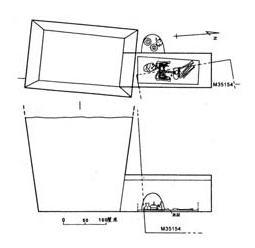
“Some of them, on the model known as <catacomb-tomb,> were composed of shafts whose bottom was dug out laterally so as to form a chamber closed by a low wall of unfired adobe bricks, wood or branches. The body of the deceased rested inside with burial objects, deposited at his head in most cases. The custom of burying a dog in a waist pit under the coffin of the deceased has been attested in Qin, as in several other sites of the same period in north China. The prevailing orientation for the deceased’s head is the west.”
“Many of the dead are lying on their backs, legs folded to the left or right side. This is a specific characteristic of a large number of Qin burials, a fact that is explained in various ways. Whatever the reason, this is a cultural marker related to very ancient practices widespread in Qinghai and Gansu and, farther afield, in central Asia. This custom continued until the late 3rd century, as exemplified in tomb 11 at Shuihudi, Yunmeng county, Hubei, dated to 217BC. It may be linked to religious beliefs. A folded leg posture could frighten away evil spirits according to an almanac discovered at Shuihudi.”
Falkenhausen – Mortuary behavior
“As for the earthenware vessels imitating ritual bronze vessels, they developed in the Chu area in larger proportions than in any other place, and earlier, from the 8th century BC on. The production of pots specifically for burial and fired at a lower temperature so that they were unusable in daily life appeared much earlier in China, but they did not occur in such numbers as in the Chu kingdom and the Qin principality during the Eastern Zhou period. Also, the imitations of bronze vessels in Chu are often of high quality. By contrast, the relatively low quality of the burial objects is a characteristic trait of the Qin. The ritual bronze vessels, like the ritual jades found in Qin tombs are among the less well worked of the Zhou period, made in an awkward style. Several of the elements just mentioned seem to indicate that Qin people tended to reserve for the dead objects necessarily different from those of the living, either cheap substitutes or models of real objects.”
“Of vast dimensions (around 140 square meters), the guo was composed of 4 compartments (large enough to be considered as chambers, which is not generally the case elsewhere in the Chu kingdom) arranged in an irregular layout: to the east, the chamber where the deceased reposed, in two nested coffins; in the center, a chamber containing the ritual vessels and a set of musical instruments used during the ceremonies; to the west, a chamber holding the coffins of 13 women; to the north, a small chamber containing weapons, two enormous bronze jars, and the inventories of the chariots which composed the cortege and carried the gifts of the relatives of the deceased and princes and officers close to him at the time of the funeral. (…) 8 coffins containing the remains of young women, no doubt servants or musicians, and, finally, a dog’s coffin placed close to that of the deceased (in earlier tombs, dogs were found buried in sacrificial pits). On a symbolic level, this chamber seems to have represented his private apartments, whereas the central chamber was used for rituals and symbolized his official life. The northern chamber formed a kind of armory, with everything necessary for a warlord of this period. The western chamber probably contained the household staff of the deceased (perhaps in charge of the ritual ensemble or the musical instruments of the central chamber). The 4 rooms communicated with each other, at least symbolically, because the openings were very small (about 40cm wide and high). The idea of communication within the tomb is also suggested by the paintings on the double coffin, since on the sides of the inner coffin a window and two doors were represented, and the larger coffin had on one side a small opening of the same size as the openings between the chambers.”
“The idea that a man had two souls hun and po seems to have appeared in the 4th century BC or even before.”
“For the location of cemeteries or isolated tombs, the Chu people chose a hill or a terrace, an elevated area, as opposed to the plain, often swampy and reserved for crops. Besides these practical reasons, there were perhaps other reasons, religious or symbolic, for the phenomenon is characteristic of the entire Chu cultural area. The tombs are characterized by the presence of an outer coffin of limited dimensions (around 9m × 7m for the largest), carefully constructed with thick and solid beams.”
“The number of compartments, between one and six, is proportional to the size of the tomb, and seems to be related to the status of the deceased, as is his coffin, which may be contained in one or two other nested coffins placed in the central compartment of the guo.”
“In the largest Chu tombs, the orientation to the east prevails, whereas most of the deceased of medium-sized and small tombs were oriented to the south.”
“In effect, we see the decline of the ritual bronzes in two different ways. On the one hand, in the 4th century BC in Chu, not only do they no longer carry inscriptions, they are often badly cast, not smoothed after the cast, even unusable. On the other hand, the use of earthenware replicas of ritual vessels increased greatly in the Chu kingdom (this phenomenon existed also in the other kingdoms and principalities, but in lesser proportions). While the ritual ensembles no longer played their previous leading role among the burial objects, new and different categories of objects, related to earthly life, were present in the tomb: furniture (beds, low tables, arm and back rests, lamps, gaming tables), luxurious tableware (separate from the ritual utensils), personal effects (combs, hairpieces, hairpins, mirrors, fans, shoes, clothes), sets of writing utensils, bamboo slips, and always, following a centuries-old custom, weapons. In the choice of objects various functions appear: the conduct of war, grooming [assepsia e adorno], entertainment, the pleasures of the table, rites which the deceased should follow during his lifetime. While the ritual sets composed of substitutes of low quality are only symbolically present, the other objects are of ostentatious luxury.”
“In the arrangement of the tomb, as in its contents, the material comfort of the deceased was thereafter assured. Beyond the conformism inherent in the social classes to which the deceased belonged, the choices made for the composition of the burial furnishings seem to be in accordance with the personal destiny of the deceased, and not only with the social position he occupied in his lifetime.”
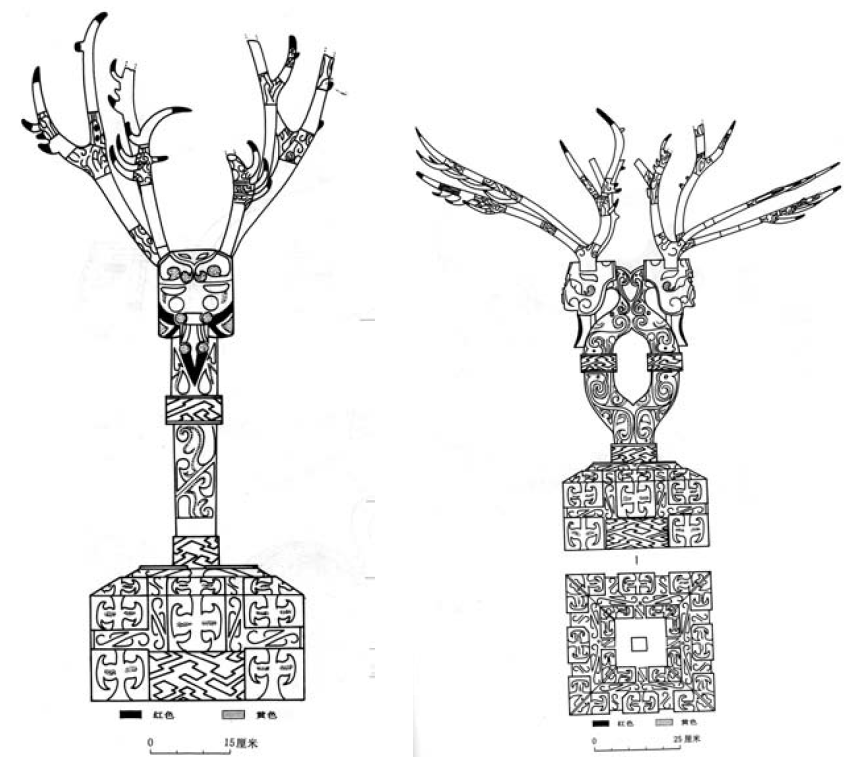
“At the same time, the protection of the tomb aimed for efficacy, and the measures of a magical character were no longer expressed by animal or human sacrifice but by the presence of sculptures of monster guardians of the tombs, the zhenmushou [representadas abaixo], whose function was to ward off the serpents which would come and feed off the corpse. Perhaps the living sought also in this way to protect themselves from the dead, to dissuade them from coming back to torment the living.”
BRONZE INSCRIPTIONS, THE SHIJING AND THE SHANGSHU:
THE EVOLUTION OF THE ANCESTRAL SACRIFICE DURING THE WESTERN ZHOU
∗
MARTIN KERN
“even the earliest texts reflect linguistic and intellectual developments that, when compared to the data available from bronze inscriptions, postdate the early Western Zhou reigns. Thus, these texts were either partially updated or wholly created not by the sage rulers of the early Western Zhou but by their distant, late-Western or early Eastern Zhou descendants who commemorated them. In the case of the Documents, this is true not only for those speeches that have long been recognized as postdating the Western Zhou—for example, King Wu’s (1049/45–1043 BC) <Exhortation at Mu> (Mu shi), purportedly delivered at dawn before the decisive battle against the Shang, but clearly a post-Western Zhou text—but also for the 12 speeches that have been generally accepted as the core Documents chapters from the reign of King Cheng (1042/35–1006 BC), including the regency of the Duke of Zhou (1042–1036 BC)¹. In other words, all our transmitted sources that speak about the early Western Zhou are likely later idealizations that arose in times of dynastic decline and from a pronounced sense of loss and deficiency: first in the middle and later stages of the Western Zhou, that is, after King Zhao’s (r. 977/75–957 BC) disastrous campaign south; and second in the time of Confucius (551–479 BC) and the following half millennium of the Warring States and the early imperial period.
¹ The argument for the authenticity of these speeches is outlined in Herlee G. Creel, The origins of statecraft in China, vol. 1, The Western Chou empire (Chicago, 1970), pp. 447–63, and re-iterated in Shaughnessy, <Shang shu (Shu ching),> in Early Chinese texts, ed. Michael Loewe (Berkeley, 1993), p. 379. However, Kai Vogelsang, <Inscriptions and proclamations: on the authenticity of the ‘gao’ chapters in the Book of documents,> Bulletin of the Museum of Far Eastern Antiquities 74 (2002), pp. 138–209, has raised serious doubts about Creel’s conclusions; instead, his sophisticated and detailed study (and recent works by others cited there, including by He Dingsheng and Vassilij M. Kryukov) suggests a late Western Zhou or early Chunqiu date for the early layers of both the Songs and the Documents. A similar argument is advanced in Kern [eu mesmo], <The performance of writing in Western Zhou China,> in The poetics of grammar and the metaphysics of sound and sign, eds. Sergio La Porta and David Shulman (Leiden, 2007), pp. 109–76.”
Baxter, “Zhou and Han phonology in the Shijing,” in Studies in the historical phonology of Asian languages, eds. William G. Boltz and Michael C. Shapiro (Amsterdam, 1991)
“In general, the case of the speeches is more problematic than that of the hymns. While the Songs were largely stable in their archaic wording since at least the late 4th century BC, regardless of their high degree of graphic variants in early manuscripts and profound differences in interpretation¹, the text of the Documents was still much in flux far into Han times. However, despite these editorial interventions, the early layers of the received Songs and Documents display an archaic diction in lexical choices and ideology that in general fits well with the epigraphic evidence from late (but not early) Western Zhou and early Springs and Autumns (Chunqiu) period (722–486 BC) bronze inscriptions.
¹ Because of the basic monosyllabic nature of the classical Chinese language and its large numbers of homophones, this is not to say that those who in the early period occasionally wrote down parts of the Songs necessarily agreed in every case on the word behind the many different graphs that could be used to write it (…) see Kern, <Excavated manuscripts and their Socratic pleasures: newly discovered challenges in reading the ‘Airs of the States,’> Études Asiatiques/Asiatische Studien 61.3 (2007), 775–93. However, textual ambiguity was a far more serious problem with the <Airs of the States> (Guofeng) section of the Songs than with the ritual hymns related to the ancestral sacrifice.”
“Untouched by later editorial change, the bronze texts provide not only the best linguistic, historical and ideological standards against which the Songs and the Documents have to be measured and dated; they also provide pristine contemporaneous evidence for the Western Zhou ancestral sacrifice itself. While their information about specific ritual procedures is not nearly as detailed as in the hymns and speeches (to say nothing of the much later elaborations in the ritual classics and other texts), they nevertheless open a window into some very specific evidence of court ceremony, present us with the very artifacts that were used for sacrificial offerings, and allow us to chronologically stratify important historical developments in Western Zhou ritual practice and ideology between the early (ca. 1045–957 BC), middle (956–858 BC) and late (857–771 BC) periods of the dynasty. Especially the last point is critically important, as it helps us to rethink some of the central tenets of Western Zhou religion. To raise some specific examples, none of them trivial: in the early hymns and speeches from the Songs and the Documents—and far more so in later sources—the interrelated notions of <Son of Heaven> (tianzi) and <Mandate of Heaven> (tianming) appear as singularly central and critical to the political legitimacy and religious underpinnings of early Western Zhou rule. Neither term, however, appears with any frequency in early Western Zhou bronze inscriptions, that is, during the reigns of kings Wu, Cheng, Kang (1005/3–978 BC), and Zhao.”
“The commemoration of origin, and with it of the religious legitimacy of the entire dynasty, created an ideal past as a parallel reality to an actual experience of loss and decay. When Confucius and his followers began to enshrine the ideal past in an ideal body of texts—later called the Five Classics(Wu jing), with the Songs and the Documents at its historical core—they unknowingly preserved not the cultural, political and religious expression of the early Western Zhou but only its subsequent, and already highly idealized, commemoration.”
“I disagree with Maspero (and Shaughnessy) on the—to my mind anachronistic—idea of individual literary authors or even a <solitary poet> (Shaughnessy) at the Western Zhou royal court; instead, I see the hymns, speeches and inscriptions as the work of ritual specialists who composed these texts in an institutional framework.”
“Western Zhou bronze inscriptions mentioning military affairs record only victories; and while the famous Shi Qiang-pan inscription of ca. 900 BC praises King Zhao for having subdued the southern people of Chu and Jing, other historical sources inform us that the royal expedition south suffered a crushing defeat that destroyed the Zhou army and even left the king dead. The fact that a royal scribe of highest rank was granted a wide and shallow water basin inscribed with a text that was as prominently displayed as it was historically inaccurate merely two generations after King Zhao’s death shows that the true question answered by the inscribed narrative was not, <What has happened?> but, <What do we wish to remember?> (…) In both hymns and speeches, this perspective is consistently emphasized through the intense use of first and second person pronouns.”
“by its nature of <multi-media happenings> that involved converging patterns of song, music, dance, fragrance, speech, material artifacts and sacrificial offerings, the sacrifice embodied the cultural practices of elite life” “And finally, the ancestral sacrifice was directly connected to other ritual, social and political activities, among them banquets and ceremonies of administrative appointment. In these combined functions, the ancestral sacrifice was at the very center of Western Zhou social, religious and political activities.”
Falkenhausen, Ritual music in Bronze Age China: an archaeological perspective (PhD diss., Harvard University, 1988)
“the role of the impersonator (shi), in which an adolescent member of the family served as the medium for the ancestral spirits”
“<may sons of sons, grandsons of grandsons, forever treasure and use [this sacrificial vessel]>Xu Zhongshu, <Jinwen guci shili>, Bulletin of the Institute of History and Philology 6.1 (1936), 1–44, has estimated that 70–80% of all bronze inscriptions end with this formula.”
“While circumstantial evidence strongly suggests the presence of writing in administrative, economic, legal and other pragmatic contexts, this writing was not preserved in the ways the inscriptions (through durable material) and the hymns and speeches (through tradition) were. Phrased the other way around, without the institution of the ancestral sacrifice, none of the earliest sources would have come into existence or have been transmitted the way they were.”
“Warring States and early imperial texts contain elaborate descriptions of the temple and refer to it primarily as miao (temple) or zongmiao (lineage temple); the three ritual classics in particular provide extensive information about its multi-layered architecture in conjunction with the rituals performed within it.”
“Archaeologists and art historians have attempted to interpret excavated building foundations as those of large-scale temple complexes. In another step, these interpretations have led to complex drawings of the presumed—and long lost—temple architecture above ground, complete with courtyards and roofed buildings of multiple chambers.” “Impressive and inspiring as these reconstructions are, they tend to draw on an extremely diverse body of far later sources and are difficult to substantiate from the available early evidence. To reconstruct above-ground architecture from building foundations is bold, and nothing in these foundations of pounded earth proves that the building they supported was indeed an ancestral temple.” “Furthermore, the ritual classics—none of which predate the late Warring States period—are not reliable descriptions of buildings and accounts of religious practices from more than half a millennium earlier; instead, they must be understood as composite, diachronic and normative idealizations from those who imagined an age long gone by. None of the early layers of the Songs and Documents provides any description of an ancestral temple, nor does a single Western Zhou bronze inscription, and even the term miao appears just once in the entire 12 early chapters of the Documents, in only three of the <Major court hymns,> and in only one of the <Eulogies of Zhou>—<Clear temple> (Qing miao, Mao 266), the paradigmatic sacrificial hymn purportedly in praise of King Wen. Of the mere 23 inscriptions in the Jinwen yinde that mention miao, 20 are from the middle and late Western Zhou periods, and 19 of them follow the same formula as in, for example, the late Western Zhou Da Ke-ding tripod: <The king was in (the capital) Ancestral Zhou. At dawn, the king entered the miao of (his ancestor, King) Mu.> This brief remark is followed not by an account of his sacrifice in the temple but by an extensive description of an appointment ceremony in which the king commanded a subject to take up a certain position and bestowed on him the insignia for the task.”
“the temple was also the site of administrative and diplomatic activities; or more precisely, the same location functioned as both temple and administrative office.”
“The 31 <Eulogies of Zhou> are very short pieces—20 of them less than 50 characters long—and are believed to be the sacrificial hymns through which the Western Zhou rulers addressed their ancestors, the early kings from King Wen to King Kang. In addition, the 31 <Major court hymns> provide the master narrative of early Zhou history and culture; presumably performed at royal banquets, they also contain a certain number of references to the sacrifices, and so do a small group of songs from the 74 <Minor court hymns>. While all the <Court hymns> are distinguished by their regular tetrasyllabic meter, orderly rhymes, stanzaic divisions [Divisão em estrofes], overall length and extensive narrative structure, many of the <Eulogies of Zhou> are notably lacking in these features and for this reason have been understood—rightly or wrongly—as genuinely archaic.”
“It is the Mandate of Heaven,
How majestic and not ending!
Ah, greatly illustrious—
How pure the virtuous power of King Wen!
[His] fi ne blessings flow to us in abundance,
May we receive them!
[He who] grandly gives us favors is King Wen—
[His] distant descendants will strengthen them.”
Mao 267
“The brilliant and cultured [ancestral] lords and rulers
Have bestowed [on us] these blessings and favors.
[Their] kindness to us has been without limits—
Sons and grandsons will preserve it.
There are no fiefs [feudos] that are not in your land,
It is the king who shall be honoring them.
Remember these great accomplishments [of the past],
Continuing and extending, may [you] revere them as august.
Truly valorous [the king] is indeed as a man,
In all four quarters, may [you] follow him.
Greatly illustrious is indeed [his] virtuous power.
The hundred lords, may they regard it as [their] model—
Oh, the former kings are not forgotten.”
Mao 269
“There are blind musicians, there are blind musicians,
They are in the courtyard of the Zhou temple.
We have set up the boards, we have set up the vertical posts for bells
[and drums,
With raised flanges¹, planted feathers,
The small responding and introducing drums, the large suspended
[drums,
The little hand drums, chime stones, rattles, and clappers—
All prepared and now played.
The panpipes [flauta de Pã] and flutes are all raised—
Huang-huang is their sound.
Solemn and concordant their harmonious tune—
The former ancestors, these are listening!
Our guests the ancestors have arrived,
For long they observe this performance.”
Mao 280
¹ Espécie de roldana, disco de metal aparafusável, mesma nomenclatura que no Português
“The bells and drums go huang-huang,
The chime stones and flutes go jiang-jiang;
The blessings sent down are xiang-xiang.
The blessings sent down are jian-jian,
The awe-inspiring demeanor is fan-fan.
The spirits, they are drunk, they are satiated—
Blessings and fortune come in return!”
Mao 274
“Here, an important performative element of the sacrificial hymns becomes visible, namely, their euphonic qualities that contribute to the overall aesthetic experience of the ritual performance. Not only does <Strong and valorous> array 5 reduplicatives in a row, in each line occupying 2 out of 4 characters, the lines also constitute 2 rhyme sequences that in the translation are separated by the line space (huang-jiang-xiang versus jian-fan (<return>)-fan).”
Falkenhausen – Suspended music: chime bells in the culture of Bronze Age China (Berkeley, 1993)
Jenny F. So (ed.) – Music in the age of Confucius (Washington, 2000)
Kern – Shi jing songs as performance texts: a case study of “Chu ci” (“Thorny caltrop”), Early China 25 (2000)
“Those who are coming are yong-yong (harmonious),
As they arrive, they are su-su (solemn)
Assisting are the lords and princes,
The Son of Heaven is mu-mu (majestic).
Ah, as we offer the large bull
Assist me in setting forth the sacrifice!
Come, o!, my august father,
Comfort me, the sacrificing son!
(…)
Having regaled the brilliant father,
I also regale the cultured mother.”
Mao 282
Bernhard Karlgren, ‘Legends and cults in ancient China’, Bulletin of the Museum of Far Eastern Antiquities 18 (1946), 199–365; Wolfram Eberhard, Review of Karlgren, ‘Legends and cults’, in Artibus Asiae IX (1946), 355–64.
B. ______, Glosses on the Book of odes (Stockholm, 1964)
“Unlike the latter, the <Major court hymns> are very extensive pieces—some of them several hundred characters long—that present the broad foundational narrative of the origin and early development of Zhou civilization. While it is unclear whether or not any of these hymns were performed in the ancestral sacrifice, their grand narrative of the Zhou must have pervaded the sacrifice as well as other ritual performances at the Zhou court.”
“Wang, From ritual to allegory, pp. 73–114, compares the narrative of King Wen as told in the <Major court hymns> to the epics of early Greece.”
“It is not merely here what we have here;
it is not merely now what is now;
since ancient times, it is like this”
“The richest account of the Zhou ancestral sacrifice comes from the <Minor court hymn>Thorny caltrop that deserves to be quoted in full. The hymn comprises 72 tetrasyllabic lines divided into 6 stanzas of equal length. Every stanza except the 5th begins with a new rhyme, and additional rhyme changes occur in stanzas four, five and six. In the following, I indicate the rhymes in square brackets (…) changes of rhyme indicate actual shifts of voices in the ritual communication among the participants, or shifts in the direction or perspective of speech.” “This construction suggests not a genuine performance text sung in the ancestral sacrifice but a more complex textual artifact: a versified commemorative narrative that aims to preserve the authentic expressions of an earlier sacrifice while also providing guidance for an audience, certainly postdating the Western Zhou, that was no longer familiar with the original sacrificial practice.”
“Stanza 1:
[Invoker addressing the impersonator(s) of the ancestor(s) on behalf of the descendant:]
Thorny, thorny is the caltrop—
So we remove its prickles. [A]
Since times of old, what have we done?
We plant the panicled millet, the glutinous millet: [A]
Our panicled millet is abundant, abundant,
Our glutinous millet is orderly, orderly. [A]
Our granaries being full,
Our sheaves are in hundreds of thousands. [A]
With them, we make ale and food: [A]
To offer, to sacrifice, [A]
To assuage, to provision, [A]
To pray for radiant blessings! [A]
Stanza 2:
[Invoker addressing the descendant:]
Dignified, dignified, processional, processional—[B]
You have purified your oxen and sheep, [B]
Proceeding to the winter sacrifice, the autumn sacrifice. [B]
Some flay, some boil, [B]
Some arrange, some present. [B]
The invoker sacrifices inside the temple gate, [B]
The sacrificial service is greatly shining. [B]
The ancestors, these you make to return, [B]
The divine protectors, these you feast. [B]
The offering descendant shall have benison! [B]
He will be requited with great blessings—
Ten thousand years longevity without limit! [B]
Stanza 3:
[Invoker addressing the descendant:]
The furnace managers are attentive, attentive, [C]
Making the sacrificial stands grand and magnificent: [C]
Some meat is roasted, some is broiled. [C]
The noble wives are solemn, solemn, [C]
Making the plates grand and numerous. [C]
With those who are guests, with those who are visitors, [C]
Presentations and toasts are exchanged. [C]
Rites and ceremony are perfectly to the rule, [C]
Laughter and talk are perfectly measured. [C]
The divine protector, he is led to arrive, [C]
He will requite you with great blessings—
Ten thousand years longevity will be your reward! [C]
Stanza 4:
[Principal descendant:]
We are greatly reverential, [D]
Form and rites are without transgression. [D]
[Narrative comment]
The officiating invoker invokes the spirits’ announcement,
He goes and presents it to the offering descendant:
[Invoker addressing the descendant on behalf of the ancestors:]
You have made fragrant and aromatic the offering sacrifice, [A]
The spirits enjoy the drink and food; [A]
They predict for you a hundred blessings. [A]
According to the proper quantities, according to the proper rules, [A]
You have brought sacrificial grain, you have brought glutinous millet, [A]
You have put them in baskets, you have arranged them. [A]
Forever the spirits bestow on you the utmost, [A]
This ten-thousandfold, this hundred-thousandfold! [A]
Stanza 5:
[Principal descendant (?):]
Rites and ceremony are completed, [A]
Bells and drums have given their warning. [A]
[Narrative comment]:
The offering descendant goes to his place,
The officiating invoker delivers the announcement:
[Invoker addressing the impersonator(s) of the ancestor(s) on behalf of the descendant:]
The spirits are all drunk— [E]
The august impersonators may now rise!” [E]
[Narrative comment]:
Drums and bells escort the impersonators away;
And so the divine protector returns. [F]
The many attendants and the noble wives
Clear and remove the dishes without delay. [F]
The many fathers and the brothers
All together banquet among themselves. [F]
Stanza 6:
[Narrative comment]:
The musicians all come in to perform, [G]
To secure the subsequent fortune. [G]
[Invoker addressing the descendant:]
Your viands have been set forth, [B]
Without resentment, all are happy! [B]
[Male clan members addressing the descendant:]
We are drunk, we are satiated; [H]
young and old, we bow our heads. [H]
The spirits have enjoyed the drink and food,
They cause you, the lord, to live long! [H]
[Invoker addressing the descendant:]
Greatly compliant, greatly timely
is how you have completed the rites. [I]
Sons of sons, grandsons of grandsons,
Let them not fail to continue these rites! [I]”
“It shows the ancestral sacrifice as a communal affair where members of the family, guests, and ritual officials fulfilled their prescribed roles, including the impersonator(s)—one or more young members of the family—that, once inebriated, spoke in the tongues representing the ancestral spirits.” “<Thorny caltrop>encapsulates not any particular performance but the blueprint and essence of all such performances. By contrast, bronze inscriptions frequently do name their patrons and also the ritual officials in the appointment ceremonies. The act of having a bronze vessel cast reflected the merits of a particular individual for whom it apparently was important to historicize the ceremony by referring to the appointment ceremony not merely as a royal institution but to one particular instantiation of that institution, complete with the names of those present—a phenomenon that reflects a strong concern with the continuity of memory over future generations but perhaps also the contractual dimensions of a royal appointment.”
“the <AXAY> [rhyme] structure is almost exclusively confined to the ritual hymns in the Book of songs (compared to the <Airs of the states> in the same anthology)—especially the <Major court hymns>—and so is the intensity with which the reduplicatives follow upon one another.”
“August indeed!” – stanza 8
“The engines of assault were strong, strong,
the walls of Chong were high, high.
Captives to be questioned came in procession, procession,
Cut-off ears were presented calmly, calmly.
These he offered at the war sacrifice, these he offered at the conquest
[sacrifice.
These he brought forward, these he appended.
Within the four quarters, there was none who affronted him.
The engines of assault were powerful, powerful,
The walls of Chong were towering, towering.
These he attacked, these he assailed,
These he put to an end, these he exterminated.
Within the four quarters, there was none who opposed him.”
W.A.H.C. Dobson – The language of the Book of songs (Toronto, 1968)
UM SOFTWARE SINCRETISTA “CRIOU” A RELIGIÃO CHINESA (LÉVI-STRAUSS GARGALHA NO SUBTERRÂNEO):“They are intertwined and overlap; they appear in recursive loops or parallel linear structures; they create a dense and multi-layered texture that resonates between lines, stanzas and whole songs. Their rich, tangible language embodies the Zhou institutions of cultural memory— sacrifice and banquet—and expresses cultural coherence, genealogical reproduction and political authority.
The features of the <Eulogies> and <Court hymns,> and the ways in which they blend language and performance, are not unique to Zhou China but have been identified and analyzed by anthropologists and linguists in other cultures as well. According to these studies, there is a striking overlap between the language of poetry, the aesthetics of ritual, and the ideology of memory. Stanley J. Tambiah has offered a useful description of ritual as
a culturally constructed system of symbolic communication. It is constituted of patterned and ordered sequences of words and acts, often expressed in multiple media, whose content and arrangement are characterized in varying degree by formality (conventionality), stereotypy (rigidity), condensation (fusion), and redundancy (repetition). [Culture, thought, and social action: an anthropological perspective (Cambridge, 1985), p. 128.]”
O SOFRIMENTO DE QUEM ESTÁ “FOR A DO TEMPO”: “It can be taken as general knowledge that poetic formation serves primarily the mnemotechnical purpose of putting identity-securing knowledge into a durable form. We are by now equally familiar with the fact that this knowledge is usually performed in the form of a multi-media staging which embeds the linguistic text undetachably in voice, body, miming, gesture, dance, rhythm, and ritual act . . . By the regularity of their recurrence, feasts and rites grant the imparting and transmission of identity-securing knowledge and hence the reproduction of cultural identity. Ritual repetition secures the coherence of the group in space and time.”Assmann, Das kulturelle Gedächtnis: Schrift , Erinnerung und politische Identität in frühen Hochkulturen (Munich, 1992), pp. 56–57 (my translation [Kern]); see also pp. 143–44.”
“Maurice Bloch has characterized ritual speech as <formalized> and <impoverished language,> as the <language of traditional authority> where <many of the options at all levels of language are abandoned so that choice of form, of style, of words and of syntax is less than in ordinary language.>Bloch holds that <religion uses forms of communication which do not have propositional force> and that in a song, <no argument or reasoning can be communicated . . . You cannot argue with a song.>”B. – Symbols, song, dance and features of articulation
David Schaberg, Song and the historical imagination in early China, Harvard Journal of Asiatic Studies 59 (1999);
______, Foundations of Chinese historiography: literary representation in Zuo Zhuan and Guoyu (Harvard University, 1996)
Kern, The poetry of Han historiography, Early Medieval China 10–11.1 (2004)
“Through remembrance, history turns into myth. By this, it does not become unreal but, on the contrary and only then, reality in the sense of a continual normative and formative force.” Assmann – Das kulturelle Gedächtnis
“In particular, religious celebrations of founding myths, such as the commemoration of the Israelite exodus in the Passover, are often performed in communal feasts. Here, the identity of the commemorating group is affirmed through reference to its shared past, and its collective identity is communicated in a ceremonial setting where remembrance <coagulates into texts, dances, images, and rites>.”
“In short, linguistic evidence, historical context and conceptual considerations on the nature and practice of cultural memory all converge in the argument for, at the earliest, a mid- or late Western Zhou date for the 12 speeches, and for their genuine place in the sacrifices and banquets of royal commemoration and political identity.” “The 12 speeches do not use rhyme but show a preference for rhythmic patterns, repetitions of various kinds, frequent exclamations like <Alas!> at the beginning of a paragraph, catalogues (as in lists of dignitaries and functionaries) and the regular use of fixed formulae such as <I, the small child> that are also familiar from bronze inscriptions.” “As no pronoun (or explicit subject) is required in classical Chinese, their heavy use—a feature typical of liturgical speech—is a conscious stylistic choice that adds rhythm, intensity and a rhetorical emphasis on personality to the speech.” “See Wheelock, <The problem of ritual language>, p. 50: <One of the first things that strikes one about liturgical utterances is the heavy usage of pronouns, adverbs, ellipses and the like that make reference to the immediate environment of the speaker and depend upon that context for their meaning.>”
“The king said:
I declare to you, the many officers of Yin:
Now, that I, indeed, have not killed you;
I, indeed, will give this command once again.
Now I make a great city in this place of Luo.
I, indeed, across the four quarters have none whom I reject.
And indeed it is you, the many officers,
Who should rush to submit and hasten to serve us—
Be greatly obedient!
You, then, may have your land!
You, then, may be tranquil in your duties and dwellings.
If you can be reverential,
Heaven, indeed, will favor and pity you.
If you cannot be reverential,
You not only will not have your land—
I also will apply the punishments of Heaven
To you as persons.
Now you indeed shall dwell in your city,
perpetuate your residence.
You, then, will have duties, will have years in this place of Luo.
Your small children will then prosper,
Following your being moved here.”
“Longer inscriptions only gradually emerged in early Western Zhou times and became increasingly frequent over the middle and later periods of the dynasty. At the same time, their placement in the bronze vessels changed over time: initially hidden deep inside the vessel and hence not visible for the human eye or at least very hard to discern, the inscriptions became not only longer over time but also more prominently placed.”
“While bells are known already from late third millennium BC and musical chime-bells were already used during the late Shang period, the yongzhong musical bells, originally not part of the northern (including royal) ritual culture, were adopted from the south” “when sets of vessels and bells were inscribed, they all carried identical inscriptions; bronze bells were now introduced to the ensemble of ritual artifacts, adding the element of music to the ceremonies; minute detail in ornament was replaced by larger patterns that oft en included bold, even coarse, wave bands; and the calligraphy of bronze inscriptions became increasingly regular and symmetrically arranged. Altogether, an overall uniformity of design was imposed across the entire range of bronze ritual paraphernalia, and their increased size, larger ornament and arrangement in sets suggest a shift from a more private ritual of the ancestral sacrifice to one with larger numbers of participants perhaps standing at some distance.”
“away from <dionysian> rituals centered upon dynamic, even frenzied movement, to a new kind of far more formalized ceremonies of <apollonian> character, in which it was the paraphernalia themselves, and their orderly display, that commanded the principal attention of the participants.” Falkenh.
K.C. Chang, The animal in Shang and Chou bronze art, Harvard Journal of Asiatic Studies 41 (1981)
______. Art, myth, and ritual: the path to political authority in ancient China (Cambridge, 1983)
J. Rawson, Late Shang bronze design: meaning and purpose IN: Roderick (ed.) – The problem of meaning in early Chinese ritual bronzes, Whitfield (London, 1993)
“while early Western Zhou bronzes seem to have varied from decade to decade and those of middle Western Zhou at least by quality of surface design, the late Western Zhou period bronzes are rigidly uniform. There seems to have been little variety either from owner to owner or from place to place over the hundred years of their use. A strong centralized control of ritual seems to have been in place . . . In the same way, inscriptions seem unvarying, as though a single model for the range of expression, for the contents, and for the shapes of the characters was in force . . . these characters seem closely dependent on early written forms and thus suggest an element of deliberate archaism. Other suggestions of archaism are seen in some vessel shapes . . . It would appear that this interest in the past was twofold, first in the reproduction of ancient shapes of vessel and character type, and second in the collection of older bronzes . . . Where the vessels (found in hoards [aos montes]) are late and fall into the sets just mentioned, the inscriptions are beautifully written but stereotyped in content.” Rawson – Western Zhou archaeology
Rawson – Statesmen or barbarians
“As the appointment ceremony inscriptions show, the inscription was the final result of an elaborate, multi-step ceremony in which a high dignitary reported to the Zhou king, then received the royal command in a ceremony held in the courtyard of the royal ancestral temple, and finally was granted the right to have a vessel—inscribed or not—cast, most likely in the royal workshop. Having received the vessel, he was entitled to use it in his own ancestral sacrifices. If inscribed, the vessel text could be as short as noting its patron and his dedication (<I have made this vessel>); next, it could include a prayer for blessings to express the ritual use of the artifact. Further extended, it could provide an account of the patron’s merits that was probably based either on his report to the king or on the king’s appointment in response.” “The most complete versions of the ceremony (or perhaps a series of ceremonies) can be found in the magnificent inscriptions of 373 characters on the Qiu-pan water basin that is further related to other lengthy inscriptions, including those on two separate series of Qiu-ding tripods from 786 and 785 BC, that were all found in 2003 in Yangjiacun (Mei xian, Shaanxi).”
“The bronze inscriptions of mid- and late Western Zhou times show conscious efforts toward poetic form. Especially in the wake of the ritual reforms, a greater number of inscriptions were guided by the same principles of rhyme and meter familiar from the Songs. The great majority of Western Zhou inscriptions include just a few graphs, but the two longest known bronze texts so far come close to 500 characters, and others contain from several dozen to 200–300 characters. All these more extensive texts fall into the range of length of the transmitted hymns. While rhyme and tetrasyllabic meter occur already among the earliest Western Zhou inscriptions, these features become increasingly regular from the periods of kings Gong and Yi onward, as do the calligraphy and overall visual layout (linear arrangement, spacing between graphs, etc.) of the inscriptions.”
“The oral performance of inscribed texts is not unusual elsewhere; for the ancient Greek example, see Rosalind Thomas, Literacy and orality in ancient Greece (Cambridge, 1995)”
“The ephemeral nature of performance became eternalized in the continuous existence of a repertoire of texts that finally transcended any particular occasion. Both hymns and inscriptions commemorated the ancestors as much as their own sacrificial ritual to serve them. Raising and answering a question like <Truly—our sacrifices are like what?> (<Thorny caltrop>), the hymnic text was the voice through which the ritual performance interpreted itself. Hymns and inscriptions contained, however abbreviated, what must not fall into oblivion: the order of culture, as embodied in the order of the sacrifice.”
“Truly—our sacrifices, what are they like?
Some hull (he grain, some scoop it;
Some sift it, some tread it.
Washing it, we hear it swish, swish;
Distilling it, we see it steam, steam.
Now we consult, now we consider;
We take southern-wood to sacrifice the fat,
We take a ram to flay it.
Now we roast, now we broil;
To give rise to the following year.
We load the wooden trenchers,
The wooden trenchers, the earthenware platters.
As the fragrance begins to rise,
The Lord on High is tranquil and delighted.
How good the fragrance is indeed!
Lord Millet [?] founded the sacrifice—
Luckily, without fault or offense,
It has reached the present day.”
RITUALS FOR THE EARTH
∗
KOMINAMI ICHIRÔ (Trad. Didier Davin)
“But why revere not Earth itself but a clod of earth placed on it? According to the Baihu tong (Comprehensive discussions of the White Tiger Hall) of Ban Gu, in the section on the ritual dedicated to the gods of the earth and cereals, sheji, the reason given is as follows:
The land is vast, and it would be impossible to express reverence to all the land. There are many kinds of cereal, and it would be impossible to sacrifice to them all. That is why earth is formed into a mound to erect a she, so that Earth can be worshiped (to sacrifice to it is to show veneration). Millet [painço, mileto] being the foremost of cereals, millet is set up and sacrifices made.
Chen Li – Baihu tong shuzheng, 1994.”
“In ancient times the grand astrologer (taishi) observed the earth as it changed with the seasons. When the yang energy fills the world, the energy inside the earth thunders forth. When the constellation Auspices of agriculture appears in the south in the morning and the sun and the moon enter the constellation of the Celestial temple, the veins of the earth open up. Nine days before (the first day of spring when the ritual to Great Earth is celebrated), the grand astrologer reports to (the officer of) Millet: <From now to the first day of the second month, the yang energy will rise up and the moisture in the earth start to be active. If there is neither activity nor transformation, the veins will be obstructed and the cereals will not grow.>
(…)
The king then ordered the minister of education (situ) to warn the nobles, the hundred officers, and the common people, and the minister of works (sikong) to prepare the altars of the ceremonial rice field, and to order the grand officer of agriculture to verify that all tools were ready.”
Guoyu – Zhouyu shang, 1939.
“At the beginning of the spring the king of Zhou himself executed a simulation of plowing in order to open up work in the fields for his subjects.”
“To determine how widespread the idea of Earth as a mother goddess was in ancient China, in relation to the vitality of the earth and according to the idea the Great Earth is itself the body of a goddess, is certainly a subject for research to resolve. However, that the idea of the earth as the body of a goddess—or a primitive giant—may have existed can be also deduced from the legend of Pangu separating earth and sky, in which everything in the universe comes from the body of Pangu. The 45th chapter of the Taiping jing (Scripture of Great Peace)and the first chapter of the Bowu zhi (Extensive investigation of things) both view the surface of the earth as its skin and warn against digging deep into its flesh.”
“The duty of the grand minister of education is to be in charge of the maps of the land and the census of the population so as to help the king bring peace to the state . . .”
Rites of Zhou
“Plant for the Great she a pine tree [pinheiro], for the she of the east a cypress [cipreste], for the she of the south a birch [bétula], for the she of the west a chestnut [castanheiro], and for the she of the north a locust [alfarrobeira].”
Shangshu (Book of documents)
“Regarding the theory linking the ritual of the she and the cult of the copses [bosques], see Édouard Chavannes, Le dieu du sol dans la Chine antique, Le T’ai-chan: essai de monographie d’un culte chinois (Paris, 1910)”
“This text is precious because it tells us that officials who cannot use a wooden votive tablet [tábua] used as substitute a bundle of silk or a bunch of reeds, which served as a receptacle for the divinity. The she made from the clump of trees is the zou of tied reeds on a bigger scale, and the clump is likewise a receptacle for the divinity, its brushy sharp point probably serving to invite them.”
“In the 5th month of the year 705, a decree ordered the establishment of a Great she in the eastern capital. The imperial secretary of the office of rites, Zhu Qinming, asked the scholars and officers of rites: <In the Rites of Zhou the emblem/tablet of the field is the most appropriate tree of the region. Why now use a stone as the emblem/altar of the Great she?> The vice minister of the chamberlain of ceremonials Wei Shuxia, the director of studies Guo Shanyun, and the erudites of the chamberlain for ceremonials Zhang Zhaixian and Yin Zhizhang submitted a discussion: <In the Sanli yizong (Fundamental ideas of the three books of rites) of Cui Ling’en it is said that the use of a stone for the god of the she is because, among all things belonging to earth, stone is the most solid. Also, in the Lüshi chunqiu it is said that, in the rites of the Yin people, a stone was used for the she, and in the Hou Weishu (History of the Latter Wei) it is said that in the 4th month of the year 443 the stone emblem/altar of the Great she was moved to the palace of the earth god (shegong). Thus there are clear and ancient statements to the effect that the she tablet/emblem was made of stone. In the Rites of Zhou the trees of the various regions are also used as emblem of the fields because it is referring not to the Great she but to that of the common people. Moreover, examination of the emblem/altar of the ancient she reveals it was 1 foot 6 inches in height and 1 foot 7 inches wide on the 4 sides.
The matter was confided to the scholars and the officers of rites, that they discuss the system. Wei Shuxia and the other officers of the rites again submitted a discussion which said: <There is no regulation in the ritual texts about the size of the she emblem/altar. But when the Son of Heaven goes to war, the she tablet is transported in a carriage, and this is called the ‘rites of the earth god’. If the votive tablet of the earth god can be thus transported, it is clear that it must not be too heavy.”
Tang huiyao
“Many bones of humans and dogs were found around the stone, all buried with the head facing the stones. The humans bones were buried in a crouched position, the head down, and most of them had the hands tied behind the back. This was not the site of a simple graveyard but of a ritual in which, it is supposed, humans and dogs were sacrificed. Furthermore, the bones of the sacrificed victims were excavated in two separate layers of the early Yinxu period and the last Yinxu period, so we know this ritual site was used for a long period.
There is still some doubt as to whether these two vestiges of altars centered on a stone are directly linked to the she with an altar of stone. But we can certainly not ignore the fact they are both located in northern Jiangsu, and that they may be related to the she altar of the Eastern tribal area, culturally different from the Central Plains.”
“The king, for all the people, erected an altar (she) to (the spirit of) the ground called the Great she, and one for himself called the Lord’s she. A feudal prince, for all his people, erected one called the State she, and one for himself called the she of the Prince. Great officers and all below them in association erected such a she, called the Appointed she.”
Tradução do Livro dos ritos, in: An encylopedia of ancient ceremonial usages, religious creeds, and social institutions, James Legge, vol. 2
“The basic part of the ritual is supposed to have been determined even before the structure of the state was constituted, that is to say back in the Neolithic period when agricultural society emerged. If there is no major error in this supposition, the essence of the ritual of the she was less what the state had decreed than what was inherited from popular rituals of the she.
We can also see that the earth god ritual concerned all people, regardless of class, in the following description found in the chapter <Jingshen xun> of the Huainanzi: <At the she of remote country places, people beat vases and drum on pitchers to accompany their harmonious singing, and they consider that music.>”
“The famous episode in the biography of Chen Ping in the Shiji (Records of the historian), where Chen Ping, who was prefect, divided the ritual meat equally at the she ritual in his prefecture and was praised by the ancients for that, reveals the fact that equality was indeed the fundamental rule.”
“This popular ritual of the she occurred twice a year, no doubt ever since antiquity, in spring and autumn. In spring the prayer for a good crop was made to the she, and in autumn gratitude for the harvest was expressed to the she. As the chapter <Yueling> (Monthly ordinances) of the Liji says: <That month (the 2nd month of the lunar calendar) the fortunate day is chosen, and orders are given to the people to sacrifice at their altars to the spirit of the ground.>”
(w)ors(hip)
“In such-and-such a year and month, on the day of the new moon, the head of the she So-and-so, together with all the people of the she, announces (gao) clearly to the god of the she: It is you who supports and nourishes the people and makes all things grow. It is now the second (eighth) month, an auspicious day, and, in accord with the standard rite, we reverently off er the special sacrificial victim, clear wine and cereals, which with great deference we present to the god of the she. May you enjoy these offerings.”
Tongdian
“I would like to focus henceforth on the tradition that led the Shang people—those who created the Shang dynasty—to call their most important base <Bo> and ask why a <Bo> can be found in every place.”
“The group forming the core of the Shang moved to different places before the advent of the Shang dynasty, and even after the founding of the dynasty they moved the capital several times. According to received texts, from the ancient ancestor of the Shang Qi to King Tang, the Shang clan changed their base eight times, and after King Tang had founded the dynasty, they changed five more times the site of the capital, which was finally fixed by Pangeng near Yinxu.”
WHEREVER I MAY ROAM: ”Why did the people of the Shang clan change so frequently the site of their capital? The notes in the Pangeng chapter of the Shangshu explain that the lower and middle region of the Yellow River has an alkaline soil in which, after a certain period of use, the salt rose from the underground water, and it ceased to be suitable for agriculture. This is why the Shang had to change places continually. The problem of underground water was certainly one of the reasons, but, more fundamentally, we may speculate that the repetition of the change of base was a necessary element of the basic features of the tribal group that the Shang was at this time. Moreover, one can see that the characteristics of this tribe were taken over by the Zhou. At least until the middle of the Western Zhou, the Zhou were mainly acting as a tribal group which needed repeatedly to move from place to place.”
“the people of the Shang (and of the Zhou as well) would establish their seat, not in the center of already secured territory, from which they then expanded their domination to the peripheral regions, but on the front lines, where they fought with other tribes to expand their sphere of power.” “Thus, through their military power the Shang eliminated other tribes, and by the building of military bases one after the other they expanded their territorial domination. These military bases were probably often called shi. In the oracular inscriptions of Yinxu, as in texts inscribed on bronzes from the first years of the Western Zhou, we can see many places called Such-and-such a shi. Among them, the most important place is called jingshi, a word which will later mean the central city of a state.” “To establish a she on a specific site and celebrate a ritual to this she was a way of confirming the possession of this land in a religious way.”
“When Wu set out to slay the Yin, what was he so anxious about?
When he carried the corpse [the tablet representing the cadaver] into battle, what was he pressed by?”
Chuci (Songs of The South)
“If you obey orders well during battle, you will be rewarded by the ancestors [zu]. If you disobey orders, you will be executed before the she”
Book of documents
Tanto zu quanto she eram placas de madeira ou pedra (no caso da she encimadas por porções de terra do solo natal, caso as tropas estivessem longe – não-raro a terra era confinada num bambu, que também tinha conotação sagrada e se referia à she) representando almas de reis mortos (convertidas em divinas) e os Deuses do panteão chinês em si, diante dos quais eram ministradas as honras e as punições letais. “When the Shang militarily eliminated another tribe and obtained a new territory, the clod of earth that was carried with the army was mixed with local earth and a new she was built. By mixing the earth of the homeland with the earth of the new land, through some sort of contagious magic, the earth of the new land acquired the same stability and vitality as that from the homeland. If this measure of contagious magic was not used, a new land, even a militarily occupied one, remained a chaotic and sterile wasteland for the members of the Shang clan.”
Purificar a Lua com a bandeira americana.
“The Great she was established in the center of the country (the capital). The earth platform of the Great she was made of blue earth on the east, red on the south, white on the west, black on the north, and of yellow earth in the center. When a lord received an assignment, he dug some earth from the side corresponding to the direction of the assigned country, covered it with the yellow earth, and wrapped it in white reeds. This constituted the <enfeoffment [uma investidura, um tributo pago pelo senhor para estabelecer o ‘contrato’ de vassalagem] of the she>. That is why it was said he had received the <lineage earth> of the royal court of the Zhou.” “However, in more ancient times, in the case of military expansion of territory, even if 5 colors of earth were not used, the religious method of the transportation of a clod of earth from the homeland and the establishment of a she with it was used.”
“It is worth noting that in the Forbidden City of present-day Beijing, one can still see the platform of a sheji made in the Ming–Qing era. According to the rules of the Rites of Zhou, the shrine to the ancestors should have been built to the east side (left) and the sheji to the west (right) of the palace. The actual site of the sheji is in the Zhongshan park, but its platform is still one with 5 colors. It is hard to see when the weather is dry, but after the rain the colors of the earth of the 5 elements on the 4 sides and top of the platform is very clear.”
Muda a aristocracia, a tradição permanece: “Because the main portion of the population of Lu was linked to the boshe, Yang Hu made his alliance with them at the boshe. We may suppose that, while the zhoushe was a new she linked to the occupation of the Zhou court, the boshe had a somewhat different character, as the institution of the ancient religion. The fact that the boshe was a particular type of she containing ancient elements is typically expressed by the fact that human sacrifices were executed there.”
“In the Zuozhuan, it is the prisoners of war who are sacrificed to the boshe as an offering to the god. According to the passage, this was <the first time> a human being was sacrificed, and we may suppose it was not the last. The second item is similar, except that it involves the offering not of ordinary prisoners of war but the ruler of the defeated state himself to the boshe.”
“What is the diff erence between <meeting> (hui) and <making a covenant> (meng)? The viscount arrived late at the meeting (that is, too late to join the covenant). On the day jiyou, the lord of Zhulou captured the viscount of Zeng and used him for a sacrifice. Where did he use him? He used him at the she. How did he use him at the she? He hit him on the nose to make him bleed, and so bloodied the she.”
Gongyang zhuan
“the Gongyang zhuan explains that the sacrificial blood was just a nosebleed, but as the professor Naba Toshisada has pointed out, the sacrifice to the she using the blood of the nose is the later, simplified ritual, and there is no doubt that, originally, the victim was killed and his blood left to empty out on the she.”
“The Shang people carried a clod of earth called botu from one battlefield to the next and, when they won new territories, settled their military base there and used the botu to build a boshe at its center. The first religious activity at this new boshe was the sacrifice of the former owner of the land defeated during the acquisition of the invaded territory. Considering the fact that this rite was later simplified, with a nosebleed replacing the blood of the victim, it seems likely that the action of pouring the blood of the former lord on the she itself was the main part of the victory ritual. By this ritual procedure, the change of ownership of a defined region was religiously confirmed.” Nascimento da política e culto à terra no sentido mais mundano do termo (o déspota de Deleuze): antes, quando apenas pequenos animais eram sacrificados, a prece era por muitas chuvas e boas colheitas (protoestado agrário).
“The fact she and zu (ancestor) are phonetically related has already been noted in earlier studies. In consequence, we may suppose that if, in the first period the Shang carried only the clod of earth called botu from battle to battle and used it to make their boshe, they must have carried separately the tablets of their ancestors. Thus the she was not just a place for rituals to the earth god but, the further we go back in time, the more it was a general ritual installation with different functions.”
“6th month, day xinchou, a fire occurred at the pushe. What is the pushe? It is the she of a fallen state. The she is a mound of earth (feng). What does it mean there was a catastrophe on it? The she of the extinguished state has a roof on it. A roof is built on top of it, and firewood placed under it.”
Gongyang zhuan
“The Great she of the Son of Heaven must receive the frost, dew, wind, and rain, so as to be in communication with the energies of the earth and sky. That is why on the she of a state that has perished a roof is built so that it cannot receive the yang energies of the heavens. A window on the north side of the pushe allows light to enter from the yin direction.”
Book of Rites
“In the 6th month, on a xinwei day, the 1st of the moon, when an eclipse of the sun occurred, the drums were beaten and a sacrifice made at the she. Why? As a way of imploring the yin, a red thread was tied around the she. One explanation says this was to threaten the she, another that there was a risk that someone, in the darkness (of the eclipse), infringe the limits of the she.”
Gongyang commentary
“human actions can have an eff ect on natural phenomena like eclipses. There is no doubt that beating drums and offering sacrifices were actions made to give energy to the declining sun. Tying a red thread around the perimeter of the she can be understood as an attempt to make the red energy reach the sun through the she. When people wanted to exert a magic influence on the celestial world, they did so via the she.”
“In Chinese mythology, in a distant past, Yu made the land safe for people to live on by conquering the big flood that had covered the entire world. There are many texts mentioning this flood control by Yu; for example, the chapter <Yugong> of the Book of documents, which relates the creation of the 9 provinces and the determination of the tribute owed by each province. It begins with the following expression: <Yu spread the earth (futu). Following the mountains, he cut down trees and fixed the lofty mountains and major rivers.> The Weikong zhuan interprets this paragraph as follows:
When the flood was overflowing, Yu went to each of the nine provinces and secured their earth. When he went through a mountain forest, he cut down the trees and opened a road. The lofty mountains are the 5 great mountains, and the major rivers are the 4 great rivers. In each of them he set the procedure that must be followed for the rituals.”
PROMETEU DESACORRENTADO (PORQUE MORTO E RESSUSCITADO): ZEUS ARREPENDIDO
“Yu and Gun first spread the earth (butu) and secured all nine provinces . . . When the flooding waters engulfed the heavens, Gun stole the living earth (xirang) from Di [O Deus Supremo] and sought with it to dike the flood. Because he acted without waiting for a mandate from Di, Di ordered (ling) Zhurong to kill Gun in the vicinity of Feather (Mountain). Gun came back to life in Yu, andDi then mandated Yu to complete the task of spreading the earth (butu) so as to secure the nine provinces.”
“Yu scattered the earth, pacified the world, labored mightily on behalf of the people, and found Yi, Gaotao, Hengge, and Zhicheng to serve as his assistants.”
Xunzi
“In all likelihood, this expression has its origin in a fixed verse form of the epic narration of Yu’s labors, and even when the original meaning of this fixed verse form had became obscure, it was still used as an ancient expression inherited from the past. On the basis of the Classic of mountains and seas, where Gun starts to spread the earth and Yu completes the task, we may hypothesize that the term originally meant the use of <living earth> (xirang) from the sky. Another term for <living earth> is xitu. Both terms refer to an earth that possesses vitality and can expand spontaneously.”
AS POÇAS DE JUSENKYO
“In all, the abysmal swamps composed of vast stretches of water measuring several hundred meters in depth covered 200,033,550 leagues [mais de 1 trilhão de km!(*)] and included nine abysses. Then Yu stopped up the flooding waters with living earth that he formed into the eminent mountains.”
Huainanzi
(*) O engraçado é que, segundo consta, o volume oficial do planeta Terra é de cerca de 1 trilhão de quilômetros cúbicos!
“The xitu is never exhausted: the more it is dug the more abundant it becomes. That is why the flooding waters could be stopped up by it.”
Gao You commentary
“When the owl and the turtle (taught him the flood control method by) pulling [and holding in the mouth,
Why did Gun not follow what they said?
And if he almost accomplished the work according to his will,
Why did the High Lord (Di) punish him?
Long he lay cast off on Feather Mountain.
Why did he not rot for three years?
Lord Yu came forth from the belly of Gun.
How was he transformed?
Yu inherited the same tradition
And carried on the work of his father.
Why was it that though he continued the work already begun,
His plan was a different one?
How did he fill the flood waters up
Where they were most deep?
How did he set bounds
To the Nine Lands of the earth?
What did the winged dragon trace on the ground?
Where did the seas and rivers flow?
What did Gun labour on,
And what did Yu accomplish?”
Songs of the South (tr. Hawkes)
“Here the fact that the task of containing the flood was started by the father Gun and completed by the son Yu is pointed out. While Gun, sacrificing himself, stole the living earth treasured by Di, the High Lord, Yu then spread it everywhere and, by the power of proliferation of the living earth, succeeded in restraining the flood. If we schematize this legend from the point of view of vitality, the vitality of the sky, by the intermediary of the living earth, was transmitted to earth, and this vitality overwhelmed the forces antagonistic to life in the form of a flood and vanquished the chaos on the surface of the earth. The legendary motif of the sacrifice of Gun, which made possible the transmission of the vitality of the sky to earth, is inseparable from the sacrificial ritual that is the background of this legend.”
“In Polynesian mythology, it was the work of a bird to bring the earth over the primitive sea on which people can live. In what is generally called underwater mythology, a bird dove into the primitive sea and came up holding in his mouth a clod of earth from the bottom of the sea. Many legends explain that this earth expanded and became the actual earth.”
“At the summit of the world there is the Kunlun mountain, and Xu Zheng, in the Changli, says that the summit of the Kunlun mountain corresponds to the Great Bear constellation. Mount Kunlun, on the vast earth, is the nearest point to the sky, and its summit reaches the sky. There earth and sky meet. If someone climbed to the top of Mount Kunlun, he would have entered the world of the sky.” “We may say that Kunlun mountain is a she representing the entire earth, and the she of the different regions are miniature Kunluns for each area.” “Yu spread the xirang everywhere he went and so governed the whole earth. When the various peoples, from the Shang to the Zhou, carried a clod of earth from their homeland and spread it via the she in the new territories they acquired through conquest, thereby making it possible to reside in those territories, they were engaging in a practice whose background was the mythical conception of flood control by Yu.”
EASTERN ZHOU (770-256BC)
ANCESTOR WORSHIP DURING THE EASTERN ZHOU
*
“Although all deities, no matter how historic, could wield potential harm, local courts by the end of the Eastern Zhou period had become much more concerned with interpreting natural omens produced by Sky and Earth by way of mathematical equations of natural forces, such as time, yin, yang, directions, elements, mountains, rivers, clouds, stars, comets, sounds, and so forth.”
“These arguments for tradition faced intensifying attacks by elite groups who questioned the efficacy of Zhou-style rituals at the same time that the system of ancestor worship was crumbling. The sphere of ancestral influence was narrowing to the lives of their immediate descendants. It was precisely at this same time that the Bronze Age—marked by the production of bronze sacrificial and burial vessels for ancestor creation and worship, a system that had peaked under the Zhou—was also coming to an end.”
“The state of Zheng moved the Zhou treasures around when they relocated the heirs in new or rebuilt sections of Chengzhou. Qin, which at that time occupied the ancestral Zhou region, absconded [sumiu] with the treasures altogether.”
“The Chu challenge dismissed the Zhou idea that the wang had to be empowered by the highest Sky power named Tian (or Shangdi).” “Early titles, such as wang and di, which were once limited to living hegemonic rulers or to their deified ancestors, were used by the lower elite as well. The title wang, besides being the title for a king, was used as an epithet for a deceased grandfather (wangfu) or deceased grandmother (wangmu). The title di was applied to a royal spirit but also to living <emperors>.”
“This mix-up in the use of epitaphs for the living and the dead reflects the elite search for divinity and power as it ultimately moved away from a focus on the ascendance of an ancestral god toward the transcendence of oneself within a natural order (vd. Puett, To become a god). This move mirrored the failure of the ancestors to hand down a sustainable, <unchanging> (bu yi) heavenly mandate for political control over land.”
“While ancestral treasures and lineage records were melted down, burned or redistributed, occasionally the larger state would re-feng the destroyed state so that the people could carry on sacrifices to certain powerful founder or nature deities—many unheard of during the period of Zhou hegemony.”
“For the translation of the title gong as <patriarch,> it is important to understand the history of the term. As Falkenhausen has pointed out the title gong was an <appellation of (a) venerated ancestor> and <later also (a) title for the ruler of a polity, sometimes translated as ‘Duke’> (Chinese society, p. 528). By the Eastern Zhou period, the title was hundreds of years old. In bronze inscriptions, we find the title generally applied to the deceased leader of an elite lineage group who was also a past ruler or even a founder ancestor. There is no clear relationship of the many gong found in Eastern Zhou texts to the Zhou king. This is no doubt due to the fact that gong was first a kinship rank (higher than <elder>bo) and second a political title. For a discussion of when gong might be applied instead of wang for a local ruler, as in the case of Chu, see Cook, Myth and authenticity: deciphering the Chu Gong Ni bell inscription, Journal of the American Oriental Society 113.4 (1993), 539–50, p. 546. By the end of the Eastern Zhou period, the term was also applied to venerated individuals or officials, such as the trinity of gong, defined variously as high officers in the early Zhou, of pre-historic dynasties, or even of Taiyi in the sky (in which case, the trinity were stars) depending on which text one followed. In this chapter, keeping with the author’s effort to avoid the use of titles linked to Western styles of government, the English title <duke> is avoided. The title <patriarch,> which in English can equally be applied to a family head, a founder, and a leader is used instead.”
“A feng could be set up only in summer, and not in winter months, so as not to harm the earth.”
“In a world composed of qi, the hierarchy supporting enactment of ancestor worship was meaningless. During the Warring States period, ancestors devolved into manifestations of qi, rather than acting as agents of Tian, and retained power only over their descendants and their homes.”
“Mencius (ca. 382–300 BC) explained that the zongmiao of each state was where the records (dianji) of their first patriarch’s feng by the Zhou king or Son of Heaven (tianzi) were safeguarded. It was the site where the family ceremonial <vessels> (qi) were stored. War, neglect, and the intrusion of other ritual systems destroyed the link between ancestor worship, the shrine for this worship, and the stability of the political realm. The archaic use of bronze sacrificial vessels in the shrines to <announce> lineage changes was expensive, unwieldy, and no longer relevant.”
“Archaeologists can only attest to the building of shrines and mausoleums in royal burial grounds outside of the cities. Pictorial representations of sacrifices on the surfaces of bronze vessels show simple tiered buildings within an area with trees and featuring scenes of toasting, tasting, or serving from ritual vessels, and of music and dance performances, archery, and other rituals.”
Lewis, The construction of space in early China (Albany, 2006)
“The manufacturing of sacrificial artifacts, considered one of the first responsibilities of people with land, was tied to a network of elite alliances as well as access to mining and production centers, such as Houma, in the northern section of the middle Yellow river valley (location of the Jin state) or to Tonglüshan in the middle Yangzi river valley (location of Jin’s rival, the powerful Chu state). The political disruption of old alliances and local control over manufacturing centers altered the traditional economy for sacrificial bronze production.”
“During the Warring States period, the musical performances patterned after the sage kings were transformed by the Ruists into personal practices of self-cultivation. The use of music, body movement, and imitation allowed the acolyte to achieve a similar level of sainthood.”
“Unlike a male heir, this princess was exhorted to pattern herself after King Wen’s mother (a Zhou saint and possible fertility goddess of Ji lineage women such as the princess) to receive divine aid; her dance involved a sashaying (youyou) style of weiyi performance while her face bore a numinous glow to the beat indicative of ancestral presence (mumu), the same rhythmic tones used at the beginning of Zhou-style inscriptions when invoking the presence of the former kings or ancestors. From this set of inscriptions, we discover that elite women, like elite men, were also trained to perform during founder ancestor ceremonies.”
“it was clearly hazardous for an outsider to participate in a non-Zhou or Shang-style di ceremony, in this case that of the Lu and Song people (particularly in this case because, as the full passage tells us, the Jin army harbored nefarious intentions against Song).”
“For a definition of ghost or gui as spirits of animate and inanimate objects, see Mu-choo Poo, The concept of ghost in ancient Chinese religion, in Religion and Chinese society, ed., John Lagerwey, vol. 1.”
“In Eastern Zhou texts, <Mulberry Woods> [Bosques de Amora] is both the name of a holy site and a dance. As a site for worship in Song, the Mozi text claims that it was equivalent to other sites (famous for hunting and fertility rituals), such as the sheji in Qi, the <Cloud Dream> (Yunmeng) wetlands in Chu, and the <Possessing Ancestors> (Youzu ) brush of Yan.”
“ Zhuangzi (ca. 365–285 BC) ironically compared the skilled movements of the Mulberry Woods dance to the movements of the hands, shoulders, knees, and feet of a master butcher while slaughtering an ox as an illustration of the self perfection achieved by following the dao.” Cf. Scott Cook, Zhuang Zi and his carving of the Confucian ox
“Some characters may have been dressed as founder ancestors with natural forms such as horned animals or bird figures, and other characters may have represented suns, rivers, trees or other spirits worshipped along with the founder ancestors since Shang times.”
“For a study of early dances, see Dallas McCurley, Performing patterns: numinous relations in Shang and Zhou China, The Drama Review 49.3 (2005)”
“a bureaucracy of ancestral spirits who, like their earthly descendants, had to constantly jockey for power and status based on the types of sacrifice or symbolic tributes paid them. On a more mundane level, it seems that the Biyang people, by accepting the Huo tribute, also took charge of the ancestral spirits of the Huo people and that the two sets of ancestral spirits were joined to make a more powerful pantheon which was then taken over and controlled by Jin.”
“The graph representing the Yi people in bronze inscriptions was written the same as <corpse> (shi) no doubt symbolic of their use in Zhou human sacrifice.”
O PAN-TEÃO ONDE VALE LITERALMENTE DE TUDO: “The Yu-people performed the di sacrifice (1) to the Yellow Emperor (Huangdi) and the suburban sacrifice (jiao) (2) to Ku; they took Zhuanxu as local branch lineage founder (zu) (3) and Yao as ancestral founder (zong) (4). The Xia-people likewise presented the di (1) to the Yellow Emperor but the suburban sacrifice (2) to Gun; they also took Zhuanxu as local lineage founder (3) but Yu as ancestral founder (4). The Yin people presented di (1) to Ku and the suburban sacrifice (2) to Ming; they took Qi as their local lineage founder (3) and Tang as ancestral founder (4). The Zhou people presented di (1) to Ku and the suburban sacrifice to Ji (2); they took King Wen as local lineage founder (3) and King Wu as the ancestral founder (4). Huangdi ((1), op. cit.) may have been a progenitor spirit local (3) to the northeast. He was first mentioned in a bronze inscription as a founder ancestor (4) by a member of the Tian lineage after they took over Qi in the 4th century BC (see Doty, The bronze inscriptions of Ch’i, vol. 2, p. 632. See also the discussions by Li Ling, Kaogu faxian yu shenhua chuanshuo, pp. 126–31 and You Shen, Chunqiu yiji qi yiqian, pp. 41–2). Reference to the suburban sacrifice (2) for progenitor Ji begs the question of what happened to this agricultural god (besides being turned into the generic Shennong). The only hint might reside in the mention in the <Chunguan zongbo 3> section of the Zhouli regarding the di-like musical performance (1) (flutes, drums, songs) for the <field ancestor> (tianzu) and possibly related to spring plowing (Shisanjing zhushu, vol. 3, p. 368).”
“For an outline and discussion of the varied <legend sets> of different founder sage kings, see Sarah Allan, The heir and the sage (San Francisco, 1981).”
“The general term <death> (si) was applied to commoners and animals. A king or Zhou-style <Son of Heaven> (tianzi) <collapsed (like a mountain)> (peng), whereas a regional ruler (hou) and his wife both fell with a <thudding sound> (as with the noise of a group of insects suddenly taking off or of dirt being thrown into a hole) (hong).¹ The next two stages for affirming rank involved first the funeral and then the mourning—the performance style of either stage represented an adherence either to a Zhou-style belief structure, as advocated by the Ruists, or to local customs, including a style that did not involve social rank or display, as advocated by Moists. In either case, there seems to have been a pervasive belief that it took about 25 months or <three years> for the aspect of the deceased that could become an ancestor with adequate mortuary ritual to settle into the next world or to begin influencing the human world.²
¹ Curiously, someone complained that if music is not performed during the period of mourning, the entire process was also at risk of <collapse> (see <Yanghuo>, Lunyu zhengyi, in Zhuzi jicheng vol. 1, p. 380). The reduplicated descriptive honghong occurs in these two contexts in the Shijing (Maoshi zhengyi, in Shisanjing zhushu vol. 2, pp. 36, 188, 548). General terms for <life>, on the other hand, did not seem to reflect different ranks. We find that life (sheng) was also an <embodiment> (wu), and <death> (si) simply the lack thereof, <nothing> (wang). The word connoting physical body (shen) was also used to imply self-consciousness or <oneself>.
² Also in Mozi is the notation that only family with three years worth of subsistence could afford to recognize a child (as their own and worth raising); see the discussion by Anne Kinney, Infant abandonment in early China, Early China 18 (1993), p. 117. Xunzi explained that all beings (wu) born between Heaven and Earth with blood and breath (qi) had awareness and the ability to feel loss at the death of a loved one, but that humans had more and therefore the need for more elaborate rituals of grieving (Knoblock, Xunzi, vol. 3, p. 69; Xunzi jijie, in Zhuzi jicheng vol. 2, p. 247).”
“According to some late ritual texts, the send-off ceremony for the deceased was a kind of wake which occurred at midnight before the burial and involved drinking, feasting, singing and other entertainment, during which the heirs, by contrast, were to make a show of grief and restraint. They were silent, wore rough un-hemmed and undyed sackcloth gowns, and ate unrefined rice and gruel.”
“Men of the hemmed-gown groups included the highest ranks of society, tianzi, wang, zhufu, who all required three-year mourning periods. While in mourning, they could not attend any ceremonies of other members in their group, suggesting that the association of the mourner with the death of a powerful member of society could jeopardize the auspicious nature of those ceremonies. This was also the case for the next rank of elites, but to a lesser degree, suggesting that the power of the spirit was directly correlated to his social rank in life. The next rank consisted of the many youths of the same generation as the heir in the main and collateral elite lineage lines, the shi and their pengyou. They mourned only 9 months. The mortuary cults around a powerful wife or mother were simply <lighter> (qing) versions of their husbands’.”
“Xunzi disapproved of the increasing tendency toward shortened mourning periods and also the excessive displays of grief (especially for financial gain).”
“Criticism or support of the system became a rhetorical device defining the debate between the camps of Ruist and Mozi followers. Mozi argued against the elaborate funeral and mortuary rituals central to the Ruist practice. For him, it was a waste of resources spent on the preservation of the corpses of the elite and key to what he saw as their corrupt hierarchical identities. Their tombs and burial grounds—replete with shrines, sacred gardens and mausoleum parks—were physical testimonies of power. He advocated quick disposal of the corpse with a minimum of fuss; one that did not involve physical preservation.” “Mozi complained about the false nature of these rich funeral displays of <righteous decorum> (yi) . He noted that such displays were claimed by Ruists to be <humane> (ren) acts because they could be observed (guan) by the <10.000 peoples> (wanmin). The observation of ceremonies served as a social model or moral lesson for the audience. Mozi noted that these fake performers of <filial piety> claimed to draw their inspiration from their high ancestors who in turn had followed their own <way of the former kings,> thus falsely elevating themselves by links to sage-king founders.”
“The local and immigrant non-elite people lived outside the city walls in the <suburbs.> The elite inside the city referred to the main shrines for a wife’s natal lineage and home as <outer main ancestral shrines> (waizong) [mulheres como periferia da casta]. The dead were buried outside the city walls, often at some distance from the living. Regions outside the state’s borders were infested with the ghosts of vanquished peoples, such as those of the Four Regions exterminated by the Zhou.”
Confúcio coincide com a época da “portabilidade dos túmulos e ícones sagrados” que representavam esses mesmos túmulos: já não era tabu retirá-los de seu templo mortuário original, onde foi realizado o ritual do enterro e consagração do espírito ancestral. Prática que se tornou controversa e uma faca de dois gumes, pois a superstição ainda fazia os guerreiros que lutavam pela elite “herege” considerarem estar perdendo a proteção das deidades ao deslocá-las em batalha.A verdade é que era um beco sem-saída: fora das fronteiras da cidade, os súditos só poderiam ser prejudicados, sem seus espíritos protetores, ainda que sob a forma de vedetes-simulacros, ou sucumbir à ação maligna de espíritos de inimigos mortos. Portanto, a restauração confuciana, que pretendia reinstaurar a harmonia, durante os períodos de guerra entre grandes províncias, apenas recrudesceu a decadência: deuses portáteis, meros mascotes arbitrários, seriam, ainda, deuses?
BARAFUNDA ILIMITADA OU FORJANDO AS PRÓPRIAS CADEIAS: “While traveling was particularly dangerous and required all sorts of protective rituals, Warring States period divination texts and almanacs illustrate the dangers of ordinary life, where the slightest cough or fever might be the result of a mischievous demon or ghost. When diviners inquired about the source of an illness, they used a combination of oracle bone and stalk divination as diagnostic tools. To effect a cure, ritualists offered a range of meat sacrifices, jades and finished cloth garments or cap ornaments to a pantheon of human and natural spirits. In the records of divination and sacrifice, ancestral spirits might be named or simply referred to in general categories, such as <human harm> (renhai) or <luminous ancestors> (mingzu). The named ancestral spirits included mythical founder spirits, ancient kings, the former king at the head of a branch lineage and recently deceased ancestors. Of these groups, the recently deceased, which went back as far as four generations, were considered, along with the earth and sky deities, as the most likely sources of curses (sui). Particularly dangerous were those, such as parents, for whom mourning rituals had not yet been completed. Also dangerous were ghosts of those who had died young or violently, belonged to an in-law’s family, <wandered> (you) due to lack of a proper burial, or were hungry. Improper displays of respect and sacrifices to ancestor spirits caused <blame> (jiu), from which descendants had to be released (jie) with gifts of food, drink, precious objects and performances to make them happy (xi).”
“While we find that ancestor worship and mortuary ritual continued to form the basis of all social and political relationships in ancient China, the lack of a clear relationship via a single Son of Heaven combined with general socio-political disruption led to increased disaffection from Zhou-style or elite traditions. Most significantly, the public worship of royal ancestors, such as the Zhou founder kings, disappeared from the bronze inscription corpus. Local courts continued the mimetic ceremony of ancestor worship at di ceremonies—the occasions for the display of skills by the elite young who were undergoing a change of status through political advancement or marriage—but the founder ancestors worshipped were more often legendary figures, some reaching back to a pre-Zhou history.”
A divindade deixava de pertencer a um passado remoto imemorial para se tornar o sábio doutrinador (o próprio Confúcio é o protótipo por excelência); e, no caso extremo dos Daoístas, o espírito das divindades supremas era incorporado ao próprio corpo por vias ascéticas. Cada monge era um panteão de deuses. Assim se dissolvia a China Antiga dos cultos grandiloqüentes que sempre remontavam a ramos primordiais de uma intrincadíssima árvore genealógica, perdida na poeira das oficinas abandonadas não mais ocupadas pelos escrivãos ou sacerdotes da monarquia, tornados antiquados e desnecessários. Desburocratização de um Estado fossilizado pela reverência aos ante-antepassados e florescência dum novo estado das coisas, menos burocratizado mas também menos transcendental, político, centrado no comando de uma intelligentsia incipiente (os legisladores diretamente subordinados aos novos imperadores que ganharam as guerras de conquista).
RITUAL AND RITUAL TEXTS IN EARLY CHINA
*
MU-CHOU POO
“Actions, emotions, sounds, color, even odor, though important during ritual performance, are often difficult to recapture with written words. Ritual texts, or texts describing ritual in various ways, are thus the most important testimony available to study rituals. Myth, whatever its relationship with ritual, may appear in a fragmentary state in ritual texts and may occasionally provide some insight into the formation of certain religious ideas or customs. Archaeological reports, on the other hand, may provide partial evidence of funerary or temple rituals often left unmentioned in written texts.”
Mu-chou Poo, Wine and wine offering in the religion of ancient Egypt (London, 1995)
“The use of fire torches indicates that fire was considered auspicious and righteous. What is to be noticed is that the evil spirits were basically not destroyed but expelled. The spell specifically states that <if you do not leave at once, those who stay behind will become their (the deities’) food.> When the evil spirits were driven out, the expression used is <they (the Exorcist and the twelve animal-deities) send the pestilences forth out of the Meridional Gate.> Thus although destructive threats were uttered in the spell, the aim of this exorcistic ritual was not to destroy the evil spirits but only to send them out of the human sphere. Implicitly, this means that the evil spirits would be able to come back the following year, so that another exorcism had to be performed. The cosmological assumption behind this exorcistic act, therefore, is quite interesting: the evil spirits, though malevolent and dangerous toward human beings, were part of the cosmic order. They could be expelled from the human sphere, yet there seems to be no way to destroy them once and for all. Thus yearly, or periodically, there arises the need to expel them.”
“During the meng-ritual, the parties engaged in the covenant first dug a pit in the ground, then sacrificed a bull, a horse, or a sheep in the pit, cut off its left ear and placed it on a plate, and poured the blood into a vessel. The covenant or contract was then pronounced, and the participants each drunk from the vessel as a token of a binding alliance. The covenant text was then buried together with the sacrifice, and the participants each kept a copy for their own record.”
“To secure a covenant, self-curses (shi) were often pronounced by the participants to ensure their faithfulness regarding the covenant. Therefore the term mengshi (covenant and curse) was often employed in situations involving the establishment of covenants and their securing with curses. In other words, a meng by its nature contains a shi, though not vice versa.”
“Thus the body of the covenant text usually consists of two sections: the first states the pact, or what behavior is expected of the participants henceforth, and the second is a shi, which is an invocation of the deities and ancestors asking them to witness the act and to keep an eye on those who would violate the covenant.”
“Similar to the nuo-exorcism, the meng-covenant can also be performed in a private situation as a form of oath-taking. One example is the meng between Duke Zhuang of Lu and Lady Mengren. The mutual oath was taken with the exchange of blood by cutting the arms of the two participants. When blood flowed from the wound, the two arms were entwined so as to form a binding pact.” “Here it might be useful to trace the meaning of blood in the context of ancient Chinese religious ideas.”
“A oferenda mais honorífica não é dispor o gosto mas venerar o aroma (qi) (…) Havia oferendas de sangue, de carne crua e de carne cozida. Todas por causa de seu cheiro”
Liji zhushu
“In either case the binding force of blood in the meng-covenant does not seem to have been adequately expressed by the term qi. There is also the idea that blood smeared on various objects could serve as a kind of exorcistic protection. In such cases, blood is seen as possessing a certain sacred power that could ward off evil spirits. In fact, an unresolved issue is whether the participants of the meng-covenant drank the blood, or merely smeared the blood on the mouth, as an act of sanctification.”
“For the religious significance of blood, mainly as representing life force or soul substance, and the blood-brotherhood or inter-commingling of blood-life, see H.W. Robinson, Blood, in Encyclopaedia of religion and ethics, ed. James Hastings (New York, 1926), vol. 2, pp. 714–19; Jean-Paul Roux, Blood, in The encyclopaedia of religion, ed. Lindsay Jones (New York, 2005), vol. 2, pp. 254–56.”
“When the meng-covenant lost its appeal as an effective assurance of alliance, especially in the political arena, a form of secular justice based on military force had to be enforced to ensure the smooth enforcement of a political alliance. The secularization of political affairs, of course, was a gradual process and did not replace the entire belief system, which we continue to encounter in other areas of human activities, as well as, in changed form, in the political sphere.”
“To suggest that a deity for human fertility was honored in a ritual that sought agricultural success is logically not impossible, since the ancient Mesopotamians also had similar religious festivals linking human fecundity with agricultural fertility.”
Thorkild Jacobsen, The treasure of darkness: a history of Mesopotamian religion (New Haven, 1976)
Derk Bodde, Festivals in classical China
“Beginning from the bottom of the tomb pit, animals such as dogs were buried in the so-called yaokeng or <waist pit> [parte da metade inferior]. After the coffins and caskets were installed, if it was a royal tomb, human sacrifice was performed, and the heads and beheaded bodies of the victims were buried on the steps of the ramps.”
“The death of a member of a social group provided an opportunity for the surviving members to rehearse the social network. As the Confucian scholar Xunzi put it, <Music is performed to unite and create unity, ritual is performed to divide and make distinctions>.”
“it is also clear that the Rites and ceremonies is not a field report and that its content is the result of much editing and numerous transmissions and, above all, ideological embellishments. When we look at actual practice, deviations from the <norm> as described in the Rites and ceremonies seem
to be the rule.”
James L. Watson, The structure of Chinese funerary rites: elementary forms, ritual sequence, and the primacy of performance, in Death ritual in late imperial and modern China, eds. James L. Watson and Evelyn Rawski (Berkeley, 1988)
“Funerary rituals are performed not only for those who died of natural causes, but also for those who died an untimely death, such as on the battlefield, which would require different rituals. A text found in a tomb from Jiudian, Hubei province, dating to the late 4th century BC, seems to be a model text for praying to the deity Wuyi, who is referred to as being assigned by the Lord on High (Shangdi) to take charge of the war dead, to enable such a person to return home to receive food offerings from his family.”
“quando o fantasma tem um lugar a que retornar, não causará nenhum prejuízo”
Zuozhuan
“As legend has it, Yu, the successor of the wise emperor Shun and founder of the Xia dynasty, the first dynasty in Chinese traditional history (though yet to be substantiated by modern historians), was skilled in hydraulic engineering and so spent most of his life in the countryside trying to divert water into channels to prevent floods. Three times he passed his home but did not enter the house to see his newly wedded wife. This famous story has been told time and again in Chinese history as evidence of the Great Yu’s devotion to his work—people first, so to speak. He is endlessly praised by the Chinese as a national hero.”
“His poor wife must have suffered a lot from his absence, should the legend be true, since Great Yu apparently did not care much about her personal needs, as he was serving a <greater cause>. Greater or not, the result is what we see in the minds of the common people whose wisdom has created the passages in the daybook. Do not marry your daughter on the day that Yu got married, as this will bring bad luck to your daughter: she will be separated from her husband, for example, and suffer exactly what Yu’s wife had suffered. One should not travel on the same (sexagesimally defined) day as Yu left home, for he never returned home. Positively or negatively, the legend of Yu was closely associated with rituals and beliefs related to travel.”
“The duke of Zheng ordered that 100 soldiers off r a pig and 25 soldiers a dog and chicken, in order to cast a curse against the one who shot Ying Kaoshu.”
“Toward the end of the reign of Emperor Wu of the Han, a case of witchcraft broke out, involving numerous officials and royal relatives and ending in the tragic death of the heir apparent. The ignition point of the incident was allegedly the act of cursing against the emperor by discontented royal relatives, and many court women were involved. The method used was the burial of small wooden figurines accompanied by spells cast by shamans. The exact content of the spell, however, remains unknown. Apparently here again the act required no assistance from any deities or demons, though the actions of the wu-shamans always involved dubious relations with evil ghosts and spirits.”
Donald Harper, A Chinese demonography of the third century B.C.
“What ghosts detest are namely: reclining in a crouch, sitting like a winnowing basket, linked steps, and standing on one foot.” “O que os fantasmas abominam são o seguinte: a postura de agachar-se, sentar-se como se fosse peneirar, dar passos concatenados [conforme a liturgia de Yu], equilibrar-se numa perna só.”
D. Harper – Spellbinding
“When without cause a ghost attacks a person and does not desist—this is the Stabbing Demon. Make a bow from peach wood; make arrows from non-fruiting jujube wood [da tamareira], and feather them with chicken feathers. When it appears, shoot it. Then it will desist.
When without cause a ghost lodges in a person’s home—this is the mound ghost [fantasma da colina abandonada, destroços ou túmulos]. Take earth from an old abandoned mound and make imitation [sic] people and dogs with it. Set them on the outside wall, one person and one dog every 5 paces, and encircle the home. When the ghost comes, scatter ashes, strike a winnowing basket, and screech [guiche] at it. Then it stops.
When a ghost continually causes a person to have foul dreams, and after waking they cannot be divined—this is the Master of Diagrams. Make a mulberry-wood staff [cajado da amoreira] and prop it inside the doorway, and turn a cookpot [panela] upside down outside the doorway. Then it will not come.” Idem
“There are plants such as jujube wood, peach wood, mulberry wood, woolly grass, reeds, and bamboo; animal parts that include foxtails or cattails; objects with an offensive smell, such as feces of dogs and pigs; inanimate substances such as sand, ashes, yellow soil, white stone, water, and fire; and finally there are man-made objects such as arrows, drums, bells, swords, and shoes. Usually the actions taken are quite simple, yet sometimes the text only says something like <search for it and get rid of it,> without specifying the exact method to be used to get rid of the demons. There are also examples where the exorcistic ritual consists of only actions, such as <unbind the hair and rush past it,> without the use of any instruments or objects. The use of fire and the sounding of the drum, in particular, reminds us of what happened during the nuo-exorcism.”
“The sitting posture that resembles a winnowing basket is seen as an offensive position, the classic reference being Confucius’ reprimanding of Yuan Rang’s sitting thus.”
“The mentality behind this is quite revealing. If the ritual acts themselves—including the use of certain objects and the performance of certain bodily actions—were powerful and efficacious and the human performer only a neutral agent that brought the sacred or powerful objects and actions together, there should be no direct relationship between the ritual act and the performer. In other words, the exorcistic rituals are understood as purely technical actions much like using medicine to cure a disease. In fact, in the <medical> texts found in the early Han period, i.e., the Mawangduisilk manuscript Wushi’er bingfang (Recipes for 52 ailments), exorcistic acts and spells are placed together with herbal recipes.”
“…and leave without looking back.” <Orfismo> corriqueiro nas fórmulas rituais…
Donald Harper, Early Chinese medical literature: the Mawangdui medical manuscripts (London, 1998)
“The recipe for healing a tooth: Present oneself before the eastern wall, make 3 Yu-steps, and say: <Hao! I dare to implore the lord of the eastern wall. So-and-so is ill because of a decayed tooth. If you can heal so-and-so, I promise to offer a cow and a calf: a fine pair.>”
“In this cosmology things work according to pre-set rules: every divine being has its proper domain of power, and every evil spirit has its weakness and thus can be exorcised. Human beings suffer attack from the evil spirits and obtain protection from the divine beings; they can also solve their own problems by performing proper rituals. The key is to have the necessary knowledge about what objects to choose and what actions to take. Morality, in this context, does not come into play, since one’s rescue comes from ritual knowledge, not moral behavior. The performance of rituals and sacrifices, moreover, also implies a desire to negotiate with the divine spirits.” “There was a separation of one’s moral self from the outside world, since the technical know-how one needs to perform the rituals and consult the texts was not conditioned by one’s moral behavior.”
“The concept of the Mandate of Heaven depended on an idea of morality, as the Mandate was bestowed on morally just rulers. (…) Confucians, Taoists, Moists, and Legalists were all masters of their own moral philosophy. Yet their philosophy is often penetrated by the amoral cosmology described here.” “How or whether this amoral cosmology is transformed in the Daoist, Buddhist, and so-called popular religions, how personal piety and devotion to the gods are intertwined with or influenced by this underlying mentality, moreover, can be very significant, for here may lie the heart of Chinese religious sentiment that instructs or informs all forms of religious belief in the subsequent eras.”
CHINESE HISTORY WRITING BETWEEN THE SACRED AND THE SECULAR
*
“the first of the so-called <official histories>, the Shiji (Records of the historian).”
“Apparently, the scribes kept day-to-day records during the campaign, and at its successful conclusion they decided (perhaps in consultation with the lord of Jin, the vessel’s donor) what portion of their records was to be inscribed on the bells.”
“Appeals to history in early Chinese philosophy and rhetoric”, Journal of Chinese Philosophy
“All the features found in inscriptions, namely the meticulous dating, the abundance of technical details, formulaic language, selective recording and what seem like attempts to influence the future through properly recording the past, are evident in the genre of the state annals, of which the Chunqiu of the state of Lu is the only surviving representative.”
“Like the bronze inscriptions, the annals concealed unpleasant news: thus the assassination of a Lu ruler or heir is invariably reported as the slain lord merely <passing away> (hong), while the heir is said to have <died> (zu). Similarly, it was taboo (hui) for the annals to publish occasions when the lord of Lu was detained or otherwise humiliated by foreign powers. Also, when in 517 [BC] rebellious ministers expelled Lord Zhao (r. 541–510), the Chunqiu laconically recorded: <Ninth month; on (the day) jihai, the lord left for Qi.>”
“The Chunqiu is extraordinarily careful in its choice of words. Thus, it uniformly refers to foreign dignitaries according to their ranks within the Zhou original hierarchy, stubbornly refusing to recognize the ritual <upgrading> of powerful rulers of such states as Chu, Wu, Yue and Qin from their original bo (earl) or zi (viscount) to the gong (duke) and wang (king) rank. Careful use of other terms, names and appellations convey the Chunqiu’s”
“The Han scholar, Huan Tan (ca. 20 BC–56 AD) exclaimed: <If the (Chunqiu) classic lacked the (Zuo) commentary, the sage would close the door and ponder over it for ten years, and even then he would not understand it!>”
“Courageous Dong Hu was praised as a model scribe by Confucius (551–479) himself—precisely because he understood that the function of the annals is not to record events as such, but to present a ritually correct judgment of the rulers and their ministers. This judgment could have severe consequences for the culprit. Several Zuo anecdotes attest to the annals’ legal importance.”
“the Qi potentate, Cui Zhu, had no less than two scribes killed in order to prevent them recording that he had assassinated Lord Zhuang (r. 553–548), but the scribes’ persistence left him no option but to accept this damage to his name (Zuo, Xiang 25, p. 1099).”
“The phrase <if spirits and deities exist>, became widespread in the second half of the Chunqiu period, as suggested by the Zuozhuan (Zuo, Xuan 4, p. 680; Xiang 10, p. 977; Xiang 14, p. 1013; Xiang 20, p. 1055; Zhao 27, p. 1487). This conditional clause reflects growing doubts as to the deities’ existence, reflected also in the later part of the Zuo (see Pines, Foundations of Confucian thought: intellectual life in the Chunqiu period”
“I shall return to the story of the retroactive manipulation of the records later; here it is important to assess the power of the annals to influence political reality. While not all Chunqiu statesmen were as concerned with their image <on the ce tablets of the overlords> as Ning Zhi, it is highly likely that Ning Zhi’s reaction was precisely the one sought by the annals’ compilers. Through their staunch preference for ritual reality over historical facts, and through their judgment of political actors, the court scribes and their employers hoped to preserve the deteriorating ritual order intact. Thus, the Chunqiu was not merely a means of communicating with the ancestors, but a creation—or re-creation—of reality as it should be, an alternative to the chaotic events of the real world. Perhaps this is why Confucius chose to publish the Chunqiu, turning thereby the Lu annals into one of the most revered canonical texts in Chinese history.”
“when Confucius (or members of his entourage) published the Chunqiu, in effect re-addressing it from the spirits to living contemporaries, they radically altered the function of the text. This may have caused Confucius to doubt whether this action itself was in accord with ritual norms, as is reflected in his putative saying: <I will be understood only because of the Chunqiu; I will be condemned only because of the Chunqiu.>” “The extant evidence does not allow a decisive answer as to whether or not Confucius (or his followers) modified the original text of the Lu annals, but it is highly likely that he was the text’s publisher.” “Almost immediately, the terse [rusticismo] text of the Lu annals acquired commentaries, which have become indispensable to its readers ever since. Two of these commentaries, namely, the Zuo and the Gongyang zhuan, may be representative of the bifurcation of Chinese historiography between the bureaucratic account of events aimed at political education of the elite and the perpetuation of ritual reality at the expense of the facts.
The Zuozhuan was composed between the 5th and 4th centuries BC. It incorporates various historical sources from major Chunqiu states, including materials that appear as auxiliary notes used by the scribes for the compilation of the annals, as well as more detailed narrative histories prepared by the scribes separately from the annals. Elsewhere I have suggested that these <scribal records> (shiji), being addressed to members of the educated elite rather than to the deities, reflect an alternative historiographic tradition to that of the court annals”
“First, far from being a dry ritualistic account, the Zuo presents history complexly, with explicit emphasis on cause-and-effect relations; not incidentally one of the most wide-spread terms in the text is gu (<therefore>), which appears over 600 times. Second, the Zuo is markedly devoid of the formulaic language so characteristic of the Chunqiu. Thus, for example, there is no traceable correlation between the appellations it employs and its author’s evaluation of the protagonists; nor does the text employ other hidden formulae to deliver <praise and blame>; this is done in a more straightforward way. Third, in terms of language, the Zuo does not steadfastly observe ritual conventions; hence, it frequently refers to the rulers of Chu, Wu and Yue as <kings>—much to the dismay of later Confucian purists. Fourth, there are no traces of taboos in the Zuo, and as far as I can tell, the text shows no clear political biases. It conceals neither defeats nor misdeeds of domestic and foreign rulers and dignitaries, as it mercilessly reveals their treachery, folly and cruelty.” “Ideologically, the author obviously believes in the moral and ritually correct universe of the Chunqiu; but he delivers his ideological message neither through the Chunqiu-like subtleties nor through a tendentious arrangement of materials as in the later dynastic histories. Rather, ideological goals are served through a variety of interpretative techniques, such as moralizing speeches, long- and short-term predictions, commentaries by the narrator and by Confucius, and the like.”
“This emphasis on detailed information is probably the single most important feature of the Zuo. Not a single pre-imperial text can even remotely match it in terms of precision of the historical data involved.”
“This abundant information is often presented in an almost raw form, with minimal interpretation, which at times results in narratives that go against the moral messages enunciated in other parts, indicating that ruthless and immoral statesmen can attain political success. Some of the later readers of the Zuo were visibly annoyed by this occasional moral void in a canonical text.”
“If the Zuozhuan approach represents a <secular> trend in traditional historiography, the Gongyang zhuan may be the clearest representative of a new quasi-religious approach, the adherents of which identified the Chunqiu itself as a sacred text that can magically influence the world. The Gongyang zhuan, which has been extensively studied by Joachim Gentz, to whom I am indebted for much of the following analysis, was composed in the second half of the Warring States period (Zhanguo, 453–221), approximately a century or more after the Zuo.”
“For the massive abuse of historical narratives and the diminishing appeal of historical argumentation in political debates, see Pines, Speeches and the question of authenticity in ancient Chinese historical records, in: Historical truth”
“Why did the superior man (Confucius) make the Chunqiu? To eradicate generations of disorder and return to the right there is nothing like the Chunqiu. Yet we cannot know anymore whether it was made for this purpose or because superior men liked to speak of the Way of Yao and Shun. And was it not in the end perhaps the delight that he would be recognized (in the same way) as Yao (recognized) Shun? To obtain the (hidden) meaning of the Chunqiu in order to await for later sages—it was also this in which the superior man was delighted when making (the Chunqiu).”
“The Gongyang authors assume that the Chunqiu comprises two layers: the initial Lu court annals, and the modifications by Confucius. The first layer is a factual skeleton of the text to which Confucius added the <flesh>, namely, specific wording through which the events should be properly understood and analyzed.” “the Gongyang zhuan does not always succeed in offering a coherent exegesis and is time and again forced to invent new rules . . . and even rules that deviate from deviation rules.” Gentz
“The Gongyang zhuan’s method of exegesis is revealing. It is based on a somewhat cabbalistic assumption that the Chunqiu text is sacrosanct and infallible, not a single word of which is misplaced or miswritten due to authorial oversight, but rather hides the Sage’s message. To preserve this assumption in light of obvious flaws in the Chunqiu records, the Gongyang masters perform remarkable intellectual acrobatics.”
Yuri Pines, Beasts or humans: pre-imperial origins of sino-barbarian dichotomy, in: Mongols, Turks and others, eds. Reuven Amitai and Michal Biran (Leiden, 2004).
“Chunqiu entry from the year 566 [BC]:
Winter, the 12th month. (Our) lord (de Wei) assembled with the marquis of Jin, the duke of Song, the marquis of Chen, the marquis of Wei, the earl of Cao, the viscount of Ju, and the viscount of Zhu at Wei. Earl Kunwan of Zheng was going to the assembly. He did not meet the overlords; on the day bingxuhe died at (the town of) Cao.
This record conceals an instance of regicide: Lord Xi of Zheng (r. 570–566) did not merely <die> but was assassinated. Why did the Chunqiu conceal this fact? The two commentaries offer entirely different explanations. The Zuo explains:
When Earl Xi of Zheng was still heir-apparent, in the 16th year of Lord Cheng [of Lu, i.e., 575], he traveled together with Zi Han (a leading Zheng noble) [1] to Jin, and mistreated him. Later he traveled with Zi Feng (another leading noble) [2] to Chu and again mistreated him. In the 1st year of his rule, he attended the court of Jin; Zi Feng wanted to complain to Jin and to depose the lord, but Zi Han stopped him. On the eve of the meeting at Wei, Zi Si (another leading Zheng noble) [3] acted as chancellor, and (the lord Xi of Zheng) again mistreated him. (The lord’s) servant [4] remonstrated but was not heeded [protestou mas foi ignorado]; when he remonstrated again, the lord (Xi of Zheng) killed him. When the lord arrived at Cao, Zi Si[o terceiro nobre humilhado da história] dispatched bandits who killed Lord Xi at night; while (Zi Si) informed the overlords that the lord died of high fever.
The Gongyang zhuan presents an entirely different version:
Why was it written <died at Cao>? (Cao) is a Zheng town. When an overlord dies within his domain, the location is not recorded: why was the location recorded here?—To conceal the matter?—What to conceal?—(The
lord) was murdered.—Who murdered him?—His nobles murdered him.Why is it not said that his nobles murdered him?—It is a taboo for the
Central States.—Why is it a taboo for the Central States?—The earl of
Zheng was en route to meet the overlords at Wei; his nobles remonstrated,
saying: <It is not good to return to the Central States; it is better to follow
Chu.>The earl of Zheng said: <Unacceptable.> His nobles said: <If you
consider the Central States righteous, then what about them invading us
during the mourning period? If you consider them powerful, then they
are no match for Chu.> Then they murdered (the lord).—Why then was
the name of the earl of Zheng, Kunwan, recorded? He was wounded and
was on the way back; he did not arrive at his lodging and died.—But he
did not meet the overlords; why is it written that he went to the assembly?—To fulfill his will.
Both texts agree about the basic fact: the lord of Zheng was murdered by his underlings en route to the inter-state assembly at Wei; thus the Chunqiu record is obviously misleading. The Zuozhuan explains that this record reflects a deliberately wrong report by the Zheng chancellor, a major culprit. The Lu scribes (and probably scribes of other northern states) went along with this lie in order not to alienate an important ally (and the Zheng leaders duly respected this by reconfirming their alliance with the northerners a few months later). That the lord of Zheng was an intolerable ruler whose cruelty and folly brought about this miserable end should not absolve the murderers of their responsibility: after all the aforementioned Zhao Dun was also justified in his plot against Lord Ling of Jin, but nonetheless the paragon [paradigm] of upright historians, Dong Hu, considered Zhao Dun guilty of regicide. The concealment of a similar event in the state of Zheng is therefore morally and ritually wrong and can be explained only by analyzing political circumstances.
This explanation is unacceptable to the Gongyang (as well as the parallel Guliang zhuan) authors. To justify the false record they invent a fascinating explanation: the Chunqiu concealed the crime as a matter of taboo. While taboo regulations should not apply to the non-Lu rulers, in this case the record was modified out of respect to Lord Xi’s putative [alegado(a)] commitment to the cause of the <Central States> against the state of Chu. It is almost needless to state that this explanation is groundless. While Zheng frequently shifted its alliances, there are no indications that Lord Xi was a supporter of the northern states, or that his ministers leaned toward Chu; the fact that Zheng continued its alliance with Jin after the assassination of Lord Xi suggests that this explanation is wrong. More substantially, treating the state of Chu as the Other of the <Central States> is anachronistic: this conceptualization of Chu is a product of the middle Warring States period and does not reflect the conditions when the Chunqiu was compiled. The Gongyang authors go to great lengths to preserve the integrity and infallibility of the text upon which they comment.
[ARES BÍBLICOS] This example will suffice to show how reverence for the Chunqiu required the authors of the Gongyang zhuan to invent or twist the facts to fit in with preconceived ideas. This reflects a general attitude of the authors toward history. The latter is important insofar as it serves as a foundation for Confucius’ putative judgments in the Chunqiu, but in the final account it is subordinate to ritual considerations.What really happened matters very little; the true message of the Chunqiu is what ought to have happened. The Gongyang zhuan creates an imagined state of affairs in which there is a unified world ruled by a powerful Son of Heaven, who is served by the overlords and their nobles, with the latter being the ruler’s minor executives and not powerful political actors. This picture, which the authors read into the Chunqiu, is completely at odds with the realities of the eponymous period (722–453), and depicts not the actual but the ideal state of affairs.”
“The Gongyang zhuan marks therefore both the apex and the dead end of religious historiography. Its advent in the early Han might therefore have contributed decisively toward what Li Wai-yee identifies as the <anti-historical tendency in Han thought>. Th is a-historicism is what eventually diminished the importance of the Gongyang zhuan in the later historiographical tradition, as it was overshadowed by the rival commentary, the Zuozhuan.”
“it is interesting to try to locate the Shiji, the fountainhead of Chinese official histories, within the sides of this divide. Recently, Michael Nylan has made several interesting observations with regard to possible religious motives in the Shiji. According to her interpretation, by compiling his universal history, Sima Qian tried to act out his filial obligation to his father, Tan, and to attain a kind of personal immortality in addition to addressing such a religiously significant topic as relations between Heaven and Man.¹ My focus will be different from Nylan’s, though. In what follows, I shall address the relation of the Shiji to the Chunqiu traditions outlined above, and then explore possible religious aspects of the genre of biographies invented by Sima Qian.”
¹ “See Nylan, Sima Qian: a true historian?, Early China 23–24 (1998–99)”
“The 12 <Chronicles>(the number of which might have been patterned after the 12 lords of Lu surveyed in the Chunqiu) deal with the rulers who supposedly governed All under Heaven; the <Hereditary houses> deal with the high nobility; while the <Arrayed biographies> focus on particularly noteworthy individuals of lesser rank.” “For detailed analyses of the structure of the Shiji, see Grant Hardy, Worlds of bronze and bamboo: Sima Qian’s conquest of history (New York, 1999), pp. 27–60; Lewis, Writing and authority, pp. 309–13.”
“Much to the dismay of later ideologues of dynastic legitimacy, he placed accounts of the pre-dynastic state of Qin and of the Han competitor, Xiang Yu (d. 202) in the <imperial> section, while the story of the peasant rebel, Chen She (d. 208), appears among the <Hereditary houses>. This obvious violation of the ritually sanctioned hierarchical norms discloses the major difference between the Shiji and the Chunqiu. While in the latter, ritual order mattered much more than historical setting, for Sima Qian the actual power of certain individuals or groups was compelling enough to make him deviate from the norms of social hierarchy. In the final account, the <secular> historian in Sima Qian overwhelms the <religious> one.”
“I would like to focus on the genre of biographies, which is one of Sima Qian’s important innovations. Prior to the Shiji there is no evidence for the existence of a biographic genre at all. Although its seeds can be traced to the inscription of the donor’s achievements or pedigree on bronze vessels, or to the collection of anecdotes about and sayings of important historical personalities that circulated in the Warring States period, prior to Sima Qian no attempt was made to systematically present biographies. Sima Qian’s invention of this genre—if he really did it—became one of his lasting contributions to Chinese historiography.”
“Boyi and Shuqi, two morally impeccable persons who died of starvation, enable Sima Qian to question more generally Heaven’s justice. By providing examples of righteous men, like Confucius’s disciple Yan Yuan, who died prematurely, and of arch-villains, like Robber Zhi, who enjoyed a good life, Sima Qian asks in despair: <So, what is called ‘the Way of Heaven’: is it right or is it wrong?>. Questioning Heaven’s justice and lamenting one’s fate was a common topos in Warring States discourse, the prevalent answer being that the superior man will cultivate his virtue whatever the external circumstances.”
“The superior man detests that after he passes away his name will not be mentioned.” Confúcio
“Clouds follow the dragon; wind follows the tiger; the sage rises and myriad creatures eye him.” Yijing
“establishing one’s name may serve as a sort of compensation for Heaven’s injustice. In Durrant’s words, <the historian thereby becomes the savior, those attached to him are saved, living on through the power of his writing brush>.¹ Indeed, by preserving one’s name for posterity, the historian corrects Heaven’s wrongdoing, providing a sort of immortality for those who failed to fulfill their aspirations in life. An after-life in a historical text becomes a compensation for underappreciation or failure in life.”
¹ The cloudy mirror
“I, Bao, heard: <The best is to establish virtue; second to it is to establish merits; ¹ next is to establish words.>” Zuo
¹“The difference between establishing <virtue> (de) and <merit> (gong ), may be in the degree of political achievement; establishing de could pertain in certain early Zhou contexts to establishing a new dynasty or at least a new regional polity (for these early usages of de, see Kominami Ichirō, Tenmei to toku, Tōhō gakuhō 64 (1992), 1–59). Merit could pertain to a more modest achievement, such as those for which meritorious ancestors of the noble lineages received their ranks. As for <establishing words>, this may well refer to the tradition of preserving ideologically important speeches of leading statesmen.”
“The coexisting ideas of a bureaucratically organized netherworld, of the tomb as a dwelling for the soul and of the <paradise> of the Spirit Mother of the West (Xiwangmu) might have been insufficiently compelling to satisfy the elites’ need of positive retribution in the afterlife.”
“To paraphrase Grant Hardy, Sima Qian’s magnum opus became eventually as imperishable as bronze and stone, which were singled out as proper media for commemoration by the Warring States thinkers. By the 1st century AD, with the increasing circulation of the Shiji, a new commemorative genre ensued, that of stone steles erected on the tombs of the elite. The similarity in the structure of the epitaphs and the Shiji biographies may not be incidental.”
DIVINERS AND ASTROLOGERS UNDER THE EASTERN ZHOU. TRANSMITTED TEXTS AND RECENT ARCHAEOLOGICAL DISCOVERIES
*
MARC KALINOWSKI (trans. Margaret McIntosh)
“It now appears that, under the Shang, osteo-pyromancy was the first of the mantic arts, indissolubly linked to the religious beliefs and practices of the upper levels of society.
Another equally important discovery was that of the numerical signs inscribed on the pyromantic media of the Shang and, in greater quantity still, on those of the Western Zhou (ca. 1050–771). These <numerograms> composed of 6 figures one above the other and usually grouped 2-by-2, have been identified as the ancestors of the hexagrams of the Book of changes (Yijing). Also referred to as the Changes of Zhou (Zhouyi), this eminent classic compiled between the 9th and the 7th centuries BC, originally without glosses or commentaries, was a collection of oracles connected to a set of 64 mantic diagrams (the hexagrams), made up of 6 units (the monograms) represented in the received versions of the text by straight or broken lines symbolizing the yang-odd and the yin-even.”
“A cleromantic process [a divinização da sorte – o número que for sorteado foi comandado pelos deuses] of casting wooden sticks or, as tradition would have it, yarrow stalks, allowed the diviner to draw by lot a numerical device in order to obtain the oracle corresponding to the request submitted by the consultant.”
NOVA ERA: EARLY CHINESE RELIGION IN A NUTSHELL
“Chinese historiographers divide the 6 centuries which separate the Western Zhou from the early empires into 2 periods. The first is that of Spring and Autumn (770–482 BC), when the increasingly vast domains and principalities that resulted from the incorporation of territories formerly under the sphere of influence of the Zhou kings began to rival each other for the exercise of hegemonic power. During the second period, that of the Warring States (481–222 BC), territorial units became large and independent states with, at their head, powerful lords seconded by numerous high dignitaries, magistrates, and local functionaries. It is to one of them, King Zheng of Qin, that the privilege of unifying the realm fell when, at the end of a war of conquest without precedent, he took the title of First Emperor (Shihuang) 26 years after his accession to power in 246 BC.” “From the end of the Spring and Autumn period the first speculations on the nature of man and his place in society appear. Following Kong Qiu (Confucius, 551–479) and his disciples, defenders of traditional values and of a humanism founded on education as well as ritual and moral improvement, different currents of wisdom and thought gradually took shape, leading to ardent debates in the princely courts of the 5th to 3rd centuries BC.”
“the diviners and astrologers depended on a ministry of cults composed of 70 major and minor officers and a total of 3,673 functionaries or petty officials. Among the major officers, alongside those in charge of rites and sacrifices—the grand master of music (dayue) and the grand invocator (dazhu)—are listed the grand diviner (dabu) and the grand scribe (dashi ). The grand diviner was responsible for divination by turtle and by the Changes (the yarrow stalk method), as well as for the interpretation of dreams. His functions consisted in writing the proposals to be divined and presiding over oracular consultations. He also played a role in the rites and royal sacrifices, in ceremonies of enthronement and investiture, the moving of the capital, military campaigns, and funeral rites. Seven minor officers assisted him in these duties: 4 for pyromancy alone, including the one who made the prognostications, wrote them down, archived them and, at the end of the year, kept an account of the oracles, verified or not; the 3 otherstook care respectively of the drawing of the yarrow stalks before the burning of the turtle plastrons, of the interpretation and exorcism of dreams, and of the examination and conjuration of the prodigies which had appeared in the land. The grand scribe, for his part, was responsible for the conservation of official documents and charts and the composition of administrative acts and their archiving. It was also his duty to establish the calendar for the seasonal activities of government and assist the diviners in the choice of days propitious for the holding of regular worship. In this framework he carried out his predictive functions with the help of two minor officers, one in charge of observations and calculation of the movements of the stars, the other of recording celestial irregularities, meteorological phenomena, and omens of good or bad fortune.”
Hans Bielenstein, The bureaucracy of Han times (Cambridge, Eng., 1980)
Anne Cheng, Étude sur le confucianisme Han. L’élaboration d’une tradition exégétique sur les classiques (Paris, 1985)
“Our principal source of information on the activities of the pre-imperial diviners and astrologers remains without contest the Zuo commentary (Zuozhuan, hereafter Commentary). The work is closely related to the Annals (Chunqiu), the celebrated collection of annals of the state of Lu traditionally attributed to Confucius, which reports in brief and ritualized form the events which took place in Lu and elsewhere between 722 and 479, the year of the Master’s death.”
“The themes submitted for divination principally concerned war (25 cases) and, in decreasing order, succession struggles and the choice of high officials (6 cases), illness (4), marriage (3) and changes of capital or residence (3).”
“An anecdote reports a case of the theft of a turtle between members of the same lineage.”
“King Ling at a former time had asked the turtle whether he might possibly (verb shang) get the whole kingdom; and when the answer was unfavorable, he cast the shell from him, railed at Heaven, and said, <This small thing you will not give me, but I will take it for myself.> The people were distressed by his insatiable ambition, and joined in the insurrection against him as eagerly as if they had been going home.”
“A first consultation by turtle is made and interpretation of the oracle confided to 3 scribes, whose predictions agree in suggesting to the hesitant minister not to undertake anything against Song. As if the avalanche of arguments presented by the scribes was insufficient, a second consultation takes place, this time by casting yarrow stalks and with the intervention of a counselor who is not a diviner, and his prognosis confirms the preceding results. The effect of the episode on the narrative process is weak because the minister simply follows the unanimous opinion expressed by the 4 interpreters. It might be said that, in such cases, the divinatory consultation has no other function than to accentuate the importance of the [political] decision to be taken”
“The prince of Lu, who had the cowardice to wish that the prince of Qi die of sickness rather than to face him in battle, died himself in the month following the prediction.”
“for military matters, it was the head of the armies and not the prime minister that had the traditional privilege of consulting the turtle.”
“the predictions always consist in determining the name of the spirit or demon causing the consultant’s illness.” “in the Commentary, there is always someone who questions in one way or another the ability to harm the spirit identified by the diviner, and this has the effect of preventing the holding of the prescribed sacrifices.”
Provavelmente vem da adivinhação oriental por arremesso e coleta de ramos de gravetos nossa consagrada expressão “quebrar um galho”. Vem daí também o jogo da vareta?
“The interest aroused by the accounts of yarrow stalk divination in the Commentary has been greater than for the other forms of mantic arts it describes. This is due in part to the fascination exerted by the Book of changes over Chinese culture in general and to its canonical status comparable to that of the books of Songs and Documents.”
“In the first instance, the independence of the yarrow method compared with that of the turtle is attested from the very beginning of the Commentary and consequently covers the entire Spring and Autumn period. Nevertheless, the two methods remain complementary, as can be seen in the cases of consultations in common in periods 1 (3 cases) and 2 (2 cases). Second, the casting of the stalks is also associated with the Changes from the beginning, since the first account, dated 672BC (Zhuang 22.1), begins with the phrase, <A scribe of Zhou cast the yarrow using the Changes of Zhou.> This formulation and its variations appear no less than 8 times in the text.”
“the practice of yarrow stalk divination spread beyond the specialized circles of court diviners and was little by little secularized by becoming accessible to the consultants themselves.” A Mãe Diná que não pesca, mas ensina a pescar: Pague uma módica taxa e aprenda a prever o seu próprio futuro daqui pra frente, oportunidade única!; Seja independente: aprenda seu próprio destino sem incomodar os outros!, etc.
“The scribe was not in favor of the marriage and made a series of clairvoyant predictions which anticipated everything that would happen to the princely family of Jin following the defeat of Han. Returning to the present time of the narrative, a conversation takes place between Prince Hui and his minister concerning the scribe’s predictions. The wise minister blames his master for the carelessness with which he made his dead father bear the responsibility for the defeat instead of acknowledging his own mistakes. Criticism of the prince’s irresponsibility in the face of the events which were to come is accompanied by criticism of the prediction itself which, we are told, was useless because it anticipated the course of events but could not change any of the predictions:
Previously, Prince Xian of Jin (father of Prince Hui) consulted the yarrow concerning the marriage of his daughter Bo Ji to Prince Mu of Qin, and obtained hexagram Kui’s line in hexagram Guimei.¹ Scribe Su made the following prediction: <Unlucky! For the verse says: ‘The young wife cuts the lamb’s throat and no blood runs, the young girl offers her basket which remains empty, the neighbor to the west (Qin) reproaches us but there is no one to respond’ . . . It will not be propitious (in the future) to undertake a military campaign. Defeat will take place on the hill (of Han) where the ancestors of Jin repose. The marriage of the young girl will bring discord and solitude, the enemy will draw his bow and a nephew (son of Prince Hui) will be exiled near his aunt (Bo Ji) . . .” Ou muito me engano ou temos aqui exemplos edipianos “clássicos” (ou, ironicamente, antigos, “quase totêmicos”): a garganta do Carneiro sem sangue representando a falta de ejaculação (cabeça = prepúcio) e, consequentemente, a ausência de filhos no casamento (a cesta vazia sendo sua barriga estéril).
¹ Os chineses chamam de sexta linha, mas seria a primeira na nossa perspectiva de leitura (a mais ao topo).
“The turtle creates images, the yarrow generates numbers. Things must take form before images can reveal themselves. In the process of their revelation, the images cause a proliferation from which the numbers are born. The mistakes of your late father were not produced by the numbers of the yarrow! Followed or not, the prediction of Scribe Su would have changed nothing.” Xi 15.4a
“To return without knowing where to go, this is called a blind return.”
– Seus dias estão contados! – disse o averbador para o funcionário.
Miss Fortune the unlucky lady
“Your sickness is without cure. I would say that it is the result of an excessive frequentation of women. The illnesses caused by women are like bewitchments. Neither evil spirits nor diet is involved here. Your spirit is altered only by the effect of your deliriums (…) The written form of the word gu (‘bewitchment’) represents a swarm of insects above a bowl of food, just as the vermin who escape from a dish of spoiled cereals are also called gu. In the Changes of Zhou, the hexagram entitled Bewitchment (Gu) has images of the wind which topples the mountain and of a man lost because of a woman.”
“The dreamers hardly differ from the consultants of turtle and yarrow, except that there are more women among them.” Me pergunto como seriam os sonhos de um eunuco.
Li Wai-yee, “Dreams of interpretation in early Chinese historical and philosophical writings,” in: Dream cultures: explorations in the comparative history of dreaming, eds. David Schulman and Guy G. Stromsa (Oxford, 1999)
“More evocative still are the dreams in which a divinity, an ancestor or a ghost speaks directly to the dreamer, threatening him with all manner of harm and demanding he make offerings to them in exchange for some kind of favor.”
“The interpretations are quite rare, short, and rarely raise a contradictory debate. Dreamers hesitated, moreover, to communicate their dreams, for fear of seeing them come true.”
“Most interpreters of omens are technicians: a diviner, two music masters and, above all, scribes and astrologers. Unlike the specialists of turtle and yarrow, they are designated by name, and some of them are among the most often quoted figures of the Zuozhuan in the field of astrology and divination.” “The treatment of prodigies in the Commentary is often accompanied by reflections on the principles which govern the science of omens. The authors of these discourses attempt to reconcile natural explanations with the tradition which holds prodigies to be in resonance with the course of events and to appear in response to human and social disorders”
Zhuang 14.2: “Previously, two serpents were seen fighting at the southern gate of the Zheng capital, one coming from inside and the other from outside. The serpent from the inside was killed. Six years went by and Prince Li returned home [from exile]. The prince of Lu asked his counselor Shen Xu: <Do omens exist after all?> He heard the reply: <When someone fears something, his vital force heats up and affects his surroundings. It is men who cause omens to appear. If a person has committed no fault, they will not appear of their own. Inversely, they will come if a person’s conduct departs from established rules of proper conduct. It is in this sense that the omens exist.>”
“the scribe had in fact the same opinion as the narrator, but rather than show a skepticism which could have been interpreted as a mark of impiety, he preferred not to go against the prince’s convictions and instead used the talents suited to his status as royal scribe. The exactitude of his predictions is not at any time in doubt and the interest of the account resides precisely in the manner in which the figures of naturalist, skeptic and diviner are reunited in the same character”
Xi 16.1: “In the springtime, five stones fell from heaven onto the state of Song and six herons [garças] flew backwards across the capital. In the first case, it was actually a rain of stars, and in the other, an illusion produced by the wind. Prince Xiang questioned Shu Xing, an inner scribe of the king of Zhou who was visiting Song, on the significance of these prodigies and on whether they were omens of good or bad fortune. The scribe answered: <This year there will be grand funerals in Lu and next year revolts will break out in Qi. You yourself, my lord, will soon try to exert your power over the princes of neighboring countries, but you will not be able to do so.> He retired and declared to his entourage: <The prince’s question was badly put. These prodigies are caused by natural changes of yin and yang. In no way are they omens of good or bad fortune. These depend upon men themselves. As the prince posed his question badly, I didn’t dare to contradict him.>”
“The celestial phenomena involved in the accounts can be reduced to 3 types. The first is solar eclipses, which were considered particularly unfavorable and dangerous events.”
“The prince is astounded by the accuracy of the counselor’s predictions, but the counselor questions the efficacy of astrology and credits his success to chance, invoking the irregularity of celestial movements, the uncertainty of the course of events, and the inconstancy of human decisions:
Zhao 7.4, 7.14: “The prince of Jin asked [his wise counselor] Shi Wenbo: <Who will suffer because of this eclipse?> The counselor replied: <Its evil effects will be felt first by the state of Wei, then, in lesser measure, by that of Lu.><Why?> asked the prince. <The eclipse started over the territory of Wu and then, leaving it, entered that of Lu,> continued Wenbo. <Misfortune will strike first at Wei, surely at the prince himself, and then it will spread naturally to Lu, where it may affect the minister> . . .
[The predicted events having taken place,] the prince confided to Wenbo: <Everything announced in your reply to my question has come true. Could it always be so?> The counselor replied: <No! Celestial phenomena vary unceasingly, the intentions of men are unequal, the chain of events is never regular, and the conduct of government does not follow unchanging rules. From the same beginning follow different ends. How can that which was true once be always true!>”
Léopold de Saussure, Les origines de l’astronomie chinoise (Paris, 1930)
“The narrator’s attention is focused on the return of correlated events each time the planet comes back to occupy the same position within the 12 Jupiter mansions. In the following example, which takes place in 531BC, the prediction of the assassination of the prince of Cai is based explicitly on the fact that he himself killed his father 12 years before (in 543). Although the narrator does not mention it explicitly, this is also true of the second prediction since the king of Chu, who will die 2 years later (in 529), had had his predecessor assassinated while Jupiter was in the same mansion (in 541)”
“Calendrical art is also the subject of numerous remarks and digressions. Their aim is generally to indicate errors of calculation, as when Confucius, having observed that Antares was still visible in the first month of winter, criticized Lu calendarists for having allowed the astronomical year to become separate from the civil calendar.”
“There are also cases of divination by music and two others by the study of facial features. The art of predicting the destiny of people by examining their physical traits gained in importance under the early empires, so the first instances mentioned in the Commentary are not uninteresting.”
“Th ere is no place for pompous imprecatory predictions from inspired prophets: the interpretations always rely on sign analysis and deductive reasoning. Th e most daring—those where the predictive inspiration of the interpreters is given full rein—at most take the form of what one could call a “reasonable trance”. Th e shamans themselves, when explaining dreams, speak the same language as the scribes and diviners. Th e principal function of the divinatory arts is to predict the future, whether it be near, as in predictions concerning a decision to be taken regarding a litigious situation, or far, as in predictions concerning the destiny of a person or a state. Th is predictive dimension serves the narrator mainly for the narrative eff ects which can be introduced into the account of events, but also for the portrayal of conversations and debates in which the protagonists themselves question the utility of divination. Finally, the “public” of the mantic arts is restricted to the ruling elites. Here, too, the interest of the narrator lies in the social eff ects of divination, the reactions of the consultants who follow or contest the predictions, hesitate, or show wisdom or impiety.”
“Other accounts show that some diviners enjoyed a status comparable to high officials. The function was hereditary, and it happened that a father and his son officiated together during the same consultation. In one account the prince of Teng, during a quarrel with another prince of the same rank over relative position, finally won the argument when he claimed to be descended from a line of diviners which went back to the Western Zhou.”
“When a conflict is apparent between a diviner and a counselor, preference always goes to the latter.” “This faculty of foreknowledge is not presented in the texts as coming from some sort of intuition or divine inspiration, but from careful observation of human behavior and moral standards. In this sense, the criticism introduced by the speeches of the counselors shows a tendency towards a rationalized practice of divination. Claudia Moatti, La raison de Rome. Naissance de l’esprit critique à la fin de
la République (Paris, 1997), p. 178, notes similar developments in Rome at the end of the Republic: <What is at work in the distinction between divination and religion, is in fact the work of Reason over tradition.>”
“In the light of the archaeological contexts in which the divination records were discovered, consultation of the oracles seems to have been widespread above all among the noble lineages and high officials of the kingdom. By contrast, the hemerological miscellanies from Jiudian and the majority of the daybooks [livros de ritos e sacrifícios] from the Qin and Han tombs belonged to magistrates of more modest rank or to local administrators.”
Marc Kalinowski, “Fonctionnalité calendaire dans les cosmogonies anciennes de la Chine,”Études chinoises 23 (2004)
“It is interesting to note that in the divinations concerning illness—where the religious context is most apparent—the rites for elimination of curses proposed by the diviners are always contested, as if there was a determination openly displayed here by the narrator to encourage the abandonment of these practices.” “The negative bias with regard to sacrificial practices which is evident in all these texts was largely shared by the educated elite of the 4th century and, as Henri Maspero has shown, is a reflection of the impact of the religious crisis caused by the slow disintegration of the political regime created by the Western Zhou and the resultant decline of the lineage and territorial cults which assured its cohesion.” “the emphasis on the predictive function of divination is a clear indicator of a change in the very understanding of mantic activity, the finality of which is no longer to gain the goodwill of the ancestors and the gods or implore their favors by rites of prayer and offerings, but to banish doubts, legitimize decisions and, in the final analysis, to use the future as they used the past. It is, incidentally, in the Commentary that the first stirrings of a philosophical approach to the idea of individual fate may be found. The accounts of predictions contained in the work will serve as a point of reference in later debates on historical determinism and the predictability of future events and human destiny.”
Sun Xiaochun & Jacob Kistemaker, The Chinese sky under the Han. Constellating stars and society (Leiden, 1997)
THE IMAGE AND STATUS OF SHAMANS IN ANCIENT CHINA
*
FU-SHIH LIN (trans. John Lagerwey & Mu-chou Poo)
“But today’s shamans are thoroughly benighted: where is their luminous intelligence? What laws do they follow? Orthodox gods do not descend. Befuddled by illicit ghosts, they covet material goods and so cheat gods and men and cause this Way to be extinguished. How distressing!” Zhouli, Shisanjing zhushu Apud Taibei, 1981.
“The word <hills> refers to the unfortunate dead, but people don’t like to use the word <unfortunate dead>. When shamans and invocators identify this god as Lishan (Shennong), are they not in error?”
“At the end of the Eastern Han shamans were no longer capable of ordering <orthodox gods> (zhengshen) to descend or possess them. That is, the orthodox gods did not descend for them, and they only sacrificed to the ghosts of the unfortunate dead, who had become the focus of <illicit cults> (yinsi) outside the state <register of sacrifices> (sidian).”
“from what time did the shamans who had enjoyed such high respect lose their status? How can we determine this? Second, is the collapse of their status due to their loss of technical competence and their moral corruption? If so, what factors led to this situation? (…) Indeed, already at the end of the 19th/beginning of the 20th century, shamanism had attracted the attention of the academic world, although it was not until the last 10 to 20 years that this interest came to be widely shared.”
“Early studies relied almost entirely on the written records. But as archaeological materials have grown daily more abundant, studies based on iconography and sacrificial vessels have been made.”
“Some studies have looked at shamanism from a different perspective, such as that of gender and female shamanism, for example. Others have explained the character wu itself, or have analyzed myths and legendary persons connected with shamanism, or have analyzed the relationship between shamanism and Daoism.”
“scholars have not come to any consensus on the role played by shamans in the formation of ancient Chinese society and civilization, nor on their social and political status. By using both textual and archaeological materials and the results of previous studies, selecting those which are the most credible, this chapter will analyze the social image of shamans in early Chinese society and try to discover the reasons for the changes in their social and political status from the pre-Qin through the Han.”
“Then came the decadence of Shaohao, when the Nine Li disrupted government; people and gods commingled, and things no longer stayed true to category. Everyone made sacrifice, there were shamans (wu) and scribes (shi) in every family, and there was no sincerity. Although people exhausted themselves in sacrifice, they had no well-being. Sacrifices were not measured, and gods and people occupied the same positions. People recklessly made sworn alliances that were utterly without authority. The gods imitated the people and had no measure in their behavior. Good things did not descend, and there was nothing to offer in sacrifice. Catastrophes multiplied, and no one lived out his life. When Zhuanxu received the Mandate, he ordered the southern rector Zhong to take charge of heaven in order to organize the gods, and he ordered the northern rector Li to take charge of earth in order to organize the people. He made all return to the ancient norm, when there was no mutual intrusion. This is what is meant by <breaking off communication between earth and heaven> [a good thing].”Discourses of the states
“most scholars do agree that Guan Shefu is describing 3 phases in the development of religion in ancient China. Be that as it may, Guan Shefu’s answer is an excellent expression of the increasingly mature and ever-more dominant humanistic mentality of the late Spring and Autumn period.”
“Because the people had many diseases, the Yellow Emperor appointed Shaman Xian to bathe and fast in order to open the 9 orifices, to beat the drum and strike the bell so as to excite the heart and exercise the body, to make steps in order to stir up the energies of yin and yang, and to drink ale and eat scallions in order to remove blockages in the 5 viscera. Because he beat the drum and hollered in order to drive out pestilence and the drought demon, the people, in their ignorance, thought it was the drought demon who was causing trouble.”
“<…there are old perverse energies which linger without breaking out. Then the mind has something it hates, and then again something it desires. Within, his blood and energy are in disorder, and yin and yang attack each other. It comes out of nowhere and is invisible and inaudible, so it seems it is ghosts or gods.> The Yellow Emperor said: <Then why do you just use incantations?>Qibo replied: <The shamans of old, because they knew how each form of illness triumphed, knew ahead of time where the illness would come from, so an incantation sufficed.>”
“Sima Qian is here giving the names of all the great specialists of astrology in the pre-Qin period. Among them, we find Shaman Xian as the representative of the Shang dynasty. Indeed, from the Han through the Tang, Shaman Xian was the name of a major book on astral divination cited and studied by astrologers.”
Victor Mair, tr., Wandering on the Way: early Taoist tales and parables of Chuang Tzu (New York, 1994)
“To rely on myths and legends to prove that shamans were a part of the ruling class in ancient China may not be sufficient to convince people. But for the Shang and Zhou, we have fairly complete evidence. In the Shang, the word wu appears frequently in the oracle bones. Written in the bones, it has 6 different meanings: divination; a kind of sacrifice, like the <oriented sacrifice> (fangsi) or the <sacrifice from afar> (wangsi); the name of a state; a place name; the name of a god; a person with a special status or function (referred to below as a shaman).”
“It is worth noting that the Shang could, on occasion, use the shaman as sacrificial victim. Because of this, some scholars speculate that their status was low, but others think, on the contrary, that this is proof for the idea of a shaman-king. In short, we have no real way of knowing whether the shaman in the oracle bones was, as many scholars think, the king or a central member of the ruling class, or whether he was someone of low estate and plebeian functions. Still, in a society and a ruling class where gods and ghosts were worshipped, where everything required asking the gods and divining, and where great significance was attached to sacrifice and exorcism, it seems not very credible that the shaman was of little importance.”
“At the very least, it seems certain that, throughout the Zhou dynasty, there must have been shaman officials and official shamans in the feudal system. By <shaman officials> I mean officials who were in charge of shamanic affairs, and by <official shamans> I mean they were a part of the <official structure>, or that in the ruling circles there were shamans who had particular functions and responsibilities.”
“Is the maker of arrows really more unfeeling than the maker of armour? The maker of arrows is afraid lest he should fail to harm people, whereas the maker of armour is afraid lest they should be harmed. The case is similar with the shaman and the coffin-maker. For this reason one cannot be too careful in the choice of one’s calling. Shamans wish to save people with incantations, while coffin makers, when they make caskets, want to sell them as quickly as possible, so it is in their interest that people die.”
“In the time of Marquis Wen of Wei, Ximen Bao was prefect of Ye. When he went to Ye, he met with the elders and asked them what the people suffered from. The elders said: <They suffer from having to provide a wife for the Lord of the River. That is why they are poor.> When Bao asked why, they said: <The district elder (sanlao) and inspector (tingyuan) tax the people yearly and collect from them millions. They use 200,000 to 300,000 to find a wife for the Lord of the River, and the rest of the money they divide between themselves and the shamans and invocators. The shamans look for and then betroth a pretty girl from a low-class family, saying she will become the wife of the Lord of the River. They wash her, make new clothes of silk for her, and then have her retire to fast. On the banks of the river they prepare a fasting palace, with a curtain of red silk within which the girl is placed. For 10-odd days they provide her beef and ale. They make her up with powder and prepare for her a wedding bed which, having had her to sit on it, they set afloat on the river. At first it floats, but after some distance, it sinks. Families with pretty daughters, fearing lest they be taken for the Lord of the River, flee afar with their daughters. As this has gone on for a long time, the city has grown ever emptier and poorer. The people have a saying: ‘If we do not find a wife for the Lord of the River, his waters will inundate us, and we will drown.’>
(…)
Bao looked at her and said to the district elder, the shamans, and the local elders: <This woman is not pretty. Let the chief shaman enter and report to the Lord of the River that we must search out a prettier girl, whom we will escort later.> Then he had his clerks and soldiers pick up the chief shaman and throw her in the river. Some time thereafter, he said: <How is it the shaman is taking so long? Let one of her disciples go get her!> They threw a disciple in the river. After another while, he said: <Why is the disciple taking so long? Let another disciple go fetch her!> When they had thrown a second and then a third disciple into the river, Ximen Bao said: <The shaman’s disciples are all women and are incapable of making the report. Let the district elder go make the report.> They threw the district elder in the water. Ximen Bao stood by looking at the river for a long while, reverently waiting. The local elders and clerks looking on from the side were all terrified. Ximen Bao turned to them and said: <The shaman and the district elder have not come back. What shall we do?> (…) The clerks and people of Ye were all terrified, but from that time on no one dared bring up the idea of finding a bride for the Lord of the River.”
“The first person in the record to have looked down on shamans or to have expressed his doubts about their techniques would seem to be the grand officer of Lu, Zang Wenzhong (Duke Xi 21, 639 BC):
“<Put in good repair your walls, the inner and the outer; lessen your food; be sparing in all your expenditure. Be in earnest to be economical, and encourage people to help one another—this is the most important preparation. What have the shaman and the deformed person to do with the matter? If Heaven wish to put them to death, it had better not have given them life. If they can really produce drought, to burn them will increase the calamity.> The duke followed his advice; and that year the scarcity was not very great.”
“The fact this scripture speaks of a foolish woman means this is a latter-day shaman. This is no longer the shaman whose spirit was focused.”
“The way of Heaven is distant, that of humans near. How can we know what we cannot reach? How does Zao know the way of Heaven? Given how much he talks, is it surprising he is credible on occasion?” Zuozhuan
“<How wrong my lord is! Kings in antiquity relied on the solidity of their virtue to bring peace to the world and on the capaciousness of their actions to embrace the multitudes. The feudal lords honored them as their overlord, and the people adhered to them as to their own parents. That is why heaven and earth were in harmony and the 4 seasons came in order and why the stars, the sun, and the moon followed their circuits without disorder. Solid virtue and capacious actions make one the mate of heaven, in the image of the seasons, and then one becomes the sovereign of sovereigns and the lord of the bright spirits. In antiquity, lords did not act carelessly and multiply sacrifices, nor take their own person lightly and rely on shamans. With a government in disorder and behavior that is vulgar, do you think to seek out the luminous virtue of the Five Emperors? Do you think that by spurning the worthy and employing shamans you can seek sovereignty for your person? Merit with regard to the people is not easily won, nor does good fortune descend readily: do you not think it will be difficult to become the sovereign of sovereigns? Alas! Your position is loft y but your theories are lowly.> (…) <That you believed him and are at fault domestically is a lack of knowledge; to send him away to another feudal lord abroad is a lack of humanity. Please have the shaman of Chu go east and Yukuan imprisoned.> The duke consented.” Yanzi chunqiu
“Making music is wrong! How do we know that this is so? The proof is found among the books of the former kings, in Tang’s Code of Punishment, where it says: <Constant dancing in the palace—this is the way
of shamans! As a punishment, gentlemen shall be fined two measures of silk.” Mozi xiangu
“Shamans, invocators, astrologers, and observers of ethers must make positive statements to the people and report their prayers to the defenders. The defenders know only that they have prayed. The shamans and observers of ethers must not foolishly make negative statements that frighten the people. Those who do must be judged without mercy” Antes Tartufos que Padres.
“If the enemy comes from the east, meet him at the eastern altar. The altar is 8 feet high, and the hall has 8 sealed entries. 8 persons aged 80 preside over the sacrifice with green flags. There are 8 green gods 8 feet tall, 8 crossbows that let the arrows fly 8 times. Vestments must also be green, and the sacrificial victim a cock . . . Relocate (inside the city) the houses and various important sites of worship that are outside the city. When the numinous shamans pray there, supply the sacrificial victims.”
“While defending the city against an enemy, then, shamans must be fully controlled and utilized, to pray to the gods, help calm the people and excite the army’s ardor. (…) In a time when wars were frequent, Mo’s ideas were probably welcome to leaders and the military class.” “Mozi repeatedly attacked the idea that there were no ghosts and told many <ghost stories> in order to prove their existence.”
“The techniques of black magic in which shamans excelled were much feared, and there was worry shamans could use these techniques to deceive the good people and disrupt the political order. For these reasons, some advocated forbidding them. When the <black magic calamity> broke out during the reign of Han Wudi and led to official action, a basic change occurred in the political and social standing of shamans.”
“Although their rank and salary is not recorded, given the fact their office of sacrifices belonged in the Western Han to the chamberlain for ceremonials (outer court, officials of the court), their salary and rank must have been like that of 600 bushel officials. In the Eastern Han, their salary was still 600 bushels, but they were transferred to the domestic treasury (inner court, palace officials). This transfer suggests the role of the shamans in state sacrifices was even less important than in the Western Han.”
“Craftsmen, doctors, shamans, diviners, invocators, and other specialists, as well as merchants and shopkeepers, whether living in the merchants’ quarter, in residential neighborhoods, or in hostels, had each to report his business to the office of the local magistrate. Their capital having been set aside, their profit was calculated and divided into 11 parts, with one part going for tribute. Those who dared not to report or did not report in accord with the facts had everything confiscated and had to do labor service for the magistrate for a year.”
“The most important paths to officialdom in the Han were being the son of an official, purchase of office, being the disciple of an academician, special summons, selection after scrutiny and examinations. Recommendation categories included <worthy and excellent>, <straightforward and upright> and many more. Of these various paths to officialdom, the most common in the early Western Han were being the son of an official and purchase of office. From the mid-Han on, it gradually became recommendations for <knowledge of the Classics> (jingshu), <special summons> (pizhao) and being <filial and incorrupt> (xiaolian). In the Eastern Han, annual recommendations for this last category were the most important, followed by special summons and being the son of an official.”
“In the Eastern Han, literati became the core of the bureaucracy, together with scribes. Once this was the case, the literati came naturally to have considerable power to manipulate recommendations. Whether it involved examinations or special summons, the literati systematically chose their own kind and rejected others. Under these circumstances, whatever was not in accord with what the Confucian Classics and theories required came to be viewed as <heterodox> and was rejected or attacked, or at the very least looked down on.”
“It is popular to prettify fabrications and act falsely and serve as shaman and invocator for the people in order to earn some pay . . . Some become rich through their profession, which is why lazy people study with them and there are shamans on every street and invocators in every ward.”
“Being proud and discoursing unreasonably is one incurable disease, looking lightly on one’s person while valuing wealth is a second, and incapacity to adapt to food and clothing a third. When yin and yang come forth together and the energies of the viscera are unstable, this is the fourth incurable disease; being weak but unable to take medicine is the fifth; and trusting shamans rather than physicians is the sixth. Whoever has one of these problems is most difficult to cure.” Shiji
The phrase <shamans drumming> is commented on by Li Kui as referring to <wild talk>: <wild talk harms truth; it is worse than saying nothing.> Thus <shamans drumming> is a metaphor for wild and empty theories, and is tantamount to criticizing shamans for being untrue and useless.”
“People nowadays believe in sacrifices . . . Rather than improving their behavior, they enrich their incantations. Rather than being respectful to those above, they fear ghosts. Death and calamity they attribute to demonic attack, saying the curse has not yet entirely succeeded. When afflicted by a demonic attack, they sacrifice. When calamities pile up, they attribute it to the fact they were not reverent in their sacrifices. As for exorcisms, they are of no use; sacrifices are of no help; and shamans and invocators are powerless.” Wang Chong, Lunheng
“If to cure illness, real ginseng was needed but one takes radish instead, or if ophiopogon was needed but one takes steamed millet instead—if one does not know what the real thing is and compounds and eats the fake drug instead, the sickness will grow worse. Not knowing one has been cheated, one says the recipe was no good and drugs are of no use in curing the illness. Th en one rejects drugs and dares not drink them but instead goes looking for a shaman, even if the result is death.” Wang Fu, Qianfu lun
“Nowadays, many women have abandoned domestic chores and have stopped caring for silkworms and weaving to learn how to shamanize and invoke, to play the drums and dance in the service of the gods. Thus do they cheat the little people and confuse them”
“The concepts of yin, yang and the five agents were quite current in the Han, so we may suspect that it was because Gong Chong’s book was full of <sayings of the shamans> that the authorities considered it mad. Later, under Huandi (r. 147–67), Xiang Kai presented the book again, and again it was not accepted. According to Fan Ye’s account, in the year 166, because <the eunuchs dominated at court and punishments were excessive, heir-apparents died one aft er the other, and catastrophes and bizarre events occurred in number,> Xiang Kai sent in a memorial in which he again promotes the Taiping qingling shu, saying it can enable the emperor to <make the country flourish and ensure many heirs.> But the chancellor memorialized as follows:
Xiang Kai uses unorthodox words to speak of important matters. His analyses break the law and contravene classical knowledge (jingyi). He relies falsely on the stars and the gods to invent ideas that fit his personal fancies, and he misleads the sovereign with lies. Please hand him over to the police, have him officially charged with a crime and sent to the Luoyang prison.”
“Shamans and invocators who invoke the ghosts and gods in order to terrorize ignorant people were all to be tried and convicted. Anyone who butchered an ox was to be punished immediately . . . The practices subsequently ceased.”
“But what worried the rulers most was perhaps the fact that shamans could cheat and confuse the people and engender panic, doubt and disorder. From the point of view of intellectuals or officials, not only could shamanic activities waste the people’s wealth and mislead them with regard to their health, they could also be the cause of crowds gathering and causing trouble, disturbing the public order or even threatening the government. Nor was this worry utterly without foundation, because from the time of the Wang Mang interregnum (9–23 AD) to the end of the Eastern Han, there were many incidents of <perverse bandits> (yaozei) revolting, among them cases in which shamans participated in or led the organizations.”
“Apart from outright violence and revolt, it was shamanic curses (zhuzu), black magic (wugu), and erotic charms (meidao) that were perceived as threats it was difficult to protect against.”
“there was a technique of transferring a curse that was current at the court and among the people. Its basic idea was to use incantations to transfer a misfortune incurred by someone onto another person. The Balanced assessments of Wang Chong provides an example: <Shaman Xian knew how to use incantations to transfer a person’s illness and cure their misfortune.> At the very latest, from the Qin dynasty on the court had an officer who specialized in this kind of <curse transfer> (yanji).”
“After Wudi’s death, Xu, like every other prince, had an opportunity to succeed to the throne. Hence, regardless of who was on the throne, Xu had shamans curse and make sacrifices, in the hope that, if the emperor died, he might succeed him. This is a classic example of how the Han feudal princes used shamanic curses to try and seize power.”
“Regardless of whether Liu Yun and his queen really had employed the shaman Fu Gong and the concubine Hehuan to curse Aidi, the emperor and his courtiers believed the emperor’s illness to be the result of black magic. So when the finger was pointed at Liu Yun, the accusation was readily believed. Moreover, Liu Yun really had employed shamans.”
“There is also so-called <black magic>. Because of the name of this technique, scholars have long misunderstood it to involve <poisoning> of the kind that was current in the southwest border regions during the Wei and the Jin. That these are not identical methods may be seen from the law code drawn up by Cui Hao on behalf of Shizu (r. 424–51) around the year 430:
In cases of poisoning, both the men and women involved were to be beheaded and their homes burned down. In cases of black magic, a goat was attached to their back, and they were drowned in a pit.”
“Wugu involves incantations, while gudu involves actual poison, usually derived from insects or snakes.”
“During the reign of Wudi, in the years 92–90 BC, a series of cases of black magic occurred in the context of a wide-reaching political struggle. Wudi’s biography in the Hanshu gives a detailed account of the events, which caused the death of several tens of thousands of people. The persons involved included the empress, the heir apparent, princesses, the prime minister and the famous general Li Guangli. It is fair to say that few other political incidents in the Han dynasty involved such highly placed individuals.”
“black magic is in fact not very different from cursing. It just adds the burial of puppets.”
“He arbitrarily arrested and interrogated the culprits, using a red hot iron to cauterize them and forcing them to submit. People then falsely accused each other of the crime of witchcraft, and officials arbitrarily charged people with the crime of treason. Several tens of thousands were implicated and put to death.”
“For months now I have been eating once a day: how could I listen to music? . . .”
“Finally, there is <the way of seduction> (meidao). Some think this refers to the arts of the bedroom (fangzhong shu), others that it is female black magic which <could cause someone to lose favor and meet misfortune, or gain favor and fortune.> These two explanations are not in complete contradiction, but what really counts is that the nucleus here, too, is incantations”
“Jealous, she strangled over 40 concubines and broke off and stole the arms and legs of firstborns to use in the way of seduction. Someone reported this in a memorial to the throne, and the judgment was execution in the marketplace.”
“Empress Dou was highly favored, but because the Song sisters were both favored by the emperor and the elder Madame Song’s son Qing was heir apparent, Empress Dou was full of hate and plotted with her mother, Lady of Biyang, to ensnare Madame Song . . . Later, in the gate of the side courts they intercepted a letter written by Madame Song. It said: <I am ill and would like to have fresh rabbit; let family members go get one.> They then falsely accused her of wishing to engage in black magic cursing, with the rabbit being the means to do it. Day and night they slandered her until the emperor gradually distanced himself from mother and child.”
“Once the imperial system had come into being, shamans fell into the lower classes and found it very difficult to recover their former glory.”
THE SUBJECT AND THE SOVEREIGN: EXPLORING THE SELF IN EARLY CHINESE SELF-CULTIVATION
*
ROMAIN GRAZIANI
“The essence of classical metaphysics revolves around the question: how is true knowledge possible? Plato’s concept of psyche, Aristotles’ noos, Descartes’ res cogitans, or Kant’s transcendental subject were all posited in order to answer this fundamental question of true knowledge.”
“Contrasting with the theoretical question of knowledge, the way of ethics explores the construction—but, as we will see below, also the dissolution— of the self.” Subestimação da filosofia de Platão.
“Many texts pertaining to the so-called philosophical traditions have been read over the course of the past decades in the light of new material discovered in tombs. These materials confirm and strengthen the ties between philosophical speculation and concrete practices. It should be noted that in many cases manuscripts found in tombs have a higher degree of technicality than the transmitted texts from the same period.”
Mark Csikszentmihàlyi, Material virtue. Ethics and the body in early China
“Historians also keep reminding us that an absolute beginning is never to be found anywhere. There is certainly a prehistory of self-cultivation practices in archaic China, or during the Spring and Autumn period. Unfortunately, what we know about it is most incomplete.” “Furthermore, the meaning of many key terms is often hard to interpret and remains subject to conflicting interpretations by modern scholars.”
“The thorough study of all these contextual features is a Herculean undertaking which would require far more than a single monograph. But we must admit at the outset that far too little is known about the uses of these texts or the extent of their influence on society.”
“For a general overview, accessible to non-specialists, of the reasons for this disregard and the importance of archeological discoveries in recent decades as well as questions pertaining to labeling philosophical schools, see the work of Harold Roth, Original Tao: <Inward training> (Nei-yeh) and the foundations of Taoist mysticism (New York, 1999); see in particular the introduction and chap. 5.”
“Self-cultivation is furthermore an expression that may appear vague and too broad. Linguistically, it has, however, precise counterparts in primary sources, with a set of equivalent expressions using the term xiu (to care for, to work on, to cultivate) and/or yang (to nourish, to nurture), in combination with shen (the self, or the body), xin (the heart/mind) or xing (the physical <form> or appearance). In its more general aspect, or if we try to take stock of its variable forms, self-cultivation consists of voluntary, personal, self-initiated practices that aim at moral achievement, cognitive enlightenment, vital flourishing, long life or immortality but also, and not infrequently, undisputed political domination. From a more negative standpoint, we can view the development of these practices in the context of kingdoms plagued by wars and daily violence, in an atmosphere of threats and dangers where the need to preserve oneself from natural catastrophes and political violence became a prominent concern. Self-cultivation is not so much focused on a theoretical doctrine as on the realization of a certain way of life and takes into account components of human experience of universal significance: hunger, disease, desire, death, the need for physical security and peace of mind, or the grounds for virtuous action. Some, like the various authors of the Zhuangzi, conceived ways not to fear death, disease or physical accidents; others sought ways to avoid death by a process of transformation leading to the production of a body impervious to decay and extinction.(*) Such attitudes, partly derived from ancient religious behavior, significantly patterned the development of Daoism during the Han dynasty.
(*) A practice later called shijie <liberation from the dead body,> documented among others in the Biographies of arrayed immortals (Liexian zhuan), it is also called qing shen <lightening the body.>”
“They imply a constant effort of the will until natural spontaneity takes over partial ways of responding and acting. Self-cultivation thus presupposes without explicitly stating it a deep faith in human moral liberty and in the possibility of perfecting oneself. (…) Many of these texts are, above all, concerned with a form of asceticism which bears a certain similarity to Stoicism(*) though it must be noted that beyond this distant similarity, the Greek and Chinese approaches remain fundamentally distinct and rely on diverging assumptions.
(*) Both aspire to a spiritual sovereignty freed from individuality, identify the principle of the genesis of all things with a material element, the original cosmic breath, in the perspective of a dynamic conception of nature, and locate the organ of thought in the breast.”
“A simple clod of earth never loses the Way” Shen Dao
“This almost transcendent norm serves to express the possibility in everyone to gain an enlightened or ecstatic apprehension of the world, in a way that has often been seen by modern scholars as a religious or mystical experience. One of our working hypotheses, which finds its more manifest confirmation in Han Feizi’s Daoist-rooted doctrine, is that each consistent conception of the sage elaborated in a given society develops in direct interaction with a certain view of rulership, and that the manner in which the full grasp of one’s inner self is described displays similar features to the optimal efficiency of political power. In other words, the way a man is supposed to experience full possession of his inner reality and to fully develop his nature offers a paradigm which influences and is in turn influenced by the shaping of the political landscape and the nature of kingship. This is obviously the case in early China, and we shall first focus on the way the inner self was discovered, described and debated by early literati. We will explore the psycho-physiological discourses at the heart of the representations of human life in order to understand the development of a theory of sovereignty that played a pivotal role in the ideological creation of imperial China during the Warring States.”
“If meditative practice stands at the core of the most interesting early sources of self-cultivation, we should note that meditation can take many forms according to the various textual traditions. Some resemble Hellenistic and Roman practices such as, in the Confucian tradition, the habit of a daily recounting of one’s behavior to others.”
“I continue to use the term Daoism as a pragmatic a posteriori but historically-rooted category, to refer not to an organized school of thought but to authors, texts, milieus and tendencies of the 4th and 3rd centuries BC that all have an air de famille. All consider the Way as a foundational ontological category, as the source of ultimate enlightenment, in opposition to a form of knowledge defined by learning and study, which accepts the paramount value of speech. Daoist discourse is furthermore associated with practices of the self aspiring to vitality, longevity and meditative trance, often discussed in terms of qi, jing and shen, leaving out of primary consideration the patterns of behavior dictated by the sages of the past. No strict borders separate these masters, disciples and textual lineages from the entourage of other circles such as doctors, diviners and magicians. The category <Huang-Lao,> the famous <philosophical football> as Mark E. Lewis astutely puts it in Writing and authority in early China (Albany, 1997), denotes in this chapter texts and authors assuming most of these patterns, but with a strong emphasis on political and administrative concerns rooted in Daoist cosmology.”
“In the Zhuangzi, meditation on several key images—concerning the formation and dissolution of things, the alternation of life and death, the underlying unity of all beings, the cosmic contemplation of the vastness surrounding us—triggers the powers of imagination and highlights the insignificance of human existence in the immensity of space and time. Such principles must always be at hand so that they can serve in every circumstance of human life, as exemplified by the facetious character Master Si in chapter 6 <Dazong shi>, who restates them in an extravagant but serene manner on his deathbed.”
“Evidence for gymnastic practices in the Warring States is rather scarce, but we have more records for the Qin and Han thanks to recent archeological finds, first in Mawangdui, with the text on bamboo slips <Ten questions> (Shiwen) and a silk manuscript with 44 illustrations of gymnastic movements performed by all kinds of male and female persons of different age, social status and attire, some subtitled with the therapeutical indication associated with the movement performed. In Zhangjiashan (northern Chu), an excavated tomb revealed a <Document of gymnastics> (Yinshu) that comments on gymnastic movements and which we can reasonably date to the beginning of the 2nd century BC. On the tomb site of Fuyang in modern Anhui, dated 165 BC, bamboo slips were found that mention gymnastic practices dealing with the circulation of vital breath. The archeological site of Shuihudi at Yunmeng in modern Hubei also revealed a manuscript in the same vein. While we shall not comment on such practices attested for the Han period, I have little doubt that they already existed in the Warring States. For a detailed analysis and references, see Catherine Despeux, <La gymnastique dao yin dans la Chine ancienne,> in: Études chinoises, 23 (2004), 45–81, and Livia Kohn, <Yoga and Daoyin,> in: L. Kohn ed., Daoist body cultivation. Traditional models and contemporary practices (Magdalena, NM, 2006).”
“We shall leave here out of consideration the debate on the authorship of the numerous chapters of the Guanzi. For a survey of this debate, see Allyn W. Rickett, Guanzi. Political, economic, and philosophical essays from early China, vol. 2 (Princeton, 1998), and for the <Xinshu> chapters in particular, Romain Graziani, <De la regence du monde a la souverainete interieure. Une etude des quatre chapitres de ‘L’art de l’esprit’ du ‘Guanzi,’> PhD dissertation (University Paris 7, 2001).”
“The first text, <Inward training> (Neiye), which may be considered a, if not the, foundational text of Daoist thought, begins with a discussion of vital energy (qi), the fundamental substance of the universe and constitutive principle of all reality. We can find in this text the principal topics of self-cultivation that will later be developed in Daoist and Confucian schools: 1) the care for one’s life and body (sensory organs, hair, skin, bones and sinews [tendões]); 2) the search for the optimal development of cognitive and perceptive power, where knowledge is not conceived as a positive content of concrete information about objects, but as an optimal alertness of the senses; 3) the cultivation of inner dispositions (attention, quietness, good mood) tied to the study of forms of behavior and external conduct (ritual, poetry and music as regulators of emotions such as anger, worry or excitement); 4) rules for eating and drinking that extend the ideal of the regulation of qi to other specialized organs in the body; 5) returning to one’s inborn nature and the consequent obtainment of a good and pacified heart (shanxin anchu); 6) the ability to speak and act in such a way that all things of their own accord fall into step (as in the Analects, we find elements of magical thought in the asserted ability of the sage to command assent and get things done by his mere charisma and virtue); 7) last, and most importantly, the development of an art of ruling conceived as the natural extension of self-cultivated potency over the world. This point is virtually present in the <Neiye> and in Laozi 8, and fully developed in the <Xinshu shang> and in the <Baixin>, as well as in the <Shuyan>.”
“The functions shared between the 9 apertures are divided like the responsibilities incumbent on officials. If the mind keeps with the spontaneous course of nature, the 9 orifices follow the natural principles”
Ainda muito dependentes da CABEÇA. Not quite there!
PARI PASSU HERODOTUS: “These conceptions date from the period when ideas on human physiology began to proliferate in the 4th and 3rd centuries BC. Phenomena which appear as heterogeneous—streams of thought, bodily strength, physical violence, states of mind, moods or emotions—all stem from one fundamental source, vital energy.”
“qi is at once the individual’s vitality, vigor, dynamism, breath, mood and the entirety of his sensory experiences; it is also his aggressiveness as well as his inspiration, sensual desire and mental acumen. (…) Qi is inside and outside the body, and self-cultivation practices work on the best way to regulate and harmonize the intake and outfl ow of this energy.”
“The oldest meaning of qi, long before it was defi ned in a cosmological context as the universal fluid, either in its active (yang) or passive (yin) form, was very similar to the Greek word pneuma (wind, breath, air).”
“Paul Unschuld has noted that Hippocratic medicine in the 4th century BC in Greece made reference in its inquiries into pathogenic agents in the expression phusai ek ton perittomaston (Φυσαι εκ των περιττῶματων), which describes precisely the elements which are appropriate to qi, more specifically the fumes which rise from food”
“In the Biblical tradition, Yahweh models man with clay and then instills the <breath of life> into his creature’s nostrils; analogous myths were developed in Egypt, Sumer and Greece.”
“For a detailed study of the notion of breath in European philosophical and religious traditions, see Gérard Verbeke, L’évolution de la doctrine du pneuma, du stoïcisme à Saint Augustin (Paris, 1945); for a medical approach to the notion of pneuma in the Hellenistic world, see also Armelle Debru, Le corps respirant. La pensée physiologique chez Galien (Leiden, New York, 1996).”
“Qi is indeed matter that is always in motion—a principle of motion. In petty men, the qi moves in a chaotic way up and down the body, for they have only deviant qi (xie qi), while the sage, enjoying a regular qi (zheng qi) can follow a straight path.”
MAIS PERTO DA LEI DO ÁTOMO COMO CONCEBIDO NO SÉCULO XX: “The mind-matter coupling of the Cartesian tradition is replaced by another, more relative complementarity, which considers the breath of life as either gross or refined, rough or subtle.”
S. Kuriyama, The expressiveness of the body and the divergence of Greek and Chinese medicine (New York, 2002).
“While the term shen originally referred to the manes of the dead, heavenly ancestors, and divinities in a religious context, it gradually came to signify spiritual energy in self-cultivation texts.”
“The sage and the cloud are formed by the same essence. This remains the most concise expression of the fundamental substratum of all things and of the continuity between matter and mind. A <material> substance stores in itself a form of energy that can be transformed into something entirely spiritual by proper mental acumen. It is imaginable that Xun Kuang, who on a number of occasions uses the expression Art of the mind (Xinshu) and who spent some of his formative years studying at the Jixia academy, to which he returned for a decade in his maturity as a renowned scholar, around 275–265 BC [quanta precisão!], is harking back to the foundational text, Inward training.”
“But how, then, shall we understand the mind? The term xin in Chinese designates a single organ for functions which are generally divided in Western culture between the heart and the mind. It refers to that organ, or rather that sense, through which we conceive and feel at the same time, and pertains as much to the realm of meaning as of emotion. The first consequence of this apparent unity is that the exploration of the self almost never leads to the formulation of an inner conflict (as between reason and feeling, desire and will, the animal and the reasonable parts within us), for xin is as much the faculty which decides as the organ which conforms, as much the command center as the seat of affects.”
“We find in early texts persons confronted with contradictory choices, as between filial piety and loyalty [?], but not facing the psychological complexity of inner division between diverging faculties, such as reason and sensibility, rightful moral perception and weakness of the will or impotency in action, such as the attitude epitomized by Mede in Ovid’s Metamorphoses which was to inspire Saint Paul in his Epistle to the Romans: Video meliora proboque, deteriora sequor [Vejo as coisas melhores e as aprovo, mas sigo as piores.]”
“The character facing such a dilemma may even commit suicide so as not to endure the shame and humiliation of not living up to his moral standard, but we never witness the typically Greek tragic essence of one’s inner multiplicity, of rebellious and conflicting feelings, or correct action performed with a sense of frustration (enkrateia in Greek), or the doing of an incorrect thing in spite of good feelings and a knowledge of good principles (akrasia, weakness of the will).” O que você fez foi o que você quis fazer stricto sensu.
ULTRA-REASONING (KIREN):“This inner task is devoid of references to evil, contamination or fault, and instead focuses on failure or excess. This way of thinking defines a form of self-cultivation in which there is neither a moralistic tone nor the hint of a potential subject.”
CONTRA STIRNER & TUDO QUE VEIO DEPOIS:“ipseity—such as the active reflection upon oneself, the assertive remembrance of one’s thoughts and deeds, the history of one’s emotions, the search for one’s identity, the process of filtering certain representations—are all systematically absent from Daoist self-cultivation texts in the Warring States. The key elements of self-cultivation lend themselves more to a disappearance of the self than to an ipseity.” “Nothing corresponds to the ontological concept of the individual, understood as singular and unique (hic), nor to the psychological concept of the individual as characterized by self-awareness”
“Published in 1980, the excavated text Wuxing is a manuscript on silk found amidst a set of other texts on bamboo and silk in the outer coffin of tomb 3 at Mawangdui, Hunan, sealed in 168 BC and found in 1973. In 1993 an older version of the Wuxing, without the partial commentary found at Mawangdui, was found in a tomb near the site of Guodian in modern Hubei province. (…) According to Csikszentmihàlyi, the Wuxing predates the Mencius, and the Mencius predates the commentary to the Wuxing. Since the commentary of this text was probably composed and recopied between 207 and 195 BC, and given the fact the medium on which it was inscribed (long bamboo slips and silk) was a precious one, we may assume it was a quite important text transmitted and discussed throughout the 3rd century”
“we seem to always remain in a world where language stands at the periphery of the sage’s concern, as if the world of wisdom in China were fundamentally non-discursive and non-dialectical, and that seems as much the case for the period of the Warring States as for subsequent periods. The extrinsic role of language—when it is not rejected outright as a hindrance—is flagrant in most philosophical texts portraying the sage, whether they be from Ru or from Daoist traditions.”
“Confucius’s reticence to speak is well-known and was subtly analyzed by Jean Levi in his biography Confucius (Paris, 2002). One might also make reference in this case to the story of wheelwright Pian [construtor de rodas] in the Zhuangzi, chapter <Tian dao>, who professes to Duke Huan his scorn of writings from the past. For him books are no more than the dregs of the men of old (ZZJS, 13.490–491).”
“Nor shall we be able to silence the recurring reproaches and objections raised against Chinese philosophical texts by most Western philosophers, whose analytical minds cannot help but see Chinese texts as fraught with contradictions, deficient in logical rigor, vague to the point of obscurity, and lacking in clear definitions and demonstrations. If early Chinese texts were produced in radically different conditions from those of modern times, it is not only because of the material factor of the medium used to write, which entails its own constraints, but because texts are never really freed from the constraints of orality. Many self-cultivation texts that we label today as philosophical, like the <Art of the mind>, may have been only notes on lectures of the master, or instructions for collective meditation. Even when duly composed, the general movement of thought in these texts, their rhythm, their tempo and temporality, develop according to the standards of oral speech. This is a major constraint, which certainly accounts for many of the features regarded as logical deficiencies in ancient Chinese thought. A text often unfolds according to associations of ideas without any systematic rigor, it eludes and resumes ideas at will instead of exposing them one by one—all features that are typical of speech, even if in written notes it was always possible to optimize the composition, add introductory parts, conclusions, or transitions.”
“When someone transcends his own individuality in a superior principle, he is outside language, in the silent processes of the natural order, never in something akin to the Greek logos. The superior form of intelligence or knowledge is an alertness of the sensory apparatus, a faculty of seeing and hearing, far from the conception of thought as an inner and silent dialogue between the mind and itself. Chinese self-cultivation texts are much more inclined to emphasize the limits of language, the weakness of argumentation and the impossibility of imparting the ultimate experience of the spiritual forces that animate the world and which may rest ephemerally within our corporeal form when the latter is made as pure as a sacrificial vessel.”
Marthe Nussbaum, The therapy of desire. Theory and practice in Hellenistic ethics (Princeton, N.J., 1994).
“From the standpoint of classical Western philosophy, self-cultivation is merely an art of wisdom or a form of mysticism, in great part because of its non-discursive view of reality.”
“He who knows does not speak. He who speaks does not know.”
“The great Way has no name. The great debate does not speak”
“How can we account for the advocacy of a minimal use of language and the mistrust of speech in early Chinese texts and more particularly in self-cultivation milieus? Underlying some critical statements against language, in the Laozi and the Zhuangzi, we may sense a kind of sociological intuition that language internalizes society’s preferences and traditional values at the expense of a full grasp of things as they genuinely are. From this well-known perspective, language is an instrument in the inculcation of beliefs and behavioral norms, and it accounts for the dichotomies according to which we face the outward world.”
“This effort to reconcile the ideas of Daoism with the demands of personal study, noble efforts and a desire to act for the sake of others without reserve, even to the extent of neglecting one’s health and accelerating one’s demise, is nonetheless somewhat paradoxical in a chapter on self-cultivation.”
“<The Huainanzi is anxious to dismiss the impression that through wuwei it is recommending disengagement and motionlessness.> Griet Vankeerberghen. What is advocated is selfless agency and not passivity in action.”
“The self is regarded as something negative, as a <human construct that bears no relation to the agent’s true nature.>”
“Comparing the mind to a mirror implies that external happenings merely graze the surface of the body and never find a way inside. The mirror-like perceptiveness of the mind is not beclouded nor jaundiced by inner moods.” Melhor ser uma esfera maciça de chumbo
“reflecting everything without ever being affected by what it reflects.” O que parece o ato da esponja que se tornou descartável, não retentora de nada novo. Velha.
Thinking the thin inking of the inner king of Beijin.
“If my mind is regulated, my senses are as well;
If my mind is peaceful, my senses are as well.
What regulates them is the mind;
What appeases them is the mind.
The mind harbors another mind:
Inside the mind there is still another mind.
For this mind within the mind
Thought precedes words.
After thought, dispositions appear;
After dispositions come words.”
“When speculation gains in subtlety, clairvoyance increasingly declines (GZJS 13.38.344)”
“The almost obsessive reiterations in the <Art of the mind> of the benefits of stillness and peace of mind, the repeated urging to dispel affections and reflections and revert to a state of emptiness, remind us that the <mind within the mind> can only be fully attained by calming our tendency to constantly worry and busy ourselves, to dissipate our focus on the present and rush headlong into the blinding and deafening world of things.”
“vacuity is the beginning of all things” (GZJS 13.36.330)
“Here we are taking up the concept of intentionality in the phenomenological sense of the word as defined by the Austrian philosopher Franz Brentano (1838–1917), the professor of Husserl and the father of phenomenology (cf. Psychologie von empirischen Standpunkt, Hamburg, 1874 and 1911). It is to Brentano that we owe our modern and now classic formulation of intentionality. This definition would inspire the first phenomenological analyses of Husserl as well as the works of Alexius Meinong and Kasimir Twardowski on the representation of mental objects. It is, of course, this modern meaning of intentionality to which we are referring when we speak of the end of intentional life in order to attain calm in the <Inward training>. Intentionality does not simply have a volitional meaning but makes reference to consciousness of any object, any tension of the mind toward an object of representation. Husserl would then make of intentionality the distinctive property of mental phenomena as opposed to physical phenomena. In the texts of self-cultivation, the mind which lets go of the intentional order and turns its attention toward its very grasping is not a second internal consciousness within the act of grasping physical phenomena (its primary object), nor is it a thinking consciousness which envisions the phenomenal self. It is a fundamental mind which discovers itself as a purely vital activity without any reference to the self.”
“we all know a contrario as a universal component of human experience that the increase of fatigue, hunger, weariness, or sensitivity to cold are the natural outcomes of an inconsiderate outflow of qi, caused by strong emotions, strenuous motions or emission of semen.”
“If Confucius was said to keep spirits at bay, and if the chapter Chu yu B of the Discourses of the states (Guoyu) attempted to maintain a strict separation through ritual between humans and spirits, the <Inward training> is probably the first text to voice the possibility for humans to equal the divine efficacy of spirits”
“The arrival of shen is often associated, in early texts, with a quasi divine clairvoyance or even the magical protection of a force which inhabits us momentarily, that of the ancestor or the dead parent, the spirit of which is hosted by the body”
“When one has refined the material principle of one’s activity, one may see clearly through the natural processes and enjoy the same acuity as formless and free-floating beings do. This idea first presented in the <Art of the mind> will gain popularity in texts imbued with Daoist thought and will challenge the traditional monopoly of court diviners and shamans over the spiritual world. The <Inward training> contends that man can avail himself of the powers that defi ne spirits while depriving ritual specialists of their prerogatives and getting rid of the superstition they deliberately maintain.
To summarize Michael Puett’s analysis, these crucial statements in the <Inward training> undoubtedly contributed to a new definition of human beings and of the nature of spirits, as well as to a new understanding of the relations between the two. It provided the matrix for the ongoing debate in the Warring States and the Han on the possibility of self-divinization and therefore deeply shook the religious and political structure advocated by the Ru tradition. It also challenged the Mohist school, which explicitly denied the possibility of humans gaining power from the divine realm.”
“The unexpected arrival of the spirit resembles more a sudden intrusion than a calculated effect. Th e contact with invisible powers, even if they become more or less immanent to the human form, is described in terms which recall the Zhou ancestral cults or the spirit’s visitation in the body of a medium who goes into trance.”
“The ecstatic trance, the loss of consciousness, and the wandering of the soul do not define here the ultimate spiritual experiences. The powers of the sage are defined according to concurrent paradigms, first that of the center, of a clear vision and internal control. It is this trait which distinguishes the form of self-cultivation promoted by Jixia scholars in the regional culture of Qi from the southern literary culture of Chu adumbrated in the Songs of the South and the Zhuangzi.”
“Whereas Western moral philosophy has mainly accounted for recurrent failures in action and irrational behavior by the weakness of the will, many early Chinese texts on self-cultivation, primarily the Zhuangzi, stand for a philosophical position that explains our frustrations and failures by an excess of the will.”
Elster Jon, Sour grapes. Studies in the subversion of rationality (Cambridge,
1983).
“The sage can only enjoy in an intermittent way a divine state that ghosts and daemons enjoy permanently. Spiritual energy emerges from within, but the independence and unpredictability of its manifestation, and the intermittent state of mind it sets into motion suggest that it might be understood as if it were an external force.”
“When in today’s world a painter declares that he was inspired after a long period of apathy, or if he lightheartedly confesses that he was visited by the muses overnight, he does not claim an attachment to the ancient belief in divine beings which entered the body, possessed it and expressed themselves through the artistic medium. And yet, when we replace outdated terms like muse or daimon with those of inspiration or grace, we continue to speak of this momentary transformation of perceptive powers, of this experience of intensification of the presence of things, as a state caused by something external, as if it came from the outside, as an event.”
“But why did Jixia scholars like the authors of the Wuxing and thinkers like Mencius try so hard to associate the sage with a specific external appearance, radiant, sleek, and bright, along the lines of contemporary theories of music and medicine? Contrast this with Socrates’s ugly physical appearance, which is the sanctuary of a beautiful, invisible soul, maliciously discussed by Montaigne in Essais III.12 <De la physionomie>. Such a clear-cut contrast between the look of the body and the nature of the soul cannot be conceived in the self-cultivation texts we examine—aside from Zhuangzi—for ideological reasons and also as a consequence of the continuity between the material body and the inner spirit.”
“The shaman was preferably described as a deformed or monstrous being: he is either a midget or a hunchback, as if his physical defectiveness or his infirmity were that which allowed for a <spiritual surplus>.”
“The ritual and historical texts also speak of the blind musicians who played an important part at sacrificial rituals, presumably including rain-dances.”
“Physical deformity becomes suspect, and is associated with the outcast and shameful condition of amputated men punished by the almighty law.”
Marcel Granet, Danses et légendes de la Chine ancienne (Paris, 1994 repr.)
“We know that if Kui appears most frequently as the music master of the wise emperors of the past Shun and sometimes Yao, he is also evoked in other textual sources as a strange one-footed creature. The moral imperative of holding fast to the integrity of the body sanctified by the Confucians was exploited by the Legalists, whose systematized policy of penal mutilation strengthened the ties between outlaws and cripples: every immoral person must become deformed and incomplete. By the complementarity of moral self-cultivation and penal policy, the former producing complete and radiant bodies, the latter mutilated and crippled ones, both Confucianism and Legalism play on the same keyboard of aesthetic values albeit in a different mode.”
“The rhetorical confl ation of moral excellence and a physical appearance graced with luster and sleekness seems to have irked the authors of the Zhuangzi more than anyone else. The Zhuangzi not only derides the vanity of technical exercises performed by self-cultivation adepts and the assertive search of immortality that were to become the core of Daoist practices. It also distills its black irony against Confucian self-cultivation, which assumes a necessary tie between moral integrity and physical completeness, and conceives of physical appearance as the radiant expression of inner flourishing, the natural outcome of refined vital breath and essence.”
“On the political significance of the deformed bodies and amputated outlaws in the Zhuangzi, see Albert Galvany, <Pensar desde la exclusion: monstruos y seres extraordinarios en le Zhuangzi,> PhD dissertation (University of Granada, 2007).”
“The aforementioned chapter portrays among others a character of uncommon ugliness, Ai Taituo, maliciously qualified as e, <ugly, unhealthy, sick, abhorrent>, who nonetheless attracts, fascinates, and seduces anyone who gets acquainted with him. From his person emanates a charismatic aura which makes women fall madly in love with him, to such an extent that they beg their husbands’ permission to leave, for they had rather be one among the many concubines of such a man than the official spouse of another.”
“The man who has had his feet cut off in punishment discards his fancy clothes because praise and blame no longer touch him. The chained convict climbs the highest peak without fear because he has abandoned all thought of life and death. These two are submissive and unashamed because they have forgotten other men, and by forgetting other men they have become men of Heaven.”
“Indeed I have an idiotic mind, so bare and blank! People are clear and clever, I alone appear confused! People are perceptive and penetrating, I alone am dull and dumb!”
“The irony of the Zhuangzi’s lampoons against the pretense of imposing a universal moral and aesthetic norm on human beings, along with an ideologically corresponding form of self-cultivation, can still be savored today as a superb exercise of self-liberation against a refi ned form of political tyranny of the body.”
“the Zhuangzi is an exception in many regards, and the way selfcultivation
is viewed or reinvented in its chapters would need a separate study (there is, for instance, the rehabilitation of menial tasks and the valorization of playful activities such as the divine butchering of an ox by the virtuoso cook Ding, the prodigious mental askesis performed by a hunchback from Chu in catching cicadas on a stick or the mystical design of a bell-rack by carpenter Qing).”
“Zhuang Zhou and those who continued his writings generally think in terms of living fi gures and do not conceive of wisdom or philosophy without casting a specific character for each particular episode. The sage, in his various guises and multiple manifestations, is always present in the Zhuangzi. We are constantly confronted with him as he acts, speaks, or even blunders before us; these concrete images speak to us as equal human beings, and not as philosophers in search of wisdom or contenders for power.”
“We would be wrong to see in the move toward internal pacification a quietist philosophy solely occupied with the search for internal calm and a return to emptiness. If the sage empties his mind of all the inclinations likely to influence him, it is in order to prepare himself for the reception of the spiritual energy which bestows power, mastery and knowledge. Th is power of the mind never serves as a means to know things in themselves, or to contemplate a supreme transcendent being; it is a means to rule, subjugate and grasp the world. The sociological conditions surrounding the practice of speculative thought in ancient China, the prevalence of public forms of writing situated at the crossroads between religious practices and political authority, the fact that most literati rose from social classes which were below that of the high nobility and aspired to the position of minister or high-ranking civil servant (when they were not already part of the sovereign’s intimate circle) might each in their own way account for the omnipresence of the theme of kingship among the learned.”
“The king remained the privileged figure of the accomplished man in the Daoist tradition of self-cultivation. This tradition, combining with the Confucian moral reminiscence of the wise sovereigns’ heyday, contributed mightily to the Legalist rethinking of the acquisition and preservation of absolute power concentrated solely in the hands of the king.
Between the noble nostalgia of a golden age where virtuous emperors governed by civilizing their peoples and the messianic dream of restoring unity <under heaven> through the quasi divine powers of the One Man, these philosophical currents redirected the demands of individual self-perfection toward a form of sovereignty and a focus on royal omnipotence. It is in this way that the reflections on self-cultivation never gained their independence, as if the literati of the ancient world had given precedence to the king over the self, and valued subjection over subjectivity.”
ETHICS AND SELF–CULTIVATION PRACTICE IN EARLY CHINA
*
MARK CSIKSZENTMIHÀLYI
“Yet despite the fact we have all come across cultural parallels that would seem to allow the use of etic categories, the subjectivity inherent in the process of translating between emic and etic categories render such comparative projects suspect in the eyes of many. Indeed, the distinction between these two categories was popularized by cultural anthropologists who drew an analogy between their field and that of linguistics, and its use generally assumes access to native informants whose testimony provides the basis for the emic categories and who test their connection to etic ones. While each passing year witnesses an increase in the textual resources available to students of premodern China, it is safe to speculate that access to native informants will remain in the domain of science fiction for some time to come. Still, it is worth visiting this issue at the outset of a study concerning early China that is predicated on the connection between two terms that do not have unambiguous counterparts in the language of early China: ethics and self-cultivation practice.”
“of the different aspects of the contemporary study of morality, certain aspects are more germane to the study of early China than others.”
“One reason for the modern turn away from ‘virtue ethics’ theories is that the actual nature of intention is diffi cult to determine for the observer, and even at times for the actor. At a time when the vocabulary of contemporary moral theory includes notions like weakness of will, self-alienation and suspicion, it may be difficult to imagine how ancients could have believed that intentions were transparent enough to be evaluated.”
“This essay argues that the vocabulary of ritual performance provided a resource for just such a test of the sincerity of intentions, and that this vocabulary should as a result be seen as an integral part of not only early Chinese moral psychology, but also cultivation practice—here defined as practice or training that alters the actor’s dispositions.”
“The domain of this study is the set of pre-imperial texts that focus on 3 types of self-cultivation: 1) those in the ethical discourse that trained readers to develop virtues such as ren (benevolence) and yi (righteousness), 2) those in the physical cultivation discourse that trained readers to strengthen their qi and lengthen their lives, and 3) those in the spiritual cultivation discourse that trained readers to communicate with tian (Heaven, the cosmos) and the spirits in order to receive their blessings.”
“’Virtue ethics’ refers to a theory of morality that emphasizes individual character, in contrast to approaches that emphasize duties (deontology) or the consequences of actions (consequentialism). In Virtue ethics and consequentialism in early Chinese philosophy, Bryan Van Norden argues that early theorists writing in the tradition of Kongzi (he calls this tradition ‘Ruism’) is a virtue ethic, using a definition that has four elements:
(1) an account of what a ‘flourishing’ human life is like, (2) an account of what virtues contribute to leading such a life, (3) an account of how one acquires those virtues, and (4) a philosophical anthropology that explains what humans are like, such that they can acquire those virtues so as to flourish in that kind of life.”
Joel Kupperman, Character (New York, 1991)
“When Hu Shi (1891–1962) described his theory of the 3 progressive states of ritual in his 1918 Zhongguo zhexue shi dagang (An outline history of Chinese philosophy), Émile Durkheim’s Elementary forms of religious life had been in print for a scant 6 years. Both works grew out of the background of 19th century evolutionary accounts of religion. Perhaps because of that, they both describe how ceremonies with symbolic importance in a specific religious context gain significance for the broader society as their components become indexed to the values of the collective. This connection between personal ritual performance and social norms is the first of two that are sometimes drawn between ritual practice and moral action, which I will call the ‘social’ ritual-ethical connection.”
“Hu described ritual as starting as religious ceremony, (I) going through a stage in which the rules of the ceremony were acknowledged as customary across the society, (II) and ending when rules became aligned with moral principles and thus became subject to modification. (III) Behind this scheme is a commonly accepted early 20th century formula: societies move from (primitive) religion to (civilized) philosophy.”
Herbert Fingarette, Confucius—the secular as sacred (New York, 1972)
“So if you think an old embankment dam is useless and destroy it, that will certainly result in flooding and loss, just as if you think the old rites are obsolete and get rid of them, that will certainly result in chaos and disaster.” Confucius
“When a lesser person is impoverished, he or she becomes constrained, and when rich, becomes proud. Constraints lead to stealing while pride leads to disorderly behavior. The regulations and patterns of ritual were created based on human affective dispositions, in order to serve as an embankment dam for the people.” Book of Rites
“This function of the rites does not construct dispositions, but rather blocks outside factors that might result in their construction. Specifically, wealth leads to a level of satiety that leads to pride, while poverty results in stealing.”
“Although the blockage or prevention of disorderly behavior benefits society and gives the individual cognitive space, this is no more than one part or an initial stage of that development.
If participation in ritual limits desires, how does it create dispositions that change behavior? In part by creating new attitudes that filter or replace desires, creating the basis for the development of virtuous dispositions.”
“If we were to describe morality as the presence of virtuous dispositions, the innate impulse to reverence would be ‘pre-moral’ because it requires cultivation to be turned into the virtue of ritual propriety. This developmental model is also found in the excavated Wuxing text, which identifies reverence as a stage in the development of ritual propriety.”
?, Reverence: renewing a forgotten virtue (Oxford and New York, 2001)
“The gentleman is awed by three things. He is awed by tian’s mandate, he is awed by great people, and he is awed by the words of the sages. A lesser person does not recognize tian’s mandate and so is not in awe of it, he is improperly familiar with great people, and he deprecates the words of the sages.” Lunyu jishi (Beijing, 1996)
“It has never happened that a person has reached sincerity but has not moved others. There has never been an insincere person who was able to move others.” Mengzi zhengyi (Beijing, 1996)
“Here the efficacy of ritual in producing authentic action may no longer be explained solely as the result of the ‘social’ ritual-ethical connection, but is also a matter of a connection on the level of the individual. Hu Shi’s evolutionary scheme has no place for this phenomenon, because here the relationship between performance and good actions is not created gradually on the level of society, but rather is a physical, material transformation in the body of the individual. A robust account of the relationship between moral action and ritual practice must take into account both its social and individual aspects. This dual aspect is also present for other practices that adopted features of the structure of moral self-cultivation practice.”
“It is, of course, possible to view early sexual techniques as teleologically neutral ‘technologies’ that might be used to multiple ends from ensuring off spring to longevity, pleasure, or controlling desires.”
The Cambridge history of ancient China, from the origins of civilization to 221 BC, eds Michael Loewe and Edward Shaughnessy (Cambridge, 1999).
“The reduction of desires on the part of the ruler is apparently the ethical justification for the clan’s political authority.” Uma espécie de ‘concentrar toda a libido no exercício do poder’.
“Taken together, these references to Pengzu’s methods for reducing desire and cultivating essence are rather different in their immediate goals, but are both programs that promise to adjust the body so that it occupies a new place in the body politic or transforms the body.”
Peter Brown, The body and society: men, women, and sexual renunciation in early Christianity
“Sometimes Mars remains in the Heart celestial palace indicating a drought or calamity but not the death of the lord. But since Ziwei did not know this, he saw it as a sign of the disaster of death. He believed the commonplace that ‘reaching sincerity’ stimulated (gan) Mars to lodge among particular stars. It was by coincidence that it left this position on its own, and Duke Jing, on his own, did not die. The world then said that Ziwei’s words were borne out, and that Duke Jing’s sincerity had moved Heaven.” Huang Hui, ed., Lunheng jiaoshi, 4 vols (Beijing, 1990)
“Once one communicates with Heaven then one can move the nature of water, wood and stone. How much the more so someone made of blood and qi? For all those who work at persuasion and governing, nothing is as good as sincerity.” Chen Qiyou, ed., Lüshi chunqiu xin jiaoshi
“Correspondences such as those between ethical categories and the body were an important part of physiology outside of China, too. The system of the Greek physician Galen (129–200) related the 3 systems based in the liver and veins, heart and arteries, and brain and nerves to the soul’s nutritive, vital and sensitive spirits, respectively. Like correspondences were an important part of Medieval and Renaissance medicine”
O. Tempkin, Galenism: rise and decline of a medical philosophy (Ithaca, 1973).
“Wayne Meeks, The origins of Christian morality (New Haven, 1993), p. 131. Some contend that an important difference between the Christian and the early Chinese picture is the presence of a naturalized Heaven in China. But this also appears at times in the Christian tradition. John Philoponus, a 6th century Alexandrian Christian, attacked the prevalent idea that the heavens were divine, and argued that both the heavens and the earth were equally divine creations.”
“It is striking that ritual is central to Ruism yet almost absent from the Aristotelean and Platonistic versions of virtue ethics.” Van Norden
THE MITHOLOGY OF EARLY CHINA
*
MARK EDWARD LEWIS
“This chapter surveys early Chinese ‘mythology’, a vexed term which will require a brief discussion prior to the body of the work. Th is is a topic that did not exist prior to the 20th century, because the very notion of a ‘mythology’ did not emerge within China, but was imported from the West. Only under the impact of Western social sciences did the Chinese become convinced that they, too, had a mythology and then begin the search to recover it. Consequently, many of the studies of the topic have begun with the assertion that the singular lack of early Chinese myths is a phenomenon that requires explanation, even while producing massive articles and books that sort through substantial amounts of material.”
“The systematic study of Chinese mythology, or perhaps we should say its invention, began with the critical assault on accounts of the Golden Age of the sage kings in high antiquity. These accounts, elaborated in the Eastern Zhou and early imperial periods, had served as the model of an idealized ancient world that underpinned the imperial system. The attack on this tradition had begun with Qing dynasty textual criticism, which demonstrated that several of the classics and related texts were later forgeries.”
“The full assault on the glorification of antiquity began with the group around Gu Jiegang (1893–1980) who produced the multi-volume Critiques of ancient history (Gushi bian) between 1926 and 1941. Inspired by Hu Shi’s call to use the vernacular language and associated popular culture as a means of creating a strong Chinese nation, Gu Jiegang had begun his career in association with the Folklore Movement. However, he approached folklore from a historical point of view, hoping to use materials gathered in the countryside to critically re-think the Chinese past in order to assist its future. This early turn to folklore, while not crucial to Gu’s work, is of significance for the history of myth studies in China.”
“Arguing through detailed textual criticism that all the texts which provided the basis for Chinese accounts of high antiquity were written after the fall of the Western Zhou (771 BC), he drew two crucial conclusions. First, the entire history of China’s high antiquity was spurious. Second, and more important both for him and us, while the ‘fraudulent’ texts told us nothing about the truth of the ancient past, they were invaluable as sources for the periods that produced them. By working through the sequence in which the texts emerged, and the issues with which they dealt, the critical historian could shed new light on the concerns, values and conduct of the intellectuals of the Warring States and early empires. On the basis of these insights the contributors to Critiques systematically dismantled the genealogy of the early sage kings and the assorted stories dealing with their deeds.”
Lawrence Schneider, Ku Chieh-kang and China’s new history: nationalism and the quest for alternative traditions (Berkeley, 1971), ch. 4–5.
Hung Chang-tai, Going to the people: Chinese intellectuals and folk literature (Cambridge, Mass., 1985).
“Thus one of Gu’s great discoveries was that the later a text was composed, the earlier was the supposed career of its leading figure, and the more detailed and fabulous were the narratives. The later genealogy of the sage kings began with the Yellow Emperor, passed through Yao and Shun, to be followed by Yu the flood-tamer and finally the kings of the Shang and the Zhou. However, the earliest texts, such as the Book of songs (Shijing), mentioned only Yu, while Yao and Shun were not mentioned until the later chapters of the Book of documents (Shangshu), and the Yellow Emperor was not mentioned until texts from the late Warring States. Second, and more important, in the earlier texts Yu appeared as a powerful spirit, while over time he was progressively humanized. (One must note here that Gu’s argument hinged on the exclusion of less canonical works from the later period, such as the Classic of mountains and seas [Shanhai jing].) This led Gu and his followers to hypothesize that the early sage kings had originally been gods or powerful spirits, frequently attributed to specific regional and even non-Han traditions, who had been transformed into humans by rationalist scholars seeking ancient precedents for their own intellectual programs. These ideas were given their most thorough elaboration in Yang Kuan’s monumental Introduction to the ancient history of China (Zhongguo shanggu shi daolun), which, as the final volume of the Critiques, reworked virtually the entirety of China’s accounts of its high antiquity into tales—often regional in origin—of assorted nature deities and animal spirits.”
“Even as the authors of the Critiques were unmasking a world of ancient regional gods and myths hidden by the intellectual programs of the early Confucians, a handful of leading Western scholars were developing similar lines of argument. In his ‘Légendes mythologiques dans le Chou King’, Henri Maspero used modern ethnographic accounts of myths collected in France’s Southeast Asian colonies to argue that the accounts of Yao, Shun and Yu were derived from early creation myths in which the sage kings had originally figured as gods. Two years later Marcel Granet published Danses et légendes de la Chine ancienne, which remains in many ways the single most brilliant work written on Chinese myth.”
“Subsequent studies in China, the West and Japan have become empirically much richer, but in terms of providing insight into early China or its myths they have gone little beyond these pioneers. In 1942 Wolfram Eberhard published the 2 volumes of Lokalkulturen im alten China. With an approach stemming largely from the traditions of folklore, he collected textual and modern versions of tales which he assembled into clusters based on their regional distribution. In this way he sought to reconstruct the diverse ethnic and regional cultures which had combined to form China. However, his decision to bring together versions from across the full sweep of Chinese history renders the work of limited utility for the study of early myths.”
“First, modern ethnological studies had invalidated the old argument of Euhemerus that gods were originally human heroes. Second, the date at which a story is first recorded cannot be treated as the date of its origin. Long-existent traditions may be set down relatively late.”
“With the exception of a brief but useful essay by Derk Bodde—which sketches the problems in studying early Chinese myths, cites his leading predecessors and studies the major etiological myths—all subsequent overarching works on Chinese mythology are compendia of varying thoroughness.”
“Finally, Anne Birrell has likewise done a translation of the Mountains and seas and a thematically organized compendium of Chinese myths.” Cf. Anne Birrell, Chinese mythology: an introduction (Baltimore, 1993).
“One point that unites all approaches to Chinese myth is the conviction that those who transmitted them to us were attempting to hide or eliminate them. In the case of Gu Jiegang and his followers this was part of a conscious political critique of the imperial heritage grounded in the tales of the sage kings. By showing how these were inventions of rationalizing Confucians, the Critiques group created the possibility of recasting tales of early China as a ‘national’ mythology in the manner that had become essential to nationalisms in Europe. However, it is notable that they did not actually attempt such a national mythology, which was left to the Marxist social historians and the Guomindang.”
“On myths and nationalism in Europe, see George S. Williamson, The longing for myth in modern Germany: religion and aesthetic culture from romanticism to Nietzsche (Chicago, 2004).”
“they all agreed that the texts of the Warring States and early empires were fundamentally duplicitous. These arguments are weak for three reasons.”
“the super-human or non-human aspects of the major characters remain
apparent.”
“the belief that the limited number of accounts dealing with gods results from censorship hinges on taking the Greek and South Asian cases—where the distinction between gods and men is fixed and fundamental—as definitive of ‘mythology’. (…) Claims by Western scholars, such as Bodde, that myths necessarily pertain to gods are not useful in the Chinese case.”
“Finally, the supposed skepticism about spirits and divinities that many scholars have attributed to early Chinese intellectuals is not visible in the texts which have been recently excavated, nor is it visible in the received literary record if carefully read. If the Warring States and early imperial writers had been truly rationalist or skeptical, the elaborate reconstructions of 20th-century mythographers would have been impossible.
Consequently, I will adopt a diff erent approach. Since our earliest usable stories date from the Eastern Zhou, primarily from the Warring States and later, I will read those stories as evidence of the attitudes of the people of that period. In doing so, I do not reject the recent attempts of certain scholars to work out traces of a Shang mythology on the basis of echoes of later mythic texts found in the oracle bones and bronze décor. However, the nature of the Shang sources means that such arguments are at best suggestive, so I will not deal with any tentatively reconstructed mythology of the Shang period. Since the Eastern Zhou sources are biased toward literati concerns, the stories will serve as evidence of the commitments and dilemmas of the literati. In addition, scattered evidence on local cults, ideas of the less intellectually committed members of the elite as suggested in tomb art and cults pertaining to workers will also be discussed.”
“The impossibility of any ‘substantial’ definition of myth has been pointed out in recent years by scholars who have shown that myths are not a distinctive mode or genre of narrative that can be distinguished from other stories by any substantive trait or linguistic mark. Such scholars have usually concluded that the category ‘myth’is an illusion or a modern construct used to deride certain stories in the service of some rival program that claims to transcend ‘primitive’myths, e.g., philosophy, dogmatic religion, science or history. Rival intellectual programs, such as Gnosticism or some forms of Romanticism, embraced the same hypostasized concept of ‘myth’ as a weapon against the all-encompassing claims of dogma, reason or modernity.”
“Walter Burkert, Structure and history in Greek mythology and ritual (Berkeley, 1979); Georges Dumezil, The destiny of the warrior, trans. Alf Hiltebeitel (Chicago, 1970); G.S. Kirk, Myth: its meaning and functions in ancient and other cultures (Berkeley, 1970). On the importance of myth’s being ‘anonymous’ and ‘traditional’, see Claude Lévi-Strauss, The raw and the cooked, trans. J. Weightman & D. Weightman (New York, 1970), p. 18.”
“Marcel Detienne, L’Invention de la mythologie (Paris, 1981), esp. ch. 7, ‘Le mythe introuvable’; Ivan Strenski, Four theories of myth in twentieth-century history: Cassirer, Eliade, Lévi-Strauss, and Malinowski (Iowa City, 1987); Robert Elwood, The politics of myth: a study of C.J. Jung, Mircea Eliade, and Joseph Campbell (Albany, 1999); Bruce Lincoln, Theorizing myth: narrative, ideology, and scholarship (Chicago, 1999); Andrew Von Hendy, The modern construction of myth (Bloomington, 2002); Richard Terdiman, Present past: modernity and memory crisis (Ithaca, 1993); Hans Blumenberg, Work on myth, trans. Robert M. Wallace (Cambridge, Mass., 1985), Part II, ch. 2–3.”
“Luc Brisson, How philosophers saved myths: allegorical interpretations of classical mythology, trans. Catherine Tihanyi (Chicago, 2004). On the pivotal role of the allegorical reading in preserving classical myths, see also Von Hendy, The modern construction of myth (op. cit.), ch. 1.”
“While the theory of a category of stories called ‘myths’ was not formulated until Plato created it as a negative term to valorize his own definition of ‘philosophy’, Edmunds shows how an incipient category already operated in the writings of Pindar, Aristophanes and Herodotus.”
“Second, even the critics who coined ‘myth’ as a negative term to set off the glories of their own programs elaborated their own myths. Plato’s use of stories about the afterlife, Atlantis, the origins of the world and other clearly ‘mythic’ themes has been the object of considerable study. The traditional myths condemned by Plato were in turn interpreted as poetic truths by Aristotle, or as veridical allegories by the Hellenistic philosophers. The apostle Paul contrasted the ‘godless and silly myths’ of the Greeks with the Christian logos (adopting Plato’s categories), Clement of Alexandria and Irenaeus denounced classical mythology as demonic, and the rejection of Gnosticism hinged in part on its reliance on an elaborate mythology. Nevertheless, elaborate tales spun out from the New Testament and, later, lives of saints formed a ‘Christian mythology’ as analyzed by scholars of the Enlightenment and the early Romantic movement.” Cf. Williamson, The longing for myth in modern Germany, chs. 1, 4.
“Nevertheless science elaborated mythic accounts of its own heroic origins, e.g., the misrepresented trial of Galileo. As Kurt Hübner (Die Wahrheit des Mythos, Munich, 1985) has shown, the tale of science supplanting myth is only one version of numerous mythicizing accounts of the end of mythology. Finally, whereas historians from the time of Thucydides have defined themselves against myth, and modern positivist historiography made the supplanting of earlier myths one of its chief tasks, increasing numbers of modern historians have incorporated myths into their work, making studying the work of mythology a central topic of their research.” Cf. Joseph Mali, Mythistory: the making of a modern historiography (Chicago, 2003).
“Hans Blumenberg’s Work on myth (Arbeit am Mythos). As the title indicates, this book elaborates its theory of mythology in terms of what is done with the stories, rather than some quality of the stories themselves. Blumenberg applies to myth the same sort of ideas as those used for literature in the ‘reception’ theories elaborated by Ingarden, Iser and Jauss, in which the assumptions and rules of reading provided by the audience re-shape the meaning of the text. The primary difference is that unlike literature, where new readings are applied to a fixed text, in the case of a myth the story itself is adapted and rewritten as the concerns of its tellers and audience change. It is for this reason that myths are ‘stories that are distinguished by a high degree of constancy in their narrative core’ but by an equally pronounced capacity for variation. It is these correlate attributes that allow myths to be transmitted over centuries (…) This combination helps account for the power of myths, which, as Blumenberg argues, are the product of a ‘Darwinism of words’ in which stories that seize attention and help people cope with their world are selected for repetition, and in which these same stories are adapted over time to changing circumstances. For useful evaluations of the book, see the ‘Translator’s introduction’ and Von Hendy, The modern construction of myth, pp. 320–26. Blumenberg demonstrates this capacity of myths to evolve by devoting the second half of his book to a study of the myth of Prometheus from its earliest appearance in Hesiod to its 20th-century versions in Kafka and Gide.
This variability of myths, in which new versions are constantly elaborated to gloss or supplant old ones, also helps to explain why mythology is routinely theorized by those who claim to refute it, only to fashion new myths in their own turn. As Lowell Edmunds has pointed out, even before ‘myth’ was theoretically formulated by Plato as a negative category, the term was oft en applied to stories which the author rejected in favor of another version or tale. Thus in Aristophanes’s Wasps Bdelycleon tells his father not to tell ‘myths [mythoi]’ about supernatural creatures, but ‘stories of the human kind’. Likewise Pindar prefaces his version of the story of Pelops by repudiating a version of the myth that he claims was started by ‘malicious neighbors’ of Pelops’ family.”
“the repeated theorization of mythology as a target of criticism is not a proof of the illusory character of the category, but rather of its mode of generation and perpetuation.”
“Thus the aforementioned absolute condemnation of killing in the Decalogue also condemns rulers who engage in wars and punish criminals. While some rigorous religious thinkers accepted this, others reconciled the contradictory rejection of killing and support of political rulers with analogies which served as miniature, nested myths. Thus Augustine suggested that a state was a bandit gang with justice, while Luther identified rulers as ‘God’s hangmen’.”
“For a brief summation of Lévi-Strauss’s methods as potentially applied to Chinese myths, see Sarah Allan, The heir and the sage: dynastic legend in early China (San Francisco, 1981), pp. 13–24. On the manner in which Lévi-Strauss’s approach to myth denies their character as narratives, in an attempt to turn them into charts, see Von Hendy, The modern construction of myth, pp. 240–50.”
“Any argument, such as that of Schelling in 1857, that myth has its own autonomy as a mode of thought ultimately depends on the elaboration of some theory that sets myths apart as a distinctive form of thought or language. In the absence of such a theory, to posit myth as an autonomous realm with its own order is incoherent, and explanations of stories in one culture by reference to those from another which is not historically related are illusory.” Mas e os arquétipos universais? Poderia o ponto em comum ser nós: o que vemos de semelhante entre a mitologia hindu e a mitologia grega, por exemplo?
“Birrell explicitly rejects any single disciplinary or theoretical approach that would distinguish myths, while at the same time arguing that myths form an autonomous intellectual sphere where a myth in one culture is best explained in light of one from another. As an example of the weakness of this approach, I would cite her discussion of Chang O on p. 11 (op. cit.).”
“In fact, if one considers the numerous recurring early Chinese stories in which women like Chang O either bestow the arts of immortality on men or take them away, looks at the role of goddesses in the realms of immortality and the tomb, and reflects on the image of sex as a battleground for the energies that will prolong life, the traditional approach to Chang O reveals major aspects of Chinese culture. [not of a trickster] Furthermore, comparison of these stories with such major Greek myths as those of Medea (who uses the lure of immortality to take away life) or Meleager and his mother, as well as Indian myths on sexual relations and immortality, would draw the Chang O myths into a major and insightful comparative endeavor. By contrast, to simply attach to her the rubric ‘trickster’, a term almost as emptied through overuse as ‘hero’, tells us virtually nothing.”
“First, it is important to note that although modern scholars state that the early Chinese treated the sage kings as human beings, this was not entirely true. During the Warring States and early empires the idea became widespread, if not universal, that the sage kings and dynastic founders—including the Han founder, about whom even the moderately skeptical Sima Qian recorded that he was sired by a dragon—were in fact the off spring of powerful spirits, dragons or forces of nature sired on human women. This assumption shows that the sage kings were not in any sense simply human. They were rather semi-divine beings, who marked the interface between the human world and the spirits. This clear distinction between the sage and the ordinary human led many people of the period to assert that the sage kings had no emotions or did not dream. The idea that Confucius was a prophet who had foretold the rise of the Han and its institutional form was part of the same complex of ideas.”
“As ‘charter myths’, these tales of the deeds and creations of ancient sage kings provided a sacred prototype for the usage and institutions of their own day. They off ered a means of representing a complex social reality, formulating its principles in vivid and dramatic terms and refl ecting on its inherent tensions. Some of these stories were reworked or reinterpreted versions of earlier tales; others were original creations which due to their aptness or power became widely known and frequently cited, but they all formed a common repertoire of stories that provided both etiologies and models for social action.”
“the invention of tools became a hallmark of the sage kings denied to lesser beings.”
“In his defeat of Chiyou and other rivals, the Yellow Emperor provided a model for the creation of a stable political order based on organized violence. In yielding the throne to the most capable, Yao and Shun set a distinctive public rule apart from the claims of kinship and inheritance, provided a mythic charter for the claims of officials against the ruler, and offered a rationalization and model for the practice of changing dynasties. In taming the flood, Yu defined the nature of an ordered human geography, provided a mythical prototype for the irrigation and water control projects of the Warring States period, and established links between the cultivation of the body and the establishment of political order.”
(SEMPRE BOM A AUTOCITAÇÃO!) Mark Edward Lewis, The flood myths of early China (Albany, 2006)
Deborah Porter, From deluge to discourse: myth, history, and the generation of Chinese fiction (Albany, 1996)
“However, the scattered references to the work of the sage kings lack the systematic character suggested here. The sage kings did not arise together in a pantheon of mutual opposition and complementarity, with the diverse spheres of the human and natural worlds parceled out among their patrons. As discussed above, modern scholars of myth generally agree that the sage kings were partially humanized transformations of earlier, supernatural beings who figured in shamanic rituals, cosmogonic myths or tales of the origins of tribes and clans. The sage kings arose independently in various regions or among different peoples, and they were drawn into a single pantheon—or, rather, a ‘genealogy’—through the centuries-long process of amalgamation and assimilation that created the Chinese empire. Consequently, the feats or attributes of one can occasionally be attributed to another. However, the divisions between the works and characters of the different sage kings are generally consistent.”
“Sima Qian observed that scholars had spoken of the Five Emperors from of old, but the Book of documents preserved by the Confucians recorded nothing prior to Yao. While the ‘myriad schools’ spoke of the Yellow Emperor, their writings were ‘neither proper nor in accord with reason’, and even the discussions of the Yellow Emperor attributed to Confucius were not transmitted by the Confucians of Sima Qian’s day.”
A.C. Graham, ‘The nung-chia <school of the tillers> and origins of peasant utopianism in China’, Bulletin of the School of Oriental and African Studies 42 (1979), 66–100.
“For the mythology of the sage kings was a history of the emergence of humankind out of a savage state of nature, an emergence achieved through the powers of supremely able rulers who served as prototypes for political actors in the Warring States. Underlying the tales about the sage kings was the belief that in the earliest times people had not been distinguished from animals. They lived intermixed with animals in the wilds, went naked or wore animal skins, built nests in trees or dwelt in caves, and ate wild plants or raw meat. The fundamental work of the sage kings was to create a distinctive human world by separating people from animals. This work had three basic aspects: the physical separation, the transformation of the material conditions of existence through inventing tools and technological processes, and the introduction of a specifically human code of conduct. These aspects were united in the overarching image of ‘separation’ or ‘distinction’: physical separation, the distinctions of correct perception and the social divisions of superior and subordinate that uniquely characterized man. Through the drawing of lines and the introduction of appropriate divisions, the sage kings created the human world out of physical and moral chaos. On the relations between men and animals as an issue in early China, see Roel Sterckx, The animal and the daemon in early China (Albany, 2002).”
“The fundamental text of the Mohist school tells of a primal ‘Humpty Dumpty’ world in which each man used the terms of moral judgment in whatever manner he chose. This moral and linguistic chaos shattered all social bonds and reduced humanity to the level of birds and beasts. (…) The major Daoist texts also described a ‘state of nature’ in which men were mixed with animals, and they attributed the subsequent separation to the former rulers. They disagreed with the other schools only in that they celebrated the primal unity and treated the separation as a decline.”
“Perhaps because they assigned the highest importance to the authority of the past and the careers of former rulers, the Confucians presented the most detailed versions of the creation of human society out of a primal chaos.”
“Shun commanded Yi to take fire and set the mountains and highlands ablaze, so the animals fled and hid. Yu then channeled the 9 rivers and led them, rippling and swirling, to the sea . . . Hou Ji taught the people husbandry, the planting and reaping of the five grains. The five grains ripened, and the people thrived.”
“In the time of Yao the waters reversed their course and overflowed the Middle Kingdoms so that snakes and dragons dwelt there. The people had no fixed dwellings, so those in lower regions made nests in trees, while those in higher ones lived in mountain caves . . . Yao had Yu impose order on it. Yu dredged out the land and channeled the rivers to the sea. He expelled the snakes and dragons to the grassy swamps. The movement of the water outward from the land formed the Jiang, Huai, Han, and Yellow rivers. As the dangers were removed to the distant regions, the harm of the snakes and dragons vanished. Only then were people able to obtain level land to dwell on.
When Yao and Shun died, the Way of the sages declined, and violent rulers arose in succession. They destroyed houses to make them into pools and ponds, so the people had no place to rest. They eliminated agricultural fields to make them into gardens and orchards, so the people had no clothes or food. Heterodox doctrines and violent conduct also arose. Since pools, ponds, gardens, orchards, and marshes were numerous, the birds and wild animals arrived. When it reached the time of King Zhou (of Shang), the whole world was again chaotic. The Duke of Zhou assisted King Wu to execute Zhou. He attacked Yin (Shang) and after 3 years punished its ruler. He expelled Feilian to the edge of the sea and executed him. He destroyed 50 states. He drove out the tigers, leopards, rhinoceroses, and elephants to distant lands, and the whole world was happy . . .” EVER AFTER!
“The generations degenerated and the Way declined. Heterodox theories and violent conduct again arose. There were ministers who assassinated their rulers and sons who killed their fathers. Confucius was afraid, so he wrote the Spring and Autumn annals. This is the task of the Son of Heaven. Therefore Confucius said, ‘Will those who appreciate me do it only through the Annals? Will those who regard me as a criminal do it only because of the Annals?’ A sage king does not now arise, the feudal lords are unrestrained, and unemployed scholars engage in wild criticism. The words of Yang Zhu and Mo Di fill the world. All discourse in the world that does not tend toward Yang tends toward Mo. Master Yang’s advocacy of being for oneself means having no ruler. Master Mo’s advocacy of caring equally for all means having no father. To have no ruler and no father means to be a bird or beast. Gongming Yi said, ‘If the ruler’s kitchens have fat meat and his stables sleek horses, while the people appear hungry and there are bodies of those who have starved in the fields, this is leading the animals to eat people.’ If the Way of Yang and Mo does not cease and the Way of Confucius does not become well-known, then heterodox theories and slanderous people will block up the teachings of humanity and duty. If the teachings of humanity and duty are blocked up, then you will lead the animals to eat people, and people will also eat one another. For this reason, I am afraid. I study the former sages, block Yang and Mo, and reject excessive phrases, so that heterodox theories cannot arise . . . (…) Confucius completed the Annals, and rebellious ministers and criminal sons became afraid [what?]” Mengzi zhengyi
“In this schema the fl ood, and the primal chaos with which it is linked, stand for all the criminality, bad government and intellectual deviance that threatened the social order.”
“One consequence of the idea that humanity was created through a historical separation from the animal world was that the fundamental distinction between men and animals was not biological but technological and, above all, moral. Man was an animal with a particular ensemble of productive skills and social relations, and should he lose them he would return to his animal state.”
“If you carry out duty then you are a man; if you abandon it then you are a beast.”
“If people became people solely through a set of technologies and teachings created by former kings and maintained by present rulers, then subjects were human only through submission to their masters. Without the controls and institutions imposed by the elite, the common people were nothing but beasts.”
“Thus the state can be re-introduced only in conjunction with the merchants and an urban-based world, which expresses the actual urban-based nature of the Warring States and early imperial polity, but which contradicts the explicit political and intellectual hostility to merchants.”
“Texts of the period contrast the two in that the Husbandman ruled without force—no hunting, punishments or warfare—while the Yellow Emperor was the first to introduce both punishments and warfare as the foundations of the state. Thus, the myths of the Yellow Emperor resolve the challenge of the stateless world of the Divine Husbandman; as the texts of the period note, the Husbandman (or his descendants) could not stop violence, because they themselves lacked the instruments of force.”
“According to the Records of the historian (Shiji), whose author still had access to Qin chronicles, the Yellow Emperor first received sacrifice from Qin state in the 5th century BC in association with a deity known as the Fiery Emperor (Yandi). Several stories, as well as the personal name of the Yellow Emperor, indicate that he was a dragon spirit who acted as a deity of the storm, while the associated Fiery Emperor was a spirit of drought. Stories of battles between these deities, and of their use of ‘natural’ weapons of water and fire, show their early ritual links to combat.”
“The Zhou state had been dominated by a warrior aristocracy whose violence in the forms of hunting, warfare, and sacrifice had been both the expression and mainstay of their power. The mythic negation of martial prowess, in the figure of Chiyou, expressed the political elimination and philosophical rejection of this aristocracy. At the same time, the innovations of the Yellow Emperor—his reliance on discipline that transformed beasts into soldiers, his employment of revealed texts that embodied the commander’s art, and his subsuming of political violence to natural pattern through calendrical rituals—gave mythic origins to the elements of the new style of warfare that had emerged. These included the reliance on infantry armies composed of peasants, the emergence of military specialists who were masters of new doctrines and technologies, and the incorporation of these armies and specialists into a state order defined by the semi-divine ruler and his ritual performances. The tales of the origins of a proper law based on celestial pattern likewise provided a mythic sanction for the legal codes that had become fundamental to the political order.”
“Combat was the duty of peasants, and the carrying out of legal punishments was performed by designated torturers or executioners. Command of armies or the adjudication of cases was performed by servants of the ruler trained in specific skills and arts. Finally, the ruler himself was the guarantor of links to Heaven or the natural world which guaranteed the correctness of state-sanctioned violence, but himself played no part in it. (This excludes his role as an occasional sacrificer, the violent character of which was steadily suppressed.)”
“Throughout the early imperial period, and indeed the rest of Chinese history, the claims of licit violence were perpetually undercut. One of the most dramatic cases of this was the doctrine of the Mandate of Heaven, in which a violent rebel, if successful, was supposed to be magically transformed into the chosen one of Heaven. However, the denunciations as criminals of the ‘sage’ founders of the Shang and Zhou in the Master Han Fei (Han Feizi) and related texts show that the fact of rebellion could never be fully suppressed or ignored.” “Criticisms of officials’ use of the law are frequent, but a handy compendium is Shiji 122, the ‘Biographies of the harsh officials’. On amnesties, see Brian McKnight, The quality of mercy: amnesties and traditional Chinese justice (Honolulu, 1981), ch. 2”
“All the intellectual traditions of early China agreed that a truly successful ruler would eliminate the need for warfare, whether through his rigorous enforcement of laws or the transforming power of his life-giving moral charisma. Th us any recourse to war meant that the ruler had failed. Similarly, actual performance of combat by the decent and obedient subjects of the empire was repeatedly called into question, and the Han government gradually transferred all combat roles to barbarians, convicts and volunteers drawn from bullies and troublemakers. Cf. Mark Edward Lewis, ‘The Han abolition of universal military service’, in Warfare in Chinese history, ed. Hans Van de Ven (Cambridge, 2000).”
“While the details vary, what became the standard versions assert that Yao and Shun had immoral sons who were not fi t to receive the throne, so they yielded it to the best man in the kingdom. In the case of Yao, this meant leaving the throne to Shun, while Shun yielded the throne to Yu. In some versions Shun and Yu had proven their worth by decades of work as ministers, and in some texts Yao had eff ectively adopted Shun by giving the latter his two daughters in marriage. In other versions the ruler first offered the throne to a figure who declined out of modesty, or because he was a hermit who regarded world rulership as a fatal trap. In some cases the ultimate recipient of the throne was first set up as regent, so his assumption of the throne contrasts with figures such as the Duke of Zhou, who served as regents only to yield the throne to the true heir, sometimes after being accused of harboring rebellious thoughts.”
“While the moral condemnation of a ‘bad last ruler’ was one political option for justifying the establishment of a new dynasty, and is often treated by Western scholars as though it were a universal recourse, in reality the Chinese of the early imperial period preferred to stage a peaceful yielding of the throne modeled on myths that condemned the hereditary principle. Cf. Howard Wechsler, Offerings of jade and silk: ritual and symbol in the legitimation of the T’ang dynasty (New Haven, 1985).”
“While such an explicit challenge to the emperor could never actually be written, the glorification of ministers in these myths did encourage a vaulting sense of literati entitlement. The perpetual frustration of this mythically-sanctioned greatness manifested itself at the levels of the individual, in the endless works of literature bemoaning the ruler’s failure to appreciate the author and of the literati group as a whole, in the perpetual shifts of power away from the formal bureaucracy to an inner court, and the consequent shedding of ink and blood elicited by some officials’ refusal to accept the objective limits of their own position.
A final negative corollary of these myths of yielding the throne was the mythic elaboration of the idea that the sage kings were bad fathers and sons. Given that the sage kings had to yield the throne to an official because of the moral failings of their sons, they were clearly bad fathers.”
“These ideas were elaborated in tales pertaining to Yao, Shun, and Yu in which each of them had a morally deficient father and in turn spawned degenerate sons. Indeed the writers of the period argued that since they were the sons of such morally exemplary parents, the wicked sons of the sage kings had to be the greatest villains that ever lived.”
“The superiority of drainage to blocking [the curses of water!] also provided a standard image for regulating the world through the use of its own internal tendencies, as opposed to trying to impose order by the application of external force.”
“In the most common forms of the latter version, order was restored through exiling a group of 4 named malefactors to the 4 edges of the earth, where they became forces for order. Such accounts of the flood and its suppression provided a mythic prototype for the classic model of the world structured as a fixed center ringed by the 4 cardinal directions.” “One notable feature of the accounts of expulsions was that the 4 malefactors were identified as the offspring or descendants of earlier rulers. While this in part indicated the belief that a new regime had to expel the polluting traces of earlier rulers, it also indicates the key role of father-son relations in accounts of the flood.” “Not only did Yu surpass his father, but, in many accounts, his father was executed prior to Yu’s appointment. Moreover, accounts of Yu’s toils in the flood often emphasize how he neglected his own wife and children in the decades that he devoted to his work.”
“Several early literary sources spoke of offspring who were destined to destroy their families and, consequently, should be killed. These offspring fell into 2 categories: those who had an animal nature and hence were alien to their own families, and those who were too close a duplication of their parents. It is the latter category that is particularly important for the stories of the sage kings’ families as prototypes for the tensions of Chinese kinship.” “Thus the wicked Gu Sou, who repeatedly attempted to murder his son Shun, was a spirit of music as was Shun himself. In the next generation, the irremediably wicked Shang Jun fi gures in several texts as an agricultural deity, a role also assigned to Shun. Gun and Yu likewise share many attributes as snake or dragon spirits (…) Indeed, in a few accounts Yu is directly born from Gun’s body.”
“The threat of a son who is identical to his father manifests itself primarily in the question of succession and inheritance. In the process of becoming a father, the son transforms his own father into a dead ancestor. Furthermore, to the extent that the father-son relationship was imagined in terms of an authority parallel to that of a ruler and his ministers, which had become a cliché in Chinese political thought, the son’s inducing the death of his father in the act of becoming an adult took on the trappings of rebellion or regicide. It is these problems generated in the conflation of household and state authority that are elaborated within the mythology of Yu through linking his actions as world fashioner, ruler and father.”
“Specifically, several texts recount that Yu was born from a stone, or in a place named for a stone. In other versions his mother was inseminated by a magical stone or meteor. Other texts tell how Yu’s son Qi was also born from a stone, or rather a mother—in some texts identified with Nüwa—who had been transformed into a stone.”
“Some tell how his body lost its hair and nails, reverting to a fishlike condition which may well reflect his origins in an aquatic deity. Others speak of his being lamed, or reduced to a strange, hobbling gait. This latter was reproduced in the ‘Pace of Yu’ (Yubu) which became a central element in ritual procedures associated with 2 of the spatial realms with which Yu’s work is linked: the ordering of the world and the formation of the body. In the former context, the Pace of Yu was employed in rituals to protect travelers, often those whose journeys entailed moving through mountains in a manner that recapitulated Yu’s structuring of the world. In the latter context, the Pace was used in rituals to cure a variety of ailments and thus restore the body to proper order.”
“Although the sage kings were the most prominent figures in the myths of the period found in texts, images from tombs provide a very different pantheon of spiritual powers. While one could devote a monograph to the images in Han tombs, and the identifi cations of the figures depicted, I will here focus on only a few of the most important figures: Chiyou, Nüwa, Fuxi and the Queen Mother of the West. These figures are notable in that, with the possible exception of Chiyou, they are much more prominent in the tomb art of the period than in the texts. They are also significant in that the most important of them—Nüwa and the Queen Mother—are women. The significance of this will be discussed below.”
“Chiyou served as the mythic prototype for the exorcist, who imitated him by wearing animal skins and four eyes and carrying a weapon with which to ward off evil influences. One of the exorcist’s roles was to clear the road of evil influences in order to protect travelers, a role also assigned to Chiyou in a prayer from the period.”
“The second major figure I will discuss is Nüwa, who figures in tomb art only together with her consort Fuxi, where the 2 appear as half-human, half-snake beings whose snake-like lower bodies intertwine. In this form they constitute a primal couple that joins together in sexual union to generate and maintain the world. In later accounts they are described as a sibling pair, which is also found in tales throughout Southeast Asia and the Pacific, whose incestuous mating re-populated the world after the human race had been destroyed by the flood. While it is uncertain that such stories existed in early times, or even that the couple was specifically involved in tales of the flood, their images in Han art show how they were related to the themes of the flood myth.”
“It is notable in this regard that the Chinese underworld was imagined as a realm of water known as the ‘Yellow Springs’. In these ways the conjoined images of Nüwa and Fuxi produced a spatial order structured in both the vertical and horizontal dimensions, an order that was generated within the sexual act that conventionally produced the human body.”
“Versions of the same stones also appear in accounts of metallurgy where the casting of swords is treated as a sexual process that parallels the generation of a body, and may even incorporate bodily parts.” Correlato ao mito de Amaterasu.
“Nüwa also restores the world to an even level by placing it on 4 giant tortoise legs. She thus not only uses bodily parts to restore the world, but also turns the world into one vast tortoise body with the shell equivalent to the sky, the plastron to the 5 regions that make up the earth and the legs to support it.”
“Fuxi, for his part, has a distinct mythological role in texts which has no clear relation to his generative and structuring function within the tomb. In the full-blown sequence of sage kings that took shape by the beginning of the empire, he was described as the creator of the role of king, whose key mythological inventions were the trigrams of the Book of changes, and by extension of writing and mathematics. All the other inventions of the sage kings existed in nuce within the potent symbols of the trigrams, which as generative forces in their own right produced the entirety of human civilization.”
“The last mythic figure who plays a prominent role in Han tomb art, indeed the most prominent role, is the Queen Mother of the West (Xiwangmu).” “Although they vary in accounts of her appearance and powers, she is most commonly described as an eternal goddess living on a mountain at the western edge of the world. She has animal aspects or assistants, controls certain astral phenomena and is the mistress of arts related to immortality. These accounts suggest that she was a cosmic deity associated with death, which was linked to the west. More notably, she appears in Han historical records as the patron deity of a mass movement that arose in 3 BC in response to a major drought in the northeast.”
“Her iconography includes her distinctive headdress, her animal attendants (dragon and tiger as a seat, hare grinding the elixirs of immortality, the toad in the moon, the crow in the sun, the nine-tailed fox), a cosmic tree or pillar, Mt. Kunlun and, sometimes, the game/divination device liubo. Her image is found throughout China, indicating that her cult was widespread, if not universal. In the art of both the shrines and tombs she is often located in a paradise which appears to be the ultimate goal of the departed, and she or her assistants may guide them.”
“For a briefer study in English, see the chapter by Michèle Pirazzoli-t’Serstevens in Volume Two.”
“In post-Han fiction and prose the Queen Mother emerged in a whole set of elaborate accounts in which she appears to an earthly ruler, notably King Mu or Emperor Wu of the Han, and either bestows immortality upon him, or ultimately fails to do so. In this way the Queen Mother mythically served as the highest of the female divinities who bestowed the arts of sexuality and immortality on earthly men, figures who were briefly cited above in the myths of the Yellow Emperor as patron of the arts of the body. The stories of her meetings with earthly rulers might also be related to a broader set of astral myths on key meetings in the sky, a set which includes the tales of the Cowherd and the Weaver Girl.”
WHY WOMEN? “This has several explanations. First, the tombs represent the beliefs and interests of a broader segment of the population than do the texts, which were limited to a highly literate minority. While still elite products, the tomb art was produced for many people of no literary pretensions. Second, the tomb and shrine art preserves a religious character which is hidden in the tales of the sage kings, and female deities played a crucial role throughout the history of Chinese religion. Third, the tomb was constructed as the earthly equivalent of the household, as a dwelling place for the deceased. Consequently, it reflected both the physical and social structure of the household, in which women played a much more important role than in the lineage or the state.”
“While myth and history are often presented as contradictory methods of narrating the past, it is also conventional to think of much of our own approach to the historical past as myth. Thus the 15–21 September 2007 issue of The Economist states that Margaret Thatcher ‘is now entering the phase of myth, with all its distortions’ (see p. 72). The use of the word ‘Munich’ as a code for appeasement has likewise entered the realm of myth. [???] In a not entirely serious variation on Lévi-Strauss’ theory of myth as the play of structural oppositions, E.R. Leach noted that conventional knowledge about Henry VIII and Elizabeth I focused on the contrast between the father with 6 wives, who indulged in the pleasures of the flesh, and his virgin daughter. A classic American historical myth is the tale of the first Thanksgiving feast, celebrated when friendly Native Americans helped the settlers avoid famine. This imaginative reworking of an actual event not only served as the charter for a national holiday invented centuries later, but also communicated a whole set of falsifying ideological messages about relations with the natives, the priority of the northern colonies over the southern (records of harvest festivals in Virginia antedate those in New England), and the absence of a debt to England (where harvest festivals had been celebrated for centuries).”
“Any reader of later Chinese history, poetry or literature encounters numerous cases of such early historical figures who have become iconic tokens for talking about certain ideas or problems. Here I will only examine a few particularly important cases, and also a few cases of historical figures who became deities in later imperial China.”
char[ac]ter
“Confucius himself was the single most important mythic historical figure of Chinese antiquity. Around the earliest collections of his remarks gathered by his friends or disciples, there gradually developed an elaborate body of anecdotes that were preserved in what became the Analects (Lunyu) and later parts of the Book of Rites (Liji). As he became a more eminent figure, the authors of the Master Zhuang likewise began to write stories in which Confucius was instructed in Daoism’s truths by Lao Dan, or in which Confucius testified to his own disciples about his inferiority to the true Daoist sages.”
“In these stories by Sima Qian, Confucius emerged as the prototype of the worthy scholar who fails to find a worthy ruler to employ him, and so must ultimately confine his activities to the textual realm of ‘empty words’. As the ‘uncrowned king’ who had magically predicted the rise and institutional form of the Han, he even rose to the rank of a near divinity, but ultimately sank back into the role of the model teacher, whose state-sponsored cult provided ritualized consolation to all those who had aspired to worldly greatness but had to settle for teaching children and youths.”
“This replacement of local water spirits, goddesses and the ghosts of drowned women with historical figures from the literary records indicates one of the most important functions of turning people into gods in Chinese civilization. In the cases of both Wu Zixu and Qu Yuan, the deification of these historical humans permitted the incorporation of illicit local cults and customs into the ritual repertoire of the elite. As the imperial system and its adherents penetrated into the south, or any frontier region, the beliefs and practices of the local people could be made acceptable to the political center by converting wild, often non-human, gods into canonical figures from Chinese historical sources. By telling new stories about the local gods, i.e., by Sinicizing their myths, alien and threatening beings could be converted into benign spiritual agents of the imperial order. Such absorption into China through the rewriting of myths could well have been actively supported by local elites seeking the heightened status of ties to the imperial court.”
“Local mythology took at least four forms. First, there were tales of local nature divinities: dragons, tigers, snakes, mountains, strange rocks, springs, trees and so on. Second, there were stories of local heroes or people held to be remarkable in the community or region. Third, there were tales of the local activities of the ancient sage kings or other sanctioned figures from the imperial center to whom were assigned achievements in a given locality, presumably by members of the local elite with a strong literary background. Fourth, there were tales of immortals who, often linked to notable local mountains, became emblematic figures of tensions between localities and the court. I will discuss each of these in turn.”
“One version of the story appears in the Discourses of the states (Guoyu), probably from the late 4th century BC. It tells how Confucius identified a giant bone discovered at Guiji as that of the giant Fangfeng who was executed for arriving late to Yu’s assembly. This story is significant, because texts dating back to Ren Fang’s (AD 460–508) Record of strange phenomena (Shuyi ji) describe an active cult to Fangfeng in the Hangzhou Bay region.”
“Li Bing was an actual man, a Qin administrator who in the 3rd century BC had built the great Dujiangyan water diversion and irrigation system that had turned the Chengdu plain into one of the most productive regions in China. However, as early as the Han he had become a legendary being who was depicted in sculpture, received regular offerings in a temple and figured as the hero of a set of tales in which he tamed the river by defeating its god in armed combat.” “The theme of taming floods by defeating hostile gods of nature developed even further in Sichuan in stories of a local god, Erlang, who was eventually identified as the son of Li Bing and received sacrifices together with him. In the later versions of these stories, which are preserved in local histories, as well as oral tales collected in this century, it is Erlang who discovers the wicked dragon that causes the floods in Sichuan, defeats the miscreant in combat and imprisons him in a deep pond beneath a stone pillar. Li Bing, the hero of the earlier tales, plays no role in these later versions.”
“This story insists on the local nature of the cult. Tang benefited his own town, but was menaced and forced to flee by a provincial governor. After departing he continued to bless his own locality, granting it good fortune not found elsewhere. The list of donors on the back of the stele names 15 people, two of whom are from Tang Gongfang’s home town, and the rest from a neighboring district. These appear to be local notables, many of whom had served as local magistrates or minor officials, and the rest are described as ‘retired scholars’. None of them appears in any literary source, which indicates that they did not make a career in the higher levels of the imperial government.”
“Unlike the Iron Ancestor, we are fortunate to have an account of the origins of this spirit. According to the ritual text for eliminating lacquer poisoning that is preserved in the Recipes for 52 ailments (Wushi’er bingfang) discovered at Mawangdui, the Lacquer King [Rei de Laca] was sent to earth by the Lord of Heaven (Tiandi) to help artisans apply lacquer to weapons and armor. However, he rebelled against his divine master and caused a rash [erupção] to appear on the craft smen’s skin. To heal the disease, the shaman-doctor smeared pig, chicken or rat feces on a statue of the Lacquer King, hit it with his shoe, threatened to stab it or had the victim spit on it 7 times (14 in the case of a woman). These constituted either modes of exorcism (for which the use of animal feces was routine) or forms of punishment that would force the deity to cease his attacks on the skin of the worker.” “However, he is also held responsible for a contradiction in the process of producing lacquer, which was an essential and valuable product but which caused a form of contact dermatitis in those who fashioned it. Thus he is described as both rebel and servant, in the manner of Chiyou, who simultaneously introduces a useful technology and the harm associated with it.”
“Apart from the numerous historical figures who had entered the realm of myth, I have also omitted, for example, tales of the origin of the world or humanity. I have done so because there are few such tales, and they play a minor role in early Chinese mythology. In fact, the tales of the separation of Heaven and earth, the closest that we possess to an account of a physical creation among the surviving stories from the period, primarily deal with the origins of sacrifice, social hierarchy and the politicized hierarchy of substances in the human body. The only story of the creation of the human race, a late Eastern Han account of the work of Nüwa, is primarily a myth of the origins of social classes, and only secondarily of the physical creation of mankind. Thus even the tales of physical origins become primarily extensions of the myths of the sage kings, i.e., accounts of the institutions and practices that constitute human society.” MINHA TEORIA: Quanto mais antigo, mais longe do começo!
“Several anthologists of myth have assembled the few accounts of origins, fleshed out with lengthy commentaries, at the beginning of their collections. See Birrell, Chinese mythology, pp. 23–39; Rémi Mathieu, Anthologie des mythes et legendes de la Chine ancienne (Paris, 1989), pp. 27–41. In his essay on Chinese myth, Bodde discusses no myths except those of origins, including the flood. See Bodde, ‘Myths of ancient China’, pp. 382–403.”
RITUAL PRACTICES FOR CONSTRUCTING TERRESTRIAL SPACE (WARRING STATES-EARLY HAN)
*
VERA DOROFEEVA-LICHTMANN
“The groundbreaking study of early Chinese city planning is the famous book by Paul Wheatley, whose comparative approach favored its recognition in various studies in the history of city planning and cosmological conceptions far beyond sinology (The pivot of the four quarters, 1971). Wheatley pinpoints the prominence of centrality and cardinally-oriented axiality in Shang and Western Zhou cities and concludes that the ancient Chinese city served as a cosmo-magical symbol.”
“Nancy Steinhardt (…) argues that the notion of a single tradition of Chinese city planning is too simplistic (Chinese imperial city planning, 1990).”
“According to the Rites of Zhou, the capital city is a square with a side of 9 li, 3 gates on each side, and 9 north-south and 9 east-west avenues.”
“The Hall of Light (Mingtang) occupies a special place among the ideal constructions of state importance described in a series of texts dating from the 4th century BC through the 2nd century AD. These descriptions are further discussed, often with <graphic representations> (tu) of the Mingtang, in later Chinese scholarship.”
“Not surprisingly, the Hall of Light has long attracted research interest and has become an integral part of studies in Chinese cosmology and city planning.”
“Two representations of the Mingtang are singled out in the Chinese cultural traditions: the 5-chamber Mingtang and the 9-chamber Mingtang, associated primarily with the <Kaogong ji> and the <Mingtang> chapter of the Da Dai liji (Book of rites of the Elder Dai), respectively. Both models are also conceived in relation to the temporal-spatial system of the <Yueling> (<Monthly ordinances>) chapter of the Liji (Book of rites).” “Compilation of the Da Dai liji is attributed to Dai De (1st century BC), but it most likely did not appear earlier than the beginning of the 2nd century AD.” “The <Monthly ordinances> describes the annual circulation of the Zhou ruler in the Hall of Light which, according to this text, consists of 13 temporal-spatial units: 12 months corresponding to 12 peripheral divisions of space arranged according to the 4 cardinal directions/seasons, plus the additional month corresponding to the center. The 13 units of the <Yueling> representation of the Mingtang can be inscribed both into a 5-chamber and a 9-chamber frame.”
William Edward Soothill, The Hall of Light: a study of early Chinese kingship (London, 1951);
Laurence Sickman & Alexander Soper, The art and architecture of China (Harmondsworth, 1956)
“One of the earliest surviving representations of the 5-chamber and the 9-chamber Mingtang is found in the Sanli tu (Graphic representations of the three ritual (classics), by Nie Chongyi (fl. mid-10th century). Despite the huge time span between these representations and the textual sources they are derived from, there is some evidence that the representations continue an earlier scholarly tradition that can be traced back at least to the Han dynasty. They have apparent structural similarities with the ground-plan of a construction discovered in Chang’an excavations and considered to be the Hall of Light of Wang Mang (r. AD 9–23), especially the emphasis on the diagonal dimensions.”
“The Nine Provinces are symbolically represented as a 3 × 3 square grid, with the length of a side of each square being 1,000 li.” “The Nine Provinces and 5 concentric zones are orderly and hierarchically structured representations of the world—the civilized world and the whole world respectively—and may therefore be referred to as global schemes or cosmograms. (…) Structures generated through these constraints necessarily have regular form and are organized as a set of hierarchically interrelated positions. E.g., the central position has a higher value than a peripheral one, the eastern position than the western (…) The Nine Provinces and five concentric zones serve as the 2 model cosmograms representing the two basic patterns for mapping terrestrial space: the square grid and the nest of concentric squares.”
Nicola di Cosmo and Don Wyatt (eds.), Political frontiers, ethnic boundaries, and human geographies in Chinese history, London, 2003.
“The regular form of the cosmograms serves, first of all, to symbolize the primary aim of statecraft as conceived in ancient China, that is, maintaining hierarchical order, balance and harmony in the world. It is for this reason that cosmograms are so systematically imprinted on the architectural symbols of power in China. For the same reason the interest in orderly structures of space and rituals and instruments serving to obtain such structures increased during the formative period of Chinese empire.”
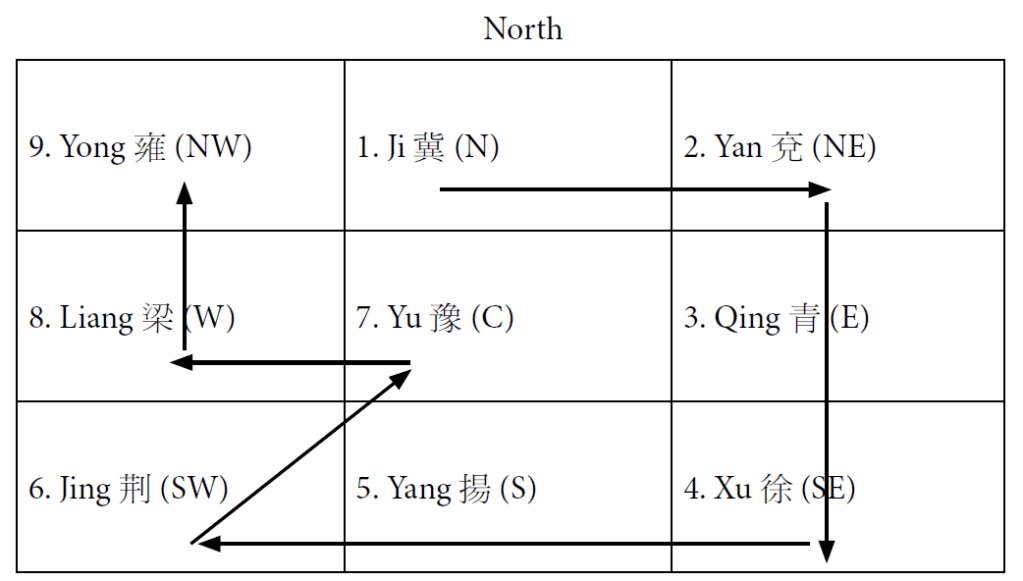
Variações de um mesmo cosmograma (a hierarquia 1-9 não muda).
“To summarize, cosmograms are instrumental in conveying conceptions of space dominated by closely interrelated political and religious meanings. In order to match these meanings, real topography could be, and in fact should be corrected or even considerably transformed.” “real topography is sacrifi ced for cosmological harmony, and topographically accurate maps are more the exception than the rule.” “Cosmograms and maps are not distinguished on the terminological level, both being designated by the term tu, <graphic representation>.”
John Knoblock and Jeffrey Riegel, trans., The Annals of Lü Buwei: a complete translation and study (Stanford, 2000)
“The schematic structure of the concentric zones is easily derived from the concept of the symbolic squareness of the earth and the units of its division characteristic of the Chinese cosmographical tradition.”
“Locating a province simply at a cardinally-oriented point, e.g., <in the south>, is an attribute of a 3 × 3 square grid, its 9 squares corresponding to the 8 cardinal directions and the center. Five of the <Youshi lan> provinces and 6 of the <Zhifang shi> provinces [divisões imperiais mais antigas] refer to the cardinally-oriented squares of the grid (…) Four of these provinces have the same cardinally-oriented positions in both accounts: Qing to the east, Yang to the southeast, Jing to the south and Yong to the west. The 5th cardinally-oriented province found in both lists, but new with respect to the <Yugong> (You), is located in the north in the <Youshi lan> and in the northeast in the <Zhifang shi>.”
“a province located in the eastern area can be ascribed eastern, northeastern, or northwestern positions, even if this deviates slightly from its real location.”
“Yugong (Shangshu) initial set
1. Ji
2. Yan
3. Qing
4. Xü
5. Yang
6. Jing
7. Yu
8. Liang
9. Yong
Youshi lan (Lüshi chunqiu) (difference in 1 name)
10. (+ You, no lugar de Liang)
Shidi (Erya) (difference in 1 name)
11. (+ Ying, no lugar de Qing)
Zhifang shi (Zhouli) (difference in 1 name)
12. (+ Bing, no lugar de Xü)
In total, there are 12 names of provinces (associated with the 12 provinces established by Shun).”
“I argue that the schematic attributes are already present in this description of the Nine Provinces, but are given in an implicit and more sophisticated way, whereas the straightforward references to schematic representation (cardinal directions, the length of the grid’s square) are characteristic of later terrestrial descriptions composed under the impact of imperial ideology, which required they be explicit and direct in this respect.”
“In particular, one can see from this map that the major structural problem for <squeezing> the Nine Provinces as they are described in the <Yugong> into the rigid form of the 3 × 3 grid is that there are too many provinces in the east and too few in the west. In order to bring the provinces into conformity with the grid framework, some shifts in their topographical locations are necessary. Th eir arrangement according to the nine celestial palaces solves this problem by keeping to more or less real topographical locations of the provinces in the north and accepting distortions and shifts in the south. The arrangement according to the Great One does the exact opposite.”
(*) “The earliest surviving maps of landmarks enumerated in the <Yugong> date from the Southern Song dynasty (1127–1279). The maps are either engraved on stone steles or block-printed. No earlier maps related to the <Yugong> have been found so far. The so-called references to such maps in ancient texts, e.g., the Yugong tu (Hou Hanshu [Beijing, 1973], p. 2465), cannot be regarded as absolute proof of their existence, due to the ambiguity of the character tu that, apart from <map>, stands for a wide range of <graphic representations>—schemes, drawings, pictures, tables, spatial textual layouts—in sum, <toutes les représentations graphiques quelles qu’elles soient>; see Édouard Chavannes, ‘Les deux plus anciens spécimens de la cartographie chinoise’, Bulletin de l’École Française d’Extrême Orient 3 (1903), p. 236. In other words, references of this kind do not allow one to determine what specific type of <graphic representation> is designated. For a recent comprehensive survey of tu-related studies, see Francesca Bray, ‘Introduction: the powers of tu,’ in Graphics and text, pp. 1–78.”
(*) “Although these maps are done about one and a half millennia later than the <Yugong>, they are still the product of a continuous Chinese cartographic tradition. The latter differs markedly from modern Western cartography not only in the code of representation, but also in its goals and functions. I make some general observations on this issue, supplied with references to studies in the history of Chinese cartography, in Dorofeeva-Lichtmann [autora corrente], ‘Mapping a <spiritual> landscape’ , pp. 38–43.”
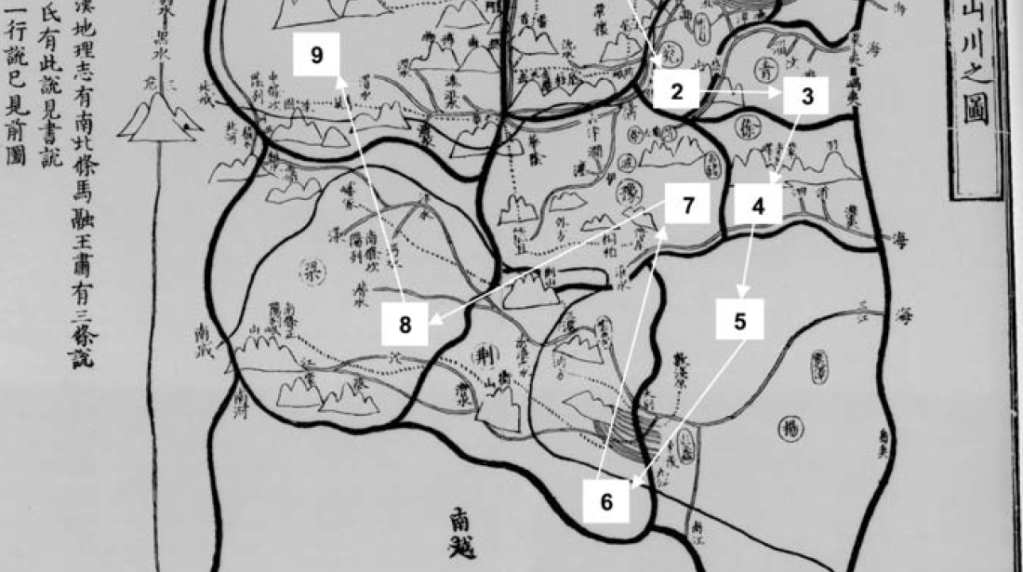
“[Fragment of] Map 1. Yugong jiuzhou shanchuan zhi tu (Map of the Nine Provinces, the (nine itineraries marked by) mountains and the (nine) river [itineraries) of the <Tribute of Yu>)
Note: The itineraries marked by mountains are shown in the map by dotted lines.”
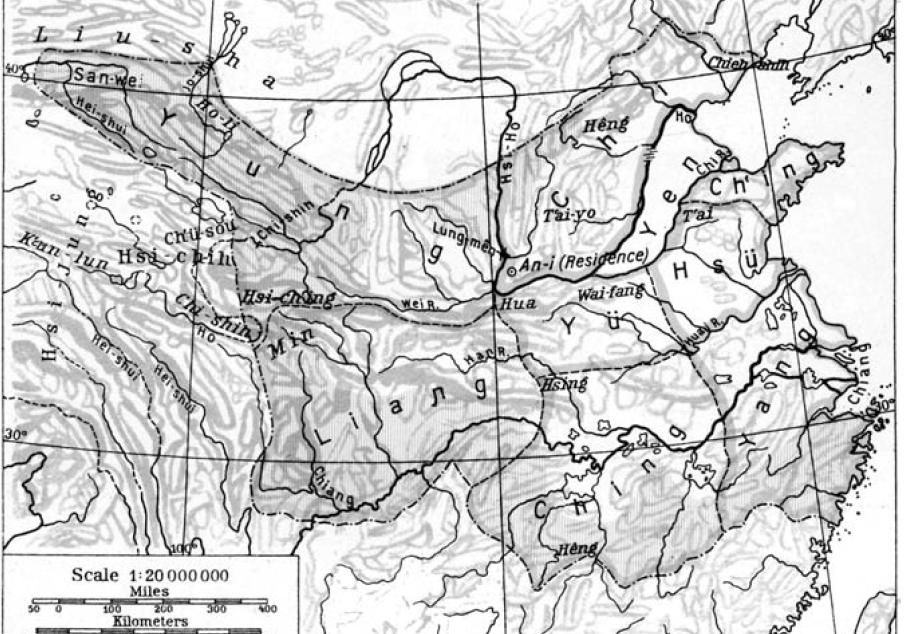
Comparação com um mapa de escala moderna.
“Two of these characteristics—fields and revenue—are especially noteworthy for the purely formal way in which they are defined. They play the role of criteria which enable one to evaluate and compare the provinces according to a nonary scale. The scale consists of 3 main classes: upper, middle and lower, each divided into 3 sub-classes, e.g., the superior class is shangshang (upper-upper class), one degree lower is shangzhong (middleupper class), etc. In this respect fields and revenue differ markedly from other characteristics of a more descriptive kind, e.g., <its soil is white and mouldy> (Ji province).”
“This map shows that Yu fi rst regulated those provinces that are closest to the sea in the east. Pursuing his work of regulation, he first descended along the sea from the north to the south, then turned to the center, and finally put in order the 2 western provinces, the farthest from the sea (this order is accentuated by arrows I have added to the map). This order seems to be determined by the need to drain an excess of water in the basins of the Yellow and Yangzi rivers, which requires first clearing out the territories close to the sea in the east and then moving west along the river courses. Therefore, Yu’s regulation of the Nine Provinces, according to the <Yugong>, combines the characteristics of the tour and draining the waters of the flood.”
“Yu’s territory [centro] comprises the region around the Zhou capital Chengzhou/Luoyi, which became the major capital after the loss of the Zhou domain in the west around the Wei river in 771 BC and is firmly associated with the center in all extant sources up to the Former Han in which the foundation and location of the Zhou capital is discussed.”
“The set of the <Youshi lan>, which is the most similar to the <Yugong> with respect to the names of the provinces (it differs in one name only), is also quite similar, though not completely identical, as regards sequence. The central province Yu is shifted here to the first place, and the new province You (located, according to this text, in the north) is added at the end of the list. This sequence is particularly interesting for its accentuation of the center, especially evident since Yu is associated here with Zhou. The emphasis on the center reflects the imperial ambitions of the Lüshi chunqiu, but also means that this sequence is not influenced by the idea of draining.
In the <Shidi>, the northern province Ji recovers the initial place it occupied in the <Yugong>. The 2 provinces whose names differ from the <Yugong> set are placed at the end. Apart from this, the sequence of provinces in the <Shidi> account is considerably different and gives the impression the provinces were tossed up in the air: after Yu province comes Yong, the last in the <Yugong> and the 8th in the <Youshi lan>, then Yang and Jing, both of which in the <Yugong> and the <Youshi lan> precede Yong, and then Yan and Xu that in the <Yugong> precede Yang and Jing.”
“The sequence of provinces in the <Zhifang shi> representing the Western Zhou is even more different, but its general direction is quite clear: it starts from the southeastern and southern positions and ends in the north, which is quite unexpected in a representation of the Zhou administrative system.”
“In sum, none of the sequences is completely independent from that of the <Yugong>, as can be seen from the fact the new provinces are placed at the end of the lists. The necessity of respecting this rule inevitably poses problems in working out the logic of the sequence of the provinces. By comparison, the sequence of provinces in the <Dixing xun>, radically different in its names from the <Yugong> group, is remarkably regular. It also makes a smooth tour, starting in the south and moving counter-clockwise, that is, just the opposite of the <Yugong> sequence.”
“An itinerary by land is marked by two to four mountains, as a route from mountain to mountain. The nine land itineraries are marked by 27 mountains. All the itineraries are delineated from west to east, and the general sequence of the itineraries is from north to south. Among a total of nine itineraries, six marked by 20 mountains are situated in the Yellow river basin, while only three itineraries marked by seven mountains are in the Yangzi basin, a refl ection of the marginal status of the Yangzi basin in the <Yugong>.” “each of these two groups of itineraries is introduced by the character <delineate> (dao), implying that it was Yu who founded them.”
“the river itineraries are delineated in a more detailed way. Apart from their initial and final points, quite a number of details are provided along the way: confluences with other rivers or changing of the river’s name; mountains and other geographical objects passed by; and, in many cases and on different parts of an itinerary, its direction with respect to the 4 cardinal directions.”
Chemla, Karine & Guo Shuchun, trans., Le classique mathématique de la Chine ancienne et ses commentaires (Paris, 2004).
“The Shanhai jing is the largest among the terrestrial descriptions that have survived from ancient China (ca. 30,000 characters). Its aim is to provide a consistent, complete and detailed picture of the entire inhabited world. Yet, despite its pretension to comprehensiveness, it has never outweighed the much shorter and more concise <Yugong>.”
“The most substantial point of difference between the <Yugong> and the Shanhai jing versions of Yu’s deeds, although not formulated directly, are the spirits, completely absent in the former and the key element of the organization of space in the latter. This led me to the conclusion that the focus of the Shanhai jing on local spirits is at least one of the main reasons for its negative evaluation. But it is not as simple as it may seem at first glance, because the local spirits are not completely excluded from either imperial practice or from the officially recognized texts. On the contrary, sacrifices to mountains and rivers were the core constituent element of the so-called royal <tours of inspection> (xunshou) that became an especially important ritual for rulership with the foundation of the empire, under the Qin and the Former Han dynasties. ”
“Shun’s tour of inspection, that consisted in performing sacrifices to the local spirits inscribed in a cardinally-oriented spatial framework on the one hand and establishing the proper sites of landmarks and a regular administrative division of the civilized world by Yu on the other, are, in effect, typologically similar world-making practices, both aimed at ordering terrestrial space. Yet they are sharply distinguished in the Shangshu, and this distinction is also respected in the dynastic histories.”
“The <administrative> version of Yu’s deeds appears marginal when compared with a broad range of sources that represent the <spiritual> version. Yet, it is the administrative version that became recognized in the imperial histories conveying the official conception of space regulation. § One of the reasons for choosing the administrative version and banning spirits from the story of such a key figure of Chinese official ideology as Yu the Great is the cautious attitude to spirits in Confucianism. Spirits are, indeed, an issue that is rather avoided by Confucius who <respected demons and spirits, but kept them at a distance> (Lunyu 11.6).”
“The already mentioned omission of Shun’s name in Ban Gu’s introduction to the <Yugong> seems to be done in order to avoid any possible association of the concept of <terrestrial organization> with the spirits.”
THE RITE, THE NORM AND THE DAO: PHILOSOPHY OF SACRIFICE AND TRANSCENDENCE OF POWER IN ANCIENT CHINA
*
JEAN LEVI (trans. John Lagerwey)
“According to his biographer, Sima Qian, Confucius resigned from his position as minister of justice not when the sovereign, occupied by the beauties sent him by the kingdom of Qi in order to separate him from the sage, neglected to attend the council of ministers, but when he forgot to give the dignitaries their share of meat after the great suburban sacrifice to Heaven.”
“The word zuo, which refers especially to gifts of meat, is glossed by the word <good fortune> (fu). The distribution of sacrificial meat is sometimes referred to as <distributing good fortune> or <distributing beneficial meat>; the character which refers to the distributed parts, shan, is composed of the meat radical and a character meaning <beneficial, good>. Not only does the ritualist refer to this practice, he codifies it. The rite of the distribution of shares is embedded in its own ceremonial sequence. Used together with the word lu to refer to official positions in archaic Chinese, the character fu represents a sacrificial vase. By metonymic derivation, it came to mean the portion of meat in the vessel given by the king to his courtiers and then, by extension, the material advantages that these gifts implied, as well as the benediction of the gods they brought. As for the word zuo, it has the verbal sense of giving a territory or a fief. All of these terms must be understood in the context of a system of gifts and counter-gifts made through the mediation of the gods or the ancestors. Thus the expression <meat-eaters> is not an idle one. It refers to a system of the distribution of symbolic goods and noble office whose key is the sacrificial practice that decides who belongs to the ruling circle.”
“The more individual ancestors to whom he had the right to sacrifice, the higher was his rank. Thus the king had 7 rooms in his ancestor temple, in which he honored his father, grandfather, great-grandfather, great-great-grandfather, the kings Wen and Wu, and the first ancestor, Houji, Lord Millet, founder of the Zhou people. A feudal prince had but 5 rooms, a great officer 4, and a gentleman 1.”
“the word used to designate rank: jue. The term originally designates a bird-shaped cup that served as a libation cup in sacrificial—primarily funeral—ceremonies. Aristocratic titles correspond to the hierarchy of the gods and are a function of the gods whom one has the right to honor. A doubly nested hierarchy is deployed in this manner: a vertical hierarchy of the gods to whom one sacrifi ces on the one hand and the geographic extent of the fief over which one has authority on the other.”
“The Son of Heaven is in charge of the entire empire because he belongs to the eldest lineage segment of all the feudal lords, who are members of junior lineage branches that at a given moment separated off from the trunk of the dynastic genealogical tree.”
“Such is, broadly sketched, the organization of the Zhou royalty, at least as it reveals itself in sources which are not anterior to the Spring and Autumn period (770–482 BC).”
“In a word, it seems to me that neither the functioning of Zhou society nor the later development of the Chinese state can be made sense of without reference to the sacrifice to Heaven, be it as a hypothetically necessary event. I shall therefore concentrate my analysis on it.
Because of the singular character of the sacrifice to Heaven that he alone may accomplish, the sovereign distinguishes himself from the feudal lords not quantitatively but qualitatively. If the princes of Lu, exceptionally, may also perform this ritual, it is because of the special ties of their ancestor, the Duke of Zhou, to the dynastic house and because of the services he rendered, for not only was he the brother of the founding king, Wu, but he himself was virtually king when he served as regent of King Cheng, still a young child when his father died.”
“The sacrifice to Heaven is a solemn sacrifi ce which in principle requires neither special apparatus nor pomp. It must at the same time strike the imagination by its atmosphere of dignity, an atmosphere derived not from the wealth or the number of the victims and the vessels, but from the gravity and the seriousness with which it is accomplished. Such as we can see it through later rituals, the sacrifice to Heaven was the occasion for a mise en scène whereby was rendered visible, by means of ritual language, the very principles which govern the natural and the social order.
It is a solar sacrifice that marks the victory of the principle of generation and life over the yin forces of decline and death. As such, it takes place either aft er the winter solstice or at the spring equinox. Commentators debate this point because the ritual texts say only, in ambiguous fashion, that it is done <when the days become longer>, a phrase which could refer either to the time when days begin to become longer—the winter solstice—or when the days become longer than the nights, at the spring equinox.”
“It is thus an act of thanksgiving to the sun as the light of day that generates light and life and provides food. Th at is why it is done in the southern suburb and why the sacrificial victim is red.”
“King Wu is said to have made the sacrifi ce to Heaven on a xin day immediately after defeating the Yin on the Muye plain. This makes of the Zhou a solar dynasty, yang, bearer of life and source of fecundity. Its ancestor is Houji, god of the harvest, and its solar and fi ery nature are marked by the presages of the red bird and the appearance of flames when King Wen ascended the throne. The cycle of the seasons is indistinguishable from that of history. The Zhou victory, regardless of whether it occurred at the time of the solstice or of the equinox, appears as the social expression of the victory of light and the forces of life over darkness and the season of death. Th anks to this ritual, history is invested with a cosmic or, even better, calendrical charge.”
“a single red bullock (in reality, 2), but a perfect one. Innocent and pure, the victim must be very young: <Of the bullocks used in sacrifi cing to Heaven and Earth, the horns were (not larger than) a cocoon or a chestnut.> (Liji) The animal, selected at birth and raised in a special corral, is chosen by divination and nourished in special fashion for at least three months. The culinary preparations, too, are very simple, at least as regards the part offered the gods: the burned, the raw and the boiled. The vessels used were also of the simplest: earthenware.
The simplicity of the sacrifice as such was in marked contrast with the precautions and decorum of the preliminary ceremonies.”
“The young bullock for Heaven was killed by arrows shot by the king himself, and the blood was collected and presented as a fi rst offering. Then the bullock was placed on a pyre lit by means of a mirror and committed to the flames. This was followed by a ritual pantomime which exalted the merits of Heaven and gave thanks to Houji for having invented agriculture and created the suburban sacrifice. Once the victim had been entirely consumed by the flames and all leftovers had disappeared, the ashes were swept and a second off ering made according to the protocol of the great sacrifices to the royal ancestors. The second bullock was attached to a pole. The king cut off a clump of hair with a rattle knife and drew some blood in order by sound and smell to attract the attention of the souls of the ancestors. He handed these to the invocator, who deposited them in front of the tablet of the deceased in order to show him the animal was perfect within and without. The bullock was then killed by arrow and cut up. His entrails were extracted, as well as his lungs, the heart, the tongue, and the liver. Th e fat of the intestines was burned with artemesia and millet [painço, milho-miúdo] so as to attract the spirits in heaven with the appetizing odor. The liver was prepared by the king and served with the heart and the tongue to the representative of the deceased, called a shi, corpse. The head—the noble part—was presented before the tablet. The blood, seat of the vital energy, qi and the organs—lungs, heart and liver, likewise filled with vital energy—were the first to be tasted. These ritual traits and the interpretation given them are not unlike Greek notions relating to the splanchna, which played a fundamental role in the economy of the sacrifice, and also like the Dogon idea of nyama, even though the idea here was not to regenerate the sacrificer but to nourish the vital force of the ancestors. Next, the flesh of the victim was prepared by the cooks and presented in the first place to the representative of the ancestor in the form of raw meat not yet de-boned, of de-boned raw meat, of boiled meat (yan), and of well-cooked meat (ren or shu) because, according to the ritual specialists, <how could they know whether the spirit enjoyed it?>. Other specialists, more certain, say that raw meat is the portion meant for distant and prestigious ancestors, while the boiled meat is for more recent ancestors, those who are more <human>. Between the various offerings of meat accompanied by different kinds of millet, there were a great number of libations of ale and liquors, and the cups circulated among the participants according to a strict protocol.
By means of fasting, purification, divination, proclamations to the living and the dead, processions, ritual throat-slitting, spilled blood, consummation on the pyre, sacrifi cial cooking, feasting, dynastic dances and hymns to the glory of the gods, the ceremony for Heaven brilliantly expresses the meaning of the sacrifice as it was understood by the Zhou.”
“The blood, a hyperbolic form of the raw, is offered to the supreme god, and the victim offered this god is entirely consumed by the flames.”
“If the similarity of the victims seems to associate the Lord on High (Shangdi) and Lord Millet, a certain number of ritual traits as regards the treatment of the two animals in fact distinguishes them.”
“In a certain sense, the living and the souls of the dead are but 2 aspects of the same procedure from which Heaven is excluded and which therefore qualifies it as the only truly divine factor. The ancestors are human beings who have lived, and the living are potential dead persons, that is, waiting to become gods if only they receive sacrifices. The dead, for their part, by virtue of the protection they provide their lineage, cause the family to multiply by watching over the fecundity over their descendants. The living thereby contribute to the survival of the dead, just as the ancestors guarantee that of the living who, when they are dead in turn, will have a numerous posterity. Celebrating the ancestors in fact confirms and justifies human mortality. The sacrifice reveals that the eternal nature of the souls has as its counterpart the ephemeral, perishable nature of humans.” “Ancestors, however prestigious, have a divine career which is dependent on the fortunes of the family which continues to ensure their sacrifices.” “Moreover, after a certain number of generations, they lose all individuality and are absorbed into the collective and anonymous mass of the distant ancestors. Ancestors are never more than intercessors with regard to the great gods of natural forces, especially Shangdi, the supreme god who reigns in heaven. Th ey are prisoners of time.”
“By contrast, things are wholly different as regards the Lord on High. If he requires sacrifices, if he feeds on the smoke of the sweet-smelling fat offered him by the Son of Heaven, he depends on the existence of no lineage. It is he who controls the mandate and distributes it to those families which reveal themselves most apt to embody his virtue. The Xia were replaced by the Shang, who were in turn overthrown by the Zhou.”
“Families know glory and decline, and sacrifices to the ancestors begin and end, but he is forever master of the game. He is identical with destiny, the fixed pivot around which turns the wheel of time, with its phases of ascension and decline”
“Having doubled itself in the great sacrifice to the supreme ancestor, the worship of Heaven ends with a general distribution of food that at once creates solidarity and marks distinctions, in such a manner as to furnish the model for both the cosmic order and the functioning of society. Even though it would seem to be but an appendix of the sacrificial ritual as such, the distribution of the leftovers is fundamental.”
“Heaven receives no leftovers but also gives none. It is the source of all leftovers, but no leftovers return to Heaven nor emanate from it. The food Heaven receives involves no leftovers and is foreign to the law of leftovers because it is indivisible: the smoke is no more divided than is the stream of red blood that flows from the open wound of the cutthroat of the bullock. Even if, during solemn oaths, the contracting parties smear their lips with the blood of the sacrificed victim collected in a cup, this involves reciprocal sharing and not the distribution from top to bottom that creates a hierarchy. This is also the case with the ceremony of the division of incense in modern popular religion, in which the burning of incense may be considered a distant reminiscence of the holocaust of the animal victim on the mound of the god of Heaven. This division creates an affiliation, not a subordination. Heaven, as it were, is on equal footing with the leftovers. Both belong to non-being: it is its disappearance that makes the leftover an active principle; it is its absence or evanescence which marks Heaven’s transcendence. By virtue of being outside the common norm, Heaven determines the ontic specificity of each being or, to use more consensual terminology, Heaven’s norm, li, is the cause or, if one prefers, the pretext of distribution without itself being involved, just as the leftovers in their cascading descent determine, in the sacrifice, the place and name of one and all. Th us Heaven is at once the absent and the central element of the ceremony. The relationship of Heaven to the leftovers is identical to that which, later on and in another context, will link the Dao and the De, the Way and its efficacious manifestation or Virtue.”
“The Chinese system of leftovers is at once similar to and radically different from the Indian category of uchista. The ontological status of the leftover as inseparable from the notion of debt is primary in the Brahmanic religion. (…) It is the remainder of the sum still owed aft er each act that sets in motion the process of actions without end, of which the sacrifice is at once the exemplary and exacerbated expression, a sequence of acts which determines the order of the world, the dharma. It is in this sense that Jacques Derrida, theorizing the results of Charles Malamoud’s study of the sacrifice, is right in creating the category of <remainder of the rest>. According to Derrida, there is something in the remainder that cannot be determined and that it is the function of the sacrifi ce to dispense with. Indian sacrificial culture is understood as aiming to control the divisions of the remainders—their cutting up and sharing—by subjecting them to an order which is at once sacrificial, hierarchical, and ontological. It aims at enclosing the remainder in its limits as <leftover> and transforming it into something identical to itself in spite of the fact that it is by nature something outside itself insofar as it only exists with respect to another outside itself from which it is inseparable. Not only is every remainder a leftover of something, it is the something of the remainder. Sacrifice in this context becomes nothing but the rationalization of the leftover, its ontological domestication as it were, founding an economy in which a hierarchy is created on the basis of the self-identity of the <master>, whether he be the sacrificer, the god, or the Fathers (that is, the dead djiva).
In the sacrifice to Heaven and to the ancestors, there is a distribution of the remainders such that there is nothing left over.” Ótimo trocadilho.
“At the very least, the leftover is not theorized as such, on the contrary: it is diluted in the course of its descent from the summit of the hierarchy to the bottom where, at a given moment, it disappears. But if it disappears, it does not remain without a remainder, that is, an effect. It leaves a trace which is worth more than itself: the recognition of a debt and the creation of a duty linking the subordinate to his superior in gratitude for the gift received. It is thus not the leftover as such that is conceptualized by the exegetes in the Chinese representation of the sacrifice but its transformation into a moral imperative which abolishes it in its essence. This notion of the obligation of reciprocity, bao, becomes, in the discourse on the sacrifice built up by Confucian ritual specialists from the 5th–4th centuries BC on, the raison d’être of the sacrifice: one presents offerings in order to show his recognition of the superior beings who give life and the means to sustain it. Liang Qichao, the great literatus of the end of the 19th century, expresses in its most synthetic form this concept of sacrifice as dictated by the moral duty of recognition and described in a great variety of manners in the Classics. According to Liang, the sacrifice in China, unlike that of the West which seeks to obtain the blessings of the gods, aims only at recognizing the virtue and merit of—and showing one’s gratitude to—everything in creation that has a benefi cial influence. With the following phrase he concludes his list of the entities and beings which, beginning with Heaven and ending with cats, deserve to receive sacrifices: <This single conception of pao (bao) penetrates the whole (institution) of sacrificial offerings.> This is a reinterpretation in ethical terms of the more fundamental phenomenon of the conversion of the leftover into an obligation of such a nature that it is virtually a categorical imperative, but an imperative which expresses itself in purely ritual form.” “In this sense, what matters is not so much the leftovers as the dynamics of their trajectory.”
“After the loss of the Dao comes power, after the loss of power, charity, after the loss of charity, propriety, and after the loss of propriety, rites.” Daode jing (Book of the Way and its power)
“Thus the Dao is to Being what Heaven is to the sacrifice: its power is the result of the fact that it is absent from the process it engenders.”
“the Dao, source of all beings but itself pure nothingness and transcendence”
“The authors of this period are constantly playing with the notions of recompense, power, gratitude and duty, a word game facilitated by the vastness of the semantic field of the word de, Virtue in the sense of being efficacious and also, by homophony with the word de [ideograma chinês é diferente], meaning gift or gain, success, results.”
“Indeed, the process does not come to an end with the end of the left overs at the bottom of the social hierarchy. This sets off the inverse process which is at once invisible—on the ritual level, that is—and essential as regards the real production of a surplus that, fictitiously generated by the sacrifice, ascends from the bottom to the top and thus creates a perpetual cycle. The descent of blessings from on high down below also serves to hide the concrete process of the collection of wealth and its seizure, going from the bottom to the top, insofar as the sacrificial victims are the fruit of the labor of the humble, the first to produce and the last to receive.”
“Politics, kinship and sacredness are all one thanks to the double articulation of the cults.” “It functions like a language which, because of the perfectly mastered manipulation of conventional signs, enables the creation of an illusion that the symbolic system is the exact replica of reality, that it can substitute for reality, and that it suffices to act on the symbolic system in order to have power over reality.”
“While the territories of the fiefs in the old center of the country remained small and fragmented, vast kingdoms grew up on the periphery. Under the cover of ensuring the defense of the Zhou sovereigns against barbarian incursions, these new entities imposed their will on other princes. The ancient and venerable fiefs that constituted, with the royal domain of the Zhou itself, the heartland of ancient China came under the sway of the dominant power of the moment. With the development of these large outlying states, struggle between the kingdoms was exacerbated. The changes in the nature of the relations between the principalities impacted relations between the noble families within the various states. The princely lines were displaced by collateral branches that took over the management of affairs. With the development of the economy and the administration, the great officers acquired considerable weight. Cults and fiefs disappeared as the number of takeovers multiplied.”
“Already in an episode in the Zuozhuan, one of the commentaries on the annals of the principality of Lu, the negative exclamation of Cao Gui, simple gentleman, about the <meat-eaters> whom he calls <idiots incapable of making a plan>, reveals the antagonism between the ancient noble class which still holds the reins of state because of its place in the cultic hierarchy and the new class which wants to play a role in the state on the basis of their personal qualities, be it competence or virtue.”
“If at the beginning the king acts as the legitimate representative of the entire country and can play the role of mediator between the human community and the superior entities, once he has lost his power and prestige, the divinity and its worship lose all reason for existence. There is no longer any link between transcendence and society.”
“In order to fill the void left by the disintegration of the cultic system, the departmentalization of territory will thus be accompanied by a new religious organization corresponding to a more abstract space and time.”
“The notion of a universal order, of a deep structure (li) on which the metaphysical system of China was built, derived from this transformation of the religious space structured by the cults into bureaucratic entities. The principle of territorial structuring becomes central and, understood as the adequate form of the universal norm, becomes the source of the order that could take the place of the ancient Heaven of the Zhou.”
“The question of classes of ever more inclusive sets of words leads to the Dao, insofar as the Dao is defined as the total absence of any limits which, in its absolute generality, can embrace all beings. This is what All-embracing Harmony says to Analytic Intelligence at the end of the first part of his discourse: [!]
The creation contains more than 10,000 beings, and yet we use the phrase <10,000 beings> to refer to an infinity, in the same way we use the term <heaven and earth> to refer to what is most vast in the universe or <yin and yang> to refer to energies in general. The word Dao refers to absolute generality that is infinite extensiveness. If we remember that this expression is just a way of talking in order to give an idea of size, then it is perfectly legitimate to use it. But we cannot compare a heuristic term of this kind with categorizations that define an object. There is an abyss between the modes of referring to the Dao, which are always by default and the taxonomy we use in ordinary discourse, where we refer to such names as <dog> or <horse>.” Zhuangzi jishi
“Even though each season has its own characteristics, Heaven favors none of them, so that the year may run its course. Each department has its own specific function, but the sovereign shows no preference for any of them. That is what brings order to a country. It is because he attaches equal importance to civil and military affairs that the action of the prince is well-rounded. Even though each of the 10,000 things obeys its own norm, the Dao shows no partiality. That is why it cannot be defined. Being without definition, it does nothing and, without doing anything, there is nothing that is not done. That is what is involved in the system of administrative circumscriptions.”
DO MENOS PARA O MAIS:“To this process of the inclusion of ever larger classes of things referred to by terms, which modern linguistics calls hyperonymy, there corresponds the inverse process of hyponymy, in which things are divided into ever smaller categories included in the larger categories that precede them, producing <minor distinctions in reference> (xiao bieming, to be compared with Analytic Intelligence).”
“Anger is born of the blood and energy; aggressiveness expresses itself in the skin. If one does not allow anger to get out, it accumulates and forms an abscess. If you are ready to abandon the 4 emotions, like a dried up corpse, you will never allow yourself to get carried away. Thereupon, the Yellow Emperor abandoned the affairs of the empire and took refuge on Mount Bowang, where he stayed in meditation for 3 years in order to find himself.”
“The founder of civilization and sovereignty. He has 4 faces, or 4 eyes. The Yellow Emperor was 4-faced because he sent 4 remarkable men to the 4 directions to organize the world”
“For the Yellow Emperor is very intimate with the exorcists, beginning with his wife Momu, whose proverbial ugliness is said to be the basis of apotropaic practices insofar as her ugly face served as the model for the masks of sorcerers.”
(*) “On the relationship of the Yellow Emperor and his wife to exorcistic rituals, see Jean Levi, <Aspects du mythe du tigre dans la Chine ancienne>, PhD thesis (University of Paris 7, 1978)”
O ROBESPIERRE CHINÊS: “It is no doubt to Shang Yang (executed in 338 BC) that fell the ambiguous privilege of elaborating the first theory of the manipulation of the masses and of being the first to apply it concretely, while Han Fei was the one who gave this theory its definitive formulation.”
“A ruler can therefore act with the same certainty with regard to the future as a hydraulic engineer: he need only act in conformity with the infallible laws that guide the course of rivers and passions.”
“Total social servitude can thereby be transformed, at its paroxysm, into its opposite, natural spontaneity. In order to be effi acious, to function as it were naturally, or rather, in order to constrain people to act spontaneously without recourse to punishments, the law must be excessive, and it then abolishes itself in its own cruelty. By a dialectical inversion borrowed from Daoist metaphysics, the use of punishment aims at the suppression thereof. The Law must be interiorized. It must become custom or, even better, tropism.¹ It then follows that the application of the decrees will be confided not to the highest ruling authorities but, on the contrary, delegated to the lowest level: by means of deliberations in the family, by collective responsibility and denunciation in the villages, it penetrates into every pore of social organization.”
¹ TROPISMO: “Desenvolvimento de um vegetal numa direção dada, sob a influência de uma excitação exterior (luz, gravidade etc.).”
“Just as the Dao is at once the aggregate and the source of all norms without coinciding with them, the prince will be the source of all laws and rules by being beyond all norms and rules. Like the principle, the sovereign is unique and refers to himself as gu, <orphan, solitary one>. He is the One and is often called <the one man>; he is said to be du, <singular>, in his person—he can never be the equal of anyone—but also in his decisions, for he is always the only one who decides, duduan.” “The Dao in its singularity stands over against the diversity of phenomena marked by the seal of multiplicity insofar as even the two primary principles of yin and yang function as a pair of entities of the same nature. This makes it easy to understand why any infringement on royal prerogatives, however minor, must be punished severely. To be One and to control multiplicity, the prince must, in the face of multiplicity, fulfill his function as the One by never allowing himself to be caught up in multiplicity as a part of it, however eminent.” “Cloistered behind the high walls of his palace, he is hidden from the eyes of his subjects, whom he can neither encounter nor see. In no case can a monarch, if he wishes to keep his preeminence, rely on his 5 senses and plunge himself in the contemplation of objects. The sovereign must live in complete retirement, hidden deep within his palace, without ever taking any initiative.”
“In the past, the Son of Heaven knew how to dress himself but allowed the attendant to do it for him. He knew how to walk, but he had a master of ceremonies go before him. He could speak, but a herald made his speeches. In this way he never said anything wrong and never made a mistake in etiquette.” Shenzi
“The state apparatus produces a miniaturization of reality, and this does not in the least diminish its power but on the contrary confers on it a surplus of efficaciousness equal to that of the universe. The imperial system enables an unheard of extension of the fi eld of action of the sovereign at the same time that it reduces his domain of activity.”
“The Legalist sovereign does not create a tyrannical reign of the arbitrary but, on the contrary, that of an irrepressible necessity achieved by the absolute and unhindered application of the law and which cannot be confused with the will of the prince.”
“The foundation of the human being is the earth, the foundation of the earth its proper use, and the foundation of proper use the cycle of seasons. Appropriate use of the seasons depends on the people, the efficaciousness of the people on their capacity for work, and this capacity on the regulation thereof. Whoever understands soil types and how to plant at the right time, who sees to it the people are used in such a way their strength is spared, will contribute to the increase in wealth. If, in addition, taxes and duties are moderate, the people will live well and, because they enjoy abundance, they will have a sense of shame. Having a sense of shame, the laws and edicts will become for them customary, with the result there will be no need to use punishments and prison terms.” Mawangdui
“Such a system has no place for rights. Rights are entirely useless because the law is but the automatic application of the cosmic law. In like manner, there can be no discussion or contesting of the decrees of the prince by the people. They are above—or prior to—praise. The laws of nature, by virtue of their apodictic nature, cannot be judged negatively or positively.”
“Like the Dao, the sovereign must be empty—pure nothingness: he is empty of all desire, all thought and all intentionality. It is because he is entirely opaque to his subjects—who, on the contrary, are transparent to him—that he can extend his domination over the world.”
“Thanks to the Law, thanks also to the techniques of manipulation that free him from dependence on his own talents, the sovereign dominates his subjects. He knows everything of their least thought, their least act. The control of others comes to him from his clairvoyance. Even though he is the target of all eyes, he can manipulate others because he can see through them and control their every act thanks to his techniques of espionage, of anonymous accusation, and of police investigation. He knows everything that happens in the most distant corner of his territory, for the eyes of his subjects are his eyes, their ears his ears, their brain his brain. He overturns their relative strengths and is no longer an isolated individual subject to the pressure of the united masses but, over against the mass of individuals isolated and separated from each other, he is in charge of the faculties of the entire people.” “Centralizing all information, collecting all secrets, he enjoys a truly divine penetration. Gifted with absolute clairvoyance, everything is transparent for him. But this transparence is the result of systematic dissimulation. The subject is transparent. The master is impenetrable and hidden. Without outlines, undefined, he cannot be grasped, while the thousand eyes he has stolen from his servants leave nothing in the dark.”
“As much as his capacity to see, his invisibility is his strength. It is but the dark and negative side of the light he sheds. The sovereign who is the equal of the gods penetrates because he is obscure. This divine perspicacity (shen) makes him as mysterious as the souls of the dead, who act in the shadows, invisible, having an impact that is as terrifying as the origin is hidden to the view of mortals.”
“Thus the prince, if he wishes to dominate, must be careful never to display to others anything but the polished mirror of the unconditioned, happy to reflect images without ever giving anything of himself, because he is nothing. This mirror, the prince can present it insofar as he has withdrawn from the world of forms.”
“Indecipherable like the Dao, the norm of all norms, the master of men acts without anyone knowing it. Impenetrable, indeterminate, he is like chaos, the most accomplished form of the Dao, its first manifestation from which the cosmos emerged.”
“The politico-mystical texts from the tradition of the Yellow Emperor referred to above bring this aspect of Legalism especially to the fore. But it is also present in Han Fei, whose inspiration derives from the many earlier texts of self-cultivation. The source of this literature lies in the conceptions of the balance of the sovereign’s humors and energies thanks to the cook, whose job it is to harmonize the 5 flavors. The <Neiye>, Inward training, one of the chapters of the Guanzi which is entirely devoted to self-cultivation, develops the idea that sovereign power is but the socialized—and therefore partial—expression of the global and universal energy, the qi, the <energy> which circulates between heaven and earth just as it irrigates the body.”
DE DRAGON BALL A STAR WARS: “Power then expresses itself in the radiant deployment of the <Force> gained by the regulation and concentration of the influx of vital energies.”
“Good and bad fortune follow the same path. No one knows where they come from. The only way to know them is to be empty, undefined. For in the emptiness of non possession, as soon as an atom forms, there are shapes and names. As soon as there are shapes and names, black and white are distinct. (…) He who is infinitely sereneis a sage; he who focuses on the public good is infinitely alert; he who is infinitely alert is the observer of the universe.” Mawangdui
“Thus does the imperial fi gure correspond to an ontological necessity. Like the Dao, which deploys itself both on the numenal and fenomenal planes, this figure has a double aspect, at once biological and cosmological.”
“What most differentiates the Confucian system of regulation from the mode of state control advocated by the Legalists is no doubt its diffuse character. In this sense, it is truly totalitarian and achieves an <immanentization> of transcendence which makes the latter perhaps even more efficient.”
“Rites which can be spread among the lowest levels of society only by means of institutions like village and township schools and by ceremonies led by the authorities such as the banquets for elders or, later, under the Han, the worship of Confucius, go together with a strict management of the people, caught up in a network of surveillance that is all the more terrible in that it is interiorized and seems, because of its virtually choreographic character, almost debonair and avuncular.”
“The most accomplished form of government in the world of the literati is pedagogy, a pedagogy which makes its impact by means of edifying acts. Confucian morality is spread by means of models: paragons of virtue, sages of antiquity, masters. But these various models which each must imitate are but the reproduction of the unique model incarnate in the emperor, for he is the mediator between Heaven and men”
“The place of this translation of the natural into the social is the Mingtang, or Hall of Light. The Mingtang is a building meant to be a replica of the cosmos, with its roof round like the heavens and its base square like the earth and containing 4 oriented facades for each of the directions around a central room. Each of the 4 sides was divided into 3 rooms. Thus did it represent the totality of the spatio-temporal universe, with its 5 directions and 12 months.” “From the appropriate room, dressed in a robe of the season’s color and carrying its emblems, the Son of Heaven proclaimed the nature of government and the appropriate music, flavors, meats, sacrifices and rites. The circulation of the sovereign, by the mere fact of his route, wove a fabric of seasons converted into a liturgical norm. The regularity of the natural cycle was subordinated to the carrying out of a ceremony that revealed a social order identified with the structure of the cosmos because the cosmos had itself been hypostasized as liturgy by the royal act.”
O TRIPLO LI QUE CRIA O 4º LI: “The rite, li, which can be defined by a play on words as li, to walk in the right way so as to reveal the deep structure of things, li, is thus the socialized expression of the natural norm.”
EXPRESSÃO SOCIAL DAS NORMAS DA NATUREZA = RITO + O CAMINHO CORRETO + COISA
(LI³ = LI + LI + LI)
“As a matter of fact, no one knows whether the Mingtang is an ancient institution, nor even whether such a building was ever built before the Han dynasty. Some specialists suspect that no Mingtang was ever built before the usurpation of Wang Mang, at the beginning of our era. Léon Vandermeersch (La voie royale), however, in his well-informed study of the institutions of the archaic royalty, believes he can trace back its creation to the very beginning of the Zhou, under the regency of the Duke of Zhou, to be precise, when it substituted for the [? – substituiu ou foi substituído?] ancestor temple which had itself always functioned as royal palace and hall of deliberations of the council, because the Duke, as regent, was not allowed to preside in the temple lest he transgress royal prerogatives. But his proof for this hypothesis is slight. Such as it is described in the texts of the Warring States, the Hall of Light bears all the hallmarks of a ritual utopia. Nonetheless, what is important is less the reality of the institution as such or of the building containing it than the driving force of the ideological structuring revealed by the fantastic discourse concerning this dreamed-of architecture.”
“Then, with Confucius, rites take on a personal and ethical coloration before they become the subject of general skepticism in the Warring States period, until Xunzi restores to them their letters patent by making of them the cardinal principle of life in society and by raising them to the rank of cosmic norm. But it must be said that this apotheosis and this resurrection owe much to their contamination by the concept of law developed by the Legalists. This does not mean a return to Zhou rituality, but on the contrary confirms its definitive disappearance. The rites are reborn from the observation that a new order had to be founded since, with Xunzi, the rite is no longer anything but a pure instrument for the structuring of the cosmos, an instrument stripped of any charge of religious emotion, even if this emotion was very controlled during the Spring and Autumn period.”
“The body of the emperor is invested with no magic power. Nor is it the seat of a mysterious force, nor yet does it participate in an Elsewhere haunted by powers who govern life and death. It simply shares in the charisma of a state apparatus which has a sacred dimension.”
* * *
“HANDBOOK OF ORIENTAL STUDIES
SECTION FOUR
CHINA
edited by
STEPHEN F. TEISER, MARTIN KERN AND TIMOTHY BROOK
VOLUME 21-1”
Será esta a série que contém todos os Early Chinese Religion studies?! Não fica muito claro (título à p. 711 do PDF)
“Part One: Shang through Han (1250 BC – 220 AD)
VOLUME TWO”
(Aqui estamos quase na metade física do livro. Abre-se como que uma nova folha de rosto e detalhes de registro do livro, como se se trata-se de outro exemplar físico, mas continuando o índice do 1º volume, conforme segue:)
“Cover illustration: Detail of the inner coffin of Zeng Hou Yi discovered at Suizhou Leigudun (Hubei), painting and lacquer on wood, ca. 433 BC. Rights reserved. Provincial museum of Hubei (Wuhan).
This book is printed on acid-free paper.
Library of Congress Cataloging-in-Publication Data
Early Chinese religion / edited by John Lagerwey and Marc Kalinowski.
p. cm. — (Handbook of oriental studies. Section four, China, ISSN 0169-9520 ; v. 21)
Includes bibliographical references and index.
ISBN 978-90-04-16835-0 (v. 1 : hardback : alk. paper) 1. China—Religion—History. I. Lagerwey, John. II. Kalinowski, Marc.
BL1803.E27 2008
299.5’10931–dc22
2008035404
ISSN: 0169- 9520
ISBN Set: 978 90 04 16835 0
ISBN Volume Two: 978 90 04 17209 8
Copyright 2009 by Koninklijke Brill NV, Leiden, The Netherlands.
Koninklijke Brill NV incorporates the imprints Brill, Hotei Publishing, IDC Publishers, Martinus Nijhoff Publishers and VSP.
All rights reserved. No part of this publication may be reproduced, translated, stored in a retrieval system, or transmitted in any form or by any means, electronic, mechanical, photocopying, recording or otherwise, without prior written permission from the publisher. ¯\_(ツ)_/¯
Authorization to photocopy items for internal or personal use is granted by Koninklijke Brill NV provided that the appropriate fees are paid directly to The Copyright Clearance Center, 222 Rosewood Drive, Suite 910,
Danvers, MA 01923, USA.
Fees are subject to change.
printed in the netherlands”
À disposição para cobrança. Este material é mesmo para uso interno e pessoal, já que absolutamente NINGUÉM lê meu blog!
Volume One – sem título (todos os artigos anteriores)
Volume Two – QIN AND HAN (221 BC–220 AD) (os que seguem)
COMBINING THE GHOSTS AND SPIRITS, CENTERING THE REALM:
MORTUARY RITUAL AND POLITICAL ORGANIZATION IN THE RITUAL COMPENDIA OF EARLY CHINA
*
MICHAEL PUETT
“The Liji 禮記 (Book of rites), Yili 儀禮 (Rites and ceremonies) and Zhouli 周禮 (Rites of Zhou) would become, in later Chinese history, the 3 most significant classics from early China for defining ritual behavior.”
The Liji
“The Liji is, by far, the most disparate of the three ritual compendia. It consists of distinct texts, dating from the 4th through 2nd centuries BC, which were compiled in the Western Han as chapters of a single work.”
“The Ziyi 緇衣, one of the texts later made into a chapter of the Liji, was discovered in 1995 in a tomb at Guodian, sealed roughly in 300 BC.”
(*) “For a study of how the Ziyi was transformed into a chapter of what would ultimately come to be seen as one of the classics, see Edward Shaughnessy, Rewriting early Chinese texts (Albany, 2006), pp. 63–130.”
“As we will see, the entire corpus of the Liji would ultimately come to be associated with Confucius.”
“The general view one finds in several of the chapters is of a constructionist vision of ritual. Rituals are presented as inventions of earlier human sages. Prior to these inventions, humans were selfish, supporting only themselves or at most only those members of their own immediate family, and they failed to see themselves as linked to other families or as linked to the larger cosmos. Th e sages, however, were able to recognize certain patterns within the cosmos and within human dispositions that could be used as models for patterning humanity in a more general way, constructing a world in which distinct families came to be linked together to create a larger community, and in which that community came to be linked to the larger cosmos.”
“Practitioners thus come to see ghosts as ancestors and see the ruler as both father and mother, as well as the Son of Heaven. Thus, in what was once a world of competing families, in a cosmos perceived to be at best indifferent to humanity and perhaps governed by capricious spirits, rituals create a world in which humans come to think of the entire cosmos as a family.”
“When happiness, anger, sorrow, and joy have not yet emerged, this is called centrality. When they have emerged, and all are centered and modulated, this is called harmony.”
“The center is defined as that which precedes humans being pulled in situations by different emotions. Once these emotions have emerged, they need to be modulated by a centering process equivalent to what existed prior to their emergence—a modulation that is then termed harmony. The implication of this argument is that the danger for humans is to be pulled by their emotions in diff erent situations, and humans must endlessly attempt to center and harmonize themselves. Since there is no pre-given set of rituals to defi ne the actions of the practitioner, the goal here is clearly one of self-cultivation: through cultivation, one becomes able, in any given situation, to be centered and harmonized.”
—encerramento provisório—
 Seclusão Anagógica