

“Noam Chomsky has been generous in expressing his disagreements in private communication (an exchange of views is included in my earlier book, Extraterritorial: Papers on Literature and the Language Revolution).”
“Ningún problema tan consustancial con las letras y con su modesto misterio como el que propone una traducción.”
J.L. BORGES, Las versiones Homéricas, Discusión, 1957
“La théorie de Ia traduction n’est donc pas une linguistique appliquée. Elle est un champ nouveau dans Ia théorie et Ia pratique de Ia littérature. Son importance épistémologique consiste dans sa contribution à une pratique théorique de l’homogénéité entre signifiant et signifié propre a cette pratique sociale qu’est l’écriture.”
HENRI MESCHONNIC, Pour la poétique II, 1973
I. UNDERSTANDING AS TRANSLATION
Shakespeare, Cymbeline, Ato II
“Is there no way for man to be, but women
Must be half-workers? We are all bastards”
“Não poderia prosseguir a espécie humana sem
a cópula? Por que há de participar a mulher?”
REMÉDIO SECULAR
O chifre tem propriedades terapêuticas. Pois não é que cada cabra macho já nasce com o remédio de seus males autocriado(s)?
Corta teu chifre, queima-o e espalha as cinzas
Para se vingar…
Do chifre e do remédio.
“O vengeance, vengeance!
Me of my lawful pleasure she restrain’d(*),
And pray’d me oft forbearance: did it with
A pudency so rosy, the sweet view on’t(*)
Might well have warm’d old Saturn(*); that I thought her
As chaste as unsunn’d snow(*). O, all the devils!
This yellow Iachimo, in an hour, was’t not?
Or less; at first? Perchance he spoke not, but
Like a full-acorn’d boar, a German one,
Cried <O!> and mounted; found no opposition
But what he look’d for should oppose and she
Should from encounter guard. Could I find out
That woman’s part in me–for there’s no motion
That tends to vice in man, but I affirm
It is the woman’s part: be it lying, note it,
The woman’s: flattering, hers; deceiving, hers:
Lust, and rank thoughts, hers, hers: revenges, hers:
Ambitions, coverings, change of prides, disdain,
Nice longing, slanders, mutability;
All faults that name, nay, that hell knows, why, hers
In part, or all: but rather all. For even to vice
They are not constant, but are changing still;
One vice, but of a minute old, for one
Not half so old as that. I’ll write against them,
Detest them, curse them: yet ‘tis greater skill
In a true hate, to pray they have their will:
The very devils cannot plague them better.”
“Ah, vingança, vingança!
Do meu direito natural ela me desposou,
E rogou ilimitadas vezes: Tem misericórdia,
Com uma pudicícia tão rósea-roseta,
Um olhar tão doce inocente
Que derreteria até o velho Tempo;
Até pensei nela casta como
neve tapada. Ah, pelos Diabos!
Juan O Íntegro, esse galinha, num instante
No primeiro encontro? Talvez tenha-
Lhe metido sem sequer trocarem cumprimentos
Como com um leitão alemão,
Montou em cima com um grito;
E a montaria não se rebelou,
E como foi que a porta ele arrombou
do celeiro? poderia eu entender o que se passa
na cabeça da mulher? — porque de homem se tratando
não há o que nos force a comer do fruto proibido,
a não ser uma Eva em nossas vidas, aquela
campeã na arte de mentir na horizontal;
bajular, enganar; ceder à luxúria, cobiçar,
coisa de mulher: ah, e se vingar;
Ambições, dissimulações, véus de orgulho e desdém,
Paciência para esperar o momento de pecar;
escândalo, volubilidade;
Todos os pecados que, só deus sabe, só recaem,
Ou maior parte, nelas: Porque nem no vício
São elas tão constantes, mas é tudo imprevisível;
Um vício, um capricho de um minuto,
logo é trocado, por um bem mais no-viço.
Deteste-as, amaldiçoe-as: qu’importa! se elas são
especialistas nesse tipo de rancor,
sempre se acham com a razão:
nem demônios praguejam como elas!”
COMENTÁRIOS DOS (*)
“Lawful pleasure” pode ter ou não uma conotação sexual. Mas decerto é patriarcal – e não seria menoscabar o problema tratá-la como “mera questão jurídica”?
Pudicícia, rosada, doce… Todo o sintagma é carnal, erótico… Uma rosa, um botão de rosa, é tão inocente… Até ser deflorado… A virgem é pueril, não mente, até enrubescer, e o que seria a rosa que não é pálida? Talvez alguém que se envergonha de si própria, que se percebe, finalmente, complexa, mentirosa… A mesma cor da paixão e do imprevisível. “Roseta” lembra buceta, quem vê cara não vê genital… Pau-dora, origem do mal. A etimologia da palavra não engana os portugueses, só os lúbricos brasucas… Pau-pra-toda-obra. Doce pode ser gosto ou cheiro, para o heterossexual a buceta emana olores eflúvios e é apetitosa, quanto mais inutilizada ela é. A pudica na verdade é uma piranha (inconsciente), é isso que William na boca de Póstumo (nome sugestivo) quer dizer.
O irônico é que se eu estivesse a ver coisas (safadeza) em cada versostrofe, Shakespeare não mexeria (shake) com o leitor e seus sentimentos com tanta freqüência, sem respiro: Zeus, o mulherengo do Olimpo, que destronou o Pai-Tempo, que era outro mulherengo, todos eles vira-e-mexe sacaneados por mulheres… A que vem essa citação aqui? Warm é tão ambíguo quanto o róseo, pode ser enternecer, amolecer, como justamente o oposto excitar, entesar. O fato é que a mulher quebra o deus, preferi o derreter. Curva-o, com suas curvas, e aquele olhar. E olha que ele é o próprio Cronos, que anda com o ponteiro, e já viu de tudo nesse mundéu… Que sensação cruel.
Já que ela é inocente, posso dizer que é uma tapada. Uma neve tapada, recoberta, sem acesso ao Sol (deus Apolo, um pouco de razão na vida de Zeus, digo, do Pai mulherengo). Mas só assim para ser fria e glacial, impiedosa na hora de machucar… De novo aquilo da neve branquinha. A rosácea não!
Iachimo é Giacomo, o James bíblico. Também significa “complementador”, “reparador”, daí o epíteto “íntegro”. Porém, como nesta estória ele vem para galantear a mulher dos outros, é Juan e não James! Amarelo quer dizer literalmente “galinha” em Inglês.
Quanto aos outros quatro quintos, foram muito mais fáceis; se não é Eva o protótipo de tudo o que Póstumo falou, mato-me eu!
* * *
O poder do editor é de Thor!
“I am quoting from the Arden edition of the play by J.M. Nasworthy. His version of Posthumus’s speech embodies a sum of personal judgement, textual probability, and scholarly and editorial precedent. It is a recension which seeks to gauge the needs and resources of the educated general reader of the mid-twentieth century. It differs from the Folio in punctuation, line-divisions, spelling, and capitalization. The visual effect is markedly different from that achieved in 1623.” “A first step would deal with the meaning of salient words – with what that meaning may have been in 1611, the probable date of the play. Already this is a difficult step, because current meaning may not have been, or have been only in part, Shakespeare’s. In short how many of Shakespeare’s contemporaries fully understood his text? An individual and a historical context are both germane [pertinentes].”
“One might begin with the expressive grouping of stamp’d, coiner, tools, and counterfeit. Several currents of meaning and implication are interwoven. They invoke the sexual and the monetary and the strong, often subterranean links between these two areas of human will.” “The meshing of adulteration with adultery would be characteristic of Shakespeare’s total responsiveness to the field of relevant force and intimation in which words conduct their complex lives.”
Seu destino está selado, e ele é uma carta prestes a ser entregue.
“the O.E.D. and Shakespeare glossaries here direct us to Much Ado About Nothing. It soon becomes evident that Claudio’s damnation of women in Act IV, Scene I foreshadows the rage of Posthumus.”
“Pudency is so unusual [?] a word that the O.E.D. gives Cymbeline as authority for its undoubted general meaning: <susceptibility to shame>. A <rosy pudency> is one that blushes; but the erotic associations are insistent and part of a certain strain of febrile bawdy [obscenidade] in this play.” Eu não disse?
“Shakespeare uses chaste three lines later with the striking image of unsunn’d snow. This touch of unrelenting cold may have been poised in his mind once reference was made to old Saturn, god of sterile winter.” Dessa eu não sabia: Saturno, Deus dos Anéis e também do Inverno Estéril! Aquele que carrega a própria morte circular…
“Yellow Iachimo is arresting. The aura of nastiness is distinct.” “Much later, and with American overtones, yellow will come to express both cowardice and mendacity – the <yellow press>.” “Shakespeare at times seems to <hear> inside a word or phrase the history of its future echoes.” [!!!]
– Estou em Constância! – e desligou o telefone o homem, voltando a afundar sua língua nos pêlos pubianos de sua camarada constantina.
“The study of Shakespeare’s grammar is itself a wide field. In the late plays, he seems to develop a syntactic shorthand; the normal sentence structure is under intense dramatic stress. Often argument and feeling crowd ahead of ordinary grammatical connections or subordinations. The effects – Coriolanus is especially rich in examples – are theatrical in the valid sense.”
“He [Póstumo] is quick to anger and to despair. Perhaps we are to detect in his rhetoric a bent towards excess, towards articulation beyond the facts.”
“Posthumus’s philippicis [arenga, diatribe, discurso virulento], at almost every stage, conventional; his vision of corrupt woman is a locus communis. Close parallels to it may be found in Harrington’s translation of Ariosto’s Orlando Furioso (XVII), in Book X of Paradise Lost, in Marston’s Fawn, and in numerous Jacobean satirists and moralists.” “The nausea of Othello, moving from sexual shock to a vision of universal chaos, and the infirm hysteria of Leontes in The Winter’s Tale have a very different pitch [tom].”
“We know little of internal history, of the changing proceedings of consciousness in a civilization. How do different cultures and historical epochs use language, how do they conventionalize or enact the manifold possible relations between word and object, between stated meaning and literal performance? What were the semantics of an Elizabethan discourse, and what evidence could we cite towards an answer? The distance between <speech signals> and reality in, say, Biblical Hebrew or Japanese court poetry is not the same as in Jacobean English. But can we, with any confidence, chart these vital differences, or are our readings of Posthumus’s invective, however scrupulous our lexical studies and editorial discriminations, bound to remain creative conjecture?” “No aspect of Elizabethan and European culture is formally irrelevant to the complete context of a Shakespearean passage. Explorations of semantic structure very soon raise the problem of infinite series. Wittgenstein asked where, when, and by what rationally established criterion the process of free yet potentially linked and significant association in psychoanalysis could be said to have a stop. An exercise in <total reading> is also potentially unending. We will want to come back to this odd truism. It touches on the nature of language itself, on the absence of any satisfactory or generally accredited answer to the question <what is language?>”
“Indeed at the surface, Jane Austen’s prose is habitually unresistant to close reading; it has a lucid <openness>. Are we not making difficulties for ourselves? I think not, though the generation of obstacles may be one of the elements which keep a <classic> vital.” “No less than Henry James, she uses style to establish and delimit a coherent, powerfully appropriated terrain. What lies outside the code lies outside Jane Austen’s criteria of admissible imaginings or, to be more precise, outside the legitimate bounds of what she regarded as <life in fiction>.” “Entire spheres of human existence – political, social, erotic, subconscious – are absent. At the height of political and industrial revolution, in a decade of formidable philosophic activity, Miss Austen composes novels almost extraterritorial to history. Yet their inference of time and locale is beautifully established. The world of Sense and Sensibility and of Pride and Prejudice is an astute <version of pastoral>, a mid- and late eighteenth-century construct complicated, shifted slightly out of focus by a Regency point of view. No fictional landscape has ever been more strategic, more expressive, in a constant if undeclared mode, of a moral case.”
“the <Chinese box> effect of dependent and conditional phrases make for subtle comedy.”
“Nature, reason, and understanding are terms both of current speech and of the philosophic vocabulary. Their interrelations, implicit throughout the sentence, argue a particular model of personality and right conduct. The concision of Miss Austen’s treatment, its assumption that the <counters> of abstract meaning are understood and shared between herself, her characters, and her readers, have behind them a considerable weight of classic Christian terminology and a current of Lockeian psychology. By 1813 that conjunction is neither self-evident nor universally held. Jane Austen’s refusal to underline what ought to be commonplace, at a time when it no longer is, makes for a covert, but forceful didacticism. <Defects of education>, <inferior society>, and <frivolous pursuits> pose traps of a different order. (…) Only by steeping oneself in Miss Austen’s novels can one gauge the extent of Lucy Steele’s imperfections.” “How much pre-information do we need to parse accurately the notions of simplicity and of interesting character, and to visualize their relationship to Lucy Steele’s beauty?”
“In a usage which the utilitarian and pragmatic vocabularies of Malthus and Ricardo exactly invert, interest can mean <that which excites pathos>, <that which attracts amorous, benevolent sympathies>.”
“A remote sky, prolonged to the sea’s brim:
One rock-point standing buffetted alone,
Vexed at its base with a foul beast unknown,(*)
Hell-spurge of geomaunt and teraphim:¹
A knight, and a winged creature bearing him,
Reared at the rock: a woman fettered there,
Leaning into the hollow with loose hair²
And throat let back and heartsick trail of limb.³
The sky is harsh, and the sea shrewd and salt.
Under his lord, the griffin-horse ramps blind
With rigid wings and tail. The spear’s lithe stem4
Thrills in the roaring of those jaws: behind,
The evil length of body chafes at fault.
She does not hear nor see – she knows of them.”
Dante Gabriel Rossetti, Angelica Rescued by the Sea-Monster, rendição escrita de um quadro de Ingres (abaixo)
PEQUENO GLOSSÁRIO DE INGRES-ROSSETTI:
brim: horizonte
buffeted: fincada
chafes at fault: dá um coice no vento; é obrigado a recuar
fettered: presa, atada à
foul: horrenda
geomaunt: – (geomante, esclarecido apenas por Steiner – cfr. abaixo)
griffin-horse: cavalo-quimera, grifo
lithe stem: haste flexível
ramp: galopa, cavalga, esvoaça, se aproxima…
shrewd: agitado, maroto
sky is harsh, the: o tempo está feio/fechado
spurge: –
teraphim: ídolo judeu (herético)
“It has a markedly heathen ring and Milton used the word with solemn reprobation in his Prelatical Episcopacy of 1641.”
thrill: vibra
vexed: ameaçada
Linhas especialmente problemáticas assinaladas por números (e sugestões):
“Angélica resgatada pelo Monstro Marinho”
¹ Como se fosse uma entidade do inferno, Cérbero montando guarda //
O brotar da geomancia e dos maus presságios //
O aparecimento de maus augúrios e sinais dos deuses
(essas duas versões grifadas só foram rascunhadas após ler os parágrafos abaixo, que definem o termo arcano geomancy, e geomant, raro na língua.)
² Inclinando-se à beira do abismo, os cabelos ao vento
³ Sem voz e com os pungentes braços ao léu //
Sem poder chamar, mas gesticulando em desespero //
A garganta para trás, os braços desconjuntados
4 Com asas e cauda tensas. A haste da seta, n’entanto, já curva
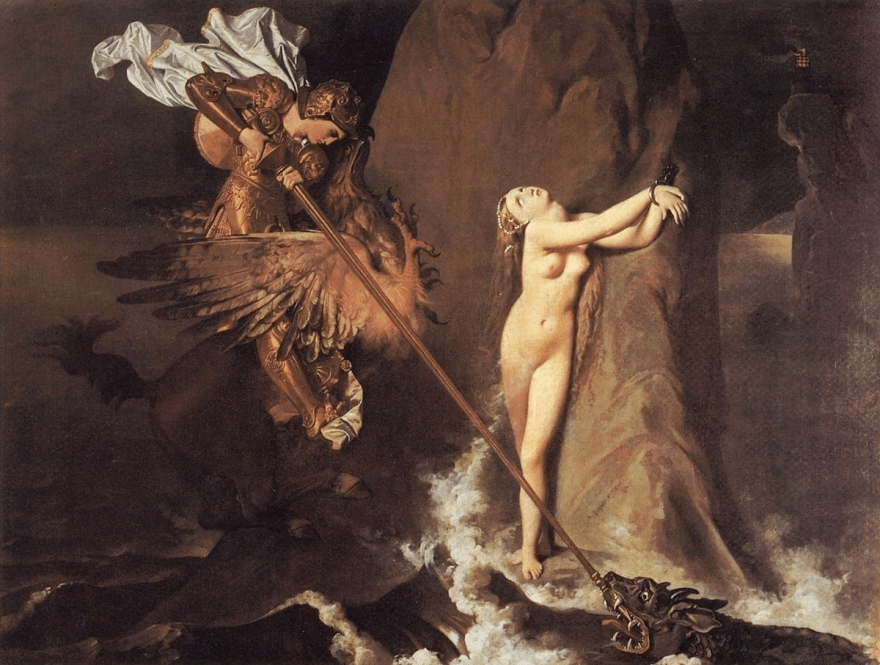
“Hell-spurge is odd. Applied to a common genus of plants, the word may, figuratively, stand for any kind of <shoot> or <sprout>. One suspects that the present instance resulted from a tonal-visual overlap with surge [uma erupção infernal e caótica, poderia ser a rendição correta].”
“Geomaunt and teraphim make a bizarre pair. The O.E.D. gives Rossetti’s sonnet as reference for <geomant> or <geomaunt>, one skilled in <geomancy>, the art of divining the future by observing terrestrial shapes or the ciphers drawn when handfuls of earth are scattered (geomancy occurs in Büchner’s Wozzeck when the tormented Wozzeck sees a hideous future writ in the shapes of moss and fungi [lama e lodo – o café do reino vegetal]). Rossetti’s source for this occult term may well have been its appearance in Dante:
quando i geomanti lor maggior fortuna
veggiono in oriente, innanzi all’alba,
surger per via che poco le sta bruna . . .
(Purgatorio, XIX. 4-6)
The occurrence of surger so close to geomanti makes it likely that a remembrance of Dante in fact underlies this part of Rossetti’s sonnet and may be more immediate to it than Ingres’ painting.”
Marcadamente, os elementos telúricos do poema rivalizam com a temática marinha do soneto! Outra curiosidade é que o cavaleiro da estória é Roger, que salva a donzela da besta-marinha, mas o título diz o contrário!
MOTIVOS PARA UMA ABSTRAÇÃO
“In a way typical of Pre-Raphaelite verse, the linguistic proposition is validated by another medium (music, painting, textile, the decorative arts). Freed from autonomy, Rossetti’s evocative caption can go through its motions. What do these amount to? No firm doctrine of correspondence is operative: the sonnet makes no attempt to simulate the style and visual planes of the picture. It embodies a momentary ricochet: griffin, armoured paladin, the boiling sea, a swooning figure on a phallic rock [a parte que Freud adoraria] trigger a volley of <poetic> gestures.”
(*) “Indeed, the whole of line 3 foreshadows [prenuncia, remete a] the Pre-Raphaelite strain in Yeats.”
ZEITGEIST DA IGNORÂNCIA
“To our current way of feeling, Rossetti’s poem is a hollow bauble [baboseira vazia]. In short, at this stage in the history of feeling and verbal perception, it is difficult to <read at all> the Sonnets for Pictures.” “We are, in the main, <word-blind> to Pre-Raphaelite and Decadent verse. This blindness results from a major change in habits of sensibility. Our contemporary sense of the poetic, our often unexamined presumptions about valid or spurious uses of figurative speech have developed from a conscious negation of fin de siècle ideals.” “We have for a time disqualified ourselves from reading comprehensively (a word which has in it the root for <understanding>) not only a good deal of Rossetti, but the poetry and prose of Swinburne, William Morris, Aubrey Beardsley, Ernest Dowson, Lionel Johnson, and Richard Le Gallienne. Dowson’s Cynara poem or Arthur Symons’s Javanese Dancers provide what comes near to being a test-case. Even in the cool light of the late 1960s, the intimation of real poetry is undeniable.” “Much more is involved here than a change of fashion, than the acceptance by journalism and the academy of a canon of English poetry chosen by Pound and Eliot. This canon is already being challenged; the primacy of Donne may be over, Browning and Tennyson are visibly in the ascendant. A design of literature which finds little worth commending between Dryden and Hopkins is obviously myopic. But the problem of how to read the Pre-Raphaelites and the poets of the nineties cuts deeper.”
“No tone-values are more difficult to determine than those of a seemingly <neutral> text, of a diction which gives no initial purchase to lexicographer or grammarian.”
“When reading any piece of English prose after about 1800 and most verse, the general reader assumes that the words on the page, with a few <difficult> or whimsical exceptions, mean what they would in his own idiom. In the case of <classics> such as Defoe and Swift that assumption may be extended back to the early eighteenth century. It almost reaches Dryden, but it is, of course, a fiction.”
“We are growing year by year more introspective and self-conscious: the current philosophy leads us to a close, patient and impartial observation and analysis of our mental processes: we more and more say and write what we actually do think and feel, and not what we intend to think or should desire to feel.” Henry Sidgwick, 1869
VERBO & TEMPO
“Language – and this is one of the crucial propositions in certain schools of modern semantics – is the most salient model of Heraclitean flux. It alters at every moment in perceived time. The sum of linguistic events is not only increased but qualified by each new event. If they occur in temporal sequence, no two statements are perfectly identical. Though homologous, they interact. When we think about language, the object of our reflection alters in the process (thus specialized or metalanguages may have considerable influence on the vulgate). In short: so far as we experience and <realize> them in linear progression, time and language are intimately related: they move and the arrow is never in the same place.” “certain cultures speak less than others; some modes of sensibility prize taciturnity and elision, others reward prolixity and semantic ornamentation. Inward discourse has its complex, probably unrecapturable history: both in amount and significant content, the divisions between what we say to ourselves and what we communicate to others have not been the same in all cultures or stages of linguistic development.”
R.B. Lees, The Basis of Glottochronology
“the Indo-European paradigm of singular, dual, plural, which may go back to the beginnings of lndo-European linguistic history, survives to this day in the English usage better of two but best of three or more. Yet the English of King Alfred’s day, most of whose features are chronologically far more recent, is practically unintelligible.”
“The conservatism, indeed the deliberate retention of the archaic, which marks several epochs in the history of Chinese has often been noted. Post-war Italian, despite the pressure of verismo and the conscious modernism of other media, such as film, has been curiously inert”
“Both the French and the Bolshevik revolutions were linguistically conservative, almost academic in their rhetoric. The Second Empire, on the other hand, sees one of the principal movements of stress and exploration in the poetics and habits of sensibility of the French language. At most stages in the history of a language, moreover, innovative and conservative tendencies coexist.”
“Some who have thought hardest about the nature of language and about the interactions of speech and society – De Maistre, Karl Kraus, Walter Benjamin, George Orwell – have, consciously or not, argued from a vitalist metaphor. In certain civilizations there come epochs in which syntax stiffens, in which the available resources of live perception and restatement wither. Words seem to go dead under the weight of sanctified usage; the frequency and sclerotic force of clichés, of unexamined similes, of worn tropes increases. Instead of acting as a living membrane, grammar and vocabulary become a barrier to new feeling. A civilization is imprisoned in a linguistic contour which no longer matches, or matches only at certain ritual; arbitrary points, the changing landscape of fact.”
“Worn, threadbare, filed down, words have become the carcass of words, phantom words; everyone drearily chews and regurgitates the sound of them between their jaws.” Adamov
“The totality of Homer, the capacity of the Iliad and Odyssey to serve as repertoire for most of the principal postures of Western consciousness – we are petulant as Achilles and old as Nestor, our homecomings are those of Odysseus – point to a moment of singular linguistic energy.”
“Aeschylus may not only have been the greatest of tragedians but the creator of the genre, the first to locate in dialogue the supreme intensities of human conflict. The grammar of the Prophets in Isaiah enacts a profound metaphysical scandal – the enforcement of the future tense, the extension of language over time. A reverse discovery animates Thucydides; his was the explicit realization that the past is a language construct, that the past tense of the verb is the sole guarantor of history. The formidable gaiety of the Platonic dialogues, the use of the dialectic as a method of intellectual chase, stems from the discovery that words, stringently tested, allowed to clash as in combat or manoeuvre as in a dance, will produce new shapes of understanding. Who was the first man to tell a joke, to strike laughter out of speech (the absence of jokes from Old Testament writings suggests that purely verbal wit may be a fairly late, subversive development)?”
“It is difficult to suppose that the Oresteia was composed very long after the dramatist’s first awareness of the paradoxical relations between himself, his personages, and the fact of personal death.”
“We have histories of massacre and deception, but none of metaphor. We cannot accurately conceive what it must have been like to be the first to compare the colour of the sea with the dark of wine or to see autumn in a man’s face. Such figures are new mappings of the world, they reorganize our habitation in reality.” “No desolation has gone deeper than Job’s, no dissent from mundanity has been more trenchant than Antigone’s. The fire-light in the domestic hearth at close of day was seen by Horace; Catullus came near to making an inventory of sexual desire. A great part of Western art and literature is a set of variations on definitive themes. Hence the anarchic bitterness of the late-comer and the impeccable logic of Dada when it proclaims that no new impulses of feeling or recognition will arise until language is demolished. <Make all things new> cries the revolutionary, in words as old as the Song of Deborah or the fragments of Heraclitus.”
“ethno-linguists tell us, for example, that Tarascan, a Mexican tongue, is inhospitable to new metaphors, whereas Cuna, a Panamanian language, is avid for them. An Attic delight in words, in the play of rhetoric, was noticed and often mocked throughout the Mediterranean world. Qiryat Sepher, the <City of the Letter> in Palestine, and the Syrian Byblos, the <Town of the Book>, are designations with no true parallel anywhere else in the ancient world.”
“In numerous cultures blindness is a supreme infirmity and abdication from life; in Greek mythology the poet and the seer are blind so that they may, by the antennae of speech, see further.”
“A true reader is a dictionary addict. He knows that English is particularly well served, from Bosworth’s Anglo-Saxon Dictionary, through Kurath and Kuhn’s Middle English Dictionary to the almost incomparable resources of the O.E.D. (both Grimm’s Wörterbuch and the Littré are invaluable but neither French nor German have found their history and specific genius as completely argued and crystallized in a single lexicon).”
“Rossetti’s geomaunt will lead to Shipley’s Dictionary of Early English and the reassurance that <the topic is capped with moromancy, foolish divination, a 17th century term that covers them all>. Skeat’s Etymological Dictionary and Principles of English Etymology are an indispensable first step towards grasping the life of words. But each period has its specialized topography. Skeat and Mayhew’s Glossary of Tudor and Stuart Words necessarily accompanies one’s reading of English literature from Skelton to Marvell. No one will get to the heart of the Kipling world, or indeed clear up certain cruces in Gilbert and Sullivan without Sir H. Yule and A. C. Burnell’s Hobson-jobson. Dictionaries of proverbs and place-names are essential. Behind the façade of public discourse extends the complex, shifting terrain of slang and taboo speech. Without such quarries as Champion’s L’Argot ancien and Eric Partridge’s lexica of underworld usage, much of Western literature, from Villon to Genet is only partly legible.
Beyond such major taxonomies lie areas of relevant specialization. A demanding reader of mid-eighteenth-century verse will often find himself referring to the Royal Horticultural Society’s Dictionary of Gardening. The old Drapers’ Dictionary of S. William Beck clears up more than one erotic conundrum in Restoration comedy. Fox-Davies’s Armorial Families and other registers of heraldry are as helpful at the opening of The Merry Wives of Windsor as they are in elucidating passages in the poetry of Sir Walter Scott. A true Shakespeare library is, of itself, very nearly a summation of human enterprise. It would include manuals of falconry and navigation, of law and of medicine, of venery [caça] and the occult. A central image in Hamlet depends on the vocabulary of wool-dyeing [tecedura de lã] (wool greased or enseamed with hog’s lard over the nasty sty [quer dizer que a lã em comento foi banhada com gordura e resinas de intestino de porco]); from The Taming of the Shrew [A Megera Domada] to The Tempest, there is scarcely a Shakespearean play which does not use the extensive glossary of Elizabethan musical terms to make vital statements about human motive or conduct. Several episodes in Jane Austen can only be made out if one has knowledge, not easily come by, of a Regency escritoire and of how letters were sent. Being so physically cumulative in effect, so scenic in structure, the Dickens world draws on a great range of technicality. There is a thesaurus of Victorian legal practice and finance in Bleak House and Dombey and Son. The Admiralty’s Dictionary of Naval Equivalents and a manual of Victorian steam-turbine construction have helped clear up the meaning of one of the most vivid yet hermetic similes in The Wreck of the Deutschland.”
“The complete penetrative grasp of a text, the complete discovery and recreative apprehension of its life-forms (prise de conscience), is an act whose realization can be precisely felt but is nearly impossible to paraphrase or systematize.” “To read Shakespeare and Hölderlin is, literally, to prepare to read them. But neither erudition nor industry make up the sum of insight, the intuitive thrust to the centre.” “yet more is needed: just literary perception, congenial intimacy with the author, experience which must have been won by study, and mother wit which he must have brought from his mother’s womb.” Houman
“ainda mais (do que erudição e indústria) são necessários: percepção literária na medida, intimidade congênita com o autor, experiência esta ganha também por estudo, mas que em não poucos casos deriva de <inteligência de mãe> que deve haver desde o útero na pessoa.”
“Ter crítica de conjectura, que permite emendar um autor que está sendo traduzido, é mais do que se pode esperar do gênero humano, sobretudo em se tratando de Shakespeare” Johnson
“Ultimate connoisseurship is a kind of finite mimesis: through it the painting or the literary text is made new – though obviously in that reflected, dependent sense which Plato gave to the concept of <imitation>.”
“Every musical realization is a new poiesis. It differs from all other performances of the same composition. Its ontological relationship to the original score and to all previous renditions is twofold: it is at the same time reproductive and innovatory. In what sense does unperformed music exist? But what is the measure of the composer’s verifiable intent after successive performances? There is a strain of femininity [?] in the great interpreter, a submission, made active by intensity of response, to the creative presence.”
Je est un autre
“Literature is news that stays news” Ezra Pound
“Só a grande arte sobrevive a uma exaustiva e deliberada reinterpretação.”
“Each time Cymheline is staged, Posthumus’s monologue becomes the object of manifold <edition>. An actor can choose to deliver the words of the Folio in what is thought to have been the pronunciation of Elizabethan English. He can adopt a neutral, though in fact basically nineteenth-century solemn register and vibrato (the equivalent of a Victorian prize calf binding). He may by control of caesura and vowel-pitch convey an impression of modernity. His – the producer’s – choice of costume is an act of practical criticism. A Roman Posthumus represents a correction of Elizabethan habits of anachronism or symbolic contemporaneity – themselves a convention of feeling which we may not fully grasp. A Jacobean costume points to the location of the play in a unique corpus: it declares of Cymheline that Shakespeare’s authorship is the dominant fact.”
“When we read or hear any language-statement from the past, be it Leviticus or last year’s best-seller, we translate. Reader, actor, editor are translators of language out of time.”
“The time-barrier may be more intractable than that of linguistic difference. Any bilingual translator is acquainted with the phenomenon of <false friends> – homonyms such as French hahit and English habit which on occasion might, but almost never do, have the same meaning, or mutually untranslatable cognates such as English home and German Heim.”
“What material reality has history outside language, outside our interpretative belief in essentially linguistic records (silence knows no history)? Where worms, fires of London, or totalitarian régimes obliterate such records, our consciousness of past being comes on a blank space. To remember everything is a condition of madness. We remember culturally, as we do individually, by conventions of emphasis, foreshortening, and omission.”
“The Middle Ages experienced by Walter Scott were not those mimed by the Pre-Raphaelites. The Augustan paradigm of Rome was, like that of Ben Janson and the Elizabethan Senecans, an active fiction, a <reading into life>. But the two models were very different. From Marsilio Ficino to Freud, the image of Greece, the verbal icon made up of successive translations of Greek literature, history, and philosophy, has oriented certain fundamental movements in Western feeling. But each reading, each translation differs, each is undertaken from a distinctive angle of vision. The Platonism of the Renaissance is not that of Shelley, Hölderlin’s Oedipus is not the Everyman of Freud or the limping [deficiente; muito debilitado] shaman of Lévi-Strauss.”
“There is, today, a 1914-19 figura for those in their 70s; to a man of 40, 1914 is the vague forerunner of realities which only gather meaning in the crises of the late 1930s; to the <bomb-generation>, history is an experience that dates to 1945; what lies before is an allegory of antique illusions. In the recent revolts of the very young, a surrealistic syntax, anticipated by Artaud and Jarry, is at work: the past tense is to be excluded from the grammar of politics and private consciousness.”
“This metaphysic of the instant, this slamming of the door on the long galleries of historical consciousness, is understandable. It has a fierce innocence. It embodies yet another surge towards Eden, towards that pastoral before time (there could be no autumn before the apple was off the branch, no fall before the Fall) which the eighteenth century sought in the allegedly static cultures of the south Pacific. But it is an innocence as destructive of civilization as it is, by concomitant logic, destructive of literate speech. Without the true fiction of history, without the unbroken animation of a chosen past, we become flat shadows. Literature, whose genius stems from what Éluard [um dos fundadores do surrealismo] called le dur désir de durer, has no chance of life outside constant translation within its own language. Art dies when we lose or ignore the conventions by which it can be read, by which its semantic statement can be carried over into our own idiom”
“Languages that extend over a large physical terrain will engender regional modes and dialects. Before the erosive standardizations of radio and television became effective, it was a phonetician’s parlour-trick to locate, often to within a few dozen miles, the place of origin of an American from the border states or a north-country Englishman. The mutual incomprehensibility of diverse branches of Chinese such as Cantonese and Mandarin are notorious. There are dictionaries and grammars of Venetian, Neapolitan, and Bergamasque.”
“Different castes, different strata of society use a different idiom. Eighteenth-century Mongolia provides a famous case. The religious language was Tibetan; the language of government was Manchu; merchants spoke Chinese; classical Mongol was the literary idiom; and the vernacular was the Khalka dialect of Mongol.”
Michel Leiris, La Langue secrète des Dogons de Sanga (Soudan Français) (Paris, 1948)
“Upper-class English diction, with its sharpened vowels, elisions; and modish slurs, is both a code for mutual recognition – accent is worn like a coat of arms – and an instrument of ironic exclusion. It communicates from above, enmeshing the actual unit of information, often imperative or conventionally benevolent, in a network of superfluous linguistic matter.” “Thackeray and Wodehouse are masters at conveying this dual focus of aristocratic semantics. As analysed by Proust, the discourse of Charlus is a light-beam pin-pointed, obscured, prismatically scattered as by a Japanese fan beating before a speaker’s face in ceremonious motion. To the lower classes, speech is no less a weapon and a vengeance.”
William Labor, Paul Cohen & Clarence Robbins, A Preliminary Study of English, Used by Negro and Puerto Rican Speakers in New York City (New York, 1965)
“White and black trade words as do front-line soldiers lobbing back an undetonated grenade.”
“Competing ideologies rarely create new terminologies. As Kenneth Burke and George Orwell have shown in regard to the vocabulary of Nazism and Stalinism, they pilfer and decompose the vulgate. In the idiom of fascism and communism, peace, freedom, progress, popular will are as prominent as in the language of representative democracy. But they have their fiercely disparate meanings. The words of the adversary are appropriated and hurled against him. When antithetical meanings are forced upon the same word (Orwell’s Newspeak), when the conceptual reach and valuation of a word can be altered by political decree, language loses credibility. Translation in the ordinary sense becomes impossible. To translate a Stalinist text on peace or on freedom under proletarian dictatorship into a non-Stalinist idiom, using the same time-honoured words, is to produce a polemic gloss, a counter-statement of values. At the moment, the speech of politics, of social dissent, of journalism is full of loud ghost-words, being shouted back and forth, signifying contraries or nothing. It is only in the underground of political humour that these shibboleths [matizes, jargões, lugares-comuns] regain significance. When the entry of foreign tanks into a free city is glossed as <a spontaneous, ardently welcomed defence of popular freedom> (Izvestia, 27 August 1968), the word <freedom> will preserve its common meaning only in the clandestine dictionary of laughter.”
“Japanese children employ a separate vocabulary for everything they have and use up to a certain age. More common, indeed universal, is the case in which children carve their own language-world out of the total lexical and syntactic resources of adult society.”
“The scatological doggerels of the nursery and the alley-way may have a sociological rather than a psychoanalytic motive. The sexual slang of childhood, so often based on mythical readings of actual sexual reality rather than on any physiological grasp, represents a night-raid on adult territory. The fracture of words, the maltreatment of grammatical norms which, as the Opies have shown, constitute a vital part of the lore, mnemonics, and secret parlance of childhood, have a rebellious aim: by refusing, for a time, to accept the rules of grown-up speech, the child seeks to keep the world open to his own, seemingly unprecedented needs. In the event of autism, the speech-battle between child and master can reach a grim finality. Surrounded by incomprehensible or hostile reality, the autistic child breaks off verbal contact. He seems to choose silence to shield his identity but even more, perhaps, to destroy his imagined enemy. Like murderous Cordelia, children know that silence can destroy another human being. Or like Kafka they remember that several have survived the song of the Sirens, but none their silence.” “Diderot had referred to <l’enfant, ce petit sauvage>, joining under one rubric the nursery and the natives of the South Seas.”
“The passage from the transitional into the exploratory model is visible in Lewis Carroll. Alice in Wonderland relates to voyages into the language-world and special logic of the child as Gulliver relates to the travel literature of the Enlightenment.”
“Henry James was one of the true pioneers. He made an acute study of the frontier zones in which the speech of children meets that of grown-ups. The Pupil dramatizes the contrasting truth-functions in adult idiom and the syntax of a child. Children, too, have their conventions of falsehood, but they differ from ours. In The Turn of the Screw, whose venue is itself so suggestive of an infected Eden, irreconcilable semantic systems destroy human contact and make it impossible to locate reality. This cruel fable moves on at least four levels of language: there is the provisional key of the narrator (I), initiating all possibilities but stabilizing none, there is the fluency of the governess (II), with its curious gusts of theatrical bravura, and the speech of the servants so avaricious of insight (III). These three modes envelope, qualify, and obscure that of the children (IV). Soon incomplete sentences, filched letters, snatches of overheard but misconstrued speech, produce a nightmare of untranslatability. <I said things,> confesses Miles when pressed to the limit of endurance. That tautology is all his luminous, incomprehensible idiom can yield. The governess seizes upon <an exquisite pathos of contradiction>. Death is the only plain statement left. Both The Awkward Age and What Maisie Knew focus on children at the border, on the brusque revelations and bursts of static which mark the communication between adolescents and those adults whose language-territory they are about to enter.”
“But for all their lively truth, children in the novels of James and Dostoevsky remain, in large measure, miniature adults. They exhibit the uncanny percipience of the <aged> infant Christ in Flemish art. Mark Twain’s transcriptions of the secret and public idiom of childhood penetrate much further. A genius for receptive insight animates the rendition of Huck Finn and Tom Sawyer.” “For the first time in Western literature, the linguistic terrain of childhood was mapped without being laid waste. After Mark Twain, child psychology and Piaget could proceed.
“Sybil released her foot. <Did you read ‘Little Black Sambo’?> she said.
<It’s very funny you ask me that,> he said. <It so happens I just finished reading it last night.> He reached down and took back Sybil’s hand. <What did you think of it?> he asked her.
<Did the tigers run all around that tree?>
<I thought they’d never stop. I never saw so many tigers.>
<There were only six,> Sybil said.
<Only six!> said the young man. <Do you call that only?>
<Do you like wax?> Sybil asked.
<Do I like what?> asked the young man.
<Wax.>
<Very much. Don’t you?>
Sybil nodded. <Do you like olives?> she asked.
<Olives–yes. Olives and wax. I never go anyplace without ‘em.>
Sybil was silent.
<I like to chew candles,> she said finally.
<Who doesn’t?> said the young man, getting his feet wet.”
J.D. Salinger
“Hence the argument of modern anthropology that the incest taboo, which appears to be primal to the organization of communal life, is inseparable from linguistic evolution. We can only prohibit that which we can name. Kinship systems, which are the coding and classification of sex for purposes of social survival, are analogous with syntax. The seminal and the semantic functions (is there, ultimately, an etymological link?) determine the genetic and social structure of human experience. Together they construe the grammar of being.”
AGE OF MASTURBATION
“If coition can be schematized as dialogue, masturbation seems to be correlative with the pulse of monologue or of internalized address. There is evidence that the sexual discharge in male onanism is greater than it is in intercourse.”
“Ejaculation [expelir com força; falar] is at once a physiological and a linguistic concept. Impotence and speech-blocks [gagueira], premature emission [ejaculação precoce – <gente que interrompe a fala do outro>, cof, cof…] and stuttering, involuntary ejaculation and the word-river of dreams are phenomena whose interrelations seem to lead back to the central knot of our humanity. Semen, excreta, and words are communicative products. They are transmissions from the self inside the skin to reality outside. At the far root, their symbolic significance, the rites, taboos, and fantasies which they evoke, and certain of the social controls on their use, are inextricably interwoven. We know all this but hardly grasp its implications.”
Semen
See, man
Seaman
Zimmerman
“In what measure are sexual perversions analogues of incorrect speech? Are there affinities between pathological erotic compulsions and the search, obsessive in certain poets and logicians, for a <private language>, for a linguistic system unique to the needs and perceptions of the user? Might there be elements of homosexuality in the modem theory of language (particularly in the early Wittgenstein), in the concept of communication as an arbitrary mirroring? It may be that the significance of Sade lies in his terrible loquacity, in his forced outpouring of millions of words. In part, the genesis of sadism could be linguistic. The sadist makes an abstraction of the human being he tortures; he verbalizes life to an extreme degree by carrying out on living beings the totality of his articulate fantasies. Did Sade’s uncontrollable fluency, like the garrulousness [tagarelice] often imputed to the old, represent a psycho-physiological surrogate for diminished sexuality (pornography seeking to replace sex by language)?”
“The formal duality of men’s and women’s speech has been recorded also in Eskimo languages, in Carib, a South American Indian language, and in Thai. I suspect that such division is a feature of almost all languages at some stage in their evolution and that numerous spoors of sexually determined lexical and syntactical differences are as yet unnoticed. But again, as in the case of Japanese or Cherokee <child-speech>, formal discriminations are easy to locate and describe. The far more important, indeed universal phenomenon, is the differential use by men and women of identical words and grammatical constructs.”
“At a rough guess, women’s speech is richer than men’s in those shadings of desire and futurity known in Greek and Sanskrit as optative; women seem to verbalize a wider range of qualified resolve and masked promise. Feminine uses of the subjunctive in European languages give to material facts and relations a characteristic vibrato. I do not say they lie about the obtuse, resistant fabric of the world: they multiply the facets of reality, they strengthen the adjective. To allow it an alternative nominal status, in a way which men often find unnerving. There is a strain of ultimatum, a separatist stance, in the masculine intonation of the first-person pronoun; the <I> of women intimates a more patient bearing, or did until Women’s Liberation. The two language models follow on Robert Graves’ dictum that men do but women are.
In regard to speech habits, the headings of mutual reproach are immemorial. In every known culture, men have accused women of being garrulous, of wasting words with lunatic prodigality. The chattering, ranting, gossipping female, the tattle, the scold, the toothless crone her mouth wind-full of speech, is older than fairy-tales. Juvenal, in his Sixth Satire, makes a nightmare of woman’s verbosity:
The grammarians yield to her; the rhetoricians succumb; the whole crowd is silenced. No lawyer, no auctioneer will get a word in, no, nor any other woman. Her speech pours out in such a torrent that you would think that pots and bells were being banged together. Let no one more blow a trumpet or clash a cymbal: one woman alone will make noise enough to rescue the labouring moon (from eclipse).”
“The alleged outpouring of women’s speech, the rank flow of words, may be a symbolic restatement of men’s apprehensive, often ignorant awareness of the menstrual cycle. In masculine satire, the obscure currents and secretions of woman’s physiology are an obsessive theme. Ben Jonson unifies the two motifs of linguistic and sexual incontinence in The Silent Woman. <She is like a conduit-pipe>, says Morose of his spurious bride, <that will gush out with more force when she opens again.> <Conduit-pipe>, with its connotations of ordure and evacuation, is appallingly brutal. So is the whole play. The climax of the play again equates feminine verbosity with lewdness: <O my heart! wilt thou break? wilt thou break? this is worst of all worst worsts that hell could have devised! Marry a whore, and so much noise!>”
“The motif of the woman or maiden who says very little, in whom silence is a symbolic counterpart to chasteness and sacrificial grace, lends a unique pathos to the Antigone of Oedipus at Colonus or Euripides’ Alcestis.” “These values crystallize in Coriolanus’ salute to Virgilia: <My gracious silence, hail!> The line is magical in its music and suggestion, but also in its dramatic shrewdness.”
“Women know the change in a man’s voice, the crowding of cadence, the heightened fluency triggered off by sexual excitement. They have also heard, perennially, how a man’s speech flattens, how its intonations dull after orgasm. In feminine speech-mythology, man is not only an erotic liar; he is an incorrigible braggart. Women’s lore and secret mock record him as an eternal miles gloriosus, a self-trumpeter who uses language to cover up his sexual or professional fiascos, his infantile needs, his inability to withstand physical pain.”
“Taceat mulier in ecclesia is prescriptive in both Judaic and Christian culture.”
“Like breathing, the technique is unconscious; like breathing also, it is subject to obstruction and homicidal breakdown. Under stress of hatred, of boredom, of sudden panic, great gaps open. It is as if a man and a woman then heard each other for the first time and knew, with sickening conviction, that they share no common language, that their previous understanding had been based on a trivial pidgin which had left the heart of meaning untouched. Abruptly the wires are down and the nervous pulse under the skin is laid bare in mutual incomprehension. Strindberg is master of such moments of fission. Harold Pinter’s plays locate the pools of silence that follow.”
“Like no other playwright, Racine communicates not only the essential beat of women’s diction but makes us feel what there is in the idiom of men which Andromaque, Phèdre, or Iphigénie can only grasp as falsehood or menace. Hence the equivocation, central in his work, on the twofold sense of entendre [em francês, escutar antes que entender]: these virtuosos of statement hear each other perfectly, but do not, cannot apprehend. I do not believe there is a more complete drama in literature, a work more exhaustive of the possibilities of human conflict than Racine’s Bérénice. It is a play about the fatality of the coexistence of man and woman, and it is dominated, necessarily, by speech-terms (parole, dire, mot, entendre). Mozart possessed something of this same rare duality (so different from the characterizing, polarizing drive of Shakespeare). Elvira, Donna Anna, and Zerlina have an intensely shared femininity, but the music exactly defines their individual range or pitch of being. The same delicacy of tone-discrimination is established between the Countess and Susanna in The Marriage of Figaro. In this instance, the discrimination is made even more precise and more dramatically different from that which characterizes male voices by the <bisexual> role of Cherubino. The Count’s page is a graphic example of Lévi-Strauss’ contention that women and words are analogous media of exchange in the grammar of social life. Stendhal was a careful student of Mozart’s operas. That study is borne out in the depth and fairness of his treatment of the speech-worlds of men and women in Fabrice and la Sanseverina in The Charterhouse of Parma. Today, when there is sexual frankness as never before, such fairness is, paradoxically, rarer. It is not as <translators> that women novelists and poets excel, but as declaimers of their own, long-stifled tongue.”
“Não é como tradutoras que as mulheres que são novelistas e poetas sobressaem-se, mas como declamadoras de seu próprio eu, seu próprio sexo, seus discursos longamente interrompidos e abortados.”
“The <aside> as it is used in drama is a naïve representation of scission: the speaker communicates to himself (thus to his audience) all that his overt statement to another character leaves unsaid. As we grow intimate with other men or women, we often <hear> in the slightly altered cadence, speed, or intonation of whatever they are saying to us the true movement of articulate but unvoiced intent. Shakespeare’s awareness of this twofold motion is unfailing. Desdemona asks of Othello, in the very first, scarcely realized instant of shaken trust, <Why is your speech so faint?>.”
“Having kept the same word-signals bounding and rebounding between them like jugglers’ weights, year after year, from horizon to horizon, Beckett’s vagrants and knit couples understand one another almost osmotically. With intimacy, the external vulgate and the private mass of language grow more and more concordant. Soon the private dimension penetrates and takes over the customary forms of public exchange. The stuffed-animal and baby-speech of adult lovers reflects this take-over. In old age the impulse towards translation wanes and the pointers of reference turn inward. The old listen less or principally to themselves. Their dictionary is, increasingly, one of private remembrance.”
“The affair at Babel confirmed and externalized the never-ending task of the translator – it did not initiate it.”
Babel caiu e abandonei a comunhão com o cão dentro de mim.
“Theories of semantics, constructs of universal and transformational grammar that have nothing of substance to say about the prodigality of the language atlas–more than a thousand different languages are spoken in New Guinea–could well be deceptive. It is here, rather than in the problem of the invention and understanding of melody (though the two issues may be congruent), that I would place what Lévi-Strauss calls le mystère suprême of anthropology.”
“why does this unified, though individually unique mammalian species not use one common language? It inhales, for its life processes, one chemical element and dies if deprived of it. It makes do with the same number of teeth and vertebrae. To grasp how notable the situation is, we must make a modest leap of imagination, asking, as it were, from outside. In the light of anatomical and neurophysiological universals, a unitary language solution would be readily understandable. Indeed, if we lived inside one common language-skin, any other situation would appear very odd. It would have the status of a recondite fantasy, like the anaerobic or anti-gravitational creatures in science-fiction.”
“Depending on which classification they adopt, ethnographers divide the human species into 4 or 7 races (though the term is, of course, an unsatisfactory shorthand). The comparative anatomy of bone structures and sizes leads to the use of 3 main typologies. The analysis of human blood-types, itself a topic of great intricacy and historical consequence, suggests that there are approximately half a dozen varieties. Such would seem to be the cardinal numbers of salient differentiation within the species though the individual, obviously, is genetically unique.”
“We do not speak one language, nor half a dozen, nor twenty or thirty. Four to five thousand languages are thought to be in current use. This figure is almost certainly on the low side. We have, until now, no language atlas which can claim to be anywhere near exhaustive. Furthermore, the four to five thousand living languages are themselves the remnant of a much larger number spoken in the past. Each year so-called rare languages, tongues spoken by isolated or moribund ethnic communities, become extinct. Today entire families of language survive only in the halting remembrance of aged, individual informants (who, by virtue of their singularity are difficult to cross-check) or in the limbo of tape-recordings. Almost at every moment in time, notably in the sphere of American Indian speech, some ancient and rich expression of articulate being is lapsing into irretrievable silence. One can only guess at the extent of lost languages. It seems reasonable to assert that the human species developed and made use of at least twice the number we can record today. A genuine philosophy of language and socio-psychology of verbal acts must grapple with the phenomenon and rationale of the human <invention> and retention of anywhere between five and ten thousand distinct tongues.” “To speak seriously of translation one must first consider the possible meanings of Babel, their inherence in language and mind.”
“Despite decades of comparative philological study and taxonomy, no linguist is certain of the language atlas of the Caucasus, stretching from Bzedux in the north-west to Rut’ul and Küri in the Tartar regions of Azerbeidjan.” “Arci, a language with a distinctive phonetic and morphological structure, is spoken by only one village of approximately 850 inhabitants.” “A comparable multiplicity and diversity marks the so-called Palaeosiberian language families. Eroded by Russian during the nineteenth century, Kamtchadal, a language of undeniable resource and antiquity, survives in only 8 hamlets [povoados – ‘hamlet’ seria um vilarejo tão pequeno que sequer possui paróquia] in the maritime province of Koriak.” “For Mexico and Central America alone, current listings reckon 190 distinct tongues.” “Tubatulabal was spoken by something like a thousand Indians at the southern spur of the Sierra Nevada as recently as the 1770s.” “Blank spaces and question marks cover immense tracts of the linguistic geography of the Amazon basin and the savannah. At latest count, ethno-linguists discriminate between 109 families, many with multiple sub-classes. But scores of Indian tongues remain unidentified or resist inclusion in any agreed category.” “Many will dim into oblivion before rudimentary grammars or word-lists can be salvaged. Each takes with it a storehouse of consciousness.” “The language catalogue begins with Aba, an Altaic idiom spoken by Tartars, and ends with Zyriene, a Finno-Ugaritic speech in use between the Urals and the Arctic shore. It conveys an image of man as a language animal of implausible variety and waste. By comparison, the classification of different types of stars, planets, and asteroids runs to a mere handful.”
ME WHITE MAN YOU TROUBLE M’AN MONEY KING WORLD ME OWN: “We have no sound basis [base sonora e base segura, belo trocadilho!] on which to argue that extinct languages failed their speakers, that only the most comprehensive or those with the greatest wealth of grammatical means have endured. On the contrary: a number of dead languages are among the obvious splendours of human intelligence. Many a linguistic mastodon is a more finely articulated, more <advanced> piece of life than its descendants. There appears to be no correlation, moreover, between linguistic wealth and other resources of a community. Idioms of fantastic elaboration and refinement coexist with utterly primitive, economically harsh modes of subsistence. Often, cultures seem to expend on their vocabulary and syntax acquisitive energies and ostentations entirely lacking in their material lives. Linguistic riches seem to act as a compensatory mechanism. Starving bands of Amazonian Indians may lavish on their condition more verb tenses than could Plato.”
“With the simple addition of neologisms and borrowed words, any language can be used fairly efficiently anywhere; Eskimo syntax is appropriate to the Sahara. Far from being economic and demonstrably advantageous, the immense number and variety of human idioms, together with the fact of mutual incomprehensibility, is a powerful obstacle to the material and social progress of the species. We will come back to the key question of whether or not linguistic differentiations may provide certain psychic, poetic benefits.”
“It was before Humboldt that the mystery of many tongues on which a view of translation hinges fascinated the religious and philosophic imagination.”
Arno Borst, Der Turmbau von Babel: Geschichte der Meinungen über Ursprung und Vielfalt der Sprachen und Völker (Stuttgart, 1957-63).
O Cãos de Pã-Dora
“Thus Babel was a second Fall, in some regards as desolate as the first. Adam had been driven from the garden; now men were harried, like yelping dogs, out of the single family of man. And they were exiled from the assurance of being able to grasp and communicate reality.”
“Had there not been a partial redemption at Pentecost, when the gift of tongues descended on the Apostles? Was not the whole of man’s linguistic history, as certain Kabbalists supposed, a laborious swing of the pendulum between Babel and a return to unison in some messianic moment of restored understanding?” “Jewish gnostics argued that the Hebrew of the Torah was God’s undoubted idiom, though man no longer understood its full, esoteric meaning. Other inquirers, from Paracelsus to the 17th century Pietists, were prepared to view Hebrew as a uniquely privileged language, but itself corrupted by, the Fall and only obscurely revelatory of the Divine presence. Almost all linguistic mythologies, from Brahmin wisdom to Celtic and North African lore, concurred in believing that original speech had shivered into 72 shards, or into a number which was a simple multiple of 72.” “[Nota] The 6×12 component suggests an astronomical or seasonal correlation.” “The name of Esperanto has in it, undisguised, the root for an ancient and compelling hope.”
Gershom Scholem, Major Trends in Jewish Mysticism
“Starting with Genesis 11:11 and continuing to Wittgenstein’s Investigations or Noam Chomsky’s earliest, unpublished paper on morphophonemics in Hebrew, Jewish thought has played a pronounced role in linguistic mystique, scholarship, and philosophy.”
“the Talmud had said: <the omission or the addition of one letter might mean the destruction of the whole world.>”
“Elohim, the name of God, unites Mi, the hidden subject, with Eloh, the hidden object.”
“in Hebrew, and particularly in Exodus with its 72 designations of the Divine name, magic forces were compacted.”
“There was, as Coleridge knew, no deeper dreamer on language, no sensibility more haunted by the alchemy of speech, than Jakob Böhme (1575-1624). Like Nicholas of Cusa long before him, Böhme supposed that the primal tongue had not been Hebrew, but an idiom brushed from men’s lips in the instant of the catastrophe at Babel and now irretrievably dejected among all living speech (Nettesheim had, at one point, argued that Adam’s true vernacular was Aramaic).”
“In the visionary musings of Angelus Silesius (Johann Scheffler), Böhme’s intimations are carried to extremes. Angelus Silesius asserts that God has, from the beginning of time, uttered only a single word. In that single utterance all reality is contained. The cosmic Word cannot be found in any known tongue; language after Babel cannot lead back to it. The bruit of human voices, so mysteriously diverse and mutually baffling, shuts out the sound of the Logos. There is no access except silence. Thus, for Silesius, the deaf and dumb are nearest of all living men to the lost vulgate of Eden.
In the climate of the eighteenth century these gnostic reveries faded. But we find them again, changed into model and metaphor, in the work of three modem writers. It is these writers who seem to tell us most of the inward springs of language and translation.”
“Walter Benjamin’s Die Aufgabe des Übersetzers dates from 1923. An English translation of this essay, by James Hynd and E.M. Valk, may be found in Delos, A Journal on and of Translation, 2 (1968).”
“The relevant proposition is this: if translation is a form, then the condition of translatability must be ontologically necessary to certain works.” W.B.
“Translation is both possible and impossible – a dialectical antinomy characteristic of esoteric argument.” “At the <messianic end of their history> (again a Kabbalistic or Hasidic formulation), all separate languages will return to their source of common life. In the interim, translation has a task of profound philosophic, ethical, and magical import.”
“Certain of Luther’s versions of the Psalms, Hölderlin’s recasting of Pindar’s Third Pythian Ode, point by their strangeness of evocatory inference to the reality of an Ur-Sprache in which German and Hebrew or German and ancient Greek are somehow fused.”
“Marianne Moore’s readings of La Fontaine are thorn-hedges apart from colloquial American English. The translator enriches his tongue by allowing the source language to penetrate and modify it.” “As the Kabbalist seeks the forms of God’s occult design in the groupings of letters and words, so the philosopher of language will seek in translations – in what they omit as much as in their content – the far light of original meaning.”
“His loyalties divided between Czech and German, his sensibility drawn as it was, at moments, to Hebrew and to Yiddish, Kafka developed an obsessive awareness of the opaqueness of language. His work can be construed as a continuous parable on the impossibility of genuine human communication, or, as he put it to Max Brod in 1921, on <the impossibility of not writing, the impossibility of writing in German, the impossibility of writing differently. One could almost add a fourth impossibility: the impossibility of writing>.” “In the Penal Colony, perhaps the most desperate of his metaphoric reflections on the ultimately inhuman nature of the written word, Kafka makes of the printing press an instrument of torture. The theme of Babel haunted him: there are references to it in almost every one of his major tales. Twice he offered specific commentaries, in a style modelled on that of Hasidic and Talmudic exegesis”
“As no generation of men can hope to complete the high edifice, as engineering skills are constantly growing, there is time to spare. More and more energies are diverted to the erection and embellishment of the workers’ housing. Fierce broils occur between different nations assembled on the site. <Added to which was the fact that already the second or third generation recognized the meaninglessness, the futility (die Sinnlosigkeit) of building a Tower unto Heaven – but all had become too involved with each other to quit the city.> Legends and ballads have come down to us telling of a fierce longing for a predestined day on which a gigantic fist will smash the builders’ city with five blows. <That is why the city has a fist in its coat of arms.>” “The Talmud, which is often Kafka’s archetype, refers to the 49 levels of meaning which must be discerned in a revealed text. [?!?!]”
A base de uma torre que chegasse ao céu teria de estar fincada nas profundezas do inferno, como o arquétipo de todas as árvores. O Minotauro-Cérbero alado aguarda na entrada cheio de respostas para nossos próprios enigmas anti-edipianos.
“Gnostic and Manichaean speculation (the word has in it an action of mirrors) provide Borges with the crucial trope of a <counter-world>. [O Espelho de Enigmas]” Borges, o Confúcio do novo milênio: somos o sonho de uma lagartixa em sua “metempsicose”-rumo-à-borboleta de um paramundo.
the thrall of time
“Borges moves with a cat’s sinewy confidence and foolery between Spanish, ancestral Portuguese, English, French, and German. He has a poets’ grip on the fibre of each. He has rendered a Northumbrian bard’s farewell to Saxon English, <a language of the dawn>. The <harsh and arduous words> of Beowulf were his before he <became a Borges>.”
“The Library of Babel dates from 1941. Every element in the fantasia has its sources in the <literalism> of the Kabbala and in gnostic and Rosicrucian images, familiar also to Mallarmé, of the world as a single, immense tome. <The universe (which others call the Library) is composed of an indefinite, perhaps an infinite number of hexagonal galleries.> It is a beehive out of Piranesi [artista plástico italiano do séc. XVIII] but also, as the title indicates, an interior view of the Tower. <The Library is total and . . . its shelves contain all the possible combinations of the 20-odd orthographic symbols (whose number, though vast, is not infinite); that is, everything which can be expressed, in all languages. Everything is there: the minute history of the future, the autobiographies of the archangels, the faithful catalogue of the Library, thousands and thousands of false catalogues, a demonstration of the falsehood of the true catalogue, the Gnostic gospel of Basilides, the commentary on this gospel, the commentary on the commentary of this gospel, the veridical account of your death, a version of each book in all languages, the interpolation of every book in all books.> Any conceivable combination of letters has already been foreseen in the Library and is certain to <encompass some terrible meaning> in one of its secret languages. No act of speech is without meaning: <No one can articulate a syllable which is not full of tenderness and fear, and which is not, in one of those languages, the powerful name of some god.> Inside the burrow or circular ruins men jabber in mutual bewilderment; yet all their myriad words are tautologies making up, in a manner unknown to the speakers, the lost cosmic syllable or Name of God. This is the formally boundless unity that underlies the fragmentation of tongues.”
“Arguably, Pierre Menard, Author of the Quixote (1939) is the most acute, most concentrated commentary anyone has offered on the business of translation. What studies of translation there are, including this book, could, in Borges’ style, be termed a commentary on his commentary. This concise fiction has been widely recognized for the device of genius which it obviously is. But – and again one sounds like a pastiche of Borges’s fastidious pedantry – certain details have been missed. Menard’s bibliography is arresting: the monographs on <a poetic vocabulary of concepts> and on <connections or affinities> between the thought of Descartes, Leibniz, and John Wilkins point towards the labours of the 17th century to construe an ars signorum, a universal ideogrammatic language system. Leibniz’s Characteristica universalis, to which Menard addresses himself, is one such design; Bishop Wilkins’s Essay towards a real character and a philosophical language of 1668 another. Both are attempts to reverse the disaster at Babel. Menard’s <work sheets of a monograph on George Boole’s symbolic logic> show his (and Borges’) awareness of the connections between the 17th century pursuit of an inter-lingua for philosophic discourse and the <universalism> of modem symbolic and mathematical logic. Menard’s transposition of the decasyllables of Valéry’s Le Cimetière marin into alexandrines is a powerful, if eccentric, extension of the concept of translation. And pace the suave authority of the memorialist, I incline to believe that <a literal translation of Quevedo’s literal translation> of Saint François de Sales was, indeed, to be found among Menard’s papers.” “(How many readers of Borges have observed that Chapter IX turns on a translation from Arabic into Castilian, that there is a labyrinth in XXXVIII, and that Chapter XXII contains a literalist equivocation, in the purest Kabbalistic vein, on the fact that the word no has the same number of letters as the word sí?)” “to become Cervantes by merely fighting Moors, recovering the Catholic faith, and forgetting the history of Europe between 1602 and 1918 was really too facile a métier. Far more interesting was <to go on being Pierre Menard and reach the Quixote through the experiences of Pierre Menard>, i.e. to put oneself so deeply in tune with Cervantes’s being, with his ontological form, as to re-enact, inevitably, the exact sum of his realizations and statements. The arduousness of the game is dizzying. Menard assumes <the mysterious duty> – Bonner,(*) rightly I feel, invokes the notion of <contract> – of recreating deliberately and explicitly what was in Cervantes a spontaneous process. But although Cervantes composed freely, the shape and substance of the Quixote had a local <naturalness> and, indeed, necessity now dissipated. Hence a second fierce difficulty for Menard: to write <the Quixote at the beginning of the 17th century was a reasonable undertaking, necessary and perhaps even unavoidable; at the beginning of the 20th, it is almost impossible. It is not in vain that 300 years have gone by, filled with exceedingly complex events. Amongst them, to mention only one, is the Quixote itself> (Bonner’s <that same Don Quixote> both complicates and flattens Borges’ intimation). In other words, any genuine act of translation is, in one regard at least, a transparent absurdity, an endeavour to go backwards up the escalator of time and to re-enact voluntarily what was a contingent motion of spirit.”
(*) Tradutor anglo-saxônico deste clássico borgeano. Possivelmente, bancar uma missão desabonneradora!
“<Repetition> is, as Kierkegaard argued, a notion so puzzling that it puts in doubt causality and the stream of time.”
Qual de nós 2 escreve esta página, eu ou meu tradutor? Pois, se não é o segundo, talvez este trecho sequer exista… Eu certamente nunca vim a escrevê-lo!
Singularidades estão na [MÔ]NA[DA].
“Philology is the quintessential historical science, the key to the Scienza nuova, because the study of the evolution of language is the study of the evolution of the human mind itself.” “Vico’s opposition to Descartes and to the extensions of Aristotelian logic in Cartesian rationalism made of him the first true <linguistic historicist> or relativist.” “a universal logic of language, on the Aristotelian or Cartesian-mathematical model, is falsely reductionist.”
“Hamann throws out suggestions which anticipate the linguistic relativism of Sapir and Whorf.” “Herder was possessed of a sense of place. His Sprachphilosophie marks a translation from the inspired fantastications of Hamann to the development of genuine comparative linguistics in the early 19th century.” “An untranslated language, urges Herder, will retain its vital innocence, it will not suffer the debilitating admixture of alien blood.”
“Sir William Jones’ celebrated Third Anniversary Discourse on the Hindus of 1786 had, as Friedrich von Schlegel put it, <first brought light into the knowledge of language through the relationship and derivation he demonstrated of Roman, Greek, Germanic and Persian from Indic; and through this into the ancient history of peoples, where previously everything had been dark and confused>. Schlegel’s own Über die Sprache und Weisheit der Indier of 1808, which contains this tribute to Jones, itself contributed largely to the foundations of modern linguistics. It is with Schlegel that the notion of <comparative grammar> takes on clear definition and currency. Not much read today, Mme. de Staël’s De L’Allemagne (1813) [de quem Nietzsche foi orgulhosamente um detrator] exercised tremendous influence.” “Expanding on suggestions already made by Hamann, she sought to correlate the metaphysical ambience, internal divisions, and lyric bias of the German national spirit with the gnarled weave and <suspensions of action> in German syntax. She saw Napoleonic French as antithetical to German, and found its systematic directness and rhetoric clearly expressive of the virtues and vices of the French nation.”
“The play of intelligence, the delicacy of particular notation, the great front of argument which Humboldt exhibits, give his writings on language, incomplete though they are, a unique stature. Humboldt is one of the very short list of writers and thinkers on language–it would include Plato, Vico, Coleridge, Saussure, Roman Jakobson–who have said anything that is new and comprehensive.”
“Werther, Don Carlos, Faust are supreme works of the individual imagination, but also intensely pragmatic forms. In them, through them, the hitherto divided provinces and principalities of the German-speaking lands could test a new common identity. Goethe and Schiller’s theatre at Weimar, Wieland’s gathering of German ballads and folk poetry, the historical narratives and plays of Kleist set out to create in the German mind and in the language a shared echo. As Vico had imagined it would, a body of poetry gave a bond of remembrance (partially fictive) to a new national community. As he studied the relations of language and society, Humboldt could witness how a literature, produced largely by men whom he knew personally, was able to give Germany a living past, and how it could project into the future great shadowforms of idealism and ambition.”
“To Humboldt and his brother, this intimation of universality was no empty metaphor. The Humboldts were among the last Europeans of whom it may be said with fair confidence that they had direct professional or imaginative notions of very nearly the whole of extant knowledge. Ethnographers, anthropologists, linguists, statesmen, educators, the two brothers were a nerve-centre for humanistic and scientific inquiry. Their active interests, like Leibniz’s, ranged with authority and passionate curiosity from mineralogy to metaphysics, from the study of Amerindian antiquities to modern technology.”
H., Über die Verschiedenheit des menschlichen Sprachbaues und ihren Einfluss auf die geistige Entwicklung des Menschengeschlechts / On the Differentiation of the Structure of Human Language, and its Influence on the Spiritual Evolution of the Human Race (1835 [obra póstuma, editada por Steinthal somente em 1883]) (comparar textos Lorena) [?]
“This organic evolutionism goes well beyond and, indeed, against Kant. In so doing, Humboldt arrives at a key notion: language is a <third universe> midway between the phenomenal reality of the <empirical world> and the internalized structures of consciousness. It is this median quality, this material and spiritual simultaneity, that makes of language the defining pivot of man and the determinant of his place in reality.” “Humboldt conjoins the environmentalism of Montesquieu and the nationalism of Herder with an essentially post-Kantian model of human consciousness as the active and diverse shaper of the perceived world.” “It may be that Humboldt derived from Schiller his emphasis on language as being itself the most comprehensive work of art.” “The entelechy, the purposeful flow of speech–we find in Humboldt a kind of romantic Aristotelianism–is the communication of ordered, perceived experience.”
A Linguagem é a unidade primordial.
Mas a unidade primordial não é unitária, que pena!
FALA PRA FORA!: “Man walks erect not because of some ancestral reaching out towards fruit or branch, but because discourse, die Rede, <would not be muffled and made dumb by the ground>.”
“Humboldt clearly anticipates both C.K. Ogden’s theory of opposition and the binary structuralism of Lévi-Strauss.”
“Even the noblest language is only ein Versuch and will remain ontologically incomplete. On the other hand, no language however primitive will fail to actualize, up to a point, the inner needs of a community. Humboldt is convinced that different tongues provide very different intensities of response to life; he is certain that different languages penetrate to different depths. He takes over Schlegel’s classification of <higher> and <lower> grammars. Inflection is far superior to agglutination. The latter is the more rudimentary mode, a Naturlaut.”
“The Greek tone is light, delicate, nuancé. Attic civilization is incomparably inventive of intellectual and plastic forms. These virtues are engendered by and reflected in the precisions and shadings of Greek grammar. Few other languages have cast so finely-woven a net over the currents of life. At the same time, there is that in Greek syntax which helps explain the divisive quality of Greek politics, the excessive trust in rhetoric, the virtuosities of falsehood which sophisticate and corrode the affairs of the polis. Latin offers a grave contrast: the stern, masculine, laconic tenor of Roman culture is exactly correlate with the Latin language, with its sobriety, even paucity, of syntactic invention and Lautformung. The lettering of a Latin inscription is perfectly expressive of the linear, monumental weight of the language.”
“The actual history of linguistic relativity leads via the work of Steinthal (the editor of Humboldt’s fragmentary texts) to the anthropology of Franz Boas.”
“The first true Germany was that of Luther’s vernacular. Gradually the German language created those modes of shared sensibility from which the nation-state could evolve. When that state entered modem history, a late arrival burdened with myths and surrounded by an alien, partially hostile Europe, it carried with it a sharpened, defensive sense of unique perspective.”
“This determination constitutes what Trier, in the early 1930s, called das sprachliche Feld. Thus, in a distinctly Leibnizian way, each tongue or language-monad constructs and operates within a total conceptual field (the imagistic correlation with quantum physics is obvious). This field may be understood as a Gestalt.”
Zwischenwelten: Entremundos
“The gauchos of the Argentine know some 200 expressions for the colours of horses’ hides, and such discrimination is obviously vital to their economy. But their normal speech finds room only for 4 plant names.”
“Anthropological study of American Indian cultures seemed to bear out Humboldt’s conjectures on linguistic determinism and Trier’s notion of the <semantic field>. The whole approach is summarized by Edward Sapir in an article dated 1929”
Whorf, Language, Thought and Reality (1956): “Whorf was an outsider. He had something of Vico’s philosophic curiosity, but was a chemical engineer with a distinctively modern awareness of scientific detail.”
Paper views acadêmicos
“Spatialization, and the space-time matrix in which we locate our lives, are made manifest in and by every element of grammar. There is a distinctive Indo-European time-sense and a corresponding system of verb tenses. Different <semantic fields> exhibit different techniques of numeration, different treatments of nouns denoting physical quantity. They divide the total spectrum of colours, sounds, and scents in very diverse ways. Again, Wittgenstein’s use of <mapping> offers an instructive parallel: different linguistic communities literally inhabit and traverse different landscapes of conscious being.”
“Unlike many universalists, Whorf had an obvious linguistic ear. But it is his work on the languages of the Hopis of Arizona that carries the weight of evidence. It is here that the notion of distinct <pattern-systems> of life and consciousness is argued by force of specific example. The key papers on <an American Indian model of the universe> date from circa 1936 to 1939, at which point Whorf extended his analyses to the Shawnee language.”
“Hopi is better equipped to deal with wave processes and vibrations than is modern English. <According to the conception of modern physics, the contrast of particle and field of vibrations is more fundamental in the world of nature than such contrasts as space and time, or past, present, and future, which are the sort of contrasts our own language imposes upon us. The Hopi aspect-contrast . . . being obligatory upon their verb forms, practically forces the Hopi to notice and observe vibratory phenomena, and furthermore encourages them to find names for and to classify such phenomena.>” “The <metaphysics underlying our own language, thinking, and modern culture> necessarily imposes a static three-dimensional infinite space, but also a perpetual time-flow. These two <cosmic co-ordinates> could be harmoniously conjoined in the physics of Newton and the physics and psychology of Kant. They confront us with profound internal contradictions in the world of quantum mechanics and four-dimensional relativity. The metaphysical framework which informs Hopi syntax is, according to Whorf, far better suited to the world-picture of modern science. Hopi verb tenses and phrasings articulate the existence of events <in a dynamic state, yet not a state of motion>.” Ou é só o nosso olho que QUER VER quarks numa cultura antiocidental? A terra-natal de Heisenberg.
“It is the study of such <cryptotypes> in different languages, urges Whorf, that will lead anthropology and psychology to an understanding of those deep-seated dynamics of meaning, of chosen and significant form, that make up a culture.” “Patently, they elude translation (we shall return to this point). Yet careful, philosophically and poetically disciplined observation does allow the linguist and anthropologist to enter, in some degree at least, into the <pattern-system> of an alien tongue. Particularly if he acts on the principles of ironic self-awareness which underlie a genuine relativist view.”
sânscrito é merda
“Lévi-Strauss would fully endorse Whorf’s assertion that <many American Indian and African languages abound in finely wrought, beautifully logical discriminations about causation, action, result, dynamic or energic quality, directness of experience, etc., all matters of the function of thinking, indeed the quintessence of the rational. In this respect they far out-distance the European languages.>” “Whatever may be the future status of Whorf’s theories of language and mind, this text will stand.”
“if the Humboldt-Sapir-Whorf hypothesis were right, if languages were monads with essentially discordant mappings of reality, how then could we communicate interlingually? How could we acquire a second tongue or traverse into another language-world by means of translation?”
“N.S. Trubetskoy’s Grundzüge der Phonologie published in Prague in 1939. Comparing some 200 phonological systems, Trubetskoy set out those acoustic structures without which there cannot be a language and which all languages exhibit.”
“It seems safe enough to assert that all languages on this earth have a vowel system. In fact, the proposition is true only if we take it to include segmented phonemes which occur as syllabic peaks – and even in that case, at least one known tongue, Wishram, poses problems. There is a Bushman dialect called Kung, spoken by a few thousand natives of the Kalahari. It belongs to the Khoisan group of languages, but is made up of a series of clicking and breathing sounds which, so far as is known, occur nowhere else, and which have, until now, defied transcription. Obviously, these sounds lie within the physiological bounds of human possibility. But why should this anomaly have developed at all, or why, if efficacious, should it be found in no other phonological system? A primary nasal consonant <is a phoneme of which the most characteristic allophone is a voiced nasal stop, that is, a sound produced by a complete oral stoppage (e.g. apical, labial), velic opening, and vibration of the vocal cords> (Ferguson).”
“the plain statement that every human tongue has at least one primary nasal consonant in its inventory requires modification. Hockett’s Manual of Phonology (1955) reports a complete absence of nasal consonants from Quileute and two neighbouring Salishan languages. Whether such nasals once existed and have, in the course of history, become voiced stops, or whether, through some arresting eccentricity, Salishan speech never included nasal phonemes at all, remains undecided. Such examples can be multiplied.”
“The pursuit of such a <fundamental grammar> is itself a fascinating chapter in the history of analytic thought. A considerable distance has been covered since Humboldt’s hope, that a generalized treatment of syntactic forms would be devised to include all languages, <from the rawest> to the most accomplished. The notion that certain fixed syntactic categories – noun, verb, gender – can be found in every tongue, and that all languages share certain primary rules of relation, became well established in 19th-century philology. That <same basic mould> in which all languages are cast came to be understood quite precisely: as a set of grammatical units, of markers which themselves denote nothing but make a difference in composite forms, and of rules of combination.”
“No language has been found to lack a first- and second-person singular pronoun. The distinctions between I, thou, and he and the associated network of relations (so vital to kinship terms) exist in every human idiom.”
“All speech operates with subject-verb-object combinations. Among these, the sequences verb-object-subject, object-subject-verb, and object-verb-subject are exceedingly rare.”
“The most ambitious list of syntactic universals to have been established <on the basis of the empirical linguistic evidence> is that of J.H. Greenberg.” “If a language <has the category of gender, it always has the category of number>. Otherwise, there would be human aggregates trapped in eccentric chaos.” “Compared to the total of languages in current use, the number whose grammar has been formalized and thoroughly examined is absurdly small (Greenberg’s empirical evidence is drawn almost exclusively from 30 languages).”
“One would expect all languages with a distinction of gender in the second-person singular to show this distinction in the third person as well. In nearly every known instance, this holds. But not in a very small cluster of tongues spoken in central Nigeria. The Nootka language provides an often-cited example of a grammatical system in which it is very difficult to draw any normal distinction between noun and verb. The alignment of genitive constructions looks like a primal typological marker according to which all languages can be classified into a small number of major groups. Araucanian, an Indian tongue spoken in Chile, and some Daghestan languages of the Caucasus do not fit the scheme. Such anomalies cannot he dismissed as mere curios. A single genuine exception, in any language whether living or dead, can invalidate the whole concept of a grammatical universal.” “Chomskian grammar is emphatically universalist (but what other theory of grammar – structural, stratificational, tagmemic, comparative – has not been so?). No theory of mental life since that of Descartes and the XVII-century grammarians of Port Royal has drawn more explicitly on a generalized and unified picture of innate human capacities, though Chomsky and Descartes mean very different things by <innateness>. Chomsky’s starting-point was the rejection of behaviourism. No simple pattern of stimulus and mimetic response could account for the extreme rapidity and complexity of the way in which human beings acquire language. All human beings. Any language. A child will be able to construct and understand utterances which are new and which are, at the same time, acceptable sentences in his language. At every moment of our lives we formulate and understand a host of sentences different from any that we have heard before. These abilities indicate that there must be fundamental processes at work quite independently of <feedback from the environment>.” “Here, as in the shared axiom that language <makes infinite use of finite means>, Chomskian universalism is congruent with the relativism of Humboldt.” “Chomsky contends that a search for universals at the phonological or ordinary syntactic level is wholly inadequate. The shaping centres of language lie much deeper. In fact, surface analogies of the kind cited by Greenberg may be entirely misleading: it is probable that the deep structures for which universality is claimed are quite distinct from the surface structure of sentences as they actually appear. The geological strata are not reflected in the local landscape.” “In the vocabulary of Wittgenstein, the transition from <surface grammar> to <depth grammar> is a step towards clarity, towards a resolution of those philosophic muddles which spring from a confusion of linguistic planes. Chomskian <deep structures>, on the other hand, are located <far beyond the level of actual or even potential consciousness>. We may think of them as relational patterns or strings of an order of abstraction far greater than even the simplest of grammatical rules. Even this is too concrete a representation.” Hm. É como se ele só tivesse formatado a teoria para não ser jamais validada ou refutada.
…DO SENHOR REITOR: “Vico’s suggestion that all languages contain key anthropomorphic metaphors. One of these, the comparison of the pupil of the eye to a small child (pupilla), has been traced in all Indo-European languages, but also in Swahili, Lapp, Chinese, and Samoan.”
“i carries values of smallness in almost every Indo-European and Finno-Ugrian language. But English big and Russian velikij suffice to show that we are not dealing with anything like a universal semantic reflex.”
“The white/black dichotomy is of particular interest, as it appears to convey a positive/negative valuation in all cultures, regardless of skin-colour. It is as if all men, since the beginning of speech, had set the light above the dark.” “All languages do subdivide the colour spectrum into continuous segments (though <continuous> begs difficult issues in the neurophysiology and psychology of perception)”
Tese (estudo de caso da Filosofia Grega (a ponta da ponta da ponta do iceberg)): Benveniste, Problèmes de linguistique generale (Paris, 1966)
Réplica: Auberique, Aristote et le language, note annexe sur les catégoeries d’Aristote. À propos d’un article de M. Benveniste, 1965 (avant? comment?)
Tréplica: Derrida, Marges de la philosophie (Paris, 1972)
“Few grammarians would hold with Osgood that 11/12 of any language consist of universals and only 1/12 of specific, arbitrary conventions, but the majority would agree that the bulk and organizing principles of the iceberg belong to the subsurface category of universals.”
“Translation is, plainly, the acid test. But the uncertainties of relation between formal and substantive universality have an obscuring effect on the relations between translation and universality as such. Only if we bear this in mind can we understand a decisive hiatus or shift in terms of reference in Chomsky’s Aspects of the Theory of Syntax” “Are we not back in a Whorfian hypothesis of autonomous language-monads? Could Hall be right when he polemicizes against the whole notion of <deep structures>, calling them <nothing but a paraphrase of a given construction, concocted ad hoc to enable the grammarian to derive the latter from the former by one kind of manipulation or another>?” “By placing the active nodes of linguistic life so <deep> as to defy all sensory observation and pragmatic depiction, transformational generative grammar may have put the ghost out of all reach of the machine.” Chomsky, O Obscuro – foi o que falei alguns parágrafos acima…
I.A. Richards, “Why Generative Grammar Does Not Help”
“No true understanding can arise from synchronic abstraction. Even more than the linguists, and long before them, poets and translators have worked inside the time-shaped skin of human speech and sought to elucidate its deepest springs of being. Men and women who have in fact grown up in a multilingual condition will have something to contribute towards the problem of a universal base and a specific world-image. Translators have left not only a great legacy of empirical evidence, but a good deal of philosophic and psychological reflection on whether or not authentic transfers of meaning between languages can take place.”
Man weiss nicht, von wannen er kommt und braust
Schiller
“O homem não sabe de onde eclodiu a língua”
III. WORD AGAINST OBJECT
SÓ SOCANDO CHOMSKY: “the seductive precedent of Euclidean geometry or classic algebraic demonstration, as each proceeds from axiomatic simplicities to high complexity, must not be invoked uncritically. The <elements> of language are not elementary in the mathematical sense. We do not come to them new, from outside, or by postulate. Behind the very concept of the elementary in language lie pragmatic manoeuvres of problematic and changing authority.”
“does that <intertraffique of the minde>, for which Samuel Daniel praised John Florio, the great translator, inhibit or augment the faculty of expressive utterance?”
“Certain experts in the field of simultaneous translation declare that a native bilingual speaker does not make for an outstanding interpreter. The best man will be one who has consciously gained fluency in his second tongue. The bilingual person does not <see the difficulties>, the frontier between the two languages is not sharp enough in his mind.” “In a genuinely multilingual matrix, the motion of spirit performed in the act of alternate choice – or translation – is parabolic rather than horizontal.”
“Speaking to oneself would be the primary function (considered by L.S. Vygotsky in the early 1930s, this profoundly suggestive hypothesis has received little serious examination since).”
“For a human being possessed of several native tongues and a sense of personal identity arrived at in the course of multilingual interior speech, the turn outward, the encounter of language with others and the world, would of necessity be very different, metaphysically, psychologically different, from that experienced by the user of a single mother-tongue. But can this difference be formulated and measured? Are there degrees of linguistic monism and of multiplicity or unhousedness that can be accurately described and tested?” “What records there are of a primary at-homeness in two or more languages may be found disseminated in the memoirs of poets, novelists, and refugees. They have never been seriously analysed. (Nabokov’s Speak Memory and the material ironized and inwoven in Ada are of the first importance.)”
Vildomec, Multilingualism (Leiden, 1963)
Dell Hymes (ed.), Pidginization and Creolization of Languages (Cambridge University Press, 1971)
Paul Pimsleur & Terence Quinn (eds.), The Psychology of Second Language Learning (Cambridge University Press, 1971)
Einar Hagen, Language Conflict and Language Planning: The Case of Modem Norwegian (Harvard, 1 966)
Leonard Forster, The Poet’s Tongues: Multilingualism in Literature (Cambridge University Press, 1970)
“Language and death may be conceived of as the two areas of meaning or cognitive constants in which grammar and ontology are mutually determinant. The ways in which we try to speak of them, or rather to speak them, are not satisfactory statements of substance, but are the only ways in which we can question, i.e. experience their reality. According to the medieval Kabbalah, God created Adam with the word emeth, meaning truth, writ on his forehead. In that identification lay the vital uniqueness of the human species, its capacity to have speech with the Creator and itself. Erase the initial aleph which, according to certain Kabbalists, contains the entire mystery of God’s hidden Name and of the speech-act whereby He called the universe into being, and what is left is meth, he is dead.” Cf. Gershom Scholem, On the Kabbalah and its Symbolism
Jakobson, Child Language, Aphasia, and Phonological Universals (The Hague, 1968)
“Work done with patients who have recovered eyesight after long periods of blindness or first acquire normal vision in mature age does suggest that we only see completely or accurately what we have touched.”
“Quantitatively, the 26-letter alphabet is richer than the genetic code with its <3-letter words>. But the lettering analogy may, as Paul Weiss has put it, be <of intriguing pertinence>.”
“The Vedantic precept that knowledge shall not, finally, know the knower points to a reasonable negative expectation; consciousness and the elucidation of consciousness as object may prove inseparable.” O preceito vedântico de que o conhecimento não deve (pode), em última instância, conhecer os pontos fulcrais, conhecer-se a si mesmo, pois do contrário frustraria todas as suas expectativas e recairia no pessimismo, de forma que o jogo do conhecimento apenas segue seu ritmo normal, constante e ininterrupto; a consciência e a elucidação da consciência como objetos talvez sejam inseparáveis.
“The needed distance for reflexive cognition is lacking. Even, perhaps, at the physiological level.” O distanciamento necessário para fins de cognição reflexiva é falto. Mesmo no nível fisiológico. Fora do que o conhecimento estaria para julgar-se enquanto conhecimento?
Jacques Monod, From Biology to Ethics: “Le langage ne reste enigmatique que pour qui continue de l’interroger, c’est-a-dire d’en parler.”
“Drugs, schizophrenic disturbances, exhaustion, hunger, common stress, and many other factors can bend, accelerate, inhibit, or simply blur our feeling and recording of time. The mind has as many chronometries as it has hopes and fears. During states of temporal distortion, linguistic operations may or may not exhibit a normal rhythm.” Cf. R. Wallis, Quatrième dimension de l’esprit (Paris, 1966)
“it is a commonplace to insist that much of the distinctive Western apprehension of time as linear sequence and vectorial motion is set out in and organized by the Indo-European verb system.”
“Does the past have any existence outside grammar? The notorious logical teaser – <can it be shown that the world was not created an instant ago with a complete programme of memories?> – is, in fact, undecidable. No raw data from the past have absolute intrinsic authority. Their meaning is relational to the present and that relation is realized linguistically. Memory is articulated as a function of the past tense of the verb.” “French knows a passé défini, a passé indéfini, a passé antérieur, a parfait (more properly, prétérit parfait), and an imparfait, to name only the principal modes.¹ No philosophic grammar has until now provided an analysis of the diverse logics, tonal values, semantic properties of past tenses and of the modulations between them to rival that of À La recherche du temps perdu – a title which is itself a pun on grammar. Proust’s minutely discriminated narrative pasts are reconnaissances of the <language-distances> which we postulate and traverse when stating memories. Proust’s control of grammar is so deeply felt, his collation of language with psychological stimuli so vital and examined, that he makes of the verb tense not only a precisely fixed location – at each moment of utterance we know where we were – but an investigation of the essentially linguistic, formally syntactic nature of the past. If the Abbé Sièyes could make of the laconic j’ai vécu a comprehensive reply to those who asked for an account of his life during the French Revolution, the reason is that the setting of the verb in the perfect preterite and the use of it without any prepositional adjunct, define a special <pastness>, an area of recall seemingly vague, yet made exact by inference of ironic judgement.”
¹ Bibliografia sugerida:
Gustave Guillaume, Temps et verbe (Paris, 1929)
______. L’Architectonique du temps dans les langues classiques (Copenhagen, 1946).
“The most complete treatment of the whole topic of time in language is to be found in André Jacob, Temps et langage (Paris, 1967). This work includes an extensive bibliography.”
PSICANÁLISE DO PRETÉRITO INTERMINÁVEL IMPERFEITO: “Orpheus walking to the light but with his eyes resolutely turned back. (…) So far as it depends on identifying a <true past> with what are, in fact, word-strings in the past tense, so far as it seeks to exhume reality through grammar, psychoanalysis remains a circular process. Remembrance is always now. In my opinion, Paul Ricoeur’s De L’interpretation (Paris, 1965) will remain the classic statement of the ontological <fictions> in propositions about the past, and of the role of such <fictions> in psychoanalysis.”
“Croce’s dictum <all history is contemporary history> points directly at the ontological paradox of the past tense.” TODO HISTORIADOR É UM TRADUTOR: “Looking at an oration by Pericles or an edict by Robespierre, he must determine <the whole range of communications which could have been conventionally performed on the given occasion by the utterance of the given utterance>. This is a handsome ideal, and it sharply illuminates the nature of the historian’s dilemma. But the solution offered is linguistically and philosophically naïve. There can be no determination of all <the functions words can serve> at any given time; <the whole range of communications that could have been conventionally performed> can never be registered or analysed. The determination of the dimensions of pertinent context (what are all the factors that may have genuine bearing on the meanings of this statement?) is very nearly as subjective, as bordered by undecidability in the case of the historical document as in that of the poetic or dramatic passage.”
“In Warheit und Methode (Tübingen, 1960), pp. 370-83, H.-G. Gadamer argues the problematic status of all historical documentation at a level which is, philosophically, a good deal deeper than that touched on by Skinner. His conclusion is lapidary, <Der Begriff des ursprünglichen Lesers steckt voller undurschauten Idealisierung> (p. 373). Oddly enough, Gadamer does not point out how drastically Heidegger – who is so clearly the source of the current hermeneutic movement – commits errors of arbitrary recreation in his definitions of the supposedly <true, authentic> meaning of key terms in early Greek philosophy.¹ Cf. in particular Heidegger’s Einführung in die Metaphysik of 1935 and 1953. See Richard E. Palmer, Hermeneutics (Evanston, Illinois, 1969) for an admirable introduction to the literature.”
¹ Tem certeza que o próprio Heidegger levou essas etimologias a sério?
“scholars of Sanskrit suggest that the development of a grammatical system of futurity may have coincided with an interest in recursive series of very large numbers”
“Stalinism has shown how a political system can outlaw the past, how it can determine exactly what memories are to be allowed to the living and what dose of oblivion to the dead. One can imagine a comparable prohibition of the future, the point being that tenses beyond the futur prochain necessarily entail the possibility of social change. What would existence be like in a total (totalitarian) present, in an idiom which limited projective utterances to the horizon of Monday next?” “The fact that young children begin by using verbs unmarked by tense may or may not tell us something regarding the genesis of language itself. Clearly, we have no history of the future tense.”
Mary R. Haas, The Prehistory of Languages (The Hague, 1969)
Richard M. Gale (ed.), The Philosophy of Time (London, 1968)
“What then is time? If no one asks me, I know. If I want to explain it to a questioner, I do not know.” Augustine
CONCEPÇÕES CRISTÃS DO TEMPO: “The account of Aquinas’ and Ockham’s thought in Étienne Gilson, La Philosophie au Moyen Age (3rd ed., Paris, 1947) remains indispensable.”
“McTaggart’s celebrated proof that time is unreal first appeared in 1908; Bergson’s Évolution créatrice a year later. Refutations of McTaggart and critiques of Bergson are at the source of the development of modem <tense-logic>. The questions asked are old.” “For an examination of McTaggart’s <proof> cf. G. Schlesinger, The Structure of McTaggart’s Argument (Review of Metaphysics, XXIV, 1971). The best history of <tense-logic> and the most thorough investigation of the issues involved are to be found in the two books by A.N. Prior, Past, Present, and Future (Oxford, 1967), and Papers on Time and Tense (Oxford, 1968).”
“The relation of the genuine prophet (nabi) to the future is, in the classic period of Hebrew feeling, unique and complex. It is one of <evitable> certitude. In as much as he merely transmits the word of God, the prophet cannot err. His uses of the future of the verb are tautological. The future is entirely present to him in the literal presentness of his speech-act. But at the same moment, and this is decisive, his enunciation of the future makes that future alterable. If man repents and changes his conduct, God can bend the arc of time out of foreseen shape. There is no immutability except His being. The force, the axiomatic certainty of the prophet’s prediction lies precisely in the possibility that the prediction will go unfulfilled. From Amos to Isaiah, the true prophet does not announce an immutable decree. (…) It is from the inspired duplicity of the prophet’s task that the tale of Jonah derives its intellectual comedy.”
C.A. Skinner, Prophecy and Religion (London, 1922) (não é o psicólogo!!)
“After the disaster at Megiddo in 609 BC, God’s will, says Buber [The Prophetic Fate], becomes an enigma. Jeremiah is a bachun (watch-tower) who seeks to resolve that enigma through moral perception.”
“In ancient Judaism man’s freedom is inherent in a complex logical-grammatical category of reversibility.”
“The oracle, at least during the early stages of Greek history, is never mistaken (during the Persian wars Delphi will prove to be erroneous and untrustworthy). Oracular uses of the future tense are severely deterministic. As in the grammar of malediction, the words cannot be called back or the fatality undone. But more often than not the phraseology of oracular pronouncements is susceptible of contrary interpretations. The language of the pythoness is forked as are the roads from Daulis. Frequently the questioner misreads the gnomic answer. Indeed the entire stance of those who consult the oracle is that of the unraveller [decifrador]. Such confrontation between deceptive message and code-breaker is characteristic of many aspects of Greek intellectual life.”
“More vividly than any other cultural forms, Greek tragedy, Thucydidean history embody a coexistence, a dialectical reciprocity between that which is wholly foreseen and yet shatters the mind.”
“Cicero’s version, in the De Divinatione and De Fato already lacks the tense paradoxality of the Greek source. Probably Yeats comes nearest, in Lapis Lazuli:
They know that Hamlet and Lear are gay;
Gaiety transfiguring all that dread.”
“Evidence suggests that there was a relatively brief spell during which Christ’s coming was regarded as imminent, as an event occurring in time but bringing time to a stop. As normal sunrise persisted, this anticipation shifted to a millenary calendar, to the numerological and cryptographic search for the true date of His return. Very gradually this sense of speculative but exact futurity altered, at least within orthodox teaching, to a preterite. The Redeemer’s coming had happened already; that <pastness> being replicated and made present in each true sacrament. Even the most lucid of modern Christologists can do little more than state the paradox: <So it seems we must say that for the early Church the coming of Christ was both present and future, both at once.> [Dodd, The Coming of Christ (Cambridge, 1951)] Such coterminous duality could fit no available syntax. The event, formidably concrete as it was held to have been, <lies outside our system of time-reckoning>. The mystery of the transubstantiative rite, enacted in each mass, has its own tense-logic. It literally bodies forth, says Dodd, a <coming of Christ which is past, present and future all in one>.”
“The paniques de l’an mille, analysed by Henri Focillon, the Adamite visionaries of the late Middle Ages, the men of the Fifth Monarchy in 17th-century England, the <doom churches> now proliferating in southern California, produce a similar idiom.”
Carnot’s Réflexions sur Ia puissance motrice du feu et les moyens propres à Ia developper (1824): “I can recall the queer inner blow I experienced when learning, as a boy, that in the future the thermodynamics of the sun would inevitably consume neighbouring planets and the works of Shakespeare, Newton, and Beethoven with them.”
“C. von Orelli’s Die hebräischen Synonyma der Zeit und Ewigkeit genetisch und sprachvergleichend dargestellt of 1871 marks the beginning of methodical attempts to relate grammatical possibilities and constraints to the development of such primary ontological concepts as time and eternity. It had long been established that the Indo-Germanic framework of three-fold temporality – past, present, future – has no counterpart in Semitic conventions of tense. The Hebrew verb views action as incomplete or perfected. Even archaic Greek has definite and subtly discriminatory verb forms with which to express the linear flow of time from past to future. No such modes developed in Hebrew. In Indo-European tongues <the future is preponderantly thought to lie before us, while in Hebrew future events are always expressed as coming after us>.”
“There can be spasms of despair in the individual and in the community, solicitations of <neverness> and of that last great repose which haunted Freud in Beyond the Pleasure Principle. Suicide is a recurrent option, as are resolutions of communal extinction, by sacrificial violence or a refusal to bear children. But these nihilistic temptations remain fitful and, statistically considered, rare. The language fabric we inhabit, the conventions of forwardness so deeply entrenched in our syntax, make for a constant, sometimes involuntary, resilience.”
“Very probably, the self-perpetuation of animals takes place in the matrix of a constant present. Like the replication of molecular organisms, the generation and nurture of offspring does not, of itself, instance a concept of the future. The drive of human expectations or, as Bloch calls it, das Prinzip Hoffnung, relates to those probabilistic, partly Utopian reflexes which every human being displays each time he expresses hope, desire, even fear. We move forward in the slipstream of the statements we make about tomorrow morning, about the millennium.”
“an animal not yet determined, not yet wholly posited”
“ein noch nicht festgestelltes Tier” Nietzsche
“it is only through language and music that man can make free of time, and overcome the presentness of his own death.”
“The paradoxical possibility of the existence of private language has widely exercised modem logic and linguistic philosophy. It may be that a muddle [confusão] between <idiolect> and <privacy> has frustrated the whole debate. It may be also that only a close reading of actual cases of translation, particularly of poetry, will isolate and make concrete the elements of privacy within public utterance.” “the material leaves one with the sense of an impasse, with the suspicion that a subject of intense interest to philosophy at large and to the theory of language has been unduly narrowed and, perhaps, muddled. In part, this is a matter of mandarin idiom, of the strong inclination of logicians to deal more with each other’s previous papers and animadversions than with the intrinsic question. But it may well be that the trouble lies with Wittgenstein’s own handling of the private-language argument.” “Wittgenstein’s case conceals a reductio ad absurdum, for it can be made to demonstrate that no language at all is possible.”
“To use language <in isolation> is like playing a game of solitaire. The names of the cards and the rules of manipulation are publicly given and the latter enable the player to play without the participation of other players. So, in a very important sense, even in a game of solitaire others participate, namely those who had made up the rules of the game.” Gershon Weiler
“Cryptography provides a crude model. The practice of encoding information in hidden characters, which can be transmitted either orally or in writing, is probably as ancient as human communication itself, and certainly older than the coded hieroglyphics incised in circa 1900 BC in a nobleman’s tomb at Menet Khufu. It seems to be an inference from the private-language argument that all codes are based on a known public speech-system and can, therefore, be broken (i.e. understood, learned by at least one person beyond the original encoder). I am not certain whether there is a logical proof of this contention, or indeed whether there can be. But factually this appears to be the case. If certain texts – the Indus Valley script, the pictographs found on Easter Island, Mayan glyphs – have, until now, remained undeciphered, the reasons are contingent. They lie in human error or the lack of a critical mass of samples. Yet even here there are suggestive border-cases, puzzles which make of contingency a complex matter of degree. The so-called Voynich manuscript first turned up in Prague in 1666 (a date [and site!] with emphatic apocalyptic-numerological overtones). Its 204 pages comprise a putative code of 29 symbols recurring in what appear to be ordered <syllabic> units. The text gives every semblance of common non-alphabetic substitution. It has, up to the present time, resisted every technique of crypto-analysis including computer-simulation. We do not even know whether we are dealing with, as was formerly held, a 13th – or, as now seems probable, a late-16th – or 17th-century device.” “Cf. David Kahn, The Codebreakers (London, 1966) for a detailed discussion of the Voynich manuscript.”
“But could there be any proof of nullity of meaning now that the original contriver is long dead? Would the absence of any such proof be evidence, however tenuous, towards the privacy of the <language> in question? And what of the <one-time pad> codes instituted by the German diplomatic service in the early 1920s? By its use of random non-repeating keys, this system makes of every message a unique, non-repeatable event. Does this undecipherable singularity throw any light on the logical paradigm of a language spoken only once, of a diary, in Wittgenstein’s model, whose rules of notation would apply only in and for the moment at which they were set down? It is the bizarre extremity of such cases which may help to point up, to elicit some of the untested assumptions in the private-language debate.”
“As it happens, there is as yet no strong evidence in anthropology to demonstrate either a single and diffusive or a multiple origin of human speech. The transformational-generative postulate of innateness remains highly controversial and is thought by many to be the weakest aspect of the new linguistics. (…) So long as Chomsky does not specify what kind of innate mechanism he is adducing, it is difficult to imagine what would constitute evidence for or against the innateness of deep structures and transformational procedures.”
“To a literate member of Western culture in the mid-20th century, the capital letter K is nearly an ideogram, invoking the presence of Kafka or of his eponymous doubles.”
“Contrary to what logicians have asserted, numerals do not necessarily satisfy the condition of an identity and universality of associative content.”
“At one pole we find a <pathology of Babel>, autistic strategies which attach hermetic meanings to certain sounds or which deliberately invert the lexical, habitual usage of words. At the other extreme, we encounter the currency of banal idiom, the colloquial shorthand of daily chatter from which constant exchange has all but eroded any particular substance. Every conceivable modulation exists between these two extremes. Even the sanest among us will have recourse, as does the deranged solipsist, to words and numerals, to phrases or sound-clusters, whose resonance and talismanic invocation are deeply personal. The cornered child will loose such signals on a deaf world. Families have their own thesaurus often irritatingly opaque to the newest member or outsider. So do priesthoods, guilds, professions, mysteries.”
“There is no dictionary that lists even a fraction of the historical, figurative, dialectic, argotic, technical planes of significance in such simple words as, say, chaussée or faubourg; nor could there be, as these planes are perpetually interactive and changing. Where experience is monotonized, on the other hand, the associative content grows progressively more transparent. There is, currently, a stylistic and emotional esperanto of airport lounges, a vulgate identically inexpressive from Archangel to Tierra del Fuego.”
“Harold Pinter and Peter Handke have strung together inert clichés, tags of commercial, journalistic idiom, to produce discourse which would show no indeterminacy, no roughage of personal reference. These satiric exercises have a direct bearing on the theory of language. The ego, with its urgent but vulnerable claims to self-definition, withers among hollow, blank phrases. Dead speech creates a vacuum in the psyche.” Comerciais de carro e desodorante que dão ânsia de vômito…
“The enrichments of intimacy, of evocative excitement, that came from the use of taboo words, the sense of a uniquely shared access to a new and secret place, were real. Being, today, so loud and public, the diction of eros is stale; the explorations past silence are fewer.”
“Under stress of radio and television, it may be that even our dreams will be standardized and made synchronic with those of our neighbours.”
“It is almost intolerable that needs, affections, hatreds, introspections which we feel to be overwhelmingly our own, which shape our awareness of identity and the world, should have to be voiced – even and most absurdly when we speak to ourselves – in the vulgate. Intimate, unprecedented as is our thirst, the cup has long been on other lips. One can only conjecture as to the blow which this discovery must be to the child’s psyche. What abandonments of autonomous, radical vision occur when the maturing sensibility apprehends that the deepest instrumentalities of personal being are cast in a ready public mould? The secret jargon of the adolescent coterie, the conspirator’s password, the nonsense-diction of lovers, teddy-bear talk are fitful, short-lived ripostes to the binding commonness and sclerosis of speech. In some individuals the original outrage persists, the shock of finding that words are stale and promiscuous (they belong to everyone) yet wholly empowered to speak for us either in the inexpressible newness of love or in the privacies of terror. It may be that the poet and philosopher are those in whom such outrage remains most acute and precisely remembered; witness Sartre’s study of himself in Les Mots and his analysis of Flaubert’s <infantile> refusal to enter the matrix of authorized speech [?]. <O Wort, du Wort das mir fehlt!> cries Moses at the enigmatic climax of Schönberg’s Moses und Aron. No word is adequate to speak the present absence of God. None to articulate a child’s discovery of his own unreplicable self. None to persuade the beloved that there has been neither longing nor trust like this in any other time or place and that reality has been made new. Those seas in our personal existence into which we are <the first that ever burst> are never silent, but loud with commonplaces.”
“The concept of <the lacking word> marks modern literature. The principal division in the history of Western literature occurs between the early 1870s and the turn of the century. It divides a literature essentially housed in language from one for which language has become a prison. Compared to this division all preceding historical and stylistic rubrics or movements – Hellenism, the medieval, the Baroque, Neo-classicism, Romanticism – are only subgroups or variants. From the beginnings of Western literature until Rimbaud and Mallarmé (Hölderlin and Nerval are decisive but isolated forerunners), poetry and prose were in organic accord with language. Vocabulary and grammar could be expanded, distorted, driven to the limits of comprehension. There are deliberate obscurities and subversions of the logic of common discourse throughout Western poetry, in Pindar, in the medieval lyric, in European amorous and philosophic verse of the 16th and 17th centuries. But even where it is most explicit, the act of invention, of individuation in Dante’s stile nuovo, in the semantic cosmography of Rabelais, moves with the grain of speech. The métier of Shakespeare lies in a realization, a bodying forth more exhaustive than any other writer’s, more delicately manifold and internally ordered, of the potentialities of public word and syntax. Shakespeare’s stance in language is a calm tenancy, an at-homeness in a sphere of expressive, executive means whose roots, traditional strengths, tonalities, as yet unexploited riches, he recognized as a man’s hand will recognize the struts and cornices, the worn places and the new in his father’s house. Where he widens and grafts, achieving reaches and interactions of language unmatched before him, Shakespeare works from within. The process is one of generation from a centre at once conventional (popular, historically based, current) and susceptible of augmented life. Hence the normative poise, [porte] the enfolding coherence which mark a Shakespearean text even at the limits of pathos or compactness. Violent, idiosyncratic as it may be, the statement is made from inside the transcendent generality of common speech. A classic literacy is defined by this <housedness> in language, by the assumption that, used with requisite penetration and suppleness, available words and grammar will do the job. There is nothing in the Garden or, indeed, in himself, that Adam cannot name. The concord between poetry and the common tongue dates back at least to the formulaic elements in Homer. It is because it is so firmly grounded in daily and communal speech, taught Milman Parry, that a Homeric simile retains its force. So far as the Western tradition goes, an underlying classicism, a pact negotiated between word and world, lasts until the second half of the 19th century. There it breaks down abruptly. Goethe and Victor Hugo were probably the last major poets to find that language was sufficient to their needs. The causes of this breakdown lie outside the scope of the argument. They are obviously multiple and complex. One would want to include consideration of the phenomenology of alienation as it emerges in the industrial revolution. The <discovery> of the unconscious and subconscious strata of the individual personality may have eroded the generalized authority of syntax. Conflicts between artist and middle class make the writer scornful of the prevailing idiom (this will be the theme of Mallarmé’s homage to Poe). <Entropy> effects could be important: the major European tongues, which are themselves offshoots from an Indo-European and Latin past, tire. Language bends under the sheer weight of the literature which it has produced. Where is the Italian poet to go after Dante, what untapped sources of life remain in English blank verse after Shakespeare? In 1902, Edmund Gosse will say of the Shakespearean tradition: <It haunts us, it oppresses us, it destroys us.> But the whole question of the aetiology and timing of the language-crisis in Western culture remains extremely involved and only partly understood. I have tried to deal with certain political and linguistic aspects of the problem in Language and Silence (1967) and Extraterritorial (1971).”
“The poet no longer has or aspires to native tenure in the house of words. Established language is the enemy.” “Because it has become calcified, impermeable to new life, the public crust of language must be riven.”
Mallarmé, Un Coup de dés jamais n’abolira le hazard
“The whole question of <difficulty> is more startling, nearer the heart of a theory of language, than is ordinarily realized. What is meant by saying that a linguistic proposition, a speech-act – verse or prose, oral or written – is <difficult>? Assuming the relevant language is known and the message plainly heard or transcribed, how can it be? Where does its <difficulty> lie? As Mauthner’s critique shows exhaustively, it is merely an evasion to affirm that the <thought> or <sentiment> in, behind the words is difficult.”
“Raise me this beggar and deject that lord,
The senator shall bear contempt hereditary,
The beggar native honour” Shak.
“It remains the case that our own sensibilities, our capacity to hear the full tonal range of speech fall drastically short of Shakespeare’s. As we re-read, we take in what we were too obtuse to grasp before. But such insufficiency is contingent. It is not a <difficulty> logically inherent in the text.” um onanista consciente “in the <complete library> all answers may be found” “This is still true of Ulysses, which is in this cardinal respect a classic work, no less responsible to a public grid and tradition than were the works of Milton and of Goethe. The fissure opens with Finnegans Wake.”
“No <difficulty> in Browning’s Sordello, reputedly the most obscure of romantic poems, is of the same nature, of the same semantic purpose and meaning, as are the difficulties in Mallarmé’s”
semen-ouvintes
sê
c’est
main
you are
or
20?
vingts
to: Wendy
[m]od[orra] (((móveis parados em Monte Mordor)))
forte Odor
sou forte
ou sinto dor?
douro
ou não sou flor?
mandioca, ora, oder?
odre de vidro?
cheio?
cavidade oca?
meio?
chora
maca-cheira
forte
som de (((soun-d)) sec
enxofree
“the energies of concealment are of an entirely new species.” “They pivot inward and we follow as best we may. The process is, as Mallarmé, Khlebnikov, and Stefan George taught, one of calculated failure”
P. 181: o tal do Mallarmé que parece até comigo… interpretações
Une damme elle s’abolit
dans le douceur du jus supreme (awh!)
communes blasphemes
elle sent
éther
en elle-même
au lit.
de repos
le blanc flotte dehors du pennis
la vie très belle, qui-t-on blâme?
Il ne s’en veillit pas
Au creux est né un musicien
silence! bruit!! silence!
vuide
ui ui ui
ouais ouiais ouais
Houaiss
au-man-aqui
ao-homme-ici-
bàs, tché!
tresser track
tréc, bric-à-brac
honnoré de bâl
au rap, nê!
“Paul Celan, almost certainly the major European poet of the period after 1945:
Das Gedunkelte Splitterecho,
himstrom—-
hin,
die Buhne über der Windung,
auf die es zu stehn kommt,
soviel Unverfenstertes dort,
sieh nur,
die Schütte
müssiger Andacht,
einen Kolbenschlag von
den Gebetssilos weg,
einen und keinen.”
“These subversions of linearity, of the logic of time and of cause so far as they are mirrored in grammar, of a significance which can, finally, be agreed upon and held steady, are far more than a poetic strategy. They embody a revolt of literature against language – comparable with, but perhaps more radical than any which has taken place in abstract art, in atonal and aleatory music. When literature seeks to break its public linguistic mould and become idiolect, when it seeks untranslatability, we have entered a new world of feeling.”
REPRESENTAÇÃO SYMBOHLIKA DO GOVERN0 BOLSONARO (ver 20/03/2019 Seclusão)
peeling grammatical
pissing
phishing
auto_phy
shy
psyauto
chology
cholostomyanus
u@fool
cleansing racial chants
white blues of t[h]orpor
“For the writer after Mallarmé language does violence to meaning, flattening, destroying it, as a living thing from the deeps is destroyed when drawn to the daylight and low pressures of the sea surface. But hermeticism, as it develops from Mallarmé to Celan, is not the most drastic of moves counter to language in modern literature. Two other alternatives emerge. Paralysed by the vacuum of words, by the chasm which has opened between individual perception and the frozen generalities of speech, the writer falls silent. The tactic of silence derives from Hölderlin or, more accurately, from the myth and treatment of Hölderlin in subsequent literature (Heidegger’s commentaries of 1936-44 are a representative instance).”
PROFISSÃO: … (niilista)
“the poet’s personal collapse into mental apathy and muteness, could be read as exemplifying the limits of language, the necessary defeat of language by the privacy and radiance of the inexpressible.”
“Vertigo assails him at the thought of the abyss which separates the complexity of human phenomena from the banal abstraction of words. Haunted by microscopic lucidity – he has come to experience reality as a mosaic of integral structures – Lord Chandos [Hofmannsthal] discovers that speech is a myopic shorthand. Looking at the most ordinary object with obsessive notice, Chandos finds himself entering into its intricate, autonomous specificity”
“Es ist mir dann, als geriete ich seiher in Gärung, würfe Blasen auf, wallte und funkelte. Und das Ganze ist eine Art fieberisches Denken, aber Denken in einem Material, das unmittelbarer, flüssiger, glühender ist als Worte. Es sind gleichfalls Wirbel, aber solche, aber solche, die nicht wie die Wirbel der Sprache ins Bodenlose zu führen scheinen, sondern irgenwie in mich selber und in den tiefsten Schoss des Friedens.”
“A good deal of what is representative in modern literature, from Kafka to Pinter, seems to work deliberately at the edge of quietness.”
“It is as if, through becoming involved in literature, I had used up all possible symbols without really penetrating their meaning. They no longer have any vital significance for me. Words have killed images or are concealing them. A civilization of words is a civilization distraught. Words create confusion. Words are not the word (les mots ne sont pas la parole) . . . The fact is that words say nothing, if I may put it that way . . . There are no words for the deepest experience. The more I try to explain myself, the less I understand myself. Of course, not everything is unsayable in words, only the living truth.” Ionesco
“the Russian <Kubofuturist>, Alexei Krucenyx, in his Declaration of the Word As Such (1913): <The worn-out, violated word ‘lily’ is devoid of all expression. Therefore I call the lily éuy…>”
“Considering the innocent finality of Hebrew poetry and of Greek literature, the paradox of freshness combined with ripeness of form, thinkers such as Winckelmann, Herder, Schiller, and Marx argued that Antiquity and the Greek genius in particular had been uniquely fortunate. The Homeric singer, Pindar, the Attic tragedians had been, literally, the first to find shaped expression for primary human impulses of love and hatred, of civic and religious feeling. To them metaphor and simile had been novel, perhaps bewildering suppositions. That a brave man should be like a lion or dawn wear a mantle of the colour of flame were not stale ornaments of speech but provisional, idiosyncratic mappings of reality. No Western idiom after the Psalms and Homer has found the world so new. Presumably, the theory is spurious. (…) No techniques of anthropological or historical reconstruction will give us any insight into the conditions of consciousness and social response which may have generated the beginnings of metaphor and the origins of symbolic reference.”
“The best analyses of the language of nonsense with special reference to English may be found in Emile Cammaerts, The Poetry of Nonsense (London, 1925), and Elizabeth Sewell, The Field of Nonsense (London, 1952).” “The grammar of nonsense consists primarily of pseudo-series or alignments of discrete units which imitate and intermingle with arithmetic progressions (in Lewis Carroll these are usually familiar rows and factorizations of whole numbers).” Muito que pensar (ou nem tanto): Platão, Pitágoras, Aristóteles, o Um… No fim, eu sou mais matemático do que sempre me cogito. A régua é a medida do homem. artes-anal. Picotear a lengua a nada lleva. Masturbação pura e simples travestida de vã-guarda. Parallax scrolling. Fausse sortie.
Um janota filosofando sobre o absurdo não consegue mais irreverência que um excêntrico mr. Kant.
PARECE QUE SUPERESTIMAMOS SHERLOCK HOLMES AQUI! “Bilingual and multilingual poetry, i.e. a text in which lines or stanzas in different languages alternate, goes back at least to the Middle Ages and to contrapunctal uses of Latin and the vulgate.”
“there are combinations of Provençal, Italian, French, Catalan, and Galician-Portuguese in troubadour verse.”
“Aime criaient-ils aime gravité
de très hautes branches tout bas pesait là
Terre aime criaient-ils dans le haut
(Cosí, mia sfera, cosí in me, sospesa, sogni: soffiavi, tenera,
[un cielo: e in me cerco i tuoi poli, se la
tua lingua è la mia ruota, Terra del Fuoco, Terra di Roubaud)
Naranja, poma, seno esfera al fin resuelta
en vacuidad de estupa. Tierra disuelta.
Ceres, Persephone, Eve, sphere
earth, bitter our apple, who at the last will hear
that love-cry?”
“A good measure of the prose in Finnegans Wake is polyglot. Consider the famous riverrounding sentence on page one: ‘Sir Tristram, violer d’amores, fr’over the short sea, has passencore rearrived from North Armorica . . . .’ Not only is there the emphatic obtrusion of French in triste, violer, pas encore and Armoric (ancient Brittany), but Italian is present in viola d’amore and, if Joyce is to be believed, in the tag from Vico, ricorsi storici, which lodges partly as an anagram, partly as a translation, in ‘passencore rearrived’.”
“Or take a characteristic example from Book II: ‘in deesperation of deispiration at the diasporation of his diesparation’. In this peal a change is rung on four and, possibly, five languages: English ‘despair’, French ‘déesse’, Latin dies (perhaps the whole phrase Dies irae is inwoven), Greek diaspora, and Old French or Old Scottish dais or deis meaning a stately room and, later, a canopied platform for solemn show.”
“Thus ‘seim’ in ‘the seim anew’ near the dose of ‘Anna Livia Plurabelle’ contains English ‘same’ and the river Seine in a deft welding not only of two tongues but of the dialectical poles of identity and flux.”
PROFESSORES UNIVERSITÁRIOS, UNI-VOS! BUT NOT ESPERANTO, POUR THOMAS: “But even in Finnegan’s Wake, the multilingual combinations are intended towards a richer, more cunning public medium. They do not aim at creating a new language. Such invention may well be the most paradoxical, revolutionary step of which the human intellect is capable.”
FIE! FAIRY, FAIL! PHANTOM PHANTASY — ANTHEM
in-me-she-ate (initiate)
inseminate
ins eminate
eminent enemy is
insert mine ache
sem mim, hate
neither,
nay, name ‘h’
‘n’ hey!
“This is not the place to go into the extensive, intricate literary aspects of Dada.¹ But it now seems probable that the entire modernist current, right to the present day, to minimalist art and the happening, to the <freak-out> and aleatory music [Jazz? Bebop?], is a footnote, often mediocre and second-hand, to Dada. The verbal, theatrical, and artistic experiments conducted first in Zurich in 1915-7 and then extended to Cologne, Munich, Paris, Berlin, Hannover, and New York, constitute one of the few undoubted revolutions or fundamental <cuts> in the history of the imagination.”
¹ “The field has reached an extension and complexity such that there is nearly need for a <bibliography of bibliographies>.”
Hans Richter, Dada-Kunst und Antikunst. Der Beitrag Dadas zur Kunst des 20. Jahrhunderts (Cologne, 1964);
Herbert S. Gershman, A Bibliography of the Surrealist Revolution in France (University of Michigan Press, 1969);
G. E. Steinke, The Life and Work of H. Ball, founder of Dadaism (The Hague, 1967).
Ball’s autobiographical novel Flametti oder vom Dandysmus der Armen;
Otto Flak’s roman à clef [“baseado em fatos reais”], Nein und Ja. Roman des Jahres 1917.
“The slapstick and formal inventions of Hugo Ball, Hans Arp, Tristan Tzara, Richard Huelsenbeck, Max Ernst, Kurt Schwitters, Francis Picabia, and Marcel Duchamp have a zestful integrity, an ascetic logic notoriously absent from a good many of the profitable rebellions that followed. Many instigations, themselves fascinating, lie behind the Dada language-routines as they erupt at the Cabaret Voltaire in 1915. It seems likely that Ball chose the name of the cabaret in order to relate Dada to the Café Voltaire in Paris at which Mallarmé and the Symbolists met during the late 1880s and 1890s.” “The notion of automatic writing, of the generation of word groups freed from the constraints of will and public meaning, dates back at least to 1896 and Gertrude Stein’s experiments at Harvard. These trials, in turn, were taken up by Italian Futurism and are echoed in Marinetti’s call for parole in libertà.”
“As Dada sprang up, <madness and death were competing . . . Those people not immediately involved in the hideous insanity of world war behaved as if they did not understand what was happening all around them . . . Dada sought to rouse them from their piteous stupor.> [Arp]”
Ball, Die Flucht aus der Zeit
Não “o fluxo do tempo”, mas um vôo ou salto para fora do tempo
nãotaxe
“The result is a disturbing sensation of possible events and densities (Heidegger’s Dichtung) just below the visual surface. No signals, or very few apart from the title, are allowed to emerge and evoke a familiar tonal context.”
“the very definition and perception of speech-pathology are themselves a social and historical convention. Different periods, different societies draw different lines between permissible and <private> linguistic forms. Cf. also B. Grassi, ‘Un contributo allo studio della poesía schizofrenica’ (Rassegna neuropsichiatrica, XV, 1961), David V. Forrest, Poiesis and the Language of Schizophrenia (Psychiatry, XXVIII, 1965), and S. Piro, Il linguaggio schizofrenico (Milan, 1967).”
“The self-defeating paradox in private language, be it the trobar clus of the Provençal poet or the lettrisme of Isou, lies in the simple fact that privacy diminishes with every unit of communication.”
“a dictionary is an inventory of consensual, therefore eroded and often <sub-significant> usages”
“L. Couturat and L. Leau, Histoire de Ia langue universelle (Paris, 1903), with its investigation of 56 artificial languages, remains the standard work.” “Pansophia can be achieved only by means of panglottia.”
“These 3 goals are already implicit in Bacon’s plea, in The Advancement of Learning (1605), for the establishment of a hierarchy of <real characters> capable of giving precise expression to fundamental <things and notions>. Some 20 years later Descartes, in his correspondence with Mersenne, welcomed the project but doubted whether it could be executed before the elaboration of a complete analytic logic and <true philosophy>.”
“Urquhart’s interlingua contains 11 genders and 10 cases besides the nominative. Yet the entire edifice is built on <but 250 prime radices upon which all the rest are branches>. Its alphabet counts 10 vowels, which also serve as digits, and 25 consonants; together these articulate all sounds of which the vocal organs of man are capable. This alphabet is a powerful means of arithmetical logic: <What rational Logarithms do by writing, this language doth by heart; and by adding of letters, shall multiply numbers; which is a most exquisite secret.> The number of syllables in a word, moreover, is proportionate to the number of its significations. Urquhart kept his <exquisite secret> but the anticipation of his claim on modem symbolic logic and computer languages is striking.”
“L. Couturat’s treatment of Leibnizian linguistics in La Logique de Leibniz (Paris, 1901) remains authoritative.”
“Few of these confections have shown much vitality. Only Esperanto continues to lead a somewhat Utopian, vestigial existence.”
“There are numerous treatments of the logical and linguistic aspects of computer languages. Several important papers are gathered in T.B. Steel (ed.), Formal Languages and Description Languages for Computer Programming (Amsterdam, 1961), and in M. Minsky (ed.), Semantic Information Processing (M.I.T. Press, 1968). Cf. also B. Higman, A Comparative Study of Programming Languages (London and New York, 1967).”
“The history of <the linguistic turn> is itself a broad subject. Even if we consider only the argument on <truth>, we can make out at least 4 main stages. There is the early work of [Marianne?] Moore and Russell [the mad chap], then of Russell and Whitehead, with its explicit background in the logistics of Boole, Peano, and Frege. There are the attempts to establish semantic definitions of <truth> made by Tarski, by Carnap, and by the Logical Positivists during the 1930s, attempts carried forward, in a highly personal vein, by Wittgenstein. A 3rd focus is provided by <Oxford philosophy> and, most notably, by the 1950 debate on <truth> between Austin and P.F. Strawson and the extensive literature to which this exchange gave rise.”
“linguistic analysis may do so thorough a job of exorcism that we might <come to see philosophy as a cultural disease which has been cured>.”
“This distinction, with its scarcely concealed inference of vacuity in the other camp, applies to Husserl, to Heidegger, to Sartre, to Ernst Bloch. Consequently, there is historical and psychological justification for setting <linguistic philosophy> apart from <philosophy of language> (Sprachphilosophie). This separation is damaging. It is doubtful whether Austin’s well-known prognostication can be realized so long as the gap remains: <Is it not possible that the next century may see the birth, through the joint labours of philosophers, grammarians and numerous other students of language, of a true and comprehensive science of language?>”
J. Ayer, Foundations of Empirical Knowledge (London, 1963)
“Schiller’s best-known paper: ‘Must Philosophers Disagree?’, published in the Proceedings of the Aristotelian Society for 1933. (…) There is the linguistic empiricism or materialism of the Marxists with its stress on <what is out there>. But no less than in other branches of recent philosophic investigation, it is the analytic positions which have been the most influential and actively pursued. The matter of truth has been one of the relations between <words and words> more often than between <words and things>.”
WHO’S AUSTIN? “Wittgenstein belongs to the history of hermetic and aphoristic practices in German literature as do Hölderlin and Lichtenberg. The finesse of Austin’s acoustical sense for speech, his ability to spot the almost surrealistic turns of unguarded oddity in common diction were such that he would have been, had he so purposed, an acute philologist or literary critic.”
Meu nulo e autêntico dia se encontra no meio-termo fractional infinitesimal entre o zero sociológico e o um platônico.
“Hume’s admonition in the first Book of the Treatise¹ inhibits him: all hypothetical arguments or <reasonings upon a supposition> are radically infirmed by the absence of any <belief of real existence>. Thus they are <chimerical and without foundation>. The entire terrain is a muddle.”
¹ Em breve no Seclusão. Reportar-se também a minha análise de Hume-Kant: https://seclusao.art.blog/2021/05/13/historia-das-ideias-introducao-a-epistemologia-hume-kantiana/.
“Bloch is a messianic Marxist; he finds the best rudiments of futurity in dialectical materialism and the Hegelian-Marxist vision of social progress. But his semantics of rational apocalypse have general philosophic and linguistic application. More than any other philosopher, Bloch has insisted that <reasonings upon a supposition> are not, as Hume in his exercise of systematic doubt ruled, <chimerical and without foundation>.”
CONTINENTE VS. VERBUM: “The ontological and the linguistic-analytical approaches would coexist in mutual respect and be seen as ultimately collaborative. But we are still a long way from this consolidation of insight.”
“In the Hippias minor Socrates enforces an opinion which is exactly antithetical to that of Augustine. <The false are powerful and prudent and knowing and wise in those things about which they are false.> The dialogue fits only awkwardly in the canon and its purpose may have been purely <demonstrative> or ironically a contrario.” Or you may be slow to understand.
“<For I hate him like the gates of death who thinks one thing and says another>, declares Achilles in Book IX of the Iliad. Opposed to him stands Odysseus, <master deceiver among mortals>. In the balance of the myth it is Odysseus who prevails; neither intellect nor creation attenuate Achilles’ raucous simplicity.”
“The shallow cascade of mendacity which attends my refusal of a boring dinner engagement is not the same thing as the un-saying of history and lives in a Stalinist encyclopedia.”
“French allows alterité, a term derived from the Scholastic discrimination between essence and alien, between the tautological integrity of God and the shivered fragments of perceived reality. Perhaps <alternity> will do: to define the <other than the case>, the counter-factual propositions, images, shapes of will and evasion with which we charge our mental being and by means of which we build the changing, largely fictive milieu of our somatic and our social existence.”
MAN’S GENIUS LIES UNTOUCHED.
“Swift’s emblem remains one of elemental centaurs, of an instinctual ethic across the borders from man. It may be that the rubric of camouflage extends to silence, to a withholding of response. At a higher level of evolution, in the primate stage perhaps, the animal will refuse an answer (there is something less than human in Cordelia’s loving reticence).”
“Folk tales and mythology retain a blurred memory of the evolutionary advantage of mask and misdirection. Loki, Odysseus are very late, literary concentrates of the widely diffused motif of the liar”
“There is a myth of hand-to-hand encounter – a duel, a wrestling bout, a trial by conundrum whose stake is the loser’s life – which we come across in almost every known language and body of legend.”
“To falsify or withhold one’s real name – the riddle set for Turandot and for countless other personages in fairy-tales and sagas – is to guard one’s life, one’s karma or essence of being, from pillage or alien procurement.”
“There is only one world, and that world is false, cruel, contradictory, misleading, senseless… We need lies to vanquish this reality, this <truth>, we need lies in order to live… That lying is a necessity of life is itself a part of the terrifying and problematic character of existence.”
“It is our syntax, not the physiology of the body or the thermodynamics of the planetary system, which is full of tomorrows. Indeed, this may be the only area of <free will>, of assertion outside direct neurochemical causation or programming. We speak, we dream ourselves free of the organic trap.”
Gordon W. Hewes, “An Explicit Formulation of the Relationship Between Tool-Usings, Tool-Making, and the Emergence of Language” (in: Visible Language, VII, 1973)
“The symbolic affinities between words and fire, between the live twist of flame and the darting tongue, are immemorially archaic and firmly entrenched in the subconscious.”
Über Wahrheit und Lüge im aussermoralischen Sinne
“The craft of the translator is, as we shall see, deeply ambivalent: it is exercised in a radical tension between impulses to facsimile and impulses to appropriate recreation. In a very specific way, the translator <re-experiences> the evolution of language itself, the ambivalence of the relations between language and world, between <languages> and <worlds>. In every translation the creative, possibly fictive nature of these relations is tested. Thus translation is no specialized, secondary activity at the <interface> between languages. It is the constant, necessary exemplification of the dialectical, at once welding and divisive nature of speech.”
IV. THE CLAIMS OF THEORY
“THE literature on the theory, practice, and history of translation is large. It can be divided into four periods, though the lines of division are in no sense absolute. The first period would extend from Cicero’s famous precept not to translate verbum pro verbo, in his Libellus de optimo genere oratorum of 46 BC and Horace’s reiteration of this formula in the Ars poetica some 20 years later, to Hölderlin’s enigmatic commentary on his own translations from Sophocles (1804). This is the long period in which seminal analyses and pronouncements stem directly from the enterprise of the translator. It includes the observations and polemics of Saint Jerome, Luther’s magisterial Sendbrief vom Dolmetschen of 1530, the arguments of Du Bellay, Montaigne, and Chapman, Jacques Amyot to the readers of his Plutarch translation, Ben Jonson on imitation, Dryden’s elaborations on Horace, Quintilian and Jonson, Pope on Homer, Rochefort on the Iliad. Florio’s theory of translation arises directly from his efforts to render Montaigne; Cowley’s general views are closely derived from the nearly intractable job of finding an English transposition for the Odes of Pindar. There are major theoretic texts in this first phase: Leonardo Bruni’s De interpretatione recta of c. 1420, for example, and Pierre Daniel Huet’s De optimo genere interpretandi, published in Paris in 1680 (after an earlier, less developed version of 1661). Huet’s treatise is, in fact, one of the fullest, most sensible accounts ever given of the nature and problems of translation. Nevertheless, the main characteristic of this first period is that of immediate empirical focus. This epoch of primary statement and technical notation may be said to end with Alexander Fraser Tytler’s (Lord Woodhouselee) Essay on the Principles of Translation issued in London in 1792, and with Friedrich Schleiermacher’s decisive essay Über die verschiedenen Methoden des Übersetzens of 1813.”
2nd period:
“It gives the subject of translation a frankly philosophic aspect.”
“We owe to it many of the most telling reports on the activity of the translator and on relations between languages. These include texts by Goethe, Schopenhauer, Matthew Arnold, Paul Valéry, Ezra Pound, I.A. Richards, Benedetto Croce, Walter Benjamin, and Ortega y Gasset. This age of philosophic-poetic theory and definition – there is now a historiography of translation – extends to Valery Larbaud’s inspired but unsystematic Sous l’invocation de Saint Jerome of 1946.”
3rd period:
“The first papers on machine translation circulate at the close of the 1940s. Russian and Czech scholars and critics, heirs to the Formalist movement, apply linguistic theory and statistics to translation. Attempts are made, notably in Quine’s Word and Object (1960), to map the relations between formal logic and models of linguistic transfer. Structural linguistics and information theory are introduced into the discussion of interlingual exchange. Professional translators constitute international bodies and journals concerned mainly or frequently with matters of translation proliferate. It is a period of intense, often collaborative exploration of which Andrei Fedorov’s lntroduction to the Theory of Translation (Vvednie v toriju perevoda, Moscow, 1953) is representative.”
“In many ways we are still in this third phase. The approaches illustrated in these two books – logical, contrastive, literary, semantic, comparative – are still being developed. Yet certain differences in emphasis have occurred since the early 1960s. The <discovery> of Walter Benjamin’s paper Die Aufgabe des Übersetzers, originally published in 1923, together with the influence of Heidegger and Hans-Georg Gadamer, has caused a reversion to hermeneutic, almost metaphysical inquiries into translation and interpretation. Much of the confidence in the scope of mechanical translation, which marked the 1950s and early 60s, has ebbed. The developments of transformational generative grammars has brought the argument between <universalist> and <relativist> positions back into the forefront of linguistic thought. As we have seen, translation offers a critical ground on which to test the issues. Even more than in the 1950s, the study of the theory and practice of translation has become a point of contact between established and newly evolving disciplines. It provides a synapse for work in psychology, anthropology, sociology, and such intermediary fields as ethno- and socio-linguistics.”
“<If there is no interpreter present, let the alien speaker be silent.>
<Translation would be blasphemy> (II Corinthians 12:4). An even more definite taboo can be found in Judaism.”
“Traduced into French, said Heine, his German poems were <moonlight stuffed with straw>.”
“nulla cosa per legame musaico armonizzata si può de la sua loquela in altra transmutare, senza rompere tutta sua dolcezza e armonia” Dante
“To read Plato or Kant, to grasp Descartes or Schopenhauer, is to undertake an elaborate, finally <undecidable> task of semantic reconstruction.” Fiz meus 50% – tá bom né?
“As early as the Cratylus and the Parmenides, we are made to feel the tension between aspirations to universality, to a critical fulcrum independent of temporal, geographic conditions, and the relativistic particularities of a given idiom.”
“Strictly considered, no statement is completely repeatable (time has passed). To translate is to compound unrepeatability at second and third hand. L’intraducibilità is the life of speech.” Croce, Estetica, 1926
“The exuberance of Rabelais, Montaigne, and, to a lesser extent, Shakespeare found in the classic precedent a ballast [lastro], a supple but steadying recourse to scale and order. But <ballast> is too static an image.”
“The <untranslatability> of Aristophanes in the latter half of the 19th century was far more than a matter of prudery. The plays seemed <unreadable> at many levels of linguistic purpose and scenic event. Less than 100 years later, the elements of taste, humour, social tone, and formal expectation which make up the reflecting surface, had moved into focus.” “The argument against translatability is, therefore, often no more than an argument based on local, temporary myopia.”
“Giacchè tradurre, in verità, è Ia condizione d’ogni pensare e d’ogni apprendere.” Gentile
“The Dolmetscher [diplomata] is the <interpreter>, using the English word in its lower range of reference. He is the intermediary who translates commercial documents, the traveller’s questions, the exchanges of diplomats and hoteliers. He is trained in Dolmetscherschulen whose linguistic demands may be rigorous, but which are not concerned with <high> translation.”
“The same ambiguity affects English interpreter and Italian interprete: he is the helpful personage in the bank, business office, or travel bureau, but he is also the exegetist and recreative performer. Truchement is a complicated word with tonalities inclusive of different ranges and problems of translation. It derives from Arabic tardjeman (Catalan torismani) and originally designates those who translated between Moor and Spaniard. Its use in Pascal’s Provinciales, XV, suggests a negative feeling: the truchement is a go-between, whose rendering may not be disinterestedly accurate. But the term also signifies a more general action of replacement, almost of metaphor: the eyes can be the truchement, translating, substituting for the silent meanings of the heart.”
“When it is analysing complex structures, thought seems to favour triads. This is true of myths of golden, silver and iron ages, of Hegelian logic, of Comte’s patterns of history, of the physics of quarks.”
“According to the modem view, the category of imitatio can legitimately include Pound’s relations to Propertius and even those of Joyce to Homer.”
“Right translation is <a kind of drawing after the life>. Ideally it will not pre-empt the authority of the original but show us what the original would have been like had it been conceived in our own speech.”
“Goethe’s involvement in translation was lifelong. His translations of Cellini’s autobiography, of Calderón, of Diderot’s Neveu de Rameau are among the most influential in the course of European literature. He translated from Latin and Greek, from Spanish, Italian, English, French and Middle High German, from Persian and the south Slavic languages. Remarks on the philosophy and technique of translation abound throughout his work, and a number of Goethe’s poems are themselves a commentary on or metaphoric treatment of the theme of translation. Deeply persuaded, as he was, of the continuity of life-forms, of the harmonious, though often hidden interweaving and cross-reference in all morphological reality, Goethe saw in the transfer of meaning and music between languages a characteristic aspect of universality. His best-known theoretical statement occurs in the section on translation in the lengthy prose addenda to the West-Östlicher Divan (1819).” “Fritz Strich’s well-known Goethe und die Weltliteratur (Bern, 1946) deals with the general theme of Goethe’s relations to other literatures. But, so far as I am aware, we have not had until now a full-scale study of Goethe’s translations and of their influence on his own writings and philosophy of form.”
“Can he really have meant to say that Luther’s immensely conscious, often magisterially violent reading is an instance of humble style, imperceptibly insinuating a foreign spirit and body of knowledge into German?”
“He knew that Wieland’s imitations of Cervantes and Richardson, and his translations of Cicero, Horace, and Shakespeare had been instrumental in the coming of age of German literature.”
“Only the third class of translators can accomplish so much. Goethe’s example here is Johann Heinrich Voss whose versions of the Odyssey (1781) and Iliad (1793) Goethe rightly considered to be one of the glories of European translation and a principal instrument in the creation of German Hellenism.”
“Now the dominant current is German. As has been often said by German poets and scholars, translation was the <inmost destiny> (innerstes Schicksal) of the German language itself. The evolution of modem German is inseparable from the Luther Bible, from Voss’ Homer, from the successive versions of Shakespeare by Wieland, Schlegel, and Tieck.”
“After observing querulously in chapter 35 of the Parerga und Paralipomena, that no amount of labour or genius would convert être debout into stehen, Schopenhauer concluded that no less was needed than a <transference of soul>.”
“No translator has recorded with more scruple his inner life between languages or has brought a more intelligent intensity to the problem of <letter> versus <spirit> than did Stephen MacKenna. MacKenna gave his uncertain physical and mental health to the translation of Plotinus’ Enneades. The 5 tall volumes appeared between 1917 and 1930. This solitary, prodigious, grimly unremunerative labour constitutes one of the masterpieces of modem English prose and formal sensibility.” “In a monumental letter of 15 October 1926 MacKenna comes as close as he can to defining the proper modernity of a good translation from the classics.
“Whenever I look again into Plotinus I feel always the old trembling fevered longing: it seems to me that I must be born for him, and that somehow someday I must have nobly translated him: my heart, untravelled, still to Plotinus turns and drags at each remove a lengthening chain.”
“At best, wrote Huet, translation can, through cumulative self-correction, come ever nearer to the demands of the original, every tangent more closely drawn. But there can never be a total circumscription. From the perception of unending inadequacy stems a particular sadness. It haunts the history and theory of translation.”
“List Saint Jerome, Luther, Dryden, Hölderlin, Novalis, Schleiermacher, Nietzsche, Ezra Pound, Valéry, MacKenna, Franz Rosenzweig, Walter Benjamin, Quine – and you have very nearly the sum total of those who have said anything fundamental or new about translation.”
“There is no treatise on translation comparable in definition or influence to Aristotle’s Poetics or Longinus On the sublime. It is only very recently (with the foundation of the International Federation of Translators in Paris in 1953) that translators have fully asserted their professional identity, that they have claimed a worldwide corporate dignity. Until then Valery Larbaud’s description of the translator as the beggar at the church door was largely accurate”
“Though the Index translationum issued annually by UNESCO shows a dramatic increase in the number and quality of books translated, though translation is probably the single most telling instrument in the battle for knowledge and woken consciousness in the underdeveloped world, the translator himself is often a ghostly presence. He makes his unnoticed entrance on the reverse of the title-page. Who picks out his name or looks with informed gratitude at his labour?”
“Who can identify the principal translators of Bacon, Descartes, Locke, Kant, Rousseau, or Marx? Who made Machiavelli or Nietzsche accessible to those who had no Italian or German?”
“We speak of the <immense influence> of Werther, of the ways in which the European awareness of the past was reshaped by the Waverley novels. What do we remember of those who translated Goethe and Scott, who were in fact the responsible agents of influence? Histories of the novel and of society tell us of the impact on Europe of Fenimore Cooper and Dickens. They do not mention Auguste-Jean-Baptiste Defaucompret through whose translations that impact is made.”
“It remains a piece of pedantic lore that Byronism, certainly in France, Russia, and the Mediterranean is mainly the consequence of the translations of Amédée Pichot.”
“It is the translations into French, English, and German by Motteux, Smollett, and Tieck respectively of Cervantes which constitute the life at large, the intensity in the literate imagination, of Don Quixote.”
“his role in making Dostoevsky or Proust available to us is underlined because it is felt that the work needs re-doing.”
“In what ways does the development of crucial philosophic, scientific, or psychological terms depend on successive translations of their initial or non-native statement? To what degree is the evolution of western Platonism, of the image of <the social contract>, of the Hegelian dialectic in the communist movements, a result of selective, variant, or thoroughly mistaken translations? Koyré’s investigations of the history of the translations of Copernicus, Galileo, and Pascal, Gadamer’s inquiries into the theoretic and practical translatability of key terms in Kant and Hegel, J.G.A. Pocock’s study of the inheritance of the vocabulary of politics from the Florentine Renaissance to Locke and Burke, are pioneering efforts. There is until now only a rudimentary understanding of the language-aspects of intellectual history and of the study of comparative institutions. Yet they are absolutely central. Without a grasp of the nature of translation there can be no account of the current in the circuit.”
“Schools for translators, such as are believed to have flourished in Alexandria in the 2nd century A.D. or in Baghdad, under the leadership of Hunain ibn Ishaq, during the 9th century, would be worth analysing and comparing.”
“We collate and judge this or that Arabic version of Aristotle or Galen. We contrast Roy Campbell’s reading into English of a Baudelaire sonnet with the readings proposed by Robert Lowell and Richard Wilbur. We set Stefan George’s Shakespeare next to Karl Kraus’. We follow the transformation of Racine’s alexandrines into the hexameters of Schiller’s Phädra. We wonder at the recasting of Lenin on empirio-criticism into Urdu and Samoyed.”
“To use a very rough analogy, the discipline of translation may be subject only to a Linnaean, not to a Mendelian type of formalization.”
“How many false starts, what arcs of association, what doodles of the brain and of the hand underlie Chesterton’s uncannily evocative version of Du Bellay’s Heureux qui comme Ulysse or Goethe’s rendition, which is a masterpiece, of Manzoni’s Il Cinque maggio?”
“The Valery Larbaud archive in Vichy contains a wealth of material, as yet unexploited, on the work in progress which led to the remarkable French translations of Moby Dick and Ulysses.” “It is doubtful whether Michel Butor will destroy the work-sheets of his current attempt to find a French mirroring for Finnegans Wake or whether Anthony Burgess’ efforts to do the same in Italian will not survive – notes, drafts, uncorrected proofs, final galleys and all – in the strong-room of some American university. The unformed fascinates us.”
“Because explication is additive, because it does not merely restate the original unit but must create for it an illustrative context, a field of actualized and perceptible ramification, translations are inflationary. There can be no reasonable presumption of co-extension between the source text and the translation. In its natural form, the translation exceeds the original or, as Quine puts it: <From the point of view of a theory of translational meaning the most notable thing about the analytical hypotheses is that they exceed anything implicit in any native’s dispositions to speech behavior.>”
“The conceptual claims, the idiom of Husserl, Merleau-Ponty and Emmanuel Levinas force on anyone concerned with the nature of translation a fuller awareness of, a more responsible discomfort at, notions of identity and otherness, of intentionality and signification. When Levinas writes that <le langage est le dépassement incessant de la Sinngebung par la signification> (significance constantly transcends designation), he comes near to equating all speech-acts with translation in the way indicated at the outset of this study.”
“The totality of Geometries comprehends, is perfectly homologous with, the study of the properties and relations of all magnitudes in all conceivable spaces. This is the first sort of relation. A particular geometry, projective geometry for example, derives rigorously from, is a part of, the larger science. This is the second sort. But it is possible neither to have a <theory of projective geometry> nor a <theory of geometrical meaning> without a <theory of Geometry or Geometries> to begin with.” “On the crucial issues – crucial, that is, in regard to a systematic understanding of the nature of translation – linguistics is still in a roughly hypothetical stage. We have some measurements, some scintillating tricks of the trade and far-ranging guesses. But no Euclidean Elements.”
“Only tautologies are coextensive with their own restatement. Pure tautologies are, one suspects, extremely rare in natural language. Occurring at successive moments in time, even repetition guarantees no logically neutral equivalence. Thus language generates – grammar permitting, one would want to say <language is> a surplus of meaning (meaning is the surplus-value of the labour performed by language).”
“In an estimated 97% of human adults language is controlled by the left hemisphere of the brain. The difference shows up in the anatomy of the upper surface of the temporal lobe (in 65% of cases studied, the planum temporale on the left side of the brain was 1/3 longer than on the right).” Cf. Norman Geschwind & Walter Levitsky, ‘Human Brain: Left-Right Asymmetries in Temporal Speech Regions’ (1968).
E.H. Lenneberg, Biological Foundations of Language
“Again a curious asymmetry or <slippage> turns up: the human ear is most sensitive to sounds whose pitch corresponds to a frequency of about 3,000 cycles per second, whereas the ordinary speaking voice of men, women and children is at least two octaves lower in the scale. This may mean that call-systems and language coexisted, at least for a long time, on neighbouring frequencies.”
“Virtually everything we know of the organization of the functions of language in the human brain derives from pathology. It has been recorded under abnormal conditions, during brain surgery, through electrical stimulation of exposed parts of the brain, by observing the more or less controlled effects of drugs on cerebral functions. Almost the entirety of our picture of how language <is located in> and produced by the brain is an extrapolation from the evidence of speech disorders followed by the study of dead tissue. This evidence, which dates back to Paul Broca’s famous papers of the 1860s, is voluminous. We know a good deal about specific cerebral dominance, i.e. the unilateral control of certain speech functions by particular areas of the cortex. Damage to Broca’s area (the third frontal gyrus on the left side) produces a characteristic aphasia. Articulation becomes slurred and elliptic; connectives and word endings drop away. Damage to the Wernicke area, also in the left hemisphere but outside and to the rear of Broca’s area, causes a totally different aphasia. Speech can remain very quick and grammatical, but it lacks content. The patient substitutes meaningless words and phrases for those he would normally articulate. Incorrect sounds slip into otherwise correct words.”
“There is a sense in which a great poet or punster is a human being able to induce and select from a Wernicke aphasia. The Sinbad the sailor sequence from Joyce’s Ulysses gives a fair illustration. But with a crucial difference: though aural reception of non-verbal sounds and of music may remain perfectly normal, a lesion in the Wernicke area will cut down severely on understanding.”
“But it is by no means clear that a neurophysiological scheme and the deepening analysis and treatment of pathological states will lead to an understanding of the production of human speech. (…) A phenomenon can be mapped, but the map can be of the surface. To say, as do the textbooks, that the third frontal gyrus <transforms> an auditory input into a visual-verbal output or feedback, is to substitute one vocabulary of images for another.”
“The gap is not only one of utterly different orders of complexity. It seems rather as if the concept of a neurochemical <explanation> of human speech and consciousness – the two are very nearly inseparable – were itself deceptive. The accumulation of physiological data and therapeutic practice could be leading towards a different, not necessarily relevant, sort of knowledge. There is nothing occult about this divergence. I have stressed throughout that the questions we ask of language and the answers we receive in (from) language are unalterably linguistic.” “We know no exit from the skin of our skin.”
“These points cannot be proved.” Foda-se, viado!
“It is conceivable that we have misread the Babel myth. The tower did not mark the end of a blessed monism, of a universal language situation. The bewildering prodigality of tongues had long existed, and had materially complicated the enterprise of men. In trying to build the tower, the nations stumbled on the great secret: that true understanding is possible only when there is silence. They built silently, and there lay the danger to God.”
“The polyglot situation and the requirements which follow from it depend totally on the fact that the human mind has the capacity to learn and to house more than one tongue. There is nothing obvious, nothing organically necessitated about this capacity. It is a startling and complex attribute. We know nothing of its historical origins, though these are presumably coincident with the beginnings of the division of labour and of trade between communities. We do not know whether it has limits. There are reliable records of polyglots with some measure of fluency in anywhere up to 25 languages. Is there any boundary other than the time span of individual lives?” “Não conhecemos o limite da cognição para o poliglotismo. Há registros concisos de indivíduos que falam mais ou menos fluentemente até 25 línguas diferentes. Há mesmo algum limite (a não ser o tempo de vida do ser humano)?” Gostaria de ter sido a criança-cobaia perfeita de um centro de pesquisa e não ter uma ‘língua-mãe’, mas de ter duas dúzias…
“The most detailed study remains that of W. Leopold, Speech. Development of a Bilingual Child: a Linguist’s Record (Northwestern University Press, 1939-47).” “Neither the Chomskyan model of competence/performance, nor socio-linguistic surveys of multilingual children or communities tell us what is meant by <learning a language> or by <learning two or more languages>, at the crucial level of the central nervous system.”
RUNNING IN CIRCLES AD AETERNUM: “If the change is focused and sustained, as occurs during the reception and internalization of <experience-information>, corresponding alterations take place in the properties of these neurones. There are experimental grounds for believing that their configurations and patterns of assembly change.” E aí estão as bobas conjeturas de Fraude no Projeto, uns 70 anos depois… Nem UM passo à frente!
“Over the next years there may be a spectacular progress of insight into the biochemistry of the central nervous system.” Sábio uso do itálico, Steiner!
“refinements in microbiology may lead to correlations between specific classes of information and specific changes in protein synthesis and neuronal assembly.” “On present evidence, however, it is impossible to go beyond rudimentary idealizations. The neurochemistry of language-acquisition, the understanding of the changes in RNA which may accompany the storage of a language in the memory centres and synoptic terminals of the cortex, necessitate models of a complexity, of a multi-dimensionality beyond anything we can now conceive of.”
“It is on this point that Marxist critiques of Chomskyan linguistics as an <empty mentalism> no less naïvely-deterministic than the theories of Skinner have been most telling. [A grande ironia é que Chomsky é um marxista!]” Cf. Rossi-Landi, ldeologies of Linguistic Relativity (The Hague, 1973), Il linguaggio come lavoro e come mercato (Milan, 1968).
“The sensation of a <near-miss> can be tactile. The sought word or phrase is a <micromillimeter away from> the scanner; it is poised obstinately at the edge of retrieval.” “The <muscles> of attention ache.” “a calming click which accompanies the instant of recall.”
“Homonyms, paronomasia, acoustic and semantic cognates, synecdochic sets, analogies, associative strings proliferate, undulating at extreme speed, sometimes with incongruous but pointed logic, across the surfaces of consciousness. The acrostic or cross-word yields faster than our pencil can follow.” Para horror de Breton.
“For the polyglot this impression is reinforced. He <switches> from one language to another with a motion that can have a lateral and for a vertical feel.” “A mixed, contingent usage of two languages can create interference effects, the phrase being sought in one idiom being <crowded out> or momentarily screened by a phrase in the other.”
“Very recent work with bilingual schizophrenics (<schizophrenia> being itself an unsatisfactory, catch-all term) may provide a similar clue. Patients who hear <voices> or report hallucinations will locate these phenomena in only one of their two languages. Questioned in the other or <safe> tongue, their answers and introspective testimony reveal no pathological interference.”
“When I have spent a few days in a country in which one of my <first> languages is native, I not only find myself re-entering that language with a strong sensation of recollected fluency and central logic, but soon have my dreams in it. In a short time-interval the language which I have been speaking in another country takes on a tangible shell of strangeness.” Acho que nunca sonhei em inglês ou espanhol, que vergonha! Mas já sonhei com muitos trocadilhos absolutamente geniais que são impossíveis de lembrar quando acordo – tudo de que lembro é que eram geniais!
“This susceptibility of linguistic <placing> to the influence of the surrounding social, psychological, and acoustical milieu is, by itself, sufficient to refute the more extreme theories of transformational-generative innateness. The external world <reaches in> at every instant to touch and regroup the layers of our speech.”
SOMOS MICHELANGELOS: “When we learn a new language, it may be that these modes of evocative congruence are the most helpful. Often, as we shall see, great translation moves by touch, finding the matching shape, the corresponding rugosity even before it looks for counterpart of meaning.”
“But no topologies of n-dimensional spaces, no mathematical theories of knots, rings, lattices, or closed and open curvatures, no algebra of matrices can until now authorize even the most preliminary model of the <language-spaces> in the central nervous system.”
“We know next to nothing of the organization and storage of different languages when they coexist in the same mind. How then can there be, in any rigorous sense of the term, a <theory of translation>?
In view of the claims put forward by linguistics since the late 1950s I have, in the foregoing chapters, tried to show that the study of language is not now a science. In closing the abstract portion of this work, I am tempted to go further. Very likely, it never will be a science. Language is, at vital points of usage and understanding, idiolectic.”
“An error, a misreading initiates the modern history of our subject. Romance languages derive their terms for <translation> from traducere because Leonardo Bruni misinterpreted a sentence in the Noctes of Aulus Gellius in which the Latin actually signifies <to introduce, to lead into>.”
“Like mutations in the improvement of the species, major acts of translation seem to have a chance necessity. The logic comes after the fact. What we are dealing with is not a science, but an exact art.”
V. THE HERMENEUTIC MOTION
“Nonsense rhymes, poésie concrète, glossolalia are untranslatable because they are lexically non-communicative or deliberately insignificant.” Yea, shan’t try mine!
“<This means nothing>, asserts the exasperated child in front of his Latin reader or the beginner at Berlitz.”
“The postulate that all cognition is aggressive, that every proposition is an inroad on the world, is, of course, Hegelian. It is Heidegger’s contribution to have shown that understanding, recognition, interpretation are a compacted, unavoidable mode of attack.” “Comprehension, as its etymology shows, <comprehends> not only cognitively but by encirclement and ingestion.”
“Ortega y Gasset speaks of the sadness of the translator after failure. There is also a sadness after success, the Augustinian tristitia which follows on the cognate acts of erotic and of intellectual possession.”
“Certain texts or genres have been exhausted by translation. Far more interestingly, others have been negated by transfiguration, by an act of appropriative penetration and transfer in excess of the original, more ordered, more aesthetically pleasing. There are originals we no longer turn to because the translation is of a higher magnitude (the sonnets of Louise Labé after Rilke’s Umdichtung).”
Translation does not take place in flat Earth.
“Though they deny it, phrase-books and primers are full of immediate deeps. Literally: J’aime la natation (from Collins French Phrase Book, 1962). Word-for-word: <I love natation>, which is mildly lunatic though, predictably, Sir Thomas Browne used the word in 1646. <I like to go swimming> (omitting the nasty problem of differential strengths in aimer and like). <Swimming> turns up in Beowulf; the root is Indo-European swem, meaning to be in general motion, in a sense still functional in Welsh and Lithuanian. Nager is very different: through Old French and Provençal there is a clear link to navigare, to what is <nautical> in the governance and progress of a ship. The phrase-book offers: je veux aller à la piscine. <Swimming-pool> is not wholly piscine. The latter is a Roman fish-pond; like nager it encodes the disciplined artifice, the interposition before spontaneous motion, of the classical order. <I want to go…> / je veux aller . . . . <Want> is ultimately Old Norse for <lack>, <need>, the felt register of deprivations. The sense <to desire> comes only 5th among the rubrics which follow on the word in the OED (Old English Dictionary). Vouloir is of that great family of words, derived from the Sanskrit root var, signifying volition, focused intent, the advance of <will> (its cognate). The phrase-book is uneasily aware of the profound difference. <I want should not be translated by je veux. In French this is a very strong form, and when used to express a wish creates the unfortunate impression of giving a blunt and peremptory order rather than of making a polite request.> But the matter is not basically one of differing forces of demand. <Want> as Shakespeare almost invariably adumbrates, speaks out of concavity, out of absence and need. In French this zone of meaning would be circumscribed by besoin, manque, and carence. But j’ai besoin d’aller nager is instantaneously off-pitch or obscurely therapeutic.”
“<It looks like rain> / le temps est à Ia pluie. No attempt here at bare literalism or point-to-point carry. <Rain> has no established cognates outside the Teutonic. The grammar of the phrase is elusive and infers futurity. <It> stands for an aggregate of sensory contexts, ranging from the indefinably atmospheric to the broadest markers of cloud, scent, or abrupt silence in the foliage. <It> is also purely syntactical, an ambiguous but indispensable member of the verb-phrase.” “Leaving aside a cosmogony – it is no Iess – in which <time> is homologous with <weather>, there is the grammar of être à Ia pluie. Here also there is contraction: the idiom elides intervening steps of conjecture: <the weather is such that it leads to the inference that . . .>. A highly-compacted argument about contiguity inheres in est à, almost as if we were saying <the hands of the clock are at . . .>. But the odd turn of <possession>, of time/weather being assigned to, being owned by the rain (i.e. ceci est à moi) is there, vestigially at least. It is abetted by the fact that pluie is not only or principally <rain> but pluvia. The Latin has a figurative weight which accords with possession.” “To know whether it will rain, we listen to the weather <forecast>; the Frenchman listens to the bulletin météorologique. Bulletins are in essence retrospective; there may be apologia and falsehood in them – the Napoleonic usage – but no augury.” “<Rain on the city>, <rain in the city>, <rain down on>: each is false. But why?”
“Das Kind ist unter die Räder gekommen. Though it signifies violent, presumably sudden mishap and aims at instant communication, the German phrase encodes a fairly elaborate gesture of fatality. <The child has been run over>, which is the equivalent offered by the <teach yourself> manual, hardly reflects the cautionary dispassion of the original. In the German phrasing the wheels have a palpable right of way; somehow the child has interrupted their licit progress. The grammatical effect is undeniably apologetic and even accusing: the syntactic neutrality of das Rad together with the near-passivity of the verb form edges the onus of guilt towards the child. The wheels have not culpably <gone over it>; it is the child which has <come to be under them>. <Undergo> would be inadmissible as translation, but it in fact conveys the accusatory hint. L’enfant s’est fait écraser is even stronger in implicit blame. Any attempt at giving a naïve equivalence in English would generate a sense of volition: <the child has had itself run over>. The French idiom intends nothing so crass. But the nuance of indictment is there and more, perhaps, than a nuance. It results from the fact that se faire plus an infinitive can function as a kind of passive without losing altogether the substratum of purposeful action.”
“Notoriously, the absence of the article in Russian can lead to pluralities and ambiguities which English misses or renders by expansive paraphrase. But the problem may arise as dramatically with regard to French. Genesis 1:3 is a well-known instance. Fiat lux. Et facta est lux has a memorable sequentiality. The phonetic and grammatical exterior proclaim a phenomenon at once stunning and perfectly self-evident (Haydn’s setting of the words in the Creation precisely communicates the effect of supremely astounding platitude). Italian Sia luce. E fu luce uses 5 words as against 6 and is, in that sense, even more lapidary. But the initial sibilant, the soft c and the stress on gender in luce (where Latin lux was, at least for part of its history, masculine), feminizes and musicalizes the imperiousness of the Vulgate. Es werde Licht. Und es ward Licht is perfectly concordant with the Latin except in one detail. The semantically elusive Es has to be there. Werde Licht would misrepresent the whole tenor and significance of the Creator’s illocution. The Es preserves the mystery of creation without previous substance. <Let there be light: and there was light> in the Authorized Version, or <Let there be light, and there was light> in the New English Bible, expand on the Latin. There are now 8 words in the place of 6. And the punctuation is lightened. The purpose, presumably, is to give a sense of instant consequence. But the omission of the full-stop together with lower-case <and> sacrifice the Latin pedal point. In the original the note of cosmic command is fully held while the division into 2 short sentences makes for a dynamic surge. This is exactly what is called for: an instant of pent breath above a groundswell of complete certitude. The French version is also 8 words long and opts for a punctuation precisely medial between the 2 English variants. Que Ia lumière soit; et Ia lumière fut. But much has altered. Latin, Italian, German, and English preserve the characteristically Hebraic repetition of the cardinal word <light> at the climax of the sentence(s). In each of the 4 cases the word-order is powerfully imitative of the action expressed.”
“purely acoustically this is counter-productive, in so far as soit is more sonorous, more evocative of accomplished harmony than is fut with its clipped vowel-sound” “Es werde das Licht. Und es
ward das Licht is possible in a way the English is not. It is weaker, more oddly specific and inferential of some Plotinian discrimination between effulgences, but just possible. Indeed, in the German Bible the article comes with the third designation: Und Gott sah, dass das Licht gut war.” “<There was light there> differs from <there was a light there> in uncommitted generality and scale”
Être, ou ne pas être, c’est là Ia question
“These are the crucial parameters throughout the early history of automatic translation. The translation machine attempts to maximize the coincidence between a word-for-word interlinear and the reconstitution of actual meaning. It hopes, as it were, to locate <rows of words> of which the mere superscription with a lexical equivalent will make adequate sense. The machine is no more than a dictionary <which consults itself> at very high speed. In its primitive versions, the automatic translator offers one lexical counterpart for every word or idiom in the original. More sophisticated mechanisms can suggest a number of possible definitions from which the human reader of the print-out will select the most apposite. This procedure is not in any complete hermeneutic sense an act of translation. The machine’s evaluation of context is wholly statistical: how many times has the given word appeared before in this particular text or body of similar texts, and do the words which immediately precede or follow it match a prepared unit in the programme? But it would be wrong to underestimate either the interest or potential utility of machine-literalism. Statistical bracketings and memory-bound recognitions of the kind employed by the machine are very obviously a part of the interpretative performance in the human brain, certainly at the level of routine understanding. A large mass of scientific literature, moreover, is susceptible to more or less automatic lexical transfer. <A monolingual reader, expert in the subject matter of the text being translated, should find it possible, in most instances, to extract the essential content of the original from this crude translation, often more accurately than a bilingual layman.> (Oettinger)”
“By comparing Garvin’s treatment with Y. Bar-Hillel’s ‘Can Translation be Mechanized?’ (Journal of Symholic Logic, XX, I955), one obtains a general view of the changing climate in the field.”
“But [all] this is not what translators of poetry, philosophy, or Scripture have meant when they claimed to be literalists.”
“nec semper feriet quodcunque minabitur arcus.
verum ubi plura intent in carmine non ego paucis
offendar maculis, quas aut incuria fudit
aut humana parum cavit natura, quid ergo est?
ut scriptor si peccat idem librarius usque,
quamvis est monitus, venia caret; ut citharoedus
ridetur chorda qui semper oberrat eadem:
sic mihi qui multum fit Choerilus ille,
quem bis terve bonum cum risu miror; at idem
indignor quandoque bonus dormitat Homerus?”
Horácio, Ars poetica
“Not alwayes doth the loosed bow hit that (A)
Which it doth threaten: Therefore, where I see (B)
Much in a Poem shine, I will not be (B)
Offended with a few spots, which negligence (C)
Hath shed, or humane frailty not kept thence. (C)
How then? why, as a Scrivener, if h’ offend (D)
Still in the same, and warned, will not mend, (D)
Deserves no pardon; or who’d play and sing (E)
Is laught at, that still jarreth in one string: (E)
So he that flaggeth much, becomes to me (B)
A Choerilus, in whom if l but see (B)
Twice, or thrice good, I wonder: but am more (F)
Angry, if once I heare good Homer snore.” (F)
tradução de Ben Jonson
“Whoever thinks a faultless piece to see, (A)
Thinks what ne’er was, nor is, nor e’er shall be. (B)
In every work regard the writer’s end, (C)
Since none can compass more than they intend; (C)
And, if the means be just, the conduct true, (D)
Applause; in spite of trivial faults is due.” (D)
tradução de Pope
“Where frequent beauties strike the reader’s view, (A)
We must not quarrel for a blot or two, (B)
But pardon equally to books or men, (C)
The slips of human nature, and the pen.” (C)
tradução de Byron
“Ben Jonson’s is, obviously, a translation in a sense in which Pope’s and Byron’s imitative commentaries are not.”
“According to the hermeneutic model I have put forward, Nabokov’s ‘Pushkin’ represents a case of ‘over-compensation’, of ‘restitution in excess’. It is a ‘Midrashic’ reanimation and exploration of the original text so massive and ingenious as to become, consciously or not, its rival. Such ‘rival servitude’ is probably central to Nabokov’s attitude to the Russian language which he, in part, deserted, and to his own eminent but also ambivalent location in the Russian literary tradition. But all this, though it may be fascinating in itself and instructive for the student of translation, does not refute Alexander Gerschenkron’s judgement: <Nabokov’s translation can and indeed should be studied, but despite all the cleverness and occasional brilliance it cannot be read> (‘A magnificent Monument?’, Modem Philology, LXIII, 1966, p. 340). ‘Nabokovians’ tend never to refer to this decisive article in which Gerschenkron, himself a virtuoso of Russian, meets the master on his own ground of literal exactitude.”
“Texts concocted of unexamined lexical transfers, of grammatical hybrids which belong neither to the source nor to the target language are the inter-zone or rather limbo in which the rushed, underpaid hack translator works. For a representative sottisier of examples as between French and German, cf. Walter Widmer, Fug and (sic) Unfug des Übersetzens, pp. 57-70. At a slightly more elevated plane, we find the codified strangeness of most translations from the Persian, the Chinese, or the Japanese haiku.”
“Chateaubriand’s prefatory Remarques to his translation of Paradise Lost (1836) are of the most vivid formal and pragmatic interest.”
“What I have undertaken is a literal translation in the strongest sense of the term, a translation which a child and a poet will be able to follow line by line, word for word, as if they had an open dictionary in front of them.”
“he has been compelled to use ablative absolutes without the auxiliary verb they require in French; he has resorted to archaicisms and formed new words, particularly negatives such as inadoré or inabstinence. Coming to <many a row of starry lamps . . ./ Yielded light / As from a sky>, Chateaubriand has written Plusieurs rangs de lampes etoilées . . . émanent Ia lumière comme un firmament.”
“Or je sais qu’émaner en français n’est pas un verb actif; un firmament n’émane pas de Ia lumière, Ia lumière émane d’un firmament: mais traduisez ainsi, que devient l’image? Du moins le lecteur pénètre ici dans le génie de Ia langue anglaise; il apprend Ia difference qui existe entre les régimes des verbes dans cette langue et dans Ia nôtre.”
“Chateaubriand not only matches Milton’s Latinity in circonférence, in orbe, in verre optique but goes, as it were, <behind> Milton to a point of common origin in marne – a modernization of Old French or Breton-Celtic marle from which Milton’s <burning marle> directly derives. In trempe éthérée the dislocation is subtle: the phrase is, in French, difficult to conceptualize and nearly an oxymoron; surprisingly, moreover, trempe is of Walloon origin (Littré gives treinp)”
“In translations, as in word-play, false etymologies can take on a momentary truth.”
“For this voice of all voices was beyond any speech whatsoever, more compelling than any, even more compelling than music, than any poem; this was the heart’s beat, and must be in its single beat, since only thus was it able to embrace the perceived unity of existence in the instant of the heart’s beat, the eye’s glance; this, the very voice of the incomprehensible which expresses the incomprehensible, was in itself incomprehensible, unattainable through human speech, unattainable through earthly symbols, the arch-image of all voices and all symbols, thanks to a most incredible immediacy, and it was only able to fulfil its inconceivably sublime mission, only empowered to do so, when it passed beyond all things earthly, yet this would become impossible for it, aye, inconceivable, did it not resemble the earthly voice; and even should it cease to have anything in common with the earthly voice, the earthly word, the earthly language, having almost ceased to symbolize them, it could serve to disclose the arch-image to whose unearthly immediacy it pointed, only when it reflected it in an earthly immediacy: image strung to image, every chain of images led into the terrestrial, to an earthly immediacy, to an early happening, yet despite this – in obedience to a supreme human compulsion – must be led further and further, must find a higher expression of earthly immediacy in the beyond, must lift the earthly happening over and beyond its this-sidedness to a still higher symbol; and even though the symbolic chain threatened to be severed at the boundary, to fall apart on the border of the celestial, evaporating on the resistance offered by the unattainable, forever discontinued, forever severed, the danger is warded off, warded off again and again…”
“Taken <straight>, this bit of prose suggests Gertrude Stein seeking to transcribe and perhaps parody Kant.”
“we come close to the poets’ dream of an absolute idiolect.”
“There is from the bilingual weave of The Death of Virgil (1945) no necessary return to either English or any German text except Broch’s own.”
“Reference to meaning or language <beyond speech> can be a heuristic device as at the end of Wittgenstein’s Tractatus. It can be a conceit, often irritating, in epistemology or mysticism.”
“If we are to allow that this invocation of transcendence is more than a rhetorical turn and tactic of sublimity, the writer must give hostages. His accomplished work must be of a stature to justify the presumption that he has in fact mastered the available language and executive forms and that he has already extended both to the utmost of intelligibility.”
“The silences, the insanities, the suicides of a number of great writers are rigorous affirmations of an experience of the boundaries of language. In Hölderlin there can be no doubt either as to the preceding mastery or the totality of the transcendent risk. And it is precisely via Hölderlin’s translations that the case for <the word beyond speech> is put most visibly.
In modem hermeneutics the poetry, letters, and translations of Hölderlin occupy a privileged place. Heidegger’s ontology of language is partly based on them, and it is from Hölderlin that Walter Benjamin deduces much of his theory of <the logos> and of translation.”
“Allemann’s Hölderlin und Heidegger (Zürich and Freiburg, 1954) explores the relationship between the ontologist and the poet but tends to reconstrue Hölderlin in Heideggerian terms. Walter Benjamin’s ‘Zwei Gedichte von Friedrich Hölderlin’ dates back to 1914-5 (but was first published in 1955). Benjamin’s essay on ‘The Task of the Translator’ reaches its visionary apex with specific reference to Hölderlin’s versions of Pindar and of Sophocles [ver mais acima sobre essas traduções de autores antigos de Höld.].”
“The pioneering work was Norbert von Hellingrath’s Pindarübertragungen von Hölderlin (Jena, 1911), followed by Günther Zuntz’s dissertation Über Hölderlins Pindar-Übersetzung (Marburg, 1928). Two basic works came next: Lothar Kempter’s Hölderlin und die Mythologie (Zürich and Leipzig, 1929) and Friedrich Beissner’s Hölderlins Übersetzungen aus dem Grieschischen (Stuttgart, 1933). Pierre Bertaux’s Hölderlin. Essai de biographie intérieure (Paris, 1936) brilliantly placed the translations in the context of the poet’s work as a whole. Since then detailed treatments have proliferated. I have drawn on the following: Meta Corsen, ‘Die Tragödie als Begegnung zwischen Gott und Mensch, Hölderlin’s Sophoklesdeutung’ (Hölderlin-Jahrbuch, 1948-9); Hans Frey, ‘Dichtung, Denken und Sprache bei Hölderlin’ (Dissertation, Zürich, 1951); Wolfgang Schadewaldt, ‘Hölderlin’s Übersetzung des Sophokles’ (Hellas und Hesperien, Zürich and Stuttgart, 1960); Karl Reinhardt, ‘Hölderlin und Sophokles’ in: J.C.B. Mohr (ed.), Hölderlin, Beiträge zu seinem Verständnis in unsern Jahrhundert (Tübingen, 1961); M.B. Benn, Hölderlin and Pindar (The Hague, 1962); Jean Beaufret’s admirable Preface to Hölderlin, Remarques sur Oedipe/Remarques sur Antigone (Paris, 1965); Rolf Zubberbühler, Hölderlins Erneuerung der Sprache aus ihren etymologischen Ursprüngen (Berlin, 1969). The translations themselves have been assembled in Volume V of the Grosse Stuttgarter Ausgabe but textual problems remain. Little in the literature, moreover, looks closely at Hölderlin’s translations from the Latin.”
“[Reading Hölderlin is difficult mainly] due to historical-and psychological complications, to the difficulty which German sensibility, since Goethe and Schiller, has experienced in coping with Hölderlin’s idiosyncratic radicalism and collapse of reason. Hölderlin’s translations are unquestionably of the first importance. They represent the most violent, deliberately extreme act of hermeneutic penetration and appropriation of which we have knowledge.”
“Again we see that literalism is not, as in traditional models of translation, the naïve, facile mode but, on the contrary, the ultimate.”
“Hölderlin uses the figura etymologica (the reinterpretation of the meaning of words according to their supposed etymology) as does Heidegger:¹ he is seeking to <break open> modem terms in order to elicit their root-significance. He draws on Luther’s idiom and on the vocabulary of the Pietist movement. He enlists Swabian forms and reverts to the Old High German or Middle High German meanings and connotations of words. Hölderlin was not alone in so doing. His etymologizing is part of an anti-Enlightenment tactic of linguistic nationalism and numinous historicism. Herder and Klopstock were direct, influential forerunners. But Hölderlin pressed further.” “Hölderlin’s view was, in a sense, the reverse of the Aristotelian assertion that <names are of a finite number whereas objects are infinite>.”
¹ Aqueles que chamaram Heidegger de mau etimologista e arbitrário/falsificador seriam os ‘positivistas’ do séc. XX?!
“das schwere Wort wird zum magischen Träger des Tiefsinns” Zuberbühler
“A palavra complicada se torna o suporte mágico das profundezas”
“As if in express defiance of Cowley’s famous warning that <if a man should undertake to translate Pindar word for word, it would be thought that one mad man had translated another>, Hölderlin strove for utmost literalism.”
THE GREAT YGGDRASIL: “Paradoxically unimpeded by frequent misunderstandings of the original Greek, these experiments in total penetration and similitude lead both to Hölderlin’s crowning poems and to his appropriations of Sophocles. Hölderlin seemed to derive from his work on Pindar the (reckless) confidence that he could pierce to the core of meaning in ancient Greek, that he could break through the barriers of linguistic, psychological remoteness to a <pre-logic> or universality of inspiration. He made of the act of understanding and restatement an archaeology of intuition. He went deeper than any philologist, grammarian, or rival translator in his obsessive search for universal roots of the poetic and of language (again, as with the speech-mystics of the 17th century and the Pietists, the borrowed image of the <root of words> is being used literally).”
HEGEL TRADUTOR DE TRAGÉDIAS? “The extent and quality of Hölderlin’s knowledge of Greek are still problematic, as are the probably crucial relations of his own treatment of Sophocles to that of Hegel. The whole topic of the role of Oedipus and Antigone, especially the latter, in the growth of German idealism, and in the works of Hegel, Kierkegaard, and Schopenhauer, demands thorough analysis. It may emerge that Hölderlin’s appropriations were somewhat less eccentric than it would seem. Hegel also was planning a translation of Sophocles and Kierkegaard’s <reconstruction> of Antigone in Either/Or is more extravagant than anything in Hölderlin.” “To Hölderlin’s contemporaries, Ödipus der Tyrann and Antigone seemed either wildly misconceived or farcical. The small circle which took note of them at all inclined to see in these versions symptoms of the mental disorder which soon enveloped the poet in silence. [Como acontece com toda formiga que tenta interpreter um dos grandes!] Modern commentators, on the contrary, have judged Hölderlin’s text to be not only the ultimate in reconstitutive understanding of Sophocles but an unequalled penetration of the meaning of Greek tragedy as a whole.” “These drastic differences of opinion reflect the enigmatic nature of Hölderlin’s enterprise.”
“ihren Kunstfehler, wo er vorkommt, verbessern” H.
“Onde outro artista errou, melhore-o.”
IN ANCIENT TIMES: “Speech did not stand for or describe the fact: it was the fact.”
“Schiller’s mirth when he and Goethe listened to a reading of the choruses in Hölderlin’s Antigone, his urbane assurance that his sometime disciple had been deranged when writing them, are well known.”
“Connectives, the inherent causal bias in idiomatic sentence-structures, create a deceptive surface and façade of logic.”
“Only by challenging the autonomy of the divine, by invading the <space of the gods>, can man accomplish his own transcendent potential and simultaneously force the gods to observe and fulfil their own ambiguous contiguities to the mor[t!]al order.” “Antigone’s invocation of <my Zeus> in Hölderlin’s celebrated but debatable reading of line 450 is simultaneously an act of arbitrary appropriation, an incursion into the <absent> realm of divine justice, and a desperate affirmation of the relevance of that realm to the survival of mankind and society.” “We find ourselves here at the far limits of any rational theory or practice of linguistic exchange. Hölderlin’s is the most exalted, enigmatic stance in the literature of translation. It merits constant attention and respect by virtue of the psychological risks implied and because it produced passages of an intensity of understanding and <re-saying> such as to make commentary impertinent.” “Paradoxically, therefore, the most exalted vision we know of the nature of translation derives precisely from that programme of literalism, of word-for-word metaphrase which traditional theory has regarded as most puerile.”
“Though writing today, the translator aims to translate Spenser into 16th-century Castilian, he produces a version of Marivaux in 18th-century Russian, he renders Pepys’ journals into 17th-century Japanese. This synchronicity has the charm of utter logic. It is (probably) absurd, but for reasons which are not trivial.” “he can translate Werther into a Dutch or a Bengali of the 1770s.” “The translator may choose the right word and grammatical turn, but he knows its later history; inevitably, the spectrum of connotations is that of his own age and locale.”
“Leopardi intended to translate Herodotus into medieval Italian. Paul-Louis Courier’s experiments at reproducing Herodotus and Longus in Renaissance French are a case of ambiguous but highly suggestive <arbitrary contemporaneity>”
Littré, Hisroire de Ia langue française, 1863
“Littré translated one book of the Iliad into 13th-century French. (…) L’Enfer mis en vieux langage
François appeared in 1879·”
Peu sont li jor que li destins vous file,
Li jor qu’avez encor de remanent;
Ne les niez à suivre sans doutance
Le haut soleil dans Ie monde sans gent.
Gardez queus vostre geste et semance;
Fait vous ne fustes por vivre com Ia beste,
Mais bien por suivre vertu et conoissance.
Mi compagnon, par ma corte requeste,
Devinrent si ardent à ce chemin,
Que parti fussent maugré mien com en feste.
Ore, tornant nostre arriere au matin,
0 rains hastames Ie vol plein de folie,
Aiant Ie bort sempre à senestre enclin.
Jà à mes ieus monstroit Ia nuit serie
Le pole austral; et li nostre ert tant bas,
Que fors Ia mer il ne se Ievoit mie.
“By a Borges effect, it is Dante who appears to be translating Littré whose Enfer is older than the Inferno and related to the chanson de geste rather than the Virgilian epic.”
“why had 13th-century German literature and civilization, poised as they were between the Teutonic north and the Mediterranean, in vital contact both with the pagan marches to the east and with Gallic Latinity, not produced a Comedia divina (the archaic spelling is Borchardt’s)? This hypothetical question engaged Borchardt, a somewhat enigmatic scholar-poet inclined to a pan-European mystique, from 1904 to ‘30.” “Dante’s absence from the history of the German language and of German sensibility in the period 1300-500 destroyed deep logical and material affinities between German feudalism and the <classical> Christendom of the Provence and of Tuscany. Far from being a sovereign renewal of German, the idiom of Luther was in many respects a defeat. Unlike medieval German, Luther’s Neuhochdeutsch was often helpless before the concreteness and sensuous force of the Biblical original. After Luther, argues Borchardt, came Opitz and Gottscheid and with them a palsied neo-classicism and bureaucratic academicism alien to fundamental strains in the German genius.”
“der genuine Archaismus greift in die Geschichte narchträglich ein, zwingt sie für die ganze Dauer des Kunstwerks nach seinem Willen um, wirft vom Vergangenen weg was ihm nicht past, und surrogiert ihr schöpferisch aus seinem Gegenwartsgefühl was es braucht; wie sein Ausgang nicht die Sehnsucht nach der Vergangenheit, sondern das resolute Bewustsein ihres unangefochtenen Besitzes ist, so wird sein Ziel nicht ihre Illusion, sondern im Goethischen Sinne des Wortes die Travestie.”
“Though it was noticed by Hesse, Curtius, Vossler and Hofmannsthal, Dante Deutsch has remained largely ignored.”
“There are admirable nuances: untergang for occidente (with the premonitory touch of disaster), auferschliessung with its delicate suggestion of the image of outward motion latent in esperienza, mannheit for virtute – an equivalence which restores the force of etymology – toll zu fliegen in which Borchardt simulates both the phonetic and semantic relations of the original, tief in meres grunde liegen which exactly mirrors the quiet menace of del marin suolo. Through these precisions, the translator renders the principal intent of Dante’s text, the inference of catastrophe in the midst of the bracing thrust of Ulysses’ summons. For all its abruptness (Borchardt valued Schroffheit), this version produces a more immediate fluency of rhyme and linked motion than perhaps any other. (…) And notice how gier, although subterraneously as it were, gives an effect, both tactile and tonal, which exactly matches acuti at the corresponding point in Dante’s verse.”
“The translator of a foreign classic, of the <classics> properly speaking, of scriptural and liturgical writings, of historians in other languages, of philosophic works, avoids the current idiom (or certainly did so until the modernist school).” “the translator combines, more or less knowingly, turns taken from the past history of the language, from the repertoire of its own masters, from preceding translators or from antique conventions which modern parlance inherits and uses still for ceremony.”
“So the Wooers spake; but Odysseus, that many a rede did know,
When the great bow he had handled, and eyed it about and along,
Then straight, as a man well learned in the lyre and the song,
On a new pin lightly stretcheth the cord, and maketh fast
From side to side the sheep-gut well-twined and overcast:
So the mighty bow he bended with no whit of laboring. . . .”
“But what is more retrograde than ‘T.E. Shaw’s’ 1932 version of Homer, what could be more ‘literary’ in the trivial sense?”
“Telemachus, the guest sitting in your hall does you no disgrace. My aim went true and my drawing the bow was no long struggle. See, my strength stands unimpaired to disprove the suitor’s slandering. In this very hour, while daylight lasts, is the Achaeans’ supper to be contrived: and after it we must make them a different play, with the dancing and music that garnish any feast.”
“This to translate a poet who, as Matthew Arnold had urged, is neither <quaint> nor <garrulous> but always <rapid>, <plain> and <direct> in word and thought.”
“Philosophic translation should seek to fix meaning uniquely and to render logical sequence transparent. To produce a <dated> version of a philosophic original is gratuitous unless the time-distance chosen specifically elucidates and makes unmistakable the sense, the technical status of the text.” Ex: a poesia de Platão ainda não pode ser transcrita como uma conversa de gírias de agora…
“Readings of the Timaeus as an analogue to the Pentateuch, hermetically transmited via a <Mosaic-Orphic> tradition, or as a prefiguration of Trinitarian and Christological motifs, are at least as old as the Middle Ages. Jowett’s stated purpose when he published his translation of the Dialogues in 1871 was to achieve greatest possible clarity consonant with the exact meaning of the Greek.” “Jowett’s <Christianization> of the dialogue, moreover, misses a central aspect of Plato’s teaching on creation. The <demiurgus> (Thomas Taylor’s translation of 1804) operates on materials which pre-exist. Plato’s cosmic builder is resolutely conceived in the image of a human craftsman, not of an omnipotent Deity in the Judaic-Christian vein.”
“The translator labours to secure a natural habitat for the alien presence which he has imported into his own tongue and cultural setting. By archaicizing his style he produces a déjà-vu. (…) It had been there <all along> awaiting reprise.” “Archaicism internalizes. It creates an illusion of remembrance which helps to embody the foreign work into the national repertoire. In the history of the art very probably the most successful domestication is the King James Bible.” “Only one set of working papers has until now turned up, and although it is among the most fascinating primary sources in the entire history of translation, it is also brief. Cf. Ward Allen (ed.), Translating for King James: Notes Made by a Translator of King James’s Bible. Allen’s discovery in 1964 of the notes taken by John Bois during the final revision of Romans through Revelation at Stationers’ Hall in London in 1610-11 is not only of extreme interest in itself, but holds out the possibility that further material may come to light.”
“Tyndale, the greatest of English Bible translators”
“By choosing or achieving almost fortuitously a dating some 2 or 3 generations earlier than their own, the translators of the Authorized Version made of a foreign, many-layered original a life-form so utterly appropriated, so vividly out of an English rather than out of a Hebraic, Hellenic or Ciceronian past, that the Bible became a new pivot of English self-consciousness.”
David Daiches, The King James Version of the English Bible: An Account of the Development and Sources of the English Bible of 1611 with Special Reference to the Hebrew Tradition, 1941.
Bowra, Primitive Song, 1963
“The assumption that speech habits and the conventions of concordance between word and object have not altered <across the time distance of 10 or 20 centuries> is one that causes increasing discomfort.” “Nothing in Quine’s famous model of stimulation and stimulus meaning logically or materially excludes the notion of a tribe which would have agreed among its members to deceive the linguist-explorer. Schoolboy coteries, fraternal lodges, craft guilds proceed in just this manner.”
“The difficulties of translating Chinese into a Western language are notorious. Chinese is composed mainly of monosyllabic units with a wide range of diverse meanings. The grammar lacks clear tense distinctions. The characters are logographic but many contain pictorial rudiments or suggestions. The relations between propositions are paratactic rather than syntactic and punctuation marks represent breathing pauses far more than they do logical or grammatical segmentations. In older Chinese literature it is almost impossible to demarcate prose from verse”
“The novice, i.e. almost everyone, will find invaluable pointers in Arthur Waley, ‘Notes on Chinese Prosody’ (Journal of the Royal Asiatic Society, April 1918); I.A. Richards, Mencius on the Mind, Experiments in Multiple Definition (London, 1932); Arthur Waley, Introduction to Chinese Painting (London, 1933); Arthur Waley, The Way and its Power: A Study of the Tao Te Ching and its Place in Chinese Thought (London, 1934); Robert Payne, The White Pony, An Anthology of Chinese Poetry from the Earliest Times to the Present Day, Newly Translated (New York, 1947); Roy Earl Teele, Through a Glass Darkly: A Study of English Translations of Chinese Poetry (Ann Arbor, 1949); James J.Y. Liu, The Art of Chinese Poetry (Chicago, 1962).”
The oddity lies in the fact that so many of the best-known translators have no Chinese. Bishop Percy, whose translations appeared in 1761, worked from an earlier English manuscript and from the Portuguese. [!!] Stuart Merrill, Helen Waddell, Amy Lowell, Witter Bynner, Kenneth Rexroth have used prose trots, previous translations, French versions, the word-by-word aid of sinologists, to arrive at their results. Paradoxically, scandalously perhaps, these constitute an ensemble of peculiar coherence and they are, in one or two cases, superior in depth of recapture to translations based on actual knowledge of the original. The notorious challenge is, of course, that of Cathay (1915). This collection is, one feels, not only the best inspired work in Pound’s uneven canon, but the achievement which comes nearest to justifying the whole ‘imagist’ programme. (…) Waley’s translations into vers libre derive from the immediate precedent of Pound.”
Wai-lim Yip, Ezra Pound’s ‘Cathay’, 1969
“Chinoiserie in European art, furniture and letters, in European philosophical-political allegory from Leibniz to Kafka and Brecht, is a product of cumulative impressions stylized and selected.” “Each translation in turn appears to corroborate what is fundamentally a Western ‘invention of China’. Pound can imitate and persuade with utmost economy not because he or his reader knows so much but because both concur in knowing so little.”
“Judith Gautier’s Le Départ d’un ami in: Le Livre de Jade (1867) differs from Pound’s Taking Leave of a Friend in verbal detail, but the conventions of melancholy and cool space are precisely analogous”
“The converse is true when Chinese artists sketch European or American cities and landscapes. These emerge delicately, characteristically uniform. New York shimmers on vague waters, like a vertical Venice.”
“All English versions of the Arabian Nights, even Edward Powys Mathers’ which is taken entirely from the French of J.C. Mardrus, display the same rose-water tint. French, German, Italian, English renditions of Japanese haiku are intimately related and come out in hushed monotone.”
“Whatever the archaeologists may tell us, we have come to envision antique statuary as pure white marble; and time’s erosion, having worn away the original loud colours, affirms our misprision.”
“English ‘differs from’ French as it does not from German or from Portuguese. The German- or Portuguese-speaker experiences this difference in regard to his own language and, with complexly variable modulations, in regard to languages of which he will have a less certain grasp. Each ‘differing from’ is diacritical in a generalized formal, historical sense but also inexhaustibly specific.”
“Chinese or Swahili are ‘immensely’ different from French. But this immensity is deceptively categorical and thin. It is a mainly inert ‘in-difference’ across an all but vacuous space. A ‘close distance’, on the other hand, as between French and English, is wholly energized by interactive differentiation.”
“Modern French lacks that plaisante plasticité still shown by the language of Ronsard and Montaigne who are Shakespeare’s counterparts.” “Possibilities of verbal prodigality, of grammatical exuberance, of metaphoric licence present in 15th– and 16th-century speech and writing were suppressed or relegated to the argotic and eccentric by the centralizing neo-classicism of 17th-century reform.” “French can muster pomp and ceremony even in excess of English; but its altitudes are characteristically abstract and of a dry, generalized grandeur peculiarly grounded in elision.” “Voltaire’s change of front, the extremism of the Romantics, the to and fro of Gide point to a shared awareness of the ‘Shakespearean gap’ in French. French literature provides no figure as immediately universal (a fact aggravated by all but fitful Anglo-Saxon immunity to Racine).”
“The modal completeness of French literature (major performances in every genre), the continuous strength but also originality of French literary movements and periods from the 13th century to today suggest, diacritically, that a Shakespeare in the history of one’s language and letters can be an ambiguous providence. (…) It may fatally debilitate, again by virtue of complete exploitation, the genre in which it is realized (the subsequent course of English verse drama).” “Conversely, if there is no Proust in the English novel, I mean no novelist who has made prose fiction inclusive of the uttermost of philosophic intelligence and, at the same time, of unbounded social, sexual, aesthetic exploration, Shakespeare’s central inherence in the language, in the very notion of English literature may, at some level, be a contributory cause. Certain reaches and deeps have never again been worth simulating.”
Horn-Monval, Les Traductions françaises de Shakespeare, 1963;
Brunel, Claudel et Shakespeare, 1971.
“Cleopatra’s lament over Antony (IV. XV. 63ff.) is quintessential of Shakespeare’s late supremely-charged economy:
The crown o’th’earth doth melt. My lord!
O, withered is the garland of the war,
The soldier’s pole is fall’n: young boys and girls
Are level now with men: the odds is gone,
And there is nothing left remarkable
Beneath the visiting moon.
This successive propositions display Cleopatra’s bounding pace, her impatience with contingency. But a subtle closeness meshes each motion. If ‘crown’ sustains the imperial theme and relates obviously to ‘the garland of the war’, it also announces the spatial, cosmological image which connects ‘earth’ to ‘pole’ (the word may, as in Hamlet and Othello, stand for ‘lode-star’) and joins both to the visitations of the moon. More plainly, ‘pole’ conveys the picture both of Antony’s spear or baton of command and of the wreathed maypole with its ancient connotations of centrality – the world’s ritual axis – and of celebration. The festival theme is operative in ‘crown’ and ‘garland’ but also in the reference to ‘young boys and girls’. Such, however, is the compaction of the passage, that this reference to the immature and to ‘boys’ in particular immediately evokes Antony and Cleopatra’s scorn for the ‘boy’ Caesar. ‘Odds’ can signify both ‘advantage’ and ‘peculiar distinction’. With Antony’s eclipse the world literally declines into flat inertia and the cold of a lunar phase. Charmian’s instant rejoinder – <O, quietness, lady!> – is concisely twofold: it begs calm of the distraught queen but also proclaims the lifeless state of being.”
“The alexandrine, native to, all but inseparable from, the French conception of heroic, lyrically elevated theatre, is inapposite to English blank verse. (…) But a French prose translation of Shakespeare also embodies the whole mechanism of dialectical differentiation and self-definition. (…) The ‘Shakespearean absence’ in French tragic drama is, from one point of view, related to the absence of prose. (…) Molière’s Don Juan gives a glimpse, but no more, of what might have been.”
« La couronne de l’univers se dénoue. Seigneur! La guirlande du combat se fane et l’étendard est abattu. À présent, les enfants et les hommes se valent. Tout s’égalise, et la lune en visitant la terre ne saura plus quoi regarder.
Though the difference in word-count is insignificant (40 as against 44), Gide’s reading, especially through its taut cadence, is meant to exemplify criteria of extreme concision. It is stringently alert to the expansionist latitude prevalent in literary translation.” “La couronne de l’univers se dénoue eliminates the topographical concreteness, the intimations at once material and emblematic, in ‘the crown of the earth melting’. Dénoue points clearly to a laurel wreath.” “Yet (…) guirlande du combat has no natural meaning in French, it only translates and it less than translates, combat being diminutive of ‘war’. Les enfans drastically (needlessly?) curtails ‘young boys and girls’, suppressing the sarcastic swerve towards Caesar. (…) He personifies the moon: it is ‘she’ – the feminine being, at this point so emphatic and symbolically laden in French – who will find nothing to look upon. (…) The whole distribution of feelings is altered. Charmian’s <Du calme, Madame!> not only trivializes; it omits the deadening fall towards extinction which is the cumulative sense and effect of Cleopatra’s lament.”
“It would be unrealistic and a trivialization of the density of Shakespeare’s method to neglect the cumulative erotic of successive touches. The allusion to physical failure, the sense of a cadence from radiant virility to impotence, are graphic in ‘melting’ and ‘withering’. There is almost a direct sexual rhetoric in ‘The soldier’s pole is fall’n’. The ‘levelling’ of boys and girls with men, which follows at once, enforces the motif of erotic pathos, of a world in which there is no longer to be found the critical difference between man and boy. One asks also, though only conjecturally, whether there is not a pertinent hint of feminine sexuality in the ‘visiting moon’.”
“The dramaturgy of Racine may fairly be termed discourse without body. It accomplishes extreme intensities of transubstantiation and ‘bodies forth’ a last violence of thought and feeling. But it is at no stage somatic.”
“It would be a vulgar simplification to say that good French enacts, bears the imprint of, a Cartesian mind-body dualism. But in no other European tongue is this dualism so na[t]ive.”
“[Conversely] Robert Lowell makes Jacobean melodrama of Phèdre. The hermeneutic of the translator’s (partial) return to his own native tongue is one of vulnerability.”
« Emma maigrit, ses joues pâlirent, sa figure s’allongea. Avec ses bandeaux noirs, ses grands yeux, son nez droit, sa démarche d’oiseau et toujours silencieuse maintenant, ne semblait-elle pas traverser l’existence en y touchant à peine, et porter au front la vague empreinte de quelque prédestination sublime? Elle était si triste et si calme, si douce à la fois et si réservée, que l’on se sentait près d’elle pris par un charme glacial, comme l’on frissonne dans les églises sous le parfum des fleurs mêlé au froid des marbres. Les autres même n’échappaient point à cette séduction. »
« Flaubert uses the economy of a certain syntactic duplicity to achieve a maximal richness of suggestion and correlation. »
“Unfortunately, the metrics of prose and notations for stress patterns in prose remain rudimentary.” Itáli cus meus cul d’miel
“Each time we return to a significant passage in Madame Bovary or in any other major text, we learn to hear more of its contained possibilities, more of the pulse of relation which gives it <internality>. Where language is fully used meaning is content beyond paraphrase.”
“Marx’s daughter, Eleanor Marx Aveling, published her translation in 1886. It was for a long time the sole English version and was taken up in the Everyman’s Library.” “Here, as in Ibsen’s Doll’s House, which the Aveling helped introduce to a circle of London readers, was a revolutionary exposure of the falsity of marriage and of family relations in a repressive capitalist system. The book had been prosecuted for obscenity in the courts of Napoleon III. Eleanor Marx saw in this prosecution a nakedly political attempt to silence an artist who, by sheer honesty of vision, had laid bare the cant [papo-furado] and corruption of life in the Second Empire.” “The translator has identified herself with Emma (there was, of course, to be a tragic concurrence in real life). All semantic options are decided in the heroine’s favour.” “Gerard Hopkins’s translation of 1948 is, linguistically, better informed.”
“He has been here before he came. He has chosen his source-text not arbitrarily but because he is kindred to it. The magnetism can be one of genre, tone, biographical fantasy, conceptual framework.”
“Once the translator has entered into the original, the frontier of language passed, once he has certified his sense of belonging, why go on with the translation? He is now, apparently, the man who needs it least. Not only can he hear and read the original for himself, but the more unforced his immersion the sharper will be his realization of a uniquely rooted meaning, of the organic autonomy of the saying and the said. So why a translation, why the circumvention which is the way home (the third movement in the hermeneutic)? Undoubtedly translation contains a paradox of altruism – a word on which there are stresses both of ‘otherness’ and of ‘alteration’. The translator performs for others, at the price of dispersal and relative devaluation, a task no longer necessary or immediate to himself. But there is also a proprietary impulse. It is only when he ‘brings home’ the simulacrum of the original, when he re-crosses the divide of language and community, that he feels himself in authentic possession of his source. Safely back he can, as an individual, discard his own translation. The original is now peculiarly his. Appropriation through understanding and metamorphic re-saying shades, psychologically as well as morally, into expropriation. This is the dilemma which I have defined as the cause of the fourth, closing movement in the hermeneutic of translation. After completing his work, the genuine translator is en fausse situation. He is in part a stranger to his own artifact which is now radically superfluous, and in part a stranger to the original which his translation has, in varying degrees, adulterated, diminished, exploited, or betrayed through improvement. (…) The need for compensation and restoration is obsessive in the distances, at once resistant and magnetic, of Hobbes to Thucydides, of Hölderlin to Sophocles, of MacKenna to Plotinus, of Celan to Shakespeare, of Nabokov to Pushkin.”
“Albert Cohn’s Shakespeare in Germany in the 16th and 17th Centuries (1965), and Rudolf Genée’s Geschichte der Shakespeareschen Dramen in Deutschland (1871) remain useful. Roy Pascal’s Shakespeare in Germany (1937) is a good introduction to the main trends for the period 1740-1815. Joseph Gregor, Shakespeare, Der Aufbau eines Zeitalters (1935) is interesting because of its untroubled assumption of a central authority, textual, theatrical, psychological in the German-Austrian interpretation of Shakespeare. (…) Friedrich Gundolf, Shakespeare und der Deutsche Geist (1927).”
“Die Shakespearomanie, As Grabbe termed it in 1827, could reach grotesque extremes: I have mentioned before the claims made, in the 1880s, that Shakespeare himself was of <Flemish-Teutonic> descent. (…) The 19th-century German pedagogues saw in Sh. a tragedian of middle-class morality, a more inspired version of Diderot and Lessing. Goethe, in his revealingly-entitled essay Shakespeare und kein Ende, came to the conclusion that Shakespeare is, above all, a poet to be read; staged, his plays are full of weakness and crudity. Goethe’s productions of Sh. in Weimar – notoriously the Romeo and Juliet of 1811 – drastically amended the infirm original. German philosophic readings of Sh., German schools of dramaturgy, made of their idol a Platonist and a radical materialist, a universal humanist and a bellicose nationalist, a bourgeois moralist and an advocate of pandemic sensuality, a symbolist so arcane as to have defied all previous unriddling and a naturalist in the manner of Hauptmann or Wedekind.” Conforme lido em Nietzsche’s Wayward Disciple, a peculiaridade da Literatura alemã é que ela parece ter saltado do Romantismo direto para o Naturalismo, pulando ou assimilando apenas ‘pelas beiradas’ o Realismo europeu (inglês-francês).
“Shakespeare, como nenhum outro, foi o Criador do sentido da vida humana.” Gundolf
“Uma comparação parecida já havia sido estabelecida por Friedrich Schlegel em sua História da Literatura Antiga e Moderna (1812).”
“The English text has not been translated into the German language, says Gundolf, it has become that language.”
O Soneto 87 do maior de todos – linhas traduzidas e intentadas:
SONHO 69 INC.: FENOMENOLOGIA DE BAUNILHA DE VERÃO
Até mais ver você é muit’area para minha pá,
E tá na cara que sabe o quanto vale
Seu preço é sua liberdade:
Tão alto que por mais que frenétiqueueinvista sei que não vou
Poder comprar todas as ações, estou no fim da fila!
Seu monopólio só compraria um trilionárioinfinitoinconcebível.
Porque como firmar, pactuar, assegurar-me, apossar-me
de você, Minha grandEmpresa, a maior transação,
Se dependo do livre-arbítrio de quem Pode mais?
Quem sou eu?
Perto dessa vertigem descomunal de cataratas de valor e valia e estima
O meu dom é ter carência e só possuir minhas mãos e mais nada
Minha Sociedade Identificada, Limitada, Nenhum Direito Reservado,
Meu escritório abandonado, micromundo autônomo se’Incentivo do ’stado
das coisas comélas são, parece que já sint’aquela dor
de quem só trabalh’em vão.
Es
tou
es
gotado.
Eis
que você se
deu – cedeu!, não reconhecendo seu valor,
Caiu em minhas mãos.
Ou eu a quem você o deu – o valor –,
Enganada, por não ser sujeito, Desse jeito,
Acaba que
seu dom é a exuberância do seu cativeiro inestimável,
Posto que quando está cativa volta a ser despreocupada perdulária,
Sem constrições ou amarras: Podes tudo novamente! Na minha mente!
A razão disso tudo é que com razão eu o novo dono devolvi
a quem merece (o valor no valor se multiplica): não ignoro sua riqueza incalculável!
Imensurável por qualquer Auditoria.
O que sou, o que sou de capital nesta História?!
Sou o imaterial, o ideal, tipo feudal, não-comercial, antiquaria, mitologia,
quimera, utopia, bruxaria!
Para ser mais claro que diáfano, sou fofas nuvens brancas sobre uma coroa doiro:
Sonho perfeito dum rei – Não! Tu és o sonho, eu sou o Rei que nada fez,
Só nasceu com sorte – Meu sonho lúcido preferido és Tu,
Consorte!
Porque tu és, e minha razão de ser é ser quem te sonhassim
O sonho é a vida vivida por um sujeito, predicado, cheia de seguimentos
Cheia de nuvens e fofuras cotadas em Libras esterlinas e muita sanha.
Eu (não sou o) sonho mas eu-sonho! Somos +2!
O bei!et0
&
ligação entre sonhador e sonhado
E diferente do inconsciente,
Saiba que a coisa que muita coisa ignora não vai
desaparecer quando
como e porque:
Eu não vou acordar!
“The Italian language, furthermore, is intimately Latin in its phonetics, derivations, syntactic structure and matrix of historical, cultural reference.”
“‘Aiuto, Galatea, ti prego, aiuto, o padre, o madre,
nel vostro regno accogliete il figlio prossimo alla morte.’
E il Ciclope l’insegue, e staccato un pezzo di monte
lo lancia sul fuggiasco. Solo un estremo
della rupe lo colse, ma fu per lui la morte.
E perché Aci riprendesse la forza dell’avo
feci quello che potevo ottenere del fato.
Dalla rupe scorreva sangue vivo, ma ecco, quel rosso
comincia a svanire come colore di fiume
che torbido di pioggia schiarisce a poco a poco.”
Metamorfoses, XIII. 880-90
“sangue vivo bypasses the suggestion of rubro which is nakedly Latin; obruit would evoke rovinare if Quasimodo had not put ma fu per lui la morte which looks antique and monumental but in fact is not, being vaguely operatic.”
“Kierkegaard, Ibsen, Strindberg, Kazantzakis have been given their impact by translation. Translation can illuminate, compelling the original, as it were, into reluctant clarity (witness Jean Hyppolite’s translation of Hegel’s Phenomenologie).” “Faulkner returned to American awareness after he had been translated and critically acclaimed in France.”
“his own sensibility and that of the author whom he is translating are discordant. Where there is difficulty the bad translator elides or paraphrases. Where there is elevation he inflates. Where his author offends he smoothes. 90% of all translation since Babel is inadequate and will remain so.”
“Only Rabelais has ever matched the scope, the implacable sanity of Homer’s tragi-comic view of life. Even Niobe fell to her food after all her children had been done to death. If the translator misses or attenuates this mystery of common sense, he will have failed Homer.”
“Hobbes’ Iliad of 1676 is the pastime of a very old man embittered by what he took to be the inadequate reception of his philosophical-political life-work.” “Hobbes felt that the essence of Homeric verse was one of speed. Hence his choice of decasyllabic lines often bone-spare. But Hobbes was no poet and the result is almost ludicrously thin”
“Now you and I must remember our supper.
For even Niobe, she of the lovely tresses, remembered
to eat, whose twelve children were destroyed in her palace…”
Parry’s Homer
“None of the translations I have quoted (and there are, at a very rough count, more than 200 complete or selected English renditions of the Iliad and Odyssey from 1581 to the present) is adequate to the original.”
“Too often, the translator feeds on the original for his own increase. Endowed with linguistic and prosodic talents, but unable to produce an independent, free life-form, the translator (Pound, Lowell, Logue, even Pasternak) will heighten, overcrowd, or excessively dramatize the text which he is translating to make it almost his trophy.”
“Implausible as the notion will seem in a context of Anglo-Saxon values, it can, I am persuaded, be reasonably maintained that Schlegel and Tieck have improved on numerous stretches of foolery, bawdy, and verbal farce in Shakespeare’s comedies (see their versions of The Two Gentlemen of Verona, As You Like It, and The Merry Wives of Windsor).”
“Although it mimes the sound of the original (You are – Es rare), the -quette in Poussiquette has overtones of coquetterie, of diminutive elegance much beyond the back-yard ecstasies in Lear. And rare is, by definition, more choice than beautiful.”
“To name a <short list> of supreme translations would be absurd. There are too many variables in historical circumstance and local purpose. One has competence in far too few languages, literatures, and disciplines.”
VI. TOPOLOGIES OF CULTURE
“To study the status of meaning is to study the substance and limits of translation.”
“The composer who sets a text to music is engaged in the same sequence of intuitive and technical motions which obtain in translation proper.” “The debate as to whether literalism or recreation should be. The dominant aim of translation is exactly paralleled by the controversy, prominent throughout the 19th century, as to whether the word or the musical design should be uppermost in the Lied or in opera.”
“The musical case is precisely comparable. When Zeiter, Schubert, Schumann, and Wolf set the identical Goethe poem to music, when Debussy, Fauré, and Reynaldo Hahn compose music to the same lyrics by Verlaine, when both Berlioz and Duparc write music to Gautier’s Au cimetière, the contrastive aspects, the problems of mutual awareness and critique are exactly those posed by multiple translation.”
“is Schubert right, in setting Schmidt von Lübeck’s Der Wanderer, when he concentrates the whole meaning of the song on the word nicht in the last line, making the word come on a poignant appoggiatura over a strange chord of the 6th?”
“What brand of Platonism is expressed in Satie’s musical setting of passages from the Symposium and the Phaedo (the analogy with certain of Jowett’s edulcorations is striking [ver acima])?”
“In all his 6 settings of Heine, Schubert misconstrues the poet’s covert but mordant irony. Often the musician will tamper with the words, altering, omitting or <improving> on the poem to suit his personal gloss or formal programme (the translator too adds or elides to his own advantage). Mozart tacks on an extra verse to Goethe’s Veilchen; wishing to obtain a rise of a full octave on the word, Schubert elides the e in Vögelein in Goethe’s Über allen Gipfeln; in Schumann’s opus 90, the composer alters Lenau’s text, changing words, leaving out several, inserting some of his own (being the most verbally-perceptive of songwriters, Hugo Wolf almost never modifies the lyric).”
“Jack M. Stein, Poem and Music in the German Lied from Gluck to Hugo Wolf, 1971. Prof. Stein’s book is one of the very few extended treatments of the interaction of poetry and musical setting. John Hollander’s The Untuning of the Sky: Ideas of Music in English Poetry 1500-1700, 1961 remains invaluable, but deals only marginally with the actual musical treatment of literary texts.”
Patrick Smith, The Tenth Muse: A Historical Study of the Opera Libretto, 1970
« Goethe est un piège pour les musiciens; et la musique un piège pour Goethe » André Suarès
“All too often there is cause for Nerval’s dictum that only the poet himself can set his own song”
“The work of Panofsky, of F. Saxl, of Edgar Wind, of E.H. Gombrich and many others has taught us how much of what the painter sees before him is previous painting.”
“Leishman’s long prefatory essay to Translating Horace, 1956 is a masterly introduction to the whole problem of the authority and transmission of classic forms in Western literature and feeling.”
“Seneca makes a change in the relations (topology) of the agents: Phaedra repents and slays herself, falling on Hippolytus’ body. But this is only a minor variant on a set theme.”
“Euripides does not describe the sea-bull. The dramatic pace and the indirection of confident art allow him to allude to a spectacle <more hideous than eyes can bear>. Seneca lingers on horror:
longum rubenti spargitur fuco latus.
tum pone tergus ultima in monstrum coit
facies, et urgens bellua immensam trahit
squamosa partem…
(His immense flanks are spotted with reddish slime. The extremity of his body is made up of a scaly tail which the monster drags behind him in writhing coils…)”
“It was thus that the horses of the sun, realizing the
absence of their accustomed driver, incensed that a
false hand should be guiding the chariot of day,
hurled Phaethon down from the heights of heaven.”
“On dit qu’on a vu même, en ce desordre affreux,
Un dieu qui d’aiguillons pressait leur flanc poudreux.”
“How are our readings of Euripides now lit or obscured by our knowledge of Seneca and, particularly, of Racine?”
“Horace’s Ode in praise of Lollius (IV. 9) is one of the templates for Western poetry and our image of the poet. Horace affirms that public achievement and heroism survive only through the poet’s commemoration. Eros and even the trivial joys sung by Anacreon achieve permanence in verse. This claim has been a talisman for the writer. No reprise has matched Horace’s compressed grandeur.”
“Many heroes lived before Agamemnon, but all unwept…”
“Vain was the Chief’s, the Sage’s pride!
They had no Poet, and they died.
In vain they schem’d, in vain they bled!
They had no Poet, and are dead.”
Pope
“How is Orpheus’ return from the underworld, which is used emblematically throughout the whole tradition of elegy and celebration, to be reconciled to the Christian interpretation of death? In his remarkable study of Orpheus in the Middle Ages (Harvard University Press, 1970), John Block Friedman has shown how late-antique thought, Neoplatonism, and Christian iconography lead to the gradual evolution of an <Orpheus-Christus figure>. From the 12th century on this syncretic conception influences art and literature.”
“The tension in Thomas Carew’s Elegy on the Death of Dr. Donne (1640) stems from a need to accord pagan with Christian counters. The need was the more acute because of Donne’s ecclesiastical status and the notorious distance between Donne’s profane and sacred poetry. The death of the Dean of St. Paul’s has left poetry <widdowed>.”
Como esse último capítulo é cansativo! O autor já esgotou completamente a originalidade do discurso, uugggh!
“The poet’s limbs lay scattered far and wide. But, Oh Hebrus, you received his head and his lyre, and (oh miracle!) while they floated in mid-stream, the lyre sounded desolate notes, the lifeless tongue murmured mournfully, and the river-banks replied sorrowingly.”
Metamorphoses XI
“Time that is intolerant
Of the brave and innocent,
And indifferent in a week
To a beautiful physique,
Worships language and forgives
Everyone by whom it lives;
Pardons cowardice, conceit,
Lays its honours at their feet.”
Auden
“The poet in front of the blank page, the painter before the vacant canvas, the sculptor facing the native stone, the thinker in the felt but undeclared proximity of the unthought, are very nearly a cliché for solitude.”
“there can be no doubt that Anna Karenina embodies Tolstoy’s close experience and partial denial of the presentation and moral judgement of adultery in Madame Bovary. Such cases are less rare than might appear.”
“The self-consciousness of men and women, so far as it is externalized in scenes of ideal or of drastic occurrence, was imprinted by Rousseau’s narrative (La nouvelle Héloïse, 1761).” “The geography of the hook, its scenario of lake, orchard, and alp, constituted a new, yet seemingly definitive, landscape of private sentiment. The diverse aspects of this landscape, its colorations, seasonal attributes, meteorologies acted as graphic objectifications of and incitements to social, philosophic, and erotic modes.” “Werther (1774) has its independent genius but belongs to the family.” “The lovers part; but there is between them a contract of desolation. They are dead to their own future. Subsidiary to these main motifs is that of the children of the beloved, or of her younger brothers or sisters. The lover’s relation to these – didactic, fraternal, conspiratorial – is one of pathos and duplicity.” “L’Éducation sentimentale, in its definitive version, appears in 1869. The title itself conveys Flaubert’s express realization of the central motif in Rousseau.” “Flaubert seems to have felt, as did other 19th-century readers, that, for all its splendour, Le Lys dans la vallé had vulgarized the psychological fineness of the material, that Balzac had, characteristically, injected a dose of melodrama (Lady Dudley and her fierce steeds) into an ambiguous tragedy of private feeling. Hence Flaubert’s special alertness to Volupté (Saint-Beuve).” “Sainte-Beuve died on 13 October 1869. The following day Flaubert wrote to his niece: <In part I had written L’Éducation sentimentale for Sainte-Beuve. He will have died without knowing a line of it!>.” “The <abler soul> of the great precedent, the proximity of the rival version, the existence, at once burdensome and liberating, of a public tradition, releases the writer from the trap of solipsism.”
“This is the agony of our human existence, that we can only feel things in conventional feeling patterns. Because when these feeling-patterns become inadequate, when they will no longer body forth the workings of the yeasty soul, then we are in torture.” Lawrence
CHINA CHINA CHINA, I SCREAM AND I PRAY: “Our Western feeling-patterns, as they have come down to us through thematic development, are <ours>, taking this possessive to delimit the Graeco-Latin and Hebraic circumference.” Reject tradition, embrace Übertradiktion!
“Yielding to intuitive conviction, and in patent rebuke to his own construct of history, Marx proclaimed that Greek art and literature would never be surpassed. They had sprung from a concordance, by definition unrepeatable, between <the childhood of the race> and the highest levels of technical craft.”
“The novelty of content and of empirical consequence in the natural sciences and technology have obscured the determinist constancy of tradition.”
“Chomsky’s emphasis on the innovative character of human speech, on the ability of native speakers to formulate and interpret correctly a limitless number of previously unspoken, unheard sentences, served as a dramatic rebuttal to naïve behaviourism. It demonstrated the inadequacy of the stimulus-response paradigm in its Pavlovian vein. Chomsky’s observation, moreover, has had notable consequences for education and speech-therapy. But looked at from a semantic point of view, the axiom of unbounded innovation is shallow.”
“Had we only Picasso’s sculptures, graphics, and paintings, we could reconstruct a fair portion of the development of the arts from the Minoan to Cézanne.”
“The apparent iconoclasts have turned out to be more or less anguished custodians racing through the museum of civilization, seeking order and sanctuary for its treasures, before closing time.”
“Long persuaded of the privileged dynamism of Western ways, of the presumably unique factor of iconoclasm and futurism operative in Western science and technology, we are now experiencing a subtle counter-current, a new understanding of our confinement within ancient bounds of mental habit.”
“The flowering of a sub- and semi-literacy in mass education, in the mass media, very obviously challenges the concept of cultural canons. The discipline of referential recognition, of citation, of a shared symbolic and syntactic code which marked traditional literacy are, increasingly, the prerogative or burden of an elite. This was always more or less the case; but the elite is no longer in an economic or political position to enforce its ideals on the community at large (even if it had the psychological impulse to do so).”
“The outward gains of barbarism which threaten to trivialize our schools, which demean the level of discourse in our politics, which cheapen the human word, are so strident as to make deeper currents almost impalpable.”
“A large part of the impulse behind the spread of English across the globe is obviously political and economic. In the aftermath of the Second World War, and building on earlier colonial-imperial foundations, English acted as the vulgate of American power and of Anglo-American technology and finance. But the causes of universality are also linguistic. There is ample evidence that English is regarded by native speakers of other languages whether in Asia, Africa or Latin America, as easier to acquire than any other second language. It is widely felt that some degree of competence can be achieved through mastery of fewer and simpler phonetic, lexical, and grammatical units than would be the case in North Chinese, Russian, Spanish, German, or French (the natural rivals to world status).”
“The bitter struggles between Walloons and Flemings, the language riots which plague India, the resurgence of linguistic autonomy in Wales and Brittany point to deep instincts of preservation. Norway now has 2 standard languages where it had only one at the tum of the century.”
“Has there been an <English English> author of absolutely the first rank after D.H. Lawrence and J.C. Powys? The representative masters of literature in the English language, since James, Shaw, Eliot, Joyce, and Pound have been mainly Irish or American. Currently, West Indian English, the English of the best American poets and novelists, the speech of West African drama demonstrate what can be called an Elizabethan capacity for ingestion, for the enlistment of both popular and technical forms.”
“One need only converse with Japanese colleagues and students, whose technical proficiency in English humbles one, to realize how profound are the effects of dislocation. (…) Only time and native ground can provide a language with the interdependence of formal and semantic components which <translates> culture into active life.”
NEO-BABEL: “More subtly, the modulation of English into an ‘Esperanto’ of world-commerce, technology, and tourism, is having debilitating effects on English proper. To use current jargon, ubiquity is causing a negative feedback. Again, it is too soon to judge of the dialectical balance”
AFTERWORD
“In recent papers, Chomsky himself has been modifying his standard theory. He now allows that rules of semantic interpretation must operate on surface structures as well as deep structures. He is also prepared to shift key morphological phenomena from the grammatical model, whose power may have been exaggerated, to the lexicon. Developed further, both these modifications would bring transformational generative grammars nearer to sociolinguistic and contrastive approaches.” Meio-século atrás e ele não parece ter completado essa transição a contento!
“By divorcing itself from that intimate collaboration with poetics which animates the work of Roman Jakobson, of the Moscow and Prague language-circles, and of I.A. Richards, formal linguistics has taken an abstract, often trivialized view of the relations between language and mind, between language and social process, between word and culture.”
“When I began this book the question of Babel, and the history of that question in religious, philosophic, and anthropological thought were hardly respectable among ‘scientific’ linguists. Now, only 4 years later…”
“For the most recent attempt to apply formal logic to vagueness, context dependence, metaphor, and polysemy in natural language, cf. M.J. Cresswell, Logics and Language (London, 1973). Nothing in this acute treatment seems to overcome Wittgenstein’s admonition against the derivation of systematic logic from ordinary language or Tarski’s theorem that <there can be no general criterion of truth for sufficiently rich languages> – all natural languages being <sufficiently rich>.”
« J’ai connu un fou qui croyait que Ia fin du monde était arrivée. II faisait de Ia peinture. Je l’aimais bien. » Beckett
“The Kabbalah, in which the problem of Babel and of the nature of language is so insistently examined, knows of a day of redemption on which translation will no longer be necessary. All human tongues will have re-entered the translucent immediacy of that primal, lost speech shared by God and Adam. We have seen the continuation of this vision in theories of linguistic monogenesis and universal grammar. But the Kabbalah also knows of a more esoteric possibility. It records the conjecture, no doubt heretical, that there shall come a day when translation is not only unnecessary but inconceivable. Words will rebel against man. They will shake off the servitude of meaning. They will <become only themselves, and as dead stones in our mouths>. In either case, men and women will have been freed forever from the burden and the splendour of the ruin at Babel.”
SELECTED BIBLIOGRAPHY
(Além das dezenas de obras já destacadas dentro dos capítulos regulares!)
1881
Giles, ‘The New Testament in Chinese’, In: The China Review, X
1920
Ezra Pound, ‘Translators of Greek: Early Translators of Homer’, reprinted in Literary Essays of Ezra Pound
1928
Albert Dubeux, Les Traductions françaises de Shakespeare (homônimo de outro livro citado acima!)
1929
Marcel Granet, Fêtes et chansons anciennes de la Chine
1934
André Thérive, Anthologie non-classique des anciens poètes grecs
1935
Georges Bonneau, Anthologie de la poésie japonnaise
1954
Olaf Blixen, La traducción literaria y sus problemas
1957
Cary, ‘Théories soviétiques de la traduction’, Babel, III
1963
Alfred Malblanc, Stylistique comparée du français et de l’allemand
1969
Orlinsky, Notes on the New Translation of the Torah
Zemb, Les structures logiques de la proposition allemande
1971
Leisi, Der Wortinhalt. Seine Struktur im Deutschen und Englishschen (4th edition, revised)
“First issued in Paris in 1932 and taken over by UNESCO in 1947, the annual Index Translationum is an indispensable guide to trends and areas of concentration in world translation.”
* * *
PRECISO ORGANIZAR UM MAPA DE PRIORIDADES DE PRÓXIMAS LEITURAS! Primeiro, neste documento só já seria um ganho e tanto – e depois no blog inteiro!…
 Seclusão Anagógica