

“The name proposed by Evensen ‘amblynoia’, ‘amblythymia’, further the ‘demenza primitiva’ of the Italians, or the one preferred by Rieger, which meanwhile has certainly been already used in a narrower sense, ‘dementia simplex’, might also be taken into consideration. Bernstein speaks of a ‘paratonia progressiva’, a name that would suit only a part of the observed cases. Other investigators accentuate the peculiar disturbance of the inner psychic association in our patients and call the disease ‘dementia dissociativa’, ‘dissecans’, ‘sejunctiva’ or with Bleuler ‘schizophrenia’. It remains to be seen how far one or other of these names will be adopted.”
“What the voices say is, as a rule, unpleasant and disturbing.”
“The patients frequently connect them with malevolent people by whom they are ‘watched through the telephone’, or connected up by wireless telegraphy or by Tesla currents.”
“I am perfectly sane and feel myself treated as a lunatic, while hallucinations are brought to me by magnetism and electricity.”
“But above all, as Bleuler especially has shewn in detail, the patients lose in a most striking way the faculty of logical ordering of their trains of thought.”
“By these disorders, which in many respects remind one of thinking in a dream, the patients’ mental associations often have that peculiarly bewildering incomprehensibility, which distinguishes them from other forms of confusion.”
“I have also said I shall then come in the end last, with the sun and the moon, and too much excitement, and all that makes still a great deal of trouble.”
“If the patient continues talking, the same ideas and expressions usually turn up again from time to time. Occasionally the persistence gets the mastery of the train of thought to such an extent that the patients for weeks and months always move in the same monotonous sphere of ideas, and cannot be brought out of it by any means.”
“A patient replied to the question how old she was; ‘One day.’ Clearly this phenomenon is nearly related to the negativistic disorders of thought.” “This state appears more clearly in the utterances of other patients, that they ‘are forced to think otherwise,’ that they ‘have to think the opposite of what other people with normal understanding do.’”
“A patient wanted to strangle herself because she had not her thoughts any longer. Thoughts are made by others in the distance, in Berlin, read off, taken away, carried over.”
“In work the patients soon become negligent, they get bad certificates, pass no examinations, are turned off everywhere as useless, and easily fall into the condition of beggars and vagabonds.”
“My whole mental power has disappeared, I have sunk intellectually below the level of a beast.”
“they are afraid they are going out of their mind, becoming insane, falling ill” Descartando o mito de que o louco não se pensa como um louco. Porém: “In contrast to these indications which sometimes characterize the situation with surprising clearness, understanding of the disease disappears fairly rapidly as the malady progresses in an overwhelming majority of cases even where in the beginning it was more or less clearly present.”
“Many patients begin to read medical books, connect their complaint with onanism, begin all sorts of cures.”
“The patient notices that he is looked at in a peculiar way, laughed at, scoffed at, that people are jeering at him, are spitting in front of him, the clergyman makes allusions to him in the sermon.” “Jews, anarchists, spiritualists, persecute him, poison the atmosphere with poisonous powder, the beer with prussic acid, generate magic vapours and foul air” “He has been taken for a telephone post”
“The patient has committed sin with his stepdaughter, with his sister, has had intercourse with cows so that hybrids have been produced; he has committed a crime against decency, has ruined himself by sexual excess, is homo-sexual, is a sadist.”
“Female patients notice that men wish to seduce them, policemen and soldiers wish to have them all. A dog with a muzzle [focinheira] on seemed to a patient to indicate his sexual restraint; when his landlady brought him an egg for breakfast he regarded that as an invitation to sexual intercourse and prepared to accept it.”
“In connection with these insane ideas an irritable aversion to the other sex is not infrequently developed. A patient spat at the girls he met.”
“The singular indifference of the patients towards their former emotional relations, the extinction of affection for relatives and friends, or satisfaction in their work and vocation, in recreation and pleasures, is not seldom the first and most striking symptom of the onset of disease.” “Everything is frightfully indifferent to me, even if I should become quite insane” “he lives one day at a time in a state of apathy.”
“One of the most characteristic features of the disease is a frequent, causeless, sudden outburst of laughter, that often is strikingly in evidence already at the very commencement.”
“I am inclined to assume that this confusion in the emotional life is caused essentially by the weakening of the higher permanent feelings, whose task it is on the one hand to check sudden oscillations of feeling, on the other hand to give to our inward states permanently equable tension and temperature, and so to become security for the agreement of our emotional relations with the outer world.”
“Many patients constantly exhibit a silly cheerfulness, others always a lachrymose dull depression or an ill-humoured strained behaviour.”
“Another asserted that his sister had an apparatus for speaking at a distance, 150 to 300 miles; by the current one could be made to fall in love, to grieve, to have bad thoughts.”
“the nerve of laughing is irritated; it is an electrical laughing.”
“They experience no tediousness, have no need to pass the time, ‘no more joy in work’, but can lie in bed unoccupied for days and weeks, stand about in corners, ‘stare into a hole’, watch the toes of their boots or wander aimlessly about.” No que se assemelham aos viciados em uso das drogas que não do tipo alucinógeno.
“a third asked ‘for an easy job, perhaps as a clergyman.’” HAHAHA
“The patients therefore are usually docile, let themselves be driven as a herd, so that they form the necessary nucleus of those crowds which conform willingly to the monotonous daily round in large institutions.”
“It is seen in waxy flexibility, in the preservation of whatever positions the patient may be put in, even although they may be very uncomfortable.”
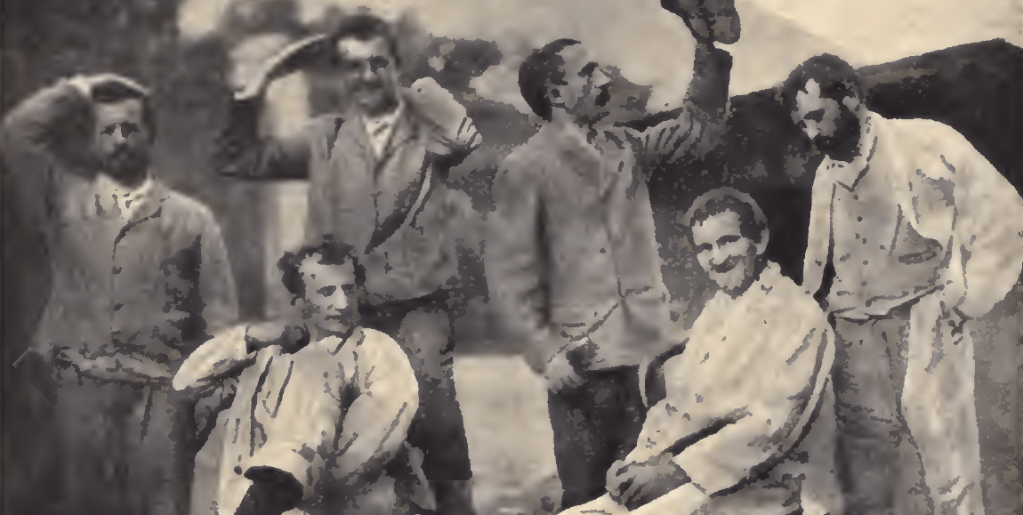
“The patients sitting are fairly demented, while the three patients still are in the initial stages of the disease.”
“Usually it is possible only with the most extreme force to bring them out of such a position, which they usually take up again as soon as the hindrance has ceased.”
“The patients suddenly break a mirror in pieces, knock over tables and chairs, take down pictures, throw objects out at the window, climb on to a cupboard, set fire to their hair, run naked into the street, ring bells, put their heads in the basin of the water-closet, set the chamber on their head, creep under the table, smash a lamp. Usually such senseless actions are carried out with great violence, suddenly, and with lightning rapidity, so that it is impossible to prevent them; the patients also oppose themselves in the most insolent way to every attempt to keep them from doing these things.”
“A patient who always rocked himself rhythmically from side to side, simply explained, ‘It happens so in me,’ ‘I must shake my head or else I am in terror,’ ‘I must constantly say things,’ ‘I must scream without wanting to, there is that impulse in me,’ ‘I must throw myself about at night in bed as if a strange power threw me,’ ‘I must turn round, as when a magnet draws a needle,’ ‘I could not have rested till I had done that,’ are similar expressions.”
OS SUB-TIPOS DE ESQUIZOFRENIA TAL QUAL KRAEPELIN OS ENCONTROU EM SUA ÉPOCA
A) DEMENTIA SIMPLEX
“The disease begins usually in the years of sexual development, but often the first slight beginnings can be traced back into childhood.”
“Hand in hand with this decline of mental activity there is a change of temperament, which often forms the first conspicuous sign of the developing malady. The patients become depressed, timid, lachrymose, or impertinent, irritable, malicious; sometimes a certain obstinate stubbornness is developed. The circle of their interests becomes narrower; their relations to their companions become cold; they show neither attachment nor sympathy. Not infrequently a growing estrangement towards parents and brothers and sisters becomes noticeable.”
“The frequency of the malady is probably fairly large, even if only a small number of the cases are considered as morbid at all or even fall into the hands of the alienist. Who cannot call to mind companions of his youth who at first gave just ground for certain, perhaps brilliant, hopes, but then from some point of their development onwards failed in an incomprehensible way?”
“A really profound dementia, without fairly acute exacerbations, with a continuous development of the malady, only slowly progressive, does not seem to occur. On the contrary, a dementia simplex which lasts for many years, even for decades, forms often enough the introduction to one of the forms of dementia praecox which goes on to profound dementia, and which will be discussed later on.”
B) SILLY DEMENTIA
“
GLOSSÁRIO
estereotipia: repetição verbal ou motora
“evasion or paralogia consists in this, that the idea which is next in the chain of thought is suppressed and replaced by another which is related to it.”
P. 94/362
DEMENTIA PRAECOX .26
 Seclusão Anagógica