
SCENE I. Rome. Before the Capitol.
“The Tomb of the ANDRONICI appearing; the Tribunes and Senators aloft. Enter, below, from one side, SATURNINUS¹ and his Followers; and, from the other side, BASSIANUS² and his Followers; with drum and colours”
¹ Qualquer que seja a fonte, só houve dois Saturninos historicamente importantes na história romana: um usurpador que foi morto pelas próprias tropas antes de se consumar imperador e outro usurpador de circunstâncias semelhantes, porém biografia provavelmente inventada. Shakespeare, portanto, está bastante justificado em sua escolha para o “imperador romano” da peça!
² Senador romano do século IV. Morto sob a acusação de conspirador. Ver https://pt.wikipedia.org/wiki/Batalha_de_C%C3%ADbalas.
“SATURNINUS
Noble patricians, patrons of my right,
Defend the justice of my cause with arms,
And, countrymen, my loving followers,
Plead my successive title with your swords:
I am his first-born son, that was the last
That wore the imperial diadem of Rome;
Then let my father’s honours live in me,
Nor wrong mine age with this indignity.
BASSIANUS
Romans, friends, followers, favorers of my right,
If ever Bassianus, Caesar’s son,¹
Were gracious in the eyes of royal Rome,
Keep then this passage to the Capitol
And suffer not dishonour to approach
The imperial seat, to virtue consecrate,
To justice, continence and nobility;
But let desert in pure election shine,
And, Romans, fight for freedom in your choice.
[¹ O título de César (imperator), não o nome próprio.]
Enter MARCUS ANDRONICUS,¹ aloft, with the crown
[¹ Apesar do patronímico existir, todos os personagens da peça são fabulosos. Existiu apenas um Lucius, mas ele era poeta e dramaturgo, uma ‘jovem projeção ou auto-referência de Shakespeare’, se assim se quiser.]
MARCUS ANDRONICUS
Princes, that strive by factions and by friends
Ambitiously for rule and empery,
Know that the people of Rome, for whom we stand
A special party, have, by common voice,
In election for the Roman empery,
Chosen Andronicus, surnamed Pius
For many good and great deserts to Rome:
A nobler man, a braver warrior,
Lives not this day within the city walls:
He by the senate is accit’d home
From weary wars against the barbarous Goths;
That, with his sons, a terror to our foes,
Hath yoked a nation strong, train’d up in arms.
Ten years are spent since first he undertook
This cause of Rome and chastised with arms
Our enemies’ pride: five times he hath return’d
Bleeding to Rome, bearing his valiant sons
In coffins from the field;
And now at last, laden with horror’s spoils,
Returns the good Andronicus to Rome,
Renowned Titus, flourishing in arms.
Let us entreat, by honour of his name,
Whom worthily you would have now succeed.
And in the Capitol and senate’s right,
Whom you pretend to honour and adore,
That you withdraw you and abate your strength;
Dismiss your followers and, as suitors should,
Plead your deserts in peace and humbleness.
SATURNINUS
How fair the tribune speaks to calm my thoughts!
BASSIANUS
Marcus Andronicus, so I do ally
In thy uprightness and integrity,
And so I love and honour thee and thine,
Thy noble brother Titus and his sons,
And her to whom my thoughts are humbled all,
Gracious Lavinia, Rome’s rich ornament,
That I will here dismiss my loving friends,
And to my fortunes and the people’s favor
Commit my cause in balance to be weigh’d.
Exeunt the followers of BASSIANUS”
“SATURNINUS
[monologando]
Rome, be as just and gracious unto me
As I am confident and kind to thee.
Open the gates, and let me in.”
“Drums and trumpets sounded. Enter MARTIUS and MUTIUS; After them, two men bearing a coffin covered with black; then LUCIUS and QUINTUS. After them, TITUS ANDRONICUS; and then TAMORA, with ALARBUS, DEMETRIUS, CHIRON, AARON, and other Goths, prisoners; Soldiers and people following. The Bearers set down the coffin, and TITUS speaks”
“TITUS ANDRONICUS
…
Romans, of five-and-twenty valiant sons,
Half of the number that King Priam had,¹
Behold the poor remains, alive and dead!
These that survive let Rome reward with love;
These that I bring unto their latest home,
With burial amongst their ancestors:
Here Goths have given me leave to sheathe my sword.
Titus, unkind and careless of thine own,
Why suffer’st thou thy sons, unburied yet,
To hover on the dreadful shore of Styx?
Make way to lay them by their brethren.
…
[tomb]
O sacred receptacle of my joys,
Sweet cell of virtue and nobility,
How many sons of mine hast thou in store,
That thou wilt never render to me more!
LUCIUS
Give us the proudest prisoner of the Goths,
That we may hew his limbs, and on a pile
Ad manes fratrum sacrifice his flesh,
Before this earthy prison of their bones;
That so the shadows be not unappeased,
Nor we disturb’d with prodigies on earth.
TITUS ANDRONICUS
I give him you, the noblest that survives,
The eldest son of this distressed queen.
TAMORA
Stay, Roman brethren! Gracious conqueror,
Victorious Titus, rue the tears I shed,
A mother’s tears in passion for her son:
And if thy sons were ever dear to thee,
O, think my son to be as dear to me!
Sufficeth not that we are brought to Rome,
To beautify thy triumphs and return,
Captive to thee and to thy Roman yoke,
But must my sons be slaughter’d in the streets,
For valiant doings in their country’s cause?
O, if to fight for king and commonweal
Were piety in thine, it is in these.
Andronicus, stain not thy tomb with blood:
Wilt thou draw near the nature of the gods?
Draw near them then in being merciful:
Sweet mercy is nobility’s true badge:
Thrice noble Titus, spare my first-born son.
TITUS ANDRONICUS
Patient yourself, madam, and pardon me.
These are their brethren, whom you Goths beheld
Alive and dead, and for their brethren slain
Religiously they ask a sacrifice:
To this your son is mark’d, and die he must,
To appease their groaning shadows that are gone.
[Mercy’s for the weak and meeke.]
LUCIUS
Away with him! and make a fire straight;
And with our swords, upon a pile of wood,
Let’s hew his limbs till they be clean consumed.”
¹ Seria um ancestral de Roma, no sentido em que o rei Príamo é pai de figuras mitológicas como Heitor, Páris e Cassandra, que participaram da Guerra de Tróia. Mais abaixo veremos sobre Hécuba, sua outrossim mitológica esposa.
“TAMORA
O cruel, irreligious piety!
CHIRON
Was ever Scythia half so barbarous?
DEMETRIUS
Oppose not Scythia to ambitious Rome.
Alarbus goes to rest; and we survive
To tremble under Titus’ threatening looks.
Then, madam, stand resolved, but hope withal
The self-same gods that arm’d the Queen of Troy
With opportunity of sharp revenge
Upon the Thracian tyrant in his tent,
May favor Tamora, the Queen of Goths–¹
When Goths were Goths and Tamora was queen–
To quit the bloody wrongs upon her foes.”
¹ Os góticos ou godos são em si mesmos de mau agouro para o Império Romano, participando ativamente de sua dissolução histórica.
“LUCIUS
See, lord and father, how we have perform’d
Our Roman rites: Alarbus’ limbs are lopp’d,
And entrails feed the sacrificing fire,
Whose smoke, like incense, doth perfume the sky.
Remaineth nought, but to inter our brethren,
And with loud ‘larums welcome them to Rome.
TITUS ANDRONICUS
Let it be so; and let Andronicus
Make this his latest farewell to their souls.
Trumpets sounded, and the coffin laid in the tomb”
“Here lurks no treason, here no envy swells,
Here grow no damned grudges; here are no storms,
No noise, but silence and eternal sleep:
In peace and honour rest you here, my sons!
Enter LAVINIA¹
LAVINIA
In peace and honour live Lord Titus long;
My noble lord and father, live in fame!
Lo, at this tomb my tributary tears
I render, for my brethren’s obsequies;
And at thy feet I kneel, with tears of joy,
Shed on the earth, for thy return to Rome:
O, bless me here with thy victorious hand,
Whose fortunes Rome’s best citizens applaud!”
TITUS ANDRONICUS
Kind Rome, that hast thus lovingly reserved
The cordial of mine age to glad my heart!
Lavinia, live; outlive thy father’s days,
And fame’s eternal date, for virtue’s praise!”
¹ Lavínia é inspirada numa figura mitológica romana. Segue a wikia: “Lavínia estava prometida como esposa a Turno, rei dos rútulos. Mas, com a chegada de Enéias ao Lácio, Latino deu sua mão ao herói troiano, pois o oráculo de seu pai Fauno dizia que ela devia casar com um estrangeiro. O rompimento da promessa conjugal desencadeou a guerra entre troianos-latinos e os rútulos de Turno. A guerra terminou com a derrota de Turno.”
“MARCUS ANDRONICUS
Long live Lord Titus, my beloved brother,
Gracious triumpher in the eyes of Rome!
TITUS ANDRONICUS
Thanks, gentle tribune, noble brother Marcus.”
Shakespeare tinha uma peculiar predileção por retratar os campeões do povo em vez dos imperadores (pelo menos o fazia em mais ocasiões) quando se tratava de Roma. Note-se o quanto os trechos grifados em vermelho acima entrarão em contradição com o sucedido na peça!
“Titus Andronicus, the people of Rome,
Whose friend in justice thou hast ever been,
Send thee by me, their tribune and their trust,
This palliament of white and spotless hue;
And name thee in election for the empire,
With these our late-deceased emperor’s sons:
Be candidatus then, and put it on,
And help to set a head on headless Rome.”
“A better head her glorious body fits
Than his that shakes for age and feebleness:
What should I don this robe, and trouble you?
Be chosen with proclamations to-day,
To-morrow yield up rule, resign my life,
And set abroad new business for you all?
Rome, I have been thy soldier 40 years,
And led my country’s strength successfully,
And buried one-and-twenty valiant sons,¹
Knighted in field, slain manfully in arms,
In right and service of their noble country
Give me a staff of honour for mine age,
But not a sceptre to control the world:
Upright he held it, lords, that held it last.”
¹ O que significa que só lhe restaram 4: Mutius, Lucius, Lavinia e Quintus. Ao fim da peça, um só!
“SATURNINUS
[a Marcus]
Proud and ambitious tribune, canst thou tell?”
“SATURNINUS
Romans, do me right:
Patricians, draw your swords: and sheathe them not
Till Saturninus be Rome’s emperor.
Andronicus, would thou wert shipp’d to hell,
Rather than rob me of the people’s hearts!”
“TITUS ANDRONICUS
Content thee, prince; I will restore to thee
The people’s hearts, and wean them from themselves.¹
[¹ O carisma é intransferível, pelo menos quando aquele que em tese o recebe com o beneplácito do carismático original o odeia, pois a população percebe essas nuances e não perdoa a ingratidão do “mau afilhado”, ainda que leve anos para se rebelar.]
BASSIANUS
[Se eu devesse adivinhar, é o pusilânime da peça]¹
Andronicus, I do not flatter thee,
But honour thee, and will do till I die:
My faction if thou strengthen with thy friends,
I will most thankful be; and thanks to men
Of noble minds is honourable meed.”
¹ Errei e errei feio – vide além!
“TITUS ANDRONICUS
Tribunes, I thank you: and this suit I make,
That you create your emperor’s eldest son,
Lord Saturnine; whose virtues will, I hope,
Reflect on Rome as Titan’s rays on earth,¹
And ripen justice in this commonweal:
Then, if you will elect by my advice,
Crown him and say ‘Long live our emperor!’
¹ Talvez um prenúncio de sua queda, como a dos Titãs na Titanomaquia.
MARCUS ANDRONICUS
With voices and applause of every sort,
Patricians and plebeians, we create
Lord Saturninus Rome’s great emperor,
And say ‘Long live our Emperor Saturnine!’
A long flourish till they come down”
“And, for an onset, Titus, to advance
Thy name and honourable family,
Lavinia will I make my empress,
Rome’s royal mistress, mistress of my heart,
And in the sacred Pantheon her espouse:
Tell me, Andronicus, doth this motion please thee?”
“And here in sight of Rome to Saturnine,
King and commander of our commonweal,
The wide world’s emperor, do I consecrate
My sword, my chariot and my prisoners;
Presents well worthy Rome’s imperial lord:
Receive them then, the tribute that I owe,
Mine honour’s ensigns humbled at thy feet.”
SATURNINUS
“The least of these unspeakable deserts,
Romans, forget your fealty to me.”
“TITUS ANDRONICUS
[To TAMORA]
Now, madam, are you prisoner to
an emperor;
To him that, for your honour and your state,
Will use you nobly and your followers.
SATURNINUS
A goodly lady, trust me; of the hue
That I would choose, were I to choose anew.
Clear up, fair queen, that cloudy countenance:
Though chance of war hath wrought this change of cheer,
Thou comest not to be made a scorn in Rome:
Princely shall be thy usage every way.
Rest on my word, and let not discontent
Daunt all your hopes: madam, he comforts you
Can make you greater than the Queen of Goths.
Lavinia, you are not displeased with this?¹
LAVINIA
Not I, my lord; sith [since] true nobility
Warrants these words in princely courtesy.
SATURNINUS
Thanks, sweet Lavinia. Romans, let us go;
Ransomless here we set our prisoners free:
Proclaim our honours, lords, with trump and drum.
Flourish. SATURNINUS courts TAMORA in dumb show
BASSIANUS
Lord Titus, by your leave, this maid is mine.
Seizing LAVINIA
TITUS ANDRONICUS
How, sir! are you in earnest then, my lord?
BASSIANUS
Ay, noble Titus; and resolved withal
To do myself this reason and this right.
MARCUS ANDRONICUS
‘Suum cuique’ is our Roman justice:
This prince in justice seizeth but his own.
LUCIUS
And that he will, and shall, if Lucius live.
TITUS ANDRONICUS
Traitors, avaunt! Where is the emperor’s guard?
Treason, my lord! Lavinia is surprised!
SATURNINUS
Surprised! by whom?
BASSIANUS
By him that justly may
Bear his betroth’d from all the world away.
Exeunt BASSIANUS and MARCUS with LAVINIA”
¹ Possível insinuação de poligamia?
“TITUS ANDRONICUS
Follow, my lord, and I’ll soon bring her back.
MUTIUS
My lord, you pass not here.
TITUS ANDRONICUS
What, villain boy!
Barr’st me my way in Rome?
Stabbing MUTIUS”
“LUCIUS
My lord, you are unjust, and, more than so,
In wrongful quarrel you have slain your son.
TITUS ANDRONICUS
Nor thou, nor he, are any sons of mine;
My sons would never so dishonour me:
Traitor, restore Lavinia to the emperor.
LUCIUS
Dead, if you will; but not to be his wife,
That is another’s lawful promised love.
Exit”
“I’ll trust, by leisure, him that mocks me once;
Thee never, nor thy traitorous haughty sons,
Confederates all thus to dishonour me.
Was there none else in Rome to make a stale,
But Saturnine? Full well, Andronicus,
Agree these deeds with that proud brag of thine,
That said’st I begg’d the empire at thy hands.
TITUS ANDRONICUS
O monstrous! what reproachful words are these?”
“A valiant son-in-law thou shalt enjoy;
One fit to bandy with thy lawless sons,
To ruffle in the commonwealth of Rome.”
“TITUS ANDRONICUS
These words are razors to my wounded heart.
SATURNINUS
And therefore, lovely Tamora, queen of Goths,
That like the stately Phoebe ‘mongst her nymphs¹
Dost overshine the gallant’st dames of Rome,
If thou be pleased with this my sudden choice,
Behold, I choose thee, Tamora, for my bride,
And will create thee empress of Rome,
Speak, Queen of Goths, dost thou applaud my choice?
And here I swear by all the Roman gods,
Sith priest and holy water are so near
And tapers burn so bright and every thing
In readiness for Hymenaeus² stand,
I will not re-salute the streets of Rome,
Or climb my palace, till from forth this place
I lead espoused my bride along with me.
TAMORA
And here, in sight of heaven, to Rome I swear,
If Saturnine advance the Queen of Goths,
She will a handmaid be to his desires,
A loving nurse, a mother to his youth.”
¹ O mesmo que Artemis, deusa da lua.
² Deus grego do casamento (“a hymenaios is a genre of Greek lyric poetry that was sung during the procession of the bride to the groom’s house in which the god is addressed, in contrast to the Epithalamium, which is sung at the nuptial threshold. He is one of the winged love gods, the Erotes.”); daí, himeneu em português.
“MARCUS ANDRONICUS
O Titus, see, O, see what thou hast done!
In a bad quarrel slain a virtuous son.
TITUS ANDRONICUS
No, foolish tribune, no; no son of mine,
Nor thou, nor these, confederates in the deed
That hath dishonour’d all our family;
Unworthy brother, and unworthy sons!
“TITUS ANDRONICUS
‘And shall!’ what villain was it that spake
that word?
QUINTUS
He that would vouch it in any place but here.
TITUS ANDRONICUS
What, would you bury him in my despite?
MARCUS ANDRONICUS
No, noble Titus, but entreat of thee
To pardon Mutius and to bury him.
TITUS ANDRONICUS
Marcus, even thou hast struck upon my crest,
And, with these boys, mine honour thou hast wounded:
My foes I do repute you every one;
So, trouble me no more, but get you gone.
MARTIUS
He is not with himself; let us withdraw.”
“MARCUS and the Sons of TITUS kneel
MARCUS ANDRONICUS
Brother, for in that name doth nature plead,–
QUINTUS
Father, and in that name doth nature speak,–
TITUS ANDRONICUS
Speak thou no more, if all the rest will speed.
MARCUS ANDRONICUS
Renowned Titus, more than half my soul,–
LUCIUS
Dear father, soul and substance of us all,–
MARCUS ANDRONICUS
Suffer thy brother Marcus to inter
His noble nephew here in virtue’s nest,
That died in honour and Lavinia’s cause.
Thou art a Roman; be not barbarous:
The Greeks upon advice did bury Ajax
That slew himself; and wise Laertes’ son¹
Did graciously plead for his funerals:
Let not young Mutius, then, that was thy joy
Be barr’d his entrance here.”
¹ Aquiles
“The dismall’st day is this that e’er I saw,
To be dishonour’d by my sons in Rome!
Well, bury him, and bury me the next.
MUTIUS is put into the tomb”
“SATURNINUS
So, Bassianus, you have play’d your prize:
God give you joy, sir, of your gallant bride!
BASSIANUS
And you of yours, my lord! I say no more,
Nor wish no less; and so, I take my leave.”
“BASSIANUS
Rape, call you it, my lord, to seize my own,
My truth-betrothed love and now my wife?
But let the laws of Rome determine all;
Meanwhile I am possess’d of that is mine.
SATURNINUS
‘Tis good, sir: you are very short with us;
But, if we live, we’ll be as sharp with you.
BASSIANUS
My lord, what I have done, as best I may,
Answer I must and shall do with my life.
Only thus much I give your grace to know:
By all the duties that I owe to Rome,
This noble gentleman, Lord Titus here,
Is in opinion and in honour wrong’d;
That in the rescue of Lavinia
With his own hand did slay his youngest son,
In zeal to you and highly moved to wrath
To be controll’d in that he frankly gave:
Receive him, then, to favor, Saturnine,
That hath express’d himself in all his deeds
A father and a friend to thee and Rome.”
“TAMORA
My worthy lord, if ever Tamora
Were gracious in those princely eyes of thine,
Then hear me speak in indifferently for all;
And at my suit, sweet, pardon what is past.
SATURNINUS
What, madam! be dishonour’d openly,
And basely put it up without revenge?
“TAMORA
(…)
Lose not so noble a friend on vain suppose,
Nor with sour looks afflict his gentle heart.
Aside to SATURNINUS
be won at last;
Dissemble all your griefs and discontents:
You are but newly planted in your throne;
Lest, then, the people, and patricians too,
Upon a just survey, take Titus’ part,
And so supplant you for ingratitude,
Which Rome reputes to be a heinous sin,
Yield at entreats; and then let me alone:
I’ll find a day to massacre them all
And raze their faction and their family,
The cruel father and his traitorous sons,
To whom I sued for my dear son’s life,
And make them know what ‘tis to let a queen
Kneel in the streets and beg for grace in vain.
Aloud
Come, come, sweet emperor; come, Andronicus;
Take up this good old man, and cheer the heart
That dies in tempest of thy angry frown.
SATURNINUS
Rise, Titus, rise; my empress hath prevail’d.”
“This day all quarrels die, Andronicus;
And let it be mine honour, good my lord,
That I have reconciled your friends and you.
For you, Prince Bassianus, I have pass’d
My word and promise to the emperor,
That you will be more mild and tractable.
And fear not lords, and you, Lavinia;
By my advice, all humbled on your knees,
You shall ask pardon of his majesty.”
ACT 2
SCENE I. Rome. Before the Palace.
“AARON
Now climbeth Tamora Olympus’ top,
Safe out of fortune’s shot; and sits aloft,
Secure of thunder’s crack or lightning flash;
Advanced above pale envy’s threatening reach.
As when the golden sun salutes the morn,
And, having gilt the ocean with his beams,
Gallops the zodiac in his glistering coach,
And overlooks the highest-peering hills;
So Tamora:
(…)
Then, Aaron, arm thy heart, and fit thy thoughts,
To mount aloft with thy imperial mistress,
And mount her pitch, whom thou in triumph long
Hast prisoner held, fetter’d in amorous chains
And faster bound to Aaron’s charming eyes
Than is Prometheus tied to Caucasus.
Away with slavish weeds and servile thoughts!
I will be bright, and shine in pearl and gold,¹
To wait upon this new-made empress.
To wait, said I? to wanton with this queen,
This goddess, this Semiramis,² this nymph,
This siren, that will charm Rome’s Saturnine,
And see his shipwreck and his commonweal’s.
Holloa! what storm is this?”
¹ Trocadilho súbito e hoje controverso de Shakespeare: o mouro, negro, mesclando-se com a goda (branca).
² A lendária fundadora da Babilônia. Há registros de uma rainha assíria de mesmo nome que pode ter iniciado o culto da deusa, quase mil anos antes de Cristo. Sua história é muito parecida com a de Artemísia, rainha muito discutido no post recente https://seclusao.org/2023/12/21/depois-de-desligar-o-videogame-o-supercompendio-de-final-fantasy-viii/.
“CHIRON
(…)
‘Tis not the difference of a year or two
Makes me less gracious or thee more fortunate:
I am as able and as fit as thou
To serve, and to deserve my mistress’ grace;
And that my sword upon thee shall approve,
And plead my passions for Lavinia’s love.
AARON
[Aside]
Clubs, clubs! these lovers will not keep
the peace.”
“AARON
[Coming forward]
Why, how now, lords!
So near the emperor’s palace dare you draw,
And maintain such a quarrel openly?
Full well I wot the ground of all this grudge:
I would not for a million of gold
The cause were known to them it most concerns;
Nor would your noble mother for much more
Be so dishonour’d in the court of Rome.
For shame, put up.”
“AARON
Away, I say!
Now, by the gods that warlike Goths adore,
This petty brabble will undo us all.
Why, lords, and think you not how dangerous
It is to jet upon a prince’s right?
What, is Lavinia then become so loose,
Or Bassianus so degenerate,
That for her love such quarrels may be broach’d
Without controlment, justice, or revenge?
Young lords, beware! and should the empress know
This discord’s ground, the music would not please.”
“AARON
Why, are ye mad? or know ye not, in Rome
How furious and impatient they be,
And cannot brook competitors in love?
I tell you, lords, you do but plot your deaths
By this device.”
“DEMETRIUS
Why makest thou it so strange?
She is a woman, therefore may be woo’d;
She is a woman, therefore may be won;
She is Lavinia, therefore must be loved.
What, man! more water glideth by the mill
Than wots the miller of; and easy it is
Of a cut loaf to steal a shive, we know:
Though Bassianus be the emperor’s brother.
Better than he have worn Vulcan’s badge.”¹
¹ O mesmo que dizer: Ele pode ser o irmão do imperador, mas isso não o faz temível como um deus-guerreiro.
“AARON
For shame, be friends, and join for that you jar:
‘Tis policy and stratagem must do
That you affect; and so must you resolve,
That what you cannot as you would achieve,
You must perforce accomplish as you may.
Take this of me: Lucrece¹ was not more chaste
Than this Lavinia, Bassianus’ love.
A speedier course than lingering languishment
Must we pursue, and I have found the path.
My lords, a solemn hunting is in hand;
There will the lovely Roman ladies troop:
The forest walks are wide and spacious;
And many unfrequented plots there are
Fitted by kind for rape and villany:
Single you thither then this dainty doe,
And strike her home by force, if not by words:
This way, or not at all, stand you in hope.
Come, come, our empress, with her sacred wit
To villany and vengeance consecrate,
Will we acquaint with all that we intend;
And she shall file our engines with advice,
That will not suffer you to square yourselves,
But to your wishes’ height advance you both.
The emperor’s court is like the house of Fame,
The palace full of tongues, of eyes, and ears:
The woods are ruthless, dreadful, deaf, and dull;
There speak, and strike, brave boys, and take
your turns;
There serve your lusts, shadow’d from heaven’s eye,
And revel in Lavinia’s treasury.”
¹ Grande foreshadowing da peça: “Lucrece, was a noblewoman in ancient Rome, whose rape by Sextus Tarquinius (Tarquin) and subsequent suicide precipitated a rebellion that overthrew the Roman monarchy and led to the transition of Roman government from a kingdom to a republic.”
ACT 2
SCENE II. A forest near Rome. Horns and cry of hounds heard.
“DEMETRIUS
Chiron, we hunt not, we, with horse nor hound,
But hope to pluck a dainty doe to ground.”
ACT 3
SCENE III. A lonely part of the forest.
“TAMORA
My lovely Aaron, wherefore look’st thou sad,
When every thing doth make a gleeful boast?
The birds chant melody on every bush,
The snake lies rolled in the cheerful sun,
The green leaves quiver with the cooling wind
And make a chequer’d shadow on the ground:
Under their sweet shade, Aaron, let us sit,
And, whilst the babbling echo mocks the hounds,
Replying shrilly to the well-tuned horns,
As if a double hunt were heard at once,
Let us sit down and mark their yelping noise;
And, after conflict such as was supposed
The wandering prince and Dido once enjoy’d,
When with a happy storm they were surprised
And curtain’d with a counsel-keeping cave,¹
We may, each wreathed in the other’s arms,
Our pastimes done, possess a golden slumber;
Whiles hounds and horns and sweet melodious birds
Be unto us as is a nurse’s song
Of lullaby to bring her babe asleep.²
[¹ Quando Enéias e Dido fizeram amor às ocultas, algo que estava destinado pelos deuses (ou pelas deusas): “Aphrodite and Hera come together to create a storm, forcing Dido and Aeneas into a cave together. There, they declare their feelings for each other and consummate their love.”
² Quase um quadro digno de princesas da Disney!]
AARON
Madam, though Venus govern your desires,
Saturn is dominator over mine:
What signifies my deadly-standing eye,
My silence and my cloudy melancholy,
My fleece of woolly hair that now uncurls
Even as an adder when she doth unroll
To do some fatal execution?
No, madam, these are no venereal signs:
Vengeance is in my heart, death in my hand,
Blood and revenge are hammering in my head.¹
Hark Tamora, the empress of my soul,
Which never hopes more heaven than rests in thee,
This is the day of doom for Bassianus:
His Philomel² must lose her tongue to-day,
Thy sons make pillage of her chastity
And wash their hands in Bassianus’ blood.
Seest thou this letter? take it up, I pray thee,
And give the king this fatal plotted scroll.
Now question me no more; we are espied;
Here comes a parcel of our hopeful booty,
Which dreads not yet their lives’ destruction.”
¹ A cruel Tamora é uma vilã care-free; Aaron, igualmente – senão mais – mau, no entanto, está concentrado demais em seus próximos planos criminosos para pensar no prazer erótico no momento.
² Semi-deusa, irmã de Procne, a ser citada na peça como Progne. Filomela é estuprada por Tereu(s), marido de Procne, que se vinga deste (junto com sua irmã) da mesma maneira que se vingará Titus de Tamora (que também contará com o auxílio de Lavínia) no fim da peça. No mito, após o estupro Filomela é resgatada pelo Olimpo sendo transformada num rouxinol (podendo assim continuar vivendo, com a honra restaurada). Filomela ou Philo-mela significaria amante da melodia (devido à beleza do canto da ave). Novamente Shakespeare se inspira mais na versão ovidiana, o que é natural, devido ao contexto romano da peça. Sófocles tem uma tragédia chamada Tereus, perdida. O estupro de Filomela por Tereu também se deu num bosque. Então, deixando-a viva e para não ser descoberto em seu ato vil, o estuprador fará o que logo farão os dois irmãos godos… Mesmo assim, Shakespeare ainda foi além em gore e crueldade! Outro ponto em comum entre personagens: tanto Procne quanto Titus não hesitam em matar seus próprios filhos quando necessário em seus projetos de vingança! A Medéia de Eurípides também narra uma saga semelhante…
“Enter BASSIANUS and LAVINIA
BASSIANUS
Who have we here? Rome’s royal empress,
Unfurnish’d of her well-beseeming troop?
Or is it Dian, habited like her,
Who hath abandoned her holy groves
To see the general hunting in this forest?¹
TAMORA
Saucy controller of our private steps!
Had I the power that some say Dian had,
Thy temples should be planted presently
With horns, as was Actaeon’s; and the hounds
Should drive upon thy new-transformed limbs,
Unmannerly intruder as thou art!
LAVINIA
Under your patience, gentle empress,
‘Tis thought you have a goodly gift in horning;
And to be doubted that your Moor and you
Are singled forth to try experiments:
Jove shield your husband from his hounds to-day!
‘Tis pity they should take him for a stag.²
BASSIANUS
Believe me, queen, your swarth Cimmerian
Doth make your honour of his body’s hue,³
Spotted, detested, and abominable.
Why are you sequester’d from all your train,
Dismounted from your snow-white goodly steed.
And wander’d hither to an obscure plot,
Accompanied but with a barbarous Moor,
If foul desire had not conducted you?
LAVINIA
And, being intercepted in your sport,
Great reason that my noble lord be rated
For sauciness. I pray you, let us hence,
And let her joy her raven-colour’d love;
This valley fits the purpose passing well.4
BASSIANUS
The king my brother shall have note of this.
LAVINIA
Ay, for these slips have made him noted long:
Good king, to be so mightily abused!
TAMORA
Why have I patience to endure all this?
Enter DEMETRIUS and CHIRON
DEMETRIUS
How now, dear sovereign, and our gracious mother!
Why doth your highness look so pale and wan?
TAMORA
Have I not reason, think you, to look pale?
These two have ‘ticed me hither to this place:
A barren detested vale, you see it is;
The trees, though summer, yet forlorn and lean,
O’ercome with moss and baleful mistletoe:
Here never shines the sun; here nothing breeds,
Unless the nightly owl or fatal raven:
And when they show’d me this abhorred pit,
They told me, here, at dead time of the night,
A thousand fiends, a thousand hissing snakes,
Ten thousand swelling toads, as many urchins,
Would make such fearful and confused cries
As any mortal body hearing it
Should straight fall mad, or else die suddenly.
No sooner had they told this hellish tale,
But straight they told me they would bind me here
Unto the body of a dismal yew,
And leave me to this miserable death:
And then they call’d me foul adulteress,
Lascivious Goth, and all the bitterest terms
That ever ear did hear to such effect:
And, had you not by wondrous fortune come,
This vengeance on me had they executed.
Revenge it, as you love your mother’s life,
Or be ye not henceforth call’d my children.
DEMETRIUS
This is a witness that I am thy son.
Stabs BASSIANUS
CHIRON
And this for me, struck home to show my strength.
Also stabs BASSIANUS, who dies
LAVINIA
Ay, come, Semiramis, nay, barbarous Tamora,
For no name fits thy nature but thy own!
TAMORA
Give me thy poniard; you shall know, my boys
Your mother’s hand shall right your mother’s wrong.
DEMETRIUS
Stay, madam; here is more belongs to her;
First thrash the corn, then after burn the straw:
This minion stood upon her chastity,
Upon her nuptial vow, her loyalty,
And with that painted hope braves your mightiness:
And shall she carry this unto her grave?
CHIRON
An if she do, I would I were an eunuch.
Drag hence her husband to some secret hole,
And make his dead trunk pillow to our lust.
TAMORA
But when ye have the honey ye desire,
Let not this wasp outlive, us both to sting.
CHIRON
I warrant you, madam, we will make that sure.
Come, mistress, now perforce we will enjoy
That nice-preserved honesty of yours.
LAVINIA
O Tamora! thou bear’st a woman’s face,–
TAMORA
I will not hear her speak; away with her!”
¹ A deusa Diana não gostava da cidade – vivia nas florestas, caçando.
² Lavínia sabe que Arão e Tamora são amantes (que o imperador tem “galhos” ou “chifres” na testa).
³ Bárbaros. Novamente se alude à cor escura de Arão de modo depreciativo, associando a cor preta a coisas ruins, vis, sujas.
4 Foreshadowing do buraco escuro em que logo serão depositados dois dos Andronicus – e o próprio Bassiano, já cadavérico.
“LAVINIA
When did the tiger’s young ones teach the dam?
O, do not learn her wrath; she taught it thee;
The milk thou suck’dst from her did turn to marble;
Even at thy teat thou hadst thy tyranny.
Yet every mother breeds not sons alike:
To CHIRON
Do thou entreat her show a woman pity.
CHIRON
What, wouldst thou have me prove myself a bastard?
LAVINIA
‘Tis true; the raven doth not hatch a lark:
Yet have I heard,–O, could I find it now!–
The lion moved with pity did endure
To have his princely paws pared all away:
Some say that ravens foster forlorn children,
The whilst their own birds famish in their nests:
O, be to me, though thy hard heart say no,
Nothing so kind, but something pitiful!”
“LAVINIA
O, let me teach thee! for my father’s sake,
That gave thee life, when well he might have
slain thee,
Be not obdurate, open thy deaf ears.
TAMORA
Hadst thou in person ne’er offended me,
Even for his sake am I pitiless.
Remember, boys, I pour’d forth tears in vain,
To save your brother from the sacrifice;
But fierce Andronicus would not relent;
Therefore, away with her, and use her as you will,
The worse to her, the better loved of me.
LAVINIA
O Tamora, be call’d a gentle queen,
And with thine own hands kill me in this place!
For ‘tis not life that I have begg’d so long;
Poor I was slain when Bassianus died.
TAMORA
What begg’st thou, then? fond woman, let me go.
LAVINIA
‘Tis present death I beg; and one thing more
That womanhood denies my tongue to tell:¹
O, keep me from their worse than killing lust,
And tumble me into some loathsome pit,
Where never man’s eye may behold my body:²
Do this, and be a charitable murderer.
TAMORA
So should I rob my sweet sons of their fee:
No, let them satisfy their lust on thee.”
¹ Como sempre nessas obras trágicas, os personagens acidentalmente narram seu terrível futuro: “Imploro aquilo que minha língua, como mulher, não pode pronunciar.” Não pode porque seria indecente. Em breve, porém, não poderá, literalmente, mesmo que quisesse e a moral o permitisse.
² Isso também faz parte da previsão: em vez de ser abandonada no escuro, Lavínia será flagrada em seu estado mais lamentável, pelo tio Marcus.
“LAVINIA
No grace? no womanhood? Ah, beastly creature!
The blot and enemy to our general name!
Confusion fall–
CHIRON
Nay, then I’ll stop your mouth. Bring thou her husband:
This is the hole where Aaron bid us hide him.
DEMETRIUS throws the body of BASSIANUS into the pit; then exeunt DEMETRIUS and CHIRON, dragging off LAVINIA.
TAMORA
Farewell, my sons: see that you make her sure.
Ne’er let my heart know merry cheer indeed,
Till all the Andronici be made away.
Now will I hence to seek my lovely Moor,¹
And let my spleenful sons this trull deflow’r.
Exit”
¹ Choca a ingenuidade dos irmãos em ato futuro da peça quando “descobrem” o produto de dois amantes, como se não fosse conseqüência natural, ao se indignarem com Aaron (ATO 4).
“AARON
Come on, my lords, the better foot before:
Straight will I bring you to the loathsome pit
Where I espied the panther fast asleep.
QUINTUS
My sight is very dull, whate’er it bodes.
MARTIUS
And mine, I promise you; were’t not for shame,
Well could I leave our sport to sleep awhile.
Falls into the pit
QUINTUS
What, art thou fall’n? What subtle hole is this,
Whose mouth is cover’d with rude-growing briers,
Upon whose leaves are drops of new-shed blood
As fresh as morning dew distill’d on flowers?
A very fatal place it seems to me.
Speak, brother, hast thou hurt thee with the fall?
MARTIUS
O brother, with the dismall’st object hurt
That ever eye with sight made heart lament!
AARON
[Aside] Now will I fetch the king to find them here,
That he thereby may give a likely guess
How these were they that made away his brother.
Exit”
“QUINTUS
Aaron is gone; and my compassionate heart
Will not permit mine eyes once to behold
The thing whereat it trembles by surmise;
O, tell me how it is; for ne’er till now
Was I a child to fear I know not what.
MARTIUS
Lord Bassianus lies embrewed here,
All on a heap, like to a slaughter’d lamb,
In this detested, dark, blood-drinking pit.
QUINTUS
If it be dark, how dost thou know ‘tis he?
MARTIUS
Upon his bloody finger he doth wear
A precious ring, that lightens all the hole,
Which, like a taper in some monument,
Doth shine upon the dead man’s earthy cheeks,
And shows the ragged entrails of the pit:
So pale did shine the moon on Pyramus
When he by night lay bathed in maiden blood.”¹
¹ Píramo e Tisbe: mais um casal trágico de Metamorfoses de Ovídio. Essa história provavelmente inspiraria Romeu & Julieta: dois amantes de duas famílias rivais que cometem cada qual suicídio devido a um mal-entendido (o primeiro achar que o segundo está morto, então se matar de verdade; o segundo acordar e ver o cadáver do primeiro, se matando finalmente). A luz da lua iluminando Píramo, coisa que não existe em Ovídio, pode ser uma referência ao apodo dado por Arão a Tamora: Artemis, deusa da lua, responsável por armar tamanho horror.
“QUINTUS
Reach me thy hand, that I may help thee out;
Or, wanting strength to do thee so much good,
I may be pluck’d into the swallowing womb
Of this deep pit, poor Bassianus’ grave.
I have no strength to pluck thee to the brink.
MARTIUS
Nor I no strength to climb without thy help.
QUINTUS
Thy hand once more; I will not loose again,
Till thou art here aloft, or I below:
Thou canst not come to me: I come to thee.
Falls in
Enter SATURNINUS with AARON
SATURNINUS
Along with me: I’ll see what hole is here,
And what he is that now is leap’d into it.
Say who art thou that lately didst descend
Into this gaping hollow of the earth?
MARTIUS
The unhappy son of old Andronicus:
Brought hither in a most unlucky hour,
To find thy brother Bassianus dead.
SATURNINUS
My brother dead! I know thou dost but jest:
He and his lady both are at the lodge
Upon the north side of this pleasant chase;
‘Tis not an hour since I left him there.
MARTIUS
We know not where you left him all alive;
But, out, alas! here have we found him dead.
Re-enter TAMORA, with Attendants; TITUS ANDRONICUS, and Lucius
TAMORA
Where is my lord the king?
SATURNINUS
Here, Tamora, though grieved with killing grief.
TAMORA
Where is thy brother Bassianus?
SATURNINUS
Now to the bottom dost thou search my wound:
Poor Bassianus here lies murdered.
TAMORA
Then all too late I bring this fatal writ,
The complot of this timeless tragedy;
And wonder greatly that man’s face can fold
In pleasing smiles such murderous tyranny.
She giveth SATURNINUS a letter
SATURNINUS
[Reads] ‘An if we miss to meet him handsomely–
Sweet huntsman, Bassianus ‘tis we mean–
Do thou so much as dig the grave for him:
Thou know’st our meaning. Look for thy reward
Among the nettles at the elder-tree
Which overshades the mouth of that same pit
Where we decreed to bury Bassianus.
Do this, and purchase us thy lasting friends.’
O Tamora! was ever heard the like?
This is the pit, and this the elder-tree.
Look, sirs, if you can find the huntsman out
That should have murdered Bassianus here.
AARON
My gracious lord, here is the bag of gold.
SATURNINUS
[To TITUS] Two of thy whelps, fell curs of
bloody kind,
Have here bereft my brother of his life.
Sirs, drag them from the pit unto the prison:
There let them bide until we have devised
Some never-heard-of torturing pain for them.
TAMORA
What, are they in this pit? O wondrous thing!
How easily murder is discovered!
TITUS ANDRONICUS
High emperor, upon my feeble knee
I beg this boon, with tears not lightly shed,
That this fell fault of my accursed sons,
Accursed if the fault be proved in them,–
SATURNINUS
If it be proved! you see it is apparent.
Who found this letter? Tamora, was it you?
TAMORA
Andronicus himself did take it up.
TITUS ANDRONICUS
I did, my lord: yet let me be their bail;
For, by my father’s reverend tomb, I vow
They shall be ready at your highness’ will
To answer their suspicion with their lives.
SATURNINUS
Thou shalt not bail them: see thou follow me.
Some bring the murder’d body, some the murderers:
Let them not speak a word; the guilt is plain;
For, by my soul, were there worse end than death,
That end upon them should be executed.
TAMORA
Andronicus, I will entreat the king;
Fear not thy sons; they shall do well enough.
TITUS ANDRONICUS
Come, Lucius, come; stay not to talk with them.
Exeunt”
ACT 2
SCENE IV. Another part of the forest. [na íntegra]
“Enter DEMETRIUS and CHIRON with LAVINIA, ravished; her hands cut off, and her tongue cut out.
DEMETRIUS
So, now go tell, an if thy tongue can speak,
Who ‘twas that cut thy tongue and ravish’d thee.
CHIRON
Write down thy mind, bewray thy meaning so,
An if thy stumps will let thee play the scribe.
DEMETRIUS
See, how with signs and tokens she can scrowl.¹
CHIRON
Go home, call for sweet water, wash thy hands.
DEMETRIUS
She hath no tongue to call, nor hands to wash;
And so let’s leave her to her silent walks.
CHIRON
An ‘twere my case, I should go hang myself.
DEMETRIUS
If thou hadst hands to help thee knit the cord.
Exeunt DEMETRIUS and CHIRON
Enter MARCUS”
¹ Outro foreshadowing!
Curioso para saber como representam tantos membros amputados no teatro!
“MARCUS
Who is this? my niece, that flies away so fast!
Cousin, a word; where is your husband?
If I do dream, would all my wealth would wake me!
If I do wake, some planet strike me down,
That I may slumber in eternal sleep!
Speak, gentle niece, what stern ungentle hands
Have lopp’d and hew’d and made thy body bare
Of her two branches, those sweet ornaments,
Whose circling shadows kings have sought to sleep in,
And might not gain so great a happiness
As have thy love? Why dost not speak to me?
Alas, a crimson river of warm blood,
Like to a bubbling fountain stirr’d with wind,
Doth rise and fall between thy rosed lips,
Coming and going with thy honey breath.
But, sure, some Tereus hath deflowered thee,
And, lest thou shouldst detect him, cut thy tongue.
Ah, now thou turn’st away thy face for shame!
And, notwithstanding all this loss of blood,
As from a conduit with 3 issuing spouts,
Yet do thy cheeks look red as Titan’s face
Blushing to be encountered with a cloud.
Shall I speak for thee? shall I say ‘tis so?
O, that I knew thy heart; and knew the beast,
That I might rail at him, to ease my mind!
Sorrow concealed, like an oven stopp’d,
Doth burn the heart to cinders where it is.
Fair Philomela, she but lost her tongue,
And in a tedious sampler sew’d her mind:
But, lovely niece, that mean is cut from thee;
A craftier Tereus, cousin, hast thou met,
And he hath cut those pretty fingers off,
That could have better sew’d than Philomel.
O, had the monster seen those lily hands
Tremble, like aspen-leaves, upon a lute,
And make the silken strings delight to kiss them,
He would not then have touch’d them for his life!
Or, had he heard the heavenly harmony
Which that sweet tongue hath made,
He would have dropp’d his knife, and fell asleep
As Cerberus at the Thracian poet’s feet.¹
Come, let us go, and make thy father blind;
For such a sight will blind a father’s eye:
One hour’s storm will drown the fragrant meads;
What will whole months of tears thy father’s eyes?
Do not draw back, for we will mourn with thee
O, could our mourning ease thy misery!
Exeunt”
¹ Referência a Orfeu, que conseguia fazer dormir até o cão tricéfalo que guardava o Hades.
ACT 3
SCENE I. Rome. A street.
“O earth, I will befriend thee more with rain,
That shall distil from these two ancient urns,
Than youthful April shall with all his showers:
In summer’s drought I’ll drop upon thee still;
In winter with warm tears I’ll melt the snow
And keep eternal spring-time on thy face,
So thou refuse to drink my dear sons’ blood.”
“LUCIUS
O noble father, you lament in vain:
The tribunes hear you not; no man is by;
And you recount your sorrows to a stone.”
“Why, tis no matter, man; if they did hear,
They would not mark me, or if they did mark,
They would not pity me, yet plead I must;
Therefore I tell my sorrows to the stones;
Who, though they cannot answer my distress,
Yet in some sort they are better than the tribunes,
For that they will not intercept my tale:
When I do weep, they humbly at my feet
Receive my tears and seem to weep with me;
And, were they but attired in grave weeds,
Rome could afford no tribune like to these.
A stone is soft as wax,–tribunes more hard than stones;
A stone is silent, and offendeth not,
And tribunes with their tongues doom men to death.”
“Why, foolish Lucius, dost thou not perceive
That Rome is but a wilderness of tigers?
Tigers must prey, and Rome affords no prey
But me and mine: how happy art thou, then,
From these devourers to be banished!
But who comes with our brother Marcus here?
Enter MARCUS and LAVINIA
MARCUS ANDRONICUS
Titus, prepare thy aged eyes to weep;
Or, if not so, thy noble heart to break:
I bring consuming sorrow to thine age.
TITUS ANDRONICUS
Will it consume me? let me see it, then.
MARCUS ANDRONICUS
This was thy daughter.
TITUS ANDRONICUS
Why, Marcus, so she is.
LUCIUS
Ay me, this object kills me!
TITUS ANDRONICUS
Faint-hearted boy, arise, and look upon her.
Speak, Lavinia, what accursed hand
Hath made thee handless in thy father’s sight?
What fool hath added water to the sea,
Or brought a faggot to bright-burning Troy?
My grief was at the height before thou camest,
And now like Nilus, it disdaineth bounds.
Give me a sword, I’ll chop off my hands too;
For they have fought for Rome, and all in vain;
And they have nursed this woe, in feeding life;
In bootless prayer have they been held up,
And they have served me to effectless use:
Now all the service I require of them
Is that the one will help to cut the other.
‘Tis well, Lavinia, that thou hast no hands;
For hands, to do Rome service, are but vain.
LUCIUS
Speak, gentle sister, who hath martyr’d thee?
MARCUS ANDRONICUS
O, that delightful engine of her thoughts
That blabb’d them with such pleasing eloquence,
Is torn from forth that pretty hollow cage,
Where, like a sweet melodious bird, it sung
Sweet varied notes, enchanting every ear!
LUCIUS
O, say thou for her, who hath done this deed?
MARCUS ANDRONICUS
O, thus I found her, straying in the park,
Seeking to hide herself, as doth the deer
That hath received some unrecuring wound.”
“This way to death my wretched sons are gone;
Here stands my other son, a banished man,
And here my brother, weeping at my woes.
But that which gives my soul the greatest spurn,
Is dear Lavinia, dearer than my soul.
Had I but seen thy picture in this plight,
It would have madded me: what shall I do
Now I behold thy lively body so?
Thou hast no hands, to wipe away thy tears:
Nor tongue, to tell me who hath martyr’d thee:
Thy husband he is dead: and for his death
Thy brothers are condemn’d, and dead by this.
Look, Marcus! ah, son Lucius, look on her!
When I did name her brothers, then fresh tears
Stood on her cheeks, as doth the honey-dew
Upon a gather’d lily almost wither’d.
MARCUS ANDRONICUS
Perchance she weeps because they kill’d her husband;
Perchance because she knows them innocent.”
“Gentle Lavinia, let me kiss thy lips.
Or make some sign how I may do thee ease:
Shall thy good uncle, and thy brother Lucius,
And thou, and I, sit round about some fountain,
Looking all downwards to behold our cheeks
How they are stain’d, as meadows, yet not dry,
With miry slime left on them by a flood?”
“Or shall we cut away our hands, like thine?
Or shall we bite our tongues, and in dumb shows
Pass the remainder of our hateful days?
What shall we do? let us, that have our tongues,
Plot some deuce of further misery,
To make us wonder’d at in time to come.”
“TITUS ANDRONICUS
Mark, Marcus, mark! I understand her signs:
Had she a tongue to speak, now would she say
That to her brother which I said to thee:
His napkin, with his true tears all bewet,
Can do no service on her sorrowful cheeks.
O, what a sympathy of woe is this,
As far from help as Limbo is from bliss!”
“AARON
Titus Andronicus, my lord the emperor
Sends thee this word,–that, if thou love thy sons,
Let Marcus, Lucius, or thyself, old Titus,
Or any one of you, chop off your hand,
And send it to the king: he for the same
Will send thee hither both thy sons alive;
And that shall be the ransom for their fault.
TITUS ANDRONICUS
O gracious emperor! O gentle Aaron!
Did ever raven sing so like a lark,¹
That gives sweet tidings of the sun’s uprise?
With all my heart, I’ll send the emperor My hand:
Good Aaron, wilt thou help to chop it off?
LUCIUS
Stay, father! for that noble hand of thine,
That hath thrown down so many enemies,
Shall not be sent: my hand will serve the turn:
My youth can better spare my blood than you;
And therefore mine shall save my brothers’ lives.
MARCUS ANDRONICUS
Which of your hands hath not defended Rome,
And rear’d aloft the bloody battle-axe,
Writing destruction on the enemy’s castle?
O, none of both but are of high desert:
My hand hath been but idle; let it serve
To ransom my two nephews from their death;
Then have I kept it to a worthy end.
AARON
Nay, come, agree whose hand shall go along,
For fear they die before their pardon come.
MARCUS ANDRONICUS
My hand shall go.
LUCIUS
By heaven, it shall not go!
TITUS ANDRONICUS
Sirs, strive no more: such wither’d herbs as these
Are meet for plucking up, and therefore mine.
LUCIUS
Sweet father, if I shall be thought thy son,
Let me redeem my brothers both from death.
MARCUS ANDRONICUS
And, for our father’s sake and mother’s care,
Now let me show a brother’s love to thee.
TITUS ANDRONICUS
Agree between you; I will spare my hand.
LUCIUS
Then I’ll go fetch an axe.
MARCUS ANDRONICUS
But I will use the axe.
Exeunt LUCIUS and MARCUS
TITUS ANDRONICUS
Come hither, Aaron; I’ll deceive them both:
Lend me thy hand, and I will give thee mine.
AARON
[Aside] If that be call’d deceit, I will be honest,
And never, whilst I live, deceive men so:
But I’ll deceive you in another sort,
And that you’ll say, ere half an hour pass.
Cuts off TITUS’s hand
Re-enter LUCIUS and MARCUS
TITUS ANDRONICUS
Now stay your strife: what shall be is dispatch’d.
Good Aaron, give his majesty my hand:
Tell him it was a hand that warded him
From thousand dangers; bid him bury it
More hath it merited; that let it have.
As for my sons, say I account of them
As jewels purchased at an easy price;
And yet dear too, because I bought mine own.”
¹ Aqui, sem saber, Titus inverte uma das últimas metáforas de Lavínia – e está bastante enganado ao fazê-lo!
“AARON
(…)
Let fools do good, and fair men call for grace.
Aaron will have his soul black like his face.
Exit”
“MARCUS ANDRONICUS
O brother, speak with possibilities,
And do not break into these deep extremes.
TITUS ANDRONICUS
Is not my sorrow deep, having no bottom?
Then be my passions bottomless with them.
MARCUS ANDRONICUS
But yet let reason govern thy lament.”
“When heaven doth weep, doth not the earth o’erflow?
If the winds rage, doth not the sea wax mad,
Threatening the welkin with his big-swollen face?
And wilt thou have a reason for this coil?
I am the sea; hark, how her sighs do blow!
She is the weeping welkin, I the earth:
Then must my sea be moved with her sighs;
Then must my earth with her continual tears
Become a deluge, overflow’d and drown’d;
For why my bowels cannot hide her woes,
But like a drunkard must I vomit them.”
“Enter a Messenger, with two heads and a hand
Messenger
Worthy Andronicus, ill art thou repaid
For that good hand thou sent’st the emperor.
Here are the heads of thy two noble sons;
And here’s thy hand, in scorn to thee sent back;
Thy griefs their sports, thy resolution mock’d;
That woe is me to think upon thy woes
More than remembrance of my father’s death.
Exit
MARCUS ANDRONICUS
Now let hot Aetna cool in Sicily,
And be my heart an ever-burning hell!
These miseries are more than may be borne.
To weep with them that weep doth ease some deal;
But sorrow flouted at is double death.”
“That ever death should let life bear his name,
Where life hath no more interest but to breathe!
LAVINIA kisses TITUS
MARCUS ANDRONICUS
Alas, poor heart, that kiss is comfortless
As frozen water to a starved snake.
TITUS ANDRONICUS
When will this fearful slumber have an end?
MARCUS ANDRONICUS
Now, farewell, flattery: die, Andronicus;
Thou dost not slumber: see, thy two sons’ heads,
Thy warlike hand, thy mangled daughter here:
Thy other banish’d son, with this dear sight
Struck pale and bloodless; and thy brother, I,
Even like a stony image, cold and numb.
Ah, now no more will I control thy griefs:
Rend off thy silver hair, thy other hand
Gnawing with thy teeth; and be this dismal sight
The closing up of our most wretched eyes;
Now is a time to storm; why art thou still?
TITUS ANDRONICUS
Ha, ha, ha!
MARCUS ANDRONICUS
Why dost thou laugh? it fits not with this hour.
TITUS ANDRONICUS
Why, I have not another tear to shed:
Besides, this sorrow is an enemy,
And would usurp upon my watery eyes
And make them blind with tributary tears:
Then which way shall I find Revenge’s cave?¹
For these two heads do seem to speak to me,
And threat me I shall never come to bliss
Till all these mischiefs be return’d again
Even in their throats that have committed them.
Come, let me see what task I have to do.
You heavy people, circle me about,
That I may turn me to each one of you,
And swear unto my soul to right your wrongs.
The vow is made. Come, brother, take a head;
And in this hand the other I will bear.
Lavinia, thou shalt be employ’d: these arms!
Bear thou my hand, sweet wench, between thy teeth.
As for thee, boy, go get thee from my sight;
Thou art an exile, and thou must not stay:
Hie to the Goths, and raise an army there:
And, if you love me, as I think you do,
Let’s kiss and part, for we have much to do.
Exeunt TITUS, MARCUS, and LAVINIA
LUCIUS
Farewell Andronicus, my noble father,
The wofull’st man that ever lived in Rome:
Farewell, proud Rome; till Lucius come again,
He leaves his pledges dearer than his life:
Farewell, Lavinia, my noble sister;
O, would thou wert as thou tofore hast been!
But now nor Lucius nor Lavinia lives
But in oblivion and hateful griefs.
If Lucius live, he will requite your wrongs;
And make proud Saturnine and his empress
Beg at the gates, like Tarquin and his queen.²
Now will I to the Goths, and raise a power,
To be revenged on Rome and Saturnine.
Exit”
¹ A caverna da vingança, como veremos, será a própria casa de Titus Andronicus.
² Figura despótica que bem inspira Saturninus, e que ao mesmo tempo compartilha o primeiro nome com quem fala: “Lucius Tarquinius Superbus (died 495 BC) was the legendary 7th and final king of Rome,a reigning 25 years until the popular uprising that led to the establishment of the Roman Republic. [segundo o historiador Lívio] He is commonly known as Tarquin the Proud, from his cognomen Superbus (Latin for proud, arrogant, lofty).” Adicionalmente, o que não se sabe se é História ou mito, este Tarquínio teria matado seu próprio irmão, o rei anterior (estamos falando da monarquia pré-república Romana, que por sua vez é pré-Império Romano, ou seja, período bem remoto e historiograficamente difícil de avaliar), e sua esposa, a fim de sentar no trono, o que excede em maldade tudo que se via ao tempo e acelerou sua ruína e a ruína do sistema monárquico na cidade (realmente houve reis em Roma antes das instituições da República, daí os traços de autenticidade da fábula).
a A quem aprecia superstições, o número 7 aqui está eivado de maldições!
ACT 3
SCENE II. A room in Titus’ house. A banquet set out.
“TITUS ANDRONICUS
So, so; now sit: and look you eat no more
Than will preserve just so much strength in us
As will revenge these bitter woes of ours.
Marcus, unknit that sorrow-wreathen knot:
Thy niece and I, poor creatures, want our hands,
And cannot passionate our tenfold grief
With folded arms. This poor right hand of mine
Is left to tyrannize upon my breast;
Who, when my heart, all mad with misery,
Beats in this hollow prison of my flesh,
Then thus I thump it down.”
“MARCUS ANDRONICUS
Fie, brother, fie! teach her not thus to lay
Such violent hands upon her tender life.
TITUS ANDRONICUS
How now! has sorrow made thee dote already?
Why, Marcus, no man should be mad but I.
What violent hands can she lay on her life?
Ah, wherefore dost thou urge the name of hands;
To bid Aeneas tell the tale twice o’er,¹
How Troy was burnt and he made miserable?
O, handle not the theme, to talk of hands,
Lest we remember still that we have none.
Fie, fie, how franticly I square my talk,
As if we should forget we had no hands,
If Marcus did not name the word of hands!”
¹ Durante a Eneida Enéias tem de recontar várias vezes suas desventuras desde a queda de Tróia até suas viagens meridionais. Recontar o passado sofrido equivale a revivê-lo, em toda sua dor.
“Here is no drink! Hark, Marcus, what she says;
I can interpret all her martyr’d signs;
She says she drinks no other drink but tears,
Brew’d with her sorrow, mesh’d upon her cheeks:
Speechless complainer, I will learn thy thought;
In thy dumb action will I be as perfect
As begging hermits in their holy prayers:
Thou shalt not sigh, nor hold thy stumps to heaven,
Nor wink, nor nod, nor kneel, nor make a sign,
But I of these will wrest an alphabet
And by still practise learn to know thy meaning.”¹
¹ Uma linguagem bem sibilina, mais avançada que libras, posto que libras exigem mãos!
“MARCUS strikes the dish with a knife
What dost thou strike at, Marcus, with thy knife?
MARCUS ANDRONICUS
At that that I have kill’d, my lord; a fly.
TITUS ANDRONICUS
Out on thee, murderer! thou kill’st my heart;
Mine eyes are cloy’d with view of tyranny:
A deed of death done on the innocent
Becomes not Titus’ brother: get thee gone:
I see thou art not for my company.”
“Poor harmless fly,
That, with his pretty buzzing melody,
Came here to make us merry! and thou hast
kill’d him.”
“MARCUS ANDRONICUS
Pardon me, sir; it was a black ill-favor’d fly,
Like to the empress’ Moor; therefore I kill’d him.
TITUS ANDRONICUS
O, O, O,
Then pardon me for reprehending thee,
For thou hast done a charitable deed.
Give me thy knife, I will insult on him;
Flattering myself, as if it were the Moor
Come hither purposely to poison me.–
There’s for thyself, and that’s for Tamora.
Ah, sirrah!
Yet, I think, we are not brought so low,
But that between us we can kill a fly
That comes in likeness of a coal-black Moor.”
“He takes false shadows for true substances.”
“TITUS ANDRONICUS
Come, take away. Lavinia, go with me:
I’ll to thy closet; and go read with thee
Sad stories chanced in the times of old.
Come, boy, and go with me: thy sight is young,
And thou shalt read when mine begin to dazzle.
Exeunt”
ACT 4
SCENE I. Rome. Titus’ garden.
“Young LUCIUS [neto de Titus]
Help, grandsire, help! my aunt Lavinia
Follows me every where, I know not why:
Good uncle Marcus, see how swift she comes.
Alas, sweet aunt, I know not what you mean.”
“TITUS ANDRONICUS
She loves thee, boy, too well to do thee harm.
Young LUCIUS
Ay, when my father was in Rome she did.
MARCUS ANDRONICUS
What means my niece Lavinia by these signs?”
“Ah, boy, Cornelia¹ never with more care
Read to her sons than she hath read to thee
Sweet poetry and Tully’s Orator.”²
¹ Grande mulher romana, considerada uma intelectual, e mãe de vários políticos do tempo republicano (matrona da dinastia Graco). Em outros termos, a preceptora ideal, grande elogio a Lavínia, a tia que educou o sobrinho Lucius o Jovem da peça. “Rome worshipped her virtues, and when she died at an advanced age, the city voted for a statue in her honor.”
² Orações de Túlio Marco Cícero.
“For I have heard my grandsire say full oft,
Extremity of griefs would make men mad;¹
And I have read that Hecuba of Troy
Ran mad through sorrow:² that made me to fear;
Although, my lord, I know my noble aunt
Loves me as dear as e’er my mother did,
And would not, but in fury, fright my youth:
Which made me down to throw my books, and fly–³
Causeless, perhaps. …”
¹ Clever wordplay com “extremidades”… os extremos da tristeza, os extremos dos braços, decepados…
² Hécuba, que perdeu muitos parentes na derrota de Tróia, teria ficado louca de tanto sofrimento. Assim o sobrinho justifica o medo de que sua tia Lavínia tivesse também perdido a razão. Shakespeare cita Hécuba mais uma vez em Hamlet: “And all for nothing – For Hecuba! What’s Hecuba to him, or he to Hecuba / That he should weep for her?” Quando o tema é vingança, uma mulher que perdeu tudo e que depois conseguiu se vingar de alguns dos assassinos de seus entes queridos é uma das melhores figuras a ser citadas…
³ To fly… correr, fugir. Na cena anterior, a do triste banquete, matam uma mosca (fly). Throw my books, derrubar os livros, como quem não consegue segurá-los por falta de mãos. Creio que Shakespeare tenha utilizado essas referências conscientemente para brincar novamente com a duplicidade do discurso do sobrinho que vê sua dinastia em pedaços.
“LAVINIA turns over with her stumps the books which LUCIUS has let fall”
“Some book there is that she desires to see.
Which is it, girl, of these? Open them, boy.
But thou art deeper read, and better skill’d
Come, and take choice of all my library,
And so beguile thy sorrow, till the heavens
Reveal the damn’d contriver of this deed.”
“MARCUS ANDRONICUS
I think she means that there was more than one
Confederate in the fact: ay, more there was;
Or else to heaven she heaves them for revenge.”
“Young LUCIUS
Grandsire, ‘tis Ovid’s Metamorphoses;¹
My mother gave it me.
MARCUS ANDRONICUS
For love of her that’s gone,
Perhaps she cull’d it from among the rest.”
¹ Um dos livros mais importantes como pano de fundo da peça, com vários de seus episódios trágicos citados ao longo dos atos.
“This is the tragic tale of Philomel,
And treats of Tereus’ treason and his rape:
And rape, I fear, was root of thine annoy.”
“TITUS ANDRONICUS
Lavinia, wert thou thus surprised, sweet girl,
Ravish’d and wrong’d, as Philomela was,
Forced in the ruthless, vast, and gloomy woods? See, see!
Ay, such a place there is, where we did hunt—
O, had we never, never hunted there!–
Pattern’d by that the poet here describes,
By nature made for murders and for rapes.
MARCUS ANDRONICUS
O, why should nature build so foul a den,
Unless the gods delight in tragedies?”
“Apollo, Pallas, Jove, or Mercury,
Inspire me, that I may this treason find!
My lord, look here: look here, Lavinia:¹
This sandy plot is plain; guide, if thou canst
This after me, when I have writ my name
Without the help of any hand at all.”
¹ Se, na Antiguidade, alguém soubesse que os próprios deuses aprovam seu desejo de vingança, este alguém se sentiria absolutamente justificado. Titus adia sua vingança até ter certeza, por todos os métodos das adivinhações, que conta com o favor dos deuses – para consumar a única coisa que o manteve vivo por tanto tempo.
“He writes his name with his staff, and guides it with feet and mouth”
“Write thou good niece; and here display, at last,
What God will have discover’d for revenge;
Heaven guide thy pen to print thy sorrows plain,
That we may know the traitors and the truth!
She takes the staff in her mouth, and guides it with her stumps, and writes
TITUS ANDRONICUS
O, do ye read, my lord, what she hath writ?
‘Stuprum. Chiron. Demetrius.’
MARCUS ANDRONICUS
What, what! the lustful sons of Tamora
Performers of this heinous, bloody deed?
TITUS ANDRONICUS
Magni Dominator poli,¹
Tam lentus audis scelera? tam lentus vides?
¹ Titus, obviamente arrependido de ter apontado Saturnino como o novo imperador, evoca no vernáculo: Ó, Senhor dessa cidade, vês e ouves tu tão horrendos crimes praticados pelos teus?
“MARCUS ANDRONICUS
O, calm thee, gentle lord; although I know
There is enough written upon this earth
To stir a mutiny in the mildest thoughts
And arm the minds of infants to exclaims.
My lord, kneel down with me; Lavinia, kneel;
And kneel, sweet boy, the Roman Hector’s hope;¹
And swear with me, as, with the woful fere
And father of that chaste dishonour’d dame,
Lord Junius Brutus² sware for Lucrece’ rape,
That we will prosecute by good advice
Mortal revenge upon these traitorous Goths,
And see their blood, or die with this reproach.”
¹ Numa nação guerreira, de toda criança espera-se que seja um dia um grande herói como o foi o antepassado dos romanos Heitor.
² Referência ao fabuloso Lucius Junius Brutus, um dos vingadores da honra da estuprada Lucrécia (evento já comentado em nota anterior).
“You are a young huntsman, Marcus; let it alone;
And, come, I will go get a leaf of brass,
And with a gad of steel will write these words,
And lay it by: the angry northern wind
Will blow these sands, like Sibyl’s leaves, abroad,
And where’s your lesson, then? Boy, what say you?
Young LUCIUS
I say, my lord, that if I were a man,
Their mother’s bed-chamber should not be safe
For these bad bondmen to the yoke of Rome.”
“TITUS ANDRONICUS
Come, go with me into mine armoury;
Lucius, I’ll fit thee; and withal, my boy,
Shalt carry from me to the empress’ sons
Presents that I intend to send them both:
Come, come; thou’lt do thy message, wilt thou not?
Young LUCIUS
Ay, with my dagger in their bosoms, grandsire.
TITUS ANDRONICUS
No, boy, not so; I’ll teach thee another course.¹
Lavinia, come. Marcus, look to my house:
Lucius and I’ll go brave it at the court:
Ay, marry, will we, sir; and we’ll be waited on.
Exeunt TITUS, LAVINIA, and Young LUCIUS”
¹ Até nessa sanguinária peça Titus tem um freio para sua ambição de vingança, como “bom velhinho” (digito essas palavras em 24/12): seu neto não precisará se envolver diretamente, sua mensagem será apenas isso: uma mensagem, para trazer a cobra ao covil inóspito dos Andronici. As crianças não precisam participar da orgia de sangue (mais do que já participaram nas guerras de Roma, na frente de batalha, os adolescentes, ou simplesmente perdendo seus pais, os mais jovens).
“MARCUS…
…
Revenge, ye heavens, for old Andronicus!
Exit”
Here comes! Revenge is the true protagonist of this oeuvre:
ACT 4
SCENE II. The same. A room in the palace.
“CHIRON
Demetrius, here’s the son of Lucius;
He hath some message to deliver us.
AARON
Ay, some mad message from his mad grandfather.
Young LUCIUS
My lords, with all the humbleness I may,
I greet your honours from Andronicus.
[Aside] And pray the Roman gods confound you both!
DEMETRIUS
Gramercy, lovely Lucius: what’s the news?
Young LUCIUS
[Aside] That you are both decipher’d, that’s the news,
For villains mark’d with rape.–May it please you,
My grandsire, well advised, hath sent by me
The goodliest weapons of his armoury
To gratify your honourable youth,
The hope of Rome; for so he bade me say;
And so I do, and with his gifts present
Your lordships, that, whenever you have need,
You may be armed and appointed well:
And so I leave you both:
[Aside] like bloody villains.
Exeunt Young LUCIUS, and Attendant”
“Integer vitae, scelerisque purus,
Non eget Mauri jaculis, nec arcu. »
“O, ‘tis a verse in Horace; I know it well:
I read it in the grammar long ago.”
“AARON
…
Now, what a thing it is to be an ass!
Here’s no sound jest! the old man hath found their guilt;
And sends them weapons wrapped about with lines,
That wound, beyond their feeling, to the quick.
But were our witty empress well afoot,
She would applaud Andronicus’ conceit:
But let her rest in her unrest awhile.
And now, young lords, was’t not a happy star
Led us to Rome, strangers, and more than so,
Captives, to be advanced to this height?
It did me good, before the palace gate
To brave the tribune in his brother’s hearing.”
“DEMETRIUS
I would we had a thousand Roman dames
At such a bay, by turn to serve our lust.
CHIRON
A charitable wish and full of love.
AARON
Here lacks but your mother for to say amen.¹
CHIRON
And that would she for 20,000 more.
DEMETRIUS
Come, let us go; and pray to all the gods
For our beloved mother in her pains.
AARON
[Aside] Pray to the devils; the gods have given us over.
Trumpets sound within
DEMETRIUS
Why do the emperor’s trumpets flourish thus?
CHIRON
Belike, for joy the emperor hath a son.²
DEMETRIUS
Soft! who comes here?
Enter a Nurse, with a blackamoor Child in her arms
Nurse
Good morr ow, lords:³
O, tell me, did you see Aaron the Moor?
AARON
Well, more or less, or ne’er a whit at all,
Here Aaron is; and what with Aaron now?
Nurse
O gentle Aaron, we are all undone!4
Now help, or woe betide thee evermore!”
¹ Os parvos filhos de Tamora não entenderam o duplo sentido de Aaron – até que ele fosse mais explícito no chiste!
² Não o imperador, mas a imperatriz apenas!
³ Shakespeare não perde uma oportunidade: Good Morning, Good morrow, se torna Good morr [quase good moor]… O espaço confirma que é um chiste intencional.
4 A fala da enfermeira ecoa o própria “pensamento alto” de Aaron de segundos atrás, ou seja: agora há dois grandes problemas para ele e Tamora.
“Nurse
…
Our empress’ shame, and stately Rome’s disgrace!
She is deliver’d, lords; she is deliver’d.”
“AARON
Well, God give her good rest! What hath he sent her?
Nurse
A devil.”
“Nurse
A joyless, dismal, black, and sorrowful issue:
Here is the babe, as loathsome as a toad¹
Amongst the fairest breeders of our clime:
The empress sends it thee, thy stamp, thy seal,
And bids thee christen it with thy dagger’s point.
AARON
‘Zounds, ye whore! is black so base a hue?
Sweet blowse, you are a beauteous blossom, sure.
DEMETRIUS
Villain, what hast thou done?
AARON
That which thou canst not undo.
CHIRON
Thou hast undone our mother.
AARON
Villain, I have done thy mother.²
DEMETRIUS
And therein, hellish dog, thou hast undone.
Woe to her chance, and damn’d her loathed choice!³
Accurse[e]d the offspring of so foul a fiend!
CHIRON
It shall not live.
AARON
It shall not die.4
Nurse
Aaron, it must; the mother wills it so.
AARON
What, must it, nurse? then let no man but I
Do execution on my flesh and blood.5
DEMETRIUS
I’ll broach the tadpole on my rapier’s point:
Nurse, give it me; my sword shall soon dispatch it.
AARON
Sooner this sword shall plough thy bowels up.
Takes the Child from the Nurse, and draws
Stay, murderous villains! will you kill your brother?
Now, by the burning tapers of the sky, [pelo sol: vide glossário ao fim]
That shone so brightly when this boy was got,
He dies upon my scimitar’s sharp point
That touches this my first-born son and heir!
I tell you, younglings, not Enceladus,6
With all his threatening band of Typhon’s brood,
Nor great Alcides, nor the god of war,7
Shall seize this prey out of his father’s hands.
What, what, ye sanguine, shallow-hearted boys!
Ye white-limed walls! ye alehouse painted signs!8
Coal-black is better than another hue,
In that it scorns to bear another hue;
For all the water in the ocean
Can never turn the swan’s black legs to white,
Although she lave them hourly in the flood.
Tell the empress from me, I am of age
To keep mine own, excuse it how she can.9
DEMETRIUS
Wilt thou betray thy noble mistress thus?
AARON
My mistress is my mistress; this myself,
The vigour and the picture of my youth:10
This before all the world do I prefer;
This maugre all the world will I keep safe,
Or some of you shall smoke for it in Rome.
DEMETRIUS
By this our mother is forever shamed.
CHIRON
Rome will despise her for this foul escape.
Nurse
The emperor, in his rage, will doom her death.”
¹ Certamente alguém cujo fenótipo “traidor” da traição ao imperador não o qualifica como príncipe, portanto é um sapo.
² E aqui, com 9 meses de retardo, os ineptos filhos de Tamora entenderam que Aaron se convertera em seu padrasto! Os godos são devagar com piadas…
³ “Graças às péssimas escolhas de mamãe, sua sorte de sobreviver e reinar acabaram…”
4 Esse tipo de contraditório transforma esses momentos da peça em comédia – lembra até Chavo del Ocho, se ainda é mais econômico que as tantrums de Seu madruga, Chaves e Quico, p.ex.! Certamente continuaria a comédia pastelão, não fosse pela preocupada intervenção da nurse!
5 O astuto Arão já começa a ganhar tempo… Tanto quanto Demetrius e Chiron são uns parvos e umas lesmas, o mouro pensa rápido!
6 Titã grego e espécie de semi-deus egípcio (a influência da mitologia grega permeia essa identidade), filho de filho do lendário rei Aegyptus (descendente de Belus e Nilus, dois deuses locais, e um dos responsáveis pelo nome Egito). A razão da analogia aqui é que Enceladus termina assassinado.
7 Alcides não é ninguém menos que Hércules em outra denominação. Godo f war poderia ser Zeus, o rei dos deuses, o Ares, especificamente o deus-guerreiro do Olimpo. Repare que o Word auto-corrigiu (auto-errou!) minha digitação de god of war para godo’f war, o que não deixa de nos vir a calhar nesse mar de trocadilhos shakespeariano! Ou seja: ninguém – humano ou deus – assassinará meu filho, quis dizer Aaron.
8 Uma instância de “racismo reverso”, diriam os bolsonaristas! Aaron sabe mesmo como ofender in the brink of an eye (num piscar de olhos); sua língua é tão ferina quanto seus planos são malignos.
9 Ao contrário, primeiro, de seus filhos tão infantis; e ao contrário de seu filho mútuo, ainda um bebê: não importa, ele será seu guardião. Com efeito, essa é a única cena que redime Aaron e talvez não nos permita qualificá-lo como o vilão mais atroz das peças de Shakespeare!
10 “Questões amorosas são questões amorosas – mas aqui se trata de mim, e eu não sou cavalheiro o suficiente para me subordinar a uma imperatriz.”
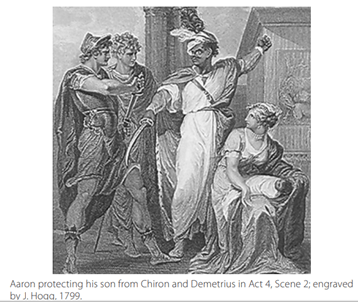
Fonte: seattleshakespeare.org
“AARON
Why, there’s the privilege your beauty bears:
Fie, treacherous hue, that will betray with blushing
The close enacts and counsels of the heart!
Here’s a young lad framed of another leer:
Look, how the black slave smiles upon the father,
As who should say ‘Old lad, I am thine own.’”
“And from that womb where you imprison’d were
He is enfranchised and come to light:
Nay, he is your brother by the surer side,¹
Although my seal be stamped in his face.”
¹ Alusão a uma mãe ser sempre reconhecível devido a ser a grávida afinal de contas; mas também a Tamora ser a própria rainha de Roma.
“Nurse
Aaron, what shall I say unto the empress?
DEMETRIUS
Advise thee, Aaron, what is to be done,
And we will all subscribe to thy advice:
Save thou the child, so we may all be safe.”
Aqui todos os 3 que contrapunham Arão já estão vendidos: foram psicologicamente convencidos, e acabarão morrendo.
“DEMETRIUS
How many women saw this child of his?”
“Nurse
Cornelia the midwife and myself;
And no one else but the deliver’d empress.
AARON
The empress, the midwife, and yourself:
Two may keep counsel when the third’s away:
Go to the empress, tell her this I said.
He kills the nurse
Weke, weke! so cries a pig prepared to the spit.”
“And now be it known to you my full intent.
Not far, one Muli lives, my countryman;
His wife but yesternight was brought to bed;
His child is like to her, fair as you are:
Go pack with him, and give the mother gold,
And tell them both the circumstance of all;
And how by this their child shall be advanced,
And be received for the emperor’s heir,
And substituted in the place of mine,
To calm this tempest whirling in the court;
And let the emperor dandle him for his own.
Hark ye, lords; ye see I have given her physic,
Pointing to the nurse
And you must needs bestow her funeral;
The fields are near, and you are gallant grooms:
This done, see that you take no longer days,
But send the midwife presently to me.
The midwife and the nurse well made away,
Then let the ladies tattle what they please.
CHIRON
Aaron, I see thou wilt not trust the air
With secrets.
DEMETRIUS
For this care of Tamora,
Herself and hers are highly bound to thee.
Exeunt DEMETRIUS and CHIRON bearing off the Nurse’s body”
O tropo das crianças trocadas no berço é um dos mais antigos da humanidade, e Sh. como bom dramaturgo, que aumenta as coisas pequenas e reles, não hesita em usá-lo.
“Come on, you thick lipp’d slave, I’ll bear you hence;
For it is you that puts us to our shifts:
I’ll make you feed on berries and on roots,
And feed on curds and whey, and suck the goat,
And cabin in a cave, and bring you up
To be a warrior, and command a camp.
Exit”
Ah, como o próprio Arão não deixa o sarcasmo de lado e a auto-imolação ao conversar com e qualificar seu próprio filho! A caverna, sempre a caverna, é a origem de muitas conseqüências interessantes em Titus Andronicus…
ACT 4
SCENE III. The same. A public place.
“Ah, Rome! Well, well; I made thee miserable
What time I threw the people’s suffrages
On him that thus doth tyrannize o’er me.
Go, get you gone; and pray be careful all,
And leave you not a man-of-war unsearch’d:
This wicked emperor may have shipp’d her hence;
And, kinsmen, then we may go pipe for justice.”
“MARCUS ANDRONICUS
Kinsmen, his sorrows are past remedy.
Join with the Goths; and with revengeful war
Take wreak on Rome for this ingratitude,
And vengeance on the traitor Saturnine.
TITUS ANDRONICUS
Publius, how now! how now, my masters!
What, have you met with her?
PUBLIUS
No, my good lord; but Pluto sends you word,
If you will have Revenge from hell, you shall:
Marry, for Justice, she is so employ’d,
He thinks, with Jove in heaven, or somewhere else,
So that perforce you must needs stay a time.”
“I’ll dive into the burning lake below,
And pull her out of Acheron by the heels.
Marcus, we are but shrubs, no cedars we
No big-boned men framed of the Cyclops’ size;
But metal, Marcus, steel to the very back,
Yet wrung with wrongs more than our backs can bear:
And, sith there’s no justice in earth nor hell,
We will solicit heaven and move the gods
To send down Justice for to wreak our wrongs.”
“To Saturn, Caius, not to Saturnine;¹
You were as good to shoot against the wind.
To it, boy! Marcus, loose when I bid.
Of my word, I have written to effect;
There’s not a god left unsolicited.”
¹ Trocadilho com Saturno ou Cronos, o deus do tempo: o tempo de Saturnino está expirando…
“MARCUS ANDRONICUS
Kinsmen, shoot all your shafts into the court:
We will afflict the emperor in his pride.”
“TITUS ANDRONICUS
Ha, ha!
Publius, Publius, what hast thou done?
See, see, thou hast shot off one of Taurus’ horns.”
“And who should find them but the empress’ villain?
She laugh’d, and told the Moor he should not choose
But give them to his master for a present.”
“Clown
Alas, sir, I know not Jupiter; I never drank with him
in all my life.”
“TITUS ANDRONICUS
Then here is a supplication for you. And when you
come to him, at the first approach you must kneel,
then kiss his foot, then deliver up your pigeons, and
then look for your reward. I’ll be at hand, sir; see
you do it bravely.
Clown
I warrant you, sir, let me alone.”
ACT 4
SCENE IV. The same. Before the palace.
“Sweet scrolls to fly about the streets of Rome!
What’s this but libelling against the senate,
And blazoning our injustice every where?
A goodly humour, is it not, my lords?
As who would say, in Rome no justice were.
But if I live, his feigned ecstasies
Shall be no shelter to these outrages:
But he and his shall know that justice lives
In Saturninus’ health, whom, if she sleep,
He’ll so awake as she in fury shall
Cut off the proud’st conspirator that lives.”
“TAMORA
My gracious lord, my lovely Saturnine,
Lord of my life, commander of my thoughts,
Calm thee, and bear the faults of Titus’ age,
The effects of sorrow for his valiant sons,
Whose loss hath pierced him deep and scarr’d his heart;
And rather comfort his distressed plight
Than prosecute the meanest or the best
For these contempts.”
“Why, thus it shall become
High-witted Tamora to gloze with all:
But, Titus, I have touched thee to the quick,
Thy life-blood out: if Aaron now be wise,
Then is all safe, the anchor’s in the port.”
“Clown
‘Tis he. God and Saint Stephen¹ give you good den:
I have brought you a letter and a couple of pigeons here.
SATURNINUS reads the letter
SATURNINUS
Go, take him away, and hang him presently.
Clown
How much money must I have?
TAMORA
Come, sirrah, you must be hanged.
Clown
Hanged! by’r lady, then I have brought up a neck to
a fair end.
Exit, guarded”
¹ Santo Stefano ou Estêvão é o primeiro santo canonizado pela igreja católica. Teria nascido em 5 a.C. e morrido em 34 d.C., um ano após a crucificação de Cristo, sendo um de seus primeiros pregadores (foi morto por apedrejamento sentenciado pelos judeus romanos). Sua data de celebração é 26 de dezembro, mesma da publicação desse post e da escrita desse parágrafo. Por que pela primeira vez Shakespeare cita um elemento posterior ao paganismo greco-romano? Talvez para indicar a proximidade de uma transição de poder…
“May this be borne?–as if his traitorous sons,
That died by law for murder of our brother,
Have by my means been butcher’d wrongfully!
Go, drag the villain hither by the hair;
Nor age nor honour shall shape privilege:
For this proud mock I’ll be thy slaughterman;
Sly frantic wretch, that holp’st to make me great,
In hope thyself should govern Rome and me.”
“AEMILIUS
Arm, arm, my lord;–Rome never had more cause.
The Goths have gather’d head; and with a power
high-resolved men, bent to the spoil,
They hither march amain, under conduct
Of Lucius, son to old Andronicus;
Who threats, in course of this revenge, to do
As much as ever Coriolanus did.
SATURNINUS
Is warlike Lucius general of the Goths?
These tidings nip me, and I hang the head
As flowers with frost or grass beat down with storms:
Ay, now begin our sorrows to approach:
‘Tis he the common people love so much;
Myself hath often over-heard them say,
When I have walked like a private man,
That Lucius’ banishment was wrongfully,
And they have wish’d that Lucius were their emperor.”
“TAMORA
King, be thy thoughts imperious, like thy name.
Is the sun dimm’d, that gnats do fly in it?
The eagle suffers little birds to sing,
And is not careful what they mean thereby,
Knowing that with the shadow of his wings
He can at pleasure stint their melody:
Even so mayst thou the giddy men of Rome.”
“I will enchant the old Andronicus
With words more sweet, and yet more dangerous,
Than baits to fish, or honey-stalks to sheep,
When as the one is wounded with the bait,
The other rotted with delicious feed.”
“I can smooth and fill his aged ear with golden promises; that, were his heart almost impregnable, his old ears deaf, yet should both ear and heart obey my tongue.”
“To Aemilius
Go thou before, be our ambassador:
Say that the emperor requests a parley
Of warlike Lucius, and appoint the meeting
Even at his father’s house, the old Andronicus.
SATURNINUS
Aemilius, do this message honourably:
And if he stand on hostage for his safety,
Bid him demand what pledge will please him best.”
“TAMORA
Now will I to that old Andronicus;
And temper him with all the art I have,
To pluck proud Lucius from the warlike Goths.”
ACT 5
SCENE I. Plains near Rome.
“First Goth
Brave slip, sprung from the great Andronicus,
Whose name was once our terror, now our comfort;
Whose high exploits and honourable deeds
Ingrateful Rome requites with foul contempt,
Be bold in us: we’ll follow where thou lead’st,
Like stinging bees in hottest summer’s day
Led by their master to the flowered fields,
And be avenged on cursed Tamora.
All the Goths
And as he saith, so say we all with him.”
“Second Goth
Renowned Lucius, from our troops I stray’d
To gaze upon a ruinous monastery;
And, as I earnestly did fix mine eye
Upon the wasted building, suddenly
I heard a child cry underneath a wall.
I made unto the noise; when soon I heard
The crying babe controll’d with this discourse:
‘Peace, tawny slave, half me and half thy dam!
Did not thy hue bewray whose brat thou art,
Had nature lent thee but thy mother’s look,
Villain, thou mightst have been an emperor:
But where the bull and cow are both milk-white,
They never do beget a coal-black calf.
Peace, villain, peace!’–even thus he rates
the babe,–
‘For I must bear thee to a trusty Goth;
Who, when he knows thou art the empress’ babe,
Will hold thee dearly for thy mother’s sake.’
With this, my weapon drawn, I rush’d upon him,
Surprised him suddenly, and brought him hither,
To use as you think needful of the man.
LUCIUS
O worthy Goth, this is the incarnate devil
That robb’d Andronicus of his good hand;
This is the pearl that pleased your empress’ eye,
And here’s the base fruit of his burning lust.
Say, wall-eyed slave, whither wouldst thou convey
This growing image of thy fiend-like face?
Why dost not speak? what, deaf? not a word?
A halter, soldiers! hang him on this tree.
And by his side his fruit of bastardy.”
“AARON
An if it please thee! why, assure thee, Lucius,
‘Twill vex thy soul to hear what I shall speak;
For I must talk of murders, rapes and massacres,
Acts of black night, abominable deeds,
Complots of mischief, treason, villanies
Ruthful to hear, yet piteously perform’d:
And this shall all be buried by my death,
Unless thou swear to me my child shall live.”
“LUCIUS
Who should I swear by? thou believest no god:
That granted, how canst thou believe an oath?
AARON
What if I do not? as, indeed, I do not;
Yet, for I know thou art religious
And hast a thing within thee called conscience,
With 20 popish tricks and ceremonies,
Which I have seen thee careful to observe,
Therefore I urge thy oath; for that I know
An idiot holds his bauble for a god
And keeps the oath which by that god he swears,
To that I’ll urge him: therefore thou shalt vow
By that same god, what god soe’er it be,
That thou adorest and hast in reverence,
To save my boy, to nourish and bring him up;
Or else I will discover nought to thee.”
“AARON
First know thou, I begot him on the empress.
LUCIUS
O most insatiate and luxurious woman!
AARON
Tut, Lucius, this was but a deed of charity
To that which thou shalt hear of me anon.
‘Twas her two sons that murder’d Bassianus;
They cut thy sister’s tongue and ravish’d her
And cut her hands and trimm’d her as thou saw’st.
LUCIUS
O detestable villain! call’st thou that trimming?
AARON
Why, she was wash’d and cut and trimm’d, and ‘twas
Trim sport for them that had the doing of it.”
“AARON
…
I train’d thy brethren to that guileful hole
Where the dead corpse of Bassianus lay:
I wrote the letter that thy father found
And hid the gold within the letter mention’d,
Confederate with the queen and her two sons:
And what not done, that thou hast cause to rue,
Wherein I had no stroke of mischief in it?
I play’d the cheater for thy father’s hand,
And, when I had it, drew myself apart
And almost broke my heart with extreme laughter:
I pry’d me through the crevice of a wall
When, for his hand, he had his two sons’ heads;
Beheld his tears, and laugh’d so heartily,
That both mine eyes were rainy like to his:
And when I told the empress of this sport,
She swooned almost at my pleasing tale,
And for my tidings gave me 20 kisses.
First Goth
What, canst thou say all this, and never blush?
AARON
Ay, like a black dog, as the saying is.
LUCIUS
Art thou not sorry for these heinous deeds?
AARON
Ay, that I had not done a thousand more.
Even now I curse the day–and yet, I think,
Few come within the compass of my curse,–
Wherein I did not some notorious ill,
As kill a man, or else devise his death,
Ravish a maid, or plot the way to do it,
Accuse some innocent and forswear myself,
Set deadly enmity between two friends,
Make poor men’s cattle break their necks;
Set fire on barns and hay-stacks in the night,
And bid the owners quench them with their tears.
Oft have I digg’d up dead men from their graves,
And set them upright at their dear friends’ doors,
Even when their sorrows almost were forgot;
And on their skins, as on the bark of trees,
Have with my knife carved in Roman letters,
‘Let not your sorrow die, though I am dead.’
Tut, I have done a thousand dreadful things
As willingly as one would kill a fly,
And nothing grieves me heartily indeed
But that I cannot do ten thousand more.
LUCIUS
Bring down the devil; for he must not die
So sweet a death as hanging presently.
AARON
If there be devils, would I were a devil,
To live and burn in everlasting fire,
So I might have your company in hell,
But to torment you with my bitter tongue!
LUCIUS
Sirs, stop his mouth, and let him speak no more.
Enter a Goth
Third Goth
My lord, there is a messenger from Rome
Desires to be admitted to your presence.
LUCIUS
Let him come near.
Enter AEMILIUS
Welcome, Aemilius what’s the news from Rome?”
“LUCIUS
Aemilius, let the emperor give his pledges
Unto my father and my uncle Marcus,
And we will come. March away.
Exeunt”
ACT 5
SCENE II. Rome. Before TITUS’ house.
“TAMORA
Thus, in this strange and sad habiliment,
I will encounter with Andronicus,
And say I am Revenge, sent from below
To join with him and right his heinous wrongs.
Knock at his study, where, they say, he keeps,
To ruminate strange plots of dire revenge;
Tell him Revenge is come to join with him,
And work confusion on his enemies.
They knock
Enter TITUS, above”
“TAMORA
If thou didst know me, thou wouldest talk with me.
TITUS ANDRONICUS
I am not mad; I know thee well enough:
Witness this wretched stump, witness these crimson lines;
Witness these trenches made by grief and care,
Witness the tiring day and heavy night;
Witness all sorrow, that I know thee well
For our proud empress, mighty Tamora:
Is not thy coming for my other hand?
TAMORA
Know, thou sad man, I am not Tamora;
She is thy enemy, and I thy friend:
I am Revenge: sent from the infernal kingdom,
To ease the gnawing vulture of thy mind,
By working wreakful vengeance on thy foes.
Come down, and welcome me to this world’s light;
Confer with me of murder and of death:
There’s not a hollow cave or lurking-place,
No vast obscurity or misty vale,
Where bloody murder or detested rape
Can couch for fear, but I will find them out;
And in their ears tell them my dreadful name,
Revenge, which makes the foul offender quake.
TITUS ANDRONICUS
Art thou Revenge? and art thou sent to me,
To be a torment to mine enemies?
TAMORA
I am; therefore come down, and welcome me.
TITUS ANDRONICUS
Do me some service, ere I come to thee.
Lo, by thy side where Rape and Murder stands; [os dois irmãos estupradores de Lavínia]
Now give me some surance that thou art Revenge,
Stab them, or tear them on thy chariot-wheels;
And then I’ll come and be thy waggoner,
And whirl along with thee about the globe.”
“TAMORA
These are my ministers, and come with me.
TITUS ANDRONICUS
Are these thy ministers? what are they call’d?
TAMORA
Rapine and Murder; therefore called so,
Cause they take vengeance of such kind of men.
TITUS ANDRONICUS
Good Lord, how like the empress’ sons they are!
And you, the empress! but we worldly men
Have miserable, mad, mistaking eyes.
O sweet Revenge, now do I come to thee;
And, if one arm’s embracement will content thee,
I will embrace thee in it by and by.
Exit above”
“Whate’er I forge to feed his brain-sick fits,
Do you uphold and maintain in your speeches,
For now he firmly takes me for Revenge;
And, being credulous in this mad thought,
I’ll make him send for Lucius his son;
And, whilst I at a banquet hold him sure,
I’ll find some cunning practise out of hand,
To scatter and disperse the giddy Goths,
Or, at the least, make them his enemies.”
“TITUS ANDRONICUS
Long have I been forlorn, and all for thee:
Welcome, dread Fury, to my woful house:
Rapine and Murder, you are welcome too.
How like the empress and her sons you are!
Well are you fitted, had you but a Moor:
Could not all hell afford you such a devil?
For well I wot the empress never wags
But in her company there is a Moor;
And, would you represent our queen aright,
It were convenient you had such a devil:
But welcome, as you are. What shall we do?”
“TAMORA
Show me a thousand that have done thee wrong,
And I will be revenged on them all.
TITUS ANDRONICUS
Look round about the wicked streets of Rome;
And when thou find’st¹ a man that’s like thyself.
Good Murder, stab him; he’s a murderer.
Go thou with him; and when it is thy hap
To find another that is like to thee,
Good Rapine, stab him; he’s a ravisher.
Go thou with them; and in the emperor’s court
There is a queen, attended by a Moor;
Well mayst thou know her by thy own proportion,
for up and down she doth resemble thee:
I pray thee, do on them some violent death;
They have been violent to me and mine.
TAMORA
Well hast thou lesson’d us; this shall we do.
But would it please thee, good Andronicus,
To send for Lucius, thy thrice-valiant son,
Who leads towards Rome a band of warlike Goths,
And bid him come and banquet at thy house;
When he is here, even at thy solemn feast,
I will bring in the empress and her sons,
The emperor himself and all thy foes;
And at thy mercy shalt they stoop and kneel,
And on them shalt thou ease thy angry heart.
What says Andronicus to this device?”
¹ Muito estranho que a grafia (os apóstrofos no lugar do ‘e’) variem durante a peça. Será exato?
“TITUS ANDRONICUS
Nay, nay, let Rape and Murder stay with me;
Or else I’ll call my brother back again,
And cleave to no revenge but Lucius.
TAMORA
[Aside to her sons] What say you, boys? will you
bide with him,
Whiles I go tell my lord the emperor
How I have govern’d our determined jest?
Yield to his humour, smooth and speak him fair,
And tarry with him till I turn again.”
“DEMETRIUS
Madam, depart at pleasure; leave us here.
TAMORA
Farewell, Andronicus: Revenge now goes
To lay a complot to betray thy foes.”
“TITUS ANDRONICUS
Fie, Publius, fie! thou art too much deceived;
The one is Murder, Rape is the other’s name;
And therefore bind them, gentle Publius.
Caius and Valentine, lay hands on them.
Oft have you heard me wish for such an hour,
And now I find it; therefore bind them sure,
And stop their mouths, if they begin to cry.
Exit
PUBLIUS, &c. lay hold on CHIRON and DEMETRIUS”
“Re-enter TITUS, with LAVINIA; he bearing a knife, and she a basin [como, na cabeça?!]
TITUS ANDRONICUS
…
Here stands the spring whom you have stain’d with mud,
This goodly summer with your winter mix’d.
You kill’d her husband, and for that vile fault
Two of her brothers were condemn’d to death,
My hand cut off and made a merry jest;
Both her sweet hands, her tongue, and that more dear
Than hands or tongue, her spotless chastity,
Inhuman traitors, you constrain’d and forced.
What would you say, if I should let you speak?
…
Hark, wretches! how I mean to martyr you.
This one hand yet is left to cut your throats,
Whilst that Lavinia ‘tween her stumps doth hold
The basin that receives your guilty blood.
You know your mother means to feast with me,
And calls herself Revenge, and thinks me mad:
Hark, villains! I will grind your bones to dust
And with your blood and it I’ll make a paste,
And of the paste a coffin I will rear
And make two pasties of your shameful heads,
And bid that strumpet, your unhallow’d dam,
Like to the earth swallow her own increase.
This is the feast that I have bid her to,
And this the banquet she shall surfeit on;
For worse than Philomel you used my daughter,
And worse than Progne I will be revenged:
And now prepare your throats. Lavinia, come,
He cuts their throats
Receive the blood: and when that they are dead,
Let me go grind their bones to powder small
And with this hateful liquor temper it;
And in that paste let their vile heads be baked.
Come, come, be every one officious
To make this banquet; which I wish may prove
More stern and bloody than the Centaurs’ feast.”¹
¹ O Centauro (ou Minotauro, o que é uma figura diferente, mas que às vezes se confunde – um seria um homem-cavalo o outro um homem-touro, o primeiro sendo animal na metade inferior, o segundo no hemisfério superior, isto é, sua cabeça é que seria de touro, enquanto não passaria de um bípede ereto) da mitologia grega que comia virgens entregas como tributo pela ilha de Creta.
ACT 5
SCENE III. Court of TITUS’ house. A banquet set out. [DESFECHO]
“LUCIUS
Good uncle, take you in this barbarous Moor,
This ravenous tiger, this accursed devil;
Let him receive no sustenance, fetter him
Till he be brought unto the empress’ face,
For testimony of her foul proceedings:
And see the ambush of our friends be strong;
I fear the emperor means no good to us.”
“The trumpets show the emperor is at hand.
Enter SATURNINUS and TAMORA, with AEMILIUS, Tribunes, Senators, and others”
“MARCUS ANDRONICUS
Rome’s emperor, and nephew, break the parle;
These quarrels must be quietly debated.
The feast is ready, which the careful Titus
Hath ordain’d to an honourable end,
For peace, for love, for league, and good to Rome:
Please you, therefore, draw nigh, and take your places.”
“Enter TITUS dressed like a Cook, LAVINIA veiled, Young LUCIUS, and others. TITUS places the dishes on the table”
“TITUS ANDRONICUS
…
My lord the emperor, resolve me this:
Was it well done of rash Virginius
To slay his daughter with his own right hand,
Because she was enforced, stain’d, and deflower’d?¹
SATURNINUS
It was, Andronicus.
TITUS ANDRONICUS
Your reason, mighty lord?
SATURNINUS
Because the girl should not survive her shame,
And by her presence still renew his sorrows.
TITUS ANDRONICUS
A reason mighty, strong, and effectual;
A pattern, precedent, and lively warrant,
For me, most wretched, to perform the like.
Die, die, Lavinia, and thy shame with thee;
Kills LAVINIA
And, with thy shame, thy father’s sorrow die!”
Que personagem, Shakespeare! Que personagem!
¹ A origem de uma lei romana que inocentou o pai de Virgínia quando este a matou para preservar-lhe a virgindade. Muitos sustentam que Lucrécia e Virgínia não passam de figuras mitológicas.
“SATURNINUS
What hast thou done, unnatural and unkind?
TITUS ANDRONICUS
Kill’d her, for whom my tears have made me blind.
I am as woful as Virginius was,
And have a thousand times more cause than he
To do this outrage: and it now is done.
SATURNINUS
What, was she ravish’d? tell who did the deed.
TITUS ANDRONICUS
Will’t please you eat? will’t please your
highness feed?
TAMORA
Why hast thou slain thine only daughter thus?
TITUS ANDRONICUS
Not I; ‘twas Chiron and Demetrius:
They ravish’d her, and cut away her tongue;
And they, ‘twas they, that did her all this wrong.
SATURNINUS
Go fetch them hither to us presently.
TITUS ANDRONICUS
Why, there they are both, baked in that pie;
Whereof their mother daintily hath fed,
Eating the flesh that she herself hath bred.
‘Tis true, ‘tis true; witness my knife’s sharp point.
Kills TAMORA
SATURNINUS
Die, frantic wretch, for this accursed deed!
Kills TITUS
LUCIUS
Can the son’s eye behold his father bleed?
There’s meed for meed, death for a deadly deed!
Kills SATURNINUS. A great tumult. LUCIUS, MARCUS, and others go up into the balcony”
“MARCUS ANDRONICUS
…
O, let me teach you how to knit again
This scatter’d corn into one mutual sheaf,
These broken limbs again into one body;
Lest Rome herself be bane unto herself,
And she whom mighty kingdoms court’sy to,
Like a forlorn and desperate castaway,
Do shameful execution on herself.
But if my frosty signs and chaps of age,
Grave witnesses of true experience,
Cannot induce you to attend my words,
To LUCIUS
Speak, Rome’s dear friend, as erst our ancestor,
When with his solemn tongue he did discourse
To love-sick Dido’s sad attending ear
The story of that baleful burning night
When subtle Greeks surprised King Priam’s Troy,
Tell us what Sinon hath bewitch’d our ears,¹
Or who hath brought the fatal engine in
That gives our Troy, our Rome, the civil wound.
…
But floods of tears will drown my oratory,
And break my utterance, even in the time
When it should move you to attend me most,
Lending your kind commiseration.
Here is a captain, let him tell the tale;
Your hearts will throb and weep to hear him speak.”
¹ Quem convence os troianos a abrirem o portão para receber a prenda do cavalo de madeira (Eneida).
“Alas, you know I am no vaunter, I;
My scars can witness, dumb although they are,
That my report is just and full of truth.
But, soft! methinks I do digress too much,
Citing my worthless praise: O, pardon me;
For when no friends are by, men praise themselves.”
“MARCUS ANDRONICUS
…
Now judge what cause had Titus to revenge
These wrongs, unspeakable, past patience,
Or more than any living man could bear.
Now you have heard the truth, what say you, Romans?
Have we done aught amiss,–show us wherein,
And, from the place where you behold us now,
The poor remainder of Andronici
Will, hand in hand, all headlong cast us down.
And on the ragged stones beat forth our brains,
And make a mutual closure of our house.
Speak, Romans, speak; and if you say we shall,
Lo, hand in hand, Lucius and I will fall.
AEMILIUS
Come, come, thou reverend man of Rome,
And bring our emperor gently in thy hand,
Lucius our emperor; for well I know
The common voice do cry it shall be so.
All
Lucius, all hail, Rome’s royal emperor!
MARCUS ANDRONICUS
Go, go into old Titus’ sorrowful house,
To Attendants
And hither hale that misbelieving Moor,
To be adjudged some direful slaughtering death,
As punishment for his most wicked life.”
“O, take this warm kiss on thy pale cold lips,
Kissing TITUS
These sorrowful drops upon thy blood-stain’d face,
The last true duties of thy noble son!”
“LUCIUS
Come hither, boy; come, come, and learn of us
To melt in showers: thy grandsire loved thee well:
Many a time he danced thee on his knee,
Sung thee asleep, his loving breast thy pillow:
Many a matter hath he told to thee,
Meet and agreeing with thine infancy;
In that respect, then, like a loving child,
Shed yet some small drops from thy tender spring,
Because kind nature doth require it so:
Friends should associate friends in grief and woe:
Bid him farewell; commit him to the grave;
Do him that kindness, and take leave of him.
Young LUCIUS
O grandsire, grandsire! even with all my heart
Would I were dead, so you did live again!
O Lord, I cannot speak to him for weeping;
My tears will choke me, if I ope my mouth.¹
Re-enter Attendants with AARON
AEMILIUS
You sad Andronici, have done with woes:
Give sentence on this execrable wretch,
That hath been breeder of these dire events.
LUCIUS
Set him breast-deep in earth, and famish him;
There let him stand, and rave, and cry for food;
If any one relieves or pities him,
For the offence he dies. This is our doom:
Some stay to see him fasten’d in the earth.”
¹ Sem dúvida não importa como intercalemos a leitura desta peça, ficamos exaustos ao final, tantas as lágrimas vertidas!
“Ten thousand worse than ever yet I did
Would I perform, if I might have my will;
If one good deed in all my life I did,
I do repent it from my very soul.”
Que falastrão o Seu Arão! E gosta dos números 20 e 10 mil!
“As for that heinous tiger, Tamora,
No funeral rite, nor man in mourning weeds,
No mournful bell shall ring her burial;
But throw her forth to beasts and birds of prey:
Her life was beast-like, and devoid of pity;
And, being so, shall have like want of pity.
See justice done on Aaron, that damn’d Moor,
By whom our heavy haps had their beginning:
Then, afterwards, to order well the State,
That like events may ne’er it ruinate.
Exeunt”
GLOSSÁRIO:
adder: víbora
blowse: mulher envergonhada, de face rubra
dainty doe: corça delicada
desert (em Shakespeare): “often deserts
Something that is deserved or merited, especially a punishment: They got their just deserts when the scheme was finally uncovered.” Punição ou mérito.
lark: cotovia
leer: olhar malicioso
maugre: obsoleto para guilty pleasure (prazer culposo, coisa má que defendo com todas as forças, embora talvez um pouco envergonhado, etc.)
peal: ribombar
shive: nesse contexto, rolha
spleenful: irritável(is)
stag: veado
stumps: toco, coto, cotoco
tadpole: girino
taper(s): nas três citações da peça, vela(s)
trull: prostituta, do alemão Trulle
 Seclusão Anagógica