In: ANAIS DE FILOSOFIA CLÁSSICA, edição v. 10, n. 20, 2016.
“só pouco a pouco teria Aristóteles conseguido distanciar-se do platonismo e alcançar um pensamento maduro e original.”
Urmetaphysik X Spätmetaphysik
“para que uma obra seja verdadeira e completamente unitária, não basta que ela seja autêntica.”
A pergunta “onde termina a física – e a biologia, na também – e começa a metafísica” faz sentido sobretudo quando o assunto é o Estagirita!
Assim como Heidegger pergunta o que é o ser?, temos o direito de perguntar, face a determinados “pergaminhos”: o que é um livro? o que é a obra?
“todo estudo posterior a 1923 é uma tomada de posição a favor ou contra a tese de Jaeger.”
“A principal razão de não se ter até agora procurado estudar o desenvolvimento intelectual de Aristóteles é, em suma, a ideia escolástica de sua filosofia como um sistema estático de conceitos.” J., sempre em laranja agora
Thomas Case, ‘Aristotle’, 1910 (1996). (artigo da enciclopédia britânica)
É ilógico, meu caro Watson!
O quê?
O princípio elementar da não-contradição!
A HAGIOGRAFIA DE UM PAGÃO: “Partindo das informações contidas nas diversas Vidas de Aristóteles, a meta do intérprete era reconstruir a história espiritual do Estagirita, desde o período acadêmico até seus últimos anos.”
“as contradições e duplicações textuais – Dubletten – são o primeiro passo para que se reconstrua a história por trás de um texto.”
De Philosophia como seu primeiro grande livro (abortado).
Então quando foi mestre de Alexandre ele era ainda um “aluno”?
Desviar de Platão, no entanto, é sempre regredir. Melhor ter ficado à sombra luminosa.
“teoria revisionista do suprassensível”
Se houvera logrado êxito, Heidegger não teria precisado publicar nada.
O bizarro elo da ontologia aristotélica à astronomia.
(*) “Stephen Menn disponibilizou no site da Humboldt-Universität zu Berlin uma primeira versão de sua obra ainda não publicada em mídia impressa, The Aim and the Argument of Aristotle’s Metaphysics.”
(*) “ao folhear qualquer introdução ao pensamento de Aristóteles e até mesmo estudos especificamente voltados à Metafísica, é comum encontrar esse tipo de afirmação.” Engraçado, podia jurar que era o contrário: livros-didáticos ou interpretações rasas ou panorâmicas citam a Metafísica como magnum opus indelevelmente unitária. Mas sem dúvida cogitar uma unidade tão absoluta neste tratado em Ar. e argumentar que Nietzsche “só escreveu dois livros propriamente ditos” é o que há de mais espúrio em termos de filosofastros!
Não se pode emendar dois sonetos tão desafinados!
Os filósofos são ótimos, o que estraga são os editores e os fãs!
Penélope Aristóteles, a cosedora.
De niilista a baconiano.
Aporistóteles
Quando Aristóteles Chorou
“Aristóteles não resolveu a tensão entre ontologia e teologia porque tal tensão seria, de fato, insolúvel.”
“cada esfera especial conserva seu caráter de tentativa e indagação, que não encontra jamais satisfação na forma exterior de uma construção perfeita e impecável, mas está sempre se corrigindo e aperfeiçoando”Qualquer semelhança com seu mestre não é mera coincidência.
Pierre Aubenque, Le problème de l’être chez Aristote, 1962.
(*) “a ontologia é um projeto que jamais se conclui: seria impossível apreender completamente o ser, pois quando se tenta fazê-lo, o máximo que se atinge é o ente. Tal tese, de claro sabor heideggeriano, conjuga-se no pensamento do estudioso francês com um severo juízo acerca da teologia.”
“Descortinar-se-ia a verdadeira face de Aristóteles: o filósofo do perene questionar, do revisionismo honesto.” Mas isso ainda é demasiado véu de Maia! Não basta ser honesto, se ser revisionista da perfeição é hediondo. O mesmo vale para o marxismo (Marx//Platão).
MUITO ALÉM DO CIDADÃO JAEGER: “O primeiro a adotar o método evolutivo e aplicá-lo à Metafísica, atingindo, porém, resultados opostos aos de Jaeger, foi Hans von Arnim. (…) Relevantes são também as interpretações de Emilio Oggioni, Paul Gohlke, Max Wundt e Josef Zürcher” Todos entre os 1920 e os 50. Cf. Reale, 2008: “A componente teológica é, para todos, completa ou parcialmente representante do espírito platônico; mas, para Jaeger, o platonismo é o ponto de partida do qual Aristóteles tende a se distanciar; para Gohlke e Wundt, o platonismo é a linha de chegada, no sentido de uma meditada recuperação; para Oggioni, tratar-se-ia de um retorno ao platonismo, contra a tendência, mais autenticamente aristotélica, em direção ao empirismo crítico. [p. 7]”Ou seja: uma dupla Odisséia, círculo perfeito.
Podem os analíticos ingleses avaliar o inapreciável (ontologias)?
(*) “Talvez o melhor exemplo dos extremos atingidos pelos defensores do método histórico-genético seja a fantasiosa interpretação de Josef Zürcher. Este autor defendeu que o corpus contém, sim, fortes sinais de evolução; essa seria, contudo, a evolução não de Aristóteles, mas a de Teofrasto! O Estagirita teria se mantido platônico durante toda sua carreira, ao passo que Teofrasto teria evoluído de uma postura platônica ao empirismo radical. O discípulo teria editado a obra de seu mestre, justapondo seus próprios escritos aos textos compostos por Aristóteles.” Daria uma boa novela. E Eco devia ter sido seu autor.
“Jaeger serviu-se dessa tese geral como fio condutor para empreender uma ‘restauração’ do corpus: ele julgou ser capaz de datar, ao menos aproximativamente, não só cada obra de Aristóteles, mas até mesmo seções do que tradicionalmente se considerara como sendo uma única obra.”
Aristóteles é o Xenofonte de Platão, diz uma fonte estrangeira (maybe Daily Mirror?).
“os textos que dariam testemunho do período puramente platônico da evolução filosófica do Estagirita estariam praticamente restritos às chamadas obras exotéricas, as quais, como se sabe, ou se perderam totalmente ou só nos chegaram de modo extremamente fragmentário.” Hipótese bastante conhecida.
“Antes de tudo, é preciso reconhecer que a tese de Jaeger revigorou enormemente o estudo das obras exotéricas de Aristóteles, estudo que vêm produzindo excelentes resultados.” Migalhas, migalhas, migalhas…
Tão diferente de si mesmo que chega a ser idêntico!
Foi Aristóteles jamais discípulo de Platão?
Platão existiu?!
CAUSA MORTIS PEAK NONFICTION: O problema com Ar., agora falando sério, tanto quanto eu o compreendo, é que ele não compreendeu a teoria das idéias. Portanto, opor-se ou não opor-se a elas é o de menos. Quiçá eu não tenha compreendido Aristóteles, no entanto – mas, questão de lógica, se compreendi Platão, compreendi Aristóteles, pois Platão é o summum bonum da epistemologia – se não compreendi Aristóteles, é verdade que me enganei com Platão?!
“Teresa Oñate y Zubía(2001, p. 65) chega ao extremo de sugerir que o modo como Jaeger descreve a dicotomia ‘platônico’–‘aristotélico’ reproduziria uma perspectiva renascentista do conflito entre os dois filósofos, a saber, a visão que representa Platão, por um lado, como o filósofo da transcendência, do espírito religioso, e Aristóteles, por outro, como o filósofo da imanência, o campeão do espírito laico e científico, visão que foi imortalizada no celebérrimo afresco da Escola de Atenas, no qual Platão figura apontando para o céu e Aristóteles para a terra.” Eram os renascentistas (deuses) escolásticos? Sabiam voar? Flutuar, ao menos?
Na Ética, vai de Buda a Maquiavel. Queda pura, diria Heid.
O dia que a transcendência for um fardo estaremos todos perdidos (insustentável leveza do Untermensch).
Não tratar como caricatura quem trata os outros como caricatura.
“ao falar de um estágio ‘platônico’ e outro ‘genuinamente aristotélico’, Jaeger sub-repticiamente reintroduz a noção de sistema, pois cada um destes estágios teria uma unidade de pensamento tal que os faz merecer, em nossa opinião, o título de pequeno sistema. (…) Jaeger flerta, assim, com um círculo interpretativo assaz vicioso.”
“O método histórico-genético, para ser verdadeiramente histórico, deveria construir-se sobre dados de fato incontroversos, sobre datas seguras e bem provadas; ao invés, umas e outros faltam completamente” R. De acordo! É por isso que a filologia é uma merda!
“Mas, como se sabe, as referências cruzadas também são, em última instância, inconfiáveis, visto que, por vezes, elas operam nos dois sentidos: o texto α contém uma frase do tipo “como dissemos em β”, o que parece ser um sinal de que β seja o texto mais antigo dos dois; mas às vezes encontra-se em β o mesmo tipo de remissão a α, o que, pela mesma lógica, sugeriria que α seria anterior a β, despedaçando assim a coerência da tentativa de determinar a ordem de composição dos tratados aristotélicos com auxílio das referências cruzadas.” Aristrollteles. Tell, troll!
Liaisons hyper-dangeureuses
À procura do meu Urblog.
(*) Cf. Décarie, 1972 “se Aristóteles acrescenta uma nota para corrigir uma opinião que ele não mais aceita, não pode ele simplesmente eliminar as passagens que dela guardam quaisquer resquícios? Se ele não o faz, é porque ele aceita o que se crê serem os estágios antigos e recentes de seu pensamento.” Até isso é suposição. Gostamos dos “filhos” que superamos… Já outros queimam obras-primas insuperáveis… Exemplo vivo são as minhas Teorias Supremas (de um adolescente sem mestre) à venda aqui.
YOU CHOOSE, REGARDING THE SEASON: “a uns parecerá mais crível que Aristóteles tenha sido um platônico em sua juventude, a outros será mais verossímil que ele tenha sido um anti-platônico.” See a son, see a sun.
“o método jaegeriano tende fortemente a optar pela solução cronológica para ‘solucionar’ (supostas) inconsistências, ao invés de tentar resolvê-las filosoficamente, ou melhor, ao invés de tentar mostrar como Aristóteles teria resolvido o problema (ou, no mínimo, como uma solução poderia ser licitamente extraída de sua filosofia).” Quem o lê e não conhece, pode pensar que J. era um tolo. Porém sua Paideia é ainda inigualável em termos de compreender Platão, e se há método “histórico-genético” ali, é sua suprema evolução (pun superintended²). Mas enfim, sobre Jaeger’s Aristotle, tudo volta à moda, basta esperar.
“…apesar de todas as críticas, o valor de Jaeger como filólogo é inegável.”
“…Metafísica, cujos ‘livros sobre a substância’ – Substanzbücher –, isto é, ΖΗΘ (os quais, como vimos, foram eleitos por Jaeger como o paradigma do ‘Aristóteles maduro’), têm recebido, há quase um século, a maior parte da atenção por parte da crítica especializada, ao passo que seções cruciais da obra, tais como Metaph. Α, Β, E e Λ, têm sido consideravelmente negligenciadas.” Convenhamos: Metafísica é um mau livro. Faríamos bem em lê-lo menos, ele todo.
Edição recomendada, se um dia eu não tiver o que fazer: ARISTÓTELES. Metafísica: ensaio introdutório, texto grego com tradução e comentário de Giovanni Reale. Tradução para o Português de Marcelo Perine. São Paulo: Loyola, 2005. 2º v.
Minha edição, à propos, é uma de bolso da Gradifco (espanhol).
Ainda falta o livro maduro de Jaeger sobre A. para eu ler, de toda maneira (11 anos depois deste primeiro).
Para quando eu melhorar meu italiano: OGGIONI, Emilio. La filosofia prima di Aristotele: Saggio di ricostruzione e di interpretazione. Milano: Vita e Pensiero,1939.
* * *
Moral da estória: estou mais confortável apenas transcrevendo Plínio o Velho, o maior copista de Aristóteles que jamais existiu – fazendo de mim um plagiário consciente e informado dos conhecimentos botânicos e zoológicos de Ari!
Informações extraídas de SEATTLE SHAKESPEARE COMPANY: EDUCATOR RESOURCE GUIDE.
“Titus Andronicus is one of Shakespeare’s earliest plays and, as such, there is less evidence to pinpoint when it was written than is available for later works. At best, scholars are able to suggest plausible dates, taking evidence from the writings of Shakespeare’s contemporaries, clues about performance history in publications of the script, and comprehensive analysis of interconnected influences between works of Elizabethan theatre and literature. With no single date of authorship agreed on, proposed dates range from 1582 to 1593.
To add more complication to the matter of dating Titus Andronicus, we have two other surviving versions of the story. One is written in prose and was published between 1736 and 1764. Some scholars believe that this work was originally penned in Shakespeare’s time and, like many of Shakespeare’s own plays, published at a later date. The second version of the story is a ballad called Titus Andronicus’s Complaint. While the earliest surviving publication of the ballad is from 1620, it can be dated much earlier thanks to a mention of the ballad by printer John Danter in 1594.”
“Shakespeare’s late Roman plays are each anchored to a period in history — Coriolanus in the early Roman Republic and Julius Caesar and Antony and Cleopatra at the transition from Republic to Empire. In contrast, Titus Andronicus is vaguely set in the late Roman Empire, with no major characters or events having historic counterparts.”
“The rape and mutilation of Lavinia, as well as her solution for identifying Chiron and Demetrius, are conflated from several episodes in Ovid’s Metamorphoses. s. Titus’s ultimate revenge against Tamora, the unwitting cannibalism of her own children, combines another story from Metamorphoses and with Seneca’s Thyestes.”
“But setting wasn’t much of a concern to Shakespeare and his original audiences. It was common in Elizabethan England for plays to be performed in current dress, regardless of when the story was set. It wasn’t until the Victorian era that the idea of performing Shakespeare in historical dress came into vogue.” É interessante que Hollywood faça “adaptações “elizabetanas” de Shakespeare, com elementos contemporâneos nas falas e indumentárias, como visto na própria adaptação de Titus e também no moderno Romeu e Julieta!
CICLOS INFINITOS DE VINGANÇA & A MEDIAÇÃO HUMANA (OU PROTO-HUMANA): “While civilization has progressed beyond it, the original function of ‘an eye for an eye’ in legal codes was to prevent over-retaliation. When the cycle of revenge gets out of hand for chimps and bonobos, a third party (either the leader or a segment of the group) breaks up the conflict and encourages reconciliation. This peace-keeping function of leadership was still in place at the beginning of recorded history.”
“Aaron in Titus, Edmund in Lear, Iago in Othello. They’re all characters who stir the pot and create chaos. Just as the moral framework for maintaining group cooperation is not unique to humans, individuals who intentionally strain the peace can also be found in our close relatives.”
DEIXANDO SÓFOCLES INVEJOSO: “Titus Andronicus pushes violence to the limits of what can be portrayed onstage, and what audiences can endure over the course of the play. Not only are there numerous murders, but children are killed in front of their parents, killed by their parents, and a newborn sentenced to death by its mother. Lavinia is raped and mutilated, Titus has his hand chopped off, and Tamora’s sons are served to her in a pie. Yet throughout this bloody play, all of these acts are committed in the name of justice. Even as Titus kills his daughter, Lavinia, he considers it justified as an act of mercy.” E não há qualquer intervenção do Coro, como em outras peças maduras de Sh…
SUCESSORAS NA BONANÇA E NA DESGRAÇA: “Children are also treated as bargaining chips, and as mere extensions of their parents. When Titus feels wronged, he kills his own son Mutius and tries to give his daughter to someone she does not want to marry. And despite how much Tamora and Titus value their own children, they still slaughter each others’ children mercilessly to settle their disputes. Because of their value, they are used as pawns.” Ironicamente, Mutius significa mudo; aquele que tenta prevenir as conseqüências desastrosas da peça (que levariam Lavínia a se tornar literalmente muda) é calado por seu pai.
O CARROSSEL DA POPULARIDADE: “Written in Shakespeare’s late 20s, Titus was an instant hit. Historic records show5 stagings of the play within 6 months of the first confirmed performance! The script was frequently republished, and a popular contemporary ballad mirrored the plot. (…) The latter [adaptações do séc. XIX] omitted all violence toward Lavinia and portrayed Tamora as chaste, Aaron as noble, and Chiron and Demetrius as dutiful children!”
“In 1923, Shakespeare’s original Titus Andronicus was staged for the first time in more than 300 years. Even then, the once beloved title still had an uphill battle to regain popularity and respect. T.S. Eliotwrote that Titus was ‘one of the stupidest and most uninspired plays ever written, a play in which it is incredible that Shakespeare had any hand at all’.”Nunca confiar nos críticos: mesmo quando são bons autores no “tempo ocioso”…
WILLIAM TARANTINO: “Shakespeare did his best to outdo the genre with an over-the-top play of blood and revenge, and he recognized the entertainment value of horrible people doing bad things. Then, as now, violence sells at the box office.”
“there was more than one individual involved, and (…) there is more than one ‘language’ involved” (Currier 1976:np). “In fact, to anyone familiar with scribal practice in mediaeval manuscripts, all of Currier’s examples can be explained straightforwardly as no more than idiosyncratic scribal differences when writing the same language, of a kind and a degree typical of the period.
The variation Currier identified in the VM, in other words, is commonplace in medieval manuscripts with languages which were not yet standardized. For example, in one mediaeval English manuscript no fewer than 6 different scribes using 6 different dialects have been identified, each using idiosyncratic conventions of spelling and grammar, yet all in the same language, namely English (Runde 2010). (…) for example in some Chaucerian manuscripts where the same page written by the same scribe contains diverse spellings such as dreem/dremes, seith/sey/seyn, blak/blake and so on (Yule 2001 and cf. Hans 1999).”
“the single word ‘though’ has survived from Middle English texts in no fewer than 500 variants (Markus 2000).”
“Taiz and Taiz have recently offered a convincing argument that the ‘Biological’ or ‘Balneological’ section (folios 75r-84v) possibly offers an account of mediaeval plant physiology following the philosophy of Aristotle and Nicolaus Damascenus (Taiz & Taiz 2011). Another recent insight was provided at the seminar to commemorate the 100th anniversary of Voynich’s rediscovery of the manuscript, when Johannes Albus presented a convincing argument that the last page of the manuscript is written in Latin and German, with two ‘Voynichese’ words, and contains a medical prescription (Albus 2012). Such advances are encouraging; however, none has yet resulted in a convincing decoding of a single word of the manuscript, without which further progress will inevitably be limited.”
“This failure to decode any part of the text has led, perhaps inevitably, to rather defeatist suggestions that the whole manuscript is an elaborate 15th century hoax. Despite the fact that different scribes seem to have been involved in its construction, which would seem curious in a hoax, such theorists have pointed to a number of statistical and other properties of the Voynich text which they claim could not be found in natural languages, and argue that the best explanation is that of a ‘a tidy-minded hoaxer’, possibly using mechanical tools to reproduce sets of apparently realistic scripts in order to fool readers for malicious or monetary reasons (Rugg 2004, Rugg 2013, Schinner 2007).
“However, as the same authors go on to explain, several natural language do in fact exhibit ‘narrow binomial distribution of word lengths’, in particular languages such as Arabic which use ‘Abjad’ scripts which omit most vowels, as will be discussed further below.
Hoax theorists also note that the VM often has the same or similar words repeated in one line, a feature noted earlier by D’Imperio(1978). However, this property could equally be used as evidence against a hoax, since any ‘tidy-minded hoaxer’ seeking to sell the manuscript would surely avoid such obvious and odd repetitions.”
“In its entry on linguistic reduplication, the Encyclopedia Britannica cites the Turkic word ‘kara’ meaning ‘black’, which can be repeated to form an ‘intensive adjective’ meaning ‘pitch black’. (Encyclopedia Brittanica 2012b). In short, hoax theorists appear to neglect features of genuine natural languages which may be present in the VM.”
“A further reason to set aside hoax theories is methodological. Not only is the hoax interpretation a sterile one, since logically it would stop all further research on the text completely, it also falls foul of a crucial scientific maxim in theory-building, namely to avoid multiplying complexities unnecessarily. Hoax theories typically contravene this by depending on many rather fantastical scenarios, devices and characters to explain why such a hoax might have been fabricated.”
“all features of the VM script so far mentioned can be fully explained in terms of natural languages encoded in scripts devised for communication rather than obfuscation.”
“Indeed, a major methodological danger of starting with such a ‘big-theory’ approach is that the analyst inevitably feels obliged to select and even massage some of the facts to fit the theory, in an attempt to persuade and convince, rather than letting the evidence speak for itself in a more neutral way.”
“using computers to find large patterns in the text as a whole (e.g. Stolfi 2000). In this article by contrast I adopt what we could call a ‘small data’ or ‘bottom-up’ approach, identifying individual linguistic patterns piece by piece, and gradually building up our decoding of the text sign by sign. One reason for this is because previous examples through history of significant decipherment have successfully adopted a similar ‘bottom-up’ approach, while few if any have ever succeeded through the use of computers alone.”
“Young and Champollion’s decipherment of Egyptian hieroglyphs, and also Ventris’ decipherment of Cretan Linear B with the help of Chadwick, both made successful use of essentially the same systematic ‘bottom-up’ approach: finding individual proper names in the data and gradually building up from them a set of letter-sound correspondences, then finally identifying the underlying languages as Coptic and Greek respectively.
By contrast, earlier attempts to decode Linear B using ‘big data’ computational techniques were unproductive, Chadwick having tried ‘techniques he had learnt while working on military codes’ (Singh 1999, page 238). One possible reason for this failure of top-down computational techniques in the case of Linear B is that the script in question did not present a one-to-one correspondence of sound to letter, because it used syllables, among other things. This might arguably be a reason why computational approaches have likewise failed with the VM, i.e. because the sound-letter correspondence is partially unsystematic, as indeed it is in most natural languages and scripts. In the case of Egyptian hieroglyphs this was clearly the case as well: it became apparent to Champollion that ‘the scribes were not fond of using vowels, and would often omit them; the scribes assumed that readers would have no problem filling in the missing vowels’ (Singh 1999:214), the relative paucity of vowels being a common feature also of Abjad scripts such as Arabic.
Champollion discovered this through the successful identification of the known proper names of Pharaohs, and on that foundation gradually worked out the full details of the symbol-sound system piece by piece, in effect filling in the vowels himself. In the case of Linear B also, although each symbol represented not a single phoneme but a syllable, Michael Ventris similarly worked from known proper names, in this case of prominent towns in Crete such as Knossos (ko-no-so), and through a systematic and intuitive process of elimination and comparison, used what he found as the basis for reconstructing the script’s full symbol-sound relationship (Singh 1999:235). The 19th century explorer and linguist Henry Rawlinson likewise described the importance of identifying proper names in deciphering the cuneiform inscriptions at Behistun (Rawlinson 1846:6). In all 3 cases, then, this focus on proper names and sound-symbol matching, in a step-by-step comparison and elimination process, was the crucial basis for the final leap, which came with the identification of Coptic, Greek and Old Persian as the respective underlying languages.”
“Although unfortunately the VM does not seem to offer us the proper names of pharaohs or towns, it does instead include a host of plants, for example, from which we could arguably make progress if only we could succeed in first identifying any plants and plant names with confidence, and then matching them with words in the corresponding VM text”
“In order to succeed with this approach it is important to study herbal manuals contemporary with the VM, and to analyse the names used historically for the plants they identify. Although numerous writers have examined the plants in the VM, many have dismissed them as inventions, even deriding them as of poor quality, ‘crudely executed … and stylized’ (Taiz & Taiz 2011:19). With the notable exception of Zandbergen (2012), it is surprising how few scholars have seriously researched herbal manuscripts contemporary with the VM, and most significantly, none has made any progress in identifying plant names in any language to match any of the pictures convincingly. One reason for this – a suggestion which I aim to substantiate in this paper – is that scholars have tended to focus almost exclusively on European herbals and European languages, and ignored the potential value of herbal manuscripts from other cultures, for example in the Near East.”
“herbals very frequently draw on the work of classical writers such as the famous herbalist Dioscorides, often copying text and pictures directly from earlier authorities rather than from life. For this reason the plants are sometimes very difficult to identify and also vary widely in different herbals”
“In the analysis which follows I aim to demonstrate, then, that in the Voynich manuscript the first word of a number of the plant pages typically encodes the name of the plant on that same or the adjacent page, and that the text discusses the plant in question, and probably gives the aetiology as well. I identify 5 plants with some confidence, with their accompanying names as the first word on the same page, and make tentative identification of 2 more.”
“A question still unresolved is why the writers of the VM used this script at all instead of another which might have been available to them (such as Latin or Arabic), and then how this particular script was devised. A common reason for devising a new script, if it is not for purely economic reasons, is to support a new national and/or religious identity or to support new cultural elements in a society, as in the case of Armenian for example (Parsumean-Tatoyean 2011).”
“Another fascinating example is that of the Glagolitic Slavic alphabet created in the 9th century. In this case a script was devised for a language which had no script by a small group of people, supposedly two brothers, using signs adapted from Greek, Hebrew, Coptic, Armenian and Samaritan (Sussex, Cubberley 2006, Auty 1968). The most famous document in this invented script, the Kiev Missal, was probably written in Bohemia in the 10th century but was then found in the 19th century as far away as Jerusalem (Vlasto 1970). On the basis of examples such as these, it is well within the bounds of possibility that the VM script could similarly have been developed from a mix of existing scripts by a small group of individuals, aiming to encode an existing language which had no previous script, the manuscript then being transported long distances by circumstance.”
“When the Greeks borrowed their writing system from the Phoenicians, it was an Abjad, meaning that it encoded consonants only and perhaps some long vowels, leaving the reader to fill in the remaining vowels from prior knowledge of the word. The Greeks’ significant contribution was then to devise a fuller vowelling system in their developed script, from which we get the vowels in Latin and in many other European scripts.”
whn th grks brrwd thr wrtng sstm frm th phncns t w n bd mnng tht t ncdd cnsnnts nl nd prps sm lng vwls lvng th rdr t fll n th rmnng vwls frm prr knwldg f th wrd th grks sgnfcnt cntrbtn ws thn t dvs fllr vwllng sstm n thr dvlpd scrpt frm whc w gt th vwls n ltn nd n mn thr rpn scrpts
“In fact, recent statistical analysis of the manuscript has explicitly suggested that the letter and word quantities and distribution do indicate an Abjad (e.g. Reddy, Knight 2011, Jaskiewicz 2011); this paper will argue that some plant names clearly use the Abjad principle in part, with the reader required to provide some of the vowels – an approach which directly imitates the practice in contemporary Arabic herbal manuscripts. In addition, some elements will be seen possibly to resemble Abugida script principles, in which the consonant is understood to have an inclusive vowel, often ‘a’”
“It should also be remembered that a ‘script’ and a ‘language’ are not the same thing. In theory any script could be used, with adaptation, to write any language. An interesting example is ‘Arebica’, which for historical reasons used Arabic script to write (Serbo-Croatian) Bosnian. Such examples alert us to the fact that although the script of the language in the VM could be borrowed in part from Indo-European languages such as Latin, and could be acting in part as an Abjad, like Arabic and other Semitic scripts, the underlying language could nevertheless be from a completely different language family again, such as Turkic.”
“Through analysis of a number of illustrations in the manuscript including one constellation (Taurus) and 7 plants, and drawing on mediaeval manuscripts and contemporary nomenclature so as to match the illustrations with proper names within the text, I propose the identification of a total of 10 words in the manuscript consisting of 14 of the Voynich symbols and clusters, some more tentatively than others.”
“In 2012 I prepared an informal paper for circulation to a few Voynich specialists in which I discussed the pattern in the manuscript transcribed as OROR (as transcribed in the EVA transcription system developed by Zandbergen and Landini). I proposed that OROR could be a possible plant name, and could represent the word ‘arar’, perhaps borrowed from the Arabic/Hebrew word ‘arar’ for Juniper or Juniper Berry.¹”
¹ “Baga de zimbro” seria uma tradução para o Português. Dessa planta vêm o gosto do gim, algumas essências de perfume e condimentos como pimenta.
“Note that the letter A in this transcription from Arabic/Hebrew stands for the semitic guttural consonant AYIN, and not a vowel. Of course the Arabic and Hebrew are read from right to left, unlike the Voynich script.”
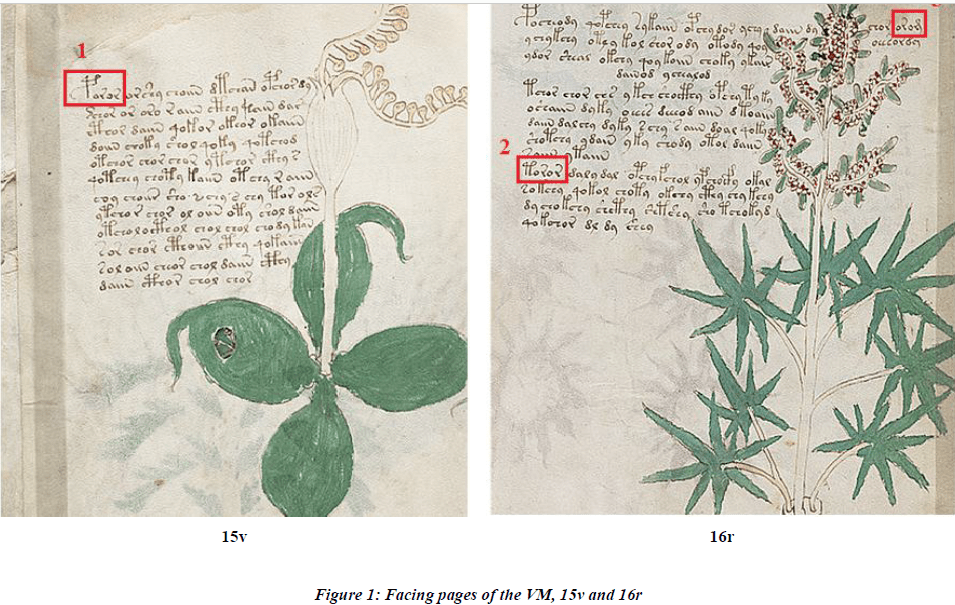
“My argument in that paper drew in part on the distribution of the pattern OROR throughout the VM, but mainly on the identification of the plant on page 16r as Juniperus oxycedrus.(*) On the facing pages 15v and 16r of the VM, the pattern OROR appears twice, once as part of the first word (on the far left) and again as part of the first word of the last paragraph (on the right hand page) (…) This is interesting, since it has long been thought that the name of the plant might be the first word of the accompanying text (Zandbergen 2004-2013), but no-one has so far been able to substantiate the idea.
(*) a plant common throughout the Mediterranean west to the Apennines and east to Iran. The plant is distinctive for its spiky leaves and red berries, which both appear clearly in the VM picture. Sara Peterson, an art historian specialising in plants, was invited to consider whether the picture might represent Juniperus oxycedrus and agreed that it could be possible. At the same time she drew attention to the depiction of Juniperus oxycedrus in Koehler’s classic book on medicinal herbs, remarking that ‘the plant in Koehler shares the same shrubby, branching habit around the central stem as the Voynich version. It’s also interesting that the Voynich depiction seems to show the soft, sappy immature leaves before they become spiky.’”
“Uses.—Oil of cade has been used locally, by the peasantry, in the treatment of the cutaneous diseases of domestic animals almost from time immemorial. More recently it has been largely employed in the treatment of chronic eczema, psoriasis, and other skin diseases of man …
This medicinal use of Juniper in mediaeval times as a treatment for skin disease is of special interest because the word OROR also occurs on the very last page of the VM (page f116v), which – as was noted above – has been convincingly analysed as a Latin/German recipe or prescription for wet rot, a skin complaint (Albus 2012).”
“Despite the apparently convincing identification of the VM image as a species of Juniper, along with the linguistic evidence of the name ‘arar’, and the use of Juniper as a medicine, there are a number of problems with the interpretation. Although POROR is the first word of page 15v, the plant depicted there – unlike its neighbour on the facing page – looks nothing like any known form of Juniper, rather resembling a species of Orchis. The fact that OROR occurs here and on the next page with a prefixed P and T also renders the interpretation uncertain, since they could arguably be different words altogether, even though it has also long been felt that the symbols transcribed as P and T might be merely decorative, or prefixes in some way. These and other reservations were noted by readers of my 2012 paper, for example Rich SantaColoma”
“In languages such as Arabic, it is common for the same letter to have different shapes depending on their position in the word, but this might be a variant – unusually – owing to the position of the word in the sentence. In other words it could be merely a variant of R, in line-final or sense-final position. Statistical analysis of OROM in the VM tends to confirm this possibility, revealing 8 instances, all of which are isolates, or in line final position, or apparently decorative” “The fact that OROM occurs always as an isolate, as a decorative, or at the end of a line, suggests that it might indeed be the equivalent of OROR, but in an isolate, decorative or sense-ending position. This is an intriguing possibility, since it would give us an additional mention of OROR on the page depicting the possible Juniperus Oxycedrus plant.”
“It was noted at the beginning of this article that no word of the VM has been convincingly translated or glossed, but in fact there is one word which has received a degree of consensus. On page 68r, in a dramatic diagram apparently showing the moon in the heavens, a set of 7 stars has been suggested to show the ‘Pleiades’, sometimes known as the Seven Sisters, in the constellation of Taurus and the accompanying word has sometimes be interpreted to indicate TAURUS (Zandbergen 2004-2013).
Historically the word Taurus is thought to derive from Proto-Indo-European *tau-ro, *tawros, *teh₂wros. meaning bull (http://www.etymonline.com); it is also linked with Semitic variants such as the Arabic word ‘thaur’, which signifies both ‘bull’ and also the constellation.”
“We could posit the idea that the initial letter, shaped somewhat like the numeral 8, represent some sort of alveolar or dental sound in the region of /t/, /d/ and /θ/ (as in the first sound of thing, which is approximately the Arabic sound in ‘thaur’), and indeed it resembles the Greek ‘theta’ to some extent.” “Of course, although this reading seems to support and be supported by, the reading of OROR as /arar/, it should still at this stage be treated as speculative.”
“The reason for the final /n/ at the end is not entirely clear, although it could represent or be borrowed from the Arabic/semitic vowelling called ‘nunation’ in the nominative singular of the word meaning ‘bull’ and the Constellation Taurus”
“In isolation, each of the above readings of /arar/ and /taərn/ is insubstantial and must be considered speculative; it will only be possible to verify them if they fit in with a larger emerging pattern which explains other words, for example the names of other plants. The process can be compared to doing a crossword puzzle: at first we might doubt one possible answer in the crossword, but gradually, as we solve other words around it which serve to confirm letters we have already placed, we gradually gain more confidence in our first answer until eventually we are confident of the solution as a whole.
In order therefore to obtain more evidence, I will now proceed to identify and discuss 4 further plants with their proposed plant names in the text. In methodological terms, however, in order to avoid the danger of ‘subjective interpretation’ which Kennedy and Churchill rightly critique in previous attempts at decoding (Kennedy & Churchill 2004), it is important to follow a systematic procedure” “Wherever possible, I will draw on independent identification of the plant by another analyst to ensure greater objectivity.”
“The reason for focusing on the first word of the herbal page in particular is that it is too easy to find any word on a page of text and to ‘imagine’ some relevant reading. For this reason the analysis below will focus strictly on the first word of plant pages, which, as was noted above, was frequently where the plant was named in mediaeval herbal manuscripts.”
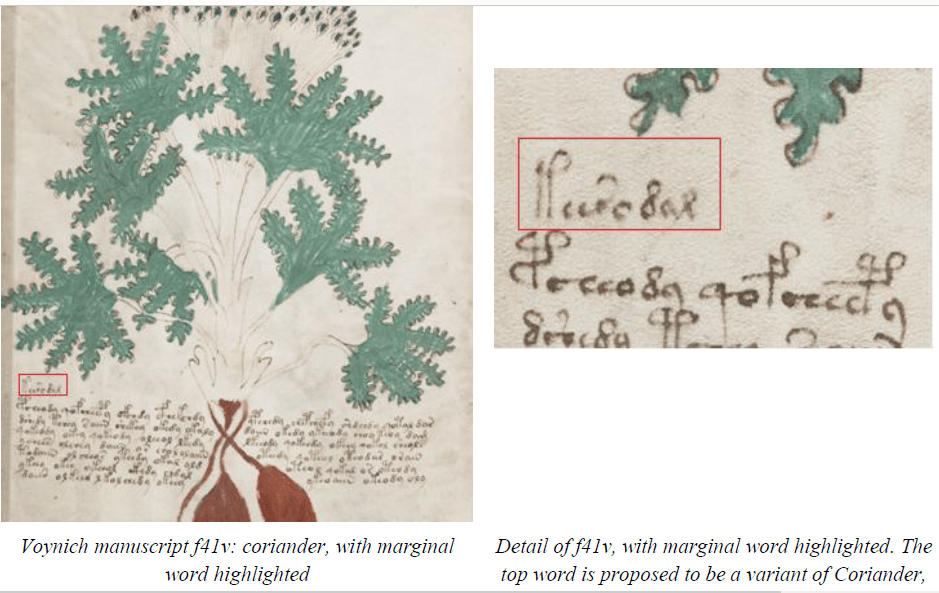
A HIPÓTESE DO CORIANDRO: “While examining the plant pages I noted a curious feature of folio 41v, which depicts the plant which you can see below, a feature which seems not to have been mentioned in the literature previously. This is the fact that above the first word of the text appears to be an extra word written as a marginal gloss. This is rare, if not unique, in the VM, but in many mediaeval herbal manuscripts such marginalia do appear, most commonly giving an alternative name of the plant, perhaps in or from another language (see examples from the Harley herbal 1585, and also e.g. the Vienna Dioscorides, which has marginalia in Greek, Arabic and Hebrew naming the plants).”
“Step 1 (plant identification): The plant itself in f41v has been convincingly identified by Sherwood as Coriander/Cilantro (Coriandrum sativum), for example with reference to the leaves at the base of the plant being ‘broadly lobed becoming more feathery higher up, with umbels of white to pale pink flowers at the top of the stem’ (Sherwood 2013, np), though bluish flowers are also common, as in the VM example.
Step 2 (nomenclature): The plant has a wide range of names in different languages. Even those related etymologically to the word ‘coriander’ (deriving from the Greek ‘korion’) are very varied in their range of vowels and consonants, including the following sample:
Cilantro (English et al.)
Coentro (Portuguese)
Coriander (English et al.)
Coriandolo (Italian)
Coriandre (French)
Coriandro (Italian, Spanish et al.)
Koendoro (Japanese)
Kolendra (Polish)
Koljandra (Russian)
Korander (Dutch)
Koriander (Danish, German)
Koriandr (Russian)
Koriannon (Greek)
Korijander (Croatian)
Korion (Greek)
Koriyun (Greek)
Koryander (Polish)
Kothambri (Kannada)
Coriandru (Romanian)
Culantro (Spanish)
Koriandrze (Polish)
Silantro (Spanish – Peru)
“This selection demonstrates the wide variety of pronunciations and spelling typical of plant names across languages – the list does not even contain the many names of coriander in other language families, for example those related to Dhania in Hindi. (…) In particular there is a regular alternation between the liquid sounds /r/ and /l/, a common alternation across many languages, and also between the (alveolar) dentals /d/ and /t/ (both exemplified in ciLanTro v. coRianDer).”
“Drawing from the readings of /arar/ and /taərn/ discussed previously, I suggest that the marginal note above the first word of the text on page 41v could represent the name of the plant in the picture, and be related to the word Coriander. Drawing on our previous identification of 3 of the signs, R A and T, in the middle part of the word, we can then provisionally reconstruct the start of the word as KOO or similar, and thereby tentatively read the word as approximately KOORATU?” “Curiously, if this reading is correct, its closest correlate is arguably the Cretan Linear B Greek version discovered following Ventris’ decipherment, i.e. ko-ri-ja-da-na, which is considered to be the earliest of all known versions of the word ‘coriander’.”
“The next plant to be considered is that on page f2r”
“Step 1 (plant identification): The plant on page 2r of the VM has been identified by Sherwood and others, apparently uncontroversially, as belonging to the genus Centaurea (Velinska 2013, Sherwood 2013). Sherwood identifies it more specifically as Centaurea diffusa:
‘Diffuse Knapweed (Centaurea diffusa), is native of Greece and Asia Minor. This weed has a long taproot, and pale-green alternate leaves that are deeply divided into lobes, measuring 1 to 3 inches in length. The single, upright stem produces several spreading branches that end with pink or white thistle-like flowers. During the Middle Ages knapweed had a reputation for curing wounds and was an ingredient in a 14th century ointment called ‘salve’. This folio could also be represented by spotted knapweed (Centaurea biebersteinii), also native to Eurasia.’
As Sherwood notes, the genus contains a large number of common species in Europe, the Caucasus, Turkey and Iran, including knapweed and cornflower.”
“Step 2 (nomenclature): The genus Centaurea is named after the Centaur Chiron (Greek Χείρων), who was reputed to have discovered its medicinal value.
‘In the history of the mythologic founders of medicine, Chiron was considered the discoverer of the medicinal properties of many herbs, who mastered the soft-handed lore of drugs and passed it on to his pupils. His name became part of the pharmaco-botanical nomenclature; we still have the genus Centaurea. According to Pliny the panacea Centaurion was discovered by Chiron, as was another panacea, Chironium.’ (Sigerist 1987:50)
This mythology concerning Chiron was well-known in medieval times, and is mentioned and depicted frequently in herbals. An attractive example can be found in the Egerton herbal”
“the Arabic version of the name is given as Qnturiyun, a direct borrowing from the Greek”
“In fact, the Voynich manuscript has many examples of what looks like ‘ai’ and ‘aii’. If we consider the lettering which represents the words Centaura major as written in a 15th century herbal in the Wellcome Library close to the age of the VM, we note that single vertical lines in various combinations could rather confusingly be used to form all of the four letters n, u, m and i. In particular the combination ‘a’ plus one vertical line stood for ‘ai’ and with two stood for ‘au’. It seems possible, at least, that the similar Voynich clusters of letters were borrowed from contemporary Latin calligraphy, and likewise represent vowel clusters or diphthongs in the same way. Since this also fits well with the reading of KNT/ə/IRN as Kantaron/Centaurea, we will therefore provisionally read the Voynich ‘ai’ symbol as /əi/ and the aii symbol as /əu/.
To those unfamiliar with Abjad scripts it might seem objectionable that this reading begins with 3 consonants together (K + N + T) with no intervening vowel. However, this is precisely the way in which Arabic, for example, or other Abjad scripts, would write this word even today.” “For readers in many languages this is not problematic, and it strongly suggests that the writers of the VM were using a script which in this respect resembled an Abjad, with some vowel omission. We recall that at first this feature of Egyptian hieroglyphs confused Champollion, and it has perhaps hindered decoding of the VM up to now as well.”
“Step 1 (plant identification): Sherwood identifies this plant as Dungwort or Bear’s foot (Helleborus foetidus), referring to its ‘thick, succulent stem; palmately compound leaves; drooping green, cup-shaped flowers; and short rhyzomes for roots’ (Sherwood 2013). Whilst her specific identification of Helleborus foetidus may be overconfident, it does seem plausible that it is a species of the genus Helleborus.
Two sorts of hellebore were commonly identified in antiquity for medicinal purposes, called black and white respectively on account of their roots. Dioscorides recommended the black hellebore as a cure for melancholia, and as a purge, while white Hellebore was used as an emetic [inductor de vômito] (Leyel 2007:223) and also used as a sneezing agent. Although the white hellebore is now considered a different genus and species altogether (Veratrum album) the visual resemblance of the two is still plain to see. However, given that the black hellebore was far more prominent in ancient herbal remedies and mediaeval herbal manuscripts, the VM picture could well represent Helleborus niger.” “A much earlier Greek herbal, the 6th-7th century Naples Dioscorides depicts the black hellebore with similarly distinctive jagged leaves and a reddish flower”
“In mediaeval Arabic herbal manuscripts the hellebore is called Kharbaq, with both white and black varieties commonly cited and discussed. To my mind an illustration which, although stylized, has several features similar to those of the VM picture, is that in the Princeton Arabic herbal. In this image we see not only clear purple flowers/pods just as in the VM, but also oddly jagged leaves themselves resembling bears’ feet. Another Arabic version, also with similarly purple-blue flowers and jagged leaves, is found in the Leiden Dioscorides.”
“Step 2 (nomenclature): (…) it can be seen that the first word of the page appears to be repeated again near the end of the same line, apparently with a prefix.” “If we adopted a European perspective and anticipated some form of the word ‘hellebore’, we would be disappointed, since the first word on page f3v in the Voynich manuscript looks nothing like any known version of the Greek word.” “I directly translated the word according to my scheme so far, and read it as KA/ə/UR, a word unfamiliar to me. In order to test out whether this reading could possibly be correct I simply typed ‘Kaur Hellebore’ into the Google search engine. To my surprise and gratification, this immediately offered a possible solution, since it returned numerous references to the name ‘Kaur’ as a name for the black hellebore, many in Indian herbal guides. When I did this in July 2012, the first result which Google produced was the book by Panda on Indian medicinal herbs (Panda 2000:311)”
“This shows clearly that the word Kaur is used for Hellebore in Kashmir, and that cognate names are also used in a variety of other languages, many including the pattern K + vowels + R, or the possibly cognate K + vowel + L, and KH (/x/) + vowel + R/L. Salient among these in Panda’s spelling are: Khartu(*) and Kuer-Beck in Arabic, Kharabekhindi in Persian/Farsi, Khorasani-kuti in Hindi and so on. Other works on Indian plants report similar nomenclatures, most frequently Kaur in the Punjab.
(*) Panda’s reference to an Arabic word Khartu for hellebore may be in error. No corroboration can be found for it in Arabic sources.
This gives immediate and graphic support to the possibility that the first word on the VM page f3v is indeed some form of the name KAUR, meaning hellebore, as my analysis predicted. This in turn supports the larger analysis above regarding other plants and names, and lends further support to the method as a whole.”
“The earliest available instance of the pattern ‘K + vowels + R’ meaning hellebore appears to be the Sumerian KUR.KUR (Campbell Thompson 1949:151). In his earlier research Campbell Thomson took this form definitively to refer to black hellebore, saying that ‘…KUR.KUR thus coincides very closely in almost every way with the ancient black hellebore’, though he added the caveat that ‘even in Assyrian times it is possible that white and black were confused.’ (Campbell Thomson 1924:671). In his later authoritative Dictionary of Assyrian Botany, he was less sure, associating the name rather with White hellebore (Veratrum Alba L.), linking it also with the delightfully onomatopoeic synonym a-ti-šu referring to white hellebore’s use as a sneezing powder.
In the same discussion Campbell Thomson cites the Akkadian ‘qarbuhu’ which can be seen also to contain a variant of the pattern ‘K + vowel + R’, this time with the guttural semitic consonant transcribed as Q. He compares this with the Arabic ḫarbaq (or kharbaq) and the Syriac ḫurbakhnâ (both beginning with the sound /x/ like the last sound of the Scottish word ‘loch’). The Arabic form kharbaq was the standard mediaeval Arabic base word for hellebore, with the adjectives ‘white’ and ‘black’ added to distinguish the two; for example, the Princeton Arabic herbal (…) shows the plant called kharbaq aswad, black hellebore”
“The second part of the Arabic word, i.e. -baq would appear to derive from the Persian word beḵẖ meaning ‘root’, indicating again that the first part, ‘khar’, is a separable lexeme for the plant itself. This analysis is supported, curiously, by two Georgian loanwords for hellebore, namely ḫarbaqi and ḫarisjira, both beginning with the /x/ or ‘kh’ sound. The first of these is cognate with the Arabic and Persian ‘kharbaq’, while the second literally means root (jira) of the ḫar, (Apridonidze et al. 2006). This once again supports the analysis that the ‘K + vowels + R’ pattern is a separate lexeme indicating one variety or other of the plant hellebore, in this case with the KH variant: KHAR.
From this trail of evidence, then, the appearance of the pattern K + vowel + R in modern Indian herbals can be explained not necessarily as a native Indian form, but as a probable early borrowing from Sumerian and Akkadian, transmitted eastwards perhaps via Arabic and/or Persian, in some cases retaining the pronunciation kaur with the harder /k/ sound (as in Punjabi kaur) in preference to the Arabic/Persian khar with /x/ (kh).
Subsequently it appears to have been associated with, or confused with, a native Indian plant whose formal species name even today retains the K + vowel + R pattern: Picrorhiza kurrooa.”
“Baden-Powell offers an insightful account of how the process of transmission and re-identification probably occurred, referring to a number of drugs which, in his analysis, ‘…were introduced by the Mahomedan hakims (wise men) who had studied from the Arabian school of medicine who, themselves, derived their knowledge from the Greeks.’ (Baden-Powell 1868:318).”
“A final irony is that, as we saw in Panda’s list above, one current Farsi/Persian word for black hellebore is Kharabekhindi, literally ‘Indian Khar-root’. This implies a retransmission of the plant and its name back westwards to Persia, but now with new Indian ‘branding’.
In summary, there is therefore strong evidence for the idea that the pattern ‘K + vowel + R’ represents an even older word for hellebore than the Greek version, and was known in one form or another for centuries across a wide area as the name of that plant. The name appears in the Caucasus (with the two forms seen above in Georgian, and also a form of kharbaq in Armenian, according to Kouyoumdjian 1981), across the Middle East and into India, with slight variations in the realization of the first consonant and the vowelling, in a manner which is normal across such a wide geographical and historical range. It sometimes also has the suffix ‘baq’ or similar, meaning ‘root’. For example, we noted its appearance in mediaeval Arabic herbals as kharbaq for black hellebore.”
“Continuing the attempt to examine the first word of plant pages and matching them with the plants depicted, let us consider the case of page f29v:
Step 1 (plant identification): This plant can be identified with relative confidence as Nigella sativa, largely because of the distinctive seed pods and leaves, which can be seen in images from Katzer’s website. Both Velinska (2013) and Sherwood agree on the identification, the latter offering also the following description:
Roman coriander (Nigella sativa), is an annual plant in the ranunculus family, native to Southern Europe, North Africa, and Southwest Asia. It has finely divided, linear leaves and pale blue or white flowers with 5 to 10 petals. The fruit is a balloon-like capsule containing numerous seeds. The seeds are frequently referred to as black cumin … (Sherwood 2013)
As seen from the name, which derives from the Latin niger (black) the defining feature of this plant has always, and across different cultures, been the black colour of the seeds, which have a long history of use in cookery and medicine, being found even in the tomb of Tutankhamen (Peter 2004). However, they have frequently been confused with the seeds of other plants such as Bunium bulbocastanum and also Caroway (Carum carvi), all of which have been called ‘black cumin’.
Step 2 (nomenclature): (…) the first word on that page is the same as the word already analysed as KA/ə/UR, for hellebore. This at first appears anomalous, but when read with the second word it can be interpreted as KA/ə/UR CHAR”
“it is not clear whether, in the construction K A /ə/ UR CH/X A R the origin of both words derives from the idea of blackness, through different routes, or whether the second means ‘seed’, related to the Persian ‘zireh’, which was also adapted eastwards with /j/ and /tʃ/ as the first consonant”
“To summarise, the precise meaning of each part of the first two words of f29v, which is taken to name the plant Nigella Sativa pictured alongside, is not entirely clear; it would seem to read either ‘Kaur black’ or ‘Black Seed’. However, the important point for this paper is that both interpretations allow a plausible link between the words and the illustration, and both support the overall analysis of the sounds and letters in this paper. In short, further analysis will help to elucidate precisely what those words signify, but in either case the argument for the sound-letter analysis presented so far is strengthened.”
“However, as also noted above, I do not underestimate the difficulty of the next steps. Many of the first words on the plant pages contain what are known as ‘Gallows’ characters, with elaborate decorative swirls. It is not clear whether these are letters identical in sound to other non-decorative letters, or different letters entirely, or merely ornamentation. Some of them overlay, and overlap with, other signs in a manner also obscure. Many of the plant illustrations are odd and insubstantial.”
“These concern the plants on pages f31r and f27r respectively. Unlike the plants discussed above, it has not been possible to research these in detail as yet, and – as will be apparent – their identification and naming still require verification.”
“It will be seen that, drawing on signs which we have seen before, the word can arguably be read as ‘KOOTON’, and it is tempting to see this as indicating ‘cotton’. The word cotton came into English from the Old French coton (12c.), and ultimately (via Provençal, Italian, or Old Spanish) from Arabic qutn, and is perhaps ultimately of Egyptian origin. The name for this plant with the basic structure ‘K/Q + T + N’, which we still have in English, was known from Western Europe (thanks to the Arabic influence in Spain) through into many parts of Asia well before the date of the VM.”
“However, it is not clear that the plant depicted on this page of the VM is in any way similar to known cotton plants. In the first place it is unusual to have cotton in a mediaeval herbal manuscript. Secondly, it would be curious if anyone wishing to depict cotton neglected to show the crucially important white cotton buds themselves, which do not appear in the VM illustration. Even so, this might not in itself rule out the identification with cotton, since plant illustrators have been known to depict cotton with scant reference to the cotton bud itself.”
“Likewise, the main plant in f27r is difficult to identify with any certainty. However, the first word of the page appears, on the basis of the analysis above, potentially to read K ? A R.” “There is no supporting evidence as yet for identifying the unknown sign, but if it were read speculatively as indicating the sound /s/, on the basis of its shape, a reading could be KSAR, which is reminiscent of a common Indian name for the Crocus¹ (i.e. kesar), from which saffron is obtained. However – as is typical of the obstacles involved in analysing the Voynich plants – the leaves of the VM plant in the picture are unlike the grassy leaves of Crocus sativus, the most common variety, and the source of saffron itself. For this reason it is tempting to identify the VM plant with another variety, such as Colchicum Autumnale, often also called Kesar, which could be a closer match.”
¹ Família do açafrão.
“Even so, as with cotton, it seems odd that an illustrator who has seen the crocus would illustrate it without showing its best known features, namely the flowers or stamen.”
“We can now turn to more general discussion, summarising the findings so far and considering the implications for the language of the Voynich manuscript, and its possible provenance and authorship.”
“for the first time we can claim with some confidence to have successfully read a number of words in this mysterious document. In particular, the naming of the constellation Taurus, the plant Centaury, the centaur Chiron and the plant ‘Kaur’ for hellebore, seem to me to be most persuasive.”
LISTA DE CONCLUSÕES PRELIMINARES
“The script is not an elaborate cipher, but resembles normal human scripts, with more or less regular sign-sound correspondences;
The content of the manuscript, at least on the plant pages, seems to be completely in accordance with its outward appearance, namely information about the plants and perhaps their medicinal and other uses. If we look back at the earlier description of typical features of mediaeval herbals, every one of them is evidenced in the analysis in this paper. In other words, the manuscript is probably not a trick document disguising secrets behind a different genre.
(…)
On the evidence of this paper there is no reason to believe that the script encodes more than one language. As regards which language it might be, this is still unknown.
(…)
On balance, then, the analysis in this paper confirms a European element to the manuscript. However, with regard to the linguistic elements and plant names considered in this paper, e.g. ‘Kaur’ for hellebore, the underlying language is probably not European.
(…)
Echoes of illustrated Arabic herbal manuscripts also suggest a possible element of interaction with Arabic cultural traditions. However, at this stage it is not possible to identify the underlying language as a whole with any known Near East language, and indeed these words could be simply borrowings. Several of the plants discussed also appear to have a Near Eastern connection.
(…)
Not only do several countries in the Caucasus have early herbal and script traditions, including Georgia and Armenia, along with Christian links which would fit elements of the manuscript, but some of the local languages also show evidence of the words discussed in this paper (…)
Some of the plant names discussed in this paper appear to have an Indian subcontinent resonance, the most salient being ‘kaur’, still used in the Punjab for hellebore (…)
One of the largest language families to be considered as possibly influencing the VM is the Turkic, which includes languages as diverse as Turkish, Azeri, and Mongol. Although the evidence for Turkic influence in this paper is slender, the form of the word Kantaron for Centaury appears on Turkish and Azeri, as does the form ‘kara’ for ‘black’. Although the agglutinative nature of Turkic languages seems not to resemble the VM word patterns, a Turkic influence cannot be ruled out;
In summary, the language of the Voynich manuscript is probably not European, but is more likely to be Near Eastern, Caucasian or Asian. We need further evidence to see whether it is of Indo-European, Semitic, Turkic, Kartvelian (e.g. related to Georgian) or from another language family.”
Nada se prova, nada se confuta. Me parece ainda mais fabuloso que um herbanário da idade média seja praticamente um híbrido de todos os continentes então conhecidos em sua composição!
“It is feasible that the script is a deliberately constructed cipher designed to hide information of some sort. However, given the fact that the plant pages seem in practice to concern the plants depicted, presumably offering knowledge which was available to others already, it is more likely that the script is not aimed at concealment, but was instead constructed simply to write a language which had not previously been written down. To put it another way, if the underlying language already had a script (such as Georgian, or Arabic, or Greek), it seems highly unlikely that anyone would invent a whole new one merely to encode information about plants and nature which was already known.”
“Given that the 15th century was a time of upheaval, in Europe in the Balkans, in the Near East with Timurid expansion as far as Turkey and the Black Sea, and also with the fall of Constantinople to the Ottomans in 1453, it is plausible to consider this ‘cultural extinction’ to be a possibility, with the group in question developing a script and literacy, only for it to be extinguished. Other examples of script which have been devised, only for those who can read it to die out include the interesting Rongorongo script from Easter Island, which again attests to the viability of the theory.”
“Thanks also to the Beineke Library at Yale for allowing use of the images of the Voynich manuscript, and I also acknowledge the copyright holders of other images in this paper.”
Francamente! Não se pode usar nem imagens de um manuscrito xexelento que ninguém sabe o que significa porque ele tem direitos autorais?! Não se sabe nem remotamente quem pode ter sido o autor, o que é mais triste – e vem uma universidade e capitaliza com isso!
[+] (citados no artigo ou simplesmente interessantes)
Brumbaugh, R. 1977, The World’s Most Mysterious Manuscript, Weidenfeld & Nicolson, London.
Daniels, P. & Bright, W. (eds) 1996, The world’s writing systems, Oxford University Press, New York, Oxford.
Kennedy, G. & Churchill, R. 2004, The Voynich manuscript: the unsolved riddle of an extraordinary book which has defied interpretation for centuries, Orion, London.
Parsumean-Tatoyean, S. 2011, The Armenians in the medieval Islamic world: paradigms of interaction: seventh to fourteenth centuries, Transaction Publishers, New Brunswick, N.J.
Rawlinson, H.C. 1846, The Persian cuneiform inscription at Behistun: decyphered and translated; with a memoir on Persian cuneiform inscriptions in general, and on that of Behistun in particular, J.W. Parker, London.
“Prior to the reprint of 1862, l’Alcibiade fanciulloa scola [Alcibiades the Schoolboy] was one of the most difficult books even to see, let alone to obtain. We knew of only a very small number of the two original editions, both dated 1652.¹ Four were in public libraries – in Dresden, in Grenoble, in the Bibliothèque Imperiale and in the British Museum. We have no information from Grenoble or Dresden, but the British Museum’s copy has been lost, and the copy in the Bibliothèque Imperiale has been placed in ‘Hell’ – the most dreadful fate which can befall a book -, where it cannot be read, examined, or even touched. M. Micharda said once to enquirers: ‘We have only opened Hell to 2 people – to M. Michelet, for his Histoire de la Révolution, and Doctor ****, for his Études sur la folie.’”
¹ Livro até então apócrifo ou atribuído aos nomes errados.
“The reprint of 1862, of 102 copies, was able to make this extraordinary book better known to bibliophiles who understood Italian, but the magistracy did not show itself disposed to extend to this language the indulgence shown to Latin. The reprinted Alcibiade was the subject of a condemnation imposed in May 1963.
Undaunted by this precedent, we have published a new edition intended, by the number of copies and the price – like the earlier reprint –, for bibliophiles and scholars who, in our opinion and like philosophers and priests, are entitled to read everything. Omnia pura puris [Aos puros tudo é puro].
This, we repeat, is our opinion, and it is a conviction so well founded that all the magistracies in the world will not shake it. Apart from anything else, it is noteworthy that shortly before the condemnation of the book 2 scholars made it the object of – or used it as the pretext for – 2 extremely interesting dissertations on the vice against Nature – and one can read these, just as one can read Alicbiade, without in the slightest degree turning into a pederast – or even Tartuffe, or his sort.
The first of these dissertations, published under the title Un point curieux des moeurs de la Grèce, was by M. Octave Delepierre, Belgian author, literary scholar and secretary of the legation of the consul-general of Belgium in London. Curieux is the right word! In his work, Delepierre rebutted the strange opinion of the famous German archaeologist Welcker, who asserted ‘that pederasty in Greece served to strengthen the bonds of friendship, that this vice, indeed, was not the result of a deviant sensuality, but an elevated principle of the theory of beauty’. We do not advise M. Welcker, famous though he is, to cross the Rhine and publish a French translation of his dissertation, since he would risk presenting the spectacle of a worthy and learned man awaiting a fine or prison.
This same man also represented Sappho as a person of pure morals.¹ We are, we see, dealing with a capricious scholar, one with a romantic and mystic spirit – a type common enough even in this country, where we have seen the rehabilitation of Marie Stuart, the madam of Longueville, of Marie Antoinette, and of other pitiable creatures. But, in his German fashion, Welcker roots his beliefs in an even more ancient and recondite cult; while Cousinmade the madam of Longueville into a ‘landlady’, he would never have made Sappho into an hotelier. To go back to Alcibiade – from the quotation included by the author in his dissertation, it was said that the author of this dialogue had treated the question of pederasty ‘according to the ideas of the most respected Greek philosophers’.”
¹ Sappho von einem herrschended Vorurtheil befreit (Safo liberta de um preconceito dominante), 1861, 2a ed. 1855.
“The other dissertation was translated from the Italian of Giamb. Baseggio by Gustave Brunet, librarian of the city of Bordeaux, and accompanied by notes and a detailed bibliography.” “Le Manuel de librarie wrongly attributed to M. Girol Adda the honour of having, in 1859, discovered that the author of Alcibiade was Ferrante Pallavicini. This honour reverted to M. Bassegio, (SIC) who in 1850 published his Disquisizone”¹
¹ E no entanto tudo isto está errado: hoje a historiografia atribui a autoria a Antonio Rocco!
“Ferrante was a member of l’Academia degl’Incogniti, and reputed author of Suzanna, Taliclea, Rete di Vulcano, Corriere svaligiato, Divorzio celeste and La Rettorica della Putane.
“For information on Pallavicini, we can consult Moreri, Bayle, Chauffepié and Prosper Marchand. This author, to some a libertarian and to others a libertine, was beheaded at Avignon in 1644, aged barely 26, a victim of the spite of the Barberini.¹ His tragic ends did not prevent friends who were admirers of his works and faithful to his beliefs – Ureporio Leti among others – arranging reprints, in Geneva, of his most liberal works, those most hostile to Rome, works such as the Corriere, Divorzio celeste, Rettorica della Putane. And the format, the paper and the typography of the 1st edition of Alciabede (SIC) pointed to the Libraire Stoer, of Geneva. Admittedly, the book carried the date of 1652, and Léti (SIC) did not go to Geneva until 1660, but dates are often altered in publications of this kind.”
¹ Não se trata de uma censura direta a suas obras de cunho erótico e tabuístico, mas ao próprio Papa Urbano VIII, a quem atacou em panfletos.
“Baseggio [wrongly] answered that (…) Pallavicini’s purpose was writing a satire directed at the educationalists who were then in public favour in Venice. (…) The warmth, the passion, the conviction that dominate the book from beginning to end seem to us quite foreign to a work of irony. A French erotic writer would write more coolly, more allusively – might indeed be shocked and repelled by such overt passion – but an Italian would show precisely this kind of warmth and enthusiasm. Pallavinci (SIC!!!), however, cannot be any more supposed a pederast than Pidanzat de Mairobert can be considered a lesbian for l’Apologie de la secte anandryne, published in l’Espoin anglais. It must me taken, then, that Alcibiade is the fantasy of a fine and free spirit immersed in classical study. (…) At the time of Pallavicini, let it be said, a work of this kind from the pen of an Italian writer was no more extraordinary than an erotic romance from a 13th century French writer. And if the author was also a pamphleteer, he would flaunt precisely those elements which today would be hidden with great care. According to Vincent Placcuis, the friends of Ferrante denied that he was the author of Diverzio celeste,(SIC!) but had no difficulty in acknowledging that he was the author of Rettorica della Putane, ‘because the morals of Italians accord well with one, and their superstition and their politics accord badly with the other’.
We have said that Gustave Brunet added an appendix to Baseggio’s dissertation. It dealt with several writings similar to Alcibiade, with works of Pallivicini (SIC!!!) and of his colleagues in the (sic) l’Academia des Ingognitie (DOUBLE SIC!!), with the legal status of the vice against Nature from antiquity to the present day, and ended with a list of more-or-less famous pederasts of more recent times. The list included both self-aknowledged and suspected pederasts. Among the first group were Théodore de Bèze and Louis XIII; among the second were Henry III, Lully, d’Assoucy [poeta], the Compte de Sintzendorff, the Marquis of Vilette, Peter the Great and Friedrich II.(*)(**)
(*) And in the XVI lived the most famous of all, Shakespeare.
(**) Les Matinées du Roi de Prusse”
“Pederasty is like cholera, in that it appears sporadically almost everywhere, and from time to time breaks out more violently, in an epidemic. The fears of Fréderic II about the Prussian army could also apply to the French army of today which, over the past few years, sadly appears also to have some of the ‘regiments of Uncle Henry’. In the last session of the Senate, the outspoken Marquis de Boissy, without beating about the bush, expressed fears about the invasion of our regiments by ‘Arab morals’, and indeed, a terrible outbreak of pederasty seems today to be the only trophy of the war of Africa, just like smallpox was that of the Italian wars of the XVI, at least if one believes Voltaire’s epigram about it”
“Escapees from Sodom: We know that the biblical fire did not destroy all the inhabitants of that vile city. Spread now over all the earth, they have made Paris into a ruin; here, in particular, they are repeatedly the cause of some filthy discovery or another. In the past 15 days we have seen too much of one affair of this kind, and the problem is now one of considerable proportions. M. Gàstagnary has tried to speak of it in his chronicle of Parisian events in the Progrès de Lyon. We copy the reserve he had to adopt in referring to the matter, but it is not as recent as he believes. It dates back for several months; if we talk about it today, it is because the affair has necessitated an enquiry among several corps of soldiers, and it has not been possible to cover the inquiry with silence, as the police manage to do in other similar cases.”
Petite Revue
(*) “We read in the personal correspondence of the Army in Egypt, ‘The Arabs and the Mamelouks have treated several of our prisoners in the way that Socrates, it is said, treated Alcibiades.’” Ensinaram-lhes filosofia?!
(*) “The pederastic epidemic inflicted itself on us in the XVII at the court of Louis XVI (See La France devenue italienne, a book that was reprinted following l’Histoire amoureuse des Gaules, by Bussy-Rabutin) (…) We know that this city (Paris is a police headquarters; in consequence, there are public places authorised for this purpose. [Paris, sempre a vanguard!] The young men who are destined for the profession are carefully classified, because the regulatory system extends even to that. They are examined; those who are beautiful, rosy, well made, chubby, are reserved for the great lords, bishops and financiers, who pay very dearly for them. Those who are deprived of their testicles, or those who are said (because our language is more chaste than our morals) not to have weavers’ weights, but who give and receive, form the 2nd class; they are still expensive, because woman can also use them while they serve men. Those who are not capable of erection because of overuse – whether or not they have all the organs necessary to please – make up the third class. But those who preside over these pleasures first confirm their impotence. In order to do so they are placed, naked, on a mattress whose lower half is open; two women caress them to the best of their ability, during which a third, with fresh nettles, knocks gently on the seat of their sexual desires. After a quarter of an hour of these attempts, a long unripe pear is introduced into the anus, causing a considerable irritation, and fine mustard of Caedebec is put on the rash induced by the nettles; the glans is also rubbed with camphor. Those who resist all these stimuli and give no sign of erection are engaged for 1/3 of pay only. (Erotika Biblion, chap. Kadhésch, p. 93-ss., Bruxelles, 1886, with notes by the Chevalier Pierrugues.) (N.E.: This is probably nonsense from beginning to end, but the public was as credulous then on such matters as they are now. But the curse has never had the extent and the expansion and intensity which we witness in modern society, and where one can say that it has been democratised. See the Études sur les attentats aux moeurs du Dr. Trdieu, 3ed., Paris, 1859). But let us cease to review these nauseating texts; let us go out and buy a bottle of disinfectant.[aaah, vai dizer que você não curte, monsieur? Conta outra!]”
“Several corps of soldiers! That is in all the documents”
Bruxelas, 1891
“AO LEITOR
Os filósofos da Antiguidade, quando ensinavam literatura, inculcavam seus conhecimentos nos alunos pelo buraco de seus traseiros [HAHAHA!]. Assumiam que, mediante este método, não teriam como não se tornar completamente eruditos; que por essa via, no devido tempo, absorveriam todo o conhecimento de seus mestres.
Ó, que esses vícios se tivessem consumido nos tempos gregos! Ao contrário: atingiram seu clímax nas escolas de nosso tempo.
Atingimos o ponto em que nossas escolas podem ser consideradas teatros da infâmia e da vergonha, um repositório de todos os vícios; nossos mestres-escola prosseguiram com o método antigo de ensinar. Se você é conhecedor desta matéria, é provável que já tenha ouvido como alguns desses professores, em seu ardor para infundir conhecimento ao alunado, chegaram a ferir seus ânuses!
Portanto, sua leitura de Alcibíades, o Estudante ensiná-lo-á que, para aperfeiçoar nossos escolares, temos de retirá-los das mãos desses mestres de Sodoma – e de seu feliz vício.”
Poxa, fiquei com vontade de ler esse livro-tabu, mas não consigo encontrá-lo!
“AOS PROFESSORES
Ah, professores maus, eu sei de suas tramas,
E de suas manhas, dos seus jogos com seus belos,
Fingindo que latim e gramática, soma e subtração
Chegam aos miolos partindo das nádegas!
É só nos cus que vocês põem os olhos,
Não têm prazer em bocetas, ou em seios e mamilos!
Nenhuma mulher pode seduzi-los nem dar-lhes prazer,
Mas vocês fodem garotinhos com todo seu poder!
Pederasta patife!, com lamentos miseráveis,
Já que agora todos seus pecados são por mim narrados,
Desistam de seus vícios, arrependam-se destas artes!
Encerrem de uma vez a vilania – cortem seus paus!
Até que, se um pirralho malcriado mostrar-lhes o bumbum,
Vocês só possam suspirar tristonhos, e seguir adiante.
M.V.”
“NOTA DO EDITOR
[ih, rapaz, tá se justificando muito já, esse trem tá suspeito!]
Esse fragmento caiu por acidente em minhas mãos, e eu julguei de suficiente interesse, caro leitor, a fim de imprimir e trazê-lo a público. Use esta obra para vigiar seus filhos pequenos e salvá-los da perniciosa influência de professores malvados, essa corja detestável tão comum no presente.
Prometo publicar em breve a segunda parte, que aparecerá intitulada O Triunfo de Alcibíades, um trabalho que despertará ainda maiores interesses, uma vez que deriva da pena de um dos homens mais sábios de nosso país. Sempre à vossa graça.”

 Seclusão Anagógica
