
COPYRIGHT NOTICE
This work is Open Access. It is licensed under a Creative Commons Attribution-Noncommercial-No Derivative Works Attribution 3.0 United States License.
Notice — For any reuse or distribution, you must make clear to others the license terms of this work. The best way to do this is with a link <http://creativecommons.org/licenses/by-nc-nd/3.0/us/>.
Questions may be directed to: hideous.gnosis@gmail.com
“Black metal, whose shriek of birth occurred in the 1980s and achieved full articulation in the early 1990s, represents a return to orthodoxy after an interlude of laxness. The enemy was not only to be found outside of the metal community, but also within.”
“The lexicon of black metal is comprised, to an extent unmet by other forms of music, of references to the enduring, the abiding, and the transcendent: the arctic tundra, the unyielding night of the northern winter, virgin woods and wastelands, stone, mountains, the moon, and the stars.”
“The heaviest metal found on Earth is uranium; enriched uranium is plutonium, a substance that conjures up the Lord of the Dead. Heavier elements occur only in space, where Pluto mournfully orbits the Sun at a distance of 3,666 million miles. Somewhere still farther off in the void floats the philosopher’s stone, black metal.”
“The black metal that was born in Scandinavia in the mode of Fortification¹ can be termed Hyperborean Black Metal. Hyperborean Black Metal is lunar, atrophic, depraved, infinite and pure. The symbol of its birth is the Death of Dead. Its tone is Nihilism and its key technique is the Blast Beat.
[¹ Banda praticamente impossível de encontrar. Checar Eternal Fortification no M-A, porém!]
Today USBM stands in the shadow of Hyperborean Black Metal. The time has come for a decisive break with the European tradition and the establishment of a truly American black metal. And we should say ‘American’ rather than ‘US’: the US is a declining empire; America is an eternal ideal representing human dignity, hybridization and creative evolution.”
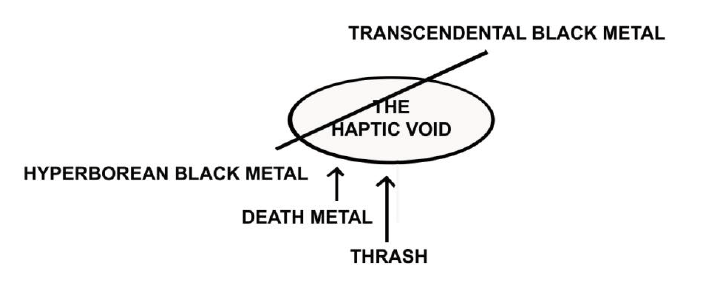
“Hyperborean Black Metal is the culmination of the history of extreme metal (which is itself the culmination of the history of the Death of God). The subject of this history may be compared to a mountaineer, maneuvering over and across the various terrains of thrash, grindcore and death metal – or rather, carving these terrains into the mountainside – and striving to reach the Haptic Void, dimly understood but strongly felt, glimmering brightly at the summit.”
“Transcendental Black Metal is in fact nihilism, however it is a double nihilism and a final nihilism, a once and for all negation of the entire series of negations. With this final ‘No’ we arrive [in] a sort of vertiginous Affirmation, an Affirmation that is white-knuckled, terrified, unsentimental, and courageous.”
“The infinite is everywhere and cheap. It is the finite that is rare. It is the finite that is peculiar to humankind. Finitude means confronting what is present at hand authentically and doing what is honest with the means one has at one’s disposal. The solar nourishes the finite. The finite is born, strives, and dies.”
“Transcendental black metal sacralizes the penultimate moment, the ‘almost‘ or the ‘not yet’, because it has been found that there is nothing after the penultimate moment. The penultimate moment is the final moment, and it takes place at every moment. The fabric of existence is open. There is nothing that is complete; there is nothing that is pure.”
“Depravity is dissimulation; courage is authenticity. Courage has no image of itself. It is trailblazing. It has no path before it. Its only trace is the wake it leaves behind.”
“After the dust settles, and the work of modernity and postmodernity is done, and the divisions between high culture, mass culture and counterculture have been obliterated, what is left? A single, shining Culture which is True, Good, and Beautiful.”
Teutoburg Forest
“The primary level of decay conveyed in black metal concerns the predisposition toward matters of the human body’s decomposition. A recurring scenario involves the ritualistic debasement of the decomposing corpse at the hands of the living, in what can often be understood as a de-sanctifying ritual that rids the rotting corpse of its illusory spiritual wholeness.”
“Second, it can certainly be said that black metal, in its varying and perpetually evolving states, employs a literal decomposition and decay of its own presence” “Beyond merely producing a record that sounds grimy, faraway, muddled, etc., these artists create a presence that is wholly separate from the music.”
“It is only after disfigurement and debasement of the corpse take place that necrophilic urges can emerge, in which the corpse is wallowed in, raped, or sodomized in a ritual of great satisfaction, as in Decay’s song, Copulation With the Gutted Corpse”
“a great deal of anti-Christian black metal maintains a knowledge of such objects that are lost to the now predominant rabble of evangelical Christians, whose masses often take place in fluorescent-lit recreation centers and whose priests often wear sweatsuits.”
(*) “For a beautiful simultaneous satire/homage of the life of the suburban black metaller, see the gorgeous black metal montage of Harmony Korine’s 1999 film Gummo.”
“If we were to define a degree zero of Black Metal politics then it would be an unstable amalgam of Stirnerite egoism and Nietzschean aristocratism: a radical anti-humanist individualism implacably hostile to all the ideological ‘spooks’ of the present social order, committed to creating an ‘aristocracy of the future’, and auto-engendering a ‘creative nothing’.” “Of course these are often ‘spooks’ associated with the extreme right, Nazism, fascism, and ultra-nationalism. Whereas Stirnerite individualism might be regarded as anarchist, or at best indifferent to politics, this racial-national metaphysics is often, although not always of course, deployed to re-territorialise and establish a ‘grand politics’.” “the critic from the left can safely handle and enjoy Black Metal and proclaim their sophistication by condescending to the naiveté of such adolescent political posturing which ‘unfortunately’ marks an otherwise admirably radical aesthetic.”
“It should be noted that a Gramscian politics of hegemony has been invoked by the far right, in particular in France by Alain de Benoist, ideologue of the ‘new right’. His culturalist racism and anti-Americanism bear many similarities to the views of Sale Famine, however Famine’s elitism and anti-popular stance incarnate a peculiarly constrained vision of hegemony – one occult and elitist.”
(*) “Famine states that the next Peste Noire album will be ‘pure reggae’ (Travis Interview), inhabiting his usual mode of deliberate provocation, but also implying his own ability to define a true Black Metal, in quasi-Duchampian mode, as whatever he nominates.”
Carl Schmitt, Theory of the Partisan, 1963.
“The apocalypse leads to the post-apocalypse. Contrary to this, Armageddon is the site of the terminal end.”
“What does this have to do with black metal, or with Mayhem’s demo title as a founding gesture?”
“Hence the absence of the usual dialectical suspects: not void, not synthesis, not the not-not of the negation of the negation.”
“It is the war fought between two totalities, between black metal’s endless antagonism and liberal capitalism’s eternal present.”
“it predicts and describes a final battle, yet it grasps that final battle as one which has been there all along.”
“Therein the desperation of black metal vocals: it’s just the howl of the thought that this is at once the worst of all possible worlds and the only possible world.” “In this way, despite its moronic and frequent attempts to be Fascist and despite the fact that we should wage total war against all such attempts, it never can be.” “all non-Nazi black metal is still NSNSBM (not so National Socialist black metal).” “Black metal dreams a sovereign, and, in the next breath, severs his head to spatter the blood across all. What remains are the headless horsemen of the apocalypse, the acephalic leaders of a chiefless crowd marching off to permanent war.”
“the act of becoming headless opens the way for the second gesture, that of the cephalophore,¹ the head-bearer, the one defined not by the condition of being without head but by the act of picking the head back up.”
¹ Botânica: que tem flor em forma de cabeça.
“Black metal makes appear as decision what is in truth a general state of affairs, not just of its imagined post-apocalypse but of the systemic chaos and non-direction of the contemporary world. Hence the performative theatricality: the head already removed, the axe’s swing is a magician’s trick, tracing the negative space there all along between the body and the head.”
“But despite its recurrent anti-intellectualism and penchant for uncritical reenactment of stale dark vitalist tropes, black metal is smarter than it thinks. Appropriately for its Satanic grounding, it shares much with the integral atheism of de Sade: to take on abstraction and the generic, you have to do so on its own terms.”
“I like some bands from the U.S. but never would have conceived of hording them altogether under some catchy, marketable little moniker like USBM. It implies a sense of unity, which I cannot see manifesting in the States on any comprehensible scale.”
“He Who Crushes Teeth, Bone Awl: I think the first band to make a uniquely American statement in Black Metal was Grand Belial’s Key. They use the same method as the Europeans in not just bending Death Metal a little bit but really making that leap, playing music that is rooted in the history of the country. Even though their music falls nicely into Black Metal as category, when I listen to Mocking the Philanthropist I hear American folk music, I hear the racial tension of the south, I hear hot American climates and landscapes. I hear the civil war. They did a fitting job including the surrounding culture into the sound, which most American bands completely fail to do.”
“Blaash, Bahimron: (…) We become soulless to a point – a hollow meandering consumer
who thinks they are xtian until theyre rapin’ their daughter one day . . . School shootings, mass murder, serial killers, suicide – all of the ‘real subjects’ – not Viking heritage or killing the ‘Christians’ in lyrics”
“Jordan, Wrath Of The Weak: In some respects, it seems like USBM has taken the destructive side of black metal and turned it against itself, so instead of church burnings and murders it manifests itself in the hatred and self-loathing that’s present in a lot of the acts which get labeled as suicidal/depressive/etc. I suppose you could take that as a reaction of sorts against our current habit of ignoring and/or medicating away any mood that isn’t neutral or somewhat positive.”
“Andee, Aquarius Records/tUMULt: Most black metal musicians did not grow up listening to black metal. Many might not have listened to metal at all. And you can hear that in the music: Elements of doom, psych, stoner rock, post rock. Black metal guys who are my age, which is a lot of them, were into Slint¹ way before they were into black metal, and were listening to Drive Like Jehu¹ and Unwound¹ before they had ever heard Mayhem or Immortal. That stuff informs everything they do. Even when they’re playing some part that is total Darkthrone worship, often those years of listening to other music seeps in and turns it into something new.”
¹ Math rock/indie/emo precursores norte-americanos.
“Blaash, Bahimiron: USBM incorporates more ‘brutality’, I think, then some European acts—ignoring the obvious stalwart murderers like Immortal, Marduk, or after them Dark Funeral…”
“Imperial, Krieg: What I do see as something typically American (to which much outside of the US and unfortunately only a small portion within the country would agree) is the pseudo idea of American superiority to outside art, culture and music. This is why you see so many bands doing the paint by numbers sort of thing, regurgitating what’s already been done yet thinking it’s their own. As Americans we have a strong artistic and literary heritage, especially post WW2 from the Beat movement, Warhol’s idea of Popism, La Monte Young‘s musical experiences,¹ etc. but we don’t draw on it, we just keep pushing out McBlackmetal.”
¹ Artista nascido em 1935 citado como ‘minimalista’, ‘vanguardista’ e mesmo drone!
“I don’t see our music as aggressive; I see it as a contemplation of your own heartbeat. The heart never stops; it never stops until you’re dead. It is never not drenched in blood. It is the most violent rhythm you can think of. When a body becomes so big it needs a heart, this is when music becomes real.”
“Josh, Velvet Cacoon: (…) The east coast stuff was really incoherent and unconvincing, it offered nothing and went nowhere. There was no direction and it seemed like they were playing black metal because it was the alternative to being just a fan. Have you ever heard Kult ov Azazel¹ or any of those types of east coast groups? Everything from the music to the lyrics, song titles and artwork screams ‘generic’. I don’t know how these guys get out of bed each morning.”
¹ Extrato da last.fm


“He Who Crushes Teeth, Bone Awl: Anything good in American black metal is happening on the West Coast…. There is more culture in California. More global influence. More computers. Less McDonald’s. More Starbucks. More Mexicans. More People. More numbers. Less women. More gay people. More cars. More traffic. More violence. More romance. More life in general. An abundance of living things.”
“UMESH, Brown Jenkins:¹ All it would take would be half a dozen ambitious writers in America and the U.S. black metal scene would have its own sordid narrative to struggle with. These are creations of the press, of course. If you think about it, the heart of the Norwegian narrative, for example, is a story with a black hole at the middle of it—no one really knows what happened the night Euronymous was murdered except Varg Vikernes. The other person involved is dead. Varg has told different stories about what happened over the years—does he even really remember? So even at the very center of an attempt to apply meaning and a grand, overarching story to the history of the Norwegian black metal scene, there is a wall beyond which no one can penetrate. It’s meaningless. People can make whatever they want of it.”
¹ Parece interessante: doom metalgaze!
“In A Thousand Plateaus Gilles Deleuze and Félix Guattari introduce the concept of ‘becoming-animal’ which refers to the subject’s movement from a stable position, from identity to a nomadic, anarchic existence. (…) Other Black Metal musicians have adopted new names to describe their becomings-wolf. Burzum’s Kristian Vikernes has changed his name into Varg which means wolf. Darkthrone’s Leif Nagell is known as Fenriz. Fenrir or Fenris is the name of the Nordic monstrous wolf, the son of the god Loki and Angerboda. Ulver is the name of a BM band from Norway whose lyrical themes are those of lycanthropy and fairy tales among others. Ulv means wolf in Norwegian and ulver is the plural form of the word.”
“A living incarnation of Satan has taken the place of a dead God. But the original father needs to be brought back and recomposed repeatedly for the transgressive act to have meaning. Logos demands to be there first, in order that Chaos may later renounce it, for the wolf to commit its prohibited crimes. Without a paternal figure transgression becomes a fruitless act, an empty simulation of repetition. And this is where black metal’s contradictions take place. The thirst for annihilation, the violent transgression of limits, the disruption and the illicit crossing of boundaries are only manifested and secured with the presence of the phallus. The Christian father haunts black metal, the way King Hamlet’s ghost haunts Denmark.”
“The annihilation of melody and the repetition of raw sounds of the same fast tempo reflect the condition of modernity’s mechanical reproductive experience, the simulation of simulations, the emptiness of the sign, the disenfranchised being’s uniform activities.”
“In Kadenzza’s¹ album The Second Renaissance (2005) songs based on the story of little red riding hood manifest the wolf’s masculine authority over the maternal and feminine. In the Woods red riding hood creeps through a hole in the door only to find the wolf offering her the flesh of her dead mother as food. It seems that both the wolf and red riding hood have transgressed into the mother’s house, the womb in the forest. In The Wolfoid the wolf incarnated as man unleashes his violent instincts through aggressive vocals and fast, repetitive, symphonic parts that deliver his nightmarish visions of devouring the mother and red riding hood. It is the ‘sinful nectar’ dripping from red riding hood’s ‘nasty lips’ that arouses the beast. Unable to make any choices red riding hood will have to drink the blood and eat the flesh of her mother, until finally the wolf will consume her body. Here Kadenzza play with the oral tradition of this fairy tale before Perault’s version which included the cannibalistic act of eating the grandmother and presented red riding hood as a slut who would eat the flesh and drink the blood of her grandmother. Wolves are the evil seducers whose ferocious instincts drive them in the consummation of their female victims.”
¹ “You Oshima
~ all vocals ( harsh vocal, natural vocal, voice )
~ all guitars ( electric and accoustic )
~ synthesizers ( …and theremin )
~ programming
~ sampling”
Satanic Corpse, banda feminina.
“If wolves howl, then red riding hoods can scream non-linguistic forms attacking the symbolic order.”
“From Keat’s ‘Ode on Melancholy’ to the ecstasies of metallic desiring machines, Melencolia Estatica, the project of the mysterious Climaxia, gives free rein to both aggression and romantic intensity. The sexual difference that these female black metal bands try to incorporate into black metal’s structures, a rewriting of female desire into the codes of music is a challenging creative power that destroys the ‘silence’ assigned to them by the phallus.”
Astarte
“If female black metal bands manipulate the qualities that patriarchy has endowed them with through the use of sexuality in their performances, the language of nihilism or the repetition of black metal’s masculine discourses, then the perpetuation of the similar will persist and their presence will forever be silenced. Black metal is a strange place to be.”
“‘Freezing’ atmospheres of, say, Judas Iscariot or Old Wainds easily give way to the ‘blazing’, ‘burning’, hell-fire clamor of bands like the German Katharsis, 1349, or Averse Sefira without any drastic alteration of formal principles, and the force that mediates between these thermal intensities is a sort of conductive violence, a constant and potent accident of atmosphere that has the quality of a heat-transference which works upon something and draws it toward a limit, one of either over-excitation or exhaustion.”
METIMANENTE
i(ll)mmanent metal
m(l) a e t
“the writings of Madame Blavatsky and Rudolph Steiner are exemplary in their trans-cultural and trans-historical breadth. In books such as Isis Unveiled (1877) or The Secret Doctrine (1888), Blavatsky covers everything from archaic mystery cults to modern paranormal research, giving one the sort of global perspective found in anthropology classics such as James Frazer’s The Golden Bough (1890).”
“We could be even more specific and refer to this perspective not just as cosmic, but as a form of ‘Cosmic Pessimism’. The view of Cosmic Pessimism is a strange mysticism of the world-without-us, a hermeticism of the abyss, a noumenal occultism. It is the difficult thought of the world as absolutely unhuman, and indifferent to the hopes, desires, and struggles of human individuals and groups. Its limit-thought is the idea of absolute nothingness, unconsciously represented in the many popular media images of nuclear war, natural disasters, global pandemics, and the cataclysmic effects of climate change.” Ao contrário! É justamente o oposto! Metal demasiado humano, apenas humano.
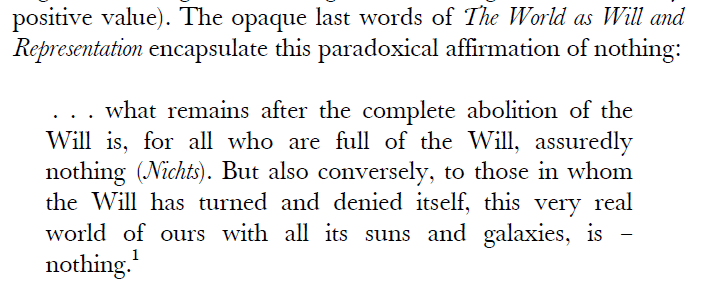
“Cosmic Pessimism has a genealogy that is more philosophical than theological. Its greatest – and most curmudgeonly [rabugentamente] – proponent was Arthur Schopenhauer, the misanthrope who rallied as much against philosophy itself as he did against doctrinal religion and the nationalist politics of his time.”
NOUSTALGIA
A vontade à vontade a-vontade.
“To find an equal to Schopenhauer, one would have to look not to philosophy but to writers of supernatural horror such as H.P. Lovecraft, whose stories evoke a sense of what he termed ‘cosmic outsideness’ – the black tentacular voids that surround us and that stretch into the furthest ‘black seas of infinity.’” Não é à toa que eu gosto mais de Poe que de Lovecraft.
“One could even suggest that some of the formal experiments in black metal, from the minimalism of Sunn O)))’s Grimmrobe Demos to the wall-of-noise in Wold’s Stratification might offer musical equivalents of the Cosmic Pessimism meaning of the word black.”
“The most striking example of Cosmic Pessimism comes from outside of the metal genre altogether. It is by the Japanese multi-instrumentalist, poet, and mystic Keiji Haino. Haino’s album So, Black is Myself takes the subtractive minimalism of Sunn O))) further, while borrowing techniques from everything from Butoh to Troubadour singing. Clocking in at just under 70 minutes, So, Black is Myself uses only a tone generator and voice. Its sole lyric is the title of the piece itself: ‘Wisdom that will bless I, who live in the spiral joy born at the utter end of a black prayer.’ The piece is brooding, rumbling, deeply sonorous, and meditative. Sometimes the tone generator and Haino’s voice merge into one, while at other times they diverge. Haino’s voice itself spans the tonal spectrum, from nearly subharmonic chant to an uncanny falsetto perhaps produced only by starving banshees.”
“To the role of medicine in Weyer, and the role of law in Bodin, we have the role of skepticism in Scot. While Weyer and Bodin are on opposite sides of the fence politically, theologically they both remain committed to the existence of supernatural forces and the conflict paradigm of good vs. evil. Scot, who had the advantage of relative financial independence, was neither beholden to the Church nor to science in his opinions – though the Discoverie of Witchcraft was printed at his own expense, was unregistered, and did not contain the publisher’s name. Most likely spurred on by a series of controversial witch trails in England in the early 1580s, Scot’s treatise is much more sarcastic, even humorous, in its criticisms.”
“Science fiction works such as Fritz Leiber’s Gather, Darkness! and James Blish’s Faust Aleph-Null, written in the shadow of world war and mass extinction, suggest a ominous affinity between technology and the supernatural. In Leiber’s novel a futuristic Papacy utilizes a whole panoply of special-effects technologies to both ensure the fidelity of the masses to the hegemony of the Church. Against them a demonic underworld of witches, warlocks, and familiars carry out their revolutionary cause. By contrast, Blish’s novel suggests that with weapons of mass destruction, a renewed Faustian pact has been made, with quantum physics as a form of necromancy.”
“see Abgott’s recent foray into mafia politics with Godfather in Black and God Dethroned’s WW1 story of Paschendale.”
 Seclusão Anagógica