

“The theorist who connects the energetic model of the material universe with its atheological double is, of course, Georges Bataille whose system of general economy relates cosmic forces to human societies, inner experience and evil.”
“The founder of the idea of acoustic ecology in the 1970s is the composer and theorist F. Murray Schafer. In a chapter called ‘The Music of the Environment’, Schafer refers to two apparently contrary Greek myths concerning the origin of music. The most familiar myth, from Homer, accounts for the invention of the lyre by Hermes when he discovers that a turtle shell can produce sound.” “The contrary myth, from Pindar’s Twelfth Pythian Ode, concerns Pallas Athena who, upon hearing of Perseus’s slaying of Medusa, attempts to ‘connect’ with ‘the sorrowful lamentations’ of her sisters, and ‘framed the full-sounded harmony of the reeds that she might imitate with instruments the deep groans proceeding from Euryale’s fell cheeks’ (…)All music, according to this myth, is infused with death and mourning.”
“Imagine the agonies of Christ on the Cross multiplied to infinite proportions, the maximum of tragic intensity giving rise to measureless expenditures of energy in the form of sonic vibrations. This is the sound of the universe, the melancholic sound that constitutes the universe, the cosmic noise from which all form and structure derives as oscillations coalesce into dark matter, atomic matter and light producing the stars from which life ultimately, derives, a universe in which, with supreme irony, human forms of life will perceive divine harmony and mathematical consistency, the very image of creation that God sought to avoid, but through avoiding, in his tragic stupidity brings about.”
“This domain of excess (the excessive negation of being) and of absolute evil is therefore exactly the same as the absolute good of black metal itself: the expenditure of a sonic drive that propels a blackened self-consciousness, a melancological consciousness without being that is necessarily prior to any positive ‘ecological’ intervention in the ‘environment’ that could only repeat the process of its human exploitation and subjugation.”
“It is perhaps appropriate here to emphasise what the ethos of melan-cology is not: it is not a form of morality; it is not a set of rules relating to social behaviour, civic duty, code of conduct, biopolitical governance, nor does it relate to any form of socio-political order dedicated to organizing and improving human survival or the survival of any other form of (inter-)planetary life.”
“Ecology and economy are virtually the same word and when the former becomes the basis of the latter there is always the serious danger of a drift towards fascism because it is always a question of deciding who or what lives and dies usually on an aesthetic/utilitarian (or ends/means) basis.”
“For the entrenched and domestic Werther-ism of so-called ‘depressive/suicidal black metal’ risks collapse into the perfect commodity-form of private, solitary, defeatist quietism, leaving black metal ripe for critical re-territorialization as nothing more than ambient shoegaze dressed up with gothic posturing (something for lone wolves rather than for packs). In his polemic of 1931, ‘Left Wing Melancholy’, Walter Benjamin long ago flagged the quietistic implications of this emotion, lambasting the ultimately harmless and conciliatory aura of ‘tortured stupidity’ that it proffers as an inadequate response to capitalism.”
Badiou, Lógica dos Mundos
“The black metal kvltist chooses to drown the present in a fog of black bile, offering what Badiou terms ‘the paradox of an occultation of the present which is itself in the present’.”
“melancholy, melaina khole, or black bile, the humor associated in Hippocratic medicine and its Galenic, medieval and early modern inheritors with autumn, cold, solitude, night-time, old age, and a wildly variant affective spectrum: sorrow and anxiety above all, but also rage, lycanthropy, psychotic hallucinations, religious devotion, sexual jealousy, artistic inspiration, catatonia and mania.”
“To move from Exodus’s ‘Bonded by Blood’ to Beherit’s ‘The Oath of Black Blood,’ is to reject the jocular and homosocial bonds of friendship in favor of the sorrowful, creaturely solidarity of melancholy suffering.”
“Bracketing this personal hit parade, the Encyclopaedia Metallum indicates at least five bands simply called Melancholy from Greece, Mexico, Lebanon, Poland and Russia, not to mention Czech Republic’s Melancholy Pessimism.” Lituânia, não Líbano. Há ainda, em 19/11/2025: Beyond Melancholy (DSBM, Itália), Enthroned Melancholy (atmospheric black metal, Suécia), Evil Melancholy (black metal, Áustria), Forgotten Melancholy (gothic/doom metal, Romênia), Martyr’s Melancholy (deathdoom, EUA), Melancholy Cry (doom metal, Polônia), Oppressive Melancholy (experimental BM, Finlândia), Starlit Melancholy (atmospheric BM, EUA), Autumn Rain Melancholy (gothic/doom, Rússia), Blood of Melancholy (black metal, México), Meadows of Melancholy (atmospheric BM, EUA), Melancholy of Evil (BM, Brasil), Morose Months of Melancholy (BM, Ucrânia), Shores of Melancholy (BM, EUA), Tears of Melancholy (gothic, Suécia), Veiled in Melancholy (atmospheric post-BM, Dinamarca) e Void of Melancholy (atmospheric BM, Finlândia). Há ainda uma Melankoly black metal sinfônico do Líbano (op. cit.), Melancholie, atmospheric/ambiente holandesa, e Melancolie, gótico italiana.
“If we look at Melencolia I (1514), we see that Dürer’s angel has a noticeably dark face: she is not, as it were, ‘white’ but is quite literally a dark angel. This is because the blood within the body of a melancholy person was imagined to run black. As Marsilio Ficino puts it in the chapter of De Vita Libri Tres (1489) titled ‘How Many Things Cause Learned People Either to Be Melancholy or to Become So’, this is a result of a drying of the brain caused by agitation”
“As melancholy lost its humoral meaning and became an elite aesthetic mode of ‘sadness’, what was bleached away, literally, was its association with dark-skinned faces.”
“This achieves its zenith in the romantic cult of languid pallor and the crypto-sexualization of the symptoms of tuberculosis. Tom Moore, visiting Lord Byron in Patras in 1828, hears the poet declare ‘I look pale. I should like to die of consumption’; taking the bait and asking why, he is told ‘because the ladies would all say Look at that poor Byron, how interesting he looks in dying.’”
“Pythagorean worship of the numeral 4 begat the Empedoclean combinatorial model of the elemental composition of the universe out of earth, air, fire and water, and this led in turn to a Galenic medical practice fashioned after this Pythagorean/Empedoclean image, populated by 4r broad types of human beings: sanguine, phlegmatic, choleric and melancholic.”
“The mainstream media, predictably ravenous in its cool hunting search for hotzones radioactive with even the most notional cachet of authenticity, has predictably fastened onto the comedic potential of corpsepaint as a means to both co-opt and condescend to black metal as an extremist sub-culture. Exhibit A of this process is the thinly veiled transposition of Immortal’s Abbath into the avatar Lars Umlaut in the Guitar Hero video game franchise. Current retail for this series is over 2 billion dollars, and with more than 25 million units sold, it is safe to say that Guitar Hero constitutes the most widely disseminated representation of a black metal musician on this planet.”
“take a press photo of Immortal, replace battle axes with kittens, and you’ve got yourself a hilarious new image to use as an online avatar which shows that you’re aware of ‘that stuff but that you don’t take it too seriously.’”
“Through corpsepaint, black metal achieves the re-occultation of black blood as an immanent experience of asymmetric struggles between life and death, dark and light, then and now.”
“This transformation of the face of the entertainer into a cartoonishly legible form thus recalls the minstrelsy tradition of white European and American entertainers ‘blacking up’ so that they can look like African-Americans, a dialectical process that foregrounds the artificiality of race as a construction while still effectively reinforcing that construction’s normative force.”
“black metal theory awaits its rendezvous with both queer theory and critical race theory.”
“Obsessed as it is with thinking negation, negativity, hostility and failure, recent queer theory might yet constitute a particularly generative lens through which to think about the fetishistic circulation of the Third Reich as a ‘lost cause – melancholically embraced because it is lost – within black metal aesthetics.”
“At the level of scene politics, if the commentary of its pioneers is any indication, the Ursprung of corpsepaint may not lie in Norway, Finland, or Sweden but in Brazil: whenever the origins of this makeup style are discussed, mention is swiftly made of the foundational influence of Sarcofago’s debut album ‘I.N.R.I.’ (1987) upon the visual presentation of the first wave of Scandinavian black metal artists, who more or less copied the signature look from these citizens of Belo Horizonte: spiked bracelets, bullet belts, white cheeks, black circular eye makeup. Corpsepaint might well have been required in order for South American musicians to look sufficiently ‘vampiric’ and ‘ghoulish’, i.e. white—but even if corpsepaint is quite specifically about looking like a dead white person, its ultimate horizon gestures beyond racial legibility towards the species-being based project of turning the human face – any human face – into a skull.”
“In a dynamic of impurity familiar from the theorization of drag performance, this very falseness offers a violation of a boundary that reifies the very line that it also subverts through crossing.”
Lord Byron,
I had a dream, which was not all a dream.
The bright sun was extinguish’d, and the stars
Did wander darkling in the eternal space,
Rayless, and pathless, and the icy earth
Swung blind and blackening in the moonless air
‘Darkness’
(1816).
“Stanton Marlan in The Black Sun: The Alchemy and Art of Darkness (2005) approaches the notion of a black sun or Sol Niger and blackness not as a representation of the nigredo or blackness phase in the process of the alchemical opus that disappears when the work is completed, or in terms of Jungian psychology where the black sun of the nigredo phase is associated with suffering and the melancholic soul’s struggles with this shadow of darkness.”
“The Burkean sublime shares much with the darkness and terror of black metal’s arctic gothic atmospheres and resonates with what Eugene Thacker calls ‘the world-without-us’; a world neutral to humans which can be found ‘in the very fissures, lapses, or lacunae in the World and the Earth’, in ‘a nebulous zone that is at once impersonal and horrific’.”
“Kali, who represents the process of dying and is the ‘terrible Mother of the cremation ground’, is worshipped by the Tantrics who believed that, ‘sitting next to corpses and other images of death, one is able to transcend the pair of opposites (i.e., good-bad, love-hate, etc.)’”
“This essay focuses primarily on examining black metal’s presence in photographic images, drawings, and sculptural installations by three American artists: Grant Willing, Terence Hannum, and Banks Violette. It argues for a black metal art history that may be used to articulate how the language of black metal is used by artists to construct meanings.”
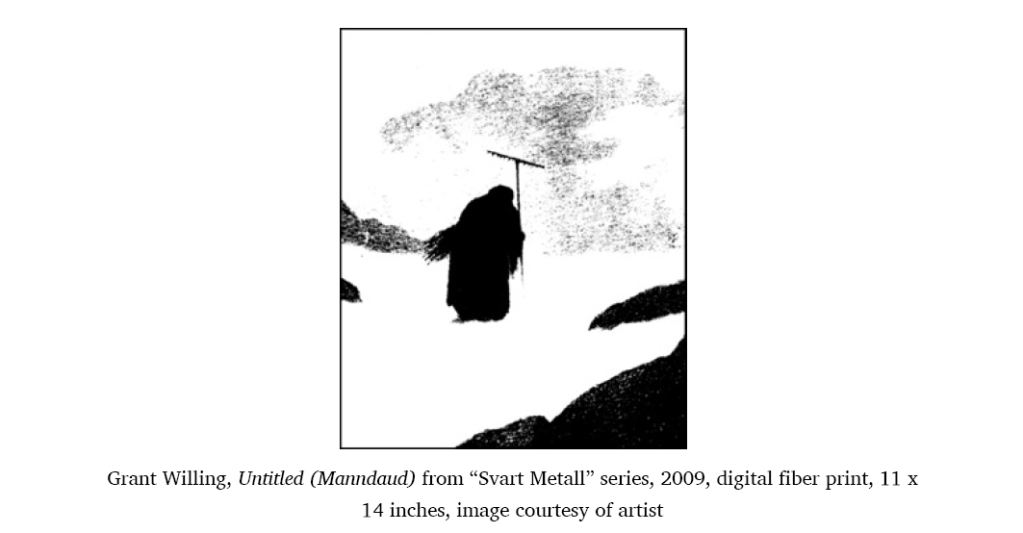
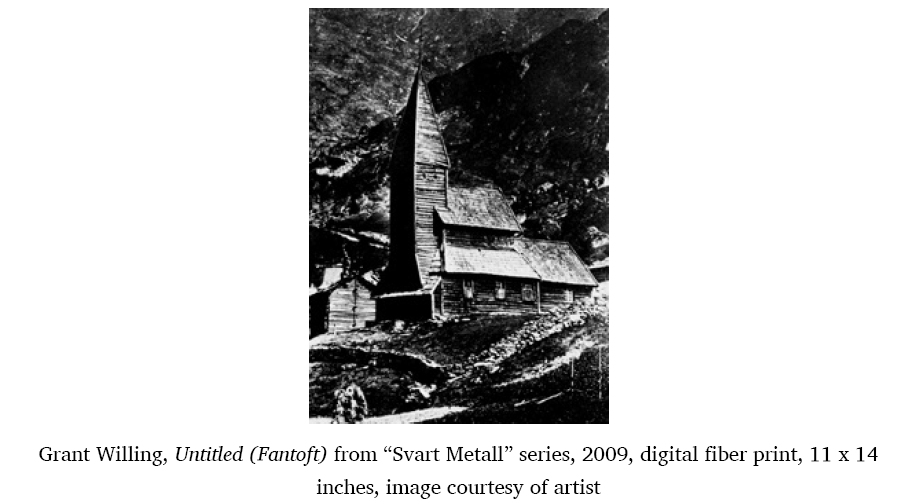
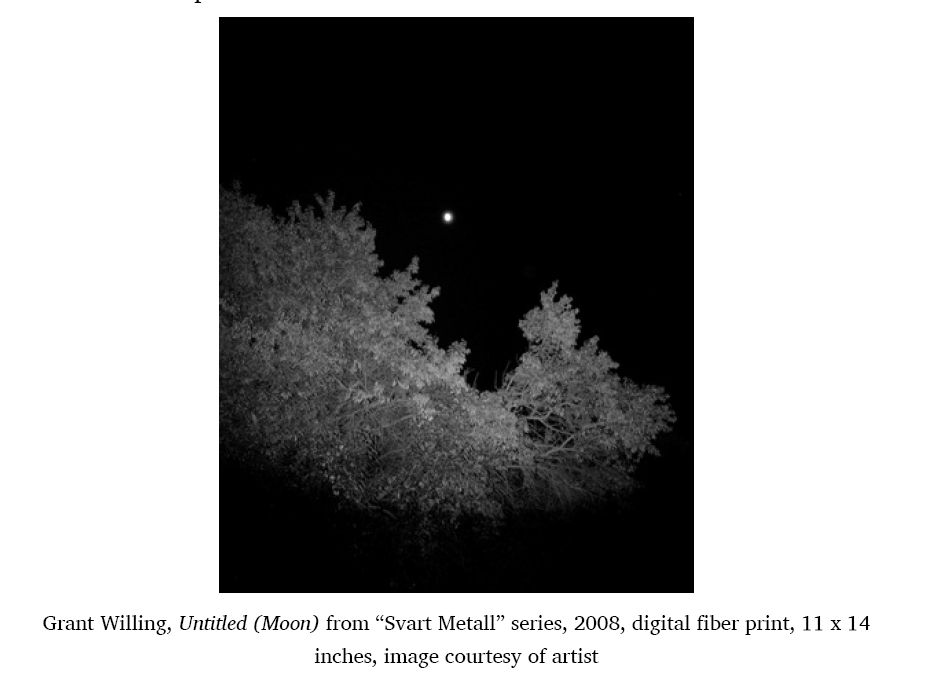
“The chorus, that is so common in classic rock, is rejected in many black metal songs in favour of a symphonic quality of alteration that forces the listener to constantly renegotiate their experience. Riffs repeat, but transform over the length of a track—which commonly reigns closer to ten minutes than the three minutes of pop music, long enough to build a dense and complex sonic landscape. The double bass drum frequently sounds like a racing heartbeat or blood rushing through my body.”
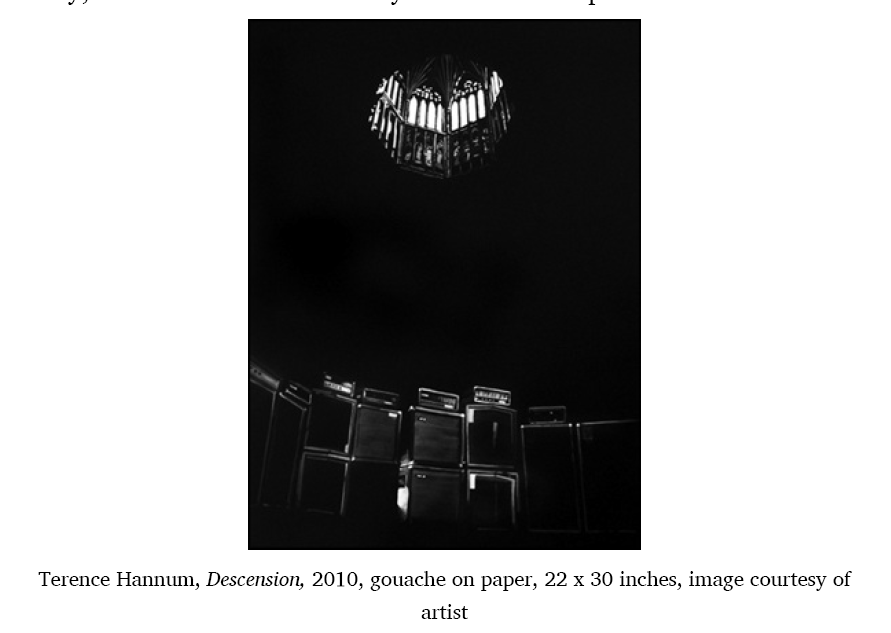
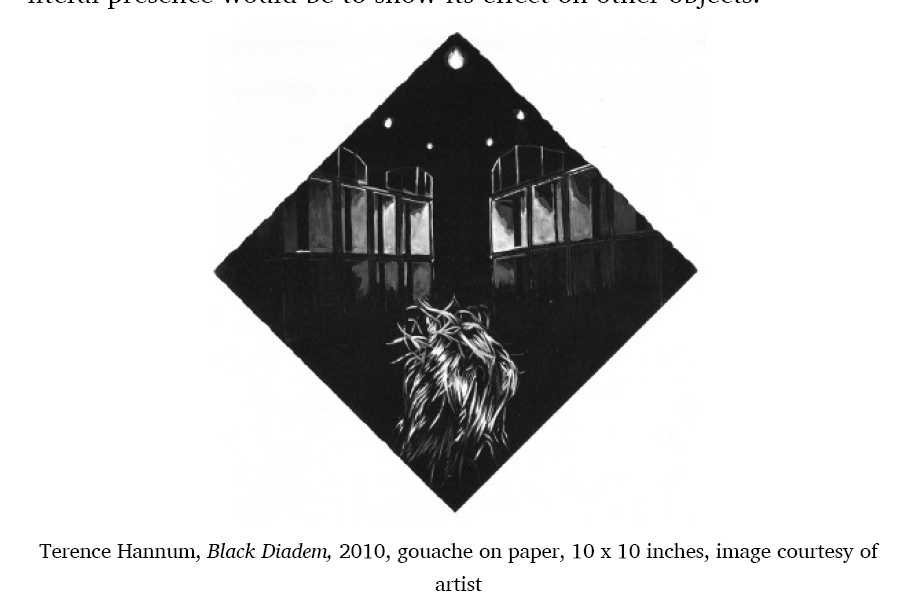
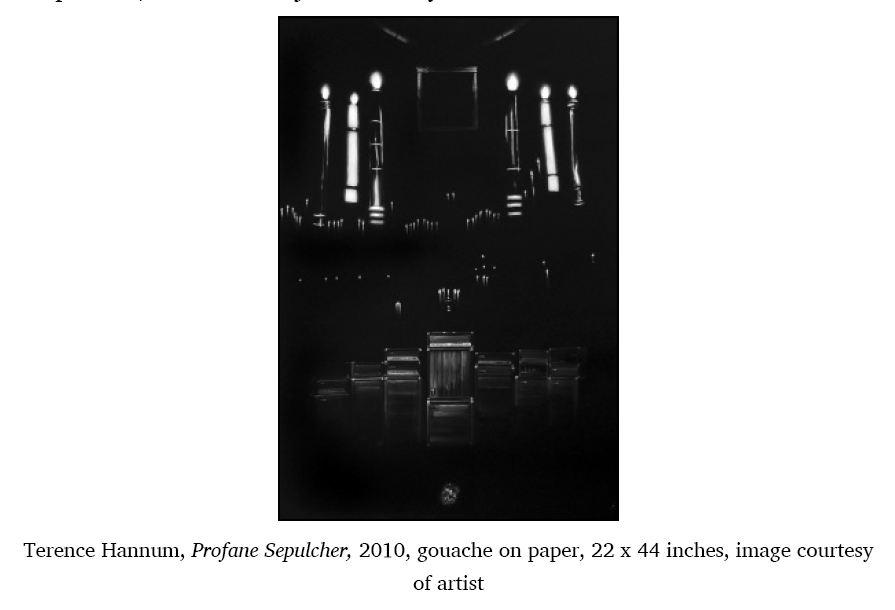
“Seen only from the back of the head, her hair is messed in a head banging nod to the speakers. In the distance where the two rows of amplifiers might meet there are no musicians mediating between the amps and the single audience member. In fact, the details between the individual and the technology in both ‘Black Diadum’ and ‘Descension’ appear to sink into the material of the pitch-black paper itself. It is formless: it looks like empty space. Yet here, exemplified by the texture within the ground of the paper substrate, Hannum allows the physicality of the media to resonate throughout the drawing, suggesting the artwork itself as a space charged with intense sonic activity.”

Caminhante sobre o mar de névoa
Burke
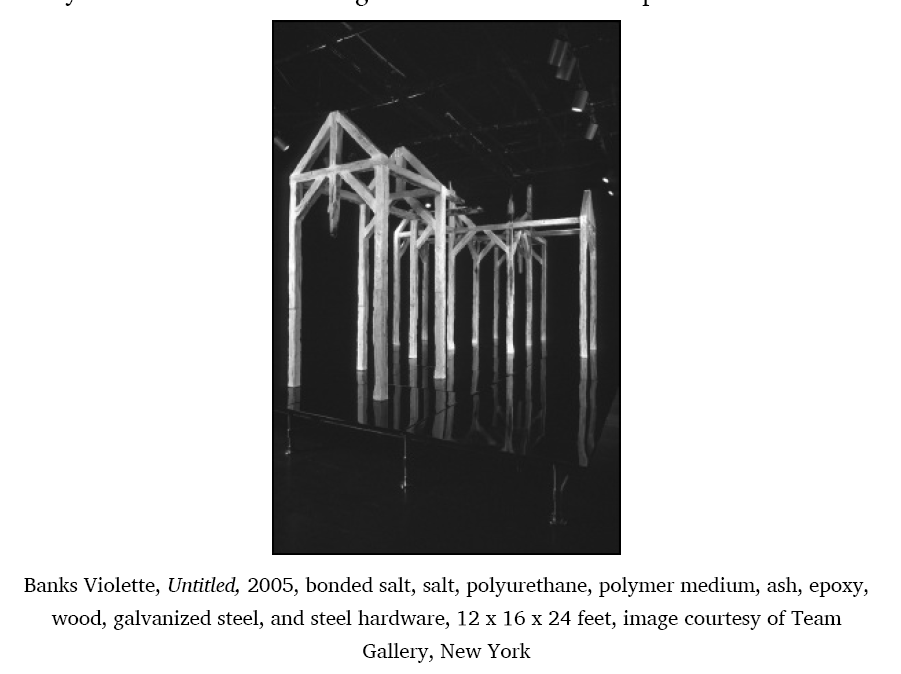
“This skeletal structure was a direct reference to both the Fantoft stave church’s burning in 1992 and the photographic representation of its charred ruins featured on the cover of Burzum’s 1992 album Aske.”
“Violette’s 2006 exhibition at the Maureen Paley gallery was initiated with an hour-long performance by the drone metal band Sunn O))) which took place on the ground floor of the gallery during opening night” “To attend a Sunn O))) performance is to experience a deep, pressure-filled amplifier massage penetrating your entire body as the band builds a dark, atmospheric, resonating sonic landscape felt long before and after it is heard. Adding to Sunn O)))’s performance at Maureen Paley was a vocal performance by Mayhem’s Attila Csihar, conducted entirely from within a sealed coffin made by Violette out of salt and resin. When the concert ended, the musicians exited unseen and viewers were finally admitted, like forensics, to witness the afterbirth.”
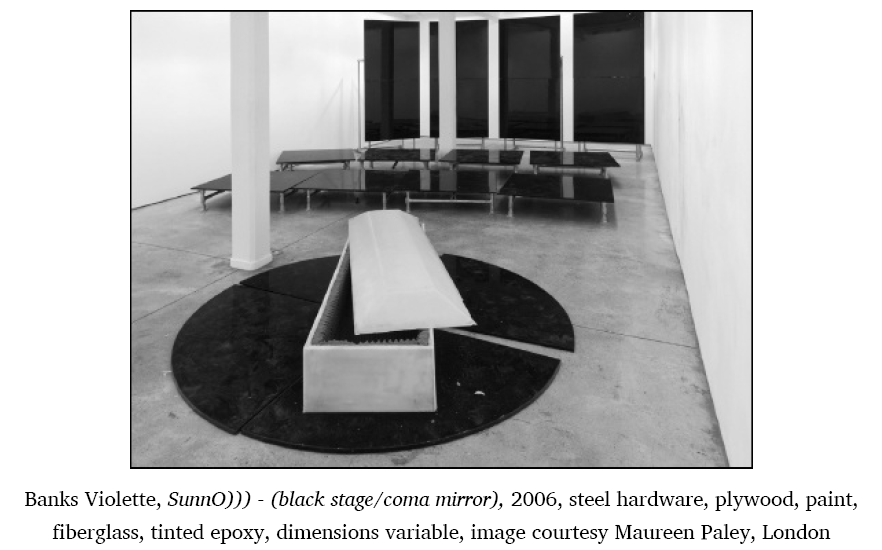
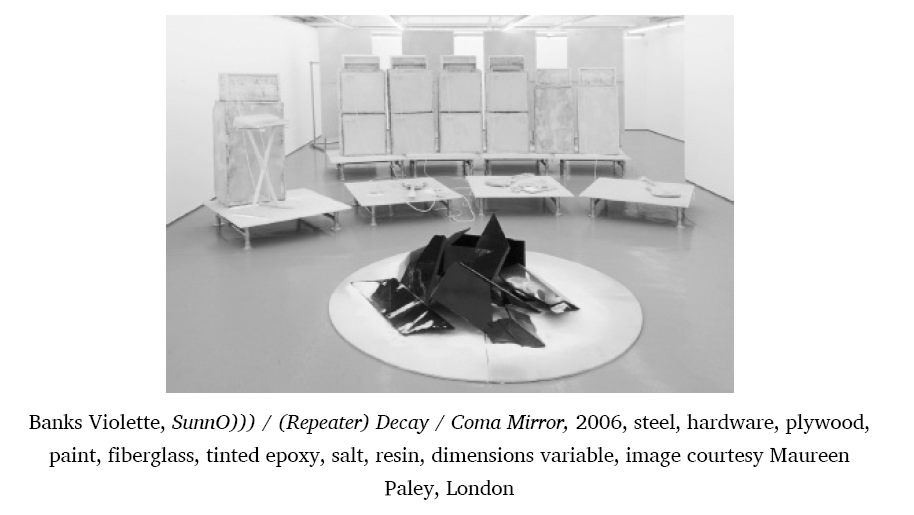

“We are left wanting […] for the sculptures raise expectations of sound, movement, fury, fame, only to render such prospects void by the absence of any.”
“Doom metal presents a music of tempo that is so grave that it negates tempo. Finally, drone metal, with its minimalist dissipation of all music into a monolithic, dense line of sound, presents us with the whittling away of all harmony into a single, thick, absolute tone, collapsing the musical spectrum into a dense black hole.”
“To give us an idea of how this unsound is different from an anti-sound or a super-sound, we could consider a number of examples in contemporary sound art, examples that cross genres, from black metal to avant-garde to dark ambient. Each can be understood as effecting different strategies that point to, but never, of course, arrive at, the unsound.”
“In one group would be works that utilize what we might call a strategy of invocation. Lustmord’s Black Star (from 2000 album Purifying Fire), Keiji Haino’s Milky Way (1973), Striborg’s Spiritual Catharsis (2004) [‘coldwave’], and Darkspace’s Darkspace II (2005) might be cited as examples.”
“In another group would be works that utilize a strategy of darkening. Raison d’Être’s Metamorphyses (2007), Nurse With Wound’s Soliloquy for Lilith (1988), Francisco Lopez’s Untitled series, and Thomas Köner’s Permafrost (1993) are examples.”
“In a third group would be those works that use a strategy of density. Sunn O)))’s Grimm Robe Demos (1988), Wold’s Screech Owl (2007), Winterkälte’s Structures of Destruction (1997), and Merzbow’s Merzbuddha (2005) are examples. Rather than adopt a subtractive approach, these works do the opposite, condensing, congealing, and clustering sound beyond its audible, or indeed, acoustic, capacity.”
“A final group would comprise works that utilize a strategy of writhing. Iancu Dumitrescu’s Medium II (1978-79; for double-bass), György Ligeti’s Ramifications (1968-69), Iannis Xenakis’ Syrmos (1959), as well as the spectralist work of composers such as Tristan Murail, and Gérard Grisey, might be cited as examples. In these works sound becomes sculptural, writhing, indefinite, flailing and formless. While the techniques may range from ‘micropolyphony’ (Ligeti) to stochastic mathematics (Xenakis), the result is that of acoustic metamorphosis, the continual undoing of sonic form. Xenakis’s scores, in particular, display this forming and de-forming quality of sound (indeed many of his sketches for sound installations look like the black avatar of Fludd’s celestial monochord). Here the abyss is the absolute writhing of sonic form, sound as the writing of the abyss”
Botanist
 Seclusão Anagógica