
CHASING LOLITA: How popular culture corrupted Nabokov’s little girl all over again – Graham Vickers, 2008.

Chasing Lolita, published on the 50th anniversary of Lolita’s American publication, is an essential contemporary companion to Vladimir Nabokov’s great novel. It establishes who Lolita really was back in 1958, explores her predecessors of all stripes, and examines the multitude of movies, theatrical shows, literary spin-offs, artifacts, fashion, art, photography, and tabloid excesses that have distorted her identity and stolen her name. It considers not just the ‘Lolita effect’ but shifting attitudes toward the always volatile mix of sex, children, and popular entertainment—from Victorian times to the present. And it also looks at some real-life cases of young girls who became the innocent victims of someone else’s obsession—unhappy sisters to one of the most affecting heroines in American fiction, and one of the most widely misunderstood.”

INTRODUCTION

The original spark of inspiration for this book was a little less ambitious. It came from a moment in a BBC television documentary that was originally broadcast to coincide with the release of the 1997 film version of Lolita. Adrian Lyne’s movie (the second of 2 film adaptations) had, to the surprise of many, enjoyed the willing consultative participation of Dmitri Nabokov, the author’s dauntingly accomplished son, a famously rigorous critic of any attempts to fool around with his father’s masterpiece.”

Nabokov I foi também um “lepidopterist”: especialista em borboletas e mariposas!

Lolita and her story were just one of these dazzling inventions, completed and put away in late 1953 and at once, in its author’s mind, displaced by the next pressing project.”

Fame is of assistance only to people who make their work, not celebrity status, the point of their endeavors. ‘It is Lolita, not I, who is famous’, Nabokov once said, when pressed, but her fame brought him wealth and independence, and if the suspicion remains that he would have preferred to have been rewarded earlier and more evenly for a lifetime of remarkable literary achievement, he was philosophical about the irony.

The German poet Rainer Maria Rilke defined fame as ‘the sum total of all the misunderstandings that can gather around one name’.”

1. THE REAL LIFE OF DOLORES HAZE: Just the facts

Humbert Humbert is a middle-aged, fastidious college professor. He also likes little girls. And none more so than Lolita, who [sic] he’ll do anything to possess. Is he in love or insane, a silver-tongued¹ poet or a pervert, a tortured soul or a monster—or is he all of these!

¹ [Persuasivo, eloqüente.]

The above summary—either supplied by the publisher or staffers at the amazon.co.uk Web site on which it appears, promoting a Penguin Modern Classics edition of the novel—illustrates the difficulty of synopsizing the plot of Lolita. The book does not lend itself to literal précis. Most attempts to summarize it make it sound melodramatic or even absurd.”

The colorful memoir is prefaced with a straitlaced introduction by the fictitious John Ray Jr., who claims to be its appointed editor. The novel’s action takes place in various U.S. locations in the late 1940s and early 1950s and presents Humbert and Lolita’s story exclusively from Humbert’s point of view and in his own often florid literary language.

So far, so good. It is when we come to summarize the book’s nature and texture that this infinitely subtle, allusive, comic, and grotesque love story defeats us. A black comedy about a middle-aged man’s obsession with a young girl is the line most frequently taken by movie listings journalists whom space compels to encapsulate the plot of either of the two film versions of Lolita in around a dozen words. Such doomed exercises recall a sketch from the cult 1970s comedy TV series Monty Python’s Flying Circus where, in the setting of a televised competition, contestants are challenged to give a 15-second summary of Proust’s one-and-a-half-million word À la recherche du temps perdu.”

today, in the age of the sound bite, the elliptical impressionism of Humbert’s account leaves the heroine of Lolita even more susceptible to grotesque misinterpretations.”

The public, they reasoned, wanted cartoonish representatives of complicated things. Accordingly, in the popular imagination wild-haired Albert Einstein became the Wacky European Scientist, surly Marlon Brando the Mumbling Ambassador of Inarticulate Youth, pneumatic Marilyn Monroe the paradigmatic Hollywood Pinup, mad-eyed bald man Pablo Picasso the Famous Modern Artist, and so on. It was a kind of visual shorthand, and it was often accompanied by editorial to match. If this trend did not actually discourage serious debate about science, acting, stardom, and modern art, neither did it do much to promote it. In this breezy spirit Lolita would gradually exemplify the Sultry Teenage Temptress. It was a travesty from the start.

In the first place, Lolita was a 12-year-old child—not a teenager—when she first succumbed to the middle-aged man who subsequently narrated the saga of his infatuation with her. In the second place, she was not equipped, in any sense, to be an iconic temptress. The novel’s descriptions of her stress her physical appeal but only in relation to Humbert’s appetites.”

In short, far from being overt, Lolita’s sex appeal would have been elusive to all but a pedophile with a very specific shopping list of expectations. For Humbert, the first wave of desire for Lolita derived from her resemblance to a particular girl who obsessed him when he was 14 and whose loss, he fancies, froze his sexual ideal forever, just as a snapshot freezes its subject in time as well as space.”

It was not until a publicity poster appeared for Stanley Kubrick’s 1962 film of Lolita that we first encounter a color photograph of an entirely bogus Lolita (Sue Lyon) wearing red heart-shaped sunglasses while licking a red lollipop (love and fellatio, get it?). Lolita’s sunglasses in Kubrick’s (black-and-white) film sport regular frames and at no point does she suck that kind of lollipop, so the poster makes false promises on every level. The same synthetic image subsequently graced many international paperback editions of the novel. Yet before Lolita’s first American publication in 1958, Nabokov had insisted that there should be no little girl at all on the book’s cover because he was in the business of writing about subjective rapture, not objective sexualization.”
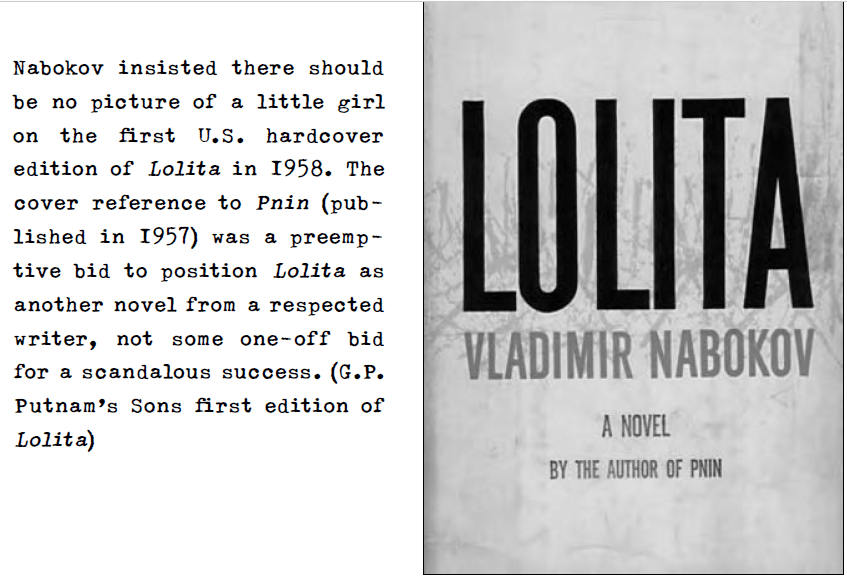
A grande ironia é que eu tenho um exemplar de Pnin em português com a seguinte chamada de capa: do mesmo autor de Lolita!

Tensions between fact and fiction, real names and aliases, evocation and invention, description and advocacy, confession and fantasy not only run through Lolita from start to finish but also precede and postdate the novel in a sometimes extraordinary series of foreshadowings, overlaps, and echoes.”

2. CASEBOOKS AND FANTASIES: Dolores Haze’s oft-told tale

by casting himself alongside poets like Dante and Petrarch—not to mention Edgar Allan Poe—Humbert Humbert seeks somehow to glamorize his wretched appetites by implying that his perversion is one to which artists and visionaries are particularly susceptible.

When Humbert makes a passing reference to Dante’s ‘love’ for the child Beatrice, he is being entirely misleading, implying that Dante Alighieri was an adult when he met the 8-year-old Beatrice Portinari in 1274. Since Dante was only 9 at the time (and there is no historical record of an affair between the couple at any point anyway), this is a dishonest ploy, to say the least. His Francesco Petrarch reference is even less persuasive, asserting that Petrarch fell madly in love with Laureen when she was a fair-haired child of 12. The poet was 23 when he first became enamored of the mysterious Laura in Avignon’s Église de Sainte Claire during the spring of 1327. Although evocatively immortalized in Petrarch’s verse, historically speaking Laura remains an entirely unknown quantity. It is only some scholars’ guess that she was in reality one Laura de Noves, the wife of Hugues de Sade. And even if this were true, then she was not only already married but also a mere 6 years younger than Petrarch, making her 17 at the time of their meeting in that French church.” “Humbert is, however, quite right when he says that Virginia Clemm was only 13 when she married her 27-year-old cousin, the poet and mystery writer Edgar Allan Poe, in 1836.

Poe is something of an éminence grise always present in the shadows of Lolita. Humbert appropriates his first name as a decorative addition to his own when the fancy suits him (‘Edgar H. Humbert’ is how he signs in at the Enchanted Hunters Hotel).”

Poe’s 1849 poem Annabel Lee supplies the plot and the seaside imagery, as well as the girl’s name for young Humbert’s ill-fated affair with his half-English, half-Dutch Annabel in the fateful summer of 1923.” “In Poe’s poem Annabel finally succumbs to a fatal chill right there in their ‘kingdom by the sea’. Death also overtakes Humbert’s Annabel, but not until after they have parted, and not in the Riviera sun—not until 4 months later when she dies of typhus in Corfu.”

Neither the angels in Heaven above,

Nor the demons down under the sea,

Can ever dissever my soul from the soul

Of the beautiful Annabel Lee.” E.A.P.

Leaving Humbert’s own very selective literary and historical apologists to one side, we may, to use a Humbertian turn of phrase, ‘tom-peep’ into the lives of a few more proto-Lolitas. The sexual appetites of Charles Lutwidge Dodgson, who under the name of Lewis Carroll found lasting fame as the author of Alice’s Adventures in Wonderland, remain mired in ambiguity (the book was translated into Russian, incidentally, by a young Vladimir Nabokov, a daunting task for which he allegedly received the equivalent of $5).”
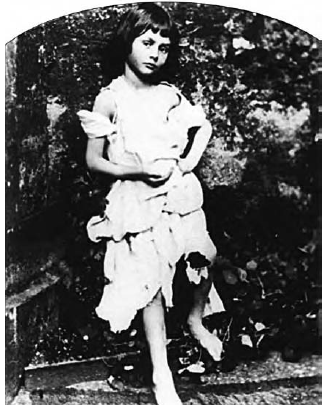
A verdadeira Alice Lidell, que não era loira, como muitos pensam.

Dodgson died a bachelor in 1898, his reputation intact, perhaps because his fondness for young children was more commonplace than we might like to think and existed in an ambiguous Victorian moral climate where even honest attempts to protect children were based upon a very formal concept of sexual purity. In his book Child-Loving: The Erotic Child and Victorian Culture, James R. Kincaid went so far as to link our contemporary cultural preoccupations with pedophilia back to 19th-century ‘child protection’ reforms that took the form of compulsory schooling, age of consent laws, and the formation of anticruelty societies.”

Early in the 20th century came one of Lolita’s almost forgotten progenitors. She was not famous at first and only attracted widespread attention in recent years—and then only because of the existence of her more famous successor. Heinz von Eschwege, a German author who wrote under the pen name of Heinz von Lichberg, invented his Lolita in 1916 in a short story of that name, which, in Carolyn Kunin’s English translation, runs to a little under 350 words. The coincidences beyond the title name are surprising, even though von Lichberg’s tale is very unlike Nabokov’s and his short but convoluted narrative resembles a set of those hollow Russian dolls that keep revealing ever smaller replicas of themselves stashed within. It begins with an account of a social gathering in Germany at which a professor tells the assembled company a story drawn from his own experience (or perhaps his reveries, he freely admits). This story is characterized by dreams and supernatural trans-generational coincidences. The German professor, traveling in Spain, is introduced to an Alicante innkeeper’s daughter called Lolita, who ‘by our northern standards . . . was terribly young. . . . Her body was boyishly slim and supple and her voice was full and dark. But there was something more than her beauty that attracted me—there was a strange mystery about her that troubled me often on those moonlit nights’. The couple have a sexual encounter and a brief affair and then part, but the story is really about the narrator’s strange nocturnal fantasies that began at home in southern Germany and, in the light of his subsequent meeting with Lolita, seem to have let him glimpse mysterious

events from the history of her family, the female line of which is apparently doomed to suffer madness and death shortly after giving birth. The story is essentially a curio, but its rediscovery naturally raised the question of whether or not Nabokov—who actually lived in the same Berlin district as von Eschwege in the mid-1930s—could have read it and been influenced by it, however subliminally.”

Dmitri Nabokov claims any influence is unlikely since his father hardly read German at all at the time. Even so it is eerie to think that Dolores Haze, conceived in Mexico, might have had a spiritual ancestor with Hispanic connections, a woman famous for her reputation for tempting men and someone for whom pregnancy would mean inevitable death.

Hindsight is a fine thing, and it is sometimes possible to see patterns and connections where none exist. The question of what, if anything, Nabokov owed to von Eschwege caused a literary stir when the first Lolita was unearthed and subsequently discussed in Michael Marr’s book The Two Lolitas. Marr, however, concluded that ‘nothing of what we admire in Nabokov’s Lolita is already to be found in the tale; the former is in no way deducible from the latter’.

A more questionable although undeniably fascinating claim of inspiration came from Charlie Chaplin’s biographer Joyce Milton, who maintained in her biography Tramp: The Life of Charlie Chaplin that Chaplin’s 1924 marriage at the age of 35 to 16-year-old Lillita Grey was Nabokov’s real inspiration. The name ‘Lillita’ is certainly a temptation to rush to judgment (after one film appearance as Lillita McMurray, the young actress in question later variously appeared as Lita Grey and Lita Grey Chaplin).”

Curiosamente:

lilt (ENG) (subst. ou verbo) alto-astral, animado, eufórico.

It is hard to see any real parallels between Humbert and Chaplin, apart from their shared ‘Europeanness’ and the latter’s well-known fondness for very young girls, a tendency that, like Charles Dodgson, he seemed to always find convenient to believe was essentially innocent and nonsexual.”

Imagine this kind of thing: an old dog—but still in his prime, fiery, thirsting for happiness—gets to know a widow, and she has a daughter, still quite a little girl—you know what I mean—when nothing is formed yet, but already she has a way of walking that drives you out of your mind. A slip of a girl, very fair, pale, with blue under the eyes—and of course she doesn’t even look at the old goat. What to do? Well, not long thinking, he ups and marries the widow. Okay. They settle down the three of them. Here you can go on indefinitely—the temptation, the eternal torment, the itch, the mad hopes. And the upshot—a miscalculation. Time flies, he gets older, she blossoms out—and not a sausage. Just walks by and scorches you with a look of contempt. Eh? D’you feel here a kind of Dostoevskian tragedy?” Nabokov, Dar (The Gift)

Almost immediately after the completion of Dar, in Paris in the autumn of 1939, Nabokov wrote his Russian novella Volshebnik (The Enchanter), which uses the first part of the above narrative premise. Unpublished, the story was assumed lost after Nabokov and his family relocated to the United States in 1940 (in point of fact the author mistakenly recalled destroying it). Unexpectedly, Volshebnik resurfaced among some papers in February 1959, and its author, more often than not a man impatient with his own failings as a young artist, found himself not entirely displeased by the rediscovered piece.

I have reread Volshebnik with considerably more pleasure than I experienced when recalling it as a dead scrap during my work on Lolita, Nabokov wrote in a letter” “(It was not to appear until 1986, almost a decade after Vladimir Nabokov’s death, in a translation by his son, Dmitri.) The original Russian version was at last published in 1991, half a century after it was written. Unlike Lolita, Volshebnik is easily summarized: A middle-aged pedophile marries an ailing woman in order to be near her 12-year-old daughter. When the woman finally dies he takes the girl on a vacation, planning to establish a sexual relationship with her over time while dressing up this protracted seduction as a game of make-believe. In their hotel room, however, he is too impatient and fondles her once she goes to sleep. When she awakes and begins screaming, the man knows all is lost and runs panic-stricken from the hotel in suicidal search of ‘a torrent, a precipice, a railroad track’. A thundering, heavy vehicle obligingly supplies the deus ex machina and the story’s ending. Compared to the infinitely richer Lolita, Volshebnik seems a rather mechanical trifle and, although beautifully written and translated, does not make us care much about any of the participants in Nabokov’s miniature Dostoevskian tragedy. Only in the occasional fleeting detail does there seem to be any live connecting tissue to Lolita, as in the introduction of Volshebnik’s nameless nymphet (who incidentally shares Lolita’s pale gray eye color) in a park on roller skates. She is ‘leaning well-forward and rhythmically swinging her relaxed arms’

SAN JOSE, Calif., March 22—(AP)—A plump [rechonchuda] little girl of 13 told police today she accompanied a 52-year-old man on a 2-year tour of the country, in fear he would expose her as a shop-lifter.

The girl, Florence Sally Horner of Camden, N.J., was found here last night after she appealed to Eastern relatives ‘send the FBI for me, please?’

Her companion, Frank La Salle, an unemployed mechanic, was said by County Prosecutor Michael H. Cohen in Camden to be under indictment for her abduction.

Officers said the girl told them La Salle had forced her to submit to sexual relations.

The nice looking youngster, with light brown hair and blue-green eyes, attributed her troubles to a Club she joined in a Camden school. One of the requirements, she said, was that each member steal something from a 10-cent store.

She stole an article, she related, and La Salle happened to be watching her. She said he told her he was an FBI Agent; that ‘We have a place for girls like you.’

Sally said she went away with him, under his threat that unless she did, he would have her placed in a reform school.” Associated Press, 1950

Nabokov uses an even more devious documentary device when he has Humbert refer to and relate another true-life crime of the day, that of G. Edward Grammar, a 35-year-old New York office manager arraigned for murdering his wife and trying to make her death look like a car accident.”

A creative writer, Nabokov wrote in his own memoir, Strong Opinions, must study carefully the works of his rivals, including the Almighty.”

Automobiles, it turned out, were clearly bad news in the short, sad life of Sally Horner, because less than 2 years after her liberation from Frank LaSalle’s mobile prison, she was killed in an unrelated road accident.”

So Sally Horner’s case brought the 20th-century casebook history of real-life pedophilia up-to-date with the time frame of Lolita, even overtaking the action by a couple of years.”

The world’s news media still intermittently highlight certain such cases. A 10-year-old Japanese girl, Fusako Sano, was kidnapped and held captive by Nobuyuki Sato for 9 years, from

1990 to 2000. Teenager Tanya Kach, of Pittsburgh, Pennsylvania, was confined against her will at the home of 37-year-old Thomas Hose from 1996 to 2006.”

Natascha Kampusch, born in 1988 in Austria, grew up fatherless like Lolita even though her mother, Brigitta Sirny, did enjoy a fairly stable relationship with another man. When Natascha was 10 she was abducted while walking to school alone after an argument with her mother (shades of Charlotte Haze’s daily domestic battles with her daughter). Her abductor, Wolfgang Priklopil, imprisoned her in a small, secretly constructed room in his house for most of the 8 years of her confinement. Although she refused to discuss ‘personal or intimate details’ after she finally escaped in 2006, the tacit assumption is that Priklopil used her as a sex slave, and Kampusch did admit to a media advisor, although not in front of the TV cameras (hers was a very structured reintroduction to society), that Priklopil beat her badly from time to time. Perhaps of particular interest to those unimaginative souls who persist in seeing Lolita’s dull cooperation with Humbert’s exploitative regime as complicity pure and simple is the fact that Priklopil once took his prisoner on a skiing holiday in Vienna and would even take her shopping occasionally. The complexities of their enforced relationship are still not fully explained and may eventually yield some awkward truths, but in 2006 the case provided an eerie echo of both Sally and Lolita, neither of whom could ever have been guarded night and day, every day, but both of whom somehow lacked the spur or spirit to escape their captors until much later than they might have been expected to do. This phenomenon now has a name, courtesy of a 1973 bank siege at Norrmalmstorg, Stockholm, Sweden, in which the robbers held employees hostage from August 23 to August 28.”

Natascha Kampusch’s wild escape through suburban gardens and streets, during which she completely failed to interest anyone she met in her plight, has itself a dark Nabokovian tinge of farce”

3. A VERY 1950s SCANDAL: Hurricane Lolita

For a time, 20th-century America did have a written moral code, and although it was intended to control only the movies, it reflected much broader establishment concerns about the general threats posed by artists to society in general. It was the Motion Picture Production Code of 1930, better known as the Hays Code, named for ex-Republican politician and ex-postmaster general [president dos Correios] Will H. Hays, who was appointed the first president of the Motion Picture Producers and Distributors Association and therefore became the nominal father of the code. The Hays Code was bold enough to set down its guidelines and exclusion zones in full literal foolishness. Although it was in operation for only 30 years or so, the code neatly set out the establishment view of what was thought admissible to depict—at least on the screen—during the period leading up to and beyond the time of Lolita’s publication.”

Though regarding motion pictures primarily as entertainment without any explicit purpose of teaching or propaganda, producers know that the motion picture within its own field of entertainment may be directly responsible for spiritual or moral progress, for higher types of social life, and for much correct thinking.” Mais lendária que a mula sem-cabeça essa mitologia hollywoodiana ianque!

The sanctity of the institution of marriage and the home shall be upheld. Pictures shall not infer that low forms of sex relationship are the accepted or common thing.” Este é o mundo livre que venceria os comedores de criancinhas soviéticos!

Sex perversion or any inference to it is forbidden”

Miscegenation (sex relationships between the white and black races) is forbidden.”

Children’s sex organs are never to be exposed.”

His moral reign, however, happened at a time when image was deemed less important than it is now; one parenthetically wonders whether saturnine [sardônico] 50s TV personality Ed Sullivan would even get a job reading the local news in front of today’s cameras.”

So Hays became the unlovely and unloved poster boy of a notorious code that was often booed when a summary of its principles appeared on the movie screen prior to the feature film—hardly the sign of a regulatory body in touch with the public.

The code was right about one thing, however: books, for whatever reason, were indeed somewhat ahead of movies in the frankness stakes, even if James Joyce’s Ulysses (1922) did run into censorship trouble in the United States during its prepublication serialization in The Little Review magazine. The finished novel was duly banned from U.S. publication until the 1930s, when Random House finally engineered the importation of a French edition with the full knowledge that it would be seized by customs. It was, and the ensuing trial—United States v. One Book Called Ulysses¹—resulted in U.S. District Judge John M. Woolsey ruling that the book was not pornographic and so could not be classed as obscene.”

¹ Essa forma de batizar julgamentos em que o réu ENFRENTA O ESTADO NOMINALMENTE sempre me soou como a coisa mais babaca do sistema judicial gringo. E, voilà, o irlandês deu um direto na fuça do Tio Sam!

Scandalous writing of a less high-flown sort next tested the would-be book banners and came in the shape of Kathleen Winsor’s proto-bodice-ripper Forever Amber (1944), which immediately stimulated a popular appetite for erotic fiction. Her impressively researched book was set in Restoration England and concerned a female social climber with a pragmatic moral sense and an eye on bedding the king; it triggered several charges of pornography and calls for bans across America. The Massachusetts attorney general found in it 70 instances of sexual intercourse, 39 illegitimate pregnancies, 7 abortions, 10 descriptions of women undressing in front of men, and many ‘miscellaneous objectionable passages’, and so prosecuted.”

the Massachusetts Supreme Court eventually concluded that Winsor’s historical research was thorough and resulted in an honest portrayal of the mores of the time and place in which the book was set.”

In 1946, literary critic Edmund Wilson published his second book of fiction, Memoirs of Hecate County. Wilson was at the time a friend and supporter of Vladimir Nabokov, although eventually the two men of letters would fall out, partly over Wilson’s low opinion of Lolita. Published by Doubleday, Memoirs of Hecate County received good reviews and sold almost 60,000 copies before the Society for the Suppression of Vice [vice fuder!] brought suit against the publisher in July 1946, on the grounds of objecting to a number of frank but otherwise unexceptionable heterosexual sex scenes.”

Will H. Hays, who died in 1954, might well have entered his grave already spinning after learning that according to Kinsey and his team at their Institute of Sexual Research, sexual orientation was a far more complex issue than The Adventures of Ozzie and Harriet¹ might have Middle America believe.”

¹ “The Adventures of Ozzie and Harriet is an American television sitcom, which aired on ABC from October 3, 1952, to April 23, 1966, and starred the real-life Nelson family. After a long run on radio, the show was brought to television, where it continued its success, initially running simultaneously on radio and TV. It was the longest running live-action sitcom in television history until It’s Always Sunny in Philadelphia replaced it on May 26, 2020, when that series got renewed for a 15th season. The series starred the entertainment duo of Ozzie Nelson and his wife, singer Harriet Nelson, and their sons, David and Ricky. Don DeFore had a recurring role as the Nelsons’ neighbor ‘Thorny’.”

Whatever the validity of Kinsey’s methods and statistics—and these were certainly controversial—the very fact that such taboos were being discussed openly seemed to cause as much outrage as the findings they unearthed. Surely America did not behave like this behind closed doors—and if it did, surely no one should ever talk about it so frankly.”

With its lively litany of social injustice, murder, adultery, and abortion, Peyton Place would remain on the New York Times’ best-seller list for over a year and seemed to mark an emphatic rejection of any hopes of art encouraging ‘correct thinking’. One episode in Metalious’ novel originally had a character named Selena Cross murder her father because he had been sexually abusing her for years. The real-life inspiration was 20-year-old Jane Glenn, a New Hampshire girl who, in 1947, confessed to the same crime—and to burying the corpse beneath a sheep pen with the help of her younger brother. Metalious’ editor changed Selena Cross’ victim to stepfather, feeling that murder was acceptable but incest was a vice too far. This assumption finds an echo in Humbert’s own moral prioritizing when he notes from his prison cell that, sitting in judgment on himself, he would dismiss the murder charge and give himself at least 30 years for rape.

Before the American public would be allowed to read these words and the rest of Lolita, Nabokov’s book would have to make its way through a maze of obstacles. When it had done so, it unleashed a scandal to overshadow all of its recent predecessors. Since it involved scholarly, retiring 59-old Vladimir Nabokov (a man whose substantial body of fiction contained no obscene words and bore eloquent testimony to his total indifference toward books with social or moral messages), it was somehow fitting that this chronicler of unexpected coincidences and unintended consequences should find himself at the center of an international uproar about morality, social responsibility, and obscenity. Nabokov had placed at the heart of his greatest novel something that Joyce had not touched upon and Hays had not even dared to articulate in order to forbid: pedophilia.

The journey toward scandal was slow and complex. Lolita’s first publishing house, the Paris-based Olympia Press, had been inherited by Maurice Girodias from his father, who had published Henry Miller’s Tropic of Cancer and Tropic of Capricorn in the 1930s. Girodias junior, falling on hard times in 1953, resolved to make money by publishing, in English, every book he could acquire that had fallen foul of Anglo-American censorship. The censor’s thumbs down was his only criterion; good, bad, or indifferent, if it had been banned, Girodias wanted it. To be fair, Girodias had also published some respectable authors (including Lawrence Durrell, J.P. Donleavy, and Samuel Beckett) and at least one notable piece of erotica, L’histoire d’O by Anne Desclos (who wrote such books either anonymously or pseudonymously as Pauline Réage while enjoying rather a good reputation under another literary pseudonym, Dominique Aury). Nabokov, however, knew little of Girodias and was guided by his French agent and friends in Paris. Since Girodias had until recently owned another imprint, a prestigious art book subsidiary called Éditions du Chêne, this further seemed to enhance his reputation as a serious publisher. So when he offered to publish Lolita, Nabokov (who had already had the novel rejected by Viking, dubbed ‘pure pornography’ by Simon & Schuster, and further rejected by 3 more American publishers) jumped at the chance.”

The final 3 months of 1955 were stressful for the author, who, having just recovered from a serious bout of lumbago, was now having difficulty finding a publisher for his next novel, Pnin (or My Poor Pnin as it was titled at the time).”

In December of the same year the French Ministère de l’Intérieur banned 25 English-language Olympia titles, Lolita among them.” Mal tinham sido salvos dos nazistas e já andavam tão ingratos!!

The French press was immediately up in arms at what it saw as a betrayal of France’s traditional cultural freedom; it identified Nabokov’s book as the true cause of the blanket ban and, by January 57, had elevated the legal dispute into ‘l’affaire Lolita’.”

France’s highly regarded publishing house Gallimard arranged to publish a French-language edition, which would be very well received—a particular fan was Raymond Queneau, a longtime Gallimard employee whose own linguistically playful novel Zazie dans le métro (1959) would transpose something of Lolita’s nymphet feistiness to another little girl, this time in a Parisian setting.”

Lolita took off, selling 100,000 copies in 3 weeks. When Putnam’s took out an ad in the New York Times Book Review of August 21, there was no shortage of rave reviews to cite. Graham Greene, William Styron, and Lionel Trilling all praised it fulsomely, and even Dorothy Parker seemed to acknowledge that for once her tendency to deploy her vitriolic wit even when reviewing things she liked had no place here. ‘A fine book, a distinguished book—all right, then—a great book’, she wrote.”

“‘V. serenely indifferent’ was Véra Nabokov’s diary entry about her husband’s reaction to finally hitting the commercial jackpot after a lifetime of poorly paid literary toil.

Lolita was never prosecuted in the United States, a source of great satisfaction to Nabokov, who passionately loved his adopted homeland. Ironically, the many delays to publication had probably helped matters since the incremental efforts of many liberal-minded publishers had recently contributed to a more mature climate surrounding literary censorship.” “As soon as the Cincinnati Public Library banned it, Lolita immediately reached the top of the best-sellers list. When the Los Angeles Public Library was ‘exposed’ for circulating a copy, the only result was a boom in sales of the book in California. The Texas town of Lolita gravely debated whether it should change its name to Jackson, presumably in case it was mistaken for a little girl.” HAHAHAHAHA!!!

Again America was absorbing something controversial into its popular culture instead of subjecting it to a witch hunt. Mainstream comedians all had a Lolita gag, the unspoken basis of the joke being that Lolita was a dirty book.” Imagina o DE NÓBREGA mandando essa!

I’ve put off reading Lolita for 6 years, till she’s 18.”

Groucho Marx

All this playfulness marked the beginning of Lolita Haze’s disparagement; the advance guard of what would prove to be a legion of faux Lolitas would soon start to emerge. Perhaps the very first was the ponytailed little girl who, incredibly, on Halloween came to the Nabokovs’ door looking for treats while dressed (by her parents!) as Lolita; the famous name was spelled out on a sign she bore and—even more sinister, since it betrayed a detailed knowledge of the book—she carried a tennis racket. Nabokov was quite shocked. If only he had known what lay in store for his nymphet.” Esses pais são o que eu chamaria de the original pranksters!

Nabokov had sold the film rights of his book to James B. Harris and Stanley Kubrick, so now Lolita Haze and Humbert Humbert were about to make the fraught transition from what Hays had called ‘the cold page’ to embodiment by ‘apparently living people’. For a middle-aged actor to impersonate Humbert might be seen as no more than a risky professional challenge, but for a prepubescent girl to embody Lolita on-screen looked like a decidedly dangerous prospect. We may charitably assume that Nabokov’s otherwise absurd suggestion that a ‘dwarfess’ be hired to play Lolita was simply a comment designed to avert any charge of being implicated in the corrupting of a living, breathing child. He had no need to worry; others would take care of the corrupting. They had been doing it in Hollywood for years.”

4. LOLITA IN MOVIELAND 1: Little Victims and Little Princesses

As with Dickens’s Little Nell, Little Emily, and Little Dorrit, that emotionally loaded word ‘little’ was to feature frequently in the promotional screen name of many a child actress (Little Mary Pickford and Little Blanche Sweet, for example), as well as in the titles of their films (The Little Princess, Little Annie Rooney, The Poor Little Rich Girl, and so on). Usually helming these enterprises and guiding their young stars’ careers were 40-something men about whose sexual inclinations we are entitled to wonder.”

it was pointed out as long ago as 1920, in the movie magazine Photoplay, that the father of film D.W. Griffith seemed to have an ‘obsession with scenes in which women and girls are beaten or attacked’.” “As in the case of Alfred Hitchcock’s well-known obsessive tendency to put his ice-cool blonde heroines through the physical or emotional mill, it could be that Griffith’s fixation was nothing more than the public sublimation of dark fantasy. He is now best remembered for directing the sprawling epics Birth of a Nation (1915) and Intolerance (1916), but Griffith also has the distinction of giving the movies their first recognizable prototype nymphet. To be sure, his version was a composite model, most often portrayed by Lillian Gish¹ and later played by actresses like Carol Dempster, Colleen Moore, and Mae Marsh, but it had been Griffith’s idea to create the character in the first place. He was certainly not alone in his interests.”

¹ Algum parentesco com Annabeth Gish? De qualquer maneira, Lillian viveu 100 anos (!) e começou a carreira de atriz já maior de idade. Dedicou ¾ de sua longa vida às telas!

In his Foolish Wives (1922), Stroheim’s character fakes love in order to try to seduce his maid, an ambassador’s wife, and a simpleminded 14-year-old girl (reenter the damaged little girl stereotype).”

In Queen Kelly, Stroheim directed like a man who knew that this might be his last film, and at one point Gloria Swanson had to cable Joe Kennedy, begging him to come and stop the ‘madman’ who was blowing the budget. Needless to say, Kennedy’s financial investment in the movie did not pay off, although it did allow his 32-year-old mistress to play convent girl Kelly, a lead part for which she was clearly far too old.”

Only one actress had miraculously spanned the entire life of the phenomenon, sustaining a little girl image that began under the guidance of D.W. Griffith in 1909 and served her well for the next 20 years. She was Gladys Marie Smith from Toronto, Canada, reinvented as Little Mary Pickford for the American movies, a highly durable nymphet who, professionally at least, would have laughed at Humbert’s age boundaries of 9 and 14.” “When her legions of loyal fans were asked by a movie magazine in 1925 whom Little Mary should play next, Alice in Wonderland and Heidi were among the top choices.” “Her protracted adult depiction of a childhood that she had never personally experienced now looks rather grotesque, and her performances come over as skillful but cloying [enjoativas] and arch [velhacas, com o perdão do trocadilho]. To her credit, Pickford did not think much of them herself (‘I can’t stand that sticky stuff’), and by the start of the 30s she knew it was all over. Her fans would simply not let her grow up. When she had the temerity to bob her hair in 1929 they had been outraged.”

By the 30s Dickensian waifs [magricelas dickensianas seria a tradução mais próxima] were on their way out. Adults impersonating children were also passé, but children impersonating adults were becoming very popular indeed. In This Is the Life (1935), 9-year-old Jane Withers mimicked Marlene Dietrich’s knowing top-hat-and-tails routine from Blonde Venus with disturbing skill.”

One scene in the movie Gold Diggers of 1933 features a midget, Billy Barty, disguised as a child of indeterminate sex, lasciviously raising a translucent curtain that has previously been displaying only the shapely silhouettes of scantily clad showgirls.”

The camp charm of a movie like 42nd Street (1933) is still enjoyable today, but our indulgent smile fades when the young ‘Chubby’ Chaney passionately kisses a cardboard cutout of Greta Garbo stationed in a movie theater lobby in a 1931 Our Gang two-reeler.”

It was Shirley Temple who set the standard, whether, at 5 years old, impersonating Marlene Dietrich (incredibly redubbed ‘Morelegs Sweettrick’) in Kid in Hollywood, a 1933 Baby Burlesk short, or matching top adult dancers step for step as she became a seasoned trouper of 8 years. Temple was not a nymphet, and neither were her contemporary child stars for that matter, but her precocity still posed an unsettling question about the sexual implications of the burlesque this particular baby was putting on. It was a matter that no one dared to raise in public until 1937.

Graham Greene’s infamous review of the 1937 Shirley Temple movie Wee Willie Winkie in the urbane but obscure British magazine Night and Day cast an intentional slur on a star Hollywood promoted as the embodiment of innocent cuteness. (…) He wrote that 9-year-old Temple displayed ‘a certain adroit coquetry which appealed to middle-aged men’.”

A swift libel suit by Twentieth Century Fox was successful and subsequently bankrupted the magazine, although it did little lasting harm to Greene, who swiftly decamped to Mexico, wrote The Power and the Glory, and, nearly 20 years later, became the first literary champion of a sensational American novel featuring a middle-aged man with a fatal taste for nymphets.

Greene’s trenchant observations about Temple’s sexualization were well founded but perhaps poorly targeted. Wee Willie Winkie was, after all, only one in a flood of similar films that adhered to a familiar convention, and it was perhaps selected for Greene’s critical attention simply because it was directed by John Ford, already regarded as a serious director. On the other hand, Greene already seemed familiar with Temple in Captain January, which boasted a less exalted directorial hand.

The child-star movies of the 30s can be partially excused because they were part of a general climate in which the sexual tensions between middle-aged men and much younger women or girls were broadly accepted as moral-free dramatic conventions of the time.”

The Major and the Minor (1942) was something of a wild card for the period, revisiting the silent cinema’s adult-imitating-a-child convention but this time seen through the caustic eye of Billy Wilder. Wilder was an Austrian expatriate who in many ways shared Stroheim’s dark perspective but usually managed to channel it into very funny if sometimes cruel satire. The Major and the Minor revolves around mid-western innocent Susan Applegate (Ginger Rogers), who needs to get home to Iowa from New York but cannot afford the train fare. Disguising herself as a 12-year-old in order to travel half price, she becomes involved with a short-sighted military man (Ray Milland) who finds himself strangely drawn to her. She feels the same, and the playing out of this apparently illicit romance lets Wilder have it both ways. The movie remains a very funny, out-of-time curio.

Otherwise, by the 1940s, the child-star syndrome had itself started to give way to a new type—adolescent girls who were sweet but not provocative, resourceful but not rebellious.” “Temple was the first to discover her babyish talent might not be automatically parlayed into puberty and beyond. She never really made it past 12 and was finished by the time she was a teenager. Elizabeth Taylor, Judy Garland, and Deanna Durbin personified the older girl-child stereotype, more demure but certainly not without an appeal to middle-aged men” “Garland, meanwhile, brought a no-nonsense, clean-pinafore [vestido feminino] charm to many films spanning the 30s and 40s. She might have been the least sexy of that particular trio, but it was 14-year-old Garland upon whom MGM decided to bestow a crush for their 35-old leading man Clark Gable.” “Garland’s blossoming figure was strapped down and she was given diet pills, so starting her out on a lifetime of drug dependency that would end in despair and death at 47. Durbin tried to make the transition to adult actress without success, despite her considerable beauty, and her career did not last beyond the 1940s; she went on to enjoy a long life away from Hollywood. Only Taylor made the breakthrough to an adult career, leaving behind a veritable menagerie of costars—dogs, horses, cats—as well as those men of a certain age. She had always looked older than her years, and her beauty when young was legendary.”

With the sweeter adolescent girls taking over in the mainstream family entertainment movies, it was left to these shadowy crime movies to give house room to the occasional Lolita of the day, and those characters were usually one-offs—kid sisters or daughters whom circumstance and their own sex drive put on the horns of a moral dilemma that was usually not the main concern of the movie.”

Errol Leslie Thomson Flynn started life in Hobart, Tasmania, and was something of an adventurer before he arrived in Hollywood by way of the provincial British stage in 1935. The 1940s proved to be Errol Flynn’s golden decade, and he appeared in a series of swashbuckling period movies that included The Adventures of Robin Hood and The Adventures of Don Juan while living the life of the Hollywood playboy to the hilt. Good-looking and with a rakish good humor, he enjoyed enormous success—indeed, it would be hard to find anyone who enjoyed it more. His taste for underage girls was well known around town and eventually well known in the world’s tabloids. Two teenagers, Peggy Satterlee and Betty Hansen, accused him of statutory rape in 1942, but Flynn was eventually acquitted after a 21-day trial. Wives came and went, but Flynn’s taste for young girls would continue unchallenged until the end of the 1940s, when he was again involved in a statutory rape case, this time of a 15-year-old girl. Again he was acquitted. Flynn never sought to disguise his tastes, and one of the things that had counted against him in the 42 rape case had been Peggy Satterlee’s evidence that he called her ‘J.B.’ (‘jail bait’) and ‘S.Q.Q.’ (‘San Quentin quail’)—proof, it was submitted, that he knew she was a juvenile. That time he got off because his accusers were eventually shown to be less than inexperienced before they met Flynn, further evidence that men could expect to get away with more than women in such matters.

It seemed the movies’ preoccupation with children and light family comedies was beginning to wane at the end of the 40s. It may have been due to nothing more than overexposure, or it may have been that the sobering experience of World War II—even if that experience was only tasted by some through the movie theater newsreels—had encouraged a taste for grittier fare than recycled Victorian dimples and ringlets.”

Then again, it may have been nothing more than that the postwar baby boom starting to populate America’s homes with large numbers of real children made movies starring unreal children seem suddenly less appealing.”

Marooned in a fairytale world of studio-funded special tutors and voice coaches, and rubbing shoulders with some of the biggest stars of the day, Gloria Jean gave her all to a style of sweet adolescent musical film fantasy that was in terminal decline but the production of which still represented the only reality she had ever known. She might have gotten a reality check from the star of the one bracing film she did appear in—Never Give a Sucker an Even Break (1941), where she played the niece of morose child hater W.C. Fields—but Gloria Jean had started too late, and when the end came it came abruptly. She moved into television and then into obscurity. Soon she was earning a living as a receptionist. The sweet-voiced little movie princesses had not made it into the next decade, and Gloria Jean had been the last one to leave, and it fell to her to turn out the light.”

5. LOLITA IN MOVIELAND 2: “Pedophilia is a hard sell”

From John Huston’s The Asphalt Jungle it looked as if Monroe might progress toward a serious, if limited, acting career. Instead, about half of the 22 films she appeared in during the 50s helped to define her as the ultimate Hollywood sex goddess and one whose erotic charge was indivisible from what would become one of the decade’s chief preoccupations: childish feminine innocence wrapped up in an adult body.”

As Clive James once noted, European movie sirens like Greta Garbo and Sophia Loren might look as if they were unashamedly thinking about sex, but ‘Monroe looked as if sex was something that might easily happen to her while she was thinking about something else’.”

Ginger Rogers is terrific at metamorphosing into a kid, but a childish Monroe does not behave all that differently from the adult model that she was already refining in 1952 and that would soon become iconic.”

Monroe had the 50s version of the damaged little Victorian girl syndrome and projected it with an impersonation of mental vacuity, physical vulnerability, and a constant need for a father figure to look after her. Because hers was an image based on reality, Monroe was the one who caught the public’s imagination; in real life she was a little brighter than she pretended to be on-screen and she could throw off the perilously high heels when she got home, but the deep-seated need for a daddy was genuine and would be evidenced by the men she sought and occasionally married.”

Judy Holliday, who was to die young, reprised variants of Billie Dawn in a handful of less satisfactory films, but her signature performance as a not-so-dumb blonde still stands as a classic example of how to make a cliché live and breathe.”

A few movies tentatively tried to absorb rock ‘n’ roll, but apart from the diverting The Girl Can’t Help It (1956) they were almost without exception embarrassing demonstrations that mainstream movies and rebellious rock were worlds apart.”

The film’s notoriety (emblemized by an iconic still showing Baby Doll (Carroll Baker) wearing the short nightgown that would henceforth carry her name, sucking her thumb, and sleeping on a child’s crib with the slats down) was enough to prompt fainthearted Warner Bros. into withdrawing the film from national release during its pre-Christmas 1956 run. Half a century after the furor it caused, Baby Doll looks better than ever, an edgy mix of comedy and drama, adult sexual promise and adolescent teasing, shadows and sunlight, tragedy and farce, all presented in ravishing black-and-white cinematography.” “In an interesting footnote, when Pennsylvanian Carroll Baker made the trip to Mississippi to star in the film, she found that ‘baby doll’ was a universal form of address for young women there, a sobriquet that seemed to combine the familiar ‘baby’ with a built-in reminder of women’s essentially passive, not to say submissive, role.”

One can only wonder where the Catholic Legion of Decency and all the other right-wing moral guardians were when, in CinemaScope and with a G rating, Maurice Chevalier, a musical Humbert if ever there was one, celebrated the unripe appeal of Caron’s pubescent whore-in-training with his lasciviously delivered song Thank Heaven for Little Girls.”

The Bad Seed marks a groundbreaking Hollywood depiction of the darker side of a female child who uses her stereotypically cute looks and presumed innocence to deceive. Shirley Temple, after all, would never have played a pint-sized ax murderer.”

Made in the same year as the first movie version of Lolita, the original film version of Cape Fear, directed by J. Lee Thompson, featured Robert Mitchum as Max Cady, a vindictive ex-prisoner intent upon exacting revenge from the lawyer who helped to put him away for attacking a woman 8 and a half years before. It contained particularly graphic scenes of Cady attacking both his enemy’s wife and young daughter. (…) Thompson was a lifelong opponent of censorship and battled spiritedly with the American censor who sought to reduce the general violence and tone down Cady’s obvious intention to rape the lawyer’s teenage daughter. Thompson had originally wanted 16-year-old Hayley Mills to play the daughter (‘because she was a very sexual girl’), but ironically enough the very sexual girl was under contract to Disney. Thompson wound up with the rather more anodyne Lori Martin instead. Although far less forthright than Martin Scorsese’s 1991 version of the story (where the daughter actually appears to be aroused by stalker Cady and at one point shares an open-mouth kiss with him), Thompson’s film, aided by a superb Bernard Herrmann score, manages to suggest extreme menace where it cannot be explicit.” “At one point Cady snatches up an egg from a counter and violently crushes it in his fist, spraying yolk and white on his victim’s chest and shoulders and then smearing the mess with the palm of his hand. Not for the first time a determined director discovered that when the censor obliged oblique methods instead of obvious ones, the result could be just as disturbing.”

Everybody would be troubled by the one biggest—and certainly the longest-running—sex-with-a-minor Hollywood story to dominate the headlines since the passing of Errol Flynn. Started in 1977, it centered on film director Roman Polanski, and its reverberations still continue to be felt over 30 years later.” “In a piece of fatal bad timing, the family returned to Poland just before the Nazis invaded; his mother was to die in Auschwitz, his father barely survived another concentration camp, and the young Roman only just escaped the Jewish ghetto. With such a traumatic start to his life, the various tragedies that he was to encounter later are put into a salutary perspective. Even so, when, in 1969, his pregnant wife Sharon Tate was murdered in the most grotesque and sensational circumstances at their house in the Hollywood Hills, Polanski—who had been absent at the time—was totally devastated and entered a phase that saw him shuttling between the United States and Europe until, in 77, he met the 13-year-old Samantha Geimer.”

Perhaps the most revealing of Polanski’s Freudian movies is, however, one of the least known. Variously titled What? and (in a censored U.S. version) Diary of Forbidden Dreams, this 1972 film is nothing less than a loose erotic reworking of Alice’s Adventures in Wonderland, in which young American tourist Nancy (Sydne Rome) has some very strange adventures of her own in an Italian coastal town. A disjointed film even before the censor got at it, What? transforms Alice’s rabbit hole into a strange villa peopled with nightmarish inhabitants, one of whom is a retired pimp played by Marcello Mastroianni. A scene in which he interrogates Nancy with all the logic of the Black Queen and then shackles her wrists to her ankles and whips her with a switch is the main reason this film never received a mainstream theatrical release and is still little seen; the handling of the scene is kinky and jokey, and its presence offers further evidence that Polanski’s sexual ideal was a young girl upon whom male dominance could be played out in ritualistic sex games.” Desculpem-me os criminologistas adiantados ou psicanalistas (esses sempre adiantados e sempre equivocados), mas não creio que se possa determinar condição psiquiátrica de perversão sádica e pedofílica via criações artísticas! Estamos em 2008 (data do livro) e isso deveria estar mais claro… Não há relação de causa-efeito entre Polanski diretor e Polanski estuprador, nem “raio X” da vida privada em seus filmes. Antes, como bem antecipou Vickers, o assassinato de sua primeira esposa, sim, foi macabro como uma ficção de mau gosto, esse o paralelo mais visível entre sétima arte e vida real.

Even Polanski’s late-blooming film noir masterpiece, Chinatown (1974), turns on the childhood sexual trauma of Faye Dunaway’s character, Evelyn Mulwray.” Um dos 10 maiores filmes da História. Ainda sobre o “reflexo da vida pessoal nas criações cinematográficas”, tem aquela piada sobre um matemático que lê um romance vanguardista e pergunta ao final: “Mas o que é que isso prova?”.

Once raped by her father (John Huston), she continues to protect the identity of a mysterious young girl called Katherine until, in response to a series of face slaps from Jack Nicholson’s exasperated private eye, she finally answers alternately, ‘My sister. My daughter. My sister. My daughter . . . she’s my sister and my daughter’.” Uma das cenas mais impactantes do cinema.

The implication of the film’s somber ending is that he now wants to gain control of Katherine, his daughter/granddaughter, in order to repeat the abuse” Desculpem o spoiler, mas ainda assim não perderão nada do senso trágico ao assistirem!

Polanski’s version was that Geimer’s mother had effectively entrapped him with a view to blackmail. Fearing that the plea bargain would not be honored, Polanski left the United States before trial, never to return. He is a French citizen, and France has no extradition agreement with the United States. He remains a European director who has never since set foot in the United States or any country that has extradition agreements with the United States.” Um ano depois deste livro, Polanski foi preso na Suíça, porém foi solto em cerca de 2 semanas diante de pendência documental e irregularidades por parte da justiça americana (source: Wikipédia!).

Preteen prostitution featured in Martin Scorsese’s Taxi Driver (1976), with Jodie Foster causing a minor stir with her portrayal of 12-year-old whore Iris Steensma.”

Also in 1976, heavily disguised as a Hitchcockian thriller, came the ultimate daddy’s little girl movie, Brian de Palma’s Obsession. Paul Schrader’s tour de force script has a successful New Orleans businessman lose his wife and young daughter in a kidnapping when he refuses to pay the ransom and a police rescue attempt goes fatally wrong. Ten years later, he meets a girl in Italy who looks exactly like his dead wife. He becomes obsessed with her, they have an affair, and he makes plans to take her back to New Orleans and marry her. Eventually the whole Italian episode is revealed to be an elaborate revenge plan: the born-again wife is actually the daughter who, unknown to everyone, survived the kidnapping and is now intent on exacting revenge from her neglectful daddy. In a Freudian nightmare of a scene, the daughter/lover, played by Geneviève Bujold, is shown toggling between her two roles (high camera angle/low camera angle, little girl’s voice/woman’s voice) during the course of a single breathless walk along an airport corridor. In Schrader’s original script incest took place, but by the time the film was shot and edited, de Palma decided to fudge the issue.”

In 1978, Louis Malle directed Pretty Baby, an ambivalent soft-focus movie in which 13-year-old Brooke Shields went topless as child prostitute Violet in early 20th-century New Orleans. (…) It seems safe to assume that such a movie might not be made today. The photographer, Ernest J. Bellocq (played by Keith Carradine), evokes shades of Charles L. Dodgson and his photographic studies of little girls previously discussed.”

In the late 70s, Woody Allen was in the middle of one of his most productive periods of moviemaking. Critics sometimes argued that he kept making the same movie over and over again, a variable celebration of loves found and loves lost from the same neurotic New York perspective of an intellectual with doubts about everything, especially mothers, psychoanalysis, and Judaism. Even for the most skeptical critics however, Manhattan (1979) represented one of Allen’s most satisfying variants on the theme. With its sumptuous black-and-white photography, Allen’s love affair with New York City featured the usual character list of literati and well-heeled academics but this time introduced a new element, a 17-year-old girlfriend for Allen’s mid-40s character. This age discrepancy is a central concern of the movie, never better highlighted than in the scene where Allen, Diane Keaton, and Michael Murphy are walking down the street having a very pretentious discussion about art while the 17-year-old girlfriend, Tracy (Mariel Hemingway), tags along. ‘What do you do, Tracy?’ asks Keaton’s character suddenly, in the middle of talking about the latest profile she has been commissioned to write for an arts magazine.

I go to high school’, Tracy replies innocently.

Suppressing a smile, Keaton turns aside to Murphy and says in a barely audible undertone, ‘Somewhere Nabokov is smiling, if you know what I mean’.

No one was smiling when, 13 years later, Allen’s relationship with his girlfriend’s adopted daughter was revealed. Now the age difference was 35 years, and the good-natured, liberal Manhattan was suddenly looked at in a new light by a moralizing press and public. It remains, however, one of the few examples of an American movie—a comedy to boot—that takes an adult, bittersweet approach to such relationships.”

Adrian Lyne’s 1997 attempt to cinematize Lolita is discussed in detail later, but in the present context it is worth noting that the thoughtful adaptation written by Stephen Schiff was greeted by a reactionary response that shrieked disapproval long before the film was completed or, in some cases, even begun. It was symptomatic of a new unwillingness to address stories focusing on pedophilia that would persist into the next millennium. The news media’s increasingly emotive and sensationalist treatment of child abuse cases in the 90s had helped to create a popular mood of national outrage at not only any actual instances of pedophilia but also at any film, TV program, play, or book that dared to explore the topic. (…) The resulting film ‘censorship’ was less a case of official proscription, more an informal outcome of a mixture of moral cowardice and commercial timidity shown by movie producers and studio executives who feared that acknowledging child abuse in a movie would automatically result in catastrophic box office returns.”

A vengeful Lolita for the 21st century. In Hard Candy (Menina Má.com, 2005), Ellen Page plays Hayley Stark (a.k.a. thonggrrrl14) who has no intention of becoming the 14-year-old victim of the 32-year-old man who believes he is grooming her on the Internet.” Curiosamente, Ellen virou Elliot – teria algum fundo traumático em sua decisão? Foi Kitty Pride na trilogia X-Men agora clássica. W.: “Page publicly came out as a gay woman in February 2014 and subsequently as transgender in December 2020. In March 2021, Page became the first openly trans man to appear on the cover of Time magazine.”

The twist comes early, when Hayley encourages Jeff to take her back to his isolated bachelor pad where it is she who spikes his drink and then takes him prisoner before subjecting him to a regime of physical and psychological torture based on her conviction that he is a pedophile and a murderer.” “Canadian actress Ellen Page’s stunning metamorphosis from breathless young teen to self-assured psychopath in the space of a couple of hours surely draws a definitive line under those early movies in which youngsters were admired for successfully aping the manners and mannerisms of adults.”

“‘You used all the same phrases to talk about Goldfrapp as they use in the reviews on amazon.com’ Here is a pleasing inversion of Humbert’s aloof tendency to use arcane Eurocentric cultural references, a private lexical amusement arcade that is largely meaningless to Lolita but that identifies Humbert as a man of the world, in every sense.” Hard Candy’s inspiration apparently came from Japanese news reports of girls ambushing men seeking underage dates on the Internet. Their tactic and Hard Candy’s reductio ad absurdum of it looks, in the end, less like female empowerment and more like the sort of warfare that brings both parties down into the mud, so rendering them indistinguishable from one another.”

When Dolores Haze sentenced Humbert to death she did it not with a noose but by accident, through her complete indifference to his late-blooming love and by divulging Quilty’s identity. The melancholic scene where she waves homicidal Dad goodbye one last time from the step of her sad Coalmont home can have only one outcome. Yet Lolita was only ever carelessly, thoughtlessly unkind, whereas thonggrrrl14 (and that snarling spelling, if nothing else in Hard Candy, would surely have been enjoyed by wordsmith Nabokov) is a self-appointed vigilante with a solemn cause, exactly the kind of political character Lolita’s creator famously abhorred.”

6. ON THE ROAD: Lolita’s Moving Prison

Crucial to any understanding of Nabokov’s nymphet is one of the most exuberant parts of Nabokov’s novel: the year-long road trip. This 11,500 word-section comes at the middle of the book and marks the point of no return for Humbert. It also contains some of the novel’s most revealing details about Lolita herself, details that frequently emerge not in the course of one of Humbert’s typically solipsistic character assessments but very much in the margins of their 27,000 miles journey. [mais que a volta ao mundo!]”

On the move, Lolita will not be able to make regular friends (in whom she might confide and thus betray him), and there will be no schools, psychologists, or social workers. Instead there will just be a year in limbo, disguised as a vacation for a child who has recently lost her mother in tragic circumstances.”

It is perhaps tempting to think of this tour—in however debased a form—as being in the general spirit of the Great American Road Trip, that iconic celebration of freedom, optimism, and exploration expressed by driving across a geographically varied nation.” Com efeito, um dos maiores mitos ou lendas urbanas do conto de fadas americano.

As Lolita’s self-appointed jailer, Humbert is in his own way as much a prisoner of their odyssey as she is.”

Henry Miller’s dyspeptic tour of 40s America, The Air-Conditioned Nightmare, amounts to little more than a litany of complaints about capitalism, mass media, rapacious industry, easy credit, misinformation, and what Miller called ‘the divorce between man and nature’.”

Humbert and Lolita’s tragedies are personal ones, not symbolic ones. Nabokov loved America and was distressed by those critics who saw malice or contempt in Humbert’s ironic observations about their ‘lovely, trustful, dreamy, enormous country’. Taylor Caldwell, for instance, praised Lolita but saw it as aiming its destructive fire at the ‘puerile materialistic and sickening fun of the perpetually adolescent American people’.

If Lolita’s road trip has any spiritual cousins, they can be found neither in the political invective of Miller’s prose nor in the morose beauty of Frank’s intentionally bleak photographs but rather in the canon of film noir, where it was almost always personal tragedies that provided the impetus.”

The widescreen color landscapes that would characterize the next generation of Hollywood road-movie fugitives—Butch Cassidy and the Sundance Kid, Bonnie and Clyde, or Thelma and Louise—were something different again.”

Jack Kerouac’s novel On the Road was put together and published at approximately the same time as Nabokov’s Lolita. Both books were begun in 1950. Nabokov’s was completed by the start of 1954 while Kerouac’s would not be ready for press until 1957. Stylistically worlds apart, both novels ended up hitting the headlines in the United States at about the same time.”

Kerouac’s famous book conflated and lightly fictionalized the 1946-50 real-life road trips undertaken by the author and his inspirational buddy Neal Cassady. (By revealing coincidence, Cassady’s interest in an underage girl was one of the things that Kerouac’s circumspect Viking Press editor Malcolm Cowley chose to excise from the manuscript.) Recasting Kerouac as Sal Paradise and Cassady as Dean Moriarty, On the Road expressed in loose, spontaneous prose all the excitement and adventure inherent in breaking the taboos of the day through a series of wild automobile trips dedicated to unrestrained indulgence in sex, drugs, and experimental spirituality. Lolita, by contrast, featured not only elegantly structured prose (the kind Kerouac and Cassady considered sterile) but also a more strategically considered itinerary, one that was designed to divert and restrain a child while camouflaging the sort of taboo breaking that even On the Road’s editor balked at seeing in print.”

the motel cabins change, but the car always stays the same. Long after Lolita has left Humbert, it is in the recesses of the car that painful souvenirs will turn up unbidden: a 3-year-old bobby pin discovered in the depths of the glove compartment after he has found and lost Lolita for the last time filled Humbert with particularly acute pain.”

With no new vehicles to buy it was quite usual for 40s cars to put in uncommonly long service with one owner, gradually becoming familiar, battered, and even anthropomorphized extensions of their occupants.”

Despite Humbert’s bored lack of interest in the American popular music of the day, we learn, by inference, that Lolita favors Jo Stafford, Tony Bennett, Sammy Kaye, Peggy Lee, Guy Mitchell, and Patti Page. This mix does not sit particularly well with Humbert’s assertion that she likes ‘hot, sweet jazz’—these were, after all, mainstream pop musicians, several of whom had hits with smooth metropolitan versions of country songs. Although his loose grasp of genres is quite plausible, Humbert’s boredom with popular music is frustrating; it would somehow have been nice to learn that Lolita sings along to, say, Patti Page’s Confess, and surely even Humbert himself might have found amusing traces of Little Carmen in Peggy Lee’s cheerfully racist ditty Mañana (Is Soon Enough for Me), another jukebox favorite of 1948. We are also told that Lo likes square dancing (no hot, sweet jazz there either), although it is far from clear how Humbert’s strict isolationist regime would allow her to participate in what at the time was essentially a couples community event usually organized by local dance clubs. Perhaps she simply admires square dancing as a spectator.”

Nothing will dispel Humbert’s fear that he will be found out. Even his enduring confidence in the anonymous privacy of the motel cabin proves misplaced when one night he discovers that their sexual activities must be clearly audible in the neighboring room from which there comes, too late, a clearly audible cough. Yet despite such reminders of the danger he courts, Humbert persists with their aimless tour as the seasons change and Lolita grows slowly more indifferent and then hostile toward him.”

Nabokov similarly listened to schoolgirl conversations on buses, pouncing on what, even to a man with his prodigious linguistic skills, must sometimes have sounded like a wildly exotic patois.”

As their Great American Road Trip draws to a close, Lolita is 13 years old, 8 pounds heavier, 2 inches taller, sexually active, reluctantly accomplished at trading physical favors for treats, and well established in the habit of crying herself to sleep on a nightly basis.”

7. TAKE ONE: “How did they ever make a film of Lolita?”

The 1962 film of Lolita was to give the world its first physical incarnation of Dolores Haze. There were some 800 applicants for the job, and sifting through them took producer James B. Harris and director Stanley Kubrick so long as to threaten to delay the start of shooting. Meanwhile, Vladimir Nabokov was vacillating about becoming involved in the reimagining of his own novel for the screen. Director Kubrick and producer Harris had bought the rights to the book from Nabokov for $150,000 (plus a share of the profits) in 1958, and their first attempt to get the author to write a screenplay had come in July 1959; it amounted to nothing. Although tempted, Nabokov turned them down after a discouraging meeting in Beverly Hills during which Kubrick’s concern about censorship—a concern that was in the end to handicap the film considerably—prompted his suggestion that the screenplay might somehow imply at the end of the story that Humbert and Lolita had been secretly married all along. It was an absurd and unworthy idea, but the author’s initial rejection of the screenwriting job stemmed not just from fears of this sort of compromise but from misgivings about his own role. A novelist, not a scenarist, Nabokov was the first to admit that he had comparatively little aptitude for writing for what he called the ‘talking’ screen.

I am no dramatist’, Nabokov conceded in the introduction to his eventually published screenplay, going on to say that if he were he would be a tyrant who demanded control of every single detail of the production, from costumes to sets.”

Despite declining the initial offer, in late 1959 the chronically insomniac author had subsequently been amused to find himself idly cinematizing certain scenes from his novel in ‘a small nocturnal illumination’. When, early in 60, a renewed and improved offer with the promise of a freer hand came from Harris and Kubrick, he accepted. His fee was to be US$40,000 plus an additional US$35,000 if he received sole credit for the script.

On March 1, 1960, Nabokov met with Kubrick at Universal City to map out some scenes in ‘an amiable battle of suggestion and counter-suggestion’. Then on March 9, both men met the frontrunner for the all-important role of Lolita. She came in the shape of 17-year-old actress Tuesday Weld. Nabokov called her ‘a graceful ingénue but not my idea of Lolita’. For once the novelist with a reputation for selecting the exact word to convey his precise shade of meaning had seemingly made a bad choice. Whatever else she was, Susan Ker Weld, initially nicknamed Tu-Tu, and later Tuesday, was not ingenuous. She was born in New York in 1943 and her father died when she was 3. Although the fascinatingly named Lothrop Motley Weld had come from a wealthy Boston family, his widow and 3 children were left with very little money after his death. Susan started working as a child model at an early age and soon became the family’s sole breadwinner. At 9 she suffered (she later claimed) a nervous breakdown, at 10 she began smoking and drinking, at 11 she started to have sex, at 12 she acted on TV, and at 13 she appeared in a small part in Hitchcock’s movie The Wrong Man. She then attempted suicide after embarking on a series of disastrous affairs with a series of much older men, including 44-year-old Frank Sinatra; she was 14 at the time of that relationship. Here—or so the cynic might think—was the perfect proto-Lolita, at 17 already so sexually experienced that she might safely be considered immune to any further corruption if she impersonated Nabokov’s nymphet. It turned out Weld herself felt much the same way but came to a different conclusion. ‘I didn’t have to play Lolita’, she claimed. ‘I was Lolita.’ So she turned Kubrick down, announced a move away from teen roles altogether, and went to study at the Actors Studio. She went on to have sexual liaisons with Elvis Presley, Albert Finney, Terence Stamp, George Hamilton, Gary Lockwood, and a number of other male actors considerably older than herself. Her movie career eventually turned out to be uneven and largely disappointing, even though she did earn some credit for appearing in a number of offbeat or risky movies. Among these were George Axelrod’s bracing satire of teen culture Lord Love a Duck (1966) and Noel Black’s chillingly effective Pretty Poison (1968), a kind of contemporary variant of Bonnie and Clyde in which Anthony Perkins’s lethal sociopath proves no match for Weld’s deceptively innocent-looking all-American high schooler. Eventually her career disintegrated, and despite a 1984 appearance in Serge Leone’s Once Upon a Time in America, Tuesday Weld is most usually remembered as a feisty, gap-toothed, 1960s teen sex kitten, a living precursor of the popular Lolita stereotype. But what if she had played Lolita, one wonders? Would her own wild young life have fused with Lolita’s fictional one to inject some authentic whiff of sex and experience into the role? Or would things have turned out much the same as they eventually did in Kubrick’s film? We cannot know, but it seems a pity that this always-interesting actress was not the first to flesh out Lolita for the screen. She might have been good.”
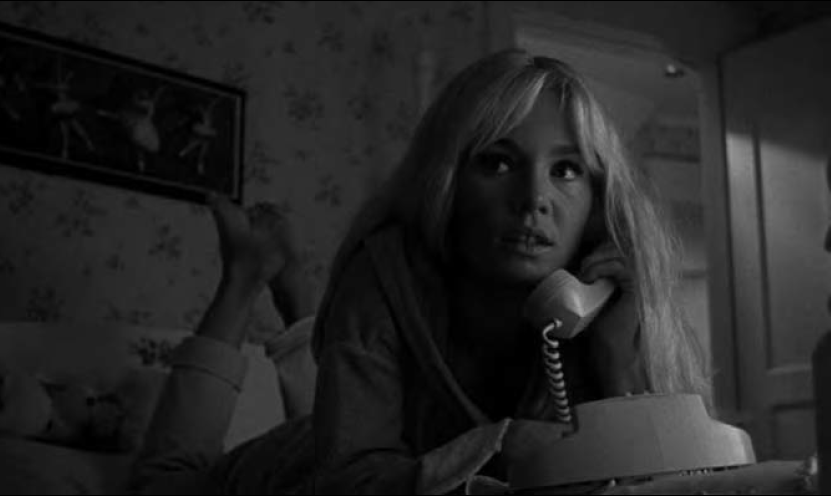
Tuesday Weld

By September 25, 1960, the question of casting had been settled without any further consultation with Nabokov. On that date, at Kubrick’s Beverly Hills house, the director showed the author some photographs of Sue Lyon (‘a demure nymphet of 14 or so’ was Nabokov’s neutral verdict) whom, Kubrick assured him, could easily be made to look younger and grubbier for the part.” “After Kubrick cast her, Lyon issued a conventional kind of Hollywood press release with a few innocuous details about herself: she was ‘just an ordinary, typical sort of grown-up American girl’, she claimed, and playing Lolita, she felt certain, would not change her. As things turned out, it was an optimistic prediction. At 14, Sue Lyon had a pretty face and a shapely figure that combined to give her an intermittently adult look, albeit one so bland that Kubrick had felt the need to reassure Nabokov that this blonde teenager could somehow be dirtied up to resemble his tomboyish, chestnut-haired little girl. She never was, and in most scenes of the film she would look closer to 21 than 12.”

When exactly is Kubrick’s Lolita set? The 40s of the novel? Apparently not. The 50s? The early 60s? In terms of sexual behavior (and quite a lot of other things) these were very different decades, so it is extremely strange not to have the period clearly identified from the start. Kubrick’s film looks strangely adrift in both time and space. While the novel was happy to ‘fictionalize’ place-names as part of its conceit about protecting the innocent, the locales Nabokov created were all diligently observed, and in terms of geography and dates, the book is extremely precise and specific. Those scholars who have taken the trouble to deconstruct Humbert’s many schedules and itineraries have found the novel’s internal topography and calendar to be carefully planned”

In the course of the film it slowly emerges that Kubrick seems to have set the action about 10 years later than the novel—although deducing even this much requires some distracting detective work on the part of the audience.”

Lolita was shot in and around Elstree Studios a few miles north of London.” “This results in the complete absence of any authentic sense of place. In another pragmatic ploy, Kubrick cast an informal repertory of expatriate Canadian supporting actors (Cec Linder, Lois Maxwell, Jerry Stovin, Shirley Douglas, Isabelle Lucas) and so introduced accents that, while not those of old England, hardly suggested New England either. Of course, such practices were not uncommon in low-budget movies of the time, but they were more likely to be seen in modest British supporting features than a high-profile MGM production.”

The embossed legend on the cover of Humbert’s pivotal diary clearly reads ‘This Year’ instead of an actual year (1947, we are specifically told in the novel). Lolita’s begging letter to Humbert is dated with the month and day, yet it too omits the year. Again, this looks like an intentional ploy to be vague. No authentic contemporary popular music is featured at any point in the film, despite Lolita’s jukebox mania that Nabokov so lovingly addressed in the book—all that research into the names of late 40s pop singers. All we get is a rather syrupy Nelson Riddle score, a vapid song, specially written and best forgotten (There’s No You), and an insistent instrumental theme tune that rings out randomly from a radio, a band at the prom, and other places—music in a vacuum to match the ersatz locations. Inevitably, though, there are one or two period clues. Lolita plays with a hula hoop on the Ramsdale lawn (the hula hoop craze dates from 1957) and joins Charlotte and Humbert at a drive-in to watch the Hammer movie The Curse of Frankenstein, also 1957 vintage. [primeiro filme de horror a cores – mas obviamente preto e branco nos frames de Lolita…]”

The film opens with the book’s climax: Humbert’s tragicomic murder of Quilty. We do not know why this urbane English-sounding man (James Mason) has come to a stranger’s ornate and cluttered house to commit a murder, but commit it he does after a series of comic delaying tactics from his victim, played—overplayed, some would say—by Peter Sellers. Buying time, a drugged or drunk Quilty assumes the identity of Spartacus (a nod to Kubrick’s previous film) while wearing a dust sheet as a toga and orchestrates a surreal, one-sided Ping-Pong match. He goes on to approximate the twangy accent of the archetypal old Western sidekick—a Gabby Hayes or a Walter Brennan—to read aloud an accusatory poem that Humbert hands him. The poem is a parody of T.S. Eliot’s Ash Wednesday, and this arcane literary touch, lifted from the novel, surely sits uncomfortably in a mainstream movie. Quilty then puts on boxing gloves and immediately takes them off again when Humbert begins firing his pistol in an unintentional echo of the amateurish marksmanship in the Western movies that he, Charlotte, and Lolita once sat through. Quilty goes on to pretend to compose a song at the piano before making a run for it and finally gets fatally shot while cowering behind a large framed reproduction of an 18th-century portrait of a woman.” “A close-up of the bullet-riddled painting marks the end of a spirited opening sequence that nonetheless denies us any hint of the gory and surreal horror of Quilty’s death as depicted in the book. Nabokov portrays him as an assassinated tyrant, a fallen king who is ‘bleeding majestically’ in his slow retreat to the master bedroom, suddenly developing ‘a burst of royal purple’ where his ear had been. Here his death is, literally, stylized out of sight.”

Much has been omitted, some of it disastrously. We do not see or hear anything of Annabel Leigh, and we learn hardly anything at all about Humbert’s lifelong obsession with nymphets.”

Here she is at last: Lolita made flesh. What, contemporary audiences might have asked themselves, was all the fuss about? Sue Lyon simply looked like a slightly more sophisticated version of Sandra Dee, the blue-eyed blonde who, in her Gidget persona, was the epitome of naughty-but-nice late 50s teen sex appeal. Certainly Kubrick had a vested interest in making his Lolita look as old as possible on the grounds that a teenager was less likely to fall foul of the Production Code Authority than might an ostensible 12-year-old. In keeping with the general calculated vagueness of the film, however, Lolita’s age is never actually given at all on-screen.”

In response to its rhetorical tagline ‘How did they ever make a movie out of Lolita?’ the June 14, 1962, New York Times review supplied a neat and obvious answer: they didn’t. Instead, ‘they made a movie from a script in which the characters have the same names as the characters in the book, the plot bears a resemblance to the original and some of the incidents are vaguely similar’, Bosley Crowther wrote. ‘But the Lolita that Vladimir Nabokov wrote as a novel and the Lolita he wrote to be a film, directed by Stanley Kubrick, are two conspicuously different things’.”

In truth, Nabokov can hardly be said to have written the finished film’s screenplay at all, although he certainly wrote a screenplay, a version of which was eventually published in 1973.”

Knowing the difficulties Kubrick eventually experienced in faking a plausible Ramsdale in England, one can only smile at the alarm he must have felt upon being required by Nabokov’s prologue to simulate the following: the French Riviera, Paris, a voyage into New York Harbor (Humbert, ‘Dramatically Standing on a Liner’s Deck’, sees ‘The towers of New York looming in the autumnal mist’), and a nursing home, a library, and assorted exteriors for the retrospective parade of European nymphets. Kubrick’s solution was to cut the entire prologue and, after Quilty’s murder, begin the story in flashback with Humbert’s arrival at Charlotte’s house 4 years earlier.”

Nabokov, who regarded Kubrick as an artist, was initially very disappointed when he finally saw the movie that used only odd scraps of his screenplay (rumor has it that Kubrick and Calder Willingham cooked up the eventual screenplay between them, but Kubrick would never be drawn on the matter, and it was Nabokov who was nominated for an Oscar for best screenplay).”

Revisiting Lolita now, the viewer may find that Sue Lyon comes out of it rather well, delivering the best and least stagy performance, but the plaudits belatedly given to James Mason’s Humbert, Shelley Winters’s Charlotte, and Peter Sellers’s Quilty seem more generous than accurate. Winters was certainly in top form as the overbearing, sexually frustrated, culturally pretentious Charlotte, but in the end her character comes over as nothing more than a grotesque at whom it is easy to laugh but about whom it is hard to care. Mason, meanwhile, is forced to underplay Humbert with a good deal of dry comedy, as if taking part in a dark sitcom. In the end his Humbert comes over as a good-looking but ineffectual rogue who suffers from occasional bouts of bad temper as he seeks to seduce a pretty teenager while living in a decidedly tense domestic situation.” “Deprived of the novel’s inner voice and hamstrung by a timid script, the actor cannot begin to hint at take one Humbert’s haunted past, his eviscerating humor, his awful sexual obsession, his calculating cruelty.” “There is little doubt that Kubrick’s decision to give Quilty so much screen time and Sellers so little direction imbalances the film badly. A figure that should be a malign, shifting shadow keeps taking center stage and doing cabaret turns.”

He shot Killer’s Kiss himself on location in New York City in 1955, and although it obviously suffered from a very low budget and was forced to use largely unknown actors, most of whom were destined to stay that way, it does contain some fine visual material with bright, monochrome vérité footage of Times Square and dramatic waterfront skylines offsetting the mean warehouses and hotel room interiors. Kubrick explored film noir again in his next picture, the celebrated 1956 racetrack heist movie The Killing, and again seemed very much at home with it. It is a shame that he did not revisit the genre—even in a spirit of parody—for his treatment of Lolita, a novel that positively bristles with both literal and oblique references to such films”

Lyon’s brief 1950s TV apprenticeship seems to have prepared her well to give what is the film’s only truly unaffected performance.” “Ironically, it is in such automobile sequences that she seems closest to Nabokov’s Lolita—because it is those sequences that represent the film’s most conspicuous betrayal of the book after its denial of pedophilia. Incredibly, the novel’s epic road trip, that beautifully evoked yearlong, looping journey to nowhere that forms the centerpiece of the novel, is effectively omitted from the film altogether. Gone is the vast promise of the U.S. highways, the idiosyncrasies of the roadside lodgings, the elegant irony of a perpetually moving prison set in a limitless landscape, and the full rotation of the seasons through August 1947 to August 1948. It is replaced with two shorter trips, each with its own specific destination and each staged here in a series of static tableaux showing Lolita and Humbert sitting in their studio-bound car with only back-projected scenery for context. The first trip is from eastern summer camp to Idaho, where Beardsley College awaits them (the institution has been transplanted from its eastern location in the novel, presumably to enable this revised cinematic schedule); the second is from Beardsley to points south, in what Humbert believes to be a mutually agreed bid to escape to Mexico, although this trip has actually been surreptitiously proposed and stage-managed by Clare Quilty. Here, though, on Elstree’s virtual road, Sue Lyon’s Lolita is at her most plausible and sympathetic. The enclosure of the car, with both passengers in the shot, gives Lyon and Mason a chance to spark off each other at close quarters without distractions. Freed of those aging fashion accessories, Lyon even looks closer to her actual age as she sucks on a soda straw, chews gum, pulls faces, and alternates between bright acquiescence and whining protestation with a palette of expressions that ranges from diffuse prettiness to slack-mouthed vulgarity—probably a pretty good approximation of what Nabokov had in mind. But because we don’t fully grasp that Mason’s Humbert is a pedophile, we can only really see these scenes as conventional father/daughter sparring matches, not unlike those traditionally practiced on-screen by everyone from Spencer Tracy and Elizabeth Taylor to Ryan and Tatum O’Neal. This couple may be sharing motel bedrooms, but the audience might be forgiven for thinking that the most intimate thing that happens there is what was shown behind the film’s opening credits: Humbert solicitously painting Lolita’s toenails.

Stanley Kubrick’s perennial defense of the absence of sex in his Lolita was that in the early 60s censorship simply made it impossible to do justice to Nabokov’s theme. His justification, often repeated and paraphrased, was ‘because of all the pressure over the Production Code and the Catholic Legion of Decency at the time, I believe I didn’t sufficiently dramatize the erotic aspect of Humbert’s relationship with Lolita. If I could do the film over again, I would have stressed the erotic component of their relationship with the same weight Nabokov did’. Yet, as Elizabeth Power pointed out in her 1999 article ‘The Cinematic Art of Nympholepsy: Movie Star Culture as Loser Culture in Nabokov’s Lolita, ‘Other contemporary and even earlier films suggest that Kubrick’s placement of blame on censors is not particularly accurate or convincing’. It is true to say that, by the 1960s, pedophilia was very occasionally starting to be acknowledged in mainstream films. Samuel Fuller’s The Naked Kiss demonstrates the early difficulties of depicting it. A serious but wildly expressive filmmaker rarely given to understatement, Fuller has his heroine, reformed call girl Kelly (Constance Towers), discover her society fiancé molesting a little girl in his own home. The film deals with the moment of discovery so oddly that at first it is hard to understand what is going on. A little girl emerges from a corner of the living room and runs out dutifully as if to play. Only then do we see Kelly’s grim-faced fiancé also emerging from the shadows. We are left to infer what was going on from Kelly’s hysterical response, which involves clubbing and killing her intended with a heavy telephone. Awkwardly presented as the scene is, The Naked Kiss does at least try to address the hot issue head-on and, in doing so, is one of several films of the time to undermine Stanley Kubrick’s routine defense of the complete absence of sex in his Lolita by citing the censor as an immovable force. The Naked Kiss was made in 1963 and released in 1964. Two years later, Kubrick’s Lolita, actress Sue Lyon, would give a far sexier performance as a jailbait teen Charlotte Goodall to Richard Burton’s disgraced preacher in John Huston’s movie of Tennessee Williams’s The Night of the Iguana.”

Taking a broader view of Kubrick’s work, the director seemed to have a pathologically uneasy relationship with the forces of censorship, whether applied externally or, more usually, by himself. He effectively withdrew his own Fear and Desire (1953) from circulation by buying up all known prints. He blocked any rerelease of A Clockwork Orange (1971) in Britain after its initial showing there, allegedly because of fear of copycat crimes of violence; it was then not seen in Britain for 30 years and only reemerged after Kubrick’s death. Despite scant evidence of undue censorial interference with any of his work prior to Lolita, he seemed hamstrung by worry about the censor even before the screenplay was written. His line seems to have been not that the censor demanded cuts but that he himself did not venture to risk a confrontation. A difficult and complex man, Kubrick has been the subject of many studies, but the rest of his odd movie career lies outside the orbit of this book.” “In what Nabokov might have called a thoughtful Hegelian synthesis, Kubrick’s final movie, the disastrous Eyes Wide Shut, involved the elaborate replication of Manhattan streets on the lot at Elstree Studios. This time it was rather more persuasively done.”

Ten years later, Sue Lyon’s life was a mess. It emerged that even the innocuous press release she had issued on getting the part had been a lie—this normal American girl had come from a deeply troubled background. Now she claimed her mother had driven her father to suicide when she was just 10 months old. Penniless, they took in lodgers, one of whom tried to rape 8-year-old Sue at knifepoint. She first had sex at the age of 12, became a model, and at 17 entered into the first of 4 marriages. She was diagnosed as bipolar and put it all down to Lolita. Sue Lyon may have been dramatizing and transferring blame for her bad luck, bad judgment, or bad behavior, but then again she may not. In the days when she still talked about her Lolita experience at all she said, ‘I defy any pretty girl who is rocketed to world stardom at 15 in a sex-nymphet role to stay on the level path thereafter’. By the time Adrian Lyne’s film of Lolita came out in 1997, Lyon, it seems, could no longer even consider the dreaded name rationally. ‘I am appalled they should revive the film that caused my destruction as a person’, she told Reuters news agency in a by now rare public statement. Lyne’s film would be no revival, it would be a completely fresh cinema treatment of the novel, but Lyon was beyond such distinctions in her hatred of Lolita, the poisonous name of her nemesis.”

The book Zazie dans le métro, as mentioned in chapter 3, was written by Raymond Queneau, who greatly admired Nabokov’s Lolita and gave his own child heroine her looks as well as her mix of innocence and cheerful vulgarity. Visiting Paris, provincial Zazie wants nothing more than to ride the metro of the title, the city’s subway system, but it is immobilized by a strike. So she shakes off her dubious guardian, a female-impersonator uncle, and explores Paris on foot. The book makes playful use of phonetically spelled French slang, much of it vulgar, in an episodic, literary tale that Malle’s 1960 color movie recast as a fast-moving farce with silent movie gags and Road Runner references instead of the linguistic allusions. Malle cast young Catherine Demongeot as Zazie. Demongeot, it has to be said, would have made the perfect Lolita: 12 years old, chestnut hair, slangy speech, mischievous and rebellious, she is also sexually neutral in a way that means any middle-aged man shown to be attracted to her would be immediately identified by his singular craving and not excused as having a more conventional appetite for pretty young girls. Demongeot (who would jokily reprise her Zazie role in Jean-Luc Godard’s Une femme est une femme one year later) is perhaps the ideal screen Lolita who never was.”

It would be 35 years before the next movie of Lolita appeared. In that period the Lolita brand would take off in a giddying multiplicity of directions. Yet the enduring irony of Stanley Kubrick’s film was that it in no way added to the popular myth of Lolita as promiscuous seductive teen.”

A further irony: a complete absence of sex was one of the few criticisms that could not be leveled at Lolita’s next two incarnations, both of which would be on the stage. A legendary lyricist felt he could do justice to the story in a musical setting, and then one of America’s leading playwrights took it on himself to pay his own theatrical tribute to Nabokov’s heroine. Subsequently, each might have had grounds for joining with Sue Lyon in identifying Lolita as a force for evil.”

8. DRAMATIC ART: Lolita Center Stage

The novel Lolita, heavily dependent on a narrator’s internal monologue, does not seem to lend itself well to stage presentation—even less so than film presentation, which leaves open the possibility of voice-over. It does present one advantage over a film treatment, however: the cinema’s troubling demand that only a little girl can plausibly play Lolita is potentially eased.” “Without close-ups, a theatrical performance does not necessarily need a very young girl, just one who can play young; this freedom also makes the later depiction of a 17-year-old Lolita a lot easier.” “The first attempt to put Lolita onstage, however, did not take advantage of this option with regard to age. It was one misjudgment among many in what was to become a resounding commercial (if not an artistic) disaster. Helmed by talented people, this venture was doomed to fail before it began. It was Lolita, the musical.”

Lyricist Alan Jay Lerner was a Harvard-educated man, a student friend of John F. Kennedy who had progressed through Harvard’s Hasty Pudding musicals to become a writer of continuity scripts for the long-running NBC/CBS radio show Your Hit Parade.”

Nabokov had only been persuaded to give his approval to the project because, as in the case of Stanley Kubrick, he was always sympathetic to those whom he considered serious artists even when he knew little about their chosen medium. Nabokov had already demonstrated, with his elephantine screenplay for Lolita, that he had no real idea how films were written, let alone made; now his often-admitted lack of appreciation for music disqualified him from assessing anything but Lerner’s impressive track record of writing intelligent, literate musical books.”

Richard Burton turned down the role of Humbert, so British Shakespearean actor John Neville (much later of The X-Files [um dos velhos do círculo conspiratório do Smoking Man]) was cast in the key role.” “The reviews were so bad that producer Norman Twain closed immediately for a complete overhaul. Annette Ferra, the 15-year-old originally cast to play Lolita, was replaced. They would try out again in Boston, premiering at the Shubert Theatre on March 15, 1971, for an intended run of 3 weeks. The cast now included a new Lolita, 13-year-old Denise Nickerson.” “The revamped show won some qualified plaudits from the critics in Boston, mainly for Lerner’s lyrics and John Neville’s Humbert, a portrayal apparently distinguished not only by a good performance but also by a strong vocal contribution. Dorothy Loudon’s Charlotte was colorful enough to be sorely missed when she died at the end of the first act. The public, however, did not really miss her because they never came in the first place. Lolita, My Love closed after only 9 poorly attended performances and never made it to New York.” “The show lost $900,000.” “What remains of Lolita, My Love? The poor quality audio recording, probably taken from the soundboard during rehearsals, still exists.”

In the end, Lolita, My Love disappeared into the well-populated Hall of Shame of failed musicals, along with the now-legendary Carrie, a musical version of the Stephen King/Brian de Palma horror-fest that faithfully included the film version’s opening shower room scene in which Carrie is taunted for being terrified by the onset of her first period.”

Perhaps, after all, the show was as good as it could have been, but the faulty foundation upon which it was built was the assumption that the public was ready for a musical about a child molester. The presence of a 13-year-old leading lady probably made it an even more distasteful prospect for its presumed audience.”

A happy-ending footnote was that, in contrast to Sue Lyon’s experience, the Curse of Lolita did not ruin Denise Nickerson’s life; after a good run in film and TV (including a stint on The Brady Bunch), she moved to Colorado and became an accountant. In the same year Lolita, My Love flopped she also appeared in the film Willie Wonka & the Chocolate Factory and was thus fondly remembered by a whole generation not as a sexualized child in a musical but as Violet Beauregarde, the gum-snapping kid who turns into a blueberry in Roald Dahl’s famous morality tale.”

Albee’s body of work already included The Zoo Story (1959), The American Dream (1961), and Who’s Afraid of Virginia Woolf? (1962), so his reputation seemed secure, and few had demurred when he was dubbed one of the few genuinely great living American dramatists.

Albee’s Lolita made its debut at the Brooks Atkinson Theatre in New York City on March 19, 1981, almost exactly 10 years to the day after Lolita, My Love folded in Boston.”

this time Lolita was played by 25-year-old Blanche Baker, whose mother, Carroll Baker—at about the same age—had played Tennessee Williams’s Baby Doll Meighan. [ver acima]”

Donald Sutherland, the Canadian movie star who had not acted on stage for 17 years but who could offer an approximation of the British accent he mastered during his extended 60s sojourn in London, was Humbert Humbert.”

it was a total disaster.”

Retracing the texture of an ephemeral event like a theatrical performance over a quarter of a century later is not an exact science. We have the reviews (in this case universally damning), but we cannot revisit what they were reviewing. We do, however, have Albee’s published play, presently included in volume 3 of his collected works. A caveat from the author suggests that, as with most of his plays, he has, in new collections, tweaked a few things with the benefit of hindsight. (This was a liberty upon which Nabokov would have frowned; once the piece was written, that was it as far as he was concerned—it was time to burn the rough drafts and alternative versions and move on.)

Its most daring device is that of introducing a detached authorial voice, embodied by the character of A Certain Gentleman who provides an ironic, Olympian commentary on the proceedings, often bantering with exasperated Humbert (who is given to complaining about the way the action is turning out and even the quality of the writing) and generally reminding the audience that this story has a puppeteer for an author. This is a strangely dated 60s device redolent of those fleetingly modish TV plays that would reveal the camera crew to remind the audience that it was watching a TV play, or new-wave movies like Jean-Luc Godard’s Le Mépris, where the mechanics of moviemaking self-consciously intrude at every turn.”

Humbert obliquely mocks the author’s decision to give Annabel a surname that so obviously evokes Poe’s doomed heroine; he finds the device of Charlotte coming upon Humbert’s incriminating diary corny.” Divertido.

The robe falls, Lolita is naked onstage, and her popular reputation as a brazen tramp is further advanced. The plot grinds on, more or less faithful to the letter of the novel but missing its bittersweet spirit entirely; fellatio and cunnilingus are simulated; the epic road trip (now meaninglessly inflated to 500 days) is included but can only be suggested by fragmented scenes in stylized motel rooms; Clare Quilty is represented in a manner that apes Peter Sellers’s disruptive chameleonic turns in Kubrick’s movie; Lolita leaves, Humbert grieves, and the play ends as does the book with Quilty’s murder and Lolita’s death in childbirth.”

“‘No one who saw the execrable production the play received on Broadway could penetrate through to the homage I was paying to Nabokov’, wrote Albee in a 2005 introduction to the play.”

(Blanche) Baker, chosen after a long talent hunt for prepubescent sexpots, is disappointing as Lolita. She begins as a little girl with a lollipop and swiftly becomes a brat with a staff sergeant’s mouth and no trace of dreamy allure.”

Albee, it seemed, was now yesterday’s man, a remnant of the 60s completely out of place in the new, Reaganite 1980s.” Stephen Bottoms

The film based on Albee’s play was never made, although the contract held good and Albee’s camp actually collected on Adrian Lyne’s 1997 film that bore absolutely no relation to Albee’s drama. The intended opera, slated to be co-written by Leonard Bernstein, also failed to materialize after the drubbing the play received. Eventually, however, another opera did surface, this time rather unexpectedly in the Swedish language. Having seen how Alan Jay Lerner and Edward Albee fared, one might have expected Rodion Schedrin to demur, but late in 1994 the Russian composer premiered his 4-hour opera of Lolita at Stockholm’s Royal Opera. Due to another wrangle with the Nabokov estate (Schedrin had written the libretto but neglected to secure the rights), it was not possible to perform it in Russian or English, so it was translated into Swedish. There were 8 Stockholm performances spread across December 1994 and January 1995, and critics found little to admire in Schedrin’s words or music, although soprano Lisa Gustaffson’s portrayal of Lolita was praised, as was the production in general and John Conklin’s boldly stylized stage design, replete with imaginative icons, symbols and logos of 50s America.”

These extreme examples of dramatic disaster would seem to suggest that no sane person would ever again try to put Lolita on the stage. Yet it is in the nature of theater to revive and rework past failures to see if it was the times or something more intrinsic that defeated them first time around.”

In 1999, the 100th anniversary of Nabokov’s birth, the International Theatre Workshop tackled it at Lower Manhattan’s Gene Frankel Theatre. In the opinion of Zembla, an admirable Web site for Nabokov fans, Russian director Slava Stepnov’s vision of Lolita here was ‘less about sex and pedophilia than . . . about being a slave to one’s own ego’.”

A 2003 Oxford University student version also produced for Edinburgh was adapted by Aidan Elliott and had Lolita ‘clambering all over Humbert with an offensive and almost comical lack of subtlety’ according to one critic.”

Dmitri Nabokov has praised a ‘truly fine’ Milan theatrical production of Lolita by Luigi Ronconi that was based not on Albee’s play but on Stephen Schiff’s screenplay for Adrian Lyne’s 1997 film.”

9. THE SPIRIT OF FREE ENTERPRISE: Every foul poster

Lolita, although too young to be socially aspirational in that particular way, does seem to have inherited her mother’s touching trust in the heady promises of lifestyle magazines and adds an insatiable consumer’s appetite for the dreams such magazines promote. America’s golden period of consumerism might still be 2 or 3 years in the future, but even during the relative austerity of the late 1940s, the constant allure of consumer goods and services is already a potent force in Lolita’s young life. Modern kids usually want the same toys, clothes, and gadgets that their friends have, but Lolita’s constrained circumstances meant that she did not even have friends for much of her meager childhood.”

Rachel Bowlby, in her essay ‘Lolita and the Poetry of Advertising’, writes: ‘It is Lolita who is the poetic reader, indifferent to things in themselves and entranced by the words that shape them into the image of a desire that consumption then perfectly satisfies. Appearing under the sign of <novelties and souvenirs>, anything can be transmuted . . . into an object of interest, worth attention.’

It all began with that 1962 movie poster featuring a stylized Lolita sucking a scarlet lollipop and peeping over the lenses of sunglasses equipped with red heart-shaped frames. Her flirty gaze is contained, top and bottom, by the out-of-focus horizontals of a car window frame (although these were sometimes airbrushed out in the innumerable variants used for international posters and paperback book covers). Fashion photographer Bert Stern, who took the picture, seems to have toyed with the idea of making Sue Lyon into an adolescent Marilyn Monroe, an aim more obvious in another color shot from the same sessions.”

At the time, Stern was already fascinated by Monroe, of whom he would soon take some 2,500 photographs in a 3-day session shortly before she died in 1962.”

heart-shaped glasses and other items were to become a loose trademark vaguely suggestive of very young, sexually available girls. In this way a counterfeit Lolita fashion was founded upon an accessory that had nothing whatever to do with the Lolita that Nabokov had realized in such precise detail and diligently accoutred with all those faded blue jeans, plaid shirts, tartan skirts, gingham frocks, and sneakers. Worse was to come.

Nabokov was still alive when, to his amused revulsion, life-size Lolita sex dolls first became available, fully equipped with the appropriate apertures. Now, in the 21st century, the Bratz range of sexy, Barbie-with-attitude dolls for girls is rarely discussed without some passing reference to Lolita.”

Both commentators took the view that targeting very young girls was mainly a commercial decision undertaken by companies who were running out of female teenage consumers and who saw not only an immediate impressionable preteen market to exploit but also a valuable recruitment platform for tomorrow’s teenage customers.”

It has also lent itself to fashion styles and trends as far removed from 40s Ramsdale as Mars or Venus.”

British artist Graham Ovenden’s series of Lolita paintings and prints from the mid-70s caused a minor scandal when they were first exhibited, but they were defended as art rather than pornography, just as Nabokov’s book had been—although in this case perhaps with less demonstrable justification. A vague adherence to certain locales of the novel (Lolita at the Lake, for example) and Ovenden’s obvious skill as a draftsman could not change the fact that his artfully undraped Lolita owed rather more to some Pre-Raphaelite erotic stereotype (long luxuriant hair, a fey self-absorption) than to Dolores Haze. Some of Ovenden’s other works, such as those depicting Lewis Carroll’s Alice or 5 seminude contemporary girl children only identified by their first names, seemed to reinforce a legitimate suspicion that a graphic talent and the fame of others were being used to legitimize a personal obsession. Another Briton, David Hamilton, also courted controversy in the 70s with his numerous soft-focus nude photographic studies of girls in their early teens. Despite a credible early career as a 60s fashion photographer for Vogue, Elle, and other upscale glossy magazines, Hamilton always remained a suspect cultural figure in the United States and Britain, and his reputation was not helped when he directed a clutch of soft-core porn movies of which Bilitis (1977) remains the best known.”

New York City–born photographer Jock Sturges has also faced repeated charges that his work was child pornography masquerading as fine art. In 1990, his studio was raided by the FBI, who confiscated much of his work and equipment. The offending images were of children of both sexes, most of whom were characterized by their nakedness, their physical beauty, and the kind of untroubled, eyes-straight-to-the-camera gaze that in itself seemed to be challenging and confrontational to the forces of conservatism.”

Many of his images were certainly of very young girls, and in their studied informality, it could be argued that they were hardly any less contrived than Charles Dodgson’s Victorian tableaux. The difference was that these were pictures of modern young girls who were growing up in a knowing culture of sophisticated magazines, movies, and TV commercials, the beneficiaries of late 20th-century health care and nutrition posing naked on the recognizable beaches of west coast America or France. Without the distancing effect of yesterday’s technology and dated visual manners—dubious excuses to be sure—to some this looked like conceited pornography. To others it was a celebration of the female body’s beauty at its most striking. After a year, that FBI raid resulted in a grand jury throwing out the child pornography case. The public trial of a photographer, who had been born in the year of Lolita’s Great Road Trip, had given a new generation, too young to remember the public outcries about Nabokov’s novel, a minor child pornography debate of its own.

Sally Mann’s photographs incited similar divisions in the late 80s, particularly with her second published collection of pictures, At Twelve: Portraits of Young Women.” “Occasionally cropping her subjects in ways that might invite the charge of fetishizing certain body parts, At Twelve: Portraits of Young Women seemed to up the ante by going out of its way to draw attention to the blurriness of the line between childhood and adulthood, innocence and experience, pornography and art. When her next collection turned the lens on her own children, it caused a new outcry. Immediate Family (1992) contained what Art in America critic Ken Johnson called ‘luminously beautiful black-and-white images of mysteriously elfin children’, while other observers considered it further evidence of Mann’s fondness for sexualizing children, now with a suspicion of incest thrown in.”

A fair-minded reviewer might have disentangled this cultural muddle, but Blundell (who does not let the fact that she never even read all of Lolita prevent her from offering the absurd assertion that its author concluded that the molestation of girls turns them into sexy, self-sufficient women) simply co-opts Mann’s images as an excuse to air her own feelings about child abuse. Her review is worth dwelling on only because it is typical of many responses to this particular subject. When it comes to discussions of child abuse, sociological or artistic, there always seems to be people for whom the very idea is so incendiary that they cannot wait to begin with their own moral conclusion and then work backward to try to make the facts support it. They always seem content never to have read the book or seen the movie or play that is central to the debate; moral certainty, it seems, makes the gathering of supporting evidence unnecessary.”

One of Lolita’s more high-profile instances of commercial fame has come from having her name adopted by a Japanese youth fashion. Lolita Fashion in general connotes a frilly fantasy in which Japanese teen or preteen girls dress in a wildly stylized approximation of Western Victorian or Edwardian girls, often complete with lacy parasol, teddy bear, and Little Bo Peep hat or frilly headdress—Alice Liddell on LSD. More famous still is the Lolita Fashion subcategory Elegant Lolita Gothic, usually shortened to Lolita Gothic, ELG, Loligoth or GothLoli. Extrapolating conclusions from all of this is inherently problematic, since delving into Japanese popular culture at all is fraught with pitfalls for most Western commentators. It seems even the most innocent assumptions about shared societal values cannot be made when it comes to Japan. In the present context it may be plausibly argued that Japan actually sanctions, or at least broadly tolerates, a national male obsession with schoolgirls. The sexual politics of the Japanese Gothic Lolita phenomenon is therefore something of a minefield.”

In Japan that look has been traditionally based on a school uniform of the sailor fuku style (white blouse, blue collar, red tie, short blue pleated skirt), although an auxiliary range of fetishized school outfits also exists in the various forms of navy blue one-piece swimsuits, gym clothes comprising tight white top and navy blue tights, and schoolgirl variants of traditional Japanese martial art clothing. On the face of it, this would seem to be comparable to American male fantasy fetishes for schoolgirl, Girl Scout, or cheerleader outfits. Yet in Japan the Lolita Gothic fashion phenomenon—which might at first be considered nothing more than another variant of the school-age girl fantasy—is also part of modern Japanese youth’s own fondness for Visual Kei and CosPlay, role-playing that uses elaborate costumes, hairstyles, and makeup to create fantasy personae.

Attracting boys as well as girls, Visual Kei finds a distant Western echo in the British glam rock era of the 70s, a movement that spawned David Bowie, Queen, and Roxy Music. It was mainly androgynous-looking males who dominated, but the symbiosis between the music and the elaborate theatrical costumes adopted by performers and fans alike seems to prefigure Visual Kei. Certainly there has been a Japanese rock music connection in the form of bands such as Rentrer en Soi and MUCC (ムック), who adopted role-model outfits to inspire their fans to imitate and compete.

By being part of the Visual Kei movement, Lolita Fashion and Lolita Gothic have therefore come to represent a particular form of self-expression for young Japanese girls that seems poised between the traditional role-playing of Kabuki and the elaborate sartorial confection of the geisha, which—at least in the form of oiran geisha—has clear associations with prostitution. So here is a stylized hybrid movement of rebellion and self-expression based on an image that seems to derive from a Japanese male erotic stereotype and is therefore overloaded with cultural and sexual references that leave journalists groping for plausible sound-bite descriptions. French maid meets Alice in Wonderland. Shirley Temple meets Morticia Addams. Victorian frills with glam rock platform shoes. Baby Doll as a Black Sabbath groupie. No words can quite do justice to the impact of Japanese Lolita Gothic, not least because it very much depends upon whom it is having an impact. Lolita Gothic has been adopted by young Japanese women whose slight physiques tend to evoke childlike or even doll-like associations—although these associations tend to exist mainly in the minds of Westerners.”

Gothic” Rei Ayanami do anime Neon Genesis Evangelion, exemplificando bem a descrição de Vickers: vão-se os cabelos azuis originais e o fan artwork toma conta da internet.

Courtney Love, in her early days with alternative rock band Hole, was occasionally hailed as the first bona fide American Loligoth, but despite her contrived look of depraved innocence, achieved through torn baby doll dresses and makeup that looked as if it had been applied by a 9-year-old with little mirror experience, Love was no elfin Japanese girl, so the overall effect came out rather differently.

Yet Lolita Gothic has been successfully exported through other media, ever since it seeped into the iconography of Japanese manga (comic and newspaper cartoons), anime (animation), and bishōjo (a type of video game¹ based on interaction with stylized young girls depicted in the styles of manga and anime).”

¹ O autor se equivocou, pois jogos são só uma parte do conceito. Wiki: “Although bishōjo is not a genre but a character design, series which predominantly feature such characters, such as harem anime and visual novels, are sometimes informally called bishōjo series. The characters and works referred to by the term bishōjo are typically intended to appeal to a male audience. [Sailor Moon – que carrega bishoujo no título original e é formalmente considerado shoujo anime – seria focado em homens ou mulheres?!] Since one of the main draws of these series is typically the art and the attractive female characters, the term is occasionally perceived negatively, as a genre which is solely dependent on the marketability of beautiful characters rather than the actual content or plot.

The word bishōjo is sometimes confused with the similar-sounding shōjo (‘girl’) demographic, but bishōjo refers to the gender and traits of the characters it describes, whereas shōjo refers to the gender and age of an audience demographic – manga publications, and sometimes anime, described as ‘shōjo’ are aimed at young female audiences.”

All of these media trade in variants of the Lolicon (and how Nabokov, the lover of portmanteau words, would have squirmed to hear that one),¹ the Lolicon being a sexually explicit graphic depiction of a stylized prepubescent girl character. The traditional Lolicon has huge eyes, a preteen physique, skimpy clothes, and some (usually) pastel accessories of childhood (hair in beribboned bunches and bangs, popsicles, toys, and so on).”

¹ Lolita + complex

Bishōjo, the video medium, has met with most resistance to export because of the overtly sexual and sometimes pornographic nature of the player’s possible interaction with the characters. Manga and anime, usually more mainstream, have therefore been the leading channels by which this particular life of Lolita has become well known outside of Japan.

What does the Loligoth phenomenon add to the sum of misunderstandings that have accumulated around Lolita’s name? If in Japan its resonances are singularly domestic, in the West it has perhaps vaguely reinforced the idea of Lolita as a proactive coconspirator in her own exploitation. The spectacle of young girls publicly affecting costumes that contrive to blend the childlike with the enticing—and doing it, however unconsciously, in Lolita’s name—only strengthens the general suspicion that somehow Dolores Haze was asking for it. It is an unworthy but widespread suspicion and one that finds its logical conclusion in the ultimate commercialization of Lolita’s name: the Internet trade in pornography where 3 trips of the tongue down the palate—Lo-Lee-Ta—signify the sexual exploitation of underage girls who are often coerced to simulate enjoyment of their ordeal.”

The world of Internet Lolitas is in fact a rather more complex one than it may seem at first glance. As with everything else, the Internet has complicated traditional perceptions of how information is delivered and received. In the pre-computer days when Lolita was first conjured into being in Nabokov’s neat hand on a series of index cards (an analog cut-and-paste system of the author’s own devising), trafficking in pornographic material of any sort was still a comparatively risky business for both supplier and consumer, involving shady bookshops, mail-order services, and the black market. As a movie like Hard Candy demonstrates, by 2006 Internet pornography had bred sophisticated new protocols involving grooming and impersonation, bringing with them new generations of clued-up children and adults as well as a highly efficient transglobal distribution channel so complex that policing it has been reduced to a series of high-profile law enforcement gestures rather than any real control.”

By the early 70s, much of Western Europe was taking a far more liberal attitude toward pornography, the trend being led by Denmark, which, in 1969, had legalized the production of all kinds of erotic material. The earliest child pornography movies were marketed under the name ‘Lolita’ and were made by a Copenhagen-based company called Color Climax. It is estimated that a minimum of 36 10-minute films were produced under this catchall title between 1971 and 1979. Pornographic magazine spin-offs drew upon these movies for still photographs. The ‘Lolita’ films featured young girls, typically between the ages of 7-11, being sexually abused mainly, but not exclusively, by men. Meanwhile, in the United States, the commercial production and distribution of child pornography also began to flourish in a parallel climate of (comparatively) lax national law enforcement, often with linkups to European producers, sharing material and sometimes even sending images from the United States to Europe for initial publication prior to importing the resulting magazines. Amsterdam became the hub of this publishing trade, and it featured material with names that included Lollitots, Lolita Color Specials, and Randy Lolitas.”

One of the more grotesque by-products of today’s Internet distribution of child pornography is that a large proportion of it actually dates from 20 or 30 years ago, those old movies and still images now having been digitized. (…) For those abused children who are still alive, those filmed episodes from their grim childhoods are still being efficiently cataloged and sold.”

Perhaps this is a good point at which to recall that in 1949 Quilty throws out adoring Lolita because she flatly refuses to participate in his pornographic movies. ‘I said no, I’m just not going to (blow) your beastly boys, because I want only you’, Lolita tells Humbert at their last meeting, explaining why Quilty dumped her.”

Of course, had Lolita’s name remained the fairly common Spanish diminutive it had been before Nabokov bestowed fantastic fame upon it, the pornographers would simply have found another generic label to identify their images of molested and beaten kids. But perhaps it is grimly fitting that those traders in abuse should have knocked off a name so mellifluous and rich in associations, since the theft is appropriate to the practice it describes: the stealing of childhoods to realize dark adult fantasies.”

10. TABLOIDS AND FACTOIDS: The Press and Lolita

Tabloids in the United States date from the launch of the New York Daily News in 1919, a paper today locked in rivalry with the New York Post, which, under the ownership of Rupert Murdoch’s News Corporation, has taken on many of the characteristics of the famously cutthroat British tabloids.”

The Pall Mall Gazette was founded in London in February 1865 by Frederick Greenwood and George Smith and began as an interesting example of life imitating art. It was the actualization of a fictitious paper dreamed up by William Makepeace Thackeray for his 1850 novel The History of Pendennis. That novel explored Thackeray’s favorite theme of the green but ambitious youngster on the make, an idea he also used in Vanity Fair and The Luck of Barry Lyndon. The real-life Gazette’s original tone had been unashamedly elitist, fully in keeping with Thackeray’s editorial prescription (the Pall Mall Gazette would be ‘written by gentlemen for gentlemen’, Pall Mall being a London street famous for its exclusive gentlemen’s clubs). In 1880, however, the actual Gazette passed from conservative to liberal ownership, and between 1883 and 1889, under editor William Thomas Stead, it became a vigorous campaigning newspaper. The fully illustrated publication now covered human interest stories and became much more accessible, featuring banner headlines and short paragraphs. Traditionalists deplored what they saw as the degradation of news journalism, and there was particular resistance to Stead’s fondness for ‘the interview’, a journalistic innovation that, a rival complained, indiscriminately gave voice to any ‘politician, religionist, social reformer, man of science, artist, tradesman, rogue, (or) madman’ whose ramblings might offer titillation to readers.

Then in 1883 the Pall Mall Gazette published a series of articles on the subject of child prostitution, a practice that it labeled ‘the white slave trade’. Sales of the paper increased from 8,000 to 12,000. Two years later, Stead joined with Josephine Butler and Florence Booth of the Salvation Army for an exposé of child prostitution that was to represent the Gazette’s finest hour. In July 1885, Stead arranged the purchase, for a sum of around $8, of Eliza Armstrong, the 13-year-old daughter of a chimney sweep, in order to demonstrate how easy it was to procure young girls for prostitution. Stead then published an account of his investigations under the rather biblical title of ‘Maiden Tribute of Modern Babylon’ and made it a Pall Mall Gazette extra. Although his motives were clearly benign and the purchase of the girl obviously an intrinsic part of the exposé, the editor, along with accomplices, was charged and briefly imprisoned for procurement. Even so, the storm of publicity he stirred up was instrumental in forcing a change in the law that same year, and the age of consent was raised from 13 to 16. It was a remarkable demonstration of the power of the popular press. Stead had, in effect, turned a patrician publication into a tabloid that not only attracted many more readers with its human interest stories and accessible layout but also demonstrated that it was not afraid to take on the establishment.” “Ironically, today’s traders in child pornography and prostitution have little to fear from the hollow cries of moral outrage about pedophilia from the pragmatic descendants of the Pall Mall Gazette. Current tabloid editors, both British and American, know a sensational story when they smell one and have long since mastered the art of pandering to the worst instincts of a prurient readership while piously sermonizing in the margins. Few editors are willing to go to prison for practicing what they preach.”

the boundary between factual reportage and titillating documentary-style fantasy was defined by the existence of publications like Real Confessions, Real Romances, and Crime Confessions; these were fact-derived entertainment.”

the word ‘factoid’ was coined by Norman Mailer in his 1973 Marilyn Monroe biography to denote a ‘fact’ that does not actually exist before being reported in a magazine or newspaper”

Post-Lolita, the newspapers found they had a new shorthand label—and they could not have wished for a better one. ‘Lolita’ was short, distinctive, easily pronounced, and rapidly acquired a meaning that was internationally understood—or rather misunderstood.” “This Lolita was a factoid, a fabrication presented by the print media as a fact, thus acquiring a bogus new reality of its own.”

At the time of this writing, half a century since the first American publication of Lolita, the world’s current number one female tennis star, at least as far as the press is concerned, is the California-based Russian Maria Yurievna Sharapova. No doubt Nabokov would have derived some enjoyment from the spectacle of a prodigiously talented expatriate Russian girl excelling at one of his favorite sports in his beloved adopted country, but he would also have groaned at the press epithets deemed suitable for someone whose only misdemeanor was to start out as a bratty-looking teenager: the red-hot Russian… the Lolita of women’s tennis… Lolita with a racket… and so on. Did Sharapova have a precursor? Indeed she did: fellow Russian Anna Kournikova was frequently dubbed the ‘Lobbing Lolita’ in the press, but her retirement from competition—as well as her more conventional type of beauty—meant that journalists soon sought a successor and found her in the sometimes petulant young Sharapova, whose occasional teen sulkiness combined with her lithe physique made her an even better expression of the Lolita fantasy cliché.”

That nymphet’s beauty lay less on her bones

Than in her name’s proclaimed two allophones.” Anthony Burgess

When I saw that Fox’s coverage was titled ‘Where Is Elizabeth Smart?’ my thought was well, you know, who killed Laura Palmer? It’s like Twin Peaks in that you have sort of a blonde vision of innocence, of maidenhood… it plays into the JonBenét story. Jon Benét was, you know, this sort of Lolita-ish beauty pageant contestant and what makes it even more sort of archetypal is that Elizabeth Smart played the harp. You can’t get more angelic than that.” James Wolcott, Vanity Fair

Gone are the days when tame TV movies like Lethal Lolita cannot include the scandalous details; HBO and the Internet can show pretty much anything.” “Kampusch (chapter 2) is turning her experience—and the notes she made in captivity—into what will surely be a best-seller.”

Since the whole business was clearly a farrago fueled by the imaginations of children who had been browbeaten by suggestible parents, the only verity upon which everyone could agree was that child abuse was a very bad thing and demanded extreme reactions, even when nothing had happened. This, of course, is the unwelcome outcome when real life fails to conform to the easy characterizations of pulp fiction or tabloid simplification.”

Nothing much changes. Lyne, however, was relentless in his efforts to bring Nabokov’s tale of infinite desire to the screen in a way that would, after Kubrick’s patchy misfire, do it some sort of justice.”

11. TAKE TWO: Once more, with feeling

The climate of public opinion toward any debate about pedophilia was now deeply hostile, far more so than in the 70s or 80s, let alone the early 60s. This was bad enough, but it was not all. Lyne’s first (and some would say his biggest) obstacle to making a distinguished movie of one of the 20th century’s greatest and most allusive novels was his own track record.”

O DIRETOR DE <FILMES DO CANAL TCM>: “Next came Flashdance (1984), an urban fairy tale about a dancing welder from Pittsburgh (Jennifer Beals) who Has a Dream. It was a hit and was followed by a trio of even more successful but rather shallow erotic movies: Nine 1/2 Weeks (1986), Fatal Attraction (1987), and Indecent Proposal (1993). Admittedly Jacob’s Ladder (1990) was in there too, and that was a very well-handled post-Vietnam psychological tour de force that in some ways foreshadowed M. Night Shyamalan’s hit of 1999, The Sixth Sense. Otherwise Lyne’s movie career seemed to be dogged by his roots in advertising—plenty of style but little substance.”

Approaching his 50th birthday, Lyne was therefore understandably inclined to take on the formidable challenge of Lolita, a literary work of art he had long adored and that was finally optioned to him in 1990, prior to the shooting of Indecent Proposal. It was to prove a case of excruciatingly bad timing.

At this time, the protracted McMartin Pre-School affair was reaching the end of its second and final trial, and Amy Fisher would soon make her first fateful visit to Joseph Buttafuoco’s car repair shop in Long Island, ensuring that Lolita’s name would stay in the headlines for years for all the wrong reasons.”

The independent U.S. production company Carolco Pictures, Inc. expressed interest in bankrolling the project. Carolco had enjoyed great success with the Rambo movies and Terminator 2 and also produced Alan Parker’s Angel Heart and Sir Richard Attenborough’s Chaplin. Lyne now wrote a 35-page outline titled ‘Preparatory Notes on Nabokov’s Novel’.”

Pinter had made a creditable screenwriting job of everything from The Last Tycoon and The French Lieutenant’s Woman to The Quiller Memorandum and The Handmaid’s Tale, so he might perhaps do Lolita proud. Unfortunately, Pinter was always virulently anti-American in his politics as well as socially subversive in his film adaptations, at least whenever he could get away with it. One suspects he did not much care for Nabokov anyway. Was Pinter, after all, the best man to render the greatest novel of an apolitical, pro-America, non-satirical writer for the screen?”

Charm was not really what was required, and even the proposed casting of Hugh Grant as a lightweight and too-young Humbert [Hugh tinha 30 anos em 1990] (a serious suggestion at one point) was not going to salvage an icy script characterization. Harold Pinter was out.”

Schiff too was asked if he could set the film in the present day, an absurd idea that he sensibly rebuffed, arguing that Lolita’s story was inseparable from the context of its time.

Nabokov set his novel in 1947’, Schiff later wrote, ‘a singular moment in American cultural history—years before the finny, funny 50s; before the invention of the great American teenager and the distinct consumer culture that sprang up to serve it.’ A pointless 10-year time lag had helped to rob Kubrick’s film of any authentic context, and a 40-year dislocation would surely have rendered Lolita’s plot, as written by Nabokov, entirely meaningless.”

Dominique Swain was another novice. Born in Malibu, California, in 1980, the same year Adrian Lyne made his Hollywood debut with Foxes, she had little acting experience before getting the part of Lolita. She had failed an audition for Neil Jordan’s Interview with the Vampire (Kirsten Dunst eventually won the part of Claudia) and made a brief uncredited appearance in a film written by Ian McEwan and directed by Joseph Rubin, The Good Son (1993). Sporty, outgoing, artistic, and a straight-A high school student, Swain at 14 was an interesting-looking girl rather than a conventionally pretty one. She was clearly intelligent and seemingly undaunted by the audition process. In a riveting videotape of her audition for the part of Lolita, with Jeremy Irons playing Humbert, she is no showbiz show-off kid but still comes over as precociously witty and self-assured. At one point she mimics Lyne’s English accent, which, she suggests, is so much more sinister than an American one for delivering a line like ‘You murdered my mother’. If Swain’s physical development could have been arrested at the time of that audition, she would have been even better than she eventually was in the movie. But by the time they started shooting she was already looking older and more strapping and can actually be seen to be growing up during the film… albeit out of sequence due to the dislocated nature of shooting schedules. It hardly matters. After beating a reported 2,500 applicants to the part, Swain turned out to be the film’s undisputed success story. She would be a wonderful Lolita: rude, loud, childlike, touching, dreamy, goofy, cruel, sad, feisty, sexy, and funny. She would do it by channeling her own personality into the part and in this was expertly guided by Adrian Lyne, the father of two daughters. Dominique Swain actually seemed to thrive on a lack of acting experience. Not knowing how to do it right can, with careful guidance and good luck, sometimes have the benign opposite effect too—not knowing how to do it wrong. Journalist Stephen Schiff was already proof of this, having turned in the excellent script Lyne needed.”

Humbert’s eyes, no longer the distorting lenses through which everything is seen, now have to be shown on-screen, along with the rest of him. This was the fundamental, perhaps irresolvable problem of Lolita—this and finding an actor possessing both the skill and the nerve to play him. Unknown 14-year-old actresses have no established career to compromise, but middle-aged actors do. Jeremy Irons, being a well-respected if not exactly beloved actor in his homeland of Britain, first balked at the risk (and this despite Harold Pinter’s sweeping recommendation: ‘If you want an actor who isn’t afraid to look bad, get Jeremy Irons’).”

Irons’s personal challenge was immense: he had to perform in several sexually charged scenes with a 14-year-old girl who was constantly being attended on set by her mother, a tutor, and a body double. (…) No matter what the level of professionalism, an uneasy personal chemistry would ensue because it is hard for a 48-year-old man to play out violent arguments and sexual shenanigans with a high school girl.”

Melanie Griffith, a tinny-voiced actress not without her detractors, was cast as Charlotte Haze. This news was seen as another unpromising signal by many movie fans who were also admirers of the book, who were hoping for the best while fearing the worst. More positively Frank Langella, a fine and imposing actor, was cast as Quilty.”

On location in the South, Lyne said he frequently half expected some redneck sheriff to burst in at any moment to close down the proceedings before the movie was even shot. As for sexual impropriety, all due care was taken, some of it risible. When Swain sat on Irons’s lap, a cushion or board was placed between them. When it was necessary for Lolita to run a hand up Humbert’s thigh or vice versa, the body double took over. The weather, doing what weather does, delayed things. Melanie Griffith fell sick. The original cinematographer had to be replaced after shooting began. Jeremy Irons had real problems with some of the sex scenes. And the only person to sail through the experience with any degree of equanimity was Dominique Swain. Happy to be the center of attention and untroubled by the one aspect of things that troubled everybody else, she burst into tears only when Irons snapped at her for ill-advisedly telling him what to do.”

They wrapped in late 1995. They started editing in 1996. Then the real battles began.” “As bankruptcy loomed, Carolco sold Lolita to a big French corporation, Chargeurs, that had already acquired the movie production and distribution company Pathé back in 1992. Now, in 96, Chargeurs was demerging Pathé, an outfit for which, it was assumed, Lolita would be an ideal property. After the deal was done, Pathé’s optimism soon turned to concern (and Lyne’s hope to despair) when a new law, the Child Pornography Prevention Act of 1996, was enacted in the United States. Aimed at Internet pornographers who used computer graphics to simulate images of children having sex (even when no real children were involved), it threw up a potential killer obstacle to distributing the new Lolita at all in the United States. The reason was that the act proscribed any visual depiction that was ‘or appeared to be’ a child having explicit sex. This scattergun definition, although perhaps worthy in original intention, had huge potential ramifications for a wide range of mainstream media. An act that would retrospectively ban Volker Schlöndorff’s The Tin Drum (1979) outright or remove the Claire Danes/Leonardo DiCaprio bedroom scene from Romeo + Juliet (1996) looked likely to be challenged in the courts, but no one was eager to be the first challenger.”

Had we released Lolita in the ‘70s or ‘80s, Schiff said, I believe it would have easily made its way into distribution. But the culture has contracted since then. And even if it hasn’t, its gatekeepers believe it has.”

In a strange echo of what happened to Nabokov’s novel back in the 50s, Pathé effectively gave up on distributing it in the United States at all and looked to Europe. They perhaps hoped that a critical success there might kick-start its prospects on this side of the Atlantic. This seemed unlikely, despite the recent precedent of John Dahl’s The Last Seduction (1994), a cable TV movie that was shown on HBO and forgotten until it wowed European audiences in theaters, subsequently earning a U.S. theatrical release and rumors of a thwarted Academy Award nomination for star Linda Fiorentino (not permitted because the movie had premiered on TV) and becoming a neo-noir classic.

Adrian Lyne’s Lolita eventually premiered in Spain, at the 1997 San Sebastian Film Festival. It received mixed reviews and subsequently fared poorly in Spain. Italy loved it. In Germany it stirred up many public protests and was subsequently hard to see in that country. In Britain it received a certificate with no trouble whatsoever, something that stirred up tabloid outrage (Jeremy Irons was reported as saying he would leave the country if it were banned).”

In the end, the cable network Showtime bought the U.S. rights to the movie and broadcast it to any American household that subscribed to their channel in the summer of 1998. Despite limited screenings in New York, Los Angeles, and a few other cities, the movie—40 years after the novel was freely published—was to all intents and purposes banned from theatrical release in the United States, not by the censor but by the movie industry itself.”

He even adds a very Nabokovian touch that does not come from the book. When 13-year-old Humbert is preparing (alas, in vain) to possess Annabel in the long-lost world of the 1920s Riviera, he takes as a souvenir a bit of ribbon trim from the broderie anglaise of her long underpants. How many members of the movie audience recognize that ribbon when it reappears, unannounced, as a bookmark in middle-aged Humbert’s diary in Ramsdale? Perhaps as many as the number of readers who identify some of Humbert’s more arcane literary references in the novel. Everyone does not need to get the more obscure allusions, but it is nice if those references make artistic sense when they are spotted.

The film score and the featured music are particularly successful. Ennio Morricone’s score underpins the film’s shifting moods hauntingly, particularly in Humbert’s last desolate hours of freedom. Lolita’s enthusiastic if tuneless sing-along participation with contemporary novelty records on the radio—songs such as Louis Prima’s Civilization, Jack McVea’s Open the Door, Richard, and, perhaps most memorably, Tim-Tay-Shun (Jo Stafford’s redneck reworking of Temptation)—seem somehow even more fitting than the jukebox hits of mainstream crooners hinted at in the book.”

12. BLOOD SISTERS: Some responses to Lolita

Vladimir Nabokov finished writing Lolita on December 6, 1953. In France earlier that same year, Françoise Quoirez, the 18-year-old daughter of a wealthy Parisian industrialist, had just failed her examinations at the Sorbonne and subsequently spent the summer writing a novella. She decided to call it Bonjour Tristesse and herself Sagan after Princesse de Sagan in Proust’s À la recherche du temps perdu. Her book was published in 1954. Its success was considerable and international, and by 1959 it had sold 850,000 copies in France alone.”

Françoise Sagan had cast herself as Cécile, a spoiled 17-year-old whose intimate relationship with her 40-year-old Don Juan of a father seemed to have all but one of the characteristics of an incestuous affair. On an extended summer vacation with him at a villa in the Riviera, she amuses herself by playing malicious cupid as Daddy juggles two women: an empty-headed young mistress whom he believes helps him cling to his vanishing youth and a more mature woman who perhaps ought to suit him better. As her father prepares to announce that he is at last taking the sensible course, Cécile, with a recently acquired summer boyfriend of her own, petulantly manipulates everyone like chess pieces, conspiring to make the woman her father now intends to marry believe that he is deceiving her. This causes the distraught woman to drive blindly from the villa to die in the kind of portentous road accident often featured in books like this. Cécile’s harsh discovery that her game has resulted in irreversible tragedy is presented as a moral awakening and a rite of passage rolled into one. She starts out sounding like an old child, winds up sounding like a young woman; the collateral damage is one dead body.”

Sagan’s book scandalized family-loving France because of the iconoclastic attitudes behind this story of a daddy’s girl for whom sex was a game and traditional notions of love and marriage represented nothing more than routine and boredom. Tame as it may seem now, Bonjour Tristesse also rang alarm bells because it was a precocious broadside from a member of a young generation whose growing cultural clout threatened to spread far beyond the realm of pop music and fashion. The intimate father-daughter relationship added an extra sense of illicit danger, but perhaps most shockingly of all, the book was written by an obviously experienced young girl who seemed to know a great deal about sex and power.”

Bonjour Tristesse and Lolita have almost nothing in common apart from having both made their debuts in the mid-50s and sharing any sociological similarities we may choose to infer from each. Their telling difference, though, is that Sagan’s narrator relates everything from a very young woman’s point of view, while Nabokov’s Humbert is a middle-aged male who allows his leading lady no real voice of her own. The controlling effect of Humbert’s oppressive viewpoint was to feature in 40 years of feminist discussion about Lolita, in which the most commonly recurring complaint was that we simply never get to hear the girl’s point of view—she is effectively gagged by the man in charge. The wider implications of this in a male-dominated society, for those who wanted to point them out, were resonant with accusation.”

In Pera’s book (Lo’s Diary), Dolores Schlegel, née Maze, does not perish in a remote Northwest territory but lives on into adulthood and actually turns up in person at a fictionalized Olympia Press in Paris, accompanied by deaf husband Dick, during a visit to the French capital. Working at this reconstituted Olympia is John Ray Jr., the original novel’s foreword writer to whom Dolores gives her own ‘childish’ diary as a corrective to Humbert’s version of things. Humbert’s ‘real’ name is now revealed as Humbert Guibert. ‘Maybe you’d take a look at my own impressions of that time’, she says, handing over the diary to the bemused Ray. ‘They’re definitely less literary’.” “Only in 1995 does he finally edit and publish it, whereupon we learn that Lolita, in Pera’s hands, certainly does have a voice, even if it sounds suspiciously like the voice of a 42-year-old Italian woman working in the same medium—but hardly at the same level—as Vladimir Nabokov.” “Any expectation that there might emerge a Lolita sympathetically informed by a perceptive feminist awareness seems doomed to disappointment. In short, Dolores Maze comes across as being gratuitously unpleasant even before Humbert gets his hooks into her.” “The book was written in Italian and translated into English by Anna Goldstein, but even making allowances for the inherent problems of translation, this Lolita’s thoughts are rendered in a vernacular considerably less authentic-sounding than Nabokov’s laboriously researched attempts to reproduce the speech patterns of American kids of the 1940s.”

Throughout, Lo’s Diary runs similarly dreary attempts to depict Lolita as a sexual punk for the postwar years, a crude proto-feminist given to expressing opinions like ‘You have to keep a firm hand on a man, just like a horse’, and a budding sadist who tortures her pet hamster to death, heaps unremitting abuse and hatred on her ‘Shitmom’ Isabel (as Charlotte is redubbed), and decides to ensnare Humbert Guibert as ‘Daddy 2’ from the moment they first meet in the garden of 341 Grassy Street.”

To readers very familiar with Lolita there is perhaps a certain morbid fun to be had in seeing which of the book’s scenes are revisited from the viewpoint of this newly vicious and venomous Lolita, but in the end Lo’s Diary comes over as a rather sterile conceit with a lifeless narrator working to an obscure purpose. It is a shame, because all those voices calling out for Lolita’s point of view might reasonably have expected something better”

“‘Is the innocence of one girl so important next to Alice in Wonderland? Does it matter if it wasn’t quote soooo wonderful for her? A hundred years of beautifully bound editions? Can anyone honestly say they would save the child and lose the book?’ This thought, intentionally or otherwise, reverses the sentiment of a 1925 Russian poem by Vladimir Nabokov, ‘The Mother’, that explored weeping Mary’s grief after the execution of Jesus.

What if her son had stayed home with her,

And carpentered and sung? What if those tears

Cost more than redemption?”

In recent years some women authors have brought particularly chilling insights and perspectives to sadly familiar scenarios featuring girl-child victims. A.M. Homes’s The End of Alice seems at its start to be promising some sort of evenhanded correspondence or dialog between a 19-year-old woman and an imprisoned male pedophile, but things soon turn out to be disturbingly otherwise.”

One of the most unexpected Lolita spinoffs, however, was neither a borrowing nor a variant; it was not even, strictly speaking, a fiction. It was a celebration in the form of a memoir in which fictional Western women—among them Elizabeth Bennet, Catherine Sloper, Daisy Buchanan, Emma Bovary, Daisy Miller, and Dolores Haze—were introduced to real Eastern women in a weekly discussion group surreptitiously held in the capital city of the Islamic Republic of Iran, right at the end of the 20th century.

Reading Lolita in Tehran: A Memoir in Books is Azar Nafisi’s account of an undercover book discussion group she organized for a handful of female students after resigning her teaching post at Iran’s University of Allameh Tabtabai. Born in the old Iran in the days of the shah but educated in England and the United States, Nafisi had returned to teach in her native country in the late 70s, just in time for the Iranian Revolution, the rise of Ayatollah Khomeini, and, among other things most unwelcome from her point of view, a sustained erosion of personal liberties that proved especially harsh for women. Nafisi was first fired from the University of Tehran in 1981 for refusing to wear the veil and ultimately given no option but to resign from Allameh Tabtabai by the ever more rigorous restrictions placed upon what she could teach there. Allameh Tabtabai still had a reputation as the country’s most liberal university at the time, but all things are comparative and she found the university regime intolerable. So the secretive book group was in effect a gift from an international academic to 7 of her brightest female students. It took place covertly on Thursday mornings at Nafisi’s home, a sanctuary where those young women could shed not only their outdoor robes and scarves to reveal a lively selection of jeans, T-shirts, and other informal items worn beneath but also divest themselves of any restrictions forbidding what they might discuss. They used the sessions, guided by Nafisi, to discuss the unique potency of literature, as well as comparing and contrasting the travails of some of fiction’s most memorable heroines with their own lives and straitened circumstances.”

If it seems strange for such an embattled group of women to have embraced a hard-to-get book that had inflamed public opinion even in comparatively liberal America, it was not quite as it seemed.” “In the Islamic Republic of Iran, where the age of consent had been summarily lowered from 18 to 9, the sense of shock about a middle-aged man having sex with a 12-year-old girl was, shall we say, considerably less potent than in most Western countries.”

To the most rebellious of her students, a young woman she calls Yassi, Nafisi explains that ‘the desperate truth of Lolita’s story is not the rape of a 12-year-old by a dirty old man, but the confiscation of one individual’s life by another’. She goes on to argue that, although we cannot know what Lolita’s life might have been like had Humbert not hijacked it, ‘the novel, the finished work, is hopeful, beautiful even, a defense not just of beauty but of life, ordinary everyday life, all the normal pleasures that Lolita, like Yassi, was deprived of’.

Philistines are ready-made souls in plastic bags.” Nabokov

Carol gave me a copy of Lolita instead of a sermon. And that is how I came to read it, in two rainy summer afternoons, when I was 12. And when I emerged tearfully from the bedroom, she just nodded and opened her arms, for I was a sensitive kid. ‘Poor, poor Humbert!’ I cried. ‘Lolita was so mean!’ Justine Brown, exemplificando, depois de adulta, o perigo de fazer pré-púberes lerem o livro para convencê-las do perigo dos predadores pedófilos – elas não entenderão, elas se situarão ao lado de Humbert, confundirão a relação abusiva com amor romântico, o amor hollywoodiano e, doravante, ocidental, e o propósito pedagógico-moral do adulto terá escorrido pelo ralo com esta criança.

Despite the young Justine Brown’s unexpected loyalties and Pia Pera’s dubious advocacy, Lolita Haze has usually found her most sympathetic champions in women. None of them has been more quietly persuasive than Vladimir Nabokov’s extraordinary wife and collaborator Véra. The acute accent on the e, by the way, was a rare instance of her own literary invention. She added it to help with the correct pronunciation of her name when the Nabokovs first moved to America—it is Vay-rah, not Veer-a. Otherwise, Véra Nabokov, née Slonim, a highly cultured Russian Jew, a great beauty with a sophisticated taste in literature and a talent for languages, wrote hardly anything but diaries and letters, dedicating her life to the role of uber-assistant to a husband whose legendary absentmindedness and impracticality in the real world contrasted comically with his genius at creating and organizing exquisitely detailed fantasy worlds.

Véra was an aristocratic woman who made a dramatic escape from Bolshevik Russia in 1920, eventually arriving in that émigrés’ favorite city, Berlin, where she was still to be found supporting husband Vladimir and young son Dmitri as late as 1938, a date whose resonance now makes this sound like an insanely risky dalliance for a Jewish woman. She was the life partner who battled with publishers when the Nabokovs lived in poverty and the one who beat off the unwanted fans when Lolita made her husband notorious. She was the steel-willed woman who carried the licensed handgun when they toured remote territories on entomological excursions. She was the practical one who drove their Oldsmobile in a mixed spirit of exhilaration and heroic martyrdom because Vladimir could not drive at all.”

I have upwards of 200,000 miles under my belt, but each time I get behind the wheel I hand my soul over to God.” Véra Nabokov

She typed everything Vladimir wrote. She delivered his lectures at Cornell when he was too ill to do it himself. Without her, there would have been no Lolita; many who knew the couple went so far as to say that without her, there would have been no Vladimir Nabokov.”

Véra not only enabled a great literary career, she literally saved Lolita’s life when she snatched the novel’s pages from a sacrificial bonfire started by her husband in the yard of a rented house in East Seneca Street in Ithaca. There were to be several subsequent bids at immolation by an author beset with what he saw as insurmountable doubts about his masterwork, but the first and most famous attempt had a witness, one of Nabokov’s own students, a senior named Dick Keegan who had surely been handed a poisoned chalice when he was recruited as his professor’s personal driving instructor. (This exercise was an unqualified disaster; it remains one of American literature’s great ironies that the man who created that magnificent road trip right in the center of that magnificent novel was always utterly unable to master the controls of an automobile.)”

Also, Vladimir had entertained vague ambitions to write a comic article for The New Yorker about the trials and tribulations of Lolita’s publication, so it is possible that Véra’s notes might have been designed to help inform that. Yet a more personal tone emerges in this rare instance of Véra seemingly writing as herself rather than as her husband’s coconspirator and administrative alter ego.”

I wish, wrote Véra, someone would notice the tender description of the child’s helplessness, her pathetic dependence upon the monstrous HH, and her heartrending courage all along, culminating in that squalid but essentially pure and healthy marriage, and her letter, and her dog. And that terrible expression on her face when she had been cheated by HH out of some little pleasure that had been promised. They all miss the fact that ‘the horrid little brat’ Lolita is essentially very good indeed—or she would not have straightened out after being crushed so terribly, and found a decent life with poor Dick more to her liking than the other kind.”

CONCLUSION

At the time of this writing a Bollywood movie, Nishabd (2007), has just been released. It is advertised as a remake of the 1962 Lolita, [por que um remake de um filme ruim do Kubrick, e não do filme de 97 ou, enfim, outra adaptação do livro?!] and rumor has it that Indian audiences have not warmed to the film. Another smile.”

Histoire de Melody Nelson was a themed album from French singer-songwriter Serge Gainsbourg in 1971 and is generally accepted to have been inspired by Lolita. Melody is an androgynous 15-year-old red-haired girl whom Gainsbourg’s alter ego accidentally knocks off her bicycle with his Rolls-Royce. He takes her to a hotel to recover and promptly seduces her in one of its rococo bedrooms. Soon accident-prone Melody will die in a mystical plane crash over New Guinea, and, as Jean-François Brieu’s album liner notes rather colorfully put it, ‘Between these two blood lettings, she will be deflowered by the hero: a little trickle of hemoglobin, tribute paid to an initiation into pleasure’ (the translation from French is mine but the sanguinary imagery is Brieu’s). The sumptuous key track of the album, Ballade de Melody Nelson, was actually recorded before the other songs. It featured vocal interjections from Gainsbourg’s English girlfriend, Jane Birkin, who also impersonates Melody on the album sleeve—red wig, rouged cheeks, toy monkey clutched to her bare bosom, and crotch-hugging jeans. She also appeared with Gainsbourg in a 28-minute 1971 French TV special, Melody, directed by Jean- Christophe Averty. It promoted the album in what now looks like a narrative sequence of primitive music videos.”

Kitsch of the highest order, Melody the TV special manages to detract from, rather than add to, the drama of the songs.”

In 1975, Birkin would make her own cult album, Lolita Go Home, the title song being a cri de coeur from a nubile schoolgirl badmouthed by women and drooled over by men; it was co-written by Serge Gainsbourg and Philippe Labro. A year later Birkin would reincarnate a variant of Melody Nelson in Gainsbourg’s movie Je t’aime, moi n’en plus alongside Joe Dallesandro.”

“…Two: doesn’t discussing Lolita—doesn’t the very existence of the book—make pedophilia more socially acceptable?

The second question is so stupid that it does not really deserve an answer, since to confuse discussion with endorsement seems to suggest a complete absence of critical intelligence. It is also perhaps helpful to remember Alfred Hitchcock’s response when told that a serial killer had murdered for the 3rd time after seeing Psycho: ‘What movies did he see before the other two?’

Is it possible to depict circumstances and emotions that you have not personally experienced? Well, does anyone ask Hannibal Lecter’s creator Thomas Harris how many people he ate by way of injecting credibility into his blockbuster? Was Bret Easton Ellis only able to write American Psycho by means of strict empirical research? And what chance would Quentin Tarantino have of remaining at liberty if his films were assumed to be autobiographical? Need we ask? Need we answer? If you want to tell the truth, write a novel; if you want to tell a lie, write nonfiction.”

Writing a biography is a notoriously tricky and subjective business that never fails to offend someone. There can be few more diligently evenhanded biographers than Stacy Schiff, whose book Véra (Mrs. Vladimir Nabokov) stands as an elegant example of the genre, yet Ms. Schiff (no relation to Adrian Lyne’s scriptwriter, although the name does seem to be a lucky one for Nabokovian projects) has said that ‘anyone who has ever taken a cat to a vet in a carrying case, and extracted the animal in a blur of claw and hackles and muscle, knows what it is to write about Mrs. Nabokov.’

Admittedly, the artist who created the original might have cause for regret to see his creation embellished by a contingent comprising largely hawkers, impresarios, and assorted opportunists, but the phantom creatures they all conjure are still bona fide inhabitants of the world of human imagination. Every time we choose to believe in one of them instead of the original, it surely tells us something about ourselves and our times. That too I found an interesting aspect of delving into the lives of Lolita: she has been corrupted in a variety of ways, but each corruption tells us something not about her but about us.

Happily, the ‘real’ Lolita can always be perfectly restored for anyone who cares to read or reread Nabokov’s novel. That experience is its own high reward as well as the most dependable antidote to the latest brazen, short-skirted, man-eating, teen mutant dreamed up and labeled with the L-word for screen, page, or stage.”
INFÂNCIA – Graciliano Ramos

O outro visitante apareceu duas ou três vezes, cochichou demorado no copiar e sumiu-se levando algumas dezenas de mil-réis. Esse dinheiro significava o imposto dos proprietários rurais aos numerosos grupos de cangaceiros que percorriam o sertão, pouco exigentes comparados aos posteriores. Mediante algumas cédulas, uma novilha ou marra, obtinham-se dedicações, amizades proveitosas. Quando nos mudamos para a vila, 5 ou 6 bandoleiros que transitavam pelos arredores saíram do caminho, embrenharam-se na caatinga, para não assustar a mulher e as crianças.

Ausentes os hóspedes e os passageiros, caíamos no ramerrão fastidioso. Os mesmos trabalhos de pega, ferra, ordenha; ferrolhos rangendo pela madrugada e ao escurecer; vozes ásperas, exigências curtas, ordens incompreensíveis. Por toda a parte despojos de animais: ossos branquejando nas veredas, caveiras de bois espetadas em estacas, couros espichados, malas de couro, surrões de couro, roupas de couro suspensas em tornos, chocalhos com badalos de chifre, montes de látegos, relhos, arreios, cabrestos de cabelo.”

As meninas arrastavam-se no alpendre e na cozinha. O moleque José começava a revelar-se. Minha irmã natural se desenvolvia, recebendo com freqüência arranhões nos melindres. A aversão que inspirava traduzia-se em remoques e muxoxos; quando tomava feição agressiva, fazia ricochete e vinha atingir-nos. Se não existisse aquele pecado, estou certo de que minha mãe teria sido mais humana.”

Dificilmente pintaríamos um verão nordestino em que os ramos não estivessem pretos e as cacimbas vazias.”

Findaram as longas conversas no alpendre, as visitas, os risos sonoros, os negócios lentos; surgiram rostos sombrios e rumores abafados. Enorme calor, nuvens de poeira. E no calor e na poeira homens indo e vindo sem descanso, molhados de suor, aboiando monotonamente.”

A boca enxuta, os beiços gretados, os olhos turvos, queimaduras interiores. Sono, preguiça — e estirei-me num colchão ardente. As pálpebras se alongavam, coriáceas, o líquido obsessor corria nas vozes que me acalentavam, umedecia-me a pele, esvaía-se de súbito. E em redor os objetos se deformavam, trêmulos. Veio a imobilidade, veio o esquecimento. Não sei quanto durou o suplício.”

Eu era ainda muito novo para compreender que a fazenda lhe pertencia. Notava diferenças entre os indivíduos que se sentavam nas redes e os que se acocoravam no alpendre. O gibão de meu pai tinha diversos enfeites; no de Amaro havia numerosos buracos e remendos. As nossas roupas grosseiras pareciam-me luxuosas comparadas à chita de Sinhá Leopoldina, à camisa de José Baía, sura, de algodão cru. Os caboclos se estazavam, suavam, prendiam arame farpado nas estacas. Meu pai vigiava-os, exigia que se mexessem desta ou daquela forma, e nunca estava satisfeito, reprovava tudo, com insultos e desconchavos.”

Aperreava o devedor e afligia-se temendo calotes. Venerava o credor e, pontual no pagamento, economizava com avareza. Só não economizava pancadas e repreensões. Éramos repreendidos e batidos.”

Eu devia ter quatro ou cinco anos, por aí, e figurei na qualidade de réu. Certamente já me haviam feito representar esse papel, mas ninguém me dera a entender que se tratava de julgamento. Batiam-me porque podiam bater-me, e isto era natural.

Os golpes que recebi antes do caso do cinturão, puramente físicos, desapareciam quando findava a dor. Certa vez minha mãe surrou-me com uma corda nodosa que me pintou as costas de manchas sangrentas. Moído, virando a cabeça com dificuldade, eu distinguia nas costelas grandes lanhos vermelhos. Deitaram-me, enrolaram-me em panos molhados com água de sal — e houve uma discussão na família. Minha avó, que nos visitava, condenou o procedimento da filha e esta afligiu-se. Irritada, ferira-me à toa, sem querer. Não guardei ódio a minha mãe: o culpado era o nó. Se não fosse ele, a flagelação me haveria causado menor estrago. E estaria esquecida. A história do cinturão, que veio pouco depois, avivou-a.”

Onde estava o cinturão? Hoje não posso ouvir uma pessoa falar alto. O coração bate-me forte, desanima, como se fosse parar, a voz emperra, a vista escurece, uma cólera doida agita coisas adormecidas cá dentro. A horrível sensação de que me furam os tímpanos com pontas de ferro.”

Pareceu-me que a figura imponente minguava — e a minha desgraça diminuiu. Se meu pai se tivesse chegado a mim, eu o teria recebido sem o arrepio que a presença dele sempre me deu. Não se aproximou: conservou-se longe, rondando, inquieto. Depois se afastou.”

Foi esse o primeiro contato que tive com a justiça.”

Quem me deu o primeiro cálice de licor foi a morena vistosa, mas não sei quem deu o segundo. Bebi vários, bebi o resto da garrafa. Comportei-me indecentemente, perdi a vergonha, achei-me à vontade, falando muito, desvariando e exigindo licor. Uma das moças trouxe-me um copo de vinho com mel. Minha mãe enferrujou a cara, estirou o braço enérgico, mas naquele momento eu desafiava as oposições. Através de uma neblina, distinguia formas vagas e inconsistentes. Repeli a mão que avançava para mim, tomei o copo. Daí em diante, até que adormeci, o tempo desapareceu. Certos pormenores avultaram, com certeza se dissiparam casos apreciáveis. Ganhei coragem de supetão, os perigos se esvaíram. Fortaleci-me, percebi aliados nas criaturas que me rodeavam.”

A literatura popular e os cancioneiros matutos gastar-se-ão repisando camponeses brabos e vingativos, donzelas ingênuas, puras demais. Engano. Senhorinha, educada perto do curral, conhecia os mistérios da procriação e era simples. Filha de proprietário, submeteu-se à honestidade e aguardou casamento. Mas as dívidas se avolumaram, a fazenda se despovoou, tombaram as cercas, o coronel, sem correntão nem guarda-chuva, aderiu à canalha — e Senhorinha renunciou à virtude, infringiu a moral, curvou-se à lei do instinto.

Bonitona. Avizinhei-me dela com impudência camarada, esfreguei-me. Essa precisão de receber carícias de uma pessoa do outro sexo surgiu-me de golpe, estimulada pelo álcool.

Suponho que não foi a primeira vez que me embriagaram. As sertanejas do Nordeste entorpecem os filhos à noite com uma garrafa de vinho forte. Meus irmãos ingeriram isso e procederam bem: não choraram, não gritaram, não manifestaram nenhuma exigência. Acordavam quietinhos, moles, bestas, bons como uns santos. Umedeciam as cobertas, mais isto não os incomodava: dormiam no líquido. E, longe deles, D. Maria sossegava. Quando apurei o olfato e a vista, percebi que os lençóis de meus irmãos eram fétidos, horríveis. Os meus deviam ter sido assim.”

Estranha loquacidade inutilizava o silêncio obtuso que me haviam imposto. O animalzinho bisonho papagueava, e gargalhadas estrugiam na sala, abafando a quizília [zanga] de minha mãe. Essa potência baqueava. Não me ocorria que ela se restabelecesse, voltasse comigo à casa triste, me fustigasse e puxasse as orelhas. Parecia-me que as moças ruidosas e a senhora encanecida iriam, no futuro, trazer-me a garrafinha, os cálices e a bandeja, escutar-me os devaneios.”

E os sapatos me incomodavam os dedos, esfolavam os calcanhares. Onde estariam as minhas alpercatas? Na roupa estreita, movia-me com dificuldade. Em geral eu usava camisa, saltava e corria como um bichinho, trepava nas pernas de José Baía, que nascera de sete meses e fora criado sem mamar. José Baía era ótimo, talvez por não ter mamado e haver nascido de sete meses, o que devia ser uma exceção. Se José Baía aparecesse ali, explicar-me-ia o papa-lagartas. A calça, o paletó e os sapatos pressagiavam acontecimentos volumosos.”

De ordinário a gente da rua, excetuados os três meses de safra, descansava seis dias na semana. Em negócios raros buscava-se lucro exorbitante.”

Debatiam-se Canudos, a Revolta da Armada, a Abolição e a Guerra do Paraguai como acontecimentos simultâneos. A república, no fim do segundo quadriênio, ainda não parecia definitivamente proclamada. Realmente não houvera mudança na vila. Os mesmos jogos de gamão e solo transmitiam-se de geração a geração; as mesmas pilhérias provocavam as mesmas risadas. Certas frases decoravam-se, achavam meio de arranjar-se com outras de sentido contrário — e essas incompatibilidades firmavam-se nas mentes como artigos de fé.”

Deodoro é que havia procedido mal. No começo da vida era um pobrezinho, e D. Pedro o recolhera, educara, dera-lhe posição e dragonas. Em paga de lautos favores, uma rasteira no protetor bambo. Ingrato. Devia ter esperado que o velhinho desse o couro às varas.”

o sapo-boi, bicho terrível que morde como cachorro e, se pega um cristão, só o larga quando o sino toca.”

Cocheiro devia tratar de cochos, objetos que não se viam no livro. Tudo ali discordava da nossa linguagem familiar. ‘Um grupo estranho e por igual vistoso.’ Parecia cantiga.”

A existência ordinária, entregue a negócios terrestres e caseiros, durava duas, três semanas, até o correio trazer o fornecimento mensal de literatura religiosa. Surgiam as beatas estigmatizadas, D. Bosco, diálogos singelos, casos edificantes, delícias vagas do céu e torturas minuciosas do inferno.”

limitando a mancha vermelha da testa, uma veia engrossava. Diversas pessoas da família tinham a mancha curiosa. Em momentos de excitação ela se avivava, quase roxa, da sobrancelha à raiz do cabelo — e essas criaturas se enfureciam, avizinhavam-se da loucura.”

Ia acabar. Estava escrito nos desígnios da Providência, trazidos regularmente pelo correio. Na passagem do século um cometa brabo percorreria o céu e extinguiria a criação: homens, bichos, plantas. Riachos e açudes se converteriam em fumaça, as pedras se derreteriam. Antigamente a cólera de Deus exterminara a vida com água; determinava agora suprimi-la a fogo.”

Quem tinha contado ao sujeito do livro que Deus resolvera matar Padre João Inácio? Padre João Inácio era poderoso. Recusei o vaticínio, firme.”

Esteve alguns dias apreensiva, folheando a brochura, os olhos arregalados, séria. Enfim abandonou o cataclismo, embrenhou-se em novos temores. O cometa veio ao cabo de uns dois anos e comportou-se bem. Minha mãe foi observá-lo da porta da igreja, sem nenhum receio, esquecida inteiramente da predição.”

Às vezes minha mãe perdia as arestas e a dureza, animava-se, quase se embelezava. Catorze ou quinze anos mais moço que ela, habituei-me, nessas tréguas curtas e valiosas, a julgá-la criança, uma companheira de gênio variável, que era necessário tratar cautelosamente. Sucedia desprecatar-me e enfadá-la. Os catorze ou quinze anos surgiam entre nós, alargavam-se de chofre — e causavam-me desgosto.”

Minha mãe estranhou a curiosidade: impossível um menino de seis anos, em idade de entrar na escola, ignorar aquilo. Realmente eu possuía noções. O inferno era um nome feio, que não devíamos pronunciar.”

Com certeza Padre João Inácio havia perdido um olho no inferno e de lá trouxera aquele mau costume. A resposta de minha mãe desiludiu-me, embaralhou-me as idéias. E pratiquei um ato de rebeldia:

Não há nada disso.”

Minha mãe curvou-se, descalçou-se e aplicou-me várias chineladas. Não me convenci. Conservei-me dócil, tentando acomodar-me às esquisitices alheias. Mas algumas vezes fui sincero, idiotamente. E vieram-me chineladas e outros castigos oportunos.”

Luísa era intratável e vagabunda. Em tempo de seca e fome chegava-se aos antigos senhores, instalava-se na fazenda, resmungona, malcriada, a discutir alto, a fomentar a desordem. Ao cabo de semanas arrumava os picuás e entrava na pândega, ia gerar negrinhos, que desapareciam comidos pela verminose ou oferecidos, como crias de gato.”

Haviam obrigado o moleque a tratar-me por senhor, não admitiam que me reconhecesse indigno, me privasse voluntariamente daquele respeito miúdo.”

Se os fregueses andavam direito na loja, obtínhamos generosidades imprevistas; se não andavam, suportávamos rigor. Provavelmente é assim em toda a parte, mas ali essas viravoltas se expunham com muita clareza.”

Quando meu pai se tinha irado bastante, segurou o moleque, arrastou-o à cozinha. Segui-os, curioso, excitado por uma viva sede de justiça. Nenhuma simpatia ao companheiro desgraçado, que se agoniava no pelourinho, aguardando a tortura. Nem compreendia que uma intervenção moderada me seria proveitosa, originaria o reconhecimento de um indivíduo superior a mim. Conservei-me perto da lei, desejando a execução da sentença rigorosa. Não me afligiam receios, porque ninguém me acusava, ninguém me bulia a consciência.”

Jazia ali um ser humano. Logo recusava a proposição insensata. Nada de humano: tinha a aparência vaga de um rolo de fumo. Isto, rolo de fumo, semelhante aos que meu pai guardava no armazém, umedecidos em líquido viscoso, empacavirados em bananeira. Apenas aquele não estava úmido nem coberto: estava nu e torrado. Um rolo de fumo ordinário, dos que se vendem nas barracas de feira, pelando-se, esfarelando-se ao sol. Difícil atribuir-lhe nome de mulher, existência de mulher. Contudo as exclamações reiteradas, fragmentos de asserções contínuas, desbarataram a evidência, deram-me afinal a certeza de que se achavam no terreiro porções da negra morta. Forçava-me a não perceber nexo entre aquela espécie de barrote queimado e a sujeita valente que se mexera, defendendo os trens domésticos, a ausência de braços e de pernas. A energia mencionada e a inércia visível debatiam-se dentro de mim.”

Curvei-me num arremesso de coragem. Faltava-lhe o cabelo, faltava a pele — e não havendo seios nem sexo, perdiam-se os restos de animalidade. A superfície vestia-se de crostas, como a dos metais inúteis, carcomidos no abandono e na ferrugem. Em alguns pontos semelhava carne assada, e havia realmente um cheiro forte de carne assada; fora daí ressecava-se demais. Nesse torrão cascalhoso sobressaía a cabeça, o que fôra cabeça, com as órbitas vazias, duas fileiras de dentes alvejando na devastação, o buraco do nariz, a expelir matéria verde, amarelenta.”

Se não me houvesse rendido à tentação, aquela imundície não existiria, pelo menos não existiria no meu espírito.”

Deus era misericordioso: contentava-se com uma habitação miserável, situada longe da rua, e com o sacrifício de uma preta anônima. Não me convenci. A loja de Seu Quinca Epifânio e a igreja não tinham nada com o negócio. Eu não vira incêndio na igreja nem na loja de Seu Quinca Epifânio: vira uma choupana destruída, e a choupana crescia, igualava-se às construções de tijolo. Seu Quinca Epifânio e Padre João Inácio estavam vivos. Se tivessem morrido no fogaréu, não seriam mais nojentos que a negra.”

A lembrança infeliz me atormentava: necessário que os outros soubessem isto e me censurassem. Tinham sido sempre rigorosos em demasia, e agora me deixavam com aquele peso no interior. A argüição e o castigo me dariam talvez um pouco de calma: eu esqueceria, nos lamentos e na zanga, a visagem terrível. Não me puniram, quiseram transformar aquele horror num fato ordinário.”

Em noites comuns, para escapar aos habitantes da treva, eu envolvia a cabeça. Isto me resguardava: nenhum fantasma viria perseguir-me debaixo do lençol. Agora não conseguia preservar-me. O tição apagado avizinhava-se, puxava a coberta, ligava-se ao meu corpo, sujava-me com a salmoura que vertia de gretas profundas. As órbitas vazias espiavam-me, a lama do nariz borbulhava num estertor, os dentes se acavalavam e queriam morder-me. Encolhia-me, escondia o rosto no travesseiro, e a visão continuava a atenazar-me. Os arrepios que me agitavam mudaram-se em tremor violento. Não resisti ao suplício, gritei como um doido, alarmei a família. Vieram buscar-me, tentaram varrer-me o espectro da imaginação, acomodaram-me aos pés da cama do casal. Aí me abati, no círculo de luz da lamparina, ouvindo o canto dos galos, até que a madrugada me trouxe uma ligeira modorra cheia de sonhos ruins. Adormeci com a figura asquerosa, despertei com ela.” “A negra tivera sorte. Provavelmente já estava no céu, diante de Jesus, misturada aos serafins. Essa esquisita benevolência deixou-me perplexo. Calei-me, prudente”

C.I.U.: “Vestindo o uniforme, eram insolentes e agressivos, apagavam as humilhações antigas afligindo outros infelizes. Bebiam cachaça, malandravam, torvos, importantes, vagarosos, e o desmazelo — cinto frouxo, quepe de banda, topete ameaçador — dava-lhes consideração. Arredios, oblíquos, promoviam sambas e furdunços em casas de palha, onde as violências passavam despercebidas e ninguém se queixava.”

Em geral os militares inferiores arrastam a voz na primeira sílaba de serviço quando se referem às ocupações da caserna, que deste modo se distinguem das civis e ordinárias, sem vogal modificada.”

Não me havendo chegado notícia das viagens de Gulliver, penso que a minha gente liliputiana teve origem nas baratas e nas aranhas. Esse povo mirim falava baixinho, zumbindo como as abelhas. Nem palavras ásperas nem arranhões, cocorotes e puxões de orelhas.”

Ótimo professor. Acho, porém, que era um mau funcionário. O Estado não lhe pagava etapa e soldo para desviar-se dos colegas, sujos e ferozes, encher com lorotas as cabeças das crianças. Um anarquista.”

Isto me pareceu absurdo: os traços insignificantes não tinham feição perigosa de armas. Ouvi os louvores, incrédulo.” “Não me sentia propenso a adivinhar os sinais pretos do papel amarelo?” Outra vítima das listas telefônicas? Haha, com certeza ainda não havia telefones…

A liberdade que me ofereciam de repente, o direito de optar, insinuou-me vaga desconfiança. Que estaria para acontecer? Mas a pergunta risonha levou-me a adotar procedimento oposto à minha tendência. Receei mostrar-me descortês e obtuso, recair na sujeição habitual. Deixei-me persuadir, sem nenhum entusiasmo, esperando que os garranchos do papel me dessem as qualidades necessárias para livrar-me de pequenos deveres e pequenos castigos. Decidi-me.”

Admirei-me. Esquisito aparecerem, logo no princípio do caderno, sílabas pronunciadas em lugar distante, por pessoa estranha. Não haveria engano? Meu pai asseverou que as letras eram realmente batizadas daquele jeito.

No dia seguinte surgiram outras, depois outras — e iniciou-se a escravidão imposta ardilosamente. Condenaram-me à tarefa odiosa, e como não me era possível realizá-la convenientemente, as horas se dobravam, todo o tempo se consumia nela. Agora eu não tocava nos pacotes de ferragens e miudezas, não me absorvia nas estampas das peças de chita: ficava sentado num caixão, sem pensamento, a carta sobre os joelhos.” Como é possível que alguém se lembre de quando e como foi alfabetizado?!

Enfim consegui familiarizar-me com as letras quase todas. Aí me exibiram outras 25, diferentes das primeiras e com os mesmos nomes delas. Atordoamento, preguiça, desespero, vontade de acabar-me. Veio 3º alfabeto, veio 4º, e a confusão se estabeleceu, um horror de quiproquós. Quatro sinais com uma só denominação. Se me habituassem às maiúsculas, deixando as minúsculas para mais tarde, talvez não me embrutecesse. Jogaram-me simultaneamente maldades grandes e pequenas, impressas e manuscritas. Um inferno.”

Muitas infelicidades me haviam perseguido. Mas vinham de chofre, dissipavam-se. Às vezes se multiplicavam. Depois, longos períodos de repouso. Em momentos de otimismo supus que estivessem definitivamente acabadas. Agora não alcançava esse engano. As 3 manchas verticais, úmidas de lágrimas, estiravam-se junto à mão doída, as letras renitentes iriam afligir-me dia e noite, sempre. As réstias que passeavam no tijolo e subiam a parede marcavam a aproximação do suplício. Dentro de algumas horas, de alguns minutos, a cena terrível se reproduziria: berros, cólera imensa a envolver-me, aniquilar-me, destruir os últimos vestígios de consciência, e o pedaço de madeira a martelar a carne machucada.”

Mocinha, quem é o Terteão?

Mocinha estranhou a pergunta. Não havia pensado que Terteão fosse homem. Talvez fosse. “Fala pouco e bem: ter-te-ão por alguém.”

Mocinha, que quer dizer isso?

e as duas consoantes inimigas dançavam: d. t.

Foi por esse tempo que o negro velho apareceu, limpo, de colarinho, gravata, botinas, roupa de cassineta, óculos. Estranhei, pois não admitia tal decência em negros, e manifestei a surpresa em linguagem de cozinha. Meu pai achou a observação original, enxergou nela intenções inexistentes em mim, referiu-a na loja aos fregueses, aos parceiros do gamão e do solo. Ouvia-a recomposta por Seu Afro, completamente desfigurada, com palavras que não me aventuraria a pronunciar.”

SUPERFÍCIE TRIDIMENSIONAL

raso, tudo é raso

rasura

de pensamento

anulado

recomeçado

reiterado?

uma coisa é outra coisa, a mesma coisa, ao mesmo tempo três vezes!

va(r)i(e)dade

O culpado era meu pai. (…) negociante não tem os escrúpulos comuns das pessoas comuns. Tanto elogiara as mercadorias chinfrins expostas na prateleira que sem dificuldade esquecia as minhas falhas evidentes e me transformava numa espécie de fechadura garantida, com boas molas.” “desagradava-me ouvir meu pai alinhavar opiniões contraditórias.”

A notícia veio de supetão: iam meter-me na escola. Já me haviam falado nisso, em horas de zanga, mas nunca me convencera de que realizassem a ameaça. A escola, segundo informações dignas de crédito, era um lugar para onde se enviavam as crianças rebeldes.” “A escola era horrível — e eu não podia negá-la, como negara o inferno.” “Iria o professor mandar-me explicar Terteão e a chave? Enorme tristeza por não perceber nenhuma simpatia em redor.”

Lavaram-me, esfregaram-me, pentearam-me, cortaram-me as unhas sujas de terra. E, com a roupa nova de fustão branco, os sapatos roxos de marroquim, o gorro de palha, folhas de almaço numa caixa, penas, lápis, uma brochura de capa amarela, saí de casa, tão perturbado que não vi para onde me levavam. Nem tinha tido a curiosidade de informar-me: estava certo de que seria entregue ao sujeito barbado e severo, residente no largo, perto da igreja.” Sujo pode, conquanto que as visitas não olhem.

Não me seria possível espernear, berrar daquele jeito, exibir força, escoicear, utilizar os dentes, cuspir nas pessoas, espumante e selvagem. Tinham-me domado. Na civilização e na fraqueza, ia para onde me impeliam, muito dócil, muito leve, como os pedaços da carta de ABC”

As pessoas comuns exalavam odores fortes e excitantes, de fumo, suor, banha de porco, mofo, sangue. E bafos nauseabundos. Os dentes de Rosenda eram pretos de sarro de cachimbo; André Laerte usava um avental imundo; por detrás dos baús de couro, brilhantes de tachas amarelas, escondiam-se camisas ensangüentadas.”

A escola exigia palmatória, mas não consta que o modesto emblema de autoridade e saber haja trazido lágrimas a alguém. D. Maria nunca o manejou. Nem sequer recorria às ameaças. Quando se aperreava, erguia o dedinho, uma nota desafinava na voz carinhosa — e nós nos alarmávamos.” “A excelente criatura logo se fatigava da severidade, restabelecia a camaradagem, rascunhava palavras e algarismos, que reproduzíamos.”

Lavou as orelhas hoje?

Lavei o rosto, gaguejei atarantado.

Perguntei se lavou as orelhas.

Então? Se lavei o rosto, devo ter lavado as orelhas.

Lembro-me de ter ouvido alguém condenar certa hóspeda que, antes de ir para a cama, pretendia banhar-se:

Moça porca.”

Continuei a asseá-las rigoroso, e ao cabo de uma semana surgiram nelas esfoladuras e gretas que dificultaram as esfregações. A professora notou o exagero, segredou-me que deixasse as orelhas em paz. Desobedeci: havia contraído um hábito e receava outra admoestação, pior que insultos e gritos.”

De quem seria o defeito, do Barão de Macaúbas ou meu? Devia ser meu. Um homem coberto de responsabilidades com certeza escrevia direito. Não havia desordem na composição. Só eu me atrapalhava nela, os meninos comuns viam facilmente o fugitivo esconder-se na gruta, a aranha fabricar a teia. Humilhava-me — e na horrível cartonagem só percebia uma confusão de veredas espinhosas. Não valia a pena esforçar-me por andar nelas. Na verdade nem tentava qualquer esforço: o exercício me produzia enjôo.”

E se o catecismo tivesse para mim algum significado, pegar-me-ia a Deus, pedir-lhe-ia que me livrasse do Barão de Macaúbas. Nenhum proveito a libertação me daria: os outros organizadores de histórias infantis eram provavelmente como ele. Em todo o caso ambicionei afastar a mosca, a teia de aranha, o pássaro virtuoso.”

Desse objeto sinistro guardo a lembrança mortificadora de muitas páginas relativas à boa pontuação. Avizinhava-me dos 7 anos, não conseguia ler e os meus rascunhos eram pavorosos. Apesar disso emaranhei-me em regras complicadas, resmunguei expressões técnicas e encerrei-me num embrutecimento admirável.”

Sete vezes nove?

Sessenta, pouco mais ou menos. A exigência de D. Maria não se inquietava com unidades.

Foi por esse tempo que me infligiram Camões, no manuscrito. Sim senhor: Camões, em medonhos caracteres borrados — e manuscritos. Aos sete anos, no interior do Nordeste, ignorante da minha língua, fui compelido a adivinhar, em língua estranha, as filhas do Mondego, a linda Inês, as armas e os barões assinalados. Um desses barões era provavelmente o de Macaúbas, o dos passarinhos, da mosca, da teia de aranha, da pontuação. Deus me perdoe. Abominei Camões. E ao Barão de Macaúbas associei Vasco da Gama, Afonso de Albuquerque, o gigante Adamastor, barão também, decerto.”

AFASTOU-ME da escola, atrasou-me, enquanto os filhos de Seu José Galvão se internavam em grandes volumes coloridos, a doença de olhos que me perseguiu na meninice. Torturava-me semanas e semanas, eu vivia na treva, o rosto oculto num pano escuro, tropeçando nos móveis, guiando-me às apalpadelas, ao longo das paredes. As pálpebras inflamadas colavam-se. Para descerrá-las, eu ficava tempo sem fim mergulhando a cara na bacia de água, lavando-me vagarosamente, pois o contacto dos dedos era doloroso em excesso. Finda a operação extensa, o espelho da sala de visitas mostrava-me dois bugalhos sangrentos, que se molhavam depressa e queriam esconder-se.” “Voltava a abrigar-me sob o pano escuro, mas isto não atenuava o padecimento. Qualquer luz me deslumbrava, feria-me como pontas de agulhas. E as lágrimas corriam, engrossavam, solidificavam-se na pele vermelha e crestada. Necessário mexer-me à toa, em busca da bacia de água.”

Minha mãe tinha a franqueza de manifestar-me viva antipatia. Dava-me dois apelidos: bezerro-encourado e cabra-cega. Bezerro-encourado é um intruso. Quando uma cria morre, tiram-lhe o couro, vestem com ele um órfão, que, neste disfarce, é amamentado. A vaca sente o cheiro do filho, engana-se e adota o animal. Devo o apodo ao meu desarranjo, à feiúra, ao desengonço.” “Essa injúria revelou muito cedo a minha condição na família: comparado ao bicho infeliz, considerei-me um pupilo enfadonho, aceito a custo. Zanguei-me, permanecendo exteriormente calmo, depois serenei.”

Se a oftalmia desaparecesse, a expressão vexatória desapareceria também, eu regressaria ao catecismo, às histórias do Barão de Macaúbas.” “Na escuridão percebi o valor enorme das palavras. Em dias de claridade e movimento entretinha-me a observar a loja e o armazém, percorria alguns metros do largo e alguns metros da Rua da Palha, de casa para a escola, da escola para casa.”

Os passos revelavam as criaturas, quase se confundiam com elas: para bem dizer tinham forma, feições, e era-me possível saber de longe se estavam zangados ou satisfeitos.”

Mas, D. Maria, a velha professora quase analfabeta, aproximava-se da santidade. Os outros viventes possuíam virtudes e defeitos, com desvios e oscilações. Chico Brabo parecia-me dois seres incompatíveis. Em vão tentei harmonizá-los. As lembranças multiplicavam-se, exageravam-se. Arriado na cama de lona, as pálpebras coladas, via distintamente um deles. Os ouvidos excitados na cegueira fixavam-me na imaginação o segundo.”

Eu não supunha que existissem pessoas tão cabeludas.”

Os fazendeiros da região submetiam-se a alternativas: anos de abundância e anos de penúria. Às vezes a terra produzia em excesso, outras vezes não produzia nada. Dissipação, mesquinharia. E contra isso qualquer esforço era inútil.”

Nunca me havia ocorrido que as rapaduras fossem conseqüência de trabalho humano. Encaixadas, nas bodegas, não pareciam exigir tantos preparos. Aquilo era uma diversão curiosa. Bonitas, cor de ouro, empilhavam-se ainda quentes. E desejei permanecer ali, ao calor da fornalha, vendo a cana esmagar-se, o líquido borbulhar nas talhas, engrossar, solidificar-se.”

Mudei-me, fui viver na cidade. A pedra faiscante sumiu-se — e o meu quarto, rezadas as orações, apagado o candeeiro de querosene, escureceu.”

A pessoa que desapareceu da família foi Mocinha. Não sei bem se desapareceu da família, mas é certo que nos deixou. Talvez não a julgassem parenta: as relações dela conosco eram imprecisas. Antes de meu pai casar, Mocinha lhe fôra enviada por portas travessas, passara às mãos de tia Dona, viúva pobre que vivia com êle e tinha duas filhas novas. Viera o casamento, viera a mudança, tia e primas se haviam distanciado e Mocinha nos acompanhara ao sertão.

Era branca e forte, de olhos grandes, cabelos negros, tão bonita que duvidei ser do meu sangue. Parece que não queriam tomar conhecimento dela. Aferrolhavam-na em camarinha tenebrosa. Natural: sempre tivemos camarinhas úmidas, tristes, seguras, fechadas, para as mulheres. Sentava-se a um canto da mesa, rezava, comia de cabeça baixa. O constrangimento devia torturá-la, pois no quintal, na cozinha, no alpendre, ria, cantava, entendia-se com Rosenda lavadeira. Do corredor para a sala de visitas encolhia-se, reprimia expansões, anulava-se.”

À Mocinha não chegavam dissabores. Era como estranha, hóspeda permanente, embora se entretivesse em serviços leves: bordava palmas e florinhas lentas em pedaços de morim estendidos em grades, remendava camisas, endurecia saias brancas na goma anilada, alisava-as a ferro numa tábua vestida em lençol, suspensa nos encostos de duas cadeiras.”

Provavelmente a situação do negócio (gado a morrer, pano barato na prateleira) não lhe permitia engendrar filhos em muitas barrigas, fortalecer-se com o trabalho deles. Reprodutor mesquinho, sujeitava-se à moral comum — e naquela bênção engrolada ao amanhecer e ao cair da noite havia a confissão de que lhe faltava o direito de cobrir muitas mulheres, gerar descendência numerosa. Cobria e gerava, mas devagar e com método. Era um patriarca refletido e oblíquo, escriturava zeloso os seus escorregos sentimentais. Mocinha não representava utilidade. Valor estimativo, de origem pecaminosa. E meu pai tentava convencer os outros de que ela não existia.

Difícil. A intrusa se encorpava e embelezava, alargava a roupa, namorava-se ao espelho da sala. E do espelho saltou à janela, onde Miguel lhe foi segredar ternuras ao lusco-fusco.

Miguel, indivíduo importante, dos mais importantes do lugar, não podia ligar-se decentemente a uma filha das ervas. A gente dele, proprietária da casa de azulejos, motivo do meu assombro ao apear-me na vila, estrilou. E meu pai estrilou também, considerável e cheio de prosápias, orgulhando-se daquela preferência, mas rigoroso, intransigente. Fecharam-se e fiscalizaram-se as venezianas; estorvaram-se as relações com o exterior; a menina, elevada à categoria de pessoa, ouviu grilos, censuras ásperas, e as duas bênçãos diárias nunca mais lhe foram concedidas.

Pensei mais tarde nas razões que levaram meu pai a repelir um sujeito de boa raça, influente na política local. Talvez desejasse evitar falatórios, que lhe causavam medo. Talvez receasse assumir responsabilidade, ir até o fim do caminho. Nunca se comportava assim. Ordinariamente parava, ocupado com minúcias, e no jogo do solo, o seu divertimento no inverno, passava demais, enchia o pires de tentos, só se arriscava quando os trunfos lhe choviam nas mãos. Temia vantagens, desconfiava dos lucros rápidos e fáceis, que exigem capital e coragem — e após o desastre na fazenda, bichos famintos, morrinha, destruição, tornara-se precavido em excesso. Realmente era ambicioso, mas a sua ambição voava curto. Leve amor às aventuras e riscos, aventuras e riscos medianos, o induzia a vender fiado. Tomava todas as precauções, estudava o freguês pelo direito e pelo avesso, duplicava o preço da mercadoria, e se a fatura se elevava um pouco, suava numa angústia verdadeira. Findos os 90 dias do prazo, esfolava o devedor com juro de 2%a.m.. É possível que, nesse caso afetivo, ele haja, adotando os seus hábitos comerciais, procedido economicamente. Se acolhesse as boas intenções de Miguel, precisaria mandar fazer enxoval, comprar malas, realizar uma festa com anúncio em banhos, cerimônia de igreja, música, jantar para dezenas de convidados. Viriam Padre João Inácio, o Comendador Badega, Seu Félix Cursino, Teotoninho Sabiá, Filipe Benício. Teríamos discursos, teríamos dança. Esses desarranjos, além de caros, não estavam na índole de meu pai.”

Meu pai detestava a dança, formalidade necessária em bodas. Certamente se lembrava de culpas nascidas na valsa e na quadrilha — e daí o horror. Havia na existência dele, no escuro do passado, uma Deolinda, a que minha mãe se referia com inveja. Deolinda surgira escandalosamente na quadrilha e na valsa, traíra o marido — e, em conseqüência, meu pai reprovava com energia o exercício abominável. Minha mãe esqueceu a reprovação e cometeu uma falta: dançou com um primo barbado, em casa de meu avô. Arrependeu-se, achegou-me ao peito magro, pediu-me que não revelasse a ninguém o desgraçado sucesso. Comprometi-me. Quando nos desaviemos, ameacei-a. Não ligou importância às ameaças: puxou-me as orelhas. Senti a perfídia, mas fui generoso, guardei o segredo. E a paz do casal não se alterou.”

O nosso governo totalitário admitia Adélia e D. Rufo, mas não admitia Miguel. Não tentava suprimir a ficção contida nos volumes sujos. Consentia a leitura, reconhecendo a inutilidade dela fora do artigo político e dos lançamentos do borrador. Mas, deixando à menina o direito de pensar em tipos de histórias, decidiu conservá-la na virgindade. Obrigava-se a alimentá-la por largos anos, vesti-la, calçá-la. Isto representava uma despesa pingada, quase insensível.”

Fervia nela, porém, o sangue materno, a solidão afligia-a. E Miguel não queria ser figura de romance. Entenderam-se, apesar da proibição, inflamaram-se, cambiaram acenos e bilhetes. E tudo se resolveu.”

estabeleceu-se que moça fugida é moça avariada.”

Mocinha casou silenciosamente, sem música e sem dança, na missa das sete. E teve alguns anos de equilíbrio e felicidade.” “Miguel abandonou-a, ligou-se a outra, no civil. Se não me engano, ligou-se também a uma índia, na lei dos índios, para as bandas do Amazonas. Mocinha desapareceu e não deixou vestígio.”

Tinham-se sumido os grandes espaços alvacentos, de areia e cascalho, despovoados, o mato franzino, bancos de macambira, cercas de pedra, chiqueiros e currais, dias luminosos riscados pelo vôo das arribações. Veredas subiam, desciam, torciam-se, e à beira delas arrumavam-se casas, jardins, hortas. Os transeuntes não se vestiam de couro.”

Chegamos ao município de Viçosa, em Alagoas. Antes de estabelecer-se na cidade, meu pai se hospedou num engenho de fogo morto.”

Objetos e palavras inexistentes no sertão originavam incerteza, e a maneira de falar me chocava os ouvidos. As pessoas e as relações me desnorteavam: não podia saber se me comportava direito com a parentela confusa e respeitável.”

Matricularam-me na escola pública da professora Maria do Ó, mulata fosca, robusta em demasia, uma das criaturas mais vigorosas que já vi.”

surgiu uma novidade que me levou a desconfiar da instrução de Alagoas: no interior de Pernambuco havia 1899 depois dos nomes da terra e do mês; escrevíamos agora 1900, e isto me embrulhou o espírito. Faltou-me a explicação necessária. Como a doce mestra sertaneja, clara, de belos caracóis imaculados, superava a outra, escura, agreste, de músculos rijos, nos olhos raivosos estrias amarelas, considerei a nova data um erro.”

Uma vez, notando-me o desânimo diante da folha machucada, Dondom tomou a pena, traçou vários caracteres em caligrafia direita, emagrecendo-os, engordando-os convenientemente, e induziu-me a prosseguir daquela maneira. Conselho perdido: as garatujas de 1900 eram iguais às de 1899. E quando a professora foi julgar as escritas e viu o dolo, chamou-me, exigiu esclarecimento. Desejei mentir, responsabilizar-me. Impossível. Olhei desesperado a minha cúmplice. D. Maria do Ó envolveu a mão nos cabelos da menina, deixando livres o indicador e o polegar, com que me agarrou uma orelha. E, tendo-nos seguros, agitou o braço violentamente: rodopiamos como dois bonecos e aluímos sobre os bancos.”

permaneci obtuso, odiando as vírgulas e o catecismo, só abrindo os volumes sujos à hora da lição. Felizmente escapava entre dezenas de garotos rudes.”

Na sala, vendo a mulata ou cafuza brandir a palmatória, precisaria comportar-me bem, simular atenção, molhar de saliva as páginas detestáveis. Ali, no encolhimento e na insignificância, os livros fechados, embrutecia-me em leves cochilos, quase só. Desperto, bocejava, examinava o quintal estreito, que subia o morro do cemitério, argiloso e resvaladiço.”

Constrangida no espartilho, branqueada a pó-de-arroz, D. Maria do Ó fingia humanizar-se lá fora: a voz amansava, a carne se reprimia, doméstica, os bugalhos amarelentos se ocultavam sob as pálpebras roxas — e a fera metia as garras nos cabelos das crianças, adulando.

Entre as vítimas desse diabo, a mais infeliz era minha prima Adelaide. Os pais não queriam separar-se dela. E, ricos, podendo confiá-la a estabelecimento que ensinasse línguas difíceis, tinham resolvido instruí-la sem perdê-la de vista. Os colégios mais ou menos europeus ficavam longe. Iriam soltá-la por este mundo, sujeita a inconveniências? Não.”

Uma Adelaide letrada, não muito letrada, com as inovações e as letras necessárias. Uma Adelaide que se banhasse no riacho e falasse francês.”

E a infeliz, vergando sob a cólera despropositada, ia buscar a vassoura, limpar o tijolo, havia-se reduzido à condição de criada. Na labuta doméstica, sofria a birra das três velhas miúdas e cor de piche. Essas fúrias boçais vinham de classe muito baixa, tinham decerto adquirido em senzalas o veneno que destilavam. Da subserviência, antiga, passavam às ordens brutais, vingavam-se numa possível descendente de senhores remotos. Adelaide curvava o espinhaço, calejava na obediência, esmorecia nos trabalhos mais humildes.”

Não me parecia que Adelaide pudesse reabilitar-se, recuperar a alma de proprietária, dominar os cambembes esvaídos no eito. O engenho perdera a grandeza, era uma sombra de engenho, e a sinhá-moça arrastaria anos de vexame, até o fim da vida.”

As tias da professora haviam sido mucamas de luxo, sem dúvida, antes da maluqueira de uma princesa odiosa. Ingratas. Não me ocorria que alguém manejara a enxada, suara no cultivo do algodão e da cana: as plantas nasciam espontaneamente.”

Coitada de minha prima, tão boa, tão débil, suportando as enxaquecas das miseráveis. Lugar de negro era a cozinha. Por que haviam saído de lá, vindo para a sala, puxar as orelhas de Adelaide? Não me conformava.”

A imobilidade e a indiferença me atraíam. Tentei invocar as almas penadas, os diabos que se agitam nas chamas eternas. Essas criaturas me inspiravam piedade ou terror. Diante das carcaças nuas, era impossível comover-me. Loucura supor que mangassem de mim.

Longamente estive a contemplar as ruínas, ignoro como e quando me retirei. Decerto os colegas foram buscar-me. Não me recordo.

Entrei em casa mergulhado numa sombra espessa. À mesa, repeli a comida.”

Imundície. As pálpebras e o globo iam apodrecer, estavam apodrecendo. Só o esqueleto resistiria. Ossos. Aquela miséria segurava-se a mim, e não havia jeito de eliminá-la. Uma caveira me acompanharia por toda a parte, estaria comigo na cama, nas horas de brinquedo, nos desalentos, curvar-se-ia sobre páginas enfadonhas e agüentaria cocorotes. Ia encher-se de noções e de sonhos, esvaziar-se, descansar num ossuário, ao sol, à chuva, mostrar os dentes às crianças. Acabar-me-ia assim. Não interrompia o exame das órbitas, e as cavidades horríveis se alargavam e aprofundavam, semelhantes aos dois buracos que me haviam observado no cemitério.”

Os duendes e os gigantes eram só palavras, os inimigos indeterminados que vivem na treva se dispersaram. Intentei recordar-me deles, assustar-me. Debalde. Lá fora cantavam grilos, o vento zumbia nos ramos das laranjeiras e na cerca de pau-a-pique, vaga-lumes e baratas começavam a manifestar-se, os moleques cochichavam. Apenas. E cá dentro — um feixe de ossos. Apenas. A carne se eriçava, o sangue badalava na artéria. Isso tudo seria gasto pelos vermes. A imagem horrorosa se obstinava. As imagens também seriam gastas pelos vermes. Então para que me fatigar, rezar, ir à loja e à escola, receber castigos da mestra, escaldar os miolos na soma e na diminuição? Para quê, se os miolos iam derreter-se, abandonar a caixa inútil? O que mais me impressionava eram as órbitas: a pesquisa minuciosa prosseguia e achava-as desertas. Ocas e sombrias, como as outras. E o resto? Não havia resto. Ali não havia nada. Aqui não haveria nada. O velho Simeão habituara-se a dormir à luz dos fogos-fátuos, que já não eram amantes falecidos em incesto, perseguindo-se, repelindo-se, entre as sepulturas. Libertara-se de crenças, fugira ao sobrenatural. E resignava-se. Eu não podia resignar-me. As almas do outro mundo e os lobisomens adquiriam muito valor, faziam-me falta.

Estas letras me pareceriam naquele tempo confusas e pedantes. Mas o artifício da composição não exclui a substância do fato. Esforcei-me por destrinçar as coisas inomináveis existentes no meu espírito infantil, numa balbúrdia. É por terem sido inomináveis que agora se apresentam duvidosas. Afinal não me surgiam dificuldades. Haviam-me exposto várias lendas. Vencida a resistência inicial, pusera-me a confirmá-las. Negava-as de repente em globo, sem análises. Não me embaraçava em dúvidas. Tinha dito sim; entrava a dizer não: uma caveira motivava o desmoronamento.

Não pretendo insinuar, porém, que me haja encerrado no ateísmo, diferençando-me dos meninos vulgares. Nem sequer pensei em Deus. O que me inquietava eram as almas. E a minha não morreu de todo. Aquele enorme desengano passou. Os fantasmas voltaram, abrandaram-me a solidão. Sumiram-se pouco a pouco e foram substituídos por outros fantasmas.”

TIRARAM-ME da escola da mestiça, puseram-me na de um mestiço, não porque esta se avantajasse àquela, mas porque minha família se mudou para a Rua da Matriz, e D. Maria do Ó, no Juazeiro, ficava longe, graças a Deus.”

Um irmão dele, claro e simpático, certo dia me apareceu zangado no armazém de Seu Costa, sentou-se num fardo de algodão, abriu um jornal, fechou-o, encarou-me e rugiu:

Tenho o meu lugar definido na sociedade.

Não o contrariei. Admirava-lhe a caligrafia, os discursos na Loja Maçônica e a linguagem nas conversas. Desejaria falar tão facilmente, rir como ele. Mas naquela hora o homem não queria falar nem rir. Bêbedo, espumava, recordando alguma ofensa:

Tenho o meu lugar definido.

Provavelmente alguém o molestara, alguém que não recebera a resposta adequada e ali, na perturbação da embriaguez, se confundia comigo.

Sem dúvida.

O sujeito desdenhou a confirmação: bateu na coxa e martelou, reimoso, disposto a luta, babando-se:

Tenho o meu lugar definido.

Mas isso foi muito depois de eu entrar na escola do irmão. Este não tinha lugar definido na sociedade. Para bem dizer, não tinha lugar definido na espécie humana: era um tipo mesquinho, de voz fina, modos ambíguos, e passava os dias alisando o pixaim com uma escova de cabelos duros. Azeite e banha não domavam a carapinha — e o dono teimava, esfregava-a constantemente, mirando-se num espelho, namorando-se, mordendo a ponta da língua. Era feio, quase negro — e a feiúra e o pretume o afligiam. Porque tinha senso de beleza, mas procurava-a loucamente no seu corpo mofino. Friccionava-se, empoava-se, arrebicava-se, examinava-se no vidro, entortando os bugalhos estriados de vermelho.”

fantasiava em sossego um livro diferente, sem explicações confusas, sem lengalengas cheias de moral. Uma interjeição me puxava à realidade, esfriava-me o sangue; a falta se revelava, erguia-me o rosto alarmado. Nenhum castigo. O professor andava no mundo da lua, as pálpebras meio cerradas, mexendo-se devagar na cadeira, como sonâmbulo. Não se espantara, não se indignara: a exclamação traduzia algum sentimento nebuloso, estranho à leitura. Findo o susto, considerava-me isolado, continuava nas infrações sem nenhuma vergonha.”

Segurava a palmatória como se quisesse derrubar com ela o mundo. E nós, meia dúzia de alunos, tremíamos da cólera maciça, tentávamos esconder-nos uns por detrás dos outros. Daríamos os nossos cabelos, trocaríamos as nossas figuras por aquela miséria que se acabrunhava junto à mesa. Por que se aperreava tanto? Insignificâncias. Eu dizia comigo que o professor, como o irmão, poderia recitar discursos brilhantes e crescer. Tornar-se um homem.”

Os olhos ensangüentavam-se, os dentes rangiam. E consertava-nos furiosamente a pronúncia, obediente a vírgulas e pontos, forçava-nos a repetir uma frase dez vezes, punha notas baixas nas escritas, rasgando o papel, farejava as contas até que o erro surgia e se publicava com estridência arrepiada. Nesse policiamento súbito acuávamos — e as folhas virgens endureciam.

Desalentava-me no banco, os miolos a arder, zonzo. Quando se acabaria aquele horrível estrupício? Evidentemente não se acabaria: precisava habituar-me a ele, gostar da insipidez. Voltava à obrigação, reduzida por bocejos e cochilos.

Felizmente a exigência durava pouco. O sujeito melindroso enxergava no vidro uma cara atraente, alvoroçava-se, deixava-me em paz. As complicações do livro adelgaçavam, perdiam-se, enquanto o meu espírito vagaroso andava longe, pezunhando nos atoleiros que se espalhavam na cidade. Ia à estação da estrada de ferro, apreciava locomotivas, fumaça, apitos, vagões, passageiros e carregadores, trilhos, dormentes, rapaduras de carvão; detinha-se no mercado, que aos sábados se povoava de matutos ruidosos; visitava lojas, armazéns, a agência do correio; subia e descia ladeiras, passeava nos montes verdes, nas margens do rio largo e pedregoso. Assim divagando, sapequei o resto das histórias espessas, surdo aos conselhos que havia nelas. Nem me inteirava da existência dos conselhos.

Despedi-me enfim do Barão de Macaúbas, larguei a cartonagem, respirei. Mas a satisfação foi rápida: meteram-me noutra escola ruim e adquiri uma seleta clássica. [antologias didáticas]”

SEU Nuno quis transformar-me em ajudante de missa, e isto me atraiu, deixei-me sugestionar, embora ignorando que esforços a novidade exigiria de mim. De fato o catecismo não me inspirava simpatia, mas a aritmética e a seleta clássica eram piores — e imaginei, com a preferência, libertar-me delas. É possível que muitas vocações comecem desse jeito.”

Assim me edifiquei, a princípio moderadamente, depois excessivo e entusiasmado. Afeiçoei-me aos toques de sino, ao cheiro de incenso, decorei as frases do ritual, e, de casa para a loja, da loja para casa, ao passar diante da igreja, tirava o chapéu, rezava um padre-nosso e uma ave-maria.” “Adiantava-me, atrasava-me, escorregava no tapete, confundia a epístola com o evangelho, não segurava direito o missal, nos momentos mais sérios distraía-me olhando os vitrais. No manejo das galhetas [‘Cada um dos recipientes em que se guardam a água ou o vinho para a missa.’ // Também se usa para recipientes de restaurante ou de laboratórios químicos.] fui tão inábil que retrogradei. Cassaram-me funções, nem o turíbulo me deixaram, porque não consegui alongar ou encurtar as correntes, e nas minhas mãos o objeto, em vez de lançar fumaça, lançava cinza.” “E a minha fé pouco a pouco arrefeceu: a liturgia encrencada afastou da igreja um ministro.”

Findara o tempo dos eclesiásticos soltos, numerosos no século passado. Entravam no rigor. Padre João Inácio e Padre Loureiro viviam com feias e honestas parentas idosas. Em conseqüência, esmorecimento, deserções. Fazendeiros, senhores de engenho e negociantes metiam os filhos em colégios leigos, formavam-nos em academias liberais. Ou largavam-nos na bagaceira, se a rudeza era grande, prendiam-nos ao balcão.”

Um dia, no quintal, descobri uma de minhas irmãs vestida na batina, mascarada, fazendo carnaval. Indignei-me, depois encolhi os ombros, insensível à profanação. A batina envelhecia, desfiava-se nos bolsos e nas extremidades, cobria-se de nódoas. Esfarrapou-se nos brinquedos — e esquecia-a.”

Padre Pimentel era uma santa criatura e insinuou-me alguns conhecimentos, os primeiros que aceitei com prazer. Narrou-me a viagem de Abraão, a vida nas tendas, a chegada à Palestina. Usava linguagem simples, comparações que atualizavam os acontecimentos. Não hesitei, ouvindo a mudança de homens e gado, com certeza tangidos pela seca, em situar a Caldéia no interior de Pernambuco. E Canaã, terra de leite e mel, aproximava-se dos engenhos e da cana-de-açúcar. Mantive essa localização arbitrária, útil à verossimilhança do enredo, espalhei seixos, mandacarus e xiquexiques no deserto sírio, e isto não desapareceu inteiramente quando os mapas vieram.

Padre Pimentel admitia dúvidas e aclarava os pontos obscuros. Realmente não explicou direito o holocausto goro de Isaac e disfarçou, para evitar-me transtorno, o procedimento das filhas de Lot, mas os outros casos se desenrolaram fáceis e naturais. Jacob brigou com Esaú por causa de herança, coisa vulgar entre pessoas ricas, fugiu, foi protegido e enganado por um tio, tomou-lhe um rebanho e casou com duas mulheres. Uma delas tinha olhos de sapiranga [a mesma blefarite ciliar de capítulos atrás!]. A poligamia, o furto e as safadezas não me espantavam. Onze malvados se desembaraçaram de um irmão.

Até aí, tudo razoável. Em seguida enxerguei na história certo exagero. Moisés era um grande chefe, mas teria vencido os egípcios, atravessado o mar a pé enxuto, recebido alimento do céu, tirado água das pedras, visto Deus? Pedi confirmação. Havia prova de que o Judeu realizara tantos milagres? Padre Pimentel não se enfadava. Claro que tinha realizado.

Ia refugiar-me, zonzo, na companhia das moças. Conversavam demais. Discutiam, graves, um corte de vestido, parando em cada prega, analisando fitas e botões, discordavam, criticavam-se, enfim se combinavam. O que me surpreendia nelas era a ausência de pressa. Uma estava noiva, quase noiva. Adiava-se a resolução — e na sala de jantar havia sobre o assunto vivas cavaqueiras, em que todas pareciam ter igual interesse. Somavam as conveniências, as inconveniências, e isto às vezes favorecia o pretendente, outras vezes o desfavorecia. Enquanto buscavam decisão, iam preparando o enxoval. Fôra dada uma anuência tácita, mas os debates prosseguiam, com o arranjo das fronhas e dos lençóis. Mediam tudo, pesavam tudo, para não surgirem decepções.

Essas moças tinham o vezo de afirmar o contrário do que desejavam. Notei a singularidade quando principiaram a elogiar o meu paletó cor de macaco. Examinavam-no sérias, achavam o pano e os aviamentos de qualidade superior, o feitio admirável. Envaideci-me: nunca havia reparado em tais vantagens. Mas os gabos se prolongaram, trouxeram-me desconfiança. Percebi afinal que elas zombavam, e não me susceptibilizei. Longe disso: julguei curiosa aquela maneira de falar pelo avesso, diferente das grosserias a que me habituara. Em geral me diziam com franqueza que a roupa não me assentava no corpo, sobrava nos sovacos. Os defeitos eram evidentes, e eu considerava estupidez virem indicá-los. Dissimulavam-se agora num jogo de palavras que encerrava malícia e bondade. Essa mistura de sentimentos incompatíveis assombrava-me — e pela primeira vez ri de mim mesmo. A doçura picante não me reformava, é claro, mas exibia-me como eu poderia ter sido se a natureza e o alfaiate me houvessem dado os recursos indispensáveis. Satisfazia-me a idéia de que a minha figura não provocava inevitavelmente irritação ou desdém, e as novas amigas surgiram-me compreensivas e caridosas.

Guardei a lição, conservei longos anos esse paletó. Conformado, avaliei o forro, as dobras e os pospontos das minhas ações cor de macaco. Paciência, tinham de ser assim. Ainda hoje, se fingem tolerar-me um romance, observo-lhe cuidadoso as mangas, as costuras, e vejo-o como ele é realmente: chinfrim e cor de macaco.”

Aos 9 anos, eu era quase analfabeto. E achava-me inferior aos Mota Lima, nossos vizinhos, muito inferior, construído de maneira diversa. Esses garotos, felizes, para mim eram perfeitos: andavam limpos, riam alto, freqüentavam escola decente e possuíam máquinas que rodavam na calçada como trens. Eu vestia roupas ordinárias, usava tamancos, enlameava-me no quintal, engenhando bonecos de barro, falava pouco.”

O lugar de estudo era isso. Os alunos se imobilizavam nos bancos: 5 horas de suplício, uma crucificação. Certo dia vi moscas na cara de um, roendo o canto do olho, entrando no olho. E o olho sem se mexer, como se o menino estivesse morto. Não há prisão pior que uma escola primária do interior. A imobilidade e a insensibilidade me aterraram. Abandonei os cadernos e as auréolas, não deixei que as moscas me comessem. Assim, aos 9 anos ainda não sabia ler.”

Meu pai determinou que eu principiasse a leitura. Principiei. Mastigando as palavras, gaguejando, gemendo uma cantilena medonha, indiferente à pontuação, saltando linhas e repisando linhas, alcancei o fim da página, sem ouvir gritos. Parei surpreendido, virei a folha, continuei a arrastar-me na gemedeira, como um carro em estrada cheia de buracos.

Com certeza o negociante recebera alguma dívida perdida: no meio do capítulo pôs-se a conversar comigo, perguntou-me se eu estava compreendendo o que lia. Explicou-me que se tratava de uma história, um romance, exigiu atenção e resumiu a parte já lida. Um casal com filhos andava numa floresta, em noite de inverno, perseguido por lobos, cachorros selvagens. Depois de muito correr, essas criaturas chegavam à cabana de um lenhador. Era ou não era? Traduziu-me em linguagem de cozinha diversas expressões literárias. Animei-me a parolar. Sim, realmente havia alguma coisa no livro, mas era difícil conhecer tudo.

Alinhavei o resto do capítulo, diligenciando penetrar o sentido da prosa confusa, aventurando-me às vezes a inquirir. E uma luzinha quase imperceptível surgia longe, apagava-se, ressurgia, vacilante, nas trevas do meu espírito. Recolhi-me preocupado: os fugitivos, os lobos e o lenhador agitaram-me o sono. Dormi com eles, acordei com eles. As horas voaram. Alheio à escola, aos brinquedos de minhas irmãs, à tagarelice dos moleques, vivi com essas criaturas de sonho, incompletas e misteriosas.”

Na terceira noite fui buscar o livro espontaneamente, mas o velho estava sombrio e silencioso.

E no dia seguinte, quando me preparei para moer a narrativa, afastou-me com um gesto, carrancudo. Nunca experimentei decepção tão grande. Era como se tivesse descoberto uma coisa muito preciosa e de repente a maravilha se quebrasse. E o homem que a reduziu a cacos, depois de me haver ajudado a encontrá-la, não imaginou a minha desgraça. A princípio foi desespero, sensação de perda e ruína, em seguida uma longa covardia, a certeza de que as horas de encanto eram boas demais para mim e não podiam durar.”

Quando falei a Emília, porém, ignorava que houvesse pessoas tão rudes quanto Eusébio e admitia facilmente as aureólas da professora. Em conformidade com a opinião de minha mãe, considerava-me uma besta. Assim, era necessário que a priminha lesse comigo o romance e me auxiliasse na decifração dele. Emília respondeu com uma pergunta que me espantou. Por que não me arriscava a tentar a leitura sozinho?”

Emília combateu a minha convicção, falou-me dos astrônomos, indivíduos que liam no céu, percebiam tudo quanto há no céu. Não no céu onde moram Deus Nosso Senhor e a Virgem Maria. Esse ninguém tinha visto. Mas o outro, o que fica por baixo, o do Sol, da Lua e das estrelas, os astrônomos conheciam perfeitamente. Ora, se eles enxergavam coisas tão distantes, porque não conseguiria eu adivinhar a página aberta diante dos meus olhos? Não distinguia as letras? Não sabia reuni-las e formar palavras?”

E tomei coragem, fui esconder-me no quintal, com os lobos, o homem, a mulher, os pequenos, a tempestade na floresta, a cabana do lenhador. Reli as folhas já percorridas. E as partes que se esclareciam derramavam escassa luz sobre os pontos obscuros.” “Os astrônomos eram formidáveis. Eu, pobre de mim, não desvendaria os segredos do céu. Preso à terra, sensibilizar-me-ia com histórias tristes, em que há homens perseguidos, mulheres e crianças abandonadas, escuridão e animais ferozes.”

Em aritmética eu era um selvagem, pouco mais ou menos um selvagem, mas fui tolerado, e creio que devo isto a Samuel Smiles.

Essa professora atrasada possuía raro talento para narrar histórias de Trancoso. Visitava-nos, prendia-nos até meia-noite com lendas e romances, que estirava e coloria admiravelmente. Nada me ensinou, mas transmitiu-me afeição às mentiras impressas.”

Imaginei um engano: tinha por erro o que divergia da minha maneira habitual de falar. Realmente pronunciara Smiles de vários modos, mas supunha que alguns deles estivesse direito. Julguei o professor uma besta — e meu primo José concordou.

Finda, porém, essa manifestação de rebeldia, chegaram-me dúvidas, grande espanto em seguida, por fim mistura vaga de resistência e admiração àquele homem que alterava as letras. A firmeza séria me deu a suspeita de que me achava na presença de uma autoridade. E como não me seria possível discernir razões profundas, contentei-me com as aparências — e a suspeita se transformou em convicção.” “Procurei outras palavras em que o i se pronunciasse daquele jeito. Inutilmente. Apesar de tudo Smiles era Smailes, e ninguém me tirava daí.”

Talvez a necessidade de mistério e grandeza me tenha levado a acreditar nos santos e nos heróis, que se desenvolveram simultaneamente. Houve, porém, um desequilíbrio: os primeiros subiram muito, enquanto os segundos desciam; em seguida os que estavam embaixo começaram a levantar-se, alcançaram os outros e ganharam a dianteira. Essas coisas, lentas, quase insensíveis, passaram-se num espírito nebuloso. Para bem dizer, não havia tempo. Na sombra avultavam figuras luminosas. Mas entre elas ficavam espaços vazios, que novas imagens vieram preencher.

Por que brigaram no meu interior esses entes de sonho não sei. Julgo que foi por causa de uma proibição, terrível proibição, relativa à brochura de capa amarela. Alguém a deixou na loja. Folheei-a devagar, soletrando, consultando o dicionário, sentado num caixão de velas. Os livros do estabelecimento eram o razão, o diário, o caixa, outros que José Batista manejava. Entre as mercadorias, porém, existia meia dúzia de dicionários. Examinei com algum proveito esses gêneros, que não achavam comprador. Tinham as bandeiras de todos os países (aí comecei a minha geografia) e retratos de figurões (origem da pouca história que sei). Meu pai me permitiu as consultas, pois a encadernação vermelha, as bandeiras e os retratos não representavam nenhum valor: era até bom que se estragassem, poupassem ao comerciante a lembrança de um mau negócio. Mercadorias. A mim revelaram pedaços do folheto amarelo, que se chamava O Menino da Mata e o seu Cão Piloto.

Arranjava-me lentamente, procurando as definições de quase todas as palavras, como quem decifra uma língua desconhecida. O trabalho era penoso, mas a história me prendia, talvez por tratar de uma criança abandonada. Sempre tive inclinação para as crianças abandonadas. No princípio do romance longo achei garotos perdidos numa floresta, ouvindo gritos de lobos. As narrativas de D. Agnelina referiam-se a pequenos maltratados que se livravam de embaraços, às vezes venciam gigantes e bruxas.

Em casa mostrei o achado a Emília, descrevi o menino, a mata e o cachorro. Nenhum sinal de aprovação. Emília arregalou os olhos, atentou horrorizada no folheto, pegou-o com as pontas dos dedos, soltou-o, como se ele estivesse sujo, aconselhou-me a não o ler. Aquilo era pecado. Aventurei-me a discutir. Minha prima se enganava: no conto havia um menino e um cachorro excelentes. Recuou, muito pálida, receosa de se contaminar, e virou o rosto. Pecado.

Pecado por que, Emília?

Porque o livro era excomungado, escrito por um sujeito ruim, protestante, para enganar os tolos. Objetei que o menino e o cachorro procediam como cristãos. Respondeu que o perigo estava aí: quando o diabo queria tentar as pessoas, simulava boa aparência, escondia os pés de pato e dava conselhos razoáveis. Depois mostrava as unhas e o rabo, cheirava a enxofre, levava a gente para o inferno. Ignorante e novo, eu não sabia o que era certo ou errado, mas se o livro tinha procedência má, boa coisa não podia ser. Afirmei que ele não tinha má procedência; Emília espiou de longe as letras da capa, discordou, afastou-se cheia de repugnância.”

Proibiam-me rir, falar alto, brincar com os vizinhos, ter opiniões. Eu vivia numa grande cadeia. Não, vivia numa cadeia pequena, como papagaio amarrado na gaiola.”

Chorei, o folheto caído, inútil. O menino da mata e o cão Piloto morriam. E nada para substituí-los. Imenso desgosto, solidão imensa. Infeliz o menino da mata, eu infeliz, infelizes todos os meninos perseguidos, sujeitos aos cocorotes, aos bichos que ladram à noite.

Os caixeiros, ouvindo-me, resmungariam ou soltariam gargalhadas; Fernando me insultaria; minha mãe me trataria com indiferença ou aspereza. E eu ficaria só no mundo. Um pecado a apertar-me como prensa. Eu era um pouco de algodão comprimido na prensa.”

Se se dirigia a mim, largava alguma frase contundente. Às vezes, atentando na significação dela, eu não achava motivo para me ofender, mas o jeito como ele se expressava, a sobrancelha carregada, o ar de suficiência e impostura, o riso brusco, um erguer de ombros, um balançar de cabeça, tudo me produzia mal-estar. Era como se ele me quisesse cortar com lâminas de gelatina.

Cresci ouvindo as piores referências a Fernando. Se fosse tão mau como afirmavam, não existia patife igual. Era parente do chefe político, e um chefe político da roça naquele tempo mandava mais que um soba,¹ dispunha das pessoas e manipulava as autoridades, bonecos miseráveis. Vivíamos num grande cercado de engenho, e só tinha sossego quem adulava o senhor. Os jornais da capital noticiavam horrores, mas ninguém se atrevia a assinar uma denúncia. Qualquer indiscrição podia originar incêndios, bordoadas, prisões ou mortes.”

¹ “Chefe de tribo ou régulo africano.”

O velho Frade, influente num município vizinho, dizia que nunca matara um homem. Matava cabra ruim, muito cabra ruim. No meu município também se assassinavam homens, embora se preferissem os cabras ruins. Quando um proprietário governista queria molestar um adversário, mandava suprimir-lhe alguns moradores — e a pessoa ameaçada vendia-lhe a terra por menos do valor. Se não vendia logo, novos moradores iam desaparecendo, até que a transação se efetuava. Só raramente, em casos de ofensas pessoais, questões de família, se eliminavam membros da classe elevada.”

Regime forte. O chefe conversava direito, falava na Coréia, torcia pelo Japão contra a Rússia em 1905, discutia gramática às vezes.” “As surras em tipos indesejáveis e o aparecimento de caboclos mortos eram fatos vulgares, mal justificavam a indignação impressa. O Coronel se defendia aos gritos, espumava; os aderentes, medrosos, balbuciavam, tentavam descobrir os autores das infames acusações. Fervilhavam suspeitas. E dias depois era certo alguém ser agredido em público, a chicote ou cacete. Nunca vi regime tão forte.

Amigo pequeno, Fernando recebia as iras destinadas a outros e não reagia. Numa reviravolta política, expôs claramente a sua natureza de tabela de bilhar: agüentou sova. Mas naquele tempo só o patrão, dono dos corpos e das almas, tinha o poder de humilhá-lo. Ouvidos os insultos, Fernando se recompunha, tornava-se insolente, apavorava os infelizes das pontas de ruas. Especializara-se em desgraçar meninas pobres, que se rendiam por medo ou eram violentadas. Algumas vezes as próprias mães iam levá-las ao sacrifício.

Lembro-me da Ratinha, linda criatura. Em noites de festa vestia roupas vermelhas, mostrava duas rosas vermelhas nas bochechas, sorria com um sorriso vermelho, era toda uma vermelhidão triunfante — e isto a perdeu. A Rata velha tinha olhos de rato, dedos finos de rato, focinho de rato, modos de rato. O Rato irmão era um rapaz miúdo, narigudo, inquieto. A Ratinha se diferençava da família, não se distinguia das moças de consideração. Engelhou e envelheceu num beco escuro.”

E lendo no dicionário encarnado, onde existiam bandeiras de todos os países e retratos de personagens vultosas, que Nero tinha sido o maior dos monstros, duvidei. Maior que Fernando? A afirmação do livro me embaraçava. Como seria possível medir por dentro as pessoas? E senti pena de Nero, que nunca me havia feito mal. Fernando me atormentava e era péssimo.” “O sujeito se tornou para mim um símbolo — e pendurei nele todas as misérias.”

Foi aí que veio o grande sucesso. Uma das tábuas ficara no chão, crivada de pregos. Fernando levantou-se, apanhou-a, agarrou um martelo, pôs-se a entortar os bicos agudos, a rosnar. Desleixo. Se uma criança descalça pisasse naquilo? Eu não acreditava nos meus olhos nem acreditava nos meus ouvidos. Então Fernando não era mau? Pensei num milagre. Julguei ter sido injusto. Fernando, o monstro, semelhante a Nero, receava que as crianças ferissem os pés. Esqueci as torpezas cochichadas, condenei o dicionário vermelho que tinha bandeiras e retratos. Talvez Nero, o pior dos seres, envergasse os pregos que poderiam furar os pés das crianças.”

APARECEU uma dificuldade, insolúvel durante meses. Como adquirir livros? No fim da história do lenhador, dos fugitivos e dos lobos havia um pequeno catálogo. Cinco, seis tostões o volume. Tencionei comprar alguns, mas José Batista me afirmou que aquilo era preço de Lisboa, em moeda forte. E Lisboa ficava longe.”

Emília tentou auxiliar-me, contou pelos dedos os possuidores prováveis de bibliotecas, sisudos, inacessíveis: Dr. Mota Lima, Professor Rijo, Padre Loureiro. Não me arriscaria a chateá-los. Mais próximo, havia o tabelião Jerônimo Barreto. Diariamente, percorrendo a Ladeira da Matriz, demorava-me em frente do cartório dele, enfiava os olhos famintos pela janela, via numa estante, em fileiras densas, bonitas encadernações de cores vivas. À mesa larga, em mangas de camisa, o funcionário manejava instrumentos jurídicos. E um respeito cheio de inveja me detinha na calçada. Atribuí àquele rapaz moreno ciência poderosa, estranhei vê-lo, simples e calmo, juntar-se aos freqüentadores da loja, onde metia na conversa Robespierre e Marat, dois tipos que venerei antes de me chegar qualquer notícia de revolução e da França.”

Foi uma inexplicável desaparição da timidez, quase a desaparição de mim mesmo. Expressei-me claro, exibi os gadanhos limpos, assegurei que não dobraria as folhas, não as estragaria com saliva. Jerônimo abriu a estante, entregou-me sorrindo O Guarani, convidou-me a voltar, franqueou-me as coleções todas.” Honestamente, se eu recebesse justo O Guarani aos 11 anos, teria desistido da literatura!

Jerônimo Barreto me desviou para as obras de carregação. Viajei bastante, abeirei-me de condessas. Mas permaneci no desalinho, esgueirando-me pelos cantos, e o juízo severo da família se agravava. Apenas meu primo José, ouvindo-me descrever uma casa queimada, resmungou:

Falante como o diabo.”

Surgiu na cidade uma espécie de colégio e introduziram-me nele. Quando cheguei, o diretor, insinuante, macio, ditou meia dúzia de linhas a diversos novatos. Emendou e classificou os ditados; pegou o meu, horrorizou-se, escreveu na margem larga do almaço: incorrigível. Esta dura sentença não me abalou. Até que me envaideci um pouco vendo a minha escrita diferente das outras.” Todo escritor se lembra de ter tido professores de português os mais mesquinhos na escola…

Dias depois o sujeito me pediu a constituição do Brasil e uma gramática. Levei a gramática, mas embirrei com a constituição, mudei-a numa história do Brasil de perguntas e respostas. Assim, não analisei o estatuto do meu país e dei a Jovino Xavier uma impressão miserável. Recebendo as cartonagens, Jovino travou comigo um diálogo: espantou-se, franziu os beiços, machucou o bigode, cocou a cabeça, entalado. E deixou-me em paz, esteve semanas sem me dirigir palavra, certamente julgando-me imbecil, o que muito me serviu.”

Jerônimo Barreto me fazia percorrer diversos caminhos: revelara-me Joaquim Manuel de Macedo, Júlio Verne, afinal Ponson du Terrail, em folhetos devorados na escola, debaixo das laranjeiras do quintal, nas pedras do Paraíba, em cima do caixão de velas, junto ao dicionário que tinha bandeiras e figuras.” Todo diferenciado precisa de seu mecenas e patrono.

Os meus colegas se afastavam de mim, declamavam as capitais, os rios da Europa. E eu mascava os prolegômenos: 24 horas, 365 dias, raça branca, raça negra. Quando tomei pé na Europa, eles exploravam outras partes do mundo. Surdo às explicações do mestre, alheio aos remoques dos garotos, embrenhava-me na leitura do precioso fascículo, escondido entre as folhas de um atlas. Às vezes procurava na carta os lugares que o ladrão terrível percorrera. E o mapa crescia, povoava-se, riscava-se de estradas por onde rodavam caleças e diligências.

Conheci desse jeito várias cidades, vivi nelas, enquanto os pequenos em redor se esgoelavam, num barulho de feira. O rumor não me atingia. Em vão me falavam. Sacudido, sobressaltava-me, as idéias ausentes, como se me arrancassem do sono. Olhavam-me estupefatos, devagar me inteirava da realidade.

Governadores-gerais, holandeses e franceses começavam a importunar-me. Esquartejavam-se períodos, subdividiam-se e rotulavam-se as peças em medonha algazarra. Os meus novos amigos guardavam maquinalmente façanhas portuguesas, francesas e holandesas, regras de sintaxe — e brilhavam nas sabatinas. Segunda-feira estavam esquecidos, e no fim da semana precisavam repetir o exercício, decorar provisoriamente toda a matéria. À medida que avançavam, a tarefa se ia tornando mais penosa: ficavam apenas, algum tempo, as últimas lições.

Eu achava estupidez pretenderem obrigar-me a papaguear de oitiva. Desonestidade falar de semelhante maneira, fingindo sabedoria. Ainda que tivesse de cor um texto incompreensível, calava-me diante do professor — e a minha reputação era lastimosa.”

Napoleão se estrepara na campanha da Rússia, logo nas primeiras páginas do Rocambole. Num desconchavo, referi-me à catedral de Notre-Dame e ao Vesúvio familiarmente, como se os tivesse visto. Além disso, arrolei plantas e animais exóticos: carvalhos e pinheiros, vinhedos e trigais, lobos e javalis, melros e rouxinóis.

Finda a novidade, os meus conhecimentos originaram desconfiança e algum desdém: Versalhes, Notre-Dame e os rouxinóis tinham aparência de contrabando. E eram inúteis, com certeza. Mas serviam para a composição de narrativas — e fora daí não me inspiravam interesse.

A existência comum se distanciava e deformava; conhecidos e transeuntes ganhavam caracteres das personagens do folhetim. Descurei as obrigações da escola e os deveres que me impunham na loja. Algumas disciplinas, porém, me ajudavam a compreensão do romance e tolerei-as — bocejei e cochilei buscando penetrá-las.

Em poucos meses li a biblioteca de Jerônimo Barreto. Mudei hábitos e linguagem. Minha mãe notou as modificações com impaciência. E Jovino Xavier também se impacientou, porque às vezes eu revelava progresso considerável, outras vezes manifestava ignorância de selvagem. Os caixeiros do estabelecimento deixaram de afligir-me e, pelos modos, entraram a considerar-me um indivíduo esquisito.”

OFERECERAM a meu pai o emprego de juiz substituto e ele o aceitou sem nenhum escrúpulo. Nada percebia de lei, possuía conhecimentos gerais muito precários. Mas estava aparentado com senhores de engenho, votava na chapa do governo, merecia a confiança do chefe político — e achou-se capaz de julgar.

Naquele tempo, e depois, os cargos se davam a sequazes dóceis, perfeitamente cegos. Isto convinha à justiça. Necessário absolver amigos, condenar inimigos, sem o que a máquina eleitoral emperraria.

Os magistrados de anel e carta diligenciavam acomodar-se, encolher-se, faziam vista grossa a muita bandalheira. De repente acuavam, tinham melindres que o mandão local não entendia e lançava à conta de má vontade. E lá vinham rixas, viagens rápidas, afrontas, um libelo contestado a punhal ou cacete. Enfim os bacharéis se agüentavam mal. Dispensavam-lhes obséquios, salamaleques — e desviavam-nos. Subsistia o Juiz de Direito, que ordinariamente se ausentava da comarca.”

A fome, a seca, noites frias passadas ao relento, a vagabundagem, a solidão, todas as misérias acumuladas num horrível fim de existência haviam produzido aquela paz. Não era resignação. Nem parecia ter consciência dos padecimentos: as dores escorregavam nele sem deixar mossa.”

Restos de felicidade esvaíam-se nas feições tranqüilas. O aió sujo pesava-lhe no ombro; o chapéu de palha esburacado não lhe protegia a cabeça curva; o ceroulão de pano cru, a camisa aberta, de fralda exposta, eram andrajos e remendos.”

Uma sexta-feira Venta-Romba nos bateu à porta. Deve ter batido: não ouvimos as pancadas. Achou o ferrolho e entrou, surgiu de supetão na sala de jantar, os dedos bambeando no cajado. As moças assustaram-se, os meninos caíram em grande latomia. [ruído]”

À distância, esse tratamento de meu senhor a uma criatura em farrapos soa mal. Era assim que minha mãe se expressava dirigindo-se a qualquer desconhecido. Trouxera o hábito da fazenda, e isto às vezes não revelava polidez. Em tons vários, meu senhor traduzia respeito, desdém ou enfado. Agora, com estridência e aspereza, indicava zanga, e a frase significava, pouco mais ou menos:

Vá-se embora, vagabundo.”

Está preso, gaguejou, nervoso, porque nunca se exercitara naquela espécie de violência.

Espalhou a vista em roda: o barulho das crianças fora substituído por uma curiosidade perversa; as moças tremelicavam na costura; a face de minha mãe expunha indiferença imóvel; um sujeito passeava na sala de visitas, exibindo pedaços da farda vistosa. Claro que não era brincadeira, mas o velho, estonteado, não alcançava o desastre. Arredou-se da porta, encostou-se à parede, esboçou um movimento de defesa. Se não fosse banguelo, rangeria os dentes; se os músculos não estivessem lassos, endureceria as munhecas, levantaria o cajado. Impossível morder ou empinar-se; o gesto maquinal de bicho acuado esmoreceu; devagar, a significação da palavra rija furou, como pua, o espírito embotado. E emergia da trouxa de molambos uma pergunta flácida:

Por que, seu Major?”

Por quê? Como se prendia um vivente incapaz de ação? Venta-Romba movia-se de leve. Não podendo fazer mal, tinha de ser bom. Difícil conduzir aquela bondade trôpega ao cárcere, onde curtiam pena os malfeitores.

Por que, seu Major?”

Assombrara-se, recorrera à força pública e receava contradizer-se. Talvez sentisse compaixão e se reconhecesse injusto. Enraivecia, acusava-se, e despejava a cólera sobre o infeliz, causa do desarranjo. Em desespero, roncou injúrias. O polícia que pigarreava na sala se avizinhou, a blusa desabotoada, faca de ponta à cintura, as reiúnas [coturno] de vaqueta ringindo.

Vinte e quatro horas de cadeia, uma noite na esteira de pipiri, remoques dos companheiros de prisão, gente desunida. Perdia-se a sexta-feira, esfumava-se a beneficência mesquinha. Como havia de ser? Como havia de ser o pagamento da carceragem?”

Eu experimentava desgosto, repugnância, um vago remorso. Não arriscara uma palavra de misericórdia. Nada obteria com a intervenção certamente prejudicial, mas devia ter afrontado as conseqüências dela. Testemunhara uma iniqüidade e achava-me cúmplice. Covardia.

Mais tarde, quando os castigos cessaram, tornei-me em casa insolente e grosseiro — e julgo que a prisão de Venta-Romba influiu nisto. Deve ter contribuído também para a desconfiança que a autoridade me inspira.”

E alguém afirmou na loja que estava ali um sujeito profundo, colaborador de jornais, autor de livros, o diabo. As maneiras esquivas e torcidas exprimiam vida interior, desprezo ao senso comum, inspiração de poeta. Em geral os poetas tinham aparência maluca e usavam cabelos assim compridos, escondendo as orelhas.

Aproximei-me desse curioso indivíduo no colégio, onde nos apareceu lecionando geografia. Não era a especialidade dele: ajustou-se à matéria como se ajustaria a qualquer outra, apenas para aliviar o trabalho de Jovino Xavier. Pouco a pouco abandonou os mapas, as listas de mares e de rios. Insinuou-nos a fundação de um periódico.

A idéia, aceita com entusiasmo, ao cabo de uma semana esfriou, teria morrido se eu e meu primo Cícero não a resguardássemos. Aferramo-nos a ela e, vencendo embaraços e canseiras, tornamo-nos diretores do Dilúculo, [Aurora] folha impressa em Maceió, com 200 exemplares de tiragem quinzenal, trazidos pelo estafeta Buriti, que vendia revista e declamava pedaços do Moço Louro. O desgraçado título foi escolha do nosso mentor, fecundo em palavras raras.”

Estabeleceu-se a redação na agência do correio, logo convertida em asilo de doidos. À tarde reuniam-se lá os membros da Escola Dramática Pedro Silva, os da Instrutora Viçosense, sociedade que dormia o ano inteiro, acordava na posse da diretoria e, concluídos os discursos, tornava ao sono. Essa gente fazia um barulho que assustava os transeuntes, afligia os vizinhos, atraía caixeiros tímidos, emaranhados nos cipoais da concordância e da métrica. Sem apanhar direito o sentido das conversas, apoderava-me de alguns vocábulos, estudava-os no dicionário, empregava-os com energia.”

“— O naturalismo…

Perplexo, eu examinava as pessoas em redor, procurava distinguir nelas o efeito da arenga difícil. Estariam compreendendo? Às vezes me assustavam discussões embrulhadas: rapazes silenciosos animavam-se, discorriam com exagero e ódio, religiosamente. Isso me dava tontura e enjôo. Uma idéia clara me surgia: os romances agradáveis eram bugigangas. Em troca, exibiam-me insipidez e obscuridade. Ali é que estava a beleza, especialmente na prosa de Coelho Neto.

Não me importava a beleza: queria distrair-me com aventuras, duelos, viagens, questões em que os bons triunfavam e os malvados acabavam presos ou mortos. Incapaz de revelar a preferência, resignei-me e agüentei as Baladilhas, o Romanceiro, outros aparatos elogiados, que me revolveram o estômago. Cochilei em cima deles, devolvi-os receando que me forçassem a comentá-los. Para mim eram chinfrins, mas esta opinião contrariava a experiência alheia.”

O Pequeno Mendigo e várias artes minhas lançadas no Dilúculo saíram com tantos arrebiques e interpolações que do original pouco se salvou. Envergonhava-me lendo esses excessos do nosso professor: toda a gente compreenderia o embuste.

Mário Venâncio fabricava artigos e notícias, reduzia os diretores a simples testas-de-ferro. Ornou de contos sérios as páginas mesquinhas. Assim principiava um deles, admirado na Instrutora Viçosense e na Escola Pedro Silva: ‘Jerusalém, a deicida, dormia sossegadamente à luz pálida das estrelas. Sobre as colinas pairava uma tênue neblina, o hálito da grande cidade adormecida. Nos casais dos cabreiros, cães de vigília ululavam lugubremente.’ Os nossos ouvidos eram insensíveis a colisões. E a brisa do monte das Oliveiras, a torrente do Cédron, lugares bíblicos, valorizavam o trabalho.

Mas não ficávamos na torrente e na brisa. Descíamos o monte das Oliveiras, caíamos na planície nacional, visitávamos a Casa de Pensão e O Coruja. Da cópia saltávamos ao modelo, invadíamos torpezas dos Bougon-Macquart, publicadas em Lisboa.”

Esquecia Zola e Victor Hugo, desanuviava-me. Havia sido ingrato com os meus pobres heróis de capa e espada. Não me atrevia a exibi-los agora. Disfarçava-os cuidadoso e, fortalecido por eles, submetia-me de novo ao pesadume, ia buscar o artifício v. a substância, em geral muito artifício e pouca substância.”

O funcionário postal facilitou-me a correspondência com livrarias: obtive catálogos da Garnier e da Francisco Alves, escrevi cartas, recebi faturas e pacotes. Não possuindo recursos, habituei-me a furtar moedas na loja, guardá-las num frasco bojudo oculto sob fronhas e toalhas no compartimento superior da cômoda. Entre níqueis e pratas surgiram cédulas — e enchi as prateleiras da estante larga, presente de aniversário. Esses delitos não me causavam remorso. Cheguei a convencer-me de que meu pai, encolhido e avaro por natureza, os aprovava tacitamente. Desculpava-me censurando-lhe a sovinice, tentando agarrar esperanças absurdas.

Mário Venâncio me pressagiava bom futuro, via em mim sinais de Coelho Neto, de Aluísio Azevedo — e isto me ensoberbecia e alarmava. Acanhado, as orelhas ardendo, repeli o vaticínio: os meus exercícios eram composições tolas, não prestavam. Sem dúvida, afirmava o adivinho. Ainda não prestavam. Mas eu faria romances. Gastei meses para certificar-me de que o palpite não encerrava zombaria. Depois a vaidade esmoreceu, foi substituída por uma vaga aflição. Que teria o homem percebido nos meus escritos? Se me decidisse a confiar nele, amargaria a vida inteira o provável engano. Examinei-me por dentro e julguei-me vazio. Não me achava capaz de conceber um daqueles enredos ensangüentados, férteis em nobres valorosos e donzelas puras. E, desatento, andava na rua aos encontrões, meio cego, meio surdo. Nunca descreveria um candeeiro como o de metal amarelo que iluminava, com azeite e difíceis pavios, duas páginas das Cenas da Vida Amazônica. Os candeeiros me passavam despercebidos. E seriam necessários? Os debates na agência não tinham fim. Lembrava-me dos governistas e oposicionistas espalhados, rancorosos, nas esquinas da cidadezinha e nos jornais da capital. Assombrava-me o partidarismo exaltado, a minha colaboração no Dilúculo era terrivelmente eclética. Mário Venâncio continuava a animar-me, eu desviava pretensões arriscadas.

Esse amável profeta bebeu ácido fênico. Levantei-me da espreguiçadeira, onde me seguravam as novidades e os sofrimentos da artrite e de uma novela russa, fui encontrar o infeliz amigo estirado no sofá, junto à mesa coberta de papéis, brochuras, pedaços de lacre, almofadas e carimbos. Um emissário da administração, feita a sindicância, redigiu necrológio pomposo, enterrou o cadáver sob a folhagem de salgueiros, entre raízes de ciprestes, vegetais desconhecidos no lugar.

O Dilúculo também morreu logo. Distanciei-me da crítica. E não me entendi com o público, muito incerto. No colégio, na Escola Pedro Silva, na Instrutora Viçosense, toleravam-me. Em casa, sem exame, detestavam as minhas novas ocupações.”

Minha família não era rigorosamente cristã: fugia do confessionário, rezava pouco, ia à igreja com temperança, nas festas. Mas admirava as procissões, jejuava na semana santa e sabia perfeitamente que os pedreiros-livres dão sangue ao diabo, obtêm fortuna e condenam-se. O velho Pedro Rico, nosso parente afastado, procedera desse jeito e estava no inferno. Sem dúvida. Percorria a vizinhança dos lugares mal-assombrados, vagava pelos caminhos, galopando num cavalo negro, pedindo missas e gemendo:

Sou a alma do finado Pedro Rico.

Seu Ramiro percebia as dificuldades e foi cauteloso, não revelou de supetão os seus desígnios sinistros. Fez diversas viagens e, com persistência e manha, declarando-se religioso em demasia, iniciou uma propaganda tímida, fortaleceu-se, conseguiu prosélitos e inaugurou a loja Mensageiros da Fé, que teve como venerável o chefe político. Na estréia, pomposa, tipos sérios, de Maceió, declamaram longos discursos.”

Findas as lições, espaçou as visitas, sumiu-se afinal. Meu pai emprestou-lhe 100 mil réis e perdeu-o de vista. Desiludiu-se, conteve imenso rancor. Certamente os irmãos deviam auxiliar-se, mas aquela maneira de arrancar auxílio era safadeza. Calou-se, roendo a indignação. Foi por isso, creio, que repugnou os três pontinhos, as brochuras misteriosas, ou triângulos, os compassos e o Supremo Arquiteto do Universo.”

A palmatória figurava em nosso código. Nas sabatinas, questões difíceis percorriam as filas — e o aluno que as adivinhava punia os ignorantes. Os amigos da justiça batiam com vigor, dispostos a quebrar munhecas; outros, como eu, surdos ao conselho do mestre, encostavam de leve o instrumento às palmas. Isto não nos trazia vexame: foi costume até que se usaram cartões relativos às notas boas. Desde então pagamos os nossos enganos com essa moeda, chegamos a emprestá-la a colegas necessitados.”

Assistíamos a uma pena estranha, infligida sem processo. A acusação se desenvolvera em segredo. No decurso da tortura, o diretor rosnava, e pelo mover dos beiços percebíamos a injúria murmurada no recreio. Não havia defesa. Nenhuma interferência.”

Em casa, o pai martelava-o sem cessar, inventava suplícios: amordaçava-o, punha-lhe as costas das mãos sobre a mesa da sala de jantar, malhava nas palmas, quase lhe triturava as falanges; prendia-lhe os rejeitos, pendurava-o num caibro, deixava-o de cabeça para baixo, como carneiro em matadouro. Fatigando-se das inovações, recorria às sevícias habituais: murros e açoites. O irmão presenciava as cenas aterrado, expandia-se em descrições torvas. E durante semanas o pobre repuxava as mangas, abotoava-se, endireitava a gola, para encobrir equimoses, sinais vermelhos, cinzentos, negros.

Apesar de tudo, a escola era um refúgio. Canseiras, adulações à mulher e aos filhos do diretor, rendiam pelo menos alguma indiferença. E isto convinha. Se o rapaz, findas as obrigações, se aquietasse, facilmente escaparia, anônimo e incolor. Não podia esconder-se. Precisava convívio, estava sempre ensaiando camaradagens que se malogravam.”

Deixei-o no colégio, perdi-o de vista. E reencontrei-o modificado. Ao iniciar-se no crime, andaria talvez pelos 15 anos. Atirou num homem à traição, homiziou-se em casa do chefe político e foi absolvido pelo júri. Realizou depois numerosas façanhas; respeitaram-lhe a violência e a crueldade. Sapecou os preparatórios num liceu vagabundo. Na academia obteve aprovação ameaçando os examinadores. Bacharelou-se, fundou um jornal. Como o velho diretor, seu carrasco, fechara o estabelecimento e curtia privações, deu-lhe um emprego mesquinho e vingou-se. Caprichou no vestuário: desapareceram as nódoas, a formiga, o mofo. E teve muitas mulheres. Foi em casa de uma que o assassinaram. Deitou-se na espreguiçadeira, adormeceu. Um inimigo, no escuro da noite, crivou-o de punhaladas.”

Aos 11 anos experimentei grave desarranjo. Atravessando uma porta, choquei no batente, senti dor aguda. Examinei-me, supus que tinha no peito dois tumores. Nasceram-me pêlos, emagreci — e nos banhos coletivos do Paraíba envergonhei-me da nudez. Era como se o meu corpo se tivesse tornado impuro e feio de repente. Percebi nele vagas exigências, alarmei-me, pela primeira vez me comparei aos homens que se lavavam no rio.”

Nunca usara franqueza com meus parentes: não me consentiam expansões. Agora a timidez se exagerava, o caso me parecia inconfessável. E se me atrevesse a falar ao Dr. Mota, ele iria dizer que o mal não tinha cura.”

à noite ficava horas pensando maluqueiras, rolava no colchão, contava as pancadas do relógio da sala, buscava o sono debalde. Levantava-me, acendia a lâmpada de querosene, pegava um romance, estirava-me na rede, lia até cansar. O espírito fugia do livro: necessário reler páginas inteiras. Inquietação inexplicável, depois meio explicável. O diagnóstico pouco a pouco se revelava, baseado em pedaços de conversas, lembranças de leituras, frases ambíguas que de chofre se esclareciam e me davam tremuras.

Aquilo ia passar: os outros rapazes certamente não viviam em tal desassossego. MAS a ansiedade aumentava, as horas de insônia dobravam-se, e de manhã o espelho me exibia olheiras fundas, uma cara murcha e pálida.”

Não me animava a exigir mais de uma gravata: meu pai só me permitia, rigoroso, o suficiente. Isso bastava à minha representação — no colégio, no quinzenário, nas seções da Instrutora Viçosense, da Amor e Caridade, que me elegeu para segundo secretário.” Diria que no teu tempo as crianças não tinham infância!

Foi então que vi Laura, num exame. Jovino Xavier fez-lhe perguntas comuns; notando-lhe a fortaleza, puxou por ela e declarou a análise sem jaca. Ouviu os discursos, recebeu os agradecimentos da professora e elogiou em demasia a inteligência e o progresso de Laura. Concordei. Invadiu-me súbita admiração, que em breve se mudou numa espécie de culto.”

Laura não possuía o azul e o ouro convencionais, mas dividia períodos, classificava orações com firmeza, trabalho em que as meninas vulgares em geral se espichavam. Imaginei-a compondo histórias curtas, a folhear o dicionário, entregue a ocupações semelhantes às minhas — e aproximei-a; encareci-lhe depois o mérito — e afastei-a. Se ela estivesse próxima, não me seria possível concluir a veneração que se ia maquinando.”

um mês a arrastar-me no Sonho de Zola, sem nenhum desejo de chegar ao fim, interpretando a narrativa a meu jeito.”

Quando Mário Venâncio teimava em reputar-me um embrião de novelista, retraía-me duvidoso: não seria capaz de arranjar um diálogo.”

Laura não tinha corpo — e aí se originou o meu tormento. Eu suprimira as indecências. Embrulhara com ódio O Cortiço em muitas dobras de papel grosso, amarrara-o em muitas voltas de barbante forte, escondera-o por detrás dos outros volumes, na prateleira inferior da estante.”

O Cortiço (…) História razoável, com alguma safadeza para atrair leitores.”

e não queria supor, com Mário Venâncio, que a bordadeira de paramentos fosse degenerada.”

Laura surgia de novo, não a figurinha transparente: um ser membrudo e espesso, todo carne e osso. Os braços rijos seguravam-me, o peito largo caía sobre o meu, achatava-me, e era inútil qualquer esforço para desprender-me. Eu desejava acordar, fugir ao pesadelo, restituir à criança as qualidades anteriores: de algum modo me sentia responsável pela medonha substituição. Angústia, arrepios.”

Devia ser efeito do café, um excitante. Abstive-me dele e bebi chá de folhas de laranja, sem proveito.”

estranharam na Escola Pedro Silva a assiduidade, o esquisito amor ao teatro, que eu revelava dando as costas à cena, os cotovelos fincados no peitoril de um janela. Assustei-me. Iriam conhecer o meu segredo?”

Otília da Conceição, à beira da cama, esperava em silêncio. Arriei sobre a mala pequena e, em silêncio também, comecei a descalçar-me. A vista se turvou, os dedos tímidos tremeram, o cordão do sapato deu um nó cego. Esforcei-me por desatá-lo: molhava-se de suor, cada vez mais se complicava. E o meu desgosto era imenso.

Entrei em casa nauseado, engolindo soluços.”

A artrite amarrou-me à espreguiçadeira, o meu desgraçado corpo se cobriu de manchas.” “Embrenhava-me agora em novelas russas. Entrevado, submerso na lona da cadeira, tentava erguer um braço doído, mexer os dedos, volver as páginas.” Estragado muy temprano. À metade do caminho…

* * *

GRACILIANO RAMOS E O SENTIDO DO HUMANO (POSFÁCIO) – Octavio de Faria

Se Infância me parece ser o livro mais importante de Graciliano Ramos — não o melhor, que certamente é Angústia — é que só vejo um caminho seguro para a compreensão do fenômeno literário chamado Graciliano Ramos, a criação levando ao criador e o criador levando à criança, ao menino que existiu nele e nunca morreu inteiramente. Em Graciliano Ramos, o menino Graciliano é tudo. Seus heróis são o menino, sua timidez é a do menino, seu pessimismo é o do menino, sua revolta é a do menino.”

é sempre o mesmo quadro cinzento e triste, quase asfixiante, o que encontramos disseminado em toda a sua obra.” Se quem leu um, leu todos…

O VICE-CAMPEONATO MAIS ARDIDO DE TODOS OS TEMPOS

Originalmente publicado em 3 de julho de 2008. Auspiciosamente republicado hoje para comemorar uma derrota brasileira no Maracanã!

Na virada do dia 2 para o dia 3 de julho de 2008 o futebol se deparou com um dos resultados mais justos de que já se teve notícia ao cabo de uma competição de suma importância, neste caso a glória máxima das equipes sul-americanas, a única escola que realmente importa quando se fala na modalidade, paradoxal e curiosamente, criada pelos sensaborões ingleses.

O Fluminense sucumbiu diante da Liga Deportiva Universitaria de Quito. Esperou-se ansiosamente para que o mundo da bola voltasse a seu estado de coerência habitual (ainda que este seja permeado de caixinhas e mais caixinhas de surpresas!). Explica-se: a própria galgada do time das Laranjeiras à decisão da Libertadores da América foi a mais infamante injúria, um descaminho que nem cem Sobrenaturais de Almeida poderiam explicar. Não foi apenas sorte, uma cadeia de eventos fortuitos. As leis da termodinâmica precisaram ser estilhaçadas durante vários minutos das rodadas de quartas e semi-finais, o que obviamente favoreceu o time que levaria franca desvantagem nos seguintes confrontos: Os Badalados do Rio de Janeiro X São Paulo FC e Os Badalados do Rio de Janeiro X Boca Juniors. Dissequemos a quase-desgraça que se anunciava e que só deixou de se abater sobre o planeta (ou a América, o Planeta Bola) no último instante, roteiro muito semelhante, aliás, a um drama hollywoodiano, em que o final é inevitavelmente a felicidade geral. (Exclui-se da conta os condoídos da longa noite.)

O CAPITÓLIO DA JUSTIÇA

A mídia não merecia. A imprensa nacional – vendida a interesses escusos, que variam de sediar uma competição de envergadura, tal qual uma Copa do Mundo, algo totalmente descabido para nosso patamar civilizatório, à manipulação de horários de jogos e sabotagem moral de equipes estrangeiras – não merecia. A Globo, sobretudo, não merecia – e quebrou a cara (ou as lentes tão caras de suas câmeras pouco ou nada imparciais, se é que é possível divagar sobre níveis de imparcialidade… Não percamos tempo com a raça dos jornalistas!). O Fluminense – de história microscópica diante de outros Golias brasileiros – não merecia. Renato Gaúcho, o técnico mais prepotente do novo milênio, não merecia. Washington, um atacante com dificuldades visíveis de domínio de bola abençoado em uma série de lances pela eliminação temporária das leis da Física, merecia ainda menos. A Unimed e seu patrocínio desmedido – somas desproporcionais aplicadas em uma instituição duvidosa – tampouco merecia. O presidente do Fluminense, Horcades, envolto em corrupção, não o merecia. O FUTEBOL, Ó DEUS DO CÉU, LOUVADOS SEJAM PELÉ, OS DRIBLES BEM-FEITOS, A SEMPRE BEM-VINDA COMPETÊNCIA, A BOLA REDONDA… NÃO MERECIA VER UM TIME RECALCITRANTE SE SAGRAR CAMPEÃO CONTINENTAL! Se me perguntarem “entre a mídia e o Fluminense, fica com quem?”, respondo que ambos se merecem.

A única concessão a essas entidades, retirando-se, claro, o futebol, é o direito ao choro copioso. Quem diria: botafoguenses, vascaínos (estes sempre na sarjeta) e flamenguistas (acometidos de um terrível desastre no meio do torneio), além de muitas outras torcidas, se é que não todas (exasperadas com o pedantismo sem-fim do sr. Renato), são os que deitam e rolam ao mirar a desolação vizinha. O chororô já deu muito o que falar em 2008, mas ainda não tinha assumido PROPORÇÕES OCEÂNICAS como nesta madrugada! O pior é que para as vítimas ainda não foi decretado o desfecho: este poderá vir de forma sobretudo lancinante, à última rodada do Campeonato Brasileiro. A tabela dirá por mim… As promissórias da ascensão precoce do time de Magno Alves à série A no triênio 99-2000-2001, fiada pelo Diabo, vencem em dezembro.

CASUALIDADES QUE ENCERRAVAM UM “MALDOSO” PROPÓSITO FINAL

Um acidente aos 48 do segundo tempo que de repente assume, nas bocas dos fanfarrões, aspecto de “superioridade técnica e tática inquestionáveis”. Massacres, domínios plenipotentes de um time sobre o outro no transcorrer de etapas inteiras, que redundam na ausência de gols, fosse por chutes tortos, fosse por defesas não mais que estupidamente improváveis de um goleiro sem um pingo de talento. Gols nascidos absolutamente no reino do absurdo, sempre um ou dois ou três minutos em seqüência a gols legítimos, auferidos pelos oponentes, equipes verdadeiramente qualificadas (gols que o Fluminense sofria e que devolvia, em surtos de loucura e histeria indizíveis, o que em circunstâncias normais seria um suicídio tático – ataques infecundos seguidos por contra-ataques mortais). Eis aí ingredientes que, detonados pela pólvora da vontade de ser macho de um indivíduo rabugento no comando de onze panacas, fazem explodir o Maracanã: para variar, no sentido negativo. Esses latinos de “abroad” muito se comprazem em murchar nossas surreais ostentações. O Brasil nunca foi o melhor em nada. Apenas em “colocar a culpa em alguém”. Essa é uma especialidade ibérica que migrou para a “nação da cana”.

A pronunciada “sorte de campeão”, que acompanhava o Fluminense há 5 rodadas (que eu chamo de “ruptura das forças forte, fraca, eletromagnética, gravitacional e do que mais a Física um dia descobrir”), se tornou o mais trucidante azar de vice, confirmando a aura maldita do Mário Filho. Tudo conspirou, afinal, para que a soberba do Renatão grassasse a cada dia, para que o time chegasse inesperadamente aonde chegou… até tudo escapar pelos dedos num chute da marca da cal. O próprio Washington, fonte de piadinhas geográficas endereçadas aos são-paulinos (a escala antes de Tokyo onde acabaram por interromper a viagem), foi quem sepultou, ironia das ironias, o “sonho”. Alguém duvida da incapacidade de sonhos que desrespeitam a Física tornarem-se reais? Não preciso prosseguir com a humilhação. Há silêncios que ferem como adagas. Calar-me-ei até o epílogo do ano, quando duas autênticas potências do futebol se confrontarão em busca de um título do mundo: quem ganhar será um campeão válido! Por ora, o simples desenrolar da realidade já se encarregou de sobrepujar a injustiça das últimas semanas…

LA CRÓNICA UNIVERSAL DE ISIDORO DE SEVILLA: Circunstancias históricas e ideológicas de su composición y traducción de la misma – Jose Carlos Martín, 2002., Seguido de: CLÁSSICO É CLÁSSICO E VICE-VERSA, da autoria do Autor (e de quem mais?).

Isidoro, obispo de Sevilla desde el año 600 aproximadamente y hasta su muerte en abril de 636, fue autor de numerosas obras de carácter gramatical, espiritual, apologético, exegético, enciclopédico e histórico. Si nos centramos en estas últimas, Isidoro escribió una Crónica Universal desde la creación del mundo hasta su época y unas Historias de los godos, suevos e vándalos, especie de historia nacional de gran valor para los historiadores del período visigodo.”

CI fue editada por última vez hace ya más de 100 años (1894) por Th. Mommsen, MGH, cm 2, PP. 424-81. Apenas ha merecido un gran interés por parte de los estudiosos. Sobresale el magnífico trabajo que dedicó a esta obra Reydellet, Les intentions idéologique; cf. además Galán Sánchez, El género historiográfico, pp. 173-208. Recientemente he dado término a una nueva edición crítica de esta obra junto con un amplio estudio de la misma: J.C. Martín, La Chronique d’Isidore de Séville. Édition critique et commentaire, 2000, Tesis Doctoral dirigida por François Dolbeau (que se puede consultar en la Biblioteca de la École Pratique des Hautes Études, IVe Section, Sciences Historiques et Philologiques, de París). HG (la Historia de los godos) fue críticamente traducida en 1975 por Rodríguez Alonso, Las Historias. De esta última obra existe además una reciente traducción inglesa acompañada de notas: Wolf, Conquerors, pp. 79-109.”

se deduce que el reino de los godos ha durado, con el favor de Dios, 256 años” Menor que muitas tartartugas.

Mais nota de rodapé que dedo na mão

La Crónica de Isidoro no aporta apenas nada a la historiografía, ni desde el punto de vista formal, ni desde el punto de vista del contenido, ni desde el punto de vista ideológico.” Galán Sánchez

Desde el punto de vista ideológico, la Crónica de Isidoro no presenta tampoco ningún relieve especial. Políticamente hablando, es una historia ‘neutra’… Isidoro no se pone a escribir a raíz de ningún acontecimiento histórico extraordinario, ni para sustentar ninguna ideología política concreta. Fuera del providencialismo religioso típico del género, la obra de Isidoro presenta una rara y aséptica neutralidad ideológica.” ibid.

Isidore does not write national but royal history.” Sánchez Salor, El providencialismo

Ainsi unifiée et considérée dans son ensemble, l’Hispania est prête à devenir le territoire du regnum Gothorum. De fait, le regnum Gothorum se confond désormais avec le regnum Hispaniae… De cette fusion entre le regnum barbare et la grande province hispanique est né, la première en Europe, la ‘nation’ d’Espagne, l’Hispania.” Teillet, Des Goths

aunque provisigodo, Juan de Bíclaro no se muestra hostil hacia Bizancio, a diferencia de Isidoro.” Álvarez García, Tiempo

Los visigodos eran, probablemente, a los ojos de Isidoro, los bárbaros que habían sido conquistados por los vencidos, como antaño había ocurrido a los romanos al apoderarse éstos de Grecia. Así, los hispanorromanos habían conseguido conquistar a sus invasores gracias a su cultura, por un lado, pero sobre todo gracias a su religión, pues sin ninguna duda fue la conversión de los visigodos al catolicismo en 589 que hizo posible el nacimiento de la nueva nación hispanogoda.”

Isidoro y sus intelectuales cercanos, en su calidad de escritores y eruditos, eran conscientes del devenir histórico, del nacimiento y del fin de los imperios, como los de los persas, egipcios, griegos o romanos. Sabían asimismo como lectores que la gloria de los reinos continúa más allá del fin de éstos y que es mucho más perdurable si ha sido fijada por escrito. Por ello, me parece altamente verosímil que Sisebuto propusiese a Isidoro la redacción de las dos principales obras históricas del sevillano, y que éste pudo escribirlas a fin de dejar eterno testimonio del esplendor y de la grandeza del reino hispanovisigodo de comienzos del siglo VII.”

Así también parece que Casiodoro nada más finalizar la redacción de su Crónica hacia 519, concibió la idea de escribir su Historia de los godos, hoy perdida, y a la que acabó entregándose entre 519 a 523 y 533 a 537-8”

Parece evidente que Isidoro no pudo escribir su obra durante esas rápidas y turbulentas semanas que constituyen el efímero reinado de Recaredo II, el hijo de Sisebuto.”

Los historiadores se preguntan incluso por qué Sisebuto puso punto final en el año 615 a la campaña contra los últimos emplazamientos bizantinos en la Península cuando todo parecía indicar que iba a obtener una rápida y fácil victoria sobre éstos. Vid. García Moreno, Historia, p. 149; Vallejo Girvés, Bizancio.”

Sin duda, precisamente la muerte de Sisebuto en las sospechosas circunstancias aludidas decidió a Isidoro a difundir rápidamente manuscritos que contuviesen HG, y ello pese a que probablemente no había finalizado satisfactoriamente su redacción o no había podido, al menos, revisarla con esmero. El trabajo que por esas mismas fechas el hispalense había dedicado a las Etimologías, su enorme enciclopedia, que conoció una primera redacción en vida de Sisebuto, hacia 620, debe de haber retrasado la composición de HG.”

COMIENZA LA CRÓNICA DE ISIDORO (SEGUIDO DA HISTÓRIA DO MUNDO POR RAFAEL DE ARAÚJO AGUIAR QUANDO O TEXTO ORIGINAL COMEÇAR A FICAR MUITO CHATO)

Primera edad del mundo.”

[Ano do Mundo] 1454 – En esta generación nacieron los gigantes.”

Nasce também a Música e a Metalurgia, no mesmo ano – que coincidência!

2242 – Escrito está que el diluvio aconteció a los 600 años de edad de Noé, cuya arca cuenta Josefo que se halla en un monte de Armenia llamado Ararat.

(…)

Segunda edad del mundo.”

2643 – En tiempos de Falec se edificó la Torre y se produjo la división de las lenguas.”

3035 Tuvo entonces su principio el reino de los egipcios”

3114 (…) Reinó el primero entre los asirios Belo, a quien algunos consideran Saturno.

(…)

Tercera edad del mundo [¿??]”

3184 (…) Nino reinó como rey de los asirios, el cual inició las guerras el primero e inventó las armas.” Para desgosto de Hobbes, o Homem viveu 3184 anos em estado de natureza (e outros!!!) e não produziu uma só guerrinha…

Ainda neste GRANDE ANO! “Zoroastro, inventor de la magia, es asesinado por el rey Nino.”

3344 (…) En este tiempo comienza el reino de los griegos” Uau, como não mais se sentiam tão superiores os egípcios, só 300 anos mais velhos que estas crianças, conforme descobrimos que mentiu Platão!

A deusa Atena habitava entre os homens.

3434 (…) Serapis, hijo de Zeus [mais um dos adultérios que Hera teve de suportar, tsc!] y rey de los egipcios (…) muere.”

Atena inventa a costura – ó! E o escudo e o arco também!

3688 (…) Se dice que en estos tiempos vivió Prometeo, de quien cuentan (…) que formó a los hombres del lodo.” Bom pra ele, mas já não havia homens?

Algum grego doido inventa a astrología.

3688 Zzzzzzzz… Os judeus são escravizados no Egito e Deucalião sobrevive ao segundo Dilúvio… Já tá ficando repetitivo, Jeová! Ah, não foi Jeová, foi Poseidon (Posidônio)!

3915 Inventam a medicina (um MÚSICO inventa a medicina)

Nem os Irmãos Certos, nem Santos du Monte, mas Dédalo e Ícaro!

En esta época reina el primero entre los latinos Pico, hijo de Saturno.”

Já inventaram a harpa umas 30 vezes!

Acho que as Musas gostam é do Olvido, com o perdão do trocadilho!

3955 Funda-se Tiro (Porrada & Bomba)

4003 Primeiras Olimpíadas!

4009 Fred Flintstone come seu primeiro sauroburger

Burro! Diz que Tróia foi conquistada em 3 anos! Não leu Homero!

4044 Samson faz seu primeiro concerto – as primeiras divas pop!

/ Joyce escreve o Ulisses

Quarta idade, ronc, ronc….

Dildo manda construírem a cidade Pênis.

4221 O Retorno dos Reis

Sauron tá fodido!

A média de idade dos homens começa a cair porque ainda não inventaram a quiropraxia. Nem mesmo Quíron!

Nasce o Clube de Regatas Remo da Rômula

Ozéias faz seu primeiro gol contra.

Rômulo tanta eleger os homens mais dignos de sua cidade para fundar o Senado – mas, decepcionado, acaba mesmo nomeando 101 dálmatas.

4543 Governou Numa Pompílio esse ano – a fonte é Plutarco, pode confiar!

Agora os anos demoram mais para passar, porque antes só tinham 10 meses.

Mas ninguém fazia porra nenhuma nesses 2 meses, só orgia, carnaval e putaria! Enquanto Roma era Roma…

Sócrates nem tinha nascido e a República Romana já prosperava…

Mas como Isidoro me ouviu, agora ele começou a remediar o fato, já que não havia se prevenido, e colocou Tales na parada.

Safo meteu fogo em Babilônia

Retiram Desmond Prometeu de um poço, uma estória mal contada…

Pitágoras inventa Euclides e o Triângulo Isósceles das Bermudas (mais conhecido como Sunga).

Dario imperador uruguaio por 30 Copas.

Funda-se a Charrete Olímpica, mãe do Gol Olímpico.

Os primeiros dinossauros abandonam a Terra devido à poluição, surfando num cometa.

Ésquilo e Eurípedes são o primeiro casal gay da Grécia – Aristófanes faz bullying com eles.

Diz, por exemplo, que Ésquilo tem a voz muito fina. Vaticina que essa relação inominável terminará em Tragédia e que todos estão cegos por não se banharem uma vez no único rio.

Heródoto mata o Mito

Um Leão faminto ressuscita Zorastuto.

Wolverine é visto por alguns com a aparência de sempre (primeiro viajante do tempo, porque foi quem viajou mais para trás, mesmo não tendo criado a máquina).

Hipócrates manda Lísias calar a boca e funda a sofisteria.

Platão descobriu qual é o bronze e o fator de proteção solar ideais.

Artaxerxes, o Rei cabeça Oca da vila secreta, reina como Hokage por 26 anos.

Demóstenes engole várias pedras e finalmente aprende a gaguejar.

Aristóteles mata seu mestre com um golpe de dialética (nome mais feio para raquete de tênis).

O Immolation grava seu melhor álbum. Baal-DJbub o produziu.

Alexandre o Maconheiro morre de enfisema pulmonar aos 33 anos.

Lady Gaga grava seu clipe no local da morte.

Vasco da Gama descobre o continente asiático.

Não perca a conta, estamos no ano 7×1.

Ptolomeu transforma a Filadélfia na cidade de economia mais pujante do Meio-Oeste.

Inventam o jogo da cara ou coroa e a hiper-inflação dispara porque todos os plebeus ficam viciados.

Os gregos afundam Atlântida e se mudam para lá, cansados.

Ênio, meu professor da quinta série, funda a Geografia.

Sasuke Bruto Kun Uchiha vinga seu clã e funda um reino sanguinário no deserto da Tartária.

Não se vêem mais Trácios da peste bubônica.

Mustaine compõe Lucretia

Sai lava do estádio Cícero Pompeu de Toledo

Júlio César é capa da primeira G-magazine, editada, numa plot twist, por Aristófanes, agora defensor dos direitos LGB.

Jesus Cristo nasce na Virgínia. Anda pregando a Palavra: todos precisamos de armas para nos defender da Rainha Elizabeth II no final dos tempos que virá nos puxar pelo pé para o inferno ver jogos de críquete em câmera lenta.

Belmont inventa o crucifixo para invadir o castelo de Tepes.

O Rei Nero mija na cama.

Sêneca leva a arte pela arte longe demais…

Fazem um filme sobre ele que é censurado na parte em que seu arqui-inimigo Epicuro come apenas uma fatia de um enorme bolo. Hegemonia do cinema chinês.

Tite é demitido da seleção brasileira.

Reinado de Nerva Ótica. Começam a usar lentes transitions.

Galiano cura 3 epilépticos no CT do Palmeiras.

Constantine exorciza Roma para que parem de queimá-la.

Aproveita e converte logo todo mundo ao Cristianismo.

Cobra um cachê muito elevado e torna Roma presa fácil para os bárbaros bancários, enriquecidos.

Prisciliano funda uma seita herege que leva seu nome: queimado na fogueira por ousar fundar uma seita com um nome tão horrível.

Jerônimo Jackson é o principal artista do período. Canta em todas as línguas.

Agostinho larga o táxi e se converte num bom homem.

Os godos invadem a Itália, os vândalos picham todos os muros e os alanos se fixam nos álamos, engrandecendo um pouco seus nomes e etnia.

Em troca da Queda do Império Romano do Ocidente, os godos aceitam ter a letra ‘r’ inserida entre as duas sílabas de seus nomes.

Pelágio posa na G-magazine, ainda a revista mais lida do planeta.

Os vândalos migram para a África e arrancam-lhe todos os diamantes.

Maomé choca o mundo ao ser visto várias vezes com mulheres muito mais velhas.

Zenão finalmente atinge seu alvo com sua flecha.

Começam a fazer Igrejas quadradas com encanamento, porque o estilo anterior era muito feio e ostentatório.

Os longobardos são os primeiros a navegar em cima de seus próprios paus.

Lutero é internado no hospício antes que conseguisse chegar à Espanha e enlouquecer Sanho Pança com suas histórias de moinhos e rodas trituradoras.

Heráclito consegue calcular a área do delta do Nilo.

Heidegger fica famoso ao divulgar em panfletos que o mundo não acabará no ano 5900 porque como é sabido até lá ele não será, mas estará sendo, exceção que confirma a regra dos Ônticos (povo que migrou da Birmânia).

Spinoza e Will Smith prometem fazer uma turnê mundial gravando filmes e escrevendo livros, alternadamente.

David Lynch escreve um epílogo que ninguém entende mas todo mundo aplaude.

CAPITVLACIONES QUE SE PIDEN POR EL EXCELENTISSIMO Señor Don Francisco Antonio Fernandez de Velasco y Tovar, Virrey, y Capitàn General del Principado, y Exercito de Cataluña, al Excelentissimo Señor Milord Conde de Peterborov, Capitàn General de las Tropas de Desembarco, de las Armadas, Inglesa, y Olandesa, como teniendo amplio poder de los Aliados, para la entrega de la Plaça, y Ciudad de Barcelona.

Que la Ciudad de Barcelona se entregará al Exercito de los Aliados, quatro días después de firmadas las presentes Capitulaciones (…) y que en el interin no se pueda hazer hostilidad de una ni otra parte por los Soldados, ni por los Paysanos”

Que los Ingenieros, Minadores, Artilleros, Bombarderos, y todos demàs que asisten, y sirven en estos oficios puedan salir el dicho dia por la Brecha, cada uno con sus insignias, con diez y seis Piezas de Artilleria de Bronze de diferentes calibres, tres Morteros de Bronze de Bombas, con todo el Tren, y Municiones para servirla, y poder disparar veinte y cinco tiros con cada Pieza, y Mortero, con un afuste¹ de reserva para cada calibre, y seis Carros cubiertos, que no puedan ser reconocidos, à cuyo fin aya de mandar el Señor Conde de Peterborovv, se dé el carruage necessario, hasta el lugar destinado para esta Guarnicion.

Que en caso de romperle alguno, ò algunos afustes en el camino, se tenga la facultad de bolver por ellos à esta Plaça, sin mas Passaporte que esta Capitulacion.”

¹ Espécie de tripé ou suporte de artilharia pesada, que possibilita o giro e realinhamento do canhão de disparo.

Que los desertores de entrambas partes sean perdonados, y que los de los Aliados puedan salir libremente con la Guarnicion, y los de la Guarnicion entrar con el Exercito de los Aliados, aunque sean criados de Oficiales, o tengan otro exercito.”

XV. Que con la Guarnicion puedan salir algunos disfrazados, sin que los puedan reconocer por qualquier sospecha que tuvieren de ellos.

XVI. Que se dexen passar libremente todos los Cavallos que se huvieren comprado à los Soldados desertores, ù de presas.”

“…despues del dia primero de Noviembre, que senecerà la suspension de Armas.”

PROPOSICIONES, Para la Ciudad, Diputacion, Braço Militar, Eclesiastico, y demás Comunes, y Particulares.

XXII. QVe queden salvas, y seguras las vidas, y haciendas de todos los Naturales, Franceses, y el Consul de esta Nacion que reside en esta Ciudad, y demás Estrangeros, assi vezinos, y abitadores de esta Ciudad, como de qualesquier otros Lugares, y parages del Principado de Cathaluña, sin que se haga daño à sus Personas, y Familias, ni de saqueo, ni de hostilidad alguna en sus Casas, y bienes por Soldados ni Paysanos, deviendoseles dar Passaporte en caso que quisieren ausentarse de esta Provincia, y passar à Francia, ú otros Parages, y tambien Escolta, en caso que fuere menester para su mayor seguridad.”

“…tanto los que fueron provistos en tiempo del Reynado de la Magestad de el Señor Rey Carlos Segundo (que Dios haya) como despues de su muerte que salieren de Barcelona, no se les pueda hazer hostilidad ni vexacion alguna, por las Tropas de los Aliados, ni por los Paysanos, assi respeto de sus Personas, como ni en los Equipages, y bienes, que quisieren sacar y llevar al lugar destinado, ni ser detenidos ellos ni sus familias, por ningún pretexto, por lo que han obrado en el nuevo Reynado, ni por razon de deudas, quedando solo en obligacion de deverlas satisfacer de los bienes raìzes que tuvieren, como por otro qualquier motivo, encargando á los Paysanos la exacta, y puntual observancia de lo contenido en esta, y demás Capitulos, con apercevimiento de que seràn severamente castigados si faltaren á ello.”

XXXII. Que en quanto á la moneda usual, no pueda correr otra, sino los Ardites, y Realillos de plata, que fabrica la Ciudad, conservando el Privilegio de fabricarla, pudiendo correr solamente la moneda de oro, y plata de España, y de los Aliados, sin que el precio del oro, y plata se pueda alterar.

XXXIII. Que los Conselleres, Clavario, y demás Oficiales de la Ciudad, sean conservados en los Oficios que oy posseen, con la misma autoridad, y preheminencias; y que se ayan de hazer las Insiculaciones de los Conselleres, Clavario, y demàs Oficios de la Ciudad, como hasta oy, y mantener los Inseculados cada uno en sus Bolsas.

XXXIV. Que en la Ciudad no entre el Exercito, sino la Guarnicion competente, y que los Oficiales y Soldados, no ayan de ser alojados en las casas de los Ciudadanos, y habitantes, sino en los Quarteles, ò casas que alquilaren, dándoles lo mismo que hasta aora se ha estilado dar a los Oficiales de la Guarnicion.”

XXXVI. Que la Universidad Literaria se conserve con los mismos Privilegios, y assistencia de Maestros, y Cathedras, como se ha gobernado hasta oy.”

XXXX. Que no se haga pagar cosa alguna à las Iglesias, assi Cathedral, como Parroquias, Conventos, Monasterios, Oratorios, Hospitales, ni de los demás Lugares Pios, y Sagrados, por razon de composicion de las Campanas, ni de qualquiera otros metales, sino que queden libres de todos los derechos, que por dicha razon se pudieren pretender.”

XXXXVIII. Que se permita, y continue el Tribunal de la Santa Inquisicion, como se ha hecho hasta aora con las mismas Prerogativas, Iurisdiccion, y Privilegios, dexando à la elección de los Inquisidores, y demás Oficiales actuales, que componen aquel Tribunal, que en caso de no querer permanecer en esta Ciudad, puedan salirse de ella, gozando de las mismas immunidades, que los demás, assi respeto à sus Personas, como de sus Bienes en la conformidad, que està expressado en los Capitulos antecedentes, en lo tocante á los Ministros de la Real Audiencia.”

no puede aver interpretacion, ni equivoco, sino que se aya de entender como està escrito, y á la letra.”

Barcelona á nueve de Octubre de 1705.

Don Francisco de Velasco.

Peterborovv.”

Petersbourg?

3 Que assi mismo se observen, y hagan observar al General, y Deputacion del Principado de Cathaluña, y á todos los dichos Comunes, y particulares de Cathaluña, y sus Condados, todos los Privilegios, Gracias, y Honores concedidos despues del referido año de 1639 por las Magestades de los Señores Reyes Don Felipe III de Aragon, IV de Castilla; La Señora Reyna Doña Mariana, su consorte, Tutora, y Governadora del Señor Rey D. Carlos II y por su Magestad mismo, y por sus Lugar-Tenientes Generales, revocados todos abusos.”

Que (…) se observe perpetuamente todo lo que se ha hecho, y executado, segun lo dispuesto, establecido, y ordenado por Constituciones, Titulos de Corte, Privilegios (…) aunque sea en fuerça de lo establecido, y ordenado en las ultimas Cortes, celebradas en los años de 1701 y 1702”

7. Que todos los Naturales (…) residentes en la presente Ciudad (…) que no quisieren vivir en ellos puedan llevarse sus familias, con toda su ropa, y dinero, y que dentro del termino de 6 meses, puedan vender, dar, enagenar, y beneficiar sus bienes, mmuebles, é inmuebles, y llevarse su dinero, sin que se les pueda poner embaraço”

A PROVISIONAL PARTIAL DECODING OF THE VOYNICH SCRIPT – Stephen Bax, 2014.

there was more than one individual involved, and (…) there is more than one ‘language’ involved” (Currier 1976:np). “In fact, to anyone familiar with scribal practice in mediaeval manuscripts, all of Currier’s examples can be explained straightforwardly as no more than idiosyncratic scribal differences when writing the same language, of a kind and a degree typical of the period.

The variation Currier identified in the VM, in other words, is commonplace in medieval manuscripts with languages which were not yet standardized. For example, in one mediaeval English manuscript no fewer than 6 different scribes using 6 different dialects have been identified, each using idiosyncratic conventions of spelling and grammar, yet all in the same language, namely English (Runde 2010). (…) for example in some Chaucerian manuscripts where the same page written by the same scribe contains diverse spellings such as dreem/dremes, seith/sey/seyn, blak/blake and so on (Yule 2001 and cf. Hans 1999).”

the single word ‘though’ has survived from Middle English texts in no fewer than 500 variants (Markus 2000).”

Taiz and Taiz have recently offered a convincing argument that the ‘Biological’ or ‘Balneological’ section (folios 75r-84v) possibly offers an account of mediaeval plant physiology following the philosophy of Aristotle and Nicolaus Damascenus (Taiz & Taiz 2011). Another recent insight was provided at the seminar to commemorate the 100th anniversary of Voynich’s rediscovery of the manuscript, when Johannes Albus presented a convincing argument that the last page of the manuscript is written in Latin and German, with two ‘Voynichese’ words, and contains a medical prescription (Albus 2012). Such advances are encouraging; however, none has yet resulted in a convincing decoding of a single word of the manuscript, without which further progress will inevitably be limited.”

This failure to decode any part of the text has led, perhaps inevitably, to rather defeatist suggestions that the whole manuscript is an elaborate 15th century hoax. Despite the fact that different scribes seem to have been involved in its construction, which would seem curious in a hoax, such theorists have pointed to a number of statistical and other properties of the Voynich text which they claim could not be found in natural languages, and argue that the best explanation is that of a ‘a tidy-minded hoaxer’, possibly using mechanical tools to reproduce sets of apparently realistic scripts in order to fool readers for malicious or monetary reasons (Rugg 2004, Rugg 2013, Schinner 2007).

However, as the same authors go on to explain, several natural language do in fact exhibit ‘narrow binomial distribution of word lengths’, in particular languages such as Arabic which use ‘Abjad’ scripts which omit most vowels, as will be discussed further below.

Hoax theorists also note that the VM often has the same or similar words repeated in one line, a feature noted earlier by D’Imperio (1978). However, this property could equally be used as evidence against a hoax, since any ‘tidy-minded hoaxer’ seeking to sell the manuscript would surely avoid such obvious and odd repetitions.”

In its entry on linguistic reduplication, the Encyclopedia Britannica cites the Turkic word ‘kara’ meaning ‘black’, which can be repeated to form an ‘intensive adjective’ meaning ‘pitch black’. (Encyclopedia Brittanica 2012b). In short, hoax theorists appear to neglect features of genuine natural languages which may be present in the VM.”

A further reason to set aside hoax theories is methodological. Not only is the hoax interpretation a sterile one, since logically it would stop all further research on the text completely, it also falls foul of a crucial scientific maxim in theory-building, namely to avoid multiplying complexities unnecessarily. Hoax theories typically contravene this by depending on many rather fantastical scenarios, devices and characters to explain why such a hoax might have been fabricated.”

all features of the VM script so far mentioned can be fully explained in terms of natural languages encoded in scripts devised for communication rather than obfuscation.

Indeed, a major methodological danger of starting with such a ‘big-theory’ approach is that the analyst inevitably feels obliged to select and even massage some of the facts to fit the theory, in an attempt to persuade and convince, rather than letting the evidence speak for itself in a more neutral way.”

using computers to find large patterns in the text as a whole (e.g. Stolfi 2000). In this article by contrast I adopt what we could call a ‘small data’ or ‘bottom-up’ approach, identifying individual linguistic patterns piece by piece, and gradually building up our decoding of the text sign by sign. One reason for this is because previous examples through history of significant decipherment have successfully adopted a similar ‘bottom-up’ approach, while few if any have ever succeeded through the use of computers alone.”

Young and Champollion’s decipherment of Egyptian hieroglyphs, and also Ventris’ decipherment of Cretan Linear B with the help of Chadwick, both made successful use of essentially the same systematic ‘bottom-up’ approach: finding individual proper names in the data and gradually building up from them a set of letter-sound correspondences, then finally identifying the underlying languages as Coptic and Greek respectively.

By contrast, earlier attempts to decode Linear B using ‘big data’ computational techniques were unproductive, Chadwick having tried ‘techniques he had learnt while working on military codes’ (Singh 1999, page 238). One possible reason for this failure of top-down computational techniques in the case of Linear B is that the script in question did not present a one-to-one correspondence of sound to letter, because it used syllables, among other things. This might arguably be a reason why computational approaches have likewise failed with the VM, i.e. because the sound-letter correspondence is partially unsystematic, as indeed it is in most natural languages and scripts. In the case of Egyptian hieroglyphs this was clearly the case as well: it became apparent to Champollion that ‘the scribes were not fond of using vowels, and would often omit them; the scribes assumed that readers would have no problem filling in the missing vowels’ (Singh 1999:214), the relative paucity of vowels being a common feature also of Abjad scripts such as Arabic.

Champollion discovered this through the successful identification of the known proper names of Pharaohs, and on that foundation gradually worked out the full details of the symbol-sound system piece by piece, in effect filling in the vowels himself. In the case of Linear B also, although each symbol represented not a single phoneme but a syllable, Michael Ventris similarly worked from known proper names, in this case of prominent towns in Crete such as Knossos (ko-no-so), and through a systematic and intuitive process of elimination and comparison, used what he found as the basis for reconstructing the script’s full symbol-sound relationship (Singh 1999:235). The 19th century explorer and linguist Henry Rawlinson likewise described the importance of identifying proper names in deciphering the cuneiform inscriptions at Behistun (Rawlinson 1846:6). In all 3 cases, then, this focus on proper names and sound-symbol matching, in a step-by-step comparison and elimination process, was the crucial basis for the final leap, which came with the identification of Coptic, Greek and Old Persian as the respective underlying languages.”

Although unfortunately the VM does not seem to offer us the proper names of pharaohs or towns, it does instead include a host of plants, for example, from which we could arguably make progress if only we could succeed in first identifying any plants and plant names with confidence, and then matching them with words in the corresponding VM text”

In order to succeed with this approach it is important to study herbal manuals contemporary with the VM, and to analyse the names used historically for the plants they identify. Although numerous writers have examined the plants in the VM, many have dismissed them as inventions, even deriding them as of poor quality, ‘crudely executed … and stylized’ (Taiz & Taiz 2011:19). With the notable exception of Zandbergen (2012), it is surprising how few scholars have seriously researched herbal manuscripts contemporary with the VM, and most significantly, none has made any progress in identifying plant names in any language to match any of the pictures convincingly. One reason for this – a suggestion which I aim to substantiate in this paper – is that scholars have tended to focus almost exclusively on European herbals and European languages, and ignored the potential value of herbal manuscripts from other cultures, for example in the Near East.”

herbals very frequently draw on the work of classical writers such as the famous herbalist Dioscorides, often copying text and pictures directly from earlier authorities rather than from life. For this reason the plants are sometimes very difficult to identify and also vary widely in different herbals”

In the analysis which follows I aim to demonstrate, then, that in the Voynich manuscript the first word of a number of the plant pages typically encodes the name of the plant on that same or the adjacent page, and that the text discusses the plant in question, and probably gives the aetiology as well. I identify 5 plants with some confidence, with their accompanying names as the first word on the same page, and make tentative identification of 2 more.”

A question still unresolved is why the writers of the VM used this script at all instead of another which might have been available to them (such as Latin or Arabic), and then how this particular script was devised. A common reason for devising a new script, if it is not for purely economic reasons, is to support a new national and/or religious identity or to support new cultural elements in a society, as in the case of Armenian for example (Parsumean-Tatoyean 2011).”

Another fascinating example is that of the Glagolitic Slavic alphabet created in the 9th century. In this case a script was devised for a language which had no script by a small group of people, supposedly two brothers, using signs adapted from Greek, Hebrew, Coptic, Armenian and Samaritan (Sussex, Cubberley 2006, Auty 1968). The most famous document in this invented script, the Kiev Missal, was probably written in Bohemia in the 10th century but was then found in the 19th century as far away as Jerusalem (Vlasto 1970). On the basis of examples such as these, it is well within the bounds of possibility that the VM script could similarly have been developed from a mix of existing scripts by a small group of individuals, aiming to encode an existing language which had no previous script, the manuscript then being transported long distances by circumstance.”

When the Greeks borrowed their writing system from the Phoenicians, it was an Abjad, meaning that it encoded consonants only and perhaps some long vowels, leaving the reader to fill in the remaining vowels from prior knowledge of the word. The Greeks’ significant contribution was then to devise a fuller vowelling system in their developed script, from which we get the vowels in Latin and in many other European scripts.”

whn th grks brrwd thr wrtng sstm frm th phncns t w n bd mnng tht t ncdd cnsnnts nl nd prps sm lng vwls lvng th rdr t fll n th rmnng vwls frm prr knwldg f th wrd th grks sgnfcnt cntrbtn ws thn t dvs fllr vwllng sstm n thr dvlpd scrpt frm whc w gt th vwls n ltn nd n mn thr rpn scrpts

wh nth gr ksbrr wdth rwrt ngss tmfr mt hph ncst wnbdm nngth ttncddc nsnntsn lndp rpssm lngv wlslv ngthrd rtflln thrm mngv wlsf rmp rrkn wldgf thw rdthg rkssg nfcntcn trbt nwsthntd vsfflrvw llng sstmnt hrdvl pdscr ptfrmw hcwg thvw lsn ltnn dnmn thrrp ns cr pt s

In fact, recent statistical analysis of the manuscript has explicitly suggested that the letter and word quantities and distribution do indicate an Abjad (e.g. Reddy, Knight 2011, Jaskiewicz 2011); this paper will argue that some plant names clearly use the Abjad principle in part, with the reader required to provide some of the vowels – an approach which directly imitates the practice in contemporary Arabic herbal manuscripts. In addition, some elements will be seen possibly to resemble Abugida script principles, in which the consonant is understood to have an inclusive vowel, often ‘a’

It should also be remembered that a ‘script’ and a ‘language’ are not the same thing. In theory any script could be used, with adaptation, to write any language. An interesting example is ‘Arebica’, which for historical reasons used Arabic script to write (Serbo-Croatian) Bosnian. Such examples alert us to the fact that although the script of the language in the VM could be borrowed in part from Indo-European languages such as Latin, and could be acting in part as an Abjad, like Arabic and other Semitic scripts, the underlying language could nevertheless be from a completely different language family again, such as Turkic.”

Through analysis of a number of illustrations in the manuscript including one constellation (Taurus) and 7 plants, and drawing on mediaeval manuscripts and contemporary nomenclature so as to match the illustrations with proper names within the text, I propose the identification of a total of 10 words in the manuscript consisting of 14 of the Voynich symbols and clusters, some more tentatively than others.”

In 2012 I prepared an informal paper for circulation to a few Voynich specialists in which I discussed the pattern in the manuscript transcribed as OROR (as transcribed in the EVA transcription system developed by Zandbergen and Landini). I proposed that OROR could be a possible plant name, and could represent the word ‘arar’, perhaps borrowed from the Arabic/Hebrew word ‘arar’ for Juniper or Juniper Berry.¹”

¹ “Baga de zimbro” seria uma tradução para o Português. Dessa planta vêm o gosto do gim, algumas essências de perfume e condimentos como pimenta.

Note that the letter A in this transcription from Arabic/Hebrew stands for the semitic guttural consonant AYIN, and not a vowel. Of course the Arabic and Hebrew are read from right to left, unlike the Voynich script.”

My argument in that paper drew in part on the distribution of the pattern OROR throughout the VM, but mainly on the identification of the plant on page 16r as Juniperus oxycedrus.(*) On the facing pages 15v and 16r of the VM, the pattern OROR appears twice, once as part of the first word (on the far left) and again as part of the first word of the last paragraph (on the right hand page) (…) This is interesting, since it has long been thought that the name of the plant might be the first word of the accompanying text (Zandbergen 2004-2013), but no-one has so far been able to substantiate the idea.

(*) a plant common throughout the Mediterranean west to the Apennines and east to Iran. The plant is distinctive for its spiky leaves and red berries, which both appear clearly in the VM picture. Sara Peterson, an art historian specialising in plants, was invited to consider whether the picture might represent Juniperus oxycedrus and agreed that it could be possible. At the same time she drew attention to the depiction of Juniperus oxycedrus in Koehler’s classic book on medicinal herbs, remarking that ‘the plant in Koehler shares the same shrubby, branching habit around the central stem as the Voynich version. It’s also interesting that the Voynich depiction seems to show the soft, sappy immature leaves before they become spiky.’

Uses.—Oil of cade has been used locally, by the peasantry, in the treatment of the cutaneous diseases of domestic animals almost from time immemorial. More recently it has been largely employed in the treatment of chronic eczema, psoriasis, and other skin diseases of man …

This medicinal use of Juniper in mediaeval times as a treatment for skin disease is of special interest because the word OROR also occurs on the very last page of the VM (page f116v), which – as was noted above – has been convincingly analysed as a Latin/German recipe or prescription for wet rot, a skin complaint (Albus 2012).”

Despite the apparently convincing identification of the VM image as a species of Juniper, along with the linguistic evidence of the name ‘arar’, and the use of Juniper as a medicine, there are a number of problems with the interpretation. Although POROR is the first word of page 15v, the plant depicted there – unlike its neighbour on the facing page – looks nothing like any known form of Juniper, rather resembling a species of Orchis. The fact that OROR occurs here and on the next page with a prefixed P and T also renders the interpretation uncertain, since they could arguably be different words altogether, even though it has also long been felt that the symbols transcribed as P and T might be merely decorative, or prefixes in some way. These and other reservations were noted by readers of my 2012 paper, for example Rich SantaColoma

In languages such as Arabic, it is common for the same letter to have different shapes depending on their position in the word, but this might be a variant – unusually – owing to the position of the word in the sentence. In other words it could be merely a variant of R, in line-final or sense-final position. Statistical analysis of OROM in the VM tends to confirm this possibility, revealing 8 instances, all of which are isolates, or in line final position, or apparently decorative” “The fact that OROM occurs always as an isolate, as a decorative, or at the end of a line, suggests that it might indeed be the equivalent of OROR, but in an isolate, decorative or sense-ending position. This is an intriguing possibility, since it would give us an additional mention of OROR on the page depicting the possible Juniperus Oxycedrus plant.”

It was noted at the beginning of this article that no word of the VM has been convincingly translated or glossed, but in fact there is one word which has received a degree of consensus. On page 68r, in a dramatic diagram apparently showing the moon in the heavens, a set of 7 stars has been suggested to show the ‘Pleiades’, sometimes known as the Seven Sisters, in the constellation of Taurus and the accompanying word has sometimes be interpreted to indicate TAURUS (Zandbergen 2004-2013).

Historically the word Taurus is thought to derive from Proto-Indo-European *tau-ro, *tawros, *tehwros. meaning bull (http://www.etymonline.com); it is also linked with Semitic variants such as the Arabic word ‘thaur’, which signifies both ‘bull’ and also the constellation.”

We could posit the idea that the initial letter, shaped somewhat like the numeral 8, represent some sort of alveolar or dental sound in the region of /t/, /d/ and /θ/ (as in the first sound of thing, which is approximately the Arabic sound in ‘thaur’), and indeed it resembles the Greek ‘theta’ to some extent.” “Of course, although this reading seems to support and be supported by, the reading of OROR as /arar/, it should still at this stage be treated as speculative.”

The reason for the final /n/ at the end is not entirely clear, although it could represent or be borrowed from the Arabic/semitic vowelling called ‘nunation’ in the nominative singular of the word meaning ‘bull’ and the Constellation Taurus”

In isolation, each of the above readings of /arar/ and /taərn/ is insubstantial and must be considered speculative; it will only be possible to verify them if they fit in with a larger emerging pattern which explains other words, for example the names of other plants. The process can be compared to doing a crossword puzzle: at first we might doubt one possible answer in the crossword, but gradually, as we solve other words around it which serve to confirm letters we have already placed, we gradually gain more confidence in our first answer until eventually we are confident of the solution as a whole.

In order therefore to obtain more evidence, I will now proceed to identify and discuss 4 further plants with their proposed plant names in the text. In methodological terms, however, in order to avoid the danger of ‘subjective interpretation’ which Kennedy and Churchill rightly critique in previous attempts at decoding (Kennedy & Churchill 2004), it is important to follow a systematic procedure” “Wherever possible, I will draw on independent identification of the plant by another analyst to ensure greater objectivity.”

The reason for focusing on the first word of the herbal page in particular is that it is too easy to find any word on a page of text and to ‘imagine’ some relevant reading. For this reason the analysis below will focus strictly on the first word of plant pages, which, as was noted above, was frequently where the plant was named in mediaeval herbal manuscripts.”

A HIPÓTESE DO CORIANDRO: “While examining the plant pages I noted a curious feature of folio 41v, which depicts the plant which you can see below, a feature which seems not to have been mentioned in the literature previously. This is the fact that above the first word of the text appears to be an extra word written as a marginal gloss. This is rare, if not unique, in the VM, but in many mediaeval herbal manuscripts such marginalia do appear, most commonly giving an alternative name of the plant, perhaps in or from another language (see examples from the Harley herbal 1585, and also e.g. the Vienna Dioscorides, which has marginalia in Greek, Arabic and Hebrew naming the plants).”

Step 1 (plant identification): The plant itself in f41v has been convincingly identified by Sherwood as Coriander/Cilantro (Coriandrum sativum), for example with reference to the leaves at the base of the plant being ‘broadly lobed becoming more feathery higher up, with umbels of white to pale pink flowers at the top of the stem’ (Sherwood 2013, np), though bluish flowers are also common, as in the VM example.

Step 2 (nomenclature): The plant has a wide range of names in different languages. Even those related etymologically to the word ‘coriander’ (deriving from the Greek ‘korion’) are very varied in their range of vowels and consonants, including the following sample:

Cilantro (English et al.)

Coentro (Portuguese)

Coriander (English et al.)

Coriandolo (Italian)

Coriandre (French)

Coriandro (Italian, Spanish et al.)

Koendoro (Japanese)

Kolendra (Polish)

Koljandra (Russian)

Korander (Dutch)

Koriander (Danish, German)

Koriandr (Russian)

Koriannon (Greek)

Korijander (Croatian)

Korion (Greek)

Koriyun (Greek)

Koryander (Polish)

Kothambri (Kannada)

Coriandru (Romanian)

Culantro (Spanish)

Koriandrze (Polish)

Silantro (Spanish – Peru)

This selection demonstrates the wide variety of pronunciations and spelling typical of plant names across languages – the list does not even contain the many names of coriander in other language families, for example those related to Dhania in Hindi. (…) In particular there is a regular alternation between the liquid sounds /r/ and /l/, a common alternation across many languages, and also between the (alveolar) dentals /d/ and /t/ (both exemplified in ciLanTro v. coRianDer).”

Drawing from the readings of /arar/ and /taərn/ discussed previously, I suggest that the marginal note above the first word of the text on page 41v could represent the name of the plant in the picture, and be related to the word Coriander. Drawing on our previous identification of 3 of the signs, R A and T, in the middle part of the word, we can then provisionally reconstruct the start of the word as KOO or similar, and thereby tentatively read the word as approximately KOORATU?” “Curiously, if this reading is correct, its closest correlate is arguably the Cretan Linear B Greek version discovered following Ventris’ decipherment, i.e. ko-ri-ja-da-na, which is considered to be the earliest of all known versions of the word ‘coriander’.”

The next plant to be considered is that on page f2r”

Step 1 (plant identification): The plant on page 2r of the VM has been identified by Sherwood and others, apparently uncontroversially, as belonging to the genus Centaurea (Velinska 2013, Sherwood 2013). Sherwood identifies it more specifically as Centaurea diffusa:

Diffuse Knapweed (Centaurea diffusa), is native of Greece and Asia Minor. This weed has a long taproot, and pale-green alternate leaves that are deeply divided into lobes, measuring 1 to 3 inches in length. The single, upright stem produces several spreading branches that end with pink or white thistle-like flowers. During the Middle Ages knapweed had a reputation for curing wounds and was an ingredient in a 14th century ointment called ‘salve’. This folio could also be represented by spotted knapweed (Centaurea biebersteinii), also native to Eurasia.’

As Sherwood notes, the genus contains a large number of common species in Europe, the Caucasus, Turkey and Iran, including knapweed and cornflower.”

Step 2 (nomenclature): The genus Centaurea is named after the Centaur Chiron (Greek Χείρων), who was reputed to have discovered its medicinal value.

In the history of the mythologic founders of medicine, Chiron was considered the discoverer of the medicinal properties of many herbs, who mastered the soft-handed lore of drugs and passed it on to his pupils. His name became part of the pharmaco-botanical nomenclature; we still have the genus Centaurea. According to Pliny the panacea Centaurion was discovered by Chiron, as was another panacea, Chironium.’ (Sigerist 1987:50)

This mythology concerning Chiron was well-known in medieval times, and is mentioned and depicted frequently in herbals. An attractive example can be found in the Egerton herbal

Cf. Vienna Dioscorides: http://exhibits.hsl.virginia.edu/hist-images/herbs/kentaureion.jpg

the Arabic version of the name is given as Qnturiyun, a direct borrowing from the Greek”

In fact, the Voynich manuscript has many examples of what looks like ‘ai’ and ‘aii’. If we consider the lettering which represents the words Centaura major as written in a 15th century herbal in the Wellcome Library close to the age of the VM, we note that single vertical lines in various combinations could rather confusingly be used to form all of the four letters n, u, m and i. In particular the combination ‘a’ plus one vertical line stood for ‘ai’ and with two stood for ‘au’. It seems possible, at least, that the similar Voynich clusters of letters were borrowed from contemporary Latin calligraphy, and likewise represent vowel clusters or diphthongs in the same way. Since this also fits well with the reading of KNT/ə/IRN as Kantaron/Centaurea, we will therefore provisionally read the Voynich ‘ai’ symbol as /əi/ and the aii symbol as /əu/.

To those unfamiliar with Abjad scripts it might seem objectionable that this reading begins with 3 consonants together (K + N + T) with no intervening vowel. However, this is precisely the way in which Arabic, for example, or other Abjad scripts, would write this word even today.” “For readers in many languages this is not problematic, and it strongly suggests that the writers of the VM were using a script which in this respect resembled an Abjad, with some vowel omission. We recall that at first this feature of Egyptian hieroglyphs confused Champollion, and it has perhaps hindered decoding of the VM up to now as well.”

Step 1 (plant identification): Sherwood identifies this plant as Dungwort or Bear’s foot (Helleborus foetidus), referring to its ‘thick, succulent stem; palmately compound leaves; drooping green, cup-shaped flowers; and short rhyzomes for roots’ (Sherwood 2013). Whilst her specific identification of Helleborus foetidus may be overconfident, it does seem plausible that it is a species of the genus Helleborus.

Two sorts of hellebore were commonly identified in antiquity for medicinal purposes, called black and white respectively on account of their roots. Dioscorides recommended the black hellebore as a cure for melancholia, and as a purge, while white Hellebore was used as an emetic [inductor de vômito] (Leyel 2007:223) and also used as a sneezing agent. Although the white hellebore is now considered a different genus and species altogether (Veratrum album) the visual resemblance of the two is still plain to see. However, given that the black hellebore was far more prominent in ancient herbal remedies and mediaeval herbal manuscripts, the VM picture could well represent Helleborus niger.” “A much earlier Greek herbal, the 6th-7th century Naples Dioscorides depicts the black hellebore with similarly distinctive jagged leaves and a reddish flower”

In mediaeval Arabic herbal manuscripts the hellebore is called Kharbaq, with both white and black varieties commonly cited and discussed. To my mind an illustration which, although stylized, has several features similar to those of the VM picture, is that in the Princeton Arabic herbal. In this image we see not only clear purple flowers/pods just as in the VM, but also oddly jagged leaves themselves resembling bears’ feet. Another Arabic version, also with similarly purple-blue flowers and jagged leaves, is found in the Leiden Dioscorides.”

Step 2 (nomenclature): (…) it can be seen that the first word of the page appears to be repeated again near the end of the same line, apparently with a prefix.” “If we adopted a European perspective and anticipated some form of the word ‘hellebore’, we would be disappointed, since the first word on page f3v in the Voynich manuscript looks nothing like any known version of the Greek word.” “I directly translated the word according to my scheme so far, and read it as KA/ə/UR, a word unfamiliar to me. In order to test out whether this reading could possibly be correct I simply typed ‘Kaur Hellebore’ into the Google search engine. To my surprise and gratification, this immediately offered a possible solution, since it returned numerous references to the name ‘Kaur’ as a name for the black hellebore, many in Indian herbal guides. When I did this in July 2012, the first result which Google produced was the book by Panda on Indian medicinal herbs (Panda 2000:311)”

This shows clearly that the word Kaur is used for Hellebore in Kashmir, and that cognate names are also used in a variety of other languages, many including the pattern K + vowels + R, or the possibly cognate K + vowel + L, and KH (/x/) + vowel + R/L. Salient among these in Panda’s spelling are: Khartu(*) and Kuer-Beck in Arabic, Kharabekhindi in Persian/Farsi, Khorasani-kuti in Hindi and so on. Other works on Indian plants report similar nomenclatures, most frequently Kaur in the Punjab.

(*) Panda’s reference to an Arabic word Khartu for hellebore may be in error. No corroboration can be found for it in Arabic sources.

This gives immediate and graphic support to the possibility that the first word on the VM page f3v is indeed some form of the name KAUR, meaning hellebore, as my analysis predicted. This in turn supports the larger analysis above regarding other plants and names, and lends further support to the method as a whole.”

The earliest available instance of the pattern ‘K + vowels + R’ meaning hellebore appears to be the Sumerian KUR.KUR (Campbell Thompson 1949:151). In his earlier research Campbell Thomson took this form definitively to refer to black hellebore, saying that ‘…KUR.KUR thus coincides very closely in almost every way with the ancient black hellebore’, though he added the caveat that ‘even in Assyrian times it is possible that white and black were confused.’ (Campbell Thomson 1924:671). In his later authoritative Dictionary of Assyrian Botany, he was less sure, associating the name rather with White hellebore (Veratrum Alba L.), linking it also with the delightfully onomatopoeic synonym a-ti-šu referring to white hellebore’s use as a sneezing powder.

In the same discussion Campbell Thomson cites the Akkadian ‘qarbuhu’ which can be seen also to contain a variant of the pattern ‘K + vowel + R’, this time with the guttural semitic consonant transcribed as Q. He compares this with the Arabic arbaq (or kharbaq) and the Syriac urbakhnâ (both beginning with the sound /x/ like the last sound of the Scottish word ‘loch’). The Arabic form kharbaq was the standard mediaeval Arabic base word for hellebore, with the adjectives ‘white’ and ‘black’ added to distinguish the two; for example, the Princeton Arabic herbal (…) shows the plant called kharbaq aswad, black hellebore”

The second part of the Arabic word, i.e. -baq would appear to derive from the Persian word beḵẖ meaning ‘root’, indicating again that the first part, ‘khar’, is a separable lexeme for the plant itself. This analysis is supported, curiously, by two Georgian loanwords for hellebore, namely arbaqi and arisjira, both beginning with the /x/ or ‘kh’ sound. The first of these is cognate with the Arabic and Persian ‘kharbaq’, while the second literally means root (jira) of the ar, (Apridonidze et al. 2006). This once again supports the analysis that the ‘K + vowels + R’ pattern is a separate lexeme indicating one variety or other of the plant hellebore, in this case with the KH variant: KHAR.

From this trail of evidence, then, the appearance of the pattern K + vowel + R in modern Indian herbals can be explained not necessarily as a native Indian form, but as a probable early borrowing from Sumerian and Akkadian, transmitted eastwards perhaps via Arabic and/or Persian, in some cases retaining the pronunciation kaur with the harder /k/ sound (as in Punjabi kaur) in preference to the Arabic/Persian khar with /x/ (kh).

Subsequently it appears to have been associated with, or confused with, a native Indian plant whose formal species name even today retains the K + vowel + R pattern: Picrorhiza kurrooa.”

Baden-Powell offers an insightful account of how the process of transmission and re-identification probably occurred, referring to a number of drugs which, in his analysis, ‘…were introduced by the Mahomedan hakims (wise men) who had studied from the Arabian school of medicine who, themselves, derived their knowledge from the Greeks.’ (Baden-Powell 1868:318).”

A final irony is that, as we saw in Panda’s list above, one current Farsi/Persian word for black hellebore is Kharabekhindi, literally ‘Indian Khar-root’. This implies a retransmission of the plant and its name back westwards to Persia, but now with new Indian ‘branding’.

In summary, there is therefore strong evidence for the idea that the pattern ‘K + vowel + R’ represents an even older word for hellebore than the Greek version, and was known in one form or another for centuries across a wide area as the name of that plant. The name appears in the Caucasus (with the two forms seen above in Georgian, and also a form of kharbaq in Armenian, according to Kouyoumdjian 1981), across the Middle East and into India, with slight variations in the realization of the first consonant and the vowelling, in a manner which is normal across such a wide geographical and historical range. It sometimes also has the suffix ‘baq’ or similar, meaning ‘root’. For example, we noted its appearance in mediaeval Arabic herbals as kharbaq for black hellebore.”

Continuing the attempt to examine the first word of plant pages and matching them with the plants depicted, let us consider the case of page f29v:

Step 1 (plant identification): This plant can be identified with relative confidence as Nigella sativa, largely because of the distinctive seed pods and leaves, which can be seen in images from Katzer’s website. Both Velinska (2013) and Sherwood agree on the identification, the latter offering also the following description:

Roman coriander (Nigella sativa), is an annual plant in the ranunculus family, native to Southern Europe, North Africa, and Southwest Asia. It has finely divided, linear leaves and pale blue or white flowers with 5 to 10 petals. The fruit is a balloon-like capsule containing numerous seeds. The seeds are frequently referred to as black cumin … (Sherwood 2013)

As seen from the name, which derives from the Latin niger (black) the defining feature of this plant has always, and across different cultures, been the black colour of the seeds, which have a long history of use in cookery and medicine, being found even in the tomb of Tutankhamen (Peter 2004). However, they have frequently been confused with the seeds of other plants such as Bunium bulbocastanum and also Caroway (Carum carvi), all of which have been called ‘black cumin’.

Step 2 (nomenclature): (…) the first word on that page is the same as the word already analysed as KA/ə/UR, for hellebore. This at first appears anomalous, but when read with the second word it can be interpreted as KA/ə/UR CHAR”

it is not clear whether, in the construction K A /ə/ UR CH/X A R the origin of both words derives from the idea of blackness, through different routes, or whether the second means ‘seed’, related to the Persian ‘zireh’, which was also adapted eastwards with /j/ and /tʃ/ as the first consonant”

To summarise, the precise meaning of each part of the first two words of f29v, which is taken to name the plant Nigella Sativa pictured alongside, is not entirely clear; it would seem to read either ‘Kaur black’ or ‘Black Seed’. However, the important point for this paper is that both interpretations allow a plausible link between the words and the illustration, and both support the overall analysis of the sounds and letters in this paper. In short, further analysis will help to elucidate precisely what those words signify, but in either case the argument for the sound-letter analysis presented so far is strengthened.”

However, as also noted above, I do not underestimate the difficulty of the next steps. Many of the first words on the plant pages contain what are known as ‘Gallows’ characters, with elaborate decorative swirls. It is not clear whether these are letters identical in sound to other non-decorative letters, or different letters entirely, or merely ornamentation. Some of them overlay, and overlap with, other signs in a manner also obscure. Many of the plant illustrations are odd and insubstantial.”

These concern the plants on pages f31r and f27r respectively. Unlike the plants discussed above, it has not been possible to research these in detail as yet, and – as will be apparent – their identification and naming still require verification.”

It will be seen that, drawing on signs which we have seen before, the word can arguably be read as ‘KOOTON’, and it is tempting to see this as indicating ‘cotton’. The word cotton came into English from the Old French coton (12c.), and ultimately (via Provençal, Italian, or Old Spanish) from Arabic qutn, and is perhaps ultimately of Egyptian origin. The name for this plant with the basic structure ‘K/Q + T + N’, which we still have in English, was known from Western Europe (thanks to the Arabic influence in Spain) through into many parts of Asia well before the date of the VM.”

However, it is not clear that the plant depicted on this page of the VM is in any way similar to known cotton plants. In the first place it is unusual to have cotton in a mediaeval herbal manuscript. Secondly, it would be curious if anyone wishing to depict cotton neglected to show the crucially important white cotton buds themselves, which do not appear in the VM illustration. Even so, this might not in itself rule out the identification with cotton, since plant illustrators have been known to depict cotton with scant reference to the cotton bud itself.”

Likewise, the main plant in f27r is difficult to identify with any certainty. However, the first word of the page appears, on the basis of the analysis above, potentially to read K ? A R.” “There is no supporting evidence as yet for identifying the unknown sign, but if it were read speculatively as indicating the sound /s/, on the basis of its shape, a reading could be KSAR, which is reminiscent of a common Indian name for the Crocus¹ (i.e. kesar), from which saffron is obtained. However – as is typical of the obstacles involved in analysing the Voynich plants – the leaves of the VM plant in the picture are unlike the grassy leaves of Crocus sativus, the most common variety, and the source of saffron itself. For this reason it is tempting to identify the VM plant with another variety, such as Colchicum Autumnale, often also called Kesar, which could be a closer match.”

¹ Família do açafrão.

Even so, as with cotton, it seems odd that an illustrator who has seen the crocus would illustrate it without showing its best known features, namely the flowers or stamen.”

We can now turn to more general discussion, summarising the findings so far and considering the implications for the language of the Voynich manuscript, and its possible provenance and authorship.”

for the first time we can claim with some confidence to have successfully read a number of words in this mysterious document. In particular, the naming of the constellation Taurus, the plant Centaury, the centaur Chiron and the plant ‘Kaur’ for hellebore, seem to me to be most persuasive.”

LISTA DE CONCLUSÕES PRELIMINARES

The script is not an elaborate cipher, but resembles normal human scripts, with more or less regular sign-sound correspondences;

The content of the manuscript, at least on the plant pages, seems to be completely in accordance with its outward appearance, namely information about the plants and perhaps their medicinal and other uses. If we look back at the earlier description of typical features of mediaeval herbals, every one of them is evidenced in the analysis in this paper. In other words, the manuscript is probably not a trick document disguising secrets behind a different genre.

(…)

On the evidence of this paper there is no reason to believe that the script encodes more than one language. As regards which language it might be, this is still unknown.

(…)

On balance, then, the analysis in this paper confirms a European element to the manuscript. However, with regard to the linguistic elements and plant names considered in this paper, e.g. ‘Kaur’ for hellebore, the underlying language is probably not European.

(…)

Echoes of illustrated Arabic herbal manuscripts also suggest a possible element of interaction with Arabic cultural traditions. However, at this stage it is not possible to identify the underlying language as a whole with any known Near East language, and indeed these words could be simply borrowings. Several of the plants discussed also appear to have a Near Eastern connection.

(…)

Not only do several countries in the Caucasus have early herbal and script traditions, including Georgia and Armenia, along with Christian links which would fit elements of the manuscript, but some of the local languages also show evidence of the words discussed in this paper (…)

Some of the plant names discussed in this paper appear to have an Indian subcontinent resonance, the most salient being ‘kaur’, still used in the Punjab for hellebore (…)

One of the largest language families to be considered as possibly influencing the VM is the Turkic, which includes languages as diverse as Turkish, Azeri, and Mongol. Although the evidence for Turkic influence in this paper is slender, the form of the word Kantaron for Centaury appears on Turkish and Azeri, as does the form ‘kara’ for ‘black’. Although the agglutinative nature of Turkic languages seems not to resemble the VM word patterns, a Turkic influence cannot be ruled out;

In summary, the language of the Voynich manuscript is probably not European, but is more likely to be Near Eastern, Caucasian or Asian. We need further evidence to see whether it is of Indo-European, Semitic, Turkic, Kartvelian (e.g. related to Georgian) or from another language family.”

Nada se prova, nada se confuta. Me parece ainda mais fabuloso que um herbanário da idade média seja praticamente um híbrido de todos os continentes então conhecidos em sua composição!

It is feasible that the script is a deliberately constructed cipher designed to hide information of some sort. However, given the fact that the plant pages seem in practice to concern the plants depicted, presumably offering knowledge which was available to others already, it is more likely that the script is not aimed at concealment, but was instead constructed simply to write a language which had not previously been written down. To put it another way, if the underlying language already had a script (such as Georgian, or Arabic, or Greek), it seems highly unlikely that anyone would invent a whole new one merely to encode information about plants and nature which was already known.”

Given that the 15th century was a time of upheaval, in Europe in the Balkans, in the Near East with Timurid expansion as far as Turkey and the Black Sea, and also with the fall of Constantinople to the Ottomans in 1453, it is plausible to consider this ‘cultural extinction’ to be a possibility, with the group in question developing a script and literacy, only for it to be extinguished. Other examples of script which have been devised, only for those who can read it to die out include the interesting Rongorongo script from Easter Island, which again attests to the viability of the theory.”

Thanks also to the Beineke Library at Yale for allowing use of the images of the Voynich manuscript, and I also acknowledge the copyright holders of other images in this paper.”

Francamente! Não se pode usar nem imagens de um manuscrito xexelento que ninguém sabe o que significa porque ele tem direitos autorais?! Não se sabe nem remotamente quem pode ter sido o autor, o que é mais triste – e vem uma universidade e capitaliza com isso!

[+] (citados no artigo ou simplesmente interessantes)

Brumbaugh, R. 1977, The World’s Most Mysterious Manuscript, Weidenfeld & Nicolson, London.

Daniels, P. & Bright, W. (eds) 1996, The world’s writing systems, Oxford University Press, New York, Oxford.

Kennedy, G. & Churchill, R. 2004, The Voynich manuscript: the unsolved riddle of an extraordinary book which has defied interpretation for centuries, Orion, London.

Parsumean-Tatoyean, S. 2011, The Armenians in the medieval Islamic world: paradigms of interaction: seventh to fourteenth centuries, Transaction Publishers, New Brunswick, N.J.

Rawlinson, H.C. 1846, The Persian cuneiform inscription at Behistun: decyphered and translated; with a memoir on Persian cuneiform inscriptions in general, and on that of Behistun in particular, J.W. Parker, London.

Sherwood, E. 2013, The Voynich Botanical plants. Available at: http://www.edithsherwood.com/voynich_botanical_plants/.

Sigerist, H.E. 1987, A history of medicine: Vol. 2: early Greek, hindu, and persian medicine, Oxford University Press, New York.

Sussex, R. & Cubberley, P.V. 2006, The Slavic languages, Cambridge University Press, Cambridge.

Vlasto, A.P. 1970, The entry of the Slavs into Christendom: an introduction to the medieval history of the Slavs, Cambridge University Press, London.

THE PERIPLUS OF HANNO – A voyage of discovery down the West African coast, by a Carthaginian admiral of the 5th century B.C., with explanatory passages quoted from numerous authors (trans. from the Greek by Wilfred H. Schoff), 1913.

To the Libyan regions of the earth beyond the Pillars of Hercules, which he dedicated also in the Temple of Baal, affixing this

1. It pleased the Carthaginians that Hanno should voyage outside the Pillars of Hercules, and found cities of the Libyphoenicians. And he set forth with 60 ships of 50 oars, and a multitude of men and women, to the number of 30,000, and with wheat and other provisions.

2. After passing through the Pillars we went on and sailed for 2 days’ journey beyond, where we founded the 1st city, which we called Thymiaterium; it lay in the midst of a great plain.

3. Sailing thence toward the west we came to Solois, a promontory of Libya, bristling with trees.

4. Having set up an alter here to Neptune, we proceeded again, going toward the east for half the day, until we reached a marsh lying no great way from the sea, thickly grown with tall reeds, Here also were elephants and other wild beasts feeding, in great numbers.

5. Going beyond the marsh a day’s journey, we settled cities by the sea, which we called Caricus Murus, Gytta, Acra, Melitta and Arambys.

6. Sailing thence we came to the Lixus, a great river flowing from Libya. By it a wandering people, the Lixitae, were pasturing their flocks; with whom we remained some time, becoming friends.

7. Above these folk lived unfriendly Aethiopians, dwelling in a land full of wild beasts, and shut off by great mountains, from which they say the Lixus flows, and on the mountains live men of various shapes, cave-dwellers, who, so the Lixitae say, are fleeter of foot than horses.

8. Taking interpreters from them, we sailed 12 days toward the south along a desert, turning thence toward the east one day’s sail. There, within the recess of a bay we found a small island, having a circuit of 15 stadia; which we settled and called it Cerne. From our journey we judged it to be situated opposite Carthage; for the voyage from Carthage to the Pillars and thence to Cerne was the same.

9. Thence, sailing by a great river whose name was Chretes, we came to a lake, which had 3 islands, larger than Cerne. Running a day’s sail beyond these, we came to the end of the lake, above which rose great mountains, peopled by savage men wearing skins of wild beasts, who threw stones at us and prevented us from landing from our ships.

10. Sailing thence, we came to another river, very great and broad, which was full of crocodiles and hippopotami. And then we turned about and went back to Cerne.

11. Thence we sailed toward the south 12 days, following the shore, which was peopled by Aethiopians who fled from us and would not wait. And their speech the Lixitae who were with us could not understand.

12. But on the last day we came to great wooded mountain. The wood of the trees was fragrant, and of various kinds.

13. Sailing around these mountains for 2 days, we came to an immense opening of the sea, from either side of which there was level ground island; from which at night we saw fire leaping up every side at intervals, now greater, now less.

14. Having taken in water there, we sailed along the shore for 5 days, until we came to a great bay, which our interpreters said was called Horn of the West. In it there was a large island, and within the island a lake of the sea, in which there was another island. Landing there during the day, we saw nothing but forests, but by night many burning fires, and we heard the sound of pipes and cymbals, and the noise of drums and a great uproar. Then fear possessed us, and the soothsayers commanded us to leave the island.

15. And then quickly sailing forth, we passed by a burning country full of fragrance, from which great torrents of fire flowed down to the sea. But the land could not be come at for the heat.

16. And we sailed along with all speed, being stricken by fear. After a journey of 4 days, we saw the land at night covered with flames. And in the midst there was one lofty fire, greater than the rest, which seemed to touch the stars. By day this was seen to be a very high mountain, called Chariot of the Gods.

17. Thence, sailing along by the fiery torrents for 3 days, we came to a bay called Horn of the South.

18. In the recess of this bay there was an island, like the former one, having a lake, in which there was another island, full of savage men. There were women, too, in even greater number. They had hairy bodies, and the interpreters called them Gorillae.¹ When we pursued them we were unable to take any of the men; for they all escaped, by climbing the steep places and defending themselves with stones; but we took 3 of the women, who bit and scratched their leaders, and would not follow us. [!!] So we killed them and flayed them, and brought their skins to Carthage. For we did not Voyage further, provisions failing us.

¹ Montesquieu comenta com muito humor no Espírito das Leis: os navegadores (ou o cronista!) pensaram haver se deparado com mulheres peludas, mas eram apenas primatas! Será o nome gorila, hoje utilizado, derivado dessa literatura?!

Toda essa expedição não foi além do contorno setentrional do continente africano!

THE GEOGRAPHY OF THE VOYAGE OF HANNO

The Carthaginian colonies mentioned in this text can be identified only in the most general way with any existing settlement. They were destroyed and abandoned so many centuries ago that no traces are likely to remain, although the unsettled condition of the country, which has remained to the present time, has prevented any exploration of the interior or even of the coast itself.

§ 1. The Pillars of Hercules are, of course, the Straits of Gibraltar.

§ 2. The 1st city, called in the text Thymiaterium, is identified by Müller as Mehedia at the mouth of the Sbou River at about 34º 20’ N. The name of this city as we have it is a Greek corruption and to the eyes of various commentators suggests Dumathir – flat ground, or city of the plain. [Bolsominionlândia]

§ 3. The Promontory of Solois is probably the same as Cape Cantin at 32º 30’ N.

(…)

§ 5. The location of the 5 colonies mentioned in this paragraph is uncertain. Müller places the 1st at the ruins of Agouz, 32º 5’ at the mouth of the Tensift River. The 2nd perhaps at Mogador, 31º 30’. The 3rd at Agadir, 30º 25’. The 4th at the mouth of the Messa River, 30º 5’. The 5th, perhaps, at the mouth of the Gueder River, 29º 10’, or at Araouas, 29º.

§ 6. The Lixus River is quite certainly the modern Wadi Draa, emptying into the ocean at 28º 30’.

§ 8. The island of Cerne, lying in the recess of a bay, is identified with the modern Herne Island within the mouth of the Rio de Oro at about 23º 45’ N. The relative distances as mentioned in this paragraph from the Straits of Gibraltar to Carthage and to Herne Island respectively, are very nearly correct.

§ 9. The Chretes River Müller identifies with the modern St. Jean at 19º 25’, at the mouth of which the 3 islands exist as the text describes.

§ 10. The great river full of crocodiles and hippopotami is identified with the Senegal at about 16º 30’ N.

§§ 12 and 13. These great wooded mountains around which the expedition sailed, can be nothing but Cape Verde, and the immense opening of the sea is the mouth of the Gambia River at 13º 30’ N.

§ 14. The bay called Horn of the West reaches from 12º to 11º N. and the islands are the modern Bissagos.

§ 16. The high mountain called Chariot of the Gods, Müller identifies with Mt. Kakulima at 9º 30’ N.

§§ 17 and 18. The island enclosed within the bay called Horn of the South, it is now agreed by all commentators, is the modern Sherboro Sound in the British colony of Sierra Leone, about 7º 30’ N.

This identification of the places named in the text extends Hanno’s voyage about 29 degrees of latitude along the West African coast, or a total length outside of Gibraltar, following the direction of the shore line, of about 2600 miles.”

EDITIONS OF THE PERIPLUS OF HANNO

(From Bunbury, History of Ancient Geography, I, 332-3)

The narrative of Hanno was certainly extant in Greek at an early period. It is cited in the work ascribed to Aristotle on Marvellous Narratives which belongs to the 3rd century; as well as by Mela, Pliny and many later writers; and Pliny expressly speaks of it as the source whence many Greek and Roman writers had derived their information, including, as he considered, many fables.”

The authenticity of the work may be considered as unquestionable. The internal evidence is conclusive upon that point. There is considerable doubt to the date of the voyage. On this point the narrative itself gives no information, [que belo diário de bordo!] and the name Hanno was very common at Carthage. (See Smith’s Dict. of Biog., Art. HANNO). But it has been generally agreed that this Hanno was either the father or the son of the Hamilcar who led the great Carthaginian expedition to Sicily in B.C. 480. In the former case the Periplus may be probably assigned to a date about 520; in the latter it must be brought down to about 470. This last view is that adopted by C. Müller in his edition of the Periplus (Geographi Graeci Minores, I, xxi-xxiv), where the whole subject is fully discussed; but as between him and his grandfather, the choice is hardly more than conjectural. M. Vivien de St. Martin prefers the date of 570, which had been previously adopted by Bougainville (Mémoires de l’Académie des Inscriptions, xxviii, 287).

The Periplus of Hanno was 1st published at Basle in 1533 (as an appendix to the Periplus of the Erythraean Sea), from a manuscript in the Heidelberg library (Cod. Pal. Graec., 398), the only one in which it is found. There have been numerous subsequent editions; of these the one by Falconer, 8vo, 1797, and Kluge, 8vo, Leipzig, 1829, are the most valuable. The treatise is also included in the editions of the Geographi Graeci Minores by Hudson, Gail and C. Müller. The valuable and elaborate commentary by the latest editor may be considered as in a great measure superseding all others. Besides all these editions, it has been made the subject of elaborate investigations by Gosselin, Bougainville, Major Rennell, Heeren, Ukert, Vivien de St. Martin and other geographical writers.” Cf. História da Geografia Antiga de Tozer (1897).

Indeed there are few ancient writings that have been the subject of more copious commentary in proportion to its very limited extent. The earliest of these commentaries, inserted by Ramusio in his collection of Voyages (Venice, 1550), is curious and interesting as being derived from Portuguese sources, who were in modern times the earliest explorers of these coasts.”

CARTHAGINIAN CHRONOLOGY

B.C. 2800 – Migration of the Phoenicians from the Persian Gulf to South Arabia and the Mediterranean, about Phoenician cities on the Mediterranean subject alternately to Babylon and Egypt.

1300 B.C. – Rise of Assyria, about Greek activity and extension of Israel.

circa 1183 B.C. – fall of Troy. [!]

1049-976 B.C. – Temporary weakness of both Assyria and Egypt makes possible the independence and alliance of Israel and Phoenicia.

~1000 B.C. – Phoenician colonies westward.

~868 B.C. – Founding of Carthage.

800-600 B.C. – At this period the Semitic commercial system centering in Mesopotamia, Phoenicia and Carthage controlled the trade of the world; continued expansion of Greece, and foundation of Greek colonies in Asia Minor and the Black Sea and westward in Italy, Sicily and Gaul.

753 B.C. – Founding of Rome [!]

650 B.C. – Decline of Assyria (…)

631 B.C. – Greek colony established at Cyrene in North Africa

(…)

606 B.C. – Fall of Nineveh

550 B.C. – Extension of Carthaginian dominions in Africa, Sicily and Sardinia.

549 B.C. – Defeat of the Carthaginians by the Greeks

548 B.C. – Fall of Babylon and rise of the Persian Empire

533 B.C. – War between Carthage and Syracuse for the possession of Sicily; Change of Carthaginian policy toward African tribes and enforcement of tribute.

528 B.C. – Rome under Etruscan kings extends its dominion in Italy

525 B.C. – Egypt conquered by the Persians

524 B.C. – Cyrene and Africa as far as the Carthaginian possessions conquered by the Persians

520 B.C. – Invasion of Italy by the Gauls

512 B.C. – Northern India conquered by the Persians

509 B.C. – Expulsion of the Tarquins and establishment of the Republic of Rome

(…)

490 B.C. – Marathon defeat [os gregos derrotam os persas]

480 B.C. – [Xerxes perde em duas frentes para os gregos na segunda guerra contra a confederação grega – Sicília e Salamina]

(…)

470 B.C. – Probable date of the Voyage of Hanno, marking the decline of Carthaginian supremacy in the northern Mediterranean and the movement to extend its trade westward by the Atlantic Ocean

390 B.C. – Invasion of Itlay by the Gauls, capture and destruction of Rome.

310 B.C. – [Romanos vencem os Etruscos]

(…)

275 B.C. – [Derrota de Pirro após invasão da Itália]

(…)

264-241 B.C. – [Primeiras Guerras Púnicas – Roma X Cartago – Cartago perde a Sicília]

218-201 B.C. – [Segundas Guerras Púnicas – Roma toma a Espanha, a Sardenha e a Córsega]

149-146 B.C. – [Terceiras Guerras Púnicas – derrota definitiva, Cartago é dizimada.]

A.D. 13 – [Roma consuma sua expansão de boa parte do mundo conhecido, controlando o Mediterrâneo – mesmo ano da morte de Augusto César]

THE “BURNING COUNTRY” OF §§14-16

Mungo Park (Travels in the Interior Districts of Africa. London, 1799: Chap. 20) thus describes the burning of the grass in the dry season in Senegambia:

The termination of the rainy season is likewise attended with violent tornadoes; after which the wind shifts to the northeast, and continues to blow from that quarter during the rest of the year. . . . The grass soon becomes dry and withered, the rivers subside very rapidly, and many of the trees shed their leaves. . . . This wind, in passing over the great desert of Sahara, acquires a very strong attraction for humidity, and parches up everything exposed to the current. . . . Whenever the grass is sufficiently dry, the Negroes set it on fire; but in Ludamar and other Moorish countries this practice is not allowed, for it is on the withered stubble that the Moors feed their cattle until the return of the rains. The burning of the grass in Manding exhibits a scene of terrific grandeur. In the middle of the night I could see the plains and mountains, as far as my eye could reach, variegated with lines of fire; and the light reflected on the sky made the heavens appear in a blaze. In the daytime pillars of smoke were seen in every direction; while the birds of prey were observed hovering round the conflagration and pouncing down upon the snakes, lizards and other reptiles, which attempted to escape from the flames. This annual burning is soon followed by a fresh and sweet verdure, and the country is thereby rendered more healthful and pleasant.” [!!!]

CARTHAGE AND THE CARTHAGINIANS (by BOSWORTH SMITH, 1877)

The land-locked sea, the eastern extremity of which washes the shores of Phoenicia proper, connecting as it does 3 continents, and abounding in deep gulfs, in fine harbors, and in fertile islands, seems to have been intended by nature for the early development of commerce and colonization. By robbing the ocean of half its mystery and more than half its terrors, it allured the timid mariner, even as the eagle does her young, from headland on to headland, or from islet to islet, till it became the highway of the nations of the ancient world; and the products of each of the countries whose shores it laves became the common property of all.” O único e verdadeiro mercantilismo!

Etruscos, os primeiros piratas.

Even Egypt, with her immemorial antiquity and her exclusive civilization, deigned to open an emporium at Naucratis (550 BC) for the ships and commerce of the Greeks, creatures of yesterday as they must have seemed in comparison with her.” Ecos do Timeu-Crítias.

But (…) it is to the Phoenicians that unquestionably belongs the foremost place. In the dimmest dawn of history, many centuries before the Greeks had set foot in Asia Minor or in Italy, before even they had settled down in secure possession of their own territories, we hear of Phoenician settlements in Asia Minor and in Greece itself, in Africa, in Macedon, and in Spain. There is hardly an island in the Mediterranean which has not preserved some traces of these early visitors (…) all have either yielded Phoenician coins and inscriptions, have retained Phoenician proper names and legends, or possess mines, long, perhaps, disused, but which worked as none but Phoenicians ever worked them.”

The rising African factory was known to its inhabitants by the name of Kirjath-Hadeschath, or New Town, to distinguish it from the much older settlement of Utica, of which it may have been, to some extent, an offshoot. The Greeks, when they came to know of its existence, called it Karchedon, and the Romans Carthago. The date of its foundation is uncertain; but the current tradition refers it to a period about 100 years before the founding of Rome.”

Her inhabitants cultivated friendly relations with the natives, looked upon themselves as tenants at will rather than owners of the soil, and, as such, cheerfully paid a rent to the African Berbers for the ground covered by their dwellings. Thus much, if thus much only, of truth is contained in the legend of Dido, which, adorned as it has been by the genius of Virgil, and resting in part on early local traditions, must always remain indissolubly bound up with the name of Carthage.

It was the instinct of self-preservation alone which, in the course of the 6th century, dictated a change of policy at Carthage, and transformed her peace-loving mercantile community into the war-like and conquering state, of which the whole of the western Mediterranean was so soon to feel the power. A people far less keen-sighted than the Phoenicians must have discerned that it was their very existence which was at sake; at all events, unless they were willing to be dislodged from Africa and Sicly and Spain, as they had already been dislodged by the flood of Hellenic colonization, they must alter their policy. Accordingly they joined hands with their inveterate enemies, the Etruscans, to prevent a threatened settlement of some exiled Phocaeans on the important island of Corsica. In Africa they took up arms to make the inhabitants of Cyrene feel that it was towards Egypt or the interior, not towards Carthage, that they must look for an extension of their boundaries; and in Sicily, by withdrawing half voluntarily from the eastern side of the island in which the Greeks had settled, they tightened their grip upon the western portion which, as being nearer to Carthage, was more important to them, and where the original Phoenician settlements of Panormus, Motye and Soloeis had been planted.

The result of this change of policy was that the western half of the Mediterranean became, with one exception, what the whole of it had once bidden fair to be – a Phoenician lake, in which no foreign merchantmen dared to show themselves.”

No promontory was so barren, no islet so insignificant, as to escape the jealous and ever watchful eye of the Carthaginians.”

theirs the tiny Elba, with its inexhaustible supply of metals”

The Nomadic tribes were beaten back beyond the river Triton into the country named, from the roving habits of its inhabitants, Numidia, or into the desert of Tripolis” “The agricultural tribes were forced to pay tribute to the conquerors for the right of cultivating their own soil or to shed their blood on the field of battle in the prosecution of further conquests from the tribes beyond.”

Utica alone, owing probably to her antiquity and to the semi-parental relation in which she stood to Carthage, was allowed to retain her walls and full equality of rights with the rising power; but Hippo Zarytus, and Adrumetum, the greater and the lesser Leptis, were compelled to pull down their walls and acknowledge the supremacy of the Carthaginian city.”

Os “Libyphoenicians” citados logo no 1º parágrafo do manuscrito nada mais são do que os descendentes da miscigenação dos fenícios e cartagineses comerciando desde sempre nessas regiões mais remotas e dos nativos. Espécies de ‘neo-brasileiros’, fazendo uma comparação grosseira com a situação da nossa colonização por Portugal.

equidistant from the Berbers on the one hand, and from the Carthaginians proper on the other, and composed of those who were neither wholly citizens nor yet wholly aliens, experienced the lot of most half castes, and were alternately trusted and feared, pampered and oppressed, loved and hated, by the ruling state.”

Havia dois supremos magistrados simultâneos de acordo com os comentários de Aristóteles, provavelmente em derivação da constituição de Tiro. Esse cargo seria o mesmo dos Shofetim (do hebraico), erroneamente traduzidos, segundo o autor, para Juízes em nossa tradição bíblica.

Ou seja: Amílcares e Hanons das linhagens cartaginesas eram os protótipos do que ficamos conhecendo como Gideões e Sansões do Livro dos Juízes; eram menos juízes propriamente ditos do que protetores (função executivo-legislativa) de seus respectivos Estados. Os gregos comparam tal instituição aos dois reis espartanos; os romanos, aos seus próprios cônsules. Nos tempos mais remotos este era um cargo vitalício, e não uma eleição de período curto. Nesse sentido eles parecem mais os sacerdotes religiosos de ambas as nações (Grécia e Roma).

Carthage was, beyond doubt, the richest city of antiquity. Her ships were to be found on all known seas, and there was probably no important product, animal, vegetable, or mineral, of the ancient world, which did not find its way into her harbours and pass through the hands of her citizens. Her commercial policy was not more far-sighted or more liberal than has been that of other commercial stated, even till very modern times.” Liberal, rsrs.

Colônia nunca será metrópole, como empregado nunca será patrão e servo jamais será senhor.

But the most important factor in the history of a people – especially if it be a Semitic people – is its religion. The religion of the Carthaginians was what their race, their language and their history would lead us to expect. It was, with slight modification, the religion of the Canaanites, the religion, that is, which, in spite of the purer Monotheism of the Hebrews and the higher teaching of their prophets, so long exercised a fatal fascination over the great bulk of the Hebrew race. The Phoenician religion has been defined to be ‘a deification of the powers of Nature, which naturally developed into an adoration of the objects in which those powers seemed most active.’ Of this adoration the Sun and Moon were the primary objects. The Sun can either create or destroy, he can give life or take it away. The Moon is his consort; she can neither create nor destroy, but she can receive and develop, and, as the queen of night, she presides alike over its stillness and its orgies. Each of these ruling deities, Baal-Moloch or the Sun-god and the horned Astarte or the crescent Moon worshipped at Carthage, it would seem, under the name of Tanith, would thus have an ennobling as well as a degrading, a more cheerful as well as a more gloomy aspect. Unfortunately, it was the gloomy and debasing side of their worship which tended to predominate alike in Phoenicia proper and in the greatest of the Phoenician colonies.

But there was one of these inferior gods who stood in such a peculiar relation to Carthage, and whose worship seems to have been so much more genial and so much more spiritual than the rest, that we are fain to dwell upon it as a foil to what has preceded. This god was Melcarth, that is Melech-Kirjath, or the king of the city; he is called by the Greeks ‘the Phoenician Hercules’, and his name itself has passed, with a slight alteration, into Greek mythology as Melicertes. The city of which he was preeminently the god was Tyre.”

At Carthage Melcarth had not even a temple. The whole city was his temple, and he refused to be localized in any particular part of it. He received, there is a reason to believe, no sacrifices of blood; and was his comparatively pure and spiritual worship which, as we see repeatedly in Carthaginian history, formed a chief link in the chain that bound the parent to the various daughter-cities scattered over the coasts and islands of the Mediterranean.”

Hamilcar is he whom Melcarth protects; Hasdrubal is he whose help is in Baal; Hannibal, the Hanniel of the Bible, the grace of Baal; and so on with Bomilcar, Himilco, Ethbaal, Maherbal, Adherbal, and Mastanabal.”

If we know little of the rich, how much less do we know of the poor of Carthage and her dependencies? The city population, with the exception—a large exception doubtless —of those engaged in commerce, well contented, as it would seem, like the Romans under the Empire, if nothing deprived them of their bread and their amusement, went on eating and marrying and multiplying until their numbers became excessive, and then they were shipped of by the prudence of their rulers to found colonies in other parts of Africa or in Spain.” Tão divertido que haja racistas na Europa, esse “depósito” de civilizações tão mais antigas!

To so vast an extent did Carthage carry out the modern principle of relieving herself of a superfluous population and at the same time of extending her empire, by colonization, that, on one occasion, the admiral Hanno, whose ‘Periplus’ still remains, was dispatched with sixty ships of war of fifty oars each, and with a total of not less than 30,000 half-caste emigrants on board, [provado pelo fato de o cronista citar ‘mulheres’ a bordo, o que mostra que não era apenas uma expedição conquistadora ou meramente exploradora] for the purpose of founding colonies on the shores of the ocean beyond the Pillars of Hercules.” Ironia terem voltado apenas com a pele de três macacas!

But the document recording this voyage is of an interest so unique, being the one relic of Carthaginian literature which has come down to us entire, that we must dwell for a moment on its contents. It was posted up by the admiral himself, as a thank-offering, in the temple of Baal, on his return from his adventurous voyage, the first attempt, made by the Phoenicians to reach the equator from the northwest of Africa. It is preserved to us in a Greek translation only, the work probably of some inquisitive Greek traveller, some nameless Herodotus who went wandering over the world like his matchless fellow-countryman, his note-book always in his hand, and always jotting down everything that was of interest to himself, or might be of importance to posterity.”

There was in Libya—so the Carthaginians told Herodotus—beyond the Pillars of Hercules, an inhabited region where they used to unload their cargoes, and leave them on the beach. After they had returned to their ships and kindled a fire there, the natives seeing the rising column of smoke, ventured down to the beach, and depositing by the merchandise what they considered to be its equivalent in gold, withdrew in their turn to their homes. Once more the Carthaginians disembarked, and if they were satisfied with the gold they found, they carried it off with them, and the dumb bargain was complete. If not, they returned a second time to their ships to give the natives the chance of offering more. The law of honor was strictly observed by both parties; for neither would the Carthaginians touch the gold till it amounted, in their opinion, to the full value of the merchandise; nor would the natives touch the merchandise till the Carthaginians had clinched the transaction by carrying off the gold.

This strange story, long looked upon as fabulous, has, like many other strange stories in Herodotus, been proved by the concurrent testimony of modern travelers to be an accurate account of the dumb trade which still exists in many parts of Africa, and which traversing even the Great Desert, brings the Marroquin into close commercial relations with the Negro, and supplies the great Mohammedan kingdoms of the Soudan with the products of the Mediterranean. It proves also that the gold-fields of the Niger, so imperfectly known to us even now, were well known to the Carthaginians, and that the gold-dust with which the natives of Ashanti lately purchased the retreat of the European invader was the recognized medium of exchange in the days of the father of history.”

The taxes paid by the natives sometimes amounted to a half of their whole produce, and among the Phoenician dependent cities themselves we know that the lesser Leptis alone paid into the Carthaginian treasury the sum of a talent daily. The tribute levied on the conquered Africans was paid in kind, as is the case with the rayahs of Turkey to the present day, and its apportionment and collection were doubtless liable to the same abuses and gave rise to the same enormities as those of which Europe has lately heard so much. Hence arose that universal disaffection, or rather that deadly hatred, on the part of her foreign subjects, and even of the Phoenician dependencies, towards Carthage on which every invader of Africa could safely count as his surest support. Hence the ease with which Agathocles, with his small army of 15,000 men, could overrun the open country, and the monotonous uniformity with which he entered, one after another, 200 towns, which Carthaginian jealousy had deprived of their walls, hardly needing to strike a blow. Hence, too, the horrors of the revolt of the outraged Libyan mercenaries, supported as it was by the free-will contributions of their golden ornaments by the Libyan women, who hated their oppressors as perhaps women only can, and which is known in history by the name of the ‘War without Truce’, or the ‘Inexpiable War’.

It must, however, he borne in mind that the inherent differences of manners, language, and race between the natives of Africa and the Phoenician incomer were so great; the African was so unimpressible, and the Phoenician was so little disposed to understand, or to assimilate himself to his surroundings, that even if the Carthaginian government had been conducted with any equity, and the taxes levied with a moderation which we know was far from being the case, a gulf profound and impassable must probably have always separated the two peoples. This was the fundamental, the ineradicable weakness of the Carthaginian Empire, and in the long run outbalanced all the advantages obtained for her by her natives, her ports and her well-stocked treasury”

Men are we, and must grieve when e’en the name

Of that which once was great has passed away.

But if under the conditions of ancient society, and the savagery of the warfare which is tolerated, there was an unavoidable necessity for either Rome or Carthage to perish utterly, we must admit, in spite of the sympathy which the brilliancy of the Carthaginian civilization, the heroism of Hamilcar and Hannibal, and the tragic catastrophe itself call forth, that it was well for the human race that the blow fell on Carthage rather than on Rome. A universal Carthaginian empire could have done for the world, as far as we can see, nothing comparable to that which the Roman universal empire did for it. It would not have melted down national antipathies, it would not have given a common literature or language, it would not have prepared the way for a higher civilization and an infinitely purer religion. Still less would it have built up that majestic fabric of law which forms the basis of the legislation of all the states of Modern Europe and America.” Certamente depois do século XIX nós já não temos o cacife de fazer afirmações tão decisórias!

PHOENICIANS AND CARTHAGINIANS

O pai confinado e sua descendência aventureira…

The Phoenicians for some centuries confined their navigation within the limits of the Mediterranean, the Propontis, and the Euxine, land-locked seas, which are tideless and far less rough than the open ocean. But before the time of Solomon they had passed the Pillars of Hercules and affronted the dangers of the Atlantic. Their frail and small vessels, scarcely bigger than modern fishing-smacks, proceeded southwards along the West African coast, as far as the tract watered by the Gambia and Senegal, while northwards they coasted along Spain, braved the heavy seas of the Bay of Biscay, and passing Cape Finisterre, ventured across the mouth of the English Channel to the Cassiterides. Singularly, from the West African shore, they boldly steered for the Fortunate Islands (the Canaries), visible from certain elevated points of the coast, though at 170 miles distance. Whether they proceeded further, in the south to the Azores, Madeira, and the Cape Verde Islands, in the north to the coast of Holland, and across the German Ocean to the Baltic, we regard as uncertain. It is possible that from time to time some of the more adventurous of their traders may have reached thus far; but their regular, settled and established navigation did not, we believe, extend beyond the Scilly Islands and coast of Cornwall to the northwest, and to the southwest Cape Non and the Canaries.”

It appears from the famous chapter Ezekiel 27, which describes the richness and greatness of Tyre in the 6th century B.C, that almost the whole of Western Asia was penetrated by the Phoenician caravans, and laid under contribution to increase the wealth of the Phoenician trader.”

Translating this glorious burst of poetry into prose, we find the following countries mentioned as carrying on an active trade with the Phoenician metropolis: Northern Syria, Syria of Damascus, Judah and the land of Israel, Egypt, Arabia, Babylonia, Assyria, Upper Mesopotamia, Armenia, Central Asia Minor, Ionia, Cyprus, Hellas or Greece, and Spain.—G. Rawlinson, History of Phoenicia, ch. 9.”

the rise of the Greek maritime settlements banished their commerce to a great degree from the Aegean Sea, and embarrassed it even in the more westerly waters.”

And as neither Egyptians, Assyrians, Persians or Indians addressed themselves to a sea-faring life, so it seems that both the importation and the distribution of the products of India and Arabia into Western Asia and Europe were performed by the Idumaean Arabs between Petra and the Red Sea—by the Arabs of Gerrha on the Persian Gulf, joined as they were in later times by a body of Chaldaean exiles from Babylonia—-and by the more enterprising Phoenicians of Tyre and Sidon in these two seas as well as in the Mediterranean.—G. Grote, History of Greece, pt. 2, ch. 18.”

The goods with which the Carthaginian merchants traded with the African tribes were doubtless such as those which civilized nations have always used in their dealings with savages. Cheap finery, gaudily colored clothes, and arms of inferior quality, would probably be their staple. Salt, too, would be an important article. . . . The articles which they would receive in exchange for their goods are easily enumerated. In the first place comes . . . gold. Carthage seems to have had always at hand an abundant supply of the precious metal for use, whether as money or as plate. Next to gold would come slaves. . . . Ivory must have been another article of Carthaginian trade, though we hear little about it. The Greeks used it extensively in art. . . . Precious stones seem to have been another article which the savages gave in exchange for the goods they coveted. . . . Perhaps we may add dates to the list of articles obtained from the interior. The European trade dealt, of course, partly with the things already mentioned, and partly with other articles for which the Carthaginian merchants acted as carriers, so to speak, from one part of the Mediterranean to another. Lipara, and the other volcanic islands near the extremity of Italy, produced resin; Agrigentum, and possibly other cities of Sicily, traded in sulphur brought down from the region of Etna; wine was produced in many of the Mediterranean countries. Wax and honey were the staple goods of Corsica. Corsican slaves, too, were highly valued. The iron of Elba, the fruit and the cattle of the Balearic islands, and to go further, the tin and copper of Britain, and even amber from the Baltic, were articles of Carthaginian commerce. Trade was carried on not only with the dwellers on the coast, but with inland tribes. Thus goods were transported across Spain to the interior of Gaul, the jealousy of Massilia (Marseilles) not permitting the Carthaginians to have any trading stations on the northern coast of that country.—A.J. Church & A. Filman, The Story of Carthage, pt. 3, ch. 3.”

THE DOMINION OF CARTHAGE

All our positive information, scanty as it is, about Carthage and her institutions, relates to the fourth, third and second centuries B.C.; yet it may be held to justify presumptive conclusions as to the fifth century B.C., especially in reference to the general system pursued. The maximum of her power was attained before her first war with Rome, which began in 364 B.C.; the first and second Punic wars both of them greatly reduced her strength and dominion. Yet in spite of such reduction we learn that about 150 B.C. shortly before the third Punic war, which ended in the capture and depopulation of the city, not less than 700,000 were computed in it, as occupants of a fortified circumference of above 20 miles, covering a peninsula with its isthmus. Upon this isthmus its citadel Byrsa was situated, surrounded by a triple wall of its own, and crowned at its summit by a magnificent temple of Esculapius [deus da medicina, de origem grega]. The numerous population is the more remarkable, since Utica (a considerable city, colonized from Phoenicia more anciently than even Carthage itself, and always independent of the Carthaginians, though in the condition of an inferior and discontented ally) was within the distance of 7 miles of Carthage on the one side, and Tunis seemingly not much further off on the other. Even at that time, too, the Carthaginians are said to have possessed 300 tributary cities in Libya. Yet this was but a small fraction of the prodigious empire which had belonged to them certainly in the fourth century B.C., and in all probability also between 480-410 B.C.”

A chosen division of 2,500 citizens, men of wealth and family, formed what was called the Sacred Band of Carthage, distinguished for their bravery in the field as well as for the splendour of their arms, and the gold and silver plate which formed part of their baggage.” Longe de ser uma potência militarista, ao menos no que tange à infantaria…

We shall find these citizen troops occasionally employed on service in Sicily; but most part of the Carthaginian army consists of Gauls, Iberians, Libyans, etc., a mingled host got together for the occasion, discordant in language as well as in customs.—G. Grote, History of Greece, pt. 2, ch. 81.”

THE NEGRITOS (THE HAIRY PEOPLE OF §18)

We have seen that the African pygmies probably reached Europe during the Stone Ages, and were certainly frequent visitors at the Courts of the Pharaohs. At present they are all denizens of the woodlands, everywhere keeping to the shelter of the Welle, Ituri, Ruwenzori, Congo, and Ogoway forests within the tropics. To this may be due the fact that they are not black but of a yellowish colour, with reddish-brown woolly head, somewhat hairy body, and extremely low stature ranging from 3 ft. (Lugard) to perhaps 4 ft. 6 in. at most.” Tudo isso me parece muito fabuloso para ainda ser crível na historiografia contemporânea!

The hirsuteness and dwarfish size were already noticed 2,500 years ago by the Carthaginian Admiral Hanno, to whom we owe the term gorilla applied by him, not to the anthropoid ape so named by Du Chaillu, but to certain hairy little people seen by him on the west coast—probably the ancestors of the dwarfs still surviving in the Ogoway district.

Here they are called Abongo and Obongo, and elsewhere are known by different names—Tikitiki, Akka, or Wochua in the Welle region, Dume in Gallaland, Wandorobo in Masailand, Batwa south of the Congo, and many others. Dr. Ludwig Wolf connects the Batwa both with the northern Akka and the southern Bushmen, all being the scattered fragments of a primeval dwarfish race to be regarded as the true aborigines of equatorial Africa. They live exclusively by the chase and the preparation of palm-wine, hence are regarded by their Bantu friends as benevolent little people whose special mission is to provide the surrounding tribes with game and palm-wine in exchange for manioc, maize, and bananas. Many are distinguished by sharp powers of observation, amazing talent for mimicry, and a good memory. Junker describes the comic ways and nimble action of an Akka who imitated with marvelous fidelity the peculiarities of persons he had once seen—Moslems at prayer, Emin Pasha with his ‘four eyes’ (spectacles), another in a towering rage, storming and abusing everybody, and Junker himself, ‘whom he took off to the life, rehearsing down to the minutest details, and with surprising accuracy, my anthropometric performance when measuring his body at Rumbek 4 years before.’—A.H. Keane, The World’s Peoples, 148-9.”

The cranes go up as far as the lakes above Egypt, where the Nile originates; there the pygmies are living; and this is not a fable, but pure truth; men and horses are, as they say, of small stature, and live in grottoes.” Aristóteles

2,600 years ago his ancestors captured the 5 young Nassamonian explorers, and made merry with them at their villages on the banks of the Niger. Even as long as 4,000 ago they were known as pygmies, and the famous battle between them and the storks was rendered into song. On every map since Hecatseus’ time, 500 years B.C, they have been located in the region of the Mountains of the Moon. When Mesu led the children of Jacob out of Goshen, they reigned over Darkest Africa undisputed lords: they are there yet, while countless dynasties of Egypt and Assyria, Persia, Greece and Rome, have flourished for comparatively brief periods, and expired. And these little people have roamed far and wide during the elapsed centuries. From the Niger banks, with successive waves of larger migrants, they have come hither to pitch their leafy huts in the unknown recesses of the forest. Their kinsmen are known as Bushmen in Cape Colony, as Watwa in the basin of the Lulungu, as Akka in Monbuttu, as Balia by the Mabode, as Wambutti in the Ihuru basin, and as Batwa under the shadows of the Lunae Montes.” H.M. Stanley, In Darkest Africa, Vol. 2

AS OPINIÕES E AS CRENÇAS – Gustave Le Bon, 1911.

APRESENTAÇÃO (Nelson Jahr Garcia)

Dificilmente se poderia estudar temas como: teoria do conhecimento, ideologia, religiões, superstições, comportamento das massas, propaganda, persuasão sem estudar e se apoiar em Le Bon.” “É uma obra de incrível atualidade; talvez tenham conseguido aprofundá-la, superar ainda não.” Digamos que seja uma mescla de preciosidades muito relevantes em assuntos como a gênese das crenças com as pérolas mais grotescas sobre movimentos sociais!

LIVRO I. OS PROBLEMAS DA CRENÇA E DO CONHECIMENTO

1. OS CICLOS DA CRENÇA E DO CONHECIMENTO

O domínio da crença sempre pareceu repleto de mistérios. É por isso que os livros sobre as origens da crença são tão pouco numerosos, ao passo que são inúmeros os que se referem ao conhecimento.”

Aceitando a velha opinião de Descartes, os autores repetem que a crença é racional e voluntária. Um dos objetivos desta obra será precisamente mostrar que ela não é voluntária nem racional.”

Por que se observam, simultaneamente, em certos espíritos, ao lado de elevadíssima inteligência, superstições muito ingênuas? Por que é tão fraca a razão para modificar as nossas convicções sentimentais? Sem uma teoria da crença, essas questões e muitas outras ficam insolúveis.”

Se o problema da crença tem sido tão mal-compreendido pelos psicólogos e pelos historiadores, é porque eles têm tentado interpretar com os recursos da lógica racional fenômenos que ela jamais regeu. Veremos que todos os elementos da crença obedecem a regras lógicas muito seguras, porém inteiramente alheias às que são empregadas pelo sábio nas suas investigações.”

Tribos nômades, perdidas no fundo da Arábia, adotam uma religião que um iluminado lhes ensina, e graças a ela fundam, em menos de 50 anos, um império tão vasto quanto o de Alexandre, ilustrado por uma esplêndida manifestação de maravilhosos monumentos.

Poucos séculos antes, povos semibárbaros se convertiam à fé pregada por apóstolos que vinham de obscuros lugares da Galiléia, e sob a luz regeneradora dessa crença, o velho mundo desabava, substituído por uma civilização inteiramente nova, de que cada elemento permanece impregnado da lembrança do Deus que o originou.

Cerca de vinte séculos mais tarde, a antiga fé é abalada, estrelas luminosas surgem no céu do pensamento, um grande povo se subleva, pretendendo romper os elos do passado. A sua fé destruidora, porém possante, confere-lhe, a despeito da anarquia em que essa grande Revolução o submerge, a força necessária para dominar a Europa armada e atravessar vitoriosamente todas as suas capitais.”

Compreende-se, por exemplo, sem dificuldade, que o Cristianismo se haja propagado facilmente entre os escravos e todos os deserdados, aos quais prometia uma felicidade eterna. Mas, que forças secretas podiam determinar um cavalheiro romano, um personagem consular, a despojar-se dos seus bens e afrontar vergonhosos suplícios, para adotar uma religião nova e vedada pelas leis?”

Facilmente concebemos que Newton, Pascal, Descartes, vivendo num meio social saturado de certas convicções, sem discussão aí tenham admitido, como admitiam as leis inelutáveis da natureza. Mas como, nos nossos dias, em meios sobre os quais a ciência projeta tanta luz, não se acham essas mesmas crenças inteiramente desagregadas? Por que as vemos nós, quando por acaso se desagregam, originar outras ficções, maravilhosas, como prova a propagação das doutrinas ocultas, espirituais etc., entre sábios eminentes?”

Tudo quanto é aceito por um simples ato de fé deve ser qualificado de crença. Se a exatidão da crença é verificada mais tarde pela observação e a experiência, cessa de ser uma crença e torna-se um conhecimento.”

Um mistério é a alma ignorada das coisas.”

Claramente se qualifica a civilização, dando-lhe o nome da fé que a inspirou. Civilização búdica, civilização muçulmana, civilização cristã são designações muito justas, porquanto, ao tornar-se um centro de atração, a crença se transforma num centro de deformação.

As únicas verdadeiras revoluções são as que despertam as crenças fundamentais de um povo. Têm sido sempre muito raras. Ordinariamente, só o nome da convicção se transforma; a fé muda de objeto, mas nunca morre.

Não poderia morrer, pois a necessidade de crer constitui um elemento psicológico tão irredutível quanto o prazer ou a dor. A alma humana tem aversão à dúvida e à incerteza. O homem atravessa, por vezes, fases de ceticismo, mas nelas não se detém longamente; sente a ânsia de ser guiado por um credo religioso, político ou moral que o domine e lhe evite o esforço de pensar. Os dogmas, que se dissipam, são sempre substituídos. A razão nada pode contra essas indestrutíveis necessidades.

A idade moderna contém tanta fé quanto tiveram os séculos precedentes. Nos novos templos pregam-se dogmas, tão despóticos quanto os do passado, e eles contam fiéis igualmente numerosos. Os velhos credos religiosos que outrora escravizavam a multidão são substituídos por credos socialistas ou anarquistas, tão imperiosos e tão pouco racionais como aqueles, mas não dominam menos as almas. A igreja é substituída muitas vezes pela taverna, mas aos sermões dos agitadores místicos que aí são ouvidos atribui-se a mesma fé.” O problema: o pós-moderno matou o socialismo e o anarquismo, restou apenas o liberalismo de mãos dadas com a velha e boa religião ecumênica – absorveram a parte religiosa (durkheimiana) do social, e agora essa neo-crença dá sinais de ser realmente indestrutível…

A fé num dogma qualquer é, sem dúvida, de um modo geral, apenas uma ilusão. Cumpre, contudo, não a desdenhar. Graças à sua mágica pujança, o irreal torna-se mais forte do que o real. Uma crença aceita dá a um povo uma comunhão de pensamentos de que se originam a sua unidade e a sua força.”

As opiniões representam geralmente pequenas crenças, mais ou menos transitórias.”

Crença e conhecimento não são opostos, como parece crer o autor. O conhecimento é apenas a crença sedimentada, e ainda não erodida. Resquício positivista, embora seja bem mais cético do que Comte, por exemplo. Tampouco deixam as opiniões de ser conhecimentos – recém-nascidos, é verdade, fetos ou bebês num mundo de alto morticínio.

2. OS MÉTODOS DE ESTUDO DA PSICOLOGIA

O mais antigo método psicológico, o único praticado durante muito tempo, foi o que se denomina de introspecção. Encerrado no seu gabinete de estudos e ignorando voluntariamente o mundo exterior, o pensador refletia em si mesmo e com os resultados das suas meditações fabricava grossos volumes. Hoje, já não acham leitores.” EXCELENTE DESCRIÇÃO DO ERUDITO! PORÉM, os primeiros “psicólogos” eram homens que viviam ao ar livre e não sabiam o que era o papel…

Lady Macbeth é uma alucinada, Otelo um histero-epilético, Hamlet um alcoólico perseguido por fobias, o rei Lear um maníaco melancólico, vítima de loucura intermitente. Cumpre, aliás, reconhecer que, se todos esses ilustres personagens tivessem sido individualidades normais, ao invés de possuírem uma patologia alterada e instável, a literatura e a arte não teriam tido necessidade de ocupar-se deles.”

A psicologia dos animais, mesmo superiores, está ainda no começo. Para compreendê-los, cumpre examiná-los de muito perto, e a essa tarefa ninguém se entrega.

Facilmente aprenderíamos a adivinhá-los, contudo, mediante um exame atento. Consagrei outrora muitos anos à observação dos animais. Os resultados que colhi foram expostos numa memória sobre a psicologia do cavalo, publicada na Revue Philosophique. Dali deduzi regras novas para a educação desse animal. Essas pesquisas foram-me úteis quando redigi o meu livro atinente à Psicologia da Educação.” [!] Tentador, objeto curioso, mas eu não leria tal livro…

A enumeração precedente permite pressentir que nenhum dos métodos psicológicos clássicos, nem os inquéritos, nem a psicofísica, nem as localizações, nem a própria psicopatologia podem revelar a gênese e a evolução das opiniões e das crenças.”

Veremos ilustres físicos afirmarem que desdobraram seres vivos e viveram com fantasmas materializados; um célebre professor de filosofia evocar os mortos e conversar com eles; outro, não menos eminente, declarar que viu um guerreiro, armado de capacete, sair do corpo de uma mulher, com os seus órgãos completos, como provava o estado da sua circulação e o exame dos produtos da sua respiração.” As Paralógicas em Psicologia: desafiando Aristóteles!

Os mais eminentes psicólogos modernos, principalmente William James, viram-se forçados a reconhecer ‘a fragilidade de uma ciência que poreja a crítica metafísica por todas as suas articulações Ainda esperamos o primeiro clarão que deve penetrar na obscuridade das realidades psicológicas fundamentais’.” “a psicologia clássica não contém ‘uma única lei, uma só fórmula de que possamos deduzir uma consequência, como se deduz um efeito da sua causa’.”

LIVRO II. O TERRENO PSICOLÓGICO DAS OPINIÕES E DAS CRENÇAS

1. OS GRANDES FATORES DA ATIVIDADE DOS SERES: O PRAZER E A DOR

Prazer e dor (…) são efeitos, como os sintomas patológicos são as conseqüências de uma moléstia.” Bom, Le Bon! Esse é o caminho…

A fome é a dor mais temida; o amor, o prazer mais procurado, e pode-se repetir o que disse o grande poeta Schiller, isto é, que a máquina do mundo se sustenta pela fome e pelo amor.”

2. CARACTERES DESCONTÍNUOS DO PRAZER E DA DOR

O único prazer um pouco durável é o (…) desejo.”

O tique-taque do relógio mais ruidoso acaba, no fim de algum tempo, por não ser mais ouvido, e o moleiro não será despertado pelo ruído das rodas do seu moinho, mas pela sua parada.”

A felicidade paradisíaca sonhada pelos crentes deixaria logo de possuir atrativos (…) [em relação ao] inferno.”

A dor de hoje torna-se o prazer de amanhã e inversamente.”

O prazer do operário que bebe e vocifera na taverna sensivelmente difere do prazer do artista, do sábio, do inventor, do poeta, ao comporem as suas obras. O prazer de Newton, ao descobrir as leis da gravitação, foi, sem dúvida, mais vivo do que se ele houvesse herdado as numerosas mulheres do rei Salomão.”

Do pólipo aos homens, todos os seres são movidos pelo desejo. Inspira a vontade, que não pode existir sem ele, e depende da sua intensidade.” Por que separar vontade e desejo? Como que antecipando minha objeção: “Cumpre, no entanto, não confundir vontade e desejo, como fizeram muitos filósofos, tais como Condillac e Schopenhauer. Tudo quanto é querido é, evidentemente, desejado; mas desejamos muitas coisas que, sabemos, não podíamos querer.” Falta CLAREZA!

A vontade traduz deliberação, determinação e execução, estados de consciência que não se observam no desejo. O desejo estabelece a escala dos nossos valores, variável, aliás, com o tempo e as raças. O ideal de cada povo é a fórmula do seu desejo.” Mera questão de semântica. Não entendeu a Vontade schopenhaueriana-nietzschiana.

Não existindo em si mesmo o valor das coisas, ele é apenas determinado pelo desejo e proporcionalmente à intensidade desse desejo. A variável apreciação dos objetos de arte fornece desse fato uma prova diária.”

Somente o grande reformador Buda compreendeu que o desejo é o verdadeiro dominador das coisas, o fator da atividade dos seres. Para libertar a humanidade das suas misérias e conduzi-la ao perpétuo repouso ele tentou suprimir esse grande móvel das nossas ações. A sua lei submeteu milhões de homens, mas não subjugou o desejo.” Perigo: o budismo europeu!

Buda vs Realpolitik

A esperança é filha do desejo, mas não é o desejo.” “Toda gente deseja a fortuna, muito poucos a esperam. Os sábios desejam descobrir a causa primitiva dos fenômenos; eles não têm nenhuma esperança de consegui-lo.”

O desejo aproxima-se algumas vezes da esperança, a ponto de confundir-se com ela. Na roleta, eu desejo e espero ganhar.

A esperança é uma forma de prazer em expectativa que, na sua atual fase de espera, constitui uma satisfação freqüentemente maior do que o contentamento produzido pela sua realização.”

Ela constitui uma espécie de vara mágica que transforma tudo. Os reformadores nunca fizeram mais do que substituir uma esperança por outra.”

O hábito é o grande regulador da sensibilidade; ele determina a continuidade dos nossos atos, embota o prazer e a dor e nos familiariza com as fadigas e com os mais penosos esforços. O mineiro habitua-se tão bem à sua dura existência que dela se recorda saudoso quando a idade o obriga a abandoná-la e o condena a viver ao sol.”

A dificuldade para um povo consiste, primeiramente, em criar hábitos sociais, depois em não permanecer muito tempo neles. Quando o jugo dos hábitos pesou muito tempo num povo, ele só se liberta desse jugo por meio de revoluções violentas. O repouso na adaptação, em que o hábito consiste, não se deve prolongar.” Por que não?

Povos envelhecidos, [Europa] civilizações adiantadas, indivíduos idosos tendem a sofrer demasiado o jugo do costume, isto é, do hábito.”

A existência de um indivíduo ou de um povo ficaria instantaneamente paralisada se, por um poder sobrenatural, ele se visse subtraído à influência do hábito. É ele que diariamente nos dita o que devemos dizer, fazer e pensar.”

Não é o pensamento, mas a sensibilidade, que nos revela o nosso ‘eu’. Se dissesse: ‘Sinto, logo existo’ ao invés de: ‘Penso, logo existo’, Descartes estaria muito perto da verdade.”

Fornecem uma resposta segura à eterna pergunta tão repetida desde o Eclesiastes: por que tanto trabalho e tantos esforços, já que a morte nos espera e o nosso planeta se resfriará um dia?

Por quê? Porque o presente ignora o futuro e no presente a Natureza nos condena a procurar o prazer e evitar a dor.” Último homem (primeiro homem).

O operário, curvado sob o peso do trabalho, a irmã de caridade, a quem não repugna nenhuma chaga, o missionário torturado pelos selvagens, o sábio que procura a solução de um problema, o obscuro micróbio que se agita no fundo de uma gota d’água, todos obedecem aos mesmos estimulantes de atividade: o atrativo do prazer, o receio da dor.” Uma meia-verdade

Não poderíamos mesmo imaginar móveis diferentes desses. Só os nomes podem variar.” Sim, e o mais correto seria vontade de no lugar de prazer.

2. AS VARIAÇÕES DA SENSIBILIDADE COMO ELEMENTOS DA VIDA INDIVIDUAL E SOCIAL

Para que a sensação aumente em progressão aritmética, cumpre que a excitação cresça em proporção geométrica. Segundo Fechner, a sensação cresce segundo o logaritmo da excitação. Assim, para dobrar a sensação produzida por uma excitação, a de um instrumento de música, por exemplo, seria necessário decuplar o número dos instrumentos; para triplicá-la, dever-se-ia centuplicar esse número.”

A placa fotográfica pode, com uma ‘pose’ suficiente, reproduzir estrelas sempre invisíveis à vista desarmada, precisamente porque a retina não possui a propriedade de acumular as pequenas impressões.”

É vantajoso que assim seja. Se o organismo se achasse constituído de modo a acumular as pequenas dores, a vida tornar-se-ia logo insuportável.” Sobre um acidente de trem com 300 vítimas chocar muito mais que uma doença, por exemplo, que leve essas mesmas 300 pessoas no decorrer de um ano ou, para deixar o exemplo simétrico, 300 pessoas que morrem em acidentes individuais de trem no mesmo período alongado. Torna-se evidente que isso se aplica à pandemia: 400 mortos diários na Itália chocaram os brasileiros; 2 mil mortes diárias em solo nacional, pela centésima vez, 1 ano depois, já não têm o poder de chocar.

Certos fatores das opiniões podem igualmente limitar as oscilações da sensibilidade. Tal é o contágio mental, criador de maneiras susceptíveis de estabilizar um pouco a nossa mobilidade. As sensibilidades coletivas, momentaneamente fixas, traduzem-se, então, em obras diversas, que são o espelho de uma época.”

Comparai, por exemplo, os pesados desenhos de Daumier com esses sóbrios esboços modernos, em que só se guardou o traço saliente dos personagens, deixando à vista o cuidado de completá-los. Do mesmo modo, em literatura, as longas descrições de paisagens são hoje substituídas por algumas linhas breves, porém evocadoras.

Apurando-se, a sensibilidade se embota também. A música simples de Lulli, que encantava nossos pais, nos enfastia. As operações de há 50 anos nos parecem, na maioria, muito envelhecidas. A harmonia tem cada vez mais dominado a melodia, e agora é necessário, para excitar sensibilidades fatigadas, o emprego de certas dissonâncias que os antigos compositores teriam considerado como erros.

Só as obras de uma época, sobretudo, artísticas e literárias, permitem conhecer a sensibilidade dessa época e as suas variações.

É precisamente porque elas são a verdadeira expressão da sensibilidade de uma época que as obras de arte são facilmente datadas. Pela mesma razão, são muito mais instrutivas do que metódicos livros de história. O historiador julga o passado com a sua sensibilidade moderna. A sua interpretação, forçosamente falsa, pouco nos ensina. O menor conto, romance, quadro, monumento da época considerada, encerra um ensinamento mais exato e interessante.”

As sensibilidades não se transportam no espaço nem no tempo. Uma obra arquitetônica formada de uma mescla de elementos de épocas afastadas ou procedentes de raças diversas nos causará, necessariamente, má impressão, porque se origina de sensibilidades dissemelhantes da nossa.

Se, em virtude da evolução da nossa espécie, a nossa sensibilidade se transformasse, todas as obras do passado, as que são mais admiradas hoje: o Partenon, as catedrais góticas, os grandes poemas, as pinturas célebres, seriam consideradas como produções indignas de atrair a atenção.”

Bastaria que a educação persistisse na sua tendência atual especialista e técnica, e continuasse a rápida ascensão ao poder das multidões. Todas as formas da arte representam para elas apenas um luxo desprezível. A Comuna, expressão bastante fiel da alma popular, não hesitou em incendiar os mais belos monumentos de Paris, como a Municipalidade e as Tuileries. Unicamente por acaso o Louvre, com as suas coleções, escapou a esse vandalismo.”

Sem esses elementos de informação, fornecidos pela literatura e pela arte, a sensibilidade de uma época permaneceria tão ignorada quanto a dos habitantes de Júpiter.”

Uma nação sem ideal desaparece rapidamente da história.”

3. AS ESFERAS DAS ATIVIDADES VITAIS E PSICOLÓGICAS: A VIDA CONSCIENTE E A VIDA INCONSCIENTE

É errôneo deixar de lado o exame dos fenômenos vitais como fazem os psicólogos, que o abandonam aos fisiologistas.”

Os sentimentos só entram na consciência após uma elaboração automática praticada nessa obscuríssima zona do inconsciente, qualificada hoje de subconsciente e cuja exploração apenas se acha iniciada.”

MAIS PARA JUNG QUE PARA FREUD: “O inconsciente é em grande parte um resíduo ancestral. A sua força é devida à circunstância de ser o inconsciente a herança de uma longa série de gerações, a que cada uma juntou alguma coisa.

O seu papel, outrora ignorado, tornou-se tão preponderante hoje que certos filósofos, principalmente W. James e Bergson, nele procuraram a explicação da maior parte dos fenômenos psicológicos.”

A prática de um ofício ou de uma arte facilmente se exerce, desde que os dirija o inconsciente, educado de um modo satisfatório. Uma moral sólida é o inconsciente bem-educado.”

Acima do inconsciente orgânico vemos o inconsciente afetivo. É de formação mais recente, é um pouco menos estável, conquanto ainda o seja muito. Por isso, quando podemos mudar o assunto no qual se exercem os nossos sentimentos, a nossa ação nele influi de maneira muito fraca. No alto dessa escala acha-se o inconsciente intelectual, que muito tarde surgiu na história do mundo e não possui profundas raízes ancestrais. Ao passo que o inconsciente orgânico e o afetivo acabaram por criar instintos transmitidos pela hereditariedade, o inconsciente intelectual só se manifesta ainda sob a forma de predisposições e de tendências, e a educação deve completá-lo em cada geração.”

ANTI-JUSSARA PR*DO: “A educação influi grandemente no inconsciente intelectual, precisamente porque ele é menos fixo do que as outras formas do inconsciente. Ela exerce, ao contrário, uma influência diminuta nos sentimentos, que são os elementos fundamentais do nosso caráter, fixos desde muito tempo. O inconsciente afetivo é, freqüentemente, um dominador imperioso, indiferente às decisões da razão. É por isso que tantos homens, muito sensatos nos seus escritos e nos seus discursos, tornam-se, na sua maneira de proceder, simples autômatos, dizendo o que não queriam dizer e fazendo o que não queriam fazer.”

A educação, já disse em outro livro, é a arte de fazer passar o consciente para o inconsciente.”

A biologia moderna baniu, há muito tempo, e com razão, a finalidade do universo; os fatos ocorrem, no entanto, como se ela dominasse o seu encadeamento. Todas as nossas explicações racionais deixam a natureza repleta de manifestações impenetráveis. A julgar pelos seus resultados, poderia parecer que o inconsciente — forma moderna da finalidade — abriga gênios sutis, desejosos de cegar-nos, fazendo-nos sacrificar, incessantemente, os nossos interesses em favor da espécie. Os gênios da finalidade inconsciente são, sem dúvida, simples necessidades selecionadas que o tempo fixou.

Qualquer que seja a razão, o inconsciente muitas vezes nos domina e sempre nos cega. Não o lamentemos demasiado, porquanto uma clara visão da sorte futura tornaria a existência muito triste. O boi não comeria tranqüilamente a erva do caminho que o conduz ao matadouro, e os entes, na sua maioria, estremeceriam de horror perante o seu destino.”

4. O EU AFETIVO E O EU INTELECTUAL

PREFIGURAÇÕES DO FASCISMO: “Legiões de políticos quiseram assentar em raciocínios o que só se pode basear em sentimentos.”

Ilustres filósofos foram vítimas da mesma confusão entre a lógica afetiva e a lógica racional. Kant pretendia edificar a moral sobre a razão. Ora, entre as duas diversas origens, a razão quase nunca figura.”

qualquer ciência seria impossível se não tivéssemos aprendido a criar uma parte descontínua no contínuo.”

O eu afetivo, evolvendo a despeito da nossa vontade e muitas vezes contra nós, torna a vida cheia de contradições.” “Assim, não temos razão quando censuramos alguém por ter mudado. Essa censura subentende a idéia muito falsa de que a inteligência pode modificar um sentimento. Erro completo. Quando o amor, por exemplo, se torna indiferença ou antipatia, a inteligência assiste a essa mudança, mas não é ela que a causa. As razões que são imaginadas para explicar tais transformações não têm relação alguma com os seus verdadeiros motivos. Nós os ignoramos.”

Freqüentemente imagina-se sentir por uma pessoa uma dedicação profunda e sólida (amor, amizade); a ausência ou a necessidade de uma ruptura demonstra a real fragilidade dessa dedicação.” Ribot

É, pois, impossível, como justamente observa o mesmo autor, julgar com o eu intelectual a maneira de agir do eu afetivo.” “Todo o nosso sistema de educação latina é uma prova dessa asserção. A persuasão de que o desenvolvimento da inteligência pela instrução desenvolve também os sentimentos, cuja associação constitui o caráter, é um dos mais perigosos preconceitos da nossa Universidade. Os educadores ingleses sabem há muito tempo que a educação do caráter não se faz por meio dos livros.

Sendo distintos o eu afetivo e o eu intelectual, não pode surpreender que uma inteligência muito elevada coexista com um caráter muito baixo.” “[Como muito bem o demonstra] o ilustre chanceler Bacon. Nenhum homem do seu tempo possuiu uma inteligência mais elevada, mas muito poucos revelaram uma alma tão baixa. Começou, na esperança de obter um emprego da rainha Isabel, por trair o seu único benfeitor, o conde d’Essex, que foi decapitado. Teve de esperar, contudo, o reino de Thiago I [James? Que tradução escrota!], para conseguir, recomendado pelo duque de Buckingham, que ele igualmente logo traiu, o lugar de solicitor geral, depois o de chanceler. Revelou-se nesse ponto cortesão humilde e ladrão impudente. As suas concussões [corrupções ao Erário] foram de tal ordem que se tornou preciso processá-lo. Em vão tentou enternecer os seus juízes por uma humílima confissão escrita, na qual confessava as suas faltas e ‘renunciava a defender-se’. Foi condenado à perda de todos os postos que ocupava e à prisão perpétua.” O que Le Bon omite é que a sentença foi revogada depois de poucos dias, e a multa a que também havia sido condenado foi paga pelo rei! “Subsequently, the disgraced viscount devoted himself to study and writing.” Parece que foi para o nosso bem. Pelo verbete do Wikipédia, não está claro que ele tivesse uma personalidade tão sórdida!

Mas, voltando: premissa irretocável. Conclusão interessante, porém é a partir dela que eu e Le Bon discordamos. Não se trata de uma inteligência muito elevada, quando é esse o caso – apenas na aparência vulgar (ou que o sujeito seja um traste, isso é um engano, se for inteligente)! Popularmente se diz que a sabedoria é individualmente rara, e que o bom caráter é-o mais ainda, ou o contrário: o bom caráter raro, a sabedoria raríssima. Porém, quem avalia a ambos está distante das condições requeridas para fazer uma avaliação correta: ambos são raros em igual medida – assim que se depara com a verdadeira sabedoria, esbarra-se também com o verdadeiro e genuíno caráter elevado. Tão raro como se apresenta, ainda há aqueles que não são reconhecidos como tais em seu próprio tempo por ninguém. Homens sábios e bons (homens sábios; homens bons – é indiferente aqui a escolha do qualificativo) que passam incógnitos pelo mundo. Pode haver a “canonização” póstuma se este homem lega obras ou tem sorte o bastante.

Mme. de Stael observava que entre os alemães o sentimento e a inteligência ‘não têm aparentemente relação alguma; uma não pode admitir limites, o outro se submete a todos os jugos’.” Cada vez mais vejo citações de De Stael. Nação de filisteus: nenhum era realmente sábio, e os estouvados foram engolfados no – quando não autores do – fascismo. É paradoxal e contra-intuitivo, mas deve ser aceita a possibilidade de uma nação burra onde floresce a filosofia. Ademais, via de regra, todo povo é burro; a sabedoria e o bom caráter devem ser procurados sempre nos indivíduos singulares.

a inteligência, variando consideravelmente de um assunto para outro e, não sendo contagiosa como os sentimentos, nunca pode revestir uma forma coletiva. Os indivíduos de uma mesma raça possuem, ao contrário, certos sentimentos comuns, que facilmente se fundem quando se acham agrupados.” A busca pelos privilegiados cosmopolitas…

O eu afetivo constitui o elemento fundamental da personalidade. Mui lentamente elaborado por aquisições ancestrais, ele evolve nos indivíduos e nos povos muito menos depressa que a inteligência.”

Um sentimento primeiramente refreado torna-se preponderante numa época e domina de maneira mais ou menos durável os outros estados afetivos. O homem em sociedade vê-se certamente forçado a submeter os seus sentimentos às sucessivas necessidades que lhe são impostas pelas circunstâncias e, sobretudo, pelo ambiente social.”

A emoção é um sentimento espontâneo, mais ou menos efêmero. Nasce de um fenômeno súbito: acidente, anúncio de uma catástrofe, ameaça, injúria, etc. A cólera, o medo, o terror são emoções.

O sentimento representa um estado afetivo durável, como a bondade, a benevolência, etc.

A paixão é constituída por sentimentos que adquirem grande intensidade e podem momentaneamente anular outros: ódio, amor, etc.”

A transformação em sentimento ou em pensamento de um processo químico-orgânico é agora completamente inexplicável.

Os sentimentos e as emoções variam conforme o estado fisiológico da pessoa ou segundo a influência de diversos excitantes: café, álcool, etc.

O sentimento mais simples é sempre muito complexo; desde, porém, que se torna irredutível a outro pela análise, devemos, para facilidade da linguagem, tratá-lo como se fosse simples. Também o químico denomina corpos simples aqueles que ele não sabe decompor.

Os psicólogos referem-se, por vezes, a sentimentos intelectuais. ‘Esse termo’, diz Ribot, ‘designa estados afetivos agradáveis ou mistos, que acompanham o exercício das operações da inteligência’.

Eu não poderia admitir essa teoria, que confunde uma causa com o seu efeito. Um sentimento pode ser produzido por influências tão diversas quanto a ação de um alimento agradável ou a de uma descoberta científica, mas resta sempre um sentimento. Quando muito poder-se-ia dizer que as nossas idéias têm um equivalente emocional.”

Os psicólogos não conseguiram ainda definir nem classificar as paixões. Spinoza admitia três: o desejo, a alegria e a tristeza, das quais deduzia todas as outras. Descartes admitia seis primitivas: a admiração, o amor, o ódio, o desejo, a alegria e a tristeza. São, evidentemente, meras formas de linguagem que nada podem explicar e que não resistem à discussão.”

As paixões que duravam muito tempo são paixões que se reavivam, como, por exemplo, os ódios políticos.”

A inteligência só influi numa paixão quando a representação mental de um sentimento é oposta a outro. A luta existe, então, não entre representações intelectuais e representações afetivas, mas unicamente entre representações afetivas postas em presença pela inteligência.”

A memória dos sentimentos [memória afetiva] existe como a da inteligência, mas num grau muito menor. O tempo muito depressa a enfraquece.” Perfumes e canções como máquinas do tempo voláteis.

Na época em que os livros eram raros e custosos, por exemplo, no século XIII, os estudantes sabiam reter os cursos que lhes eram ditados. Atkinson assegura ‘que se os clássicos chineses viessem a ser hoje destruídos, mais de 1 milhão de chineses poderiam reconstituí-los de memória’.”

Um ódio que não se entretém não subsiste. O ódio dos alemães contra os franceses teria desaparecido desde muito tempo se os jornais germânicos não o atiçassem incessantemente.” Ódio intelectual a pobre, eis tudo que a elite brasileira lega uma geração após a outra… Retórica do intelectualismo mais bárbaro, entretanto.

A aversão que os holandeses votam aos ingleses, que outrora lhes tomaram as colônias, persiste somente porque fatos numerosos, principalmente a guerra contra os colonos holandeses do Transvaál, vêm reavivá-la, e porque a Holanda se julga sempre ameaçada.

A aliança russa e o acordo franco-inglês mostram com que rapidez povos, outrora inimigos, esquecem os ódios que não são alimentados. Quando a Inglaterra se tornou a nossa amiga, nós não nos achávamos longe da terrível humilhação de Fashoda [1898, símbolo do fim da era colonialista].”

Nas associações por semelhança, a impressão atual reaviva as impressões anteriores análogas. Nas associações por contigüidade, a impressão nova faz reviver outras, ressentidas ao mesmo tempo, mas sem analogia entre elas.”

5. OS ELEMENTOS DA PERSONALIDADE: COMBINAÇÕES DE SENTIMENTOS QUE FORMAM O CARÁTER

O caráter é constituído por um agregado de elementos afetivos aos quais se sobrepõem, mesclando-se muito pouco a eles, alguns elementos intelectuais. São sempre os primeiros que dão ao indivíduo a sua verdadeira personalidade.

Sendo numerosos os elementos afetivos, a sua associação formará os elementos variados: ativos, contemplativos apáticos, sensitivos, etc.

COMO UM GATO LÍQUIDO NUM RECIPIENTE: “Aos agregados sólidos correspondem às individualidades fortes, que se mantêm não obstante as variações de meio e de circunstâncias. Aos agregados mal-cimentados correspondem às mentalidades moles, incertas e mutáveis. Elas se modificariam a cada instante sob as influências mais insignificantes se certas necessidades da vida quotidiana não as orientassem, como as margens de um rio canalizam seu curso.

Por mais estável que seja o caráter, permanece sempre ligado, no entanto, ao estado dos nossos órgãos. Uma nevralgia, um reumatismo, uma perturbação intestinal, transformam o júbilo em melancolia, a bondade em maldade, a vontade em indolência. Napoleão, doente em Warteloo, já não era Napoleão. César, dispéptico, não teria, sem dúvida, transposto o Rubicon.”

Depois de uma conversão, o amor profano se tornará amor divino. O clerical fanático e perseguidor acabará, por vezes, como livre-pensador, igualmente fanático e não menos perseguidor.”

A TSUNAMI CHINESA VEM AÍ: “Admito facilmente, com Faguet, que a Europa, ao tornar-se pacifista, será conquistada ‘pelo último povo que permaneceu militar e ficou relativamente feudal’. Esse povo reduzirá os outros à escravidão e fará trabalhar em seu proveito pacifistas muito inteligentes, mas destituídos da energia que a vontade proporciona.” Interessante também notar como os europeus, nem mesmo na segunda década do século XX, enxergavam os Estados Unidos, tão auto-suficientes se crêem.

Cada povo possui caracteres coletivos, comuns à maioria dos seus membros, o que faz das diversas nações verdadeiras espécies psicológicas.”

Consideremos os ingleses, por exemplo. Os elementos que orientam a sua história podem ser resumidos em poucas linhas: culto do esforço persistente, que impede de recuar diante do obstáculo e de considerar uma desgraça como irremediável; respeito religioso dos costumes e de tudo o que é validado pelo tempo; necessidade de ação e desdém das vãs especulações do pensamento; desprezo da fraqueza, muito intensa compreensão do dever, vigilância de si mesmo julgada como qualidade essencial e entretida cuidadosamente por especial educação.

Certos defeitos de caráter, insuportáveis nos indivíduos, tornam-se virtudes quando são coletivos; por exemplo, o orgulho.” “A inquebrantável coragem dos japoneses, na sua última guerra, provinha de um orgulho idêntico.” Quebrar o orgulho em nível subatômico…

Desde que uma nação se convence da sua superioridade, ela leva ao máximo os esforços necessários para mantê-la. [ou conquistá-la, quando ela se convence de que é superior mas não o é; no entanto, seu esforço apenas acelerará sua própria decadência]”

COMMUNISM IS THE END, WINTER IT WILL SEND: “O amor da família, depois da tribo, da cidade e, enfim, da pátria são adaptações de um sentimento idêntico a agrupamentos diferentes, e não a criação de sentimentos novos. O internacionalismo e o pacifismo representam as últimas extensões desse mesmo sentimento.”

Há apenas um século, o patriotismo alemão era desconhecido, a Alemanha se achava dividida em províncias rivais. Se o pangermanismo atual constitui uma virtude, essa virtude é unicamente a extensão de sentimentos antigos a categorias novas de indivíduos.”

Para adquirir, por exemplo, um pouco — muito pouco — essa forma de altruísmo, qualificada de tolerância, foi preciso, disse justamente o Sr. Lavisse, ‘que morressem mártires por milhares em suplícios e o sangue corresse em ondas nos campos de batalha’.

É um grande perigo para um povo querer criar, por meio da razão, sentimentos contrários aos que a natureza lhe fixou na alma. Semelhante erro pesa sobre o povo desde a Revolução. Ele provocou o desenvolvimento do socialismo, que pretende mudar o curso natural das coisas e refazer a alma das nações.” O mundo pede a criação de um SOCIALISMO IRRACIONAL.

São poderosas essas influências econômicas. A difusão da propriedade, por exemplo, tem como conseqüência a diminuição da natalidade, pois surge o egoísmo familiar do proprietário, pouco desejoso de ver divididos os seus bens. Se todos os cidadãos de um país se tornassem proprietários, a população diminuiria provavelmente em enormes proporções.”

se, atualmente, o futuro se apresenta muito sombrio, é porque os sentimentos das classes populares tendem a sofrer uma nova orientação. Sob o impulso das ilusões socialistas, cada qual, do operário ao professor, se tornou descontente da sua sorte e persuadido de que merece outro destino. Todo o trabalhador julga-se explorado [correção: é explorado] pelas classes dirigentes e ambiciona apoderar-se das suas riquezas por meio de um golpe de força. No domínio do afetivo, as ilusões têm uma força que as torna muito perigosa, porque a razão não as influencia.” Sociologia de época. Não podia ir além dessa compreensão escrevendo nos 1910s… Ou podia, mas ainda era possível ser bem-intencionado e “liberal” ao mesmo tempo, ainda que a História estivesse galgando o caminho da desolação a passos de guepardo…

6. A DESAGREGAÇÃO DO CARÁTER E AS OSCILAÇÕES DA PERSONALIDADE

TUDO QUE É SÓLIDO DESMANCHA NO AR: “A noção de equilíbrio entre o meio em que vivemos e os elementos que nos compõem é capital. Sem que seja absolutamente especial à psicologia, ela domina a química, a física e a biologia. Um ente qualquer, matéria bruta ou matéria viva, resulta de certo estado de equilíbrio entre ele e o seu meio. O primeiro não poderia mudar sem que logo se transformasse o segundo. Uma barra de aço rígida pode, sob a influência de uma modificação conveniente de meio, tornar-se um leve vapor.”

A diminuição de sensibilidade dos caracteres, no tocante à influência de certas ações exteriores por diversos processos, tem o nome, como se sabe, de imunização. O futuro estudo da patologia dos caracteres compreenderá também o da sua imunização.”

Vamos ver o que Le Bon oferece como contraponto (ou em concordância com a?) falida teoria da degenerescência. Provavelmente, ele apenas a ignora em toda a sua obra.

O verdadeiro homem de Estado possui a arte, ainda misteriosa, de saber modificar, se for necessário, o equilíbrio dos elementos do caráter nacional, fazendo predominar os elementos úteis nas necessidades do momento.”

É inútil objetar que a personalidade dos seres parece, em geral, bastante estável. Se ela nunca varia, com efeito, é porque o meio social permanece mais ou menos constante. Se subitamente esse meio se modifica, como em tempo de revolução, a personalidade de um mesmo indivíduo se poderá transformar inteiramente. Foi assim que se viram, durante o Terror, bons burgueses reputados pela sua brandura tornarem-se fanáticos sanguinários. Passada a tormenta e, por conseguinte, representando o antigo meio e o seu império, eles readquiriram sua personalidade pacífica. Desenvolvi, há muito tempo, essa teoria e mostrei que a vida dos personagens da Revolução era incompreensível sem ela.” O que limita muito o poder de análise da teoria é que vivemos numa longa revolução (de coisa de 2 ou 3 séculos), então não existe nenhum contraste com um “mundo exterior estável” em que apoiemos e testemos a validação de nossas conclusões.

Excitações emocionais violentas, certos estados patológicos observáveis nos médiuns, nos extáticos, nos indivíduos hipnotizados, etc., fazem variar essas combinações e, por conseguinte, determinam, pelo menos momentaneamente, no mesmo ente, uma personalidade diversa, inferior ou superior à superioridade ordinária. Todos possuímos possibilidades de ação que ultrapassam a nossa capacidade habitual e que certas circunstâncias virão despertar.”

PUBLIC ENEMY N. 1: “Aquele que se quer diferenciar do seu grupo tem-no inteiramente por inimigo.”

OS COROAS DO GUARÁ, AUTÔMATOS: “Se os homens não tivessem por guia as opiniões e a maneira de proceder daqueles que os cercam, onde achariam a direção mental necessária à maior parte? Graças ao grupo que os enquadra, eles possuem um modo de agir e de reagir quase constante. Graças ainda a ele, naturezas um pouco amorfas são orientadas e sustentadas na vida.”

Assim canalizados, os membros de um grupo social qualquer possuem, com uma personalidade momentânea ou durável, porém bem-definida, uma força de ação que jamais sonharia qualquer dos indivíduos que a compõem. As grandes matanças da Revolução não foram atos individuais. Os seus autores atuavam em grupos: girondinos, dantonistas, hebertistas, robespierristas, termidorianos, etc. Esses grupos, muito mais do que indivíduos, então se combatiam. Deviam, portanto, empregar nas suas lutas a ferocidade furiosa e o fanatismo estreito, característicos das manifestações coletivas violentas.”

Sendo variável o nosso eu, que é dependente das circunstâncias, um homem jamais deve supor que conhece outro. Pode somente afirmar que, não variando as circunstâncias, o procedimento do indivíduo observado não mudará. O chefe de escritório que já redige há 20 anos honestos relatórios, continuará sem dúvida a redigi-los com a mesma honestidade, mas cumpre não o afirmar em demasia. Se surgirem novas circunstâncias, se uma paixão forte lhe invadir a mente, se um perigo lhe ameaçar o lar, o insignificante burocrata poderá tornar-se um celerado ou um herói.

As grandes oscilações da personalidade observam-se quase exclusivamente na esfera dos sentimentos. Na da inteligência, elas são muito fracas. Um imbecil permanecerá sempre imbecil.

As possíveis variações da personalidade, que impedem de conhecer a fundo os nossos semelhantes, também obstam a que cada qual conheça a si próprio. O adágio Nosce te ipsum dos antigos filósofos constitui um conselho irrealizável. O eu exteriorizado representa habitualmente uma personalidade de empréstimo”

Cada qual só se conhece um pouco depois de ter observado a sua maneira de agir em circunstâncias determinadas. Pretender adivinhar como procederemos numa situação dada é muito quimérico. O marechal Ney, quando jurou a Luís XVIII que lhe traria Napoleão numa gaiola de ferro, estava de muito boa fé, mas não se conhecia; um simples olhar do Imperador bastou para mudar a sua resolução; o infortunado marechal pagou com a vida a ignorância da sua própria personalidade. Se estivesse mais familiarizado com as leis da psicologia, Luís XVIII lhe teria provavelmente perdoado.”

Quanto mais se aprofunda o assunto, tanto mais firmemente se reconhece que a educação e as instituições políticas desempenham um papel bastante fraco no destino dos indivíduos e dos povos. Essa doutrina, contrária, aliás, às nossas crenças democráticas, parece, por vezes, contrariada também pelos fatos observados em certos povos modernos, e é isso que sempre a impedirá de ser facilmente admitida.

Na introdução que escreveu para a tradução japonesa das minhas obras, um dos mais eminentes estadistas do Extremo-Oriente, o barão Motono, embaixador em São Petersburgo, me objeta com várias mudanças realizadas na mentalidade japonesa, sob a influência das idéias européias. Não creio, entretanto, que isso prove uma modificação real dessa mentalidade. As idéias européias simplesmente entram na armadura ancestral da alma japonesa, sem modificar as suas partes essenciais. A substituição do canhão pela funda mudaria completamente o destino de um povo, sem transformar por isso os seus caracteres nacionais.”

LIVRO III. AS DIVERSAS FORMAS DE LÓGICA QUE REGEM AS OPINIÕES E AS CRENÇAS

1. CLASSIFICAÇÃO DAS DIVERSAS FORMAS DE LÓGICA

A lógica tem sido considerada até aqui como a arte de raciocinar e demonstrar. Mas viver é agir e, na maior parte das vezes, não é a demonstração que faz agir.” “Constituindo a ação, no nosso modo de ver, o único critério de uma lógica, consideraremos como diversas as lógicas que conduzem a resultados dessemelhantes.”

Há ações virtuosas ou criminosas, hábeis ou inábeis, não as há ilógicas. Elas procedem, simplesmente, de lógicas distintas e nenhuma pode exclusivamente servir no julgamento das outras.”

Pode-se, julgamos, estabelecer cinco formas de lógica: 1º. lógica biológica; 2º. lógica afetiva; 3º. lógica coletiva; 4º. lógica mística; 5º. lógica racional.”

a lógica biológica (…) não traz nenhum traço de influência das nossas influências, mas produz adaptações, dirigidas em determinado sentido, por forças que não conhecemos. Essas forças parecem agir como se possuíssem uma razão superior à nossa e nada têm de mecânicas, porquanto a sua ação varia a cada instante, conforme o objetivo a satisfazer.

A adjunção às outras formas de lógica da lógica biológica, que domina grandemente a maioria das outras, preencherá uma lacuna dissimulada pelas velhas teorias metafísicas.”

as associações intelectuais podem ser conscientes, ao passo que as dos estados afetivos permanecem inconscientes.”

Mostramos, há já muitos anos, que o homem em multidão procede diferentemente do homem isolado. Ele é, pois, guiado por uma lógica especial [a terceira]”

Para as mentalidades místicas o encadeamento das coisas não oferece nenhuma regularidade, mas depende de seres ou de forças superiores, cujas vontades nos são simplesmente impostas.” A lógica que Freud converteu no seu horrendo conceito de compulsão à repetição, patologizando a nomenclatura inutilmente, doravante.

LÓGICA RACIONAL: “Desde Aristóteles, inumeráveis livros lhe têm sido consagrados.”

A lógica afetiva levava um general, invejoso dos seus rivais, a declarar-lhes a guerra. A lógica mística fazia [com] que ele consultasse os oráculos relativamente à data útil das operações a empreender. A lógica racional guiava a sua tática. Durante todos esses atos, a lógica biológica o fazia viver.” Kira do Death Note é um general que sofre de uma hipertrofia da lógica racional. Frio e calculista (risos). Diria o PSDB que faltou a Kira fazer a sua autocrítica…

A existência das diversas formas de lógica só é demonstrada pelos seus resultados. Elas representam postulados que só se verificam pelas conseqüências decorrentes. As ciências mais exatas, a física, por exemplo, são igualmente obrigadas a colocar na sua base puras hipóteses, transformadas em verdades prováveis quando se demonstra a sua necessidade.” O gato de Schrödinger é um “reconhecimento tácito” de que outras lógicas operam, também nesse nível…

Todas as explicações da luz, do calor, da eletricidade, isto é, a física quase integral, repousam na hipótese do éter. A essa substância totalmente desconhecida foi preciso atribuir propriedades incompreensíveis e mesmo inconciliáveis, como, por exemplo, uma rigidez superior à do aço, conquanto os corpos materiais nela se movam sem dificuldade. Um fenômeno novo obriga os físicos a darem ao éter propriedades novas contrárias às que já estão admitidas. Assim, depois de lhe haver atribuído uma densidade infinitamente mais fraca que a dos gases, agora se lhe concebe uma que é milhões de vezes superior à dos mais pesados metais.” Excelente insight. E Le Bon parece não ter sobrevivido até a refutação final do éter e a fragmentação da física.

O físico não afirma que o éter existe. Diz simplesmente que as coisas se passam como se o éter existisse e que todos os fenômenos ficariam incompreensíveis sem essa suposta existência.”

2. A LÓGICA BIOLÓGICA

o que escrevi sobre esse assunto no meu livro A Evolução da Matéria:

Os edifícios atômicos que células microscópicas conseguem fabricar compreendem não só as mais sábias operações dos nossos laboratórios: eterificação, oxidação, redução, polimerização, etc., como também muitas outras mais difíceis, que não poderíamos imitar. Por meios insuspeitos, as células vitais constroem esses compostos complicados e variados albuminóides, celulose, gorduras, amido, etc., necessários para a conservação da vida. Elas sabem decompor os corpos mais estáveis, como o cloreto de sódio, extrair o azoto dos sais amoniacais, o fósforo dos fosfatos, etc. Todas essas obras tão precisas, tão admiravelmente adaptadas a um objetivo, são dirigidas por forças de que não temos nenhuma idéia e que atuam exatamente como se elas possuíssem uma sagacidade muito superior à nossa razão. A obra que elas executam a cada momento da existência, paira muito acima do que pode realizar a ciência mais adiantada. O sábio capaz de resolver com a sua inteligência os problemas resolvidos a cada instante pelas humildes células de uma ínfima criatura seria de tal modo superior aos outros homens que se poderia considerá-lo como um deus.”

Se um corpo inútil ou perigoso for introduzido no organismo, será neutralizado ou rejeitado. O elemento útil é, ao contrário, expedido a órgãos diferentes e sofre transformações físicas muito sábias. Esses milhares de pequenas operações parciais se emaranham sem se contrariar, porque são orientadas com uma precisão perfeita. Desde que a rigorosa lógica diretriz dos centros nervosos se detém, é a morte.”

Quando uma célula evolve para certa forma, quando o animal regenera inteiramente um órgão amputado, com nervos, músculos e vasos, verificamos que a lógica biológica funda, para esses acidentes imprevistos, uma série de fenômenos que nenhum esforço da lógica racional poderia imitar ou mesmo compreender.” As manifestações mais cruas da Vontade.

As espécies parecem desaparecer quando, muito estabilizadas por uma pesada hereditariedade ancestral, já não se podem adaptar às variações do meio. Essa história do mundo vegetal e animal foi também a de muitos povos. § A infância de uma espécie, de um indivíduo ou de um povo caracteriza-se por uma plasticidade excessiva, que lhe permite adaptar-se a todas as variações de meio.”

Tendo os sentimentos por sustentáculo a vida, concebe-se que a lógica biológica não somente influa na lógica afetiva, como também possa parecer confundir-se, por vezes, com ela. Não permanecem ambas, por isso, menos nitidamente separadas, pois a vida biológica é simplesmente o terreno no qual a vida afetiva vem germinar. § É, portanto, inexplicável que os psicólogos ignorem a lógica biológica. Ela é a mais importante de todas as formas de lógica, por ser a mais imperiosa.”

Bergson tem razão quando separa o instinto da inteligência, mas só parcialmente tem razão nesse ponto. Uma multidão de instintos constituem hábitos intelectuais ou afetivos acumulados pela hereditariedade. Para os fenômenos biológicos, não somente os mais simples, a fome ou o amor, como também os muito complicados, que se observam nos insetos, a separação entre eles e a inteligência parece completa.”

Uma ameba, isto é, um simples glóbulo de protoplasma formado de granulações vivas, quando se quer apoderar de uma presa, executa atos adaptados ao fim que tem em mira, variando segundo as circunstâncias como se esse esboço de ser pudesse ter certos raciocínios. Observando os minuciosos cuidados de certos insetos na proteção dos ovos de que sairão larvas de uma forma muito diferente da sua e que, na maioria dos casos, eles jamais verão, Darwin declarava ‘que é infrutífero especular sobre esse assunto’.”

O seu mecanismo permanece ignorado, mas o sentido do seu esforço é acessível.”

Numerosos naturalistas, Blanchard, Fabre, etc., mostraram a perfeição dos atos dos insetos, como também o seu discernimento e a sua aptidão para mudar de proceder segundo as circunstâncias. Eles sabem, por exemplo, modificar a qualidade das matérias alimentares preparadas para as suas larvas, conforme devem ser machos ou fêmeas. Certos insetos que não são carnívoros, mas cujas larvas só se podem nutrir de presas vivas, paralisam-nas de modo que elas possam esperar, sem decomposição, o nascimento dos seres que as hão de devorar. Determinar uma paralisia semelhante seria uma operação difícil para um anatomista hábil. Ela não embaraça, entretanto, o inseto. Ele sabe atacar os únicos coleópteros cujos centros nervosos se aproximem até tocar-se, o que permite provocar a paralisia com um só golpe de aguilhão. Na considerável quantidade de coleópteros, somente dois grupos, os charanções e os buprestes, satisfazem a essas condições. Fabre reconhece que ao instinto geral do inseto que o dirige nos atos imutáveis da sua espécie se sobrepõe alguma coisa de ‘consciente e de perceptível pela experiência. Não ousando chamar inteligência a essa aptidão rudimentar, pois aquela denominação seria muito elevada para ela. Eu a denominarei’, diz ele discernimento (…) ‘o inseto nos maravilha e nos apavora pela sua alta lucidez’”

Numerosos fatos da mesma ordem, observados nas formigas e nas abelhas por um sábio acadêmico, Gaston Bonnier, conduziram-no a atribuir aos insetos uma faculdade por ele denominada raciocínio coletivo.” “Se, por exemplo, a comissão manda buscar água a uma bacia, em vão se espalhariam ao lado gotas de xarope ou de mel, o inseto não tocará nisso. Aqueles que estão prepostos à colheita do néctar não se ocuparão de recolher o pólen, etc.” “É o ideal do coletivismo realizado.”

Esses fatos, multiplicados pela observação, embaraçam cada vez mais os adeptos da velha psicologia racionalista. Tinha-se, outrora, para interpretá-los, um termo precioso, o instinto; mas é preciso reconhecer que, sob esse vocábulo gasto, se abriga uma ordem completa de fenômenos profundamente desconhecidos.” “Outrora, o instinto era considerado como uma espécie de faculdade imutável, concedida pela natureza aos animais no próprio momento da sua formação, para guiá-los através dos atos da vida, como o pastor conduz o seu rebanho.”

Tendo os animais sido mais bem-estudados, foi preciso reconhecer a variabilidade desses pretensos instintos imutáveis. A abelha, por exemplo, sabe perfeitamente transformar a sua colméia, desde que isso se torne necessário. Numa nota intitulada gradação e aperfeiçoamento do instinto nas vespas solitárias da África, inserta nas atas da Academia das Ciências, de 19 de outubro de 1908, o sr. Roubaud mostra entre as espécies do gênero sinagris ‘diferenças das mais notáveis, a tal ponto que se podem aí seguir as fases principais de uma insuspeita evolução do instinto dos solitários para o das vespas sociais’. Os ninhos, primeiramente solitários, antes de se aproximarem, representam sem dúvidas a forma primitiva das colônias de vespas sociais.”

A seguir, a exposição de que o pássaro não é “tão burro como o homem”: conheceu antes de seu próprio Newton a gravidade! Terá sempre conhecido (princípios antagônicos dos instinto estático x instinto dinâmico)? Pode ser até que não, mas então não era ainda pássaro!

Renunciar às explicações puramente mecânicas como as de Descartes é compreender, ao mesmo tempo, que existe uma esfera imensa da vida física, completamente inexplorada, e de que apenas entrevemos a existência.” “Quando analisarmos os fatores das nossas opiniões e das nossas crenças, não nos deveremos esquecer de que, sob a superfície das coisas, se oculta um mundo de forças inacessíveis à nossa razão, mais pujantes do que essa razão, e que muitas vezes a conduzem.”

Se a sua ação se interrompesse, o nosso planeta se tornaria um triste deserto, submetido às forças cegas da natureza, isto é, às forças ainda não-organizadas.” Abandono da concepção do instinto como força cega da natureza!

3. A LÓGICA AFETIVA E A LÓGICA COLETIVA

Antes de conhecer, todos sentiram.”

E se a transmutação de todos os valores a um além-homem fosse não um upgrade de qualquer forma do Homo sapiens sapiens, mas apenas aquele ponto histórico irreversível (point of no return) em que enquanto coletividade decidimos conscientemente abandonar este que é o mais central de todos os preconceitos, i.e., toda a nossa fonte de amor-próprio: “Não somos aquele que sabe que sabe! Demo-nos de uma vez por todas um outro nome que corresponda melhor a nossa essência!”? Que é o Homem, perguntou Drácula: perguntou, porque ele já não era um Homem!

As Luzes da Emoção

MUITO ALÉM DA LINGUAGEM: “As palavras, por meio das quais tentamos representar os sentimentos, muito mal os traduzem. Só o consentem um pouco por associação. O hábito de ligar os sentimentos ao som de certos vocábulos dá a estes últimos o poder de evocar representações mentais afetivas.” “A música, verdadeira linguagem dos sentimentos, evoca-os melhor do que as palavras, mas, pela falta de precisão, só permite relações muito vagas entre os seres.”

Não podendo as regras da lógica afetiva serem universais como as da lógica racional, um tratado de lógica afetiva, verdadeiro para um indivíduo ou para certa categoria de indivíduos, não o seria para os outros. Um livro de lógica racional possui, ao contrário, um valor invariável para todos.”

Percebe-se, todavia, o caminho percorrido, quando se vê, pelo estudo dos selvagens, o que foram os primitivos dominados pela sentimentalidade pura.” Aqui sou obrigado a refutar qualquer presença de sentimentalidade pura.

A lógica afetiva é um dos sustentáculos da lógica coletiva. Não estudaremos agora esta última, porquanto nos devemos ocupar dela no capítulo consagrado às opiniões e às crenças coletivas.”

4. A LÓGICA MÍSTICA

A lógica mística, de que nos vamos ocupar agora, corresponde a uma fase superior da vida mental. Os animais não a conhecem, conquanto possuam grande número dos nossos sentimentos.” “Semelhante à lógica afetiva, a lógica mística aceita as contradições; não é, porém, inconsciente como a primeira e traduz, freqüentes vezes, uma deliberação.”

Desfazendo alguns mal-entendidos do míope século XIX: “O ateu pode ser tão místico quanto um perfeito devoto; freqüentemente ele o é ainda mais.”

O misticismo muda incessantemente de forma, porém conserva como fundo imutável o papel atribuído a poderes misteriosos. O tempo, que faz variar o objeto do misticismo, mantém a intangibilidade daquele elemento.” O tempo: último misticismo, aliás.

Muitos homens que se qualificam de livres-pensadores porque rejeitam os dogmas religiosos, firmemente crêem nos pressentimentos, nos presságios, na força mágica da corda do enforcado ou do número 13.” “Não há jogador cuja convicção nesse ponto não esteja solidamente estabelecida.” Quem tem cu tem superstição, já diria o outro (Mestre Zagallo).

Os progressos da razão não hão de poder, sem dúvida, abalar o misticismo, porquanto ele terá sempre como refúgio o domínio do além-túmulo, inacessível à ciência. Os espíritos curiosos desse além-túmulo são, naturalmente, inumeráveis.”

A credulidade do verdadeiro crente é geralmente ilimitada, e nenhum milagre o poderia surpreender, porquanto é infinito o poder do Deus que ele invoca. Vê-se na catedral de Orviedo um cofre que, diz a notícia distribuída aos visitantes, foi instantaneamente transportado de Jerusalém através dos ares. Encerra: ‘o leite da mão de Jesus Cristo, os cabelos com que Maria Madalena enxugou os pés do Salvador, a vara com que Moisés separou as águas do mar Vermelho, a carteira de S. Pedro, etc.’.”

A Lógica de Pandora

A época literária chamada romântica é disso uma manifestação. Os artistas têm somente convicções místicas. Os métodos da análise racional são, geralmente, ignorados por eles.” A unio mystica entre mim e o eu-escritor.

PURO ZEITGEIST DE LE BON: “Mas é principalmente em política que se observa a influência do espírito místico. Radicais, anticlericais, maçons e todos os sectários de partidos extremos vivem em pleno misticismo. A classe operária é, igualmente, dominada por um misticismo intenso.” A mania do intelectual de até 100 anos atrás de enxergar o liberalismo como a-místico. Não leu Marx e sua análise do fetichismo econômico.

Lógica mística, lógica sentimental e lógica racional representam 3 formas da atividade mental irredutíveis uma na outra. Seria, portanto, inútil pô-las em conflito.”

5. A LÓGICA INTELECTUAL

A lógica intelectual tem sido o assunto de inúmeros escritos de uma utilidade, aliás, medíocre. Se a ela aludimos aqui, é, primeiramente, porque representa certo papel na gênese das opiniões e, em seguida, para precisar os pontos em que ela difere das outras formas de lógica”

A vontade é a faculdade de resolver-se a praticar um ato; compreende, geralmente, 3 fases: deliberação, determinação, execução. Uma determinação chama-se volição, uma resolução tem também o nome de decisão.”

A vontade é, ao mesmo tempo, de origem afetiva e racional. É de origem afetiva porque todos os móveis dos nossos atos têm um substratum afetivo.”

Descartes, imitado nisso por muitos filósofos modernos, fazia da vontade uma espécie de entidade aposta à inteligência” “Aristóteles se aproximava muito mais do que Descartes das idéias aqui expostas, quando fundava a sua psicologia na distinção entre as faculdades sensitivas e as faculdades intelectuais. Da combinação das duas resultava, no seu juízo, a vontade”

A atenção é o ato pelo qual, sob a ação de um excitante ou da vontade, o espírito se concentra num objeto, com exclusão dos outros, ou na representação mental desse objeto, ou ainda nas idéias que ele suscita.”

A criança e o selvagem possuem muito diminuta atenção voluntária. Quanto mais suscetível de atenção e, por conseguinte, de reflexão, for o homem, tanto mais considerável será a sua força intelectual. Um Newton sem grande capacidade de atenção não é concebível.”

A aptidão para refletir implica sempre a aptidão para a atenção. A capacidade de atenção fácil comporta a faculdade de reflexão medíocre.”

O seu domínio é o da matéria bruta, isto é, momentaneamente estabilizada pela morte ou pelo tempo. Sobre os fenômenos que representam um movimento constante, como a vida, ela projetou luzes muito incertas.”

Para mover, cumpre comover.”

Esse imenso poder [de tudo que não é lógico-racional] é talvez maior ainda do que a ciência o supõe. Nós estamos sujeitos à natureza, mas não se acha ela também submetida, segundo as palavras atribuídas por Ésquilo a Prometeu, acorrentada ao seu rochedo, às necessidades que regem o destino e às quais os próprios deuses devem obedecer?” Mas a necessidade é a natureza.

LIVRO IV. OS CONFLITOS DAS DIVERSAS FORMAS DE LÓGICA

1. O CONFLITO DOS ELEMENTOS AFETIVOS, MÍSTICOS E INTELECTUAIS

O equilíbrio que acabamos de indicar não é uma fusão, porém uma superposição das diversas formas de lógica, cada uma das quais mantém independente a sua ação.”

Nas suas concepções científicas, esses espíritos são guiados pela lógica racional. Nas suas crenças, obedecem às leis da lógica mística ou da lógica afetiva. § Um sábio passa da esfera do conhecimento à da crença, como mudaria de habitação. O erro de que é vítima muitas vezes consiste em querer aplicar às interpretações das lógicas místicas ou afetiva os métodos da lógica intelectual, a fim de basear cientificamente as suas crenças.

Destruído o equilíbrio entre as várias formas de lógicas, elas entram em luta. Raramente nesse conflito vence a lógica racional, que se deixa facilmente torturar, aliás, a fim de colocar-se ao serviço das concepções mais infantis. Por isso, em matéria de crença religiosa, política ou moral, toda a contestação é inútil. Discutir racionalmente com outrem uma opinião de origem afetiva ou mística só terá como resultado exaltá-lo. Discuti-la consigo mesmo também não a abala, salvo quando ela chegou a um grau de enfraquecimento tal que a sua força inteiramente se dissipou.

Os resultados de uma luta entre a lógica mística e a lógica racional não poderiam ser postas mais em evidência do que pelo exemplo de Pascal, examinado minuciosamente em outro capítulo desta obra.”

Nós nos limitaremos, portanto, no que se vai seguir, a estudar o conflito entre a lógica afetiva e a lógica racional.”

A idéia só é, geralmente, a conclusão de um sentimento, cuja evolução permanece inconsciente e, portanto, ignorada.”

Uma palavra, um gesto, quase insignificantes em determinado momento, podem, com o tempo, transformar a amizade em indiferença e, algumas vezes, mesmo em antipatia.

O verdadeiro papel da inteligência no agregado de sentimentos que formam o caráter consiste em isolar alguns, torná-los mais intensos por meio de uma contínua representação mental, dando-lhes a força necessária para dominar certas impulsões. Ela pode chegar, por esse predomínio de um estado afetivo relativamente a outro, a elevar o indivíduo acima de si mesmo, pelo menos momentaneamente.”

se os sentimentos são muito intensos, a inteligência perde todo o poder. A força de certos sentimentos pode tornar-se tal que, não só a inteligência, como também os interesses mais evidentes do indivíduo perdem a influência.”

Se os sentimentos não se transformam diretamente em idéias, são, contudo, criadores de idéias, evocadoras, por seu turno, de outros sentimentos. Mantendo assim a sua independência, essas duas esferas da atividade mental atuam constantemente uma na outra.”

Como as idéias surgem dos sentimentos, as lutas entre idéias não são, na realidade, mais do que lutas entre sentimentos. Os povos que combatem aparentemente por idéias, lutam por sentimentos dos quais essas idéias se derivam.”

Assim, as funções outrora exercidas pelas nobrezas inglesa e francesa apresentavam qualidades de caráter que desapareceram com a cessação das funções. Tendo essas classes sociais perdido as suas qualidades de ordem moral, sem adquirir a inteligência, que elas não tinham tido ensejo de exercer, tornaram-se inferiores às classes outrora dominadas. Era, pois, inevitável que a influência da nobreza, depois de haver sido destruída em França pela Revolução, ficasse hoje muito abalada na Inglaterra.

Essa lei, ignorada pelos nossos educadores, de que um sentimento não praticado se atrofia, parece ter uma aplicação geral.” “Os nossos instintos guerreiros, tão desenvolvidos na época da Revolução e do Império, acabaram por dar lugar a um pacifismo e a um antimilitarismo cada dia mais divulgados, não somente nas massas, como também entre os intelectuais. Daí resulta este estranho contraste: à medida que as nações se tornam mais pacíficas, os seus governos não cessam de aumentar os armamentos.”

Os indivíduos obedecem ao seu egoísmo pessoal, ao passo que os governantes são obrigados a preocupar-se do interesse coletivo. Mais esclarecidos do que as multidões e os retóricos, eles sabem, por experiências seculares, que toda a nação que se enfraquece é logo invadida e saqueada pelos vizinhos.

As nações modernas não escaparam mais a essa lei do que as suas predecessoras das civilizações antigas. Polacos, turcos, egípcios, sérvios, etc., só evitaram as invasões destruidoras deixando-se despojar do todo ou de parte dos seus territórios.”

Os códigos civis ou religiosos sempre tiveram por objetivo principal exercer uma ação inibidora nas manifestações de certos sentimentos.”

Aprendendo, sob a rigorosa lei das primeiras obrigações sociais, a dominar um pouco as suas impulsões, o primitivo desprendeu-se da animalidade pura e chegou à barbárie. Forçado a refrear-se mais, ele se elevou até à civilização. Esta só se mantém enquanto persiste o domínio do homem sobre si mesmo.”

Os sentimentos nos conduzirão sempre, mas nenhuma sociedade pode subsistir sem que os membros aprendessem a mantê-los nos limites abaixo dos quais começam a anarquia e a decadência.”

2. O CONFLITO DAS DIVERSAS FORMAS DE LÓGICA NA VIDA DOS POVOS

O seu primeiro sintoma é um rápido acréscimo da criminalidade, tal como o que hoje se observa em França. É favorecido, aliás, pelo desenvolvimento do humanitarismo, que paralisa a repressão e tende, por conseguinte, a destruir todos os freios.

A nossa democracia atual sofre cada vez mais as conseqüências da supressão dessas ações inibidoras, as únicas que podiam contrabalançar os sentimentos antissociais.” Grande paradoxo da democracia.

O ódio das superioridades e a inveja, que se tornaram os flagelos da democracia e ameaçam a sua existência, derivam de sentimentos muito naturais para que não tivessem subsistido sempre.

Tendo adquirido hoje livre impulso, incessantemente alentados por políticos ávidos de popularidade e universitários descontentes da sua sorte, esses sentimentos exercem constantemente a sua desastrosa tirania.” Bolsonarismo e jovem periférico reacionário (o preto que acessou a universidade e depois se tornou antipetista) in a nutshell.

Uma sociedade subsiste graças ao fator de manter a convicção hereditária de que cumpre respeitar religiosamente as leis em que se funda o organismo social. § A força que os códigos possuem para impor a obediência é, sobretudo, moral. Nenhuma potência material conseguiria tornar respeitada uma lei que toda a gente violasse.”

Se um gênio malfazejo quisesse destruir uma sociedade em poucos dias, bastar-lhe-ia sugerir a todos os seus membros a recusa de obedecer às leis. O desastre seria muito maior do que uma invasão a que se seguisse a conquista. Um conquistador limita-se geralmente, com efeito, a mudar o nome dos senhores que dispõem do poder, mas é seu interesse conservar cuidadosamente os quadros sociais cuja ação é sempre mais eficaz do que a dos exércitos.” Alexandre é o melhor exemplo disso. Portugal, um dos piores.

Os monumentos saqueados rapidamente se reconstroem, mas para refazer a alma de um povo, são necessários, em muitos casos, alguns séculos.”

Combatendo a tradição em nome do progresso e sonhando destruir a sociedade para apoderar-se das suas riquezas, como Átila sonhava saquear Roma, os sectários não vêem que a sua vida é um estreito tecido de aquisições ancestrais, sem as quais não viveriam um só dia.”

só a experiência repetida instrui.” Nem isso!

Se só tratarmos dos tempos modernos, não ouvimos repetir, por toda parte, que a Revolução teve por origem as dissertações dos filósofos e que o seu principal objetivo foi obter que triunfassem as ideias racionais?

Em nenhuma época, com efeito, a razão foi tão invocada. Chegou-se mesmo a deificá-la e a construir-lhe um templo. Na realidade, não existe período em que ela haja representado um papel menos importante. Isso se verificará seguramente quando, dissipados os atavismos que nos cegam, for possível escrever uma psicologia da Revolução Francesa.”

Os burgueses, que foram os seus primeiros instigadores, eram, sobretudo, guiados por um sentimento de intensa inveja contra uma classe que eles supunham ter igualado. O povo não pensava, a princípio, em invejar certas situações, tão longe dele que jamais esperaria alcançá-la; acolheu, todavia, com entusiasmo o movimento revolucionário. Sentimento muito natural, pois a destruição legal das peias sociais e as promessas que se fazia luzir aos seus olhos lhe desvendavam a perspectiva de ser igual aos seus antigos senhores e de apoderar-se das suas riquezas. Na divisa revolucionária, recordada nas nossas moedas e nas nossas muralhas, um único vocábulo, igualdade, apaixonou os espíritos, como ainda os apaixona. De fraternidade não se fala mais hoje, pois a luta das classes se tornou a divisa dos novos tempos. Quanto à liberdade, as multidões jamais perceberam seu sentido e sempre a recusaram.”

A guerra de 1870, por exemplo, é repleta de ensinamentos desse gênero. O imperador, doente, e o rei da Prússia, idoso, queriam, a todo o custo, evitar o conflito. Nesse intuito, o rei da Prússia tinha, finalmente, renunciado à candidatura de seu parente ao trono da Espanha, e a paz parecia firme.

Atrás, porém, desses espíritos incertos e de vontade fraca, um cérebro possante, dotado de uma vontade enérgica, tinha nas mãos os fios do destino. Suprimindo habilmente algumas palavras de um telegrama, soube exasperar até ao furor a sentimentalidade de um povo demasiado sensível e obrigou-o a declarar, sem preparo militar, a guerra a inimigos preparados desde muito tempo. Utilizando, em seguida, os sentimentos de cada nação, conseguiu manter a neutralidade que convinha aos seus desígnios. Cega pelos sentimentos que esse profundo psicólogo fizera vibrar, a Inglaterra recusou associar-se a um projeto de congresso, sem prever o que, mais tarde, lhe custaria a formação de uma potência militar preponderante, seu pesadelo atual.”

Do conflito das várias formas da lógica resulta a maior parte das oscilações da história. Quando predomina o elemento místico, são as lutas religiosas com a sua imperiosa violência. Quando sobressai o elemento afetivo, notam-se, conforme o fator sentimental mais evidente, ou os grandes empreendimentos guerreiros ou, ao contrário, a florescência do humanitarismo e do pacifismo, cujas consequências finais não são menos mortíferas.”

Nos nossos dias, as multidões e os seus agitadores mostram-se, como já dissemos, tão saturados de misticismo quanto os seus mais remotos antepassados. Palavras e fórmulas dotadas de um poder mágico herdaram a força atribuída às divindades que nossos pais adoravam.”

Sendo consideráveis os progressos que ela tem realizado nas ciências, tomou-se natural supor que métodos suscetíveis de produzir tais resultados podiam transformar as sociedades e criar a felicidade universal.”

A própria Inglaterra, tradicional, começa a assistir a esse conflito. As instituições políticas que fizeram a sua grandeza estão agora em luta com os ataques racionalistas de partidos adiantados, os quais pretendem reconstruir o edifício em nome da razão, isto é, da sua razão.”

3. A BALANÇA DOS MOTIVOS

Esses móveis de ação podem, algumas vezes, ser razões, mas aos móveis conscientes de ordem intelectual juntam-se, as mais das vezes, os móveis inconscientes já descritos, que pesam grandemente em um dos pratos. Em última análise, os motivos são energias em luta. Vencem os mais fortes. § Quando as energias contrárias têm, mais ou menos, a mesma intensidade, os pratos oscilam muito tempo antes de fixar-se numa posição definitiva. Caracteres incertos, hesitantes.”

Não é com as multidões, cegos joguetes dos seus instintos, que as civilizações progridem, mas com a pequena elite que sabe pensar por elas e orientá-las. Procurando pôr a lógica intelectual ao serviço da lógica coletiva para justificar todos os seus impulsos, a terrível legião dos políticos não fez mais do que criar uma profunda anarquia.”

Uma lógica afetiva demasiada leva a ceder sem reflexão a impulsos freqüentemente funestos. Uma lógica mística excessiva suscita as exigências religiosas, dominadas pela preocupação egoísta da sua salvação, e sem utilidade social. Uma lógica coletiva exagerada promove a predominância dos elementos inferiores de um povo e o conduz à barbárie. Uma lógica racional em demasia provoca a dúvida e a inação.”

LIVRO V. AS OPINIÕES E AS CRENÇAS INDIVIDUAIS

1. OS FATORES INTERNOS DAS OPINIÕES E DAS CRENÇAS: O caráter, o ideal, as necessidades, o interesse, as paixões, etc.

O jornal inglês Comentator escrevia recentemente, a propósito da psicologia política: ‘Nascerá, talvez, um dia, um livro maravilhoso sobre a arte de persuadir. Se supusermos que a psicologia chega a ser uma ciência tão adiantada quanto a geometria e a mecânica, será possível predizer os efeitos de um argumento sobre o espírito do homem tão seguramente quanto podemos agora predizer um eclipse de lua. Uma psicologia desenvolvida até esse ponto possuirá uma série de regras que permitem converter um indivíduo a uma opinião qualquer. O mecanismo de um espírito será, então, comparável a máquina de escrever, em que basta apoiar numa alavanca para ver sair imediatamente a letra desejada. Uma ciência tão pujante e, por conseguinte, tão perigosa, tornar-se-á necessariamente um monopólio do governo’.”

O mais refletido dos filósofos não escapa à sua influência. As suas doutrinas otimistas ou pessimistas resultam muito mais do seu caráter que da sua inteligência. W. James assegura, pois, com razão, que ‘a história da filosofia é, em grande parte, a do conflito dos temperamentos humanos. Essa diferença particular dos temperamentos’, acrescenta ele, ‘sempre entrou em linha de conta no domínio da literatura, da arte, do governo e dos costumes, tanto quanto no da filosofia.’

Compenetrados dessa influência do caráter individual nas opiniões, facilmente conceberemos por que certos homens são conservadores e outros revolucionários. Estes últimos tendem sempre a revoltar-se, unicamente por temperamento, contra o que os cerca, qualquer que seja a ordem das coisas estabelecidas. Encontram-se, geralmente, entre caracteres cuja estabilidade ancestral foi dissociada por influências diversas. Eles já não se acham, por conseguinte, adaptados ao seu meio. Muitos dentre eles pertencem à grande família dos degenerados, que estão sobretudo no domínio da patologia.” HAHAHAHAHA!

O exército dos revolucionários se recruta, principalmente hoje, nessa multidão de degenerados, com que o alcoolismo, a sífilis, o paludismo, o saturnismo, etc., povoam as grandes cidades. É um resíduo cujo número os progressos da civilização diariamente aumentam. Um dos mais temíveis problemas do futuro será subtrair as sociedades aos furiosos ataques desse exército de inadaptados.” Toma sintoma por causa. Filósofo de província.

Semi-alienados [?!] como Pedro o Ermitão [?] e Lutero subverteram o mundo.”

[?] Ou Eremita. Um dos promotores das Primeiras Cruzadas.

Se tantos homens se mostram hoje hesitantes nas suas opiniões, nas suas crenças e obedecem às impulsões mais contrárias é porque, com uma inteligência por vezes muito elevada, possuem um ideal muito fraco.” O problema hoje é o contrário…

A força dos fanáticos reside precisamente na rigorosa obediência ao seu ideal perigoso. É o que se pode observar hoje no tocante ao ideal socialista, o único que ainda seduz as multidões. Ele pesa inteiramente na nossa vida nacional e suscita numerosas leis destruidoras da sua prosperidade.

Um ideal não é, absolutamente, portanto, uma concepção teórica, cuja ação possa ser negligenciada. Quando se generaliza, exerce uma influência preponderante nas minúcias mais insignificantes da vida. Mesmo aqueles que ignoram a sua influência, a elas se submetem.”

Já disse, com razão, que o socialismo é uma questão de estômago.” Ninguém pode dizer que diz com razão: deve apenas dizer, e deixar arrazoamentos para os outros.

A evolução científica da indústria promoveu necessidades novas, que se tornaram logo, como os caminhos de ferro e o telefone, necessidades indispensáveis. Infelizmente, essas necessidades aumentaram mais depressa do que os meios de satisfazê-las. Representam uma das fontes do descontentamento que desenvolve o socialismo.”

O germano de há 50 anos, modesto comedor de ‘choucroute’, era pacífico, porque não tinha desejos. Tendo subitamente crescido as suas necessidades, tornou-se guerreiro e ameaçador. Aumentando, além disso, rapidamente, a sua população e ultrapassando logo o número de indivíduos que o país pode nutrir, aproxima-se o momento em que, sob um pretexto qualquer, e mesmo sem outro pretexto a não ser o direito do mais forte, a Alemanha invadirá, para viver, as nações vizinhas. Só essa razão podia decidi-la a fazer as esmagadoras despesas exigidas pelo aumento da sua marinha e do seu exército.”

2. OS FATORES EXTERNOS DAS OPINIÕES E DAS CRENÇAS: A sugestão, primeiras impressões, necessidade de explicações, palavras e imagens, ilusões, necessidade, etc.

Convencer não é absolutamente sugerir. Uma sugestão faz obedecer. Um raciocínio pode persuadir, mas não obriga a ceder.” Conceituação complicadinha de sugestão, já que exige muito… Uma hipnose!

repetir a afirmação com ardor é levar ao seu máximo a ação sugestiva.” E no entanto aqui está a boa e velha acepção de sugestão…

Os efeitos da sugestão são de uma intensidade muito variável. Ela se estende desde a ação diminuta do vendedor que se procura desfazer de uma mercadoria, até a que é exercida pelo hipnotizador no espírito do neuropata, o qual cegamente obedece a todas as suas vontades. Na política, o hipnotizador se chama agitador; sua influência é considerável.

Os efeitos de uma sugestão dependem do estado mental do indivíduo que a recebe. Sob uma influência pessoal intensa: ódio, amor, etc., que limita o campo da sua consciência, ele será muito sugestionável e as suas opiniões facilmente se transformarão.”

Questões escandalosas, tais como a de Mme. Humbert e de Dupray de la Mahérie, provaram que banqueiros hábeis, advogados e homens de negócios experientes podiam ser sugestionados, a ponto de abandonar a fortuna a vulgares velhacos, que só tinham ao seu favor a força fascinadora.”

O FASCISMO É FASCINANTE… “Essa fascinação é uma irresistível forma de sugestão. O homem a ela se submete como o pássaro diante da cobra.”

Muitos crimes tiveram como origem essa ação fascinadora. A formosa condessa Tarnowska sugeria sem dificuldade assassinatos aos seus adoradores. A sua força era tal que se tornou preciso mudar muitas vezes os carabineiros que a acompanhavam, assim como os guardas da sua prisão.”

Tornando-se cada vez mais preponderante o papel das multidões e sendo estas unicamente influenciadas pela sugestão, a influência dos agitadores cresce dia a dia. Um governo supostamente popular é, na realidade, uma oligarquia de agitadores, cuja influência tirânica se manifesta a cada instante. Eles ordenam as greves, obrigam os ministros a obedecer-lhes e impõem leis absurdas.”

Sendo de ordem afetiva, a sugestão só pela sugestão pode ser combatida. Ceder aos agitadores, como sem cessar se procede, é fortalecer a sua influência.” Dente por dente? Fake News por fake news?

O principal inconveniente das opiniões baseadas em explicações errôneas é que, admitindo-as como definitivas, o homem não procura outras. Supor que se conhece a razão das coisas é um meio seguro de não a descobrir. A ignorância da nossa ignorância tem retardado de longos séculos os progressos das ciências e ainda, aliás, os restringe.”

Certas palavras, como precisamente observou a propósito o sr. Barrès, são dotadas de uma sonoridade mística. Gozam dessa propriedade as expressões favoritas dos políticos: capitalismo, proletariado, etc.” E quem é este senhor Barres?

O inacessível elétron sucedeu ao não menos inacessível átomo. Essas expressões baseadas no desconhecido concedem suficiente satisfação à nossa necessidade de explicações.”

Diante da rápida diminuição dos alistamentos voluntários na cavalaria, um sensato psicólogo militar teve, há alguns anos, a idéia de mandar colar, por toda parte, cartazes ilustrados coloridos que representavam elegantes cavaleiros, fazendo várias sortes de exercícios. Na parte inferior figurava a enumeração das vantagens outorgadas aos que se alistavam pela primeira e pela segunda vez. Os resultados foram tais que, em muitos regimentos, os coronéis recusaram os candidatos por falta de lugar.”

Uma inteligência que possui o poder atribuído aos deuses de abranger, num golpe de vista, o presente e o futuro, a nada mais se interessaria e os seus móveis de ação ficariam paralisados para sempre.”

Conquanto muito breve, a enumeração dos fatores de opiniões e de crenças precedentemente exposta basta para provar como são pesadas as fatalidades de que está carregada a alma humana.” Realmente Le Bon prima pela concisão. Prima até demais.

3. POR QUE DIFEREM AS OPINIÕES E POR QUE A RAZÃO NÃO AS CONSEGUE RETIFICAR

Aperfeiçoando os homens, a civilização não os transformou, portanto, igualmente. Longe de caminharem para a igualdade, como as nossas ilusões democráticas procuram persuadir, eles tendem, ao contrário, para uma desigualdade crescente. A igualdade, que foi a lei dos primeiros tempos, não poderia ser a do presente e ainda menos a do futuro.

Assim, só pelo fato da sua ascensão progressiva, a civilização realizou a façanha de um mágico que ressuscitasse, no mesmo momento, no mesmo solo, homens das cavernas, senhores feudais, artistas da Renascença, operários e sábios modernos.”

A árdua tarefa dos governos modernos é fazer viver, sem excessivo desacordo, todos esses herdeiros de mentalidades tão desigualmente adaptadas ao seu meio. Inútil seria pensar em nivelá-las. Isso não é possível pelas instituições, pelas leis nem pela educação.

Um dos maiores erros do nosso tempo é supor que a educação iguala os homens. Ela os utiliza, mas não os nivela nunca. Numerosos políticos ou universitários, carregados de diplomas, possuem mentalidade de bárbaros e somente podem, portanto, ter por guia na vida uma alma de bárbaro.”

Uma mulher culpada de grave crime, porém cercada de filhos lacrimosos que a reclamem, está certa da indulgência do júri. A mulher formosa que, num acesso de ciúme, matou o amante, pode estar ainda certa disso. Um júri inglês a condenaria à forca; um júri francês a absolve quase sempre.”

Um pouco acima dessa categoria, dominada por mera sentimentalidade, acham-se os juízes dos tribunais de primeira instância. São ainda bastante jovens e os argumentos de ordem afetiva podem-nos comover. O prestígio de um advogado célebre sempre os impressiona. Pode-se, entretanto, exercer influência nos seus espíritos por meio de provas racionais, unicamente, porém, se elas não tiverem de lutar contra interesses pessoais. A esperança de promoção, as pressões políticas, exercem, por vezes, uma influência preponderante nas suas opiniões. Eles formulam julgamentos bastante incertos, porquanto os magistrados do Tribunal de Apelação reformam cerca de um terço desses julgamentos. Eles se iludem, portanto, mais ou menos 1 vez em 3.

Os magistrados de Tribunais de Apelação formam um grau superior ao da classificação precedente. Mais idosos e mais instruídos, são menos subordinados à lógica afetiva do que à lógica racional.

No vértice, finalmente, surgem os juízes do Tribunal Supremo. Envelhecidos, um pouco decrépitos, nada mais tendo a esperar, desprovidos de toda sentimentalidade, tão indiferentes ao interesse individual quando à compaixão, ignoram os casos particulares e permanecem confinados no direito estrito. Nenhum advogado procuraria invocar um ar sentimental diante deles. Só a prova racional os pode impressionar. As meticulosas precauções da lei inteiramente os dominam. Ela tornou-se para eles uma espécie de entidade mística, isolada dos homens. Esse excesso de racionalismo não é destituído de perigo, pois o direito, eqüitável no momento em que acaba de ser fixo, cessa logo de o ser em virtude de evolução social, que rapidamente o excede. É então que se deve interpretá-lo, a fim de preparar a sua transformação, como fazem alguns magistrados cujas sentenças formam uma jurisprudência, [ou um calhamaço de jurisprudências…] filha de novos costumes e mãe de novas leis. O duelo passou, assim, do estado de crime ao de delito não-condenável; o adultério, acarretando outrora anos de prisão para os culpados e julgado pelo código como um crime tão grave que ao marido se desculpava matar a mulher, acabou por ser incluído entre os delitos de tal modo secundários que um novo projeto de lei propôs, como única punição para o adultério, uma insignificante multa.”

Assembléias: “Os votos são unicamente sugeridos pelos interesses do partido ou pelos dos eleitores, aos quais devem agradar.” Se houver resquícios do segundo, dêem-se por satisfeitos!

Sem dúvida, a razão é constantemente invocada nas assembléias parlamentares, mas, na realidade, é o menos importante dentre os fatores suscetíveis de influenciá-la.”

As divergências de opinião não resultam, como por vezes supomos, das desigualdades de instrução daqueles que as manifestam. Elas se notam, com efeito, em indivíduos dotados de inteligência e de instrução equivalentes.” Bourdieu pesquisou temperamentos e caracteres em sua nascida-defasada-teoria social dos gostos? Tudo o que vale para esses mentes-vazias é a erudição e a classe econômica!

A história da Alemanha e a da França nestes últimos 50 anos fornece numerosas provas das vantagens inconvenientes destes dois métodos: a tirania individual e a tirania coletiva.” Infelizmente o conhecimento político de Le Bon parece se limitar ao século XIX de dois ou três países vizinhos, o que é teoricamente um nada.

4. A RETIFICAÇÃO DAS OPINIÕES PELA EXPERIÊNCIA

Todas as nações verificam, desde as origens do mundo, que a anarquia termina pela ditadura. Mas dessa eterna lição elas não tiram nenhum proveito.”

A experiência mostra, igualmente, que, por seguros motivos de ordem psicológica, todo o produto fabricado pelo Estado ultrapassa sempre os preços da indústria particular, não obstante essa prova, os socialistas obrigam o Estado a monopolizar constantemente alguma fabricação nova.” Que coisa! Israel devia terceirizar sua indústria bélica, então!

SIM, ESSE É UM DOGMA DO CAPITALISMO: “Os socialistas aprenderam, assim, experimentalmente, porém à custa dos seus administradores, que as leis econômicas desdenhadas, quando não são compreendidas, tornarão sempre impossível o estabelecimento de uma taxa qualquer numa classe única de cidadãos. Por incidência, ela se reparte logo entre todas as outras classes, e quem paga não é aquele contra o qual o imposto foi votado.”

LIVRO VI. AS OPINIÕES E AS CRENÇAS COLETIVAS

1. AS OPINIÕES FORMADAS SOB INFLUÊNCIAS COLETIVAS: A raça, o meio, o costume, os grupos sociais, etc.

Já não existem hoje raças puras, no sentido antropológico da expressão; mas, quando povos da mesma origem ou origens diversas, sem que sejam muito afastadas, estiveram submetidos durante muitos séculos às mesmas crenças, às mesmas instituições, às mesmas leis, e falam a mesma língua, constituem o que denomino uma raça histórica.” “A alma de um povo não é, portanto, uma concepção metafísica, mas uma realidade palpitante. É formada de uma estratificação atávica, de tradições, modos de pensar e mesmo preconceitos. Da sua solidez depende a força de uma nação.” “Destruir as influências do passado na alma de um povo teve sempre como invariável resultado conduzi-lo à barbárie.” “Os tchecos e os húngaros na Áustria, os irlandeses na Inglaterra, etc., confirmaram a exatidão dessa lei. A pretensão de impor os nossos códigos aos indígenas das nossas colônias prova que ela é mal-compreendida.”

Um povo de mestiços é ingovernável. A anarquia em que vivem as repúblicas latinas da América é uma prova dessa asserção.”

As violentas revoluções por meio das quais os povos procuram então, por vezes, subtrair-se ao jugo opressor de um passado demasiadamente penoso, não têm uma ação durável. Podem destruir as coisas, porém modificam muito pouco as almas. Assim, as opiniões e as crenças da velha França pesam sobre a nova de um modo irresistível. Só as fachadas mudaram.” Tanto criticam a ineficácia das revolução nos séculos XVIII e XIX e se esquecem do advento do Cristianismo: teria mudado o homem? Não, em absoluto!

Um perfeito socialista revolucionário facilmente se torna um conservador intransigente, desde que chegue ao poder. Sabe-se com que facilidade Napoleão transformou em duques, camaristas e barões, os terríveis convencionais que ainda não tinham tido tempo de matar-se uns aos outros.” Pouco se fala, no entanto, do estranho fenômeno dos comunistas na velhice ou maturidade: FhC, Mandetta, Mark Zuckerberg, se bobear até o Musk… Todos xingados de comunistas pelos “cérebros de gelatina” que ajudaram a destruir o Brasil elegendo Bolsonaro.

QUE AZEDO E ULTRAPASSADO! “Imaginando, segundo a afirmação dos seus agitadores, que eles são os criadores únicos da riqueza, não suspeitam absolutamente o papel que o capital e a inteligência representam. Considerando-se muito mais compatriotas dos operários estrangeiros do que dos burgueses franceses, eles se tornaram internacionalistas e antimilitaristas. A sua verdadeira pátria é o grupo de homens do seu ofício, a qualquer nação que pertençam.”

2. OS PROGRESSOS DA INFLUÊNCIA DAS OPINIÕES COLETIVAS E AS SUAS CONSEQÜÊNCIAS

O ponto mais essencial, talvez, da psicologia das multidões é a nula influência que a razão exerceu nelas. (…) Tais verdades deveriam ser banais desde muito tempo, mas a maneira de agir dos políticos de raça latina indica que eles não as compreendem ainda. Eles só se libertarão da anarquia depois de a terem compreendido.” Mas de que adianta compreender, se continuarão sentindo e sendo mistificados, Le Bon?

As mais revolucionárias multidões latinas mantêm um espírito muito conservador, muito tradicionalista. E isso explica por que os regimes que ela destrói são logo restaurados sob novas designações.”

A ação das opiniões populares, que hoje se tornou preponderante, igualmente se exerceu nas diversas épocas da História. Ela não é sempre percebida, porque a crônica das nações não foi, durante muito tempo, mais do que a dos soberanos. Todos os atos dos reinados pareciam resultar meramente da vontade dos reis.”

Quando, depois de haver terminado a história dos soberanos, o cronista se ocupar da história dos povos, claramente se verá que as multidões foram as verdadeiras criadoras de acontecimentos memoráveis: cruzadas, guerra de religião, matança de S. Bartolomeu,¹ revogação do edito de Nantes, restauração monárquica e napoleônica, etc. Nenhum déspota teria jamais tido a força de ordenar a matança de São Bartolomeu e, a despeito do seu poder absoluto, Luís XIV não haveria podido revogar o edito de Nantes.”

¹ wiki: “O massacre da noite de São Bartolomeu ou a noite de São Bartolomeu foi um episódio da história da França na repressão ao protestantismo, engendrado pelos reis franceses, que eram católicos. [Pelos reis, no plural, se foram somente em duas noites?] Esses assassinatos aconteceram em 23 e 24 de agosto de 1572, em Paris, no dia de São Bartolomeu. Estima-se que entre 5 e 30 mil pessoas tenham sido mortas, dependendo da fonte atribuída.”

Os acontecimentos provocados pelas multidões são, na maioria, os que têm na História o papel mais funesto. As catástrofes de origem popular foram, felizmente, pouco numerosas, graças à ação das elites que, tão fracas hoje, conseguiam, então, na maior parte das vezes, limitar os caprichos e os furores do número.” Que coisa, não? Como envelheceste mal!

Se tudo é permitido para muitos ou quase todos, nada é permitido a ninguém.

Se um povo aspira à liberdade, o que raramente lhe acontece, ou se ele se arremessa à servidão, tendência muito mais freqüente, sempre achará professores e advogados que dêem uma forma intelectual às suas impulsões, por mais perigosas que possam ser.”

As opiniões da multidão ditam sempre hoje aos legisladores leis que eles devem votar e, como essas leis correspondem a efêmeras fantasias e não a necessidades, o seu resultado final é a desorganização da vida industrial, social e econômica do país.” Se assim o é, poderia me explicar como e por que a maconha e o aborto não são ainda legais? E por que não existe um programa de renda mínima consolidado no Brasil?

Que saudades do que não vivi (as greves sendo realmente temidas!)…

Isso é apenas, cumpre notar, um começo. [!!!] Os operários, aos quais são propostas pensões de 200 ou 300 francos já não se contentarão com isso, desde que se certificarem de que, mediante violência, os seus colegas das estradas de ferro obtêm 2 ou 3 mil. Depois do voto do Senado, os pedidos de aposentadorias proporcionais principiaram a aparecer, naturalmente, em avultado número: cantoneiros, operários dos arsenais, da manufatura do fumo reclamaram energicamente. Mas tudo isso é o futuro, um temível futuro, que só as preocupações eleitorais impedem de ver. Que sinistra cegueira!”

Sem os pesquisadores solitários, jamais haveria civilização ou progresso; mas a obra individual somente adquire toda a força pela sua absorção na alma coletiva.”

3. A DISSOLUÇÃO DA ALMA INDIVIDUAL NA ALMA COLETIVA

Essa desagregação de uma sociedade em fragmentos sem elos comuns constitui o que se denominou movimento sindicalista. Longe de permanecer, como o socialismo, um produto de puros teóricos, alheios às realidades, ele representa uma criação espontânea, devida a necessidades econômicas, que por toda a parte se impuseram, como prova a sua generalização, sob formas diversas, em povos de mentalidades distintas. As únicas diferenças são que o sindicalismo, revolucionário em alguns países, é pacífico em outros.” Que distinção absurda é essa???

A evolução industrial, que provocou esse movimento, conduz as grandes pátrias modernas a se subdividirem em pequenas pátrias, que só respeitam as próprias leis e desdenham as da coletividade geral que as contém.” Intui (mas articula mal) o reacionarismo e a fragmentação pós-modernos subseqüentes à falência do socialismo…

Desde que o antigo bloco social tiver sido inteiramente dissolvido em pequenos fragmentos solidamente constituídos, as suas divergências de interesses fatalmente os conduzirão a incessantes lutas. Se cada grupo for, com efeito, composto de elementos homogêneos, dotados de interesse e opiniões semelhantes, ele se achará em conflito com outros grupos, tão pujantes, mas que encerrem interesses nitidamente opostos.

É possível pressentir desde já essas futuras lutas entre interesses contrários, pois assim nos revela a história das antigas repúblicas italianas, principalmente a de Siena e a de Florença. Governadas por sindicatos operários, estes ensangüentaram com as suas dissensões intestinas, durante séculos, todas as cidades em que se exerceu o seu domínio. § Não objetemos que se trata de tempos muito remotos. As grandes leis sociais não são numerosas e sempre se repetem. § As lutas de grupos apenas começam porque o poder central, ainda forte, refreia as suas rivalidades, mas esse poder perde cada vez mais a sua ação. Desde que ele a tiver perdido inteiramente contra ele, [ele contra ele quem?] como em Narbona, depois entre eles, como na Champagne, onde os sindicatos rivais de dois departamentos de interesses contrários encarniçadamente lutaram um contra o outro.” Alusão a fenômenos sociais hoje ininteligíveis para quem não conhece os episódios com muita especificidade!

Nos capítulos consagrados ao estudo das opiniões individuais, tivemos, muitas vezes, dificuldade em precisar, entre os fatores que podiam agir, aqueles que desempenham um papel preponderante. Nada é, porém, mais fácil quando se trata de grupos muito homogêneos, muito circunscritos, tais como aqueles cuja formação acabamos de indicar.

Eles são, efetivamente, compostos de indivíduos que possuem unicamente as opiniões do seu pequeno meio. Para conservar a sua força, o grupo é obrigado a não tolerar nenhuma dissidência. Pela opinião de um dos seus membros, conhece-se a de todos os outros.”

Caiam as sociedades futuras sob o jugo do socialismo, do sindicalismo ou dos déspotas, suscitados pelas anarquias precedentes dessas doutrinas, elas serão, de qualquer modo, mentalmente escravizadas.” HAHAHA!

A evolução moderna tende, como acabamos de ver, a desagregar as sociedades em pequenos grupos distintos, que possuem sentimentos, idéias e opiniões idênticas, isto é, uma alma comum. É inútil discutir o valor dessa evolução, porquanto a razão não altera os fatos. § Mas, sem que os julguemos, é possível, pelo menos, tentar interpretá-los. Ora, é fácil mostrar que essa fusão das almas individuais em almas coletivas constitui um retrocesso a fases extremamente remotas da história, observadas ainda no estado de sobrevivência entre os povos primitivos inferiores.” Interessante. Simplesmente enuncia o conceito de aldeia global ou “tribos urbanas”! “e é por isso que todos os membros de uma mesma tribo são considerados como responsáveis pelos atos de um só.”

Um administrador da Indochina, o Sr. Paul Giran, observa justamente que ‘o direito coletivo desse país parece incompreensível aos magistrados europeus que aí são enviados, porquanto eles consideram como indiscutível evidência que somente o autor de um delito tem a responsabilidade do ato cometido. A idéia de que uma pessoa alheia a um crime possa, pelo fato desse crime, sofrer uma pena qualquer, parece-lhes monstruosa’.

Ela não o é, entretanto, para o anamita.¹ Em numerosos casos, os parentes, que pertencem ao grupo familiar do culpado, são executados. E por quê? Pela razão psicológica acima indicada, isto é, que não estando diferenciados os elementos de cada grupo social, são considerados como tendo apenas uma alma coletiva.” Mas se está falando da individualização do crime?!?

¹ Antigo povo autóctone do território atual do Camarões (melhor resultado na pesquisa)? Ininteligível…

Os próprios europeus empregam esse direito primitivo em tempo de guerra, quando fuzilam os reféns, apoiando-se no princípio da responsabilidade coletiva,”

A não-diferenciação psicológica dos diversos membros de uma tribo, entre os primitivos, é também acompanhada de uma não-diferenciação anatômica. Provei, outrora, por investigações feitas em milhares de crânios, que a homogeneidade anatômica de um povo é tanto maior quanto mais alto se remonta às suas origens, e os crânios dos seus diversos membros se diferenciam gradualmente, à medida que esse povo progride.” Difícil provar algo em arqueologia, amigo!

A alma individual, que só em séculos conseguira desprender-se um pouco da alma coletiva, atualmente se volta para ela.” Oxalá!

LIVRO VII. A PROPAGAÇÃO DAS OPINIÕES E DAS CRENÇAS

1. A AFIRMAÇÃO, A REPETIÇÃO, O EXEMPLO E O PRESTÍGIO

O hábito de louvar a virtude teria acabado, talvez, por tornar virtuoso o próprio Tartufo.”

Mais forte que o hábito é o enjôo, a náusea. É o que vem depois de dois mil anos de “ele morreu por nós”…

Enquanto na Alemanha a mocidade universitária, a mocidade burguesa, inteligente e letrada, outrora atraídas pelo socialismo, hoje se afastam dele e voltam a sentimentos de patriotismo exclusivo e exaltado, a tal ponto que a social-democracia alemã já não obtém, por assim dizer, adeptos entre eles; em França, ao contrário, é moda alistar-se entre os estudantes coletivistas e internacionalistas. O exemplo vem de cima, dos professores de filosofia, dos normalistas. A Escola Normal se transforma numa escola do socialismo.” Que bom, Le Bon: evitastes o fascismo francês – orgueil! Estranho poder místico possuído por esses professores… Os do século XXI não conseguem mais influenciar seus alunos e pensarem por si mesmos!

A autoridade do mestre é hoje soberana, inteiramente como no tempo em que reinava Aristóteles. Ela se torna mesmo cada vez mais onipotente à medida que a ciência mais se especializa.” Defina mestre. Hoje ele é o bobo-da-côrte.

CLOROQUINERS IN A NUTSHELL: “O completo imbecil, entretanto, alcança êxito, algumas vezes, porquanto, não tendo consciência da sua imbecilidade, jamais hesita em afirmar com autoridade.” “O mais vulgar dos ‘camelos’, quando energicamente afirma a imaginária superioridade de um produto, exerce prestígio na multidão que o circunda.” Seja lá o que for camelo, está correto…

2. O CONTÁGIO MENTAL

Minha sensação é que Le Bon – logo ele! – subestima a inteligência da sua própria massa; ignaro em sua própria psicologia! Ele pressupõe que seu público não sabia das verdades imorredouras (as obviedades, melhor dizendo) que ele elenca com sua automática, sua metralhadora verbal. Tudo isso (o que é uma opinião, o que é uma crença, seu poder absoluto) o populacho sempre soube, sempre saberá.

2014- : “Na vida ordinária, o contágio pode ser limitado pela ação inibidora da vontade, mas, se uma causa qualquer — violenta mudança de meio em tempo de revolução, excitações populares, etc. — vêm paralisá-la, o contágio exercerá facilmente a sua influência e poderá transformar seres pacíficos em ousados guerreiros, plácidos burgueses ou terríveis sectários. Sob a sua influência, os mesmos indivíduos passarão de um partido para outro e empregarão tanta energia em reprimir uma revolução quanto em fomentá-la.” PARADOXO DE SININHO, a “esquerdista” que ajudou a acordar o Gigante e derrubar o Partido dos Trabalhadores…

Quanto mais se multiplicam os meios de comunicação tanto mais se penetram e se contagiam. A cada dia estamos mais ligados àqueles que nos cercam. A mentalidade individual facilmente reveste uma forma coletiva.”

UM HOMEM DE ÉPOCA (E PÕE ÉPOCA NISSO!): “Os magistrados são, com efeito, indulgentes em demasia para com todos os criminosos, e bons filantropos, um pouco imbecis, constroem para eles elegantes prisões bem-aquecidas e providas de todo o conforto moderno.”

O contágio criminal produz-se, muitas vezes, assim, graças às narrações de assassinatos profissionais, referidos pelos jornais.” Engraçado que nunca ninguém imitou Pelé! Uma teoria de contágio com partido (se for ruim, é contagiante…). Típica do reacionarismo fim-de-milênio.

O terror do último cometa, que devia, segundo se afirmava, encontrar a Terra, provocou a morte voluntária de muitas pessoas.”

O rol de exemplos eqüestres é invejável! Mas não terei saco para ler sua obra sobre equinos…

Se um dos cães ladra, os outros imediatamente o imitam.” Será mesmo uma imitação, ou apenas um ato contíguo e inédito, impossível de ser distinguido de uma reação instintiva pelo homem?

Tem-se muitas vezes repetido a história dos 15 inválidos que se enforcaram no mesmo gancho de um corredor e a dos soldados que se suicidaram na mesma guarita.” É mesmo? Diga-me o nome de 3 deles, por favor.

O Sr. Stohoukine cita um caso de uma fogueira que devorou 2500 indivíduos que se sacrificavam na esperança de uma vida melhor.”

O contágio mental pode, portanto, escravizar todas os inteligências. À semelhança do contágio pelos micróbios, ele poupa apenas naturezas muito resistentes e pouco numerosas.” Imagina quanta tolice não foi reverberada graças às passagens mais histriônicas do seu livro?

TOUCHÉ: “As opiniões propagadas por contágio só se destroem por meio de opiniões contrárias propagadas do mesmo modo. Aplicada por estadistas, essa regra de ordem psicológica lhes permitiria, graças aos meios de que dispõem, combaterem o contágio pelo contágio.” Meu país sempre será vermelho, etc.

3. A MODA

Com a vida mais rápida, a mulher teve de se masculinizar exteriormente para seguir o homem nas suas vertiginosas corridas pelas grandes estradas. O vestido tailleur, primeiramente reservado a certos esportes, generalizou-se em tudo quanto tinha de cômodo e de adequado. Quanto aos outros vestidos, as mangas largas dos corpetes tornaram-se estreitas para deslizarem facilmente nos paletós. Mas, então, a vista sentiu-se impressionada desagradavelmente pelo busto assim estreito. Para corrigir esse defeito e porque uma transformação determina outra, diminuiu-se a amplitude das saias, para que ficassem mais largas as espáduas e se afinasse a silhueta, modificação que suscitou a supressão dos bolsos e, depois, as saias inferiores. A mulher, na sua necessidade de sentir em torno de si uma atmosfera de desejo, sublinhou essa simplicidade por uma estreiteza excessiva. Ela mostrou tudo quanto era possível e deixou adivinhar o resto. Saias, rendas e roupa branca cederam o lugar às peças inferiores, chamadas combinaisons, que preservam do pó e do frio.”

A moda é tão poderosa entre as mulheres que elas suportam, em obediência aos seus ditames, os mais terríveis enfados, como as obrigações, há alguns anos, de manter constantemente erguido, por uma das mãos, um vestido de cauda, sendo a outra mão ocupada em carregar a bolsa, destinada a encerrar o conteúdo dos bolsos; é análogo o suplício no andar, determinado pelos vestidos chamados entraves e aceito há longos meses. Nesse ponto, as civilizadas rivalizam com as selvagens, que suportam a tortura de um anel espetado no nariz, em obediência à moda.”

A moda não conhece revoltadas; só a extrema pobreza lhe recusa escravas. Nenhum dos deuses do passado foi mais respeitosamente obedecido.”

4. OS JORNAIS E OS LIVROS

Alguns foram, contudo, bastante poderosos pela sua influência sugestiva para provocar a morte de milhares de homens. Tais são as obras de Rousseau, verdadeira bíblia dos chefes do Terror, ou A Cabana do Pai Tomás, que contribuiu muito para a sanguinolenta guerra de secessão na América do Norte.”

A leitura da Bíblia no tempo de Cromwel criou na Inglaterra um número avultado de fanáticos. Sabe-se que na época em que foi escrito Dom Quixote, os romances de cavalaria exerciam uma ação tão perniciosa em todos os cérebros que os soberanos espanhóis vedaram, finalmente, a venda desses livros.”

A simples repetição de uma fórmula breve só é útil para um produto já conhecido. Ela atua, então, por uma espécie de obsessão, mas, para um produto novo, será necessariamente preciso enumerar todas as suas qualidades.”

A dificuldade de lutar contra o hábito, que combate a influência psicológica do anúncio, ficou muito bem provada pela história da adaptação dos pneumáticos aos carros. Tendo os alugadores recusado a compra desse artigo, o inventor o distribuiu gratuitamente a uma pequena companhia. O êxito foi tão rápido que, não somente essa empresa fez fortuna, como, diante das reclamações dos que tomavam carro, todas as outras companhias se viram obrigadas, com grandes despesas, a munir da borracha, primeiramente desdenhada, os seus veículos.”

A batalha de Iena para os alemães, a guerra de 1870 para os franceses, foram necessárias para que criassem correntes de opiniões suscetíveis de impor o serviço militar obrigatório universal.(*) Só uma corrente de opiniões análoga, resultante de decisivos sucessos marítimos, podia permitir ao governo japonês aumentar de mais de um bilhão por ano as despesas da sua marinha de guerra.

(*) O chanceler do Império da Alemanha exprimiu muito bem essa verdade num discurso proferido em março de 1911 no Reichstag, e de que damos um resumo: ‘A questão do desarmamento é, para todo o observador sério, insolúvel enquanto os homens forem homens e os Estados forem Estados. Por mais que façam, os fracos serão sempre a presa dos fortes. O povo que não quer despender com o seu armamento, decai, e um povo mais forte toma o seu lugar’. [Carniça!] Como muito bem disse o mesmo estadista, ‘as disposições de que podem hoje surgir a guerra têm as suas raízes em sentimentos populares, que se deixam facilmente influenciar’.”

Os mais temíveis tiranos nunca foram bastante fortes para lutar muito tempo contra correntes de opiniões. Observa Juvenal que Domiciano pôde matar impunemente personagens ilustres, porém ‘pereceu quando os sapateiros começaram a ter medo dele’.”

Essas explosões de opiniões populares, muito perigosas porque a razão não exerce nelas nenhuma influência, são felizmente pouco duráveis. Resistir-lhes diretamente é excitá-las ainda mais. Entre os diversos fatores das explosões de furor provocadas pela questão Dreyfus, um dos mais ativos foi a obstinação do Estado-maior em afrontar a opinião, contestando a evidência de certos documentos. Um simples erro judiciário não teria produzido mais efeito do que tantos outros, cotidianamente cometidos, e logo se teria cessado de pensar nisso.”

LIVRO VIII. A VIDA DAS CRENÇAS

1. CARACTERES FUNDAMENTAIS DE UMA CRENÇA

Se os romanos aceitaram as divindades de todos os povos estrangeiros, foi porque elas constituíam para eles uma hierarquia de seres poderosos, que cada qual devia atrair em seu favor pela adoração.

Conquanto animado de princípios diferentes, o budismo triunfante não foi mais perseguidor. Ensinando a indiferença ao desejo e considerando os deuses e os entes como vãs ilusões sem importância, ele não tinha nenhuma razão para ser intolerante.”

Os sectários modernos da deusa Razão são tão violentos, tão intolerantes, tão sequiosos de sacrifícios quanto os seus predecessores. A regra de todo o verdadeiro crente será sempre a que foi ensinada na Suma de S. Tomás: ‘A heresia é um pecado pelo qual se merece ser excluído do mundo pela morte’.”

Todos os progressos da civilização procedem, evidentemente, desses espíritos superiores, mas não se pode desejar a sua multiplicação sucessiva. Inapta a adaptar-se imediatamente a progressos rápidos e profundos em demasia, uma sociedade se tornaria logo anárquica. A estabilidade necessária à sua existência é precisamente estabelecida graças ao grupo compacto dos espíritos lentos e medíocres, governados por influências de tradições e de meio.”

A mediocridade de espírito pode, pois, ser benéfica para um povo, sobretudo associada a certas qualidades de caráter. Instintivamente, a Inglaterra o compreendeu, e é por isso que nesse país, embora seja um dos mais liberais do universo, o livre-pensamento sempre foi bastante mal-visto.”

A mentalidade dos mártires de toda a espécie, política, religiosa ou social, é idêntica. Hipnotizados pela fixidez do seu sonho, sacrificam-se alegremente a fim de estabelecer a vitória da sua idéia, sem mesmo nenhuma esperança de recompensa neste mundo ou no outro. A história dos niilistas e dos terroristas russos é abundante em ensinamentos que demonstram este último ponto. Não é sempre a esperança do céu que faz os mártires.” “O estudo dos mártires pertence, sobretudo, ao domínio da patologia mental. Os alucinados das crenças mais variadas apresentam tal analogia que, depois de examinados dois ou três, todos os outros ficam conhecidos.” HAHAHAHAHAAHA!

Eles podem ter como tipo o exemplo de Vivia Perpétua, venerada pelos cristãos sob o nome de santa Perpétua, e que vivia no reinado de Sétimo Severo. Filha de um senador três vezes cônsul, presidente do Senado de Cartago, a bela e rica patrícia, [afinal ela era cartaginesa ou romana?] secretamente convertida ao Cristianismo, preferiu ser exposta nua diante do povo e devorada viva pelos animais ferozes a fazer o simulacro de queimar um pouco de incenso no altar do gênio do Imperador. Os crentes consideraram tais atos como provas do poder dos seus Deuses. É, evidentemente, uma pura ilusão, porquanto os mártires foram igualmente numerosos em todas as religiões e em todas as seitas políticas.”

Os povos jamais sobreviveram muito tempo à morte dos seus deuses.”

2. AS CERTEZAS DERIVADAS DAS CRENÇAS: A natureza das provas com que se contentam os crentes

Lutero tinha certeza de que o papa era o Anti-Cristo, que não existia purgatório e, em nome de verdades dessa ordem, a Europa foi posta a fogo e sangue, durante muitos séculos. Os padres da Inquisição tinham certeza de que Deus queria ver queimados os hereges, e eles despovoaram a Espanha com as suas fogueiras.”

A leitura das obras relativas aos meios de descobrir os feiticeiros, descritos por doutos magistrados outrora qualificados de eminentes, é, nesse ponto de vista, extremamente instrutiva. Os documentos dessa natureza, tanto quanto os livros dos teólogos, mostram o abismo que separa a prova exigida pelo sábio da que satisfaz o espírito encerrado no ciclo da crença.

É inútil dar aqui exemplos. Todos seriam análogos aos que foram revelados no processo que se intentou contra o escritor italiano d’Albano. Provou-se claramente que havia aprendido ‘as 7 artes liberais’ com o auxílio de 7 demônios, por se ter descoberto em sua casa uma garrafa que continha 7 drogas diferentes, cada uma das quais representava um demônio. A despeito dos seus 80 anos, ia ser queimado vivo, quando, protegido sem dúvida pelos 7 demônios captados, morreu subitamente. Os juízes tiveram de limitar-se a desenterrá-lo e a queimar o cadáver numa praça pública.

No reinado de Luís XIV, só excepcionalmente os feiticeiros foram queimados, mas ninguém duvidava do poder que eles possuíam. O processo da feiticeira Voisin revelou que as maiores personalidades da época, o marechal de Luxembourg, o bispo de Langres, primeiro capelão da rainha e outros, tinham recorrido à força mágica que lhe atribuíam. O bispo Simiane de Gorges se dirigira a ela, a fim de obter, por influência do diabo, a fita azul do Espírito Santo!

Se as cartomantes e as pitonisas modernas referissem as visitas que recebem, ver-se-ia que a credulidade humana não tem diminuído. Eu poderia citar um ex-ministro, conhecido pelo seu rígido anticlericalismo, que nunca sai sem ter no bolso o pedaço de uma corda de enforcado. Um dos nossos mais eminentes embaixadores imediatamente se levanta de uma mesa em que se acham 13 convivas. É o fetichismo desses ilustres homens de Estado verdadeiramente superior às crenças religiosas que eles proscrevem com tanto vigor?”

Uma doutrina deve ser julgada verdadeira, dizia ele, desde que todos os homens assim pensam. No juízo de Bossuet, um único ente não poderia ter razão contra a totalidade dos outros. Foram necessários os progressos das ciências modernas para provar que muitas descobertas se realizaram, precisamente porque um único homem teve razão contra todos os outros.”

Uma mentalidade religiosa indestrutível nos fará voltar sempre os olhos para o sobrenatural, mas o estudo atento dos fatos milagrosos sempre mostrará também que eles são apenas alucinações criadas pelo nosso espírito.”

3. PAPEL ATRIBUÍDO À RAZÃO E À VONTADE NA GÊNESE DE UMA CRENÇA

O exemplo de Pascal mostra o que podem ser os resultados dessa luta entre a lógica afetiva e mística de um lado e a lógica racional do outro. O ilustre pensador escrevia numa época em que as verdades religiosas eram aceitas sem contestação, e só um gênio como o seu podia ousar submeter as suas certezas a uma discussão racional. O completo insucesso da sua tentativa demonstra, ainda uma vez, a fraqueza da razão perante a crença.

Pascal era dotado de muita sagacidade para não perceber o ilogismo racional de uma lenda que supõe um Deus a vingar em seu filho uma injúria cometida na origem do mundo por uma das suas criaturas, e não hesita em qualificá-la de ‘tolice’.” “Impressionado pelo receio do inferno (…) ele chega a considerar a vida futura como o objeto de uma temível aposta.” O e se… ético da vida aqui e agora, só que mal-aplicado…

Todo o homem pode fazer o que fez Maomé, porquanto este não fez milagres e não foi predito. Nenhum homem pode fazer o que fez Jesus Cristo.”

4. COMO AS CRENÇAS SE MANTÊM E SE TRANSFORMAM

uma crença que não é continuamente defendida logo se desagrega. A história está repleta de destroços de crenças que, por essa razão, tiveram apenas uma existência efêmera.” Mas pode-se reavivar crenças há séculos perdidas.

Confinado num deserto, privado de qualquer símbolo, o crente mais convicto veria rapidamente declinar a sua fé. Se, entretanto, anacoretas e missionários a conservam, é porque incessantemente relêem os seus livros religiosos e, sobretudo, se sujeitam a uma multidão de ritos e de preces. A obrigação para o padre de recitar diariamente o seu breviário foi imaginada pelos psicólogos que conheciam bem a virtude sugestiva da repetição.”

Os iconoclastas eram guiados por um instinto seguro, quando quebravam as estátuas e os templos das divindades que eles queriam destruir.”

O bramanismo, por exemplo, só tem muito vaga relação com os livros védicos que o inspiraram. O mesmo se diria do budismo.” Não existem dois brâmanes iguais, diria Heráclito.

Uma crença triunfante acaba sempre por fragmentar-se em seitas, cada uma das quais mantém apenas os elementos fundamentais da crença primitiva.”

Considerar a Reforma, como freqüentemente se faz, como uma vitória da liberdade do pensamento é não compreender absolutamente a natureza de uma crença. O protestantismo foi, primeiramente, mais rígido do que o catolicismo, e se ele evolveu, em seguida, para formas por vezes um pouco liberais, não ficou, por isso, menos intolerante. Lutero e os seus sucessores professavam doutrinas muito decisivas, destituídas de todo o espírito filosófico e impregnadas de uma intransigência absoluta. Tendo dividido os homens em eleitos e réprobos, Calvino julgava que os primeiros não devem ter nenhuma consideração para os segundos. Tendo-se tornado senhor de Genebra, impôs à cidade a mais terrível tirania e organizou um tribunal tão sanguinário quanto o Santo Ofício. O seu contraditor, Michel Servet, foi queimado a fogo lento.

Na época da matança de S. Bartolomeu, resultado de todas essas querelas em França, os protestantes foram os massacrados; mas, em todos os países em que eles eram os mais fortes, tornaram-se massacradores. A intolerância era a mesma dos dois lados.

A perpétua subdivisão das crenças é devida à circunstância de que cada qual adota os elementos que o impressionam com mais força e não é influenciado pelos outros. Certos fiéis que possuem o temperamento de apóstolos procuram logo formar uma pequena igreja. Se o conseguem, funda-se um cisma ou uma heresia e o contágio mental logo intervém para propagá-la. A divisão de uma crença em seitas foi sempre favorecida pela extrema imprecisão dos livros sacros. Cada teólogo pode, desde então, interpretá-los ao seu modo.

É útil percorrer obras como as que foram consagradas às discussões sobre a graça, entre tomistas e congruístas, jansenistas e jesuítas, etc., a fim de ver a que grau de aberração podem descer mentalidades influenciadas pela fé.

Os próprios espíritos mais eminentes parecem estar tomados de vertigem, desde que penetram no domínio da crença. Como exemplo, citaríamos as Meditações do célebre Malebranche. O êxito desse livro foi tal que, ao ser publicado em 1684, 4 mil exemplares foram vendidos em uma semana.”

Se há mal no mundo, é porque Deus negligenciou um pouco a sua obra; assim era, aliás, preciso, porquanto o mundo é a morada dos pecadores.”

Os crentes de todos os tempos têm procurado racionalizar a sua fé, sem compreender que a sua força era devida justamente à circunstância de não ser influenciada pelo raciocínio.”

A desagregação de uma crença em seitas rivais perpetuamente em luta não se poderia produzir nas religiões politeístas. Elas também evolveram, mas por simples anexação, depois por fusão de deuses novos, todos considerados como muito poderosos e, conseguintemente, muito respeitados. Eis por que as guerras de religião que devastaram a Europa ficaram mais ou menos ignoradas na antiguidade pagã.

Foi, pois, um grande benefício para os povos terem começado pelo politeísmo. Considero, contrariamente a uma opinião muito generalizada, que eles lucrariam muito se permanecessem nesse terreno. Longe de favorecer o progresso, o monoteísmo os atrasou, pelas lutas sanguinolentas com que encheu o mundo. Moderou durante séculos a evolução das artes, da filosofia e das letras, desenvolvidas pelos gregos politeístas a um ponto tal que eles são tidos como nossos mestres.” “O culto da pátria tinha bastado para dotar os romanos politeístas, na época da sua grandeza, de uma identidade de sentimentos que nunca foi ultrapassada.”

Se, conforme o juízo de tantos historiadores e de meios-filósofos como Renan, o monoteísmo houvesse constituído uma superioridade, seria preciso colocar acima de todas as outras religiões o islamismo, a única mais ou menos monoteísta.

Digo ‘mais ou menos’ porquanto as religiões realmente monoteístas só existiram nos livros. O cristianismo, por exemplo, logo anexou legiões de anjos, santos e demônios, que correspondem exatamente às divindades secundárias do mundo antigo e são venerados ou temidos como aquelas.

Essa multiplicidade de deuses secundários nas crenças monoteístas e a divisão rápida destas últimas em seitas mostram claramente que o monoteísmo é um conceito teórico, que não satisfaz às nossas necessidades afetivas e místicas.”

5. COMO MORREM AS CRENÇAS

Exato no sentido histórico, o título deste capítulo é muito menos preciso no sentido filosófico. Semelhantes à energia física moderna, as crenças se transformam algumas vezes, mas nunca perecem. Mudam, contudo, de nome, e é esse fenômeno que pode ser considerado como a sua morte.”

Essa fase, na qual o ceticismo e a fé se aproximam, produz-se quando o tempo ou outros motivos abalaram as crenças antes que estejam ainda nitidamente formuladas aquelas que as devem substituir. Os últimos defensores dos dogmas desfeitos a eles se prendem desesperadamente, sem que neles acreditem muito. Parece recearem ‘esse incurável tédio’, segundo Bossuet, ‘que constitui o fundo da vida dos homens, desde que perderam o gosto de Deus’.”

Atravessamos precisamente um desses períodos de instabilidade em que os povos se sentem vacilantes entre as influências das divindades antigas e as que se acham em via de formação. A nossa época constitui um dos pontos críticos da história das crenças. Enquanto se espera a adoção de uma grande fé nova, a alma popular flutua entre pequenos dogmas momentâneos, sem duração, mas não sem força. Defendidos por grupos, comissões ou partidos, eles exercem, muitas vezes, um poder considerável.” “Os imperativos categóricos gerais de outrora tornaram-se pequenos imperativos de seitas, tendo de comum apenas um ódio intenso contra a ordem de coisas estabelecidas.”

Robespierre, encarnação típica da estreita mentalidade religiosa do seu tempo, julgava-se um apóstolo que recebera do céu a missão de estabelecer o reino da virtude. Muito deísta, muito conservador e grão-sacerdote infalível de uma nova teocracia, supunha um dever sagrado imolar implacavelmente ‘os inimigos da virtude’ e, como outrora os pontífices da Inquisição, não excluía ninguém. Os seus discursos faziam incessantemente apelo ao Ente Supremo. O seu agente Couthon invocava também a cada instante o Altíssimo.”

O DEUS DO SOCIALISMO É O TRABALHO RESTITUÍDO AO HOMEM: “Se o socialismo possuísse alguma divindade precisa que cumprisse adorar, o seu êxito seria muito mais rápido. Os seus apóstolos reconhecem instintivamente essa necessidade, mas, não ousando oferecer à adoração popular a cabeça do principal teórico da doutrina, o judeu Karl Marx, eles se voltaram para a deusa Razão.” Qual é a necessidade de designá-lo como judeu neste contexto? Eu mesmo respondo: anti-semitismo.

Infelizmente, as divindades abstratas nunca seduziram as multidões, e é por isso que a religião socialista possui dogmas, mas ainda espera o seu deus. Ele não se fará esperar muito tempo. Os deuses surgem quando se tornam necessários.” Erro crasso ou acertou por tabela ao chutar o vento, acertando na Mãe-Rússia?

É inútil recriminar.” Dessa perspectiva, seu livro inteiro foi inútil.

Pilatos, hoje, já não formularia sem dúvida a pergunta, à qual nenhum filósofo jamais respondeu definitivamente. Ele diria que, sendo a verdade o que se crê, toda a crença estabelecida constitui uma verdade.”

LIVRO IX. PESQUISAS EXPERIMENTAIS SOBRE A FORMAÇÃO DAS CRENÇAS E SOBRE FENÔMENOS INCONSCIENTES DE QUE ELAS DERIVAM

1. INTERVENÇÃO DA CRENÇA NO CICLO DO CONHECIMENTO. GÊNESE DAS ILUSÕES CIENTÍFICAS.

Um dos mais flagrantes é a aventura de que foram vítimas, há mais ou menos 40 anos, a quase totalidade dos membros da Academia das Ciências, e que inspirou a Daudet o seu célebre romance O imortal. Acreditando num eminente geômetra, aureolado de grande prestígio, a ilustre assembléia inseriu, como autênticas, nas suas atas, uma centena de cartas atribuídas a Newton, Pascal, Galileu, Cassini, etc. Fabricadas, inteiramente, por um falsário pouco letrado, encerravam numerosos erros e vulgaridades, mas os nomes dos supostos autores e do sábio que as apresentava fizeram aceitar tudo. Os acadêmicos, na sua maioria, e principalmente o secretário perpétuo, não conceberam nenhuma dúvida no tocante à autenticidade desses documentos, até ao dia em que o falsário confessou a fraude. Dissipado o prestígio, declarou-se que era miserável o estilo das cartas, que, ao princípio, se afirmara ser maravilhoso e digno dos escritores de gênio considerados como os seus autores.

RAIOS N: “Durante 2 anos, as atas da Academia de Ciências publicaram inúmeras notas de vários físicos profissionais: Broca, J. Becquerel, Bichot, etc., sobre as propriedades, cada dia mais maravilhosas, desses raios. O Sr. Jean Becquerel anunciava mesmo tê-los cloroformizado. Sábios distintos, notavelmente o sr. D’Arsonval, faziam a respeito deles entusiásticas conferências. A Academia de Ciências, julgando necessário recompensar tão importante descoberta, encarregou vários dos seus membros, entre os quais o físico Marcart, de verificarem na residência do autor a exatidão das suas pesquisas. De lá voltaram maravilhados, e um prêmio de 50 mil francos foi concedido ao inventor.(*)

(*) Esse prêmio devia, primeiramente, ser conferido exclusivamente pelos raios N, mas, no último momento, por um excesso de prudência, que se afigurou excessivo a alguns membros da comissão, no relatório se declarou que o prêmio seria atribuído ao sr. Becquerel pelo conjunto dos seus trabalhos, sem especificação.

Durante esse tempo, sábios estrangeiros, para os quais os físicos franceses são destituídos de prestígio, repetiam em vão as experiências, sem o menor resultado. Muitos se decidiram, então, a ir observá-las na residência do inventor, e rapidamente se certificaram de que este era vítima das mais completas ilusões e continuaram a medir, por exemplo, os desvios dos raios N sob a influência de um prisma, conquanto se houvesse retirado sorrateiramente esse prisma na escuridão, etc.

A Revue Scientifique encetou, então, um vasto inquérito junto a todos os físicos do universo. Os seus resultados foram desastrosos para os raios N. Foi preciso reconhecer que eles constituíam um mero produto da sugestão mental e do contágio, e nunca tinham tido existência.

Dissipada a sugestão, nenhum dos físicos franceses persuadidos de terem visto os raios N conseguiu uma só vez vê-los de novo. As comunicações sobre esse assunto, outrora tão abundantes nas atas da Academia de Ciências, subitamente e totalmente cessaram.”

Nas ciências em via de formação, como é a medicina, [!] na qual são extremamente difíceis as verificações — porquanto jamais se sabe que resultados cumpre atribuir à sugestão e ao remédio —, os erros se perpetuam muito mais. Enumerá-los seria relatar a história da medicina e mostrar que teorias, remédios e raciocínios mudam todos os quartos de século.”

Há 50 anos, mais ou menos, o tratamento da pneumonia pela sangria era considerado como uma das belas conquistas da arte médica. O seu valor parecia fartamente provado por estatísticas, as quais indicavam que, graças a esse tratamento, só morriam 30 doentes em 100. (…) Os médicos matavam, pois, pela sangria, 25 por 100 dos seus doentes.”

2. A FORMAÇÃO MODERNA DE UMA CRENÇA: O ocultismo

Queimados por milhares, os feiticeiros reapareciam sempre. Essa potência rival da Igreja foi vencida pelo tempo muito mais do que pelos suplícios.”

Se inúmeros testemunhos, afirmações obstinadamente repetidas, mesmo à custa da vida, bastassem para estabelecer a existência de um fato, nada seria mais incontestavelmente provado do que a existência do sabbat. Incalculável é, com efeito, o número de indivíduos que confessaram tê-lo visitado através dos ares, montados numa vassoura, e haver tido aí relações sexuais com os demônios.”

O papel da sugestão e do contágio mental aí se manifesta em grande escala. Os testemunhos ouvidos no decurso dos processos de feitiçaria em vários países são concordes, as descrições de satã idênticas, o modo de ir ao sabbat é o mesmo em toda parte. Nenhum interesse pessoal parece ter influenciado a alma desses alucinados. O diabo lhes dava, verdadeiramente, muito pouco em troca da sua salvação eterna”

Raramente havia, aliás, necessidade de recorrer às torturas para obter a confissão dos seus supostos crimes. Os inculpados descreviam, sem resistência alguma, as cenas do sabbat. O diabo aí os esperava sob formas variadas: sapo, gato, cão preto, bode, etc. Oferecia aos seus fiéis refeições geralmente compostas de fragmentos de cadáveres e distrações mui pouco numerosas. Afora as danças e as relações sexuais com feios demônios ou velhas feiticeiras, as mais freqüentes ocupações consistiam em fustigar vigorosamente grandes sapos para que segregassem um líquido esverdeado e pegajoso, destinado a fabricar unguentos e pós mágicos.”

A magia antiga devia, ainda uma vez, reaparecer, mudando de nome sem sofrer notável modificação. Chama-se hoje ocultismo de espiritismo, os áugures se denominam médiuns, os deuses inspiradores de oráculos se intitulam espíritos, as evocações dos mortos têm o nome de materialização. Durante muito tempo a nova crença foi desdenhada pelos sábios; mas, há uns 20 anos que assistimos a este fenômeno muito imprevisto: eminentes professores tornam-se convencidos adeptos de todas as formas de magia.

Assim, reputados antropologistas, como Lombroso, [só um racista de merda] afirmam que evocaram as sombras dos mortos e com elas conversaram; ilustres químicos, tais como Crookes, dizem ter vivido meses com um espírito que diariamente se materializava e desmaterializava, professores de filosofia célebres, como Richet, [enxame de perfeitos anônimos] declaram ter visto um guerreiro de capacete surgir espontaneamente do corpo de uma menina, físicos distintos, como d’Arsonval, referem que um ‘médium pode fazer variar, à vontade e de um modo considerável, o peso de um objeto’. Vemos, enfim, ilustres filósofos, como o sr. Boutroux, dissertarem em brilhantes conferências sobre os espíritos, as comunicações sobrenaturais, e afirmarem que ‘a porta subliminal é a abertura pela qual o divino pode penetrar na alma humana’.”

A palavra materialização significa que um espírito, o de um morto ou mesmo o de uma pessoa viva, pode subtrair ao organismo do médium, o ‘fluido’, isto é, uma substância imponderável, suscetível, entretanto, de condensar-se e tornar-se matéria. Essa substância se agrega em matéria e se apresenta sob formas diversas, conforme a vontade da inteligência que a manipula. Ordinariamente é um corpo análogo a um corpo vivo que essa inteligência fabrica; lembra a forma que tinha, quando vivo, o defunto, se se trata de um morto. Tais corpos têm a denominação de materializados.” “Dr.” Maxwell

Além do nosso corpo material, possuímos em duplicata, um corpo astral, por vezes separável do primeiro depois da morte. Ele se pode materializar, servindo-se dos elementos materiais de um corpo vivo, o do médium, por exemplo.

Naturalmente, as explicações dos espíritas sobre tal assunto são bastante confusas e variam com a imaginação de cada autor. Cumpre unicamente reter que do corpo de um ente vivo poderia instantaneamente surgir outro ser, possuindo os mesmos órgãos e não o seu simples aspecto.

A famosa Katy King, de Williams Crookes, tinha, com efeito, um coração muito regular, e os pulmões do fantasma de capacete, materializado em presença do professor Richet, segregavam ácido carbônico como os de um ente ordinário, como se pode verificar, mediante a insuflação de ar num tubo banhado em água de barita.” HAHAHA?!

O sr. Bottazi e os seus auxiliares estavam persuadidos de que do corpo de Eusápia podiam sair um braço e uma mão invisíveis, que lhe permitiam levantar uma mesa de 22 quilos e deslocar numerosos objetos.”

Outros sábios conhecidos, o Dr. Venzano, o professor Morselli, etc., anunciam ter observado com o mesmo médium fenômenos análogos, principalmente ‘um vulto de mulher que tinha nos braços uma criança de cabelos muito curtos’.”

Os povos de todas as raças adoraram, sob nomes diversos, uma única divindade: a Esperança.” Menos os gregos.

3. MÉTODOS DE EXAME APLICÁVEIS AO ESTUDO EXPERIMENTAL DE CERTAS CRENÇAS E DE DIVERSOS FENÔMENOS SUPOSTAMENTE MARAVILHOSOS

As pessoas um pouco familiarizadas com a psicologia das multidões sabem como é diminuta a utilidade dos inquéritos coletivos. Os observadores transmitem sugestão uns aos outros e perdem inteiramente o espírito crítico; o nível de sua credulidade aumenta e eles chegam apenas a conclusões incertas. Não creio que uma só grande descoberta haja sido feita por uma coletividade.”

Todos os inquéritos relativos ao ocultismo empreendidos na Inglaterra, na França e na Itália, nada adiantaram e amplamente justificaram as reflexões precedentes. Conforme a mentalidade dos assistentes e o seu grau de sugestibilidade, o mesmo médium foi considerado como um vulgar embusteiro ou, ao contrário, como possuidor de poderes tão maravilhosos quanto os que foram outrora atribuídos ao diabo pela feitiçaria.

O mais importante desses inquéritos, tanto pelo tempo e pelo dinheiro despendido quanto pela qualidade dos observadores, foi o que organizou o Instituto Psicológico de Paris. Os resultados não foram brilhantes, apesar dos 25 mil francos sacrificados e das 43 sessões consagradas às experiências.”

Seria preciso imaginar um Mulder que não consegue provar a farsa ou embuste de nenhum autor de fenômenos paranormais!

Não se podia objetar às condições precedentes que os fenômenos de levitação somente se produzem na obscuridade, [os médiuns] tinham renunciado a essa exigência. O sr. Maxwell não cessa de insistir, no seu livro, na possibilidade de obter os fenômenos de levitação em plena luz. O sr. Boirac, reitor da Academia de Dijon, afirma também ter, por várias vezes, à luz, atraído uma mesa, sem tocar. Por que, gozando de tão curiosa propriedade, não quis obter o prêmio de 2 mil francos?

O anúncio desse prêmio valeu-me, naturalmente, a recepção de muitas centenas de cartas, porém somente 5 médiuns se apresentaram para ganhá-lo. Referi-lhes as condições acima indicadas prometendo, aliás, o número de sessões que quisessem. Disseram-me que voltariam. Não os tornei a ver.”

O fenômeno da levitação das mesas representa o ABC do espiritismo. Nesse particular, já não há dúvida possível! A mesa se levanta inteiramente só, sem estratagemas nem embustes, e fica suspensa até 78 segundos… Aqui em Gênova um jovem poeta, excelente médium, imprimiu movimento a uma caixa que pesava 180 quilos.” Prof. Morseff

por que os médiuns, capazes, há 40 anos, de erguer 75 quilogramas, já não podem levantar hoje alguns gramas?”

Um erro muito generalizado é o que consiste em imaginar que um sábio, distinto na sua especialidade, possui por essa única razão uma aptidão particular na observação dos fatos alheios a essa especialidade, principalmente aqueles em que a ilusão e a fraude desempenham um papel preponderante. Vivendo na sinceridade, habituados a crer no testemunho dos seus sentidos, completados pela precisão dos instrumentos, os sábios são, na realidade, os homens mais facilmente iludíveis.”

Os fenômenos do espiritismo não poderiam, portanto, ser eficazmente observados por sábios. Os únicos observadores competentes são os homens habituados a criar ilusões e, por conseguinte, a desvendá-las, isto é, os prestidigitadores. É muito lamentável que o Instituto Psicológico não o tenha compreendido.”

Não sendo os verdadeiros crentes influenciáveis por um raciocínio, seria inútil discutir com eles. Mas, ao lado desses agita-se a imensa legião dos simples curiosos, dos meio-convencidos.” Cético pero no mucho.

4. ESTUDO EXPERIMENTAL DE ALGUNS FENÔMENOS INCONSCIENTES GERADORES DE CRENÇAS

Está hoje mais ou menos demonstrado que as peregrinações, levando milhares de crentes tanto a Meca quanto a Lourdes, ou às margens do Ganges, não lhes foram sempre inúteis. As forças misteriosas do inconsciente, postas em jogo por uma fé ardente, muitas vezes se revelam mais pujantes que os meios de que dispõe a terapêutica.

Julgo que é do mais elevado interesse, porquanto pode desvendar imprevistos horizontes à fisiologia, pôr nitidamente em evidência os limites das influências que consegue determinar no organismo a sugestão produzida pelas preces, pelas relíquias, pelos amuletos, etc.

Sem dúvida, durante muito tempo ainda, esse estudo capital não poderá ser seriamente iniciado. As curas, qualificadas de milagrosas, só foram até aqui examinadas por céticos intransigentes ou crentes irredutíveis. Ora, essas duas formas de mentalidade paralisam, igualmente, a faculdade de observar. E como o cético nesses assuntos se torna facilmente um crente, por vezes sem consciência disso, vê-se que não é fácil chegar a conclusões muito nítidas.”

O QUERIDINHO DE FRAUD, O PRESTIDIGITADOR: “A cura pela fé foi numerosas vezes utilizada nos nossos dias pelo célebre médico Charcot.”

Eusápia, diz o relator, pede ao sr. D’Arsonval que tente erguer uma pequena mesa, o que ele facilmente faz; veda-lhe, em seguida, que o faça o sr. D’Arsonval não consegue deslocar o objeto. ‘Parecia pregado ao solo.’ Eusápia coloca de novo o cotovelo sobre a mesa, e o Sr. D’Arsonval ergue a mesa sem dificuldade. Alguns instantes, após, Eusápia diz ao objeto: ‘Sê leve’ e o Sr. D’Arsonval mais facilmente ainda o levanta. Essa experiência, que os magnetizadores profissionais facilmente conseguem nas feiras, escolhendo os seus ‘motivos’ entre os neuropatas da assistência, demonstra simplesmente o poder sugestionante de certos médiuns.”

É infinitamente provável que o sr. d’Arsonval, supondo, sob a influência da vontade de Eusápia, observar as variações de peso de um corpo, teve uma ilusão análoga à que se deu com os raios N, à qual lhe inspirou uma conferência entusiástica, e à qual afirmou a realidade de todos os fenômenos anunciados.”

OUIJA? “Está desde muito tempo provado que os movimentos dessas mesas são devidos às impulsões inconscientes dos operadores. Mas por que gira a mesa sempre num sentido determinado, sem ser contrariada por impulsões diferentes? Por que, tocando no solo, de um modo que corresponda a certas letras do alfabeto, e colocada sob as mãos dos diversos indivíduos que a cercam, pára a mesa no momento necessário, como se obedecesse a uma vontade única?” A hipótese da “alma coletiva” transitória.

É inútil insistir nesse esboço de explicação. O fenômeno constituído pelo nascimento, pela evolução e pela dissolução de uma alma coletiva é um dos enigmas da psicologia. Ela pode apenas afirmar que essa alma coletiva sempre desempenhou um papel essencial na vida dos povos.”

5. COMO O ESPÍRITO SE FIXA NO CICLO DA CRENÇA: Tem limites a credulidade?

É por essas fases diversas, começando por uma incredulidade total para chegar a uma credulidade completa, que têm passado muitos sábios modernos, tais como o célebre Lombroso. Muito cético no começo das suas investigações, adquiriu, finalmente, uma fé ingênua, de que fornece triste testemunho o seu último livro.”

A ciência se nega a discutir o que ela denomina o incognoscível, e é precisamente nesse incognoscível que a alma humana coloca o seu ideal e as suas esperanças. Com uma paciência que seculares insucessos não puderam fatigar, ela encontra, incessantemente, um obstáculo no mundo sempre inviolado do mistério, a fim de descobrir aí a origem das coisas e o segredo do seu destino. Não tendo aí podido penetrar, acabou por povoá-lo dos seus sonhos.”

o ocultismo, último ramo da fé religiosa, que nunca morre.” O cadáver fétido de Deus.

LADRÕES DE PARABÓLICA, OU: DOS VÁRIOS PARADOXOS QUE CIRCUNDAM O HOMEM BERLUSCONI

Originalmente publicado em 23 de maio de 2007

Mais de meio século depois a depressão econômica deixou a Itália. A Itália é mais uma das duzentas nações pós-modernas do globo terrestre, dominada pela televisão. Tanto que elegeram presidente um dono de canal, Silvio Berlusconi. Nada mais quixotesco, infame, risível. Quixotesco porque, ao verem o erro que haviam cometido, tentaram lutar contra o mau governante usando a mídia, e isso é dar de cabeça no moinho.


Mas, mudando de entrevero, que tal falar da atualização dos famosos “ladrões de bicicleta”, suposta alegoria (e quando podemos dizer que o cinema neorrealista é alegórico?) da situação de penúria na Itália da Segunda Guerra, presente na película homônima de
Vittorio de Sica? Os ladrões de bicicleta roubavam bicicletas e tinham suas bicicletas roubadas. Todos eram pobres. Rico não anda de bicicleta. Se anda, não depende dela para ir trabalhar, nem a obtém roubando dos pobres (não pelos meios clássicos – ele “manda roubar”, ele vende seus suvenires!). Uma bicicleta vai passando de mão em mão até que quebre ou seja jogada no fundo de um lago, porque quase não há dinheiro para compra; quando um pobre a compra é porque vendeu até o cobertor do filho; e logo, logo ela troca de dono, na primeira esquina obscura – das muitas obscuras – da Milão daquele tempo. É o grotesco de ser a vítima e se ver praticando o ato facínora horas depois – e sendo apanhado. Se houvesse justiça, dir-se-ia, seria uma punição injusta.

Porém, assim como não existe uma Verdade – e a queda de Mussolini isso atesta –, também não existe uma Justiça, e fica por isso mesmo. Daí a classificação do dramalhão por trás de Ladrões de Bicicleta de De Sica (por trás, jamais explícito) como “neorrealista”: é a reprodução – não menos artística, por isso – da realidade, sem cargas emotivas. Gerald Thomas diria que tudo é uma GREAT BULLSHIT, que a arte é desligada da realidade e falha em copiá-la. Mas fato é que o teor, a emoção, ou seja, a constatação dos roubos sucessivos de bicicletas como alegoria de um padrão endêmico social, não é obra do autor, é obra do espectador. Nossos olhos fazem Arte, ao diagnosticarem uma crítica social por trás de uma mera narração semi-estática (câmeras paradas pelas ruas, personagens se distanciando, saindo do foco e às vezes do próprio campo de visão), amoral e perfeita em sua singularidade.


A referida atualização dos
Ladrões de Bicicleta aconteceu hoje, dia 23 de maio de 2007, nos mesmos domínios da Bota. E agora não há motivos para um “filme neo-neo-realista” (vulgo noticiário, embora um noticiário seja mil vezes mais sensacionalista que qualquer filme) chocar alguém. A civilização já perdeu seu resquício de moral e seus ideais. Cada um faz o que bem lhe convém, e nisso ele é apoiado pela ditadura de informações e torrente de imagens despejadas sobre si. Opa, Berlusconi aí de novo!


Fato é que passou, vindo das agências de notícias, trafegando pelos meios de reprodução, e aportando nos lares – e ninguém se deu conta. Ninguém se deu conta de que houve a reprise da série de furtos do filme de De Sica, com a diferença de que não é mais um veículo de duas rodas sem motor o objeto do roubo, isto é! Ninguém percebeu – e, se percebesse, daria de ombros. Muitos não perceberam porque não fazem idéia de quem seja De Sica. Outros tantos porque seu cinismo diário, erguido tijolo a tijolo, isolando-o dos sobressaltos característicos do bicho-homem, não tolera reflexão. Fato é que esta manhã, da data já referida na primeira linha do parágrafo anterior, um homem foi preso em flagrante de roubo. Carregava consigo uma
antena parabólica. Seu intuito era assistir à decisão da Liga dos Campeões da Europa, o último suspiro da maior competição de clubes de futebol do planeta. Um dos times que chegou à final é o Milan, onde há jogadores de todas as nacionalidades. Essa globalização nos gramados deve explicar a seguinte cifra: a partida é televisionada todo ano para mais de 1 bilhão de pessoas. Muitos prestigiam o espetáculo sem uma preferência, pelo ideal utópico da contemplação imparcial. Já o homem em questão (o ladrão de parabólica) é milanês, torcedor convicto. O que dificultava seu intuito de acompanhar o time do coração e incentivou terminantemente seu ato desesperado foi o bloqueio estatal (estatal!) dos sinais da TV aberta de todos os moradores de sua cidadezinha. Em outras palavras, qualquer cidadão, dotado do livre acesso à informação e do pleno direito de se expressar perante a constituição, sem poder aquisitivo para instalar uma antena parabólica ou assinar canais a cabo no seu televisor, ficará na mão durante a exibição do jogo!


Na Itália mais neorrealista que já vi, o governo prepara o crime e o proletário – ops, “consumidor latente”, o que seria mais politicamente correto – o comete. Paralelamente ao personagem do filme, que teve sua bicicleta, instrumento de trabalho, usurpada não mais que de repente enquanto colava cartazes e se viu obrigado a repetir a indocilidade num bairro que parecia deserto e cujo único objeto exposto, a uma parede, era uma lustrosa bicicleta, o protagonista do neorrealismo das agências de notícia do dia 23 de maio de 2007 foi prejudicado pela mão do Estado e, quando pôs a própria mão na massa para consertar a situação e se dar bem (sem pensar nos outros, exatamente como cada um de seus pares, nós humanos), o mesmo Estado, na forma dos guardas, lá estava para exibi-lo às televisões (que ironicamente ele trouxe para si, sejam as abertas, as parabólicas ou as a cabo), num estilo grande-irmão, no pior sentido:
“O homem com uma antena na mão”, não é vergonhoso ler uma manchete dessas? Por que um homem roubaria uma antena?! Não estava roubando pão, não era miséria, era canalhice! Ele não tem motivos pra isso – ninguém tem! Quem imaginaria toda essa situação neossurreal?


No desfecho da produção de De Sica, o roubado que se torna ladrão não é preso ou espancado até a morte. Talvez se assim filmasse De Sica fosse taxado de maquiavélico, frio, insensível. Ou o oposto: moralista! Ele odiava juízos de valor, não queria seu dedo na estória. Não queria apenas um enredo com “happy end” invertido. Seu enredo era a
falta de enredo, tomadas tiradas ao acaso de uma família que se vê às voltas nem com o primeiro nem com o último de seus problemas. Pois então, mesmo que fosse até esperado, realisticamente, que depois de ser pego montado na bicicleta que encontrou quase sozinha o homem pudesse ser morto a bordoadas, pela sensação de que aquilo era panfletário demais, De Sica o tratou de evitar. Ao contrário: preferiu inserir ali um filho pequeno e algumas falas pouco boas dos homens, a primeira vez no filme que alguém despeja alguma lição de moral de modo explícito: “Vagabundo! E ainda rouba na frente do seu filho, que exemplo!”. Ao roubado que virou ladrão resta a resignação, e o orgulho para sempre ferido, não por causa de outros adultos que o apanharam em flagrante, mas pelo testemunho da criança, do próprio filho. A prova (se é que se pode dizer prova) de que isso não é “construído” para virar uma fábula, a encerrar uma moral, de que é puro produto do acaso, é que o protagonista podia ter conseguido se safar dos perseguidores. E seu filho poderia ter pegado o bonde que seu pai mandara que ele pegasse minutos antes – e que não o fez por uma margem de segundos, porque o bonde saiu da estação antes que o menino chegasse… Na verdade o roubo poderia nem acontecer. Assim como o próprio filme. A película é, no final, uma daquelas peças com que topamos mais dia, menos dia – e temos o direito de achá-la ou não alegoria de algo maior. O ser humano tem muito disso: gosta de enaltecer as pequenas coisas.


Quer saber? Talvez o Milan ganhe – e talvez nosso ator (o neorrealismo proíbe as denominações “vítima” ou “herói”) anônimo do roubo de uma antena parabólica consiga assistir à vitória: ouvi dizer que na cadeia tem uma parabólica e uma legião de torcedores.

E Berlusconi? Hoje ele não governa mais o país. Seu hobby predileto é, nestes tempos, gerenciar seu clube de futebol: Associazione Calcio Milan.

PSYCHOLOGY OF SPACE EXPLORATION (NASA): Contemporary research in historical perspective – Douglas Vakoch (ed.), 2011.

1. INTRODUCTION: PSYCHOLOGY AND THE U.S. SPACE PROGRAM: Albert Harrison & Edna Fiedler

Looking back over the history of aviation, Grether remarked that despite a few contributions to military aviation in World War I, for roughly 35 years after the Wright brothers’ initial flight at Kitty Hawk, aviation and psychology pretty much went separate ways. Then, beginning with research to benefit civilians in the late 1930s and followed by a powerful military program in World War II, aviation psychology became prominent and influential. <How much different the role of psychology has been in man’s early ventures into space!> Grether wrote (Psychology and the Space Frontier, 1962). Psychological testing, he continued, was prominent in the selection of the initial 7 Mercury astronauts, and beyond selection psychologists were productively engaged in vehicle design, training, task design, and workload management.

Grether pointed to 4 areas for future research: moving about the interior of spacecraft (once they became large enough for this to occur), conducting extravehicular activities (EVAs) or <spacewalks>, performing rendez-vous, and living and working under conditions of prolonged isolation and confinement. Highly optimistic about America’s future in space, Grether foresaw a strong continuing partnership between psychology and space exploration. One of his few notes of pessimism – that it would not be possible to use the science fiction writer’s rocket gun to move from place to place during EVAs – would soon be proven wrong.”

although NASA has been forthright about medical and biological insights gained from previous spaceflights . . . the agency has been hesitant on styudying or releasing information on the psychological experience of its personnel in space. Generally, NASA has limited the access to astronauts by social science researchers, even by its own psychiatrists and psychologists; the agency has failed to capitalize [?] on the data it collected that could improve spaceflight and living for others to follow.” P.H. Harris, “Personal Deployment Systems: Managing People in Polar and Outer Space Environments”, From Antarctica to Outer Space: Life in Isolation and Confinement, ed. A.A. Harrison, Y.A. Clearwater, and C.P. McKay (NY: Springer, 1990)

Margaret Weitekamp points out how interest in high-altitude flight in the 1930s initiated research that evolved into aerospace medicine in the 1940s. Research to support pilots flying very fast and high provided basis for sending astronauts into space. The first conference with <space> in the title was prior to 1950, notes Weitekamp, but some space-oriented research was clandestine or integrated into aviation medicine and psychology in order to avoid the wrath of superiors who thought it wasteful to study Buck Rogers issues.”

In 2001, the National Academy of Sciences issued Safe Passage: Astronaut Care for Exploration Missions, prepared by the Committee on Creating a Vision for Space Medicine During Travel Beyond Earth Orbit of the Institute of Medicine of the N.A.S.. This panel of experts identified some of the medical and behavioral issues that should be resolved quickly in anticipation of a return to the Moon and a mission to Mars. This far-ranging work covers astronaut health in transit to Earth orbit and beyond, health maintenance, emergency and continuing care, the development of a new infrastructure for space medicine, and medical ethics.”

Following Apollo and the race to the Moon, NASA entered new eras in 1981, when the Space Shuttle took flight, and again in 1993, when astronauts joined cosmonauts first on Russia’s Mir space station and then on the International Space Station (ISS) in 2000. Topics such as habitability, loneliness, cultural conflicts, the need to sustain a high level of performance over the long haul, and postflight adjustment gained a degree of immediacy and could no longer be ignored.”

In their discussion of post-Apollo psychological issues, Connors and her associates noted that as missions change, so do behavioral requirements. Perhaps the most conspicuous trench are in the direction of increased crew size, diversity, and mission duration. The first round of US flights, under Project Mercury, were solo but rapidly gave way to 2-person crews with the advent of Project Gemini in 1965, followed by 3-person crews during the Apollo program. After Mercury, note Clay Foushee and Robert Helmreich, the test pilot became a less relevant model than the multi-engine aircraft commander, who not only requires technical skills but also requires human relations skills as the leader of a team. America’s first space station, Skylab, provided a <house in space> for 3-person crews; apart from occasional emergencies or visitors, 3-person crews were also typical for Soviet (1970-89) and then Russian (1990 and onwards) space stations and the ISS. Shuttles are relatively capacious and usually carry 6 to 8 crewmembers. Other than during brief visits from Shuttle crews, the ISS has been home to crews of 2 to 6 people. We suspect that later space stations will house larger crews. Although it is possible to envision huge orbiting platforms and communities on the Moon and Mars, foresseable missions are unlikely to exceed 8 people, so crews will remain within the <small group> range.

A second salient trend is toward increasing diversity of crew composition. The initial vision was for a highly diverse pool of astronaut candidates, including mountain climbers, deep sea divers, and arctic explorers, but it was military pilots who got the nod. The military remains well represented, but over the years, the astronaut corps has been expanded to include people from many different professions and a greater number of women and minorities. Further complexity was added with the Soviet guest cosmonaut program beginning in the 70s, the inclusion of international crewmembers on the Shuttle, and international missions on Mir and the ISS. Already, tourists have entered the mix, and the first industrial workers in commercial space ventures may not be far behind.

Third, initial spaceflights were measured in hours, then days. (Indeed, within each series of flights, successive Mercury and then Gemini flights were longer and longer, to establish that astronauts could withstand the long trip to the Moon.) The third Skylab crew remained on orbit 84 days. Skylab was short-lived, but the Soviets set endurance records in this area; the present record of 366 days was set by a Russian cosmonaut on Mir during a 1987-88 mission. ISS missions have usually lasted about 3 months, but individuals are staying on the Space Station for up to 6 months, as demonstrated in 2007 and 2008 by Sunni Williams and Peggy Whitson. Extended stays can also result from unexpected circumstances, such as the loss of the Shuttle Columbia, which delayed the retrieval of one crew. If and when humans go to Mars, the sheer distance may require a transit time of 2 years.”

Harvey Wichman points out that soon, spaceflight may no longer be a government monopoly and future spacefarers may require departing from the government agency form of organization that has dominated space exploration so far in favor of a private enterprise model of commercial space exploration; it will also require accommodating people who lack the qualifications of today’s astronauts and cosmonauts. In his view, society is at a historical threshold that will require a shift in how engineers, designers, flight managers, and crews perform their tasks. He illustrates some of these points with his industry-sponsored simulation study intended to gauge tourist reactions to spaceflight.

Group dynamics is a focal point for Jason Kring and Megan Kaminski, who explore gender effects on social interaction and the determinants of interpersonal cohesion (commitment to membership in the group) and task cohesion (commitment to the work at hand). Their review of the basic literature on mixed-gender groups, as well as findings from spaceflight and other extreme environments, points to the conclusion that whereas there are many benefits to mixed-gender crews (typically men and women bring different skills to the mix), the issue is multifaceted and complex and poses challenges for spaceflight operations.”

Through studying reminiscences of majority and minority participants in multinational and international missions, they test the hypothesis that multinational flights are a source of frustration and annoyance, that are not evident in the true partnerships of international flights.”

although most of the chapters in this book are authored or coauthored by psychologists and make repeated references to psychology, understanding and managing human behavior in space is an interdisciplinary effort. In essence, <spaceflight psychology> includes contributions from architecture and design, enineering, biology, medicine, anthropology, sociology, communications, and organizational studies, as well as many hybrids (such as cognitive science) and disciplines within psychology (such as environmental, social, and clinical). In a similar vein, the delivery of psychological services to astronauts involve physicians, psychiatrists, social workers, and peers, as well as psychologists.”

Our essays do not provide in-depth tratment of the interface between engineering and psychology, nor do they attend to the interface of biology and behavior, f.ex., the effects of cumulative fatigue and circadian rhythms on performance and risk. With respect to this, we note a recent chapter by Barbara Woolford and Frances Mount that described how, over the past 40 years, research on anthropometrics, biomechanics architecture, and other ergonomics issues slowly shifted from surviving and functioning in microgravity to designing space vehicles and habitats to produce the greatest returns for human knowledge.”

2. BEHAVIORAL HEALTH: Albert Harrison & Edna Fiedler

As early as the late 40s, biological specimens were launched on balloons and sounding rockets. In 1958, the Russians successfully launched a dog, Laika, who survived several days in orbit even though she could not be brought back to Earth.” “In 1958-9, America’s first primate spacefarers, 2 squirrel monkeys named Able and Baker were launched on 15-minute flights reaching an altitude of 300 miles on a 1,500-mile trajectory and were successfully recovered following splashdown.”

During the early 60s, the United States and Soviet Russia were locked in a race to the Moon, and in many ways, the 2 programs paralleled each other. In the United States, solo missions (Mercury) gave way to two-person missions (Gemini) and then to three-person missions (Apollo) that, in July of 1969, brought astronauts to the Moon.” “By the late 70s, the U.S. and Soviet programs were following different paths: Americans awaited the orbiter, or Space Shuttle, and Soviets launched a series of space stations. In 1984, President Ronald Reagan approved the development of a U.S. space station, but construction was delayed almost 15 years. President Bill Clinton approved the station as a multi-national venture, and it became the International Space Station, or ISS. Prior to its construction, American astronauts joined Russian cosmonauts on Mir

Since there were practically no studies of astronauts, researchers relied heavily on studies conducted in Antarctica, submarines and research submersibles, and simulators. Research continues in all three venues; Antarctica took an early lead and remained prominent for many years.” “Other factors that favored Antarctica were the large number of people who ventured there and that, as an international site, it offers opportunities for researchers from many different nations. By picking and choosing research locations, one can find conditions that resemble those of many different kinds of space missions, ranging from relatively luxurious space stations to primitive extraterrestrial camps.”

Compared with earlier formulations (such as mental health), behavioral health is less limited in that it recognizes that effective, positive behavior depends on an interaction with the physical and social environments, as well as an absence of neuropsychiatric dysfunction. [?] Behavioral health is evident not only at the level of the individual, but also at the levels of the group and organization. [Ô, cê jura?]”

GRINGOS: “many people strongly associate psychology with mental illness and long-term psychotherapy.”

The historian Roger Launius points out that, from the moment the astronauts were first introduced to the public in 1959, America was enthralled by the <virtuous, no nonsense, able and professional men> who <put a very human face on the grandest technological endeavor in history> and <represented the very best that we had to offer>. From the beginning, the press was never motivated to dig up dirt on the astronauts; rather, reporters sought confirmation that they embodied America’s deepest virtues. <They wanted to demonstrate to their readers that the Mercury 7 strode the Earth as latter-day saviors whose purity coupled with noble deeds would purge this land of the evils of communism by besting the Soviet Union on the world stage.>

Assim que o Homem pisou na lua não demorou muito para Clark Kent ceder a Xavier, Magneto e Wolverine na preferência mundial (ou ianque).

Michael Collins and his colleagues liked the John Wayne–type image created for the early astronauts and did not want it tarnished. Flying in space was a macho, masculine endeavor, and there were those who made an effort to reserve the term astronaut for men, referring to women who sought to fly in space as astronautrix, astro-nettes, feminauts, and space girls.”

Many kinds of workers, including those in the military and law enforcement, worry about breaches of confidentiality that have adverse repercussions on their careers. Worries about a breach of confidentiality are periodically reinforced by officials who release information despite assurances to the contrary. Efforts to protect the astronauts’ image are evident in the cordon that NASA public relations and legal teams establish to prevent outsiders from obtaining potentially damaging information, the micromanagement of astronauts’ public appearances, and the great care with which most astronauts comport themselves in public.”

A REALIDADE IMITA A ARTE: “By the beginning of the 21st century, cracks began to appear in this image.”

On the debit side of the balance sheet, members of isolated and confined groups frequently report sleep disturbances, somatic complaints (aches, pains, and a constellation of flu-like symptoms sometimes known as the space crud), heart palpitations, anxiety, mood swings including mild depression, inconsistent motivation, and performance decrements. Crewmembers sometimes withdraw from one another, get into conflicts with each other, or get into disputes with Mission Control. Eugene Cernan reports that the conflicts between the Apollo 7 crew and Mission Control were so severe that the astronauts never flew again. [ver bibliografia]” “Burrough writes that Soyuz 21 (1976), Soyuz T-14 (1985), and Soyuz TM-2 (1987) were shortened because of mood, performance, and interpersonal issues.”

After their return, some astronauts reported depression, substance abuse issues, marital discord, and jealousy.”

The Mercury astronauts lobbied aggressively to fly as pilots rather than to ride as mere passengers (<Spam in a can>) whose spacecraft were controlled from the ground.”

To get the most information from this final trip in the Apollo program, ground control in Houston had removed virtually all the slack from the astronauts’ schedule of activities and had treated the men as if they were robots. To get everything in, ground control shortened meal times, reduced setup times for experiments, and made no allowance for the fact that previous crews aboard Skylab had stowed equipment in an unsystematic manner. The astronauts’ favorite pastimes—watching the sun and earth—were forbidden.” Weick

Thus, on 27 December 1973, the Skylab 4 astronauts conducted a day-long <sit-down strike>. Cooper described the crew pejoratively as hostile, irritable, and down-right grumpy, while other writers have described the strike as a legitimate reaction to overwork.”

NASA appears to have taken the lesson to heart. In 2002, Space.com’s Todd Halvorson conducted an interview with enthusiastic ISS astronaut Susan Helms. <It’s not that the crew isn’t busy maintaining the station, testing the remote manipulator and conducting science, it’s that there remains enough time to look out the window, do somersaults in weightlessness, watch movies, and sit around chatting.>”

Many of the two dozen or so astronauts and cosmonauts interviewed by Frank White reported <overview effects>, truly transformative experiences including senses of wonder and awe, unity with nature, transcendence, and universal brotherhood.”

Studies of the mental health of cosmonauts conducted 2 or 3 years after their return to Earth found that they had become less anxious, hypochondriacal, depressive, and aggressive.”

By the mid-80s, Oleg Gazenko, head of Soviet space medicine, concluded that the limitations of living in space are not medical, but psychological.”

The Russians have experienced longer spaceflights than their American counterparts and have given considerable attention to ways of maintaining individuals’ psychological health and high morale in space . . . In the Soviet Union, the Group for Psychological Support is an acknowledged and welcomed component of the ground team. Concern over such issues as intragroup compatibility and the effects of boredom on productivity seem to be actively studied by cosmonauts and psychologists alike. There appears to be little if any loss of status associated with confirmation of psychological or social problems associated with confinement in space.”

Thus, Russians had to confront in the 70s issues that became pressing for Americans two decades later. As a result, when looking for models for a psychological support program, NASA turned to the Russian program to support cosmonauts on Mir. It is interesting that America’s international partners in space—European as well as Japanese—share the Russians’ interest in spaceflight psychology.”

NASA, chartered as a civilian space agency, initially intended to select Mercury astronauts from a relatively broad range of explorers: military and commercial aviators; mountain climbers; polar explorers; bathysphere operators [câmaras impermeáveis para mergulhos em altas profundidades oceânicas, baixadas e erguidas via cabos]; and other fit, intelligent, highly motivated individuals who had demonstrated capabilities for venturing into dangerous new areas. Strong pressure from the White House limited the pool to military test pilots.”

Furthermore, because they were under military command, they were used to taking orders and were already cleared for top-secret technology. Mercury candidates had to be under 40 years of age, have graduated from college with a bachelor’s degree in science or engineering, have logged at least 1,500 hours flying jet planes, and have graduated from test pilot school. Of course, they were expected to be free of disease or illness and to demonstrate resistance to the physical stressors of spaceflight, such as temperature extremes and rapid acceleration and deceleration. To fit in the cramped confines of the Mercury capsule, their height could not exceed 5 feet 9 inches [1.75m]. The first astronauts had 5 duties: survive, perform effectively, add reliability to the automated system, complement instrument and satellite observation with scientific human observation, and improve the flight system through human engineering capabilities.” “As Robert Voas and Raymond Zedekar point out, psychological qualifications fell into 2 categories: abilities and personality.” “At that time, of 508 military test pilots, 110 met the general requirements and 69 were considered highly qualified. These were invited to the Pentagon for a briefing and interviews. Then, 32 were sent to the Lovelace clinic for an extraordinary physical exam and, after certification at Lovelace, to Wright Air Development Center in Dayton, Ohio, for tests of performance under stress.”

Two of the more interesting personality and motivation studies seemed like parlor games at first, until it became evident how profound an exercise in Socratic introspection was implied by conscientious answers to the test questions <Who am I?> and <Whom would you assign to the mission if you could not go yourself?>”

After five Mercury flights, NASA officials decided that, given the absence of serious performance deficits to date, there was no need to continue exhaustive testing procedures. Although ongoing research would have provided an excellent basis for refining selection methods, by the end of 1962, NASA had prohibited research teams from collecting data on astronaut job performance, thus making it impossible to validate selection methods. At that point, according to Patricia Santy’s authoritative work, Choosing the Right Stuff: The Psychological Assessment of Astronauts and Cosmonauts, normal reluctance to participate in psychological research was transformed into <outright hostility>. Psychiatric and psychological data from the Mercury program were confiscated, and researchers were told that apart from incomplete information that had already appeared in an obscure interim report, nothing could be published about astronaut psychology. The reasons for this are not entirely clear—for example, confidentiality was a growing concern, and data that could provide a basis for invidious comparisons could work against crew morale—but Santy favors the view that <NASA became fearful that information on the psychological status and performance of their astronauts would be detrimental to the agency.> She also documents the minimal role that psychiatrists and psychologists played in the selection process from Gemini until well into the early Shuttle missions.”

in 1983, no psychological testing was involved. Rather, the approach had evolved into an entirely psychiatric process completed by two psychiatrists who separately interviewed each candidate. Whereas the original examination sought the best-qualified candidates, later procedures simply ensured that each candidate met the minimum qualifications.

Candidates were no longer rated against one another, but they were screened for various psychopathologic conditions that could be detrimental or unsafe in a space environment. (…) Neuroses, personality disorders, fear of flying, disabling phobias, substance abuse, the use of psychotropic medications, or any other psychiatric conditions that would be hazardous to flight safety or mission accomplishment were among the grounds for rejection.

Thus, a selection program that began in 1959 as a model rooted in psychiatry and clinical psychology, and in industrial and organizational psychology, had been reduced to subjective evaluation.”

The development of standardized, semistructured interviews and diagnostic criteria, aided by the work done by the Working Group on Psychiatric and Psychological Selection of Astronauts, resulted in a rewrite of NASA psychiatric standards based on the then-current American Psychiatric Association’s Diagnostic and Statistical Manual III and recommendations for a select-in process.” (1999)

Although these researchers developed a profile of needed knowledge, skills, and abilities, NASA’s prohibition against obtaining in-training or on-the-job performance ratings effectively killed any longitudinal or predictive validation of the proposed astronaut select-in procedures.” “To prevent coaching, the specific tests and interview content are not publicly available. The current selection process resembles the selection procedures for other high-risk jobs and incorporates highly validated tests that are quantitatively scored, along with in-depth, semistructured interviews.”

Well before Apollo astronauts set foot on the Moon, there were political pressures to increase the diversity of the astronaut corps by including women and representatives of different racial and ethnic groups. Accommodating people with different cultural backgrounds became a practical matter in the Apollo-Soyuz rendezvous, in the course of the Russian <guest cosmonaut> program, in Shuttle missions with international crews, and, of course, aboard the ISS.”

Women offered certain potential advantages over men; one of the most notable of these was their smaller size (and reduced life-support requirements), which would make them easier to lift into orbit and keep alive at a time when engineers had to fret every extra pound of weight. After word of the program’s existence leaked, it was abandoned by the Air Force and taken over by Dr. Randall Lovelace, of the same Lovelace Clinic that conducted the physicals for project Mercury. Aviatrix Jackie Cochran and her wealthy philanthropist husband, Floyd Odlum, provided funding [$$$] so that Lovelace could put the women through the same rigorous evaluation. Of the 25 women who took the physical, 13 passed. The next step in the process, which involved centrifuges and jet flights, depended on the availability of military facilities and equipment. Although it appeared that the procedures could be done at the Naval Air Station in Pensacola, Florida, the ability to do so depended on NASA’s officially <requiring> and then reimbursing the testing. Since the program was unofficial (despite widespread perceptions that it was connected with NASA), the space agency did not intervene on the women’s behalf. Some of the women continued to press for further testing and flight training, and, eventually, there was a congressional hearing, but public clamor and aggressive lobbying got no results. Kennedy’s decision to place a man on the Moon before the decade was finished was interpreted by NASA to mean that it could not divert resources to sending women to orbit. But there were other barriers to women’s participation in space exploration, including the inability of some of the people in NASA’s white-male-dominated culture to conceive of women in the <masculine> role of astronaut.”

At a very basic level, it never occurred to American decision makers to seriously consider a woman astronaut. In the late 50s and early 60s, NASA officials and other American space policy makers remained unconscious of the way their calculations implicitly incorporated postwar beliefs about men’s and women’s roles. Within the civilian space agency, the macho ethos of test piloting and military aviation remained intact. The tacit acceptance that military jet test pilots sometimes drank too much (and often drove too fast) complemented the expectation that women wore gloves and high heels—and did not fly spaceships.”

In the congressional report, NASA admitted that as of the end of fiscal year (FY) 1971, of all NASA employees, only 16.6%were women and 4.6% minorities. Only 3% of the supervisors and 2.4% of the engineers were women.”

On 16 January 1978, the first female and black candidates were selected; only a few years later, in 1983, the public wildly acclaimed mission specialist Sally Ride’s orbital flight aboard Challenger.” “Despite the long road that American women and minorities traveled to prove their worth, the U.S. experience has shown that talented women and minorities, given no special treatment because of gender or ethnicity, are as adept as their white, male colleagues in the world of space.”

During the flight stage, in addition to the crew care packages and private weekly videoconferences with families, psychological support services include extensive communication with people on the ground (including Mission Control personnel, relatives, and friends), psychological support hardware and software, special events such as surprise calls from celebrities, and semimonthly videos with a behavioral health clinician. Astronauts in flight have e-mail accessibility and can use an Internet protocol phone on board the ISS to call back to Earth. As in the past, ham radio allows contact between the ISS and schools throughout the world.”

3. FROM EARTH ANALOGS TO SPACE: GETTING THERE FROM HERE: Sheryl L. Bishop

Many of our earliest myths, such as the flight of Daedalus and Icarus too close to the Sun on wings made of wax, expressed our desire to explore beyond the boundaries of Earth as well as our willingness to push current technology to its limits. Considerations by the earliest philosophers and scientists, including Archimedes, Galileo Galilei, Nicolaus Copernicus, Leonardo da Vinci, Isaac Newton, Jules Verne, H.G. Wells, or Percival Lowell, eventually generated a whole new genre of fictional literature built upon scientific extrapolations, dubbed science fiction, and gave voice to their speculations about the nature of extraterrestrial environments. Modern scientists and pioneers led by the Wright brothers, Robert Goddard, Konstantin Tsiolkovsky, Hermann Oberth, Wernher von Braun, Sergey Korolev, Yuri Gagarin, and Neil Armstrong pushed the boundaries of knowledge about flight and extended human inquiry beyond our terrestrial boundaries into our local and extended galactic neighborhood.”

Since there is no direct equivalent for space, all analog environments are simulations of greater or lesser fidelity along varying dimensions of interest. Some analog environments provide extremely good characterizations of expected challenges in testing equipment or hardware, e.g., environmental chambers such as the Space Shuttle mock-ups of the various decks or the cargo bay in NASA’s Weightless Environmental Training Facility (WET-F), but lack any relevance to assessing how human operators will fare psychologically or as a team.”

The tradition of publishing personal diaries and mission recounts has been similarly observed by the earliest explorers of space. Secondary analyses of historical expeditions have become increasingly popular in recent years.” Ver bibliografia ao final para várias referências.

In real-world groups that have higher degrees of structure and control, such as military teams, the command and control structure is distinctly different from the current scientist-astronaut organizational structure of space missions. Fundamental differences in group structures, such as leadership and authority, represent significant elements in whether findings from terrestrial analogs translate to future space crews.”

the tendency of crews to direct aggression toward personnel at Mission Control.”

A more recent, hybrid approach of situating research facilities within extreme environments offers a good compromise between the artificial conditions of the laboratory and the open-ended, full access of an expeditionary mission. When teams or individuals operate in extreme environments, their responses are more purely a product of either situational drivers or internal personal characteristics. To the extent that an extreme environment is well characterized and known, it gains in fidelity and allows more accurate inferences about key phenomena to be drawn. For these very reasons, Palinkas has strongly argued that the cumulative experience with year-round presence in Antarctica makes it an ideal laboratory for investigating the impact of seasonal variation on behavior, gaining understanding about how biological mechanisms and psychological processes interact, and allowing us to look at a variety of health and adaptation effects.”

One could argue that chronicles such as the Iliad and the Odyssey were early examples of more recent diaries such as those that recounted the historic race to reach the South Pole between modern polar expeditions lead by Roald Amundsen, who reached the South Pole in 1911, and Robert F. Scott, who reached the South Pole in 1912. (…) The first winter-over in Antarctica occurred during 1898–99 on board an icebound ship, the Belgica, on which Amundsen served as a second mate. A continuous presence on our furthermost southern continent has only been in place since the International Geophysical Year of 1956–7.”

Analyses of critical incidents in medical operating rooms indicate that 70% to 80% of medical mishaps are due to team and inter-personal interactions among the operating room team.”

While an emergency on the International Space Station certainly poses difficulties regarding time to rescue, one can argue that the difficulties inherent in a Mars mission or even here on Earth from the Antarctic in midwinter, where weather conditions may absolutely make rescue impossible for long periods, carry a qualitatively different psychological impact. An emergency on a mission to Mars will preclude any chance of rescue and necessitate a high degree of autonomy for the crew in making decisions without any real-time mission support. The degree to which such factors magnify the negative effects of isolation and confinement is critical to assess.”

in a study of Antarctic winter-over personnel, Palinkas found that personnel at Palmer (a small station) spent 60% of their waking hours alone and retreated to their bedrooms extensively for privacy. These behaviors could be considered fission factors as they promote withdrawal, social isolation, and distancing from one’s teammates. On the other hand, if the use of privacy served to control the amount of contact and decreased tensions and group conflict, they would be considered fusion factors. He also found that intermittent communication was a major source of conflict and misunderstanding between crews and external support personnel, a clear source of fission influence. Examples of fusion factors for this group were effective leadership styles, which played a significant role in station and crew functioning, as well as the ability to move furniture and decorate both common and private areas, which facilitated adaptation and adjustment.”

Whereas polar teams evidenced a delay interval with a marked drop in aggression until after the first quarter, with concomitant increase in homesickness, chamber teams displayed a steady gradual increase in coping over time. A number of researchers have noted that it is not the site that seems to matter, but rather it is the differences in the mission profiles, e.g., tasks (daily achievement of a distance goal versus stationkeeping) or duration (short versus long).”

Similarly, an apparently adaptive personality profile has emerged from winter-overers that is characterized by low levels of neuroticism, desire for affection, boredom, and need for order, as well as a high tolerance for lack of achievement, which would fit well in an environment where isolation and confinement prevented accomplishments and the participants experienced frequent short-ages and problems.”

The expedition may be intended to recreate experiences of earlier explorers, such as the Polynesian Kon-Tiki oceanic traverse; set records or discover new territory, e.g., discover a route to India or explore a cave system; achieve personal challenges, such as climbing mountains or skiing to the North Pole; conduct scientific research, e.g., by means of ocean-going research vessels or polar ice drilling teams; or conduct commercial exploration, such as mineral and oil exploration.”

Voyages of scientific discovery began in the late 18th century, an age, Finney points out, that many have argued foreshadowed the space race of the 1960s. The first exploratory voyage to include scientists as crew and mission goals with explicit scientific objectives instead of commercial goals that serendipitously collected science data was the 3-year-long English expedition of the Endeavour to Tahiti, 1768–71, led by Captain James Cook. The on-board scientists were tasked to observe the transit of Venus across the face of the Sun to provide data needed to calculate the distance between Earth and the Sun. The success of the Endeavour’s expedition led to a 2nd expedition, which sailed with a number of scientists, 2 astronomers, and a naturalist, an expedition that, in contrast to the first, was rife with contentious relationships between the seamen and the scientists. Subsequent voyages with scientists on board were similarly plagued by conflicts between those pursuing scientific goals and those tasked with the piloting and maintenance of the ship.”

Not until a hundred years after Cook, in 1872, would the Royal Navy’s Challenger, a 3-masted, square-rigged, wooden vessel with a steam engine, sail around the world with 6 marine scientists and a crew and captain who were totally dedicated to the research.”

Such troubles were not limited to the English. The French followed a similar pattern, beginning in 1766 and continuing through 1800, when scientists sailed with numerous expeditions that were summarily characterized by conflict and contention between the crews and scientists. Finney further notes that such complaints are found in journals of early Russian scientists, as well as American scientists on the 4-year-long United States Exploring Expedition that sailed from Norfolk in 1838 with a contingent of 12 scientists.

Modern development of specialized ships complete with laboratories and equipment dedicated to oceanographic research has been primarily organized and maintained by universities and oceanographic institutes. Yet even aboard these dedicated floating research vessels, conflict between the ship’s crew and the scientists whom they serve has not been eliminated. A dissertation study conducted by a resident at the Scripps Institute of Oceanography during 1973 concluded that tension between the 2 groups was inevitable because they formed two essentially separate and distinct subcultures with different values and goals, as well as different educational backgrounds and class memberships.”

If space research were to be made as routine to the extent that ocean research now is, subcultural differences, and hence tensions, between scientist and those pilots, station-keepers, and others whose job it will be to enable researchers to carry out their tasks in space may become critical considerations. If so, space analogues of the mechanisms that have evolved to accommodate differences between scientists and seamen aboard oceanographic ships may have to be developed.”

An example of how examination of the records from past expeditions contributes to the current state of knowledge and provides the impetus for future studies in space can be seen in a metastudy by Dudley-Rowley et al. that examines written records from a sample of space missions and polar expeditions for similarities and differences in conflicts and perceptions of subjective duration of the mission. Ten missions were compared across a number of dimensions. The metastudy included 3 space missions that represented both long- and short-duration mission profiles: Apollo 11 (1969) and Apollo 13 (1970), ranging from 6 to 8 days apiece, and Salyut 7 (1982), which lasted over 200. Four Antarctic expeditions were included: the western party field trip of the Terra Nova Expedition (1913, 48 days), an International Geophysical Year (IGY) traverse (1957–58, 88 days), the Frozen Sea expedition (1982–84, 480 days), and the International Trans-Antarctic expedition (1990, 224 days). Finally, 3 early Arctic expeditions were also included: the Lady Franklin Bay (1881–84, 1,080 days), Wrangel Island (1921–23, 720 days), and Dominion Explorers’ (1929, 72 days). Seven factors emerged that seemed to coincide with the subjectivization of time and the differentiation of situational reality for the crews from baseline:

1. increasing distance from rescue in case of emergency (lessening chances of <returnability>);

2. increasing proximity to unknown or little-understood phenomena (which could include increasing distance from Earth);

3. increasing reliance on a limited, contained environment (where a breach of environmental seals means death or where a fire inside could rapidly replace atmosphere with toxins);

4. increasing difficulties in communicating with Ground or Base;

5. increasing reliance on a group of companions who come to compose a micro-society as time, confinement, and distance leave the larger society behind, in a situation where innovative norms may emerge in response to the new sociophysical environment;

6. increasing autonomy from Ground’s or Base’s technological aid or advice; and

7. diminishing available resources needed for life and the enjoyment of life.”

The Lady Franklin Bay Expedition [ao Ártico, que durou de 1881 a 1884] suffered 18 deaths of its complement of 25, and the rest were starving when found. The Wrangel Island expedition [idem, porém de 1921 a 23] suffered 4 deaths out of its crew of 5. Apollo 13 was a catastrophe that was remarkable in its recovery of the crew intact. The Salyut 7 mission [espacial, 1982, 200 dias], the Terra Nova western field party [1913, 48 dias na Antártida], and the Apollo 11 mission all had high degrees of risk.”

the presence of similar factors in space and early polar exploration that contributed to perceptions of mission/expedition duration or of how their situational reality deviates from baseline is important to note. These results suggest that as control over their environment decreases, team members’ subjective experiences of time and the situation increasingly differ from their baselines.”

Initially, it was believed that space would represent a significant loss of normal sensory stimulation due to isolation from people, reduction in physical stimulation, and restricted mobility. Thus, sensory deprivation chambers were argued to be good analogs for astronauts. Selection procedures, therefore, included stints in dark, small, enclosed spaces for several hours to observe how potential astronauts handled the confinement and loss of perceptual cues. As Dr. Bernard Harris, the first African American to walk in space, recounts, <They put me in this little box where I couldn’t move or see or hear anything. As I recall, I fell asleep after a while until the test ended.>

The first systematic attempts to investigate psychological adaptation factors to isolation and confinement in simulated operational environments were conducted in the 60s and early 70s by putting volunteers in closed rooms for several days, subjecting them to sleep deprivation and/or various levels of task demands by having them complete repetitive research tasks to evaluate various aspects of performance decrements. Chamber research, as it was to become known, encompassed a variety of artificial, constructed environments whose raison d’être was control over all factors not specifically under study. Later, specially constructed confinement laboratories such as the facility at the Johns Hopkins University School of Medicine or simulators at Marshall Space Flight Center in Huntsville, Alabama; the McDonnell Douglas Corporation in Huntington Beach, California; or Ames Research Center at Moffett Field, California, housed small groups of 3 to 6 individuals in programmed environments for weeks to months of continuous residence to address a variety of space-science-related human biobehavioral issues related to group dynamics”

The epitome example of chamber research may be the series of 4 hyperbaric-chamber studies, sponsored by the European Space Agency and designed to investigate psychosocial functioning, in which groups were confined for periods lasting from 28 to 240 days.” “However, skepticism regarding the verisimilitude of studies in which discontented members can simply quit has continued to raise real concerns as to how generalizable the findings from chamber studies are to space missions.”

Occupying the middle ground between traditional expeditionary missions with moving trajectories and the artificiality of laboratory spaces designated as space station habitats are capsule habitats, sharing the controlled, defined enclosure of the laboratory situated within an extreme unusual environment (EUE). Characterized by a controlled, highly technological habitat that provides protection and life support from an environment that is harsh, dangerous, and life-threatening, capsule habitats occupy a wide range of environments. Some are true operational bases with missions in which biobehavioral research is only secondary. Others run the gamut from fundamental <tuna can> habitats with spartan support capabilities situated in locations of varying access to a full-fidelity Antarctic base constructed solely for the purposes of biobehavioral space analog research.”

Due to their high military relevance, the best-studied of capsule habitats are submarines. As an analog for space, submarines share a number of common characteristics: pressurization concerns (hyperpressurization for submarines and loss of pressurization for space), catastrophic outcomes for loss of power (e.g., the inability to return to the surface for submarines and degraded orbits for space), dependence on atmosphere revitalization and decontamination, radiation effects, and severe space restrictions. Prenuclear submarine environments were limited in the duration of submersions (72 hours), crew size (9 officers and 64 enlisted men), and deployment periods without restocking of fuel and supplies. Structurally, these short-duration mission parameters mimicked those of the early years of space, albeit with vastly larger crews. With the launch of the nuclear-powered Nautilus in 1954, the verisimilitude of the submersible environment as an analog for long-duration space missions was vastly improved. With the nuclear submarine, mission durations were extended to 60 to 90 days, crews were increased to 16 officers and 148 enlisted men, and resupply could be delayed for months.”

An extension of the submersible operational environment of a military submarine is the NASA Extreme Environment Mission Operations program (NEEMO) being conducted in the Aquarius underwater habitat situated off Key Largo, Florida—the only undersea research laboratory in the world. Owned by the U.S. National Oceanic and Atmospheric Administration (NOAA) and operated by the National Undersea Research Center (NURC) of the University of North Carolina at Wilmington on behalf of NOAA, Aquarius is the submerged analog to NOAA oceanic research vessels. First deployed in 1988 in the U.S. Virgin Islands and relocated to Key Largo in 1992, the underwater facility has hosted more than 80 missions and 13 crews of astronauts and space researchers since 2001. Aquarius provides a capsule habitat uniquely situated within an environment that replicates many of the closed-loop constraints of the vacuum of space, a hostile, alien environment that requires total dependency on life support; poses significant restrictions to escape or access to immediate help; and is defined by limited, confined habitable space and physical isolation. The complexity of NEEMO missions further parallels space missions in their mission architecture, with similar requirements for extensive planning, training, control, and monitoring via an external mission control entity. However, it has only been the most recent NEEMO missions in which stress, fatigue, and cognitive fitness, as well as individual and intrapersonal mood and interaction, have been the focus of study.”

While there are other polar bases in the Arctic and subarctic, the bulk of sustained psychological research has been conducted in Antarctica. (…) There are 47 stations throughout the Antarctic and sub-Antarctic regions, operated by 20 different nations, with populations running from 14 to 1,100 men and women [!!] in the summer to 10 to 250 during the winter months. The base populations vary from mixed-gendered crews to male-only crews, from intact families (Chile) to unattached singletons, for assignments that last from a few months to 3 years.

In 1958, after the IGY (1956–57) produced the 1st permanent bases in Antarctica, C.S. Mullin, H. Connery, and F. Wouters conducted the first systematic psychological study of 85 men wintering over in Antarctica. Their study was the first of many to identify the Antarctic fugue state later dubbed the <big-eye>, characterized by pronounced absent-mindedness, wandering of attention, and deterioration in situational awareness that surfaced after only a few months in isolation.” “Those that did address psychosocial factors tended to focus on the negative or pathological problems of psychological adjustment to Antarctic isolation and confinement, with persistent findings of depression, hostility, sleep disturbance, and impaired cognition, which quickly came to be classified as the <winter-over syndrome>.”

One of Antarctica’s most prolific researchers, Dr. Larry Palinkas has analyzed 1,100 Americans who wintered over between 1963 and 2003 over four decades of research [uma vida inteira na região mais remota do planeta!] in Antarctica and proposed 4 distinct characteristics to psychosocial adaptation to isolation, confinement, and the extreme environment” “Crews with clique structures report significantly more depression, anxiety, anger, fatigue, and confusion than crews with core-periphery structures.”

Palinkas found that a depressed mood was inversely associated with the severity of station physical environments—that is, the better the environment, the worse the depression—and that the winter-over experience was associated with reduced subsequent rates of hospital admissions.”

Dome C is one of the coldest places on Earth, with temperatures hardly rising above –25°C in summer and falling below –80°C in winter. Situated on top of the Antarctic plateau, the world’s largest desert, it is extraordinarily dry and supports no animals or plants. The first summer campaign lasted 96 days, from 5 November 2005 until 8 February 2006, with 95 persons participating. The 2006 season included 7 crewmembers with 2 medical experiments and the first 2 psychological experiments sponsored by the European Space Agency for which the crew acted as subjects during their stay. The 2 experiments investigated psychological adaptation to the environment and the process of developing group identity, issues that will also be important factors for humans traveling to Mars.”

4. PATTERNS IN CREW-INITIATED PHOTOGRAPHY OF EARTH FROM THE ISS—IS EARTH OBSERVATION A SALUTOGENIC EXPERIENCE? Julie A. Robinson, Kelley J. Slack, Valerie A. Olson, Michael H. Trenchard, Kimberly J. Willis, Pamela J. Baskin & Jennifer E. Boyd

John Glenn, the first U.S. astronaut in orbit, talked NASA into letting him carry a camera on Friendship 7 on 20 February 1962. (…) Glenn proceeded to describe each of the 3 sunrises and sunsets he saw during the flight, and he continues to recount that experience in interviews today. A number of the astronauts who have followed have verbally recounted emotional experiences related to seeing and photographing Earth, and several astronauts have documented in written form their responses to views of Earth linked to their photography activities while in space.”

First of all, there’s the astounding beauty and diversity of the planet itself, scrolling across your view at what appears to be a smooth, stately pace . . . I’m happy to report that no amount of prior study or training can fully prepare anybody for the awe and wonder this inspires.” Kathryn D. Sullivan

All the imagery is archived in a searchable online database maintained by the descendant of the previous programs on the International Space Station, CEO, which provided statistics summarized here. Over 2,500 photographs of Earth were taken by Mercury and Gemini astronauts. Apollo astronauts photographed both Earth and Moon views, with over 11,000 photographs taken, and have been credited with initiating the interest in Earth observations from space. Handheld photography of Earth by astronauts on Skylab accompanied the extensive imagery obtained by an automated multispectral camera system. Over the 3 Skylab missions, crewmembers took around 2,400 images of Earth, and the automated camera systems an additional 38,000 photographs with specialized films.

Building from this experience and the growing interest in Earth observations from space, a program called the Space Shuttle Earth Observations Project (SSEOP) was established in 1982 to support the acquisition and scientific use of Earth photography from Space Shuttle flights.”

Astronauts were trained in geology, geography, meteorology, oceanography, and environmental change for a total of approximately 12 instructional hours prior to flight. Also before flight, about 20 to 30 sites were chosen for the crew to photograph while on orbit. The mission-specific sites were chosen from a list of previously identified environmentally dynamic terrestrial areas visible from the Space Shuttle. Each crew was given a preflight manual consisting of their unique sites that included photographs and scientific information. The decision on when to take photographs was at the astronauts’ discretion. A list of targets was sent to the Shuttle crew on a daily basis during the flight. The main camera used for Earth observation was the 70-millimeter Hasselblad with the 50-, 100-, 110-, and 250-millimeter lenses commonly used, and both color and infrared film was made available per crew preference.” “To date, Shuttle crewmembers have captured over 287,000 images of Earth.”

Although SSEOP was dissolved, individual Shuttle crewmembers on missions to the ISS could still use the on-board cameras to take images of Earth, but without scientific support.”

The digital camera was favored by ISS crews over the film cameras because it allowed them to review their imagery while on orbit. The immediate review of their imagery enabled the crews to view and improve their photographic techniques. Digital images could also be down-linked to the CEO scientists for review, and the scientists in turn could provide feedback to the crew. The issue of film versus digital cameras was settled in 2003 when mission length was extended to about 6 months. The extension of crew time on orbit made film more susceptible to radiation ‘fogging’. While digital cameras are not immune to radiation, they are better able to cope with longer exposures to the space environment, and eliminating the need to return film to Earth was also an important improvement.”

With the use of the 400-millimeter lens and 2× extender available for the digital camera, ISS crews have been able to document dynamic events at a higher resolution than was possible from the Shuttle with the 250-millimeter lens.”

JURO QUE NÃO ENTENDO ESSA OBSESSÃO: “A particular concern is maintaining crew psychological well-being for the duration of a round-trip mission to Mars that could last as long as 3 years.

Positive (or ‘salutogenic’) experiences while in space may promote psychological well-being by enhancing personal growth and may be important for offsetting the challenges of living and working in a confined and isolated environment. In a survey of flown astronauts aimed at identifying the positive or salutogenic effects of spaceflight, Eva Ihle and colleagues identified positive changes in perceptions of Earth as the most important change experienced by astronauts.

If viewing Earth is an important component of positive experiences in spaceflight, then having Earth ‘out of view’ may be an important challenge for crews going to Mars because it could increase the sense of isolation.” De novo isso? Ora, leve cada um uma foto do Blue Planet na ‘carteira’!

Typically, crewmembers have fewer set tasks to accomplish on weekends, so they have increased periods of time in which they can choose their activities.” É fim de semana aqui na lua!

While the term phasing is more general, the term third-quarter effect specifically refers to a period of lowered psychological well-being during the third quarter of an extended confinement.”

The cameras automatically record the date and time when the photograph was taken, as well as specific photographic parameters. The data do not identify the individuals using the camera, as any crewmember may pick up any camera to take pictures, and individuals often stop briefly at a window to take pictures throughout the day. Crews are cross-trained in the use of the imagery equipment. Some crews share the responsibility of taking images of Earth; in other crews, one member might have more interest and thus be the primary photographer. Regardless, crewmembers report photographing areas known to be of interest to fellow crewmembers.” “Occasionally, battery changes and camera resets were conducted on orbit without resetting the date and time on the camera. Because of this, not all camera time stamps were accurate. We screened those data for inaccuracies (such as an incorrect year for a specific expedition), and these records were eliminated from the analyses.”

The use of the 800-millimeter lens was tracked because it represents a significant skill that requires much effort to achieve the best results, and the resulting images provide the most detail (up to 6-meter spatial resolution).” O que isso significa exatamente? Que o zoom com nitidez vai até um pixel representar 6m? Ou que é como se a fotografia fosse tirade da altura de 6m de uma camera comum ou, enfim, semipro? A segunda possibilidade parece ser improvável, então vamos com a 1ª caso o texto não esclareça mais à frente!

Dados estatísticos para o estudo analisados pelo SAS (mesmo programa que estou aprendendo a usar no meu trabalho!).

From December 2001 (Expedition 4) through October 2005 (Expedition 11), crewmembers took 144,180 images that had accurate time and date data automatically recorded by the camera. Of time-stamped photographs, 84.5% were crew-initiated and not in response to CEO requests.”

A crew containing a member, for example, whose childhood home was in a small town in Illinois, would be more likely to take images of that area than of areas not holding personal significance for any member of that crew.”

Foi possível fotografar a Golden Gate Bridge (San Francisco) como se sua largura fosse da espessura da metade do meu dedo mindinho. Mas mais impressionantes ainda são as fotos de picos no Alaska, que parecem laterais e não panorâmicas, provavelmente devido à proximidade do pólo da Terra!

Earth photography is clearly a leisure activity. However, crews are more likely to take self-initiated images as the mission progresses—perhaps due to acclimation and familiarity with life and duties on the Station or a growing realization that their time in space, and thus their ability to photograph Earth from space, is limited. This trend over the duration of the mission was the only mission phasing observed. A more careful examination of figure 3 suggests that the phasing effect might be due more to individual differences pertaining to specific missions or perhaps to an increasing competency with the photographic equipment. It is not clear to what extent this phasing effect might reflect differences in mission profiles or characteristics of the particular crewmembers assigned to the particular missions.”

As we begin to plan for interplanetary missions, it is important to consider what types of activities could be substituted. Perhaps the crewmembers best suited to a Mars transit are those individuals who can get a boost to psychological well-being from scientific observations and astronomical imaging.” Deixe de ver a Terra e então você terá um derrame logo (Desmond Effect)!

5. MANAGING NEGATIVE INTERACTIONS IN SPACE CREWS: THE ROLE OF SIMULATOR RESEARCH – Harvey Wichman

In the 47 years since Yuri Gagarin became the first person in space and the first person to orbit Earth, several hundred cosmonauts and astronauts have successfully flown in space. Clearly, there is no longer any doubt that people can live and work successfully in space in Earth orbit. This ability has been demonstrated in spacecraft as tiny as the Mercury capsules, in Space Shuttles, and in various (and much more spacious) U.S. and Soviet/Russian space stations. Spending up to half a year in space with a small group of others is no longer unusual. However, plans are afoot to return to the Moon and establish a permanent settlement there and then to proceed to Mars. Big challenges are on the horizon, and their likely success is predicated on 3 historical series of events: first, the long series of successes in Earth-orbital flights since the launch of Sputnik on 4 October 1957; second, the 6 successful excursions of Apollo astronauts on the Moon; and third, the success-ful robotic landings to date on Mars.”

is there any chance that space tourism, with a much more fluid social structure and a vastly broader spectrum of participants than in the current space program, will work at all?”

New “extreme environment” since 2020: our houses!

The density intensity hypothesis stated that whatever emotion is extant when crowding occurs will be enhanced by the crowding. Crowding per se is not necessarily aversive. This was a nonintuitive but valuable finding. This phenomenon can be witnessed at most happy social gatherings. A group of people may have a whole house at their disposal, but one would seldom find them uniformly distributed about the premises. It is much more likely that they will be gathered together in 2 or 3 locations, happily interacting in close proximity. The reverse of this is also true, as can be seen in mob behavior, where the crowding amplifies the anger of the members.”

In the early days of the space program, when anecdotal studies of life in extreme environments such as submarines were all we had, these studies proved valuable and served us well. But spaceflight simulators can be used to create situations more specific to spaceflight and do so in a laboratory setting in which extraneous variables can be much better controlled.

Of course, spaceflight simulators on Earth cannot simulate weightlessness. That is unfortunate because the higher the fidelity of the simulator, the better the transfer to real-world situations. We have seen in aviation that extremely high-fidelity flight simulators can be so effective for training that airline pilots transitioning to a new airplane can take all of their training in a simulator and then go out and fly the airplane successfully the first time.”

Since there have been few such studies involving civilian participants, the general public knows little of what goes on in such a study. Therefore, I will describe a study conducted in my laboratory that will demonstrate how simulator studies can address both applied and theoretical research questions.”

McDonnell Douglas Aerospace (now Boeing Space Systems) in Huntington Beach, California, was in the process of developing a new, single-stage-to-orbit rocket to replace the Space Shuttles. This vehicle would take off vertically the way the Shuttles do, but instead of gliding in for a landing, it would land vertically using the thrust of its engines the way the Moon landers did in the Apollo program. The rocket, which was to be called the Delta Clipper, was first conceived of as a cargo vehicle. Soon, engineers began thinking about having both a cargo bay and, interchangeable with it, a passenger compartment. The passenger compartment was to accommodate 6 passengers and a crew of 2 for a 2-day orbital flight. Former astronaut Charles ‘Pete’ Conrad was then a vice-president of McDonnell Douglas Aerospace and a key player in the development of the Delta Clipper. At the time, all of the McDonnell Douglas designers were fully occupied with work under a NASA contract on the design of what would eventually become the International Space Station.”

remember that when orbiting Earth, one is in darkness half the time”

Once the passenger compartment design was satisfactorily completed, there was considerable excitement among the McDonnell Douglas engineers about the idea of taking civilian passengers to space (no one spoke words such as ‘space tourism’ yet at that time). The designers were excited about such ideas as not putting full fuel on board the vehicle for orbital flight but keeping it lighter, adding more passengers, remaining suborbital, and flying from Los Angeles to Tokyo in 40 minutes or Los Angeles to Paris in 38 minutes. However, when the euphoria of the daydreaming was over, the Delta Clipper team was left with the question, can you really take a group of unselected, relatively untrained civilians; coop them up in a cramped spacecraft for 2 days of orbital spaceflight; and expect them to have a good time?”

We accepted the challenge and built a spaceflight simulator in our laboratory that had the same volume per person as the one designed for the Delta Clipper”

Planta do simulador-laboratório

The Delta Clipper team wanted to know whether people such as those we would select could tolerate being enclosed in a simulator for 45 hours, whether this experience could be an enjoyable space vacation adventure, and whether anything could be done prior to a flight to ensure a high quality of interpersonal interactions among the participants during the flight.”

we decided to conduct 2 simulated flights with equivalent groups. The flights would have to be essentially identical except that one group (the experimental group) would get pre-flight training in effective group behavior techniques, and the other group (the control group) would spend the same preflight time in a placebo treatment without group training.”

Participants soon were oblivious to being observed, as was often demonstrated when an observer on the outside would be startled by a participant suddenly using the one-way window as the mirror it appeared to be on the inside.

In an effort to recruit participants who would approximate the kinds of people who might book a spaceflight, we contacted a travel company that booked adventure travel tours such as to Antarctica and got from them the demographics of the people who book such tours. We then advertised in a local paper for volunteers to act as participants in a simulated space ‘vacation’. Those applying would have to commit to participating for 48 hours, from 5p.m. on a Friday evening until 5p.m. on the following Sunday evening. Six passengers were selected for each of the 2 groups: they ranged in age from 34 to 72, half of them were men and half were women, and each group had one married couple. In addition, each group had its own 2-membercrew, a white male and a black female. We knew of no spaceflight simulation study that involved such diversity of age, gender, and ethnicity involving civilians resembling those who might one day be involved in space travel. Participants wore their own light sport clothing and soft slippers or warm socks because, as they were informed, in space, where people will be floating about and might bump into others or delicate equipment, shoes would not be worn. The crewmembers were mature college students who were recruited and trained ahead of time. They wore uniforms similar to NASA-type coveralls. They were unaware of the fact that there were 2 groups and of the variables being studied.

Observers were trained to a high degree of reliability to observe the groups at all times. The analytical system used was the Bales Interaction Analysis technique. Using operationally defined criteria, the observers measured whether interpersonal interactions, both verbal and nonverbal (e.g., postures, gestures, and expressions), were positive, neutral, or negative.

During their duty shifts, the observers each monitored the behavior of 2 participants. An observer would monitor 1 participant for a 1-minute period, assign a score, and then switch to the other participant for a 1-minute period and assign that person a score. Then it was back to the first person for a minute and so on until the end of the shift.”

A simulator is, in a way, equivalent to a stage set. If it looks sufficiently like a spaceship and has the sounds and smells of a spaceship, and if the things that take place within it are those that take place in spaceflight, then the participants, so to speak, ‘buy into it’ and experience the event as a spaceflight. Our spaceflight simulator seems to have worked very well in this respect. Loudspeakers produced sounds mimicking those in Space Shuttles and were kept at amplitudes similar to the Shuttle averages (72 decibels). For lift-off and touchdown, very loud engine exhaust vibration and sound were produced by large, hidden speakers.

Because the participants in the simulator did not float about in weightlessness as they would in orbit, we had to have bunks for them to sleep in.” Bom saber que astronauta não tem cama!

During the simulated lift-off and insertion into orbital flight, the participants remained strapped in their bunks. The participants reported in postflight questionnaires that they felt they really had a sense of what a spaceflight would be like—that they often forgot that this was ‘make believe’ and that they ‘really were living the real experience’, to quote 2 of the participants.”

The passengers had unstrapped from their bunks and were assembled in their seats facing forward toward the window area. Mission Control advised that they were preparing to remotely retract the radiation shield over the window and that everyone would soon have a view of Earth from space. By watching the changing postures of the participants, observers could easily see that tension was mounting during the 10-second countdown. Suddenly, a view of Earth taken from one of the Shuttle flights filled the window (actually a 27-inch television screen). One participant gasped and placed her hand to her mouth while staring at the scene.”

Exit from the simulator was delayed in both flights because the participants took the unplanned-for time to trade telephone numbers and addresses before leaving. People who came to the experiment as strangers left as friends. Participants’ moods during the simulated flights remained positive, and the number of negative interactions in both groups was small. In the year following the study, my lab received so many telephone calls from participants in both groups requesting a reunion that we felt compelled to go back to McDonnell Douglas and request that they sponsor such an event. They did, and it was a very well-attended, robust party.”

For months after the experiment, the lab kept receiving calls from participants requesting answers to all sorts of space questions. It seemed that now that they were perceived by others as authorities on space, people called to ask space-related questions of them. When they could not answer them, they turned to us for the answers. What is important here is that this post-simulation experience gave us the opportunity to see how this simulation had changed the participants’ lives in a positive, space-related way.”

In the postflight questionnaires, the participants of both flights indicated that the discussions with Mission Control while flying were the favorite parts of the trip. Very clearly, the participants enjoyed the spaceflight aspects of the simulation very much. All of the subsystems of the simulator worked as planned. No extraneous variables intruded, such as outside noises. From the standpoint of the equipment, the experiment was uneventful.

Just before entering the simulator, the experimental group received a 2-hour-long program designed to enhance interpersonal prosocial behavior. It was designed much like the type of program corporations provide for their executives in order to develop team building and enhance effective workplace interactions.” Então não serviu pra nada!

In our simulations, the experimental group index of amicability was 44.3. The control group had an index of amicability of 14.8. Thus, using the difference in index of amicability between the 2 groups as a measure of the efficacy of the preflight training, we find a very large improvement in social functioning of 299% from a small investment of 2 hours in a training program.” “We found that our short-duration experimental study corroborated the findings of both the long-duration experimental studies and the anecdotal studies.”

As the history of spaceflight unfolds, I contend that now we are at a transition point between the exploratory and settlement stages of spaceflight that is similar to the opening of the American West in the United States. The early exploration of the West was conducted by a relatively few brave and hardy explorer sorts with an emphasis on daring and pushing back frontiers. There was much ambiguity about the challenges and dangers that lay in uncharted territory. These beginning forays into the unknown were followed by the incursion of hardy trappers, hunters, miners, and various tradesmen. Settlers soon followed, and eventually tourists did as well. In parallel with the western movement of people, technology was improving to facilitate the western expansion—transportation evolved from stage coaches and Conestoga wagons to steamboats and trains.” Comparação grosseira. Um bando de covardes com pólvora, isso que eram os americanos ‘colonizadores territoriais’…

space vehicles are currently very noisy. The noise is due to the fact that warm air does not rise in weightless environments. Without convection currents, any air that is to be moved must be moved mechanically. The large number of fans and bends in ductwork create much of the noise.” “This [72db] is about like driving a car at 100 kilometers per hour (kph) with the windows rolled down. By comparison, a living room on Earth would be about 45db.”

As this paper is being written, the European Space Agency has just issued a worldwide invitation for volunteers to participate in a 520-day simulated Mars mission.” Loucura e estultícia!

6. GENDER COMPOSITION AND CREW COHESION DURING LONG-DURATION SPACE MISSIONS: Jason Kring & Megan Kaminski

(…)

Estou cansado! Já não há nenhuma idéia nova há ALGUNS artigos, e estou somente no sexto! Mau sinal, mau sinal… Só se fala em MARTE, MARTE, MARTE… MARTEla outra tecla, Houston!

7. FLYING WITH STRANGERS: Postmission Reflections of Multinational Space Crews: Peter Suedfeld, Kassia Wilk & Lindi Cassel

Long before technology made real space voyages possible, fictional explorations can be traced to the myth of Daedalus and Icarus and its counterparts in other traditions, to the writings of Cyrano de Bergerac, and eventually to the imaginations of Jules Verne and the multitude of early-20th-century science fiction writers.” Depois disso (principalmente na segunda metade do XX, i.e., desde que existe a Nasa) o ser humano perdeu a criatividade.

The first decades of human spaceflight were a series of competitions between the Soviet Union and the United States: who would be the first to launch an orbiting spacecraft, a piloted spacecraft, a space crew, a Moon rocket, a space station . . . . Flights were scheduled to preempt media publicity from the competition. Temporary victory veered from one bloc to the other, with each claiming—or at least implying—that being momentarily ahead in the race was proof of the superiority of its political and economic system, just as Olympic gold medals were (and are) risibly interpreted as markers of national quality.”

(…)

8. SPACEFLIGHT AND CROSS-CULTURAL PSYCHOLOGY: Juris Draguns & Albert Harrison

(…)

AFTERWORD. FROM THE PAST TO THE FUTURE: Gro Mjeldheim Sandal & Gloria Leon

(…)

BIBLIOGRAFIA COMPLEMENTAR

Cernan & Davis, The Last Man on the Moon: Astronaut Eugene Cernan and America’s Race to Space (New York: St. Martin’s Press, 1999).

Dunmore, French Explorers of the Pacific, vol. 1 (Oxford: Clarendon Press, 1965).

Greely, Three Years of Arctic Service: An Account of the Lady Franklin Bay Expedition of 1881–1884, and the Attainment of the Farthest North (New York: Scribner, 1886).

Harrison, Spacefaring: The Human Dimention (Berkeley: University of California Press, 2001).

Lebedev, Diary of a Cosmonaut: 211 Days in Space (College Station, TX: Phytoresource Research, Inc., 1988).

Linklater, The Voyage of the Challenger (London: John Murray, 1972).

Lovell & Kluger, Lost Moon: The Perilous Voyage of Apollo 13 (New York: Pocket Books, 1994).

Mears & Cleary, “Anxiety as a Factor in Underwater Performance,” Ergonomics 23, no. 6 (1980): 549.

Pearce, “Marooned in the Arctic: Diary of the Dominion Explorers’ Expedition to the Arctic, August to December 1929,” in: Northern Miner (Winnipeg, MB, 1930).

Petrov, Lomov, & Samsonov, eds., Psychological Problems of Spaceflight (Moscow: Nauka Press, 1979).

Ryan, The Pre-Astronauts: Manned Ballooning on the Threshold of Space (Annapolis, MD: Naval Institute Press, 1995).

Stefansson, The Adventure of Wrangel Island (New York: MacMillan Company, 1925).

Von Chamisso [o mesmo autor de Peter Schlemiel], Reise um die Welt mit der Romanoffischen Entdeckungs Expedition in den Jahren 1815–1818 (Berlin: Weidmann, 1856).

Weitekamp, Right Stuff, Wrong Sex: America’s First Women in Space Program (Baltimore, MD: Johns Hopkins University Press, 2004).

THE IMPACT OF MONOLINGUAL AND BILINGUAL SUBTITLES ON VISUAL ATTENTION, COGNITIVE LOAD, AND COMPREHENSION – Sixin Liao, Jan-Louis Kruger and Stephen Doherty

Bilingual subtitles, a unique subtitle mode that presents subtitles in two different languages simultaneously, are gaining popularity around the world, especially in Mainland China (Li 2016). This is partly attributed to the belief that bilingual subtitles could deliver the benefits of both intralingual and interlingual subtitles, with intralingual subtitles providing the written forms of spoken words that can facilitate vocabulary learning and interlingual subtitles providing the meaning (translation) of words that can enhance viewers’ comprehension and absorption of the content (García 2017).

There exists however an inherent risk that subtitles, as a written form of spoken dialogue, generate redundant information that may overburden the visual processing channel and deplete people’s limited cognitive resources that could have been used to process other essential information (Zheng et al. 2016). When watching subtitled videos, viewers have to cope with a rich combination of multimodal and multiple-source information: visual images (visual-nonverbal), spoken dialogue (audio-verbal), subtitles (visual-verbal) and background sounds (audio-nonverbal) (Gottlieb 1998). This could place high demands on viewers’ attentional and cognitive resources because processing too much information simultaneously has been shown to exceed the capacity of working memory and result in cognitive overload (Kalyuga et al. 1999).”

Compared with monolingual subtitles, watching videos with bilingual subtitles could be more cognitively demanding due to the concurrent presence of subtitles in two different languages, which, if the audience understands both languages, is likely to generate more redundancy and impose additional cognitive load on working memory. However, due to the scant research in this field, little is currently known about the actual visual and cognitive processing of bilingual subtitles.”

The conceptualisation of cognitive load has been well-established in CLT (Sweller et al. 2011), one of the most influential theoretical frameworks accounting for cognitive processing during learning (Martin 2014). As this study approaches bilingual subtitles for the purpose of enhancing learning, we argue that CLT is a most appropriate theoretical framework for the current study since it has a well-established empirical basis in educational psychology, instructional design, and educational technology.

Three components of cognitive load have been identified in CLT literature, namely intrinsic cognitive load, extraneous cognitive load and germane cognitive load. Intrinsic cognitive load is created by dealing with the inherent complexity of the task (Van Merriënboer and Sweller 2005; Sweller 2010), while extraneous cognitive load is generated by dealing with instructional features that do not contribute to learning. Germane cognitive load, on the other hand, is created when learners are engaged in processing essential information that contributes to learning (Sweller et al. 1998; Sweller 2010).”

Learners have also been shown to be more likely to experience high extraneous cognitive load when they process redundant information that is unnecessary for learning (Kalyuga and Sweller 2005). More specifically, numerous empirical studies on cognitive load effects have found that presenting the same information in different forms (e.g. presenting verbal information in both written and audio forms) would hinder learning and cause the redundancy effect (Mayer et al. 2001; Diao and Sweller 2007). The redundancy effect is very relevant to subtitling in that subtitles transfer auditory information into a written form and thus could produce verbal redundancy, which is likely to induce extraneous cognitive load. However, subtitles in different linguistic formats generate different degrees of redundancy and could exert a differential impact on cognitive load and, as a consequence, on task performance and learning outcomes within educational settings.”

Based on formal linguistic parameters, subtitles can be categorised into three types, namely intralingual subtitles, interlingual subtitles, and bilingual subtitles (Díaz Cintas and Remael 2007). Intralingual subtitles (or same-language subtitles or bimodal subtitles), which are presented in the same language as the spoken dialogue, are primarily used by deaf and hard-of-hearing viewers, but also in language learning and other educational contexts (Doherty 2016; Kruger and Doherty 2016; Doherty and Kruger 2018). Interlingual subtitles (or standard subtitles or L1 subtitles) refer to subtitles that are displayed in a language different from that of the dialogue, normally in the viewers’ native language (Raine 2012). Different from intralingual and interlingual subtitles, which consist of only one language, bilingual subtitles (also known as dual/double subtitles) present subtitles simultaneously in 2 different languages. This category is mostly used in multilingual countries or regions where two or more languages are spoken, such as Finland, Belgium, Israel, Singapore, Malaysia and Hong Kong (Gottlieb 2004; Kuo 2014; Corrizzato 2015). In Mainland China, for example, bilingual subtitles are gaining currency as China’s dominant TV broadcaster is stepping up its effort to present television programs with subtitles in both English and Chinese in order to attract a wider audience. The increasing usage of bilingual subtitles in online videos is attributed to the efforts of amateur subtitlers who translate foreign language videos online on a voluntary basis (Zhang 2013; Hsiao 2014).”

Thus, our research question aims to identify the effects, if any, of bilingual subtitles on viewers’ distribution of visual attention, cognitive load, and comprehension of audiovisual stimuli.”

This also provides support to previous arguments that ‘the number of lines does not play as big a role in the processing of subtitles as previously thought’ (Kruger and Steyn 2014: 105). However, it is worth noting that adding subtitles in a non-native language may cause a different interaction between the language of the subtitles and the language of the soundtrack, which could consequently impact on the attention allocated to subtitles, as the viewer may automatically try to read along with the narration, in what we could call the karaoke effect. This assumption is being investigated in our other studies.”

It is also possible that in the bilingual condition, with two lines of subtitles presented in different languages, subtitles presented on the first line (i.e. L1 subtitles) can grasp viewers’ attention more easily and viewers may feel less motivated to read L2 subtitles once they have gained sufficient information from L1 subtitles. To sanction this assumption, more empirical research is needed to investigate the impact that subtitle positioning in bilingual subtitles has on the distribution of visual attention. Another possibility is that L2 subtitles render more redundancy than L1 subtitles when L2 audio information is available and therefore are less attended to by participants.”

Moreover, the fact that viewers spent time reading subtitles in both languages in spite of their redundancy provides evidence for the automatic subtitle reading behaviour hypothesis as originally proposed by d’Ydewalle et al. (1991).”

we propose that adding bilingual subtitles that contain both L1 and L2 subtitles makes the video easier to understand and allows for more available cognitive resources than not providing viewers with any written text as linguistic support. This finding also supports the growing body of evidence that processing subtitles is cognitively effective and does not cause cognitive overload if optimised spatio-temporally (Kruger, Hefer and Matthew 2013; Lång 2016; Perego et al. 2010).”

INVESTIGATING THE RELATION BETWEEN THE SUBTITLING OF SENSITIVE AUDIOVISUAL MATERIAL AND SUBTITLERS’ PERFORMANCE: An empirical study – Katerina Perdikaki and Nadia Georgiou

This fast-paced consumption, which characterises today’s media culture, is enabled, among others, by the expansion of video streaming services and video-on-demand platforms. In turn, the abundance of audiovisual products and the necessity to make them accessible to all audiences increases the demand for audiovisual translation (AVT) which needs to be prompt, while maintaining all other quality requirements.

In this environment, AVT professionals need to develop a skill-set which goes beyond the acquisition of technological literacy and linguistic aptitude to embrace adaptability, which may be hard to achieve when the audiovisual programme deals with sensitive and/or controversial topics because of the emotional impact inflicted upon the translator.”

To look into this issue, we designed an online questionnaire which was completed by 170 professional and amateur subtitlers.”

Schäffner (1997) examines sensitive texts from the perspective of the reaction they prompt in a reader (or viewer, in the case of audiovisual texts) and argues that any text causing irritation or confusion can be considered sensitive.” Exemplos recentes meus: Infância (Graciliano Ramos), Rayuela (Cortázar)…

It should be noted that the study focuses on negative emotions, as these are assumed to have the most drastic impact on subtitling performance.”

In areas such as public service interpreting (PSI), healthcare interpreting and, more specifically, mental health interpreting, professionals often face emotionally demanding situations and are affected when relaying traumatic experiences (Hsieh and Nicodemus 2015; Doherty et al. 2010). Similar observations can be made when it comes to emotionally-loaded cases involving interpreting, as in the Nuremberg trials, where simultaneous interpreting first appeared, and in the interpreting conducted in Nazi concentration camps during World War II (Tryuk 2016). The fact that interpreters experience distress and anxiety at some point in their careers has been affirmed in related studies (Loutan et al. 1999; Valero-Garcés 2005; Doherty et al. 2010).”

meaning that individuals with higher EI tend to be more creative.” Jussara’s EI or QE: 0.

the emotional potential of audiovisual texts is relatively greater than that of a literary text because of the different layers of information involved.”

In addition, given the tight deadlines governing the subtitling industry (Georgakopoulou 2009), rarely is there the luxury of time to first watch the programme and then translate it. Therefore, subtitlers often need to switch between the different hats of viewer and translator while experiencing the text for the first time, which arguably allows them less time to crystallise the viewing experience and to follow a more clinical approach in subtitling.”

Out of the 16 amateur subtitlers in the sample, only three answered that their performance is affected by their emotions.” Típico.

It is possible that the participants misunderstood the option of humour as referring to a linguistic challenge in subtitling, and not to a potentially emotion-eliciting aspect of the audiovisual text. Taking this into account, the fact that humour was the option with the most responses (80 – 47%) can be interpreted in two ways: either humour is one of the most challenging elements to relay in subtitling, as has been confirmed in the relevant literature (Díaz Cintas and Remael 2007; Chiaro 2010), or humour embedded in sensitive material, e.g. jokes that can be considered obscene, profane, racist or sexist, elicits a more intense emotional reaction.”

This sentiment of desensitisation may also be evident in the fact that 36 participants (21%) chose not to answer this question, making it the question with the lowest response rate in the questionnaire. Another interpretation for the low response rate would be that the participants, as language professionals, are comfortable with such aspects of language and their non-responsiveness to sensitive language is a meditated stance they adopt to demonstrate their professionalism.”

Out of these 133 participants, 24 of them proceeded to report an example where their performance was shown to be affected in one way or another. More specifically, they acknowledged that they sometimes have physical reactions to the material (e.g. crying, feeling nauseated) and, thus, have to take frequent breaks while subtitling, or they avoid looking at the screen, focus solely on the audio, and work quickly through the material. Others defer part of the project to other subtitlers and refuse to take on similar projects in the future. In fact, these participants’ narratives are similar to those that answered that their performance was affected by their emotions.”

The fact that some participants answered that their performance is not affected by their emotions and yet showed evidence of such effect in their free-text responses suggests that some may initially misperceive the extent of the emotional impact experienced when subtitling sensitive material. Alternatively, as it was noted above, a reluctance to admit the impact of emotions on subtitling performance may be connected to the subtitlers’ sense of professionalism and the attitude it entails. Notably, 10 out of the 133 participants that gave a negative response highlighted the subtitler’s responsibility to remain impartial and persevere with the translation, thus demonstrating how norms of the field of translation are often internalised by its agents.”

I don’t linger much on the translation. I don’t think how to render it best. I just want […] to get it over with” !!!

Overall, 16 participants (9%) remark that they tend to take frequent breaks in order to cope with the emotional impact, which results in their being less productive and needing more time to complete the job. This may also cause them to ask for an extension to the deadline, if circumstances allow it, or resort to a last-minute translation, as happens with the subtitlers that delay working on the sensitive material. Six participants (3%), all professional subtitlers, note that they refuse work that they know will have such a strong emotional impact on them. Admittedly, this presupposes an established presence in the subtitling industry and a good rapport with one’s clients, so that there is the professional, and financial, flexibility to turn down work. Indeed, the participants that made this point have more than 10 years of subtitling experience.”

Given that the subtitles co-exist with, and heavily depend on, the visual channel, it is obvious that an obscured image may negatively impact the translation. Furthermore, templates usually contain an abbreviated version of the dialogue, and thus do not correspond to the full onscreen content. As a participant attests, when working through torture scenes, they ‘avoid watching, which makes [their] work prone to error’” Não entendo: como pode trabalhar com isso?

Twelve of these participants reported that they may consciously tone down language that they find too offensive, particularly in regard to racial discrimination and swearing. The participants’ responses indicate that this also occurs when the depicted images are especially emotive (e.g. images of slaughterhouses or active war zones). Therefore, although language in isolation seems to leave many participants emotionally unaffected, perhaps because translators are trained and expected to be able to handle abusive, offensive, and colourful language, coping with images is arguably more challenging.”

Eleven participants (6%) highlighted that their performance improved because they felt an even greater responsibility to convey the intended message to the target viewers. As the participants noted, despite the intense emotional impact they experienced, they persevered in order to do justice to the ST, either to match its high cinematographic quality, in the case of fictional films/TV series, or to raise awareness of the issues involved, in the case of documentaries. One participant points out that they took extra care ‘to convey the speakers’ message to the target audience’ when subtitling a documentary about Ugandan child soldiers, in order to communicate their life stories as accurately as possible. Similarly, another participant notes that the emotions of sadness and helplessness they experienced when working on a documentary about cancer patients helped them produce more natural subtitles because they felt that they were the patients’ voice for the target audience. The same participant highlights that in cases where they are overwhelmed with emotion, their empathy with the depicted characters is strengthened, which, in their opinion, ultimately has a positive effect on their subtitling performance.”

The emotions that the subtitlers in our study experience most commonly are sadness, anger, and disgust, and the topic that emotionally affects them the most is abuse. In terms of imagery, scenes of rape, torture, and animal abuse appear to be particularly sensitive for most participants. In contrast, language usage (e.g. swearing) does not seem to have a significant emotional impact on the majority of the participants.”

Given that an emotional impact can either hinder or enhance subtitling performance, as discussed above, it seems necessary that subtitlers learn how to process and cope with the elicited emotions first so that they can reap the potential benefits of emotional impact.”

Further research can also examine relevant training practices that could benefit subtitlers, either in an institutionalised academic context or in the professional environment.”

FILM LANGUAGE, FILM EMOTIONS AND THE EXPERIENCE OF BLIND AND PARTIALLY SIGHTED VIEWERS: A RECEPTION STUDY – Floriane Bardini

blind and partially sighted (BPS)”

To many, expressions like in close-up, pan across, mid-shot, crane-shot etc., may not mean anything but it is important to try to understand why a director has chosen to film a sequence in a particular way and to describe it in terms which will be understood by the majority, if there is room to do so.”

The length of the three ADs is comparable and the final word counts are 388 words for the conventional AD (100%), 427 words for the cinematic AD (110%), and 400 words for the narrative AD (103%). The cinematic version is inevitably longer because cinematic terms are added to the iconic content being described.

The conventional AD is denotative, while the cinematic and narrative ADs are interpretative. The latter ones offer an interpretation of film language to render its meaning and feeling into words, instead of omitting or describing denotatively how cinematic techniques are used onscreen. Interpretative AD styles imply that the describer uses her subjectivity to describe what is shown and how it is shown, so it is a delicate approach that requires ethics and professionalism to ensure that an informed interpretation is provided, and not a personal vision of things.”

Cinematic terminology comes into play most particularly to describe elements that are specific to film, such as camera movements and editing techniques (Casetti and di Chio 1991).”

Narrative AD style (AD3) concentrates on interpreting film language and integrating the visual information into a coherent and flowing narration, which incorporates film dialogue and can be read as a single piece of text. It is an interpretative AD style, which does not always depict the images in full detail or in the exact moment they are shown but instead offers a narrative recreation of the feelings raised and of the meaning channelled through film language. Here too, the aim is to offer an immersive experience that is as similar as possible to that of sighted viewers.” Acho que eu iria preferir o 3.

[AD1 – CONVENTIONAL] Handwritten and slanted: ‘Nuit Blanche’. In black and white. At night, it’s full moon. The zinc roofs of a big city, with smoking chimneys. A three-storey building with large windows and light inside. Over the main door, made of glass, a company name.

[AD2 – CINEMATIC] ‘Nuit Blanche’ appears onscreen in film noir style. In black and white on a full moon night, chimneys smoke on the zinc roofs of a big city. The frame goes down the front face of a three-storey office building, with large windows and light inside.

[AD3 – NARRATIVE] ‘Nuit Blanche’. The city spreads out in black and white under the full moon. Chimneys smoke on zinc roofs. Men and women walk in the street, wrapped up in coats, passing by a three-storey office building with large windows and light inside.”

there are so many shades of grey between black and white that you can create extremely rich images. Because black and white photography is inherently pure, it’s a great way to tell a visual story and express emotion”

Forty-five blind and partially sighted participants were recruited with the help of two user organisations to listen to the ADs, answer the questionnaire and participate in focus group interviews. We contacted thirty-nine through the Department of Culture and Sport of the Territorial Delegation of ONCE (National Organization of the Spanish Blind) in Catalonia and five local ONCE offices located in Girona, Lleida, Manresa, Reus and Vic. Six further participants were recruited through ACIC, the Catalan Association for the Integration of the Blind, based in Barcelona. There were 28 men and 17 women, aged between 24 and 86 (M=54), of whom 11 were blind from birth. Six participants held a university degree, 14 had A-Levels and/or vocational training, 15 had no degree and 10 did not specify.”

[AD1 – CONVENTIONAL] Surrounded by pieces of glass that reflect light, they walk towards each other. She slightly reaches out her arms; he has no hat and briefcase. When they get closer, they shut their eyes and their lips come closer.

[AD2 – CINEMATIC] Surrounded by pieces of glass that shine like sparks, they walk towards each other decidedly. She slightly reaches out her arms. When they are getting closer, they look at each other’s lips and close their eyes as they are about to kiss. The frame closes in on their lips.

[AD3 – NARRATIVE] Surrounded by pieces of glass that shine like sparks, they walk towards each other decidedly, like two wax dolls set apart from reality. Getting closer, they look at each other’s lips and close their eyes as they are about to kiss.”

Our results are in line with those of Fryer and Freeman (2013), Szarkowska (2013), and Walczak (2017a) insofar as the consumers of an alternative AD, which goes beyond the mere denotative description of images, report a better film experience. Whether it is the naming and/or interpretation of the film techniques (cinematic AD), the interpretative and narrative approach (narrative AD), the extensive use of cinematic terminology (Fryer and Freeman 2013), the adoption of the director’s view (Szarkowska 2013), or the integration of the camera work and colloquial language into the AD (Walczak 2017a), studies seem to point to the need to approach AD from a filmic point of view and integrate film language into AD so as to offer blind and partially sighted viewers a better film experience.”

DOES THE DUBBING EFFECT APPLY TO VOICE-OVER? A CONCEPTUAL REPLICATION STUDY ON VISUAL ATTENTION AND IMMERSION – Gabriela Flis, Adam Sikorski and Agnieszka Szarkowska

The original study by Romero-Fresco (2016) was replicated by Di Giovanni and Romero-Fresco (2019) on a group of Italian and English viewers watching a fragment of Grand Budapest Hotel (Wes Anderson 2014). While the original study focused on close-ups, Di Giovanni and Romero-Fresco (2019) examined a different language combination (English to Italian dubbing) and different types of shots in the film.”

As opposed to Spain, where the predominant audiovisual translation (AVT) mode is dubbing, and the UK, where the vast majority of audiovisual content is available in the original English version, Poland is generally considered a stronghold of voice-over (VO) (Gottlieb 1998). Casablanca has never been dubbed into Polish and only the voiced-over and subtitled versions exist.” [!!]

Voice-over translation is an audiovisual translation technique in which, unlike in dubbing, actor voices are recorded over the original audio track which can be heard in the background.”

In contrast to dubbing, where every attempt is made to synchronise the translation with the lip movements of the original actors (Chaume 2014), in voice-over there is no requirement for lip synchrony (Sepielak and Matamala 1999). Neither does the translation need to be of the same duration as the original – a requirement known as isochrony (Chaume 2014). In VO, the original soundtrack remains audible but its volume is lowered, and the translation tends to be shorter than the original, typically allowing viewers to hear the beginning and end of the original utterances. The translation is read by one voice talent, usually male.”

Assuming that a lack of synchrony between the characters’ lip movements and the translation may lead to viewers avoiding looking at the mouth, we wondered whether a similar effect may take place when watching Polish VO, where the lack of synchrony between the original utterance and its translation is part and parcel of this AVT mode. Have Polish viewers also developed similar strategies in their process of habituation to VO? Given the fact that all the translated utterances, whether pronounced by female or male actors, are read out by a single male voice talent, we thought that the viewers’ potential avoidance of looking at characters’ mouths may be particularly discernible in scenes with female characters speaking.”

Although film viewing may seem like a passive activity, when watching films viewers are, in fact, busy processing the sequences of images and sounds, understanding the action, and construing the narrative. From previous research we know that viewer gaze behaviour shows certain commonalities (Smith 2013).” “Attentional synchrony, or “the tendency for observers to be looking in the same place at the same time” (Foulsham and Sanderson 2013: 926), is greater when sound is present than during moments of silence (ibid.: 939).”

One might think that perceptual quality would be extremely low in cases of, for example, science-fiction movies or animated short stories; however, this is not the case. In Hall’s experiment, participants who watched Jurassic Park (Steven Spielberg 1993) still perceived dinosaurs as real, even though they had become extinct millions of years ago, because they felt real in the context of the film.”

Even though it might sound similar to transportation, character identification is limited to particular characters depicted in a movie, whereas transportation ‘is a more general experience created by the narrative as a whole’ (Tal-Or and Cohen 2010: 404).”

Experiment 1 reports on the results of the eye-tracking study conducted on VO with Polish viewers, using the same 6-minute excerpt from Casablanca as Romero-Fresco (2016, 2020). We used a mixed study design with the area of the face (eyes/mouth) as an independent within-subject variable, and participants’ immersive tendency and English proficiency as factors. The dependent variables were the percentage of gaze distribution, immersion levels, comprehension and enjoyment. In Experiment 2, we compared our results with those obtained by Romero-Fresco (2016, 2020).”

To the best of our knowledge, no work on the dubbing effect in voiced-over films, and especially Polish VO, has been done before.”

In general, our sample consisted of young adults whose proficiency in English was relatively high, which may be important as they could understand the original English audio in the background of the Polish voiced-over version.”

Our percentages on eyes and mouth did not add up to 100%, as was the case in the original study, because we also took into account other areas on the screen where people looked, including the nose, hat, hair, background, etc.”

when the actors were speaking, participants looked at the eyes twice as much as at the mouth but, when the characters were not speaking, participants looked at the eyes four times more than at the mouth.”

We therefore compared the percentage of gaze distribution on Ilsa’s mouth with that on Rick’s mouth. Indeed, a statistically significant main effect of actors’ gender was found on gaze distribution on the mouth in dialogue scenes, F(1, 17) = 4.516, p = .049, partial eta2 = .21. Contrary to our predictions, [sabia!] however, viewers looked more at Ilsa’s mouth (M = 24.94, SD = 12.36) than Rick’s (M = 17.94, SD = 13.34).

We were also interested in finding out whether gaze distribution was in any way related to the participant’s immersive tendency and English proficiency, but neither of these factors was found to be significant.”

The largest discrepancy between the declarative and the actual time spent was found in the case of Spanish participants looking at the mouth, which may show that the dubbing effect is largely unconscious.

It needs to be noted that asking people to report on a 1-5 scale the time they think they spent on eyes and mouth is problematic for a number of reasons, including the fact that while watching they were unaware of the nature of the experiment and were not focussed on their gaze behaviour and its distribution.”

In answer to our main research question, we found that when watching the voiced-over fragment of Casablanca, Polish viewers did not avoid looking at the characters’ mouths. Our participants spent – proportionally – about 60% of the time looking at the eyes and about 40% at the mouth in scenes with dialogue, while for the English this proportion was about 75% and 25% and for the Spanish 95% and 5%. This means that we did not find what could be potentially called ‘the voice-over effect’.”

Interestingly, the percentage gaze distribution of Polish viewers was closer to that of the English viewers watching the original clip than to the Spanish group watching the dubbed version. Statistically, there were no differences in gaze distribution between Polish and English people in the sense that more time was spent looking at eyes in scenes with no dialogue than in dialogue scenes and, analogically, at mouth in dialogue scenes in comparison with those where the character remained silent. For Spanish, the trend was reversed. Such results make us wonder whether voice-over may in fact provide an experience more similar to the one we may have while watching a film originally recorded in our native language, an aspect that could be investigated in further studies.” A questão não é essa, mas que o áudio original estava presente!

In the presence of noise, where speech is less intelligible, the significance of visual speech information increases. If we consider VO as a sort of ‘noise’, making the perception of the original more difficult by the co-presence of the VO translation, then it may explain why Polish viewers focused so much on the mouth compared to the other two groups.”

Indeed, when directing films starring Ingrid Bergman, Alfred Hitchcock increased the use of close-ups ‘to concentrate expression in the micromovements’ of Bergman’s face. In the scene used in the study, Bergman is also framed in a close-up, placing her face and full mouth in a particularly prominent position, which may explain the larger focus on Ilsa’s face and mouth than on Rick’s.

It has been suggested that the reasons for the scarcity of replication in modern science include the negative perception of replication as research that is unoriginal and lacking in novelty; the unfavourable attitude of some editors and the consequent difficulty in publishing such studies; the potential hostility towards the original researchers and the fact that replications may be associated with controversy (Koole and Lakens 2012; Nosek et al. 2012; Coyne et al. 2016).”

In our study, direct replication was not possible since dubbing is rare in Poland and the clip used in the original study has never been dubbed into Polish. Furthermore, as we were operating with the institutional confines of our university lab, we had to work with a different eye tracker (SMI) than that used in the original study (Tobii).”

Given the departures from the original study, conceptual replications ‘do not constitute an unequivocal test of the validity of prior findings’ (Coyne et al. 2016: 245) and can be used ‘only to confirm […] the original result, not to disconfirm it’ (Nosek et al. 2012: 619). Therefore, the fact that the dubbing effect has not been found in the Polish context does not necessarily disconfirm its existence in a typical dubbing country such as Spain. Last but not least, as stated by Earp and Trafimow (2015: 9), ‘even carefully-designed replications, carried out in good faith by expert investigators, will never be conclusive on their own.’ What is needed is a series of replications, conducted independently of one another by different research teams and labs.

Replicating a study may be in some ways more challenging than conducting an original study from scratch. The replication team needs to make sure that they follow exactly the same protocol as the original team did. Yet, current reporting practices are sometimes insufficient for the replicating team to be able to follow the experimental protocol to the letter. This relates to, for instance, using identical areas of interest, identical pre-processing of eye-tracking data in terms of minimum and maximum fixation duration as cut-off points, or using exactly the same eye-tracking measures, such as fixation time or dwell time.”

Our study has shown that the visual attention distribution of Polish participants was similar to that of English people watching the film in the original, which suggests that for viewers accustomed to VO, watching a voiced-over film may be an experience comparable with watching the original, at least in terms of visual attention distribution. This may come as a surprise, since VO is often considered ‘the worst possible method (which can) in no sense maintain or do justice to the quality of the original version’ (Dries 1995: 6).”

INVESTIGAÇÕES SOBRE O ENTENDIMENTO HUMANO & SOBRE OS PRINCÍPIOS DA MORAL – Hume (trad. José Oscar de Almeida Marques)

Continuador da tradição empirista inaugurada por Bacon e desenvolvida por Locke e Berkeley, levou-a a sua mais extrema conclusão, culminando em um sistema que tem sido injustamente acusado de ser excessivamente cético e de privar a ciência e a moral de qualquer justificação racional. Os dois textos aqui apresentados têm uma origem comum, sendo ambos condensações e reelaborações de partes de uma obra mais vasta, o Tratado da natureza humana, que David Hume (1711-1776) redigiu em sua juventude (1737)”

Convencido de que o problema não estava no conteúdo de seu Tratado mas no estilo de sua exposição, Hume decidiu, alguns anos mais tarde, extrair dele duas obras mais curtas, nas quais procurou dar um tom acessível ao texto, eliminar a prolixidade argumentativa, suprimir os tópicos não-essenciais para a condução de seu argumento central e cuidar ao máximo da clareza da expressão.¹ São essas as duas Investigações reunidas no presente volume: a Investigação sobre o entendimento humano e a Investigação sobre os princípios da moral, extraídas do primeiro e do terceiro livros do Tratado e publicadas respectivamente em 1748 e 1751. Uma terceira obra, a Dissertação sobre as paixões, extrato do Livro II do Tratado e publicada em 1757, carece de maior relevância. De fato, os tópicos de maior interesse filosófico do Livro II, como a discussão da liberdade e da necessidade, já haviam sido incluídos na primeira Investigacão.”

¹ Se ao menos metade dos filósofos clássicos tivesse se preocupado em fazê-lo…

Acrescento algumas palavras sobre as presentes traduções. As duas Investigações já haviam sido anteriormente publicadas no Brasil – a primeira (em duas traduções distintas) na coleção Os Pensadores, e a segunda, traduzida por mim para a Editora da Unicamp, em 1995, tomando-se como base, em todos esses casos, a clássica edição de L.A. Selby-Bigge, à época a edição mais respeitada desses textos de Hume. O aparecimento, em 1998 e 1999, das novas edições preparadas por Tom L. Beauchamp para a série Oxford Philosophical Texts, da Oxford University Press, estabeleceu um novo standard acadêmico e abriu a oportunidade para o preparo de novas traduções brasileiras, o que fui feito quase imediatamente no caso da Investigação sobre o entendimento humano, publicada já em 1999 pela Editora UNESP.”

* * *

UMA INVESTIGAÇÃO SOBRE O ENTENDIMENTO HUMANO

SEÇÃO 1. DAS DIFERENTES ESPÉCIES DE FILOSOFIA

P. 19: crítica da filosofia moral até sua época (encarnada nos pragmatistas); chamemo-la de Filosofia A, doravante.

P. 20: crítica do racionalismo cartesiano (encarnada pelos pensantes), a Filosofia B doravante.

Hume efetuará a sua síntese entre ambas.

Um prefácio digno de um britânico fleumático: “É certo que, para o grosso da humanidade, a filosofia simples e acessível [A] terá sempre preferência sobre a filosofia exata e abstrusa, [B] e será louvada por muitos não apenas como mais agradável, mas também como mais útil que a outra.”

É fácil para um filósofo profundo cometer um engano em seus sutis raciocínios, e um engano é necessariamente o gerador de outro; ele, entretanto, segue todas as conseqüências e não hesita em endossar qualquer conclusão a que chegue, por mais inusitada ou conflitante com a opinião popular.” Podemos dizer que Schopenhauer foi o representante da filosofia B de maior calibre, e que errou exatamente desta maneira. Os “filósofos A”, enquanto pregadores morais, estão mais para “ensaístas”, concatenam idéias provisoriamente apenas, sem compromisso. Ex: La Rochefoucauld.

Ruim de chute (é impossível sepultar escolas filosóficas, elas sempre voltam à moda): “A fama de Cícero floresce no presente, mas a de Aristóteles está completamente arruinada. La Bruyère atravessa os mares e ainda mantém sua reputação, mas a glória de Malebranche está confinada à sua própria nação e à sua própria época. E Addison, talvez, ainda será lido com prazer quando Locke estiver inteiramente esquecido.”

O filósofo puro é um personagem que em geral não é muito bem-aceito pelo mundo, pois supõe-se que ele em nada contribui para o proveito ou deleite da sociedade, ao viver longe do contato com os seres humanos e envolvido com princípios e idéias não menos distantes da compreensão destes. Por outro lado, o mero ignorante é ainda mais desprezado; e, em uma época e nação em que florescem as ciências, não há sinal mais seguro de estreiteza de espírito que o de não se sentir minimamente atraído por esses nobres afazeres.”

chega[mos] mesmo à absoluta rejeição de todos os raciocínios mais aprofundados (…) [da] metafísica

O anatomista põe-nos diante dos olhos os objetos mais horrendos e desagradáveis, mas sua ciência é útil ao pintor para delinear até mesmo uma Vênus ou uma Helena.”

Um otimista incubado: “E embora um filósofo possa viver afastado dos assuntos práticos, o espírito característico da filosofia, se muitos o cultivarem cuidadosamente, não poderá deixar de se difundir gradualmente por toda a sociedade e conferir uma similar exatidão a todo ofício e vocação.” “A estabilidade dos governos modernos, em comparação aos antigos, e a precisão da moderna filosofia têm-se aperfeiçoado e provavelmente irão ainda se aperfeiçoar por gradações similares.”

E embora essas pesquisas possam parecer penosas e fatigantes, ocorre com algumas mentes o mesmo que com alguns corpos, os quais, tendo sido dotados de uma saúde vigorosa e exuberante, requerem severo exercício e colhem prazer daquilo que parece árduo e laborioso à humanidade em geral.”

Todo gênio audaz continuará lançando-se ao árduo prêmio e considerar-se-á antes estimulado que desencorajado pelos fracassos de seus predecessores, esperando que a glória de alcançar sucesso em tão difícil empreitada esteja reservada apenas para si.”

devemos dedicar algum cuidado ao cultivo da verdadeira metafísica a fim de destruir aquela que é falsa e adulterada.”

Constitui, assim, uma parte nada desprezível da ciência a mera tarefa de reconhecer as diferentes operações da mente, distingui-las umas das outras, classificá-las sob os títulos adequados e corrigir toda aquela aparente desordem na qual mergulham quando tomadas como objetos de pesquisa e reflexão.”

Tampouco pode restar alguma suspeita de que essa ciência seja incerta ou quimérica, a menos que alimentemos um ceticismo tão completo que subverta inteiramente toda especulação e, mais ainda, toda a ação.”

E deveríamos porventura considerar digno do trabalho de um filósofo fornecer-nos o verdadeiro sistema dos planetas e conciliar a posição e a ordem desses corpos longínquos, ao mesmo tempo que simulamos desconhecer aqueles que com tanto sucesso delineiam as partes da mente que de tão perto nos dizem respeito?” “Os astrônomos por muito tempo se contentaram em deduzir dos fenômenos visíveis os verdadeiros movimentos, ordem e magnitude dos corpos celestes, até surgir finalmente um filósofo que, pelos mais afortunados raciocínios, parece ter determinado também as leis e forças que governam e dirigem as revoluções dos planetas.”

Renunciar imediatamente a todas as expectativas dessa espécie pode ser com razão classificado como mais brusco, precipitado e dogmático que a mais ousada e afirmativa filosofia que já tenha tentado impor suas rudes doutrinas e princípios à humanidade.”

SEÇÃO 2. DA ORIGEM DAS IDÉIAS

Diga a um racionalista: Filosofe sobre a tortura, se queres tanto filosofar!

Entendo pelo termo impressão, portanto, todas as nossas percepções mais vívidas, sempre que ouvimos, ou vemos, ou sentimos, ou amamos, ou odiamos, ou desejamos ou exercemos nossa vontade. E impressões são distintas das idéias, que são as percepções menos vívidas, das quais estamos conscientes quando refletimos sobre quaisquer umas das sensações ou atividades já mencionadas.”

…e nada há que esteja fora do alcance do pensamento, exceto aquilo que implica uma absoluta contradição.” Ainda sob a sombra da opaca lógica aristotélica. Veremos isso com muito mais detalhes a seguir. Mas é curioso que a última página (e o limite teórico, por igual) da maior obra de Schopenhauer também seja inteiramente dominada pela mesma “sombra”…

INTUIÇÃO + MATEMÁTICA: “A idéia de Deus, no sentido de um Ser infinitamente inteligente, sábio e bondoso, surge da reflexão sobre as operações de nossa própria mente e do aumento ilimitado dessas qualidades de bondade e sabedoria.”

um lapão ou um negro não têm idéia do sabor do vinho.”

Portanto, sempre que alimentamos alguma suspeita de que um termo filosófico esteja sendo empregado sem nenhum significado ou idéia associada (como freqüentemente ocorre), precisaremos apenas indagar: de que impressão deriva esta suposta idéia?

a palavra idéia parece ter sido tomada usualmente num sentido muito amplo por Locke e outros, como significando qualquer uma de nossas percepções, nossas sensações e paixões, bem como pensamentos.” “L. caiu na armadilha dos escolásticos, os quais, ao fazerem uso de termos não-definidos, alongam tediosamente suas disputas sem jamais tocar no ponto em questão.”

SEÇÃO 3. DA ASSOCIAÇÃO DE IDÉIAS

Pelo menos 250 anos de antecipação a Freud: “Mesmo em nossos devaneios mais desenfreados e errantes – e não somente neles, mas até em nossos próprios sonhos – descobrimos, se refletirmos, que a imaginação não correu inteiramente à solta, mas houve uma ligação entre as diferentes idéias que se sucederam umas às outras.”

Embora o fato de que diferentes idéias estejam conectadas seja demasiado óbvio para escapar à observação, não é de meu conhecimento que algum filósofo tenha tentado enumerar ou classificar todos os princípios de associação; um assunto que, entretanto, parece digno de investigação. De minha parte, parece haver apenas 3 princípios de conexão entre as idéias, a saber, semelhança, contigüidade no tempo ou no espaço, e causa ou efeito.”

Como o homem é um ser dotado de razão e está continuamente em busca de uma felicidade…”

Como essa regra não admite nenhuma exceção, segue-se que, em composições narrativas, os acontecimentos ou ações que o escritor relata devem estar conectados por algum vínculo ou liame.”

Ovídio baseou seu plano no princípio de conexão por semelhança.”

Um analista ou historiador que se propusesse a escrever a história da Europa em um determinado século seria influenciado pela conexão de contigüidade”

Mas a espécie mais usual de conexão entre os diferentes acontecimentos que figuram em qualquer composição narrativa é a de causa e efeito”

Parece também que mesmo um biógrafo que fosse escrever a vida de Aquiles iria conectar os acontecimentos, mostrando suas relações e dependências mútuas, tanto quanto um poeta que fosse fazer da ira desse herói o assunto de sua narrativa, contrariamente a Aristóteles, Poética.” Talvez Ar. tenha sido enganado pelo procedimento de Homero na Ilíada. A propósito do quê H. não esquecerá de comentar: “Surge daí o artifício da narrativa oblíqua, empregada na Odisséia e na Eneida, em que o herói é inicialmente apresentado próximo à consecução de seus desígnios e posteriormente nos revela, como que em perspectiva, as causas e eventos mais distantes. Com esse método excita-se de imediato a curiosidade do leitor: os eventos seguem-se com rapidez e em estreita conexão, a atenção mantém-se viva e, por meio da relação próxima dos objetos, cresce continuamente do começo ao fim da narrativa.”

A mesma regra vale para a poesia dramática, não se permitindo, em uma composição regular, a introdução de um ator que tenha pouca ou nenhuma relação com os personagens principais do enredo.”

Pode-se objetar a Milton que ele foi muito longe no traçado de suas causas, e que a rebelião dos anjos produz a queda do homem por uma sucessão de eventos que é ao mesmo tempo muito longa e muito fortuita, para não mencionar que a criação do mundo, da qual ele dá um extenso relato, não é a causa dessa catástrofe mais do que da batalha de Farsália ou de qualquer outro evento já ocorrido. Mas se considerarmos que esses eventos todos: a rebelião dos anjos, a criação do mundo e a queda do homem assemelham-se uns aos outros por serem miraculosos e estarem fora do curso ordinário da natureza; que eles são considerados contíguos no tempo; e que, estando desconectados de todos os outros eventos e sendo os únicos fatos originais dados a conhecer pela revelação, chamam de imediato a atenção e evocam-se naturalmente uns aos outros no pensamento e na imaginação (…) [é] uma unidade suficiente”

A explicação completa deste princípio e de todas as suas conseqüências levar-nos-ia a raciocínios demasiado vastos e profundos para esta investigação.”

SEÇÃO 4. DÚVIDAS CÉTICAS SOBRE AS OPERAÇÕES DO ENTENDIMENTO

Parte 1

O ANTI-KANT: “Arrisco-me a afirmar, a título de uma proposta geral que não admite exceções, que o conhecimento dessa relação [de qualquer relação de fatos] não é, em nenhum caso, alcançado por meio de raciocínios a priori, mas provém inteiramente da experiência”

O mesmo conteúdo que em Schopenhauer: “Quanto às causas dessas causas gerais, entretanto, será em vão que procuremos descobri-las; e nenhuma explicação particular delas será jamais capaz de nos satisfazer. Esses móveis princípios fundamentais estão totalmente vedados à curiosidade e à investigação humanas. Elasticidade, gravidade, coesão de partes, comunicação de movimento por impulso – essas são provavelmente as últimas causas e princípios que será dado descobrir na natureza” Todos o afirmariam antes da eletricidade.

o resultado de toda filosofia é a constatação da cegueira e debilidade humanas”

Mesmo a geometria, quando chamada a auxiliar a filosofia natural, é incapaz de corrigir esse defeito ou de nos levar ao conhecimento das causas últimas”

Parte 2

Se houver qualquer suspeita de que o curso da natureza possa vir a modificar-se, e que o passado possa não ser uma regra para o futuro, toda a experiência se tornará inútil e incapaz de dar origem a qualquer inferência ou conclusão. (…) Por mais regular que se admita ter sido até agora o curso das coisas, isso, isoladamente, sem algum novo argumento ou inferência, não prova que, no futuro, ele continuará a sê-lo. (…) sua natureza secreta e, conseqüentemente, todos os seus efeitos e influências podem modificar-se sem que suas qualidades sensíveis alterem-se minimamente.”

SEÇÃO 5. SOLUÇÃO CÉTICA DESSAS DÚVIDAS

Parte 1

É certo que, ao buscarmos atingir a elevação e a firmeza espiritual do sábio filósofo e esforçarmo-nos para confinar nossos prazeres exclusivamente ao campo de nossas próprias mentes, poderemos acabar tornando nossa filosofia semelhante à de Epicteto e outros estóicos, ou seja, simplesmente um sistema mais refinado de egoísmo

Há no entanto uma espécie de filosofia que parece pouco sujeita a esse inconveniente, pois não se harmoniza com nenhuma paixão desordenada da mente humana, nem se mistura, ela própria, a nenhuma afecção ou inclinação naturais; essa é a filosofia acadêmica ou cética.” “uma filosofia como essa é o que há de mais contrário à indolência acomodada da mente, sua arrogância irrefletida, suas grandiosas pretensões e sua credulidade supersticiosa.” “Surpreende que essa filosofia – que em quase todas as ocasiões deve mostrar-se inofensiva e inocente – seja objeto de tantas censuras e reprovações infundadas.”

Parte 2

Segue-se uma clássica crítica do catolicismo por parte de um inglês protestante do século XVIII.

nossas emoções são mais fortemente despertadas quando vemos os locais que se diz terem sido freqüentados por homens ilustres do que quando ouvimos contar seus feitos ou lemos seus escritos. É assim que me sinto agora. Vem-me à mente Platão, de quem se diz ter sido o primeiro a entreter discussões neste lugar [a Academia de Atenas], e de fato o pequeno jardim acolá não apenas traz sua memória mas põe, por assim dizer, o próprio homem diante de meus olhos. E aqui está Espêusipo, aqui Xenócrates e seu discípulo Polemo, que costumava ocupar o próprio assento que ali vemos. E mesmo nosso edifício do Senado (refiro-me à Cúria Hostília, não ao novo edifício, que me parece ter-se tornado menor depois da ampliação)¹ trazia-me ao pensamento os vultos de Cipião, Catão, Lélio e principalmente de meu avô. Tal é o poder de evocação que reside nos locais, e não é sem razão que neles se baseia a arte da mnemônica.” Marco Piso

¹ Os homens são rabugentos e apegados ao passado em todas as eras.

Suponhamos que nos fosse apresentado o filho de um amigo há muito tempo morto ou ausente; é claro que esse objeto faria instantaneamente reviver sua idéia correlativa e traria a nossos pensamentos todas as lembranças dos momentos íntimos e familiares do passado, em cores mais vívidas do que de outro modo nos teriam aparecido. Eis aqui outro fenômeno que parece comprovar o princípio já mencionado.”

A influência do retrato supõe que acreditemos que nosso amigo tenha alguma vez existido. A contiguidade ao lar não poderia excitar as idéias que temos dele a menos que acreditemos que realmente exista.”

Não é verdade que, quando uma espada é empunhada contra meu peito, a idéia do ferimento e da dor me afeta mais fortemente do que quando me é oferecida uma taça de vinho, mesmo que tal idéia viesse por acidente a ocorrer-me quando do aparecimento desse último objeto?” Aonde você quer chegar, meu caro?

Assim como a natureza ensinou-nos o uso de nossos membros sem nos dar o conhecimento dos músculos e nervos que os comandam, [?] do mesmo modo ela implantou em nós um instinto que leva adiante o pensamento em um curso corresponde ao que ela estabeleceu para os objetos externos, [??] embora ignoremos os poderes e as forças dos quais esse curso e sucessão regulares de objetos totalmente depende. [!]”

[?] E quem é esta natureza, ente transcendental de seu sistema?

[??] “Implantaram-nos” instintos (voz passiva) que levam adiante pensamentos relativos a objetos exteriores? Características inatas cujo objetivo mesmo é lidar com o contingente? Mal-formulado!

[!] Finalmente uma afirmação competente no parágrafo – porém só mostra a vaidade da “filosofia cética”…

SEÇÃO 6. DA PROBABILIDADE

Embora não haja no mundo isso que se denominou acaso

SEÇÃO 7. DA IDÉIA DE CONEXÃO NECESSÁRIA

Parte 1

Na realidade, dificilmente se encontrará em Euclides uma proposição tão simples que não contenha mais partes do que se pode encontrar em qualquer raciocínio moral que não enverede pela fantasia e presunção.” “Como a filosofia moral [A] parece ter recebido até agora menos aperfeiçoamentos que a geometria ou a física, podemos concluir que, se há alguma diferença a esse respeito entre essas ciências, as dificuldades que atravancam o progresso da 1ª requerem maior cuidado e aptidão para serem sobrepujadas.

Não há, entre as idéias que ocorrem na metafísica, [B] outras mais incertas e obscuras que as de poder, força, energia ou conexão necessária, das quais nos é forçoso tratar a cada instante em todas as nossas investigações.” E no entanto, nada há de mais certo que a existência e ubiqüidade mesmo desse poder.

O cenário do universo está em contínua mutação, e os objetos seguem-se uns aos outros em sucessão ininterrupta, mas o poder ou força que põe toda essa máquina em movimento está completamente oculto de nossa vista e nunca se manifesta em nenhuma das qualidades sensíveis dos corpos.”

Pode-se dizer que a todo instante estamos conscientes de um poder interno, quando sentimos que, pelo simples comando de nossa vontade, podemos mover os órgãos de nosso corpo ou direcionar as faculdades de nosso espírito. Um ato de volição produz movimento em nossos membros ou faz surgir uma nova idéia em nossa imaginação. Essa influência da vontade nos é dada a conhecer pela consciência. Dela adquirimos a idéia de poder ou energia, e ficamos certos de que nós próprios e todos os outros seres inteligentes estamos dotados de poder. Essa idéia, então, é uma idéia de reflexão, dado que a obtemos refletindo sobre as operações de nossa própria mente e sobre o comando que a vontade exerce tanto sobre os órgãos do corpo como sobre as faculdades da alma.”

Essa influência, observa-se, é um fato que, como todos os outros acontecimentos naturais, pode ser conhecido apenas pela experiência” “a energia pela qual a vontade executa uma tão extraordinária operação, tudo isso está tão longe de nossa consciência imediata que deve para sempre escapar às nossas mais diligentes investigações.” Touché!

Se estivesse em nosso poder remover montanhas por um recôndito desejo, ou controlar os planetas em suas órbitas, essa vasta autoridade não seria mais extraordinária nem estaria mais distante de nossa compreensão.”

deveríamos conhecer a união secreta entre a alma e o corpo e a natureza dessas 2 substâncias que torna uma delas capaz de operar sobre a outra em um número tão grande de casos.”

Por que a vontade tem uma influência sobre a língua e os dedos, mas não sobre o coração e o fígado?” Curiosidade de colegial…

aprendemos em anatomia que o objeto imediato do poder no movimento voluntário não é o próprio membro movido, mas certos músculos, nervos, e espíritos animais, [?] ou talvez algo ainda mais minúsculo e mais desconhecido, através dos quais o movimento sucessivamente se propaga antes de atingir propriamente o membro cujo movimento é o objeto imediato da volição.” Então estávamos ou estamos inclusive hoje, antes das próximos descobertas, experimentando tudo errado, senhor?

O que ocorre aqui é que a mente executa um ato da vontade que tem como objeto um certo acontecimento e imediatamente se produz um outro acontecimento que nos é desconhecido e difere totalmente daquele que se tencionava produzir. E esse acontecimento produz outro, também desconhecido, até que, por fim, após uma longa sucessão, produz-se o acontecimento desejado.”

nossa idéia de poder não é copiada de nenhum sentimento ou consciência de poder que porventura experimentemos em nosso interior ao darmos início ao movimento animal ou empregarmos nossos membros nos usos e afazeres que lhes são próprios.” “Este nisus, ou esforço intenso do qual estamos conscientes, é a impressão original da qual essa idéia é copiada. Mas, em 1º lugar, atribuímos poderes a um vasto número de objetos com referência aos quais não é lícito supor a ocorrência de tal resistência ou exercício de força: ao Ser Supremo, que nunca depara com nenhuma resistência (…) Em segundo lugar, esse sentimento de um esforço para sobrepujar uma resistência não tem conexão conhecida com nenhum acontecimento (…) não poderíamos sabê-lo a priori.” “O que se tem aqui é uma genuína criação: a produção de alguma coisa a partir do nada”

Nossa autoridade sobre os nossos sentimentos e paixões é muito mais tênue que sobre nossas idéias, e mesmo esta última autoridade está circunscrita a limites bem estreitos. Quem pretenderá indicar a razão última?” Hume já sente a ponta do iceberg do niilismo…

Dominamos melhor nossos pensamentos pela manhã do que à noite”

IN COVID TIMES… “É só com a descoberta de fenômenos extraordinários como terremotos, peste e prodígios de qualquer outro tipo que a gente comum se sente incapaz de indicar uma causa adequada e de explicar o modo pelo qual o efeito é produzido por ela. É comum que pessoas em tais dificuldades recorram a algum princípio inteligente invisível (deus ex machina) como causa imediata do acontecimento que as surpreende e que elas julgam não mais poder ser explicado pelos poderes usuais da natureza.”

Aqui, então, muitos filósofos sentem-se obrigados pela razão a recorrer, em todas as ocasiões, ao mesmo princípio que o vulgo não emprega a não ser em casos que parecem miraculosos ou sobrenaturais.”

Nossa linha é demasiado curta para sondar abismos tão imensos.”

Nunca foi intenção de sir Isaac Newton destituir as causas segundas¹ de toda sua força ou energia, embora alguns de seus seguidores tenham se esforçado para estabelecer essa teoria valendo-se de sua autoridade. Pelo contrário, aquele grande filósofo [hm] lançou mão de um fluido ativo etéreo para explicar sua atração universal, embora tenha sido suficientemente cauteloso e modesto para admitir que se tratava de mera hipótese sobre a qual não se deveria insistir sem mais experimentos.² (…) Descartes sugeriu aquela doutrina da eficácia única e universal da Divindade, sem nela insistir. Malebranche e outros cartesianos tornaram-na o fundamento de toda sua filosofia.”

¹ Lei de causalidade, gravitação, etc.!

² O que desagradou os positivistas de então é que ele recuou demais: escolasticamente, atribuiu tudo a Deus! Laplace (da geração seguinte a Hume) refutaria o deísmo newtoniano com leis mais abrangentes sobre o sistema solar inteiro (avanço da matemática no período).

Parte 2

Todos os acontecimentos parecem inteiramente soltos e separados. Um acontecimento segue outro, mas jamais nos é dado observar qualquer liame entre eles. Eles parecem conjugados, mas nunca conectados. E como não podemos ter nenhuma idéia de uma coisa que nunca se apresentou ao nosso sentido exterior ou sentimento interior, a conclusão inevitável parece ser que não temos absolutamente nenhuma idéia de conexão ou de poder, e que essas palavras acham-se totalmente desprovidas de significado quando empregadas tanto no raciocínio filosófico quanto na vida ordinária.” “ele agora sente que esses acontecimentos estão conectados em sua imaginação”

SEÇÃO 8. DA LIBERDADE E NECESSIDADE

Parte 1

Espero tornar evidente que todos os homens sempre concordaram tanto sobre a doutrina da necessidade quanto sobre a da liberdade, em qualquer sentido razoável que se possa dar a esses termos, e que toda a controvérsia girou até agora meramente em torno de palavras.”

Quer-se conhecer os sentimentos, inclinações e modo de vida dos gregos e romanos? Estude-se bem o temperamento e a as ações dos franceses e ingleses” Far-fetched!

a terra, a água e outros elementos examinados por Ar. e Hipócrates não se assemelham mais aos que estão presentemente dados à nossa observação do que os homens descritos por Políbio e Tácito assemelham-se aos que agora governam o mundo.”

A veracidade de Quinto Cúrcio é tão suspeita quando descreve a coragem sobrenatural de Alexandre que o impelia a atacar sozinho multidões, como quando descreve sua força e atuação sobrenaturais que o tornavam capaz de resistir a essas mesmas multidões.”

A necessidade de qualquer ação, quer da matéria quer da mente, não é, propriamente, uma qualidade que esteja no agente, mas em um ser qualquer, dotado de pensamento e intelecto, que possa observar a ação; e consiste principalmente no fato de seus pensamentos estarem determinados a inferir a existência daquela ação a partir de alguns objetos precedentes”

sentimos que a vontade se move facilmente em todas as direções e produz uma imagem de si própria (ou uma veleidade, como se diz nas escolas) mesmo naquele lado no qual não veio a se fixar.”

Parte 2

(…)

SEÇÃO 9. DA RAZÃO DOS ANIMAIS

E não é igualmente a experiência que o faz até mesmo responder a seu nome e inferir, a partir desse som arbitrário, que referimo-nos a ele e não a algum outro de seus companheiros, e que o estamos chamando quando pronunciamos esse som de uma certa maneira e com um certo tom e inflexão?”

Formular máximas gerais a partir de observações particulares é uma operação muito delicada, e nada é mais usual do que enganar-se nessa atividade, pela pressa ou por uma estreiteza da mente que não examina a questão sob todos os seus ângulos.” Procedimento muito corriqueiro na Filosofia A.

SEÇÃO 10. DOS MILAGRES

Parte 1

a evidência que temos para a veracidade da religião cristã é menor que a evidência para a veracidade de nossos sentidos, porque já não era maior que esta nem mesmo nos primeiros autores de nossa religião, devendo certamente diminuir ao passar deles para seus discípulos, e ninguém pode depositar nos relatos destes tanta confiança quanto no objeto imediato de seus sentidos.” “Nada é tão convincente quanto um argumento conclusivo dessa espécie, que deve no mínimo silenciar o fanatismo e a superstição mais arrogantes e livrar-nos de suas exigências descabidas.”

Não fosse a memória dotada de um certo grau de obstinação, não se inclinassem comumente os homens à verdade e a um princípio de probidade, não fossem eles sensíveis à vergonha de serem apanhados mentindo, se estas qualidades, eu digo, não fossem reveladas pela experiência como inerentes à natureza humana, então não teríamos por que depositar a menor confiança no testemunho humano. Um homem que delira, ou é famoso pela sua falsidade e baixeza, não tem perante nós a menor autoridade.” Vivo no século do vil delírio.

A razão pela qual damos algum crédito a testemunhas e historiadores não deriva de qualquer conexão que percebamos a priori entre o testemunho e a realidade, mas de estarmos acostumados a encontrar uma concordância entre essas coisas.”

Eu não acreditaria em tal história, ainda que ela me fosse contada pelo próprio Catão, era um dito proverbial em Roma.”

Raciocinava corretamente o príncipe indiano que se recusou a acreditar nos primeiros relatos acerca dos efeitos do congelamento; e seria naturalmente necessário um testemunho muito poderoso para fazê-lo admitir fatos que decorrem de uma condição da natureza com a qual ele não estava familiarizado e que apresentavam tão pouca analogia com os acontecimentos dos quais tinha tido experiência constante e uniforme.”

Parte 2

não se encontra em toda a história nenhum milagre atestado por um número suficiente de homens de bom senso, educação e saber tão inquestionáveis que nos garantam contra toda possibilidade de estarem eles próprios enganados; de integridade tão indubitável que os coloque acima de qualquer suspeita de pretenderem iludir outros; de tal crédito e reputação aos olhos da humanidade que tenham muito a perder no caso de serem apanhados em qualquer falsidade; e, ao mesmo tempo, que atestem fatos realizados de maneira tão pública e em uma parte do mundo tão conhecida que não se pudesse evitar o desmascaramento.”

os efeitos que com muita dificuldade um Túlio ou um Demóstenes poderia obter sobre uma platéia romana ou ateniense, qualquer capuchinho, qualquer mestre itinerante ou estabelecido pode alcançar sobre o grosso da humanidade, e num grau mais elevado, manipulando essas paixões rudes e vulgares.”

nem bem 2 jovens de mesma condição vêem-se por duas vezes e a vizinhança inteira já os une imediatamente por casamento.”

Quando examinamos as histórias primevas de todas as nações, sentimo-nos como que transportados a algum mundo novo, no qual todo o arcabouço da natureza se acha desarticulado, e cada elemento realiza suas operações de uma maneira diferente da que o faz presentemente.”

nem sempre ocorre que todo Alexandre depare com um Luciano pronto a denunciar e desmascarar suas imposturas.” Personagens desconhecidos.

Um dos mais bem-atestados milagres em toda a história profana é aquele que Tácito conta de Vespasiano, que curou um cego em Alexandria por meio de sua saliva e um coxo com o simples toque de seu pé, em obediência a uma visão que estes tiveram do deus Serápis, o qual lhes ordenara recorrer ao imperador para obter essas curas milagrosas. Além disso, Suetônio oferece quase o mesmo relato em sua Vida de Vespasiano.” “Tácito era um autor contemporâneo aos fatos, famoso pela sinceridade e fidedignidade e, além disso, o maior e mais penetrante gênio, talvez, de toda a Antiguidade” “as testemunhas oculares do fato continuaram a confirmar seu depoimento depois que a família dos Flávios foi despojada do império e não poderia mais oferecer recompensas em troca de uma mentira.”

A sabedoria, inteligência e honradez dos cavalheiros e a austeridade das freiras de Port-Royal têm sido muito louvadas por toda a Europa. E, contudo, todos eles depõem em favor de um milagre acontecido à sobrinha do famoso Pascal, cuja santidade de vida e extraordinária capacidade são bem-conhecidas. [A sobrinha de Pascal escreveu-lhe a biografia] O famoso Racine relata esse milagre em sua famosa história de Port-Royal, e a reforça com todas as provas que uma multidão de freiras, padres, médicos e homens da sociedade – todos eles de crédito inquestionável – puderam conferir a ele. Diversos homens de letras, particularmente o bispo de Tournay, consideraram esse milagre tão genuíno a ponto de empregá-lo na refutação de ateístas e livres-pensadores. A rainha-regente da França, que alimentava imensa hostilidade contra Port-Royal, enviou seu médico particular para investigar o milagre, o qual retornou absolutamente convertido. Em resumo, a cura sobrenatural era tão incontestável que salvou por um tempo o famoso monastério da ruína com a qual os jesuítas o ameaçavam. Se tivesse sido um logro [e não um autologro], teria sido certamente detectado por antagonistas tão sagazes e poderosos, e deveria ter apressado a ruína dos perpetradores. Nossos teólogos, capazes de construir um castelo formidável com materiais tão insignificantes, que prodigiosa estrutura não teriam erguido com todas essas circunstâncias e muitas outras que não mencionei! Quão freqüentemente teriam os grandes nomes de Pascal, Racine, Arnaud, Nicole ressoado em nossos ouvidos? Mas, se forem sábios, é melhor que adotem o milagre por ser mil vezes mais valioso que todo o restante de sua coleção.” Hume já estava tão cansado de contar ‘causos’ numa nota de rodapé que ocupa 4 páginas que até abandonou o relato a meio caminho!

Nos primórdios das novas religiões, os sábios e instruídos comumente julgam que o assunto é demasiado insignificante para merecer seu cuidado e atenção. E quando mais tarde se interessam em desmascarar a fraude para abrir os olhos à multidão iludida, a hora certa já passou e os registros e testemunhas, que poderiam esclarecer a questão, estão para sempre perdidos.”

A autoridade do testemunho humano provém apenas da experiência, mas é essa mesma experiência que nos assegura sobre as leis da natureza. Quando, portanto, esses 2 tipos de experiência se opõem, nada nos resta a fazer senão subtrair um do outro, e abraçar uma opinião, seja de um lado, seja de outro, com a confiança que o resíduo pode produzir. Mas, de acordo com o princípio aqui explicado, essa subtração, no que diz respeito a todas as religiões populares, equivale a uma completa aniquilação, e podemos estabelecer, portanto, como uma máxima, que nenhum testemunho humano pode ter força suficiente para provar um milagre e torná-lo uma genuína fundação para qualquer sistema religioso dessa espécie.”

Embora o Ser ao qual o milagre é atribuído seja Todo-poderoso, o fato não se torna por isso minimamente mais provável, dado que nos é impossível conhecer os atributos ou ações de um tal Ser, a não ser pela experiência que temos de suas operações no curso usual da natureza.”

Devemos fazer uma coleção ou história particular de todos os monstros e produções ou nascimentos prodigiosos, e, em suma, de todas as coisas novas, raras e extraordinárias na natureza. Mas esse exame deve ser feito com o máximo rigor, para não nos afastarmos da verdade. Acima de tudo, todos os relatos que dependem em algum grau da religião devem ser considerados suspeitos, como os prodígios de Lívio. E no mesmo grau todas as coisas que se encontram nos escritos de magia natural ou alquimia, ou em autores que parecem todos dotados de insaciável apetite por mentiras e fábulas.” Bacon, Novum Organum, II

Para isso, teremos então de considerar inicialmente um livro que recebemos de um povo bárbaro e ignorante, escrito numa época em que eram ainda mais bárbaros e, muito provavelmente, longo tempo depois dos fatos nele narrados, um livro que não conta com a corroboração de nenhum testemunho concordante e que se assemelha aos relatos fabulosos que todas as nações fazem de suas origens.”

todo aquele que aceita a religião cristã movido pela está consciente de um permanente milagre em sua própria pessoa, milagre esse que subverte todos os princípios de seu entendimento e o faz acreditar no que há de mais oposto ao costume e à experiência.” Tão kierkegaardiano!

SEÇÃO 11. DE UMA PROVIDÊNCIA PARTICULAR E DE UM ESTADO VINDOURO

exceto pelo banimento de Protágoras e a morte de Sócrates – este último evento resultou parcialmente de outros motivos –, dificilmente se encontram, na história antiga, exemplos desse zelo fanático que tanto infesta a época presente. Epicuro viveu em Atenas até idade provecta, gozando de paz e tranqüilidade, e os epicuristas foram mesmo admitidos ao sacerdócio e oficiaram, diante do altar, os ritos mais sagrados da religião estabelecida. E o encorajamento público dos estipêndios e remunerações foi concedido igualmente, pelos mais sábios dos imperadores romanos, aos seguidores de todas as seitas filosóficas.” Cf. Luciano, O Banquete, Os Lápitas e O Eunuco. Este é o mesmo Luciano acima que “desmistificou” o homem Alexandre, O Grande?

SEÇÃO 12. DA FILOSOFIA ACADÊMICA OU CÉTICA

Parte 1

Não há maior número de raciocínios filosóficos desenvolvidos sobre um assunto qualquer do que aqueles que provam a existência de uma Divindade e refutam as falácias dos ateístas; e, contudo, os filósofos religiosos continuam debatendo se algum homem pode ser tão cego a ponto de ser um ateísta especulativo. Como poderíamos reconciliar essas contradições?”

que se entende por um cético?”

A dúvida cartesiana, portanto, se fosse alguma vez capaz de ser atingida por qualquer criatura humana (o que obviamente não é), seria totalmente incurável, e nenhum raciocínio poderia jamais levar-nos a um estado de segurança e convencimento acerca de qualquer assunto.

Deve-se confessar, contudo, que essa espécie de ceticismo, quando exercida com mais moderação, pode ser entendida em um sentido muito razoável, e constitui um preparativo necessário para o estudo da filosofia”

Com efeito: ironicamente, Descartes foi muito mais cético que Hume, “o cético”!

Até mesmo nossos próprios sentidos são postos em questão por uma certa espécie de filósofos, e as máximas da vida ordinária são sujeitas à mesma dúvida que os mais profundos princípios ou conclusões da metafísica e teologia. Como essas doutrinas paradoxais podem ser encontradas em alguns filósofos, e sua refutação em diversos outros, elas naturalmente excitam nossa curiosidade”

* * *

[POST SEPARADO] INTRODUÇÃO À EPISTEMOLOGIA HUME-KANTIANA

HUME ESTÁ PARA KANT COMO FEUERBACH ESTÁ PARA MARX: “sempre supomos um universo externo que não depende de nossa percepção, mas existiria ainda que nós a todas as outras criaturas sensíveis estivéssemos ausentes ou fôssemos aniquilados.”

Ainda com mais detalhes: Hegel Feuerbach (compreende Hegel, incapaz de prosseguir) Marx (compreende Hegel, compreende as falhas de Fuerbach, prossegue); Platão Hume (compreende a Idéia ou Representação, incapaz de prosseguir) Kant (criticismo kantiano ao estabelecer o a priori do espaço-tempo que leva em conta Platão e corrige as falhas de Hume).

Base de Hume:

instintos (naturalismo)

sentidos – sistema dos sentidos

ceticismo – crítica dos instintos e dos sentidos, sistema aperfeiçoado dos sentidos

[A filosofia] não pode mais recorrer ao instinto infalível e irresistível da natureza (naturalismo, mera noção enganosa ou antes verificada como impossível de ser alcançada através da ‘equipagem’ do ser humano no mundo), pois tal caminho nos conduz a um sistema completamente diferente, que se demonstrou falível e mesmo enganoso.” Refutação do naturalismo e do idealismo cartesiano, duas correntes de pensamento filosóficas – ambas refutáveis já por suas contrárias através de ceticismos incompletos ou parciais. “E justificar esse pretenso sistema filosófico por uma série de argumentos claros e convincentes, ou sequer por algo que se assemelhe a um argumento, é algo que está fora do alcance de toda a capacidade humana.” Descoberta de que a raiz da imperfeição tanto do naturalismo quanto do pseudo-ceticismo cartesiano são a mesma: o racionalismo, ou a fé na razão, que os primeiros filósofos da modernidade elevaram a uma categoria superior aos instintos e aos sentidos, mas que é mera ficção ou arbitrariedade, i.e., apresenta um conteúdo vazio, contaminado pelos próprios instintos e sentidos de maneira inconsciente (nestes filósofos, cujo ceticismo, grande ferramenta da filosofia, deixava a desejar).

Por qual argumento se poderia provar que as percepções da mente [sentidos e raciocínios] devem ser causadas por objetos externos inteiramente distintos delas, embora a elas assemelhados (se isso for possível), e não poderiam provir, seja da energia da própria mente, (I) seja da sugestão de algum espírito invisível e desconhecido, seja de alguma outra causa que ignoramos ainda mais?” (II) Começo da compreensão da dialética interior-exterior. Sujeito e objeto são díspares. Porém categorias os intersecionam num uno: cores e formas. A mente e uma mesa são objetos materiais, vermelhos, marrons, brancos, pouco importa, sólidos, etc. (I) é uma alusão avant la lettre a um tipo de solipsismo: conjetura-se: e se… todos os objetos exteriores que apreendemos são apenas criações nossas? Despidas de materialidade, apenas ilusões. Evocação do mito da caverna, do ainda-por-vir criticismo kantiano e das próprias considerações de uma filosofia ainda mais tardia a Hume e Kant eles mesmos, i.e., a fenomenologia do século XX, em que – com a ajuda manifesta de Kant – entendemos os fenômenos como aparências e ao mesmo tempo como nossa realidade relativa (posto descartar-se um absoluto). O (II) seria uma alusão direta à Coisa-Em-Si de Kant. Uma causa que está além do homem, e que incita à metafísica, ou seja, a meras especulações, sem poder ser refutada ou provada. “Reconhece-se, de fato, que muitas dessas percepções não surgem de nada exterior, como nos sonhos, na loucura e em outras enfermidades. E nada pode ser mais inexplicável que a maneira pela qual um corpo deveria operar sobre a mente para ser capaz de transmitir uma imagem de si mesmo a uma substância que se supõe dotada de uma natureza tão distinta e mesmo oposta.” Assunção humeana de corpo e mente como instâncias irrevocavelmente separadas. O corpo representa, nesta instância, os sentidos. A mente a capacidade de abstração. Que a substância? A matéria cinzenta, o cérebro, nosso sistema cognitivo. Sentidos e razão não possuem qualquer coincidência entre si. Nenhum pode sobrepor o outro, ambos são sempre contraditos e contradizem o outro, mas isto, esta conjugação paradoxal, é o homem. Nós sequer possuímos uma “imagem objetiva” de nosso próprio corpo, seja internamente seja externamente. Ex: não sabemos a priori como são nossas entranhas e como funcionam nossos sistemas biológicos como o digestório-excretório, o circulatório, o respiratório, etc., antes de uma investigação racional sobre tais temas. A mente também não pode comunicar conceitos ao corpo, e ela mesma não se conhece fisicamente ou, como queira, no nível espiritual, de forma objetiva, dadas nossas limitações. Não há uma instância maior-que-o-real a que se possa recorrer para arbitragem imparcial de todo esse impasse: no sonho, basta que se acorde. A causa está fora do sonho, por isso o sonho pode ser objeto de investigação. Na loucura, o louco não pode investigar-se, mas pode ser objeto de estudo. O homem, o filósofo, não pode investigar-se e investigar o mundo da mesma forma como o sonhador investiga o sonho e a medicina investiga o paciente. Neste caso, estamos dentro de um sonho, chamado mundo, e somos portadores de monomanias ou loucuras parciais que não podemos exatamente explicar ou esclarecer. Eis o que se pode construir contra todo ceticismo esclarecido. Nossos limites epistemológicos.

PERGUNTA – É uma questão de fato se as percepções dos sentidos são produzidas por objetos externos a elas assemelhadas – como se decidirá esta questão?”

Nossos olhos enxergam outras matérias porque são matéria também (idênticas, em última instância, ao que observam), ou nossa visão (sentido) cria a matéria tal qual a observamos? Neste estágio, Hume está em um problema de “o ovo ou a galinha”, a que não tem certeza a qual concede prioridade causal. Tal debate parece hoje inocente, mesmo da perspectiva epistemológica. Até por isso é necessário esclarecer o leitor, no entanto, que tampouco fala-se aqui da investigação física sobre o fenômeno da visão (já que usamos presentemente este sentido, aquele que é mais explorado pela filosofia ocidental, em detrimento do tato, paladar, audição e olfato), que até a época de Hume não estava esclarecido na base atual (a resposta encontrando-se na luz em interação tanto com a retina humana quanto com o objeto). Não é este “ângulo cru” que interessa neste livro de Hume. Ele está, ao invés, a se perguntar: que é a verdade, qual é o fundamento do real? Essas mesmas perguntas, repito, são para nós inocentes, pois a filosofia pós-kantiana decidiu-se sobre esse aspecto, sem recorrer quer ao ovo, quer a galinha, no que ficou conhecida como a síntese kantiana (ou ainda crítica, simplesmente) das correntes filosóficas importantes que o precederam. Não é dada primazia à faculdade do olho (uma câmera senciente, por assim dizer, i.e., uma câmera ligada a um sistema nervoso) nem à dos objetos, mas sim ao caráter relativista da apreensão do mundo inerente ao ser humano e ao ‘fenômeno’, conceito que detalharemos mais a seguir.

Nem existe nada de que se possa falar que seja externo ao ser (um cogitado real ou coisa-em-si), nem é o sentido do ser que cria ilusões sensórias em detrimento de acessar uma suposta realidade não-sensível, independente (o que poderíamos, hoje, tanto chamar de coisa-em-si – de novo – como de absurdo). O ser é a própria realidade que observa; a mesa, a luz, o olho humano são fenômenos (aparências), única forma da realidade regida pelo tempo-espaço, nosso único modo de vivência. Nosso corpo e mente não se encontram cingidos à maneira humeana no sistema kantiano, posto que enquanto fenômeno eternamente aparente (ou seja, em modificação) ele é em si a elucidação dos conceitos de espaço e de tempo, conteúdo e forma e sua variação, que estão embutidos em nossos instintos, sentidos e cognição (se desdobra num e noutro desde que existe, até que deixe de existir). A realidade é relativa ao indivíduo porque dois corpos não podem ser conhecidos ao mesmo tempo da mesma perspectiva, nem ‘no mesmo espaço’, sendo cada apreensão fenomênica um ‘caso isolado’ na perspectiva de um só indivíduo ou de vários. Se Hume ainda falava de um Absoluto, mas ao mesmo tempo defendia haver uma impossibilidade prática de acessá-lo, Kant, na medida em que não trata da coisa-em-si de forma moral (na Crítica da Razão Pura Prática, abordagem que não nos interessa nesta epistemologia humeana), dispensa o absoluto, ao tempo em que, justamente, o conserva, somente que sob a forma do fenômeno (que não conhece distinção sujeito-objeto), único absoluto de seu sistema.

RESPOSTA – Pela experiência.”

Como Hume não segue pela senda kantiana, ele entende que o real (o fenômeno) possa ser paulatinamente investigado pela experiência (“sentidos acumulados”, “sentidos orientados pela razão”, “razão orientada pelos sentidos” até, como queiram – também “memória”).¹ Sucede que, na fenomenologia póstuma chega-se ao veredito: a experiência humana não “acumula” fatores necessários para o entendimento da própria experiência ou do real, como diz Hume, simplesmente porque os fatores necessários são tempo e espaço,¹ que é inerente ao ser enquanto ser (e a única manifestação do ser é através do devir fenomenológico). Em outros termos, Hume procura uma solução que já estava solucionada, sendo sua investigação tautológica ou até mesmo pré-tautológica, contraproducente e falsificadora (já que podemos entender o mundo dos fenômenos como a tautologia ela mesma).

¹ Como esta é uma INTRODUÇÃO À EPISTEMOLOGIA destes dois autores, achei por bem não complicar a exposição logo de início com um último fator enunciado por Kant na sua primeira Crítica que completa um “tripé de fundamentos”. Se possível gostaria de ter deixado esta parte fora, mas como Hume, a dado ponto das Investigações cita a própria “memória” e o termo que aqui é conveniente citar, i.e., “aprendizado das causas e efeitos”, vejo que ao menos dessa nota de rodapé o “terceiro elemento” da tríade kantiana deve constar, embora a explanação seja auto-suficiente recorrendo-se estritamente a tempo e espaço. O fator que explica a memória e o acúmulo de experiências, no sistema kantiano, é o princípio inato de apreensão de causa-efeito; se já não fôssemos equipados desta intuição elementar, a própria passagem do tempo ou as mudanças do espaço (que são, em realidade, um único fenômeno que se separa na expressão da linguagem) não seriam apreensíveis, o que demoliria todo o sistema. E na verdade quando falamos em espaço e em tempo já intuímos, por assim dizer, noções como e hegemonia de causas e efeitos no real ou nos fenômenos. Nosso próprio conceito ou abstração do que seria nossa memória envolve um recipiente, um contêiner, uma caixa, por exemplo, extensa e tridimensional, finita, capaz de armazenar, em diferentes etapas e períodos, informações, sendo que esta caixa nunca nos parecerá totalmente vazia nem cheia, embora intuamos naturalmente suas limitações – ainda que nem evoquemos aqui o esquema de um cérebro esta imagem inocente da caixa já é o suficiente; o cérebro que, antes de dissecar um corpo, um ser humano não conhece em sua aparência nem em outros atributos (o mesmo que se poderia dizer do intestino, p.ex.) a não ser pela educação ou instrução, direta ou indireta, por seres humanos que obtiveram estes dados no passado, i.e., numa palavra, pela razão. Em suma, a noção de causa-efeito nada mais é do que a articulação lógica que possibilita nossa compreensão (inata) de tempo e espaço como fundamentos do real e articulados em unidade regendo todos os fenômenos.

Recorrer à veracidade do Ser supremo para provar a veracidade de nossos sentidos é, certamente, tomar um caminho muito inesperado.” Desta vez Hume está certo, e o próprio Kant, na Crítica da Razão Pura Prática, continuação moral de sua clássica e inauguradora Crítica da Razão Pura, retrocedeu e recaiu no próprio erro que já havia superado anos antes: atribuiu ao Ser supremo mediado pela ética cristã no mundo fenomênico o fundamento de nossa conduta social. Ele fez isso porque não encontrou outra solução metodológica para o dilema moral que suas conclusões no primeiro livro traziam: a queda no niilismo desenfreado, uma vez que os fenômenos são relativos e, portanto, realidades últimas individualmente falando. Faltava a explicação de como é possível a ética, isto é, a ação-no-mundo de forma que fosse possível a vida estabilizada em sociedade, fora da situação hipotética hobbesiana do estado de natureza (todos os homens contra todos os homens) e guiada por fins mais nobres do que a própria mundanidade fenomênica. Sua resposta bem conhecida é o enunciado do imperativo categórico. Sua premissa é válida para poucos séculos europeus de civilização cristã, ignorando portanto qualquer desenvolvimento histórico (a manifestação do Estado antes do modelo constitucional moderno, as civilizações anteriores, as civilizações não-européias e as civilizações póstumas, todas elas fenômenos transcendentais e estáveis, porém regidos por morais, culturas, religiões e códigos de ética alternativos ao tempo-espaço de Kant, i.e., o Estado de Direito cristão europeu do século XVIII). Kant retomaria uma epistemologia independente da coisa-em-si no seu terceiro trabalho clássico, a Crítica da Faculdade do Juízo, para explicar a possibilidade da Estética.

Este é um tópico, portanto, no qual os céticos mais profundos e mais filosóficos sempre haverão de triunfar quando se propuserem a introduzir uma dúvida universal em todos os objetos de conhecimento e investigação humanos.” No sentido aqui atribuído ao ceticismo, todos os trabalhos filosóficos ainda válidos para nossa própria idade foram efetivamente legados por indivíduos céticos, sem reparos.

É universalmente reconhecido, pelos modernos pesquisadores, que todas as qualidades sensíveis dos objetos, tais como o duro e o mole, o quente e o frio, o branco e o preto, etc., são meramente secundárias e não existem nos objetos eles mesmos, mas são percepções da mente que não representam nenhum arquétipo ou modelo externo. Se isso se admite com relação às qualidades secundárias, o mesmo deve igualmente seguir-se com relação às supostas qualidades primárias de extensão e solidez, as quais não podem ter mais direito a essa denominação que as anteriores. A idéia de extensão é inteiramente adquirida a partir dos sentidos da visão e do tato, e se todas as qualidades percebidas pelos sentidos estão na mente, não no objeto, a mesma conclusão deve alcançar a idéia de extensão, que é inteiramente dependente das idéias sensíveis, ou idéias de qualidades secundárias. Nada pode nos resguardar dessa conclusão a não ser declarar que as idéias dessas qualidades primárias são obtidas por abstração, uma opinião que, examinada cuidadosamente, revelar-se-á ininteligível e mesmo absurda. Uma extensão que não é nem tangível nem visível não pode ser minimamente concebida, e uma extensão visível ou tangível que não é nem dura nem mole, nem preta nem branca [Hume quis dizer: sem cor], está igualmente além do alcance da concepção humana. Que alguém tente conceber um triângulo em geral que não seja nem isósceles nem escaleno, nem tenha qualquer particular comprimento ou proporção entre seus lados, e logo perceberá o absurdo de todas as noções escolásticas referentes à abstração e às idéias gerais. (Em nota) Tomou-se de empréstimo esse argumento ao Dr. Berkeley; e, de fato, a maior parte dos escritos desse autor extraordinariamente habilidoso compõe as melhores lições de ceticismo que se pode encontrar entre os filósofos antigos ou modernos, incluindo Bayle. (…) Ele declara, entretanto, na folha de rosto (e sem dúvida com grande sinceridade), ter composto seu livro contra os céticos, bem como contra os ateus e os livres-pensadores. Mas todos os seus argumentos, embora visem a outro objetivo, são, na realidade, meramente céticos, o que fica claro ao se observar que não admitem nenhuma resposta e não produzem nenhuma convicção. Seu único efeito é causar aquela perplexidade, indecisão e embaraço momentâneos que são o resultado do ceticismo. [do filosofar]” Aqui Hume estava muito próximo de chegar ao criticismo kantiano, por exemplo. Diríamos que estava “quente”, mas que alguns parágrafos à frente “esfriou” de novo…

Parte 2

Pode parecer muito extravagante que os céticos tentem destruir a razão por meio de argumentos e raciocínios, contudo esse é o grande objetivo de todas as suas disputas e investigações.”

A principal objeção contra todos os raciocínios abstratos deriva das idéias de espaço e tempo; idéias que, na vida ordinária e para um olhar descuidado, passam por muito claras e inteligíveis, mas, quando submetidas ao escrutínio das ciências profundas (e elas são o principal objeto dessas ciências), geram princípios que parecem recheados de absurdos e contradições.” Significa: podemos abstrair inúmeras conclusões físico-matemática falsas acerca do espaço e do tempo, o que é o uso indiscriminado e mal-feito da razão, mas o que há de empírico e sensível no tempo e no espaço é irrefutável, indiscutível mesmo, ignorando e destruindo qualquer conceito ou abstração em última instância; daí ser fácil intuirmos por que espaço-tempo seja a base do kantismo: eis as noções mais imediatas e impregnadas no Ser, a condição de possibilidade de todos os fenômenos e representações.

Em mais algumas passagens de considerável extensão (!), Hume antecipa a eclosão, em um não-curto prazo, como a História verificou, dos famosos paradoxos das ciências exatas, principalmente na matemática pós-euclidiana, decorrente do próprio hiper-desenvolvimento e exaustão do modelo da geometria clássica, bem como podemos chamar já a matemática analítica (a álgebra), nascida aproximadamente com Descartes, do espelhamento desta situação, já adiantado, relativo à aritmética.

* * *

A grande destruidora do pirronismo, ou ceticismo de princípios excessivos, é a ação, e os afazeres e ocupações da vida cotidiana.”

Um seguidor de Copérnico, ou um de Ptolomeu, defendendo cada qual seu diferente sistema de astronomia, pode esperar produzir em sua audiência uma convicção que permanecerá constante e duradoura. Um estóico ou um epicurista expõem princípios que não apenas podem ser duradouros, mas também têm uma influência na conduta e nas maneiras. Mas um pirrônico não pode esperar que sua filosofia venha a ter alguma influência constante na mente humana; ou, se tiver, que essa influência seja benéfica para a sociedade. Ao contrário, ele deverá reconhecer – se puder – que toda vida humana seria aniquilada se seus princípios fossem adotados de forma constante e universal.” “Quando desperta de seu sonho, ele é o primeiro a rir-se de si mesmo e a confessar que suas objeções são puro entretenimento, e só tendem a mostrar a estranha condição da humanidade, que está obrigada a agir, a raciocinar e a acreditar sem ser capaz, mesmo pelas mais diligentes investigações, de convencer-se quanto às bases dessas operações ou de afastar as objeções que podem ser levantadas contra elas.”

Parte 3

Existe, com efeito, um ceticismo mais mitigado, ou filosofia acadêmica, que pode ser tanto útil quanto duradouro” O famoso ‘pra que arrumar a cama se vou dormir de novo ainda hoje?’.

Aqueles que têm propensão para a filosofia prosseguirão em suas pesquisas, porque ponderam que, em adição ao prazer imediato que acompanha essa ocupação, as decisões filosóficas nada mais são que as reflexões da vida ordinária, sistematizadas e corrigidas.”

Parece-me que os únicos objetos das ciências abstratas, ou objetos de demonstração, são a quantidade e o número, e que todas as tentativas para estender essa espécie mais perfeita de conhecimento além desses limites não passam de sofística e ilusionismo.”

Que o quadrado da hipotenusa é igual aos quadrados dos 2 outros lados, isso não pode ser conhecido, por mais exatamente que estejam definidos os termos, sem um processo de raciocínio e investigação.”

A ímpia máxima da filosofia antiga Ex nihilo, nihil fit (Do nada, nada procede), pela qual se negava a criação da matéria, deixa de ser uma máxima, de acordo com a presente filosofia.”

Os assuntos ligados à moral e à crítica são menos propriamente objetos do entendimento que do gosto e do sentimento. A beleza, quer moral ou natural, é mais propriamente sentida que percebida. Ou, se raciocinamos sobre ela, e tentamos estabelecer seu padrão, tomamos em consideração um novo fato, a saber, o gosto geral da humanidade ou algum outro fato desse tipo, que possa ser objeto do raciocínio e da investigação.” Longe de mim, ao demonstrar que a epistemologia kantiana é em síntese a superação da epistemologia humeana, rebaixar ou relegar Hume a um canto irrelevante da história dos pensadores. Nesta passagem, por exemplo, se vê com assaz clareza que Hume, apenas 13 anos mais velho que seu ainda mais celebrado “rival”, respirando a mesma cultura portanto, poderia muito bem ter sido o autor de todo o criticismo kantiano, se rumasse por veredas não muito distintas de seu próprio método, posto que essas linhas por si só contêm em germe não só as conclusões kantianas mais sublimes, como os postulados da primeira e da terceira Críticas, como até o sensato corretivo dos devaneios kantianos sobre a moral (segunda Crítica).

Quando percorrermos as bibliotecas, convencidos destes princípios, que devastação não deveremos produzir! Se tomarmos em nossas mãos um volume qualquer, de teologia ou metafísica escolástica, p.ex., façamos a pergunta: Contém ele qualquer raciocínio abstrato referente a números e quantidades? Não. Contém qualquer raciocínio experimental referente a questões de fato e de existência? Não. Às chamas com ele, então, pois não pode conter senão sofismas e ilusão.”

UMA INVESTIGAÇÃO SOBRE OS PRINCÍPIOS DA MORAL

SEÇÃO 1. DOS PRINCÍPIOS GERAIS DA MORAL

é inútil esperar que qualquer lógica – que não se dirige aos afetos – seja jamais capaz de levá-los a abraçar princípios mais sadios.”

Por mais insensível que seja um homem, ele será freqüentemente tocado pelas imagens do certo e do errado, e, por mais obstinados que sejam seus preconceitos, ele deve certamente observar que outras pessoas são suscetíveis às mesmas impressões. O único modo, portanto, de converter um antagonista dessa espécie é deixá-lo sozinho.”

Os filósofos da Antiguidade, embora afirmem muitas vezes que a virtude nada mais é que a conformidade com a razão, parecem em geral considerar que a moral deriva sua existência do gosto e do sentimento.”

Extingam-se todos os cálidos sentimentos e propensões em favor da virtude, e toda repugnância ou aversão ao vício; tornem-se os homens totalmente indiferentes a essas distinções, e a moralidade não mais será um estudo prático nem terá nenhuma tendência a regular nossa vida e ações.”

Mas em muitas espécies de beleza, particularmente no caso das belas-artes, é preciso empregar muito raciocínio para experimentar o sentimento adequado, e um falso deleite pode muitas vezes ser corrigido por argumentos e reflexão. Há boas razões para se concluir que a beleza moral tem muitos traços em comum com esta última espécie, e exige a assistência de nossas faculdades intelectuais para adquirir uma influência apropriada sobre a mente humana.”

Dado que essa é uma questão factual e não um assunto de ciência abstrata, só podemos esperar obter sucesso seguindo o método experimental e deduzindo máximas gerais a partir de uma comparação de casos particulares.” Larochefoucauldismo

Os homens estão hoje curados de sua paixão por hipóteses e sistemas em filosofia natural, e não darão ouvidos a argumentos que não sejam derivados da experiência.” Que otimismo!

Já é tempo de que façam uma reforma semelhante em todas as investigações morais e rejeitem todos os sistemas éticos, por mais sutis e engenhosos, que não estejam fundados em fatos e na observação.”

SEÇÃO 2. DA BENEVOLÊNCIA

Parte 1

Os epítetos ‘sociável’, ‘de boa índole’, ‘humano’, ‘compassivo’, ‘grato’, ‘amistoso’, ‘generoso’, ‘benfazejo’, ou seus equivalentes, são conhecidos em todas as linguagens e expressam universalmente o mais alto mérito que a natureza humana é capaz de atingir.”

Uma elevada aptidão, uma coragem indomável, um sucesso florescente só podem expor um herói ou um político à inveja e má vontade do público; mas tão logo se acrescentem os louvores de humanitário e beneficente, tão logo sejam dadas demonstrações de brandura, enternecimento e amizade, a própria inveja se cala ou junta-se ao coro geral de aprovação e aplauso.”

Em homens de talentos e capacidades mais ordinários, as virtudes sociais (se é que isto é possível) são requeridas de forma ainda mais essencial, já que não há, nesses casos, nada que se sobressaia para compensar sua ausência ou para preservar a pessoa da mais profunda aversão ou desprezo.”

Deve-se de fato reconhecer que é apenas pela prática do bem que um homem pode verdadeiramente gozar das vantagens de ser eminente. Sua posição elevada, por si só, apenas o deixa mais exposto ao perigo e à tempestade.”

Parte 2

Plantar uma árvore, cultivar um campo, gerar filhos: atos meritórios, segundo a religião de Zoroastro.” Faltou um quarto ato: ler meu blog.

O ato de dar esmolas a pedintes vulgares é compreensivelmente elogiado, pois parece trazer alívio aos aflitos e indigentes; mas, quando observamos o encorajamento que isso dá à ociosidade e à devassidão, passamos a considerar essa espécie de caridade antes como uma fraqueza que uma virtude.”

O tiranicídio, ou assassinato de usurpadores e príncipes opressivos, foi sumamente enaltecido em tempos antigos porque livrou a humanidade desses monstros e parecia, além disso, impor o temor a outros que a espada ou o punhal não podiam alcançar. Mas como a história e a experiência desde então nos convenceram de que essa prática aumenta a suspeita e a crueldade dos príncipes, um Timoleão e um Bruto, embora tratados com indulgência em vista das predisposições de sua época, são hoje considerados como modelos muito impróprios para imitação.”

O luxo, ou refinamento nos prazeres e confortos da vida, foi durante muito tempo tomado como a origem de toda a corrupção no governo, e como a causa imediata de discórdia, rebelião, guerras civis e perda total de liberdade.”

SEÇÃO 3. DA JUSTIÇA

Parte 1

A água e o ar, embora sejam as mais necessárias de todas as coisas, não são disputados como propriedades de indivíduos, e ninguém comete injustiça por mais prodigamente que se sirva e desfrute dessas bênçãos.” Como Hume envelheceu mal nesses 250 anos!

Para quê erigir marcos limítrofes entre meu campo e o de meu vizinho se meu coração não fez nenhuma divisão entre nossos interesses, mas compartilha todas as suas alegrias e tristezas com a mesma força e vivacidade que experimentaria caso fossem originalmente as minhas próprias?”

O ANTI-HOBBES I: “Esta ficção poética de uma idade de ouro está, sob certos aspectos, em pé de igualdade com a ficção filosófica de um estado de natureza (…) Essa ficção de um estado de natureza como um estado de guerra não se iniciou com Thomas Hobbes, como se costuma imaginar (Leviatã, capítulo 13). Platão esforça-se para refutar uma hipótese muito semelhante a essa nos 2º, 3º e 4º livros da República. Cícero, ao contrário, toma-a como certa e universalmente admitida [Cícero é péssimo!]”

Pode-se com razão duvidar de que uma tal condição da natureza humana tenha jamais existido, ou, se existiu, que tenha durado por tanto tempo a ponto de merecer a denominação de um estado.”

Hume não pôde prever um direito dos animais (p. 125 do PDF, 251 da edição); mais, aliás: não pôde prever nem direitos dos povos autóctones! “A grande superioridade dos europeus civilizados em relação aos índios selvagens inclinou-nos a imaginar que estamos, perante eles, em idêntica situação [àquela dos homens com os animais], e fez com que nos desembaraçássemos de todas as restrições derivadas da justiça e mesmo de considerações humanitárias.” Em seguida, sobre a situação isenta de esperança da mulher! Segundo Hume, pela força bruta, o homem jamais perderia seus direitos exclusivos à propriedade, p.ex.; ocorre que o charme da mulher ‘democratizou’ tais relações. Nada, portanto, mais etno-antropo-androcêntrico que este parágrafo!

Parte 2

Fanáticos podem supor que o poder se funda na graça, e que somente os santos herdarão a terra, mas o magistrado civil muito corretamente põe esses sublimes teóricos em pé de igualdade com os assaltantes comuns e lhes ensina pela disciplina mais severa que uma regra que, do ponto de vista especulativo, parece talvez a mais vantajosa para a sociedade, pode revelar-se, na prática, totalmente perniciosa e destrutiva.”

PREFIGURAÇÕES DO SOCIALISMO: “Talvez os ‘Levellers’, que reclamavam uma distribuição igualitária da propriedade, tenham sido um tipo de fanáticos políticos que brotaram da espécie religiosa e confessavam mais abertamente suas pretensões, como tendo uma aparência mais plausível de poderem ser postas em prática e serem de utilidade para a sociedade humana.”

a mínima gratificação de um frívolo capricho de um indivíduo custa freqüentemente mais do que o pão de muitas famílias, e até de muitas províncias.” Cita Esparta como a república que teria realizado o ideal da igualdade sobre a terra. E em seguida: “Sem mencionar que as leis agrárias, tão freqüentemente reivindicadas em Roma e postas em prática em muitas cidades gregas, procederam todas elas de uma concepção geral da utilidade desse princípio.” Claro que, como bom liberal do XVII, H. vai dizer que essas idéias não são mais exeqüíveis nem desejáveis, de forma alguma. Uma das razões é que tal disposição geraria a necessidade de uma justiça draconiana, praticamente uma comissão inquisitorial. Não deixa de ser verdade que Esparta e Roma foram assim, mas que, em Esparta pelo menos, isso não era sentido como peso devido à arete dos cidadãos.

Quem não vê (…) que a propriedade deve passar por herança para os filhos e parentes, tendo em vista o mesmo útil propósito?”

um sistema [o de Montesquieu!] que, em minha opinião, jamais poderá ser reconciliado com a verdadeira filosofia.” Posso entender por que Hume deve ter exercido influência do mais alto grau em mentes como Smith e Stuart-Mill! Aliás, Smith foi contemporâneo tanto de Montesquieu quanto de Hume, e conterrâneo de Hume (escocês)!

Um sírio morreria de fome antes de saborear um pombo, um egípcio não se aproximaria de um pedaço de toucinho” “Uma ave na quinta-feira é um alimento lícito, na sexta-feira torna-se abominável; ovos são permitidos nesta casa e nesta diocese durante a Quaresma, cem passos adiante, comê-los é um pecado mortal; este terreno ou edifício ontem era profano, hoje, após serem murmuradas certas palavras, tornou-se pio e sagrado.”

Adoro o Hume antirreligioso: “Se os interesses da sociedade não estivessem de nenhum modo envolvidos, a razão pela qual a articulação de certos sons implicando consentimento por parte de uma pessoa deveria alterar a natureza de minhas ações com respeito a um objeto particular seria tão ininteligível quanto a razão pela qual uma fórmula litúrgica recitada por um padre, com um certo hábito e numa certa postura, deveria consagrar uma pilha de madeira e tijolos e torná-la desde então sagrada para todo o sempre.”

MALDITOS JESUÍTAS, ESSES “SUPERESCOLÁSTICOS”: “ver no Dicionário de Bayle o verbete ‘Loyola’.”

As sutilezas casuísticas podem não ser maiores que as sutilezas dos advogados aqui mencionadas, mas como as primeiras são perniciosas e as últimas inocentes e mesmo necessárias, compreende-se a razão das recepções bastante diferentes que encontraram no mundo. § É uma doutrina da Igreja de Roma que o sacerdote, por um direcionamento secreto de sua intenção, pode invalidar qualquer sacramento.”

E estas próprias palavras, herança e contrato, representam idéias infinitamente complicadas, e uma centena de volumes de legislação mais um milhar de volumes de comentários não se mostraram suficientes para defini-las com exatidão. Poderia a natureza, cujos instintos nos seres humanos são de todo simples, abarcar objetos tão complicados e artificiosos, e criar uma criatura racional sem nada consignar à operação de sua razão?” “Teríamos então idéias inatas originárias acerca de pretores, chanceleres e júris? Quem não vê que todas essas instituições surgem simplesmente das necessidades da sociedade humana?” Sedutor, mas errado.

O Zeitgeist é tão forte que mesmo um “anti-Iluminista” como Hume acaba chegando às mesmas conclusões que os baluartes do Esclarecimento: “A vantagem, ou antes a necessidade, que leva à justiça é tão universal e conduz em todas as partes de modo tão pronunciado às mesmas regras que o hábito toma assento em todas as sociedades e só com algum esforço investigativo somos capazes de descobrir sua verdadeira origem.”

SEÇÃO 4. DA SOCIEDADE POLÍTICA

Alianças e tratados são formalizados todos os dias entre Estados independentes, o que constituiria desperdício de pergaminho se a experiência não tivesse mostrado que eles têm alguma influência e autoridade.”

No caso de confederações como a antiga república dos aqueus ou, modernamente, os Cantões Suíços e as Províncias Unidas,(*) como a aliança tem, nesses casos, uma peculiar utilidade, as condições de união têm um caráter particularmente sagrado e impositivo, e uma violação delas será considerada tão ou mais criminosa que qualquer dano ou injustiça de caráter privado.

(*) Os Países Baixos, constituídos em 1579 pelo tratado de Utrecht. (N.T.)”

A única solução que Platão oferece a todas as objeções que poderiam ser levantadas contra a posse em comum das mulheres estabelecida em sua comunidade imaginária é ‘pois sempre houve e haverá boa razão para se afirmar que o útil é belo, e o nocivo é feio’ (Rep., V).”

Odeio um companheiro de bebedeiras que nunca esquece, diz o provérbio grego. As loucuras da última esbórnia devem ser sepultadas em eterno olvido a fim de abrir o máximo espaço para as loucuras da próxima.”

ÉTICA DO CARONEIRO PARTE II! (PREQUEL): “Que o veículo mais leve ceda passagem ao mais pesado, e, em veículos de mesmo porte, que o que está vazio dê preferência ao carregado são regras fundadas na conveniência. Que aqueles que estão se dirigindo para a capital têm precedência sobre os que estão retornando parece fundar-se em alguma representação da dignidade da grande cidade, e a uma preferência do futuro sobre o passado. Por análogas razões, entre pedestres, a mão direita dá direito a caminhar junto à parede e evita os esbarrões que as pessoas pacíficas acham muito desagradáveis e inconvenientes.”

SEÇÃO 5. POR QUE A UTILIDADE AGRADA

Parte 1

Se a natureza não tivesse feito essa distinção com base na constituição original da mente, as palavras ‘honroso’ e ‘vergonhoso’, ‘estimável’ e ‘odioso’, ‘nobre’ e ‘desprezível’ não existiriam em nenhuma linguagem; e mesmo que os políticos viessem a inventar esses termos, jamais seriam capazes de torná-los inteligíveis ou fazê-los veicular alguma idéia aos ouvintes. Nada mais superficial, portanto, que esse paradoxo dos céticos

Essa dedução da moral a partir do amor de si mesmo, ou de uma atenção aos interesses privados, é uma idéia óbvia” “Mas (…) a voz da natureza e da experiência parecem se opor claramente à teoria egoísta.”

O descumprimento das obrigações para com os pais é desaprovado por todos os homens” Mas Políbio vê que essas considerações são também egoístas: <quando eu tiver filhos…>

Que tem isso a ver comigo? Há poucas ocasiões em que essa pergunta não é pertinente”

Um homem trazido à beira de um precipício não pode olhar para baixo sem tremer, e o sentimento de um perigo imaginário atua sobre ele em oposição à opinião e crença de uma segurança real.” Poderíamos inverter os vocábulos imaginário e real nesta frase e ela manteria o mesmo sentido, se é que não faria ainda mais sentido…

Parte 2

Poucos gêneros poéticos trazem mais entretenimento do que o gênero pastoral

A leitura atenta da história parece ser um entretenimento tranqüilo, mas não seria de nenhum modo um entretenimento se nossos corações não batessem em movimentos correspondentes aos que são descritos pelo historiador.”

Tucídides e Guicciardini mantêm com dificuldade nossa atenção quando o 1º descreve os triviais confrontos das pequenas cidades da Grécia e o 2º as guerras inofensivas de Pisa. (…) Mas a profunda aflição do numeroso exército ateniense diante de Siracusa e o perigo que tão de perto ameaçava Veneza, esses despertam compaixão, esses incitam o terror e a ansiedade.” Hoje tudo isso para nós está unido sob uma única alcunha: passado remoto; igualmente indiferente, igualmente apaixonante, dependendo da circunstância e do receptor.

Se admitíssemos que a crueldade de Nero era inteiramente voluntária e não antes o efeito de um constante temor e ressentimento, é evidente que Tigelino, de preferência a Sêneca e Burro, deveria ter gozado de sua constante e invariável aprovação.”

NACIONALISMO: FÓSSIL: “Dedicamos sempre uma consideração mais apaixonada a um estadista ou patriota que serve nosso próprio país em nossa própria época do que a um outro cuja influência benéfica operou em eras remotas ou em nações distantes, nas quais o bem resultante de sua generosa benevolência, estando menos relacionado conosco, parece-nos mais obscuro, afeta-nos com uma simpatia menos vívida.” Essa regra só se aplicaria aos seres humanos que conhecemos em nossa vida diária: os fascistas com quem convivo me inspiram aversão infinitamente maior que qualquer traste que eu venha a conhecer lendo a história do Nazismo.

SEÇÃO 6. DAS QUALIDADES ÚTEIS A NÓS MESMOS

Parte 1

Para um Cromwell, talvez, ou para um De Retz, a discrição pode parecer uma virtude típica de vereador, no dizer do Dr. Swift; e, sendo incompatível com aqueles vastos desígnios inspirados por sua coragem e ambição, poderia neles constituir realmente um defeito ou imperfeição.”

Um dos extremos da frugalidade é a avareza, que, ao privar um homem de todo uso de suas riquezas e simultaneamente impedir a hospitalidade e qualquer prazer sociável, sofre, com razão, uma dupla censura.”

Mas, em épocas antigas, quando ninguém podia sobressair-se sem o dom da oratória e a audiência era demasiado refinada para suportar as arengas cruas e mal-digeridas com que nossos improvisados oradores se dirigem às assembléias públicas, a faculdade da memória tinha então a mais alta importância e era, em conseqüência, muito mais valorizada do que no presente.”

Parte 2

As justas proporções de um cavalo descritas por Xenofonte e Virgílio são as mesmas hoje aceitas pelos que lidam com esses animais, porque seu fundamento é o mesmo, a saber, a experiência do que é prejudicial ou útil nesses animais.”

Quanto escárnio e desdém, por parte de ambos os sexos, acompanham a impotência! O infeliz indivíduo é visto como privado de um prazer essencial na vida e, ao mesmo tempo, incapaz de proporcioná-lo a outros.”

SEÇÃO 7. DAS QUALIDADES IMEDIATAMENTE AGRADÁVEIS A NÓS MESMOS

DÊNIS & CABELINHO: “A chama se propaga a todo o círculo, e mesmo os mais rabugentos e taciturnos são contagiados por ela. Embora Horácio o tenha afirmado, tenho certa dificuldade em admitir que as pessoas tristes detestam as alegres, porque sempre observei que, quando a jovialidade é moderada e decente, as pessoas sérias são as que mais se deliciam, já que ela dissipa as trevas que comumente as oprimem e proporciona-lhes uma rara diversão.” “surge uma cordial emoção dirigida para a pessoa que transmite tanta satisfação. Ela constitui um espetáculo mais tonificante, sua presença difunde sobre nós uma satisfação e um contentamento mais serenos; nossa imaginação, penetrando em seus sentimentos e disposições, é afetada de uma maneira mais agradável do que se nos tivesse sido apresentado um temperamento triste, abatido, sombrio e angustiado.”

Não há ninguém que não seja afetado, em certas ocasiões, pelas desagradáveis paixões do medo, cólera, abatimento, aflição, tristeza, ansiedade, etc. Mas essas paixões, por serem naturais e universais, não fazem nenhuma diferença entre uma pessoa e outra, e não podem jamais constituir motivo de censura. É apenas quando a disposição produz uma propensão a uma dessas desagradáveis paixões que desfiguram o caráter e, ao produzir desconforto, transmitem o sentimento de desaprovação ao espectador.”

Poucos invejariam o caráter que César atribui a Cássio:

He loves no play,

As thou do’st, Anthony: he hears no music:

Seldom he smiles; and smiles in such a sort,

As if he mock’d himself, and scorn’d his spirit

That could be mov’d to smile at any thing.”

Shakespeare, Júlio César, ato I, cena II,203-207, trecho tão comentado por Deleuze no Anti-Édipo!

Ide!, exclamou o mesmo herói a seus soldados quando estes se recusaram a segui-lo até as Índias, ide e dizei a vossos compatriotas que deixastes Alexandre completando a conquista do mundo! E o Príncipe de Condé, grande admirador dessa passagem, complementa: Alexandre, abandonado por seus soldados entre bárbaros ainda não totalmente subjugados, sentia em si uma tamanha dignidade e direito de comando que não podia acreditar ser possível que alguém se recusasse a obedecer-lhe. Na Europa ou na Ásia, entre gregos ou persas, pouco lhe importava: onde quer que encontrasse homens, imaginava que haveria de encontrar súditos.”

RUBENEUS ADRIANUS: “E se, como freqüentemente acontece, a mesma pessoa que rasteja diante de seus superiores é insolente com seus subordinados, essa contradição em seu comportamento, longe de corrigir o vício anterior, agrava-o extraordinariamente pelo acréscimo de um vício ainda mais odioso.”

Contemplei Filipe, contra quem lutastes, expondo-se resolutamente, em sua busca de poder e domínio, a todos os ferimentos; o olho coberto de uma crosta de sangue, o pescoço contorcido, o braço e coxa trespassados, pronto a abandonar de bom grado qualquer parte de seu corpo que a fortuna agarrasse desde que pudesse, com o restante, viver com honra e renome. Quem diria que, nascido em Pela, lugar até então vil e ignóbil, ele tenha sido inspirado por tão grande ambição e sede de celebridade, ao passo que vós, atenienses, . . . .” Demóstenes

Os suevos arranjavam seus cabelos com um louvável intento; não para amar ou serem amados: eles se adornavam apenas para seus inimigos e para parecerem mais terríveis.” – Tácito. O penteado coque-samurai dos bárbaros germânicos massacrados por César – acabei de ler a mesma citação na History of The Romans Under the Empire de Merivale (em breve no Seclusão)!

Os citas, de acordo com Heródoto em seu Livro 4, após escalpelarem seus inimigos, tratavam a pele como um couro e usavam-na como uma toalha, e quem possuísse o maior número dessas toalhas era o mais merecedor de apreço entre eles.”

E esse [a ética da coragem guerreira] também, até muito recentemente, foi o sistema ético predominante em muitas das regiões bárbaras da Irlanda, se podemos dar crédito a Spenser em seu judicioso relato do estado daquele reino: ‘É comum que os filhos das boas famílias, tão logo sejam capazes de usar suas armas, reúnam-se imediatamente a 3 ou 4 vagabundos ou mercenários os quais vagueiam à toa durante algum tempo pelo país, apoderando-se apenas de comida, até que afinal se lhe ofereça alguma má aventura, a qual, logo que se torna conhecida, faz com que ele seja considerado daí em diante como um homem de valor, em quem há coragem.

A serenidade filosófica pode, na verdade, ser considerada simplesmente como um ramo da grandeza de espírito.”

Epicteto não tinha sequer uma porta no casebre em que morava, e por isso logo perdeu seu lampião de ferro, o único de seus objetos que valia a pena ser furtado. E tendo decidido frustrar todos os futuros ladrões, substituiu-o por um lampião de barro, que manteve pacificamente desde então em sua posse.”

sofremos por contágio e simpatia, e não podemos manter-nos como espectadores indiferentes, mesmo estando certos de que nenhuma conseqüência danosa nos advirá dessas ameaçadoras paixões.”

A coragem excessiva e a resoluta inflexibilidade de Carlos XII arruinaram seu país e assolaram todos os vizinhos, mas exibem um tal esplendor (…) que poderiam ser até (…) aprovadas (…) se não traíssem (…) sintomas (…) evidentes de loucura”

SEÇÃO 8. DAS QUALIDADES IMEDIATAMENTE AGRADÁVEIS AOS OUTROS

Um espanhol sai de sua casa à frente de seu hóspede, significando com isso que o deixa como senhor dela. Em outros países, o dono da casa sai em último lugar, como um sinal usual de respeito e consideração.”

pouca satisfação é obtida pelo contador de longas histórias ou pelo declamador empertigado.”

Há um tipo inofensivo de mentirosos, comumente encontrados nas reuniões, que se comprazem muitíssimo com relatos fantásticos. Em geral sua intenção é agradar, mas, como as pessoas se encantam mais com aquilo que supõem verdadeiro, esses indivíduos se equivocam redondamente sobre as formas de entreter e incorrem em uma censura universal.”

As pessoas têm, em geral, uma propensão muito maior para se sobrevalorizarem do que para se menosprezarem, não obstante a opinião de Aristóteles sobre o assunto em Ética a Nicômaco.”

Ninguém poderá censurar Maurício, príncipe de Orange, por sua resposta de caráter bem-humorado e velado quando lhe perguntaram quem ele considerava o maior general de sua época: O marquês de Spinola é o segundo.”

A magnífica obstinação de Sócrates, como Cícero a denominava, tem sido grandemente celebrada em todas as épocas, e, quando conjugada à usual modéstia de seu comportamento, compõe um caráter luminoso. (…) Em suma, um generoso temperamento e amor-próprio, quando bem-fundamentados, disfarçados com decoro e corajosamente defendidos contra as calúnias e vicissitudes, é uma grande virtude e parece derivar seu mérito da nobre elevação de seu sentimento, ou do fato de ser imediatamente agradável a seu possuidor.”

Por que essa ansiedade em relatar que estivemos em companhia de pessoas ilustres e que recebemos referências elogiosas, como se essas não fossem coisas corriqueiras que todos poderiam imaginar sem que lhes fossem contadas?”

SEÇÃO 9. CONCLUSÃO

Parte 1

O ANTI-SCHOPENHAUER: “Celibato, jejum, penitência, mortificação, negação de si próprio, submissão, silêncio, solidão e todo o séquito das virtudes monásticas – por que razão são elas em toda parte rejeitadas pelas pessoas sensatas a não ser porque não servem a nenhum propósito; não aumentam a fortuna de um homem nem o tornam um membro mais valioso da sociedade; não o qualificam para as alegrias da convivência social nem o tornam mais capaz de satisfazer-se consigo mesmo?” “Um fanático sombrio e ignorante pode, após sua morte, ganhar uma data no calendário, mas dificilmente seria admitido, enquanto vivo, à intimidade e ao convívio social, exceto por aqueles tão transtornados e lúgubres quanto ele.”

O ANTI-HOBBES II: “aqueles pensadores que sinceramente sustentam o predominante egoísmo do ser humano não se escandalizarão em absoluto ao ouvir falar desses tênues sentimentos de virtude implantados em nossa natureza.”

Quando um homem chama outro de seu inimigo, seu rival, seu antagonista, seu adversário, entende-se que ele está falando a linguagem do amor de si mesmo e expressando sentimentos que lhe são próprios e que decorrem das situações e circunstâncias particulares em que está envolvido. Mas, quando atribui a alguém os epítetos de corrupto, odioso ou depravado, já está falando outra linguagem e expressando sentimentos que ele espera que serão compartilhados por toda sua audiência.”

Quando o coração está cheio de ira, nunca lhe faltam pretextos dessa natureza, embora sejam às vezes tão ridículos como os de Horácio que, ao ser quase esmagado pela queda de uma árvore, pretendeu acusar de parricídio quem a havia plantado (Odes, livro 2, ode 13).” [!!!]

NOVAMENTE ME ESPANTO QUE HUME NÃO TENHA VIVIDO APÓS LAPLACE! “quando reflito que, embora se tenha medido e delineado o tamanho e a forma da Terra, explicado os movimentos das marés, submetido a ordem e organização dos corpos celestes a leis apropriadas, e reduzido o próprio infinito a um cálculo, ainda persistem as disputas relativas ao fundamento de seus deveres morais (…) recaio na desconfiança e no ceticismo, [não diga! logo você, sr. Hume?!] e suspeito que, se fosse verdadeira (…) esta hipótese tão óbvia (…) teria já há muito tempo recebido o sufrágio e a aceitação unânimes da humanidade.”

Parte 2

(…)

APÊNDICE 1. Sobre o sentimento moral

(…)

APÊNDICE 2.

(…)

APÊNDICE 3.

(…)

APÊNDICE 4.

Em tempos mais recentes, toda espécie de filosofia e em especial a ética têm estado mais estreitamente unidas à teologia do que jamais estiveram entre os pagãos; e como essa última ciência não faz quaisquer concessões às demais, mas verga todos os ramos do conhecimento para seus propósitos particulares, sem dar muita atenção aos fenômenos da natureza ou a sentimentos mentais livres de preconceitos, segue-se que o raciocínio e mesmo a linguagem foram desviados de seu curso natural, e fez-se um esforço para estabelecer distinções em situações em que a diferença entre os objetos era quase imperceptível. Filósofos, ou antes teólogos sob esse disfarce, ao tratar toda a moral em pé de igualdade com as leis civis, protegidas pelas sanções de recompensa ou punição, foram necessariamente levados a fazer da característica do voluntário ou involuntário o fundamento de toda a sua teoria.”

Que temos um dever em relação a nós mesmos é algo que até o mais vulgar sistema de moral reconhece”

UM DIÁLOGO

Parece que Alcheic tinha sido muito belo em sua juventude, tinha sido cortejado por muitos amantes, mas concedera seus favores especialmente ao sábio Elcouf, a quem se supunha que ele devia o espantoso progresso que fizera em filosofia e na virtude.

Surpreendeu-me também o fato de que a esposa de Alcheic (que, aliás, era também sua irmã) não se mostrasse minimamente escandalizada com essa espécie de infidelidade.

Mais ou menos à mesma época descobri (…) que Alcheic era um assassino e um parricida, e que mandara para a morte uma pessoa inocente, que lhe era estreitamente aparentada e a quem estava obrigado a proteger e defender por todos os laços da natureza”

Recebi recentemente uma carta de um correspondente em Fourli, pela qual fiquei sabendo que, após minha partida, Alcheic apropriadamente se enforcou, e morreu universalmente lamentado e aplaudido em todo o país.”

mal poderíeis distinguir se ele estava zombando ou falando sério.”

Cuidado, gritou ele, tende cuidado! Não percebeis que estais blasfemando e insultando os vossos favoritos, os gregos, especialmente os atenienses, que eu ocultei o tempo todo sob os nomes bizarros que empreguei?”

Mas não dissestes que Usbek era um usurpador!”

Não o fiz, para que não descobrísseis o paralelo que tinha em mente. Mas, mesmo acrescentando essa circunstância, não deveríamos hesitar, de acordo com nosso sentimento de moral, em classificar Bruto e Cássio como traidores ingratos e assassinos, embora saibais que são talvez as mais altas personalidades de toda a Antiguidade, e que os atenienses erigiram-lhes estátuas, [?] colocadas próximas às de Harmódio e Aristogiton, seus próprios libertadores.”

Creio que com justiça mostrei que um ateniense de mérito poderia ser alguém que entre nós passaria hoje por incestuoso, parricida, assassino, ingrato, pérfido traidor e outra coisa demasiado abominável para ser nomeada; [gay] sem contar sua rusticidade”

Geometria, física, astronomia, anatomia, botânica, geografia, navegação: em todas estas reivindicamos com razão a superioridade. Mas que temos a opor a seus moralistas? Vossa representação das coisas é falaciosa.”

Ser-me-ia permitido informar aos atenienses de que houve uma nação em que o adultério, tanto ativo quanto passivo, gozava da mais alta popularidade e estima? Na qual cada homem educado escolhia para sua amante uma mulher casada, talvez a esposa de seu amigo e companheiro, e vangloriava-se dessas infames conquistas tanto quanto se tivesse sido várias vezes vencedor no boxe ou na luta nos Jogos Olímpicos? Na qual cada homem também se orgulhava de sua mansidão (…) com relação a sua própria mulher, e alegrava-se de fazer amigos e obter vantagens permitindo que ela prostituísse seus encantos; e que dava-lhe plena liberdade e indulgência? Pergunto, então, que sentimentos os atenienses experimentariam por um tal povo”

Ser-me-ia preciso acrescentar que esse mesmo povo era tão orgulhoso de sua escravidão e dependência como os atenienses de sua liberdade, e embora um homem desse povo estivesse oprimido, desgraçado, empobrecido, insultado ou aprisionado pelo tirano, ainda consideraria altamente meritório amá-lo, servi-lo e obedecer-lhe?”

E se um homem que lhes é absolutamente estranho desejasse que, sob ameaça de morte, cortassem a garganta de um velho amigo, eles imediatamente obedeceriam e se julgariam altamente favorecidos e honrados por essa comissão.”

Mas embora estejam tão prontos a sacar sua espada contra seus amigos, nenhuma desgraça, dor ou miséria jamais levará essas pessoas a apontarem-na contra seu próprio peito. Um homem de posição irá remar nas galés, mendigar seu pão, definhar na prisão, sofrer todas as torturas, conquanto conserve sua ignóbil existência.”

É também muito usual entre esse povo construir prisões nas quais todas as artes de afligir e atormentar os infelizes prisioneiros são cuidadosamente estudadas e praticadas. E é comum que pais voluntariamente encerrem vários de seus filhos nessas prisões, a fim de que um outro filho, que admitem não ter mais mérito, ou até tê-lo menos, que os outros, possa gozar integralmente de sua fortuna e chafurdar em toda espécie de voluptuosidade e prazeres.”

Mas o mais singular nessa caprichosa nação é que vossos folguedos durante as saturnais, quando os escravos são servidos por seus senhores, são seriamente estendidos por eles de modo a cobrir o ano inteiro e todo o tempo de sua vida, acompanhados ainda de algumas circunstâncias que aumentam o absurdo e o ridículo. (…) em todo o tempo a superioridade das mulheres é prontamente reconhecida e aceita por todos (…) Dificilmente um crime seria mais universalmente condenado do que uma infração a essa regra.”

Também os franceses, sem dúvida, são um povo muito civilizado e inteligente; no entanto, seus homens de mérito poderiam, entre os atenienses, ser objetos do maior desprezo e ridículo, e mesmo de ódio. O que torna a questão mais extraordinária é que esses dois povos são considerados os mais similares em seu caráter nacional entre todos os povos antigos e modernos! E enquanto os ingleses se gabam de assemelhar-se aos romanos, seus vizinhos no continente traçam um paralelo entre os cultivados gregos e si próprios.”

Os amores gregos (…) provêm de uma causa muito inocente, a freqüência dos exercícios de ginástica entre esse povo, e eram recomendados, embora absurdamente, como uma fonte de amizade, simpatia, apego mútuo e fidelidade”

Como se poderia recuperar a liberdade pública das mãos de um usurpador ou tirano, se seu poder o protege da rebelião pública e de nossos escrúpulos da vingança privada?”

reconheço que há uma dificuldade quase tão grande de justificar a galanteria francesa quanto a grega, exceto, talvez, que a 1ª é muito mais natural e agradável.”

Certamente nada pode ser mais absurdo e bárbaro que a prática do duelo”

Horácio enalteceu uma testa baixa, e Anacreonte sobrancelhas unidas; mas o Apolo e a Vênus da Antiguidade são ainda nossos modelos de beleza masculina e feminina”

De todas as nações do mundo nas quais não se permitia a poligamia, os gregos parecem ter sido os mais reservados em suas relações com o belo sexo”

vemos que, exceto pelas fabulosas histórias de Helena e Clitemnestra, quase não há nenhum acontecimento na história grega que decorra das intrigas femininas. Nos tempos modernos, entretanto, particularmente em uma nação vizinha, as mulheres participam de todas as transações e arranjos da Igreja e do Estado (…) Henrique III pôs em perigo sua coroa e perdeu sua vida por ter incorrido no desagrado das mulheres”

quem poderia imaginar que os romanos tivessem um tão grande desinteresse pela música e considerassem a dança aviltante; ao passo que os gregos passassem todo o tempo a tocar flauta, cantar e dançar?”

Hoje, quando a filosofia perdeu a atração da novidade, não tem mais uma influência tão extensa, mas parece confinar-se principalmente a especulações de gabinete, da mesma maneira como a antiga religião estava limitada a sacrifícios no templo. Seu lugar está agora ocupado pela moderna religião, que inspeciona por inteiro nossa conduta e prescreve uma regra universal a nossas ações, a nossas palavras, a nossos próprios pensamentos e inclinações”

Diógenes é o modelo mais célebre de filosofia extravagante. Procuremos um seu paralelo nos tempos modernos. Não devemos desonrar nenhum autor filosófico comparando-o com os Domingos ou Loyolas, [dominicanos e jesuítas] ou algum padre ou monge canonizado. [No lugar disso,] comparemos Diógenes a Pascal”O filósofo antigo se sustentava por sua magnanimidade, exibição, orgulho, e pela idéia de sua própria superioridade perante seus conterrâneos. O filósofo moderno professava constantemente humildade e aviltamento, desprezo e ódio de si mesmo, e esforçava-se por alcançar essas supostas virtudes, tanto quanto fosse possível alcançá-las. As austeridades do grego visavam habituá-lo aos desconfortos e impedir que jamais viesse a sofrer. As do francês eram adotadas meramente por elas próprias, com o fito de fazê-lo sofrer o máximo possível. O filósofo entregava-se aos prazeres mais bestiais, mesmo em público; [quanto escândalo, ui, ui!] o santo recusava a si próprio os mais inocentes deles, mesmo em privado. O primeiro julgava seu dever amar seus amigos, ralhar com eles, censurá-los, descompô-los. O último esforçava-se por tornar-se absolutamente indiferente às pessoas que lhe eram mais próximas, e amar e falar bem de seus inimigos. O grande alvo dos sarcasmos de Diógenes era a superstição de qualquer tipo (…) A mortalidade da alma era seu princípio-padrão (…) As mais ridículas superstições dirigiam a fé e os atos de Pascal, e um extremo desprezo desta vida em comparação com uma vida futura era o principal fundamento de sua conduta.”

Onde está, então, o padrão universal da moral de que falais?”

Dos dois diálogos hipostasiados por David Hume apreendi que: para vencer uma discussão tens de ser o último a falar!

FREUD, BIOLOGIST OF THE MIND: Beyond the psychoanalytic legend – Frank Sulloway, 1983.

PREFACE

To humanists, Freud is an epic poet and a hero of literature. Moreover, his theories are deliberately segregated from the sciences under a variety of labels, such as ‘hermeneutics’ and ‘Geisteswissenschaft’. Freud himself helped to cultivate this kind of image when he elected to exclude from his Gesammelte Werke almost all of his numerous publications on the fields of neurology and neuroanatomy.”

A central message is that F., through the years, has become a crypto-, or covert, biologist, and that psychoanalysis has become, accordingly, a crypto-biology.”

Henri Ellenberger, in his impressively erudite if also much-disputed Discovery of the Unconscious (1970), has done more than any student of Freud’s life to question these myths in a systematic matter and to sketch out their general proportions.”

PART I: FREUD AND NINETEENTH CENTURY PSYCHOPHYSICS

1. THE NATURE AND ORIGINS OF PSYCHOANALYSIS

A renowned Viennese physiologist, Ernst Brücke, along with Émil du Bois-Reymond, Hermann Helmholtz, and Carl Ludwig, had succeeded in revolutionizing German physiology during the preceding quarter century [1848-1873, tomando como ponto de chegada o ano de entrada de Freud na faculdade de Medicina, quando teve Brücke como seu terceiro mestre – ao que tudo indica, os alunos naquela época e naquele modelo de ensino possuíam um professor por ano]. As youthful students of that Science in the early 1840s, the first 3 of these 4 men had banded together and pledged their mutual dedication to overthrowing the then-dominant position of vitalistic biologists like Johannes Müller – their common teacher; Ludwig, who was not a Müller student, joined the movement in 1847.”

no other forces than the common physical-chemical ones are active within the organism. In those cases which cannot at the time be explained by these forces one has either to find the specific way or form of their action by means of the physical-mathematical method, or to assume new forces equal in dignity to the chemical-physical forces inherent in matter, reducible to the force of attraction and repulsion.” Du Boys-Reymond, trad. Bernfeld. Vemos o quanto a HISTÓRIA DA MATEMÁTICA interfere na epistemologia médica do século XIX! Cf. https://seclusao.art.blog/2021/05/26/historia-da-matematica-uma-visao-critica-desfazendo-mitos-e-lendas-tatiana-roque-2012/.

Young Freud thus acquired his first scientific training within what has often been referred to, after its most famous member, as the ‘Helmholtz school of medicine’.”

Freud published 5 scientific papers during the next 6 years (1876-82): 2 on the neuroanatomy of Ammocoetes (Petromyzon planeri) – a primitive form of fish; 1 on the gonadal structure of the eel; an announcement of a new chemical method for preparing nerve tissues for microscopic examination; and a study of the nerve cells of the crayfish.”

F. subsequently named his third son after Brücke”

F.’s last major publication from this neuroanatomical phase of his career appeared in 1897” Daí pra frente (ou eu diria: já antes!) é só ladeira abaixo…

As late as 1936 the Swiss neurologist Rudolf Brun commented upon the unrivalled status of this monograph, calling it ‘the most thorough and complete that has yet been written on the cerebral paralyses of children’

2. SIGMUND F. AND JOSEF BREUER: TOWARD A PSYCHOPHYSICAL THEORY OF HYSTERIA (1880-95)

Meynert soon invited F. to work in his Laboratory for Cerebral Anatomy, which Freud did from 1883 to 1886.”

SEMPRE LIGADO À MORTE: “It was also while working as Sekundararzt in Meynert’s Psychiatric Clinic that F. finally decided, in September 1883, to become a neurologist. The immediate inspiration for this decision was the tragic suicide of Nathan Weiss, an extremely brilliant and eccentric young neurologist whom F. hoped to succeed in the medical community.”

Jean-Martin Charcot (1825-93) was then at the height of the varied medical career that had led him to the study of neurology, and his stature in French medicine was equalled only by that of the great Louis Pasteur.” “With the possible exception of Guillain (1955), no adequate biographical treatment of Charcot yet exists. This surprising lacuna in the history of medicine is perhaps related to the sharp reversal of medical opinions after Charcot’s death regarding the reliability of his famous researches on hypnotism and hysteria. The following account of his life and work relies heavily upon Ellenberger”

Charcot’s paper created a sensation. It also brought about a complete reversal within France of the negative attitude in official science toward mesmerism or ‘animal magnetism’ – a subject that the Académie des Sciences itself had twice formally condemned.” “It is no wonder, then, that the neurologist whose work on hypnotism and hysteria in the 1880s enthralled both the French medical community and a generation of novelists and playwrights eventually received the nickname ‘Napoleon of Neuroses’.”

Charcot was the first to teach us that to explain hysterical neurosis we must apply to psychology”

Charcot had further fixed the ratio of male to female hysteria at roughly 1:20.”

MITO OU VERDADE? F. (ou Charcot) descobriu a histeria masculina.

MITO. A questão já era debatida um século antes na Alemanha.

P. 38: “Thus, the existence of male hysterie per se (as a non-traumatic clinical entity) was by no means a controversial medical issue of this period, but had long been accepted, in fact, by most European and American physicians.”

The chairman of the meeting, Heinrich von Bamberger (one of the 4 professors on the committee that awarded F. his traveling stipend), responded to F.’s presentation with the words: ‘In spite of my great admiration for Charcot and my high interest for the subject, I was unable to find anything new in the report of Dr. F. because all that has been said has already long been known’ (Schnitzler, 1886).” Acontece que em seus escritos autobiográficos F. dissera que Bamberger respondeu: “Isso que você nos apresentou é inacreditável, a ciência não respalda!”.

As Ellenberger observes, the ‘critical’ reception of F.’s own paper was clearly a routine affair amidst such a learned society of medical experts.”

Three points of interest emerge from a survey of the responses to F.’s paper. First, F. was apparently unaware, before he delivered his paper, of just how well-known Charchot’s ideas already were to his own superiors in Vienna. (…) Second, F. obviously returned from Paris with an idealized picture of Charcot (…) It is now generally recognized that Charcot formulated his theories of hypnotism and hysteria on the basis of experiments performed repeatedly with a few dozen subjects, most of whom lived on the wards of the Salpêtrière, and many of whom, unknown to Charcot, had been rehearsed beforehand in the various responses expected of them.” Hahaha! “One patient, Blanche Wittmann, earned herself the title ‘Queen of the Hysterics’ for her ability to produce both the 3 stages of hypnosis and a complete hysterical crisis à la Charcot.”

The Belgian physician Joseph Delboeuf, who visited Paris contemporaneously with F., was appalled by the laxity of Charcot’s experimental procedures and, upon returning home, issued a highly critical account of them (1886).”

The third and last point about this incident is F.’s tactical blunder in attributing as unique to Charcot certain ideas and discoveries that were common medical knowledge in Vienna at the time. F.’s student contemporary and acquaintance, the psychiatrist and subsequent Nobel Prize laureate Julius Wagner-Jauregg (1847-1940), was also present at this meeting, and he later recorded in his autobiography how F. had affronted his superiors when he ‘spoke only of Ch. and praised him in the highest fashion’.” Como um aluno qualquer apresentando seminário.

F. was the only one at the Society of Physicians meeting even to bring up the old uterine theory of hysteria, which only a handful of physicians (particularly gynaecologists) took seriously any longer”

All in all, the reception of F.’s paper tells us more about his ambitious expectations as a young man of science (and about his overly sensitive attitude toward criticism) than it does about the supposedly backward state of affairs in Viennese medical circles in 1886.”

Briquet’s Traité presented the results of over 400 investigations of hysterical patients. On the basis of these researches, which required approximately 10 years to complete, he was able to dismiss altogether the prevailing notions that hysteria was related to unsatisfied sexual impulses (he found that prostitutes suffered more than nuns), to disturbances of the womb, or to an exclusive etiology in the female sex. Briquet estimated the same ratio between female and male cases later reported by Ch..”

Further, it is not true thar F. ceased on this account to attend the various local medical societies, as he also claims in his Autobiography. (…) a year and a half after his ill-fated talk he was duly elected to the society [of Physicians, de Viena]’s membership! He remained a member in good standing until he was forced by the Nazis to leave Vienna in ‘38. (…) See Sablik (1968)

Soon after F.’s return to Vienna, Meynert had begun to take a dim view of F.’s new allegiance to the views of Charcot, apparently considering it to be disloyal both to himself and to his own more somatically oriented views of disease.” Rupturas são com ele mesmo!

He even went so far as to label the growing hypnotism movement a ‘psychical epidemic among doctors’ – precisely the same epithet used 20 years later by a critic of the nascent psychoanalytic movement. Finally, Meynert firmly believed that most hypnotic ‘cures’ were the result either of fraudulence or of self-delusion on the part of doctors and patients.” “Meynert cited in this connection the experiences of one candid physician who confessed that he had more than once experienced involuntary pollutions after having been placed in a state of hypnosis. To this same subcortical liberation of sexual impulses, Meynert was also inclined to ascribe the well-known state of ‘euphoria’ so often experienced by subjects under hypnosis.” Ironicamente, F. iria se alimentar do fel do seu novo rival.

Liébault (mestre de Bernheim), Du sommeil et des états analogues, livro à frente da sua época sobre o hipnotismo.

Bernheim’s 1884 revival of Lié. suggestion therapy was subsequently expanded in 1886 into a larger textbook (De la suggestion et de ses applications à la thérapeutique), which F. himself had presumably read by the end of December 1887, since he was already under contract by that date, as he informed his friend Fliess, to translate this work into German. Bernheim reiterated his basic theme that (…) suggestibility (…) was a capacity shared by all human beings, not just hysterics and neuropaths. [como acreditava Charcot]”

As it has turned out, Bernheim was right [sobre a exclusividade do psiquismo no hipnotismo], and F., who later retracted his support for Charcot on this point, was wrong.” “In short, by 1893, the work of Bernheim and others had succeeded in convincing F. that much of Ch.’s evidence for the physiological nature of hypnosis was completely bogus.”

Breuer’s physiological researches provided a conceptual foundation for the pioneering theory of hysteria that he and F. later proposed.” “Breuer’s first important discovery – while still working as a medical student under Ewald Hering – was of the self-regulating mechanism of breathing as controlled by the vagus nerve (the so-called Hering-Breuer reflex). (…) his demonstration furnished conclusive evidence for one of the first biological feedback mechanisms to be documented in mammals. Breuer’s second major contribution to physiology was his discovery in 1873, essentially simultaneously with the great Ernst Mach and the Edinburgh chemist A. Crum Brown, of the function played by the semicircular canals in the ear. The inner ear is a double organ – for both hearing and balance. Breuer, in his own work on this problem, skillfully elucidated the delicate series of reflex mechanisms by which the sensory receptors within the inner-ear labyrinth succeed in regulating posture, equilibrium and movement. He also called attention to the importance of the more obscure otolith system, an aspect of the problem that had been overlooked by Mach and Brown. See Cranefield (1970a) and Hirschmüller (1978)” “The first Austrian Nobel Laureate, Robert Bárány, won the Physiology and Medicine Prize in 1914 for his work on the equilibrium organs of the inner ear. In 1916 he was denied academic advancement by the Senate of the University of Vienna because he had given insufficient credit to prior researchers on this subject, principally Josef Breuer. Although Bárány indeed admitted to having forgotten Breuer’s 1874 paper, Breuer himself made light of the whole episode and actually came to Bárány’s defense in the priority proceedings (Hirscmüller).”

On the strength of these early and impressive findings in physiology, Breuer was appointed in 1875 to the rank of Privatdozent at the University of Vienna. Subsequent difficulties in gaining patients for teaching purposes apparently caused him to resign his position 10 years later. At this time he also refused the offer of Theodor Billroth, the famous surgeon, to propose him for the title ‘Extraordinary Professor’, retiring instead into the full-time private practice that became his principal medical devotion.

The calibre of Breuer’s continued scientific reputation is nevertheless well illustrated by the fact the he was elected to the Viennese Academy of Sciences in 1894 upon the nominations of Ernst Mach, Ewald Hering, and Sigmund Exner, 3 of that body’s most accomplished and internationally known members. Although it is often assumed that Breuer published relatively little in his lifetime, a bibliography of his purely physiological publications includes nearly 20 articles totaling some 500 printed pages of meticulously conducted and carefully described research (Cranefield). Among Breuer’s many patients were the families of Brücke, Exner, Billroth, Chrobak, and many other prominent members of the Viennese scientific community.”

Breuer maintained an extensive correspondence with the philosopher-psychologist Franz Brentano as well as with the poetess Marie von Ebner-Eschenbach.”

In 1881, Breuer’s tutelage included regular monthly loans, and F.’s financial debt to him eventually was substantial – a debt that became a sore burden to F. a decade later, when B. tried to refuse its repayment during the period when the 2 men were growing estranged.”

B. immediately recognized Anna O. as one of hysterical double personality. He discovered at one point that, merely by showing her an orange, he could induce a transition from her normal personality to what she called her ‘bad self’. More remarkable still, at the height of her illness, the patient regularly hallucinated the various events in her life that had actually taken place 365 days earlier. B. documented this aspect of the case history from a diary of the illness kept by Anna O.’s mother.” “He found that if he repeated to his patient each evening, when she entered a state of autohypnosis, the frightened words she had uttered during her daytime absences (fr.), she was able to recall the forgotten details of her terrifying hallucinations. Therapeutically, this process relieved both her symptoms and her often agitated state of mind by the end of each day.” A limpeza de chaminé que, convenhamos, F. nunca soube reproduzir.

The medical cure was nothing short of stupendous, given the almost unheard-of time and patience Breuer spent in treating this one patient. According to Breuer, he listened to stories of the circumstances, people, places, and often exact dates (for Anna O. had a remarkable memory) associated with 303 separate instances in which the patient had previously experienced dysfunctions in her hearing alone. The systematic Breuer carefully recorded them all and even managed to group them under 7 different contextual subheadings!”

Juan Dalma has pointed out that Jacob Bernays, the uncle of F.’s future wife, had long been concerned with the Aristotelian concept of dramatic catharsis. (…) According to Hirschmüller, by 1880 Bernays’s ideas had inspired some 70 German-language publications on catharsis, a number that more than doubled by 1890. It seems very possible that an intelligent girl like Anna O. might have been acquainted with the subject and have unconsciously incorporated this knowledge into the dramatic plot of her illness.” Por que demorou mais de uma década para os Estudos em Histeria saírem? Porque o livro haveria de ser incrementado com algumas pacientes de F., as ‘famosas’ Elisabeth von R., Emmy von N., etc. Se é que todas existiram e tal e qual foram retratadas…

F. was slow to apply to B.’s new therapeutic technique himself after returning from Paris, probably because his initial clientele presented him with many strictly neurological disorders and, as a specialist in neurology, his own interests were still largely focused upon physiological aspects of the neuroses.”

The mysterious clinical diminution of hysteria in the course of the 20th century makes Breuer and Freud’s Studies on Hysteria an unusual book in the history of science; for while it marks a turning point in psychiatric theory, it deals with a disease many present-day neurological specialists see only once or twice in a lifetime of medical practice. Although no one has succeeded in satisfactorily explaining why hysterical afflictions have become as rare as they have in Europe and America, an interesting discussion of this problem from a social historian’s point of view has been provided by Carroll Smith-Rosenberg (1972). In a quasi-Adlerian analysis of the problem, Smith-Rosenberg has tentatively related the passing of this primarily female affliction to the increased opportunity that women have in modern life to control their own destinies, especially when faced with the sort of oppressive or intolerable circumstances that formerly allowed only one principal form of escape – flight into illness (and the role of the invalid).” Ou “flight into marrying”, rigorously the same!

Is it phantasy or just a fantasy?

É claro que dos “4 casos clássicos” do livro, o de Breuer é o único sem nada sexual envolvido…

The economic aspect is embodied in Breuer and F.’s theoretical attribution of hysterical symptoms to a certain ‘quantity’ of excitation, affect, or mental energy. In healthy individuals, this quantity is dissipated along the nervous pathways of everyday mental and physical activity. But in hysteria, B. and F. believed, a certain quota of affect succeeds in becoming pathologically ‘converted’ into inappropriate somatic channels (Strachey).”

The nervous system endeavours to keep constant something in its functional relations that we may describe as the ‘sum of excitation’. It puts this precondition of health into effect by disposing associatively of every sensible accretion of excitation or by discharging it by an appropriate motor reaction”

supersuscetível e insensível ao mesmo tempo

strangulation of affect: (…) when a strong affect is not permitted immediate or adequate conscious discharge – as with known clinical instances of hysteria arising from severe insults endured in silence”

The first published instance of the term das Unbewusste (‘the unconscious’) by either B. or F. occurs in B.’s discussion of the case history of Anna O. (S.E.).” “B., by his unusual diligence, perspicacity, and extreme patience as a physician, provided the initial discoveries that hysterical symptoms can arise from unconscious ideas and that they can be made to disappear if they are brought back into consciousness. (…) he also coined the term catharsis and possibly the term ab-reaction and was responsible for the notions of hypnoid hysteria and retention hysteria. F. was responsible, first and foremost, for reviving B.’s dormant interest in his famous patient” Graaaande papel.

According to the extreme form of this particular myth, F. was subjected to 2 conflicting forces, namely his allegiance to mechanistic and molecular explanation, i.e., the Helmholtz school’s¹ influence, and his desire to forge a new way of looking at the mind, a psychological way free from the entanglements of narrow and naïve materialism.” Cranefield

¹ “See Bernfeld (1944, 1949), who coined the phrase ‘the School of Helmholtz’.”

In the first place, Helmholtz himself was by no means ever considered to be the head of a ‘school’ in medicine, even among the original group of 4 – du Bois-Reymond (the group’s real leader), Brücke, Ludwig, and Helmholtz himself – who together initiated what Cranefield has more appropriately termed ‘the 1847 biophysics program’. (The year 1847 was when Ludwig joined the group.) Furthermore, Helmholtz was actually an isolated figure in science compared with the other 3; he had few students or close associates, even within the fields of mathematics and physics where he did his major and most valuable scientific work. Secondly, the members of this movement were at no time typical, as both Bernfeld and Jones have implied, of the extreme brand of 19th-century mechanism-materialism that was espoused by men like Karl Vogt and Ludwig Büchner. Carl Ludwig, for example, treated the subject of dreams (…) in what is certainly the language of psychology”

Finally, by the time F. began his medical training in the 1870s, the 1847 biophysics program had been in manifest retreat for many years. Indeed, by the 1870s, most of the movement’s original members had frankly acknowledged the prematurity of their initial visions that physiology was soon to become nothing but physics and chemistry.

On the other hand, the mechanistic thrust of Helmholtz and his biophysics confreres did enter psychoanalysis indirectly from the field of psychology through Gustav Theodor Fechner (1801-87). It was Fechner who not only introduced into psychology the principle of the conservation of energy (formulated in 1842 by the physician Robert Mayer and further developed by Helmholtz in 1845), but also derived a sophisticated equivalent of F.’s pleasure-unpleasure principle from this notion.”

Fechner’s famous law describing the mathematical relationship between the intensity of stimulation and the resultant sensation is mentioned by F. (…) in the Project for a Scientific Psychology.” “Josef Breuer, for his own, greatly admired Fechner, who, along with Goethe, were his two favourite authors (Jones). Fechner likewise exerted considerable influence upon F.’s teacher Theodor Meynert (Dorer).

Thus, perhaps most directly, the Breuer-Freud theory of hysteria reflects the ‘Fechnerian school’ of psychophysics far more than it does the long-since defunct ‘Helmholtz school’ of biophysics.”

Herbart’s influence may also be traced in the psychological writings of Fechner, as well as in those of the psychiatrist Wilhelm Griesinger (1817-69), both of whose ideas were in turn important sources of inspiration to F.’s teacher Meynert (Dorer).”

In the course of his Theoretical contribution to the Studies, B. specifically cited the works of men like Paul Möbius (1888, 1894), Adolf von Strümpell (1892), Pierre Janet (1889, 1893a, 1894), Joseph Delboeuf (1889) and Moritz Benedikt (1894) for their many anticipations of (…) the basic ideas advocated by himself and F..

Although the Frenchman Janet’s researches are now perhaps the best known of this group of psychotherapists, Viennese neurologist Moritz Benedikt’s views were the closest to those of B&F. As early as 1868, Benedikt had insisted, in opposition to Charcot’s predecessor Pierre Briquet, that hysteria often depends upon functional disorders of the libido. In subsequent publications, he continued to elaborate this doctrine on the basis of clinical evidence suggesting that most hysterics fall ill owing to their excessive preoccupation with a ‘secret life’ of phantasies or frustrated desires, frequently of a sexual nature.”

what perhaps serves most of all to distinguish the work of B&F from that of their many contemporaries in the scientific study of hysteria is their unusually detailed clinical documentation of case histories”

3. SEXUALITY AND THE ETIOLOGY OF NEUROSIS: THE ESTRANGEMENT OF BREUER AND F.

A técnica da pressão na testa foi inventada por Bernheim e por ele comunicada a F..

It is to Ellenberger’s (1972) even more recent and detective-like research efforts that we owe the unexpected rediscovery of a contemporaneous, 21-page case history of Bertha Pappenheim prepared by Josef Breuer in 1882, for the Sanatorium Bellevue, Kreuzlingen, Switzerland. (Where Anna O. was transferred to in July of that year.) Ell. also uncovered a brief follow-up report written by one of the physicians at the San. Bell. for the period of Anna O.’s 3-and-½-month sojourn there. (…) Albrecht Hirschmüller (1978), who has published the German texts of the various documents discovered by Ell., has found other equally relevant materials at the Sanatorium Bellevue. (…) So much for the myth about ‘timid’ B., retreating from the distasteful implications of his own momentous discoveries!”

In his painstaking work on the semicircular canals of the inner ear, B. did not stop until he had generalized his findings to fish, reptiles, birds, and mammals. If, prior to F.’s confirmation of B.’s initial findings, the latter was reluctant to publish his discoveries in the case of Anna O., this was simply because he did not believe that the isolated and possibly atypical results in this one case were grounds for formal (theoretical) publication on a subject of such complexity.” “In sharp contrast to B., F. saw far less need for copious replications of the cathartic procedure before making it known to the medical world.”

Even as late as 1895, when B&F finally published Studies on Hysteria, Bertha Pap.’s identity as A.O. became immediately evident to many Viennese readers of that book.”

In earlier times all hysteria was sexual; afterwards we felt we were insulting our patients if we included any sexual feeling in their aetiology; and now that the true state of things has once more come to light, the pendulum swings to the other side. (…) it is merely (…) the law of the swing of the pendulum, which governs all intellectual development.” B.

To sum up, B.’s collaboration with F. came to an end when F. began to insist sexuality was the essential cause of every hysteria as well as of most other neuroses.”

O bichinho da prepotência mordeu F. dentro da Salpêtrière.

In a word, F. feared mediocrity and others’ anticipation of his ideas more than he feared error in science, and he fully accepted the risks inherent in this particular choice of values.” Mas depois chorava suas pitangas.

B.’s position is plain enough from several subsequently published accounts detailing his 4 November 1895 public defense of F.’s views before the Wiener medicinisches Doctorencollegium (Vienna College of Physicians). F. had given 3 lectures on hysteria before this society on the evenings of 14, 21 and 28 October 1895.”

No physician has any idea what sort of symptoms an erection calls forth in women, because the young women refuse to speak of the matter and the old ones have already forgotten about it” B., 1895.

Thus, B.’s ‘inability’ to follow F. completely on this issue is simply a measure of F.’s own growing fanaticism about it.”

A Viena fim de século era mais promíscua que Gotham City, Paris no auge da opulência e que essas capitais da África setentrional e do Oriente Médio cheias de pederastas todas juntas. Por ali, tudo devia acabar em segredinhos sujos e mulheres histéricas.

F. clearly took his reductionist metapsychology literally when it came to the phenomenon of sex. B., on the other hand, was inclined to be more cautious in generalizing the various mechanical analogies in their model of hysteria. In Studies on Hysteria he treated this model as a psychological heuristic and thus saw no need to make sexuality any more ‘indispensable’ to hysterical symptom formation than affects like fright or anger.”

Eis-tudo da raiva.

Any theory of causation in mental pathology [why not general pathology too?] must take account of the straightforward medical consideration that disease can have only 2 logical sources, acting singly or together: (1) harmful experiences and/or agents originating in the external environment; and (2) endogenous (generally hereditary) factors. Ultimately, however, medical science must also seek to explain what contributes to disease-prone heredity, either in terms of inherited residues of noxious, ancestral experiences – the now-discredited Lamarckian position that F. himself endorsed – or in terms of some other form of genetic anomaly.”

DESCONFIE DOS ESQUEMAS REDONDAMENTE SIMÉTRICOS: “F.’s 4-part logic of disease brings to mind Aristotle’s well-known and similar fourfold analysis of causality into material, efficient, formal and final causes. Thus it is of particular interest that, at the University of Vienna, F. took 5 separate courses in philosophy with Franz Brentano, a specialist on Aristotle who also emphasized that Greek philosopher’s relevance to modern psychology. Two of Freud’s 5 courses with Brentano were devoted to Aristotle and to logic, respectively. See Bernfeld (1951) and, especially, Ramzy (1956), who discusses a number of more general parallels between the doctrines of Aristotle and F..”

The standard English expression ‘free association’ is a misleading approximation of F.’s own choice of the German words freier Einfall for his technique. F.’s term conveys much more of the intended impression of an uncontrollable ‘intrusion’ (Einfall) of preconscious ideas upon conscious thinking, a process that his fundamental rule of analysis – that the patient should report everything that comes to mind – was further designed to lay bare to the physician.”

4. F.’S 3 MAJOR PSYCHOANALYTIC PROBLEMS AND THE PROJECT FOR A SCIENTIFIC PSYCHOLOGY (1895)

I am particularly indebted to Stewart’s comprehensive analysis of the aspect of the choice-of-neurosis in F.’s neurological career in the 1890s (Psychoanalysis: The First 10 Years).”

The development of F.’s ideas on the actual neuroses can be followed in the Fl. correspondence from manuscript Drafts A and B in late 1892 and early 1893, to their far more refined formulations in Drafts E and G (mid-1894 and January 1895), and finally to their various published treatments in the 1890s (1895b, 1895f, 1898a). F.’s general approach to the problem, as stated in his earliest manuscript drafts, was purely ‘toxicological’. In other words, sufferers from the actual neuroses were somehow being neurologically poisoned by their own abnormal deployment of a sexual substance emanating from the reproductive organs.” O cérebro do neurastênico é inimigo do neurastênico, grande descoberta/hipótese que não mudava nada: mas quando é que F. não foi um inútil fataliste?!

AS INSPIRAÇÕES DE REICH: “At this point a totally uninhibited organism would take steps through vigorous motoric activity to place the sexual object in a favorable position. If successful, orgasmic reflex action discharges the accumulated tension in the end organ, thus triggering the simultaneous sensation of voluptuous feelings in the psychical sexual group.”

The 4-part analysis offered here is mine, not F.’s, although it is fully implicit in his psychophysicalist logic about the neuroses.”

He later called such anxiety neuroses ‘the somatic counterpart of hysteria’” “the symptoms of melancholia – a sort of psychopathological ‘mourning over loss of libido’ – were simply an unconscious neurotic counterpart to normal mourning.” “Two forms of actual neurosis were to be distinguished from one another in F.’s scheme: neurasthenia (characterized by lassitude, headaches, indigestion, perceptual sensitivities and a wide variety of other complaints) and anxiety neurosis. Neurasthenia was invariably the result of excessive adolescent masturbation (Freud 1895b), and it generally appeared with the onset of puberty.” Os sintomas de esgotamento, letargia e de fechamento ao mundo exterior não combinam com a puberdade. A energia sexual está em franco crescimento, pouco importando as vicissitudes do indivíduo e ele vive a fase mais expansiva de sua vida psíquica.

neurose atualíssima:

tão atual que só começa a acontecer amanhã!

F. via o afeto como impulsos somáticos que catexizam [descarregam] idéias no processo de obtenção de expressão psíquica.”

The paranoid individual, F. maintained in his 1896 publication, is one who differs from other psychoneurotics by fully accepting the existence of the incompatible idea. [Sem mecanismo de defesa ‘clássico’] Defense is nevertheless achieved in paranoia and entails projection of that incompatible idea onto the external world, whence comes the paranoid’s sense of persecution, his delusions, and his extreme distrust of other people.”

The Project is sufficiently complex that a summary of its contents cannot do it full justice. But a brief list of the topics treated by F. will perhaps suffice to convey the ambitious nature of this undertaking.

No other document in the history of psychoanalysis has provoked such a large body of discussion with such a minimum of agreement as has Freud’s Project. (…) [it] has even prompted some students of F.’s ideas to make elaborate comparisons between it and more recent achievements in the kindred field of cybernetics. Specifically, comparisons have been made to the electronic models of brain functioning developed by Donald Hebb, Karl Lashley, Norbert Wiener and others” “F. soon altogether abandoned the Project itself. As Jones observes, F. never even requested the return of the 2 notebooks that had cost him so much mental effort; and so it was that these notebooks¹ only became known to the world 2 decades after Fliess’ death and a full decade after F.’s own.”

¹ Mas não estamos falando do mesmo livro que tanto inspirou Reich enquanto ainda estava ligado a F.? Estranho…

Holt (1865a) has repeatedly insisted that many of the most important and often seemingly arbitrary aspects of psychoanalytic theory have their origin in ‘hidden biological assumptions’ derived from F.’s pre-psychoanalytic career. According to Holt, F.’s apparently psychological description of the psychical apparatus in the famous 7th chapter of The Interpretation of Dreams (1900a) was no more than a ‘convenient fiction’ – one that ‘had the paradoxical effect of preserving these biological assumptions by hiding their original nature, and by transferring the operations of the apparatus into a conceptual realm where they were insulated from correction by progress in neurophysiology and brain anatomy’ (1968a). Peter Amacher (1965) concurs with this judgment; and it is upon his careful historical documentation of the Project’s various intellectual roots that Robert Holt has based his own historical claims.”

Did F. (…) simply retain old-fashioned neurological terms (e.g. ‘cathexis’) while giving them a new and independent psychoanalytic meaning in The Interpretation (…)? [Mostly so!] Or, are the outmoded 19th-century neurological constructs so evident in the Project still holding up the creaking scaffolding of present-day psychoanalysis, as Holt insists, and has their cryptic nature insulated psa. from a much-needed rejuvenation within the fertile field of neurophysiology (…)? [Both!]”

According to Freudians, the Project represents F.’s ‘last desperate effort to cling to the safety of cerebral anatomy’ and is therefore a conceptual hangover from his earlier neurological education within the famous Helmholtz school of medicine (Jones). Complementing this 1st misunderstanding is the 2nd, namely, that F. abandoned the Project as an abject failure shortly after having written it. As I have already discussed the specific Helmholtz aspect of these claims, stressing its several implicit fallacies, here I shall address the view that the Project was only a ‘neurological’ document.”

F. was convinced that psychology must have a physical basis, and he logically hoped that psychological laws might turn out to exhibit many of the same fundamental principles as the neurophysiological events upon which they are causally dependent (Wollheim 1971).” “Even Jones (…) admits that F. had come upon the meaning of dreams more from an a priori physicalist than from a purely empirical point of view (Amacher 1965). (…) Kanzer’s attempt to reduce F.’s P. metapsychology to purely clinical inductions is, to me, patently unconvincing and only seems to substitute one unfortunate historical extreme for another.”

in seeking to legitimate his hypothetical distinctions between perceptual and psychical-mnemic neurones, F. had momentarily considered what he termed ‘a Darwinian line of thought’ before ultimately settling upon a mechanical solution to that problem.” Tradução: Quando convinha, F. usava o modelo estático da neurologia incipiente do século XIX; quando a explicação era insuficiente, recorria à biologia. Abandonava novamente a biologia quando seus conhecimentos em neuroanatomia pareciam não deixar contradições teóricas.

He formally enunciated 2 such rules, those of attention and primary defense, when his mechanical paradigm proved insufficient to master the psychological problems of intentionality and foresight. So it transpired that, when necessary, F. was able to renounce in the Project the concepts of a reductionist physiologist in favour of concepts proper to an organismic and evolutionary biologist. The importance of this conceptual step cannot be overestimated.”

In this way, and in this way alone [Darwinism], F.’s Project model of mind was made applicable to more than just amoeba-like behaviour. Thus in the Project, his 2 biological models – the purely mechanical and the organismic-evolutionary – were at times decided rivals for his supposedly ‘neurological’ loyalties.” “one remarkably well-integrated psychobiological system.”

This psychology is really an incubus… All I was trying to do was to explain defence, but I found myself explaining something from the very heart of nature. (…) Now I want to hear no more of it” F. a Fl.

F.’s unrelenting difficulties with the problems of defense and pathological repression in the P. bring up the important but far too little emphasized fact that he never finished this work. Furthermore, it was its most critical part – ‘The Psychopathology of Repression’ in the 3rd, and now lost, notebook – that he failed to complete to his personal satisfaction and thus withheld from Fl. [and burnt].”

From that point (completion of the first 2 notebooks) I had to start from scratch again, and I have been alternately proud and happy and abashed and miserable, until now, after an excess of mental torment, I just apathetically tell myself that it does not hang together yet and perhaps never will. What does not hang together yet is not the general mechanism (…) but the mechanical explanation of repression, clinical knowledge of which has incidentally made great strides.” Daí todo o seu pavor medonho de que Marie Bonaparte expusesse sua charlatanice ainda em vida, de posse das cartas a Fl..

The principal difficulty (…) was to provide a mechanical explanation for defense against unpleasure without having to assume the existence of an ‘observing’ ego.” Nascimento da tópica esdrúxula e fim de qualquer utilidade do Fraudismo.

chemical measure of unpleasure”

SEM FLIESS, SEM PSICANÁLISE: “It was to Fl. ultimately that F., in his candid desperation, increasingly looked for help in attempting to solve the problem of pathological repression in biological terms. ‘I am in a rather gloomy state,’ Fr. wrote to his friend on 30 June 1896, 9 months after drafting the Project for a Scientific Psychology, ‘and all I can say is that I am looking forward to our next congress. . . . I have run into some doubts about my repression theory which a suggestion from you . . . may resolve. Anxiety, chemical factors, etc. – perhaps you may supply me with solid ground on which I shall be able to give up explaining things psychologically and start finding a firm basis in physiology!’.” Mal posso acreditar que isso passou pela censura e pente-fino de Kris e Anna F. para publicação, pela 1ª vez, dos extratos das cartas F./Fl. (Origins of Psychoanalysis, p. 169)!

It is often assumed, erroneously, that there is only one form of reductionism in science – to the laws of physics and chemistry. But in certain sciences, particularly the life sciences, there are 2 major forms of reductionism – physical-chemical and historical-evolutionary; each supplements the other and explains attributes of living organisms that the other cannot (Mayr 1961).”

PART II: PSYCHOANALYSIS: THE BIRTH OF A GENETIC PSYCHOBIOLOGY

5. WILHELM FLIESS AND THE MATHEMATICS OF HUMAN SEXUAL BIOLOGY

A correspondence between the 2 began shortly after their first meeting, and by 1892 the formal Sie in their letters had given way to the informal du.”

Unfortunately even the availability of a complete edition of F.’s letters to Fl. would hardly solve many of the most important enigmas that have come to surround the intellectual relationship of these 2 men. Part of the historian’s problem stems from the fact that they exchanged many of their scientific ideas orally.”

Your praise is nectar and ambrosia to me”

Fl.’s Christmas present to F. in ‘98 was, appropriately, a two-volume set of Helmholtz’ lectures (Kris 1954). Physics, chemistry, and, for Fl., particularly mathematics were to be the foundations of the mature sort of scientific explanation that both men sought to achieve in their medical theories. It was Fl., significantly, who encouraged F. to continue with the Project for a Scientific Psychology when he began to bog down under the manifold frustrations of the ambitious undertaking.”

The standard and, indeed, the virtually unanimous judgment of posterity regarding Fl.’s scientific ideas is that they constitute a remarkably well-developed form of pseudoscience.”

Fl., Gardner explains, analysed all his periodicity data in terms of the general formula x*23 +- y*28. Unfortunately Fl.’s mathematical abilities must have been limited to elementary arithmetic, Gardner asserts, for what Fl. did not seem to realize was that any 2 positive integers that possess, like 23 and 28, no common divisor, can be used with his general formula (above) to derive any positive number whatsoever! Thus, there was no positive integer that Fl.’s formula could not produce, given the right juggling of the values of x and y. (Gardner, Fads an Fallacies in the Name of Science, 1957; 1966)”

If one eliminates these as well as 4 other numbers within plus or minus 3 of 28, one is left with only 2 candidates for Fl.’s formula: 23 and 33. It is interesting that modern Fliessians (and to this day Fl.’s theories boast a considerable following in Germany, Switzerland, Japan and US) have added a 33-day cycle to Fl.’s original 2-cycle system. One of Fl.’s most ardent disciples, Bruno Saaler, also found such a 33-day period in his own periodicity researches while Fl. was still alive, and asked his mentor about it.” Qualquer bom matemático ‘imparcial’ pode provar a existência de Deus para os crédulos! Como qualquer satanista ou esotérico pode usar os números a seu favour, ad infinitum

Fl. replied that he, too, had found considerable evidence for such a period, but he had finally concluded that it was really to be explained as the difference between 2*28 – that is, 56 – and 23[*1] (Saaler, 1921).

Freud intended to name one of his 2 youngest children after Fliess, but, as Jones dryly remarks, ‘fortunately they were both girls.’

F. even permitted Fliess to operate repeatedly upon his own nose and sinuses – Fl. surgically removed and cauterized part of F.’s turbinate bone – in the hope of dispelling certain neurotic symptoms!”

Two voices, albeit lone ones, have managed to find a few good words to say about Fl. – words that go beyond the standard attribution of menial functions that he supposedly served in F.’s life. (…) [e.g.] Eissler: [que começou a rever suas posições tarde demais, na velhice da velhice…] (…) an unsolved enigma still surrounds the relationship of these 2 men”

Precisely what that ‘unsolved enigma’ might be is a subject to which the psychiatrist and historian of medicine Iago Galdston (1956) long ago devoted an outspoken, heterodox, and thought-provoking essay.”

DO ESOTÉRICO AO EXOTÉRICO, PERCORRENDO TODO O HORÓSCOPO E TODO O CALEIDOSCÓPIO: “Virtually all of Fl.’s major ideas – periodicity, bisexuality, polarity, and man’s dependence upon the world process – were part of a Romantic tradition in medicine” “among other figures [than proto-biologists, naturalists and physicians], Galdston specifically cites Leibniz, Kant, Fichte, Schelling, Goethe, Carus, Oken, Novalis and Bachofen

In fact, I have absolutely no hesitation in asserting that, along with Brücke, Charcot and Breuer, Wilhelm Fliess is the 4th, the last, and perhaps the most important of the quaternary of personal friends and scientific contemporaries who most influenced F.’s psychoanalytic thinking during the crucial years of discovery.”

Surprising as it may seem, Fl. was hardly alone during the early 1890s in suspecting a physiological connection between the nose and the female sexual organs.”

Speaking in 1898 at a major medical conference in Montreal, Mackenzie expressed nothing but praise for Fl.’s researches (…): ‘Fliess’ elaborate monograph, written in apparent ignorance of the work done by me in this special field before him, is a model of painstaking labour, and is valuable as an independent contribution to the study of this important subject’”

To render the relationship to which I wish to call attention more intelligible, it is necessary to recall the anatomical fact that in man, covering . . . the septum of the nose is a structure which is essentially the anatomical analogue of the erectile tissue of the penis”

Indeed, the genitalia, the nipples, and the nose are the only parts of the body to possess such erectile tissue. Also, there generally occurs during sexual arousal a simultaneous erection of all such tissues throughout the body. According to Mackenzie, this last circumstance explains why some individuals suffer from chronic nasal disturbances (nosebleeding, sneezing, and simple occlusion) during moments of intense sexual excitation.”

Mackenzie believed that all such afflictions of the nasal mucous membranes were probably ‘the connecting link between the sense of smell and erethism of the reproductive organs exhibited in the lower animals’.”

In this connection Mackenzie testified that masturbators frequently suffer from concurrent nasal disease, olfactory disturbances and nosebleeding.” “Nor was Mackenzie surprised by Fl.’s report of several cases of accidental abortion due to galvanocaustic operations on the nose, for analogous medical observations had been known to Pliny in ancient times.”

Mackenzie’s early findings (1884) had received a prompt and favourable discussion from F.’s noted colleague at the University of Vienna, Richard von Krafft-Ebing.” “Krafft-Ebing drew attention to the relevance of the nasogenital relationship to certain enigmatic problems of sexual pathology, and he cited patients plagued by olfactory hallucinations apparently induced through excessive masturbation.” “Indeed, so closely linked with sexuality did Krafft-Ebing believe the olfactory sense to be that he envisioned the two functions as controlled by proximal areas within the cerebral cortex.”

For a more complete review of the history of this field, see Semon (1900), who credits the Freiburg otolaryngologist Wilhelm Hack (1884) with developing the notion of nasal reflex neuroses independently of the Mackenzie-Fliess theory of nasogenital disorders.”

By the late 1890s, the area of research pioneered by Mackenzie in 1884 in America and shortly thereafter by Fl. in Germany had come to be a common topic of discussion among rhinologists. To cite one illustration, in the same periodical (the much-respected Journal of Laryngology, Rhinology and Otology) and year in which Mackenzie issued his 1898 review article on this subject, there appeared a paper discussing the frequent association between nasal catarrh and enuresis (bed-wetting) among children.”

some 20 years earlier (…) illustrious biologist and ardent Darwinian, Ernst Haeckel (…) had theorized in his Anthropogenie oder Entwickelungsgeschichte des Menschen (Anthropology or Evolutionary History of Man) that ‘erotic chemotropisms’ – that is to say, chemically based sex stimulants affecting taste and smell were (…) the ‘primal source’ of all sexual attraction in nature (1874a).” “When sexologist Iwan Bloch published his 2-volume Beiträge zur Aetiologie der Psychopathia sexualis (1902-3), he duly cited Haeckel’s evolutionary hypothesis immediately before discussing both Fl.’s researches and their more recent confirmation in 47 clinical histories by Arthur Schiff (1901).”

(*) “Bloch, Haeckel and Fliess were all 3 to become founding members of the Berlin Ärtzliche Gesellschaft für Sexualwissenschaft und Eugenik in 1913. This organization in turn provided a prominent forum for the discussion and dissemination of Fl.’s theories. For a general review of late-19th-century literature on sexuality and olfaction, see Kern, 1975

What Benedikt and other critics contested was Fl.’s general theory of ‘nasal reflex neuroses’ and, in particular, the clinical frequency that he persisted in claiming for such disorders (1901). Yet (…) Even the ever-cautious Josef Breuer, after some initial hesitation, appears to have accepted the whole of Fl.’s nasal theory by the mid-90s, while Richard von Krafft-Ebing’s enthusiastic endorsement of the Mackenzie-Fl. doctrine stands in considerable contrast to the ‘benevolent scepticism’ with which he tended to view many of F.’s psychoanalytic claims about this same time.

As late as 1914, almost 20 years after their formulation, Fl.’s ideas on nasogenital disorders were still being openly discussed and zealously defended on an evolutionary as well as on a clinico-medical basis. One lively focal point for these later debates was the experimental research by Koblanck and Roeder in 1912, which showed that young rabbits that had had Fliess’ ‘genital spots’ surgically removed from their noses uniformly suffered an inhibition of development in their genital organs.” “How, his supporters apparently wondered, could Fl.’s detractors be so blind to the biological validity and importance of his nasal discoveries? § It is against this background of biological and medical debate over Fl.’s theories that the clinical support of his numerous co-workers must also be considered, for a surprising number of them found that his methods of cocaine application and nasal cauterization actually worked!”

The method becoming more generally known made friends out of scoffers, and many a man who began to experiment with it in the hope of discrediting it and exposing its fallacy wound up as a disciple and an apostle. Wherever the method was subjected to impartial tests it has achieved an amazing number of successes, and the experience of the last 6 years has procured for it many friends who would be loath to part with it if not forced thereto by very weighty reasons” Ries, 1903

Yet, numerous experimenters who took careful steps to preclude suggestion found that this particular factor could not explain why cocaine solutions worked and water did not, why the cocaine solutions uniformly took 8 minutes to act – instead of having a more immediate effect, as they should have done if suggestion was involved – or why cauterization of the nose often produced permanent results. (…) Only Fl.’s more ambitious and peculiar theory of the ‘nasal reflex’, together with his method of therapeutic treatment, eventually proved ephemeral.”

(*) “The specific use of cocaine in the treatment of nasal disorders remains one of the few success stories in the history of this otherwise problematic drug. According to Henderson and Johns (1977), this drug is unrivalled in nasal therapy today for its fast action, its prolonged duration, and its strong vasoconstricting and decongestive effects. ‘Cocaine finds its most extensive use in nasal surgery. In a recent survey of 4000 otolaryngologists, 94% said that they utilize cocaine routinely for anesthesia in nasal surgery’.”

the study of vital periodicity had passed through a long and honourable history before Fl. turned to it in the 1890s. The lengthy list of previous researchers into the biomedical implications of vital periodicity includes, among others, Charles Darwin, who in The Descent of Man had addressed himself to ‘that mysterious law’ common to both man and lower animals ‘which causes certain normal processes, such as gestation, as well as the maturation and duration of various diseases, to follow lunar periods’ (1871).

D. recognized not only the biological significance of the 28-day lunar cycle in most living creatures, but also the existence of regular weekly cycles, together with their even multiples, in virtually all temporal aspects of growth, reproduction, and disease known to life science. Darwin’s explanation for such weekly periodic processes assumed that man and his vertebrate relations must be descended from an ever lower, originally tidal-dependent, marine organism similar to the present-day ascidians.

The ascidians, or sea squirts, appear in adult form to be potato-sized sea plants. They are exclusively found, fixed to firm supports, in tidal zones. In the mid-1860s, the remarkable discovery was made by Russia’s leading 19th-century embryologist, Aleksandr Kovalevsky (1840-1901), that the larval form of the ascidian, which resembles a microscopic tadpole, possesses a rudimentary notochord and is therefore related to the most primitive of all true vertebrates (see also Adams 1973). The ascidians were consequently recognized as animals, not plants, and were considered by many to be a ‘missing link’ between invertebrates and the lowest true vertebrates.(*)

(*) The honor of being the lowest true vertebrate had previously fallen to the lancelot or amphioxus, a primitive fish that was once mistakenly classified with the worms. For a more general historical review of the receptions and controversies that greeted the famous ascidian hypothesis of vertebrate descent, see Russell 1916).”

“… animals living either about the mean high-water mark, or about the mean low-water mark, pass through a complete cycle of tidal changes in a fortnight [14 dias]. Consequently, their food supply will undergo marked changes week by week. The vital functions of such animals, living under these conditions for many generations, can hardly fail to run their course in regular weekly periods. Now it is a mysterious fact that in the higher and now terrestrial Vertebrata, as well as in other classes, many normal and abnormal processes have one or more whole weeks as their periods; this would be rendered intelligible if the Vertebrata are descended from an animal allied to the existing tidal Ascidians. (Darwin, 1874, expanded from the 1871 ed.).

As striking illustrations of both the prevalence and the indelible nature of this law, D. went on to cite that the eggs of the pigeon hatch in precisely 2 weeks, those of the hen in 3, those of the duck in 4, those of the goose in 5, and those of the ostrich in 7 whole weeks.

But why, asked D., had such weekly periods survived so uniformly in higher organisms? He attributed this rhythmic persistence to natural selection, which must have favoured in gestation and other periodic biological functions only those temporal alterations that harmonized with the original pre-existing cycles of the ancestors. Such ‘pre-adaptive’ transmutations, D. reasoned, would have been those occurring ‘abruptly by a whole week’. This conclusion, if sound, is highly remarkable; for the period of gestation in each mammal, and the hatching of each bird’s eggs, and many other vital processes, thus betray to us the primordial birthplace of these animals.

Darwin’s interest in vital periodicity was apparently aroused by the researches of his fellow countryman Thomas Laycock, who had treated the subject in a provocative series of 11 separate studies published in the early 1840. D. must have been familiar as well with his grandfather Erasmus Darwin’s stimulating treatment of solar and lunar influences upon biological processes. See Erasmus D.’s discussion of The Periods of Disease in Zoonomia (1794-6).

A neurophysiologist and neurologist like F., Thomas Laycock (1812-76) was a prolific scientific writer and published some 300 articles and 6 books in his lifetime. His widely read Treatise on the Nervous Diseases of Women: Comprising an Inquiry into the Nature, Causes, and Treatment of Spinal and Hysterical Disorders recognized hysteria in the male, attributed hysteria in the female primarily to sexual causes, and, on more Fl. lines, argued that menstruation does not cease during pregnancy (1840). More important for the history of psychology, Laycock was one of the earliest to develop a theory of the reflex action of the brain. He later combined this doctrine with a remarkably Freudian view of unconscious mental activity in order to explain dreaming, states of delirium, and various other mental disorders. He was one of the first neurologists to apply the theory of evolution to explaining the comparative structure and function of the nervous system in man and other vertebrates (see Laycock 1860). Through his famous pupil John Hughlings Jackson, Laycock’s views on the ‘evolution and dissolution’ of nervous functioning were later to have a major influence on F..”

Like Fl. half a century later, Laycock believed that temporal cycles govern the duration of many stages in the development of organisms. He drew much of his evidence on this score from the life cycles of insects, showing that the sequence of principal stages (ovum, larva and its moults, pupa, imago or ‘puberty’ stage, and adult life-span) often follows multiples of 7 whole days.”

In this last connection [cycles of 3 ½ days and its multiples for diseases] he pointed to the remarkable coincidence between such views and the famous ‘critical days’ of Hippocratic medicine – that is, the 7th, 14th, 21st, and 28th days. Setting forth one last anticipation of Fl.’s theories, Laycock suggested that twins, siblings, and perhaps even successive generations might all share identical constitutional periodicities in their vital cycles.”

Krafft-Ebing mentions Laycock’s Nervous Diseases (…) for its observations on the sexually stimulating effect exerted by musk [uma planta] upon women (Psychopathia Sexualis, 1886).”

Havelock Ellis, one of the great turn-of-the-century pioneers in the scientific study of sexuality, mentioned both men prominently and devoted a large portion of the 2nd volume of his Studies in the Psychology of Sex to ‘the phenomena of sexual periodicity’ (1900).” “Following the Italian anthropologist Mantegazza rather than D., Ellis attributed the 28-day menstrual cycle in the human species to a (…) residue of the favourable opportunities for courting, long provided by the light of the full moon (1900).”

In the late 1890s, the Nobel Prize of 1902 Arrhenius had claimed the discovery of 2 separate periods of air-electrical activity in Stockholm, following intervals of 25.93 and 27.32 days, respectively. On the basis of these meteorological findings, he went on to refer the 26.68-day menstrual cycle average in that city to the mean effect of these 2 electrical periodicities – themselves averaging 26.62 days, a difference of only .06 days [~1h26] (Arrhenius 1898).”

Krafft-Ebing had previously recognized equivalent phenomena in the male sex – for example, regular monthly homosexual urges and the case of a microcephalic imbecile whose sexual impulses were manifested ‘periodically and intensively, as in animals’ (1899).”

Like the relationship between the nose and the genitals, the subject of vital periodicity had become a hot topic for scientific research around this time. Indeed, not a few contemporary researches believed with Fl. that vital periodicity, together with its manifest links to biochemistry, might soon provide a major scientific breakthrough on the level of D.’s momentous achievements half a century before.”

Gravitation and evolution had to run the gantlet [encruzilhada, convergência] of ‘ist’ and ‘ism’, but are now undeniable laws. The medical man has now, so to speak, to devote himself to the astronomy of microscopic bodies” (Green 1897) – “vital law” never took place!

W.Fl.’s 3rd major scientific interest: bisexuality in man.”

To men like Richard von Krafft-Ebing, the idea of constitutional bisexuality provided one of the most promising solutions to the enigmas of homosexuality and other forms of psychosexual hermaphroditism.”

The original bisexuality [o sentido hoje seria ‘unissexualidade’, terceiro sexo, ou sexo uno, ou sexo zero, na realidade – pré-diferenciação sexual não-análoga ao hermafroditismo] of the ancestors of the race, shown in the rudimentary female organs of the male, could not fail to occasion functional, if not organic reversions, when mental or physical manifestations were interfered with by disease or congenital defect . . . . It seems certain that a femininely functionating brain can occupy a male body and vice versa(Kiernan 1888)

Krafft-Ebing presented in Psychopathia Sexualis the instructive case history of a woman who underwent a spontaneous sexual transformation at the age of 30. In June of 1891 this woman suddenly grew a full beard, developed hair on her abdomen and chest, and experienced a drastic voice change from that of a ‘soprano’ to that of a ‘lieutenant’. Temperamentally the patient assumed a psychically aggressive demeanor, and she even showed signs of a progressive ‘masculinization’ of the external genitalia. (…) In support of the probably organic and atavistic, or reversionary, nature of such pathological phenomena, Krafft-Ebing cited the researches of zoologist Carl Claus, an expert on both hermaphroditism and sexual alternation of generations in lower animals. K.-E. was particularly impressed by Claus’s discovery that certain forms of Crustacea live the 1st part of their lives as males and the 2nd as females (see Claus 1891).”

Impressed by his young student, Claus twice obtained for F., in March and September 1876, traveling grants to his newly founded marine laboratory in Trieste. While F. was at the Trieste laboratory, Claus personally directed his first piece of scientific research – a study of the male sex organs of the eel (Freud 1877b).”

Sobre o Segundo e mais conhecido trabalho de graduação de F., com Brücke (op. cit.): “Not only is Petromyzon itself bisexual, but, more important, it is virtually the closest zoological relative to the primitive amphioxus and hence, hypothetically, to the remarkable little Ascidians that had prompted to much lively biological controversy during F.’s student days. (…) Thus, when Fl. brought the theory of bisexuality to F.’s attention in the mid-90s, he found in the latter a biologically prepared listener who not only had trained with a leader in this field but also had conducted first-hand research himself on a bisexual progenitor of man.”

I should like to emphasize that Fl.’s only really new idea was the controversial claim to have discovered a 23-day physiological cycle in man. But even here he was forced to share the honors of simultaneous discovery with another of his biological contemporaries, Edinburgh University Professor of Comparative Embryology and Vertebrate Morphology, John Beard.” “23 days is the average interval between the termination of one menstruation and the beginning of the next.” “Beard sought to demonstrate that the time required from the last day of menstruation to the completion of the next ovulation in women, approximately 23 days, is of far greater biological significance than the full 28-day cycle.”

In the embryological development of every species, there comes a point at which the embryo is finally recognizable in all its essential parts. In man, this point, defined by Beard as ‘the critical period’, comes between the 46th and 47th day of embryonic life. Why, he asked, do some organisms come into the world only long after this critical period is reached? In other words, why are not all organisms born, as are most species of marsupials, when the critical period is attained, and when the primitive yolk-sac placenta of these marsupials is no longer able to nourish the young? Beard’s answer was that the post-marsupial evolution of an allantoic placenta had allowed gradual prolongation of gestation (with all of its well-known evolutionary benefits). But in marsupials, which lack this innovation, the embryo must be born when its parts are roughly complete, and when its source of uterine nourishment is gone.”

Something of a masterpiece in hypothetico-deductive reasoning, Beard’s monography was empirically supported by considerable quantitative data from comparative embryology and reproductive biology. His information showed that such whole multiples were indeed to be found in the mouse, rabbit, dog, cat, cavy, pig, sheep, cow, horse, and even man!

These findings bring us to Beard’s analysis of the relationship between menstrual and ovulatory cycles in human beings. In the human female, B. reasoned, menstruation represents the abortion of an unfertilized egg. It also represents the abortion of a missing 23-day-old embryo, one that would have been half the age at which such embryos now reach their critical period and technically become ‘fetuses’. According to Beard’s theory, 23 days must have been the original length of gestation in man’s ancestors; afterward it doubled to the present critical period and then was augmented, again by whole multiples, until it reached the present gestation span of 276-80 days. The aboriginal period of gestation has nevertheless been preserved, B. argued, in the present period of ovulation, which is triggered anew by each abortive ‘birth’ (menstruation) of an unfertilized embryo. In B.’s interpretation, then, the period of evolution is to be seen as extending from the very end of one menstruation to the very beginning of the next (1897). Menstruation itself is merely a superadded phenomenon – and peculiarly long in the human female on account of the highly evolved nature of placental reproduction in our species.

One important implication of Beard’s theory was that in man the usual length of gestation (276-80 days) could be understood as precisely 12 times the average ovulation cycle (23-23,33 days) and 6 times the critical period (46-47 days), and not, as most physicians then commonly believed, 10x the 28-day menstrual cycle. In corroboration of his theory, Beard presented considerable statistical evidence showing that spontaneous abortions tend to be most frequent at multiples of the 23-day ovulation cycle (1897).”

Although Fl. reached essentially the same conclusion as B. regarding the independent existence of a 23-day sexual cycle in man, he seems to have done so from a more physicalist point of view.” “It should be noted that much of Fl.’s scientific work on this subject originated from observations on himself and his family. Fl.’s wife became pregnant with her first child in March 1895 and delivered in 29 December, precisely the interval in which Fl. developed his ideas on the 23-day masculine cycle. What is more, during her pregnancy his wife’s periods varied from a lower limit of 23 days to an upper limit of 33 (Kris). (…) He was well aware that during pregnancy menstruation appears to cease only superficially. That is because the most characteristic feature of the female cycle, the last 4 or 5 days of uterine bleeding, is biologically suppressed (Fliess 1897).” “[This is the reason] this 2nd rhythm could be seen in Fl.’s bioenergetics terms as the really active and procreative component of the human sexual cycle.”

QUANDO DOIS MACHISTAS COADUNAM: “So, too, when his friend F. later came to the conclusion that libido, which the latter always conceived as inherently ‘active’, must be predominantly masculine and therefore corresponds to Fl.’s 23-day substance”

The normal ratio between the sexes at birth is roughly 105 or 106 males to every 100 females. On the basis of his theory of bisexual periods, Fliess predicted that this ratio should be 121.7 per 100 (=28/23). But males are known to show a much higher intrauterine, as well as postnatal, mortality rate than females. Citing data from Carl Düsing’s (1884) authoritative monograph on the regulation of the sex ratio in man, animals and plants, Fl. noted that the human dead-born sexual ratio was 129 males to 100 females (based on a figure of 10 million dead-born foetuses). Numerically, this finding is intriguing for Fl.’s theory, because:

129 dead-born males / 106 live-born males = 1.217 = 28/23 (exactly)!

In other words, the higher intrauterine death rate among males appeared to be somehow related to Fl.’s 2 periodic cycles.”

Fl. even produced independent biological statistics from Düsing (1884) to show that roughly 2 fetuses die in utero for every 51 born alive – precisely the figure required by his theory:

1+1 / 28+23 = 2 dead-born foetuses / 51 live-born foetuses”

There are (…) misunderstandings about Fl.’s theories that we are finally in a position to correct (…) in order to convey the full and rational nature of his influence upon F. (…) First, Fl. definitely did not chose the number 23 in his general formula 23x +- 28y because it allowed him to derive, in conjunction with 28, any and all positive integers, as critics from his own time up to ours (e.g. Gardner 1966) have suggested.(*) Fl. was simply not that stupid, either biologically or mathematically. [desmente trecho acima] Indeed, he was fully aware of such mathematical criticism and devoted 2 whole chapters in Der Ablauf des Lebens (1906b) to refuting it!

(*) According to Kris (1954), Fl.’s scientific ideas were never discussed outside Germany. This claim is patently false. See Ellis (1928), Mackenzie (1898) and Ries (1903) for further English and American citations of Fl.’s theories. See also Henning (1910).”

All in all, it would not be going too far to say that the remarkable mathematical versatility of 23 and 28 in Fl.’s basic formula was purely an unforeseen consequence of his prior biological train of thought. Only later did he apparently realize this mathematical versatility, which proved to be a veritable nuisance in his efforts to win converts to his biological conceptions.”

To cite perhaps the most glaring example of this historical disregard by the Freudians, Fl. has long been held responsible for predicting, on the basis of his biorhythm theory, that F. would die at 51 (the sum of 23 and 28).(*) And yet periods of years had absolutely no significance in Fl.’s theory.(**) In actuality, F. himself made this superstitious prediction in a letter he wrote Fl. a full year before his friend had even begun to speak about a 23-day cycle. F. founded this famous prediction upon his own knowledge of several colleagues who had died suddenly at this critical age (1900a). He was also obsessed at various times with the fear that he would die at 41 and 42, 61 and 62, and 81½ – ages that were as little significant to Fliess’s theory as was 51. Thus, the ‘death-at-51’ story, long a symbol of Fliess’s ‘number mysticism’ and ‘Teutonic crackpottery’, is largely a myth – one that tells us something about Sigmund Freud and his subsequent biographers, but nothing about Fliess.

(*) Consequently, Jones, Bakan, Lauzon, Gardner, Costigan, Schur and Strachey were all wrong.

(**) The only one who has ever noticed this inconsistency is the English-language translator, Patrick Evans, of Lauzon’s French biography of F. (1963), in a translator’s footnote to p. 47.

This conclusion brings us to the second and perhaps the more important of the 2 major historical misunderstandings about Fl.’s theory of vital periodicity.”

(*) “Discovery of the 33-day ‘intellectual’ cycle was announced in the 1920s by Alfred Teltscher, a doctor of engineering and teacher at Innsbruck who collected information on the performance of high school and university students. A series of Swiss investigators subsequently combined Fl.’s 2 cycles with the Teltscher cycle to create the present 3-cycle system. See Wernli 1959; Thommen 1964.”

Fl. was fully aware that the 28-day menstrual cycle does not confine itself to producing just 4 or 5 days’ symptoms every 23rd through 28th day or, for that matter, at regular 14-day intervals (…) Nor did Fl. expect all the phenomena of life, any more than those pertaining to menstruation, to follow entirely like clockwork at uninterrupted intervals of 23 and 28 days.” “What Fl. did expect was that different vital and pathological manifestations would intermittently occur in various bodily organs throughout each cycle and that the presence of recurring patterns would reveal itself by phenomena like migraine, Nebenmenstruation [sangramentos esporádicos fora dos dias habituais de menstruação], and other organic symptoms following one another at intervals of 23 and 28 days.”

Thus, Fliess was, above all, a victim of his own prior expectations; and as the latter had a substantial biological foundation, it was all the easier to find confirmations of his theory. After all, much of his data was derived from entirely bona fide 28-day, and even some 23-day manifestations of his female patients. (…) his ultimate scientific self-deception on the basis of prior biological assumptions was hardly the sort of totally ‘psychopathological’ affair that Freud’s biographers have so often proclaimed it.” “Some even interpreted resistance to his discoveries as a sign that he, like the long-unappreciated Gregor Mendel, was simply too far ahead of his times.”

From now on, we may definitely delete the word ‘chance’ from the biological sphere of events.”

6. F.’S PSYCHOANALYTIC TRANSFORMATION OF THE FLIESSIAN UNCONSCIOUS

Yet what a truly remarkable fact it is that not a single word has been uttered in the voluminous secondary literature on F. concerning Fl.’s discoveries on this most Freudian of topics (childhood sexuality). (…) Fl. published his ideas on infantile sexuality for all to see in his scientific monograph of 1897. (…) Kern, who mentions Fl.’s observations on sensual thumb-sucking in childhood seems not to have appreciated that they were part of a far more comprehensive conception of childhood sexuality and, more important still, that this conception was integral to his overall theory of human development and exerted a considerable influence upon F..”

Growth to Fl. was just another form by which sexual chemistry expresses itself in a wider, asexual mode of biological reproduction.” “his pansexualist unification of biorhythms, sexual chemistry and a theory of the entire human life cycle seemed to contradict contemporary scientific belief in the absence of sexual phenomena before puberty.”

Among children, in whom development proceeds in the same periodic thrusts (as found in adults), subtle indications from among the cluster of anxiety symptoms¹ betray the fact that these thrusts are essentially of a sexual nature. Such symptoms are singultus (attacks of sobbing) and diarrhea (‘teething diarrhea’). (…) it finds (…) symptomology (…) with little boys, in direct erections of the penis (…) (even as early as the first months of life!).”

¹ Referência a F.

Fl. set forth his provocative views on spontaneous infantile sexuality at a time when F., obsessed by his faith in a traumatic seduction theory of psychoneuroses, was intent on minimizing just such a possibility.”

Like F., Fl. was concerned with what is commonly known in psychoanalytic parlance as erotogenic zones – those parts of the body (including the nose) that are capable of contributing to sexual excitement in its wider, non-genital sense.”

I would just like to point out that the sucking movements that small children make with their lips and tongue on periodic days . . ., the so-called ‘Ludeln’,(*) as well as thumb-sucking, must be considered as an equivalent of masturbation. Such activity (…) brings on anxiety, sometimes combined with neurasthenia, just as does true masturbation. It comes on impulsively and is, on this account, so difficult to wean children from. . . . The role which the word ‘sweet’ (suss) later plays in the language of love has its initial physiological root here. With lips and tongue the child first tastes lactose (Milchzucker) at his mother’s breast, and they provide him with his earliest experience of satisfaction. Süss is related to the French sucer (to suck) and to Zucker, suggar, sugere.”

(*) “English possesses no real equivalent for the German nursery terms Ludeln and Lutschen (‘thumb-sucking’) used by Fl.. Both terms were later employed by F., along with wonnesaugen (‘to suck sensually’), to describe sexual manifestations of the so-called oral phase of childhood development. (…) see Strachey’s footnote to F.’s Three Essays. See also Lindner (1879), who had previously used all 3 terms in his study of childhood thumb-sucking.”

Compare Fl.’s etymological analysis of the German word suss with F.’s similar observations on this subject in his case history of the ‘Wolf Man’ some 20 years later

The enuresis and urticarial of children also appears only at periodic intervals. Childhood enuresis resembles the urge to urinate by which so many women are tormented and which also in fact occurs at periodic intervals among adults. Its relationship with sexual processes was apparently already known to the ancients (castus raro mingit, ‘the chaste rarely urinate’). But only if one knows its exact periodic relationship, can one understand why among older people, following the extinction of the sexual function, the bladder becomes less ‘retentive’ and how it might come to be that in some men, directly after castration and in an often mysterious way, that incessant impulse to urinate suddenly disappears, which at times can make life miserable for those with prostate disorders.” PARA ALÉM DA VASECTOMIA! DEVERÍAMOS NOS AUTOCASTRARMOS (EM BUSCA DO AUTOADESTRAMENTO)? O eunuco é o “cão comportado” cultural.

Fl. stood on Freudian ground when he drew a connection in his sexual theory between haemorrhoids in adults and those ‘reflex-neuroses’ associated with the reproductive system.”

Ernest Jones, who apparently misread a remark by F., has erroneously attributed to Fl. the origins of the specific term sublimation. Actually, both the term and the concept were already in common circulation in F.’s day, and they may be traced to Novalis, Schopenhauer and Nietzsche, among others. Although Krafft-Ebing did not employ this term, he believed, like Nie. and the others, that civilization, ethics and the highest poetic arts were all founded in human sexual feeling (Psychopathia Sexualis, 1886 and later editions).” Ernest Jones errar ou se enganar é pleonasmo.

(*) “Breuer’s teacher Ewald Hering (1870) and Ernst Haeckel (1876) had already proposed that heredity was merely ‘memory’ stored in the form of molecular vibrations or periods of motions (Gould, 1977).”

#offtopic Se Adão viveu 1000 anos, quando vocês acham que começou a adolescência dele e quando a pipa dele parou de subir?

Such a sharp student of etymologies as Fl. could hardly have overlooked the fact that the German language specifically relates ‘shame’ (Scham) to the genital organs: e.g., Schamteile (‘genitals’), Schamgegend (‘pubic region’), Schamglied (‘penis’), Schamgang (‘vagina’), and so forth”

F.’s use of the German expression schubweise in the preceding passage [of Interpretation of Dreams] is particularly worthy of commentary. Schub (‘push’, ‘shove’, ‘thrust’, etc.) and schubweise (‘by thrusts’) were developmental terms Fl. used throughout his monograph of 1897 in order to express the periodic ebb and flow that he personally attributed to all developmental processes in human beings. As such, these terms were unique to his writings in this scientific and biophysical context. F. adopted these terms from Fl. and introduced them into his correspondence with his friend soon after reading the latter’s monograph. In English translation, this linguistic tie between Fl. and F. has largely been lost. Thus, Eric Mosbacher’s English rendition of these terms in F.’s letters to Fl. (e.g., Entwicklungsschübe as ‘progressive steps of development’ and Schübe as ‘steps’ of development) has unfortunately obliterated both the precise scientific meaning of these terms in German, where Schub is specifically used in physics to mean ‘thrust’, and their peculiarly Fliessian, biorhythmic significance. (…) In the SE, translator Strachey’s choice of the words ‘successive waves (of development)’ as an English equivalent for Entwicklungsschübe and ‘by successive waves’ for schubweise is considerably more accurate but still not entirely adequate.”

Fl.’s 1st child (Robert) and F.’s 6th and last child (Anna) were born the same month (December 1895). Just how far F.’s scientific cooperation with Fl.’s researches proceeded may be gathered from the following anonymous, but surely Freudian, observation subsequently attributed to ‘a friendly colleague’ by Fl., who cited his anonymous friend ‘word for word’:

My wife felt the 1st movements of the child on July 10th 1895. On the 3rd December came the beginning of labor and birth. On the 29th day of February her period resumed again. My wife has always been regular since puberty. Her period runs somewhat over 29 days. Now, from the 3rd Dec. to the 29th Feb. exactly 88 = 3 * 29.33 days elapsed and from the 10th of July to the 3rd Dec. 146 = 5 * 29.2 days passed. For a period of somewhat over 29 days the birth therefore ensued right on time and the first movements of the child fall on the 5th menstrual date.”

That these observations were made by Freud and dealt with his wife and youngest child seems more than likely on the basis of the following 5 points of indirect evidence. First, A. was indeed born on 3 Dec. 1895. Second, she was Frau F.’s 6th delivery. Third, the written summary of evidence provided by Fl.’s anonymous ‘colleague’ required familiarity with Fl.’s unpublished theoretical expectations. Thus, the information could only have come from someone like F. who was in close scientific contact with Fl. in the early summer of ‘95. Fourth, the particular expression befreundeter College employed by Fl. in referring to his collaborator is one that F. and Fl. had previously agreed upon for just such discreet acknowledgments of mutual scientific debt. Fifth, Fl. later used birth information on all the F. children in his larger book Der Ablauf des Lebens (1906c).”

Uma doença em uma imagem

An universal medical diagnosis in the 1870s and 1880s, the attribution of neuroses and even insanity to ‘masturbatory excesses’ had virtually vanished by the 1930s and early 1940s. This change was effected largely by the pioneering medical efforts of Ellis, Moll and other contemporary sexologists, who, by systematically collecting information on the problem, found healthy and mentally disturbed individuals to differ little in their autoerotic practices.” “Freud and Fliess were united in their endorsement of the harmful consequences of such onanistic activities by their toxicological conception of the whole problem. (…) In spite of many emendations, [A psicanálise pode ser vista como UMA ÚNICA E GIGANTESCA AUTORRETIFICAÇÃO INTERMINÁVEL, TAL QUAL AS ANÁLISES!] F.’s mature theory of the neuroses continued to support this toxicological-bioenergetic conception of sexual pathology that had bound him to Fl. in the ‘90s.”

as late as 1899, Hermann Rohleder, in a scholarly medical monograph on masturbation (…) was able to assert that 16 months was the earliest age at which an erection had ever been reported in the medical literature. In contrast, Fl. was claiming such spontaneous erections as a regular phenomenon in the first few weeks of life – probably on the basis of first-hand observations of his son Robert. (…) See Chodoff 1966

Jung later recalled how surprised he was in 1907 to discover that F.’s wife knew ‘absolutely nothing’ about her husband’s psychoanalytic work (Billinsky 1969).”

F. wrote to his friend in February 1897 in connection with a request for information on early childhood attitudes toward excrement: ‘Because with 12 and ½ hours’ work I have no time, and because the womenfolk do not back me in my investigations’“Fliess had even informed Freud that his son Robert, now in the 2nd year of life, had become sexually aroused by the sight of his mother’s naked body – the same and supposedly revolutionary revelation later occurred to Freud”

Elenore Fliess, in a biography of her husband Robert, has briefly described the home life that allowed his father and mother to utilize him and his siblings as objects of psychosexual research. According to Elenore Fliess, Wilhelm Fliess was a man ‘who however charming to patients and acquaintances was a tyrant at home. His children were 2nd-class citizens, from diet to schooling. The mother, intelligent and quite efficient, would appear to have been more impressed with her husband’s off-beat (and quite unsubstantiable) physiologic theories than with his parental responsibilities’ (1974). It is not without significance that the principal subject of W.Fl.’s pioneering infant studies should have become a psychoanalyst who had little good to say about his own father. Yet prior to the ‘30s, Robert Fliess actively supported his father’s controversial periodicity theories (Schlieper 1928). His father’s death in 1928 and especially Robert’s subsequent training as an analyst during his late thirties seem to have precipitated a considerable re-evaluation of his father and his father’s theories (R. Fliess 1956). When George Thommen, an American Neo-Fliessian, contacted R.Fl. in the early 60s, Fl. refused to speak to him on the telephone; and Thommen was told by a second party that ‘the doctor did not wish to be involved’ Irmão da Anna por procuração. pRocura$ão.

Although F. was apparently unaware of Laycock’s views, the intimate biological link between sexuality and dentition was certainly known to him from more contemporary sources. Charles Darwin, in particular, covered much of this same ground when, in The Descent of Man, he listed tusks and enlarged canines among the most important mammalian secondary sexual characteristics, commented upon the regularly ‘inverse relationship’ between the development of horns and the length of canine teeth, and emphasized the inhibitory effect that castration generally exerts upon the development of horns and antlers in mammals (1871, 1874).”

The perversions regularly lead into zoophilia, and have an animal character. They are not to be explained by the functioning of erotogenic zones which have later been abandoned (in normal individuals), but by the operation of erotogenic sensations which have subsequently lost their force (in normal individuals). In this connection it will be remembered that the principal sense in animals (for sexual purposes as well as others) is that of smell, which has been deposed from that position in human beings. So long as the sense of smell (and of taste) is dominant, hair, faeces, and the whole surface of the body – and blood as well – have a sexually exciting effect. The increase in the sense of smell in hysteria (a state of repressed perversion) is no doubt connected with this.”

At any event, what F. does not state, but nevertheless seems to have had in mind in relating abandoned erotogenic zones to repression and the sense of smell, is Ernst Haeckel’s biogenetic law – better known as the theory that ‘ontogeny is the short and rapid recapitulation of phylogeny’ (1866) (…) then, according to Haeckel’s law, the child must necessarily recapitulate both the process by which the zones were gradually extinguished in man and the concomitant acquisition of olfactory ‘disgust’ toward these zones.” O que é falso, já que a repulsa ao material fecal não é “inata à maturidade”, mas um fator da socialização.

At what age, Freud asked Fliess, is disgust toward excrement first sensed by infants?”

At Aussee (for our planned meeting in August), I know a wonderful wood full of ferns and mushrooms, where you shall reveal to me the secrets of the world of the lower animals and the world of children. [grifo de Sulloway] I am agape [boquiaberto] as never before for what you have to say – and I hope that the world will not hear it before me, and that instead of a short article you’ll give us within a year a small book which will reveal organic secrets of development in periods of 28 and 23”

There can, in short, be little question, as subsequent letters to Fl. make even more evident, that the famed biogenetic law was of major hypothetico-deductive influence upon F.’s thinking throughout the 1986-7 period.”

Fetos do porco, da vaca, do coelho e do homem

Freud then remarked that sexual development in the female, as opposed to the male, seems to require an additional step in organic repression at the time of puberty – one that extinguishes the clitoral, or masculine, zone and thereby prepares the way for the subsequent innervation of the vaginal zone. Feminists will be inclined to see in this last, and surprisingly influential, psychoanalytic idea both a typical reflection of F.’s sexism and a clear sign of his ignorance about the female sex.”

Neurosis always has a feminine character . . . Whatever is of the libido has a masculine character, and whatever is repression is of a feminine character”

Experiences in childhood which merely affect the genitals never produce neuroses in males (or masculine females) but only compulsive masturbation and libido.”

P. 204: F. acreditou (ou, enfim, forjou, já que com charlatões nunca se sabe ao certo) sua ‘teoria da sedução’ principalmente porque não seguiu o trabalho de Fl. nessa parte, recusando-se, nesse ponto de sua ‘vida intelectual’, a atribuir sexualidade (ativa) às crianças pequenas, como algumas passagens de Sulloway já deixavam claro mais acima.

Ou seja, do ponto de vista do ‘teórico honesto’ (supondo que ele não tinha qualquer interesse supracientífico!), assim Sulloway explica o nascimento da ‘principal descoberta da psicanálise’ e que todos os imbecis e descuidados reputam ser de Freud, o primeiro do mundo a proclamar: “it only remained for Freud to take the next logical step in order to see how such repressed sexual impulses might generate phantasies” Além disso, não fosse dessa forma, não demoraria até 1905 para que ele publicasse um trabalho como os Três ensaios.

Was Freud himself consciously aware of any overlap between Fliess’ biochemical, developmental vision of libidinal impulses and his own growing insight into the etiology of neurotic phantasies? Judging from the Fl. correspondence, I believe he was.”

Nuremberg kept me going for 2 months.” Awn, que bonitos são 2 homens apaixonados! Trecho censurado pela família, hahahaha!… Sulloway só pôde citá-lo graças ao “furo” de Schur – quanta ironia!

Até mesmo Ellenberger, o destruidor dos mitos, caiu no conto do vigário mais potentemente que defensores escrachados como Schur e Jones, localizando (crendo haver já é chocante o bastante!) uma autoanálise a partir de 1895, enquanto esses outros babaquinhas atribuíam a “data oficial” como sendo algum mês de 1897.

F. frankly acknowledges the first essay, ‘The Sexual Aberrations’, to be a general compendium of current information from the writings of Krafft-Ebing, Havelock Ellis, Albert Moll and other sexologists.”

in 1910 and ‘15, F. ascribed homosexuality, in part, to ‘narcissistic object-choice and a retention of the erotic significance of the anal zone’

[In the 3rd essay] Adolescence also presents each individual with the critical task of finding an appropriate sexual object. At first such sexual objects are taken in phantasy life only – a process that inevitably revives the incestuous libidinal ties of childhood. These phantasies must be overcome if a normal sexual life is to ensue. Most individuals accomplish this feat by gradually detaching themselves from the parental authority that they accepted so unquestioningly in childhood. Psychoneurosis becomes the individual’s unhappy fate if there instead occurs a repudiation of the demands of normal sexuality, followed by an unconscious return to the incestuous object choice of childhood.”

In spite of the considerable credence given to these various explanations of the estrangement, I must question them all. To begin with, they all rest upon the (…) incorrect assumption that F. (…) was the one who terminated the relationship (e.g., Schur 1972).”

FREUD’S NEUROSES

From about 1894 to about 1900, F. suffered the symptoms of a psychosomatic illness. His complaints included highly depressed moods, disquieting self-doubts, an obsessive preoccupation with his own death, and various gastrointestinal and cardiac disturbances.”

The collapse of his seduction theory (his would-be discovery of ‘the source of the Nile’) effectively smashed his hopes for quick fame and recognition as a neurologist. Moreover, his scientific mistake, already published in several scientific papers, was professionally embarrassing. Indeed, it was fully seven years before F. finally admitted his error in print to the highly sceptical medical community that had never really believed him in the first place!” Isso que dá sair correndo para a caixa de correio com a tinta ainda fresca… Aprendesse com seu ex-mentor Breuer, poxa vida!

The characteristics of a creative illness are polymorphous, according to Ellenberger. They include depression; symptoms of a severe neurosis or even psychosis; excessive preoccupation with obscure intellectual problems; a sense of utter isolation, of ordeal, and of searching for ‘an elusive truth’; continual doubts about one’s ability to reach that great and secret principle; and an euphoric return to health once the discovery, or series of discoveries, has finally been made [or so the author convinces himself of].” Se essa foi a ‘doença’, acho que também já a tive! (2008-10) Todo pensador de pensamento único (Heidegger), aliás. Nietzsche hat mich kaputt gemacht!

E todo este meu depoimento sem que eu tivesse lido as linhas subsecutivas antes! “Such illnesses, Ellenberger maintains, are to be seen among shamans, mystics, creative writers, and many philosophers. Mesmer, Fechner, Nietzsche, Freud and Jung all suffered from a creative illness at some time in their lives. In F.’s case, Ellenberger believes, Fl. took on the role of ‘the shaman master before the shaman apprentice’ and thus facilitated F.’s passage through his creative illness. This is a variant of the traditional ‘transference’ hypothesis about Fl..

Whereas Ellenberger, Jones and most other F. scholars tend to stress the creative derivatives of F.’s neurotic illness, I prefer to concentrate upon its causes. F. was not only an ambitious and creative thinker but also a man obsessed with being creative – a self-styled ‘conquistador’ in the world of science. Eissler (1971), speaking of the medical-student period of F.’s life (1882-86), has reached a similar conclusion in relating F.’s ‘wild and probably pathological ambition’, together with his fear of accepting ‘a subordinate position in the history of ideas’, to many psychical conflicts he experienced during this earlier period. Eissler believes that F. has learned to master such conflicts by the time he visited Charcot in Paris. I, on the other hand, prefer to think more in terms of a ‘return of the repressed’ [HAHAHA] during the late 1890s.” A exata ironia que se deve usar contra os psicanalistas, uma vez que tudo eles rebatem com essas feias ferramentas escolásticas!

“‘We share like the two beggars, one of whom allotted himself the province of Posen; you take the biological, I the psychological.’ Then, with the abandonment of the seduction theory in September 1897, all this suddenly changed as F. also abandoned his extreme environmentalism and in its stead began to speak of ‘big, general framework factors’ in human development”

Biologically dream-life seems to me to proceed directly from the residue of the prehistoric stage of life (1 to 3 years), which is the source of the unconscious and alone contains the aetiology of all the psychoneuroses; the stage which is normally obscured by an amnesia similar to hysteria.”

But Fl. meanwhile had been busy extending his own theories – both along with, and independently of, F. – into the overlapping provinces of psychology, human psychosexual development, and neuropathology. (The absence of Fl.’s replies to F.’s letters should not fool one into thinking him as just a passive or disinterested observer of F.’s psychoanalytic transformation of his ideas.)”

In short, F. wanted to use Fl.’s ideas and suggestions – in his own psychoanalytically transformed terms.”

Contrary to his unconscious wish ‘to survive Fl.’, F. received no indication from the publication of The Interpretation of Dreams that his ambition was to be realized in a purely intellectual sense.”

I am deeply impoverished. I have had to demolish all my castles in the air, and I have just plucked up enough courage to start rebuilding them . . . In your company . . . your fine and positive biological discoveries would rouse my innermost envy. (…) [Veja os sinais do delírio de grandeza:] No one can help me in what oppresses me, it is my cross, which I must bear”

No critic . . . can see more clearly than I the disproportion there is between the problems and my answers to them” Ecoa o “Essas correspondências traem o que há de mais íntimo em minha vida” a Marie Bonaparte…

It’s just as well that we’re friends. Otherwise I should burst with envy if I heard that anyone was making such discoveries in Berlin!”

The result of the situation at Achensee in the summer of 1900 was that I quietly withdrew from F. and dropped our regular correspondence. Since that time F. has heard no more from me about my scientific findings.” Fl., 1906a

F. continued to believe in Fl.’s theory of biological periodicity long after they had parted intellectual company.”

FEDERN does not see the contradiction that has just been mentioned by F.. Tabular comparisons he made from this Fliessian point of view reveal that in some cases the periodic influence comes clearly to the fore as soon as during the course of treatment the psychogenic repetition of symptoms subsides. . . .

HITSCHMANN, too, is of the opinion that the influence exerted by psychic factors is no evidence against periodicity.” Minutes, 1913

F.’s disciples must surely have sensed more than a rational scientific objection in his aversion to combining Fliessian periodicity theory with the psychoanalytic point of view.”

Now for bisexuality! I am sure you are right about it. And I am accustoming myself to the idea of regarding every sexual act as a process in which 4 persons are involved. We shall have a lot to discuss about that” 1899

At first F. could not believe that Fl. would allow such a valuable friendship to come to an end. When he finally realized that Fl. was serious, [meio lerdinho, né gente] he still thought he could placate his friend by recognizing bisexuality theory ‘once and for all’ in connection with his famous ‘Dora’ case history, where, however, Fl. is NOT credited for this notion. Then, in an effort of DUBIOUS TACT, F. sought to win back Fl.’s friendship in late 1901 with the announcement that his next book would be called Bisexuality in Men, for which he would need Fl.’s considerable help!“Fl. also turned down F.’s subsequent plea for a reunion in January 1902.”

Legenda hilária de foto à p. 224: “Otto Weininger about 1900. At 23, he stunned the world with his book Sex and Character (1903) and then committed suicide the same year.”

The success of Weininger’s book may be judged by its having reached a 26th edition in 1925. A Danish translation appeared in 1905, an English translation in 1906, and a Polish translation in 1921. See also Ellenberger. Abrahamsen’s The Mind and Death of a Genius (1946) presents the best account of Weininger’s life and work and also contains 2 letters to the author from F. discussing his relations with Weininger.”

Até Jones confessa que no caso do plágio F. foi frouxo e covarde: “Obviously what Oskar Rie (Fliess’ brother-in-law and F.’s old collaborator on the subject of childhood cerebral paralyses) told me, in all innocence, when I mentioned Weininger, was incorrect. He said that Weininger had been to you with his manuscript and you, after examining it, had advised him against publication, because the contents were rubbish. In that case, I would have thought that you would have warned both him and myself of the theft.” Fl.

Jones, speaking from personal experience, was later to point up Freud’s annoying inability to keep confidential matters to himself.”

Meanwhile the whole episode had taken on a new complexion. When the psychotic Weininger had committed suicide in 1903, he left his library and all his papers to his friend Swoboda (Brome 1967), who in 1904 published a book on the periods of the human organism in their psychological and biological significance.” Não se pode confiar num lacaniano como Porge nem para saber desses detalhes direito!

UNFORTUNATELY Swoboda also tried to claim that he had made these discoveries independently of Fl., and that he had been, moreover, the 1st to document such periodic processes in the psyche.”

Actually we have to do with the fantasy of an ambitious man who in his loneliness has lost the capacity to judge what is right and what is permissible” F. sobre Fl. após o escândalo detonar, em carta para um anuário de sexualidade infanto-juvenil – ou seria sobre ele mesmo?!?

According to Bernfeld, Swoboda lost the case because his Viennese lawyer was sadly ignorant of German libel laws”

Both Pfennig and Fl. attempted to argue that Weininger’s knowledge of biology was so poor that he could not possibly have reached such an insight by himself. But Weininger’s 133-page Appendix (Zusätze und Nachweise) contradicts this claim and shows that he was widely read in the works of Darwin, Weismann, Haeckel, Naegeli, Claus, the Hertwig brothers, de Vries and many other contemporary biologists.” Em suma, este morto aos 23 anos não viveu!

In this Appendix (which is not included in the English translation), Weininger noted that the idea of bisexual complementarity in sexual attraction had previously been suggested by two men – Arthur Schopenhauer (1844) and Albert Moll (1897). Nevertheless, Weininger claimed to have reached his similar insight independently of these two sources.”

Sincerely convinced, like Weininger, that he was the originator of new and profound insights about an admittedly old idea, Fl. did what he thought necessary to protect his priorities. Such a response can hardly be considered ‘paranoid’, as Eissler and others have labelled it.” “Did not Fl., after nearly 15 years of intimate friendship and scientific collaboration, deserve better from F.?”

As late as 1910, he was disturbed by a dream repeated over a series of nights – a dream that had as its basic content a possible reconciliation with his old friend.” Que ironia que o grande manipulador da História no século XX fosse um “mago dos sonhos” e gostasse de se autodissecar, de forma que até essa sua intimidade pôde ser, enfim, exposta após sua morte!

Um dos desmaios de F. com J. foi quando este se recusou a omitir o nome de Fliess de qualquer artigo do Zentralblatt! “It seems that their final argument during the Achensee congress in 1900 took place in this same dining room.” Se não me engano, Roazen atribui cada um dos episódios de desmaio ao sentimento de inveja dirigido a Jung.

Recently, and in spite of their repeated refutation, these theories have attracted a following in Japan, where, according to Neo-Fliessian George Thommen (1973), they have been adopted by over 5,000 companies in an effort to improve safety and production. In America, the 3-cycle system has been promoted into a $1000-a-week business [?] by George Thommen and has also been applied to sports forecasting (see Gittelson 1977). Needless to say, Fliessian biorhythms work best when the application is retrospective, or when a knowledge of the theory alters the subjects’ behavioural patterns.”

7. THE DARWINIAN REVOLUTION’S LEGACY TO PSYCHOLOGY AND PSYCHOANALYSIS

When Charles Darwin, in his celebrated book On the Origin of Species (1859), announced to a disbelieving world that the supposed Organic Creation was no ‘creation’ at all but rather the result of a natural evolutionary process; when, in the guise of his theory of natural selection, he presented the world with a convincing new rationale for such heterodox views; and when, in The Descent of Man (1871), he finally included man himself in this evolutionary vision – in short, when he accomplished all these feats, he probably did more than any other individual to pave the way for F. and the psyc. revolution.”

Educated men and women read about Darwinian ideas first-hand, second-hand, third-hand, and nth-hand” Onde eu me incluo, pois até a data nunca li D. mas provavelmente já absorvi por tabela tudo o que ele disse sobre a tese central de seus dois livros imortais.

Lamarck, whose work finally gained acceptance through D.’s own achievements; those who were influenced by D., Wallace, and other early Darwinians (…) and those, like Herbert Spencer in England and Ernst Hackel in Germany, who played an important role in popularizing D.’s theories [os Sagans da época]”

that D.’s personal interest in psychology was ‘fundamental to his system’ has been convincingly maintained by Ghiselin (1973).”

D. successfully convinced his hesitant father that an oceanic voyage as a ship’s naturalist would not be demeaning to his intended profession as a clergyman. For 5 years Darwin circumnavigated the globe, spending most of this time in the vicinity of the South American continent, where he conducted detailed studies of the geology and the natural history of this great land mass and its neighboring islands.”

D.’s M and N notebooks have been transcribed and published with valuable commentary by Howard Gruber and Paul Barrett in Darwin on Man (1974). (…) Gruber’s chapter ‘D. as Psychologist’ has been of particular assistance in my own treatment of this theme.”

Metaphysics must flourish. – He who understands baboon would do more toward metaphysics than Locke” Notebook M – Não sei se isso ficou ultrapassado ou nós é que ainda estamos muito atrasados para “superar lockismos”…

D.’s researches on facial expression and other manifestations of the emotions were later published as The Expression of the Emotions in Man and Animals (1872). Although he had originally intended to use this material as part of The Descent of Man, he found the subject so extensive that it required a book of its own.”

D.’s notebooks touch repeatedly upon unconscious mental processes and conflicts; upon psychopathology (including double consciousness, mania, delirium, senility, intoxication, and a variety of other psychosomatic phenomena); upon the psychopathology of everyday life (forgetting and involuntary recall); upon dreaming (D. records 3 of his own dreams and subjects them to partial psychological analysis); upon the psychology of love and the phenomena of sexual excitation (‘We need not feel so much surprise at male animals smelling vagina of females. – when it is recollected that smell of one’s own pudenda is not disagreeable’

The Devil under form of Baboon is our grandfather!”

One of the earliest known attempts of its kind, D.’s ‘A Biographical Sketch of an Infant’ (1877)

Taine believed that children would eventually create a language of their own if not otherwise supplied one by adults.”

In the early 1880s, while F. was still a student, and aging D. had put the bulk of his unpublished researches in psychology at the disposal of Romanes. After D.’s death in 1882, Romanes published much of this unknown manuscript material, including an essay by D. on the subject of instinct, as part of his Mental Evolution in Animals (1883). Five years later, Romanes followed this work with a companion study on child development entitled Mental Evolution in Man (1888), which was read and carefully annotated by F. – probably during the early 90s. This book is, in fact, the most annotated work of those that comprise the 1,200-item F. acquisition of the Health Sciences Library, Columbia University.” “It is strange that F. does not refer to this work in any of his published writings – for example, in the list of books on child psychology that he said were known to him in his Three Essays.”

D.’s inference was anticipated by his grandfather Erasmus D., who was also an evolutionist and had already argued in Zoonomia that the infant’s pleasurable sensations while breast-feeding later find mature expression in man’s highest aesthetic undertakings (see Ellenberger 1970).”

Enfim, a cada página que se lê, fica mais claro que Freud tem mais precursores que o Flamengo tinha torcedores no Maracanã nos anos 70.

In America, Groos’ Die Spiele der Thiere (The Play of Animals) and Die Spiele der Menschen were translated by Elizabeth L. Baldwin, the wife of American psychologist and evolutionary theorist James Mark Baldwin.” “F. was familiar with the works of Baldwin (1895), Groos (1899), Sully (1896) and Preyer (1882)“To sum up, by the ‘90s the post-Darwinian rush to child psychology had reached the point at which even F. was wondering in private how much room for originality remained.”

The history of psychology in the 19th century may be viewed as essentially a development away from philosophy and toward biology (Young 1970).”

It is not generally recognized that D.’s The Descent of Man, and Selection in Relation to Sex [the whole title of the book] was really 2-books-in-1, with roughly 2/3 of it being devoted to the subject matter announced in the latter half of the title! In fact, the major message was the claim that a phenomenon called sexual selection can and does act independently of the Darwinian principle of natural selection. But D. was saying even more – namely, that the ultimate test of biological success lies in reproduction, not in ‘the survival of the fittest’.” Ainda não fugimos de Schopenhauer…

TAVA DEMORANDO, ALIÁS! “Schopenhauer’s famous work Die Welt als Wille und Vorstellung emphasized the unconscious and irrational aspects of the will. Behind the operation of the will were 2 instincts, the conservative [feeding] and the sexual; and Sch. considered the sexual to be by far the more important of the 2.”

The sexual act is the unceasing thought of the unchaste and the involuntary, the ever recurring daydream of the chaste, the key of all intimations, an ever ready matter for fun, an inexhaustible source of jokes” Provavelmente já traduzi esse trecho!

Mann once wrote that F.’s theories were Sch.’s doctrines ‘translated from metaphysics to psychology’. F. later claimed that he read Sch. very late in life” Sempre essa mesma baboseira de escusa. Veja as cores e cheire a merda (merdanálise!).

Havelock Ellis, who later prided himself on his early (1898b) acceptance of the Breuer-F. theory of hysteria, nevertheless recalled in the year of his death that Thomas Clouston had endorsed a sexual interpretation of this disease ahead of all of them (1939a).”

To biologists before D., the many useless rudimentary organs in nature – like wisdom teeth and the appendix in adult man, and the gill slits [brânquias – como se fôssemos capazes de respirar na água caso o feto se desenvolvesse de forma diferente…] and tail in the early stages of human embryological development – often seemed like arbitrary quirks of Creative Fiat. D. demonstrated the historical meaning of such organs”

Wilhelm Bölsche [vik?] (1861-1939), a popular science writer as well as novelist, was also known in lay intellectual circles for his biographies of D. and Haeckel.” “His rambling and highly lyrical Das Liebesleben was an unabashed part of this attempt [in materialistic biology], extolling the many marvels of sex while cataloguing in prosaic detail the remarkable diversity in nature’s modes of sexual union.”

Penis and vagina appeared with the crocodiles as a means of introducing greater efficiency into the awkward process of ‘anus pressed against anus’” Bölsche (1931)

By the mid-19th century, the notion of anatomical fixations (or ‘arrests in development’) was well established in the fields of embryology, teratology (the study of monstrous births), and medical pathology.”

James’ laws were applied by Moll to developmental disorders of the ‘libido sexualis’ in a work that F. carefully read in 1897.”

F. owned, and from the evidence of his annotations, read with care the 1896 German translation of Ellis’s Sexual Inversion.”

F. scholars have long pointed out that F. was indebted for this general concept of regression to the English neurologist John Hughlings Jackson (1935-1911) and his notion of ‘dissolution’. Jackson, in turn, derived his ideas on the ‘evolution’ and the ‘dissolution’ of the nervous system from the evolutionary philosophy of Herbert Spencer.” “Pagel (1954) has traced the notion of pathological regressions to a number of early 19th-century medical thinkers.”

#offtopic Eu sou uma cadeira e odeio ser um encosto!

8. F. AND THE SEXOLOGISTS

Terms and constructs like libido, component instincts, erotogenic zones, autoerotism, and narcissism – all generally associated in 20th century consciousness with F.’s name alone – were actually brought into scientific circulation between 1880 and 1900 by other contemporary students of sexology.” “Unknown to Ellis, Näcke and F., Alfred Binet (1887) precede them all by comparing certain fetishists who take themselves as their preferred sexual object to the famous fable of Narcissus.”

Stephen Kern (1973, 1975), who has presented by far the most detailed historical survey to date on the subject of childhood sexuality, lists over a dozen publications between 1867 and 1905 in which F.’s views were clearly presaged (…) Not only did many of these writers, like Henry Maudsley (1867), S. Lindner (1879), Bernard Pérez (1886), Friedrich Scholz (1891), Paul Sollier (1891), Jules Dallemagne (1894), Stekel (1895), Karl Groos (1899), Hermann Rohleder (1901), Iwan Bloch (1902-3), and Lewis Terman (1905) recognize the relative normalcy of sexual manifestations in childhood; but a few others, like Max Dessoir (1894), Moll (1897b), Ellis (1898a, 1900b, 1901) and Sanford Bell (1902) went even further in arguing that the normal human libido develops in sequential, prepubertal stages – attaching itself to different ‘love’ objects in the process. (…) As Kern concludes, ‘almost every element of F.’s theory of child sexuality is exactly anticipated, or in some way implied or suggested, before him.’

Um quarto de século antes do que se imagina popularmente.

Krafft-Ebing later attributed his ambition of erecting a whole science of sexual pathology to Ulrichs’ influence. Ulrichs (1826-95), a Hanoverian legal official, was also a self-confessed homosexual. In a series of works published from 1864 onward, at first under the pseudonym of Numa Numantius, Ulrichs had openly discussed the problem of sexual inversion and had sought for a revision of the German legal codes in this domain. It was Ulrichs who coined the term urning in reference to homosexuals (an allusion to Uranos in Plato’s Symposium).”

Although the Psychopathia Sexualis enjoyed immense success, finding its way into 7 languages and going through 12 editions in its author’s lifetime, Krafft-Ebing himself was far from being a seeker after notoriety. As Victor Robinson (1953) has commented about him: ‘K.-E. was a physician who wrote for physicians. He did not want the public to read his book, so he gave it a scientific title, employed technical terms, and inscribed the most exciting parts in Latin. . . . It was annoying not to understand the cryptic phrase in the lady’s letter: <While you whine like a dog under the lashes of my servants, you shall witness another favoritus sudorem pedum mihi lambit. [meu pé suado favorito sendo lambido]>’. Still, the public was hardly to be foiled by such subterfuges, for most of the book was written in the vernacular. It was this feature of the Psychopathia Sexualis that prompted the Brittish Medical Journal to lament in 1893 not only the book’s recent translation into English (by an initially anonymous translator), but also the fact that K.-E. had not written his entire book in Latin and thus veiled it ‘in the decent obscurity of a dead language’.” “The Psychopathia Sexualis itself grew from 45 case histories and 110 pages in 1886 to 238 case histories and 437 pages by the 12th edition of 1903.”

It was Krafft-Ebing that coined the terms sadism, masochism, sexual bondage and psychical hermaphroditism.”

Adolescent onanism, he believed, destroys the masturbator’s sexual ideals and eventually undermines a normal desire for the opposite sex.”

Differentiating himself from alienists like Krafft-Ebing, who were preoccupied with the medical and forensic aspects of perversion, Binet (1887) explicitly set out to study the acquirement of sexual perversions and, particularly, to elucidate the psychological laws governing this process.”

Schrenck-Notzing reported that his patient, a homosexual from a ‘tainted’ family, had required 45 hypnotic sessions over 4 months in order to reverse his inverted tendencies (1889). (…) (Besides hypnotic suggestions, Schrenck-Notzing’s treatment included trips to local brothels in order to reinforce these therapeutic suggestion!)”

In part a reaction against the pseudoexactitude of German psychophysics, the functionalist program (led by William James, John Dewey, J.R. Angell, and G. Stanley Hall) sought to make psychology the study of the organism’s adaptations to its environment.”

It was Kiernan who first insisted that the 9 gruesome (and never solved) murders attributed to ‘Jack the Ripper’ between 1887-89 were the work of a sexual deviate.” “It was through publications of Kiernan and Lydston in America and, slightly later, through Julien Chevalier’s (1893) similar writings in France, that these biogenetic theories of sadism and sexual inversion came to the attention of Krafft-Ebing, who was particularly enthusiastic about the notion of bisexuality, with its apparent solution to the problem of homosexuality.” “Through years of patient research, Krafft-Ebing had come to recognize the noble qualities of many homosexuals, who were frequently, he emphasized, the pride of their nations as authors, artists, statesmen (1901b).”

Krafft-Ebing was one of 2 professors, along with Hermann Nothnagel, who actively supported F.’s promotion to Extraordinary Associate Professor at the University of Vienna – an honor F. finally obtained in 1902, the year of K.-E.’s death.”

It was to the Psychopathia Sexualis, that monumental conduit of information and theory on sexual pathology, that F. turned in early 1897 when he first formulated the notion that psychoneurosis is a ‘repressed’ state of perversion.”

Compared with Havelock Ellis and F., Albert Moll is an obscure figure today – a standing that is in marked contrast to his preeminence as a neurologist and sexologist around the turn of the century. After K.-E.’s death in 1902, Moll was possibly the best-known authority on sexual pathology in all Europe.” “After 1933, Moll’s reputation suffered a further setback in Germany as his books were systematically destroyed by the Nazis; and in a curious twist of fate, he died in 1939, in relative anonymity, the same day as his world-celebrated rival F. (Ellenberger 1970). [!] Moll’s intellectual relationship to F. has long been obscured by his harsh criticisms of psychoanalysis after the turn of the century” Errado não tava!

The rank of Ellis’ (1928) citations may be looked upon as a convenient ‘Who’s Who’ of eminent sexologists around the turn of the century. Moll, leading the field with 120 citations, is followed by Iwan Bloch (96), K.-E. (77), Charles Féré (76), F. (75), Magnus Hirschfeld (71) and Paul Näcke (57).”

In Paris, Moll attended Charcot’s lectures and clinic and was also invited, like F., to C.’s famous parties. Through C., he met Binet, Féré, Gilles de la Tourette and many others (…) he attached himself to the Nancy school of hypnotic therapy (…) [and] he later spoke, like F., of having been ‘isolated’ from his older and more conservative colleagues during these pioneering years (1936).” Deve ser o ar de Viena que deixava os doutores tão egocêntricos e afetados!

Ellis, who arranged for Moll’s first book [on hypnosis] to be translated into English as part of his Contemporary Science Series, later reported that it had become the best-seller of the entire 50-volume series (1939b).”

Writing on the subject in 1897, Ellis called Moll’s work ‘the most important discussion of sexual inversion which has yet appeared’ (…) E. commanded Moll for attacking the causes of perversion and for doing so ‘as a psychologist even more than as a physician’.”

Already in the 1890s he had reported that mutual masturbation is often practiced in childhood by individuals who later show no signs of inversion. In fact, he had learned of a veritable ‘epidemic’ of this sort that had broken out in a Berlin boarding school many years before.”

It was, as he stated in his Preface to Investigations into the Libido Sexualis (1897b), the regrettable failure of previous sexologists to study normal sexuality that was largely responsible for existing disagreements about abnormal sexuality.”

“…we are familiar in literary history with numerous cases of prominent poets who in their early childhood fell in love with women, that is at a time when we could not as yet speak of physical puberty. Let me mention Dante, who fell in love with Beatrice at the age of 9; Canova at the age of 5; Alfieri, at 10; and Byron is said to, when 8, have fallen in love with Mary Duff.” Moll

Were a single sexual experience and, indeed, the first sexual experience, to induce a lasting association between the sex drive and the object of the first sexual experience, then we would have to find sexual perversion everywhere. Where are there to be found people who initially satisfied their sexual impulse in a normal manner?”

I determined that I would . . . spare the youth of future generations the trouble and perplexity which this ignorance had caused me”

H. Ellis

Besides his own writings, Ellis occupied himself for many years by editing 2 major book series: the 26-volume Mermaid Series, through which he republished the best plays of Shakespeare’s contemporaries; and the 50-volume Contemporary Science Series, the first volume of which was Geddes and Thomson’s widely read The Evolution of Sex (1889). After writing 2 books of his own in the CSSThe Criminal (1890) and Man and Woman (1894) – Ellis turned his attention in the mid-90s to his chief life’s work, the Studies in the Psychology of Sex.”

Ellis says in his autobiography that when he finally finished the 6th volume, he could identify himself with Gibbon completing his monumental History; and in his personal diary Ellis wrote at the time, ‘The work that I was born to do is done’ (1939b). A supplementary 7th volume (Eonism and other Supplementary Studies) was added to the series in 1928.

The scope of Ellis’s documentation in the Studies is truly breathtaking. He was uncommonly at home with the medical literature of his day and cited more than 2,000 authors in the Studies from at least half a dozen different languages. Each volume is an encyclopedic compendium of contemporary information on the various topics he treated. At once informative, judicious and readable, the series enjoyed an immense success that included its translation into numerous foreign languages.

Publication of his 1st volume in the series, Sexual Inversion, soon became the occasion for the famous prosecution of Queen v. Bedborough in 1898. Bedborough, a bookseller of radical reputation, was arrested in 1898 for selling a copy of Ellis’s book to a London police detective.(*) He was thereupon charged by a grand jury with seeking ‘to vitiate and corrupt the morals of the liege subjects of our Lady the Queen, to debauch and poison the minds of divers of the liege subjects of our said Lady the Queen, and to raise and create in them lustful desires, and to bring the liege subjects into a state of wickedness, lewdness and debauchery’ (Ellis 1936).

(*) See E.’s Note on the Bedborough Trial (1898c).”

even in America, the sale of E.’s Studies was restricted to doctors and lawyers until the early 1930s.”

He acknowledged the importance of examples set at school, of seductions, and of disappointments in normal love in eliciting such latent tendencies. (…) When the Studies were later republished in America, he moved the volume on sexual inversion to the 2nd position in the series.”

As sexual derivatives, E. proclaimed, the symptoms of hysteria documented so thoroughly by Breuer and F. were to be included among autoerotic phenomena. (…) A regular exchange of letters and publications between the two investigators dates from about this time.”

He recorded the case of an 8-month-old female infant who was able to induce complete orgasm by closing her eyes, clenching her fists, and tightly crossing her thighs.”

E.’s survey article offered several provocative views of his own on the oral and anal nature of childhood sexuality, a subject on which he anticipated much of the Freudian doctrine. He referred to the pleasurable anal, urethral, and bladder sensations reported by a number of his personal informants who, as children, had regularly practiced the voluntary retention of urine and excreta for this purpose.”

The analogy is indeed very close, though I do not know, or cannot recall, that it has been pointed out: the erectile nipple corresponds to the erectile penis, the eager watery mouth of the infant to the moist and throbbing vagina, the vitally albuminous milk to the vitally albuminous semen: The complete mutual satisfaction, physical and psychic, of mother and child, in the transfer from one to the other of a precious organized fluid, is the one true physiological analogy to the relationship of a man and a woman at the climax of the sexual act.”

E.

Along with Max Dessoir and Karl Groos, Moll and Ellis established a developmental conception of the sexual instinct – a conception extending back into early childhood and acknowledging the apparently perverse nature of spontaneous infantile sexual phenomena. Within this developmental conception, sexuality in childhood became comprehensible as a biologically normal and prerequisite part of human maturation. Moreover, this new and largely Darwinian conception of sex, supplemented as it was by detailed autobiographical narratives of healthy individuals, placed the isolated observations on childhood sexuality by Lindner (1879), Pérez (1886), Sollier (1891), Dallemagne (1894) and others within an assimilable context of theory. Prior to this conceptual transformation, such reports had received systematic attention only in the contrasting, pathological context of degeneration doctrine (…) The discovery of infantile sexuality was therefore a discovery in theory as much as it was a discovery of facts. For the facts, long known but eschewed, required the proper theory to bring them to recognition as a normal aspect of human development.”

Contrary to the Freudian legend, this new conception of sexual development was established in the sphere of sexual studies by Ellis and Moll several years before F.’s Three Essays” “Above all, it was Moll (1897c) who added the dynamic element to this indifferentiated-stage concept [origem das nomenclaturas de fase oral e anal]”

Pode-se dizer que, com a reviravolta pessoal de Krafft-Ebing em 1901, simbolicamente, a homossexualidade nasceu, em decorrência da morte do homossexualismo. O que torna toda a bizarria da teoria da degenerescência e da homofobia nazistas ainda mais incompreensíveis, tendo em vista que – salvo Ellis! – toda a sexologia alemã era tão avançada tantas décadas antes! Não existia tanto corporativismo e ortodoxia na ciência como hoje – a Verdade, por incrível e fabuloso que este relato pareça, venceu então:

It may now be said to be recognized by all authorities, even by F. [!] . . . that a congenital predisposition as well as an acquired tendency is necessary to constitute true inversion, apparent exceptions being too few to carry much weight. K.-E., Näcke and Iwan Bloch, who at one time believed in the possibility of acquired inversion, all finally abandoned that view, and even Schrenck-Notzing, a vigorous champions of the doctrine of acquired inversion 20 years ago, admits the necessity of a favoring predisposition.” Ellis, 1928

Outra conclusão desse capítulo: a falhada teoria da sedução freudiana era natimorta; não é que a “genialidade” de F. (cof, cof!) tenha permitido que ele corrigisse esse embaraço em 2 ou 3 anos: quando F. inventou sensacionalisticamente essa teoria, dando o pontapé inicial na psicanálise, Moll já havia publicado seus trabalhos de vanguarda que rechaçavam por completo essa possibilidade. Ou seja: essa asneira só existiu porque F. não foi um leitor compenetrado de seu próprio campo no fim dos anos 1890…

Although F. himself never said as much, I believe that reading Moll’s Libido Sexualis indeed played an important part in F.’s abandonment of the seduction theory during the fall of 1897.”

F.’s published references to Moll – whom, as I have already mentioned, he greatly despised – are 8 in number: of these, 2 are favorable (1 of these was later deleted), 2 are neutral (and briefly mention M.’s notions of detumescence and contrectation), and the remaining 4 are disparaging. F. listed Moll in 1910 (3 essays, 2nd ed.) among those backward physicians who were still denying the existence of infantile sexuality!”

A citação que F. suprimiu dos Três Ensaios, e que constava da 1ª edição, jamais restaurado na Standard Edition: “Many writers, especially Moll [insbesondere von Moll], have insisted with justice that the dates assigned by inverts themselves for the appearance of their tendency to inversion are untrustworthy, since they may have repressed the evidence of their heterosexual feelings from their memory”

F. 1st alluded to this crucial distinction between genital and non-genital childhood sexuality in a 14 November 1897 letter to Fliess in which he also mentioned Albert Moll.” NÃO LEIAM MINHAS CARTAS COM FLIESS, ELAS POSSUEM NOTAÇÕES DA MAIOR INTIMIDADE!!! Hehehe…

Moll warned against the danger of accepting too readily the accusations of sexual misconduct that little girls often lodge against men, and called it ‘one of the gravest scandals of our present penal system’ that such charges were so frequently believed by judges. The problem was particularly marked, he also emphasized, with child hysterics (1912a). Similarly Iwan Bloch (1902-3) supported Moll’s call for caution when he noted that in spite of the ‘enormously important’ role of childhood seductions as documented by K.-E., Moll and Ellis, Moll’s report of a 7-year-old girl seducing her own brother was a clear caveat for suspecting that little girls may sometimes make false sexual accusations against adults.”

As mentioned before, the prevalence of such homosexual activities among the Greeks had sufficiently impressed American psychologist William James (1890) for him to proclaim that homosexual inclinations must be innate in all of us, although normally kept in check by an instinct for interpersonal ‘isolation’.” Já li muito absurdo, mas um instinto de ISOLAMENTO é um dos maiores até agora… Seclusão Anagógica é um atributo do gênio, não do homem médio!

Outra bandwagon em q F. se viu levado a embarcar: as observações etnográficas. Que pena que as dele ele tirou apenas de sua mente inerentemente fértil – muita charutada no divã!…

Bourke’s Scatologic Rites of All Nations (1891) – another of Iwan Bloch’s sources.”

In sum, the collective efforts of historians, ethnologists and anthropologists to escape the narrow confines of the late-19th-century Victorian conception of sexuality played an important role in the sexual revolution that is now associated with F.’s name.”

More of a psychologist than K.-E., Moll or Ellis, F. was also far more of a biologist than Binet, Schrenck-Notzing or Bloch. It is this dual construction to his theorizing as a sexologist that has made so enduring F.’s thinking as a ‘psychoanalyst’.”

9. DREAMS AND THE PSYCHOPATHOLOGY OF EVERYDAY LIFE

If The Interpretation of Dreams is F.’s greatest book, it is today also one of his least understood, as Henri Ellenberger has insisted. Ellenberger would ascribe the inaccessible nature of F.’s book to the many revisions, additions and deletions that The Interpretation of Dreams underwent in F.’s lifetime; the frequently difficult-to-translate nuances in F.’s original German-language dream discussions; and the implicit, but largely unappreciated, context of fin-de-siècle Viennese life that the book as a whole reflects.”

when F. once wrote that he had entertained no interest in the subject of dreams prior to his discovery of their psychoanalytic importance in the 1890s, he was evidently allowing his Baconian self-image as a scientist to obscure the truth of the matter.” = Freud lied hard.

F. was considerably more accurate and outspoken when it came to acknowledge his major predecessors in dream theory. Prior to F., the literature on dreams was already quite voluminous, as he discovered to his chagrin when he decided to write a historical survey chapter for his book. Furthermore, like the psychoanalytic theory of psychosexual development, F.’s theory of dreams had been anticipated piecemeal in almost every major constituent by prior students of the problem. For example, the claim that dreams have a hidden meaning, that they are wish-fulfillments, that they represent disguised expressions of unacceptable thoughts, that they elicit the archaic features of man’s psyche, that they involve a regression to the dreamer’s childhood experiences and successive personalities, that they fulfill the wish to sleep, and that they come about by the condensation and displacement of ideas – all these ‘Freudian insights’ and more were made by other students of dreaming prior to F..”

The Bibliography of F.’s book includes references to 79 different works on dreams, most of which are mentioned in the text. In later editions, F. added a 2nd bibliographical list of over 200 works – most of them psychoanalytic – written since 1900 and increased the first (pre-1900) list to 260 items.”

F.’s most important precursors in the theory of dreaming, at least for him personally, are probably the least discussed in psychoanalytic history, because they were largely anonymous. I am speaking of the age-old proponents of the popular, lay conception of dreaming, as set forth in the Bible – for example, Joseph’s interpretations of the Pharaoh’s prophetic dreams – and in countless cheap dream books that were widely available in F.’s day. Two methods of dream interpretation are generally used in these popular sources. In most biblical instances, dreams are transposed as a symbolic whole in order to uncover their hidden, prophetic meaning. Joseph interprets the Pharaoh’s dream of 7 fat cows that are followed and then eaten by 7 thin cows as foretelling 7 years of Egyptian plenty that are to be followed by 7 years of famine. (…) the popular dream books generally treated the dream piecemeal as a series of brief messages to be deciphered according to a fixed cryptographic key (e.g., receiving a ‘letter’ stands for impending ‘trouble’). Although F. did not specifically mention ever having studied such dream books, the private dream notebooks he kept in the early 1880s were clearly patterned after them.” Traumdeutung, unlike, say, Deutung des Traums, reminded his German readers of the fortune-teller’s slogan as well as of the related word Sterndeutung (‘astrology’).”

For Meynert’s concept of amentia and its ties to F.’s own thinking see Amacher 1965.”

Some years after publishing his famous work on dreams, F. ran across the related ideas of a Viennese engineer, Josef Popper, who had independently set forth what F. acknowledged as ‘the core’ of his own dream-distortion theory. Popper’s views were first stated in Phantasien eines Realisten (1899), published almost simultaneously with F.’s Interpretation. Writing under the pseudonym of Lynkeys, Popper had explained in a chapter entitled ‘Dreaming like Waking’ that the dreams of the unchaste, in contrast to those of the virtuous, are commonly senseless and fragmented owing to an intervening distortion and censorship of the original dream-thoughts.”

Influenced by the Romantic tradition, Scherner’s Das Leben des Traums appeared in 1861 and set forth a symbolic theory of dream interpretations. (…) Scherner was particularly thorough in his enumeration of sexual symbols. As symbolic equivalents of the male sexual organs, he listed pointed objects of all sorts, and, for the female sex, he mentioned narrow passageways through courtyards and other similarly confined spaces. Scherner believed pubic hair to be symbolized by fur. F. later praised Scherner as ‘the true discoverer of symbolism in dreams’, adding that Sc.’s views on this subject had merely been resurrected and given proper recognition by his own psychoanalytic of dream symbolism (1911).” Sincero uma vez na vida: viu só como é bom? Doeu?! Filho da puta! Se o autor tivesse sobrevivido para criticar a psicanálise, obviamente sequer seria citado (pelo menos a partir da 2ª edição!).

It remained for Hervey de Saint-Denys, however, to carry the self-analytic technique of dream interpretation to its most herculean extreme in the late 19th century. In his anonymously published Les Rêves et les moyens de les diriger (1867), Hervey described the 3 stages through which his self-analytic technique evolved. First he learned how to recognize when he was dreaming. Then he taught himself to wake up after each dream so that he might record his dreams in special notebooks. Finally, he sought to alter the course of his dreams as he pleased, a technique that was successful but that met with certain limitations.¹ For instance, when Hervey once attempted to kill himself in the course of a dream by jumping off a tall tower, he instantly found himself transposed into the crowd below, where he witnessed another man falling off the same tower. Over a 20 year period, Hervey recorded more than 2,000 dreams, many of them ‘self-directed’ by his remarkable experimental method.” “Hervey’s book had become a rare item by the 1890s, and F. reported that he was unable, in spite of all his efforts, to procure a copy of it. [Eu não acredito] Many of Hervey’s findings were indirectly known to F., however, from other works on dreaming – e.g., Maury’s (1861) book in its 2nd edition (1878).”

¹ É altamente provável que este homem teve algum contato oriental.

Yves Delage (1891) was a French biologist whose model of dreaming, with its emphasis upon day-to-day sensory impressions as ‘accumulators of energy’ tending to inhibit and conflict with one another, approximates the economic and dynamic postulates of F.’s theory.”

When asleep we go back to the old ways of looking at things and of feeling about them, to impulses and activities which long ago dominated us”

James Sully, 1893

Another little-appreciated aspect of F.’s thinking about dreams is that he held 2 distinct theories between 1895 and 1900. Or I might say that his theory of dreams passed through 2 major stages, with the later reformulation encompassing the earlier. F. himself confounded his 2 different dream theories in his History of the Psychoanalytic movement, where he wrote The Interpretation of Dreams (…) was finished in all essentials at the beginning of 1896 but was not written out until the summer of 1899’. James Strachey seems to agree with F.’s statement, while adding ‘some qualifications’ to it. On the other hand, Jones, Kris & Schur [os guarda-costas] and others have questioned F.’s claim. (…) Of principal concern to J., K. and S. is to portray F.’s self-analysis in the fall of ‘97 as the revolutionary catalyst in his understanding of the dreaming process”

F. reached his early theory of dreams deductively in the process of thinking about the Project. Having envisioned primary-process mental phenomena as movements of psychic energy following previous experiences of satisfaction (or the neuronal pathways of least ‘resistance’), F. found it logical to view dreams as similar primary-process activities. Dreams, according to this conception, are simply hallucinations motivated by the small residues of energy that are ordinarily left over in an otherwise sleeping (or energyless) mind. (…) F.’s interpretation of the dream about Irma’s injection [ah, como eu estou farto dessa fabricação!] fixed [t]his theory in his mind at the more empirical level when he inferred from certain ideational missing links that were somehow absent from the conscious manifestations of the dream.”

The day before the dream, F. was visited by his friend Oskar Rie, who had been staying with Emma’s family at a summer resort. Oskar reproved F. for his failure to cure Emma of all her symptoms. That evening F. wrote out Emma’s case history so that he might present it to Josef Breuer in order to justify his treatment of the case. Later that night F. dreamt that he met Emma at a large party and said to her ‘If you still get pains, it’s really only your fault’. Emma looked ‘pale and puffy’, and F. wondered if she might not have an organic disease after all. He therefore examined his patient and detected white patches and scabs in her mouth. Oskar and Breuer, who were also present in the dream, then examined the patient for themselves, and it was agreed by all that Emma had contracted ‘an infection’. The 3 physicians further determined that the infection had originated from an injection previously given to the patient by Oskar, who had apparently used a dirty syringe.” Esse homem deve ter tido muitos sonhos até 1939 para expiar cada pecado médico!

the dream had excused him of responsibility for Emma’s pains (…) [and] had exercised revenge upon his friend Oskar for his annoying remarks about F.’s unsuccessful therapy. There is no mention of either repression or censorship in F.’s brief Project discussion of the dream.”

F. evidently declined to theorize about nightmares, anxiety dreams and other forms of blatantly unpleasant dreams in 1895. And although the term id did not become part of the psychoanalytic lexicon until 1923, I have used it here in its generally accepted conceptual sense as applied to the earlier period.”

In Interpretation F. cited 6 other authorities on dreaming, in addition to Griesinger (1861) who had anticipated him on the notion that dreams are a wish-fulfillment. What was unique to his own theory, he declared, was that every dream could be proved as such.” “F.’s whole theory of anxiety dreams has its roots, of course, in his toxicological theory of anxiety neurosis.”

your fly is undone” “du hast deine Fleischbank offen” “sua braguilha ‘tá aberta”

F.’s early theory of dreams actually constituted a reaction against symbolic theories of dream interpretation. It was Wilhelm Stekel whom F. personally credited with having brought the full importance of dream symbols to his attention.”

His book remained incomplete in [2]¹ significant ways that conjointly touch upon this problem of interpretation.”

¹ Sulloway diz 3, mas ao meu ver os pontos 1 e 3 que ele cita são aspectos diferentes do mesmo problema, que eu resumi abaixo como o 1º ponto:

1) Sonhos dos neuróticos não diferem dos sonhos dos “normais”. Conclusão: não existe a neurose?

2) Interpretações exaustivas implicavam usar os próprios sonhos do autor. Por razões óbvias, seria impossível uma decodificação absoluta e honesta – e se fosse possível, não seria publicada. A censura de vigília da psicanálise sempre foi um problema muito maior que a censura do sonho, hehe…

F.’s appraisal [in book reviews] was indeed prophetic, for some of his most devoted disciples were unimpressed by their first reading of Interpretation. Sándor Ferenczi, for one, read and dismissed the book ‘with a shrug of his shoulders’ shortly after it was published, and in 1907 he had to be persuaded to read it again – this time with a better result – by a Hungarian colleague who fortunately happened to be acquainted with F. and Jung.”

Even as late as 1911, Jung and his Swiss group were still very conscious of the didactic inadequacies in F.’s treatment of dreams. When F. asked J. that year if he had any suggested revisions for the 3rd edition of Interpretation, J. responded with the collective criticism put forward by his teaching seminar on psychoanalysis at the Burghölzli – that it was ‘sorely’ difficult to understand F.’s theory and methods from his book owing to the incomplete nature of the specimen dreams and the consequent lack of ‘deeper layer’ interpretations. J. recommended that F. insert more dreams of neurotics and interpret them fully, so that ‘the ultimate real motives’ of dreams could be ruthlessly disclosed’. F. answered J.’s criticisms by saying that the time had now come to discontinue publication of Interpretation with the forthcoming edition (!) and to replace it with a ‘new and impersonal’ work in which the theories of dreaming and neurosis could be interrelated more adequately. F. added that he would announce this decision in his Preface to the 3rd edition of Interpretation and would explain there the various reasons for it, pretty much in J.’s own words. Nothing ever came of this plan, as – among other reasons – F.’s astute publisher, Franz Deuticke, thught it would make a bad impression and so vetoed it (Freud/Jung Letters).”

As for the supposedly poor sales of F.’s book, Interpretation sold, at an annual rate of 75 copies per year over an 8-year period, nearly twice as well as Studies on Hysteria and about half as well as F.’s Jokes and Their Relation to the Unconscious (1905c) and Leonardo da Vinci (1910c). (…) Sales figures are not available for The Psychopathology (…) (1901b), which was first issued as a book in 1904 and became F.’s most successful pre-I World War publication.”

the 5 Lectures (1910a), published at the height of controversy over F.’s theories, sold 1,500 copies over an initial 2-year period (…), and eventually over 30,000 copies by the mid-1950s after worldwide fame.”

A similar myth surrounds Alfred Adler’s conversion to psychoanalysis. According to Phyllis Bottome (1939), Adler read a hostile review of Interpretation in the Neue Freie Presse and thereupon wrote a letter of protest to that newspaper. Adler’s letter supposedly attracted F.’s attention, causing F. to send a postcard to Adler thanking him for his support and inviting Adler to pay him a visit. In reality, neither a hostile review nor a response from Adler ever appeared in the Neue Freie Presse – or in any other Viennese newspaper, as far as is known.”

10. EVOLUTIONARY BIOLOGY RESOLVES F.’S 3 PSYCHOANALYTIC PROBLEMS (1905-39)

After carefully searching F.’s and Adler’s clinical writings for indications about the wealth and the social status of their clientele, Wassermann found consistent differences between the two physicians’ patients. Specifically, ¾ (74%) of F.’s patients were affluent, and almost none (3%) poor. By Viennese standards, F.’s fees were also high. In contrast to this, 75% of Adler’s patrons were either middle class (40%) or poor (35%). Wassermann attributes certain basic theoretical differences between F. and Adler to this marked contrast in their medical practices. Among F.’s upper-class clientele, ‘with the instinct of self-preservation completely satisfied, the second most powerful instinct (sex) moves to the frontline’ (1958). Adler’s less affluent patients, on the other hand, found ‘the problems of material existence . . . much more anxiety-inspiring’.”

Adler (…) pioneered in discovering (…) the sibling-sibling interactions and saw his patients as victims of their struggle for greater power” // Bianca @SastyPie e seu relato de sonhos edípicos com a irmã – característica que eu, um caçula praticamente filho único, dadas as minhas condições singulares, não podia intuir solo.

SULLOWAY COMO PSICÓLOGO MEDÍOCRE (BEM ABAIXO DE SUAS REALIZAÇÕES COMO EPISTEMÓLOGO): “In my view, to be elaborated more fully in a future publication [seu único livro autoral ou o único livro de fama, um dos dois, muito criticado pelos psicólogos] on birth order and revolutionary temperament in science, F. was a birth-order ‘hybrid’, simultaneously displaying qualities of both firstborn and laterborn temperaments.” De uma ingenuidade candente para a segunda metade do séc. XX!

As we shall see in this chapter, it was actually (and ironically) because of F.’s sweeping cultural and historical relativism that he was ultimately able to proclaim the universal views on sex and neurosis that he did, and not, as Jung and others have suggested, because F. was tragically caught up by his own ‘daimon’ and was thus incapable of placing his clinical findings in a proper socio-historical framework.” Generalizou para todos os tempos e lugares sua Viena vitoriana. Grosso modo, absolutamente toda e qualquer idéia que constitui o miolo de cada livro de F. no séc. XX pode ser apanhada na correspondência com Fl.. Um “Carl Sagan da sexologia”, F. precisou apenas reciclar, como bom jornalista, seus “achados” por 4 décadas a fio… A tal correspondência, por sua vez, pode ser interpretada como um espirro de efeito retardado do Darwinismo.

As a pre-1900 psychologist and neuropathologist, F. may be described as primarily a proximate-causal theorist. For a time, he even hoped that a proximate-causal approach to brain functioning might allow him to grasp the entire working principles of the mental apparatus. (…) his abandonment of neurophysiological reductionism was increasingly counterbalanced by his adoption of a phylogenetic-historical form of reductionism as he continued to wrestle with his most essential, unanswered problems.”

Os cientistas do XIX trocaram sua fé em D. pela fé em D. (Deus por Darwin).

Heinz Hartmann (1939) and Hans Lampl (1953) tried to reconcile F.’s notion of sexual latency with Bolk’s fetalization theory. Bolk’s ideas, founded upon a Lamarckian-vitalist theory of evolution, have long since been rejected by biologists (Gould 1977). Yazmajian sums up this Neo-Freudian foray into biology by saying that ‘it epitomizes the erroneous biological thinking, glib theorizing, and philosophizing that has regularly punctuated psychoanalytic literature in this area over the years’ (1967).”

THALASSA UMA TEORIA DA GENITALIDADE COMO A EXAGERAÇÃO DA TEORIA DO MESTRE: “Ferenczi set forth 5 great catastrophic events that he believed to be faithfully recapitulated in present human sexual life. He saw these recapitulations not only in ontogeny but also in what he termed perigenesis, or all those biological developments pertaining to the protection and nurture of the embryo. The great biogenetic theorist Ernst Haeckel had believed such specialized placental innovations to be independent of recapitulation and to interfere, moreover, with the embryological corroboration of that law. Ferenczi, ‘out-Haeckeling’ Haeckel, claimed these acquisitions as attempted re-creations, for the sake of the germ cells, of life’s earliest, preterrestrial environment.”

11. LIFE (EROS) AND DEATH INSTINCTS: CULMINATION OF A BIOGENETIC ROMANCE

In particular, F.’s idea of a death instinct has the remarkable distinction among his theories of being the only one that achieved little acceptance even among his own followers. Jones reported in 1957 that (…) by the 50s (…) none of the psychoanalytic papers devoted to this topic supported F.’s theory” “English psychologist William McDougall, who was sympathetic to many of Freud’s psychoanalytic ideas, once colorfully dubbed his death instinct ‘the most bizarre monster of all his gallery of monsters’ (1936).” “According to neurologist Rudolf Brun (1953), F.’s theory of the death instinct ‘contradicts all biological principles’

F.’s tortuous formulations on the death instinct can now securely be relegated to the dust bin of history”

Ernest Becker, 1973

The 2nd basic inconsistency to be rectified by F.’s death-instinct theory entails a clinical phenomenon known as the compulsion to repeat.”

A ETERNA GAMBIARRA QUE SÓ PIORA O MAL-FUNCIONAMENTO: “But regression without prior repressions would produce perversion, never neuroses. Once again, to explain the possibility of regressions-in-aim that are capable of inducing a psychoneurosis, [aqui está terminantemente claro: F. nunca entendeu o que é uma psiconeurose] F. had to assume that some unknown force is active in overcoming the counterinfluence of primal repressions.

In ‘13, F.’s colleague Ferenczi had independently dealt with the general evolution/involution paradox and successfully resolved it in a way that was to prove instrumental to F.’s own thinking. [se é que ele possui own thinking!]” E pelo que li na seqüência, Ferenczi teve de beber muito em Rank!

Some 20 years after Fechner’s (1873) publication of his 3 principles of stability, and some 20 years before F.’s Beyond (…), Cope (1896) proposed a fundamental biological dichotomy between Anagenetic (life) and Catagenetic (death-dissolution) forces.”

During later years, F. used the death instinct as an important rationale for explaining the therapeutic limits to psychoanalytic treatment.”

Of all of F.’ works, Beyond offers perhaps the closest conceptual ties to the unpublished Project for a Scientific Psychology, drafted a quarter of a century earlier. One is struck by the bold and frankly speculative vein of both works as well as by their common guiding principle – F.’s attempt to unite psychology with biology in resolving his most fundamental questions about human behavior.”

PART III: IDEOLOGY, MYTH AND HISTORY IN THE ORIGINS OF PSYCHOANALYSIS

12. FREUD AS CRYPTO-BIOLOGIST: THE POLITICS OF SCIENTIFIC INDEPENDENCE

Galileo, Dialogues Concerning Two New Sciences, trans. Henry Crew and Alfonso de Salvio, 1914.

Honton’s book (1969) on Einstein”

Historians and political ideologists may haggle over the young Marx as against the mature Marx, but at least these classical disputants have both sets of writings readily available to fuel their debates. See, e.g., Althusser, For Marx (1969).”

Biology is the antidiscipline of psychology, just as psychology is itself the antidiscipline of sociology and certain other social sciences.” Logo, Psicanálise (Cripto-Biologia) & Sociologia formam um belo casamento, que coisa linda!

The physicist seeks to reduce chemistry to the laws of physics, while the chemist hopes to reduce biology to chemistry, and so forth along the antidiscipline/discipline progression.”

Dismissing F.’s notion of sexual latency as an ‘impossible supposition’, Jung affirmed instead this doctrine’s opposite: that the usual beginning of sexual development coincides precisely with the onset of F.’s latency period (around the age of 6).” “Thus, like Janet and Adler, Jung now endorsed a theory of neurosis emphasizing current psychical conflicts, not childhood ones”

According to J.’s theoretical scheme, activation of the collective unconscious is achieved through psychical regressions during adulthood. Such regressions were thought to play a major role in mental disorders like schizophrenia.”

The defections of Jung and Adler soon drew other psychoanalytic enthusiasts away from the Freudian camp, including Stanley Hall”

Jones is undoubtedly a very interesting and worthy man, but he gives me a feeling of, I was almost going to say racial strangeness. He is a fanatic . . . He denies all heredity; to his mind even I am a reactionary. How, with your moderation, were you able to get on with him?” F. a J., hahaha!

Fritz Wittels later recalled of the movement’s earliest members how ‘they had hoped a psychoanalytic revolution would transmute the Victorian Era into a Golden Age!’

Freud’s Lamarckian propensities were much regretted by many of us” Ernst Kris

BLEACHING MACHINE: “In his biography of F., Jones later psychoanalyzed F.’s Lamarckian gullibility away attributing it to his having heard, as a young child, the Bible story in which God punishes the iniquity of the fathers in the children of successive generations.” HAHAHAHAA!

Throughout his productive life, F. found himself caught between the Scylla of critical opposition, which repeatedly accused him of excessive speculation, and the Charybdis of his unsolved psychobiological problems. As is often the case in science, he consequently sought to portray his discoveries as rooted in empiricism and, in so doing, emphasized his debt to his clinical materials and to the psychoanalytic method, not to theoretical (and often biological) inspirations.”

F.’s theories have consistently been reinterpreted, especially by an optimistic America, in a more purely environmentalist, and hence more psychological, vein than Freud ever intended.”

13. THE MYTH OF THE HERO IN THE PSYCHOANALYTIC MOVEMENT

Joseph Campbell, who has surveyed hundreds of examples of hero myths in The Hero with a Thousand Faces (1968), has described the archetypal hero in detail. Although Campbell does not discuss the F. case, his model of the classical hero’s life-path can fruitfully be applied to the Freud legend.”

The story of F.’s heroic self-analysis follows this last archetypal sub-pattern in many essential respects and may be compared with such equally heroic episodes as Aeneas’ descent into the underworld to learn his destiny or Moses’ leadership of the Hebrews during the Exodus from Egypt.”

F.’s self-analysis will one day take a place of eminence in the history of ideas, just as the fact that it took place at all will remain, possibly forever, a problem that is baffling to the psychologist” O ingênuo (gullible) Eissler em 1971!

Campbell, himself a Jung devotee, compares the journey of the archetypal hero to a temporary loss of ‘ego control’ upon entering the forbidding world of the personal unconscious”

Whatever else may have isolated F. in Vienna, it was not his scrutiny of sex. In a city where Sacher-Masoch, Krafft-Ebing and Weininger were read with nonchalance, F.’s pansexualism hardly shocked anyone”

Johnston, 1972

F.’s opponents saw him not so much as a ‘depraved revolutionary’ as they did a misguided reactionary who was harking back to the superstitions of the past. The psychiatrist Konrad Rieger (1896) was apparently the first to object to F.’s theories on such grounds. (…) R. concluded that F.’s attempt to unite hysteria with paranoia under the common rubric of sexual etiology threatened to destroy one of the most important distinctions in all of psychiatry. Such a confusion of etiologies, Rieger insisted, ‘can lead to nothing else but to a simply horrible old wives’ psychiatry.”

After reading The Interpretation, many reviewers judged certain of F.’s specific dream interpretations as arbitrary, unconvincing, and even far-fetched. (…) Once again F. seemed like a reactionary, not a revolutionary”

As late as 1905, Hermann Oppenheim called F.’s clinical work ‘original’, ‘significant’, and ‘ingenious’ before changing his tune on psychoanalysis a few years later.”

In remembering Ziehen only as an enemy of psychoanalysis, one leaves out almost 10 years of his professional career during which he occasionally practiced psychoanalysis himself, never condemned it, and reported its efficacy in certain situations.” Decker, 1971

Various medical authorities before F. had recognized the importance of sex as well as its aptitude to appear in childhood. But they had been careful to make their statements with moderation and to express them temperately, so that they might be accepted without arousing either enthusiasm or hostility. F.’s outspoken and even extravagant presentation of the subject, fortified by a literary skill which has not always been recognized, was, on the other hand, warmly welcomed by those who had never dared to reveal a secret sense of the importance of sexual phenomena, and, on the other hand, indignantly rejected by those who cherished all the ancient traditions of the mingled sacredness and obscenity of sex.” Ellis

Stanley Hall encountered much the same problem in America owing to his own unrestrained manner of writing about sex. ‘To realize the material presented in Adolescence (1904), one must combine his memories of medical text-books, erotic poetry and inspirational preaching’ (Edward Thorndike). Thorndike had nothing but praise, however, for the staid and dignified treatment of sexual life of the child by Moll (1909).”

The rise of psychoanalysis as a movement thus served to embroil the reception of F.’s ideas even further. Neuropathologists like Oppenheim, Ziehen, Weygandt, Eulenburg and others, who had originally held a respectful and even friendly attitude toward psychoanalysis, now felt compelled to take a negative public stance on it.”

In Wittgenstein’s Vienna, Janik and Toulmin (1973) have shown that Viennese society exerted a pervasive influence upon a whole generation of intellectuals, including both F. and the philosopher Ludwig Wittgenstein (1889-1951), who grew up in Vienna during the waning years of the Hapsburg Empire. From 1848, when Emperor Franz Josef began his 68-year rule of Austria-Hungary, the Hapsburg House governed from Vienna with a single guiding philosophy, which was that change, especially revolutionary change, was to be prevented at all costs.” “Unlimited patriarchal authority and typical Viennese bourgeois values came to reflect the Hapsburgs’ own fetish of stability.” “woman suffered most from this prevailing moral attitude; and hysteria and frigidity were often the psychological consequences.” “But whereas Jones later attributed F.’s hatred of Vienna to Viennese anti-Semitism and to the community’s hostile reception of his theories, F.’s feelings must actually be understood in a less personal vein.” “Karl Kraus, the witty satirist who attacked the Viennese underbelly with his periodical Die Fackel (The Torch); Arnold Schönberg, the composer and conductor; Ludwig Wittgenstein, the philosopher; and F. himself were all among those who resisted Viennese double-think and generally perceived themselves as morally and spiritually isolated from the society whose values they did not share.” “F. was never inhibited in his scientific research or in the publication of his results.”

The common assumption that F.’s promotion was opposed for anti-Semitic reasons is also not supported by the facts. Seven of the 10 nominees in F.’s original 1897 group appear to have been Jewish, while the Minister of Education, von Hartel, had himself publicly condemned anti-Semitism before the Austrian Parliament (Gicklhorn & Gicklhorn, 1960; Eissler, 1966).

What does appear relevant to F.’s 5-year delay is the issuing in early 1898 of a ‘secret’ ministerial decree, which was subsequently discovered in the Austrian state archives and published by the Gicklhorns. The decree in question had sought to reduce the number of promotions from Assistant to Extraordinary Professor, partly for financial reasons and partly because recent promotions had created an imbalance in the Medical Faculty between the numbers of Ordinary (or Full) Professors (then 25) and the number of Extraordinary (or Associate) Professors (37) eventually supposed to succeed them. For several years, appointments were held up by this decree until a compromise between the Ministry and the Medical Faculty was finally worked out.”

That F.’s controversial views on sexual etiology, added to his prior reputation as a fanatic who had defended dubious causes like Charcot and cocaine, might have annoyed someone with influence in the Ministry is certainly not implausible.”

F.’s attitude toward Schopenhauer and Nietzsche, whose philosophies so closely resemble the leading tenets of psychoanalysis, is particularly revealing in this regard. Like F., both philosophers described the unconscious and irrational sources of human behavior and stressed the self-deluding character of the intellect. But whereas Schopenhauer and F. considered sexuality as the most important instinct, Nietzsche emphasized the aggressive and self-destructive drives of man. Nie., however, preceded F. in the use of the terms sublimation and id (das Es) as well as in the idea that civilization is founded upon a renunciation of instinct.” “In point of fact, both Sch.’s and N.’s ideas were so widely discussed within late-XIX intellectual circles that F. could not possibly have escaped a reasonably general education in their doctrines (Ellenberger 1970).” “The members of this reading society [de que F. era membro] even corresponded with N., [!!!] telling him of their extreme devotion to his philosophy and vowing ‘to strive like you with the strongest will, selflessly and truthfully, for the realization of those ideals which you have presented in your writings – specifically, in your Schopenhauer as Educator (letter of 18-10-1877, cited by McGrath, 1967).”

the general conception of unconscious mental processes was conceivable . . . around 1700, topical around 1800, and fashionable around 1870-80.”

Whyte, 1960

[In his autobiography,] Moll also recalled the amusing story of how he once trained a psychoanalyst for public service. During the I World War, Moll had received a call from the German Colonial Office requesting that he prepare a certain intelligent soldier for immediate medical duty. After learning that he was to be given just 4 days to complete the man’s training, Moll decided the only medical discipline that could possibly be learned in such a brief period was psychoanalysis! Moll therefore asked the soldier if he possessed a good imagination, which the soldier claimed he did. The soldier was then instructed in a few technical terms, like conversion, repression, and the subsconscious, and introduced to a few key dream symbols. Throughout the allotted 4 days, Moll assiduously rehearsed his pupil, who afterward had to pass a special examination administered by Moll. According to Moll, his ‘psychoanalyst’ served the Fatherland in a commendable fashion, analyzing fellow soldiers for the duration of the war.

Years later, when Moll organized and, as a capstone to his career, was elected president of the First International Congress for Sexual Research in 1926, F. ordered a psychoanalytic boycott of the congress owing to Moll’s continued opposition to his theories. In spite of the boycott, the congress was an immense success, and a second one, this time attended by psychoanalysts, was held 4 years later in London.”

Freud was lapped in the myth of the hero . . . There can be little doubt that F. felt himself heroically predestined and convinced that it was up to him to eventuate this heroic destiny” Iago Galdston

F. was born with a caul [omento(*)], a circumstance that people over the centuries have taken as a portent of later fame.”

(*) substantivo

[Medicina] Epíploo; parte da membrana peritoneal que envolve os intestinos.

Nunca tinha ouvido falar nisso – nem na palavra ou circunstância que envolve “heróis de berço”!

F. aos 11 ou 12 anos estava comendo com sua família na rua… “when their attention was attracted by a man who, for a small fee, was improvising verse on any chosen subject. F. was sent to fetch the poet, who began by dedicating a few lines to his young emissary, declaring that the boy would grow up to be a cabinet minister. At that time the liberal Bürger (‘Middle-class’) Ministry included a number of Jews, whose names and portraits were all well known to Jewish schoolboys. F. was so impressed by this predicting that he decided to study law. Only at the last moment before entering the university did he change his career plans to medicine (1900a, Standard Edition).”

The entire family revolved around his well-being. To cite one amusing and representative anecdote, when Freud found that a sister’s piano practicing was disturbing his studies, both the piano lessons and the piano had to go (Anna Freud Bernays, 1940).”

The Fliess correspondence clearly documents the partially self-imposed nature of F.’s isolation, as well as Fl.’s role in it, in a letter of 16 April 1896: ‘Following your suggestion, I have started to isolate myself completely and find it easier to bear.’

Besides being predominantly Jewish, F.’s early followers were often ‘lonely and highly neurotic men’ (Weisz 1975). A surprising number eventually committed suicide (Stekel, Federn, Kahane, Tausk, Silberer, Honegger, Schrötter; and there were others).”

Jones saw himself in relation to F. as T.H. Huxley – ‘Darwin’s bulldog’ – had stood to the embattled Darwin a half century earlier.” “Veszy-Wagner, who was in close contact with Jones during his composition of the F. volumes, particularly noted his undiminished virulence toward all the old opponents of F. and psychoanalysis.” “he regarded the F. biography as part of his autobiography – so much so, that Jones post-poned writing his own autobiography (1959) in favor of the F. work even though he knew he might die, as he did, before completing them both.” Se fodeu!

In short, the myths of the hero and of F. as pure psychologist are the heart of the epistemological politics that have pervaded the entire psychoanalytic revolution.”

14. EPILOGUE AND CONCLUSION

Time and time again, F. saw in his patients what psychoanalytic theory led him to look for and then to interpret the way he did; and when the theory changed, so did the clinical findings.”

The opinion is gaining ground that doctrinaire psychoanalytic theory is the most stupendous intellectual confidence trick of the 20th-century: and a terminal product as well – something akin to a dinosaur or a zeppelin in the history of ideas, a vast structure of radically unsounded design and with no posterity”

Medawar, 1975

In Freudian language, sociobiology represents a dramatic ‘return of the repressed’.” Fica a dica para MANTER-SE LONGE DESSE RAMO!

We are accustomed to such myths, mystiques, and cults of personality in major social and political movements; but their manifestation in the objective world of science is more surprising.”

Mankind, it would seem, will not tolerate the critical assaults upon its heroes and the charitable reassessments of its villains that myth-less history requires. In many respects, then, F. will always remain a crypto-biologist”

HISTÓRIA DA MATEMÁTICA: Uma visão crítica, desfazendo mitos e lendas – Tatiana Roque, 2012.

O Capítulo 7 já foi contemplado em

https://seclusao.art.blog/2019/12/26/historia-da-matematica-uma-visao-critica-desfazendo-mitos-e-lendas-tatiana-roque-2012-capitulo-7-o-seculo-xix-inventa-a-matematica-pura-ou-a-era-do/. A seguir, citações dos demais.

Anexo: A história da matemática e sua própria história

Quase todos esses autores escreveram seus textos mais importantes antes dos anos 1970, logo, sua visão sobre a história da matemática já pode ser considerada ultrapassada. Não queremos desmerecer o trabalho desses pioneiros, que ajudaram a fundar a história da matemática como campo de pesquisa e motivaram o interesse de inúmeros jovens por essa área. A intenção aqui é ressaltar que suas obras continuam a ser citadas sem uma visão crítica, ainda que inúmeros trabalhos históricos, nas últimas décadas, tenham desmentido e questionado grande parte das afirmações nelas reproduzidas. Até esse momento, os livros de história da matemática eram escritos, principalmente, por matemáticos e professores. A década de 1970 marcou uma virada na historiografia, pois a profissão de <historiador da matemática> começou a existir. Tal mudança se deu primeiramente nos Estados Unidos, mas também em outros países, cuja produção histórica anterior também era intensa, apesar de menos conhecida no Brasil.

A história da matemática teve um período de grande atividade na Europa entre as últimas décadas do século XIX e a Primeira Guerra Mundial. Um exemplo é a obra monumental do matemático alemão Moritz Cantor, Vorlesungen über Geschichte der Mathematik (Preleções sobre a história da matemática), publicada em 4 volumes entre 1880 e 1908 (este último volume com colaboradores), cobrindo um longo período: dos tempos antigos até 1200; de 1200 a 1668; de 1668 a 1758; e de 1759 a 1799. Outra iniciativa colossal foi a organização da Encyklopädie der mathematischen Wissenschaften (Enciclopédia das ciências matemáticas), coordenada por Felix Klein, que pretendia servir de fonte para uma visão geral sobre a área naquele momento, mas também sobre sua pré-história. O período foi marcado ainda por inúmeras edições de trabalhos originais de matemáticos renomados do passado, como as traduções dos textos gregos feitas por J.L. Heiberg (para o alemão), T.L. Heath (para o inglês) e P. Tannery (para o francês). Não é difícil imaginar que o período entre-guerras tenha interrompido essa intensa produção européia relacionada à história da matemática, um campo de pesquisas então incipiente. Depois da Segunda Guerra, houve trabalhos pontuais, como os de Otto Neugebauer, que, a partir de 1929, passou a liderar um grupo de historiadores sobre as matemáticas antiga e árabe. Estudos sobre outros períodos da história eram escassos, em parte devido ao predomínio da visão positivista em filosofia, mas também em outras áreas, o que pode ter influenciado os matemáticos e outros pesquisadores a pensarem que a <história era bobagem>.”

1960 (…) Esse é um ano importante, pois marca a fundação de uma das revistas mais conhecidas até hoje dedicada especificamente ao tema: Archive for History of Exact Sciences. Apesar de esse periódico também ter divulgado, desde seus primeiros números, artigos de história da matemática, o movimento para reconhecer a história da ciência como área de pesquisa não foi acompanhado, de imediato, por um esforço similar para institucionalizar a história da matemática.”

É curioso constatar que Uma história da matemática, livro escrito por Florian Cajori nas primeiras décadas do século XX, tenha sido traduzido para o português em 2007. Apesar de poder interessar à história da história da matemática, essa obra é bastante desatualizada.”

Para combater o eurocentrismo, não nos parece profícuo tentar mostrar que o que os europeus descobriram já estava presente em outras culturas. Lançar-se em uma busca desenfreada pelas raízes não-européias da matemática pode levar alguns autores a exagerar para o outro lado, caso do best-seller de G.G. Joseph, Crest of the Peacock: Non-European Roots of Mathematics, publicado em 1991, em Londres, pela I.B. Taurus.”

Sabetai Unguru, romeno que estudou filosofia e história da matemática em Israel e nos EUA, publicou em 1975 o polêmico artigo On the need to rewrite the history of mathematics, dirigindo forte crítica às histórias da matemática grega mais reconhecidas naquele momento, entre as quais se incluíam as de Neugebauer e de B.L. van der Waerden. Nesse artigo, os antigos historiadores da matemática grega são desqualificados como <matemáticos> e suas teses são apontadas como anacrônicas, marcadas por reconstruções racionais dos conteúdos com base na diferença entre necessidade lógica e necessidade histórica. Tal polêmica foi crucial para a definição da personalidade da história da matemática, contrastando interpretações conceituais, baseadas em uma imagem moderna da matemática, com estudos históricos que levavam em conta o contexto cultural.”

Os trabalhos inovadores de Jöran Friberg, Jens Høyrup e Eleanor Robson, nos anos 80 e 90, transformaram de modo irreversível a imagem da matemática mesopotâmica, antes estudada por meio de reconstruções anacrônicas. A mesma revolução não aconteceu na história que aborda períodos mais recentes. O estudo da matemática na Idade Média e no Renascimento recebeu a influência dessas transformações no modo de fazer história, incluindo análises mais contextualizadas sobre o desenvolvimento geral da ciência, bem como da visão sobre a ciência na época. Mas a história da matemática moderna, que reconhecemos como mais próxima da nossa, está apenas começando a ser reescrita.”

Um livro geral de história da matemática que pretende levar em conta essas novas pesquisas, cobrindo inclusive épocas mais recentes, é A History of Mathematics: an Introduction, publicado por V. Katz em 1993 e traduzido para o português como História da matemática. Trata-se de uma fonte confiável que, no entanto, devido à sua extensão, apresenta alguns temas de forma bastante resumida.”

Ainda que o significado de noções como generalidade, universalidade e demonstração tenha mudado ao longo da história, o trabalho matemático foi executado, em diferentes momentos, como uma atividade demonstrativa, almejando produzir resultados segundo regras próprias a uma época dada. Os processos de abstração, bem como as manipulações simbólicas por meio das quais eles se manifestam, possuem uma história e foram traços característicos da prática matemática sobretudo em épocas mais recentes e, como tais, precisam ser analisados de perto.”

CAPÍTULO 1. Matemáticas na Mesopotâmia e no antigo Egito

Como nosso objetivo é relacionar a história dos números com a história de seus registros, é preciso abordar o nascimento da escrita, que data aproximadamente do quarto milênio antes da Era Comum. Os primeiros registros que podem ser concebidos como um tipo de escrita são provenientes da Baixa Mesopotâmia, onde atualmente se situa o Iraque. O surgimento da escrita e o da matemática nessa região estão intimamente relacionados.”

Em seguida, a região foi dominada por um império cujo centro administrativo era a cidade da Babilônia, habitada pelos semitas, que criaram o Primeiro Império Babilônico. Os semitas são conhecidos como <antigos babilônios>, e não se confundem com os fundadores do Segundo Império Babilônico, denominados <neobabilônios>. Data do período babilônico antigo (2000-1600 a.E.C.) a maioria dos tabletes de argila mencionados na história da matemática.

babilônicos (judeus) x mesopotâmicos (babilônios!)

Por exemplo, o tablete YBC 7289 diz respeito ao tablete catalogado sob o número 7289 da coleção da Universidade Yale (Yale Babilonian Collection). Outras coleções são: AO (Antiquités Orientales, do Museu do Louvre); BM (British Museum); NBC (Nies Babylonian Collection); Plimpton (George A. Plimpton Collection, Universidade Columbia); VAT (Vorderasiatische Abteilung, Tontafeln, Staatliche Museen, Berlim).”

Os registros disponíveis são mais numerosos para a matemática mesopotâmica do que para a egípcia, provavelmente devido à maior facilidade na preservação da argila usada pelos mesopotâmicos do que do papiro, usado pelos egípcios.”

A escrita, no período faraônico, tinha dois formatos: hieroglífico e hierático. O primeiro era mais utilizado nas inscrições monumentais em pedra; o segundo era uma forma cursiva de escrita, empregada nos papiros e vasos relacionados a funções do dia a dia, como documentos administrativos, cartas e literatura. Os textos matemáticos eram escritos em hierático e datam da primeira metade do segundo milênio [antes de Cristo], apesar de haver registros numéricos anteriores.”

Høyrup (…) mostrou que a <álgebra> dos babilônicos estava intimamente relacionada a um procedimento geométrico de <cortar e colar>. Logo, tal prática não poderia ser descrita como álgebra, sendo mais adequado falar de <cálculos com grandezas>.”

Centenas de tabletes arcaicos indicavam que a escrita já existia no quarto milênio, pois continham sinais traçados ou impressos com um determinado tipo de estilete. O material contradizia a tese pictográfica, pois nessa fase inicial da escrita as figuras que representavam algum objeto concreto eram exceção. Diversos tabletes traziam sinais comuns que eram abstratos, isto é, não procuravam representar um objeto. Assim, o sinal para designar uma ovelha não era o desenho de uma ovelha, mas um círculo com uma cruz.”

Eles não representavam números, como 1 ou 10, mas eram instrumentos particulares que serviam para contar cada tipo de insumo: jarras de óleo eram contadas com ovóides; pequenas quantidades de grãos, com esferas. Os tokens eram usados em correspondência um a um com o que contavam: uma jarra de óleo era representada por um ovóide; duas jarras, por dois ovóides; e assim por diante.” “Isso quer dizer que o fato de associarmos um mesmo símbolo, no caso 1, ou um cone, a objetos de tipos distintos, como ovelhas e jarras de óleo, consiste em uma abstração que não estava presente no processo de contagem descrito anteriormente.”

A descoberta dos tabletes de Uruk levou ao desenvolvimento de um projeto dedicado à sua interpretação, que começou por volta dos anos 1960, em Berlim. A iniciativa foi fundamental para a compreensão dos símbolos encontrados e deu origem à obra que esclareceu o contexto desses registros: Archaic Bookkeeping: Early Writing and Techniques of Economic Administration in the Ancient Near East (Contabilidade arcaica: escrita antiga e técnicas de administração econômica no antigo Oriente Próximo), de H.J. Nissen, P. Damerow e R.K. Englund. Ficou claro, a partir daí, que os registros serviam para documentar atividades administrativas e exibiam um sistema complexo para controlar as riquezas, apresentando balanços de produtos e contas.”

Havia mais de 6 sistemas de capacidade usados para diferentes tipos de grãos e de líquidos. Ao passo que os objetos discretos eram contados em base 60, a contagem de outros produtos empregava a base 120. Além disso, havia métodos distintos para contar tempo e áreas.”

Uma cunha pequena representava uma unidade de grãos, a unidade básica do sistema de medidas dos sumérios. Uma quantidade 6x maior era representada pela marca circular, e outra 10x maior que esta última, por um círculo maior

ESTILO PROTOCUNEIFORME

(Ler da direita para a esquerda. – As imagens não são ‘números’ como no Ocidente, apenas de forma algo relativa. – Na 1ª imagem-seqüência [figura], demonstra-se uma figura que é um dez avos de outra e portanto outra que é 10x a primeira; na segunda figura assume-se a representação numérica abstrata ocidental para facilitar o raciocínio, entre aspas – a unidade “10”, que podia ser qualquer outro número inteiro ou fração, seis vezes menor que a unidade “60”, esta 10x menor que a unidade “600”, e assim por diante. Como a primeira imagem da 2ª figura difere da primeira imagem da 1ª figura, bem como da 2ª imagem da 1ª figura – mas note-se a semelhança da bola preta que na figura mais acima é apenas uma parte de um todo maior, indicando uma lógica interna –, vê-se que a representação numérica ou contagem pode iniciar de qualquer representação simbólica.)

TRANSIÇÃO AO ESTILO CUNEIFORME “MADURO”

Aparição das primeiras notações fixas

= 1

(cunha simples)

= 10

(ponto ou esfera)

= 60

(cunha aumentada)

= 600

(cunha com ponto ou esfera)

= 3600

(ponto aumentado ou esfera aumentada)

= 36000

(ponto dentro de outro ponto / esfera dentro de outra esfera / notação dos 3 círculos preto e branco contrastados em relação de contido e contém / ou ainda “esfera com raias”)

Outras notações foram aparecendo:

Fase tardia da evolução (reprise intercalada dos sinais, a cada multiplicação por 60):

Toda simplificação é uma complexificação!

O sistema sexagesimal posicional usado no período babilônico deve ter surgido da padronização desse sistema numérico, antes do final do terceiro milênio [a.C.]. Ainda que a representação numérica continuasse a ser dependente do contexto e a usar diferentes bases ao mesmo tempo, aos poucos começaram a ser registradas listas que resumiam as relações entre diferentes sistemas de medida.”

Na verdade, presume-se que muitos dos tabletes que nos fornecem um conhecimento sobre a matemática babilônica tinham funções pedagógicas.”

Sobre a tradução dos textos cuneiformes, ver Gonçalves, Observações sobre a tradução de textos matemáticos cuneiformes.”

O sistema que usamos para representar as horas, os minutos e os segundos é um sistema sexagesimal [o nosso possui literalmente 60 valores, já que 0 = 60; o cuneiforme, 59, já que não há o zero e 1 = 60.].”

Nosso sistema de numeração de base 10 também é posicional. Há símbolos diferentes para os números de 1 a 9, e o 10 é representado pelo próprio 1, mas em uma posição diferente. Por isso se diz que nosso sistema é um sistema posicional de numeração de base 10, o que significa que a posição ocupada por cada algarismo em um número altera seu valor de uma potência de 10 para cada casa à esquerda.”

Se considerarmos 125 escrito na base 60, estaremos representando 1 × 60² + 2 × 60¹ + 5 × 600, que é igual a 3725 na base 10.”

Suponhamos agora que, em vez de usar a base 10, queiramos escrever um número em um sistema de numeração posicional cuja base genérica é b. Para representar um número N qualquer nessa base b, escrevemos:

N = anbn + an1bn1 + + a0b0 + a1b1 + + ambm + .

Isso significa que anbn + an1bn1 + + a0b0 é a parte inteira e temos que a1b1 + + ambm + é a parte fracionária desse número.”

Como na base 60 podemos ter, em cada casa, algarismos de 1 a 59, empregaremos o símbolo ; como separador de algarismos dentro da parte inteira ou dentro da parte fracionária de um número.” “Por exemplo, no número 12;11,6;31 a parte inteira é constituída por dois algarismos (12 e 11); e a parte fracionária por outros dois (6 e 31).”

12;11 neste caso = no nosso sistema a:

12 x 60¹ + 11 x 600 =

12 x 60 + 11 =

720 + 11 =

731

O número após a vírgula 6;31 assim se resolve:

6 x 60-1 + 31 x 60-2 =

6 x 1/60 + 31 x 1/3600 =

6/60 + 31/3600 =

1/10 + 0,00861… =

0,10861…

Logo, 12;11,6;31 =

731 + ~0,10861 =

~731,1086 =

~731,11

Que mecanismo utilizamos em nosso sistema de numeração para indicar a posição de um símbolo? Por exemplo, como fazemos para que o 1 do número 1 tenha um valor distinto do 1 do número 10?”

Observe-se que esse sistema dá margem a algumas ambigüidades. Por exemplo, o mesmo símbolo podendo ser lido como (1 + 1) ou (1;1) [ou seja, como 2 ou 61 da notação decimal]. (…) Nesse caso, houve uma época em que se usava o símbolo com tamanhos diferentes para representar o 60 e o 1, hábito que talvez esteja na origem do sistema posicional.” Quer seja: sem escala ou casas decimais, ficamos incapacitados de resolver informações polissêmicas, a não ser que, por exemplo, fosse evidente, digamos, pelo número de cabeças visíveis num rebanho, a qual grandeza o símbolo faria referência.

Algumas vezes era deixado um espaço entre os dois símbolos para marcar uma coluna vazia. Mas essa solução não resolve o problema de expressar uma coluna vazia no fim do número, logo, permite diferenciar 7200 de 3601, p.ex., mas não 7200 de 2 e de 120.”

ADIÇÃO EM BASE 60

1;30,27;40 + 29,15;13 = 1;59,42;53

1;59 + 1 = 2

MULTIPLICAÇÃO EM BASE 60

4 x 20 = 1;20

DIVISÃO EM BASE 60

1,30 ÷ 3 =0,30

(raciocínio análogo a: 1h30 dividido por 3 é igual a meia-hora. A coisa se complicaria muito se o segundo número possuísse casa fracionária [sessentesimal e não decimal].)

Por óbvio, multiplicações, divisões, somas e subtrações por 60 são as operações mais simples.

Uma das vantagens do sistema sexagesimal é o fato de que o número 60 é divisível por todos os inteiros entre 1 e 6, o que facilita a inversão dos números expressos nessa base. A divisibilidade por inteiros pequenos é uma importante característica a ser levada em conta no momento da escolha de uma base para representar os números. A base 12 está presente até hoje no comércio, onde usamos a dúzia justamente pelo fato de o número 12 ser divisível por 2, 3 e 4 ao mesmo tempo. Não podemos dizer, no entanto, que esse tenha sido o motivo do emprego dessa base pelos mesopotâmicos.”

No sistema posicional, podem-se usar os mesmos símbolos para escrever números inteiros e números fracionários, o que não acontece no sistema egípcio, como veremos adiante.”

Uma grande vantagem do sistema posicional é permitir a escrita de números muito grandes com poucos símbolos. Efetivamente, mais tarde, quando os babilônios iniciaram seus estudos astronômicos, tornou-se necessário escrever números maiores, fazendo com que as características posicionais se tornassem mais evidentes.”

A observação dos corpos celestes, presente nos registros da matemática babilônica do primeiro milênio a.C., bem como a aritmética e o sistema posicional sexagesimal usados nesse contexto, pode ter tido influência sobre a tradição grega de Hiparco e Ptolomeu. A astronomia desenvolvida por eles no Egito, na virada do milênio, indica que os cálculos astronômicos e trigonométricos de então eram feitos por meio do sistema sexagesimal posicional, ainda que com uma simbologia distinta, e que este permaneceu sendo o principal sistema até a introdução do sistema decimal indo-arábico, muitos séculos depois. Apesar disso, a idéia de que teria havido uma continuidade entre as matemáticas mesopotâmica e grega foi construída com base em interpretações equivocadas e não há evidências nítidas da influência dos mesopotâmicos sobre a tradição grega.”

Os astrônomos selêucidas, talvez pela necessidade de lidar com números grandes, chegaram a introduzir um símbolo para designar o zero, ou melhor, uma coluna vazia. No caso de 3601, escrevia-se 1; separador; 1. O separador era simbolizado por dois traços inclinados:


1 ; // ; 1 =
3601

A noção de zero como número só surgirá quando ele começar a ser associado a operações, em particular, ao resultado de uma operação, como 1 – 1 = 0. Escrever uma história do zero é tarefa bastante complexa, pois devem ser levados em conta, antes de tudo, os diversos contextos em que ele aparece e o que essa noção pode significar em cada contexto.”

No caso da multiplicação, o uso de tabuadas em tabletes era fundamental. Basta observar que os cálculos elementares, ou seja, aqueles que correspondem à nossa tabuada, incluem multiplicações até 59 × 59! Isso pode indicar a necessidade de tabletes mesmo para os cálculos mais elementares.

Um exemplo de tablete de multiplicação por 25:

1 (vezes 25 é igual a) 25

2 (vezes 25 é igual a) 50

3 (vezes 25 é igual a) 1;15

4 (vezes 25 é igual a) 1;40

5 (vezes 25 é igual a) 2;05

6 (vezes 25 é igual a) 2;30

7 (vezes 25 é igual a) 2;55 etc.”

O procedimento de divisão empregado pelos babilônios nos leva a concluir que a utilização dos tabletes, nesse caso, não servia apenas à memorização de tabuadas, o que seria um papel acessório. Para que a técnica adotada na divisão fosse rigorosa, devia haver uma necessidade intrínseca de se representar em tabletes as divisões por números cujos inversos não possuem representação finita em base 60. Isso porque, no caso de 1/N não possuir representação finita, o resultado da divisão de M por N teria de estar registrado em um tablete. Se essa operação fosse realizada pelo procedimento usual, ou seja, multiplicando-se M por 1/N, o resultado obtido não seria correto, da mesma forma que não seria correto fazer 6 × 0,3333(=1/3) para dividir 6 por 3.”

Além das operações de soma, subtração, multiplicação e divisão, os babilônios também resolviam potências e raízes quadradas e registravam os resultados em tabletes. O método usado nesse último caso era bastante interessante, uma vez que permitia obter valores aproximados para raízes que hoje sabemos serem irracionais.”

Além dos tabletes contendo o resultado de operações, os babilônios tinham um certo número de tabletes de procedimentos, como se fossem exercícios resolvidos. Correspondiam a problemas que trataríamos hoje por meio de equações. Analisaremos alguns deles em detalhes, com a finalidade de mostrar como seria anacrônico considerar que os babilônios soubessem resolver equações.”

A generalidade dos algoritmos babilônicos é distinta, pois eles constroem uma lista de exemplos típicos, interpolando-os, em seguida, para resolver novos problemas.”

Desde a época grega, e pelo menos até o século XVII, a geometria teve de respeitar a homogeneidade das grandezas. Isso quer dizer que não era permitido somar uma área com um segmento de reta. A operação utilizada pelos babilônios revela que eles não experimentavam nenhuma dificuldade nesse sentido, uma vez que possuíam um modo concreto de transformar um segmento de reta em um retângulo, operação traduzida aqui como <projeção>.”

Exemplos como esse, envolvendo operações de <cortar e colar> figuras geométricas parecem ter sido comuns na época. Høyrup caracteriza essas práticas como uma <geometria ingênua>.”

Se definíssemos álgebra como um conjunto de procedimentos que devem ser aplicados a entidades matemáticas abstratas, poderíamos até concluir que os babilônios realizavam uma álgebra de comprimentos, larguras e áreas. Mas, nesse caso, deveríamos ter o cuidado de definir a álgebra dos babilônios de um modo particular, e não por extensão do nosso conceito moderno de álgebra.”

O sistema decimal egípcio já estava desenvolvido por volta do ano 3000 [a.C.], ou seja, antes da unificação do Egito sob o regime dos faraós. O número 1 era representado por uma barra vertical, e os números consecutivos de 2 a 9 eram obtidos pela soma de um número correspondente de barras. (…) O número 10 é uma alça [parece um pórtico ou uma ferradura apontando para o céu]; 100, uma espiral; mil, a flor de lótus; 10 mil, um dedo; 100 mil, um sapo; e 1 milhão, um deus com as mãos levantadas.” Quanta inocência! Ou serei eu muito malicioso? Veja abaixo…

Impossível não associar a notação egípcia a motivos religiosos ou sexuais – particularmente o 10 mil (caractere fálico) e o 1 milhão (duas interpretações instantâneas: 1- mão segura pênis e realiza-se, no topo, felação; 2- analogamente, pessoa ajoelhada em prece, com braços soerguidos), mas também o 100 mil, que remete a girino, embora não possamos dizer que se soubesse o formato de um espermatozóide (nem por isso deixava de haver uma noção, comprovada mitologicamente, de que ‘a vida veio da água’).

os números são obtidos pela soma de todos os números representados pelos símbolos (sistema aditivo) (…) esse sistema não é adequado para representar números muito grandes (…) Cabe notar que os romanos lidavam com números grandes [mesmo] usando um sistema aditivo, o que relativiza esta afirmação.”

Somente as frações ½, 1/3, 2/3 e ¼ possuíam símbolos próprios (exclusivos).

Nosso numerador indica quantas partes estamos tomando de uma subdivisão em um dado número de partes. Na designação egípcia, o símbolo oval [uma espécie de auréola sobre o símbolo usual do número] não possui um sentido cardinal, mas ordinal. Ou seja, indica que, em uma distribuição em n partes iguais, tomamos a nésima parte, aquela que conclui a subdivisão em n partes. É como se estivéssemos distribuindo algo por n pessoas e 1/n é quanto cada uma irá ganhar. Logo, configura-se um certo abuso de linguagem dizer que, na representação egípcia, as frações possuem ‘numerador 1’. Seria mais adequado dizer que essas frações egípcias representam os inversos dos números.”


Como eles representavam frações de numerador >1?

R: 5/8 seriam ½ + 1/8. (I)

Outros ex.:

(II) 58/87 = ½ + 1/6

(III) 3/7 = 1/3 + 1/11 + 1/231

Se quisermos saber, em nossa representação, qual a maior de duas frações teremos de igualar os denominadores. Na representação egípcia, uma inspeção direta permite dizer qual a maior das duas frações”

A palavra <aha> é traduzida por <número> ou <quantidade>, e esses problemas eram procedimentos para encontrar uma quantidade desconhecida quando é dada uma relação com um resultado conhecido.”

O INÍCIO DAS SUPERSTIÇÕES SOBRE “NÚMEROS RUINS”? “a duplicação de frações de denominador ímpar, um cálculo ‘difícil’, era realizada apenas uma vez, e sempre que se necessitasse do resultado recorria-se às tabelas. Pelo mesmo motivo, as somas de frações também traziam dificuldade e deviam ser representadas em tabelas.”

Esses exemplos são citados em diversos livros, muitas vezes com o objetivo de indicar que os povos babilônicos e egípcios possuíam aproximações para o valor de π. Nosso objetivo é entender em que contexto tais problemas se inserem e em que medida podem ser ou não considerados instâncias primitivas da utilização de π. Para abreviar, evitamos entrar em detalhes sobre as unidades de medida utilizadas.”

Exemplo egípcio (Problema 41 do papiro de Rhind): <Fazer um celeiro redondo de 9 por 10.> O celeiro tem o formato de um cilindro e a primeira parte do problema consiste em calcular a área da base, em forma de circunferência, cujo diâmetro é 9. A segunda parte consiste em calcular o volume em grãos se a altura é 10. O procedimento para resolver a primeira parte é o seguinte:

1) Subtraia 1/9 de 9. Resta: 8.

2) 8*8 = 64

A1 = 64

O valor 1/9 é uma constante que devia ser aprendida e utilizada sempre que se quisesse calcular a área de uma circunferência (multiplicando essa constante pelo diâmetro). (….) O resultado deveria ser multiplicado por ele mesmo”

No ocidente:

A = π*R² = (8/9*d)² = (8/9*2)²*r²,

em que d é o diâmetro dado.

π = ~3,16,

Daí a afirmação, apressada, contida em alguns livros de história, de que os egípcios já possuíam uma aproximação para π.”

Exemplo babilônico (Haddad 104): <Procedimento para um tronco. Sua linha divisória é 0,05. Quanto ele pode armazenar?>”

<Linha divisória> é o diâmetro da circunferência determinada por uma seção transversal. Em primeiro lugar, calculava-se a área de uma seção transversal, de forma circular:

1) Triplique a linha divisória:

3*0,05 = 0,15

2) Faça o quadrado de 0,15:

(0,15)² = 0,03;45

3) Multiplique 0,03;45 novamente pela linha divisória:

Abase = 0,03;45*0,05 = 0,00;18;45

4) Multiplicar a área da base pela altura:

Abase*Alt.

A altura era considerada implicitamente como igual ao diâmetro.”

Lembramos que a fórmula usada atualmente para o perímetro da circunferência é 2πr = πd (onde d é o diâmetro). Poderíamos dizer que o método dos babilônios não está muito longe do nosso, usando 3 como valor aproximado de π. Mas o objetivo não é calcular o perímetro e sim a área da circunferência, que, em seguida, deverá ser multiplicada pela altura. Para calcular a área a partir do perímetro, temos de elevar ao quadrado e depois dividir o resultado por 4π (basta verificar na nossa fórmula que a área πr² = (π²*d²)/4π). Mas, considerando que os babilônios usavam 3 como constante, em base 60, dividir por 4π é equivalente a multiplicar por 0,5 (pois 1/4π = 1/12 = 5/60 é o mesmo que 0,5 em base 60). Isso explica a multiplicação por essa constante”

Seria um tremendo anacronismo dizer que os povos mesopotâmicos e egípcios já possuíam uma estimativa para π, pois esses valores estavam implícitos em operações que funcionavam, ao invés de serem expressos por números considerados constantes universais, como em nossa concepção atual sobre π.”

Contar, e registrar quantidades, pode ser dita uma atividade concreta, pois implica um corpo a corpo com os objetos contados. Quando os tokens eram manipulados na contagem, e mesmo quando eram impressos na superfície dos invólucros, essa concretude estava em jogo. A abstração tem lugar a partir do momento em que o conteúdo dos invólucros podia ser esquecido, levando a um registro independente do que estava sendo contado, impresso em tabletes.”

É MUITO COMUM LERMOS que a geometria surgiu às margens do Nilo, devido à necessidade de medir a área das terras a serem redistribuídas, após as enchentes, entre os que haviam sofrido prejuízos. Essa hipótese tem sua origem nos escritos de Heródoto, datados do século V a.C.: <Quando das inundações do Nilo, o rei Sesóstris enviava pessoas para inspecionar o terreno e medir a diminuição dos mesmos para atribuir ao homem uma redução proporcional de impostos. Aí está, creio eu, a origem da geometria, que migrou, mais tarde, para a Grécia>” “Além disso, quase todos os livros de história da matemática a que temos acesso em português reproduzem a lenda de que a descoberta dos irracionais provocou uma crise nos fundamentos da matemática grega. Alguns chegam a afirmar que tal crise só foi resolvida com a definição rigorosa dos números reais, proposta por Cantor e Dedekind no século XIX (ou seja, mais de vinte séculos depois).”

Matemáticos célebres da Grécia Antiga em ordem cronológica:

1. Tales

2. Pitágoras

3. Euclides

CAPÍTULO 2. Lendas sobre o início da matemática na Grécia

O testemunho de Heródoto, apresentado no segundo dos nove livros de suas Histórias, se insere em uma descrição dos costumes e das instituições de povos diversos e é parte das investigações sobre as causas das guerras entre gregos e bárbaros (pertencentes ao império persa). Esse segundo livro é inteiramente consagrado ao Egito e nele se encontra a menção à palavra grega <geometria>. Os egípcios teriam revelado que seu rei partilhava a terra igualmente entre todos, contanto que lhe fosse atribuído um imposto na base dessa repartição. Como o Nilo, às vezes, cobria parte de um lote, era preciso medir que pedaço de terra o proprietário tinha perdido, com o fim de recalcular o pagamento devido.” “A palavra geometria pode ser traduzida, portanto, como <medida da terra>. Vem daí a idéia de que seu surgimento está ligado à agrimensura.”

Mas que gregos teriam levado a geometria para a Grécia? Heródoto não diz nada sobre o assunto e estudiosos postularam, posteriormente, que teria sido Tales. Para tornar o relato mais consistente, afirmou-se que esse matemático teria calculado até mesmo a altura de uma das pirâmides do Egito. Tal anedota, que Eudemo e Proclus ajudaram a construir, combina a idéia de que a geometria prática, de origem egípcia, teria evoluído para a determinação indireta de medidas inacessíveis, caso da altura de uma pirâmide.”

Não há uma documentação confiável que possa estabelecer a transição da matemática mesopotâmica e egípcia para a grega. Essa é, na verdade, uma etapa na construção do mito de que existiria uma matemática geral da humanidade.”

A designação de ‘abstrato’ ganha, agora, um sentido diferente do exposto no Capítulo 1, já que aqui a expressão está associada à prática geométrica e não numérica. O registro grego é fragmentário e a escassez de fontes faz com que o trabalho do historiador pareça especulativo. Existem alguns tratados matemáticos concluídos, outros parcialmente finalizados e outros, ainda, com apenas trechos aleatórios preservados acidentalmente em obras derivadas, além de alguma literatura sobre a matemática em textos filosóficos.”

Alguns termos de geometria já apareciam, por exemplo, na arquitetura. Há escritos técnicos do século VI abordando problemas relacionados à astronomia e ao calendário.”

é difícil estabelecer as bases factuais desta e de outras afirmações sobre Tales atribuídas por Proclus a Eudemo. Na verdade, o papel de Tales foi objeto de algumas controvérsias históricas. Segundo W. Burkert, parece ser fato que, por volta do século V, seu nome era empregado em conexão com resultados geométricos. Além disso, Aristóteles menciona Tales na Metafísica como o fundador da filosofia.”

A historiografia da matemática costuma analisar, entre as épocas de Tales e de Euclides, as contribuições da escola pitagórica do século V. Os ensinamentos dessa escola teriam influenciado um outro matemático importante desse século, Hipócrates de Quios. Além disso, é frequente encontrarmos referências a Pitágoras como um dos primeiros matemáticos gregos. Mas ambas as afirmações são hoje largamente questionadas pelos historiadores.”

Se o matemático mais conhecido do século V, Hipócrates de Quios, não era herdeiro de Pitágoras, de onde veio sua matemática? As evidências mostram que havia uma matemática grega antes dos pitagóricos. Em meados desse século, tal prática parecia estar no centro dos interesses dos principais pensadores, pois muitos deles se conectavam com questões matemáticas, caso de Anaxágoras, Hípias e Antifonte. (…) Em Atenas, a geometria era ensinada, apesar de não sabermos exatamente como. Nos diálogos de Platão, há algumas evidências da existência de um ambiente de discussão sobre os problemas geométricos que data de uma época anterior a sua obra. Um exemplo são os diálogos entre Sócrates e Teodoro, que era contemporâneo de Hipócrates e de quem Teeteto, importante personagem dos textos de Platão, deve ter sido aluno.”

como mostra W. Burkert, a escola pitagórica não parece ter tido um papel significativo na transformação da matemática de seu tempo. A convicção de que o pitagorismo está na fonte da matemática grega decorre da tradição educacional dos neopitagóricos e neoplatônicos da Antiguidade, durante os primeiros séculos da era cristã.” Curioso.

Neste capítulo e no próximo mostraremos que a visão de que a matemática abstrata, que faz uso de demonstrações, foi uma invenção dos gregos toma por base os Elementos de Euclides. Logo, seria anacrônico analisar o desenvolvimento da matemática antes de Euclides a partir de inferências lógicas.”

Mesmo o famoso teorema ‘de Pitágoras’, em sua compreensão geométrica como relação entre medidas dos lados de um triângulo retângulo, não parece ter sido particularmente estudado por Pitágoras e sua escola. Veremos, ainda, que a descoberta das grandezas incomensuráveis, freqüentemente atribuída a um pitagórico, deve ter tido outras origens. Tal descoberta contribuiu para a separação entre a geometria e a aritmética, a primeira devendo se dedicar às grandezas geométricas e a segunda, aos números – separação que é um dos traços marcantes da geometria grega, ao menos na maneira como ela se disseminou com Euclides.”

Um de nossos principais objetivos, aqui, é desconstruir os mitos envolvidos na chamada ‘crise dos incomensuráveis’. Essa tese tem origem em obras já ultrapassadas que constituem um exemplo paradigmático de um modo de fazer história da matemática – hoje contestado – baseado em pressupostos modernos sobre a natureza dessa disciplina. As narrativas sobre o suposto escândalo provocado pela descoberta dos incomensuráveis citam também os paradoxos de Zenão, por isso descreveremos brevemente seus enunciados, mostrando que estes tinham um fim filosófico e não matemático.”

A Antiuidade tardia nos legou 2 textos de pensadores neoplatônicos nos quais os feitos da matemática grega foram avaliados: um de Jâmblico, De communi mathematica scientia (Sobre o conhecimento matemático comum), e outro de Proclus, o primeiro prólogo ao seu Comentário sobre o primeiro livro dos Elementos de Euclides. Jâmblico viveu entre os séculos III e IV d.C. (…) De communi mathematica scientia é o terceiro volume de uma obra maior, dedicada ao pitagorismo, De vita pytaghorica (Sobre a vida pitagórica)“A escassez das fontes, somada à convergência interessada dos únicos textos disponíveis, nos permite duvidar até mesmo da existência de um matemático de nome Pitágoras.”

A matemática atribuída a Pitágoras é a aritmética de pontinhos, que será detalhada adiante, mas não se sabe ao certo se ela é uma criação de um matemático chamado Pitágoras, de integrantes de uma escola antiga chamada pitagórica (mas não de Pitágoras), ou dos neoplatônicos e neopitagóricos da Antiguidade, como Jâmblico e Nicômaco.”

Os pitagóricos embora sejam vistos como os primeiros a considerar o número do ponto de vista teórico, e não apenas prático, não possuíam, de fato, uma noção de número puro. Diferentemente de Platão, os pitagóricos não admitiam nenhuma separação entre número e corporeidade, entre seres corpóreos e incorpóreos.”

O Um é ao mesmo tempo par e ímpar, ser bissexuado a partir do qual os outros números se desenvolveram. O par e o ímpar são elementos dos números e na conjugação limitado-ilimitado está a oposição cósmica primordial por trás do mundo, expresso em números.”

As relações entre os números não representavam, portanto, uma cadeia linear na qual todas as relações internas eram semelhantes. Cada arranjo designava uma ordem distinta, com ligações próprias. Daí o papel dos números figurados na matemática pitagórica. Esses números eram, de fato, figuras formadas por pontos, como as que encontramos em um dado. Não é uma cifra, como 3, que serve de representação pictórica para um número, mas a delimitação de uma área constituída de pontos, como uma constelação.”

Os números triangulares representados na Figura 1 podem ser associados aos nossos números 1, 3, 6, 10, 15 e 21, que possuem, respectivamente, ordem n = 1, 2, 3, 4, 5 e 6. Em linguagem atual, o número triangular de ordem n é dado pela soma da progressão aritmética 1 + 2 + 3 + … + n = [n*(n+1)]/2. Em seguida, temos os números quadrados, que, em nosso simbolismo, podem ser escritos como .”

Essa imagem, chamada gnomons, é a representação pitagórica equivalente à nossas equações:

1² + 3 = 2²

2² + 5 = 3²

3² + 7 = 4² (4º gnomon, etc.)

Temos notícia de que a ciência matemática era dividida, primeiramente, em duas partes: uma que tratava dos números; outra, das grandezas. Cada uma era subdividida em duas outras partes: a aritmética estudava as quantidades em si mesmas; a música, as relações entre quantidades; a geometria, as grandezas em repouso; e a astronomia, as grandezas em movimento inerente. O conhecimento sobre esse aspecto da doutrina pitagórica vem da Metafísica de Aristóteles”

Ar. usava essa tabela de opostos para criticar a separação binária platônica segundo a qual, de um lado, temos o igual, imóvel e harmônico e, de outro, o desigual, movente e desarmônico.” Que pena que não se encontre isso em lugar nenhum do cânone platônico!

Para Aristóteles, isso indicaria a presença de seres abstratos. Por exemplo, a partir do tetractys [o terceiro triângulo de duas imagens acima, aquele com 10 pontos] os pitagóricos teriam obtido as entidades abstratas: ponto, reta, plano e sólido. No entanto, Burkert nota que essa tese está em franca contradição com outra afirmação do próprio Aristóteles, a saber, que não havia entre os pitagóricos a noção de ponto, no sentido geométrico do termo.”

O enunciado mais famoso associado ao nome de Pitágoras é o teorema que estabelece uma relação entre as medidas dos lados de um triângulo retângulo: <O quadrado da hipotenusa é igual à soma dos quadrados dos catetos>. Hoje se sabe que essa relação era conhecida por diversos povos mais antigos do que os gregos e pode ter sido um saber comum na época de Pitágoras. No entanto, não é nosso objetivo mostrar que os pitagóricos não foram os primeiros na história a estabelecer tal relação. O objetivo é investigar de que modo esse resultado podia intervir na matemática praticada pelos pitagóricos, com as características anteriormente descritas. A demonstração desse teorema, encontrada nos Elementos de Euclides, faz uso de resultados que eram desconhecidos na época da escola pitagórica. Não se conhece nenhuma prova do teorema geométrico que tenha sido fornecida por um pitagórico e parece pouco provável que ela exista.”

Não deve ter havido um teorema geométrico sobre o triângulo retângulo demonstrado pelos pitagóricos, e sim um estudo das chamadas triplas pitagóricas. O problema das triplas pitagóricas é fornecer triplas constando de dois números quadrados e um terceiro número quadrado que seja a soma dos dois primeiros.¹ Essas triplas são constituídas por números inteiros que podem ser associados às medidas dos lados de um triângulo retângulo.

¹ Alguns historiadores da matemática defendem que na placa Plimpton 322 há um indício de que os babilônios já estudavam as triplas pitagóricas, o que mostraria que a relação atribuída a Pitágoras seria conhecida na Babilônia pelo menos mil anos antes dele. Essa tese é questionada por E. Robson em ‘Neither Sherlock Holmes nor Babylon: A reassessment of Plimpton 322’ e ‘Words and pictures: new light on Plimpton 322’.”

Provavelmente, os pitagóricos chegaram a essas triplas por meio do gnomon

a primeira tripla pitagórica: (3, 4, 5).” = 3² + 4² = 5²

Na tradição, poucas triplas são mencionadas e (3, 4, 5) tem um papel especial, pois 3 é o macho; 4, a fêmea; e 5, o casamento que os une no triângulo pitagórico. Segundo Proclus, havia 2 métodos para se obter triplas pitagóricas: um de Pitágoras, outro de Platão. O primeiro começa pelos números ímpares. Associando um dado número ao menor dos lados do triângulo que formam o ângulo reto, tomamos o seu quadrado, subtraímos a unidade e dividimos por 2, obtendo o outro lado, que forma o ângulo reto. Para obter o lado oposto, somamos a unidade novamente ao resultado. Seja 3, por exemplo, o menor dos lados. Toma-se o seu quadrado e subtrai-se a unidade, obtendo 8, e extrai-se a metade de 8, que é 4. Adicionando a unidade novamente, obtemos 5, e o triângulo retângulo que procuramos é o de lados 3, 4 e 5.

O método platônico começa por um número par, considerado um dos lados que formam o ângulo reto. Primeiro dividimos esse número por 2 e fazemos o quadrado de sua metade. Subtraindo 1 desse quadrado, obtemos o outro lado que forma o ângulo reto e, adicionando 1, o lado restante. Por exemplo, seja 4 o lado. Dividimos por 2 e tomamos o quadrado da metade, obtendo 4. Subtraímos 1 e adicionamos 1, obtendo os lados restantes: 3 e 5.” Em linguagem moderna, o método platônico = (2a)² + (a² − 1)² = (a² + 1)².

Logo, pelo contexto em que esse resultado intervém, não é possível dizer que o conhecimento aritmético das triplas pitagóricas seja o exato correlato do teorema geométrico atribuído a Pitágoras, daí as aspas empregadas aqui ao falarmos do teorema <de Pitágoras>.”

A versão mais popular é a de que esse livro de Euclides resulta de uma compilação de conhecimentos matemáticos anteriores, ainda que a forma da exposição deva ser característica do tempo e do meio em que ele viveu. Não é possível confirmar essa tese, mas é fato que uma boa parte da matemática contida nessa obra associa-se a outros trabalhos gregos. Euclides apresenta 2 tipos de teoria das razões e proporções. Há uma versão no livro VII que pode ser aplicada somente à razão entre inteiros e é atribuída aos pitagóricos. A definição contida aí é usada para razões entre grandezas comensuráveis. A segunda versão, presumidamente posterior à primeira, está no livro V e é atribuída ao matemático platônico Eudoxo. Essa última teoria das razões e proporções é bastante sofisticada e se aplica igualmente a grandezas comensuráveis e incomensuráveis.”

Segundo Knorr, o desenvolvimento formal da matemática deve ter se iniciado com os trabalhos de Teeteto, no início do século IV”

Hipócrates teria sido o autor da primeira obra escrita em um livro de ‘elementos’, ou seja, com a apresentação sistemática da geometria. Infelizmente, poucos fragmentos sobreviveram. Seu trabalho mais conhecido é o estudo das lúnulas, que são porções de círculo compreendidas entre duas circunferências, incluindo a investigação de quadraturas. Os escritos de Hipócrates constituem o único documento do século V contendo um estudo de razões e proporções entre figuras geométricas. Ele sabia que a razão entre as áreas de dois segmentos de círculo semelhantes é igual à razão entre os quadrados de seus diâmetros. Essa demonstração, de uma época bem anterior à de Eudoxo, exigia um conhecimento profundo de razões e proporções.”

A palavra antifairese vem do grego e significa, literalmente, subtração recíproca. Na álgebra moderna, o procedimento é semelhante ao conhecido como <algoritmo de Euclides> e sua função é encontrar o maior divisor comum entre dois números.”

O método da antifairese descreve uma série de comparações. Por exemplo, podemos pedir a um aluno que compare duas pilhas de pedras. Se a primeira tem 60 e a segunda, 26, concluímos que:

1) da primeira pilha com 60 pedras é possível subtrair duas vezes a pilha com 26 pedras, e ainda resta uma pilha com 8 pedras;

2) da pilha com 26 pedras é possível subtrair três vezes a pilha com 8 pedras, e ainda resta uma pilha com 2 pedras;

3) por fim, a pilha com 2 pedras cabe, exatamente, quatro vezes na pilha com 8 pedras.

A sequência <2x, 3x e 4x exatamente> representa o número de subtrações que se pode fazer em cada passo. Podemos chamá-la de razão e usar a notação Ant (60, 26) = [2, 3, 4] para representar a razão antifairética 60:26. A escolha de grandezas que permitem uma representação finita por números inteiros nem sempre é possível.

Para Fowler, os gregos entendiam a razão 22:6, por exemplo, baseados no fato de que é possível subtrair 6 de 22 três vezes, restando 4; em seguida, subtrai-se 4 de 6, restando 2; finalmente, subtrai-se 2 de 4 exatamente duas vezes. Logo, a razão 22:6 seria definida pela sequência <3x, 1x, 2x>.”

Essa antifairese equivale a fazer A = n0B + R1, em seguida, B = n1R1 + R2, depois R2 = n1R2 + R3, e assim por diante. O procedimento pode ou não chegar ao fim. Quando ele termina, a medida comum aos dois segmentos fica associada a um terceiro segmento, R, que é o último resto não-nulo encontrado e que mede os segmentos A e B. Isso permite achar a medida comum a 2 segmentos e, assim, é possível reduzir a geometria à aritmética, pois cada segmento será representado por sua medida.”

A teoria das grandezas comensuráveis foi desenvolvida, primeiramente, pela aritmética e, depois, por imitação, pela geometria. Por essa razão, ambas as ciências definem grandezas comensuráveis como aquelas que estão uma para outra na razão de um número para outro número, o que implica que a comensurabilidade existiu primeiro entre os números.” Proclus

Como afirma Fowler, essa técnica teria sido usada para desenvolver uma teoria de razão independente da noção de proporção. Segundo o historiador, 3 noções distintas de razão estariam presentes na tradição grega: uma vinda da teoria musical; outra, da astronomia (que teria servido de base para as definições do livro V dos Elementos); e uma terceira, baseada na antifairese.”

Se temos, por exemplo, um quadrado de lado 1, esse lado não é comensurável em comprimento com a diagonal. No entanto, seu quadrado 1 é comensurável com o quadrado da diagonal, que é 2. É lícito dizer, então, que essas grandezas são comensuráveis em potência.”

as teses atuais sugerem que houve um desenvolvimento contínuo da matemática, e não uma ruptura, antes e depois do momento em que se percebeu a possibilidade de duas grandezas serem incomensuráveis.”

Reza a lenda que a descoberta dos irracionais causou tanto escândalo entre os gregos que o pitagórico responsável por ela, Hípaso, foi expulso da escola e condenado à morte. Não se sabe de onde veio essa história, mas parece pouco provável que seja verídica. Em um artigo publicado em 1945, ‘The discovery of incommensurability by Hippasos of Metapontum’ (A descoberta da incomensurabilidade por Hípaso de Metaponto), Von Fritz conjectura que a incomensurabilidade tenha sido descoberta durante o estudo do problema das diagonais do pentágono regular, que constituem o famoso pentagrama. A lenda da descoberta dos irracionais por Hípaso foi erigida a partir desse exemplo. Entretanto, os historiadores que seguimos aqui contestam tal reconstrução, uma vez que ela implica o uso de fatos geométricos elaborados que só se tornaram conhecidos depois dos Elementos de Euclides.”

Não sabemos exatamente qual a importância da geometria na escola pitagórica, mas acredita-se que não tenha sido tão relevante quanto a aritmética. Para os pitagóricos, que praticavam aritmética com números representados por pedrinhas e estavam preocupados com teorias sobre o cosmos, resumidas pelo enunciado <tudo é número>, a descoberta da incomensurabilidade não deve ter tido nenhuma importância. A teoria dos números desenvolvida por eles e a matemática abstrata, associada à geometria, estavam em dois planos distintos: <tudo é número> não significava <todas as grandezas são comensuráveis>.”

A afirmação de que a descoberta da incomensurabilidade produziu uma crise nos fundamentos da matemática grega foi consolidada por trabalhos de historiadores da 1ª metade do século XX. P. Tannery já havia afirmado que tal descoberta significou um escândalo lógico na escola pitagórica do século V, sendo mantida em segredo inicialmente, até que, ao se tornar conhecida, teve como efeito desacreditar o uso das proporções na geometria. Um dos artigos mais influentes a propalar a ocorrência de uma crise foi ‘Die Grundlagenkrisis der griechischen Mathematik’ (A crise dos fundamentos da matemática grega), de Hasse & Scholz, publicado em 1928, que fazia referência somente à possibilidade de ter havido uma crise dos fundamentos da matemática grega.”

O problema da incomensurabilidade parece ter surgido no seio da própria matemática, mais precisamente da geometria, sem a relevância filosófica que lhe é atribuída. Ao contrário da célebre lenda, os historiadores citados, como Burkert e Knorr, contestam até mesmo que essa descoberta tenha representado uma crise nos fundamentos da matemática grega. Não se encontra alusão a escândalo em nenhuma passagem dos escritos a que temos acesso e que citam o problema dos incomensuráveis, como os de Platão ou Aristóteles. Aristóteles, aliás, não cita o problema dos incomensuráveis nem mesmo em sua crítica aos pitagóricos.”

Em ‘Impact of modern mathematics on ancient mathematics’ (Impacto da matemática moderna sobre a matemática antiga), Knorr interpreta as diferentes versões da crise dos incomensuráveis que dominaram a historiografia em meados do século XX como um sinal da influência de pressupostos filosóficos. Os estudos meta-matemáticos do período foram marcados pelo questionamento em relação aos fundamentos da matemática, associado aos trabalhos de Dedekind, Cantor e Hilbert. A tentação de ver nos gregos uma crise análoga era um modo de valorizar os trabalhos do início do século XX, encarados como soluções para dilemas não resolvidos por 2500 anos.”

É provável que a antifairese entre o lado e a diagonal do quadrado fosse conhecida de modo geométrico nos séculos V e IV sem que se atribuísse ao procedimento o valor de uma demonstração da incomensurabilidade. Outra hipótese sobre a descoberta da incomensurabilidade, dessa vez no contexto da aritmética, tem sua origem em um resultado atribuído a Euclides. No final do século IV, Aristóteles se refere à prova da incomensurabilidade em sua exposição sobre a técnica de raciocínio por absurdo, dizendo que: se o lado e o diâmetro são considerados comensuráveis um em relação ao outro, pode-se deduzir que os números ímpares são iguais aos pares; essa contradição afirma, portanto, a incomensurabilidade das duas grandezas.” “Mas a demonstração desse fato faz uso de uma linguagem algébrica que não poderia ter sido usada pelos gregos antigos.” Ar., gênio, mas sempre menino bobo!

Na matemática grega anterior a Euclides, os problemas geométricos eram tratados como se fossem cálculos com números. Foi justamente a descoberta dos incomensuráveis que provocou uma separação entre os universos das grandezas e dos números. A demonstração pré-euclidiana da incomensurabilidade não pode ter se servido, portanto, dessa separação. Logo, a prova encontrada nesse apêndice deve ser tardia e com certeza não foi por meio dela que se descobriu a incomensurabilidade.”

Por volta do ano 375, Platão criticou os geômetras por não empregarem critérios de rigor desejáveis para as práticas matemáticas. Não por acaso o trabalho de Eudoxo se desenvolveu no seio da academia platônica. Sendo assim, ainda que não possamos dizer que a transformação dos fundamentos da matemática grega é devida a Platão, este expressa o descontentamento dos filósofos com os métodos adotados pela matemática e articula o trabalho dos pensadores à sua volta para que se dediquem a formalizar as técnicas utilizadas indiscriminadamente.”

Temos notícia dos paradoxos de Zenão por fontes indiretas, como a Física de Aristóteles, e seus objetivos estão expostos no diálogo Parmênides de Platão. Tais paradoxos são mencionados algumas vezes em conexão com o problema dos incomensuráveis. No entanto, os argumentos de Zenão se voltam contra pressupostos filosóficos. Além disso, a descoberta da incomensurabilidade deve ter se dado depois da época de Zenão, o que nos leva a concluir que seus paradoxos nada têm a ver com a questão. Em livros de história da matemática, é comum também relacionar esses paradoxos ao desenvolvimento do cálculo infinitesimal e do conceito de limite. Trata-se, no entanto, de uma interpretação a posteriori.”

O pensamento dos eleatas busca ultrapassar a percepção e fundamentar a filosofia em bases não-empíricas. A filosofia do Uno nega veementemente a possibilidade de que as coisas possam ser subdivididas, já que essa divisão implica a constituição de uma pluralidade. Zenão queria mostrar, com seus paradoxos, que é absurdo considerar não apenas que as coisas são infinitamente divisíveis, mas também que são compostas de infinitos indivisíveis. Os paradoxos dizem respeito à impossibilidade do movimento, no caso de admitirmos quaisquer dessas hipóteses. § Esses paradoxos contra o movimento só são conhecidos na forma exposta por Aristóteles, com o objetivo de refutá-los. Nenhum argumento matemático é usado em sua contestação.” Ainda o mesmo dos pseudo-divulgadores científicos de hoje: ‘Olha só, um físico afirmou que o tempo não existe!!’

A série que pode ser usada para traduzir o problema de Zenão é ½ + (½)² + (½)³ cuja soma deve ser igual a 1.”

Demonstração moderna:

0,999999… = 0,9 + 0,09 + … = 9/10 + 9/100 + 9/1000 + … = 9/10 / (1 – 1/10) = ½ / (1 – ½) = 1

Resumindo todo o teor do capítulo:

A historiografia calibrada recente nos ensina que:

Pitágoras é o Pai da matemática indutiva grega;

Euclides é o Pai da matemática dedutiva grega. (Pai – conhecido! – da Axiomática)

Por que então o método dedutivo teria sido empregado na matemática grega e quais as causas da adoção da noção de prova? § Problemas matemáticos complexos começaram a surgir por volta do quinto e quarto séculos, como o de expressar o comprimento da diagonal em termos do lado de um quadrado. Esse não era somente um problema ainda não-resolvido, era um problema que desafiava a percepção, além de não poder ser abordado somente por meio de cálculos. A lógica matemática e a prova dedutiva podem ir além do que é perceptível.”

Por um lado, os matemáticos tinham de lidar com a complexidade e o caráter abstrato de alguns problemas que contradiziam a intuição e não eram acessíveis por meio de cálculos. Por outro, a organização em escolas, cujo objetivo era transmitir o conhecimento matemático da época, pode ter gerado uma demanda pela compilação e sistematização desse conhecimento. A necessidade de colocar em ordem a aritmética e a geometria herdadas das tradições mais antigas, bem como as descobertas recentes, deve ter levado, naturalmente, a um questionamento sobre a forma de expor o conteúdo matemático.”

Tudo que é abstrato se cimenta no ar.

Uma das primeiras evidências diretas e extensas sobre a geometria grega no período aqui considerado, para além de fragmentos ou reconstruções tardias, é o diálogo platônico intitulado Mênon, que se supõe tenha sido escrito por volta do ano 385 a.C.” Minha tradução de trechos (os matemáticos sempre em verde): https://seclusao.art.blog/2020/01/22/menon-ou-da-virtude-ou-da-inexistencia-de-uma-ciencia-politica-ultima-traducao-do-ciclo-platao-obras-completas-virginia-woolf-ao-final/.

Sem que minha tradução fosse prejudicada por isso, fi-la da seguinte forma (linhas vermelhas), ao passo que Sócrates na verdade se referia às linhas cinzentas (acontece que essa era uma forma de demonstrar a incomensurabilidade da diagonal do quadrado numa forma bidimensional, enquanto que na minha tradução aludi ao cubo, tridimensional, em nota de rodapé):

Com efeito, eis o quadrado de oito pés de área, a olho nu. A palavra diagonal não aparece no texto, apenas lado. Porque a diagonal é, afinal, um lado de outro quadrado, justaposto.

A pergunta sobre quanto mede a diagonal não chega nem mesmo a ser evocada, talvez porque Sócrates saiba que essa medida não pode ser encontrada no universo dos números admitidos até então. Mas, além disso, talvez ele quisesse apresentar ao escravo um novo tipo de conhecimento, no qual basta exibir a linha sobre a qual o quadrado deve ser construído.”

Vemos que embora minha intenção fosse diferente da da autora (Tatiana Roque), não discordamos nada a respeito do diálogo (a evidenciação do conceito de reminiscência X o correto ensino da matemática geométrica, em que pese a ‘irracionalidade do número da diagonal’). É que em algum momento ambas as coisas são uma só na exposição de Sócrates. O que fica evidente no meu trecho comentado que reproduzo aqui: “Este raciocínio todo, bem simples, serve para lembrar, também: não é todo matemático que é bom em ensinar matemática. É preciso saber o método para não fazer o aluno <descobrir a natureza> da forma indesejada (pelo ensino oficial, pelos livros, pelo próprio educador, etc.). Mostrar que o jovem se equivocava ao imaginar o quadrado e que se daria conta do erro ao contar os quadrados após desenhar o quadrado na areia favorecia Sócrates na discussão que tinha com Mênon (sobre a teoria da reminiscência).” O que mostra, ainda, o quão visual era, àquela altura, a matemática para os gregos!

Mas continuando…

A geometria, tal como a conhecemos atualmente, lida com formas abstratas. Um quadrado não é o quadrado que desenhamos no papel; é uma forma abstrata, a forma <quadrado>. Os objetos geométricos de base – como o ponto, a reta e o plano – também não são concretos. O ponto é algo sem dimensão, que não existe na realidade. Logo, esses objetos só podem ser concebidos por meio de uma abstração.” Parênteses filosóficos importantes: a idéia platônica é só isso: a verdade não está no fenômeno! Aristóteles, tão genial em suas sistematizações, não foi capaz de compreendê-lo. Ao contrário das aparências, não foi seu melhor aluno… Ou, não importa: enquanto aluno presencial, na Academia, talvez até tenha sido. Mas nós somos alunos muito melhores neste século! Em nenhum momento se tratava de criar duplos metafísicos, mas de descrever o Um parmenídeo.

O conhecimento não são sombras, mas também não é o sol ou qualquer imagem tridimensional fora da caverna (precaução contra a hiper-fenomenologia)…

A matemática parte sempre de primeiros princípios: um conjunto de hipóteses a partir das quais se poderá descer até as conclusões, que constituirão o conhecimento científico. Nesse processo, objetos sensíveis se fazem necessários, o que é muito claro na matemática: raciocinar sobre um quadrado hipotético exige o emprego do desenho de um quadrado no quadro-negro, ainda que saibamos que esse quadrado desenhado não é o verdadeiro quadrado. A dialética é um conhecimento de tipo distinto, que usa as hipóteses como ponto de partida para um mundo acima delas, no qual não há hipóteses.” Nessa última frase serei obrigado a discordar: Platão nunca fez essa distinção. Todo transcender ao que está por trás das aparências, o verdadeiro, ainda é sempre um exercício de engatinhar e tatear por entre hipóteses…

Entre as ciências hipotéticas, a geometria é o principal exemplo usado por Platão. Essa ciência utiliza hipóteses e dados sensíveis para chegar a conclusões de modo consistente. Um de seus traços distintivos é o fato de utilizar formas visíveis com o fim, somente, de investigar o absoluto que encerram. Quando um geômetra pesquisa as propriedades de um quadrado desenhado no quadro-negro – cópia do quadrado ideal –, é o verdadeiro quadrado que ele pretende simular e não meramente a sua cópia. As verdades da Idéia só podem ser vistas com os olhos do pensamento, e em sua busca a alma é obrigada a usar os primeiros princípios, descendendo destes suas conseqüências.” Agora se expressou melhor!

A OBRA Elementos, de Euclides, é vista como o ápice do esforço de organização da geometria grega desenvolvida até o século III a.C. Por um lado, afirma-se que seria somente uma compilação de resultados já existentes produzidos por outros, o que torna o seu autor um mero editor. Por outro, celebra-se que esses trabalhos tenham sido expostos de um modo novo, o que revelaria a predominância na Grécia, nessa época, de um pensamento lógico e dedutivo.”

CAPÍTULO 3. Problemas, teoremas e demonstrações na geometria grega

Os Elementos de Euclides são um conjunto de 13 livros publicados por volta do ano 300, mas não temos registros da obra original, somente versões e traduções tardias.”

Do ponto de vista histórico, cabe perguntar até que ponto o padrão que esse livro exprime era realmente preponderante na matemática que se desenvolveu antes e depois de Euclides. Além disso, é fato, as construções propostas nessa obra são efetuadas por meio da régua e do compasso. Mas seria essa restrição decorrente de uma proibição de outros métodos de construção? Teria essa determinação afetado toda a geometria depois de Euclides?” “Um dos objetivos deste capítulo é relativizar a tese da influência platônica na reorganização da geometria, bem como o papel das técnicas de construção propostas nos Elementos no contexto das práticas gregas de resolução de problemas.”

Todo enunciado universal sobre um objeto geométrico é um teorema geométrico. Os problemas são um primeiro passo para passarmos do mundo prático à geometria. (…) Grande parte da crença que temos na motivação platônica de Euclides decorre da utilização dos Comentários de Proclus. A Coleção matemática de Pappus é outra das principais fontes de conhecimento dos trabalhos matemáticos gregos, cujos registros originais se perderam.”

A resolução de problemas geométricos envolve sempre uma construção, e o critério usado nessa classificação baseia-se nos tipos de linhas necessárias para efetuá-la. Além da régua e do compasso, são listados métodos que usam cônicas e curvas mecânicas, como a quadratriz, a espiral e o conchóide de Nicomedes, conhecidos antes do fim do século III. As construções com régua e compasso não permitem resolver todos os problemas propostos pelos matemáticos gregos antes e depois de Euclides, que não se furtavam, por isso, a utilizar outros métodos.”

A visão de que os matemáticos gregos se aferravam aos fundamentos e a padrões rígidos tem origem na história da matemática desenvolvida na virada dos séculos XIX e XX, período marcado por pesquisas sobre o rigor da matemática dessa época. O objetivo dos trabalhos de Hilbert, por exemplo, era justamente fundamentar a geometria euclidiana. Mas será que os matemáticos da Antiguidade eram tão preocupados assim com questões de fundamento quanto os do final do século XIX?”

Nos primeiros livros dos Elementos, muitos resultados parecem pertencer a uma tradição que podemos chamar de ‘cálculo de áreas’, que inclui a transformação de uma área em outra equivalente, bem como a soma de áreas. Veremos que as proposições dos livros I e II podem ser entendidas a partir dessas práticas, incluindo o teorema sobre a hipotenusa do triângulo retângulo,

dito ‘de Pitágoras’.”

Arquimedes nasceu mais ou menos no momento em que Euclides morreu, em torno da segunda década do século III. Era de esperar, portanto, que o trabalho de Euclides tivesse uma influência marcante em sua obra. Mas não foi bem assim. Arquimedes não pode ser visto como sucessor de Euclides; e seu trabalho não se inscreve, por assim dizer, em uma tradição euclidiana. Um exemplo disso é a utilização de métodos mecânicos de construção, caso da espiral de Arquimedes.”

Entre os diversos problemas matemáticos clássicos difundidos antes de Euclides estão o da duplicação do cubo (problema deliano) e o da quadratura do círculo.”

Há diversas construções para as meias proporcionais que datam de períodos posteriores e podem ser encontradas em Três excursões pela história da matemática, de J.B. Pitombeira. Entre elas está a de Menecmo, que viveu por volta de 350 e foi aluno de Eudoxo. O seu conhecimento da teoria das razões e proporções permitia concluir, sem usar equações, que o ponto que satisfaz o problema das meias proporcionais é a interseção de duas cônicas, uma parábola e uma hipérbole, que atualmente seriam dadas, respectivamente, pelas equações y² = bx e xy = ab.”

Por valorizar a matemática teórica, Platão teria desprezo pelas construções mecânicas, realizadas com ferramentas de verdade. A régua e o compasso, apesar de serem instrumentos de construção, podem ser representados, respectivamente, pela linha reta e pelo círculo, figuras geométricas com alto grau de perfeição.” “é coerente dizer que sua filosofia encarava a reta e o círculo como figuras geométricas superiores, mas também não há, em seus escritos, indicações explícitas de imposição dessas figuras como protótipos para toda a geometria, nem de proibição do uso de outras construções.”

OS CHATÕES DOS 1800! “O responsável por creditar a Platão a restrição à régua e ao compasso é o matemático alemão Hermann Hankel, que atuou na segunda metade do século XIX e trabalhou com matemáticos como Weierstrass e Kronecker, conhecidos pela preocupação com os fundamentos da matemática. Em 1874, Hankel publicou um texto histórico sobre a geometria euclidiana – Zur Geschichte der Mathematik in Alterthum und Mittelalter (Sobre a história da matemática na Idade Média e na Antiguidade) – contendo extrapolações com base em trechos da obra de Platão. Em uma tese meticulosa sobre o papel da restrição à régua e ao compasso escrita em 1936, mas que continua uma referência sobre o nascimento desse mito, o alemão A.D. Steele analisa por que a tese de Hankel é falsa e fornece algumas hipóteses sobre as razões do uso exclusivo desses instrumentos nos Elementos de Euclides. Referimo-nos especificamente aos Elementos, pois a restrição à régua e ao compasso não parece ser importante nem mesmo em outros escritos de Euclides.”

Quer optemos pela motivação pedagógica ou por essa segunda razão, de cunho epistemológico, parece mais adequado entender a exclusividade da régua e do compasso nos Elementos como uma restrição pragmática cujo objetivo poderia ser apresentar um uso ótimo dos instrumentos mais simples possíveis.”

O tipo de organização dos Elementos também é objeto de extensas pesquisas, pois os resultados dos primeiros livros não são necessariamente os mais antigos, ou seja, a obra não é organizada de modo cronológico. Acredita-se que os livros VII a IX – os livros aritméticos dos Elementos, atribuídos aos pitagóricos – sejam os mais antigos. Os livros II, III e IV não apresentam uma ordem seqüencial tão nítida quanto a dos livros I, V e VI, o que pode indicar que aqueles sejam anteriores a esses. Além disso, nos livros I a IV, as construções e provas são realizadas por métodos de congruência e pelo cálculo de áreas e não empregam razões e proporções, que já eram conhecidas muito antes de Euclides. Isso poderia ser um indício de que eles teriam sido escritos depois da descoberta dos incomensuráveis, que demandou uma nova teoria das razões e proporções. A partir desse momento, parece ter havido uma reorganização do conhecimento geométrico. A exposição de resultados envolvendo semelhança de figuras, por exemplo, que já eram bastante antigos, foi adiada para depois do livro V, uma vez que necessitava de uma teoria geral das razões e proporções para grandezas (incluindo as incomensuráveis).”

Um traço particular dos Elementos é que as grandezas são tratadas enquanto tais e jamais são associadas a números (ao contrário, nos livros sobre números, eles são tratados como segmentos de reta).” “Alguns pesquisadores, como Fowler, afirmam que o livro V dos Elementos, que contém uma teoria das razões e proporções, trata de resultados mais recentes do que os outros livros.

Resumindo, podemos traçar a seguinte cronologia: os livros VII a IX, que seriam os mais antigos, empregam uma linguagem ingênua de razões e proporções que estaria presente desde épocas muito remotas, antes da descoberta dos incomensuráveis; os livros I a IV tratam de resultados sobre equivalência de áreas também antigos, mas as demonstrações evitam o uso de razões e proporções; no livro V é apresentada a nova teoria das razões e proporções, servindo de base para o estudo de equivalência de áreas e semelhança de figuras de um novo modo, o que é feito no livro VI. Além disso, o livro I teria sido escrito com o intuito de apresentar os princípios, por isso exibiria um cuidado especial com o encadeamento das proposições.”


Uma definição é um tipo de hipótese da qual o aprendiz não tem uma noção evidente, mas faz uma concessão àquele que as ensina e aceita-a sem demonstração. As definições que iniciam os Elementos fazem referência aos objetos matemáticos que serão utilizados ao longo da obra e que possuem um conteúdo intuitivo.”

Livro I – Definições

1. Ponto é aquilo de que nada é parte

2. E linha é comprimento sem largura

3. E extremidades de uma linha são pontos

4. E linha reta é a que está posta por igual com os pontos sobre si mesma

5. E superfície é aquilo que tem somente comprimento e largura

6. E extremidades de uma superfície são retas

10. E quando uma reta, tendo sido alteada sobre uma reta, faça os ângulos adjacentes iguais, cada um dos ângulos é reto, e a reta que se alteou é chamada uma perpendicular àquela sobre a qual se alteou

15. Círculo é uma figura plana contida por uma linha (que é chamada circunferência), em relação à qual todas as retas que a encontram (até a circunferência do círculo), a partir de um ponto dos postos no interior da figura, são iguais entre si

…”

Na definição 4, o termo linha reta designa o que hoje chamamos de segmento de reta. À maneira de Euclides, usaremos aqui o termo reta com esse sentido.” “A definição 15 está na origem da distinção entre círculo e circunferência encontrada em alguns livros-texto atuais.”

Uma noção comum, segundo Proclus, é um enunciado de conteúdo óbvio, tido facilmente como válido pelo aprendiz. Se além de o enunciado ser desconhecido ele é proposto como verdadeiro por meio de alguma argumentação temos um postulado. Nesse caso, é necessário que aquele que ensina convença o aprendiz de sua validade.”

Livro I – Postulados

1. Fique postulado traçar uma reta a partir de todo ponto até todo ponto

2. Também prolongar uma reta limitada, continuamente, sobre uma reta

3. E, com todo centro e distância, descrever um círculo

4. E serem iguais entre si todos os ângulos retos

5. E, caso uma reta, caindo sobre duas retas, faça os ângulos interiores e do mesmo lado menores do que dois retos, sendo prolongadas as duas retas, ilimitadamente, encontrarem-se no lado no qual estão os menores do que dois retos

Livro I – Noções comuns

1. As coisas iguais à mesma coisa são também iguais entre si

2. E, caso sejam adicionadas coisas iguais a coisas iguais, os todos são iguais

3. E, caso de iguais sejam subtraídas iguais, as restantes são iguais

4. E, caso iguais sejam adicionadas a desiguais, os todos são desiguais

8. E o todo é maior do que a parte

9. E duas retas não contêm uma área”

Os enunciados da matemática seguem-se, por demonstração, dos primeiros princípios. Essa é a definição do método axiomático-dedutivo. Mas por que Euclides usou esse método?”

Como vimos, o objetivo da proposição I-45 é mostrar como se pode construir um paralelogramo, com ângulo dado, cuja área seja igual à de um polígono qualquer. Observemos que essa construção torna possível representar a área de qualquer polígono como um retângulo, uma vez que o retângulo é um caso particular de paralelogramo, com ângulos retos. Para entender a importância dessa construção, é preciso saber como eram realizados os cálculos de áreas na geometria grega.

Atualmente, medir é associar uma grandeza a um número. Se quisermos somar as áreas de dois polígonos, teremos de calcular a área de cada um, por meio de uma fórmula, e somar os resultados (que são números). Mas nesse momento as grandezas não eram tratadas por meio de associação a números.”

para ‘medir’ a área de uma figura qualquer, deveríamos encontrar uma figura simples cuja área fosse igual à da figura dada. Essa figura simples era um quadrado. Logo, o problema de encontrar a quadratura de uma figura qualquer era equivalente ao problema de construir um quadrado cuja área fosse igual à da figura dada.”

Os primeiros princípios servem, portanto, à demonstração dos primeiros resultados, que, em seguida, efetuarão o papel de premissas para novas demonstrações. O encadeamento dedutivo das proposições pode ser compreendido, assim, como a busca de uma espécie de economia na argumentação.”

se 2 triângulos têm 2 lados iguais e os ângulos formados por eles também iguais, então os triângulos são congruentes. O uso do termo ‘congruente’ é bem mais recente e tem como objetivo resolver uma inconsistência lógica colocada pela formalização posterior da geometria euclidiana. Na lógica, o princípio da identidade afirma que uma coisa só é igual a si mesma. Portanto, 2 triângulos ou 2 figuras geométricas quaisquer não podem ser iguais. Daí o emprego do termo ‘congruente’, que significa, intuitivamente, que 2 figuras podem ser colocadas uma em cima da outra.” A lógica não é sempre lógica.

se 2 triângulos ABC e DBC possuem a mesma base e o terceiro vértice em uma paralela à base, então eles têm áreas iguais. Atualmente, dizemos que 2 triângulos têm áreas iguais se possuem a mesma base e a mesma altura, uma vez que a área é calculada pela fórmula bh/2.Como tratamos aqui de uma tradição geométrica que não associava grandezas a números, não se mediam a base e a altura para calcular a área. A proposição I-38 procura dizer em que casos duas áreas são equivalentes sem que seja preciso calculá-las. Ora, se o 3º vértice de 2 triângulos está em uma paralela à base, eles possuem as mesmas alturas. Como é dado que as bases são iguais, eles têm também a mesma área. As 2 últimas proposições do livro I são justamente o resultado conhecido como teorema ‘de Pitágoras’ e o seu recíproco.”

Proposição I-47

Nos triângulos retângulos, o quadrado sobre o lado que se estende sob o ângulo reto é igual aos quadrados sobre os lados que contêm o ângulo reto. [mal-redigido pra porra, como veremos mais abaixo!]

Demonstração: Seja o triângulo retângulo ABC, com ângulo reto BAC. Queremos mostrar que a área do quadrado construído sobre o lado BC é igual à soma das áreas dos quadrados construídos sobre os lados AB e AC, que formam o ângulo reto BAC. Vamos ilustrar a demonstração com figuras que não foram usadas por Euclides, [não fosse isso e dificilmente entenderíamos] mas manteremos o espírito de sua prova. Descrevemos sobre cada lado um quadrado e vamos mostrar que a área do quadrado construído sobre o lado BC pode ser obtida pela soma de 2 retângulos, um deles com área igual à do quadrado construído sobre AB (em cor branca na Ilustração 10) e o outro com área igual à do quadrado construído sobre AC (de cor cinza).

Queremos mostrar que a área do quadrado ABFG é igual à do retângulo BDLK. Os próximos passos para concluir essa demonstração são os seguintes:

1. Mostrar que a área do triângulo ABF, que é metade do quadrado ABFG, é igual à área do triângulo DBK, que é metade da do retângulo BDLK.

2. Para isso, mostraremos que a área de ABF é igual à de CBF e que a área de DBK é igual à de ABD.

3. Como já mostramos que a área de ABD e de CBF são iguais, concluiremos que a área de ABF é igual à área de DBK, assim, a área do quadrado ABFG será igual à do retângulo BDLK.

Como os ângulos BAC e BAG são retos, os segmentos CA e AG estão sobre uma mesma reta. Como essa reta é paralela a BF, temos que CBF e ABF são triângulos de mesma base com o 3º vértice em uma paralela a essa base. Logo, pela proposição I-38, eles possuem a mesma área. De modo análogo, como AL foi construída paralelamente a BD, temos que ABD e DBK são triângulos de mesma base com 3º vértice em uma paralela à base, sendo assim, possuem a mesma área. Esse parágrafo, juntamente com o anterior, conclui a etapa 2.”

Encontrar a ‘quadratura’ significava, no contexto grego, achar a área de uma figura dada. Usando essa proposição, como seria possível, portanto, comparar as áreas de dois retângulos sem calculá-las? Basta construir os quadrados com áreas iguais às dos retângulos e comparar os lados. E como podemos somar as áreas de dois retângulos? Basta construir os quadrados com áreas iguais às dos retângulos e somar as áreas desses quadrados por meio do teorema ‘de Pitágoras’.”

Em grego, a palavra ‘hipérbole’ refere-se ao fato de que a base do paralelogramo resultante excede o segmento dado, ou seja, a figura construída possui como excesso a figura semelhante ao paralelogramo dado. ‘Hiperbólico’ remete a excessivo. Quando, inversamente, fica faltando uma figura para completar o segmento dado, tem-se uma situação associada a ‘elipse’. O paralelogramo pedido é construído de modo que fique faltando uma figura semelhante à figura dada, e a palavra ‘elíptico’ quer dizer que algo está faltando.” “Nesse caso, em que não há nenhuma figura excedendo a construção pedida, o paralelogramo é construído exatamente sobre o segmento. A origem da palavra ‘parábola’, em grego, remete ao fato de a figura ser construída de modo exato. As cônicas que conhecemos como parábola, hipérbole e elipse ganharam tais nomes no trabalho de Apolônio, justamente porque são usados métodos de aplicação de áreas em suas construções.”

Vimos que enunciados dos Elementos de Euclides possuem um estilo geométrico. Seus problemas e teoremas têm um caráter essencialmente geométrico e devem ser demonstrados para as figuras empregadas consideradas do modo mais geral possível, ou seja, sem associar suas dimensões a medidas precisas. Apesar dessa evidência, entre o final do século XIX e meados do XX, matemáticos e historiadores, como H. Zeuthen e B.L. van der Waerden, postularam que as proposições do livro II dos Elementos seriam, na verdade, propriedades algébricas enunciadas sob uma roupagem geométrica. Por essa razão, os resultados desse livro são freqüentemente denominados ‘álgebra geométrica’. Esses pesquisadores se baseavam na hipótese de que as proposições do livro II são formulações geométricas de regras algébricas, como as que permitem resolver uma equação do 2º grau.”

Em 1975, o romeno Sabetai Unguru escreveu um artigo atacando os defensores da tese da ‘álgebra geométrica’ e ressaltando que ler os textos gregos com a matemática moderna em mente pode nos fazer esquecer que aqueles se baseavam em pressupostos próprios. A partir daí, instaurou-se uma querela acirrada em torno da álgebra geométrica e da natureza da matemática euclidiana. Matemáticos historiadores, como André Weil e Hans Freudenthal, uniram-se contra os argumentos de Unguru, que passou a ser marginalizado pelas revistas mais importantes da época. A discussão9 teve consequências metodológicas importantes, ainda que não imediatamente, pois os historiadores se conscientizaram de que pode o ser conveniente traduzir os textos geométricos gregos em linguagem algébrica, como Heath havia feito com os Elementos de Euclides e Neugebauer com as Cônicas de Apolônio. Por essa razão, S. Unguru é reconhecido atualmente como um dos pioneiros nas transformações pelas quais a historiografia da matemática vem passando.

O ponto de vista algébrico mascara, por exemplo, uma singularidade essencial do tipo de argumentação usado na geometria grega: seu caráter sintético. Ou seja, a exposição analítica e algébrica que usamos hoje permite enunciar situações gerais, tratando os exemplos como casos particulares; no entanto, a geometria euclidiana não lidava com a generalidade de seus enunciados do mesmo modo. E, sobretudo, partia de premissas dadas e ia deduzindo os resultados passo a passo, a partir de conseqüências dedutíveis desses primeiros princípios.”

Afora isso, as transformações de áreas operadas nos Elementos podem ser associadas às operações de adição, multiplicação e extração de raiz quadrada, mas nada indica que tais operações pudessem ser abstraídas das formas geométricas propriamente ditas.”

Nos Elementos, o tratamento dos números (arithmos) é separado do tratamento das grandezas (mégéthos). Tanto as grandezas quanto os números são simbolizados por segmentos de reta. No entanto, os números são agrupamentos de unidades que não são divisíveis; já as grandezas geométricas são divisíveis em partes da mesma natureza (uma linha é dividida em linhas; uma superfície, em superfícies, etc.). A medida está presente nos 2 casos, mas mesmo quando uma proposição sobre medida possui enunciados semelhantes para números e grandezas, ela é demonstrada de modos distintos. As primeiras definições do livro VII apresentam a noção de número e o papel da medida.”

Definição VII-3

Um número é uma parte de um número, o menor, do maior, quando meça exatamente o maior.

Essa última definição postula que um número menor é uma parte de outro número maior quando pode medi-lo, ou seja, os números são considerados segmentos de reta com medida inteira. Por exemplo, um segmento de tamanho 2 não seria parte de um segmento de tamanho 3, mas sim de um segmento de tamanho 6. Os números servem para contar, mas antes de contar é preciso saber qual a unidade de contagem.”

A ‘unidade’, na definição de Euclides, é o que possibilita a medida, mas não é um número. Sendo assim, é inconcebível que a unidade possa ser subdividida.”

É (…) com razão que o Uno não é considerado um número, pois a unidade de medida não é uma pluralidade de medidas.” Ar., Metafísica

DEFINIÇÃO DO MÁXIMO DIVISOR COMUM

Proposição VII-1

Sendo expostos dois números desiguais, e sendo sempre subtraído de novo o menor do maior, caso o que restou nunca meça exatamente o antes dele mesmo, até que reste uma unidade, os números do princípio serão primos entre si.

Proposição VII-2

Sendo dados dois números não primos entre si, achar a maior medida comum deles.”

A proposição VII-1 fornece um critério para decidir quando dois números A e B são primos entre si. Supondo B < A, retira-se B de A obtendo-se um resto, R1. Se R1 não for igual a B, retira-se R1 de B, obtendo-se outro resto, R2. O procedimento continua enquanto nenhum dos restos sucessivos R1, R2,… for igual ao anterior e nem igual a 1. Quando um resto coincidir com o anterior, a próxima subtração resultará em 0 e os números A e B terão uma medida comum. Então a proposição VII-2 se aplica. Caso contrário, o resto será igual a 1 em alguma iteração e poderemos dizer que A e B são primos entre si. Na verdade, ao enunciar essa proposição 2 do livro VII, Euclides emprega uma linguagem de grandezas. Os dois números dados são os segmentos A e B dos quais queremos encontrar a maior medida comum.”

Exemplo:

Como encontrar por este método o mdc de 119 e 85.

Solução:

Começo por retirar 85 uma vez de 119, obtendo R1 = 34 como resto. Em seguida, retiro 34 duas vezes de 85, obtendo o segundo resto, R2 = 17. Agora retiro 17 duas vezes de 34, obtendo 0. Logo, 17 é o maior divisor de 119 e 85. Note que, se fossem primos, esse procedimento chegaria ao resto 1, e não a 0.”

Um número é primo quando não é medido por nenhum número, somente por 1, que não é considerado número.”

Há, portanto, uma analogia entre grandezas incomensuráveis e números primos entre si. Só que a antifairese para números termina dando 1, ao passo que o mesmo procedimento aplicado a grandezas não termina no caso incomensurável, conforme visto no Capítulo 2 ao mostrarmos a incomensurabilidade entre o lado e a diagonal do quadrado.”

A FRAÇÃO AINDA NÃO NASCEU: “A terminologia mais empregada é a de que duas coisas ‘estão uma para a outra assim como’. Temos um exemplo disso na proposição 1 do livro VI: ‘Triângulos, e paralelogramos, com a mesma altura estão um para o outro assim como suas bases’.”

Uma das motivações de Eudoxo pode ter sido aprimorar os procedimentos infinitos usados por Hipócrates em sua medida do círculo. O uso de processos que tendem ao infinito será efetuado por Arquimedes, usando seqüências de aproximações finitas da área do círculo por polígonos. A teoria das proporções de Eudoxo teria como objetivo enunciar teoremas gerais sobre proporções que valessem também para grandezas incomensuráveis, ou seja, que generalizassem os resultados obtidos por matemáticos mais antigos, como Hipócrates, Arquitas e Teeteto.”

Definição V-5

Magnitudes são ditas estar na mesma razão, uma primeira para uma segunda e uma terceira para uma quarta, quando os mesmos múltiplos da primeira e da terceira ou, ao mesmo tempo, excedam, ou, ao mesmo tempo, sejam iguais, ou, ao mesmo tempo, sejam inferiores aos mesmos múltiplos da segunda e da quarta, relativamente a qualquer tipo que seja de multiplicação, cada um de cada um, tendo sido tomados correspondentes.”

A definição 3 deixa claro que o conceito de razão é aplicado a grandezas homogêneas. Assim, importa observar a natureza da grandeza, não podendo haver razão entre um comprimento e uma área. Ainda que a razão diga respeito à quantidade, ela não será sempre calculável como um número.”

Em outras palavras, a/b para os gregos não era um número. Sendo assim, nosso método não pode ser usado. Ou seja, para comparar a/b a c/d não é possível usar o argumento de que a/b = c/d se e somente se ad = bc.”

Arquimedes é um dos matemáticos mais conhecidos do período pós-euclidiano. Seus livros possuem uma estrutura bastante distinta daquela que caracteriza os Elementos de Euclides e seus métodos não reproduzem o padrão euclidiano. Não se percebe em seus trabalhos uma preocupação nem em usar nem em defender um método de tipo axiomático, e a forma como expõe seus resultados não parece ter sofrido influência do estilo dos Elementos. Sem se restringir a nenhuma determinação a priori, Arquimedes usa métodos não-euclidianos, como a neusis, mesmo quando uma construção com régua e compasso é viável. Conforme sugere Knorr, ao invés de estender ou generalizar a estrutura axiomática da matemática, Arquimedes parecia estar mais preocupado em comunicar novas descobertas relativas à resolução de problemas geométricos.”

No início de sua obra intitulada Quadratura da parábola, em uma carta a Dositheus, Arquimedes afirma que pretende comunicar ‘um certo teorema geométrico que não foi investigado antes e que foi agora investigado por mim e que eu descobri, primeiramente, por meio da mecânica, e que foi exibido, em seguida, por meio da geometria’. Esse tipo de procedimento fica ainda mais claro no livro O método dos teoremas mecânicos, encontrado apenas em 1899 e escrito para Eratóstenes” “Uma análise desse trabalho pode ser encontrada em S. Costa, ‘O método de Arquimedes’.”

Em seus estudos sobre os trabalhos de Arquimedes, Knorr aventa a hipótese de que, no lugar de contribuir para o progresso da matemática, a ênfase no formalismo parecia distrair os geômetras do que realmente importava. A comunidade dos pensadores alexandrinos, que se formou no período pós-euclidiano, estava mais interessada em criticar detalhes das demonstrações do que em fornecer novos resultados, o que será abordado no Capítulo 4. Em diversas ocasiões, Arquimedes manifestou, de modo sutil, sua impaciência com esses formalistas que influenciaram a história da geometria grega.”

A partir dessa definição, temos que a espiral é uma curva gerada por um ponto que se move sobre um segmento de reta com velocidade constante ao mesmo tempo em que esse segmento de reta se move, também com velocidade constante, circularmente, com uma extremidade fixa e a outra sobre uma circunferência.

A principal propriedade da espiral, que é bastante útil para problemas de construção, reside em associar uma razão entre arcos (ou ângulos) a uma razão entre segmentos. A espiral estabelece uma proporcionalidade entre uma distância em linha reta e uma medida angular, o que permite reduzir o problema de seccionar um ângulo ao problema mais simples de seccionar um segmento de reta. A distância entre a origem e um ponto sobre a espiral é proporcional ao ângulo formado pela reta inicial e pela reta que compõe esse ângulo. Essa é exatamente a propriedade expressa, em linguagem atual, pela equação polar da espiral, que pode ser escrita na forma r = aθ, θ 0.”

Como mencionado, dividir um ângulo em 3 partes iguais era um dos problemas mais importantes da geometria grega. Sabemos dividir um ângulo em 2 partes iguais com régua e compasso, mas muitas foram as tentativas frustradas de encontrar um procedimento análogo para a trissecção do ângulo. Uma das motivações da espiral de Arquimedes é justamente apresentar uma solução para este problema”

No século XVII, esse tipo de procedimento ficou conhecido como método da exaustão. Essa nomenclatura, no entanto, não é a mais adequada, uma vez que o método se baseia justamente no fato de que o infinito não pode ser levado à exaustão, isto é, não admite ser exaurido – pois por mais que nos aproximemos, nunca chegamos até ele. Analisaremos, em seguida, o modo como Arquimedes ‘calculava’ a área de um círculo na primeira proposição de um de seus livros mais antigos: Medida do círculo. ‘Calcular’ está entre aspas porque essa proposição é uma maneira de determinar a área do círculo encontrando uma figura retilínea, um triângulo, no caso, cuja área seja igual à área do círculo. Esse foi um dos resultados mais populares de Arquimedes em sua época, e o procedimento é análogo ao empregado na proposição XII-2 dos Elementos de Euclides, atribuída a Eudoxo.”

O final do século III foi o período de maior popularidade dos 3 problemas clássicos (quadratura do círculo, duplicação do cubo e trissecção do ângulo). Esses problemas constituem o ponto comum dos trabalhos de diversos geômetras da época, como Eratóstenes, Nicomedes, Hípias, Diocles, Dionysodorus, Perseus e Zenodorus. Apesar de a maioria das fontes que continham esses trabalhos não ter sido preservada, há evidências de aplicações da geometria a problemas de astronomia, ótica, geografia e mecânica. Além disso, esses geômetras parecem ter sofrido influência direta de Arquimedes, o que pode ser constatado pelo uso de métodos mecânicos, como a espiral (e outras curvas geradas por movimentos mecânicos), e de diversos tipos de neusis. Contudo, nota-se também que eles se distanciaram um pouco do estilo de Arquimedes, uma vez que se dedicaram à procura de métodos alternativos em suas construções, indicando uma possível necessidade de ir além dos procedimentos disponíveis na época.”

Para aqueles que desejam se aprofundar nas Cônicas de Apolônio [considerado o mais literal sucessor de Euclides], Fried & Unguru fornecem, em Apollonius of Perga’s Conica: Text, Context, Subtext. Mnemosyne Supplement., uma nova tradução desse texto, livre dos anacronismos que o associavam à suposta álgebra geométrica dos gregos.”

Apolônio segue o estilo formal dos Elementos até nos detalhes do enunciado de certas proposições. Seus resultados parecem exprimir a tentativa de estender e tornar rigorosos os métodos antigos empregados no estudo de cônicas, desenvolvidos por Euclides (em sua obra sobre as cônicas) e Arquimedes. Uma das preocupações de Apolônio era apresentar soluções por meio de cônicas para os problemas clássicos, como a duplicação do cubo e a trissecção do ângulo, a fim de eliminar as soluções por neuses e por curvas especiais usadas por Arquimedes e outros.

A diversidade de métodos utilizados na resolução de problemas geométricos até o século III revela que, até esse estágio do desenvolvimento da matemática, o importante era resolver os problemas por qualquer técnica disponível. Esse Leitmotiv marcou a tradição grega de resolução de problemas geométricos.” “Os métodos de resolução de problemas utilizados por Euclides foram consolidados por Apolônio no período seguinte, ao passo que os procedimentos de Arquimedes só encontrariam seguidores bem mais tarde, por volta dos séculos XVI e XVII.”

Os escritos da época helenística, como os de Arquimedes, Fílon, Diocles e Apolônio, são precedidos por prefácios esclarecedores para a história da matemática. O texto propriamente dito tende a ser ordenado por meio de definições e axiomas, a partir dos quais os teoremas se encadeiam dedutivamente. Esse tipo de exposição não dá lugar a comentários heurísticos sobre como e para quê aqueles resultados foram obtidos.”

O início do século II a.C. foi marcado por um declínio na atenção dos matemáticos aos problemas geométricos avançados, o que não representou uma decadência do campo matemático e sim um deslocamento de interesse em direção a outras áreas, como a trigonometria e os métodos numéricos. Devido à influência desses métodos nos trabalhos desenvolvidos pelos árabes durante a Idade Média, eles serão abordados no Capítulo 4, quando trataremos desse período histórico.

W. Knorr tacha a escola de Alexandria, nos tempos de Arquimedes, de ‘academicista’. Mesmo a composição dos Elementos de Euclides, para ele, se relaciona aos ideais da época e, sobretudo, aos seus objetivos pedagógicos. Essa abordagem privilegiava uma exposição sintética, tornando inacessível o procedimento heurístico da descoberta e menosprezando toda consideração concreta ou prática. Knorr contrasta essa tendência com outras obras alexandrinas mais tardias, como as Métricas, de Heron, o Almagesto, de Ptolomeu, e a Aritmética, de Diofanto. Em Métricas, Heron fornece regras aritméticas para computar áreas de diferentes tipos de figuras planas. Ao contrário dessa orientação pedagógica, a exposição de Euclides não dá nenhuma pista sobre a aplicação de seus teoremas a problemas práticos. A abordagem teórica, de inspiração euclidiana, seria característica do ensino nas escolas filosóficas, pois o estudante deveria aprender matemática por meio da contemplação e não pela prática.”

A visão de que os teoremas são superiores aos problemas tem origem em uma tradição bem posterior, conhecida atualmente por meio dos Comentários de Proclus, que datam do nosso século V.”

NOS LIVROS DE HISTÓRIA DA MATEMÁTICA é comum encontrarmos, depois da explanação das mais importantes contribuições gregas, referências a autores isolados, como Heron, Ptolomeu ou Diofanto. Em seguida, faz-se uma breve descrição da prática matemática em ‘outras culturas’, como China e Índia, passando superficialmente pelos estudos dos árabes. Em livros mais antigos, a referência ao período chega a ser depreciativa, como em The Development of Mathematics (O desenvolvimento da matemática), de E.T. Bell, dos anos 1940. Ao capítulo sobre a geometria grega, dedicado à época na qual a matemática foi ‘firmemente estabelecida’, seguem-se dois curtos capítulos: ‘A Depressão européia’ e ‘Desvio pela Índia, Arábia e Espanha’. Em tempos recentes, não é comum cometer esses exageros, ainda assim as matemáticas chinesa, indiana e árabe são tratadas como exceções, em uma linha não diretamente relacionada à matemática teórica que nos foi legada pelos gregos.” Outras matemáticas me interessam…

Os árabes, por exemplo, são reconhecidos sobretudo como tradutores da matemática grega e transmissores dessa tradição na Europa, possibilitando que as obras gregas chegassem ao Ocidente e fossem vertidas para o latim no final da Idade Média. O período do Renascimento teria podido, assim, desfrutar a influência grega e dar os primeiros passos em direção ao desenvolvimento da matemática como a conhecemos hoje. A história desse período de transição entre a matemática grega, de tipo axiomático, e o desenvolvimento da álgebra na Europa, entre os séculos XIV e XVI, é uma peça-chave na construção da tese de que nossa matemática é a legítima herdeira dos padrões gregos. A superioridade do caráter dedutivo dos Elementos de Euclides é reforçada pelo discurso sobre a suposta natureza prática da matemática na Antiguidade tardia e na Idade Média.”

CAPÍTULO 4. Revisitando a separação entre teoria e prática: Antiguidade e Idade Média

entre as práticas transmitidas pelos árabes as mais valorizadas por esses historiadores são justamente aquelas que traduzem o ideal grego. As artes práticas e a mecânica têm um papel inferior.

À luz dos recentes questionamentos historiográficos, não podemos deixar de achar estranho o gigantesco salto, recorrente nos livros de história da matemática, registrado entre o século III a.C., quando viveu Euclides, e o século XV, quando a matemática voltou a se desenvolver na Europa. A ideia aqui é contribuir para a desconstrução de alguns mitos em torno do pensamento medieval, sobretudo aqueles que levaram à sua designação como <idade das trevas>.

Dentre os matemáticos árabes, o mais famoso é Al-Khwarizmi, do século IX, importante personagem no desenvolvimento da álgebra. Tal afirmação pode soar estranha, pois se o papel dos árabes foi essencialmente transmitir a matemática grega, conforme nos ensina a história tradicional, e se esta era marcada pela geometria, como eles podiam ter conhecimentos algébricos significativos?

Os escritos árabes foram, de fato, influenciados por suas traduções de obras gregas. No entanto, não devem ser reconhecidos somente por terem disseminado a matemática praticada na Grécia antiga. Dentre suas contribuições destacam-se pontos importantes que vão além do que hoje chamamos de álgebra, abrangendo também a geometria, a astronomia e a trigonometria. Ver J.L. Berggren, Episodes in the Mathematics of Medieval Islam. Contrapondo-se à tendência eurocentrista da visão tradicional, alguns historiadores mais recentes acabaram exagerando para o outro lado, ao defenderem que a matemática medieval do período islâmico já apresentava um desenvolvimento comparável ao da matemática moderna. Em suma, a questão é complexa e controvertida. Não sabemos sequer se é legítimo falar de ‘matemática árabe’, ou se é melhor designar as contribuições desse período como ‘islâmicas’, uma vez que nem todos os países dominados pelo Islã eram árabes. Sendo assim, para evitar confusão, quando empregarmos aqui o termo ‘matemática árabe’ estaremos nos referindo à matemática escrita em árabe.”

A necessidade de abordar a divisão entre teoria e prática e de analisar o papel dessa cisão no desenvolvimento da matemática exige que nos debrucemos mais sobre o contexto social e político da época. Sendo assim, considerações sobre história geral estarão mais presentes neste capítulo do que nos outros.”

O início da Idade Média tem sido tradicionalmente delimitado pela desintegração do império romano no Ocidente, no ano 476. A história desses eventos se mistura com a questão da fé religiosa, como se a racionalidade fosse uma conquista dos tempos posteriores ao Renascimento, conhecidos como a Idade da Razão. Mas que racionalidades existiram na Idade Média?

A concepção de que as artes práticas e a mecânica eram o ‘patinho feio’ da ciência grega contradiz as lendas que exaltam as invenções de um dos maiores matemáticos gregos, Arquimedes, relacionando-o a descobertas mecânicas. Ver Plutarco, The Life of Marcellus, p.471.”

Plutarco prossegue, citando as origens da mecânica, com Eudoxo e Arquitas, e mostrando que Platão investiu contra eles acusando-os de corruptores e destruidores da pura excelência da geometria, que deveria se ocupar somente de coisas abstratas. E finaliza, defendendo a importância da separação entre mecânica e geometria: ‘Por essa razão a mecânica foi tornada inteiramente distinta da geometria, e tendo sido durante um longo tempo ignorada pelos filósofos, acabou sendo vista como uma das artes militares.’” Novamente eu me pergunto: podemos confiar em Plutarco?

É freqüente encontrarmos referência a Arquimedes como um grande mecânico, mas essa imagem foi construída a posteriori, e não sabemos bem o que Arquimedes pensava da mecânica, nem se via as próprias obras como voltadas para a mecânica. O fato é que, a partir do século I, vários autores de mecânica, ligados às instituições alexandrinas, citam Arquimedes como um dos maiores mecânicos gregos. Isso mostra que não podemos traçar um panorama do pensamento do século I usando o testemunho de uma só fonte, por exemplo, Plutarco,¹ nem tampouco identificar suas correntes hegemônicas.

¹ Anedotas como a que relata que Arquimedes desvendou o mistério da coroa do rei Hieron são hoje tidas como lendas, construídas por meio de testemunhos duvidosos em escritos de terceiros.” O famoso ‘um amigo de um amigo me contou…’, mas mais gourmet!

No Dictionary of Scientific Biography (Dicionário de biografias científicas) organizado por C.C. Gillispie lemos que Heron era um homem educado e um matemático aplicado, engenhoso. No entanto, é reconhecido somente por suas preocupações pedagógicas e pela ligação que estabeleceu entre as práticas matemáticas dos babilônios e as desenvolvidas pelos árabes e pelos renascentistas europeus.

C. Boyer afirma que existiam 2 níveis de matemática na Antiguidade, uma de tipo clássico, eminentemente racional, conhecida como geometria, e outra mais prática, mais bem-descrita como geodésia, herdada dos babilônios e mencionada nos escritos de Heron. Esses níveis são apresentados como um testemunho da oposição entre teoria e prática, sendo a segunda menos valorizada que a primeira.”

Passaremos em seguida à história da álgebra, cuja origem é freqüentemente associada aos métodos propostos por Diofanto, por volta do século III a.C. Sua contribuição é vista, no entanto, como exceção no contexto decadente da matemática alexandrina, já sob o domínio romano.”

Preferiríamos, sem dúvida, falar de todas as práticas do período que podem ser chamadas de ‘matemáticas’. No entanto, para atingir nosso objetivo de relativizar a separação entre teoria e prática, escolhemos as manifestações que foram designadas como ‘algébricas’ pela história tradicional, uma vez que nos relatos desse tipo elas foram associadas a contextos ‘práticos’. Esses desenvolvimentos estão em íntima relação com a formulação do mito da matemática greco-européia. Em 1569, Petrus Ramus formulou claramente o mito em uma carta para Catarina de Médici, buscando persuadi-la a incentivar o trabalho dos matemáticos. Ele se refere à Europa como uma totalidade, acrescentando que a França seria a maior beneficiária do programa. Para muitos pensadores da época, somente os gregos e os europeus teriam dado contribuições valiosas à matemática, forjada como um saber eminentemente europeu. A obra matemática de Ramus não continha nada além do conhecimento dos árabes.

Contudo, a imagem da matemática expressa por ele foi reforçada, em seguida, por outras contribuições que produziram, de fato, novas abordagens e formalismos para erigir um conhecimento inspirado nos ideais gregos. Para se demarcar em relação a seus predecessores, François Viète, considerado um dos inventores da álgebra moderna, afirma ter fundado uma nova arte: a arte analítica.”

O passo decisivo para a constituição da álgebra como disciplina pode ser visto como a organização de técnicas em torno da classificação e da resolução de equações, o que teve lugar no século IX, com os trabalhos de Al-Khwarizmi e de outros matemáticos ligados a ele.”

Antes disso, é preciso citar os matemáticos indianos, em particular Bhaskara, para mostrar que ele não é o inventor da conhecida fórmula que ganhou seu nome no Brasil. Apesar de possuírem regras para resolver problemas que seriam hoje traduzidos por equações do 2º grau e usarem alguns símbolos para representar as quantidades desconhecidas e as operações, não se pode dizer que os indianos possuíssem uma fórmula de resolução de equações de 2º grau.”

Os métodos para resolver problemas de 3º grau tiveram um papel importante na história da álgebra, passando por Omar Khayam, pelos matemáticos italianos e chegando a François Viète. Nesse caso, a origem da álgebra também pode ser associada à introdução do simbolismo. Há exemplos bastante expressivos de seu uso no Magreb (região do norte da África que abrange Marrocos, Saara Ocidental, Argélia e Tunísia) a partir do século XII. Na parte do Magreb próxima da Andaluzia, na Espanha, as práticas científicas são conhecidas por sua importância na transmissão da cultura antiga. A partir do século XIII, os tratados gregos começaram a ser traduzidos na Europa ocidental. No que tange ao uso de símbolos em problemas algébricos, citaremos exemplos das escolas de ábaco, que se desenvolveram na Itália entre os séculos XIII e XIV. Foi somente no século XV, porém, que parece ter havido um emprego mais sistemático da notação algébrica. A partir do tratamento das equações empreendido pelo italiano Girolamo Cardano, veremos que é possível definir, em um novo sentido, o que entendemos por álgebra.”

Pretendemos mostrar que, se quiséssemos aplicar a alcunha de ‘o pai da álgebra’ a algum matemático do período, obteríamos múltiplas respostas: Diofanto, se usarmos a definição A para álgebra; Al-Khwarizmi, se usarmos a definição B; Cardano, se usarmos a C; e, finalmente, Viète, se usarmos a D. Ou seja, podemos concluir que alcunhas desse tipo são inúteis para a história da matemática.”

Alexandria foi uma das cidades mais importantes da Antiguidade. Fundada em 331 a.C. por Alexandre, o Grande, permaneceu como capital do Egito durante mil anos, até a conquista muçulmana. Temos notícia de que o Museu de Alexandria, construído pelo rei Ptolomeu I por volta do ano 290 a.C., incluía uma grande biblioteca que reunia todo o saber da época. Inicialmente, seus pensadores mais conhecidos teriam sido Euclides e Arquimedes. Como, em seguida, a civilização grega se disseminou por uma vasta área, que ia do mar Mediterrâneo oriental até a Ásia Central, passou a incluir Alexandria. O período que chamamos de ‘helenístico’ se caracterizou pelo ideal de Alexandre de difundir a cultura grega aos territórios conquistados e se estendeu, de sua morte, em 323 a.C., até a anexação da Grécia por Roma, em 146 a.C.

E se nunca houve o famoso incêndio da Biblioteca de Alexandria? E se nunca houve uma (tão suntuosa) Biblioteca de Alexandria? E se esse fosse um mito como o da Torre de Babel?

Alexandria se tornou o centro da cultura grega na época helenística e seus habitantes eram, em sua maioria, gregos de todas as procedências, mas havia também uma colônia judaica e um bairro egípcio na cidade. Em seguida, passou a fazer parte do império romano, que se desenvolveu a partir da Itália e chegou a dominar terras da atual Inglaterra, França, Portugal, Espanha, Itália, partes da Alemanha, Bélgica, península Balcânica, Grécia, Turquia, Armênia, Mesopotâmia, Palestina, Egito, Síria, Etiópia e todo o norte da África. Muitas datas são comumente propostas para marcar o início do império romano, entre elas a da indicação de Júlio César como ditador perpétuo, em 44 a.C.”

Hipátia, filha de Teon, astrônoma, matemática e filósofa do século IV, que se supõe ter sido assassinada durante um motim de cristãos no início do século V e cuja morte simboliza o fim da época de ouro da ciência alexandrina.” “Teon de Alexandria é, na verdade, o único dos matemáticos citados sobre o qual se pode assegurar que foi membro do Museu de Alexandria. O que se pode afirmar com certeza é que existe uma relação entre a conservação das obras científicas redigidas entre o século III a.C. e o século III d.C. e a conexão de seu autor à cidade de Alexandria. Ou seja, a influência da Biblioteca ou do Museu de Alexandria se exerceu sobre a conservação e a transmissão do conhecimento matemático, bem como sobre a seleção e a reprodução dos textos considerados relevantes.”

Na astronomia, como nos indica o Almagesto, o sistema sexagesimal posicional passou a ser empregado para denotar a parte fracionária dos números. Além dessas evidências, existe, na matemática grega, uma série de questões que, por sua forma, lembram o modo como os cálculos babilônicos e egípcios eram enunciados. Como nos textos escolares mais antigos, o leitor é interpelado a realizar os passos ‘faça isso, coloque aquilo’. Tais prescrições, que aparecem nos escritos de Heron, invocam o que Vitrac (‘Dossier: les géomètres de la Grèce antique’) designa como ‘uma pedagogia pelo exemplo’. Apesar de evidências desse tipo, a ausência de fontes documentais não nos permite atestar com segurança a influência oriental sobre a matemática grega.”

Um traço particular da escola de Alexandria é o enciclopedismo.¹ Os pensadores do período produziram numerosas enciclopédias, coleções, sínteses e todo tipo de iniciativas visando à organização do saber. Esses documentos não são especificamente matemáticos, estando ligados à orientação geral do governo da época, que incentivava a fundação de instituições para guardar e difundir o saber. O pensamento dos antigos merecia lugar de destaque, e devido à multiplicidade e ao acúmulo desse conhecimento era necessário organizar, selecionar, ou mesmo corrigir e completar, os autores estudados. O intelectual se configurava, assim, como um historiador do saber, pois precisava se situar em relação aos antigos, tratados com respeito e admiração.”

¹ Podemos, por conseguinte, chamar o movimento francês do XVII como neo-enciclopedismo, em contraposição.

Antes da constituição da Coleção matemática, obra papiana célebre, seu livro VIII já havia circulado de forma autônoma com o título de Introduções mecânicas. Assim ele foi traduzido em árabe mais tarde, diferentemente dos outros livros da coleção.”

nesse momento da Antiguidade tardia a matemática foi absorvida pelas escolas filosóficas, sobretudo as de inspiração neoplatônica. Essa tradição, na qual Proclus se encaixa, usava conceitos filosóficos para descrever, interpretar e criticar os trabalhos dos geômetras antigos. Os objetivos e métodos heurísticos dos antigos matemáticos podem ter sido então obscurecidos pela tendência formalista dos comentadores.”

A história da matemática antiga escrita por Van der Waerden, muito influente nos anos 60-70, apresenta as Métricas, de Heron, como uma coleção de exemplos numéricos e sem provas, idêntica a um texto babilônico. Esse historiador chega a afirmar que, ao contrário das obras dos grandes matemáticos, o livro de Heron pode ser desconsiderado, uma vez que consiste somente de um texto aritmético de popularização. No entanto, todos os problemas das Métricas possuem uma demonstração. É verdade que muitas obras de Heron só foram descobertas no final do século XIX e início do XX, como é o caso, além desta, de seu comentário sobre os Elementos de Euclides. Esses textos, porém, não são compatíveis com a idéia de que Heron fosse um simples artesão.” Heron é o responsável por fazer a síntese epistemológica entre a geometria antiga e a ‘geodésia’ acima descrita.

Para escaparmos da dicotomia entre teoria e prática, é preciso entender o que os antigos chamavam de ‘mecânica’, nomenclatura que pode designar 2 tipos de atividade. A primeira concerne à descrição, à construção e ao uso de máquinas, tendo um importante componente militar, particularmente impulsionado na época dos reis alexandrinos, quando a engenharia conheceu grandes progressos. Há, contudo, um outro tipo, que se interessa pelas causas que permitem explicar o funcionamento e a eventual eficácia das máquinas. Além dessas vertentes, nota-se também uma tentativa de redução da mecânica a princípios matemáticos oriundos da geometria. Por exemplo, métodos para resolver o problema da duplicação do cubo, e outros correlatos, eram vistos como mecânicos.” “Ambos [Heron e Pappus] defendiam a importância tanto filosófica quanto política da mecânica, em comentários que parecem se contrapor a outras opiniões desfavoráveis a ela.”

Temos notícia, normalmente, de que no período romano o ensino da matemática era subordinado ao da filosofia ou das artes aplicadas, como a arquitetura, e consistia de ensinamentos simples, incluindo, no máximo, alguns resultados dos Elementos de Euclides ou do Almagesto de Ptolomeu. Entretanto, se era assim, como explicar que a Coleção matemática de Pappus, que claramente é direcionada para o grande público, contenha resultados de matemática tão avançada? No Capítulo 3, vimos como Pappus usava a intercalação na trissecção do ângulo, e esse é um pequeno exemplo, pois a Coleção matemática investiga diversos resultados sobre as cônicas de Apolônio, chegando a avançar teoremas originais.”

A VELHA FÁBULA DE MARX É AINDA MAIS VELHA: “As abelhas sabem intuitivamente o que lhes é útil, como o fato de que a área dos hexágonos, usados na fabricação das colméias, é maior do que a área dos quadrados dos triângulos. Contudo, só os matemáticos podem atingir conhecimentos mais elaborados.”

MECÂNICA ANTIGA, I.E., NADA MAIS DO QUE TRIGONOMETRIA TRIDIMENSIONAL IPSIS LITERIS: “A complementaridade entre geometria e mecânica pode ser exemplificada pelo uso de problemas equivalentes ao da duplicação do cubo na arquitetura, que enxergava sua utilidade prática ao permitir modificar um sólido de acordo com uma razão dada. Normalmente, o problema da duplicação do cubo devia ser resolvido por meio das seções cônicas, contudo, como é difícil desenhar cônicas no plano, outras soluções podiam ser obtidas com procedimentos mecânicos. Quando não era possível resolver problemas por meios geométricos, era lícito recorrer a instrumentos mecânicos.”

Em geral, considera-se que a primeira ocorrência da notação simbólica que caracteriza nossa álgebra remonta ao livro Aritmética, escrito em grego por Diofanto. Acredita-se que esse autor tenha vivido no século III, ainda que tal data seja contestada. Além disso, embora se tenha notícia de que Diofanto viveu em Alexandria, não se pode assegurar que fosse grego, apesar de seu texto ser escrito nessa língua. O fato de sua obra parecer distinta da tradição grega levou até alguns historiadores, como Hankel, a conjecturar que ele fosse árabe. Não investigaremos os detalhes sobre sua origem. Interessa-nos aqui abordar a seguinte questão: pode-se concluir que o livro de Diofanto é o primeiro tratado de álgebra propriamente dito? Já houve muita discussão a esse respeito entre os historiadores, e forneceremos alguns argumentos contra e a favor dessa tese.

A contribuição mais conhecida de Diofanto é ter introduzido uma forma de representar o valor desconhecido em um problema, designando-o como arithmos, de onde vem o nome aritmética. O livro Aritmética contém uma coleção de problemas que integrava a tradição matemática da época. Já no livro I, ele introduz símbolos, aos quais chama ‘designações abreviadas’, para representar os diversos tipos de quantidade que aparecem nos problemas. O método de abreviação representava a palavra usada para designar essas quantidades por sua primeira ou última letra de acordo com o alfabeto grego:

ς (última letra da palavra arithmos, a quantidade desconhecida) (primeira potência)

ΔY (primeira letra de dynamis, o quadrado da quantidade desconhecida) (segunda potência)

KY (primeira letra de kybos, o cubo) (terceira potência)

ΔYΔ (o quadrado-quadrado) (quarta potência)

ΔKY (o quadrado-cubo) (quinta potência)

KYK (o cubo-cubo) (sexta potência)”

Método de Diofanto para nossa equação seguinte:

x + y = 20

xy = 96

Em que pese podermos fazer esse cálculo de cabeça espontaneamente (x = 12 e y = 8), em Diofant0, seguia-se o seguinte raciocínio:

Se x = y,

x = y = 10

xy = 100 (a segunda potência ou quadrado do número).

Logo,

100 – 96 = 4, que é a diferença para o produto realmente desejado.

Sendo 96 um produto, significa que este 4 é na verdade 2², ou seja, xy, se x = y, seria 4, e cada número desconhecido seria o 2.

Como inicialmente estipulou-se arbitrariamente que x = y = 10, soma-se e subtrai-se 2 deste número.

Portanto x = 12, y = 8.

Com os símbolos acima:

10 − ς + 10 + ς = 20

(10 − ς) (10 + ς) = 96

10² − ΔY = 10² − ς2 = 96

ς = 2

Podemos perceber que o método não recorre a nenhuma construção geométrica para resolver o problema. Além disso, em sua resolução, opera-se com quantidades desconhecidas do mesmo modo como se lida com quantidades conhecidas. Para Diofanto, o arithmos é uma quantidade indeterminada de unidades diferente dos números, que são formados de uma certa quantidade, determinada, de unidades. No entanto, ambos são sujeitos ao mesmo tipo de tratamento. Por exemplo, assim como operamos com números, obtendo 1/3 ou ¼, podemos obter as partes dos arithmoi. A natureza das quantidades desconhecidas e as operações que podemos realizar com elas se baseiam nas propriedades dos números. Ou seja, na resolução de um problema as quantidades conhecidas e desconhecidas têm o mesmo estatuto. Somente por essa razão será possível introduzir um símbolo para uma quantidade desconhecida.

Na visão de alguns historiadores, o fato de se assumir uma representação para quantidades desconhecidas constitui um passo importante em direção à abstração. Logo, chegou-se a considerar Diofanto o ‘pai da álgebra’, uma vez que tal representação seria a principal característica de um pensamento algébrico. De modo mais cuidadoso, essa particularidade levou G.H.F. Nesselman (Die Algebra der Griechen) a designar o procedimento de Diofanto como uma ‘álgebra sincopada’ que faria a transição entre a álgebra retórica e a álgebra simbólica moderna. Mesmo Viète, segundo Nesselman, ainda praticava uma álgebra sincopada.”

Heeffer, ‘On the nature and origin of algebraic symbolism’: esse autor mostra ser possível identificar, na história da álgebra, raciocínios simbólicos que não empregam símbolos. Ou seja, para fazer uma história sobre a emergência do simbolismo em matemática não basta procurar as fontes dos símbolos que usamos hoje, como fez Cajori em A History of Mathematical Notations.”

Como vimos, no texto de Diofanto as quantidades desconhecidas são abreviadas, e não simbolizadas, o que já havia sido observado por J. Klein (Greek Mathematical Thought and the Origins of Algebra).”

J. Christianidis (‘The way of Diophantus: Some clarifications on Diophantus’ method of solution’) também se distancia da interpretação algebrizante sobre Diofanto ao mostrar que uma parte essencial de seu método consiste na tradução dos termos numéricos, que constam no enunciado do problema, em designações abreviadas, que podem ser vistas como termos técnicos pertencentes a uma teoria aritmética. Presume-se que essa teoria já existisse antes de Diofanto e possuísse uma linguagem própria, distinta da que é adotada no enunciado do problema.”

Fica claro que a técnica continuaria a funcionar, caso esses números fossem substituídos por outros, mas isso não chega a ser feito. Diofanto fornece uma enorme variedade de soluções que funcionam para exemplos particulares, enumerados à exaustão. Porém, não existem métodos de solução como os nossos, descritos, de modo geral, com o auxílio de símbolos para representar os coeficientes e podendo ser aplicados aos exemplos.”

A maior parte da matemática que conhecemos como ‘indiana’ foi escrita em sânscrito e se originou na região do sul da Ásia (que compreende também o Paquistão, o Nepal, Bangladesh e Sri Lanka). Os registros mais antigos de que temos notícia datam da primeira metade do primeiro milênio antes de Cristo, mas se tornaram mais freqüentes depois da conquista de Alexandre, o Grande, no século IV a.C. Não conhecemos bem as interações da matemática indiana com as tradições antigas, entretanto, alguns de seus problemas parecem ter sido inspirados pelo contato com a astronomia babilônica e grega.

É sabido que o sistema de numeração decimal posicional que usamos hoje é de origem indiana, tendo sido transmitido para o Ocidente pelos povos islâmicos na Idade Média. E os documentos indianos mostram que esse sistema estava bem-estabelecido nos primeiros séculos de nossa era. Antes disso, usavam-se diferentes sistemas de numeração, aditivos e multiplicativos, embora não posicionais. Alguns textos astronômicos e astrológicos do século III já empregavam um sistema posicional decimal, incluindo um símbolo para o zero. No entanto, as evidências sobre a astronomia escrita em sânscrito só se tornaram mais significativas a partir de meados do primeiro milênio. Elas mostram que havia, nesse período, uma intensa atividade matemática expressa sobretudo pela elaboração de tratados astronômicos que também foram influenciados por obras gregas, devido ao contato com o império romano. Os autores integravam elementos de sua tradição matemática – como conceitos sobre a astronomia e o calendário, bem como o sistema posicional decimal – a outros componentes, adaptados das obras gregas – como a trigonometria plana, os modelos cosmológicos geocêntricos (como os de Ptolomeu) e a astrologia.

Dos tratados desse tipo o mais antigo que conhecemos foi escrito por Aryabhata, que nasceu no ano 476. Pouco se sabe sobre sua vida, mas essa obra permanece uma das fontes mais importantes sobre a matemática e a astronomia indianas. Ela foi toda escrita em versos, o que se tornou uma tradição indiana, e apresenta conhecimentos matemáticos variados, principalmente em relação às regras de cálculo. Há procedimentos aritméticos e geométricos, como os usados para encontrar raízes quadradas e cúbicas, assim como o cômputo de áreas, além de incluir regras trigonométricas úteis para a astronomia. O aspecto mais inovador é a sistematização das técnicas de cálculo, que constituem uma prática chamada ‘ganita’, concebida como o estudo dos métodos de cálculo em geral e voltados não somente para a astronomia.

Como a exposição em versos era de difícil compreensão, as obras indianas eram complementadas por comentários redigidos por outros matemáticos tendo em vista elucidar o seu significado. O comentário mais antigo sobre o livro de Aryabhata foi escrito por um autor de nome Bhaskara em 629. Mas esse personagem é completamente desconhecido e chamado, freqüentemente, de Bhaskara I, para distingui-lo do outro Bhaskara mais famoso, que viveu no século XII. O comentário de Bhaskara I indica que a matemática documentada em sânscrito era bastante rica, pois ele se refere a uma tradição que parecia estar bem-estabelecida. Essa tradição diz respeito a uma prática distinta da que concebemos hoje como matemática, pois seu principal objetivo era garantir que os leitores compreendessem e interpretassem corretamente as regras contidas nos versos, que pareciam propositadamente criptográficos. Sua decodificação incluía, ainda, uma análise gramatical, considerada parte da prática matemática.

Um tratado astronômico contemporâneo do comentário de Bhaskara I foi escrito pelo astrônomo Brahmagupta, em 628. Um dos capítulos matemáticos de seu tratado é dedicado completamente à ganita, contendo o estudo de operações aritméticas, razões e proporções, juros, bem como fórmulas para achar comprimentos, áreas e volumes de figuras geométricas. Contudo, havia também um capítulo dedicado a um outro tipo de matemática que compreendia análises envolvendo o zero, os negativos e positivos, as quantidades desconhecidas, e ainda os métodos de eliminação do termo médio e de redução a uma variável. Tratava-se de técnicas para lidar com problemas envolvendo quantidades desconhecidas.”

Os procedimentos utilizados por Brahmagupta foram citados, mais tarde, por Bhaskara II, autor dos livros mais populares de aritmética e álgebra no século XII, que, presume-se, foram livros-textos voltados para o ensino. As evidências abundantes sobre os trabalhos desse astrônomo, que nasceu em 1114, indicam que eram bastante influentes na época. Seus livros mais conhecidos, o Lilavati e o Bija Ganita (Semente do Cálculo), mostram como a prática da ganita, já presente nos escritos de Aryabhata e Brahmagupta, amadureceu ao longo dos séculos.”

(II) Seja uma igualdade contendo a quantidade desconhecida, seu quadrado, etc. Se temos os quadrados da quantidade desconhecida etc., em um dos membros multiplicamos os dois membros por um fator conveniente e somamos o que é necessário para que o membro das quantidades desconhecidas tenha uma raiz; igualando, em seguida, essa raiz à do membro das quantidades conhecidas, obtemos o valor da quantidade desconhecida.

Observamos que se concebia, de modo retórico, uma igualdade entre dois membros, sem utilização do sinal de igual: a igualdade entre um membro contendo a quantidade desconhecida (e o seu quadrado) e outro membro contendo as quantidades conhecidas. O primeiro membro deve ser escrito de modo a possuir uma raiz, ou seja, deve ser reescrito como um quadrado”

De um enxame de abelhas, tome a metade, depois a raiz. Esse grupo extrai o pólen de um campo de jasmins. Oito nonos do todo flutuam pelo céu. Uma abelha solitária escuta seu macho zumbir sobre uma flor de lótus. Atraído pela fragrância, ele tinha se deixado aprisionar na noite anterior. Quantas abelhas havia no enxame?” O modo indiano de dizer x + 16x²/9 + 2 = 2x²! “o número de abelhas, 2x² = 72.”

Na matemática indiana eram muito comuns as equações com mais de uma incógnita, equações indeterminadas que escreveríamos, hoje, assim: xy = ax + by + c ou y2 = ax² + 1. Esses casos eram resolvidos por procedimentos semelhantes ao método descrito acima, podendo se empregar símbolos para representar as incógnitas. O método de Bhaskara funciona perfeitamente para resolver o que chamamos, hoje, de ‘equações de 2º grau’, mas ainda assim não podemos atribuir-lhe a invenção da fórmula usada atualmente. Por quê? Mesmo que pudessem ser empregados símbolos para representar as incógnitas e algumas operações, não havia símbolos para expressar coeficientes genéricos a, b e c,… de uma equação (…) o que será proposto por Viète somente no século XVI.

A predominância dos textos de Bhaskara II faz com que pensemos que a matemática indiana decaiu depois do século XII, mas há evidências de que ela continuou a se desenvolver, embora de forma isolada em relação à Europa. Transmissões diretas da matemática indiana para o Ocidente foram freqüentes durante a expansão islâmica, que controlou parte da Índia a partir do século VIII. Os tratados astronômicos da escola de Brahmagupta chegaram a Bagdá nessa época e foram rapidamente traduzidos. Outras traduções do sânscrito inspiraram trabalhos árabes em astronomia e astrologia, alguns imitando a escrita em versos. A maioria desses textos se perdeu. Contudo, ainda assim podemos afirmar que a astronomia emergente na matemática árabe adotou diversos métodos indianos, embora de modo não-uniforme, como a representação decimal posicional e as técnicas de cálculo. No entanto, a influência indiana do período inicial logo foi ultrapassada pela invasão de textos matemáticos e astronômicos gregos, traduzidos em seguida. A astronomia indiana foi, então, submetida às práticas greco-islâmicas, tendo permanecido somente uma aritmética decimal posicional, designada de ‘computação indiana’.”

alguns problemas recreativos, propondo desafios, parecem ter atravessado os séculos. Seria o caso, por exemplo, do jogo do tabuleiro de xadrez, que consiste em perguntar quantos grãos de arroz obteremos se colocarmos um grão na primeira casa do tabuleiro e duplicarmos sucessivamente o número de grãos até chegar à última casa.”

Houve uma primeira fase bastante tolerante do Islã, em que se permitia a convivência dos muçulmanos com os judeus e os cristãos. Do ponto de vista do pensamento, essa tolerância também era sentida, pois, ao lado das ciências sagradas, constituídas pela teologia e pela jurisprudência, estavam as chamadas ciências estrangeiras, recebidas dos gregos. Estas eram constituídas por ramos do conhecimento tidos como auxiliares que podiam servir à ciência tradicional, incluindo a matemática e a astronomia.” Bom, sem Química não ‘se fazem’ homens-bomba…

Alguns problemas práticos exigiam o desenvolvimento da matemática, caso das heranças. Toda a família tinha direito a uma parte da herança, mas não de modo igualitário. Eram usados métodos aritméticos sofisticados que passavam por cálculos com frações, e ainda o método da falsa-posição, para encontrar uma quantidade desconhecida. Teriam surgido daí os primeiros problemas, enunciados de modo retórico, que são equivalentes ao que designamos hoje por meio de uma equação do 2º grau.”

O MITO UBÍQUO DA “GRANDE BIBLIOTECA”: “Um outro fator de desenvolvimento da matemática árabe, mais conhecido, são as traduções das obras gregas, que começaram a ser feitas por volta do século VIII. Essas iniciativas são atribuídas a indivíduos ou grupos de estudiosos que se interessavam voluntariamente pelos escritos encontrados nos territórios conquistados. As instituições de ensino eram as madraças, dedicadas à difusão do conhecimento, mas não à sua produção. Tais escolas eram mantidas por fundações piedosas e deviam ensinar os textos canônicos, mantendo a tradição do saber sagrado. No entanto, nesse primeiro momento, várias delas apoiavam também as ciências estrangeiras. No período racionalista, entre os séculos IX e XI, houve ainda uma instituição oficial importante, fundada pelo califa em Bagdá e conhecida como Casa do Saber. Aí existia uma biblioteca na qual se colecionavam e traduziam manuscritos gregos. Além desta, havia algumas outras bibliotecas e observatórios em que também era possível estudar as ciências estrangeiras.”

Ahmed Djebbar (Une histoire de la science arabe) mostra que o fenômeno de tradução não foi instantâneo, nem seguiu uma ordem racional. Não havia nenhuma política central relativa ao saber e ninguém decidiu impetrar um programa de tradução das obras científicas antigas e confiá-las a uma equipe de tradutores. As traduções seguiram uma dinâmica complexa e descoordenada. Os primeiros tradutores encontravam obras antigas e propunham um texto em árabe contendo vários erros, pois não existiam correspondentes em árabe para os termos científicos que constavam dessas obras. Muitos eram os casos, portanto, de retraduções ou mesmo de reconstruções dos textos antigos, o que pode ter propiciado a emergência das primeiras contribuições originais dos pensadores árabes.”

ARISTÓTELES SEMPRE DESTRUINDO O LEGADO PLATÔNICO, EM VÁRIAS ERAS E POVOS: “Em um primeiro momento, as obras de medicina e filosofia despertaram um grande interesse, mas os árabes traduziam praticamente tudo o que encontravam, sem critério de seleção rígido. Aos poucos, os trabalhos de Aristóteles se destacaram e sua obra dominou as discussões filosóficas entre os séculos IX e XIII. Essa influência, no entanto, não foi necessariamente positiva para a matemática árabe, pois impunha limites, por exemplo: o ‘um’ não devia ser considerado número; o movimento devia ser banido das demonstrações geométricas; devia ser respeitada a homogeneidade das grandezas. Ou seja, a influência filosófica impunha um padrão geométrico à álgebra, ainda que essa restrição não fosse significativa.”

Entre os séculos VIII e XII, a cidade de Bagdá era um dos maiores centros científicos do mundo, e seus matemáticos tinham conhecimento tanto das obras gregas quanto das orientais. A partir do século IX, essa cultura evoluiu para uma produção matemática original que tinha na álgebra um de seus pontos fortes. A grande influência das obras clássicas não impediu o surgimento de uma matemática nova, e o matemático mais ilustre desse século foi Al-Khwarizmi. No século XI houve uma dogmatização do Islã e os racionalistas foram vencidos. (…) A reconquista de Toledo, Córdoba e Sevilha, no século XII, fez com que os núcleos científicos dessas cidades andaluzas migrassem para um espaço muçulmano mais acolhedor para a sua cultura. Tal mudança impulsionou o desenvolvimento da matemática e da astronomia no Magreb entre os séculos XII e XIV.” Navegar ainda não era, mas seria preciso. E para navegar, carecia calcular

Entre os séculos XII e XV, Marrakech era um polo de desenvolvimento científico, unificando as culturas africanas e européias localizadas em torno do Mediterrâneo, sem distinção entre muçulmanos, judeus e cristãos. Além de enfatizar contribuições matemáticas antes desconhecidas, como a introdução do simbolismo algébrico, essas pesquisas recentes analisam o papel dessas regiões no fenômeno de circulação da produção matemática em direção ao restante da Europa, por meio de traduções para o latim e o hebraico. Essa direção de pesquisa busca desconstruir o viés eurocentrista do relato tradicional, explícito nos escritos dos primeiros historiadores da matemática, que eram matemáticos de profissão e viam com preconceito a contribuição árabe”

Para o quarto caso, Al-Khwarizmi considera o exemplo ‘um Mal e dez Jidhr igualam 39 dinares’, que em nossa notação algébrica seria representado como x² + 10x = 39. O algoritmo de resolução era descrito assim:

Tome a metade da quantidade de Jidhr (que neste exemplo é 5)

Multiplique essa quantidade por si mesma (obtendo 25)

Some no resultado os Adad (fazemos 39 + 25 = 64)

Extraia a raiz quadrada do resultado (que dá 8)

Subtraia desse resultado a metade dos Jidhr, encontrando a solução (essa solução é 8 − 5 = 3)”

Observando a terceira coluna da tabela, percebemos que o algoritmo de resolução é uma sequência de operações equivalentes à fórmula de resolução de equação do 2º grau usada atualmente. Mesmo que fosse exposto para um exemplo particular, o método descrito por Al-Khwarizmi permitia tratar qualquer exemplo dentro de um caso determinado, logo, esse método gozava de certa generalidade.”

Observemos que esse modo de ‘passar para o outro lado’ não se justifica pela concepção que temos de que a soma e a subtração são operações inversas. O modo de operar dos árabes está mais próximo da crença de que realmente retiramos uma quantidade de um lado para ‘passar para o outro lado’, forçada pela restrição ao universo dos números positivos. Em seguida, as espécies do mesmo tipo e iguais são subtraídas de ambos os lados, o que seria equivalente a retirar 58 de ambos os lados. É preciso equilibrar os dois lados, ou seja, balanceá-los pelo procedimento de al-muqabala, reduzindo os dois números a um só.”

Nessas práticas subcientíficas pode ser sentida uma influência indiana indireta. Um dos principais exemplos é o uso dos algarismos que designamos como ‘indo-arábicos’. Essa representação dos números, presente também em nossa matemática, já era empregada por Al-Kwharizmi e é atribuída por ele aos indianos. No entanto, esta deve ter sido uma herança de praticantes que usavam o sistema, não sendo transmitida por tratados aritméticos de natureza científica. Ainda assim, é discutível se o sistema posicional decimal, adotado pelos indianos, foi divulgado pelos árabes, pois estes usavam majoritariamente o sistema grego sexagesimal.”

As práticas algébricas dos árabes possuem conexão com os métodos babilônicos e indianos, porém é difícil encontrar evidências que testemunhem influências diretas dessas culturas. Antes mesmo dos tempos islâmicos, tais tradições já haviam se misturado e, a partir do século IX, a síntese islâmica foi responsável pela sistematização das práticas.”

Além disso, alguns indianos operavam com quantidades negativas, o que os árabes, nessa época, não faziam. Nem Bhaskara, nem outro matemático indiano, nem Al-Khwarizmi, nem outro árabe qualquer inventou a fórmula para a resolução da equação de 2º grau, apesar de todos eles saberem resolver o análogo a uma equação desse tipo nos termos da matemática de seu tempo. É certo que a fórmula só pôde ser escrita depois que Viète introduziu um simbolismo para os coeficientes, como veremos adiante, mas nem mesmo ele pode ser considerado o inventor da fórmula, uma vez que seu método de resolução já era amplamente conhecido pelos indianos e árabes.”

No caso de situações envolvendo quantidades elevadas ao cubo, Al-Khayam reconhece não ter sido possível encontrar um algoritmo análogo ao que tinha sido utilizado para equações quadráticas, por esse motivo suas soluções são geométricas e empregam cônicas.”

Por exemplo, o problema 21 (‘um cubo, algumas raízes e um número são iguais a alguns quadrados’), traduzido em linguagem atual, corresponde à equação x³ + bx + a = cx².”

Pela lei de homogeneidade das grandezas, todos os seus termos são considerados volumes, ou seja, de grau 3. Isso quer dizer que um cubo deve ser somado a cubos ou paralelepípedos. Logo, a expressão ‘algumas raízes’ do enunciado (traduzida como bx) era usada para designar um paralelepípedo cuja altura é a raiz e cuja base é obtida tomando-se um certo número de vezes um quadrado unitário.”

O método empregado por Al-Khayam era puramente geométrico, diferente do caso da equação do 2º grau, que envolve a extração de uma raiz quadrada, por isso ficou conhecido como ‘método de resolução por radicais’. Será devido à busca de um método de resolução por radicais para as equações cúbicas que grande parte da álgebra se desenvolverá nos séculos XV e XVI.”

Fibonacci incontestavelmente, tem o papel de pioneiro no renascimento da matemática no oeste cristão. Como nenhum outro antes dele, considerou de modo novo o conhecimento antigo e desenvolveu-o de maneira independente. Em aritmética, mostrou habilidade superior para os cálculos. Além disso, ofereceu aos seus leitores um material organizado de forma sistemática e ordenou seus exemplos do mais fácil para o mais difícil (…) Em geometria demonstrou, diferentemente dos agrimensores, um domínio completo de Euclides, cujo rigor matemático ele foi capaz de recapturar.” Gillispie, Dictionary of Scientific Biography

Esse relato é comum em livros de história da matemática. Uma radicalização dessa lenda sobre o ‘renascimento’ da matemática antiga na Europa aponta que, com a queda de Constantinopla, em 1453, refugiados que escaparam para a Itália teriam levado preciosos tratados gregos antigos para o mundo europeu ocidental. A verdade é que alguns tratados gregos já haviam aparecido na Europa no século XIII, quando as cruzadas, ao invés de se dirigirem à Terra Santa, invadiram outro território cristão, Constantinopla, onde havia manuscritos conservados desde a Antiguidade, quando a região ainda era grega e se chamava Bizâncio.

É fato que Fibonacci freqüentou Bugia, cidade da Argélia, seguindo o desejo de seu pai, que era comerciante. Depois dessa primeira formação em matemática, Fibonacci viajou pelo Egito, pela Síria, pelo sul da França e pela Sicília, na Itália. Ou seja, teve contato com o mundo mediterrâneo, onde se aperfeiçoou em domínios como a álgebra, prática até então desconhecida dos europeus. No entanto, a versão simplificadora sobre a difusão da álgebra na Itália teve de ser reformulada nos últimos anos devido a dois complicadores: as descobertas que exibem o desenvolvimento de uma álgebra simbólica no Magreb e na Andaluzia entre os séculos XI e XIV, bem como sua transmissão para os cristãos na Espanha; e as pesquisas em torno das escolas de ábaco, que floresceram na Itália a partir do século XIII.

Essas escolas, que treinavam jovens comerciantes desde os 11 ou 12 anos em matemática prática, e se difundiram em várias regiões da Itália, sobretudo Florença, estão relacionadas ao desenvolvimento do capitalismo no fim da Idade Média. Para tratar problemas ligados ao comércio, ensinava-se o cálculo com numerais indianos (…), a regra de três, os juros simples e compostos, os métodos da falsa-posição, entre outras ferramentas voltadas para problemas práticos. Ainda que fossem designadas como escolas de ábaco, a partir do século XIII elas se dedicavam a técnicas de cálculo sem ábaco.”

O livro mais conhecido de Fibonacci se chama Liber Abaci, ou seja, ‘livro de ábaco’, o que levou alguns historiadores a afirmarem que, em geral, os escritos associados às escolas de ábaco eram, de fato, resumos e adaptações dessa obra de Fibonacci. Esses textos de matemática prática, escritos em língua vernácula, receberam pouca atenção dos historiadores até as transcrições feitas por Gino Arrighi e seus colegas italianos, nos anos 1960 e 70.”

Na Europa do século XVI, desenvolveram-se pesquisas dedicadas à resolução de equações que empregavam uma grande quantidade de símbolos e que estão na origem de alguns dos que conhecemos até hoje. Os símbolos de + (mais) e (menos) já eram usados na Alemanha. O símbolo para raiz quadrada, por exemplo, foi introduzido em 1525 pelo matemático alemão Christoff Rudolff. Seu aspecto vem de uma abreviação da letra r, inicial de ‘raiz’. Em 1557, o inglês Robert Recorde publicou um livro de álgebra no qual introduziu o símbolo ‘=’, usado por nós para a igualdade: um par de retas paralelas, pois ‘não pode haver duas coisas mais iguais’. Os símbolos para o quadrado e o cubo da quantidade desconhecida provinham de abreviações das palavras latinas.”

A padronização dos símbolos matemáticos se deu muito mais tarde, a partir do final do século XVII, sobretudo devido à popularidade dos trabalhos de Descartes, Leibniz e Newton, conforme será visto nos capítulos seguintes.”

Quantidades negativas já tinham aparecido em problemas mais simples, envolvendo equações do 2º grau. Nesse caso, no entanto, quando a quantidade negativa aparecia no resultado, era fácil driblar a dificuldade – bastava dizer que a equação não tinha solução. A aplicação da fórmula para resolver equações do 3º grau faz com que não seja possível desviar da questão com facilidade. As equações irredutíveis serão tratadas por Rafael Bombelli, matemático italiano do século XVI associado à história dos números complexos.”

François Viète, que viveu entre os anos 1540 e 1603, introduziu uma representação padrão: as incógnitas serão representadas pelas vogais e os coeficientes pelas consoantes do alfabeto, todas maiúsculas”

É importante observar que há uma diferença de natureza fundamental entre uma ‘incógnita’ e um ‘coeficiente’. A incógnita é uma quantidade desconhecida que será conhecida a partir das restrições representadas pela equação; já o coeficiente é uma quantidade conhecida genérica que está, portanto, indeterminada na expressão de uma equação qualquer. Ambos os casos pressupõem indeterminações, porém em níveis distintos: a determinação dos coeficientes é obtida pela escolha de uma equação particular (arbitrária); e a determinação do valor da incógnita, pela resolução (não-arbitrária) dessa equação. A determinação da incógnita depende das restrições dadas por uma equação. De modo distinto, no universo das equações, a escolha arbitrária de coeficientes determina uma equação. Por exemplo, na equação ax² + bx + c = 0 a escolha dos valores a = 1, b = 3 e c = 100 determina um ‘caso’: x² + 3x + 100 = 0. A notação introduzida por Viète deveria ter representado, portanto, uma generalização dos métodos algébricos.”

A REVOLUÇÃO CIENTÍFICA É COMPREENDIDA, comumente, como uma brusca mudança no modo de fazer ciência ocorrida nos séculos XVI e XVII, em especial na astronomia, na física e na matemática. Copérnico teria inaugurado o questionamento da cosmologia aristotélica e ptolomaica; novas teorias teriam sido formuladas a partir das leis de Kepler; e Galileu seria o responsável pelo desenvolvimento de uma nova física, baseada em uma visão mecânica da natureza que pode ser descrita em linguagem matemática. Esse processo culminaria com Newton, que teria reunido tais avanços de modo coerente e representaria o triunfo da ciência moderna.

O século XVII é visto como a ‘alvorada da matemática moderna’, título do capítulo que H. Eves dedica ao período em sua Introdução à história da matemática. Na historiografia tradicional, o papel de Descartes e de suas contribuições à geometria aparece ora desconectado desse contexto mais amplo, ora como uma conseqüência vaga, no máximo de natureza filosófica. No primeiro caso, esquece-se que sua Geometria foi publicada como anexo de um livro filosófico que também incluía um texto de ótica, além do fato de ele ter abordado diferentes problemas de física.” “o matemático francês é considerado moderno e suas principais contribuições, como o plano cartesiano, são explicadas por meio da notação atual. Essa abordagem leva a um dos inconvenientes mais graves na história da matemática a partir desse período: a subdivisão desse saber em disciplinas. Descartes e Fermat são mencionados como fazendo parte da história da ‘geometria analítica’, como se essa designação fizesse sentido antes deles. No entanto, como falar da história de certo domínio matemático se queremos analisar, de modo amplo, os procedimentos que só mais tarde foram selecionados e traduzidos com a finalidade de integrar esse domínio?”

CAPÍTULO 5. A Revolução Científica e a nova geometria do século XVII

Numerosos exemplos mostram que a história da ciência nessa época não é tão triunfal como se acredita, e que a historiografia tradicional construiu esse cânone para justificar a imagem moderna da ciência. Na verdade, a recepção das idéias inovadoras de Copérnico, Galileu e Newton parece ter sido bastante lenta; a convivência entre as novas e as antigas idéias gerou misturas no pensamento; e eles não escreveram com o intuito nítido de renovar os padrões que os precediam.”

Alguns estudos que exibem a complexidade de interesses dos pensadores da época podem ser encontrados em M. Osler (org.), Rethinking the Scientific Revolution.”

A matemática era estudada para ajudar na compreensão das proposições aristotélicas sobre a lógica e a natureza; a aritmética consistia em regras de cálculo; a geometria era tirada de Euclides e de outras geometrias práticas; a música era influenciada por Boethius; e a astronomia seguia a tradição de Ptolomeu e das traduções de trabalhos árabes.”

A escola típica do período anterior era monástica e rural; agora inauguravam-se escolas urbanas de vários tipos, com objetivos amplos. Ainda que o programa pudesse variar de uma escola para outra, segundo o interesse do professor que a dirigia, as escolas, de modo geral, reorientaram o currículo para satisfazer às necessidades práticas de uma clientela variada que ocuparia postos de direção na Igreja e no Estado. Com isso, o currículo passou a incluir, além da teologia, a lógica, o quadrivium matemático, a medicina e o direito”

Estrangeiros que não sabiam árabe chegavam à Espanha, procuravam um professor e começavam a traduzir; ou encontravam um nativo bilíngüe e faziam versões em parceria. Um exemplo desse segundo tipo foi Robert de Chester, de Gales, que propôs a primeira tradução da Álgebra de Al-Khwarizmi, em 1145.”

Até o século XIII, o ensino era de responsabilidade de mestres que se estabeleciam com o apoio de uma escola ou de modo autônomo. Com o crescimento dessas iniciativas, foi necessário organizá-las. Os mestres e estudantes começaram então a formar associações chamadas ‘universidades’ (…) Essa nomenclatura, no entanto, só era usada em Bolonha, onde os alunos se organizavam e contratavam os professores. As universidades não se caracterizavam por edifícios ou estatutos; eram grupos de professores que podiam ter mobilidade. Um dos principais objetivos dessas corporações era o autogoverno e o monopólio, ou seja, o controle do ensino. Assim, elas acabaram obtendo o direito de estabelecer os próprios padrões, como fixar o currículo, conceder diplomas e determinar quem podia estudar e ensinar. Tudo isso com o apoio do mecenato de papas, imperadores ou reis.”

A astronomia ainda era respeitada, ao passo que a aritmética e a geometria mereciam um ensino breve e superficial. Tais matérias eram destinadas à formação de jovens dentro da faculdade de artes e tinham uma função propedêutica para a entrada nas faculdades superiores, onde o saber englobava somente a teologia, a jurisprudência e a medicina.”

para Aristóteles, os elementos do cosmos sempre se comportaram e se comportarão de acordo com sua natureza. Logo, para ele, não houve um momento em que o Universo nasceu, nem haverá um outro em que deixará de existir. Ora, do ponto de vista cristão, tal posição é indefensável”

Em Paris, entre 1210 e 1277, houve diversas condenações às teses de Aristóteles, sobretudo à sua física. No entanto, a atenção às causas naturais dos fenômenos já havia atraído diversos pensadores, e a filosofia natural continuou a se desenvolver no século XIV, ainda que prolongando as tentativas de conciliação com as doutrinas cristãs. Esse século foi marcado pela influência de São Tomás de Aquino, que reconciliou o aristotelismo e a Igreja.”

Oresme utilizava esse diagrama para demonstrar uma lei que já havia sido formulada pelos cientistas de Oxford e que versava sobre a quantidade total de uma qualidade. Afirmava-se que: dada uma qualidade uniformemente disforme em um intervalo de tempo, a sua quantidade total é igual à quantidade total da qualidade uniforme que afeta o corpo com a intensidade média da qualidade uniformemente disforme.” [!]


O homem vitruviano de Da Vinci.

Peuerbach lecionava em Viena, conhecia perfeitamente o Almagesto e aperfeiçoou as tábuas astronômicas de Ptolomeu usando os instrumentos que inventava. Quando foi convidado para ir à Itália, levou Regiomontanus, que viria a completar seu trabalho depois de sua morte, em 1461. A obra de Peuerbach é uma iniciativa característica do século XV, pois tentava conciliar os ideais aristotélicos com a astronomia de Ptolomeu. Seu livro principal, Theoricae novae planetarum (Novas teóricas dos planetas), publicado por Regiomontanus, exerceu grande influência sobre Copérnico.”


O “último” modelo geocêntrico (antes da emergência da neo-imbecilidade, vulgo Terraplanismo).

Sua obra De revolutionibus orbium coelestium (Da revolução das esferas celestes) foi publicada no ano de sua morte, em 1543, embora sua teoria já fosse conhecida. Algumas tabelas astronômicas baseadas em suas obras começaram a ser usadas por volta de 1550, e a atração que o trabalho de Copérnico exercia se devia, principalmente, ao fato de oferecer um meio mais simples e mais acurado para calcular a posição dos astros. Ou seja, sua importância, para a época, não era atribuída ao fato de ter fornecido um modelo físico mais exato dos movimentos celestes. O traço inovador da teoria de Copérnico então reconhecido era a defesa da autonomia dos modelos matemáticos para salvar as aparências dos fenômenos.”

A explicação física no estilo ptolomaico/aristotélico, exemplificada pela obra de Peuerbach, permaneceu sendo a principal referência para a astronomia até os anos 1570, quando as observações realizadas por Tycho Brahe abriram novas possibilidades. Somente por volta de 1600 os astrônomos europeus pareciam estar preparados para aceitar a realidade física do sistema heliocêntrico.”

Normalmente, o Renascimento é identificado com o espírito platônico, pelo privilégio ocupado pela matemática como ferramenta explicativa. Mas a influência de Platão não parece ter sido especialmente forte se comparada à de outros pensadores gregos, como Arquimedes. A Europa ocidental conheceu os tratados mecânicos de Arquimedes com as traduções do século XIII, entretanto, só começou realmente a se apropriar de seus trabalhos no século XVI. Esse renascimento da mecânica clássica não se deveu à atuação das universidades nem dos humanistas e sim de engenheiros interessados em questões teóricas, como Niccolò Fontana, conhecido como Tartaglia.” “Tartaglia publicou sua Nova scientia em um dialeto local em 1537. A nova ciência mencionada nessa obra é a balística, que traduz as preocupações com o estudo da artilharia em longas distâncias e demanda a análise da trajetória de projéteis.”

A Coleção matemática de Pappus foi traduzida em 1588 e fez ressurgir o interesse pelas construções dos gregos, chamadas de problemas de lugares geométricos (locus). Pappus os classificava como: problemas planos, construídos com régua e compasso; problemas sólidos, construídos por cônicas; e problemas lineares, construídos por curvas mais gerais, como a espiral. Além da obra de Pappus e dos trabalhos algébricos então disponíveis, em 1575 foi publicada uma tradução para o latim da Aritmética de Diofanto. A Arte analítica de Viète foi influenciada por esses trabalhos. No entanto, para resolver problemas geométricos, ele propunha usar uma argumentação denominada ‘análise’. A obra publicada por Viète em 1591, que em latim se intitula In Artem Analyticem Isagoge (Introdução à arte analítica), é o primeiro dos 10 tratados que formam a sua Opus restituta Mathematica Analyseos, seu, Algebra nova (Obra de análise matemática restaurada, ou Álgebra nova). Nesse título a palavra que chama a atenção é restitua, levando-nos a acreditar que Viète queria ‘restaurar’ a análise dos antigos. Dando seqüência à Isagoge, ele apresentou o Les Zeteticorum libri quinque (Cinco livros das zetéticas), nos quais aplica sua arte analítica a 82 problemas que são, em sua maioria, análogos aos estudados por Diofanto na Aritmética. A Arte analítica começa com uma explicação do que é análise, retirada da Coleção matemática de Pappus”

pelo método analítico, supomos que as soluções desconhecidas são conhecidas e operamos com elas como se fossem conhecidas, até chegar a um resultado conhecido que determina a solução. A simbolização algébrica permite representar essas soluções desconhecidas por símbolos, manipulados segundo as mesmas regras que os números conhecidos.” “Quando escrevemos x + 2 = 3, tratamos o x como se fosse conhecido e operamos com essa quantidade da mesma forma que fazemos com o 3 e o 2, que são, efetivamente, números conhecidos. Com essa manipulação, fazemos x = 3 − 2 = 1 e encontramos o valor da quantidade desconhecida. Operamos, nesse exemplo, com as quantidades procuradas como se elas já estivessem dadas. Se quiséssemos resolver o problema de encontrar duas grandezas com soma e produto dados pelo método analítico, começaríamos supondo que essas grandezas que procuramos são dadas e podem ser chamadas de x e y.”

Alguns matemáticos do século XVI, como Viète, e mesmo Descartes, no século XVII, acreditavam que os gregos omitiam, na maioria das vezes, a parte referente à análise das resoluções dos problemas. Para os antigos, a análise seria então um método de descoberta, e não de demonstração.”

NULLUM NON PROBLEMA SOLVERE (‘nenhum problema sem resolver’). Foi para alcançar esse objetivo que inventou o que chamou de logistica speciosa, que se propunha a ser uma ciência dentro dos padrões gregos. Tratava-se, na verdade, de uma nova maneira de calcular, apresentada na forma axiomática.” “Um único símbolo deveria poder representar todos os tipos de grandeza. Ao fundar um cálculo para todos os tipos de grandeza (numérica ou geométrica; conhecida ou desconhecida), Viète poderia resolver todos os problemas.”

O lugar de Galileu na transformação da ciência no século XVII foi objeto de intensas controvérsias. Uma das polêmicas mais famosas envolve as teses do historiador e filósofo da ciência Alexandre Koyré. Segundo Koyré, as práticas empíricas em áreas como balística, fortificação e hidráulica ajudaram a derrubar o feudalismo e o poder medieval, mas não poderiam ser suficientes para transformar a ciência do movimento. Em diversos artigos, escritos em torno dos anos 40, Koyré ressalta a relação de Galileu com o platonismo, expressa pela importância dada à razão e ao papel da matemática.”

Galileu foi um fabricante de instrumentos. Entretanto, apesar de suas contribuições ao aprimoramento do telescópio serem reconhecidas, essa faceta tinha sido marginalizada na história que vigorou até o princípio da segunda metade do século XX. Na verdade, a imagem de Galileu como um cientista teórico, com semblante moderno, foi questionada nos anos 40 nos trabalhos de Edgar Zilsel, pensador austríaco que emigrou para os Estados Unidos fugindo da perseguição nazista. Segundo esse historiador e filósofo da ciência, de inspiração marxista, os mesmos avanços sociais que tiveram lugar na Europa entre os séculos XII e XVI ocorreram também no domínio tecnológico. As artes práticas teriam sido estimuladas pelas novas necessidades e inspirado uma confiança na continuidade dos avanços da tecnologia. O poder que os teóricos dos séculos XV e XVI experimentavam, uma vez que tinham se apropriado da literatura dos sábios da Antiguidade, era semelhante à sensação que os artesãos tinham diante das melhorias que haviam conseguido empreender por meio de ferramentas importantes para a organização da vida em sociedade.

Segundo a teoria que ficou conhecida como ‘tese de Zilsel’, entre 1300 e 1600 distinguem-se ao menos 2 estratos da organização social: intelectuais acadêmicos e artesãos qualificados. A estes vem se somar, em muitas regiões, um 3º grupo: o dos pensadores humanistas. Os professores e humanistas tinham certo desprezo pelas artes mecânicas e pelos trabalhos manuais. Por outro lado, os artesãos qualificados, que incluíam artistas-engenheiros, agrimensores, construtores de instrumentos musicais, náuticos e de guerra, eram mestres na prática da experimentação. Tratava-se de dois mundos separados: os últimos, tidos como plebeus, não tinham treinamento intelectual teórico; e aos primeiros, integrantes das classes mais altas, faltava um contato com a experiência prática e com as possibilidades dos instrumentos. A atividade intelectual era derivada da estrutura hierárquica da sociedade. Logo, os dois componentes do método científico estavam separados por uma barreira social. Somente quando os preconceitos começaram a ruir, por volta de 1600, eles puderam unir seus conhecimentos e experiências. Os trabalhos de Galileu devem ser analisados nesse contexto de desenvolvimento de uma sociedade capitalista.”

Histórias mais recentes, como a exposta por M. Valleriani em Galileo Engineer, já aceitam a importância dada à prática na época e procuram ir além da tese de Zilsel, analisando como a aproximação desses 2 mundos influenciou a própria física de Galileu. Mas, antes de abordar essas novas tentativas, faremos um brevíssimo resumo do percurso de Galileu como pensador.”

se temos dois volumes iguais de água e de madeira, o volume de água será mais pesado, logo, não podemos fazer o volume de madeira submergir. Essa explicação se opõe à teoria das causas aristotélicas, segundo a qual o movimento não se dá por qualidades de cada corpo e sim por uma causa única, o peso, que é como uma força que interage com a ação de um meio.”

Entre 1613 e 1615, Galileu escreveu algumas cartas que ficaram conhecidas como Lettere copernicane (Cartas copernicanas), nas quais afirma que algumas passagens da Bíblia deviam ser interpretadas à luz do sistema heliocêntrico, para o qual ele não tinha ainda provas científicas conclusivas.”

Dialogo sopra i due massimi sistemi del mondo tolemaico e copernicano (Diálogo sobre os dois principais sistemas do mundo ptolomaico e copernicano), finalizado em 1630 e publicado em 1632, no qual voltou a defender o sistema heliocêntrico. Essa obra foi decisiva no processo da Inquisição montado contra ele.

Em 1638, foram publicados os seus Discursos e demonstrações matemáticas sobre duas novas ciências. Trata-se do primeiro tratado sobre a cinemática e a dinâmica dos movimentos nas proximidades da superfície da Terra. Redigido na forma de diálogos, seguia a tradição grega que se tornara comum no Renascimento. Seus 3 interlocutores são: Salviati (que representa o próprio Galileu), Simplício (que defende a filosofia e a física de Aristóteles) e Sagredo (personagem prático, de mentalidade aberta, que atua como uma espécie de árbitro entre as duas posições em confronto) [SSS]. O livro é constituído basicamente por 4 ‘jornadas’. A primeira é uma introdução às ‘duas novas ciências’: a resistência dos materiais e o estudo do movimento. A segunda trata da estática e desenvolve as idéias e os modelos de Galileu sobre a resistência dos materiais. Nas duas últimas ‘jornadas’, discutem-se o movimento acelerado e as leis que regem o movimento dos projéteis.”

SÃO GALILEU (O PADROEIRO DOS CIENTISTAS DA BOMBA “A”): “No final do século XV, surgiram armas de artilharia pesada ligadas a novas estratégias de defesa e, na primeira metade do século XVI, trabalhos como os de Tartaglia debruçavam-se no estudo do movimento dos projéteis. Se analisarmos o aprendizado de Galileu como artista-engenheiro (entre 1584 e 1589) e o trabalho que realizou durante sua estada em Pádua (entre 1592 e 1610), veremos que devotou tempo considerável a pesquisas sobre guerra. Ele concebeu instrumentos matemáticos para uso militar e abriu uma oficina para construí-los.” “Quando conseguiu aumentar o alcance do telescópio, em 1609, estava envolvido justamente nessa economia de artefatos e sua idéia inicial não era desenvolver um instrumento astronômico para comprovar o heliocentrismo, e sim fornecer uma nova ferramenta militar à Marinha de Veneza.”

Segundo Valleriani, o estudo da queda livre foi diretamente influenciado pela pesquisa de Galileu sobre a trajetória de projéteis, uma questão fundamental para a balística da época. O modelo central analisado por ele é o movimento de queda, livre ou sobre um plano inclinado, de modo que a distância de um corpo em relação ao ponto inicial aumenta com o quadrado do tempo transcorrido. Se esse movimento de queda é superposto a um movimento uniforme horizontal, obtemos a trajetória parabólica de um projétil.”

Na época da publicação de Discursos e demonstrações matemáticas sobre duas novas ciências, a Geometria de Descartes já havia sido escrita, mas Galileu não estava a par desse trabalho.

No Diálogo, publicado antes dos Discursos, encontramos também uma tentativa de representar 2 magnitudes diferentes, no caso, o tempo e a velocidade, como pontos definidos a partir de 2 eixos coordenados. Mas, apesar da utilização engenhosa dos diagramas na representação do movimento, é um exagero considerar Galileu o fundador da representação em coordenadas, pois o passo fundamental das justamente denominadas ‘coordenadas cartesianas’ depende da utilização da álgebra. Como no plano de Oresme, não são usadas ferramentas algébricas na demonstração de Galileu.”

Segundo Bacon, em vez da lógica aristotélica, o método indutivo podia ser mais frutífero para a enunciação de novas verdades científicas. Bacon não chegou a ver a primeira edição de uma de suas obras mais conhecidas, Nova Atlântida, publicada somente pouco depois de sua morte, ocorrida em 1626. Esse livro trata de uma localidade imaginária, marcada pela prosperidade e pela intervenção do homem na natureza.” “Está para além do escopo deste trabalho estudar as influências de Bacon sobre Descartes, entretanto, ainda que a obra de Bacon não tenha angariado popularidade imediata, a crítica à velha lógica e os esforços para encontrar novos métodos para a enunciação de verdades, presentes no Novum organum, foram apreciados por matemáticos como o padre Marin Mersenne e o próprio Descartes.”

A ASCENSÃO DOS EMPIRISTAS: “Em um texto de 1623, Il saggiatore, Galileu já descrevia a operação necessária ao estudo quantitativo dos fenômenos. Para conhecer uma matéria ou substância corporal seria preciso concebê-la como algo limitado, dotado de uma forma, ocupando um certo lugar em um dado momento, em movimento ou imóvel, em contato com outro corpo ou isolada, simples ou composta. Não importa se essa matéria era branca ou vermelha, amarga ou doce, com cheiro bom ou ruim. Para Galileu, essas qualidades deviam ser abstraídas em prol de uma descrição quantitativa.”

Refletindo mais atentamente, pareceu-me por fim óbvio relacionar com a Matemática tudo aquilo em que apenas se examina a ordem e a medida, sem ter em conta se é em números, figuras, astros, sons, ou em qualquer outro objeto que semelhante medida se deve procurar; e, por conseguinte, deve haver uma ciência geral que explique tudo o que se pode investigar acerca da ordem e da medida, sem as aplicar a uma matéria especial: esta ciência designa-se não pelo vocábulo suposto, mas pelo vocábulo já antigo e aceito pelo uso de Matemática universal (Mathesis universalis) porque esta contém tudo que contribui para que as outras ciências se chamem partes da Matemática.” Descartes, Regras para a direção do espírito

CÉTICOS RACIONALISTAS: “Como afirma Barbin, a realidade é matemática porque foi tornada matematizável por separação, por triagem. Para Descartes, as deduções lógicas que permitem passar de uma proposição a outra devem ser substituídas por relações entre coisas quantificáveis, traduzidas por equações (igualdades entre quantidades). Quanto mais nos distanciamos das quantidades, mais o conhecimento toca o obscuro, podendo induzir a erro. Não podemos confiar nas aparências, no que acreditamos ser verdadeiro pelo testemunho dos sentidos. Poderia existir, como postula Descartes, um gênio maligno que faz com que estejamos enganados sempre que acreditamos ver, ou testemunhar, um certo fenômeno. Por isso é preciso duvidar sempre. Nesse quadro de incertezas, como obter uma certeza?”

Se tomamos um pedaço de cera sabemos que ele possui certo tamanho, certa forma, certa cor, um cheiro, uma temperatura; e se batemos nele, podemos até ouvir um som. Mas o que acontece quando acendemos uma chama sobre essa cera? Evidentemente ela perderá todas essas propriedades. Por que então podemos, ainda assim, continuar a chamar de ‘cera’ o que resta? O que há de estável que permanece após essas profundas transformações? Descartes afirma que há algo que resta, chamado por ele de ‘extensão’, e que não diz respeito nem à matéria nem à forma [Não diz respeito à forma? Isso é bem estranho!], ou seja, não se identifica com o espaço ocupado pela cera.”

Em 1626, Descartes freqüentou o círculo de pensadores que gravitavam em torno do padre Mersenne, em Paris, que se dedicava, entre outras coisas, a pesquisar problemas óticos ligados ao estudo do movimento dos raios luminosos. Esses trabalhos levaram Descartes a escrever Dióptrica, um dos ensaios publicados com o Discurso do método, ou seja, juntamente com a Geometria. Trata-se de um tratado de ótica que compreende uma teoria da refração da luz, e desde o início da obra percebe-se a proximidade de Descartes com os artesãos de instrumentos óticos.”

já se sabia que as cônicas podiam ser usadas para construir lunetas e espelhos, bem como servir à relojoaria. Pesquisadores do círculo de Mersenne investigavam como transformar um raio luminoso cilíndrico em um feixe de cônicas, e a conseqüência disso para a geometria é que o problema das curvas óticas implicava a busca de curvas desconhecidas, ou seja, de curvas que realizassem certos efeitos óticos.

O que Barbin designa como ‘invenção do curvo’ é uma concepção geral das curvas existente na época que não se limitava ao estudo de curvas particulares, ampliando o universo dos objetos geométricos pela introdução de curvas que descrevem movimentos ou são expressas por equações algébricas. Em diversos problemas, tratava-se de procurar um objeto desconhecido que podia ser uma curva, em um sentido bem mais geral do que se considerava anteriormente.”

A construção das ovais, que possuem a propriedade de fazer com que os raios de luz convirjam para um único ponto, mostra a utilidade instrumental de sua matemática no campo da ótica; mas a superioridade do método será afirmada com a resolução de um problema herdado dos antigos, cuja solução ainda não havia sido encontrada: o problema de Pappus, que estudaremos a seguir.”

Se queremos resolver qualquer problema, primeiramente supomos que a solução já está efetuada e damos nomes a todas as linhas que parecem necessárias para construí-la. Tanto para as que são desconhecidas como para as que são conhecidas. Em seguida, sem fazer distinção entre linhas conhecidas e desconhecidas, devemos percorrer a dificuldade da maneira mais natural possível, mostrando as relações entre essas linhas, até que seja possível expressar uma única quantidade de dois modos. A isto chamamos uma Equação, uma vez que os termos de uma dessas duas expressões são iguais aos termos da outra.”

Temos [pela 1ª vez] uma potência quadrada que não é associada a um quadrado, mas a um segmento de reta.” “Isso foi possível pela escolha de um segmento de reta arbitrário considerado ‘unidade’. A partir daí, o produto de 2 segmentos pôde ser interpretado como um outro segmento, e não mais necessariamente como a área de um retângulo.”

Problema de Pappus

Encontrar o lugar geométrico de um ponto tal que, se segmentos de reta são desenhados desde esse ponto até 3 ou 4 retas dadas em ângulos determinados, o produto de 2 desses segmentos deve ser proporcional ao produto dos outros 2 (se há 4 retas) ou ao quadrado do 3º (se há 3 retas).

Pappus demonstrou que, no caso geral, a solução deve ser uma cônica. Descartes, inspirado por esse matemático grego, passou a considerar o problema para mais de 4 retas, o que dará origem a curvas de maior grau. Em uma forma simplificada, o problema consiste em: dadas 2n retas, encontrar o lugar geométrico de um ponto móvel tal que o produto de suas distâncias (não necessariamente em ângulo reto) a n das retas (em posições determinadas, com ângulos dados) é proporcional ao produto das distâncias às outras n retas.”

atribuindo valores a y teremos equações do tipo x² = ±px ± q², para as quais a solução pode ser construída com régua e compasso (por meio dos métodos que

Descartes havia deduzido para a construção de raízes de equações quadráticas). Tomando sucessivamente infinitos valores para y, obtemos infinitos valores para x e, para cada par x e y, fica determinado um ponto C, o que permite desenhar a curva.”

O QUE SÃO EQUAÇÕES INDETERMINADAS?

Há uma diferença de natureza entre as equações x² − 4x + 3 = 0 e x² + y² = 1. No primeiro caso, trata-se de encontrar o valor da quantidade desconhecida x, que, mesmo não sendo conhecida, pode ser determinada por uma das igualdades x = 3 ou x = 1. No segundo caso, x e y não possuem valores determinados, por isso dizemos que se trata de uma equação indeterminada. Podemos variar os valores de x, o que nos fará obter, de modo geral, diferentes valores para y. No exemplo, se x e y são números reais, o lugar geométrico dos pontos que satisfazem à equação é uma circunferência de raio 1. O papel do símbolo x muda também de um caso para o outro, por isso pensamos ser mais adequado dizer que, no primeiro caso, x é uma incógnita e, no segundo, uma variável.”

A prática da arte analítica do final do século XVI e início do XVII envolvia numerosos estudos de problemas particulares, abordados com métodos heterogêneos que tinham em comum a utilização da análise por meio da ferramenta algébrica. A aplicação dos novos métodos à resolução de problemas geométricos não seguia uma norma bem-definida. Antes de Descartes, os diversos procedimentos de construção utilizados não tinham sido submetidos a uma ordenação nem a teorias unificadoras acerca de sua legitimidade. Sabia-se que o uso de métodos algébricos na análise envolvia a relação entre problemas, equações e construções, mas a natureza dessas relações não era bem-compreendida. Um dos objetivos da Geometria de Descartes era ordenar o domínio da resolução de problemas geométricos por meio da arte analítica, postulando um novo padrão de rigor e uma nova noção de exatidão para os procedimentos de construção.”

Parece claro que se assumimos que a geometria é precisa e exata, enquanto a mecânica não é; e se pensamos a geometria como uma ciência que fornece um conhecimento geral das medidas de todos os corpos, então não temos mais o direito de excluir curvas mais complexas, bastando que elas sejam concebidas como curvas descritas por um movimento contínuo ou por vários movimentos sucessivos, cada um sendo completamente determinado pelos precedentes; pois desta forma um conhecimento exato da magnitude de cada um é sempre possível.”

não se trata de um movimento qualquer dependendo do tempo. O escopo dos movimentos que podem ser considerados para gerar curvas é restrito e depende de critérios geométricos. As curvas consideradas ‘geométricas’ serão aquelas cujas coordenadas possuem necessariamente alguma relação com todos os pontos de uma reta, relação que pode ser expressa por meio de uma única equação.(*) Em seguida, as curvas serão classificadas pelo grau dessa equação, sendo o caso mais simples, de 2º grau, referente ao círculo, à parábola, à hipérbole e à elipse.

(*) Descartes só considera as curvas algébricas; as outras (que hoje chamamos transcendentes, como as trigonométricas e logarítmicas) deviam ser excluídas da geometria.”

Vimos que o início do século XVII foi marcado por esforços de diversos matemáticos para recuperar as obras clássicas mencionadas por Pappus. Entre elas, uma das mais importantes eram as Cônicas, de Apolônio. O objetivo dos trabalhos iniciais de Fermat era exprimir os problemas geométricos de Apolônio na linguagem algébrica proposta por Viète. A geometria analítica de Fermat atingiu sua forma final por volta de 1635, mas esse bacharel em direito já estudava o assunto desde os tempos em que esteve em Bordeaux, antes de voltar para Toulouse. No final de 1636, ele enviou a Paris uma cópia de sua Introdução aos lugares geométricos planos e sólidos, quando iniciava uma correspondência com os matemáticos parisienses. Na época, Fermat não conhecia a Geometria de Descartes, mas sua obra também estabelecia uma correspondência entre lugares geométricos e equações indeterminadas. Logo no princípio da Introdução, ele propunha: sempre que em uma equação final duas quantidades desconhecidas são encontradas, temos um lugar geométrico e a extremidade de uma delas descreve uma linha, reta ou curva.”

Quando os matemáticos próximos de Fermat tomaram conhecimento desses trabalhos, reagiram com ceticismo. Mesmo aqueles envolvidos na prática da ‘arte analítica’ eram tributários do estilo euclidiano de apresentação. Viète fez questão de deixar claro, na Introdução à arte analítica, que suas demonstrações algébricas podiam ser revertidas com o fim de obter um argumento sintético, apesar de já existirem trabalhos que indicavam um relaxamento em relação a esse tipo de demonstração. Na época, usar a análise algébrica sem demonstrações sintéticas era considerado deselegante, e quando Fermat apresentou suas pesquisas a Mersenne, em 1636, chegou a se desculpar, afirmando que seus resultados podiam despertar algum interesse ainda que não tivesse tido tempo de escrever as demonstrações. Ele pretendia apresentá-las depois, mas nunca chegou a fazer isso. Alguns historiadores, como Mahoney, observam que Fermat não se prendia muito às convenções da matemática clássica: estava interessado em seus problemas e na efetividade da arte analítica para tratá-los.”

Foi a partir da publicidade obtida em torno da obra de Descartes que essa nova geometria tornou-se conhecida, obscurecendo o papel de Viète. Mesmo que a qualidade matemática dos métodos de Fermat seja equiparável à apresentada por Descartes, o uso da terminologia e da notação de Viète fez diminuir sua popularidade. Logo após um conhecer a obra do outro, iniciou-se uma controvérsia entre Descartes e Fermat que não tinha por objeto, contudo, a busca da prioridade dos métodos da nova geometria. Junto com a Introdução aos lugares geométricos planos e sólidos, Fermat havia enviado a Mersenne a tradução de Lugares geométricos planos, de Apolônio, e mais outro texto, de sua autoria, Méthode pour la recherche du maximum et du minimum et des tangentes aux lignes courbes (Método para determinar máximos e mínimos e tangentes a linhas curvas). Foi por essa obra que alguns matemáticos do círculo de Mersenne começaram a admirar Fermat, caso de Roberval, que ajudou a divulgar o talento desse matemático até então desconhecido.”

AH, O EGO! INVEJO, LOGO SOU! “Entre 1637 e 38, Fermat escreveu uma crítica à Dióptrica de Descartes, à qual tivera acesso de forma não-autorizada, por meio de um colega. Descartes ficou furioso, principalmente porque o trabalho ainda era inédito. Antes da publicação efetiva do Discurso do método (que compreendia a Dióptrica, além da Geometria), seu autor tomou conhecimento da geometria analítica de Fermat e de seu modo de encontrar máximos e mínimos, o que fez com que receasse que a obra de Fermat ofuscasse o brilho do seu novo método, que estava prestes a se tornar conhecido. Com a singularidade de sua abordagem, Descartes pretendia impressionar a intelectualidade francesa; e as críticas de Fermat, bem como suas inovações na geometria, atrapalhavam tal propósito. Depois de perceber que os métodos de Fermat estavam corretos, Descartes centrou seus ataques contra seu estilo, que abria mão de fornecer métodos gerais e sistemáticos. Assim, a habilidade do matemático de Toulouse resumia-se, para ele, à arte de resolver problemas.”

CAPÍTULO 6. Um rigor ou vários? A análise matemática dos sécs. XVII e XVIII

No caso da noção de ‘função’, diversos escritos fornecem uma lista com a evolução das principais definições, do século XVII ao início do XX, de modo esquemático. Isso nos faz acreditar que teria havido um desenvolvimento linear durante o qual essas definições foram sendo aprimoradas até culminar com a versão rigorosa usada atualmente, baseada na linguagem dos conjuntos. Mas por que essas definições precisaram ser reformuladas? Quando elas se tornaram insatisfatórias e, principalmente, por que permaneceram satisfatórias durante tanto tempo?

A história do cálculo infinitesimal também recebe um tratamento retrospectivo. Apresentam-se diferentes técnicas que remontam aos paradoxos de Zenão, passando pelo método grego da ‘exaustão’ e pelos métodos de Cavalieri para calcular áreas até chegar a Leibniz e Newton.”

Em sua história do cálculo, publicada originalmente em 1949, C.B. Boyer destaca a mudança de ponto de vista ocorrida em meados do século XVIII, quando se passou a rejeitar concepções geométricas e enfatizar métodos formais (cf. C.B. Boyer, The History of Calculus and its Conceptual Development). Essa tendência foi documentada mais tarde, e com mais detalhes, por outros historiadores, como H.J.M. Bos em ‘Differentials, higher-order differentials and the derivative in the Leibnizian calculus’.”

função, número real e número complexo: É praticamente impossível compreender tais conceitos sem investigar o contexto em que apareceram, intimamente ligado às discussões sobre o cálculo infinitesimal e às transformações na concepção de rigor.” Que beleza, então, o ensino básico de matemática nas escolas!

Em qualquer curso de cálculo infinitesimal, a definição de derivada é antecedida pela sentença: ‘Seja uma função y = f(x). Porém, o conceito de função só foi introduzido na matemática após o aprimoramento das técnicas diferenciais efetuado por Leibniz e Newton. Esse é mais um exemplo de que os conteúdos matemáticos que aprendemos não são organizados de modo cronológico. Fosse assim não poderíamos aprender funções, no 9º ano, sem algumas noções básicas sobre derivadas e integrais.

Até o advento do cálculo, a matemática era uma ciência das quantidades. No século XVII, o trabalho sobre curvas relacionava quantidades geométricas. Já a partir do século XVIII muitos matemáticos começaram a considerar que seu principal objeto era a função. Essa mudança foi descrita da seguinte forma por Jaques Hadamard, Le calcul fonctionnel: ‘O ser matemático, em uma palavra, deixou de ser o número: passou a ser a lei de variação, a função. A matemática não apenas foi enriquecida por novos métodos; foi transformada em seu objeto.

A identificação entre função e expressão analítica defendida no século XVIII muitas vezes está mais presente na cabeça de nossos estudantes do que sua definição formal, em termos de conjuntos, proposta no século XIX.”

A noção de rigor também tem uma história, e não há um padrão único que a matemática mais recente teria descoberto como universal, tornando as contribuições dos matemáticos anteriores somente um caminho em sua direção.”

Para que a matemática pudesse se libertar dos padrões gregos, associados ao cânone euclidiano, pensadores do século XVII, incluindo Leibniz, defendiam suas práticas como uma arte da invenção, para qual não importavam tanto os critérios de demonstração e sim o que as ferramentas permitiam obter em termos de novidade

Veremos que o papel da análise matemática, bem como de sua algebrização, deve ser compreendido no contexto da institucionalização do ensino na França depois da Revolução de 1789.”

A ciclóide é definida pelo movimento de um ponto P em uma circunferência que rola sobre uma superfície plana sem atrito. Quando a circunferência dá uma volta completa em um movimento da esquerda para a direita, o ponto P traça um arco de ciclóide, conforme se vê na Figura 1.”

Para obter esse resultado, Roberval usou o método dos indivisíveis, que havia sido formulado pelo aluno de Galileu chamado Bonaventura Cavalieri, autor de um modo geométrico para calcular áreas publicado em 1635.”

Surgiu, assim, uma nova maneira de calcular áreas por meio da aproximação de uma área por retângulos infinitamente finos, e essa ferramenta podia ser aplicada a qualquer figura curvilínea.”

A = OB³/3 = x³/3

Esse método se estende facilmente para outras curvas, distintas da parábola; basta que tenhamos uma equação que substitua as alturas dos retângulos. Para isso, é preciso conhecer a soma das m-ésimas potências dos n primeiros números naturais. Por volta de 1636, Fermat já sabia que, para n racional e diferente de −1, a área sob o gráfico de y = xn entre 2 pontos O e B (a uma distância a de O) é dada por an+1/n+1.

Há uma diferença fundamental entre essa técnica e o método de exaustão usado pelos gregos, entre eles Arquimedes, pois aqui não se usa nenhuma prova indireta para se chegar ao resultado final.” “O procedimento de dupla redução ao absurdo, usado pelos antigos geômetras, era indireto, ao passo que o novo método permite obter a área diretamente.”

Pascal defendia seus procedimentos apelando para argumentos de inteligibilidade. O método dos indivisíveis parece não ser geométrico e pode até ser considerado um pecado contra a geometria, mas trata-se somente da soma de um número infinito de retângulos que difere da área por uma quantidade menor que qualquer quantidade dada. Para Pascal, os que não entendiam a razão desse procedimento possuíam, decerto, uma limitação ligada à falta de inteligência. [hahaha]” Tão pio em religião, tão pragmático em questões axiomáticas!

Ao contrário da exposição sintética da geometria euclidiana, que apresenta uma construção sem nos permitir perceber como ela foi obtida, a associação de grandezas geométricas a quantidades algébricas exibe o caminho percorrido para se chegar ao resultado. No exemplo, ainda que se tenha partido de teoremas geométricos, o resultado final foi obtido por meio de uma manipulação algébrica. Essa via era considerada por Arnauld e por outros matemáticos do século XVII a mais natural, em contraposição ao método axiomático de Euclides.”

Um dos primeiros a defender publicamente tal método foi o marquês de L’Hôpital, na obra que popularizou os métodos infinitesimais: Analyse des infiniments petits pour l’intelligence des lignes courbes (Análise dos infinitamente pequenos para a compreensão das linhas curvas), editada em 1696. No prefácio, L’Hôpital faz um histórico desse método, afirmando que Descartes foi o primeiro a deixar os antigos para trás, mas também cita Fermat, Barrow, Leibniz e Bernoulli.”

Jean Prestet condenava, por exemplo, a ausência de uma explicação sobre as operações aritméticas expostas nos Elementos de Euclides, dizendo que essa obra era inútil para um aprendiz de matemática.” “No final do século XVII e início do XVIII, o grupo do filósofo cartesiano, padre e teólogo francês Nicolas Malebranche, do qual Prestet fazia parte, disseminou essa postura na Academia de Ciências de Paris, contribuindo, assim, para a modernização da matemática francesa.”

Após ter estudado direito e filosofia, Leibniz participou, em 1672, de uma missão diplomática à corte de Luís XIV, na França, onde conheceu Christian Huygens. Antigo aluno de Descartes, Huygens trabalhava intensamente sobre séries e apresentou a Leibniz, até então praticamente ignorante em matemática, os trabalhos de Cavalieri, Pascal, Descartes, St. Vincent, J. Wallis e J. Gregory. Os métodos analíticos de Descartes e Fermat haviam motivado o estudo das propriedades aritméticas de séries infinitas na Inglaterra, sobretudo por Wallis, Gregory e Isaac Barrow. Esses pesquisadores resolviam com sucesso um grande número de problemas, como encontrar a tangente a uma curva, calcular quadraturas ou retificar curvas, e tiveram forte influência sobre Newton e Leibniz.

A maior novidade introduzida na matemática por Newton e Leibniz reside no grau de generalidade e unidade que os métodos infinitesimais adquiriram com seus trabalhos. Os matemáticos já tinham um enorme conhecimento sobre como resolver problemas específicos do cálculo infinitesimal, mas não se dedicaram a mostrar a generalidade e a potencialidade das técnicas empregadas. Além disso, esses problemas eram tratados de forma independente e as semelhanças entre os métodos não eram ressaltadas.”

nos trabalhos do fim do século XVII, o conceito de curva recobria 3 aspectos: a curva como expressão algébrica, eventualmente infinita; a curva como trajetória de um ponto em movimento; e a curva como polígono com número infinito de lados. Essas três concepções foram essenciais no desenvolvimento dos métodos infinitesimais, e Leibniz teve papel central nessa mudança. Depois de ler a geometria de Descartes, em 1673, ele considerou seu método de tangentes restritivo. Além de ser complicado, o procedimento não se aplicava a uma grande quantidade de curvas. Uma das principais contribuições de Leibniz foi justamente estender o domínio das curvas para além das algébricas, vistas por Descartes como as curvas da geometria por excelência.”

Com fórmulas simbólicas, Leibniz enunciou as regras para encontrar a derivada de somas, diferenças, produtos, quocientes, potências e raízes. Essas regras constituíam o algoritmo desse cálculo, que ele denominava diferencial.”

Com isso também pretendia mostrar que novos métodos eram necessários para estudar relações entre grandezas que não podiam ser tratadas com a álgebra ordinária, caso da relação de uma curva com sua tangente ou sua normal. Entrava-se, portanto, em um novo domínio da relação entre quantidades, o que, como veremos, contribuirá para o surgimento da idéia de função como relação entre quantidades.”

Em um artigo de 1694, ‘Considerações sobre a diferença que existe entre a análise ordinária e o novo cálculo dos transcendentes’, ele afirmou que seu método fazia parte de uma matemática geral que tratava do infinito e que, por isso, ele seria necessário se quiséssemos usar a matemática na física, uma vez que o infinito está presente na natureza.”

Um exemplo paradigmático é o estudo do pêndulo, feito por Huygens, que servia à relojoaria e envolvia a análise detalhada da ciclóide. Depois dos exemplos propostos por seu mentor, Huygens, Leibniz também foi motivado por estudos físicos desenvolvidos por Johann Bernoulli.”

PÊNDULO DE HUYGENS

No pêndulo simples, o tempo de oscilação (período) varia de acordo com a amplitude da mesma. No caso de pequenas oscilações, o período não se altera. Huygens construiu um pêndulo cujo período não se alterava com a amplitude da oscilação, ou seja, ele construiu um pêndulo isócrono. A importância de se construir um pêndulo com tal característica residia na possibilidade de obter cronômetros mais precisos para os relógios, principalmente cronômetros marítimos, pois o balanço dos navios alterava as amplitudes das oscilações.”

Foi Huygens o pai do opressor tempo moderno?

Dadas certas propriedades de uma curva, que podem ser propriedades infinitesimais, expressas como uma relação entre as coordenadas da curva, busca-se a curva. Um exemplo famoso é o da braquistócrona, proposto em 1696 por Johann Bernoulli. O desafio consistia em, dados dois pontos situados em um plano vertical, determinar o caminho entre eles ao longo do qual um corpo desce, pela ação da gravidade, no menor período de tempo. O problema atraiu a atenção de vários matemáticos, como Leibniz, Newton, L’Hôpital, Tschirnhaus e Jakob Bernoulli.”

Segundo Leibniz, sua primeira inspiração para a invenção do cálculo infinitesimal veio com a leitura do ‘Tratado dos senos do quarto de círculo’, escrito por Pascal em 1659. Baseado no modo como Pascal demonstrava um resultado sobre quadraturas, Leibniz criou o seu ‘triângulo característico’, uma ideia geral da qual se serviu diversas vezes e que nos ajuda a entender como Leibniz concebia o cálculo.”

como é possível entender e justificar a razão entre 2 quantidades que deixaram de existir? Esse tipo de consideração gerou inúmeras controvérsias sobre o estatuto dessas ‘quantidades infinitamente pequenas’. Alguns estudiosos viram nas grandezas não-atribuíveis de Leibniz um apelo a certas quantidades que estão entre a existência e o nada.”

Leibniz “inventou” a equação diferencial ao chegar a seu dy/dx = 2x.

tomemos um primeiro tipo de relação, as razões, sendo que para Leibniz razão era diferente de fração. Para ele, uma fração era a divisão de 2 números, logo, era 1 quantidade obtida pela divisão de 2 quantidades. Isto é, mesmo que seja verdade que as duas frações +1/-1 = -1/+1 são iguais, frações não são o mesmo que razões, ainda que estas sejam expressas por aquelas.”

Leibniz não chegou a enunciar desse modo, pois não propôs um conceito de função. Pode-se argumentar, no entanto, que ele já admitia que as quantidades devem estar em relação. Essa conclusão sugere que não é relevante investigar a justificativa dos infinitesimais, sendo mais instrutivo ressaltar que eles sempre aparecem em relação.” “Logo, essa relação não pode ser entendida como um quociente entre 2 quantidades infinitamente pequenas, não-atribuíveis ou evanescentes, o que seria contraditório com a impossibilidade de dividir 0 por 0.”

A riqueza da notação proposta por Leibniz é justamente ter introduzido o operador d, separando-o, ao mesmo tempo, da quantidade x à qual ele se relaciona e indicando a ligação com essa quantidade.

Como afirma Bos, não é sobre a diferencial, como objeto, que se funda o cálculo leibniziano, mas sobre a idéia de diferenciabilidade.¹ Daí a importância de se introduzir a expressão ‘diferenciar em relação a’, indicando a percepção clara de que a diferenciação é a noção central do cálculo, e não as diferenciais.”

¹ O Tite adoraria!

No final da década de 1660, isto é, antes mesmo do encontro entre Leibniz e Huygens, Newton já empregava procedimentos infinitesimais e, no início dos anos 1670, reformulou esses algoritmos na linguagem de ‘fluentes’ e ‘fluxões’.”

O livro Philosophiæ naturalis principia mathematica (Princípios matemáticos da filosofia natural), maior obra de Newton, não contém desenvolvimentos analíticos. Os resultados são apresentados na linguagem da geometria sintética. Esse formalismo euclidiano era considerado mais adequado para expor uma nova teoria. Como vimos, tal ponto de vista não era compartilhado por Leibniz, que, influenciado pelo contexto francês, pretendia fundar um cálculo universal baseado em ferramentas e algoritmos que deveriam constituir uma arte da invenção.”

Leibniz promoveu sua teoria e o uso dos infinitesimais como uma maneira de descobrir novas verdades. Já Newton, para fazer com que sua teoria fosse aceita, se preocupou em garantir uma continuidade histórica entre seus métodos e os dos antigos.

Essa diferença se reflete no estilo e na regularidade das publicações de ambos. Uma singularidade de Leibniz reside justamente no fato de publicar sem grandes receios de cometer equívocos, podendo rever suas posições em outros artigos. Por exemplo, em relação às justificativas para os métodos infinitesimais, algumas das quais já descrevemos, Leibniz possuía diferentes versões, muitas contraditórias entre si, não se importando tanto em manter uma coerência. Newton, ao contrário, talvez ciente da fragilidade dos novos procedimentos infinitesimais, trabalhava bem seus argumentos antes de torná-los públicos e considerava o padrão da geometria grega mais adequado para transmitir suas idéias.”

A partir de 1696, houve uma mudança importante no funcionamento da pesquisa matemática, pois, sob influência do grupo de Malebranche, a Academia passou a se organizar em classes, instaurando, pela 1ª vez, uma classe de matemáticos com postos de trabalho remunerados que atuavam somente como pesquisadores.” Cf. G. Schubring, ‘Aspetti istituzionali della matematica’

No caso do cálculo, a Academia se dividia entre um grupo mais tradicional, que declarava a superioridade dos métodos convencionais (incluindo Fermat e Huygens), e outro que defendia os novos métodos. Os ataques se dirigiam, principalmente, ao uso de quantidades infinitamente pequenas por L’Hôpital, mas também ao postulado relativo à definição da igualdade, admitido por ele e por Johann Bernoulli, com inspiração leibniziana.”

Na Inglaterra, o início do século XVIII testemunhou diversas críticas às quantidades infinitamente pequenas e aos métodos do cálculo. Uma das mais conhecidas foi formulada pelo filósofo George Berkeley, que publicou, em 1734, uma obra com um título que traduzimos para o português como: O analista ou um discurso endereçado a um matemático infiel. Na qual é examinado se o objeto, os princípios e as inferências da análise moderna são concebidos de um modo mais distinto, ou deduzidos de um modo mais evidente, do que mistérios religiosos e questões de fé.¹ Berkeley enumerava diversas definições e técnicas do cálculo que eram paradoxais e contradiziam a intuição, como a de eliminar quantidades infinitamente pequenas nas contas.”

¹ Que bobagem. Sabe de nada, inocente!

Tal proposta [do inglês McLaurin] influenciou o francês Jean le Rond d’Alembert a defender a substituição das quantidades infinitamente pequenas pelo método de limites, permitindo, contudo, a intervenção da álgebra.” “em sua acepção moderna, o limite é uma noção estática e não dinâmica (entendido como um número do qual é possível se aproximar indefinidamente).”

Essa definição é apresentada no verbete Différentiel, publicado em 1751 na Encyclopédie ou Dictionnaire raisonné des sciences, des arts et des métiers, de d’Alembert e Diderot. » Imaginei

A ENCICLOPÉDIA DE DIDEROT E D’ALEMBERT

A famosa Encyclopédie ou Dictionnaire raisonné des sciences, des arts et des métiers foi publicada na França entre 1750 e 1772, por Jean le Rond d’Alembert e Denis Diderot. Compreende 33 volumes e 71.818 artigos e contou com contribuições dos mais destacados personagens do Iluminismo, como Voltaire, Rousseau e Montesquieu. Trata-se também de um vasto compêndio das tecnologias do período, em que são descritos os avanços da Revolução Industrial inglesa e da ciência da época.”

Outras tentativas de elaborar o conceito de limite se sucederam nas décadas seguintes. Um exemplo da proeminência dessa discussão foi o prêmio oferecido, em 1784, pela Academia de Berlim para quem rejeitasse os infinitamente pequenos. O trabalho vencedor usava a linguagem dos limites. Ainda que muitos desses trabalhos tenham sido escritos na França, a defesa dos limites se encaixava mais no estilo inglês, influenciado por Newton. Ao passo que na Inglaterra os argumentos matemáticos associavam-se à mecânica, na França era mais comum apelar para a algebrização dos conceitos.”

Diferentemente do que as narrativas tradicionais sugerem, o desenvolvimento das idéias fundamentais do cálculo não se deu no interior da matemática, como consequência dos trabalhos de uma comunidade imbuída em aperfeiçoar as lacunas formais de modo cumulativo. Durante os séculos XVII e XVIII, os métodos infinitesimais se inseriam em um domínio amplo que incluía não só a matemática, mas também a filosofia e a física. Além disso, as discussões acerca de sua natureza e legitimidade são inseparáveis do ambiente institucional em que aconteciam.”

O que é uma variável? Como é possível representar simbolicamente uma variável? A noção de variável só foi introduzida formalmente no século XIX. Um passo fundamental para se chegar a esse conceito foi o nascimento da física matemática e a representação simbólica de uma quantidade desconhecida, proposta inicialmente por Viète mas desenvolvida no século XVII.”

DEFINIÇÃO DE FUNÇÃO NO CONTEXTO ESCOLAR

A definição de função encontrada com mais frequência nos livros de ensino médio é:

Dados dois conjuntos X e Y, uma função f : X Y é uma regra ou que diz como associar a cada elemento x X um elemento y = f(x) Y. O conjunto X chama-se domínio e Y é o contradomínio da função.” Não ajudou em nada!

O estudo da variação por meio de leis matemáticas se deve em grande parte ao desenvolvimento da física pós-Galileu. A idéia de uma variação em função do tempo é fundamental em seus trabalhos, onde já encontramos uma certa noção de função no sentido de uma associação entre 2 grandezas que variam, dada por uma proporção geométrica. Uma função pode ser vista justamente como uma relação entre 2 grandezas que variam.”

Apesar de terem pesquisado inúmeras relações funcionais, Leibniz e Newton não explicitam o conceito de função em suas obras. A falta de um termo geral para exprimir quantidades arbitrárias, que dependem de outra quantidade variável, motivou a definição de função, expressa pela primeira vez em uma correspondência entre Leibniz e Johann Bernoulli. No final do século XVII, Bernoulli já empregava essa palavra relacionando-a indiretamente a ‘quantidades formadas a partir de quantidades indeterminadas e constantes’. Tal concepção é a mesma que temos em mente quando associamos uma função à expressão f(x) = x + 2, por exemplo. Temos aí uma quantidade indeterminada x, que é suposta variável, e uma constante, no caso, 2.

Em uma resposta a Bernoulli, redigida em 1698, Leibniz discute qual seria a melhor notação para uma função. Nessa época, ele já havia introduzido os conceitos de constante e de variável, que se tornaram populares com a publicação do primeiro tratado de cálculo diferencial, por L’Hôpital em 1696. A definição explícita da noção de função com base nessa perspectiva só começou a ser delineada alguns anos mais tarde, em um artigo de Bernoulli apresentado em 1718 à Academia de Ciências de Paris em que ele diz o seguinte:

Definição. Chamamos função de uma grandeza variável uma quantidade composta, de um modo qualquer, desta grandeza variável e de constantes.

No mesmo artigo, ele usa a letra grega φ para representar a característica da função, ou seja, o nome da função, escrevendo o argumento sem os parênteses: φx. Bernoulli não diz mais nada sobre o modo de constituir funções a partir da variável independente, mas o que ele tem em mente são as expressões analíticas de curvas.

Os primeiros passos para que o cálculo infinitesimal pudesse ser reconstruído com base na análise algebrizada foram dados por um pupilo de Johann Bernoulli, Leonard Euler. Apesar dessa proximidade entre eles, os livros de ambos diferem bastante em estilo. Ao passo que o primeiro privilegiava problemas geométricos e mecânicos (como vimos no caso da braquistócrona), o segundo pretendia se restringir à análise pura, sem recorrer a figuras geométricas para explicar as regras do cálculo. Foi com Euler que o cálculo passou a ser visto como uma teoria das funções, tidas como algo diferente de curvas. A idéia de que a análise matemática é uma ciência geral das variáveis e de suas funções exerceu grande influência sobre a matemática do século XVIII, a partir da publicação de sua Introductio in analysin infinitorum (Introdução à análise infinita), editada em 1748.”

Uma quantidade variável compreende todos os números nela mesma, tanto positivos quanto negativos, inteiros e fracionários, os que são racionais, transcendentes e irracionais. Não devemos excluir nem mesmo o zero e os números imaginários.”

Nessa época, supunha-se, implicitamente, que todas as funções pudessem ser escritas como uma série de potências da forma A + Bz + Cz² + Dz³+ …, ainda que fosse preciso considerar expoentes dados por qualquer número (e não apenas por números inteiros).”

A profissão de fé dos matemáticos da época, que identificavam a função à sua expressão analítica, começou a ser questionada ainda no século XVIII, no contexto de um problema físico que faria intervir uma definição mais geral de função. Trata-se do ‘problema das cordas vibrantes’, que estuda as vibrações infinitamente pequenas de uma corda presa por suas extremidades. Uma corda elástica com extremidades fixas 0 e l é deformada até uma certa forma inicial; em seguida a soltamos. A corda começa a vibrar e o problema em questão é determinar a função que a forma da corda descreve em um instante t.”

Já era sabido, na época, que os sons musicais, em particular os gerados pelas vibrações de uma corda, são compostos de freqüências fundamentais e de harmônicos. Essas vibrações podem ser expressas, portanto, como somas de funções trigonométricas, que são periódicas. Baseado nessa evidência, Daniel Bernoulli [filho de Johann] afirmou que a posição inicial de uma corda vibrante pode ser representada por uma série infinita de termos trigonométricos, que deve ser considerada tão geral quanto uma série de potências. Isso implica que uma função qualquer possa ser representada por uma série trigonométrica, mas Daniel Bernoulli estava mais interessado no problema físico e não chegou a propor uma nova definição de função com base nessa hipótese.”

Tais funções eram denominadas descontínuas. A continuidade de Euler era uma noção muito distinta da atual, pois se relacionava à invariabilidade da expressão analítica que determina a curva. Se a curva era expressa por apenas uma equação em todo o domínio dos valores da variável, ela era contínua. Ela era descontínua se, ao contrário, fosse necessário mudar a expressão analítica que exprime a curva quando passamos de um domínio a outro das variáveis.”

O problema das cordas vibrantes permaneceu confinado a tratados acadêmicos e não chegou a ser apresentado em livros-textos até o final do século XVIII. Do mesmo modo, o debate sobre o conceito de função não teve muita repercussão nesse século e definições mais gerais só surgiriam bem mais tarde.”

É intrigante, por exemplo, que a história da algebrização da análise salte de Euler a Lagrange diretamente, uma vez que o primeiro não atuava na França. O citado livro de Gert Schubring foi o primeiro estudo histórico a focar os fenômenos de recepção e circulação dos escritos relacionados à análise no século XVIII. Apesar de a obra de Schubring abordar diferentes contextos nacionais, nos restringiremos à parte que remete à situação francesa, uma vez que nosso objetivo é bem mais específico: entender como, entre Euler e Lagrange, a análise algebrizada se tornou uma abordagem hegemônica.”

A matemática e a química, sob a égide do método analítico, tornaram-se as disciplinas principais, responsáveis por disseminar os ideais de racionalidade então valorizados. Muitos matemáticos importantes viviam na França, como Lagrange, Laplace, Legendre e Monge, mas não tinham a função de ensinar. Na época pré-revolucionária, a instrução matemática ocupava um lugar marginal e carecia de professores qualificados. Essa disciplina constava do currículo do último nível do Collège (instituição de ensino secundário), fora do alcance da maioria dos alunos, que saíam da escola antes de atingir esse nível. A partir de 1750, foi estabelecido um segundo sistema educacional nas escolas militares que valorizava a matemática e atraía estudantes hábeis, porém, o recrutamento de alunos só abrangia a nobreza.”

Depois da Revolução Francesa, alterou-se significativamente o perfil da sustentação financeira da pesquisa científica, até então beneficiada pela benevolência de patronos e reis. Os novos cientistas – pertencentes a uma classe média crescente – precisavam de suporte institucional, o que impulsionou a criação de novos postos de trabalho. Além disso, a idéia de que a formação científica podia ser útil à nação era cada vez mais aceita, tanto para a expansão da indústria como para o aperfeiçoamento da força militar, consciência que levou à criação de novas escolas e departamentos científicos. Em 1794, foi fundada a École Polytechnique, dedicada à formação de engenheiros e cientistas. Foi nesse contexto que Lagrange e Lacroix produziram livros-textos que se tornaram ferramentas cruciais para o ensino superior da matemática, formando gerações de matemáticos de peso, como o próprio Cauchy. Essas instituições públicas geraram uma inédita padronização do currículo que tinha no método analítico, praticado pela matemática e pela química, seu principal elemento. No contexto mais geral, na tradição do racionalismo, esse método já havia sido defendido pelo filósofo iluminista francês Étienne Bonnot de Condillac. Na matemática, a abordagem algébrica da análise podia vencer o conceito sintético (geométrico) das quantidades infinitamente pequenas.

Especialmente depois da queda de Robespierre, em 1794, um grupo de filósofos chamados idéologues (ideólogos) passou a determinar a política para a educação e a ciência. Depois dos ataques de Arnauld e Prestet aos métodos sintéticos de Newton, as críticas foram renovadas por esse grupo, que assumiu o programa dos malebranchistas e instituiu o método analítico como orientação predominante. Em um jornal dos idéologues publicado em 1794, lemos que ‘esse método deve ser, sem dúvida, fundado na análise … é somente por meio da análise que podemos penetrar com segurança no santuário da ciência’. O método analítico permitia descobrir novas verdades, ao passo que o sintético era longo e obscuro. A química também passou a operar com símbolos, e Lavoisier se baseou na filosofia analítica de Condillac para desenvolver seus trabalhos. Essa possibilidade de expressá-la em uma linguagem simbólica permitiu novas descobertas, provando a fecundidade da análise.”

A recepção de Euler seguiu um curso contraditório ao papel atribuído a ele pela historiografia hoje, conforme nos mostra Schubring. Um número considerável de matemáticos lia seus trabalhos, em diferentes países, mas a maioria adotava somente alguns de seus resultados pontuais e não suas posições sobre os fundamentos da matemática. Euler não tinha relação com um sistema de ensino e suas obras eram direcionadas para um público mais acadêmico.”

O curso inaugural de análise da École Polytechnique foi ministrado em 1795 por Gaspard Riche de Prony, engenheiro que tinha grande estima pela matemática. Apesar de seu curso, que foi publicado mais tarde, dedicar-se à análise aplicada à mecânica, ele se baseava, fundamentalmente, nos 2 primeiros capítulos da Introductio de Euler e adotava seus métodos e sua notação. Como consequência, seu texto é o primeiro na França a defender o conceito de função como objeto central da análise. O rompimento com a tradição se exprimia pela exclusão dos infinitamente pequenos.

A radicalidade de um outro movimento, capitaneado por Lagrange, se revela já no título de sua principal obra, publicada em 1797: Théorie des fonctions analytiques, contenant les principes du calcul différentiel, dégagés de toute considération d’infiniments petits, d’évanouissants, de limites et de fluxions, et réduits à l’analyse algébrique des quantités finies (Teoria das funções analíticas, contendo os princípios do cálculo diferencial, livres de qualquer consideração de infinitamente pequenos, evanescentes, limites e fluxões, e reduzidos à análise algébrica de quantidades finitas). Vemos aí uma vontade explícita de liberar a matemática das noções ambíguas de infinitamente pequenos e quantidades evanescentes, usadas por Leibniz, bem como das ‘fluxões’, quantidades variáveis usadas por Newton.

Lagrange fazia parte de uma segunda geração de analistas do século XVIII. Iniciou sua atividade nos anos 1770, quando já se preocupava com a questão dos fundamentos. Contudo, seu programa de algebrização dos métodos da análise só foi construído nos anos 1795-6, durante seus cursos de análise na École Polytechnique, quando as diferenciais passaram a ser definidas diretamente pela expansão de uma função em séries.”

Lagrange criticou até mesmo algumas concepções de d’Alembert e Euler sobre os fundamentos. A função era dada por uma fórmula analítica finita, mas que podia ser representada por uma série de potências, como a descrita acima, que já tinha sido definida pelo inglês B. Taylor no início do século XVIII.”

Desde os primeiros anos da École Polytechnique, a produção de livros-textos se tornou uma atividade significativa, uma vez que o conhecimento não se destinava mais somente às classes privilegiadas. Os livros sobre cálculo diferencial e integral tinham em comum a rejeição dos infinitamente pequenos e a defesa da concepção algébrica. Ainda em 1797, foi publicado o 1º volume de um livro de S.F. Lacroix, Traité du calcul différentiel et du calcul integral (Tratado do cálculo diferencial e integral), que contribuiu para difundir as novas ideias sobre a análise. Os 2 outros volumes saíram em 1798 e 1800. Em 1803, essa obra ganhou uma versão resumida, voltada para o ensino, reeditada várias vezes na França e traduzida em outros países.” “O uso do símbolo f para representar funções em geral também foi proposto nesse tratado.”

Na sua Méchanique analytique (Mecânica analítica), de 1788, Lagrange já afirmava que a mecânica deve ser vista como uma parte da análise matemática, podendo prescindir de figuras ou de qualquer consideração geométrica. Ou seja, a análise matemática, identificada à análise algebrizada, pode se aplicar à geometria ou à mecânica, mas deve ser cultivada como um ramo distinto, com seus próprios fundamentos.”

o problema original do cálculo, que era analisar matematicamente a variação sobre curvas, foi dando lugar ao estudo de fórmulas. Como a álgebra, a análise lidava com fórmulas e seus teoremas eram provados por meio de cálculos com essas fórmulas.”

Essa confiança no formalismo decorria do sucesso dos métodos analíticos, e a generalidade da matemática, uma qualidade cara aos analistas, era assegurada pela generalidade dos métodos algébricos. Isso significa dizer que esses métodos operavam sobre objetos algébricos e sua generalidade era derivada da generalidade das fórmulas da álgebra. Logo, se uma demonstração era feita por meio de tais fórmulas, o resultado era admitido como válido em geral. Não havia sequer a necessidade de tecer especulações associadas ao domínio da aplicação das técnicas.

Essa crença na ‘generalidade da álgebra’ será criticada no século XIX, inicialmente por Cauchy. As pesquisas que ajudaram a desenvolver uma nova visão sobre o cálculo diferencial durante esse século tinham como motivação, segundo alguns historiadores, fundar a matemática sobre bases rigorosas. Essa interpretação pressupõe que os analistas do século XVIII não se importavam com o rigor de seus trabalhos. Mas Euler e Lagrange, só para dar 2 exemplos, foram responsáveis justamente por transformar o cálculo diferencial e integral de Leibniz e Newton com o fim de liberar esse cálculo de argumentos injustificados. Dito de outro modo, ao procurar fundar o cálculo em bases mais sólidas e esclarecer seus conceitos fundamentais, diversos matemáticos do século XVIII tinham na busca do rigor sua motivação.”

No século XIX, no entanto, a noção de função será discutida, em um primeiro momento, com relação a um problema físico: o estudo da propagação do calor. O programa de ensino e o corpo de professores da École Polytechnique foram expandidos em 1796 e criou-se um curso de análise algébrica como introdução ao cálculo, já que, do ponto de vista da escola, não se podia confrontar os alunos diretamente com as ferramentas desse campo da matemática – isto é, os estudantes precisavam ser nivelados para acompanhar o aprendizado de análise. A criação desse novo curso foi atribuída ao matemático e físico francês Jean-Baptiste Joseph Fourier, que teria um papel fundamental na discussão sobre o conceito de função.

Os trabalhos de Fourier sobre a teoria da propagação do calor datam dos primeiros anos do século XIX e estão associados à redefinição do conceito de função. Tratamos de seus métodos ainda neste capítulo para enfatizar que seus estudos partiam de um problema físico: saber como o calor se propaga em uma massa sólida, dadas certas condições iniciais. Quando o calor é desigualmente distribuído em diferentes pontos da massa sólida, ele tende a se colocar em equilíbrio e passa lentamente das partes mais quentes às menos quentes, como se estivesse em um tubo que atravessa perpendicularmente as curvas de mesma temperatura sobre a superfície sólida. Seguindo um raciocínio físico, ele deduzia que a difusão de calor é governada por uma equação diferencial parcial.”

Ao fornecer a solução de um problema considerando somente um intervalo, ou definir uma função somente em um intervalo, Fourier apresentava um recurso inovador em relação à definição da função pela sua expressão analítica. Nesse caso, uma função era determinada automaticamente se a expressão analítica estivesse bem-estabelecida. Não era necessário prestar atenção ao domínio de definição da função; aliás, sequer existia essa noção de domínio. Essa e outras definições desse tipo, que nos são bastante familiares, começaram a aparecer nesse momento, mas só se desenvolverão com o estudo dos conjuntos numéricos.”

Até os anos 1820, as séries de Fourier eram vistas com desconfiança, pois contradiziam a concepção aceita sobre a natureza das funções. A razão dessa desconfiança não advinha tanto do fato de ele enxergar a soma de uma série de potências como uma função – isso estava de acordo com os padrões da época – e sim de afirmar que uma função qualquer pode ser representada por uma série trigonométrica. Ora, isso implicava dizer que a função era algo mais do que a sua representação. Ou seja, implicava dizer que existe um objeto que é a função e que esse objeto pode ser representado por uma série. A expressão analítica, nesse caso, não seria a função.”

suas soluções representavam fenômenos físicos com precisão e não podiam simplesmente ser descartadas. Se o método funcionava, era interessante investigar por quê.

Para além de exemplos específicos, Fourier não demonstrou realmente que uma função qualquer pode ser representada por uma série trigonométrica em um intervalo. Ou seja, mesmo em um intervalo restrito, não havia uma demonstração satisfatória de que essa série convergisse para a função. Quem daria continuidade ao trabalho de Fourier nessa direção seria o matemático alemão Gustav Lejeune Dirichlet, em 1829”

No meio francês, os matemáticos, sobretudo Lagrange, estavam convencidos de que as séries de Fourier não convergiam. Para tentar persuadi-los, Fourier fez alguns experimentos comparando as predições de seu modelo matemático com fenômenos efetivamente observados.

O problema do fluxo de calor interessava a muitos pesquisadores da época, e, em 1811, houve um concurso da Academia para escolher a melhor explicação sobre o tema. Fourier ganhou o prêmio e começou a escrever um livro com o fim de difundir suas idéias. A obra Théorie analytique de la chaleur (Teoria analítica do calor) foi publicada em 1822 e Fourier passou a ocupar um lugar de destaque na cena matemática francesa. Nesse livro encontramos uma definição mais geral do termo ‘função’, freqüentemente citada nos textos sobre a história dessa noção:

Em geral, a função fx representa uma sucessão de valores, ou ordenadas, cada um dos quais é arbitrário. Uma infinidade de valores sendo atribuídos à abscissa x, existe um número igual de ordenadas fx. Todas têm valores numéricos atuais, ou positivos, ou negativos, ou nulos. Não se supõe que essas ordenadas estejam sujeitas a uma lei comum; elas se sucedem uma à outra de um modo qualquer, e cada uma delas é dada como se fosse uma única quantidade.”

pode acontecer, em tese, de a função ter valores infinitos, mas se os valores da abscissa estiverem compreendidos entre limites bem-determinados, é impossível que ‘uma questão natural conduza a supor que a função fx se torne infinita’.

Fourier não subscrevia a profissão de fé dos matemáticos do século XVIII de que uma função se identificava à sua expressão analítica. Para ele, 2 funções dadas por expressões analíticas diferentes podem coincidir em um intervalo sem coincidir fora dele. Vemos, assim, que sua definição de função é mais geral do que a usada anteriormente, sobretudo por não desconsiderar a lei que governa o modo como a ordenada depende da abscissa.”

Portanto, o termo ‘atual’, usualmente esquecido nas histórias sobre a noção de função, é essencial na definição de Fourier, que não considerou, efetivamente, funções arbitrárias.(*) Vale lembrar que essa definição não possui nenhum destaque no texto; surge embaralhada no meio de resultados físicos sobre a propagação do calor que envolvem a integração de equações diferenciais.

(*) As funções empregadas por ele são as que diríamos, hoje, ‘contínuas por partes’.

A teoria de Fourier superará as desconfianças e ganhará grande destaque no século XIX. O problema da convergência das séries trabalhado por ele será abordado por Cauchy em 1826. Esse trabalho continha algumas falhas, o que levou Dirichlet a escrever um artigo sobre o tema 3 anos depois com uma boa demonstração, segundo seus critérios, da convergência das séries de Fourier.

Os problemas físicos tratados geometricamente por meio do cálculo no final do século XVII continuaram a ocupar um papel de destaque no século seguinte. A competição entre os métodos de integração de Newton e Leibniz teve grande impacto na Academia de Ciências de Paris a partir de meados dos anos 1730, graças, principalmente, ao estímulo de Pierre-Louis Maupertuis. Diante da urgência de resolver problemas específicos de natureza físico-matemática, ficava em segundo plano a discussão filosófica, como a que existia entre cartesianos e newtonianos. Assim, a teoria newtoniana sobre a forma da Terra ganhou popularidade na França nos anos 1730 e as discussões a esse respeito moldaram a física matemática francesa. Ao mesmo tempo, os debates sobre o princípio da mínima ação, influenciados por Leibniz, eram intensos nos anos 1730-40, envolvendo contribuições de Maupertuis e d’Alembert.

Ainda que tenha sido escrito anteriormente em latim, o Método das fluxões e séries infinitas, de Newton, foi publicado em inglês em 1736 e traduzido por Buffon para o francês em 1740. Nesse momento, o pensamento newtoniano tornou-se bastante popular na França. A visão sobre a física implícita nessa obra, bem como nos trabalhos sobre o cálculo infinitesimal, implicava que as variáveis e os coeficientes descritos pelas funções se relacionavam de modo vago com a realidade das leis da natureza. Para Buffon, o uso da análise tornava os princípios físicos opacos ao entendimento. Uma equação como a da queda livre, que associa a posição de um corpo ao tempo transcorrido na queda, era uma imagem direta da lei natural que rege esse fenômeno, ou seja, exprimia sua causa física. No entanto, as séries infinitas, principal ferramenta do cálculo, não podiam ser compreendidas como uma soma de causas físicas, o que foi criticado por Buffon em um intenso debate com Clairaut. Para mais detalhes, ver J. Dhombres, ‘The mathematics implied in the laws of nature and realism, or the role of functions around 1750’.

Motivada pelo pensamento newtoniano, como também por pesquisas francesas, uma comunidade singular de física matemática começou a se desenvolver na França nessa época. Outras influências, como a de Euler, a partir dos 1740, além da invasão de farta literatura de outros países, ajudaram a formatar o seu estilo. Esse processo culminou com o papel preponderante que Laplace adquiriu a partir dos anos 1770, somado à transferência de Lagrange de Berlim para Paris, em 1787. Paris se tornava, assim, o centro da física matemática européia. Inicialmente, as pesquisas continuaram a versar sobre os mesmos problemas tratados anteriormente: a teoria sobre a forma da Terra; questões ligadas à estabilidade do Sistema Solar, entre elas o dos três corpos e a teoria da Lua; além de problemas de dinâmica, como o estudo do movimento, da conservação da energia e do princípio de mínima ação.”

A física precisava lidar com séries infinitas, pois os fenômenos eram descritos por equações diferenciais e as soluções dessas equações eram dadas por séries infinitas. Uma função era escrita como uma série e não interessava explicar sua forma em termos de causas físicas, já que ela permitia descrever a evolução do fenômeno. O poder da álgebra fazia com que fosse menos necessário para uma fórmula representar a realidade do que possibilitar um cálculo.

Aos poucos, percebeu-se que vários fenômenos físicos podiam ser descritos por equações diferenciais análogas, e o problema de deduzir e resolver as equações que descrevem os fenômenos tomou o lugar da explicação física. Na segunda metade do século XVIII, a elaboração da mecânica analítica transformou a física matemática de um saber geométrico em um saber analítico. Para Lagrange, por exemplo, a mecânica era um ramo da análise. Isso não aconteceu com o estudo dos fenômenos naturais em geral – muitos continuaram a possuir métodos próprios e a investigar os princípios por meio de ferramentas matemáticas variadas.”

Para que a atração pudesse ser concebida como uma força, seria necessário identificar os traços manifestos que a exprimem. Se afirmamos que um planeta gira em torno do Sol graças a uma força, precisamos mostrar como o Sol se liga a esse planeta, do contrário, supõe-se que deva ser dotado de um motor. Newton hesitava sobre a resposta a essa questão. Sua obra mais importante, Princípios matemáticos da filosofia natural, publicada originalmente em 1687, ganhou um acréscimo em sua 2ª edição, de 1713, denominado Escólio Geral, no qual encontramos um comentário que busca responder às críticas recebidas:

Mas até aqui não fui capaz de descobrir a causa dessas propriedades da gravidade a partir dos fenômenos, [e ninguém jamais irá!] e não construo nenhuma hipótese; pois tudo que não é deduzido dos fenômenos deve ser chamado uma hipótese; e as hipóteses, quer metafísicas ou físicas, quer de qualidades ocultas ou mecânicas, não têm lugar na filosofia experimental.”

hypotesis non fingo (…) Para se livrar do problema proposto por Leibniz, Newton argumentou que não vale a pena pesquisar a causa da gravitação.” “Entendida como uma lei, ela pode ajudar a descrever os fenômenos, e isso basta, ou seja, não precisamos nos preocupar com as questões relativas à causa da gravitação. Essa resposta, aperfeiçoada no século XVIII, exclui as questões sobre a causa e a natureza física da atração. Assim, a filosofia experimental deve tratar somente das propriedades manifestas; já as qualidades físicas podem ser negligenciadas em favor de quantidades e proporções matemáticas.”

Foi a partir do século XVIII que a lei de atração universal passou a ser concebida como um fato científico independente de sua natureza. Esse tipo de investigação abre mão do porquê para investigar somente como os fenômenos acontecem. Koyré apresentou uma avaliação negativa dessa transformação: ‘O pensamento do século XVIII se reconcilia com o inexplicável.’Bobão!

Esse quadro foi estabelecido no século XVIII e as pesquisas sobre a estabilidade do Sistema Solar fornecem um exemplo perfeito desse ponto de vista. Tais estudos partiam do problema de Newton: como garantir que a atração não perturbe a trajetória dos corpos em torno do Sol? Na descrição kepleriana, a órbita de cada planeta em torno do Sol deveria ser elíptica, considerando apenas a interação entre esse planeta e o Sol. Mas, com o uso da lei de atração universal para descrever todos os movimentos do Sistema Solar, passamos a ser forçados a considerar a perturbação causada pela atração dos outros corpos. No Escólio Geral, Newton acrescentou: ‘Este magnífico sistema do Sol, planetas e cometas poderia somente proceder do conselho e domínio de um Ser inteligente e poderoso.’Shut up, fool!

Contra essa necessidade da intervenção de um Deus que salvaguardasse a estabilidade do Sistema Solar se dirigiram inúmeras críticas, a começar por Leibniz, que acusou o Deus de Newton de funcionar como um relojoeiro responsável por recolocar regularmente a máquina do Universo em funcionamento.”

Laplace lamentava que Newton não tivesse enxergado todo o poder de suas leis, e isso se devia à utilização da geometria sintética. Para devolver ao sistema newtoniano sua vocação explicativa, era fundamental traduzi-lo por meio das ferramentas da análise matemática, ‘esse maravilhoso instrumento sem o qual seria impossível penetrar em um mecanismo tão complicado em seus efeitos quanto em suas causas’ (Laplace, Exposition du système du monde). A formulação analítica do problema da estabilidade e sua demonstração eram elementos cruciais para atestar a legitimidade da concepção do Universo conforme descrito por leis matemáticas. Lagrange e Laplace exprimiram esse problema em termos de séries infinitas obtidas como solução de equações diferenciais.”

A síntese geométrica tem a propriedade de não deixar que se perca de vista o seu objeto e de clarear todo o caminho que conduz dos primeiros axiomas às suas últimas consequências; ao passo que a análise algébrica nos faz logo esquecer o objeto principal para nos ocuparmos de combinações abstratas. … Tal é a fecundidade da análise; basta traduzir nessa língua universal as verdades particulares, para ver sair de suas expressões uma multidão de novas e inesperadas verdades. Nenhuma língua é tão suscetível de elegância.” L.

Dessa forma, o critério para considerar uma explicação aceitável de um fenômeno físico (como o da gravitação) deixava de ser mecânico e passava a ser matemático. Se fosse possível obter uma formulação matemática de um fenômeno, ainda que não se soubesse sua causa física, devia se prosseguir na investigação por meio da equação.”

Deduzindo das fórmulas as conseqüências mais sutis e mais distantes dos princípios e testando-as por meio de experimentos, pode-se verificar, realmente, se uma teoria é falsa ou verdadeira. Sendo assim, o método da ciência experimental passou a se basear na matemática e na física e a experiência adquiriu o papel de mera verificação de uma teoria, ao passo que a explicação foi identificada à fórmula matemática. Essa mudança teve conseqüências na física do século XIX, principalmente na separação da pesquisa matemática em relação aos problemas físicos que tinham exercido um papel central no desenvolvimento do cálculo infinitesimal.”

De modo similar, essa narrativa tradicional enxerga a construção dos diferentes conjuntos numéricos a partir de extensões sucessivas: primeiro os naturais, depois os inteiros, os racionais, os reais e os complexos. Mas essa construção, embora didática, não possui fundamento histórico, além de fornecer uma imagem da evolução da matemática tal qual um edifício estruturado, erigido sobre bases sólidas. A constituição da noção de rigor, ora vigente, está ligada à história da análise matemática. Na maioria dos livros que tratam do tema, as práticas dos analistas do século XVIII aparecem como inconsistentes em comparação com a análise moderna, desenvolvida a partir de Cauchy. Dentro desse espírito, chega-se a afirmar que, na virada do século XVIII para o XIX, os matemáticos começaram a se preocupar com a inconsistência dos conceitos e provas de amplos ramos da análise e resolveram colocar ordem no caos. (…) Essa mistificação gera sérias conseqüências no modo como noções básicas da matemática nos são apresentadas até hoje – caso da definição de funções e de números por meio do conceito de conjunto.”

[+]

Cohen, The Scientific Revolution: a Historiographical Inquiry

Corry, The history of modern mathematics: writing and rewriting

Cuomo, Pappus of Alexandria and the Mathematics of Late Antiquity

Fowler, The Mathematics of Plato’s Academy: A New Reconstruction

Gonçalves, A história da história da matemática antiga

Høyrup, ‘The formation of a myth: Greek mathematics – our mathematics’ (art.)

Knorr (o professor que dá um caldo, cof, cof…), The Evolution of the Euclidean Elements, 1975 (tese de doutoramento).

Netz, The history of early mathematics: ways of re-writing

Nobre, Introdução à história da história da matemática: das origens ao século XVIII

Rashed, Al-Khwarizmi: Le commencement de l’algèbre

Struik, The historiography of mathematics from Proklos to Cantor

AFTER BABEL: Aspects of Language and Translation – George Steiner, 1975.

Noam Chomsky has been generous in expressing his disagreements in private communication (an exchange of views is included in my earlier book, Extraterritorial: Papers on Literature and the Language Revolution).”

Ningún problema tan consustancial con las letras y con su modesto misterio como el que propone una traducción.”

J.L. BORGES, Las versiones Homéricas, Discusión, 1957

La théorie de Ia traduction n’est donc pas une linguistique appliquée. Elle est un champ nouveau dans Ia théorie et Ia pratique de Ia littérature. Son importance épistémologique consiste dans sa contribution à une pratique théorique de l’homogénéité entre signifiant et signifié propre a cette pratique sociale qu’est l’écriture.”

HENRI MESCHONNIC, Pour la poétique II, 1973

I. UNDERSTANDING AS TRANSLATION

Shakespeare, Cymbeline, Ato II

Is there no way for man to be, but women

Must be half-workers? We are all bastards”

“Não poderia prosseguir a espécie humana sem

a cópula? Por que há de participar a mulher?”

REMÉDIO SECULAR

O chifre tem propriedades terapêuticas. Pois não é que cada cabra macho já nasce com o remédio de seus males autocriado(s)?

Corta teu chifre, queima-o e espalha as cinzas

Para se vingar…

Do chifre e do remédio.

O vengeance, vengeance!

Me of my lawful pleasure she restrain’d(*),

And pray’d me oft forbearance: did it with

A pudency so rosy, the sweet view on’t(*)

Might well have warm’d old Saturn(*); that I thought her

As chaste as unsunn’d snow(*). O, all the devils!

This yellow Iachimo, in an hour, was’t not?

Or less; at first? Perchance he spoke not, but

Like a full-acorn’d boar, a German one,

Cried <O!> and mounted; found no opposition

But what he look’d for should oppose and she

Should from encounter guard. Could I find out

That woman’s part in me–for there’s no motion

That tends to vice in man, but I affirm

It is the woman’s part: be it lying, note it,

The woman’s: flattering, hers; deceiving, hers:

Lust, and rank thoughts, hers, hers: revenges, hers:

Ambitions, coverings, change of prides, disdain,

Nice longing, slanders, mutability;

All faults that name, nay, that hell knows, why, hers

In part, or all: but rather all. For even to vice

They are not constant, but are changing still;

One vice, but of a minute old, for one

Not half so old as that. I’ll write against them,

Detest them, curse them: yet ‘tis greater skill

In a true hate, to pray they have their will:

The very devils cannot plague them better.”

“Ah, vingança, vingança!

Do meu direito natural ela me desposou,

E rogou ilimitadas vezes: Tem misericórdia,

Com uma pudicícia tão rósea-roseta,

Um olhar tão doce inocente

Que derreteria até o velho Tempo;

Até pensei nela casta como

neve tapada. Ah, pelos Diabos!

Juan O Íntegro, esse galinha, num instante

No primeiro encontro? Talvez tenha-

Lhe metido sem sequer trocarem cumprimentos

Como com um leitão alemão,

Montou em cima com um grito;

E a montaria não se rebelou,

E como foi que a porta ele arrombou

do celeiro? poderia eu entender o que se passa

na cabeça da mulher? — porque de homem se tratando

não há o que nos force a comer do fruto proibido,

a não ser uma Eva em nossas vidas, aquela

campeã na arte de mentir na horizontal;

bajular, enganar; ceder à luxúria, cobiçar,

coisa de mulher: ah, e se vingar;

Ambições, dissimulações, véus de orgulho e desdém,

Paciência para esperar o momento de pecar;

escândalo, volubilidade;

Todos os pecados que, só deus sabe, só recaem,

Ou maior parte, nelas: Porque nem no vício

São elas tão constantes, mas é tudo imprevisível;

Um vício, um capricho de um minuto,

logo é trocado, por um bem mais no-viço.

Deteste-as, amaldiçoe-as: qu’importa! se elas são

especialistas nesse tipo de rancor,

sempre se acham com a razão:

nem demônios praguejam como elas!”

COMENTÁRIOS DOS (*)

“Lawful pleasure” pode ter ou não uma conotação sexual. Mas decerto é patriarcal – e não seria menoscabar o problema tratá-la como “mera questão jurídica”?

Pudicícia, rosada, doce… Todo o sintagma é carnal, erótico… Uma rosa, um botão de rosa, é tão inocente… Até ser deflorado… A virgem é pueril, não mente, até enrubescer, e o que seria a rosa que não é pálida? Talvez alguém que se envergonha de si própria, que se percebe, finalmente, complexa, mentirosa… A mesma cor da paixão e do imprevisível. “Roseta” lembra buceta, quem vê cara não vê genital… Pau-dora, origem do mal. A etimologia da palavra não engana os portugueses, só os lúbricos brasucas… Pau-pra-toda-obra. Doce pode ser gosto ou cheiro, para o heterossexual a buceta emana olores eflúvios e é apetitosa, quanto mais inutilizada ela é. A pudica na verdade é uma piranha (inconsciente), é isso que William na boca de Póstumo (nome sugestivo) quer dizer.

O irônico é que se eu estivesse a ver coisas (safadeza) em cada versostrofe, Shakespeare não mexeria (shake) com o leitor e seus sentimentos com tanta freqüência, sem respiro: Zeus, o mulherengo do Olimpo, que destronou o Pai-Tempo, que era outro mulherengo, todos eles vira-e-mexe sacaneados por mulheres… A que vem essa citação aqui? Warm é tão ambíguo quanto o róseo, pode ser enternecer, amolecer, como justamente o oposto excitar, entesar. O fato é que a mulher quebra o deus, preferi o derreter. Curva-o, com suas curvas, e aquele olhar. E olha que ele é o próprio Cronos, que anda com o ponteiro, e já viu de tudo nesse mundéu… Que sensação cruel.

Já que ela é inocente, posso dizer que é uma tapada. Uma neve tapada, recoberta, sem acesso ao Sol (deus Apolo, um pouco de razão na vida de Zeus, digo, do Pai mulherengo). Mas só assim para ser fria e glacial, impiedosa na hora de machucar… De novo aquilo da neve branquinha. A rosácea não!

Iachimo é Giacomo, o James bíblico. Também significa “complementador”, “reparador”, daí o epíteto “íntegro”. Porém, como nesta estória ele vem para galantear a mulher dos outros, é Juan e não James! Amarelo quer dizer literalmente “galinha” em Inglês.

Quanto aos outros quatro quintos, foram muito mais fáceis; se não é Eva o protótipo de tudo o que Póstumo falou, mato-me eu!

* * *

O poder do editor é de Thor!

I am quoting from the Arden edition of the play by J.M. Nasworthy. His version of Posthumus’s speech embodies a sum of personal judgement, textual probability, and scholarly and editorial precedent. It is a recension which seeks to gauge the needs and resources of the educated general reader of the mid-twentieth century. It differs from the Folio in punctuation, line-divisions, spelling, and capitalization. The visual effect is markedly different from that achieved in 1623.” “A first step would deal with the meaning of salient words – with what that meaning may have been in 1611, the probable date of the play. Already this is a difficult step, because current meaning may not have been, or have been only in part, Shakespeare’s. In short how many of Shakespeare’s contemporaries fully understood his text? An individual and a historical context are both germane [pertinentes].”

One might begin with the expressive grouping of stamp’d, coiner, tools, and counterfeit. Several currents of meaning and implication are interwoven. They invoke the sexual and the monetary and the strong, often subterranean links between these two areas of human will.” “The meshing of adulteration with adultery would be characteristic of Shakespeare’s total responsiveness to the field of relevant force and intimation in which words conduct their complex lives.”

Seu destino está selado, e ele é uma carta prestes a ser entregue.

the O.E.D. and Shakespeare glossaries here direct us to Much Ado About Nothing. It soon becomes evident that Claudio’s damnation of women in Act IV, Scene I foreshadows the rage of Posthumus.”

Pudency is so unusual [?] a word that the O.E.D. gives Cymbeline as authority for its undoubted general meaning: <susceptibility to shame>. A <rosy pudency> is one that blushes; but the erotic associations are insistent and part of a certain strain of febrile bawdy [obscenidade] in this play.” Eu não disse?

Shakespeare uses chaste three lines later with the striking image of unsunn’d snow. This touch of unrelenting cold may have been poised in his mind once reference was made to old Saturn, god of sterile winter.” Dessa eu não sabia: Saturno, Deus dos Anéis e também do Inverno Estéril! Aquele que carrega a própria morte circular…

Yellow Iachimo is arresting. The aura of nastiness is distinct.” “Much later, and with American overtones, yellow will come to express both cowardice and mendacity – the <yellow press>.” “Shakespeare at times seems to <hear> inside a word or phrase the history of its future echoes.” [!!!]

– Estou em Constância! – e desligou o telefone o homem, voltando a afundar sua língua nos pêlos pubianos de sua camarada constantina.

The study of Shakespeare’s grammar is itself a wide field. In the late plays, he seems to develop a syntactic shorthand; the normal sentence structure is under intense dramatic stress. Often argument and feeling crowd ahead of ordinary grammatical connections or subordinations. The effects – Coriolanus is especially rich in examples – are theatrical in the valid sense.”

He [Póstumo] is quick to anger and to despair. Perhaps we are to detect in his rhetoric a bent towards excess, towards articulation beyond the facts.”

Posthumus’s philippicis [arenga, diatribe, discurso virulento], at almost every stage, conventional; his vision of corrupt woman is a locus communis. Close parallels to it may be found in Harrington’s translation of Ariosto’s Orlando Furioso (XVII), in Book X of Paradise Lost, in Marston’s Fawn, and in numerous Jacobean satirists and moralists.” “The nausea of Othello, moving from sexual shock to a vision of universal chaos, and the infirm hysteria of Leontes in The Winter’s Tale have a very different pitch [tom].”

We know little of internal history, of the changing proceedings of consciousness in a civilization. How do different cultures and historical epochs use language, how do they conventionalize or enact the manifold possible relations between word and object, between stated meaning and literal performance? What were the semantics of an Elizabethan discourse, and what evidence could we cite towards an answer? The distance between <speech signals> and reality in, say, Biblical Hebrew or Japanese court poetry is not the same as in Jacobean English. But can we, with any confidence, chart these vital differences, or are our readings of Posthumus’s invective, however scrupulous our lexical studies and editorial discriminations, bound to remain creative conjecture?” “No aspect of Elizabethan and European culture is formally irrelevant to the complete context of a Shakespearean passage. Explorations of semantic structure very soon raise the problem of infinite series. Wittgenstein asked where, when, and by what rationally established criterion the process of free yet potentially linked and significant association in psychoanalysis could be said to have a stop. An exercise in <total reading> is also potentially unending. We will want to come back to this odd truism. It touches on the nature of language itself, on the absence of any satisfactory or generally accredited answer to the question <what is language?>”

Indeed at the surface, Jane Austen’s prose is habitually unresistant to close reading; it has a lucid <openness>. Are we not making difficulties for ourselves? I think not, though the generation of obstacles may be one of the elements which keep a <classic> vital.” “No less than Henry James, she uses style to establish and delimit a coherent, powerfully appropriated terrain. What lies outside the code lies outside Jane Austen’s criteria of admissible imaginings or, to be more precise, outside the legitimate bounds of what she regarded as <life in fiction>.” “Entire spheres of human existence – political, social, erotic, subconscious – are absent. At the height of political and industrial revolution, in a decade of formidable philosophic activity, Miss Austen composes novels almost extraterritorial to history. Yet their inference of time and locale is beautifully established. The world of Sense and Sensibility and of Pride and Prejudice is an astute <version of pastoral>, a mid- and late eighteenth-century construct complicated, shifted slightly out of focus by a Regency point of view. No fictional landscape has ever been more strategic, more expressive, in a constant if undeclared mode, of a moral case.”

the <Chinese box> effect of dependent and conditional phrases make for subtle comedy.”

Nature, reason, and understanding are terms both of current speech and of the philosophic vocabulary. Their interrelations, implicit throughout the sentence, argue a particular model of personality and right conduct. The concision of Miss Austen’s treatment, its assumption that the <counters> of abstract meaning are understood and shared between herself, her characters, and her readers, have behind them a considerable weight of classic Christian terminology and a current of Lockeian psychology. By 1813 that conjunction is neither self-evident nor universally held. Jane Austen’s refusal to underline what ought to be commonplace, at a time when it no longer is, makes for a covert, but forceful didacticism. <Defects of education>, <inferior society>, and <frivolous pursuits> pose traps of a different order. (…) Only by steeping oneself in Miss Austen’s novels can one gauge the extent of Lucy Steele’s imperfections.” “How much pre-information do we need to parse accurately the notions of simplicity and of interesting character, and to visualize their relationship to Lucy Steele’s beauty?”

In a usage which the utilitarian and pragmatic vocabularies of Malthus and Ricardo exactly invert, interest can mean <that which excites pathos>, <that which attracts amorous, benevolent sympathies>.”

A remote sky, prolonged to the sea’s brim:

One rock-point standing buffetted alone,

Vexed at its base with a foul beast unknown,(*)

Hell-spurge of geomaunt and teraphim

A knight, and a winged creature bearing him,

Reared at the rock: a woman fettered there,

Leaning into the hollow with loose hair²

And throat let back and heartsick trail of limb.³

The sky is harsh, and the sea shrewd and salt.

Under his lord, the griffin-horse ramps blind

With rigid wings and tail. The spear’s lithe stem4

Thrills in the roaring of those jaws: behind,

The evil length of body chafes at fault.

She does not hear nor see – she knows of them.”

Dante Gabriel Rossetti, Angelica Rescued by the Sea-Monster, rendição escrita de um quadro de Ingres (abaixo)

PEQUENO GLOSSÁRIO DE INGRES-ROSSETTI:

brim: horizonte

buffeted: fincada

chafes at fault: dá um coice no vento; é obrigado a recuar

fettered: presa, atada à

foul: horrenda

geomaunt: – (geomante, esclarecido apenas por Steiner – cfr. abaixo)

griffin-horse: cavalo-quimera, grifo

lithe stem: haste flexível

ramp: galopa, cavalga, esvoaça, se aproxima…

shrewd: agitado, maroto

sky is harsh, the: o tempo está feio/fechado

spurge: –

teraphim: ídolo judeu (herético)

It has a markedly heathen ring and Milton used the word with solemn reprobation in his Prelatical Episcopacy of 1641.”

thrill: vibra

vexed: ameaçada

Linhas especialmente problemáticas assinaladas por números (e sugestões):

Angélica resgatada pelo Monstro Marinho”

¹ Como se fosse uma entidade do inferno, Cérbero montando guarda //

O brotar da geomancia e dos maus presságios //

O aparecimento de maus augúrios e sinais dos deuses

(essas duas versões grifadas só foram rascunhadas após ler os parágrafos abaixo, que definem o termo arcano geomancy, e geomant, raro na língua.)

² Inclinando-se à beira do abismo, os cabelos ao vento

³ Sem voz e com os pungentes braços ao léu //

Sem poder chamar, mas gesticulando em desespero //

A garganta para trás, os braços desconjuntados

4 Com asas e cauda tensas. A haste da seta, n’entanto, já curva


Hell-spurge is odd. Applied to a common genus of plants, the word may, figuratively, stand for any kind of <shoot> or <sprout>. One suspects that the present instance resulted from a tonal-visual overlap with surge [uma erupção infernal e caótica, poderia ser a rendição correta].”

Geomaunt and teraphim make a bizarre pair. The O.E.D. gives Rossetti’s sonnet as reference for <geomant> or <geomaunt>, one skilled in <geomancy>, the art of divining the future by observing terrestrial shapes or the ciphers drawn when handfuls of earth are scattered (geomancy occurs in Büchner’s Wozzeck when the tormented Wozzeck sees a hideous future writ in the shapes of moss and fungi [lama e lodo – o café do reino vegetal]). Rossetti’s source for this occult term may well have been its appearance in Dante:

quando i geomanti lor maggior fortuna

veggiono in oriente, innanzi all’alba,

surger per via che poco le sta bruna . . .

(Purgatorio, XIX. 4-6)

The occurrence of surger so close to geomanti makes it likely that a remembrance of Dante in fact underlies this part of Rossetti’s sonnet and may be more immediate to it than Ingres’ painting.”

Marcadamente, os elementos telúricos do poema rivalizam com a temática marinha do soneto! Outra curiosidade é que o cavaleiro da estória é Roger, que salva a donzela da besta-marinha, mas o título diz o contrário!

MOTIVOS PARA UMA ABSTRAÇÃO

In a way typical of Pre-Raphaelite verse, the linguistic proposition is validated by another medium (music, painting, textile, the decorative arts). Freed from autonomy, Rossetti’s evocative caption can go through its motions. What do these amount to? No firm doctrine of correspondence is operative: the sonnet makes no attempt to simulate the style and visual planes of the picture. It embodies a momentary ricochet: griffin, armoured paladin, the boiling sea, a swooning figure on a phallic rock [a parte que Freud adoraria] trigger a volley of <poetic> gestures.”

(*) “Indeed, the whole of line 3 foreshadows [prenuncia, remete a] the Pre-Raphaelite strain in Yeats.”

ZEITGEIST DA IGNORÂNCIA

To our current way of feeling, Rossetti’s poem is a hollow bauble [baboseira vazia]. In short, at this stage in the history of feeling and verbal perception, it is difficult to <read at all> the Sonnets for Pictures.” “We are, in the main, <word-blind> to Pre-Raphaelite and Decadent verse. This blindness results from a major change in habits of sensibility. Our contemporary sense of the poetic, our often unexamined presumptions about valid or spurious uses of figurative speech have developed from a conscious negation of fin de siècle ideals.” “We have for a time disqualified ourselves from reading comprehensively (a word which has in it the root for <understanding>) not only a good deal of Rossetti, but the poetry and prose of Swinburne, William Morris, Aubrey Beardsley, Ernest Dowson, Lionel Johnson, and Richard Le Gallienne. Dowson’s Cynara poem or Arthur Symons’s Javanese Dancers provide what comes near to being a test-case. Even in the cool light of the late 1960s, the intimation of real poetry is undeniable.” “Much more is involved here than a change of fashion, than the acceptance by journalism and the academy of a canon of English poetry chosen by Pound and Eliot. This canon is already being challenged; the primacy of Donne may be over, Browning and Tennyson are visibly in the ascendant. A design of literature which finds little worth commending between Dryden and Hopkins is obviously myopic. But the problem of how to read the Pre-Raphaelites and the poets of the nineties cuts deeper.”

No tone-values are more difficult to determine than those of a seemingly <neutral> text, of a diction which gives no initial purchase to lexicographer or grammarian.”

When reading any piece of English prose after about 1800 and most verse, the general reader assumes that the words on the page, with a few <difficult> or whimsical exceptions, mean what they would in his own idiom. In the case of <classics> such as Defoe and Swift that assumption may be extended back to the early eighteenth century. It almost reaches Dryden, but it is, of course, a fiction.”

We are growing year by year more introspective and self-conscious: the current philosophy leads us to a close, patient and impartial observation and analysis of our mental processes: we more and more say and write what we actually do think and feel, and not what we intend to think or should desire to feel.” Henry Sidgwick, 1869

VERBO & TEMPO

Language – and this is one of the crucial propositions in certain schools of modern semantics – is the most salient model of Heraclitean flux. It alters at every moment in perceived time. The sum of linguistic events is not only increased but qualified by each new event. If they occur in temporal sequence, no two statements are perfectly identical. Though homologous, they interact. When we think about language, the object of our reflection alters in the process (thus specialized or metalanguages may have considerable influence on the vulgate). In short: so far as we experience and <realize> them in linear progression, time and language are intimately related: they move and the arrow is never in the same place.” “certain cultures speak less than others; some modes of sensibility prize taciturnity and elision, others reward prolixity and semantic ornamentation. Inward discourse has its complex, probably unrecapturable history: both in amount and significant content, the divisions between what we say to ourselves and what we communicate to others have not been the same in all cultures or stages of linguistic development.”

R.B. Lees, The Basis of Glottochronology

the Indo-European paradigm of singular, dual, plural, which may go back to the beginnings of lndo-European linguistic history, survives to this day in the English usage better of two but best of three or more. Yet the English of King Alfred’s day, most of whose features are chronologically far more recent, is practically unintelligible.”

The conservatism, indeed the deliberate retention of the archaic, which marks several epochs in the history of Chinese has often been noted. Post-war Italian, despite the pressure of verismo and the conscious modernism of other media, such as film, has been curiously inert”

Both the French and the Bolshevik revolutions were linguistically conservative, almost academic in their rhetoric. The Second Empire, on the other hand, sees one of the principal movements of stress and exploration in the poetics and habits of sensibility of the French language. At most stages in the history of a language, moreover, innovative and conservative tendencies coexist.”

Some who have thought hardest about the nature of language and about the interactions of speech and society – De Maistre, Karl Kraus, Walter Benjamin, George Orwell – have, consciously or not, argued from a vitalist metaphor. In certain civilizations there come epochs in which syntax stiffens, in which the available resources of live perception and restatement wither. Words seem to go dead under the weight of sanctified usage; the frequency and sclerotic force of clichés, of unexamined similes, of worn tropes increases. Instead of acting as a living membrane, grammar and vocabulary become a barrier to new feeling. A civilization is imprisoned in a linguistic contour which no longer matches, or matches only at certain ritual; arbitrary points, the changing landscape of fact.”

Worn, threadbare, filed down, words have become the carcass of words, phantom words; everyone drearily chews and regurgitates the sound of them between their jaws.” Adamov

The totality of Homer, the capacity of the Iliad and Odyssey to serve as repertoire for most of the principal postures of Western consciousness – we are petulant as Achilles and old as Nestor, our homecomings are those of Odysseus – point to a moment of singular linguistic energy.”

Aeschylus may not only have been the greatest of tragedians but the creator of the genre, the first to locate in dialogue the supreme intensities of human conflict. The grammar of the Prophets in Isaiah enacts a profound metaphysical scandal – the enforcement of the future tense, the extension of language over time. A reverse discovery animates Thucydides; his was the explicit realization that the past is a language construct, that the past tense of the verb is the sole guarantor of history. The formidable gaiety of the Platonic dialogues, the use of the dialectic as a method of intellectual chase, stems from the discovery that words, stringently tested, allowed to clash as in combat or manoeuvre as in a dance, will produce new shapes of understanding. Who was the first man to tell a joke, to strike laughter out of speech (the absence of jokes from Old Testament writings suggests that purely verbal wit may be a fairly late, subversive development)?”

It is difficult to suppose that the Oresteia was composed very long after the dramatist’s first awareness of the paradoxical relations between himself, his personages, and the fact of personal death.”

We have histories of massacre and deception, but none of metaphor. We cannot accurately conceive what it must have been like to be the first to compare the colour of the sea with the dark of wine or to see autumn in a man’s face. Such figures are new mappings of the world, they reorganize our habitation in reality.” “No desolation has gone deeper than Job’s, no dissent from mundanity has been more trenchant than Antigone’s. The fire-light in the domestic hearth at close of day was seen by Horace; Catullus came near to making an inventory of sexual desire. A great part of Western art and literature is a set of variations on definitive themes. Hence the anarchic bitterness of the late-comer and the impeccable logic of Dada when it proclaims that no new impulses of feeling or recognition will arise until language is demolished. <Make all things new> cries the revolutionary, in words as old as the Song of Deborah or the fragments of Heraclitus.”

ethno-linguists tell us, for example, that Tarascan, a Mexican tongue, is inhospitable to new metaphors, whereas Cuna, a Panamanian language, is avid for them. An Attic delight in words, in the play of rhetoric, was noticed and often mocked throughout the Mediterranean world. Qiryat Sepher, the <City of the Letter> in Palestine, and the Syrian Byblos, the <Town of the Book>, are designations with no true parallel anywhere else in the ancient world.”

In numerous cultures blindness is a supreme infirmity and abdication from life; in Greek mythology the poet and the seer are blind so that they may, by the antennae of speech, see further.”

A true reader is a dictionary addict. He knows that English is particularly well served, from Bosworth’s Anglo-Saxon Dictionary, through Kurath and Kuhn’s Middle English Dictionary to the almost incomparable resources of the O.E.D. (both Grimm’s Wörterbuch and the Littré are invaluable but neither French nor German have found their history and specific genius as completely argued and crystallized in a single lexicon).”

Rossetti’s geomaunt will lead to Shipley’s Dictionary of Early English and the reassurance that <the topic is capped with moromancy, foolish divination, a 17th century term that covers them all>. Skeat’s Etymological Dictionary and Principles of English Etymology are an indispensable first step towards grasping the life of words. But each period has its specialized topography. Skeat and Mayhew’s Glossary of Tudor and Stuart Words necessarily accompanies one’s reading of English literature from Skelton to Marvell. No one will get to the heart of the Kipling world, or indeed clear up certain cruces in Gilbert and Sullivan without Sir H. Yule and A. C. Burnell’s Hobson-jobson. Dictionaries of proverbs and place-names are essential. Behind the façade of public discourse extends the complex, shifting terrain of slang and taboo speech. Without such quarries as Champion’s L’Argot ancien and Eric Partridge’s lexica of underworld usage, much of Western literature, from Villon to Genet is only partly legible.

Beyond such major taxonomies lie areas of relevant specialization. A demanding reader of mid-eighteenth-century verse will often find himself referring to the Royal Horticultural Society’s Dictionary of Gardening. The old Drapers’ Dictionary of S. William Beck clears up more than one erotic conundrum in Restoration comedy. Fox-Davies’s Armorial Families and other registers of heraldry are as helpful at the opening of The Merry Wives of Windsor as they are in elucidating passages in the poetry of Sir Walter Scott. A true Shakespeare library is, of itself, very nearly a summation of human enterprise. It would include manuals of falconry and navigation, of law and of medicine, of venery [caça] and the occult. A central image in Hamlet depends on the vocabulary of wool-dyeing [tecedura de lã] (wool greased or enseamed with hog’s lard over the nasty sty [quer dizer que a lã em comento foi banhada com gordura e resinas de intestino de porco]); from The Taming of the Shrew [A Megera Domada] to The Tempest, there is scarcely a Shakespearean play which does not use the extensive glossary of Elizabethan musical terms to make vital statements about human motive or conduct. Several episodes in Jane Austen can only be made out if one has knowledge, not easily come by, of a Regency escritoire and of how letters were sent. Being so physically cumulative in effect, so scenic in structure, the Dickens world draws on a great range of technicality. There is a thesaurus of Victorian legal practice and finance in Bleak House and Dombey and Son. The Admiralty’s Dictionary of Naval Equivalents and a manual of Victorian steam-turbine construction have helped clear up the meaning of one of the most vivid yet hermetic similes in The Wreck of the Deutschland.”

The complete penetrative grasp of a text, the complete discovery and recreative apprehension of its life-forms (prise de conscience), is an act whose realization can be precisely felt but is nearly impossible to paraphrase or systematize.” “To read Shakespeare and Hölderlin is, literally, to prepare to read them. But neither erudition nor industry make up the sum of insight, the intuitive thrust to the centre.” “yet more is needed: just literary perception, congenial intimacy with the author, experience which must have been won by study, and mother wit which he must have brought from his mother’s womb.” Houman

ainda mais (do que erudição e indústria) são necessários: percepção literária na medida, intimidade congênita com o autor, experiência esta ganha também por estudo, mas que em não poucos casos deriva de <inteligência de mãe> que deve haver desde o útero na pessoa.”

Ter crítica de conjectura, que permite emendar um autor que está sendo traduzido, é mais do que se pode esperar do gênero humano, sobretudo em se tratando de Shakespeare” Johnson

Ultimate connoisseurship is a kind of finite mimesis: through it the painting or the literary text is made new – though obviously in that reflected, dependent sense which Plato gave to the concept of <imitation>.”

Every musical realization is a new poiesis. It differs from all other performances of the same composition. Its ontological relationship to the original score and to all previous renditions is twofold: it is at the same time reproductive and innovatory. In what sense does unperformed music exist? But what is the measure of the composer’s verifiable intent after successive performances? There is a strain of femininity [?] in the great interpreter, a submission, made active by intensity of response, to the creative presence.”

Je est un autre

Literature is news that stays news” Ezra Pound

“Só a grande arte sobrevive a uma exaustiva e deliberada reinterpretação.”

Each time Cymheline is staged, Posthumus’s monologue becomes the object of manifold <edition>. An actor can choose to deliver the words of the Folio in what is thought to have been the pronunciation of Elizabethan English. He can adopt a neutral, though in fact basically nineteenth-century solemn register and vibrato (the equivalent of a Victorian prize calf binding). He may by control of caesura and vowel-pitch convey an impression of modernity. His – the producer’s – choice of costume is an act of practical criticism. A Roman Posthumus represents a correction of Elizabethan habits of anachronism or symbolic contemporaneity – themselves a convention of feeling which we may not fully grasp. A Jacobean costume points to the location of the play in a unique corpus: it declares of Cymheline that Shakespeare’s authorship is the dominant fact.”

When we read or hear any language-statement from the past, be it Leviticus or last year’s best-seller, we translate. Reader, actor, editor are translators of language out of time.”

The time-barrier may be more intractable than that of linguistic difference. Any bilingual translator is acquainted with the phenomenon of <false friends> – homonyms such as French hahit and English habit which on occasion might, but almost never do, have the same meaning, or mutually untranslatable cognates such as English home and German Heim.”

What material reality has history outside language, outside our interpretative belief in essentially linguistic records (silence knows no history)? Where worms, fires of London, or totalitarian régimes obliterate such records, our consciousness of past being comes on a blank space. To remember everything is a condition of madness. We remember culturally, as we do individually, by conventions of emphasis, foreshortening, and omission.”

The Middle Ages experienced by Walter Scott were not those mimed by the Pre-Raphaelites. The Augustan paradigm of Rome was, like that of Ben Janson and the Elizabethan Senecans, an active fiction, a <reading into life>. But the two models were very different. From Marsilio Ficino to Freud, the image of Greece, the verbal icon made up of successive translations of Greek literature, history, and philosophy, has oriented certain fundamental movements in Western feeling. But each reading, each translation differs, each is undertaken from a distinctive angle of vision. The Platonism of the Renaissance is not that of Shelley, Hölderlin’s Oedipus is not the Everyman of Freud or the limping [deficiente; muito debilitado] shaman of Lévi-Strauss.”

There is, today, a 1914-19 figura for those in their 70s; to a man of 40, 1914 is the vague forerunner of realities which only gather meaning in the crises of the late 1930s; to the <bomb-generation>, history is an experience that dates to 1945; what lies before is an allegory of antique illusions. In the recent revolts of the very young, a surrealistic syntax, anticipated by Artaud and Jarry, is at work: the past tense is to be excluded from the grammar of politics and private consciousness.”

This metaphysic of the instant, this slamming of the door on the long galleries of historical consciousness, is understandable. It has a fierce innocence. It embodies yet another surge towards Eden, towards that pastoral before time (there could be no autumn before the apple was off the branch, no fall before the Fall) which the eighteenth century sought in the allegedly static cultures of the south Pacific. But it is an innocence as destructive of civilization as it is, by concomitant logic, destructive of literate speech. Without the true fiction of history, without the unbroken animation of a chosen past, we become flat shadows. Literature, whose genius stems from what Éluard [um dos fundadores do surrealismo] called le dur désir de durer, has no chance of life outside constant translation within its own language. Art dies when we lose or ignore the conventions by which it can be read, by which its semantic statement can be carried over into our own idiom”

Languages that extend over a large physical terrain will engender regional modes and dialects. Before the erosive standardizations of radio and television became effective, it was a phonetician’s parlour-trick to locate, often to within a few dozen miles, the place of origin of an American from the border states or a north-country Englishman. The mutual incomprehensibility of diverse branches of Chinese such as Cantonese and Mandarin are notorious. There are dictionaries and grammars of Venetian, Neapolitan, and Bergamasque.”

Different castes, different strata of society use a different idiom. Eighteenth-century Mongolia provides a famous case. The religious language was Tibetan; the language of government was Manchu; merchants spoke Chinese; classical Mongol was the literary idiom; and the vernacular was the Khalka dialect of Mongol.”

Michel Leiris, La Langue secrète des Dogons de Sanga (Soudan Français) (Paris, 1948)

Upper-class English diction, with its sharpened vowels, elisions; and modish slurs, is both a code for mutual recognition – accent is worn like a coat of arms – and an instrument of ironic exclusion. It communicates from above, enmeshing the actual unit of information, often imperative or conventionally benevolent, in a network of superfluous linguistic matter.” “Thackeray and Wodehouse are masters at conveying this dual focus of aristocratic semantics. As analysed by Proust, the discourse of Charlus is a light-beam pin-pointed, obscured, prismatically scattered as by a Japanese fan beating before a speaker’s face in ceremonious motion. To the lower classes, speech is no less a weapon and a vengeance.”

William Labor, Paul Cohen & Clarence Robbins, A Preliminary Study of English, Used by Negro and Puerto Rican Speakers in New York City (New York, 1965)

White and black trade words as do front-line soldiers lobbing back an undetonated grenade.”

Competing ideologies rarely create new terminologies. As Kenneth Burke and George Orwell have shown in regard to the vocabulary of Nazism and Stalinism, they pilfer and decompose the vulgate. In the idiom of fascism and communism, peace, freedom, progress, popular will are as prominent as in the language of representative democracy. But they have their fiercely disparate meanings. The words of the adversary are appropriated and hurled against him. When antithetical meanings are forced upon the same word (Orwell’s Newspeak), when the conceptual reach and valuation of a word can be altered by political decree, language loses credibility. Translation in the ordinary sense becomes impossible. To translate a Stalinist text on peace or on freedom under proletarian dictatorship into a non-Stalinist idiom, using the same time-honoured words, is to produce a polemic gloss, a counter-statement of values. At the moment, the speech of politics, of social dissent, of journalism is full of loud ghost-words, being shouted back and forth, signifying contraries or nothing. It is only in the underground of political humour that these shibboleths [matizes, jargões, lugares-comuns] regain significance. When the entry of foreign tanks into a free city is glossed as <a spontaneous, ardently welcomed defence of popular freedom> (Izvestia, 27 August 1968), the word <freedom> will preserve its common meaning only in the clandestine dictionary of laughter.”

Japanese children employ a separate vocabulary for everything they have and use up to a certain age. More common, indeed universal, is the case in which children carve their own language-world out of the total lexical and syntactic resources of adult society.”

The scatological doggerels of the nursery and the alley-way may have a sociological rather than a psychoanalytic motive. The sexual slang of childhood, so often based on mythical readings of actual sexual reality rather than on any physiological grasp, represents a night-raid on adult territory. The fracture of words, the maltreatment of grammatical norms which, as the Opies have shown, constitute a vital part of the lore, mnemonics, and secret parlance of childhood, have a rebellious aim: by refusing, for a time, to accept the rules of grown-up speech, the child seeks to keep the world open to his own, seemingly unprecedented needs. In the event of autism, the speech-battle between child and master can reach a grim finality. Surrounded by incomprehensible or hostile reality, the autistic child breaks off verbal contact. He seems to choose silence to shield his identity but even more, perhaps, to destroy his imagined enemy. Like murderous Cordelia, children know that silence can destroy another human being. Or like Kafka they remember that several have survived the song of the Sirens, but none their silence.” “Diderot had referred to <l’enfant, ce petit sauvage>, joining under one rubric the nursery and the natives of the South Seas.”

The passage from the transitional into the exploratory model is visible in Lewis Carroll. Alice in Wonderland relates to voyages into the language-world and special logic of the child as Gulliver relates to the travel literature of the Enlightenment.”

Henry James was one of the true pioneers. He made an acute study of the frontier zones in which the speech of children meets that of grown-ups. The Pupil dramatizes the contrasting truth-functions in adult idiom and the syntax of a child. Children, too, have their conventions of falsehood, but they differ from ours. In The Turn of the Screw, whose venue is itself so suggestive of an infected Eden, irreconcilable semantic systems destroy human contact and make it impossible to locate reality. This cruel fable moves on at least four levels of language: there is the provisional key of the narrator (I), initiating all possibilities but stabilizing none, there is the fluency of the governess (II), with its curious gusts of theatrical bravura, and the speech of the servants so avaricious of insight (III). These three modes envelope, qualify, and obscure that of the children (IV). Soon incomplete sentences, filched letters, snatches of overheard but misconstrued speech, produce a nightmare of untranslatability. <I said things,> confesses Miles when pressed to the limit of endurance. That tautology is all his luminous, incomprehensible idiom can yield. The governess seizes upon <an exquisite pathos of contradiction>. Death is the only plain statement left. Both The Awkward Age and What Maisie Knew focus on children at the border, on the brusque revelations and bursts of static which mark the communication between adolescents and those adults whose language-territory they are about to enter.”

But for all their lively truth, children in the novels of James and Dostoevsky remain, in large measure, miniature adults. They exhibit the uncanny percipience of the <aged> infant Christ in Flemish art. Mark Twain’s transcriptions of the secret and public idiom of childhood penetrate much further. A genius for receptive insight animates the rendition of Huck Finn and Tom Sawyer.” “For the first time in Western literature, the linguistic terrain of childhood was mapped without being laid waste. After Mark Twain, child psychology and Piaget could proceed.

Sybil released her foot. <Did you read ‘Little Black Sambo’?> she said.

<It’s very funny you ask me that,> he said. <It so happens I just finished reading it last night.> He reached down and took back Sybil’s hand. <What did you think of it?> he asked her.

<Did the tigers run all around that tree?>

<I thought they’d never stop. I never saw so many tigers.>

<There were only six,> Sybil said.

<Only six!> said the young man. <Do you call that only?>

<Do you like wax?> Sybil asked.

<Do I like what?> asked the young man.

<Wax.>

<Very much. Don’t you?>

Sybil nodded. <Do you like olives?> she asked.

<Olives–yes. Olives and wax. I never go anyplace without ‘em.>

Sybil was silent.

<I like to chew candles,> she said finally.

<Who doesn’t?> said the young man, getting his feet wet.”

J.D. Salinger

Hence the argument of modern anthropology that the incest taboo, which appears to be primal to the organization of communal life, is inseparable from linguistic evolution. We can only prohibit that which we can name. Kinship systems, which are the coding and classification of sex for purposes of social survival, are analogous with syntax. The seminal and the semantic functions (is there, ultimately, an etymological link?) determine the genetic and social structure of human experience. Together they construe the grammar of being.”

AGE OF MASTURBATION

If coition can be schematized as dialogue, masturbation seems to be correlative with the pulse of monologue or of internalized address. There is evidence that the sexual discharge in male onanism is greater than it is in intercourse.”

Ejaculation [expelir com força; falar] is at once a physiological and a linguistic concept. Impotence and speech-blocks [gagueira], premature emission [ejaculação precoce – <gente que interrompe a fala do outro>, cof, cof…] and stuttering, involuntary ejaculation and the word-river of dreams are phenomena whose interrelations seem to lead back to the central knot of our humanity. Semen, excreta, and words are communicative products. They are transmissions from the self inside the skin to reality outside. At the far root, their symbolic significance, the rites, taboos, and fantasies which they evoke, and certain of the social controls on their use, are inextricably interwoven. We know all this but hardly grasp its implications.”

Semen

See, man

Seaman

Zimmerman

In what measure are sexual perversions analogues of incorrect speech? Are there affinities between pathological erotic compulsions and the search, obsessive in certain poets and logicians, for a <private language>, for a linguistic system unique to the needs and perceptions of the user? Might there be elements of homosexuality in the modem theory of language (particularly in the early Wittgenstein), in the concept of communication as an arbitrary mirroring? It may be that the significance of Sade lies in his terrible loquacity, in his forced outpouring of millions of words. In part, the genesis of sadism could be linguistic. The sadist makes an abstraction of the human being he tortures; he verbalizes life to an extreme degree by carrying out on living beings the totality of his articulate fantasies. Did Sade’s uncontrollable fluency, like the garrulousness [tagarelice] often imputed to the old, represent a psycho-physiological surrogate for diminished sexuality (pornography seeking to replace sex by language)?”

The formal duality of men’s and women’s speech has been recorded also in Eskimo languages, in Carib, a South American Indian language, and in Thai. I suspect that such division is a feature of almost all languages at some stage in their evolution and that numerous spoors of sexually determined lexical and syntactical differences are as yet unnoticed. But again, as in the case of Japanese or Cherokee <child-speech>, formal discriminations are easy to locate and describe. The far more important, indeed universal phenomenon, is the differential use by men and women of identical words and grammatical constructs.”

At a rough guess, women’s speech is richer than men’s in those shadings of desire and futurity known in Greek and Sanskrit as optative; women seem to verbalize a wider range of qualified resolve and masked promise. Feminine uses of the subjunctive in European languages give to material facts and relations a characteristic vibrato. I do not say they lie about the obtuse, resistant fabric of the world: they multiply the facets of reality, they strengthen the adjective. To allow it an alternative nominal status, in a way which men often find unnerving. There is a strain of ultimatum, a separatist stance, in the masculine intonation of the first-person pronoun; the <I> of women intimates a more patient bearing, or did until Women’s Liberation. The two language models follow on Robert Graves’ dictum that men do but women are.

In regard to speech habits, the headings of mutual reproach are immemorial. In every known culture, men have accused women of being garrulous, of wasting words with lunatic prodigality. The chattering, ranting, gossipping female, the tattle, the scold, the toothless crone her mouth wind-full of speech, is older than fairy-tales. Juvenal, in his Sixth Satire, makes a nightmare of woman’s verbosity:

The grammarians yield to her; the rhetoricians succumb; the whole crowd is silenced. No lawyer, no auctioneer will get a word in, no, nor any other woman. Her speech pours out in such a torrent that you would think that pots and bells were being banged together. Let no one more blow a trumpet or clash a cymbal: one woman alone will make noise enough to rescue the labouring moon (from eclipse).”

The alleged outpouring of women’s speech, the rank flow of words, may be a symbolic restatement of men’s apprehensive, often ignorant awareness of the menstrual cycle. In masculine satire, the obscure currents and secretions of woman’s physiology are an obsessive theme. Ben Jonson unifies the two motifs of linguistic and sexual incontinence in The Silent Woman. <She is like a conduit-pipe>, says Morose of his spurious bride, <that will gush out with more force when she opens again.> <Conduit-pipe>, with its connotations of ordure and evacuation, is appallingly brutal. So is the whole play. The climax of the play again equates feminine verbosity with lewdness: <O my heart! wilt thou break? wilt thou break? this is worst of all worst worsts that hell could have devised! Marry a whore, and so much noise!>”

The motif of the woman or maiden who says very little, in whom silence is a symbolic counterpart to chasteness and sacrificial grace, lends a unique pathos to the Antigone of Oedipus at Colonus or Euripides’ Alcestis.” “These values crystallize in Coriolanus’ salute to Virgilia: <My gracious silence, hail!> The line is magical in its music and suggestion, but also in its dramatic shrewdness.”

Women know the change in a man’s voice, the crowding of cadence, the heightened fluency triggered off by sexual excitement. They have also heard, perennially, how a man’s speech flattens, how its intonations dull after orgasm. In feminine speech-mythology, man is not only an erotic liar; he is an incorrigible braggart. Women’s lore and secret mock record him as an eternal miles gloriosus, a self-trumpeter who uses language to cover up his sexual or professional fiascos, his infantile needs, his inability to withstand physical pain.”

Taceat mulier in ecclesia is prescriptive in both Judaic and Christian culture.”

Like breathing, the technique is unconscious; like breathing also, it is subject to obstruction and homicidal breakdown. Under stress of hatred, of boredom, of sudden panic, great gaps open. It is as if a man and a woman then heard each other for the first time and knew, with sickening conviction, that they share no common language, that their previous understanding had been based on a trivial pidgin which had left the heart of meaning untouched. Abruptly the wires are down and the nervous pulse under the skin is laid bare in mutual incomprehension. Strindberg is master of such moments of fission. Harold Pinter’s plays locate the pools of silence that follow.”

Like no other playwright, Racine communicates not only the essential beat of women’s diction but makes us feel what there is in the idiom of men which Andromaque, Phèdre, or Iphigénie can only grasp as falsehood or menace. Hence the equivocation, central in his work, on the twofold sense of entendre [em francês, escutar antes que entender]: these virtuosos of statement hear each other perfectly, but do not, cannot apprehend. I do not believe there is a more complete drama in literature, a work more exhaustive of the possibilities of human conflict than Racine’s Bérénice. It is a play about the fatality of the coexistence of man and woman, and it is dominated, necessarily, by speech-terms (parole, dire, mot, entendre). Mozart possessed something of this same rare duality (so different from the characterizing, polarizing drive of Shakespeare). Elvira, Donna Anna, and Zerlina have an intensely shared femininity, but the music exactly defines their individual range or pitch of being. The same delicacy of tone-discrimination is established between the Countess and Susanna in The Marriage of Figaro. In this instance, the discrimination is made even more precise and more dramatically different from that which characterizes male voices by the <bisexual> role of Cherubino. The Count’s page is a graphic example of Lévi-Strauss’ contention that women and words are analogous media of exchange in the grammar of social life. Stendhal was a careful student of Mozart’s operas. That study is borne out in the depth and fairness of his treatment of the speech-worlds of men and women in Fabrice and la Sanseverina in The Charterhouse of Parma. Today, when there is sexual frankness as never before, such fairness is, paradoxically, rarer. It is not as <translators> that women novelists and poets excel, but as declaimers of their own, long-stifled tongue.”

“Não é como tradutoras que as mulheres que são novelistas e poetas sobressaem-se, mas como declamadoras de seu próprio eu, seu próprio sexo, seus discursos longamente interrompidos e abortados.”

The <aside> as it is used in drama is a naïve representation of scission: the speaker communicates to himself (thus to his audience) all that his overt statement to another character leaves unsaid. As we grow intimate with other men or women, we often <hear> in the slightly altered cadence, speed, or intonation of whatever they are saying to us the true movement of articulate but unvoiced intent. Shakespeare’s awareness of this twofold motion is unfailing. Desdemona asks of Othello, in the very first, scarcely realized instant of shaken trust, <Why is your speech so faint?>.”

Having kept the same word-signals bounding and rebounding between them like jugglers’ weights, year after year, from horizon to horizon, Beckett’s vagrants and knit couples understand one another almost osmotically. With intimacy, the external vulgate and the private mass of language grow more and more concordant. Soon the private dimension penetrates and takes over the customary forms of public exchange. The stuffed-animal and baby-speech of adult lovers reflects this take-over. In old age the impulse towards translation wanes and the pointers of reference turn inward. The old listen less or principally to themselves. Their dictionary is, increasingly, one of private remembrance.

The affair at Babel confirmed and externalized the never-ending task of the translator – it did not initiate it.”

Babel caiu e abandonei a comunhão com o cão dentro de mim.

II. LANGUAGE AND GNOSIS

Theories of semantics, constructs of universal and transformational grammar that have nothing of substance to say about the prodigality of the language atlas–more than a thousand different languages are spoken in New Guinea–could well be deceptive. It is here, rather than in the problem of the invention and understanding of melody (though the two issues may be congruent), that I would place what Lévi-Strauss calls le mystère suprême of anthropology.”

why does this unified, though individually unique mammalian species not use one common language? It inhales, for its life processes, one chemical element and dies if deprived of it. It makes do with the same number of teeth and vertebrae. To grasp how notable the situation is, we must make a modest leap of imagination, asking, as it were, from outside. In the light of anatomical and neurophysiological universals, a unitary language solution would be readily understandable. Indeed, if we lived inside one common language-skin, any other situation would appear very odd. It would have the status of a recondite fantasy, like the anaerobic or anti-gravitational creatures in science-fiction.”

Depending on which classification they adopt, ethnographers divide the human species into 4 or 7 races (though the term is, of course, an unsatisfactory shorthand). The comparative anatomy of bone structures and sizes leads to the use of 3 main typologies. The analysis of human blood-types, itself a topic of great intricacy and historical consequence, suggests that there are approximately half a dozen varieties. Such would seem to be the cardinal numbers of salient differentiation within the species though the individual, obviously, is genetically unique.”

We do not speak one language, nor half a dozen, nor twenty or thirty. Four to five thousand languages are thought to be in current use. This figure is almost certainly on the low side. We have, until now, no language atlas which can claim to be anywhere near exhaustive. Furthermore, the four to five thousand living languages are themselves the remnant of a much larger number spoken in the past. Each year so-called rare languages, tongues spoken by isolated or moribund ethnic communities, become extinct. Today entire families of language survive only in the halting remembrance of aged, individual informants (who, by virtue of their singularity are difficult to cross-check) or in the limbo of tape-recordings. Almost at every moment in time, notably in the sphere of American Indian speech, some ancient and rich expression of articulate being is lapsing into irretrievable silence. One can only guess at the extent of lost languages. It seems reasonable to assert that the human species developed and made use of at least twice the number we can record today. A genuine philosophy of language and socio-psychology of verbal acts must grapple with the phenomenon and rationale of the human <invention> and retention of anywhere between five and ten thousand distinct tongues.” “To speak seriously of translation one must first consider the possible meanings of Babel, their inherence in language and mind.”

Despite decades of comparative philological study and taxonomy, no linguist is certain of the language atlas of the Caucasus, stretching from Bzedux in the north-west to Rut’ul and Küri in the Tartar regions of Azerbeidjan.” “Arci, a language with a distinctive phonetic and morphological structure, is spoken by only one village of approximately 850 inhabitants.” “A comparable multiplicity and diversity marks the so-called Palaeosiberian language families. Eroded by Russian during the nineteenth century, Kamtchadal, a language of undeniable resource and antiquity, survives in only 8 hamlets [povoados – ‘hamlet’ seria um vilarejo tão pequeno que sequer possui paróquia] in the maritime province of Koriak.” “For Mexico and Central America alone, current listings reckon 190 distinct tongues.” “Tubatulabal was spoken by something like a thousand Indians at the southern spur of the Sierra Nevada as recently as the 1770s.” “Blank spaces and question marks cover immense tracts of the linguistic geography of the Amazon basin and the savannah. At latest count, ethno-linguists discriminate between 109 families, many with multiple sub-classes. But scores of Indian tongues remain unidentified or resist inclusion in any agreed category.” “Many will dim into oblivion before rudimentary grammars or word-lists can be salvaged. Each takes with it a storehouse of consciousness.” “The language catalogue begins with Aba, an Altaic idiom spoken by Tartars, and ends with Zyriene, a Finno-Ugaritic speech in use between the Urals and the Arctic shore. It conveys an image of man as a language animal of implausible variety and waste. By comparison, the classification of different types of stars, planets, and asteroids runs to a mere handful.”

ME WHITE MAN YOU TROUBLE M’AN MONEY KING WORLD ME OWN: “We have no sound basis [base sonora e base segura, belo trocadilho!] on which to argue that extinct languages failed their speakers, that only the most comprehensive or those with the greatest wealth of grammatical means have endured. On the contrary: a number of dead languages are among the obvious splendours of human intelligence. Many a linguistic mastodon is a more finely articulated, more <advanced> piece of life than its descendants. There appears to be no correlation, moreover, between linguistic wealth and other resources of a community. Idioms of fantastic elaboration and refinement coexist with utterly primitive, economically harsh modes of subsistence. Often, cultures seem to expend on their vocabulary and syntax acquisitive energies and ostentations entirely lacking in their material lives. Linguistic riches seem to act as a compensatory mechanism. Starving bands of Amazonian Indians may lavish on their condition more verb tenses than could Plato.”

With the simple addition of neologisms and borrowed words, any language can be used fairly efficiently anywhere; Eskimo syntax is appropriate to the Sahara. Far from being economic and demonstrably advantageous, the immense number and variety of human idioms, together with the fact of mutual incomprehensibility, is a powerful obstacle to the material and social progress of the species. We will come back to the key question of whether or not linguistic differentiations may provide certain psychic, poetic benefits.

It was before Humboldt that the mystery of many tongues on which a view of translation hinges fascinated the religious and philosophic imagination.”

Arno Borst, Der Turmbau von Babel: Geschichte der Meinungen über Ursprung und Vielfalt der Sprachen und Völker (Stuttgart, 1957-63).

O Cãos de Pã-Dora

Thus Babel was a second Fall, in some regards as desolate as the first. Adam had been driven from the garden; now men were harried, like yelping dogs, out of the single family of man. And they were exiled from the assurance of being able to grasp and communicate reality.”

Had there not been a partial redemption at Pentecost, when the gift of tongues descended on the Apostles? Was not the whole of man’s linguistic history, as certain Kabbalists supposed, a laborious swing of the pendulum between Babel and a return to unison in some messianic moment of restored understanding?” “Jewish gnostics argued that the Hebrew of the Torah was God’s undoubted idiom, though man no longer understood its full, esoteric meaning. Other inquirers, from Paracelsus to the 17th century Pietists, were prepared to view Hebrew as a uniquely privileged language, but itself corrupted by, the Fall and only obscurely revelatory of the Divine presence. Almost all linguistic mythologies, from Brahmin wisdom to Celtic and North African lore, concurred in believing that original speech had shivered into 72 shards, or into a number which was a simple multiple of 72.” “[Nota] The 6×12 component suggests an astronomical or seasonal correlation.” “The name of Esperanto has in it, undisguised, the root for an ancient and compelling hope.”

Gershom Scholem, Major Trends in Jewish Mysticism

Starting with Genesis 11:11 and continuing to Wittgenstein’s Investigations or Noam Chomsky’s earliest, unpublished paper on morphophonemics in Hebrew, Jewish thought has played a pronounced role in linguistic mystique, scholarship, and philosophy.”

the Talmud had said: <the omission or the addition of one letter might mean the destruction of the whole world.>

Elohim, the name of God, unites Mi, the hidden subject, with Eloh, the hidden object.”

in Hebrew, and particularly in Exodus with its 72 designations of the Divine name, magic forces were compacted.”

There was, as Coleridge knew, no deeper dreamer on language, no sensibility more haunted by the alchemy of speech, than Jakob Böhme (1575-1624). Like Nicholas of Cusa long before him, Böhme supposed that the primal tongue had not been Hebrew, but an idiom brushed from men’s lips in the instant of the catastrophe at Babel and now irretrievably dejected among all living speech (Nettesheim had, at one point, argued that Adam’s true vernacular was Aramaic).”

In the visionary musings of Angelus Silesius (Johann Scheffler), Böhme’s intimations are carried to extremes. Angelus Silesius asserts that God has, from the beginning of time, uttered only a single word. In that single utterance all reality is contained. The cosmic Word cannot be found in any known tongue; language after Babel cannot lead back to it. The bruit of human voices, so mysteriously diverse and mutually baffling, shuts out the sound of the Logos. There is no access except silence. Thus, for Silesius, the deaf and dumb are nearest of all living men to the lost vulgate of Eden.

In the climate of the eighteenth century these gnostic reveries faded. But we find them again, changed into model and metaphor, in the work of three modem writers. It is these writers who seem to tell us most of the inward springs of language and translation.”

Walter Benjamin’s Die Aufgabe des Übersetzers dates from 1923. An English translation of this essay, by James Hynd and E.M. Valk, may be found in Delos, A Journal on and of Translation, 2 (1968).”

The relevant proposition is this: if translation is a form, then the condition of translatability must be ontologically necessary to certain works.” W.B.

Translation is both possible and impossible – a dialectical antinomy characteristic of esoteric argument.” “At the <messianic end of their history> (again a Kabbalistic or Hasidic formulation), all separate languages will return to their source of common life. In the interim, translation has a task of profound philosophic, ethical, and magical import.”

Certain of Luther’s versions of the Psalms, Hölderlin’s recasting of Pindar’s Third Pythian Ode, point by their strangeness of evocatory inference to the reality of an Ur-Sprache in which German and Hebrew or German and ancient Greek are somehow fused.”

Marianne Moore’s readings of La Fontaine are thorn-hedges apart from colloquial American English. The translator enriches his tongue by allowing the source language to penetrate and modify it.” “As the Kabbalist seeks the forms of God’s occult design in the groupings of letters and words, so the philosopher of language will seek in translations – in what they omit as much as in their content – the far light of original meaning.”

His loyalties divided between Czech and German, his sensibility drawn as it was, at moments, to Hebrew and to Yiddish, Kafka developed an obsessive awareness of the opaqueness of language. His work can be construed as a continuous parable on the impossibility of genuine human communication, or, as he put it to Max Brod in 1921, on <the impossibility of not writing, the impossibility of writing in German, the impossibility of writing differently. One could almost add a fourth impossibility: the impossibility of writing>.” In the Penal Colony, perhaps the most desperate of his metaphoric reflections on the ultimately inhuman nature of the written word, Kafka makes of the printing press an instrument of torture. The theme of Babel haunted him: there are references to it in almost every one of his major tales. Twice he offered specific commentaries, in a style modelled on that of Hasidic and Talmudic exegesis”

As no generation of men can hope to complete the high edifice, as engineering skills are constantly growing, there is time to spare. More and more energies are diverted to the erection and embellishment of the workers’ housing. Fierce broils occur between different nations assembled on the site. <Added to which was the fact that already the second or third generation recognized the meaninglessness, the futility (die Sinnlosigkeit) of building a Tower unto Heaven – but all had become too involved with each other to quit the city.> Legends and ballads have come down to us telling of a fierce longing for a predestined day on which a gigantic fist will smash the builders’ city with five blows. <That is why the city has a fist in its coat of arms.>” “The Talmud, which is often Kafka’s archetype, refers to the 49 levels of meaning which must be discerned in a revealed text. [?!?!]”

A base de uma torre que chegasse ao céu teria de estar fincada nas profundezas do inferno, como o arquétipo de todas as árvores. O Minotauro-Cérbero alado aguarda na entrada cheio de respostas para nossos próprios enigmas anti-edipianos.

Gnostic and Manichaean speculation (the word has in it an action of mirrors) provide Borges with the crucial trope of a <counter-world>. [O Espelho de Enigmas]” Borges, o Confúcio do novo milênio: somos o sonho de uma lagartixa em sua “metempsicose”-rumo-à-borboleta de um paramundo.

the thrall of time

Borges moves with a cat’s sinewy confidence and foolery between Spanish, ancestral Portuguese, English, French, and German. He has a poets’ grip on the fibre of each. He has rendered a Northumbrian bard’s farewell to Saxon English, <a language of the dawn>. The <harsh and arduous words> of Beowulf were his before he <became a Borges>.”

The Library of Babel dates from 1941. Every element in the fantasia has its sources in the <literalism> of the Kabbala and in gnostic and Rosicrucian images, familiar also to Mallarmé, of the world as a single, immense tome. <The universe (which others call the Library) is composed of an indefinite, perhaps an infinite number of hexagonal galleries.> It is a beehive out of Piranesi [artista plástico italiano do séc. XVIII] but also, as the title indicates, an interior view of the Tower. <The Library is total and . . . its shelves contain all the possible combinations of the 20-odd orthographic symbols (whose number, though vast, is not infinite); that is, everything which can be expressed, in all languages. Everything is there: the minute history of the future, the autobiographies of the archangels, the faithful catalogue of the Library, thousands and thousands of false catalogues, a demonstration of the falsehood of the true catalogue, the Gnostic gospel of Basilides, the commentary on this gospel, the commentary on the commentary of this gospel, the veridical account of your death, a version of each book in all languages, the interpolation of every book in all books.> Any conceivable combination of letters has already been foreseen in the Library and is certain to <encompass some terrible meaning> in one of its secret languages. No act of speech is without meaning: <No one can articulate a syllable which is not full of tenderness and fear, and which is not, in one of those languages, the powerful name of some god.> Inside the burrow or circular ruins men jabber in mutual bewilderment; yet all their myriad words are tautologies making up, in a manner unknown to the speakers, the lost cosmic syllable or Name of God. This is the formally boundless unity that underlies the fragmentation of tongues.”

Arguably, Pierre Menard, Author of the Quixote (1939) is the most acute, most concentrated commentary anyone has offered on the business of translation. What studies of translation there are, including this book, could, in Borges’ style, be termed a commentary on his commentary. This concise fiction has been widely recognized for the device of genius which it obviously is. But – and again one sounds like a pastiche of Borges’s fastidious pedantry – certain details have been missed. Menard’s bibliography is arresting: the monographs on <a poetic vocabulary of concepts> and on <connections or affinities> between the thought of Descartes, Leibniz, and John Wilkins point towards the labours of the 17th century to construe an ars signorum, a universal ideogrammatic language system. Leibniz’s Characteristica universalis, to which Menard addresses himself, is one such design; Bishop Wilkins’s Essay towards a real character and a philosophical language of 1668 another. Both are attempts to reverse the disaster at Babel. Menard’s <work sheets of a monograph on George Boole’s symbolic logic> show his (and Borges’) awareness of the connections between the 17th century pursuit of an inter-lingua for philosophic discourse and the <universalism> of modem symbolic and mathematical logic. Menard’s transposition of the decasyllables of Valéry’s Le Cimetière marin into alexandrines is a powerful, if eccentric, extension of the concept of translation. And pace the suave authority of the memorialist, I incline to believe that <a literal translation of Quevedo’s literal translation> of Saint François de Sales was, indeed, to be found among Menard’s papers.” “(How many readers of Borges have observed that Chapter IX turns on a translation from Arabic into Castilian, that there is a labyrinth in XXXVIII, and that Chapter XXII contains a literalist equivocation, in the purest Kabbalistic vein, on the fact that the word no has the same number of letters as the word ?)” “to become Cervantes by merely fighting Moors, recovering the Catholic faith, and forgetting the history of Europe between 1602 and 1918 was really too facile a métier. Far more interesting was <to go on being Pierre Menard and reach the Quixote through the experiences of Pierre Menard>, i.e. to put oneself so deeply in tune with Cervantes’s being, with his ontological form, as to re-enact, inevitably, the exact sum of his realizations and statements. The arduousness of the game is dizzying. Menard assumes <the mysterious duty> – Bonner,(*) rightly I feel, invokes the notion of <contract> – of recreating deliberately and explicitly what was in Cervantes a spontaneous process. But although Cervantes composed freely, the shape and substance of the Quixote had a local <naturalness> and, indeed, necessity now dissipated. Hence a second fierce difficulty for Menard: to write <the Quixote at the beginning of the 17th century was a reasonable undertaking, necessary and perhaps even unavoidable; at the beginning of the 20th, it is almost impossible. It is not in vain that 300 years have gone by, filled with exceedingly complex events. Amongst them, to mention only one, is the Quixote itself> (Bonner’s <that same Don Quixote> both complicates and flattens Borges’ intimation). In other words, any genuine act of translation is, in one regard at least, a transparent absurdity, an endeavour to go backwards up the escalator of time and to re-enact voluntarily what was a contingent motion of spirit.”

(*) Tradutor anglo-saxônico deste clássico borgeano. Possivelmente, bancar uma missão desabonneradora!

<Repetition> is, as Kierkegaard argued, a notion so puzzling that it puts in doubt causality and the stream of time.”

Qual de nós 2 escreve esta página, eu ou meu tradutor? Pois, se não é o segundo, talvez este trecho sequer exista… Eu certamente nunca vim a escrevê-lo!

Singularidades estão na [MÔ]NA[DA].

Philology is the quintessential historical science, the key to the Scienza nuova, because the study of the evolution of language is the study of the evolution of the human mind itself.”Vico’s opposition to Descartes and to the extensions of Aristotelian logic in Cartesian rationalism made of him the first true <linguistic historicist> or relativist.” “a universal logic of language, on the Aristotelian or Cartesian-mathematical model, is falsely reductionist.”

Hamann throws out suggestions which anticipate the linguistic relativism of Sapir and Whorf.” “Herder was possessed of a sense of place. His Sprachphilosophie marks a translation from the inspired fantastications of Hamann to the development of genuine comparative linguistics in the early 19th century.” “An untranslated language, urges Herder, will retain its vital innocence, it will not suffer the debilitating admixture of alien blood.”

Sir William Jones’ celebrated Third Anniversary Discourse on the Hindus of 1786 had, as Friedrich von Schlegel put it, <first brought light into the knowledge of language through the relationship and derivation he demonstrated of Roman, Greek, Germanic and Persian from Indic; and through this into the ancient history of peoples, where previously everything had been dark and confused>. Schlegel’s own Über die Sprache und Weisheit der Indier of 1808, which contains this tribute to Jones, itself contributed largely to the foundations of modern linguistics. It is with Schlegel that the notion of <comparative grammar> takes on clear definition and currency. Not much read today, Mme. de Staël’s De L’Allemagne (1813) [de quem Nietzsche foi orgulhosamente um detrator] exercised tremendous influence.” “Expanding on suggestions already made by Hamann, she sought to correlate the metaphysical ambience, internal divisions, and lyric bias of the German national spirit with the gnarled weave and <suspensions of action> in German syntax. She saw Napoleonic French as antithetical to German, and found its systematic directness and rhetoric clearly expressive of the virtues and vices of the French nation.”

The play of intelligence, the delicacy of particular notation, the great front of argument which Humboldt exhibits, give his writings on language, incomplete though they are, a unique stature. Humboldt is one of the very short list of writers and thinkers on language–it would include Plato, Vico, Coleridge, Saussure, Roman Jakobson–who have said anything that is new and comprehensive.”

Werther, Don Carlos, Faust are supreme works of the individual imagination, but also intensely pragmatic forms. In them, through them, the hitherto divided provinces and principalities of the German-speaking lands could test a new common identity. Goethe and Schiller’s theatre at Weimar, Wieland’s gathering of German ballads and folk poetry, the historical narratives and plays of Kleist set out to create in the German mind and in the language a shared echo. As Vico had imagined it would, a body of poetry gave a bond of remembrance (partially fictive) to a new national community. As he studied the relations of language and society, Humboldt could witness how a literature, produced largely by men whom he knew personally, was able to give Germany a living past, and how it could project into the future great shadowforms of idealism and ambition.”

To Humboldt and his brother, this intimation of universality was no empty metaphor. The Humboldts were among the last Europeans of whom it may be said with fair confidence that they had direct professional or imaginative notions of very nearly the whole of extant knowledge. Ethnographers, anthropologists, linguists, statesmen, educators, the two brothers were a nerve-centre for humanistic and scientific inquiry. Their active interests, like Leibniz’s, ranged with authority and passionate curiosity from mineralogy to metaphysics, from the study of Amerindian antiquities to modern technology.”

H., Über die Verschiedenheit des menschlichen Sprachbaues und ihren Einfluss auf die geistige Entwicklung des Menschengeschlechts / On the Differentiation of the Structure of Human Language, and its Influence on the Spiritual Evolution of the Human Race (1835 [obra póstuma, editada por Steinthal somente em 1883]) (comparar textos Lorena) [?]

This organic evolutionism goes well beyond and, indeed, against Kant. In so doing, Humboldt arrives at a key notion: language is a <third universe> midway between the phenomenal reality of the <empirical world> and the internalized structures of consciousness. It is this median quality, this material and spiritual simultaneity, that makes of language the defining pivot of man and the determinant of his place in reality.” “Humboldt conjoins the environmentalism of Montesquieu and the nationalism of Herder with an essentially post-Kantian model of human consciousness as the active and diverse shaper of the perceived world.” “It may be that Humboldt derived from Schiller his emphasis on language as being itself the most comprehensive work of art.” “The entelechy, the purposeful flow of speech–we find in Humboldt a kind of romantic Aristotelianism–is the communication of ordered, perceived experience.”

A Linguagem é a unidade primordial.

Mas a unidade primordial não é unitária, que pena!

FALA PRA FORA!: “Man walks erect not because of some ancestral reaching out towards fruit or branch, but because discourse, die Rede, <would not be muffled and made dumb by the ground>.”

Humboldt clearly anticipates both C.K. Ogden’s theory of opposition and the binary structuralism of Lévi-Strauss.”

Even the noblest language is only ein Versuch and will remain ontologically incomplete. On the other hand, no language however primitive will fail to actualize, up to a point, the inner needs of a community. Humboldt is convinced that different tongues provide very different intensities of response to life; he is certain that different languages penetrate to different depths. He takes over Schlegel’s classification of <higher> and <lower> grammars. Inflection is far superior to agglutination. The latter is the more rudimentary mode, a Naturlaut.”

The Greek tone is light, delicate, nuancé. Attic civilization is incomparably inventive of intellectual and plastic forms. These virtues are engendered by and reflected in the precisions and shadings of Greek grammar. Few other languages have cast so finely-woven a net over the currents of life. At the same time, there is that in Greek syntax which helps explain the divisive quality of Greek politics, the excessive trust in rhetoric, the virtuosities of falsehood which sophisticate and corrode the affairs of the polis. Latin offers a grave contrast: the stern, masculine, laconic tenor of Roman culture is exactly correlate with the Latin language, with its sobriety, even paucity, of syntactic invention and Lautformung. The lettering of a Latin inscription is perfectly expressive of the linear, monumental weight of the language.”

The actual history of linguistic relativity leads via the work of Steinthal (the editor of Humboldt’s fragmentary texts) to the anthropology of Franz Boas.”

The first true Germany was that of Luther’s vernacular. Gradually the German language created those modes of shared sensibility from which the nation-state could evolve. When that state entered modem history, a late arrival burdened with myths and surrounded by an alien, partially hostile Europe, it carried with it a sharpened, defensive sense of unique perspective.”

This determination constitutes what Trier, in the early 1930s, called das sprachliche Feld. Thus, in a distinctly Leibnizian way, each tongue or language-monad constructs and operates within a total conceptual field (the imagistic correlation with quantum physics is obvious). This field may be understood as a Gestalt.”

Zwischenwelten: Entremundos

The gauchos of the Argentine know some 200 expressions for the colours of horses’ hides, and such discrimination is obviously vital to their economy. But their normal speech finds room only for 4 plant names.”

Anthropological study of American Indian cultures seemed to bear out Humboldt’s conjectures on linguistic determinism and Trier’s notion of the <semantic field>. The whole approach is summarized by Edward Sapir in an article dated 1929”

Whorf, Language, Thought and Reality (1956): “Whorf was an outsider. He had something of Vico’s philosophic curiosity, but was a chemical engineer with a distinctively modern awareness of scientific detail.”

Paper views acadêmicos

Spatialization, and the space-time matrix in which we locate our lives, are made manifest in and by every element of grammar. There is a distinctive Indo-European time-sense and a corresponding system of verb tenses. Different <semantic fields> exhibit different techniques of numeration, different treatments of nouns denoting physical quantity. They divide the total spectrum of colours, sounds, and scents in very diverse ways. Again, Wittgenstein’s use of <mapping> offers an instructive parallel: different linguistic communities literally inhabit and traverse different landscapes of conscious being.”

Unlike many universalists, Whorf had an obvious linguistic ear. But it is his work on the languages of the Hopis of Arizona that carries the weight of evidence. It is here that the notion of distinct <pattern-systems> of life and consciousness is argued by force of specific example. The key papers on <an American Indian model of the universe> date from circa 1936 to 1939, at which point Whorf extended his analyses to the Shawnee language.”

Hopi is better equipped to deal with wave processes and vibrations than is modern English. <According to the conception of modern physics, the contrast of particle and field of vibrations is more fundamental in the world of nature than such contrasts as space and time, or past, present, and future, which are the sort of contrasts our own language imposes upon us. The Hopi aspect-contrast . . . being obligatory upon their verb forms, practically forces the Hopi to notice and observe vibratory phenomena, and furthermore encourages them to find names for and to classify such phenomena.>” “The <metaphysics underlying our own language, thinking, and modern culture> necessarily imposes a static three-dimensional infinite space, but also a perpetual time-flow. These two <cosmic co-ordinates> could be harmoniously conjoined in the physics of Newton and the physics and psychology of Kant. They confront us with profound internal contradictions in the world of quantum mechanics and four-dimensional relativity. The metaphysical framework which informs Hopi syntax is, according to Whorf, far better suited to the world-picture of modern science. Hopi verb tenses and phrasings articulate the existence of events <in a dynamic state, yet not a state of motion>.” Ou é só o nosso olho que QUER VER quarks numa cultura antiocidental? A terra-natal de Heisenberg.

It is the study of such <cryptotypes> in different languages, urges Whorf, that will lead anthropology and psychology to an understanding of those deep-seated dynamics of meaning, of chosen and significant form, that make up a culture.” “Patently, they elude translation (we shall return to this point). Yet careful, philosophically and poetically disciplined observation does allow the linguist and anthropologist to enter, in some degree at least, into the <pattern-system> of an alien tongue. Particularly if he acts on the principles of ironic self-awareness which underlie a genuine relativist view.”

sânscrito é merda

Lévi-Strauss would fully endorse Whorf’s assertion that <many American Indian and African languages abound in finely wrought, beautifully logical discriminations about causation, action, result, dynamic or energic quality, directness of experience, etc., all matters of the function of thinking, indeed the quintessence of the rational. In this respect they far out-distance the European languages.>” “Whatever may be the future status of Whorf’s theories of language and mind, this text will stand.”

if the Humboldt-Sapir-Whorf hypothesis were right, if languages were monads with essentially discordant mappings of reality, how then could we communicate interlingually? How could we acquire a second tongue or traverse into another language-world by means of translation?”

N.S. Trubetskoy’s Grundzüge der Phonologie published in Prague in 1939. Comparing some 200 phonological systems, Trubetskoy set out those acoustic structures without which there cannot be a language and which all languages exhibit.”

It seems safe enough to assert that all languages on this earth have a vowel system. In fact, the proposition is true only if we take it to include segmented phonemes which occur as syllabic peaks – and even in that case, at least one known tongue, Wishram, poses problems. There is a Bushman dialect called Kung, spoken by a few thousand natives of the Kalahari. It belongs to the Khoisan group of languages, but is made up of a series of clicking and breathing sounds which, so far as is known, occur nowhere else, and which have, until now, defied transcription. Obviously, these sounds lie within the physiological bounds of human possibility. But why should this anomaly have developed at all, or why, if efficacious, should it be found in no other phonological system? A primary nasal consonant <is a phoneme of which the most characteristic allophone is a voiced nasal stop, that is, a sound produced by a complete oral stoppage (e.g. apical, labial), velic opening, and vibration of the vocal cords> (Ferguson).”

the plain statement that every human tongue has at least one primary nasal consonant in its inventory requires modification. Hockett’s Manual of Phonology (1955) reports a complete absence of nasal consonants from Quileute and two neighbouring Salishan languages. Whether such nasals once existed and have, in the course of history, become voiced stops, or whether, through some arresting eccentricity, Salishan speech never included nasal phonemes at all, remains undecided. Such examples can be multiplied.”

The pursuit of such a <fundamental grammar> is itself a fascinating chapter in the history of analytic thought. A considerable distance has been covered since Humboldt’s hope, that a generalized treatment of syntactic forms would be devised to include all languages, <from the rawest> to the most accomplished. The notion that certain fixed syntactic categories – noun, verb, gender – can be found in every tongue, and that all languages share certain primary rules of relation, became well established in 19th-century philology. That <same basic mould> in which all languages are cast came to be understood quite precisely: as a set of grammatical units, of markers which themselves denote nothing but make a difference in composite forms, and of rules of combination.”

No language has been found to lack a first- and second-person singular pronoun. The distinctions between I, thou, and he and the associated network of relations (so vital to kinship terms) exist in every human idiom.”

All speech operates with subject-verb-object combinations. Among these, the sequences verb-object-subject, object-subject-verb, and object-verb-subject are exceedingly rare.”

The most ambitious list of syntactic universals to have been established <on the basis of the empirical linguistic evidence> is that of J.H. Greenberg.” “If a language <has the category of gender, it always has the category of number>. Otherwise, there would be human aggregates trapped in eccentric chaos.” “Compared to the total of languages in current use, the number whose grammar has been formalized and thoroughly examined is absurdly small (Greenberg’s empirical evidence is drawn almost exclusively from 30 languages).”

One would expect all languages with a distinction of gender in the second-person singular to show this distinction in the third person as well. In nearly every known instance, this holds. But not in a very small cluster of tongues spoken in central Nigeria. The Nootka language provides an often-cited example of a grammatical system in which it is very difficult to draw any normal distinction between noun and verb. The alignment of genitive constructions looks like a primal typological marker according to which all languages can be classified into a small number of major groups. Araucanian, an Indian tongue spoken in Chile, and some Daghestan languages of the Caucasus do not fit the scheme. Such anomalies cannot he dismissed as mere curios. A single genuine exception, in any language whether living or dead, can invalidate the whole concept of a grammatical universal.” “Chomskian grammar is emphatically universalist (but what other theory of grammar – structural, stratificational, tagmemic, comparative – has not been so?). No theory of mental life since that of Descartes and the XVII-century grammarians of Port Royal has drawn more explicitly on a generalized and unified picture of innate human capacities, though Chomsky and Descartes mean very different things by <innateness>. Chomsky’s starting-point was the rejection of behaviourism. No simple pattern of stimulus and mimetic response could account for the extreme rapidity and complexity of the way in which human beings acquire language. All human beings. Any language. A child will be able to construct and understand utterances which are new and which are, at the same time, acceptable sentences in his language. At every moment of our lives we formulate and understand a host of sentences different from any that we have heard before. These abilities indicate that there must be fundamental processes at work quite independently of <feedback from the environment>.” “Here, as in the shared axiom that language <makes infinite use of finite means>, Chomskian universalism is congruent with the relativism of Humboldt.” “Chomsky contends that a search for universals at the phonological or ordinary syntactic level is wholly inadequate. The shaping centres of language lie much deeper. In fact, surface analogies of the kind cited by Greenberg may be entirely misleading: it is probable that the deep structures for which universality is claimed are quite distinct from the surface structure of sentences as they actually appear. The geological strata are not reflected in the local landscape.” “In the vocabulary of Wittgenstein, the transition from <surface grammar> to <depth grammar> is a step towards clarity, towards a resolution of those philosophic muddles which spring from a confusion of linguistic planes. Chomskian <deep structures>, on the other hand, are located <far beyond the level of actual or even potential consciousness>. We may think of them as relational patterns or strings of an order of abstraction far greater than even the simplest of grammatical rules. Even this is too concrete a representation.” Hm. É como se ele só tivesse formatado a teoria para não ser jamais validada ou refutada.

…DO SENHOR REITOR: “Vico’s suggestion that all languages contain key anthropomorphic metaphors. One of these, the comparison of the pupil of the eye to a small child (pupilla), has been traced in all Indo-European languages, but also in Swahili, Lapp, Chinese, and Samoan.”

i carries values of smallness in almost every Indo-European and Finno-Ugrian language. But English big and Russian velikij suffice to show that we are not dealing with anything like a universal semantic reflex.”

The white/black dichotomy is of particular interest, as it appears to convey a positive/negative valuation in all cultures, regardless of skin-colour. It is as if all men, since the beginning of speech, had set the light above the dark.” “All languages do subdivide the colour spectrum into continuous segments (though <continuous> begs difficult issues in the neurophysiology and psychology of perception)”

Tese (estudo de caso da Filosofia Grega (a ponta da ponta da ponta do iceberg)): Benveniste, Problèmes de linguistique generale (Paris, 1966)

Réplica: Auberique, Aristote et le language, note annexe sur les catégoeries d’Aristote. À propos d’un article de M. Benveniste, 1965 (avant? comment?)

Tréplica: Derrida, Marges de la philosophie (Paris, 1972)

Few grammarians would hold with Osgood that 11/12 of any language consist of universals and only 1/12 of specific, arbitrary conventions, but the majority would agree that the bulk and organizing principles of the iceberg belong to the subsurface category of universals.”

Translation is, plainly, the acid test. But the uncertainties of relation between formal and substantive universality have an obscuring effect on the relations between translation and universality as such. Only if we bear this in mind can we understand a decisive hiatus or shift in terms of reference in Chomsky’s Aspects of the Theory of Syntax” “Are we not back in a Whorfian hypothesis of autonomous language-monads? Could Hall be right when he polemicizes against the whole notion of <deep structures>, calling them <nothing but a paraphrase of a given construction, concocted ad hoc to enable the grammarian to derive the latter from the former by one kind of manipulation or another>?” “By placing the active nodes of linguistic life so <deep> as to defy all sensory observation and pragmatic depiction, transformational generative grammar may have put the ghost out of all reach of the machine.” Chomsky, O Obscuro – foi o que falei alguns parágrafos acima…

I.A. Richards, “Why Generative Grammar Does Not Help”

No true understanding can arise from synchronic abstraction. Even more than the linguists, and long before them, poets and translators have worked inside the time-shaped skin of human speech and sought to elucidate its deepest springs of being. Men and women who have in fact grown up in a multilingual condition will have something to contribute towards the problem of a universal base and a specific world-image. Translators have left not only a great legacy of empirical evidence, but a good deal of philosophic and psychological reflection on whether or not authentic transfers of meaning between languages can take place.”

Man weiss nicht, von wannen er kommt und braust

Schiller

O homem não sabe de onde eclodiu a língua”

III. WORD AGAINST OBJECT

SÓ SOCANDO CHOMSKY: “the seductive precedent of Euclidean geometry or classic algebraic demonstration, as each proceeds from axiomatic simplicities to high complexity, must not be invoked uncritically. The <elements> of language are not elementary in the mathematical sense. We do not come to them new, from outside, or by postulate. Behind the very concept of the elementary in language lie pragmatic manoeuvres of problematic and changing authority.”

does that <intertraffique of the minde>, for which Samuel Daniel praised John Florio, the great translator, inhibit or augment the faculty of expressive utterance?”

Certain experts in the field of simultaneous translation declare that a native bilingual speaker does not make for an outstanding interpreter. The best man will be one who has consciously gained fluency in his second tongue. The bilingual person does not <see the difficulties>, the frontier between the two languages is not sharp enough in his mind.” “In a genuinely multilingual matrix, the motion of spirit performed in the act of alternate choice – or translation – is parabolic rather than horizontal.”

Speaking to oneself would be the primary function (considered by L.S. Vygotsky in the early 1930s, this profoundly suggestive hypothesis has received little serious examination since).”

For a human being possessed of several native tongues and a sense of personal identity arrived at in the course of multilingual interior speech, the turn outward, the encounter of language with others and the world, would of necessity be very different, metaphysically, psychologically different, from that experienced by the user of a single mother-tongue. But can this difference be formulated and measured? Are there degrees of linguistic monism and of multiplicity or unhousedness that can be accurately described and tested?” “What records there are of a primary at-homeness in two or more languages may be found disseminated in the memoirs of poets, novelists, and refugees. They have never been seriously analysed. (Nabokov’s Speak Memory and the material ironized and inwoven in Ada are of the first importance.)”

Vildomec, Multilingualism (Leiden, 1963)

Dell Hymes (ed.), Pidginization and Creolization of Languages (Cambridge University Press, 1971)

Paul Pimsleur & Terence Quinn (eds.), The Psychology of Second Language Learning (Cambridge University Press, 1971)

Einar Hagen, Language Conflict and Language Planning: The Case of Modem Norwegian (Harvard, 1 966)

Leonard Forster, The Poet’s Tongues: Multilingualism in Literature (Cambridge University Press, 1970)

Language and death may be conceived of as the two areas of meaning or cognitive constants in which grammar and ontology are mutually determinant. The ways in which we try to speak of them, or rather to speak them, are not satisfactory statements of substance, but are the only ways in which we can question, i.e. experience their reality. According to the medieval Kabbalah, God created Adam with the word emeth, meaning truth, writ on his forehead. In that identification lay the vital uniqueness of the human species, its capacity to have speech with the Creator and itself. Erase the initial aleph which, according to certain Kabbalists, contains the entire mystery of God’s hidden Name and of the speech-act whereby He called the universe into being, and what is left is meth, he is dead.” Cf. Gershom Scholem, On the Kabbalah and its Symbolism

Jakobson, Child Language, Aphasia, and Phonological Universals (The Hague, 1968)

Work done with patients who have recovered eyesight after long periods of blindness or first acquire normal vision in mature age does suggest that we only see completely or accurately what we have touched.”

Quantitatively, the 26-letter alphabet is richer than the genetic code with its <3-letter words>. But the lettering analogy may, as Paul Weiss has put it, be <of intriguing pertinence>.”

The Vedantic precept that knowledge shall not, finally, know the knower points to a reasonable negative expectation; consciousness and the elucidation of consciousness as object may prove inseparable.” O preceito vedântico de que o conhecimento não deve (pode), em última instância, conhecer os pontos fulcrais, conhecer-se a si mesmo, pois do contrário frustraria todas as suas expectativas e recairia no pessimismo, de forma que o jogo do conhecimento apenas segue seu ritmo normal, constante e ininterrupto; a consciência e a elucidação da consciência como objetos talvez sejam inseparáveis.

The needed distance for reflexive cognition is lacking. Even, perhaps, at the physiological level.” O distanciamento necessário para fins de cognição reflexiva é falto. Mesmo no nível fisiológico. Fora do que o conhecimento estaria para julgar-se enquanto conhecimento?

Jacques Monod, From Biology to Ethics: “Le langage ne reste enigmatique que pour qui continue de l’interroger, c’est-a-dire d’en parler.”

Drugs, schizophrenic disturbances, exhaustion, hunger, common stress, and many other factors can bend, accelerate, inhibit, or simply blur our feeling and recording of time. The mind has as many chronometries as it has hopes and fears. During states of temporal distortion, linguistic operations may or may not exhibit a normal rhythm.” Cf. R. Wallis, Quatrième dimension de l’esprit (Paris, 1966)

it is a commonplace to insist that much of the distinctive Western apprehension of time as linear sequence and vectorial motion is set out in and organized by the Indo-European verb system.”

Does the past have any existence outside grammar? The notorious logical teaser – <can it be shown that the world was not created an instant ago with a complete programme of memories?> – is, in fact, undecidable. No raw data from the past have absolute intrinsic authority. Their meaning is relational to the present and that relation is realized linguistically. Memory is articulated as a function of the past tense of the verb.” “French knows a passé défini, a passé indéfini, a passé antérieur, a parfait (more properly, prétérit parfait), and an imparfait, to name only the principal modes.¹ No philosophic grammar has until now provided an analysis of the diverse logics, tonal values, semantic properties of past tenses and of the modulations between them to rival that of À La recherche du temps perdu – a title which is itself a pun on grammar. Proust’s minutely discriminated narrative pasts are reconnaissances of the <language-distances> which we postulate and traverse when stating memories. Proust’s control of grammar is so deeply felt, his collation of language with psychological stimuli so vital and examined, that he makes of the verb tense not only a precisely fixed location – at each moment of utterance we know where we were – but an investigation of the essentially linguistic, formally syntactic nature of the past. If the Abbé Sièyes could make of the laconic j’ai vécu a comprehensive reply to those who asked for an account of his life during the French Revolution, the reason is that the setting of the verb in the perfect preterite and the use of it without any prepositional adjunct, define a special <pastness>, an area of recall seemingly vague, yet made exact by inference of ironic judgement.”

¹ Bibliografia sugerida:

Gustave Guillaume, Temps et verbe (Paris, 1929)

______. L’Architectonique du temps dans les langues classiques (Copenhagen, 1946).

The most complete treatment of the whole topic of time in language is to be found in André Jacob, Temps et langage (Paris, 1967). This work includes an extensive bibliography.”

PSICANÁLISE DO PRETÉRITO INTERMINÁVEL IMPERFEITO: “Orpheus walking to the light but with his eyes resolutely turned back. (…) So far as it depends on identifying a <true past> with what are, in fact, word-strings in the past tense, so far as it seeks to exhume reality through grammar, psychoanalysis remains a circular process. Remembrance is always now. In my opinion, Paul Ricoeur’s De L’interpretation (Paris, 1965) will remain the classic statement of the ontological <fictions> in propositions about the past, and of the role of such <fictions> in psychoanalysis.”

Croce’s dictum <all history is contemporary history> points directly at the ontological paradox of the past tense.” TODO HISTORIADOR É UM TRADUTOR: “Looking at an oration by Pericles or an edict by Robespierre, he must determine <the whole range of communications which could have been conventionally performed on the given occasion by the utterance of the given utterance>. This is a handsome ideal, and it sharply illuminates the nature of the historian’s dilemma. But the solution offered is linguistically and philosophically naïve. There can be no determination of all <the functions words can serve> at any given time; <the whole range of communications that could have been conventionally performed> can never be registered or analysed. The determination of the dimensions of pertinent context (what are all the factors that may have genuine bearing on the meanings of this statement?) is very nearly as subjective, as bordered by undecidability in the case of the historical document as in that of the poetic or dramatic passage.”

In Warheit und Methode (Tübingen, 1960), pp. 370-83, H.-G. Gadamer argues the problematic status of all historical documentation at a level which is, philosophically, a good deal deeper than that touched on by Skinner. His conclusion is lapidary, <Der Begriff des ursprünglichen Lesers steckt voller undurschauten Idealisierung> (p. 373). Oddly enough, Gadamer does not point out how drastically Heidegger – who is so clearly the source of the current hermeneutic movement – commits errors of arbitrary recreation in his definitions of the supposedly <true, authentic> meaning of key terms in early Greek philosophyCf. in particular Heidegger’s Einführung in die Metaphysik of 1935 and 1953. See Richard E. Palmer, Hermeneutics (Evanston, Illinois, 1969) for an admirable introduction to the literature.”

¹ Tem certeza que o próprio Heidegger levou essas etimologias a sério?

scholars of Sanskrit suggest that the development of a grammatical system of futurity may have coincided with an interest in recursive series of very large numbers”

Stalinism has shown how a political system can outlaw the past, how it can determine exactly what memories are to be allowed to the living and what dose of oblivion to the dead. One can imagine a comparable prohibition of the future, the point being that tenses beyond the futur prochain necessarily entail the possibility of social change. What would existence be like in a total (totalitarian) present, in an idiom which limited projective utterances to the horizon of Monday next?” “The fact that young children begin by using verbs unmarked by tense may or may not tell us something regarding the genesis of language itself. Clearly, we have no history of the future tense.”

Mary R. Haas, The Prehistory of Languages (The Hague, 1969)

Richard M. Gale (ed.), The Philosophy of Time (London, 1968)

What then is time? If no one asks me, I know. If I want to explain it to a questioner, I do not know.” Augustine

CONCEPÇÕES CRISTÃS DO TEMPO: “The account of Aquinas’ and Ockham’s thought in Étienne Gilson, La Philosophie au Moyen Age (3rd ed., Paris, 1947) remains indispensable.”

McTaggart’s celebrated proof that time is unreal first appeared in 1908; Bergson’s Évolution créatrice a year later. Refutations of McTaggart and critiques of Bergson are at the source of the development of modem <tense-logic>. The questions asked are old.” “For an examination of McTaggart’s <proof> cf. G. Schlesinger, The Structure of McTaggart’s Argument (Review of Metaphysics, XXIV, 1971). The best history of <tense-logic> and the most thorough investigation of the issues involved are to be found in the two books by A.N. Prior, Past, Present, and Future (Oxford, 1967), and Papers on Time and Tense (Oxford, 1968).”

The relation of the genuine prophet (nabi) to the future is, in the classic period of Hebrew feeling, unique and complex. It is one of <evitable> certitude. In as much as he merely transmits the word of God, the prophet cannot err. His uses of the future of the verb are tautological. The future is entirely present to him in the literal presentness of his speech-act. But at the same moment, and this is decisive, his enunciation of the future makes that future alterable. If man repents and changes his conduct, God can bend the arc of time out of foreseen shape. There is no immutability except His being. The force, the axiomatic certainty of the prophet’s prediction lies precisely in the possibility that the prediction will go unfulfilled. From Amos to Isaiah, the true prophet does not announce an immutable decree. (…) It is from the inspired duplicity of the prophet’s task that the tale of Jonah derives its intellectual comedy.”

C.A. Skinner, Prophecy and Religion (London, 1922) (não é o psicólogo!!)

After the disaster at Megiddo in 609 BC, God’s will, says Buber [The Prophetic Fate], becomes an enigma. Jeremiah is a bachun (watch-tower) who seeks to resolve that enigma through moral perception.”

In ancient Judaism man’s freedom is inherent in a complex logical-grammatical category of reversibility.”

The oracle, at least during the early stages of Greek history, is never mistaken (during the Persian wars Delphi will prove to be erroneous and untrustworthy). Oracular uses of the future tense are severely deterministic. As in the grammar of malediction, the words cannot be called back or the fatality undone. But more often than not the phraseology of oracular pronouncements is susceptible of contrary interpretations. The language of the pythoness is forked as are the roads from Daulis. Frequently the questioner misreads the gnomic answer. Indeed the entire stance of those who consult the oracle is that of the unraveller [decifrador]. Such confrontation between deceptive message and code-breaker is characteristic of many aspects of Greek intellectual life.”

More vividly than any other cultural forms, Greek tragedy, Thucydidean history embody a coexistence, a dialectical reciprocity between that which is wholly foreseen and yet shatters the mind.”

Cicero’s version, in the De Divinatione and De Fato already lacks the tense paradoxality of the Greek source. Probably Yeats comes nearest, in Lapis Lazuli:

They know that Hamlet and Lear are gay;

Gaiety transfiguring all that dread.”

Evidence suggests that there was a relatively brief spell during which Christ’s coming was regarded as imminent, as an event occurring in time but bringing time to a stop. As normal sunrise persisted, this anticipation shifted to a millenary calendar, to the numerological and cryptographic search for the true date of His return. Very gradually this sense of speculative but exact futurity altered, at least within orthodox teaching, to a preterite. The Redeemer’s coming had happened already; that <pastness> being replicated and made present in each true sacrament. Even the most lucid of modern Christologists can do little more than state the paradox: <So it seems we must say that for the early Church the coming of Christ was both present and future, both at once.> [Dodd, The Coming of Christ (Cambridge, 1951)] Such coterminous duality could fit no available syntax. The event, formidably concrete as it was held to have been, <lies outside our system of time-reckoning>. The mystery of the transubstantiative rite, enacted in each mass, has its own tense-logic. It literally bodies forth, says Dodd, a <coming of Christ which is past, present and future all in one>.”

The paniques de l’an mille, analysed by Henri Focillon, the Adamite visionaries of the late Middle Ages, the men of the Fifth Monarchy in 17th-century England, the <doom churches> now proliferating in southern California, produce a similar idiom.”

Carnot’s Réflexions sur Ia puissance motrice du feu et les moyens propres à Ia developper (1824): “I can recall the queer inner blow I experienced when learning, as a boy, that in the future the thermodynamics of the sun would inevitably consume neighbouring planets and the works of Shakespeare, Newton, and Beethoven with them.”

C. von Orelli’s Die hebräischen Synonyma der Zeit und Ewigkeit genetisch und sprachvergleichend dargestellt of 1871 marks the beginning of methodical attempts to relate grammatical possibilities and constraints to the development of such primary ontological concepts as time and eternity. It had long been established that the Indo-Germanic framework of three-fold temporality – past, present, future – has no counterpart in Semitic conventions of tense. The Hebrew verb views action as incomplete or perfected. Even archaic Greek has definite and subtly discriminatory verb forms with which to express the linear flow of time from past to future. No such modes developed in Hebrew. In Indo-European tongues <the future is preponderantly thought to lie before us, while in Hebrew future events are always expressed as coming after us>.”

There can be spasms of despair in the individual and in the community, solicitations of <neverness> and of that last great repose which haunted Freud in Beyond the Pleasure Principle. Suicide is a recurrent option, as are resolutions of communal extinction, by sacrificial violence or a refusal to bear children. But these nihilistic temptations remain fitful and, statistically considered, rare. The language fabric we inhabit, the conventions of forwardness so deeply entrenched in our syntax, make for a constant, sometimes involuntary, resilience.”

Very probably, the self-perpetuation of animals takes place in the matrix of a constant present. Like the replication of molecular organisms, the generation and nurture of offspring does not, of itself, instance a concept of the future. The drive of human expectations or, as Bloch calls it, das Prinzip Hoffnung, relates to those probabilistic, partly Utopian reflexes which every human being displays each time he expresses hope, desire, even fear. We move forward in the slipstream of the statements we make about tomorrow morning, about the millennium.”

an animal not yet determined, not yet wholly posited”

ein noch nicht festgestelltes Tier” Nietzsche

it is only through language and music that man can make free of time, and overcome the presentness of his own death.”

The paradoxical possibility of the existence of private language has widely exercised modem logic and linguistic philosophy. It may be that a muddle [confusão] between <idiolect> and <privacy> has frustrated the whole debate. It may be also that only a close reading of actual cases of translation, particularly of poetry, will isolate and make concrete the elements of privacy within public utterance.” “the material leaves one with the sense of an impasse, with the suspicion that a subject of intense interest to philosophy at large and to the theory of language has been unduly narrowed and, perhaps, muddled. In part, this is a matter of mandarin idiom, of the strong inclination of logicians to deal more with each other’s previous papers and animadversions than with the intrinsic question. But it may well be that the trouble lies with Wittgenstein’s own handling of the private-language argument.” “Wittgenstein’s case conceals a reductio ad absurdum, for it can be made to demonstrate that no language at all is possible.”

To use language <in isolation> is like playing a game of solitaire. The names of the cards and the rules of manipulation are publicly given and the latter enable the player to play without the participation of other players. So, in a very important sense, even in a game of solitaire others participate, namely those who had made up the rules of the game.” Gershon Weiler

Cryptography provides a crude model. The practice of encoding information in hidden characters, which can be transmitted either orally or in writing, is probably as ancient as human communication itself, and certainly older than the coded hieroglyphics incised in circa 1900 BC in a nobleman’s tomb at Menet Khufu. It seems to be an inference from the private-language argument that all codes are based on a known public speech-system and can, therefore, be broken (i.e. understood, learned by at least one person beyond the original encoder). I am not certain whether there is a logical proof of this contention, or indeed whether there can be. But factually this appears to be the case. If certain texts – the Indus Valley script, the pictographs found on Easter Island, Mayan glyphs – have, until now, remained undeciphered, the reasons are contingent. They lie in human error or the lack of a critical mass of samples. Yet even here there are suggestive border-cases, puzzles which make of contingency a complex matter of degree. The so-called Voynich manuscript first turned up in Prague in 1666 (a date [and site!] with emphatic apocalyptic-numerological overtones). Its 204 pages comprise a putative code of 29 symbols recurring in what appear to be ordered <syllabic> units. The text gives every semblance of common non-alphabetic substitution. It has, up to the present time, resisted every technique of crypto-analysis including computer-simulation. We do not even know whether we are dealing with, as was formerly held, a 13th – or, as now seems probable, a late-16th – or 17th-century device.” “Cf. David Kahn, The Codebreakers (London, 1966) for a detailed discussion of the Voynich manuscript.”

But could there be any proof of nullity of meaning now that the original contriver is long dead? Would the absence of any such proof be evidence, however tenuous, towards the privacy of the <language> in question? And what of the <one-time pad> codes instituted by the German diplomatic service in the early 1920s? By its use of random non-repeating keys, this system makes of every message a unique, non-repeatable event. Does this undecipherable singularity throw any light on the logical paradigm of a language spoken only once, of a diary, in Wittgenstein’s model, whose rules of notation would apply only in and for the moment at which they were set down? It is the bizarre extremity of such cases which may help to point up, to elicit some of the untested assumptions in the private-language debate.”

As it happens, there is as yet no strong evidence in anthropology to demonstrate either a single and diffusive or a multiple origin of human speech. The transformational-generative postulate of innateness remains highly controversial and is thought by many to be the weakest aspect of the new linguistics. (…) So long as Chomsky does not specify what kind of innate mechanism he is adducing, it is difficult to imagine what would constitute evidence for or against the innateness of deep structures and transformational procedures.”

To a literate member of Western culture in the mid-20th century, the capital letter K is nearly an ideogram, invoking the presence of Kafka or of his eponymous doubles.”

Contrary to what logicians have asserted, numerals do not necessarily satisfy the condition of an identity and universality of associative content.”

At one pole we find a <pathology of Babel>, autistic strategies which attach hermetic meanings to certain sounds or which deliberately invert the lexical, habitual usage of words. At the other extreme, we encounter the currency of banal idiom, the colloquial shorthand of daily chatter from which constant exchange has all but eroded any particular substance. Every conceivable modulation exists between these two extremes. Even the sanest among us will have recourse, as does the deranged solipsist, to words and numerals, to phrases or sound-clusters, whose resonance and talismanic invocation are deeply personal. The cornered child will loose such signals on a deaf world. Families have their own thesaurus often irritatingly opaque to the newest member or outsider. So do priesthoods, guilds, professions, mysteries.”

There is no dictionary that lists even a fraction of the historical, figurative, dialectic, argotic, technical planes of significance in such simple words as, say, chaussée or faubourg; nor could there be, as these planes are perpetually interactive and changing. Where experience is monotonized, on the other hand, the associative content grows progressively more transparent. There is, currently, a stylistic and emotional esperanto of airport lounges, a vulgate identically inexpressive from Archangel to Tierra del Fuego.”

Harold Pinter and Peter Handke have strung together inert clichés, tags of commercial, journalistic idiom, to produce discourse which would show no indeterminacy, no roughage of personal reference. These satiric exercises have a direct bearing on the theory of language. The ego, with its urgent but vulnerable claims to self-definition, withers among hollow, blank phrases. Dead speech creates a vacuum in the psyche.” Comerciais de carro e desodorante que dão ânsia de vômito…

The enrichments of intimacy, of evocative excitement, that came from the use of taboo words, the sense of a uniquely shared access to a new and secret place, were real. Being, today, so loud and public, the diction of eros is stale; the explorations past silence are fewer.”

Under stress of radio and television, it may be that even our dreams will be standardized and made synchronic with those of our neighbours.”

It is almost intolerable that needs, affections, hatreds, introspections which we feel to be overwhelmingly our own, which shape our awareness of identity and the world, should have to be voiced – even and most absurdly when we speak to ourselves – in the vulgate. Intimate, unprecedented as is our thirst, the cup has long been on other lips. One can only conjecture as to the blow which this discovery must be to the child’s psyche. What abandonments of autonomous, radical vision occur when the maturing sensibility apprehends that the deepest instrumentalities of personal being are cast in a ready public mould? The secret jargon of the adolescent coterie, the conspirator’s password, the nonsense-diction of lovers, teddy-bear talk are fitful, short-lived ripostes to the binding commonness and sclerosis of speech. In some individuals the original outrage persists, the shock of finding that words are stale and promiscuous (they belong to everyone) yet wholly empowered to speak for us either in the inexpressible newness of love or in the privacies of terror. It may be that the poet and philosopher are those in whom such outrage remains most acute and precisely remembered; witness Sartre’s study of himself in Les Mots and his analysis of Flaubert’s <infantile> refusal to enter the matrix of authorized speech [?]. <O Wort, du Wort das mir fehlt!> cries Moses at the enigmatic climax of Schönberg’s Moses und Aron. No word is adequate to speak the present absence of God. None to articulate a child’s discovery of his own unreplicable self. None to persuade the beloved that there has been neither longing nor trust like this in any other time or place and that reality has been made new. Those seas in our personal existence into which we are <the first that ever burst> are never silent, but loud with commonplaces.”

The concept of <the lacking word> marks modern literature. The principal division in the history of Western literature occurs between the early 1870s and the turn of the century. It divides a literature essentially housed in language from one for which language has become a prison. Compared to this division all preceding historical and stylistic rubrics or movements – Hellenism, the medieval, the Baroque, Neo-classicism, Romanticism – are only subgroups or variants. From the beginnings of Western literature until Rimbaud and Mallarmé (Hölderlin and Nerval are decisive but isolated forerunners), poetry and prose were in organic accord with language. Vocabulary and grammar could be expanded, distorted, driven to the limits of comprehension. There are deliberate obscurities and subversions of the logic of common discourse throughout Western poetry, in Pindar, in the medieval lyric, in European amorous and philosophic verse of the 16th and 17th centuries. But even where it is most explicit, the act of invention, of individuation in Dante’s stile nuovo, in the semantic cosmography of Rabelais, moves with the grain of speech. The métier of Shakespeare lies in a realization, a bodying forth more exhaustive than any other writer’s, more delicately manifold and internally ordered, of the potentialities of public word and syntax. Shakespeare’s stance in language is a calm tenancy, an at-homeness in a sphere of expressive, executive means whose roots, traditional strengths, tonalities, as yet unexploited riches, he recognized as a man’s hand will recognize the struts and cornices, the worn places and the new in his father’s house. Where he widens and grafts, achieving reaches and interactions of language unmatched before him, Shakespeare works from within. The process is one of generation from a centre at once conventional (popular, historically based, current) and susceptible of augmented life. Hence the normative poise, [porte] the enfolding coherence which mark a Shakespearean text even at the limits of pathos or compactness. Violent, idiosyncratic as it may be, the statement is made from inside the transcendent generality of common speech. A classic literacy is defined by this <housedness> in language, by the assumption that, used with requisite penetration and suppleness, available words and grammar will do the job. There is nothing in the Garden or, indeed, in himself, that Adam cannot name. The concord between poetry and the common tongue dates back at least to the formulaic elements in Homer. It is because it is so firmly grounded in daily and communal speech, taught Milman Parry, that a Homeric simile retains its force. So far as the Western tradition goes, an underlying classicism, a pact negotiated between word and world, lasts until the second half of the 19th century. There it breaks down abruptly. Goethe and Victor Hugo were probably the last major poets to find that language was sufficient to their needs. The causes of this breakdown lie outside the scope of the argument. They are obviously multiple and complex. One would want to include consideration of the phenomenology of alienation as it emerges in the industrial revolution. The <discovery> of the unconscious and subconscious strata of the individual personality may have eroded the generalized authority of syntax. Conflicts between artist and middle class make the writer scornful of the prevailing idiom (this will be the theme of Mallarmé’s homage to Poe). <Entropy> effects could be important: the major European tongues, which are themselves offshoots from an Indo-European and Latin past, tire. Language bends under the sheer weight of the literature which it has produced. Where is the Italian poet to go after Dante, what untapped sources of life remain in English blank verse after Shakespeare? In 1902, Edmund Gosse will say of the Shakespearean tradition: <It haunts us, it oppresses us, it destroys us.> But the whole question of the aetiology and timing of the language-crisis in Western culture remains extremely involved and only partly understood. I have tried to deal with certain political and linguistic aspects of the problem in Language and Silence (1967) and Extraterritorial (1971).”

The poet no longer has or aspires to native tenure in the house of words. Established language is the enemy.” “Because it has become calcified, impermeable to new life, the public crust of language must be riven.”

Mallarmé, Un Coup de dés jamais n’abolira le hazard

The whole question of <difficulty> is more startling, nearer the heart of a theory of language, than is ordinarily realized. What is meant by saying that a linguistic proposition, a speech-act – verse or prose, oral or written – is <difficult>? Assuming the relevant language is known and the message plainly heard or transcribed, how can it be? Where does its <difficulty> lie? As Mauthner’s critique shows exhaustively, it is merely an evasion to affirm that the <thought> or <sentiment> in, behind the words is difficult.”

Raise me this beggar and deject that lord,

The senator shall bear contempt hereditary,

The beggar native honour” Shak.

It remains the case that our own sensibilities, our capacity to hear the full tonal range of speech fall drastically short of Shakespeare’s. As we re-read, we take in what we were too obtuse to grasp before. But such insufficiency is contingent. It is not a <difficulty> logically inherent in the text.” um onanista consciente “in the <complete library> all answers may be found” “This is still true of Ulysses, which is in this cardinal respect a classic work, no less responsible to a public grid and tradition than were the works of Milton and of Goethe. The fissure opens with Finnegans Wake.”

No <difficulty> in Browning’s Sordello, reputedly the most obscure of romantic poems, is of the same nature, of the same semantic purpose and meaning, as are the difficulties in Mallarmé’s”

semen-ouvintes

c’est

main

you are

or

20?

vingts

to: Wendy

[m]od[orra] (((móveis parados em Monte Mordor)))

forte Odor

sou forte

ou sinto dor?

douro

ou não sou flor?

mandioca, ora, oder?

odre de vidro?

cheio?

cavidade oca?

meio?

chora

maca-cheira

forte

som de (((soun-d)) sec

enxofree

the energies of concealment are of an entirely new species.” “They pivot inward and we follow as best we may. The process is, as Mallarmé, Khlebnikov, and Stefan George taught, one of calculated failure”

P. 181: o tal do Mallarmé que parece até comigo… interpretações

Une damme elle s’abolit

dans le douceur du jus supreme (awh!)

communes blasphemes

elle sent

éther

en elle-même

au lit.

de repos

le blanc flotte dehors du pennis

la vie très belle, qui-t-on blâme?

Il ne s’en veillit pas

Au creux est né un musicien

silence! bruit!! silence!

vuide

ui ui ui

ouais ouiais ouais

Houaiss

au-man-aqui

ao-homme-ici-

bàs, tché!

tresser track

tréc, bric-à-brac

honnoré de bâl

au rap, nê!

Paul Celan, almost certainly the major European poet of the period after 1945:

Das Gedunkelte Splitterecho,

himstrom—-

hin,

die Buhne über der Windung,

auf die es zu stehn kommt,

soviel Unverfenstertes dort,

sieh nur,

die Schütte

müssiger Andacht,

einen Kolbenschlag von

den Gebetssilos weg,

einen und keinen.”

These subversions of linearity, of the logic of time and of cause so far as they are mirrored in grammar, of a significance which can, finally, be agreed upon and held steady, are far more than a poetic strategy. They embody a revolt of literature against language – comparable with, but perhaps more radical than any which has taken place in abstract art, in atonal and aleatory music. When literature seeks to break its public linguistic mould and become idiolect, when it seeks untranslatability, we have entered a new world of feeling.”

REPRESENTAÇÃO SYMBOHLIKA DO GOVERN0 BOLSONARO (ver 20/03/2019 Seclusão)

peeling grammatical

pissing

phishing

auto_phy

shy

psyauto

chology

cholostomyanus

u@fool

cleansing racial chants

white blues of t[h]orpor

For the writer after Mallarmé language does violence to meaning, flattening, destroying it, as a living thing from the deeps is destroyed when drawn to the daylight and low pressures of the sea surface. But hermeticism, as it develops from Mallarmé to Celan, is not the most drastic of moves counter to language in modern literature. Two other alternatives emerge. Paralysed by the vacuum of words, by the chasm which has opened between individual perception and the frozen generalities of speech, the writer falls silent. The tactic of silence derives from Hölderlin or, more accurately, from the myth and treatment of Hölderlin in subsequent literature (Heidegger’s commentaries of 1936-44 are a representative instance).”

PROFISSÃO: … (niilista)

the poet’s personal collapse into mental apathy and muteness, could be read as exemplifying the limits of language, the necessary defeat of language by the privacy and radiance of the inexpressible.”

Vertigo assails him at the thought of the abyss which separates the complexity of human phenomena from the banal abstraction of words. Haunted by microscopic lucidity – he has come to experience reality as a mosaic of integral structures – Lord Chandos [Hofmannsthal] discovers that speech is a myopic shorthand. Looking at the most ordinary object with obsessive notice, Chandos finds himself entering into its intricate, autonomous specificity”

Es ist mir dann, als geriete ich seiher in Gärung, würfe Blasen auf, wallte und funkelte. Und das Ganze ist eine Art fieberisches Denken, aber Denken in einem Material, das unmittelbarer, flüssiger, glühender ist als Worte. Es sind gleichfalls Wirbel, aber solche, aber solche, die nicht wie die Wirbel der Sprache ins Bodenlose zu führen scheinen, sondern irgenwie in mich selber und in den tiefsten Schoss des Friedens.”

A good deal of what is representative in modern literature, from Kafka to Pinter, seems to work deliberately at the edge of quietness.”

It is as if, through becoming involved in literature, I had used up all possible symbols without really penetrating their meaning. They no longer have any vital significance for me. Words have killed images or are concealing them. A civilization of words is a civilization distraught. Words create confusion. Words are not the word (les mots ne sont pas la parole) . . . The fact is that words say nothing, if I may put it that way . . . There are no words for the deepest experience. The more I try to explain myself, the less I understand myself. Of course, not everything is unsayable in words, only the living truth.” Ionesco

the Russian <Kubofuturist>, Alexei Krucenyx, in his Declaration of the Word As Such (1913): <The worn-out, violated word ‘lily’ is devoid of all expression. Therefore I call the lily éuy…>”

Considering the innocent finality of Hebrew poetry and of Greek literature, the paradox of freshness combined with ripeness of form, thinkers such as Winckelmann, Herder, Schiller, and Marx argued that Antiquity and the Greek genius in particular had been uniquely fortunate. The Homeric singer, Pindar, the Attic tragedians had been, literally, the first to find shaped expression for primary human impulses of love and hatred, of civic and religious feeling. To them metaphor and simile had been novel, perhaps bewildering suppositions. That a brave man should be like a lion or dawn wear a mantle of the colour of flame were not stale ornaments of speech but provisional, idiosyncratic mappings of reality. No Western idiom after the Psalms and Homer has found the world so new. Presumably, the theory is spurious. (…) No techniques of anthropological or historical reconstruction will give us any insight into the conditions of consciousness and social response which may have generated the beginnings of metaphor and the origins of symbolic reference.”

The best analyses of the language of nonsense with special reference to English may be found in Emile Cammaerts, The Poetry of Nonsense (London, 1925), and Elizabeth Sewell, The Field of Nonsense (London, 1952).” “The grammar of nonsense consists primarily of pseudo-series or alignments of discrete units which imitate and intermingle with arithmetic progressions (in Lewis Carroll these are usually familiar rows and factorizations of whole numbers).” Muito que pensar (ou nem tanto): Platão, Pitágoras, Aristóteles, o Um… No fim, eu sou mais matemático do que sempre me cogito. A régua é a medida do homem. artes-anal. Picotear a lengua a nada lleva. Masturbação pura e simples travestida de vã-guarda. Parallax scrolling. Fausse sortie.

Um janota filosofando sobre o absurdo não consegue mais irreverência que um excêntrico mr. Kant.

PARECE QUE SUPERESTIMAMOS SHERLOCK HOLMES AQUI! “Bilingual and multilingual poetry, i.e. a text in which lines or stanzas in different languages alternate, goes back at least to the Middle Ages and to contrapunctal uses of Latin and the vulgate.”

there are combinations of Provençal, Italian, French, Catalan, and Galician-Portuguese in troubadour verse.”

Aime criaient-ils aime gravité

de très hautes branches tout bas pesait là

Terre aime criaient-ils dans le haut

(Cosí, mia sfera, cosí in me, sospesa, sogni: soffiavi, tenera,

[un cielo: e in me cerco i tuoi poli, se la

tua lingua è la mia ruota, Terra del Fuoco, Terra di Roubaud)

Naranja, poma, seno esfera al fin resuelta

en vacuidad de estupa. Tierra disuelta.

Ceres, Persephone, Eve, sphere

earth, bitter our apple, who at the last will hear

that love-cry?”

A good measure of the prose in Finnegans Wake is polyglot. Consider the famous riverrounding sentence on page one: ‘Sir Tristram, violer d’amores, fr’over the short sea, has passencore rearrived from North Armorica . . . .’ Not only is there the emphatic obtrusion of French in triste, violer, pas encore and Armoric (ancient Brittany), but Italian is present in viola d’amore and, if Joyce is to be believed, in the tag from Vico, ricorsi storici, which lodges partly as an anagram, partly as a translation, in ‘passencore rearrived’.”

Or take a characteristic example from Book II: ‘in deesperation of deispiration at the diasporation of his diesparation’. In this peal a change is rung on four and, possibly, five languages: English ‘despair’, French ‘déesse’, Latin dies (perhaps the whole phrase Dies irae is inwoven), Greek diaspora, and Old French or Old Scottish dais or deis meaning a stately room and, later, a canopied platform for solemn show.”

Thus ‘seim’ in ‘the seim anew’ near the dose of ‘Anna Livia Plurabelle’ contains English ‘same’ and the river Seine in a deft welding not only of two tongues but of the dialectical poles of identity and flux.”

PROFESSORES UNIVERSITÁRIOS, UNI-VOS! BUT NOT ESPERANTO, POUR THOMAS: “But even in Finnegan’s Wake, the multilingual combinations are intended towards a richer, more cunning public medium. They do not aim at creating a new language. Such invention may well be the most paradoxical, revolutionary step of which the human intellect is capable.”

FIE! FAIRY, FAIL! PHANTOM PHANTASY — ANTHEM

in-me-she-ate (initiate)

inseminate

ins eminate

eminent enemy is

insert mine ache

sem mim, hate

neither,

nay, name ‘h’

n’ hey!

This is not the place to go into the extensive, intricate literary aspects of Dada.¹ But it now seems probable that the entire modernist current, right to the present day, to minimalist art and the happening, to the <freak-out> and aleatory music [Jazz? Bebop?], is a footnote, often mediocre and second-hand, to Dada. The verbal, theatrical, and artistic experiments conducted first in Zurich in 1915-7 and then extended to Cologne, Munich, Paris, Berlin, Hannover, and New York, constitute one of the few undoubted revolutions or fundamental <cuts> in the history of the imagination.”

¹ “The field has reached an extension and complexity such that there is nearly need for a <bibliography of bibliographies>.”

Hans Richter, Dada-Kunst und Antikunst. Der Beitrag Dadas zur Kunst des 20. Jahrhunderts (Cologne, 1964);

Herbert S. Gershman, A Bibliography of the Surrealist Revolution in France (University of Michigan Press, 1969);

G. E. Steinke, The Life and Work of H. Ball, founder of Dadaism (The Hague, 1967).

Ball’s autobiographical novel Flametti oder vom Dandysmus der Armen;

Otto Flak’s roman à clef [“baseado em fatos reais”], Nein und Ja. Roman des Jahres 1917.

The slapstick and formal inventions of Hugo Ball, Hans Arp, Tristan Tzara, Richard Huelsenbeck, Max Ernst, Kurt Schwitters, Francis Picabia, and Marcel Duchamp have a zestful integrity, an ascetic logic notoriously absent from a good many of the profitable rebellions that followed. Many instigations, themselves fascinating, lie behind the Dada language-routines as they erupt at the Cabaret Voltaire in 1915. It seems likely that Ball chose the name of the cabaret in order to relate Dada to the Café Voltaire in Paris at which Mallarmé and the Symbolists met during the late 1880s and 1890s.” “The notion of automatic writing, of the generation of word groups freed from the constraints of will and public meaning, dates back at least to 1896 and Gertrude Stein’s experiments at Harvard. These trials, in turn, were taken up by Italian Futurism and are echoed in Marinetti’s call for parole in libertà.”

As Dada sprang up, <madness and death were competing . . . Those people not immediately involved in the hideous insanity of world war behaved as if they did not understand what was happening all around them . . . Dada sought to rouse them from their piteous stupor.> [Arp]”

Ball, Die Flucht aus der Zeit

Não “o fluxo do tempo”, mas um vôo ou salto para fora do tempo

nãotaxe

The result is a disturbing sensation of possible events and densities (Heidegger’s Dichtung) just below the visual surface. No signals, or very few apart from the title, are allowed to emerge and evoke a familiar tonal context.”

the very definition and perception of speech-pathology are themselves a social and historical convention. Different periods, different societies draw different lines between permissible and <private> linguistic forms. Cf. also B. Grassi, ‘Un contributo allo studio della poesía schizofrenica’ (Rassegna neuropsichiatrica, XV, 1961), David V. Forrest, Poiesis and the Language of Schizophrenia (Psychiatry, XXVIII, 1965), and S. Piro, Il linguaggio schizofrenico (Milan, 1967).”

The self-defeating paradox in private language, be it the trobar clus of the Provençal poet or the lettrisme of Isou, lies in the simple fact that privacy diminishes with every unit of communication.”

a dictionary is an inventory of consensual, therefore eroded and often <sub-significant> usages”

L. Couturat and L. Leau, Histoire de Ia langue universelle (Paris, 1903), with its investigation of 56 artificial languages, remains the standard work.” “Pansophia can be achieved only by means of panglottia.”

These 3 goals are already implicit in Bacon’s plea, in The Advancement of Learning (1605), for the establishment of a hierarchy of <real characters> capable of giving precise expression to fundamental <things and notions>. Some 20 years later Descartes, in his correspondence with Mersenne, welcomed the project but doubted whether it could be executed before the elaboration of a complete analytic logic and <true philosophy>.”

Urquhart’s interlingua contains 11 genders and 10 cases besides the nominative. Yet the entire edifice is built on <but 250 prime radices upon which all the rest are branches>. Its alphabet counts 10 vowels, which also serve as digits, and 25 consonants; together these articulate all sounds of which the vocal organs of man are capable. This alphabet is a powerful means of arithmetical logic: <What rational Logarithms do by writing, this language doth by heart; and by adding of letters, shall multiply numbers; which is a most exquisite secret.> The number of syllables in a word, moreover, is proportionate to the number of its significations. Urquhart kept his <exquisite secret> but the anticipation of his claim on modem symbolic logic and computer languages is striking.”

L. Couturat’s treatment of Leibnizian linguistics in La Logique de Leibniz (Paris, 1901) remains authoritative.”

Few of these confections have shown much vitality. Only Esperanto continues to lead a somewhat Utopian, vestigial existence.”

There are numerous treatments of the logical and linguistic aspects of computer languages. Several important papers are gathered in T.B. Steel (ed.), Formal Languages and Description Languages for Computer Programming (Amsterdam, 1961), and in M. Minsky (ed.), Semantic Information Processing (M.I.T. Press, 1968). Cf. also B. Higman, A Comparative Study of Programming Languages (London and New York, 1967).”

The history of <the linguistic turn> is itself a broad subject. Even if we consider only the argument on <truth>, we can make out at least 4 main stages. There is the early work of [Marianne?] Moore and Russell [the mad chap], then of Russell and Whitehead, with its explicit background in the logistics of Boole, Peano, and Frege. There are the attempts to establish semantic definitions of <truth> made by Tarski, by Carnap, and by the Logical Positivists during the 1930s, attempts carried forward, in a highly personal vein, by Wittgenstein. A 3rd focus is provided by <Oxford philosophy> and, most notably, by the 1950 debate on <truth> between Austin and P.F. Strawson and the extensive literature to which this exchange gave rise.”

linguistic analysis may do so thorough a job of exorcism that we might <come to see philosophy as a cultural disease which has been cured>.”

This distinction, with its scarcely concealed inference of vacuity in the other camp, applies to Husserl, to Heidegger, to Sartre, to Ernst Bloch. Consequently, there is historical and psychological justification for setting <linguistic philosophy> apart from <philosophy of language> (Sprachphilosophie). This separation is damaging. It is doubtful whether Austin’s well-known prognostication can be realized so long as the gap remains: <Is it not possible that the next century may see the birth, through the joint labours of philosophers, grammarians and numerous other students of language, of a true and comprehensive science of language?>”

J. Ayer, Foundations of Empirical Knowledge (London, 1963)

Schiller’s best-known paper: Must Philosophers Disagree?’, published in the Proceedings of the Aristotelian Society for 1933. (…) There is the linguistic empiricism or materialism of the Marxists with its stress on <what is out there>. But no less than in other branches of recent philosophic investigation, it is the analytic positions which have been the most influential and actively pursued. The matter of truth has been one of the relations between <words and words> more often than between <words and things>.”

WHO’S AUSTIN? “Wittgenstein belongs to the history of hermetic and aphoristic practices in German literature as do Hölderlin and Lichtenberg. The finesse of Austin’s acoustical sense for speech, his ability to spot the almost surrealistic turns of unguarded oddity in common diction were such that he would have been, had he so purposed, an acute philologist or literary critic.”

Meu nulo e autêntico dia se encontra no meio-termo fractional infinitesimal entre o zero sociológico e o um platônico.

Hume’s admonition in the first Book of the Treatise¹ inhibits him: all hypothetical arguments or <reasonings upon a supposition> are radically infirmed by the absence of any <belief of real existence>. Thus they are <chimerical and without foundation>. The entire terrain is a muddle.”

¹ Em breve no Seclusão. Reportar-se também a minha análise de Hume-Kant: https://seclusao.art.blog/2021/05/13/historia-das-ideias-introducao-a-epistemologia-hume-kantiana/.

Bloch is a messianic Marxist; he finds the best rudiments of futurity in dialectical materialism and the Hegelian-Marxist vision of social progress. But his semantics of rational apocalypse have general philosophic and linguistic application. More than any other philosopher, Bloch has insisted that <reasonings upon a supposition> are not, as Hume in his exercise of systematic doubt ruled, <chimerical and without foundation>.”

CONTINENTE VS. VERBUM: “The ontological and the linguistic-analytical approaches would coexist in mutual respect and be seen as ultimately collaborative. But we are still a long way from this consolidation of insight.”

In the Hippias minor Socrates enforces an opinion which is exactly antithetical to that of Augustine. <The false are powerful and prudent and knowing and wise in those things about which they are false.> The dialogue fits only awkwardly in the canon and its purpose may have been purely <demonstrative> or ironically a contrario.” Or you may be slow to understand.

<For I hate him like the gates of death who thinks one thing and says another>, declares Achilles in Book IX of the Iliad. Opposed to him stands Odysseus, <master deceiver among mortals>. In the balance of the myth it is Odysseus who prevails; neither intellect nor creation attenuate Achilles’ raucous simplicity.”

The shallow cascade of mendacity which attends my refusal of a boring dinner engagement is not the same thing as the un-saying of history and lives in a Stalinist encyclopedia.”

French allows alterité, a term derived from the Scholastic discrimination between essence and alien, between the tautological integrity of God and the shivered fragments of perceived reality. Perhaps <alternity> will do: to define the <other than the case>, the counter-factual propositions, images, shapes of will and evasion with which we charge our mental being and by means of which we build the changing, largely fictive milieu of our somatic and our social existence.”

MAN’S GENIUS LIES UNTOUCHED.

Swift’s emblem remains one of elemental centaurs, of an instinctual ethic across the borders from man. It may be that the rubric of camouflage extends to silence, to a withholding of response. At a higher level of evolution, in the primate stage perhaps, the animal will refuse an answer (there is something less than human in Cordelia’s loving reticence).”

Folk tales and mythology retain a blurred memory of the evolutionary advantage of mask and misdirection. Loki, Odysseus are very late, literary concentrates of the widely diffused motif of the liar”

There is a myth of hand-to-hand encounter – a duel, a wrestling bout, a trial by conundrum whose stake is the loser’s life – which we come across in almost every known language and body of legend.”

To falsify or withhold one’s real name – the riddle set for Turandot and for countless other personages in fairy-tales and sagas – is to guard one’s life, one’s karma or essence of being, from pillage or alien procurement.”

There is only one world, and that world is false, cruel, contradictory, misleading, senseless… We need lies to vanquish this reality, this <truth>, we need lies in order to live… That lying is a necessity of life is itself a part of the terrifying and problematic character of existence.”

It is our syntax, not the physiology of the body or the thermodynamics of the planetary system, which is full of tomorrows. Indeed, this may be the only area of <free will>, of assertion outside direct neurochemical causation or programming. We speak, we dream ourselves free of the organic trap.”

Gordon W. Hewes, “An Explicit Formulation of the Relationship Between Tool-Usings, Tool-Making, and the Emergence of Language” (in: Visible Language, VII, 1973)

The symbolic affinities between words and fire, between the live twist of flame and the darting tongue, are immemorially archaic and firmly entrenched in the subconscious.”

Über Wahrheit und Lüge im aussermoralischen Sinne

The craft of the translator is, as we shall see, deeply ambivalent: it is exercised in a radical tension between impulses to facsimile and impulses to appropriate recreation. In a very specific way, the translator <re-experiences> the evolution of language itself, the ambivalence of the relations between language and world, between <languages> and <worlds>. In every translation the creative, possibly fictive nature of these relations is tested. Thus translation is no specialized, secondary activity at the <interface> between languages. It is the constant, necessary exemplification of the dialectical, at once welding and divisive nature of speech.”

IV. THE CLAIMS OF THEORY

THE literature on the theory, practice, and history of translation is large. It can be divided into four periods, though the lines of division are in no sense absolute. The first period would extend from Cicero’s famous precept not to translate verbum pro verbo, in his Libellus de optimo genere oratorum of 46 BC and Horace’s reiteration of this formula in the Ars poetica some 20 years later, to Hölderlin’s enigmatic commentary on his own translations from Sophocles (1804). This is the long period in which seminal analyses and pronouncements stem directly from the enterprise of the translator. It includes the observations and polemics of Saint Jerome, Luther’s magisterial Sendbrief vom Dolmetschen of 1530, the arguments of Du Bellay, Montaigne, and Chapman, Jacques Amyot to the readers of his Plutarch translation, Ben Jonson on imitation, Dryden’s elaborations on Horace, Quintilian and Jonson, Pope on Homer, Rochefort on the Iliad. Florio’s theory of translation arises directly from his efforts to render Montaigne; Cowley’s general views are closely derived from the nearly intractable job of finding an English transposition for the Odes of Pindar. There are major theoretic texts in this first phase: Leonardo Bruni’s De interpretatione recta of c. 1420, for example, and Pierre Daniel Huet’s De optimo genere interpretandi, published in Paris in 1680 (after an earlier, less developed version of 1661). Huet’s treatise is, in fact, one of the fullest, most sensible accounts ever given of the nature and problems of translation. Nevertheless, the main characteristic of this first period is that of immediate empirical focus. This epoch of primary statement and technical notation may be said to end with Alexander Fraser Tytler’s (Lord Woodhouselee) Essay on the Principles of Translation issued in London in 1792, and with Friedrich Schleiermacher’s decisive essay Über die verschiedenen Methoden des Übersetzens of 1813.

2nd period:

It gives the subject of translation a frankly philosophic aspect.”

We owe to it many of the most telling reports on the activity of the translator and on relations between languages. These include texts by Goethe, Schopenhauer, Matthew Arnold, Paul Valéry, Ezra Pound, I.A. Richards, Benedetto Croce, Walter Benjamin, and Ortega y Gasset. This age of philosophic-poetic theory and definition – there is now a historiography of translation – extends to Valery Larbaud’s inspired but unsystematic Sous l’invocation de Saint Jerome of 1946.”

3rd period:

The first papers on machine translation circulate at the close of the 1940s. Russian and Czech scholars and critics, heirs to the Formalist movement, apply linguistic theory and statistics to translation. Attempts are made, notably in Quine’s Word and Object (1960), to map the relations between formal logic and models of linguistic transfer. Structural linguistics and information theory are introduced into the discussion of interlingual exchange. Professional translators constitute international bodies and journals concerned mainly or frequently with matters of translation proliferate. It is a period of intense, often collaborative exploration of which Andrei Fedorov’s lntroduction to the Theory of Translation (Vvednie v toriju perevoda, Moscow, 1953) is representative.”

In many ways we are still in this third phase. The approaches illustrated in these two books – logical, contrastive, literary, semantic, comparative – are still being developed. Yet certain differences in emphasis have occurred since the early 1960s. The <discovery> of Walter Benjamin’s paper Die Aufgabe des Übersetzers, originally published in 1923, together with the influence of Heidegger and Hans-Georg Gadamer, has caused a reversion to hermeneutic, almost metaphysical inquiries into translation and interpretation. Much of the confidence in the scope of mechanical translation, which marked the 1950s and early 60s, has ebbed. The developments of transformational generative grammars has brought the argument between <universalist> and <relativist> positions back into the forefront of linguistic thought. As we have seen, translation offers a critical ground on which to test the issues. Even more than in the 1950s, the study of the theory and practice of translation has become a point of contact between established and newly evolving disciplines. It provides a synapse for work in psychology, anthropology, sociology, and such intermediary fields as ethno- and socio-linguistics.”

<If there is no interpreter present, let the alien speaker be silent.>

<Translation would be blasphemy> (II Corinthians 12:4). An even more definite taboo can be found in Judaism.”

Traduced into French, said Heine, his German poems were <moonlight stuffed with straw>.”

nulla cosa per legame musaico armonizzata si può de la sua loquela in altra transmutare, senza rompere tutta sua dolcezza e armonia” Dante

To read Plato or Kant, to grasp Descartes or Schopenhauer, is to undertake an elaborate, finally <undecidable> task of semantic reconstruction.” Fiz meus 50% – tá bom né?

As early as the Cratylus and the Parmenides, we are made to feel the tension between aspirations to universality, to a critical fulcrum independent of temporal, geographic conditions, and the relativistic particularities of a given idiom.”

Strictly considered, no statement is completely repeatable (time has passed). To translate is to compound unrepeatability at second and third hand. L’intraducibilità is the life of speech.” Croce, Estetica, 1926

The exuberance of Rabelais, Montaigne, and, to a lesser extent, Shakespeare found in the classic precedent a ballast [lastro], a supple but steadying recourse to scale and order. But <ballast> is too static an image.”

The <untranslatability> of Aristophanes in the latter half of the 19th century was far more than a matter of prudery. The plays seemed <unreadable> at many levels of linguistic purpose and scenic event. Less than 100 years later, the elements of taste, humour, social tone, and formal expectation which make up the reflecting surface, had moved into focus.” “The argument against translatability is, therefore, often no more than an argument based on local, temporary myopia.”

Giacchè tradurre, in verità, è Ia condizione d’ogni pensare e d’ogni apprendere.” Gentile

The Dolmetscher [diplomata] is the <interpreter>, using the English word in its lower range of reference. He is the intermediary who translates commercial documents, the traveller’s questions, the exchanges of diplomats and hoteliers. He is trained in Dolmetscherschulen whose linguistic demands may be rigorous, but which are not concerned with <high> translation.”

The same ambiguity affects English interpreter and Italian interprete: he is the helpful personage in the bank, business office, or travel bureau, but he is also the exegetist and recreative performer. Truchement is a complicated word with tonalities inclusive of different ranges and problems of translation. It derives from Arabic tardjeman (Catalan torismani) and originally designates those who translated between Moor and Spaniard. Its use in Pascal’s Provinciales, XV, suggests a negative feeling: the truchement is a go-between, whose rendering may not be disinterestedly accurate. But the term also signifies a more general action of replacement, almost of metaphor: the eyes can be the truchement, translating, substituting for the silent meanings of the heart.”

When it is analysing complex structures, thought seems to favour triads. This is true of myths of golden, silver and iron ages, of Hegelian logic, of Comte’s patterns of history, of the physics of quarks.”

According to the modem view, the category of imitatio can legitimately include Pound’s relations to Propertius and even those of Joyce to Homer.”

Right translation is <a kind of drawing after the life>. Ideally it will not pre-empt the authority of the original but show us what the original would have been like had it been conceived in our own speech.”

Goethe’s involvement in translation was lifelong. His translations of Cellini’s autobiography, of Calderón, of Diderot’s Neveu de Rameau are among the most influential in the course of European literature. He translated from Latin and Greek, from Spanish, Italian, English, French and Middle High German, from Persian and the south Slavic languages. Remarks on the philosophy and technique of translation abound throughout his work, and a number of Goethe’s poems are themselves a commentary on or metaphoric treatment of the theme of translation. Deeply persuaded, as he was, of the continuity of life-forms, of the harmonious, though often hidden interweaving and cross-reference in all morphological reality, Goethe saw in the transfer of meaning and music between languages a characteristic aspect of universality. His best-known theoretical statement occurs in the section on translation in the lengthy prose addenda to the West-Östlicher Divan (1819).” “Fritz Strich’s well-known Goethe und die Weltliteratur (Bern, 1946) deals with the general theme of Goethe’s relations to other literatures. But, so far as I am aware, we have not had until now a full-scale study of Goethe’s translations and of their influence on his own writings and philosophy of form.”

Can he really have meant to say that Luther’s immensely conscious, often magisterially violent reading is an instance of humble style, imperceptibly insinuating a foreign spirit and body of knowledge into German?”

He knew that Wieland’s imitations of Cervantes and Richardson, and his translations of Cicero, Horace, and Shakespeare had been instrumental in the coming of age of German literature.”

Only the third class of translators can accomplish so much. Goethe’s example here is Johann Heinrich Voss whose versions of the Odyssey (1781) and Iliad (1793) Goethe rightly considered to be one of the glories of European translation and a principal instrument in the creation of German Hellenism.”

Now the dominant current is German. As has been often said by German poets and scholars, translation was the <inmost destiny> (innerstes Schicksal) of the German language itself. The evolution of modem German is inseparable from the Luther Bible, from Voss’ Homer, from the successive versions of Shakespeare by Wieland, Schlegel, and Tieck.”

After observing querulously in chapter 35 of the Parerga und Paralipomena, that no amount of labour or genius would convert être debout into stehen, Schopenhauer concluded that no less was needed than a <transference of soul>.”

No translator has recorded with more scruple his inner life between languages or has brought a more intelligent intensity to the problem of <letter> versus <spirit> than did Stephen MacKenna. MacKenna gave his uncertain physical and mental health to the translation of Plotinus’ Enneades. The 5 tall volumes appeared between 1917 and 1930. This solitary, prodigious, grimly unremunerative labour constitutes one of the masterpieces of modem English prose and formal sensibility.” “In a monumental letter of 15 October 1926 MacKenna comes as close as he can to defining the proper modernity of a good translation from the classics.

Whenever I look again into Plotinus I feel always the old trembling fevered longing: it seems to me that I must be born for him, and that somehow someday I must have nobly translated him: my heart, untravelled, still to Plotinus turns and drags at each remove a lengthening chain.”

At best, wrote Huet, translation can, through cumulative self-correction, come ever nearer to the demands of the original, every tangent more closely drawn. But there can never be a total circumscription. From the perception of unending inadequacy stems a particular sadness. It haunts the history and theory of translation.”

List Saint Jerome, Luther, Dryden, Hölderlin, Novalis, Schleiermacher, Nietzsche, Ezra Pound, Valéry, MacKenna, Franz Rosenzweig, Walter Benjamin, Quine – and you have very nearly the sum total of those who have said anything fundamental or new about translation.”

There is no treatise on translation comparable in definition or influence to Aristotle’s Poetics or Longinus On the sublime. It is only very recently (with the foundation of the International Federation of Translators in Paris in 1953) that translators have fully asserted their professional identity, that they have claimed a worldwide corporate dignity. Until then Valery Larbaud’s description of the translator as the beggar at the church door was largely accurate”

Though the Index translationum issued annually by UNESCO shows a dramatic increase in the number and quality of books translated, though translation is probably the single most telling instrument in the battle for knowledge and woken consciousness in the underdeveloped world, the translator himself is often a ghostly presence. He makes his unnoticed entrance on the reverse of the title-page. Who picks out his name or looks with informed gratitude at his labour?”

Who can identify the principal translators of Bacon, Descartes, Locke, Kant, Rousseau, or Marx? Who made Machiavelli or Nietzsche accessible to those who had no Italian or German?”

We speak of the <immense influence> of Werther, of the ways in which the European awareness of the past was reshaped by the Waverley novels. What do we remember of those who translated Goethe and Scott, who were in fact the responsible agents of influence? Histories of the novel and of society tell us of the impact on Europe of Fenimore Cooper and Dickens. They do not mention Auguste-Jean-Baptiste Defaucompret through whose translations that impact is made.”

It remains a piece of pedantic lore that Byronism, certainly in France, Russia, and the Mediterranean is mainly the consequence of the translations of Amédée Pichot.”

It is the translations into French, English, and German by Motteux, Smollett, and Tieck respectively of Cervantes which constitute the life at large, the intensity in the literate imagination, of Don Quixote.”

his role in making Dostoevsky or Proust available to us is underlined because it is felt that the work needs re-doing.”

In what ways does the development of crucial philosophic, scientific, or psychological terms depend on successive translations of their initial or non-native statement? To what degree is the evolution of western Platonism, of the image of <the social contract>, of the Hegelian dialectic in the communist movements, a result of selective, variant, or thoroughly mistaken translations? Koyré’s investigations of the history of the translations of Copernicus, Galileo, and Pascal, Gadamer’s inquiries into the theoretic and practical translatability of key terms in Kant and Hegel, J.G.A. Pocock’s study of the inheritance of the vocabulary of politics from the Florentine Renaissance to Locke and Burke, are pioneering efforts. There is until now only a rudimentary understanding of the language-aspects of intellectual history and of the study of comparative institutions. Yet they are absolutely central. Without a grasp of the nature of translation there can be no account of the current in the circuit.”

Schools for translators, such as are believed to have flourished in Alexandria in the 2nd century A.D. or in Baghdad, under the leadership of Hunain ibn Ishaq, during the 9th century, would be worth analysing and comparing.”

We collate and judge this or that Arabic version of Aristotle or Galen. We contrast Roy Campbell’s reading into English of a Baudelaire sonnet with the readings proposed by Robert Lowell and Richard Wilbur. We set Stefan George’s Shakespeare next to Karl Kraus’. We follow the transformation of Racine’s alexandrines into the hexameters of Schiller’s Phädra. We wonder at the recasting of Lenin on empirio-criticism into Urdu and Samoyed.”

To use a very rough analogy, the discipline of translation may be subject only to a Linnaean, not to a Mendelian type of formalization.”

How many false starts, what arcs of association, what doodles of the brain and of the hand underlie Chesterton’s uncannily evocative version of Du Bellay’s Heureux qui comme Ulysse or Goethe’s rendition, which is a masterpiece, of Manzoni’s Il Cinque maggio?”

The Valery Larbaud archive in Vichy contains a wealth of material, as yet unexploited, on the work in progress which led to the remarkable French translations of Moby Dick and Ulysses.” “It is doubtful whether Michel Butor will destroy the work-sheets of his current attempt to find a French mirroring for Finnegans Wake or whether Anthony Burgess’ efforts to do the same in Italian will not survive – notes, drafts, uncorrected proofs, final galleys and all – in the strong-room of some American university. The unformed fascinates us.

Because explication is additive, because it does not merely restate the original unit but must create for it an illustrative context, a field of actualized and perceptible ramification, translations are inflationary. There can be no reasonable presumption of co-extension between the source text and the translation. In its natural form, the translation exceeds the original or, as Quine puts it: <From the point of view of a theory of translational meaning the most notable thing about the analytical hypotheses is that they exceed anything implicit in any native’s dispositions to speech behavior.>

The conceptual claims, the idiom of Husserl, Merleau-Ponty and Emmanuel Levinas force on anyone concerned with the nature of translation a fuller awareness of, a more responsible discomfort at, notions of identity and otherness, of intentionality and signification. When Levinas writes that <le langage est le dépassement incessant de la Sinngebung par la signification> (significance constantly transcends designation), he comes near to equating all speech-acts with translation in the way indicated at the outset of this study.”

The totality of Geometries comprehends, is perfectly homologous with, the study of the properties and relations of all magnitudes in all conceivable spaces. This is the first sort of relation. A particular geometry, projective geometry for example, derives rigorously from, is a part of, the larger science. This is the second sort. But it is possible neither to have a <theory of projective geometry> nor a <theory of geometrical meaning> without a <theory of Geometry or Geometries> to begin with.” “On the crucial issues – crucial, that is, in regard to a systematic understanding of the nature of translation – linguistics is still in a roughly hypothetical stage. We have some measurements, some scintillating tricks of the trade and far-ranging guesses. But no Euclidean Elements.”

Only tautologies are coextensive with their own restatement. Pure tautologies are, one suspects, extremely rare in natural language. Occurring at successive moments in time, even repetition guarantees no logically neutral equivalence. Thus language generates – grammar permitting, one would want to say <language is> a surplus of meaning (meaning is the surplus-value of the labour performed by language).”

In an estimated 97% of human adults language is controlled by the left hemisphere of the brain. The difference shows up in the anatomy of the upper surface of the temporal lobe (in 65% of cases studied, the planum temporale on the left side of the brain was 1/3 longer than on the right).” Cf. Norman Geschwind & Walter Levitsky, ‘Human Brain: Left-Right Asymmetries in Temporal Speech Regions’ (1968).

E.H. Lenneberg, Biological Foundations of Language

Again a curious asymmetry or <slippage> turns up: the human ear is most sensitive to sounds whose pitch corresponds to a frequency of about 3,000 cycles per second, whereas the ordinary speaking voice of men, women and children is at least two octaves lower in the scale. This may mean that call-systems and language coexisted, at least for a long time, on neighbouring frequencies.”

Virtually everything we know of the organization of the functions of language in the human brain derives from pathology. It has been recorded under abnormal conditions, during brain surgery, through electrical stimulation of exposed parts of the brain, by observing the more or less controlled effects of drugs on cerebral functions. Almost the entirety of our picture of how language <is located in> and produced by the brain is an extrapolation from the evidence of speech disorders followed by the study of dead tissue. This evidence, which dates back to Paul Broca’s famous papers of the 1860s, is voluminous. We know a good deal about specific cerebral dominance, i.e. the unilateral control of certain speech functions by particular areas of the cortex. Damage to Broca’s area (the third frontal gyrus on the left side) produces a characteristic aphasia. Articulation becomes slurred and elliptic; connectives and word endings drop away. Damage to the Wernicke area, also in the left hemisphere but outside and to the rear of Broca’s area, causes a totally different aphasia. Speech can remain very quick and grammatical, but it lacks content. The patient substitutes meaningless words and phrases for those he would normally articulate. Incorrect sounds slip into otherwise correct words.”

There is a sense in which a great poet or punster is a human being able to induce and select from a Wernicke aphasia. The Sinbad the sailor sequence from Joyce’s Ulysses gives a fair illustration. But with a crucial difference: though aural reception of non-verbal sounds and of music may remain perfectly normal, a lesion in the Wernicke area will cut down severely on understanding.”

But it is by no means clear that a neurophysiological scheme and the deepening analysis and treatment of pathological states will lead to an understanding of the production of human speech. (…) A phenomenon can be mapped, but the map can be of the surface. To say, as do the textbooks, that the third frontal gyrus <transforms> an auditory input into a visual-verbal output or feedback, is to substitute one vocabulary of images for another.”

The gap is not only one of utterly different orders of complexity. It seems rather as if the concept of a neurochemical <explanation> of human speech and consciousness – the two are very nearly inseparable – were itself deceptive. The accumulation of physiological data and therapeutic practice could be leading towards a different, not necessarily relevant, sort of knowledge. There is nothing occult about this divergence. I have stressed throughout that the questions we ask of language and the answers we receive in (from) language are unalterably linguistic.” “We know no exit from the skin of our skin.”

These points cannot be proved.” Foda-se, viado!

It is conceivable that we have misread the Babel myth. The tower did not mark the end of a blessed monism, of a universal language situation. The bewildering prodigality of tongues had long existed, and had materially complicated the enterprise of men. In trying to build the tower, the nations stumbled on the great secret: that true understanding is possible only when there is silence. They built silently, and there lay the danger to God.”

The polyglot situation and the requirements which follow from it depend totally on the fact that the human mind has the capacity to learn and to house more than one tongue. There is nothing obvious, nothing organically necessitated about this capacity. It is a startling and complex attribute. We know nothing of its historical origins, though these are presumably coincident with the beginnings of the division of labour and of trade between communities. We do not know whether it has limits. There are reliable records of polyglots with some measure of fluency in anywhere up to 25 languages. Is there any boundary other than the time span of individual lives?” “Não conhecemos o limite da cognição para o poliglotismo. Há registros concisos de indivíduos que falam mais ou menos fluentemente até 25 línguas diferentes. Há mesmo algum limite (a não ser o tempo de vida do ser humano)?” Gostaria de ter sido a criança-cobaia perfeita de um centro de pesquisa e não ter uma ‘língua-mãe’, mas de ter duas dúzias…

The most detailed study remains that of W. Leopold, Speech. Development of a Bilingual Child: a Linguist’s Record (Northwestern University Press, 1939-47).” “Neither the Chomskyan model of competence/performance, nor socio-linguistic surveys of multilingual children or communities tell us what is meant by <learning a language> or by <learning two or more languages>, at the crucial level of the central nervous system.”

RUNNING IN CIRCLES AD AETERNUM: “If the change is focused and sustained, as occurs during the reception and internalization of <experience-information>, corresponding alterations take place in the properties of these neurones. There are experimental grounds for believing that their configurations and patterns of assembly change.” E aí estão as bobas conjeturas de Fraude no Projeto, uns 70 anos depois… Nem UM passo à frente!

Over the next years there may be a spectacular progress of insight into the biochemistry of the central nervous system.” Sábio uso do itálico, Steiner!

refinements in microbiology may lead to correlations between specific classes of information and specific changes in protein synthesis and neuronal assembly.” “On present evidence, however, it is impossible to go beyond rudimentary idealizations. The neurochemistry of language-acquisition, the understanding of the changes in RNA which may accompany the storage of a language in the memory centres and synoptic terminals of the cortex, necessitate models of a complexity, of a multi-dimensionality beyond anything we can now conceive of.”

It is on this point that Marxist critiques of Chomskyan linguistics as an <empty mentalism> no less naïvely-deterministic than the theories of Skinner have been most telling. [A grande ironia é que Chomsky é um marxista!]” Cf. Rossi-Landi, ldeologies of Linguistic Relativity (The Hague, 1973), Il linguaggio come lavoro e come mercato (Milan, 1968).

The sensation of a <near-miss> can be tactile. The sought word or phrase is a <micromillimeter away from> the scanner; it is poised obstinately at the edge of retrieval.” “The <muscles> of attention ache.” “a calming click which accompanies the instant of recall.”

Homonyms, paronomasia, acoustic and semantic cognates, synecdochic sets, analogies, associative strings proliferate, undulating at extreme speed, sometimes with incongruous but pointed logic, across the surfaces of consciousness. The acrostic or cross-word yields faster than our pencil can follow.” Para horror de Breton.

For the polyglot this impression is reinforced. He <switches> from one language to another with a motion that can have a lateral and for a vertical feel.” “A mixed, contingent usage of two languages can create interference effects, the phrase being sought in one idiom being <crowded out> or momentarily screened by a phrase in the other.”

Very recent work with bilingual schizophrenics (<schizophrenia> being itself an unsatisfactory, catch-all term) may provide a similar clue. Patients who hear <voices> or report hallucinations will locate these phenomena in only one of their two languages. Questioned in the other or <safe> tongue, their answers and introspective testimony reveal no pathological interference.”

When I have spent a few days in a country in which one of my <first> languages is native, I not only find myself re-entering that language with a strong sensation of recollected fluency and central logic, but soon have my dreams in it. In a short time-interval the language which I have been speaking in another country takes on a tangible shell of strangeness.” Acho que nunca sonhei em inglês ou espanhol, que vergonha! Mas já sonhei com muitos trocadilhos absolutamente geniais que são impossíveis de lembrar quando acordo – tudo de que lembro é que eram geniais!

This susceptibility of linguistic <placing> to the influence of the surrounding social, psychological, and acoustical milieu is, by itself, sufficient to refute the more extreme theories of transformational-generative innateness. The external world <reaches in> at every instant to touch and regroup the layers of our speech.”

SOMOS MICHELANGELOS: “When we learn a new language, it may be that these modes of evocative congruence are the most helpful. Often, as we shall see, great translation moves by touch, finding the matching shape, the corresponding rugosity even before it looks for counterpart of meaning.”

But no topologies of n-dimensional spaces, no mathematical theories of knots, rings, lattices, or closed and open curvatures, no algebra of matrices can until now authorize even the most preliminary model of the <language-spaces> in the central nervous system.”

We know next to nothing of the organization and storage of different languages when they coexist in the same mind. How then can there be, in any rigorous sense of the term, a <theory of translation>?

In view of the claims put forward by linguistics since the late 1950s I have, in the foregoing chapters, tried to show that the study of language is not now a science. In closing the abstract portion of this work, I am tempted to go further. Very likely, it never will be a science. Language is, at vital points of usage and understanding, idiolectic.”

An error, a misreading initiates the modern history of our subject. Romance languages derive their terms for <translation> from traducere because Leonardo Bruni misinterpreted a sentence in the Noctes of Aulus Gellius in which the Latin actually signifies <to introduce, to lead into>.”

Like mutations in the improvement of the species, major acts of translation seem to have a chance necessity. The logic comes after the fact. What we are dealing with is not a science, but an exact art.”

V. THE HERMENEUTIC MOTION

Nonsense rhymes, poésie concrète, glossolalia are untranslatable because they are lexically non-communicative or deliberately insignificant.” Yea, shan’t try mine!

<This means nothing>, asserts the exasperated child in front of his Latin reader or the beginner at Berlitz.”

The postulate that all cognition is aggressive, that every proposition is an inroad on the world, is, of course, Hegelian. It is Heidegger’s contribution to have shown that understanding, recognition, interpretation are a compacted, unavoidable mode of attack.” “Comprehension, as its etymology shows, <comprehends> not only cognitively but by encirclement and ingestion.”

Ortega y Gasset speaks of the sadness of the translator after failure. There is also a sadness after success, the Augustinian tristitia which follows on the cognate acts of erotic and of intellectual possession.”

Certain texts or genres have been exhausted by translation. Far more interestingly, others have been negated by transfiguration, by an act of appropriative penetration and transfer in excess of the original, more ordered, more aesthetically pleasing. There are originals we no longer turn to because the translation is of a higher magnitude (the sonnets of Louise Labé after Rilke’s Umdichtung).”

Translation does not take place in flat Earth.

Though they deny it, phrase-books and primers are full of immediate deeps. Literally: J’aime la natation (from Collins French Phrase Book, 1962). Word-for-word: <I love natation>, which is mildly lunatic though, predictably, Sir Thomas Browne used the word in 1646. <I like to go swimming> (omitting the nasty problem of differential strengths in aimer and like). <Swimming> turns up in Beowulf; the root is Indo-European swem, meaning to be in general motion, in a sense still functional in Welsh and Lithuanian. Nager is very different: through Old French and Provençal there is a clear link to navigare, to what is <nautical> in the governance and progress of a ship. The phrase-book offers: je veux aller à la piscine. <Swimming-pool> is not wholly piscine. The latter is a Roman fish-pond; like nager it encodes the disciplined artifice, the interposition before spontaneous motion, of the classical order. <I want to go…> / je veux aller . . . . <Want> is ultimately Old Norse for <lack>, <need>, the felt register of deprivations. The sense <to desire> comes only 5th among the rubrics which follow on the word in the OED (Old English Dictionary). Vouloir is of that great family of words, derived from the Sanskrit root var, signifying volition, focused intent, the advance of <will> (its cognate). The phrase-book is uneasily aware of the profound difference. <I want should not be translated by je veux. In French this is a very strong form, and when used to express a wish creates the unfortunate impression of giving a blunt and peremptory order rather than of making a polite request.> But the matter is not basically one of differing forces of demand. <Want> as Shakespeare almost invariably adumbrates, speaks out of concavity, out of absence and need. In French this zone of meaning would be circumscribed by besoin, manque, and carence. But j’ai besoin d’aller nager is instantaneously off-pitch or obscurely therapeutic.”

<It looks like rain> / le temps est à Ia pluie. No attempt here at bare literalism or point-to-point carry. <Rain> has no established cognates outside the Teutonic. The grammar of the phrase is elusive and infers futurity. <It> stands for an aggregate of sensory contexts, ranging from the indefinably atmospheric to the broadest markers of cloud, scent, or abrupt silence in the foliage. <It> is also purely syntactical, an ambiguous but indispensable member of the verb-phrase.” “Leaving aside a cosmogony – it is no Iess – in which <time> is homologous with <weather>, there is the grammar of être à Ia pluie. Here also there is contraction: the idiom elides intervening steps of conjecture: <the weather is such that it leads to the inference that . . .>. A highly-compacted argument about contiguity inheres in est à, almost as if we were saying <the hands of the clock are at . . .>. But the odd turn of <possession>, of time/weather being assigned to, being owned by the rain (i.e. ceci est à moi) is there, vestigially at least. It is abetted by the fact that pluie is not only or principally <rain> but pluvia. The Latin has a figurative weight which accords with possession.” “To know whether it will rain, we listen to the weather <forecast>; the Frenchman listens to the bulletin météorologique. Bulletins are in essence retrospective; there may be apologia and falsehood in them – the Napoleonic usage – but no augury.” “<Rain on the city>, <rain in the city>, <rain down on>: each is false. But why?”

Das Kind ist unter die Räder gekommen. Though it signifies violent, presumably sudden mishap and aims at instant communication, the German phrase encodes a fairly elaborate gesture of fatality. <The child has been run over>, which is the equivalent offered by the <teach yourself> manual, hardly reflects the cautionary dispassion of the original. In the German phrasing the wheels have a palpable right of way; somehow the child has interrupted their licit progress. The grammatical effect is undeniably apologetic and even accusing: the syntactic neutrality of das Rad together with the near-passivity of the verb form edges the onus of guilt towards the child. The wheels have not culpably <gone over it>; it is the child which has <come to be under them>. <Undergo> would be inadmissible as translation, but it in fact conveys the accusatory hint. L’enfant s’est fait écraser is even stronger in implicit blame. Any attempt at giving a naïve equivalence in English would generate a sense of volition: <the child has had itself run over>. The French idiom intends nothing so crass. But the nuance of indictment is there and more, perhaps, than a nuance. It results from the fact that se faire plus an infinitive can function as a kind of passive without losing altogether the substratum of purposeful action.”

Notoriously, the absence of the article in Russian can lead to pluralities and ambiguities which English misses or renders by expansive paraphrase. But the problem may arise as dramatically with regard to French. Genesis 1:3 is a well-known instance. Fiat lux. Et facta est lux has a memorable sequentiality. The phonetic and grammatical exterior proclaim a phenomenon at once stunning and perfectly self-evident (Haydn’s setting of the words in the Creation precisely communicates the effect of supremely astounding platitude). Italian Sia luce. E fu luce uses 5 words as against 6 and is, in that sense, even more lapidary. But the initial sibilant, the soft c and the stress on gender in luce (where Latin lux was, at least for part of its history, masculine), feminizes and musicalizes the imperiousness of the Vulgate. Es werde Licht. Und es ward Licht is perfectly concordant with the Latin except in one detail. The semantically elusive Es has to be there. Werde Licht would misrepresent the whole tenor and significance of the Creator’s illocution. The Es preserves the mystery of creation without previous substance. <Let there be light: and there was light> in the Authorized Version, or <Let there be light, and there was light> in the New English Bible, expand on the Latin. There are now 8 words in the place of 6. And the punctuation is lightened. The purpose, presumably, is to give a sense of instant consequence. But the omission of the full-stop together with lower-case <and> sacrifice the Latin pedal point. In the original the note of cosmic command is fully held while the division into 2 short sentences makes for a dynamic surge. This is exactly what is called for: an instant of pent breath above a groundswell of complete certitude. The French version is also 8 words long and opts for a punctuation precisely medial between the 2 English variants. Que Ia lumière soit; et Ia lumière fut. But much has altered. Latin, Italian, German, and English preserve the characteristically Hebraic repetition of the cardinal word <light> at the climax of the sentence(s). In each of the 4 cases the word-order is powerfully imitative of the action expressed.”

purely acoustically this is counter-productive, in so far as soit is more sonorous, more evocative of accomplished harmony than is fut with its clipped vowel-sound” “Es werde das Licht. Und es

ward das Licht is possible in a way the English is not. It is weaker, more oddly specific and inferential of some Plotinian discrimination between effulgences, but just possible. Indeed, in the German Bible the article comes with the third designation: Und Gott sah, dass das Licht gut war.” “<There was light there> differs from <there was a light there> in uncommitted generality and scale”

Être, ou ne pas être, c’est là Ia question

These are the crucial parameters throughout the early history of automatic translation. The translation machine attempts to maximize the coincidence between a word-for-word interlinear and the reconstitution of actual meaning. It hopes, as it were, to locate <rows of words> of which the mere superscription with a lexical equivalent will make adequate sense. The machine is no more than a dictionary <which consults itself> at very high speed. In its primitive versions, the automatic translator offers one lexical counterpart for every word or idiom in the original. More sophisticated mechanisms can suggest a number of possible definitions from which the human reader of the print-out will select the most apposite. This procedure is not in any complete hermeneutic sense an act of translation. The machine’s evaluation of context is wholly statistical: how many times has the given word appeared before in this particular text or body of similar texts, and do the words which immediately precede or follow it match a prepared unit in the programme? But it would be wrong to underestimate either the interest or potential utility of machine-literalism. Statistical bracketings and memory-bound recognitions of the kind employed by the machine are very obviously a part of the interpretative performance in the human brain, certainly at the level of routine understanding. A large mass of scientific literature, moreover, is susceptible to more or less automatic lexical transfer. <A monolingual reader, expert in the subject matter of the text being translated, should find it possible, in most instances, to extract the essential content of the original from this crude translation, often more accurately than a bilingual layman.> (Oettinger)”

By comparing Garvin’s treatment with Y. Bar-Hillel’s ‘Can Translation be Mechanized?’ (Journal of Symholic Logic, XX, I955), one obtains a general view of the changing climate in the field.”

But [all] this is not what translators of poetry, philosophy, or Scripture have meant when they claimed to be literalists.”

nec semper feriet quodcunque minabitur arcus.

verum ubi plura intent in carmine non ego paucis

offendar maculis, quas aut incuria fudit

aut humana parum cavit natura, quid ergo est?

ut scriptor si peccat idem librarius usque,

quamvis est monitus, venia caret; ut citharoedus

ridetur chorda qui semper oberrat eadem:

sic mihi qui multum fit Choerilus ille,

quem bis terve bonum cum risu miror; at idem

indignor quandoque bonus dormitat Homerus?”

Horácio, Ars poetica

Not alwayes doth the loosed bow hit that (A)

Which it doth threaten: Therefore, where I see (B)

Much in a Poem shine, I will not be (B)

Offended with a few spots, which negligence (C)

Hath shed, or humane frailty not kept thence. (C)

How then? why, as a Scrivener, if h’ offend (D)

Still in the same, and warned, will not mend, (D)

Deserves no pardon; or who’d play and sing (E)

Is laught at, that still jarreth in one string: (E)

So he that flaggeth much, becomes to me (B)

A Choerilus, in whom if l but see (B)

Twice, or thrice good, I wonder: but am more (F)

Angry, if once I heare good Homer snore.” (F)

tradução de Ben Jonson

Whoever thinks a faultless piece to see, (A)

Thinks what ne’er was, nor is, nor e’er shall be. (B)

In every work regard the writer’s end, (C)

Since none can compass more than they intend; (C)

And, if the means be just, the conduct true, (D)

Applause; in spite of trivial faults is due.” (D)

tradução de Pope

Where frequent beauties strike the reader’s view, (A)

We must not quarrel for a blot or two, (B)

But pardon equally to books or men, (C)

The slips of human nature, and the pen.” (C)

tradução de Byron

Ben Jonson’s is, obviously, a translation in a sense in which Pope’s and Byron’s imitative commentaries are not.”

According to the hermeneutic model I have put forward, Nabokov’s ‘Pushkin’ represents a case of ‘over-compensation’, of ‘restitution in excess’. It is a ‘Midrashic’ reanimation and exploration of the original text so massive and ingenious as to become, consciously or not, its rival. Such ‘rival servitude’ is probably central to Nabokov’s attitude to the Russian language which he, in part, deserted, and to his own eminent but also ambivalent location in the Russian literary tradition. But all this, though it may be fascinating in itself and instructive for the student of translation, does not refute Alexander Gerschenkron’s judgement: <Nabokov’s translation can and indeed should be studied, but despite all the cleverness and occasional brilliance it cannot be read> (‘A magnificent Monument?’, Modem Philology, LXIII, 1966, p. 340). ‘Nabokovians’ tend never to refer to this decisive article in which Gerschenkron, himself a virtuoso of Russian, meets the master on his own ground of literal exactitude.”

Texts concocted of unexamined lexical transfers, of grammatical hybrids which belong neither to the source nor to the target language are the inter-zone or rather limbo in which the rushed, underpaid hack translator works. For a representative sottisier of examples as between French and German, cf. Walter Widmer, Fug and (sic) Unfug des Übersetzens, pp. 57-70. At a slightly more elevated plane, we find the codified strangeness of most translations from the Persian, the Chinese, or the Japanese haiku.”

Chateaubriand’s prefatory Remarques to his translation of Paradise Lost (1836) are of the most vivid formal and pragmatic interest.”

What I have undertaken is a literal translation in the strongest sense of the term, a translation which a child and a poet will be able to follow line by line, word for word, as if they had an open dictionary in front of them.”

he has been compelled to use ablative absolutes without the auxiliary verb they require in French; he has resorted to archaicisms and formed new words, particularly negatives such as inadoré or inabstinence. Coming to <many a row of starry lamps . . ./ Yielded light / As from a sky>, Chateaubriand has written Plusieurs rangs de lampes etoilées . . . émanent Ia lumière comme un firmament.”

Or je sais qu’émaner en français n’est pas un verb actif; un firmament n’émane pas de Ia lumière, Ia lumière émane d’un firmament: mais traduisez ainsi, que devient l’image? Du moins le lecteur pénètre ici dans le génie de Ia langue anglaise; il apprend Ia difference qui existe entre les régimes des verbes dans cette langue et dans Ia nôtre.”

Chateaubriand not only matches Milton’s Latinity in circonférence, in orbe, in verre optique but goes, as it were, <behind> Milton to a point of common origin in marne – a modernization of Old French or Breton-Celtic marle from which Milton’s <burning marle> directly derives. In trempe éthérée the dislocation is subtle: the phrase is, in French, difficult to conceptualize and nearly an oxymoron; surprisingly, moreover, trempe is of Walloon origin (Littré gives treinp)”

In translations, as in word-play, false etymologies can take on a momentary truth.”

For this voice of all voices was beyond any speech whatsoever, more compelling than any, even more compelling than music, than any poem; this was the heart’s beat, and must be in its single beat, since only thus was it able to embrace the perceived unity of existence in the instant of the heart’s beat, the eye’s glance; this, the very voice of the incomprehensible which expresses the incomprehensible, was in itself incomprehensible, unattainable through human speech, unattainable through earthly symbols, the arch-image of all voices and all symbols, thanks to a most incredible immediacy, and it was only able to fulfil its inconceivably sublime mission, only empowered to do so, when it passed beyond all things earthly, yet this would become impossible for it, aye, inconceivable, did it not resemble the earthly voice; and even should it cease to have anything in common with the earthly voice, the earthly word, the earthly language, having almost ceased to symbolize them, it could serve to disclose the arch-image to whose unearthly immediacy it pointed, only when it reflected it in an earthly immediacy: image strung to image, every chain of images led into the terrestrial, to an earthly immediacy, to an early happening, yet despite this – in obedience to a supreme human compulsion – must be led further and further, must find a higher expression of earthly immediacy in the beyond, must lift the earthly happening over and beyond its this-sidedness to a still higher symbol; and even though the symbolic chain threatened to be severed at the boundary, to fall apart on the border of the celestial, evaporating on the resistance offered by the unattainable, forever discontinued, forever severed, the danger is warded off, warded off again and again…”

Taken <straight>, this bit of prose suggests Gertrude Stein seeking to transcribe and perhaps parody Kant.”

we come close to the poets’ dream of an absolute idiolect.”

There is from the bilingual weave of The Death of Virgil (1945) no necessary return to either English or any German text except Broch’s own.”

Reference to meaning or language <beyond speech> can be a heuristic device as at the end of Wittgenstein’s Tractatus. It can be a conceit, often irritating, in epistemology or mysticism.”

If we are to allow that this invocation of transcendence is more than a rhetorical turn and tactic of sublimity, the writer must give hostages. His accomplished work must be of a stature to justify the presumption that he has in fact mastered the available language and executive forms and that he has already extended both to the utmost of intelligibility.”

The silences, the insanities, the suicides of a number of great writers are rigorous affirmations of an experience of the boundaries of language. In Hölderlin there can be no doubt either as to the preceding mastery or the totality of the transcendent risk. And it is precisely via Hölderlin’s translations that the case for <the word beyond speech> is put most visibly.

In modem hermeneutics the poetry, letters, and translations of Hölderlin occupy a privileged place. Heidegger’s ontology of language is partly based on them, and it is from Hölderlin that Walter Benjamin deduces much of his theory of <the logos> and of translation.”

Allemann’s Hölderlin und Heidegger (Zürich and Freiburg, 1954) explores the relationship between the ontologist and the poet but tends to reconstrue Hölderlin in Heideggerian terms. Walter Benjamin’s ‘Zwei Gedichte von Friedrich Hölderlin’ dates back to 1914-5 (but was first published in 1955). Benjamin’s essay on ‘The Task of the Translator’ reaches its visionary apex with specific reference to Hölderlin’s versions of Pindar and of Sophocles [ver mais acima sobre essas traduções de autores antigos de Höld.].”

The pioneering work was Norbert von Hellingrath’s Pindarübertragungen von Hölderlin (Jena, 1911), followed by Günther Zuntz’s dissertation Über Hölderlins Pindar-Übersetzung (Marburg, 1928). Two basic works came next: Lothar Kempter’s Hölderlin und die Mythologie (Zürich and Leipzig, 1929) and Friedrich Beissner’s Hölderlins Übersetzungen aus dem Grieschischen (Stuttgart, 1933). Pierre Bertaux’s Hölderlin. Essai de biographie intérieure (Paris, 1936) brilliantly placed the translations in the context of the poet’s work as a whole. Since then detailed treatments have proliferated. I have drawn on the following: Meta Corsen, ‘Die Tragödie als Begegnung zwischen Gott und Mensch, Hölderlin’s Sophoklesdeutung’ (Hölderlin-Jahrbuch, 1948-9); Hans Frey, ‘Dichtung, Denken und Sprache bei Hölderlin’ (Dissertation, Zürich, 1951); Wolfgang Schadewaldt, ‘Hölderlin’s Übersetzung des Sophokles’ (Hellas und Hesperien, Zürich and Stuttgart, 1960); Karl Reinhardt, ‘Hölderlin und Sophokles’ in: J.C.B. Mohr (ed.), Hölderlin, Beiträge zu seinem Verständnis in unsern Jahrhundert (Tübingen, 1961); M.B. Benn, Hölderlin and Pindar (The Hague, 1962); Jean Beaufret’s admirable Preface to Hölderlin, Remarques sur Oedipe/Remarques sur Antigone (Paris, 1965); Rolf Zubberbühler, Hölderlins Erneuerung der Sprache aus ihren etymologischen Ursprüngen (Berlin, 1969). The translations themselves have been assembled in Volume V of the Grosse Stuttgarter Ausgabe but textual problems remain. Little in the literature, moreover, looks closely at Hölderlin’s translations from the Latin.”

[Reading Hölderlin is difficult mainly] due to historical-and psychological complications, to the difficulty which German sensibility, since Goethe and Schiller, has experienced in coping with Hölderlin’s idiosyncratic radicalism and collapse of reason. Hölderlin’s translations are unquestionably of the first importance. They represent the most violent, deliberately extreme act of hermeneutic penetration and appropriation of which we have knowledge.”

Again we see that literalism is not, as in traditional models of translation, the naïve, facile mode but, on the contrary, the ultimate.”

Hölderlin uses the figura etymologica (the reinterpretation of the meaning of words according to their supposed etymology) as does Heidegger:¹ he is seeking to <break open> modem terms in order to elicit their root-significance. He draws on Luther’s idiom and on the vocabulary of the Pietist movement. He enlists Swabian forms and reverts to the Old High German or Middle High German meanings and connotations of words. Hölderlin was not alone in so doing. His etymologizing is part of an anti-Enlightenment tactic of linguistic nationalism and numinous historicism. Herder and Klopstock were direct, influential forerunners. But Hölderlin pressed further.” “Hölderlin’s view was, in a sense, the reverse of the Aristotelian assertion that <names are of a finite number whereas objects are infinite>.”

¹ Aqueles que chamaram Heidegger de mau etimologista e arbitrário/falsificador seriam os ‘positivistas’ do séc. XX?!

das schwere Wort wird zum magischen Träger des Tiefsinns” Zuberbühler

A palavra complicada se torna o suporte mágico das profundezas”

As if in express defiance of Cowley’s famous warning that <if a man should undertake to translate Pindar word for word, it would be thought that one mad man had translated another>, Hölderlin strove for utmost literalism.”

THE GREAT YGGDRASIL: “Paradoxically unimpeded by frequent misunderstandings of the original Greek, these experiments in total penetration and similitude lead both to Hölderlin’s crowning poems and to his appropriations of Sophocles. Hölderlin seemed to derive from his work on Pindar the (reckless) confidence that he could pierce to the core of meaning in ancient Greek, that he could break through the barriers of linguistic, psychological remoteness to a <pre-logic> or universality of inspiration. He made of the act of understanding and restatement an archaeology of intuition. He went deeper than any philologist, grammarian, or rival translator in his obsessive search for universal roots of the poetic and of language (again, as with the speech-mystics of the 17th century and the Pietists, the borrowed image of the <root of words> is being used literally).”

HEGEL TRADUTOR DE TRAGÉDIAS? “The extent and quality of Hölderlin’s knowledge of Greek are still problematic, as are the probably crucial relations of his own treatment of Sophocles to that of Hegel. The whole topic of the role of Oedipus and Antigone, especially the latter, in the growth of German idealism, and in the works of Hegel, Kierkegaard, and Schopenhauer, demands thorough analysis. It may emerge that Hölderlin’s appropriations were somewhat less eccentric than it would seem. Hegel also was planning a translation of Sophocles and Kierkegaard’s <reconstruction> of Antigone in Either/Or is more extravagant than anything in Hölderlin.” “To Hölderlin’s contemporaries, Ödipus der Tyrann and Antigone seemed either wildly misconceived or farcical. The small circle which took note of them at all inclined to see in these versions symptoms of the mental disorder which soon enveloped the poet in silence. [Como acontece com toda formiga que tenta interpreter um dos grandes!] Modern commentators, on the contrary, have judged Hölderlin’s text to be not only the ultimate in reconstitutive understanding of Sophocles but an unequalled penetration of the meaning of Greek tragedy as a whole.” “These drastic differences of opinion reflect the enigmatic nature of Hölderlin’s enterprise.”

ihren Kunstfehler, wo er vorkommt, verbessern” H.

Onde outro artista errou, melhore-o.”

IN ANCIENT TIMES: “Speech did not stand for or describe the fact: it was the fact.”

Schiller’s mirth when he and Goethe listened to a reading of the choruses in Hölderlin’s Antigone, his urbane assurance that his sometime disciple had been deranged when writing them, are well known.”

Connectives, the inherent causal bias in idiomatic sentence-structures, create a deceptive surface and façade of logic.”

Only by challenging the autonomy of the divine, by invading the <space of the gods>, can man accomplish his own transcendent potential and simultaneously force the gods to observe and fulfil their own ambiguous contiguities to the mor[t!]al order.” “Antigone’s invocation of <my Zeus> in Hölderlin’s celebrated but debatable reading of line 450 is simultaneously an act of arbitrary appropriation, an incursion into the <absent> realm of divine justice, and a desperate affirmation of the relevance of that realm to the survival of mankind and society.” “We find ourselves here at the far limits of any rational theory or practice of linguistic exchange. Hölderlin’s is the most exalted, enigmatic stance in the literature of translation. It merits constant attention and respect by virtue of the psychological risks implied and because it produced passages of an intensity of understanding and <re-saying> such as to make commentary impertinent.” “Paradoxically, therefore, the most exalted vision we know of the nature of translation derives precisely from that programme of literalism, of word-for-word metaphrase which traditional theory has regarded as most puerile.”

Though writing today, the translator aims to translate Spenser into 16th-century Castilian, he produces a version of Marivaux in 18th-century Russian, he renders Pepys’ journals into 17th-century Japanese. This synchronicity has the charm of utter logic. It is (probably) absurd, but for reasons which are not trivial.” “he can translate Werther into a Dutch or a Bengali of the 1770s.” “The translator may choose the right word and grammatical turn, but he knows its later history; inevitably, the spectrum of connotations is that of his own age and locale.”

Leopardi intended to translate Herodotus into medieval Italian. Paul-Louis Courier’s experiments at reproducing Herodotus and Longus in Renaissance French are a case of ambiguous but highly suggestive <arbitrary contemporaneity>”

Littré, Hisroire de Ia langue française, 1863

Littré translated one book of the Iliad into 13th-century French. (…) L’Enfer mis en vieux langage

François appeared in 1879·”

Peu sont li jor que li destins vous file,

Li jor qu’avez encor de remanent;

Ne les niez à suivre sans doutance

Le haut soleil dans Ie monde sans gent.

Gardez queus vostre geste et semance;

Fait vous ne fustes por vivre com Ia beste,

Mais bien por suivre vertu et conoissance.

Mi compagnon, par ma corte requeste,

Devinrent si ardent à ce chemin,

Que parti fussent maugré mien com en feste.

Ore, tornant nostre arriere au matin,

0 rains hastames Ie vol plein de folie,

Aiant Ie bort sempre à senestre enclin.

Jà à mes ieus monstroit Ia nuit serie

Le pole austral; et li nostre ert tant bas,

Que fors Ia mer il ne se Ievoit mie.

By a Borges effect, it is Dante who appears to be translating Littré whose Enfer is older than the Inferno and related to the chanson de geste rather than the Virgilian epic.”

why had 13th-century German literature and civilization, poised as they were between the Teutonic north and the Mediterranean, in vital contact both with the pagan marches to the east and with Gallic Latinity, not produced a Comedia divina (the archaic spelling is Borchardt’s)? This hypothetical question engaged Borchardt, a somewhat enigmatic scholar-poet inclined to a pan-European mystique, from 1904 to ‘30.” “Dante’s absence from the history of the German language and of German sensibility in the period 1300-500 destroyed deep logical and material affinities between German feudalism and the <classical> Christendom of the Provence and of Tuscany. Far from being a sovereign renewal of German, the idiom of Luther was in many respects a defeat. Unlike medieval German, Luther’s Neuhochdeutsch was often helpless before the concreteness and sensuous force of the Biblical original. After Luther, argues Borchardt, came Opitz and Gottscheid and with them a palsied neo-classicism and bureaucratic academicism alien to fundamental strains in the German genius.”

der genuine Archaismus greift in die Geschichte narchträglich ein, zwingt sie für die ganze Dauer des Kunstwerks nach seinem Willen um, wirft vom Vergangenen weg was ihm nicht past, und surrogiert ihr schöpferisch aus seinem Gegenwartsgefühl was es braucht; wie sein Ausgang nicht die Sehnsucht nach der Vergangenheit, sondern das resolute Bewustsein ihres unangefochtenen Besitzes ist, so wird sein Ziel nicht ihre Illusion, sondern im Goethischen Sinne des Wortes die Travestie.”

Though it was noticed by Hesse, Curtius, Vossler and Hofmannsthal, Dante Deutsch has remained largely ignored.”

There are admirable nuances: untergang for occidente (with the premonitory touch of disaster), auferschliessung with its delicate suggestion of the image of outward motion latent in esperienza, mannheit for virtute – an equivalence which restores the force of etymology – toll zu fliegen in which Borchardt simulates both the phonetic and semantic relations of the original, tief in meres grunde liegen which exactly mirrors the quiet menace of del marin suolo. Through these precisions, the translator renders the principal intent of Dante’s text, the inference of catastrophe in the midst of the bracing thrust of Ulysses’ summons. For all its abruptness (Borchardt valued Schroffheit), this version produces a more immediate fluency of rhyme and linked motion than perhaps any other. (…) And notice how gier, although subterraneously as it were, gives an effect, both tactile and tonal, which exactly matches acuti at the corresponding point in Dante’s verse.”

The translator of a foreign classic, of the <classics> properly speaking, of scriptural and liturgical writings, of historians in other languages, of philosophic works, avoids the current idiom (or certainly did so until the modernist school).” “the translator combines, more or less knowingly, turns taken from the past history of the language, from the repertoire of its own masters, from preceding translators or from antique conventions which modern parlance inherits and uses still for ceremony.”

So the Wooers spake; but Odysseus, that many a rede did know,

When the great bow he had handled, and eyed it about and along,

Then straight, as a man well learned in the lyre and the song,

On a new pin lightly stretcheth the cord, and maketh fast

From side to side the sheep-gut well-twined and overcast:

So the mighty bow he bended with no whit of laboring. . . .”

But what is more retrograde than T.E. Shaw’s’ 1932 version of Homer, what could be more ‘literary’ in the trivial sense?”

Telemachus, the guest sitting in your hall does you no disgrace. My aim went true and my drawing the bow was no long struggle. See, my strength stands unimpaired to disprove the suitor’s slandering. In this very hour, while daylight lasts, is the Achaeans’ supper to be contrived: and after it we must make them a different play, with the dancing and music that garnish any feast.”

This to translate a poet who, as Matthew Arnold had urged, is neither <quaint> nor <garrulous> but always <rapid>, <plain> and <direct> in word and thought.”

Philosophic translation should seek to fix meaning uniquely and to render logical sequence transparent. To produce a <dated> version of a philosophic original is gratuitous unless the time-distance chosen specifically elucidates and makes unmistakable the sense, the technical status of the text.” Ex: a poesia de Platão ainda não pode ser transcrita como uma conversa de gírias de agora…

Readings of the Timaeus as an analogue to the Pentateuch, hermetically transmited via a <Mosaic-Orphic> tradition, or as a prefiguration of Trinitarian and Christological motifs, are at least as old as the Middle Ages. Jowett’s stated purpose when he published his translation of the Dialogues in 1871 was to achieve greatest possible clarity consonant with the exact meaning of the Greek.” “Jowett’s <Christianization> of the dialogue, moreover, misses a central aspect of Plato’s teaching on creation. The <demiurgus> (Thomas Taylor’s translation of 1804) operates on materials which pre-exist. Plato’s cosmic builder is resolutely conceived in the image of a human craftsman, not of an omnipotent Deity in the Judaic-Christian vein.”

The translator labours to secure a natural habitat for the alien presence which he has imported into his own tongue and cultural setting. By archaicizing his style he produces a déjà-vu. (…) It had been there <all along> awaiting reprise.” “Archaicism internalizes. It creates an illusion of remembrance which helps to embody the foreign work into the national repertoire. In the history of the art very probably the most successful domestication is the King James Bible.” “Only one set of working papers has until now turned up, and although it is among the most fascinating primary sources in the entire history of translation, it is also brief. Cf. Ward Allen (ed.), Translating for King James: Notes Made by a Translator of King James’s Bible. Allen’s discovery in 1964 of the notes taken by John Bois during the final revision of Romans through Revelation at Stationers’ Hall in London in 1610-11 is not only of extreme interest in itself, but holds out the possibility that further material may come to light.”

Tyndale, the greatest of English Bible translators”

By choosing or achieving almost fortuitously a dating some 2 or 3 generations earlier than their own, the translators of the Authorized Version made of a foreign, many-layered original a life-form so utterly appropriated, so vividly out of an English rather than out of a Hebraic, Hellenic or Ciceronian past, that the Bible became a new pivot of English self-consciousness.”

David Daiches, The King James Version of the English Bible: An Account of the Development and Sources of the English Bible of 1611 with Special Reference to the Hebrew Tradition, 1941.

Bowra, Primitive Song, 1963

The assumption that speech habits and the conventions of concordance between word and object have not altered <across the time distance of 10 or 20 centuries> is one that causes increasing discomfort.” “Nothing in Quine’s famous model of stimulation and stimulus meaning logically or materially excludes the notion of a tribe which would have agreed among its members to deceive the linguist-explorer. Schoolboy coteries, fraternal lodges, craft guilds proceed in just this manner.”

The difficulties of translating Chinese into a Western language are notorious. Chinese is composed mainly of monosyllabic units with a wide range of diverse meanings. The grammar lacks clear tense distinctions. The characters are logographic but many contain pictorial rudiments or suggestions. The relations between propositions are paratactic rather than syntactic and punctuation marks represent breathing pauses far more than they do logical or grammatical segmentations. In older Chinese literature it is almost impossible to demarcate prose from verse”

The novice, i.e. almost everyone, will find invaluable pointers in Arthur Waley, ‘Notes on Chinese Prosody’ (Journal of the Royal Asiatic Society, April 1918); I.A. Richards, Mencius on the Mind, Experiments in Multiple Definition (London, 1932); Arthur Waley, Introduction to Chinese Painting (London, 1933); Arthur Waley, The Way and its Power: A Study of the Tao Te Ching and its Place in Chinese Thought (London, 1934); Robert Payne, The White Pony, An Anthology of Chinese Poetry from the Earliest Times to the Present Day, Newly Translated (New York, 1947); Roy Earl Teele, Through a Glass Darkly: A Study of English Translations of Chinese Poetry (Ann Arbor, 1949); James J.Y. Liu, The Art of Chinese Poetry (Chicago, 1962).”

The oddity lies in the fact that so many of the best-known translators have no Chinese. Bishop Percy, whose translations appeared in 1761, worked from an earlier English manuscript and from the Portuguese. [!!] Stuart Merrill, Helen Waddell, Amy Lowell, Witter Bynner, Kenneth Rexroth have used prose trots, previous translations, French versions, the word-by-word aid of sinologists, to arrive at their results. Paradoxically, scandalously perhaps, these constitute an ensemble of peculiar coherence and they are, in one or two cases, superior in depth of recapture to translations based on actual knowledge of the original. The notorious challenge is, of course, that of Cathay (1915). This collection is, one feels, not only the best inspired work in Pound’s uneven canon, but the achievement which comes nearest to justifying the whole ‘imagist’ programme. (…) Waley’s translations into vers libre derive from the immediate precedent of Pound.”

Wai-lim Yip, Ezra Pound’s ‘Cathay’, 1969

Chinoiserie in European art, furniture and letters, in European philosophical-political allegory from Leibniz to Kafka and Brecht, is a product of cumulative impressions stylized and selected.” “Each translation in turn appears to corroborate what is fundamentally a Western ‘invention of China’. Pound can imitate and persuade with utmost economy not because he or his reader knows so much but because both concur in knowing so little.”

Judith Gautier’s Le Départ d’un ami in: Le Livre de Jade (1867) differs from Pound’s Taking Leave of a Friend in verbal detail, but the conventions of melancholy and cool space are precisely analogous”

The converse is true when Chinese artists sketch European or American cities and landscapes. These emerge delicately, characteristically uniform. New York shimmers on vague waters, like a vertical Venice.”

All English versions of the Arabian Nights, even Edward Powys Mathers’ which is taken entirely from the French of J.C. Mardrus, display the same rose-water tint. French, German, Italian, English renditions of Japanese haiku are intimately related and come out in hushed monotone.”

Whatever the archaeologists may tell us, we have come to envision antique statuary as pure white marble; and time’s erosion, having worn away the original loud colours, affirms our misprision.”

English ‘differs from’ French as it does not from German or from Portuguese. The German- or Portuguese-speaker experiences this difference in regard to his own language and, with complexly variable modulations, in regard to languages of which he will have a less certain grasp. Each ‘differing from’ is diacritical in a generalized formal, historical sense but also inexhaustibly specific.”

Chinese or Swahili are ‘immensely’ different from French. But this immensity is deceptively categorical and thin. It is a mainly inert ‘in-difference’ across an all but vacuous space. A ‘close distance’, on the other hand, as between French and English, is wholly energized by interactive differentiation.”

Modern French lacks that plaisante plasticité still shown by the language of Ronsard and Montaigne who are Shakespeare’s counterparts.” “Possibilities of verbal prodigality, of grammatical exuberance, of metaphoric licence present in 15th– and 16th-century speech and writing were suppressed or relegated to the argotic and eccentric by the centralizing neo-classicism of 17th-century reform.” “French can muster pomp and ceremony even in excess of English; but its altitudes are characteristically abstract and of a dry, generalized grandeur peculiarly grounded in elision.” “Voltaire’s change of front, the extremism of the Romantics, the to and fro of Gide point to a shared awareness of the ‘Shakespearean gap’ in French. French literature provides no figure as immediately universal (a fact aggravated by all but fitful Anglo-Saxon immunity to Racine).”

The modal completeness of French literature (major performances in every genre), the continuous strength but also originality of French literary movements and periods from the 13th century to today suggest, diacritically, that a Shakespeare in the history of one’s language and letters can be an ambiguous providence. (…) It may fatally debilitate, again by virtue of complete exploitation, the genre in which it is realized (the subsequent course of English verse drama).” “Conversely, if there is no Proust in the English novel, I mean no novelist who has made prose fiction inclusive of the uttermost of philosophic intelligence and, at the same time, of unbounded social, sexual, aesthetic exploration, Shakespeare’s central inherence in the language, in the very notion of English literature may, at some level, be a contributory cause. Certain reaches and deeps have never again been worth simulating.”

Horn-Monval, Les Traductions françaises de Shakespeare, 1963;

Brunel, Claudel et Shakespeare, 1971.

Cleopatra’s lament over Antony (IV. XV. 63ff.) is quintessential of Shakespeare’s late supremely-charged economy:

The crown o’th’earth doth melt. My lord!

O, withered is the garland of the war,

The soldier’s pole is fall’n: young boys and girls

Are level now with men: the odds is gone,

And there is nothing left remarkable

Beneath the visiting moon.

This successive propositions display Cleopatra’s bounding pace, her impatience with contingency. But a subtle closeness meshes each motion. If ‘crown’ sustains the imperial theme and relates obviously to ‘the garland of the war’, it also announces the spatial, cosmological image which connects ‘earth’ to ‘pole’ (the word may, as in Hamlet and Othello, stand for ‘lode-star’) and joins both to the visitations of the moon. More plainly, ‘pole’ conveys the picture both of Antony’s spear or baton of command and of the wreathed maypole with its ancient connotations of centrality – the world’s ritual axis – and of celebration. The festival theme is operative in ‘crown’ and ‘garland’ but also in the reference to ‘young boys and girls’. Such, however, is the compaction of the passage, that this reference to the immature and to ‘boys’ in particular immediately evokes Antony and Cleopatra’s scorn for the ‘boy’ Caesar. ‘Odds’ can signify both ‘advantage’ and ‘peculiar distinction’. With Antony’s eclipse the world literally declines into flat inertia and the cold of a lunar phase. Charmian’s instant rejoinder – <O, quietness, lady!> – is concisely twofold: it begs calm of the distraught queen but also proclaims the lifeless state of being.”

The alexandrine, native to, all but inseparable from, the French conception of heroic, lyrically elevated theatre, is inapposite to English blank verse. (…) But a French prose translation of Shakespeare also embodies the whole mechanism of dialectical differentiation and self-definition. (…) The ‘Shakespearean absence’ in French tragic drama is, from one point of view, related to the absence of prose. (…) Molière’s Don Juan gives a glimpse, but no more, of what might have been.”

« La couronne de l’univers se dénoue. Seigneur! La guirlande du combat se fane et l’étendard est abattu. À présent, les enfants et les hommes se valent. Tout s’égalise, et la lune en visitant la terre ne saura plus quoi regarder.

Though the difference in word-count is insignificant (40 as against 44), Gide’s reading, especially through its taut cadence, is meant to exemplify criteria of extreme concision. It is stringently alert to the expansionist latitude prevalent in literary translation.” “La couronne de l’univers se dénoue eliminates the topographical concreteness, the intimations at once material and emblematic, in ‘the crown of the earth melting’. Dénoue points clearly to a laurel wreath.” “Yet (…) guirlande du combat has no natural meaning in French, it only translates and it less than translates, combat being diminutive of ‘war’. Les enfans drastically (needlessly?) curtails ‘young boys and girls’, suppressing the sarcastic swerve towards Caesar. (…) He personifies the moon: it is ‘she’ – the feminine being, at this point so emphatic and symbolically laden in French – who will find nothing to look upon. (…) The whole distribution of feelings is altered. Charmian’s <Du calme, Madame!> not only trivializes; it omits the deadening fall towards extinction which is the cumulative sense and effect of Cleopatra’s lament.”

It would be unrealistic and a trivialization of the density of Shakespeare’s method to neglect the cumulative erotic of successive touches. The allusion to physical failure, the sense of a cadence from radiant virility to impotence, are graphic in ‘melting’ and ‘withering’. There is almost a direct sexual rhetoric in ‘The soldier’s pole is fall’n’. The ‘levelling’ of boys and girls with men, which follows at once, enforces the motif of erotic pathos, of a world in which there is no longer to be found the critical difference between man and boy. One asks also, though only conjecturally, whether there is not a pertinent hint of feminine sexuality in the ‘visiting moon’.”

The dramaturgy of Racine may fairly be termed discourse without body. It accomplishes extreme intensities of transubstantiation and ‘bodies forth’ a last violence of thought and feeling. But it is at no stage somatic.”

It would be a vulgar simplification to say that good French enacts, bears the imprint of, a Cartesian mind-body dualism. But in no other European tongue is this dualism so na[t]ive.”

[Conversely] Robert Lowell makes Jacobean melodrama of Phèdre. The hermeneutic of the translator’s (partial) return to his own native tongue is one of vulnerability.”

« Emma maigrit, ses joues pâlirent, sa figure s’allongea. Avec ses bandeaux noirs, ses grands yeux, son nez droit, sa démarche d’oiseau et toujours silencieuse maintenant, ne semblait-elle pas traverser l’existence en y touchant à peine, et porter au front la vague empreinte de quelque prédestination sublime? Elle était si triste et si calme, si douce à la fois et si réservée, que l’on se sentait près d’elle pris par un charme glacial, comme l’on frissonne dans les églises sous le parfum des fleurs mêlé au froid des marbres. Les autres même n’échappaient point à cette séduction. »

« Flaubert uses the economy of a certain syntactic duplicity to achieve a maximal richness of suggestion and correlation. »

Unfortunately, the metrics of prose and notations for stress patterns in prose remain rudimentary.” Itáli cus meus cul d’miel

Each time we return to a significant passage in Madame Bovary or in any other major text, we learn to hear more of its contained possibilities, more of the pulse of relation which gives it <internality>. Where language is fully used meaning is content beyond paraphrase.

Marx’s daughter, Eleanor Marx Aveling, published her translation in 1886. It was for a long time the sole English version and was taken up in the Everyman’s Library.” “Here, as in Ibsen’s Doll’s House, which the Aveling helped introduce to a circle of London readers, was a revolutionary exposure of the falsity of marriage and of family relations in a repressive capitalist system. The book had been prosecuted for obscenity in the courts of Napoleon III. Eleanor Marx saw in this prosecution a nakedly political attempt to silence an artist who, by sheer honesty of vision, had laid bare the cant [papo-furado] and corruption of life in the Second Empire.” “The translator has identified herself with Emma (there was, of course, to be a tragic concurrence in real life). All semantic options are decided in the heroine’s favour.” “Gerard Hopkins’s translation of 1948 is, linguistically, better informed.”

He has been here before he came. He has chosen his source-text not arbitrarily but because he is kindred to it. The magnetism can be one of genre, tone, biographical fantasy, conceptual framework.”

Once the translator has entered into the original, the frontier of language passed, once he has certified his sense of belonging, why go on with the translation? He is now, apparently, the man who needs it least. Not only can he hear and read the original for himself, but the more unforced his immersion the sharper will be his realization of a uniquely rooted meaning, of the organic autonomy of the saying and the said. So why a translation, why the circumvention which is the way home (the third movement in the hermeneutic)? Undoubtedly translation contains a paradox of altruism – a word on which there are stresses both of ‘otherness’ and of ‘alteration’. The translator performs for others, at the price of dispersal and relative devaluation, a task no longer necessary or immediate to himself. But there is also a proprietary impulse. It is only when he ‘brings home’ the simulacrum of the original, when he re-crosses the divide of language and community, that he feels himself in authentic possession of his source. Safely back he can, as an individual, discard his own translation. The original is now peculiarly his. Appropriation through understanding and metamorphic re-saying shades, psychologically as well as morally, into expropriation. This is the dilemma which I have defined as the cause of the fourth, closing movement in the hermeneutic of translation. After completing his work, the genuine translator is en fausse situation. He is in part a stranger to his own artifact which is now radically superfluous, and in part a stranger to the original which his translation has, in varying degrees, adulterated, diminished, exploited, or betrayed through improvement. (…) The need for compensation and restoration is obsessive in the distances, at once resistant and magnetic, of Hobbes to Thucydides, of Hölderlin to Sophocles, of MacKenna to Plotinus, of Celan to Shakespeare, of Nabokov to Pushkin.”

Albert Cohn’s Shakespeare in Germany in the 16th and 17th Centuries (1965), and Rudolf Genée’s Geschichte der Shakespeareschen Dramen in Deutschland (1871) remain useful. Roy Pascal’s Shakespeare in Germany (1937) is a good introduction to the main trends for the period 1740-1815. Joseph Gregor, Shakespeare, Der Aufbau eines Zeitalters (1935) is interesting because of its untroubled assumption of a central authority, textual, theatrical, psychological in the German-Austrian interpretation of Shakespeare. (…) Friedrich Gundolf, Shakespeare und der Deutsche Geist (1927).”

Die Shakespearomanie, As Grabbe termed it in 1827, could reach grotesque extremes: I have mentioned before the claims made, in the 1880s, that Shakespeare himself was of <Flemish-Teutonic> descent. (…) The 19th-century German pedagogues saw in Sh. a tragedian of middle-class morality, a more inspired version of Diderot and Lessing. Goethe, in his revealingly-entitled essay Shakespeare und kein Ende, came to the conclusion that Shakespeare is, above all, a poet to be read; staged, his plays are full of weakness and crudity. Goethe’s productions of Sh. in Weimar – notoriously the Romeo and Juliet of 1811 – drastically amended the infirm original. German philosophic readings of Sh., German schools of dramaturgy, made of their idol a Platonist and a radical materialist, a universal humanist and a bellicose nationalist, a bourgeois moralist and an advocate of pandemic sensuality, a symbolist so arcane as to have defied all previous unriddling and a naturalist in the manner of Hauptmann or Wedekind.” Conforme lido em Nietzsche’s Wayward Disciple, a peculiaridade da Literatura alemã é que ela parece ter saltado do Romantismo direto para o Naturalismo, pulando ou assimilando apenas ‘pelas beiradas’ o Realismo europeu (inglês-francês).

Shakespeare, como nenhum outro, foi o Criador do sentido da vida humana.” Gundolf

“Uma comparação parecida já havia sido estabelecida por Friedrich Schlegel em sua História da Literatura Antiga e Moderna (1812).”

The English text has not been translated into the German language, says Gundolf, it has become that language.”

O Soneto 87 do maior de todos – linhas traduzidas e intentadas:

SONHO 69 INC.: FENOMENOLOGIA DE BAUNILHA DE VERÃO

Até mais ver você é muit’area para minha pá,

E tá na cara que sabe o quanto vale

Seu preço é sua liberdade:

Tão alto que por mais que frenétiqueueinvista sei que não vou

Poder comprar todas as ações, estou no fim da fila!

Seu monopólio só compraria um trilionárioinfinitoinconcebível.

Porque como firmar, pactuar, assegurar-me, apossar-me

de você, Minha grandEmpresa, a maior transação,

Se dependo do livre-arbítrio de quem Pode mais?

Quem sou eu?

Perto dessa vertigem descomunal de cataratas de valor e valia e estima

O meu dom é ter carência e só possuir minhas mãos e mais nada

Minha Sociedade Identificada, Limitada, Nenhum Direito Reservado,

Meu escritório abandonado, micromundo autônomo se’Incentivo do ’stado

das coisas comélas são, parece que já sint’aquela dor

de quem só trabalh’em vão.

Es

tou

es

gotado.

Eis

que você se

deu – cedeu!, não reconhecendo seu valor,

Caiu em minhas mãos.

Ou eu a quem você o deu – o valor –,

Enganada, por não ser sujeito, Desse jeito,

Acaba que

seu dom é a exuberância do seu cativeiro inestimável,

Posto que quando está cativa volta a ser despreocupada perdulária,

Sem constrições ou amarras: Podes tudo novamente! Na minha mente!

A razão disso tudo é que com razão eu o novo dono devolvi

a quem merece (o valor no valor se multiplica): não ignoro sua riqueza incalculável!

Imensurável por qualquer Auditoria.

O que sou, o que sou de capital nesta História?!

Sou o imaterial, o ideal, tipo feudal, não-comercial, antiquaria, mitologia,

quimera, utopia, bruxaria!

Para ser mais claro que diáfano, sou fofas nuvens brancas sobre uma coroa doiro:

Sonho perfeito dum rei – Não! Tu és o sonho, eu sou o Rei que nada fez,

Só nasceu com sorte – Meu sonho lúcido preferido és Tu,

Consorte!

Porque tu és, e minha razão de ser é ser quem te sonhassim

O sonho é a vida vivida por um sujeito, predicado, cheia de seguimentos

Cheia de nuvens e fofuras cotadas em Libras esterlinas e muita sanha.

Eu (não sou o) sonho mas eu-sonho! Somos +2!

O bei!et0

&

ligação entre sonhador e sonhado

E diferente do inconsciente,

Saiba que a coisa que muita coisa ignora não vai

desaparecer quando

como e porque:

Eu não vou acordar!

The Italian language, furthermore, is intimately Latin in its phonetics, derivations, syntactic structure and matrix of historical, cultural reference.”

“‘Aiuto, Galatea, ti prego, aiuto, o padre, o madre,

nel vostro regno accogliete il figlio prossimo alla morte.’

E il Ciclope l’insegue, e staccato un pezzo di monte

lo lancia sul fuggiasco. Solo un estremo

della rupe lo colse, ma fu per lui la morte.

E perché Aci riprendesse la forza dell’avo

feci quello che potevo ottenere del fato.

Dalla rupe scorreva sangue vivo, ma ecco, quel rosso

comincia a svanire come colore di fiume

che torbido di pioggia schiarisce a poco a poco.”

Metamorfoses, XIII. 880-90

sangue vivo bypasses the suggestion of rubro which is nakedly Latin; obruit would evoke rovinare if Quasimodo had not put ma fu per lui la morte which looks antique and monumental but in fact is not, being vaguely operatic.”

Kierkegaard, Ibsen, Strindberg, Kazantzakis have been given their impact by translation. Translation can illuminate, compelling the original, as it were, into reluctant clarity (witness Jean Hyppolite’s translation of Hegel’s Phenomenologie).” “Faulkner returned to American awareness after he had been translated and critically acclaimed in France.”

his own sensibility and that of the author whom he is translating are discordant. Where there is difficulty the bad translator elides or paraphrases. Where there is elevation he inflates. Where his author offends he smoothes. 90% of all translation since Babel is inadequate and will remain so.”

Only Rabelais has ever matched the scope, the implacable sanity of Homer’s tragi-comic view of life. Even Niobe fell to her food after all her children had been done to death. If the translator misses or attenuates this mystery of common sense, he will have failed Homer.”

Hobbes’ Iliad of 1676 is the pastime of a very old man embittered by what he took to be the inadequate reception of his philosophical-political life-work.” “Hobbes felt that the essence of Homeric verse was one of speed. Hence his choice of decasyllabic lines often bone-spare. But Hobbes was no poet and the result is almost ludicrously thin”

Now you and I must remember our supper.

For even Niobe, she of the lovely tresses, remembered

to eat, whose twelve children were destroyed in her palace…”

Parry’s Homer

None of the translations I have quoted (and there are, at a very rough count, more than 200 complete or selected English renditions of the Iliad and Odyssey from 1581 to the present) is adequate to the original.”

Too often, the translator feeds on the original for his own increase. Endowed with linguistic and prosodic talents, but unable to produce an independent, free life-form, the translator (Pound, Lowell, Logue, even Pasternak) will heighten, overcrowd, or excessively dramatize the text which he is translating to make it almost his trophy.”

Implausible as the notion will seem in a context of Anglo-Saxon values, it can, I am persuaded, be reasonably maintained that Schlegel and Tieck have improved on numerous stretches of foolery, bawdy, and verbal farce in Shakespeare’s comedies (see their versions of The Two Gentlemen of Verona, As You Like It, and The Merry Wives of Windsor).”

Although it mimes the sound of the original (You are – Es rare), the -quette in Poussiquette has overtones of coquetterie, of diminutive elegance much beyond the back-yard ecstasies in Lear. And rare is, by definition, more choice than beautiful.”

To name a <short list> of supreme translations would be absurd. There are too many variables in historical circumstance and local purpose. One has competence in far too few languages, literatures, and disciplines.”

VI. TOPOLOGIES OF CULTURE

To study the status of meaning is to study the substance and limits of translation.”

The composer who sets a text to music is engaged in the same sequence of intuitive and technical motions which obtain in translation proper.” “The debate as to whether literalism or recreation should be. The dominant aim of translation is exactly paralleled by the controversy, prominent throughout the 19th century, as to whether the word or the musical design should be uppermost in the Lied or in opera.”

The musical case is precisely comparable. When Zeiter, Schubert, Schumann, and Wolf set the identical Goethe poem to music, when Debussy, Fauré, and Reynaldo Hahn compose music to the same lyrics by Verlaine, when both Berlioz and Duparc write music to Gautier’s Au cimetière, the contrastive aspects, the problems of mutual awareness and critique are exactly those posed by multiple translation.”

is Schubert right, in setting Schmidt von Lübeck’s Der Wanderer, when he concentrates the whole meaning of the song on the word nicht in the last line, making the word come on a poignant appoggiatura over a strange chord of the 6th?”

What brand of Platonism is expressed in Satie’s musical setting of passages from the Symposium and the Phaedo (the analogy with certain of Jowett’s edulcorations is striking [ver acima])?”

In all his 6 settings of Heine, Schubert misconstrues the poet’s covert but mordant irony. Often the musician will tamper with the words, altering, omitting or <improving> on the poem to suit his personal gloss or formal programme (the translator too adds or elides to his own advantage). Mozart tacks on an extra verse to Goethe’s Veilchen; wishing to obtain a rise of a full octave on the word, Schubert elides the e in Vögelein in Goethe’s Über allen Gipfeln; in Schumann’s opus 90, the composer alters Lenau’s text, changing words, leaving out several, inserting some of his own (being the most verbally-perceptive of songwriters, Hugo Wolf almost never modifies the lyric).”

Jack M. Stein, Poem and Music in the German Lied from Gluck to Hugo Wolf, 1971. Prof. Stein’s book is one of the very few extended treatments of the interaction of poetry and musical setting. John Hollander’s The Untuning of the Sky: Ideas of Music in English Poetry 1500-1700, 1961 remains invaluable, but deals only marginally with the actual musical treatment of literary texts.”

Patrick Smith, The Tenth Muse: A Historical Study of the Opera Libretto, 1970

« Goethe est un piège pour les musiciens; et la musique un piège pour Goethe » André Suarès

All too often there is cause for Nerval’s dictum that only the poet himself can set his own song”

The work of Panofsky, of F. Saxl, of Edgar Wind, of E.H. Gombrich and many others has taught us how much of what the painter sees before him is previous painting.”

Leishman’s long prefatory essay to Translating Horace, 1956 is a masterly introduction to the whole problem of the authority and transmission of classic forms in Western literature and feeling.”

Seneca makes a change in the relations (topology) of the agents: Phaedra repents and slays herself, falling on Hippolytus’ body. But this is only a minor variant on a set theme.”

Euripides does not describe the sea-bull. The dramatic pace and the indirection of confident art allow him to allude to a spectacle <more hideous than eyes can bear>. Seneca lingers on horror:

longum rubenti spargitur fuco latus.

tum pone tergus ultima in monstrum coit

facies, et urgens bellua immensam trahit

squamosa partem…

(His immense flanks are spotted with reddish slime. The extremity of his body is made up of a scaly tail which the monster drags behind him in writhing coils…)”

It was thus that the horses of the sun, realizing the

absence of their accustomed driver, incensed that a

false hand should be guiding the chariot of day,

hurled Phaethon down from the heights of heaven.”

On dit qu’on a vu même, en ce desordre affreux,

Un dieu qui d’aiguillons pressait leur flanc poudreux.”

How are our readings of Euripides now lit or obscured by our knowledge of Seneca and, particularly, of Racine?”

Horace’s Ode in praise of Lollius (IV. 9) is one of the templates for Western poetry and our image of the poet. Horace affirms that public achievement and heroism survive only through the poet’s commemoration. Eros and even the trivial joys sung by Anacreon achieve permanence in verse. This claim has been a talisman for the writer. No reprise has matched Horace’s compressed grandeur.”

Many heroes lived before Agamemnon, but all unwept…”

Vain was the Chief’s, the Sage’s pride!

They had no Poet, and they died.

In vain they schem’d, in vain they bled!

They had no Poet, and are dead.”

Pope

How is Orpheus’ return from the underworld, which is used emblematically throughout the whole tradition of elegy and celebration, to be reconciled to the Christian interpretation of death? In his remarkable study of Orpheus in the Middle Ages (Harvard University Press, 1970), John Block Friedman has shown how late-antique thought, Neoplatonism, and Christian iconography lead to the gradual evolution of an <Orpheus-Christus figure>. From the 12th century on this syncretic conception influences art and literature.”

The tension in Thomas Carew’s Elegy on the Death of Dr. Donne (1640) stems from a need to accord pagan with Christian counters. The need was the more acute because of Donne’s ecclesiastical status and the notorious distance between Donne’s profane and sacred poetry. The death of the Dean of St. Paul’s has left poetry <widdowed>.”

Como esse último capítulo é cansativo! O autor já esgotou completamente a originalidade do discurso, uugggh!

The poet’s limbs lay scattered far and wide. But, Oh Hebrus, you received his head and his lyre, and (oh miracle!) while they floated in mid-stream, the lyre sounded desolate notes, the lifeless tongue murmured mournfully, and the river-banks replied sorrowingly.”

Metamorphoses XI

Time that is intolerant

Of the brave and innocent,

And indifferent in a week

To a beautiful physique,

Worships language and forgives

Everyone by whom it lives;

Pardons cowardice, conceit,

Lays its honours at their feet.”

Auden

The poet in front of the blank page, the painter before the vacant canvas, the sculptor facing the native stone, the thinker in the felt but undeclared proximity of the unthought, are very nearly a cliché for solitude.”

there can be no doubt that Anna Karenina embodies Tolstoy’s close experience and partial denial of the presentation and moral judgement of adultery in Madame Bovary. Such cases are less rare than might appear.”

The self-consciousness of men and women, so far as it is externalized in scenes of ideal or of drastic occurrence, was imprinted by Rousseau’s narrative (La nouvelle Héloïse, 1761).” “The geography of the hook, its scenario of lake, orchard, and alp, constituted a new, yet seemingly definitive, landscape of private sentiment. The diverse aspects of this landscape, its colorations, seasonal attributes, meteorologies acted as graphic objectifications of and incitements to social, philosophic, and erotic modes.” “Werther (1774) has its independent genius but belongs to the family.” “The lovers part; but there is between them a contract of desolation. They are dead to their own future. Subsidiary to these main motifs is that of the children of the beloved, or of her younger brothers or sisters. The lover’s relation to these – didactic, fraternal, conspiratorial – is one of pathos and duplicity.” “L’Éducation sentimentale, in its definitive version, appears in 1869. The title itself conveys Flaubert’s express realization of the central motif in Rousseau.” “Flaubert seems to have felt, as did other 19th-century readers, that, for all its splendour, Le Lys dans la vallé had vulgarized the psychological fineness of the material, that Balzac had, characteristically, injected a dose of melodrama (Lady Dudley and her fierce steeds) into an ambiguous tragedy of private feeling. Hence Flaubert’s special alertness to Volupté (Saint-Beuve).” “Sainte-Beuve died on 13 October 1869. The following day Flaubert wrote to his niece: <In part I had written L’Éducation sentimentale for Sainte-Beuve. He will have died without knowing a line of it!>.” “The <abler soul> of the great precedent, the proximity of the rival version, the existence, at once burdensome and liberating, of a public tradition, releases the writer from the trap of solipsism.”

This is the agony of our human existence, that we can only feel things in conventional feeling patterns. Because when these feeling-patterns become inadequate, when they will no longer body forth the workings of the yeasty soul, then we are in torture.” Lawrence

CHINA CHINA CHINA, I SCREAM AND I PRAY: “Our Western feeling-patterns, as they have come down to us through thematic development, are <ours>, taking this possessive to delimit the Graeco-Latin and Hebraic circumference.” Reject tradition, embrace Übertradiktion!

Yielding to intuitive conviction, and in patent rebuke to his own construct of history, Marx proclaimed that Greek art and literature would never be surpassed. They had sprung from a concordance, by definition unrepeatable, between <the childhood of the race> and the highest levels of technical craft.”

The novelty of content and of empirical consequence in the natural sciences and technology have obscured the determinist constancy of tradition.”

Chomsky’s emphasis on the innovative character of human speech, on the ability of native speakers to formulate and interpret correctly a limitless number of previously unspoken, unheard sentences, served as a dramatic rebuttal to naïve behaviourism. It demonstrated the inadequacy of the stimulus-response paradigm in its Pavlovian vein. Chomsky’s observation, moreover, has had notable consequences for education and speech-therapy. But looked at from a semantic point of view, the axiom of unbounded innovation is shallow.”

Had we only Picasso’s sculptures, graphics, and paintings, we could reconstruct a fair portion of the development of the arts from the Minoan to Cézanne.”

The apparent iconoclasts have turned out to be more or less anguished custodians racing through the museum of civilization, seeking order and sanctuary for its treasures, before closing time.”

Long persuaded of the privileged dynamism of Western ways, of the presumably unique factor of iconoclasm and futurism operative in Western science and technology, we are now experiencing a subtle counter-current, a new understanding of our confinement within ancient bounds of mental habit.”

The flowering of a sub- and semi-literacy in mass education, in the mass media, very obviously challenges the concept of cultural canons. The discipline of referential recognition, of citation, of a shared symbolic and syntactic code which marked traditional literacy are, increasingly, the prerogative or burden of an elite. This was always more or less the case; but the elite is no longer in an economic or political position to enforce its ideals on the community at large (even if it had the psychological impulse to do so).”

The outward gains of barbarism which threaten to trivialize our schools, which demean the level of discourse in our politics, which cheapen the human word, are so strident as to make deeper currents almost impalpable.”


“A large part of the impulse behind the spread of English across the globe is obviously political and economic. In the aftermath of the Second World War, and building on earlier colonial-imperial foundations, English acted as the vulgate of American power and of Anglo-American technology and finance. But the causes of universality are also linguistic.
There is ample evidence that English is regarded by native speakers of other languages whether in Asia, Africa or Latin America, as easier to acquire than any other second language. It is widely felt that some degree of competence can be achieved through mastery of fewer and simpler phonetic, lexical, and grammatical units than would be the case in North Chinese, Russian, Spanish, German, or French (the natural rivals to world status).”

The bitter struggles between Walloons and Flemings, the language riots which plague India, the resurgence of linguistic autonomy in Wales and Brittany point to deep instincts of preservation. Norway now has 2 standard languages where it had only one at the tum of the century.”

Has there been an <English English> author of absolutely the first rank after D.H. Lawrence and J.C. Powys? The representative masters of literature in the English language, since James, Shaw, Eliot, Joyce, and Pound have been mainly Irish or American. Currently, West Indian English, the English of the best American poets and novelists, the speech of West African drama demonstrate what can be called an Elizabethan capacity for ingestion, for the enlistment of both popular and technical forms.”

One need only converse with Japanese colleagues and students, whose technical proficiency in English humbles one, to realize how profound are the effects of dislocation. (…) Only time and native ground can provide a language with the interdependence of formal and semantic components which <translates> culture into active life.”

NEO-BABEL: “More subtly, the modulation of English into an ‘Esperanto’ of world-commerce, technology, and tourism, is having debilitating effects on English proper. To use current jargon, ubiquity is causing a negative feedback. Again, it is too soon to judge of the dialectical balance”

AFTERWORD

In recent papers, Chomsky himself has been modifying his standard theory. He now allows that rules of semantic interpretation must operate on surface structures as well as deep structures. He is also prepared to shift key morphological phenomena from the grammatical model, whose power may have been exaggerated, to the lexicon. Developed further, both these modifications would bring transformational generative grammars nearer to sociolinguistic and contrastive approaches.” Meio-século atrás e ele não parece ter completado essa transição a contento!

By divorcing itself from that intimate collaboration with poetics which animates the work of Roman Jakobson, of the Moscow and Prague language-circles, and of I.A. Richards, formal linguistics has taken an abstract, often trivialized view of the relations between language and mind, between language and social process, between word and culture.”

When I began this book the question of Babel, and the history of that question in religious, philosophic, and anthropological thought were hardly respectable among ‘scientific’ linguists. Now, only 4 years later…”

For the most recent attempt to apply formal logic to vagueness, context dependence, metaphor, and polysemy in natural language, cf. M.J. Cresswell, Logics and Language (London, 1973). Nothing in this acute treatment seems to overcome Wittgenstein’s admonition against the derivation of systematic logic from ordinary language or Tarski’s theorem that <there can be no general criterion of truth for sufficiently rich languages> – all natural languages being <sufficiently rich>.”

« J’ai connu un fou qui croyait que Ia fin du monde était arrivée. II faisait de Ia peinture. Je l’aimais bien. » Beckett

The Kabbalah, in which the problem of Babel and of the nature of language is so insistently examined, knows of a day of redemption on which translation will no longer be necessary. All human tongues will have re-entered the translucent immediacy of that primal, lost speech shared by God and Adam. We have seen the continuation of this vision in theories of linguistic monogenesis and universal grammar. But the Kabbalah also knows of a more esoteric possibility. It records the conjecture, no doubt heretical, that there shall come a day when translation is not only unnecessary but inconceivable. Words will rebel against man. They will shake off the servitude of meaning. They will <become only themselves, and as dead stones in our mouths>. In either case, men and women will have been freed forever from the burden and the splendour of the ruin at Babel.”

SELECTED BIBLIOGRAPHY

(Além das dezenas de obras já destacadas dentro dos capítulos regulares!)

1881

Giles, ‘The New Testament in Chinese’, In: The China Review, X

1920

Ezra Pound, ‘Translators of Greek: Early Translators of Homer’, reprinted in Literary Essays of Ezra Pound

1928

Albert Dubeux, Les Traductions françaises de Shakespeare (homônimo de outro livro citado acima!)

1929

Marcel Granet, Fêtes et chansons anciennes de la Chine

1934

André Thérive, Anthologie non-classique des anciens poètes grecs

1935

Georges Bonneau, Anthologie de la poésie japonnaise

1954

Olaf Blixen, La traducción literaria y sus problemas

1957

Cary, ‘Théories soviétiques de la traduction’, Babel, III

1963

Alfred Malblanc, Stylistique comparée du français et de l’allemand

1969

Orlinsky, Notes on the New Translation of the Torah

Zemb, Les structures logiques de la proposition allemande

1971

Leisi, Der Wortinhalt. Seine Struktur im Deutschen und Englishschen (4th edition, revised)

First issued in Paris in 1932 and taken over by UNESCO in 1947, the annual Index Translationum is an indispensable guide to trends and areas of concentration in world translation.”

* * *

PRECISO ORGANIZAR UM MAPA DE PRIORIDADES DE PRÓXIMAS LEITURAS! Primeiro, neste documento só já seria um ganho e tanto – e depois no blog inteiro!…