PLATÃO, ARISTÓTELES E A INFLUÊNCIA PITAGÓRICA NO “TRATADO SOBRE A MÚSICA”, DE PLUTARCO – Roosevelt Rocha (UFPR), 2013.

Um primeiro aspecto interessante a destacar aqui é o fato de Plutarco acrescentar o adjetivo ‘agudo’ (oxeia) para caracterizar a harmonia lídia que Platão não usa. É possível que essa predicação tenha origem num comentário da República que não chegou até nós ou mesmo num tratado de um musicólogo que tivesse estudado a questão do valor ético das harmonias.” Não precisa ir tão fundo: ele apenas conhecia a música lídia.

Desse modo, para Plutarco, a harmonia lídia, aparentemente, corresponde à lídia tensa de Platão. Para explicar essa diferença, Gevaert (1881: 154) diz que Plutarco teria cometido uma omissão no seu texto. Salazar (1954: 426), por outro lado, afirma que o termo syntonolydisti, usado por Platão, não era mais usado na época de Plutarco. Mas é possível também que a caracterização diversificada já estivesse presente numa fonte intermediária que o queronense pode ter usado para tratar das concepções musicais do discípulo de Sócrates.

Em seguida, no capítulo 16, Plutarco trata da harmonia mixolídia. Segundo nosso autor, essa harmonia era patética (pathētikē) e, por isso, apropriada para as tragédias. Ela seria o contrário da chamada lídia ‘relaxada’ ou ‘distendida’ (epaneimenē). Depois, no capítulo 17, Plutarco diz que a mixolídia era lamentosa e a outra relaxada. Quanto à primeira harmonia, as palavras de Plutarco estão de acordo com o que Platão diz. Porém, no que diz respeito à lídia distendida, cabe examinar o que significa exatamente o adjetivo epaneimenē.”

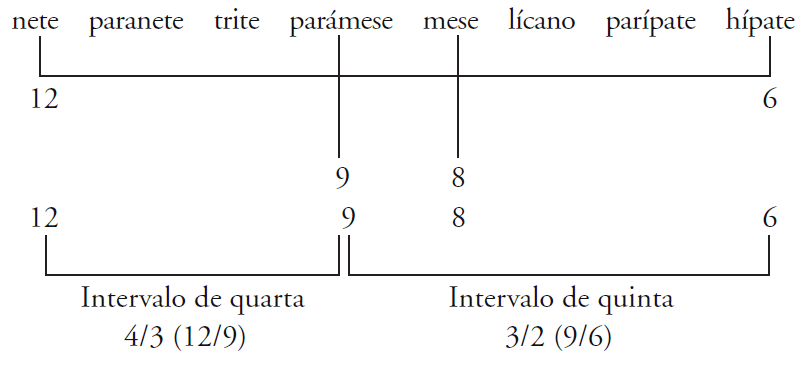
ESQUEMA DA OITAVA NA ESCOLA PITAGÓRICA

A mesma relação, invertida, entre 12/8 e 8/6

Como Plutarco, no seu comentário, apresenta um raciocínio eminentemente musical, inclusive empregando os nomes das notas (hípate, nete, mese e parámese), podemos supor que tivesse sob os olhos um outro livro, além do próprio Timeu, de Platão, que dava um relevo maior à presença da teoria harmônica de raiz pitagórica na obra do filósofo ateniense. Que obra era essa, nós não sabemos. Segundo Lasserre (1954: 168), essa fonte levaria a explicação mais além, já que os intervalos de terça e de sexta ou de sétima e de um tom também cumpririam as condições estabelecidas.

A partir do que discutimos até aqui, parece ficar a impressão de que Plutarco não consultou o próprio texto de Platão para redigir o seu tratado. Aparentemente, ele estava usando uma fonte intermediária onde se dedicava uma atenção especial ao tema da música na obra do filósofo. Isso pode ser a explicação para a ausência da harmonia frígia no texto de Plutarco e também para a interpretação especial acerca do Timeu.” Neste último parágrafo eu acho que a dedução vai longe demais: em busca da originalidade no artigo, o autor palpita algo inverossímil (Plutarco não ter acesso ao hiper-disseminado texto de Platão!). Hipérbole acadêmica.

Mas faltava [em Aristóteles] tratar ainda do intervalo de um tom, chamado ‘epógdoon’ na tradição pitagórica. Ele é representado pela proporção 9/8 que resulta da diferença ou excesso da quinta em relação à quarta. O tom ou epógdoon é o espaço localizado entre a parámese e a mese. Ele separa os dois tetracordes que formam a oitava e é numericamente encontrado através da operação seguinte: 3:2 (quinta) : 4:3 (quarta) = 3/2 x 3/4 = 9/8.

O capítulo 23 é importante, porque reforça a percepção de que Aristóteles estava interessado na música, não só nos seus aspectos éticos e pedagógicos, mas também nas discussões acerca da teoria harmônica. Não chegou até nós nenhum tratado musical de sua autoria. Mas há muitas partes de suas obras em que trata de questões musicais, como no livro VIII da Política. Há ainda os livros XI e XIX dos Problemas, que parecem ter sido redigidos por algum aristotélico, que tratam de temas musicais. Além disso, sabemos que o pensamento de Aristóteles exerceu uma influência determinante sobre as concepções teóricas de Aristóxeno de Tarento, o maior musicólogo da Antiguidade Clássica, que foi discípulo do estagirita e aproveitou algumas de suas idéias para construir sua teoria musical baseada na percepção e não no cálculo matemático.”

Essa influência pitagórica pode dever-se ao fato de que Aristóteles, no trecho citado por Plutarco, estaria tratando especificamente da teoria harmônica pitagórica. Ou, por outro lado, a influência pode ser resultado de uma interferência por uma fonte intermediária, ou seja, um tratadista cuja visão seria marcada pelo pitagorismo e que teria sido utilizado por Plutarco no trecho em exame.” Ótimo, mas sem essa fonte, nada se conclui.

É possível que a fonte desse capítulo seja Aristóxeno, já que o fragmento 73 Wehrli apresenta um texto muito semelhante ao que encontramos no nosso tratado.” Forçando a barra até onde pode!

nosso autor lembra que a visão e a audição são geradas através da harmonia. Elas são celestes e divinas e permitem que os homens percebam e manifestem em si próprios a harmonia com o auxílio da luz e do som.”

SATANIC RITUAL ABUSE: A question of memory – Dale McCulley, Journal of Psychology and Theology, 1994.

Traumatic amnesia, described in the DSM-III-R as psychogenic amnesia, is a phenomenon which has been known to mental health professionals for more than 100 years. The clinically observed characteristics of traumatic memory formation and retrieval match precisely the patterns of memory recovery exhibited by SRA [satanic ritual abuse] survivors, and strongly confirm the reality of their cult abuse.”

Some patients claiming abuse or SRA are most accurately viewed as having other goals besides healing, falling into diagnostic classifications of Munchausen syndrome, Factitious Disorder or other kinds of pseudovictims, or victims of folie à deux or delusional systems. Some are consciously exaggerating, fabricating, and malingering” Martha Rogers

The basic premise upon which all of these authors found their observations and hypotheses represents purely a leap of faith rather than a scientific inquiry” George Ganaway

The question is, rather: to what degree do these vividly reenacted experiences represent purely factual accounts of multigenerational cult activities with actual human sacrifices as described, versus fantasy and/or illusion borrowing its core material from literature, movies, TV, other patients’ accounts or unintentional therapist suggestion?”

Ralph Underwager and Hollida Wakefield (1992) state that the only data that can be offered for the reality of a worldwide satanic conspiracy are ‘unsubstantiated verbal reports by people who claim to have had personal experience, often through recovered memories in the course of therapy, and some claims elicited from children in multi-victim and multi-perpetrator sexual abuse allegations.’

Passentino and Passentino (1992) evince a similar level of discredence when they note that <…the fact that more and more people are ‘recovering repressed memories’ of SRA doesn’t necessarily lead to a conclusion that SRA sensationalism is true.>

PSICÓLOGO É TUDO DOENTE, IMAGINA PSICÓLOGO PADRECO! “It seems more than coincidental, then, that 4 of the doubters in the Special Issue are past or present members of the advisory board of the False Memory Syndrome Foundation (FMSF), which was formed shortly before the JPT issue was published, and which has been vigorously propounding the proposition that many memories of childhood abuse have been implanted in the minds of suggestible clients by incompetent or malign therapists. Dr. Underwager, who played a leading role in the formation of the False Memory Syndrome Foundation, has since resigned following the publication of an interview with him and his wife, Hollida Wakefield, in the Journal of Paedophilia (Underwager & Wakefield, 1993). Underwager takes a remarkably sanguine attitude toward paedophilia stating, <I am also a theologian, and as a theologian I believe it is God’s will that there be closeness and intimacy, unity of the flesh, between people. A paedophile can say: ‘This closeness is possible for me within the choices that I’ve made’> (p. 4). He later affirms that <With boldness they can say, ‘I believe this in fact part of God’s will’> (Underwager & Wakefield, 1993, p. 4).”

NICE FANFIC! “But when we speak of the ritual abuse of children, we are not talking about normal events. Reports by both children and adult survivors commonly deal with rape—vaginal, anal, and oral; with the penetration of body orifices by lighted candles and sharp instruments; with every type of torture, including protracted electric shock; with animal and human sacrifice; with ritual cannibalism.”

A Viet Nam (sic) veteran viewing Platoon, for example, may find himself back in a rice paddy trying to evade enemy fire.” Comparação esdrúxula, mas valeu a tentativa!

They hear again the Enochian chant, punctuated by the screams of victims, rising in the night air. They glimpse the flickering candles and the fearsome circle of hooded, black-robed cultists. Their bodies feel the thrusting knife and searing flame. Blisters and scars sometimes reappear, and fresh blood may flow from tissues ravaged long ago.” O que me deixa mais indignado é fantasiar em cima de assunto sério (estresse pós-traumático)! Essas vítimas claramente foram sexual e fisicamente abusadas e torturadas, mas são todas de famílias cristãs fanáticas.

The most significant finding was that 38% of the women in the sample reported no recollection of the index event, even though it was firmly documented by hospital records. In response to the concern that some women simply were too embarrassed to disclose the assault, Dr. Williams points out that of the women who did not recall the abusive incident, 68% told the interviewer about other sexual assaults.” Curioso como ‘Satã’ ou ‘Enoque’ prefere mulheres num ritual que deveria ser indiferente ao gênero…

Equally significant is the fact that in a subsample of 23 women who had recorded medical evidence of genital trauma, and who also received the highest credibility rating by the interviewer, 52% did not recall the abuse.” E onde está a evidência satânica?

Another study, cited by Lenore Terr (1994), was conducted in Holland by Nel Draijer, who interviewed a random sample of more than a thousand Dutch women. One in six reported coerced sex with household members in childhood, and many had experienced years of psychogenic amnesia, until the memories were retrieved in adulthood.”

RESPOSTA À PERGUNTA: “O QUE É O ILUMINISMO?” – Kant (trad. Artur Morão), 1784.

lluminismo é a saída do homem da sua menoridade de que ele próprio é culpado. (…) Sapere aude! (…) Eis a palavra de ordem do Iluminismo.”

É tão cômodo ser menor. (…) Não me é forçoso pensar, quando posso simplesmente pagar; outros empreenderão por mim essa tarefa aborrecida.”

Preceitos e fórmulas, instrumentos mecânicos do uso racional, ou antes, do mau uso dos seus dons naturais são os grilhões de uma menoridade perpétua.” Descrição dos meus pais.

São muito poucos os que conseguiram mediante a transformação do seu espírito arrancar-se à menoridade e encetar um andamento seguro.”

Semear preconceitos é muito danoso, porque acabam por se vingar dos que pessoalmente, ou os seus predecessores, foram os seus autores. Um público só muito lentamente consegue chegar à ilustração. Por meio de uma revolução talvez se possa levar a cabo a queda do despotismo pessoal e da opressão gananciosa ou dominadora, mas nunca uma verdadeira reforma do modo de pensar. Novos preconceitos, justamente como os antigos, servirão de rédeas à grande massa destituída de pensamento.”

Por uso público da própria razão entendo aquele que qualquer um, enquanto erudito, dela faz perante o grande público do mundo letrado.” Manifesto anti-psicanálise!

Chamo uso privado àquele que alguém pode fazer da sua razão num certo cargo público ou função a ele confiado. (…) Neste caso, não é decerto permitido raciocinar, mas tem de se obedecer.”

O cidadão não pode recusar-se a pagar os impostos que lhe são exigidos; e uma censura impertinente de tais obrigações, se por ele devem ser cumpridas, pode mesmo punir-se como um escândalo (que poderia causar uma insubordinação geral). Mas, apesar disso, não age contra o dever de um cidadão se, como erudito, ele expuser as suas idéias contra a inconveniência ou também a injustiça de tais prescrições.”

o que ele ensina em virtude da sua função, como ministro da Igreja, expõe-no como algo em relação ao qual não tem o livre poder de ensinar segundo a sua opinião própria, mas está obrigado a expor segundo a prescrição e em nome de outrem.”

o uso que um professor contratado faz da sua razão perante a sua comunidade é apenas um uso privado, porque ela, por maior que seja, é sempre apenas uma assembleia doméstica; e no tocante a tal uso, ele como sacerdote não é livre e também o não pode ser, porque exerce uma incumbência alheia. Em contrapartida, como erudito que, mediante escritos, fala a um público genuíno, a saber, ao mundo, por conseguinte, o clérigo, no uso público da sua razão, goza de uma liberdade ilimitada de se servir da própria razão e de falar em seu nome próprio.” O mundo se complexificou demais, caro amigo Kant!

É, de fato, um absurdo, que leva à perpetuação dos absurdos, que os tutores do povo (em coisas espirituais) tenham de ser, por sua vez, menores. § Mas não deveria uma sociedade de clérigos, por exemplo, uma assembleia eclesiástica ou uma venerável classis (como a si mesma se denomina entre os holandeses) estar autorizada sob juramento a comprometer-se entre si com um certo símbolo imutável para assim se instituir uma interminável supertutela sobre cada um dos seus membros e, por meio deles, sobre o povo, e deste modo a eternizar? Digo: isso é de todo impossível. Semelhante contrato,¹ que decidiria excluir para sempre toda a ulterior ilustração do género humano, é absolutamente nulo e sem validade, mesmo que fosse confirmado pela autoridade suprema, por parlamentos e pelos mais solenes tratados de paz.”

¹ Sentiu a indireta, Hobbes?

E os vindouros têm toda a legitimidade para recusar essas resoluções decretadas de um modo incompetente e criminoso. A pedra de toque de tudo o que se pode decretar como lei sobre um povo reside na pergunta: poderia um povo impor a si próprio essa lei?”

Um homem, para a sua pessoa, e mesmo então só por algum tempo, pode, no que lhe incumbe saber, adiar a ilustração; mas renunciar a ela, quer seja para si, quer ainda mais para a descendência, significa lesar e calcar aos pés o sagrado direito da humanidade. O que não é lícito a um povo decidir em relação a si mesmo menos o pode ainda um monarca decidir sobre o povo, pois a sua autoridade legislativa assenta precisamente no facto de na sua vontade unificar a vontade conjunta do povo.” “Constitui até um dano para a sua majestade imiscuir-se em tais assuntos”

Caesar non est supra grammaticos”

Falta ainda muito para que os homens tomados em conjunto, da maneira como as coisas agora estão, se encontrem já numa situação ou nela se possam apenas vir a pôr de, em matéria de religião, se servirem bem e com segurança do seu próprio entendimento, sem a orientação de outrem. (…) esta época é a época do Iluminismo, ou o século de Frederico.”

Um príncipe que não acha indigno de si dizer que tem por dever nada prescrever aos homens em matéria de religião, mas deixar-lhes aí a plena liberdade, que, por conseguinte, recusa o arrogante nome de tolerância, é efetivamente esclarecido e merece ser encomiado pelo mundo grato e pela posteridade como aquele que, pela primeira vez, libertou o gênero humano da menoridade, pelo menos por parte do governo, e concedeu a cada qual a liberdade de se servir da própria razão em tudo o que é assunto da consciência.” Não fazer julgamentos precoces, foi o que disseste lá em cima!

Este espírito de liberdade difunde-se também no exterior, mesmo onde entra em conflito com obstáculos externos de um governo que a si mesmo se compreende mal.”

Apresentei o ponto central do Iluminismo, a saída do homem da sua menoridade culpada, sobretudo nas coisas de religião, porque em relação às artes e às ciências os nossos governantes não têm interesse algum em exercer a tutela sobre os seus súbditos” Infelizmente regredimos muito em 240 anos!

raciocinai tanto quanto quiserdes e sobre o que quiserdes; mas obedecei!” “Um grau maior da liberdade civil afigura-se vantajosa para a liberdade do espírito do povo e, no entanto, estabelece-lhe limites intransponíveis; um grau menor cria-lhe, pelo contrário, o espaço para ela se alargar segundo toda a sua capacidade.” Narrando o que logo aconteceria na França.

L’ALCIBIADE FANCIULLO A SCOLA – Prefácio à edição francesa de 1891 (trad. inglesa)

Prior to the reprint of 1862, l’Alcibiade fanciullo a scola [Alcibiades the Schoolboy] was one of the most difficult books even to see, let alone to obtain. We knew of only a very small number of the two original editions, both dated 1652.¹ Four were in public libraries – in Dresden, in Grenoble, in the Bibliothèque Imperiale and in the British Museum. We have no information from Grenoble or Dresden, but the British Museum’s copy has been lost, and the copy in the Bibliothèque Imperiale has been placed in ‘Hell’ – the most dreadful fate which can befall a book -, where it cannot be read, examined, or even touched. M. Micharda said once to enquirers: ‘We have only opened Hell to 2 people – to M. Michelet, for his Histoire de la Révolution, and Doctor ****, for his Études sur la folie.’”

¹ Livro até então apócrifo ou atribuído aos nomes errados.

The reprint of 1862, of 102 copies, was able to make this extraordinary book better known to bibliophiles who understood Italian, but the magistracy did not show itself disposed to extend to this language the indulgence shown to Latin. The reprinted Alcibiade was the subject of a condemnation imposed in May 1963.

Undaunted by this precedent, we have published a new edition intended, by the number of copies and the price – like the earlier reprint –, for bibliophiles and scholars who, in our opinion and like philosophers and priests, are entitled to read everything. Omnia pura puris [Aos puros tudo é puro].

This, we repeat, is our opinion, and it is a conviction so well founded that all the magistracies in the world will not shake it. Apart from anything else, it is noteworthy that shortly before the condemnation of the book 2 scholars made it the object of – or used it as the pretext for – 2 extremely interesting dissertations on the vice against Nature – and one can read these, just as one can read Alicbiade, without in the slightest degree turning into a pederast – or even Tartuffe, or his sort.

The first of these dissertations, published under the title Un point curieux des moeurs de la Grèce, was by M. Octave Delepierre, Belgian author, literary scholar and secretary of the legation of the consul-general of Belgium in London. Curieux is the right word! In his work, Delepierre rebutted the strange opinion of the famous German archaeologist Welcker, who asserted ‘that pederasty in Greece served to strengthen the bonds of friendship, that this vice, indeed, was not the result of a deviant sensuality, but an elevated principle of the theory of beauty’. We do not advise M. Welcker, famous though he is, to cross the Rhine and publish a French translation of his dissertation, since he would risk presenting the spectacle of a worthy and learned man awaiting a fine or prison.

This same man also represented Sappho as a person of pure morals.¹ We are, we see, dealing with a capricious scholar, one with a romantic and mystic spirit – a type common enough even in this country, where we have seen the rehabilitation of Marie Stuart, the madam of Longueville, of Marie Antoinette, and of other pitiable creatures. But, in his German fashion, Welcker roots his beliefs in an even more ancient and recondite cult; while Cousin made the madam of Longueville into a ‘landlady’, he would never have made Sappho into an hotelier. To go back to Alcibiade – from the quotation included by the author in his dissertation, it was said that the author of this dialogue had treated the question of pederasty ‘according to the ideas of the most respected Greek philosophers’.”

¹ Sappho von einem herrschended Vorurtheil befreit (Safo liberta de um preconceito dominante), 1861, 2a ed. 1855.

The other dissertation was translated from the Italian of Giamb. Baseggio by Gustave Brunet, librarian of the city of Bordeaux, and accompanied by notes and a detailed bibliography.” Le Manuel de librarie wrongly attributed to M. Girol Adda the honour of having, in 1859, discovered that the author of Alcibiade was Ferrante Pallavicini. This honour reverted to M. Bassegio, (SIC) who in 1850 published his Disquisizone”¹

¹ E no entanto tudo isto está errado: hoje a historiografia atribui a autoria a Antonio Rocco!

Ferrante was a member of l’Academia degl’Incogniti, and reputed author of Suzanna, Taliclea, Rete di Vulcano, Corriere svaligiato, Divorzio celeste and La Rettorica della Putane.

For information on Pallavicini, we can consult Moreri, Bayle, Chauffepié and Prosper Marchand. This author, to some a libertarian and to others a libertine, was beheaded at Avignon in 1644, aged barely 26, a victim of the spite of the Barberini.¹ His tragic ends did not prevent friends who were admirers of his works and faithful to his beliefs – Ureporio Leti among others – arranging reprints, in Geneva, of his most liberal works, those most hostile to Rome, works such as the Corriere, Divorzio celeste, Rettorica della Putane. And the format, the paper and the typography of the 1st edition of Alciabede (SIC) pointed to the Libraire Stoer, of Geneva. Admittedly, the book carried the date of 1652, and Léti (SIC) did not go to Geneva until 1660, but dates are often altered in publications of this kind.”

¹ Não se trata de uma censura direta a suas obras de cunho erótico e tabuístico, mas ao próprio Papa Urbano VIII, a quem atacou em panfletos.

Baseggio [wrongly] answered that (…) Pallavicini’s purpose was writing a satire directed at the educationalists who were then in public favour in Venice. (…) The warmth, the passion, the conviction that dominate the book from beginning to end seem to us quite foreign to a work of irony. A French erotic writer would write more coolly, more allusively – might indeed be shocked and repelled by such overt passion – but an Italian would show precisely this kind of warmth and enthusiasm. Pallavinci (SIC!!!), however, cannot be any more supposed a pederast than Pidanzat de Mairobert can be considered a lesbian for l’Apologie de la secte anandryne, published in l’Espoin anglais. It must me taken, then, that Alcibiade is the fantasy of a fine and free spirit immersed in classical study. (…) At the time of Pallavicini, let it be said, a work of this kind from the pen of an Italian writer was no more extraordinary than an erotic romance from a 13th century French writer. And if the author was also a pamphleteer, he would flaunt precisely those elements which today would be hidden with great care. According to Vincent Placcuis, the friends of Ferrante denied that he was the author of Diverzio celeste, (SIC!) but had no difficulty in acknowledging that he was the author of Rettorica della Putane, ‘because the morals of Italians accord well with one, and their superstition and their politics accord badly with the other’.

We have said that Gustave Brunet added an appendix to Baseggio’s dissertation. It dealt with several writings similar to Alcibiade, with works of Pallivicini (SIC!!!) and of his colleagues in the (sic) l’Academia des Ingognitie (DOUBLE SIC!!), with the legal status of the vice against Nature from antiquity to the present day, and ended with a list of more-or-less famous pederasts of more recent times. The list included both self-aknowledged and suspected pederasts. Among the first group were Théodore de Bèze and Louis XIII; among the second were Henry III, Lully, d’Assoucy [poeta], the Compte de Sintzendorff, the Marquis of Vilette, Peter the Great and Friedrich II.(*)(**)

(*) And in the XVI lived the most famous of all, Shakespeare.

(**) Les Matinées du Roi de Prusse

Pederasty is like cholera, in that it appears sporadically almost everywhere, and from time to time breaks out more violently, in an epidemic. The fears of Fréderic II about the Prussian army could also apply to the French army of today which, over the past few years, sadly appears also to have some of the ‘regiments of Uncle Henry’. In the last session of the Senate, the outspoken Marquis de Boissy, without beating about the bush, expressed fears about the invasion of our regiments by ‘Arab morals’, and indeed, a terrible outbreak of pederasty seems today to be the only trophy of the war of Africa, just like smallpox was that of the Italian wars of the XVI, at least if one believes Voltaire’s epigram about it”

Escapees from Sodom: We know that the biblical fire did not destroy all the inhabitants of that vile city. Spread now over all the earth, they have made Paris into a ruin; here, in particular, they are repeatedly the cause of some filthy discovery or another. In the past 15 days we have seen too much of one affair of this kind, and the problem is now one of considerable proportions. M. Gàstagnary has tried to speak of it in his chronicle of Parisian events in the Progrès de Lyon. We copy the reserve he had to adopt in referring to the matter, but it is not as recent as he believes. It dates back for several months; if we talk about it today, it is because the affair has necessitated an enquiry among several corps of soldiers, and it has not been possible to cover the inquiry with silence, as the police manage to do in other similar cases.”

Petite Revue

(*) “We read in the personal correspondence of the Army in Egypt, ‘The Arabs and the Mamelouks have treated several of our prisoners in the way that Socrates, it is said, treated Alcibiades.’” Ensinaram-lhes filosofia?!

(*) “The pederastic epidemic inflicted itself on us in the XVII at the court of Louis XVI (See La France devenue italienne, a book that was reprinted following l’Histoire amoureuse des Gaules, by Bussy-Rabutin) (…) We know that this city (Paris is a police headquarters; in consequence, there are public places authorised for this purpose. [Paris, sempre a vanguard!] The young men who are destined for the profession are carefully classified, because the regulatory system extends even to that. They are examined; those who are beautiful, rosy, well made, chubby, are reserved for the great lords, bishops and financiers, who pay very dearly for them. Those who are deprived of their testicles, or those who are said (because our language is more chaste than our morals) not to have weavers’ weights, but who give and receive, form the 2nd class; they are still expensive, because woman can also use them while they serve men. Those who are not capable of erection because of overuse – whether or not they have all the organs necessary to please – make up the third class. But those who preside over these pleasures first confirm their impotence. In order to do so they are placed, naked, on a mattress whose lower half is open; two women caress them to the best of their ability, during which a third, with fresh nettles, knocks gently on the seat of their sexual desires. After a quarter of an hour of these attempts, a long unripe pear is introduced into the anus, causing a considerable irritation, and fine mustard of Caedebec is put on the rash induced by the nettles; the glans is also rubbed with camphor. Those who resist all these stimuli and give no sign of erection are engaged for 1/3 of pay only. (Erotika Biblion, chap. Kadhésch, p. 93-ss., Bruxelles, 1886, with notes by the Chevalier Pierrugues.) (N.E.: This is probably nonsense from beginning to end, but the public was as credulous then on such matters as they are now. But the curse has never had the extent and the expansion and intensity which we witness in modern society, and where one can say that it has been democratised. See the Études sur les attentats aux moeurs du Dr. Trdieu, 3ed., Paris, 1859). But let us cease to review these nauseating texts; let us go out and buy a bottle of disinfectant. [aaah, vai dizer que você não curte, monsieur? Conta outra!]”

Several corps of soldiers! That is in all the documents”

Bruxelas, 1891

AO LEITOR

Os filósofos da Antiguidade, quando ensinavam literatura, inculcavam seus conhecimentos nos alunos pelo buraco de seus traseiros [HAHAHA!]. Assumiam que, mediante este método, não teriam como não se tornar completamente eruditos; que por essa via, no devido tempo, absorveriam todo o conhecimento de seus mestres.

Ó, que esses vícios se tivessem consumido nos tempos gregos! Ao contrário: atingiram seu clímax nas escolas de nosso tempo.

Atingimos o ponto em que nossas escolas podem ser consideradas teatros da infâmia e da vergonha, um repositório de todos os vícios; nossos mestres-escola prosseguiram com o método antigo de ensinar. Se você é conhecedor desta matéria, é provável que já tenha ouvido como alguns desses professores, em seu ardor para infundir conhecimento ao alunado, chegaram a ferir seus ânuses!

Portanto, sua leitura de Alcibíades, o Estudante ensiná-lo-á que, para aperfeiçoar nossos escolares, temos de retirá-los das mãos desses mestres de Sodoma – e de seu feliz vício.”

Poxa, fiquei com vontade de ler esse livro-tabu, mas não consigo encontrá-lo!

AOS PROFESSORES

Ah, professores maus, eu sei de suas tramas,

E de suas manhas, dos seus jogos com seus belos,

Fingindo que latim e gramática, soma e subtração

Chegam aos miolos partindo das nádegas!

É só nos cus que vocês põem os olhos,

Não têm prazer em bocetas, ou em seios e mamilos!

Nenhuma mulher pode seduzi-los nem dar-lhes prazer,

Mas vocês fodem garotinhos com todo seu poder!

Pederasta patife!, com lamentos miseráveis,

Já que agora todos seus pecados são por mim narrados,

Desistam de seus vícios, arrependam-se destas artes!

Encerrem de uma vez a vilania – cortem seus paus!

Até que, se um pirralho malcriado mostrar-lhes o bumbum,

Vocês só possam suspirar tristonhos, e seguir adiante.

M.V.”

NOTA DO EDITOR

[ih, rapaz, tá se justificando muito já, esse trem tá suspeito!]

Esse fragmento caiu por acidente em minhas mãos, e eu julguei de suficiente interesse, caro leitor, a fim de imprimir e trazê-lo a público. Use esta obra para vigiar seus filhos pequenos e salvá-los da perniciosa influência de professores malvados, essa corja detestável tão comum no presente.

Prometo publicar em breve a segunda parte, que aparecerá intitulada O Triunfo de Alcibíades, um trabalho que despertará ainda maiores interesses, uma vez que deriva da pena de um dos homens mais sábios de nosso país. Sempre à vossa graça.”

A THEORY OF THE SOCIOLOGY OF WOMEN – Hellen Moore & Jane Ollenburger, 1989.

For example, sex role analyses use bipolar concepts, such as masculinity and femininity as givens. Even models of androgyny anticipate the reality of a continuum with fixed masculine and feminine end points. Thus, the language used in creating patriarchal and sex role theories sets parameters that cannot be ignored or transformed by the models themselves.”

Explain the development, maintenance, and change of women’s oppression in the range of cultures we can use as examples (Chafetz, Feminist Sociology, 1988). The reasons for building a feminist theory or explanation are clear. But why build a sociological theory? Are the problems created by patriarchal theory and liberal feminist theory inherent to the sociological theory building process? We believe it is not. Theory as a practice can itself be examined from a feminist perspective, analyzed for potential consequences, and revisioned for its potential contributions to an understanding of women’s lives”

A major challenge for feminist theorists is to bridge the structural and interpretive approaches available in the social sciences and in women’s studies theory. An integrative theory of women’s oppression should draw from all available models, not to construct a hodgepodge, but with an eye toward the patchwork quilt of women’s traditional crafts. Such a patchwork would take the useful concepts of feminist models and draw them together to make a strong theoretical fabric”

The post-structuralists argue that we cannot answer the question, ‘Are there women?’ (De Beauvoir, 1974; Eisenstein and Jardine, 1980). We believe that the questions must be asked, even if the medium of language will ultimately distort the reality of those lives.”

Drawing on the radical feminist theories, we also propose that, in a patriarchal system, men set the exchange value. As Hartmann and others have pointed out, capitalism goes hand in hand with patriarchy in most Western industrial nations (Hartmann, 1984).” Vago.

the lives of black women prior to the Emancipation Proclamation have been limited to a few diaries and to public records that define blacks as property. Immigrant and black women’s work was not recorded separately by race from white women until the 1890’s, and various Hispanic groups have been tabulated as white at various points in time. Not until the 1980 census were significant Hispanic cultural groups separated such as Cubana, Chicana, and Puerta Ricana for research and policy discussion.”

the absence of marital rape laws in the majority of states identifies the informal and formal definitions of sexual control for men.”

Women who do not fit this family-centered framework are thrust out of the normative definitions of sexuality: lesbians, nuns, spinsters [solteironas], prostitutes, and women in the pornography industry.”

The notion of recreational, non-reproductive sex (the use value of sex) is a relatively modem phenomenon, particularly for married women. This new model of sexuality has generated an avalanche of media images, novels, advice books, and self-help groups to create norms for the practice and enjoyment of women’s sexuality. Much of this recreational sexual identity has been based upon historical and erroneous definitions supplied by men: the norm of the vaginal orgasm, definitions of the sexually attractive, and control of the verbal and nonverbal cues for sexual initiation”

RÁDIO-CABEÇA

RÁDIO 1

Primeiro Solilóquio

Eu acho tudo igual,

porque dessemelhante permanece, e só um fraco feixe de luz cai. Sabes tu, o raio alumia meu tempo minha vida, aponta o caminho ao Mundo de Alexandre. Esse mundo me promete a volta do mal, assim como a penumbra dos tumultuados tijolos é um louvor à existência.

Cômico. O papel de parede não volta a seu lugar…

Sabes tu, o mundo vem sempre com esse deslocamento do papel de parede no jogo. O raio de luz evanescente acompanha todo o jogo. E então os Arcanjos Gabriel e Micael me apontam coisas, com mórbida fascinação. Embora abstrato, absurdo até, é, digo-te, a mais clara e completa claridade.

A claridade se consuma em cada homem, sobretudo na morte! Eu sei, creia-me! É toda uma canção humana e patética. Mas aqui não se trata de humanidade, mas do papel de parede jamais voltar a seu lugar! Do umbral eu antevejo,

talvez me espere alguém. Gabriel, quem sabe? Logo saberei. Estranho. Tudo que era ruidoso e barulhento está agora em calmaria. Ah, naturalmente… – ela dirá! Mas não, isso não extingue nosso angustiante tormento. Ah, diga, diga… não há nada como uma extravagante canção! Deixe estar…

Eu me pergunto se a estática do rádio e essa sensação de chiado silêncio e solidão tem algum significado, isto é, pode ser um diálogo. Por favor, guardem para si vossos comentários, pois eu só busco minha própria atenção.

Muito obrigado.

Segundo Solilóquio

Merda! Devo eu retornar à monótona noite e quem sabe com cicatrizes palpitantes me render à própria realidade de Mammon?

Onde é nu esta bosta de rádio? Ontem eu contemplei outra vez o espetáculo deplorável do louco, aquela dança horrenda de sapatilhas que deslizavam como trenós. Seja como for, senti aquela sensação banal, como se ele procurasse algo no rádio. Vou pensar naquele estranho quartinho de menina na casa. Finalmente eu encontrei os diários em capa dura das três garotinhas.

Intitulados “Sombras do Mundo de Alexandre”. Eis o homem… Estranho!

RádiŒpílogo 1

Eu cavalgo a cobra e acho o chacal.

E Jesus Cristo come, ávido, sua barra de Milka.

Deus gosta dessa música, é o que eu acho.

Deus, vai pro inferno! vão todos vocês juntos!

Preciso pensar na lagosta e não em isso-cantar.

QUINCAS BORBA

Quincas Borba está muito impaciente? perguntou Rubião bebendo o último golo de café, e lançando um último olhar à bandeja.

– Me parece que sí.

– Lá vou soltá-lo.”

ESTE QUINCAS BORBA, se acaso me fizeste o favor de ler as Memórias Póstumas de Brás Cubas, é aquele mesmo náufrago da existência, que ali aparece, mendigo, herdeiro inopinado, e inventor de uma filosofia. Aqui o tens agora em Barbacena. Logo que chegou, enamorou-se de uma viúva, senhora de condição mediana e parcos meios de vida, mas, tão acanhada que os suspiros no namorado ficavam sem eco. Chamava-se Maria da Piedade. Um irmão dela, que é o presente Rubião, fez todo o possível para casá-los. Piedade resistiu, um pleuris a levou.”

filosofia é uma cousa, e morrer de verdade é outra”

RUBIÃO achou um rival no coração de Quincas Borba, – um cão, um bonito cão, meio tamanho, pêlo cor de chumbo, malhado de preto. Quincas Borba levava-o para toda parte, dormiam no mesmo quarto. De manhã, era o cão que acordava o senhor, trepando ao leito, onde trocavam as primeiras saudações. Uma das extravagâncias do dono foi dar-lhe o seu próprio nome; mas, explicava-o por dous motivos, um doutrinário, outro particular.

– Desde que Humanitas, segundo a minha doutrina, é o princípio da vida e reside em toda a parte, existe também no cão, e este pode assim receber um nome de gente, seja cristão ou muçulmano. . .

– Bem, mas por que não lhe deu antes o nome de Bernardo? disse Rubião com o pensamento em um rival político da localidade.

– Esse agora é o motivo particular. Se eu morrer antes, como presumo, sobreviverei no nome do meu bom cachorro. Ris-te, não?”

“ – (…) Viverei perpetuamente no meu grande livro. Os que, porém, não souberem ler, charlarão Quincas Borba ao cachorro, e…

O cão, ouvindo o nome, correu à cama. Quincas Borba, comovido, olhou para Quincas Borba.”

agora os olhos metidos para dentro viam pensar o cérebro.”

O universo ainda não parou por lhe faltarem alguns poemas mortos em flor na cabeça de um varão ilustre ou obscuro”

Crê-me, o Humanitismo é o remate das cousas; e eu que o formulei, sou o maior homem do mundo. Olha, vês como o meu bom Quincas Borba está olhando para mim? Não é ele, é Humanitas…”

– Não há morte. O encontro de duas expansões, ou a expansão de duas formas, pode determinar a supressão de uma delas; mas, rigorosamente, não há morte, há vida, porque a supressão de uma é princípio universal e comum. Daí o caráter conservador e benéfico da guerra.

– Mas a opinião do exterminado?

– Não há exterminado. Desaparece o fenômeno; a substância é a mesma. Nunca viste ferver água?

Moléstia e saúde eram dous caroços do mesmo fruto, dous estados de Humanitas.”

Quincas Borba chorava pelo outro Quincas Borba. Não quis vê-lo à saída. Chorava deveras; lágrimas de loucura ou de afeição, quaisquer que fossem, ele as ia deixando pela boa terra mineira, como o derradeiro suor de uma alma obscura, prestes a cair no abismo.”

Algumas pessoas começaram a mofar do Rubião e da singular incumbência de guardar um cão em vez de ser o cão que o guardasse a ele. Vinha a risota, choviam as alcunhas. Em que havia de dar o professor! sentinela de cachorro! Rubião tinha medo da opinião pública. Com efeito, parecia-lhe ridículo; fugia aos olhos estranhos, olhava com fastio para o animal, dava-se ao diabo, arrenegava da vida.”

SETE SEMANAS depois, chegou a Barbacena esta carta, datada do Rio de Janeiro, toda do punho do Quincas Borba.”

Quem sou eu, Rubião? Sou Santo Agostinho. Sei que há de sorrir, porque você é um ignaro, Rubião; a nossa intimidade permitia-me dizer palavra mais crua, mas faço-lhe esta concessão, que é a última. Ignaro!”

O santo e eu passamos uma parte do tempo nos deleites e na heresia, porque eu considero heresia tudo o que não é a minha doutrina de Humanitas; ambos furtamos, ele, em pequeno, umas pêras de Cartago, eu, já rapaz, um relógio do meu amigo Brás Cubas. Nossas mães eram religiosas e castas. Enfim, ele pensava, como eu, que tudo que existe é bom, e assim o demonstra no capítulo XVI, livro VII das Confissões, com a diferença que, para ele, o mal é um desvio da vontade, ilusão própria de um século atrasado, concessão ao erro, pois que o mal nem mesmo existe, e só a primeira afirmação é verdadeira; todas as cousas são boas, omnia bona, e adeus.”

Dar-se-ia que, provada a alienação mental do testador, nulo ficaria o testamento, e perdidas as deixas? Rubião teve uma vertigem. Estava ainda com a carta aberta nas mãos, quando viu aparecer o doutor, que vinha por notícias do enfermo; o agente do correio dissera-lhe haver chegado uma carta.”

– Não quero nada, disse ao escravo. E outra vez pensou no legado. Calculou o algarismo. Menos de dez contos, não. Compraria um pedaço de terra, uma casa, cultivaria isto ou aquilo, ou lavraria ouro. O pior é se era menos, cinco contos… Cinco? Era pouco; mas, enfim, talvez não passasse disso. Cinco que fossem, era um arranjo menor, e antes menor que nada.

QUANDO o testamento foi aberto, Rubião quase caiu para trás. Adivinhais por quê. Era nomeado herdeiro universal do testador. Não cinco, nem dez, nem vinte contos, mas tudo, o capital inteiro, especificados os bens, casas na Côrte, uma em Barbacena, escravos, apólices, ações do Banco do Brasil e de outras instituições, jóias, dinheiro amoedado, livros – tudo finalmente passava às mãos do Rubião, sem desvios, sem deixas a nenhuma pessoa, nem esmolas, nem dívidas. Uma só condição havia no testamento, a de guardar o herdeiro consigo o seu pobre cachorro Quincas Borba, nome que lhe deu por motivo da grande afeição que lhe tinha. Exigia do dito Rubião que o tratasse como se fosse a ele próprio testador, nada poupando em seu benefício, resguardando-o de moléstias, de fugas, de roubo ou de morte que lhe quisessem dar por maldade; cuidar finalmente como se cão não fosse, mas pessoa humana. Item, impunha-lhe a condição, quando morresse o cachorro, de lhe dar sepultura decente em terreno próprio, que cobriria de flores e plantas cheirosas; e mais desenterraria os ossos do dito cachorro, quando fosse tempo idôneo, e os recolheria a uma urna de madeira preciosa para depositá-los no lugar mais honrado da casa.”

E quanto seria tudo? ia ele pensando. Casas, apólices, ações, escravos, roupa, louça, alguns quadros, que ele teria na Corte, porque era homem de muito gosto, tratava de cousas de arte com grande saber. E livros? devia ter muitos livros, citava muitos deles. Mas em quanto andaria tudo? Cem contos? Talvez duzentos. Era possível; trezentos mesmo não havia que admirar. Trezentos contos! trezentos!”

De repente, surgiu-lhe este grave problema – se iria viver no Rio de Janeiro, ou se ficaria em Barbacena. Sentia cócegas de ficar, de brilhar onde escurecia, de quebrar a castanha na boca aos que antes faziam pouco caso dele, e principalmente aos que se riram da amizade do Quincas Borba. Mas logo depois, vinha a imagem do Rio de Janeiro, que ele conhecia, com os seus feitiços, movimento, teatros em toda a parte, moças bonitas, ‘vestidas à francesa’. Resolveu que era melhor, podia subir muitas e muitas vezes à cidade natal.”

Aqui a testa e as costas das mãos do nosso amigo ficaram em água. Outra nuvem pelos olhos. E o coração batia-lhe rápido, rápido. A cláusula começava a parecer-lhe extravagante. Rubião pegava-se com os santos, prometia missas, dez missas. . . Mas lá estava a casa da comadre. Rubião picou o passo; viu alguém; era ela? era, era ela, encostada à porta e rindo.”

Tão certo é que a paisagem depende do ponto de vista, e que o melhor modo de apreciar o chicote é ter-lhe o cabo na mão.”

Diz-se de uma paisagem que é melancólica, mas não se diz igual cousa de um cão. A razão não pode ser outra senão que a melancolia da paisagem está em nós mesmos, enquanto que atribuí-la ao cão é deixá-la fora de nós. Seja o que for é alguma cousa que não a alegria de há pouco; mas venha um ,assobio do cozinheiro, ou um gesto do senhor, e lá vai tudo embora, os olhos brilham, o prazer arregaça-lhe o focinho, e as pernas voam que parecem asas.”

O maior pecado, depois do pecado, é a publicação do pecado. Eu, se fosse legislador propunha que se queimassem todos os homens convencidos de indiscrição nestas matérias”

As senhoras casadas eram bonitas; a mesma solteira não devia ter sido feia, aos vinte e cinco anos”

Sofia rastejava os vinte e oito anos; estava mais bela que aos vinte e sete; era de supor que só aos trinta desse o escultor os últimos retoques, se não quisesse prolongar ainda o trabalho, por dous ou três anos.”

Tinha essa vaidade singular, decotava a mulher sempre que podia, e até onde não podia, para mostrar aos outros as suas venturas particulares. Era assim um rei Candaules, mais restrito por um lado, e, por outro, mais público. E aqui façamos justiça à nossa dama. A princípio, cedeu sem vontade aos desejos do marido; mas tais foram as admirações colhidas, e a tal ponto o uso acomoda a gente às circunstâncias, que ela acabou gostando de ser vista, muito vista, para recreio e estímulo dos outros. Não a façamos mais santa do que é, nem menos. Para as despesas da vaidade, bastavam-lhe os olhos, que eram ridentes, inquietos, convidativos, e só convidativos”

Meu Deus! como é bonita! Sinto-me capaz de fazer um escândalo!”

Os seus pobres olhos de 39 anos, olhos sem parceiros na terra, indo já a resvalar do cansaço na desesperança, acharam em si algumas fagulhas. Volvê-los uma e muitas vezes requebrando-os, era o longo ofício dela. Não lhe custou nada armá-los contra o capitalista.”

Era o velho formulário em ação; nada lhe rendera até ali, mas a loteria é assim mesmo: lá vem um bilhete que resgata os perdidos.” “D.Tonica sentiu o grasnar do velho corvo da desesperança. Quoth the Raven NEVER MORE.”

Rubião lembrou-se de uma comparação velha, mui velha, apanhada em não sei que décima de 1850, ou de qualquer outra página em prosa de todos os tempos. Chamou aos olhos de Sofia as estrelas da terra, e às estrelas os olhos do céu. Tudo isso baixinho e trêmulo. Sofia ficou pasmada. De súbito endireitou o corpo, que até ali viera pesando no braço do Rubião. Estava tão acostumada à timidez do homem… Estrelas? olhos? Quis dizer que não caçoasse com ela, mas não achou como dar forma à resposta, sem rejeitar uma convicção que também era sua, ou então sem animá-lo a ir adiante. Daí um longo silêncio.”

Depois, a lua é solitária. A solidão faz a pessoa séria. As estrelas em chusma, são como as moças entre quinze e vinte anos, alegres, palreiras, rindo e falando a um tempo de tudo e de todos.”

Castas estrelas! é assim que lhes chama Otelo, o terrível, e Tristram Shandy, o jovial. Esses extremos do coração e do espírito estão de acordo num pontoas estrelas são castas.”

O convite era poético, mas só o convite. Rubião ia devorando a moça com olhos de fogo e segurava-lhe uma das mãos para que ela não fugisse. Nem os olhos nem o gesto tinham poesia nenhuma. (…) pediu-lhe pela alma da mãe dele, que devia estar no céu… Rubião não sabia do céu nem da mãe, nem de nada. Que era mãe? que era céu? parecia dizer a cara dele.”

A Côrte é o diabo; apanha-se uma paixão como se apanha uma constipação; basta uma fresta de ar, fica-se perdido.”

Durou muito tempo essa explosão de raiva interior,-perto de vinte minutos; mas a alma cansou, e tornou a si. A imaginação não podia mais, e a realidade próxima atraiu-lhe a vista.”

Onde li eu que uma tradição antiga fazia esperar a uma virgem de Israel, durante certa noite do ano, a concepção divina? Seja onde for, comparemo-la à desta outra, que só difere daquela em não ter noite fixa, mas todas, todas, todas…”

Crede-me: há tiranos de intenção. Quem sabe? Na alma desta senhora passou agora um tênue fio de Calígula…”

Sei que é honrado, que trabalha muito; o diabo da mulher é que fez mal em meter-se de permeio, com os lindos olhos e a figura… Que admirável figura, meu pai do céu! Hoje então estava divina.”

morava em casa de um amigo, que começava a tratá-lo como hóspede de três dias, e ele já o era de quatro semanas. Dizem que os de três dias cheiram mal; muito antes disso cheiram mal os defuntos, ao menos nestes climas quentes… Certo é que o nosso Rubião, singelo como um bom mineiro, mas desconfiado como um paulista, ia cheio de cuidados, pensando em retirar-se quanto antes.”

Era tão raro ver um enforcado! Senhor, em vinte minutos está tudo findo! – Senhor, vamos tratar de outros negócios! E o nosso homem fechou os olhos, e deixou-se ir ao acaso.”

Vai senão quando, ocorreu-lhe que os dous Quincas Borba podiam ser a mesma criatura, por efeito da entrada da alma do defunto no corpo do cachorro, menos a purgar os seus pecados que a vigiar o dono. Foi uma preta de São João d’EI-Rei que lhe meteu, em criança, essa idéia de transmigração. Dizia ela que a alma cheia de pecados ia para o corpo de um bruto; chegou a jurar que conhecera um escrivão que acabou feito gambá…”

Nunca, entretanto, lhe passou pela cabeça que o amigo chegasse a declarar amor a alguém, menos ainda a Sofia, se é que era amor deveras; podia ser gracejo de intimidade. Rubião olhava para ela muita vez, é certo; parece também que Sofia, em algumas ocasiões, pagava os olhares com outros… Concessões de moça bonita! Mas, enfim, contanto que lhe ficassem os olhos, podiam ir alguns raios deles. Não havia de ter ciúmes do nervo óptico, ia pensando o marido.”

É assim que as moças falam aos quinze anos; é assim que falam os tolos em todos os tempos, e os poetas também; mas ele nem é moça nem poeta.”

Os deuses de Homero – e mais eram deuses – debatiam uma vez no Olimpo, gravemente, e até furiosamente. A orgulhosa Juno, ciosa dos colóquios de Tétis e Júpiter em favor de Aquiles, interrompe o filho de Saturno. Júpiter troveja e ameaça; a esposa treme de cólera. Os outros gemem e suspiram. Mas quando Vulcano pega da urna de néctar e vai coxeando servir a todos, rompe no Olimpo uma enorme gargalhada inextinguível. Por quê? Senhora minha, com certeza nunca viu cair um carteiro.

Às vezes, nem é preciso que ele caia; outras vezes nem é sequer preciso que exista. Basta imaginá-lo ou recordá-lo. A sombra da sombra de uma lembrança grotesca projeta-se no meio da paixão mais aborrecível, e o sorriso vem às vezes à tona da cara, leve que seja – um nada.”

Pôs o caso à sorte. Se o primeiro carro que passasse viesse da direita, iria; se viesse da esquerda, não. E deixou-se estar na sala, no pouf central, olhando. Veio logo um tílburi da esquerda. Estava dito; não ia a Santa Teresa. Mas aqui a consciência reagiu; queria os próprios termos da proposta: um carro. Tílburi não era carro. Devia ser o que vulgarmente se chama carro, uma caleça inteira ou meia, ou ainda uma vitória. Daí a pouco vieram chegando da direita muitas caleças, que voltavam de um enterro. Foi.”

Nunca a intimidade do casal lhe excitara os ódios contra o legítimo senhor. E lá iam meses e meses, sem alteração do sentimento, nem morte da esperança. Mas a possibilidade de um rival de fora veio atordoá-lo; aqui é que o ciúme trouxe ao nosso amigo uma dentada de sangue.”

reconheceu que a emenda era pior que o soneto, e que há bonitos sonetos mentirosos.”

como o espectador que se regala das paixões de Otelo, e sai do teatro com as mãos limpas da morte de Desdêmona.”

Seria singular que esta mulher, que não tinha amor àquele homem, não quisesse dá-lo de noivo à prima, mas a natureza é capaz de tudo, amigo e senhor. Inventou o ciúme de Otelo e o do cavaleiro Desgrieux, podia inventar este outro de uma pessoa que não quer ceder o que não quer possuir.”

Que sabe a aranha a respeito de Mozart? Nada; entretanto, ouve com prazer uma sonata do mestre. O gato, que nunca leu Kant, talvez um animal metafísico.”

Aquelas cenas da corte de França, inventadas pelo maravilhoso. Dumas, e os seus nobres espadachins e aventureiros, as condessas e os duques de Feuillet, metidos em estufas ricas, todos eles com palavras mui compostas, polidas, altivas ou graciosas, faziam-lhe passar o tempo às carreiras. Quase sempre, acabava com o livro caído e os olhos no ar, pensando.”

Que misterioso Próspero transformava assim uma ilha banal em mascarada sublime? (…) As palavras seriam as mesmas da comédia; a ilha é que era outra, a ilha e a mascarada.”

Desde uma semana que não ia à Praia do Flamengo, por haver Sofia entrado em um dos seus períodos de sequidão.”

MAS NÃO HÁ SERENIDADE moral que corte uma polegada sequer às abas do tempo, quando a pessoa não tem maneira de o fazer mais curto. Ao contrário, a ânsia de ir ao Flamengo, à noite, vinha tornar as horas mais arrastadas.”

Oh! precaução sublime e piedosa da natureza, que põe uma cigarra viva ao pé de vinte formigas mortas, para compensá-las. Essa reflexão é do leitor. Do Rubião não pode ser.”

Ela, para não estar vadia, ia cosendo uns folhos; e, quando a conversação fazia pausa, Rubião era pouco para comer-lhe as mãos ágeis, que pareciam brincar com a agulha.”

-Não leu a notícia daquela epidemia numa cidade das Alagoas?

Contou-lhe haver ficado tão penalizada, que resolveu logo organizar uma comissão de senhoras, para pedir esmolas. A morte da tia interrompeu os primeiros passos; mas ia continuar, passada a missa do sétimo dia. E perguntou que lhe parecia.

– Parece-me bem. Não há homens na comissão?

-Há só senhoras. Os homens apenas dão dinheiro, concluiu rindo.”

juro-lhe que estou disposto a gastar trezentos, oitocentos, mil contos, dous mil, trinta mil contos, se tanto for preciso para estrangular o infame…”

Em geral, não podia suportar as refeições solitárias, estava tão afeito à linguagem dos amigos, às observações, às graças, não menos que aos respeitos e considerações, que comer só era o mesmo que não comer nada. Agora, porém, era como um Saul que precisasse de algum Davi, para expelir o espírito maligno que se metera nele. Já queria mal ao portador da carta, porque a deixara cair”

Davi apareceu enfim, entre o queijo e o café, na pessoa do Dr. Camacho, que voltara de Vassouras, na véspera, à noite.”

“ – (…) Demais, o senhor é a melhor solução da divergência.

– Divergência?

– Sim, o Dr. Hermenegildo, de Catas-Altas, e o Coronel Romualdo; dizem que ambos, em caso de vaga, querem apresentar-se; é dividir os votos…”

Uns biltres! Ah! meu caro Rubião, isto de política pode ser comparado à paixão de Nosso Senhor Jesus Cristo; não falta nada, nem o discípulo que nega, nem o discípulo que vende. Coroa de espinhos, bofetadas, madeiro, e afinal morre-se na cruz das idéias, pregado pelos cravos da inveja, da calúnia e da ingratidão. . .”

Em política, não se perdoa nem se esquece nada. Quem fez uma, paga; creia que a vingança é um prazer”

Os anátemas brotavam-lhe como da boca de Isaías, as palmas do triunfo verdejavam-lhe nas mãos. Cada gesto parecia um princípio. Quando abria os braços, ferindo o ar, era como se desdobrasse um programa inteiro.”

CAPÍTULO CVI

…OU, MAIS PROPRIAMENTE, capítulo em que o leitor, desorientado, não pode combinar as tristezas de Sofia com a anedota do cocheiro.”

Sim, desgraçado; adverte bem que era inverossímil que um homem, indo a uma aventura daquelas, fizesse parar o tílburi diante da casa pactuada. Seria pôr uma testemunha ao crime. Há entre o céu e a terra muitas mais ruas do que sonha a tua filosofia, – ruas transversais, onde o tílburi podia ficar esperando.”

Nem todos os cocheiros são imaginativos. Já é muito concertar farrapos da realidade.”

DURANTE alguns meses, Rubião deixou de ir ao Flamengo. Não foi resolução fácil de cumprir. Custou-lhe muita hesitação, muito arrependimento; mais de uma vez chegou a sair com o propósito de visitar Sofia e pedir-lhe perdão. De quê? Não sabia; mas queria ser perdoado. Em todas as tentativas desse gênero, a lembrança de Carlos Maria fazia-o recuar. De certo ponto em diante, foi o próprio lapso de tempo que o tolheu; era esquisito aparecer lá um dia. como um triste filho pródigo, unicamente para suplicar o calor dos belos olhos da dona da casa. Ia ao armazém, visitar o Palha; este, ao fim de cinco semanas, reprochou-lhe a ausência; e, passados dous meses, perguntou-lhe se era formal propósito.

– Tenho tido muito que fazer, acudiu Rubião; esses negócios políticos tomam todo o tempo a uma pessoa. Vou lá domingo.”

Palha era agora o depositário dos títulos de Rubião (ações, apólices, escrituras) que estavam fechados na burra do armazém. Cobrava-lhe os juros, os dividendos e os aluguéis de três casas, que lhe fizera comprar algum tempo antes, a vil preço, e que lhe rendiam muito.”

CAPÍTULO CXII

AQUI É QUE EU QUISERA ter dado a este livro o método de tantos outros – velhos todos –em que a matéria do capítulo era posta no sumário: ‘De como aconteceu isto assim, e mais assim.’ Aí está Bernardim Ribeiro; aí estão outros livros gloriosos. Das línguas estranhas, sem querer subir a Cervantes nem a Rabelais, bastavam-me Fielding e Smollet, muitos capítulos dos quais só pelo sumário estão lidos. Pegai em Tom Jones, livro IV, cap. I, lede este título ‘Contendo cinco folhas de papel’. É claro, é simples, não engana a ninguém; são 5 folhas, mais nada, quem não quer não lê, e quem quer lê, para os últimos é que o autor concluiu obsequiosamente: ‘E agora, sem mais prefácio, vamos ao seguinte capítulo’.”

CAPÍTULO CXIV

AO CONTRÁRIO, não sei se o capítulo que se segue poderia estar todo no título.”

Rubião olhava superiormente para tudo. A qualidade dos convivas não lhe produziu impressão, nem o ar cerimonioso, nem o luxo da mesa; nada disso o deslumbrou. O mesmo cuidado particular de Sofia, embora lhe fosse agradável, não o tonteava, como outrora. E da parte dela era mais apurada a atenção, e os olhos excepcionalmente meigos e serviçais.”

A HISTÓRIA do casamento de Maria Benedita é curta; e, posto Sofia a ache vulgar, vale a pena dizê-la. Fique desde já admitido que, se não fosse a epidemia das Alagoas, talvez não chegasse a haver casamento; donde se conclui que as catástrofes são úteis, e até necessárias.”

Era uma vez uma choupana que ardia na estrada; a dona, um triste molambo de mulher, chorava o seu desastre, a poucos passos, sentada no chão. Senão quando, indo a passar um homem ébrio, viu o incêndio, viu a mulher, perguntou-lhe se a casa era dela.

– É minha, sim, meu senhor; é tudo o que eu possuía neste mundo.

– Dá-me então licença que acenda ali o meu charuto?

O padre que me contou isto certamente emendou o texto original, não é preciso estar embriagado para acender um charuto nas misérias alheias. Bom Padre Chagas! – Chamava-se Chagas.”

Conheço uma moça de Pelotas, que é um bijou, e só casa com moço da Côrte.”

Carlos Maria amava a conversação das mulheres, tanto quanto, em geral, aborrecia a dos homens. Achava os homens declamadores, grosseiros, cansativos, pesados, frívolos, chulos, triviais. As mulheres, ao contrário, não eram grosseiras, nem declamadoras, nem pesadas. A vaidade nelas ficava bem, e alguns defeitos não lhes iam mal”

Não, queridinha, isto de adorar a um homem que não faz caso da gente, é poesia. Deixe-se de poesia. Olhe que só você perde no negócio, porque ele casa com outra, os anos passam, a paixão monta na garupa deles, e um dia, quando você menos pensar, acorda sem amor nem marido. E quem é esse bárbaro?”

Duas blasfêmias, menina; a primeira é que não se deve amar a ninguém como a Deus, a segunda é que um marido, ainda sendo mau, sempre é melhor que o melhor dos sonhos.”

Ninguém finge as mãos frias; devia padecer deveras.”

São assim os homens; as águas que passam, e os ventos que rugem não são outra cousa.”

Há delitos virtuais, que dormem. Há óperas remissas na cabeça de um maestro, que só esperam os primeiros compassos da inspiração.”

Carlos Maria aborrecia o papagaio, como aborrecia o macaco, duas contrafações da pessoa humana, dizia ele.”

A carreira daquele homem era cada vez mais próspera e vistosa. O negócio corria-lhe largo; um dos motivos da separação era justamente não ter que dividir com outros os lucros futuros. Palha, além do mais, possuía ações de toda a parte, apólices de ouro do empréstimo Itaboraí, e fizera uns dous fornecimentos para a guerra, de sociedade com um poderoso, nos quais ganhou muito. Já trazia apalavrado um arquiteto para lhe construir um palacete. Vagamente pensava em baronia.”

Ah! vaidades deste mundo! Pois não vi outro dia a mulher dele, num coupé, com outra? A Sofia de coupé! Fingiu que me não via, mas arranjou os olhos de modo que percebesse se eu a via, se a admirava. Vaidades desta vida! Quem nunca comeu azeite, quando come se lambuza.”

Tinham-lhe feito uma lenda. Diziam-no discípulo de um grande filósofo, que lhe legara imensos bens – um, três, cinco mil contos. Estranhavam alguns que ele não tratasse nunca de filosofia, mas a lenda explicava esse silêncio pelo próprio método filosófico do mestre, que consistia em ensinar somente aos homens de boa vontade. Onde estavam esses discípulos? Iam à casa dele, todos os dias, alguns duas vezes, de manhã e de tarde; e assim ficavam definidos os comensais. Não seriam discípulos, mas eram de boa vontade Roíam fome, à espera, e ouviam calados e risonhos os discursos do anfitrião. Entre os antigos e os novos, houve tal ou qual rivalidade que os primeiros acentuaram bem, mostrando maior intimidade dando ordens aos criados, pedindo charutos, indo ao interior, assobiando, etc. Mas o costume os fez suportáveis entre si, e todos acabaram na doce e comum confissão das qualidades do dono da casa. Ao cabo de algum tempo, também os novos lhe deviam dinheiro, ou em espécie, ou em fiança no alfaiate, ou endosso de letras, que ele pagava às escondidas, para não vexar os devedores.”

FAZER UM CAPÍTULO só para dizer que, a princípio, os convivas, ausente o Rubião, fumavam os próprios charutos, depois do jantar, parecerá frívolo aos frívolos; mas os considerados dirão que algum interesse haverá nesta circunstância em aparência mínima.”

RUBIÃO protegia largamente as letras. Livros que lhe eram dedicados, entravam para o prelo com a garantia de duzentos e trezentos exemplares. Tinha diplomas e diplomas de sociedades literárias. coreografias, pias, e era juntamente sócio de uma Congregação Católica e de um Grêmio Protestante, não se tendo lembrado de um quando lhe falaram do outro; o que fazia era pagar regularmente as mensalidades de ambos. Assinava jornais sem os ler. Um dia, ao pagar o semestre de um, que lhe haviam mandado, é que soube, pelo cobrador, que era do partido do governo; mandou o cobrador ao diabo.”

Palha era então as duas cousas; casmurro, a princípio frio, quase desdenhoso; mas, ou a reflexão, ou o impulso inconsciente restituía ao nosso homem a animação habitual, e com ela, segundo o momento, a demasia e o estrépito. Sofia é que, em verdade, corrigia tudo. Observava, imitava. Necessidade e vocação fizeram-lhe adquirir, aos poucos, o que não trouxera do nascimento nem da fortuna. Ao demais, estava naquela idade média em que as mulheres inspiram igual confiança às sinhazinhas de vinte e às sinhás de quarenta”

Para as rosas, escreveu alguém, o jardineiro é eterno. E que melhor maneira de ferir o eterno que mofar das suas iras? Eu passo, tu ficas; mas eu não fiz mais que florir e aromar, servi a donas e a donzelas, fui letra de amor, ornei a botoeira dos homens, ou expiro no próprio arbusto, e todas as mãos, e todos os olhos me trataram e me viram com admiração e afeto. Tu não, ó eterno; tu zangas-te, tu padeces, tu choras, tu afliges-te! a tua eternidade não vale um só dos meus minutos.”

Quem conhece o solo e o subsolo da vida, sabe muito bem que um trecho de muro, um banco, um tapete, um guarda-chuva, são ricos de idéias ou de sentimentos, quando nós também o somos, e que as reflexões de parceria entre os homens e as cousas compõem um dos mais interessantes fenômenos da terra. A expressão ‘Conversar com os seus botões’, parecendo simples metáfora, é frase de sentido real e direto. Os botões operam sincronicamente conosco; formam uma espécie de senado, cômodo e barato, que vota sempre as nossas moções.”

FICANDO SÓ, Rubião atirou-se a uma poltrona, e viu passar muitas cousas suntuosas. Estava em Biarritz ou Compiègne, não se sabe bem; Compiègne, parece. Governou um grande Estado, ouviu ministros e embaixadores, dançou, jantou, e assim outras ações narradas em correspondências de jornais, que ele lera e lhe ficaram de memória. Nem os ganidos de Quincas Borba logravam espertá-lo. Estava longe e alto. Compiègne era no caminho da lua. Em marcha para a lua!”

Para que há de haver cocheiros neste mundo? Se o carro andasse por si, a gente falava à vontade, e iria ao fim da Terra.”

ESPALHOU-SE a nova da mania de Rubião. Alguns, não o encontrando nas horas do delírio, faziam experiências, a ver se era verdadeiro o boato; encaminhavam a conversação para os negócios de França do imperador. Rubião resvalava ao abismo, e convencia-os.”

A queda de Napoleão III foi para ele a captura do rei Guilherme, a revolução de 4 de setembro, um banquete de bonapartistas.

Em casa, os amigos do jantar não se metiam a dissuadi-lo. Também não confirmavam nada, por vergonha uns dos outros; sorriam e desconversavam. Todos, entretanto, tinham as suas patentes militares, o Marechal Torres, o Marechal Pio, o Marechal Ribeiro, e acudiam pelo título. Rubião via-os fardados; ordenava um reconhecimento, um ataque, e não era necessário que eles saíssem a obedecer; o cérebro do anfitrião cumpria tudo. Quando Rubião deixava o campo de batalha para tornar à mesa, esta era outra. Já sem prataria, quase sem porcelana nem cristais, ainda assim aparecia aos olhos de Rubião regiamente esplêndida.”

Toda a mais casa, gasta pelo tempo e pela incúria, tapetes desbotados, mobílias truncadas e descompostas, cortinas enxovalhadas, nada tinha o seu atual aspecto, mas outro, lustroso e magnífico. E a linguagem era também diversa, rotunda e copiosa, e assim os pensamentos, alguns extraordinários, como os do finado amigo Quincas Borba, teorias que ele não entendera, quando lhas ouvira outrora, em Barbacena, e que ora repetia com lucidez, com alma, às vezes, empregando as mesmas frases do filósofo. Como explicar essa repetição do obscuro, esse conhecimento do inextricável, quando os pensamentos e as palavras pareciam ter ido com os ventos de outros dias?”

a doença, dando-lhe audácia nos momentos de crise, dobrava-lhe a timidez nas horas normais. Não sorria, como o Palha, quando Rubião subia ao trono ou comandava um exército. Crendo-se autora do mal, perdoava-lho; a idéia de ter sido amada até à loucura, sagrava-lhe o homem.”

Mas, não há riqueza inesgotável, quando se entra pelo capital; foi o que ele fez. Hoje creio que tenha pouco…”

O sol nem sempre é oficial de boas idéias; mas, ao menos, permite sair, e a troca do espetáculo muda as sensações”

um triste bacilo destrói o mais robusto organismo.”

Rubião precisava de um pedaço de corda que o atasse à realidade porque o espírito sentia-se outra vez presa da vertigem. Entretanto, falou com tal acerto e propriedade, que o major o achou em pleno juízo, e disse-lhe:

– Sabe que tenho uma grande notícia que lhe dar?

– Vamos a ela.

– Há de ser quando chegarmos.

Chegaram. Era uma casa assobradada; D. Tonica veio abrir-lhes a cancela. Trazia um vestido novo e brincos.

– Olhe bem para ela, disse o major pegando na filha pelo queixo.

D. Tonica recuou envergonhada.

– Estou olhando, respondeu Rubião.

– Não se vê logo que é uma pessoa que vai casar?

– Ah! parabéns!

– É verdade, vai casar. Custou, mas acertou. Achou por aí um noivo, que a adora, como todos eles”

Todas as noivas têm quinze anos.”

RUBIÃO foi recolhido a uma casa de saúde. Palha esquecera a obrigação que Sofia lhe impôs, e Sofia não se lembrou mais da promessa feita à rio-grandense. Cuidavam ambos de outra casa, um palacete em Botafogo, cuja reconstrução estava prestes a acabar, e que eles queriam inaugurar, no inverno, quando as câmaras trabalhassem, e toda a gente houvesse descido de Petrópolis. Mas agora a promessa foi cumprida; Rubião deu entrada no estabelecimento, onde ficou ocupando uma sala e um quarto especiais, recomendado pelo Dr. Falcão e pelo Palha.”

LÁ FICOU O HOMEM. Quincas Borba tentara entrar na carruagem que levou o amigo, e porfiou em acompanhá-la, correndo; foi necessária toda a força do criado para agarrá-lo, contê-lo e trancá-lo em casa. Era a mesma situação de Barbacena; mas a vida, meu rico senhor, compõe-se rigorosamente de quatro ou cinco situações, que as circunstâncias variam e multiplicam aos olhos. Rubião pediu instante mente que lhe mandassem o cão. D. Fernanda, alcançado o consentimento do diretor, cuidou de satisfazer o desejo do doente. Quis escrever a Sofia, mas foi ela própria ao Flamengo.”

– Ele foi muito rico? perguntou D. Fernanda a Sofia.

– Tinha alguma cousa, respondeu esta, quando chegou de Minas; mas parece que estragou tudo. Olhe, levante o vestido que o chão parece que não se varre há um século.”

A trivialidade daquilo tudo não lhe dizia nada ao espírito nem ao coração; a lembrança do alienado não a ajudava a suportar o tempo. De si para si achava a companheira singularmente romântica ou afetada. ‘Que bobagem!’ ia pensando, sem desconcertar o sorriso aprovador com que acudia a todas as observações de D. Fernanda.”

Quincas Borba, respondeu o criado, rindo com a voz arrastada. Tem nome de gente. Eh! Quincas Borba! vai lá! a senhora está chamando.”

<CONTO RESTITUÍ-LO à razão no fim de seis ou oito meses. Vai muito bem.>

D. Fernanda mandou a Sofia esta resposta do diretor da casa de saúde, e convidou-a a irem ver o enfermo, se achasse que não lhe ficava mal. <Que mal pode haver?> respondeu Sofia em um bilhete. <Mas eu é que não teria ânimo de vê-lo; foi tão nosso amigo, que não sei se poderia suportar a vista e a conversação do pobre homem. Mostrei a carta a Cristiano, que me declarou ter liquidado os bens do Sr. Rubião: apurou 3 contos e 200.>”

…a morte do noivo de D. Tonica, três dias antes de casar. D. Tonica espremeu as últimas lágrimas, umas de amizade, outras de desesperança, e ficou com os olhos tão vermelhos, que pareciam doentes.”

D. Fernanda leu-a; era do diretor da casa de saúde; noticiava que Rubião, desde 3 dias, desaparecera, não tendo podido ser encontrado por mais esforços que houvessem empregado a polícia e ele. Tanto mais me espanta esta fuga, concluía a carta, quanto que as melhoras eram grandes, e podia contar que, em dous meses, o poria inteiramente bom.”

COMO ACHAR, porém, o nosso Rubião nem o cachorro, se ambos haviam partido para Barbacena? Oito dias antes, Rubião escrevera ao Palha que o procurasse; este acudiu à casa de saúde, viu que ele raciocinava claramente, sem a menor sombra de delírio.”

VAGARAM sem destino. O estômago de Rubião interrogava, exclamava, intimava; por fortuna, o delírio vinha enganar a necessidade com os seus banquetes das Tulherias. Quincas Borba é que não tinha igual recurso. E toca a andar acima e abaixo. Rubião, de quando em quando, sentava-se no lajedo, e o cão trepava-lhe às pernas, para dormir a fome; achava as calcas molhadas, e descia; mas tornava logo a subir, tão frio era o ar da noite, já noite alta, já noite morta. Rubião passava-lhe as mãos por cima, resmungando algumas palavras magras.”

– Ao vencedor, as batatas! – bradava Rubião aos curiosos. Aqui estou imperador! Ao vencedor, as batatas!

Esta palavra obscura e incompleta era repetida na rua, examinada, sem que lhe dessem com o sentido. Alguns antigos desafetos do Rubião iam entrando, sem cerimônia, para gozá-lo melhor; e diziam à comadre que não lhe convinha ficar com um doudo em casa, era perigoso; devia mandá-lo para a cadeia, até que a autoridade o remetesse para outra parte. Pessoa mais compassiva lembrou a conveniência de chamar o doutor.”

Capturara o rei da Prússia, não sabendo ainda se o mandaria fuzilar ou não; era certo, porém, que exigiria uma indenização pecuniária enorme – 5 bilhões de francos.”

CAPÍTULO CCI

QUERIA DIZER aqui o fim do Quincas Borba, que adoeceu também, ganiu infinitamente, fugiu desvairado em busca do dono, e amanheceu morto na rua, três dias depois. Mas, vendo a morte do cão narrada em capítulo especial, é provável que me perguntes se ele, se o seu defunto homônimo é que dá o título ao livro, e por que antes um que outro – questão prenhe de questões, que nos levariam longe… Eia! chora os dous recentes mortos, se tens lágrimas. Se só tens riso, ri-te! É a mesma cousa. O Cruzeiro, que a linda Sofia não quis fitar como lhe pedia Rubião, está assaz alto para não discernir os risos e as lágrimas dos homens.”

CURSO DE LINGUÍSTICA GERAL III

CURSO DE LINGUÍSTICA GERAL II (módulo parcial): https://seclusao.art.blog/2018/04/16/saussureal/ Podemos retomar, portanto, da página 148 (SEGUNDA PARTE, cap. VI), salvo o que já houver sido explorado ainda antes, no

CURSO DE LINGUÍSTICA GERAL I: https://rafazardly.wordpress.com/2020/11/16/curso-de-linguistica-geral-saussure/

O curso I foi “redigido” com base num exemplar físico, cuja editora me escapa no momento;

O curso II foi “redigido” (e imagens foram aproveitadas) com base no PDF da edição Cultrix, com prefácio de Isaac Nicolau Salum (USP). Trad.: Antônio Chelini, José Paulo Paes e Izidoro Blikstein. ISBN 978-85-316-0102-6, 34ed., 2013.

Sou proprietário de um exemplar da obra e informo que os trechos por aqui veiculados têm intuitos tão-somente educativos.

PREFÁCIO À EDIÇÃO BRASILEIRA (PRINCÍPIO DA DÉCADA DE 70) – Isaac Salum

A 1ª edição do Cours é de 1916, e é, como se sabe, ‘obra póstuma’, pois Saussure faleceu a 22 de fevereiro de 1913. A versão portuguesa sai com ‘apenas’ 54 anos de atraso. Mas nesse ponto não somos só nós que estamos atrasados. O Cours de linguistique générale não foi um best-seller, mas foi em francês mesmo que ele se tomou conhecido na Europa e na América. A 1ª edição francesa, de 1916, tinha 337 paginas; as seguintes, de 1922, 1931, 1949, 1955, 1962… e 1969, têm 331 paginas. Note-se, porém, como crescem os intervalos entre as edições até a 4ª, de 1949, e depois se reduzem à constante de 7 anos, o que mostra que até a edição francesa teve a sua popularidade aumentada nestas duas ultimas décadas.

Uma vista de olhos sobre as traduções é bastante elucidativa. A primeira foi a versão japonesa de Kobayashi, de 1928, reeditada em 1940, 1941 e 1950. Vem depois a alemã de Lommel, em 1931, depois a russa, de H.M. Suhotin, em 1933. Uma divulgou-o no Oriente, e a outra no mundo germânico ( e nórdico) e a terceira no mundo eslavo. A versão espanhola, de Amado Alonso, enriquecida com um excelente prefácio de 23 páginas, saiu em 1945, sucedendo-se as edições de 1955, 1959, 1961, 1965 e 1967, numa cerrada competição com as edições francesas.” “A versão inglesa de Wade Baskin, saída em Nova Iorque, Toronto e Londres, de 1959. A polonesa é de 1961, e a húngara, de 1967. Em 1967 saiu a notável versão italiana de Tullio De Mauro, tradução segura e fiel, mas especialmente notável pelas 23 páginas introdutórias e por mais 202 páginas que se seguem ao texto, de maior rendimento, em virtude do corpo do tipo usado, ostentando extraordinária riqueza de informações sobre Saussure e sobre a sorte do Cours, com 305 notas ao texto e uma bibliografia de 15 páginas (cerca de 400 títulos).”

Mas a freqüência das reedições e traduções do Cours nesta década de 60 que acaba de expirar mostra que já era tempo de fazer sair uma versão portuguesa dessa obra cujo interesse cresce com o extraordinário impulso que vêm tomando os estudos lingüísticos entre nós e em todo o mundo. Já se tem dito, e com razão, que a Lingüística é hoje a ‘vedette’ das ciências humanas. Acresce que o desenvolvimento dos currículos do nosso estudo médio nestes últimos anos impede que uma boa percentagem de colegiais e estudantes do curso superior possam ler Saussure em francês.” Retiraram o Francês da grade curricular do ensino médio. Malditos milicos!

O Cours é um clássico. Não é uma ‘bíblia’ da Lingüística moderna, que dê a ultima palavra sobre os fatos, mas é ainda o ponto de partida de uma problemática que continua na ordem do dia.”

É bem certo que a Lingüística americana moderna surgiu sem especial contribuição de Saussure; não deixa, porém, de causar espécie a onda de silêncio da quase totalidade dos lingüistas americanos com relação ao Cours. Bloomfield, fazendo em 1922 a recensão da Language de Sapir, chama o Cours ‘um fundamento teórico da mais recente tendência dos estudos lingüísticos’, repete esse juízo ao fazer a recensão do próprio Cours. em 1924, fala em 1926, do seu ‘débito ideal’ a Sapir e a Saussure, mas não inclui o Cours na bibliografia de sua Language, em 1933.”

hoje não se pode deixar de reconhecer que o Cours levanta uma série intérmina de problemas. Porque, no que toca a eles, Saussure – como Sócrates e Jesus – é recebido ‘de segunda mão’. Conhecemos Sócrates pelo que Xenofonte e Platão escreveram como sendo dele. O primeiro era muito pouco filósofo para entendê-lo, e o segundo, filósofo demais para não ir além dele, ambos distorcendo-o. Jesus nada escreveu senão na areia: seus ensinos são os que nos transmitiram os seus discípulos, alguns dos quais não foram testemunhas oculares.”

COINCIDÊNCIA OU DESTINO? “foram três os Cursos de Lingüística Geral que ele ministrou na Universidade de Genebra” “Saussure várias vezes se mostra insatisfeito com os pontos de vista a que tinha chegado.” “Os editores do CoursCharles Bally, Albert Sechehaye, com a colaboração de A. Riedlinger – só tiveram em mãos as anotações de L. Caille, L. Gautier, Paul Regard, Mme. A. Sechehaye, George Dégallier, Francis Joseph, e as notas de Riedlinger. E, tal qual ele foi editado, com a sistematização e organização dos 3 ilustres discípulos de Saussure, apresenta vários problemas críticos.”

Godel, Les sources manuscrites du Cours de linguistique générale de Ferdinand de Saussure, Genebra-Paris, Droz, 1957.

Benveniste, Saussure après um demi-siècle

Vejo-me diante de um dilema: ou expor o assunta em toda a sua complexidade e confessar todas as minhas dúvidas, o que não pode convir para um curso que deve ser matéria de exame, ou fazer algo simplificado, mais bem-adaptado a um auditório¹ de estudantes que não são lingüistas. Mas a cada passo me vejo retido por escrúpulos.”

¹ Falando assim nem parece que seus cursos agora clássicos jamais ultrapassaram a dúzia de estudantes simultâneos!

Ajunte-se como traço anedótico que a frase final do Cours tão citada – a Lingüística tem por único e verdadeiro objeto a língua encarada em si mesma e por si mesma – não é de Saussure, mas dos editores.

Aí está um problema crítico com tríplice complicação. Problema crítico grave como o da exegese platônica ou o problema sinótico dos Evangelhos. Naturalmente, as notas dos discípulos de Saussure foram apanhadas ao vivo na hora, como cada um podia anotar.”

Saussure destruía os seus rascunhos apressados em que ia traçando dia a dia o esboço da sua exposição.”

Godel não se mostra muito entusiasta com essas pesquisas. Eis o que ele diz: ‘Na época em que Saussure se ocupava de mitologia gêrmânica, apaixonou-se também por pesquisas singulares. (…) Os cadernos e os quadros em que ele consignou os resultados dessa longa e estéril investigação formam a parte mais considerável dos manuscritos que ele deixou” “É curioso notar que Tullio De Mauro, tão rico de informações, e que cita e usa tanto o Recueil como Les sources manuscrites, não os tenha incluído no seu inventário bibliográfico final, de cerca de 400 títulos.”

“Os Souvenirs de F. de Saussure concernant sa jeunesse et ses études atrás mencionados (Ms. fr. 3957) são ricos de informações acerca das suas relações com os lingüistas alemães e sobre a famosa Mémoire sur le système primitif des voyelles dans les langues indo-européenes, Leipzig, Teubner, 1879, 302 pp., escrita aos 21 anos.”

Se a isso se acrescentar o conjunto de obras editadas em 1922 por Charles Bally e Léopold Gautier sob o título de Recueil des publications scientifiques de Ferdinand de Saussure, num grosso volume de 8 tomos e 641pp., teremos tudo o que Saussure publicou ou esboçou ou escreveu.”

O estudo sincrônico dum estado atual de língua, especialmente na sua manifestação oral, atenua, quase dispensando, o trabalho filológico. Mas, paradoxalmente, a obra do lingüista que insistiu na sincronia constitui-se agora um notável problema filológico: o do estabelecimento do seu texto.

A edição crítica saiu em 1968 (ed. Rudolf Engler), num primeiro volume de grande formato, 31×22 cm, e de 515+515 páginas. É uma edição sinó(p)tica [simultânea, global, contextual], que dá as fontes lado a lado em 6 colunas. A primeira coluna reproduz o texto do Cours, da 1ª edição de 1916, com as variantes introduzidas na 2ª e na 3ª (de 1922 e 31). As colunas 2, 3 e 4 trazem as fontes usadas por Charles Bally e Albert Sechehaye. As colunas 5 e 6 trazem as fontes descobertas e publicadas por Robert Godel”

Assim como “a Synopse des quatre évangiles en français de Benoit e Boismard, o famoso livro de Saussure ‘que ele não escreveu’ poderá ter também o seu interesse pedagógico: será uma fotografia fiel de como é apreendido diversamente aquilo que é transmitido via oral.”

A edição a ser oferecida a um público mais amplo só pode ser a que consagrou a obra: a edição crítica, de leitura pesada, será obra de consulta de grande utilidade para os especialistas e para os mais aficionados.” Poooxa…

Mas êste prefácio já se alongou demais. Além disso, os trabalhos de análise da Lingüística moderna como As grandes correntes da Lingüística Moderna, de Leroy, As novas tendências da Lingüística, de Malmberg, Lingüística Románica, de lorgu Iordan, em versão espanhola de Manuel Alvar (pp. 509-601), os estudos de Meillet em Linguistique historique et linguistique générale II (pp. 174-183) e no Bullettin de la Société de Linguistique de Paris, o de Benveniste em Problèmes de linguistique générale (pp. 32-45), o de Lepschy, em La linguistique structurale (pp. 45-56), o prólogo da edição de Amado Alonso, a excelente edição de Tullio De Mauro, são guias de grande valor para o interessado. A estes acrescente-se o excelente trabalho de divulgação de Georges Mounin, Saussure ou le structuraliste sans le savoir – présentation, choix de textes, bibliographie, que, a nosso ver, tem [de] defeituoso apenas o título, pois Saussure foi antes ‘estruturalista antes do termo’, que Mounin poderia dizer à francesa le structuraliste avant la lettre.”

S., (tese de doutorado) De l’emploi du genitif absolu en sanskrit

PREFÁCIO À 1a EDIÇÃO

Lecionou três cursos de Lingüística Geral, em 1906-1907, 1908-1909 e 1910-1911; é verdade que as necessidades do programa o obrigaram a consagrar a metade de cada um desses cursos a uma exposição relativa às línguas indo-européias, sua história e sua descrição, pelo que a parte essencial do seu tema ficou singularmente reduzida.”

Que iríamos fazer desse material? Um trabalho crítico preliminar se impunha: era mister, para cada curso, e para cada pormenor de curso, comparando todas as versões, chegar até o pensamento do qual tínhamos apenas ecos, por vezes discordantes. Para os dois primeiros cursos, recorremos à colaboração do Sr. A. Riedlinger, um dos discípulos que acompanharam o pensamento do mestre com o maior interesse; seu trabalho, nesse ponto, nos foi muito útil. No que respeita ao terceira curso, A. Sechehaye levou a cabo o mesmo trabalho minucioso de colação e arranjo.”

A ausência de uma Lingüística da fala é mais sensível. Prometida aos ouvintes do 3º curso, esse estudo teria tido, sem dúvida, lugar de honra nos seguintes; sabe-se muito bem por que tal promessa não pôde ser cumprida. Limitamo-nos a recolher a situar em seu lugar natural as indicações fugitivas desse programa apenas esboçado: não poderíamos ir mais longe.”

* * *

INTRODUÇÃO. I. VISÃO GERAL DA HISTÓRIA DA LINGÜÍSTICA

os trabalhos de Ritschl acerca de Plauto podem ser chamados lingüísticos; mas nesse domínio a crítica filológica é falha num particular: apega-se muito servilmente à língua escrita e esquece a língua falada; aliás, a Antiguidade grega e latina a absorve quase completamente.”

Bopp não tem, pois, o mérito da descoberta de que o sânscrito é parente de certos idiomas da Europa e da Ásia, mas foi ele quem compreendeu que as relações entre línguas afins podiam tornar-se matéria duma ciência autônoma.”

Curtius, Princípios de Etimologia Grega, 1879

Schleicher, Breviário de Gramática Comparada das Línguas Indo-Germânicas, 1816

(modelo seminal da escola comparatista)

A Lingüística propriamente dita, que deu à comparação o lugar que exatamente lhe cabe, nasceu do estudo das línguas românicas e das línguas germânicas. Os estudos românicos, inaugurados por Diez – sua Gramática das Línguas Românicas data de 1836-38 –, contribuíram particularmente para aproximar a Lingüística do seu verdadeiro objeto. Os romanistas se achavam em condições privilegiadas, desconhecidas dos indo-europeístas; conhecia-se o latim, protótipo das línguas românicas; além disso, a abundância de documentos permitia acompanhar pormenorizadamente a evolução dos idiomas. Essas duas circunstâncias limitavam o campo das conjecturas e davam a toda a pesquisa uma fisionomia particularmente concreta. Os germanistas se achavam em situação idêntica; sem dúvida, o protogermânico não é conhecido diretamente, mas a história das línguas que dele derivam pode ser acompanhada com a ajuda de numerosos documentes, através de uma longa seqüência de séculos. Também os germanistas, mais próximos da realidade, chegaram a concepções diferentes das dos primeiros indo-europeístas.”

Graças aos neogramáticos, não se viu mais na língua um organismo que se desenvolve por si, mas um produto do espirito coletivo dos grupos lingüísticos. Ao mesmo tempo, compreende-se quão errôneas e insuficientes eram as idéias da Filologia e da Gramatica comparada.”

INTRODUÇÃO. VII. A FONOLOGIA

os primeiros lingüistas, que nada sabiam da fisiologia dos sons articulados, caiam a todo instante nessas ciladas; desapegar-se da letra era, para eles, perder o pé; para nós, constitui o primeiro passo rumo à verdade, pois é o estudo dos sons através dos próprios sons que nos proporciona o apoio que buscamos. Os lingüistas da época atual terminaram por compreendê-lo; retomando, por sua própria conta, pesquisas iniciadas por outros (fisiologistas, teóricos do canto etc.), dotaram a Lingüística de uma ciência auxiliar que a libertou da palavra escrita.”

A Fonética é uma ciência histórica; analisa acontecimentos, transformações e se move no tempo. A Fonologia se coloca fora do tempo, já que o mecanismo da articulação permanece sempre igual a si mesmo.”

O lingüista exige, antes de tudo, que lhe seja fornecido um meio de representar os sons articulados que suprima qualquer equívoco. De fato, inúmeros sistemas gráficos foram propostos.”

Haveria razões para substituir por um alfabeto fonológico a ortografia usual? Essa questão tão interessante pode apenas ser aflorada aqui; para nós, a escrita fonológica deve servir apenas aos lingüistas. Antes de tudo, como fazer ingleses, alemães, franceses etc., adotarem um sistema uniforme! Além disso, um alfabeto aplicável a todos os idiomas correria o risco de atravancar-se de signas diacríticos; sem falar do aspecto desolador que apresentaria uma página de um texto que tal, é evidente que, à força de precisar, semelhante escrita obscureceria o que quisesse esclarecer e atrapalharia o leitor. Esses inconvenientes não seriam compensados por vantagens suficientes. Fora da Ciência, a exatidão fonológica não é muito desejável.”

os gramáticos gregos designavam as sonoras (como b, d, g) pelo nome de consoantes ‘médias’ (mesai) e as surdas (como p, t, k) pelo nome de psilai, que os latinos traduziam por tenues.”

não sabemos exatamente qual era o valor do ç sânscrito, mas como ele é continuação do k palatal indo-europeu, esse dado delimita claramente o campo das suposições.”

Os textos poéticos são documentos preciosos para o conhecimento da pronúncia: conforme o sistema de versificação se baseie no nº de sílabas, na quantidade, ou na conformidade dos sons (aliteração, assonância, rima), tais monumentos nos fornecem informações sobre esses diversos pontos. Se o grego distingue certas longas pela grafia, em outras descura tal precisão; é nos poetas que devemos buscar informações sobre a quantidade de a, i e u. No antigo francês, a rima permite conhecer, p.ex., até que época eram diferentes as consoantes finais de gras e faz (latim facio, ‘eu faço’) e a partir de que momento se aproximaram e se confundiram. A rima e a assonância nos ensinam ainda que no francês antigo os ee provenientes dum a latino (p.ex.: père de patrem, tel de talem, mer de marem) tinham um som totalmente diverso dos outros ee. Jamais esses termos rimam ou fazem assonância com ele (de illa), vert (de viridem), belle (de bella), etc.”

em gótico, kawtsjo nos informa a pronúncia de cautio em baixo latim.”

APÊNDICE À INTRODUÇÃO – PRINCÍPIOS DE FONOLOGIA

Muitos fonologistas se aplicam quase exclusivamente ao ato de fonação, vale dizer, à produção dos sons pelos órgãos (laringe, boca etc.), e negligenciam o lado acústico. Esse método não é correto: não somente a impressão produzida no ouvido nos é dada tão diretamente quanto a imagem motriz dos órgãos, como também é ela a base de toda teoria.

O dado acústico existe já inconscientemente quando se abordam as unidades fonológicas; pelo ouvido, sabemos o que é um b, um t etc. Se se pudessem reproduzir por meio do cinematógrafo todos os movimentos da boca e da laringe ao executarem uma seqüência de sons, seria impossível descobrir subdivisões nessa seqüência de movimentos articulatórios; não se sabe onde um som termina e outro se inicia. Como afirmar, sem a impressão acústica, que em fal, por exemplo, existem três unidades, e não duas ou quatro? É na cadeia da fala ouvida que se pode perceber imediatamente se um som permanece ou não igual a si próprio; enquanto se tenha a impressão de algo homogêneo, este som é único. O que importa não é sua duração em colcheias e semicolcheias, mas a qualidade de impressão. A cadeia acústica não se divide em tempos iguais, mas em tempos homogêneos, caracterizados pela unidade de impressão, e esse é o ponto de partida natural para o estudo fonológico. Nesse sentido, o alfabeto grego primitivo merece nossa admiração. Cada som simples é nele representado por um único signo gráfico, e, reciprocamente, cada signo corresponde a um som simples, sempre o mesmo. É uma descoberta de gênio, que os latinos herdaram. Na escrita da palavra bárbaros, ‘bárbaro’, cada letra corresponde a um tempo homogêneo (…) No alfabeto grego primitivo, não se encontram grafias complexas coma o ‘ch’ francês p[ara uma modalidade do ‘s’], nem representações duplas de um som único como no francês o ‘s’+‘s’ por ‘s’, nem um signo simples para um som duplo, como o u ‘x’ por ks. Esse princípio, necessário e suficiente para uma boa escrita fonológica, os gregos o realizaram quase integralmente.

É verdade que escreviam [caracteres específicos] por kh, th, ph (…) mas é uma inovação posterior (…) As mesmas inscrições oferecem dois signos para o k, o kappa e o koppa, mas o fato é diferente: tratava-se de consignar dois matizes reais da pronúncia, pois o k era umas vezes palatal, outras velar; além disso, o koppa desapareceu mais tarde. Enfim – ponto mais delicado –, as inscrições primitivas gregas e latinas costumam consignar freqüentemente uma consoante dupla com uma letra simples; assim a palavra latina fuisse era escrita FUISE; portanto, infração do princípio, pois esse duplo s dura dois tempos que, como veremos, não são homogêneos e dão impressões distintas; erro desculpável, porém, pois esses dois sons, sem se confundirem, apresentam uma característica comum.”

Os semitas só assinalavam as consoantes: um termo como bárbaros teria sido escrito por eles BRBRS.”

o fonema é a soma das impressões acústicas e dos movimentas articulatórios da unidade ouvida e da unidade falada, das quais uma condiciona a outra; portanto, trata-se já de uma unidade complexa, que tem um pé em cada cadeia.”

A glote, formada por dois músculos paralelos ou cordas vocais, se abre ou se fecha conforme elas se separam ou se juntam. A oclusão completa não entra, por assim dizer, em linha de conta; quanto à abertura, ela pode ser mais larga ou mais estreita. No primeiro caso, o ar passa livremente e as cordas vocais não vibram; no segundo, a passagem do ar determina as vibrações sonoras. Não há outra alternativa na emissão normal dos sons.

A cavidade nasal é um órgão completamente imóvel; a passagem do ar pode ser impedida pelo levantamento da úvula, nada mais; é uma porta aberta ou fechada.”

a expiração, elemento positivo, mas que intervém em todo ato fonat6rio, não tem valor diferenciador; ao passo que a ausência de ressonância nasal, fator negativo, servira, do mesmo modo que sua presença, para caracterizar os fonemas.”

Excerto p. 55 – A matéria de fonologia é muito técnica e fisiológica para que eu me detenha apenas em parágrafos. “[]” denota ausência do fator na fala. Não existe fala sem expiração ou articulação bucal (o que não significa que inexista som). A letra c faz referência à intervenção da laringe, que ocorre nos cenários II e IV. A letra d diz respeito à ressonância nasal, que interfere no som emitido nos cenários III e IV. Essas são todas as combinações possíveis grosso modo (já que ainda falta comentar sobre as ‘n’ possibilidades de articulações bucais; a expiração é uniforme e não possui variações).

ESCALA DE OCLUSÃO-ABERTURA DA ARTICULAÇÃO:

(fechada) 0 (mín.) 1 2 3 4 5 6 (máx.)

0. OCLUSIVAS

3 subtipos: labial (p, b, m); dental (t, d, n); gutural (k, g, n com notação de ponto em cima).

1. FRICATIVAS OU EXPIRANTES

genericamente podemos subdividir este ponto da escala em palatais e velares conforme capta o ouvido humano na maioria das línguas.

Ex (cada exemplo exige movimento diferente da língua): Ing – thing, then; Fr – si, rose, chant, génie; Ale – ich, Bach; Alemão do Norte – liegen, Tage.

ouve-se um v nasal no francês inventor; mas em geral a fricativa nasal não é um som de que a língua tenha consciência.”

2. NASAIS

3. LÍQUIDAS

2 subtipos: lateral e vibrante.

Lateral: Sobretudo no l francês.

Vibrante: Sobretudo no r francês.

4. SEMIVOGAIS (I, U, Ü)

Primeiro grau de oclusão para as vogais.

Passado um certo grau de abertura, a boca funciona principalmente como ressoador. (…) Quanto mais a boca se fecha, mais o som laríngeo é interceptado; quanto mais se abre, mais diminui o ruído. É assim que, de modo totalmente mecânico, o som predomina na vogal.”

O i se pronuncia com os lábios retraídos (signo ¯) e articulação dianteira; o u com os lábios arredondados sinal º) e articulação posterior, ü com a posição dos lábios de u articulação de i.”

5. E, O, Ö

Fr: pin, pont, brun.

dé, dos, deux.

mer, mort, meurt.

6. A NASAL & A ABERTO

A nasal: o nosso ã.

Fr: grand

* * *

O lingüista não tem necessidade alguma de ser um fonologista consumado; ele pede simplesmente que lhe seja fornecido certo nº de dados necessários para o estudo da língua.”

não é nunca uma unidade simples que cria embaraços em Lingüística: se, por exemplo, em dado momento, numa determinada língua, todo a se transformou em o, nada resulta daí; podemos limitar-nos a assinalar o fenômeno, sem procurar explicá-lo fonologicamente. A ciência dos sons não adquire valor enquanto dois ou mais elementos não se achem implicados numa relação de dependência interna (…) somente o fato de que haja dois elementos engendra uma relação e uma regra”

no antigo alto alemão, hagl, balg, wagn, lang, donr, dorn, se tornaram mais tarde, hagal, balg, wagan, lang, donnar, dorn (…) ora uma vogal se desenvolve entre duas consoantes; ora o grupo permanece compacto. Como, pois, formular a lei?” R: Com base nos grupos consonantais. Ou seja, gn e ng possuem valores silábicos diferentes na pronúncia, etc.

Para nos darmos conta do que se passa nos grupos, necessário se faz fundar uma Fonologia onde eles seriam considerados como equações algébricas; um grupo binário implica certo número de elementos mecânicos e acústicos que se condicionam reciprocamente; quando um varia, essa variação tem, sobre os outras, uma repercussão necessária, que poderá ser calculada.”

Sem dúvida, num grupo como appa, distingue-se, além da implosão e explosão, um tempo de repouso no qual a oclusão se prolonga ad libitum, e, tratando-se de um fonema de abertura maior, como no grupo alla, é a emissão do próprio som que se prolonga na imobilidade dos órgãos.”

o w inglês, o j alemão e amiúde o y francês (em yeux, etc.) representam sons que se abrem, em oposição a u e i somente. Mas num grau maior de abertura (e e o), a implosão e a explosão, teoricamente concebíveis (aeea, aooa) são bastante difíceis de se distinguirem na prática. (…) o a já não apresenta mais nem implosão nem explosão, pois para este fonema a abertura desfaz qualquer diferença desse gênero.”

Pela primeira. vez, saímos da abstração; pela primeira vez, aparecem elementos concretos, indecomponíveis, ocupando um lugar e representando um tempo na cadeia falada. Pode-se dizer que P não era mais que uma unidade abstrata reunindo as características comuns do P implosivo e do P explosivo, as únicas que se encontram na realidade, exatamente como B, P, M se reúnem numa abstração superior, as labiais. Fala-se de P como se se falasse duma espécie zoológica; existem exemplares machos e fêmeas, mas jamais um exemplar ideal da espécie. São essas abstrações que até agora temos distinguido e classificado; é necessário, porém, ir mais longe e chegar ao elemento concreto.” “Vê-se porque bastam dois elementos para confundir a Fonologia tradicional [anglo-saxônica, particularmente a inglesa da época de S.], e assim fica demonstrada a impossibilidade de proceder, como ela o faz, por unidades fonológicas abstratas.”

em prix, enquanto se pronuncia o p, os órgãos se encontram já na posição do r. Mas é impossível pronunciar em cadeia contínua a série inversa rp; não que seja mecanicamente impossível adotar a posição de p enquanto se articula um r que se abre, mas porque o movimento desse r, encontrando a abertura menor do p, não poderá ser percebido.”

try forma uma cadeia explosiva perfeita”

Os termos vogal e consoante designam espécies diferentes; soante e consoante indicam, ao contrário, funções na sílaba. Essa dupla terminologia permite evitar uma confusão que reinou por longo tempo.” Ex: “i” cumpre função de soante em fidalgo e de consoante em piegas. “A análise mostra que as soantes são sempre implosivas e as consoantes ora implosivas (boy), ora explosivas (pied).”

Na prática, são os fonemas de abertura 2, 3 e 4 (nasais, líquidas, semivogais) que desempenham um ou outro papel [implosão ou explosão]”

O ouvido percebe, em toda cadeia falada, a divisão em sílabas, e em toda sílaba uma soante.”

o hiato, de emprego tão freqüente, não é outra coisa senão um elo implosivo rompido

Por que fac é medido como longo em factus? Responde-se: por causa do grupo ct; mas se isso se deve ao grupo em si, qualquer sílaba iniciada por 2 consoantes terá também quantidade longa; no entanto, não é assim (cliens)…” “A verdadeira razão está em que a explosão e a implosão são essencialmente diversas no que respeita à duração.” “Sabe-se, por outro lado, que as vogais colocadas diante de um grupo formado de oclusivas ou fricativa + líquida, são tratadas de dois modos: em patrem, o a pode ser longo ou breve”, conforme se pronuncia o tr de forma implosiva, o que dá a sensação de que o a, mesmo não tendo sido a sílaba tônica, fôra mais “longo”, ou se o pronuncia de forma explosiva, o que “encurta” o a.

O ditongo constitui apenas um caso especial do elo implosivo” Exemplo que dá S.: art. A pronúncia de arte, artista nos soa bem natural. Acontece que o sistema articulatório se comporta da mesma maneira pronunciando autista. Falsos ditongos: “não se pode pronunciar uo como implosiva + implosiva sem rompimento da cadeia, a menos que, por via de um artifício, se imponha a esse grupo a unidade que ele não tem por natureza.”

não podemos, p.ex., fazer distinção alguma entre newo e neuo

vogais protéticas” – aquele s incômodo do francês que não temos certeza se se pronuncia ou não, pois está sucedido de uma consoante.

todo caráter fonológico pouco sensível tende a aumentar quando se insiste em conservá-lo.” (até decair o uso do s). Scole iscole, escole école

É ainda o mesmo caso que se encontra na pronúncia popular da preposição de, que se transcreve por ed: un oiel ed tanche. Por síncope, de tanche se tornou d’tanche

Basta apenas relembrar a questão das soantes indo-européias, e perguntar, p.ex., por que o antigo alto alemão hagl se transformou em hagal, enquanto balg permaneceu intacto. O l desta última palavra, segundo elemento de um elo implosivo [balg, o alg é perfeitamente contínuo, ou seja, é uma sílaba só, com três implosões sucessivas, o que é sempre possível quando o som seguinte é mais fraco que o anterior], faz o papel de consoante e não tinha razão alguma para trocar de função. Ao contrário, o l, igualmente implosivo, de hagl fazia ponto vocálico.”

Por outro lado, [essa evolução] se obscureceu com o tempo, pois hoje Hagel se pronuncia novamente hagl [g explosivo]. É isto mesmo que faz a diferença entre a pronúncia dessa palavra e a do francês aigle [é-gle, somente o e é explosivo].”

Este é o ponto ideal para ler o https://seclusao.art.blog/2018/04/16/saussureal/, que eu chamei de CURSO GERAL II no cabeçalho (PRIMEIRA PARTE + cinco primeiros capítulos da SEGUNDA PARTE). Agora empreende-se o fechamento do módulo da Lingüística Sincrônica e vai-se mais além:

SEGUNDA PARTE. VI. MECANISMO DA LÍNGUA

Se o mecanismo da língua fosse inteiramente racional, poderíamos estudá-lo em si mesmo; mas como não passa de uma correção parcial de um sistema naturalmente caótico, adota-se o ponto de vista imposto pela natureza mesma da língua, estudando esse mecanismo como uma limitação do arbitrário.”

SEGUNDA PARTE. VII. A GRAMÁTICA E SUAS SUBDIVISÕES

Lingüisticamente, a morfologia não tem objeto real e autônomo; não pode constituir uma disciplina distinta da sintaxe.”

Tudo o que compõe um estado de língua pode ser reduzido a uma teoria dos sintagmas e a uma teoria das associações. Primeiramente, certas partes da Gramática tradicional parecem agrupar-se sem esforço numa ou noutra dessas ordens: a flexão é evidentemente uma forma típica da associação das formas no espírito do falante; por outro lado, a sintaxe, vale dizer, segundo a definição mais corrente, a teoria dos agrupamentos de palavras, entra na sintagmática, pois esses agrupamentos supõem sempre pelo menos duas unidades distribuídas no espaço. Nem todos os fatos da sintagmática se classificam na sintaxe, mas todos os fatos de sintaxe pertencem à sintagmática.”

TERCEIRA PARTE. LINGÜÍSTICA DIACRÔNICA

II. AS MUDANÇAS FONÉTICAS

Em alemão, todo i se tornou ei, depois ai: win, triben, lihen, zit deram Wein, treiben, leihen, Zeit; todo u se tomou au: hus, zun, ruch Haus, Zaun, Rauch; assim também ü se converteu em eu: hüsir Hauser etc. Pelo contrário, o ditongo ie passou a i, que se continua a escrever ie: cf. biegen, lieb, Tier. Paralelamente, todos os uo se transformaram em u: muot Mut etc. Todo z deu s (escrito ss): wazer Wasser, fliezen fliessen etc. Todo h interior desapareceu de entre vogais: lihen, sehen leien, seen (escritos leihen, sehen). Todo w se transformou em v lábio-dental (escrito w): wazer wasr (Wasser).”

O mais grave erro de método que recordamos aqui consiste em formular uma lei fonética, no presente, como se os fatos que abrange existissem de uma vez para sempre, em vez de nascerem e morrerem numa porção do tempo. É o caos, porque assim se suprime toda sucessão cronológica dos acontecimentos. (…) Quando se diz: ‘s se toma r em latim’, dá-se a entender que o rotacismo é inerente à natureza da língua e fica-se embaraçado diante de exceções como causa, risus etc. Somente a fórmula: ‘s intervocálico se tomou r em latim numa certa época’ autoriza a pensar que no momento em que s passava a r, causa, risus etc., não tinham s intervocálico e estavam ao abrigo da mudança; com efeito, dizia-se ainda caussa, rissus.”

Disse-se que a raça teria predisposições que traçariam de antemão a direção das mudanças fonéticas. Existe aí uma questão de Antropologia comparada: o aparelho fonatório varia de uma raça para outra? Não, não mais que de um indivíduo para outro; um negro transplantado desde seu nascimento para a França fala o francês tão bem quanto os indígenas. Ademais, quando se utilizam expressões como ‘o órgão italiano’ ou ‘a boca dos germanos não admite isso’, arrisca-se a transformar em caráter permanente um fato puramente histórico

ao lado dos idiomas escandinavos, tão carregados de consoantes, os dos lapões e dos finlandeses são mais vocálicos que o próprio italiano.”

Fez-se intervir a lei do menor esforço, que substituiria duas articulações por uma só, ou uma articulação difícil por outra mais cômoda. Esta idéia, diga-se o que se disser, merece exame: ela pode elucidar a causa do fenômeno em certa medida, ou indicar pelo menos a direção em que cumpre investigar.” “Só que se poderiam mencionar outros tantos casos em que se passa exatamente o contrário.” Meu exemplo: mor virou maior.

Se é verdade que o abreviamento corresponde a um menor esforço no sentido da duração, é igualmente verdade que as pronunciações negligenciadas caem e recaem na sílaba longa e que a breve exige maior vigilância.”

nada autoriza a admitir que às épocas agitadas da história de uma nação correspondam evoluções precipitadas dos sons de um idioma.”

III. CONSEQÜÊNCIAS GRAMATICAIS DA EVOLUÇÃO FONÉTICA

As formas simpes hunc, hanc, hac, etc., do latim clássico, que remontam a hon-ce, han-ce, há-ce, conforme o mostram as formas epigráficas, são o resultado da aglutinação do pronome com a partícula –ce; podia-se, outrora, aproximar hon-ce etc., de ec-ce; mais tarde, porém, tendo –e caído foneticamente, isto não mais foi possível; o que equivale a dizer que não se distinguem mais os elementos de hunc, hanc, hac etc.”

Por si mesma, a evolução dos sons não tem a virtude de criar duas formas em lugar de uma.”

Se agora se pretende que o pronome latino me é representado em francês por duas formas: me e moi (cf. il me voit e c’est moi qu’il voit), responderemos: Foi o lat. me átono que se tornou me; me acentuado deu moi; ora, a presença ou ausência do acento depende, não de leis fonéticas que fizeram com que me passasse a me e moi, mas do papel dessa palavra na frase; trata-se de uma dualidade gramatical.” “De fato, não se registram parelhas fonéticas em parte alguma. A evolução dos sons não faz mais que acentuar as diferenças existentes antes dela.”

Em francês, todo o latino situado em sílaba aberta se tornou eu com o acento ou ou em posição pretônica; daí parelhas como pouvons : peuvent, oeuvre : ouvrier, nouveau : neuf etc., nas quais se distingue sem esforço um elemento regular de diferença de variação.”

A alternância pode ser assim definida: uma correspondência entre dois sons ou grupos de sons determinados, que se permutam regularmente entre duas séries de formas coexistentes.”

É um erro, partilhado por numerosos lingüistas, acreditar que a alternância seja de ordem fonética, simplesmente porque os sons lhe formam a matéria, e porque suas alterações intervêm na gênese. De fato, quer a tomemos em seu ponto de partida ou em seu ponto de chegada, ela pertence sempre à gramática e à sincronia.”

O ablaut (alemão), ou variação vocálica radical coincidente com uma oposição gramatical, é um exemplo capital da alternância; todavia, não se distingue do fenômeno geral por nenhum caráter particular.”

IV. A ANALOGIA

Mecanismo compensatório do fenômeno fonético.

Ex: “A princípio se disse honos : honosem, depois, por rotacismo do s, honos : honorem. O radical tinha, desde então, uma forma dupla; tal dualidade foi eliminada pela nova forma honor, criada sobre o modelo de orator : oratorem.”

não se pode dizer de antemão até onde irá a imitação de um modelo, nem quais são os tipos destinados a provocá-la. Dessarte, não são sempre as formas mais numerosas que desencadeiam a analogia.”

Honor e honos coexistiram durante certo tempo e era possível usar uma pela outra. Entretanto, como repugna à língua manter dois significantes para uma só idéia, as mais das vezes a forma primitiva, menos regular, cai em desuso e desaparece. É esse resultado que faz crer numa transformação: uma vez terminada a ação analógica, o estado antigo (honos : honorem) e o novo (honor : honorem) estão, em aparência, na mesma oposição que a que resulta da evolução dos sons. Todavia, no momento em que nasce honor, nada mudou, pois não se substitui nada; o desaparecimento de honos não é mais uma mudança, de vez que se trata de um fenômeno independente do primeiro.”

A analogia é inteiramente gramatical e sincrônica.”

Carteiro não foi engendrado por carta; foi criado pelo modelo de prisioneiro : prisão. Do mesmo modo, encartar deve sua existência à analogia com enfaixar, enquadrar, encapuzar, etc., que contêm faixa, quadro, capuz, etc. Existem, pois, em toda língua, palavras produtivas e palavras estéreis, mas a proporção de umas e outras varia. Isso se reduz à distinção já feita entre as línguas lexicológicas e as línguas gramaticais. Em chinês, em sua maioria, as palavras são indecomponíveis; ao contrário, numa língua artificial, são quase todas analisáveis.”

Nossas gramáticas européias operam com a quarta proporcional [fenômeno do honos honorem honor transformado em procedimento-padrão]; elas explicam, p.ex., a formação de um pretérito alemão partindo de palavras completas; dizem aos alunos: sobre o modelo de setzen : setzte formem o pretérito de lachen, etc. Ao contrário, a gramática hindu estudaria num capítulo determinado as raízes (setz-, lach-, etc.), em outro as terminações do pretérito (-te…); daria os elementos resultantes da análise, e os alunos teriam de recompor as palavras completas. Em todo dicionários sânscrito, os verbos estão classificados na ordem que lhes consigna a raiz.

Conforme a tendência dominante de cada grupo lingüístico, os teóricos da gramática se inclinarão para um ou outro desses métodos.”

O latim antigo tinha, portanto, em alto grau, o sentimento das peças da palavra (radicais, sufixos, etc.) e de sua combinação. É provável que nossas línguas modernas não o tenham de maneira tão aguda, mas parece que o alemão o tem mais que o francês.”

V. ANALOGIA E EVOLUÇÃO

pag-anus, formado sobre pag-us, basta para mostrar como os latinos analisavam Rom-anus [em detrimento do mais antigo Roma-nus]” Ou seja, ‘pagão’ tinha tudo para ser ‘pago’, ou pelo menos ‘paganos’.

Um exemplo particularmente curioso mostrará como a analogia trabalha de época para época com novas unidades. Em francês moderno, somnolent é analisado somnol-ent, como se fosse um particípio presente; a prova disso é que existe um verbo somnoler. Mas em latim dividia-se somno-lentus, como succu-lentus, etc., e mais antigamente ainda, somn-olentus (‘que cheira a sono’), de olere, como vin-olentus, ‘que cheira a vinho’).”

As inovações da analogia são mais aparentes que reais. A língua é um traje coberto de remendos feitos de seu próprio tecido. Quatro quintos do francês são indo-europeus, se se pensa na substância de que se compõem suas frases, ao passo que as palavras transmitidas na sua totalidade, sem mudança analógica, da língua-mãe ao francês moderno, caberiam no espaço de uma página (p.ex.: est = esti, os nomes dos números, certos vocábulos como ours, nez, père, chein, etc.). A imensa maioria das palavras constitui, de um modo ou de outro, combinações novas de elementos fônicos arrancados a formas mais antigas. Nesse sentido, pode-se dizer que a analogia, precisamente porque utiliza sempre a matéria antiga para as suas inovações, é eminentemente conservadora.”

O latim agunt se transmitiu quase intacto desde a época pré-histórica (quando se dizia agonti) até o limiar da época romana. Durante esse intervalo, as gerações sucessivas o retomaram sem que nenhuma forma concorrente viesse suplantá-lo. A analogia não teve nada a ver com essa conservação? Pelo contrário (…) Agunt (…) é solidário de formas como dicunt, legunt, etc. e de outras como agimus, agitis, etc. Sem essa vizinhança, teria muitas possibilidades de ser substituído por uma forma composta de novos elementos. O que se transmitiu não foi agunt, mas ag-unt; a forma não muda, porque ag- e ­–unt se verificavam regularmente em outras séries”

Por conseguinte, as formas se mantém porque são refeitas analogicamente sem cessar; uma palavra é simultaneamente compreendida como unidade e como sintagma e perdura enquanto seus elementos não mudam.”

Veja-se o que ocorre em francês com dites e faites, que correspondem diretamente ao latim dic-itis, fac-itis, mas que não têm mais ponto de apoio na flexão verbal atual; a língua procura substituí-las; ouve-se dizer disez, faisez, sobre o modelo de plaisez, lisez, etc. e essas novas desinências são já usuais na maioria dos compostos contredisez, etc.).”

As únicas formas sobre as quais a analogia não tem poder nenhum são naturalmente as palavras isoladas, tais como os nomes próprios, especialmente os nomes de lugares”

VI. A ETIMOLOGIA POPULAR

estropiar palavras”

Existe, em primeiro lugar, o caso em que a palavra recebe uma interpretação nova sem que sua forma mude. Em alemão, durchbläuen, ‘moer de pancadas’, remonta etimologicamente a bliuwan, ‘fustigar’; todavia, a palavra é associada a blau (azul) devido às equimoses produzidas pelas pancadas. Na Idade Média, o alemão tomou emprestado do francês aventure, de que fez regularmente abentüre, depois Abenteuer; sem deformar a palavra, foi ela associada com Abend (‘o que se conta no serão’) de tal maneira que no século XVIII se escrevia Abend-teuer.”

Mais comumente, entretanto, deforma-se a palavra ‘para acomodá-la aos elementos que se acreditam reconhecer nela; é o caso de choucroute (de Sauerkraut) [Sauer, rato]; em alemão, dromedarius se tornou Trampeltier, ‘o animal que pateia’; o composto é novo, mas encerra palavras que já existiam, trampeln e Tier.”

Eis um caso particularmente instrutivo: o latim carbunculus, ‘carvãozinho’, deu em alemão Karfunkel (por associação com funkeln, ‘cintilar’) e em francês escarboucle, ligado a boucle. Calfeter, calfetrer se tornou calfeutrer por influência de feutre.”

A analogia nada tira dos signos que substitui. Contrariamente, a etimologia popular se reduz a uma interpretação da forma antiga; a recordação, mesmo [que] confusa, é o ponto de partida da deformação”

A etimologia popular não age, pois, senão em condições particulares, e não atinge mais que as palavras, raras, técnicas ou estrangeiras, que as pessoas assimilam imperfeitamente. A analogia, ao contrário, é um fato absolutamente geral, que pertence ao funcionamento normal da língua.”

VII. A AGLUTINAÇÃO

ausência de vontade”

Em francês, disse-se a princípio ce ci em duas palavras, e mais tarde ceci (…) tous jours toujours, ao jour d’ ui aujourd’hui, dès jà dejà, vert jus verjus.” Em decorrência, o acento antigo (vért-jús) também transformou-se (verjús).

A aglutinação opera unicamente na esfera sintagmática; sua ação incide num grupo dado; não considera outra coisa. Ao contrário, a analogia faz apelo às séries associativas tanto quanto aos sintagmas.”

em latim, possum não é mais que a soldadura de duas palavras potis sum, ‘eu sou dono’: é um aglutinado”

Grosso modo:

aglutinação lexicológica

analogia sintática

Os lingüistas discutiram interminavelmente acerca das formas es-mi, es-ti, ed-mi, etc., do indo-europeu. Foram os elementos es-, ed-, etc., numa época muito recuada, palavras verdadeiras, aglutinadas a seguir com outras: mi, ti, etc., ou então resultam es-mi, es-ti, etc., de combinações com elementos extraídos de outras unidades complexas da mesma ordem, o que faria remontar a aglutinação a uma época anterior à formação das desinências em indo-europeu? À falta de testemunhos históricos, a questão é provavelmente insolúvel.”

VIII. UNIDADES, IDENTIDADES E REALIDADES DIACRÔNICAS

O indo-europeu não conhecia as preposições; as relações que estas indicam eram indicadas por numerosos casos, providos de grande força significativa. Não existiam tampouco verbos compostos por meio de preverbos, mas apenas partículas, palavrinhas que se acrescentavam à frase para precisar e matizar a ação do verbo. Assim, nada que correspondesse ao latim reo b mortem, ‘ir diante da morte’, nem a obire mortem; ter-se-ia de dizer ire mortem ob. Esse é ainda o estado do grego primitivo”

é a mesma substância com outras funções”

Somente a solução do problema da unidade diacrônica nos permitirá ultrapassar as aparências do fenômeno de evolução e atingir-lhe a essência.”

Com efeito, para que eu possa dizer que uma unidade persistiu idêntica a si mesma, ou que, persistindo como unidade distinta, mudou de forma ou de sentido – pois todos esses casos são possíveis – cumpre que eu saiba em quê me fundo para afirmar que um elemento tomado a uma época, p.ex. o francês chaud, é a mesma coisa que um elemento tomado a outra época, p.ex. o latim calidum.”

é impossível que o som dê conta, por si só, da identidade.”

ADEMAIS, ERA O MAR PARA O ROMANO O MESMO QUE O MAR PARA O FRANCÊS? “Tem-se, sem dúvida, razão em dizer que o latim mare deve aparecer em francês sob a forma de mer porque todo a se tornou e em certas condições, porque o e átono final cai, etc.; afirmar, porém, que são essas relações a e, e 0 (zero), que constituem a identidade, é inverter os termos, pois, ao contrário, é em nome da correspondência mare : mer que eu julgo que o a se tornou ie, que o e final cai, etc.”

APÊNDICES DA TERCEIRA E QUARTA(?) PARTES

(?) Os editores foram muito afobados, colocando a carruagem antes dos bois!

A escola antiga divida as palavras em raízes, temas, sufixos, etc., e dava a essas distinções um valor absoluto. Lendo Bopp e seus discípulos, acreditar-se-ia que os gregos tinham trazido consigo, desde um tempo imemorial, uma bagagem de raízes e sufixos, e que se dedicavam a confeccionar suas palavras ao falar, que pater, p.ex., era para eles raiz pa + sufixo ter, que doso, em sua boca, representava a soma de do + so + uma desinência pessoal, etc.”

A escola nova [neogramáticos], após ter reconhecido os defeitos da antiga doutrina, o que era fácil, contentou-se em rejeitar a teoria, ao passo que, na prática, ficava como que embaraçada por um aparato científico que, apesar de tudo, não podia dispensar. Quando se raciocina sobre essas ‘abstrações’, vê-se a parte de realidade que representam, e um corretivo muito simples basta para dar a tais artifícios do gramático um sentido legítimo e exato. Foi o que tentamos fazer mais acima, ao mostrar que, unida por um vínculo interior à análise subjetiva da língua viva, a análise objetiva tem um lugar legítimo e determinado no método lingüístico.”

Como diria o filósofo (não necessariamente o filósofo – nem mesmo o filólogo, com perdão do trocadilho!), a raiz é relativa! Ou a r-aiz é hell-ativa!

Em certos idiomas, caracteres precisos assinalam a raiz para os falantes. É o caso do alemão, em que tem um aspecto assaz uniforme; quase sempre monossilábica (streit-, bind-, haft-, etc.), ela obedece a certas regras de estrutura: os fonemas não aparecem nela numa ordem qualquer; certas combinações de consoantes, tais como oclusiva + líquida, estão proibidas em posição final: werk- é possível, wekr- não o é; encontram-se helf-, werd-; não se encontram hefl-, wedr-.”

A etimologia não é nem uma disciplina distinta nem uma parte da Lingüística evolutiva; é somente uma aplicação especial dos princípios relativos aos fatos sincrônicos e diacrônicos [nem sequer é um método]. Ela remonta o passado [processo obviamente finito – ainda que fôra infinito, poderíamos dizer que seu limite é bem claro: a palavra, limite do sentido]” Pode-se falar, embora soe mais esquisito, em etimologia sincrônica. Ex: “matador”, cuja etimologia é o verbo “matar”. Ou pode-se prosseguir a análise até um radical indecomponível. E depois remontar à árvore ou família de radicais do Português presente (enquanto se quiser continuar nos limites da etimologia sincrônica).

QUARTA PARTE. LINGÜÍSTICA GEOGRÁFICA

I. DA DIVERSIDADE DAS LÍNGUAS

O termo idioma designa com muita precisão a língua como algo que reflete os traços próprios de uma comunidade (o grego idioma já tinha o sentido de ‘costume especial’).”

a Lingüística moderna reconheceu sucessivamente as famílias indo-européia, semítica, banto”

O fino-úgrio, que compreende entre outros o finês propriamente dito ou suomi, o mordvino, o lapão, etc., é uma família de línguas faladas na Rússia setentrional e na Sibéria, e que remonta certamente a um idioma primitivo comum; tais línguas se relacionam com o grupo muito vasto das línguas ditas uralo-altaicas, cuja comunidade de origem não está provada, malgrado certos traços que se encontram em todas.”

Cumpre não confundir o que pode ser com o que é demonstrável. O parentesco universal das línguas não é provável, mas se fosse verdadeiro – como o crê um lingüista italiano, Trombetti [próximas leituras] –, não poderia ser provado, devido ao excessivo número de mudanças ocorridas.”

Dois idiomas podem diferir em todos os graus; assemelharem-se espantosamente, coma o zenda e o sânscrito; ou parecerem inteiramente dissemelhantes, como o sânscrito e o irlandês; todos os matizes intermediários são possíveis: assim, o grego e o latim estão mais perto um do outro que respectivamente do sânscrito etc. Os idiomas que divergem entre si somente em pequeno grau sio chamados dialetos; contudo, não se deve dar a esse termo um sentido rigorosamente exato”

II. COMPLICAÇÕES DA DIVERSIDADE GEOGRÁFICA

na África do Sul, ao lado de diversos dialetos negros, comprova-se a presença do holandês e do inglês, resultado de duas colonizações sucessivas; foi da mesma maneira que o espanhol se implantou no México. Não se deve acreditar, porém, que as usurpações lingüísticas desse gênero sejam específicas da época moderna.”

na Irlanda, fala-se o céltico e o inglês; muitos irlandeses possuem as duas línguas. Na Bretanha, emprega-se o bretão e o francês; na região basca, utilizam-se o francês ou o espanhol ao mesmo tempo que o basco. Na Finlândia, o sueco e o finês coexistem há muito tempo; o russo veio juntar-se a eles recentemente; na Curlândia e na Livônia falam-se o letão, o alemão e o russo; o alemão, importado por colonos chegados, na Idade Média, sob os auspícios da liga hanseática, pertence a uma classe especial da população; o russo foi a seguir importado por via de conquista. A Lituânia viu implantar-se, de par com o italiano, o polonês, conseqüência de sua antiga união com a Polônia, e o russo, resultado da incorporação ao império moscovita. Até o século XVIII, o eslavo e o alemão estavam em uso em toda a região oriental da Alemanha, a partir do Elba. Em certos países, a confusão de línguas é ainda maior; na Macedônia, encontram-se todas as línguas imagináveis: o turco, o búlgaro, o sérvio, o grego, o albanês, o rumeno etc., misturados de diversas maneiras, conforme as regiões.”

Acontece, por exemplo, que, de duas línguas, uma é falada nas cidades e a outra nos campos; tal repartição, contudo, nem sempre é clara.”

Se possuíssemos o mapa lingüístico do Império Romano, ele nos mostraria fatos em tudo semelhantes aos da época moderna. Assim, na Campanha, ao fim da República, falavam-se: o osco, como o testemunham as inscrições de Pompéia; o grego, língua dos colonos fundadores de Nápoles etc.; o latim; talvez até mesmo o etrusco, que imperara nessa região antes da chegada dos romanos. Em Cartago, o púnico ou fenício persistira de par com o latim (existia ainda na época da invasão árabe), sem contar que se falava certamente o númida em território cartaginês. Quase se pode admitir que na Antiguidade, à volta da bacia do Mediterrâneo, os países unilíngües constituíam a exceção.”

os ciganos, fixados sobretudo na Hungria, formavam vilas compactas; o estudo de sua língua mostrou que devem ter vindo da Índia, numa época ignorada. Na Dobrudja, às bocas do Danúbio, encontram-se vilas tártaras esparramadas, pintalgando o mapa lingüístico daquela região.”

Por ‘língua literária’ entendemos não somente a língua da literatura como também, em sentido mais gerai, toda espécie de língua culta, oficial ou não, ao serviço da comunidade inteira. Abandonada a si mesma, a língua conhece apenas dialetos, nenhum dos quais se impõe aos demais, pelo que ela está destinada a um fracionamento indefinido. Mas coma a civilização, ao se desenvolver, multiplica as comunicações, escolhe-se, por uma espécie de convenção tácita, um dos dialetos existentes para dele fazer o veículo de tudo quanto interesse à nação no seu conjunto.”

dessarte, no francês literário, reconhece-se bem o dialeto da Ilha de França, e o toscano no italiano comum. Seja como for, a língua literária não se impõe do dia para a noite, e uma grande parte da população passa a ser bilíngüe, falando simultaneamente a língua de todos e o patuá local. É o que se vê em muitas regiões da França, como a Savóia, em que o francês é uma língua importada e não logrou sufocar ainda o patuá da terra.”

Os mesmos fatos ocorreram em todos os tempos, nos povos que chegaram a certo grau de civilização. Os gregos tiveram o seu koiné, nascido do ático e do jônio, de par com o qual subsistiram os dialetos locais. Mesmo na antiga Babilônia, acredita-se poder estabelecer que houve uma língua oficial ao lado dos dialetos regionais.” Que ironia: uma Torre de Babel não logra sequer a ‘unidade nacional’!

Uma língua geral supõe forçosamente o uso da escrita? Os poemas homéricos parecem provar o contrário; conquanto tenham surgido numa época em que mal se fazia uso da escrita, sua língua é convencional e acusa todos os caracteres de uma língua literária.”

III. CAUSAS DA DIVERSIDADE GEOGRÁFICA

Esquece-se o fator tempo, porque é menos concreto que o espaça; na realidade, porém, é dele que releva a diferenciação lingüística. A diversidade geográfica deve traduzir-se em diversidade temporal.”

Um u se toma ü num dado momento, num dado meio; por que se modificou nesse momento e nesse lugar, e por que se tomou ü e não o por exemplo? Eis o que ninguém poderia dizer.”

em todo o norte da França, exceto na Picardia e numa parte da Normandia, o c e g latinos antes de alguns sons se transformaram (cantum chant; virga verge). Na Normandia e Picardia esse registro permaneceu intacto (cf. picardo cat por chat, rescapé por réchappé, que passou recentemente, aliás, para o francês; vergue de virga, etc.)”

Se, num momento dado, uma mesma língua reina por toda a extensão de um território, ao cabo de 5 ou 10 séculos os habitantes de 2 pontos extremos não se entenderão mais, provavelmente; em compensação, os de um ponto qualquer continuarão a compreender o falar das regiões circunvizinhas.”

A pesquisa dos caracteres dialetais foi o ponto de partida dos trabalhos de cartografia lingüística cujo modelo é o Atlas Linguistique de la France, de Gilliéron; cumpre citar também o da Alemanha, de Wenker. A forma do atlas é a mais indicada, pois somos obrigados a estudar o país região por região e para cada uma delas um mapa não pode abranger senão um pequeno número de caracteres dialetais; a mesma região deve ser retomada um grande número de vezes para que se possa ter uma idéia das particularidades fonéticas, lexicológicas, morfológicas, etc., que ali se superpõem. Investigações que tais supõem toda uma organização, inquirições de correspondentes locais, etc. Convém citar, aqui, a inquirição acerca dos patuás da Suíça romana. Uma das vantagens dos atlas lingüísticos é a de fornecer materiais para os trabalhos de dialetologia

Freqüentes vezes, um dialeto tem o nome de língua porque produziu uma literatura; é o caso do português e do holandês.”

Assim como não se poderia dizer onde termina o alto alemão e onde começa o plattdeutsch, assim também é impossível traçar uma linha de demarcação entre o alemão e o holandês, entre o francês e o italiano. (…) uma zona compacta mais restrita, imaginada para servir de transição entre as duas línguas, como p.ex. o provençal entre o francês e o italiano, não tem realidade.”

Pelos seus caracteres, o eslavo se sobrepõe ao iraniano e ao germânico, o que está de acordo com a repartição geográfica dessas línguas; de igual maneira, o germânico pode ser considerado como um anel intermediário entre o eslavo e o céltico, o qual, por sua vez, tem relações muito íntimas com o itálico (…) E, contudo, quando se considera uma fronteira entre 2 grupos de idiomas, p.ex., a fronteira germano-eslava, comprova-se um salto brusco (…) É que os dialetos intermediários desapareceram.” “Hoje, o francês literário vem chocar-se, na fronteira, com o italiano oficial (toscano generalizado), e é uma sorte que se possam ainda encontrar patuás de transição nos Alpes ocidentais, enquanto em tantas outras fronteiras lingüísticas se apagou toda lembrança de falares intermediários.”

IV. PROPAGAÇÃO DAS ONDAS LINGÜÍSTICAS

Quase poético: “a linha isoglossemática é como a orla extrema de uma inundação que se expande e que pode também refluir.”

O foneticista distinguirá, pois, cuidadosamente os focos de inovação em que um fonema evolui unicamente sobre o eixo do tempo, e as áreas de contágio que, relevando simultaneamente do tempo e do espaço, não terão que intervir na teoria dos fatos fonéticos puros. No momento em que um ts, vindo de fora, substitui o t, não se trata da modificação de um protótipo tradicional, mas da imitação de um falar vizinho, que não leva em conta esse protótipo; quando uma forma herza, ‘coração’, vinda dos Alpes, substitui na Turíngia um herta mais arcaico, não se deve falar de mudança fonética, mas de empréstimo de fonema.”

a teoria das ondas não nos dá somente uma visão mais justa da pré-hist6ria do indo-europeu; ela nos instrui acerca das leis primordiais de todos os fenômenos de diferenciação e das condições que regem o parentesco das línguas. Entretanto, essa teoria das ondas se opõe à das migrações sem a excluir necessariamente. (…) e isso nos leva aos problemas da evolução de um idioma em territórios separados. É o caso do antigo inglês.”

o que o isolamento pode fazer, a continuidade geográfica o faz igualmente bem; se existe uma diferença entre essas duas ordens de fenômenos, não podemos discerni-la.”

QUINTA PARTE. QUESTÕES DE LINGÜÍSTICA RETROSPECTIVA. CONCLUSÃO.

I. AS DUAS PERSPECTIVAS DA LINGÜÍSTICA DIACRÔNICA

O método da lingüística diacrônica prospectiva consiste unicamente em criticar os documentas de que se dispõe. Mas num grande número de casos, essa maneira de praticar a ciência é insuficiente ou inaplicável. Com efeito, para poder fixar a história de uma língua em todos os seus detalhes, acompanhando o curso do tempo, seria mister possuir uma infinidade de fotografias da língua, tomadas momento após momento. Ora, tal condição nunca se verifica: os romancistas, por exemplo, que têm o privilégio de conhecer o latim, ponto de partida de sua pesquisa, e de possuir uma massa imponente de documentas pertencentes a uma longa série de séculos, verificam, a cada instante, lacunas enormes em sua documentação. Cumpre então renunciar ao método prospectivo, ao documento direto, e proceder em sentido inverso, remontando o curso do tempo pela retrospecção. Nesse segundo modo de ver, colocamo-nos numa época dada para pesquisar não o que resulta de uma forma, mas qual é a forma mais antiga que lhe pode dar origem.

Enquanto a prospecção se reduz a uma simples narração e se funda inteiramente na crítica dos documentos, a retrospecção exige um método reconstrutivo, que se apóia na comparação. Não se pode estabelecer a forma primitiva de um signo único e isolado, ao passo que 2 signos diferentes, mas da mesma origem, como o latim pater, sânscrito pitar-, ou radical do latim ger-o e o de ges-tus, deixam já entrever, por via de sua comparação, a unidade diacrônica que os vincula ambos a um protótipo suscetível de ser reconstituído pela indução. Quanto mais numerosos forem os termos de comparação, mais precisas serão tais induções, e elas rematarão – se os dados forem suficientes – em verdadeiras reconstruções.”

Se, p.ex., numerosos idiomas germânicos são atestados diretamente por documentos, o germânico comum de onde esses diversos idiomas saíram só é conhecido indiretamente, pelo método retrospectivo. É ainda da mesma maneira que os lingüistas pesquisaram, com variável êxito, a unidade primitiva de outras famílias.”

Destarte, a história prospectiva do latim começa somente no séc. III ou IV a.C.; todavia, a reconstituição do indo-europeu permitiu que se tivesse uma idéia do que deve ter ocorrido no período que se estende entre a unidade primitiva e os primeiros documentos conhecidos, e foi só então que se pôde traçar o quadro prospectivo do latim.

Ora, em teoria, pode-se conceber uma Geologia prospectiva, mas na realidade, e com maior freqüência, uma vista de olhos só pode ser retrospectiva; antes de relatar o que aconteceu num ponto da Terra está obrigada a reconstituir a cadeia dos acontecimentos e averiguar o que levou essa parte do globo ao seu estado atual.”

Se estudarmos, p.ex., (retrospectivamente), as origens do sufixo de particípio francês em –é, remontaremos ao latim –atum; este, por suas origens, se relaciona primeiramente com os verbos denominativos latinos em –are (sílaba tônica -a-), os quais, por sua vez, remontam em grande parte aos substantivos femininos em –a| (cf. plantare : planta, grego timao : tima, etc.); por outro lado, -atum não existiria se o sufixo indo-europeu -to- não tivesse sido, por si mesmo, vivo e produtivo (cf. grego klu-to-s, latim in-clu-tu-s, sânscrito çru-ta-s, etc.): ­-atum encerra ainda o elemento formativo ­–m do acusativo singular. Se, inversamente, perguntarmos (prospectivamente) em quais formações francesas se encontra o sufixo primitivo -to-, poderíamos mencionar não somente os diversos sufixos, produtivos ou não, do particípio passado (aimé = latim amatum, fini = latim finitum, clos = latim clausum por *claudtum, etc.), mas também muitos outros como –u = latim ­–utum (cf. cornu = cornutum), -tif [sufixo erudito] = latim –tivum (cf. fugitif = fugitivum, sensitif, négatif, etc.) e uma porção de palavras que não se analisam mais, tais como point = latim punctum, = latim datum, chétif = latim captivum, etc.”

I. A LÍNGUA MAIS ANTIGA E O PROTÓTIPO

como os documentos do sânscrito são os mais antigos do indo-europeu, tais foram erroneamente promovidos à dignidade de protótipo. Uma coisa é supor o indo-europeu engendrando o sânscrito, o grego, o eslavo, o céltico, o itálico, e outra é colocar uma dessas línguas no lugar do indo-europeu. (…) Bopp, p.ex., escrevia que ‘não acreditava que o sânscrito pudesse ser a fonte comum’, como se fosse possível formular, mesmo dubitativamente, semelhante suposição.”

primeiro dogma: não se pode dotar uma língua de idade.

Não acontece à linguagem o mesmo que à Humanidade: a continuidade absoluta de seu desenvolvimento impede distinguir nela gerações, e Gaston Paris se insurgia, com razão, contra a concepção de línguas-filhas e línguas-mães, porque tal concepção supõe interrupções. Não é, pois, nesse sentido que se pode dizer que uma língua é mais velha que outra.”

segundo dogma: se se o fizer, condicionalmente, o tempo no qual o idioma foi falado não importa, mas sua originalidade. Ex: “poder-se-ia dizer que o lituano do século XVI [descoberta nova, língua mais ‘preservada’ ou ‘pura’] é mais antigo que o latim do séc. III a.C. [que se sabe ser apenas uma modificação de latins mais antigos dos quais não temos registros diretos].”

Como conseqüência dessa idéia assaz confusa de antiguidade, que faz do sânscrito algo de anterior a toda a família, aconteceu mais tarde que os lingüistas, mesmo curados da idéia de uma língua-mãe, continuaram a dar importância excessiva ao testemunho que ele fornece como língua colateral.”

em vez de falar do germânico, não se tinha escrúpulo em citar muito simplesmente ‘o gótico’, porque é anterior de vários séculos aos outros dialetos germânicos; ele se tornava, por usurpação, o protótipo, a fonte dos outros dialetos. No tocante ao eslavo, os lingüistas se apoiavam exclusivamente no eslavônico ou páleo-eslavo, conhecido no séc. X, porque os outros são conhecidos a partir de data mais recente.”

remontando do francês ao latim, encontramo-nos bem na vertical; o território dessas línguas resulta ser, por acaso, o mesmo que aquele em que se falava o latim, e cada uma delas não é senão o latim evoluído. Vimos também que o persa das inscrições de Dario é o mesmo dialeto que o persa da Idade Média. Mas o inverso é bem mais freqüente: os testemunhos das diversas épocas pertencem a dialetos diferentes da mesma família.”

III. AS RECONSTRUÇÕES

a comparação resultará sempre numa reconstrução de formas.”

[mas] pode-se chegar a um fato morfológico geral, deduzido de um conjunto [de quantidade indeterminável] de verificações isoladas

Uma forma reconstruída não é um todo solidário, mas uma soma sempre decomponível de raciocínios fonéticos, e cada uma de suas partes é revogável e fica submetida a exame. Por conseguinte, as formas restituídas foram sempre o reflexo fiel das conclusões gerais que lhes são aplicáveis. [testagem e retestagem gradual de novos casos isolados observados] Para ‘cavalo’ em indo-europeu foram sucessivamente supostos os termos *akvas, *ak1vas, *ek1vos e por fim *ek1wos; só o s e o nº de fonemas não sofreram contestação”

(Usa-se a notação do * em geral quando a reconstrução de idioma pré-histórico – o suposto indo-europeu – é altamente segura.)

O objetivo das reconstruções não é, portanto, restituir uma forma por si mesma, o que seria aliás bastante ridículo, mas cristalizar, condensar um conjunto de conclusões que se crêem acertadas,, segundo os resultados que foi possível obter a cada momento; numa palavra, registrar o progresso de nossa ciência. Não há porque justificar os lingüistas pela idéia assaz extravagante que se lhes atribui de restaurar de cabo a rabo o indo-europeu, como se pretendessem utilizá-lo. Nem sequer nutrem tal idéia quando abordam as línguas historicamente conhecidas (não se estuda o latim lingüisticamente a fim de falá-lo bem)”

Trata-se de um instrumento indispensável para representar, com relativa facilidade, grande número de fatos gerais, sincrônicos e diacrônicos. As grandes linhas do indo-europeu se aclaram imediatamente pelo conjunto das reconstruções: p.ex., que os sufixos eram formados de certos elementos (f, s, r, etc.) com exclusão de outros , que a variedade complicada do vocalismo dos verbos alemães (cf. werden, wirst, ward, wurde, worden) oculta, na regra, uma mesma alternância primitiva: e-o-(valor-zero).”

Existem formas reconstruídas que são completamente seguras, outras que permanecem discutíveis ou francamente problemáticas.”

Em *ek1wos é inútil determinar a qualidade absoluta do e, perguntar se era aberto ou fechado, articulado mais ou menos adiante, etc.; enquanto não tenham sido reconhecidas diversas espécies de e, isso não terá importância, desde que não os confundamos com outros dos elementos distinguidos da língua (a, o, e, etc.). Isso equivale a dizer que o primeiro fonema de *ek1wos não diferia do 2º de *medhyos, do 3º de *age, etc., e que se poderia, sem especificar-lhe a natureza fônica, catalogá-lo e representá-lo pelo seu nº respectivo no quadro dos fonemas indo-europeus. Ou seja: a reconstrução de *ek1wos quer dizer que o correspondente indo-europeu do latim équos, sânscrito açva-s etc. era formado de 5 fonemas determinados, tomados à gama fonológica do idioma primitivo.”

IV. O TESTEMUNHO DA LÍNGUA EM ANTROPOLOGIA E EM PRÉ-HISTÓRIA

seria um erro supor que pela comunidade de línguas se possa inferir a consangüinidade; que uma família de línguas encubra uma família antropológica.”

Durante longo tempo, acreditou-se que as línguas fossem uma fonte inesgotável de documentos acerca dos povos que as falavam e de sua pré-história. Adolphe Pictet, um dos pioneiros do celtismo, é conhecido sobretudo pelo seu livro As Origens Indo-Européias (1859-63). Esta obra serviu de modelo a muitas outras; continua a ser a mais atraente de todas. Pictet quer encontrar, nos testemunhos fornecidos pelas línguas indo-européias, os traços fundamentais da civilização dos ‘árias’, e acredita poder fixar-lhe os aspectos mais diversos: coisas materiais (ferramentas, armas, animais domésticos), vida social (tratava-se de um povo nômade ou agrícola?), família, governo; intenta conhecer o berço dos árias, que situa em Bactriana; estuda a fauna e a flora da região que habitavam. É este o ensaio mais considerável que já se fez nessa direção; a ciência que assim inaugurou recebeu o nome de Paleontologia lingüística.”

Uma das tentativas mais recentes é a de Hermann Hirt (Die Indogermanen, 1905-1907).(*) Ela se funda na teoria de Schmidt para determinar a região habitada pelos indo-europeus (…) fatos de vocabulário mostraram-lhe que os indo-europeus eram agricultores, e ele se recusa a situá-los na Rússia meridional, mais adequada à vida nômade; a freqüência dos nomes de árvores, e, sobretudo, de certas essências (pinho, bétula, faia, carvalho), o leva a pensar que a região dos árias era arborizada e situada entre o Harz e o Vístula, mais especialmente na região de Brandemburgo e Berlim. Recordemos também que, mesmo antes de Pictet, Adalbert Kuhn e outros haviam utilizado a Lingüística para reconstruir a mitologia e a religião dos indo-europeus.

(*) Cf. também Arbois de Jubainville: Os Primeiros Habitantes da Europa (1877); O. Schrader: Sprachvergleichung und Urgeschichte [Mesclas de língua e Pré-história]; S. Feist: Europa im Lichte der Vorgerschichte [A Europa à Luz da Pré-História] (1910).”

Ora, não parece que se possa pedir a uma língua ensinamentos desse gênero”

compreendeu-se pouco a pouco como são raras as palavras cuja origem está bem-estabelecida, e o linguista se tornou mais circunspecto.”

a palavra para designar ‘arar’ falta nos idiomas asiáticos; isso, porém, não significa que tal ocupação fosse desconhecida no princípio: o arar pode muito bem ter caído em desuso ou ter sido levado a cabo através de outros procedimentos, designados por outras palavras.”

o cânhamo só veio a ser conhecido na bacia do Mediterrâneo muito tardiamente, mais tardiamente ainda que nos países do Norte; em cada ocasião, o nome do cânhamo passava com a planta.”

Em Homero, einateres quer dizer <concunhadas> no sentido de <mulheres de vários irmãos>; e galooi <cunhadas> no sentido de <mulher e irmã do marido entre si>; ora, o latim janitrices corresponde a einateres pela forma e pela significação. Do mesmo modo, o <cunhado, marido da irmã> não tem o mesmo nome que os <concunhados, maridos de várias irmãs, entre si>. Aqui se pode, portanto, verificar um pormenor minucioso, mas em geral temos de contentar-nos com uma informação geral. O mesmo acontece com animais: no caso de espécies importantes, como a espécie bovina, não apenas se pode contar com a coincidência do grego bous, do alemão Kuh, do sânscrito gau-s, etc., e reconstituir um indo-europeu *g2ou-s, como também a flexão tem os mesmos caracteres em todas as línguas, o que não seria possível se se tratasse de uma palavra tomada de empréstimo, posteriormente, a outra língua.”

A despeito de tudo quanto se disse sobre o vínculo de dominus com domus, os linguistas não se sentem plenamente satisfeitos, pois é coisa das mais extraordinárias ver um sufixo –no- formar derivados secundários; nunca se ouviu falar de uma formação como seria em grego *oiko-no-s ou *oike-nos-s de oikos, ou em sânscrito *açva-na- de açva-. Mas é precisamente tal rareza que dá ao sufixo de dominus sem valor e seu relevo. [Aqui, Saussure elenca uma série de semelhanças em idiomas, em que uma mesma raiz gerou as palavras para senhor ou deus e povo ou servo, submisso.]”

Por inferência e analogia, pode-se concluir que tribunus é uma derivação de tribus significando “chefe da tribo”.

Dominus, com seu singular sufixo, nos parece uma prova dificilmente refutável não apenas de uma comunidade lingüística mas também de uma comunidade de instituições entre o etnismo italiota e o etnismo germânico. Cumpre, todavia, lembrar, uma vez mais, que as comparações de língua a língua RARAS VEZES proporcionam índices tão característicos.”

V. FAMÍLIAS DE LÍNGUAS E TIPOS LINGÜÍSTICOS. CONCLUSÃO.

Embora reconhecendo que Schleicher violentava a realidade ao ver na língua uma coisa orgânica, que trazia em si própria a sua lei de evolução, continuamos, sem vacilar, a querer fazer dela uma coisa orgânica em outro sentido, ao supor que o ‘gênio’ de uma raça ou de um grupo étnico tende a conduzir a língua incessantemente por caminhos determinados.”

REICH SPEAKS OF FREUD

Mary Higgins & Chester Raphael (eds.), 1967 (1972). Tradução do alemão ao inglês por Therese Pol.

The publication of the interview contained in this book is not made under the auspices nor with the consent or authorization of the Sigmund Freud Archives, Inc. or K.R. Eissler” É evidente que não! Mas o engraçado é que o entrevistador foi o próprio Kurt Eissler…

Entrevista realizada em 18 e 19 de outubro de 1952.

While Reich in many of his writings did refer to this relationship and to the conflict that developed later, the directness and informality of the interview technique has made it possible to elicit the information in a manner that is both simple and concise, and it should have the advantage of placing the reader in a favourable position to determine for himself what was at issue.” “In view of recent strenuous efforts to eliminate the libido theory, the publication of this interview is unexpectedly timely. For Reich remained steadfast in viewing libido as the core of Freudian theory.” Libido nunca significou a mesma coisa para ambos. E, ao contrário do que parece aos não-iniciados, depende de Reich o nome de Freud continuar a ter força século XXI adentro, e não o contrário.

Freud capitulated (sublimation, death-instinct, and cultural theories), and gained fame; Reich died in prison. The fact that Freud did not offer any scientific proof for the libido theory, even though he predicted it would be forthcoming, and the attenuation that resulted from his later speculations, left his disciples with little to sustain them. As a result, they have gradually abdicated, despite some idolatrical lip service in their theoretical discussions and they have offered little, if any, opposition to the concerted effort now being directed against the energy theory”

They emphasize ‘sociology’ and conveniently deemphasize ‘sexuality’. Ironically, although Reich’s emphasis on the magnitude of the influence of society upon the individual caused his break with Freud and his expulsion from the International Psychoanalytic Association, he saw no justification for discarding Freud’s libido and remained the only one prepared to defend it.

Although he was never politically oriented, Reich was once violently condemned and, at times, even today, continues to be slandered as a communist because he attached so much importance to the impact of society and saw in Marxist doctrine some basis for hope in bringing about an improven1ent in the human condition. However, practical communism, as it developed in the Soviet Union, became a monster he termed ‘red facism’; and this fact, in addition to his own experiences as a physician among the masses, convinced him that human structure, molded by authoritarian institutions, is protoplasmically unable to change.”

Even Adler, Jung and Rank are not denied Reich’s indebtedness for the inadvertent assistance their theoretical positions provided in his pursuit of a natural scientific basis for the libido theory.”

We have also provided the footnotes and appended a supplement consisting of correspondence with Freud and others, as well as miscellaneous documents pertinent to the material of the interview.”

Ernst Freud, managing director of the Sigmund Freud Copyrights, Ltd., initially expressed interest only in the payment of a royalty, but negotiations were abruptly terminated and permission refused on the advice of unnamed psychoanalysts.”

* * *

Why should we be so full of regard for privacy in important matters when our newspapers drown us in small scandals every day?” “The developments in science and education within the next 100 years will be decisive in establishing whether this interview will have any meaning whatsoever, or whether the evasion of the issues of babyhood and motherhood will continue to mess up more centuries of human destiny.”

Em 2052 a raça humana verá. Eu provavelmente não estarei mais aqui.

(*) “Even though Freud came to realize that these communications could not be taken at face value and, thus, necessitated theoretical and technical modifications, the verbal productions remain the raw material of the psychoanalytic therapy. The attempts to alleviate the difficulty in verbal communication, utilizing free association, produced some improvement, but the ability of the patient to communicate verbally remained an essential feature of the technique. It tended to exclude the uncooperative psychotic, for example, or the patient whose ability to communicate verbally was impaired by the concealed spasm of the glottis. The attempt to relieve such spasm by initiating the gag reflex, as utilized in orgone therapy, would not be a recognized means of eliminating the difficulty in psychoanalysis.”

I began to see the despair in Freud’s face some time around 1940. Although he was dead, he had a great influence upon the direction of my further search in the realm of human emotions. What was his despair about? Now, if I am right, if I read the emotional expression correctly, the problem is why he was in such despair. And why didn’t I see it before, in 1925 or 1930?” “I don’t know whether you know that he withdrew from all meetings and congresses in 1924. And he developed his cancer of the jaw at that time. Are you following me?” Esse maldito não praticava o coito.

Now, cancer, in my research is a disease following emotional resignation – a bio-energetic shrinking, a giving up of hope.”

(*) “Carcinomatous shrinking biopathy [biopatia minguante carcinomatosa] is the term Reich has applied to the process underlying the disease known as cancer, in which he discovered the functional unity of psychic resignation and biopathic shrinking which precede, often by many years, and accompany the appearance of the malignant tumor.”

What happened at that time not only happened in the IPA from 1926 to 1934. It has happened all through the ages. It happened in the Christian Church 1500 years ago. It happened in every home on this planet. Now that sounds peculiar, doesn’t it? What happened? Do you know the term ‘pestilent character’?”

PAULO FODIDO, O DOENTE: (*) “Evidence of Paul Federn’s efforts to disturb the relationship between Freud and Reich was clearly revealed by Freud himself in a letter to Reich dated November 22, 1928, in which he told him that Federn had requested Reich’s removal as director of the technical seminar. In a later letter from Freud to Reich, October 10, 1930, Federn’s malevolent ‘digging’ was again in evidence.”

I don’t know what has been deposited in the Freud Archives about me – what slander or defamation. But I know it’s around. I know who was involved in it. Jones was in it.”

You don’t know that rumor of schizophrenia? Oh, yes. That was spread by Fenichel. Oh, yes. Now, today, nobody believes it. It was quite a thing, quite a thing. I doubt that you never heard that I’m paranoiac, schizophrenic.”

Now listen! I can explain how they came to invent such a rumor, or to set such a rumor into motion about me. In 1929 I began to work in character analysis with physiological emotions, with physiological feelings in the patients.”

(*) “Students of the various schools of psychoanalysis are required to read Character Analysis but are often specifically warned not to read the contents of the 3rd edition beyond the chapter on The Masochistic Character’, to mark their separation from Reich’s later work. This separation is, of course, correct, but the admonition to ignore the later work is given with defamatory emphasis.”

In investigating the difference between the typical neurotic and the schizophrenic, I learned that the neurotic recognizes the excitations which may break through spontaneously, or in the course of treatment, as biological, as arising from within. The schizophrenic fails to recognize these primary, biophysical sensations and plasmatic streamings as an inner process and, thus, comes to misinterpret and distort them. (…) This explanation of the schizophrenic process was viewed as distorted and even delusional by psychoanalysts such as Jones, Federn, Fenichel. And out of such things grew the slander of calling me a paranoid schizophrenic.”

At that time, about 1925, the psychoanalysts in the technical seminar didn’t like my work on genitality, on orgastic potency, on the actual stasis neurosis which underlies the whole dynamic structure of the energy source of the neurosis”

Hitschmann was the only one who said, ‘You hit the nail on the head.’ (He was the director of the Psychoanalytic Polyclinic. We built it up together.)”

Basically, Freud discovered the principle of energy functioning of the psychic apparatus. The energy-functioning principle. This was what distinguished hin1 from all other psychologists. Not so much the discovery of the unconscious.”

First, when Freud discovered infantile sexuality, he was furiously attacked, in a horrible way, by Modju. Do you know who Modju is?

(…)

Then you knew that ‘Modju’ is a synonym for the emotional plague or pestilent character who uses underhanded slander and defamation in his fight against life and truth.”

DR. EISSLER

From where did you get the name?

DR. REICH

It was derived frmn Mocenigo [sobrenome italiano], a nincompoop [idiota], a nobody, who delivered a very great scientist, in the 16th century, to the Inquisition. That scientist was Giordano Bruno. He was imprisoned for 8 years and then burned at the stake. This Mocenigo was a nobody who knew nothing, learned nothing, couldn’t learn anything. He wanted to get a good memory function from Bruno, who had a marvelous memory. But he couldn’t do it. Bruno couldn’t give it to him. So what did he do? He went out and killed Bruno. You see? That’s MO-cenigo. And DJU is Djugashvili. That’s Stalin.”

F. was moving quite logically in the direction of the genitality problem, where I found myself so n1uch later, about fifteen years later. But he couldn’t get at it.” “The sublimation theory, which he developed as an absolute, was a consequence of that. It was an evasion.” Aristóteles, Nietzsche: o alerta já foi dado no séc. XIX. Enquanto não entenderem o MAL-ENTENDIDO sobre a CATARSE, que começou na Antiguidade, nada mudará. Isso foi quase uma transcrição exata de aspas do último autor citado. O cerne da questão humana, da nossa civilização.

They hampered Freud. He was hampered so that he couldn’t develop further. And from there, he went right into the death-instinct theory.”

(*) <Sublimation, as the essential cultural achievement of the psychic apparatus, is possible only in the absence of sexual repression; in the adult it applies only to the pregenital, but not to the genital impulses.> Reich, The Sexual Revolution (New York: The Noonday Press. 1962), p. 19.”

You didn’t know that? I don’t think his life was happy. He lived a very calm, quiet, decent family life, but there is little doubt that he was very much dissatisfied genitally. Both his resignation and his cancer were evidence of that. Freud had to give up, as a person. (…) Now, if my theory is correct, if my view of cancer is correct, you just give up, you resign-and, then, you shrink.” “I always had the feeling he smoked – not nervousness, not nervousness – but because he wanted to say something which never came over his lips.” the key!

(*) “All day, from breakfast until he went to sleep, Freud smoked practically without pause … usual quantum was twenty cigars a day” (Hanns Sachs) E não são os cigarrinhos com filtro de hoje, eram charutos! Demolindo ao menos o primeiro volume de Schur (porque ainda não li os outros 2), em que a versão das cartas de F. é hagiografada: “esta semana eu fumei apenas um charuto, etc., etc.”

(*) “Once – and only once – I saw him terribly angry. But the only sign of this anger was a sudden pallor and the way his teeth bit into his cigar.” Theodor Reik, From Thirty Years with Freud

If you bite with a muscle for years and years, the tissue begins to deteriorate, and then cancer develops. Now, that cannot be found in psychoanalytic theory. That comes right out of my work, out of orgonomy.”

He was alone and lonesome. Only later, about 1926, Anna Freud began to come into his life, into his work, as a co-worker. He stood it better then. But he really withdrew in 1924. The last time I saw him at a Congress was in Berlin, 1922.” “He knew in 1929 that in my youthful scientific enthusiasm I was right. But to admit this would have meant to sacrifice half of the organization.”

I don’t speak about impotence or frigidity. No. What I mean is the emotional, the primary emotional experience of the merger of two organisms. Do you get me, now?

(…)

It’s not just to fuck, you understand, not the embrace in itself, not the intercourse. It is the real emotional experience of the loss of your ego, of your whole spiritual self.”

Don’t worry. Just go on. Do your clinical work. Don’t worry. He was right! Today, these death-instinct things are dead; they are finished. You don’t hear of them any more.”

Now, how, in heaven’s name, are psychiatrists, who are influenced to such a great extent by psychoanalytic thinking, ever to correct the psychic economy in children, in new-borns, in adolescents if they leave that libido out? I don’t think it will stay that way, because I’m still around. You know that? I am quite a bit around. So that is the struggle.”

Depth psychology, therefore, operates with a function of recent origin. Many animals express themselves by sounds. But the living functions beyond and before any sound formation as a form of expression.”

You remember the role the so-called ‘negative therapeutic reaction’ played in psychoanalysis. The more you knew, the worse you got. And nobody understood it. Nobody! I began to understand it a few years ago. I would like to try to condense it into a few words.”

It will sound incredible in 100 years. Take it away from the mother. The mother must not touch or see the baby. The baby has no body contact after having had 9 months of body contact at a very high temperature – what we call the ‘orgonotic body energy contact’, the field action between them, the warmth and the heat. Then, the Jews introduced something about 6 or 7,000 years ago. And that is circumcision. I don’t know why they introduced it. It’s still a riddle. Take that poor penis. Take a knife – right? And start cutting. And everybody says, ‘It doesn’t hurt’. Everybody says, ‘No, it doesn’t hurt’. Get it? That’s an excuse, of course, a subterfuge. They say that the sheaths of the nerve are not yet developed. Therefore, the sensation in the nerves is not yet developed. Therefore, the child doesn’t feel a thing. (…) Circumcision is one of the worst treatments of children. And what happens to them? You just look at them. They can’t talk to you. They just cry. What they do is shrink. They contract, get away into the inside, away from that ugly world. I express it very crudely, but you understand what I mean, Doctor.”

(*) “I find it difficult to believe that circumcision, as practiced in our hospitals, would not represent stress and shock of some kind. Nobody who has witnessed the way these infants are operated on without anesthesia, the infant screaming in manifest pain, can reasonably deny that such treatment is likely to leave traces of some kind on the personality. This is one of the cruel ties the medical profession thoughtlessly inflicts on infants just because these cannot tell what they suffer.” René Spitz

Words can’t express it. Here, in the very beginning, the spite develops. Here, the ‘no’’ develops, the big ‘NO’ of humanity. And then you ask why the world is in a mess.” “How is it understandable that a single Hitler or a single Djugashvili can control 800,000,000 people?”

BUDISMO ORIGINAL, BUDISMO EUROPEU, BUDISMO MUNDIAL: “The biological system of the human race has been ruined for ages. It has been ruined for thousands of years in Asia – in China, in Japan. The hardened structures in India and Arabia. The helplessness of millions. That is why the Moscow Modju has such success in Asia. It is also true, of course, in Europe and in America. Everywhere.” “People are dull. They are dull, dead, uninterested. And. then, they develop their pseudo-contacts, fake pleasures, fake intelligence, superficial things, the wars, and so on.”

He wanted to get out of his own marriage. But he couldn’t. He was bound down – bound down by his position, by his Judaism, and by many other things.” “Freud was a peculiar mixture of a very progressive free thinker and a gentleman professor of 1860. Yet, in spite of his conservatism, he was so open-minded and so outgoing. I don’t think that he, himself, betrayed his cause, but he let himself be caught.”

I have had to destroy one organization after another in order to remain free. You get my point?”

(*) “Reich’s connection with the communist movement in the late 1920s, which has been repeatedly exploited to discredit him, arose simply from the fact that it was expedient, in order to carry on his work in sexual hygiene, to encounter the masses of the people in a semblance of organization in the socialist and communist parties. Thus, <It was necessary to carry on sex-economic hygiene work within the framework of the socialist and communist parties because that was where the masses of people were at that time. Their problems had to be handled in their life set-up if one wanted to get out of the rut of individual treatment. Furthermore, the physicians who would aid in such matters as birth control, and other aspects of sexual hygiene were in the socialist and communist parties, because Russia, at that time, was still connected with sex-affirmative legislation.> Reich, 1952. From the Archives of the Orgone Institute.”

It is terrifically painful to be alone and alive at the same time. That’s hell. I go through it myself. Do you know why I have removed myself, why I sit here, alone? I have to save my clean thoughts. I have to maintain a cleanliness, a purity. Freud didn’t succeed in that, and you can see it in his face. That was not quite clear in 1925. I didn’t understand it, then. But later, I too began to experience the emotional plague and to see what it does to man’s leaders. Now, that’s very crucial, not only to the understanding of Freud, but to the understanding of the human race and what it does, how it operates with its leaders, how it creates the dictator.”

He didn’t have any pose. On the other hand, Federn was a prophet, with a beard. Somebody else – Eidelberg, for instance, sat there as a ‘thinker’. But Freud was just a simple animal. Would you accept that? Just a simple animal. That was Freud. And then he broke.”

he would write, ‘Impotence, three months.’ Can you imagine trying to accomplish this in 3 months, or even in 6 months?

[Change of tape. Dialogue lost.]” Oh man!

HOW ALONE AM I, EVEN? “When I first met Freud, there was immediate contact-immediate contact of 2 organisms, an aliveness, interest, and going to the point. I had the same experience with Einstein when I met him in 1940.(*) There are certain people who click, just click in their emotional contact.

(*) Reich met Professor Albert Einstein on January 13, 1941. The basis for the meeting and their ensuing correspondence is contained in The Einstein Affair (Orgone Institute Press, 1953).”

And there was a great difference between my way of expression, as you feel it right now, and that of the rest of the psychoanalysts in Vienna. It was so very dull there. About 8 or 10 people would sit around, and it was awfully. dull – if you know what I mean?”

(*) <It is wrong to speak of the psychoanalytic method of thinking. Freud really had no method. He disliked method. And when he tried to do something with it, he went way off. He was a good empirical worker, but not a scientific methodologist. The first attempt to put method into psychoanalysis was my work in character analysis. That’s what Reik criticized me for, just for method. I put what was correct in psychoanalysis on a natural-scientific foundation, but my methodological, scientific work had in itself nothing to do with psychoanalysis, in the sense of being a part of it or developing from it. What I did was to put my eagle’s egg in the nest of chickens’ eggs. Then I took it out and gave it its own nest.> Reich, 1951. From the Archives of the Orgone Institute.”

Almost oh nest!

He liked my work in the technical seminar. I think Anna Freud knows that very well. She often said it, and she could confirm it. I was a good psychiatrist. I was known as a good clinician. I think I was the only one in that group whose background was in biology, natural science, and natural philosophy. I don’t know whether there was – no, there was nobody else. I don’t think Nunberg or Hitschmann or Federn, or anybody else had that background.”

He often expressed the hope that I would continue clinical work, just clinical work. I was a clinician. We agreed that speculations had no meaning. It was easy to put up a theory about a case. I, however, appealed to facts, to the developn1ent of the case. And that’s what Freud loved. So he had great hopes.”

Here, Freud’s disappointment comes in. I went into sociology, which, at that time, was mixed or identical with politics. It was one thing. And, here, there was another man, another genius, Marx. I began to be interested in Marx and Engels in 1927. I had to, of course. They were very great men and they all were right. I learned some good, true sociology, there.”

I want to have it quite clear that Das Unbehagen in der Kultur was written specifically in response to one of my lectures in Freud’s home.”

AS WE GET TO KNOW THE CHARACTERS! “Helene Deutsch was very sympathetic, but noncommittal. Who else? Horney understood, but she dropped the sexual angle. Rado was far off. Alexander [Abraham, nulidade] was always far off. Yes, Alexander was an eneny. Anna Freud understood. She was always very interested and friendly, but she was also noncommittal.”

Now, I can assure you I made many mistakes at that time. For instance, it was a mistake to believe that if you tell the people about a neurosis and if you tell them about happiness, they will be able to understand and to change.” Paradigma vvilfredyano.

Well, if I hadn’t gone through those mistakes, I wouldn’t have arrived where I am now, at such a mature point. I don’t want to go into that here, but I want you to understand there is no use in individual therapy. No use! Oh, yes, good use to make money and to help here and there. But from the standpoint of the social problem, the mental-hygiene problem, it’s no use. Therefore, I gave it up. There is no use in anything but infants. You have to go back to the unspoiled protoplasm.”

(*) <While I was accused by Freud of criticizing his psychoanalytic theory on behalf of and at the command of Moscow, Bischoff and Schneider, two Berlin stooges of the Moscow dictators, were using the most intricate devices of defamation, underhandedness, distortion, lies and calumny in order to wrest some 50,000 men, women, adolescents and children from my influence. These people had joined the Sexpol organizations in Germany solely because I had made them look at social institutions from the standpoint of the gratification of human needs. In contradistinction, the red fascists were only interested in state power and in getting social influence by misusing what I had built up. They were not at all interested in the factual, concrete solution of the sexual misery of people. Therefore, they fought me as an ‘anti-Marxist, counter-revolutionary Freudian’. A few years later, I pulled out of this Freudian and Marxian mess and moved onto the road which led to the common functioning principle underlying both Freud’s and Marx’s discoveries, i.e. the living in the human unconscious mind as well as in the human creative working power.> Reich, 1952. From the Archives of the Orgone Institute.”

SOMOS 3: “but I remember that he said, ‘It is not our purpose, or the purpose of our existence, to save the world.’ And you will be astounded when I tell you that I have now reached the same point. I am just where Freud was in 1930.”

First, you must shift from therapy to prophylaxis – prevention. Second, you must concern yourself with the family, which is the origin of the oedipus conflict, and so on. It was cold. They were revolting. Freud was very hard with me, but it was a good hardness.”

(*) “The responsibility for the instigation and perpetuation of these vicious attacks culminating in Reich’s imprisonment and death must be laid at the door of the psychoanalysts. Their attempts to absolve themselves of this responsibility by references to Reich’s sanity must be scrutinized in the light of this interview, which was requested and conducted amidst these desperate efforts to discredit and destroy Reich and his work by groundless slander.”

You see, the question is: Will our children, in a hundred years, when they are 5 or 6 years old, be able to live their natural lives as nature or God ordains it? Or will they sublimate according to Anna Freud?”

Hitschmann once told me that Freud couldn’t stand Federn’s eyes. He referred to them once as ‘patricidal eyes’. And that was quite true. Wonderful! Federn really had murderous eyes. Yes!”

DR. EISSLER

I mean, it’s your fault that you are speaking in such a fascinating way that I don’t notice the time, really.

DR. REICH

All right. Now, I could go on and on because it is endless. That’s what Freud means to me. Freud is like Columbus who landed on a shore and opened up a continent. You understand? Now, Freud had a severe conflict with Judaism. Here, he was bound down, too. On the one hand, out of protest against the persecution he had suffered, he maintained very bravely and very courageously that he was a Jew. But he wasn’t. Freud was not Jewish. Do you know what I mean, now? (…) So Freud was really German. His style, his thinking, his interests, everything was German. And, here, he was torn apart. On the one hand, he was a Zionist. On the other hand, he was a German. He liked Goethe, Faust. His language was German. His style was the wounded German style of Thomas Mann – the rounded, harmonic, but very complicated expression, in contradistinction to the English, which is straight and simple. That became more and more apparent in Freud as the years went by and his fame grew. And, then, there was his interest in Moses, who, to Freud’s mind, wasn’t a Jew either.”

Freud was the Moses who never reached the promised land. His unconscious was only an idea. It’s not real. It was never real.”

I think he was a very eager physician. He wanted to cure people, but it didn’t work.”

(*) “Making the unconscious conscious, which is, in essence, the function of psychoanalysis, is a speculative, intuitive process of interpretation. In orgone therapy, the attack upon the characterological and muscular rigidities effects a release of bio-energy which is expressed in clonic movements and the experience of bodily sensations described as streamings. This movement provides an objectively expressive language, eliminating the need for the verbal psychoanalytic speculations condemned by many as unscientific.”

The Christians have the deepest point of view, the cosmic one. The American Jew has it, too, but not the European. I don’t know whether we should go into that. But I am very much interested in the history of Christianity. Do you know what Christ knew? He knew about the Life Energy.”

Freud was anti-emotional, very anti-emotional. Freud was for intellect only, you understand. I myself am quite intellectual. But intellect without an emotional basis can’t quite fully live or work.”

Intellectual activity has often such a structure and direction that it impresses one as an extremely clever apparatus precisely for the avoidance of facts, as an activity which really detracts from reality.”

In short, psychoanalytic theory assumes that the unconscious is the last biologically given realm; that there is nothing behind what the analyst can find in the depth of the person. This theory knows nothing of the bio-energetic functions in the core of the living system; neither does it penetrate deeply enough into the realm of bio-energetic functioning to realize that the ‘polymorphous perversity’ and antisociality of the unconscious are artifacts of our culture which suppresses the naturally given bioenergetics emotions”

DR. EISSLER

Yes. Now in one of your letters you said that you saw Freud at the window like a caged animal.

DR. REICH

That was that September, when we parted.”

But to return to our last meeting. We talked for about an hour, maybe an hour and a half, and I left. I knew it was the last time I would see him. Somehow, I knew that I wouldn’t see him again. I walked down. And as I left, I looked up at his window, and I saw him walk up, down, up, down, fast, up-down, up-down, in that room. I don’t know exactly why this impression remained so vivid to me, but I had the impression ‘caged animal’ And that’s what he was. Every man of his greatness, of his vivacity, of his spirit, who knew what he wanted and landed where he did would behave like that, like a caged animal. I have a very good feeling for movement and for expressions, and that was my impression – caged animal.”

You see, every pioneer has to have friends and co-workers to carry his work. Now, what usually happens is that they are not around, or if they are around, they take advantage of the pioneer. That’s a very dreadful truth, but it is truth. He waits and waits and waits for somebody to come around, to help, to do things and to go along with him. But they are just dead. You see, the pioneer somehow jumps out of the present-day biological structure of humanity.

NÓS” NÃO TEMOS UM PORQUÊ DE SER ASSIM. MAS TEMOS UM “PORQUE SIM” DE SER ASSIM.

Oh, yes, neurasthenia. The neurasthenia problem. Now, you know that Freud began as a somaticist, as a man who worked with the body. Then he discovered the unconscious. So he switched over into psychology. But he never forgot that he was a somaticist. The greatest thing that ever happened in psychiatry was the discovery that the core of the neurosis was somatic, i.e., the stasis, the libido stasis was somatic. I once treated a waiter. I did this and did that, and finally, I had to give up. I described it in The Function. I worked an hour every day for over 2 years. It didn’t work. Didn’t work. Nothing happened, even though I went through to the urszene, to the primal scene. He had no erections, couldn’t have erections. Well, such things drove me to Freud. His basic attitude about our technique was that we shouldn’t be too ambitious in trying to cure. But I always had the feeling that he was very, very disappointed in the curative faculties of psychoanalysis. He had expected very much, and it didn’t quite work out. When I first began to analyze, treatment was to last 3 months, or, at the most, 6 months. Then it became longer and longer and longer. Then he left therapy altogether. He no longer wanted to improve humanity.”

(*) “Reich, here, is referring to neurasthenia as a specific example of a psychiatric disorder with a somatic core. Contrasting it with the psychoneuroses, Freud had classified neurasthenia and anxiety neuroses as actual (‘aktuelle’) neuroses, i.e., disturbances lacking a psychic etiology. He did go so far as to suggest that all psychoneuroses may have an actual-neurotic core, but he failed to pursue the issue. Reich, on the other hand, searching for the somatic core, found ample clinical evidence to justify the conclusion that the stasis of sexual energy was the common denominator of all neuroses. This was the starting point of his orgasm theory and all his later investigations into the nature of the sexual energy.”

if your destructiveness is just inhibited and you turn it against yourself and eat yourself up inside, then I agree with you fully. But to believe in a primary masochism, in a wish to punish yourself, in a desire to die – no! no!”

He couldn’t speak. You see, he had been a marvelous speaker. His words flew clearly, simply, logically. I remember that Berlin Congress. He was beautiful. He spoke about Das Ich und Das Es. He spoke very clearly. And then it hit him right there in the speech organ. He had to resign. This man had wanted to talk, to go out, to speak, to move. Look at his mouth, the configuration of his mouth. He wanted to go out, to do.” I wanna sing, dad serious, dead issues, but I’m pretty awful at it – so what? So my fingers, awfully good in what they do – type, type, and type… I once dreamt they got cut off! Brainless Zanardi

By the way, I have to mention here that Horney took over my bio-energetic theory. When Freud’s dualism didn’t work, I proceeded toward the physiological and biological realm, and then toward the plasma motions. If I want something, I stretch out. Yes? If I am afraid, I pull in. And if I want to hit, I go out with a fury. So you have: I go out in love. I withdraw in anxiety. Or withdrawal is anxiety. That’s simple. It’s the plasma motion which does it. When I came to the United States, I visited Horney. She asked me about my work and I told her. Three or four years later, a book by her appeared. I don’t know which it was – Personality, or one of them. But it said she had a new theory: People are moving toward people, away from people, and against people. Toward people, away from people, against people. Do you get the point?”

There was a mental-hygiene movement long before, but the recognition of the neuroses as a social problem, mass neuroses, that’s what I brought into the mental-hygiene movement.”

I had made statistics in the Psychoanalytic Polyclinic, in free-thinker movements and in various associations. They revealed that about 90% of all women and about 70% to 80% of all men were just plain sick. That made me realize that there was a mass neurosis. I went to Freud. He had already said that all humanity was his patient. Here, quite concretely, was the evidence. 90% of all women (today, I would say even more) are characterologically and neurotically sick and not functioning according to natural law.”

(*) “From the beginning of the attack by the Food and Drug Administration in 1947 until his imprisonment in 1957, Reich was compelled to divert much of his time and energy to legal matters.”

I went too far. I would have done better if I had restricted the movement for the first 10 years to the spreading of clinics. I had 6 clinics in Vienna where people came and received advice once or twice a week. I had one, Annie Reich had one, Annie Angel had one, Bergler had one, and so on. To provide medical and educational help was its purpose. But I went too fast. I unintentionally aroused the animosity of the political parties. They felt the power of it, and they bccan1e afraid or jealous. Their meetings were dull. They spoke about this and that, law and such things. People weren’t interested. When they came to our meetings they had the whole personal, emotional life right in the open. That created too much competition. It happened too quickly, too quickly.”

Never do it the political way! People will get very enthusiastic about it. They will glow. They will burn for you. But their structures won’t follow. The character structure can’t follow. Then you are in trouble. That’s the danger, and that’s the special problem of mental-hygiene. I’m fully occupied with it, now, in an effort to solve it. This discrepancy between what a human being wants, what he dreams of, what he intellectually understands as true and good and what he actually can do, i.e., what his structure, the character structure, really permits him to do, is quite a problem in mental hygiene. It is also the gap where religion comes in with the idea of paradise.”

Freud? I don’t know. I don’t think Freud was ever against it. But the psychoanalysts, socialists, communists, Nazis, yes, and the liberals – everybody was against it. All the politicians were against it. The problem is so tough, so complicated. But I did learn one thing: Never do it politically. Never do it politically. Do it factually. Establish clinics, help adolescents to establish their love lives…”

(*) “<Apart from the mass of diseases it creates, the process of armoring in early childhood makes every living expression edgy, mechanical, rigid, incapable of change and adaptation to living functions and processes. The living organ sensations, which have become inaccessible to self-perception, will, from now on, constitute the total realm of ideas which center around the ‘SUPERNATURAL’. This, too, is tragically logical. Life is beyond reach, ‘transcendental’. Thus, it becomes the center of religious longing for the saviour, the redeemer, the BEYOND.> Reich, Ether, God and Devil

Politically? F. always said, ‘I’m a scientist. I have nothing to do with politics.’ And since politics was hooked up with sociology, I said, ‘That’s an impossible standpoint.’ You can’t be apolitical in a situation such as the world was in. You know, the depression years. But he was right as far as politics went because politics is irrational. He was wrong as far as social science went.”

Do you know what a political peddler does? He uses such terms as ‘sexual freedom’, ‘sexual happiness for youth’ as slogans. For example, the anarchists in England, the communists in Greece do it in a political way.”

All that brain surgery,(*) all that stuff, the chemistry racket business – no good. That’s medicine of the past. There’s no doubt that Freud was one of the fathers of the quite new medicine-psychosomatic medicine, functional medicine. We are the pioneers in that direction.” “There’s so much cheating in the field of medicine, especially in the United States, cheating, cheats, just quacks, that I understand why they become chauvinistic and bureaucratic. (…) I think it was a very great mistake in his fight against the chauvinism in medicine when he protected Reik. (…) He was attacked by someone for practicing medicine. Freud supported him. And from that, ‘lay analysis’ developed.

(*) Reich is referring to the frontal lobotomy which gained some vogue in the treatment of mental disease.”

The admission of lay analysts into natural scientific psychoanalysis was a very great mistake. Here, again, I refer to the natural scientific angle in psychoanalysis as opposed to the mere psychological angle. The psychological angle doesn’t carry you anywhere. You have to be rooted in natural scientific thinking, in physical medicine, and so on. You have all these lay analysts in the United States and, in my opinion, they do very much damage, very great damage. And it was Freud who opened the way to that.”

It was quite clear where Adler was wrong. He got stuck in a very superficial layer with the power thing and he didn’t think further. It was an evasion of the libido theory. That was quite clear. Freud was very clear about these things. He had an awfully clear mind. He knew. (…) Freud attacked hin1 fron1 the standpoint of the libido theory. He rebuffed him and didn’t want anything of the ego theory. Then, Freud himself went into it, undermining the libido theory.”

Jung meant something very important. You know what he meant? He really meant the energy in the universe, a universal libido. Freud said it was not scientific. You couldn’t measure it on a Geiger counter as I can.(*) Furthermore, it was mystically conceived.

(*) The Geiger-Müller counter is used to measure orgone energy in the atmosphere.”

There is a deadly orgone energy. It is in the atmosphere. You can demonstrate it on devices such as the Geiger counter. It’s a swampy quality. You know what swamps are? Stagnant, deadly water which doesn’t flow, doesn’t metabolize. Cancer, too, is due to a stagnation.”

(*) “The moment a man questions the meaning and value of life, he is sick, since objectively neither has any existence; by asking this question one is merely admitting to a store of unsatisfied libido to which something else must have happened, a kind of fermentation leading to sadness and depression.” F. em uma carta. Mas esta frase é um plágio.

He was theoretically very good. You must grant mistakes to a man who has to handle such a vast realm as the unconscious. Everybody makes mistakes.”

He thought Stekel was a charlatan.(*) I think he was unjust to Stekel. Stekel did things. He slept with patients and such things. (…) I think that was his reason.

(*) <He plays the respectful disciple, and meantime assumes the privilege of a superior. He forgives me so to speak for all that he has done to me.> F., in Joseph Wortis, Fragment of

an Analysis with Freud

Rank said something very real, without knowing it. It is what we operate with today in our children’s clinic. It is the tight uterus, the contracted, spastic uterus which chokes the child. The oxygen is lacking. The CO2 is excessive. Then, coming out of such a spastic uterus is really a trauma. The birth process takes 20 to 40 hours in primaparae as against 1 to 5 hours in relaxed organisms. So Rank was in the right direction, too. But what did he do? Just as so many others did, just as Adler did with the will to power. They based everything on it. They made a secondary or tertiary process the sole, responsible factor. And Rank did the same thing.”

Freud rejected the existence of so-called ‘ozeanische Gefühle’. He didn’t believe in such a thing. I never quite understood why. It is so obvious that the ‘ozeanische Gefühle’, the feeling of unity between you and Spring and God, or what people call God, and Nature is a very basic element in all religion, in all religious feeling to the extent that it is not sick and distorted.”

Well, there was a question wether Anna Freud had a love life. That was a very much discussed thing. Many analysts in Vienna thought she lived in abstinence. And it was regretted. I, personally, felt somehow that it wasn’t good for the development of the education of children. Problems of genitality arise in education and if one of its leaders lives that way it is important. This is what everybody felt. I know nothing about her. I wouldn’t like to utter any opinions about it.”

F. used to analyze his children. If the child had wet himself, he would ask, ‘Why did you do it?’

He liked pretty women. For instance, Princess Bonaparte was quite pretty at that time, and Deutsch was a very pretty woman. Want more of such gossip?”

Fenichel wrote letters around about what everybody did to everybody else.”

DR. REICH

You would like this? Tell me, how far do you go when you mean Freud, when you say Freud, Sigmund Freud Archives? How far do you go?

DR. EISSLER

Well, it’s difficult to say. It originally meant Freud, and just Freud, but I don’t think that you can really make sharp distinctions.”

It is meaningful from a point of view of my own use, of my early development, my emotional connection with Freud. I liked him very much. He liked me very much. It was important. But it is only a memory now. The psychoanalysts still think I’m a psychoanalyst. No! No! Am I looked upon as a psychoanalyst?”

(*) “<Your suggestion to link up the discovery of the Life Energy with Freud’s contributions to science cannot be put into effect. There is no such link. The utmost station of my work process which had clear cut positive links with psychoanalysis is the presentation in the second edition of my Character Analysis. Even these positive links had been rejected by Freud, including the crucial orgasm theory, the starting point of the later orgone energy developments.> Reich, in a letter to Dr. Harry Slochower, January 3, 1956.”

I think it will take hundreds of years before the theory of the unconscious and the theory of bio-energy will be really lived by alive people. And to protect that process, you have to guard against slander. Slander will go on for a long time – the slander of love, the slander of genitality, the slander of life, the hate of life – for a long time. To protect against that is part of the job. It is beyond psychoanalysis. It has nothing to do with psychoanalysis. It is outside.”

everybody wants to know how many women he had; whether he was divorced or not divorced; how many times he was divorced, and so on and so on. But those who ask these questions and those who assume the right to delve into the private lives of the pioneer, mostly to do damage, are themselves hidden in the bushes. I have a very typical picture of that. The pioneer is like a deer in the open meadow, and all of his critics and all of his enemies are all around him in the bushes. They can shoot from ambush and he can’t do a thing about it. Now, Freud was a pioneer, and you know how people wanted to know about him. He ran away from that. I told you that yesterday. He stayed at home. He didn’t see people. He was careful about his private life. He went into the sublimation theory.

Now, I myself began to be a pioneer, about 1923, when I discovered the genitality problem in neurosis. And the enemies – they were not enemies yet, but they sensed danger. As I told you yesterday, most of the psychoanalysts had been patients, sexually disturbed themselves, and that had a great influence. But it wouldn’t have developed as it did if I hadn’t tackled the problem of genitality in the neuroses. So the spotlight was turned on to me very early. I remember, in this connection, a remark by Reik, Theodor Reik, when I gave my first lecture on die Rolle der Genitalität in der Neurosenetiologie. All of the Viennese psychoanalysts sat there and listened. They were very attentive. Then, for the first time, the emotional atmosphere around me cooled. Reik said that it was a perfect presentation, but <I wouldn’t like to have written that book.>”

About 1926, when I published the work on the genitality in children, the first puberty, rumors came to my ears that I cohabited with my patients. I didn’t. It was Federn who slandered. That went on and on and on, underhandedly. I would hear something here, something there.”

DR. REICH

(…) To further illustrate the situation as it developed around 1932 – I was in trouble with my wife, my first wife. You know that?

DR. EISSLER

Yes.

DR. REICH

She was sick. I just had to leave her. And I, in contradistinction to Freud, did not give up my private life. I lived my love life. I was not afraid of public opinion. When the relationship with my first wife did not work out, I took another woman. Today, such things are readily acknowledged, aren’t they? But in those ‘cultured’ Viennese circles it was something very peculiar. Now, I was in the open. Everybody knew about it. I was not promiscuous, or in any way amoral or immoral. But I never permitted my organism to grow stale or to become dirty. That goes very deep, you understand. You know what happens when somebody lives too long in abstinence. He gets dirty, dirty-minded, pornographic, neurotic, and so on. (…) One only shrinks if one lives against nature. One shrinks, gets sick, ill, in one way or another.”

As a psychoanalyst, you are aware of the fact that the one who leads a frustrated life, or a pathological life, is envious of the one who doesn’t, the one who leads a clear and straight life.”

When I was through with my first wife, I had a second one. I wasn’t married to her, not legally married to her, but she was my wife. That was Elsa Lindenberg.¹ (…) Without mentioning names, I shall mention facts which resulted from the genital frustration of some psychoanalysts.”

¹ “Elsa Lindenberg met Wilhelm Reich, the psychologist, in May, 1932, during a protest demonstration against Adolf Hitler and the Nazi Party. She later recalled that ‘I got to know Willie Reich when I used to walk around Berlin at night with a pot of glue and anti-Hitler posters.’” Fonte: https://spartacus-educational.com/Elsa_Lindenberg.htm

There were instances where psychoanalysts, under the pretext of a genital examination, of a medical examination, put their fingers into the vaginas of their patients. It was quite frequent. I knew that. You see, it happened once or twice that I fell in love with a patient. Then I was frank about it. I stopped the treatment and I let the thing cool off. Then we decided either yes or no to go to bed.

(…)

I was quite straight about it. Some psychoanalysts didn’t do that. They would be hypocrites about it. They would pretend there was nothing there and would masturbate the patient during the sessions.”

One way the world usually attempts to kill the pioneer is to segregate him, to put him away into loneliness, into lonesomeness, so he can’t live a normal life. That is one way of breaking him. It happened to Nietzsche, for example. Now, I never permitted anyone to do that to me. They tried many times. What did I do? I dissolved the organizations that tried to do that.”

Well, for example, it happened recently in New York. There was a group of two dozen or so physicians who began to admire me and to have this mystical attitude toward me. They sat around me. They made that bust of me and carried it up and down the steps in my house and made a holy smoke out of me. That began to disturb my life, my vitality. I had to separate myself. I didn’t want it. It is much more important that I stay alive and do my experiments and my science than it is to have a few followers.”

(*) “The jailing of Reich achieved for his enemies what he had been able to avoid during so much of his eventful life. It was the final and tragically irrevocable solution to the endless attempts to segregate him. Jailing succeeded where slander and defamation had failed.”

I was reproached because I married a former patient of mine, Annie Pink. It turned out very badly. Rado married a patient, Emmy. Others married patients. There was nothing wrong with that. What was wrong, however, was the hypocrisy which was in many treatments”

You make somebody else bad in order to free yourself from responsibility. We call that the Emotional Plague.”

This was not a special case of hate, or infamy, or destructiveness toward me. It is a general thing that goes on everywhere. But the psychoanalysts are no different from anyone else.”

I assure you that it is the same with the orgonomists today with the genitality theory. They don’t touch it. These armored character structures cannot handle natural genitality. It may take another 50 years or so to get it across.

Let me give you another example. My second wife, Elsa Lindenberg, was very beautiful. That is her picture over there. I came to the Lucerne Congress with her in 1934. It is quite amusing to think back on that today. But to give you a picture of the attitude of some analysts at that time: They lived in hotels, sat around in smoky lobbies, and so on. I didn’t. I lived with my wife in a tent at the Lucerne Lake. I had a dagger, you know, as you have when camping. Today, nobody would find anything peculiar in it. Fifteen years later, a rumor went around in New York to the effect that I had gone completely crazy at Lucerne and had put up a tent in the lobby of the hotel and that I went around with a dagger. You never knew who started it, but that rumor went around and came back to me.” “Only starved, genitally starved individuals do such things. A genital character, a normal, healthy individual doesn’t do that. It doesn’t occur to him to do such things, to run after a woman in such a manner. They didn’t know that she was my wife, but when they found out, they retreated. To get to the essence of the whole thing, it is impossible for a human organism, such as that of an analyst, to work continuously over the years with the human structure, with the instincts, the perverted instincts and the healthy instincts, to take all that, to have to accept it, to have it poured onto him, and to stand it, unless he himself is completely clean, lucid, and orgastically satisfied, unless he himself lives in a good way. Now, that was not the case with the majority of psychoanalysts. And that is crucial. (…) Their structures couldn’t stand it. I don’t think they avoided it in a moral way. In some cases, they did so in a pornographic way; in others, in a defensive, compulsion neurotic way; in still others, by just not having contact with it, just not handling it.”

You can’t get at the human character by psychoanalytic means. You have to reach it with character analysis or orgone therapy. Human beings live emotionally on the surface, with their surface appearance. Correct? In order to get to the core where the natural, the normal, the healthy is, you have to get through that middle layer. And in that middle layer there is terror. There is severe terror. Not only that, there is murder there. All that Freud tried to subsume under the death instinct is in that middle layer. He thought it was biological. It wasn’t. It is an artifact of culture. It is a structural malignancy of the human animal. Therefore, before you can get through to what Freud called Eros or what I call orgonotic streaming or plasmatic excitation (the basic plasma action of the bio-energetic system), you have to go through hell. Just through hell! This is true for the physician as well as the patient. In this hell, there is confusion, schizophrenic breakdown, melancholic depression.” “A bull is mad and destructive when it is frustrated. Humanity is that way, too.”

At that time, I would have run. I couldn’t run today. The bridges are burned behind me. Looking back, I understand it. It is very dangerous. You see, the armor, as thick as it is and as bad as it is, is a protective device, and it is good for the individual under present social and psychological circumstances to have it. He couldn’t live otherwise. That is what I try to teach my doctors today. I tell them I am glad they don’t succeed in breaking down that armor because people, who have grown up with such structures, are used to living with them. If you take that away, they break down. They can’t, they just can’t live any longer. They can’t function, you see. It will take a long time – maybe decades, maybe centuries, I don’t know – until we have new generations whose structures will be different.”

DR. EISSLER

You mentioned yesterday about Jones. I thought that that had a direct effect on-

DR. REICH

Oh yes, of course. He was a very frustrated Englishman, you see. And he hated the way I lived. So, to judge from the events at Lucerne, he most likely dug against me to Freud. He thought I was psychopathic. The analysts don’t distinguish the sick and the healthy. So, to them, I was psychopathic.”

(…) Emmy, Rado’s his wife, and I had very strong genital contact with each other. Never anything like full embrace happened between us, but we danced a lot together and we had very strong contact. And Rado was jealous.

DR. EISSLER

And then he started an intrigue against you?

DR. REICH

Yes. He was the one who started that rumor in 1934. He began the rumor that I was schizophrenic. He was the one. And Fenichel picked it up. The rumor was that I was in a mental institution. I wasn’t. I never was, never have been. Fenichel was the one who broke down emotionally. It was Fenichel who was in an institution for three weeks after a breakdown. He broke down in connection with my separation from the IPA. I never mentioned him by name, but I related that whole story in Character Analysis, in the 3rd edition. I never reacted to that publicly because I knew I was strong enough to survive. So, to begin with, it was Rado because of Emmy. Fenichel and others picked it up easily, as usually happens. I had quite a time to get rid of that. The rumor preceded me by a year in the United States. Everybody thought I was psychotic. That was my punishment for the discovery of the orgasm function.”

This ‘don’t touch it’ showed up quite clearly in the handling of the Freud Archives. I don’t know whether you know that. Freud was put away. Nobody wants to deal with Freudian problems, you understand. ‘Put them away for 100 years. Let 2 or 3 later generations decide about it. We don’t want anything of it.’ You won’t agree with me. There is, however, no doubt about it. When your secretary went down to the Library of Congress to confirm receipt of my documents, the answer I received back was the assurance that my correspondence with Freud or about Freud is put away for 100 years. But I am not interested in that. I never intended to put away my correspondence for 100 years. On the contrary, I am going to publish it during my lifetime. There is nothing to hide. Are you going to tell them what I say?”

It was a handy tool for my enemies, you know. I wasn’t a communist. I wasn’t a Marxist. I understood Marx, but I saw that Marxism, as I proved in my writings, was insufficient to handle the problems. But the analysts were already afraid of the ‘social consequences’. If I had known where it would lead, I would have been afraid, too. But I didn’t, you see. I was determined to go right after the problem.”

I was never a political communist. I would like to have that fully on record. Never. Oh, yes, I worked in the organization. I worked with them. I believed that capitalism was bad, but I don’t believe, today, that the misery stems from capitalism. The misery is older than capitalism. I tried hard to get psychology, especially psychoanalytic psychology, into sociology.” “From the point of view of later developments of misery for myself and my beloved ones, I wished I had never started my program of improving the socialist movements. No more deadly enemies, no greater danger to my life and liberty or happiness have ever come than that movement directed by liberators without knowledge of the laws of responsible freedom.”

Bernfeld began it about 1925, but he dropped it. I continued in 1927. In Austria, I worked with the communists, but I was in the Arbeiter Hilfe. (The Arbeiterhilfe (Worker’s Help) consisted mainly of people who were not party members but sympathized openly with the Russian revolution. The Arbeiterhilfe and the Rote Hilfe (Red Help) were designed as a kind of Red Cross organization. However, these affiliates consisting of non-political members were in many cases abused for political power purposes in the early 30s, without the consent or even the knowledge of the members of these organizations.) In Germany, I belonged to the socialist physicians under Simmel.(*) I worked with the communist faction because of the new laws in Russia – the sexual laws. Freud was all for it. Today, everybody is for it except the Russians, who dropped it long ago. Somehow, the world has split up. You see, there was this tendency in the late 20s to unite psychology and Marxism, or psychoanalysis and Marxism.(**)

(*) Ernst Simmel (1882-1947), president of the Society for Socialist Physicians in Berlin, who pioneered in the development of hospital care of patients, using psychoanalytic principles.

(**) At that time, nobody had an inkling of the future split of a mechanized and ruined Karl Marx who would be confined to an imperialist, Russian, tyrant state, and a badly mauled Freud confined to the USA, appearing frequently in a commercial manner as thousands of ‘lay psychotherapists’”

He was a Modju. Federn was a psychoanalytic Modju. He was very unhappy in his marriage, but he was a very, very good husband. He stuck to her and so on. And he was a ‘culturist’. He used to read Goethe to his patients.”

DR. REICH

(…) When did you enter the psychoanalytic movement?

DR. EISSLER

Well, I went to psychoanalytic lectures from 1931 on.

DR. REICH

Are you a member of the psychoanalytic society now?

DR. EISSLER

Yes.

DR. REICH

In New York?

DR. EISSLER

Yes.

DR. REICH

May I ask you a question? Did you discuss this interview with anyone of the Board of Directors of the Psychoanalytic?

DR. EISSLER

What do you mean – discuss?

DR. REICH

Discuss what we should talk about?

DR. EISSLER

One or two, I think, know that I planned to interview you.

DR. REICH

Who?

DR. EISSLER

I think I told Hartmann and Kronold.

DR. REICH

You know Kronold was my student.

DR. EISSLER

Yes.

DR. REICH

He is quite decent, but they all left me. They all abandoned me.

DR. EISSLER

But they say you are a very good analyst.

DR. REICH

Yes. Other psychoanalysts don’t know about this interview? They don’t ask? But they know that I cooperate with you?

DR. EISSLER

Yes, sure. But their interest is really a peripheral one.

DR. REICH

Is that so?

DR. EISSLER

Yes.

DR. REICH

You know what I mentioned yesterday about that original damage done to the human, to infants. That’s what it is – this lack of interest. Nobody is interested. They can’t be interested. The protoplasm doesn’t sparkle any more. Oh, we encounter that everywhere. We have it right in our own midst. It is everywhere, everywhere. Were there any objections to my depositing the documents?

DR. EISSLER

Oh, no.

DR. REICH

There are a few severe enemies in the psychoanalytic association. Nunberg is very severe. There are very many friends there, too, but they don’t touch it. You know what I mean.”

Do you know who has kept the libido theory alive and working today? And who developed it? I regard myself as the only one who did it. Nobody else. Is that clear? I want this quite clearly on record. I claim that. (…) It was also a point of frequent discussion with Freud. I refer here to the relationship of the quantitative to the qualitative. To him, it was one of his greatest discoveries that an idea is not active on its own, but because it has a certain energy cathexis, i.e., it has a certain amount of energy attached to it. In this, he had brought the quantitative and the qualitative together. He did the same thing when he claimed that the neurosis had a somatic nucleus. But the quantitative, the energy angle, was only a concept. It was not reality. Now, whereas the psychoanalytic organization developed the qualitative angle, i.e., the ideas, their interconnection, and so on, I picked up the energy angle. I had to hold on to the libido theory, you understand, not only because it was true, but because I needed it. I needed it as a tool. It led into the physiological realm. That means that what Freud called libido was not a chemical, but a movement of the protoplasm.”

(*) “I must guard against any attempt to write me down in history as a Freudian or as one of the many psychotherapeutic schools which sprang from the deletion of the living nerve of the Freudian theory, namely, the libido theory. The actual discovery of the cosmic energy has nothing whatever to do with Freud.” Reich, 1956

(*) “The microscope, telescope, orgonoscope, temperature-difference apparatus, electroscope, field meter, fluorophotometer, Geiger-Müller counter are some of the devices used to visualize and otherwise demonstrate and measure quantitatively the orgone energy in biological specimens and in the atmosphere.”

(*) “Blue is the specific color of orgone energy within and without the organism. Classical physics tries to explain the blueness of the sky by the scattering of the blue and of the spectral color series in the gaseous atmosphere. However, it is a fact that blue is the color seen in all functions which are related to the cosmic or atmospheric or organismic orgone energy. Protoplasm of any kind, in every cell or bacterium is blue. It is generally mistaken as ‘refraction’ of light which is wrong, since the same cell under the same conditions of light loses its blueness when it dies. Thunder clouds are deeply blue, due to high orgone charges contained in the suspended masses of water. A completely darkened room, if lined with iron sheet metal (the so-called ‘Orgone Room’), is not black, i.e., free of any light, but bluish or bluish-gray. Orgone energy luminates spontaneously; it is ‘luminescent’. Water in deep lakes and in the ocean is blue. The color of luminating, decaying wood is blue; so are the luminating tail ends of glowworms, St. Elmo’s fire, and the aurora borealis. The lumination in evacuated tubes charged with orgone energy is blue.’” Reich, The Orgone Energy Accumulator – Its Scientific and Medical Use

However, I could have developed my discovery of the life energy as well from Driesch’s Entelechy or Bergson’s Élan Vital, or from any of the biochemical branches of science, had I happened to have worked practically in any of these fields. Similar conflicts would have arisen to free my thoughts. This is to say that there are many forerunners of my discovery.”

Think of an article like Sterba’s on my work in which he leaves out the crucial orgasm question entirely. Oh, yes, I know they talk of anal and oral and so on. That is not the point, you understand. The point is the grasping of what the libido theory meant. With the libido theory, psychology hooked onto natural science for the first time in the history of science.”

(*) “The term id expresses, in a metaphysical manner, the fact that there is in the biosystem a ‘something’ the functions of which are determined outside of the individual. This ‘something’, the id, is a physical reality; the cosmic orgone energy. The living ‘orgonotic system’, the ‘bio-apparatus’, represents nothing but a special state of concentrated orgone energy. In a recent review, a psychoanalyst described the ‘orgone’ as ‘identical with Freud’s id’. This is as correct as the contention, say, that the ‘entelechy’ of Aristotle and Driesch is identical with the ‘orgone’. It is true, indeed, that the terms id, entelechy, élan vital and orgone describe ‘the same thing’. But one makes things all too easy for oneself with such analogies. ‘Orgone’ is a visible, measurable and applicable energy of a cosmic nature. Such concepts as id, entelechy, or élan vital, on the other hand, are only the expression of inklings of the existence of such an energy. Are the ‘electromagnetic waves’ of Maxwell ‘the same’ as the ‘electromagnetic waves’ of Hertz? Undoubtedly they are. But with the latter one can send messages across the oceans while with the former one cannot.

Such ‘correct’ equations without a mention of the practical differences serve the function of verbalizing away great discoveries in natural science. They are as unscientific as the sociologist who, in a recent review, referred to the orgone as a ‘hypothesis’. With hypotheses, with such things as the id or entelechy, one cannot charge blood corpuscles or destroy cancer tumors; with orgone energy, one can.” Character Analysis

* * *

APÊNDICES DO LIVRO (PART 2. DOCUMENTARY SUPPLEMENT)

TRECHOS DE ESCLARECIMENTOS E PREFÁCIOS

Freud seemed to have been stuck in his own need to ‘sublimate’ which he, then, made valid for all by translating it into a wrong psychological theory. Contemporaries of his such as Strindberg, Ibsen, Nietzsche, who had no fear, were far ahead of Freud in these matters.”

Dialectic materialism as outlined by Engels in his Anti-Dühring developed into biophysical functionalism. This development was made possible by the discovery of the biological energy, the orgone (1936-1939). Sociology and psychology were put on a solid biological foundation. Such a development cannot remain without influence on thought. As thinking develops, old concepts change and new concepts take the place of obsolete ones. The Marxist ‘consciousness’ was replaced by ‘dynamic structure’, ‘needs’ by ‘orgonotic instinctual processes’, ‘tradition’ by ‘biological and characterological rigidity’, etc.” “Does that mean that the economic theory of Marxism is fundamentally wrong? I should like to clarify this question by an illustration. Is the microscope of Pasteur’s time, or Leonardo da Vinci’s water pump ‘wrong’? Marxism is a scientific economic theory which stems from the social conditions of the early 19th century.”

TRECHOS DE CORRESPONDÊNCIAS

Carta a Adler, 1920

For if this will to power originated from the desire to become like the father (reinforced by the inferiority feeling that this cannot be done), the explanation would suffice if we did not have to ask ourselves: in what respect does the 4-year-old boy want to become like his father? If he feels the stirrings of inferiority, this must have a cause – and what is it? However, our curiosity will scarcely be satisfied by this answer: the youngster wants to become an engineer or a shoemaker like his father; he wants to build equally fine houses, etc., and since he cannot do this, his inferiority feelings awaken, and along with them the will to surpass his father. We can even occasionally observe that little boys show preference for games imitating the occupations of adults, the closest model being the father. But we will have to say that this is not always the case, and if it does happen, it is frequently an imitation, free of envy, whose strongest motives must be sought in entirely different areas. We should even admit that nothing could be more alien to the child than the reality, burdened with worries and sorrow, which in the long run cannot be concealed from him, particularly if he is intelligent; that he will select from this reality only that which gives him the most pleasure – that is, only the marvelous freedom, the come-and-go-as-you-please, above all the freedom from the paternal whip that keeps coercing him back into the narrow circle he tries to break by every available means. And, here, alone, we

would find the relation you have emphasized: cause-effect, pressure by the father (by all education)–inferiority feeling (and the will to surpass the father, i.e., to overcome him, to be free of him).”

I would like to point to the enormously conspicuous circumstance that persons with a particularly highly developed will to power also show a distinctly sadistic character trait.”

Here the question arises as to why the absolutely and relatively greater inferiority feeling of the female sex does not produce, by way of overcompensation, a will to power far stronger than the man’s …. In explaining this case, you mentioned the father’s extraordinary love for his young daughter and later, it seemed to me, you did not refer to this very important circumstance again. Is it not likely, then, that the girl returned her father’s love, could not emancipate herself from him and rejected all suitors, regardless of her wish to get married, which even seems to have tormented her?”

Carta a Ferenzi, 1925

But the principal conclusion of this research, stimulated by The Ego and the Id concerning the character and its analysis, seems to me the, by now, generally accepted opinion that we are progressing from symptom analysis to a therapy that investigates the characterological foundations of the symptom neurosis; and that true and lasting cures can be achieved only if we succeed in modifying the neurotic character, which is the substructure of its symptomatology.”

Since The Ego and the Id, we can no longer doubt that sadism – the aggressive, destructive death instinct – stands as the equal of Eros, and we are learning to assess its importance, which differs from Adler’s in being less one-sided, and yet somehow resembling it. I must confess that the contradiction between text and addendum irritated me all the more as I felt that the Professor F. did not unequivocally resolve it; for what Adler at the time understood to be an aggressive instinct is the same that Freud calls destructive instinct.”

Carta a Federn, 1926 (infelizmente Reich era muito ponderado e acabava não enviando essas cartas mais ofensivas!)

On the occasion of the last election of secretaries, after you became acting chairman following Rank’s resignation from the executive committee, you told me that I would have become secretary, along with Nunberg, if it had not been necessary to iron out certain differences with Jokl and to appoint him for political reasons. Nunberg was elected because he had seniority. (May I be permitted to remind you in this connection that I have seniority over Jokl.) I accepted these political arguments, too, even if I did not approve their specific political nature, and I, the ‘aggressive, paranoid and ambitious’ type, forgot the whole affair without being in the least upset about it. It was only after the most recent decisions of the executive committee that both incidents assumed significance in my mind. Now the position of secretary was simply liquidated with the explanation that Bernfeld was the only one being considered ad personam. And what about the post of second secretary before Bernfeld’s elecion? Please believe me when I say that I thought of my automatic advancement to Bernfeld’s position (as secretary or librarian) for the first time when you spoke of the new election in the board meeting. I had a two-fold interest in being on the executive committee. The first was motivated by the understandable desire to see and listen to the Professor more frequently. Infantile, perhaps, but neither ambitious nor criminal. The second was purely factual: I feel that for several years I have presented important suggestions which actually should have originated with a member of the executive committee since they concerned organizational questions such as establishing, conducting and developing the technical seminar (the chairmanship of which I have never claimed); differentiating between two kinds of members, systematizing the clinic services and the employment of physicians. (My admission as acting chairman to the executive committee of the clinician admission I did not claim but which was promised to me – suffered the same fate, for even flimsier reasons, as did my admission to the executive committee of the Association. Without bemoaning the former, I performed my duties in the outpatient clinic to the best of my ability and judgment, giving no cause for complaint, in spite of constant vexations.) Without my energetic efforts against the decision of the Association, the important question of the psychoanalytic specialist might not have been tackled for many years. My organizational work in the Association, combined with my scientific activity, gave me the feeling of justified expectation.”

My activity – which, like all positive things, also has its negative aspects – has earned me the reputation of being aggressive. I share this fate with Tausk. I had to admit that for a while, stung by an irrelevant scientific opposition and by the general conditions in the Association, I did not exercise sufficient restraint, a fact which I regretted very, very much, and, on realizing it, I changed my conduct immediately. However, I may safely say that, no matter in what defensive position I found myself, I never insulted a colleague or otherwise hurt his feelings. Should this nevertheless have happened, I am ready to make any amends that are asked for. I never intended any personal offense but always objectively said what I was convinced I was justified in saying – without false consideration, however, for age or position of the criticized party. I have always welcomed objective criticism. On the other hand, I have had to put up with many things that would have prompted any one among you to insist on an arbitration procedure, and yet I did not react personally (coram publico or in private) or aggressively. That my objective criticism became stricter still is something I cannot be blamed for. May I recall the personal insults of Dr. Hitschmann, Drs. Nunberg and Hoffer; also, the irrelevant personal criticism of my lectures by Dr. Reik (‘The paper is good, but I would not like to have written it’). I will not even mention all the needling – so intangible, without being the less hurtful – that I cannot itemize without making a fool of myself.

Also, please do not ask me for details about colleagues (there is only one among them who is younger than I am) who are apparently well-intentioned toward me. Unless it can be proved that I made gross or numerous serious errors which would explain the attitude of many members and, by extension, the attitude of the executive committee, then only one explanation suggests itself: our Association is suffering from intramural envy. A paralyzing skepticism prevails; almost no one takes an active interest in the outpatient clinic, and anyone who wants to bring clarity to the controversial question of analytic therapy and refuses to become stifled in his interest in psychoanalysis as a science and movement is looked upon with a jaundiced eye.”

A conversation with Professor Freud about analytic therapy convinced me that an infinite number of opinions, circulated as belonging to the Professor (e.g., on passivity), are either falsely attributed to him or, if he voiced them at all, have been misunderstood. Whence stems this shyness to discuss our therapy which is so dangerous for psychoanalysis as well as for the individual analyst? The idiotic rationalization is: the Professor does not think much of therapy. And yet, it is nothing but one’s own inner insecurity and lack of sincerity which take cover behind Freud. I am not an optimist, as people keep telling me over and over. I am merely seeking the truth about our achievements, and for this purpose, confident of analytic honesty, I created the technical seminar. I have worked for many years to obtain insight into the circumstances of successful and unsuccessful analyses. I interpret it as a symptom, and blame everyone who takes this personally, for letting me be the only one in the seminar, in courses and in publications who has reported on failures and tried to clarify these in common discussion. Most of the Viennese analysts report either on the theory of the case alone or on successful cases only.

So this is the crime that makes me unpopular: I criticized the ostrich attitude as being unanalytic; I publicly maintained that an analyst is duty-bound to discharge a patient when he has lost the thread of the analysis and is unable to find it again; he must deal with the therapeutic theory of each case and he must study the criteria for prognosis. I have repeatedly asked for cooperation, and have met either with blind criticism or scorn for my efforts.”

Carta a Freud, 1928

In yesterday’s meeting I lectured on A Problem of Psychoanalytic Technique, reporting on the technique of dealing with narcissistic defense. Last summer, I was criticized for giving my technical lectures at the Seminar and not at the Association. In yesterday’s lecture, I wished to present to the Association one of the problems which has been discussed for years at the Seminar, in order to elucidate the differences of opinion prevailing in the Seminar. To my greatest astonishment, Dr. Federn declared that what I had presented was so commonplace that it did not belong in the Association. This may be true or not; but I must protest against Dr. Federn’s hateful, high-handed tone, and against the fact that he paralyzed the discussion by proposing that the points of contention should not be debated, which, in view of the Association’s general apathy for debate, was quite enough. This unprofessional attitude of a chairman cannot, and must not, be tolerated.

It is not only my own feeling but the conviction of almost all analysts, particularly the younger ones, that Dr. Federn inhibits all constructive work by his inconsistency, his inability to conduct a discussion, and especially by his embarrassing manner of belittling everything a younger analyst may say; he is not only hampering the development of the Vienna Association but, worse, contributing to its deterioration. Dr. Sterba and Dr. Bibring, who, at my suggestion, were to present to the Association surveys on technique and therapy developed at the Seminar, have refused to do so because they do not want to expose themselves to Dr. Fedem’s supercilious condescension. If Dr. Fedem complained last year that the Seminar draws off lectures from the Association, then he should not now brush aside everything the younger analysts have to say; even if their knowledge is rather basic, they still struggle to acquire it on their own because it is generally held that Dr. Federn’s technical course was inadequate and did not offer what he calls ‘commonplace’. The younger analysts dare not complain because they fear for their future. Conditions in the Association are utterly depressing.”

Carta aos editores do International Journal for Psychoanalysis, 1932

I criticized the doctrine of the death instinct at a time when I knew nothing about Marxism except that it existed (see discussion with Alexander, written down in 1926). It was not Marxism that caused me to criticize the empirically unproven hypotheses leading to horrendous conclusions (death instinct and repetition compulsion), but it was analytic empiricism that brought me to Marxism. After all, aside from individual psychological motives, the question why psychoanalysis deviated from its initial clear biological path could essentially be explained in sociological terms alone.”

Carta a Eitingon, 1932

In our conversation of October 6th, you asked me not to admit any candidates in the first training stages to the unofficial technical seminar I am conducting, and to limit attendance to those analysts who at least are guests of the Association. You justified this demand by stating that I differ with Prof. Freud on the death instinct theory, which, judging by the latest decisions, has become an integral part of psychoanalytic theory.”

Carta à IPA, 1933

Yesterday Dr. Freud, the editorial director, advised me that, following a decision of the advisory board and the publishers, the contract for my book Character Analysis, scheduled for early publication, has been cancelled.”

For a long time, political reaction has identified psychoanalysis with Kulturbolschewismus, and rightly so. The discoveries of psychoanalysis are diametrically opposed to the nationalistic ideology and threaten its existence. It makes absolutely no difference whether the representatives of psychoanalysis resort to one precautionary measure or another, whether they withdraw from scientific work, or whether they adapt it to present conditions. The sociological and cultural-political character of psychoanalysis cannot be eliminated from this world by any measure whatsoever. The nature of its discoveries (infantile sexuality, sexual repression, sexuality and religion) makes it the arch-enemy of political reaction. One may hide behind such illusory beliefs as a ‘nonpolitical’ science: this will only harm scientific research, but will never prevent the ruling powers from sensing the dangers where indeed they are, and fighting them accordingly. (For example, the burning of Freud’s books.)

Since psychoanalysis, in the unanimous opinion of its exponents, has a cultural and political significance beyond its medical goals and will play a decisive role in the forthcoming struggle for a new social order, but will certainly not side with political reaction, any attempt at adapting or camouflaging the movement’s essential meaning is a senseless self-sacrifice. All the more so as a substantial group of analysts is determined to continue the cultural-political struggle. The existence of this group, regardless of its position inside or outside the IPV[ienna], is politically compromising even if its principal spokesmen should be physically de strayed. I see no possibility for the leaders of the IPV to disavow this group since it is rooted completely, and in contradistinction to other groups, in the soil of psychoanalytic discoveries with all their implications.”

Hitler’s rule does not spell the end of the historical process. If ever the historical raison d’être of psychoanalysis and its sociological function was needed, the current phase of historical development must prove it.”

Carta a Anna Freud, 1933

when they learned that I was going to Copenhagen, two Danish students wanted to study with me. They discussed this with several Viennese analysts. One of these analysts discouraged them because a training course with me allegedly would not be recognized. This man knew more than I did. Another promised the bewildered Danes to consult local training analysts, and came back with the information that a training analysis with me was not advisable because the Danes were Marxists, and since I, too, was a Marxist, ‘the danger of identification’ would be ‘too great’. This came as quite a surprise to me, for up to now it seemed virtually taken for granted that theologians were sent to Pfister, moral philosophers to Mueller-Braunschweig, and reconstructed socialists to Bernfeld. Only in my case this Gleichschaltung, to use the latest Nazi term, does not seem to apply. I am powerless against such methods, which I hesitate to describe more succinctly; neither do I fear them.”

I do not know if you realize that Dr. Harnik is going to Copenhagen as a training analyst, with the explicit consent of Dr. Eitingon. Dr. Hamik’s psychotic illness makes such a move seem extremely questionable. I refrain from describing the serious complications that are bound to arise when his psychosis breaks out in the North. It obviously will not help the cause of analysis. In any event, Dr. Eitingon bears a heavy responsibility for placing Dr. Harnik in such an exposed position.”

Carta a Anna, 1933

I have the greatest interest in eliminating two facts: first, the IPV’s strategy of ‘killing by silence’ as hitherto applied to my work, and, secondly, the resultant attempts to give me the cold shoulder unofficially, quietly, as it were by indirection. Dr. Eitingon’s private stand on the question of my call to Copenhagen as a training analyst, of which I informed you; Dr. Federn’s private proposal that I should be induced to resign from the IPV; the private attempts by several analysts to dispute my competence to train analysts and to disavow my purely analytic work – these represent inappropriate attempts to resolve a conflict which can only be clarified by an open, official stand.”

Carta a Rado, 1933

I have the misfortune to be an extremely orthodox analyst and a Marxist all in one, which in our present world has produced some very unpleasant truths.”

Hence, could you investigate and let me know how the Americans feel about me? And if I could eventually get a purely formal invitation from overseas for visa purposes? I would also be grateful if, in your capacity as secretary of the IUK of the IPV, you would take a stand on my teaching activity in Copenhagen by writing officially to Berlin to the Educational Committee.”

(Erik Carstens to Freud)

10 November 1933

DANISH PSYCHOANALYTIC ASSOCIATION

Holbersgade 26 – Copenhagen K

My dear Professor:

The Danish Psychoanalytic Association has asked me to write you as follows:

We are turning to you, the founder of psychoanalytic science, to help us in our difficulties. Our efforts in behalf of psychoanalysis are threatened from two sides – by the Danish authorities and the ‘wild’ analysts. Without motivation, our Minister of Justice has rejected our petition for residence and working permit for Dr. Reich, who is our training analyst and scientific director. We replied by inviting the public to a lecture, where Reich, Neergaard and I discussed the Struggle for Psychoanalysis. The evening was a success, about 600 people attended, the press gave us good coverage, and a group of physicians decided to send a new petition to the Minister of Justice. We have written to Dr. E. Jones, asking him for his expert opinion on the need of authorized training for psychoanalysts, for submission to the Danish authorities. The next attack on psychoanalysis happened a few days ago: the Attorney General is suing the editor of a journal for publishing an article by Dr. Reich on sexual education which he considers pornographic. This article is a translation of Reich’s paper published in 1928 in the Journal for Psychoanalytic Pedagogy.

We are determined to continue the struggle for authorized psychoanalytic training, but are further handicapped by the activities of wild analysts. One of them, Sigurd Naesgaard, Ph.D., who has never been analyzed, has battled for years against the training analysis. He asserts that the training analysis is only a means of power. Publicly, he describes himself as your student, but his publications contain such a mixture of opinions by Stekel, Adler, Jung and yourself that no one can quite unravel who said what. He has asked many persons to practice psychoanalysis without previous training. Several have followed his suggestion. Recently he founded, together with Strömme (Oslo) and Bjerre (Stockholm) a Scandinavian Psychotherapeutic Association for the purpose of establishing psychotherapeutic training institutes. In the program brochure, the training analysis is not even mentioned.

I am writing in such detail about Dr. Naesgaard becanse I know that you have corresponded with him and because I must assume that, living as far away as you do, you are not fully informed about him. A friend of mine who knows Naesgaard quite well recently told me that Naesgaard showed him a letter from you, in which you mentioned Harnik and Reich. You apparently wrote about Harnik that you had known for years that he was manic-paranoid. As to your comment on Reich, my friend had promised to keep silent.

You will scarcely be able to judge from such a distance how much Harnik has damaged the psychoanalytic movement here. My letter would be very long indeed if I were to elaborate on this. Let me just say this: people in Copenhagen were greatly surprised, and still are, that a man in his condition was a member of the teaching committee of the German Psychoanalytic Association, that he was given the difficult assignment to teach psychoanalysis in Denmark, and that he was an authorized analyst at all.

In contrast to Harnik, Dr. Reich has rendered us such valuable practical assistance as a training analyst and director of our technical seminar during his brief residence that we wish to keep him at all costs. His departure would not only disrupt our training program but would also cause great personal harm since our training analyses would suddenly stop. Most of us are prevented by external circumstances from following him abroad. But for several analysands with strong transference feelings such a break would be just as harmful as an interrupted operation would be for a patient whose doctor leaves him in the middle of surgery.

Therefore, we would appreciate your helping us in this trying situation by sending us your expert opinion on these two questions:

1) Is a training analysis mandatory for those who wish to practice psychoanalysis?

2) Is Reich’s article ‘Where Does Nudist Education Lead To?’ (Journal for ps. Pedagogy, 1928) pornographic?

We further would ask your permission to forward your opinions to the Danish authorities and also – if we consider it appropriate, to publish them in Denmark.”

Freud’s reply, dated November 12, 1933, acknowledged Reich’s stature as an analyst, but criticized his political ideology, which he felt interfered with his scientific work. Carsten’s appeal for help was rejected.” C A N A L H Ã O – EM 1933 PASSOU O ANO SE MASTURBANDO COM CHARUTO, NEM SABIA QUEM ERA HITLER!

Carta ao ‘camarada’ Fenichel, 1934

In science, a political struggle usually does not present itself directly and thus is not easily recognizable, but is camouflaged as a difference of scientific theories. It requires considerable Marxist training to recognize whether such differences merely stem from factual confusion or whether, regardless of the facts, they arise from conflicting political ideologies. I do not consider it very promising to wage a struggle within a scientific movement with weapons taken from the arsenal of party politics. I mean, it is not important to prove that one school of thought is reactionary and the other revolutionary. What matters is not so much the private political conviction of the analyst; rather, it is important to show how the ideology of a scholar will influence the formation of his theory and his clinical, therapeutic work. Any critique of psychoanalysis must grow from the subject matter itself; it must demonstrate from the raw material of research in which particular concepts the road forks off-to the right, or to the left. Therefore, dialectical-materialist criticism of the psychoanalytic movement can only be fruitful if it proceeds from a specific standpoint it has already earned independently – in other words, from a theory. A concrete example: it is certainly characteristic that the attitude of the Paris group toward the German e1nigres was reactionary. But what is decisive for the development of psychoanalysis is the fact not only that today Laforgue’s theories are published in preference to authentic psychoanalytic works but that this distortion of psychoanalysis goes unopposed, even among analysts who have been the most dependable in the past. Therefore, whoever does not take an open stand against the wrong theories we criticize supports them, whether he likes to or not, and runs the danger of slipping into the wrong path. For my part, since 1924, when I saw the beginnings of a schism in the formation of analytic theory, I have tried to gain a firm foothold for my criticism by the consistent development of the psychoanalytic libido theory. The attacks of the most prominent members of the Vienna association (Deutsch, Federn, Nunberg, etc.) on my orgasm theory were the first signs of the conflict between dialectical-materialist and bourgeois psychoanalysis at a time when neither side was aware of it. Even then Freud seemed to realize the depth of the conflict. He once said to me after a lecture: ‘Either you are completely wrong, or you will soon have to carry the heavy burden of psychoanalysis alone’. I knew I was not basically wrong, and today I know that the second part of Freud’s prediction has come true for me. So I already have my own theoretical platform on which to base my militant criticism. I suggest that you also find a theoretical position. Which brings me to the second point.

I think that in Fenichel’s report I have lately detected a tendency that has always caused me great concern. I fully appreciate it, but for purely objective reasons I cannot agree with it. This tendency reads: ‘Wherever possible, Freud himself should be kept out of the conflict’. And this is precisely what cannot be done. It is taken for granted that in tone and attitude our criticism of Freud will differ from our criticism of Roheim, but we cannot, and should not, exclude Freud from criticism. For we must note the following:

1) The scientific sins of Roheim, Laforgue, Jones, Klein, Deutsch, etc., are more or less rooted in Freud.

2) The basic debate between dialectical-materialist and bourgeois psychoanalysts will primarily have to prove where Freud the scientist came into conflict with Freud the bourgeois philosopher; where psychoanalytic research corrected the bourgeois concept of culture and where the bourgeois concept of culture hindered and confused scientific research and led it astray. ‘Freud against Freud’ is the central theme of our criticism. Not for one moment should we put our consideration for Freud before our consideration for the future of psychoanalysis. And from my personal relationship with Freud I have come to the conclusion that he would prefer it this way, all appearances to the contrary.”

The present state of affairs would not have spread to such an extent if Freud had not supported the reactionary trends and combated the Marxist trends.”

If people kill our work by silence – unless they just plagiarize and distort it, as Balint did at the last Congress – we must not only vigorously defend ourselves and even move to the attack, but we must have the courage of our own convictions. We must discard all false modesty and take the position that we are carrying on scientific – i.e., Marxist, dialectical-materialist –psychoanalysis, and that we are determined to defend it even against Freud wherever he is inconsistent.”

Clergymen and reactionary-minded physicians who in analysis fail to recognize the contradiction between sexual reality and social ideology cannot become analysts.”

(Reich to dialectical materialistic psychoanalysts)

Malmö, May 30, 1934

To the Group of

Dialectical Materialistic Psychoanalysts

Attn: Otto Fenichel

Oslo

Dear Colleagues and Comrades:

When my further residence in Sweden was turned down owing to denunciations by psychiatrists, as it recently turned out, a group of psychoanalysts and sympathizers wrote a circular letter to Freud, Einstein, Bohr and Malinowski, asking them to protest in writing against the persecution of scientists by political reactionaries. Freud declined” “The question cannot be clarified by pointing to his age, his weariness, his private convictions, etc. What concerns us here is an essential part of the struggle between reaction and revolution.”

Now is the time to prove why psychoanalysis has this significance, and why its function can be fulfilled in the camp of the political left alone.”

To the Group of

Analysts in Opposition

through Otto Fenichel

Oslo”

I am also professionally interested in seeing that my findings are linked with my name; neither do I want to be judged in the same category and on the same level with Melitta Schmideberg; I want my writings to be studied at least as carefully as those of Miss Searl or Harnik. I will definitely defend myself if my concepts and findings, for which I have fought hard since 1924 against all generally held opinions, are now taken for granted without mention of my name or are presented as new problems that have just come up.”

I advised supporting liberal slogans but maintaining our own basic, negative stand on reactionary research, if later we intend to come forward as a Marxist group, for essentially we will not be able to conceal this appearance from the world. (…) After all, any development is still possible. I am convinced that these inner difficulties would not exist if for years I had not worked quite openly and if many members of the opposition were not personal friends of mine as well, which seems to commit them more than the situation requires.”

Carta a Lotte Liebeck, sua aluna, fim de 1934

With O.F. (Otto Fenichel) the situation is very difficult! This friendship and readiness to understand the orgasm theory, combined with a structural inability and unconscious hostility, is a complicated problem for me. I am glad that you could judge this for yourself when you were in Sletten.”

You have good reason to be shaken by reading Freud: he was a wonderful man. But I was even more shattered by the subsequent break in his work. This is tragic. I am curious to know if you will discern it before it becomes openly manifest. It goes back to the earliest writings (predominance of symbolic interpretation rather than questions of dynamics-economy, genitality, etc.). But this can only be discovered ex post facto.”

A resposta de Liebeck:

The first work being lucid, courageous, with a brilliant prediction about the tremendous significance of the path shown and of the insights for mankind in general. The suggestion that it is up to the coming century to build up further-and then, ten years later, a totally different man, even in tone! What once was courage and clarity, combined with the utmost caution and integrity of scientific thinking, is now replaced by anxious vacillation and the fear of his own courage. How many disappointments and personal blows there must have been in the intervening years! (…) Objectively, I note that he can be beaten with his own weapons. Throughout his early works he disparaged the hereditary factor in favor of the accidental element – only to smuggle in through the back door the same factor he had previously thrown out! (…) At one time he thought that hereditary damage was incurable anyway; now it is for us to tell him that ourselves!” “Our profession ceases to be gemütlich if we have to rake up the deepest primeval emotions! And this we must inevitably do, or else we will get stuck just as inevitably halfway in between, or worse! And once we do this, we can no longer doubt the truth of the etiology anchored in the traumatic experiences of childhood. I believe more and more that we lean, quite without cause, on fantasies, and seriously neglect actual experience.”

I deliberately take my cue from the works of 1896. From then on, the roads fork off. Here is how I see it: on the one hand, a continued development; on the other, a slow retreat. For some time both are in balance, and there are still many marvelous discoveries for us in subsequent writings, until the balance shifts more and more to the sterile side and leads to paths that deviate from the natural sciences. There is only one thing I don’t understand: why haven’t the others noticed this? Or am I doing them an injustice out of my limited knowledge of literature? But perhaps it is an indispensable existential lie to have this blind spot.”

(Reich to psychoanalysts in Denmark, Norway and Germany

who are in opposition to, and in conflict with, Freud)

Oslo, December 16, 1934”

The German association did not actually want to exclude me and had taken it for granted that I would automatically become a member of the Scandinavian group. I was asked by numerous colleagues from various local groups to rejoin via the Norwegian group, and 3 members of this group, who were attending the Congress, assured me of acceptance. I could not make up my mind at that time and wished to consider the matter. Here are the names of several prominent colleagues who regarded the whole affair as a pure formality: Zulliger, Loewenstein, Bally, Landauer, Meng, Schjelderup, Hoel, Raknes, etc. When I moved to Oslo to carry out certain experiments concerning my sexual theory, people collaborated with me as if I were a member. The close connection of my work with the IPV group, and renewed assurances from colleagues in Oslo, prompted me to reapply for membership. No one had expected that Dr. Fenichel would sharply oppose me and use his influence against me. A few days earlier, I had asked Fenichel for his opinion, but he merely shrugged. The reason for his opposition is as follows: he said I harmed the cause of natural scientific (dialectical-materialist) psychoanalysis; it would be better if I remained outside and if the cause were even dissociated from my name and person.”

I would ask you to note that I deeply regret ever having placed any confidence in Fenichel and asking for his help. I cannot entrust the dialectical-materialist theory of psychoanalysis which I have worked out over many years amidst the gravest trials to anyone else, nor can I dissociate myself from it. I have no quarrel with anyone doing exactly as he pleases, but I must defend myself against usurpers and so-called services of friendship.”

SÍNTESE

I, therefore, find myself faced with the unpleasant task of summarizing my scientific position. Basically, it contains three main parts:

1. The concepts held in common with Freudian theory (the materialistic dialectic already developed by Freud).

2. Orgasm theory and character analysis as consistent extensions of Freud’s natural science and, sinmultaneously, representing those theories that I opposed to the death-instinct theory and the interpretive technique. Point 2 is still in the realm of psychoanalysis.

3. My own concepts of sexuality, based on the orgasm theory and transcending the sphere of psychology (sex-economy and sex-politics). Part 3 has merely points of contact with psychoanalysis. It forms an independent field: the basic law of the sexual process.

Whoever expounds a ‘dialectical-materialist psychology’ without explicitly expounding its very core, with the risks and sacrifices this entails, has simply made up his ‘own’ dialectical-materialist psychology and is at liberty to teach it. There is nothing we can do about the nuisance of naming certain activities by whim. Even Stroemme, for example, calls himself a ‘psychoanalyst’.”

It was from my teacher Freud that I learned the art of waiting and keeping my ideas free from undesirable interpretations and mongrelizations. I prefer to have fewer relationships and, instead, more tidiness in my work.”

Whoever fears exclusion – which is not so reprehensible – cannot take part in this struggle and is much more valuable as a quiet sympathetic bystander than he would be as an active fighter. However, it is self-evident that the victory of the scientific over the metaphysical trend in psychoanalysis will be more easily attained and secured if we succeed in revealing the various consequences inherent in the raw material of their own problems to the colleagues of all those groups that have plainly demonstrated their scientific orientation in their own work. The commitment to the dialectical-materialist trend in psychoanalysis in no way entails a similar commitment to the political trend of communism. There is no doubt that the person who is a valid scientist in his chosen professional specialty is to that extent secured against the influences of political reaction. And scientific integrity carries infinitely more weight than a political commitment. These are the natural scientists who someday will become the decisive force of social progress.”

O ANTI-FENICHEL

Fenichel finds himself in a grave conflict. On the one hand, he cannot deny the validity of my scientific position. On the other hand, he fears nothing more than taking an unequivocal stand for me and against Freud whenever the differences are manifest. He cannot oppose me factually without losing sympathies, and so he calls himself a friend of the cause while doing everything he can to avoid a conflict that is unavoidable anyway. No one is forced to go to battle for the natural scientific trend. Gerö declared that he is on my side, but does not want to fight for it. This is the proper attitude: Gerö will never become dishonest as long as he admits this to himself. Lantos told me that she sympathized with me, but that it was not her business and that she did not want to take any risks for it. We are on very good terms. Fenichel’s attitude is insincere because he is caught in a conflict between willingness and ability. I shall no longer argue with Fenichel, but the nature of his dishonesty should be clearly set down here. Perhaps my readmission would lead to a premature exclusion of the group. In Fenichel’s place, as the friend of a cause which was after all my own creation and which remains irrevocably tied to me, I would have talked with Reich, consulted him as to what could be done in order to build up enough strength for some future date; I would have named all those who might sooner or later be won over to the libido-theoretical point of view; I would have sent Reich’s papers around for discussion, etc., etc. What did Fenichel do? He never unequivocally argued against the death-instinct theory; he did not dare to engage in open polemics against Freud when necessary; he presents a theory of dialectical-materialist psychology which in its least important aspects agrees with the theory he ostensibly sympathizes with; no one knows how much scientific knowledge there really is that argues against the death-instinct theory, totem and taboo, etc.; in short, he is afraid. He might be valuable as a quiet co-worker, but he is completely unsuited to lead any scientific opposition because he is not willing to accept the slightest responsibilities. (…) Fenichel is both terribly frightened and terribly ambitious. What he did was the inevitable result of this emotional confusion. I have neither time nor inclination for such organizational struggles. They are sterile.”

Para Liebeck, 1935

And I most sincerely believe that this isolation – not from Eitingon but from life itself, from the world, from all vital things and processes – will soon prove true for my opponents and hesitating ‘friends’. This of course depends on more general problems to which I subordinate such questions as penis envy in women, etc. I find that psychoanalysis has become isolated from reality, but I have reality on my side and am not alone. (…) For years I’ve pleaded for understanding; now I’ve had it. (…) As I said in my letter, the best thing I can do for the cause is just to send out my publications. Our teacher spent 15 years in isolation. I’m not striving to emulate him, but if necessary I, too, can take it. But I don’t believe it will come to that, because there’s too much momentum in my work. You’ll be glad to hear that I’m going to hold a continuous clinical course and a technical seminar at the university; there is great interest.”

It won’t be my fault if in the course of time fewer and fewer people will want to travel by a 1915 type train when a more modern one is available.”

So, dear Lotte, don’t get all entangled, but remember that even the worst will eventually pass to make room for something better.”

I’ve only scanned Kaiser’s paper.¹ I was amused to see that Imago simultaneously published another article completely contradicting it. I’ve gradually learned to take this kind of thing from the humorous side, although I feel that a certain type of humor is an evasion. [Provavelmente fala do ar sardônico de F.] I believe Kaiser handled the subject too academically; he wanted to be too consistent and he went ahead too fast. He forgets that a theoretical postulate can be substantially correct but may not be easily carried into practice. His conclusion that all interpretation is superfluous is correct, but in our clinical practice we still cannot do without terminal interpretations. From my own development I disliked the academic tone: it didn’t touch the essentials. But still, I liked the article. But I have one suspicion: just as they’ve tried to dissociate me from dialectical-materialist psychoanalysis, just as they’ve usurped my orgasm theory without mentioning my name, so now the IPV is collecting its ‘own character analysts’. I can assure you that my book was only the beginning: the real thing is still to come and cannot be mastered without me.”

¹ Um autor já morto em 1935, outro à frente de seu tempo, que Reich conhecia e cita no Character Analysis. Hellmuth Kaiser, Effective Therapy.

Outra carta, para Lotte, 8 dias depois:

The only constructive thing one can do today is to analyze the nature and origin of the ‘split’ with complete intellectual honesty and independence. I’ve done my part – and that’s the end of it. I scarcely have ti1ne to carry on this controversy.” Sua discípula estava fazendo àquela altura o que estou fazendo agora: lendo o ‘inimigo’ para apre(e)nder todos os seus erros, já não mais podendo me identificar com quaisquer de suas OPINIÕES. Uma revisão literário-teórica de suma valia, ainda que só para mim mesmo, na pior das hipóteses.

I realize more and more how sinful the death-instinct theorv really is. What a choking off of life itself!”

One more thing: Nic Hoel (op. cit.) had the idea that we should start thinking about ways and means of protecting character-analytic technique from unwelcome distortions. What do you think? How should we go about it? I think it’s important to start soon -this is bound to become a fad. We would have to establish definite training requirements. I’ll never permit the work to get out of my hands: it is my strongest weapon. Please write me about this. It is also in the interest of the younger colleagues.”

(*) “Some psychoanalysts stole my principle of character-analysis without mentioning me, because to mention me as the originator of the character-analytic technique would mean to defend the orgasm theory, and to stand the blows which follow in its path. So they have thrown out the orgasm theory and are taking over a kind of ghost which does not mean yes or no, black or white, mah nor bah. You are helpless against such procedure on the part of the so-called common or little man who grabs where he can take without being punished, and pays tribute to where he is treated in an authoritative manner. Take, hit and run is their motto.”

(**) “Liebeck had stated that Freud’s Three Contributions to the Theory of Sex contained ‘just about everything that can basically be said on the subject! Everything else strikes me as mere elaboration.’

A Lotte, fev. 1935

Today she had her first session. I immediately noticed what 3 or 4 years ago I probably would not have seen till much later: rigid body attitude, stiff as a board, arms stretched out, hands folded, head practically nailed down. In speaking, the lips hardly moved, the voice without resonance, high-pitched, near inaudible. In previous analyses she had always insisted that she could not, and would not, speak: for 3½ years. The more she was urged to talk, the less she could do so. With Fenichel she was silent for months, and so was he. Instead of making her aware of her body attitude, and nothing else, he asked her to change position (i.e., Ferenczi’s active technique); thereupon increased defiance. The first thing I tell her is: ‘You’re behaving as if you were facing an operation – completely stiff.’ Her reply: ‘I’ve never been afraid of operations; on the contrary, I’ve always wanted them.’ (Masochism!!!) I slowly begin to describe her attitude, feature by feature: mouth, voice, posture, mask-like face, head virtually nailed down. After about 15 minutes she starts speaking softly and urgently, and suddenly remembers the anxiety she felt as a child about operations. That she was always stretched out so expectantly; that at one time she was very angry with her mother because under some pretext she took her to a doctor without telling her the truth. It had hurt a great deal. The posture stiffened even more. I have an idea: ‘Corpse.’ I tell her that a single word seems to me to describe her attitude, but that I will not mention it because she would have to begin to feel it herself. Her reply: ‘Were you thinking of corpse?’ Then come memories: once her hair got stuck in a crate while she was playing; she would go wild if someone suddenly grasped her from behind. The ‘nailed-down’ head gradually acquired meaning, but I said nothing and merely continued describing her attitude. At the end of the hour she said ‘I don’t like my back. I’m lying here as if I were glued down, as if I had no back, as if I’d been cut in two length-wise,’ etc. Now what do you say to that? Not once in 3 years of analysis did she remember that she was afraid of surgery. Her very attitude communicated this. I confess I was shaken. Three years of money, effort, life itself!!! I’m pleased, and a little proud, to have found a way. No, I would be sinning against myself if I failed to draw the therapeutic line vis-à-vis the others, cautiously, but sharply and resolutely all the same.

Which reminds me: Elsa (Lindenberg) wrote me that she cannot verbalize in her analysis. I forgot to tell you that she has characteristic mouth movements. She will not talk, or talk poorly, unless her neck cramps are made conscious to her first. Please watch this. Each silence – and this I’ve learned only recently – is rooted in anxiety bound up in tensions of the neck musculature. Very important for the beginning; may save months of effort if properly handled.”

A Lotte, mar. 1935

I’ve done myself a grave injustice by working for so many years under the impression that my theory of genitality was rooted in Freud. This was merely due to my father fixation. Some day I hope to make a clean break.”

Yesterday Fenichel presented his ‘criticism’ of my technique and everybody was against him, including most of his own analysands (Nic, Raknes). Did you know he’s leaving Oslo? Things have been hard for him lately because the superiority of character analysis had become obvious to all. He’s going to Prague. Unfortunately, he believes that this will solve his problems. The whole Norwegian group has sided with me, except for one who doesn’t know what it is all about, and two who’re honestly trying but are structurally incapable.”

The apparatus is among the most modem there is. It may soon be necessary to have a professionally trained assistant come from Germany because the local physiologist merely wants to ‘help’, but that’s not enough. The first experiments (recording of potentials at erogenous zones) will start soon. (…) Please try to find an unemployed electrophysiologist who is fully acquainted with the oscillograph and knows about the physiology of the skin and the vegetative nervous system.”

A English (psiquiatra e ex-colega de curso), nov. 1937

Here is an example of the tactics employed by some psychiatrists. In his attack on me, Professor Ragnar Vogt thinks he can draw on the anthropologist Bronislaw Malinowski for support. Now we can prove conclusively that Malinowski approves (…) my ethnological interpretations of his book […] Furthermore, he himself has disputed the biological roots of the child-parent conflict, and has interpreted it sociologically. I do not know if you are fully familiar with this struggle in the Psychoanalytic Association, and outside of it, in 1926. If not, you might be interested in reading the back issues of Imago for 1926-27 on Malinowski’s views – of course, only if you consider such orientation necessary and feel that the avenues of approach you studied with me in Vienna and Berlin are insufficiently enlightening.”

Carta aberta de Malinowski, 1938

I have known Dr. Wilhelm Reich for 5 years, during which period I have read his works and also on many occasions had the opportunity of conversation and discussion with him, in London and Oslo. Both through his published work and in the personal contacts he has impressed me as an original and sound thinker, a genuine personality, and a man of open character and courageous views. I regard his sociological work a distinct and valuable contribution to Science. It would, in my opinion, be the greatest loss if Dr. Reich were in any way prevented from enjoying the fullest facilities for the working out of his ideas and scientific discoveries.

I should like to add that my testimonial may have some additional strength, coming as it does from one who does not share Dr. Reich’s advanced views nor yet his sympathies with Marxian philosophy – I like to describe myself as an old-fashioned, almost conservative liberal.”

Reich a Malinowski, abr. 1938

I’m not an incorrigible optimist, but thanks to my work I have deeply experienced not only man’s satanic impulses but also the human side of him. So if Hitler plucks the strings of the subhuman theme, why shouldn’t we concentrate on his human core which we know exists all along but has merely been buried?”

Malinowski a Reich, jul. 1939

My dear Willy:

Many thanks for your letter of July 10. As you can see, I am still in America, and I shall be only too happy to do all I can to help you.

Unfortunately it is by no means easy to manipulate matters now, owing to the enormous pressure on the universities and teaching institutions here. The other unfortunate point in your case is the fact that many psychoanalysts will have nothing to do with you. You know where my sympathies are, so I need not tell you how indignant I feel when this attitude is revealed. This would not be so bad if American psychoanalysts were not so much dominated by people from Vienna or Berlin. But wherever can there be a psychoanalytical society with Rank or H. Sachs or Alexander in the key position.”

Reich a um tal „Dr. Scharfenberg“, carta jamais entregue

Before moving to New York, I am taking the liberty to express my heartfelt thanks for the service you have rendered my scientific work. I would beg you to restrain your amazement over this somewhat unusual gesture. I am very much in earnest, for I have learned to appreciate the enormously important role of antagonists. The antagonist himself is usually unaware of this aspect of his achievement. You have advanced my extremely difficult scientific work by at least a decade.”

You pretend to fight alcoholism and, if I remember rightly, you belong to several temperance societies. Now it may have escaped your notice that the case history you referred to with such abusive vehemence describes the cure of an alcoholic by means of the recently developed vegetotherapy. The damming up of sexual energy and the resultant vegetative anxiety are very likely the most important underlying causes of alcoholism.”

Furthermore, it became clear as never before that the exponents of the obsolete school of psychiatry are determined to collaborate with the police, while modern psychiatry works with the patient. You reacted to the modern treatment of the difficult problem of infantile onanism with police denunciations, while we work with kindergarten and teaching staffs in order to remove for all time a medieval inquisition that has eroded the vital energies of small children.”

Over the long haul, practitioners who threaten with deportation proceedings are fighting a losing battle. You know that it was psychiatrists of your own persuasion who conspired to make my residence in Denmark and Sweden impossible, and that local and foreign fascists openly cheered your opinions about me. That this scandalizing exposure could happen to a member of a workers’ party calling itself socialist, to a registered member of the Friends of the Right of Asylum, to an ‘anti-fascist’, etc., was worth witnessing, in spite of embarrassing inconveniences. It proves the close ties between fascist ideology and the false premises inherent in genetic-oriented psychiatry. (…) From the ‘theory of degenerative genetic substances’ to Hitler’s ‘racial theory’, it is only one step. True science will stop the influence of such atrophied thinking. In the history of science your name will go down on the minus side. And yet, you might be grateful to me in turn: thanks to your active opposition to me, you have gained the honor that sometime in the future you will at least be mentioned negatively in the history of science.”

(*) “Though denunciations with the police as a weapon against Reich’s work had happened before in Europe, it had never come to an arrest.” USfachos

Reich a Malinowski, 1942

They had investigated my ‘case’ for more than a year, found nothing, had no complaints, and yet I was behind bars for 3½ weeks.”

My first wife has something to do with it. My daughter Lore told me several months ago that I had better watch out because her mother had, together with Dr. Kubie from the Psa. Society, prepared something against me in case that I don’t behave well. Here you are! Do you remember my troubles in Denmark and Sweden back in 1934 when psychiatrists had run to the police? Well, here’s the same story. The odds confronting our work are tremendous, but so are also the achievements.”

depth or death psychology, comes the question with a big H

Reich a Neill, dez. 1948

For instance, the rumor was circulated about two weeks ago in many places that a woman patient had been masturbated at the Orgone Institute and thereupon had a breakdown. The woman whose name was mentioned in this connection had never been here. We went after this story immediately with the help of our lawyer, and the man who spread the rumor, a Dr. Miller, took it back immediately. Well, this is what I call plague.”

MISCELÂNEA

This manuscript (Introduction to Ibsen’s ‘Peer Gynt”, Libidokonflikte und Wahngebilde, 1919-20 [publicação somente em 1952]) is being deposited with the Sigmund Freud Archives not only because it had some interest for the psychoanalytic historian. It is being deposited mainly to give an impression of the academic atmosphere in which the early psychoanalytic movement was submerged at that time. Psychoanalysis, which dealt with human dirt of the worst kind, and at the same time had to survive the onslaught of the maligning, gossiping, slandering academic world of established ‘sex-free’’ psychiatry, was forced to compensate for the dirt it handled by a highly academic, ‘purified’ style. It was, for example, a habit with early psychoanalytic lectures to introduce their lectures with an excuse as to their right to deal with the subject, or as to the subject itself.”

It is noteworthy that Freud’s simple style in his first papers of the 1890’s became more and more involved, academic, and ‘Goethean’ as the decades passed by. Reich, who met psychoanalysis in 1919 and had grown up in the spirit and language of German, acaden1ic, natural science and philosophy, discloses a shrouded, academic style in this manuscript, which deals little with sex directly.” “But as the years passed by, and as the emotional plague increased its efforts to kill Reich’s fight for the love life of infants and adolescents, in the 1930’s, the style became more congruous with the contents: simple, straight, brief-sentenced, hard-hitting, direct, avoiding circumlocution, evasion, and academicism.”

HISTÓRICO DA SOCIALIZAÇÃO DO NERVOSISMO SEXUAL DA MASSA: “I came to Freud through the field of sexology. It is thus not surprising that his theory of the actual neuroses (Aktualneurosen) which I later termed stasis neuroses (Stauungsneurosen) [neurose de estagnação ou entorpecimento] struck me as much more in keeping with natural science than the ‘interpretation’ of the ‘meaning’ of symptoms in the ‘psychoneuroses’. Freud applied the name of actual neuroses to neuroses which resulted from present-day (aktuelle) disturbances of sex life. According to this concept, anxiety neurosis and neurasthenia were disturbances which lacked a ‘psychic etiology’. Instead, they were the immediate result of dammed-up sexuality. They were like toxic disturbances. Freud assumed the existence of ‘chemical sexual substances’ which, if not correctly ‘metabolized’, caused such symptoms as palpitation, cardiac irregularity, acute anxiety attacks, sweating and other vegetative symptoms. He did not establish a connection between anxiety neurosis and the vegetative system. Anxiety neurosis, so his clinical experience showed, was caused by sexual abstinence or coitus interruptus. It had to be distinguished from neurasthenia, which, in contradistinction, was caused by ‘sexual abuse’, such as excessive masturbation, and which was characterized by pain in the back, headaches, general irritability, disturbances of memory and concentration, etc. That is, Freud classified according to their etiology syndromes which official neurology and psychiatry did not understand. For this, he was attacked by the psychiatrist Lowenfeld, who, like hundreds of other psychiatrists, denied completely the sexual etiology of the neuroses. Freud was trying to adapt his concepts to clinical terminology. As he put it, the symptoms of the actual neuroses, in contrast to those of the psychoneuroses, especially hysteria and compulsion neurosis, betrayed no psychic content whatsoever. (…) The psychoneuroses, understandably, occupied the center of the clinical interest of the psychoanalyst. According to Freud, the treatment of the actual neuroses consisted in the elimination of the harmful sexual practices, such as sexual abstinence or coitus interruptus in anxiety neurosis, excessive masturbation in neurasthenia. The psychoneuroses, on the other hand, called for psychoanalytic treatment. In spite of this sharp distinction, Freud admitted a connection between the two. He thought it likely that every psychoneurosis centered around an ‘actual-neurotic core’. This illuminating statement, which Freud never followed up, was the starting point of my own investigations of stasis anxiety.”

However, the majority of psychoanalysts opposed Freud’s theory of the actual neuroses. They contended that actual neuroses did not exist at all (…) The chief exponent of this view was Stekel. He, like others, failed to see the fundamental difference between psychosomatic affect and psychic content of a symptom.”

However, the symptoms of the actual neuroses had undeniably a psychic superstructure. Pure actual neuroses are rare. The distinction was not as sharp as Freud had assumed.”

While most analysts ascribed everything to the psychic content of the neurotic symptoms, leading psychopathologists, like Jaspers, contended that psychological interpretation of meaning, and thus, psychoanalysis, were not within the realm of natural science at all.”

In other words: (…) Can psychoanalysis claim to be such a psychology? Or is it only one of the many philosophical schools? Freud himself paid no attention to these methodological questions and quietly continued to publish his clinical observations; he disliked philosophical discussions. (…) They tried to classify us [a escolar reichiana] as mystics and thus to settle the question.”

If it were true that only experimental psychology in the sense of Wundt was ‘natural science’, because it measured human reactions quantitatively, then, I thought, something was wrong with natural science. For Wundt and his pupils knew nothing of the human in his living reality.”

The Viennese philosopher and physiologist Allers refused to enter upon the question of the existence of an unconscious psychic life, on the grounds that the assumption of an ‘unconscious’ was ‘a priori erroneous from a philosophical point of view’. I hear similar objections today. When I assert that highly sterilized substances produce life, it is argued that the slide was dirty, or that, if there seems to be life, it is ‘only a matter of Brownian movement’ [https://en.wikipedia.org/wiki/Brownian_motion].” Gostaria de saber o quanto andaram as comprovações ou refutações sobre esses experimentos reichianos, mas tudo que obtenho de mecanismos de busca é da própria teoria reichiana. Será que toda sua obra foi realmente relegada ao exotismo e desconhecimento?

The fact that it is very easy to distinguish dirt on the slide from the bions, and equally easy to distinguish Brownian movement from vegetative movement, is not taken into consideration. In brief, ‘objective science’ is a problem in itself.”

RESUMINDO O ANTICRISTO OU ALÉM DO BEM E DO MAL…

If the excitation subsided, the idea would collapse also. If, as is the case in the stasis neurosis, the idea of sexual intercourse does not arise in consciousness, due to moral inhibition, the excitation attaches itself to other ideas which are less subject to censorship. From this, I concluded: the stasis neurosis is a somatic disturbance, caused by sexual excitation which is misdirected because it is frustrated. However, without a psychic inhibition, sexual energy can never become misdirected. I was surprised that Freud had overlooked this fact. Once an inhibition has created the sexual stasis, this in turn may easily increase the inhibition and reactivate infantile ideas, which then take the place of normal ones.¹ That is, infantile experiences which in themselves are in no way pathological, may, due to a present-day inhibition, become endowed with an excess of sexual energy. Once that has happened, they become urgent; being in conflict with adult psychic organization, they have to be kept down by repression. Thus, the chronic psychoneurosis, with its infantile sexual content, develops on the basis of a sexual inhibition which is conditioned by present-day circumstances and is apparently ‘harmless’ at the outset. This is the nature of Freud’s ‘regression to infantile mechanisms’. All cases that I have treated showed this mechanism. If the neurosis had developed not in childhood, but at a later age, it was shown regularly that some ‘normal’ inhibition or difficulty of the sexual life had created a stasis, and this in turn had reactivated infantile incestuous desires and sexual anxieties.”

¹ Basta uma queda vital para viver pelo resto da eternidade num ciclo trágico.

Reik had published a book on Geständniszwang und Strafbedürfnis [Compulsão a Confessar e Necessidade de Punição] in which the whole original concept of the neurosis was made upside down. That the book was well received was so much the worse. Reduced to the simplest terms, his innovation consisted in the elimination of the concept that the child fears punishment for sexual behavior. Freud, in Beyond the Pleasure Principle and in The Ego and the Id had assumed the existence of an unconscious need for punishment; this was supposed to account for the resistance against getting well. (…) According to this concept [the death instinct, Thanatos], life really was nothing but a disturbance of eternal silence, of nothingness.”

It was only through Reik that I really found out where Freud began to err. Reik exaggerated and generalized many correct findings, such as the fact that criminals tend to give themselves away, or that to many people it is a relief to be able to confess a crime.”

Such formulations made any further thinking unnecessary. If one was not able to cure, the death instinct could be blamed. When people committed murder, it was in order to go to prison; when children stole, it was to obtain relief from a conscience that troubled them. I marvel today at the energy that was expended at that time on the discussion of such opinions.” “The patients’ ‘negative therapeutic reaction’ was later shown to be nothing but the result of theoretical and technical inability to establish orgastic potency in the patient, in other words, to handle their pleasure anxiety.”

Until now, we have been concerned only with the question whether non-physicians should practice psychoanalysis on patients (analysis for therapeutic purposes). The problem has now been shifted insofar as Prof. Freud, in his book on lay analysis, has taken a further step, proposing to separate psychoanalysis, even in its medical aspects, from medicine; i.e., to train ‘a special class of therapists’.” Essa e as outras 4 considerações abaixo sobre (contra a) ‘análise leiga’ datam de 1927.

It is said that non-medical analysts require practical experience in order to engage in scholarly pursuits. But the facts show that the application of psychoanalysis to the humanities is not advanced, but on the contrary suffers when its proponents become clinicians, too. The awakening clinical interest supplants all other concerns. The development of psychoanalysis in the humanities has ceased since lay persons have also been practicing analysis. This argument is thus contradicted by experience.”

A physician discovered psychoanalysis. l\lost analysts, and not the worst ones, are physicians. Prof Freud once stated that psychoanalysis will one day be placed on its organic base. Furthermore – and, until now, this has merited much too little consideration in the question of lay analysis – he posited something somatic as the core of the neuroses and the essence of the affects.”

One need only consider the great area of the organic neuroses: hypochondria, neurasthenia and the psychoses. And do we not have much to expect from a psychology of the organic diseases? Or, after psychoanalysis has been separated from its foundation, must there be analysts who, as physicians, concern themselves only with the area bordering on the organic? In our opinion, neither science nor the patient would benefit by such a division.”

At the present time, medical men offer the best guarantee of an adequate preliminary education. The fact that physicians have shown themselves so contemptuous and devoid of understanding toward psychoanalysis must be ascribed not to their somatic training but to their complexes. And have philosophers or biologists or academic psychologists who have come in contact with analysis behaved differently? Why is the ‘somatic prejudice’ any more onerous than the philosophical one? Does not the philosopher always have the most complicated objections to analysis?”

(*) “Walter Brichl, author of the chapter on Reich in the recently published Psychoanalytic Pioneers, perpetuates the myth that Reich ‘resigned’ from the IPA.”

(*) “We cannot give here an extensive presentation of the motives behind this expulsion or of the differences within the psychoanalytic movement. This may be done at a time when further catastrophes in the scientific development of psychoanalysis, catastrophes which are bound to come, will necessitate a detailed historical explanation. Here we shall show only briefly how conservative scientific organizations of today fight workers who strive to take scientific research seriously. The manner in which the expulsion of Wilhelm Reich took place is so grotesque as to appear incredible to the outsider.”

As an organization, it has to represent a science which is, intrinsically and in its theoretical origin, revolutionary. But the representatives of this organization are steeped in the ideology and the milieu of the middle classes, are convinced of the unalterability of present-day living to such an extent that they con1d not escape coming into conflict with their own theory; this has taken place to the same extent to which the world political situation turned reactionary and threatened any correct scientific work with destruction of the scientists.” “The administration of the Association had no grounds on which to object to Wilhelm Reich’s scientific and clinical views. On the contrary, over a period of many years, members of the Association, in great numbers, considered his work (theory of genitality and character-analysis) as the consistent development of Freud’s originally revolutionary theory. There were, then, no solid grounds for his expulsion. For a number of years, therefore, the demand had been made that he resign voluntarily. This he rejected, stating that he would never resign voluntarily.”

A decisive factor in the whole affair was the attitude of the Norwegians. The Executive Committee of the International Association tried to make the recognition of the Norwegian group contingent on their accepting the condition that they would not accept Reich as a member. The Norwegians, however, took the correct point of view: ‘We will not have conditions dictated to us. Make up your mind whether you want to recognize us or not. If you don’t, we will resign.’ The decisive and upright attitude of the Norwegians (Hoel, Raknes, Schjelderup) made a great impression and intimidated the Executive Committee. They were recognized unconditionally as a group of the International Association; however, the Swedish group was separated from the Norwegian group, in order to remove it from Reich’s influence. After his expulsion, Reich read his paper to the Congress as a guest.”

Sex-economy is being represented as one of the deviations from psychoanalysis like that of Jung, Adler or Stekel. The reasons for this misrepresentation are stupidity as well as malice. He who knows the history of the psychoanalytic movement can see the difference at first glance. All deviations from Freud’s theory, without exception, are characterized by the negation of sexuality. With Jung, the libido became a meaningless, mystical all-soul concept, the best possible soil for the later Gleichschaltung in the Third Reich. Adler replaced sexuality by the will to power, Rank denied the existence of infantile sexuality. Sex-economy, on the other hand, took its starting point precisely from those basic elements in Freud’s theory which originally had aroused the ire of a world afraid of the truth. It developed the orgasm theory and tried in vain to incorporate it into psychoanalytic theory, where it organically belonged. It clarified the theory of the pre-genital infantile sexual drives and built the basis for a characterology which has the sexual process as its core. Character-analytic technique required the full recognition of the laws of sexual economy.”

And what do things look like in the psychoanalytic movement itself? The English school is a sectarian circle completely divorced from life as it is. The Berlin Society attempted Gleichschaltung and thus perished. The Hungarian group consists almost exclusively of the house-analysts of rich people, without either scientific development or serious perspective. The Vienna Society is under the pressure of political reaction and ruled by some death-instinct theorists who no longer can be taken seriously from a scientific point of view. The French group looks desolate. Has the socialist movement accepted psychoanalysis? Here and there in words, because political reaction placed Freud in the camp of Kulturbolschewismus.”

Our psychological criticism of Freud began with the clinical finding that the unconscious inferno is not anything absolute, eternal, or unalterable, that a certain social situation and development has created the character structure of today and is thus perpetuated. We recognized that the fear of the ‘sexual chaos’ is justified but also that it applies to definite historical periods; and our therapeutic work showed us that a different regulation of social living is possible.”

Marxist economics was organized politically. In the realm of political economics, the political organization of science arouses no surprise. It is different in other fields. Here, the illusion of an ‘unpolitical science’ has created much confusion.”

An anxiety fantasy can be inhibitive or agitating. Vegetotherapy has nothing to do with any kind of calisthenics or breathing exercises such as yoga. If anything, it is diametrically opposed to these methods. Calisthenics and all other breathing techniques are designed to teach the organism various movements or attitudes. Vegetotherapy strives to develop those attitudes, movements, excitations, and natural breathing rhythms that are specifically characteristic of the patient’s personality.”

The principal method of psychoanalytic therapy is free association, i.e., essentially talking and communicating. The principal method of vegetotherapy consists in the disturbance of involuntary (hence unconscious) vegetative attitudes. Conversely, in vegetotherapy it is the not-talking – the elimination of conscious intensive oral expression – which is one of the principal methods for bringing to the fore vegetative feelings and affects, rooted in organic processes, before they become conscious.” “As a rule, the psychoanalyst sits behind the patient and, if possible, should not be seen by him. In vegetotherapy, this rule is suspended since it no longer relies on free association.”

Psychoanalysis is a psychology; sex-economy is sexology. ‘Sexology’ is the science of the biological, physiological, emotional, and social processes of sexuality. Sex-economy is the first discipline to establish the profession of sex physician. Up to now this discipline was not taught as a specialized medical branch at the universities, and was practiced merely as a side line of other physicians such as gynecologists, specialists for venereal diseases, neurologists, psychoanalysts.”

The practice of vegetotherapy requires:

a) An adequate orientation in the fundamentals of sociology, i.e., of the laws of the social process which influence the strength of man’s vegetative drives.

b) The knowledge of the basic elements governing the developmental history of sexual morality, from primitive society to the present state.

c) The knowledge of basic elements of psychiatry, with special consideration of the mechanisms operative in schizophrenia and in manic-depressive psychosis.

d) The work of the vegetotherapist demands precise knowledge of the autonomic or vegetative nervous system and the fundamentals of human physiology as well as endocrinology and sexual physiology.

e) A knowledge of the fundamentals of cell biology, vegetative current manifestations and electrical phenomena in protozoa are among the indispensable prerequisites for the practice of vegetotherapy.

f) Since vegetotherapy is increasingly penetrating the field of physical illness, knowledge of the relationship of the state of the bio-electric charge to the skin surface in neuroses and ego disturbances becomes a prerequisite of practical everyday work.”

Communism in its present form as Red Fascism is not a political party like other political parties. It is politically and militarily armed organized emotional plague.”

If you ask a liberal or a socialist or a Republican what he believes in socially, he will tell you frankly. The Red Fascist will not tell you what he is, who he is, what he wants. This proves that hiding is his basic characteristic. And only people who are hiding by way of their character constitution will operate in and for the Communist Party.”

Such an attitude toward fact and truth, history and human welfare is not specifically a characteristic of Red Fascism. It is typical of all politics. Red Fascism differs from other political disrespect for fact and truth in that it eliminates all checks and controls of the abuse of power and drives the nuisance politician to his utmost power. To believe that ‘’peace negotiations’ are meant as such is disastrous. They may and they may not be meant, according to the momentary expediency.”

Espionage and counter-espionage may belong as part of present-day social administration: It will never solve the problem of social pathology.”

He will be a master in cunning, slyness, ‘know-how’ in getting along with people smoothly. He will stand out little from the crowd. He will be a ‘good fellow’, people will like him, he will appear honest and straight, and he will really mean what he says subjectively. But he will never quite overcome the feeling of being an abortive genius, gifted and crippled at the same time. This is strongly developed in him, and he has this trait in common with most average people. The people in general, however, have far less strained ambitions and are not as strong bio-energetically.”

The pestilent character is basically a coward and he has much to hide, especially sexually. The hiddenness is essential to his social and emotional existence.”

Djugashvili rides to power over millions, carried along by the very people whom he is going to suppress, supported and protected by what they have in common with hin1, be it ever so minute and little.”

E DE VOLTA À PAIDEIA: “It is clear that the educator and physician instead of the politician and policeman should be in charge of these affairs of social pathology.”

Here an administrator has embraced a girl he knew in decency and honesty, but slightly out of range of what is considered ‘moral’ by ‘the public’. Many knew it, of course, but since everyone has such little and perfectly decent secrets, there is a common bond, so to speak, among the people who constitute what is called the public. Everybody has a more or less pressing bad conscience, well hidden under a mask of righteousness. Fear of getting into trouble with the law is quite general. Conformism stems from this fear and from these little secrets. And there is nothing whatsoever in the social set-up to understand, handle, or protect such innocent little secrets against invasion by dirty minds.”

O LIMITE MORAL É A MEGA-SENA: “It is all right to stop rampant cheating in the realm of public lotteries, but one can see no harm in a little gambling or a little tun at pinball machines. It is the pestilent character again who here, too, spoils the fun for the people by misusing and abusing freedom of action.”

They are convinced of the ultimately decent nature of man. But, at the same time, they talk that way out of weakness and fear of the plague. They are factually hypnotized into immobility by the plague like a hen by the snake.”

Now the pestilent character has easy going. He is protected on all sides and can proceed safely, without any danger of being detected, put into the bright sunlight, or challenged in any other way. If he adds political power machinery to his already rather well-set position he can conquer whole continents.”

The public will not act or render any help to the truth. It will remain ‘sitting’ silently and watch helplessly or even gloatingly any crucifixion of innocent souls. The public administrator will be frightened to bits and try to maintain public morals and order. The pioneer will be silenced or he may go psychotic or fall into deep depression.”

Atacar o problema da censura na muda (na calada da noite)!

The pestilent character is usually a coward and has nothing constructive to offer. Meet the plague head on. Do not yield or appease. Master your guilt feelings and know your weak spots. If necessary, reveal frankly your weak points, even your secrets. People will understand.” “Learn continuously how to meet the underhanded lie.”

Now I’m not so sure: “Truth is our potential ally even within the pestilent character. He, too, is somewhere decent deep down, though he may not know it.”

Diário de Reich, 15/10/53

since clitoral genitality is a neurotic substitute for a blocked vaginal excitation, they [F. e Kinsey¹] confused the acme of the orgasm with the total orgasm which, in the ergonomic sense, includes, in addition to the acme, the ensuing convulsive movements.” Dor femural pós-coito (no lugar de omni tristi).

¹ Alfred Kinsey (1894-1956), sexólogo, biólogo e entomologista americano. Parece ser o pai da sexologia pop estilo Penélope da MTV (ou seja, inútil). Cultuado pelo LGBTQ, que nem deve saber quem foi Reich…

According to the bio-energetic view of clinical orgonomy, the orgasm is identical with the total involuntary convulsion of the organism beginning with the acme (peak) of the orgasm and ending with complete relaxation. The orgasn1 function in the ergonomic sense reaches far beyond species and genus. It is older than the development of nerves. (…) It is clearly expressed in the protrusion of the pseudopodium of an ameba.”

Excerto de O Assassinato de Cristo (CONCLUSÃO)

To add a new dogma of human living to the 1naze of philosophies, religions, and political prescriptions means adding another piece of confusion to the building of the Tower of Babel. The task is not the construction of a new philosophy of life, but diversion of the attention from futile dogmas to the ONE basic question: WHY HAVE ALL DOGMAS OF HOW TO LIVE SO FAR FAILED?”

S-H ou Sui.

Let us now for a moment imagine that the psychoanalysts had acquired social power in some country. They would, from their point of view of the existence of an unconscious mind, acknowledge a vast domain of human existence beyond the conscious will. They would, if meeting with the ‘sitting’ of humanity, attribute it to ‘bad’ unconscious wishes of one kind or another. Their remedy would be to ‘make the spite conscious’, to exterminate the evil unconscious. This, of course, would not help, just as it does not help in the treatment of a neurotic, since the spiting itself is the result of the total body armoring, and the ‘evil unconscious’ is the result of the suppression of natural life in the infant; and ‘I won’t’ is superimposed upon a silent ‘I CAN’T’. This immobility, expressed as an ‘I CAN’T’, is naturally inaccessible to mere ideas or persuasion, since it is what orgone biophysics calls ‘STRUCTURAL’, i.e., frozen emotions. In other words, it is an expression of the total being of the individual, unalterable, just as the shape of a grown tree is unalterable.”

[+]

Margaret Anderson, Children of the South

N.B. Talvez os Três Ensaios sobre a Teoria da Sexualidade de Freud sejam seu único texto – ou seus únicos 3 textos – que realmente valham alguma pena ainda hoje.

R., Truth versus Modju + Escuta, Zé-Ninguém! (Listen, Little Man!) + The Murder of Christ…

IRRELIGIOSIDADE VELADA

Carência é minha Palavra

Derradeiros os meus gestos

Sem lastro o meu olhar

Apática minha devoção

E no entanto é grande a ânsia de

do fundo do abismo a que a luz escapa

por meio do instinto mais primordial

ascender, À luz mais esquálida

Um pássaro preto

paira sobre as ondas

Um último raio de sol

fere a escuridão encouraçada

“MELANIE KLEIN” – Julia Kristeva

A “filósofa da inveja” ou “charlatã II: Freud Femme”.

Aunque muchos desconfiaron y siguen desconfiando (desde Heidegger hasta Nabokov, para citar a los más empecinados),¹ algunos hombres y mujeres que se contaron entre los más inventivos de este siglo (desde Virginia Woolf hasta Georges Bataille, desde André Breton hasta Jean-Paul Sartre, desde Romain Rolland hasta Gustave Mahler, desde André Gide hasta Émile Benveniste, desde Charlie Chaplin y Alfred Hitchcock hasta Woody Allen) leyeron a Freud o se tendieron en el diván analítico, para comprender o experimentar esa innovación del autoconocimiento”

¹ Às vezes a teimosia é uma virtude. Ou ela quis dizer que Heidegger e Nabokov nem sequer leram Freud ou pelo menos nenhum texto psicanalítico? Acho muito difícil… Mas não fazer análise ou discordar da seita não pode ser considerado recalcitrância nem na Paris “culta” dos 60…

Uma coisa é achar Freud genial; outra é, além disso, achar que ele contribuiu para o feminismo do século XX – INSÂNIA!

Freud inventó el psicoanálisis a partir del amor de transferencia, que nunca teorizó a fondo”

phantasy, palabra que los kleinianos escriben con ph en lugar de la f habitual”

Atenta a la pulsión de muerte que Freud ya había puesto al mando de la vida psíquica en Más allá del principio de placer, ella hizo de esta función el agente principal de nuestras afecciones”

METAPSICOLOGIA QUE PAIRA ACIMA DOS FENÔMENOS: “La locura habrá sido la actualidad política quemante de nuestro siglo, y es forzoso recordar que el psicoanálisis fue contemporáneo de ella. No porque haya participado de no se sabe qué nihilismo consecutivo a la secularización, que habría producido conjuntamente la muerte de Dios, los totalitarismos y la ‘liberación sexual’… Sino porque, en esta desconstrucción de la metafísica que vivimos con más o menos riesgos y felicidad, el psicoanálisis nos ha llevado hasta el núcleo de la psique humana, para descubrir allí la locura que es a la vez su motor y su atolladero.”

Más allá de los destinos específicos y de las desemejanzas entre las obras, es posible entrever ya algunas constantes comunes en los genios respectivos de Melanie Klein y Hannah Arendt” Odeio essas forçadas de barra gratuitas que uma mulher se sente obrigada a fazer com duas outras mulheres que não têm nada em comum, como que para ‘pagar uma dívida’!

Arendt y Klein son de las insumisas cuyo genio consistió en arriegarse a pensar.” Poderia ser só um pouco mais clichê?

1. FAMILIAS JUDÍAS, HISTORIAS EUROPEAS: UNA DEPRESIÓN Y SUS CONSECUENCIAS

En su breve Autobiografía redactada entre 1953 y 1959 (no publicada, propiedad del Melanie Klein Trust), la psicoanalista da una imagen muy modificada, incluso idealizada, de su vida. Dice haber sido fascinada por la atmósfera erudita que reinaba en la casa de los Deutsch, [¿??] haber apreciado la independencia de espíritu de su padre, que supo oponerse a los hassidim para emprender estudios de medicina, y haber admirado su dominio de una decena de idiomas… No obstante, evoca también ‘la repulsión’ que le inspiraban los caftanes de la hermana del padre, y no oculta su ‘desprecio’ por el ídish que hablaban los judíos eslovacos de su familia materna.”

Las dificultades económicas de los Deutsch obligaron a Libussa a abrir un negocio un tanto extraño para una esposa de médico. Allí vendía plantas y reptiles: lo recordaremos al abordar la fantasía del cuerpo materno según Melanie Klein, bullente de horrorosos ‘objetos malos’ penianos y anales. [¿]”

Los ‘poderosos armónicos incestuosos’ que resonaban en el seno de la familia Reizes [sobrenome do pai] se concentraron sobre todo en la relación de Melanie con Emanuel. Afectado de una enfermedad cardiaca como consecuencia de una escarlatina infantil, Emanuel se sabía condenado y, después de haber intentado estudiar medicina, se inscribió en la facultad de letras para dedicarse a la literatura y los viajes. Enfermo y endeudado, recorrió Italia escribiéndole a la madre y a la hermana, la cual le respondía con cartas llenas de sentimientos amorosos y alusiones sexuales. Fue en el marco de esta relación desesperadamente gemela, en la que hermano y hermana buscaban un fervor que estaba mucho más allá de la amistad, donde se inscribió… el matrimonio de Melanie. Ella tenía 17 años cuando conoció, en 1899, a Arthur Steven Klein, sobrino segundo de Libussa [deixa o irmão para se jogar nos braços de um primo, que bela e mórbida resolução!] y allegado a Emanuel: tenía 21 años y estudiaba química en la prestigiosa Alta Escuela Técnica de Zürich. Libussa vio en él ‘un buen partido’, e incluso a ‘el pretendiente más ventajoso’, y Emanuel demostró más entusiasmo por Arthur que la propia Melanie: más tarde, ella atribuyó su matrimonio no tanto al amor como al impulso del ‘temperamento apasionado del hermano’.”

Sumergida aún en el duelo por su hermano, cuya muerte la conmovió profundamente, Melanie se casó el 31 de marzo de 1903, al día siguiente de cumplir 21 años. A juzgar por una novela muy autobiográfica que ella escribió más tarde (hacia 1913) el sexo solo le provocaba repulsión. Ese rechazo habría estado vinculado a la sensación de traicionar el lazo incestuoso con su hermano Emanuel.” “A julgar por uma novela autobiográfica escrita em 1913, o sexo para Melanie Klein provocava repulsão. Essa recusa se ligava à sensação de trair o laço incestuoso com seu irmão Emanuel.” O pré-requisito pra ser psicanalista deve ser ser doente mental!

La existencia de la nueva familia Klein se desarrolló totalmente bajo la férula de Libussa: madre posesiva y abusiva, antes de instalarse con la pareja le prodigó consejos en cartas, les exigía ayuda económica, e incluso los acompañó en un viaje a Italia; consideraba a su hija inmadura y neurasténica, la abrumaba con su vigilancia, y llegó a ocupar el lugar de ‘la señora Klein’: Quería ocupar un lugar muy especial en la vida de la hija, y le propuso un medio extrañamente tortuoso para que Melanie pudiera comunicarse con ella sin que Arthur leyera sus cartas: «¡Dirigirlas sencillamente a la Señora Klein!». En este contexto, el propio Arthur se convirtió en ‘muy difícil’, comenzó a sufrir de los ‘nervios’ y del vientre… Las enfermedades de Melanie no tardaron en estallar a la luz del día”

Escritora de primeira ou segunda ou terceira categoria? “En su estilo es visible la influencia de la poesía erótica expresionista, pero también la ‘corriente de conciencia’, a la manera de Schnitzler y Joyce”

DODÓI DA BEBESSA, COITADA: “Melanie comenzó a asistir a una escuela de baile, donde conoció a Chezkel Zvi Kloetzel, un periodista del Berliner Tageblatt. Él estaba casado, se parecía a Emanuel… Melanie se enamoró de manera romántica, y le puso en secreto el nombre de… Hans, su hijo mayor.

A diferencia de los estalinistas, que caracterizaban el psicoanálisis como una ciencia decadente, ¡los compañeros de Béla Kun nombraron a Ferenczi profesor de psicoanálisis en la universidad! Pero cuando estalló la contrarrevolución, y al terror rojo lo sucedió un terror blanco antisemita, Roheim y Ferenczi fueron destituidos y amenazados de muerte.”

2. ANALIZAR A SUS HIJOS: DEL ESCÁNDALO A LA TÉCNICA DEL JUEGO

Mucho antes que Freud, Wordsworth (1770-1850) había escrito que ‘el niño es el padre del hombre’. Bajo el signo del Niño Jesús y de las Confesiones de San Agustín, dos modelos de la infancia se disputaban el imaginario inglés: por un lado, John Locke, con sus Pensamientos acerca de la educación (1793) y J.-J. Rousseau con el Emilio (1762) o el mito purificado de la inocencia infantil; por otra parte, la convicción, de inspiración calvinista, de que el niño tiene una naturaleza perversa, heredada del pecado original, la cual justificaba la severidad a menudo cruel de los métodos educativos (flagelaciones, privaciones, amenazas).”

En pleno siglo XIX, el escritor Charles Kingsley, en Antón Locke, describió de manera impresionante la tesis puritana. Su novela presenta los esfuerzos educativos de una madre convencida de la naturaleza diabólica de su niño, hasta su ‘conversión’ a los valores cristianos (privación de comida y sesiones regulares de latigazos le enseñan a moderar sus pasiones). Esta visión rígida subtiende la ferocidad de los intentos de moralización de los niños de las clases populares por los filántropos del siglo XIX. El libro culto de la burguesía triunfante, Tomas Brown en la escuela (1857), de Thomas Hughes, narra la transformación de la public school de Rugby por obra de Thomas Arnold, y describe la metamorfosis de un niño tímido en ‘the bad of school’, hecho a las virtudes de la ‘muscular Christianity’. [¿]”

El niño parece ser el objeto de deseo por excelencia del imaginario inglés, que calificaríamos de buena gana de paidófilo si el término pudiera aún vestirse de una cierta inocencia puritana.”

3. PRIORIDAD E INTERIORIDAD DEL OTRO Y DEL VÍNCULO: EL BEBÉ NACE CON SUS OBJETOS

(…)

4. ¿LA ANGUSTIA O EL DESEO? EN EL COMIENZO ERA LA PULSIÓN DE MUERTE

(…)

5. UN SUPERYÓ PRECOZ TIRÁNICO

Merda ininteligível… “La fase de sadismo exacerbado desde el nacimiento, a la cual Melanie Klein le dio en 1946 el nombre de posición esquizoparanoide, apunta, con el pecho, al interior del cuerpo de la madre, que contiene el pene del padre. Allí veremos, con Jean Bégoin, el prototipo del espacio psíquico.”

6. ¿CULTO DE LA MADRE O ELOGIO DEL MATRICIDIO? LOS PADRES

El universo kleiniano (se lo ha dicho demasiado) está dominado por la madre. Esa figura arcaica amenaza y aterroriza por su omnipotencia. ¿Será tan perniciosa que haya que abandonarla y hacerla morir? ¿No podría transformarse? Pero, ¿en qué? El abandono necesario de la madre, ¿constituirá un pasaje hacia el padre, como lo piensan Freud y Lacan? ¿O será más bien el primero de los encuentros con una madre buena finalmente restaurada, gratificante y gratificada? Sin duda, puesto que, para nuestra autora, no hay cuna que no tenga su bruja, ni bebé sin envidia. Y solo el analista o la analista (preferentemente mujer, o al menos un hombre que asuma lo femenino que hay en él) podría convencer al lactante que seguimos siendo eternamente, de que no es imposible encontrar hadas que merezcan nuestra gratitud.”

Pero, al poner un énfasis excesivo en la madre, desatendida por el fundador, se corre el riesgo de olvidar al padre. En efecto, ¿cuál es el lugar del padre en Melanie? Una de las primeras personas que planteó el interrogante fue Melitta Schmideberg, la hija de la analista. Y lo hizo con violencia.”

Traduzcamos: si la mujer huye del pene, lo hace porque huye del pecho; no podrá gozar, será frígida, porque gozar es en primer lugar gozar del seno que lleva el pene.”

7. LA FANTASÍA COMO METÁFORA ENCARNADA

(…)

8. INMANENCIA Y GRADOS DE SIMBOLISMO

(…)

9. DE LA LENGUA EXTRANJERA A LAS REDES DE LOS FIELES Y LOS INFIELES

A partir de su instalación en Inglaterra, en 1926, Melanie Klein formuló sus pensamientos en inglés, no sin volver a menudo a su lengua materna, para seguir en contacto con sus emociones y hacerlas compartir: después de la muerte de su hijo Hans, ella se confió a Paula Heimann hablándole en alemán. Es también probable que cuando murió su hijo haya soñado en alemán, despertando muchos recuerdos penosos: la preferencia de su padre por Emilie, la muerte precoz de Sidonie, la pérdida cruel de Emanuel (por la cual sintió una aguda culpabilidad), el resurgimiento de la angustia al morir la madre, la ambivalencia respecto de Arthur, su marido, el abatimiento consecutivo a la muerte de Abraham y su difícil relación con Kloetzel.”

La técnica y la política nos arrancan cada vez más a nuestros hábitat, y nos hemos vuelto a convertir en nómades.” ¿??

Habitar, ser puesto en seguridad, quiere decir quedar encerrado (engefriedet) en lo que nos es pariente (en in das Frye), es decir, en lo que es libre (in das Freie) y que cuida todo en su ser. El rasgo fundamental de la habitación es ese cuidado. Penetra la habitación en toda su extensión. Esta extensión se nos aparece en cuanto pensamos que la condición humana reside en la habitación en el sentido de permanencia sobre la tierra de los mortales.” Martin Heidegger

Como si no bastara con el apellido familiar Klein, que en alemán significa ‘pequeño’, a la hija que le nació el 19 de enero de 1904 (menos de un año después de su matrimonio con Arthur, el 31 de marzo de 1903) Melanie le puso sencillamente el nombre de Melitta: ‘Pequeña Melanie’. La dos veces pequeña tuvo de qué quejarse desde el principio, pero aguardó su hora. En la desavenencia entre sus padres, ella tomó aparentemente el partido de la madre. Lo que no dejaba de tener su mérito, pues Melanie, sufriendo bajo la férula de Libussa, se ausentaba continuamente en viajes y curas, Y era la abuela la que se ocupaba de la niña, por cierto que con devoción y solicitud, pero prefiriendo al hermanito menor, Hans, el varón, y explicándole a la pequeña Melitta que la madre era solo ‘una enferma emocional, tan enferma que tenía que abandonar constantemente a la hija’.”

La inserción de Melitta en el mundo psicoanalítico fue rápida y brillante. Aparentemente, de niña había sido analizada por la madre. Más tarde tuvo un análisis didáctico con Eitingon; después se analizó con Karen Horney, ya en Londres con Ella Sharpe, y finalmente con Edward Glover. Se recibió de médica en la Universidad de Berlín en 1927, y viajó a Londres para redactar su tesis sobre la Historia de la homeopatía en Hungría, en 1928.”

La guerra entre las dos mujeres se puso de manifiesto abiertamente en octubre de 1933, cuando Melitta Schmideberg fue elegida miembro del Instituto Británico: en su memoria, ella no atribuía las dificultades alimentarias de su paciente Viviane a factores funcionales, como lo quería la teoría de Melanie Klein, sino a la actitud de la madre que había procedido a una enseñanza demasiado estricta de la limpieza. Al morir su hermano Hans, en 1934, Melitta habló de suicidio, e insinuó que, como con todo suicida, una parte de la responsabilidad del acto correspondía a las dificultades con la familia, a la idealización y la decepción. Muy pronto la venganza de la hija, alentada por Glover, fue tomando forma hasta molestar a los miembros de la Sociedad. Siguieron escenas inconvenientes; Melitta le lanzó a Melanie apostrofes estridentes: ‘¿Dónde está el padre en tu obra?’. La guerrilla siguió jalonada por sarcasmos, indiscreciones, acusaciones que remitían a la primera infancia, a la vida familiar de los Klein.”

Después de haberse mostrado muy crítica respecto de los trabajos de Anna Freud, y de haberla atacado indirectamente en el comentario sobre el libro de una colega, Melitta intentó acercarse a Anna en el momento en que estallaron las divergencias entre los annafreudianos y los kleinianos. Visitó a Freud cuando este llegó a Londres el 6 de junio de 1939. Melanie, que le había enviado al maestro una carta de bienvenida, no fue recibida, y solo asistió a las exequias de Freud a fines del mes de septiembre. Melitta participó en una reunión con Anna Freud y los suyos, y después tomó parte en las múltiples controversias contra su madre, en un tono ‘chirriante’ y ‘sarcástico’.”

10. LA POLÍTICA DEL KLEINISMO

Los analistas ingleses —Barbara Low (cuyo apoyo a Anna Freud no se desmentirá, y que realizó una reseña elogiosa de su libro), Eder, Glover, Riviere, Sharpe y la propia Klein— leyeron con una atención minuciosa la obra de la hija del maestro. Aunque heterogéneo, el grupo estimó unánimemente (según la carta de Jones a Freud y en respuesta a las reconvenciones de este último) que resultaba inoportuno publicar en inglés una obra en la que era ostensible ‘un poco de precipitación’, que tenía ‘una base experimental también pobre’, y podía imponer ‘una detención’ al desarrollo del psicoanálisis de niños. Hasta el final de su vida, Anna Freud sintió la amargura de esa desaprobación, en particular por la conducta de Jones, que en ese momento dio muestras de cierto atrevimiento en su relación con Freud.”

Melanie resumió como sigue los principios del análisis según Anna Freud que le parecían inaceptables: 1) el análisis del complejo de Edipo es imposible, porque interfiere las relaciones con los padres; 2) el análisis del niño debería limitarse a fines educativos; 3) el analista no debería aceptar la neurosis de transferencia por respeto a los padres, cuyo papel es predominante en la vida del hijo; 4) el analista debería ganarse la confianza del niño, y desplegar el análisis sobre esta base. Estos principios iban en contra de las observaciones de Klein”

La primera referencia de Lacan a Klein se lee en su informe dedicado a la agresividad, que él presentó en mayo de 1948 en el XI Congreso de los Psicoanalistas de Lengua Francesa en Bruselas. Allí asimilaba su propia concepción de las ‘imágenes del cuerpo fragmentado’ con los ‘objetos internos’ de las fantasías arcaicas según Melanie, y en esa ‘fenomenología de la experiencia kleiniana’ reconoció los ‘fantasmas de la fase llamada paranoide’.”

Mientras se apropiaba de la posición paranoide según Klein, la amplificó y definió el yo como una instancia de desconocimiento imaginario, construida como una estructura paranoica. La transferencia negativa destacada por Klein lo llevó a entender la cura como una paranoia dirigida que contribuye a deshacer los desconocimientos del yo”

En esa exposición, Lacan también rindió un homenaje enfático a Anna Freud, lo cual se ha interpretado a menudo como una estrategia política de acercamiento a la hija del ‘fundador’.”

Melanie perdió toda su confianza en Lacan y en adelante se acercó a Daniel Lagache.”

Dos años después, en 1954, en el curso de su Seminario I, Los escritos técnicos de Freud, Lacan retomó el ‘caso Dick’ e introdujo su propia lectura de ‘La (de)negación’, basándose en Jean Hyppolite. Como lo hemos señalado, ese texto freudiano había sido el caballo de batalla de los kleinianos en las Controversias con los annafreudianos, que no lo conocían. En suma, Lacan adoptó la misma estrategia que los kleinianos en su propia refundación del psicoanálisis. Pero sin citar sus fuentes. Sin mencionar a Klein en su comentario sobre la negatividad freudiana, salvo… indirectamente, remitiendo a Kris y a Melitta acerca del caso clínico del Hombre de los Sesos Frescos.”

Lacan le critica entonces a Jones que suscriba la ‘perfecta brutalidad’ de los conceptos kleinianos, y no vea en el pene más que un objeto parcial, y no ‘el falo’: denuncia la ligereza con que ‘incluye los fantasmas edípicos más originarios en el cuerpo materno, desde su procedencia de la realidad que supone el Nombre-del-Padre’.”

Estos dos rostros del kleinismo no han dejado de atraer la atención de los sociólogos y otros teóricos de la modernidad ingleses, así como de las feministas británicas y estadounidenses. Entre los psicoanalistas, Melanie Klein es tal vez la única que, sin haber propuesto ella misma una reflexión directa sobre la historia y la sociedad modernas (como lo hicieron un Freud o un Reich), suscitó desarrollos políticos que exceden en mucho el alcance inmediato de sus concepciones clínicas. Su empirismo y sus torpezas teóricas hacen que la obra sea intrínsecamente abierta y polisémica, e inducen por defecto interpretaciones fagocitantes. Pero esto no basta para explicar ese éxito sociológico, que parece debido en parte a la atracción que ejerce el psicoanálisis de las profundidades en nuestro mundo contemporáneo, para cuya comprensión las ideologías y filosofías clásicas resultan caducas.”

De modo que se perfilan dos rostros del kleinismo incluso en las extrapolaciones sociológicas de la obra de Melanie. Unas acentúan la teoría de lo negativo, la importancia de la pulsión de muerte y de las fuerzas destructivas que gobiernan a las figuras del contestatario, del rebelde, cuando no del paranoico o del egotista secretamente esquizofrénico. Esta lectura, más atenta a la interpretación, realizada por los psicoanalistas franceses, recientemente ha comenzado a aparecer también en la pluma de numerosos teóricos británicos. Otros, por el contrario, desde hace ya una decena de años, se felicitan por haber descubierto en Melanie Klein un fundamento del vínculo social, privilegiando la conciliación y llevando al extremo lo que incluso algunos clínicos kleinianos no se privan de exagerar: la reparación

Por partir de la teoría freudiana de las pulsiones sexuales y el Edipo, el Eros según Marcuse, se opone en vano a una sociedad fundada en la represión; una sociología que se inspire en él corre el riesgo de encallar en un ‘instrumentalismo interesado’. Esto es lo que dice Alford. Por el contrario, una sociología derivada del kleinismo podría modelar un vínculo social en el que prevalezcan la reparación y la reconciliación.”

En efecto, mucho antes de la conmoción de Mayo del 68 y de la fuga anarquista de El anti-Edipo, que precedió en poco tiempo la pasión lacaniana por la paranoia femenina, Melanie vio al individuo como una economía movida por la pulsión de muerte, intrínsecamente esquizoparanoide y poco dispuesto a adaptarse a la realidad. Los annafreudianos le reprochaban que no tuviera en cuenta a la familia y la madre reales (mucho menos al padre), así como tampoco a la realidad exterior que había que conocer, sino que se encerraba en un mundo de fantasías sádicas, o en todo caso esencialmente negativas.”

Bion y Winnicott iban a clarificar este tema, y lo desarrollaron hablando del ‘ensueño de la madre’ (versión positiva generadora de la vida psíquica), y de ‘madres intrusivas’ (versión maléfica desestructuradora del psiquismo).”

Lacan debía remediar esa falta, inscribiendo la existencia del Edipo y el superyó kleinianos en la preexistencia de lo simbólico en los seres humanos, tal como se pone de manifiesto en el Nombre-del-Padre y en la pregnancia del Falo, cuya función paterna es portadora de lo imaginario.”

Las feministas se felicitaron por la alternativa propuesta de este modo al machismo freudiano y al falocentrismo lacaniano. Otras lamentaron lo que consideran un ‘normadvismo’ kleiniano, es decir, su adhesión a la pareja padre-madre y a la heterosexualidad como condiciones del desarrollo creativo de la psique.”

BOOMER IMBECIL: “Y ni que hablar los juegos electrónicos cuya violencia enloquece a las asociaciones de padres —puesto que sus hijos se “proyectan” (¡y sí!) en ellos, al punto de no diferenciar ya la imagen y la realidad—, juegos en los que el mundo moderno parece hundirse en una fantasía, en el sentido kleiniano del término, taliónica y realista. Con la diferencia de que, en Melanie, el analista acompaña esa fantasía, la formula y la interpreta para hacerla pensable y solo de ese modo atravesarla, no prohibirla ni reprimirla. Por el contrario, los asesinos inconscientes de las escuelas estadounidenses solo han tenido por baby-sitter a la pantalla televisiva y, sin que ninguna palabra los salvara del dominio imaginario, son los náufragos de una posición depresiva nunca consumada, víctimas señaladas de la regresión esquizoparanoide.” Eles iam à escola, mas faltava que fossem à analista judia, ah bom!

THE LIFE AND DEATH OF KING JOHN

CHATILLON

Philip of France, in right and true behalf
Of thy deceased brother Geffrey’s son,
Arthur Plantagenet, lays most lawful claim
To this fair island and the territories,
To Ireland, Poictiers, Anjou, Touraine, Maine,
Desiring thee to lay aside the sword
Which sways usurpingly these several titles,
And put these same into young Arthur’s hand,
Thy nephew and right royal sovereign.

KING JOHN

What follows if we disallow of this?”

KING JOHN

Bear mine to him, and so depart in peace:
Be thou as lightning in the eyes of France;
For ere thou canst report I will be there,
The thunder of my cannon shall be heard:
So hence! Be thou the trumpet of our wrath
And sullen presage of your own decay.
An honourable conduct let him have:
Pembroke, look to ‘t. Farewell, Chatillon.

Exeunt CHATILLON and PEMBROKE”

“KING JOHN

What is thy name?

BASTARD

Philip, my liege, so is my name begun,
Philip, good old sir Robert’s wife’s eldest son.

KING JOHN

From henceforth bear his name whose form thou bear’st:
Kneel thou down Philip, but rise more great,
Arise sir Richard and Plantagenet.”

KING JOHN

Go, Faulconbridge: now hast thou thy desire;
A landless knight makes thee a landed squire.
Come, madam, and come, Richard, we must speed
For France, for France, for it is more than need.”

“But, mother, I am not sir Robert’s son;
I have disclaim’d sir Robert and my land;
Legitimation, name and all is gone:
Then, good my mother, let me know my father;
Some proper man, I hope: who was it, mother?

LADY FAULCONBRIDGE

Hast thou denied thyself a Faulconbridge?

BASTARD

As faithfully as I deny the devil.

LADY FAULCONBRIDGE

King Richard Coeur-de-lion was thy father:
By long and vehement suit I was seduced
To make room for him in my husband’s bed:
Heaven lay not my transgression to my charge!
Thou art the issue of my dear offence,
Which was so strongly urged past my defence.

BASTARD

Now, by this light, were I to get again,
Madam, I would not wish a better father.
Some sins do bear their privilege on earth,
And so doth yours; your fault was not your folly:
Needs must you lay your heart at his dispose,
Subjected tribute to commanding love,
Against whose fury and unmatched force
The aweless lion could not wage the fight,
Nor keep his princely heart from Richard’s hand.
He that perforce robs lions of their hearts
May easily win a woman’s. Ay, my mother,
With all my heart I thank thee for my father!
Who lives and dares but say thou didst not well
When I was got, I’ll send his soul to hell.
Come, lady, I will show thee to my kin;
And they shall say, when Richard me begot,
If thou hadst said him nay, it had been sin:
Who says it was, he lies; I say ‘twas not.

Exeunt

CHATILLON

Then turn your forces from this paltry siege
And stir them up against a mightier task.
England, impatient of your just demands,
Hath put himself in arms: the adverse winds,
Whose leisure I have stay’d, have given him time
To land his legions all as soon as I;
His marches are expedient to this town,
His forces strong, his soldiers confident.
With him along is come the mother-queen,
An Ate, stirring him to blood and strife;
With her her niece, the Lady Blanch of Spain;
With them a bastard of the king’s deceased,
And all the unsettled humours of the land,
Rash, inconsiderate, fiery voluntaries,
With ladies’ faces and fierce dragons’ spleens,
Have sold their fortunes at their native homes,
Bearing their birthrights proudly on their backs,
To make hazard of new fortunes here:
In brief, a braver choice of dauntless spirits
Than now the English bottoms have waft o’er
Did nearer float upon the swelling tide,
To do offence and scath in Christendom.

Drum beats

The interruption of their churlish drums
Cuts off more circumstance: they are at hand,
To parley or to fight; therefore prepare.”

“KING JOHN

Peace be to France, if France in peace permit
Our just and lineal entrance to our own;
If not, bleed France, and peace ascend to heaven,
Whiles we, God’s wrathful agent, do correct
Their proud contempt that beats His peace to heaven.”

QUEEN ELINOR

Who is it thou dost call usurper, France?

CONSTANCE

Let me make answer; thy usurping son.

QUEEN ELINOR

Out, insolent! thy bastard shall be king,
That thou mayst be a queen, and cheque the world!”

“ARTHUR

Good my mother, peace!
I would that I were low laid in my grave:
I am not worth this coil that’s made for me.

QUEEN ELINOR

His mother shames him so, poor boy, he weeps.

CONSTANCE

Now shame upon you, whether she does or no!
His grandam’s wrongs, and not his mother’s shames,
Draws those heaven-moving pearls from his poor eyes,
Which heaven shall take in nature of a fee;
Ay, with these crystal beads heaven shall be bribed
To do him justice and revenge on you.”

First Citizen

In brief, we are the king of England’s subjects:
For him, and in his right, we hold this town.

KING JOHN

Acknowledge then the king, and let me in.

First Citizen

That can we not; but he that proves the king,
To him will we prove loyal: till that time
Have we ramm’d up our gates against the world.

KING JOHN

Doth not the crown of England prove the king?
And if not that, I bring you witnesses,
Twice fifteen thousand hearts of England’s breed,–

BASTARD

Bastards, and else.

KING JOHN

To verify our title with their lives.

KING PHILIP

As many and as well-born bloods as those,–

BASTARD

Some bastards too.

KING PHILIP

Stand in his face to contradict his claim.

First Citizen

Till you compound whose right is worthiest,
We for the worthiest hold the right from both.”

First Citizen

Heralds, from off our towers we might behold,
From first to last, the onset and retire
Of both your armies; whose equality
By our best eyes cannot be censured:
Blood hath bought blood and blows have answered blows;
Strength match’d with strength, and power confronted power:
Both are alike; and both alike we like.
One must prove greatest: while they weigh so even,
We hold our town for neither, yet for both.”

“BASTARD

(…)

The swords of soldiers are his teeth, his fangs;
And now he feasts, mousing the flesh of men,
In undetermined differences of kings.
Why stand these royal fronts amazed thus?
Cry, ‘havoc!’ kings; back to the stained field,
You equal potents, fiery kindled spirits!
Then let confusion of one part confirm
The other’s peace: till then, blows, blood and death!”

BASTARD

By heaven, these scroyles of Angiers flout you, kings,
And stand securely on their battlements,
As in a theatre, whence they gape and point
At your industrious scenes and acts of death.
Your royal presences be ruled by me:
Do like the mutines of Jerusalem,
Be friends awhile and both conjointly bend
Your sharpest deeds of malice on this town:
By east and west let France and England mount
Their battering cannon charged to the mouths,
Till their soul-fearing clamours have brawl’d down
The flinty ribs of this contemptuous city:
I’ld play incessantly upon these jades,
Even till unfenced desolation
Leave them as naked as the vulgar air.
That done, dissever your united strengths,
And part your mingled colours once again;
Turn face to face and bloody point to point;
Then, in a moment, Fortune shall cull forth
Out of one side her happy minion,
To whom in favour she shall give the day,
And kiss him with a glorious victory.
How like you this wild counsel, mighty states?
Smacks it not something of the policy?

KING JOHN

Now, by the sky that hangs above our heads,
I like it well. France, shall we knit our powers
And lay this Angiers even to the ground;
Then after fight who shall be king of it?

BASTARD

An if thou hast the mettle of a king,
Being wronged as we are by this peevish town,
Turn thou the mouth of thy artillery,
As we will ours, against these saucy walls;
And when that we have dash’d them to the ground,
Why then defy each other and pell-mell
Make work upon ourselves, for heaven or hell.

KING PHILIP

Let it be so. Say, where will you assault?

KING JOHN

We from the west will send destruction
Into this city’s bosom.

AUSTRIA

I from the north.

KING PHILIP

Our thunder from the south
Shall rain their drift of bullets on this town.

BASTARD

O prudent discipline! From north to south:
Austria and France shoot in each other’s mouth:
I’ll stir them to it. Come, away, away!”

“BASTARD

…Here’s a large mouth, indeed,
That spits forth death and mountains, rocks and seas,
Talks as familiarly of roaring lions
As maids of thirteen do of puppy-dogs!
What cannoneer begot this lusty blood?
He speaks plain cannon fire, and smoke and bounce;
He gives the bastinado with his tongue:
Our ears are cudgell’d; not a word of his
But buffets better than a fist of France:
Zounds! I was never so bethump’d with words
Since I first call’d my brother’s father dad.”

TUDO ACABA EM GUERRA OU CASÓRIO

“KING PHILIP

Speak England first, that hath been forward first
To speak unto this city: what say you?

KING JOHN

If that the Dauphin there, thy princely son,
Can in this book of beauty read ‘I love,’
Her dowry shall weigh equal with a queen:
For Anjou and fair Touraine, Maine, Poictiers,
And all that we upon this side the sea,
Except this city now by us besieged,
Find liable to our crown and dignity,
Shall gild her bridal bed and make her rich
In titles, honours and promotions,
As she in beauty, education, blood,
Holds hand with any princess of the world.

KING PHILIP

What say’st thou, boy? look in the lady’s face.

LEWIS

I do, my lord; and in her eye I find
A wonder, or a wondrous miracle,
The shadow of myself form’d in her eye:
Which being but the shadow of your son,
Becomes a sun and makes your son a shadow:
I do protest I never loved myself
Till now infixed I beheld myself
Drawn in the flattering table of her eye.

Whispers with BLANCH

BASTARD

Drawn in the flattering table of her eye!
Hang’d in the frowning wrinkle of her brow!
And quarter’d in her heart! he doth espy
Himself love’s traitor: this is pity now,
That hang’d and drawn and quartered, there should be
In such a love so vile a lout as he.”

* * *

“KING JOHN

Then do I give Volquessen, Touraine, Maine,
Poictiers and Anjou, these five provinces,
With her to thee; and this addition more,
Full thirty thousand marks of English coin.
Philip of France, if thou be pleased withal,
Command thy son and daughter to join hands.

KING PHILIP

It likes us well; young princes, close your hands.”

KING PHILIP

Now, citizens of Angiers, ope your gates,
Let in that amity which you have made;
For at Saint Mary’s chapel presently
The rites of marriage shall be solemnized.
Is not the Lady Constance in this troop?
I know she is not, for this match made up
Her presence would have interrupted much:
Where is she and her son? tell me, who knows.

LEWIS

She is sad and passionate at your highness’ tent.

KING PHILIP

And, by my faith, this league that we have made
Will give her sadness very little cure.
Brother of England, how may we content
This widow lady? In her right we came;
Which we, God knows, have turn’d another way,
To our own vantage.

KING JOHN

We will heal up all;
For we’ll create young Arthur Duke of Bretagne
And Earl of Richmond; and this rich fair town
We make him lord of. Call the Lady Constance;
Some speedy messenger bid her repair
To our solemnity: I trust we shall,
If not fill up the measure of her will,
Yet in some measure satisfy her so
That we shall stop her exclamation.
Go we, as well as haste will suffer us,
To this unlook’d for, unprepared pomp.

Exeunt all but the BASTARD

BASTARD

Mad world! mad kings! mad composition!
John, to stop Arthur’s title in the whole,
Hath willingly departed with a part,
And France, whose armour conscience buckled on,
Whom zeal and charity brought to the field
As God’s own soldier, rounded in the ear
With that same purpose-changer, that sly devil,
That broker, that still breaks the pate of faith,
That daily break-vow, he that wins of all,
Of kings, of beggars, old men, young men, maids,
Who, having no external thing to lose
But the word ‘maid,’ cheats the poor maid of that,
That smooth-faced gentleman, tickling Commodity,
Commodity, the bias of the world,
The world, who of itself is peised well,
Made to run even upon even ground,
Till this advantage, this vile-drawing bias,
This sway of motion, this Commodity,
Makes it take head from all indifferency,
From all direction, purpose, course, intent:
And this same bias, this Commodity,
This bawd, this broker, this all-changing word,
Clapp’d on the outward eye of fickle France,
Hath drawn him from his own determined aid,
From a resolved and honourable war,
To a most base and vile-concluded peace.
And why rail I on this Commodity?
But for because he hath not woo’d me yet:
Not that I have the power to clutch my hand,
When his fair angels would salute my palm;
But for my hand, as unattempted yet,
Like a poor beggar, raileth on the rich.
Well, whiles I am a beggar, I will rail
And say there is no sin but to be rich;
And being rich, my virtue then shall be
To say there is no vice but beggary.
Since kings break faith upon commodity,
Gain, be my lord, for I will worship thee.

Exit

“For grief is proud and makes his owner stoop.

To me and to the state of my great grief

Let kings assemble; for my grief’s so great

That no supporter but the huge firm earth

Can hold it up: here I and sorrows sit;

Here is my throne, bid kings come bow to it.”

“CARDINAL PANDULPH

Hail, you anointed deputies of heaven!

To thee, King John, my holy errand is.

I Pandulph, of fair Milan cardinal,

And from Pope Innocent the legate here,

Do in his name religiously demand

Why thou against the church, our holy mother,

So wilfully dost spurn; and force perforce

Keep Stephen Langton, chosen archbishop

Of Canterbury, from that holy see?

This, in our foresaid holy father’s name,

Pope Innocent, I do demand of thee.”

“KING PHILIP

Brother of England, you blaspheme in this.

KING JOHN

Though you and all the kings of Christendom

Are led so grossly by this meddling priest,

Dreading the curse that money may buy out;

And by the merit of vile gold, dross, dust,

Purchase corrupted pardon of a man,

Who in that sale sells pardon from himself,

Though you and all the rest so grossly led

This juggling witchcraft with revenue cherish,

Yet I alone, alone do me oppose

Against the pope and count his friends my foes.

CARDINAL PANDULPH

Then, by the lawful power that I have,

Thou shalt stand cursed and excommunicate.

And blessed shall he be that doth revolt

From his allegiance to an heretic;

And meritorious shall that hand be call’d,

Canonized and worshipped as a saint,

That takes away by any secret course

Thy hateful life.

CONSTANCE

O, lawful let it be

That I have room with Rome to curse awhile!

Good father cardinal, cry thou amen

To my keen curses; for without my wrong

There is no tongue hath power to curse him right.”

“KING JOHN

Philip, what say’st thou to the cardinal?

CONSTANCE

What should he say, but as the cardinal?

LEWIS

Bethink you, father; for the difference

Is purchase of a heavy curse from Rome,

Or the light loss of England for a friend:

Forego the easier.

BLANCH

The Lady Constance speaks not from her faith,

But from her need.

CONSTANCE

O, if thou grant my need,

Which only lives but by the death of faith,

That need must needs infer this principle,

That faith would live again by death of need.

O then, tread down my need, and faith mounts up;

Keep my need up, and faith is trodden down!

KING JOHN

The king is moved, and answers not to this.”

“KING PHILIP

Good reverend father, make my person yours,

And tell me how you would bestow yourself.

This royal hand and mine are newly knit,

And the conjunction of our inward souls

Married in league, coupled and linked together

With all religious strength of sacred vows;

The latest breath that gave the sound of words

Was deep-sworn faith, peace, amity, true love

Between our kingdoms and our royal selves,

And even before this truce, but new before,

No longer than we well could wash our hands

To clap this royal bargain up of peace,

Heaven knows, they were besmear’d and over-stain’d

With slaughter’s pencil, where revenge did paint

The fearful difference of incensed kings:

And shall these hands, so lately purged of blood,

So newly join’d in love, so strong in both,

Unyoke this seizure and this kind regreet?

Play fast and loose with faith? so jest with heaven,

Make such unconstant children of ourselves,

As now again to snatch our palm from palm,

Unswear faith sworn, and on the marriage-bed

Of smiling peace to march a bloody host,

And make a riot on the gentle brow

Of true sincerity? O, holy sir,

My reverend father, let it not be so!

Out of your grace, devise, ordain, impose

Some gentle order; and then we shall be blest

To do your pleasure and continue friends.

CARDINAL PANDULPH

All form is formless, order orderless,

Save what is opposite to England’s love.

Therefore to arms! be champion of our church,

Or let the church, our mother, breathe her curse,

A mother’s curse, on her revolting son.

France, thou mayst hold a serpent by the tongue,

A chafed lion by the mortal paw,

A fasting tiger safer by the tooth,

Than keep in peace that hand which thou dost hold.”

“It is religion that doth make vows kept;

But thou hast sworn against religion,

By what thou swear’st against the thing thou swear’st,

And makest an oath the surety for thy truth

Against an oath: the truth thou art unsure

To swear, swears only not to be forsworn;

Else what a mockery should it be to swear!

But thou dost swear only to be forsworn;

And most forsworn, to keep what thou dost swear.

Therefore thy later vows against thy first

Is in thyself rebellion to thyself”

“LEWIS

Father, to arms!

BLANCH

Upon thy wedding-day?

Against the blood that thou hast married?

What, shall our feast be kept with slaughter’d men?

Shall braying trumpets and loud churlish drums,

Clamours of hell, be measures to our pomp?

O husband, hear me! ay, alack, how new

Is husband in my mouth! even for that name,

Which till this time my tongue did ne’er pronounce,

Upon my knee I beg, go not to arms

Against mine uncle.

CONSTANCE

O, upon my knee,

Made hard with kneeling, I do pray to thee,

Thou virtuous Dauphin, alter not the doom

Forethought by heaven!”

“CONSTANCE

O fair return of banish’d majesty!

QUEEN ELINOR

O foul revolt of French inconstancy!

KING JOHN

France, thou shalt rue this hour within this hour.

BASTARD

Old Time the clock-setter, that bald sexton Time,

Is it as he will? well then, France shall rue.

BLANCH

The sun’s o’ercast with blood: fair day, adieu!

Which is the side that I must go withal?

I am with both: each army hath a hand;

And in their rage, I having hold of both,

They swirl asunder and dismember me.

Husband, I cannot pray that thou mayst win;

Uncle, I needs must pray that thou mayst lose;

Father, I may not wish the fortune thine;

Grandam, I will not wish thy fortunes thrive:

Whoever wins, on that side shall I lose

Assured loss before the match be play’d.”

“There where my fortune lives, there my life dies.”

“KING JOHN

Cousin, go draw our puissance together.

Exit BASTARD

France, I am burn’d up with inflaming wrath;

A rage whose heat hath this condition,

That nothing can allay, nothing but blood,

The blood, and dearest-valued blood, of France.

KING PHILIP

Thy rage sham burn thee up, and thou shalt turn

To ashes, ere our blood shall quench that fire:

Look to thyself, thou art in jeopardy.

KING JOHN

No more than he that threats. To arms let’s hie!

Exeunt”

“KING JOHN

Do not I know thou wouldst?

Good Hubert, Hubert, Hubert, throw thine eye

On yon young boy: I’ll tell thee what, my friend,

He is a very serpent in my way;

And whereso’er this foot of mine doth tread,

He lies before me: dost thou understand me?

Thou art his keeper.

HUBERT

And I’ll keep him so,

That he shall not offend your majesty.

KING JOHN

Death.

HUBERT

My lord?

KING JOHN

A grave.

HUBERT

He shall not live.

KING JOHN

Enough.

I could be merry now. Hubert, I love thee;

Well, I’ll not say what I intend for thee:

Remember. Madam, fare you well:

I’ll send those powers o’er to your majesty.

ELINOR

My blessing go with thee!

KING JOHN

For England, cousin, go:

Hubert shall be your man, attend on you

With all true duty. On toward Calais, ho!

Exeunt”

“HUBERT

Heat me these irons hot; and look thou stand

Within the arras: when I strike my foot

Upon the bosom of the ground, rush forth,

And bind the boy which you shall find with me

Fast to the chair: be heedful: hence, and watch.

First Executioner

I hope your warrant will bear out the deed.

HUBERT

Uncleanly scruples! fear not you: look to’t.

Exeunt Executioners

Young lad, come forth; I have to say with you.

Enter ARTHUR

ARTHUR

Good morrow, Hubert.”

“ARTHUR

Mercy on me!

Methinks no body should be sad but I:

Yet, I remember, when I was in France,

Young gentlemen would be as sad as night,

Only for wantonness. By my christendom,

So I were out of prison and kept sheep,

I should be as merry as the day is long;

And so I would be here, but that I doubt

My uncle practises more harm to me:

He is afraid of me and I of him:

Is it my fault that I was Geffrey’s son?

No, indeed, is’t not; and I would to heaven

I were your son, so you would love me, Hubert.

HUBERT

[Aside] If I talk to him, with his innocent prate

He will awake my mercy which lies dead:

Therefore I will be sudden and dispatch.”

“How now, foolish rheum!

Turning dispiteous torture out of door!

I must be brief, lest resolution drop

Out at mine eyes in tender womanish tears.

Can you not read it? Is it not fair writ?

ARTHUR

Too fairly, Hubert, for so foul effect:

Must you with hot irons burn out both mine eyes?

HUBERT

Young boy, I must.

ARTHUR

And will you?

HUBERT

And I will.”

“…Will you put out mine eyes?

These eyes that never did nor never shall

So much as frown on you.

HUBERT

I have sworn to do it;

And with hot irons must I burn them out.

ARTHUR

Ah, none but in this iron age would do it!

The iron of itself, though heat red-hot,

Approaching near these eyes, would drink my tears

And quench his fiery indignation

Even in the matter of mine innocence;

Nay, after that, consume away in rust

But for containing fire to harm mine eye.

Are you more stubborn-hard than hammer’d iron?

An if an angel should have come to me

And told me Hubert should put out mine eyes,

I would not have believed him,–no tongue but Hubert’s.

HUBERT

Come forth.

Stamps

Re-enter Executioners, with a cord, irons, & c

Do as I bid you do.”

“ARTHUR

Alas, what need you be so boisterous-rough?

I will not struggle, I will stand stone-still.

For heaven sake, Hubert, let me not be bound!

Nay, hear me, Hubert, drive these men away,

And I will sit as quiet as a lamb;

I will not stir, nor wince, nor speak a word,

Nor look upon the iron angerly:

Thrust but these men away, and I’ll forgive you,

Whatever torment you do put me to.

HUBERT

Go, stand within; let me alone with him.

First Executioner

I am best pleased to be from such a deed.

Exeunt Executioners”

“ARTHUR

Is there no remedy?

HUBERT

None, but to lose your eyes.

ARTHUR

O heaven, that there were but a mote in yours,

A grain, a dust, a gnat, a wandering hair,

Any annoyance in that precious sense!

Then feeling what small things are boisterous there,

Your vile intent must needs seem horrible.

HUBERT

Is this your promise? go to, hold your tongue.”

“Or, Hubert, if you will, cut out my tongue,

So I may keep mine eyes: O, spare mine eyes.

Though to no use but still to look on you!

Lo, by my truth, the instrument is cold

And would not harm me.

HUBERT

I can heat it, boy.

ARTHUR

No, in good sooth: the fire is dead with grief,

Being create for comfort, to be used

In undeserved extremes: see else yourself;

There is no malice in this burning coal;

The breath of heaven has blown his spirit out

And strew’d repentent ashes on his head.

HUBERT

But with my breath I can revive it, boy.

ARTHUR

An if you do, you will but make it blush

And glow with shame of your proceedings, Hubert:

Nay, it perchance will sparkle in your eyes;

And like a dog that is compell’d to fight,

Snatch at his master that doth tarre him on.

All things that you should use to do me wrong

Deny their office: only you do lack

That mercy which fierce fire and iron extends,

Creatures of note for mercy-lacking uses.

HUBERT

Well, see to live; I will not touch thine eye

For all the treasure that thine uncle owes:

Yet am I sworn and I did purpose, boy,

With this same very iron to burn them out.

ARTHUR

O, now you look like Hubert! all this while

You were disguised.

HUBERT

Peace; no more. Adieu.

Your uncle must not know but you are dead;

I’ll fill these dogged spies with false reports:

And, pretty child, sleep doubtless and secure,

That Hubert, for the wealth of all the world,

Will not offend thee.

ARTHUR

O heaven! I thank you, Hubert.

HUBERT

Silence; no more: go closely in with me:

Much danger do I undergo for thee.

Exeunt”

P EMBROKE

Then I, as one that am the tongue of these,

To sound the purpose of all their hearts,

Both for myself and them, but, chief of all,

Your safety, for the which myself and them

Bend their best studies, heartily request

The enfranchisement of Arthur; whose restraint

Doth move the murmuring lips of discontent

To break into this dangerous argument,–

If what in rest you have in right you hold,

Why then your fears, which, as they say, attend

The steps of wrong, should move you to mew up

Your tender kinsman and to choke his days

With barbarous ignorance and deny his youth

The rich advantage of good exercise?

That the time’s enemies may not have this

To grace occasions, let it be our suit

That you have bid us ask his liberty;

Which for our goods we do no further ask

Than whereupon our weal, on you depending,

Counts it your weal he have his liberty.

Enter HUBERT

KING JOHN

Let it be so: I do commit his youth

To your direction. Hubert, what news with you?

Taking him apart

“PEMBROKE

This is the man should do the bloody deed;

He show’d his warrant to a friend of mine:

The image of a wicked heinous fault

Lives in his eye; that close aspect of his

Does show the mood of a much troubled breast;

And I do fearfully believe ‘tis done,

What we so fear’d he had a charge to do.

SALISBURY

The colour of the king doth come and go

Between his purpose and his conscience,

Like heralds ‘twixt two dreadful battles set:

His passion is so ripe, it needs must break.

PEMBROKE

And when it breaks, I fear will issue thence

The foul corruption of a sweet child’s death.

KING JOHN

We cannot hold mortality’s strong hand:

Good lords, although my will to give is living,

The suit which you demand is gone and dead:

He tells us Arthur is deceased to-night.

SALISBURY

Indeed we fear’d his sickness was past cure.

PEMBROKE

Indeed we heard how near his death he was

Before the child himself felt he was sick:

This must be answer’d either here or hence.

KING JOHN

Why do you bend such solemn brows on me?

Think you I bear the shears of destiny?

Have I commandment on the pulse of life?

SALISBURY

It is apparent foul play; and ‘tis shame

That greatness should so grossly offer it:

So thrive it in your game! and so, farewell.

PEMBROKE

Stay yet, Lord Salisbury; I’ll go with thee,

And find the inheritance of this poor child,

His little kingdom of a forced grave.

That blood which owed the breadth of all this isle,

Three foot of it doth hold: bad world the while!

This must not be thus borne: this will break out

To all our sorrows, and ere long I doubt.

Exeunt Lords

KING JOHN

They burn in indignation. I repent:

There is no sure foundation set on blood,

No certain life achieved by others’ death.

Enter a Messenger

A fearful eye thou hast: where is that blood

That I have seen inhabit in those cheeks?

So foul a sky clears not without a storm:

Pour down thy weather: how goes all in France?

Messenger

From France to England. Never such a power

For any foreign preparation

Was levied in the body of a land.

The copy of your speed is learn’d by them;

For when you should be told they do prepare,

The tidings come that they are all arrived.”

Messenger

My liege, her ear

Is stopp’d with dust; the first of April died

Your noble mother: and, as I hear, my lord,

The Lady Constance in a frenzy died

Three days before: but this from rumour’s tongue

I idly heard; if true or false I know not.”

“BASTARD

How I have sped among the clergymen,

The sums I have collected shall express.

But as I travell’d hither through the land,

I find the people strangely fantasied;

Possess’d with rumours, full of idle dreams,

Not knowing what they fear, but full of fear:

And here a prophet, that I brought with me

From forth the streets of Pomfret, whom I found

With many hundreds treading on his heels;

To whom he sung, in rude harsh-sounding rhymes,

That, ere the next Ascension-day at noon,

Your highness should deliver up your crown.

KING JOHN

Thou idle dreamer, wherefore didst thou so?

PETER

Foreknowing that the truth will fall out so.

KING JOHN

Hubert, away with him; imprison him;

And on that day at noon whereon he says

I shall yield up my crown, let him be hang’d.

Deliver him to safety; and return,

For I must use thee.

Exeunt HUBERT with PETER

O my gentle cousin,

Hear’st thou the news abroad, who are arrived?

BASTARD

The French, my lord; men’s mouths are full of it:

Besides, I met Lord Bigot and Lord Salisbury,

With eyes as red as new-enkindled fire,

And others more, going to seek the grave

Of Arthur, who they say is kill’d to-night

On your suggestion.

KING JOHN

Gentle kinsman, go,

And thrust thyself into their companies:

I have a way to win their loves again;

Bring them before me.

BASTARD

I will seek them out.”

“HUBERT

My lord, they say five moons were seen to-night;

Four fixed, and the fifth did whirl about

The other four in wondrous motion.

KING JOHN

Five moons!

HUBERT

Old men and beldams in the streets

Do prophesy upon it dangerously:

Young Arthur’s death is common in their mouths:

And when they talk of him, they shake their heads

And whisper one another in the ear;

And he that speaks doth gripe the hearer’s wrist,

Whilst he that hears makes fearful action,

With wrinkled brows, with nods, with rolling eyes.

I saw a smith stand with his hammer, thus,

The whilst his iron did on the anvil cool,

With open mouth swallowing a tailor’s news;

Who, with his shears and measure in his hand,

Standing on slippers, which his nimble haste

Had falsely thrust upon contrary feet,

Told of a many thousand warlike French

That were embattailed and rank’d in Kent:

Another lean unwash’d artificer

Cuts off his tale and talks of Arthur’s death.

KING JOHN

Why seek’st thou to possess me with these fears?

Why urgest thou so oft young Arthur’s death?

Thy hand hath murder’d him: I had a mighty cause

To wish him dead, but thou hadst none to kill him.

HUBERT

No had, my lord! why, did you not provoke me?

KING JOHN

It is the curse of kings to be attended

By slaves that take their humours for a warrant

To break within the bloody house of life,

And on the winking of authority

To understand a law, to know the meaning

Of dangerous majesty, when perchance it frowns

More upon humour than advised respect.

HUBERT

Here is your hand and seal for what I did.

KING JOHN

O, when the last account ‘twixt heaven and earth

Is to be made, then shall this hand and seal

Witness against us to damnation!

How oft the sight of means to do ill deeds

Make deeds ill done! Hadst not thou been by,

A fellow by the hand of nature mark’d,

Quoted and sign’d to do a deed of shame,

This murder had not come into my mind:

But taking note of thy abhorr’d aspect,

Finding thee fit for bloody villany,

Apt, liable to be employ’d in danger,

I faintly broke with thee of Arthur’s death;

And thou, to be endeared to a king,

Made it no conscience to destroy a prince.

HUBERT

My lord—

KING JOHN

Hadst thou but shook thy head or made a pause

When I spake darkly what I purposed,

Or turn’d an eye of doubt upon my face,

As bid me tell my tale in express words,

Deep shame had struck me dumb, made me break off,

And those thy fears might have wrought fears in me:

But thou didst understand me by my signs

And didst in signs again parley with sin;

Yea, without stop, didst let thy heart consent,

And consequently thy rude hand to act

The deed, which both our tongues held vile to name.

Out of my sight, and never see me more!

My nobles leave me; and my state is braved,

Even at my gates, with ranks of foreign powers:

Nay, in the body of this fleshly land,

This kingdom, this confine of blood and breath,

Hostility and civil tumult reigns

Between my conscience and my cousin’s death.

HUBERT

Arm you against your other enemies,

I’ll make a peace between your soul and you.

Young Arthur is alive: this hand of mine

Is yet a maiden and an innocent hand,

Not painted with the crimson spots of blood.

Within this bosom never enter’d yet

The dreadful motion of a murderous thought;

And you have slander’d nature in my form,

Which, howsoever rude exteriorly,

Is yet the cover of a fairer mind

Than to be butcher of an innocent child.

KING JOHN

Doth Arthur live? O, haste thee to the peers,

Throw this report on their incensed rage,

And make them tame to their obedience!

Forgive the comment that my passion made

Upon thy feature; for my rage was blind,

And foul imaginary eyes of blood

Presented thee more hideous than thou art.

O, answer not, but to my closet bring

The angry lords with all expedient haste.

I conjure thee but slowly; run more fast.

Exeunt”

ARTHUR

(…)

As good to die and go, as die and stay.

Leaps down

O me! my uncle’s spirit is in these stones:

Heaven take my soul, and England keep my bones!

Dies

Enter PEMBROKE, SALISBURY, and BIGOT”

“PEMBROKE

All murders past do stand excused in this:

And this, so sole and so unmatchable,

Shall give a holiness, a purity,

To the yet unbegotten sin of times;

And prove a deadly bloodshed but a jest,

Exampled by this heinous spectacle.

BASTARD

It is a damned and a bloody work;

The graceless action of a heavy hand,

If that it be the work of any hand.”

“HUBERT

Lords, I am hot with haste in seeking you:

Arthur doth live; the king hath sent for you.

SALISBURY

O, he is old and blushes not at death.

Avaunt, thou hateful villain, get thee gone!

HUBERT

I am no villain.

SALISBURY

Must I rob the law?

Drawing his sword

BASTARD

Your sword is bright, sir; put it up again.

SALISBURY

Not till I sheathe it in a murderer’s skin.

HUBERT

Stand back, Lord Salisbury, stand back, I say;

By heaven, I think my sword’s as sharp as yours:

I would not have you, lord, forget yourself,

Nor tempt the danger of my true defence;

Lest I, by marking of your rage, forget

Your worth, your greatness and nobility.

BIGOT

Out, dunghill! darest thou brave a nobleman?

HUBERT

Not for my life: but yet I dare defend

My innocent life against an emperor.

SALISBURY

Thou art a murderer.

HUBERT

Do not prove me so;

Yet I am none: whose tongue soe’er speaks false,

Not truly speaks; who speaks not truly, lies.

PEMBROKE

Cut him to pieces.

BASTARD

Keep the peace, I say.

SALISBURY

Stand by, or I shall gall you, Faulconbridge.

BASTARD

Thou wert better gall the devil, Salisbury:

If thou but frown on me, or stir thy foot,

Or teach thy hasty spleen to do me shame,

I’ll strike thee dead. Put up thy sword betime;

Or I’ll so maul you and your toasting-iron,

That you shall think the devil is come from hell.

BIGOT

What wilt thou do, renowned Faulconbridge?

Second a villain and a murderer?

HUBERT

Lord Bigot, I am none.

BIGOT

Who kill’d this prince?

HUBERT

‘Tis not an hour since I left him well:

I honour’d him, I loved him, and will weep

My date of life out for his sweet life’s loss.

SALISBURY

Trust not those cunning waters of his eyes,

For villany is not without such rheum;

And he, long traded in it, makes it seem

Like rivers of remorse and innocency.

Away with me, all you whose souls abhor

The uncleanly savours of a slaughter-house;

For I am stifled with this smell of sin.

BIGOT

Away toward Bury, to the Dauphin there!

PEMBROKE

There tell the king he may inquire us out.

Exeunt Lords”

“BASTARD

Ha! I’ll tell thee what;

Thou’rt damn’d as black–nay, nothing is so black;

Thou art more deep damn’d than Prince Lucifer:

There is not yet so ugly a fiend of hell

As thou shalt be, if thou didst kill this child.

HUBERT

Upon my soul–

BASTARD

If thou didst but consent

To this most cruel act, do but despair;

And if thou want’st a cord, the smallest thread

That ever spider twisted from her womb

Will serve to strangle thee, a rush will be a beam

To hang thee on; or wouldst thou drown thyself,

Put but a little water in a spoon,

And it shall be as all the ocean,

Enough to stifle such a villain up.

I do suspect thee very grievously.

HUBERT

If I in act, consent, or sin of thought,

Be guilty of the stealing that sweet breath

Which was embounded in this beauteous clay,

Let hell want pains enough to torture me.

I left him well.

BASTARD

Go, bear him in thine arms.

I am amazed, methinks, and lose my way

Among the thorns and dangers of this world.

How easy dost thou take all England up!

From forth this morsel of dead royalty,

The life, the right and truth of all this realm

Is fled to heaven; and England now is left

To tug and scamble and to part by the teeth

The unowed interest of proud-swelling state.

Now for the bare-pick’d bone of majesty

Doth dogged war bristle his angry crest

And snarleth in the gentle eyes of peace:

Now powers from home and discontents at home

Meet in one line; and vast confusion waits,

As doth a raven on a sick-fall’n beast,

The imminent decay of wrested pomp.

Now happy he whose cloak and cincture can

Hold out this tempest. Bear away that child

And follow me with speed: I’ll to the king:

A thousand businesses are brief in hand,

And heaven itself doth frown upon the land.

Exeunt”

“CARDINAL PANDULPH

(…)

On this Ascension-day, remember well,

Upon your oath of service to the pope,

Go I to make the French lay down their arms.

Exit

KING JOHN

Is this Ascension-day? Did not the prophet

Say that before Ascension-day at noon

My crown I should give off? Even so I have:

I did suppose it should be on constraint:

But, heaven be thank’d, it is but voluntary.

Enter the BASTARD

BASTARD

All Kent hath yielded; nothing there holds out

But Dover castle: London hath received,

Like a kind host, the Dauphin and his powers:

Your nobles will not hear you, but are gone

To offer service to your enemy,

And wild amazement hurries up and down

The little number of your doubtful friends.

KING JOHN

Would not my lords return to me again,

After they heard young Arthur was alive?

BASTARD

They found him dead and cast into the streets,

An empty casket, where the jewel of life

By some damn’d hand was robb’d and ta’en away.

KING JOHN

That villain Hubert told me he did live.

BASTARD

So, on my soul, he did, for aught he knew.

But wherefore do you droop? why look you sad?

Be great in act, as you have been in thought;

Let not the world see fear and sad distrust

Govern the motion of a kingly eye:

Be stirring as the time; be fire with fire;

Threaten the threatener and outface the brow

Of bragging horror: so shall inferior eyes,

That borrow their behaviors from the great,

Grow great by your example and put on

The dauntless spirit of resolution.

Away, and glister like the god of war,

When he intendeth to become the field:

Show boldness and aspiring confidence.

What, shall they seek the lion in his den,

And fright him there? and make him tremble there?

O, let it not be said: forage, and run

To meet displeasure farther from the doors,

And grapple with him ere he comes so nigh.

KING JOHN

The legate of the pope hath been with me,

And I have made a happy peace with him;

And he hath promised to dismiss the powers

Led by the Dauphin.

BASTARD

O inglorious league!

Shall we, upon the footing of our land,

Send fair-play orders and make compromise,

Insinuation, parley and base truce

To arms invasive? shall a beardless boy,

A cocker’d silken wanton, brave our fields,

And flesh his spirit in a warlike soil,

Mocking the air with colours idly spread,

And find no cheque? Let us, my liege, to arms:

Perchance the cardinal cannot make your peace;

Or if he do, let it at least be said

They saw we had a purpose of defence.

KING JOHN

Have thou the ordering of this present time.”

“CARDINAL PANDULPH

Hail, noble prince of France!

The next is this, King John hath reconciled

Himself to Rome; his spirit is come in,

That so stood out against the holy church,

The great metropolis and see of Rome:

Therefore thy threatening colours now wind up;

And tame the savage spirit of wild war,

That like a lion foster’d up at hand,

It may lie gently at the foot of peace,

And be no further harmful than in show.”

“LEWIS

(…)

And come ye now to tell me John hath made

His peace with Rome? What is that peace to me?

I, by the honour of my marriage-bed,

After young Arthur, claim this land for mine;

And, now it is half-conquer’d, must I back

Because that John hath made his peace with Rome?

Am I Rome’s slave? What penny hath Rome borne,

What men provided, what munition sent,

To underprop this action? Is’t not I

That undergo this charge? who else but I,

And such as to my claim are liable,

Sweat in this business and maintain this war?

Have I not heard these islanders shout out

‘Vive le roi!’ as I have bank’d their towns?

Have I not here the best cards for the game,

To win this easy match play’d for a crown?

And shall I now give o’er the yielded set?

No, no, on my soul, it never shall be said.”

“Trumpet sounds

What lusty trumpet thus doth summon us?

Enter the BASTARD, attended”

2a vez que essa mesma sequência de três linhas sucede na peça, uma no prólogo, outra no ato final.

“The youth says well. Now hear our English king;

For thus his royalty doth speak in me.

He is prepared, and reason too he should:

This apish and unmannerly approach,

This harness’d masque and unadvised revel,

This unhair’d sauciness and boyish troops,

The king doth smile at; and is well prepared

To whip this dwarfish war, these pigmy arms,

From out the circle of his territories.

That hand which had the strength, even at your door,

To cudgel you and make you take the hatch,

To dive like buckets in concealed wells,

To crouch in litter of your stable planks,

To lie like pawns lock’d up in chests and trunks,

To hug with swine, to seek sweet safety out

In vaults and prisons, and to thrill and shake

Even at the crying of your nation’s crow,

Thinking his voice an armed Englishman;

Shall that victorious hand be feebled here,

That in your chambers gave you chastisement?

No: know the gallant monarch is in arms

And like an eagle o’er his aery towers,

To souse annoyance that comes near his nest.

And you degenerate, you ingrate revolts,

You bloody Neroes, ripping up the womb

Of your dear mother England, blush for shame;

For your own ladies and pale-visaged maids

Like Amazons come tripping after drums,

Their thimbles into armed gauntlets change,

Their needles to lances, and their gentle hearts

To fierce and bloody inclination.

LEWIS

There end thy brave, and turn thy face in peace;

We grant thou canst outscold us: fare thee well;

We hold our time too precious to be spent

With such a brabbler.

CARDINAL PANDULPH

Give me leave to speak.

BASTARD

No, I will speak.

LEWIS

We will attend to neither.

Strike up the drums; and let the tongue of war

Plead for our interest and our being here.

BASTARD

Indeed your drums, being beaten, will cry out;

And so shall you, being beaten: do but start

An echo with the clamour of thy drum,

And even at hand a drum is ready braced

That shall reverberate all as loud as thine;

Sound but another, and another shall

As loud as thine rattle the welkin’s ear

And mock the deep-mouth’d thunder: for at hand,

Not trusting to this halting legate here,

Whom he hath used rather for sport than need

Is warlike John; and in his forehead sits

A bare-ribb’d death, whose office is this day

To feast upon whole thousands of the French.

LEWIS

Strike up our drums, to find this danger out.

BASTARD

And thou shalt find it, Dauphin, do not doubt.

Exeunt”

“KING JOHN

This fever, that hath troubled me so long,

Lies heavy on me; O, my heart is sick!

Enter a Messenger

Messenger

My lord, your valiant kinsman, Faulconbridge [Richard the Bastard],

Desires your majesty to leave the field

And send him word by me which way you go.“

“KING JOHN

Ay me! this tyrant fever burns me up,

And will not let me welcome this good news.

Set on toward Swinstead: to my litter straight;

Weakness possesseth me, and I am faint.

Exeunt”

ACT 5 SCENE 4 (na íntegra)

Another part of the field.

Enter SALISBURY, PEMBROKE, and BIGOT

SALISBURY

I did not think the king so stored with friends.

PEMBROKE

Up once again; put spirit in the French:

If they miscarry, we miscarry too.

SALISBURY

That misbegotten devil, Faulconbridge,

In spite of spite, alone upholds the day.

PEMBROKE

They say King John sore sick hath left the field.

Enter MELUN, wounded

MELUN

Lead me to the revolts of England here.

SALISBURY

When we were happy we had other names.

PEMBROKE

It is the Count Melun.

SALISBURY

Wounded to death.

MELUN

Fly, noble English, you are bought and sold;

Unthread the rude eye of rebellion

And welcome home again discarded faith.

Seek out King John and fall before his feet;

For if the French be lords of this loud day,

He means to recompense the pains you take

By cutting off your heads: thus hath he sworn

And I with him, and many moe with me,

Upon the altar at Saint Edmundsbury;

Even on that altar where we swore to you

Dear amity and everlasting love.

SALISBURY

May this be possible? may this be true?

MELUN

Have I not hideous death within my view,

Retaining but a quantity of life,

Which bleeds away, even as a form of wax

Resolveth from his figure ‘gainst the fire?

What in the world should make me now deceive,

Since I must lose the use of all deceit?

Why should I then be false, since it is true

That I must die here and live hence by truth?

I say again, if Lewis do win the day,

He is forsworn, if e’er those eyes of yours

Behold another day break in the east:

But even this night, whose black contagious breath

Already smokes about the burning crest

Of the old, feeble and day-wearied sun,

Even this ill night, your breathing shall expire,

Paying the fine of rated treachery

Even with a treacherous fine of all your lives,

If Lewis by your assistance win the day.

Commend me to one Hubert with your king:

The love of him, and this respect besides,

For that my grandsire was an Englishman,

Awakes my conscience to confess all this.

In lieu whereof, I pray you, bear me hence

From forth the noise and rumour of the field,

Where I may think the remnant of my thoughts

In peace, and part this body and my soul

With contemplation and devout desires.

SALISBURY

We do believe thee: and beshrew my soul

But I do love the favour and the form

Of this most fair occasion, by the which

We will untread the steps of damned flight,

And like a bated and retired flood,

Leaving our rankness and irregular course,

Stoop low within those bounds we have o’erlook’d

And cabby run on in obedience

Even to our ocean, to our great King John.

My arm shall give thee help to bear thee hence;

For I do see the cruel pangs of death

Right in thine eye. Away, my friends! New flight;

And happy newness, that intends old right.

Exeunt, leading off MELUN”

“LEWIS

Here: what news?

Messenger

The Count Melun is slain; the English lords

By his persuasion are again fall’n off,

And your supply, which you have wish’d so long,

Are cast away and sunk on Goodwin Sands.

LEWIS

Ah, foul shrewd news! beshrew thy very heart!

I did not think to be so sad to-night

As this hath made me. Who was he that said

King John did fly an hour or two before

The stumbling night did part our weary powers?”

“HUBERT

O, my sweet sir, news fitting to the night,

Black, fearful, comfortless and horrible.

BASTARD

Show me the very wound of this ill news:

I am no woman, I’ll not swoon at it.

HUBERT

The king, I fear, is poison’d by a monk:

I left him almost speechless; and broke out

To acquaint you with this evil, that you might

The better arm you to the sudden time,

Than if you had at leisure known of this.

BASTARD

How did he take it? who did taste to him?”

“BASTARD

Who didst thou leave to tend his majesty?

HUBERT

Why, know you not? the lords are all come back,

And brought Prince Henry in their company;

At whose request the king hath pardon’d them,

And they are all about his majesty.”

“PRINCE HENRY

It is too late: the life of all his blood

Is touch’d corruptibly, and his pure brain,

Which some suppose the soul’s frail dwelling-house,

Doth by the idle comments that it makes

Foretell the ending of mortality.

Enter PEMBROKE”

“PRINCE HENRY

O vanity of sickness! fierce extremes

In their continuance will not feel themselves.

Death, having prey’d upon the outward parts,

Leaves them invisible, and his siege is now

Against the mind, the which he pricks and wounds

With many legions of strange fantasies,

Which, in their throng and press to that last hold,

Confound themselves. ‘Tis strange that death

should sing.

I am the cygnet to this pale faint swan,

Who chants a doleful hymn to his own death,

And from the organ-pipe of frailty sings

His soul and body to their lasting rest.”

“There is so hot a summer in my bosom,

That all my bowels crumble up to dust:

I am a scribbled form, drawn with a pen

Upon a parchment, and against this fire

Do I shrink up.”

“PRINCE HENRY

O that there were some virtue in my tears,

That might relieve you!

KING JOHN

The salt in them is hot.

Within me is a hell; and there the poison

Is as a fiend confined to tyrannize

On unreprievable condemned blood.

Enter the BASTARD”

“O cousin, thou art come to set mine eye:

The tackle of my heart is crack’d and burn’d,

And all the shrouds wherewith my life should sail

Are turned to one thread, one little hair:

My heart hath one poor string to stay it by,

Which holds but till thy news be uttered;

And then all this thou seest is but a clod

And module of confounded royalty.”

“KING JOHN dies

SALISBURY

You breathe these dead news in as dead an ear.

My liege! my lord! but now a king, now thus.”

“What surety of the world, what hope, what stay,

When this was now a king, and now is clay?”

“SALISBURY

It seems you know not, then, so much as we:

The Cardinal Pandulph is within at rest,

Who half an hour since came from the Dauphin,

And brings from him such offers of our peace

As we with honour and respect may take,

With purpose presently to leave this war.

BASTARD

He will the rather do it when he sees

Ourselves well sinewed to our defence.

SALISBURY

Nay, it is in a manner done already;

For many carriages he hath dispatch’d

To the sea-side, and put his cause and quarrel

To the disposing of the cardinal:

With whom yourself, myself and other lords,

If you think meet, this afternoon will post

To consummate this business happily.

BASTARD

Let it be so: and you, my noble prince,

With other princes that may best be spared,

Shall wait upon your father’s funeral.

PRINCE HENRY

At Worcester must his body be interr’d;

For so he will’d it.”

“BASTARD

(…)

This England never did, nor never shall,

Lie at the proud foot of a conqueror,

But when it first did help to wound itself.

Now these her princes are come home again,

Come the three corners of the world in arms,

And we shall shock them. Nought shall make us rue,

If England to itself do rest but true.

Exeunt”

DA CULPA E DA AUTORIA DOS ATOS E TEXTOS

Republicação de ensaio de outubro de 2008.

Venho aqui tratar da gênese do sentimento de culpa. Defendo a tese, escorado em autores denominados imoralistas, de que a relação do indivíduo moderno com a culpa se assemelha à caça de uma longa e sinuosa serpente. A analogia ganha sentido quando se pensa que ao buscar incessantemente o rabo, e com ele jamais se deparar, o caçador apanha, tateando cego, de súbito, o que pensa ser uma das extremidades. E de fato: acaba de segurar a cobra pela cabeça. Ainda não era a cauda. A cauda é um enigma que, nesta minha história, jamais é desvendado. A pessoa inscrita na sociedade que busca “culpar alguém por alguma coisa” é um caçador de serpentes que acredita a todo tempo estar a ponto de se deparar com uma rabiça que chocalha. Há uma complexa relação entre “cena do crime” e “criminoso” que gostaria de desenvolver ao longo deste singelo ensaio.

Apurar um culpado é partir em busca da resposta: “quem fez?”, “de que consciência emanou a ação?”. Porém, tendo em vista conceitos lapidados ao longo de séculos como “indivíduo”, “volição”, “infração”, “acaso”, “antecedentes”, “conseqüências”, “testemunhos” e “confissões em júri”, torna-se impossível atingir um culpado ou uma penalização sobre os quais não recaia boa dose de incredulidade, mesmo revolta. O culpado e a penalização “ideais” ou “perfeitos” são o que se poderia chamar de cauda da serpente. Buscar a causa de uma cena e imputá-la a um sujeito é a prática mais corriqueira do propalado contrato social elaborado pelo homem branco europeu e hoje hegemônico no globo. Inicialmente, tal contrato era tácito, verbal ou hereditário. Filósofos então se acercaram do problema, evidenciaram-no, registraram-no, disseminaram a questão em diversos idiomas para que pessoas de épocas a partir dali pudessem consultá-la e quem sabe nela tomar parte. Houve até quem começasse a questionar a validade do contrato, sua engenharia, seus postulados, a natureza do homem. Pois se se necessita de um contrato, parece haver uma condição pré-contrato insustentável e que no entanto era o “previsível” ou “esperável”, o normal ou natural a suceder-se. Avessos ao contrato social renegam a moral cultivada pelo mundo ocidental e buscam novos valores para o homem, no que são vistos pelos compactuantes (assinantes do contrato) como imorais, apólogos do desrespeito ao contrato.

Contratos, de letras ou mais que isso, sempre podem ser quebrados. Diz-se que avalizam o ser com garantias, mas elas nunca são totalmente certas. Claro que se pode defender que é o suficiente e, ademais, o cume do possível. Infratores são prejudicados consensualmente; vítimas pontuais de infratores, algo sempre “fatal”, trágico, repentino, já que não podem ser evitadas, são aceitas e inscritas como “bodes expiatórios” insubstituíveis. Entra aqui uma expressão que gostaria de estender mais adiante ao autor da quebra de contrato, no ato de sua punição.

Assino o contrato. Acho que todos assinam o contrato ao nascerem em circunstâncias como as minhas. Mas sou contra o contrato. Enquanto não revogo minha assinatura, me limito ao que o leitor batiza de “plano teórico”, embora quem me conheça espere que eu não lance mão da dicotomia prática-teoria, por considerá-la uma barca furada. Fato é que enquanto não revogar minha assinatura e minha posição em acordo com o contrato social, caso ajam de modo ilegal contra mim serão punidos, o mesmo válido para mim. Não há escapatória: esqueci de dizer que quem não assina o contrato não existe. Não existe categoricamente neste mundo e não lhe pode ser agraciada nenhuma vantagem. Em um mar de milhões de pessoas e de coerção ultimada, significa que o indivíduo está condenado ao ostracismo mais cruel, provavelmente à inanição. Mesmo gangsters possuem um forte contrato social intra-grupo. Sou ciente do caráter absurdo de minha reivindicação aqui. Prossigo.

Assinar o contrato é proteger elementos para a própria existência esperando que uma instância que se põe à disposição de todos regule com sentenças negativas aqueles que ameaçarem a existência alheia. Assinar o contrato implica que caso aconteça uma ilegalidade (quebra de contrato), haverá um culpado pronto a indenizar, seja a vítima em si, seja a tal instância central-mediadora (aqui, o Estado, sistema de justiça). Portanto, assinar o contrato é reservar à disposição, quando necessário, um caçador de cauda de cobra. E se digo que é impossível obtê-la? Já o disse. O leitor o sabe. O leitor pode também alegar que há uma “proximidade do rabo suficiente para tornar as coisas justas”, ou ponderar que inexiste “medida melhor”. Discordarei até o final, mas reconheço que minha voz não é estridente o bastante para calar as ontologias dessas preferências, as motivações singulares de cada um. Adoraria um mundo em que houvesse mais e mais vozes desafiantes como a minha… Atenção!

Há uma confusão muito grande entre dois pares de coisas que me faz preferir a rasura da minha assinatura do contrato. Eis os pares: condicionamento/incondicionamento, sujeito/predicado. Há razões lingüísticas e históricas para crer que o mundo moderno erra ao propor dicotomias o tempo inteiro. A idéia de que há alguém para ser responsabilizado por uma “cena” precisa ser afastada. Tradicionalmente, devido à individualização das relações sociais, há sempre um autor para uma ação, sempre um sujeito para um predicado. É até difícil de engolir, para uma proporção extremamente elevada desta “realidade competitiva” que se diga que a distinção entre eu e outros e entre pessoa e meio não é correta! Não existem pessoas. Pessoas são palavras. Houve enormes equívocos na relação entre ser (sujeito) e objeto (entenda como mundo) que amalgamaram a vivência. Os “autores do contrato” (não cairei no erro de buscar um rabo de cobra, mas preciso ser sintético) são gerações sucessivas de filósofos que partiram de pressupostos convenientes ao dogma cristão, por sua vez associado a condições que surgiram no falecimento do mundo grego… Percebe como eu poderia seguir para trás até chegar a lugar algum? Esta foi uma caçada sinuosa a um apetitoso rabo. Pois bem, nos atenhamos na parte frontal do comboio: considero filósofos como Platão, Kant, os existencialistas do século XX e alguns outros no decorrer da linha do tempo como contribuintes deste modo de pensar. Porém não os quero prender, nem mesmo malograr! Queria mostrar a gênese do sentimento de culpa.

Tais pensadores propõem o pensamento, a razão humana, como algo incomensuravelmente único, pertencente ao sujeito, inalienável. Através dessa razão efetuam-se inter-relação ser-ser e ser-objeto. Efetuam-se predicados advindos de um ser. Não há predicado sem ser. O cristianismo coloca coisas inexplicáveis a cargo de uma entidade chamada deus. O homem moderno deixa deus um pouco de lado (para intervir somente quando cômodo) e convoca o Estado e mecanismos de “impessoalidade” para representar um grande número de pessoas como se fossem uma só (o Brasil como uma pessoa de 200 milhões de “rostos”). O autor do mundo é deus. O mundo é o predicado de um sujeito. O crime é o predicado do criminoso. Alguém comete, alguém é responsável. O ser tem a primazia. Mas o que é o ser?

Este debate está ficando muito extenso! Nunca vou resolvê-lo com propriedade magnânima se não estiver da espessura de um livro, mas eu disse que seria um ensaio singelo. Singelo no sentido de que não deve ser muito longo, embora não seja breve para o que um leitor gostaria de ler. Nunca se tem tempo para ler. Um blog de uma pessoa nada ilustre, então…

Eu falei de Deus. Ou deus. Existe também um par que ingressa agora no jogo, o condicionado/incondicionado. Tudo que é cobra, ou filamento de cobra, evento envolvido num emaranhado de outros, sendo causa de uns tantos e causador de outros mais, é condicionado. Só se pensa existir um autor para uma quebra de contrato porque alguém promove uma ação. Ações sempre estão ligadas a sujeitos delimitados, no mundo moderno. Pode parecer estranho, mas nem sempre foi assim. No mundo grego talvez não se dissesse “somos três pessoas”. Poder-se-ia contá-las, mas não no sentido que conhecemos. Seríamos parte de um todo indivisível. O incondicionado respeita essa idéia. O mundo é o caos. Qualquer tentativa lógica de pintar suas motivações redunda em fracasso, insuficiência. Nada está em relação com nada na medida em que tudo está em relação com tudo. Digamos que o grego ainda assuma que a teia de eventos e fatos seja uma cobra, uma cobra das grandes, mas que o homem grego não age como caçador de cauda. Se se pensa que tudo tem uma origem, há o problema da origem em si: o primeiro fato, a primeira ação, o primeiro ser, quem os trouxe ali? Deus serve para preencher essa lacuna como ninguém no mundo moderno. Pasmem aqueles que não sabiam muito sobre os gregos: eles não precisam de um deus!

Deus é tratado como todo-poderoso, onipotente, essa é sua razão de nos ser afigurável (paradoxo?!). Ele é incondicionado porque está além de qualquer causalismo, é independente e autônomo. Porém, como explicar que proviemos do incondicionado e somos condicionados? Mesmo os extensos poderes da criatura não depõem a seu favor. Na Grécia Arcaica aceita-se o mundo como eu penso que ele seja, um amontoado de caracteres incondicionados. Esbarraremos em perguntas por parte do leitor como “mas então de onde você acha que veio tudo?”. Não ficarei devendo esta resposta, mas devemos continuar até ela ser respondida!

O mundo moderno quer o condicionamento, mas como é complexo e na verdade impossível atingir o rabo da cobra, ele adiciona uma cláusula de incondicionamento ao contrato. Tudo isso para salvar a plausibilidade do binômio sujeito/predicado. Afinal, alguém tem de pagar por ter matado ou roubado alguém, ou antes, as pessoas precisam ser incutidas do medo para se sentirem seguras. Que belo vaivém!

Viu-se que são binômios assimétricos, deficientes. Não andam direito, não estão em compasso. Na Grécia está presente a idéia do incondicionado em sua totalidade, e agora não precisamos nos preocupar com cobras, autores, punições. O que parece punição, ao ocidental contemporâneo, o que faz vezes de castigo, não passa de “fato”, evento desligado de outros antes e depois de sua ocorrência. Chama-se a isso de ética trágica, um substituto do contrato social. Mente quem para me desmoralizar trata seres humanos que não pensam num contrato social como incapazes de viver, de estabelecer existências a longo prazo, viáveis. Além disso, “viável” é diferente aqui e acolá. A ética trágica preconiza que ninguém pode evitar desgraças, porém as desgraças são a chave da existência grandiosa, de quem quer ser lembrado em todos os tempos. Na Grécia clássica (pré-socrática), homem feliz é aquele que está “vencendo todo dia”. Pois, sem contrato, sua exposição a perigos permite que a sucessão de seus dias seja um contraste entre o perder e o ganhar. E o ganhar do grego, o prazer, só pode nascer do perder e do desprazer que lhe são anteriores. Dizem que o mundo ocidental tem um pouco disso: a ética da quantidade de vitórias! Mas isso é uma tendência que só pode se acentuar no futuro. Presentemente, é benquisto deitar-se e acalmar-se, dar-se a si mesmo uma vitória que permaneça. Outra vez já disse que a natureza não gosta de equilíbrios, e isso depõe contra a prática do contrato. Contratos são feitos para serem quebrados, parece saber o advogado, embora neste exato momento ele se acanhe. Parecemos viver em uma ânsia por cometer um crime. Essa vontade é a vontade de ser grego. Penso que minha antipatia pelo contrato já ganhou novos contornos! Pude explicar por um texto que não sou louco, mas apenas um “nostálgico”…

Complementarmente, para evitar buracos neste texto, me adensarei em alguns pontos. Se quiser, pode me abandonar. Intuo que eu esteja sendo interessante e você não vai partir.

Kant e seu imperativo categórico são as maiores salvaguardas da ética não-trágica, quer seja, da culpa e do contrato. Diz esse imperativo ele que a felicidade está em Deus ter fundado o mundo para que respeitemos uns aos outros, vivamos em comunhão. Persisto em que essa é uma prática maléfica que humilha o homem…

Eu diria que o mundo grego não é mais fraco por não ter um Deus. Antes, ele tem vários deuses. Mas esses deuses não são morais, não se preocupam com imputar autoria de ações a ninguém, tampouco se ocupam minutos que sejam com aquelas letrinhas pequenas de contratos… É uma liga poderosa. Já o Ocidente possui uma perna só. Para mim, o único alicerce da construção chamada “nosso mundo” é a palavra culpa. Se ela fenecer, todos os contratos serão cancelados.

Vou tentar convencê-lo a se juntar a mim e me encaminhar para a intrincada resposta que prometi (“mas então, de onde veio tudo?”). Mas para isso preciso fugir um pouco do assunto: conheci um homem – não pessoalmente – que antecipou todas as descobertas das ciências naturais no século XX, mesmo pertencendo ao século XIX e sendo um filósofo. Seu nome era Friedrich Wilhelm Nietzsche. Ele não é muito reconhecido pelos seus feitos. Sua principal descoberta foi que a natureza não existe, tal como pensamos, de forma absoluta. Ela não é o que ela é. O que vemos não pode ser, não existe a verdade, fixa, se quisermos chegar à VERDADE DAS COISAS. Nietzsche desvendou como ninguém as armadilhas da verdade. Podemos dizer que se trata de uma cobra. Quando dizemos que alguém é um criminoso pensamos estar enunciando uma verdade. Nietzsche resgatou o espírito grego e foi capaz de perceber que a verdade não pode nem QUER ser apanhada. Este é o problema: para que o rabo? Na verdade, antes que seja um desconsolo, seu enunciado é um consolo: “O único motivo da existência é não seguir qualquer motivo”. Não sei como imaginar uma vida que caminha para um propósito rijo no horizonte. Pode o indivíduo que lê se pensar como condicionado, realmente? A sociologia faz isso, tem essa missão. Ciência das mais recentes, sua principal sobrevivência é negar o livre-arbítrio individual, porque ela se escora na existência de uma sociedade onde tudo é “causado”. O velho papo do rabo… Anulando-se a individualidade em plena sociedade que valoriza supremamente o indivíduo, chega-se a uma crise irreversível. E pensar que o sujeito está sozinho é naufragar. O melhor é ser grego e entender que não existe indivíduo ou não-indivíduo. Está tudo misturado. De quem é a culpa, se a sociologia se encarrega de buscar as razões pela ocorrência de crimes? O leitor tem esperanças de que eu admita a captura da cauda da serpente? Não! A sociologia não se resolveu com essa culpa, com esse “bode expiatório”. Ou se resolveu, a sua maneira: se tudo está entrelaçado e o criminoso cometeu a ilegalidade devido a circunstâncias sociais, e estas nasceram de outras, que por sua vez nasceram da natureza em evolução, que por sua vez principiou-se do cosmos, que nasceu a dado momento de algum ato, o único culpado é este ato 1. O ato 1 é a criação do universo por Deus. Agora descortinei este deus: aparenta todo-poder, é todo-desgraça. O ocidental, o homem moderno, culpa a existência por um ato criminoso. Se o sujeito supremo é deus, todos os predicados são seus crimes. E o pior é que a autonomia do indivíduo se subjuga a ser predicado, ou seja, ao zero. É uma engenharia completamente falha. A vida no contrato social parece um teatro horroroso do qual não se pode escapar: cadê o autor da peça? O homem não é mais digno no momento em que se revolta contra o autor do contrato que julga ser imprescindível sem saber quem ele é e sem saber por onde começar a rasgar a peça jurídica; e caso ele entenda tudo o que eu disse, tem vergonha por seus pares, que não o farão, impossibilitando que ele mesmo seja um perfeito grego. Ser grego é ser deus, neste aspecto. Se tudo se imbrica, que se assuma a responsabilidade por tudo e por nada ao mesmo tempo!

Essencialmente, na natureza não existe nada que não se contradiga. Um criminoso é uma figura sempre ambígua. Um átomo é ambíguo. Nada é preciso. A vida é uma dança, um enigma, que nunca quer ser descoberto. Uma cobra não sibila reta. O fenômeno não existe em si. O próprio fenômeno é uma perspectiva. O mundo é muito mais rico do que aparenta. Não significa que nada seja real, mas que existe uma realidade para cada observador, e elas se sobrepõem, formando uma cornucópia impensável para o melhor dos criadores. Por isso o mundo não possui um autor. Como por trás de uma perspectiva há sempre uma criação ou ensaio de sentido, o Ocidente disso se aproveita para instalar a culpa. O Júri é uma instância observacional tão rica quanto qualquer pessoa, mas se diz acima de todas elas para julgar o ato como foi. Ora, não existe ato como foi! Além do mais, atos são atos e não podem ser negados. Tudo no cosmo se afirma. Crimes (que só recebem esse nome porque há sujeito – sem o ser, tudo são atos, apenas criminosos, apenas não-criminosos ou tão-somente atos puros, sem distinção, de qualquer forma) são atos. Irreversíveis. Apesar de existir o que se possa chamar de vingança, a vingança é um ato recomeçado. Não pode existir um centro de onde emana uma “punição”. Esta instância central está cometendo aí um crime, mas o homem não precisa se eximir de cometê-los e assistir o cometimento de ilegalidades de forma indireta. É uma prisão, uma revolta gerada pelo contrato e pelo conceito do Deus uno.

Para encerrar, um adágio em homenagem aos gregos, que acertaram, porque ao não pensar num contrato atingiram a imortalidade: “algo para ser eterno tem de acontecer só uma vez”. O universo é um anel, não uma cobra! Sua cauda é sua cabeça, sua origem é a mesma coisa que o seu desfecho. Este o enigma supremo do universo, porém eu não o descobri: enunciar uma verdade é perdê-la no instante em que ela sai das entranhas, para ser adotada de diferentes prismas, sempre em mutação, sempre em passos de dança. Agora a resposta “de onde veio tudo”: não acredito num deus que nos criou, em Kant, no contrato e na covardia. Eu acredito em uma economia invertida, em que o máximo esforço gera os menores resultados, e em que todos fazem o máximo de esforço. Há que haver riqueza. Quem possui mesmo a riqueza, riqueza de vida, tem o bastante para dar sem pedir nada em troca. Eu acredito que o universo jamais começou a começar e jamais cessará de terminar, embora ele comece e termine nalgum dia, para os que nele estão. Ele reverbera indefinidamente… Creio que a natureza seja traiçoeira e magnífica o suficiente para se ter engendrado isso: assim, jamais foi o “nada” e jamais rumará para um fim fixo, apenas se auto-afirmará perpetuamente… No anel, posso inverter o espaço-tempo, não existe antes e depois, e dizer que eu nasci porque neste momento de minha vida, aos 20 anos, decidi que devia nascer…

A INDIFERENÇA VOTACIONAL E O PROBLEMA DA UNIVERSIDADE (PÚBLICA OU OUTRO MODELO QUALQUER)

Republicação de artigo de 19/09/2008. Alterações apenas cosméticas nos grifos.

Ouso afirmar que o dilema do ensino superior no Brasil (Terceiro Mundo)¹ não reside em pontos abordáveis por qualquer campanha partidária e que o jovem que não vota pouco tem a ver com isso: antes, diria que aquele que se compraz em votar intensifica o problema!

¹ Não autorizo a interpretação de que “elogio” sistemas de “Primeiro Mundo” ao fazer desde o primeiro parágrafo uma crítica tão-somente ao “nosso mundo”, mas, como veremos abaixo, ao menos nestes lugares há uma maior qualidade no atendimento de serviços básicos, até para o cidadão que pode contribuir com muito pouco. De qualquer modo, ao avançar em minha argumentação deixo claro que não salvo países, muito pelo contrário: condeno todos os Estados.

Apesar da democracia se apresentar como o sistema menos inadequado de gestão do povo – ou de instituições –, sua controvérsia por excelência (eu diria “pouca vergonha”) é que constrange o indivíduo à participação, por uma rede de meios.

Em uma democracia de último tipo é absolutamente incorruptível o direito do cidadão ao alheamento. Vê-se que os direitos ativos são prometidos e não mais que parcialmente cumpridos: todos, constitucionalmente, teriam acesso à informação; não é o que acontece. Além disso, posso questionar o valor da informação em uma sociedade do espetáculo de massa. Poderia questionar qualquer tipo de serviço do Estado. Há dúvida em se o esgoto é melhor do que a falta de saneamento. Em uma grande cidade, certamente é uma bela solução provisória; mas o problema dos detalhes hiberna e ressuscita à frente. Paralelamente, posso apontar pequenas povoações em que a ausência de encanamentos representa facilidade de vida e bem-estar, porque o lixo de poucas casas não chega a agredir o meio ambiente. Aliás, povoados mais isolados e que não sucumbiram à tara da industrialização não possuem o que se pode chamar de lixo. Ilustrativamente, o tão danoso plástico é algo industrial. Nenhum indígena poderia “poluir” a natureza, no sentido que nós mesmos criamos para nossas porcarias… Nada essencial para o aborígene fica mil anos em deterioração como uma lata de Coca. E, cá entre nós, quer lugar mais imundo que o subterrâneo citadino? Porém, interrompamos esta última parte da digressão!

Eu me referia ao direito ao alheamento: a priori, é mais simples de fazê-lo valer do que a demagogia ou falácia da “benesse para todos” (os exemplos citados da televisão e jornais e do sistema de esgoto). Isso porque não há dependência econômica, não se lida com recursos escassos. O indivíduo que não incomoda a liberdade do próximo para desfrutar a sua, dando predileção à TV desligada, ao jornal na lixeira (não que o problema do excesso de lixo seja seu!) e à indiferença quanto à prestação de serviços pelo governo (“eles não recolhem meu lixo, em contrapartida eu não pago impostos”), é o modelo preciso do cidadão que quer e pode, segundo a lei, “alienar-se” do coletivo. Vê-se que, em verdade, apesar de uma ou outra baixa na receita, gostos voltados para a misantropia são apreciáveis da ótica do Estado. Basta não o olhar, o dispêndio zero, e a administração quita com suas obrigações para com o sujeito; o sujeito adora esta situação, está de acordo. Há reciprocidade, mutualidade. A democracia permite acordos tácitos em que “ninguém se mexe para não perturbar e não ser perturbado”. Assim como, não esqueçamos, jamais veda o caminho de quem quer participar, custe o que custar. O mundo perfeito!

Não obstante, essa é apenas a descrição normativa básica do paradigma democrático: não se sustenta após observações. O quadro real apresenta incongruências nos dois pólos: o cidadão ativo é submisso ao Estado e dele não recebe “recompensas” o suficiente (o que, aliás, produz em muitos a vontade de tornarem-se passivos); o cidadão passivo não consegue “não agir”. Disserto aqui sobre este segundo malefício, limitação congênita de democracias até onde as conheço. Em suma, pedimos ao poder central para não participarmos, aceitando as conseqüências (por mais que nos digam que tal atitude é prejudicial, fazemos um balanço interno e consideramo-la uma postura vantajosa!), no entanto a “máquina” não aceita nossa escolha. A falha clamorosa é que o Estado declara respeitar essa vontade de omissão; mas, na prática, pune o omisso (para não falar do ativo). Portanto, a afronta à liberdade é clara e venho por meio deste manuscrito denunciá-la. É verdade que esse meu ato se afigura como “luta ativa”, mas direciono-o tão-somente ao círculo mais próximo com o intuito de explicitar os motivos irrefutáveis de minha não-participação nas eleições da UnB, evidenciando uma crível superioridade da passividade em relação à atividade.

a) Findo este PRELÚDIO, adentremos o concreto.

De volta à universidade subdesenvolvida e votantes e não-votantes, observo que ontem, no campus Darcy Ribeiro, dia 18 de setembro de 2008, no último dia do primeiro turno para eleição do novo reitor, havia uma forte pressão, proveniente dos fiscais ou ativistas das chapas concorrentes (dir-se-ia, antigamente, “massa de manobra da inteligência”; dir-se-ia, por estarmos onde estamos, que eles SÃO a intelligentsia; mas me recuso – são ovelhas!), para quem ainda não havia votado e não demonstrava ímpeto para tal, votar. Uma pressão indevida e onipresente nos corredores do Minhocão: dificilmente se é indulgente ao ponto de vista de que “alienar-se” do processo eleitoral é já, em si, uma escolha. Argumenta-se, do lado de lá, que “sempre é melhor exercer seu voto”. Eu não compartilho desta tese. Todavia, exceto por esta carta, não tento demover quem pensa diferentemente de mim. Aí está o intenso paroxismo do “espírito democrático”.

b) Razões menos abstratas de “por que não voto” e da situação periclitante da universidade em relação profunda com a ruína do Ocidente² (e com a mediocridade da população, resultado dos impulsos democráticos):

² Ocidente, neste contexto: modelo desenvolvimentista, mundo moderno, crença no Iluminismo e preponderância do espírito apolíneo na condução das vidas (Idealismo, a vida fora da vida!).

O problema mais profundo é o SISTEMA ELEITORAL. É o MEIO URBANO. É a SOCIEDADE OCIDENTAL em todos os seus pressupostos. Devo dizer que enquanto perdurarmos neste modo infecundo de viver não VOTAREI. NUNCA votarei, pois o correto é não votar. A seguir exponho razões individuais para não ter votado ontem:

Meu peso é nulo – em escala de Brasil, DF, UnB e mesmo em uma sala – geralmente defendo o indefensável para a moral que vigora; penso que se fossem somente eu e mais dois, eu seria provavelmente a minoria. Mas independentemente de uma personalidade avessa à mediania ou não, há total irrelevância do cidadão que vota. Note-se que eu sou um. Nunca vi uma eleição ser definida por um voto. Qualquer votante fervoroso sabe que não muda o menor estilhaço do espectro político. Corneteiros, que querem transformar seu voto em cem votos, pelas mãos e cabeças dos outros, são uma figura proibida na eleição politicamente correta (pois é dela que trato aqui – não preciso citar quem fere as liberdades individuais, quem age por interesses segundos, sempre a serviço de um poderoso, ou do candidato que mexe pauzinhos para se auto-eleger… Essas condutas são óbvias, qualquer um constata, e já demonstram per se a falência do ideal democrata… E eu aqui bancando o SALVACIONISTA… Nem deveria discutir com vocês!). Porém, mesmo para a eleição definida por UM voto, sua responsabilidade é nula, acredite. Como alguém poderia dizer “se eu votasse na legenda adversária, o resultado seria integralmente diferente”, todos os demais o poderiam! Isso implica que a responsabilidade é indizivelmente dividida. Não sobra nada. Nunca se é responsável, é a conclusão. A democracia é uma fuga da responsabilidade! Parece que não se vive, é um desperdício votar… Se ainda não se convenceu, devo explicar o mecanismo “democrático” da Universidade de Brasília: o mais votado pelos estudantes/professores/funcionários (e é muito mais sadio pensar que professores escolhem um reitor ao invés de jovens inconseqüentes em curto estágio por estas bandas) não é automaticamente eleito. Na verdade, longe disso. Mesmo os dois candidatos de segundo turno podem ficar alijados da cadeira de reitor. As eleições servem apenas para que seja submetida uma lista tríplice ao Ministério da Educação, que adotará os próprios critérios. Anula-se ainda mais um peso individual que tangia ao zero! Em suma, eu, pelo menos, tenho coisas muito mais terríveis e homéricas com as quais me preocupar – uma delas é o que fazer no domingo eleitoral se não tem futebol na tevê nem se vota para vereador ou prefeito em Brasília…

Há obscuridade e interesses vis em cada um dos candidatos. Pouco pude conhecer destes renomáveis senhores e seus vices, nas páginas de jornais internos. Mas não só pode haver parcialidade por parte do jornalista como fica clara a vacuidade de cada programa. Todos bastante homogêneos entre si, parece ser o detalhe de uma barba grisalha ou de um sorriso ameaçador os fatores decisivos na escolha do aluno. E pelo que pude perceber, todas as candidaturas eram irregulares! Panfletagem em locais proibidos e posse de empresas privadas, coisas inconstitucionais… Não se vota em ladrão! O mais grave mesmo é o amontoado de santinhos e filipetas, que poderia ir para o lixão e ser tratado (reciclado), mas que devido ao recomeço da estação de chuvas escorreu em grosso para os esgotos, amplificando o problema já tratado mais acima.

Uma universidade não pode primar pela democracia, é um lugar para relações hierárquicas. A universidade não é uma coisa engraçada? O conceito de uma instituição superior de ensino em si já muito me assusta, e ainda mais a micro-democracia em algo que exige tamanha verticalidade (professor x aluno). Tenho pena de quem panfletou em nome do 70 e alguma coisa… A universidade não tem lugar em meu cardápio de estimas porque está imbricada em uma legião de equívocos: “mercado de trabalho”, “boletins de desempenho” e “intenso convívio com PADRÕES” são aviltamentos indizíveis à vida!

Proponho eu a varredura completa. A universidade terá sempre, nestes moldes, um limite baixo de recursos. Os “revolucionárias da reitoria” não o desfrutarão: o capital inundará as engenharias. Por mais que seja reconstruído por pessoas diferentes (José Geraldo?), seu sucateamento é inevitável. Vivemos em uma nação herdeira de uma filosofia perfeita de “como tornar almas miseráveis”. A UnB não muda sem que mude primeiro o sistema-mundo. Mas num sistema-mundo transcendido (adequadamente!) inexistem universidades… Não quero melhorar a UnB porque quero destruí-la – eis a minha essência. Sou um verme latente. Uma larva que hiberna antes de amadurecer e inocular seus filhotes nos bebedouros – todos beberão e serão arruinados, se fracos. Haverá também muito veneno do esgoto, este mundo de porcalha próprio dos ocidentais!

ON THE EMBASSY – Aeschines (trad. de Charles Darwin Adams, Cambridge, 1919.)

Discurso em autodefesa, contra as acusações de Demóstenes, promotor do caso. O contexto histórico é Atenas sob a dominação de Filipe da Macedônia. A “Embaixada” se refere a uma comitiva de dez embaixadores escolhidos por Atenas para negociarem a paz na Macedônia. Tanto Ésquines como Demóstenes faziam parte desta dezena. Ambos têm versões diferentes sobre quem dos dois agira como traidor da pátria na mal-sucedida viagem. Demóstenes possui um discurso, a que este retorque, chamado hoje, para diferenciá-lo de seu homônimo (e antípoda), On the FALSE Embassy.

“But when it is a question of solicitude for the interests of the state, one solitary man stands out in all his speech—Demosthenes; all the rest are traitors! For he has unceasingly insulted us and poured out his slanderous lies, not upon me alone, but upon the rest as well”

“But we, who have shrines and family tombs in our native land, and such life and intercourse with you as belong to free man, and lawful marriage, with its offspring and connections, we while at Athens were worthy of your confidence, or you would never have chosen us, but when we had come to Macedonia we all at once turned traitors! But the man who had not one member of his body left unsold, posing as a 2nd Aristeides <the Just>, is displeased, and spits on us, as takers of bribes.

“and when Pausanias was coming back to contend for the throne,¹ an exile then, but favoured by opportunity and the support of many of the people, and bringing a Greek force with him, and when he had already seized Anthemon, Therma, Strepsa and certain other places, at a time when the Macedonians were not united, but most of them favoured Pausanias: at this crisis the Athenians elected Iphicrates as their general to go against Amphipolis [no tempo desta ação, future colônia ateniense; ex-colônia ateniense, no momento do discurso de Ésquines]—for at that time the people of Amphipolis were holding their city themselves and enjoying the products of the land.” Vê-se, também, por extensão, que neste tempo Atenas formava uma coalisão imperialista com a Macedônia.

¹ Da dividida Macedônia. Segue explicação do tradutor: “Amyntas, king of Macedonia, left 3 sons, Alexander, Perdiccas, and Philip. Alexander succeeded his father, but after a short reign he was assassinated. His mother Eurydice with her paramour Ptolomaeus took the throne. Her power was threatened by Pausanias, a member of a rival princely house.”

(*) “Amyntas, hard pressed by his Illyrian and Thessalian neighbors, had at one time been driven from his throne by a rival prince. After 2 years, he was restored to power by help of Sparta and Athens. [!] It is conjectured that this was the occasion of his adoption of the Athenian Iphicrates, one of the most capable leaders of mercenary troops.”

Toda a controvérsia do princípio do discurso de defesa está em que a Macedônia tomou Anfípolis para si. Mas teria sido direito de conquista, subtraindo-a dos atenienses, ou uma “tirania”, uma usurpação de uma ainda-colônia de Atenas? Melindres e filigranas…

Ésquines diz que Demóstenes, o último da comitiva a falar com Filipe, desmaiou de nervoso.

“he … having forgotten what he had written, was unable to recover himself; nay, on making a 2nd attempt, he broke down again. Silence followed; then the herald bade us withdraw.”

“And when we were all dining together at Larisa, he made fun of himself and the embarrassment which had come upon him in his speech, and he declared that Philip was the most wonderful man under the sun.”

“In referring to me he said something like this: that I had not disappointed the hopes of those who elected me to the embassy. And to cap it all he moved that each of us be crowned with a garland of wild olive because of our loyalty to the people, and that we be invited to dine on the morrow in the Prytaneum. To prove that I have spoken to you nothing but the truth, please let the clerk take the decree, and let him read the testimony of my colleagues in the embassy.”

“Then he went on and said <See how briefly I will report all the rest. To Aeschines Philip seemed to be eloquent, but not to me; nay, if one should strip off his luck and clothe another with it, this other would be almost his equal.”

“that you may know, fellow citizens, that when it is a question of speaking in the city’s behalf, Demosthenes is helpless, but against those who have broken bread with him and shared in the same libations, he is a practised orator.”

“You find, therefore, that it was not Philocrates and I who entered into partnership in the negotations for the peace, but Philocrates and Demosthenes.”

“For it the presiding officers gave no opportunity for discussion in the 2nd meeting, it is impossible that I spoke then. And if my policy was the same as that of Philocrates, what motive could I have had for opposing on the first day, and then after an interval of a single night, in the presence of the same listeners, for supporting?”

A História (antiga, moderna, ambas?) divide a Guerra Atenas Contra Macedônia ou Liga Atenéia x Filipe II em duas, mas podemos encará-la como uma grande conflagração continuada, com esparsas tréguas. A Guerra de Tróia, por sinal, contemplou mais armistício do que combates, durando de 9 a 10 anos…

“and instead of respect and the hegemony of Hellas, Athens had a name that stank like a nest of Myonnesian¹ pirates. And Philip from his base in Macedonia was no longer contending with us for Amphipolis, but already for Lemnos, Imbros, and Scyros, our own possessions, while our citizens were abandoning Chersonese, the undisputed property of Athens.”

¹ Ilha dos Ratos, mostrando que corsários sempre foram depreciados como animais de rapina ou até coisa pior!

“charge the peace not to the ambassadors, but to the commanders o four arms.”

“Such was the situation of the city, such the circumstances under which the debate on the peace took place. But the popular speakers arose and with one consent ignored the question of the safety of the state, but called on you to gaze at the Propylaea of the Acropolis, and remember the battle of Salamis, and the tombs and trophies of our forefathers.”

(*) “Aristotle tells us that it was Cleophon who introduced the 2 obol donation from the treasury to provide a free seat in the theatre for every citizen who applied for it. This was the beginning of the Theorika, recognized in the time of Aeschines as one of the greatest abuses in the democracy.”

“Finally they brought the city to such a pass that she was glad to make peace, giving up everything, tearing down her walls [como bem visto nos discursos de Lísias no seclusão], receiving a garrison and a Lacedaemonian governor, and surrendering the democracy to the Thirty, who put 1500 citizens to death without a trial.”

“For Atrometus, our father, whom you slander, though you do not know him and never saw what a man he was in his prime—you, Demosthenes, a descendant through your mother of the nomad Scythians—our father went into exile in the time of the Thirty, and later helped to restore the democracy”

“But you find fault with my service as ambassador to Arcadia and my speech before the Ten Thousand there, and you say that I have changed sides—yourself more slave than freeman, all but branded as a runaway! (…) I acknowledge that I advised the people to come to terms with Philip, and to make the peace, which you, Demosthenes, now hold disgraceful, you who never had a weapon of war in your hands—but which I declare to be much more honourable than the war.”

“But if the responsibility for the wars is to be laid upon the ambassadors, while the generals are to receive the rewards, the wars you wage will know neither truce nor herald of peace, for no man will be willing to be your ambassador.”

“Demosthenees, who just now burst into tears here at mention of Cersobleptes, tried to shut him out of the alliance. (…) and my accuser has dared to tell you that it was I who drove Critobulus, Cersobleptes’ ambassador, from the ceremony—in the presence of the allies, under the eyes of the generals, after the people had voted as they did! Where did I get all that power?”

“you preserve for all time in the public archives your decrees, together with their dates and the names of the officials who put them to vote.”

“And do you put on airs before these jurymen, as though they did not know that you are the bastard son of Demosthenes the cutler?” Não é a primeira vez que Ésquines utiliza o fato de a mãe de Demóstenes não ser cidadã ateniense como argumento extra, ad hominem.

“For it serves you, as it does all liars, to confuse the dates, but it serves me to give the events in their order”

“At the same time I reviewed [to Phillip] from the beginning the story of the founding of the shrine, and of the first synod of the Amphictyons that was ever held; and I read their oaths, in which the men of ancient times swore that they would raze no city of the Amphictyonic states, nor shut them off from flowing water either in war or in peace; that if anyone should violate this oath, they would march against such an one and raze his cities; and if any one should violate the shrine of the god or be accessory to such violation, or make any plot against the holy places, they would punish him with hand and foot and voice, and all their power. To the oath was added a mighty course.”

“in the apportionment of the day eleven jars of water have been assigned to my defence.(*)

(*) How long a time would be occupied by the running of one amphora of water through the clepsydra, we have no means of knowing.”

“Would it not, then, be monstrous treatment for me if I should be convicted when my accuser is Demosthenes, the paid servant of Thebes and the wickedest man in Hellas, while my advocates are Phocians and Boeotians?”

“For you, Demosthenes, fabricated these charges against me, but I will tell my story, as I was taught to do from childhood, truthfully. Yonder is my father, Atrometus; there are few older men among all the citizens, for he is now 94 years old. When he was a young man, before the war destroyed his property, he was so fortunate as to be an athlete; banished by the Thirty, he served as a soldier in Asia, and in danger he showed himself a man (…) and he helped in the restoration of the democracy

It is my good fortune, too, that all the members of my mother’s family are free-born citizens; and today I see her here before my eyes in anxiety and fear for my safety. And yet, Demosthenes, this mother of mine went out to Corinth an exile, with her husband, and shared the disasters of the democracy; but you, who claim to be a man—that you really are a man I should not venture to say—you were once indicted for desertion, and you saved yourself by buying off the man who indicted you, Nicodemus of Aphidna, whom afterward you helped Aristarchus to destroy; wherefore you are polluted, and have no right to be invading the market-place.”

(*) “The murder of Nichodemus by Aristarchus, a young friend of Demosthenes, was a notorious case, but the attempts of Demosthenes’ enemies to connect him with it were entirely unsuccessful.”

“But you dared to speak about my wife’s family also—so shameless you are and so inherently thankless, you that have neither affection nor respect for Philodemus, the father of Philon and Epicrates, the man by whose good offices you were enrolled among the men of your deme, as the elder Paeanians know.”

“But see how far back his preparations for this accusation go. For there is a certain Olynthians living here, Aristophanes by name. Demosthenes was introduced to him by some one, and having found out that he is an able speaker, paid extravagant court to him and won his confidence; this accomplished, he tried to persuade him to give false testimony against me before you, promising, namely, to give him 500 drachmas on the spot, if he would consent to come into court and complain of me, and say that I was guilty of drunken abuse of a woman of his family, who had been taken captive; and he promised to pay him 500 more when he should have given the testimony.

But Aristophanes answered him, as he himself told the story, that Demosthenes had entirely misjudged his character, for he could do nothing of the sort. (…) Please call Aristophanes the Olynthian (…) and call those who heard his story and reported it to me—Dercylus, of the deme Hagnus, the son of Autocles, and Aristeides of Cephisia, the son of Euphiletus.”

“Ofttimes whole peoples suffer from one man

Whose deeds are sinful and whose purpose base.”

Hesiod

“You wrote a speech for the banker Phormion and were paid for it: this speech you communicated to Apollodorus, who was bringing a capital charge against Phormion.”

“I fought in the battle of Mantineia, not without honour to myself or credit to the city. I took part in the expeditions to Euboea, and at the battle of Tamynae as a member of the picked corps I so bore myself in danger that I received a wreath of honour then and there, and another at the hands of the people on my arrival home; for I brought the news of the Athenian victory, and Temenides, taxiarch of the tribe Pandionis, who was despatched with me from camp, told here how I had borne myself in the face of the danger that befell us.”

“In former days, after the battle of Salamis, our city stood in high repute, and although our walls had been thrown down by the barbarians yet so long as we had peace with the Lacedaemonians we preserved our democratic form of government.”

“and we held the democratic constitution unshaken. But meanwhile men who were neither free by birth nor of fit character had intruded into our body politic, and finally we became involved in war again with the Lacedaemonians, this time because of the Aeginetans.”

(*) “Ver Andocides, On the Peace with the Lacedaemonians

“a creature who is no man—no better in spirit than a woman.”

“Is he not indeed to be pitied who must look into the sneering face of an enemy, and hear with his ears his insults? But nevertheless I have taken the risk, I have exposed my body to the peril.”

LAS AVES

“EVÉLPIDES. (Indignado.)  En verdad, es una indignidad lo que ha hecho con nosotros el pajarero, el bilioso Filócrates el del mercado de las aves, que decía que estos dos pajarracos nos iban a enseñar de entre las aves a Tereo, abubilla después de su metamorfosis, y nos vendió el grajo ése, un hijo de Tarrélides por un óbolo, y la otra por tres. Y ahora resulta que los dos no sabían dar más que picotazos. (Cambia de entonación, dirigiéndose al grajo.) ¿Y por qué abres el pico ahora? ¿Hay todavía algún sitio al que quieras despeñarnos? Porque por aquí no hay ningún camino.”

“EVÉLPIDES. ¿No es una cosa lastimosa que queramos irnos… (irónico) a los cuervos y, después de hacer nuestros preparativos, luego no podamos hallar el camino? Porque nosotros, gentes que nos escucháis, estamos enfermos de la enfermedad contraria a la de Sacas: éste, no siendo ciudadano, trata de meterse en las listas a la fuerza, mientras que nosotros, de una tribu y una familia estimables, ciudadanos entre los ciudadanos, sin que nadie nos eche, hemos salido de Atenas volando con los dos pies, y no por odio, porque no fuera naturalmente grande y rica y libre para todo el mundo para pagar impuestos. Pero la verdad es que las cigarras cantan uno o dos meses sobre las ramas, mientras que los atenienses cantan en los pleitos toda su vida. Por eso damos este paso, y con un canastillo, un puchero y mirto, vamos de un lado a otro buscando un lugar tranquilo donde asentarnos para pasar la vida. Nuestra expedición es en busca de Tereo, la abubilla, deseosos de que nos entere de si ha visto por dónde ha volado alguna ciudad de esa clase.”

“PISTETERO. ¿Sabes lo que vas a hacer? Golpea la roca con la pierna.

EVÉLPIDES. Y tú con la cabeza, para que el ruido sea doble.”

“SERVIDOR DE LA ABUBILLA. (Sale de la casa de ésta) ¿Quiénes son éstos? ¿Quién llama a mi amo?

PISTETERO. ¡Apolo protector! ¡Qué abertura de pico!”

“EVÉLPIDES. Pero si no somos hombres.

SERVIDOR. ¿Pues qué?

EVÉLPIDES. Yo, el asustado, un pájaro de Libia.

SERVIDOR. Dices tonterías.

EVÉLPIDES. Y, sin embargo, mira ante mis pies.

SERVIDOR. ¿Y qué pájaro es este otro? Dímelo.

PISTETERO. Un cagado, ave del Fasis.

EVÉLPIDES. Y tú, ¿qué clase de animal eres? Di, por los dioses.

SERVIDOR. Soy un pájaro esclavo.

EVÉLPIDES. ¿Es que te venció algún gallo?

SERVIDOR . No, pero cuando mi amo se convirtió en abubilla, pidió a los dioses que yo me hiciera pájaro, a fin de tenerme para acompañarle y servirle.

EVÉLPIDES. ¿Es que un pájaro necesita servidor?

SERVIDOR. Éste, por lo menos, sí, a causa, yo creo, de que fue primero hombre. Unas veces tiene ganas de comer boquerones del Falero: cojo mi escudilla y corro por los boquerones; le apetece puré y hace falta una cuchara y un puchero: corro por la cuchara.”

“EVÉLPIDES. Los doce dioses parece que te han dejado malparado.

ABUBILLA. ¿Os burláis de mi plumaje? Es que yo era un hombre, ¡oh extranjeros!

EVÉLPIDES. No nos reímos de ti.

ABUBILLA. ¿Pues de qué?

EVÉLPIDES. Tu pico es el que nos parece risible.

ABUBILLA. Estos excesos ha hecho contra mí Sófocles en sus tragedias, de Tereo que era antes.

EVÉLPIDES. ¿Tú, Tereo? ¿Ave o… pavo real?”

“ABUBILLA. Entonces, ¿buscas una ciudad mayor que la vieja Atenas?

EVÉLPIDES. Mayor, de ningún modo, pero sí una más apropiada para nosotros.

ABUBILLA. (Con seriedad.) Sin duda alguna, veo que buscas un régimen aristocrático.”

“PISTETERO. Cuando el padre de un bonito muchacho, al encontrarse conmigo, me hiciera estos reproches como si yo le hubiera ofendido: «Tiene gracia la cosa: te encuentras a mi hijo, Don Lindo, saliendo del gimnasio, recién bañado, y no le diste un beso, no le dijiste nada, no le abrazaste, no le cogiste los cojones [colhões], y eso tú, ¡un amigo de la familia!»”

“PISTETERO. Fundad una ciudad.

ABUBILLA . ¿Y qué ciudad podríamos fundar las aves?

PISTETERO. ¿De verdad? (Recitando como verso y con gravedad cómica.)

¡Oh, cuán necia es la frase

que osaste pronunciar!

(En tono normal.) Mira abajo.

ABUBILLA. Ya estoy mirando.

PISTETERO. Mira ahora arriba.

ABUBILLA. Ya miro.

PISTETERO. Vuelve el pescuezo.

ABUBILLA. Por Zeus, ¿voy a sacar provecho si me lo retuerzo?

PISTETERO. ¿Viste algo?

ABUBILLA. Las nubes y el cielo.

PISTETERO. ¿Y n o es este, a todas luces, el polo de las aves?

ABUBILLA . ¿El polo? ¿Cómo?

PISTETERO. Como el que dice el lugar. Como todos se espolean [rosetar, gracejar] y corren a través de él, se llama polo. Pues bien: si colonizáis esto y lo cercáis con murallas se llamará polis y reinaréis sobre los hombres como ahora sobre los saltamontes, ya los dioses los haréis morir con un hambre melia.(*)

EVÉLPIDES. ¿Cómo?

(*) Alude a la rendición de Melos, por hambre, unos meses antes de representarse Las aves.”

“de esta misma manera, cuando los hombres hagan sacrificios a los dioses, como éstos no os paguen tributo, no dejaréis pasar el olor a muslos asados a través del espacio y de una ciudad que no es suya.”

O imposto sobre o ar é real!

“ABUBILLA. Lo juro por la tierra, por los lazos, por las nubes, por las redes: nunca he oído una idea más ingeniosa; estoy dispuesto a fundar contigo la ciudad si están de acuerdo los otros pájaros.”

“¡Abubuí bubuí bubububuí bubuí!

¡Ió, ió, venid, venid!

Venid aquí todos, amigos alados,

que las tierras fértiles de los campesinos

pobláis, las bandadas que comen cebada,

las razas que buscan el grano,

de rápido vuelo, de suave canto;

los que en el sembrado piáis,

(…)

Porque ha llegado un ingenioso viejo,

de nuevas ideas,

de nuevas empresas agudo inventor.

Venid todos a consejo,

aquí, aquí, aquí, aquí

¡torotorotorotorotix!,

¡kikkabaú, kikkabaü,

torotorotorolililix!”

“UN AVE. ¡Torotix, torotix!

(La flau ta imita el canto de las aves.)”

“EVÉLPIDES. ¿Qué prodigio es éste? Entonces, ¿no sólo tú eres abubilla, sino también este otro pájaro?

ABUBILLA. Es hijo de la abubilla de Filocles y yo soy su abuelo; es como si dicen que Hiponico es hijo de Calias y otro Calias hijo de Hiponico.”

“EVÉLPIDES. Pero ¿por qué esa cresta de las aves? ¿Es que son soldados que van a correr el doble estadio?”

“EVÉLPIDES. Señor Apolo, ¡qué nube! Tantos volando no dejan ver ni la entrada del teatro.”

“CORIFEO. Pero más tarde arreglaremos nuestras cuentas con él; ahora me parece lo mejor que estos dos viejos sufran castigo y sean despedazados por nosotros.

PISTETERO. ¡Estamos perdidos!

EVÉLPIDES. Tú eres el único culpable. ¿Por qué me has hecho venir de Atenas?

PISTETERO. Para que me acompañaras.

EVÉLPIDES. Para llorar amargamente.

PISTETERO. No dices nada más que tonterías; pues ¿cómo vas a llorar, si te van a sacar los ojos?”

“ABUBILLA. Precisamente de sus enemigos aprenden mucho los sabios. La previsión es la salvadora de todo. Y de un amigo no la aprenderás, pero el enemigo enseguida obliga a ello. Sin ir más lejos, las ciudades aprendieron de los enemigos, y no de los amigos, a construir altas murallas y a tener naves de guerra; y este”

“CORIFEO. Lo pactamos.

PISTETERO. Júralo.

CORIFEO. Lo juro con la condición de que todos los jueces y espectado res den el premio a la comedia.

PISTETERO. Eso es.”

“CORIFEO. ¿Nosotros reyes? ¿De quién?

PISTETERO. ¿Vosotros? De todo lo que existe, de mí primero, de éste, del mismo Zeus; sois más antiguos y anteriores a Crono, a los titanes y a la Tierra.

CORIFEO. ¿Y a la Tierra?

PISTETERO. ¡Sí, por Apolo!

CORIFEO. ¡Esto no lo sabía yo, por Zeus!

PISTETERO. Porque eres un ignorante y nada curioso y no has dado siete vueltas a Esopo, que dice que la alondra nació antes que las demás aves, antes que la Tierra, y que después su padre enfermó y murió; y no había tierra y el cadáver estuvo expuesto cinco días; y ella, apurada ante la dificultad, enterró a su padre en su propia cabeza.”

“PISTETERO. Y de que antiguamente los dioses no gobernaban a los hombres, sino las aves, de eso hay muchas pruebas. Por ejemplo, os mostraré que el gallo era rey y mandaba sobre los persas antes de todos los Daríos y Megabazos, hasta el punto de que los griegos le llamamos ave persa por aquella soberanía.”

“PISTETERO. Y el cuco era rey de Egipto y de toda Fenicia; y cuando el cuco decía: «Cu-cú», todos los fenicios recolectaban trigo y cebada en los campos.”

“PISTETERO. Y lo peor de todo, Zeus, el que ahora reina, aunque es rey, tiene sobre la cabeza un águila; y su hija Atenea, una lechuza; y Apolo, como servidor, un halcón.”

“Os tiran piedras como a los locos; hasta en los templos todos los pajareros os tienden lazos y preparan contra vosotros varetas, cepos, hilos, redes, pihuelas y trampas; luego os cogen y os venden en montón; la gente os compra después de palparos. Y ni siquiera, ya que éste es su capricho, os sirven asados, sino que hacen un menudo picadillo con queso, aceite, silfio y vinagre y le agregan otra salsa dulce y grasienta y luego os la echan caliente, como sobre carnes secas de muerto.”

“Y cuando el muro se haya elevado, reclamad a Zeus el poder; y si dice que no, y no quiere, y no se vuelve atrás de su resolución, declaradle la guerra santa y prohibid a los dioses atravesar vuestro país cuando estén en erección, del modo que antes bajaban a seducir a las Alcmenas, las Alopes y las Semeles; pero si vienen, ponedles un sello en la punta, para que no se acuesten con aquéllas. Y os ordeno que enviéis a los hombres otra ave como heraldo, para que les diga que en adelante hagan sacrificios en honor de las aves, porque son éstas las que reinan; y luego de nuevo a los dioses. Unid a cada dios un ave, la que mejor se acomode a él: si uno sacrifica a Afrodita, que ofrende trigo¹ a la negreta; si una oveja a Posidón, que consagre trigo¹ al pato; si a Heracles, que ofrezca pasteles de miel bien macizos al cuervo marino, y si sacrifica un carnero a Zeus Rey, el rey es el reyezuelo,¹ al cual hay que ofrecer antes que a Zeus un mosquito muy macho.”

¹ Alusões obscenas ao falo!

“Estás delirando. También Hermes, que es dios, vuela y lleva alas, y otros muchos dioses. Sin ir más lejos, la victoria vuela con sus dos alas de oro, y, por Zeus, también el Amor; y Homero dijo que Iris era semejante a una paloma temblorosa.”

“Y que los cuervos saquen los ojos a los bueyes de labor y a las ovejas, como muestra; y que luego Apolo, el médico, los cure: para eso le pagan.”

“CORIFEO. ¿Y cómo llegarán a la vejez? Porque está en el Olimpo. ¿Deben morir de niños?

PISTETERO. No, por Zeus; las aves, por el contrario, les añadirán trescientos años.

CORIFEO. ¿De quién?

PISTETERO. ¿De quién? De sí mismas. ¿No sabes que «la chillona corneja» vive cinco generaciones de hombres?”

“Lo primero, no tendremos que construir templos de piedra ni ponerles puertas de oro, sino que estos dioses habitarán en matas y chaparras. Y los pájaros ilustres tendrán de templo un olivo. Y no necesitaremos ir a Delfos ni a Amón para sacrificar, sino que, en pie entre los madroños y acebuches, con unos granos de cebada y de trigo, les pediremos la fortuna, levantando las manos, y la conseguiremos tirando unos granos de trigo.”

“PISTETERO. Espera, tú, vuelve. Vamos a ver, dinos cómo éste y yo, que no volamos, viviremos con vosotros, que voláis.

ABUBILLA. Muy fácilmente.”

“El Caos, la Noche, el negro Erebo y el ancho Tártaro existieron

y aún no había tierra, aire ni cielo, cuando del Erebo en el seno

puso la Noche de alas negras, antes de nada, un huevo huero.

De éste nació, pasando el tiempo, Amor, objeto de deseo,

brillante el torso con sus alas, turbión más rápido que el viento.

Se unió el Amor al Caos alado en el Tártaro vasto y negro,

y así dio el ser a nuestra raza y la sacó a la luz primero.

Pues no existían aún inmortales: Amor unió los elementos

más tarde sólo y al unirse nació el Océano y el Cielo,

nació la Tierra con los dioses felices todos, nunca muertos.

Somos los dioses más antiguos, somos de Amor los herederos.

Es claro: veis, tenemos alas y a los amantes protegemos.”

“no huiremos a los cielos

ni, sentados en las nubes,

nos haremos los gloriosos

como Zeus; aquí presentes

os daremos a vosotros

y a vuestros hijos y nietos

salud y riqueza, vida,

paz, juventud, risa, danzas,

fiestas y leche de pájaro.

Podréis cansaros de bienes,

seréis ricos en tal grado.”

“Cuantas cosas son consideradas vergonzosas en la tierra y las prohíbe la ley, aquí entre nosotros los pájaros son dignas de elogio. Pues si en Atenas es infamante, según la ley, golpear a un padre, aquí entre nosotros es honroso; así, si uno corre hacia su padre y golpeándole le dice: «Levanta el espolón sí quieres lucha.» Si alguno de vosotros es un esclavo fugitivo y ha sido marcado a fuego, entre nosotros se le llamará el francolín, de plumaje moteado. Si alguno es tan frigio como Espíntaro, éste será el frígilo o pinzón, de la familia de Filemón. Si es un esclavo y un cario como Ejecéstides, que engendre unos abuelos en nuestra ciudad y aparecerán enseguida sus compañeros de fratría. Y si el hijo de Pisias quiere entregar por traición a gente indigna las puertas de la ciudad, que se haga perdiz, polluelo de su padre, pues para nosotros no es vergüenza alguna huir como una perdiz.”

“No hay cosa mejor ni más agradable que el que le salgan a uno alas. Así, si uno de vosotros los espectadores tuviera alas, si tiene hambre y se aburre en los coros de las tragedias, saldría volando y se iría a comer a casa, y luego, ya repleto, volvería a nosotros. Y si alguno de vosotros, como Patróclides, tiene ganas de cagar, no se… sudaría en su vestido, sino que volaría y, después de quedar descansado y de tomar aliento, volaría de regreso de nuevo. Y si alguno de vosotros es amante de alguna mujer y ve al marido en los asientos reservados al Consejo, agitaría las alas y se alejaría volando de nuestro lado, y luego, después de haber jodido, volvería otra vez. ¿No resulta que el tener alas merece cualquier cosa? Fijaos en que Diítrefes, que no tiene más alas que las asas de sus vasijas, fue elegido jefe de escuadrón, luego general de caballería y luego, él que ha salido de la nada, lo pasa espléndidamente y hoy es un hipalectrión amarillo [versão do centauro metade cavalo metade galo].”

“SACERDOTE. … y a los héroes pájaros y a los hijos de los héroes, y al Porfirión, y al Pelícano Blanco y al Pardo, y al Águila, y a la Perdiz, y al Pavo Real, y al Pardillo, y a la Gaviota, y a la Cerceta, y a la Garza, y a la Bubia, y al Paro, y al Herrerillo…

PISTETERO. ¡Basta! ¡Vete a los cuervos! Deja de invitar gente. ¿A qué sacrificio llamas, desgraciado, a las águilas del mar y a los buitres? ¿No ves que un solo milano nos llevaría la víctima entera? Vete de aquí con tus guirnaldas sacerdotales. Yo me basto solo para hacer este sacrificio.

(Se aparta el Sacerdote, Pistetero coge del canastillo el cuchillo sacrifical, tras lavarse las manos.)”

“POETA. (Interrumpiendo.)

¡Oh tú, a Nubicucópolis, ciudad de distinción,

celebra, Musa, de tus cantos al son!

PISTETERO. ¿De dónde sale ese personaje? Dime, ¿quién eres?

POETA. ¿Yo?

Lanzador de canciones dulces como la miel,

de las Musas celestes soy un servidor fiel,

como dice Homero.”

“POETA. He compuesto en honor de Cucópolis de las Nubes muchos y bonitos ditirambos y partenios y versos a la manera de Simónides.

PISTETERO. ¿Y cuándo has hecho eso? ¿Cuánto hace?

POETA.

Ha mucho, mucho tiempo

que esta ciudad ensalzo.

PISTETERO. ¿Pues no estaba yo haciendo el sacrificio del décimo día y poniéndole el nombre como a un niño?”

“PISTETERO. Esta peste nos va a dar que hacer si no logramos escapar dándole algo. ¡Eh, tú! (Dirigiéndose al Sacerdote.) Tú tienes una pelliza y una túnica. Quítate la pelliza y dásela al docto poeta. Tenia: me parece que estás helado.”

“POETA.

En los escitas nómadas se aleja de la gente

el que de algún vestido tejido es indigente.

La pelliza sin túnica, de honra y fama es carente.

Tú me entiendes bien.

PISTETERO. Entiendo que quieres llevarte la túnica. Quítatela: hay que ayudar al poeta. Cógela y vete. (El Sacerdote le da la túnica y queda medio desnudo; a continuación se marcha, asustado.)”

“ADIVINO. No empieces por el sacrificio del macho cabrío.

PISTETERO. ¿Y tú quién eres?

ADIVINO. ¿Quién? Un adivino.

PISTETERO. Que mal provecho te haga.

ADIVINO. ¡Desgraciado, no desprecies las cosas divinas! Hay un oráculo de Bacis, que se refiere sin duda a Cucópolis de las Nubes.

PISTETERO. ¿Y por qué no lo anunciaste antes que yo fundara la ciudad?

ADIVINO. La divinidad me ponía trabas.”

“PISTETERO. Ese oráculo se parece muy poco a este otro que me dictó Apolo:

Mas si sin ser llamado se acerca un majadero

y estorba el sacrificio, de carne deseoso,

hay que darle de palos entre los dos costados…”

“METÓN. Quiero parcelar el aire y dividirlo en yugadas.

PISTETERO. ¡Por los dioses! ¿Y quién eres tú?

METÓN. ¿Que quién soy? Metón, a quien conoce Grecia…¹ ¡Y hasta Colono!

PISTETERO. Pero, dime , ¿qué es esto?

METÓN. Cordeles para medir el aire. El aire, sábelo bien, tiene la forma de un horno, más o menos. Pongo encima este cordel curvado, aplico el compás…, ¿comprendes?

PISTETERO. No comprendo.

METÓN. Tomaré las medidas con un cordel puesto en línea recta, inscribiendo el círculo en un cuadrado; en medio estará la plaza, a la que llevarán vías directas y, como de una estrella, pues será circular, por todas partes saldrán de ella los rayos, espléndidas calles rectas.

PISTETERO. ¡Este hombre es un Tales!”

¹ Conhecido urbanista.

“INSPECTOR. Vengo como inspector, elegido en Atenas por sorteo, para Cucópolis de las Nubes.

PISTETERO. ¿Como inspector? ¿Y quién te ha enviado?

INSPECTOR. Un papelucho de Teleas.

PISTETERO. ¿Quieres cobrar tu sueldo sin buscarte complicaciones y marcharte?

(Le amenza con el bastón.)”

“¿No es esto insoportable? ¡Mandan ya inspectores a la ciudad, antes de que hagamos el sacrificio

fundacional!”

“VENDEDOR. Te perderé presentando contra ti una reclamación de diez mil dracmas.

PISTETERO. Y yo cogeré las urnas de tu tribunal y las haré añicos.

VENDEDOR. ¿Te acuerdas de cuando una tarde hiciste tus necesidades en la columna de las leyes?

PISTETERO. ¿Sí? Cogedlo. Amigo, ¿no te esperas? (Le persigue.) Vámonos de aquí nosotros cuanto antes, para sacrificar ahí dentro a los dioses el macho cabrío.

(Sale con el macho cabrío.)”

“Ya a mí que todo lo veo,

al potente, los mortales

sacrificarán con votos.

Pues yo contemplo los campos

y yo defiendo los frutos

destruyendo los insectos

todos que sobre la tierra

con bocas voraces devoran el fruto

que nace del cáliz, e igual en los árboles.

Mato a los que perfumados

huertos arruinan con daño.

Reptantes o alados, todos los que existen

mueren a mis… alas, son asesinados.”

“CORIFEO. A los jueces queremos hablarles sobre el premio, diciéndoles cuántos beneficios les daremos si nos lo conceden: recibirán regalos mucho mejores que los de Paris.”

“MENSAJERO 2º. Algo terrible ha sucedido. Uno de los dioses de Zeus ha entrado en el aire atravesando nuestras puertas. Ha escapado a la vigilancia de los grajos, centinelas de día.

PISTETERO. Un acto horrible y criminal ha realizado. ¿Qué dios?”

“CORO. (Música.)

Estrofa.

Ya surge la guerra, la guerra sangrienta

entre mí y los dioses. Vigilad, pues, todos

el aire nuboso que dio a luz el Erebo,

no vaya a escapárseos un dios que aquí pase.”

“PISTETERO. ¡Eh, tú! ¿Dónde vas? ¿Dónde? Estáte quieta, estáte sin moverte ahí. ¿Quién eres? ¿De dónde? Deberías decir de dónde vienes volando.

IRIS. ¿Yo? De los dioses Olímpicos.

PISTETERO. ¿Cuál es tu nombre? ¿Eres una galera o un casco? (Alusión a l disfraz; lleva alas y arco iris en la cabeza.)

IRIS. La rápida Iris.”

“IRIS. ¿Yo? Vuelo hacia los hombres enviada por mi padre para decirles que hagan sacrificios a los dioses olímpicos, inmolen carneros y bueyes en las aras y llenen las calles del olor de la grasa de las víctimas.

PISTETERO. ¿Qué dices? ¿A qué dioses?

IRIS. ¿Que a qué dioses? A nosotros, los del cielo.

PISTETERO. ¿Vosotros sois dioses?

IRIS. ¿Pues qué o tro es dios?

PISTETERO. Las aves son ahora dioses para los hombres y a ellas han de sacrificar, pero, por Zeus, no a Zeus.”

“…Y tú, si sigues dándome la lata, voy a estirar las piernas y atravesar los muslos a la propia Iris; te quedarás asombrada de que, aunque viejo, todavía me pongo en erección como tres espolones.

(Trata de abrasarla.)

IRIS. ¿N o reventarás, buen hombre, con tus disparates?

PISTETERO. ¿No sales corriendo? ¡Deprisa! ¡Fuera, fuera!

IRIS. Mi padre Zeus reprimirá tu insolencia.

(Sale.)”

“HERALDO. Por tu sabiduría, los hombres te coronan con esta corona de oro y te honran las gentes.

PISTETERO. La acepto. Pero ¿por q u é me honran las gentes?

HERALDO.

Fundador glorioso de ciudad etérea,

¡no sabes qué honores los hombres te dan

ni cuántos amantes ya tiene esta tierra!

Antes de que esta ciudad tú fundaras

tenían los hombres laconomanía,

hambrientos y sucios, peludos, socráticos,

llevando un bastón; pero ahora, al contrario,

son todos los hombres pajaromaníacos

e imitan en todo con gusto a los pájaros.

Porque, lo primero, salen de la cama

y, como nosotros, picotean… las leyes;

de allí van a posarse en los anuncios,

más tarde se alimentan de… decretos.

Es claro que tienen pajaromanía,

pues muchos reciben motes de los pájaros.

La perdiz le llaman a un tendero cojo,

de Menipo el nombre es la golondrina,

y del tuerto Opuntio, igualmente, el cuervo;

la alondra es Filocles; cataraña, Teógenes;

el ibis, Licurgo; Querefón, murciélago;

Siracosio, urraca; de su parte a Midias

codorniz llamaban; y se parecía

a una a la que han dado un palo en la cabeza.

(…)

Esto allá en Atenas; te digo una cosa:

vendrá desde allí número infinito

pidiendo costumbres y alas de rapaces.

Para esos colonos necesitas alas.”

“PISTETERO. Me parece que el mensajero no va a salirnos mentiroso, pues aquí viene uno que canta a las águilas.

PARRICIDA. ¡Ah! No hay nada más dulce que volar. Pues tengo pajaromanía y vuelo ya y quiero vivir con vosotros y tengo pasión por vuestras leyes.

PISTETERO. ¿Por qué leyes? Son muchas las leyes de los pájaros.

PARRICIDA. Por todas, pero sobre todo por la que hace honorable entre los pájaros estrangular al padre y morderle.”

“(Fin de la música. Entra Prometeo tapándose con las manos la cabeza.)”

“PROMETEO. ¡Zeus está perdido!

PISTETERO. ¿Desde cuándo está perdido?

PROMETEO. Desde que colonizasteis el aire. Pues ya no sacrifica a los dioses ningún hombre, ni, desde entonces, ha vuelto a subir a nosotros el olor a grasa de los muslos de las víctimas sacrificadas; ayunamos como en las Tesmoforias, por falta de ofrendas. Y los dioses bárbaros, hambrientos y chillando, como ilirios, amenazan con atacar desde arriba a Zeus si no logra que abran los mercados para poder importar carne de víctimas ya hecha chuletas.”

“PROMETEO. Sin duda alguna. Y te digo una cosa bien clara: van a venir embajadores de Zeus y de los Tríbalos de arriba para lograr un compromiso; vosotros no lo firméis mientras Zeus no devuelva el cetro a los pájaros y te dé a Soberanía como esposa.

PISTETERO. ¿Quién es Soberanía?

PROMETEO. Una bella joven que administra el rayo de Zeus y todo lo demás, la prudencia, las buenas leyes, la moderación, los astilleros, los insultos, el habilitado del juzgado, los

tres óbolos del jurado.

PISTETERO. ¿Todo eso administra?

PROMETEO. Te lo digo yo. Si logras que te la entregue, lo tienes todo. Para eso he venido, para explicarte estas cosas; yo siempre soy amigo de los hombres.

PISTETERO. Gracias a ti sólo de los dioses hacemos nuestros asados.

PROMETEO. Y odio a todos los dioses, como tú sabes.

PISTETERO. Sí, por Zeus, siempre has odiado a los dioses.

PROMETEO. Soy un puro Timón.¹ Pero para poder irme, dame una sombrilla, para que, si Zeus me ve desde arriba, crea que voy en una procesión dando escolta a una canéforo.

PISTETERO. Toma, llévate también el taburte.

(Se va Prometeo.)”

(*) “Ilustre misántropo.”

(**) “Las canéforos llevaban una cestilla sagrada en las Panateneas; detrás de cada una, otra doncella llevaba una sombrilla para quitarle el sol y un taburete para que se sentara en las paradas.”

Querfonte: (*) “Discípulo de Sócrates, así apodado [murciélago] por la palidez de su rostro: dedicado al estudio, no hacía la habitual vida al aire libre.”

“HERACLES. Ya me has oído, Posidón, que quiero estrangular al hombre que ha bloqueado a los dioses, sea quien sea.

POSIDÓN. Pero, ¡amigo Heracles, si hemos sido elegidos embajadores para hacer un pacto!”

“HERACLES. ¿Y de qué es esa carne?

PISTETERO. Son unos pájaros que se sublevaron contra los pájaros demócratas y fueron declarados culpables.

HERACLES. Y entonces, ¿primero les rallas encima el silfio?

PISTETERO. ¡Oh! Buenos días, Heracles. ¿Qué ocurre?

POSIDÓN. Hemos venido en embajada de parte de los dioses sobre el fin de la guerra…”

“PISTETERO. Nosotros no sólo nunca hemos empezado una guerra contra vosotros, sino que ahora mismo queremos, si os parece bien y si deseáis obrar en justicia, siquiera ahora, hacer la paz. Y obrar en justicia consiste en esto: que Zeus nos devuelva el cetro a nosotros los pájaros; y si nos ponemos de acuerdo sobre esta condición, invito a comer a los embajadores.

HERACLES. A mí me basta eso y voto a favor.

POSIDÓN. ¡Cómo, desgraciado! ¡Eres un imbécil y un glotón! ¿Vas a quitar el poder real a tu padre Zeus?”

“PISTETERO. Por Zeus, hay otra cosa de la que me acuerdo ahora. Hera se la doy a Zeus, pero a la joven Soberanía hay que dármela a mí por mujer.

POSIDÓN. Tú no quieres la paz. Volvamos a casa.

PISTETERO. Poco me importa. Cocinero, la salsa hay que hacerla dulce.

HERACLES. ¡Posidón, diantre de hombre!, ¿a dónde vas? ¿Vamos a hacer la guerra por una mujer?

POSIDÓN. ¿Pues qué hemos de hacer?

HERACLES. ¿Qué? La paz.

POSIDÓN. ¿Cómo, desgraciado? ¿No ves que te están engañando? Te perjudicas a ti mismo. Pues si Zeus se muere después de dejar a éstos el poder real, serás pobre, porque los bienes que Zeus deje al morir son tuyos.

PISTETERO. ¡Pobre de mí! ¡Cómo te rodea con sofismas! Ven acá conmigo para que te hable. Te engaña tu tío, desgraciado. De los bienes paternos ni a un óbolo tienes derecho, según la ley, porque eres bastardo y no hijo legítimo.

HERACLES. ¿Yo bastardo? ¿Qué dices?

PISTETERO. Tú, por Zeus, hijo de una mujer extranjera. ¿O cómo crees que Atenea sería heredera única si tuviera hermanos legítimos?

HERACLES. ¿Y si mi padre al morir me lega sus bienes como a bastardo?

PISTETERO. La ley no le deja. Este Posidón que ahora te azuza será el primero en oponerse a que recibas los bienes paternos, diciendo que él es hermano legítimo. Te voy a citar la ley de Solón: «Que el bastardo no tenga el derecho de parentesco de primer grado si hay hijos legítimos; y si no hay hijos legítimos, que los parientes colaterales más próximos se repartan la herencia.»

HERACLES. ¿Luego no me toca nada de la herencia de mi padre?

PISTETERO. No, por Zeus. Pero, dime, ¿tu padre te presentó ya a los miembros de su fratría?

HERACLES. A mí, no. Y la verdad, hace tiempo que me chocaba esto.

PISTETERO. Entonces, ¿por qué miras arriba con la boca abierta con aire de hombre al que le dan una paliza? Si te pones de nuestro lado, te haré rey y te daré leche de pájaro.

HERACLES. Desde hace un rato creo que tienes razón acerca de esa joven, y yo por mi parte te la entrego.

PISTETERO. ¿Y tú qué dices?

POSIDÓN. Voto en contra.

PISTETERO. Todo depende del Tríbalo. Y tú, ¿qué dices?

TRÍBALO. Bella joven y grande reina pájaro entrego.

HERACLES. Dice que la entreguemos.

POSIDÓN. Por Zeus, no es eso: lo que dice es que la entreguemos si no sabe andar, como las golondrinas.

HERACLES. Entonces dice que la entreguemos a las golondrinas.”

“HERACLES. ¿Queréis que yo, mientras tanto, me quede aquí guisando la carne? Vosotros idos.

POSIDÓN. ¿Que guisas la carne? ¿De qué glotonería estás hablando? Vente con nosotros.”

“(Entran PISTETERO y SOBERANÍA con corona, y el primero con cetro y rayo.)

CORO. (Cada verso corresponde a un coreuta.)

Atrás, aparte, en fila, dejad sitio.

Volad junto al dichoso de dichosa fortuna.

¡Cielos, qué juventud y qué belleza!

iQué boda afortunada para esta villa hiciste!”

DIC:

canastilla: cesta

POR QUE A PROSTITUIÇÃO JAMAIS ESTEVE TÃO PRESENTE APÓS A CRISE DA INSTITUIÇÃO DO CASAMENTO NO OCIDENTE HODIERNO

Este texto foi originalmente redigido e publicado em meu primeiro (e extinto) blog, em 07/10/08. Eu tinha 20 anos. Hoje, mesmo que ainda concorde com maioria do que foi dito, não me expressaria da mesma forma.


Artigo dedicado a

colegas de discussão, em especial o Thomas

qualquer um que discorde dos métodos do professor Luiz Gusmão

os fãs de artigos bem-escritos

e, finalmente, às corajosas namoradas de quem primeiro ler (obviamente, homens)


Na página 8 de Filosofia do Amor, Georg Simmel nos brinda com a seguinte passagem: “(…) é fatal que um aumento de cultura acarrete uma necessidade maior de prostituição”, no que foi desqualificado peremptoriamente pelo cânone do magistério de Sociologia da UnB, Gusmão, em sala de aula repleta de alunos. O professor defende que a variável “flexibilidade da moral”, em 100 anos, tornou a afirmação obsoleta. Não é verdade. Ela jamais foi tão válida e referendada pelo quadro social. O “empirismo neo-platônico” gusmoniano falhou mais uma vez. Em sua decadência que recrudesce, o Ocidente continua sendo unidimensional neste aspecto. Jessé Souza, autor da Introdução a Simmel e a Modernidade, me inspirou a contra-atacar  minha cátedra, pois palpavelmente compartilha de meu ponto de vista.

Até que haja rupturas galopantes da moral (“bons costumes”) e da justiça (e respectivos “tribunais imparciais”) haverá crescimento de prostituição e elevação de crimes.

Há visivelmente um paralelo que elucida a compreensão da massificação da sujidade feminina, que é a correspondente explosão da criminalidade, sobretudo de crimes periféricos, como é o caso do roubo de um pote de margarina. Há crimes brandos e crimes graves; bem como há a prostituta clássica e a fêmea de hoje em dia (uma “mulher da vida em doses homeopáticas”).

Quando Simmel fala que homicídios eram tributados com módicas multas, subentende-se que “crimes não eram valorizados em uma sociedade arcaica”. Essa leitura ocidental despreocupada com a desconstrução de categorias é nefasta, erro crasso. Matar não era considerado crime, eis o sensato. Todo crime tribal é hediondo. Quem praticar o incesto ou cozinhar um animal-totem será castigado com a morte. O crime era sempre grave. Mas era episódico. Hoje um ato ilegal é coibido de maneira mais macia – o que não evita a pecha de marginal – e sua prática se alastrou bastante.

Hoje, aceita-se muitas “depravações leves”, contra o quadro anterior¹ em que poucas ações (ou se se quiser mulheres) eram depravadas porém estas eram notórias e suportavam a carga apenas entre elas. Houve então uma “democratização” da vadiagem, o que está longe de simbolizar o afrouxamento moral.

¹ Sociedades ágrafas, Antiguidade e idade média.

O tabu é tão vigoroso que na sala de aula é benquisto ao professor homem disfarçar suas opiniões sobre o assunto. A mulher negará até o último momento ou mesmo não compreende o panorama.

Quanto mais fervilha a economia especulativa, mais se enxergam essas vicissitudes. A questão dos relacionamentos sexuais precoces que serviriam para evitar que o mancebo recorresse a prostitutas antes do casamento é um incidente que não atrapalha a teoria – muito pelo contrário: com a instituição do matrimônio em crise irreversível, sobra má-fama para todas. Inexiste qualquer pureza de espírito na mulher contemporânea em sua infinidade de sub-moldes.

Antes, a fogueira como punição da desonra. Hoje, cochichos. Quanto mais dinheiro, maior a força da propriedade. Mais sórdido é o caráter da exclusão social – os status de marginal/trombadinha e mulher que se vende tornam-se insuportáveis. Acirra-se o contraste. E ao mesmo tempo é impossível para cada homem não ser ladrão de vez em quando ou para cada mulher não agir feito puta. Isso não sou eu quem inventou: está nas ruas. Nunca a palavra de quatro letras foi tão empregada. Na sociedade das prostitutas, a mãe daquela que esqueceu por segundos de ser pudica é fortemente coagida pelo verbo. A proliferação da categoria das fêmeas que rodam a bolsa as está tornando sinônimo do grupo social, mais abrangente, “mulher” – engolindo o gênero feminino tal qual buraco negro. A castidade passou a ser encarada como mito. Houve a ampliação descomunal do conceito. O pote de margarina, banal, disseminado, me evoca a não menos freqüente menina-sabão. “Menina” que é de nítido caráter inocente, conjugado com o instrumento básico de limpeza nos lares e cuja função é escorregar, de mão em mão se for preciso. A limpeza vira sujeira quando se ensaboa os homens. Estranha palavra híbrida ocidental pós-moderna…

Se nem todas chegam a tanto (ser uma “menina-sabão”), pelo menos se diz que “tem cara de”, “se parece com uma”, “está agindo feito uma”, ou é insinuante em algo, se veste de maneira que provoca. Seja como for, algum pecado a moça tem! Obviamente, ele é produzido pelas relações de dinheiro. Certo é que o fenômeno não desapareceu, mas se fortaleceu. Quanto mais dinheiro, mais os valores da dignidade humana se degradam.

PREFÁCIO DE J. STRACHEY À STANDARD EDITION DAS OBRAS DE FREUD

“A Standard Edition não inclui a correspondência de Freud. Esta tem enorme extensão [provavelmente mais que as próprias obras completas, 3970 páginas, PDF verdadeiramente grotesco composto de 20 volumes] e apenas algumas seleções relativamente pequenas foram publicadas até o momento. Com exceção das ‘Cartas Abertas’ e de algumas outras, publicadas com o consentimento de Freud durante sua vida, minha exceção principal a essa regra geral está representada pela correspondência que Freud manteve com Wilhelm Fliess no correr da parte inicial de sua carreira.”

“Para um editor que se defrontou com um total de uns dois milhões de palavras, o primeiro problema foi decidir qual a melhor maneira de apresentá-las aos leitores. Deveria o material ser ordenado segundo um critério classificatório ou um critério cronológico? A primeira edição alemã coligida (os Gesammelte Schriften, publicados durante a vida de Freud) empreendeu uma divisão de acordo com o assunto; para as Gesammelte Werke, mais recentes, pretendeu-se uma disposição estritamente cronológica. Nenhum dos dois critérios foi satisfatório. Os escritos de Freud não se encaixam comodamente em categorias, e a cronologia estrita significaria interromper cerradas seqüências de idéias. Aqui, portanto, foi adotada uma conciliação.”

NOTA MENTAL: NUNCA ACEITAR SER O EDITOR DAS OBRAS COMPLETAS DE REVISIONISTA NATO! “Um grave defeito nas edições alemãs é a ausência de qualquer tentativa de levar em conta as numerosas modificações de texto feitas por Freud nas edições sucessivas de alguns dos seus livros. Isso se aplica especialmente à Interpretação dos Sonhos e aos Três Ensaios sobre a Teoria da Sexualidade, pois ambos foram, em grau muito acentuado, remodelados em suas edições posteriores.”

“A maioria de suas alusões deve ter sido imediatamente compreensível para seus contemporâneos em Viena, mas elas estão muito além do alcance de um leitor atual de língua inglesa. Contudo, muitas vezes, especialmente em A Interpretação dos Sonhos, essas alusões desempenham um papel real no desenvolvimento de sua argumentação; sua explicação não pôde ser posta de lado, conquanto tivesse exigido pesquisa considerável e às vezes infrutífera.”

“quase sem exceção, esta edição não contém absolutamente referências a outros autores, por mais eminentes que sejam – exceto, naturalmente, aqueles que são citados pelo próprio Freud. (A enorme proliferação da bibliografia psicanalítica depois de sua morte, de qualquer modo, teria imposto essa decisão.)”

ESTRANHO MEA CULPA: “Quando a Standard Edition foi inicialmente planejada, considerou-se que seria vantajoso uma única pessoa incumbir-se de moldar todo o texto; com efeito, uma única pessoa executou a maior parte do trabalho de tradução, e mesmo quando uma versão anterior foi utilizada como base, pode-se constatar que se impôs a execução de grandes alterações. Infelizmente, isso provocou a rejeição, no interesse da desejada uniformidade, de muitas traduções feitas anteriormente e que, em si mesmas, eram excelentes. O modelo imaginário que sempre tive diante de mim foram os escritos de algum homem de ciência inglês, de grande cultura, nascido em meados do século dezenove. E em caráter explicativo, e não patriótico, eu gostaria de enfatizar a palavra ‘inglês’.”

“A Srta. Freud, sobretudo, revelou-se incansável ao dedicar suas preciosas horas de lazer à leitura de toda a tradução e ao contribuir com inestimáveis críticas.” Hm.

“O Sr. Woolf, que vem publicando as traduções inglesas de Freud há uns quarenta anos, participou ativamente da evolução desta edição. Sinto que minha gratidão especial, e até um tanto mesclada de culpa, se deve aos editores e impressores, por sua tolerância em atenderem às minhas exigências.”

“Já faz hoje quase meio século desde que, juntos, passamos dois anos em Viena, em análise com Freud, e desde que, decorridas apenas algumas semanas de análise, ele, de repente, nos instruiu a fazer uma tradução de um trabalho que escrevera havia pouco tempo – Ein Kind wird geschlagen –, tradução que agora faz parte, aqui, do Volume XVII.”

CÓDIGO DE HAMMURABI

“Cuando Anum, el Altísimo, Rey de los Anunnakus, el divino Enlil, señor de cielos y tierra, que prescribe los destinos del País, otorgaron al divino Marduk, primogénito del dios Ea, la categoría de Enlil (soberano) de todo el pueblo, lo magnificaron entre los Igigus; cuando impusieron a Babilonia su sublime nombre la hicieron la más poderosa de los Cuatro Cuadrantes; cuando en su seno aseguraron a Marduk un reino eterno de cimientos tan sólidos como los de cielo y tierra, en aquellos días, Anum y el divino Enlil también a mí, Hammurabi, príncipe devoto respetuoso de los dioses, para que yo mostrase la Equidad al País, para que yo destruyese al malvado y al inicuo, para que el prepotente no oprimiese al débil, para que yo, como el divino Shamash, apareciera sobre los «Cabezas Negras» e iluminara la tierra, para que promoviese el bienestar de la gente, me impusieron el nombre.”

“Leyes

1 § Si un hombre acusa a otro hombre y le imputa un asesinato pero no puede probarIo, su acusador será ejecutado.

2 § Si un hombre le imputa a otro hombre actos de brujería pero no puede probarlo, el que ha sido acusado de magia tendrá que acudir al divino Río y echarse al divino Río y, si el divino Río se lo lleva, al acusador le será lícito quedarse con su patrimonio. Pero si el divino Río lo declara puro y sigue sano y salvo, quien le acusó de magia será ejecutado. El que se echó al divino Río se quedará con el patrimonio de su acusador.”

“4 § Si acude a atestiguar en un proceso sobre cebada o dinero, pagará la multa de ese proceso. 5 § Si un juez instruye un caso, dicta sentencia y extiende veredicto sellado, pero luego modifica su sentencia, al juez le probarán que ha cambiado la sentencia y la suma de la sentencia la tendrá que pagar 12 veces. Además, en pública asamblea, le echarán de su sede judicial de modo irrevocable y nunca más podrá volver a sentarse con jueces en un proceso.”

“7 § Si un hombre compra o recibe en depósito plata u oro o un esclavo o esclava o un buey, o una oveja, o un asno, o lo que sea, de manos de un hijo de un hombre o del esclavo de un hombre sin testigos ni contrato, ese hombre es un ladrón; será ejecutado.”

“13 § Si ese hombre no tiene entonces los testigos a mano, los jueces fijarán un plazo de hasta 6 meses. Si no presenta a sus testigos en 6 meses, ese hombre es un embaucador [enganador]; que cargue con toda la multa del juicio.”

“15 § Si un hombre deja que un esclavo del palacio o una esclava del palacio o un esclavo de un individuo común o una esclava de un individuo común salgan por la puerta principal de la ciudad, será ejecutado.”

“17 § Si un hombre captura en el campo a un esclavo o esclava fugitivos y los lleva a su amo, el amo le dará 2 siclos de plata.”

“21 § Si un hombre abre un boquete [buraco] en una casa, lo ejecutarán y lo dejarán colgado frente al boquete [pendurado ou enterrado ou abandonado].”

“25 § Si en la casa de un hombre hay un incendio y algún hombre que había venido a apagarlo desea algún objeto y se queda con el objeto del dueño de la casa, ese hombre será quemado en ese mismo fuego.”

“27 § Caso que un soldado o un militar haya caído cautivo estando de servicio en una fuerza del rey, y su campo o su huerta se hayan confiado –en su ausencia- a otro y ése haya ido cumpliendo con sus cargas fiscales: si consigue volver y regresar a su ciudad, le devolverán su campo y su huerta, y él cumplirá con sus cargas fiscales .”

“30 § Si un soldado o un militar deja las cargas fiscales por su campo, su huerta y su casa y se ausenta, y otro, en lugar suyo, se queda con su campo, su huerta y su casa y cumple con sus cargas fiscales durante 3 años, si aquél vuelve y reclama su campo, su huerta y su casa, que no se los den; el que cargó y cumplió con sus cargas fiscales, ése seguirá.”

“36 § El campo o la huerta o la casa de un soldado o de un militar o de un colono no puede venderse.”

“42 § Si un hombre arrienda un campo para explotarlo pero luego no produce cebada en el campo, que le prueben que no lo cultiva bien y él le dará al dueño tanta cebada como produzca su vecino.”

“45 § Si un hombre arrienda su campo a un arrendatario y recibe la renta de su campo, si el divino Adad devasta el campo o se lo lleva una riada, los perjuicios serán sólo del arrendatario.”

“48 § Si un hombre contrae una deuda y el divino Adad devasta su campo o se lo lleva una riada, o, por falta de agua, no se produce cebada en el campo, en ese año no le devolverá cebada a su acreedor; que moje su tablilla [o equivalente de rasgar, romper o contrato] y no pague el interés de ese año.”

“54 § Si no puede compensar la cebada, que lo vendan a él y sus bienes, y que, después, los que tenían las tierras cuya cebada se llevó el agua, se lo repartan.”

“59 § Si un hombre sin permiso del dueño de una huerta corta un árbol en la huerta de un hombre, le pagará 1/2 mina de plata.

60 § Si un hombre confía un campo a un hortelano para que plante una huerta y el hortelano la planta, que él la cultive cuatro años, y el quinto año, que se la repartan en partes iguales; el dueño de la huerta elegirá primero la parte que quiera quedarse.”

“108 § Si una tabernera no cobra cebada como precio por la cerveza y cobra en dinero según una pesa grande y rebaja el valor de cerveza en relación al valor de la cebada, que se lo prueben y la tiren al agua.

109 § Si una tabernera en cuyo local suelan reunirse embusteros no agarra a esos embusteros y los lleva a Palacio, que esa tabernera sea ejecutada.

110 § Si una sacerdotisa naditum o una sacerdotisa ugbabtum que no reside en un convento gagu abre una taberna o entra por cerveza en una taberna, a esa mujer, que la quemen.”

“117 § Si las deudas se apoderan de un hombre y tiene que vender a su esposa, a su hijo o a su hija, o andar ofreciéndoles para que sirvan por la deuda, que trabajen 3 años para la casa del que los compró o los tomó en servicio; el cuarto año serán libres.”

“119 § Si las deudas se apoderan de un hombre y tiene que vender a una esclava que ya le haya dado hijos y el dueño de la esclava paga todo el dinero que le había prestado el mercader, que redima a su esclava.”

“122 § Si un hombre da a otro hombre en depósito plata, oro o lo que sea, que todo lo que entrega lo enseñe a testigos, que redacte un contrato y que luego haga la entrega.

123 § Si efectúa la entrega sin testigos ni contrato y luego se lo niegan en el lugar en que lo entregó, en ese caso no podrá haber reclamación judicial.”

“127 § Si un hombre señala con el dedo a una sacerdotisa ugbabtu o a la esposa de otro hombre, y luego no lo prueba, a ese hombre que lo azoten ante los jueces; y le raparán media cabeza.

128 § Si alguien toma esposa, pero no redacta un contrato sobre ella, esa mujer no es esposa.

129 § Si la esposa de un hombre es sorprendida acostada con otro varón, que los aten y los tiren al agua; si el marido perdona a su esposa la vida, el rey perdonará también la vida a su súbdito.”

“131 § Si a la esposa de un hombre la acusa su marido y no ha sido descubierta acostada con otro varón, que ella jure públicamente por la vida del dios, y volverá a su casa.

132 § Si a la esposa de un hombre, a causa de otro varón, se la señala con el dedo, ella, aunque no haya sido descubierta acostada con el otro varón, tendrá que echarse al divino Río por petición de su marido.”

“134 § Si alguien es hecho preso y en su casa no hay de comer, que su esposa entre en casa de otro; esta mujer no tiene culpa.

135 § Si alguien está preso y en su casa no hay de comer, y su esposa, antes de que él vuelva, entra en casa de otro y alumbra hijos, y luego su marido logra volver y regresa a su ciudad, que esa mujer vuelva con su primer marido; los hijos seguirán a su padre.”

“137 § Si un hombre quiere divorciarse de una sacerdotisa shugitum que le ha dado hijos, o de una sacerdotisa naditum que le ha dado hijos, que a esa mujer le devuelvan su dote; además le darán la mitad del campo, de la huerta y de los bienes muebles, y criará a sus hijos; desde que haya criado a sus hijos, que a ella, de todo lo que les fue entregado a sus hijos, le den una parte como a un heredero más, y que case con ella el marido que a ella le guste.”

“139 § Si no ha habido precio de novia, le pagará 1 mina de plata como compensación por el repudio.

140 § Si es un individuo común, le pagará 1/3 de mina de plata como compensación por el repudio.

141 § Si la esposa de un hombre que vive en la casa del hombre planea irse y hace sisa, dilapida su casa, es desconsiderada con su marido, que se lo prueben; si su marido declara su voluntad de divorcio, que se divorcie de ella; no le dará nada para el viaje ni como compensación por repudio. Pero, si su marido no declara su voluntad de divorcio, que el marido tome a otra mujer y que la primera viva como una esclava en casa de su marido.

142 § Si una mujer siente rechazo hacia su marido y declara: «Ya no vas a tomarme», que su caso sea decidido por el barrio y, si ella guardó su cuerpo y no hay falta alguna, y su marido suele salir y es muy desconsiderado con ella, esa mujer no es culpable; que recupere su dote y marche a casa de su padre.

143 § Si no ha guardado su cuerpo, ha estado saliendo, ha dilapidado la casa y ha sido desconsiderada con su marido, a esa mujer la tirarán al agua.”

“145 § Caso que un hombre haya tomado (por esposa) a una (sacerdotisa) naditum y ella no le haya alumbrado hijos, si luego se propone tomar a una gugitum, que ese hombre tome a la shugitum, que la meta en su casa; pero la shugitum no tendrá el mismo rango que la naditum.” Pesquisar sobre o sistema de castas.

“148 § Si un hombre toma una esposa y a ella le ataca la sarna, y quiere tomar por esposa a otra, que la tome; que a su esposa con la sarna no la repudie; ella vivirá en la casa que hizo él y, mientras ella viva, él la seguirá manteniendo.”

“151 § Si la esposa de un hombre que vive en la casa del hombre, para evitar que se quede con ella un acreedor de su marido, obliga por contrato a su marido y le hace extender una tablilla, si ese hombre, antes de tomar a esa mujer, ya se había endeudado, sus acreedores no podrán hacerse con su mujer. Igualmente, si esa mujer, antes de entrar en casa de su marido, ya se había endeudado, sus acreedores no podrán quedarse con su marido.”

“153 § Si la esposa de un hombre, a causa de otro varón, hace que maten a su marido, a esa mujer la empalarán.

154 § Si un hombre yace con una hija suya, a ese hombre lo desterrarán de la ciudad.

155 § Si un hombre le elige una novia a su hijo y su hijo yace con ella, y más tarde es él quien yace con ella y lo sorprenden, a ese hombre lo atarán y lo tirarán al agua.”

“157 § Si un hombre, después de muerto su padre, yace con su madre, que los quemen a ambos.”

“158 § Si un hombre, después de muerto su padre, yace con su «principal» [=madrastra], que ya había alumbrado hijos, ese hombre será expulsado de casa de su padre.”

“161 § Si un hombre manda a casa de su suegro el regalo de esponsales y da el precio de la novia, y luego su amigo lo calumnia, y su suegro le dice al marido: «No tomarás a mi hija por esposa», que calcule 2 veces lo que le había sido llevado y lo devuelva, pero que a su esposa no la tome su amigo.” [¡]

“166 § Si un hombre les elige esposas a los hijos que haya tenido, pero no ha elegido aún esposa a su hijo menor, luego, al llegarle al padre su última hora, cuando los hermanos hagan partes, de los bienes de la casa del padre asignen a su hermano menor, que no ha tomado aún esposa, además de su parte, dinero para el precio de novia, y, de este modo, le dejarán tomar una esposa.”

“168 § Si un hombre se propone desheredar a su hijo y les dice a los jueces: «Desheredo a mi hijo», que los jueces decidan sobre su caso, y si el hijo no ha cargado con una falta lo suficientemente grave como para arrancarlo de su posición de heredero, el padre no lo arrancará de su condición de heredero.

169 § Si ha cargado con una falta respecto a su padre lo bastante grave para arrancarlo de su posición de heredero, que, la primera vez, no se lo echen en cara. Si se carga con una falta grave por segunda vez, su padre Io privará de su condición de heredero.”

“175 § Si un esclavo del palacio o un esclavo de individuo común toma por esposa a una hija de señor y ella alumbra hijos, el dueño del esclavo no reclamará como esclavos a los hijos de la hija de señor.”

“177 § Si una viuda, con hijos pequeños, quiere entrar como esposa en casa de otro, que no entre sin permiso de los jueces. Cuando entre, que los jueces valoren el patrimonio dejado por su marido y que el patrimonio del primer marido lo den en custodia al marido nuevo y a la mujer, y que se escriba una tablilla; tendrán que cuidar del patrimonio, y criar a los pequeños, y no venderán objeto alguno: el comprador que compre algo perteneciente a los hijos de la viuda perderá su dinero; la propiedad volverá a su dueña.”

“188 § Si un maestro artesano se lleva a un hijo ajeno para criarlo y le enseña su oficio, [el hijo] no podrá ser reclamado.”

“190 § Si un hombre se lleva un niño para adoptarlo y lo cría, pero no lo trata como a hijo, ese niño podrá volver a casa de su padre.”

“192 § Si el hijo adoptivo de un cortesano girsiqu o el hijo de una hieródula sekretum le dice al padre que lo ha criado o la madre que lo ha criado: «Tú no eres mi padre; tú no eres mi madre», que le corten a lengua.

193 § Si el hijo adoptivo de un cortesano girsiqu o el hijo de una hieródula sekretum averigua la casa de su padre natural y desdeña al padre que lo ha criado o a la madre que lo ha criado y se marcha a casa de su padre, que le saquen un ojo.

194 § Si un hombre confía su hijo a una nodriza y ese hijo muere mientras lo cuida la nodriza, si la nodriza, sin saberlo el padre ni la madre, se procura otro niño y se lo prueban, por haberse procurado otro niño sin saberlo el padre y la madre, que le corten un pecho.

195 § Si un hijo golpea a su padre, que le corten la mano.

196 § Si un hombre deja tuerto a otro, lo dejarán tuerto.

197 § Si le rompe un hueso a otro, que le rompan un hueso.

198 § Si deja tuerto a un individuo común o le rompe un hueso a un individuo común, pagará 1 mina de plata.

199 § Si deja tuerto al esclavo de un hombre o le rompe un hueso al esclavo de un hombre pagará la mitad de su valor.

200 § Si un hombre le arranca un diente a otro hombre de igual rango, que le arranquen un diente.”

“202 § Si un hombre golpea en la mejilla a otro hombre mayor que él, le darán en público 60 azotes de vergajo de buey.”

“205 § Si el esclavo de un hombre golpea en la mejilla al hijo de un hombre, que le corten una oreja.

206 § Si un hombre golpea a otro hombre durante una discusión acalorada y le produce una herida, que ese hombre jure: «Le he golpeado sin intención», y pagará el médico.”

“209 § Si un hombre golpea a una hija de hombre y le causa la pérdida del fruto de sus entrañas, pagará 10 siclos de plata por él.

210 § Si esa mujer muere, que maten a su hija.” Ambíguo, embora entendamos (pelo principio de Talião)!

“213 § Si golpea a la esclava de un hombre y le provoca la pérdida del fruto de sus entrañas, pagará 2 siclos de plata.”

“215 § Si un médico hace incisión profunda en un hombre con bisturí de bronce y le salva la vida al hombre, o si le abre la sien a un hombre con bisturí de bronce y le salva un ojo al hombre, percibirá 10 siclos de plata.” [¡]

“218 § Si un médico hace incisión profunda en un hombre con bisturí de bronce y le provoca la muerte, o si le abre la sien a un hombre con bisturí de bronce y deja tuerto al hombre, que le corten la mano.”

“219 § Si un médico hace incisión profunda al esclavo de un individuo común y le provoca la muerte, restituirá esclavo por esclavo.”

“224 § Si un veterinario hace incisión profunda en un buey o en un asno y le salva la vida, el dueño del buey o del asno le dará al médico 1/6 de siclo de plata al médico como paga.

225 § Si hace incisión profunda en un buey o un asno y le causa la muerte, pagará al dueño del buey o del asno 1/4 de su valor.

226 § Si un barbero, sin consentimiento del dueño de un esclavo, afeita el copete [topete] a un esclavo que no sea suyo, que corten la mano del barbero.

227 § Si un hombre hace que un barbero le afeite el copete a un esclavo que no es suyo, que ejecuten a ese hombre y lo cuelguen a la puerta de su casa; que el barbero jure: «Lo he afeitado sin saberlo» y no tendrá castigo.”

“229 § Si un albañil hace una casa a un hombre y no consolida bien su obra y la casa que acaba de hacer se derrumba y mata al dueño de la casa, ese albañil será ejecutado.

230 § Si muere un hijo del dueño de la casa, que ejecuten a un hijo de ese albañil.”

“232 § Si destruye bienes de la propiedad, que restituya todo lo destruido y, por no haber consolidado bien la casa que hizo y haberse derrumbado, que a su costa rehaga la casa derrumbada.”

“239 § Si un hombre contrata un barquero, le pagará 6 kures de cebada por año.”

“250 § Si un buey, al ir por una calle, da una cornada a un hombre y lo mata, no hay lugar para una reclamación judicial.

251 § Si el buey de un hombre suele dar cornadas y su barrio ya le ha hecho saber que da cornadas y él ni le recorta los cuernos ni controla su buey, si luego ese buey da una cornada a un hijo de hombre y lo mata, pagará ½ mina de plata.

252 § Si es el esclavo de un hombre, pagará 1/3 de mina de plata.”

“266 § Si en un corral, hay un toque de dios o un león mata reses, el pastor jurará públicamente su inocencia ante el dios, y, las pérdidas del corral, será el dueño del corral quien las afrontará en lugar suyo.”

“278 § Si un hombre compra un esclavo o una esclava y, antes de que haya pasado un mes, le da un solo ataque de epilepsia, que lo devuelva al que se lo vendió, y el comprador recuperará el dinero pagado.”

“282 § Si un esclavo dice a su amo: «Tú no eres mi amo», que el amo pruebe que sí, él es su esclavo, y luego le corte la oreja.” (último artigo)

“Yo soy Hammurabi, el rey perfecto. Respecto a los «Cabezas Negras» que me regaló Enlil y cuyo pastoreo me confió Marduk, no fui nada negligente, no me crucé de brazos. Les fui buscando lugares tranquilos, resolví las dificultades más duras, les hice salir la luz. Con el arma poderosa que me habían prestado el divino Zababa y la divina Ishtar, con la agudeza que me destinó el divino Ea, con la fuerza que me donó el divino Marduk, aniquilé a los enemigos arriba y abajo, extinguí la resistencia, y volví placentera la vida del País. Asenté a la gente aglomerada en regadíos, y no dejé pasar a nadie que los pudiera inquietar. Los Grandes Dioses me llamaron: yo soy el único Pastor Salvífico, de recto cayado, mi buena sombra se extiende por mi capital, llevé en mi regazo a la gente de Súmer y Acad, han prosperado por la Virtud mía, los he conducido en paz, los he resguardado con mi perspicacia. Para que el fuerte no oprima al débil, para garantizar los derechos del huérfano y la viuda, en Babilonia, la capital cuya cabeza exaltaron Anum y el divino Enlil, en el Esagil, el templo cuyos cimientos son tan sólidos como los cielos y la tierra, para decretar el derecho del País, para dictar las sentencias del País, para garantizar los derechos del oprimido, he inscrito mis eximias palabras en la estela mía, y las he alzado delante de mi estatua de Rey de la Equidad. Yo soy el rey que sobresale de entre los reyes. Mis palabras son exquisitas, mi potencia no tiene igual. Que, por orden de Shamash, el gran juez de cielos y tierra, brille mi Equidad en el País; que, por la palabra de Marduk, mi señor, mis signos y designios no tengan que enfrentarse a quien las aniquile; que, en el Esagil, que tanto amo, sea mi nombre pronunciado con gratitud por siempre. Que el oprimido a quien llevan a juicio pueda acudir ante mi estatua de Rey de la Equidad, que lea y relea mi estela inscrita y oiga mis exquisitas palabras, que mi estela le aclare el caso, él mismo comprenda su sentencia, y su corazón respire diciendo: «Hammurabi – el Señor que se manifiesta como padre carnal de la gente ha vibrado ante las palabras del divino Marduk, su señor, y ha hecho realidad los deseos de victoria de Marduk arriba y abajo; ha regocijado el corazón de Marduk, su señor, y convertido el bienestar en el destino sempiterno de la gente, e impuesto su derecho en el País».” “Que, en días venideros -en cualquier tiempo-, el rey que surja en el País guarde las palabras de Equidad que he grabado en mi estela; que no falsee la legislación que le he dado al País, ni las sentencias que he dictado al País; que no aniquile mis signos y designios. Si ese hombre tiene inteligencia y es capaz de poner orden en su país: que atienda a las palabras que he grabado en mi estela, y que, el camino, la conducta, la legislación que he dado al País, las sentencias que he dictado para el País, se los enseñe esta estela, y que dirija bien a sus «Cabezas Negras», que les dé una ley y que decida sobre ellos: que erradique de su país al malvado y al inicuo y procure el bienestar de su gente.” “Que el divino Nergal, el más Fuerte de los dioses, irresistible en la batalla, el que me asegura el triunfo, con su enorme poder queme a su gente como un incendio desatado en el cañaveral y, con su arma poderosa, lo haga azotar y desmenuce sus miembros como de figurilla de barro.”

“DIOSES Y TEMPLOS

Adab, lugar al SE [sudeste] de Nippur, culto a la diosa Nimmaj (hoy Bismaya).

Adad/Ishkur, dios del clima y la tormenta, culto en Karkara.

Anum/An, Dios del cielo, padre de los dioses (Uruk).

Anunnaku, el panteón, los dioses reunidos.

Aya, diosa de la luz, esposa de Shamash (Sippar).

Dagán, dios del cereal (Éufrates medio).

Damgalnunna, esposa de Ea/Enki (Malgum).

Dilbad, al S [sul] de Borsippa (dios Urash).

Duranki, lazo de cielo y tierra, mote de Nippur.

Ea/Enki, el Viviente, dios del saber y la magia, rey del abismo inferior de agua dulce.

E’abzu, casa del abismo subterráneo, templo de Ea en Eriddu.

E’anna, casa del cielo, templo de Ishtar en Uruk.

Ebabbar, casa blanca, templo de Shamash en Sippar y Larsa.

Egalmaj, palacio espléndido, templo de Ishtar en Isin.

Ekishnugal, casa rebosante de luz, templo de Sin en Ur.

Ekur, casa de la montaña, templo de Enlil en Nippur.

Emaj, casa espléndida, templo de Ninmaj en Adab.

Emeslam, casa del guerrero infernal, templos de Nergal (Kuta, Mashkan Sapir) y Erra (Kuta).

Emesmes, templo de Ishtar en Nínive.

Emete’ursag, casa digna del héroe, templo de Zababa en Kish.

Eninnu, casa de los 50 pájaros blancos del abismo, templo de Ningirsu (Girsu).

Enlil, el señor del aire, dios de la atmósfera, hijo de Anu, esposo de Ninlil, jefe de los dioses (Nippur).

Erra, dios de la peste y la guerra (Kuta).

Esagil, casa de la alta cima, templo de Marduk en Babilonia.

E’udgalgal, casa de las tempestades, templo de Adad en Karkara.

E’ulmash, templo de Ishtar en Acad.

Ezide, casa de la justicia, templo de Tutu en Borsippa.

Hursagkalamma, montaña mundial, templo de Ishtar en Kish.

Id, río divino cuando juzga por ordalía.

Igigu, conjunto de los dioses mayores.

Inanna = Ishtar.

Ishkur = Adad.

Ishtar = Inanna, diosa de la guerra y del amor, planeta Venus.

Mama, un nombre de la gran diosa madre.

Marduk, dios de Babilonia, sucesor de Enlil.

Nanna = Sin. Nergal, dios ínfero.

Ninazu, dios sanador e ínfero.

Ninkarrak, diosa médica, hija de Anu.

Ninlil, la señora del aire, esposa de Enlil.

Nintu, un nombre de la gran diosa madre.”

EVERYTHING THAT RISES MUST CONVERGE (TUDO QUE ASCENDE DEVE SE UNIR)

Flannery O’Connor

“Rome wasn’t built in a day.”

“Julian thought he could have stood his lot better if she had been selfish, if she had been an old hag who drank and screamed at him. He walked along, saturated in depression, as if in the midst of his martyrdom he had lost his faith.”

if you know who you are, you can go anywhere. She said this every time he took her to the reducing class.”

“Knowing who you are is good for one generation only. You haven’t the foggiest idea where you stand now or who you are.”

“You remain what you are, she said. Your great-grand-father had a plantation and two hundred slaves.

There are no more slaves, he said irritably.”

“I’ve always had a great respect for my colored friends”

“Behind the newspaper Julian was withdrawing into the inner compartment of his mind where he spent most of his time. This was a kind of mental bubble in which he established himself when he could not bear to be a part of what was going on around him. From it he could see out and judge but in it he was safe from any kind of penetration from without. It was the only place where he felt free of the general idiocy of his fellows. His mother had never entered it but from it he could see her with absolute clarity.”

“he realized he was too intelligent to be a success”

“She excused his gloominess on the grounds that he was still growing up and his radical ideas on his lack of practical experience. She said he didn’t yet know a thing about ‘life,’ that he hadn’t even entered the real world – when already he was as disenchanted with it as a man of fifty.

The further irony of all this was that in spite of her, he had turned out so well. In spite of going to only a third-rate college, he had, on his own initiative, come out with a first-rate education; in spite of growing up dominated by a small mind, he had ended up with a large one; in spite of all her foolish views, he was free of prejudice and unafraid to face facts. Most miraculous of all, instead of being blinded by love for her as she was for him, he had cut himself emotionally free of her and could see her with complete objectivity. He was not dominated by his mother.”

“He would have liked to get in conversation with the Negro and to talk with him about art or politics or any subject that would be above the comprehension of those around them, but the man remained entrenched behind his paper. He was either ignoring the change of seating or had never noticed it. There was no way for Julian to convey his sympathy.”

“Instead, he approached the ultimate horror. He brought home a beautiful suspiciously Negroid woman. Prepare yourself, he said. There is nothing you can do about it. This is the woman I’ve chosen. She’s intelligent, dignified, even good, and she’s suffered and she hasn’t thought it fun.”

“He could not believe that Fate had thrust upon his mother such a lesson. He gave a loud chuckle so that she would look at him and see that he saw. She turned her eyes on him slowly. The blue in them seemed to have turned a bruised purple. For a moment he had an uncomfortable sense of her innocence, but it lasted only a second before principle rescued him. Justice entitled him to laugh. His grin hardened until it said to her as plainly as if he were saying aloud: Your punishment exactly fits your pettiness. This should teach you a permanent lesson.”

“She kept her eyes on the woman and an amused smile came over her face as if the woman were a monkey that had stolen her hat.”

Don’t think that was just an uppity Negro woman, he said. That was the whole colored race which will no longer take your condescending pennies. That was your black double. She can wear the same hat as you, and to be sure, he added gratuitously (because he thought it was funny), it looked better on her than it did on you. What all this means, he said, is that the old world is gone. The old manners are obsolete and your graciousness is not worth a damn. He thought bitterly of the house that had been lost for him. You aren’t who you think you are, he said.”

“He turned her over. Her face was fiercely distorted. One eye, large and staring, moved slightly to the left as if it had become unmoored. The other remained fixed on him, raked his face again, found nothing and closed.”

Help, help! he shouted, but his voice was thin, scarcely a thread of sound.”

Ironically, the son killed his raucous mother; Jacob read it as a sycophant father killed (failed to kill) his honest son. And not by rising, but by making him descend! The son in O’Connor’s felt guilty, unlike the dad in Lost’s.