
HISTÓRIA DA MATEMÁTICA: Uma visão crítica, desfazendo mitos e lendas – Tatiana Roque, 2012.

O Capítulo 7 já foi contemplado em

https://seclusao.art.blog/2019/12/26/historia-da-matematica-uma-visao-critica-desfazendo-mitos-e-lendas-tatiana-roque-2012-capitulo-7-o-seculo-xix-inventa-a-matematica-pura-ou-a-era-do/. A seguir, citações dos demais.

Anexo: A história da matemática e sua própria história

Quase todos esses autores escreveram seus textos mais importantes antes dos anos 1970, logo, sua visão sobre a história da matemática já pode ser considerada ultrapassada. Não queremos desmerecer o trabalho desses pioneiros, que ajudaram a fundar a história da matemática como campo de pesquisa e motivaram o interesse de inúmeros jovens por essa área. A intenção aqui é ressaltar que suas obras continuam a ser citadas sem uma visão crítica, ainda que inúmeros trabalhos históricos, nas últimas décadas, tenham desmentido e questionado grande parte das afirmações nelas reproduzidas. Até esse momento, os livros de história da matemática eram escritos, principalmente, por matemáticos e professores. A década de 1970 marcou uma virada na historiografia, pois a profissão de <historiador da matemática> começou a existir. Tal mudança se deu primeiramente nos Estados Unidos, mas também em outros países, cuja produção histórica anterior também era intensa, apesar de menos conhecida no Brasil.

A história da matemática teve um período de grande atividade na Europa entre as últimas décadas do século XIX e a Primeira Guerra Mundial. Um exemplo é a obra monumental do matemático alemão Moritz Cantor, Vorlesungen über Geschichte der Mathematik (Preleções sobre a história da matemática), publicada em 4 volumes entre 1880 e 1908 (este último volume com colaboradores), cobrindo um longo período: dos tempos antigos até 1200; de 1200 a 1668; de 1668 a 1758; e de 1759 a 1799. Outra iniciativa colossal foi a organização da Encyklopädie der mathematischen Wissenschaften (Enciclopédia das ciências matemáticas), coordenada por Felix Klein, que pretendia servir de fonte para uma visão geral sobre a área naquele momento, mas também sobre sua pré-história. O período foi marcado ainda por inúmeras edições de trabalhos originais de matemáticos renomados do passado, como as traduções dos textos gregos feitas por J.L. Heiberg (para o alemão), T.L. Heath (para o inglês) e P. Tannery (para o francês). Não é difícil imaginar que o período entre-guerras tenha interrompido essa intensa produção européia relacionada à história da matemática, um campo de pesquisas então incipiente. Depois da Segunda Guerra, houve trabalhos pontuais, como os de Otto Neugebauer, que, a partir de 1929, passou a liderar um grupo de historiadores sobre as matemáticas antiga e árabe. Estudos sobre outros períodos da história eram escassos, em parte devido ao predomínio da visão positivista em filosofia, mas também em outras áreas, o que pode ter influenciado os matemáticos e outros pesquisadores a pensarem que a <história era bobagem>.”

1960 (…) Esse é um ano importante, pois marca a fundação de uma das revistas mais conhecidas até hoje dedicada especificamente ao tema: Archive for History of Exact Sciences. Apesar de esse periódico também ter divulgado, desde seus primeiros números, artigos de história da matemática, o movimento para reconhecer a história da ciência como área de pesquisa não foi acompanhado, de imediato, por um esforço similar para institucionalizar a história da matemática.”

É curioso constatar que Uma história da matemática, livro escrito por Florian Cajori nas primeiras décadas do século XX, tenha sido traduzido para o português em 2007. Apesar de poder interessar à história da história da matemática, essa obra é bastante desatualizada.”

Para combater o eurocentrismo, não nos parece profícuo tentar mostrar que o que os europeus descobriram já estava presente em outras culturas. Lançar-se em uma busca desenfreada pelas raízes não-européias da matemática pode levar alguns autores a exagerar para o outro lado, caso do best-seller de G.G. Joseph, Crest of the Peacock: Non-European Roots of Mathematics, publicado em 1991, em Londres, pela I.B. Taurus.”

Sabetai Unguru, romeno que estudou filosofia e história da matemática em Israel e nos EUA, publicou em 1975 o polêmico artigo On the need to rewrite the history of mathematics, dirigindo forte crítica às histórias da matemática grega mais reconhecidas naquele momento, entre as quais se incluíam as de Neugebauer e de B.L. van der Waerden. Nesse artigo, os antigos historiadores da matemática grega são desqualificados como <matemáticos> e suas teses são apontadas como anacrônicas, marcadas por reconstruções racionais dos conteúdos com base na diferença entre necessidade lógica e necessidade histórica. Tal polêmica foi crucial para a definição da personalidade da história da matemática, contrastando interpretações conceituais, baseadas em uma imagem moderna da matemática, com estudos históricos que levavam em conta o contexto cultural.”

Os trabalhos inovadores de Jöran Friberg, Jens Høyrup e Eleanor Robson, nos anos 80 e 90, transformaram de modo irreversível a imagem da matemática mesopotâmica, antes estudada por meio de reconstruções anacrônicas. A mesma revolução não aconteceu na história que aborda períodos mais recentes. O estudo da matemática na Idade Média e no Renascimento recebeu a influência dessas transformações no modo de fazer história, incluindo análises mais contextualizadas sobre o desenvolvimento geral da ciência, bem como da visão sobre a ciência na época. Mas a história da matemática moderna, que reconhecemos como mais próxima da nossa, está apenas começando a ser reescrita.”

Um livro geral de história da matemática que pretende levar em conta essas novas pesquisas, cobrindo inclusive épocas mais recentes, é A History of Mathematics: an Introduction, publicado por V. Katz em 1993 e traduzido para o português como História da matemática. Trata-se de uma fonte confiável que, no entanto, devido à sua extensão, apresenta alguns temas de forma bastante resumida.”

Ainda que o significado de noções como generalidade, universalidade e demonstração tenha mudado ao longo da história, o trabalho matemático foi executado, em diferentes momentos, como uma atividade demonstrativa, almejando produzir resultados segundo regras próprias a uma época dada. Os processos de abstração, bem como as manipulações simbólicas por meio das quais eles se manifestam, possuem uma história e foram traços característicos da prática matemática sobretudo em épocas mais recentes e, como tais, precisam ser analisados de perto.”

CAPÍTULO 1. Matemáticas na Mesopotâmia e no antigo Egito

Como nosso objetivo é relacionar a história dos números com a história de seus registros, é preciso abordar o nascimento da escrita, que data aproximadamente do quarto milênio antes da Era Comum. Os primeiros registros que podem ser concebidos como um tipo de escrita são provenientes da Baixa Mesopotâmia, onde atualmente se situa o Iraque. O surgimento da escrita e o da matemática nessa região estão intimamente relacionados.”

Em seguida, a região foi dominada por um império cujo centro administrativo era a cidade da Babilônia, habitada pelos semitas, que criaram o Primeiro Império Babilônico. Os semitas são conhecidos como <antigos babilônios>, e não se confundem com os fundadores do Segundo Império Babilônico, denominados <neobabilônios>. Data do período babilônico antigo (2000-1600 a.E.C.) a maioria dos tabletes de argila mencionados na história da matemática.

babilônicos (judeus) x mesopotâmicos (babilônios!)

Por exemplo, o tablete YBC 7289 diz respeito ao tablete catalogado sob o número 7289 da coleção da Universidade Yale (Yale Babilonian Collection). Outras coleções são: AO (Antiquités Orientales, do Museu do Louvre); BM (British Museum); NBC (Nies Babylonian Collection); Plimpton (George A. Plimpton Collection, Universidade Columbia); VAT (Vorderasiatische Abteilung, Tontafeln, Staatliche Museen, Berlim).”

Os registros disponíveis são mais numerosos para a matemática mesopotâmica do que para a egípcia, provavelmente devido à maior facilidade na preservação da argila usada pelos mesopotâmicos do que do papiro, usado pelos egípcios.”

A escrita, no período faraônico, tinha dois formatos: hieroglífico e hierático. O primeiro era mais utilizado nas inscrições monumentais em pedra; o segundo era uma forma cursiva de escrita, empregada nos papiros e vasos relacionados a funções do dia a dia, como documentos administrativos, cartas e literatura. Os textos matemáticos eram escritos em hierático e datam da primeira metade do segundo milênio [antes de Cristo], apesar de haver registros numéricos anteriores.”

Høyrup (…) mostrou que a <álgebra> dos babilônicos estava intimamente relacionada a um procedimento geométrico de <cortar e colar>. Logo, tal prática não poderia ser descrita como álgebra, sendo mais adequado falar de <cálculos com grandezas>.”

Centenas de tabletes arcaicos indicavam que a escrita já existia no quarto milênio, pois continham sinais traçados ou impressos com um determinado tipo de estilete. O material contradizia a tese pictográfica, pois nessa fase inicial da escrita as figuras que representavam algum objeto concreto eram exceção. Diversos tabletes traziam sinais comuns que eram abstratos, isto é, não procuravam representar um objeto. Assim, o sinal para designar uma ovelha não era o desenho de uma ovelha, mas um círculo com uma cruz.”

Eles não representavam números, como 1 ou 10, mas eram instrumentos particulares que serviam para contar cada tipo de insumo: jarras de óleo eram contadas com ovóides; pequenas quantidades de grãos, com esferas. Os tokens eram usados em correspondência um a um com o que contavam: uma jarra de óleo era representada por um ovóide; duas jarras, por dois ovóides; e assim por diante.” “Isso quer dizer que o fato de associarmos um mesmo símbolo, no caso 1, ou um cone, a objetos de tipos distintos, como ovelhas e jarras de óleo, consiste em uma abstração que não estava presente no processo de contagem descrito anteriormente.”

A descoberta dos tabletes de Uruk levou ao desenvolvimento de um projeto dedicado à sua interpretação, que começou por volta dos anos 1960, em Berlim. A iniciativa foi fundamental para a compreensão dos símbolos encontrados e deu origem à obra que esclareceu o contexto desses registros: Archaic Bookkeeping: Early Writing and Techniques of Economic Administration in the Ancient Near East (Contabilidade arcaica: escrita antiga e técnicas de administração econômica no antigo Oriente Próximo), de H.J. Nissen, P. Damerow e R.K. Englund. Ficou claro, a partir daí, que os registros serviam para documentar atividades administrativas e exibiam um sistema complexo para controlar as riquezas, apresentando balanços de produtos e contas.”

Havia mais de 6 sistemas de capacidade usados para diferentes tipos de grãos e de líquidos. Ao passo que os objetos discretos eram contados em base 60, a contagem de outros produtos empregava a base 120. Além disso, havia métodos distintos para contar tempo e áreas.”

Uma cunha pequena representava uma unidade de grãos, a unidade básica do sistema de medidas dos sumérios. Uma quantidade 6x maior era representada pela marca circular, e outra 10x maior que esta última, por um círculo maior

ESTILO PROTOCUNEIFORME

(Ler da direita para a esquerda. – As imagens não são ‘números’ como no Ocidente, apenas de forma algo relativa. – Na 1ª imagem-seqüência [figura], demonstra-se uma figura que é um dez avos de outra e portanto outra que é 10x a primeira; na segunda figura assume-se a representação numérica abstrata ocidental para facilitar o raciocínio, entre aspas – a unidade “10”, que podia ser qualquer outro número inteiro ou fração, seis vezes menor que a unidade “60”, esta 10x menor que a unidade “600”, e assim por diante. Como a primeira imagem da 2ª figura difere da primeira imagem da 1ª figura, bem como da 2ª imagem da 1ª figura – mas note-se a semelhança da bola preta que na figura mais acima é apenas uma parte de um todo maior, indicando uma lógica interna –, vê-se que a representação numérica ou contagem pode iniciar de qualquer representação simbólica.)

TRANSIÇÃO AO ESTILO CUNEIFORME “MADURO”

Aparição das primeiras notações fixas

= 1

(cunha simples)

= 10

(ponto ou esfera)

= 60

(cunha aumentada)

= 600

(cunha com ponto ou esfera)

= 3600

(ponto aumentado ou esfera aumentada)

= 36000

(ponto dentro de outro ponto / esfera dentro de outra esfera / notação dos 3 círculos preto e branco contrastados em relação de contido e contém / ou ainda “esfera com raias”)

Outras notações foram aparecendo:

Fase tardia da evolução (reprise intercalada dos sinais, a cada multiplicação por 60):

Toda simplificação é uma complexificação!

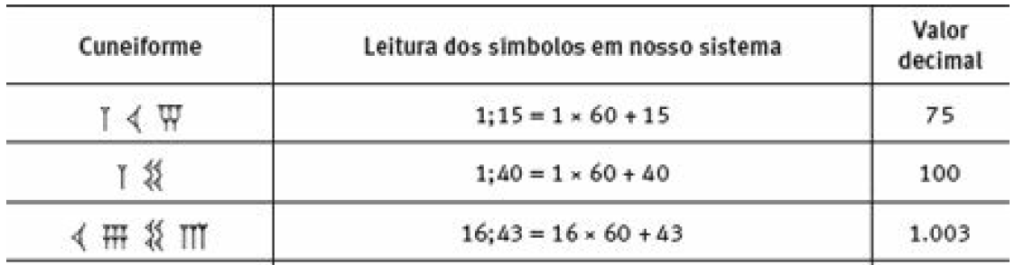
O sistema sexagesimal posicional usado no período babilônico deve ter surgido da padronização desse sistema numérico, antes do final do terceiro milênio [a.C.]. Ainda que a representação numérica continuasse a ser dependente do contexto e a usar diferentes bases ao mesmo tempo, aos poucos começaram a ser registradas listas que resumiam as relações entre diferentes sistemas de medida.”

Na verdade, presume-se que muitos dos tabletes que nos fornecem um conhecimento sobre a matemática babilônica tinham funções pedagógicas.”

Sobre a tradução dos textos cuneiformes, ver Gonçalves, Observações sobre a tradução de textos matemáticos cuneiformes.”

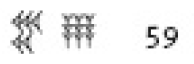
O sistema que usamos para representar as horas, os minutos e os segundos é um sistema sexagesimal [o nosso possui literalmente 60 valores, já que 0 = 60; o cuneiforme, 59, já que não há o zero e 1 = 60.].”

Nosso sistema de numeração de base 10 também é posicional. Há símbolos diferentes para os números de 1 a 9, e o 10 é representado pelo próprio 1, mas em uma posição diferente. Por isso se diz que nosso sistema é um sistema posicional de numeração de base 10, o que significa que a posição ocupada por cada algarismo em um número altera seu valor de uma potência de 10 para cada casa à esquerda.”

Se considerarmos 125 escrito na base 60, estaremos representando 1 × 60² + 2 × 60¹ + 5 × 600, que é igual a 3725 na base 10.”

Suponhamos agora que, em vez de usar a base 10, queiramos escrever um número em um sistema de numeração posicional cuja base genérica é b. Para representar um número N qualquer nessa base b, escrevemos:

N = anbn + an1bn1 + + a0b0 + a1b1 + + ambm + .

Isso significa que anbn + an1bn1 + + a0b0 é a parte inteira e temos que a1b1 + + ambm + é a parte fracionária desse número.”

Como na base 60 podemos ter, em cada casa, algarismos de 1 a 59, empregaremos o símbolo ; como separador de algarismos dentro da parte inteira ou dentro da parte fracionária de um número.” “Por exemplo, no número 12;11,6;31 a parte inteira é constituída por dois algarismos (12 e 11); e a parte fracionária por outros dois (6 e 31).”

12;11 neste caso = no nosso sistema a:

12 x 60¹ + 11 x 600 =

12 x 60 + 11 =

720 + 11 =

731

O número após a vírgula 6;31 assim se resolve:

6 x 60-1 + 31 x 60-2 =

6 x 1/60 + 31 x 1/3600 =

6/60 + 31/3600 =

1/10 + 0,00861… =

0,10861…

Logo, 12;11,6;31 =

731 + ~0,10861 =

~731,1086 =

~731,11

Que mecanismo utilizamos em nosso sistema de numeração para indicar a posição de um símbolo? Por exemplo, como fazemos para que o 1 do número 1 tenha um valor distinto do 1 do número 10?”

Observe-se que esse sistema dá margem a algumas ambigüidades. Por exemplo, o mesmo símbolo podendo ser lido como (1 + 1) ou (1;1) [ou seja, como 2 ou 61 da notação decimal]. (…) Nesse caso, houve uma época em que se usava o símbolo com tamanhos diferentes para representar o 60 e o 1, hábito que talvez esteja na origem do sistema posicional.” Quer seja: sem escala ou casas decimais, ficamos incapacitados de resolver informações polissêmicas, a não ser que, por exemplo, fosse evidente, digamos, pelo número de cabeças visíveis num rebanho, a qual grandeza o símbolo faria referência.

Algumas vezes era deixado um espaço entre os dois símbolos para marcar uma coluna vazia. Mas essa solução não resolve o problema de expressar uma coluna vazia no fim do número, logo, permite diferenciar 7200 de 3601, p.ex., mas não 7200 de 2 e de 120.”

ADIÇÃO EM BASE 60

1;30,27;40 + 29,15;13 = 1;59,42;53

1;59 + 1 = 2

MULTIPLICAÇÃO EM BASE 60

4 x 20 = 1;20

DIVISÃO EM BASE 60

1,30 ÷ 3 =0,30

(raciocínio análogo a: 1h30 dividido por 3 é igual a meia-hora. A coisa se complicaria muito se o segundo número possuísse casa fracionária [sessentesimal e não decimal].)

Por óbvio, multiplicações, divisões, somas e subtrações por 60 são as operações mais simples.

Uma das vantagens do sistema sexagesimal é o fato de que o número 60 é divisível por todos os inteiros entre 1 e 6, o que facilita a inversão dos números expressos nessa base. A divisibilidade por inteiros pequenos é uma importante característica a ser levada em conta no momento da escolha de uma base para representar os números. A base 12 está presente até hoje no comércio, onde usamos a dúzia justamente pelo fato de o número 12 ser divisível por 2, 3 e 4 ao mesmo tempo. Não podemos dizer, no entanto, que esse tenha sido o motivo do emprego dessa base pelos mesopotâmicos.”

No sistema posicional, podem-se usar os mesmos símbolos para escrever números inteiros e números fracionários, o que não acontece no sistema egípcio, como veremos adiante.”

Uma grande vantagem do sistema posicional é permitir a escrita de números muito grandes com poucos símbolos. Efetivamente, mais tarde, quando os babilônios iniciaram seus estudos astronômicos, tornou-se necessário escrever números maiores, fazendo com que as características posicionais se tornassem mais evidentes.”

A observação dos corpos celestes, presente nos registros da matemática babilônica do primeiro milênio a.C., bem como a aritmética e o sistema posicional sexagesimal usados nesse contexto, pode ter tido influência sobre a tradição grega de Hiparco e Ptolomeu. A astronomia desenvolvida por eles no Egito, na virada do milênio, indica que os cálculos astronômicos e trigonométricos de então eram feitos por meio do sistema sexagesimal posicional, ainda que com uma simbologia distinta, e que este permaneceu sendo o principal sistema até a introdução do sistema decimal indo-arábico, muitos séculos depois. Apesar disso, a idéia de que teria havido uma continuidade entre as matemáticas mesopotâmica e grega foi construída com base em interpretações equivocadas e não há evidências nítidas da influência dos mesopotâmicos sobre a tradição grega.”

Os astrônomos selêucidas, talvez pela necessidade de lidar com números grandes, chegaram a introduzir um símbolo para designar o zero, ou melhor, uma coluna vazia. No caso de 3601, escrevia-se 1; separador; 1. O separador era simbolizado por dois traços inclinados:


1 ; // ; 1 =
3601

A noção de zero como número só surgirá quando ele começar a ser associado a operações, em particular, ao resultado de uma operação, como 1 – 1 = 0. Escrever uma história do zero é tarefa bastante complexa, pois devem ser levados em conta, antes de tudo, os diversos contextos em que ele aparece e o que essa noção pode significar em cada contexto.”

No caso da multiplicação, o uso de tabuadas em tabletes era fundamental. Basta observar que os cálculos elementares, ou seja, aqueles que correspondem à nossa tabuada, incluem multiplicações até 59 × 59! Isso pode indicar a necessidade de tabletes mesmo para os cálculos mais elementares.

Um exemplo de tablete de multiplicação por 25:

1 (vezes 25 é igual a) 25

2 (vezes 25 é igual a) 50

3 (vezes 25 é igual a) 1;15

4 (vezes 25 é igual a) 1;40

5 (vezes 25 é igual a) 2;05

6 (vezes 25 é igual a) 2;30

7 (vezes 25 é igual a) 2;55 etc.”

O procedimento de divisão empregado pelos babilônios nos leva a concluir que a utilização dos tabletes, nesse caso, não servia apenas à memorização de tabuadas, o que seria um papel acessório. Para que a técnica adotada na divisão fosse rigorosa, devia haver uma necessidade intrínseca de se representar em tabletes as divisões por números cujos inversos não possuem representação finita em base 60. Isso porque, no caso de 1/N não possuir representação finita, o resultado da divisão de M por N teria de estar registrado em um tablete. Se essa operação fosse realizada pelo procedimento usual, ou seja, multiplicando-se M por 1/N, o resultado obtido não seria correto, da mesma forma que não seria correto fazer 6 × 0,3333(=1/3) para dividir 6 por 3.”

Além das operações de soma, subtração, multiplicação e divisão, os babilônios também resolviam potências e raízes quadradas e registravam os resultados em tabletes. O método usado nesse último caso era bastante interessante, uma vez que permitia obter valores aproximados para raízes que hoje sabemos serem irracionais.”

Além dos tabletes contendo o resultado de operações, os babilônios tinham um certo número de tabletes de procedimentos, como se fossem exercícios resolvidos. Correspondiam a problemas que trataríamos hoje por meio de equações. Analisaremos alguns deles em detalhes, com a finalidade de mostrar como seria anacrônico considerar que os babilônios soubessem resolver equações.”

A generalidade dos algoritmos babilônicos é distinta, pois eles constroem uma lista de exemplos típicos, interpolando-os, em seguida, para resolver novos problemas.”

Desde a época grega, e pelo menos até o século XVII, a geometria teve de respeitar a homogeneidade das grandezas. Isso quer dizer que não era permitido somar uma área com um segmento de reta. A operação utilizada pelos babilônios revela que eles não experimentavam nenhuma dificuldade nesse sentido, uma vez que possuíam um modo concreto de transformar um segmento de reta em um retângulo, operação traduzida aqui como <projeção>.”

Exemplos como esse, envolvendo operações de <cortar e colar> figuras geométricas parecem ter sido comuns na época. Høyrup caracteriza essas práticas como uma <geometria ingênua>.”

Se definíssemos álgebra como um conjunto de procedimentos que devem ser aplicados a entidades matemáticas abstratas, poderíamos até concluir que os babilônios realizavam uma álgebra de comprimentos, larguras e áreas. Mas, nesse caso, deveríamos ter o cuidado de definir a álgebra dos babilônios de um modo particular, e não por extensão do nosso conceito moderno de álgebra.”

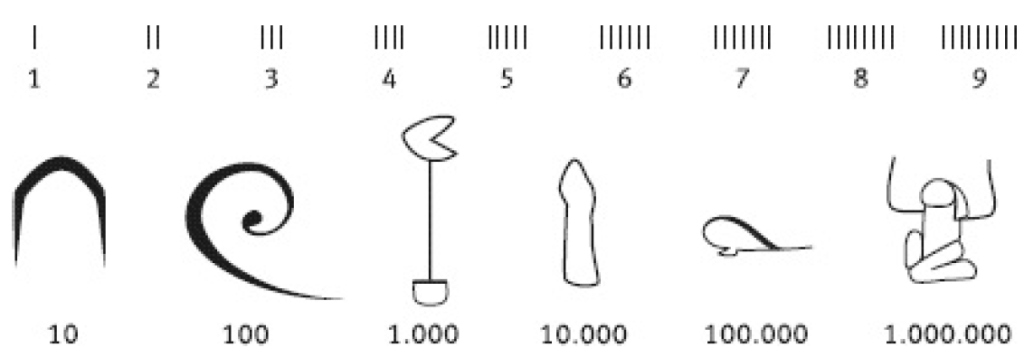
O sistema decimal egípcio já estava desenvolvido por volta do ano 3000 [a.C.], ou seja, antes da unificação do Egito sob o regime dos faraós. O número 1 era representado por uma barra vertical, e os números consecutivos de 2 a 9 eram obtidos pela soma de um número correspondente de barras. (…) O número 10 é uma alça [parece um pórtico ou uma ferradura apontando para o céu]; 100, uma espiral; mil, a flor de lótus; 10 mil, um dedo; 100 mil, um sapo; e 1 milhão, um deus com as mãos levantadas.” Quanta inocência! Ou serei eu muito malicioso? Veja abaixo…

Impossível não associar a notação egípcia a motivos religiosos ou sexuais – particularmente o 10 mil (caractere fálico) e o 1 milhão (duas interpretações instantâneas: 1- mão segura pênis e realiza-se, no topo, felação; 2- analogamente, pessoa ajoelhada em prece, com braços soerguidos), mas também o 100 mil, que remete a girino, embora não possamos dizer que se soubesse o formato de um espermatozóide (nem por isso deixava de haver uma noção, comprovada mitologicamente, de que ‘a vida veio da água’).

os números são obtidos pela soma de todos os números representados pelos símbolos (sistema aditivo) (…) esse sistema não é adequado para representar números muito grandes (…) Cabe notar que os romanos lidavam com números grandes [mesmo] usando um sistema aditivo, o que relativiza esta afirmação.”

Somente as frações ½, 1/3, 2/3 e ¼ possuíam símbolos próprios (exclusivos).

Nosso numerador indica quantas partes estamos tomando de uma subdivisão em um dado número de partes. Na designação egípcia, o símbolo oval [uma espécie de auréola sobre o símbolo usual do número] não possui um sentido cardinal, mas ordinal. Ou seja, indica que, em uma distribuição em n partes iguais, tomamos a nésima parte, aquela que conclui a subdivisão em n partes. É como se estivéssemos distribuindo algo por n pessoas e 1/n é quanto cada uma irá ganhar. Logo, configura-se um certo abuso de linguagem dizer que, na representação egípcia, as frações possuem ‘numerador 1’. Seria mais adequado dizer que essas frações egípcias representam os inversos dos números.”


Como eles representavam frações de numerador >1?

R: 5/8 seriam ½ + 1/8. (I)

Outros ex.:

(II) 58/87 = ½ + 1/6

(III) 3/7 = 1/3 + 1/11 + 1/231

Se quisermos saber, em nossa representação, qual a maior de duas frações teremos de igualar os denominadores. Na representação egípcia, uma inspeção direta permite dizer qual a maior das duas frações”

A palavra <aha> é traduzida por <número> ou <quantidade>, e esses problemas eram procedimentos para encontrar uma quantidade desconhecida quando é dada uma relação com um resultado conhecido.”

O INÍCIO DAS SUPERSTIÇÕES SOBRE “NÚMEROS RUINS”? “a duplicação de frações de denominador ímpar, um cálculo ‘difícil’, era realizada apenas uma vez, e sempre que se necessitasse do resultado recorria-se às tabelas. Pelo mesmo motivo, as somas de frações também traziam dificuldade e deviam ser representadas em tabelas.”

Esses exemplos são citados em diversos livros, muitas vezes com o objetivo de indicar que os povos babilônicos e egípcios possuíam aproximações para o valor de π. Nosso objetivo é entender em que contexto tais problemas se inserem e em que medida podem ser ou não considerados instâncias primitivas da utilização de π. Para abreviar, evitamos entrar em detalhes sobre as unidades de medida utilizadas.”

Exemplo egípcio (Problema 41 do papiro de Rhind): <Fazer um celeiro redondo de 9 por 10.> O celeiro tem o formato de um cilindro e a primeira parte do problema consiste em calcular a área da base, em forma de circunferência, cujo diâmetro é 9. A segunda parte consiste em calcular o volume em grãos se a altura é 10. O procedimento para resolver a primeira parte é o seguinte:

1) Subtraia 1/9 de 9. Resta: 8.

2) 8*8 = 64

A1 = 64

O valor 1/9 é uma constante que devia ser aprendida e utilizada sempre que se quisesse calcular a área de uma circunferência (multiplicando essa constante pelo diâmetro). (….) O resultado deveria ser multiplicado por ele mesmo”

No ocidente:

A = π*R² = (8/9*d)² = (8/9*2)²*r²,

em que d é o diâmetro dado.

π = ~3,16,

Daí a afirmação, apressada, contida em alguns livros de história, de que os egípcios já possuíam uma aproximação para π.”

Exemplo babilônico (Haddad 104): <Procedimento para um tronco. Sua linha divisória é 0,05. Quanto ele pode armazenar?>”

<Linha divisória> é o diâmetro da circunferência determinada por uma seção transversal. Em primeiro lugar, calculava-se a área de uma seção transversal, de forma circular:

1) Triplique a linha divisória:

3*0,05 = 0,15

2) Faça o quadrado de 0,15:

(0,15)² = 0,03;45

3) Multiplique 0,03;45 novamente pela linha divisória:

Abase = 0,03;45*0,05 = 0,00;18;45

4) Multiplicar a área da base pela altura:

Abase*Alt.

A altura era considerada implicitamente como igual ao diâmetro.”

Lembramos que a fórmula usada atualmente para o perímetro da circunferência é 2πr = πd (onde d é o diâmetro). Poderíamos dizer que o método dos babilônios não está muito longe do nosso, usando 3 como valor aproximado de π. Mas o objetivo não é calcular o perímetro e sim a área da circunferência, que, em seguida, deverá ser multiplicada pela altura. Para calcular a área a partir do perímetro, temos de elevar ao quadrado e depois dividir o resultado por 4π (basta verificar na nossa fórmula que a área πr² = (π²*d²)/4π). Mas, considerando que os babilônios usavam 3 como constante, em base 60, dividir por 4π é equivalente a multiplicar por 0,5 (pois 1/4π = 1/12 = 5/60 é o mesmo que 0,5 em base 60). Isso explica a multiplicação por essa constante”

Seria um tremendo anacronismo dizer que os povos mesopotâmicos e egípcios já possuíam uma estimativa para π, pois esses valores estavam implícitos em operações que funcionavam, ao invés de serem expressos por números considerados constantes universais, como em nossa concepção atual sobre π.”

Contar, e registrar quantidades, pode ser dita uma atividade concreta, pois implica um corpo a corpo com os objetos contados. Quando os tokens eram manipulados na contagem, e mesmo quando eram impressos na superfície dos invólucros, essa concretude estava em jogo. A abstração tem lugar a partir do momento em que o conteúdo dos invólucros podia ser esquecido, levando a um registro independente do que estava sendo contado, impresso em tabletes.”

É MUITO COMUM LERMOS que a geometria surgiu às margens do Nilo, devido à necessidade de medir a área das terras a serem redistribuídas, após as enchentes, entre os que haviam sofrido prejuízos. Essa hipótese tem sua origem nos escritos de Heródoto, datados do século V a.C.: <Quando das inundações do Nilo, o rei Sesóstris enviava pessoas para inspecionar o terreno e medir a diminuição dos mesmos para atribuir ao homem uma redução proporcional de impostos. Aí está, creio eu, a origem da geometria, que migrou, mais tarde, para a Grécia>” “Além disso, quase todos os livros de história da matemática a que temos acesso em português reproduzem a lenda de que a descoberta dos irracionais provocou uma crise nos fundamentos da matemática grega. Alguns chegam a afirmar que tal crise só foi resolvida com a definição rigorosa dos números reais, proposta por Cantor e Dedekind no século XIX (ou seja, mais de vinte séculos depois).”

Matemáticos célebres da Grécia Antiga em ordem cronológica:

1. Tales

2. Pitágoras

3. Euclides

CAPÍTULO 2. Lendas sobre o início da matemática na Grécia

O testemunho de Heródoto, apresentado no segundo dos nove livros de suas Histórias, se insere em uma descrição dos costumes e das instituições de povos diversos e é parte das investigações sobre as causas das guerras entre gregos e bárbaros (pertencentes ao império persa). Esse segundo livro é inteiramente consagrado ao Egito e nele se encontra a menção à palavra grega <geometria>. Os egípcios teriam revelado que seu rei partilhava a terra igualmente entre todos, contanto que lhe fosse atribuído um imposto na base dessa repartição. Como o Nilo, às vezes, cobria parte de um lote, era preciso medir que pedaço de terra o proprietário tinha perdido, com o fim de recalcular o pagamento devido.” “A palavra geometria pode ser traduzida, portanto, como <medida da terra>. Vem daí a idéia de que seu surgimento está ligado à agrimensura.”

Mas que gregos teriam levado a geometria para a Grécia? Heródoto não diz nada sobre o assunto e estudiosos postularam, posteriormente, que teria sido Tales. Para tornar o relato mais consistente, afirmou-se que esse matemático teria calculado até mesmo a altura de uma das pirâmides do Egito. Tal anedota, que Eudemo e Proclus ajudaram a construir, combina a idéia de que a geometria prática, de origem egípcia, teria evoluído para a determinação indireta de medidas inacessíveis, caso da altura de uma pirâmide.”

Não há uma documentação confiável que possa estabelecer a transição da matemática mesopotâmica e egípcia para a grega. Essa é, na verdade, uma etapa na construção do mito de que existiria uma matemática geral da humanidade.”

A designação de ‘abstrato’ ganha, agora, um sentido diferente do exposto no Capítulo 1, já que aqui a expressão está associada à prática geométrica e não numérica. O registro grego é fragmentário e a escassez de fontes faz com que o trabalho do historiador pareça especulativo. Existem alguns tratados matemáticos concluídos, outros parcialmente finalizados e outros, ainda, com apenas trechos aleatórios preservados acidentalmente em obras derivadas, além de alguma literatura sobre a matemática em textos filosóficos.”

Alguns termos de geometria já apareciam, por exemplo, na arquitetura. Há escritos técnicos do século VI abordando problemas relacionados à astronomia e ao calendário.”

é difícil estabelecer as bases factuais desta e de outras afirmações sobre Tales atribuídas por Proclus a Eudemo. Na verdade, o papel de Tales foi objeto de algumas controvérsias históricas. Segundo W. Burkert, parece ser fato que, por volta do século V, seu nome era empregado em conexão com resultados geométricos. Além disso, Aristóteles menciona Tales na Metafísica como o fundador da filosofia.”

A historiografia da matemática costuma analisar, entre as épocas de Tales e de Euclides, as contribuições da escola pitagórica do século V. Os ensinamentos dessa escola teriam influenciado um outro matemático importante desse século, Hipócrates de Quios. Além disso, é frequente encontrarmos referências a Pitágoras como um dos primeiros matemáticos gregos. Mas ambas as afirmações são hoje largamente questionadas pelos historiadores.”

Se o matemático mais conhecido do século V, Hipócrates de Quios, não era herdeiro de Pitágoras, de onde veio sua matemática? As evidências mostram que havia uma matemática grega antes dos pitagóricos. Em meados desse século, tal prática parecia estar no centro dos interesses dos principais pensadores, pois muitos deles se conectavam com questões matemáticas, caso de Anaxágoras, Hípias e Antifonte. (…) Em Atenas, a geometria era ensinada, apesar de não sabermos exatamente como. Nos diálogos de Platão, há algumas evidências da existência de um ambiente de discussão sobre os problemas geométricos que data de uma época anterior a sua obra. Um exemplo são os diálogos entre Sócrates e Teodoro, que era contemporâneo de Hipócrates e de quem Teeteto, importante personagem dos textos de Platão, deve ter sido aluno.”

como mostra W. Burkert, a escola pitagórica não parece ter tido um papel significativo na transformação da matemática de seu tempo. A convicção de que o pitagorismo está na fonte da matemática grega decorre da tradição educacional dos neopitagóricos e neoplatônicos da Antiguidade, durante os primeiros séculos da era cristã.” Curioso.

Neste capítulo e no próximo mostraremos que a visão de que a matemática abstrata, que faz uso de demonstrações, foi uma invenção dos gregos toma por base os Elementos de Euclides. Logo, seria anacrônico analisar o desenvolvimento da matemática antes de Euclides a partir de inferências lógicas.”

Mesmo o famoso teorema ‘de Pitágoras’, em sua compreensão geométrica como relação entre medidas dos lados de um triângulo retângulo, não parece ter sido particularmente estudado por Pitágoras e sua escola. Veremos, ainda, que a descoberta das grandezas incomensuráveis, freqüentemente atribuída a um pitagórico, deve ter tido outras origens. Tal descoberta contribuiu para a separação entre a geometria e a aritmética, a primeira devendo se dedicar às grandezas geométricas e a segunda, aos números – separação que é um dos traços marcantes da geometria grega, ao menos na maneira como ela se disseminou com Euclides.”

Um de nossos principais objetivos, aqui, é desconstruir os mitos envolvidos na chamada ‘crise dos incomensuráveis’. Essa tese tem origem em obras já ultrapassadas que constituem um exemplo paradigmático de um modo de fazer história da matemática – hoje contestado – baseado em pressupostos modernos sobre a natureza dessa disciplina. As narrativas sobre o suposto escândalo provocado pela descoberta dos incomensuráveis citam também os paradoxos de Zenão, por isso descreveremos brevemente seus enunciados, mostrando que estes tinham um fim filosófico e não matemático.”

A Antiuidade tardia nos legou 2 textos de pensadores neoplatônicos nos quais os feitos da matemática grega foram avaliados: um de Jâmblico, De communi mathematica scientia (Sobre o conhecimento matemático comum), e outro de Proclus, o primeiro prólogo ao seu Comentário sobre o primeiro livro dos Elementos de Euclides. Jâmblico viveu entre os séculos III e IV d.C. (…) De communi mathematica scientia é o terceiro volume de uma obra maior, dedicada ao pitagorismo, De vita pytaghorica (Sobre a vida pitagórica)“A escassez das fontes, somada à convergência interessada dos únicos textos disponíveis, nos permite duvidar até mesmo da existência de um matemático de nome Pitágoras.”

A matemática atribuída a Pitágoras é a aritmética de pontinhos, que será detalhada adiante, mas não se sabe ao certo se ela é uma criação de um matemático chamado Pitágoras, de integrantes de uma escola antiga chamada pitagórica (mas não de Pitágoras), ou dos neoplatônicos e neopitagóricos da Antiguidade, como Jâmblico e Nicômaco.”

Os pitagóricos embora sejam vistos como os primeiros a considerar o número do ponto de vista teórico, e não apenas prático, não possuíam, de fato, uma noção de número puro. Diferentemente de Platão, os pitagóricos não admitiam nenhuma separação entre número e corporeidade, entre seres corpóreos e incorpóreos.”

O Um é ao mesmo tempo par e ímpar, ser bissexuado a partir do qual os outros números se desenvolveram. O par e o ímpar são elementos dos números e na conjugação limitado-ilimitado está a oposição cósmica primordial por trás do mundo, expresso em números.”

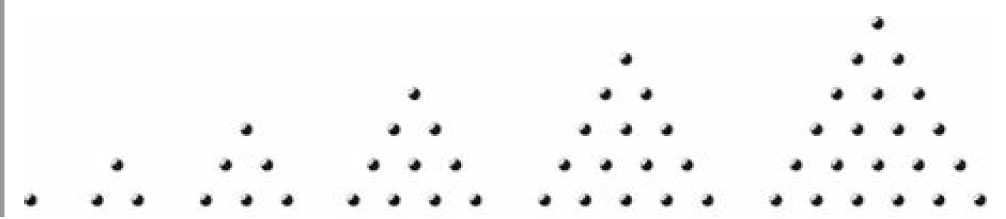
As relações entre os números não representavam, portanto, uma cadeia linear na qual todas as relações internas eram semelhantes. Cada arranjo designava uma ordem distinta, com ligações próprias. Daí o papel dos números figurados na matemática pitagórica. Esses números eram, de fato, figuras formadas por pontos, como as que encontramos em um dado. Não é uma cifra, como 3, que serve de representação pictórica para um número, mas a delimitação de uma área constituída de pontos, como uma constelação.”

Os números triangulares representados na Figura 1 podem ser associados aos nossos números 1, 3, 6, 10, 15 e 21, que possuem, respectivamente, ordem n = 1, 2, 3, 4, 5 e 6. Em linguagem atual, o número triangular de ordem n é dado pela soma da progressão aritmética 1 + 2 + 3 + … + n = [n*(n+1)]/2. Em seguida, temos os números quadrados, que, em nosso simbolismo, podem ser escritos como .”

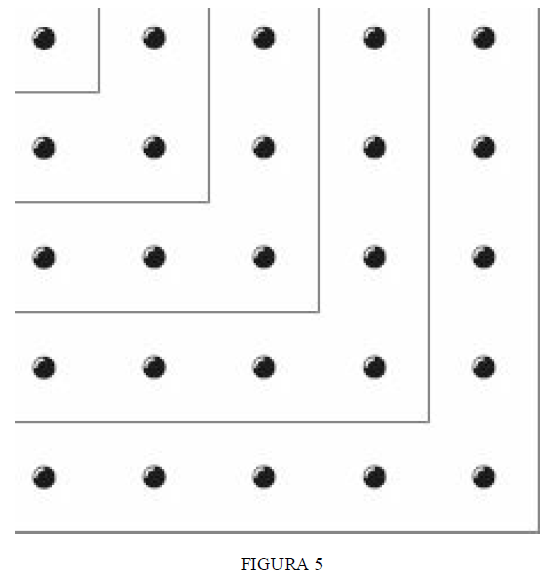
Essa imagem, chamada gnomons, é a representação pitagórica equivalente à nossas equações:

1² + 3 = 2²

2² + 5 = 3²

3² + 7 = 4² (4º gnomon, etc.)

Temos notícia de que a ciência matemática era dividida, primeiramente, em duas partes: uma que tratava dos números; outra, das grandezas. Cada uma era subdividida em duas outras partes: a aritmética estudava as quantidades em si mesmas; a música, as relações entre quantidades; a geometria, as grandezas em repouso; e a astronomia, as grandezas em movimento inerente. O conhecimento sobre esse aspecto da doutrina pitagórica vem da Metafísica de Aristóteles”

Ar. usava essa tabela de opostos para criticar a separação binária platônica segundo a qual, de um lado, temos o igual, imóvel e harmônico e, de outro, o desigual, movente e desarmônico.” Que pena que não se encontre isso em lugar nenhum do cânone platônico!

Para Aristóteles, isso indicaria a presença de seres abstratos. Por exemplo, a partir do tetractys [o terceiro triângulo de duas imagens acima, aquele com 10 pontos] os pitagóricos teriam obtido as entidades abstratas: ponto, reta, plano e sólido. No entanto, Burkert nota que essa tese está em franca contradição com outra afirmação do próprio Aristóteles, a saber, que não havia entre os pitagóricos a noção de ponto, no sentido geométrico do termo.”

O enunciado mais famoso associado ao nome de Pitágoras é o teorema que estabelece uma relação entre as medidas dos lados de um triângulo retângulo: <O quadrado da hipotenusa é igual à soma dos quadrados dos catetos>. Hoje se sabe que essa relação era conhecida por diversos povos mais antigos do que os gregos e pode ter sido um saber comum na época de Pitágoras. No entanto, não é nosso objetivo mostrar que os pitagóricos não foram os primeiros na história a estabelecer tal relação. O objetivo é investigar de que modo esse resultado podia intervir na matemática praticada pelos pitagóricos, com as características anteriormente descritas. A demonstração desse teorema, encontrada nos Elementos de Euclides, faz uso de resultados que eram desconhecidos na época da escola pitagórica. Não se conhece nenhuma prova do teorema geométrico que tenha sido fornecida por um pitagórico e parece pouco provável que ela exista.”

Não deve ter havido um teorema geométrico sobre o triângulo retângulo demonstrado pelos pitagóricos, e sim um estudo das chamadas triplas pitagóricas. O problema das triplas pitagóricas é fornecer triplas constando de dois números quadrados e um terceiro número quadrado que seja a soma dos dois primeiros.¹ Essas triplas são constituídas por números inteiros que podem ser associados às medidas dos lados de um triângulo retângulo.

¹ Alguns historiadores da matemática defendem que na placa Plimpton 322 há um indício de que os babilônios já estudavam as triplas pitagóricas, o que mostraria que a relação atribuída a Pitágoras seria conhecida na Babilônia pelo menos mil anos antes dele. Essa tese é questionada por E. Robson em ‘Neither Sherlock Holmes nor Babylon: A reassessment of Plimpton 322’ e ‘Words and pictures: new light on Plimpton 322’.”

Provavelmente, os pitagóricos chegaram a essas triplas por meio do gnomon

a primeira tripla pitagórica: (3, 4, 5).” = 3² + 4² = 5²

Na tradição, poucas triplas são mencionadas e (3, 4, 5) tem um papel especial, pois 3 é o macho; 4, a fêmea; e 5, o casamento que os une no triângulo pitagórico. Segundo Proclus, havia 2 métodos para se obter triplas pitagóricas: um de Pitágoras, outro de Platão. O primeiro começa pelos números ímpares. Associando um dado número ao menor dos lados do triângulo que formam o ângulo reto, tomamos o seu quadrado, subtraímos a unidade e dividimos por 2, obtendo o outro lado, que forma o ângulo reto. Para obter o lado oposto, somamos a unidade novamente ao resultado. Seja 3, por exemplo, o menor dos lados. Toma-se o seu quadrado e subtrai-se a unidade, obtendo 8, e extrai-se a metade de 8, que é 4. Adicionando a unidade novamente, obtemos 5, e o triângulo retângulo que procuramos é o de lados 3, 4 e 5.

O método platônico começa por um número par, considerado um dos lados que formam o ângulo reto. Primeiro dividimos esse número por 2 e fazemos o quadrado de sua metade. Subtraindo 1 desse quadrado, obtemos o outro lado que forma o ângulo reto e, adicionando 1, o lado restante. Por exemplo, seja 4 o lado. Dividimos por 2 e tomamos o quadrado da metade, obtendo 4. Subtraímos 1 e adicionamos 1, obtendo os lados restantes: 3 e 5.” Em linguagem moderna, o método platônico = (2a)² + (a² − 1)² = (a² + 1)².

Logo, pelo contexto em que esse resultado intervém, não é possível dizer que o conhecimento aritmético das triplas pitagóricas seja o exato correlato do teorema geométrico atribuído a Pitágoras, daí as aspas empregadas aqui ao falarmos do teorema <de Pitágoras>.”

A versão mais popular é a de que esse livro de Euclides resulta de uma compilação de conhecimentos matemáticos anteriores, ainda que a forma da exposição deva ser característica do tempo e do meio em que ele viveu. Não é possível confirmar essa tese, mas é fato que uma boa parte da matemática contida nessa obra associa-se a outros trabalhos gregos. Euclides apresenta 2 tipos de teoria das razões e proporções. Há uma versão no livro VII que pode ser aplicada somente à razão entre inteiros e é atribuída aos pitagóricos. A definição contida aí é usada para razões entre grandezas comensuráveis. A segunda versão, presumidamente posterior à primeira, está no livro V e é atribuída ao matemático platônico Eudoxo. Essa última teoria das razões e proporções é bastante sofisticada e se aplica igualmente a grandezas comensuráveis e incomensuráveis.”

Segundo Knorr, o desenvolvimento formal da matemática deve ter se iniciado com os trabalhos de Teeteto, no início do século IV”

Hipócrates teria sido o autor da primeira obra escrita em um livro de ‘elementos’, ou seja, com a apresentação sistemática da geometria. Infelizmente, poucos fragmentos sobreviveram. Seu trabalho mais conhecido é o estudo das lúnulas, que são porções de círculo compreendidas entre duas circunferências, incluindo a investigação de quadraturas. Os escritos de Hipócrates constituem o único documento do século V contendo um estudo de razões e proporções entre figuras geométricas. Ele sabia que a razão entre as áreas de dois segmentos de círculo semelhantes é igual à razão entre os quadrados de seus diâmetros. Essa demonstração, de uma época bem anterior à de Eudoxo, exigia um conhecimento profundo de razões e proporções.”

A palavra antifairese vem do grego e significa, literalmente, subtração recíproca. Na álgebra moderna, o procedimento é semelhante ao conhecido como <algoritmo de Euclides> e sua função é encontrar o maior divisor comum entre dois números.”

O método da antifairese descreve uma série de comparações. Por exemplo, podemos pedir a um aluno que compare duas pilhas de pedras. Se a primeira tem 60 e a segunda, 26, concluímos que:

1) da primeira pilha com 60 pedras é possível subtrair duas vezes a pilha com 26 pedras, e ainda resta uma pilha com 8 pedras;

2) da pilha com 26 pedras é possível subtrair três vezes a pilha com 8 pedras, e ainda resta uma pilha com 2 pedras;

3) por fim, a pilha com 2 pedras cabe, exatamente, quatro vezes na pilha com 8 pedras.

A sequência <2x, 3x e 4x exatamente> representa o número de subtrações que se pode fazer em cada passo. Podemos chamá-la de razão e usar a notação Ant (60, 26) = [2, 3, 4] para representar a razão antifairética 60:26. A escolha de grandezas que permitem uma representação finita por números inteiros nem sempre é possível.

Para Fowler, os gregos entendiam a razão 22:6, por exemplo, baseados no fato de que é possível subtrair 6 de 22 três vezes, restando 4; em seguida, subtrai-se 4 de 6, restando 2; finalmente, subtrai-se 2 de 4 exatamente duas vezes. Logo, a razão 22:6 seria definida pela sequência <3x, 1x, 2x>.”

Essa antifairese equivale a fazer A = n0B + R1, em seguida, B = n1R1 + R2, depois R2 = n1R2 + R3, e assim por diante. O procedimento pode ou não chegar ao fim. Quando ele termina, a medida comum aos dois segmentos fica associada a um terceiro segmento, R, que é o último resto não-nulo encontrado e que mede os segmentos A e B. Isso permite achar a medida comum a 2 segmentos e, assim, é possível reduzir a geometria à aritmética, pois cada segmento será representado por sua medida.”

A teoria das grandezas comensuráveis foi desenvolvida, primeiramente, pela aritmética e, depois, por imitação, pela geometria. Por essa razão, ambas as ciências definem grandezas comensuráveis como aquelas que estão uma para outra na razão de um número para outro número, o que implica que a comensurabilidade existiu primeiro entre os números.” Proclus

Como afirma Fowler, essa técnica teria sido usada para desenvolver uma teoria de razão independente da noção de proporção. Segundo o historiador, 3 noções distintas de razão estariam presentes na tradição grega: uma vinda da teoria musical; outra, da astronomia (que teria servido de base para as definições do livro V dos Elementos); e uma terceira, baseada na antifairese.”

Se temos, por exemplo, um quadrado de lado 1, esse lado não é comensurável em comprimento com a diagonal. No entanto, seu quadrado 1 é comensurável com o quadrado da diagonal, que é 2. É lícito dizer, então, que essas grandezas são comensuráveis em potência.”

as teses atuais sugerem que houve um desenvolvimento contínuo da matemática, e não uma ruptura, antes e depois do momento em que se percebeu a possibilidade de duas grandezas serem incomensuráveis.”

Reza a lenda que a descoberta dos irracionais causou tanto escândalo entre os gregos que o pitagórico responsável por ela, Hípaso, foi expulso da escola e condenado à morte. Não se sabe de onde veio essa história, mas parece pouco provável que seja verídica. Em um artigo publicado em 1945, ‘The discovery of incommensurability by Hippasos of Metapontum’ (A descoberta da incomensurabilidade por Hípaso de Metaponto), Von Fritz conjectura que a incomensurabilidade tenha sido descoberta durante o estudo do problema das diagonais do pentágono regular, que constituem o famoso pentagrama. A lenda da descoberta dos irracionais por Hípaso foi erigida a partir desse exemplo. Entretanto, os historiadores que seguimos aqui contestam tal reconstrução, uma vez que ela implica o uso de fatos geométricos elaborados que só se tornaram conhecidos depois dos Elementos de Euclides.”

Não sabemos exatamente qual a importância da geometria na escola pitagórica, mas acredita-se que não tenha sido tão relevante quanto a aritmética. Para os pitagóricos, que praticavam aritmética com números representados por pedrinhas e estavam preocupados com teorias sobre o cosmos, resumidas pelo enunciado <tudo é número>, a descoberta da incomensurabilidade não deve ter tido nenhuma importância. A teoria dos números desenvolvida por eles e a matemática abstrata, associada à geometria, estavam em dois planos distintos: <tudo é número> não significava <todas as grandezas são comensuráveis>.”

A afirmação de que a descoberta da incomensurabilidade produziu uma crise nos fundamentos da matemática grega foi consolidada por trabalhos de historiadores da 1ª metade do século XX. P. Tannery já havia afirmado que tal descoberta significou um escândalo lógico na escola pitagórica do século V, sendo mantida em segredo inicialmente, até que, ao se tornar conhecida, teve como efeito desacreditar o uso das proporções na geometria. Um dos artigos mais influentes a propalar a ocorrência de uma crise foi ‘Die Grundlagenkrisis der griechischen Mathematik’ (A crise dos fundamentos da matemática grega), de Hasse & Scholz, publicado em 1928, que fazia referência somente à possibilidade de ter havido uma crise dos fundamentos da matemática grega.”

O problema da incomensurabilidade parece ter surgido no seio da própria matemática, mais precisamente da geometria, sem a relevância filosófica que lhe é atribuída. Ao contrário da célebre lenda, os historiadores citados, como Burkert e Knorr, contestam até mesmo que essa descoberta tenha representado uma crise nos fundamentos da matemática grega. Não se encontra alusão a escândalo em nenhuma passagem dos escritos a que temos acesso e que citam o problema dos incomensuráveis, como os de Platão ou Aristóteles. Aristóteles, aliás, não cita o problema dos incomensuráveis nem mesmo em sua crítica aos pitagóricos.”

Em ‘Impact of modern mathematics on ancient mathematics’ (Impacto da matemática moderna sobre a matemática antiga), Knorr interpreta as diferentes versões da crise dos incomensuráveis que dominaram a historiografia em meados do século XX como um sinal da influência de pressupostos filosóficos. Os estudos meta-matemáticos do período foram marcados pelo questionamento em relação aos fundamentos da matemática, associado aos trabalhos de Dedekind, Cantor e Hilbert. A tentação de ver nos gregos uma crise análoga era um modo de valorizar os trabalhos do início do século XX, encarados como soluções para dilemas não resolvidos por 2500 anos.”

É provável que a antifairese entre o lado e a diagonal do quadrado fosse conhecida de modo geométrico nos séculos V e IV sem que se atribuísse ao procedimento o valor de uma demonstração da incomensurabilidade. Outra hipótese sobre a descoberta da incomensurabilidade, dessa vez no contexto da aritmética, tem sua origem em um resultado atribuído a Euclides. No final do século IV, Aristóteles se refere à prova da incomensurabilidade em sua exposição sobre a técnica de raciocínio por absurdo, dizendo que: se o lado e o diâmetro são considerados comensuráveis um em relação ao outro, pode-se deduzir que os números ímpares são iguais aos pares; essa contradição afirma, portanto, a incomensurabilidade das duas grandezas.” “Mas a demonstração desse fato faz uso de uma linguagem algébrica que não poderia ter sido usada pelos gregos antigos.” Ar., gênio, mas sempre menino bobo!

Na matemática grega anterior a Euclides, os problemas geométricos eram tratados como se fossem cálculos com números. Foi justamente a descoberta dos incomensuráveis que provocou uma separação entre os universos das grandezas e dos números. A demonstração pré-euclidiana da incomensurabilidade não pode ter se servido, portanto, dessa separação. Logo, a prova encontrada nesse apêndice deve ser tardia e com certeza não foi por meio dela que se descobriu a incomensurabilidade.”

Por volta do ano 375, Platão criticou os geômetras por não empregarem critérios de rigor desejáveis para as práticas matemáticas. Não por acaso o trabalho de Eudoxo se desenvolveu no seio da academia platônica. Sendo assim, ainda que não possamos dizer que a transformação dos fundamentos da matemática grega é devida a Platão, este expressa o descontentamento dos filósofos com os métodos adotados pela matemática e articula o trabalho dos pensadores à sua volta para que se dediquem a formalizar as técnicas utilizadas indiscriminadamente.”

Temos notícia dos paradoxos de Zenão por fontes indiretas, como a Física de Aristóteles, e seus objetivos estão expostos no diálogo Parmênides de Platão. Tais paradoxos são mencionados algumas vezes em conexão com o problema dos incomensuráveis. No entanto, os argumentos de Zenão se voltam contra pressupostos filosóficos. Além disso, a descoberta da incomensurabilidade deve ter se dado depois da época de Zenão, o que nos leva a concluir que seus paradoxos nada têm a ver com a questão. Em livros de história da matemática, é comum também relacionar esses paradoxos ao desenvolvimento do cálculo infinitesimal e do conceito de limite. Trata-se, no entanto, de uma interpretação a posteriori.”

O pensamento dos eleatas busca ultrapassar a percepção e fundamentar a filosofia em bases não-empíricas. A filosofia do Uno nega veementemente a possibilidade de que as coisas possam ser subdivididas, já que essa divisão implica a constituição de uma pluralidade. Zenão queria mostrar, com seus paradoxos, que é absurdo considerar não apenas que as coisas são infinitamente divisíveis, mas também que são compostas de infinitos indivisíveis. Os paradoxos dizem respeito à impossibilidade do movimento, no caso de admitirmos quaisquer dessas hipóteses. § Esses paradoxos contra o movimento só são conhecidos na forma exposta por Aristóteles, com o objetivo de refutá-los. Nenhum argumento matemático é usado em sua contestação.” Ainda o mesmo dos pseudo-divulgadores científicos de hoje: ‘Olha só, um físico afirmou que o tempo não existe!!’

A série que pode ser usada para traduzir o problema de Zenão é ½ + (½)² + (½)³ cuja soma deve ser igual a 1.”

Demonstração moderna:

0,999999… = 0,9 + 0,09 + … = 9/10 + 9/100 + 9/1000 + … = 9/10 / (1 – 1/10) = ½ / (1 – ½) = 1

Resumindo todo o teor do capítulo:

A historiografia calibrada recente nos ensina que:

Pitágoras é o Pai da matemática indutiva grega;

Euclides é o Pai da matemática dedutiva grega. (Pai – conhecido! – da Axiomática)

Por que então o método dedutivo teria sido empregado na matemática grega e quais as causas da adoção da noção de prova? § Problemas matemáticos complexos começaram a surgir por volta do quinto e quarto séculos, como o de expressar o comprimento da diagonal em termos do lado de um quadrado. Esse não era somente um problema ainda não-resolvido, era um problema que desafiava a percepção, além de não poder ser abordado somente por meio de cálculos. A lógica matemática e a prova dedutiva podem ir além do que é perceptível.”

Por um lado, os matemáticos tinham de lidar com a complexidade e o caráter abstrato de alguns problemas que contradiziam a intuição e não eram acessíveis por meio de cálculos. Por outro, a organização em escolas, cujo objetivo era transmitir o conhecimento matemático da época, pode ter gerado uma demanda pela compilação e sistematização desse conhecimento. A necessidade de colocar em ordem a aritmética e a geometria herdadas das tradições mais antigas, bem como as descobertas recentes, deve ter levado, naturalmente, a um questionamento sobre a forma de expor o conteúdo matemático.”

Tudo que é abstrato se cimenta no ar.

Uma das primeiras evidências diretas e extensas sobre a geometria grega no período aqui considerado, para além de fragmentos ou reconstruções tardias, é o diálogo platônico intitulado Mênon, que se supõe tenha sido escrito por volta do ano 385 a.C.” Minha tradução de trechos (os matemáticos sempre em verde): https://seclusao.art.blog/2020/01/22/menon-ou-da-virtude-ou-da-inexistencia-de-uma-ciencia-politica-ultima-traducao-do-ciclo-platao-obras-completas-virginia-woolf-ao-final/.

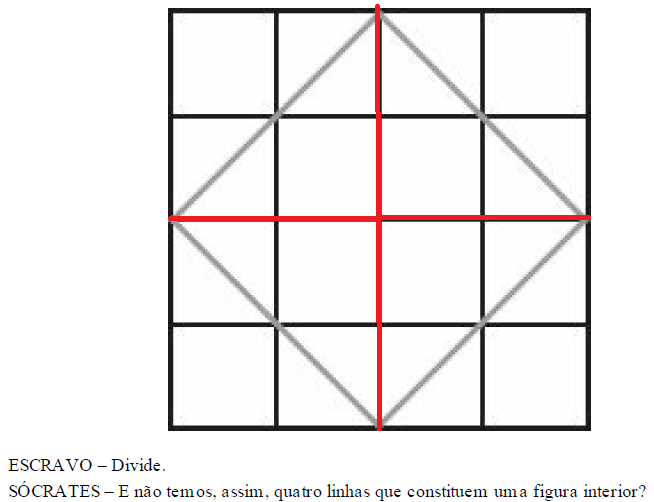
Sem que minha tradução fosse prejudicada por isso, fi-la da seguinte forma (linhas vermelhas), ao passo que Sócrates na verdade se referia às linhas cinzentas (acontece que essa era uma forma de demonstrar a incomensurabilidade da diagonal do quadrado numa forma bidimensional, enquanto que na minha tradução aludi ao cubo, tridimensional, em nota de rodapé):

Com efeito, eis o quadrado de oito pés de área, a olho nu. A palavra diagonal não aparece no texto, apenas lado. Porque a diagonal é, afinal, um lado de outro quadrado, justaposto.

A pergunta sobre quanto mede a diagonal não chega nem mesmo a ser evocada, talvez porque Sócrates saiba que essa medida não pode ser encontrada no universo dos números admitidos até então. Mas, além disso, talvez ele quisesse apresentar ao escravo um novo tipo de conhecimento, no qual basta exibir a linha sobre a qual o quadrado deve ser construído.”

Vemos que embora minha intenção fosse diferente da da autora (Tatiana Roque), não discordamos nada a respeito do diálogo (a evidenciação do conceito de reminiscência X o correto ensino da matemática geométrica, em que pese a ‘irracionalidade do número da diagonal’). É que em algum momento ambas as coisas são uma só na exposição de Sócrates. O que fica evidente no meu trecho comentado que reproduzo aqui: “Este raciocínio todo, bem simples, serve para lembrar, também: não é todo matemático que é bom em ensinar matemática. É preciso saber o método para não fazer o aluno <descobrir a natureza> da forma indesejada (pelo ensino oficial, pelos livros, pelo próprio educador, etc.). Mostrar que o jovem se equivocava ao imaginar o quadrado e que se daria conta do erro ao contar os quadrados após desenhar o quadrado na areia favorecia Sócrates na discussão que tinha com Mênon (sobre a teoria da reminiscência).” O que mostra, ainda, o quão visual era, àquela altura, a matemática para os gregos!

Mas continuando…

A geometria, tal como a conhecemos atualmente, lida com formas abstratas. Um quadrado não é o quadrado que desenhamos no papel; é uma forma abstrata, a forma <quadrado>. Os objetos geométricos de base – como o ponto, a reta e o plano – também não são concretos. O ponto é algo sem dimensão, que não existe na realidade. Logo, esses objetos só podem ser concebidos por meio de uma abstração.” Parênteses filosóficos importantes: a idéia platônica é só isso: a verdade não está no fenômeno! Aristóteles, tão genial em suas sistematizações, não foi capaz de compreendê-lo. Ao contrário das aparências, não foi seu melhor aluno… Ou, não importa: enquanto aluno presencial, na Academia, talvez até tenha sido. Mas nós somos alunos muito melhores neste século! Em nenhum momento se tratava de criar duplos metafísicos, mas de descrever o Um parmenídeo.

O conhecimento não são sombras, mas também não é o sol ou qualquer imagem tridimensional fora da caverna (precaução contra a hiper-fenomenologia)…

A matemática parte sempre de primeiros princípios: um conjunto de hipóteses a partir das quais se poderá descer até as conclusões, que constituirão o conhecimento científico. Nesse processo, objetos sensíveis se fazem necessários, o que é muito claro na matemática: raciocinar sobre um quadrado hipotético exige o emprego do desenho de um quadrado no quadro-negro, ainda que saibamos que esse quadrado desenhado não é o verdadeiro quadrado. A dialética é um conhecimento de tipo distinto, que usa as hipóteses como ponto de partida para um mundo acima delas, no qual não há hipóteses.” Nessa última frase serei obrigado a discordar: Platão nunca fez essa distinção. Todo transcender ao que está por trás das aparências, o verdadeiro, ainda é sempre um exercício de engatinhar e tatear por entre hipóteses…

Entre as ciências hipotéticas, a geometria é o principal exemplo usado por Platão. Essa ciência utiliza hipóteses e dados sensíveis para chegar a conclusões de modo consistente. Um de seus traços distintivos é o fato de utilizar formas visíveis com o fim, somente, de investigar o absoluto que encerram. Quando um geômetra pesquisa as propriedades de um quadrado desenhado no quadro-negro – cópia do quadrado ideal –, é o verdadeiro quadrado que ele pretende simular e não meramente a sua cópia. As verdades da Idéia só podem ser vistas com os olhos do pensamento, e em sua busca a alma é obrigada a usar os primeiros princípios, descendendo destes suas conseqüências.” Agora se expressou melhor!

A OBRA Elementos, de Euclides, é vista como o ápice do esforço de organização da geometria grega desenvolvida até o século III a.C. Por um lado, afirma-se que seria somente uma compilação de resultados já existentes produzidos por outros, o que torna o seu autor um mero editor. Por outro, celebra-se que esses trabalhos tenham sido expostos de um modo novo, o que revelaria a predominância na Grécia, nessa época, de um pensamento lógico e dedutivo.”

CAPÍTULO 3. Problemas, teoremas e demonstrações na geometria grega

Os Elementos de Euclides são um conjunto de 13 livros publicados por volta do ano 300, mas não temos registros da obra original, somente versões e traduções tardias.”

Do ponto de vista histórico, cabe perguntar até que ponto o padrão que esse livro exprime era realmente preponderante na matemática que se desenvolveu antes e depois de Euclides. Além disso, é fato, as construções propostas nessa obra são efetuadas por meio da régua e do compasso. Mas seria essa restrição decorrente de uma proibição de outros métodos de construção? Teria essa determinação afetado toda a geometria depois de Euclides?” “Um dos objetivos deste capítulo é relativizar a tese da influência platônica na reorganização da geometria, bem como o papel das técnicas de construção propostas nos Elementos no contexto das práticas gregas de resolução de problemas.”

Todo enunciado universal sobre um objeto geométrico é um teorema geométrico. Os problemas são um primeiro passo para passarmos do mundo prático à geometria. (…) Grande parte da crença que temos na motivação platônica de Euclides decorre da utilização dos Comentários de Proclus. A Coleção matemática de Pappus é outra das principais fontes de conhecimento dos trabalhos matemáticos gregos, cujos registros originais se perderam.”

A resolução de problemas geométricos envolve sempre uma construção, e o critério usado nessa classificação baseia-se nos tipos de linhas necessárias para efetuá-la. Além da régua e do compasso, são listados métodos que usam cônicas e curvas mecânicas, como a quadratriz, a espiral e o conchóide de Nicomedes, conhecidos antes do fim do século III. As construções com régua e compasso não permitem resolver todos os problemas propostos pelos matemáticos gregos antes e depois de Euclides, que não se furtavam, por isso, a utilizar outros métodos.”

A visão de que os matemáticos gregos se aferravam aos fundamentos e a padrões rígidos tem origem na história da matemática desenvolvida na virada dos séculos XIX e XX, período marcado por pesquisas sobre o rigor da matemática dessa época. O objetivo dos trabalhos de Hilbert, por exemplo, era justamente fundamentar a geometria euclidiana. Mas será que os matemáticos da Antiguidade eram tão preocupados assim com questões de fundamento quanto os do final do século XIX?”

Nos primeiros livros dos Elementos, muitos resultados parecem pertencer a uma tradição que podemos chamar de ‘cálculo de áreas’, que inclui a transformação de uma área em outra equivalente, bem como a soma de áreas. Veremos que as proposições dos livros I e II podem ser entendidas a partir dessas práticas, incluindo o teorema sobre a hipotenusa do triângulo retângulo,

dito ‘de Pitágoras’.”

Arquimedes nasceu mais ou menos no momento em que Euclides morreu, em torno da segunda década do século III. Era de esperar, portanto, que o trabalho de Euclides tivesse uma influência marcante em sua obra. Mas não foi bem assim. Arquimedes não pode ser visto como sucessor de Euclides; e seu trabalho não se inscreve, por assim dizer, em uma tradição euclidiana. Um exemplo disso é a utilização de métodos mecânicos de construção, caso da espiral de Arquimedes.”

Entre os diversos problemas matemáticos clássicos difundidos antes de Euclides estão o da duplicação do cubo (problema deliano) e o da quadratura do círculo.”

Há diversas construções para as meias proporcionais que datam de períodos posteriores e podem ser encontradas em Três excursões pela história da matemática, de J.B. Pitombeira. Entre elas está a de Menecmo, que viveu por volta de 350 e foi aluno de Eudoxo. O seu conhecimento da teoria das razões e proporções permitia concluir, sem usar equações, que o ponto que satisfaz o problema das meias proporcionais é a interseção de duas cônicas, uma parábola e uma hipérbole, que atualmente seriam dadas, respectivamente, pelas equações y² = bx e xy = ab.”

Por valorizar a matemática teórica, Platão teria desprezo pelas construções mecânicas, realizadas com ferramentas de verdade. A régua e o compasso, apesar de serem instrumentos de construção, podem ser representados, respectivamente, pela linha reta e pelo círculo, figuras geométricas com alto grau de perfeição.” “é coerente dizer que sua filosofia encarava a reta e o círculo como figuras geométricas superiores, mas também não há, em seus escritos, indicações explícitas de imposição dessas figuras como protótipos para toda a geometria, nem de proibição do uso de outras construções.”

OS CHATÕES DOS 1800! “O responsável por creditar a Platão a restrição à régua e ao compasso é o matemático alemão Hermann Hankel, que atuou na segunda metade do século XIX e trabalhou com matemáticos como Weierstrass e Kronecker, conhecidos pela preocupação com os fundamentos da matemática. Em 1874, Hankel publicou um texto histórico sobre a geometria euclidiana – Zur Geschichte der Mathematik in Alterthum und Mittelalter (Sobre a história da matemática na Idade Média e na Antiguidade) – contendo extrapolações com base em trechos da obra de Platão. Em uma tese meticulosa sobre o papel da restrição à régua e ao compasso escrita em 1936, mas que continua uma referência sobre o nascimento desse mito, o alemão A.D. Steele analisa por que a tese de Hankel é falsa e fornece algumas hipóteses sobre as razões do uso exclusivo desses instrumentos nos Elementos de Euclides. Referimo-nos especificamente aos Elementos, pois a restrição à régua e ao compasso não parece ser importante nem mesmo em outros escritos de Euclides.”

Quer optemos pela motivação pedagógica ou por essa segunda razão, de cunho epistemológico, parece mais adequado entender a exclusividade da régua e do compasso nos Elementos como uma restrição pragmática cujo objetivo poderia ser apresentar um uso ótimo dos instrumentos mais simples possíveis.”

O tipo de organização dos Elementos também é objeto de extensas pesquisas, pois os resultados dos primeiros livros não são necessariamente os mais antigos, ou seja, a obra não é organizada de modo cronológico. Acredita-se que os livros VII a IX – os livros aritméticos dos Elementos, atribuídos aos pitagóricos – sejam os mais antigos. Os livros II, III e IV não apresentam uma ordem seqüencial tão nítida quanto a dos livros I, V e VI, o que pode indicar que aqueles sejam anteriores a esses. Além disso, nos livros I a IV, as construções e provas são realizadas por métodos de congruência e pelo cálculo de áreas e não empregam razões e proporções, que já eram conhecidas muito antes de Euclides. Isso poderia ser um indício de que eles teriam sido escritos depois da descoberta dos incomensuráveis, que demandou uma nova teoria das razões e proporções. A partir desse momento, parece ter havido uma reorganização do conhecimento geométrico. A exposição de resultados envolvendo semelhança de figuras, por exemplo, que já eram bastante antigos, foi adiada para depois do livro V, uma vez que necessitava de uma teoria geral das razões e proporções para grandezas (incluindo as incomensuráveis).”

Um traço particular dos Elementos é que as grandezas são tratadas enquanto tais e jamais são associadas a números (ao contrário, nos livros sobre números, eles são tratados como segmentos de reta).” “Alguns pesquisadores, como Fowler, afirmam que o livro V dos Elementos, que contém uma teoria das razões e proporções, trata de resultados mais recentes do que os outros livros.

Resumindo, podemos traçar a seguinte cronologia: os livros VII a IX, que seriam os mais antigos, empregam uma linguagem ingênua de razões e proporções que estaria presente desde épocas muito remotas, antes da descoberta dos incomensuráveis; os livros I a IV tratam de resultados sobre equivalência de áreas também antigos, mas as demonstrações evitam o uso de razões e proporções; no livro V é apresentada a nova teoria das razões e proporções, servindo de base para o estudo de equivalência de áreas e semelhança de figuras de um novo modo, o que é feito no livro VI. Além disso, o livro I teria sido escrito com o intuito de apresentar os princípios, por isso exibiria um cuidado especial com o encadeamento das proposições.”


Uma definição é um tipo de hipótese da qual o aprendiz não tem uma noção evidente, mas faz uma concessão àquele que as ensina e aceita-a sem demonstração. As definições que iniciam os Elementos fazem referência aos objetos matemáticos que serão utilizados ao longo da obra e que possuem um conteúdo intuitivo.”

Livro I – Definições

1. Ponto é aquilo de que nada é parte

2. E linha é comprimento sem largura

3. E extremidades de uma linha são pontos

4. E linha reta é a que está posta por igual com os pontos sobre si mesma

5. E superfície é aquilo que tem somente comprimento e largura

6. E extremidades de uma superfície são retas

10. E quando uma reta, tendo sido alteada sobre uma reta, faça os ângulos adjacentes iguais, cada um dos ângulos é reto, e a reta que se alteou é chamada uma perpendicular àquela sobre a qual se alteou

15. Círculo é uma figura plana contida por uma linha (que é chamada circunferência), em relação à qual todas as retas que a encontram (até a circunferência do círculo), a partir de um ponto dos postos no interior da figura, são iguais entre si

…”

Na definição 4, o termo linha reta designa o que hoje chamamos de segmento de reta. À maneira de Euclides, usaremos aqui o termo reta com esse sentido.” “A definição 15 está na origem da distinção entre círculo e circunferência encontrada em alguns livros-texto atuais.”

Uma noção comum, segundo Proclus, é um enunciado de conteúdo óbvio, tido facilmente como válido pelo aprendiz. Se além de o enunciado ser desconhecido ele é proposto como verdadeiro por meio de alguma argumentação temos um postulado. Nesse caso, é necessário que aquele que ensina convença o aprendiz de sua validade.”

Livro I – Postulados

1. Fique postulado traçar uma reta a partir de todo ponto até todo ponto

2. Também prolongar uma reta limitada, continuamente, sobre uma reta

3. E, com todo centro e distância, descrever um círculo

4. E serem iguais entre si todos os ângulos retos

5. E, caso uma reta, caindo sobre duas retas, faça os ângulos interiores e do mesmo lado menores do que dois retos, sendo prolongadas as duas retas, ilimitadamente, encontrarem-se no lado no qual estão os menores do que dois retos

Livro I – Noções comuns

1. As coisas iguais à mesma coisa são também iguais entre si

2. E, caso sejam adicionadas coisas iguais a coisas iguais, os todos são iguais

3. E, caso de iguais sejam subtraídas iguais, as restantes são iguais

4. E, caso iguais sejam adicionadas a desiguais, os todos são desiguais

8. E o todo é maior do que a parte

9. E duas retas não contêm uma área”

Os enunciados da matemática seguem-se, por demonstração, dos primeiros princípios. Essa é a definição do método axiomático-dedutivo. Mas por que Euclides usou esse método?”

Como vimos, o objetivo da proposição I-45 é mostrar como se pode construir um paralelogramo, com ângulo dado, cuja área seja igual à de um polígono qualquer. Observemos que essa construção torna possível representar a área de qualquer polígono como um retângulo, uma vez que o retângulo é um caso particular de paralelogramo, com ângulos retos. Para entender a importância dessa construção, é preciso saber como eram realizados os cálculos de áreas na geometria grega.

Atualmente, medir é associar uma grandeza a um número. Se quisermos somar as áreas de dois polígonos, teremos de calcular a área de cada um, por meio de uma fórmula, e somar os resultados (que são números). Mas nesse momento as grandezas não eram tratadas por meio de associação a números.”

para ‘medir’ a área de uma figura qualquer, deveríamos encontrar uma figura simples cuja área fosse igual à da figura dada. Essa figura simples era um quadrado. Logo, o problema de encontrar a quadratura de uma figura qualquer era equivalente ao problema de construir um quadrado cuja área fosse igual à da figura dada.”

Os primeiros princípios servem, portanto, à demonstração dos primeiros resultados, que, em seguida, efetuarão o papel de premissas para novas demonstrações. O encadeamento dedutivo das proposições pode ser compreendido, assim, como a busca de uma espécie de economia na argumentação.”

se 2 triângulos têm 2 lados iguais e os ângulos formados por eles também iguais, então os triângulos são congruentes. O uso do termo ‘congruente’ é bem mais recente e tem como objetivo resolver uma inconsistência lógica colocada pela formalização posterior da geometria euclidiana. Na lógica, o princípio da identidade afirma que uma coisa só é igual a si mesma. Portanto, 2 triângulos ou 2 figuras geométricas quaisquer não podem ser iguais. Daí o emprego do termo ‘congruente’, que significa, intuitivamente, que 2 figuras podem ser colocadas uma em cima da outra.” A lógica não é sempre lógica.

se 2 triângulos ABC e DBC possuem a mesma base e o terceiro vértice em uma paralela à base, então eles têm áreas iguais. Atualmente, dizemos que 2 triângulos têm áreas iguais se possuem a mesma base e a mesma altura, uma vez que a área é calculada pela fórmula bh/2.Como tratamos aqui de uma tradição geométrica que não associava grandezas a números, não se mediam a base e a altura para calcular a área. A proposição I-38 procura dizer em que casos duas áreas são equivalentes sem que seja preciso calculá-las. Ora, se o 3º vértice de 2 triângulos está em uma paralela à base, eles possuem as mesmas alturas. Como é dado que as bases são iguais, eles têm também a mesma área. As 2 últimas proposições do livro I são justamente o resultado conhecido como teorema ‘de Pitágoras’ e o seu recíproco.”

Proposição I-47

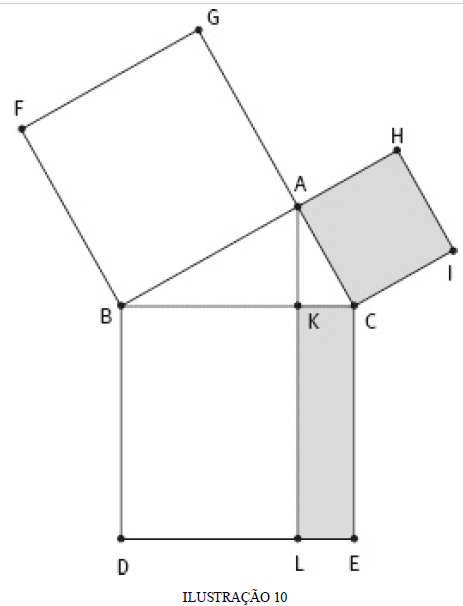
Nos triângulos retângulos, o quadrado sobre o lado que se estende sob o ângulo reto é igual aos quadrados sobre os lados que contêm o ângulo reto. [mal-redigido pra porra, como veremos mais abaixo!]

Demonstração: Seja o triângulo retângulo ABC, com ângulo reto BAC. Queremos mostrar que a área do quadrado construído sobre o lado BC é igual à soma das áreas dos quadrados construídos sobre os lados AB e AC, que formam o ângulo reto BAC. Vamos ilustrar a demonstração com figuras que não foram usadas por Euclides, [não fosse isso e dificilmente entenderíamos] mas manteremos o espírito de sua prova. Descrevemos sobre cada lado um quadrado e vamos mostrar que a área do quadrado construído sobre o lado BC pode ser obtida pela soma de 2 retângulos, um deles com área igual à do quadrado construído sobre AB (em cor branca na Ilustração 10) e o outro com área igual à do quadrado construído sobre AC (de cor cinza).

Queremos mostrar que a área do quadrado ABFG é igual à do retângulo BDLK. Os próximos passos para concluir essa demonstração são os seguintes:

1. Mostrar que a área do triângulo ABF, que é metade do quadrado ABFG, é igual à área do triângulo DBK, que é metade da do retângulo BDLK.

2. Para isso, mostraremos que a área de ABF é igual à de CBF e que a área de DBK é igual à de ABD.

3. Como já mostramos que a área de ABD e de CBF são iguais, concluiremos que a área de ABF é igual à área de DBK, assim, a área do quadrado ABFG será igual à do retângulo BDLK.

Como os ângulos BAC e BAG são retos, os segmentos CA e AG estão sobre uma mesma reta. Como essa reta é paralela a BF, temos que CBF e ABF são triângulos de mesma base com o 3º vértice em uma paralela a essa base. Logo, pela proposição I-38, eles possuem a mesma área. De modo análogo, como AL foi construída paralelamente a BD, temos que ABD e DBK são triângulos de mesma base com 3º vértice em uma paralela à base, sendo assim, possuem a mesma área. Esse parágrafo, juntamente com o anterior, conclui a etapa 2.”

Encontrar a ‘quadratura’ significava, no contexto grego, achar a área de uma figura dada. Usando essa proposição, como seria possível, portanto, comparar as áreas de dois retângulos sem calculá-las? Basta construir os quadrados com áreas iguais às dos retângulos e comparar os lados. E como podemos somar as áreas de dois retângulos? Basta construir os quadrados com áreas iguais às dos retângulos e somar as áreas desses quadrados por meio do teorema ‘de Pitágoras’.”

Em grego, a palavra ‘hipérbole’ refere-se ao fato de que a base do paralelogramo resultante excede o segmento dado, ou seja, a figura construída possui como excesso a figura semelhante ao paralelogramo dado. ‘Hiperbólico’ remete a excessivo. Quando, inversamente, fica faltando uma figura para completar o segmento dado, tem-se uma situação associada a ‘elipse’. O paralelogramo pedido é construído de modo que fique faltando uma figura semelhante à figura dada, e a palavra ‘elíptico’ quer dizer que algo está faltando.” “Nesse caso, em que não há nenhuma figura excedendo a construção pedida, o paralelogramo é construído exatamente sobre o segmento. A origem da palavra ‘parábola’, em grego, remete ao fato de a figura ser construída de modo exato. As cônicas que conhecemos como parábola, hipérbole e elipse ganharam tais nomes no trabalho de Apolônio, justamente porque são usados métodos de aplicação de áreas em suas construções.”

Vimos que enunciados dos Elementos de Euclides possuem um estilo geométrico. Seus problemas e teoremas têm um caráter essencialmente geométrico e devem ser demonstrados para as figuras empregadas consideradas do modo mais geral possível, ou seja, sem associar suas dimensões a medidas precisas. Apesar dessa evidência, entre o final do século XIX e meados do XX, matemáticos e historiadores, como H. Zeuthen e B.L. van der Waerden, postularam que as proposições do livro II dos Elementos seriam, na verdade, propriedades algébricas enunciadas sob uma roupagem geométrica. Por essa razão, os resultados desse livro são freqüentemente denominados ‘álgebra geométrica’. Esses pesquisadores se baseavam na hipótese de que as proposições do livro II são formulações geométricas de regras algébricas, como as que permitem resolver uma equação do 2º grau.”

Em 1975, o romeno Sabetai Unguru escreveu um artigo atacando os defensores da tese da ‘álgebra geométrica’ e ressaltando que ler os textos gregos com a matemática moderna em mente pode nos fazer esquecer que aqueles se baseavam em pressupostos próprios. A partir daí, instaurou-se uma querela acirrada em torno da álgebra geométrica e da natureza da matemática euclidiana. Matemáticos historiadores, como André Weil e Hans Freudenthal, uniram-se contra os argumentos de Unguru, que passou a ser marginalizado pelas revistas mais importantes da época. A discussão9 teve consequências metodológicas importantes, ainda que não imediatamente, pois os historiadores se conscientizaram de que pode o ser conveniente traduzir os textos geométricos gregos em linguagem algébrica, como Heath havia feito com os Elementos de Euclides e Neugebauer com as Cônicas de Apolônio. Por essa razão, S. Unguru é reconhecido atualmente como um dos pioneiros nas transformações pelas quais a historiografia da matemática vem passando.

O ponto de vista algébrico mascara, por exemplo, uma singularidade essencial do tipo de argumentação usado na geometria grega: seu caráter sintético. Ou seja, a exposição analítica e algébrica que usamos hoje permite enunciar situações gerais, tratando os exemplos como casos particulares; no entanto, a geometria euclidiana não lidava com a generalidade de seus enunciados do mesmo modo. E, sobretudo, partia de premissas dadas e ia deduzindo os resultados passo a passo, a partir de conseqüências dedutíveis desses primeiros princípios.”

Afora isso, as transformações de áreas operadas nos Elementos podem ser associadas às operações de adição, multiplicação e extração de raiz quadrada, mas nada indica que tais operações pudessem ser abstraídas das formas geométricas propriamente ditas.”

Nos Elementos, o tratamento dos números (arithmos) é separado do tratamento das grandezas (mégéthos). Tanto as grandezas quanto os números são simbolizados por segmentos de reta. No entanto, os números são agrupamentos de unidades que não são divisíveis; já as grandezas geométricas são divisíveis em partes da mesma natureza (uma linha é dividida em linhas; uma superfície, em superfícies, etc.). A medida está presente nos 2 casos, mas mesmo quando uma proposição sobre medida possui enunciados semelhantes para números e grandezas, ela é demonstrada de modos distintos. As primeiras definições do livro VII apresentam a noção de número e o papel da medida.”

Definição VII-3

Um número é uma parte de um número, o menor, do maior, quando meça exatamente o maior.

Essa última definição postula que um número menor é uma parte de outro número maior quando pode medi-lo, ou seja, os números são considerados segmentos de reta com medida inteira. Por exemplo, um segmento de tamanho 2 não seria parte de um segmento de tamanho 3, mas sim de um segmento de tamanho 6. Os números servem para contar, mas antes de contar é preciso saber qual a unidade de contagem.”

A ‘unidade’, na definição de Euclides, é o que possibilita a medida, mas não é um número. Sendo assim, é inconcebível que a unidade possa ser subdividida.”

É (…) com razão que o Uno não é considerado um número, pois a unidade de medida não é uma pluralidade de medidas.” Ar., Metafísica

DEFINIÇÃO DO MÁXIMO DIVISOR COMUM

Proposição VII-1

Sendo expostos dois números desiguais, e sendo sempre subtraído de novo o menor do maior, caso o que restou nunca meça exatamente o antes dele mesmo, até que reste uma unidade, os números do princípio serão primos entre si.

Proposição VII-2

Sendo dados dois números não primos entre si, achar a maior medida comum deles.”

A proposição VII-1 fornece um critério para decidir quando dois números A e B são primos entre si. Supondo B < A, retira-se B de A obtendo-se um resto, R1. Se R1 não for igual a B, retira-se R1 de B, obtendo-se outro resto, R2. O procedimento continua enquanto nenhum dos restos sucessivos R1, R2,… for igual ao anterior e nem igual a 1. Quando um resto coincidir com o anterior, a próxima subtração resultará em 0 e os números A e B terão uma medida comum. Então a proposição VII-2 se aplica. Caso contrário, o resto será igual a 1 em alguma iteração e poderemos dizer que A e B são primos entre si. Na verdade, ao enunciar essa proposição 2 do livro VII, Euclides emprega uma linguagem de grandezas. Os dois números dados são os segmentos A e B dos quais queremos encontrar a maior medida comum.”

Exemplo:

Como encontrar por este método o mdc de 119 e 85.

Solução:

Começo por retirar 85 uma vez de 119, obtendo R1 = 34 como resto. Em seguida, retiro 34 duas vezes de 85, obtendo o segundo resto, R2 = 17. Agora retiro 17 duas vezes de 34, obtendo 0. Logo, 17 é o maior divisor de 119 e 85. Note que, se fossem primos, esse procedimento chegaria ao resto 1, e não a 0.”

Um número é primo quando não é medido por nenhum número, somente por 1, que não é considerado número.”

Há, portanto, uma analogia entre grandezas incomensuráveis e números primos entre si. Só que a antifairese para números termina dando 1, ao passo que o mesmo procedimento aplicado a grandezas não termina no caso incomensurável, conforme visto no Capítulo 2 ao mostrarmos a incomensurabilidade entre o lado e a diagonal do quadrado.”

A FRAÇÃO AINDA NÃO NASCEU: “A terminologia mais empregada é a de que duas coisas ‘estão uma para a outra assim como’. Temos um exemplo disso na proposição 1 do livro VI: ‘Triângulos, e paralelogramos, com a mesma altura estão um para o outro assim como suas bases’.”

Uma das motivações de Eudoxo pode ter sido aprimorar os procedimentos infinitos usados por Hipócrates em sua medida do círculo. O uso de processos que tendem ao infinito será efetuado por Arquimedes, usando seqüências de aproximações finitas da área do círculo por polígonos. A teoria das proporções de Eudoxo teria como objetivo enunciar teoremas gerais sobre proporções que valessem também para grandezas incomensuráveis, ou seja, que generalizassem os resultados obtidos por matemáticos mais antigos, como Hipócrates, Arquitas e Teeteto.”

Definição V-5

Magnitudes são ditas estar na mesma razão, uma primeira para uma segunda e uma terceira para uma quarta, quando os mesmos múltiplos da primeira e da terceira ou, ao mesmo tempo, excedam, ou, ao mesmo tempo, sejam iguais, ou, ao mesmo tempo, sejam inferiores aos mesmos múltiplos da segunda e da quarta, relativamente a qualquer tipo que seja de multiplicação, cada um de cada um, tendo sido tomados correspondentes.”

A definição 3 deixa claro que o conceito de razão é aplicado a grandezas homogêneas. Assim, importa observar a natureza da grandeza, não podendo haver razão entre um comprimento e uma área. Ainda que a razão diga respeito à quantidade, ela não será sempre calculável como um número.”

Em outras palavras, a/b para os gregos não era um número. Sendo assim, nosso método não pode ser usado. Ou seja, para comparar a/b a c/d não é possível usar o argumento de que a/b = c/d se e somente se ad = bc.”

Arquimedes é um dos matemáticos mais conhecidos do período pós-euclidiano. Seus livros possuem uma estrutura bastante distinta daquela que caracteriza os Elementos de Euclides e seus métodos não reproduzem o padrão euclidiano. Não se percebe em seus trabalhos uma preocupação nem em usar nem em defender um método de tipo axiomático, e a forma como expõe seus resultados não parece ter sofrido influência do estilo dos Elementos. Sem se restringir a nenhuma determinação a priori, Arquimedes usa métodos não-euclidianos, como a neusis, mesmo quando uma construção com régua e compasso é viável. Conforme sugere Knorr, ao invés de estender ou generalizar a estrutura axiomática da matemática, Arquimedes parecia estar mais preocupado em comunicar novas descobertas relativas à resolução de problemas geométricos.”

No início de sua obra intitulada Quadratura da parábola, em uma carta a Dositheus, Arquimedes afirma que pretende comunicar ‘um certo teorema geométrico que não foi investigado antes e que foi agora investigado por mim e que eu descobri, primeiramente, por meio da mecânica, e que foi exibido, em seguida, por meio da geometria’. Esse tipo de procedimento fica ainda mais claro no livro O método dos teoremas mecânicos, encontrado apenas em 1899 e escrito para Eratóstenes” “Uma análise desse trabalho pode ser encontrada em S. Costa, ‘O método de Arquimedes’.”

Em seus estudos sobre os trabalhos de Arquimedes, Knorr aventa a hipótese de que, no lugar de contribuir para o progresso da matemática, a ênfase no formalismo parecia distrair os geômetras do que realmente importava. A comunidade dos pensadores alexandrinos, que se formou no período pós-euclidiano, estava mais interessada em criticar detalhes das demonstrações do que em fornecer novos resultados, o que será abordado no Capítulo 4. Em diversas ocasiões, Arquimedes manifestou, de modo sutil, sua impaciência com esses formalistas que influenciaram a história da geometria grega.”

A partir dessa definição, temos que a espiral é uma curva gerada por um ponto que se move sobre um segmento de reta com velocidade constante ao mesmo tempo em que esse segmento de reta se move, também com velocidade constante, circularmente, com uma extremidade fixa e a outra sobre uma circunferência.

A principal propriedade da espiral, que é bastante útil para problemas de construção, reside em associar uma razão entre arcos (ou ângulos) a uma razão entre segmentos. A espiral estabelece uma proporcionalidade entre uma distância em linha reta e uma medida angular, o que permite reduzir o problema de seccionar um ângulo ao problema mais simples de seccionar um segmento de reta. A distância entre a origem e um ponto sobre a espiral é proporcional ao ângulo formado pela reta inicial e pela reta que compõe esse ângulo. Essa é exatamente a propriedade expressa, em linguagem atual, pela equação polar da espiral, que pode ser escrita na forma r = aθ, θ 0.”

Como mencionado, dividir um ângulo em 3 partes iguais era um dos problemas mais importantes da geometria grega. Sabemos dividir um ângulo em 2 partes iguais com régua e compasso, mas muitas foram as tentativas frustradas de encontrar um procedimento análogo para a trissecção do ângulo. Uma das motivações da espiral de Arquimedes é justamente apresentar uma solução para este problema”

No século XVII, esse tipo de procedimento ficou conhecido como método da exaustão. Essa nomenclatura, no entanto, não é a mais adequada, uma vez que o método se baseia justamente no fato de que o infinito não pode ser levado à exaustão, isto é, não admite ser exaurido – pois por mais que nos aproximemos, nunca chegamos até ele. Analisaremos, em seguida, o modo como Arquimedes ‘calculava’ a área de um círculo na primeira proposição de um de seus livros mais antigos: Medida do círculo. ‘Calcular’ está entre aspas porque essa proposição é uma maneira de determinar a área do círculo encontrando uma figura retilínea, um triângulo, no caso, cuja área seja igual à área do círculo. Esse foi um dos resultados mais populares de Arquimedes em sua época, e o procedimento é análogo ao empregado na proposição XII-2 dos Elementos de Euclides, atribuída a Eudoxo.”

O final do século III foi o período de maior popularidade dos 3 problemas clássicos (quadratura do círculo, duplicação do cubo e trissecção do ângulo). Esses problemas constituem o ponto comum dos trabalhos de diversos geômetras da época, como Eratóstenes, Nicomedes, Hípias, Diocles, Dionysodorus, Perseus e Zenodorus. Apesar de a maioria das fontes que continham esses trabalhos não ter sido preservada, há evidências de aplicações da geometria a problemas de astronomia, ótica, geografia e mecânica. Além disso, esses geômetras parecem ter sofrido influência direta de Arquimedes, o que pode ser constatado pelo uso de métodos mecânicos, como a espiral (e outras curvas geradas por movimentos mecânicos), e de diversos tipos de neusis. Contudo, nota-se também que eles se distanciaram um pouco do estilo de Arquimedes, uma vez que se dedicaram à procura de métodos alternativos em suas construções, indicando uma possível necessidade de ir além dos procedimentos disponíveis na época.”

Para aqueles que desejam se aprofundar nas Cônicas de Apolônio [considerado o mais literal sucessor de Euclides], Fried & Unguru fornecem, em Apollonius of Perga’s Conica: Text, Context, Subtext. Mnemosyne Supplement., uma nova tradução desse texto, livre dos anacronismos que o associavam à suposta álgebra geométrica dos gregos.”

Apolônio segue o estilo formal dos Elementos até nos detalhes do enunciado de certas proposições. Seus resultados parecem exprimir a tentativa de estender e tornar rigorosos os métodos antigos empregados no estudo de cônicas, desenvolvidos por Euclides (em sua obra sobre as cônicas) e Arquimedes. Uma das preocupações de Apolônio era apresentar soluções por meio de cônicas para os problemas clássicos, como a duplicação do cubo e a trissecção do ângulo, a fim de eliminar as soluções por neuses e por curvas especiais usadas por Arquimedes e outros.

A diversidade de métodos utilizados na resolução de problemas geométricos até o século III revela que, até esse estágio do desenvolvimento da matemática, o importante era resolver os problemas por qualquer técnica disponível. Esse Leitmotiv marcou a tradição grega de resolução de problemas geométricos.” “Os métodos de resolução de problemas utilizados por Euclides foram consolidados por Apolônio no período seguinte, ao passo que os procedimentos de Arquimedes só encontrariam seguidores bem mais tarde, por volta dos séculos XVI e XVII.”

Os escritos da época helenística, como os de Arquimedes, Fílon, Diocles e Apolônio, são precedidos por prefácios esclarecedores para a história da matemática. O texto propriamente dito tende a ser ordenado por meio de definições e axiomas, a partir dos quais os teoremas se encadeiam dedutivamente. Esse tipo de exposição não dá lugar a comentários heurísticos sobre como e para quê aqueles resultados foram obtidos.”

O início do século II a.C. foi marcado por um declínio na atenção dos matemáticos aos problemas geométricos avançados, o que não representou uma decadência do campo matemático e sim um deslocamento de interesse em direção a outras áreas, como a trigonometria e os métodos numéricos. Devido à influência desses métodos nos trabalhos desenvolvidos pelos árabes durante a Idade Média, eles serão abordados no Capítulo 4, quando trataremos desse período histórico.

W. Knorr tacha a escola de Alexandria, nos tempos de Arquimedes, de ‘academicista’. Mesmo a composição dos Elementos de Euclides, para ele, se relaciona aos ideais da época e, sobretudo, aos seus objetivos pedagógicos. Essa abordagem privilegiava uma exposição sintética, tornando inacessível o procedimento heurístico da descoberta e menosprezando toda consideração concreta ou prática. Knorr contrasta essa tendência com outras obras alexandrinas mais tardias, como as Métricas, de Heron, o Almagesto, de Ptolomeu, e a Aritmética, de Diofanto. Em Métricas, Heron fornece regras aritméticas para computar áreas de diferentes tipos de figuras planas. Ao contrário dessa orientação pedagógica, a exposição de Euclides não dá nenhuma pista sobre a aplicação de seus teoremas a problemas práticos. A abordagem teórica, de inspiração euclidiana, seria característica do ensino nas escolas filosóficas, pois o estudante deveria aprender matemática por meio da contemplação e não pela prática.”

A visão de que os teoremas são superiores aos problemas tem origem em uma tradição bem posterior, conhecida atualmente por meio dos Comentários de Proclus, que datam do nosso século V.”

NOS LIVROS DE HISTÓRIA DA MATEMÁTICA é comum encontrarmos, depois da explanação das mais importantes contribuições gregas, referências a autores isolados, como Heron, Ptolomeu ou Diofanto. Em seguida, faz-se uma breve descrição da prática matemática em ‘outras culturas’, como China e Índia, passando superficialmente pelos estudos dos árabes. Em livros mais antigos, a referência ao período chega a ser depreciativa, como em The Development of Mathematics (O desenvolvimento da matemática), de E.T. Bell, dos anos 1940. Ao capítulo sobre a geometria grega, dedicado à época na qual a matemática foi ‘firmemente estabelecida’, seguem-se dois curtos capítulos: ‘A Depressão européia’ e ‘Desvio pela Índia, Arábia e Espanha’. Em tempos recentes, não é comum cometer esses exageros, ainda assim as matemáticas chinesa, indiana e árabe são tratadas como exceções, em uma linha não diretamente relacionada à matemática teórica que nos foi legada pelos gregos.” Outras matemáticas me interessam…

Os árabes, por exemplo, são reconhecidos sobretudo como tradutores da matemática grega e transmissores dessa tradição na Europa, possibilitando que as obras gregas chegassem ao Ocidente e fossem vertidas para o latim no final da Idade Média. O período do Renascimento teria podido, assim, desfrutar a influência grega e dar os primeiros passos em direção ao desenvolvimento da matemática como a conhecemos hoje. A história desse período de transição entre a matemática grega, de tipo axiomático, e o desenvolvimento da álgebra na Europa, entre os séculos XIV e XVI, é uma peça-chave na construção da tese de que nossa matemática é a legítima herdeira dos padrões gregos. A superioridade do caráter dedutivo dos Elementos de Euclides é reforçada pelo discurso sobre a suposta natureza prática da matemática na Antiguidade tardia e na Idade Média.”

CAPÍTULO 4. Revisitando a separação entre teoria e prática: Antiguidade e Idade Média

entre as práticas transmitidas pelos árabes as mais valorizadas por esses historiadores são justamente aquelas que traduzem o ideal grego. As artes práticas e a mecânica têm um papel inferior.

À luz dos recentes questionamentos historiográficos, não podemos deixar de achar estranho o gigantesco salto, recorrente nos livros de história da matemática, registrado entre o século III a.C., quando viveu Euclides, e o século XV, quando a matemática voltou a se desenvolver na Europa. A ideia aqui é contribuir para a desconstrução de alguns mitos em torno do pensamento medieval, sobretudo aqueles que levaram à sua designação como <idade das trevas>.

Dentre os matemáticos árabes, o mais famoso é Al-Khwarizmi, do século IX, importante personagem no desenvolvimento da álgebra. Tal afirmação pode soar estranha, pois se o papel dos árabes foi essencialmente transmitir a matemática grega, conforme nos ensina a história tradicional, e se esta era marcada pela geometria, como eles podiam ter conhecimentos algébricos significativos?

Os escritos árabes foram, de fato, influenciados por suas traduções de obras gregas. No entanto, não devem ser reconhecidos somente por terem disseminado a matemática praticada na Grécia antiga. Dentre suas contribuições destacam-se pontos importantes que vão além do que hoje chamamos de álgebra, abrangendo também a geometria, a astronomia e a trigonometria. Ver J.L. Berggren, Episodes in the Mathematics of Medieval Islam. Contrapondo-se à tendência eurocentrista da visão tradicional, alguns historiadores mais recentes acabaram exagerando para o outro lado, ao defenderem que a matemática medieval do período islâmico já apresentava um desenvolvimento comparável ao da matemática moderna. Em suma, a questão é complexa e controvertida. Não sabemos sequer se é legítimo falar de ‘matemática árabe’, ou se é melhor designar as contribuições desse período como ‘islâmicas’, uma vez que nem todos os países dominados pelo Islã eram árabes. Sendo assim, para evitar confusão, quando empregarmos aqui o termo ‘matemática árabe’ estaremos nos referindo à matemática escrita em árabe.”

A necessidade de abordar a divisão entre teoria e prática e de analisar o papel dessa cisão no desenvolvimento da matemática exige que nos debrucemos mais sobre o contexto social e político da época. Sendo assim, considerações sobre história geral estarão mais presentes neste capítulo do que nos outros.”

O início da Idade Média tem sido tradicionalmente delimitado pela desintegração do império romano no Ocidente, no ano 476. A história desses eventos se mistura com a questão da fé religiosa, como se a racionalidade fosse uma conquista dos tempos posteriores ao Renascimento, conhecidos como a Idade da Razão. Mas que racionalidades existiram na Idade Média?

A concepção de que as artes práticas e a mecânica eram o ‘patinho feio’ da ciência grega contradiz as lendas que exaltam as invenções de um dos maiores matemáticos gregos, Arquimedes, relacionando-o a descobertas mecânicas. Ver Plutarco, The Life of Marcellus, p.471.”

Plutarco prossegue, citando as origens da mecânica, com Eudoxo e Arquitas, e mostrando que Platão investiu contra eles acusando-os de corruptores e destruidores da pura excelência da geometria, que deveria se ocupar somente de coisas abstratas. E finaliza, defendendo a importância da separação entre mecânica e geometria: ‘Por essa razão a mecânica foi tornada inteiramente distinta da geometria, e tendo sido durante um longo tempo ignorada pelos filósofos, acabou sendo vista como uma das artes militares.’” Novamente eu me pergunto: podemos confiar em Plutarco?

É freqüente encontrarmos referência a Arquimedes como um grande mecânico, mas essa imagem foi construída a posteriori, e não sabemos bem o que Arquimedes pensava da mecânica, nem se via as próprias obras como voltadas para a mecânica. O fato é que, a partir do século I, vários autores de mecânica, ligados às instituições alexandrinas, citam Arquimedes como um dos maiores mecânicos gregos. Isso mostra que não podemos traçar um panorama do pensamento do século I usando o testemunho de uma só fonte, por exemplo, Plutarco,¹ nem tampouco identificar suas correntes hegemônicas.

¹ Anedotas como a que relata que Arquimedes desvendou o mistério da coroa do rei Hieron são hoje tidas como lendas, construídas por meio de testemunhos duvidosos em escritos de terceiros.” O famoso ‘um amigo de um amigo me contou…’, mas mais gourmet!

No Dictionary of Scientific Biography (Dicionário de biografias científicas) organizado por C.C. Gillispie lemos que Heron era um homem educado e um matemático aplicado, engenhoso. No entanto, é reconhecido somente por suas preocupações pedagógicas e pela ligação que estabeleceu entre as práticas matemáticas dos babilônios e as desenvolvidas pelos árabes e pelos renascentistas europeus.

C. Boyer afirma que existiam 2 níveis de matemática na Antiguidade, uma de tipo clássico, eminentemente racional, conhecida como geometria, e outra mais prática, mais bem-descrita como geodésia, herdada dos babilônios e mencionada nos escritos de Heron. Esses níveis são apresentados como um testemunho da oposição entre teoria e prática, sendo a segunda menos valorizada que a primeira.”

Passaremos em seguida à história da álgebra, cuja origem é freqüentemente associada aos métodos propostos por Diofanto, por volta do século III a.C. Sua contribuição é vista, no entanto, como exceção no contexto decadente da matemática alexandrina, já sob o domínio romano.”

Preferiríamos, sem dúvida, falar de todas as práticas do período que podem ser chamadas de ‘matemáticas’. No entanto, para atingir nosso objetivo de relativizar a separação entre teoria e prática, escolhemos as manifestações que foram designadas como ‘algébricas’ pela história tradicional, uma vez que nos relatos desse tipo elas foram associadas a contextos ‘práticos’. Esses desenvolvimentos estão em íntima relação com a formulação do mito da matemática greco-européia. Em 1569, Petrus Ramus formulou claramente o mito em uma carta para Catarina de Médici, buscando persuadi-la a incentivar o trabalho dos matemáticos. Ele se refere à Europa como uma totalidade, acrescentando que a França seria a maior beneficiária do programa. Para muitos pensadores da época, somente os gregos e os europeus teriam dado contribuições valiosas à matemática, forjada como um saber eminentemente europeu. A obra matemática de Ramus não continha nada além do conhecimento dos árabes.

Contudo, a imagem da matemática expressa por ele foi reforçada, em seguida, por outras contribuições que produziram, de fato, novas abordagens e formalismos para erigir um conhecimento inspirado nos ideais gregos. Para se demarcar em relação a seus predecessores, François Viète, considerado um dos inventores da álgebra moderna, afirma ter fundado uma nova arte: a arte analítica.”

O passo decisivo para a constituição da álgebra como disciplina pode ser visto como a organização de técnicas em torno da classificação e da resolução de equações, o que teve lugar no século IX, com os trabalhos de Al-Khwarizmi e de outros matemáticos ligados a ele.”

Antes disso, é preciso citar os matemáticos indianos, em particular Bhaskara, para mostrar que ele não é o inventor da conhecida fórmula que ganhou seu nome no Brasil. Apesar de possuírem regras para resolver problemas que seriam hoje traduzidos por equações do 2º grau e usarem alguns símbolos para representar as quantidades desconhecidas e as operações, não se pode dizer que os indianos possuíssem uma fórmula de resolução de equações de 2º grau.”

Os métodos para resolver problemas de 3º grau tiveram um papel importante na história da álgebra, passando por Omar Khayam, pelos matemáticos italianos e chegando a François Viète. Nesse caso, a origem da álgebra também pode ser associada à introdução do simbolismo. Há exemplos bastante expressivos de seu uso no Magreb (região do norte da África que abrange Marrocos, Saara Ocidental, Argélia e Tunísia) a partir do século XII. Na parte do Magreb próxima da Andaluzia, na Espanha, as práticas científicas são conhecidas por sua importância na transmissão da cultura antiga. A partir do século XIII, os tratados gregos começaram a ser traduzidos na Europa ocidental. No que tange ao uso de símbolos em problemas algébricos, citaremos exemplos das escolas de ábaco, que se desenvolveram na Itália entre os séculos XIII e XIV. Foi somente no século XV, porém, que parece ter havido um emprego mais sistemático da notação algébrica. A partir do tratamento das equações empreendido pelo italiano Girolamo Cardano, veremos que é possível definir, em um novo sentido, o que entendemos por álgebra.”

Pretendemos mostrar que, se quiséssemos aplicar a alcunha de ‘o pai da álgebra’ a algum matemático do período, obteríamos múltiplas respostas: Diofanto, se usarmos a definição A para álgebra; Al-Khwarizmi, se usarmos a definição B; Cardano, se usarmos a C; e, finalmente, Viète, se usarmos a D. Ou seja, podemos concluir que alcunhas desse tipo são inúteis para a história da matemática.”

Alexandria foi uma das cidades mais importantes da Antiguidade. Fundada em 331 a.C. por Alexandre, o Grande, permaneceu como capital do Egito durante mil anos, até a conquista muçulmana. Temos notícia de que o Museu de Alexandria, construído pelo rei Ptolomeu I por volta do ano 290 a.C., incluía uma grande biblioteca que reunia todo o saber da época. Inicialmente, seus pensadores mais conhecidos teriam sido Euclides e Arquimedes. Como, em seguida, a civilização grega se disseminou por uma vasta área, que ia do mar Mediterrâneo oriental até a Ásia Central, passou a incluir Alexandria. O período que chamamos de ‘helenístico’ se caracterizou pelo ideal de Alexandre de difundir a cultura grega aos territórios conquistados e se estendeu, de sua morte, em 323 a.C., até a anexação da Grécia por Roma, em 146 a.C.

E se nunca houve o famoso incêndio da Biblioteca de Alexandria? E se nunca houve uma (tão suntuosa) Biblioteca de Alexandria? E se esse fosse um mito como o da Torre de Babel?

Alexandria se tornou o centro da cultura grega na época helenística e seus habitantes eram, em sua maioria, gregos de todas as procedências, mas havia também uma colônia judaica e um bairro egípcio na cidade. Em seguida, passou a fazer parte do império romano, que se desenvolveu a partir da Itália e chegou a dominar terras da atual Inglaterra, França, Portugal, Espanha, Itália, partes da Alemanha, Bélgica, península Balcânica, Grécia, Turquia, Armênia, Mesopotâmia, Palestina, Egito, Síria, Etiópia e todo o norte da África. Muitas datas são comumente propostas para marcar o início do império romano, entre elas a da indicação de Júlio César como ditador perpétuo, em 44 a.C.”

Hipátia, filha de Teon, astrônoma, matemática e filósofa do século IV, que se supõe ter sido assassinada durante um motim de cristãos no início do século V e cuja morte simboliza o fim da época de ouro da ciência alexandrina.” “Teon de Alexandria é, na verdade, o único dos matemáticos citados sobre o qual se pode assegurar que foi membro do Museu de Alexandria. O que se pode afirmar com certeza é que existe uma relação entre a conservação das obras científicas redigidas entre o século III a.C. e o século III d.C. e a conexão de seu autor à cidade de Alexandria. Ou seja, a influência da Biblioteca ou do Museu de Alexandria se exerceu sobre a conservação e a transmissão do conhecimento matemático, bem como sobre a seleção e a reprodução dos textos considerados relevantes.”

Na astronomia, como nos indica o Almagesto, o sistema sexagesimal posicional passou a ser empregado para denotar a parte fracionária dos números. Além dessas evidências, existe, na matemática grega, uma série de questões que, por sua forma, lembram o modo como os cálculos babilônicos e egípcios eram enunciados. Como nos textos escolares mais antigos, o leitor é interpelado a realizar os passos ‘faça isso, coloque aquilo’. Tais prescrições, que aparecem nos escritos de Heron, invocam o que Vitrac (‘Dossier: les géomètres de la Grèce antique’) designa como ‘uma pedagogia pelo exemplo’. Apesar de evidências desse tipo, a ausência de fontes documentais não nos permite atestar com segurança a influência oriental sobre a matemática grega.”

Um traço particular da escola de Alexandria é o enciclopedismo.¹ Os pensadores do período produziram numerosas enciclopédias, coleções, sínteses e todo tipo de iniciativas visando à organização do saber. Esses documentos não são especificamente matemáticos, estando ligados à orientação geral do governo da época, que incentivava a fundação de instituições para guardar e difundir o saber. O pensamento dos antigos merecia lugar de destaque, e devido à multiplicidade e ao acúmulo desse conhecimento era necessário organizar, selecionar, ou mesmo corrigir e completar, os autores estudados. O intelectual se configurava, assim, como um historiador do saber, pois precisava se situar em relação aos antigos, tratados com respeito e admiração.”

¹ Podemos, por conseguinte, chamar o movimento francês do XVII como neo-enciclopedismo, em contraposição.

Antes da constituição da Coleção matemática, obra papiana célebre, seu livro VIII já havia circulado de forma autônoma com o título de Introduções mecânicas. Assim ele foi traduzido em árabe mais tarde, diferentemente dos outros livros da coleção.”

nesse momento da Antiguidade tardia a matemática foi absorvida pelas escolas filosóficas, sobretudo as de inspiração neoplatônica. Essa tradição, na qual Proclus se encaixa, usava conceitos filosóficos para descrever, interpretar e criticar os trabalhos dos geômetras antigos. Os objetivos e métodos heurísticos dos antigos matemáticos podem ter sido então obscurecidos pela tendência formalista dos comentadores.”

A história da matemática antiga escrita por Van der Waerden, muito influente nos anos 60-70, apresenta as Métricas, de Heron, como uma coleção de exemplos numéricos e sem provas, idêntica a um texto babilônico. Esse historiador chega a afirmar que, ao contrário das obras dos grandes matemáticos, o livro de Heron pode ser desconsiderado, uma vez que consiste somente de um texto aritmético de popularização. No entanto, todos os problemas das Métricas possuem uma demonstração. É verdade que muitas obras de Heron só foram descobertas no final do século XIX e início do XX, como é o caso, além desta, de seu comentário sobre os Elementos de Euclides. Esses textos, porém, não são compatíveis com a idéia de que Heron fosse um simples artesão.” Heron é o responsável por fazer a síntese epistemológica entre a geometria antiga e a ‘geodésia’ acima descrita.

Para escaparmos da dicotomia entre teoria e prática, é preciso entender o que os antigos chamavam de ‘mecânica’, nomenclatura que pode designar 2 tipos de atividade. A primeira concerne à descrição, à construção e ao uso de máquinas, tendo um importante componente militar, particularmente impulsionado na época dos reis alexandrinos, quando a engenharia conheceu grandes progressos. Há, contudo, um outro tipo, que se interessa pelas causas que permitem explicar o funcionamento e a eventual eficácia das máquinas. Além dessas vertentes, nota-se também uma tentativa de redução da mecânica a princípios matemáticos oriundos da geometria. Por exemplo, métodos para resolver o problema da duplicação do cubo, e outros correlatos, eram vistos como mecânicos.” “Ambos [Heron e Pappus] defendiam a importância tanto filosófica quanto política da mecânica, em comentários que parecem se contrapor a outras opiniões desfavoráveis a ela.”

Temos notícia, normalmente, de que no período romano o ensino da matemática era subordinado ao da filosofia ou das artes aplicadas, como a arquitetura, e consistia de ensinamentos simples, incluindo, no máximo, alguns resultados dos Elementos de Euclides ou do Almagesto de Ptolomeu. Entretanto, se era assim, como explicar que a Coleção matemática de Pappus, que claramente é direcionada para o grande público, contenha resultados de matemática tão avançada? No Capítulo 3, vimos como Pappus usava a intercalação na trissecção do ângulo, e esse é um pequeno exemplo, pois a Coleção matemática investiga diversos resultados sobre as cônicas de Apolônio, chegando a avançar teoremas originais.”

A VELHA FÁBULA DE MARX É AINDA MAIS VELHA: “As abelhas sabem intuitivamente o que lhes é útil, como o fato de que a área dos hexágonos, usados na fabricação das colméias, é maior do que a área dos quadrados dos triângulos. Contudo, só os matemáticos podem atingir conhecimentos mais elaborados.”

MECÂNICA ANTIGA, I.E., NADA MAIS DO QUE TRIGONOMETRIA TRIDIMENSIONAL IPSIS LITERIS: “A complementaridade entre geometria e mecânica pode ser exemplificada pelo uso de problemas equivalentes ao da duplicação do cubo na arquitetura, que enxergava sua utilidade prática ao permitir modificar um sólido de acordo com uma razão dada. Normalmente, o problema da duplicação do cubo devia ser resolvido por meio das seções cônicas, contudo, como é difícil desenhar cônicas no plano, outras soluções podiam ser obtidas com procedimentos mecânicos. Quando não era possível resolver problemas por meios geométricos, era lícito recorrer a instrumentos mecânicos.”

Em geral, considera-se que a primeira ocorrência da notação simbólica que caracteriza nossa álgebra remonta ao livro Aritmética, escrito em grego por Diofanto. Acredita-se que esse autor tenha vivido no século III, ainda que tal data seja contestada. Além disso, embora se tenha notícia de que Diofanto viveu em Alexandria, não se pode assegurar que fosse grego, apesar de seu texto ser escrito nessa língua. O fato de sua obra parecer distinta da tradição grega levou até alguns historiadores, como Hankel, a conjecturar que ele fosse árabe. Não investigaremos os detalhes sobre sua origem. Interessa-nos aqui abordar a seguinte questão: pode-se concluir que o livro de Diofanto é o primeiro tratado de álgebra propriamente dito? Já houve muita discussão a esse respeito entre os historiadores, e forneceremos alguns argumentos contra e a favor dessa tese.

A contribuição mais conhecida de Diofanto é ter introduzido uma forma de representar o valor desconhecido em um problema, designando-o como arithmos, de onde vem o nome aritmética. O livro Aritmética contém uma coleção de problemas que integrava a tradição matemática da época. Já no livro I, ele introduz símbolos, aos quais chama ‘designações abreviadas’, para representar os diversos tipos de quantidade que aparecem nos problemas. O método de abreviação representava a palavra usada para designar essas quantidades por sua primeira ou última letra de acordo com o alfabeto grego:

ς (última letra da palavra arithmos, a quantidade desconhecida) (primeira potência)

ΔY (primeira letra de dynamis, o quadrado da quantidade desconhecida) (segunda potência)

KY (primeira letra de kybos, o cubo) (terceira potência)

ΔYΔ (o quadrado-quadrado) (quarta potência)

ΔKY (o quadrado-cubo) (quinta potência)

KYK (o cubo-cubo) (sexta potência)”

Método de Diofanto para nossa equação seguinte:

x + y = 20

xy = 96

Em que pese podermos fazer esse cálculo de cabeça espontaneamente (x = 12 e y = 8), em Diofant0, seguia-se o seguinte raciocínio:

Se x = y,

x = y = 10

xy = 100 (a segunda potência ou quadrado do número).

Logo,

100 – 96 = 4, que é a diferença para o produto realmente desejado.

Sendo 96 um produto, significa que este 4 é na verdade 2², ou seja, xy, se x = y, seria 4, e cada número desconhecido seria o 2.

Como inicialmente estipulou-se arbitrariamente que x = y = 10, soma-se e subtrai-se 2 deste número.

Portanto x = 12, y = 8.

Com os símbolos acima:

10 − ς + 10 + ς = 20

(10 − ς) (10 + ς) = 96

10² − ΔY = 10² − ς2 = 96

ς = 2

Podemos perceber que o método não recorre a nenhuma construção geométrica para resolver o problema. Além disso, em sua resolução, opera-se com quantidades desconhecidas do mesmo modo como se lida com quantidades conhecidas. Para Diofanto, o arithmos é uma quantidade indeterminada de unidades diferente dos números, que são formados de uma certa quantidade, determinada, de unidades. No entanto, ambos são sujeitos ao mesmo tipo de tratamento. Por exemplo, assim como operamos com números, obtendo 1/3 ou ¼, podemos obter as partes dos arithmoi. A natureza das quantidades desconhecidas e as operações que podemos realizar com elas se baseiam nas propriedades dos números. Ou seja, na resolução de um problema as quantidades conhecidas e desconhecidas têm o mesmo estatuto. Somente por essa razão será possível introduzir um símbolo para uma quantidade desconhecida.

Na visão de alguns historiadores, o fato de se assumir uma representação para quantidades desconhecidas constitui um passo importante em direção à abstração. Logo, chegou-se a considerar Diofanto o ‘pai da álgebra’, uma vez que tal representação seria a principal característica de um pensamento algébrico. De modo mais cuidadoso, essa particularidade levou G.H.F. Nesselman (Die Algebra der Griechen) a designar o procedimento de Diofanto como uma ‘álgebra sincopada’ que faria a transição entre a álgebra retórica e a álgebra simbólica moderna. Mesmo Viète, segundo Nesselman, ainda praticava uma álgebra sincopada.”

Heeffer, ‘On the nature and origin of algebraic symbolism’: esse autor mostra ser possível identificar, na história da álgebra, raciocínios simbólicos que não empregam símbolos. Ou seja, para fazer uma história sobre a emergência do simbolismo em matemática não basta procurar as fontes dos símbolos que usamos hoje, como fez Cajori em A History of Mathematical Notations.”

Como vimos, no texto de Diofanto as quantidades desconhecidas são abreviadas, e não simbolizadas, o que já havia sido observado por J. Klein (Greek Mathematical Thought and the Origins of Algebra).”

J. Christianidis (‘The way of Diophantus: Some clarifications on Diophantus’ method of solution’) também se distancia da interpretação algebrizante sobre Diofanto ao mostrar que uma parte essencial de seu método consiste na tradução dos termos numéricos, que constam no enunciado do problema, em designações abreviadas, que podem ser vistas como termos técnicos pertencentes a uma teoria aritmética. Presume-se que essa teoria já existisse antes de Diofanto e possuísse uma linguagem própria, distinta da que é adotada no enunciado do problema.”

Fica claro que a técnica continuaria a funcionar, caso esses números fossem substituídos por outros, mas isso não chega a ser feito. Diofanto fornece uma enorme variedade de soluções que funcionam para exemplos particulares, enumerados à exaustão. Porém, não existem métodos de solução como os nossos, descritos, de modo geral, com o auxílio de símbolos para representar os coeficientes e podendo ser aplicados aos exemplos.”

A maior parte da matemática que conhecemos como ‘indiana’ foi escrita em sânscrito e se originou na região do sul da Ásia (que compreende também o Paquistão, o Nepal, Bangladesh e Sri Lanka). Os registros mais antigos de que temos notícia datam da primeira metade do primeiro milênio antes de Cristo, mas se tornaram mais freqüentes depois da conquista de Alexandre, o Grande, no século IV a.C. Não conhecemos bem as interações da matemática indiana com as tradições antigas, entretanto, alguns de seus problemas parecem ter sido inspirados pelo contato com a astronomia babilônica e grega.

É sabido que o sistema de numeração decimal posicional que usamos hoje é de origem indiana, tendo sido transmitido para o Ocidente pelos povos islâmicos na Idade Média. E os documentos indianos mostram que esse sistema estava bem-estabelecido nos primeiros séculos de nossa era. Antes disso, usavam-se diferentes sistemas de numeração, aditivos e multiplicativos, embora não posicionais. Alguns textos astronômicos e astrológicos do século III já empregavam um sistema posicional decimal, incluindo um símbolo para o zero. No entanto, as evidências sobre a astronomia escrita em sânscrito só se tornaram mais significativas a partir de meados do primeiro milênio. Elas mostram que havia, nesse período, uma intensa atividade matemática expressa sobretudo pela elaboração de tratados astronômicos que também foram influenciados por obras gregas, devido ao contato com o império romano. Os autores integravam elementos de sua tradição matemática – como conceitos sobre a astronomia e o calendário, bem como o sistema posicional decimal – a outros componentes, adaptados das obras gregas – como a trigonometria plana, os modelos cosmológicos geocêntricos (como os de Ptolomeu) e a astrologia.

Dos tratados desse tipo o mais antigo que conhecemos foi escrito por Aryabhata, que nasceu no ano 476. Pouco se sabe sobre sua vida, mas essa obra permanece uma das fontes mais importantes sobre a matemática e a astronomia indianas. Ela foi toda escrita em versos, o que se tornou uma tradição indiana, e apresenta conhecimentos matemáticos variados, principalmente em relação às regras de cálculo. Há procedimentos aritméticos e geométricos, como os usados para encontrar raízes quadradas e cúbicas, assim como o cômputo de áreas, além de incluir regras trigonométricas úteis para a astronomia. O aspecto mais inovador é a sistematização das técnicas de cálculo, que constituem uma prática chamada ‘ganita’, concebida como o estudo dos métodos de cálculo em geral e voltados não somente para a astronomia.

Como a exposição em versos era de difícil compreensão, as obras indianas eram complementadas por comentários redigidos por outros matemáticos tendo em vista elucidar o seu significado. O comentário mais antigo sobre o livro de Aryabhata foi escrito por um autor de nome Bhaskara em 629. Mas esse personagem é completamente desconhecido e chamado, freqüentemente, de Bhaskara I, para distingui-lo do outro Bhaskara mais famoso, que viveu no século XII. O comentário de Bhaskara I indica que a matemática documentada em sânscrito era bastante rica, pois ele se refere a uma tradição que parecia estar bem-estabelecida. Essa tradição diz respeito a uma prática distinta da que concebemos hoje como matemática, pois seu principal objetivo era garantir que os leitores compreendessem e interpretassem corretamente as regras contidas nos versos, que pareciam propositadamente criptográficos. Sua decodificação incluía, ainda, uma análise gramatical, considerada parte da prática matemática.

Um tratado astronômico contemporâneo do comentário de Bhaskara I foi escrito pelo astrônomo Brahmagupta, em 628. Um dos capítulos matemáticos de seu tratado é dedicado completamente à ganita, contendo o estudo de operações aritméticas, razões e proporções, juros, bem como fórmulas para achar comprimentos, áreas e volumes de figuras geométricas. Contudo, havia também um capítulo dedicado a um outro tipo de matemática que compreendia análises envolvendo o zero, os negativos e positivos, as quantidades desconhecidas, e ainda os métodos de eliminação do termo médio e de redução a uma variável. Tratava-se de técnicas para lidar com problemas envolvendo quantidades desconhecidas.”

Os procedimentos utilizados por Brahmagupta foram citados, mais tarde, por Bhaskara II, autor dos livros mais populares de aritmética e álgebra no século XII, que, presume-se, foram livros-textos voltados para o ensino. As evidências abundantes sobre os trabalhos desse astrônomo, que nasceu em 1114, indicam que eram bastante influentes na época. Seus livros mais conhecidos, o Lilavati e o Bija Ganita (Semente do Cálculo), mostram como a prática da ganita, já presente nos escritos de Aryabhata e Brahmagupta, amadureceu ao longo dos séculos.”

(II) Seja uma igualdade contendo a quantidade desconhecida, seu quadrado, etc. Se temos os quadrados da quantidade desconhecida etc., em um dos membros multiplicamos os dois membros por um fator conveniente e somamos o que é necessário para que o membro das quantidades desconhecidas tenha uma raiz; igualando, em seguida, essa raiz à do membro das quantidades conhecidas, obtemos o valor da quantidade desconhecida.

Observamos que se concebia, de modo retórico, uma igualdade entre dois membros, sem utilização do sinal de igual: a igualdade entre um membro contendo a quantidade desconhecida (e o seu quadrado) e outro membro contendo as quantidades conhecidas. O primeiro membro deve ser escrito de modo a possuir uma raiz, ou seja, deve ser reescrito como um quadrado”

De um enxame de abelhas, tome a metade, depois a raiz. Esse grupo extrai o pólen de um campo de jasmins. Oito nonos do todo flutuam pelo céu. Uma abelha solitária escuta seu macho zumbir sobre uma flor de lótus. Atraído pela fragrância, ele tinha se deixado aprisionar na noite anterior. Quantas abelhas havia no enxame?” O modo indiano de dizer x + 16x²/9 + 2 = 2x²! “o número de abelhas, 2x² = 72.”

Na matemática indiana eram muito comuns as equações com mais de uma incógnita, equações indeterminadas que escreveríamos, hoje, assim: xy = ax + by + c ou y2 = ax² + 1. Esses casos eram resolvidos por procedimentos semelhantes ao método descrito acima, podendo se empregar símbolos para representar as incógnitas. O método de Bhaskara funciona perfeitamente para resolver o que chamamos, hoje, de ‘equações de 2º grau’, mas ainda assim não podemos atribuir-lhe a invenção da fórmula usada atualmente. Por quê? Mesmo que pudessem ser empregados símbolos para representar as incógnitas e algumas operações, não havia símbolos para expressar coeficientes genéricos a, b e c,… de uma equação (…) o que será proposto por Viète somente no século XVI.

A predominância dos textos de Bhaskara II faz com que pensemos que a matemática indiana decaiu depois do século XII, mas há evidências de que ela continuou a se desenvolver, embora de forma isolada em relação à Europa. Transmissões diretas da matemática indiana para o Ocidente foram freqüentes durante a expansão islâmica, que controlou parte da Índia a partir do século VIII. Os tratados astronômicos da escola de Brahmagupta chegaram a Bagdá nessa época e foram rapidamente traduzidos. Outras traduções do sânscrito inspiraram trabalhos árabes em astronomia e astrologia, alguns imitando a escrita em versos. A maioria desses textos se perdeu. Contudo, ainda assim podemos afirmar que a astronomia emergente na matemática árabe adotou diversos métodos indianos, embora de modo não-uniforme, como a representação decimal posicional e as técnicas de cálculo. No entanto, a influência indiana do período inicial logo foi ultrapassada pela invasão de textos matemáticos e astronômicos gregos, traduzidos em seguida. A astronomia indiana foi, então, submetida às práticas greco-islâmicas, tendo permanecido somente uma aritmética decimal posicional, designada de ‘computação indiana’.”

alguns problemas recreativos, propondo desafios, parecem ter atravessado os séculos. Seria o caso, por exemplo, do jogo do tabuleiro de xadrez, que consiste em perguntar quantos grãos de arroz obteremos se colocarmos um grão na primeira casa do tabuleiro e duplicarmos sucessivamente o número de grãos até chegar à última casa.”

Houve uma primeira fase bastante tolerante do Islã, em que se permitia a convivência dos muçulmanos com os judeus e os cristãos. Do ponto de vista do pensamento, essa tolerância também era sentida, pois, ao lado das ciências sagradas, constituídas pela teologia e pela jurisprudência, estavam as chamadas ciências estrangeiras, recebidas dos gregos. Estas eram constituídas por ramos do conhecimento tidos como auxiliares que podiam servir à ciência tradicional, incluindo a matemática e a astronomia.” Bom, sem Química não ‘se fazem’ homens-bomba…

Alguns problemas práticos exigiam o desenvolvimento da matemática, caso das heranças. Toda a família tinha direito a uma parte da herança, mas não de modo igualitário. Eram usados métodos aritméticos sofisticados que passavam por cálculos com frações, e ainda o método da falsa-posição, para encontrar uma quantidade desconhecida. Teriam surgido daí os primeiros problemas, enunciados de modo retórico, que são equivalentes ao que designamos hoje por meio de uma equação do 2º grau.”

O MITO UBÍQUO DA “GRANDE BIBLIOTECA”: “Um outro fator de desenvolvimento da matemática árabe, mais conhecido, são as traduções das obras gregas, que começaram a ser feitas por volta do século VIII. Essas iniciativas são atribuídas a indivíduos ou grupos de estudiosos que se interessavam voluntariamente pelos escritos encontrados nos territórios conquistados. As instituições de ensino eram as madraças, dedicadas à difusão do conhecimento, mas não à sua produção. Tais escolas eram mantidas por fundações piedosas e deviam ensinar os textos canônicos, mantendo a tradição do saber sagrado. No entanto, nesse primeiro momento, várias delas apoiavam também as ciências estrangeiras. No período racionalista, entre os séculos IX e XI, houve ainda uma instituição oficial importante, fundada pelo califa em Bagdá e conhecida como Casa do Saber. Aí existia uma biblioteca na qual se colecionavam e traduziam manuscritos gregos. Além desta, havia algumas outras bibliotecas e observatórios em que também era possível estudar as ciências estrangeiras.”

Ahmed Djebbar (Une histoire de la science arabe) mostra que o fenômeno de tradução não foi instantâneo, nem seguiu uma ordem racional. Não havia nenhuma política central relativa ao saber e ninguém decidiu impetrar um programa de tradução das obras científicas antigas e confiá-las a uma equipe de tradutores. As traduções seguiram uma dinâmica complexa e descoordenada. Os primeiros tradutores encontravam obras antigas e propunham um texto em árabe contendo vários erros, pois não existiam correspondentes em árabe para os termos científicos que constavam dessas obras. Muitos eram os casos, portanto, de retraduções ou mesmo de reconstruções dos textos antigos, o que pode ter propiciado a emergência das primeiras contribuições originais dos pensadores árabes.”

ARISTÓTELES SEMPRE DESTRUINDO O LEGADO PLATÔNICO, EM VÁRIAS ERAS E POVOS: “Em um primeiro momento, as obras de medicina e filosofia despertaram um grande interesse, mas os árabes traduziam praticamente tudo o que encontravam, sem critério de seleção rígido. Aos poucos, os trabalhos de Aristóteles se destacaram e sua obra dominou as discussões filosóficas entre os séculos IX e XIII. Essa influência, no entanto, não foi necessariamente positiva para a matemática árabe, pois impunha limites, por exemplo: o ‘um’ não devia ser considerado número; o movimento devia ser banido das demonstrações geométricas; devia ser respeitada a homogeneidade das grandezas. Ou seja, a influência filosófica impunha um padrão geométrico à álgebra, ainda que essa restrição não fosse significativa.”

Entre os séculos VIII e XII, a cidade de Bagdá era um dos maiores centros científicos do mundo, e seus matemáticos tinham conhecimento tanto das obras gregas quanto das orientais. A partir do século IX, essa cultura evoluiu para uma produção matemática original que tinha na álgebra um de seus pontos fortes. A grande influência das obras clássicas não impediu o surgimento de uma matemática nova, e o matemático mais ilustre desse século foi Al-Khwarizmi. No século XI houve uma dogmatização do Islã e os racionalistas foram vencidos. (…) A reconquista de Toledo, Córdoba e Sevilha, no século XII, fez com que os núcleos científicos dessas cidades andaluzas migrassem para um espaço muçulmano mais acolhedor para a sua cultura. Tal mudança impulsionou o desenvolvimento da matemática e da astronomia no Magreb entre os séculos XII e XIV.” Navegar ainda não era, mas seria preciso. E para navegar, carecia calcular

Entre os séculos XII e XV, Marrakech era um polo de desenvolvimento científico, unificando as culturas africanas e européias localizadas em torno do Mediterrâneo, sem distinção entre muçulmanos, judeus e cristãos. Além de enfatizar contribuições matemáticas antes desconhecidas, como a introdução do simbolismo algébrico, essas pesquisas recentes analisam o papel dessas regiões no fenômeno de circulação da produção matemática em direção ao restante da Europa, por meio de traduções para o latim e o hebraico. Essa direção de pesquisa busca desconstruir o viés eurocentrista do relato tradicional, explícito nos escritos dos primeiros historiadores da matemática, que eram matemáticos de profissão e viam com preconceito a contribuição árabe”

Para o quarto caso, Al-Khwarizmi considera o exemplo ‘um Mal e dez Jidhr igualam 39 dinares’, que em nossa notação algébrica seria representado como x² + 10x = 39. O algoritmo de resolução era descrito assim:

Tome a metade da quantidade de Jidhr (que neste exemplo é 5)

Multiplique essa quantidade por si mesma (obtendo 25)

Some no resultado os Adad (fazemos 39 + 25 = 64)

Extraia a raiz quadrada do resultado (que dá 8)

Subtraia desse resultado a metade dos Jidhr, encontrando a solução (essa solução é 8 − 5 = 3)”

Observando a terceira coluna da tabela, percebemos que o algoritmo de resolução é uma sequência de operações equivalentes à fórmula de resolução de equação do 2º grau usada atualmente. Mesmo que fosse exposto para um exemplo particular, o método descrito por Al-Khwarizmi permitia tratar qualquer exemplo dentro de um caso determinado, logo, esse método gozava de certa generalidade.”

Observemos que esse modo de ‘passar para o outro lado’ não se justifica pela concepção que temos de que a soma e a subtração são operações inversas. O modo de operar dos árabes está mais próximo da crença de que realmente retiramos uma quantidade de um lado para ‘passar para o outro lado’, forçada pela restrição ao universo dos números positivos. Em seguida, as espécies do mesmo tipo e iguais são subtraídas de ambos os lados, o que seria equivalente a retirar 58 de ambos os lados. É preciso equilibrar os dois lados, ou seja, balanceá-los pelo procedimento de al-muqabala, reduzindo os dois números a um só.”

Nessas práticas subcientíficas pode ser sentida uma influência indiana indireta. Um dos principais exemplos é o uso dos algarismos que designamos como ‘indo-arábicos’. Essa representação dos números, presente também em nossa matemática, já era empregada por Al-Kwharizmi e é atribuída por ele aos indianos. No entanto, esta deve ter sido uma herança de praticantes que usavam o sistema, não sendo transmitida por tratados aritméticos de natureza científica. Ainda assim, é discutível se o sistema posicional decimal, adotado pelos indianos, foi divulgado pelos árabes, pois estes usavam majoritariamente o sistema grego sexagesimal.”

As práticas algébricas dos árabes possuem conexão com os métodos babilônicos e indianos, porém é difícil encontrar evidências que testemunhem influências diretas dessas culturas. Antes mesmo dos tempos islâmicos, tais tradições já haviam se misturado e, a partir do século IX, a síntese islâmica foi responsável pela sistematização das práticas.”

Além disso, alguns indianos operavam com quantidades negativas, o que os árabes, nessa época, não faziam. Nem Bhaskara, nem outro matemático indiano, nem Al-Khwarizmi, nem outro árabe qualquer inventou a fórmula para a resolução da equação de 2º grau, apesar de todos eles saberem resolver o análogo a uma equação desse tipo nos termos da matemática de seu tempo. É certo que a fórmula só pôde ser escrita depois que Viète introduziu um simbolismo para os coeficientes, como veremos adiante, mas nem mesmo ele pode ser considerado o inventor da fórmula, uma vez que seu método de resolução já era amplamente conhecido pelos indianos e árabes.”

No caso de situações envolvendo quantidades elevadas ao cubo, Al-Khayam reconhece não ter sido possível encontrar um algoritmo análogo ao que tinha sido utilizado para equações quadráticas, por esse motivo suas soluções são geométricas e empregam cônicas.”

Por exemplo, o problema 21 (‘um cubo, algumas raízes e um número são iguais a alguns quadrados’), traduzido em linguagem atual, corresponde à equação x³ + bx + a = cx².”

Pela lei de homogeneidade das grandezas, todos os seus termos são considerados volumes, ou seja, de grau 3. Isso quer dizer que um cubo deve ser somado a cubos ou paralelepípedos. Logo, a expressão ‘algumas raízes’ do enunciado (traduzida como bx) era usada para designar um paralelepípedo cuja altura é a raiz e cuja base é obtida tomando-se um certo número de vezes um quadrado unitário.”

O método empregado por Al-Khayam era puramente geométrico, diferente do caso da equação do 2º grau, que envolve a extração de uma raiz quadrada, por isso ficou conhecido como ‘método de resolução por radicais’. Será devido à busca de um método de resolução por radicais para as equações cúbicas que grande parte da álgebra se desenvolverá nos séculos XV e XVI.”

Fibonacci incontestavelmente, tem o papel de pioneiro no renascimento da matemática no oeste cristão. Como nenhum outro antes dele, considerou de modo novo o conhecimento antigo e desenvolveu-o de maneira independente. Em aritmética, mostrou habilidade superior para os cálculos. Além disso, ofereceu aos seus leitores um material organizado de forma sistemática e ordenou seus exemplos do mais fácil para o mais difícil (…) Em geometria demonstrou, diferentemente dos agrimensores, um domínio completo de Euclides, cujo rigor matemático ele foi capaz de recapturar.” Gillispie, Dictionary of Scientific Biography

Esse relato é comum em livros de história da matemática. Uma radicalização dessa lenda sobre o ‘renascimento’ da matemática antiga na Europa aponta que, com a queda de Constantinopla, em 1453, refugiados que escaparam para a Itália teriam levado preciosos tratados gregos antigos para o mundo europeu ocidental. A verdade é que alguns tratados gregos já haviam aparecido na Europa no século XIII, quando as cruzadas, ao invés de se dirigirem à Terra Santa, invadiram outro território cristão, Constantinopla, onde havia manuscritos conservados desde a Antiguidade, quando a região ainda era grega e se chamava Bizâncio.

É fato que Fibonacci freqüentou Bugia, cidade da Argélia, seguindo o desejo de seu pai, que era comerciante. Depois dessa primeira formação em matemática, Fibonacci viajou pelo Egito, pela Síria, pelo sul da França e pela Sicília, na Itália. Ou seja, teve contato com o mundo mediterrâneo, onde se aperfeiçoou em domínios como a álgebra, prática até então desconhecida dos europeus. No entanto, a versão simplificadora sobre a difusão da álgebra na Itália teve de ser reformulada nos últimos anos devido a dois complicadores: as descobertas que exibem o desenvolvimento de uma álgebra simbólica no Magreb e na Andaluzia entre os séculos XI e XIV, bem como sua transmissão para os cristãos na Espanha; e as pesquisas em torno das escolas de ábaco, que floresceram na Itália a partir do século XIII.

Essas escolas, que treinavam jovens comerciantes desde os 11 ou 12 anos em matemática prática, e se difundiram em várias regiões da Itália, sobretudo Florença, estão relacionadas ao desenvolvimento do capitalismo no fim da Idade Média. Para tratar problemas ligados ao comércio, ensinava-se o cálculo com numerais indianos (…), a regra de três, os juros simples e compostos, os métodos da falsa-posição, entre outras ferramentas voltadas para problemas práticos. Ainda que fossem designadas como escolas de ábaco, a partir do século XIII elas se dedicavam a técnicas de cálculo sem ábaco.”

O livro mais conhecido de Fibonacci se chama Liber Abaci, ou seja, ‘livro de ábaco’, o que levou alguns historiadores a afirmarem que, em geral, os escritos associados às escolas de ábaco eram, de fato, resumos e adaptações dessa obra de Fibonacci. Esses textos de matemática prática, escritos em língua vernácula, receberam pouca atenção dos historiadores até as transcrições feitas por Gino Arrighi e seus colegas italianos, nos anos 1960 e 70.”

Na Europa do século XVI, desenvolveram-se pesquisas dedicadas à resolução de equações que empregavam uma grande quantidade de símbolos e que estão na origem de alguns dos que conhecemos até hoje. Os símbolos de + (mais) e (menos) já eram usados na Alemanha. O símbolo para raiz quadrada, por exemplo, foi introduzido em 1525 pelo matemático alemão Christoff Rudolff. Seu aspecto vem de uma abreviação da letra r, inicial de ‘raiz’. Em 1557, o inglês Robert Recorde publicou um livro de álgebra no qual introduziu o símbolo ‘=’, usado por nós para a igualdade: um par de retas paralelas, pois ‘não pode haver duas coisas mais iguais’. Os símbolos para o quadrado e o cubo da quantidade desconhecida provinham de abreviações das palavras latinas.”

A padronização dos símbolos matemáticos se deu muito mais tarde, a partir do final do século XVII, sobretudo devido à popularidade dos trabalhos de Descartes, Leibniz e Newton, conforme será visto nos capítulos seguintes.”

Quantidades negativas já tinham aparecido em problemas mais simples, envolvendo equações do 2º grau. Nesse caso, no entanto, quando a quantidade negativa aparecia no resultado, era fácil driblar a dificuldade – bastava dizer que a equação não tinha solução. A aplicação da fórmula para resolver equações do 3º grau faz com que não seja possível desviar da questão com facilidade. As equações irredutíveis serão tratadas por Rafael Bombelli, matemático italiano do século XVI associado à história dos números complexos.”

François Viète, que viveu entre os anos 1540 e 1603, introduziu uma representação padrão: as incógnitas serão representadas pelas vogais e os coeficientes pelas consoantes do alfabeto, todas maiúsculas”

É importante observar que há uma diferença de natureza fundamental entre uma ‘incógnita’ e um ‘coeficiente’. A incógnita é uma quantidade desconhecida que será conhecida a partir das restrições representadas pela equação; já o coeficiente é uma quantidade conhecida genérica que está, portanto, indeterminada na expressão de uma equação qualquer. Ambos os casos pressupõem indeterminações, porém em níveis distintos: a determinação dos coeficientes é obtida pela escolha de uma equação particular (arbitrária); e a determinação do valor da incógnita, pela resolução (não-arbitrária) dessa equação. A determinação da incógnita depende das restrições dadas por uma equação. De modo distinto, no universo das equações, a escolha arbitrária de coeficientes determina uma equação. Por exemplo, na equação ax² + bx + c = 0 a escolha dos valores a = 1, b = 3 e c = 100 determina um ‘caso’: x² + 3x + 100 = 0. A notação introduzida por Viète deveria ter representado, portanto, uma generalização dos métodos algébricos.”

A REVOLUÇÃO CIENTÍFICA É COMPREENDIDA, comumente, como uma brusca mudança no modo de fazer ciência ocorrida nos séculos XVI e XVII, em especial na astronomia, na física e na matemática. Copérnico teria inaugurado o questionamento da cosmologia aristotélica e ptolomaica; novas teorias teriam sido formuladas a partir das leis de Kepler; e Galileu seria o responsável pelo desenvolvimento de uma nova física, baseada em uma visão mecânica da natureza que pode ser descrita em linguagem matemática. Esse processo culminaria com Newton, que teria reunido tais avanços de modo coerente e representaria o triunfo da ciência moderna.

O século XVII é visto como a ‘alvorada da matemática moderna’, título do capítulo que H. Eves dedica ao período em sua Introdução à história da matemática. Na historiografia tradicional, o papel de Descartes e de suas contribuições à geometria aparece ora desconectado desse contexto mais amplo, ora como uma conseqüência vaga, no máximo de natureza filosófica. No primeiro caso, esquece-se que sua Geometria foi publicada como anexo de um livro filosófico que também incluía um texto de ótica, além do fato de ele ter abordado diferentes problemas de física.” “o matemático francês é considerado moderno e suas principais contribuições, como o plano cartesiano, são explicadas por meio da notação atual. Essa abordagem leva a um dos inconvenientes mais graves na história da matemática a partir desse período: a subdivisão desse saber em disciplinas. Descartes e Fermat são mencionados como fazendo parte da história da ‘geometria analítica’, como se essa designação fizesse sentido antes deles. No entanto, como falar da história de certo domínio matemático se queremos analisar, de modo amplo, os procedimentos que só mais tarde foram selecionados e traduzidos com a finalidade de integrar esse domínio?”

CAPÍTULO 5. A Revolução Científica e a nova geometria do século XVII

Numerosos exemplos mostram que a história da ciência nessa época não é tão triunfal como se acredita, e que a historiografia tradicional construiu esse cânone para justificar a imagem moderna da ciência. Na verdade, a recepção das idéias inovadoras de Copérnico, Galileu e Newton parece ter sido bastante lenta; a convivência entre as novas e as antigas idéias gerou misturas no pensamento; e eles não escreveram com o intuito nítido de renovar os padrões que os precediam.”

Alguns estudos que exibem a complexidade de interesses dos pensadores da época podem ser encontrados em M. Osler (org.), Rethinking the Scientific Revolution.”

A matemática era estudada para ajudar na compreensão das proposições aristotélicas sobre a lógica e a natureza; a aritmética consistia em regras de cálculo; a geometria era tirada de Euclides e de outras geometrias práticas; a música era influenciada por Boethius; e a astronomia seguia a tradição de Ptolomeu e das traduções de trabalhos árabes.”

A escola típica do período anterior era monástica e rural; agora inauguravam-se escolas urbanas de vários tipos, com objetivos amplos. Ainda que o programa pudesse variar de uma escola para outra, segundo o interesse do professor que a dirigia, as escolas, de modo geral, reorientaram o currículo para satisfazer às necessidades práticas de uma clientela variada que ocuparia postos de direção na Igreja e no Estado. Com isso, o currículo passou a incluir, além da teologia, a lógica, o quadrivium matemático, a medicina e o direito”

Estrangeiros que não sabiam árabe chegavam à Espanha, procuravam um professor e começavam a traduzir; ou encontravam um nativo bilíngüe e faziam versões em parceria. Um exemplo desse segundo tipo foi Robert de Chester, de Gales, que propôs a primeira tradução da Álgebra de Al-Khwarizmi, em 1145.”

Até o século XIII, o ensino era de responsabilidade de mestres que se estabeleciam com o apoio de uma escola ou de modo autônomo. Com o crescimento dessas iniciativas, foi necessário organizá-las. Os mestres e estudantes começaram então a formar associações chamadas ‘universidades’ (…) Essa nomenclatura, no entanto, só era usada em Bolonha, onde os alunos se organizavam e contratavam os professores. As universidades não se caracterizavam por edifícios ou estatutos; eram grupos de professores que podiam ter mobilidade. Um dos principais objetivos dessas corporações era o autogoverno e o monopólio, ou seja, o controle do ensino. Assim, elas acabaram obtendo o direito de estabelecer os próprios padrões, como fixar o currículo, conceder diplomas e determinar quem podia estudar e ensinar. Tudo isso com o apoio do mecenato de papas, imperadores ou reis.”

A astronomia ainda era respeitada, ao passo que a aritmética e a geometria mereciam um ensino breve e superficial. Tais matérias eram destinadas à formação de jovens dentro da faculdade de artes e tinham uma função propedêutica para a entrada nas faculdades superiores, onde o saber englobava somente a teologia, a jurisprudência e a medicina.”

para Aristóteles, os elementos do cosmos sempre se comportaram e se comportarão de acordo com sua natureza. Logo, para ele, não houve um momento em que o Universo nasceu, nem haverá um outro em que deixará de existir. Ora, do ponto de vista cristão, tal posição é indefensável”

Em Paris, entre 1210 e 1277, houve diversas condenações às teses de Aristóteles, sobretudo à sua física. No entanto, a atenção às causas naturais dos fenômenos já havia atraído diversos pensadores, e a filosofia natural continuou a se desenvolver no século XIV, ainda que prolongando as tentativas de conciliação com as doutrinas cristãs. Esse século foi marcado pela influência de São Tomás de Aquino, que reconciliou o aristotelismo e a Igreja.”

Oresme utilizava esse diagrama para demonstrar uma lei que já havia sido formulada pelos cientistas de Oxford e que versava sobre a quantidade total de uma qualidade. Afirmava-se que: dada uma qualidade uniformemente disforme em um intervalo de tempo, a sua quantidade total é igual à quantidade total da qualidade uniforme que afeta o corpo com a intensidade média da qualidade uniformemente disforme.” [!]


O homem vitruviano de Da Vinci.

Peuerbach lecionava em Viena, conhecia perfeitamente o Almagesto e aperfeiçoou as tábuas astronômicas de Ptolomeu usando os instrumentos que inventava. Quando foi convidado para ir à Itália, levou Regiomontanus, que viria a completar seu trabalho depois de sua morte, em 1461. A obra de Peuerbach é uma iniciativa característica do século XV, pois tentava conciliar os ideais aristotélicos com a astronomia de Ptolomeu. Seu livro principal, Theoricae novae planetarum (Novas teóricas dos planetas), publicado por Regiomontanus, exerceu grande influência sobre Copérnico.”


O “último” modelo geocêntrico (antes da emergência da neo-imbecilidade, vulgo Terraplanismo).

Sua obra De revolutionibus orbium coelestium (Da revolução das esferas celestes) foi publicada no ano de sua morte, em 1543, embora sua teoria já fosse conhecida. Algumas tabelas astronômicas baseadas em suas obras começaram a ser usadas por volta de 1550, e a atração que o trabalho de Copérnico exercia se devia, principalmente, ao fato de oferecer um meio mais simples e mais acurado para calcular a posição dos astros. Ou seja, sua importância, para a época, não era atribuída ao fato de ter fornecido um modelo físico mais exato dos movimentos celestes. O traço inovador da teoria de Copérnico então reconhecido era a defesa da autonomia dos modelos matemáticos para salvar as aparências dos fenômenos.”

A explicação física no estilo ptolomaico/aristotélico, exemplificada pela obra de Peuerbach, permaneceu sendo a principal referência para a astronomia até os anos 1570, quando as observações realizadas por Tycho Brahe abriram novas possibilidades. Somente por volta de 1600 os astrônomos europeus pareciam estar preparados para aceitar a realidade física do sistema heliocêntrico.”

Normalmente, o Renascimento é identificado com o espírito platônico, pelo privilégio ocupado pela matemática como ferramenta explicativa. Mas a influência de Platão não parece ter sido especialmente forte se comparada à de outros pensadores gregos, como Arquimedes. A Europa ocidental conheceu os tratados mecânicos de Arquimedes com as traduções do século XIII, entretanto, só começou realmente a se apropriar de seus trabalhos no século XVI. Esse renascimento da mecânica clássica não se deveu à atuação das universidades nem dos humanistas e sim de engenheiros interessados em questões teóricas, como Niccolò Fontana, conhecido como Tartaglia.” “Tartaglia publicou sua Nova scientia em um dialeto local em 1537. A nova ciência mencionada nessa obra é a balística, que traduz as preocupações com o estudo da artilharia em longas distâncias e demanda a análise da trajetória de projéteis.”

A Coleção matemática de Pappus foi traduzida em 1588 e fez ressurgir o interesse pelas construções dos gregos, chamadas de problemas de lugares geométricos (locus). Pappus os classificava como: problemas planos, construídos com régua e compasso; problemas sólidos, construídos por cônicas; e problemas lineares, construídos por curvas mais gerais, como a espiral. Além da obra de Pappus e dos trabalhos algébricos então disponíveis, em 1575 foi publicada uma tradução para o latim da Aritmética de Diofanto. A Arte analítica de Viète foi influenciada por esses trabalhos. No entanto, para resolver problemas geométricos, ele propunha usar uma argumentação denominada ‘análise’. A obra publicada por Viète em 1591, que em latim se intitula In Artem Analyticem Isagoge (Introdução à arte analítica), é o primeiro dos 10 tratados que formam a sua Opus restituta Mathematica Analyseos, seu, Algebra nova (Obra de análise matemática restaurada, ou Álgebra nova). Nesse título a palavra que chama a atenção é restitua, levando-nos a acreditar que Viète queria ‘restaurar’ a análise dos antigos. Dando seqüência à Isagoge, ele apresentou o Les Zeteticorum libri quinque (Cinco livros das zetéticas), nos quais aplica sua arte analítica a 82 problemas que são, em sua maioria, análogos aos estudados por Diofanto na Aritmética. A Arte analítica começa com uma explicação do que é análise, retirada da Coleção matemática de Pappus”

pelo método analítico, supomos que as soluções desconhecidas são conhecidas e operamos com elas como se fossem conhecidas, até chegar a um resultado conhecido que determina a solução. A simbolização algébrica permite representar essas soluções desconhecidas por símbolos, manipulados segundo as mesmas regras que os números conhecidos.” “Quando escrevemos x + 2 = 3, tratamos o x como se fosse conhecido e operamos com essa quantidade da mesma forma que fazemos com o 3 e o 2, que são, efetivamente, números conhecidos. Com essa manipulação, fazemos x = 3 − 2 = 1 e encontramos o valor da quantidade desconhecida. Operamos, nesse exemplo, com as quantidades procuradas como se elas já estivessem dadas. Se quiséssemos resolver o problema de encontrar duas grandezas com soma e produto dados pelo método analítico, começaríamos supondo que essas grandezas que procuramos são dadas e podem ser chamadas de x e y.”

Alguns matemáticos do século XVI, como Viète, e mesmo Descartes, no século XVII, acreditavam que os gregos omitiam, na maioria das vezes, a parte referente à análise das resoluções dos problemas. Para os antigos, a análise seria então um método de descoberta, e não de demonstração.”

NULLUM NON PROBLEMA SOLVERE (‘nenhum problema sem resolver’). Foi para alcançar esse objetivo que inventou o que chamou de logistica speciosa, que se propunha a ser uma ciência dentro dos padrões gregos. Tratava-se, na verdade, de uma nova maneira de calcular, apresentada na forma axiomática.” “Um único símbolo deveria poder representar todos os tipos de grandeza. Ao fundar um cálculo para todos os tipos de grandeza (numérica ou geométrica; conhecida ou desconhecida), Viète poderia resolver todos os problemas.”

O lugar de Galileu na transformação da ciência no século XVII foi objeto de intensas controvérsias. Uma das polêmicas mais famosas envolve as teses do historiador e filósofo da ciência Alexandre Koyré. Segundo Koyré, as práticas empíricas em áreas como balística, fortificação e hidráulica ajudaram a derrubar o feudalismo e o poder medieval, mas não poderiam ser suficientes para transformar a ciência do movimento. Em diversos artigos, escritos em torno dos anos 40, Koyré ressalta a relação de Galileu com o platonismo, expressa pela importância dada à razão e ao papel da matemática.”

Galileu foi um fabricante de instrumentos. Entretanto, apesar de suas contribuições ao aprimoramento do telescópio serem reconhecidas, essa faceta tinha sido marginalizada na história que vigorou até o princípio da segunda metade do século XX. Na verdade, a imagem de Galileu como um cientista teórico, com semblante moderno, foi questionada nos anos 40 nos trabalhos de Edgar Zilsel, pensador austríaco que emigrou para os Estados Unidos fugindo da perseguição nazista. Segundo esse historiador e filósofo da ciência, de inspiração marxista, os mesmos avanços sociais que tiveram lugar na Europa entre os séculos XII e XVI ocorreram também no domínio tecnológico. As artes práticas teriam sido estimuladas pelas novas necessidades e inspirado uma confiança na continuidade dos avanços da tecnologia. O poder que os teóricos dos séculos XV e XVI experimentavam, uma vez que tinham se apropriado da literatura dos sábios da Antiguidade, era semelhante à sensação que os artesãos tinham diante das melhorias que haviam conseguido empreender por meio de ferramentas importantes para a organização da vida em sociedade.

Segundo a teoria que ficou conhecida como ‘tese de Zilsel’, entre 1300 e 1600 distinguem-se ao menos 2 estratos da organização social: intelectuais acadêmicos e artesãos qualificados. A estes vem se somar, em muitas regiões, um 3º grupo: o dos pensadores humanistas. Os professores e humanistas tinham certo desprezo pelas artes mecânicas e pelos trabalhos manuais. Por outro lado, os artesãos qualificados, que incluíam artistas-engenheiros, agrimensores, construtores de instrumentos musicais, náuticos e de guerra, eram mestres na prática da experimentação. Tratava-se de dois mundos separados: os últimos, tidos como plebeus, não tinham treinamento intelectual teórico; e aos primeiros, integrantes das classes mais altas, faltava um contato com a experiência prática e com as possibilidades dos instrumentos. A atividade intelectual era derivada da estrutura hierárquica da sociedade. Logo, os dois componentes do método científico estavam separados por uma barreira social. Somente quando os preconceitos começaram a ruir, por volta de 1600, eles puderam unir seus conhecimentos e experiências. Os trabalhos de Galileu devem ser analisados nesse contexto de desenvolvimento de uma sociedade capitalista.”

Histórias mais recentes, como a exposta por M. Valleriani em Galileo Engineer, já aceitam a importância dada à prática na época e procuram ir além da tese de Zilsel, analisando como a aproximação desses 2 mundos influenciou a própria física de Galileu. Mas, antes de abordar essas novas tentativas, faremos um brevíssimo resumo do percurso de Galileu como pensador.”

se temos dois volumes iguais de água e de madeira, o volume de água será mais pesado, logo, não podemos fazer o volume de madeira submergir. Essa explicação se opõe à teoria das causas aristotélicas, segundo a qual o movimento não se dá por qualidades de cada corpo e sim por uma causa única, o peso, que é como uma força que interage com a ação de um meio.”

Entre 1613 e 1615, Galileu escreveu algumas cartas que ficaram conhecidas como Lettere copernicane (Cartas copernicanas), nas quais afirma que algumas passagens da Bíblia deviam ser interpretadas à luz do sistema heliocêntrico, para o qual ele não tinha ainda provas científicas conclusivas.”

Dialogo sopra i due massimi sistemi del mondo tolemaico e copernicano (Diálogo sobre os dois principais sistemas do mundo ptolomaico e copernicano), finalizado em 1630 e publicado em 1632, no qual voltou a defender o sistema heliocêntrico. Essa obra foi decisiva no processo da Inquisição montado contra ele.

Em 1638, foram publicados os seus Discursos e demonstrações matemáticas sobre duas novas ciências. Trata-se do primeiro tratado sobre a cinemática e a dinâmica dos movimentos nas proximidades da superfície da Terra. Redigido na forma de diálogos, seguia a tradição grega que se tornara comum no Renascimento. Seus 3 interlocutores são: Salviati (que representa o próprio Galileu), Simplício (que defende a filosofia e a física de Aristóteles) e Sagredo (personagem prático, de mentalidade aberta, que atua como uma espécie de árbitro entre as duas posições em confronto) [SSS]. O livro é constituído basicamente por 4 ‘jornadas’. A primeira é uma introdução às ‘duas novas ciências’: a resistência dos materiais e o estudo do movimento. A segunda trata da estática e desenvolve as idéias e os modelos de Galileu sobre a resistência dos materiais. Nas duas últimas ‘jornadas’, discutem-se o movimento acelerado e as leis que regem o movimento dos projéteis.”

SÃO GALILEU (O PADROEIRO DOS CIENTISTAS DA BOMBA “A”): “No final do século XV, surgiram armas de artilharia pesada ligadas a novas estratégias de defesa e, na primeira metade do século XVI, trabalhos como os de Tartaglia debruçavam-se no estudo do movimento dos projéteis. Se analisarmos o aprendizado de Galileu como artista-engenheiro (entre 1584 e 1589) e o trabalho que realizou durante sua estada em Pádua (entre 1592 e 1610), veremos que devotou tempo considerável a pesquisas sobre guerra. Ele concebeu instrumentos matemáticos para uso militar e abriu uma oficina para construí-los.” “Quando conseguiu aumentar o alcance do telescópio, em 1609, estava envolvido justamente nessa economia de artefatos e sua idéia inicial não era desenvolver um instrumento astronômico para comprovar o heliocentrismo, e sim fornecer uma nova ferramenta militar à Marinha de Veneza.”

Segundo Valleriani, o estudo da queda livre foi diretamente influenciado pela pesquisa de Galileu sobre a trajetória de projéteis, uma questão fundamental para a balística da época. O modelo central analisado por ele é o movimento de queda, livre ou sobre um plano inclinado, de modo que a distância de um corpo em relação ao ponto inicial aumenta com o quadrado do tempo transcorrido. Se esse movimento de queda é superposto a um movimento uniforme horizontal, obtemos a trajetória parabólica de um projétil.”

Na época da publicação de Discursos e demonstrações matemáticas sobre duas novas ciências, a Geometria de Descartes já havia sido escrita, mas Galileu não estava a par desse trabalho.

No Diálogo, publicado antes dos Discursos, encontramos também uma tentativa de representar 2 magnitudes diferentes, no caso, o tempo e a velocidade, como pontos definidos a partir de 2 eixos coordenados. Mas, apesar da utilização engenhosa dos diagramas na representação do movimento, é um exagero considerar Galileu o fundador da representação em coordenadas, pois o passo fundamental das justamente denominadas ‘coordenadas cartesianas’ depende da utilização da álgebra. Como no plano de Oresme, não são usadas ferramentas algébricas na demonstração de Galileu.”

Segundo Bacon, em vez da lógica aristotélica, o método indutivo podia ser mais frutífero para a enunciação de novas verdades científicas. Bacon não chegou a ver a primeira edição de uma de suas obras mais conhecidas, Nova Atlântida, publicada somente pouco depois de sua morte, ocorrida em 1626. Esse livro trata de uma localidade imaginária, marcada pela prosperidade e pela intervenção do homem na natureza.” “Está para além do escopo deste trabalho estudar as influências de Bacon sobre Descartes, entretanto, ainda que a obra de Bacon não tenha angariado popularidade imediata, a crítica à velha lógica e os esforços para encontrar novos métodos para a enunciação de verdades, presentes no Novum organum, foram apreciados por matemáticos como o padre Marin Mersenne e o próprio Descartes.”

A ASCENSÃO DOS EMPIRISTAS: “Em um texto de 1623, Il saggiatore, Galileu já descrevia a operação necessária ao estudo quantitativo dos fenômenos. Para conhecer uma matéria ou substância corporal seria preciso concebê-la como algo limitado, dotado de uma forma, ocupando um certo lugar em um dado momento, em movimento ou imóvel, em contato com outro corpo ou isolada, simples ou composta. Não importa se essa matéria era branca ou vermelha, amarga ou doce, com cheiro bom ou ruim. Para Galileu, essas qualidades deviam ser abstraídas em prol de uma descrição quantitativa.”

Refletindo mais atentamente, pareceu-me por fim óbvio relacionar com a Matemática tudo aquilo em que apenas se examina a ordem e a medida, sem ter em conta se é em números, figuras, astros, sons, ou em qualquer outro objeto que semelhante medida se deve procurar; e, por conseguinte, deve haver uma ciência geral que explique tudo o que se pode investigar acerca da ordem e da medida, sem as aplicar a uma matéria especial: esta ciência designa-se não pelo vocábulo suposto, mas pelo vocábulo já antigo e aceito pelo uso de Matemática universal (Mathesis universalis) porque esta contém tudo que contribui para que as outras ciências se chamem partes da Matemática.” Descartes, Regras para a direção do espírito

CÉTICOS RACIONALISTAS: “Como afirma Barbin, a realidade é matemática porque foi tornada matematizável por separação, por triagem. Para Descartes, as deduções lógicas que permitem passar de uma proposição a outra devem ser substituídas por relações entre coisas quantificáveis, traduzidas por equações (igualdades entre quantidades). Quanto mais nos distanciamos das quantidades, mais o conhecimento toca o obscuro, podendo induzir a erro. Não podemos confiar nas aparências, no que acreditamos ser verdadeiro pelo testemunho dos sentidos. Poderia existir, como postula Descartes, um gênio maligno que faz com que estejamos enganados sempre que acreditamos ver, ou testemunhar, um certo fenômeno. Por isso é preciso duvidar sempre. Nesse quadro de incertezas, como obter uma certeza?”

Se tomamos um pedaço de cera sabemos que ele possui certo tamanho, certa forma, certa cor, um cheiro, uma temperatura; e se batemos nele, podemos até ouvir um som. Mas o que acontece quando acendemos uma chama sobre essa cera? Evidentemente ela perderá todas essas propriedades. Por que então podemos, ainda assim, continuar a chamar de ‘cera’ o que resta? O que há de estável que permanece após essas profundas transformações? Descartes afirma que há algo que resta, chamado por ele de ‘extensão’, e que não diz respeito nem à matéria nem à forma [Não diz respeito à forma? Isso é bem estranho!], ou seja, não se identifica com o espaço ocupado pela cera.”

Em 1626, Descartes freqüentou o círculo de pensadores que gravitavam em torno do padre Mersenne, em Paris, que se dedicava, entre outras coisas, a pesquisar problemas óticos ligados ao estudo do movimento dos raios luminosos. Esses trabalhos levaram Descartes a escrever Dióptrica, um dos ensaios publicados com o Discurso do método, ou seja, juntamente com a Geometria. Trata-se de um tratado de ótica que compreende uma teoria da refração da luz, e desde o início da obra percebe-se a proximidade de Descartes com os artesãos de instrumentos óticos.”

já se sabia que as cônicas podiam ser usadas para construir lunetas e espelhos, bem como servir à relojoaria. Pesquisadores do círculo de Mersenne investigavam como transformar um raio luminoso cilíndrico em um feixe de cônicas, e a conseqüência disso para a geometria é que o problema das curvas óticas implicava a busca de curvas desconhecidas, ou seja, de curvas que realizassem certos efeitos óticos.

O que Barbin designa como ‘invenção do curvo’ é uma concepção geral das curvas existente na época que não se limitava ao estudo de curvas particulares, ampliando o universo dos objetos geométricos pela introdução de curvas que descrevem movimentos ou são expressas por equações algébricas. Em diversos problemas, tratava-se de procurar um objeto desconhecido que podia ser uma curva, em um sentido bem mais geral do que se considerava anteriormente.”

A construção das ovais, que possuem a propriedade de fazer com que os raios de luz convirjam para um único ponto, mostra a utilidade instrumental de sua matemática no campo da ótica; mas a superioridade do método será afirmada com a resolução de um problema herdado dos antigos, cuja solução ainda não havia sido encontrada: o problema de Pappus, que estudaremos a seguir.”

Se queremos resolver qualquer problema, primeiramente supomos que a solução já está efetuada e damos nomes a todas as linhas que parecem necessárias para construí-la. Tanto para as que são desconhecidas como para as que são conhecidas. Em seguida, sem fazer distinção entre linhas conhecidas e desconhecidas, devemos percorrer a dificuldade da maneira mais natural possível, mostrando as relações entre essas linhas, até que seja possível expressar uma única quantidade de dois modos. A isto chamamos uma Equação, uma vez que os termos de uma dessas duas expressões são iguais aos termos da outra.”

Temos [pela 1ª vez] uma potência quadrada que não é associada a um quadrado, mas a um segmento de reta.” “Isso foi possível pela escolha de um segmento de reta arbitrário considerado ‘unidade’. A partir daí, o produto de 2 segmentos pôde ser interpretado como um outro segmento, e não mais necessariamente como a área de um retângulo.”

Problema de Pappus

Encontrar o lugar geométrico de um ponto tal que, se segmentos de reta são desenhados desde esse ponto até 3 ou 4 retas dadas em ângulos determinados, o produto de 2 desses segmentos deve ser proporcional ao produto dos outros 2 (se há 4 retas) ou ao quadrado do 3º (se há 3 retas).

Pappus demonstrou que, no caso geral, a solução deve ser uma cônica. Descartes, inspirado por esse matemático grego, passou a considerar o problema para mais de 4 retas, o que dará origem a curvas de maior grau. Em uma forma simplificada, o problema consiste em: dadas 2n retas, encontrar o lugar geométrico de um ponto móvel tal que o produto de suas distâncias (não necessariamente em ângulo reto) a n das retas (em posições determinadas, com ângulos dados) é proporcional ao produto das distâncias às outras n retas.”

atribuindo valores a y teremos equações do tipo x² = ±px ± q², para as quais a solução pode ser construída com régua e compasso (por meio dos métodos que

Descartes havia deduzido para a construção de raízes de equações quadráticas). Tomando sucessivamente infinitos valores para y, obtemos infinitos valores para x e, para cada par x e y, fica determinado um ponto C, o que permite desenhar a curva.”

O QUE SÃO EQUAÇÕES INDETERMINADAS?

Há uma diferença de natureza entre as equações x² − 4x + 3 = 0 e x² + y² = 1. No primeiro caso, trata-se de encontrar o valor da quantidade desconhecida x, que, mesmo não sendo conhecida, pode ser determinada por uma das igualdades x = 3 ou x = 1. No segundo caso, x e y não possuem valores determinados, por isso dizemos que se trata de uma equação indeterminada. Podemos variar os valores de x, o que nos fará obter, de modo geral, diferentes valores para y. No exemplo, se x e y são números reais, o lugar geométrico dos pontos que satisfazem à equação é uma circunferência de raio 1. O papel do símbolo x muda também de um caso para o outro, por isso pensamos ser mais adequado dizer que, no primeiro caso, x é uma incógnita e, no segundo, uma variável.”

A prática da arte analítica do final do século XVI e início do XVII envolvia numerosos estudos de problemas particulares, abordados com métodos heterogêneos que tinham em comum a utilização da análise por meio da ferramenta algébrica. A aplicação dos novos métodos à resolução de problemas geométricos não seguia uma norma bem-definida. Antes de Descartes, os diversos procedimentos de construção utilizados não tinham sido submetidos a uma ordenação nem a teorias unificadoras acerca de sua legitimidade. Sabia-se que o uso de métodos algébricos na análise envolvia a relação entre problemas, equações e construções, mas a natureza dessas relações não era bem-compreendida. Um dos objetivos da Geometria de Descartes era ordenar o domínio da resolução de problemas geométricos por meio da arte analítica, postulando um novo padrão de rigor e uma nova noção de exatidão para os procedimentos de construção.”

Parece claro que se assumimos que a geometria é precisa e exata, enquanto a mecânica não é; e se pensamos a geometria como uma ciência que fornece um conhecimento geral das medidas de todos os corpos, então não temos mais o direito de excluir curvas mais complexas, bastando que elas sejam concebidas como curvas descritas por um movimento contínuo ou por vários movimentos sucessivos, cada um sendo completamente determinado pelos precedentes; pois desta forma um conhecimento exato da magnitude de cada um é sempre possível.”

não se trata de um movimento qualquer dependendo do tempo. O escopo dos movimentos que podem ser considerados para gerar curvas é restrito e depende de critérios geométricos. As curvas consideradas ‘geométricas’ serão aquelas cujas coordenadas possuem necessariamente alguma relação com todos os pontos de uma reta, relação que pode ser expressa por meio de uma única equação.(*) Em seguida, as curvas serão classificadas pelo grau dessa equação, sendo o caso mais simples, de 2º grau, referente ao círculo, à parábola, à hipérbole e à elipse.

(*) Descartes só considera as curvas algébricas; as outras (que hoje chamamos transcendentes, como as trigonométricas e logarítmicas) deviam ser excluídas da geometria.”

Vimos que o início do século XVII foi marcado por esforços de diversos matemáticos para recuperar as obras clássicas mencionadas por Pappus. Entre elas, uma das mais importantes eram as Cônicas, de Apolônio. O objetivo dos trabalhos iniciais de Fermat era exprimir os problemas geométricos de Apolônio na linguagem algébrica proposta por Viète. A geometria analítica de Fermat atingiu sua forma final por volta de 1635, mas esse bacharel em direito já estudava o assunto desde os tempos em que esteve em Bordeaux, antes de voltar para Toulouse. No final de 1636, ele enviou a Paris uma cópia de sua Introdução aos lugares geométricos planos e sólidos, quando iniciava uma correspondência com os matemáticos parisienses. Na época, Fermat não conhecia a Geometria de Descartes, mas sua obra também estabelecia uma correspondência entre lugares geométricos e equações indeterminadas. Logo no princípio da Introdução, ele propunha: sempre que em uma equação final duas quantidades desconhecidas são encontradas, temos um lugar geométrico e a extremidade de uma delas descreve uma linha, reta ou curva.”

Quando os matemáticos próximos de Fermat tomaram conhecimento desses trabalhos, reagiram com ceticismo. Mesmo aqueles envolvidos na prática da ‘arte analítica’ eram tributários do estilo euclidiano de apresentação. Viète fez questão de deixar claro, na Introdução à arte analítica, que suas demonstrações algébricas podiam ser revertidas com o fim de obter um argumento sintético, apesar de já existirem trabalhos que indicavam um relaxamento em relação a esse tipo de demonstração. Na época, usar a análise algébrica sem demonstrações sintéticas era considerado deselegante, e quando Fermat apresentou suas pesquisas a Mersenne, em 1636, chegou a se desculpar, afirmando que seus resultados podiam despertar algum interesse ainda que não tivesse tido tempo de escrever as demonstrações. Ele pretendia apresentá-las depois, mas nunca chegou a fazer isso. Alguns historiadores, como Mahoney, observam que Fermat não se prendia muito às convenções da matemática clássica: estava interessado em seus problemas e na efetividade da arte analítica para tratá-los.”

Foi a partir da publicidade obtida em torno da obra de Descartes que essa nova geometria tornou-se conhecida, obscurecendo o papel de Viète. Mesmo que a qualidade matemática dos métodos de Fermat seja equiparável à apresentada por Descartes, o uso da terminologia e da notação de Viète fez diminuir sua popularidade. Logo após um conhecer a obra do outro, iniciou-se uma controvérsia entre Descartes e Fermat que não tinha por objeto, contudo, a busca da prioridade dos métodos da nova geometria. Junto com a Introdução aos lugares geométricos planos e sólidos, Fermat havia enviado a Mersenne a tradução de Lugares geométricos planos, de Apolônio, e mais outro texto, de sua autoria, Méthode pour la recherche du maximum et du minimum et des tangentes aux lignes courbes (Método para determinar máximos e mínimos e tangentes a linhas curvas). Foi por essa obra que alguns matemáticos do círculo de Mersenne começaram a admirar Fermat, caso de Roberval, que ajudou a divulgar o talento desse matemático até então desconhecido.”

AH, O EGO! INVEJO, LOGO SOU! “Entre 1637 e 38, Fermat escreveu uma crítica à Dióptrica de Descartes, à qual tivera acesso de forma não-autorizada, por meio de um colega. Descartes ficou furioso, principalmente porque o trabalho ainda era inédito. Antes da publicação efetiva do Discurso do método (que compreendia a Dióptrica, além da Geometria), seu autor tomou conhecimento da geometria analítica de Fermat e de seu modo de encontrar máximos e mínimos, o que fez com que receasse que a obra de Fermat ofuscasse o brilho do seu novo método, que estava prestes a se tornar conhecido. Com a singularidade de sua abordagem, Descartes pretendia impressionar a intelectualidade francesa; e as críticas de Fermat, bem como suas inovações na geometria, atrapalhavam tal propósito. Depois de perceber que os métodos de Fermat estavam corretos, Descartes centrou seus ataques contra seu estilo, que abria mão de fornecer métodos gerais e sistemáticos. Assim, a habilidade do matemático de Toulouse resumia-se, para ele, à arte de resolver problemas.”

CAPÍTULO 6. Um rigor ou vários? A análise matemática dos sécs. XVII e XVIII

No caso da noção de ‘função’, diversos escritos fornecem uma lista com a evolução das principais definições, do século XVII ao início do XX, de modo esquemático. Isso nos faz acreditar que teria havido um desenvolvimento linear durante o qual essas definições foram sendo aprimoradas até culminar com a versão rigorosa usada atualmente, baseada na linguagem dos conjuntos. Mas por que essas definições precisaram ser reformuladas? Quando elas se tornaram insatisfatórias e, principalmente, por que permaneceram satisfatórias durante tanto tempo?

A história do cálculo infinitesimal também recebe um tratamento retrospectivo. Apresentam-se diferentes técnicas que remontam aos paradoxos de Zenão, passando pelo método grego da ‘exaustão’ e pelos métodos de Cavalieri para calcular áreas até chegar a Leibniz e Newton.”

Em sua história do cálculo, publicada originalmente em 1949, C.B. Boyer destaca a mudança de ponto de vista ocorrida em meados do século XVIII, quando se passou a rejeitar concepções geométricas e enfatizar métodos formais (cf. C.B. Boyer, The History of Calculus and its Conceptual Development). Essa tendência foi documentada mais tarde, e com mais detalhes, por outros historiadores, como H.J.M. Bos em ‘Differentials, higher-order differentials and the derivative in the Leibnizian calculus’.”

função, número real e número complexo: É praticamente impossível compreender tais conceitos sem investigar o contexto em que apareceram, intimamente ligado às discussões sobre o cálculo infinitesimal e às transformações na concepção de rigor.” Que beleza, então, o ensino básico de matemática nas escolas!

Em qualquer curso de cálculo infinitesimal, a definição de derivada é antecedida pela sentença: ‘Seja uma função y = f(x). Porém, o conceito de função só foi introduzido na matemática após o aprimoramento das técnicas diferenciais efetuado por Leibniz e Newton. Esse é mais um exemplo de que os conteúdos matemáticos que aprendemos não são organizados de modo cronológico. Fosse assim não poderíamos aprender funções, no 9º ano, sem algumas noções básicas sobre derivadas e integrais.

Até o advento do cálculo, a matemática era uma ciência das quantidades. No século XVII, o trabalho sobre curvas relacionava quantidades geométricas. Já a partir do século XVIII muitos matemáticos começaram a considerar que seu principal objeto era a função. Essa mudança foi descrita da seguinte forma por Jaques Hadamard, Le calcul fonctionnel: ‘O ser matemático, em uma palavra, deixou de ser o número: passou a ser a lei de variação, a função. A matemática não apenas foi enriquecida por novos métodos; foi transformada em seu objeto.

A identificação entre função e expressão analítica defendida no século XVIII muitas vezes está mais presente na cabeça de nossos estudantes do que sua definição formal, em termos de conjuntos, proposta no século XIX.”

A noção de rigor também tem uma história, e não há um padrão único que a matemática mais recente teria descoberto como universal, tornando as contribuições dos matemáticos anteriores somente um caminho em sua direção.”

Para que a matemática pudesse se libertar dos padrões gregos, associados ao cânone euclidiano, pensadores do século XVII, incluindo Leibniz, defendiam suas práticas como uma arte da invenção, para qual não importavam tanto os critérios de demonstração e sim o que as ferramentas permitiam obter em termos de novidade

Veremos que o papel da análise matemática, bem como de sua algebrização, deve ser compreendido no contexto da institucionalização do ensino na França depois da Revolução de 1789.”

A ciclóide é definida pelo movimento de um ponto P em uma circunferência que rola sobre uma superfície plana sem atrito. Quando a circunferência dá uma volta completa em um movimento da esquerda para a direita, o ponto P traça um arco de ciclóide, conforme se vê na Figura 1.”

Para obter esse resultado, Roberval usou o método dos indivisíveis, que havia sido formulado pelo aluno de Galileu chamado Bonaventura Cavalieri, autor de um modo geométrico para calcular áreas publicado em 1635.”

Surgiu, assim, uma nova maneira de calcular áreas por meio da aproximação de uma área por retângulos infinitamente finos, e essa ferramenta podia ser aplicada a qualquer figura curvilínea.”

A = OB³/3 = x³/3

Esse método se estende facilmente para outras curvas, distintas da parábola; basta que tenhamos uma equação que substitua as alturas dos retângulos. Para isso, é preciso conhecer a soma das m-ésimas potências dos n primeiros números naturais. Por volta de 1636, Fermat já sabia que, para n racional e diferente de −1, a área sob o gráfico de y = xn entre 2 pontos O e B (a uma distância a de O) é dada por an+1/n+1.

Há uma diferença fundamental entre essa técnica e o método de exaustão usado pelos gregos, entre eles Arquimedes, pois aqui não se usa nenhuma prova indireta para se chegar ao resultado final.” “O procedimento de dupla redução ao absurdo, usado pelos antigos geômetras, era indireto, ao passo que o novo método permite obter a área diretamente.”

Pascal defendia seus procedimentos apelando para argumentos de inteligibilidade. O método dos indivisíveis parece não ser geométrico e pode até ser considerado um pecado contra a geometria, mas trata-se somente da soma de um número infinito de retângulos que difere da área por uma quantidade menor que qualquer quantidade dada. Para Pascal, os que não entendiam a razão desse procedimento possuíam, decerto, uma limitação ligada à falta de inteligência. [hahaha]” Tão pio em religião, tão pragmático em questões axiomáticas!

Ao contrário da exposição sintética da geometria euclidiana, que apresenta uma construção sem nos permitir perceber como ela foi obtida, a associação de grandezas geométricas a quantidades algébricas exibe o caminho percorrido para se chegar ao resultado. No exemplo, ainda que se tenha partido de teoremas geométricos, o resultado final foi obtido por meio de uma manipulação algébrica. Essa via era considerada por Arnauld e por outros matemáticos do século XVII a mais natural, em contraposição ao método axiomático de Euclides.”

Um dos primeiros a defender publicamente tal método foi o marquês de L’Hôpital, na obra que popularizou os métodos infinitesimais: Analyse des infiniments petits pour l’intelligence des lignes courbes (Análise dos infinitamente pequenos para a compreensão das linhas curvas), editada em 1696. No prefácio, L’Hôpital faz um histórico desse método, afirmando que Descartes foi o primeiro a deixar os antigos para trás, mas também cita Fermat, Barrow, Leibniz e Bernoulli.”

Jean Prestet condenava, por exemplo, a ausência de uma explicação sobre as operações aritméticas expostas nos Elementos de Euclides, dizendo que essa obra era inútil para um aprendiz de matemática.” “No final do século XVII e início do XVIII, o grupo do filósofo cartesiano, padre e teólogo francês Nicolas Malebranche, do qual Prestet fazia parte, disseminou essa postura na Academia de Ciências de Paris, contribuindo, assim, para a modernização da matemática francesa.”

Após ter estudado direito e filosofia, Leibniz participou, em 1672, de uma missão diplomática à corte de Luís XIV, na França, onde conheceu Christian Huygens. Antigo aluno de Descartes, Huygens trabalhava intensamente sobre séries e apresentou a Leibniz, até então praticamente ignorante em matemática, os trabalhos de Cavalieri, Pascal, Descartes, St. Vincent, J. Wallis e J. Gregory. Os métodos analíticos de Descartes e Fermat haviam motivado o estudo das propriedades aritméticas de séries infinitas na Inglaterra, sobretudo por Wallis, Gregory e Isaac Barrow. Esses pesquisadores resolviam com sucesso um grande número de problemas, como encontrar a tangente a uma curva, calcular quadraturas ou retificar curvas, e tiveram forte influência sobre Newton e Leibniz.

A maior novidade introduzida na matemática por Newton e Leibniz reside no grau de generalidade e unidade que os métodos infinitesimais adquiriram com seus trabalhos. Os matemáticos já tinham um enorme conhecimento sobre como resolver problemas específicos do cálculo infinitesimal, mas não se dedicaram a mostrar a generalidade e a potencialidade das técnicas empregadas. Além disso, esses problemas eram tratados de forma independente e as semelhanças entre os métodos não eram ressaltadas.”

nos trabalhos do fim do século XVII, o conceito de curva recobria 3 aspectos: a curva como expressão algébrica, eventualmente infinita; a curva como trajetória de um ponto em movimento; e a curva como polígono com número infinito de lados. Essas três concepções foram essenciais no desenvolvimento dos métodos infinitesimais, e Leibniz teve papel central nessa mudança. Depois de ler a geometria de Descartes, em 1673, ele considerou seu método de tangentes restritivo. Além de ser complicado, o procedimento não se aplicava a uma grande quantidade de curvas. Uma das principais contribuições de Leibniz foi justamente estender o domínio das curvas para além das algébricas, vistas por Descartes como as curvas da geometria por excelência.”

Com fórmulas simbólicas, Leibniz enunciou as regras para encontrar a derivada de somas, diferenças, produtos, quocientes, potências e raízes. Essas regras constituíam o algoritmo desse cálculo, que ele denominava diferencial.”

Com isso também pretendia mostrar que novos métodos eram necessários para estudar relações entre grandezas que não podiam ser tratadas com a álgebra ordinária, caso da relação de uma curva com sua tangente ou sua normal. Entrava-se, portanto, em um novo domínio da relação entre quantidades, o que, como veremos, contribuirá para o surgimento da idéia de função como relação entre quantidades.”

Em um artigo de 1694, ‘Considerações sobre a diferença que existe entre a análise ordinária e o novo cálculo dos transcendentes’, ele afirmou que seu método fazia parte de uma matemática geral que tratava do infinito e que, por isso, ele seria necessário se quiséssemos usar a matemática na física, uma vez que o infinito está presente na natureza.”

Um exemplo paradigmático é o estudo do pêndulo, feito por Huygens, que servia à relojoaria e envolvia a análise detalhada da ciclóide. Depois dos exemplos propostos por seu mentor, Huygens, Leibniz também foi motivado por estudos físicos desenvolvidos por Johann Bernoulli.”

PÊNDULO DE HUYGENS

No pêndulo simples, o tempo de oscilação (período) varia de acordo com a amplitude da mesma. No caso de pequenas oscilações, o período não se altera. Huygens construiu um pêndulo cujo período não se alterava com a amplitude da oscilação, ou seja, ele construiu um pêndulo isócrono. A importância de se construir um pêndulo com tal característica residia na possibilidade de obter cronômetros mais precisos para os relógios, principalmente cronômetros marítimos, pois o balanço dos navios alterava as amplitudes das oscilações.”

Foi Huygens o pai do opressor tempo moderno?

Dadas certas propriedades de uma curva, que podem ser propriedades infinitesimais, expressas como uma relação entre as coordenadas da curva, busca-se a curva. Um exemplo famoso é o da braquistócrona, proposto em 1696 por Johann Bernoulli. O desafio consistia em, dados dois pontos situados em um plano vertical, determinar o caminho entre eles ao longo do qual um corpo desce, pela ação da gravidade, no menor período de tempo. O problema atraiu a atenção de vários matemáticos, como Leibniz, Newton, L’Hôpital, Tschirnhaus e Jakob Bernoulli.”

Segundo Leibniz, sua primeira inspiração para a invenção do cálculo infinitesimal veio com a leitura do ‘Tratado dos senos do quarto de círculo’, escrito por Pascal em 1659. Baseado no modo como Pascal demonstrava um resultado sobre quadraturas, Leibniz criou o seu ‘triângulo característico’, uma ideia geral da qual se serviu diversas vezes e que nos ajuda a entender como Leibniz concebia o cálculo.”

como é possível entender e justificar a razão entre 2 quantidades que deixaram de existir? Esse tipo de consideração gerou inúmeras controvérsias sobre o estatuto dessas ‘quantidades infinitamente pequenas’. Alguns estudiosos viram nas grandezas não-atribuíveis de Leibniz um apelo a certas quantidades que estão entre a existência e o nada.”

Leibniz “inventou” a equação diferencial ao chegar a seu dy/dx = 2x.

tomemos um primeiro tipo de relação, as razões, sendo que para Leibniz razão era diferente de fração. Para ele, uma fração era a divisão de 2 números, logo, era 1 quantidade obtida pela divisão de 2 quantidades. Isto é, mesmo que seja verdade que as duas frações +1/-1 = -1/+1 são iguais, frações não são o mesmo que razões, ainda que estas sejam expressas por aquelas.”

Leibniz não chegou a enunciar desse modo, pois não propôs um conceito de função. Pode-se argumentar, no entanto, que ele já admitia que as quantidades devem estar em relação. Essa conclusão sugere que não é relevante investigar a justificativa dos infinitesimais, sendo mais instrutivo ressaltar que eles sempre aparecem em relação.” “Logo, essa relação não pode ser entendida como um quociente entre 2 quantidades infinitamente pequenas, não-atribuíveis ou evanescentes, o que seria contraditório com a impossibilidade de dividir 0 por 0.”

A riqueza da notação proposta por Leibniz é justamente ter introduzido o operador d, separando-o, ao mesmo tempo, da quantidade x à qual ele se relaciona e indicando a ligação com essa quantidade.

Como afirma Bos, não é sobre a diferencial, como objeto, que se funda o cálculo leibniziano, mas sobre a idéia de diferenciabilidade.¹ Daí a importância de se introduzir a expressão ‘diferenciar em relação a’, indicando a percepção clara de que a diferenciação é a noção central do cálculo, e não as diferenciais.”

¹ O Tite adoraria!

No final da década de 1660, isto é, antes mesmo do encontro entre Leibniz e Huygens, Newton já empregava procedimentos infinitesimais e, no início dos anos 1670, reformulou esses algoritmos na linguagem de ‘fluentes’ e ‘fluxões’.”

O livro Philosophiæ naturalis principia mathematica (Princípios matemáticos da filosofia natural), maior obra de Newton, não contém desenvolvimentos analíticos. Os resultados são apresentados na linguagem da geometria sintética. Esse formalismo euclidiano era considerado mais adequado para expor uma nova teoria. Como vimos, tal ponto de vista não era compartilhado por Leibniz, que, influenciado pelo contexto francês, pretendia fundar um cálculo universal baseado em ferramentas e algoritmos que deveriam constituir uma arte da invenção.”

Leibniz promoveu sua teoria e o uso dos infinitesimais como uma maneira de descobrir novas verdades. Já Newton, para fazer com que sua teoria fosse aceita, se preocupou em garantir uma continuidade histórica entre seus métodos e os dos antigos.

Essa diferença se reflete no estilo e na regularidade das publicações de ambos. Uma singularidade de Leibniz reside justamente no fato de publicar sem grandes receios de cometer equívocos, podendo rever suas posições em outros artigos. Por exemplo, em relação às justificativas para os métodos infinitesimais, algumas das quais já descrevemos, Leibniz possuía diferentes versões, muitas contraditórias entre si, não se importando tanto em manter uma coerência. Newton, ao contrário, talvez ciente da fragilidade dos novos procedimentos infinitesimais, trabalhava bem seus argumentos antes de torná-los públicos e considerava o padrão da geometria grega mais adequado para transmitir suas idéias.”

A partir de 1696, houve uma mudança importante no funcionamento da pesquisa matemática, pois, sob influência do grupo de Malebranche, a Academia passou a se organizar em classes, instaurando, pela 1ª vez, uma classe de matemáticos com postos de trabalho remunerados que atuavam somente como pesquisadores.” Cf. G. Schubring, ‘Aspetti istituzionali della matematica’

No caso do cálculo, a Academia se dividia entre um grupo mais tradicional, que declarava a superioridade dos métodos convencionais (incluindo Fermat e Huygens), e outro que defendia os novos métodos. Os ataques se dirigiam, principalmente, ao uso de quantidades infinitamente pequenas por L’Hôpital, mas também ao postulado relativo à definição da igualdade, admitido por ele e por Johann Bernoulli, com inspiração leibniziana.”

Na Inglaterra, o início do século XVIII testemunhou diversas críticas às quantidades infinitamente pequenas e aos métodos do cálculo. Uma das mais conhecidas foi formulada pelo filósofo George Berkeley, que publicou, em 1734, uma obra com um título que traduzimos para o português como: O analista ou um discurso endereçado a um matemático infiel. Na qual é examinado se o objeto, os princípios e as inferências da análise moderna são concebidos de um modo mais distinto, ou deduzidos de um modo mais evidente, do que mistérios religiosos e questões de fé.¹ Berkeley enumerava diversas definições e técnicas do cálculo que eram paradoxais e contradiziam a intuição, como a de eliminar quantidades infinitamente pequenas nas contas.”

¹ Que bobagem. Sabe de nada, inocente!

Tal proposta [do inglês McLaurin] influenciou o francês Jean le Rond d’Alembert a defender a substituição das quantidades infinitamente pequenas pelo método de limites, permitindo, contudo, a intervenção da álgebra.” “em sua acepção moderna, o limite é uma noção estática e não dinâmica (entendido como um número do qual é possível se aproximar indefinidamente).”

Essa definição é apresentada no verbete Différentiel, publicado em 1751 na Encyclopédie ou Dictionnaire raisonné des sciences, des arts et des métiers, de d’Alembert e Diderot. » Imaginei

A ENCICLOPÉDIA DE DIDEROT E D’ALEMBERT

A famosa Encyclopédie ou Dictionnaire raisonné des sciences, des arts et des métiers foi publicada na França entre 1750 e 1772, por Jean le Rond d’Alembert e Denis Diderot. Compreende 33 volumes e 71.818 artigos e contou com contribuições dos mais destacados personagens do Iluminismo, como Voltaire, Rousseau e Montesquieu. Trata-se também de um vasto compêndio das tecnologias do período, em que são descritos os avanços da Revolução Industrial inglesa e da ciência da época.”

Outras tentativas de elaborar o conceito de limite se sucederam nas décadas seguintes. Um exemplo da proeminência dessa discussão foi o prêmio oferecido, em 1784, pela Academia de Berlim para quem rejeitasse os infinitamente pequenos. O trabalho vencedor usava a linguagem dos limites. Ainda que muitos desses trabalhos tenham sido escritos na França, a defesa dos limites se encaixava mais no estilo inglês, influenciado por Newton. Ao passo que na Inglaterra os argumentos matemáticos associavam-se à mecânica, na França era mais comum apelar para a algebrização dos conceitos.”

Diferentemente do que as narrativas tradicionais sugerem, o desenvolvimento das idéias fundamentais do cálculo não se deu no interior da matemática, como consequência dos trabalhos de uma comunidade imbuída em aperfeiçoar as lacunas formais de modo cumulativo. Durante os séculos XVII e XVIII, os métodos infinitesimais se inseriam em um domínio amplo que incluía não só a matemática, mas também a filosofia e a física. Além disso, as discussões acerca de sua natureza e legitimidade são inseparáveis do ambiente institucional em que aconteciam.”

O que é uma variável? Como é possível representar simbolicamente uma variável? A noção de variável só foi introduzida formalmente no século XIX. Um passo fundamental para se chegar a esse conceito foi o nascimento da física matemática e a representação simbólica de uma quantidade desconhecida, proposta inicialmente por Viète mas desenvolvida no século XVII.”

DEFINIÇÃO DE FUNÇÃO NO CONTEXTO ESCOLAR

A definição de função encontrada com mais frequência nos livros de ensino médio é:

Dados dois conjuntos X e Y, uma função f : X Y é uma regra ou que diz como associar a cada elemento x X um elemento y = f(x) Y. O conjunto X chama-se domínio e Y é o contradomínio da função.” Não ajudou em nada!

O estudo da variação por meio de leis matemáticas se deve em grande parte ao desenvolvimento da física pós-Galileu. A idéia de uma variação em função do tempo é fundamental em seus trabalhos, onde já encontramos uma certa noção de função no sentido de uma associação entre 2 grandezas que variam, dada por uma proporção geométrica. Uma função pode ser vista justamente como uma relação entre 2 grandezas que variam.”

Apesar de terem pesquisado inúmeras relações funcionais, Leibniz e Newton não explicitam o conceito de função em suas obras. A falta de um termo geral para exprimir quantidades arbitrárias, que dependem de outra quantidade variável, motivou a definição de função, expressa pela primeira vez em uma correspondência entre Leibniz e Johann Bernoulli. No final do século XVII, Bernoulli já empregava essa palavra relacionando-a indiretamente a ‘quantidades formadas a partir de quantidades indeterminadas e constantes’. Tal concepção é a mesma que temos em mente quando associamos uma função à expressão f(x) = x + 2, por exemplo. Temos aí uma quantidade indeterminada x, que é suposta variável, e uma constante, no caso, 2.

Em uma resposta a Bernoulli, redigida em 1698, Leibniz discute qual seria a melhor notação para uma função. Nessa época, ele já havia introduzido os conceitos de constante e de variável, que se tornaram populares com a publicação do primeiro tratado de cálculo diferencial, por L’Hôpital em 1696. A definição explícita da noção de função com base nessa perspectiva só começou a ser delineada alguns anos mais tarde, em um artigo de Bernoulli apresentado em 1718 à Academia de Ciências de Paris em que ele diz o seguinte:

Definição. Chamamos função de uma grandeza variável uma quantidade composta, de um modo qualquer, desta grandeza variável e de constantes.

No mesmo artigo, ele usa a letra grega φ para representar a característica da função, ou seja, o nome da função, escrevendo o argumento sem os parênteses: φx. Bernoulli não diz mais nada sobre o modo de constituir funções a partir da variável independente, mas o que ele tem em mente são as expressões analíticas de curvas.

Os primeiros passos para que o cálculo infinitesimal pudesse ser reconstruído com base na análise algebrizada foram dados por um pupilo de Johann Bernoulli, Leonard Euler. Apesar dessa proximidade entre eles, os livros de ambos diferem bastante em estilo. Ao passo que o primeiro privilegiava problemas geométricos e mecânicos (como vimos no caso da braquistócrona), o segundo pretendia se restringir à análise pura, sem recorrer a figuras geométricas para explicar as regras do cálculo. Foi com Euler que o cálculo passou a ser visto como uma teoria das funções, tidas como algo diferente de curvas. A idéia de que a análise matemática é uma ciência geral das variáveis e de suas funções exerceu grande influência sobre a matemática do século XVIII, a partir da publicação de sua Introductio in analysin infinitorum (Introdução à análise infinita), editada em 1748.”

Uma quantidade variável compreende todos os números nela mesma, tanto positivos quanto negativos, inteiros e fracionários, os que são racionais, transcendentes e irracionais. Não devemos excluir nem mesmo o zero e os números imaginários.”

Nessa época, supunha-se, implicitamente, que todas as funções pudessem ser escritas como uma série de potências da forma A + Bz + Cz² + Dz³+ …, ainda que fosse preciso considerar expoentes dados por qualquer número (e não apenas por números inteiros).”

A profissão de fé dos matemáticos da época, que identificavam a função à sua expressão analítica, começou a ser questionada ainda no século XVIII, no contexto de um problema físico que faria intervir uma definição mais geral de função. Trata-se do ‘problema das cordas vibrantes’, que estuda as vibrações infinitamente pequenas de uma corda presa por suas extremidades. Uma corda elástica com extremidades fixas 0 e l é deformada até uma certa forma inicial; em seguida a soltamos. A corda começa a vibrar e o problema em questão é determinar a função que a forma da corda descreve em um instante t.”

Já era sabido, na época, que os sons musicais, em particular os gerados pelas vibrações de uma corda, são compostos de freqüências fundamentais e de harmônicos. Essas vibrações podem ser expressas, portanto, como somas de funções trigonométricas, que são periódicas. Baseado nessa evidência, Daniel Bernoulli [filho de Johann] afirmou que a posição inicial de uma corda vibrante pode ser representada por uma série infinita de termos trigonométricos, que deve ser considerada tão geral quanto uma série de potências. Isso implica que uma função qualquer possa ser representada por uma série trigonométrica, mas Daniel Bernoulli estava mais interessado no problema físico e não chegou a propor uma nova definição de função com base nessa hipótese.”

Tais funções eram denominadas descontínuas. A continuidade de Euler era uma noção muito distinta da atual, pois se relacionava à invariabilidade da expressão analítica que determina a curva. Se a curva era expressa por apenas uma equação em todo o domínio dos valores da variável, ela era contínua. Ela era descontínua se, ao contrário, fosse necessário mudar a expressão analítica que exprime a curva quando passamos de um domínio a outro das variáveis.”

O problema das cordas vibrantes permaneceu confinado a tratados acadêmicos e não chegou a ser apresentado em livros-textos até o final do século XVIII. Do mesmo modo, o debate sobre o conceito de função não teve muita repercussão nesse século e definições mais gerais só surgiriam bem mais tarde.”

É intrigante, por exemplo, que a história da algebrização da análise salte de Euler a Lagrange diretamente, uma vez que o primeiro não atuava na França. O citado livro de Gert Schubring foi o primeiro estudo histórico a focar os fenômenos de recepção e circulação dos escritos relacionados à análise no século XVIII. Apesar de a obra de Schubring abordar diferentes contextos nacionais, nos restringiremos à parte que remete à situação francesa, uma vez que nosso objetivo é bem mais específico: entender como, entre Euler e Lagrange, a análise algebrizada se tornou uma abordagem hegemônica.”

A matemática e a química, sob a égide do método analítico, tornaram-se as disciplinas principais, responsáveis por disseminar os ideais de racionalidade então valorizados. Muitos matemáticos importantes viviam na França, como Lagrange, Laplace, Legendre e Monge, mas não tinham a função de ensinar. Na época pré-revolucionária, a instrução matemática ocupava um lugar marginal e carecia de professores qualificados. Essa disciplina constava do currículo do último nível do Collège (instituição de ensino secundário), fora do alcance da maioria dos alunos, que saíam da escola antes de atingir esse nível. A partir de 1750, foi estabelecido um segundo sistema educacional nas escolas militares que valorizava a matemática e atraía estudantes hábeis, porém, o recrutamento de alunos só abrangia a nobreza.”

Depois da Revolução Francesa, alterou-se significativamente o perfil da sustentação financeira da pesquisa científica, até então beneficiada pela benevolência de patronos e reis. Os novos cientistas – pertencentes a uma classe média crescente – precisavam de suporte institucional, o que impulsionou a criação de novos postos de trabalho. Além disso, a idéia de que a formação científica podia ser útil à nação era cada vez mais aceita, tanto para a expansão da indústria como para o aperfeiçoamento da força militar, consciência que levou à criação de novas escolas e departamentos científicos. Em 1794, foi fundada a École Polytechnique, dedicada à formação de engenheiros e cientistas. Foi nesse contexto que Lagrange e Lacroix produziram livros-textos que se tornaram ferramentas cruciais para o ensino superior da matemática, formando gerações de matemáticos de peso, como o próprio Cauchy. Essas instituições públicas geraram uma inédita padronização do currículo que tinha no método analítico, praticado pela matemática e pela química, seu principal elemento. No contexto mais geral, na tradição do racionalismo, esse método já havia sido defendido pelo filósofo iluminista francês Étienne Bonnot de Condillac. Na matemática, a abordagem algébrica da análise podia vencer o conceito sintético (geométrico) das quantidades infinitamente pequenas.

Especialmente depois da queda de Robespierre, em 1794, um grupo de filósofos chamados idéologues (ideólogos) passou a determinar a política para a educação e a ciência. Depois dos ataques de Arnauld e Prestet aos métodos sintéticos de Newton, as críticas foram renovadas por esse grupo, que assumiu o programa dos malebranchistas e instituiu o método analítico como orientação predominante. Em um jornal dos idéologues publicado em 1794, lemos que ‘esse método deve ser, sem dúvida, fundado na análise … é somente por meio da análise que podemos penetrar com segurança no santuário da ciência’. O método analítico permitia descobrir novas verdades, ao passo que o sintético era longo e obscuro. A química também passou a operar com símbolos, e Lavoisier se baseou na filosofia analítica de Condillac para desenvolver seus trabalhos. Essa possibilidade de expressá-la em uma linguagem simbólica permitiu novas descobertas, provando a fecundidade da análise.”

A recepção de Euler seguiu um curso contraditório ao papel atribuído a ele pela historiografia hoje, conforme nos mostra Schubring. Um número considerável de matemáticos lia seus trabalhos, em diferentes países, mas a maioria adotava somente alguns de seus resultados pontuais e não suas posições sobre os fundamentos da matemática. Euler não tinha relação com um sistema de ensino e suas obras eram direcionadas para um público mais acadêmico.”

O curso inaugural de análise da École Polytechnique foi ministrado em 1795 por Gaspard Riche de Prony, engenheiro que tinha grande estima pela matemática. Apesar de seu curso, que foi publicado mais tarde, dedicar-se à análise aplicada à mecânica, ele se baseava, fundamentalmente, nos 2 primeiros capítulos da Introductio de Euler e adotava seus métodos e sua notação. Como consequência, seu texto é o primeiro na França a defender o conceito de função como objeto central da análise. O rompimento com a tradição se exprimia pela exclusão dos infinitamente pequenos.

A radicalidade de um outro movimento, capitaneado por Lagrange, se revela já no título de sua principal obra, publicada em 1797: Théorie des fonctions analytiques, contenant les principes du calcul différentiel, dégagés de toute considération d’infiniments petits, d’évanouissants, de limites et de fluxions, et réduits à l’analyse algébrique des quantités finies (Teoria das funções analíticas, contendo os princípios do cálculo diferencial, livres de qualquer consideração de infinitamente pequenos, evanescentes, limites e fluxões, e reduzidos à análise algébrica de quantidades finitas). Vemos aí uma vontade explícita de liberar a matemática das noções ambíguas de infinitamente pequenos e quantidades evanescentes, usadas por Leibniz, bem como das ‘fluxões’, quantidades variáveis usadas por Newton.

Lagrange fazia parte de uma segunda geração de analistas do século XVIII. Iniciou sua atividade nos anos 1770, quando já se preocupava com a questão dos fundamentos. Contudo, seu programa de algebrização dos métodos da análise só foi construído nos anos 1795-6, durante seus cursos de análise na École Polytechnique, quando as diferenciais passaram a ser definidas diretamente pela expansão de uma função em séries.”

Lagrange criticou até mesmo algumas concepções de d’Alembert e Euler sobre os fundamentos. A função era dada por uma fórmula analítica finita, mas que podia ser representada por uma série de potências, como a descrita acima, que já tinha sido definida pelo inglês B. Taylor no início do século XVIII.”

Desde os primeiros anos da École Polytechnique, a produção de livros-textos se tornou uma atividade significativa, uma vez que o conhecimento não se destinava mais somente às classes privilegiadas. Os livros sobre cálculo diferencial e integral tinham em comum a rejeição dos infinitamente pequenos e a defesa da concepção algébrica. Ainda em 1797, foi publicado o 1º volume de um livro de S.F. Lacroix, Traité du calcul différentiel et du calcul integral (Tratado do cálculo diferencial e integral), que contribuiu para difundir as novas ideias sobre a análise. Os 2 outros volumes saíram em 1798 e 1800. Em 1803, essa obra ganhou uma versão resumida, voltada para o ensino, reeditada várias vezes na França e traduzida em outros países.” “O uso do símbolo f para representar funções em geral também foi proposto nesse tratado.”

Na sua Méchanique analytique (Mecânica analítica), de 1788, Lagrange já afirmava que a mecânica deve ser vista como uma parte da análise matemática, podendo prescindir de figuras ou de qualquer consideração geométrica. Ou seja, a análise matemática, identificada à análise algebrizada, pode se aplicar à geometria ou à mecânica, mas deve ser cultivada como um ramo distinto, com seus próprios fundamentos.”

o problema original do cálculo, que era analisar matematicamente a variação sobre curvas, foi dando lugar ao estudo de fórmulas. Como a álgebra, a análise lidava com fórmulas e seus teoremas eram provados por meio de cálculos com essas fórmulas.”

Essa confiança no formalismo decorria do sucesso dos métodos analíticos, e a generalidade da matemática, uma qualidade cara aos analistas, era assegurada pela generalidade dos métodos algébricos. Isso significa dizer que esses métodos operavam sobre objetos algébricos e sua generalidade era derivada da generalidade das fórmulas da álgebra. Logo, se uma demonstração era feita por meio de tais fórmulas, o resultado era admitido como válido em geral. Não havia sequer a necessidade de tecer especulações associadas ao domínio da aplicação das técnicas.

Essa crença na ‘generalidade da álgebra’ será criticada no século XIX, inicialmente por Cauchy. As pesquisas que ajudaram a desenvolver uma nova visão sobre o cálculo diferencial durante esse século tinham como motivação, segundo alguns historiadores, fundar a matemática sobre bases rigorosas. Essa interpretação pressupõe que os analistas do século XVIII não se importavam com o rigor de seus trabalhos. Mas Euler e Lagrange, só para dar 2 exemplos, foram responsáveis justamente por transformar o cálculo diferencial e integral de Leibniz e Newton com o fim de liberar esse cálculo de argumentos injustificados. Dito de outro modo, ao procurar fundar o cálculo em bases mais sólidas e esclarecer seus conceitos fundamentais, diversos matemáticos do século XVIII tinham na busca do rigor sua motivação.”

No século XIX, no entanto, a noção de função será discutida, em um primeiro momento, com relação a um problema físico: o estudo da propagação do calor. O programa de ensino e o corpo de professores da École Polytechnique foram expandidos em 1796 e criou-se um curso de análise algébrica como introdução ao cálculo, já que, do ponto de vista da escola, não se podia confrontar os alunos diretamente com as ferramentas desse campo da matemática – isto é, os estudantes precisavam ser nivelados para acompanhar o aprendizado de análise. A criação desse novo curso foi atribuída ao matemático e físico francês Jean-Baptiste Joseph Fourier, que teria um papel fundamental na discussão sobre o conceito de função.

Os trabalhos de Fourier sobre a teoria da propagação do calor datam dos primeiros anos do século XIX e estão associados à redefinição do conceito de função. Tratamos de seus métodos ainda neste capítulo para enfatizar que seus estudos partiam de um problema físico: saber como o calor se propaga em uma massa sólida, dadas certas condições iniciais. Quando o calor é desigualmente distribuído em diferentes pontos da massa sólida, ele tende a se colocar em equilíbrio e passa lentamente das partes mais quentes às menos quentes, como se estivesse em um tubo que atravessa perpendicularmente as curvas de mesma temperatura sobre a superfície sólida. Seguindo um raciocínio físico, ele deduzia que a difusão de calor é governada por uma equação diferencial parcial.”

Ao fornecer a solução de um problema considerando somente um intervalo, ou definir uma função somente em um intervalo, Fourier apresentava um recurso inovador em relação à definição da função pela sua expressão analítica. Nesse caso, uma função era determinada automaticamente se a expressão analítica estivesse bem-estabelecida. Não era necessário prestar atenção ao domínio de definição da função; aliás, sequer existia essa noção de domínio. Essa e outras definições desse tipo, que nos são bastante familiares, começaram a aparecer nesse momento, mas só se desenvolverão com o estudo dos conjuntos numéricos.”

Até os anos 1820, as séries de Fourier eram vistas com desconfiança, pois contradiziam a concepção aceita sobre a natureza das funções. A razão dessa desconfiança não advinha tanto do fato de ele enxergar a soma de uma série de potências como uma função – isso estava de acordo com os padrões da época – e sim de afirmar que uma função qualquer pode ser representada por uma série trigonométrica. Ora, isso implicava dizer que a função era algo mais do que a sua representação. Ou seja, implicava dizer que existe um objeto que é a função e que esse objeto pode ser representado por uma série. A expressão analítica, nesse caso, não seria a função.”

suas soluções representavam fenômenos físicos com precisão e não podiam simplesmente ser descartadas. Se o método funcionava, era interessante investigar por quê.

Para além de exemplos específicos, Fourier não demonstrou realmente que uma função qualquer pode ser representada por uma série trigonométrica em um intervalo. Ou seja, mesmo em um intervalo restrito, não havia uma demonstração satisfatória de que essa série convergisse para a função. Quem daria continuidade ao trabalho de Fourier nessa direção seria o matemático alemão Gustav Lejeune Dirichlet, em 1829”

No meio francês, os matemáticos, sobretudo Lagrange, estavam convencidos de que as séries de Fourier não convergiam. Para tentar persuadi-los, Fourier fez alguns experimentos comparando as predições de seu modelo matemático com fenômenos efetivamente observados.

O problema do fluxo de calor interessava a muitos pesquisadores da época, e, em 1811, houve um concurso da Academia para escolher a melhor explicação sobre o tema. Fourier ganhou o prêmio e começou a escrever um livro com o fim de difundir suas idéias. A obra Théorie analytique de la chaleur (Teoria analítica do calor) foi publicada em 1822 e Fourier passou a ocupar um lugar de destaque na cena matemática francesa. Nesse livro encontramos uma definição mais geral do termo ‘função’, freqüentemente citada nos textos sobre a história dessa noção:

Em geral, a função fx representa uma sucessão de valores, ou ordenadas, cada um dos quais é arbitrário. Uma infinidade de valores sendo atribuídos à abscissa x, existe um número igual de ordenadas fx. Todas têm valores numéricos atuais, ou positivos, ou negativos, ou nulos. Não se supõe que essas ordenadas estejam sujeitas a uma lei comum; elas se sucedem uma à outra de um modo qualquer, e cada uma delas é dada como se fosse uma única quantidade.”

pode acontecer, em tese, de a função ter valores infinitos, mas se os valores da abscissa estiverem compreendidos entre limites bem-determinados, é impossível que ‘uma questão natural conduza a supor que a função fx se torne infinita’.

Fourier não subscrevia a profissão de fé dos matemáticos do século XVIII de que uma função se identificava à sua expressão analítica. Para ele, 2 funções dadas por expressões analíticas diferentes podem coincidir em um intervalo sem coincidir fora dele. Vemos, assim, que sua definição de função é mais geral do que a usada anteriormente, sobretudo por não desconsiderar a lei que governa o modo como a ordenada depende da abscissa.”

Portanto, o termo ‘atual’, usualmente esquecido nas histórias sobre a noção de função, é essencial na definição de Fourier, que não considerou, efetivamente, funções arbitrárias.(*) Vale lembrar que essa definição não possui nenhum destaque no texto; surge embaralhada no meio de resultados físicos sobre a propagação do calor que envolvem a integração de equações diferenciais.

(*) As funções empregadas por ele são as que diríamos, hoje, ‘contínuas por partes’.

A teoria de Fourier superará as desconfianças e ganhará grande destaque no século XIX. O problema da convergência das séries trabalhado por ele será abordado por Cauchy em 1826. Esse trabalho continha algumas falhas, o que levou Dirichlet a escrever um artigo sobre o tema 3 anos depois com uma boa demonstração, segundo seus critérios, da convergência das séries de Fourier.

Os problemas físicos tratados geometricamente por meio do cálculo no final do século XVII continuaram a ocupar um papel de destaque no século seguinte. A competição entre os métodos de integração de Newton e Leibniz teve grande impacto na Academia de Ciências de Paris a partir de meados dos anos 1730, graças, principalmente, ao estímulo de Pierre-Louis Maupertuis. Diante da urgência de resolver problemas específicos de natureza físico-matemática, ficava em segundo plano a discussão filosófica, como a que existia entre cartesianos e newtonianos. Assim, a teoria newtoniana sobre a forma da Terra ganhou popularidade na França nos anos 1730 e as discussões a esse respeito moldaram a física matemática francesa. Ao mesmo tempo, os debates sobre o princípio da mínima ação, influenciados por Leibniz, eram intensos nos anos 1730-40, envolvendo contribuições de Maupertuis e d’Alembert.

Ainda que tenha sido escrito anteriormente em latim, o Método das fluxões e séries infinitas, de Newton, foi publicado em inglês em 1736 e traduzido por Buffon para o francês em 1740. Nesse momento, o pensamento newtoniano tornou-se bastante popular na França. A visão sobre a física implícita nessa obra, bem como nos trabalhos sobre o cálculo infinitesimal, implicava que as variáveis e os coeficientes descritos pelas funções se relacionavam de modo vago com a realidade das leis da natureza. Para Buffon, o uso da análise tornava os princípios físicos opacos ao entendimento. Uma equação como a da queda livre, que associa a posição de um corpo ao tempo transcorrido na queda, era uma imagem direta da lei natural que rege esse fenômeno, ou seja, exprimia sua causa física. No entanto, as séries infinitas, principal ferramenta do cálculo, não podiam ser compreendidas como uma soma de causas físicas, o que foi criticado por Buffon em um intenso debate com Clairaut. Para mais detalhes, ver J. Dhombres, ‘The mathematics implied in the laws of nature and realism, or the role of functions around 1750’.

Motivada pelo pensamento newtoniano, como também por pesquisas francesas, uma comunidade singular de física matemática começou a se desenvolver na França nessa época. Outras influências, como a de Euler, a partir dos 1740, além da invasão de farta literatura de outros países, ajudaram a formatar o seu estilo. Esse processo culminou com o papel preponderante que Laplace adquiriu a partir dos anos 1770, somado à transferência de Lagrange de Berlim para Paris, em 1787. Paris se tornava, assim, o centro da física matemática européia. Inicialmente, as pesquisas continuaram a versar sobre os mesmos problemas tratados anteriormente: a teoria sobre a forma da Terra; questões ligadas à estabilidade do Sistema Solar, entre elas o dos três corpos e a teoria da Lua; além de problemas de dinâmica, como o estudo do movimento, da conservação da energia e do princípio de mínima ação.”

A física precisava lidar com séries infinitas, pois os fenômenos eram descritos por equações diferenciais e as soluções dessas equações eram dadas por séries infinitas. Uma função era escrita como uma série e não interessava explicar sua forma em termos de causas físicas, já que ela permitia descrever a evolução do fenômeno. O poder da álgebra fazia com que fosse menos necessário para uma fórmula representar a realidade do que possibilitar um cálculo.

Aos poucos, percebeu-se que vários fenômenos físicos podiam ser descritos por equações diferenciais análogas, e o problema de deduzir e resolver as equações que descrevem os fenômenos tomou o lugar da explicação física. Na segunda metade do século XVIII, a elaboração da mecânica analítica transformou a física matemática de um saber geométrico em um saber analítico. Para Lagrange, por exemplo, a mecânica era um ramo da análise. Isso não aconteceu com o estudo dos fenômenos naturais em geral – muitos continuaram a possuir métodos próprios e a investigar os princípios por meio de ferramentas matemáticas variadas.”

Para que a atração pudesse ser concebida como uma força, seria necessário identificar os traços manifestos que a exprimem. Se afirmamos que um planeta gira em torno do Sol graças a uma força, precisamos mostrar como o Sol se liga a esse planeta, do contrário, supõe-se que deva ser dotado de um motor. Newton hesitava sobre a resposta a essa questão. Sua obra mais importante, Princípios matemáticos da filosofia natural, publicada originalmente em 1687, ganhou um acréscimo em sua 2ª edição, de 1713, denominado Escólio Geral, no qual encontramos um comentário que busca responder às críticas recebidas:

Mas até aqui não fui capaz de descobrir a causa dessas propriedades da gravidade a partir dos fenômenos, [e ninguém jamais irá!] e não construo nenhuma hipótese; pois tudo que não é deduzido dos fenômenos deve ser chamado uma hipótese; e as hipóteses, quer metafísicas ou físicas, quer de qualidades ocultas ou mecânicas, não têm lugar na filosofia experimental.”

hypotesis non fingo (…) Para se livrar do problema proposto por Leibniz, Newton argumentou que não vale a pena pesquisar a causa da gravitação.” “Entendida como uma lei, ela pode ajudar a descrever os fenômenos, e isso basta, ou seja, não precisamos nos preocupar com as questões relativas à causa da gravitação. Essa resposta, aperfeiçoada no século XVIII, exclui as questões sobre a causa e a natureza física da atração. Assim, a filosofia experimental deve tratar somente das propriedades manifestas; já as qualidades físicas podem ser negligenciadas em favor de quantidades e proporções matemáticas.”

Foi a partir do século XVIII que a lei de atração universal passou a ser concebida como um fato científico independente de sua natureza. Esse tipo de investigação abre mão do porquê para investigar somente como os fenômenos acontecem. Koyré apresentou uma avaliação negativa dessa transformação: ‘O pensamento do século XVIII se reconcilia com o inexplicável.’Bobão!

Esse quadro foi estabelecido no século XVIII e as pesquisas sobre a estabilidade do Sistema Solar fornecem um exemplo perfeito desse ponto de vista. Tais estudos partiam do problema de Newton: como garantir que a atração não perturbe a trajetória dos corpos em torno do Sol? Na descrição kepleriana, a órbita de cada planeta em torno do Sol deveria ser elíptica, considerando apenas a interação entre esse planeta e o Sol. Mas, com o uso da lei de atração universal para descrever todos os movimentos do Sistema Solar, passamos a ser forçados a considerar a perturbação causada pela atração dos outros corpos. No Escólio Geral, Newton acrescentou: ‘Este magnífico sistema do Sol, planetas e cometas poderia somente proceder do conselho e domínio de um Ser inteligente e poderoso.’Shut up, fool!

Contra essa necessidade da intervenção de um Deus que salvaguardasse a estabilidade do Sistema Solar se dirigiram inúmeras críticas, a começar por Leibniz, que acusou o Deus de Newton de funcionar como um relojoeiro responsável por recolocar regularmente a máquina do Universo em funcionamento.”

Laplace lamentava que Newton não tivesse enxergado todo o poder de suas leis, e isso se devia à utilização da geometria sintética. Para devolver ao sistema newtoniano sua vocação explicativa, era fundamental traduzi-lo por meio das ferramentas da análise matemática, ‘esse maravilhoso instrumento sem o qual seria impossível penetrar em um mecanismo tão complicado em seus efeitos quanto em suas causas’ (Laplace, Exposition du système du monde). A formulação analítica do problema da estabilidade e sua demonstração eram elementos cruciais para atestar a legitimidade da concepção do Universo conforme descrito por leis matemáticas. Lagrange e Laplace exprimiram esse problema em termos de séries infinitas obtidas como solução de equações diferenciais.”

A síntese geométrica tem a propriedade de não deixar que se perca de vista o seu objeto e de clarear todo o caminho que conduz dos primeiros axiomas às suas últimas consequências; ao passo que a análise algébrica nos faz logo esquecer o objeto principal para nos ocuparmos de combinações abstratas. … Tal é a fecundidade da análise; basta traduzir nessa língua universal as verdades particulares, para ver sair de suas expressões uma multidão de novas e inesperadas verdades. Nenhuma língua é tão suscetível de elegância.” L.

Dessa forma, o critério para considerar uma explicação aceitável de um fenômeno físico (como o da gravitação) deixava de ser mecânico e passava a ser matemático. Se fosse possível obter uma formulação matemática de um fenômeno, ainda que não se soubesse sua causa física, devia se prosseguir na investigação por meio da equação.”

Deduzindo das fórmulas as conseqüências mais sutis e mais distantes dos princípios e testando-as por meio de experimentos, pode-se verificar, realmente, se uma teoria é falsa ou verdadeira. Sendo assim, o método da ciência experimental passou a se basear na matemática e na física e a experiência adquiriu o papel de mera verificação de uma teoria, ao passo que a explicação foi identificada à fórmula matemática. Essa mudança teve conseqüências na física do século XIX, principalmente na separação da pesquisa matemática em relação aos problemas físicos que tinham exercido um papel central no desenvolvimento do cálculo infinitesimal.”

De modo similar, essa narrativa tradicional enxerga a construção dos diferentes conjuntos numéricos a partir de extensões sucessivas: primeiro os naturais, depois os inteiros, os racionais, os reais e os complexos. Mas essa construção, embora didática, não possui fundamento histórico, além de fornecer uma imagem da evolução da matemática tal qual um edifício estruturado, erigido sobre bases sólidas. A constituição da noção de rigor, ora vigente, está ligada à história da análise matemática. Na maioria dos livros que tratam do tema, as práticas dos analistas do século XVIII aparecem como inconsistentes em comparação com a análise moderna, desenvolvida a partir de Cauchy. Dentro desse espírito, chega-se a afirmar que, na virada do século XVIII para o XIX, os matemáticos começaram a se preocupar com a inconsistência dos conceitos e provas de amplos ramos da análise e resolveram colocar ordem no caos. (…) Essa mistificação gera sérias conseqüências no modo como noções básicas da matemática nos são apresentadas até hoje – caso da definição de funções e de números por meio do conceito de conjunto.”

[+]

Cohen, The Scientific Revolution: a Historiographical Inquiry

Corry, The history of modern mathematics: writing and rewriting

Cuomo, Pappus of Alexandria and the Mathematics of Late Antiquity

Fowler, The Mathematics of Plato’s Academy: A New Reconstruction

Gonçalves, A história da história da matemática antiga

Høyrup, ‘The formation of a myth: Greek mathematics – our mathematics’ (art.)

Knorr (o professor que dá um caldo, cof, cof…), The Evolution of the Euclidean Elements, 1975 (tese de doutoramento).

Netz, The history of early mathematics: ways of re-writing

Nobre, Introdução à história da história da matemática: das origens ao século XVIII

Rashed, Al-Khwarizmi: Le commencement de l’algèbre

Struik, The historiography of mathematics from Proklos to Cantor

AFTER BABEL: Aspects of Language and Translation – George Steiner, 1975.

Noam Chomsky has been generous in expressing his disagreements in private communication (an exchange of views is included in my earlier book, Extraterritorial: Papers on Literature and the Language Revolution).”

Ningún problema tan consustancial con las letras y con su modesto misterio como el que propone una traducción.”

J.L. BORGES, Las versiones Homéricas, Discusión, 1957

La théorie de Ia traduction n’est donc pas une linguistique appliquée. Elle est un champ nouveau dans Ia théorie et Ia pratique de Ia littérature. Son importance épistémologique consiste dans sa contribution à une pratique théorique de l’homogénéité entre signifiant et signifié propre a cette pratique sociale qu’est l’écriture.”

HENRI MESCHONNIC, Pour la poétique II, 1973

I. UNDERSTANDING AS TRANSLATION

Shakespeare, Cymbeline, Ato II

Is there no way for man to be, but women

Must be half-workers? We are all bastards”

“Não poderia prosseguir a espécie humana sem

a cópula? Por que há de participar a mulher?”

REMÉDIO SECULAR

O chifre tem propriedades terapêuticas. Pois não é que cada cabra macho já nasce com o remédio de seus males autocriado(s)?

Corta teu chifre, queima-o e espalha as cinzas

Para se vingar…

Do chifre e do remédio.

O vengeance, vengeance!

Me of my lawful pleasure she restrain’d(*),

And pray’d me oft forbearance: did it with

A pudency so rosy, the sweet view on’t(*)

Might well have warm’d old Saturn(*); that I thought her

As chaste as unsunn’d snow(*). O, all the devils!

This yellow Iachimo, in an hour, was’t not?

Or less; at first? Perchance he spoke not, but

Like a full-acorn’d boar, a German one,

Cried <O!> and mounted; found no opposition

But what he look’d for should oppose and she

Should from encounter guard. Could I find out

That woman’s part in me–for there’s no motion

That tends to vice in man, but I affirm

It is the woman’s part: be it lying, note it,

The woman’s: flattering, hers; deceiving, hers:

Lust, and rank thoughts, hers, hers: revenges, hers:

Ambitions, coverings, change of prides, disdain,

Nice longing, slanders, mutability;

All faults that name, nay, that hell knows, why, hers

In part, or all: but rather all. For even to vice

They are not constant, but are changing still;

One vice, but of a minute old, for one

Not half so old as that. I’ll write against them,

Detest them, curse them: yet ‘tis greater skill

In a true hate, to pray they have their will:

The very devils cannot plague them better.”

“Ah, vingança, vingança!

Do meu direito natural ela me desposou,

E rogou ilimitadas vezes: Tem misericórdia,

Com uma pudicícia tão rósea-roseta,

Um olhar tão doce inocente

Que derreteria até o velho Tempo;

Até pensei nela casta como

neve tapada. Ah, pelos Diabos!

Juan O Íntegro, esse galinha, num instante

No primeiro encontro? Talvez tenha-

Lhe metido sem sequer trocarem cumprimentos

Como com um leitão alemão,

Montou em cima com um grito;

E a montaria não se rebelou,

E como foi que a porta ele arrombou

do celeiro? poderia eu entender o que se passa

na cabeça da mulher? — porque de homem se tratando

não há o que nos force a comer do fruto proibido,

a não ser uma Eva em nossas vidas, aquela

campeã na arte de mentir na horizontal;

bajular, enganar; ceder à luxúria, cobiçar,

coisa de mulher: ah, e se vingar;

Ambições, dissimulações, véus de orgulho e desdém,

Paciência para esperar o momento de pecar;

escândalo, volubilidade;

Todos os pecados que, só deus sabe, só recaem,

Ou maior parte, nelas: Porque nem no vício

São elas tão constantes, mas é tudo imprevisível;

Um vício, um capricho de um minuto,

logo é trocado, por um bem mais no-viço.

Deteste-as, amaldiçoe-as: qu’importa! se elas são

especialistas nesse tipo de rancor,

sempre se acham com a razão:

nem demônios praguejam como elas!”

COMENTÁRIOS DOS (*)

“Lawful pleasure” pode ter ou não uma conotação sexual. Mas decerto é patriarcal – e não seria menoscabar o problema tratá-la como “mera questão jurídica”?

Pudicícia, rosada, doce… Todo o sintagma é carnal, erótico… Uma rosa, um botão de rosa, é tão inocente… Até ser deflorado… A virgem é pueril, não mente, até enrubescer, e o que seria a rosa que não é pálida? Talvez alguém que se envergonha de si própria, que se percebe, finalmente, complexa, mentirosa… A mesma cor da paixão e do imprevisível. “Roseta” lembra buceta, quem vê cara não vê genital… Pau-dora, origem do mal. A etimologia da palavra não engana os portugueses, só os lúbricos brasucas… Pau-pra-toda-obra. Doce pode ser gosto ou cheiro, para o heterossexual a buceta emana olores eflúvios e é apetitosa, quanto mais inutilizada ela é. A pudica na verdade é uma piranha (inconsciente), é isso que William na boca de Póstumo (nome sugestivo) quer dizer.

O irônico é que se eu estivesse a ver coisas (safadeza) em cada versostrofe, Shakespeare não mexeria (shake) com o leitor e seus sentimentos com tanta freqüência, sem respiro: Zeus, o mulherengo do Olimpo, que destronou o Pai-Tempo, que era outro mulherengo, todos eles vira-e-mexe sacaneados por mulheres… A que vem essa citação aqui? Warm é tão ambíguo quanto o róseo, pode ser enternecer, amolecer, como justamente o oposto excitar, entesar. O fato é que a mulher quebra o deus, preferi o derreter. Curva-o, com suas curvas, e aquele olhar. E olha que ele é o próprio Cronos, que anda com o ponteiro, e já viu de tudo nesse mundéu… Que sensação cruel.

Já que ela é inocente, posso dizer que é uma tapada. Uma neve tapada, recoberta, sem acesso ao Sol (deus Apolo, um pouco de razão na vida de Zeus, digo, do Pai mulherengo). Mas só assim para ser fria e glacial, impiedosa na hora de machucar… De novo aquilo da neve branquinha. A rosácea não!

Iachimo é Giacomo, o James bíblico. Também significa “complementador”, “reparador”, daí o epíteto “íntegro”. Porém, como nesta estória ele vem para galantear a mulher dos outros, é Juan e não James! Amarelo quer dizer literalmente “galinha” em Inglês.

Quanto aos outros quatro quintos, foram muito mais fáceis; se não é Eva o protótipo de tudo o que Póstumo falou, mato-me eu!

* * *

O poder do editor é de Thor!

I am quoting from the Arden edition of the play by J.M. Nasworthy. His version of Posthumus’s speech embodies a sum of personal judgement, textual probability, and scholarly and editorial precedent. It is a recension which seeks to gauge the needs and resources of the educated general reader of the mid-twentieth century. It differs from the Folio in punctuation, line-divisions, spelling, and capitalization. The visual effect is markedly different from that achieved in 1623.” “A first step would deal with the meaning of salient words – with what that meaning may have been in 1611, the probable date of the play. Already this is a difficult step, because current meaning may not have been, or have been only in part, Shakespeare’s. In short how many of Shakespeare’s contemporaries fully understood his text? An individual and a historical context are both germane [pertinentes].”

One might begin with the expressive grouping of stamp’d, coiner, tools, and counterfeit. Several currents of meaning and implication are interwoven. They invoke the sexual and the monetary and the strong, often subterranean links between these two areas of human will.” “The meshing of adulteration with adultery would be characteristic of Shakespeare’s total responsiveness to the field of relevant force and intimation in which words conduct their complex lives.”

Seu destino está selado, e ele é uma carta prestes a ser entregue.

the O.E.D. and Shakespeare glossaries here direct us to Much Ado About Nothing. It soon becomes evident that Claudio’s damnation of women in Act IV, Scene I foreshadows the rage of Posthumus.”

Pudency is so unusual [?] a word that the O.E.D. gives Cymbeline as authority for its undoubted general meaning: <susceptibility to shame>. A <rosy pudency> is one that blushes; but the erotic associations are insistent and part of a certain strain of febrile bawdy [obscenidade] in this play.” Eu não disse?

Shakespeare uses chaste three lines later with the striking image of unsunn’d snow. This touch of unrelenting cold may have been poised in his mind once reference was made to old Saturn, god of sterile winter.” Dessa eu não sabia: Saturno, Deus dos Anéis e também do Inverno Estéril! Aquele que carrega a própria morte circular…

Yellow Iachimo is arresting. The aura of nastiness is distinct.” “Much later, and with American overtones, yellow will come to express both cowardice and mendacity – the <yellow press>.” “Shakespeare at times seems to <hear> inside a word or phrase the history of its future echoes.” [!!!]

– Estou em Constância! – e desligou o telefone o homem, voltando a afundar sua língua nos pêlos pubianos de sua camarada constantina.

The study of Shakespeare’s grammar is itself a wide field. In the late plays, he seems to develop a syntactic shorthand; the normal sentence structure is under intense dramatic stress. Often argument and feeling crowd ahead of ordinary grammatical connections or subordinations. The effects – Coriolanus is especially rich in examples – are theatrical in the valid sense.”

He [Póstumo] is quick to anger and to despair. Perhaps we are to detect in his rhetoric a bent towards excess, towards articulation beyond the facts.”

Posthumus’s philippicis [arenga, diatribe, discurso virulento], at almost every stage, conventional; his vision of corrupt woman is a locus communis. Close parallels to it may be found in Harrington’s translation of Ariosto’s Orlando Furioso (XVII), in Book X of Paradise Lost, in Marston’s Fawn, and in numerous Jacobean satirists and moralists.” “The nausea of Othello, moving from sexual shock to a vision of universal chaos, and the infirm hysteria of Leontes in The Winter’s Tale have a very different pitch [tom].”

We know little of internal history, of the changing proceedings of consciousness in a civilization. How do different cultures and historical epochs use language, how do they conventionalize or enact the manifold possible relations between word and object, between stated meaning and literal performance? What were the semantics of an Elizabethan discourse, and what evidence could we cite towards an answer? The distance between <speech signals> and reality in, say, Biblical Hebrew or Japanese court poetry is not the same as in Jacobean English. But can we, with any confidence, chart these vital differences, or are our readings of Posthumus’s invective, however scrupulous our lexical studies and editorial discriminations, bound to remain creative conjecture?” “No aspect of Elizabethan and European culture is formally irrelevant to the complete context of a Shakespearean passage. Explorations of semantic structure very soon raise the problem of infinite series. Wittgenstein asked where, when, and by what rationally established criterion the process of free yet potentially linked and significant association in psychoanalysis could be said to have a stop. An exercise in <total reading> is also potentially unending. We will want to come back to this odd truism. It touches on the nature of language itself, on the absence of any satisfactory or generally accredited answer to the question <what is language?>”

Indeed at the surface, Jane Austen’s prose is habitually unresistant to close reading; it has a lucid <openness>. Are we not making difficulties for ourselves? I think not, though the generation of obstacles may be one of the elements which keep a <classic> vital.” “No less than Henry James, she uses style to establish and delimit a coherent, powerfully appropriated terrain. What lies outside the code lies outside Jane Austen’s criteria of admissible imaginings or, to be more precise, outside the legitimate bounds of what she regarded as <life in fiction>.” “Entire spheres of human existence – political, social, erotic, subconscious – are absent. At the height of political and industrial revolution, in a decade of formidable philosophic activity, Miss Austen composes novels almost extraterritorial to history. Yet their inference of time and locale is beautifully established. The world of Sense and Sensibility and of Pride and Prejudice is an astute <version of pastoral>, a mid- and late eighteenth-century construct complicated, shifted slightly out of focus by a Regency point of view. No fictional landscape has ever been more strategic, more expressive, in a constant if undeclared mode, of a moral case.”

the <Chinese box> effect of dependent and conditional phrases make for subtle comedy.”

Nature, reason, and understanding are terms both of current speech and of the philosophic vocabulary. Their interrelations, implicit throughout the sentence, argue a particular model of personality and right conduct. The concision of Miss Austen’s treatment, its assumption that the <counters> of abstract meaning are understood and shared between herself, her characters, and her readers, have behind them a considerable weight of classic Christian terminology and a current of Lockeian psychology. By 1813 that conjunction is neither self-evident nor universally held. Jane Austen’s refusal to underline what ought to be commonplace, at a time when it no longer is, makes for a covert, but forceful didacticism. <Defects of education>, <inferior society>, and <frivolous pursuits> pose traps of a different order. (…) Only by steeping oneself in Miss Austen’s novels can one gauge the extent of Lucy Steele’s imperfections.” “How much pre-information do we need to parse accurately the notions of simplicity and of interesting character, and to visualize their relationship to Lucy Steele’s beauty?”

In a usage which the utilitarian and pragmatic vocabularies of Malthus and Ricardo exactly invert, interest can mean <that which excites pathos>, <that which attracts amorous, benevolent sympathies>.”

A remote sky, prolonged to the sea’s brim:

One rock-point standing buffetted alone,

Vexed at its base with a foul beast unknown,(*)

Hell-spurge of geomaunt and teraphim

A knight, and a winged creature bearing him,

Reared at the rock: a woman fettered there,

Leaning into the hollow with loose hair²

And throat let back and heartsick trail of limb.³

The sky is harsh, and the sea shrewd and salt.

Under his lord, the griffin-horse ramps blind

With rigid wings and tail. The spear’s lithe stem4

Thrills in the roaring of those jaws: behind,

The evil length of body chafes at fault.

She does not hear nor see – she knows of them.”

Dante Gabriel Rossetti, Angelica Rescued by the Sea-Monster, rendição escrita de um quadro de Ingres (abaixo)

PEQUENO GLOSSÁRIO DE INGRES-ROSSETTI:

brim: horizonte

buffeted: fincada

chafes at fault: dá um coice no vento; é obrigado a recuar

fettered: presa, atada à

foul: horrenda

geomaunt: – (geomante, esclarecido apenas por Steiner – cfr. abaixo)

griffin-horse: cavalo-quimera, grifo

lithe stem: haste flexível

ramp: galopa, cavalga, esvoaça, se aproxima…

shrewd: agitado, maroto

sky is harsh, the: o tempo está feio/fechado

spurge: –

teraphim: ídolo judeu (herético)

It has a markedly heathen ring and Milton used the word with solemn reprobation in his Prelatical Episcopacy of 1641.”

thrill: vibra

vexed: ameaçada

Linhas especialmente problemáticas assinaladas por números (e sugestões):

Angélica resgatada pelo Monstro Marinho”

¹ Como se fosse uma entidade do inferno, Cérbero montando guarda //

O brotar da geomancia e dos maus presságios //

O aparecimento de maus augúrios e sinais dos deuses

(essas duas versões grifadas só foram rascunhadas após ler os parágrafos abaixo, que definem o termo arcano geomancy, e geomant, raro na língua.)

² Inclinando-se à beira do abismo, os cabelos ao vento

³ Sem voz e com os pungentes braços ao léu //

Sem poder chamar, mas gesticulando em desespero //

A garganta para trás, os braços desconjuntados

4 Com asas e cauda tensas. A haste da seta, n’entanto, já curva


Hell-spurge is odd. Applied to a common genus of plants, the word may, figuratively, stand for any kind of <shoot> or <sprout>. One suspects that the present instance resulted from a tonal-visual overlap with surge [uma erupção infernal e caótica, poderia ser a rendição correta].”

Geomaunt and teraphim make a bizarre pair. The O.E.D. gives Rossetti’s sonnet as reference for <geomant> or <geomaunt>, one skilled in <geomancy>, the art of divining the future by observing terrestrial shapes or the ciphers drawn when handfuls of earth are scattered (geomancy occurs in Büchner’s Wozzeck when the tormented Wozzeck sees a hideous future writ in the shapes of moss and fungi [lama e lodo – o café do reino vegetal]). Rossetti’s source for this occult term may well have been its appearance in Dante:

quando i geomanti lor maggior fortuna

veggiono in oriente, innanzi all’alba,

surger per via che poco le sta bruna . . .

(Purgatorio, XIX. 4-6)

The occurrence of surger so close to geomanti makes it likely that a remembrance of Dante in fact underlies this part of Rossetti’s sonnet and may be more immediate to it than Ingres’ painting.”

Marcadamente, os elementos telúricos do poema rivalizam com a temática marinha do soneto! Outra curiosidade é que o cavaleiro da estória é Roger, que salva a donzela da besta-marinha, mas o título diz o contrário!

MOTIVOS PARA UMA ABSTRAÇÃO

In a way typical of Pre-Raphaelite verse, the linguistic proposition is validated by another medium (music, painting, textile, the decorative arts). Freed from autonomy, Rossetti’s evocative caption can go through its motions. What do these amount to? No firm doctrine of correspondence is operative: the sonnet makes no attempt to simulate the style and visual planes of the picture. It embodies a momentary ricochet: griffin, armoured paladin, the boiling sea, a swooning figure on a phallic rock [a parte que Freud adoraria] trigger a volley of <poetic> gestures.”

(*) “Indeed, the whole of line 3 foreshadows [prenuncia, remete a] the Pre-Raphaelite strain in Yeats.”

ZEITGEIST DA IGNORÂNCIA

To our current way of feeling, Rossetti’s poem is a hollow bauble [baboseira vazia]. In short, at this stage in the history of feeling and verbal perception, it is difficult to <read at all> the Sonnets for Pictures.” “We are, in the main, <word-blind> to Pre-Raphaelite and Decadent verse. This blindness results from a major change in habits of sensibility. Our contemporary sense of the poetic, our often unexamined presumptions about valid or spurious uses of figurative speech have developed from a conscious negation of fin de siècle ideals.” “We have for a time disqualified ourselves from reading comprehensively (a word which has in it the root for <understanding>) not only a good deal of Rossetti, but the poetry and prose of Swinburne, William Morris, Aubrey Beardsley, Ernest Dowson, Lionel Johnson, and Richard Le Gallienne. Dowson’s Cynara poem or Arthur Symons’s Javanese Dancers provide what comes near to being a test-case. Even in the cool light of the late 1960s, the intimation of real poetry is undeniable.” “Much more is involved here than a change of fashion, than the acceptance by journalism and the academy of a canon of English poetry chosen by Pound and Eliot. This canon is already being challenged; the primacy of Donne may be over, Browning and Tennyson are visibly in the ascendant. A design of literature which finds little worth commending between Dryden and Hopkins is obviously myopic. But the problem of how to read the Pre-Raphaelites and the poets of the nineties cuts deeper.”

No tone-values are more difficult to determine than those of a seemingly <neutral> text, of a diction which gives no initial purchase to lexicographer or grammarian.”

When reading any piece of English prose after about 1800 and most verse, the general reader assumes that the words on the page, with a few <difficult> or whimsical exceptions, mean what they would in his own idiom. In the case of <classics> such as Defoe and Swift that assumption may be extended back to the early eighteenth century. It almost reaches Dryden, but it is, of course, a fiction.”

We are growing year by year more introspective and self-conscious: the current philosophy leads us to a close, patient and impartial observation and analysis of our mental processes: we more and more say and write what we actually do think and feel, and not what we intend to think or should desire to feel.” Henry Sidgwick, 1869

VERBO & TEMPO

Language – and this is one of the crucial propositions in certain schools of modern semantics – is the most salient model of Heraclitean flux. It alters at every moment in perceived time. The sum of linguistic events is not only increased but qualified by each new event. If they occur in temporal sequence, no two statements are perfectly identical. Though homologous, they interact. When we think about language, the object of our reflection alters in the process (thus specialized or metalanguages may have considerable influence on the vulgate). In short: so far as we experience and <realize> them in linear progression, time and language are intimately related: they move and the arrow is never in the same place.” “certain cultures speak less than others; some modes of sensibility prize taciturnity and elision, others reward prolixity and semantic ornamentation. Inward discourse has its complex, probably unrecapturable history: both in amount and significant content, the divisions between what we say to ourselves and what we communicate to others have not been the same in all cultures or stages of linguistic development.”

R.B. Lees, The Basis of Glottochronology

the Indo-European paradigm of singular, dual, plural, which may go back to the beginnings of lndo-European linguistic history, survives to this day in the English usage better of two but best of three or more. Yet the English of King Alfred’s day, most of whose features are chronologically far more recent, is practically unintelligible.”

The conservatism, indeed the deliberate retention of the archaic, which marks several epochs in the history of Chinese has often been noted. Post-war Italian, despite the pressure of verismo and the conscious modernism of other media, such as film, has been curiously inert”

Both the French and the Bolshevik revolutions were linguistically conservative, almost academic in their rhetoric. The Second Empire, on the other hand, sees one of the principal movements of stress and exploration in the poetics and habits of sensibility of the French language. At most stages in the history of a language, moreover, innovative and conservative tendencies coexist.”

Some who have thought hardest about the nature of language and about the interactions of speech and society – De Maistre, Karl Kraus, Walter Benjamin, George Orwell – have, consciously or not, argued from a vitalist metaphor. In certain civilizations there come epochs in which syntax stiffens, in which the available resources of live perception and restatement wither. Words seem to go dead under the weight of sanctified usage; the frequency and sclerotic force of clichés, of unexamined similes, of worn tropes increases. Instead of acting as a living membrane, grammar and vocabulary become a barrier to new feeling. A civilization is imprisoned in a linguistic contour which no longer matches, or matches only at certain ritual; arbitrary points, the changing landscape of fact.”

Worn, threadbare, filed down, words have become the carcass of words, phantom words; everyone drearily chews and regurgitates the sound of them between their jaws.” Adamov

The totality of Homer, the capacity of the Iliad and Odyssey to serve as repertoire for most of the principal postures of Western consciousness – we are petulant as Achilles and old as Nestor, our homecomings are those of Odysseus – point to a moment of singular linguistic energy.”

Aeschylus may not only have been the greatest of tragedians but the creator of the genre, the first to locate in dialogue the supreme intensities of human conflict. The grammar of the Prophets in Isaiah enacts a profound metaphysical scandal – the enforcement of the future tense, the extension of language over time. A reverse discovery animates Thucydides; his was the explicit realization that the past is a language construct, that the past tense of the verb is the sole guarantor of history. The formidable gaiety of the Platonic dialogues, the use of the dialectic as a method of intellectual chase, stems from the discovery that words, stringently tested, allowed to clash as in combat or manoeuvre as in a dance, will produce new shapes of understanding. Who was the first man to tell a joke, to strike laughter out of speech (the absence of jokes from Old Testament writings suggests that purely verbal wit may be a fairly late, subversive development)?”

It is difficult to suppose that the Oresteia was composed very long after the dramatist’s first awareness of the paradoxical relations between himself, his personages, and the fact of personal death.”

We have histories of massacre and deception, but none of metaphor. We cannot accurately conceive what it must have been like to be the first to compare the colour of the sea with the dark of wine or to see autumn in a man’s face. Such figures are new mappings of the world, they reorganize our habitation in reality.” “No desolation has gone deeper than Job’s, no dissent from mundanity has been more trenchant than Antigone’s. The fire-light in the domestic hearth at close of day was seen by Horace; Catullus came near to making an inventory of sexual desire. A great part of Western art and literature is a set of variations on definitive themes. Hence the anarchic bitterness of the late-comer and the impeccable logic of Dada when it proclaims that no new impulses of feeling or recognition will arise until language is demolished. <Make all things new> cries the revolutionary, in words as old as the Song of Deborah or the fragments of Heraclitus.”

ethno-linguists tell us, for example, that Tarascan, a Mexican tongue, is inhospitable to new metaphors, whereas Cuna, a Panamanian language, is avid for them. An Attic delight in words, in the play of rhetoric, was noticed and often mocked throughout the Mediterranean world. Qiryat Sepher, the <City of the Letter> in Palestine, and the Syrian Byblos, the <Town of the Book>, are designations with no true parallel anywhere else in the ancient world.”

In numerous cultures blindness is a supreme infirmity and abdication from life; in Greek mythology the poet and the seer are blind so that they may, by the antennae of speech, see further.”

A true reader is a dictionary addict. He knows that English is particularly well served, from Bosworth’s Anglo-Saxon Dictionary, through Kurath and Kuhn’s Middle English Dictionary to the almost incomparable resources of the O.E.D. (both Grimm’s Wörterbuch and the Littré are invaluable but neither French nor German have found their history and specific genius as completely argued and crystallized in a single lexicon).”

Rossetti’s geomaunt will lead to Shipley’s Dictionary of Early English and the reassurance that <the topic is capped with moromancy, foolish divination, a 17th century term that covers them all>. Skeat’s Etymological Dictionary and Principles of English Etymology are an indispensable first step towards grasping the life of words. But each period has its specialized topography. Skeat and Mayhew’s Glossary of Tudor and Stuart Words necessarily accompanies one’s reading of English literature from Skelton to Marvell. No one will get to the heart of the Kipling world, or indeed clear up certain cruces in Gilbert and Sullivan without Sir H. Yule and A. C. Burnell’s Hobson-jobson. Dictionaries of proverbs and place-names are essential. Behind the façade of public discourse extends the complex, shifting terrain of slang and taboo speech. Without such quarries as Champion’s L’Argot ancien and Eric Partridge’s lexica of underworld usage, much of Western literature, from Villon to Genet is only partly legible.

Beyond such major taxonomies lie areas of relevant specialization. A demanding reader of mid-eighteenth-century verse will often find himself referring to the Royal Horticultural Society’s Dictionary of Gardening. The old Drapers’ Dictionary of S. William Beck clears up more than one erotic conundrum in Restoration comedy. Fox-Davies’s Armorial Families and other registers of heraldry are as helpful at the opening of The Merry Wives of Windsor as they are in elucidating passages in the poetry of Sir Walter Scott. A true Shakespeare library is, of itself, very nearly a summation of human enterprise. It would include manuals of falconry and navigation, of law and of medicine, of venery [caça] and the occult. A central image in Hamlet depends on the vocabulary of wool-dyeing [tecedura de lã] (wool greased or enseamed with hog’s lard over the nasty sty [quer dizer que a lã em comento foi banhada com gordura e resinas de intestino de porco]); from The Taming of the Shrew [A Megera Domada] to The Tempest, there is scarcely a Shakespearean play which does not use the extensive glossary of Elizabethan musical terms to make vital statements about human motive or conduct. Several episodes in Jane Austen can only be made out if one has knowledge, not easily come by, of a Regency escritoire and of how letters were sent. Being so physically cumulative in effect, so scenic in structure, the Dickens world draws on a great range of technicality. There is a thesaurus of Victorian legal practice and finance in Bleak House and Dombey and Son. The Admiralty’s Dictionary of Naval Equivalents and a manual of Victorian steam-turbine construction have helped clear up the meaning of one of the most vivid yet hermetic similes in The Wreck of the Deutschland.”

The complete penetrative grasp of a text, the complete discovery and recreative apprehension of its life-forms (prise de conscience), is an act whose realization can be precisely felt but is nearly impossible to paraphrase or systematize.” “To read Shakespeare and Hölderlin is, literally, to prepare to read them. But neither erudition nor industry make up the sum of insight, the intuitive thrust to the centre.” “yet more is needed: just literary perception, congenial intimacy with the author, experience which must have been won by study, and mother wit which he must have brought from his mother’s womb.” Houman

ainda mais (do que erudição e indústria) são necessários: percepção literária na medida, intimidade congênita com o autor, experiência esta ganha também por estudo, mas que em não poucos casos deriva de <inteligência de mãe> que deve haver desde o útero na pessoa.”

Ter crítica de conjectura, que permite emendar um autor que está sendo traduzido, é mais do que se pode esperar do gênero humano, sobretudo em se tratando de Shakespeare” Johnson

Ultimate connoisseurship is a kind of finite mimesis: through it the painting or the literary text is made new – though obviously in that reflected, dependent sense which Plato gave to the concept of <imitation>.”

Every musical realization is a new poiesis. It differs from all other performances of the same composition. Its ontological relationship to the original score and to all previous renditions is twofold: it is at the same time reproductive and innovatory. In what sense does unperformed music exist? But what is the measure of the composer’s verifiable intent after successive performances? There is a strain of femininity [?] in the great interpreter, a submission, made active by intensity of response, to the creative presence.”

Je est un autre

Literature is news that stays news” Ezra Pound

“Só a grande arte sobrevive a uma exaustiva e deliberada reinterpretação.”

Each time Cymheline is staged, Posthumus’s monologue becomes the object of manifold <edition>. An actor can choose to deliver the words of the Folio in what is thought to have been the pronunciation of Elizabethan English. He can adopt a neutral, though in fact basically nineteenth-century solemn register and vibrato (the equivalent of a Victorian prize calf binding). He may by control of caesura and vowel-pitch convey an impression of modernity. His – the producer’s – choice of costume is an act of practical criticism. A Roman Posthumus represents a correction of Elizabethan habits of anachronism or symbolic contemporaneity – themselves a convention of feeling which we may not fully grasp. A Jacobean costume points to the location of the play in a unique corpus: it declares of Cymheline that Shakespeare’s authorship is the dominant fact.”

When we read or hear any language-statement from the past, be it Leviticus or last year’s best-seller, we translate. Reader, actor, editor are translators of language out of time.”

The time-barrier may be more intractable than that of linguistic difference. Any bilingual translator is acquainted with the phenomenon of <false friends> – homonyms such as French hahit and English habit which on occasion might, but almost never do, have the same meaning, or mutually untranslatable cognates such as English home and German Heim.”

What material reality has history outside language, outside our interpretative belief in essentially linguistic records (silence knows no history)? Where worms, fires of London, or totalitarian régimes obliterate such records, our consciousness of past being comes on a blank space. To remember everything is a condition of madness. We remember culturally, as we do individually, by conventions of emphasis, foreshortening, and omission.”

The Middle Ages experienced by Walter Scott were not those mimed by the Pre-Raphaelites. The Augustan paradigm of Rome was, like that of Ben Janson and the Elizabethan Senecans, an active fiction, a <reading into life>. But the two models were very different. From Marsilio Ficino to Freud, the image of Greece, the verbal icon made up of successive translations of Greek literature, history, and philosophy, has oriented certain fundamental movements in Western feeling. But each reading, each translation differs, each is undertaken from a distinctive angle of vision. The Platonism of the Renaissance is not that of Shelley, Hölderlin’s Oedipus is not the Everyman of Freud or the limping [deficiente; muito debilitado] shaman of Lévi-Strauss.”

There is, today, a 1914-19 figura for those in their 70s; to a man of 40, 1914 is the vague forerunner of realities which only gather meaning in the crises of the late 1930s; to the <bomb-generation>, history is an experience that dates to 1945; what lies before is an allegory of antique illusions. In the recent revolts of the very young, a surrealistic syntax, anticipated by Artaud and Jarry, is at work: the past tense is to be excluded from the grammar of politics and private consciousness.”

This metaphysic of the instant, this slamming of the door on the long galleries of historical consciousness, is understandable. It has a fierce innocence. It embodies yet another surge towards Eden, towards that pastoral before time (there could be no autumn before the apple was off the branch, no fall before the Fall) which the eighteenth century sought in the allegedly static cultures of the south Pacific. But it is an innocence as destructive of civilization as it is, by concomitant logic, destructive of literate speech. Without the true fiction of history, without the unbroken animation of a chosen past, we become flat shadows. Literature, whose genius stems from what Éluard [um dos fundadores do surrealismo] called le dur désir de durer, has no chance of life outside constant translation within its own language. Art dies when we lose or ignore the conventions by which it can be read, by which its semantic statement can be carried over into our own idiom”

Languages that extend over a large physical terrain will engender regional modes and dialects. Before the erosive standardizations of radio and television became effective, it was a phonetician’s parlour-trick to locate, often to within a few dozen miles, the place of origin of an American from the border states or a north-country Englishman. The mutual incomprehensibility of diverse branches of Chinese such as Cantonese and Mandarin are notorious. There are dictionaries and grammars of Venetian, Neapolitan, and Bergamasque.”

Different castes, different strata of society use a different idiom. Eighteenth-century Mongolia provides a famous case. The religious language was Tibetan; the language of government was Manchu; merchants spoke Chinese; classical Mongol was the literary idiom; and the vernacular was the Khalka dialect of Mongol.”

Michel Leiris, La Langue secrète des Dogons de Sanga (Soudan Français) (Paris, 1948)

Upper-class English diction, with its sharpened vowels, elisions; and modish slurs, is both a code for mutual recognition – accent is worn like a coat of arms – and an instrument of ironic exclusion. It communicates from above, enmeshing the actual unit of information, often imperative or conventionally benevolent, in a network of superfluous linguistic matter.” “Thackeray and Wodehouse are masters at conveying this dual focus of aristocratic semantics. As analysed by Proust, the discourse of Charlus is a light-beam pin-pointed, obscured, prismatically scattered as by a Japanese fan beating before a speaker’s face in ceremonious motion. To the lower classes, speech is no less a weapon and a vengeance.”

William Labor, Paul Cohen & Clarence Robbins, A Preliminary Study of English, Used by Negro and Puerto Rican Speakers in New York City (New York, 1965)

White and black trade words as do front-line soldiers lobbing back an undetonated grenade.”

Competing ideologies rarely create new terminologies. As Kenneth Burke and George Orwell have shown in regard to the vocabulary of Nazism and Stalinism, they pilfer and decompose the vulgate. In the idiom of fascism and communism, peace, freedom, progress, popular will are as prominent as in the language of representative democracy. But they have their fiercely disparate meanings. The words of the adversary are appropriated and hurled against him. When antithetical meanings are forced upon the same word (Orwell’s Newspeak), when the conceptual reach and valuation of a word can be altered by political decree, language loses credibility. Translation in the ordinary sense becomes impossible. To translate a Stalinist text on peace or on freedom under proletarian dictatorship into a non-Stalinist idiom, using the same time-honoured words, is to produce a polemic gloss, a counter-statement of values. At the moment, the speech of politics, of social dissent, of journalism is full of loud ghost-words, being shouted back and forth, signifying contraries or nothing. It is only in the underground of political humour that these shibboleths [matizes, jargões, lugares-comuns] regain significance. When the entry of foreign tanks into a free city is glossed as <a spontaneous, ardently welcomed defence of popular freedom> (Izvestia, 27 August 1968), the word <freedom> will preserve its common meaning only in the clandestine dictionary of laughter.”

Japanese children employ a separate vocabulary for everything they have and use up to a certain age. More common, indeed universal, is the case in which children carve their own language-world out of the total lexical and syntactic resources of adult society.”

The scatological doggerels of the nursery and the alley-way may have a sociological rather than a psychoanalytic motive. The sexual slang of childhood, so often based on mythical readings of actual sexual reality rather than on any physiological grasp, represents a night-raid on adult territory. The fracture of words, the maltreatment of grammatical norms which, as the Opies have shown, constitute a vital part of the lore, mnemonics, and secret parlance of childhood, have a rebellious aim: by refusing, for a time, to accept the rules of grown-up speech, the child seeks to keep the world open to his own, seemingly unprecedented needs. In the event of autism, the speech-battle between child and master can reach a grim finality. Surrounded by incomprehensible or hostile reality, the autistic child breaks off verbal contact. He seems to choose silence to shield his identity but even more, perhaps, to destroy his imagined enemy. Like murderous Cordelia, children know that silence can destroy another human being. Or like Kafka they remember that several have survived the song of the Sirens, but none their silence.” “Diderot had referred to <l’enfant, ce petit sauvage>, joining under one rubric the nursery and the natives of the South Seas.”

The passage from the transitional into the exploratory model is visible in Lewis Carroll. Alice in Wonderland relates to voyages into the language-world and special logic of the child as Gulliver relates to the travel literature of the Enlightenment.”

Henry James was one of the true pioneers. He made an acute study of the frontier zones in which the speech of children meets that of grown-ups. The Pupil dramatizes the contrasting truth-functions in adult idiom and the syntax of a child. Children, too, have their conventions of falsehood, but they differ from ours. In The Turn of the Screw, whose venue is itself so suggestive of an infected Eden, irreconcilable semantic systems destroy human contact and make it impossible to locate reality. This cruel fable moves on at least four levels of language: there is the provisional key of the narrator (I), initiating all possibilities but stabilizing none, there is the fluency of the governess (II), with its curious gusts of theatrical bravura, and the speech of the servants so avaricious of insight (III). These three modes envelope, qualify, and obscure that of the children (IV). Soon incomplete sentences, filched letters, snatches of overheard but misconstrued speech, produce a nightmare of untranslatability. <I said things,> confesses Miles when pressed to the limit of endurance. That tautology is all his luminous, incomprehensible idiom can yield. The governess seizes upon <an exquisite pathos of contradiction>. Death is the only plain statement left. Both The Awkward Age and What Maisie Knew focus on children at the border, on the brusque revelations and bursts of static which mark the communication between adolescents and those adults whose language-territory they are about to enter.”

But for all their lively truth, children in the novels of James and Dostoevsky remain, in large measure, miniature adults. They exhibit the uncanny percipience of the <aged> infant Christ in Flemish art. Mark Twain’s transcriptions of the secret and public idiom of childhood penetrate much further. A genius for receptive insight animates the rendition of Huck Finn and Tom Sawyer.” “For the first time in Western literature, the linguistic terrain of childhood was mapped without being laid waste. After Mark Twain, child psychology and Piaget could proceed.

Sybil released her foot. <Did you read ‘Little Black Sambo’?> she said.

<It’s very funny you ask me that,> he said. <It so happens I just finished reading it last night.> He reached down and took back Sybil’s hand. <What did you think of it?> he asked her.

<Did the tigers run all around that tree?>

<I thought they’d never stop. I never saw so many tigers.>

<There were only six,> Sybil said.

<Only six!> said the young man. <Do you call that only?>

<Do you like wax?> Sybil asked.

<Do I like what?> asked the young man.

<Wax.>

<Very much. Don’t you?>

Sybil nodded. <Do you like olives?> she asked.

<Olives–yes. Olives and wax. I never go anyplace without ‘em.>

Sybil was silent.

<I like to chew candles,> she said finally.

<Who doesn’t?> said the young man, getting his feet wet.”

J.D. Salinger

Hence the argument of modern anthropology that the incest taboo, which appears to be primal to the organization of communal life, is inseparable from linguistic evolution. We can only prohibit that which we can name. Kinship systems, which are the coding and classification of sex for purposes of social survival, are analogous with syntax. The seminal and the semantic functions (is there, ultimately, an etymological link?) determine the genetic and social structure of human experience. Together they construe the grammar of being.”

AGE OF MASTURBATION

If coition can be schematized as dialogue, masturbation seems to be correlative with the pulse of monologue or of internalized address. There is evidence that the sexual discharge in male onanism is greater than it is in intercourse.”

Ejaculation [expelir com força; falar] is at once a physiological and a linguistic concept. Impotence and speech-blocks [gagueira], premature emission [ejaculação precoce – <gente que interrompe a fala do outro>, cof, cof…] and stuttering, involuntary ejaculation and the word-river of dreams are phenomena whose interrelations seem to lead back to the central knot of our humanity. Semen, excreta, and words are communicative products. They are transmissions from the self inside the skin to reality outside. At the far root, their symbolic significance, the rites, taboos, and fantasies which they evoke, and certain of the social controls on their use, are inextricably interwoven. We know all this but hardly grasp its implications.”

Semen

See, man

Seaman

Zimmerman

In what measure are sexual perversions analogues of incorrect speech? Are there affinities between pathological erotic compulsions and the search, obsessive in certain poets and logicians, for a <private language>, for a linguistic system unique to the needs and perceptions of the user? Might there be elements of homosexuality in the modem theory of language (particularly in the early Wittgenstein), in the concept of communication as an arbitrary mirroring? It may be that the significance of Sade lies in his terrible loquacity, in his forced outpouring of millions of words. In part, the genesis of sadism could be linguistic. The sadist makes an abstraction of the human being he tortures; he verbalizes life to an extreme degree by carrying out on living beings the totality of his articulate fantasies. Did Sade’s uncontrollable fluency, like the garrulousness [tagarelice] often imputed to the old, represent a psycho-physiological surrogate for diminished sexuality (pornography seeking to replace sex by language)?”

The formal duality of men’s and women’s speech has been recorded also in Eskimo languages, in Carib, a South American Indian language, and in Thai. I suspect that such division is a feature of almost all languages at some stage in their evolution and that numerous spoors of sexually determined lexical and syntactical differences are as yet unnoticed. But again, as in the case of Japanese or Cherokee <child-speech>, formal discriminations are easy to locate and describe. The far more important, indeed universal phenomenon, is the differential use by men and women of identical words and grammatical constructs.”

At a rough guess, women’s speech is richer than men’s in those shadings of desire and futurity known in Greek and Sanskrit as optative; women seem to verbalize a wider range of qualified resolve and masked promise. Feminine uses of the subjunctive in European languages give to material facts and relations a characteristic vibrato. I do not say they lie about the obtuse, resistant fabric of the world: they multiply the facets of reality, they strengthen the adjective. To allow it an alternative nominal status, in a way which men often find unnerving. There is a strain of ultimatum, a separatist stance, in the masculine intonation of the first-person pronoun; the <I> of women intimates a more patient bearing, or did until Women’s Liberation. The two language models follow on Robert Graves’ dictum that men do but women are.

In regard to speech habits, the headings of mutual reproach are immemorial. In every known culture, men have accused women of being garrulous, of wasting words with lunatic prodigality. The chattering, ranting, gossipping female, the tattle, the scold, the toothless crone her mouth wind-full of speech, is older than fairy-tales. Juvenal, in his Sixth Satire, makes a nightmare of woman’s verbosity:

The grammarians yield to her; the rhetoricians succumb; the whole crowd is silenced. No lawyer, no auctioneer will get a word in, no, nor any other woman. Her speech pours out in such a torrent that you would think that pots and bells were being banged together. Let no one more blow a trumpet or clash a cymbal: one woman alone will make noise enough to rescue the labouring moon (from eclipse).”

The alleged outpouring of women’s speech, the rank flow of words, may be a symbolic restatement of men’s apprehensive, often ignorant awareness of the menstrual cycle. In masculine satire, the obscure currents and secretions of woman’s physiology are an obsessive theme. Ben Jonson unifies the two motifs of linguistic and sexual incontinence in The Silent Woman. <She is like a conduit-pipe>, says Morose of his spurious bride, <that will gush out with more force when she opens again.> <Conduit-pipe>, with its connotations of ordure and evacuation, is appallingly brutal. So is the whole play. The climax of the play again equates feminine verbosity with lewdness: <O my heart! wilt thou break? wilt thou break? this is worst of all worst worsts that hell could have devised! Marry a whore, and so much noise!>”

The motif of the woman or maiden who says very little, in whom silence is a symbolic counterpart to chasteness and sacrificial grace, lends a unique pathos to the Antigone of Oedipus at Colonus or Euripides’ Alcestis.” “These values crystallize in Coriolanus’ salute to Virgilia: <My gracious silence, hail!> The line is magical in its music and suggestion, but also in its dramatic shrewdness.”

Women know the change in a man’s voice, the crowding of cadence, the heightened fluency triggered off by sexual excitement. They have also heard, perennially, how a man’s speech flattens, how its intonations dull after orgasm. In feminine speech-mythology, man is not only an erotic liar; he is an incorrigible braggart. Women’s lore and secret mock record him as an eternal miles gloriosus, a self-trumpeter who uses language to cover up his sexual or professional fiascos, his infantile needs, his inability to withstand physical pain.”

Taceat mulier in ecclesia is prescriptive in both Judaic and Christian culture.”

Like breathing, the technique is unconscious; like breathing also, it is subject to obstruction and homicidal breakdown. Under stress of hatred, of boredom, of sudden panic, great gaps open. It is as if a man and a woman then heard each other for the first time and knew, with sickening conviction, that they share no common language, that their previous understanding had been based on a trivial pidgin which had left the heart of meaning untouched. Abruptly the wires are down and the nervous pulse under the skin is laid bare in mutual incomprehension. Strindberg is master of such moments of fission. Harold Pinter’s plays locate the pools of silence that follow.”

Like no other playwright, Racine communicates not only the essential beat of women’s diction but makes us feel what there is in the idiom of men which Andromaque, Phèdre, or Iphigénie can only grasp as falsehood or menace. Hence the equivocation, central in his work, on the twofold sense of entendre [em francês, escutar antes que entender]: these virtuosos of statement hear each other perfectly, but do not, cannot apprehend. I do not believe there is a more complete drama in literature, a work more exhaustive of the possibilities of human conflict than Racine’s Bérénice. It is a play about the fatality of the coexistence of man and woman, and it is dominated, necessarily, by speech-terms (parole, dire, mot, entendre). Mozart possessed something of this same rare duality (so different from the characterizing, polarizing drive of Shakespeare). Elvira, Donna Anna, and Zerlina have an intensely shared femininity, but the music exactly defines their individual range or pitch of being. The same delicacy of tone-discrimination is established between the Countess and Susanna in The Marriage of Figaro. In this instance, the discrimination is made even more precise and more dramatically different from that which characterizes male voices by the <bisexual> role of Cherubino. The Count’s page is a graphic example of Lévi-Strauss’ contention that women and words are analogous media of exchange in the grammar of social life. Stendhal was a careful student of Mozart’s operas. That study is borne out in the depth and fairness of his treatment of the speech-worlds of men and women in Fabrice and la Sanseverina in The Charterhouse of Parma. Today, when there is sexual frankness as never before, such fairness is, paradoxically, rarer. It is not as <translators> that women novelists and poets excel, but as declaimers of their own, long-stifled tongue.”

“Não é como tradutoras que as mulheres que são novelistas e poetas sobressaem-se, mas como declamadoras de seu próprio eu, seu próprio sexo, seus discursos longamente interrompidos e abortados.”

The <aside> as it is used in drama is a naïve representation of scission: the speaker communicates to himself (thus to his audience) all that his overt statement to another character leaves unsaid. As we grow intimate with other men or women, we often <hear> in the slightly altered cadence, speed, or intonation of whatever they are saying to us the true movement of articulate but unvoiced intent. Shakespeare’s awareness of this twofold motion is unfailing. Desdemona asks of Othello, in the very first, scarcely realized instant of shaken trust, <Why is your speech so faint?>.”

Having kept the same word-signals bounding and rebounding between them like jugglers’ weights, year after year, from horizon to horizon, Beckett’s vagrants and knit couples understand one another almost osmotically. With intimacy, the external vulgate and the private mass of language grow more and more concordant. Soon the private dimension penetrates and takes over the customary forms of public exchange. The stuffed-animal and baby-speech of adult lovers reflects this take-over. In old age the impulse towards translation wanes and the pointers of reference turn inward. The old listen less or principally to themselves. Their dictionary is, increasingly, one of private remembrance.

The affair at Babel confirmed and externalized the never-ending task of the translator – it did not initiate it.”

Babel caiu e abandonei a comunhão com o cão dentro de mim.

II. LANGUAGE AND GNOSIS

Theories of semantics, constructs of universal and transformational grammar that have nothing of substance to say about the prodigality of the language atlas–more than a thousand different languages are spoken in New Guinea–could well be deceptive. It is here, rather than in the problem of the invention and understanding of melody (though the two issues may be congruent), that I would place what Lévi-Strauss calls le mystère suprême of anthropology.”

why does this unified, though individually unique mammalian species not use one common language? It inhales, for its life processes, one chemical element and dies if deprived of it. It makes do with the same number of teeth and vertebrae. To grasp how notable the situation is, we must make a modest leap of imagination, asking, as it were, from outside. In the light of anatomical and neurophysiological universals, a unitary language solution would be readily understandable. Indeed, if we lived inside one common language-skin, any other situation would appear very odd. It would have the status of a recondite fantasy, like the anaerobic or anti-gravitational creatures in science-fiction.”

Depending on which classification they adopt, ethnographers divide the human species into 4 or 7 races (though the term is, of course, an unsatisfactory shorthand). The comparative anatomy of bone structures and sizes leads to the use of 3 main typologies. The analysis of human blood-types, itself a topic of great intricacy and historical consequence, suggests that there are approximately half a dozen varieties. Such would seem to be the cardinal numbers of salient differentiation within the species though the individual, obviously, is genetically unique.”

We do not speak one language, nor half a dozen, nor twenty or thirty. Four to five thousand languages are thought to be in current use. This figure is almost certainly on the low side. We have, until now, no language atlas which can claim to be anywhere near exhaustive. Furthermore, the four to five thousand living languages are themselves the remnant of a much larger number spoken in the past. Each year so-called rare languages, tongues spoken by isolated or moribund ethnic communities, become extinct. Today entire families of language survive only in the halting remembrance of aged, individual informants (who, by virtue of their singularity are difficult to cross-check) or in the limbo of tape-recordings. Almost at every moment in time, notably in the sphere of American Indian speech, some ancient and rich expression of articulate being is lapsing into irretrievable silence. One can only guess at the extent of lost languages. It seems reasonable to assert that the human species developed and made use of at least twice the number we can record today. A genuine philosophy of language and socio-psychology of verbal acts must grapple with the phenomenon and rationale of the human <invention> and retention of anywhere between five and ten thousand distinct tongues.” “To speak seriously of translation one must first consider the possible meanings of Babel, their inherence in language and mind.”

Despite decades of comparative philological study and taxonomy, no linguist is certain of the language atlas of the Caucasus, stretching from Bzedux in the north-west to Rut’ul and Küri in the Tartar regions of Azerbeidjan.” “Arci, a language with a distinctive phonetic and morphological structure, is spoken by only one village of approximately 850 inhabitants.” “A comparable multiplicity and diversity marks the so-called Palaeosiberian language families. Eroded by Russian during the nineteenth century, Kamtchadal, a language of undeniable resource and antiquity, survives in only 8 hamlets [povoados – ‘hamlet’ seria um vilarejo tão pequeno que sequer possui paróquia] in the maritime province of Koriak.” “For Mexico and Central America alone, current listings reckon 190 distinct tongues.” “Tubatulabal was spoken by something like a thousand Indians at the southern spur of the Sierra Nevada as recently as the 1770s.” “Blank spaces and question marks cover immense tracts of the linguistic geography of the Amazon basin and the savannah. At latest count, ethno-linguists discriminate between 109 families, many with multiple sub-classes. But scores of Indian tongues remain unidentified or resist inclusion in any agreed category.” “Many will dim into oblivion before rudimentary grammars or word-lists can be salvaged. Each takes with it a storehouse of consciousness.” “The language catalogue begins with Aba, an Altaic idiom spoken by Tartars, and ends with Zyriene, a Finno-Ugaritic speech in use between the Urals and the Arctic shore. It conveys an image of man as a language animal of implausible variety and waste. By comparison, the classification of different types of stars, planets, and asteroids runs to a mere handful.”

ME WHITE MAN YOU TROUBLE M’AN MONEY KING WORLD ME OWN: “We have no sound basis [base sonora e base segura, belo trocadilho!] on which to argue that extinct languages failed their speakers, that only the most comprehensive or those with the greatest wealth of grammatical means have endured. On the contrary: a number of dead languages are among the obvious splendours of human intelligence. Many a linguistic mastodon is a more finely articulated, more <advanced> piece of life than its descendants. There appears to be no correlation, moreover, between linguistic wealth and other resources of a community. Idioms of fantastic elaboration and refinement coexist with utterly primitive, economically harsh modes of subsistence. Often, cultures seem to expend on their vocabulary and syntax acquisitive energies and ostentations entirely lacking in their material lives. Linguistic riches seem to act as a compensatory mechanism. Starving bands of Amazonian Indians may lavish on their condition more verb tenses than could Plato.”

With the simple addition of neologisms and borrowed words, any language can be used fairly efficiently anywhere; Eskimo syntax is appropriate to the Sahara. Far from being economic and demonstrably advantageous, the immense number and variety of human idioms, together with the fact of mutual incomprehensibility, is a powerful obstacle to the material and social progress of the species. We will come back to the key question of whether or not linguistic differentiations may provide certain psychic, poetic benefits.

It was before Humboldt that the mystery of many tongues on which a view of translation hinges fascinated the religious and philosophic imagination.”

Arno Borst, Der Turmbau von Babel: Geschichte der Meinungen über Ursprung und Vielfalt der Sprachen und Völker (Stuttgart, 1957-63).

O Cãos de Pã-Dora

Thus Babel was a second Fall, in some regards as desolate as the first. Adam had been driven from the garden; now men were harried, like yelping dogs, out of the single family of man. And they were exiled from the assurance of being able to grasp and communicate reality.”

Had there not been a partial redemption at Pentecost, when the gift of tongues descended on the Apostles? Was not the whole of man’s linguistic history, as certain Kabbalists supposed, a laborious swing of the pendulum between Babel and a return to unison in some messianic moment of restored understanding?” “Jewish gnostics argued that the Hebrew of the Torah was God’s undoubted idiom, though man no longer understood its full, esoteric meaning. Other inquirers, from Paracelsus to the 17th century Pietists, were prepared to view Hebrew as a uniquely privileged language, but itself corrupted by, the Fall and only obscurely revelatory of the Divine presence. Almost all linguistic mythologies, from Brahmin wisdom to Celtic and North African lore, concurred in believing that original speech had shivered into 72 shards, or into a number which was a simple multiple of 72.” “[Nota] The 6×12 component suggests an astronomical or seasonal correlation.” “The name of Esperanto has in it, undisguised, the root for an ancient and compelling hope.”

Gershom Scholem, Major Trends in Jewish Mysticism

Starting with Genesis 11:11 and continuing to Wittgenstein’s Investigations or Noam Chomsky’s earliest, unpublished paper on morphophonemics in Hebrew, Jewish thought has played a pronounced role in linguistic mystique, scholarship, and philosophy.”

the Talmud had said: <the omission or the addition of one letter might mean the destruction of the whole world.>

Elohim, the name of God, unites Mi, the hidden subject, with Eloh, the hidden object.”

in Hebrew, and particularly in Exodus with its 72 designations of the Divine name, magic forces were compacted.”

There was, as Coleridge knew, no deeper dreamer on language, no sensibility more haunted by the alchemy of speech, than Jakob Böhme (1575-1624). Like Nicholas of Cusa long before him, Böhme supposed that the primal tongue had not been Hebrew, but an idiom brushed from men’s lips in the instant of the catastrophe at Babel and now irretrievably dejected among all living speech (Nettesheim had, at one point, argued that Adam’s true vernacular was Aramaic).”

In the visionary musings of Angelus Silesius (Johann Scheffler), Böhme’s intimations are carried to extremes. Angelus Silesius asserts that God has, from the beginning of time, uttered only a single word. In that single utterance all reality is contained. The cosmic Word cannot be found in any known tongue; language after Babel cannot lead back to it. The bruit of human voices, so mysteriously diverse and mutually baffling, shuts out the sound of the Logos. There is no access except silence. Thus, for Silesius, the deaf and dumb are nearest of all living men to the lost vulgate of Eden.

In the climate of the eighteenth century these gnostic reveries faded. But we find them again, changed into model and metaphor, in the work of three modem writers. It is these writers who seem to tell us most of the inward springs of language and translation.”

Walter Benjamin’s Die Aufgabe des Übersetzers dates from 1923. An English translation of this essay, by James Hynd and E.M. Valk, may be found in Delos, A Journal on and of Translation, 2 (1968).”

The relevant proposition is this: if translation is a form, then the condition of translatability must be ontologically necessary to certain works.” W.B.

Translation is both possible and impossible – a dialectical antinomy characteristic of esoteric argument.” “At the <messianic end of their history> (again a Kabbalistic or Hasidic formulation), all separate languages will return to their source of common life. In the interim, translation has a task of profound philosophic, ethical, and magical import.”

Certain of Luther’s versions of the Psalms, Hölderlin’s recasting of Pindar’s Third Pythian Ode, point by their strangeness of evocatory inference to the reality of an Ur-Sprache in which German and Hebrew or German and ancient Greek are somehow fused.”

Marianne Moore’s readings of La Fontaine are thorn-hedges apart from colloquial American English. The translator enriches his tongue by allowing the source language to penetrate and modify it.” “As the Kabbalist seeks the forms of God’s occult design in the groupings of letters and words, so the philosopher of language will seek in translations – in what they omit as much as in their content – the far light of original meaning.”

His loyalties divided between Czech and German, his sensibility drawn as it was, at moments, to Hebrew and to Yiddish, Kafka developed an obsessive awareness of the opaqueness of language. His work can be construed as a continuous parable on the impossibility of genuine human communication, or, as he put it to Max Brod in 1921, on <the impossibility of not writing, the impossibility of writing in German, the impossibility of writing differently. One could almost add a fourth impossibility: the impossibility of writing>.” In the Penal Colony, perhaps the most desperate of his metaphoric reflections on the ultimately inhuman nature of the written word, Kafka makes of the printing press an instrument of torture. The theme of Babel haunted him: there are references to it in almost every one of his major tales. Twice he offered specific commentaries, in a style modelled on that of Hasidic and Talmudic exegesis”

As no generation of men can hope to complete the high edifice, as engineering skills are constantly growing, there is time to spare. More and more energies are diverted to the erection and embellishment of the workers’ housing. Fierce broils occur between different nations assembled on the site. <Added to which was the fact that already the second or third generation recognized the meaninglessness, the futility (die Sinnlosigkeit) of building a Tower unto Heaven – but all had become too involved with each other to quit the city.> Legends and ballads have come down to us telling of a fierce longing for a predestined day on which a gigantic fist will smash the builders’ city with five blows. <That is why the city has a fist in its coat of arms.>” “The Talmud, which is often Kafka’s archetype, refers to the 49 levels of meaning which must be discerned in a revealed text. [?!?!]”

A base de uma torre que chegasse ao céu teria de estar fincada nas profundezas do inferno, como o arquétipo de todas as árvores. O Minotauro-Cérbero alado aguarda na entrada cheio de respostas para nossos próprios enigmas anti-edipianos.

Gnostic and Manichaean speculation (the word has in it an action of mirrors) provide Borges with the crucial trope of a <counter-world>. [O Espelho de Enigmas]” Borges, o Confúcio do novo milênio: somos o sonho de uma lagartixa em sua “metempsicose”-rumo-à-borboleta de um paramundo.

the thrall of time

Borges moves with a cat’s sinewy confidence and foolery between Spanish, ancestral Portuguese, English, French, and German. He has a poets’ grip on the fibre of each. He has rendered a Northumbrian bard’s farewell to Saxon English, <a language of the dawn>. The <harsh and arduous words> of Beowulf were his before he <became a Borges>.”

The Library of Babel dates from 1941. Every element in the fantasia has its sources in the <literalism> of the Kabbala and in gnostic and Rosicrucian images, familiar also to Mallarmé, of the world as a single, immense tome. <The universe (which others call the Library) is composed of an indefinite, perhaps an infinite number of hexagonal galleries.> It is a beehive out of Piranesi [artista plástico italiano do séc. XVIII] but also, as the title indicates, an interior view of the Tower. <The Library is total and . . . its shelves contain all the possible combinations of the 20-odd orthographic symbols (whose number, though vast, is not infinite); that is, everything which can be expressed, in all languages. Everything is there: the minute history of the future, the autobiographies of the archangels, the faithful catalogue of the Library, thousands and thousands of false catalogues, a demonstration of the falsehood of the true catalogue, the Gnostic gospel of Basilides, the commentary on this gospel, the commentary on the commentary of this gospel, the veridical account of your death, a version of each book in all languages, the interpolation of every book in all books.> Any conceivable combination of letters has already been foreseen in the Library and is certain to <encompass some terrible meaning> in one of its secret languages. No act of speech is without meaning: <No one can articulate a syllable which is not full of tenderness and fear, and which is not, in one of those languages, the powerful name of some god.> Inside the burrow or circular ruins men jabber in mutual bewilderment; yet all their myriad words are tautologies making up, in a manner unknown to the speakers, the lost cosmic syllable or Name of God. This is the formally boundless unity that underlies the fragmentation of tongues.”

Arguably, Pierre Menard, Author of the Quixote (1939) is the most acute, most concentrated commentary anyone has offered on the business of translation. What studies of translation there are, including this book, could, in Borges’ style, be termed a commentary on his commentary. This concise fiction has been widely recognized for the device of genius which it obviously is. But – and again one sounds like a pastiche of Borges’s fastidious pedantry – certain details have been missed. Menard’s bibliography is arresting: the monographs on <a poetic vocabulary of concepts> and on <connections or affinities> between the thought of Descartes, Leibniz, and John Wilkins point towards the labours of the 17th century to construe an ars signorum, a universal ideogrammatic language system. Leibniz’s Characteristica universalis, to which Menard addresses himself, is one such design; Bishop Wilkins’s Essay towards a real character and a philosophical language of 1668 another. Both are attempts to reverse the disaster at Babel. Menard’s <work sheets of a monograph on George Boole’s symbolic logic> show his (and Borges’) awareness of the connections between the 17th century pursuit of an inter-lingua for philosophic discourse and the <universalism> of modem symbolic and mathematical logic. Menard’s transposition of the decasyllables of Valéry’s Le Cimetière marin into alexandrines is a powerful, if eccentric, extension of the concept of translation. And pace the suave authority of the memorialist, I incline to believe that <a literal translation of Quevedo’s literal translation> of Saint François de Sales was, indeed, to be found among Menard’s papers.” “(How many readers of Borges have observed that Chapter IX turns on a translation from Arabic into Castilian, that there is a labyrinth in XXXVIII, and that Chapter XXII contains a literalist equivocation, in the purest Kabbalistic vein, on the fact that the word no has the same number of letters as the word ?)” “to become Cervantes by merely fighting Moors, recovering the Catholic faith, and forgetting the history of Europe between 1602 and 1918 was really too facile a métier. Far more interesting was <to go on being Pierre Menard and reach the Quixote through the experiences of Pierre Menard>, i.e. to put oneself so deeply in tune with Cervantes’s being, with his ontological form, as to re-enact, inevitably, the exact sum of his realizations and statements. The arduousness of the game is dizzying. Menard assumes <the mysterious duty> – Bonner,(*) rightly I feel, invokes the notion of <contract> – of recreating deliberately and explicitly what was in Cervantes a spontaneous process. But although Cervantes composed freely, the shape and substance of the Quixote had a local <naturalness> and, indeed, necessity now dissipated. Hence a second fierce difficulty for Menard: to write <the Quixote at the beginning of the 17th century was a reasonable undertaking, necessary and perhaps even unavoidable; at the beginning of the 20th, it is almost impossible. It is not in vain that 300 years have gone by, filled with exceedingly complex events. Amongst them, to mention only one, is the Quixote itself> (Bonner’s <that same Don Quixote> both complicates and flattens Borges’ intimation). In other words, any genuine act of translation is, in one regard at least, a transparent absurdity, an endeavour to go backwards up the escalator of time and to re-enact voluntarily what was a contingent motion of spirit.”

(*) Tradutor anglo-saxônico deste clássico borgeano. Possivelmente, bancar uma missão desabonneradora!

<Repetition> is, as Kierkegaard argued, a notion so puzzling that it puts in doubt causality and the stream of time.”

Qual de nós 2 escreve esta página, eu ou meu tradutor? Pois, se não é o segundo, talvez este trecho sequer exista… Eu certamente nunca vim a escrevê-lo!

Singularidades estão na [MÔ]NA[DA].

Philology is the quintessential historical science, the key to the Scienza nuova, because the study of the evolution of language is the study of the evolution of the human mind itself.”Vico’s opposition to Descartes and to the extensions of Aristotelian logic in Cartesian rationalism made of him the first true <linguistic historicist> or relativist.” “a universal logic of language, on the Aristotelian or Cartesian-mathematical model, is falsely reductionist.”

Hamann throws out suggestions which anticipate the linguistic relativism of Sapir and Whorf.” “Herder was possessed of a sense of place. His Sprachphilosophie marks a translation from the inspired fantastications of Hamann to the development of genuine comparative linguistics in the early 19th century.” “An untranslated language, urges Herder, will retain its vital innocence, it will not suffer the debilitating admixture of alien blood.”

Sir William Jones’ celebrated Third Anniversary Discourse on the Hindus of 1786 had, as Friedrich von Schlegel put it, <first brought light into the knowledge of language through the relationship and derivation he demonstrated of Roman, Greek, Germanic and Persian from Indic; and through this into the ancient history of peoples, where previously everything had been dark and confused>. Schlegel’s own Über die Sprache und Weisheit der Indier of 1808, which contains this tribute to Jones, itself contributed largely to the foundations of modern linguistics. It is with Schlegel that the notion of <comparative grammar> takes on clear definition and currency. Not much read today, Mme. de Staël’s De L’Allemagne (1813) [de quem Nietzsche foi orgulhosamente um detrator] exercised tremendous influence.” “Expanding on suggestions already made by Hamann, she sought to correlate the metaphysical ambience, internal divisions, and lyric bias of the German national spirit with the gnarled weave and <suspensions of action> in German syntax. She saw Napoleonic French as antithetical to German, and found its systematic directness and rhetoric clearly expressive of the virtues and vices of the French nation.”

The play of intelligence, the delicacy of particular notation, the great front of argument which Humboldt exhibits, give his writings on language, incomplete though they are, a unique stature. Humboldt is one of the very short list of writers and thinkers on language–it would include Plato, Vico, Coleridge, Saussure, Roman Jakobson–who have said anything that is new and comprehensive.”

Werther, Don Carlos, Faust are supreme works of the individual imagination, but also intensely pragmatic forms. In them, through them, the hitherto divided provinces and principalities of the German-speaking lands could test a new common identity. Goethe and Schiller’s theatre at Weimar, Wieland’s gathering of German ballads and folk poetry, the historical narratives and plays of Kleist set out to create in the German mind and in the language a shared echo. As Vico had imagined it would, a body of poetry gave a bond of remembrance (partially fictive) to a new national community. As he studied the relations of language and society, Humboldt could witness how a literature, produced largely by men whom he knew personally, was able to give Germany a living past, and how it could project into the future great shadowforms of idealism and ambition.”

To Humboldt and his brother, this intimation of universality was no empty metaphor. The Humboldts were among the last Europeans of whom it may be said with fair confidence that they had direct professional or imaginative notions of very nearly the whole of extant knowledge. Ethnographers, anthropologists, linguists, statesmen, educators, the two brothers were a nerve-centre for humanistic and scientific inquiry. Their active interests, like Leibniz’s, ranged with authority and passionate curiosity from mineralogy to metaphysics, from the study of Amerindian antiquities to modern technology.”

H., Über die Verschiedenheit des menschlichen Sprachbaues und ihren Einfluss auf die geistige Entwicklung des Menschengeschlechts / On the Differentiation of the Structure of Human Language, and its Influence on the Spiritual Evolution of the Human Race (1835 [obra póstuma, editada por Steinthal somente em 1883]) (comparar textos Lorena) [?]

This organic evolutionism goes well beyond and, indeed, against Kant. In so doing, Humboldt arrives at a key notion: language is a <third universe> midway between the phenomenal reality of the <empirical world> and the internalized structures of consciousness. It is this median quality, this material and spiritual simultaneity, that makes of language the defining pivot of man and the determinant of his place in reality.” “Humboldt conjoins the environmentalism of Montesquieu and the nationalism of Herder with an essentially post-Kantian model of human consciousness as the active and diverse shaper of the perceived world.” “It may be that Humboldt derived from Schiller his emphasis on language as being itself the most comprehensive work of art.” “The entelechy, the purposeful flow of speech–we find in Humboldt a kind of romantic Aristotelianism–is the communication of ordered, perceived experience.”

A Linguagem é a unidade primordial.

Mas a unidade primordial não é unitária, que pena!

FALA PRA FORA!: “Man walks erect not because of some ancestral reaching out towards fruit or branch, but because discourse, die Rede, <would not be muffled and made dumb by the ground>.”

Humboldt clearly anticipates both C.K. Ogden’s theory of opposition and the binary structuralism of Lévi-Strauss.”

Even the noblest language is only ein Versuch and will remain ontologically incomplete. On the other hand, no language however primitive will fail to actualize, up to a point, the inner needs of a community. Humboldt is convinced that different tongues provide very different intensities of response to life; he is certain that different languages penetrate to different depths. He takes over Schlegel’s classification of <higher> and <lower> grammars. Inflection is far superior to agglutination. The latter is the more rudimentary mode, a Naturlaut.”

The Greek tone is light, delicate, nuancé. Attic civilization is incomparably inventive of intellectual and plastic forms. These virtues are engendered by and reflected in the precisions and shadings of Greek grammar. Few other languages have cast so finely-woven a net over the currents of life. At the same time, there is that in Greek syntax which helps explain the divisive quality of Greek politics, the excessive trust in rhetoric, the virtuosities of falsehood which sophisticate and corrode the affairs of the polis. Latin offers a grave contrast: the stern, masculine, laconic tenor of Roman culture is exactly correlate with the Latin language, with its sobriety, even paucity, of syntactic invention and Lautformung. The lettering of a Latin inscription is perfectly expressive of the linear, monumental weight of the language.”

The actual history of linguistic relativity leads via the work of Steinthal (the editor of Humboldt’s fragmentary texts) to the anthropology of Franz Boas.”

The first true Germany was that of Luther’s vernacular. Gradually the German language created those modes of shared sensibility from which the nation-state could evolve. When that state entered modem history, a late arrival burdened with myths and surrounded by an alien, partially hostile Europe, it carried with it a sharpened, defensive sense of unique perspective.”

This determination constitutes what Trier, in the early 1930s, called das sprachliche Feld. Thus, in a distinctly Leibnizian way, each tongue or language-monad constructs and operates within a total conceptual field (the imagistic correlation with quantum physics is obvious). This field may be understood as a Gestalt.”

Zwischenwelten: Entremundos

The gauchos of the Argentine know some 200 expressions for the colours of horses’ hides, and such discrimination is obviously vital to their economy. But their normal speech finds room only for 4 plant names.”

Anthropological study of American Indian cultures seemed to bear out Humboldt’s conjectures on linguistic determinism and Trier’s notion of the <semantic field>. The whole approach is summarized by Edward Sapir in an article dated 1929”

Whorf, Language, Thought and Reality (1956): “Whorf was an outsider. He had something of Vico’s philosophic curiosity, but was a chemical engineer with a distinctively modern awareness of scientific detail.”

Paper views acadêmicos

Spatialization, and the space-time matrix in which we locate our lives, are made manifest in and by every element of grammar. There is a distinctive Indo-European time-sense and a corresponding system of verb tenses. Different <semantic fields> exhibit different techniques of numeration, different treatments of nouns denoting physical quantity. They divide the total spectrum of colours, sounds, and scents in very diverse ways. Again, Wittgenstein’s use of <mapping> offers an instructive parallel: different linguistic communities literally inhabit and traverse different landscapes of conscious being.”

Unlike many universalists, Whorf had an obvious linguistic ear. But it is his work on the languages of the Hopis of Arizona that carries the weight of evidence. It is here that the notion of distinct <pattern-systems> of life and consciousness is argued by force of specific example. The key papers on <an American Indian model of the universe> date from circa 1936 to 1939, at which point Whorf extended his analyses to the Shawnee language.”

Hopi is better equipped to deal with wave processes and vibrations than is modern English. <According to the conception of modern physics, the contrast of particle and field of vibrations is more fundamental in the world of nature than such contrasts as space and time, or past, present, and future, which are the sort of contrasts our own language imposes upon us. The Hopi aspect-contrast . . . being obligatory upon their verb forms, practically forces the Hopi to notice and observe vibratory phenomena, and furthermore encourages them to find names for and to classify such phenomena.>” “The <metaphysics underlying our own language, thinking, and modern culture> necessarily imposes a static three-dimensional infinite space, but also a perpetual time-flow. These two <cosmic co-ordinates> could be harmoniously conjoined in the physics of Newton and the physics and psychology of Kant. They confront us with profound internal contradictions in the world of quantum mechanics and four-dimensional relativity. The metaphysical framework which informs Hopi syntax is, according to Whorf, far better suited to the world-picture of modern science. Hopi verb tenses and phrasings articulate the existence of events <in a dynamic state, yet not a state of motion>.” Ou é só o nosso olho que QUER VER quarks numa cultura antiocidental? A terra-natal de Heisenberg.

It is the study of such <cryptotypes> in different languages, urges Whorf, that will lead anthropology and psychology to an understanding of those deep-seated dynamics of meaning, of chosen and significant form, that make up a culture.” “Patently, they elude translation (we shall return to this point). Yet careful, philosophically and poetically disciplined observation does allow the linguist and anthropologist to enter, in some degree at least, into the <pattern-system> of an alien tongue. Particularly if he acts on the principles of ironic self-awareness which underlie a genuine relativist view.”

sânscrito é merda

Lévi-Strauss would fully endorse Whorf’s assertion that <many American Indian and African languages abound in finely wrought, beautifully logical discriminations about causation, action, result, dynamic or energic quality, directness of experience, etc., all matters of the function of thinking, indeed the quintessence of the rational. In this respect they far out-distance the European languages.>” “Whatever may be the future status of Whorf’s theories of language and mind, this text will stand.”

if the Humboldt-Sapir-Whorf hypothesis were right, if languages were monads with essentially discordant mappings of reality, how then could we communicate interlingually? How could we acquire a second tongue or traverse into another language-world by means of translation?”

N.S. Trubetskoy’s Grundzüge der Phonologie published in Prague in 1939. Comparing some 200 phonological systems, Trubetskoy set out those acoustic structures without which there cannot be a language and which all languages exhibit.”

It seems safe enough to assert that all languages on this earth have a vowel system. In fact, the proposition is true only if we take it to include segmented phonemes which occur as syllabic peaks – and even in that case, at least one known tongue, Wishram, poses problems. There is a Bushman dialect called Kung, spoken by a few thousand natives of the Kalahari. It belongs to the Khoisan group of languages, but is made up of a series of clicking and breathing sounds which, so far as is known, occur nowhere else, and which have, until now, defied transcription. Obviously, these sounds lie within the physiological bounds of human possibility. But why should this anomaly have developed at all, or why, if efficacious, should it be found in no other phonological system? A primary nasal consonant <is a phoneme of which the most characteristic allophone is a voiced nasal stop, that is, a sound produced by a complete oral stoppage (e.g. apical, labial), velic opening, and vibration of the vocal cords> (Ferguson).”

the plain statement that every human tongue has at least one primary nasal consonant in its inventory requires modification. Hockett’s Manual of Phonology (1955) reports a complete absence of nasal consonants from Quileute and two neighbouring Salishan languages. Whether such nasals once existed and have, in the course of history, become voiced stops, or whether, through some arresting eccentricity, Salishan speech never included nasal phonemes at all, remains undecided. Such examples can be multiplied.”

The pursuit of such a <fundamental grammar> is itself a fascinating chapter in the history of analytic thought. A considerable distance has been covered since Humboldt’s hope, that a generalized treatment of syntactic forms would be devised to include all languages, <from the rawest> to the most accomplished. The notion that certain fixed syntactic categories – noun, verb, gender – can be found in every tongue, and that all languages share certain primary rules of relation, became well established in 19th-century philology. That <same basic mould> in which all languages are cast came to be understood quite precisely: as a set of grammatical units, of markers which themselves denote nothing but make a difference in composite forms, and of rules of combination.”

No language has been found to lack a first- and second-person singular pronoun. The distinctions between I, thou, and he and the associated network of relations (so vital to kinship terms) exist in every human idiom.”

All speech operates with subject-verb-object combinations. Among these, the sequences verb-object-subject, object-subject-verb, and object-verb-subject are exceedingly rare.”

The most ambitious list of syntactic universals to have been established <on the basis of the empirical linguistic evidence> is that of J.H. Greenberg.” “If a language <has the category of gender, it always has the category of number>. Otherwise, there would be human aggregates trapped in eccentric chaos.” “Compared to the total of languages in current use, the number whose grammar has been formalized and thoroughly examined is absurdly small (Greenberg’s empirical evidence is drawn almost exclusively from 30 languages).”

One would expect all languages with a distinction of gender in the second-person singular to show this distinction in the third person as well. In nearly every known instance, this holds. But not in a very small cluster of tongues spoken in central Nigeria. The Nootka language provides an often-cited example of a grammatical system in which it is very difficult to draw any normal distinction between noun and verb. The alignment of genitive constructions looks like a primal typological marker according to which all languages can be classified into a small number of major groups. Araucanian, an Indian tongue spoken in Chile, and some Daghestan languages of the Caucasus do not fit the scheme. Such anomalies cannot he dismissed as mere curios. A single genuine exception, in any language whether living or dead, can invalidate the whole concept of a grammatical universal.” “Chomskian grammar is emphatically universalist (but what other theory of grammar – structural, stratificational, tagmemic, comparative – has not been so?). No theory of mental life since that of Descartes and the XVII-century grammarians of Port Royal has drawn more explicitly on a generalized and unified picture of innate human capacities, though Chomsky and Descartes mean very different things by <innateness>. Chomsky’s starting-point was the rejection of behaviourism. No simple pattern of stimulus and mimetic response could account for the extreme rapidity and complexity of the way in which human beings acquire language. All human beings. Any language. A child will be able to construct and understand utterances which are new and which are, at the same time, acceptable sentences in his language. At every moment of our lives we formulate and understand a host of sentences different from any that we have heard before. These abilities indicate that there must be fundamental processes at work quite independently of <feedback from the environment>.” “Here, as in the shared axiom that language <makes infinite use of finite means>, Chomskian universalism is congruent with the relativism of Humboldt.” “Chomsky contends that a search for universals at the phonological or ordinary syntactic level is wholly inadequate. The shaping centres of language lie much deeper. In fact, surface analogies of the kind cited by Greenberg may be entirely misleading: it is probable that the deep structures for which universality is claimed are quite distinct from the surface structure of sentences as they actually appear. The geological strata are not reflected in the local landscape.” “In the vocabulary of Wittgenstein, the transition from <surface grammar> to <depth grammar> is a step towards clarity, towards a resolution of those philosophic muddles which spring from a confusion of linguistic planes. Chomskian <deep structures>, on the other hand, are located <far beyond the level of actual or even potential consciousness>. We may think of them as relational patterns or strings of an order of abstraction far greater than even the simplest of grammatical rules. Even this is too concrete a representation.” Hm. É como se ele só tivesse formatado a teoria para não ser jamais validada ou refutada.

…DO SENHOR REITOR: “Vico’s suggestion that all languages contain key anthropomorphic metaphors. One of these, the comparison of the pupil of the eye to a small child (pupilla), has been traced in all Indo-European languages, but also in Swahili, Lapp, Chinese, and Samoan.”

i carries values of smallness in almost every Indo-European and Finno-Ugrian language. But English big and Russian velikij suffice to show that we are not dealing with anything like a universal semantic reflex.”

The white/black dichotomy is of particular interest, as it appears to convey a positive/negative valuation in all cultures, regardless of skin-colour. It is as if all men, since the beginning of speech, had set the light above the dark.” “All languages do subdivide the colour spectrum into continuous segments (though <continuous> begs difficult issues in the neurophysiology and psychology of perception)”

Tese (estudo de caso da Filosofia Grega (a ponta da ponta da ponta do iceberg)): Benveniste, Problèmes de linguistique generale (Paris, 1966)

Réplica: Auberique, Aristote et le language, note annexe sur les catégoeries d’Aristote. À propos d’un article de M. Benveniste, 1965 (avant? comment?)

Tréplica: Derrida, Marges de la philosophie (Paris, 1972)

Few grammarians would hold with Osgood that 11/12 of any language consist of universals and only 1/12 of specific, arbitrary conventions, but the majority would agree that the bulk and organizing principles of the iceberg belong to the subsurface category of universals.”

Translation is, plainly, the acid test. But the uncertainties of relation between formal and substantive universality have an obscuring effect on the relations between translation and universality as such. Only if we bear this in mind can we understand a decisive hiatus or shift in terms of reference in Chomsky’s Aspects of the Theory of Syntax” “Are we not back in a Whorfian hypothesis of autonomous language-monads? Could Hall be right when he polemicizes against the whole notion of <deep structures>, calling them <nothing but a paraphrase of a given construction, concocted ad hoc to enable the grammarian to derive the latter from the former by one kind of manipulation or another>?” “By placing the active nodes of linguistic life so <deep> as to defy all sensory observation and pragmatic depiction, transformational generative grammar may have put the ghost out of all reach of the machine.” Chomsky, O Obscuro – foi o que falei alguns parágrafos acima…

I.A. Richards, “Why Generative Grammar Does Not Help”

No true understanding can arise from synchronic abstraction. Even more than the linguists, and long before them, poets and translators have worked inside the time-shaped skin of human speech and sought to elucidate its deepest springs of being. Men and women who have in fact grown up in a multilingual condition will have something to contribute towards the problem of a universal base and a specific world-image. Translators have left not only a great legacy of empirical evidence, but a good deal of philosophic and psychological reflection on whether or not authentic transfers of meaning between languages can take place.”

Man weiss nicht, von wannen er kommt und braust

Schiller

O homem não sabe de onde eclodiu a língua”

III. WORD AGAINST OBJECT

SÓ SOCANDO CHOMSKY: “the seductive precedent of Euclidean geometry or classic algebraic demonstration, as each proceeds from axiomatic simplicities to high complexity, must not be invoked uncritically. The <elements> of language are not elementary in the mathematical sense. We do not come to them new, from outside, or by postulate. Behind the very concept of the elementary in language lie pragmatic manoeuvres of problematic and changing authority.”

does that <intertraffique of the minde>, for which Samuel Daniel praised John Florio, the great translator, inhibit or augment the faculty of expressive utterance?”

Certain experts in the field of simultaneous translation declare that a native bilingual speaker does not make for an outstanding interpreter. The best man will be one who has consciously gained fluency in his second tongue. The bilingual person does not <see the difficulties>, the frontier between the two languages is not sharp enough in his mind.” “In a genuinely multilingual matrix, the motion of spirit performed in the act of alternate choice – or translation – is parabolic rather than horizontal.”

Speaking to oneself would be the primary function (considered by L.S. Vygotsky in the early 1930s, this profoundly suggestive hypothesis has received little serious examination since).”

For a human being possessed of several native tongues and a sense of personal identity arrived at in the course of multilingual interior speech, the turn outward, the encounter of language with others and the world, would of necessity be very different, metaphysically, psychologically different, from that experienced by the user of a single mother-tongue. But can this difference be formulated and measured? Are there degrees of linguistic monism and of multiplicity or unhousedness that can be accurately described and tested?” “What records there are of a primary at-homeness in two or more languages may be found disseminated in the memoirs of poets, novelists, and refugees. They have never been seriously analysed. (Nabokov’s Speak Memory and the material ironized and inwoven in Ada are of the first importance.)”

Vildomec, Multilingualism (Leiden, 1963)

Dell Hymes (ed.), Pidginization and Creolization of Languages (Cambridge University Press, 1971)

Paul Pimsleur & Terence Quinn (eds.), The Psychology of Second Language Learning (Cambridge University Press, 1971)

Einar Hagen, Language Conflict and Language Planning: The Case of Modem Norwegian (Harvard, 1 966)

Leonard Forster, The Poet’s Tongues: Multilingualism in Literature (Cambridge University Press, 1970)

Language and death may be conceived of as the two areas of meaning or cognitive constants in which grammar and ontology are mutually determinant. The ways in which we try to speak of them, or rather to speak them, are not satisfactory statements of substance, but are the only ways in which we can question, i.e. experience their reality. According to the medieval Kabbalah, God created Adam with the word emeth, meaning truth, writ on his forehead. In that identification lay the vital uniqueness of the human species, its capacity to have speech with the Creator and itself. Erase the initial aleph which, according to certain Kabbalists, contains the entire mystery of God’s hidden Name and of the speech-act whereby He called the universe into being, and what is left is meth, he is dead.” Cf. Gershom Scholem, On the Kabbalah and its Symbolism

Jakobson, Child Language, Aphasia, and Phonological Universals (The Hague, 1968)

Work done with patients who have recovered eyesight after long periods of blindness or first acquire normal vision in mature age does suggest that we only see completely or accurately what we have touched.”

Quantitatively, the 26-letter alphabet is richer than the genetic code with its <3-letter words>. But the lettering analogy may, as Paul Weiss has put it, be <of intriguing pertinence>.”

The Vedantic precept that knowledge shall not, finally, know the knower points to a reasonable negative expectation; consciousness and the elucidation of consciousness as object may prove inseparable.” O preceito vedântico de que o conhecimento não deve (pode), em última instância, conhecer os pontos fulcrais, conhecer-se a si mesmo, pois do contrário frustraria todas as suas expectativas e recairia no pessimismo, de forma que o jogo do conhecimento apenas segue seu ritmo normal, constante e ininterrupto; a consciência e a elucidação da consciência como objetos talvez sejam inseparáveis.

The needed distance for reflexive cognition is lacking. Even, perhaps, at the physiological level.” O distanciamento necessário para fins de cognição reflexiva é falto. Mesmo no nível fisiológico. Fora do que o conhecimento estaria para julgar-se enquanto conhecimento?

Jacques Monod, From Biology to Ethics: “Le langage ne reste enigmatique que pour qui continue de l’interroger, c’est-a-dire d’en parler.”

Drugs, schizophrenic disturbances, exhaustion, hunger, common stress, and many other factors can bend, accelerate, inhibit, or simply blur our feeling and recording of time. The mind has as many chronometries as it has hopes and fears. During states of temporal distortion, linguistic operations may or may not exhibit a normal rhythm.” Cf. R. Wallis, Quatrième dimension de l’esprit (Paris, 1966)

it is a commonplace to insist that much of the distinctive Western apprehension of time as linear sequence and vectorial motion is set out in and organized by the Indo-European verb system.”

Does the past have any existence outside grammar? The notorious logical teaser – <can it be shown that the world was not created an instant ago with a complete programme of memories?> – is, in fact, undecidable. No raw data from the past have absolute intrinsic authority. Their meaning is relational to the present and that relation is realized linguistically. Memory is articulated as a function of the past tense of the verb.” “French knows a passé défini, a passé indéfini, a passé antérieur, a parfait (more properly, prétérit parfait), and an imparfait, to name only the principal modes.¹ No philosophic grammar has until now provided an analysis of the diverse logics, tonal values, semantic properties of past tenses and of the modulations between them to rival that of À La recherche du temps perdu – a title which is itself a pun on grammar. Proust’s minutely discriminated narrative pasts are reconnaissances of the <language-distances> which we postulate and traverse when stating memories. Proust’s control of grammar is so deeply felt, his collation of language with psychological stimuli so vital and examined, that he makes of the verb tense not only a precisely fixed location – at each moment of utterance we know where we were – but an investigation of the essentially linguistic, formally syntactic nature of the past. If the Abbé Sièyes could make of the laconic j’ai vécu a comprehensive reply to those who asked for an account of his life during the French Revolution, the reason is that the setting of the verb in the perfect preterite and the use of it without any prepositional adjunct, define a special <pastness>, an area of recall seemingly vague, yet made exact by inference of ironic judgement.”

¹ Bibliografia sugerida:

Gustave Guillaume, Temps et verbe (Paris, 1929)

______. L’Architectonique du temps dans les langues classiques (Copenhagen, 1946).

The most complete treatment of the whole topic of time in language is to be found in André Jacob, Temps et langage (Paris, 1967). This work includes an extensive bibliography.”

PSICANÁLISE DO PRETÉRITO INTERMINÁVEL IMPERFEITO: “Orpheus walking to the light but with his eyes resolutely turned back. (…) So far as it depends on identifying a <true past> with what are, in fact, word-strings in the past tense, so far as it seeks to exhume reality through grammar, psychoanalysis remains a circular process. Remembrance is always now. In my opinion, Paul Ricoeur’s De L’interpretation (Paris, 1965) will remain the classic statement of the ontological <fictions> in propositions about the past, and of the role of such <fictions> in psychoanalysis.”

Croce’s dictum <all history is contemporary history> points directly at the ontological paradox of the past tense.” TODO HISTORIADOR É UM TRADUTOR: “Looking at an oration by Pericles or an edict by Robespierre, he must determine <the whole range of communications which could have been conventionally performed on the given occasion by the utterance of the given utterance>. This is a handsome ideal, and it sharply illuminates the nature of the historian’s dilemma. But the solution offered is linguistically and philosophically naïve. There can be no determination of all <the functions words can serve> at any given time; <the whole range of communications that could have been conventionally performed> can never be registered or analysed. The determination of the dimensions of pertinent context (what are all the factors that may have genuine bearing on the meanings of this statement?) is very nearly as subjective, as bordered by undecidability in the case of the historical document as in that of the poetic or dramatic passage.”

In Warheit und Methode (Tübingen, 1960), pp. 370-83, H.-G. Gadamer argues the problematic status of all historical documentation at a level which is, philosophically, a good deal deeper than that touched on by Skinner. His conclusion is lapidary, <Der Begriff des ursprünglichen Lesers steckt voller undurschauten Idealisierung> (p. 373). Oddly enough, Gadamer does not point out how drastically Heidegger – who is so clearly the source of the current hermeneutic movement – commits errors of arbitrary recreation in his definitions of the supposedly <true, authentic> meaning of key terms in early Greek philosophyCf. in particular Heidegger’s Einführung in die Metaphysik of 1935 and 1953. See Richard E. Palmer, Hermeneutics (Evanston, Illinois, 1969) for an admirable introduction to the literature.”

¹ Tem certeza que o próprio Heidegger levou essas etimologias a sério?

scholars of Sanskrit suggest that the development of a grammatical system of futurity may have coincided with an interest in recursive series of very large numbers”

Stalinism has shown how a political system can outlaw the past, how it can determine exactly what memories are to be allowed to the living and what dose of oblivion to the dead. One can imagine a comparable prohibition of the future, the point being that tenses beyond the futur prochain necessarily entail the possibility of social change. What would existence be like in a total (totalitarian) present, in an idiom which limited projective utterances to the horizon of Monday next?” “The fact that young children begin by using verbs unmarked by tense may or may not tell us something regarding the genesis of language itself. Clearly, we have no history of the future tense.”

Mary R. Haas, The Prehistory of Languages (The Hague, 1969)

Richard M. Gale (ed.), The Philosophy of Time (London, 1968)

What then is time? If no one asks me, I know. If I want to explain it to a questioner, I do not know.” Augustine

CONCEPÇÕES CRISTÃS DO TEMPO: “The account of Aquinas’ and Ockham’s thought in Étienne Gilson, La Philosophie au Moyen Age (3rd ed., Paris, 1947) remains indispensable.”

McTaggart’s celebrated proof that time is unreal first appeared in 1908; Bergson’s Évolution créatrice a year later. Refutations of McTaggart and critiques of Bergson are at the source of the development of modem <tense-logic>. The questions asked are old.” “For an examination of McTaggart’s <proof> cf. G. Schlesinger, The Structure of McTaggart’s Argument (Review of Metaphysics, XXIV, 1971). The best history of <tense-logic> and the most thorough investigation of the issues involved are to be found in the two books by A.N. Prior, Past, Present, and Future (Oxford, 1967), and Papers on Time and Tense (Oxford, 1968).”

The relation of the genuine prophet (nabi) to the future is, in the classic period of Hebrew feeling, unique and complex. It is one of <evitable> certitude. In as much as he merely transmits the word of God, the prophet cannot err. His uses of the future of the verb are tautological. The future is entirely present to him in the literal presentness of his speech-act. But at the same moment, and this is decisive, his enunciation of the future makes that future alterable. If man repents and changes his conduct, God can bend the arc of time out of foreseen shape. There is no immutability except His being. The force, the axiomatic certainty of the prophet’s prediction lies precisely in the possibility that the prediction will go unfulfilled. From Amos to Isaiah, the true prophet does not announce an immutable decree. (…) It is from the inspired duplicity of the prophet’s task that the tale of Jonah derives its intellectual comedy.”

C.A. Skinner, Prophecy and Religion (London, 1922) (não é o psicólogo!!)

After the disaster at Megiddo in 609 BC, God’s will, says Buber [The Prophetic Fate], becomes an enigma. Jeremiah is a bachun (watch-tower) who seeks to resolve that enigma through moral perception.”

In ancient Judaism man’s freedom is inherent in a complex logical-grammatical category of reversibility.”

The oracle, at least during the early stages of Greek history, is never mistaken (during the Persian wars Delphi will prove to be erroneous and untrustworthy). Oracular uses of the future tense are severely deterministic. As in the grammar of malediction, the words cannot be called back or the fatality undone. But more often than not the phraseology of oracular pronouncements is susceptible of contrary interpretations. The language of the pythoness is forked as are the roads from Daulis. Frequently the questioner misreads the gnomic answer. Indeed the entire stance of those who consult the oracle is that of the unraveller [decifrador]. Such confrontation between deceptive message and code-breaker is characteristic of many aspects of Greek intellectual life.”

More vividly than any other cultural forms, Greek tragedy, Thucydidean history embody a coexistence, a dialectical reciprocity between that which is wholly foreseen and yet shatters the mind.”

Cicero’s version, in the De Divinatione and De Fato already lacks the tense paradoxality of the Greek source. Probably Yeats comes nearest, in Lapis Lazuli:

They know that Hamlet and Lear are gay;

Gaiety transfiguring all that dread.”

Evidence suggests that there was a relatively brief spell during which Christ’s coming was regarded as imminent, as an event occurring in time but bringing time to a stop. As normal sunrise persisted, this anticipation shifted to a millenary calendar, to the numerological and cryptographic search for the true date of His return. Very gradually this sense of speculative but exact futurity altered, at least within orthodox teaching, to a preterite. The Redeemer’s coming had happened already; that <pastness> being replicated and made present in each true sacrament. Even the most lucid of modern Christologists can do little more than state the paradox: <So it seems we must say that for the early Church the coming of Christ was both present and future, both at once.> [Dodd, The Coming of Christ (Cambridge, 1951)] Such coterminous duality could fit no available syntax. The event, formidably concrete as it was held to have been, <lies outside our system of time-reckoning>. The mystery of the transubstantiative rite, enacted in each mass, has its own tense-logic. It literally bodies forth, says Dodd, a <coming of Christ which is past, present and future all in one>.”

The paniques de l’an mille, analysed by Henri Focillon, the Adamite visionaries of the late Middle Ages, the men of the Fifth Monarchy in 17th-century England, the <doom churches> now proliferating in southern California, produce a similar idiom.”

Carnot’s Réflexions sur Ia puissance motrice du feu et les moyens propres à Ia developper (1824): “I can recall the queer inner blow I experienced when learning, as a boy, that in the future the thermodynamics of the sun would inevitably consume neighbouring planets and the works of Shakespeare, Newton, and Beethoven with them.”

C. von Orelli’s Die hebräischen Synonyma der Zeit und Ewigkeit genetisch und sprachvergleichend dargestellt of 1871 marks the beginning of methodical attempts to relate grammatical possibilities and constraints to the development of such primary ontological concepts as time and eternity. It had long been established that the Indo-Germanic framework of three-fold temporality – past, present, future – has no counterpart in Semitic conventions of tense. The Hebrew verb views action as incomplete or perfected. Even archaic Greek has definite and subtly discriminatory verb forms with which to express the linear flow of time from past to future. No such modes developed in Hebrew. In Indo-European tongues <the future is preponderantly thought to lie before us, while in Hebrew future events are always expressed as coming after us>.”

There can be spasms of despair in the individual and in the community, solicitations of <neverness> and of that last great repose which haunted Freud in Beyond the Pleasure Principle. Suicide is a recurrent option, as are resolutions of communal extinction, by sacrificial violence or a refusal to bear children. But these nihilistic temptations remain fitful and, statistically considered, rare. The language fabric we inhabit, the conventions of forwardness so deeply entrenched in our syntax, make for a constant, sometimes involuntary, resilience.”

Very probably, the self-perpetuation of animals takes place in the matrix of a constant present. Like the replication of molecular organisms, the generation and nurture of offspring does not, of itself, instance a concept of the future. The drive of human expectations or, as Bloch calls it, das Prinzip Hoffnung, relates to those probabilistic, partly Utopian reflexes which every human being displays each time he expresses hope, desire, even fear. We move forward in the slipstream of the statements we make about tomorrow morning, about the millennium.”

an animal not yet determined, not yet wholly posited”

ein noch nicht festgestelltes Tier” Nietzsche

it is only through language and music that man can make free of time, and overcome the presentness of his own death.”

The paradoxical possibility of the existence of private language has widely exercised modem logic and linguistic philosophy. It may be that a muddle [confusão] between <idiolect> and <privacy> has frustrated the whole debate. It may be also that only a close reading of actual cases of translation, particularly of poetry, will isolate and make concrete the elements of privacy within public utterance.” “the material leaves one with the sense of an impasse, with the suspicion that a subject of intense interest to philosophy at large and to the theory of language has been unduly narrowed and, perhaps, muddled. In part, this is a matter of mandarin idiom, of the strong inclination of logicians to deal more with each other’s previous papers and animadversions than with the intrinsic question. But it may well be that the trouble lies with Wittgenstein’s own handling of the private-language argument.” “Wittgenstein’s case conceals a reductio ad absurdum, for it can be made to demonstrate that no language at all is possible.”

To use language <in isolation> is like playing a game of solitaire. The names of the cards and the rules of manipulation are publicly given and the latter enable the player to play without the participation of other players. So, in a very important sense, even in a game of solitaire others participate, namely those who had made up the rules of the game.” Gershon Weiler

Cryptography provides a crude model. The practice of encoding information in hidden characters, which can be transmitted either orally or in writing, is probably as ancient as human communication itself, and certainly older than the coded hieroglyphics incised in circa 1900 BC in a nobleman’s tomb at Menet Khufu. It seems to be an inference from the private-language argument that all codes are based on a known public speech-system and can, therefore, be broken (i.e. understood, learned by at least one person beyond the original encoder). I am not certain whether there is a logical proof of this contention, or indeed whether there can be. But factually this appears to be the case. If certain texts – the Indus Valley script, the pictographs found on Easter Island, Mayan glyphs – have, until now, remained undeciphered, the reasons are contingent. They lie in human error or the lack of a critical mass of samples. Yet even here there are suggestive border-cases, puzzles which make of contingency a complex matter of degree. The so-called Voynich manuscript first turned up in Prague in 1666 (a date [and site!] with emphatic apocalyptic-numerological overtones). Its 204 pages comprise a putative code of 29 symbols recurring in what appear to be ordered <syllabic> units. The text gives every semblance of common non-alphabetic substitution. It has, up to the present time, resisted every technique of crypto-analysis including computer-simulation. We do not even know whether we are dealing with, as was formerly held, a 13th – or, as now seems probable, a late-16th – or 17th-century device.” “Cf. David Kahn, The Codebreakers (London, 1966) for a detailed discussion of the Voynich manuscript.”

But could there be any proof of nullity of meaning now that the original contriver is long dead? Would the absence of any such proof be evidence, however tenuous, towards the privacy of the <language> in question? And what of the <one-time pad> codes instituted by the German diplomatic service in the early 1920s? By its use of random non-repeating keys, this system makes of every message a unique, non-repeatable event. Does this undecipherable singularity throw any light on the logical paradigm of a language spoken only once, of a diary, in Wittgenstein’s model, whose rules of notation would apply only in and for the moment at which they were set down? It is the bizarre extremity of such cases which may help to point up, to elicit some of the untested assumptions in the private-language debate.”

As it happens, there is as yet no strong evidence in anthropology to demonstrate either a single and diffusive or a multiple origin of human speech. The transformational-generative postulate of innateness remains highly controversial and is thought by many to be the weakest aspect of the new linguistics. (…) So long as Chomsky does not specify what kind of innate mechanism he is adducing, it is difficult to imagine what would constitute evidence for or against the innateness of deep structures and transformational procedures.”

To a literate member of Western culture in the mid-20th century, the capital letter K is nearly an ideogram, invoking the presence of Kafka or of his eponymous doubles.”

Contrary to what logicians have asserted, numerals do not necessarily satisfy the condition of an identity and universality of associative content.”

At one pole we find a <pathology of Babel>, autistic strategies which attach hermetic meanings to certain sounds or which deliberately invert the lexical, habitual usage of words. At the other extreme, we encounter the currency of banal idiom, the colloquial shorthand of daily chatter from which constant exchange has all but eroded any particular substance. Every conceivable modulation exists between these two extremes. Even the sanest among us will have recourse, as does the deranged solipsist, to words and numerals, to phrases or sound-clusters, whose resonance and talismanic invocation are deeply personal. The cornered child will loose such signals on a deaf world. Families have their own thesaurus often irritatingly opaque to the newest member or outsider. So do priesthoods, guilds, professions, mysteries.”

There is no dictionary that lists even a fraction of the historical, figurative, dialectic, argotic, technical planes of significance in such simple words as, say, chaussée or faubourg; nor could there be, as these planes are perpetually interactive and changing. Where experience is monotonized, on the other hand, the associative content grows progressively more transparent. There is, currently, a stylistic and emotional esperanto of airport lounges, a vulgate identically inexpressive from Archangel to Tierra del Fuego.”

Harold Pinter and Peter Handke have strung together inert clichés, tags of commercial, journalistic idiom, to produce discourse which would show no indeterminacy, no roughage of personal reference. These satiric exercises have a direct bearing on the theory of language. The ego, with its urgent but vulnerable claims to self-definition, withers among hollow, blank phrases. Dead speech creates a vacuum in the psyche.” Comerciais de carro e desodorante que dão ânsia de vômito…

The enrichments of intimacy, of evocative excitement, that came from the use of taboo words, the sense of a uniquely shared access to a new and secret place, were real. Being, today, so loud and public, the diction of eros is stale; the explorations past silence are fewer.”

Under stress of radio and television, it may be that even our dreams will be standardized and made synchronic with those of our neighbours.”

It is almost intolerable that needs, affections, hatreds, introspections which we feel to be overwhelmingly our own, which shape our awareness of identity and the world, should have to be voiced – even and most absurdly when we speak to ourselves – in the vulgate. Intimate, unprecedented as is our thirst, the cup has long been on other lips. One can only conjecture as to the blow which this discovery must be to the child’s psyche. What abandonments of autonomous, radical vision occur when the maturing sensibility apprehends that the deepest instrumentalities of personal being are cast in a ready public mould? The secret jargon of the adolescent coterie, the conspirator’s password, the nonsense-diction of lovers, teddy-bear talk are fitful, short-lived ripostes to the binding commonness and sclerosis of speech. In some individuals the original outrage persists, the shock of finding that words are stale and promiscuous (they belong to everyone) yet wholly empowered to speak for us either in the inexpressible newness of love or in the privacies of terror. It may be that the poet and philosopher are those in whom such outrage remains most acute and precisely remembered; witness Sartre’s study of himself in Les Mots and his analysis of Flaubert’s <infantile> refusal to enter the matrix of authorized speech [?]. <O Wort, du Wort das mir fehlt!> cries Moses at the enigmatic climax of Schönberg’s Moses und Aron. No word is adequate to speak the present absence of God. None to articulate a child’s discovery of his own unreplicable self. None to persuade the beloved that there has been neither longing nor trust like this in any other time or place and that reality has been made new. Those seas in our personal existence into which we are <the first that ever burst> are never silent, but loud with commonplaces.”

The concept of <the lacking word> marks modern literature. The principal division in the history of Western literature occurs between the early 1870s and the turn of the century. It divides a literature essentially housed in language from one for which language has become a prison. Compared to this division all preceding historical and stylistic rubrics or movements – Hellenism, the medieval, the Baroque, Neo-classicism, Romanticism – are only subgroups or variants. From the beginnings of Western literature until Rimbaud and Mallarmé (Hölderlin and Nerval are decisive but isolated forerunners), poetry and prose were in organic accord with language. Vocabulary and grammar could be expanded, distorted, driven to the limits of comprehension. There are deliberate obscurities and subversions of the logic of common discourse throughout Western poetry, in Pindar, in the medieval lyric, in European amorous and philosophic verse of the 16th and 17th centuries. But even where it is most explicit, the act of invention, of individuation in Dante’s stile nuovo, in the semantic cosmography of Rabelais, moves with the grain of speech. The métier of Shakespeare lies in a realization, a bodying forth more exhaustive than any other writer’s, more delicately manifold and internally ordered, of the potentialities of public word and syntax. Shakespeare’s stance in language is a calm tenancy, an at-homeness in a sphere of expressive, executive means whose roots, traditional strengths, tonalities, as yet unexploited riches, he recognized as a man’s hand will recognize the struts and cornices, the worn places and the new in his father’s house. Where he widens and grafts, achieving reaches and interactions of language unmatched before him, Shakespeare works from within. The process is one of generation from a centre at once conventional (popular, historically based, current) and susceptible of augmented life. Hence the normative poise, [porte] the enfolding coherence which mark a Shakespearean text even at the limits of pathos or compactness. Violent, idiosyncratic as it may be, the statement is made from inside the transcendent generality of common speech. A classic literacy is defined by this <housedness> in language, by the assumption that, used with requisite penetration and suppleness, available words and grammar will do the job. There is nothing in the Garden or, indeed, in himself, that Adam cannot name. The concord between poetry and the common tongue dates back at least to the formulaic elements in Homer. It is because it is so firmly grounded in daily and communal speech, taught Milman Parry, that a Homeric simile retains its force. So far as the Western tradition goes, an underlying classicism, a pact negotiated between word and world, lasts until the second half of the 19th century. There it breaks down abruptly. Goethe and Victor Hugo were probably the last major poets to find that language was sufficient to their needs. The causes of this breakdown lie outside the scope of the argument. They are obviously multiple and complex. One would want to include consideration of the phenomenology of alienation as it emerges in the industrial revolution. The <discovery> of the unconscious and subconscious strata of the individual personality may have eroded the generalized authority of syntax. Conflicts between artist and middle class make the writer scornful of the prevailing idiom (this will be the theme of Mallarmé’s homage to Poe). <Entropy> effects could be important: the major European tongues, which are themselves offshoots from an Indo-European and Latin past, tire. Language bends under the sheer weight of the literature which it has produced. Where is the Italian poet to go after Dante, what untapped sources of life remain in English blank verse after Shakespeare? In 1902, Edmund Gosse will say of the Shakespearean tradition: <It haunts us, it oppresses us, it destroys us.> But the whole question of the aetiology and timing of the language-crisis in Western culture remains extremely involved and only partly understood. I have tried to deal with certain political and linguistic aspects of the problem in Language and Silence (1967) and Extraterritorial (1971).”

The poet no longer has or aspires to native tenure in the house of words. Established language is the enemy.” “Because it has become calcified, impermeable to new life, the public crust of language must be riven.”

Mallarmé, Un Coup de dés jamais n’abolira le hazard

The whole question of <difficulty> is more startling, nearer the heart of a theory of language, than is ordinarily realized. What is meant by saying that a linguistic proposition, a speech-act – verse or prose, oral or written – is <difficult>? Assuming the relevant language is known and the message plainly heard or transcribed, how can it be? Where does its <difficulty> lie? As Mauthner’s critique shows exhaustively, it is merely an evasion to affirm that the <thought> or <sentiment> in, behind the words is difficult.”

Raise me this beggar and deject that lord,

The senator shall bear contempt hereditary,

The beggar native honour” Shak.

It remains the case that our own sensibilities, our capacity to hear the full tonal range of speech fall drastically short of Shakespeare’s. As we re-read, we take in what we were too obtuse to grasp before. But such insufficiency is contingent. It is not a <difficulty> logically inherent in the text.” um onanista consciente “in the <complete library> all answers may be found” “This is still true of Ulysses, which is in this cardinal respect a classic work, no less responsible to a public grid and tradition than were the works of Milton and of Goethe. The fissure opens with Finnegans Wake.”

No <difficulty> in Browning’s Sordello, reputedly the most obscure of romantic poems, is of the same nature, of the same semantic purpose and meaning, as are the difficulties in Mallarmé’s”

semen-ouvintes

c’est

main

you are

or

20?

vingts

to: Wendy

[m]od[orra] (((móveis parados em Monte Mordor)))

forte Odor

sou forte

ou sinto dor?

douro

ou não sou flor?

mandioca, ora, oder?

odre de vidro?

cheio?

cavidade oca?

meio?

chora

maca-cheira

forte

som de (((soun-d)) sec

enxofree

the energies of concealment are of an entirely new species.” “They pivot inward and we follow as best we may. The process is, as Mallarmé, Khlebnikov, and Stefan George taught, one of calculated failure”

P. 181: o tal do Mallarmé que parece até comigo… interpretações

Une damme elle s’abolit

dans le douceur du jus supreme (awh!)

communes blasphemes

elle sent

éther

en elle-même

au lit.

de repos

le blanc flotte dehors du pennis

la vie très belle, qui-t-on blâme?

Il ne s’en veillit pas

Au creux est né un musicien

silence! bruit!! silence!

vuide

ui ui ui

ouais ouiais ouais

Houaiss

au-man-aqui

ao-homme-ici-

bàs, tché!

tresser track

tréc, bric-à-brac

honnoré de bâl

au rap, nê!

Paul Celan, almost certainly the major European poet of the period after 1945:

Das Gedunkelte Splitterecho,

himstrom—-

hin,

die Buhne über der Windung,

auf die es zu stehn kommt,

soviel Unverfenstertes dort,

sieh nur,

die Schütte

müssiger Andacht,

einen Kolbenschlag von

den Gebetssilos weg,

einen und keinen.”

These subversions of linearity, of the logic of time and of cause so far as they are mirrored in grammar, of a significance which can, finally, be agreed upon and held steady, are far more than a poetic strategy. They embody a revolt of literature against language – comparable with, but perhaps more radical than any which has taken place in abstract art, in atonal and aleatory music. When literature seeks to break its public linguistic mould and become idiolect, when it seeks untranslatability, we have entered a new world of feeling.”

REPRESENTAÇÃO SYMBOHLIKA DO GOVERN0 BOLSONARO (ver 20/03/2019 Seclusão)

peeling grammatical

pissing

phishing

auto_phy

shy

psyauto

chology

cholostomyanus

u@fool

cleansing racial chants

white blues of t[h]orpor

For the writer after Mallarmé language does violence to meaning, flattening, destroying it, as a living thing from the deeps is destroyed when drawn to the daylight and low pressures of the sea surface. But hermeticism, as it develops from Mallarmé to Celan, is not the most drastic of moves counter to language in modern literature. Two other alternatives emerge. Paralysed by the vacuum of words, by the chasm which has opened between individual perception and the frozen generalities of speech, the writer falls silent. The tactic of silence derives from Hölderlin or, more accurately, from the myth and treatment of Hölderlin in subsequent literature (Heidegger’s commentaries of 1936-44 are a representative instance).”

PROFISSÃO: … (niilista)

the poet’s personal collapse into mental apathy and muteness, could be read as exemplifying the limits of language, the necessary defeat of language by the privacy and radiance of the inexpressible.”

Vertigo assails him at the thought of the abyss which separates the complexity of human phenomena from the banal abstraction of words. Haunted by microscopic lucidity – he has come to experience reality as a mosaic of integral structures – Lord Chandos [Hofmannsthal] discovers that speech is a myopic shorthand. Looking at the most ordinary object with obsessive notice, Chandos finds himself entering into its intricate, autonomous specificity”

Es ist mir dann, als geriete ich seiher in Gärung, würfe Blasen auf, wallte und funkelte. Und das Ganze ist eine Art fieberisches Denken, aber Denken in einem Material, das unmittelbarer, flüssiger, glühender ist als Worte. Es sind gleichfalls Wirbel, aber solche, aber solche, die nicht wie die Wirbel der Sprache ins Bodenlose zu führen scheinen, sondern irgenwie in mich selber und in den tiefsten Schoss des Friedens.”

A good deal of what is representative in modern literature, from Kafka to Pinter, seems to work deliberately at the edge of quietness.”

It is as if, through becoming involved in literature, I had used up all possible symbols without really penetrating their meaning. They no longer have any vital significance for me. Words have killed images or are concealing them. A civilization of words is a civilization distraught. Words create confusion. Words are not the word (les mots ne sont pas la parole) . . . The fact is that words say nothing, if I may put it that way . . . There are no words for the deepest experience. The more I try to explain myself, the less I understand myself. Of course, not everything is unsayable in words, only the living truth.” Ionesco

the Russian <Kubofuturist>, Alexei Krucenyx, in his Declaration of the Word As Such (1913): <The worn-out, violated word ‘lily’ is devoid of all expression. Therefore I call the lily éuy…>”

Considering the innocent finality of Hebrew poetry and of Greek literature, the paradox of freshness combined with ripeness of form, thinkers such as Winckelmann, Herder, Schiller, and Marx argued that Antiquity and the Greek genius in particular had been uniquely fortunate. The Homeric singer, Pindar, the Attic tragedians had been, literally, the first to find shaped expression for primary human impulses of love and hatred, of civic and religious feeling. To them metaphor and simile had been novel, perhaps bewildering suppositions. That a brave man should be like a lion or dawn wear a mantle of the colour of flame were not stale ornaments of speech but provisional, idiosyncratic mappings of reality. No Western idiom after the Psalms and Homer has found the world so new. Presumably, the theory is spurious. (…) No techniques of anthropological or historical reconstruction will give us any insight into the conditions of consciousness and social response which may have generated the beginnings of metaphor and the origins of symbolic reference.”

The best analyses of the language of nonsense with special reference to English may be found in Emile Cammaerts, The Poetry of Nonsense (London, 1925), and Elizabeth Sewell, The Field of Nonsense (London, 1952).” “The grammar of nonsense consists primarily of pseudo-series or alignments of discrete units which imitate and intermingle with arithmetic progressions (in Lewis Carroll these are usually familiar rows and factorizations of whole numbers).” Muito que pensar (ou nem tanto): Platão, Pitágoras, Aristóteles, o Um… No fim, eu sou mais matemático do que sempre me cogito. A régua é a medida do homem. artes-anal. Picotear a lengua a nada lleva. Masturbação pura e simples travestida de vã-guarda. Parallax scrolling. Fausse sortie.

Um janota filosofando sobre o absurdo não consegue mais irreverência que um excêntrico mr. Kant.

PARECE QUE SUPERESTIMAMOS SHERLOCK HOLMES AQUI! “Bilingual and multilingual poetry, i.e. a text in which lines or stanzas in different languages alternate, goes back at least to the Middle Ages and to contrapunctal uses of Latin and the vulgate.”

there are combinations of Provençal, Italian, French, Catalan, and Galician-Portuguese in troubadour verse.”

Aime criaient-ils aime gravité

de très hautes branches tout bas pesait là

Terre aime criaient-ils dans le haut

(Cosí, mia sfera, cosí in me, sospesa, sogni: soffiavi, tenera,

[un cielo: e in me cerco i tuoi poli, se la

tua lingua è la mia ruota, Terra del Fuoco, Terra di Roubaud)

Naranja, poma, seno esfera al fin resuelta

en vacuidad de estupa. Tierra disuelta.

Ceres, Persephone, Eve, sphere

earth, bitter our apple, who at the last will hear

that love-cry?”

A good measure of the prose in Finnegans Wake is polyglot. Consider the famous riverrounding sentence on page one: ‘Sir Tristram, violer d’amores, fr’over the short sea, has passencore rearrived from North Armorica . . . .’ Not only is there the emphatic obtrusion of French in triste, violer, pas encore and Armoric (ancient Brittany), but Italian is present in viola d’amore and, if Joyce is to be believed, in the tag from Vico, ricorsi storici, which lodges partly as an anagram, partly as a translation, in ‘passencore rearrived’.”

Or take a characteristic example from Book II: ‘in deesperation of deispiration at the diasporation of his diesparation’. In this peal a change is rung on four and, possibly, five languages: English ‘despair’, French ‘déesse’, Latin dies (perhaps the whole phrase Dies irae is inwoven), Greek diaspora, and Old French or Old Scottish dais or deis meaning a stately room and, later, a canopied platform for solemn show.”

Thus ‘seim’ in ‘the seim anew’ near the dose of ‘Anna Livia Plurabelle’ contains English ‘same’ and the river Seine in a deft welding not only of two tongues but of the dialectical poles of identity and flux.”

PROFESSORES UNIVERSITÁRIOS, UNI-VOS! BUT NOT ESPERANTO, POUR THOMAS: “But even in Finnegan’s Wake, the multilingual combinations are intended towards a richer, more cunning public medium. They do not aim at creating a new language. Such invention may well be the most paradoxical, revolutionary step of which the human intellect is capable.”

FIE! FAIRY, FAIL! PHANTOM PHANTASY — ANTHEM

in-me-she-ate (initiate)

inseminate

ins eminate

eminent enemy is

insert mine ache

sem mim, hate

neither,

nay, name ‘h’

n’ hey!

This is not the place to go into the extensive, intricate literary aspects of Dada.¹ But it now seems probable that the entire modernist current, right to the present day, to minimalist art and the happening, to the <freak-out> and aleatory music [Jazz? Bebop?], is a footnote, often mediocre and second-hand, to Dada. The verbal, theatrical, and artistic experiments conducted first in Zurich in 1915-7 and then extended to Cologne, Munich, Paris, Berlin, Hannover, and New York, constitute one of the few undoubted revolutions or fundamental <cuts> in the history of the imagination.”

¹ “The field has reached an extension and complexity such that there is nearly need for a <bibliography of bibliographies>.”

Hans Richter, Dada-Kunst und Antikunst. Der Beitrag Dadas zur Kunst des 20. Jahrhunderts (Cologne, 1964);

Herbert S. Gershman, A Bibliography of the Surrealist Revolution in France (University of Michigan Press, 1969);

G. E. Steinke, The Life and Work of H. Ball, founder of Dadaism (The Hague, 1967).

Ball’s autobiographical novel Flametti oder vom Dandysmus der Armen;

Otto Flak’s roman à clef [“baseado em fatos reais”], Nein und Ja. Roman des Jahres 1917.

The slapstick and formal inventions of Hugo Ball, Hans Arp, Tristan Tzara, Richard Huelsenbeck, Max Ernst, Kurt Schwitters, Francis Picabia, and Marcel Duchamp have a zestful integrity, an ascetic logic notoriously absent from a good many of the profitable rebellions that followed. Many instigations, themselves fascinating, lie behind the Dada language-routines as they erupt at the Cabaret Voltaire in 1915. It seems likely that Ball chose the name of the cabaret in order to relate Dada to the Café Voltaire in Paris at which Mallarmé and the Symbolists met during the late 1880s and 1890s.” “The notion of automatic writing, of the generation of word groups freed from the constraints of will and public meaning, dates back at least to 1896 and Gertrude Stein’s experiments at Harvard. These trials, in turn, were taken up by Italian Futurism and are echoed in Marinetti’s call for parole in libertà.”

As Dada sprang up, <madness and death were competing . . . Those people not immediately involved in the hideous insanity of world war behaved as if they did not understand what was happening all around them . . . Dada sought to rouse them from their piteous stupor.> [Arp]”

Ball, Die Flucht aus der Zeit

Não “o fluxo do tempo”, mas um vôo ou salto para fora do tempo

nãotaxe

The result is a disturbing sensation of possible events and densities (Heidegger’s Dichtung) just below the visual surface. No signals, or very few apart from the title, are allowed to emerge and evoke a familiar tonal context.”

the very definition and perception of speech-pathology are themselves a social and historical convention. Different periods, different societies draw different lines between permissible and <private> linguistic forms. Cf. also B. Grassi, ‘Un contributo allo studio della poesía schizofrenica’ (Rassegna neuropsichiatrica, XV, 1961), David V. Forrest, Poiesis and the Language of Schizophrenia (Psychiatry, XXVIII, 1965), and S. Piro, Il linguaggio schizofrenico (Milan, 1967).”

The self-defeating paradox in private language, be it the trobar clus of the Provençal poet or the lettrisme of Isou, lies in the simple fact that privacy diminishes with every unit of communication.”

a dictionary is an inventory of consensual, therefore eroded and often <sub-significant> usages”

L. Couturat and L. Leau, Histoire de Ia langue universelle (Paris, 1903), with its investigation of 56 artificial languages, remains the standard work.” “Pansophia can be achieved only by means of panglottia.”

These 3 goals are already implicit in Bacon’s plea, in The Advancement of Learning (1605), for the establishment of a hierarchy of <real characters> capable of giving precise expression to fundamental <things and notions>. Some 20 years later Descartes, in his correspondence with Mersenne, welcomed the project but doubted whether it could be executed before the elaboration of a complete analytic logic and <true philosophy>.”

Urquhart’s interlingua contains 11 genders and 10 cases besides the nominative. Yet the entire edifice is built on <but 250 prime radices upon which all the rest are branches>. Its alphabet counts 10 vowels, which also serve as digits, and 25 consonants; together these articulate all sounds of which the vocal organs of man are capable. This alphabet is a powerful means of arithmetical logic: <What rational Logarithms do by writing, this language doth by heart; and by adding of letters, shall multiply numbers; which is a most exquisite secret.> The number of syllables in a word, moreover, is proportionate to the number of its significations. Urquhart kept his <exquisite secret> but the anticipation of his claim on modem symbolic logic and computer languages is striking.”

L. Couturat’s treatment of Leibnizian linguistics in La Logique de Leibniz (Paris, 1901) remains authoritative.”

Few of these confections have shown much vitality. Only Esperanto continues to lead a somewhat Utopian, vestigial existence.”

There are numerous treatments of the logical and linguistic aspects of computer languages. Several important papers are gathered in T.B. Steel (ed.), Formal Languages and Description Languages for Computer Programming (Amsterdam, 1961), and in M. Minsky (ed.), Semantic Information Processing (M.I.T. Press, 1968). Cf. also B. Higman, A Comparative Study of Programming Languages (London and New York, 1967).”

The history of <the linguistic turn> is itself a broad subject. Even if we consider only the argument on <truth>, we can make out at least 4 main stages. There is the early work of [Marianne?] Moore and Russell [the mad chap], then of Russell and Whitehead, with its explicit background in the logistics of Boole, Peano, and Frege. There are the attempts to establish semantic definitions of <truth> made by Tarski, by Carnap, and by the Logical Positivists during the 1930s, attempts carried forward, in a highly personal vein, by Wittgenstein. A 3rd focus is provided by <Oxford philosophy> and, most notably, by the 1950 debate on <truth> between Austin and P.F. Strawson and the extensive literature to which this exchange gave rise.”

linguistic analysis may do so thorough a job of exorcism that we might <come to see philosophy as a cultural disease which has been cured>.”

This distinction, with its scarcely concealed inference of vacuity in the other camp, applies to Husserl, to Heidegger, to Sartre, to Ernst Bloch. Consequently, there is historical and psychological justification for setting <linguistic philosophy> apart from <philosophy of language> (Sprachphilosophie). This separation is damaging. It is doubtful whether Austin’s well-known prognostication can be realized so long as the gap remains: <Is it not possible that the next century may see the birth, through the joint labours of philosophers, grammarians and numerous other students of language, of a true and comprehensive science of language?>”

J. Ayer, Foundations of Empirical Knowledge (London, 1963)

Schiller’s best-known paper: Must Philosophers Disagree?’, published in the Proceedings of the Aristotelian Society for 1933. (…) There is the linguistic empiricism or materialism of the Marxists with its stress on <what is out there>. But no less than in other branches of recent philosophic investigation, it is the analytic positions which have been the most influential and actively pursued. The matter of truth has been one of the relations between <words and words> more often than between <words and things>.”

WHO’S AUSTIN? “Wittgenstein belongs to the history of hermetic and aphoristic practices in German literature as do Hölderlin and Lichtenberg. The finesse of Austin’s acoustical sense for speech, his ability to spot the almost surrealistic turns of unguarded oddity in common diction were such that he would have been, had he so purposed, an acute philologist or literary critic.”

Meu nulo e autêntico dia se encontra no meio-termo fractional infinitesimal entre o zero sociológico e o um platônico.

Hume’s admonition in the first Book of the Treatise¹ inhibits him: all hypothetical arguments or <reasonings upon a supposition> are radically infirmed by the absence of any <belief of real existence>. Thus they are <chimerical and without foundation>. The entire terrain is a muddle.”

¹ Em breve no Seclusão. Reportar-se também a minha análise de Hume-Kant: https://seclusao.art.blog/2021/05/13/historia-das-ideias-introducao-a-epistemologia-hume-kantiana/.

Bloch is a messianic Marxist; he finds the best rudiments of futurity in dialectical materialism and the Hegelian-Marxist vision of social progress. But his semantics of rational apocalypse have general philosophic and linguistic application. More than any other philosopher, Bloch has insisted that <reasonings upon a supposition> are not, as Hume in his exercise of systematic doubt ruled, <chimerical and without foundation>.”

CONTINENTE VS. VERBUM: “The ontological and the linguistic-analytical approaches would coexist in mutual respect and be seen as ultimately collaborative. But we are still a long way from this consolidation of insight.”

In the Hippias minor Socrates enforces an opinion which is exactly antithetical to that of Augustine. <The false are powerful and prudent and knowing and wise in those things about which they are false.> The dialogue fits only awkwardly in the canon and its purpose may have been purely <demonstrative> or ironically a contrario.” Or you may be slow to understand.

<For I hate him like the gates of death who thinks one thing and says another>, declares Achilles in Book IX of the Iliad. Opposed to him stands Odysseus, <master deceiver among mortals>. In the balance of the myth it is Odysseus who prevails; neither intellect nor creation attenuate Achilles’ raucous simplicity.”

The shallow cascade of mendacity which attends my refusal of a boring dinner engagement is not the same thing as the un-saying of history and lives in a Stalinist encyclopedia.”

French allows alterité, a term derived from the Scholastic discrimination between essence and alien, between the tautological integrity of God and the shivered fragments of perceived reality. Perhaps <alternity> will do: to define the <other than the case>, the counter-factual propositions, images, shapes of will and evasion with which we charge our mental being and by means of which we build the changing, largely fictive milieu of our somatic and our social existence.”

MAN’S GENIUS LIES UNTOUCHED.

Swift’s emblem remains one of elemental centaurs, of an instinctual ethic across the borders from man. It may be that the rubric of camouflage extends to silence, to a withholding of response. At a higher level of evolution, in the primate stage perhaps, the animal will refuse an answer (there is something less than human in Cordelia’s loving reticence).”

Folk tales and mythology retain a blurred memory of the evolutionary advantage of mask and misdirection. Loki, Odysseus are very late, literary concentrates of the widely diffused motif of the liar”

There is a myth of hand-to-hand encounter – a duel, a wrestling bout, a trial by conundrum whose stake is the loser’s life – which we come across in almost every known language and body of legend.”

To falsify or withhold one’s real name – the riddle set for Turandot and for countless other personages in fairy-tales and sagas – is to guard one’s life, one’s karma or essence of being, from pillage or alien procurement.”

There is only one world, and that world is false, cruel, contradictory, misleading, senseless… We need lies to vanquish this reality, this <truth>, we need lies in order to live… That lying is a necessity of life is itself a part of the terrifying and problematic character of existence.”

It is our syntax, not the physiology of the body or the thermodynamics of the planetary system, which is full of tomorrows. Indeed, this may be the only area of <free will>, of assertion outside direct neurochemical causation or programming. We speak, we dream ourselves free of the organic trap.”

Gordon W. Hewes, “An Explicit Formulation of the Relationship Between Tool-Usings, Tool-Making, and the Emergence of Language” (in: Visible Language, VII, 1973)

The symbolic affinities between words and fire, between the live twist of flame and the darting tongue, are immemorially archaic and firmly entrenched in the subconscious.”

Über Wahrheit und Lüge im aussermoralischen Sinne

The craft of the translator is, as we shall see, deeply ambivalent: it is exercised in a radical tension between impulses to facsimile and impulses to appropriate recreation. In a very specific way, the translator <re-experiences> the evolution of language itself, the ambivalence of the relations between language and world, between <languages> and <worlds>. In every translation the creative, possibly fictive nature of these relations is tested. Thus translation is no specialized, secondary activity at the <interface> between languages. It is the constant, necessary exemplification of the dialectical, at once welding and divisive nature of speech.”

IV. THE CLAIMS OF THEORY

THE literature on the theory, practice, and history of translation is large. It can be divided into four periods, though the lines of division are in no sense absolute. The first period would extend from Cicero’s famous precept not to translate verbum pro verbo, in his Libellus de optimo genere oratorum of 46 BC and Horace’s reiteration of this formula in the Ars poetica some 20 years later, to Hölderlin’s enigmatic commentary on his own translations from Sophocles (1804). This is the long period in which seminal analyses and pronouncements stem directly from the enterprise of the translator. It includes the observations and polemics of Saint Jerome, Luther’s magisterial Sendbrief vom Dolmetschen of 1530, the arguments of Du Bellay, Montaigne, and Chapman, Jacques Amyot to the readers of his Plutarch translation, Ben Jonson on imitation, Dryden’s elaborations on Horace, Quintilian and Jonson, Pope on Homer, Rochefort on the Iliad. Florio’s theory of translation arises directly from his efforts to render Montaigne; Cowley’s general views are closely derived from the nearly intractable job of finding an English transposition for the Odes of Pindar. There are major theoretic texts in this first phase: Leonardo Bruni’s De interpretatione recta of c. 1420, for example, and Pierre Daniel Huet’s De optimo genere interpretandi, published in Paris in 1680 (after an earlier, less developed version of 1661). Huet’s treatise is, in fact, one of the fullest, most sensible accounts ever given of the nature and problems of translation. Nevertheless, the main characteristic of this first period is that of immediate empirical focus. This epoch of primary statement and technical notation may be said to end with Alexander Fraser Tytler’s (Lord Woodhouselee) Essay on the Principles of Translation issued in London in 1792, and with Friedrich Schleiermacher’s decisive essay Über die verschiedenen Methoden des Übersetzens of 1813.

2nd period:

It gives the subject of translation a frankly philosophic aspect.”

We owe to it many of the most telling reports on the activity of the translator and on relations between languages. These include texts by Goethe, Schopenhauer, Matthew Arnold, Paul Valéry, Ezra Pound, I.A. Richards, Benedetto Croce, Walter Benjamin, and Ortega y Gasset. This age of philosophic-poetic theory and definition – there is now a historiography of translation – extends to Valery Larbaud’s inspired but unsystematic Sous l’invocation de Saint Jerome of 1946.”

3rd period:

The first papers on machine translation circulate at the close of the 1940s. Russian and Czech scholars and critics, heirs to the Formalist movement, apply linguistic theory and statistics to translation. Attempts are made, notably in Quine’s Word and Object (1960), to map the relations between formal logic and models of linguistic transfer. Structural linguistics and information theory are introduced into the discussion of interlingual exchange. Professional translators constitute international bodies and journals concerned mainly or frequently with matters of translation proliferate. It is a period of intense, often collaborative exploration of which Andrei Fedorov’s lntroduction to the Theory of Translation (Vvednie v toriju perevoda, Moscow, 1953) is representative.”

In many ways we are still in this third phase. The approaches illustrated in these two books – logical, contrastive, literary, semantic, comparative – are still being developed. Yet certain differences in emphasis have occurred since the early 1960s. The <discovery> of Walter Benjamin’s paper Die Aufgabe des Übersetzers, originally published in 1923, together with the influence of Heidegger and Hans-Georg Gadamer, has caused a reversion to hermeneutic, almost metaphysical inquiries into translation and interpretation. Much of the confidence in the scope of mechanical translation, which marked the 1950s and early 60s, has ebbed. The developments of transformational generative grammars has brought the argument between <universalist> and <relativist> positions back into the forefront of linguistic thought. As we have seen, translation offers a critical ground on which to test the issues. Even more than in the 1950s, the study of the theory and practice of translation has become a point of contact between established and newly evolving disciplines. It provides a synapse for work in psychology, anthropology, sociology, and such intermediary fields as ethno- and socio-linguistics.”

<If there is no interpreter present, let the alien speaker be silent.>

<Translation would be blasphemy> (II Corinthians 12:4). An even more definite taboo can be found in Judaism.”

Traduced into French, said Heine, his German poems were <moonlight stuffed with straw>.”

nulla cosa per legame musaico armonizzata si può de la sua loquela in altra transmutare, senza rompere tutta sua dolcezza e armonia” Dante

To read Plato or Kant, to grasp Descartes or Schopenhauer, is to undertake an elaborate, finally <undecidable> task of semantic reconstruction.” Fiz meus 50% – tá bom né?

As early as the Cratylus and the Parmenides, we are made to feel the tension between aspirations to universality, to a critical fulcrum independent of temporal, geographic conditions, and the relativistic particularities of a given idiom.”

Strictly considered, no statement is completely repeatable (time has passed). To translate is to compound unrepeatability at second and third hand. L’intraducibilità is the life of speech.” Croce, Estetica, 1926

The exuberance of Rabelais, Montaigne, and, to a lesser extent, Shakespeare found in the classic precedent a ballast [lastro], a supple but steadying recourse to scale and order. But <ballast> is too static an image.”

The <untranslatability> of Aristophanes in the latter half of the 19th century was far more than a matter of prudery. The plays seemed <unreadable> at many levels of linguistic purpose and scenic event. Less than 100 years later, the elements of taste, humour, social tone, and formal expectation which make up the reflecting surface, had moved into focus.” “The argument against translatability is, therefore, often no more than an argument based on local, temporary myopia.”

Giacchè tradurre, in verità, è Ia condizione d’ogni pensare e d’ogni apprendere.” Gentile

The Dolmetscher [diplomata] is the <interpreter>, using the English word in its lower range of reference. He is the intermediary who translates commercial documents, the traveller’s questions, the exchanges of diplomats and hoteliers. He is trained in Dolmetscherschulen whose linguistic demands may be rigorous, but which are not concerned with <high> translation.”

The same ambiguity affects English interpreter and Italian interprete: he is the helpful personage in the bank, business office, or travel bureau, but he is also the exegetist and recreative performer. Truchement is a complicated word with tonalities inclusive of different ranges and problems of translation. It derives from Arabic tardjeman (Catalan torismani) and originally designates those who translated between Moor and Spaniard. Its use in Pascal’s Provinciales, XV, suggests a negative feeling: the truchement is a go-between, whose rendering may not be disinterestedly accurate. But the term also signifies a more general action of replacement, almost of metaphor: the eyes can be the truchement, translating, substituting for the silent meanings of the heart.”

When it is analysing complex structures, thought seems to favour triads. This is true of myths of golden, silver and iron ages, of Hegelian logic, of Comte’s patterns of history, of the physics of quarks.”

According to the modem view, the category of imitatio can legitimately include Pound’s relations to Propertius and even those of Joyce to Homer.”

Right translation is <a kind of drawing after the life>. Ideally it will not pre-empt the authority of the original but show us what the original would have been like had it been conceived in our own speech.”

Goethe’s involvement in translation was lifelong. His translations of Cellini’s autobiography, of Calderón, of Diderot’s Neveu de Rameau are among the most influential in the course of European literature. He translated from Latin and Greek, from Spanish, Italian, English, French and Middle High German, from Persian and the south Slavic languages. Remarks on the philosophy and technique of translation abound throughout his work, and a number of Goethe’s poems are themselves a commentary on or metaphoric treatment of the theme of translation. Deeply persuaded, as he was, of the continuity of life-forms, of the harmonious, though often hidden interweaving and cross-reference in all morphological reality, Goethe saw in the transfer of meaning and music between languages a characteristic aspect of universality. His best-known theoretical statement occurs in the section on translation in the lengthy prose addenda to the West-Östlicher Divan (1819).” “Fritz Strich’s well-known Goethe und die Weltliteratur (Bern, 1946) deals with the general theme of Goethe’s relations to other literatures. But, so far as I am aware, we have not had until now a full-scale study of Goethe’s translations and of their influence on his own writings and philosophy of form.”

Can he really have meant to say that Luther’s immensely conscious, often magisterially violent reading is an instance of humble style, imperceptibly insinuating a foreign spirit and body of knowledge into German?”

He knew that Wieland’s imitations of Cervantes and Richardson, and his translations of Cicero, Horace, and Shakespeare had been instrumental in the coming of age of German literature.”

Only the third class of translators can accomplish so much. Goethe’s example here is Johann Heinrich Voss whose versions of the Odyssey (1781) and Iliad (1793) Goethe rightly considered to be one of the glories of European translation and a principal instrument in the creation of German Hellenism.”

Now the dominant current is German. As has been often said by German poets and scholars, translation was the <inmost destiny> (innerstes Schicksal) of the German language itself. The evolution of modem German is inseparable from the Luther Bible, from Voss’ Homer, from the successive versions of Shakespeare by Wieland, Schlegel, and Tieck.”

After observing querulously in chapter 35 of the Parerga und Paralipomena, that no amount of labour or genius would convert être debout into stehen, Schopenhauer concluded that no less was needed than a <transference of soul>.”

No translator has recorded with more scruple his inner life between languages or has brought a more intelligent intensity to the problem of <letter> versus <spirit> than did Stephen MacKenna. MacKenna gave his uncertain physical and mental health to the translation of Plotinus’ Enneades. The 5 tall volumes appeared between 1917 and 1930. This solitary, prodigious, grimly unremunerative labour constitutes one of the masterpieces of modem English prose and formal sensibility.” “In a monumental letter of 15 October 1926 MacKenna comes as close as he can to defining the proper modernity of a good translation from the classics.

Whenever I look again into Plotinus I feel always the old trembling fevered longing: it seems to me that I must be born for him, and that somehow someday I must have nobly translated him: my heart, untravelled, still to Plotinus turns and drags at each remove a lengthening chain.”

At best, wrote Huet, translation can, through cumulative self-correction, come ever nearer to the demands of the original, every tangent more closely drawn. But there can never be a total circumscription. From the perception of unending inadequacy stems a particular sadness. It haunts the history and theory of translation.”

List Saint Jerome, Luther, Dryden, Hölderlin, Novalis, Schleiermacher, Nietzsche, Ezra Pound, Valéry, MacKenna, Franz Rosenzweig, Walter Benjamin, Quine – and you have very nearly the sum total of those who have said anything fundamental or new about translation.”

There is no treatise on translation comparable in definition or influence to Aristotle’s Poetics or Longinus On the sublime. It is only very recently (with the foundation of the International Federation of Translators in Paris in 1953) that translators have fully asserted their professional identity, that they have claimed a worldwide corporate dignity. Until then Valery Larbaud’s description of the translator as the beggar at the church door was largely accurate”

Though the Index translationum issued annually by UNESCO shows a dramatic increase in the number and quality of books translated, though translation is probably the single most telling instrument in the battle for knowledge and woken consciousness in the underdeveloped world, the translator himself is often a ghostly presence. He makes his unnoticed entrance on the reverse of the title-page. Who picks out his name or looks with informed gratitude at his labour?”

Who can identify the principal translators of Bacon, Descartes, Locke, Kant, Rousseau, or Marx? Who made Machiavelli or Nietzsche accessible to those who had no Italian or German?”

We speak of the <immense influence> of Werther, of the ways in which the European awareness of the past was reshaped by the Waverley novels. What do we remember of those who translated Goethe and Scott, who were in fact the responsible agents of influence? Histories of the novel and of society tell us of the impact on Europe of Fenimore Cooper and Dickens. They do not mention Auguste-Jean-Baptiste Defaucompret through whose translations that impact is made.”

It remains a piece of pedantic lore that Byronism, certainly in France, Russia, and the Mediterranean is mainly the consequence of the translations of Amédée Pichot.”

It is the translations into French, English, and German by Motteux, Smollett, and Tieck respectively of Cervantes which constitute the life at large, the intensity in the literate imagination, of Don Quixote.”

his role in making Dostoevsky or Proust available to us is underlined because it is felt that the work needs re-doing.”

In what ways does the development of crucial philosophic, scientific, or psychological terms depend on successive translations of their initial or non-native statement? To what degree is the evolution of western Platonism, of the image of <the social contract>, of the Hegelian dialectic in the communist movements, a result of selective, variant, or thoroughly mistaken translations? Koyré’s investigations of the history of the translations of Copernicus, Galileo, and Pascal, Gadamer’s inquiries into the theoretic and practical translatability of key terms in Kant and Hegel, J.G.A. Pocock’s study of the inheritance of the vocabulary of politics from the Florentine Renaissance to Locke and Burke, are pioneering efforts. There is until now only a rudimentary understanding of the language-aspects of intellectual history and of the study of comparative institutions. Yet they are absolutely central. Without a grasp of the nature of translation there can be no account of the current in the circuit.”

Schools for translators, such as are believed to have flourished in Alexandria in the 2nd century A.D. or in Baghdad, under the leadership of Hunain ibn Ishaq, during the 9th century, would be worth analysing and comparing.”

We collate and judge this or that Arabic version of Aristotle or Galen. We contrast Roy Campbell’s reading into English of a Baudelaire sonnet with the readings proposed by Robert Lowell and Richard Wilbur. We set Stefan George’s Shakespeare next to Karl Kraus’. We follow the transformation of Racine’s alexandrines into the hexameters of Schiller’s Phädra. We wonder at the recasting of Lenin on empirio-criticism into Urdu and Samoyed.”

To use a very rough analogy, the discipline of translation may be subject only to a Linnaean, not to a Mendelian type of formalization.”

How many false starts, what arcs of association, what doodles of the brain and of the hand underlie Chesterton’s uncannily evocative version of Du Bellay’s Heureux qui comme Ulysse or Goethe’s rendition, which is a masterpiece, of Manzoni’s Il Cinque maggio?”

The Valery Larbaud archive in Vichy contains a wealth of material, as yet unexploited, on the work in progress which led to the remarkable French translations of Moby Dick and Ulysses.” “It is doubtful whether Michel Butor will destroy the work-sheets of his current attempt to find a French mirroring for Finnegans Wake or whether Anthony Burgess’ efforts to do the same in Italian will not survive – notes, drafts, uncorrected proofs, final galleys and all – in the strong-room of some American university. The unformed fascinates us.

Because explication is additive, because it does not merely restate the original unit but must create for it an illustrative context, a field of actualized and perceptible ramification, translations are inflationary. There can be no reasonable presumption of co-extension between the source text and the translation. In its natural form, the translation exceeds the original or, as Quine puts it: <From the point of view of a theory of translational meaning the most notable thing about the analytical hypotheses is that they exceed anything implicit in any native’s dispositions to speech behavior.>

The conceptual claims, the idiom of Husserl, Merleau-Ponty and Emmanuel Levinas force on anyone concerned with the nature of translation a fuller awareness of, a more responsible discomfort at, notions of identity and otherness, of intentionality and signification. When Levinas writes that <le langage est le dépassement incessant de la Sinngebung par la signification> (significance constantly transcends designation), he comes near to equating all speech-acts with translation in the way indicated at the outset of this study.”

The totality of Geometries comprehends, is perfectly homologous with, the study of the properties and relations of all magnitudes in all conceivable spaces. This is the first sort of relation. A particular geometry, projective geometry for example, derives rigorously from, is a part of, the larger science. This is the second sort. But it is possible neither to have a <theory of projective geometry> nor a <theory of geometrical meaning> without a <theory of Geometry or Geometries> to begin with.” “On the crucial issues – crucial, that is, in regard to a systematic understanding of the nature of translation – linguistics is still in a roughly hypothetical stage. We have some measurements, some scintillating tricks of the trade and far-ranging guesses. But no Euclidean Elements.”

Only tautologies are coextensive with their own restatement. Pure tautologies are, one suspects, extremely rare in natural language. Occurring at successive moments in time, even repetition guarantees no logically neutral equivalence. Thus language generates – grammar permitting, one would want to say <language is> a surplus of meaning (meaning is the surplus-value of the labour performed by language).”

In an estimated 97% of human adults language is controlled by the left hemisphere of the brain. The difference shows up in the anatomy of the upper surface of the temporal lobe (in 65% of cases studied, the planum temporale on the left side of the brain was 1/3 longer than on the right).” Cf. Norman Geschwind & Walter Levitsky, ‘Human Brain: Left-Right Asymmetries in Temporal Speech Regions’ (1968).

E.H. Lenneberg, Biological Foundations of Language

Again a curious asymmetry or <slippage> turns up: the human ear is most sensitive to sounds whose pitch corresponds to a frequency of about 3,000 cycles per second, whereas the ordinary speaking voice of men, women and children is at least two octaves lower in the scale. This may mean that call-systems and language coexisted, at least for a long time, on neighbouring frequencies.”

Virtually everything we know of the organization of the functions of language in the human brain derives from pathology. It has been recorded under abnormal conditions, during brain surgery, through electrical stimulation of exposed parts of the brain, by observing the more or less controlled effects of drugs on cerebral functions. Almost the entirety of our picture of how language <is located in> and produced by the brain is an extrapolation from the evidence of speech disorders followed by the study of dead tissue. This evidence, which dates back to Paul Broca’s famous papers of the 1860s, is voluminous. We know a good deal about specific cerebral dominance, i.e. the unilateral control of certain speech functions by particular areas of the cortex. Damage to Broca’s area (the third frontal gyrus on the left side) produces a characteristic aphasia. Articulation becomes slurred and elliptic; connectives and word endings drop away. Damage to the Wernicke area, also in the left hemisphere but outside and to the rear of Broca’s area, causes a totally different aphasia. Speech can remain very quick and grammatical, but it lacks content. The patient substitutes meaningless words and phrases for those he would normally articulate. Incorrect sounds slip into otherwise correct words.”

There is a sense in which a great poet or punster is a human being able to induce and select from a Wernicke aphasia. The Sinbad the sailor sequence from Joyce’s Ulysses gives a fair illustration. But with a crucial difference: though aural reception of non-verbal sounds and of music may remain perfectly normal, a lesion in the Wernicke area will cut down severely on understanding.”

But it is by no means clear that a neurophysiological scheme and the deepening analysis and treatment of pathological states will lead to an understanding of the production of human speech. (…) A phenomenon can be mapped, but the map can be of the surface. To say, as do the textbooks, that the third frontal gyrus <transforms> an auditory input into a visual-verbal output or feedback, is to substitute one vocabulary of images for another.”

The gap is not only one of utterly different orders of complexity. It seems rather as if the concept of a neurochemical <explanation> of human speech and consciousness – the two are very nearly inseparable – were itself deceptive. The accumulation of physiological data and therapeutic practice could be leading towards a different, not necessarily relevant, sort of knowledge. There is nothing occult about this divergence. I have stressed throughout that the questions we ask of language and the answers we receive in (from) language are unalterably linguistic.” “We know no exit from the skin of our skin.”

These points cannot be proved.” Foda-se, viado!

It is conceivable that we have misread the Babel myth. The tower did not mark the end of a blessed monism, of a universal language situation. The bewildering prodigality of tongues had long existed, and had materially complicated the enterprise of men. In trying to build the tower, the nations stumbled on the great secret: that true understanding is possible only when there is silence. They built silently, and there lay the danger to God.”

The polyglot situation and the requirements which follow from it depend totally on the fact that the human mind has the capacity to learn and to house more than one tongue. There is nothing obvious, nothing organically necessitated about this capacity. It is a startling and complex attribute. We know nothing of its historical origins, though these are presumably coincident with the beginnings of the division of labour and of trade between communities. We do not know whether it has limits. There are reliable records of polyglots with some measure of fluency in anywhere up to 25 languages. Is there any boundary other than the time span of individual lives?” “Não conhecemos o limite da cognição para o poliglotismo. Há registros concisos de indivíduos que falam mais ou menos fluentemente até 25 línguas diferentes. Há mesmo algum limite (a não ser o tempo de vida do ser humano)?” Gostaria de ter sido a criança-cobaia perfeita de um centro de pesquisa e não ter uma ‘língua-mãe’, mas de ter duas dúzias…

The most detailed study remains that of W. Leopold, Speech. Development of a Bilingual Child: a Linguist’s Record (Northwestern University Press, 1939-47).” “Neither the Chomskyan model of competence/performance, nor socio-linguistic surveys of multilingual children or communities tell us what is meant by <learning a language> or by <learning two or more languages>, at the crucial level of the central nervous system.”

RUNNING IN CIRCLES AD AETERNUM: “If the change is focused and sustained, as occurs during the reception and internalization of <experience-information>, corresponding alterations take place in the properties of these neurones. There are experimental grounds for believing that their configurations and patterns of assembly change.” E aí estão as bobas conjeturas de Fraude no Projeto, uns 70 anos depois… Nem UM passo à frente!

Over the next years there may be a spectacular progress of insight into the biochemistry of the central nervous system.” Sábio uso do itálico, Steiner!

refinements in microbiology may lead to correlations between specific classes of information and specific changes in protein synthesis and neuronal assembly.” “On present evidence, however, it is impossible to go beyond rudimentary idealizations. The neurochemistry of language-acquisition, the understanding of the changes in RNA which may accompany the storage of a language in the memory centres and synoptic terminals of the cortex, necessitate models of a complexity, of a multi-dimensionality beyond anything we can now conceive of.”

It is on this point that Marxist critiques of Chomskyan linguistics as an <empty mentalism> no less naïvely-deterministic than the theories of Skinner have been most telling. [A grande ironia é que Chomsky é um marxista!]” Cf. Rossi-Landi, ldeologies of Linguistic Relativity (The Hague, 1973), Il linguaggio come lavoro e come mercato (Milan, 1968).

The sensation of a <near-miss> can be tactile. The sought word or phrase is a <micromillimeter away from> the scanner; it is poised obstinately at the edge of retrieval.” “The <muscles> of attention ache.” “a calming click which accompanies the instant of recall.”

Homonyms, paronomasia, acoustic and semantic cognates, synecdochic sets, analogies, associative strings proliferate, undulating at extreme speed, sometimes with incongruous but pointed logic, across the surfaces of consciousness. The acrostic or cross-word yields faster than our pencil can follow.” Para horror de Breton.

For the polyglot this impression is reinforced. He <switches> from one language to another with a motion that can have a lateral and for a vertical feel.” “A mixed, contingent usage of two languages can create interference effects, the phrase being sought in one idiom being <crowded out> or momentarily screened by a phrase in the other.”

Very recent work with bilingual schizophrenics (<schizophrenia> being itself an unsatisfactory, catch-all term) may provide a similar clue. Patients who hear <voices> or report hallucinations will locate these phenomena in only one of their two languages. Questioned in the other or <safe> tongue, their answers and introspective testimony reveal no pathological interference.”

When I have spent a few days in a country in which one of my <first> languages is native, I not only find myself re-entering that language with a strong sensation of recollected fluency and central logic, but soon have my dreams in it. In a short time-interval the language which I have been speaking in another country takes on a tangible shell of strangeness.” Acho que nunca sonhei em inglês ou espanhol, que vergonha! Mas já sonhei com muitos trocadilhos absolutamente geniais que são impossíveis de lembrar quando acordo – tudo de que lembro é que eram geniais!

This susceptibility of linguistic <placing> to the influence of the surrounding social, psychological, and acoustical milieu is, by itself, sufficient to refute the more extreme theories of transformational-generative innateness. The external world <reaches in> at every instant to touch and regroup the layers of our speech.”

SOMOS MICHELANGELOS: “When we learn a new language, it may be that these modes of evocative congruence are the most helpful. Often, as we shall see, great translation moves by touch, finding the matching shape, the corresponding rugosity even before it looks for counterpart of meaning.”

But no topologies of n-dimensional spaces, no mathematical theories of knots, rings, lattices, or closed and open curvatures, no algebra of matrices can until now authorize even the most preliminary model of the <language-spaces> in the central nervous system.”

We know next to nothing of the organization and storage of different languages when they coexist in the same mind. How then can there be, in any rigorous sense of the term, a <theory of translation>?

In view of the claims put forward by linguistics since the late 1950s I have, in the foregoing chapters, tried to show that the study of language is not now a science. In closing the abstract portion of this work, I am tempted to go further. Very likely, it never will be a science. Language is, at vital points of usage and understanding, idiolectic.”

An error, a misreading initiates the modern history of our subject. Romance languages derive their terms for <translation> from traducere because Leonardo Bruni misinterpreted a sentence in the Noctes of Aulus Gellius in which the Latin actually signifies <to introduce, to lead into>.”

Like mutations in the improvement of the species, major acts of translation seem to have a chance necessity. The logic comes after the fact. What we are dealing with is not a science, but an exact art.”

V. THE HERMENEUTIC MOTION

Nonsense rhymes, poésie concrète, glossolalia are untranslatable because they are lexically non-communicative or deliberately insignificant.” Yea, shan’t try mine!

<This means nothing>, asserts the exasperated child in front of his Latin reader or the beginner at Berlitz.”

The postulate that all cognition is aggressive, that every proposition is an inroad on the world, is, of course, Hegelian. It is Heidegger’s contribution to have shown that understanding, recognition, interpretation are a compacted, unavoidable mode of attack.” “Comprehension, as its etymology shows, <comprehends> not only cognitively but by encirclement and ingestion.”

Ortega y Gasset speaks of the sadness of the translator after failure. There is also a sadness after success, the Augustinian tristitia which follows on the cognate acts of erotic and of intellectual possession.”

Certain texts or genres have been exhausted by translation. Far more interestingly, others have been negated by transfiguration, by an act of appropriative penetration and transfer in excess of the original, more ordered, more aesthetically pleasing. There are originals we no longer turn to because the translation is of a higher magnitude (the sonnets of Louise Labé after Rilke’s Umdichtung).”

Translation does not take place in flat Earth.

Though they deny it, phrase-books and primers are full of immediate deeps. Literally: J’aime la natation (from Collins French Phrase Book, 1962). Word-for-word: <I love natation>, which is mildly lunatic though, predictably, Sir Thomas Browne used the word in 1646. <I like to go swimming> (omitting the nasty problem of differential strengths in aimer and like). <Swimming> turns up in Beowulf; the root is Indo-European swem, meaning to be in general motion, in a sense still functional in Welsh and Lithuanian. Nager is very different: through Old French and Provençal there is a clear link to navigare, to what is <nautical> in the governance and progress of a ship. The phrase-book offers: je veux aller à la piscine. <Swimming-pool> is not wholly piscine. The latter is a Roman fish-pond; like nager it encodes the disciplined artifice, the interposition before spontaneous motion, of the classical order. <I want to go…> / je veux aller . . . . <Want> is ultimately Old Norse for <lack>, <need>, the felt register of deprivations. The sense <to desire> comes only 5th among the rubrics which follow on the word in the OED (Old English Dictionary). Vouloir is of that great family of words, derived from the Sanskrit root var, signifying volition, focused intent, the advance of <will> (its cognate). The phrase-book is uneasily aware of the profound difference. <I want should not be translated by je veux. In French this is a very strong form, and when used to express a wish creates the unfortunate impression of giving a blunt and peremptory order rather than of making a polite request.> But the matter is not basically one of differing forces of demand. <Want> as Shakespeare almost invariably adumbrates, speaks out of concavity, out of absence and need. In French this zone of meaning would be circumscribed by besoin, manque, and carence. But j’ai besoin d’aller nager is instantaneously off-pitch or obscurely therapeutic.”

<It looks like rain> / le temps est à Ia pluie. No attempt here at bare literalism or point-to-point carry. <Rain> has no established cognates outside the Teutonic. The grammar of the phrase is elusive and infers futurity. <It> stands for an aggregate of sensory contexts, ranging from the indefinably atmospheric to the broadest markers of cloud, scent, or abrupt silence in the foliage. <It> is also purely syntactical, an ambiguous but indispensable member of the verb-phrase.” “Leaving aside a cosmogony – it is no Iess – in which <time> is homologous with <weather>, there is the grammar of être à Ia pluie. Here also there is contraction: the idiom elides intervening steps of conjecture: <the weather is such that it leads to the inference that . . .>. A highly-compacted argument about contiguity inheres in est à, almost as if we were saying <the hands of the clock are at . . .>. But the odd turn of <possession>, of time/weather being assigned to, being owned by the rain (i.e. ceci est à moi) is there, vestigially at least. It is abetted by the fact that pluie is not only or principally <rain> but pluvia. The Latin has a figurative weight which accords with possession.” “To know whether it will rain, we listen to the weather <forecast>; the Frenchman listens to the bulletin météorologique. Bulletins are in essence retrospective; there may be apologia and falsehood in them – the Napoleonic usage – but no augury.” “<Rain on the city>, <rain in the city>, <rain down on>: each is false. But why?”

Das Kind ist unter die Räder gekommen. Though it signifies violent, presumably sudden mishap and aims at instant communication, the German phrase encodes a fairly elaborate gesture of fatality. <The child has been run over>, which is the equivalent offered by the <teach yourself> manual, hardly reflects the cautionary dispassion of the original. In the German phrasing the wheels have a palpable right of way; somehow the child has interrupted their licit progress. The grammatical effect is undeniably apologetic and even accusing: the syntactic neutrality of das Rad together with the near-passivity of the verb form edges the onus of guilt towards the child. The wheels have not culpably <gone over it>; it is the child which has <come to be under them>. <Undergo> would be inadmissible as translation, but it in fact conveys the accusatory hint. L’enfant s’est fait écraser is even stronger in implicit blame. Any attempt at giving a naïve equivalence in English would generate a sense of volition: <the child has had itself run over>. The French idiom intends nothing so crass. But the nuance of indictment is there and more, perhaps, than a nuance. It results from the fact that se faire plus an infinitive can function as a kind of passive without losing altogether the substratum of purposeful action.”

Notoriously, the absence of the article in Russian can lead to pluralities and ambiguities which English misses or renders by expansive paraphrase. But the problem may arise as dramatically with regard to French. Genesis 1:3 is a well-known instance. Fiat lux. Et facta est lux has a memorable sequentiality. The phonetic and grammatical exterior proclaim a phenomenon at once stunning and perfectly self-evident (Haydn’s setting of the words in the Creation precisely communicates the effect of supremely astounding platitude). Italian Sia luce. E fu luce uses 5 words as against 6 and is, in that sense, even more lapidary. But the initial sibilant, the soft c and the stress on gender in luce (where Latin lux was, at least for part of its history, masculine), feminizes and musicalizes the imperiousness of the Vulgate. Es werde Licht. Und es ward Licht is perfectly concordant with the Latin except in one detail. The semantically elusive Es has to be there. Werde Licht would misrepresent the whole tenor and significance of the Creator’s illocution. The Es preserves the mystery of creation without previous substance. <Let there be light: and there was light> in the Authorized Version, or <Let there be light, and there was light> in the New English Bible, expand on the Latin. There are now 8 words in the place of 6. And the punctuation is lightened. The purpose, presumably, is to give a sense of instant consequence. But the omission of the full-stop together with lower-case <and> sacrifice the Latin pedal point. In the original the note of cosmic command is fully held while the division into 2 short sentences makes for a dynamic surge. This is exactly what is called for: an instant of pent breath above a groundswell of complete certitude. The French version is also 8 words long and opts for a punctuation precisely medial between the 2 English variants. Que Ia lumière soit; et Ia lumière fut. But much has altered. Latin, Italian, German, and English preserve the characteristically Hebraic repetition of the cardinal word <light> at the climax of the sentence(s). In each of the 4 cases the word-order is powerfully imitative of the action expressed.”

purely acoustically this is counter-productive, in so far as soit is more sonorous, more evocative of accomplished harmony than is fut with its clipped vowel-sound” “Es werde das Licht. Und es

ward das Licht is possible in a way the English is not. It is weaker, more oddly specific and inferential of some Plotinian discrimination between effulgences, but just possible. Indeed, in the German Bible the article comes with the third designation: Und Gott sah, dass das Licht gut war.” “<There was light there> differs from <there was a light there> in uncommitted generality and scale”

Être, ou ne pas être, c’est là Ia question

These are the crucial parameters throughout the early history of automatic translation. The translation machine attempts to maximize the coincidence between a word-for-word interlinear and the reconstitution of actual meaning. It hopes, as it were, to locate <rows of words> of which the mere superscription with a lexical equivalent will make adequate sense. The machine is no more than a dictionary <which consults itself> at very high speed. In its primitive versions, the automatic translator offers one lexical counterpart for every word or idiom in the original. More sophisticated mechanisms can suggest a number of possible definitions from which the human reader of the print-out will select the most apposite. This procedure is not in any complete hermeneutic sense an act of translation. The machine’s evaluation of context is wholly statistical: how many times has the given word appeared before in this particular text or body of similar texts, and do the words which immediately precede or follow it match a prepared unit in the programme? But it would be wrong to underestimate either the interest or potential utility of machine-literalism. Statistical bracketings and memory-bound recognitions of the kind employed by the machine are very obviously a part of the interpretative performance in the human brain, certainly at the level of routine understanding. A large mass of scientific literature, moreover, is susceptible to more or less automatic lexical transfer. <A monolingual reader, expert in the subject matter of the text being translated, should find it possible, in most instances, to extract the essential content of the original from this crude translation, often more accurately than a bilingual layman.> (Oettinger)”

By comparing Garvin’s treatment with Y. Bar-Hillel’s ‘Can Translation be Mechanized?’ (Journal of Symholic Logic, XX, I955), one obtains a general view of the changing climate in the field.”

But [all] this is not what translators of poetry, philosophy, or Scripture have meant when they claimed to be literalists.”

nec semper feriet quodcunque minabitur arcus.

verum ubi plura intent in carmine non ego paucis

offendar maculis, quas aut incuria fudit

aut humana parum cavit natura, quid ergo est?

ut scriptor si peccat idem librarius usque,

quamvis est monitus, venia caret; ut citharoedus

ridetur chorda qui semper oberrat eadem:

sic mihi qui multum fit Choerilus ille,

quem bis terve bonum cum risu miror; at idem

indignor quandoque bonus dormitat Homerus?”

Horácio, Ars poetica

Not alwayes doth the loosed bow hit that (A)

Which it doth threaten: Therefore, where I see (B)

Much in a Poem shine, I will not be (B)

Offended with a few spots, which negligence (C)

Hath shed, or humane frailty not kept thence. (C)

How then? why, as a Scrivener, if h’ offend (D)

Still in the same, and warned, will not mend, (D)

Deserves no pardon; or who’d play and sing (E)

Is laught at, that still jarreth in one string: (E)

So he that flaggeth much, becomes to me (B)

A Choerilus, in whom if l but see (B)

Twice, or thrice good, I wonder: but am more (F)

Angry, if once I heare good Homer snore.” (F)

tradução de Ben Jonson

Whoever thinks a faultless piece to see, (A)

Thinks what ne’er was, nor is, nor e’er shall be. (B)

In every work regard the writer’s end, (C)

Since none can compass more than they intend; (C)

And, if the means be just, the conduct true, (D)

Applause; in spite of trivial faults is due.” (D)

tradução de Pope

Where frequent beauties strike the reader’s view, (A)

We must not quarrel for a blot or two, (B)

But pardon equally to books or men, (C)

The slips of human nature, and the pen.” (C)

tradução de Byron

Ben Jonson’s is, obviously, a translation in a sense in which Pope’s and Byron’s imitative commentaries are not.”

According to the hermeneutic model I have put forward, Nabokov’s ‘Pushkin’ represents a case of ‘over-compensation’, of ‘restitution in excess’. It is a ‘Midrashic’ reanimation and exploration of the original text so massive and ingenious as to become, consciously or not, its rival. Such ‘rival servitude’ is probably central to Nabokov’s attitude to the Russian language which he, in part, deserted, and to his own eminent but also ambivalent location in the Russian literary tradition. But all this, though it may be fascinating in itself and instructive for the student of translation, does not refute Alexander Gerschenkron’s judgement: <Nabokov’s translation can and indeed should be studied, but despite all the cleverness and occasional brilliance it cannot be read> (‘A magnificent Monument?’, Modem Philology, LXIII, 1966, p. 340). ‘Nabokovians’ tend never to refer to this decisive article in which Gerschenkron, himself a virtuoso of Russian, meets the master on his own ground of literal exactitude.”

Texts concocted of unexamined lexical transfers, of grammatical hybrids which belong neither to the source nor to the target language are the inter-zone or rather limbo in which the rushed, underpaid hack translator works. For a representative sottisier of examples as between French and German, cf. Walter Widmer, Fug and (sic) Unfug des Übersetzens, pp. 57-70. At a slightly more elevated plane, we find the codified strangeness of most translations from the Persian, the Chinese, or the Japanese haiku.”

Chateaubriand’s prefatory Remarques to his translation of Paradise Lost (1836) are of the most vivid formal and pragmatic interest.”

What I have undertaken is a literal translation in the strongest sense of the term, a translation which a child and a poet will be able to follow line by line, word for word, as if they had an open dictionary in front of them.”

he has been compelled to use ablative absolutes without the auxiliary verb they require in French; he has resorted to archaicisms and formed new words, particularly negatives such as inadoré or inabstinence. Coming to <many a row of starry lamps . . ./ Yielded light / As from a sky>, Chateaubriand has written Plusieurs rangs de lampes etoilées . . . émanent Ia lumière comme un firmament.”

Or je sais qu’émaner en français n’est pas un verb actif; un firmament n’émane pas de Ia lumière, Ia lumière émane d’un firmament: mais traduisez ainsi, que devient l’image? Du moins le lecteur pénètre ici dans le génie de Ia langue anglaise; il apprend Ia difference qui existe entre les régimes des verbes dans cette langue et dans Ia nôtre.”

Chateaubriand not only matches Milton’s Latinity in circonférence, in orbe, in verre optique but goes, as it were, <behind> Milton to a point of common origin in marne – a modernization of Old French or Breton-Celtic marle from which Milton’s <burning marle> directly derives. In trempe éthérée the dislocation is subtle: the phrase is, in French, difficult to conceptualize and nearly an oxymoron; surprisingly, moreover, trempe is of Walloon origin (Littré gives treinp)”

In translations, as in word-play, false etymologies can take on a momentary truth.”

For this voice of all voices was beyond any speech whatsoever, more compelling than any, even more compelling than music, than any poem; this was the heart’s beat, and must be in its single beat, since only thus was it able to embrace the perceived unity of existence in the instant of the heart’s beat, the eye’s glance; this, the very voice of the incomprehensible which expresses the incomprehensible, was in itself incomprehensible, unattainable through human speech, unattainable through earthly symbols, the arch-image of all voices and all symbols, thanks to a most incredible immediacy, and it was only able to fulfil its inconceivably sublime mission, only empowered to do so, when it passed beyond all things earthly, yet this would become impossible for it, aye, inconceivable, did it not resemble the earthly voice; and even should it cease to have anything in common with the earthly voice, the earthly word, the earthly language, having almost ceased to symbolize them, it could serve to disclose the arch-image to whose unearthly immediacy it pointed, only when it reflected it in an earthly immediacy: image strung to image, every chain of images led into the terrestrial, to an earthly immediacy, to an early happening, yet despite this – in obedience to a supreme human compulsion – must be led further and further, must find a higher expression of earthly immediacy in the beyond, must lift the earthly happening over and beyond its this-sidedness to a still higher symbol; and even though the symbolic chain threatened to be severed at the boundary, to fall apart on the border of the celestial, evaporating on the resistance offered by the unattainable, forever discontinued, forever severed, the danger is warded off, warded off again and again…”

Taken <straight>, this bit of prose suggests Gertrude Stein seeking to transcribe and perhaps parody Kant.”

we come close to the poets’ dream of an absolute idiolect.”

There is from the bilingual weave of The Death of Virgil (1945) no necessary return to either English or any German text except Broch’s own.”

Reference to meaning or language <beyond speech> can be a heuristic device as at the end of Wittgenstein’s Tractatus. It can be a conceit, often irritating, in epistemology or mysticism.”

If we are to allow that this invocation of transcendence is more than a rhetorical turn and tactic of sublimity, the writer must give hostages. His accomplished work must be of a stature to justify the presumption that he has in fact mastered the available language and executive forms and that he has already extended both to the utmost of intelligibility.”

The silences, the insanities, the suicides of a number of great writers are rigorous affirmations of an experience of the boundaries of language. In Hölderlin there can be no doubt either as to the preceding mastery or the totality of the transcendent risk. And it is precisely via Hölderlin’s translations that the case for <the word beyond speech> is put most visibly.

In modem hermeneutics the poetry, letters, and translations of Hölderlin occupy a privileged place. Heidegger’s ontology of language is partly based on them, and it is from Hölderlin that Walter Benjamin deduces much of his theory of <the logos> and of translation.”

Allemann’s Hölderlin und Heidegger (Zürich and Freiburg, 1954) explores the relationship between the ontologist and the poet but tends to reconstrue Hölderlin in Heideggerian terms. Walter Benjamin’s ‘Zwei Gedichte von Friedrich Hölderlin’ dates back to 1914-5 (but was first published in 1955). Benjamin’s essay on ‘The Task of the Translator’ reaches its visionary apex with specific reference to Hölderlin’s versions of Pindar and of Sophocles [ver mais acima sobre essas traduções de autores antigos de Höld.].”

The pioneering work was Norbert von Hellingrath’s Pindarübertragungen von Hölderlin (Jena, 1911), followed by Günther Zuntz’s dissertation Über Hölderlins Pindar-Übersetzung (Marburg, 1928). Two basic works came next: Lothar Kempter’s Hölderlin und die Mythologie (Zürich and Leipzig, 1929) and Friedrich Beissner’s Hölderlins Übersetzungen aus dem Grieschischen (Stuttgart, 1933). Pierre Bertaux’s Hölderlin. Essai de biographie intérieure (Paris, 1936) brilliantly placed the translations in the context of the poet’s work as a whole. Since then detailed treatments have proliferated. I have drawn on the following: Meta Corsen, ‘Die Tragödie als Begegnung zwischen Gott und Mensch, Hölderlin’s Sophoklesdeutung’ (Hölderlin-Jahrbuch, 1948-9); Hans Frey, ‘Dichtung, Denken und Sprache bei Hölderlin’ (Dissertation, Zürich, 1951); Wolfgang Schadewaldt, ‘Hölderlin’s Übersetzung des Sophokles’ (Hellas und Hesperien, Zürich and Stuttgart, 1960); Karl Reinhardt, ‘Hölderlin und Sophokles’ in: J.C.B. Mohr (ed.), Hölderlin, Beiträge zu seinem Verständnis in unsern Jahrhundert (Tübingen, 1961); M.B. Benn, Hölderlin and Pindar (The Hague, 1962); Jean Beaufret’s admirable Preface to Hölderlin, Remarques sur Oedipe/Remarques sur Antigone (Paris, 1965); Rolf Zubberbühler, Hölderlins Erneuerung der Sprache aus ihren etymologischen Ursprüngen (Berlin, 1969). The translations themselves have been assembled in Volume V of the Grosse Stuttgarter Ausgabe but textual problems remain. Little in the literature, moreover, looks closely at Hölderlin’s translations from the Latin.”

[Reading Hölderlin is difficult mainly] due to historical-and psychological complications, to the difficulty which German sensibility, since Goethe and Schiller, has experienced in coping with Hölderlin’s idiosyncratic radicalism and collapse of reason. Hölderlin’s translations are unquestionably of the first importance. They represent the most violent, deliberately extreme act of hermeneutic penetration and appropriation of which we have knowledge.”

Again we see that literalism is not, as in traditional models of translation, the naïve, facile mode but, on the contrary, the ultimate.”

Hölderlin uses the figura etymologica (the reinterpretation of the meaning of words according to their supposed etymology) as does Heidegger:¹ he is seeking to <break open> modem terms in order to elicit their root-significance. He draws on Luther’s idiom and on the vocabulary of the Pietist movement. He enlists Swabian forms and reverts to the Old High German or Middle High German meanings and connotations of words. Hölderlin was not alone in so doing. His etymologizing is part of an anti-Enlightenment tactic of linguistic nationalism and numinous historicism. Herder and Klopstock were direct, influential forerunners. But Hölderlin pressed further.” “Hölderlin’s view was, in a sense, the reverse of the Aristotelian assertion that <names are of a finite number whereas objects are infinite>.”

¹ Aqueles que chamaram Heidegger de mau etimologista e arbitrário/falsificador seriam os ‘positivistas’ do séc. XX?!

das schwere Wort wird zum magischen Träger des Tiefsinns” Zuberbühler

A palavra complicada se torna o suporte mágico das profundezas”

As if in express defiance of Cowley’s famous warning that <if a man should undertake to translate Pindar word for word, it would be thought that one mad man had translated another>, Hölderlin strove for utmost literalism.”

THE GREAT YGGDRASIL: “Paradoxically unimpeded by frequent misunderstandings of the original Greek, these experiments in total penetration and similitude lead both to Hölderlin’s crowning poems and to his appropriations of Sophocles. Hölderlin seemed to derive from his work on Pindar the (reckless) confidence that he could pierce to the core of meaning in ancient Greek, that he could break through the barriers of linguistic, psychological remoteness to a <pre-logic> or universality of inspiration. He made of the act of understanding and restatement an archaeology of intuition. He went deeper than any philologist, grammarian, or rival translator in his obsessive search for universal roots of the poetic and of language (again, as with the speech-mystics of the 17th century and the Pietists, the borrowed image of the <root of words> is being used literally).”

HEGEL TRADUTOR DE TRAGÉDIAS? “The extent and quality of Hölderlin’s knowledge of Greek are still problematic, as are the probably crucial relations of his own treatment of Sophocles to that of Hegel. The whole topic of the role of Oedipus and Antigone, especially the latter, in the growth of German idealism, and in the works of Hegel, Kierkegaard, and Schopenhauer, demands thorough analysis. It may emerge that Hölderlin’s appropriations were somewhat less eccentric than it would seem. Hegel also was planning a translation of Sophocles and Kierkegaard’s <reconstruction> of Antigone in Either/Or is more extravagant than anything in Hölderlin.” “To Hölderlin’s contemporaries, Ödipus der Tyrann and Antigone seemed either wildly misconceived or farcical. The small circle which took note of them at all inclined to see in these versions symptoms of the mental disorder which soon enveloped the poet in silence. [Como acontece com toda formiga que tenta interpreter um dos grandes!] Modern commentators, on the contrary, have judged Hölderlin’s text to be not only the ultimate in reconstitutive understanding of Sophocles but an unequalled penetration of the meaning of Greek tragedy as a whole.” “These drastic differences of opinion reflect the enigmatic nature of Hölderlin’s enterprise.”

ihren Kunstfehler, wo er vorkommt, verbessern” H.

Onde outro artista errou, melhore-o.”

IN ANCIENT TIMES: “Speech did not stand for or describe the fact: it was the fact.”

Schiller’s mirth when he and Goethe listened to a reading of the choruses in Hölderlin’s Antigone, his urbane assurance that his sometime disciple had been deranged when writing them, are well known.”

Connectives, the inherent causal bias in idiomatic sentence-structures, create a deceptive surface and façade of logic.”

Only by challenging the autonomy of the divine, by invading the <space of the gods>, can man accomplish his own transcendent potential and simultaneously force the gods to observe and fulfil their own ambiguous contiguities to the mor[t!]al order.” “Antigone’s invocation of <my Zeus> in Hölderlin’s celebrated but debatable reading of line 450 is simultaneously an act of arbitrary appropriation, an incursion into the <absent> realm of divine justice, and a desperate affirmation of the relevance of that realm to the survival of mankind and society.” “We find ourselves here at the far limits of any rational theory or practice of linguistic exchange. Hölderlin’s is the most exalted, enigmatic stance in the literature of translation. It merits constant attention and respect by virtue of the psychological risks implied and because it produced passages of an intensity of understanding and <re-saying> such as to make commentary impertinent.” “Paradoxically, therefore, the most exalted vision we know of the nature of translation derives precisely from that programme of literalism, of word-for-word metaphrase which traditional theory has regarded as most puerile.”

Though writing today, the translator aims to translate Spenser into 16th-century Castilian, he produces a version of Marivaux in 18th-century Russian, he renders Pepys’ journals into 17th-century Japanese. This synchronicity has the charm of utter logic. It is (probably) absurd, but for reasons which are not trivial.” “he can translate Werther into a Dutch or a Bengali of the 1770s.” “The translator may choose the right word and grammatical turn, but he knows its later history; inevitably, the spectrum of connotations is that of his own age and locale.”

Leopardi intended to translate Herodotus into medieval Italian. Paul-Louis Courier’s experiments at reproducing Herodotus and Longus in Renaissance French are a case of ambiguous but highly suggestive <arbitrary contemporaneity>”

Littré, Hisroire de Ia langue française, 1863

Littré translated one book of the Iliad into 13th-century French. (…) L’Enfer mis en vieux langage

François appeared in 1879·”

Peu sont li jor que li destins vous file,

Li jor qu’avez encor de remanent;

Ne les niez à suivre sans doutance

Le haut soleil dans Ie monde sans gent.

Gardez queus vostre geste et semance;

Fait vous ne fustes por vivre com Ia beste,

Mais bien por suivre vertu et conoissance.

Mi compagnon, par ma corte requeste,

Devinrent si ardent à ce chemin,

Que parti fussent maugré mien com en feste.

Ore, tornant nostre arriere au matin,

0 rains hastames Ie vol plein de folie,

Aiant Ie bort sempre à senestre enclin.

Jà à mes ieus monstroit Ia nuit serie

Le pole austral; et li nostre ert tant bas,

Que fors Ia mer il ne se Ievoit mie.

By a Borges effect, it is Dante who appears to be translating Littré whose Enfer is older than the Inferno and related to the chanson de geste rather than the Virgilian epic.”

why had 13th-century German literature and civilization, poised as they were between the Teutonic north and the Mediterranean, in vital contact both with the pagan marches to the east and with Gallic Latinity, not produced a Comedia divina (the archaic spelling is Borchardt’s)? This hypothetical question engaged Borchardt, a somewhat enigmatic scholar-poet inclined to a pan-European mystique, from 1904 to ‘30.” “Dante’s absence from the history of the German language and of German sensibility in the period 1300-500 destroyed deep logical and material affinities between German feudalism and the <classical> Christendom of the Provence and of Tuscany. Far from being a sovereign renewal of German, the idiom of Luther was in many respects a defeat. Unlike medieval German, Luther’s Neuhochdeutsch was often helpless before the concreteness and sensuous force of the Biblical original. After Luther, argues Borchardt, came Opitz and Gottscheid and with them a palsied neo-classicism and bureaucratic academicism alien to fundamental strains in the German genius.”

der genuine Archaismus greift in die Geschichte narchträglich ein, zwingt sie für die ganze Dauer des Kunstwerks nach seinem Willen um, wirft vom Vergangenen weg was ihm nicht past, und surrogiert ihr schöpferisch aus seinem Gegenwartsgefühl was es braucht; wie sein Ausgang nicht die Sehnsucht nach der Vergangenheit, sondern das resolute Bewustsein ihres unangefochtenen Besitzes ist, so wird sein Ziel nicht ihre Illusion, sondern im Goethischen Sinne des Wortes die Travestie.”

Though it was noticed by Hesse, Curtius, Vossler and Hofmannsthal, Dante Deutsch has remained largely ignored.”

There are admirable nuances: untergang for occidente (with the premonitory touch of disaster), auferschliessung with its delicate suggestion of the image of outward motion latent in esperienza, mannheit for virtute – an equivalence which restores the force of etymology – toll zu fliegen in which Borchardt simulates both the phonetic and semantic relations of the original, tief in meres grunde liegen which exactly mirrors the quiet menace of del marin suolo. Through these precisions, the translator renders the principal intent of Dante’s text, the inference of catastrophe in the midst of the bracing thrust of Ulysses’ summons. For all its abruptness (Borchardt valued Schroffheit), this version produces a more immediate fluency of rhyme and linked motion than perhaps any other. (…) And notice how gier, although subterraneously as it were, gives an effect, both tactile and tonal, which exactly matches acuti at the corresponding point in Dante’s verse.”

The translator of a foreign classic, of the <classics> properly speaking, of scriptural and liturgical writings, of historians in other languages, of philosophic works, avoids the current idiom (or certainly did so until the modernist school).” “the translator combines, more or less knowingly, turns taken from the past history of the language, from the repertoire of its own masters, from preceding translators or from antique conventions which modern parlance inherits and uses still for ceremony.”

So the Wooers spake; but Odysseus, that many a rede did know,

When the great bow he had handled, and eyed it about and along,

Then straight, as a man well learned in the lyre and the song,

On a new pin lightly stretcheth the cord, and maketh fast

From side to side the sheep-gut well-twined and overcast:

So the mighty bow he bended with no whit of laboring. . . .”

But what is more retrograde than T.E. Shaw’s’ 1932 version of Homer, what could be more ‘literary’ in the trivial sense?”

Telemachus, the guest sitting in your hall does you no disgrace. My aim went true and my drawing the bow was no long struggle. See, my strength stands unimpaired to disprove the suitor’s slandering. In this very hour, while daylight lasts, is the Achaeans’ supper to be contrived: and after it we must make them a different play, with the dancing and music that garnish any feast.”

This to translate a poet who, as Matthew Arnold had urged, is neither <quaint> nor <garrulous> but always <rapid>, <plain> and <direct> in word and thought.”

Philosophic translation should seek to fix meaning uniquely and to render logical sequence transparent. To produce a <dated> version of a philosophic original is gratuitous unless the time-distance chosen specifically elucidates and makes unmistakable the sense, the technical status of the text.” Ex: a poesia de Platão ainda não pode ser transcrita como uma conversa de gírias de agora…

Readings of the Timaeus as an analogue to the Pentateuch, hermetically transmited via a <Mosaic-Orphic> tradition, or as a prefiguration of Trinitarian and Christological motifs, are at least as old as the Middle Ages. Jowett’s stated purpose when he published his translation of the Dialogues in 1871 was to achieve greatest possible clarity consonant with the exact meaning of the Greek.” “Jowett’s <Christianization> of the dialogue, moreover, misses a central aspect of Plato’s teaching on creation. The <demiurgus> (Thomas Taylor’s translation of 1804) operates on materials which pre-exist. Plato’s cosmic builder is resolutely conceived in the image of a human craftsman, not of an omnipotent Deity in the Judaic-Christian vein.”

The translator labours to secure a natural habitat for the alien presence which he has imported into his own tongue and cultural setting. By archaicizing his style he produces a déjà-vu. (…) It had been there <all along> awaiting reprise.” “Archaicism internalizes. It creates an illusion of remembrance which helps to embody the foreign work into the national repertoire. In the history of the art very probably the most successful domestication is the King James Bible.” “Only one set of working papers has until now turned up, and although it is among the most fascinating primary sources in the entire history of translation, it is also brief. Cf. Ward Allen (ed.), Translating for King James: Notes Made by a Translator of King James’s Bible. Allen’s discovery in 1964 of the notes taken by John Bois during the final revision of Romans through Revelation at Stationers’ Hall in London in 1610-11 is not only of extreme interest in itself, but holds out the possibility that further material may come to light.”

Tyndale, the greatest of English Bible translators”

By choosing or achieving almost fortuitously a dating some 2 or 3 generations earlier than their own, the translators of the Authorized Version made of a foreign, many-layered original a life-form so utterly appropriated, so vividly out of an English rather than out of a Hebraic, Hellenic or Ciceronian past, that the Bible became a new pivot of English self-consciousness.”

David Daiches, The King James Version of the English Bible: An Account of the Development and Sources of the English Bible of 1611 with Special Reference to the Hebrew Tradition, 1941.

Bowra, Primitive Song, 1963

The assumption that speech habits and the conventions of concordance between word and object have not altered <across the time distance of 10 or 20 centuries> is one that causes increasing discomfort.” “Nothing in Quine’s famous model of stimulation and stimulus meaning logically or materially excludes the notion of a tribe which would have agreed among its members to deceive the linguist-explorer. Schoolboy coteries, fraternal lodges, craft guilds proceed in just this manner.”

The difficulties of translating Chinese into a Western language are notorious. Chinese is composed mainly of monosyllabic units with a wide range of diverse meanings. The grammar lacks clear tense distinctions. The characters are logographic but many contain pictorial rudiments or suggestions. The relations between propositions are paratactic rather than syntactic and punctuation marks represent breathing pauses far more than they do logical or grammatical segmentations. In older Chinese literature it is almost impossible to demarcate prose from verse”

The novice, i.e. almost everyone, will find invaluable pointers in Arthur Waley, ‘Notes on Chinese Prosody’ (Journal of the Royal Asiatic Society, April 1918); I.A. Richards, Mencius on the Mind, Experiments in Multiple Definition (London, 1932); Arthur Waley, Introduction to Chinese Painting (London, 1933); Arthur Waley, The Way and its Power: A Study of the Tao Te Ching and its Place in Chinese Thought (London, 1934); Robert Payne, The White Pony, An Anthology of Chinese Poetry from the Earliest Times to the Present Day, Newly Translated (New York, 1947); Roy Earl Teele, Through a Glass Darkly: A Study of English Translations of Chinese Poetry (Ann Arbor, 1949); James J.Y. Liu, The Art of Chinese Poetry (Chicago, 1962).”

The oddity lies in the fact that so many of the best-known translators have no Chinese. Bishop Percy, whose translations appeared in 1761, worked from an earlier English manuscript and from the Portuguese. [!!] Stuart Merrill, Helen Waddell, Amy Lowell, Witter Bynner, Kenneth Rexroth have used prose trots, previous translations, French versions, the word-by-word aid of sinologists, to arrive at their results. Paradoxically, scandalously perhaps, these constitute an ensemble of peculiar coherence and they are, in one or two cases, superior in depth of recapture to translations based on actual knowledge of the original. The notorious challenge is, of course, that of Cathay (1915). This collection is, one feels, not only the best inspired work in Pound’s uneven canon, but the achievement which comes nearest to justifying the whole ‘imagist’ programme. (…) Waley’s translations into vers libre derive from the immediate precedent of Pound.”

Wai-lim Yip, Ezra Pound’s ‘Cathay’, 1969

Chinoiserie in European art, furniture and letters, in European philosophical-political allegory from Leibniz to Kafka and Brecht, is a product of cumulative impressions stylized and selected.” “Each translation in turn appears to corroborate what is fundamentally a Western ‘invention of China’. Pound can imitate and persuade with utmost economy not because he or his reader knows so much but because both concur in knowing so little.”

Judith Gautier’s Le Départ d’un ami in: Le Livre de Jade (1867) differs from Pound’s Taking Leave of a Friend in verbal detail, but the conventions of melancholy and cool space are precisely analogous”

The converse is true when Chinese artists sketch European or American cities and landscapes. These emerge delicately, characteristically uniform. New York shimmers on vague waters, like a vertical Venice.”

All English versions of the Arabian Nights, even Edward Powys Mathers’ which is taken entirely from the French of J.C. Mardrus, display the same rose-water tint. French, German, Italian, English renditions of Japanese haiku are intimately related and come out in hushed monotone.”

Whatever the archaeologists may tell us, we have come to envision antique statuary as pure white marble; and time’s erosion, having worn away the original loud colours, affirms our misprision.”

English ‘differs from’ French as it does not from German or from Portuguese. The German- or Portuguese-speaker experiences this difference in regard to his own language and, with complexly variable modulations, in regard to languages of which he will have a less certain grasp. Each ‘differing from’ is diacritical in a generalized formal, historical sense but also inexhaustibly specific.”

Chinese or Swahili are ‘immensely’ different from French. But this immensity is deceptively categorical and thin. It is a mainly inert ‘in-difference’ across an all but vacuous space. A ‘close distance’, on the other hand, as between French and English, is wholly energized by interactive differentiation.”

Modern French lacks that plaisante plasticité still shown by the language of Ronsard and Montaigne who are Shakespeare’s counterparts.” “Possibilities of verbal prodigality, of grammatical exuberance, of metaphoric licence present in 15th– and 16th-century speech and writing were suppressed or relegated to the argotic and eccentric by the centralizing neo-classicism of 17th-century reform.” “French can muster pomp and ceremony even in excess of English; but its altitudes are characteristically abstract and of a dry, generalized grandeur peculiarly grounded in elision.” “Voltaire’s change of front, the extremism of the Romantics, the to and fro of Gide point to a shared awareness of the ‘Shakespearean gap’ in French. French literature provides no figure as immediately universal (a fact aggravated by all but fitful Anglo-Saxon immunity to Racine).”

The modal completeness of French literature (major performances in every genre), the continuous strength but also originality of French literary movements and periods from the 13th century to today suggest, diacritically, that a Shakespeare in the history of one’s language and letters can be an ambiguous providence. (…) It may fatally debilitate, again by virtue of complete exploitation, the genre in which it is realized (the subsequent course of English verse drama).” “Conversely, if there is no Proust in the English novel, I mean no novelist who has made prose fiction inclusive of the uttermost of philosophic intelligence and, at the same time, of unbounded social, sexual, aesthetic exploration, Shakespeare’s central inherence in the language, in the very notion of English literature may, at some level, be a contributory cause. Certain reaches and deeps have never again been worth simulating.”

Horn-Monval, Les Traductions françaises de Shakespeare, 1963;

Brunel, Claudel et Shakespeare, 1971.

Cleopatra’s lament over Antony (IV. XV. 63ff.) is quintessential of Shakespeare’s late supremely-charged economy:

The crown o’th’earth doth melt. My lord!

O, withered is the garland of the war,

The soldier’s pole is fall’n: young boys and girls

Are level now with men: the odds is gone,

And there is nothing left remarkable

Beneath the visiting moon.

This successive propositions display Cleopatra’s bounding pace, her impatience with contingency. But a subtle closeness meshes each motion. If ‘crown’ sustains the imperial theme and relates obviously to ‘the garland of the war’, it also announces the spatial, cosmological image which connects ‘earth’ to ‘pole’ (the word may, as in Hamlet and Othello, stand for ‘lode-star’) and joins both to the visitations of the moon. More plainly, ‘pole’ conveys the picture both of Antony’s spear or baton of command and of the wreathed maypole with its ancient connotations of centrality – the world’s ritual axis – and of celebration. The festival theme is operative in ‘crown’ and ‘garland’ but also in the reference to ‘young boys and girls’. Such, however, is the compaction of the passage, that this reference to the immature and to ‘boys’ in particular immediately evokes Antony and Cleopatra’s scorn for the ‘boy’ Caesar. ‘Odds’ can signify both ‘advantage’ and ‘peculiar distinction’. With Antony’s eclipse the world literally declines into flat inertia and the cold of a lunar phase. Charmian’s instant rejoinder – <O, quietness, lady!> – is concisely twofold: it begs calm of the distraught queen but also proclaims the lifeless state of being.”

The alexandrine, native to, all but inseparable from, the French conception of heroic, lyrically elevated theatre, is inapposite to English blank verse. (…) But a French prose translation of Shakespeare also embodies the whole mechanism of dialectical differentiation and self-definition. (…) The ‘Shakespearean absence’ in French tragic drama is, from one point of view, related to the absence of prose. (…) Molière’s Don Juan gives a glimpse, but no more, of what might have been.”

« La couronne de l’univers se dénoue. Seigneur! La guirlande du combat se fane et l’étendard est abattu. À présent, les enfants et les hommes se valent. Tout s’égalise, et la lune en visitant la terre ne saura plus quoi regarder.

Though the difference in word-count is insignificant (40 as against 44), Gide’s reading, especially through its taut cadence, is meant to exemplify criteria of extreme concision. It is stringently alert to the expansionist latitude prevalent in literary translation.” “La couronne de l’univers se dénoue eliminates the topographical concreteness, the intimations at once material and emblematic, in ‘the crown of the earth melting’. Dénoue points clearly to a laurel wreath.” “Yet (…) guirlande du combat has no natural meaning in French, it only translates and it less than translates, combat being diminutive of ‘war’. Les enfans drastically (needlessly?) curtails ‘young boys and girls’, suppressing the sarcastic swerve towards Caesar. (…) He personifies the moon: it is ‘she’ – the feminine being, at this point so emphatic and symbolically laden in French – who will find nothing to look upon. (…) The whole distribution of feelings is altered. Charmian’s <Du calme, Madame!> not only trivializes; it omits the deadening fall towards extinction which is the cumulative sense and effect of Cleopatra’s lament.”

It would be unrealistic and a trivialization of the density of Shakespeare’s method to neglect the cumulative erotic of successive touches. The allusion to physical failure, the sense of a cadence from radiant virility to impotence, are graphic in ‘melting’ and ‘withering’. There is almost a direct sexual rhetoric in ‘The soldier’s pole is fall’n’. The ‘levelling’ of boys and girls with men, which follows at once, enforces the motif of erotic pathos, of a world in which there is no longer to be found the critical difference between man and boy. One asks also, though only conjecturally, whether there is not a pertinent hint of feminine sexuality in the ‘visiting moon’.”

The dramaturgy of Racine may fairly be termed discourse without body. It accomplishes extreme intensities of transubstantiation and ‘bodies forth’ a last violence of thought and feeling. But it is at no stage somatic.”

It would be a vulgar simplification to say that good French enacts, bears the imprint of, a Cartesian mind-body dualism. But in no other European tongue is this dualism so na[t]ive.”

[Conversely] Robert Lowell makes Jacobean melodrama of Phèdre. The hermeneutic of the translator’s (partial) return to his own native tongue is one of vulnerability.”

« Emma maigrit, ses joues pâlirent, sa figure s’allongea. Avec ses bandeaux noirs, ses grands yeux, son nez droit, sa démarche d’oiseau et toujours silencieuse maintenant, ne semblait-elle pas traverser l’existence en y touchant à peine, et porter au front la vague empreinte de quelque prédestination sublime? Elle était si triste et si calme, si douce à la fois et si réservée, que l’on se sentait près d’elle pris par un charme glacial, comme l’on frissonne dans les églises sous le parfum des fleurs mêlé au froid des marbres. Les autres même n’échappaient point à cette séduction. »

« Flaubert uses the economy of a certain syntactic duplicity to achieve a maximal richness of suggestion and correlation. »

Unfortunately, the metrics of prose and notations for stress patterns in prose remain rudimentary.” Itáli cus meus cul d’miel

Each time we return to a significant passage in Madame Bovary or in any other major text, we learn to hear more of its contained possibilities, more of the pulse of relation which gives it <internality>. Where language is fully used meaning is content beyond paraphrase.

Marx’s daughter, Eleanor Marx Aveling, published her translation in 1886. It was for a long time the sole English version and was taken up in the Everyman’s Library.” “Here, as in Ibsen’s Doll’s House, which the Aveling helped introduce to a circle of London readers, was a revolutionary exposure of the falsity of marriage and of family relations in a repressive capitalist system. The book had been prosecuted for obscenity in the courts of Napoleon III. Eleanor Marx saw in this prosecution a nakedly political attempt to silence an artist who, by sheer honesty of vision, had laid bare the cant [papo-furado] and corruption of life in the Second Empire.” “The translator has identified herself with Emma (there was, of course, to be a tragic concurrence in real life). All semantic options are decided in the heroine’s favour.” “Gerard Hopkins’s translation of 1948 is, linguistically, better informed.”

He has been here before he came. He has chosen his source-text not arbitrarily but because he is kindred to it. The magnetism can be one of genre, tone, biographical fantasy, conceptual framework.”

Once the translator has entered into the original, the frontier of language passed, once he has certified his sense of belonging, why go on with the translation? He is now, apparently, the man who needs it least. Not only can he hear and read the original for himself, but the more unforced his immersion the sharper will be his realization of a uniquely rooted meaning, of the organic autonomy of the saying and the said. So why a translation, why the circumvention which is the way home (the third movement in the hermeneutic)? Undoubtedly translation contains a paradox of altruism – a word on which there are stresses both of ‘otherness’ and of ‘alteration’. The translator performs for others, at the price of dispersal and relative devaluation, a task no longer necessary or immediate to himself. But there is also a proprietary impulse. It is only when he ‘brings home’ the simulacrum of the original, when he re-crosses the divide of language and community, that he feels himself in authentic possession of his source. Safely back he can, as an individual, discard his own translation. The original is now peculiarly his. Appropriation through understanding and metamorphic re-saying shades, psychologically as well as morally, into expropriation. This is the dilemma which I have defined as the cause of the fourth, closing movement in the hermeneutic of translation. After completing his work, the genuine translator is en fausse situation. He is in part a stranger to his own artifact which is now radically superfluous, and in part a stranger to the original which his translation has, in varying degrees, adulterated, diminished, exploited, or betrayed through improvement. (…) The need for compensation and restoration is obsessive in the distances, at once resistant and magnetic, of Hobbes to Thucydides, of Hölderlin to Sophocles, of MacKenna to Plotinus, of Celan to Shakespeare, of Nabokov to Pushkin.”

Albert Cohn’s Shakespeare in Germany in the 16th and 17th Centuries (1965), and Rudolf Genée’s Geschichte der Shakespeareschen Dramen in Deutschland (1871) remain useful. Roy Pascal’s Shakespeare in Germany (1937) is a good introduction to the main trends for the period 1740-1815. Joseph Gregor, Shakespeare, Der Aufbau eines Zeitalters (1935) is interesting because of its untroubled assumption of a central authority, textual, theatrical, psychological in the German-Austrian interpretation of Shakespeare. (…) Friedrich Gundolf, Shakespeare und der Deutsche Geist (1927).”

Die Shakespearomanie, As Grabbe termed it in 1827, could reach grotesque extremes: I have mentioned before the claims made, in the 1880s, that Shakespeare himself was of <Flemish-Teutonic> descent. (…) The 19th-century German pedagogues saw in Sh. a tragedian of middle-class morality, a more inspired version of Diderot and Lessing. Goethe, in his revealingly-entitled essay Shakespeare und kein Ende, came to the conclusion that Shakespeare is, above all, a poet to be read; staged, his plays are full of weakness and crudity. Goethe’s productions of Sh. in Weimar – notoriously the Romeo and Juliet of 1811 – drastically amended the infirm original. German philosophic readings of Sh., German schools of dramaturgy, made of their idol a Platonist and a radical materialist, a universal humanist and a bellicose nationalist, a bourgeois moralist and an advocate of pandemic sensuality, a symbolist so arcane as to have defied all previous unriddling and a naturalist in the manner of Hauptmann or Wedekind.” Conforme lido em Nietzsche’s Wayward Disciple, a peculiaridade da Literatura alemã é que ela parece ter saltado do Romantismo direto para o Naturalismo, pulando ou assimilando apenas ‘pelas beiradas’ o Realismo europeu (inglês-francês).

Shakespeare, como nenhum outro, foi o Criador do sentido da vida humana.” Gundolf

“Uma comparação parecida já havia sido estabelecida por Friedrich Schlegel em sua História da Literatura Antiga e Moderna (1812).”

The English text has not been translated into the German language, says Gundolf, it has become that language.”

O Soneto 87 do maior de todos – linhas traduzidas e intentadas:

SONHO 69 INC.: FENOMENOLOGIA DE BAUNILHA DE VERÃO

Até mais ver você é muit’area para minha pá,

E tá na cara que sabe o quanto vale

Seu preço é sua liberdade:

Tão alto que por mais que frenétiqueueinvista sei que não vou

Poder comprar todas as ações, estou no fim da fila!

Seu monopólio só compraria um trilionárioinfinitoinconcebível.

Porque como firmar, pactuar, assegurar-me, apossar-me

de você, Minha grandEmpresa, a maior transação,

Se dependo do livre-arbítrio de quem Pode mais?

Quem sou eu?

Perto dessa vertigem descomunal de cataratas de valor e valia e estima

O meu dom é ter carência e só possuir minhas mãos e mais nada

Minha Sociedade Identificada, Limitada, Nenhum Direito Reservado,

Meu escritório abandonado, micromundo autônomo se’Incentivo do ’stado

das coisas comélas são, parece que já sint’aquela dor

de quem só trabalh’em vão.

Es

tou

es

gotado.

Eis

que você se

deu – cedeu!, não reconhecendo seu valor,

Caiu em minhas mãos.

Ou eu a quem você o deu – o valor –,

Enganada, por não ser sujeito, Desse jeito,

Acaba que

seu dom é a exuberância do seu cativeiro inestimável,

Posto que quando está cativa volta a ser despreocupada perdulária,

Sem constrições ou amarras: Podes tudo novamente! Na minha mente!

A razão disso tudo é que com razão eu o novo dono devolvi

a quem merece (o valor no valor se multiplica): não ignoro sua riqueza incalculável!

Imensurável por qualquer Auditoria.

O que sou, o que sou de capital nesta História?!

Sou o imaterial, o ideal, tipo feudal, não-comercial, antiquaria, mitologia,

quimera, utopia, bruxaria!

Para ser mais claro que diáfano, sou fofas nuvens brancas sobre uma coroa doiro:

Sonho perfeito dum rei – Não! Tu és o sonho, eu sou o Rei que nada fez,

Só nasceu com sorte – Meu sonho lúcido preferido és Tu,

Consorte!

Porque tu és, e minha razão de ser é ser quem te sonhassim

O sonho é a vida vivida por um sujeito, predicado, cheia de seguimentos

Cheia de nuvens e fofuras cotadas em Libras esterlinas e muita sanha.

Eu (não sou o) sonho mas eu-sonho! Somos +2!

O bei!et0

&

ligação entre sonhador e sonhado

E diferente do inconsciente,

Saiba que a coisa que muita coisa ignora não vai

desaparecer quando

como e porque:

Eu não vou acordar!

The Italian language, furthermore, is intimately Latin in its phonetics, derivations, syntactic structure and matrix of historical, cultural reference.”

“‘Aiuto, Galatea, ti prego, aiuto, o padre, o madre,

nel vostro regno accogliete il figlio prossimo alla morte.’

E il Ciclope l’insegue, e staccato un pezzo di monte

lo lancia sul fuggiasco. Solo un estremo

della rupe lo colse, ma fu per lui la morte.

E perché Aci riprendesse la forza dell’avo

feci quello che potevo ottenere del fato.

Dalla rupe scorreva sangue vivo, ma ecco, quel rosso

comincia a svanire come colore di fiume

che torbido di pioggia schiarisce a poco a poco.”

Metamorfoses, XIII. 880-90

sangue vivo bypasses the suggestion of rubro which is nakedly Latin; obruit would evoke rovinare if Quasimodo had not put ma fu per lui la morte which looks antique and monumental but in fact is not, being vaguely operatic.”

Kierkegaard, Ibsen, Strindberg, Kazantzakis have been given their impact by translation. Translation can illuminate, compelling the original, as it were, into reluctant clarity (witness Jean Hyppolite’s translation of Hegel’s Phenomenologie).” “Faulkner returned to American awareness after he had been translated and critically acclaimed in France.”

his own sensibility and that of the author whom he is translating are discordant. Where there is difficulty the bad translator elides or paraphrases. Where there is elevation he inflates. Where his author offends he smoothes. 90% of all translation since Babel is inadequate and will remain so.”

Only Rabelais has ever matched the scope, the implacable sanity of Homer’s tragi-comic view of life. Even Niobe fell to her food after all her children had been done to death. If the translator misses or attenuates this mystery of common sense, he will have failed Homer.”

Hobbes’ Iliad of 1676 is the pastime of a very old man embittered by what he took to be the inadequate reception of his philosophical-political life-work.” “Hobbes felt that the essence of Homeric verse was one of speed. Hence his choice of decasyllabic lines often bone-spare. But Hobbes was no poet and the result is almost ludicrously thin”

Now you and I must remember our supper.

For even Niobe, she of the lovely tresses, remembered

to eat, whose twelve children were destroyed in her palace…”

Parry’s Homer

None of the translations I have quoted (and there are, at a very rough count, more than 200 complete or selected English renditions of the Iliad and Odyssey from 1581 to the present) is adequate to the original.”

Too often, the translator feeds on the original for his own increase. Endowed with linguistic and prosodic talents, but unable to produce an independent, free life-form, the translator (Pound, Lowell, Logue, even Pasternak) will heighten, overcrowd, or excessively dramatize the text which he is translating to make it almost his trophy.”

Implausible as the notion will seem in a context of Anglo-Saxon values, it can, I am persuaded, be reasonably maintained that Schlegel and Tieck have improved on numerous stretches of foolery, bawdy, and verbal farce in Shakespeare’s comedies (see their versions of The Two Gentlemen of Verona, As You Like It, and The Merry Wives of Windsor).”

Although it mimes the sound of the original (You are – Es rare), the -quette in Poussiquette has overtones of coquetterie, of diminutive elegance much beyond the back-yard ecstasies in Lear. And rare is, by definition, more choice than beautiful.”

To name a <short list> of supreme translations would be absurd. There are too many variables in historical circumstance and local purpose. One has competence in far too few languages, literatures, and disciplines.”

VI. TOPOLOGIES OF CULTURE

To study the status of meaning is to study the substance and limits of translation.”

The composer who sets a text to music is engaged in the same sequence of intuitive and technical motions which obtain in translation proper.” “The debate as to whether literalism or recreation should be. The dominant aim of translation is exactly paralleled by the controversy, prominent throughout the 19th century, as to whether the word or the musical design should be uppermost in the Lied or in opera.”

The musical case is precisely comparable. When Zeiter, Schubert, Schumann, and Wolf set the identical Goethe poem to music, when Debussy, Fauré, and Reynaldo Hahn compose music to the same lyrics by Verlaine, when both Berlioz and Duparc write music to Gautier’s Au cimetière, the contrastive aspects, the problems of mutual awareness and critique are exactly those posed by multiple translation.”

is Schubert right, in setting Schmidt von Lübeck’s Der Wanderer, when he concentrates the whole meaning of the song on the word nicht in the last line, making the word come on a poignant appoggiatura over a strange chord of the 6th?”

What brand of Platonism is expressed in Satie’s musical setting of passages from the Symposium and the Phaedo (the analogy with certain of Jowett’s edulcorations is striking [ver acima])?”

In all his 6 settings of Heine, Schubert misconstrues the poet’s covert but mordant irony. Often the musician will tamper with the words, altering, omitting or <improving> on the poem to suit his personal gloss or formal programme (the translator too adds or elides to his own advantage). Mozart tacks on an extra verse to Goethe’s Veilchen; wishing to obtain a rise of a full octave on the word, Schubert elides the e in Vögelein in Goethe’s Über allen Gipfeln; in Schumann’s opus 90, the composer alters Lenau’s text, changing words, leaving out several, inserting some of his own (being the most verbally-perceptive of songwriters, Hugo Wolf almost never modifies the lyric).”

Jack M. Stein, Poem and Music in the German Lied from Gluck to Hugo Wolf, 1971. Prof. Stein’s book is one of the very few extended treatments of the interaction of poetry and musical setting. John Hollander’s The Untuning of the Sky: Ideas of Music in English Poetry 1500-1700, 1961 remains invaluable, but deals only marginally with the actual musical treatment of literary texts.”

Patrick Smith, The Tenth Muse: A Historical Study of the Opera Libretto, 1970

« Goethe est un piège pour les musiciens; et la musique un piège pour Goethe » André Suarès

All too often there is cause for Nerval’s dictum that only the poet himself can set his own song”

The work of Panofsky, of F. Saxl, of Edgar Wind, of E.H. Gombrich and many others has taught us how much of what the painter sees before him is previous painting.”

Leishman’s long prefatory essay to Translating Horace, 1956 is a masterly introduction to the whole problem of the authority and transmission of classic forms in Western literature and feeling.”

Seneca makes a change in the relations (topology) of the agents: Phaedra repents and slays herself, falling on Hippolytus’ body. But this is only a minor variant on a set theme.”

Euripides does not describe the sea-bull. The dramatic pace and the indirection of confident art allow him to allude to a spectacle <more hideous than eyes can bear>. Seneca lingers on horror:

longum rubenti spargitur fuco latus.

tum pone tergus ultima in monstrum coit

facies, et urgens bellua immensam trahit

squamosa partem…

(His immense flanks are spotted with reddish slime. The extremity of his body is made up of a scaly tail which the monster drags behind him in writhing coils…)”

It was thus that the horses of the sun, realizing the

absence of their accustomed driver, incensed that a

false hand should be guiding the chariot of day,

hurled Phaethon down from the heights of heaven.”

On dit qu’on a vu même, en ce desordre affreux,

Un dieu qui d’aiguillons pressait leur flanc poudreux.”

How are our readings of Euripides now lit or obscured by our knowledge of Seneca and, particularly, of Racine?”

Horace’s Ode in praise of Lollius (IV. 9) is one of the templates for Western poetry and our image of the poet. Horace affirms that public achievement and heroism survive only through the poet’s commemoration. Eros and even the trivial joys sung by Anacreon achieve permanence in verse. This claim has been a talisman for the writer. No reprise has matched Horace’s compressed grandeur.”

Many heroes lived before Agamemnon, but all unwept…”

Vain was the Chief’s, the Sage’s pride!

They had no Poet, and they died.

In vain they schem’d, in vain they bled!

They had no Poet, and are dead.”

Pope

How is Orpheus’ return from the underworld, which is used emblematically throughout the whole tradition of elegy and celebration, to be reconciled to the Christian interpretation of death? In his remarkable study of Orpheus in the Middle Ages (Harvard University Press, 1970), John Block Friedman has shown how late-antique thought, Neoplatonism, and Christian iconography lead to the gradual evolution of an <Orpheus-Christus figure>. From the 12th century on this syncretic conception influences art and literature.”

The tension in Thomas Carew’s Elegy on the Death of Dr. Donne (1640) stems from a need to accord pagan with Christian counters. The need was the more acute because of Donne’s ecclesiastical status and the notorious distance between Donne’s profane and sacred poetry. The death of the Dean of St. Paul’s has left poetry <widdowed>.”

Como esse último capítulo é cansativo! O autor já esgotou completamente a originalidade do discurso, uugggh!

The poet’s limbs lay scattered far and wide. But, Oh Hebrus, you received his head and his lyre, and (oh miracle!) while they floated in mid-stream, the lyre sounded desolate notes, the lifeless tongue murmured mournfully, and the river-banks replied sorrowingly.”

Metamorphoses XI

Time that is intolerant

Of the brave and innocent,

And indifferent in a week

To a beautiful physique,

Worships language and forgives

Everyone by whom it lives;

Pardons cowardice, conceit,

Lays its honours at their feet.”

Auden

The poet in front of the blank page, the painter before the vacant canvas, the sculptor facing the native stone, the thinker in the felt but undeclared proximity of the unthought, are very nearly a cliché for solitude.”

there can be no doubt that Anna Karenina embodies Tolstoy’s close experience and partial denial of the presentation and moral judgement of adultery in Madame Bovary. Such cases are less rare than might appear.”

The self-consciousness of men and women, so far as it is externalized in scenes of ideal or of drastic occurrence, was imprinted by Rousseau’s narrative (La nouvelle Héloïse, 1761).” “The geography of the hook, its scenario of lake, orchard, and alp, constituted a new, yet seemingly definitive, landscape of private sentiment. The diverse aspects of this landscape, its colorations, seasonal attributes, meteorologies acted as graphic objectifications of and incitements to social, philosophic, and erotic modes.” “Werther (1774) has its independent genius but belongs to the family.” “The lovers part; but there is between them a contract of desolation. They are dead to their own future. Subsidiary to these main motifs is that of the children of the beloved, or of her younger brothers or sisters. The lover’s relation to these – didactic, fraternal, conspiratorial – is one of pathos and duplicity.” “L’Éducation sentimentale, in its definitive version, appears in 1869. The title itself conveys Flaubert’s express realization of the central motif in Rousseau.” “Flaubert seems to have felt, as did other 19th-century readers, that, for all its splendour, Le Lys dans la vallé had vulgarized the psychological fineness of the material, that Balzac had, characteristically, injected a dose of melodrama (Lady Dudley and her fierce steeds) into an ambiguous tragedy of private feeling. Hence Flaubert’s special alertness to Volupté (Saint-Beuve).” “Sainte-Beuve died on 13 October 1869. The following day Flaubert wrote to his niece: <In part I had written L’Éducation sentimentale for Sainte-Beuve. He will have died without knowing a line of it!>.” “The <abler soul> of the great precedent, the proximity of the rival version, the existence, at once burdensome and liberating, of a public tradition, releases the writer from the trap of solipsism.”

This is the agony of our human existence, that we can only feel things in conventional feeling patterns. Because when these feeling-patterns become inadequate, when they will no longer body forth the workings of the yeasty soul, then we are in torture.” Lawrence

CHINA CHINA CHINA, I SCREAM AND I PRAY: “Our Western feeling-patterns, as they have come down to us through thematic development, are <ours>, taking this possessive to delimit the Graeco-Latin and Hebraic circumference.” Reject tradition, embrace Übertradiktion!

Yielding to intuitive conviction, and in patent rebuke to his own construct of history, Marx proclaimed that Greek art and literature would never be surpassed. They had sprung from a concordance, by definition unrepeatable, between <the childhood of the race> and the highest levels of technical craft.”

The novelty of content and of empirical consequence in the natural sciences and technology have obscured the determinist constancy of tradition.”

Chomsky’s emphasis on the innovative character of human speech, on the ability of native speakers to formulate and interpret correctly a limitless number of previously unspoken, unheard sentences, served as a dramatic rebuttal to naïve behaviourism. It demonstrated the inadequacy of the stimulus-response paradigm in its Pavlovian vein. Chomsky’s observation, moreover, has had notable consequences for education and speech-therapy. But looked at from a semantic point of view, the axiom of unbounded innovation is shallow.”

Had we only Picasso’s sculptures, graphics, and paintings, we could reconstruct a fair portion of the development of the arts from the Minoan to Cézanne.”

The apparent iconoclasts have turned out to be more or less anguished custodians racing through the museum of civilization, seeking order and sanctuary for its treasures, before closing time.”

Long persuaded of the privileged dynamism of Western ways, of the presumably unique factor of iconoclasm and futurism operative in Western science and technology, we are now experiencing a subtle counter-current, a new understanding of our confinement within ancient bounds of mental habit.”

The flowering of a sub- and semi-literacy in mass education, in the mass media, very obviously challenges the concept of cultural canons. The discipline of referential recognition, of citation, of a shared symbolic and syntactic code which marked traditional literacy are, increasingly, the prerogative or burden of an elite. This was always more or less the case; but the elite is no longer in an economic or political position to enforce its ideals on the community at large (even if it had the psychological impulse to do so).”

The outward gains of barbarism which threaten to trivialize our schools, which demean the level of discourse in our politics, which cheapen the human word, are so strident as to make deeper currents almost impalpable.”


“A large part of the impulse behind the spread of English across the globe is obviously political and economic. In the aftermath of the Second World War, and building on earlier colonial-imperial foundations, English acted as the vulgate of American power and of Anglo-American technology and finance. But the causes of universality are also linguistic.
There is ample evidence that English is regarded by native speakers of other languages whether in Asia, Africa or Latin America, as easier to acquire than any other second language. It is widely felt that some degree of competence can be achieved through mastery of fewer and simpler phonetic, lexical, and grammatical units than would be the case in North Chinese, Russian, Spanish, German, or French (the natural rivals to world status).”

The bitter struggles between Walloons and Flemings, the language riots which plague India, the resurgence of linguistic autonomy in Wales and Brittany point to deep instincts of preservation. Norway now has 2 standard languages where it had only one at the tum of the century.”

Has there been an <English English> author of absolutely the first rank after D.H. Lawrence and J.C. Powys? The representative masters of literature in the English language, since James, Shaw, Eliot, Joyce, and Pound have been mainly Irish or American. Currently, West Indian English, the English of the best American poets and novelists, the speech of West African drama demonstrate what can be called an Elizabethan capacity for ingestion, for the enlistment of both popular and technical forms.”

One need only converse with Japanese colleagues and students, whose technical proficiency in English humbles one, to realize how profound are the effects of dislocation. (…) Only time and native ground can provide a language with the interdependence of formal and semantic components which <translates> culture into active life.”

NEO-BABEL: “More subtly, the modulation of English into an ‘Esperanto’ of world-commerce, technology, and tourism, is having debilitating effects on English proper. To use current jargon, ubiquity is causing a negative feedback. Again, it is too soon to judge of the dialectical balance”

AFTERWORD

In recent papers, Chomsky himself has been modifying his standard theory. He now allows that rules of semantic interpretation must operate on surface structures as well as deep structures. He is also prepared to shift key morphological phenomena from the grammatical model, whose power may have been exaggerated, to the lexicon. Developed further, both these modifications would bring transformational generative grammars nearer to sociolinguistic and contrastive approaches.” Meio-século atrás e ele não parece ter completado essa transição a contento!

By divorcing itself from that intimate collaboration with poetics which animates the work of Roman Jakobson, of the Moscow and Prague language-circles, and of I.A. Richards, formal linguistics has taken an abstract, often trivialized view of the relations between language and mind, between language and social process, between word and culture.”

When I began this book the question of Babel, and the history of that question in religious, philosophic, and anthropological thought were hardly respectable among ‘scientific’ linguists. Now, only 4 years later…”

For the most recent attempt to apply formal logic to vagueness, context dependence, metaphor, and polysemy in natural language, cf. M.J. Cresswell, Logics and Language (London, 1973). Nothing in this acute treatment seems to overcome Wittgenstein’s admonition against the derivation of systematic logic from ordinary language or Tarski’s theorem that <there can be no general criterion of truth for sufficiently rich languages> – all natural languages being <sufficiently rich>.”

« J’ai connu un fou qui croyait que Ia fin du monde était arrivée. II faisait de Ia peinture. Je l’aimais bien. » Beckett

The Kabbalah, in which the problem of Babel and of the nature of language is so insistently examined, knows of a day of redemption on which translation will no longer be necessary. All human tongues will have re-entered the translucent immediacy of that primal, lost speech shared by God and Adam. We have seen the continuation of this vision in theories of linguistic monogenesis and universal grammar. But the Kabbalah also knows of a more esoteric possibility. It records the conjecture, no doubt heretical, that there shall come a day when translation is not only unnecessary but inconceivable. Words will rebel against man. They will shake off the servitude of meaning. They will <become only themselves, and as dead stones in our mouths>. In either case, men and women will have been freed forever from the burden and the splendour of the ruin at Babel.”

SELECTED BIBLIOGRAPHY

(Além das dezenas de obras já destacadas dentro dos capítulos regulares!)

1881

Giles, ‘The New Testament in Chinese’, In: The China Review, X

1920

Ezra Pound, ‘Translators of Greek: Early Translators of Homer’, reprinted in Literary Essays of Ezra Pound

1928

Albert Dubeux, Les Traductions françaises de Shakespeare (homônimo de outro livro citado acima!)

1929

Marcel Granet, Fêtes et chansons anciennes de la Chine

1934

André Thérive, Anthologie non-classique des anciens poètes grecs

1935

Georges Bonneau, Anthologie de la poésie japonnaise

1954

Olaf Blixen, La traducción literaria y sus problemas

1957

Cary, ‘Théories soviétiques de la traduction’, Babel, III

1963

Alfred Malblanc, Stylistique comparée du français et de l’allemand

1969

Orlinsky, Notes on the New Translation of the Torah

Zemb, Les structures logiques de la proposition allemande

1971

Leisi, Der Wortinhalt. Seine Struktur im Deutschen und Englishschen (4th edition, revised)

First issued in Paris in 1932 and taken over by UNESCO in 1947, the annual Index Translationum is an indispensable guide to trends and areas of concentration in world translation.”

* * *

PRECISO ORGANIZAR UM MAPA DE PRIORIDADES DE PRÓXIMAS LEITURAS! Primeiro, neste documento só já seria um ganho e tanto – e depois no blog inteiro!…

ESCRITOS PRECOCES DE FREUD, INCLUINDO “O PROJETO”

RELATÓRIO SOBRE MEUS ESTUDOS EM PARIS E BERLIM (1886 [1960])

Notas introdutórias de Strachey

O relatório com que apropriadamente tem início a Standard Edition das Obras Psicológicas de Freud é um relato contemporâneo que seu protagonista faz de um evento histórico: o desvio dos interesses científicos de Freud da neurologia para a psicologia.”

Por iniciativa de Siegfried Bernfeld, esse relatório foi descoberto nos Arquivos da Universidade pelo Professor Josef Gicklhorn, o que possibilitou sua publicação – primeiramente em inglês – 70 anos depois de ter sido escrito, por gentileza de Eissler, Secretário dos Arquivos Sigmund Freud em Nova Iorque. O original, que se encontra nos Arquivos da Universidade de Viena, consiste em 12 folhas manuscritas, das quais a primeira contém apenas o título.”

Livro propriamente dito

O Salpêtrière, que foi o primeiro local que visitei, é um amplo conjunto de edifícios que, por seus prédios de 2 andares dispostos em quadriláteros, assim como por seus pátios e jardins, lembra muito o Hospital Geral de Viena. Com o passar do tempo, o Salpêtrière serviu a finalidades muito diferentes, e seu nome (assim como a nossa Gewehrfabrik) provém da primeira dessas finalidades. Os edifícios foram, afinal, convertidos em lar de mulheres idosas (Hospice pour la vieilesse (femmes), 1813) e proporcionam asilo a 5 mil pessoas. A natureza das circunstâncias fez com que as doenças nervosas crônicas viessem a figurar nesse material clínico com especial freqüência; e os antigos ‘médicins des hôpitaux’ da instituição (Briquet, por exemplo) tinham começado a fazer um estudo científico dos pacientes. Mas o trabalho não pôde prosseguir de modo sistemático por causa do costume existente entre os ‘médicins des hôpitaux’ franceses de mudarem freqüentemente de hospital e, ao mesmo tempo, trocarem o ramo especial da medicina que estão estudando, até que sua carreira os conduza ao grande hospital clínico do Hôtel-Dieu. Mas J.-M. Charcot, quando era ‘interne’ no Salpêtrière, em 1856, percebeu ser necessário fazer das doenças nervosas crônicas o tema de um estudo constante e exclusivo; resolveu retornar ao Salpêtrière como ‘médicin des hôpitaux’ e, depois, jamais abandonar esse hospital.”

No Salpêtrière, meu trabalho assumiu uma forma diferente daquela que eu, de início, tinha estabelecido para mim mesmo. Eu havia chegado com a intenção de fazer de uma única pergunta, objeto de uma cuidadosa investigação; e como, em Viena, o assunto eleito por mim eram os problemas anatômicos, tinha escolhido o estudo das atrofias e degenerações secundárias que se seguem às afecções do cérebro nas crianças. Um material patológico extremamente valioso estava à minha disposição; achei, todavia, que as condições para me utilizar dele eram muitíssimo desfavoráveis. O laboratório de modo algum oferecia condições para receber um pesquisador de fora, e esse espaço e esses recursos, tal como existiam, haviam-se tornado inacessíveis devido à falta de qualquer espécie de organização. Assim sendo, vi-me obrigado a desistir do trabalho com a anatomia e a me contentar com uma descoberta referente às relações dos núcleos da coluna posterior da medulla oblongata.”

Charcot costumava dizer que, falando de modo geral, o trabalho da anatomia estava encerrado e que a teoria das doenças orgânicas do sistema nervoso podia ser dada como completa: o que precisava ser abordado a seguir eram as neuroses. Sem dúvida, essa afirmação pode ser considerada como nada além da expressão do rumo tomado por suas próprias atividades.”

Até o presente, dificilmente se pode considerar a palavra histeria como um termo com significado bem-definido. O estado mórbido a que se aplica tal nome caracteriza-se cientificamente apenas por sinais negativos; tem sido estudado escassa e relutantemente; e carrega a ira de alguns preconceitos muito difundidos. Entre estes estão a suposição de que a doença histérica depende de irritação genital, o ponto de vista de que nenhuma sintomatologia definida pode ser atribuída à histeria simplesmente porque nela pode ocorrer qualquer combinação de sintomas e, finalmente, a exagerada importância dada à simulação no quadro clínico da histeria.”

A Idade Média estava familiarizada de modo preciso com os ‘estigmas’ da histeria, seus sinais somáticos, e os interpretava e utilizava à sua própria maneira. No departamento de ambulatório, em Berlim, contudo, verifiquei que esses sinais somáticos da histeria eram praticamente desconhecidos e que, em geral, quando se fazia um diagnóstico de ‘histeria’, parecia estar eliminada qualquer motivação para se obter mais algum informe a respeito do paciente.”

Estudando cientificamente o hipnotismo – área da neuropatologia que teve que ser arrancada, de um lado, do ceticismo e, de outro, do embuste –, Charcot chegou a uma espécie de teoria da sintomatologia histérica.”

Neste ponto, devo observar que a disposição de considerar as neuroses provenientes de trauma (‘railway spine’) como histeria encontrou decidida oposição por parte de autoridades alemãs, especialmente do Dr. Thomsen e do Dr. Oppenheim, médicos assistentes do Charité, de Berlim. Conheci pessoalmente a ambos, mais tarde, em Berlim, e esperava ter a oportunidade de verificar se sua oposição era justificada. Infelizmente, porém, os pacientes em questão já não se encontravam mais no Charité. Fiquei, todavia, com a impressão de que a questão não está madura para uma decisão, mas que Charcot acertadamente começara por abordar os casos típicos e mais simples, ao passo que seus adversários alemães partiram do estudo de exemplos indeterminados e mais complexos.”

PROPAGANDA É A ALMA DO NEGÓCIO: “Quando tomei conhecimento de que Charcot tencionava publicar uma nova coletânea de suas conferências, ofereci-me para fazer uma tradução alemã; graças a essa tarefa, entrei em contato pessoal mais próximo com o Professor Charcot e também pude prolongar minha estada em Paris além do período coberto por minha bolsa de estudos. Essa tradução está por ser publicada em Viena, em maio do corrente ano, pela editora de Toeplitz & Deuticke.”

As repetidas visitas ao Professor Munk e ao laboratório de agricultura do Professor Zuntz possibilitaram-me formar opinião própria acerca da controvérsia entre Goltz e Munk quanto à questão da localização do sentido da visão no córtex cerebral. O Dr. B. Baginsky, do laboratório de Munk, teve a gentileza de demonstrar para mim suas preparações do trajeto do nervo acústico e de solicitar minha opinião a respeito delas.”

PREFÁCIO À TRADUÇÃO DAS CONFERÊNCIAS SOBRE AS DOENÇAS DO SISTEMA NERVOSO, DE CHARCOT (1886)

Nota de Strachey

Três dessas conferências (XI, XII e XIII) tratam da afasia. Em um breve comentário, Freud mostra que já estava especialmente interessado no assunto, sobre o qual, 5 anos depois, escreveria sua monografia.”

EXTRATOS DOS DOCUMENTOS DIRIGIDOS A FLIESS (1892-1899 [1950])

Strachey

O mais importante destes esboços é o extenso documento – com umas 40 mil palavras [+100pp.] – a que demos o título de Projeto para uma Psicologia Científica.” “Seguimos o critério dos organizadores dos Anfänge, ao destacar o Projeto do restante da correspondência e editá-lo no fim do volume.”

Extratos

O PAPEL DESEMPENHADO PELAS EMPREGADAS [na gênese da histeria]

Uma imensa carga de culpa, com autocensuras (por furto, aborto etc.), torna-se possível para a mulher mediante identificação com essas pessoas de baixo padrão moral, que tão freqüentemente são lembradas por ela como sem valor, sexualmente ligadas com o pai ou o irmão dela.”

PROJETO PARA UMA PSICOLOGIA CIENTÍFICA (1895 [1950])

Strachey

O título alemão (Esboço de uma Psicologia) foi escolhido pelos compiladores dos Anfänge [como sempre refletindo o péssimo gosto de Kris & Anna]; o título inglês é escolha do tradutor. O original não tem título.”

O exame do manuscrito logo confirmou a existência de inúmeras divergências em relação à versão publicada. O tradutor se viu, assim, na situação diversa da que tinha enfrentado para verter a maior parte das obras de Freud, onde o leitor que alimenta dúvidas ou desconfianças a respeito da fidelidade da tradução pode quase sempre recorrer a um texto alemão confiável. Aqui, infelizmente, não existe tal texto publicado, só sendo possível obtê-lo mediante um fac-símile do manuscrito original. De modo que o tradutor arca inevitavelmente com uma responsabilidade especial e absoluta, pois o leitor fica inteiramente à mercê dele, e o tratamento do texto tem que se adaptar a essa situação. Seu critério deve obedecer a duas considerações: conseguir apresentar algo que seja inteligível, fluente e com um estilo inglês aceitável, além de reproduzir a intenção do autor da maneira mais exata possível. Esses dois objetivos muitas vezes entram em conflito, mas, no caso de uma obra tão difícil e importante como esta (e nas circunstâncias que acabamos de mencionar), a tradução precisa optar, mais do que nunca, pela fidelidade.

A letra de Freud, nesse caso específico, não é muito difícil de ser decifrada por quem já esteja familiarizado com os caracteres góticos, e não existem realmente muitos pontos discutíveis no texto propriamente dito. Pode-se, aliás, afirmar que Freud (tal como Ben Jonson disse de Shakespeare) ‘nunca riscou uma linha’, e as páginas de seus manuscritos se sucedem completamente livres de alterações: no Projeto, em cerca de 40 mil palavras do mais conciso raciocínio, existem ao todo apenas 20 e poucas correções.”

Freud não foi um escritor meticuloso; ocorre, assim, um determinado número de deslizes óbvios, corrigidos sem comentário em nossa versão, exceto quando o erro é discutível ou de especial importância. A pontuação não é sistemática (às vezes faltam vírgulas ou não se fecham alguns parênteses) e, seja como for, em geral não coincide com as normas inglesas. Isso também se aplica à mudança de parágrafos, que, além do mais, nem sempre é fácil de determinar.”

Em compensação, mantivemo-nos invariavelmente fiéis ao método extremamente pessoal e muito pouco inglês com que Freud sublinha toda palavra, oração ou frase a que atribui suma importância. Para outro de seus expedientes para imprimir ênfase – o de escrever uma palavra ou oração em caracteres latinos, em vez de caracteres góticos – julgamos desnecessário acrescentar uma nota de rodapé.”

Mas o maior problema causado pelo manuscrito de Freud é o uso de abreviaturas. São dos mais variados gêneros. Atingem o máximo nas primeiras 4 páginas e meia – o trecho escrito a lápis no trem. Não que esteja redigido com menos nitidez do que o resto; pelo contrário. Mas não só as palavras isoladas se acham abreviadas, como acontece com freqüência em todo o manuscrito, como também as próprias frases estão escritas em estilo telegráfico: faltam artigos definidos e indefinidos e há orações que omitem o verbo principal. Eis, por exemplo, a tradução literal da primeira frase da obra: ‘Intenção de fornecer psic. natural-científica, i.e., representar processos psic. como quant. determinar estados de partículas matérias especificáveis, para assim tornar compreensível e livre de contradições.’

É nesse sentido que divergimos fundamentalmente dos organizadores dos Anfänge, que fazem todas as suas modificações sem o menor tipo de advertência.” “a necessidade de corrigir os inúmeros erros cometidos na versão publicada em alemão nos acarretou um excesso de notas de rodapé. Sem dúvida, muitos leitores ficarão irritados com isso, mas desse modo os que possuem [a] edição alemã poderão compará-la de perto com o manuscrito original.” “o Projeto, apesar de ser manifestamente um documento neurológico, contém em si o núcleo de grande parte das teorias psicológicas que Freud desenvolveria mais tarde.”

O auxílio que o Projeto dá à compreensão do sétimo capítulo teórico de A Interpretação dos Sonhos está comentado com certa minúcia na Introdução do Editor Inglês àquela obra. Mas, na realidade, o Projeto, ou melhor, seu espírito invisível, paira sobre toda a série de obras técnicas de Freud até o fim.” “Aqui a ênfase está colocada exclusivamente no impacto do meio sobre o organismo e na reação do organismo ao meio.” “As ‘pulsões’ são apenas entidades indefinidas, que mal recebem um nome.”

Já se assinalou muitas vezes que é no Projeto que se encontra uma antecipação do eu estrutural que surge em O Eu e o Isso.”

pode-se, em primeiro lugar, notar a insistência de Freud na necessidade primordial de prover a máquina de uma ‘memória’; por outro lado, há o seu sistema de ‘barreiras de contato’, que permite à máquina fazer uma ‘escolha’ adequada, com base na lembrança de acontecimentos anteriores, entre as linhas alternativas de reação ao estímulo externo; e, mais uma vez, há, na descrição feita por Freud do mecanismo de percepção, a introdução da noção fundamental de realimentação (feedback) como modo de corrigir erros no próprio relacionamento da máquina com o meio. Essas e outras semelhanças, caso confirmadas, constituíram (sic) sem dúvida novas provas da originalidade e fertilidade das idéias de Freud e, talvez, uma sedutora possibilidade de ver nele um precursor do behaviorismo de nossos dias.”

O Projeto – PARTE I

princípio de inércia neuronal” “o princípio da inércia explica a dicotomia estrutural (dos neurônios) em motores e sensoriais”

CLARA INSPIRAÇÃO REICHIANA: “Se retrocedermos ainda mais, poderemos, em primeira instância, vincular o sistema nervoso, como herdeiro da irritabilidade geral do protoplasma, com a superfície externa irritável (de um organismo), que é interrompida por extensões consideráveis de superfície não-irritável.” Movimentos orgásmicos unicelulares.

À proporção que (aumenta) a complexidade interior (do organismo), o sistema nervoso recebe estímulos do próprio elemento somático – os estímulos endógenos – que também têm que ser descarregados. Esses estímulos se originam nas células do corpo e criam as grandes necessidades como respiração, sexualidade. Deles, ao contrário do que faz com os estímulos externos, o organismo não pode esquivar-se; não pode empregar a quantidade deles para a fuga do estímulo. Eles cessam apenas mediante certas condições, que devem ser realizadas no mundo externo. (Cf., por exemplo, a necessidade de nutrição.)”

A essência dessas novas descobertas é que o sistema nervoso se compõe de neurônios distintos e construídos de forma similar, que estão em contato recíproco por meio de uma substância estranha, que terminam uns sobre os outros como fazem sobre porções de tecido estranho”

NUNCA LEU HERÁCLITO: “Uma teoria psicológica digna de consideração precisa fornecer uma explicação para a ‘memória’. Ora, qualquer explicação dessa espécie se depara com a dificuldade de admitir, por um lado, que, depois de cessar a excitação, os neurônios fiquem permanentemente modificados em relação a seu estado anterior, ao passo que, por outro lado, não se pode negar que as novas excitações, em geral, encontrem as mesmas condições de recepção que encontraram as excitações precedentes. Desse modo, parece que os neurônios teriam que ser ao mesmo tempo, indiferenciadamente, influenciados e inalterados.”

ficar cheio de Q (catexia [energia, nesse contexto – veremos ao longo do texto que este termo é mal-definido, porque em cada frase pode significar algo diferente, por isso essa nomenclatura deveria ser ANIQUILADA])” Para o darwinista F., quanto maior a cabeça, menor a dor de cabeça. Simples assim. Quanto mais neurônios, mais capacidade de reter impressões e traumas, etc. Uma simples abordagem de tamanho de HD. Não à toa os imbecis da área de tecnologia superestimam esse tipo de trabalho ‘pioneiro’.

…embora fosse possível seguir uma linha de pensamento darwiniano e apelar para o fato de que os neurônios impermeáveis são imprescindíveis e, por conseguinte, têm que subsistir.”

Para ser um gênio é necessário abdicar da concentração de conhecimentos: regalar os neurônios da periferia com a mesma riqueza dos centros!

TAMPOUCO LEU CREPÚSCULO DOS ÍDOLOS: “O sistema nervoso tem a mais decidida propensão a fugir da dor.”

Uma personalidade tremida, que não treme na base. (Sobre nós os sensitivos)

Até aqui nada se disse sobre o fato de que toda teoria psicológica, independentemente do que se realiza do ponto de vista da ciência natural, precisa satisfazer mais um requisito fundamental. Ela tem de nos explicar tudo o que já conhecemos, da maneira mais enigmática, através de nossa ‘consciência’; e, uma vez que essa consciência nada sabe do que até agora vimos pressupondo – quantidades e neurônios –, também terá de nos explicar essa falta de conhecimento.”

Sempre no umbral de fundar uma psicologia, mas até aí, ele não se destaca mais do que uma boa dúzia de dúzia de homens deste campo e desta época, ou bem anteriores até.

PELO MENOS LEU CRÍTICA DA RAZÃO PURA: “Onde se originam as qualidades? Não no mundo externo. Pois lá, segundo o parecer da nossa ciência natural, à qual também devemos submeter a psicologia aqui, só existem massas em movimento e nada mais.”

É sempre possível hipostasiar uma solução: “reunimos ânimo suficiente para presumir que haja um terceiro sistema de neurônios

Só mediante essas hipóteses tão complicadas e pouco óbvias é que pude até agora introduzir os fenômenos da consciência na estrutura da psicologia quantitativa. Naturalmente, não se pode tentar explicar como é que os processos excitatórios dos neurônios levam à consciência. É apenas uma questão de estabelecer uma coincidência entre as características da consciência que conhecemos e os processos nos neurônios (…) que variam paralelamente a elas.”

Segundo uma avançada teoria mecanicista,¹ a consciência é um mero apêndice aos processos fisiológico-psíquicos e sua omissão não acarretaria alteração na passagem psíquica [dos acontecimentos].”

¹ Essa nunca foi uma teoria ‘avançada’.

Já ouviu aquela expressão? Botânico vê planta em todo lugar…

…Isso lembra muito as condições impostas pela lei de Fechner, que poderiam ser localizadas.”

É muito digno de nota o fato de que a condução dos neurônios y consiga manter uma posição entre as características da permeabilidade e da impermeabilidade, de vez que recuperam sua resistência quase por completo, apesar da passagem de Q. Isso contradiz totalmente a propriedade que atribuímos aos neurônios y, de ficarem permanentemente facilitados pela passagem de uma corrente de Q. Como explicar essa contradição? Admitindo que a restauração da resistência, depois da passagem de uma corrente, é uma característica geral das barreiras de contato.” “Durante a passagem da Q, a resistência fica suspensa; depois ela se restabelece, mas em vários níveis, em proporção à Q que passou por ela, de maneira que, na vez seguinte, uma Q menor já conseguirá passar, e assim por diante. Quando se estabelece a facilitação mais completa, ainda resta uma certa resistência, que é igual para todas as barreiras de contato e que também requer o aumento das Qs até um determinado limiar antes de permitir sua passagem. Essa resistência seria uma constante. Por conseguinte, o fato de que as Qs endógenas atuam por soma apenas significa que essas Qs são constituídas de parcelas de excitação mínimas, menores que a constante. A via endógena de condução está, portanto, e apesar disso, completamente facilitada.” “No momento em que a via de condução é reajustada, nenhum limite adicional é fixado para essa soma. Aqui, y está à mercê de Q, e é assim que surge no interior do sistema o impulso que sustenta toda a atividade psíquica. Conhecemos essa força como vontade – o derivado das pulsões.” Sistema de vontade infinitesimal, quanta ironia! Pois se há algo de imensurável nesse mundo, tão grande quanto ‘grande’ pode ser, algo inefável que tentamos alcançar ou simbolizar… Esse algo atende pela palavra VONTADE!

O maior erro freudiano nesta tópica: no seu sistema nervoso, a dor tem valor (+); o prazer, valor (-). O que isso quer dizer? Que na hierarquia a dor ocupa o primeiro lugar. Esta é uma química arbitrária que não pode funcionar como a dos elétrons e prótons, infelizmente. O prazer como sub-espécie de dor. O nada como fim do sistema. Uma mentira. Como não entendeu este ponto aquele que estudou sobre a sexualidade infantil é um verdadeiro enigma (o cume da auto-cegueira): dado que o adulto se caracteriza pela maior vivência de desprazer (mas também prazer!), sendo qualitativamente mais completo, superior, como é que seu pseudo-sistema filosófico foi ser rematado duas décadas depois com uma força chamada Tânatos como cabeça de um débil corpúsculo chamado Eros?! Quanto mais dor, mais realização vital, deveria ser concluído segundo as próprias premissas freudianas do Projeto! Evitar a dor não constitui um desejo razoável de nenhuma criatura viva. F. entendeu o neurótico como aquele que sofria dor demais, quando devia ter entendido aquele que evitou sofrer mais dor (o enrijecido)! O que também me causa espanto é o fato de Wilhelm Reich não ter se dado conta de que todas as ‘premissas culturais’ a-sociais do tardo-Freud estavam perfeitamente esboçadas aqui, não o contrário – que homem cheio de vitalidade era esse que ele diz ter conhecido até 1920 (e, no plano teórico, até 1905)?!

SOBRE SISTEMAS TRIPARTIDOS: No princípio era o Jokenpo…

Não fica difícil especular, nesse ponto da leitura, que seu sistema foi revelado assimétrico mais tarde, e F. teve de recorrer a um oposto simétrico de sua catexia, i.e., a sublimação.

Quando a imagem mnêmica do objeto (hostil) é renovadamente catexizada por qualquer razão – por nova percepção, digamos –, surge um estado que não é o da dor, mas que, apesar disso, tem certa semelhança com ela. Esse estado inclui o desprazer e a tendência à descarga que corresponde à experiência da dor. Como o desprazer significa aumento de nível, deve-se perguntar qual a origem dessa Q.” Interessante: podíamos até mesmo cravar existir uma LEI DA COMPULSÃO À NÃO-REPETIÇÃO: preferimos sofrer dores diferentes do que reprisar sempre as mesmas dores. Esta “inocente” premissa adquire ares de importância dentro da refutação do sistema freudiano, não obstante, quando nos lembramos que o recalcamento nada mais é do que uma suposta forma de não-repetição do evento – eis que a psicanálise procura o tratamento dessa condição na recuperação da lembrança reprimida e na revivescência do trauma – o que é absurdo, segundo o Projeto. Aqui pegamos F. no pulo. Ruminar sobre traumas não nos induz a qualquer cura ou auto-superação. Busque traumas novos ou apodreça revivendo o mesmo dia eternamente… Além disso, ao avesso, um prazer inédito, quando revivido, gera cada vez menos prazer. Um masturbador compulsivo mórbido nos é repelente através da mesma noção: é inconcebível que ainda como fonte de um prazer simples e fugaz alguém repita o ato consecutivas vezes no mesmo dia. O mesmo com qualquer conquista biográfica…

Só nos resta, pois, pressupor que, devido à catexia [repressão-descarga] das lembranças, o desprazer é liberado do interior do corpo e de novo transmitido. O mecanismo dessa liberação só pode ser retratado da seguinte maneira. Assim como existem neurônios motores que, quando cheios até certo ponto, conduzem Q aos músculos, descarregando-a, devem também existir neurônios ‘secretores’ que, quando excitados, provocam no interior do corpo o surgimento de algo que atua como estímulo sobre as vias endógenas de condução de y. A esses neurônios [secretores] chamaremos de neurônios-chave.” Todo e qualquer aprofundamento da tese no Projeto implica um novo tipo de neurônio tirado do ânus de F. Desse ponto de vista, o eu nada mais é do que um neurônio gigante.

Logo, se o ego existe, ele deve inibir os processos psíquicos primários.”

É sério que isso é um projeto para uma psicologia científica? FÓRMULA: “Se (hipótese), logo (conclusão condicional).”

A catexia [neste contexto, repressão] de desejo, levada ao ponto de alucinação, e a completa produção do desprazer, que envolve o dispêndio total da defesa, são por nós designadas como processos psíquicos primários; em contrapartida, os processos que só se tornam possíveis mediante uma boa catexia do eu, e que representam versões atenuadas dos referidos processos primários, são descritos como processos psíquicos secundários.”

nenhuma experiência sexual produz qualquer efeito enquanto o sujeito ignora toda e qualquer sensação sexual – quer dizer, em geral, antes do início da puberdade.”

Não é certo que, nos adultos, o eu fique completamente livre de sua carga durante o sono. De qualquer forma, ele retira um enorme número de catexias, que, no entanto, ao despertar, são restabelecidas imediatamente e sem esforço.”

A consciência das idéias oníricas é, acima de tudo, descontínua. O que se torna consciente não é uma sucessão integral de associações, mas apenas alguns de seus pontos de parada isolados, entre os quais existem vínculos intermediários inconscientes que podemos facilmente descobrir quando estamos acordados.”

(*) “o próprio Freud atribuiu a descoberta do conceito de regressão a Albertus Magnus, filósofo escolástico do século XIII, e ao Leviathan de Hobbes (1651).” Onde neste último???

(*) “A palavra alemã Regression apareceu pela primeira vez, ao que nos conste (num contexto semelhante), cerca de 18 meses mais tarde, num rascunho enviado a Fliess no dia 2 de maio de 1897 (Rascunho L). Mas sua primeira publicação foi em A Interpretação dos Sonhos.

(*) “A regressão topográfica é a que Breuer introduziu; foi empregada no Projeto e forma o tema principal do Capítulo VII de A Interpretação dos Sonhos.”

PARTE II

a “proton pseudos (primeira mentira histérica)” é tão real quanto Adão.

PARTE III

Assim, vemo-nos inesperadamente diante do mais obscuro problema: a origem do eu – ou seja, de um complexo de neurônios que se mantêm presos a suas catexias, um complexo, por conseguinte, que permanece por breves períodos em nível constante.”

O eu primeiro aprende que não deve catexizar as imagens motoras, de modo que resulte a descarga, enquanto não se cumprirem determinadas condições advindas da percepção.”

O desprazer permanece como o único meio de educação. Confesso, porém, que não sei explicar como a defesa primária, a não-catexização devido a uma ameaça de desprazer, pode ser representada mecanicamente.”

Por catexia intencional deve-se entender aqui não uma catexia uniforme, como a que afeta todo um setor no caso da atenção, mas uma catexia que se destaque, que sobressaia ao nível do eu.”

Que acontece, então, com as lembranças capazes de afeto até serem dominadas? Não se pode supor que o tempo, a repetição enfraqueçam sua capacidade de afeto, já que, normalmente, esse fator (a repetição) até contribui para intensificar a associação.” Vago e dúbio.

O fato de que a lembrança exibe característica alucinatória durante tanto tempo também requer explicação, que é importante para nosso conceito da alucinação. Aqui é plausível supor que essa capacidade para a alucinação, além da capacidade para o afeto, sejam indicações de que a catexia do eu ainda não exerceu nenhuma influência sobre a lembrança e de que nesta predominam as linhas primárias de descarga e o processo total ou primário.”

as facilitações estão sujeitas a uma decadência gradativa (esquecimento)” Autocontraditório; e o inconsciente não estaria ‘fora do tempo’?

pensamento intencional” “pensamento teórico”

Pelo menos cite Kant, ô, rapazola! “O início dos processos de pensamento derivados (do pensamento prático) é a formação de juízos.”

A atividade de pensamento realizada com juízos, e não com complexos perceptuais desordenados, significa uma economia considerável.”

o pensamento cognitivo, que, indubitavelmente, aparece como uma preparação para o pensamento prático, embora na realidade só se tenha desenvolvido tardiamente deste último.” Hipótese obscura.

JÁ CRIOU SUBTIPOS DEMAIS, CHEGA! “Ainda temos de considerar outro tipo de pensamento: o crítico ou examinador. Essa forma de pensamento é motivada quando, apesar de ter obedecido a todas as regras, o processo de expectativa, seguido pela ação específica, não causa satisfação, e sim desprazer.”

APÊNDICE B: TRECHO DA CARTA 39, ESCRITA POR FREUD A FLIESS EM 1º DE JANEIRO DE 1896

Os neurônios w [percepção] são os neurônios y que só têm capacidade muito reduzida de catexia quantitativa.” É uma tentativa grosseira de dizer que existem neurônios-dedicados-à-consciência e neurônios-dedicados-ao-inconsciente.

Os processos y seriam inconscientes em si [que ‘si’? Noumeno?] e só subseqüentemente adquiririam uma consciência secundária, artificial, ao se vincularem aos processos de descarga e de percepção (associação da fala).” “Agora fica muito mais fácil compreender a regra da defesa, que não se aplica às percepções [w], mas apenas aos processos y. O fato de a consciência secundária ficar para trás possibilita uma descrição simples dos processos neuróticos. (…) O conflito entre a condução orgânica puramente quantitativa e os processos excitados em y pela sensação consciente me permite explicar também a liberação de desprazer, da qual necessito para o recalcamento nas neuroses sexuais.” Obcecado por desvendar a histeria, que não era sólida mas, igualmente, desmanchou no ar no séc. XX. Ele não via a natureza, via o que lhe interessava.

Essa nova hipótese também se ajusta melhor ao fato de que os estímulos sensoriais objetivos são tão ínfimos que, de acordo com o princípio da constância, é difícil derivar dessa fonte a força de vontade.”

Isso nos ofereceria a tão almejada distinção entre os movimentos ‘voluntários e espásticos’, e ao mesmo tempo permitiria explicar todo um grupo de efeitos somáticos secundários – na histeria, por exemplo.” Vê-se por que Reich era tão entusiasmado por esse material.

Diz que a dor força seu caminho ao inconsciente. Sem nexo.

antes dos ataques de enxaqueca não se tem nenhuma sensação olfativa subjetiva. Por conseguinte, o nariz receberia, por assim dizer, informações sobre os estímulos olfativos internos por intermédio dos corpora cavernosa, tal como recebe os estímulos externos através da membrana de Schneider: seríamos vítimas do próprio corpo. Essas duas formas de se produzir a enxaqueca – espontaneamente ou por odores e emanações tóxicas humanas, seriam portanto equivalentes, e seus respectivos efeitos poderiam ser provocados a qualquer momento por soma.”

Reflexologia nasal, agora que paro para pensar, seria como atribuir ao nariz (não externamente, lógico) atributos como o arregalar ou fechar dos olhos ou ampliação-redução da retina, etc.

APÊNDICE C: A NATUREZA DA Q

(*) “É bem verdade que, cerca de um ano e meio antes da redação do Projeto, em seu primeiro artigo sobre as neuropsicoses de defesa (1894a), ele já tinha feito uma vaga comparação entre algo que seria precursor da Q e ‘uma carga elétrica espalhada pela superfície de um corpo’.

É forçoso reconhecer que existem certas partes obscuras na descrição fornecida no Projeto para a natureza do estado ‘ligado’ e seu mecanismo. Uma das mais intrigantes diz respeito ao processo de ‘juízo’ e ao papel nele desempenhado por uma catexia procedente do eu. Essa influência está descrita das maneiras mais variadas – como ‘catexia colateral’, ou ‘pré-catexia’, ou ‘hipercatexia’ – e se encontra intrinsecamente implicada na idéia de uma catexia da atenção.”

(*) “Efetivamente, todo o problema da relação da atenção com a Q requer um exame meticuloso. (…) A atenção é mencionada discretamente na Seção 14 da Parte I, mas logo começa a mostrar sua importância (na Seção 19 da Parte I e na Seção 6 da Parte II), até se tornar, na Parte III, um elemento quase predominante. Apesar disso, nos escritos posteriores de Freud, a atenção, depois de ser citada esporadicamente, é quase relegada ao esquecimento.” Faltou atenção ao mestre…

(*) “Essas incertezas subseqüentes a respeito das pulsões (entidades que, tal como a Q, se encontram ‘na fronteira entre o mental e o físico’) e de sua classificação nos lembram que Freud sempre se mostrou muito coerente ao salientar nossa ignorância quanto à natureza básica da Q ou de seja lá qual for o nome que se lhe dê.” Nesse ‘nossa’, ele parecia não se incluir!

A indefinição de todas as nossas discussões sobre o que descrevemos como metapsicologia se deve, naturalmente, ao fato de nada sabermos da natureza do processo excitatório que ocorre nos elementos dos sistemas psíquicos, e a não nos sentirmos autorizados a formular qualquer hipótese sobre o assunto. Estamos, conseqüentemente, trabalhando o tempo todo com um grande fator desconhecido, que somos obrigados a transportar para cada fórmula nova.” Além do Princípio do Prazer – Mas, não obstante todo esse ceticismo teórico (honesto), o engraçado é que a ‘clínica psicanalítica’ era perfeita!!

THE FREUD FILES: An Inquire into the History of Psychoanalysis – BORCH-JACOBSEN & SHAMDASANI, 2012.

We wanted to study the history of the history of psychoanalysis and to understand better the basic issues of this fascinating and conflictual field – fascinating because of the conflict. We wanted, in the end, to draw consequences from historical criticism for the understanding of this strange movement. For any reckoning with the status of psychology, psychiatry and psychotherapy in today’s societies at some point requires coming to terms with Freud and his legacy.

We would like to thank all those who accompanied us in this task and above all the historians who agreed to be interviewed. Many became friends (when they were not already) and guides in the minefields of Freud studies: Ernst Falzeder, Didier Gille, Han Israëls, Mark S. Micale, Karin Obholzer, Paul Roazen, François Roustang, Élisabeth Roudinesco, Richard Skues, Anthony Stadlen, Isabelle Stengers, Frank J. Sulloway, Peter J. Swales.”

INTRODUCTION: THE PAST OF AN ILLUSION

Copernicus, Darwin, Freud: this genealogy of the de-centred man of modernity is by now so familiar to us that we no longer note its profoundly arbitrary character.” “As Bernard I. Cohen and Roy Porter have shown, the motif of the ‘revolutions’ effected by Copernicus, Galileo and Newton is a commonplace in the history of science since Fontenelle and the encyclopédistes, and Freud was certainly not the first, nor will he be the last, to recycle it to his advantage. However, he was by no means the only figure in psychology to do this, which immediately relativises his version of the evolution of the sciences. At the end of the nineteenth century, there was a veritable plethora of candidates vying for the title of the Darwin, Galileo or Newton of psychology. But how did Freud’s audience, and indeed so many others, come to believe in Freud’s entitlement, rather than that of one of his rivals?” “this ambition was one shared by many psychologists at the end of the nineteenth century, from Wundt to Brentano, from Ebbinghaus to William James.” “When the Swiss psychologist Théodore Flournoy obtained his chair in psychology, he insisted that it be placed in the faculty of sciences.” Coitado.

In placing this chair in the faculty of sciences, rather than in that of letters where all the courses of philosophy are found, the Genevan government has implicitly recognized (perhaps without knowing it) the existence of psychology as a particular science, independent of all philosophical systems, with the same claims as physics, botany, astronomy”

Flournoy – Esprits et médiums

Until then, knowledge of Man had been scattered between the stories of myth and religion, the speculations of philosophy, the maxims of morality, and the intuitions of art and literature. Psychology would replace these incomplete and partial knowledges by a true science of Man, with laws as universal as physics and methods as certain as those of chemistry.”

Freud’s teaching has been compared with the puerperal fever theory of Semmelweiss, which was initially ridiculed and then brilliantly recognised. If we certainly also revolt against this, it would still be cruel to compare Freud with Hahnemann, the founder of homeopathy. It is perhaps closer to think of Franz Joseph Gall, whose theories, despite some striking points of view and findings, fell into rejection immediately due to their uncritical exaggeration and utilisation, including good and bad components.”

Wilhelm Weygandt

Legenda is a story meant to be repeated mechanically, almost unknowingly, like the lives of the saints that were daily recited at matins in the convents of the Middle Ages. Just as the removal of these legendae from history facilitated their vast transcultural diffusion, so the legendary de-historicisation of psychoanalysis has allowed it to adapt to all sorts of contexts which on the face of it ought to have been inhospitable to it, and to constantly reinvent itself in a brand-new guise.

Each has his own version of the legend – positivist, existentialist, hermeneutic, Freudo-Marxist, narrativist, cognitivist, structuralist, deconstructivist and now even neuroscientific. These versions are as different as can be, but they have this in common: they all celebrate the exceptionalism of psychoanalysis, removed from context, history and verification.” “In this sense, it is not simply a question of reducing the Freud legend to a fixed narrative, which would simply require a point-by-point refutation, as Sulloway attempted. Rather, the legend has an open structure, capable at any moment of integrating new elements and discarding others whilst maintaining its underlying form, which remains recognisable. The elements can change, particular theories or conceptions of Freud can be abandoned or remodelled to the point where they become completely unrecognisable, but the legend survives.” “That even a philosopher of science of the caliber of Kuhn repeats the Freud–Copernicus comparison illustrates the extraordinary cultural success of the Freudian legend”

In many circles, calling into question the existence of the unconscious, the Oedipus complex or infantile sexuality could provoke the same response as to creationists or members of the Flat Earth Society.” “It was ‘blackboxed’, to use the language of sociologists of science (Merton, Latour), that is to say, it was accepted as a given that it would be simply futile to question.”

One finds the same problem and the same evolution in the history of psychoanalysis. This was started by Freud himself in 1914, in the heat of the dissensions and controversies which threatened to shipwreck the movement, and with obvious polemical intent. It was subsequently taken up by followers and fellow travellers such as Fritz Wittels, Siegfried Bernfeld, Ernest Jones [o Arcanjo Negro de Jeová-Freud], Marthe Robert, Max Schur, Ola Anderson and, closer to us, figures such as Peter Gay, Élisabeth Roudinesco and Joseph Schwartz.¹ Whatever the respective merits and the sometimes considerable erudition of their works, it is not unfair to remark that their historiography remains profoundly Freudian, and does not put into question the general schema of the narrative proposed by the founder, even when their research forces them to abandon or revise this or that element of the legend.” “Thus one had to wait for historians who were independent of psychoanalytic institutions for Freudian theory to be envisaged for the first time as a problematic construction, in need of explication, rather than an intangible a priori.”

¹ “It seems that, for Schwartz, the history of humanity before Freud was one long aphasia.”

there were a number of alternative histories of psychology and psychotherapy, such as Pierre Janet’s admirable 3-volume Psychological Medications. (…) [But] only historians not party to a particular psychological school could attempt to give non-partisan accounts of these controversies, without prejudging the results and the respective validity of the theories in question. The first who set out to correct this situation was the historian of dynamic psychiatry Henri Ellenberger.”

In the second volume of his biography, there is a famous chapter enumerating the so-called persecutions that befell certain psychoanalysts. I drew up a list of the incidents, and checked each one of them with primary sources. Among the cases on which I was able to gather dependable information, I found 80% of Jones’ facts to be either completely false or greatly exaggerated.”

To remedy this situation, Ellenberger followed several simple methodological rules which he enumerated at the beginning of his monumental work of 1970, The Discovery of the Unconscious. The History and Evolution of Dynamic Psychiatry [em breve no Seclusão]. On the one hand, never take anything as given; verify everything (even if Rorschach’s sister swears that his eyes are blue, ask for his passport). Always use original documents and, whenever possible, first-hand witnesses; read texts in their original language; identify the patients in this observation or that case history; establish the facts through mercilessly separating them from interpretations, rumours and legends; on the other hand, resist the theoreticism and spontaneous iatrocentrism of psychiatrists by replacing their theories in their multiple biographical, professional, intellectual, economic, social and political contexts, and by taking account of the role played in their elaboration by the patients themselves.”

The legend becomes the property of a closed group, of a school, a family (Nietzsche), of a corporation and a family (Pinel). A closed school (cf. the Epicurians). Continual selection of documents: destruction, guarding, diffusion. Role of publishers, editors, readers. Later, relative deformations, through the change of perspective, through the disappearance of the context, which render the works of the author unintelligible.”

Ellenberger noted that the Freudian legend, which is clearly the major target of The Discovery of the Unconscious, essentially turns around two themes: that of the solitary hero surmounting the obstacles placed across his route by malicious adversaries and that of the absolute originality of the founder – two ways of negating the friendships, the networks, influences, legacies, readings and intellectual debts – in short, everything which would link Freud to his historical epoch. Ellenberger’s book, with its 932 pages and 2,611 footnotes, is by itself a striking demonstration of the absurdity of this presentation of psychoanalysis. Ellenberger unearthed a century and a half of researches conducted by hundreds of magnetisers, hypnotisers, philosophers, novelists, psychologists and psychiatrists, without which psychoanalysis would have been unthinkable. And for good measure, he flanked his chapter on Freud by 3 others dedicated to his great rivals, Janet (placed first), Jung and Adler, so as to stress that this history of dynamic psychiatry neither commenced nor terminated with psychoanalysis, contrary to what the contemporaneous teleologically inclined histories of Gregory Zilboorg, Dieter Wyss or Ilza Veith contended.”

The current legend . . . attributes to Freud much of what belongs, notably, to Herbart, Fechner, Nietzsche, Meynert, Benedikt, and Janet, and overlooks the work of previous explorers of the unconscious, dreams, and sexual pathology. Much of what is credited to Freud was diffuse current lore, and his role was to crystallize these ideas and give them an original shape.”

It is clear from the unpublished notebooks left by him after his death that in the course of his research Ellenberger became extremely critical with regard to psychoanalysis – more so than one would suspect from his published writings.”

In his book with an Ellenbergian subtitle, Freud, Biologist of the Mind. Beyond the Psychoanalytic Legend, Sulloway showed in a very convincing manner how the principal ‘discoveries’ were actually deeply rooted in the biological hypotheses and speculations of his Darwinian era. Behind libido, infantile sexuality, polymorphous perversity, erotogenous zones, bisexuality, regression, primary repression, the murder of the primary father, originary fantasies and the death drive, he unearthed the forgotten ‘sexual theories’ of Krafft-Ebing, Albert Moll and Havelock Ellis, Haeckel’s vast biogenetic frescoes, Wilhelm Fliess and Darwin’s speculations on biorhythms, or again the theory of the transmission of acquired characteristics of Lamarck. In so doing, Sulloway intellectually rehabilitated Freud’s friend, confidant and collaborator Wilhelm Fliess, generally presented in Freud biographies as a dangerous paranoiac and crank with grandiose and extravagant theories. Not only were Fliess’ theories perfectly plausible in the context of the biogenetic speculations then in vogue, but they were favourably received by a not inconsiderable number of his contemporaries (beginning with Breuer). Thus there is no need, as some have proposed, to imagine an irrational transference on the part of Freud towards his friend to explain how he could have chosen him as a privileged interlocuter for so many years: they simply shared the same colleagues, the same ideas and the same readings.”

How is it possible, in a self analysis, not to be conditioned by all the scientific knowledge, reading and diverse evidence that you have gathered from half a dozen other disciplines? How could you prevent those relevant sources of information from steering your self analysis in a certain direction? If you begin to read in the literature that the infant is much more sexually spontaneous than you had ever thought, how could you not probe that issue in your own self analysis? So it shouldn’t come as a big surprise if you then uncover a memory of having seen your mother naked at age 2. If every book you are reading is telling you that and you then discover it in your own life, well, big news! It is obvious, not even profound.

The self analysis has been made into a causal agent of Freud’s originality in traditional Freud scholarship, but that simply is not true. It is like an uncontrolled experiment: things that are going on in self analysis get credited for all of Freud’s intellectual changes, but those things themselves are coming in from somewhere else. The self analysis is one of the great legendary stories in the history of science and although Freud himself really didn’t spawn that aspect of the myth, he did nothing to prevent it from spreading.”

On the one hand, through presenting the image of an isolated Freud, it allowed one to assert the radicality of the new science of the mind whilst clandestinely recuperating the contributions of Darwin, Haeckel, Fliess, Krafft-Ebing, the sexologists, and other figures. On the other hand, and more profoundly, it effectively protected psychoanalysis against the vicissitudes of scientific research. Once transmuted into psychological discoveries, the evolutionary hypotheses which underlay psychoanalytic theory could be maintained in spite of everything, even when they were refuted in their original fields. Deracinated, psychoanalysis became a discipline apart, cordoned off and protected from the refutation of some of its founding presuppositions.”

Following Sulloway, the Freudian legend is not an anecdotal or propagandist supplement to psychoanalytic theory (which it remains to some extent for Ellenberger). On the contrary, it is the theory itself. Questioning the Freudian legend leads to questioning the status of psychoanalysis itself. Ellenberger, with Swiss prudence, characterised psychoanalysis as a half-science (‘demi-science’). Sulloway, on the other hand, does not hesitate to describe psychoanalysis as a pseudoscience immunised against criticism by a very efficient propaganda machine and by historical disinformation.”

The appearance of works by Ellenberger and Sulloway was followed by a veritable avalanche of ‘revisionist’ works,¹ each more critical than the last of the Freudian legend. Whilst, in the main, the works of Ellenberger and Sulloway were focused on intellectual history, Paul Roazen² launched a social history of the psychoanalytic movement, through conducting oral histories, not unlike the anthropologists of science, who have attempted to study and distinguish what scientists actually do in contrast to their public statements about their work. Roazen’s interviewees presented recollections of Freud which were radically discrepant from the image of Freud prepared by his biographer-disciple, Ernest Jones. Likewise, Peter Swales³ embarked upon a vast and meticulous archival investigation, only partially published, which reconstructed Freud’s social and intellectual world in turn of the century Vienna, and presented a comprehensive account of the origins of psychoanalysis which was completely at variance with the Freudian legend.”

¹ “This term seems to have been used for the first time in Freud studies by Sulloway (1992a). It is important not to confound it with ‘revisionism’ in the Marxist sense, or even less with the ‘revisionism’ of Holocaust deniers.”

² Ainda muito timorato. Apesar do prefácio honesto, eu mesmo achei que ele era ainda um freudiano por todas as contemporizações que fez ao longo da “biografia reflexa” (o livro parece ser um compêndio de mini-biografias de seus discípulos mais diretos – sempre faltando Reich! – mas revela-se uma biografia de Freud contada por divisões em segmentos com um foco dividido entre Sigmund e um de seus ‘fiéis’/ex-fiéis).

³ A esse respeito, indico também Vienna fin de siècle de Carl Schorske (trad. de Denise Bottmann para o português), outra preciosidade que tenho a meta de incluir aqui. Este livro não é centrado na psicanálise, mas é igualmente epistemologicamente interessante!

The ‘Freud wars’ raged. Journal covers were titled ‘Is Freud dead?’. Works were published with titles such as Why Freud Was Wrong, The Freud Case. The Birth of Psychoanalysis from the Lie, Despatches from the Freud Wars or again The Black Book of Psychoanalysis, and articles on Freud in magazines regularly sparked off an avalanche of indignant letters of protestation from the adversarial camp, followed by responses.”

Roazen’s book Brother Animal is trivial and slight. Its scholarship, like that of many other works of pop history, does not hold up under any sort of close scrutiny.”

Janet Malcolm

DESAFETO DE DERRIDA DETECTADO!

If he sticks to the archive and believes that it has no exteriority which permits it to be read or stops it from being ‘anarchived’ (sic) itself, he is prey to spasmodic convulsions worthy of Grand Mal. The Grand Mal of the archive. This illness is also of a sexual nature.”

René Major, concernindo Mikkel Borch-Jacobsen

As for the new historians, they denounced Freudian dominance of the media, the press campaigns waged against dissidents, and the restriction of Freudian archives. How did it come about that so many documents deposited in public institutions such as the Library of Congress in Washington were officially inaccessible to researchers, and some documents until 2113 (or now indefinitely)? And why were these access restrictions, implacably applied when it came to independent researchers, suddenly lifted when it came to insiders of the psychoanalytic movement?

In 1994, a large international exhibition under the auspices of the Freud Archives and the Library of Congress in Washington was announced. None of the new Freud scholars figured in the organising committee. In protest, 42 of them (including the authors of this book) sent an open letter to the Library of Congress to express their wish that the exhibition reflect ‘the present state of Freud research’ and requested that someone representing their views be added to the organising committee. The request was not considered. Then, for apparently completely independent reasons, the Library of Congress announced that the exhibition would be postponed to enable the organisers to raise the necessary funds. This inflamed the controversy. The letter, which would otherwise have sunk without a trace, was taken to be responsible for the postponement. The organisers attributed the Library of Congress’ decision to the petitioners’ political and media pressure and protested, claiming that they were defending ‘freedom of expression’. The news was immediately reported in the international press: once more, Freud was the butt of censure! A counter-petition was organised in France by Élisabeth Roudinesco [velha conhecida, a tola!] and Philippe Garnier. This gathered together more than 180 signatures, some of them prestigious, to denounce the ‘blackmail to fear’, the ‘puritan manifestations’, the ‘witch hunt’ and the ‘dictatorship of several intellectuals turned into inquisitors’. The so-called inquisitors retorted by a press release, read by practically no one, in which they protested against the manipulation of the media by their adversaries. At that point, the Library of Congress announced that the organisers had found the necessary funds to mount the exhibition and that it could take place as initially intended. In the meantime, the latest Freud war had taken place. Once more, historians and critics had been misrepresented and slandered, and the media manipulated to present a heroic image of an embattled revolutionary science of psychoanalysis.

This book is about the Freud wars, old and new. It reopens the controversies which surrounded the inception of psychoanalysis and shows what we may learn from them about the fate of a once fashionable would-be science.”

It is well known that, from 1906, Freud’s theories were the subject of a fierce international controversy, in which the leading contemporary figures of psychiatry and psychology participated: Pierre Janet, Emil Kraepelin, William Stern, Eugen Bleuler, Gustav Aschaffenburg, Alfred Hoche, Morton Prince and many others. What is less known is the fact that this controversy came to a close with the defeat of psychoanalysis at the congress of the German psychiatric association, held in Breslau in 1913, where speaker after speaker rose up to denounce psychoanalysis in an unequivocal manner. The reason for this ‘induced amnesia’ is the fact that Freud and his followers acted as if the controversy ended in their favour.”

Given how hard to retrieve much of this material is, we have deliberately chosen to cite excerpts in extenso, letting the historical actors speak in their own voices and creating a polyphonic text, rather than filter through paraphrases. Taken together, they show a history which has every little in common with that which one finds in the works of Freud and his biographers, and which was taken at face value for so long.”

1. PRIVATISING SCIENCE

Psychoanalysis was reproached by Karl Jaspers for mixing up hermeneutic understanding (Verstehen) and the explanation (Erklären) of the natural sciences, by Jean-Paul Sartre for confounding repression and ‘bad faith’, by Ludwig Wittgenstein for confusing causes and reasons, by Karl Popper for avoiding all scientific falsification, by Adolf Grünbaum for proposing an epistemically inconsistent clinical validation and by Michel Foucault for producing sexuality under the cover of unmasking it.” Foucault e Popper: NUNCA CRITIQUEI!

None of this affected psychoanalysts. Even the provocations and magnificent rhetorical violence of Gilles Deleuze and Felix Guattari’s Anti-Oedipus did not lead them to lose their composure.” “The more Freud is debated, it is often said, the more it confirms his significance.”

Why then such sudden susceptibility concerning historical details, some of which on first sight appear to be quite trivial? Why is it so important for psychoanalysts to maintain the version of events given by Freud and his authorised biographers? Is it simply a question of a dispute between experts, a controversy between historians such as we often see? Not in this case, because the dispute here is not simply one between factions of historians, or of ways of interpreting the historical record. More deeply, it pits historians against a radically dehistoricised version of psychoanalysis, disguised as a ‘history of psychoanalysis’. From this perspective, similarities abound between the ‘Freud wars’ and the ‘science wars’, which rage elsewhere between historians, sociologists and anthropologists of science on the one side and scientistic ideologues on the other. In both cases, what is at stake is the historicisation, and correspondingly the relativisation, of ‘facts’, ‘discoveries’ and ‘truths’ ordinarily presented as atemporal and universal and shielded from the variations and contingencies of history (it is of little importance here whether psychoanalysis styles itself as a science or not, as it still nevertheless presents itself as a universal theory, a general ontology valid for all). These debates are not external to the science or the theory, because they bear on this demarcation itself: can one or should one separate the science or the theory from its history? To take up the famous Mertonian distinction, can one separate what is ‘internal’ from what is ‘external’? Can one, as Reichenbach would have it, trace a limit between the context of discovery (the anecdotal account of the emergence of concepts) and the context of justification (the properly scientific work of proof)?”

Even if some scientists feel attacked in their most intimate convictions by the historicisation of science practised by ‘science studies’, those who are really threatened by this are rare. On the contrary, many scientists don’t mind opening their notebooks and laboratories to historians and anthropologists when asked, and some do not hesitate to recognise how they are portrayed, even if they draw different conclusions from those of their observers. This is a sign that they feel themselves sufficiently strong to bear the test of historical and anthropological inquiry. The same is not the case for psychoanalysis, where intrusions of historians into the Freudian ‘laboratory’ are generally perceived as unacceptable transgressions which should be denounced. For a discipline concerned with the past, psychoanalysis is strangely allergic to its own history, and for good reason: for it is precisely here that it is vulnerable.”

One knows today that Churchill decided to let Coventry be bombed rather than reveal to the Germans that the British had deciphered their code. But one can still not have access to this or that correspondence with Freud which could inform us about this or that detail of his private life! It seems that there is something there that is too explosive for one to dream of divulging. This is perfectly absurd. In terms of what concerns me, I see here the sign that psychoanalysis has failed to adopt the normal regime of scientific production.”

Isabelle Stengers

At least on two instances, in 1885 and in 1907, he destroyed most of his notes, intimate diaries and personal papers, veritable holocausts in which correspondences as precious for the comprehension of the origins of psychoanalysis as those with Bernheim, Breuer, Fliess, August Forel, Havelock Ellis and Leopold Löwenfeld probably perished. The same thing happened in 1938 and again in 1939, and one knows that he would have destroyed his letters to Wilhelm Fliess were it not for the refusal of Marie Bonaparte, who had acquired this correspondence on the express condition that he could not regain possession of them”

It is not so much the autobiographical form as such which is a problem, for Freud was not the first pioneer of psychology and of psychotherapy to have adopted it – one thinks of the memoirs of Wundt, Stanley Hall, August Forel, Emil Kraepelin, Albert Moll, Havelock Ellis and later Jung. There was also, from the 1930s, a systematic collection of autobiographical accounts from the principal figures in psychology, such as Pierre Janet, William McDougall, James Mark Baldwin, J.B. Watson, William Stern, Édouard Claparède, Jean Piaget and Kurt Goldstein. One need only peruse the volumes of this monumental History of Psychology in Autobiography, initially published under the editorship of Carl Murchison, to see that a number of the autobiographies of Freud’s contemporaries were no less ‘subjective’, tendentious and lacunary than his. That of Watson in particular cedes nothing to Freud in terms of aggressive invective. However, none of Freud’s contemporaries appear to have linked their theories to their own person, and for a good reason: that would have meant putting into doubt the objectivity of the theory, in making it an expression of the theorist’s subjectivity.”

For psycho-analysis is my creation . . . I consider myself justified in maintaining that even to-day no one can know better than I do what psycho-analysis is, how it differs from other ways of investigating the life of the mind, and precisely what should be called psycho-analysis and what would better be described by some other name.”

F.

Freud, we are told, was the first in the history of humanity who analysed himself and it was thus that he could lift the repressions which prevented his predecessors and contemporaries, indeed all of humanity, from seeing the truth.” “The indissoluble linkage which Freud established between his object and his own person now becomes clear: he himself was the ‘royal road’ to the unconscious. Henceforth, there would be no other route to it.”

In the summer of 1897 . . . Freud undertook his most heroic feat – a psychoanalysis of his own unconscious . . . Yet the uniqueness of the feat remains. Once done it is done forever. For no one ever again can be the first to explore those depths . . . What indomitable courage, both intellectual and moral, must have been needed!”

Jones

Here we return to the enigma of Freud’s personality . . . His findings had to be wrested in the face of his own extreme resistances – the self-analysis being comparable, in terms of the danger involved, to Benjamin Franklin’s flying a kite in a thunderstorm in 1752, in order to investigate the laws of electricity. The next two persons who tried to repeat his experiments were both killed.”

Eissler. Bom, estou ansioso pela invenção do pára-raio do inconsciente!

The wish to play the spy upon one’s self . . . is to reverse the natural order of cognitive powers . . . The desire for self-investigation is either already a disease of the mind (hypochondria) or will lead to such a disease and ultimately to the madhouse.”

Kant

The thinker cannot divide himself into two, of whom one reasons whilst the other observes him reason. The organ observed and the organ observing being, in this case, identical, how could observation take place? This pretended psychological method is then radically null and void.” Comte

It is important to recall that throughout the nineteenth century, despite the strictures against it expressed by figures such as Kant and Auguste Comte, introspection continued to be the main method of philosophical psychology. Initially, this hardly changed with the advent of the new ‘scientific’ psychology. Franz Brentano maintained that psychology, like any other natural science, had to be based on perception and experience, straightforwardly including self-perception in this.”

The identically titled works of Alfred Maury and Joseph Delboeuf, Sleep and Dreams, are good examples of this introspective genre. At the same time, which seems strange to us today, the first ‘subjects’ of the new experimental psychology were the experimenters themselves – Fechner, Hering, Helmholtz and Ebbinghaus. Even in Wundt’s laboratory, where the experimenters also acted as subjects, the experimental procedures were essentially intended to render introspection more reliable and replicable, and in no respect to eliminate it. It was only later, with the famous debate on ‘imageless thought’, that introspection was gradually abandoned as a method in psychology, notably in favour of the third-person experimentation promoted by behaviourism, with its methodological rejection of all private mental states.”

Taken in the narrow sense of systematic therapeutic analysis, centred on the recollection of childhood memories, the self-analysis appears to have been extremely brief, and, in Freud’s own view, disappointing (a point rarely mentioned by his biographers). Actively pursued from the beginning of October 1897 (two weeks after the abandonment of the seduction theory), it was finished 6 weeks later in a lucid assessment of failure.”

As for the rest, everything is still in a state of latency. My self-analysis is at rest in favor of the dream book.”

F. a Fl., fevereiro de 1898.

Delboeuf’s analysis of the ‘dream of lizards and of the asplenium ruta muraria’ seems to have served as the model of the analysis of the ‘dream of Irma’s injection in The Interpretation of Dreams’.”

To be a psychoanalyst, one had to cure oneself, or in other words, psychoanalyse oneself. In 1909, to the question of how one became a psychoanalyst, Freud replied: ‘by studying one’s own dreams’. The following year, he noted that would-be psychoanalysts had to devote themselves to a self-analysis in order to overcome their resistances.” Onde eu pego minha grana?!

Ernest Jones and Sándor Ferenczi, for example, sent detailed accounts of their self-analyses to Freud, who responded with interpretations, suggestions and directives. These mimetic ‘self’-analyses could with much justice be regarded simply as analyses by correspondence. Furthermore, they were hardly examples of open-ended inquiry, as what was to be found was already known in advance, and scripted by psychoanalytic theory.”

There where Freud found Oedipus, others found Electra. Where he insisted on the paternal complex, others insisted on the maternal complex. Where he ‘discovered’ infantile sexuality, others discovered ‘organ inferiority’. Where he saw the workings of the ‘libido’, others saw the ‘aggressive drive’. It is not a coincidence that the epoch when Freud placed his trust in the practice of self-analysis was also that of the monumental disputes between Freud, Adler, Stekel and Jung. Insofar as the ultimate criterion for the validity of psychoanalytic interpretations was self-analysis, each could invoke his own to delegitimate the interpretations and theories of others and accuse them of projecting their own unanalysed complexes into their theories or of having succumbed to neurotic resistances. Nothing enabled one to settle the symmetric conflicts of interpretations which were tearing apart the psychoanalytic community.”

In one session that took place after Adler had seceded, Freud claimed that Adler suffered from paranoia. That was one of Freud’s favorite diagnoses; he had applied it to another important friend of his from whom he had separated. Immediately in his slavish choir, voices resounded which enthusiastically confirmed this ridiculous diagnosis.”

Stekel

It is not enough . . . that the physician himself should be an approximately normal person. It may be insisted, rather, that he should have undergone a psycho-analytic purification and have become aware of those complexes of his own which would be apt to interfere with his grasp of what the patient tells him . . . I count it as one of the many merits of the Zurich school of analysis that they have laid increased emphasis on this requirement, and have embodied it in the demand that everyone who wishes to carry out analyses on other people shall first himself undergo an analysis by someone with expert knowledge . . . But anyone who has scorned to take the precaution of being analysed himself . . . will easily fall into the temptation of projecting outwards some of the peculiarities of his own personality, which he has dimly perceived, into the field of science, as a theory having universal validity; he will bring the psycho-analytic method into discredit, and lead the inexperienced astray.”

F. Mau começo, grande conclusão!

Whilst self-experimentation was still common, it would have been unthinkable to require that a would-be practitioner of hypnosis undergo hypnosis, or a would-be surgeon undergo surgery.”

Thus the ‘psychoanalytic purification’ coincided with an institutional purging and a hermeneutical standardisation. Gone was the anarchy of uncontrolled and uncontrollable self-analyses, and the infernal cycle of diagnoses and counter-diagnoses. The recapturing of the psychoanalytic movement had begun. From now on, Freud and his lieutenants would have the final word.”

If a patient rejected an analyst’s interpretations, the latter could always claim that he knew more because he had submitted to a personal analysis. But what if it was another analyst who objected to his interpretation? What if the patient refused the asymmetry of the analytic situation and set out to analyse the analyst? Whatever way one looks at the question, nothing authorises the analyst to declare that his interpretation is necessarily superior to that of his colleague or of his patient except the institutional arrangement which underwrote his interpretation.”

However, this ‘solution’ immediately raised another difficulty: what of Freud? If every analyst derived their authority from their training analysis, from where did Freud derive his? As long as psychoanalysts trained themselves through self-analysis, Freud’s self-analysis did not pose any problems (on the contrary, it was regarded as the prototype). But now the rules of the game had changed, and the status of Freud’s self-analysis was exposed. Who could guarantee that Freud’s analysis had been complete? On the one hand, Jung’s proposition enabled the closure of the controversy with Adler and Stekel, and on the other, it opened a new one, this time between Freud and himself. For how could Freud impose his interpretations on Jung if he had, by his own terms, not been analysed?”

May I draw your attention to the fact that you open The Interpretation of Dreams with the mournful admission of your own neurosis the dream of Irma’s injection identification with the neurotic in need of treatment. Very significant. Our analysis, you may remember, came to a stop with your remark that you ‘could not submit to analysis without losing your authority.’ These words are engraved on my memory as a symbol of everything to come.”

Jung a F. nos confins de 1912…

O carequinha puxa-saco: “But what is valid for you is not valid for the rest of us. Jung has not achieved the same self-mastery as you. He got the results ready-made and accepted them lock, stock and barrel, without testing them out on himself.” Ferenczi

Ferenczi, more lucidly than Freud, saw well that to reproach Jung in the manner in which he had reproached Freud would not serve anything. Since mutual analysis would not resolve the problem of conflicts of interpretation, Ferenczi proposed to re-establish the asymmetry (i.e., the principle of authority) through affirming the exceptional character of Freud’s self-analysis. Instead of letting himself be drawn by Jung into a conflict of equals from which no one could escape unharmed, it was necessary to refuse the very terms of the debate and regain the ‘meta’ level. And what better way to do this than substituting a theory of the great man, of the singular and inimitable genius, for ordinary scientific and scholarly debate?”

Now, it is quite certain, as everyone knows, that no psychoanalyst can claim to represent, in however slight a way, an absolute knowledge. That is why, in a sense, it can be said that if there is someone to whom one can apply there can be only one such person. This one was Freud, while he was still alive. The fact that Freud, on the subject of the unconscious, was legitimately the subject that one could presume to know, sets anything that had to do with the analytic relation, when it was initiated, by his patients, with him.”

O ingênuo Lacan

In 1919, Karl Abraham published an article in which he described self-analysis as a particular form of the resistance to psychoanalysis:

One element in such a ‘self-analysis’ is a narcissistic enjoyment of oneself; another is a revolt against the father. The unrestrained occupation with his own ego and the feeling of superiority already described offers the person’s narcissism a rich store of pleasure. The necessity of being alone during the process brings it extraordinarily near to onanism and its equivalent, neurotic day-dreaming, both of which were earlier present to a marked degree in all the patients under consideration.” Reciclou as conferências introdutórias direitinho!

To Paul Schilder (who had not been analysed), Freud wrote in 1935 that those of the first psychoanalysts who had not been analysed ‘were never proud of it’. As for himself, he added, ‘one might perhaps assert the right to an exceptional position’.”

At the end of his large volume on Freud’s self-analysis, Didier Anzieu [ex-esquizofrênico?] enumerated no less than 116 psychoanalytic notions or concepts which were elaborated by Freud in the course of his self-analysis, which he dated between 1895 and 1901.” Essa é muito boa!

Freud’s self-analysis thus becomes the mythical origin of psychoanalysis, the historical event which places it outside history. Others, like Schur, did not hesitate to identify psychoanalysis with Freud’s interminable self-analysis (1895–1939).” RIP!

It followed that there couldn’t be progress in psychoanalysis which was not a post-mortem deepening of the self-analysis of the founder (1895–). Every new development in psychoanalysis had to be backdated to the inaugural event itself. The mythification and the dehistoricisation of psychoanalysis were now complete.” A Psicanálise foi pioneira: precedeu até mesmo Stalin no apagamento da História (isso se supusermos que nos 12 primeiros anos Josef Dugashvilli não havia terminado ainda de subverter o leninismo remanescente)!

Freud often described the foundation of the International Psychoanalytic Association (IPA) as a necessary recourse, given the unanimous rejection of his theories by psychiatry and university psychology. However, the history of Freud’s relations with his peers was actually much more complex. Far from psychoanalysis simply being excluded from institutions and academic exchanges, it deliberately withdrew from them, rather than attempting to create a consensus around its theories in an open manner. From this perspective, the ostracism of psychoanalysis is no less legendary than Freud’s self-analysis.”

Initially, Freud did attempt to get his theories recognised by his peers. At the turn of the century, he had already gained a certain notoriety, but his theories were far from being at the centre of discussions between German-language psychiatrists (one of the reasons being that he was viewed as a neurologist without much psychiatric experience). As a Privatdozent, he was entitled to give lectures at the University of Vienna, but his audience was so small that he sometimes had trouble getting the minimum requirement of 3 attendees. Those interested in psychoanalysis were generally either colleagues who became patients (such as Wilhelm Stekel) or patients who became colleagues (such as Emma Eckstein). Freud was clearly not faring well at promoting his theories. The situation changed somewhat in 1902. At the instigation of Stekel, he gathered together a group of doctors for weekly meetings. The other initial members were Alfred Adler, Max Kahane and Rudolf Reitler, soon followed by others. The proceedings were not harmonious.”

I could not succeed in establishing among its members the friendly relations that ought to obtain between men who are all engaged upon the same difficult work; nor was I able to stifle the disputes about priority for which there were so many opportunities under these conditions of work in common.”

F.

The structure of these discussions did not follow that of other psychological and psychiatric associations, as Fritz Wittels subsequently recalled:

Freud’s design in the promotion of these gatherings was to have his own thoughts passed through the filter of other trained intelligences. It did not matter if the intelligences were mediocre. Indeed, he had little desire that these associates should be persons of strong individuality, that they should be critical and ambitious collaborators. The realm of psychoanalysis was his idea and his will, and he welcomed anyone who accepted his views. What he wanted was to look into a kaleidoscope lined with mirrors that would multiply the images he introduced into it.

All this changed in 1904, when Eugen Bleuler, the director of the famous Burghölzli psychiatric hospital in Zurich, came into Freud’s view.”

Löwenfeld, Psychical Obsessional Phenomena

Bernheim, New Studies on Hypnosis, Suggestion and Psychotherapy

This was no accident, for Bleuler had been a pupil of August Forel, one of the great figures of European neurology and psychiatry and the promoter of a psychotherapy of Bernheimian inspiration.

Forel, another important figure in this story, was also interested in Freud’s work. In 1889, Freud started a correspondence with him, and wrote a very positive review of his book on hypnotism. Forel recommended Freud to Bernheim when he went to Nancy, and invited him to the editorial committee of the Zeitschrift für Hypnotismus, a journal which he had founded in 1892 to draw together the Bernheimian movement. He cited Freud in the second edition of his book on hypnotism among doctors who had taken up the issue of therapeutic suggestion following the work of the Nancy school. A little later, he followed the works of Breuer and Freud with interest, going as far as introducing them to his American colleagues in a lecture he gave in 1899 at the celebration of the 10th anniversary of the founding of Clark University. In 1903, he again cited favourably Freud’s method of treatment, apparently not realizing that the latter had given up cathartic hypnosis in the interim.”

It is possible that one reason why Bleuler introduced psychoanalysis into the Burghölzli was to experiment with its potential therapeutic value with psychotics. (…) The institutional set-up at the Burghölzli permitted such an experimental utilisation.”

Bleuler’s letters to Freud are on open access at the Library of Congress, but aside from a few excerpts which have been cited, Freud’s letters are not accessible.”

On 28 November 1905, Bleuler narrated to Freud how he had had diarrhoea at night from time to time, since puberty. He had long had a presentiment that this was connected to sexuality, but did not know how. The prospect for Freud was tantalising. Through Bleuler’s interest, psychoanalysis had found a crucial beachhead from which to launch itself on the German-language psychiatric world. All he had to do was to get Bleuler to assent to his interpretations (and hope for some alleviation in his bowel movements). Unfortunately, Bleuler’s intestines remained resistant to Freud’s interpretations.” HAHAHA!

In the meantime, other experiments were taking place at the Burghölzli in the field of experimental psychopathology on associations. These were inscribed in a more general tendency to utilise the methods of the new scientific psychology in psychiatry. The psychiatrist Gustav Aschaffenburg, a student of Wundt, had applied the latter’s work on verbal associations to psychopathological research. This drew the interest of the Burghölzli psychiatrists, notably Jung and Franz Riklin. It was hoped that the association experiment could provide a quick and reliable means of differential diagnosis. Despite grand promissory claims in print by Bleuler, this project was an abject failure. Experimenters failed to differentiate sexes, let alone make fine diagnostic discriminations. Jung and Riklin salvaged the operation by linking failures to respond and failed reaction times to Freud’s account of repression. The stimulus words, they claimed, could be regarded as indicators of affectively stressed complexes.

The linkage was fateful. Jung claimed that psychoanalysis was a difficult art, and that what was lacking was a basic framework. This could be provided by the association experiment, which could facilitate and shorten psychoanalysis. However, what was described as psychoanalysis strictly along Freud’s lines included hypnosis and the recollection of traumatic sexual memories, from the time of the Studies on Hysteria and the defunct seduction theory. Visibly, news of changes in Freud’s theories were slow to reach the Burghölzli. Jung, together with Forel and most contemporaries, did not realise that Freud’s method had radically changed – and for good reason, since Freud had not clearly indicated his rupture with Breuer and his abandonment of the seduction theory.” “In other words, the Burghölzli psychiatrists were replicating and providing proof for theories which Freud had already abandoned. The situation was paradoxical. Freud had finally found an echo in mainstream psychiatry, but it was for theories which he had given up. Scientific replication, which was supposedly the source of reliable consensus, had led to the uncontrollable proliferation of simulacras. Freud, as one sees in his first exchanges with Jung and Abraham, had a delicate damage limitation exercise on his hands.”

The Burghölzli became the hotbed of psychoanalysis, and foreign visitors, such as Ernest Jones, Sándor Ferenczi and Abraham Brill, streamed to it, as it was the only institution where one could learn how to practise psychoanalysis. Psychoanalysis was treated not as a separate discipline, requiring specific training or authorisation to practise, but as an auxiliary technique in medicine and psychiatry. Visitors to the Burghölzli were able to hear lectures on the subject, attend staff meetings where patients were subjected to analytical questioning, and have some sessions of analysis with figures such as Jung, Riklin and Maeder. The Burghölzli utilised an open model of instruction, similar to the one that Bernheim had established at Nancy for the teaching of hypnosis.”

It was publicly demonstrable, complete with statistics, measurements down to the millisecond and sophisticated laboratory equipment such as the pneumograph. The association experiment had thus all the paraphernalia and trappings that were being increasingly taken as the hallmarks of science in psychology. Compared with this, Freud’s sole apparatus of the couch seemed a relic of the hypnotic era. If one wanted to find out about psychoanalysis, the first destination of choice was therefore not Vienna, but Zurich.”

When a theory achieves greater visibility, it inevitably attracts discussion and contradiction. From 1906 onward, a series of debates about psychoanalysis took place in psychiatric congresses, which lasted until 1913. It is striking that, despite invitations, Freud himself did not take part. Aloof disengagement and deputised representation were to be Freud’s style. He delegated the task of defending his theories to his followers and, withdrawing behind a haughty silence, which his contemporaries viewed as a refusal of debate.”

He never risked himself in a congress and never defended his cause in public! . . . This always made him afraid! America was the first and only time! . . . He was too touchy!”

Jung, 29 August 1953

Freud lets the person whom he examines associate freely and this continues until, from time to time, he thinks that he has discovered a precise index, and then he draws his patient’s attention to this and gets him to associate further starting from this new point of departure. But most patients who go to see Freud already know in advance where he wants to go and this thought immediately evokes complexes of representations connected to the sexual life . . . But if the sexual trauma always appears with him as the final result of his psychoanalyses, there is in my view only one possible explanation: that Freud as much as his patients is a victim of an auto-suggestion. (…) Freud’s method is incorrect for most cases, dubious for many, and unnecessary for all”

Gustav Aschaffenburg

Freud’s first use of the word psychoanalysis was in a paper published in French in the Revue neurologique. His French neologism, psychoanalyse, appears to have been directly modelled on the word psychotherapy.

Curiously, Freud provided no definition, justification or extended description of the term, but simply retroactively applied it to what he had been content to describe in the previous year as a method of psychotherapy. Pierre Janet was later to complain that Freud had simply appropriated his work and that his psychoanalysis was nothing but a copycat name for his own psychological analysis (analyse psychologique).”

They invented the name complex, whereas I had used the term psychological system . . . They spoke of catharsis where I had spoken of the dissociation of fixed ideas or of moral disinfection. The names differed, but the essential ideas I had put forward . . . were accepted without modification.”

Pierre Janet

Forel and his students, on the other hand, noted that Freud’s term was a barbarism which indicated an ignorance concerning the correct formation of words from Greek roots.”

One speaks of psychoanalysis, as if the apostrophising was not as appropriate as with other compounds. Who says psychoiatry, psychoasthenia, etc.?”

Dumeng Bezzola

I write ‘psychanalysis’ like Bezzola, Frank and Bleuler, and not ‘psychoanalysis’ as Freud does, according to the rational and euphonic derivation of the word. On this subject, Bezzola remarks for good reason that one writes ‘psychiatry’ and not ‘psychoiatry’.”

Forel

Nesse sentido, o Português é uma evolução!

In addition, this psychanalysis relieved of its ‘o’ [praticada por discípulos de Forel] was a Breuerian psychanalysis. Frank and Bezzola reproached Freud for having abandoned the essential element of the cathartic method – hypnosis – without a convincing explanation. Hence, Frank recommended a type of hypnoanalysis combining interpretation and the induction of a hypnoid state. (Thus, before Lacan’s return to Freud, there had already been a return to Breuer in the history of psychoanalysis.)”

Bezzola likewise proposed a ‘modification of the Breuer–Freud procedure’, which he called ‘psychosynthesis’. He placed the patient in a relaxed position with closed eyes and, instead of Freudian associations, collected direct sensory impressions. In this regard, he found Jung’s association complexes of great heuristic value. Introductory hypnosis as well as Freud’s procedure of interpretation was unnecessary, since the self-observation of neurotic sensations could by itself bring about the experience corresponding to the hypnoid state.”

His new method of treatment through interpretation and the limitless enlargement of his concept of sexuality have provoked in the discussion such a violent opposition to everything promoted and accomplished by Freud that there is a danger that also Breuer’s method of treatment and valuable developments by Freud [an allusion to the pressure method described by Freud in the Studies on Hysteria] will become forgotten and overlooked . . . It seems to me that Freud no longer takes account in his method of interpretation, at least in a great number of cases, of the important role of the hypnoid state in their genesis, to which he himself had drawn attention.”

Bezzola

Clearly, the psychanalysis and psychosynthesis that Frank and Bezzola advocated against Aschaffenburg were rivals to Freud’s psychoanalysis. These new allies were in fact competitors.”

He who reads the Freudian ‘Fragment of a hysteria-analysis’ without prejudice will only put it down shaking his head. For my part, I must confess that it is for me wholly incomprehensible how anyone can take the train of thought produced there seriously. (…) It therefore borders on comic relief when the opposition to Freudian ideas is set in parallel with the resistance of contemporaries to Copernican views, as happened in private discussions.”

Alfred Hoche

I let it be directly experienced. With Freud the doctor works under the control of the patient, with me the patient works under the control of the doctor. With me the danger of false interpretation is excluded, because I avoid every suggestion, except those for relaxation.”

Bezzola

Frank and Bezzola’s project, to dissociate themselves from Freud and to propose a non-Freudian psychanalysis or psychosynthesis, had the complete support of Forel. From the moment when he realised how far Freud had departed from his original method, Forel became very critical of him. Just like Aschaffenburg and Hoche, he was disturbed by the arbitrariness of Freud’s interpretations, as well as by his increasing influence in Forel’s former institution, the Burghölzli. As his correspondence between 1907 and 1910 shows, he urged his disciples to take strong positions against the Freudian deviation, so as to be able to separate ‘the true wheat from the chaff’.”

This Freud cult disgusts me, just as it disgusts Bezzola. I leave open the question if the famous discovery of Freud is really his and doesn’t rather belong to Breuer, but it is certain that in Vienna, where people aren’t prudish, Freud has a very bad reputation which is not unfounded . . . It appears to me as if Bleuler is no longer the director of the Burghölzli, but Jung, and I am sorry.”

Forel

For that reason you do not need to join any Freud club, by any means. For me, Freud himself is highly unsympathetic, but I think you will achieve more in your position if you confront Frank peacefully and frankly and if you sometime fight a battle with the Freud fools, than if you make way for them.”

Forel a Bezzola

I have now a case in treatment (through hypnosis) that had been completely shattered through psychoanalysis of Freud & his school. The person became half crazy from outspoken ‘sexual’ interpretations of the most harmless things. I think there is a type of psychoanalysis that produces more complexes than it eliminates!”

Forel a Bezzola, coisa de 1 ano depois

It worries me that you haven’t written your book about your experiences. This is an urgent necessity. The whole question is completely corrupted and discredited by Freud and his clique. It is high time that the reasonable and scientific psychanalysts intervene with a serious and important work.”

Forel a Bezzola, 1 ano e meio depois da carta acima, sobre um livro que nunca viria a existir

Not content with anti-Freudian agitation in the background, Forel wrote to Breuer, whom he had known since his student days in Vienna, to ask him to indicate precisely ‘which part of psychoanalysis went back to him, what role he had in psychoanalysis’. Breuer obliged. He himself was responsible for ‘everything which directly followed from the case of Anna O.’ – the theory of hypnoid states and non-abreacted affective representations, the notion of retention hysteria and analytic therapy (Breuer first wrote ‘psychanalytic’). Freud was responsible for the notions of conversion, defence neuroses, and the accent placed on defence to the detriment of hypnoid states (hardly ‘to the benefit of his theory’, Breuer added). To both of them belonged the emphasis on ‘the prominent place assumed by sexuality’. Thus Breuer did not hesitate to claim his part in the discovery of the role of sexuality in hysteria. At the same time, just as he had done in Studies on Hysteria, he stressed the asexual character of Anna O.”

In this respect the new Freudian method has a great similarity with Dubois’ method of education . . . Bezzola’s method of psychosynthesis on the other hand is a direct, very interesting further development of the Breuer–Freud cathartic method of abreaction. The theoretical basis of Freudian psychanalytic method, which has grown entirely through practical empiricism, is still covered in a deep darkness. Through my association research I think that I have at least made a few points accessible to experimental investigation, though all theoretical difficulties have still not yet been overcome.”

Jung

In Jung’s history the basic presuppositions of his own research lay principally in Janet’s work on dissociation and automatisms, coupled with the work of Otto Binswanger, suggestion theory (i.e., Bernheim and Forel) and the generally recognised notion of hysteria as a psychogenic neurosis. In addition, Freud’s new method was linked with Dubois and placed alongside Bezzola’s. Jung was clearly attempting to recruit allies and was casting his net as widely as possible. However, this had the effect of completely diluting the specificity of psychoanalysis as Freud understood it. What is worse, Jung suggested that the deep darkness which lay over the theoretical basis of Freud’s method was being clarified through the light shed by Jung’s own association experiments. Freud could not have failed to notice the similarities with Frank and Bezzola. Freud was in danger of becoming a bystander, a footnote in the history of the psychanalytic movement.”

This is perfectly exact: one notes fixed ideas of an erotic order with some hysterics, insufficiency of the sexual sense, or more or less light perversions of the genital instincts. This is incontestable and this has been described many times with a great depth of pathological analysis. But why generalise these true observations in a completely excessive manner, why declare that all hysteria consists in this genital perturbation of several patients?”

Janet

In other words, what was good in psychoanalysis was not new, and stemmed from Janet’s own work. What was new was not good, and could safely be left to Freud.”

So a new plan of action took shape. On 30 November 1907, Jung informed Freud that a new arrival, Dr. Jones from London, together with Jung’s friends from Budapest had suggested a congress of Freudian followers. On 30 January 1908, Jung informed Karl Abraham that he was not going to invite Bezzola, and asked Abraham to find more participants, ‘provided that they are people with pro-Freudian interests. Please would you stress in each case the private nature of the project.’ The ‘First Congress for Freudian Psychology’, which took place at the end of April in Salzburg, was to be a secret admittance by invitation only event, with no criticism allowed. This private meeting, which set the tone for future psychoanalytic congresses across the world, represented a return to Freud’s weekly meetings with his disciples in Vienna. Once again, Freud could see his ideas replicated by the kaleidoscope which Wittels referred to.

However, what Bleuler would later call the politics of the closed door did not entirely solve the situation; far from it. In accordance with a pattern which would be constantly repeated, the controversies which the Freudians attempted to evade externally soon resurfaced internally. Ultimately, there was little difference between the external debates and the internal dissensions.”

whilst Abraham attempted to apply Freud’s libido theory to its elucidation, Jung presented his view that the loss of reality in dementia praecox could not be explained on the basis of the libido theory, and indeed, that the condition could not be explained purely psychogenically, and invoked an unknown toxin as a possible aetiological factor. Whilst Abraham did not mention his former superiors at the Burghölzli, aside from a few gestures of praise, Jung’s paper was basically independent of Freud’s work. Freud interpreted this doctrinal dispute between Jung and himself as a priority dispute between Abraham and Jung.”

Freud had actively encouraged Abraham to present his paper and even assured him that it would not bring him into conflict with Jung . . . Thus it seems that Freud had brought about the very conflict he then deplored. He then tried to obfuscate that fact and to put the blame on Abraham and Jung. In the aftermath of the Congress, Freud reinterpreted the conflict as a priority dispute between Abraham and Jung; a conflict over the priority of being the first to solve the riddle of schizophrenia with the help of psychoanalysis.”

Ernst Falzeder

In reframing his horizontal conflict with Jung into one between his disciples, Freud was arrogating the right to intervene in the debate vertically, from a position of uncontested authority. This strategy furnished the model which Freud would follow in subsequent internal conflicts: each time one of his collaborators attempted to have an open discussion with him as between equals, as his psychiatric colleagues had attempted to do from the exterior, he reduced him to the status of a pupil, leaving him no choice but to toe the line or quit the movement and join the growing crowd of his critics. Hence, the boundary between the interior and the exterior of the movement was extremely fluid and was constantly being redrawn as a result of expulsions. The closed door began to resemble a revolving door.”

In August 1909, Forel sent a circular letter to the main representatives of European psychotherapy, including Freud and Jung, to invite them to join the International Society of Medical Psychology and Psychotherapy, which he proposed to establish with Oskar Vogt and Ludwig Frank. Forel felt that the lack of coordination between the different orientations of psychotherapy was a critical problem. He wanted to create order in this ‘tower of Babel’ by facilitating scientific exchanges and through establishing ‘a clear international terminology, capable of being accepted in a general manner by different people’.”

scorned and neglected in general by the faculties of medicine, psychology and psychiatry have been studied above all by autodidacts who have formed special or local schools, such as at Paris, Nancy, Vienna, etc., schools which have each developed according to their special ideas, without contact with the others, without in-depth scientific discussions, without agreement on terms.

As a result of this situation, it seems to me that many things are highly necessary.

1. Obtain an international agreement to help the scientific discussions in the domain which occupies us – agreement on the facts and on the terms.

2. Unify neurological science and make it known in all its branches by the faculties of medicine.”

Forel

Freud and Jung had already left to attend the Clark Conference and to conquer America. They found Forel’s circular on their return at the beginning of October. By that time, the Society had already been founded. The formation of this society placed them in an unexpectedly awkward position. Forel proposed to draw together the diverse psychotherapies, without according a special status to psychoanalysis. Forel and Frank were taking the reins, under the banner of a true scientific psychology, and were offering Freud and Jung a back seat in the new organisation. After a long hesitation, Freud and Jung nevertheless decided to accept Forel’s invitation in mid November, so as not to leave the field to their rivals. The same month, at a professional meeting of Swiss psychiatrists, Forel and Jung made an alliance to isolate Constantin von Monakow, co-founder with Paul Dubois of a 3rd association of psychotherapists, the Society of Neurologists. In December, Forel sent Freud a dedicated copy of the 11th edition of his book Brain and Soul. More surprising yet, Freud briefly envisaged infiltrating the International Order for Ethics and Culture of Pastor Kneipp, an organisation in which Forel actively participated, before abandoning the idea on Jung’s advice.

In the meantime, the idea of an International Association of Psychoanalysis had germinated, formally grouping together adherents to Freud’s doctrine. The timing was clearly not accidental.”

I find your suggestion (tighter organization) extremely useful. The acceptance of members, however, would be just as strictly managed as it is in the Vienna Society; that would be a way of keeping out undesirable elements.”

Ferenczi a Freud

Embden warned against referring patients to asylums where psychoanalysis was practised (in

all likelihood, his main target was the Burghölzli). In the discussion, Trömner argued that the basic elements of Freud’s theory of hysteria were fine (i.e., the conversion of non-abreacted affects), but that Freud had erected monstrous theories from Breuer’s correct starting point. As for Freud’s interpretations of dreams, he notes that they were nearly identical to those which had been proposed long ago by Scherner.”

If Freud was Columbus, it followed that other psychologists and psychiatrists had to take the role of the American Indians.”

We have become so used to considering psychoanalysis as Freudian that we do not even consider that there could have been non-Freudian psychanalysts. But this is a retrospective (asymmetric) illusion, which grants victory to the IPA over rival organisations.”

Which one was to conquer the new continent of psychotherapy: psychanalysis according to Breuer, Forel and Frank, or psychoanalysis according to Freud and his followers? Without much exaggeration, one could say that before splitting into rival schools, the IPA itself was the product of a schism within the psych(o)analytic movement. Around the same time, Frank published a book titled Psychanalysis, in which he openly advocated return of psychanalysis to Breuer, critiquing the Freudian deviation. Unsurprisingly, Freud did not appreciate this.”

What is common with all the members of the sect is the high degree of veneration for the Master, which only perhaps finds its analogue in the personality cult of the circle of Bayreuth around Wagner . . . The Freudian movement is in fact a return, under a modern form, of a medicina magica, a secret doctrine which can only be practised by qualified interpreters of signs.”

Hoche

It is getting really bad with Adler. You see a resemblance to Bleuler; in me he awakens the memory of Fliess; but an octave lower. The same paranoia.”

F. a Jung (ironicamente…)

This pathologisation of dissent not only enabled the delegitimation of Adler’s theoretical innovations, it also mitigated a predictable rejoinder by Freud’s critics: ‘even your own psycho-analysts don’t agree with you!’ Indeed, if Adler remained a psychoanalyst – and one with a prominent institutional position and in a powerful position with regard to psychoanalytic literature – Freud’s defences against his critics would simply backfire. The simple rejoinder that the views of critics were nullified because they hadn’t practised psychoanalysis now posed a serious problem when someone such as Adler, one of the founding members of Freud’s Wednesday psychological society from 1902, presented views which in critical respects coincided with those of Freud’s critics.

Adler’s innovations opened the possibility of a proliferation of concurrent psychoanalyses, which was precisely what the founding of the IPA had attempted to stop. Thus simple theoretical disagreement would have been insufficient – it was necessary that Adler lose all credibility. In January and February 1911, a series of four meetings was convened in Vienna to discuss the theoretical differences between Freud and Adler.”

After these meetings, Adler and other associates resigned and formed a Society for Free Psychoanalytic Research, a pointed rejoinder to Freud’s authoritarian tactics.”

One year after the Isserlin episode, Hans Maier, who had succeeded Jung at the Burghölzli, was excluded from attending the Zurich Psychoanalytic Society. Freud had previously asked Bleuler to break off his relations with the psychiatrists Alfred Hoche and Theodore Ziehen under the rationale that they were critical of psychoanalysis. After the Maier episode, Bleuler decided that he had had enough and left the IPA.”

Rather than to strive to have many points of contact with the rest of science and other scientists, the Association isolated itself with barbed wires from the external world, which hurts both foe and friend . . . The psychoanalysts themselves have validated the malicious words of Hoche about sectarianism, which at that time was unjustified.”

Bleuler

After recalling that the roots of psychoanalysis were to be found in Liébeault’s theory of suggestion, Forel enumerated the authors who had developed the psychanalytic method: Freud, Vogt, Graeter, Frank, Bezzola, Du Montet, Loÿ, etc. One can imagine Freud’s reaction to see himself cited as one continuer amongst others of Breuer’s work.”

Eight months later, the dispute between the two psych(o)analytic factions broke out in a series of exchanges in the Neue Zürcher Zeitung, the main Zurich newspaper. This important controversy, which was first reconstructed by Ellenberger, has been passed over by Freudian historiography. It forms the first example of the numerous polemical Freud wars played out in newspapers and popular periodicals.”

From the side of the Freudian school, much too much exegesis, interpretation of dreams, and belleletristic studies of literary antiquity have been brought in, and thus the scientific method has been abandoned. In public the matter has then become dilettantish playing around.”

Forel

Stuck between Freud and his colleagues (between the inside and the outside), Jung’s position became more and more untenable. As we have seen, it was in the same year [1912] that conflict between Freud and Jung broke out into the open. This was potentially disastrous. Freud was not only on the point of losing his most precious ally, who had led the war of which Ferenczi spoke (and taken the blows in his place), but also the whole Zurich school, and with it the hope of internationalising the psychoanalytic movement and colonising psychiatry. Psychoanalysis was in danger of returning to becoming a local, Viennese affair.”

Bleuler could not have been clearer: far from being external, his critique was based on the results of his self-analysis, but also of his course of analysis by correspondence with Freud. Bleuler noted that his 1911 paper on psychanalysis had stressed the positive side; this one would represent the negative, with the advantage of further experience. Bleuler’s tactic was to identify and single out each aspect of Freud’s theories, and those of some of his followers, and to indicate what he accepted and what he rejected, in a meticulous and detailed fashion. Such an itemised view was precisely what Freud was militating against. Bleuler’s paper represented the most detailed examination of psychoanalytic concepts which had yet been undertaken.”

Being unverifiable, psychoanalytic interpretations were thus completely arbitrary. In this respect, the study of the literary products of the sect enabled a specific methodology to be identified.”

What occurs to one person today will on the next day already become a proven fact and be used as the basis for further inferences.”

Hoche

It was not surprising that hysterics were receptive to it, as this was the case with all new methods which surrounded themselves with mysteries. The believing doctor and patient were both under the suggestive effect of the same circle of ideas. Another category of patients was those in conditions where spontaneous remissions were common, such as neurasthenia and depression.”

The correspondences between Freud, Jones, Abraham and Ferenczi, only published in their entirety over the last few years, show that Freud was fully aware of this danger and sought to take evasive action. Should he dissolve the IPA and form a new organisation? Or should he resign before being ejected by Jung? None of these solutions appeared to be viable. There were not enough numbers to impose the dissolution of the IPA on the Zurich contingent. As for leaving the IPA, one could imagine the pleasure that it would give to Forel, Bleuler, Kraepelin, Hoche, Frank, Bezzola and their colleagues to see Freud leave his own organisation.”

In response to this situation, Freud decided to stake his all. Abraham, Jones, Ferenczi and Eitington were directed to publish conjoint attacks against Jung, in a carefully orchestrated campaign. Freud himself turned to writing his ‘bomb’, the ‘History of the psychoanalytic movement’. From the opening lines, it was quite clear that one was no longer dealing with even a pretence of open scientific discussion. As we have seen, Freud peremptorily declared that he alone was authorised to decide what was psychoanalysis, his creation. This argument from authority was clearly a response to the proliferation of Breuerian, Forelian, Adlerian and Jungian deviations. The vehemence with which Freud denounced Breuer, Jung, Adler and official science indicated his failure to resolve the question on the theoretical level, to persuade his colleagues of his definition of psychoanalysis. The extraordinary polemical tone of Freud’s ‘History’ reflects this defeat. Giving up all pretension at objectivity, Freud accused his adversaries of shameful motives, duplicity, incompetence, mental pathology, and in the case of Jung, racism.”

In terms of posterity, Freud’s strategy was a masterstroke. In the absence of prominent alternative accounts by Adler and Jung, Freud’s so-called ‘History’ became a founding document of the psychoanalytic movement and the basis of its official history, subsequently elaborated in numerous articles, books and biographies. Freud had managed to snatch victory out of defeat, passing in silence over embarrassing episodes (Forel, the Breslau congress), and transforming disagreements concerning psychoanalysis into irrational resistances. It is no exaggeration to say that without this tendentious rescripting of history, psychoanalysis would not have been able to propagate itself and attain the prominence which it had in the twentieth century.” “Between 1905 and 1914, Freud had sought to internationalise the psychoanalytic movement through seeking allies, initially through Bleuler and Jung. Henceforth, psychoanalysis came to be propagated from the interior, through producing more psychoanalysts in the form of patients turned into disciples. In this regard, the success which psychoanalysis came to have was due not to its capacity to convince its opponents (who remained sceptical), but to the unique form of transmission which it inaugurated.”

Separated from the university and the school of medicine (Freud formally stopped teaching in 1917), psychoanalysis became a private enterprise, recruiting clients (and hence potential followers) in an unregulated market, independent of all university or governmental authority. Psychoanalysis effectively became Freud’s firm, organised like an international company based on franchises. All sorts of subsidiaries could be formed across the world, on the condition that they faithfully reproduced the proprietary mode for forming analysts.”

It was as if Freud had patented Coca Cola. He did not really care whether Pepsi Cola or Royal Cola or Crown Cola were better. He merely wanted to make sure that only his products carried the original label.”

Thomas Szasz

As Ellenberger notes, Freud took over Adler’s conceptions of an autonomous aggressive drive, of the confluence and displacement of the drives and the internalisation of external demands.”

Everything I discovered was considered common property or was attributed to Freud. I could give countless examples of that.”

Stekel, que alega ter descoberto o instinto de morte. F. plagiava, mas plagiava muito mal

Freud later started to work on concepts that were no longer Freudian in the original sense . . . He found himself constrained to take my line, but this he could not admit to himself.”

Jung

This tacit recuperation of the theories of dissidents or of external critics became one of the most striking traits of the psychoanalytic movement, and it demonstrates that what was at stake in the formidable disputes between Freud and his adversaries was not the intrinsic value of particular ideas, but of who could lay claim to them.”

The connection between neurasthenia and masturbation, which formed an essential part of his theory of the actual neuroses, directly followed from George Beard’s Sexual Neurasthenia, and one finds it in many figures in medicine at that time, such as Krafft-Ebing, Löwenfeld, Erb, Strümpel, Peyer or Breuer.”

It is interesting to note a return, in part at least, to the old theory of the origin of hysteria in sexual disorders, especially as the tendency of late years has been to attach very much less importance to them.”

Michell Clarke, sobre Studies on Hysteria

Many hysterics had suffered severely from the prejudice of their relatives that hysteria can only arise on a sexual foundation. This widely spread prejudice we German neurologists have taken endless trouble to destroy. Now if the Freudian opinion concerning the genesis of hysteria should gain ground the poor hysterics will again be condemned as before. This retrograde step would do the greatest harm.”

Konrad Alt

As regards the sexual basis of the disease, my examination of Selma B. has been serious and thorough. She says that she sometimes masturbated as a child of about 10 or 12 years of age, and presumably thereafter. She can say nothing about duration or intensity, but since at the age of 16 or 17 she experienced a severe neurasthenic condition it may be assumed that both were considerable.”

Breuer a Fliess, 1895

Neurasthenia is certainly an illness that is sexual in root.”

Breuer

The ideas of the libido, infantile sexuality, erogenous zones and bisexuality to which Freud turned after his abandonment of his seduction theory were all part of the Darwinian heritage which he shared with his sexological colleagues, and notably with Fliess (whom Freud systematically omitted from his historical accounts).”

In short, if one resituates Freud’s theories on sexuality in their context, one sees that they were neither as revolutionary nor as scandalous as he claimed.”

To claim as Freud did in his autobiographical study that the science of his time had pronounced an ‘excommunication’ on the subject of dreams is simply false. In this respect, one may well ask why he insisted so much on the fact that he arrived at the theory of dream symbolism (which was absent from the first edition of The Interpretation of Dreams) independently of Scherner, when the latter anticipated other more important parts of his theory, such as dreams being the disguised fulfilment of sexual wishes. As Irving Massey and Stephen Kern have both noted, Freud, in his historical review of the literature on dreams, seems systematically to have avoided citing the passages in the works of his predecessors which came closest to his own theories.”

Sexual impulses that arise during sleep, and their representation in dreams, are totally indifferent to morality; the fantasy simply takes as its motif the sexual vitality that is given in the physical organism and presents it symbolically; the chastest virgin and the respectable matron, the priest who has renounced earthly things, and the philosopher, who grants to the sexual drive only the measure and purpose decreed by morality, are equally, willy-nilly, dreamers of sexual arousal.”

Scherner

WHO IS THE DREAMER?

The dream provides us with such fine aperçus of self-knowledge, such instructive allusions to our weaknesses, such clarifying revelations of half unconscious dispositions of feelings and powers, that on awaking we are entitled to be astonished at the demon who with true hawk eyes has looked into the cards. But if it is so, what rational grounds could keep us from individual questions of self inquiry, and especially with the one great main question: who is the real master in our house? The hints of dream life should certainly be heeded!”

Hildebrandt

Similarly, whether Freud had actually read Schopenhauer – and there are many reasons for thinking that this was the case – he most certainly would have been aware that the term and concept of repression played an important role in the work of his teacher Meynert, who had taken it from Herbart, and that in his initial formulations, the psychic mechanism which this designated was very close to the dissociation of Charcot, Binet and Janet. As for his claims to have avoided reading Nietzsche, William McGrath established that it would have been nearly impossible for him not to have read him when he was a young student, and a member of the Leseverein der deutschen Studenten Wiens, a pan-Germanic reading group which avidly studied the works of Schopenhauer, Wagner and Nietzsche. Thus, one wonders how Freud could have known that he would have had great pleasure from Nietzsche without having read him!”

The renowned sociologist of science Robert K. Merton counted no less than 150 priority disputes in Freud’s works, which on average comes out to over three per year – and this was before the major exchanges of correspondence had been published.”

Wernicke’s pupils, Sachs and C.S. Freund, have produced a piece of nonsense on hysteria (on

psychic paralyses), which by the way is almost a plagiarism of my ‘Considerations, etc.’ in the Archives de neurologie. Sachs’s postulation of the constancy of psychic energy is more painful.

F. a Fl., 1895, antes de se encontrar com Sachs e tê-lo como bajulador pelo resto de sua existência.

I found the substance of my insight stated quite clearly in Lipps, perhaps rather more so than I would like.”

F. a Fl.

2. THE INTERPREFACTION OF DREAMS

When Freud strongly overestimates himself and the significance of his theory, and with sharp words presents the psychiatrists from whom he has much to learn, even concerning elementary knowledge, as incapable, then one must regard him as having been spoilt by the blind admiration of his disciples.”

Aschaffenburg

According to Hitschmann’s book Freud’s Theory of Neuroses, one would believe that Freud discovered the unconscious! We need only refer to the numerous works of modern psychology, as well as to Dessoir’s more strictly defined concept of the ‘underconscious’ (Unterbewussten) . . . to show how incorrect such a view is”

Forel

I object that a man like myself who has collected his own dreams since the age of 16 and investigated the problems under discussion here since 1894 – almost as long as Freud and longer than any of his disciples – should be refused the right to discuss these questions by any Freudian!”

Vogt

It is much as if a bacteriologist had confined his studies to the investigation of a single bacillus and had neglected the great storehouse of knowledge acquired in the whole bacteriological field.”

Morton Prince

To invoke Freud’s ‘megalomania’ or ‘desire for grandeur’ (openly avowed in The Interpretation of Dreams) or his ‘paranoia’ (the myth of the hostile irrationality of his colleagues, the invocation of ‘resistances to psychoanalysis’, the pathologising of adversaries, etc.) is insufficient and comes down to utilising the same sort of reductive psychopathological interpretations which Freud liberally applied to others. What such explanations leave out of account is that Freud’s histories were primarily directed towards a particular public: from ‘The history of the psychoanalytic movement’, Freud was principally preaching to the converted and was no longer preoccupied with the objections of his peers. (…) From this perspective, the legend of the isolated and persecuted scientist is less the expression of Freud’s megalomania or mythomania, than the reflection of the institutional isolation of psychoanalysis.”

Nowhere in the whole of Freud’s writings is there a shred of proof, only assertions, assertions of having proved something before, but which was never done, and mysterious reference to inaccessible and unpublished results of psycho-analyses.”

Wohlgemuth

In other words, the ‘psychoanalogy’ (term he expressly gives to psychoanalysis) is all in the explanation, in the theory of the analyst, not in the material of the case. This indeed is quite opposed to the assumptions and quite explicable without them.”

Hollingworth

PIOR QUE A MAÇONARIA: “Moreover, from being impartial witnesses of therapeutic efficacy, the psychoanalytic method often transformed such patients into disciples, hence into active protagonists on one side of the controversy.”

Moreover, I believe that the cures effected by Freud (as to the permanence of which, in view of the insufficiency of the published materials, no decisive opinion can as yet be given) are explicable in another way. A large proportion of the good results are certainly fully explicable as the results of suggestion. The patient’s confidence in his physician, and the fact that the treatment requires much time and patience, are two such powerful factors of suggestion, that provisionally it is necessary to regard it as possible that suggestion explains the whole matter.”

Moll

SÍNTESE DO PROBLEMA QUE É SER CÉTICO DEMAIS: “By the 1890s, psychiatrists and psychologists were acutely aware of the demise of Charcot’s theories through the criticism of the Nancy school, and of the ease with which one could take one’s theories to be real through suggesting them to patients or to subjects of psychological experimentation. Despite (or rather because of) their positivism, they didn’t trust many of the clinical ‘confirmations’ which Freud invoked in support of his theories. In the 1920s, the young Karl Popper recalled this whilst elaborating his famous critique of the non-falsifiable nature of psychoanalytic theory:

Years ago I introduced the term ‘Oedipus effect’ to describe the influence of a theory or expectation or prediction upon the event which it predicts or describes: it will be remembered that the causal chain leading to Oedipus’ parricide was started by the oracle’s prediction of this event. This is a characteristic and recurrent theme of such myths, but one which seems to have failed to attract the interest of the analysts, perhaps not accidentally.”

When one has seen how suggestible hysterics are, even during their fit, how much they easily realise the phenomena which one expects or that they have seen produced in others, one cannot stop oneself from thinking that imitation, working by autosuggestion, plays a great role in the genesis of these manifestations . . . I thus believe that the grand hysteria which the Salpêtrière presents as classical, unfolding in clear and distinct phases like a chain hysteria, is cultivated hysteria.”

Bernheim

Freud’s peers, thanks to their familiarity with the work of the Nancy school, saw clearly that the replacement of direct hypnotic suggestion with the method of so-called free association by no means settled the problem of suggestion understood as creation of artefacts.” “nothing guaranteed the fact that Freud’s method of free association would be any less suggestive than other psychotherapeutic methods, or that his theories would be more objective than his master Charcot’s.”

A lengthy investigation of a patient’s mind means that one is no longer examining at the end of the investigation the object one set out to observe, but an object which has progressively altered during the course of the investigation, and altered in a way which may have been largely determined by the investigation itself. This was the circumstance which vitiated absolutely and completely the painstaking conclusions drawn by Charcot and his school of the Salpêtrière. A perusal of the literature of double personality suggests strongly the existence of a similar vitiating factor”

Hart

Psychological experimenters (as Messer and Koffka) have frequently observed that it is very difficult to secure a really free association . . . It is rather strange that the Freudians . . . should assume that the subject is really passive in the process of the analysis, and should omit to inquire what sort of tendency or control may be exerted on the movement of thought. If we ask ourselves this question, we notice that the psychoanalyst instructs his subject to be passive and uncritical, and to give expression to every thought that comes up, no matter how trivial or embarrassing it may be. The subject is warned time and time again that he must keep back nothing if he wishes the treatment to succeed. It is easy to see that such instructions tend to arouse a definite set of mind towards that which is private and embarrassing; and this easily suggests the sexual.”

R.S. Woodworth

As Aschaffenburg and Hoche argued, patients knew in advance what was expected of them. Hence it would be no surprise if patients exhibited all the manifestations of resistance or negative transference as portrayed in psychoanalytic theory.” E olha que estamos falando de 100 anos atrás…

From an epistemological perspective, Freud was a classical positivist, for whom the fundamental basis of knowledge was observation (…) Like all good positivists, such as Ernst Mach, who seems to have been his principal reference in epistemological matters, he firmly distinguished between observation and theory. In general, positivists were wary of theories, which brought with them the risk of mistaking the idea for the thing and tipping over into fruitless metaphysical speculation. Thus they attempted to delimit the sphere of theory, clearly demarcating it from observation. For the most part, they knew that science wasn’t only a matter of inductive generalisation from observations, and that one could not avoid heuristic hypotheses. But they insisted that such hypotheses be perceived as such, i.e., as nothing other than theories. In a paradoxical and yet logical manner, the accent which positivists placed on observation often led to conventionalism or ludic theories: one could speculate, imagine and play with ideas, as long as it was clear that these were only ideas which could ultimately be corrected by experience. For positivists, concepts were disposable. As Mach explained, they were ‘provisional fictions’ which were necessary as one had to begin somewhere, but one shouldn’t hesitate to dispense with them when one came up with better ones. For Freud, the ‘basic concepts’ of his metapsychology were only ‘fictions’, ‘mythical entities’, ‘speculative superstructure(s)’, ‘scientific constructions’ or ‘working hypothes(es)’ destined to be replaced if they came into conflict with observation.”

Huygens’ wave hypothesis was not a perfect fit and its justification left much to be desired, causing not a little trouble even to much later followers; but had he dropped it, much of the ground would have been unprepared for Young and Fresnel who would probably have had to confine themselves to the preliminary run-up. The hypothesis of the emission was adapted little by little to the new experiences . . . Hence experience worked continually to transform and complete our representations, enabling a better fit with our hypotheses.”

Ernst Mach

MORRER ABRAÇADO NO TRIÂNGULO… “Without metapsychological speculation and theorizing – I had almost said ‘phantasising’ – we shall not get another step forward. Unfortunately, here as elsewhere, what our Witch reveals is neither very clear nor very detailed.” F.

Psycho-analysis an Empirical Science. – Psycho-analysis is not, like philosophies, a system starting out from a few sharply defined basic concepts, seeking to grasp the whole universe with the help of these and, once it is completed, having no room for fresh discoveries or better understanding. On the contrary, it keeps close to the facts in its field of study, seeks to solve the immediate problems of observation, gropes its way forward by the help of experience, is always incomplete and always ready to correct or modify its theories. There is no incongruity (any more than in the case of physics or chemistry) if its most general concepts lack clarity and if its postulates are provisional; it leaves their more precise definition to the results of future work.”

F.

The Freudian theme of theoretical fiction, which has often been seen as an oppositional counterpoint to ‘positivism and to the substantialisation of metaphysical and metapsychological instances’, is in fact a typically positivist trait.”

Hence there is nothing to guarantee that psychoanalysis is not an a priori system, a celibate theoretical machine which produces its own evidence – a positivist’s nightmare.”

COM O TEMPO, FOI DEIXANDO DE SE CORRIGIR: “When, however, I was at last obliged to recognize that these scenes of seduction had never taken place, and that they were only phantasies which my patients had made up or which I myself had perhaps forced on them, I was for some time completely at a loss . . . When I had pulled myself together, I was able to draw the right conclusions from my discovery: namely, that the neurotic symptoms were not related directly to actual events but to wishful phantasies, and that as far as the neurosis was concerned psychical reality was of more importance than material reality. I do not believe even now that I forced the seduction-phantasies on my patients, that I ‘suggested’ them.” F. – Nem mesmo as fantasias de realização eram reais…

The ‘pragmatic argument’ will not work in this case. We have a number of other treatments, all more or less successful in treating neurotic cases, and each one purporting to be based on a different theory.”

Woodworth

Psycho-analysts defend their theory by pointing to its practical therapeutic successes. People are cured by psycho-analysis, they say; therefore psycho-analysis must be correct as a theory. This argument would be more convincing than it is, if it could be shown: first, that people have been cured by psycho-analysis after all methods had failed; and secondly, that they have really been cured by psychoanalysis and not by suggestion somewhat circuitously applied through psycho-analytic ritual.”

Aldous Huxley

“‘Suggestion’ is to the psychologist what bacteria are to the surgeon. The psychologist aims, as it were, at an aseptic treatment, whilst the psychoanalyst indulges in deliberate infection. After having waded through the psycho-analysis of little Hans, which is reeking and teeming with suggestion, to read Freud’s remarks upon it and upon its critics simply takes one’s breath away.”

Wohlgemuth

To those who suspected him of projecting theories drawn from elsewhere onto clinical material, he replied that he was much too uncultivated to be capable of doing so. To those who accused him of imposing his ideas onto patients, he retorted that he only listened to what they had told him. The Freudian legend was a very effective means of returning critiques to their sender and of inverting the order of research. Hence what was subjective suddenly became objective. What was contingent and historical became atemporal. Interpretation became ‘psychic reality’. Constructions became ‘historical truth’ which emerged from a black box to which only the analyst had the key.”

We propose to call this process of the transmutation of interpretations and constructions into positive facts interprefaction. Interprefaction forms the basic element of Freud’s scientistic rhetoric and the diverse historical legends which he wove around his so-called ‘discoveries’.”

PERRRVERRRTIIIDO: “Why did Freud feel the need to rewrite history so as to imply that his patients had spontaneously volunteered their memories? Paradoxically, the fact that they didn’t recall the events in question would have fitted in better with his subsequent theory of repression. But not to have done so would have laid himself completely open to the charge of suggestion. To concede this here would be to raise the question whether the same was not true of his later theories of neurosis, obtained through the same ‘analytic’ method? Hence it was critical for Freud to conceal the fact that it was he who had speculated, imagined these scenes of sodomy, sadism, fetishism, analingus and fellatio, and taken them to be real, under the influence of his theoretical presuppositions of the moment.

At the same time, through transforming his own hypotheses and conjectures into the ‘communications’ of his patients, Freud was able to wash his hands of this whole affair, as the onus of responsibility lay with his patients. His error had simply been one of having trusted their bona fides too much and hence having allowed himself to have been led astray by them. It also enabled him to give body and reality to his speculations, despite their erroneous character. With the seduction theory, Freud had put his scientific reputation on the line, and had failed.”

Should we then reduce the Freudian interprefaction of fantasies to a deception, to an effect of pure rhetoric? This is the perspective of a number of ‘revisionist’ scholars, such as Frank Cioffi, Han Israëls, Allen Esterson and Frederick Crews, for whom the account of the discovery of unconscious fantasies is a historical mystification which rests on nothing. From this perspective, the Freudian legend took hold because of our belief in the unconscious, which itself was a ruse of the great sophist. Hence the task of the historian should be one of unmasking the vacuity of Freud’s accounts, and with this of psychoanalysis itself. However, such a perspective, whilst unmasking Freud’s theories, still partakes of a similar positivism.”

Individuals continue to confess their fantasies, to rescript their lives in terms of Oedipal conflicts, or to recover repressed memories of infantile sexual abuse, and practitioners continue to conduct their trade in good faith. Is this simply due to human, all too human credulity (‘mundus vultus decepit’)?”

Or because psychoanalysts have maintained a still powerful authoritative position in the media, health services and human sciences? Such a perspective would be too simple, and would also fail to account for the success of other psychological theories and other psychotherapeutic systems which have also flourished.”

Psychoanalysis can no longer be dismissed as a fad; it has risen to the dignity of a fashion, and possesses all that moral authority and intellectual finality which we associate with a particular pattern of hats or whiskers . . . But in any case, a theory is only a thought, while a fashion is a fact. If certain things have really taken hold of the centres of civilization, they play quite as much a part in history whether their ultimate origin is a misapprehension or not.”

Chesterton

Individuals respond to the interpretations of their analysts and suggestive effects of cultural milieux, and many have rescripted their lives on this basis. As a result, new realities have been fashioned. In other words, there is a becoming-fact of fiction or legend becoming a fact, which escapes the simple opposition of true or false, of the given or constructed, of the real and illusory.”

Suddenly, the past was no longer the same; innocent memories of childhood were transformed into ‘screen-memories’ for more embarrassing or sinister events. Dreams could become confirmations of new realities, and symptoms could take on new significations. Patients themselves could take on the task of reinterpreting their lives through a previously unremembered traumatic event which seemed to offer the hope of explanation and liberation. Hence it is not surprising that scenes of seduction would emerge, just as Freud predicted.”

ATINGIMOS PERIGOSOS CONTORNOS BAUDRILLARDIANOS! “The patients reproduced traumatic ‘reminiscences’ between 1889 and 1895, then scenes of infantile sexual abuse between 1896 and 1897, and then they stopped, once Freud asked them instead to produce Oedipal fantasies or memories of ‘primal scenes’. Each time, a new reality was produced, with its own rules and characteristics. Had other hypotheses and theoretical demands been given, other psychological realities and therapeutic worlds may have resulted – which was exactly what took place at the turn of the century in the myriad other schools. Like many other psychotherapies and psychologies, psychoanalysis was an ontology-making practice, which recreated the world in its image.”

ONDE ESTÁ O SEU COMPLEXO? ESTARIA NO MESMO LUGAR QUE O MEU? “If a dream of mine were analysed by Freud he would doubtless unearth some sexual complex, whilst Jung, with the same dream, would discover some ‘prospective and teleological function,’ and Adler would find the ‘will to power, the masculine protest.’ This I think is sufficient proof that the result is due to the psychoanalyst and that the dream-interpretation is the via regia to the analyst’s unconscious.” Wohlgemuth

Depending upon the point of view of the analyst, the patients of each school seem to bring up precisely the kind of phenomenological data which confirm the theories and interpretations of their analysts! Thus each theory tends to be self-validating. Freudians elicit material about the Oedipus Complex and castration anxiety, Jungians about archetypes, Rankian about separation anxiety, Adlerians about masculine strivings and feelings of inferiority, Horneyites about idealized images, Sullivanians about disturbed relationships, etc.”

Judd Marmor

It is as if Descartes’ famous ‘evil genius’ really existed and self-confirmed all the theories of dynamic psychiatry.”

Ellenberger

As the participants agree to play the game and respect the rules and the contract, they make it real. At a structural level, the same holds true for psychoanalysis and other forms of psychotherapy. These consensual practices do not reflect the world, they recreate a segment of it. There is nothing wrong with that as long as protagonists do not seek to impose their world on those who never signed up for it and who don’t accept it.”

The examples which we have considered so far concern cases where both parties have taken on board the constructions and interpretations of the analyst, and have remade the world and rewritten personal history on this basis. But what of cases in which one of the parties rejects the interpretations and even refuses to join in the further game of ‘transference resistance’?”

If colleagues did not accept his theories, it was because they repressed sexuality (Breuer, and German psychiatry as a whole), because they were perverse (Stekel), neurotic (Rank), paranoiac (Fliess, Adler, Ferenczi), on the edge of psychosis (Jung) or in a psychiatric condition (Rank again).”

Breuer hadn’t mentioned his patient’s very painful neuralgia in his 1895 case history, nor the morphine addiction that had resulted from his efforts to calm her convulsions. Nevertheless, the neuralgias figured prominently among the symptoms that he and Freud, in their ‘Preliminary communication’, claimed to have been able to trace back to traumas.”

There is then a certain untrustworthiness about all these earlier cases of Freud. Thus again, the famous first case that he had with Breuer, which has been so much spoken about as an example of a brilliant therapeutic success, was in reality nothing of the kind. Freud told me that he was called in to see the woman the same night that Breuer had seen her for the last time, and that she was in a bad hysterical attack, due to the breaking off of the transference.”

Jung

To Jung, to Marie Bonaparte, to Stefan Zweig and, it seems, to many other colleagues, Freud appears to have related an even more fabulous and explosive story than that of Anna O.’s supposed ‘transferential love’ for Breuer.”

Eitingon [talvez o maior verme da burocracia da IPA] provided a critical revision of Breuer’s case history in which he emphasised its pre-psychoanalytic character, that is to say its incompleteness. Breuer had insisted on the ‘asexual’ character of Anna O.’s symptomology; Eitingon, though, retranslating Breuer’s report in the ‘language of psychoanalysis’, had no difficulty recognising the sexuality within it: Anna O., at the bedside of her ailing father, had nourished incestuous fantasies, as well as a fantasy of pregnancy which she subsequently repressed and transferred onto Breuer, who was transformed into a substitute for her dead father.”

Even Kurt Eissler, at the end of a life dedicated to defending Freud’s probity and moral rectitude against his detractors, was forced to recognise this fact, speaking in this regard of a ‘hardly believable derailment’ by his hero.” Depois de tantas entrevistas nos anos 50, qualquer um arregraria de seu cargo na fascistolândia.

Freud acted here in a way that is in contrast to his usual fidelity of character: he was ungrateful, indiscreet, and slanderous.”

K.E., bancando o ingênuo.

I am one of the rare members of Bertha Pappenheim’s close family circle who is still living and I have the duty as her executor to speak in the name of the family and to establish that the family is not capable of an inexcusable lack of piety to authorise the lifting of a medical secret which Bertha had guarded during her life. But much worse than the revelation of her name as such is the fact that Dr. Jones on p. 225 adds on his own account a completely superficial and misleading version of Bertha’s life after the conclusion of Dr. Breuer’s treatment. Instead of informing us how Bertha was finally cured and how, completely mentally reestablished, she led a new life of active social work, he gives the impression that she was never cured and that her social activity and even her piety were another phase of the development of her illness . . . Anyone who has known Bertha Pappenheim during the decades which followed will regard this attempt at interpretation on the part of a man who never knew her personally as defamation.”

Paul Homburger

3. CASE HISTORIES

In this sense, we can well say that Freud’s ‘case histories’ (Krankengeschichten) are no less mythical than the fabulous ‘history of the psychoanalytic movement’ narrated in his autobiographical writings or the history of humanity described in his phylogenetic and anthropological fictions. No matter where we look, we find the same rewriting of history, the same narrativising of arbitrary interpretations, the same transformation of hypotheses into facts.”

If the final criterion for the fiction proposed by the therapist is that the patient accept (veri-fy) it, why insist on perpetrating Freudian fictions in accordance with psychoanalytic theory as opposed to any others? Why the inevitable interpretation of the patient’s biography in terms of desire, repression, resistance or transference – and not, let’s say, in terms of class struggle, astrological constellations, the evil eye, diet or psychopharmacology?”

There is nothing inherently wrong with this (after all, the therapist has to start from somewhere), but we at least need to recognise that little has fundamentally changed since Freud’s more authoritarian and ‘suggestive’ psychoanalysis, in which the patient was indoctrinated.”

Freud was not an excellent psychoanalytic technician . . . First of all, he had practised suggestion for too long not to have retained certain reflexes. When he was persuaded of a truth, he wasted little time in awakening it in his patient’s mind; he wanted to quickly convince him, and because of this, he talked too much. Secondly, one rapidly sensed the theoretical question with which he was preoccupied, because he often developed at length new points of view that he was in the process of clarifying in his own mind. It was beneficial for the mind, but not always to the treatment.”

Raymond de Saussure, um dos analisandos de Freud!

He was much more interested in the work in general, than in me, as a person. He was interested in the translations (for the Collected Papers). He was interested in the Verlag (blotted out) and he would as soon as one came in be quite prepared to show me a German letter and discuss it with me, you see, and argue, and that sort of thing. Well, from my point of view now it is completely impossible to see it as an analysis! . . . I was also frustrated and deprived because he practically devoted the whole session to business.”

Joan Riviere

Whether the patient chooses to collaborate with the analyst or, on the contrary, resist his interpretations, the fact remains that everything originates from the theory informing these interpretations – no matter if it be the ‘ready-made’ theory inherited by Freud’s successors or else, as in the case of the founder himself, hypotheses and speculations tried out on patients. We thus have the right to wonder, as Albert Moll was already doing in 1909, if the case histories are actually at the core of the theory or if it isn’t rather the inverse.”

The Freudian legend, as we have seen, exists to bolster and give credibility to this constantly reaffirmed, positivistic thesis: the theory (the meta-psychology) comes after the observation or, at the least, it never interferes with it. (…) It is this impartial observation, the fundamental cornerstone of psychoanalysis, that case histories are supposed to represent for those not present at the analysis, just like, say, the Royal Society’s seventeenth century Philosophical Transactions or the modern reports we make of experiments today. These documents take the place of what happened in the analyst’s office; they report to the public the psychical ‘events’ brought to light during analysis – and the theory subsequently attempts, somehow or other, to make sense of these events. We immediately see the enormous role these case histories play in the official epistemology of Freudianism, inasmuch as they are equated with the analytical experience itself. They are, as Kurt Eissler proudly declared, ‘the pillars on which psychoanalysis as an empirical science rests’. To take this declaration seriously, though, is to admit that the entire metapsychological edifice rests on a handful of cases that were observed and described by Freud himself: Dora, the Rat Man, the Wolf Man, the Homosexual (we hesitate to add Little Hans to this extremely short list, because, with the exception of one session with Freud, his analysis was conducted entirely by his father).”

This situation is almost unique: in perhaps no other field has so great a body of theory been built upon such a small public record of raw data.”

Michael Sherwood

What is problematic about Freud’s observations is the fact that he was the only one who had access to them, contrary to the demands of publicity which have characterised science since the seventeenth century. As Steven Shapin has shown, this demand is an entirely integral aspect of the ‘Scientific Revolution’, not to mention the modern sciences among which psychoanalysis is supposedly situated.”

Thus, even during Freud’s time, any doctor or researcher could attend Charcot’s patient demonstrations or Bernheim’s hypnosis sessions, both to verify the authenticity of the phenomena they described, and to train in their techniques. It was after a visit to the Salpêtrière, for example, that Delboeuf became convinced of the artefactual nature of Charcot’s grande hystérie and grand hypnotisme. Likewise, it was after their return from a visit to Bernheim’s clinic in Nancy that Forel, Freud and several others began practising ‘suggestive psychotherapy’ in their clinics or private offices.”

This is especially true at the Burghölzli clinic, where psychoanalysis, as we have seen, was taught just like any other medical technique. Researchers who came there for an internship could have on-the-job training in the new techniques by witnessing analytic interviews with patients, by undergoing analysis with Jung, Riklin or Maeder, or again by collectively analysing their dreams and slips of the tongue during the meals they took together.” “Again: in 1909 the title of Jung’s lectures for the summer semester was ‘Course in Psychotherapy with Demonstrations’, making clear the open nature of the teaching being done in Zurich.”

He was my first instructor in the practice of psychoanalysis and I used to be present during his treatment of a case.”

Jones sobre Otto Gross

It will be remarked that here Freud speaks of the necessity of hiding his patients’ identities from the public, which is an entirely legitimate concern. But why expand this embargo to include those colleagues bound by professional secrecy? It’s one thing to protect a patient’s privacy from the public; it’s something else to shield their analyses from any peer evaluation or ‘case presentation’. No one, in fact, would push the principle of medical confidentiality to such an extreme, and apply it in such a rigid manner, as Freud and his successors did. Psychoanalysis is a strange, confidential science, in the sense that the direct and public presentation of the matter of fact is quite literally forbidden, tabooed and scandalised. From this point of view, Freud’s private office was indeed closer to the laboratory of the ancient alchemists, where a ‘secret art’ was practised, than to the open and transparent space of the modern laboratory.”

An examination of the list of Freud’s technical writings . . . will show that after the publication of the Studies on Hysteria in 1895, apart from two very sketchy accounts dating from 1903 and 1904, he published no general description of his technique for more than 15 years . . . The relative paucity of Freud’s writings on technique, as well as his hesitations and delays over their production, suggests that there was some feeling of reluctance on his part to publish this kind of material. And this, indeed, seems to have been the case, for a variety of reasons . . . Behind all his discussions of technique, however, Freud never ceased to insist that a proper mastery of the subject could only be acquired from clinical experience and not from books. Clinical experience with patients, no doubt, but, above all, clinical experience from the analyst’s own analysis.”

Strachey

Even today, analysts in training learn psychoanalysis not by observing a senior practitioner’s analyses, but by studying Freud’s case studies, and by making a didactic analysis with an analyst who learned the same way. As a result, climbing back up the chain we always find ourselves with Freud and his canonical case histories – endlessly copied and ‘confirmed’ by successive generations of analysands/analysts.”

Freud, Jones thus tells us, was a man of ‘absolute honesty’ and ‘flawless integrity’; a man who was ready to sacrifice friendships and theories upon the altar of Science. (Jones, with some difficulty, concedes that the murky SwobodaWeininger scandal, in which Fliess caught Freud red-handed in a lie, was the exception which proved the rule: ‘It was perhaps the only occasion in Freud’s life when he was for a moment not completely straightforward.’)”

As Lacan might have said: the Freudian field is structured by a symbolic pact with the founding Father, whose Word, which his sons constantly return to, is the sole guarantor of their practice. This is what explains, for example, why the question of knowing whether Freud cheated on his wife with his sister-in-law is so significant for psychoanalysts.¹”

¹ “See Maciejewski (2006) for the reportage of Freud’s signing into a room at Hotel Schweizerhaus in Maloja, Switzerland, in August 1898 with his sister-in-law as ‘Mr and Mrs Freud’.”

Freud’s case studies are long, complex and, above all, well written. While the ‘observations’ of a Bernheim or even a Janet limit themselves to transmitting events in a quasi-telegraphic style, Freud tells us actual stories, using all the narrative resources available to the fiction writer (some of which we will take a look at later on).”

Freud was quite extraordinarily inaccurate about details. He seems to have had a delusion that he possessed a ‘photographic memory’. Actually . . . he constantly contradicts himself over details of fact. When we did the case histories (for the Collected Papers) we sent him a long list of these – most of which he then put right in the Gesammelte Schriften and later editions.”

Strachey a Jones

It is a theory supported by itself: a celibate speculative machine producing, with its hypotheses and ‘constructions’, its own reality. Whatever he might claim, Freud never ‘observed’ the unconscious or repression anymore than he ‘discovered’ the Oedipus complex, infantile sexuality or the meaning of dreams. He only wagered that they existed, acting ‘as if ’ these conjectures were real and then asking his patients to confirm them.”

He thought that just as Kant postulated the thing in itself behind the phenomenal world, so he himself postulated the unconscious behind the conscious that is accessible to our experience, but that can never be directly experienced.” Binswanger, elogiando Freud, ao meu ver, já que pelo menos ele entendeu algo de Kant!

who ever said that Ida loved Mr K.? Only Freud. It is obvious that Freud’s interesting ‘psychological problem’ would instantly vanish if he consented to abandon his hypothesis instead of projecting it onto Ida’s unconscious – in spite of her protests.”

It is important to note the great pains taken by Freud not to specify the extent to which he has ‘supplemented’ the material provided by Ida – and for good reason: not only is the ‘primal scene’ his own supposition, but furthermore Ida ‘denied flatly’ having the slightest memory of masturbating before the age of 8, or having been in love with her father. Even if we keep her memories of the mountain excursion in mind, we are nonetheless led to the conclusion that Ida’s contribution to Freud’s case history was quite minimal. The rest is pure speculation on Freud’s part; however, he narrates all of this as if the events had actually occurred in Ida’s mind. So how, under these conditions, is the reader to know the difference?”

The examples we have cited to this point all have one thing in common: they systematically confuse the limits between the analyst’s heuristic hypotheses and the ‘psychical reality’ of the person on the couch. What was initially an idea of Freud’s is, in the end, presented as the patient’s unconscious or latent thought, in such a manner that we no longer know who thinks what. Everything, in fact, proceeds as if Freud were reading into the thoughts of others; or, more precisely, as if he were reading them for us.”

Just like Balzac or Stendhal, he knows the hidden motives behind their actions, and he even has access to thoughts and feelings that they themselves are hardly aware of, or else refuse to acknowledge. But while the omniscient narrator of classic novels takes centre stage, often intervening with conspicuous commentary or irony, Freud constantly tries to efface himself as narrator in order better to create the illusion of having immediate access to the thoughts of his ‘characters’ (which, literarily speaking, actually places him in the company of such realist novelists as Flaubert, Zola and Henry James).” “The reader, who is asked to suspend his disbelief, now has the impression of directly witnessing the patient’s inner life.”

Most of the time, Freud carefully avoids stating explicitly that he cites statements made by the patient. More prudently, he prefers to remain in the ambiguous zone of ‘free indirect style’ so dear to realist novelists, which has the precise effect of confounding quotation and narration, direct discourse and indirect discourse. Instead of writing in the mode of oratio recta: (Dora said:) ‘I remember how much Papa had exerted himself that night with mother’, or else in the mode of oratio obliqua: ‘Dora remembered that her father had exerted himself a great deal that night with her mother’, he writes, like a novelist narrating the inner thoughts of a character: ‘Then came the recollection of how much he had exerted himself with Mummy that night.’

To those, like Max Scharnberg or Allen Esterson, who would accuse him of deceitfully presenting his interpretations as if they were the actual accounts given by his patients, he could always reply that he did nothing of the sort: these critics were adopting an extremely literal and legalistic reading of what is, in fact, only literary licence. Flaubert’s trial, it has been said, would never have taken place if the authorities had had enough literary sense to understand that Madame Bovary’s immorality was that of his character Emma’s thoughts, narrated in free indirect style, and not those of the author-narrator Flaubert. Likewise and conversely, Freud would be right to argue, from a strictly grammatical point of view, that he never explicitly attributed his own thoughts to his patients.”

is it his fault if his readers take at face value what he, the conscientious scientist, was merely suggesting?”

Why did Freud engage in this retelling? And why did he so forcefully maintain that Lanzer owed the money to the imaginary young woman at the post office, rather than to Lieutenant Engel? We needn’t look very far to find the answer. In the section titled ‘The paternal complex and the solution to the rat idea’, Freud explains that the story of the anonymous Captain had revived in Lanzer’s unconscious his identification with his father.”

Já estou de saco cheio dessa história do Homem dos Ratos. Os psicanalistas podem enfiá-la dolorosamente no cu se quiserem!

Jung, clearly, was hoping that Freud would finally provide the detailed description of a completed analysis that everyone had been waiting for. Freud, who, surprisingly, seems to have been short on completed analyses (in 1908!), decided at the last moment to give a lecture on Lanzer, despite the fact that this latest analysis wasn’t ‘finished’.”

This case also provided Freud with a felicitous opportunity to present a ‘defence and illustration’ of his theory of obsessional neurosis, which Janet had criticised in his monumental work Obsessions and Psychasthenia. Thus, given the stakes, it was urgent that Freud ‘finish’ Lanzer’s analysis.”

Sergius Constantinovitch Pankejeff, who received money from the Sigmund Freud Archives, and around whom Kurt Eissler and Muriel Gardiner had established a tight sanitary cordon, seems to have been rather excited to be discovered by someone outside the International Psychoanalytic Association. Having gained his confidence, Obholzer succeeded in convincing him to agree to a series of interviews, despite pressure exerted on him by Eissler and Gardiner to deny her request.”

Not so, Pankejeff retorted. Sixty years after his first analysis with Freud, he was still suffering from obsessional ruminations and bouts of deep depression, despite the subsequent and almost constant analytic treatment he had received since then (after the war, he had been in successive analyses with Alfred von Winterstein, an unidentified female analyst (Eva Laible?) and Wilhelm Solms; to this ought to be added a stay at a psychoanalytic counselling clinic in 1955, as well as daily ‘analytically directed conversations’ with Kurt Eissler when the latter returned to Vienna during the summer).”

OBHOLZER: To get back to sexuality: Freud says somewhere that you preferred a certain position during intercourse, the one from behind…

PANKEJEFF: Well, that was no absolute, you know…

OBHOLZER: …that you enjoyed it less in other positions.

PANKEJEFF: But that also depends on the woman, how she is built. There are women where it is only possible from the front. That’s happened to me… It depends on whether the vagina is more toward the front or toward the rear.

OBHOLZER: I see. In any event, Freud writes, ‘He was walking through the village which formed part of their estate, when he saw a peasant girl kneeling by the pond and employed in washing clothes in it…’ He thought that you involuntarily fall in love when you come across something like that. And ‘even his final choice of object, which played such an important part in his life, is shown by its details (though they cannot be adduced here) to have been dependent upon the same condition…’

PANKEJEFF: That’s incorrect.

(…)

PANKEJEFF: With Therese, if you insist on details, the first coitus was that she sat on top of me.

OBHOLZER: That would be the exact opposite…”

Here again, protests from Pankejeff. Not only had his constipation never been cured, but it wasn’t even the reason he went to see Freud. It was actually Freud who had insisted that he undergo a second period of analysis, despite his desire to return to Odessa to save his fortune which was threatened by the Bolshevik Revolution.”

Pankejeff often told me that his first 4 years of analysis with Freud had helped him . . . The mistake he did was to go and see Freud again in 1919, because he agreed to resume the analysis in spite of the fact that he didn’t want to. He had paid a visit to Freud on his way to Freiburg, where his wife Theresa was staying with her dying daughter, and Freud persuaded him to come back from Freiburg to Vienna for a reanalysis. This was the ‘catastrophe’. The Wolfman always reproached Freud for this.”

Obholzer

In an academy filled with scepticism concerning the scientificity of psychology, and populated with semiotic, hermeneutic, post-structural and deconstructive literary theories, one can imagine the following retort:

So, you’ve picked apart some of the narrative strategies Freud uses in his case histories to support his positivistic rhetoric and create the illusion of an empirical science. But we’ve known for ages that Freud wasn’t a scientist, but a phenomenal man of letters, one of these writers who change the world by giving us a new language to describe it . . . Of course his case histories were novels! If not, how could he have worked out the incredible complexity of our deepest thoughts, their overdetermination, their signifying absurdity? We don’t go to the laboratory to provide an account of the ambiguity and ambivalence of desire – the desire that turns against itself or loses itself in the other – we do so with the pen of the great writer. Do we reproach Stendhal, Dostoievsky or Proust for not being scientists? Freud shouldn’t be measured against Copernicus or Darwin; rather, he should be measured against Dante, Shakespeare, and all these great narrators of the human soul. Come to speak of it, didn’t Freud receive the Goethe Prize?

This hermeneutical-narrativistic defence of Freud and psychoanalysis has become commonplace today, but it does come up against a stubborn fact: nothing irritated Freud so much as to be compared to a novelist.

A recent book by Havelock Ellis . . . includes an essay on ‘Psycho-Analysis in relation to sex.’ The aim of this essay is to show that the writings of the creator of analysis should be judged not as a piece of scientific work but as an artistic production. We cannot but regard this view as a fresh turn taken by resistance and as a repudiation of analysis, even though it is disguised in a friendly, indeed in too flattering a manner. We are inclined to meet it with a most decided contradiction.

F.”

In literature, psychoanalysis ran into a mirror: a strange and unnerving double.”

We have the right to analyze a poet’s work, but it is not right for the poet to make poetry out of our analyses.”

We must not confuse the darkness I am speaking of and that into which Freud asks his patients to descend. Freud burglarized some shabby apartments. He removed some mediocre pieces of furniture and erotic photographs. He never sanctified the abnormal as transcendence. He never paid tribute to the great disorders. He provided a confessional for the unfortunate . . . Freud’s key to dreams is incredibly naïve. Here, the simple christens itself as the complex. His sexual obsession was destined to seduce an idle society for which sex is its axis . . . Sexuality is not, we infer, without some role in it. Da Vinci and Michaelangelo proved it, but their secrets have nothing to do with Freud’s removals . . . Freud’s mistake was to have made our darkness into a storage unit that brings it into disrepute, and for having opened it when it is fathomless and can’t even be opened part way.”

Jean Cocteau

4. POLICING THE PAST

After Freud’s death on 23 September 1939, his heirs had to confront the question of how to deal with his literary remains. In keeping with his style, Freud had requested that all his papers be burnt after his death, but his widow could not bring herself to do this. What should one do with all these documents – leave them in an attic, place them in an archive or publish them? This question had already arisen when Freud’s letters to Fliess re-emerged and were purchased by Marie Bonaparte. As we have seen, she had acquired them on the express condition that they would not enter Freud’s possession and she had kept this promise, resisting Freud’s pressure to have them burnt.

Freud, when I wrote to him from Paris that Ida Fliess had sold his letters and that I acquired them from Reinhold Stahl, was very moved. He judged this act to be highly inimical on the part of Fliess’s widow. He was happy to know that at least the letters were in my hands, and not sent off to someplace in America where they would no doubt have been published immediately . . . Ida Fliess was determined that the letters not reach the hands of Freud.

Bonaparte

Whilst the letters did not fall into Freud’s hands, his family got hold of them and could decide what to do with them. As Freud had destroyed Fliess’ letters, there was no need for negotiations between two literary estates, as later happened with the Freud–Jung letters.”

It was finally decided to have Kris prepare an edition under the joint supervision of Anna Freud and Marie Bonaparte. Kris seemed well placed for this task, as a historian of art and a psychoanalyst trained by Anna Freud. Furthermore, he was married to the child analyst Marianne Rie, who had also been analysed by Anna Freud, and was the daughter of Freud’s old friend Oscar Rie and Melanie Bondy, the sister of Ida Fliess. Kris was clearly ‘one of the family’.”

Let’s just take . . . for instance the notion that life is regulated by rhythms, biorhythms and so on. Well, you can go right back to Charles Darwin’s The Descent of Man and find an elaborate discussion about why the gestation cycles of all higher vertebrates follow periods of either weeks or a month and always multiples of 7, 14 and 28 days. Darwin argued that this is simply an evolutionary consequence of our having evolved from some kind of invertebrate progenitor which lived in tidal zones, for in tidal zones the food cycles and therefore the reproductive cycles are dependent on the phases of the tides and therefore of the moon. Now, if Charles Darwin is taking this stuff seriously, why shouldn’t all of Fliess’s contemporaries?”

Sulloway

Ernst Kris was confronted with the problem of how to square the content of Freud’s letters to Fliess with the legend of the immaculate conception proposed by Freud in his public works. The simplest manner was to employ Freud’s private strategy of pathologising Fliess, and hence portraying his theories as the expression of his paranoia. How could Freud have possibly been influenced by such manifestly delirious speculations? (…) Kris even did some family research to try to get an authorised corroboration of his diagnoses from Fliess’ son Robert, who was his wife’s cousin. This did not prove to be difficult. Robert Fliess had turned against his father, notably after a ‘long conversation’ with Freud in 1929. He had been trained by Karl Abraham, and was now installed as a psychoanalyst in New York.”

It was only in 1985 when the complete letters were published that the scale of the censorship became fully apparent: of the 284 letters which Kris had at his disposal, only 168 escaped being totally eliminated, and of these only 29 were published intact. The others (including some of the accompanying manuscripts, such as ‘Manuscript C’) were shortened in differing proportions, often without indication. Nearly 2/3 of the letters were discarded. As James Strachey later confided to Max Schur with British understatement, ‘the censorship of Freud’s letters in the Anfänge was rather extreme’.”

One more: From the beginning I had the greatest pleasure in omitting the Eckstein case history. I do not believe that it will be missed by the reader and it seems to me that there is a long series of considerations against it.”

Anna

To Fliess, Freud described what transpired in his office in a raw manner. This makes the correspondence indispensable for reconstructing Freud’s practice at this time, notably during the period of the ‘seduction theory’. One can see how he threw ideas in the air and then ‘tested’ them on his patients, through insisting upon them until he had obtained the desired confirmation, and how he treated the slightest refusal as a ‘resistance’ to be conquered by all means possible.”

It was my intention to leave out everything which could give an impression of excessive intimacy, everything which the details and the extent of the nose and heart complaints draws out before the death of his father . . . Further, I have left out what gives the impression of wildness in the case histories . . . and what here and there is too intimate in connection with these abridgements . . . I also think that the abridgement must go further . . . I have no bad conscience with the abridgements which I now recommend to you. On the contrary, perhaps we will decide to be still more radical.”

Kris

Thus passages where Freud appeared to credit the possibility of a satanic sexual cult were omitted. Freud had been intrigued by the resemblance of the ‘scenes’ of perversion which he provoked in his patients and the accounts of diabolic debauchery extorted under torture by the judges in the Inquisition. Rather than being more circumspect concerning the ‘scenes’ of his patients, he ended by believing the veracity of the accounts of the poor ‘witches’, effectively taking sides with their torturers. Furthermore, he floated the hypothesis that the perverse acts which his patients had allegedly submitted to were part of a ritual practised by a secret satanic sect still active. Fliess was sceptical. As for Kris and Anna Freud, it was clear that the striking similarity between Freud’s therapy and the Inquisition would not go down well before the public.”

But why did the devil who took possession of the poor things invariably abuse them sexually and in a loathsome manner? Why are their confessions under torture so like the communications made by my patients in psychic treatment? . . . Eckstein has a scene where the diabolus sticks needles into her fingers and then places a candy on each drop of blood. As far as blood is concerned, you are completely without blame!”

F.

I am beginning to grasp an idea: it is as though in the perversions, of which hysteria is the negative, we have before us a remnant of a primeval sexual cult, which once was – perhaps still is – a religion in the Semitic East (Moloch, Astarte). Imagine, I obtained a scene about the circumcision of a girl. The cutting off of a piece of the labium minor (which is even shorter today), sucking up the blood, after which the child was given a piece of the skin to eat. This child, at age 13, once claimed that she could swallow a part of an earthworm and proceeded to do it. An operation you once performed was affected by a hemophilia that originated in this way . . . I dream, therefore, of a primeval devil religion with rites that continue to be carried on secretly, and understand the harsh therapy of the witches’ judges. Connecting links abound.”

F.

However, despite all the efforts of the censors, Freud’s letters to Fliess remained explosive. One could not conceal the fact that Freud had had an extremely intense friendship with Fliess. Furthermore, this relation appears more strange if one simultaneously depicts Fliess as a dangerous paranoiac: the further one tried to separate Freud from Fliess, the more pathological their intimacy appeared.”

It’s really a complete instance of folie à deux, with Freud in the unexpected role of hysterical partner to a paranoia.”

Strachey

The so-called Freudian ‘epistemological break’ was, quite literally, the product of the censors’ scissors.”

Anna Freud and Marie Bonaparte were strongly against any mention of a ‘neurosis’ of the founder, which risked giving weapons to the adversaries of psychoanalysis. So the official diagnosis remained one of organic cardiac symptoms.”

Even Schur had changed his opinion, as, after reading the letters, he ‘suddenly felt that he never really believed in the thrombosis of the 1890s’.” Outro médico merda e inepto!

The censor was now censored, and Kris removed references to Freud’s ‘feminine tendency’ and his various ‘neurotic’ symptoms, and only left a vague reference to his mood swings and the alternation of progress and resistance. Consequently, the reader remains in the dark as to precisely what Freud was cured of. The self-analysis, which Kris had brought to centre stage to provide a therapy for the errancy of the letters, now became a cure without an illness nor much in the way of discernable symptoms. The mystification of the origins of psychoanalysis was complete. It was only in 1966 that Max Schur discretely revealed some fragments from the unpublished parts of the correspondence (…) However, the myth of the immaculate self-analysis had already taken root and become embedded and enshrined in the literature of psychoanalysis and spread to other disciplines, including in figures as sophisticated as Derrida and Ricoeur. The censors had won. To this day, how many people bother to read the complete edition of the letters to Fliess?”

As we have seen, Freud had been profoundly allergic to any intrusion in his private life and his heirs shared this attitude, systematically refusing all cooperation with projects such as the fictional biography of Irving Stone, a Hollywood film planned by Anatole Litvak or the historical researches of Dr von Hattingberg of Baden-Baden.”

I do not see how a complete stranger like Hattingberg has the right to write a biography, how he can have the knowledge to do so. It seems to me that he had much better be left to his own devices, and perhaps he will [illegible] so little that he will drop his plan.”

Anna

However, this rigorously obstructionist attitude became untenable when unauthorised biographies and memoirs began to appear. These threatened to diminish Freud’s public image. In 1946 and 1947, two critical biographies of Freud appeared, from Emil Ludwig¹ and Helen Puner,² soon followed by other incursions into Freud’s private life. Anna Freud was outraged by these. She described Ludwig’s work as ‘labour of hate’, while that of Puner was ‘horrible’; Erik Erikson’s article on the Irma dream in The Interpretation of Dreams ‘literally turned her stomach’; Leslie Adams, a New York psychiatrist who had done researches on Freud’s youth, was a ‘full-time crank’; Joseph Wortis³ deserved being taken to court for having published his memoirs of his analysis with Freud, and so on.”

¹ “Emil Ludwig, who was known for his novelistic biographies and whose works were burned by the Nazis along with those of Freud, had been critiqued by the later in his New Introductory Lectures on Psychoanalysis, because he had the misfortune of interpreting the personality of Emperor William II with Adler’s theories. Ludwig conceived of his book on Freud as a response to Freud’s critique.”

² “Oliver Freud, Anna Freud’s brother, thought that Puner’s book wasn’t that bad and that the errors which it contained were attributable to the fact that she cited accounts by Jung, Stekel and Wittels (Oliver Freud to Ernest Jones, 4 December 1952).”

³ ‘I think Wortis perpetrated almost a crime, and since at least one letter by Freud was published in facsimile, The Sigmund Freud Copyrights, Ltd. may have a legal angle . . . it is my feeling that the President of the New York Society, or of the American Psychoanalytic Association, or of the International Psychoanalytic Association should do something . . . I think it is the duty of the psychoanalytic organizations to take a very strong stand . . .

P.S. Of course, people who understand such matters should decide here, in the United States, whether such a stand against the book may not give it additional publicity, and thus increase the harm’

(Kurt Eissler to Anna Freud, 7 February 1955, Anna Freud Collection, Manuscript Division, Library of Congress, Washington, DC).

But who should write the true life of Freud? On October 1946, Jones was contacted by Leon Shimkin, the director of Simon & Schuster, who wanted to know if he was interested in writing a biography of Freud. Jones immediately contacted Anna Freud, who was ambivalent about this prospect. Jones had recently taken sides against her in the conflict with Melanie Klein. He had never truly been part of the ‘family’ and she was not sure how much she could trust him. So she suggested that Jones collaborated with Siegfried Bernfeld, an old friend of her youth in Vienna, thinking that Bernfeld could direct the project or at least control his collaborator. Moreover, Bernfeld was particularly qualified for this task, as, following his emigration to the United States, he had begun to undertake very detailed investigations with his wife Suzanne of Freud’s youth and the intellectual context of his early work.”

Confidentially: I am concerned about Jones’ contribution. In England – back in 1937 – Jones

made some remarks on Freud’s personality and life which shocked me, not only because they were made in a hostile and careless way at the dinner table but mainly because they reveal that Jones, at that time, lacked the kind of sympathy and reverence for Freud which is essential for an objective historian. I know that he doesn’t like me a bit and I doubt therefore whether he would be able to cooperate with me. I don’t like him either but I have sufficient appreciation of his contributions to psychoanalysis to be willing to try.”

Bernfeld

Several months later, however, Jones wrote a preface for Freud’s study The Question of Lay Analysis which did not please Anna Freud. The issue was one where Jones had disagreed with Freud, and he referred to Freud’s anti-medical prejudices. On 16 May, she asked Kris to inform Shimkin that she was considering withdrawing her agreement to Jones as Freud’s biographer. In reply, Shimkin proposed entrusting Bernfeld with the role, aided by Anna Freud herself. As she did not want to participate directly in it, she proposed instead a collaboration between Bernfeld and Kris, with Jones reduced to being an informer. Finally, in September, the publisher decided to offer Jones a contract for a volume of 300,000 words. The project appears to have lain fallow for two and a half years, until Jones wrote to Bernfeld on 23 March 1950 to ask for his collaboration, in line with the original project. Jones wondered how he could integrate the work in Bernfeld’s already published articles into his biography. Bernfeld, faithful to the promise which he had made to Anna Freud, reassured him on this point and offered to place his published and unpublished researches at Jones’ disposal.”

Bernfeld, obviously basing his work on the passage in The Interpretation of Dreams, succeeded in identifying the anonymous morphinomanic whom Freud claimed to have cured. It was Ernst von Fleischl-Marxow, a colleague and a friend of Freud who had used morphine to combat the extreme pain following the amputation of a finger. Exactly as Erlenmeyer had found in his own patients, Fleischl-Marxow developed a cocaine addiction thanks to Freud’s treatment. He died 6 years later, addicted to both morphine and cocaine. Bernfeld asked Jones if the Betrothal Letters shed further light on this episode. Jones confirmed that the letters contained ‘valuable and unexpected’ information on this subject, and added that he would plead Bernfeld’s case with Anna Freud, to enable him to consult at least this part of the correspondence.”

What a company they were. Meynert drank. Fleischl was a bad morphinomanic and I am afraid that Freud took more cocaine than he should though I am not mentioning that.”

Jones

The way Freud thrust the cocaine on everybody must have made him quite a menace; even Martha had to take it to bring some bloom into her cheeks! . . . He was only interested in the magical internal effects of the drug, of which he took too much himself. Even years later he and Fliess were always cocainising each other’s nose.”

Ironically, it was Jones, whom Anna Freud had considered too frail for the task, who survived Bernfeld, and who profited from Bernfeld’s research¹ in writing the official Freud biography.”

¹ “Ilse Grubrich-Simitis, who notes that the 1st volume of Jones’ biography is largely a rewriting of Bernfeld’s articles. She noted passages which Jones copied without attribution, and Bernfeld’s 2 letters of 1952 expressing his irritation in this regard”

From her house in Hampstead (now the location of the Freud Museum), she decided in a sovereign manner who could have access to what, which documents could be published or cited, and which events of her father’s life could be mentioned or rather should be omitted. Thus Jones was able to read complete correspondences and documents which were restricted for other researchers, in part or completely, for decades, and in some cases remain so: the complete letters to Fliess (published in 1985), the Betrothal Letters, the Secret Chronicle (accessible to researchers since 2000), the correspondences with Minna Bernays, Karl Abraham, Oskar Pfister [O PASTOR], Sándor Ferenczi, C.G. Jung, Max Eitingon and Abraham Brill, as well as the journals of Marie Bonaparte. Just like Kris with the Fliess letters, Jones submitted the chapters of his biography to Anna Freud for her approval and critique. Her censure sometimes concerned trivial as well as significant points. For example, Jones was instructed not to mention Freud’s chronic constipation. This was one of the rare points on which he disobeyed. He was interdicted from mentioning that Martha’s brother, Eli Bernays, had illegitimate children (his legitimate son, the famous publicist Eli Bernays [II.], threatened a law suit). In other letters, Anna Freud demanded that Jones should remove or modify passages on Abraham, and Pfister, and complained that Ferenczi ‘comes off badly’. However, in the main, she didn’t have to censor much, as Jones had already done the bulk of this. Much smarter in this regard than Bernfeld, he knew how to anticipate her desires and to avoid contentious issues or at least present them from the most favourable angle.

Jones’ biography was a brilliant dramatisation of the Freudian legend. As we have seen with his treatment of Bernfeld’s article on cocaine, Jones was past master in the art of utilising documents and accounts to which he alone had access to flesh out and confirm Freud’s accounts whilst eliding the contradictions. When Kris abridged the letters to Fliess, he deliberately cut their anecdotal aspects, rendering them ‘more arid’ and ‘austere’ than they actually were. By contrast, Jones did not hesitate to be a raconteur, embroidering the anecdotes narrated by Freud and adding more striking details. These embellishments never contradicted the master-narrative proposed by Freud and the troika of Ernst Kris, Anna Freud and Marie Bonaparte.”

In his edition of the letters to Fliess, Kris had systematically eliminated all the passages in which Freud rather viciously maligned Breuer, despite all the professional and financial assistance that his ex-friend had given him over the years. Jones, on the other hand, didn’t hesitate to point out the ingratitude and ‘bitterness’ of Freud’s comments – something he found difficult to explain. Better yet, he scrupulously quoted all the passages in which Breuer insisted on the role of sexuality in the neuroses, thereby contradicting what Freud had written about the resistance of his collaborator. But Jones also cited the less than flattering descriptions of Breuer in Freud’s letters: that of a ‘weak’ and indecisive man whose ‘pettifogging kind of censoriousness’ prevented him from fully assenting to the revolutionary theories of his young colleague. And above all, the major ‘leak’: Jones made public the fable of Anna O.’s hysterical childbirth which Freud, as we have seen, had been spreading in private to discredit Breuer and counter his objections to the exclusively sexual aetiology of the neuroses. Jones even gave the real name of Breuer’s patient, which he had discovered in the Betrothal Letters, and he claimed that one of these letters ‘contain substantially the same story’ that Freud had told him – which was false. For good measure, he added his own embellishments, claiming that Breuer, after fleeing the hysterical childbirth ‘in a cold sweat’, had departed the next day with his wife for Venice where they conceived a daughter who, ‘born in these curious circumstances’, was fated to commit suicide 60 years later in New York (absolutely nothing in this sensational story is true).

Just as with Bernfeld, Jones regularly sent drafts of his chapters to James Strachey, who was working on the volumes of the Standard Edition (this project, begun immediately after Freud’s death, can be considered the third pillar of psychoanalysis’ official history, after The Origins of Psychoanalysis and Jones’ biography).”

Breuer’s adventure. Freud told me the same story with a good deal of dramatic business. I remember very well his saying: ‘So he took up his hat and rushed from the house.’ – But I’ve always been in some doubt of whether this was a story that Breuer told Freud or whether it was what he inferred – a ‘construction’ in fact.”

Strachey a Jones, outubro de 1951 – sujeito esperto!

Strachey, quite perceptively, puts his finger on the oddities that we have already encountered: if Freud heard the story directly from Breuer, why would he have needed to ‘reconstruct’ it? Obviously, Strachey suspected Freud of having improperly presented, under the guise of historical fact, what was merely an interpretation. Jones, who knew perfectly well that this was the case – since he was able to use the letter to Martha as a means of comparison – nevertheless decided to stay the course.”

The nasty rumour started by Freud now became the official public version. Strachey, in a note appended to his translation of the Anna O. case, aligned himself with Jones, an example of the synchronisation between the biography and the ‘standard’ edition.”

In the same way, Jones also took up the theme of Freud’s ‘splendid isolation’ and the ‘boycotting’ of his work by his colleagues, systematically blowing out of proportion the negative reviews of his works, while treating the several positive reviews that he cited as courageous ‘exceptions’: Studies on Hysteria hadn’t been well received by the medical community, The Interpretation of Dreams had been greeted with ‘a most stupid and contemptuous review’ by Burckhardt, who had halted outright its sales in Vienna, and the Three Essays on the Theory of Sexuality along with the case history of ‘Dora’ had caused their author to be ostracised from his profession.

Quite strangely, this rehashing of the puritanism which supposedly confronted the nascent psychoanalysis went hand in hand with Jones’ launching of a new myth, that of Freud’s puritanism.” “The creation of psychoanalysis had thus been literally immaculate and asexualised. As Bruno Bettelheim noted in regard to the first 2 volumes of the biography, Jones paradoxically ended up shielding Freud from all psychoanalysis.”

Speaking of Freud’s sister-in-law, who, for 42 years, was part of his household circle, Jones simply says, ‘There was no sexual attraction on either side.’ One must wonder about the ‘man Freud’, who traveled for long periods alone with this mature woman, roomed in hotels with her, but did not find her sexually attractive; one wonders even more how it was possible for this woman not to become sexually attractive to Freud.”

B.B.

Any person who had ever had the misfortune of being opposed to Freud at one point or another was systematically presented as a ‘case’, or else as having a personality deficiency”

Jones received the assistance of Lilla Veszy-Wagner – an analyst in training being analysed by Balint – who compiled and catalogued the contemporary literature of the period on psychoanalysis. It is clear, to judge from the abstracts which she had prepared for him, that he systematically discarded all the nuanced assessments of Freudian theory (Warda, Gaupp, Möbius, Binswanger, Näcke, Stern), while holding onto only the most negative formulations – which were made even more so by detaching them from any context: Spielmeyer described psychoanalysis as ‘mental masturbation’, Hoche claimed that it was ‘an evil method born of mystical tendencies’, Rieger saw a ‘simply gruesome old-wives’ psychiatry’, etc. Thus reduced to an exchange of epithets, the intense scientific controversy that had taken place around psychoanalysis was trivialised to the point of sinking into total insignificance.”

In January 1955, just as the 2nd volume was going to print, one of the lawyers for Hogarth Press, Macfarlane, sent Jones a list of around 60 ‘defamatory passages’ that he insisted be removed or modified in order to protect the publishing house against future lawsuits. Since British libel law did not protect the dead, Jones could keep these passages as they were if he succeeded in establishing that the persons concerned were deceased. Adler, Rank, Ferenczi were no longer alive, but what about Oppenheim, Ziehen, Collins, Vogt, etc.? Jones had already asked Lilla Veszy-Wagner to research Freud’s former adversaries.”

I don’t care when he died so long as I can be sure he is thoroughly dead now, since I am libeling him severely.”

J., o Arcanjo do Fraude

To Jones’ delight, most of the slandered parties turned out to be dead and buried. Those who remained were spoilsports. With regret, Jones was forced to remove a note on Gezá Roheim, which was ‘capable’, said the lawyer, ‘of an extremely uncomplimentary interpretation’. It was also necessary to tone down certain passages on Helen Puner and Adler’s biographer, Phyllis Bottome. Then there was Jung, about whom Jones had a long series of discussions with Peter Calvocoressi, one of the Hogarth Press directors.”

We now come to the much more tricky subject of Jung. Broadly speaking, there are 2 serious allegations against Jung which cannot stand: that he was anti-Semitic and that when he and Freud parted company there was not merely a parting of the ways but also an element of disloyalty or turpitude in Jung’s action”

Calvocoressi, carta

The expression: ‘Jung is crazy’ must come out. As I have already explained, the fact that this is Freud’s remark does not make it less defamatory or make us less liable to an action.”

Ele deve ter ficado calvo de preocupação com a verborréia do Arcanjo.

OS FÃS DE ANTIGAMENTE ERAM AINDA MAIS IMBECIS: “Jones, though, wasn’t ready to sacrifice these passages which he held particularly dear, and he thus negotiated tooth and nail. And if ‘Jung is cracked’ was used in place of ‘Jung is crazy’, would this be more acceptable? ‘National prejudice’, instead of ‘racial prejudice’? ‘Disagreeable look’, instead of ‘sour look’? Finally, Jones offered to accept all financial responsibility for the costs of a future lawsuit.” “In the end, Hogarth Press accepted this proposal, which allowed Jones to keep certain contentious passages. As Jones had predicted, Jung did not pursue any legal action, and thus the claims about him entered the public domain without the slightest protest.”

When Jones was writing his book on Freud, he never asked him (C.G.) anything about the early years when he and Freud were working together. As Freud and Ferenczi were dead C.G. was the only person who could have given him accurate information, and he could easily have done so. Jones was not there, and there were a number of errors in his book.”

Bennet, 1959

Jung was still alive, but this was not the case for Rank and Ferenczi, who could be easily assassinated post-mortem. Rank and Ferenczi, Jones recalled in the last volume of his biography, were both members of the famous Secret Committee created to defend psychoanalysis against doctrinal deviations (it was Ferenczi who had had the idea, even if Jones happily credited himself with its founding).”

On what basis did Jones make this impressive diagnosis? Had Rank and Ferenczi sunken into delirium? Had they been committed? Had they been hearing voices? Not at all: Ferenczi had died in 1933 of pernicious anaemia, while he was testing a new psychoanalytic technique (‘neo-catharsis’), and Rank, after his break with Freud, had become a prolific author, while also developing a form of short therapy (‘will therapy’).”

I saw Ferenczi during the last months of his life on many occasions, once or twice every week, and I never found him deluded, paranoid or homicidal. On the contrary, though he was physically incapacitated by his ataxia, mentally most of the time he was quite fresh and often discussed with me the various details of his controversy with Freud and his plan to revise some of his ideas published in his last papers . . . I saw him on the Sunday before his death and though he was very weak, his mind even then was completely clear.

Balint

As mentioned, I have received several letters from all over the world urging me to do something; the last being from Elma and Magda, Ferenczi’s step-daughters, who are, as you know, the legal owners of the Freud–Ferenczi correspondence, asking me to get either a rectification by you or to withdraw the permission to use his correspondence.”

Freud had thought so, therefore it was true. The Biography, as we see, was history as seen through the eyes of Freud, the ‘eyewitness’ of the unconscious”

This is a typically Stalinist type of re-writing history, whereby Stalinists assassinate the character of opponents by calling them spies and traitors. The Freudians do it by calling them ‘insane’.”

Erich Fromm

Publicly, Balint expressed his disagreement with Jones much more mutedly and prudently in a letter that was published in the International Journal of Psychoanalysis with a response from Jones (Balint 1958). Commenting on this exchange, Erich Fromm remarked that ‘if such a tortuous and submissive letter had been written by a personality of less stature than Balint or else to avoid serious consequences relating to life or liberty in a dictatorial system, that would be understandable. But . . . this only shows the intensity of the pressure that forbids any criticism, if not extremely mild, from a member of the organisation’ (Fromm 1970, 22).”

It is all there: the miraculous purity of the Founding Personage, the preordained diabolism of Judas (Jung), dazzling vistas of humanity redeemed with apocalyptic visions of perdition and death . . . The steadfast centre (Jones) fighting against the left deviationists (Glover), the right deviationists (Horney, Fromm), and against the unspeakable renegades whose deviations have led them on and on along the slippery path of treachery, until they ended up in the camp of the enemy (Adler, Jung). Yet somehow, nobody gets killed in all this – only character-assassinated. The psychoanalytic game seems to be a sort of unpolitical bolshevism without teeth.”

Perspicaz definição de Frank Knopfelmacher

No mention of the unbelievable erotic-analytic triangle of Ferenczi, Gizella Pálos¹ and her daughter Elma, to which Freud had played the role of family therapist. Nothing about the analysis of Anna Freud by her own father. Nothing about the suicides of Viktor Tausk and Herbert Silberer, which the analytic rumour attributed to their relationships with Freud. Nothing about the murder of Hermine von Hug-Hellmuth, the pioneer of child psychoanalysis, by her nephew-patient; and nothing either about the fact that the so-called A Young Girl’s Diary, which she had edited and Freud had glowingly prefaced, was in reality a complete fabrication.”

¹ Jones: “Balint makes life as complicated as he can. Now he has discovered a promise to Gisella Ferenczi that no one is to use the allusions to her for 50 years (as if I wanted to, or as if I didn’t know all about their problems!)”

In New York City alone, 15,000 copies were sold in the first two weeks. Everywhere, Jones’ work was acclaimed, and the glory of Sigmund Freud immediately spread throughout the world: from London to Sydney, passing through Paris and Frankfurt. The Freudian legend had finally penetrated the masses.”

What a splendid history of this great man could now be written if official psychoanalysis had not sealed the Freud archives with 2.500 of his letters for 50 years!”

Bettelheim

Thanks to the policy of retention practised by Anna Freud and the administrators of the Freud Archives, the Holy Scripture was, very literally, incontestable and irrefutable.”

I look forward to your book stopping all the impossible attempts at biography of my father which are in the air (and on paper) now.”

Anna Freud a Jones, 1952

The idea of an archive that brought together all the documents of the Freudian family seems to have taken shape in July 1950, in close connection with the abridged edition of the letters to Fliess and the preparations for the ‘true biography’.”

The idea rapidly took hold, because, in November of the same year, Kurt Eissler, in the name of Anna Freud, contacted Luther Evans, the Librarian of Congress, to inquire about the possibility of depositing the Freudian Archives at the American Library of Congress. One month later, Eissler informed Anna Freud that the articles of incorporation for the ‘Sigmund Freud Archives’, signed by Heinz Hartmann, Bertram Lewin, Ernst Kris, Herman Nunberg and himself, had been registered in the state of New York.”

We have submitted the statutes in preparation for setting up the Archives as a registered company in the state of New York, and a contract is going to be signed with the Library of Congress that will allow the Archives to deposit all the assembled documents in the Library’s vaults. The board of directors will have the right to determine who can access the documents and at what date. Consequently, any possibility of indiscretion has been ruled out”

Primeiro secretário das Vontades dos Fraudadores (família dos), sr. Eissler.

Bernfeld, disappointed that his proposition had not been accepted, warned against the dangers of not processing the documents before depositing them at the Library of Congress.”

(LEEENTAMENTE) PAGANDO TODO O DÉBITO QUE DEVE AO MUNDO

The plan you describe in your letter of 13 January naturally has my approval, since it conforms to one of the alternatives I suggested . . . I don’t like the idea of assembling letters and sending them unprocessed to the Library of Congress. I understand the advantages of this procedure. But I think that it should only be used as a last resort and it would be better not to make things easy for donors wishing to lock them up and bury them in Washington. I know enough about Freud as a letter writer to understand that many of his correspondents would prefer to keep secret some of his blunt remarks regarding them and their colleagues. It’s mostly excessive sensitivity, but at times there is, in fact, food for devastating gossip . . . If the Archives come to fruition, they are probably going to suck up all these documents and keep them sealed for an undetermined duration. And this is a point, in my opinion, that deserves serious reflection by the Directors of the Archives; they shouldn’t begin to assemble the documents before deciding on a policy that reduces this danger.”

Eissler, a young analyst trained by August Aichhorn, was simply an executor of Miss Freud’s wishes – he had sent her a copy of Bernfeld’s first letter and was awaiting her instructions.”

Following up on my indiscretion, I am sending you a copy of another letter from Bernfeld . . .” Tão caladinho na entrevista ao Reich, ninguém podia imaginar… Aliás, imaginar todos podem, desde que se trata de um psicanalista – e da alta cúpula da IPA, ainda por cima!

Broadly speaking, the board of directors will stipulate a longer duration than the donor has intended, in order to prevent any possibility of an embarrassing situation in the future.”

Porém, existe vida no século XXI, seus bastardos!

On 28 March, Eissler, somewhat ashamed, told Anna Freud that he had met Bernfeld in New York and that the latter had expressed his surprise that Anna, as she had formerly done, no longer responded to his letters and requests for information.”

The goal of the Freud Archives had never been to make the documents of Freudianism available to the public, as Luther Evans, the Librarian of Congress, undoubtedly believed when Eissler approached him. In reality, the Library of Congress and the American people had been duped. What Anna Freud and the Freudian Family sought, quite simply, was a safety deposit box where they could lock up the archives, their archives, and protect them from the curiosity of outsiders. If their choice was the Library of Congress, it was because the American government and its legendary bureaucracy presented, in this respect, extremely solid guarantees of reliability and security. Not to mention the fact that the costs of archiving and safekeeping the materials were entirely thrust upon the American taxpayers (…) Better yet, donations to the Library of Congress were tax-deductible, making for an excellent business, insofar as the ‘expert’ designated to appraise their value for the American Internal Revenue Service was none other than… Kurt Eissler.”

But it wasn’t simply the American taxpayers who were taken advantage of, but also, in many cases, the donors themselves. Even though certain donors were obviously in on the secret, many others undoubtedly believed that they were making a gift of their archives to a public entity, the Library of Congress, considering that the Library’s current ‘Freud Collection’ was initially called ‘The Sigmund Freud Archives’. As article 2 of the contract signed on 5 July 1951 between the Sigmund Freud Archives, Inc. and the Library of Congress,¹ the latter promised to ‘protect the identity of the donations by marking the name The Sigmund Freud Archives on all the publications and on the cartons containing other documents, and to administer these donations under the title The Sigmund Freud Archives. It must have been difficult, therefore, for the donors to distinguish between the ‘Sigmund Freud Archives’ of the Library of Congress and the ‘Sigmund Freud Archives, Inc.’ – all the more so since the paper in front of them proudly stated: ‘Conservator of the Archives: the Library of Congress’ (later changed to ‘Guardian and Proprietor of the Sigmund Freud Collection: the Library of Congress’).

¹ “Agreement between The Library of Congress and The Sigmund Freud Archives, Inc., 5 July 1951. We thank the Library of Congress for allowing us to consult this internal document pursuant to article 1917–3 of the Library of Congress Regulations.”

In reality, the donations were being made to the Sigmund Freud Archives, Inc., a private organisation which then became their legal owner and could thus impose any restrictions on access that it wished from the moment they were deposited at the Library of Congress (in the catalogues, we still read: ‘Donor: Sigmund Freud Archives’ or ‘Donor: Kurt Eissler’).”

To the British psychiatrist E.A. Bennet, who in 1972 asked if the Freud Archives would be interested in two letters that Freud had addressed to him, Eissler nonchalantly [sossegadamente] responded that it depended on the Library of Congress.” “These two letters, for which Bennet had not demanded any restrictions on access, were only made available to researchers in the year 2000.” Curiosamente porque a múmia aí (Eissler) morreu em 1999…

To the donors, then, the Archives passed themselves off as representatives of the Library of Congress and of the American people, in order, as Bernfeld said, to ‘suck up’ the documents and testimonials. To the Library of Congress, on the other hand, they passed themselves off as the representatives of donors and medical confidentiality, imposing restrictions on access, as well as arbitrary declassification dates, which the donors themselves had not often demanded.”

Eissler, Notes on His First Interview with Sergius Pankejeff in Vienna, 1952: He always has the idea that his Memoirs could be published and is rather disappointed, that this material will first be read by others in 200 years.” Em 2152 felizmente ninguém saberá o que foi a pseud(o)análise nem quem foi S. Fraude. Aos de nossa geração, que gostariam de ver seus descendentes devolverem o dinheiro que tiraram de vítimas inocentes sem praticar nenhuma terapia em troca, só resta assaltar esse maldito cofre!

Eissler to the Pastor Oskar Pfister, 20 December 1951: When your report is opened in 150 years, I believe that it will no longer be able to cause even the slightest indiscretion.”

Eissler, Interview with Carl Gustav Jung, 29 August 1953: I believe that the historical development of depth psychology will at one time have a great interest, and your relation to Freud, your observations of Freud whom you knew in such an important phase, in such an important epoch, will very much interest historians, if there are still historians in 200 years /laughs/.”

Eissler to Bonaparte, 1 April 1960:¹ At The Library of Congress you would only see a row of boxes which concern The Sigmund Freud Archives. The boxes are filled with sealed envelopes and, since we have an agreement with The Library of Congress that the envelopes may be opened only after many years they would not be permitted to show you anything of their contents . . . if you plan to visit The Library of Congress solely out of your desire to see The Sigmund Freud Archives, I would strongly advise against it because, as I have said before, there is nothing to see other than a row of boxes.”

¹ Ótima data realmente…

MAIS OBSCUROS QUE OS ARQUIVOS X

Yes, the Freud Archives were very much a tomb, a crypt, where, as Bernfeld said, the radioactive waste of psychoanalysis’ history could be ‘buried’. Therefore, as we see with the X (formerly Z) series of the Sigmund Freud Collection, the slow process of declassification (we are almost tempted to say: of decontamination) only began in 1995, with the correspondence between Freud and Max Eitingon [crápula burocrata-mor], and will continue for the most part until 2057, when Eissler’s inteviews with Elsa Foges, Harry Freud, Oliver Freud, Judith Bernays Heller,¹ Clarence Oberndorf, Edoardo Weiss and the mysterious ‘Interviewee B’ are due to be released. In the 1990s one letter to Freud from an unidentified correspondent was restricted till 2113 (and not 2102, as the 1985 catalogue anticipated). Now, many such items do not even have a stipulated derestriction date, and are listed simply as ‘closed’.”

¹ “Eissler interviewed her three times – twice in 1952 and once in 1953. The respective derestriction dates are 2010, 2017 and 2057.”

Just think of the secrecy associated with the documents of the Freud Archives at the Library of Congress and the oddity of their dates of release. Some documents are sealed away until 2013, others until 2032, others until 2102, 2103, etc., and you wonder how they came up with these strange dates. If you look up the birth and death dates of the persons concerned, you are almost tempted to apply Fliessian periodicities of 23 and 28 to see what these numbers mean, because it is not 100 or 150 years from anybody’s death, it’s not 150 or 200 years from anybody’s birth – it’s just some weird number that someone thought up! It is totally arbitrary, but that is how censorship has always worked.”

Sulloway

In certain cases, the restrictions on access have been imposed despite the wishes expressed by the donors. As Peter Swales has noted, Eissler’s interview with Freud’s granddaughter, Sophie Freud, will not be available until the year 2017, even though she has declared herself, on several occasions, in favour of a complete and immediate opening of the Archives. Paul Roazen, likewise, relates how Eissler refused to let the psychoanalyst Helene Deutsch take a look at her own donation when she had wished to show it to Roazen.”

During my own research on Freud and his circle, I met numerous donors who were not only completely unaware that their donation was now locked away, but who also clearly disapproved of the secrecy Eissler was determined to maintain around Freud in order to protect him from the curiosity of independent historians.”

Roazen

Eissler executed the orders of Anna Freud, and Anna Freud continued a policy of dehistoricisation and narrative decontextualisation which had been her father’s – as, for example, when he burned his correspondences or destroyed his analysis notes. The important thing was to keep everyone else’s hands off the Freudian narrative and to rid it of all the parasitic ‘noises’ liable to cloud its message, in order to immunise Freud’s testimony – which is to say psychoanalytic theory – against all doubts and questions. Without this excessive dehistoricisation, psychoanalysis would never have succeeded in establishing itself as the Holy Scripture of psychotherapy, nor Freud as the Solitary Hero of the unconscious. The Archives’ censorship, so absurd at first glance, is absolutely essential to the system it and psychoanalysis’ legendary epistemology together constitute.”

CODA

Texts available to researchers and the general public had been carefully filtered and reformatted to present the image of Freud and psychoanalysis that the Freudian establishment wanted to promote.”

Even when Freud’s works were reread and reinterpreted in heterodox ways, it was always on the basis of the sanitised and dehistoricised version propagated by Anna Freud, Ernst Kris, Ernest Jones, James Strachey and Kurt Eissler. Lacan’s famous ‘return to Freud’ was simply a return to the version of Freud that they had canonised. The same goes for all the more recent hermeneutic, structuralist, narrativist, deconstructivist, feminist and post-modern reformulations of psychoanalysis. Despite their sophistication and their refusal of Freud’s positivism, the Freud which they interpreted/deconstructed/narritivised/fictionalised was always the same legendary Freud, dressed up in the new garments of the latest intellectual fashion.”

cuts in letters weren’t indicated, inconvenient facts were omitted, skeletons were hidden in closets, critics were silenced, the names of patients were disguised, recollections were sequestered, tendentious interpretations were presented as real events, calumnies and rumours were taken as facts. The mythification of the history of psychoanalysis gave it a simplicity which rendered it suitable for mass dissemination. At the same time, the formidable obstacles which confronted historians rendered a wholesale challenge of the legend impossible.”

To the extent to which psychoanalysis was placed at the centre and the origin of the critical developments in depth psychology, dynamic psychiatry and psychotherapy, psychoanalysis became everything – and at the same time nothing.” “Ninety years later, the situation has hardly changed: ‘any kind of popular or intuitive psychology’ is precisely what passes for psychoanalysis, whether it be in university seminars, specialist journals and magazines, or on television or the radio. However, it is precisely this confusion and the manner in which Freudians successfully exploited it to promote ‘psychoanalysis’ that significantly contributed to the success of the brand. If it appears to be everywhere, it is because so much has been arbitrarily Freudianised, franchised by psychoanalysis: slips, dreams, sex, mental illness, neurosis, psychotherapy, memory, biography, history, language, pedagogy and teaching, marital relations, politics.”

But if psychoanalysis is everything and nothing at the same time, what are we ultimately speaking about? Nothing – or nearly nothing: it is precisely because it has always been vague and floating, perfectly inconsistent, that psychoanalysis could propagate as it did and embed itself in a variety of ‘ecological niches’, to use Ian Hacking’s expression, in the most diverse array of environments. Being nothing in particular, psychoanalysis has functioned like Lévi-Strauss’ famous ‘floating signifier’: it is a ‘machine’, a ‘whatsit’, a ‘thingumajig’ which can serve to designate anything, an empty theory in which one can cram whatever one likes.”

The traumatic neuroses of the First World War appeared to have conclusively demonstrated that one could suffer from hysterical symptoms for non-sexual reasons. Freud then came up with the theories of the repetition compulsion and the death drive from the ever ready unconscious. Such radical theoretical shifts have often been cited in praise of Freud’s conscientious empiricism, but this is to confound falsificationist rigour with damage limitation. No ‘fact’ was likely to refute Freud’s theories, as he could adapt them to objections made to him, according to the exigencies of the moment, in continual shadow-boxing with his critics.”

Psychoanalysis has sprung many surprises on us, performed more than one volte-face before our indignant eyes. No sooner had we got used to the psychiatric quack who vehemently demonstrated the serpent of sex coiled round the root of all our actions, no sooner had we begun to feel honestly uneasy about our lurking complexes, than lo and behold the psychoanalytic gentlemen reappeared on the stage with a theory of pure psychology. The medical faculty, which was on hot bricks over the therapeutic innovations, heaved a sigh of relief as it watched the ground warming under the feet of the professional psychologists.”

D.H. Lawrence

In reality, as we have seen, psychoanalysis was riven from its inception by contradictory interpretations as to what psychological analysis/psychoanalysis/psychanalysis/psychosynthesis/free-psychoanalysis/individual-psychology/analytical-psychology were, and to wherein they differed. This situation has not ceased. (…) Under such conditions, how can one continue to speak of ‘psychoanalysis’, as if it were a matter of a coherent doctrine, organised around a series of clearly articulated theses, principles or methods? Psychoanalysis in the singular never existed. What is there in common between Freud’s theories and those of Rank, Ferenczi, Reich, Klein, Horney, Winnicott, Bion, Bowlby, Kohut, Kernberg, Lacan, Laplanche, Zizek or Kristeva?”

Whilst conceding that the theories of psychoanalytic metapsychology were finally nothing other than ‘articles of psychoanalytic faith’, Wallerstein [ex-presidente da IPA] nevertheless claimed that the Freudian field continued to present a unity at the level of clinical theory and the givens of the consulting room. However, his definition of the psychoanalytic clinic was so expansive and vague that it could be applied to many other forms of dynamic psychotherapy.”

Little by little, the puzzle is being reconstituted, forming portraits quite different from that fashioned by the censors and hagiographers. This is not to say that there is a consensus among historians – it is simply to note that the cumulative effect of their work has been to dismantle the monomyth. Today defenders of the legend have vigorously protested this, at times resorting to the old tactics which once served so well in the first Freudian wars (the pathologisation of adversaries, ad hominem attacks, etc.), but without the same success. Readers approaching Freud simply have a wealth of documentation and critical historical studies which simply wasn’t available in the 1970s and 1980s, together with an increasing number of studies which have demonstrated that Freud’s professional rivals, adversaries and former colleagues weren’t all the fools they were painted to be.”

EPÍLOGO BAUDRILLARDIANO: “The Freudian legend is being effaced before our eyes, and with it, psychoanalysis, to make way for other cultural fashions, other modes of therapeutic interaction, continuing and renewing the ancient ritual of patient–doctor encounter. We should hurry to study Psychoanalysis whilst we can, for we will soon no longer be able to discern its features – and for good reason: because it never was.”

NOTES

France has since witnessed no less than two other ‘guerres des psys’ on the occasion of the publication of The Black Book of Psychoanalysis (Meyer 2005) [breve no Seclusão], and of Michel Onfray’s The Twilight of an Idol. The Freudian Fabrication (Onfray 2010).

on the unreliability of Jung’s ‘memories’ recorded and edited by Aniela Jaffé, see Elms (1994)

Jones mentions that Freud had noted his dreams since his youth – none of the notebooks containing these survived Freud’s periodic destruction of his papers (Jones 1953, 351–3).”

Ernst Falzeder notes that Freud, irritated by Rank’s The Trauma of Birth, insinuated that he wouldn’t have written it if he had been analysed. Rank replied: ‘I have felt curiously touched by the fact that you, of all persons, suggest that I would not have adopted this concept had I been analyzed. This might well be so. But the question is whether this is a cause for regret. I, for one, can only consider myself lucky, after all the results I have seen with analyzed analysts’ (Rank to the former secret committee members, 20 December 1924, cited by Falzeder 1998, 147).” HAHAHA

The mythologisation of the relation between Freud and Jung has quite eclipsed that between Bleuler and Freud on the one hand and Bleuler and Jung on the other, with deleterious effects. In many crucial respects, the relationship and subsequent separation between Bleuler and Freud was more consequential for the subsequent history of psychoanalysis, and its separations from psychiatry, than that between Freud and Jung; second, the relationship and subsequent separation between Bleuler and Jung was more important for Jung than his relation with Freud; third, no account of the relation between Freud and Jung is complete without grasping the complex triangulations between them and Bleuler.”

Forel was French-Swiss, and wrote in French and German. His research was many-faceted, and he was well known for playing a key role in the formulation of the concept of the neurone, for his research on ants and on the sexual question, and for his militant anti-alcoholism. On Forel, see Shamdasani (2006).”

“‘Manfred Bleuler when I interviewed him told me that he hesitates to give copies to the Archives since he fears for Freud’s reputation in view of what Freud wrote to his father about Jung’ (Kurt Eissler, manuscript notes in the margin of the translation of a letter from Freud to Bleuler of 17 November 1912, Sigmund Freud Collection, Manuscript Division, Library of Congress, Washington, DC).” Ora, se esse era o caso, ele devia justamente se apressar em enviar para o Arquivo!

For example, I read his article on the 13 cases of so-called traumatic hysteria and I asked him, tell me, Professor, are you sure that these people really told you the truth? How do you know that these traumas took place? He said to me (laughs): But these were good people! And I: Excuse me, but they are hysterics! . . . I was a psychiatrist . . . and I know what hysterics were capable of in this regard! But he denied this . . . He admitted nothing, nothing! Corrected nothing.

Jung, interview typescript of 29 August 1953 with Kurt Eissler, Sigmund Freud Collection, Manuscript Division, Library of Congress, Washington, DC, 17.”

Contrary to general opinion, the word psycho-analytical had been employed prior to Freud. In 1979, Kathleen Coburn noted that the term had been used by Coleridge in his notebooks (cited in Eng 1984, 463). Coleridge had written about the need for a psycho-analytical understanding. As Erling Eng noted, Coleridge understood this as what was ‘needed to recover the presence of Greek myth hidden with Renaissance epic verse, this for the sake of realizing a purified Christian Faith’ (ibid., 465). Whilst Coleridge’s diaries were not published till the twentieth century, the OED also notes a published use of the word in 1857 in Russell’s Magazine: ‘Poe chose . . . the psycho-analytical. His heroes are monstrous reflections of his own heart in its despair, not in its peace.’ Whether the word may have been in wider circulation has not yet been established.”

I do not recall Breuer’s exact words, but I do remember the vivid gestures and facial expressions with which he responded to my naive question of what his position was regarding Freud since the Studies. His look of downright pity and superiority, as well as the wave of his hand, a dismissal in the full sense of the word, left not the slightest doubt that in his opinion Freud had gone scientifically astray to such an extent that he could no longer be taken seriously, and hence it was better not to talk about him”

Binswanger 1957, 4.

Since the publication of the French edition of this book (Freud Inc., 2006), George Makari’s Revolution in Mind. The Creation of Psychoanalysis (2008) has appeared. This work is the most significant history of psychoanalysis to date and his analysis converges at a number of points with that developed here, particularly in this section [ch. 1] and chapters 6 and 7 of his book. Our main point of difference is with Makari’s argument that, after the first schisms, Freud did a volte-face from his prior authoritarian position, and thereafter maintained a relatively loose hold on the psychoanalytic movement [mito do velhinho cansado de tretas]. We would rather emphasize the fact that greater latitude developed regarding the range of permissible divergence on aspects of theory (in part necessitated by the damage limitation exercise vis-à-vis the work of figures such as Adler and Jung) only as long as the Freud legend and Freud’s fundamental authority remained unchallenged.”

Forel’s The Sexual Question (1905) appeared the same year as Freud’s Three Essays on the Theory of Sexuality, and received far more attention and was widely translated. Forel also published a book on Ethical and Legal Conflicts of the Sexual Life Inside and Outside of Marriage (1909). Jung reviewed it favourably, noting: ‘The author introduces his book with the following words: The following pages are for the most part an attack, based on documentary material, on the hypocrisy, the dishonesty and cruelty of our present-day morality and our almost non-existent rights in matters of sexual life. From which it is apparent that this work is another contribution to the great social task to which Forel has already rendered such signal service’ (Jung 1909, CW 18, § 921).”

on the embeddedness of Freud’s work on dream in the history of the study of dreams, see the remarkable neglected study of Raymond de Saussure (1926), and Ellenberger (1970), 303–11; Kern (1975); and Shamdasani (2003a), section 2.”

Already in 1930 H.L. Hollingworth noted: ‘The modern psychoanalytic movement, and what is often referred to as the Freudian psychology, consists chiefly in an elaboration and application of Herbart’s doctrines, and their amplification with a wealth of clinical detail’ (Hollingworth, 1930, 48).”

See also Siegfried Bernfeld to Hans Ansbacher, 26 May 1952: ‘Freud belonged to the group of physicists and physiologists around Brücke, who prepared the way for the positivism of Mach and Avenarius.¹ He certainly knew the Zeitschrift für wissenschaftliche Philosophie. In the 1890s, Mach struck him . . . In one form or another positivism was unquestionably his natural mode of thinking’ (…) Freud mentions his reading of Mach’s The Analysis of Sensations in his letter to Fliess of 12 June 1900 (Freud 1985, 417).”

¹ “The philosopher Richard Avenarius was, along with Ernst Mach, one of the originators of empirico-criticism.”

It seems that Derrida confounded the positivistic critique of metaphysics (evinced in Freud) with its Heideggerian deconstruction.”

This only makes his abandonment of the seduction theory more enigmatic. Since he obtained ‘confirmations’ from his patients and could attribute the instances where he didn’t do so to resistance, what led him to repudiate his theory? Certainly not ‘adverse evidence’, as Grünbaum contends (1985, 117), because he couldn’t have had any (see Cioffi’s refutation of Grünbaum’s argument, 1988, 240–8). Neither the seduction theory nor its abandonment corresponded to the positivist model of ‘adaptation to facts’ (Mach).”

One could say of psychotherapeutic practices what William James said of religious experience in general, which he described as self-validating states of transformation: ‘No authority emanates from them which should make it a duty for those who stand outside of them to accept their revelations uncritically’ (James 1929 [1902], 327).”

Jones to Freud, 25 April 1913: ‘Jung’s recent conduct in America makes me think more than ever that he does not react like a normal man, and that he is mentally deranged to a serious extent; he produced quite a paranoiac impression on some of the Psa psychiatrists in Ward’s Island’

To take only a few examples from the era, Bernheim’s work (1980 [1891]) included 103 observations; the second volume of Janet’s book on psychasthenia (1903) had 236.”

O INDISCRETO

Indeed, one need only look at almost any correspondence between Freud and his disciples to be struck by the continual stream of indiscretions about his patients, as well as by his polemical use of confidences learned during analysis. Freud even publicised disparaging comments by one of his patients (Pastor Oskar Pfister) concerning Jung, his previous analyst: ‘The patient gave me this information quite spontaneously and I make use of his communication without asking his consent, since I cannot allow that a psycho-analytic technique has any right to claim the protection of medical discretion’ (Freud 1914a). To Poul Bjerre, Jung wrote: ‘In a breach of medical discretion, Freud has even made hostile use of a patient’s letter – a letter which the person concerned, whom I know very well, wrote in a moment of resistance against me’ (17 July 1914, Jung 1975). For the identification of Pfister, see the letter from Abraham to Freud of 16 July 1914 in the new, unexpurgated edition of their correspondence, which shows at which point the medical secret was shared among insiders: ‘I think Pf is completely unreliable. His letter quoted in History was written in opposition to Jung; with a change of attitude he goes back to Jung, and now back to you again!’ Even a loyal supporter like Jones complained in private of several analytic ‘indiscretions’ by Freud: ‘Here are a few more examples. Not to mention the Swoboda case which is different, there was an occasion when he related to Jekels (when in his analysis) the work on Napoleon on which I had been engaged for two years. Jekels immediately published it in such a good essay that I never wrote anything on the subject. Then Freud told me the nature of Stekel’s sexual perversion, which he should not have and which I have never repeated to anyone’ (Ernest Jones to Max Schur, 6 October 1955; Jones Papers, Archives of the British Psycho-Analytical Society). We wonder what Jones’ reaction would have been had he known of the 1953 interview granted by Joan Riviere to Kurt Eissler about her analysis with Freud – carefully kept under lock and key at the Library of Congress until its recent declassification: ‘Freud wanted to get out the emotional reaction to Jones . . . He then read me a letter from Jones which made some uncomplimentary remarks about me. And he expected me to get very angry. And I was merely hurt that Freud should take the attitude of [censored word]’ (Sigmund Freud Collection, Manuscript Division, Library of Congress, Washington, DC).”

We know that Ida Bauer [caso Dora] terminated the treatment after Freud had tried once again to convince her of her love for Mr K.”

With her spasmodic cough, which, as is usual, was referred for its exciting stimulus to a tickling in her throat, she pictured to herself a scene of sexual gratification per os between the two people whose love-affair occupied her mind so incessantly. Her cough vanished a very short time after this tacitly accepted explanation – which fitted in very well with my view’ (Freud 1905c). The preceding lines established that Ida Bauer, far from having accepted Freud’s interpretation, had explicitly rejected it”

As Billig remarks, ‘it only takes 5 minutes to read aloud the longest of Freud’s reports of these 50-minute sessions. Thus, the bulk of the dialogue must be treated as being lost’ (1999, 58).”

Freud’s interpretation is in fact based on his theory of symbolic equivalence: money–excrement (Freud 1908b, 172–4; 1917b), which theory itself goes back to a series of associations elicited during the treatment of Oscar Fellner (‘Mr E’), in January 1897: ‘I read one day that the gold the devil gives his victims regularly turns into excrement; and the next day Mr E, who reports that his nurse had money deliria, suddenly told me (by way of Cagliostro – alchemist – Dukatenscheißer –one who defecates ducats–) that Louise’s money always was excrement’ (Freud 1985, 227). Here again, it’s unclear if these associations are Freud’s or Fellner’s.”

We see that Lacan’s structural interpretation takes no fewer liberties with Freud’s case history than Freud does with Lanzer’s account. In the end, we are left to wonder what exactly we are talking about.” Realmente o artigo O mito individual do neurótico é um negócio ATROZ! Confira passagens em: https://seclusao.art.blog/2020/12/23/el-mito-individual-del-neurotico-lacan/

Once again, we observe that Lacan’s narrative revisions are no less blatant than Freud’s: where exactly does Lacan find it that Lanzer’s father had been dismissed from the Army and that this was the reason for his marriage?”

According to recently declassified documents at the Library of Congress in Washington, DC, Kraepelin, with whom Pankejeff had been in treatment before going to see Freud, had diagnosed him as suffering from a manic-depressive state which was hereditary in nature (…) Pankejeff, after decades of analysis, came to the conclusion that it was Kraepelin and not Freud who correctly saw his case for what it was: ‘Ah, Kraepelin, he’s the only one who understood something about it!’ (typed interview with Kurt Eissler from 30 July 1954).”

Freud sem dúvida foi o melhor atrapalhapeuta/encosto de todos os tempos: “At the beginning of the analysis, Odessa was still under English control. This was not the only time that Freud put the analysis before Pankejeff’s personal wishes and plans: ‘But I remember, one time I wanted to go to Budapest for one or two days, but Freud didn’t let me go: There are many beautiful women in Budapest! you could fall in love with one of them while you’re there! “Freud had also forbidden Pankejeff from getting married and having children”

For an early and penetrating critique of the reductive confusion Freud implemented between hermeneutical understanding and the causal explanation proper to the natural sciences, see Jaspers (1973).”

My father maintained that he was born on the same day as Bismark (sic) – April 1, 1815. (…) So he died (…) on October 23/24, 1896; B. on July 30, 1898. B. survived him by 645 days = 23 × 28 + 1. The ‘1’ is no doubt due to my father’s error. Therefore the life difference is 23 × 28.”

F.

Strachey was the only member of the Freudian circle who disapproved of Anna Freud’s and Kris’ cuts: ‘I’ve just got hold of the Procter-Gregg translation of the Fliess letters into English in typescript. It contains a certain amount that was evidently cut out of the German edition subsequently. I confess that I’m shocked by some of the omissions (…) Unless Anna Freud proposes to burn the originals, they’re bound to come out in the end; and surely it’s better that they should while people are alive who can correct their effect’ (James Strachey to Ernest Jones, 1 October 1951, Jones Papers, Archives of the British Psycho-Analytical Society)”

In a letter to Strachey of 10/27/51, Jones noted that Freud arrived at Oedipus through accusing his father of incest: ‘And it is odd that he believes his own father seduced only his brother and some younger sisters, thus accounting for their hysteria, at a time when he was suffering from it badly himself ’ (Jones Papers).”

Immediately after the publication of his article, Schur tried to convince the Freud family to publish an unexpurgated edition of the letters and he seems to have had a favourable response from Anna Freud (Max Schur to James Strachey, 10 April 1967, Archives of the British Psycho-

Analytical Society; Max Schur to Ernst Freud, 5 June 1968, Sigmund Freud Copyrights, Wivenhoe). However, the idea got nowhere.”

ANA COBRINHA, SEU PROBLEMA ERAM AS MULHERES! “I don’t know how far her judgment can be trusted and how we can prevent her from putting the material to a wrong use, if she should want to do so . . . Does Suse Bernfeld really have the right, for example, to publish my father’s correspondence with Wagner-Jauregg?” “Anna Freud’s fears were baseless, as Suzanne Bernfeld continued to respond to Jones’ requests for information.”

In private, however, Jones didn’t fail to criticize the ‘Kris atrocities’ (Ernest Jones to James Strachey, 6 November 1951, Jones Papers, Archives of the British Psycho-Analytical Society) [Até ele tinha um coração!]. On 24 October 1951, Strachey had sent him a detailed critique of Kris’ argument, according to which the discovery of infantile sexuality was to have coincided with the self-analysis and the abandonment of the seduction theory: ‘My point is that the recognition of infantile sexuality as a normal activity – as distinct from the mere occurrence of abnormal sexual experiences – was only accepted by Freud gradually – over the years between 1897 and 1899’. [Another] response to Jones, 27 October 1951: ‘I have been too complacent about Kris’s pre-vision of the future, although it is a fascinating topic. Many of them [sic] are very nachträglich (ibid.).”

We will compare with the document entitled ‘Freud in Paris’ which Marie Bonaparte sent to Jones and in which she reported what Freud had said to her on 8 April 1928 about his 1885–6 stay in Paris: ‘Then Freud went, with his friend, into a café, and there, the friend invited 5 or 6 ~respectable~ women to their table. One, who had a suspicious efflorescence on her nose, prided herself on undressing in just seconds.’ Freud had added, it is true: ‘Everything with these ladies was limited to a few drinks’ (Jones Papers).”

“‘His wife was assuredly the only woman in Freud’s love life, and she came first before all other mortals.’ (Jones) Here, however, is what Helen Puner, who gained this information from dissidents like Jung and Stekel, had to say: ‘Early in their marriage he came to regard his wife with the same analytic detachment he regarded a neurotic symptom’ (Puner 1947, 136).”

As to Martha – here I have my doubts whether at the time I knew them she still was the ‘one and only’. As far as I could see it, he spent less and less time with her . . . there was so little left of the great love that I was quite surprised by Volume I Schur

To Ferenczi, who had developed the habit of exchanging kisses with his patients, he wrote: ‘Now I am assuredly not one of those who from prudishness or from consideration of bourgeois convention would condemn little erotic gratification of this kind’ (Freud and Ferenczi 2000, 479 [obviamente sendo falso em sua carta]).” Freud odiaria os brasileiros…

Rumours had circulated in Vienna about a liaison between Freud and Minna Bernays, which Jung later corroborated.

JUNG: This is a fact: the youngest sister made a giant transference and Freud was not insensible.

EISSLER: You mean, there was a liaison with the youngest sister?

JUNG: Oh, a liaison!? I don’t know to what extent!? But, my God, we know very well how it is, don’t we!?

The testimony of Max Graf, father of ‘Little Hans’, is just as ambiguous:

GRAF: I had the impression that there was something strange in the relationship with the sister-in-law . . . But as things weren’t very clear, I didn’t want to speak publicly about it . . .

EISSLER: Did he have sexual relations with her?

GRAF: I don’t believe so

These are the rumours that Jones surreptitiously evoked when he wrote: ‘Freud no doubt appreciated Minna Bernays’ conversation, but to say that she in any way replaced her sister in his affection is sheer nonsense’

OS PÂNDEGOS

In the unpublished version of Bennet’s notebooks, Jung told Bennet on 16 September 1959 that Jones never had any original ideas and never liked him. On 19 September, he noted that Jones was mistaken to claim that it was Freud and Ferenczi who had persuaded him to break his vow of abstinence from alcohol (required of all physicians at the Burghölzli) to drink wine in August 1909 (Jones 1955, 61), as he had already left the Burghölzli, and celebrated by going drinking (Bennet Papers, Swiss Federal Institute of Technology, Zurich). Alphonse Maeder recalled that on occasion, at a meeting of the Swiss Society of Psychiatry, ‘Bleuler made a violent storm of abuse . . . against the assistants who let themselves abandon abstinence (Jung after his trip with Freud in the USA, and myself later); and went so far as to say that if he had seen this in advance, he would not have introduced psychoanalysis into the Burghölzli’ (Maeder to Ellenberger, 1 March 1967, Centre Henri Ellenberger, Hôpital Sainte-Anne, Paris).”

Suprema ironia do destino, o tio de Freud foi condenado por ser moedeiro-falso! Nos F. Archives: “Top secret microfilm of newspaper article. – Not to be opened, except by Dr. K.R. Eissler.”

In my article on repression and memory . . . I criticised Jung for a statement which I now find in your recent article on repression. This is very sad, isn’t it?”

Jones em carta a F.

For an anthropological study of (now rapidly declining)¹ psychoanalytic institutes in the USA, see Kirschner (2000).”

¹ Adorei o adendo. Será que ainda dá tempo de reconhecer alguma coisa que tenha sobrevivido para 2021?!

PROTÁGORAS & OUTROS (atualizado em 5/8/23)

CÁRMIDES OU DA SABEDORIA

Tradução de “PLATÓN. Obras Completas (trad. espanhola do grego de Patricio de Azcárate, 1875), Ed. Epicureum (digital)”.

(*) “O Cármides é um diálogo de Platão onde Sócrates dialoga com o jovem Cármides, e depois com Crítias, sobre o sentido de sophrosyne, uma palavra grega que significa <temperança>, <prudência>, <autocontrole> ou <restrição>. Como é habitual nos diálogos platônicos de juventude, os dialogantes não alcançam uma definição satisfatória (aporia), mas por meio da maiêutica desenvolvem uma profunda reflexão, neste caso acerca da sabedoria.”

Completo em: https://seclusao.art.blog/2019/11/25/carmides-ou-da-sabedoria/

LAQUES OU DO VALOR

Tradução de “PLATÓN. Obras Completas (trad. espanhola do grego de Patricio de Azcárate, 1875), Ed. Epicureum (digital)”.

(*) “a educação dos filhos” “Daqui se segue que o valor não foi ainda definido, posto que todas as definições propostas estão, por excesso ou por falta, em desacordo com a idéia mesma de valor.”

Completo em: https://seclusao.art.blog/2019/11/03/laques-ou-do-valor-ou-da-prevalencia-da-virtude-sobre-a-valentia-platao/

PROTÁGORAS OU OS SOFISTAS

Tradução de “PLATÓN. Obras Completas (trad. espanhola do grego de Patricio de Azcárate, 1875), Ed. Epicureum (digital)”.

O AMIGO DE SÓCRATES – (…) o belo Alcibíades. Te confesso que no outro dia me comprazia em olhá-lo; porque me parecia que, apesar de ser um homem já formado, é muito belo; porque, cá entre nós, pode-se dizer que não está em sua primeira juventude, e a barba faz sombrear já o seu semblante.

SÓCRATES – O que tem a ver? Crês então que Homero cometera um erro ao dizer que a idade de um jovem que começa a ter barba é a mais agradável? Esta é precisamente a idade de Alcibíades.”

O AMIGO DE SÓCRATES – (…) Encontraste porventura na cidade algum jovem mais formoso que Alcibíades?

SÓCRATES – Muito mais formoso.”

SÓCRATES – Sim, um sábio, o mais sábio dos homens que hoje existem; se Protágoras te pode parecer tal.

O AMIGO DE SÓCRATES – Que dizes? O quê, Protágoras está aqui?

SÓCRATES – Sim, faz 3 dias.

O AMIGO DE SÓCRATES – E acabas agora mesmo de deixá-lo?

SÓCRATES – Sim, neste momento, e depois de uma conversação muito longa.”

Hipócrates, filho de Apolodoro e irmão de Fáson, veio a minha porta e gritou e bateu fortemente com seu bastão para me chamar, e apenas lhe abriram já foi correndo para o meu quarto, dizendo em voz alta:

– Sócrates, dormes?”

Se fosses à casa de Hipócrates, esse grande médico de Cós, que leva esse mesmo nome que tu, e que descende de Asclépio, e lhe oferecesses dinheiro, se alguém te perguntasse: <Hipócrates, a que classe de homem pretendes dar esse dinheiro destinado ao outro Hipócrates?>

– Como chamam Protágoras?

– Chamam-no de sofista, Sócrates.

– Bom, eu lhe disse, vamos dar nosso dinheiro a um sofista.

– Certamente.”

– Como! Terias coragem de dar-te por sofista na cara dos gregos?

– Se tenho de dizer a verdade, te juro, Sócrates, que me daria vergonha.

– Ah!, já te entendo, meu querido Hipócrates, tua intenção não é ir à escola de Protágoras senão como foste à de um gramático, à de um tocador de lira ou mestre de ginástica; porque não foste à casa de todos esses mestres para estudar sua arte a fundo, e para fazer-te professor, mas só para exercitar-te e aprender o que um cidadão, um homem livre, deve necessariamente saber.

– Diga-me, pois, que é um sofista.

– Um sofista, como seu nome mesmo o demonstra, é um homem hábil que sabe muitas e boas coisas.”

– Não te advertes, Hipócrates, de que um sofista é um mercador de todas as coisas de que se alimenta a alma?”

Se te conheces; se sabes o que é bom ou mau, podes comprar com segurança as ciências na casa de Protágoras ou na de todos os demais sofistas; mas se não te conheces, não te exponhas ao que te deve ser mais caro no mundo, meu querido Hipócrates, porque o risco que se corre na compra das ciências é muito maior que o que se corre na compra das provisões para a boca.”

– (…) Na minha opinião, sustento que a arte dos sofistas é muito antiga, mas os que a professaram nos primeiros tempos, para ocultar o que tem de suspeitosa, trataram de encobri-la, uns com o velo da poesia, como Homero, Hesíodo, e Simônides; outros, sob o velo das purificações e profecias, como Orfeu e Museu; aqueles a disfarçaram debaixo das aparências, como Icos de Tarento, e como faz hoje em dia um dos maiores sofistas que jamais existiram, quero dizer, Heródico de Selímbria na Trácia(*) e originário de Mégara; e estes a ocultaram sob o pretexto da música, como vosso Agátocles, grande sofista como poucos, Pitóclides de Ceos e muitos outros. (…) é impossível ocultar-se por muito tempo aos olhos das principais autoridades das cidades, que ao fim sempre descobrem essas intrigas imaginadas por eles (…) E pode haver coisa mais ridícula que ver-se surpreendido quando quer-se ocultar? O que isto produz é atrair um maior número de inimigos e se tornar mais suspeito, chegando ao ponto de se o ter por um velhaco. Quanto a mim, tomo um caminho oposto; faço francamente profissão de ensinar os homens, e me declaro sofista. A melhor de todas as dissimulações é, ao meu ver, não se valer de nenhuma; prefiro me apresentar a ser descoberto.

(*) Antiga Istambul.”

Foi fácil conhecer sua intenção, e vi que o que buscava era mostrar-se para Pródico e Hípias, e se gabar de que nós nos dirigíamos a ele, ansiosos por sua sabedoria.”

Te digo que Hipócrates não tem que temer quanto a mim o que teria a temer de todos os demais sofistas, porque todos os demais causam um notável prejuízo aos jovens ao obrigá-los, contra sua vontade, a aprender artes que não lhes interessam e que de nenhuma maneira quereriam aprender, como a aritmética, a astronomia, a geometria, a música, (e dizendo isto olhava para Hípias) no lugar do quê, comigo, este jovem não aprenderá nada a não ser a ciência que deseja logo que se dirige a mim, e esta ciência não é outra senão a prudência ou o tino que faz com que alguém governe bem a sua casa, e que nas coisas tocantes à república nos faz muito capazes de dizer e fazer tudo aquilo que é o mais vantajoso.”

os atenienses crêem que a política não pode ser ensinada.” “os mais sábios e os mais hábeis de nossos cidadãos não podem comunicar sua sabedoria e sua habilidade aos demais. Sem ir mais longe, Péricles fez com que seus filhos, que estão presentes, aprendessem tudo o que depende de mestres, mas quanto a sua capacidade política, nem ele lhes ensina, nem os envia à casa de qualquer mestre, mas os deixa pastar livremente por todas as pradarias, como animais consagrados aos deuses que vagam errantes sem pastor, para ver se por acaso se colocam eles mesmos no caminho da virtude.”

Se podes-nos demonstrar claramente que a virtude por sua natureza pode ser ensinada, não nos oculta tesouro tão precioso!”

(*) “A fábula, que era o forte dos sofistas, suplantou a religião natural e introduziu o paganismo, que é sua corrupção.”

Houve um tempo em que os deuses existiam sozinhos, e não existia nenhum ser mortal. Quando o tempo destinado à criação destes últimos se cumpriu, os deuses os formaram nas entranhas da terra, mesclando a terra, o fogo e os outros dois elementos que entram na composição dos dois primeiros. Mas antes de deixá-los sair à luz, mandaram os deuses, a Prometeu e Epimeteu, que os revestissem de todas as qualidades convenientes, distribuindo-as entre eles. (…) Estava já próximo o dia destinado para aparecer o homem sobre a terra e se mostrar à luz do sol, e Prometeu não sabia o que fazer, para dar ao homem os meios de se conservar. Enfim, eis o expediente a que recorreu: roubou de Hefesto e de Atena o segredo das artes e o fogo, porque sem o fogo as ciências não podiam ser possuídas e seriam inúteis, e de tudo fez um presente ao homem. Eis aqui de que maneira o homem recebeu a ciência de conservar sua vida; mas não recebeu o conhecimento da política, porque a política estava em poder de Zeus, e Prometeu não tinha ainda a liberdade de entrar no santuário do pai dos deuses.”

Diz-se que Prometeu foi depois castigado por este roubo, que só foi feito a fim de reparar a falta cometida por Epimeteu.”

Com todos esses auxílios os primeiros homens viviam dispersos, e não havia ainda cidades. Viam-se miseravelmente devorados pelas bestas, sendo em todas as partes muito mais débeis que elas. As artes que possuíam eram um meio suficiente para se alimentarem, mas muito insuficiente para se defenderem dos animais, porque não tinham ainda nenhum conhecimento da política, da qual a arte da guerra é uma parte. Creram que era indispensável se reunirem para sua mútua conservação, construindo cidades. Mas tão logo se encontraram reunidos, causaram-se uns aos outros muitos males, porque ainda não tinham idéia alguma da política.”

Zeus, movido pela compaixão e temendo também que a raça humana se visse exterminada, enviou a Hermes ordem para dar aos homens pudor e justiça, a fim de que construíssem suas cidades e estreitassem os laços de uma amizade comum.”

a arte da medicina, por exemplo, foi atribuída a um homem só, que a exerce por meio de uma multidão de outros que não a conhecem, e o mesmo sucede com todos os demais artistas.

– Bastará, pois, que eu distribua analogamente o pudor e a justiça entre um pequeno número de pessoas, ou os repartirei a todos indistintamente?

A todos, sem dúvida, respondeu Zeus; é preciso que todos sejam partícipes, porque se se entregam a um pequeno número, como se fez com as demais artes, jamais haverá nem sociedades, nem povoações. Ademais, publicarás de minha parte uma lei, segundo a qual todo homem que não participe do pudor e da justiça será exterminado e considerado como a peste da sociedade.”

todos os homens estão obrigados a afirmar de si mesmos que são justos, ainda que não o sejam, e o que não sabe, pelo menos, se fingir de justo, é rematado louco”

Não é certo que, com respeito aos defeitos que nos são naturais ou que nos vêm do azar, ninguém se irrita conosco, ninguém no-los censura, ninguém nos repreende, em uma palavra, não se nos castiga para que fôssemos distintos do que somos? Antes ao contrário, tem-se compaixão de nós, porque quem poderia ser tão insensato que tentasse corrigir um homem raquítico, um homem feio, um inválido?” “Não se passa o mesmo com todas as demais coisas que são consideradas como fruto da aplicação e do estudo.” “De onde se segue necessariamente que os atenienses estão tão persuadidos como os demais povos de que a virtude pode ser adquirida e ensinada. Tanto assim que com razão ouvem em seus conselhos o pedreiro, o ferreiro, o sapateiro, porque estão persuadidos de que se pode ensinar a virtude” “Depois de tantos cuidados como se tomam em público e em particular para inspirar a virtude, estranharás, Sócrates, e duvidarás um só momento, se a virtude puder ser ensinada?”

Eis aqui meu modo ordinário de proceder neste caso: quando alguém aprendeu de mim o que desejava saber, se quer, paga-me o que tem o costume de dar-me, e senão, pode ir a um templo, e depois de jurar que o que lhe ensinei vale tanto ou quanto, depositar a soma que me destine.”

Os filhos de Policleto, que são da mesma idade que Xantipo e Páralo, não são nada se se os compara ao pai, e o mesmo sucede com muitos outros filhos de nossos maiores artistas.”

Em verdade, filho de Apolodoro, não me é possível te expressar meu agradecimento ao haver-me premido a vir aqui, porque por nada no mundo houvera querido perder esta ocasião de ter ouvido Protágoras. Até aqui tinha sempre acreditado que de nenhuma maneira devíamos ao auxílio do homem o tornar-nos virtuosos, mas no presente estou persuadido de que é uma coisa puramente humana Só me resta um pequeno escrúpulo, que me extrairá Protágoras facilmente, que tão lindas coisas nos acaba de demonstrar.”

¹ Estupenda ironia de Sócrates: a pequena política – chamada administração doméstica – é realmente cem por cento humana, independe da virtude. Já a grande política, esta é transcendental, i.e., participa já do divino.

sem opor objeções e limitando-nos a escutá-los, não concluiriam nunca, e fariam como os vasos de bronze, que uma vez golpeados produzem por um longo período um som, se neles não se põe a mão ou se se os agarra, e eis o que fazem os nossos oradores; se os excitamos, raciocinam até o infinito. Não é o que ocorre com Protágoras; é muito capaz, não só de pronunciar longos e preciosos discursos, como acaba de nos fazer ver, como também de responder com precisão e em poucas palavras às perguntas que se lhe fazem.”

Disseste que Zeus enviou aos homens o pudor e a justiça, e em todo o teu discurso falaste da justiça, da temperança e da santidade, como se a virtude fosse uma só coisa que abraçasse todas estas qualidades.”

Sócrates, a virtude é una, e essas que dizes não são mais que partes.”

Esta fala assinala quando Sócrates “pegou seu adversário, surpreendeu-o em contradição.

O tom com que me falou me fez conhecer que estava ressentido, em completa desordem de idéias e muito predisposto a perder o prumo. Vendo-se nesse estado, quis adulá-lo, e procurei perguntar-lhe com mais precaução.”

O azeite é o maior inimigo das plantas e da pele de todos os animais, e é muito bom para a pele dos homens e para todas as partes de seu corpo. Tão certo é que o que se chama de bom é relativamente diverso, porque o azeite mesmo de que falo é bom para as partes exteriores do homem, e muito ruim para as partes interiores. Eis por que os médicos proíbem em absoluto aos enfermos seu consumo, e lhes dão em curtas dosagens, e tão só para corrigir o mau odor de certas coisas, como as carnes e os alimentos que é preciso fornecê-los.”

Protágoras, disse-lhe eu, eu sou um homem naturalmente fraco de memória, e quando alguém me dirige longos discursos, perco o fio do assunto.” “ninguém é tão afluente e tão extenso como tu, quando queres, assim como tampouco tão lacônico, ou que se explique em menos palavras do que tu.” “não tenho tempo para ouvir-te por extenso, porque me chama outro negócio, te digo adeus, e por muito prazer que teria em ouvir tuas arengas, não posso evitar de ir-me.

Dizendo isto, levantei-me para me retirar, mas Cálias, agarrando-me pelo braço com uma mão e prendendo minha capa com a outra, disse:

– (…) Te conjuro a permaneceres aqui; nada pode consolar-me tanto quanto ouvir tua disputa com Protágoras”

No que toca a Sócrates, eu afianço que de nada esquecerá, e quando diz que se esquece é porque está a tirar sarro.”

Falas perfeitamente, Crítias, disse Pródico; todos os que prestam atenção a uma discussão devem escutar todos os interlocutores, mas não com igualdade; porque ainda concedendo a ambos uma atenção igual, ela deve ser maior com respeito ao mais sábio, e menor quanto ao que não sabe nada. Para mim, se quereis seguir meu conselho, Protágoras e Sócrates, eis uma coisa em que gostaria que vos pusésseis de acordo: e é que discutais, mas não quereleis, porque os amigos discutem entre si decorosamente, e os inimigos querelam entre si a fim de se despedaçarem, e desta maneira esta conversação nos será muito agradável. (…) a estima é uma homenagem sincera que rende uma alma verdadeiramente comovida e persuadida, enquanto que a bajulação é um som que a boca pronuncia contra os sentimentos do coração”

Simônides diz em certa passagem, dirigindo-se a Escopas, filho de Creonte o tessalonicense:

É difícil chegar a ser verdadeiramente virtuoso,

a ser reto das mãos, dos pés e do espírito,

enfim, a não ter a menor imperfeição.

O dito de Pítaco não me agrada de maneira alguma,

por mais que Pítaco seja um dos sábios,

quando diz que é difícil ser virtuoso.”

Crês que ser e devir ou chegar a ser sejam a mesma coisa ou duas coisas diferentes?” “Nos primeiros versos, Simônides declara seu pensamento, dizendo: <Que é muito difícil devir verdadeiramente virtuoso>. (…) Com efeito, Pítaco não disse como Simônides que é difícil devir virtuoso, mas ser virtuoso. Ser e devir, meu querido Protágoras, não são a mesma coisa, segundo opinião do mesmo Pródico; e se não são a mesma coisa, Simônides não se contradiz de maneira alguma. Talvez Pródico e muitos outros pensem com Hesíodo que, em verdade, é difícil de vir-a-ser ou tornar-se homem de bem, porque os deuses antepuseram o suor à virtude, mas que uma vez chegado ao cimo, é fácil possuir a virtude, ainda que ao princípio tenha custado sacrifícios.” “Eis por quê, meu querido Pródico, Simônides repreende tanto a Pítaco, por ter dito que é difícil ser virtuoso, como se tivesse querido dizer que é ruim ser virtuoso.”

A filosofia é muito antiga entre os gregos, sobretudo em Creta e na Lacedemônia. Ali há mais sofistas que em nenhuma outra parte, mas se ocultam e simulam ignorância, como os sofistas de que Protágoras falou, para que não se creia que superam a todos os demais gregos em habilidade e em ciência, e só querem que se os considere como homens bravos, que estão por cima de todos os demais por seu valor. Porque estão persuadidos de que se fossem conhecidos tais como são, todo o mundo se aplicaria à filosofia.” “Se bem que os espartanos, quando querem conversar com seus sofistas em plena liberdade, e estão fatigados de vê-los apenas a furtadelas, arrojam todas essas gentes que os estorvam, isto é, todos os estrangeiros que se encontram em suas cidades, e assim conversam com seus sofistas, sem admitir nenhum estrangeiro. Tampouco permitem que os jovens viajem pelas demais cidades, por temor de que esqueçam o que aprenderam, como se pratica em Creta.”

Dessa estirpe eram Tales de Mileto, Pítaco de Mitilene, Bias de Priene, nosso Sólon, Cleóbulo de Lindos, Míson de Quenéia e Quílon de Esparta, o sétimo sábio. Todos estes sábios foram sectários da educação espartana, como provam essas sentenças lacônicas que deles se conservam. Havendo todos eles se encontrado certo dia juntos, consagraram a Apolo, como primícias de sua sabedoria, estas duas sentenças que estão na boca de todo mundo e que fizeram com que se fixassem no pórtico do templo de Delfos: Conhece-te a ti mesmo e Nada em demasia.

Por que vos referi tudo isto? Foi para fazer-vos ver que o caráter da filosofia dos antigos consistia em certa brevidade lacônica.”

Isso é possível por algum tempo, mas persistir nesse estado depois que alguém já se fez virtuoso, como tu dizes, Pítaco, é impossível, porque está acima das forças do homem; este feliz privilégio só pertence a deus, e não é humanamente possível que um homem deixe de se tornar mau, quando uma calamidade insuperável cai sobre ele.” “as calamidades só abatem e fazem variar os homens hábeis, nunca os ignorantes.”

em uma palavra, os bons são os que podem se fazer maus, como o atesta outro poeta neste verso:

O homem de bem tão logo é mau, tão logo bom.

Não gosto de repreender, porque a raça dos néscios é tão numerosa que se alguém tivesse prazer em repreender seria uma coisa de não acabar nunca.”

NADA EM DEMASIA:Esta é a razão por que não busco um homem que seja inteiramente inocente entre todos os que as produções desta terra fecunda alimentam. Se o encontrar, logo revelarei. Até aqui não exalto ninguém por sua perfeição; me basta que um homem ocupe esse termo-médio digno de louvores e que não obre mal. Eis as gentes que quero e que exalto.”

Mas quando pessoas ilustradas e bem-nascidas se reúnem para comer, não chamam nem cantores nem dançarinas, nem tocadores de flauta, nem encontram dificuldade nenhuma em sustentar por si mesmos uma conversação animada sem estas misérias e prazeres vãos.”

Se vale este raciocínio, eu poderia provar igualmente que o vigor e a sabedoria não são mais que um. Porque, primeiramente, tu me perguntarias segundo tua costumada gradação: os homens vigorosos são fortes? Eu te responderia, sim. Dirias tu em seguida: os que aprenderam a lutar são mais fortes que os que não aprenderam? E o mesmo lutador, não é, depois de ter aprendido, mais forte do que era antes? Eu responderia que sim. Destas duas coisas que te concedi, valendo-te dos mesmos argumentos, te seria fácil deduzir esta conseqüência: que por minha própria confissão a sabedoria e o vigor são uma mesma coisa. Mas eu nunca concedi, nem concederei, que os fortes são vigorosos.”

Na verdade, Sócrates, me disse, eu não sei se devo te dar respostas tão simples e tão genéricas como tuas perguntas, e assegurar absolutamente que todas as coisas agradáveis são boas e que todas as coisas penosas são más.”

Comentários acerca da monumental ENCICLOPÉDIA – Diderot & al.

DISCOURS PRÉLIMINAIRE

Parece que queriam escrever a Crítica da Razão Pura antes da Crítica da Razão Pura: “Pourquoi supposer que nous ayons d’avance des notions purement intellectuelles, si nous n’avons besoin pour les former, que de réfléchir sur nos sensations?”

& n’imitons point ces Philosophes dont parle Montaigne, qui interrogés sur le principe des actions humaines, cherchent encore s’il y a des hommes.”

De tous les objets qui nous affectent par leur présence, notre propre corps est celui dont l’existence nous frappe le plus (…) tel est le malheur de la condition humaine, que la douleur est en nous le sentiment le plus vif; le plaisir nous touche moins qu’elle, & ne suffit presque jamais pour nous en consoler. En vain quelques Philosophes soûtenoient, en retenant leurs cris au milieu des souffrances, que la douleur n’étoit point un mal: en vain quelques autres plaçoient le bonheur suprème dans la volupté, à laquelle ils ne laissoient pas de se refuser par la crainte de ses suites: tous auroient mieux connu notre nature, s’ils s’étoient contentés de borner à l’exemption de la douleur le souverain bien de la vie présente, & de convenir que sans pouvoir atteindre à ce souverain bien, il nous étoit seulement permis d’en approcher plus ou moins, à proportion de nos soins & de notre vigilance.” Presidiários do hedonismo: “tal é a infelicidade da condição humana, que a dor é em nós o sentimento mais vivo; o prazer nos toca menos que ela, e não basta quase nunca para nos consolar. Em vão alguns filósofos sustentavam, retendo seus gritos em meio ao sofrimento, que a dor não seria um mal; em vão alguns outros situavam a felicidade suprema na voluptuosidade, à qual eles não deixavam de se recusar por medo das conseqüências; todos teriam conhecido melhor nossa natureza se se houvessem contentado em restringir à falta da dor o bem soberano da vida presente, e em convir que, sem poder atender a esse bem soberano, só nos seria permitido dele nos aproximar mais ou menos, à medida de nossos cuidados e de nossa vigilância.” Mesquinharia “La communication des idées est le principe & le soûtien de cette union” O bem supremo seria verdadeiro se existisse a humanidade. De fato, não existe o solipsismo, mas, a bem dizer, “todos são alienígenas”. E assim descaminha a máquina de desejos no devir inalienável.

Mais chaque membre de la société cherchant ainsi à augmenter pour lui-même l’utilité qu’il en retire, & ayant à combattre dans chacun des autres un empressement égal au sien, tous ne peuvent avoir la même part aux avantages, quoique tous y ayent le même droit. (…) Ainsi la force, donnée par la nature à certains hommes, & qu’ils ne devroient sans doute employer qu’au soûtien & à la protection des foibles, est au contraire l’origine de l’oppression de ces derniers. Mais plus l’oppression est violente, plus ils la souffrent impatiemment, parce qu’ils sentent que rien de raisonnable n’a dû les y assujettir. De-là la notion de l’injuste, & par conséquent du bien & du mal moral, dont tant de Philosophes ont cherché le principe, & que le cri de la nature, qui retentit dans tout homme, fait entendre chez les Peuples même les plus sauvages. (…) C’est ainsi que le mal que nous éprouvons par les vices de nos semblables, produit en nous la connoissance réfléchie des vertus opposées à ces vices”

Mas tudo recai na Escolástica para esses Velhos: “Cet esclavage si indépendant de nous, joint aux réflexions que nous sommes forcés de faire sur la nature des deux principes & sur leur imperfection, nous éleve à la contemplation d’une Intelligence toute puissante à qui nous devons ce que nous sommes”.

De-là ont dû naître d’abord l’Agriculture, la Medecine, enfin tous les Arts les plus absolument nécessaires.”

De plus, dans l’ordre de nos besoins & des objets de nos passions, le plaisir tient une des premieres places, & la curiosité est un besoin pour qui sait penser, sur-tout lorsque ce desir inquiet est animé par une sorte de dépit de ne pouvoir entierement se satisfaire. (…) si l’utilité n’en est pas l’objet, elle peut en être au moins le prétexte. (…) Voilà l’origine & la cause des progrès de cette vaste Science, appellée en général Physique ou Etude de la Nature, qui comprend tant de parties différentes: l’Agriculture & la Medecine, qui l’ont principalement fait naître, n’en sont plus aujourd’hui que des branches.”

Tout nous porte à regarder l’espace comme le lieu des corps, sinon réel, au moins supposé; c’est en effet par le secours des parties de cet espace considérées comme pénétrables & immobiles, que nous parvenons à nous former l’idée la plus nette que nous puissions avoir du mouvement.” Par cette nouvelle considération nous ne voyons plus les corps que comme des parties figurées & étendues de l’espace; point de vûe le plus général & le plus abstrait sous lequel nous puissions les envisager. Car l’étendue où nous ne distinguerions point de parties figurées, ne seroit qu’un tableau lointain & obscur, où tout nous échapperoit, parce qu’il nous seroit impossible d’y rien discerner. La couleur & la figure, propriétés toûjours attachées aux corps, quoique variables pour chacun d’eux, nous servent en quelque sorte à les détacher du fond de l’espace; l’une de ces deux propriétés est même suffisante à cet égard: aussi pour considérer les corps sous la forme la plus intellectuelle, nous préférons la figure à la couleur, soit parce que la figure nous est plus familiere étant à la fois connue par la vûe & par le toucher, soit parce qu’il est plus facile de considérer dans un corps la figure sans la couleur, que la couleur sans la figure

C’est l’objet de la Géométrie, qui pour y parvenir plus facilement, considere d’abord l’étendue limitée par une seule dimension, ensuite par deux, & enfin sous les trois dimensions qui constituent l’essence du corps intelligible” Quarta dimensão é coisa de mongol – ou será de egípcios ou caldeus? “ces combinaisons plus faciles; & comme elles consistent principalement dans le calcul & le rapport des différentes parties dont nous imaginons que les corps géométriques sont formés, cette recherche nous conduit bientôt à l’Arithmétique ou Science des nombres. “Les résultats de ces combinaisons, réduits sous une forme générale, ne seront en effet que des calculs arithmétiques indiqués, & représentés par l’expression la plus simple & la plus courte que puisse souffrir leur état de généralité. La science ou l’art de désigner ainsi les rapports est ce qu’on nomme Algebre.” “Cette Science est le terme le plus éloigné où la contemplation des propriétés de la matiere puisse nous conduire, & nous ne pourrions aller plus loin sans sortir tout-à-fait de l’univers matériel. Mais telle est la marche de l’esprit dans ses recherches, quaprès avoir généralisé ses perceptions jusqu’au point de ne pouvoir plus les décomposer davantage, il revient ensuite sur ses pas, recompose de nouveau ces perceptions mêmes, & en forme peu à peu & par gradation, les êtres réels qui sont l’objet immédiat & direct de nos sensations. (…) les abstractions mathématiques nous en facilitent la connoissance; mais elles ne sont utiles qu’autant qu’on ne s’y borne pas. “as abstrações matemáticas nos facilitam o conhecimento; mas elas não são úteis enquanto nos limitarmos apenas a elas.”

C’est à peu-près de cette maniere que sont nées toutes les Sciences appellées Physico-Mathématiques. On peut mettre à leur tête l’Astronomie, dont l’étude, après celle de nous-mêmes, est la plus digne de notre application par le spectacle magnifique qu’elle nous présente. Joignant l’observation au calcul, & les éclairant l’un par l’autre, cette science détermine avec une exactitude digne d’admiration les distances & les mouvemens les plus compliqués des corps célestes; elle assigne jusqu’aux forces mêmes par lesquelles ces mouvemens sont produits ou altérés.”

Niilismo diminui niilismo aumenta: “En effet, plus on diminue le nombre des principes d’une science, plus on leur donne d’étendue; puisque l’objet d’une science étant nécessairement déterminé, les principes appliqués à cet objet seront d’autant plus féconds qu’ils seront en plus petit nombre.” “Com efeito, mais se diminui o número de princípios duma ciência, mais se a concede em extensão; porque o objeto de uma ciência sendo necessariamente determinado, os princípios aplicados a esse objeto serão tão mais fecundos quão em menor número estiverem.”

sistema sem tema – É, não saber sintetizar o absorvido pode ser o meu problema. Só pode… não deve. Poema longo longevo verdadeiro caso épico nada condensado.

L’Aimant, par exemple, un des corps qui ont été le plus étudiés, & sur lequel on a fait des découvertes si surprenantes, a la propriété d’attirer le fer, celle de lui communiquer sa vertu, celle de se tourner vers les poles du Monde, avec une variation qui est elle-même sujette à des regles, & qui n’est pas moins étonnante que ne le seroit une direction plus exacte; enfin la propriété de s’incliner en formant avec la ligne horisontale un angle plus ou moins grand, selon le lieu de la terre où il est placé. Toutes ces propriétés singulieres, dépendantes de la nature de l’Aimant, tiennent vraissemblablement à quelque propriété générale, qui en est l’origine, qui jusqu’ici nous est inconnue, & peut-être le restera longtems.

Tel est le plan que nous devons suivre dans cette vaste partie de la Physique, appellée Physique générale & expérimentale. Elle differe des Sciences Physico-Mathématiques, en ce qu’elle n’est proprement qu’un recueil raisonné d’expériences & d’observations; au lieu que celles-ci par l’application des calculs mathématiques à l’expérience, déduisent quelquefois d’une seule & unique observation un grand nombre de conséquences qui tiennent de bien près par leur certitude aux vérités géométriques. Ainsi une seule expérience sur la réflexion de la lumiere donne toute la Catoptrique, ou science des propriétés des Miroirs; une seule sur la réfraction de la lumiere produit l’explication mathématique de l’Arc-en-ciel, la théorie des couleurs, & toute la Dioptrique, ou science des Verres concaves & convexes; d’une seule observation sur la pression des fluides, on tire toutes les lois de l’équilibre & du mouvement de ces corps; enfin une experience unique sur l’accélération des corps qui tombent, fait découvrir les lois de leur chûte sur des plans inclinés, & celles du mouvement des pendules.“Assim, uma só experiência sobre a reflexão da luz nos dá toda a Catóptica, ou ciência das propriedades dos Espelhos; uma só sobre a refração da luz produz a explicação matemática do arco-íris, a teoria das cores, e tudo da Diótica, ou ciência dos vidros côncavos e convexos; de uma só observação acerca da pressão dos fluidos, tiram-se todas as leis do equilíbrio e do movimento desses corpos; enfim, uma única experiência sobre a aceleração dos corpos que caem nos faz descobrir as leis de sua queda em planos inclinados, e aquelas do movimento de pêndulos.”

Discurso do Método Atualizado: “Il faut avoüer pourtant que les Géometres abusent quelquefois de cette application de l’Algebre à la Physique. Au défaut d’expériences propres à servir de base à leur calcul, ils se permettent des hypothèses les plus commodes, à la vérité, qu’il leur est possible, mais souvent très-éloignées de ce qui est réellement dans la Nature. On a voulu réduire en calcul jusqu’à l’art de guérir; & le corps humain, cette machine si compliquée, a été traité par nos Medecins algébristes comme le seroit la machine la plus simple ou la plus facile à décomposer. (…) la seule vraie maniere de philosopher en Physique, consiste, ou dans l’application de l’analvse mathématique aux expériences, ou dans l’observation seule, éclairée par l’esprit de méthode, aidée quelquefois par des conjectures lorsqu’elles peuvent fournir des vûes, mais séverement dégagée de toute hypothèse arbitraire.”

Vamos para as Humanas agora:La nature de l’homme, dont l’étude est si nécessaire & si recommandée par Socrate, est un mystere impénétrable à l’homme même, quand il n’est éclairé que par la raison seule [que tal suprimir o “ne…que”?]; & les plus grands génies à force de réflexions sur une matiere si importante, ne parviennent que trop souvent à en savoir un peu moins [plus?] que le reste des hommes.”

CRISE CRISE CRISE: “L’impénétrabilité, ajoûtée à l’idée de l’étendue, semble ne nous offrir qu’un mystere de plus, la nature du mouvement est une énigme pour les Philosophes, le principe métaphysique des lois de la percussion ne leur est pas moins caché” “A impenetrabilidade, adicionada à idéia de extensão, não nos parece oferecer mais do que um mistério a mais, a natureza do movimento é um enigma para os filósofos, o princípio metafísico das leis da percussão não se lhes afigura menos obscuro”

Qu’est-ce que la plûpart des ces axiomes dont la Géométrie est si orgueilleuse, si ce n’est l’expression d’une même idée simple par deux signes ou mots différens? Celui qui dit que deux & deux font quatre, a-t-il une connoissance de plus que celui qui se contenteroit de dire que deux & deux font deux & deux?” “O que é a maioria dos axiomas de que a Geometria tanto se orgulha, senão a expressão duma mesma idéia simples por dois signos ou palavras diferentes? Aquele que diz dois e dois fazem quatro, terá ele um conhecimento maior que aquele que se contentaria de dizer que dois e dois fazem dois e dois?” “C’est à-peu-près comme si on vouloit exprimer cette proposition par le moyen d’une langue qui se seroit insensiblement dénaturée, & qu’on l’exprimât successivement de diverses manieres, qui représentassent les différens états par lesquels la langue a passé.” Tudo é enchimento de língua de lingüiça “On peut donc regarder l’enchaînement de plusieurs vérités géométriques, comme des traductions plus ou moins différentes & plus ou moins compliquées de la même proposition, & souvent de la même hypothèse.” 3 mil idiomas também aqui

Procurando Thomas: “Les corps électriques dans lesquels on a découvert tant de propriétés singulieres, mais qui ne paroissent pas tenir l’une à l’autre, sont peut-être en un sens les corps les moins connus, parce qu’ils paroissent l’être davantage. Cette vertu qu’ils acquierent étant frottés, d’attirer de petits corpuscules, & celle de produire dans les animaux une commotion violente, sont deux choses pour nous; c’en seroit une seule si nous pouvions remonter à la première cause.”

Enfin réduisant l’usage des mots en préceptes, on a formé la Grammaire, que l’on peut regarder comme une des branches de la Logique.Por isso é tão chata.

Celui qui a prétendu le premier qu’on devoit les Orateurs à l’art, ou n’étoit pas du nombre, ou étoit bien ingrat envers la Nature. Elle seule peut créer un homme éloquent; les hommes sont le premier livre qu’il doive étudier pour réussir, les grands modeles sont le second; & tout ce que ces Ecrivains illustres nous ont laissé de philosophique & de réfléchi sur le talent de l’Orateur, ne prouve que la difficulté de leur ressembler.” “A l’égard de ces puérilités pédantesques qu’on a honorées du nom de Rhétorique, ou plûtôt qui n’ont servi qu’à rendre ce nom ridicule, & qui sont à l’Art oratoire ce que la Scholastique est à la vraie Philosophie, elles ne sont propres qu’à donner de l’Eloquence l’idée la plus fausse & la plus barbare.”

Animés par la curiosité & par l’amour-propre, & cherchant par une avidité naturelle à embrasser à la fois le passé, le présent & l’avenir, nous desirons en même-tems de vivre avec ceux qui nous suivront, & d’avoir vêcu avec ceux qui nous ont précédé. De-là l’origine & l’étude de l’Histoire, qui nous unissant aux siecles passés par le spectacle de leurs vices & de leurs vertus, de leurs connoissances & de leurs erreurs, transmet les nôtres aux siecles futurs.”

Un des principaux fruits de l’étude des Empires & de leurs révolutions, est d’examiner comment les hommes, séparés pour ainsi dire en plusieurs grandes familles, ont formé diverses sociétés; comment ces différentes sociétés ont donné naissance aux différentes especes de gouvernemens; comment elles ont cherché à se distinguer les unes des autres, tant par les lois qu’elles se sont données, que par les signes particuliers que chacune a imaginées pour que ses membres communiquassent plus facilement entr’eux. Telle est la source de cette diversité de langues & de lois, qui est devenue pour notre malheur un objet considérable d’étude. Telle est encore l’origine de la politique, espece de morale d’un genre particulier & supérieur, à laquelle les principes de la morale ordinaire ne peuvent quelquefois s’accommoder qu’avec beaucoup de finesse, & qui pénétrant dans les ressorts principaux du gouvernement des Etats, démêle ce qui peut les conserver, les affoiblir ou les détruire. Etude peut-être la plus difficile de toutes, par les connoissances profondes des peuples & des hommes qu’elle exige, & par l’étendue & la variété des talens qu’elle suppose; surtout quand le Politique ne veut point oublier que la loi naturelle, antérieure à toutes les conventions particulieres, est aussi la premiere loi des Peuples, & que pour être homme d’Etat, on ne doit point cesser d’être homme.”

A l’égard des objets qui n’exciteroient étant réels que des sentimens tristes ou tumultueux, leur imitation est plus agréable que les objets même, parce qu’elle nous place à cette juste distance, où nous éprouvons le plaisir de l’émotion sans en ressentir le desordre.”

A la tête des connoissances qui consistent dans l’imitation, doivent être placées la Peinture & la Sculpture, parce que ce sont celles de toutes où l’imitation approche le plus des objets qu’elle représente, & parle le plus directement aux sens.”

La Poësie qui vient après la Peinture & la Sculpture, & qui n’employe pour l’imitation que les mots disposés suivant une harmonie agréable à l’oreille, parle plûtot à l’imagination qu’aux sens; elle lui représente d’une maniere vive & touchante les objets qui composent cet Univers, & semble plûtôt les créer que les peindre, par la chaleur, le mouvement, & la vie qu’elle sait leur donner. Enfin la Musique, qui parle à la fois à l’imagination & aux sens, tient le dernier rang dans l’ordre de l’imitation; non que son imitation soit moins parfaite dans les objets qu’elle se propose de représenter, mais parce qu’elle semble bornée jusqu’ici à un plus petit nombre d’images; ce qu’on doit moins attibuer à sa nature, qu’à trop peu d’invention & de ressource dans la plûpart de ceux qui la cultivent [será mesmo?]: il ne sera pas inutile de faire sur cela quelques réflexions. La Musique, qui dans son origine n’étoit peut-être destinée à représenter que du bruit [como podes afirmar com tanta soberba?], est devenue peu-à-peu une espece de discours ou même de langue, par laquelle on exprime les différens sentimens de l’ame, ou plûtôt ses différentes passions: mais pourquoi réduire cette expression aux passions seules, & ne pas l’étendre, autant qu’il est possible, jusqu’aux sensations même [compor músicas ejaculatórias, he-he-he…]? [Porque a paixão é o ápice do ser.] Quoique les perceptions que nous recevons par divers organes different entr’elles autant que leurs objets, on peut néanmoins les comparer sous un autre point de vûe qui leur est commun, c’est-à-dire, par la situation de plaisir ou de trouble où elles mettent notre ame. [sempre de volta ao mesmo ponto] Un objet effrayant, un bruit terrible, produisent chacun en nous une émotion par laquelle nous pouvons jusqu’à un certain point les rapprocher, & que nous désignons souvent dans l’un & l’autre cas, ou par le même nom, ou par des noms synonymes. Je ne vois donc point pourquoi un Musicien qui auroit à peindre un objet effrayant, ne pourroit pas y réussir en cherchant dans la Nature l’espece de bruit qui peut produire en nous l’émotion la plus semblable à celle que cet objet y excite [o prurido dum morcego?]. J’en dis autant des sensations agréables. Penser autrement, ce seroit vouloir resserrer les bornes de l’art & de nos plaisirs. J’avoue que la peinture dont il s’agit, exige une étude fine & approfondie des nuances qui distinguent nos sensations; mais aussi ne faut-il pas espérer que ces nuances soient démêlées par un talent ordinaire. Saisies par l’homme de génie, senties par l’homme de goût, apperçûes par l’homme d’esprit, elles sont perdues pour la multitude. Toute Musique qui ne peint rien n’est que du bruit; & sans l’habitude qui dénature tout, elle ne feroit guere plus de plaisir qu’une suite de mots harmonieux & sonores dénués d’ordre & de liaison [envelheça você, não o compositor]. Il est vrai qu’un Musicien attentif à tout peindre, nous présenteroit dans plusieurs circonstances des tableaux d’harmonie qui ne seroient point faits pour des sens vulgaires; mais tout ce qu’on en doit conclurre, c’est qu’après avoir fait un art d’apprendre la Musique, on devroit bien en faire un de l’écouter.

La spéculation & la pratique constituent la principale différence qui distingue les Sciences d’avec les Arts, & c’est à-peu-près en suivant cette notion, qu’on a donné l’un ou l’autre nom à chacune de nos connoissances.” Eu sou ativo, pouco especulativo. Minha vida tão especulativa e pouco ativa apenas provam-no.

—“Qu’on s’épargneroit de questions & de peines si on déterminoit enfin la signification des mots d’une maniere nette & précise!” Sísifo se lamenta muito

On peut en général donner le nom d’Art à tout système de connoissances qu’il est possible de réduire à des regles positives, invariables & indépendantes du caprice ou de l’opinion, & il seroit permis de dire en ce sens que plusieurs de nos sciences sont des arts, étant envisagées par leur côté pratique.”

Bela contribuição à teoria da minha superioridade inata: “la force corporelle, enchaînée par les lois, ne pouvant plus offrir aucun moyen de supériorité, ils ont été réduits à chercher dans la différence des esprits un principe d’inégalité aussi naturel, plus paisible, & plus utile à la société. Ainsi la partie la plus noble de notre être s’est en quelque maniere vengée des premiers avantages que la partie la plus vile avoit usurpés; & les talens de l’esprit ont été généralement reconnus pour supérieurs à ceux du corps. Les Arts méchaniques dépendans d’une opération manuelle, & asservis, qu’on me permette ce terme, à une espece de routine, ont été abandonnés à ceux d’entre les hommes que les préjugés ont placés dans la classe la plus inférieure.”

Entre o louco e Chaplin há abismos rasos. E raros. O culto do Artesão. O cu dá tesão.

La découverte de la Boussole n’est pas moins avantageuse au genre humain, que ne le seroit à la Physique l’explication des propriétés de cette aiguille.”  “A descoberta da bússola não é menos vantajosa ao gênero humano que o seria à Física a explicação das propriedades dessa agulha.”

c’est peut-être chez les Artisans qu’il faut aller chercher les preuves les plus admirables de la sagacité de l’esprit, de sa patience & de ses ressources.”

Les Laids-Arts. Manual de como ser um Joyce. Pela primeira vez. Na sua não-Televisão.TV-cisão.

Tout s’y rapporte à nos besoins, soit de nécessité absolue, soit de convenance & d’agrément, soit même d’usage & de caprice. Plus les besoins sont éloignés ou difficiles à satisfaire, plus les connoissances destinées à cette fin sont lentes à paroître.”

le génie est le sentiment qui crée, & le goût, le sentiment qui juge.”

L’Univers n’est qu’un vaste Océan, sur la surface duquel nous appercevons quelques îles plus ou moins grandes, dont la liaison avec le continent nous est cachée.”

Nous ne voulons point ressembler à cette foule de Naturalistes qu’un Philosophe moderne a eu tant de raison de censurer; & qui occupés sans cesse à diviser les productions de la Nature en genres & en especes, ont consumé dans ce travail un tems qu’ils auroient beaucoup mieux employé à l’étude de ces productions même. Que diroit-on d’un Architecte qui ayant à élever un édifice immense, passeroit toute sa vie à en tracer le plan; ou d’un Curieux qui se proposant de parcourir un vaste palais, employeroit tout son tems à en observer l’entrée?”

le génie aime mieux créer que discuter.”

Aussi la Métaphysique & la Géométrie sont de toutes les Sciences qui appartiennent à la raison, celles où l’imagination a le plus de part. J’en demande pardon à nos beaux esprits détracteurs de la Géométrie; ils ne se croyoient pas sans doute si près d’elle, & il n’y a peut-être que la Métaphysique qui les en sépare. L’imagination dans un Géometre qui crée, n’agit pas moins que dans un Poëte qui invente. Il est vrai qu’ils operent différemment sur leur objet; le premier le dépouille & l’analyse, le second le compose & l’embellit. Il est encore vrai que cette maniere différente d’opérer n’appartient qu’à différentes sortes d’esprits; & c’est pour cela que les talens du grand Géometre & du grand Poëte ne se trouveront peut-être jamais ensemble.” “De tous les grands hommes de l’antiquité, Archimede est peut-être celui qui mérite le plus d’être placé à côté d’Homere. J’espere qu’on pardonnera cette digression à un Géometre qui aime son art, mais qu’on n’accusera point d’en être admirateur outré, & je reviens à mon sujet.” Só podia não ser um bardo…

Primeiro criticam a Escolástica para depois dizerem isso: “séparer la Théologie de la Philosophie, ce seroit arracher du tronc un rejetton qui de lui-même y est uni.”

La connoissance spéculative de l’ame dérive en partie de la Théologie naturelle, & en partie de la Théologie révélée, & s’appelle Pneumatologie ou Métaphysique particuliere [Avós da Psicologia!]. La connoissance de ses operations se subdivise en deux branches, ces opérations pouvant avoir pour objet, ou la découverte de la vérité, ou la pratique de la vertu. La découverte de la vérité, qui est le but de la Logique, produit l’art de la transmettre aux autres; ainsi l’usage que nous faisons de la Logique est en partie pour notre propre avantage, en partie pour celui des êtres semblables à nous; les regles de la Morale se rapportent moins à l’homme isolé, & le supposent nécessairement en société avec les autres hommes.”

La speculation intellectuelle appartient à la Physique générale, qui n’est proprement que la Métaphysique des corps

EX TE[RE]O TIPOSLe Poëte & le Philosophe se traitent mutuellement d’insensés, qui se repaissent de chimères: l’un & l’autre regardent l’Erudit comme une espece d’avare, qui ne pense qu’à amasser sans joüir, & qui entasse sans choix les métaux les plus vils avec les plus précieux; & l’Erudit, qui ne voit que des mots partout où il ne lit point des faits, méprise le Poëte & le Philosophe, comme des gens qui se croyent riches, parce que leur dépense excede leurs fonds.”

Lorsque les Anciens ont appellé les Muses filles de Mémoire, a dit un Auteur moderne, ils sentoient peut-être combien cette faculté de notre âme est nécessaire à toutes les autres; & les Romains lui élevoient des temples, comme à la Fortune.”

TREVAS “Ils croyoient qu’il étoit inutile de chercher les modeles de la Poësie dans les Ouvrages des Grecs & des Romains, dont la Langue ne se parloit plus; & ils prenoient pour la véritable Philosophie des Anciens une tradition barbare qui la défiguroit. La Poësie se réduisoit pour eux à un méchanisme puéril: l’examen approfondi de la nature, & la grande Étude de l’homme, étoient remplacés par mille questions frivoles sur des êtres abstraits & métaphysiques; questions dont la solution, bonne ou mauvaise, demandoit souvent beaucoup de subtilité, & par conséquent un grand abus de l’esprit. Qu’on joigne à ce desordre l’état d’esclavage où presque toute l’Europe étoit plongée, les ravages de la superstition qui naît de l’ignorance, & qui la reproduit à son tour: & l’on verra que rien ne manquoit aux obstacles qui éloignoient le retour de la raison & du goût; car il n’y a que la liberté d’agir & de penser qui soit capable de produire de grandes choses, & elle n’a besoin que de lumières pour se préserver des excès.” “l’Empire Grec est détruit, sa ruine fait refluer en Europe le peu de connoissances qui restoient encore au monde; l’invention de l’Imprimerie, la protection des Medicis & de François I raniment les esprits; & la lumière renaît de toutes parts.

L’étude des Langues & de l’Histoire abandonnée par nécessité durant les siecles d’ignorance, fut la premiere à laquelle on se livra. L’esprit humain se trouvoit au sortir de la barbarie dans une espece d’enfance, avide d’accumuler des idées, & incapable pourtant d’en acquérir d’abord d’un certain ordre par l’espèce d’engourdissement où les facultés de l’âme avoient été si longtems. De toutes ces facultés, la mémoire fut celle que l’on cultiva d’abord, parce qu’elle est la plus facile à satisfaire, & que les connoissances qu’on obtient par son secours, sont celles qui peuvent le plus aisément être entassées. On ne commença donc point par étudier la Nature, ainsi que les premiers hommes avoient dû faire; on joüissoit d’un secours dont ils étoient dépourvûs, celui des Ouvrages des Anciens que la générosité des Grands & l’Impression commençoient à rendre communs, on croyoít n’avoir qu’à lire pour devenir savant; & il est bien plus aisé de lire que de voir. Ainsi, on dévora sans distinction tout ce que les Anciens nous avoient laissé dans chaque genre: on les traduisit, on les commenta; & par une espèce de reconnoissance on se mit à les adorer sans connoître à beaucoup près ce qu’ils valoient.”

Le pays de l’érudition & des faits est inépuisable [inesgotável]; on croit, pour ainsi dire, voir tous les jours augmenter sa substance par les acquisitions que l’on y fait sans peine. Au contraire le pays de la raison & des découvertes est d’une assez petite étendue; & souvent au lieu d’y apprendre ce que l’on ignoroit, on ne parvient à force d’étude qu’à désapprendre ce qu’on croyoit savoir. C’est pourquoi, à mérite fort inégal, un Erudit doit être beaucoup plus vain qu’un Philosophe, & peut-être qu’un Poëte: car l’esprit qui invente est toûjours mécontent de ses progrès, parce qu’il voit au-delà; & les plus grands génies trouvent souvent dans leur amour-propre même un juge secret, mais sévere, que l’approbation des autres fait taire pour quelques instans, mais qu’elle ne parvient jamais à corrompre.

Il semble que par le mépris que l’on a pour ces Savans, on cherche à les punir de l’estime outrée qu’ils faisoient d’eux-mêmes, ou du suffrage peu éclairé de leurs contemporains, & qu’en foulant aux piés ces idoles, on veuille en faire oublier jusqu’aux noms.”

Les Gens de Lettres penserent donc à perfectionner les Langues vulgairès; ils chercherent d’abord à dire dans ces Langues ce que les Anciens avoient dit dans les leurs. Cependant par une suite du préjugé dont on avoit eu tant de peine à se défaire, au lieu d’enrichir la Langue Françoise, on commença par la défigurer. Ronsard en fit un jargon barbare, hérissé de Grec & de Latin: mais heureusement il la rendit assez méconnoissable, pour qu’elle en devìnt ridicule.”

Malherbe, nourri de la lecture des excellens Poëtes de l’antiquité, & prenant comme eux la Nature pour modele, répandit le premier dans notre Poësie une harmonie & des beautés auparavant inconnues. Balzac, aujourd’hui trop méprisé, donna à notre Prose de la noblesse & du nombre. Les Ecrivains de Port-royal continuerent ce que Balzac avoit commencé; ils y ajoûterent cette précision, cet heureux choix de termes, & cette pureté qui ont conservé jusqu’à présent à la plûpart de leurs Ouvrages un air moderne, & qui les distinguent d’un grand nombre de Livres surannés, écrits dans le même tems. Corneille, après avoir sacrifié pendant quelques années au mauvais goût dans la carriere dramatique, s’en affranchit enfin; découvrit par la force de son génie, bien plus que par la lecture, les lois du Théatre, & les exposa dans ses Discours admirables sur la Tragédie, dans ses réflexions sur chacune de ses pièces, mais principalement dans ses pièces mêmes. Racine s’ouvrant une autre route, sit paroìtre sur le Théatre une passion que les Anciens n’y avoient guère connue; & développant les ressorts du coeur humain, joignit à une élégance & une vérité continues quelques traits de sublime. Despréaux dans son art poëtique se rendit l’égal d’Horace en l’imitant; Molière par la peinture fine des ridicules & des moeurs de son tems, laissa bien loin derriere lui la Comédie ancienne; La Fontaine sit presque oublier Esope & Phedre, & Bossuet alla se placer à coté de Démosthene.

Les Beaux-Arts sont tellement unis avec les Belles-Lettres, que le même goût qui cultive les unes, porte aussi à perfectionner les autres.”

Lulli, créateur d’un chant propre à notre Langue, rendoit par sa musique aux poëmes de Quinault l’immortalité qu’elle en recevoit.”

Il faut avoüer pourtant que la renaissance de la Peinture & de la Sculpture avoit été beaucoup plus rapide que celle de la Poësie & de la Musique”

En général, l’objet de la Peinture & de la Sculpture étant plus du ressort des sens, ces Arts ne pouvoient manquer de précéder la Poësie, parce que les sens ont dû être plus promptement affectés des beautés sensibles & palpables des statues anciennes, que l’imagination n’a dû appercevoir les beautés intellectuelles & fugitives des anciens Écrivains. D’ailleurs, quand elle a commencé à les découvrir, l’imitation de ces mêmes beautés imparfaite par sa servitude, & par la Langue étrangere dont elle se servoit, n’a pû manquer de nuire aux progrès de l”imagination même.” Mas isso não justifica a lentidão da Música, a linguagem universal.

A l’égard de la Musique, elle a dû arriver beaucoup plus tard à un certain degré de perfection, parce que c’est un art que les Modernes ont été obligés de créer. Le tems a détruit tous les modèles que les Anciens avoient pû nous laisser en ce genre; & leurs Écrivains, du moins ceux qui nous restent, ne nous ont transmis sur ce sujet que des connoissances très-obscures, ou des histoires plus propres à nous étonner qu’à nous instruire. Aussi plusieurs de nos Savans, poussés peut-être par une espece d’amour de propriété, ont prétendu que nous avons porté cet art beaucoup plus loin que les Grecs; prétention que le défaut de monumens rend aussi difficile à appuyer qu’à détruire, & qui ne peut être qu’assez foiblement combattue par les prodiges vrais ou supposés de la Musique ancienne. Peut-être seroit-il permis de conjecturer avec quelque vraissemblance, que cette Musique étoit tout-à-fait différente de la nôtre, & que si l’ancienne étoit supérieure par la mélodie, l’harmonie donne à la moderne des avantages.

nous ne reconnoissions point ce que nous devons à l’Italie; c’est d’elle que nous avons reçû les Sciences, qui depuis ont fructifié si abondamment dans toute l’Europe; c’est à elle surtout que nous devons les Beaux-Arts & le bon goût, dont elle nous a fourni un grand nombre de modèles inimitables.”

Pendant que les Arts & les Belles-Lettres étoient en honneur, il s’en falloit beaucoup que la Philosophie fît le même progrès, du moins dans chaque nation prise en corps; elle n’a reparu que beaucoup plus tard. (…) D’ailleurs, les Anciens n’étoient pas à beaucoup près si parfaits comme Philosophes que comme Écrivains. En effet, quoique dans l’ordre de nos idées les premieres opérations de la raison précedent les premiers efforts de l’imagination, celle-ci, quand elle a fait les premiers pas, va beaucoup plus vîte que l’autre: elle a l’avantage de travailler sur des objets qu’elle enfante; au lieu que la raison forcée de se borner à ceux qu’elle a devant elle, & de s’arrêter à chaque instant, ne s’épuise que trop souvent en recherches infructueuses. (…) on ne pouvoit suppléer à cette étude par celle de leurs Ouvrages, dont la plûpart avoient été détruits, & dont un petit nombre mutilé par le tems ne pouvoit nous donner sur une matière aussi vaste que des notions fort incertaines & fort altérées.”

On étoit persuadé depuis un tems, pour ainsi dire, immémorial, qu’on possédoit dans toute sa pureté la doctrine d’Aristote, commentée par les Arabes, & altérée par mille additions absurdes ou puériles; & on ne pensoit pas même à s’assûrer si cette Philosophie barbare étoit réellement celle de ce grand homme, tant on avoit conçû de respect pour les Anciens. C’est ainsi qu’une foule de peuples nés & affermis dans leurs erreurs par l’éducation, se croyent d’autant plus sincèrement dans le chemin de la vérité, qu’il ne leur est même jamais venu en pensée de former sur cela le moindre doute.”

On avoit permis aux Poëtes de chanter dans leurs Ouvrages les divinités du Paganisme, parce qu’on étoit persuadé avec raison que les noms de ces divinités ne pouvoient plus être qu’un jeu dont on n’avoit rien à craindre. Si d’un côté, la religion des Anciens, qui animoit tout, ouvroit un vaste champ à l’imagination des beaux Esprits; de l’autre, les principes en étoient trop absurdes, pour qu’on appréhendât de voir ressusciter Jupiter & Pluton par quelque secte de Novateurs. Mais l’on craignoit, ou l’on paroissoit craindre les coups qu’une raison aveugle pouvoit porter au Christianisme: comment ne voyoit-on pas qu’il n’avoit point à redouter une attaque aussi foible?”

Un Tribunal devenu puissant dans le Midi de l’Europe, dans les Indes, dans le Nouveau Monde, mais que la Foi n’ordonne point de croire, ni la Charité d’approuver, & dont la France n’a pû s’accoûtumer encore à prononcer le nom sans effroi, condamna un célebre Astronome pour avoir soûtenu le mouvement de la Terre, & le déclara hérétique; à peu-près comme le Pape Zacharie avoit condamné quelques siècles auparavant un Evêque, pour n’avoir pas pensé comme saint Augustin sur les Antipodes, & pour avoir deviné leur existence 600 ans avant que Christophe Colomb les découvrît. C’est ainsi que l’abus de l’autorité spirituelle réunie à la temporelle forçoit la raison au silence”

A la tête de ces illustres personnages doit être placé l’immortel Chancelier d’Angleterre, François Bacon, dont les Ouvrages si justement èstimés, & plus estimés pourtant qu’ils ne sont connus, méritent encore plus notre lecture que nos éloges. A considérer les vûes saines & étendues de ce grand homme, la multitude d’objets sur lesquels son esprit s’est porté, la hardiesse de son style qui réunit partout les plus sublimes images avec la précision la plus rigoureuse, on seroit tenté de le regarder comme le plus grand, le plus universel, & le plus éloquent des Philosophes. Bacon, né dans le sein de la nuit la plus profonde, sentit que la Philosophie n’étoit pas encore, quoique bien des gens sans doute se flatassent d’y exceller; car plus un siècle est grossier, plus il se croit instruit de tout ce qu’il peut savoir. Il commença donc par envisager d’une vûe générale les divers objets de toutes les Sciences naturelles; il partagea ces Sciences en différentes branches, dont il fit l’énumération la plus exacte qu’il lui fut possible: il examina ce que l’on savoit déjà sur chacun de ces objets, & fit le catalogue immense de ce qui restoit à découvrir: c’est le but de son admirable Ouvrage de la dignité & de l’accroissement des connoissances humaines. Dans son nouvel organe des Sciences, il perfectionne les vûes qu’il avoit données dans le premier Ouvrage; il les porte plus loin, & fait connoître la nécessité de la Physique expérimentale, à laquelle on ne pensoit point encore. Ennemi des systèmes, il n’envisage la Philosophie que comme cette partie de nos connoissances, qui doit contribuer à nous rendre meilleurs ou plus heureux: il semble la borner à la Science des choses utiles, & recommande partout l’étude de la Nature. Ses autres Ecrits sont formés sur le même plan; tout, jusqu’à leurs titres, y annonce l’homme de génie, l’esprit qui voit en grand. § Nous déclarerons ici que nous devons principalement au Chancelier Bacon l’Arbre encyclopédique dont nous avons déjà parlé fort au long, & que l’on trouvera à la fin de ce Discours.”

Au Chancelier Bacon succéda l’illustre Descartes. Cet homme rare dont la fortune a tant varié en moins d’un siècle, avoit tout ce qu’il falloit pour changer la face de la Philosophie; une imagination forte, un esprit très-conséquent, des connoissances puisées dans lui-même plus que dans les Livres, beaucoup de courage pour combattre les préjugés les plus généralement reçus, & aucune espece de dépendance qui le sorçât à les ménager. Aussi éprouva-t-il de son vivant même ce qui arrive pour l’ordinaire à tout homme qui prend un ascendant trop marqué sur les autres. Il fit quelques enthousiastes, & eut beaucoup d’ennemis. Soit qu’il connût sa nation ou qu’il s’en défiât seulement, il s’étoit refugié dans un pays entierement libre pour y méditer plus à son aise. Quoiqu’il pensât beaucoup moins à faire des disciples qu’à les mériter, la persécution alla le chercher dans sa retraite; & la vie cachée qu’il menoit ne put l’y soustraire. Malgré toute la sagacité qu’il avoit employée pour prouver l’existence de Dieu, il fut accusé de la nier par des Ministres qui peut-être ne la croyoient pas. Tourmenté & calomnié par des étrangers, & assez mal accueilli de ses compatriotes, il alla mourir en Suede, bien éloigné sans doute de s’attendre au succès brillant que ses opinions auroient un jour.” “L’Algebre créée en quelque maniere par les Italiens, & prodigieusement augmentée par notre illustre Viete, a recû entre les mains de Descartes de nouveaux accroissemens. Un des plus considérables est sa méthode des Indéterminées, artifice très-ingénieux & très-subtil, qu’on a sû appliquer depuis à un grand nombre de recherches.” “Comme Philosophe, il a peut-être été aussi grand, mais il n’a pas été si heureux. (…) Sa Méthode seule auroit suffi pour le rendre immortel; sa Dioptrique est la plus grande & la plus belle application qu’on eût faite encore de la Géométrie à la Physique; on voit enfin dans ses ouvrages, même les moins lûs maintenant, briller par tout le génie inventeur. Si on juge sans partialité ces tourbillons devenus aujourd’hui presque ridicules, on conviendra, j’ose le dire, qu’on ne pouvoit alors imaginer mieux: les observations astronomiques qui ont servi à les détruire étoient encore imparfaites, ou peu constatées; rien n’étoit plus naturel que de supposer un fluide qui transportât les planètes; il n’y avoit qu’une longue suite de phénomènes, de raisonnemens & de calculs, & par conséquent une longue suite d’années, qui pût faire renoncer à une théorie si séduisante. Elle avoit d’ailleurs l’avantage singulier de rendre raison de la gravitation des corps par la force centrifuge du Tourbillon même; & je ne crains point d’avancer que cette explication de la pesanteur est une des plus belles & des plus ingénieuses hypotheses que la Philosophie ait jamais imaginées.” “après avoir eu des sectateurs sans nombre, il est presque réduit à des apologistes. Il se trompa sans doute en admettant les idées innées: mais s’il eût retenu de la secte Péripatéticienne la seule vérité qu’elle enseignoit sur l’origine des idées par les sens, peut-être les erreurs qui deshonoroient cette vérité par leur alliage, auroient été plus difficiles à déraciner.”

Newton, à qui la route avoit été préparée par Huyghens, parut enfin, & donna à la Philosophie une forme qu’elle semble devoir conserver. Ce grand génie vit qu’il étoit tems de bannir de la Physique les conjectures & les hypothèses vagues, ou du moins de ne les donner que pour ce qu’elles valoient, & que cette Science devoit être uniquement soûmise aux expériences & à la Géométrie. C’est peut-être dans cette vûe qu’il commença par inventer le calcul de l’Infini & la méthode des Suites, dont les usages si étendus dans la Géométrie même, le sont encore davantage pour déterminer les effets compliqués que l’on observe dans la Nature, où tout semble s’exécuter par des especes de progressions infinies. (…) Sa Théorie du monde (car je ne veux pas dire son Systême) est aujourd”hui si généralement reçue, qu’on commence à disputer à l’auteur l’honneur de l’invention, parce qu’on accuse d’abord les grands hommes de se tromper, & qu’on finit par les traiter de plagiaires. Je laisse à ceux qui trouvent tout dans les ouvrages des anciens, le plaisir de découvrir dans ces ouvrages la gravitation des planètes, quand elle n’y seroit pas; mais en supposant même que les Grecs en ayent eu l’idée, ce qui n’étoit chez eux qu’un systême hasardé & romanesque, est devenu une démonstration dans les mains de Newton” “Il se contenta de prouver que les tourbillons de Descartes ne pouvoient rendre raison du mouvement des planètes; que les phénomènes & les lois de la Mechanique s’unissoient pour les renverser; qu’il y a une force par laquelle les planètes tendent les unes vers les autres, & dont le principe nous est entièrement inconnu.” “A l’égard de la Métaphysique, il paroît que Newton ne l’avoit pas entierement négligée. Il étoit trop grand Philosophe pour ne pas sentir qu’elle est la base de nos connoissances, & qu’il faut chercher dans elle seule des notions nettes & exactes de tout: il paroît même par les ouvrages de ce profond Géometre, qu’il étoit parvenu à se faire de telles notions sur les principaux objets qui l’avoient occupé. Cependant, soit qu’il fût peu content lui-même des progrès qu’il avoit faits à d’autres égards dans la Métaphysique, soit qu’il crût difficile de donner au genre humain des lumières bien satisfaisantes ou bien étendues sur une science trop souvent incertaine & contentieuse, soit enfin qu’il craignît qu’à l’ombre de son authorité on n’abusat de sa Métaphysique comme on avoit abusé de celle de Descartes pour soutenit des opinions dangereuses ou erronées [levando as hipóteses e sua defesa longe demais…], il s’abstint presque absolument d’en parler dans ceux de ses écrits qui sont le plus connus; & on ne peut guère apprendre ce qu’il pensoit sur les différens objets de cette science, que dans les ouvrages de ses disciples. Ainsi comme il n’a causé sur ce point aucune révolution, nous nous abstiendrons de le considérer de ce côté-là.”

Ce que Newton n’avoit osé, ou n’auroit peut-être pû faire, Locke l’entreprit & l’exécuta avec succès. On peut dire qu’il créa la Métaphysique à peu-près comme Newton avoit créé la Physique. Il conçut que les abstractions & les questions ridicules qu”on avoit jusqu’alors agitées, & qui avoient fait comme la substance de la Philosophie, étoient la partie qu’il falloit surtout proscrire. Il chercha dans ces abstractions & dans l’abus des signes les causes principales de nos erreurs, & les y trouva. Pour connoitre notre âme, ses idées & ses affections, il n’étudia point les livres, parce qu’ils l’auroient mal instruit [lugar-comum à época, correto, m. Rousseau?]; il se contenta de descendre profondement en lui-même; & après s’être, pour ainsi dire, contemplé longtems, il ne fit dans son Traité de l’entendement humain que présenter aux hommes le miroir dans lequel il s’étoit vû. En un mot il réduisit la Métaphysique à ce qu’elle doit être en effet, la Physique expérimentale de l’âme; espece de Physique très-différente de celle des corps non-seulement par son objet, mais par la maniere de l’envisager. (…) Cependant le titre de Métaphysicien & même de grand Métaphysicien est encore assez commun dans notre siècle; car nous aimons à tout prodiguer (…) Je ne doute point que ce titre ne soit bientôt une injure pour nos bons esprits, comme le nom de Sophiste, qui pourtant signifie Sage, avili en Grèce par ceux qui le portoient, fut rejetté par les vrais Philosophes.”

Galilée, à qui la Géographie doit tant pour ses découvertes Astronomiques, & la Méchanique pour sa Théorie de l’accélération; Harvey, que la découverte de la circulation du sang rendra immortel; Huyghens, que nous avons déja nommé, & qui par des ouvrages pleins de force & de génie a si bien mérité de la Géometrie & de la Physique; Pascal, auteur d’un traité sur la Cycloide, qu’on doit regarder comme un prodige de sagacité & de pénétration, & d’un traité de l’équilibre des liqueurs & de la pésanteur de l’air, qui nous a ouvert une science nouvelle: génie universel & sublime, dont les talens ne pourroient être trop regrettés par la Philosophie, si la religion n’en avoit pas profité; Malebranche, qui a si bien démelé les erreurs des sens, & qui a connu celles de l’imagination comme s’il n’avoit pas été souvent trompé par la sienne; Boyle, le père de la Physique expérimentale; plusieurs autres enfin, parmis lesquels doivent être comptés avec distinction les Vesale, les Sydenham, les Boerhaave, & une infinité d’Anatomistes & de Physiciens célébres.

Entre ces grands hommes il en est un, dont la Philosophie aujourd’hui fort accueillie & fort combattue dans le Nord de l’Europe, nous oblige à ne le point passer sous silence; c’est l’illustre Leibnitz. Quand il n’auroit pour lui que la gloire, ou même que le soupçon d’avoir partagé avec Newton l’invention du calcul différentiel, il mériteroit à ce titre une mention honorable. Mais c’est principalement par sa Métaphysique que nous voulons l’envisager. Comme Descartes, il semble avoir reconnu l’insuffisance de toutes les solutions qui avoient été données jusqu’à lui des questions les plus élevées, sur l’union du corps & de l’ame, sur la Providence, sur la nature de la matiere; il paroit même avoir eu l’avantage d’exposer avec plus de force que personne les difficultés qu’on peut proposer sur ces questions; mais moins sage que Locke & Newton, il ne s’est pas contenté de former des doutes, il a cherché à les dissiper, & de ce côté-là il n’a peut-être pas été plus heureux que Descartes. Son principe de la raison suffisante, très-beau & très vrai en lui-même, ne paroît pas devoir être fort utile à des êtres aussi peu éclairés que nous le sommes sur les raisons premieres de toutes choses; ses Monades prouvent tout au plus qu’il a vu mieux que personne qu’on ne peut se former une idée nette de la matiere, mais elles ne paroissent pas faites pour la donner; son Harmonie préétablie, semble n’ajoûter qu’une difficulté de plus à l’opinion de Descartes sur l’union du corps & de l’ame; enfin son systême de l’Optimisme est peut-être dangereux par le prétendu avantage qu’il a d’expliquer tout.”

On ne permet guère aux grands génies d’en savoir tant”

Newton, il est vrai, a trouvé dans ses contemporains moins de contradiction, soit que les découvertes géométriques par lesquelles il s’annonça, & dont on ne pouvoit lui disputer ni la propriété, ni la réalité, eussent accoûtumé à l’admiration pour lui, & à lui rendre des hommages qui n’étoient ni trop subits, ni trop forcés; soit que par sa supériorité il imposât silence à l’envie, soit enfin, ce qui paroît plus difficile à croire, qu’il eût affaire à une nation moins injuste que les autres. Il a eu l’avantage singulier de voir sa Philosophie généralement reçûe en Angleterre de son vivant, & d’avoir tous ses compatriotes pour partilans & pour admirateurs.”

Il ne faut qu’ouvrir nos Livres, pour voir avec surprise qu’il n’y a pas encore vingt ans qu’on a commencé en France à renoncer au Cartésianisme. Le premier qui ait osé parmi nous se déclarer ouvertement Newtonien, est l’auteur du Discours sur la figure des Astres, qui joint à des connoissances géométriques très-étendues, cet esprit philosophique avec lequel elles ne se trouvent pas toûjours, & ce talent d’écrire auquel on ne croira plus qu’elles nuisent, quand on aura lû ses Ouvrages. M. de Maupertuis a crû qu’on pouvoit être bon citoyen, sans adopter aveuglément la Physique de son pays; & pour attaquer cette Physique, il a eu besoin d’un courage dont on doit lui savoir gré. En effet notre nation, singulièrement avide de nouveautés dans les matières de goût, est au contraire en matiere de Science très-attachée aux opinions anciennes. (…) Pour avoir le droit d’admirer les erreurs d’un grand homme, il faut savoir les reconnoitre, quand le tems les a mises au grand jour. Aussi les jeunes gens qu’on regarde d’ordinaire comme d’assez mauvais juges, sont peut-être les meilleurs dans les matières philosophiques & dans beaucoup d’autres, lorsqu’ils ne sont pas dépourvûs de lumiere” “Si le Newtonianisme venoit à être détruit de nos jours par quelque cause que ce pût être, injuste ou légitime, les sectateurs nombreux qu’il a maintenant joueroient sans doute alors le même role qu’ils ont fait joüer à d’autres. Telle est la nature des esprits: telles sont les suites de l’amour-propre qui gouverne les Philosophes du moins autant que les autres hommes, & de la contradiction que doivent éprouver toutes les découvertes, ou même ce qui en a l’apparence.”

les grands hommes se livrent à leur génie, & les gens médiocres à celui de leur nation. Il est vrai que le témoignage que la supériorité ne peut s’empêcher de se rendre à elle-même suffit pour la dédommager des suffrages vulgaires: elle se nourrit de sa propre substance; & cette réputation dont on est si avide, ne sert souvent qu’à consoler la médiocrité des avantages que le talent a sur elle.”

Il semble qu’on regarde l’antiquité comme un oracle qui a tout dit, & qu’il est inutile d’interroger; & l’on ne fait guère plus de cas aujourd’hui de la restitution d’un passage, que de la découverte d’un petit rameau de veine dans le corps humain.”

L’usage de tout écrire aujourd’hui en Langue vulgaire, a contribué sans doute à fortifier ce préjugé, & est peut-être plus pernicieux que le préjugé même. Notre Langue s’étant répandue par toute l’Europe, nous avons crû qu’il étoit tems de la substituer à la Langue latine, qui depuis la renaissance des Lettres étoit celle de nos Savans. J’avoüe qu’un Philosophe est beaucoup plus excusable d’écrire en François, qu’un François de faire des vers Latins; je veux bien même convenir que cet usage a contribué à rendre la lumière plus générale, si néanmoins c’est étendre réellement l’esprit d’un Peuple, que d’en étendre la superficie. Cependant il résulte de-là un inconvénient que nous aurions bien dû prévoir. Les Savans des autres nations à qui nous avons donné l’exemple, ont crû avec raison qu’ils écriroient encore mieux dans leur Langue que dans la nôtre. L’Angleterre nous a donc imité; l’Allemagne, où le Latin sembloit s’être réfugié, commence insensiblement à en perdre l’usage; je ne doute pas qu’elle ne soit bientôt suivie par les Suédois, les Danois, & les Russiens. Ainsi, avant la fin du 18e siècle, un Philosophe qui voudra s’instruire à fond des découvertes de ses prédécesseurs, sera contraint de charger sa mémoire de sept à huit Langues différentes; & après avoir consumé à les apprendre le tems le plus précieux de sa vie, il mourra avant de commencer à s’instruire. L”usage de la Langue Latine, dont nous avons fait voir le ridicule dans les matières de goût, ne pourroit être que très-utile dans les Ouvrages de Philosophie, dont la clarté & la précision doivent faire tout le mérite, & qui n’ont besoin que d’une Langue universelle & de convention. Il seroit donc à souhaiter qu’on rétablit cet usage: mais il n’y a pas lieu de l’espérer. L’abus dont nous osons nous plaindre est trop favorable à la vanité & à la paresse, pour qu’on se flate de le déraciner. Les Philosophes, comme les autres Écrivains, veulent être lûs, & surtout de leur nation. S’ils se servoient d’une Langue moins familiere, ils auroient moins de bouches pour les célébrer, & on ne pourroit pas se vanter de les entendre. Il est vrai qu’avec moins d’admirateurs, ils auroient de meilleurs juges: mais c’est un avantage qui les touche peu, parce que la réputation tient plus au nombre qu’au mérite de ceux qui la distribuent.”

le goût des systèmes, plus propre à flater l’imagination qu’à éclairer la raison, est aujourd’hui presqu’absolument banni des bons Ouvrages. Un de nos meilleurs Philosophes semble lui avoir porté les derniers coups.” Referência a M. l’Abbé de Condillac, de l’Académie royale des Sciences de Prusse, em seu Traité des Systémes. “& si on prétend prouver l’utilité des Systèmes par un très-petit nombre de découvertes qu’ils ont occasionnées autrefois, on pourroit de même conseiller à nos Géometres de s’appliquer à la quadrature du cercle, parce que les efforts de plusieurs Mathématiciens pour la trouver, nous ont produit quelques theorêmes. L’esprit de Système est dans la Physique ce que la Métaphysique est dans la Géométrie. S”il est quelquefois nécessaire pour nous mettre dans le chemin de la vérité, il est presque toûjours incapable de nous y conduire par lui-même.”

CRISE À LA FRANÇAISE:Notre siècle porté à la combinaison & à l’analyse, semble vouloir introduire les discussions froides & didactiques dans les choses de sentiment. (…) cet esprit de discussion a contribué à affranchir notre littérature de l’admiration aveugle des Anciens (…) Mais c’est peut-être aussi à la même source que nous devons je ne sais quelle Métaphysique du coeur, qui s’est emparée de nos théatres; s’il ne falloit pas l’en bannir entièrement, encore moins falloit-il l’y laisser régner. Cette anatomie de l’ame s’est glissée jusque dans nos conversations; on y disserte, on n’y parle plus; & nos sociétés ont perdu leurs principaux agrémens, la chaleur & la gaieté. dissertamos, não conversamos mais; e nossas sociedades perderam suas principais benesses, o calor e a alegria.”

TEORIA DA DECADÊNCIA OU AO MENOS DA ESTAGNAÇÃO CULTURAL: “Le goût & l’art d’écrire font en peu de tems des progrès rapides, dès qu’une fois la véritable route est ouverte; à peine un grand génie a-t-il entrevû le beau, qu’il l’apperçoit dans toute son étendue; & l’imitation de la belle Nature semble bornée à de certaines limites qu’une génération, ou deux tout au plus, ont bien tôt atteintes: il ne reste à la génération suivante que d’imiter: mais elle ne se contente pas de ce partage; les richesses qu’elle a acquises autorisent le desir de les accroître; elle veut ajoûter à ce qu’elle a reçû, & manque le but en cherchant à le passer. On a donc tout à la fois plus de principes pour bien juger, un plus grand fonds de lumières, plus de bons juges, & moins de bons Ouvrages; on ne dit point d’un Livre qu’il est bon, mais que c’est le Livre d’un homme d’esprit. C’est ainsi que le siècle de Démétrius de Phalere a succédé immédiatement à celui de Démosthene, le siècle de Lucain & de Séneque à celui de Cicéron & de Virgile, & le nôtre à celui de Louis XIV.”

Mas de quem fala? “comme nous devons au siècle de Pline les ouvrages admirables de Quintilien & de Tacite, que la génération précédente n’auroit peut-être pas été en état de produire, le nôtre laissera à la postérité des monumens dont il a bien droit de se glorifier. Un Poëte célebre par ses talens & par ses malheurs a effacé Malherbe dans ses Odes, & Marot dans ses Epigrammes & dans ses Epitres. Nous avons vu naître le seul Poëme épique que la France pui opposer à ceux des Grecs, des Romains, des Italiens, des Anglois & des Espagnols. Deux hommes illustres, entre lesquels notre nation semble partagée, & que la postérité saura mettre chacun à sa place, se disputent la gloire du cothurne, & l’on voit encore avec un extrème plaisir leurs Tragédies après celles de Corneille & de Racine. L’un de ces deux hommes, le même à qui nous devons la Henriade, sur d”obtenir parmi le très-petit nombre de grands Poëtes une place distinguée & qui n’est qu’à lui, possede en même tems au plus haut dégré un talent que n’a eu presque aucun Poëte même dans un dégré médiocre, celui d’écrire en prose. Personne n’a mieux connu l”art si rare de rendre sans effort chaque idée par le terme qui lui est propre, d’embellir tout sans se méprendre sur le coloris propre à chaque chose; enfin, ce qui caracterise plus qu’on ne pense les grands Écrivains, de n’être jamais ni au-dessus, ni au-dessous de son sujet. Son essai sur le siècle de Louis XIV est un morceau d”autant plus précieux que l’Auteur n’avoit en ce genre aucun modele ni parmi les Anciens, ni parmi nous. Son histoire de Charles XII par la rapidité & la noblesse du style est digne du Héros qu’il avoit à peindre; ses pièces sugitives [?] supérieures à toutes celles que nous estimons le plus, suffiroient par leur nombre & par leur mérite pour immortaliser plusieurs Écrivains.”

Deuxième:Un Écrivain judicieux, aussi bon citoyen que grand Philosophe, nous a donné sur les principes des Lois un ouvrage décrié par quelques François, & estimé de toute l’Europe. D’excellens auteurs ont écrit l’histoire; des esprits justes & éclairés l’ont approfondie; la Comédie a acquis un nouveau genre, qu’on auroit tort de rejetter, puisqu’il en résulte un plaisir de plus, & qui n’a pas été aussi inconnu des anciens qu’on voudroit nous le persuader; enfin nous avons plusieurs Romans qui nous empêchent de regretter ceux du dernier siècle.” Montesquieu ou Balzac.

La Musique est peut-être de tous ces Arts celui qui a fait depuis quinze ans le plus de progrès parmi nous. Graces aux travaux d’un génie mâle, hardi & fécond, les Etrangers qui ne pouvoient souffrir nos symphonies, commencent à les goûter, & les François paroissent enfin persuadés que Lulli avoit laissé dans ce genre beaucoup à faire. M. Rameau, en poussant la pratique de son Art à un si haut degré de perfection, est devenu tout ensemble le modele & l’objet de la jalousie d’un grand nombre d’Artistes, qui le décrient en s’efforçant de l’imiter. Mais ce qui le distingue plus particulierement, c’est d’avoir refléchi avec beaucoup de succès sur la théorie de ce même Art; d’avoir sû trouver dans la Basse fondamentale le principe de l’harmonie & de la mélodie; d’avoir réduit par ce moyen à des lois plus certaines & plus simples, une science livrée avant lui à des regles arbitraires, ou dictées par une expérience aveugle. Je saisis avec empressement l’occasion de célébrer cet Artiste philosophe, dans un discours destiné principalement à l’éloge des grands Hommes.”

on nuit plus aux progrès de l’esprit, en plaçant mal les récompenses qu’en les supprimant. Avoüons même à l’honneur des lettres, que les Savans n’ont pas toujours besoin d’être récompensés pour se multiplier. Témoin l’Angleterre, à qui les Sciences doivent tant, sans que le Gouvernement fasse rien pour elles. Il est vrai que la Nation les considère, qu’elle les respecte même; & cette espece de récompense, supérieure à toutes les autres, est sans doute le moyen le plus sûr de faire fleurir les Sciences & les Arts; parce que c’est le Gouvernement qui donne les places, & le Public qui distribue l’estime.”

Engajados profetas sociais: “tout a des révolutions reglées, & l’obscurité se terminera par un nouveau siècle de lumière.”

M. Rousseau de Genêve, Auteur de la Partie de l’Encyclopédie qui concerne la Musique, & dont nous espérons que le Public sera très satisfait, a composé un Discours fort éloquent, pour prouver que le rétablissement des Sciences & des Arts a corrompu les moeurs. Ce Discours a été couronné en 1750 par l’Académie de Dijon, avec les plus grands éloges; il [a] été imprimé à Paris au commencement de cette année 1751, & a fait beaucoup d’honneur à son Auteur.”

Il doit y avoir en général dans une République plus d’Orateurs, d’Historiens, & de Philosophes; & dans une Monarchie, plus de Poëtes, de Théologiens, & de Géometres. Cette regle n’est pourtant pas si absolue, qu’elle ne puisse être altérée & modifiée par une infinité de causes.” [???]

* * *

Praticamente um segundo prefácio dentro do prefácio:

Le Prospectus qui a déjà été publié dans cette vûe, & dont M. Diderot mon collegue est l’Auteur, ayant été reçu de toute l’Europe avec les plus grands éloges, je vais en son nom le remettre ici de nouveau sous les yeux du Public, avec les changemens & les additions qui nous ont parû convenables à l’un & à l’autre.”

MAD – Meu Amigo Diderot

les Dictionnaires par leur forme même ne sont propres qu’à être consultés, & se refusent à toute lecture suivie. Quand nous apprendrons qu’un homme de Lettres, desirant d’étudier l’Histoire à fond, aura choisi pour cet objet le Dictionnaire de Moreri, nous conviendrons du reproche que l’on veut nous faire. Nous aurions peut-être plus de raison d’attribuer l’abus prétendu dont on se plaint, à la multiplication des méthodes, des élémens, des abregés, & des bibliotheques, si nous n’étions persuadés qu’on ne sauroit trop faciliter les moyens de s’instruire. On abrégeroit encore davantage ces moyens, en réduisant à quelques volumes tout ce que les hommes ont découvert jusqu”à nos jours dans les Sciences & dans les Arts. Ce projet, en y comprenant même les faits historiques réellement utiles, ne seroit peut-être pas impossible dans l’exécution; il seroit du moins à souhaiter qu’on le tentât, nous ne prétendons aujourd’hui que l’ébaucher; & il nous débarrasseroit enfin de tant de Livres, dont les Auteurs n’ont fait que se copier les uns les autres. Ce qui doit nous rassûrer contre la satyre des Dictionnaires, c’est qu’on pourroit faire le même reproche sur un fondement aussi peu solide aux Journalistes les plus estimables. Leur but n’est-il pas essentiellement d”exposer en raccourci [resumo] ce que notre siecle ajoûte de lumières à celles des siècles précédens?”

Jusqu’ici personne n’avoit conçû un Ouvrage aussi grand, ou du moins personne ne l’avoit exécuté. Leibnitz, de tous les Savans le plus capable d’en sentir les difficultés, desiroit qu’on les surmontât. Cependant on avoit des Encyclopédies; & Leibnitz ne l’ignoroit pas, lorsqu’il en demandoit une.”

La vraie Philosophie étoit au berceau; la Géométrie de l’Infini n’étoit pas encore; la Physique expérimentale se montroit à peine; il n’y avoit point de Dialectique; les lois de la saine Critique étoient entièrement ignorées. Les Auteurs célebres en tout genre dont nous avons parlé dans ce Discours, & leurs illustres disciples, ou n’existoient pas, ou n’avoient pas écrit. L’esprit de recherche & d’émulation n’animoit pas les Savans; un autre esprit moins fécond peut-être, mais plus rare, celui de justesse & de méthode, ne s’étoit point soûmis les différentes parties de la Littérature; & les Académies, dont les travaux ont porté si loin les Sciences & les Arts, n’étoient pas instituées.” “il faut avoüer aussi que l’augmentation prodigieuse des matières rendit à d’autres égards un tel Ouvrage beaucoup plus difficile. Mais ce n’est point à nous juger si les successeurs des premiers Encyclopédistes ont été hardis ou présomptueux” “L’Encyclopédie de Chambers dont on a publié à Londres un si grand nombre d’Éditions rapides; cette Encyclopédie qu’on vient de traduire tout récemment en Italien, & qui de notre aveu mérite en Angleterre & chez l’étranger les honneurs qu’on lui rend, n’eût peut-être jamais été faite, si avant qu’elle parut en Anglois, nous n’avions eu dans notre Langue des Ouvrages où Chambers a puisé sans mesure & sans choix la plus grande partie des choses dont il a composé son Dictionnaire.” “En effet, conçoit-on que tout ce qui concerne les Sciences & les Arts puisse être renfermé en deux Volumes in-folio?” “Chambers a lû des Livres, mais il n’a guère vû d’artistes; cependant il y a beaucoup de choses qu’on n’apprend que dans les atteliers. D’ailleurs il n’en est pas ici des omissions comme dans un autre Ouvrage. Un article omis dans un Dictionnaire commun le rend seulement imparfait. Dans une Encyclopédie, il rompt l’enchaînement, & nuit à la forme & au fond “L’expérience journaliere n’apprend que trop combien il est difficile à un Auteur de traiter profondément de la Science ou de l’Art dont il a fait toute sa vie une étude particuliere. Quel homme peut donc être assez hardi & assez borné pour entreprendre de traiter seul de toutes les Sciences & de tous les Arts?” Que tal o sujeito hiper-ativo de Mort à Crédit, M. de Pereires? “Il est vrai que ce plan a réduit le mérite d’Editeur à peu de chose; mais il a beaucoup ajoûté à la perfection de l”Ouvrage, & nous penserons toûjours nous être acquis assez de gloire, si le Public est satisfait. En un mot, chacun de nos Collègues a fait un Dictionnaire de la Partie dont il s’est chargé, & nous avons réuni tous ces Dictionnaires ensemble.” “Si nous eussions traité toutes les Sciences séparément, en faisant de chacune un Dictionnaire particulier, non seulement le prétendu desordre de la succession alphabétique auroit eu lieu dans ce nouvel arrangement; mais une telle méthode auroit été sujette à des inconvéniens considérables par le grand nombre de mots communs à différentes Sciences, & qu’il auroit fallu répéter plusieurs fois, ou placer au hasard. D’un autre côté, si nous eussions traité de chaque Science séparément & dans un discours suivi, conforme à l’ordre des idées, & non à celui des mots, la forme de cet Ouvrage eût été encore moins commode pour le plus grand nombre de nos lecteurs, qui n’y auroient rien trouvé qu’avec peine” “le travail d’autrui sera sacré pour nous, & nous ne manquerons pas de consulter l’Auteur, s’il arrive dans le cours de l’Edition que son ouvrage nous paroisse demander quelque changement considérable.” “Un procédé de Chimie ne sera point du même ton que la description des bains & des théatres anciens, ni la manoeuvre d’un Serrurier, exposée comme les recherches d’un Théologien, sur un point de dogme ou de discipline.”

On a beaucoup écrit sur les Sciences. Les traités sur les Arts libéraux se sont multipliés sans nombre; la république des Lettres en est inondée. Mais combien peu donnent les vrais principes? combien d’autres les noyent dans une affluence de paroles, ou les perdent dans des ténebres affectées? Combien dont l’autorité en impose, & chez qui une erreur placée à côté d’une vérité, ou décrédite celle-ci, ou s’accrédite elle-même à la faveur de ce voisinage? On eût mieux fait sans doute d’écrire moins & d’écrire mieux.” “dans les différentes parties dont un article est composé, on ne sait exactement quel Auteur on doit consulter sur tel ou tel point, ou s’il faut les consulter tous, ce qui rend la vérification longue & pénible. On s’est attaché, autant qu’il a été possible, à éviter cet inconvénient, en citant dans le corps même des articles les Auteurs sur le témoignage desquels on s’est appuyé; rapportant leur propre texte quand il est nécessaire; comparant partout les opinions; balançant les raisons; proposant des moyens de douter ou de sortir de doute; décidant même quelquefois; détruisant autant qu’il est en nous les erreurs & les préjugés; & tâchant surtout de ne les pas multiplier, & de ne les point perpétuer, en protégeant sans examen des sentimens rejettés, ou en proscrivant sans raison des opinions reçûes.”

il ne faut pas croire que la définition d’une Science, surtout d’une Science abstraite, en puisse donner l’idée à ceux qui n’y sont pas du moins initiés. En effet, qu’est-ce qu’une Science? sinon un système de regles ou de faits relatifs à un certain objet; & comment peut-on donner l’idée de ce système à quelqu’un qui seroit absolument ignorant de ce que le système renferme? Quand on dit de l’Arithmétique, que c’est la Science des propriétés des nombres, la fait-on mieux connoître à celui qui ne la sait pas, qu’on ne feroit connoître la pièrre philosophale, en disant que c’est le secret de faire de l’or? La définition d’une Science ne consiste proprement que dans l’exposition détaillée des choses dont cette Science s’occupe, comme la définition d’un corps est la description détaillée de ce corps même; & il nous semble d’après ce principe, que ce qu’on appelle définition de chaque Science seroit mieux placé à la fin qu’au commencement du livre qui en traite: ce seroit alors le résultat extrèmement réduit de toutes les notions qu’on auroit acquises.”

ces hommes avides de réputation & dépourvûs de génie, qui publient hardiment de vieux systèmes comme des idées nouvelles, seront bientôt démasqués.”

M. Formey, Secrétaire perpétuel de l’Académie royale des Sciences & des Belles-Lettres de Prusse. Cet illustre Académicien avoit médité un Dictionnaire tel à peu-près que le nôtre, & il nous a généreusement sacrifié la partie considérable qu’il en avoit exécutée, & dont nous ne manquerons pas de lui faire honneur. (…) De ce nombre seront presque tous les articles de Grammaire générale & particuliere. Nous croyons pouvoir assurer qu’aucun Ouvrage connu ne sera ni aussi riche, ni aussi instructif que le nôtre sur les regles & les usages de la Langue Françoise, & même sur la nature, l’origine & le philosophie des Langues en général.”

tout nous a été ouvert, & par ceux qui cultivent les Lettres, & par ceux qui les aiment.”

Que l’Encyclopédie devienne un sanctuaire où les connoissances des hommes soient à l’abri des tems & des révolutions (…) Quel avantage n’auroit-ce pas été pour nos Pères & pour nous, si les travaux des Peuples anciens, des Egyptiens, des Chaldéens, des Grecs, des Romains, &c. avoient été transmis dans un Ouvrage encyclopédique, qui eût exposé en même tems les vrais principes de leurs Langues! Faisons donc pour les siècles à venir ce que nous regrettons que les siècles passés n’ayent pas fait pour le nôtre. Nous osons dire que si les Anciens eussent exécuté une Encyclopédie, comme ils ont exécuté tant de grandes choses, & que ce manuscrit se fût échappé seul de la fameuse bibliotheque d’Alexandrie, il eût été capable de nous consoler de la perte des autres.”

On a trop écrit sur les Sciences: on n’a pas assez bien écrit sur la plûpart des Arts libéraux; on n’a presque rien écrit sur les Arts méchaniques; car qu’est-ce que le peu qu’on en rencontre dans les Auteurs, en comparaison de l’étendue & de la fécondité du sujet?” “La plûpart de ceux qui exercent les Arts méchaniques, ne les ont embrassés que par nécessité, & n’operent que par instinct. À peine entre mille en trouve-t-on une douzaine en état de s’exprimer avec quelque clarté sur les instrumens qu’ils employent & sur les ouvrages qu’ils fabriquent. Nous avons vû des ouvriers qui travaillent depuis quarante années, sans rien connoître à leurs machines. Il a fallu exercer avec eux la fonction dont se glorifioit Socrate, la fonction pénible & délicate de faire accoucher les esprits, obstetrix animorum.”

C’est ainsi que nous nous sommes convaincus de l’ignorance dans laquelle on est sur la plûpart des objets de la vie, & de la difficulté de sortir de cette ignorance. C’est ainsi que nous nous sommes mis en état de démontrer que l’homme de Lettres qui sait le plus sa Langue, ne connoît pas la vingtieme partie des mots; que quoique chaque Art ait la sienne, cette langue est encore bien imparfaite”

+1000 PALAVRAS: “Mais le peu d’habitude qu’on a & d’écrire, & de lire des écrits sur les Arts, rend les choses difficiles à expliquer d’une manière intelligible. De-là naît le besoin de Figures. On pourroit démontrer par mille exemples, qu’un Dictionnaire pur & simple de définitions, quelque bien qu’il soit fait, ne peut se passer de figures, sans tomber dans des descriptions obscures ou vagues; combien donc à plus forte raison ce secours ne nous étoit-il pas nécessaire? On a envoyé des Dessinateurs dans les atteliers” “Un seul art dont on voudroit tout représenter & tout dire, fourniroit des volumes de discours & de planches. On ne finiroit jamais si l’on se proposoit de rendre en figures tous les états par lesquels passe un morceau de fer avant que d’être transformé en aiguille.” “nous n’avons pû réduire le nombre des unes & des autres, à moins de 600. Les deux volumes qu’elles formeront ne seront pas la partie la moins intéressante de l’Ouvrage, par l’attention que nous aurons de placer au verso d’une Planche l’explication de celle qui sera vis-à-vis, avec des renvois aux endroits du Dictionnaire auxquels chaque figure sera relative.”

la perfection derniere d’une Encyclopédie est l’ouvrage des siècles. Il a fallu des siècles pour commencer; il en faudra pour finir: mais nous serons satisfaits d’avoir contribué à jetter les fondemens” Até que puderam fazê-lo num quartel!

* * *

Os Autores

M. Daubenton est le digne collegue de M. de Buffon dans le grand Ouvrage sur l’Histoire Naturelle, dont les trois premiers volumes déjà publiés, ont eu successivement trois éditions rapides, & dont le Public attend la suite avec impatience. On a donné dans le Mercure de Mars 1751 l’article Abeille, que M. Daubenton a fait pour l’Encyclopédie, & le succès général de cet article nous a engagé à insérer dans le second volume du Mercure de Juin 1751 l’article Agate.”

La Théologie est de M. l’Abbé Mallet, Docteur en Théologie de la Faculté de Paris, de la Maison & Société de Navarre, & Professeur royal en Théologie à Paris. (…) M. l’Abbé Mallet est aussi l’Auteur de tous les articles d’Histoire ancienne & moderne (…) on observera que les articles d’Histoire de notre Encyclopédie ne s’étendent pas aux noms de Rois, de Savans, & de Peuples, qui sont l’objet particulier du Dictionnaire de Moreri, & qui auroient presque doublé le nôtre. Enfin, nous devons encore à M. l’abbé Mallet tous les articles qui concernent la Poësie, l’Eloquence, & en général la Littérature. Il a déjà publié en ce genre deux Ouvrages utiles & remplis de réflexions judicieuses. L’un est son Essai sur l’étude des Belles-Lettres, & l’autre ses Principes pour la lecture des Poëtes.”

La Grammaire est de M. du Marsais, qu’il suffit de nommer.”

“La Métaphysique, la Logique, & la Morale, de M. l’Abbé Yvon. Métaphysicien profond, & ce qui est encore plus rare, d’une extrème clarté. On peut en juger par les articles qui sont de lui dans ce premier volume, entr’autres par l’article Agir auquel nous renvoyons, non par préférence; mais parce qu’étant court, il peut faire juger en un moment combien la Philosophie de M. l’Abbé Yvon est saine, & sa Métaphysique nette & précise. M. l’Abbé Pestré, digne par son savoir & par son mérite de seconder M. l’Abbé Yvon, l’a aidé dans plusieurs articles de Morale.”

La Jurisprudence est de M. Toussaint, Avocat en Parlement & membre de l’Académie royale des Sciences & des Belles-Lettres de Prusse”

Le Blason est de M. Eidous ci-devant Ingénieur des Armées de Sa Majesté Catholique”

L’Arithmétique & la Géométrie élémentaire ont été revûes par M. l’Abbé de la Chapelle

Les articles d’Art militaire sont de M. Le Blond, Professeur de Mathématiques des Pages de la grande Écurie du Roi”

La Coupe des Pierres est de M. Goussier

Le Jardinage & l’Hydraulique sont de M. d’Argenville, Conseiller du Roi en ses Conseils Maître ordinaire en sa Chambre des Comptes de Paris, des Sociétés royales des Sciences de Londres & de Montpellier, & de l’Académie des Arcades de Rome.”

La Marine est de M. Bellin, Censeur royal & Ingénieur ordinaire de la Marine”

L’Horlogerie & la description des instrumens astronomiques sont de M. J. B. le Roy

L’Anatomie & la Physiologie sont de M. Tarin, Docteur en Medecine” Morreu aos 26 anos! “La Medecine, la Matière medicale, & la Pharmacie, de M. de Vandenesse, Docteur Régent de la Faculté de Medecine de Paris” “La Chirurgie de M. Louis, Chirurgien gradué, Démonstrateur royal au Collége de Saint Côme, & Conseiller Commissaire pour les extraits de l’Académie royal de Chirurgie.”

La Chimie est de M. Malouin, Docteur Régent de la Faculté de Medecine de Paris, Censeur royal, & membre de l’Académie royale des Sciences”

La Peinture, la Sculpture, la Gravûre, sont de M. Landois

L’Architecture de M. Blondel, Architecte célebre, non seulement par plusieurs Ouvrages qu’il a fait exécuter à Paris, & par d’autres dont il a donné les desseins, & qui ont été exécutés chez différens Souverains, mais encore par son Traité de la Décoration des Édifices, dont il a gravé lui-même les Planches qui sont très-estimées”

M. Rousseau de Genêve, dont nous avons déjà parlé, & qui possède en Philosophe & en homme d’esprit la théorie & la pratique de la Musique, nous a donné les articles qui concernent cette Science. Il a publié il y a quelques années un Ouvrage intitulé Dissertation sur la Musique moderne.” musicologie.org (O LADO DESCONHECIDO DE ROUSSEAU!): “Toujours recherché par le parlement de Paris, de nouveau en France, en mai 1767, il s’installe sous le nom de Renou, avec Thérèse, qu’il fait passer pour sa sœur, au château de Trye-le-Château, mis à disposition par le prince Conti. La même année, il publie son Dictionnaire de musique. (…) Pour Jean-Jacques Rousseau, la langue italienne est plus propice à la musique que la langue française. Parce que la langue du peuple est évincée par une langue de cour qui n’a plus aucune accentuation. Il conclut ainsi sa lettre sur la musique française: Je crois avoir fait voir qu’il n’y a ni mesure ni mélodie dans la musique françoise, parce que la langue n’en n’est pas susceptible; que le chant françois n’est qu’un aboiement continuel, insupportable à toute oreille non prévenue. Et enfin, la célèbre sentence: D’où je conclus que les François n’ont point de musique et n’en peuvent avoir, ou que si jamais ils en ont une, ce sera tant pis pour eux.La musique est de tous les beaux-arts celui dont le vocabulaire est le plus étendu, et pour lequel un dictionnaire est, par conséquent, le plus utile. Ainsi l’on ne doit pas mettre celui-ci au nombre de ces compilations ridicules que la mode ou plutôt la manie des dictionnaires multiplie de jour en jour. Si ce livre est bien fait, il est utile aux artistes; s’il est mauvais, ce n’est ni par le choix ni par la forme de l’ouvrage. Ainsi, l’on auroit tort de le rebuter sur son titre; il faut le lire pour en juger.”

+ Teatro, Poesia e Música (3a obra temática)

+ Lettre sur la musique françoise (4a)

+ Examen de deux principes avancés par Monsieur Rameau. (5a)

DISCOGRAFIA [!]

Jean-Jacques Rousseau, Consolations des misères de ma vie. Ensemble Alba, Quantum 2012 (QM 7067).

Jean-Jacques Rousseau, Le Devin du village – Intermède en 1 acte sur un livret de Jean-Jacques Rousseau

M. Le Monnier des Académies royales des Sciences de Paris & de Berlin, & de la Société royale de Londres, & Medecin ordinaire de S. M. à Saint-Germain-en-Laye, nous a donné les articles qui concernent l’Aimant & l’Electricité, deux matières importantes qu’il a étudiées avec beaucoup de succès”

M. de Cahusac de l’Académie des Belles-Lettres de Montauban, Auteur de Zeneïde que le Public revoit & applaudit si souvent sur la scene Françoise, des Fêtes de l’Amour & de l’Hymen, & de plusieurs autres Ouvrages qui ont eu beaucoup de succès sur le Théatre lyrique, nous a donné les articles Ballet, Danse, Opera, Decoration

J’ai [*] fait ou revû tous les articles de Mathématique & de Physique, qui ne dépendent point des parties dont il a été parlé ci-dessus (…) Je me suis attaché dans les articles de Mathématique transcendente à donner l’esprit général des méthodes (…) enfin à donner, autant qu’il m’a été possible, dans chaque matière, des principes métaphysiques exacts, c’est-à-dire, simples.” [*] Não revelado precisamente.

M. Diderot mon collegue. Il est Auteur de la partie de cette Encyclopédie la plus étendue, la plus importante, la plus desirée du Public, & j’ose le dire, la plus difficile à remplir; c’est la description des Arts. M. Diderot l’a faite sur des mémoires qui lui ont été fournis par des ouvriers ou par des amateurs, dont on lira bientôt les noms, ou sur les connoissances qu’il a été puiser lui-même chez les ouvriers, ou enfin sur des métiers qu’il s’est donné la peine de voir, & dont quelquefois il a fait construire des modeles pour les étudier plus à son aise. A ce détail qui est immense, & dont il s’est acquitté avec beaucoup de soin, il en a joint un autre qui ne l’est pas moins, en suppléant dans les différentes parties de l’Encyclopédie un nombre prodigieux d’articles qui manquoient. Il s’est livré à ce travail avec un desintéressement qui honore les Lettres (…) Parmi ces articles, il y en a de très-étendus, comme Acier, Aiguille, Ardoise, Anatomie http://xtudotudo6.zip.net/arch2016-05-01_2016-05-31.html vd. 15 de maio ], Animal, Agriculture, &c.”

M. le Comte d’Herouville de Claye, Lieutenant Général des Armées du Roi, & Inspecteur Général d’Infanterie, (…) a communiqué des mémoires très-curieux sur la Minéralogie

M. Falconet, Medecin Consultant du Roi & membre de l’Académie royale des Belles-Lettres, possesseur d’une Bibliothèque aussi nombreuse & aussi étendue que ses connoissances”

M. Goussier, déjà nommé au sujet de la Coupe de pierres (…) Mais il s’est particulierement occupé des figures de l’Encyclopédie qu’il a toutes revûes & presque toutes dessinées”

M. Rogeau, habile Professeur de Mathématiques, a fourni des matériaux sur le Monnoyage

M. Prevost, Inspecteur des Verreries

La Brasserie a été faite sur un mémoire de M. Longchamp

M. La Bassée [?] a fourni les articles de Passementerie, dont le détail n’est bien connu que de ceux qui s’en sont particulierement occupés.”

M. Papillon, célebre Graveur en bois

M. Fournier, très-habile Fondeur de caracteres d’Imprimerie

M. Favre a donné des mémoires sur la Serrurerie, Taillanderie, Fonte des canons, &c.”

Enfin un grand nombre d’autres personnes bien intentionnées ont instruit M. Diderot sur la fabrication des Ardoises, les Forges, la Fonderie, Refendrie, Trifilerie, &c. La plûpart de ces personnes étant absentes, on n’a pû disposer de leur nom sans leur consentement; on les nommera pour peu qu’elles le desirent.”

Nous publions ce premier volume dans le tems précis pour lequel nous l’avions promis. Le second volume est déjà sous presse; nous espérons que le Public n’attendra point les autres, ni les volumes des Figures; notre exactitude à lui tenir parole ne dépendra que de notre vie, de notre santé, & de notre repos. Nous avertissons aussi au nom des Libraires associés qu’en cas d’une seconde édition, les additions & corrections seront données dans un volume séparé à ceux qui auront acheté la première.”

la protection du Gouvernement; des ennemis tant foibles que puissans, qui ont cherché, quoiqu’en vain, à étouffer l’Ouvrage avant sa naissance”

Les Articles qui n’ont point de lettres à la fin, ou qui ont une étoile au commencement, sont de M. Diderot”

Abbé Mallet [mala mesmo, como veremos]: (G): Alcorão, etc.

d’Alembert: (O)

Rousseau: (S)

Marsais, o Gramático: (F)

* * *

A Árvore do Conhecimento

C’est aussi à l’Art de transmettre, qu’il faut rapporter la Critique, la Poedagogique & la Philologie. La Critique, qui restitue dans les Auteurs les endroits corrompus, donne des éditions, &c. La Poedagogique, qui traite du choix des Études, & de la manière d’enseigner. La Philologie, qui s’occupe de la connoissance de la Littérature universelle. [??]

C’est à l’Art d’embellir le Discours, qu’il faut rapporter la Versification, ou le méchanique de la Poësie. Nous omettrons la distribution de la Rhétorique dans ses différentes parties, parce qu’il n’en découle ni Science, ni Art, si ce n’est peut-être la Pantomime, du Geste; & du Geste & dela Voix, la Déclamation.”

l’OEconomique, la Science des devoirs de l’Homme en famille; la Politique, celle des devoirs de l’Homme en société.”

L’Arithmétique se distribue en Arithmétique numérique ou par Chiffres, & en Algèbre ou Arithmétique universelle par Lettres, qui n’est autre chose que le calcul des grandeurs en général, & dont les opérations ne sont proprement que des opérations arithmétiques indiquées d’une manière abrégée: car, à parler exactement, il n’y a calcul que de nombres.

L’Algèbre est élémentaire ou infinitésimale, selon la nature des quantités auxquelles on l’applique. L’infinitésimale est ou différentielle ou intégrale: différentielle, quand il s’agit de descendre de l’expression d’une quantité finie, ou considérée comme telle, à l’expression de son accroissement, ou de sa diminution instantanée; intégrale, quand il s’agit de remonter de cette expression à la quantité finie même.

l’Hydrodynamique prend alors le nom d’Hydraulique. On pourroit rapporter la Navigation à l’Hydrodynamique, & la Ballistique ou le jet des Bombes, à la Méchanique.”

La quantité considérée dans la possibilité des événemens, donne l’Art de conjecturer, d’où naît l’Analyse des Jeux de hasard.”

la Science qu’on appelle Astronomie physique, à laquelle il faut rapporter la Science de leurs influences, qu’on nomme Astrologie; d’où l’Astrologie physique, & la chimère de l’Astrologie judiciaire.”

Zoologie; d’où sont émanés la Médecine, la Vétérinaire, & le Manége; la Chasse, la Pêche, & la FauconnerieClassificação quase socrática!

L’Hygienne peut se considérer relativement à la santé du corps, à sa beauté, & à ses forces; & se sous-diviser en Hygienne proprement dite, en Cosmétique, & en Athlétique. La Cosmétique donnera l’Orthopédie, ou l’Art de procurer aux membres une belle conformation; & l’Athlétique donnera la Gymnastique ou l’Art de les exercer.”

la recherche artificielle de leurs propriétés intérieures & occultes; & cet Art s’est appellé Chimie. La Chimie est imitatrice & rivale de la Nature: son objet est presque aussi étendu que celui de la Nature même: ou elle décompose les Êtres; ou elle les révivifie; ou elle les transforme, &c. La Chimie a donné naissance à l’Alchimie, & à la Magie naturelle. La Métallurgie ou l’Art de traiter les Métaux en grand, est une branche importante de la Chimie. On peut encore rapporter à cet Art la Teinture.”

il n’est pas moins vrai de dire du Peintre qu’il est un Poëte, que du Poëte qu’il est un Peintre”

Division de lHistoire ecclésiastique en Histoire ecclésiastique particulière, Histoire des Prophéties, qui contient la Prophétie & l’accomplissement, & Histoire de ce que Bacon appelle Nemesis, ou la Providence, c’est-à-dire, de l’accord qui se remarque quelquefois entre la volonté révelée de Dieu & sa volonté secrette.”

Division de la Science de l’âme en Science du souffle divin, d’où est sortie l’âme raisonnable, & Science de l’âme irrationnelle, qui nous est commune avec les brutes, & qui est produite du limon de la terre.”

* * *

FONTE BIBLIOGRÁFICA

> portal.atilf.fr

> archive.org

>The Project for American and French Research on the Treasury of the French Language (ARTFL) is a cooperative enterprise of Analyse et Traitement Informatique de la Langue Française (ATILF) of the Centre National de la Recherche Scientifique (CNRS), the Division of the Humanities, the Division of the Social Sciences, and Electronic Text Services (ETS) of the University of Chicago.”