THE AUTOBIOGRAPHY OF FBI SPECIAL AGENT DALE COOPER (My Life, My Tapes), As heard by Scott Frost

O tanoeiro do vale. O estrabismo entre dois picos. Invisível e na frente de nossos narizes o tempo todo…

December 25, 9 P.M.

Believe the extension cord has some severe limitations. One, I cannot travel more than 75 ft. from the house, which will limit my investigations. Two, it draws attention to itself in a way that can be dangerous. I think a battery pack of some kind is the solution, and tomorrow will visit Simms’ Hardware to find the answer. Dad said that words are tools, and that tools should be taken care of or else you won’t drive a straight nail. Dad says a lot of things I don’t understand.

This is the end of Christmas Day. My presents this year were the following: underwear, socks, corduroy pants, insect field guide, five dollars from my grandmother, and a Norelco B2000 tape recorder, which is not a toy. Signing off, this is Dale Cooper.”

According to Mr. Simms, each battery will last 3 hours. I bought 3 with the money my grandmother sent, which she thinks I am putting aside for college.”

December 27, 3 A.M.

Mom just left my room because I had an asthma attack. When I can’t breathe I sometimes just lie there and think that I’m dead and float away as she is rubbing my chest with VapoRub. I might not be able to go outside tomorrow if it’s cold because of my lungs.”

She said that she was alone on a field when thousands of birds filled the sky, blocking out all of the light. That’s when she always wakes up. Mom says we can see things in our dreams that we can’t see when we’re awake. I asked her what she thought the dream meant but she just smiled and said it was nothing . . . I’m glad I have the recorder and someone I can always talk to.

I have never seen a dead person. I think I would like to, but not right now because I want to close my eyes and not think about being dead.”

January 1, 1968, 10 A.M.

Bradley Schlurman’s Stingray was stolen by members of the 24th Street gang yesterday. Two clues point to them. One, Bradley saw them as they knocked him off his bike. Two, they said this bike now belongs to the 24th Street gang. The police have been called but so far they have come up empty. I have decided to take the case myself with the aid of my tape recorder. If I can follow them and get one of them on tape talking about the bike, I believe I will crack the case. I have not told Bradley this because he has locked himself in his room and will not come out.”

The 24th Street gang stole my tape recorder. My plan was working just as I had hoped. I followed the suspect for a block but was unable to get a confession on tape. I then attempted to fool the gangsters into believing that I would like to join the gang. It was at that point that they noticed the potatoes in my pack and began taking them. When they saw my tape recorder, they grabbed that and threw the potatoes at me as I ran for cover. For two days it was in the hands of the gang. And today was recovered by police when they arrested them for stealing a car outside the Band Box Theater. I have decided that if I am going to ever fight crime again, I must be better prepared. The recorder is undamaged. Dad has checked it and says that it is A-okay. He also said that he was very proud of me fighting against the gang, but that I should use better disguises than potatoes. I also discovered that you cannot record through a glove. There is still no sign of Bradley’s bike.”

Dear Mr. Zimbalist,

Like your show very much, also like Hawaii Five-O and The Wild, Wild West. Because I sunburn very easily, I don’t think being a policeman in Hawaii would be a very good idea for me.”

Noticed this morning that my pee smells like the asparagus we had for dinner. Wonder why this does not happen when I eat a hamburger. Also this morning Mom was very quiet around the breakfast table. I think she had another dream about the birds in the sky. This dream seems to frighten her and I do not know why.”

At exactly 7:05 P.M. today I became a member of the Boy Scouts of America and immediately began my studies for my first merit badge. I expect with hard work I can attain the level of Eagle Scout in two years, far ahead of the average time required for most Scouts.”

I had not been in a girl’s room before, and did not stay long when Marie asked if I knew about breastfeeding. I do not understand why Marie seems interested in me except that she is bigger and stronger and can probably beat me in a wrestling match so is not afraid of me.”

I read in a science book that electricity is what keeps us alive. I do not understand where it comes from and where it goes when we are dead. Dad said that was the big question, and that he did not know the answer. Neither do I.”

Have just finished reading about Sherlock Holmes in The Hound of the Baskervilles. I believe Mr. Holmes is the smartest detective who has ever lived, and would very much like to live a life like he did. It is the Friends School belief that the best thing one can do in life is to do good rather than do well. I believe that in Mr. Holmes I see a way to accomplish this.”

April 4, 8 P.M.

Martin Luther King was assassinated today in Memphis, Tennessee. He was shot in the neck while standing on the balcony of a motel. I was in the car with Dad when the news came over the radio. He said shit. The first time I have ever heard him say that word. We then drove home and watched the news on the TV with Mom. There are riots in many places. I believe that the FBI must be on the trail of the man who killed him, and that they will catch him. I wish I was older. And that I knew more than I do.”

April 19, 4 P.M.

Turned fourteen today. Mom and Dad gave me a Timex watch. submerged it in bathtub for 15 minutes and it still ticks.”

June 6, 3:30 A.M.

Dad woke me up, telling me Bobby Kennedy had been shot in Los Angeles. Dad is still downstairs sitting in front of the television, waiting to hear if Bobby is alive. On the radio they played a tape of the shooting recorded by a reporter. You can hear the pop of the gunshots, then people yelling, <Get the gun, get the gun.>

She then kissed me on the lips, moving her tongue around inside my mouth in what I think was a clockwise motion. Then her eyes filled with tears and she turned and ran down the block out of sight.”

Dear Mr. Hoover,

Have made a decision today to become an FBI agent at earliest possible date. I am presently 14 years old, and on road to becoming Eagle Scout by 15. Have never broken any laws, though if you look into my records you will discover that I was recently caught audio-taping a girls’ sex education class while hidden in a heating vent. Do not feel this should be held against me, for my intent was purely scientific, and not for personal gain. Would like very much to come and meet you and discuss any experiences you may have had with audio tapes yourself.

Yours truly,

Dale Cooper”

Had a dream in the middle of the night that frightened me a great deal. A man who I have never seen was trying to break into my room. He kept calling my name and said that he wanted me. He then screamed, and after a moment it turned into a kind of roar as if he were some kind of animal. I told Mom about it and she said that she knew about <him>, and that she has the same dream, and that I must never let the man into my room. I don’t understand what it means. My chest hurts a great deal. I think I will go to sleep now. I am very tired.”

February 28, 7 A.M.

Have noticed that with great frequency I am waking up with an erection. Understand this to be part of the dream process in all mammals. Find it interesting that there is a part of the body that I seem to have no control over, which can be embarrassing when it happens at school. I have discovered, though, that by thinking very intently about Disneyland, I can suppress an erection with some success.”

It is interesting that Marie is the only girl I have ever seen naked and I can remember almost nothing of it. Our families are going to get together and watch the landing and moon walk.”

Marie smiled. I didn’t understand it until I saw men walking on the moon, but I believe God has a plan for everyone, and we are part of it. Do you understand, Dale?

I said that I thought I did.

Are you sure, Dale?

I said I was.

So am I, said Marie.

She then picked up my hand in hers and hit the nail on the head. Pray with me, Dale.

There are moments in a person’s life that you dream about and hope for. This turned out not to be one of those moments. For 2 hours we lay there together holding hands. Marie’s eyes closed in prayer. Mine opened in bewilderment.”

Wonder if I’m condemned to forever be a virgin. This situation must take full priority right behind achieving Eagle status.”

I do not know why I shot the bird. At the moment I squeezed the trigger it seemed that the only two things in the world were the crow and myself. And now there is just me.”

Have traveled 6 miles on foot so far, 170 to go. Have had no experiences to speak of yet. Believe it is about to rain.”

Am at the Post and Beam restaurant on Route 487. Cannot describe the taste of warm cherry pie to a wet and weary traveler. Have also had my very first cup of coffee, and my second. My feet seem to tingle [formigar] and are very agitated. I feel like running very fast while screaming like an Indian.”

Star is outside asleep on a rock. Was going to tell April that I am a virgin and that any help in this matter would be greatly appreciated, but before I could she took off all her clothes and went outside to chase fireflies. I attempted to follow but stepped on a stick and cut my foot several steps from the tepee [tenda]. Could do nothing but watch as her naked body ran off into the field, chasing bugs. Lost sight of her as she caught her first fly. Have dressed and cleaned the foot wound. Expect full recovery. Do not know when or if April will return. Have found a bottle of raspberry [framboesa] brandy in the van and have filled my camp cup.”

DALE: Speak right into there.

ALLEN: The sun is dying. I travel all over this state and not one person realizes that the sun is dying and that time as we know it is coming to an end, everything we do is of no importance, and not one person seems to want to do a goddamn thing about it. Art, books, television, religion – none of it matters. What we need to start doing is planning to live without our bodies once the sun craps out on us. But no one wants to talk about it. I’ve got a plan, but no one wants to listen. They would rather just walk around and pretend the sun is going to come up tomorrow just like it did today. And where do you think all those people are going to be when Mr. Sun doesn’t come up? In trouble, that’s where they are going to be, but not me. Not Allen K. Boyle. I got a plan. . . .”

Mom had another dream last night. She said that he almost got in the door. Dad has been very busy printing maps of the moon. I asked him about the dreams and he said it was something I probably understood better than he did. I don’t, and am worried.”

The doctors said it was a brain aneurysm. They operated to relieve the pressure and now we are just waiting to find out what happens.

Dad said that she had gotten up about 11:30 to get a glass of water and take an aspirin. He asked her if she was feeling all right and she said, <Oh, you know.>. She didn’t say anything else, just that. <Oh, you know.> I don’t understand, and I hate hospitals.”

An aneurysm is a permanent abnormal blood-filled dilatation of a blood vessel resulting from disease of the vessel wall. It isn’t that bad.”

Dad is going to have her cremated. I never finished my civics paper. Marie came over. Started to tell me something about Mom being with God and I told her if she said one more word I’d knock her goddamn teeth out.”

I wish my brother Emmet could come, but if he crosses the border he will be arrested. Dad talked to Emmet on the phone and told him he understood why he couldn’t come back. I wish I understood. Bradley said Emmet was a coward and that was why he was in Canada. I smacked Bradley”

Mom is on her way to the ocean. Small grayish pebbles [seixos]. We each took a handful and tossed them into the water. They sank and then the current started to take them along, bouncing across the bottom. Saw a small perch eat one and then spit it out. A crayfish [lagostim] picked up another one in its claw and walked away with it into the deep water.”

Mom has been gone for over 3 months now. Don’t know what Dad would have done without the moon map business. He talks of little else but the moon now. Spends each night before going to bed on the roof with a telescope looking into the sky, drawing pictures of craters.”

Our first assignment is to write a sonnet. I told her that I have never liked or understood poetry. She said that she would do her best to change that, then she walked away.”

She then read a D. H. Lawrence poem, Gloire de Dijon, to the class, and kept her eyes on me the whole time. Unfortunately, I only remember the last few lines:

…She stoops to the sponge, and her swung breasts

Sway like full-blown yellow

Gloire de Dijon roses. … [bonita flor]

Had an erection throughout Mr. Hord’s early American history class.”

Have finished my first poem. Am seeking a balance between the erotic and the sublime.

Alone in a tepee full of breasts

hovering above him like angels

He dreams of fireflies and pyramids

and stars sleeping on rocks.”

April suggested that poetry may not be my field of expertise.”

Am beginning to believe that she is only interested in sleeping with dead poets.”

Just awoke from a dream where I was visited by Mom. She was not the same as I remember her. She seemed to be younger, barely a woman. Her face was smooth and pale, her hair was long and fell onto her shoulders. She was trying to tell me something, but I was not able to hear her.

I woke to find myself clutching a small gold ring in my hand. I do not know where it came from, and am sure it was not there when I went to sleep.”

The ring is now locked in the drawer of my desk. Mom is dead, and it was only a dream. I will not believe this.”

The ring fits on my small finger as if it was made for it. However, it will remain in the desk until I remember where it came from.”

Found an old photograph in an album of Mom when she was a teenager. On her finger was the ring I found in my hand the other night. I asked Dad about it and he said that when they were first dating he remembers Mom wearing it. That it had been her father’s and that her mother had given it to her when he died.”

Have drunk 7 cups of coffee. Feel somewhat sick to my stomach. Am trying very hard not to think about raspberry brandy.

Started to yawn one time after another. Drank 3 more cups of coffee to perk me up. Feel like my feet want to crawl out of my ears.”

Was up to 207 when April leaned out of the window and asked what I was doing. I said that I was counting cracks in the sidewalk. She asked why. I said that I was not sure, that I was not sure of anything anymore. (…) I told her that I thought there were more than 207 cracks in her sidewalk, but that was as far as I’d gotten, but if she wanted a complete count, I would be glad to finish. She said thanks, but that it was not necessary.”

I told April how Mrs. Laudner had tripped on a crack in the sidewalk in front of her house, smashing her nose flat against her cheek, and now always looks like she’s walking sideways. A few minutes later I left after Mr. Hord talked about how George Washington’s wooden teeth disappeared after his death and then mysteriously were found 30 years later under his bed by a maid looking for loose change.”

There are those within the scouting world who say that the skill of tracking has outlived its time. I disagree. The ability to follow a trail is fundamental to understanding the world.”

Marie rose up out of the grass, unhooked her bra, and slid it down off her arms. Although I do not actually remember doing it, at that time I apparently removed my clothes. We then stood inches apart, her breasts touching my chest.

Do you believe in God?, asked Mary.

I said I most certainly did. She smiled, kissed my chest, then slid her tongue all the way down to my penis and took it into her mouth.

The explosion that followed was unlike any I have ever experienced before. The rocket landed within 30 yards and exploded with a concussion that knocked me over. Then smaller clusters began exploding and streaming into the air. I believe at that point Mary stopped sucking and began screaming.”

Few forces in nature are as frightening as fire. Particularly when one is naked. The battle that followed lasted for almost an hour. What is left of my pants could hardly make a handkerchief. The hope that Marie had run off to get help was a false one. With only my clothes as weapons, the fire and I fought a running battle up and down the clearing from one hot spot to another. I lost my shirt to a small spruce, Marie’s to a blueberry bush, and most of my pants to a large clump of grass. Believe Marie’s socks and bra were also victims because I was not able to locate them after the flames were out.”

I lied last night. I do not believe in God, at least one who isn’t actively working against me.”

Received news today that Marie drowned this morning at Promised Land Lake. She apparently hit her head while diving off the swimming platform. She was alone at the time, so there was no one there to know she was in trouble. When they found her it was too late.”

What is good either dies or is killed.”

Thanks for saving my sneakers was the last thing I will ever hear her say.

Sure thing, I said back to her.”

Don’t forget your civics homework.”

Talked with Dad for much of the night. Both agreed that change is needed, or I will lose my marbles. Dad always seems to find the right words. Told him that I feel very guilty because I was not in love with Marie and that she might be alive if I had been.”

Have decided not to take along the tape recorder, it would not be practical, and I do not feel the need of its companionship, if that is what it has provided for the last several years. Will stop on the way out of town at Marie’s grave to leave a note and the small glass pyramid April gave me. Have also made some calculations. Expect that by the time I cross my first ocean, the lightest of Mom’s ashes will be drifting out to sea.”

The following letters are the only clues as to his whereabouts for those 3 years.”

(Three very brief and superficial letters.)

April 19, 1973, 9 P.M.

(…) Will make no attempt to record the events of the last 3 years, other than to say the whole universe is one bright pearl, and there is no need to understand it.”

Awnings seem to be declining in popularity. Trust and elm trees are disappearing. And J. Edgar Hoover is dead. Do not know whether any or all of these events are related.”

I must admit that my experience of the past several years does not lend itself to the belief that good can or will defeat evil. This is not a pessimistic view, but simply an observation of facts as I have experienced them.”

Have gotten a job digging holes for trees to be planted in. Could not be happier.”

The firemen were just mopping up. Jim’s room and several of the surrounding ones were gone. The firemen said the place went up like a torch. There was little they could do but stop it from spreading to the entire building. Jim’s body was not found in the room, and no one saw him leave the building. The firemen suspect that the heat was so intense from all the paper that only a forensic examination of the room will turn up any remains.

I do not believe they will find any. As I stood watching the firemen wrap up their hoses, the shadow of a man became faintly visible for an instant in an alley across the street. I then detected what I thought to be the muffled sound of a crying. I moved through the crows toward the alley and soon realized as I drew closer and closer that it was not crying at all, but laughter. When I reached the alley it was empty. I called out, searched up and down to no avail. All that was there was a freshly sharpened pencil where the laughter had come from. A message, I suspect.”

The owner of the circus pointed out that anyone who would write a letter seeking employment from a circus was probably not the kind of person they were looking for. He also said that he was plumb full of knife throwers already and was only looking for a bearded lady at the moment.”

Dad went on at some length that Lincoln would not have wanted to be remembered as a large piece of granite hanging on the side of a mountain with rain dripping off his nose.”

Dad gave me a new tape recorder that is the size of a notebook and used cassettes of tape rather than reels. He told me to work hard and not believe a damn thing anyone tells me.”

While I have experienced a number of mind-altering fungi and natural fauna used by what we refer to as primitive cultures, never have I witnessed a tribal display of debauchery that could hold a candle to a large group of 18-year-old Americans away from home for the first time.”

I retreated to the relative quiet of my room and read the writing of a monk who lived alone on a mountaintop for 37 years in search of a deeper understanding of the world. His main conclusion, when he came down, was that you can see very far on top of a mountain unless it is cloudy. Imprisoned for his radical ideas, he died several years later in jail. The only writing from this time period that survived is the line: There are no clouds in a prison.”

I was not prepared for the fact that women as a general rule are wild savages. At least those that are studying philosophy.”

Woke from a dream. I was sitting in a darkened room. There was a door with light coming through a crack. On the outside I could hear voices. One, I thought, was my mother’s. The other was indistinct. I believe it was death. She was attempting to open the door and walk back into the room. The door handle began to turn. I heard her call my name and I realized that it was not my mother but Marie. I heard her say <Please, I’m not ready>, then her voice grew fainter and fainter until it was gone. I wish Marie was at peace, but I do not think she is at this time, and I wonder what it is that she knows that those in the physical world can never understand.”

What I felt at that time I now realize was more than terror or shock. I firmly believe that the killer was within striking distance of myself, and could easily have claimed me as his second victim. This is not intuition. The presence of the killer was as real as the shaking in my hand at this moment. I do not understand the dark forces that result in so much brutality. But I now know that it is a real thing. And is out there at this very moment. I must find someone who can help me to understand and fight this. But who?”

I am back in my rooms. If it is true that dreams are the window into the subconscious, then I fear mine is a troubled place. While judgment is certainly questionable when suffering from a 103-degree fever, I nonetheless find myself believing that it was not merely infection that attacked my body, but somehow the evil that took the life of the young woman and was in striking distance of taking mine.

Does this evil exist in as tangible a form as, say, a germ? Does it float as a feather would on the currents of air that bring life to this world; moving in and out of all our lives, and occasionally taking root on unfortunate souls? If that is true, then the battle that took place within my body was not viral in origin, but a struggle for my very soul.”

I am therefore going to attempt to establish two things. First, the duration for which my body can function effectively without sleep. And second, the minimum amount of sleep required to sustain a high level of operation. Log entries will be made on the hour beginning now.”

The intake of stimulants of any kind would render the exercise useless, so I have decided to forgo coffee for the sake of scientific accuracy. No greater sacrifice has ever been made before in the name of science.”

God spelled backward is dog. Believe the test pattern used in television is similar in its ability to clear the mind to a spinning Tibetan prayer wheel. Last hour completed 50 push-ups in 60 seconds. Aside from slight heaviness in the eyelids, feel tip-top.”

[Mais de 26h acordado] Feel alert, strong, and fit. Am beginning to think that sleep is much overrated.”

I never liked the name Dale. Always wish I had been born an Apache and named Ten Sticks. Why, I do not know.”

Am beginning to think that the controlled chaos that I see around me now in the streets is much more orderly than nature unchained.”

Why is it you can never find a policeman when you need one? I must keep moving.”

Think I may reconsider my major in anthropology.”

It should be noted that the difference between a street celebration and a protest may appear small on the surface. However, when one is approaching a mounted policeman to ask for assistance, I would advise the questioner to be sure of the intentions of the group surrounding him.

As the words <I’ve been robbed> left my mouth, a column of mounted policemen charged toward me without any intention of offering assistance at all.”

As I understand it, Betty has died from her wounds. What was it that she was feeling when she said <I’m free>? Was it the same presence that I sensed when I found the murdered woman? Is there a beast? I do not know, and how does one fight it?” “This may be the greatest puzzle I have and will ever face.”

Have the distinct impression that Howard has plans to chemically alter his mind. Should also note that I believe President Nixon is conspiring in a cover-up and that the path he has taken can lead only to impeachment.”

There are two things I believe my life is beginning to point toward and focus on. The existence of good. And that of evil. These appear to be the two most important fundamental questions affecting daily life. The question, then, is how does one engage these two opposing forces? Evil is something that I seem to have had no trouble at all engaging. Good, and the form it takes, is a more elusive quest.”

The pursuit of good, when combined with raging hormones, is a powerful force indeed.”

Have never before danced naked with a large group of strangers. I, in general, would endorse it as an icebreaker to the shy and reserved of the world. I met several very nice women who wrote their phone numbers on my thigh with a Magic Marker. Though it is strange that I don’t seem to remember what any of them looked like naked. Where was it, I wonder, that I was looking? I seem to remember a breast here, a knee there, a foot, a shoulder, a neck. But none of them seem to add up to one entire body.”

A strange man stands outside of my building, looking up at my window. He appears to be painted blue. Am not sure what it is that he wants.”

For some reason, the management of the casinos has asked me not to come back to their tables ever again. They seem to be under the impression that the technique of card counting is a form of cheating and were in no mood to accept my argument that it was a simple form of mathematics.”

Woke in the middle of the night with a terrible sense of loss. Am not sure, but I wonder if it could be connected to the fact that my old bedroom at my father’s house has been turned into a pottery studio by Charlotte.”

Not even a large piece of pie and a cup of coffee down at the Lunch Pal restaurant could lift this fog. Studies seem of little use. Need a change.”

The tapes for the next 9 months were destroyed in a fire that started when an electric blanket ignited.” – 1975

Will miss very much the tape Howard and his girlfriend made of themselves making love as Nixon gave his resignation speech. It is a moment in history that I would have liked to have in my collection.”

Am attempting to discover how long an individual can function normally without urinating while consuming a normal amount of liquid. Will now drink 6 ounces of hot coffee.”

5 horas e algumas xícaras de café depois: “Seem to have reached a plateau.” Resistiu mais 5h08. “Urination lasted a full 2 minutes. Can safely say that they were the 2 most satisfying minutes I have ever spent in my short life. If it were not for the pain inflicted on oneself to reach the 10-hour mark, I would highly recommend it as a substitute for sex.”

The precise cause and nature of the fire that erupted in the garage at that exact moment is still under investigation by the fire marshal.”

It is difficult to describe the feeling that comes over an individual when he discovers that his girlfriend is an arsonist. While I admit to having had some suspicions at the time of the blaze, one is never quite prepared for meeting this kind of truth head-on. I believe it was Holmes who said that truth is often arrived at by 2 roads pointing in very different directions.” Visited Lena today. She seemed cheerful, happy, and for the most part normal. We talked for about 30 minutes about a wide variety of topics. Would have felt much better about the visit if she could have remembered who I was.” “I do not understand what it is about the choices I have made with women but they all seem to have been disasters.”

Three severed fingers were found in the biology building this morning. They appear to belong to a man, probably engaged in manual labor given the hair, calluses, and dirt under the fingernails. Was able to examine them for a number of minutes before the police arrived to handle the investigation.”

As I’m sitting here in my room, I find that a fire has been rekindled in me that was lost over the past several years. Spent over an hour with a special agent at the FBI booth. His name is Windom Earle, a man of uncommon intelligence. After talking with him I now believe I may have been looking to understand evil intellectually as a substitute for confronting it head-on.”

Am going to attempt to look up several of the members of the 24th Street gang that stole my tape recorder when I was 13 as a way of tracking their development. Have located the 1st individual working at a garage not far from their old hangout. Will visit him tomorrow.”

Feel myself totally focused. Find that sex is entering my thoughts only 3 or 4 times a day instead of the normal hourly preoccupation.”

All systems go. Report to the FBI Academy in Quantico, Virginia, the 1st of September [1977]. Will use the intervening time to go into the Poconos to prepare myself in body and spirit.”

Was right about John’s marksmanship abilities. He and the instructor almost outpointed me with the pistol in the standing combat position until I realized the weapon I was using had a defect in the way the bullet rotated in the barrel. Adjustments were made and I completed the round with 6 straight bull’s-eyes.”

There is no more focused mind than the one that has created its own reality. And for that reason, it is the insane criminal who is to be feared more than any other. There is no gray area in madness. It is an absolute form of twisted truth.”

The firing of a machine gun is a sobering experience.”

There is one woman in the class. A person of great drive, beauty, and excellent marksmanship. She, Robin, is to be my partner in a simulated raid during a hostage situation tomorrow.”

Never again can I allow my guard to be lowered because of personal weakness on my part.”

Had a turkey dinner of what I think was gravy, stuffing, mashed potatoes, and a green thing the best minds of the FBI could not identify.”

Disappointed that I was not able to bring anyone to justice on my first day. I have been assigned a secretary. Her name is Diane. Believe her experience will be of great help. She seems an interesting cross between a saint and a cabaret singer.”

Selected tapes throughout Agent Cooper’s FBI career have been subject to censoring for reasons of security.”

Diane, I hope that you will not mind that I address these tapes to you even when it is clear that I am talking to myself. The knowledge that someone of your insight is standing behind me is comforting. The Roe house is quiet now. We wait for the phone call that we know must be coming.”

Diane, please make a note to the procurement division about the coffee they now supply the Bureau with. Until coming to this office I had never met a bean I didn’t like. I can only wonder what hellhole of a government surplus warehouse they unearthed this blend from, and what war it was captured in.”

There are 3 bodies, Diane. All appear to be female between the ages of 16 and 30. The cause of death is as yet undetermined. Whatever could have done this, Diane, I can’t imagine was entirely human.” “The recognition that evil exists as an entity outside our understanding of life is not official policy of the Bureau.” “The file on this case remains active; all tapes pertaining to it have been withheld.”

Windom has invited me to his house tomorrow for dinner and a game of chess.” I have much to learn about the game of chess. Windom beat me in 7 moves. His wife, Caroline, is a remarkable woman. During a private moment together she told me about the first time Windom was forced to use his weapon, and that she hoped I would not let it affect my life the way it did Windom’s. I wonder what she meant.”

I believe I have encountered my first real mystery without a solution. How do they get the little snowflakes inside paperweights?”

Diane, found Windom’s car. He is nowhere to be seen. Am moving into an abandoned building. . . . I have a very bad feeling about this (…) Diane, at the top of the stairs I’ve found Windom’s wallet and ID”

I am standing in the shadows of a crane. Below, half submerged in the river, is the barge. In the faint moonlight two white items are visible in the center. . . . They are hands severed at the wrists like the others. There is a difference, however. One holds a small black square of cardboard, the other a white square, the significance of which I do not know at this time. What kind of game is being played out here, Diane?”

Is my dream connected somehow to this? A legless man telling me I cannot run from It. Corpses without hands. The abyss, and wonderful things.”

La Casa El Corazón. The house of the heart. (sic) Windom and Caroline spent their honeymoon here. A step into the past. From my balcony I look down onto the warm waters of the Caribbean. An old man sits playing chess in the courtyard. Windom told me of an old man who taught him all he knew of the game. If this is the same man, he must be 100 years old if a day.”

Caroline Earle has been kidnapped. According to my estimation, the abduction took place at the same time I found myself falling under the influence of the narcotic. How there could be a connection between events 1,500 miles apart I do not know. (…) Perhaps it is the Tibetan notion that there is no such thing as unrelated events, that everything is connected.”

Caroline smiled tonight, and held my hand. Windom seemed very pleased.”

Caroline woke with a terrible scream. I ran into the room and found Windom standing over her, speaking in soft, gentle tones. She said she saw the face of the man, that he was still coming after her, and that she knew she was going to die. However, she could not identify the man.”

Windom has decided not to remain at the safe house. He feels that his continued presence serves only to impede Caroline’s progress.”

I do not know what I will tell Windom when he arrives here in the morning. Aside from the fact that it would be useless to try, I can and will not lie to him.”

She had seen the face of the man who had taken her”

I have been stabbed . . . unconscious . . . Caroline is dead . . . Caroline is dead . . . Forgive me.”

Cooper made only two recordings over the next 6 months. His whereabouts during this time are not clear.”

February 1, 1980, 12 PM.

(…)

Windom Earle was insane long before the events of that terrible night, and is guilty of the attack on me, and the murder of his wife. I cannot prove this, for he is far too brilliant an opponent, but I am sure of it in my heart.”

Gordon and I both agreed that remaining in Pittsburgh would not be to my benefit or the Bureau’s. Gordon has really gone to bet for me. I will soon find out if the Bureau has the same confidence.”

Diane, pack your bags, we’re going to San Francisco.”

Diane, you won’t believe this, but I’ve just driven through a hole cut in a redwood tree. Never saw a tree like this in the eastern forests. These are the trees that legends are born from. Can’t imagine what a druid would have done if he was faced with this monster.”

The people in the lab have just identified the last remaining piece of evidence found on the last victim. A fiber found under one the toenails. It came from a carpet of a car. The color was blue, possibly from a Ford, though several makes use the same manufacturer.”

For the next 6 years Cooper remained in the counterintelligence division. If any tapes exist for that period of time, the FBI does not acknowledge it. The following <letters> to his father are the only pieces of audio released for these years.”

August 24, 9 A.M., 1987

Diane, I have spent 3 days with the people over at DEA now and I have yet to meet one person in a coat and tie. Also notice that they all seem to wear their body armor even when sitting in the office drinking coffee. They may be just the kind of people who can evaluate a new investigative technique I’m working on based on the writings of a Tibetan monk named Gumm.”

August 26, 10 A.M.

According to the results of my first substantial test of Gumm’s work, Lee Harvey Oswald did not act alone on that fateful day in Dallas, and Jack Ruby [o assassino de Lee Harvey – morreu na prisão enquanto aguardava julgamento] is still alive and living in Peru. . . . This may need some more work yet.”

My counterpart in the DEA is an agent named Dennis Bryson. We leave for San Diego tonight”

I have not been to a dentist in 7 years.”

While I respect and admire the job the DEA does, I do not feel that I quite fit in with the cowboy esprit de corps that is prevalent in their ranks.”

Diane, looks like I’m going to be out of town for a while. There’s been a murder in a town in the southwest part of the state of Washington. The state authorities assume from the condition of the body that kidnapping was involved and have asked the Bureau to look into the case.”

Teresa Banks, no known next of kin, residence unknown, was found lying in a drainage ditch on the outskirts of town. Her naked body was wrapped in clear plastic and secured with duct tape. Appeared to have suffered numerous contusions to and about the head. The local coroner has determined the cause of death to be brain damage caused by a blow to the right temple area that fractured the skull. None of the other blows were severe enough to cause death. She had had sexual relations within the last 12 hours of her life.”

Diane, something appears to have been forced under the nail on the ring finger. It is quite deep. I am going to try to remove it. . . . It appears to have penetrated at least ¾ of the way under the nail. . . . just a little bit deeper. Chief, I think you might feel better if you stepped outside. . . . There, got it.

Diane, what we have is a small square of white paper with the letter T typed on it. (…) Diane, as Gordon thought, everything about this has the feel of a serial killing.”

Teresa Banks worked here for a period of no more than 3 weeks, and lived in one of the cabins that tourists rent down along the river.”

Bureau training does not cover or even acknowledge the existence of forces outside of the physical world. Nothing in Western thinking does.”

Had a very strange dream last night. I was dancing with a tiny little man, and a very beautiful young woman.”

Why do you think Bobby Fisher (sic) turned to God and gave up chess?

Answer: To get to the other side.

(…)

Windom Earle”

wiki: “After forfeiting his title as World Champion, Fischer became reclusive and sometimes erratic, disappearing from both competitive chess and the public eye. In 1992, he reemerged to win an unofficial rematch against Spassky. It was held in Yugoslavia, which was under a United Nations embargo at the time. His participation led to a conflict with the US government, which warned Fischer that his participation in the match would violate an executive order imposing US sanctions on Yugoslavia. The US government ultimately issued a warrant for his arrest. After that, Fischer lived his life as an émigré. In 2004, he was arrested in Japan and held for several months for using a passport that had been revoked by the US government. Eventually, he was granted an Icelandic passport and citizenship by a special act of the Icelandic Althing, allowing him to live in Iceland until his death in 2008.” “He was too good. There was no use in playing him. It wasn’t interesting. I was getting beaten, and it wasn’t clear to me why. It wasn’t like I made this mistake or that mistake. It was like I was being gradually outplayed, from the start. He wasn’t taking any time to think. The most depressing thing about it is that I wasn’t even getting out of the middle game to an endgame. I don’t ever remember an endgame. He honestly believes there is no one for him to play, no one worthy of him. I played him, and I can attest to that.” In a 1984 letter to the editor of the Encyclopaedia Judaica, Fischer demanded that they remove his name from future editions. In an interview in the January 1962 issue of Harper’s, he was quoted as saying, <I read a book lately by Nietzsche and he says religion is just to dull the senses of the people. I agree.> Fischer associated with the Worldwide Church of God in the mid-1960s. The church prescribed Saturday Sabbath, and forbade work (and competitive chess) on Sabbath.”  “<He idolized Hitler and read everything about him that he could lay his hands on. He also championed a brand of anti-semitism that could only be thought up by a mind completely cut off from reality.> Donner took Fischer to a war museum, which <left a great impression, since (Fischer) is not an evil person, and afterwards he was more restrained in his remarks—to me, at least.>” “A notebook written by Fischer contains sentiments such as <12/13/99 It’s time to start randomly killing Jews>. Despite his views, Fischer remained on good terms with Jewish chess players.”

Diane, I’ve never asked you this before, and as a general rule I try never to mix my private and public life, but I would consider it a great honor if you would consider having dinner with me. If this in any way crosses over a line that we have long ago set for our relationship, I will understand. If not, how does 8 o’clock sound?” “It occurred to me last night while in the middle of a very fine duck that I do not know Diane’s last name.”

I’m a time traveler, slipping in and out like an archaeologist, hoping I will find clues to forgotten secrets, or guideposts to future destinations. I find neither. You can no more hold the past in your hand than you can see tomorrow.”

I don’t think I’ve ever told you this, Diane, but in 1970 my father discovered a new crater on the moon [verified – Cooper crater exists!]. It’s called Cooper’s Crater, and you can just see it on the edge of the dark side’s shadow.”

In a nutshell, Diane, I am bored, and have not found a way to combat this malaise. Holmes used cocaine, an alternative I find unacceptable. What I need, what any detective needs, is a good case. Something to test oneself to the absolute limit. To walk to the edge of the fire and risk it all. (…) Is there any great cases anymore? (…) a John Dillinger, a Professor Moriarty? If I was to say that in my heart I hoped there was, then I should hang up my badge and gun and retire.”

February 24, 6 A.M.

There’s been a body found in Washington state, Diane. A young woman, wrapped in plastic. I’m headed for a little town called Twin Peaks.”

LECTURES EN TRADUCTOLOGIE – Evaine Le Calvé Ivičević (Org.), 2015. –OU: UM MERGULHO AERODINÂMICO NA LINGÜÍSTICA–

DA POSSIBILIDADE DA TRADUÇÃO

Trechos de Mounin, Les problèmes théoriques de la traduction

« Cette notion de langue-répertoire, ajoute Martinet, se fonde sur l’idée simpliste que le monde tout entier s’ordonne, antérieurement à la vision qu’en ont les hommes, en catégories d’objets parfaitement distinctes, chacune recevant nécessairement une désignation dans chaque langue »

« à Paris, il ne savait pas nommer chaque céréale par son nom; parce qu’il n’était pas en situation d’avoir besoin de la nommer. (Son système risque encore de lui faire nommer blé un champ de riz jeune en Camargue, ou de jeune maïs en Dordogne ou de sorgho dans le Vaucluse.) Maintenant, son pouvoir de nomination différentielle des céréales correspond à sa pratique sociale de petit citadin en vacances au nord de Lyon, capable de nommer ce qu’il voit. Mais le même système des céréales, ou des herbes, est susceptible, selon le même processus, de se compliquer encore, pour des gens – ce petit garçon devenant ingénieur agronome, ou vendeur de semences – dont la pratique sociale est liée à une détermination différentielle plus poussée du même champ de réalité à nommer. De ce filet à une seule maille du petit citadin qui débarque à la campagne, ils feront un filet à dizaines de mailles, de formes et de tailles différentes, qui couvrira la même surface sémantique; c’est-à-dire qui désignera la même quantité de réalité dans le monde extérieur, mais connue, c’est-à-dire organisée, ou qualifiée autrement, – ordonnée de plus en plus, selon des différenciations de plus en plus poussées. Saussure a pleinement raison quand il définit la valeur d’un terme comme étant ce que tous les autres termes (du système) ne sont pas. Là où le petit citadin dit: de l’herbe, le producteur distingue et nomme 53 variétés de 23 espèces (…), par le processus génétique qui vient d’être analysé: système dont tous les termes se tiennent, car si le spécialiste ne sait pas distinguer les 7 variétés de flouves, par exemple, 6 mailles sautent dans son système à 53 mailles, mais la maille unique restante couvre la même surface sémantique que les 7 noms de flouve qui seraient possibles. »

« Notion traditionnelle qui remontait peut-être à la Bible, décrivant la nomination des choses comme une attribution de noms propres: ‘Et Dieu nomma la lumière Jour, et les ténèbres, Nuit […]. Et Dieu nomma l’étendue, Cieux […] Et Dieu nomma le sec, Terre; il nomma l’amas des eaux, Mers’ (Genèse, I, 5-8-10). ‘Or l’Éternel Dieu avait formé de la terre toutes les bêtes des champs, et tous les oiseaux des cieux: puis il les avait fait venir vers Adam, afin qu’il vît comment il les nommerait: et que le nom qu’Adam donnerait à tout animal vivant fût son nom. Et Adam donna les noms à tous les animaux domestiques, et aux oiseaux des cieux, et à toutes les bêtes des champs…’ (Genèse, II, 19-20). A ce propos, quelle que soit l’intention finale de Platon dans le Cratyle, il faut aussi souligner la place énorme, dans ce dialogue, des exemples tirés des noms propres (49 exemples sur 139, plus du tiers) pour exposer une théorie des noms communs, c’est-à-dire de la nomination des choses en général; et plus important que le nombre d’exemples, le fait que Platon parte du nom propre, base tout son exposé sur le nom propre, passe indifféremment du nom propre au nom commun, comme si ces deux operations de nomination pouvaient être assimilées. La Bible et le Cratyle, qui tiennent une grande place dans l’origine de notre notion traditionnelle de langue-répertoire, illustrent aussi le processus mental archaïque par lequel l’assignation des noms aux choses (et des sens aux mots), se voyait conçue comme un baptême et comme un recensement. »

« Voulant donc éviter toute définition mentaliste de la notion de sens, il a recours à la définition behaviouriste: le sens d’un énoncé linguistique est <la situation dans laquelle le locuteur émet cet énoncé, ainsi que le comportement-réponse que cet énoncé tire de l’auditeur> (Bloomfield, Language, p. 139). » « La définition de Bloomfield se trouve matérialisée dans le fait que nous pouvons lire certaines langues mortes sans pouvoir les traduire parce que toutes les situations qui pouvaient nous donner le sens de ces langues ont disparu avec les peuples qui les parlaient. Mais sa définition, de l’aveu de Bloomfield lui-même, amène à dire que la saisie du sens des énoncés linguistiques est scientifiquement impossible, puisqu’elle équivaut, reconnaît-il, à postuler <guère moins que l’omniscience> » « La théorie bloomfieldienne en matière de sens impliquerait donc une négation, soit de la légitimité théorique, soit de la possibilité pratique, de toute traduction. Le sens d’un énoncé restant inaccessible, on ne pourrait jamais être certain d’avoir fait passer ce sens d’une langue dans une autre. »

« Il existe un véritable postulat de Bloomfield (jamais assez mis en relief au cours des discussions) qui justifie la possibilité de la science linguistique en dépit de la critique bloomfieldienne de la notion de sens, postulat qu’on doit toujours remettre au centre de la doctrine bloomfieldienne après l’avoir critiquée: <Comme nous n’avons pas de moyens de définir la plupart des significations, ni de démontrer leur constance, nous devons adopter comme un postulat de toute étude linguistique, ce caractère de spécificité et de stabilité de chaque forme linguistique, exactement comme nous les postulons dans nos rapports quotidiens avec les autres hommes. Nous pouvons formuler ce postulat comme l’hypothèse fondamentale de la linguistique, sous cette forme: Dans certaines communautés (communautés de langue), il y a des énoncés linguistiques qui sont les mêmes quant à la forme et quant au sens> (Bloomfield, ouvr. cit. p. 144). »

« Jusqu’à ce jour, 40 ans après l’enseignement de Saussure, les linguistes n’ont pas encore réussi à découvrir une méthode qui permettrait de délimiter les monèmes sans tenir compte du signifié » (Frei, Critères de délimitation, p. 136)

« L’analyse distributionnelle, ainsi réduite à sa dimension théorique correcte, apparaît comme une formulation trop extrême de la vieille méthode combinatoire, proposée, dès le XVIIIème siècle, par l’abbé Passeri et employée pour accéder aux langues non déchiffrées. C’est sur des cas comme l’étrusque qu’on pourrait vérifier si cette théorie fonctionne, car toutes les fois qu’on l’applique à des langues dont le linguiste connaît les significations par ailleurs, il est établi qu’il ne peut pas se comporter comme s’il ignorait ces significations. L’analyse distributionnelle appliquée au corpus connu de textes étrusques, permettrait de vérifier si, en conclusion, nous nous retrouverions ou non devant un formulaire impeccable de combinaisons, mais dont nous ne saurions toujours pas à quoi appliquer les formules – ou devant une description de l’étrusque qui soit utilisable (à la lettre, il faut imaginer un volume rempli de signes et de calculs algébriques, dont nous restituerions toute la logique, mais dont nous ne posséderions pas les valeurs, de sorte qu’il serait impossible de deviner si elles concernent le cubage du bois, la résistance du ciment vibré, le débit des liquides dans des conduites, etc… sauf si nous avions, d’autre part, des notions en ces matières). »

« Pour Hjelmslev, le langage offre à notre observation deux substances; 1) la substance de l’expression, généralement considérée comme physique, matérielle, analysable en sons par la physique et la physiologie, mais étudiée par Hjelmslev uniquement dans sa valeur abstraite: les relations entre les différences élémentaires qui font que ces sons deviennent utilisés comme éléments de signaux (nous n’en parlerons plus ici); 2) la substance sémantique, ou substance du sens, ou substance du contenu. »

É IMPRESSÃO MINHA OU A INGENUIDADE DOS LINGÜISTAS AINDA OS SITUA ANTES DE KANT? “«la substance (du contenu, du sens), étant par elle-même, avant d’être ‘formée’, une masse amorphe, échappe à toute analyse, et, par là, à toute connaissance». (Il n’envisage même pas la possibilité, théoriquement concédée par Bloomfield, d’une connaissance du sens par référence à la situation correspondante.)”

« L’étude linguistique de l’expression ne sera donc pas une phonétique, ou étude des sons, et l’étude du contenu ne sera pas une sémantique, ou étude des sens. La science linguistique sera une sorte d’algèbre… (Martinet, Au sujet des fondements, p. 31) conclut-il [Hjelmslev], en ce sens qu’elle étudiera uniquement les formes, vides, des relations des éléments linguistiques entre eux. »

SUNS A’XÉDOLLS

sons sens

sans sons

nonsens

sins&pins

sinsao

k b Ludotec4

« L’analyse hjelmslévienne, elle non plus, ne détruit donc pas la notion de signification en linguistique. Pour des raisons de méthode, elle écarte tout recours au sens comme substance du contenu, elle veut éviter le cercle vicieux qui consiste à fonder l’analyse des structures (phonétiques, morphologiques, lexicales, syntaxiques) d’une langue en s’appuyant implicitement sur le postulat qu’on connaît (sens exact des énoncés linguistiques qu’on analyse) – pour ensuite établir la connaissance du sens de ces mêmes énoncés d’après l’emploi des structures qu’on en aura tirées. Hjelmslev comme Saussure, comme Bloomfield et comme Harris, essaie de mettre la connaissance du sens au-delà du point d’arrivée de la linguistique descriptive, au lieu de la mettre (sans le dire) au point de départ. Tous quatre ne visent qu’à fournir des méthodes plus scientifiques pour approcher finalement le sens. En attendant que ces méthodes plus scientifiques soient définitivement construites, acceptées, prouvées – puis qu’elles aient permis d’analyser scientifiquement la substance du contenu – Hjelmslev écrit des livres et des articles dont chaque phrase, comme celles de Saussure, de Bloomfield et de Harris, est empiriquement fondée sur le postulat fondamental de Bloomfield lui-même: l’existence d’une signification relativement spécifique et relativement stable (dans certaines limites chaque jour mieux connues), pour chaque énoncé linguistique distinct. Mais ce postulat qui soutient, empiriquement sans doute, aussi provisoirement qu’on le voudra, la légitimité de toute recherche linguistique, soutient également – sous les mêmes reserves – la légitimité de l’opération traduisante. »

Em suma, a Tradução é um hóspede que você deixou entrar e acabou se tornando o dono da casa.

« Cette façon de concevoir les rapports entre l’univers de notre expérience (ou notre expérience de l’univers), d’une part, et les langues, d’autre part, a été lentement mais complètement bouleversée depuis cent ans, c’est-à-dire depouis les thèses philosophiques sur le langage exposées par Wilhelm von Humboldt, et surtout ses descendants, dits néo-kantians ou néo-humboldtiens. »

« Les anciens Grec n’étudièrent que leur propre langue; ils considérèrent comme évident que la strucuture de cette langue incarnait les formes universelles de la pensée humaine ou, peut-être, de l’ordre du cosmos. En conséquence, ils firent des observations grammaticales, mais les limitèrent à une seule langue, et les formulèrent em termes de philosophie. » Bloomfield

« <‘Le capitalisme de tout le monde’, qui traduit assez mal une terminologie américaine plus concise, ‘people’s capitalism’ […], qu’on a également baptisé parfois ‘capitalisme démocratique’ ou ‘capitalisme populaire’ et que nous appellerons pour plus de commodité, au cours de cet article, tout simplement, le ‘capitalisme américain’.> (Nida) Indiscutiblement, le lecteur français, même moyennement nourri d’économie politique, reconnaîtra que les 4 équivalents proposés (du terme américain) ne donnent pas une idée claire de la structure économique que veut distinguer et que semble distinguer – pour un locuteur américan – l’étiquette anglo-saxonne <people’s capitalism>. »

« überfragen, poser des questions auxquelles l’autre ne peut répondre, <coller> » Philippe Forget

Não existe masculino de imbécile em francês!

* * *

Trechos de Charles Zaremba, “Traduction – Traductions”, in: La traduction: problèmes théoriques et pratiques

« Toutes les mythologies réservent une place de choix au «paradis perdu», à «l’âge d’or», c’est-à dire à un temps et un lieu perdus (provisoirement puisqu’ils doivent revenir «à la fin destemps»), qui se caractérisent non seulement par le bien-être et l’abondance, mais aussi par um statut linguistique particulier: il n’y a qu’une seule langue.

La nostalgie de l’avant-Babel, ou si l’on préfère, d’une langue originelle et universelle, impregne profondément notre civilisation qui essaie, plus ou moins consciemment, de revenir àcet état idéal en s’efforçant de rompre les barrières linguistiques.

En effet, dans un premier temps mythique, la diversité des langues est un châtiment (aumême titre que le travail): seul Dieu possède l’entendement universel et peut le conférer »

Todas as mitologias reservam um espaço para o <paraíso perdido>, um tempo para a <idade de ouro>, isto é, um tempo e um lugar literalmente perdidos (provisoriamente, já que eles deverão retornar <no final dos tempos>), que se caracterizam não somente pelo bem-estar e abundância, mas também por um estatuto lingüístico singular: nele só há um idioma.

A nostalgia pré-babélica ou, se se preferir, duma língua seminal e universal, impregna profundamente nossa civilização, que ensaia, mais ou menos conscientemente, desde que é civilização, o retorno a esse estado de coisas com mil propostas de derrubada das barreiras lingüísticas.

Com efeito, num primeiro tempo mítico, a pluralidade das línguas é sempre um castigo (como sempre se define o trabalho): só Deus possui o dom do entendimento universal e portanto estaria autorizado distribuí-lo a um reduzido número de porta-vozes.”

Se tão perfeita por que te degradas com o uso, ó Una?! Mas cá entre nós só o que me interessa seria o exercício perfeitamente contrário: um concurso em que o campeão seria o autor do idioma mais imperfeito concebível. É mais difícil do que parece, já que teria que ser muito superior a qualquer seqüência de grunhidos animais, embora tenha de ser feia e abjeta como uma sinfonia de black metal velha guarda tocada por orcs irremediáveis! Quase sempre criaríamos minúcias de beleza sem notarmos, querendo apenas produzir nojo e aversão – como somos ingênuos, parnasianos e asseados, apesar de tudo!

« Villon ou Rutebeuf tels quels sont incompréhensibles, de même qu’un grand nombre de fabuleux; le problème devient épineux avec Rabelais, qu’on hésite à traduire. La langue de Rabelais exige tant de notes qu’elle devient difficilement lisible – mais même dans ce cas, on préfère parler de transposition que de traduction en français moderne. Le subterfuge est cousu de fil blanc: la transposition est bel et bien une traduction d’um texte dont on n’ose pas vraiment avouer qu’il est écrit dans une langue qui n’est plus la nôtre, car cela pourrait suggérer que Rabelais n’est pas vraiment français… Cependant, le travail du traducteur de Rabelais est, me semble-t-il, en tout point comparable au travail du traducteur français d’un auteur italien ou espagnol. Là encore, on a un passage d’une langue A (état ancien de la langue) à une langue B (état moderne de la même langue).

Le voyage inverse, c’est-à-dire dans le temps linguistique, a intrigué plus d’un auteur – mais rarement à ma connaissance les auteurs de science-fiction, pour qui les voyages dans le temps sont souvent étrangement atemporels, des individus distants de plusieurs siècles discourant à loisir (ainsi Pierre Boulle dans La planète des singes fait-il lire à la guenon Phyllis, vivant dans um futur très éloigné, un manuscrit rédigé par un homme). Stanislaw Lem a échappé à cette naïve commodité dans ses Mémoires trouvés dans une baignoire (Pamietnik znaleziony w wannie, 1961, Trad. D. Sila et A. Labedzka Mémoires trouvés dans une baignoire, Calmann-Lévy, 1974) où l’intrigue repose en partie sur la quasi-impossibilité pour un homme du futur de comprendre notre civilisation à partir d’un vieux manuscrit trouvé justement dans une baignoire. Le voyage dans le temps linguistique est plutôt le fait d’auteurs qui ne pratiquent pas la science-fiction. »

A viagem inversa, i.e., do presente para o futuro (lingüístico), já intrigou mais de um autor, mas raramente, que eu saiba, os de ficção científica. Para eles, a viagem temporal é estranhamente atemporal, indivíduos de vários séculos de diferença conversam entre si sem qualquer tipo de problema (sucede, por exemplo, no Planeta dos Macacos de Pierre Boulle: o autor faz a macaca Phyllis, dum futuro longínquo, achar, ler e compreender perfeitamente um manuscrito de um humano, parisiense do século XX). Stanislaw Lem soube se subtrair dessa comodidade ingênua em suas Memórias encontradas numa Banheira (original polonês, Pamiętnik znaleziony w wannie, de 1961; tradução francesa por Dominique Sila e Labedzka de 1974 [edição em português de Portugal – tradução indireta – de 1984 por Manuela Alves – quem sabe o Cila não é o primeiro a traduzir, um dia, direto do Polonês para o Português brasileiro?]). O mote da trama é a incompreensão da humanidade de um futuro distante diante de um tempo histórico muito mais antigo, que historiadores tentam decifrar com base num só vestígio, um manuscrito encontrado curiosamente dentro de uma banheira. A viagem no tempo lingüístico é muito mais para o escritor que não redige ficção científica.”

« Remarquons à ce propos que G. Karski conseille de styliser les textes ‘sans logique’, pour ne donner qu’une coloration archaïque. » …brutO

On ne traduit pas Ronsard en français modeme mais on retraduit les auteurs étrangers en français moderne, justement.”

« Des générations de Français se sont nourris de Kafka dans la traduction d’Alexandre Vialatte – et comprenaient le monde de l’auteur. Une nouvelle traduction a quand même été nécessaire. Et c’est une différence fondamentale entre l’original et la traduction: cette dernière est caduque. ‘Les traductions supportent mal le temps et mis à part de rares exceptions, elles ne deviendront jamais des chefs-d’oeuvres éternels.’ (Géher) »

polisistema intralinguistico

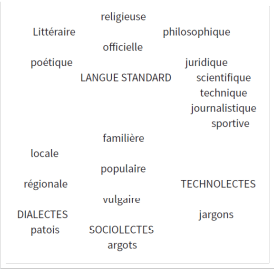
Poli-sistema intralingüístico de M. Wandruszka

PATOIS: « structures grammaticales différentes » (Associado ao camponês – como o Provençal ou a Langue d’oc são patoás e muito próximos do Catalão, isso só aumenta minha razão naquele debate com a catalunha [?] estúpida no twitter.)

« Toutefois, il est difficile de traduire d’une «sous-langue» dans une autre (on peut parler ici de pluriglossie et non de plurilinguisme): les passages d’un technolecte à un dialecte, par exemple, sont difficiles à imaginer. »

Les études de traduction (ou encore: les textes de traductologie) distinguent souvent deux types de textes: les textes littéraires et les textes scientifiques (les textes de traductologie littéraire font souvent preuve de mépris pour la traduction technique, cette dernière étant ravalée au rang de simple transcodage; en outre le traducteur technique est en général mieux rémunéré que son homologue littéraire).”

Os estudos de tradução (ou ainda: os textos de Tradutologia) distinguem, no mínimo, dois tipos de textos: os literários e os científicos (os tradutores literários comumente desprezam a tradução técnica, i.e., científica, limitando-se esta última, o mais das vezes, a uma simples transcodificação; se bem que o tradutor técnico-científico é em geral mais bem-pago que seu homólogo literário.)”

NICHO DO NICHO DO NICHO: “Le «mépris» va dans les deux sens, les traducteurs techniques reprochant aux littéraires leur manque de précision… Le texte littéraire possède des qualités esthétiques que ne possède pas, en principe, le texte scientifique. Le traducteur littéraire doit faire oeuvre non plus de simple transcodage, ou encore de traduction de langue à langue, mais de traduction de milieu à milieu, de texte à texte, la composante purement linguistique de son travail passant presque au second plan. Le traducteur littéraire doit être coauteur, faire preuve de «congénialité», suivant l’expression de B. Lortholary. Et là encore, on distingue la prose de la poésie, la première étant à la portée de tout traducteur, la seconde étant réservée aux poètes. On reviendra sur ce point quand on abordera la personnalité du traducteur.Falso déjà vu ou a Jéssica B***** é realmente uma TECNOCRATA da Tradução? Papo muito antigo… Vergonha da classe… (É sempre horrível quando lembramos dos piores praticantes de nossas artes e ofícios!)

Il me semble nécessaire de distinguer les textes sacrés (bibliques) des textes non-sacrés, qu’on peut aussi appeler ecclésiastiques, qui sont l’oeuvre d’hommes d’Église (gloses, commentaires, vies de saints) et ne posent pas les mêmes problèmes philosophiques de traduction, puisqu’il ne s’agit pas de la «parole de Dieu» (je ne prends en considération que la tradition chrétienne dans sa version catholique romaine – c’est-à-dire que je limite mon champ de réflexion à l’Europe qui a connu la Renaissance).” “la traduction avait été «officialisée» par le miracle de la Pentecôte qui confirme le bien-fondé de la traduction des Septantes, à savoir qu’il n’y a pas de langue sacrée. Au IVe siècle, Saint Jérôme traduit la Bible en latin (la Vulgate) mais il faudra attendre le concile de Trente (1545-1563) pour que cette version soit déclarée authentique et devant servir de base à toute traduction ultérieure. Durant une dizaine de siècles, la question n’avait été ni posée ni tranchée.”

Au siècle suivant apparaissent des traductions de la Vulgate et surtout des originaux hébreux et grecs. En 1532 est imprimé un psautier traduit au XIIIe siècle et connu sous le nom de Psalterzflorianski; en 1552, Stanislaw Murzynowski publie une traduction du Nouveau Testament, suivie de plusieurs autres. Ce siècle est donc marqué par une intense activité de traduction qui se fixe 2 buts: d’une part, faire mieux connaître la Bible au peuple, d’autre part, mieux traduire la Bible.”

le mot plagiaire n’est attesté en français qu’en 1555, plagiat date de 1697 et plagier de 1801 et qu’il vient du latin plagiarus «débaucheur et receleur des esclaves d’autrui», lui-même venant de plagium «détournement», cf. Nouveau Dictionnaire Étymologique et historique, par A. Dauzat, J. Dubois et H. Mitterand, Larousse, 1971. Remarquons d’ailleurs que la première loi sur la propriété littéraire en France, championne de l’administration, date de 1866.” SESQUICENTENÁRIO DE MERDA!

On comprend l’importance de la déclaration d’authenticité de la Vulgate: c’est, en quelque sorte, le premier copyright de l’Histoire moderne.”

L’auteur devient propriétaire de son texte et ce dernier se sacralise en quelque sorte: tout texte a droit à une traduction fidèle, au même titre que la Bible. La traduction proprement dite, opposée à la libre adaptation, devient non seulement possible, mais peu à peu souhaitable et philosophiquement obligatoire.”

La lecture de quelques ouvrages et articles de traductologie, montre d’une part que c’est un discours extrêmement répétitif et, d’autre part, que plusieurs discours coexistent qui pretendent chacun à la traductologie. On distingue très nettement deux types d’études: les textes de linguistes (très souvent, ce sont des approches théoriques) et les textes de littéraires (dans l’ensemble plus pratiques).”

Il illustre son propos par l’anglais worker qu’il faut traduire en russe par robotnik ou robotnica, c’est-à-dire que la langue russe impose la précision du genre, ce qui n’est pas le cas em anglais pour ce mot-là. De tels exemples sont légion et de nombreux ouvrages y sont consacrés, principalement écrits par des linguistes structuralistes, comme Z. Klemensiewicz.”

Jakobson ilustra seu argumento pelo inglês worker, que deve ser traduzido em russo por robotnik ou robotnica, i.e., a língua russa impõe a determinação do gênero, o que passa longe de ser o caso do inglês, pelo menos para esta palavra. Inumeráveis exemplos num sem-fim de livros foram esmiuçados século XX adentro, campo no qual se destacam os lingüistas estruturalistas, como Z. Klemensiewicz.”

Le discours des littéraires a les limites qu’ont les récits d’expériences personnelles. Il est souvent peu généralisable – mais, par la précision de certaines remarques, il est soouvent une mine de renseignements pour le linguiste comparatiste.”

Pode-se comparar o tradutor a um artesão, a meio caminho entre o artista (o autor) e o técnico (o lingüista).” Há um texto meu que já virou um clássico: https://www.recantodasletras.com.br/artigos-de-literatura/5827201 (originalmente de 2006, republicado neste link em 2016).

Eu-tradutor sou eu menos inspirado. Eu-cientista sou eu em crise.

Pour résumer, on peut dire que: 1. les linguistes disent – voici ce qu’il faut faire! 2. les littéraires disent – voilà ce que nous avons fait! et 3. les philosophes disent – comment diable pouvez-vous faire?”

Resumindo, pode-se dizer que: 1. Os lingüistas dizem – eis o que se deve fazer! 2. Os literatos dizem: eis o que nós fizemos! 3. E os filósofos dizem: como diabos podeis fazê-lo?

A VERDADEIRA REVOLUÇÃO UNIVERSAL (Altivez, loquacidade e dignidade): Alexander F. Tytler – Essay on the Principles of Translation (1791)

deux courants de traducteurs: les «fidèles» (sans doute proches des linguistes) et les auteurs de «belles infidèles» (plus proches des littéraires).”

En effet, la plupart des textes de traductologie prennent des exemples «nobles»:traduction de philosophes ou de grands auteurs comme Shakespeare, Cervantès, Corneille,etc. Je n’ai pas trouvé d’auteurs «mineurs» ou d’auteurs de best-sellers (comme, par exempleP.L. Sulitzer qui affirme dans l’un de ses livres que la Tchéka était la police secrète du tsar,qui nomme son héros polonais Taddeuz, alors que l’orthographe correcte est Tadeusz, etc).Le style des «grands écrivains» n’est pas critiquable: nous n’avons pas le droit de les juger,nous devons nous en inspirer, éventuellement les imiter – en tout cas, les respecter. Dans lestextes de traductologie, les exemples «non nobles» sont considérés froidement: ce sont destechnolectes ou des sociolectes, déviant par rapport à la langue standard mais respectablesen eux-mêmes. C’est là qu’on trouve le problème du discours politique, souvent réduit à sonaspect purement terminologique (voir à ce propos J.B. Neveux, La traduction du vocabulairepolitique, dans La traduction, 1979).

Or, il y a des textes littéraires «de moindre importance» et des textes ni littéraires ni techniques,c’est-à-dire le texte journalistique, le reportage et surtout les Mémoires et entretiens de toutesorte qu’on trouve en abondance dans les librairies – ce qu’on peut appeler la littérature de témoignage.Que faire, par exemple, avec un texte où un personnage déclare tout à fait sérieusementque «les liens» qui le lient à une certaine organisation sont «éteints»? Si on applique à lalettre les principes de Tytler, à mauvais texte en langue-source doit correspondre un mauvaistexte en langue-cible. Ou bien faut-il améliorer? C’était le point de vue de la plupart des traducteursdu XVIIème siècle, mais on en a aussi de nombreux exemples dans les traductions plusrécentes. Le discours traductologique du XXème siècle a tendance à critiquer ces améliorationsqui sont, en fait, de véritables déformations du texte.”

A maior parte dos textos de Tradutologia utiliza exemplos <nobres>: tradução de filósofos ou de grandes autores como Shakespeare, Cervantes, Corneille, etc. Não encontro, neles, os chamados <autores menores> ou de best-sellers (como, p.ex., P.L. Sulitzer, que afirma em um de seus livros que a Tcheka era a polícia secreta do czar, e batiza seu herói polonês de Taddeuz, ao passo que a grafia correta seria Tadeusz, etc.). O estilo dos <grandes escritores> não é criticável, evidentemente: não temos o direito de julgá-los, devemos sim nos inspirar neles, eventualmente imitá-los – em todo caso, respeitá-los. Nos textos de Tradutologia, exemplos <plebeus> são olhados com desconfiança: estes são classificáveis como tecnoletos ou socioletos, desvios da língua-padrão ainda respeitáveis em si mesmo, regulares o bastante, porém não têm um <estilo>, portanto não merecem grande atenção.

Daí deriva o conhecido problema do discurso político, com frequência reduzido a seu aspecto puramente terminológico (ver, a respeito, J.B. Neveux, La traduction, capítulo <A tradução do vocabulário político>, 1979).

Ademais, há sempre os textos literários <de menor importância> e os textos que não são tampouco literários ou técnicos, i.e., textos jornalísticos, a reportagem, memórias e entrevistas de todo gênero, encontrados em abundância nas bibliotecas e livrarias – o que se passou a denominar literatura de testemunho ou biográfica. O que fazer, p.ex., dum texto onde o personagem declara, de forma séria, que <les liens> (as relações) que o ligam a uma determinada organização são <éteints> (apagadas, nulas, opacas – termo difícil de traduzir)? Se se aplicam à letra os princípios de Tytler, aos textos mal-feitos da língua de partida deveria corresponder um mau texto na língua de chegada. Ou seria lícito melhorá-lo? O auge deste ponto de vista foi no século XVII, mas essa tendência nunca esmoreceu de verdade entre os tradutores (sendo aliás a obsessão por excelência dos editores). Nos discursos tradutológicos do século XX vemos uma pronunciada tendência à crítica desses <melhoramentos>, que são considerados agora deformações do texto original.”

Qui est traducteur (je ne prends en considération que les traducteurs littéraires et je n’aborderaidonc pas les problèmes des traducteurs jurés, techniques ou interprétes dont la traduction estla principale source de revenus)? A priori, toute personne connaissant bien une langue étrangèreet sa langue maternelle, sans être nécessairement «parfaitement bilingue» – les dictionnairesle sont suffisamment – peut être traductrice.Cependant, le traducteur est avant tout um lecteur: sans goût pour la littérature (ou même simplement la chose écrite), il est peu probableque quelqu’un se mette à traduire, puisque cet acte nécessite une première lecture (en termeslinguistiques: un premier décodage). Le nombre des traducteurs est tout de même inférieur aunombre de lecteurs connaissant plus d’une langue, car en plus, il faut savoir écrire (être capablede faire le ré-encodage) – c’est-à-dire avoir au moins un peu de talent littéraire, ainsi que le remarquefort justement G. Karski et même le structuraliste Z. Klemensiewicz qui parle de congénialité:la traduction ne doit être «ni une réécriture, ni une transécriture, mais une co-écriture». C’est d’ailleurs un métier qui ne s’enseigne pas: les écoles de traducteurs forment des interprèteset des traducteurs techniques, non des traducteurs littéraires.”

ANATOMIA DO TRADUTOR – Quem é tradutor? (Daqui para a frente, me eximo da responsabilidade de considerar os tradutores não-literários, isto é, NÃO ABORDAREMOS EM ABSOLUTO OS PROBLEMAS DAS TRADUÇÕES JURAMENTADAS, TÉCNICAS OU DE INTÉRPRETES, PROFISSÕES BASICAMENTE DE DEDICAÇÃO EXCLUSIVA)

RESPOSTA: A priori, qualquer bom conhecedor de ao menos uma língua estrangeira e da própria língua materna, sem ser necessariamente <um bilíngue perfeito> – de modo que os dicionários já lhe são ajuda suficiente.

Acima de tudo, o tradutor é um leitor. Sem tesão pela literatura (ou simplesmente pela <coisa escrita>), é muito pouco provável que qualquer um se meta a traduzir. Trata-se dum ato que exige no mínimo uma primeira leitura (o que na Lingüística se chamaria de primeira decodificação). Segunda implicação: o número de tradutores é sempre inferior ao de leitores conhecedores de mais de um idioma, porque, afora a <decodificação inicial>, é preciso saber fazer a re-codificação (em termos leigos, saber (re)escrever).

O que é esse <saber ler-reescrever>? Possuir um mínimo de talento literário (este mínimo não é <mensurável>), o que lingüistas como Karski e Klemensiewicz definem como a posse da cogenialidade, isto é, menos que a genialidade mas mais do que a banalidade, além de ser sempre uma espécie de <parceria diacrônica> com um outro co-gênio que precede ao tradutor.¹ Resumindo, é uma atividade impassível de ensino: as escolas de tradutores formam intérpretes e tradutores técnicos, não tradutores literários.”

¹ Matizes kardecistas, até!

Os vilões do meu universo encastelado: os assessores, os sociólogos não-marxianos, os pré-existencialistas e, finalmente, os tradutores juramentados ou leigos que solicitam ou falam em “tradução livre” (verdadeira abominação em forma de binômio). Trocando em miúdos, estes são os péssimos profissionais das minhas áreas ou ex-áreas de atuação (respectivamente, Jornalismo, Sociologia, Filosofia, Letras), tudo que eu jamais seria ou jamais tomaria como modelo.

Rares sont les traducteurs littéraires dont la traduction est la principale (ou seule) source derevenus: la plupart du temps, ils exercent des métiers intellectuels, sont souvent des universitaires- mais rarement des écrivains. Il suffit de consulter les bibliographies d’auteurs pour levoir: les écrivains écrivent «pour leur propre compte». Quant aux traducteurs, s’ils ont assez detalent pour traduire, il leur en manque pour créer. Remarquons toutefois que le travail de traductionest ingrat : il demande un effort considérable, est plus ou moins bien rémunéré – mais lestraducteurs passés à la postérité sont rares, si l’on excepte les premiers traducteurs de la Bible.Comme le remarque I. Géher, on ne lit jamais un texte parce qu’il a été traduit par X, mais parcequ’il a été écrit par Y. Les grands traducteurs sont donc peu nombreux: en France, Baudelairen’est un traducteur célèbre que parce qu’il était par ailleurs un immense poète, en Pologne TadeuszBoy-Zelenski n’est célèbre que parce qu’il a, à lui seul, traduit énormément de littératurefrançaise (dont Montaigne, Descartes, Pascal, Rabelais, tout Molière, Chateaubriand, Stendhal,Proust, Gide, tout Balzac, etc.) alors que lui-même n’était qu’un écrivain-créateur médiocre.

Donc, les écrivains ne sont pas des traducteurs – sauf les poètes. Cependant, il est remarquableque les poètes signent quelquefois des traductions de langues qu’ils ne connaissent pas. En fait, ils ne sont pas traducteurs, mais «poétisateurs» de textes précédemment traduits par destraducteurs non poètes (dans la terminologie de H. Meschonnic, l’un parle «langue» et l’autreparle «texte». L’auteur s’insurge avec raison, contre cette pratique qui pose des problèmesphilosophiques et méthodologiques sur lesquels je ne m’attarderai pas).”

O PARADOXO DO POETA NÃO-ESCRITOR E DO ESCRITOR NÃO-POETA (ALÉM DO LIMBO CHAMADO TRADUTOR)

Raros são os tradutores literários para quem traduzir é a principal (ou única) fonte de renda: a maior parte do tempo, eles exercem qualquer outra função intelectual, comumente nas universidades – salvo que raramente são escritores. Basta consultar as bibliografias dos autores para atestá-lo: os escritores <escrevem por conta própria>. Quanto aos tradutores, malgrado tenham o talento imprescindível à tradução, falta-lhes o talento para criar. Observemos quão ingrato é o ofício do tradutor: traduções demandam um esforço considerável e são mais ou menos bem-remuneradas, dependendo do contexto – mas o notável da carreira é quão poucos dentre os tradutores gravam seu nome na posteridade. As maiores exceções foram os primeiros tradutores da Bíblia, por motivos óbvios. Como lembra Géher, ninguém lê um livro <porque foi traduzido por Fulano>, mas sim <porque foi escrito por Cicrano>. Os grandes tradutores são, desta feita, pouco numerosos: na França, Baudelaire só se tornou um tradutor de renome porque além de traduzir era também um enorme poeta; na Polônia, Tadeusz Boy-Zelenski só atingiu fama imortal por ter sido quem traduziu sozinho quase toda a Literatura francesa que realmente interessa: Montaigne, Descartes, Pascal, Rabelais, Molière (a obra completa), Chateaubriand, Stendhal, Proust, Gide, Balzac (a obra completa), e ainda outros! Fora isso, o próprio Tadeusz nada era senão um escritor autoral medíocre.

Sendo assim, os escritores não são tradutores – isto é, com a exceção dos poetas. O insólito da situação do poeta é que ele assina traduções de línguas que não conhece (conhece muito mal, comparado com os tradutores por vocação). Na verdade, quando poetas se aventuram a traduzir, não são tradutores, são <poetizadores> de textos anteriormente traduzidos por tradutores não-poetas (na terminologia de Meschonnic, o poeta fala uma língua, o tradutor fala um texto). O autor (escritor) se insurge (com razão?) contra esta prática, que encerra uma vasta gama de problemas filosóficos e metodológicos, os quais por si só já mereceriam livros e mais livros.”

Tudo já foi escrito” é a desculpa esfarrapada do primeiro dos últimos pós-modernos!

Já traduzi até Heine… Não sei nem mais que(m) sou…

Quem

Queim

Queime

Queimei

Quem

Ei!

Quem queimou

Quem queimou meu queijo?

#IdéiadeTítulodeLivro

UÉ?!

E quem disse que o filósofo é mais escritor do que poeta e tradutor?

Qual é o TAMANHO da sua escrita? Imortal e milenar ou 500 páginas sem margens e espaçamento 1?

Le traducteur est doublement dépendant: en amont, de l’auteur, en aval de l’éditeur.”

L’éditeur est une invention récente que toutefois on trouve à l’état embryonnaire dès l’invention de l’imprimerie. Avant, chaque livre était unique et le copiste devait posséder un savoir (la lecture et l’écriture) et maîtriser une technique (la calligraphie). L’imprimerie introduit une technique lourde et extérieure au copiste et donc, qui plus est, à l’auteur. L’imprimeur devient l’intermédiaire obligatoire (monopolistique) entre auteur et lecteur. Cette situation dure très longtemps: l’éditeur, c’est l’imprimeur, c’est-à-dire un technicien qui se double rapidement d’un commerçant (dans des cas extrêmes, l’imprimeur peut être analphabète, comme le père Séchard dans les Illusions perdues de Balzac). Voulant connaître la nature de sa marchandise, il se met à lire et à juger ce qu’il imprime, pour décider peut-être de ne pas le faire, et devient éditeur à proprement parler. Le statut de l’éditeur est ambigu: il est à la fois connaisseur littéraire et commerçant. Suivant le cas, c’est l’une ou l’autre facette qui l’emporte. Son double jugement (littéraire et/ou commercial) n’est pas infaillible, loin de là. Actuellement, l’éditeur délègue les travaux d’impression (le côté technique) et assume les rôles de commerçant et de juge, quitte, bien sûr, à s’entourer de «commerciaux» et d’un «comité de lecture».”

Lorsqu’un auteur propose (soumet) um texte à un éditeur et que ce dernier accepte de le publier, il accepte par là-même de faire un investissement correspondant aux frais d’impression, de diffusion et éventuellement de publicité. Les revenus de l’auteur dépendent alors étroitement de ceux de l’éditeur. La démarche du traducteur est différente, encore qu’il faille distinguer deux cas de figure: 1. le traducteur propose un texte à l’éditeur, 2. l’éditeur commande une traduction. La différence entre les deux s’inscrit dans la durée. Dans le second cas, le traducteur reçoit un travail pour lequel il sera rétribué. Il n’a donc aucune démarche – au sens propre du terme – à accomplir. Dans le premier cas, le traducteur commence en général par convaincre longuement l’éditeur de l’intérêt littéraire d’un texte, échantillon à l’appui. En cas de refus, il aura travaillé pour rien. Dans les deux cas de figure, si l’éditeur accepte de publier la traduction, son investissement est important: il doit racheter les droits d’auteurs s’ils n’appartiennent pas encore au domaine public, il doit payer le traducteur et, bien sûr, veiller à l’impression, etc.

Le contrat de traduction est signé et, quelques temps après, le manuscrit (ou plutôt le «tapuscrit») est remis à l’éditeur qui va le lire, ou le faire lire. Ce lecteur (qu’il soit l’éditeur lui-même ou une personne tierce, on l’appellera le correcteur) ne connaît pas nécessairement le milieu-source: il ne fera donc que veiller au respect du 3ème principe de Tytler, c’est-à-dire la lisibilité. L’intermédiaire du correcteur est une bonne chose en soi: quel traducteur n’a pas remarqué une baisse affligeante de sa compétence linguistique en langue-cible, qui est en général sa langue maternelle, pendant l’acte de traduction? Les relectures que l’on fait «à froid» sont nécessaires pour se débarrasser du modèle contraignant de la langue-source, mais même là, il arrive que des phrases sonnent juste seulement pour le traducteur, hélas! C’est ce qu’exprime clairement G. Mounin (cité par J.R. Ladmiral), quand il parle de la «richesse merveilleuse de toutes les langues de départ, pauvreté incurable de toutes les langues d’arrivée». Encore faut-il que le correcteur soit effectivement compétent…

C’est là que se pose le problème du «mauvais» texte de départ, ou, si l’on préfere, des maladresses stylistiques qui peuvent s’y trouver. Si on applique le principe de fidélité, à mauvais original doit correspondre mauvais texte en traduction (et ce sera justement cela la bonne traduction) – la première réaction du correcteur sera de considérer que la traduction est mauvaise, et non le texte original, et il se dépêchera de corriger, d’améliorer le texte en langue-cible, pratique autrefois courante, aujourd’hui plutôt critiquée. Il faut cependant faire une distinction entre «petites» et «grosses» maladresses. Voyons un exemple de petite maladresse.

Dans La légende de Pendragon, Antal Szerb répète très souvent le mot különös, quelquefois à l’intérieur d’un même paragraphe. Ce mot signifie «singulier, bizarre, étrange». La stricte fidélité à l’original demanderait de choisir l’un de ces adjectifs – de préférence «singulier» – et de l’employer systématiquement, comme un terme technique. Or, pour la traduction, nous avons choisi de varier les équivalents français pour éviter des répétitions qui, tout en alourdissant le style, n’apportent pas d’information particulière et – surtout – nous auraient fait passer pour de mauvais traducteurs… Nous avons donc prévenu les critiques du correcteur, d’autant plus qu’il s’agissait effectivement d’une maladresse de la part d’Antal Szerb: c’était un éminent historien de la littérature qui écrivait des romans en dilettante, vite et sûrement sans se relire, ce que le lecteur français ne sait pas, alors que le personnage de Szerb est très connu en Hongrie. On a ici un problème non de langue, mais de milieu. Ce roman est passionnant de bout en bout – il n’en est pas pour autant exempt de ce type de maladresses qu’on peut corriger sans porter atteinte au texte.”

Escrita, a anti-bosta: quanto mais mexe, menos fede?! Há um momento, no entanto, em que ela petrifica, para o bem ou para o mal…

Il arrive cependant que la «maladresse» (en particulier, la répétition) soit voulue et significative. C’est le cas du roman du Polonais Julian Kawalec intitulé W sloncu où la répétition de mots ou de membres de phrase crée un effet lancinant comparable à la poésie de Gertrude Stein. Dans ce cas, il faut conserver cet aspect de l’original – et il ne sera guère aisé de convaincre l’éditeur qu’il doit en être ainsi. L’éditeur est un être soupçonneux: il met en doute les compétences linguistiques du traducteur aussi bien en langue-source qu’en langue-cible – ce qui n’est d’ailleurs qu’une manifestation de son souci du lecteur.”

¹ E mais uma vez o dia foi salvo graças ao poder deveras oportuno da… NOTA DE RODAPÉ!!!

Prancha de salvação que leva direto aos tubarões. Conversas off-topic gravadas. Quando a nota é do editor, o “tradutor venceu” a guerra, e o Ed. se vinga. Quando a nota é do tradutor, o “editor venceu” a guerra, e o Trad. quita dalgum modo a dívida e restabelece o equilíbrio. Isso supondo que não se trate só de mea culpas baratas…

Remarquons que la plupart des «notes du traducteur» sont des informations portant sur le milieu-source.”

Quelle frustration de voir écrit en bas de page «calembour intraduisible». La responsabilité repose entièrement sur les épaules du traducteur; et comme la plupart des calembours sont intraduisibles, le traducteur essaie de compenser comme il peut, éventuellement en plaçant un bon mot à un autre endroit du texte. Ces deux types d’exemples sont peu importants – même s’ils donnent quelquefois des nuits blanches aux traducteurs – si l’on pense qu’ils ne concernent la plupart du temps que des mots et expressions éparpillés dans un texte par ailleurs normalement traduisible. Le problème se pose plus gravement quand c’est le texte tout entier qui nécessite une note du traducteur – qui alors peut choisir de se taire ou de se manifester par une introduction. Je ne citerai qu’un seul exemple: l’introduction à la traduction française de Trans-Atlantique de W. Gombrowicz. Il s’agit d’une longue introduction historico-littéraire ainsi que traductologique. C. Jelenski & G. Serreau, les traducteurs, expliquent que le roman, écrit en 1948, s’inscrit dans une convention littéraire du XVIIIème siècle – j’en ai parlé au début, à propos du «voyage dans le temps». La traduction est stylisée, archaïsée au point qu’elle crée une impression aussi étrange et grotesque que l’original. On a un «style fonctionnellement équivalent» (Taber). De ce point de vue, et du point de vue des libraires aussi, c’est une réussite et pourtant… Le texte français est beaucoup plus long que l’original polonais. On observe, pour employer la terminologie de J.R. Ladmiral une incrémentialisation et une péri-paraphrase généralisées – en d’autres termes, c’est une traduction explicative.”

Mais C. Jelenski n’a-t-il pas dit lui-même à propos de ce travail qu’on ne comprenait vraiment une oeuvre qu’en la traduisant? Cette traduction illustre l’application stricte du second principe de Tytler, au détriment du premier – à cela près, qu’il n’y a pas déperdition, mais excès. Ce phénomène est constant dans tout le roman – en fait de traduction, on a presque une adaptation.”

HAHA: “adaptation, appelée quelquefois traduction libre (…) L’apparition des notions de propriété littéraire et de plagiat oblige l’adaptateur à citer son modèle – quitte à se faire passer pour un traducteur.” Bom menino-mau: Em nome da Honra – Chapeuzinho Vermelho; O Orfanato & O Senhor-Robô – Dalá-gonu Borô Zeta; Do Caos ao Barro, da Lama ao Caos: Lisboa, 1755 – Moonspell & Nação Zumbi & Chico Science… O Andarilho Triclope… …. ….. Sofrimentos do Jovem Ed…itor

* * *

Trechos de Marianne Lederer, “La traduction aujourd’hui”

Même à un stade très avancé de l’acquisition d’une langue étrangère, on entend encore des étudiants demander comment traduire tel mot ou tel mot. Comment dit-on <préposé> en anglais? ou <pronouncement> en français? Ils espèrent une réponse qui ferait apparaître une forme sonore différente dans uns signification inchangée.”

Les mots anglais <control>, <region>, <opportunity> ont tout d’abord été compris au sens français de <contrôle> (vérification), <région> (partie d’un pays), <opportunité> (qui vient à propos). (…) Aujourd’hui <contrôle> a perdu en grande partie sa signification initiale pour prendre le sens anglais de <maîtriser>, <commander>, <diriger>; <région> englobe plusieurs pays et <opportunités> remplace de plus en plus <occasion>. Les déformations sémantiques de <global>, <rampant>, <attractif>, etc., ont suivi ce processus à des degrés divers. <Global>, à l’instar de l’anglais, signifie aujourd’hui <universel> en plus de sa signification de <entier>, <total>. <Rampant> a gardé sa signification française mais est utilisé avec une fréquence qui lui vient de l’anglais. <Attractif> a la forme de l’anglais tout en gardant la signification de <attrayant>, <attirant>, etc.”

La stylistique comparée du français et de l’anglais, cependant, malgré toutes ses qualités, n’est pas une méthode de traduction des textes, contrairement à ce que laisse entendre son sous-titre, <Méthode de traduction>. Elle ne peut l’être car, observant les désignations différentes de situations identiques, elle ne va pas, sauf pour en analyser le résultat, jusqu’à expliquer la traduction par équivalences.”

J. Delisle écrit: L’analyse de la langue que pratiquent les stylisticiens comparatistes reste en deçà de l’analyse du discours sur lequel se fonde toute vraie traduction.

Les 7 procédés techniques si célèbres de La stylistique comparée (…) (l’emprunt, le calque, la traduction littérale, la transposition, la modulation, l’équivalence, l’adaptation) ne peuvent contribuer à la traduction, qui est essentiellement un exercice d’interprétation car, ne facilitant ni l’analyse d’un message ni sa restitution, ils ne peuvent pas avoir valeur de règles pratiques de traduction.”

La stylistique (et d’autres <manuels de traduction>) peuvent rendre de grands services aux étudiants dans leur auto-perfectionnement linguistique. L’apprenant peut puiser à la source du comparatisme pour perfectionner ses connaissances.”

* * *

La polémique “Cibliste vs. Sourciste”.

Trechos de Pierre Baccheretti, “Traduire ou interpréter”, in: La traduction: problèmes théoriques et pratiques

Dans la pluplart de cas, c’est la réalité décrite qui se refuse à la traduction, pour la simples raison qu’elle n’a point d’équivalent dans le pays où est parlée l’autre langue. Se pose alors le problème, bien connu, de la traduction des <réalia>.”

Nous traduirons donc filosofija trëx vesëlyx kombinatorov P’enikle. Nous soulignerons, en qualifiant cette philosophie de mudrënaja et en recourant à un verbe noble:

A brotik Pol’, zabrosiv azbuku, po veceram, lëza v krovatke, vnikal v mudrenuju filosofiju <Trëx vesëlyx Kombinatorov P’enikle>”

E meu irmão Paulinho, em sua cama, penetrava nos segredos da sábia filosofia dos três fanfarrões vigaristas Pieds Nickelés, menos três patetas que uma espécie de Cebolinha arquitetando um de seus Planos Infalíveis…

Um dia só é bom quando o próximo é um feriado.

le français montagne se verra-t-il attribuer comme équivalent le russe gora. C’est du moins ce que recommandent, à l’unanimité, tous les dictionnaires bilingues. Et, pourtant, un examen, même superficiel, des emplois de gora en russe montre à l’évidence que la réalité recouverte ressemble souvent, à s’y méprendre, à une simple colline de Provence.”

Il est évident que l’imagination des parents ne connaît point de bornes lorsqu’il s’agit de toruver un nom zoologique gentil à ces chers petits, et, dans l’intimité du nid familial, tout est permis. Mais les assimilations être humain/animal sont loin d’avoir une valeur universelle immuable, et dans le domaine de la traduction, il est, sans aucun doute, souhaitable d’éviter des équivalences au mot à mot qui, dans la langue d’arrivée, risquent d’avoir une valeur comique qui n’était certainement pas recherchée au départ.”

Je frappai le mulet sous le ventre […] tandis que le paysan l’appelait: <carcan, carogne> et l’accusait de se nourrir d’excréments.

Pagnol fait là allusion à une injure fort prisée dans le Midi et dont le sens laisserait à supposer que votre interlocuteur, pour se sustentar, mange autre chose que de la fougasse et des olives. Malgré la richesse de son vocabulaire dans ce domaine, le russe ne possède pas d’équivalent terme à terme qui soit couramment utilisé. Et, difficulté supplémentaire, tout cet aspect de la langue parlée est totalement tabou dans la langue écrite: le bon citoyen russe peut être, dans la vie de chaque jour, tout aussi mal embouché que le plus grossier des charretiers de France, mais l’usage littéraire jette un voile pudique sur les expressions qui sortent des sentiers battus, et les dictionnaires – à l’exception d’un ouvrage anglais (Beyond the Russian dictionary, 1973, London, Flegon Press) restent étrangement muets sur le sujet.”

Le grossier personnage n’hésitera pas à compléter nos points de suspension en recourant à un verbe précis que conférera à la phrase le sens approximatif de tu sais ce qu’on lui fait à ta mère? L’injure est à ce point vivante en russe que la langue en arrive à renoncer à employer à l’accusatif le mot mat’ précedé du possessif, de façon à éviter toute réminiscence mal venue.”

ryba, le poisson, est, en russe, de genre féminin”

De la même façon, dans la traduction du Petit Prince, le traducteur soviétique a été amené à traduire le renard et la Fleur respectivement pas lis, masculin, quasiment inemployé en russe, à côté du très courant lisa de genre féminin, et roza (la rose, et non la fleur cvetok masculin) de façon à respecter la répartition féminin/masculin, essentielle dans le texte original.”

En effet, alors qu’en français, le mâle donne habituellement son non à l’espèce (un chat, une chatte, le chat), le russe préférera d’ordinaire la forme féminine pour désigner l’espèce (kot, koska). Le canard sera ainsi utka de genre féminin, ce qui saurait convenir à un exemplaire, défini comme le vieux père canard, et, plus loin dans le texte, le vieux dur-à-cuire.”

Le locuteur français (qui dit ) reste, en quelque sorte, à distance, immobile, considère le mouvement d’un point fixe, depuis l’endroit d’où il observe, et il n’est qu’observateur. Le locuteur russe (qui dit ici) se déplace en même temps que son personnage, participe au mouvement, est, d’une certaine façon, acteur de la scène.”

On pourrait expliquer l’implicite du français par le fait d’une capacité d’abstraction plus grande, le contexte étant suffisamment clair pour donner à comprendre la succession chronologique de divers mouvements sous-entendus.”

Jacques entra dans le café, avisa une table libre à l’écart, et commanda une bière.

=

Zak vosël v kafe, primetil svobodnyj stolik v storone, sel i zakazal pivo

=

Jacques entra dans le café, avisa une table libre à l’écart, s’assit et commanda une bière.

Là oú le locuteur français, du seul fait du cheminement de la logique interne de l’énoncé, distingue sans ambiguïté les divers personnages, tous nommés <il>, le russe ne reconnait pour <il> (on) que la personne qui était déjà le sujet de la proposition précédente, et si la personne, sujet de la nouvelle proposition, est autre, doit impérativement la nommer, ou recourir au démonstratif tot qui désigne la personne ou l’objet éloigné, par opposition à étot réservé à l’objet de la personne proche.”

nous avions la triste impression de lire un autre livre qui parlait la même chose, mais ne disait rien.”

il n’y a qu’un pas entre l’abattoir, skotobojnja, et bojnja, la tuerie, la boucherie, la guerre.”

En effet, on peut constater dans l’usage russe une tendance marquée à préciser ce que le français se contentait de suggérer, et, sur un certain nombre de points, la langue dispose d’une série de moyens techniques pour le faire, moyens que le français, soit ne possède pas, soit répugne à utiliser”

En français, le contexte éclaire la mimique, donne leur signification aux gestes, alors qu’en russe ce sont les gestes qui contribuent à créer le contexte.”

Ainsi l’expression zadrav nos, littéralement <le nez en l’air> marque, en russe, l’attitude hautaine, l’air conquérant de celui qui est trop content de soi, et non, comme en français, une certaine insouciance, un manque évident d’attention.”

Cabeça na lua, nariz empinado, olhando sempre pra baixo, boca tesa, ouvido surdo concentrado, pêlos eriçados, cabelo sem viço, derrubado.

O russo precisa incluir muitos travessões num diálogo, certo, Dosto?

…dit ma mère, répliqua vivement mon père, précisa tante Rose, dit, dubitatif, mon pére, etc. Bien entendu, tous ces verbes auraient été possibles dans le texte français, mais telle ne semble pas être la tendance de la langue.”

Le verbe de parole en fraçais répond essentiellement à la question: qui parle? Le russe va, souvent, plus loin: qui parle, et comment?

c’est la vi(ll)e désertes amis

Trechos de Françoise Flamant, “Pour en venir au texte lui-même”, in: La traduction: problèmes théoriques et pratiques

O artigo de Pierre Baccheretti Traduire ou interpréter, que se funda sobre uma prática assídua da tradução, incita com naturalidade todo tradutor a refletir sobre sua própria prática. Constatamos imediatamente que os tradutores, que se comprazem, em geral, em debater e confrontar pares, repugnam, o mais das vezes, comunicar suas experiências por escrito. Esta repugnância – ou essa negligência – (que o próprio P. Baccheretti decerto não reprova em alguns contextos) não seria reveladora da inquietude que acompanha o tradutor incontinenti ao longo da elaboração de seu texto, e desse resíduo de insatisfação que persiste nele ao contemplar o resultado de seu trabalho? Angústia e insatisfação que não são sanadas pela leitura de nenhuma obra teórica sobre tradução. Com efeito, a atividade do tradutor não se caracteriza como uma posta em prática de teorias e princípios, quaisquer que sejam, estabelecidos pelo tradutor mesmo ou consagrados muito antes dele – se caracteriza, sim, como uma tensão irredutível entre dois pólos: duma parte a convicção de que a estrangeiridade dum texto compõe um de seus atributos primordiais; doutra, a necessidade imperiosa de comunicar essa estrangeiridade, i.e., esse algo insólito e inefável, convertendo-o nalgo familiar para o receptor, e, afinal, redigido na língua natal deste último! A tradução se realiza num vaivém permanente entre estes 2 pólos, percorrendo uma infinidade de escolhas, uma mais insatisfatória que a outra, caso fossem examinadas em separado, mas que tendem a se equilibrar, se compensar, consideradas como um todo mais que a soma das partes.”

O tradutor moderno perdeu a tranqüila confiança de seus predecessores franceses do século passado, intimamente convencidos da supremacia de sua própria língua vernacular e de sua civilização. (…) Viardot alcançava o denominador comum (do gosto francês) entre a prosa de um Cervantes e a de um Turgueniev.”

<tradutor de Arte> (é assim que os russos denominam o <tradutor literário>)”

Veja-se o exemplo da palavra muzik, transcrita geralmente como moujik em francês (definição: <camponês russo>). Em sua obra Tolstoï et Dostoïevski (1901), o escritor e filósofo Mérejkovski consagra um capítulo à religião de Dostoïevski, para a qual duas palavras diferentes conotam o <camponês> a depender da situação: muzik ou krest’janin. Mérejkovski defende a idéia de que o apego de Dostoïevski a um cristianismo do terror que ele associa intimamente ao camponês russo (o krest’janin) teve sua origem num episódio da infância do escritor, contado aliás por ele próprio: aterrorizado pelo uivo dum lobo, Dostoïevski-criança sai correndo e se joga nos braços fortes e protetores do camponês (muzik) Maréï, que trabalha nos campos das proximidades de sua casa, o que o conforta e o alivia de sua crise. O sentido do <texto em si mesmo> indica aqui, ao tradutor, que deve se servir da palavra moujik toda vez que fizer referência ao <moujik Maréï>, e da palavra paysan [a tradução literal, i.e., camponês, o pobre, o povo, e não mujique, dicionarizada em português, inclusive] sempre que a questão for traduzir krest’janin. A palavra muzik, formação diminutiva pela qual se auto-designava o camponês-servo na sociedade feudal russa, é a que Dostoïevski aplica em seu relato da lembrança de infância. Ao conservar a denominação, o tradutor permite ao leitor francês identificar a citação – tão rapidamente quanto o próprio leitor russo. Ao traduzir o camponês médio ou o camponês em geral pela outra palavra, krest’janin, distingue-se, na prática, o evento-concreto fundador (de feição particular, historicamente datado, de caráter patriarcal, a relação, em suma, do <jovem mestre> com um de seus servos) do conceito universal ressignificado ulteriormente na visão teológica de Dostoïevski que gira em torno do arquétipo do camponês (o krest’janin).

A mesma palavra no plural, Muziki, é o título de uma longa novela de Tchékhov datada de 1897, cujo enredo se passa no mesmo ano. A tradução de um título é sempre perigosa: sua formulação geralmente lacônica (o mais lacônica possível, aliás) tem como meta representar, ou ao menos sugerir, a idéia primordial contida na obra. Mas, ao mesmo tempo, um título deve ser chamativo, despertar a vontade de ler. Daí que não nos pareça recomendável traduzir a obra como Les moujiks: a estranheza da palavra – estranheza que, em si mesma, não impede a palavra de ser utilizada, e até pode ser um critério para preferi-la, como já indicamos – não ajuda em tornar o título atrativo para o potencial leitor de ficção (muito embora o caráter de estranho possa ser sempre atrativo para aficionados em relatos de viagens, por exemplo). E, ademais, a palavra muziki passa longe de ser neutra, uma vez que designa os camponeses russos do fim do séc. XIX aproximadamente 40 anos após a abolição da servidão. Em que pese esse período coincidir com a infância de Dostoïevski, não podemos assinalá-la como bom sinônimo de krest’jane. Na verdade quem não lê a novela obviamente não pode entender o sentido do título Muziki: a estória da decadência inelutável duma família camponesa e de toda uma vila, em meio a uma sociedade que não libertou os camponeses senão para abandoná-los a eles mesmos, figuras ontologicamente irresponsáveis pela própria existência. Sendo assim, Muziki aqui é um misto de termo carregado de compaixão com leve depreciação ou crítica nuançada. Agora, em nosso tempo, essa palavra, ainda empregada, se tornou muito mais – abertamente – pejorativa. Quanto à melhor sugestão de tradução, seria Paysans, sem artigo, preferível a Les Paysans, que vem a ser a escolha mais freqüente.”

a neutralidade estilística está para o texto como o silêncio está para a peça musical e o plano de fundo para a pintura.”

* * *

L’autre forme de l’interprétation de conférence est l’interprétation simultanée, introduite dans la pratique professionnelle à partir du procès de Nuremberg: l’interprète est isolé dans une cabine vitrée qui lui permet de voir les participants. Il reçoit le son grâce à des écouteurs et traduit ainsi dans un micro les propos entendus, non pas simultanément, mais avec un léger décalage dont la durée varie en fonction de la nature du discours. C’est à Marianne Lederer (op. cit.), ancienne directrice de l’EST, que la traductologie doit l’ouvrage majeur sur l’interprétation simultanée: La traduction simultanée, expérience et théorie, paru en 1981. Les recherches de Seleskovitch se poursuivent par toute una série d’articles qui élargissent peu à peu le champ de son étude de l’interprétation à la traduction en général. Le texte qui suit retrace le cheminement de son analyse et ses notions clés”

Trechos de Colette Laplace, Théorie du langage et théorie de la traduction

on pense mieux en parlant qu’au stade de la pensée non formulée. Toute parole est donc en même temps expression de la pensée et génératrice de pensée.” Selesk.

Selon l’interprète, la langue signale par le pluriel même auquel elle se prête (les langues), qu’elle a un caractère instrumental” “L’impression retirée de la lecture de L’interprète dans les conférences internationales se trouve immédiatement confirmée: en 20 ans de recherche, Seleskovitch ne s’est jamais lancée dans une étude analytique de la langue, elle s’est toujours tenue volontairement à l’écart des grands courants de la linguistique contemporaine, distributionnalisme bloomfieldien, strucuturalisme saussurien, glossématique de Hjelmslev, fonctionnalisme d’un Jakobson ou d’un Martinet, etc.” “Quel musicologue se contenterait d’étudier le bois dont est fait un stradivarius pour s’expliquer une musique? Ainsi les recherches d’un Chomsky sur la structure profonde ne sauraient trouver grâce à ses yeux, car elles ne permettent pas de <sortir de la langue>.”

Les idées doivent se couler dans les catégories que leur impose la langue, mais elles ne se confondent pas plus avec ces catégories qu’elles ne se confondent avec la langue.

Toute conception de la langue de Seleskovitch est dans cette phrase et ses différentes publications fourmillent d’illustrations de cette thèse.”

O KEYHOLE PRINCIPLE DE SELESK.: “un Anglais et un Français ont certainement la même représentation mentale, le même concept, d’un trou de serrure [buraco de fechadura, ‘lock-hole’], pourtant l’un utilise le terme <trou de serrure> et l’autre celui de <keyhole> (trou pour la clef).”

L’anglais dit outlet, le français dit prise (de courant)” Uma queima de estoque ligada no 220V!

a língua não diz, ela permite dizer”

Le vouloir-dire est la cause du discours, le sens en est la finalité.”

Dans les conférences internationales, les orateurs se succèdent, abordant des sujets politiques, écnonomiques, techniques ou scientifiques, que leurs auditeurs, délégués de même langue ou interprètes, sont supposés comprendre à la vitesse du débit oral, sans jamais disposer de la possibilité d’opérer un retour en arrière, alors que le lecteur a, lui, toujours loisir de le faire. C’est donc la situation idéale pour observer le jeu des mécanismes de compréhension, sans que rien ne le fausse.”

Il est certes plus difficile de dégager le sens d’un poème d’Hölderlin ou de René Char que d’un discours de Margaret Thatcher, et le travail d’exégèse n’est sans doute pas encore achevé mais il n’en reste pas moins que ce sens a une entité objective.”

The chickens are ready to eat! est ambiguë car nul ne peut opter à partir de la seule signification de la phrase: Les poulets sont cuits à point ou plutôt pour on peut maintenant donner à manger aux poulets.”

Nul besoin d’aller chercher des mots comme Gemüt et Schadenfreude pour affirmer que certains mots sont intraduisibles.”

on conserve le mot étranger come on l’a fait pour l’isba des romans russes ou pour le software des ensembles électroniques ou bien l’on crée un mot nouveau comme on l’a fait pour cybernétique, ou une acception nouvelle comme satellite qui a vite perdu son épithète d’artificiel.”

Bread pour l’Américain c’est une matière spongieuse, coupée en tranches et enveloppée de cellophane; pour le Français, le pain c’est une longue baguette croustillante et dorée” “nous serions tentée de demander si le soleil est bien la même chose pour un esquimo qui, pendant une partie de l’année seulement voit un astre pâle décrire une courbe molle au-dessus de l’horizon en difusant de la lumière 24 heures sur 24 et pour un Africain, qui identifie le soleil à une pluie de feu qui tombe du ciel et contre laquelle il convient de se protéger.”

«Ainsi les chiffres qui sont traduisibles par excellence puisqu’il y a une parfaite correspondance entre le référent et les signifiés des différentes langues, peuvent dans certaines circonstances devenir contextuels. Seleskovitch cite l’exemple des <15 jours> en français qui se traduisent par <14 Tage> en allemand. On pourrait également citer la signification attachée au chiffre 13 dans certains pays occidentaux (signification de malheur) qui se traduirait dans certains pays asiatiques par le chiffre 4.»

«Pour nous en convaincre, il suffit d’ouvrir le dictionnaire bilingue au hasard. Voici ce que propose le dictionnaire bilingue français-allemand de Sachs et Villatte: Kern: noyau, pépin, amande, coeur, puis des expressions diverses telles que der Kern der Sache: le vif do sujet; des Pudels Kern: le fin mot de l’affaire. Nous constatons que le terme allemand a un champ sémantique très large, plus large serait-on tenté de dire que celui de ces correspondants français. Mais est-ce bien vrai? Vérifions maintenant les équivalents proposés pour l’un des termes français. Coeur: Herz, Gefühl, Gemüt, Mut, etc. et d’innonbrables expressions: par coeur: auswendig; loin des yeux, loin du coeur: aus den Augen aus dem Sinn; faire à contre coeur: widerwillig machen; coeur d’un arbre: Kern, etc. Nous constatons que le champ sémantique du terme français est lui aussi très vaste, mais qu’il n’est nullement superposable au champ sémantique du terme allemand.»

Can you give me a lift? : Tu es en voiture? / Tu peux me déposer quelque part? / Vous êtes motorisé?

Trechos de Philippe Forget, Il faut bien traduire

«ces représentantes du vouloir-dire, de la parole vivante, de la conscience maîtresse du sens sont ici en train de pratiquer le spiritisme: elles convoquent le sens, donc l‘esprit, le font apparaître en dehors de sa forme matérielle pour, identifique à lui-même (insensible aux contextes, donc) le rematérialiser ensuite!»

* * *

ELEMENTOS CULTURAIS, CONOTAÇÃO, ESTILÍSTICA

Trechos de Ladmiral (op. cit.)

«D’un point de vue historique, le concept de connotation a été remis à l’honneur par la linguistique américaine, dans le sillage de Bloomfield, avant d’être repris ensuite et thématisé surtout par les linguistes européens (cf. Mounin, 1963). Au-delà de l’héritage bloomfieldien, c’est donc essentiellement à l’apport de linguistes européens comme Martinet, Mounin, Guiraud, Lyons, Hjelmslev, voire Barthes… que nous serons conduit à faire réferérence.»

«On trouve le mot déjà chez Littré, qui consacre à la notion 3 entrées dans son dictionnaire – où connotation est définie comme ‘l’idée particulière que comporte un terme abstrait à côté du sens général’, où connoter signifie ‘faire une connotation, c’est-à-dire, indiquer, en même temps que l’idée principale, une idée secondaire qui s’y rattache’, et où connotatif a aussi une adresse qui luit est propre.»

* * *

O CROATA APRESENTA INCRÍVEIS PARALELOS COM O PORTUGUÊS!

«C’est ici que se situe la grande majorité des cas. Notons que ces termes relèvent souvent de sphères où le français faisait jadis figure de langue de communication internationale: les lettres et les arts: esej, rezime, portret, revija, feljton, vodvilj, gvas; la politique: portfelj, revans, alijansa; les sciences et techniques: emalj, rezervoar, freza; la médecine: celulit; les finances: financije, akreditirati, garancija; l’art militaire: kampanja, bajuneta; la mode: dekolte, drapirati; l’art culinaire: blansirati, rulada, desert, fondan, frikase, et puis le savoureux frape, qu’en bon français nous préférons appeler milk-shake.

(…) interpolacija [interpolação] (…) bizuterija – désignant uniquement les bijoux de pacotille; frizura – la coiffure en général [cabelo frisado]; bombonijera – désignant une boîte de bonbons ou bien une confiserie [confeito]); soit avec una acception très pointue du mot source (apartman – qui le plus souvent désigne un logement locatif dans un lieu de villégiature); soit, et c’est beaucoup plus rare, avec une notion plus large que dans la langue d’origine (goblen, à partir de Gobelins, aboutit à l’idée de tapisserie en général).»

«avantura, butik, degutantan, dekadansa, impozantan»

TRADUZIR POESIA

Trechos de Inês Oseki-Dépré, Théories et pratiques de la traduction littéraire

«‘La Traduction-Allusion se propose seulement d’ébranler l’imagination du lecteur qui n’aura qu’à achever l’esquisse.’ Ainsi, selon Etkind, ‘n’est-il pas rare de voir les traducteurs ne faire rimer que les 4 ou les 8 premiers vers comme dans l’original, comme pour orienter l’esprit du lecteur dans la bonne direction’»

«recréer un poème dans son indivisible unité, dans sa totalité est un miracle qui ne serait accessible qu’à un poète.»

O que aconteceria se se esperasse de uma tradução poética que atendesse à lei formal das traduções, que é serem mais longas que o original?

« les Allemands et les Russes ont admirablement traduit dans leurs langues Homère, Eschyle, Sapho, Alcée, Virgile, Catulle, Horace, Juvénal. Il y a, entre la versification russe, tonique, et la versification polonaise, syllabique, une différence de principe fondamentale: elle n’a pas empêché Julian Tuwim de faire une excellente tradution d’Eugéne Onéguine de Pouchkine, ni Severin Pollack de recréer, de manière trèssatisfaisante, la poésie d’Anna Akmatova, de Maldelstam, de Tsvetaieva, de Pasternak.

De leur côté, la différence entre le système syllabique et le système tonique n’a pas empêché les poètes russes de traduire André Chénier, Évariste Parny (Pouchhine[?]), Auguste Barbier (Benediktov, Antokolski), Baudelaire, Verlaine, Rimbaud. »

«Le vers classique croule sous le poids des connotations livresques: impossible d’écrire une ligne, et encore moins une phrase, sans qu’aussitôt se présentent à l’esprit de longues séries de réminiscences scolaires, de citations et de commentaires transmis de génération en génération. Cet héritage s’est accumulé pendant plus de 4 siècles: on est fatigué par tant de liens culturels, la réalité vivante en est occultée. Libérer la vie des alluvions culturelles qui la recouvrent, telle est l’aspiration essentielle du vers libre. Paul Valéry, qui y avait tenu sa part, évoque ce refus total de l’ancienne tradition classique à partir des années 1890.»

* * *

INDICATIONS BIBLIOGRAPHIQUES

BALLARD, Michel. Qu’est-ce que la traductologie?, 2006.

BENJAMIN, Walter. La tâche du traducteur in: Oeuvres I.

ECO, Umberto. Dire presque la même chose.

LADMIRAL, Théorèmes pour la traduction.

TYTLER, op. cit.

GRAMÁTICA DE LA LENGUA ALEMANA (seleção de tópicos) – Andreu Castell

.

.

.

2.14. OS VERBOS HABEN, SEIN E WERDEN

2.14.1. HABEN

a) sem “nur” e sentenças afirmativas (+):

HABEN+ZU = obrigação = MÜSSEN

b) com “nur” (sentenças afirmativas (+) + sentenças negativas (-):

HABEN+ZU = obrigação/exortação/proibição = MÜSSEN/DÜRFEN

Ex1: Du hast nur zu unterschreiben / Du musst nur unterschreiben / Du brauchst nur zu unterschreiben todas querem dizer a mesma coisa: O Diabo termina de convencer o pecador: “Só tem que assinar aqui e fechamos o negócio d’alma!”

Ex2: Ich habe es nicht zu entscheiden

(eu não tenho que decidi-lo)

Ex3: Du hast es niemandem zu erzählen

(deves guardar segredo)

2.14.2. SEIN

A mesma função (com zu) de OBRIGAÇÃO, porém sempre no passivo (verbo que auxilia no PARTICÍPIO).

Ex: Der Brief ist sofort abzuschicken. / Der Brief muss sofort abgeschickt werden.

(segundo caso – suprime o zu do Trembar mas agrega 1 verbo:

1ª expressão – sein no presente do indicativo + passivo com zu “interposto”;

2ª expressão – muss no presente do indicativo + passivo com sein no infinitivo (futuro).

(outros exemplos na p. 182 do PDF)

2.14.3. WERDEN P.D.

Ex: Er ist sehr nervös geworden. / Er ist von allen gelobt worden.

(A partícula –worden perde o ge- quando o outro verbo da frase assume a voz passiva.)

Er will Arzt werden. (quer tornar-se)

Er wird nicht alt werden. (não tornar-se-á)

Jahre danach wurde er Minister. (tornou-se)

Er ist sehr reich geworden.

Ich werde alt. (estou ficando velho)

Bald wird es Tag. (logo tornar-se-á/será dia)

Er ist sehr wütend geworden. (ficou ‘p’ da vida)

Als er krank wurde,… (quando se pôs enfermo; ao ficar doente…)

Bist du verrückt geworden? (tu ficaste louco?)

Mit der Zeit wurde Hitler zum wichtigsten Mann der Partei.

Ich werde sehr schnell müde.

Als sie wach wurde… (Quando despertou, ela…)

Er wird es wohl gekauft haben. (É provável que o tenha comprado)

2.16. VERBOS DE MODALIDADE

Subcategoria dos “verbos modais” que exige sempre o zu.

Verbos de modalidade mais usuais:

drohen (ameaçar)

pflegen (costumar/soer|cuidar)

scheinen (parecer/brilhar)

vermögen (conseguir/lograr/obter êxito)

versprechen (prometer)

verstehen (saber/compreender)

wissen (saber/ser capaz de)

Todos os verbos de preto possuem autonomia (são verbos em si, e a semântica é alterada quando não são apenas verbos de modalidade). O mesmo não se diz do verbo assinalado, pois ele é culto/está em desuso.

Ex:

Das Projekt droht ein Misserfolg zu werden.

(O projeto ameaça/promete ser um fracasso. / O projeto tem tudo pra dar errado.)

Die Brücke drohte einzustürzen.

(A ponte ameaçava ceder. / A ponte parecia que ia cair a qualquer momento…)

Vê-se que o significado do verbo de modalidade listado acima é bem alegórico, ou seja, não precisa estar verificado numa tradução.

USO CLÁSSICO: Sie drohten mir, mich zu entlassen.

(Ameaçaram me despedir.) Neste caso as duas “versões” do verbo são relativamente próximas.

Er pflegt zu Hause zu essen. (Costuma comer em casa.)

Sie pflegten Karten zu spielen. (De hábito, jogavam as cartas.)

USO CLÁSSICO: Er pflegte sie sehr liebevoll. (Cuidava dela mui ternamente.)

Er scheint daran interessiert zu sein.

(Me parece que ele está bastante interessado. / Tudo indica que o interesse dele é grande.)

Er schien alle zu kennen. (Parece que ele conhece todo mundo. / Me dá a impressão de que…)

Das scheint einfach zu sein. / Das sieht einfach aus. (Parece bem fácil.)

USO CLÁSSICO: Heute scheint die Sonne. (Hoje o sol brilha.)

Wer vermag das zu verstehen? (Quem entenderia [sobressairia em entender] algo assim?)

Er vermochte es nicht zu verstehen. (Ele não conseguia entender de jeito nenhum.)

Er hat uns nicht zu überzeugen vermocht. (Não conseguiu nos convencer)

(Sem USO CLÁSSICO.)

Das Buch verspricht ein Bestseller zu werden.

(Esse livro promete ser um best-seller.)

Schon als Kind versprach er es weit zu bringen.

(Desde criança demonstrava um enorme potencial.)

USO CLÁSSICO:

Er versprach, uns zu helfen. (Ele prometeu nos ajudar)

Er versteht (es,) die Sachen einfach und klar zu erklären. (É capaz de explicar [explicá-lo] de forma simples e clara)

(quando o verbo principal da oração é usado no infinitivo, a vírgula é obrigatória, se o objeto não for omitido)

Mais exemplos para deixar klar:

Er hat die Sachen einfach und klar zu erklären verstanden. (Soube explicar tranquilamente/sem problemas.)

Er hat es verstanden, die Sachen einfach und klar zu erklären. (Soube explicar [VÍRGULA][AS COISAS] de forma um tanto quanto clara.)

(Quando o complemento do verbo é “pesado” no sentido da frase, a vírgula também é compulsória (difícil de transmitir a noção sem recorrer a exemplos:)

Er verstand es trotzdem, sie zu überzeugen. (Apesar de tudo, soube convencê-los.)

Er verstand es nicht, uns zu überzeugen. (Infelizmente, ao cabo, não pôde convencer-nos.)

USO CLÁSSICO: Hast du die Erklärung verstanden? (Por acaso você entendeu a explicação?)

Er weiss die Leute zu überzeugen. (funcionamento idêntico ao verbo anterior)

Er hatte sie nicht zu überzeugen gewusst.

USO CLÁSSICO: Ich weiss, wie man es macht. (Eu sei fazer como deve ser feito – atenção com a vírgula!)

2.17. OS VERBOS HÖREN, SEHEN E LASSEN

Ich liess ihn kommen.

Verbos que não tem forma particípia se acompanhados de infinitivo:

Ich habe ihn singen hören.

Wir hatten ihn kommen sehen.

Ich habe ihn sofort rufen lassen.

Sie hatten ihn gehen heissen. (Ela o mandou ir, Ela mandou-lhe que fosse)

Situações outras:

Ich habe ihn gehört/gesehen.

Ich habe die Koffer zu Hause gelassen.

Damals hat er anders geheissen.

2.17.1. A POLISSEMIA DO VERBO “LASSEN”

deixar, to lay

Lass den Mantel im Schrank.

Wo hast du die Schlüssel gelassen?

deixar, to leave

Lass mich nicht allein.

let in/out, deixar passar -dentro/fora- (Como seria aquele famoso ditado liberal em Alemão? Pelo visto, deixaram como estrangerismo!)

Warum hast du Fremde ins Haus gelassen?

Er liess mich nicht hinaus.

permitir

fazer (com que) – fez o técnico vir; fez com que o técnico viesse

tenho que fazer uns reparos

Ich liess den Techniker die alte Schreibmaschine reparieren.

Nestes casos de frases mais complexas com 2 objetos (o técnico e a velha máquina de escrever, etc.), o acusativo (pessoa/coisa) será objetificado pela partícula von a depender da ordem frasal, obrigatória ou facultativamente conforme a relação:

(1) Ich werde meinen Bruder die Koffer meines Freundes zum Bahnof bringen lassen.

Farei meu irmão levar as malas de meu amigo à estação.

(2) Ich werde die Koffer meines Freundes von meinem Bruder zum Bahnhof bringen lassen.

Farei com que meu irmão leve as malas de meu amigo à estação.

(3) Ich werde meinen Freund von meinem Bruder zum Bahnhof bringen lassen.

Farei meu irmão levar meu amigo.

Nótese que cuando la perífrasis española hacer + infinitivo expresa una acción que no depende de la voluntad del sujeto, no cabe utilizar lassen, sino que debe acudirse al verbo machen (hacer). A diferencia del primero, éste forma el Perfekt con el participio II:

Er wollte uns glauben machen, dass er es nicht gewesen sei.

Nos quería hacer creer que no había sido él.

Das hat mich lachen gemacht.

Esto me ha hecho reír. (bom, se esse ato é ou não voluntário, daria toda uma tese metafísica…)

Das lässt sich machen. = Das kann gemacht werden.

Isso pode(-) se fazer.

b.4) En cuanto al uso de lassen como alternativa al imperativo en exhortaciones directas, véase 2.6.2.

2.18. COMPARAÇÕES E PRINCIPAIS DIFICULDADES

2.18.1. DEZ CASOS LISTADOS DE EQUIVALÊNCIAS AO GERÚNDIO LATINO

a) PARTIZIP I

regra de utilização: para ações simultâneas

Er ging pfeifend über dis Strasse.

Cruzó la calle silbando.

Der Mann kam lachend zu uns.

El hombre vino riendo hacia nosotros.

b) PRÄSENS

regra de utilização: imediaticidade (auxiliar gerade) – equivale ao estar+gerúndio do português: estou lendo; está caminhando, etc.

Ich lese gerade ein Buch.

Estoy leyendo un libro.

c) PRÄTERITUM

Ich habe zwei Stunden lang auf dich gewartet.

Estive te esperando por duas horas!

(casos de demarcações temporais pontuais aceitam o gerade🙂

Wir haben gerade Karten gespielt. / Wir spielten gerade Karten.

(Era então que) jogávamos/estávamos jogando/a jogar cartas.

Wir hatten gerade mit Peter gesprochen.

Acabamos de falar com o Pedro!

Estávamos justamente falando com o Pedro (ainda agora)!

d) AÇÕES NÃO-CONCLUÍDAS (COM DABEI)

Wir sind/waren (gerade)(*) dabei, die Koffer zu packen.

Estávamos fazendo as malas…

(*) a partícula gerade é facultativa.

e) PARTÍCULAS WEITER E (IMMER) NOCH (QUALQUER TEMPO VERBAL)

Sprich weiter!

Continue falando!

Trotz des Regens spielten wir weiter.

Em que pese a chuva, continuávamos jogando.

Es regnet (immer) noch.

Continua chovendo. / Chove ainda.

Sie diskutierten (immer) noch, als ich ging.

Quando eu parti, ainda estavam discutindo. / Até eu ir embora não havia(m) acabado a discussão.

f) ADVÉRBIOS DE VELOCIDADE DA AÇÃO

Mein Vater wird lagnsam älter.

Meu pai envelhece cada vez mais / vai envelhecendo mais e mais.

Die Zahl der Arbeitslosen nimmt allmählich zu.

A taxa de desemprego não pára de subir. / O número de desempregados segue aumentando.

g) VIR + ___NDO & JÁ

Das mache ich schon seit Jahren so.

(Já) Faz anos que venho fazendo isso.

Er arbeitete schon vier Jahre lang in dem selben Betrieb.

Já vinha trabalhando há 4 anos na mesma firma.

h) IDEM (VER 12.2.3.)

Sie können die Maschine in Gang setzen, in dem Sie diesen Hebel betätigen.

Pode-se colocar a máquina para funcionar movendo/ao mover esta alavanca.

i) ORAÇÕES SUBORDINADAS (via de regra COM AUXÍLIO DAS PREPOSIÇÕES)

Da wir nicht das wartete Ziel erreicht haben, müssen wir wieder von vor ne anfangen.

Sem que obtivéssemos o (resultado) que desejávamos / Não obtendo/tendo obtido aquilo q…, só nos resta voltar ao começo/recomeçar.

Já que não deu certo…

Wenn du soviel isst, wirst du krank.

Se você ficar comendo assim, logo, logo ficará doente.

Obwohl er wusste, dass der Zug mit Verspätung kam, wartete er nicht auf uns.

Mesmo sabendo/Embora soubesse que o trem atrasaria, não nos esperou.

Ich habe mir das Bein gebrochen, als ich versuchte, über die Mauer zu springen.

Quando tentava pular o muro, quebrei a perna.

caso especial: Ich habe mich beim Rasieren geschnitten.

Me cortei fazendo/enquanto fazia a barba.

j) CASOS AVANÇADOS (PARTIZIP I&II)

In Barcelona angekommen, rief er sofort seine Eltern an.

Logo que chegou/Havendo chegado em Barcelona, ligou para seus pais.

2.18.2. QUANDO NO ALEMÃO SE EVITA O INFINITIVO (E DEVIDAS EXCEÇÕES)

a) O infinitivo como complemento frasal é bastante restrito em Alemão, sendo caso excepcional nos seguintes contextos: comparação; seqüência lógica; finalidade; restrição; vicariedade…

zB:

…als…zu…

(an)sttat…zu

ausser um…zu

ausser…zu

ohne…zu

um…zu

Er hat sich beim Spülen geschnitten. / Cortou-se lavando a louça. / ao lavar a…

Agora, exemplos de frases que encontram outras soluções no Alemão:

1. Sie bestraften mich, weil ich unpünktlich gewesen war. : Me castigaram por ter sido impontual. (…porque eu me atrasei./porque eu dei mole.)

2. Wenn das stimmt, wird er Probleme haben. : Sendo certo isso daí (esp: De ser cierto eso), haverá problema. / Se isso se confirma…

3. Obwohl er viel Geld hatte, fühlte er sich unglücklich. : Apesar de ter muito dinheiro, se sentia desgraçado. / Embora tivesse bastante grana, sentia-se infeliz.

4. Als ihr Vater starb, mussten sie das Haus verkaufen. : Al morir su padre, tuvieron que vender la casa.

5. Nachdem wir die Kinder zu ihren Grosseltern gebracht hatten, gingen wir ins Kino. : Después de llevar a los niños con (a?)(chez) sus abuelos, fuimos al cine.

6. Gleich nachdem sie gegessen hatten, begannen sie den Aufstieg. : Nada más haber comido, emprendieron la subida. : Mal haviam comido, mal acabaram de comer…

ESTRUTURAS USUAIS DO INFINITIVO EM ALEMÃO

b.1) acabar, vir de + inf

= Perkect mit gerade

(mais-que-perfeito, idéia de exatidão)

zB:

Ich habe gerade Klaus gesehen. : Acabo de ver o Klaus.

Ich hatte gerade die Koffer ausgepackt. : Justo no instante em que acabava (tinha acabado) de desfazer as malas.

b.2) ir + inf

= Futur I oder Präsens

(presente com idéia de futuro ou futuro do pretérito)

zB:

Wir sprechen morgen darüber. : Vamos falar sobre isso amanhã.

Ich werde mir einen Wagen kaufen. : Comprar-me-ei um carrinho!

b.3) começar, pôr-se a + inf

= Präteritum

(passado imediato com complemento)

zB:

Es hat angefangen zu regnen. : Começou a chover.

Dann began er zu schreien. : Pôs-se, então, a gritar.

b.4) soer, costumar + inf

= Präsens/Präteritum (pflegen)

(idéia de hábito)

zB:

Er flegt spazieren zu gehen. : Sói passear.

Er ist (für) gewöhnlich netter. : Ele costuma ser mais acessível.

Der Bus hatte meistens Verspätung. : O mais das vezes o ônibus chegava atrasado.

b.5) verbo + wieder/nochmal/… + inf

= Alles Zeites

(repetição)

zB:

Hast du ihn wieder gesehen? : Voltaste a vê-lo?

Als ich ihn wieder sah,… : Quando nos reencontramos (Ao nos reencontrarmos…)

Ich muss wieder anrufen. : Tenho que ligar outra vez.

2.18.3. QUESTÕES RESIDUAIS

2.18.3.1. ENTRAR, SAIR, DESCER, SUBIR…

a) entrar|sair ir|vir + preposições espaciais (trenbare)

zB:

Geh hinein/hinaus.

Komm herein/heraus.

Willst du nicht hereinkommen?

OBS: “Sin embargo, debe tenerse en cuenta que cuando es el propio hablante quien se dirige hacia donde está su interlocutor, para comunicárselo no utiliza, como se haría en español, gehen (ir), sino kommen (venir).” Como se fôramos nos expressar assim: Calma! Já estou vindo!

Ich komme sofort. / Voy en seguida.

Politesse (entrando na casa de alguém):

Darf ich hin einkommen? / Posso entrar?

b) descer|subir

Para a maioria dos casos o Alemão usa steigen com a ajuda de preposições de prefixo.

zB:

Steig ein! Ich fahr dich nach Hause.

Steig aus dem Wagen/vom Fahrrad!

Steig in den Wagen/aufs Fahrrad!

2.18.3.2. SCHMECKEN, MÖGEN E DERIVADOS

Nótese que schmecken funciona sintácticamente como gustar, siendo su sujeto la cosa que gusta y su complemento dativo la persona, mientras que con mögen, la persona se convierte en sujeto y la cosa, que aparece sin determinante, en complemento acusativo.”

zB:

Schmeckt (dir) das Fleisch? = Magst du Fleisch? = Isst du gern Fleisch?

Objetos “iningeríveis”:

Gefällt dir die Musik?

Magst du Musik? : Você gostou DA música?; e não “você gosta de música”

Hörst du gern klassische Musik?

Liest du gern Krimis?

2.18.3.3. HAVER & TER

Cuando el complemento directo de hay lo constituyen objetos de ubicación fija y el enunciado contiene un complemento circunstancial de lugar, cabe, según la situación concreta, la posibilidad de utilizar es gibt o ist/sind. Esta segunda se utiliza sistemáticamente cuando el objeto se halla en el campo visual del hablante y preferentemente cuando la localización es muy concreta. En caso contrario se suele optar mayormente por la primera [es gibt: teor mais ‘filosófico’]” “Cuando el complemento directo de hay lo constituyen seres animados, cabe el uso de ambas formas. Se utiliza es gibt para expresar que se encuentran habitualmente en el lugar indicado (…) Un enunciado como <Am Banhof ist ein Mann, der Vögel verkauft.> significaría que el hombre en cuestión se halla efectivamente allí en ese momento, lo cual no comporta que su presencia sea habitual. El mismo enunciado con es gibt, en cambio, implica que el hombre suele estar allí.”

Distâncias espaciais exigem o sein. zB:

Wie weit ist es bis zum Zoo?

Von Bonn nach Köln sind es 30km.

2.18.3.4. AFINAL: MÜSSEN, SOLLEN OU DÜRFEN? (+ KÖNNEN)

A) müssen: é necessário, é inevitável

Alle Menschen müssen sterben.

Ich muss gehen, sonst verpasse den Zug.

Du must Schokolade esse, wenn du zunehmen willst. (dúbio?) – não vejo por que esse sentido de necessidade impreterível seria tão objetivo quanto os acima (que são fisicamente certos – claro, a menos que o trem atrase, p.ex.)

NEGAÇÃO DO MÜSSEN:

Du musst keine Schokolade essen, wenn du nich willst. [?]

Der Tisch muss nicht sehr breit [larga] sein.

b) “Mientras que el propio emisor de la prohibición acude preferentemente a dürfen, al referirla una persona distinta puede utilizar indistintamente dürfen y sollen.”

Sie dürfen keine Schokolade essen, wenn Sie abnehmen wollen. [??]

Gramático é o pior filósofo que existe.

Der Tisch darf nicht sehr breit sein.

Der Arzt sagt, ich darf/soll keine Schokolade essen. [agora faz um pouco mais de sentido…] (sonst du sterben willst!)

Der Chef sagt, der Tisch darf/sol nicht zu breit [demasiado ampla] sein.

c) “Obrigação pessoal” e “imposição” (sinceramente nunca entenderei essa matéria)

Ich soll morgen nach Paris (me mandaram ir a Paris)

Ich muss morgen nach Paris (eu tenho que ir a Paris, estou me obrigando a isso)

d) KÖNNEN/DÜRFEN (volição e probabilidade / permissão legal)

Hier kann man nicht parken. Die Strasse ist zu eng. / Não DÁ para estacionar. A rua é muito estreita.

Hier darf man nicht parken. Es ist verboten. / Aqui não se estaciona. A lei proíbe.

Lo cierto es, sin embargo, que en la lengua hablada es cada vez mayor la tendencia a utilizar können en lugar de dürfen

A clássica:

Darf man hier rauchen?

Darf ich das Buch mitnehmen?

2.18.3.5. KÖNNEN, WISSEN OU VERSTEHEN?

saber não é poder, ao contrário do que dizem! ao menos quando o verbo é transitivo, ainda que implicitamente:

Er kann viele Gedichte (aufsagen). : Ele sabe muitos poemas. Ele os pode recitar.

Er weiss es nicht.

a) Saber como aprendizagem:

Sie kann sehr gut schwimmen.

Er kann noch nicht lesen.

Er kann nicht tanzen.

Können nur die Vögel fliegen? (dúbio)

expressão usual:

Kannst du English (sprechen)?

b) A complicada regra para usar, de vez em quando, wissen ou verstehen (envolvendo zu), e exceções.

Er kann sich nitch benehmen. : Ele não pode/sabe/CONSEGUE se comportar. (tem mais a ver com um gênio inato)

Er weiss sich zu benehmen. / Ele sabe se portar. (não se usa kann sich zu benehmen)

Er versteht mit Kindern umzugehen. / Sabe lidar com crianças.

Er kann nicht mit Kindern umgehen. / Ele não sabe lidar com crianças. (ausência do zu)

Er kann sehr nett sein, wenn er will. / Sabe ser simpático quando quer. (aqui a questão não é não haver zu, mas que o verbo sein sempre prefere o kann)

* * *

3.2.5. SUBSTANTIVOS DE GÊNERO OSCILANTE

3.2.5.1. SEM ALTERAÇÃO DE SIGNIFICADO

Substantivos “unissex” mas com alguma predominância no uso cotidiano para algum dos gêneros “arbitrários” (enfatizada em CAPS LOCK – quando todos os artigos estão em CAPS, significa que não há uma preferência detectável na população):

(uma língua verdadeiramente machista!)

DER/die Abscheu (aversão)

DER/das Abszess

DER/DAS Argot (provavelmente a palavra foi importada do léxico francês)

DER/DAS Barock

DER/das Bereich (âmbito)

DER/DAS Bonbon (caramelo)

DER/das Curry

DER/das Dschungel (selva)

DER/DAS Episkopat

DER/DAS Filter

DER/DAS Gelee

DAS/der Gulasch (prato de carne apimentada)

DER/das Gummi (goma)

DER/DAS Joghurt

DER/DAS Keks (cookie)

DER/DAS Knäuel (novelo)

DER/DAS Liter

DER/DAS Meteor

DER/DAS Meter

DER/DAS Poster

DER/das Pyjama

DER/DAS Radar

DER/das Cilo

DIE/DAS Soda

DER/DAS Traktat

DAS/der Virus

DAS/der Zölibat (Assim Falou o Z(C)elibata!)

3.2.5.2. COM ALTERAÇÃO DE SIGNIFICADO

der Alp

(pesadelo)

die Alp

(pasto alpino)

pesadelo de queijo suíço…

der Balg

(pele)

das Balg

(traquinas)

der Band

(volume, tomo)

das Band

(cordão, literal ou metafórico, como algo que ata ou une)

desliga a TV e vai ler um Band!

der Bauer

(camponês) De fato, o Bruno atacado por Nietzsche em uma de suas reações intempestivas era um servo humilde do Senhorio Filosofia!

das Bauer

(jaula) O contrário da liberdade rural…

der Bund

(união) Bundesliga

das Bund

(conjunto, molho de chaves) Bundesliga auch?!

der Ekel

(asco coisa!)

das Ekel

(alguém antipático, asqueroso, asco humano!…)

der Erbe

(herdeiro)

das Erbe

(herança)

A herança é neutra, quem faz o estrago é o dono…

der Gefallen

(favor)

das Gefallen

(bajulação)

der Gehalt

(conteúdo)

das Gehalt

(salário)

der Golf

(golfo geográfico)

das Golf

(esporte, carro)

der Heide

(pagão)

die Heide

(plano, páramo)

der Hut

(sombreiro)

die Hut

(precaução)

The hut seria ainda outra coisa que guarda a cabeça!

der Junge

(jovem humano)

das Junge

(animal filhote)

der Kiefer

(mandíbula)

die Kiefer

(pinheiro)

.

.

.

der See

(lago)

die See

(mar)

der Stift

(lápis)

die Stift

(convento)

der Tor

(idiota)

das Tor

(porta, gol)

der Verdienst

(ganância)

das Verdienst

(mérito!)

der Weise

(sábio)

die Weise

(melodia, maneira)

As musas sabem o que fazem e cantam…

3.3.3.6. CASOS EXCEPCIONAIS DE FORMAÇÃO DO PLURAL

3.3.3.6.1. NOMES COM 2 PLURAIS

a) Plurais compulsórios de singular único

zB: das Band, die Bank, der Bau, die Mutter, der Strauss, das Tuch, das Wasser, das Wort. Comento abaixo alguns desses casos:

DIE BANK

die Bänke – os móveis de sentar

die Banken – as instituições financeiras

DIE MUTTER

die Mütter – as mães

die Muttern – as porcas (peça mecânica)

DER STRAUSS

die Sträusse – buquês

die Strausse – avestruzes

DAS WASSER

die Wässer – tipos de águas

die Wasser – massas de água

DAS WORT

die Wörter – palavras, enquanto “coisa”

die Worte – palavras, enquanto “abstração”

Seine Worte beruhigten mich : Suas palavras me tranquilizam.

b) Plurais de múltiplos singulares (conotação dada pelo artigo)

Estes casos são poucos na língua e elenca-se uma lista exaustiva deles:

(SINGULAR 1º significado / 2º significado PLURAL 1º significado / 2º significado)

DER/DAS BAND die Bände, die Bande / die Bänder

DER/DAS BAUER die Bauern / die Bauer

DER/DAS BUND die Bünde / die Bunde

(CURIOSIDADE NOTÁVEL: “cinta-liga” é uma vestimenta feminina (une meias e calcinhas numa peça só Em Alemão, der Bund/die Bünde é “liga/associação”, e das Bund/die Bunde, “fita/faixa/cinta”. Bundesliga parece um pleonasmo!)

DER/DIE KIEFER die Kiefer / die Kiefern

DER/DIE LEITER die Leiter / die Leitern

DER/DIE MANGEL die Mängel / die Mangeln

DER/DIE OTTER die Otter / die Ottern

DER/DAS SCHILD die Schilde / die Schilder

DAS/DIE STEUER die Steuer / die Steuern

DER/DAS TOR die Toren / die Tore (origem da expressão “idiota como uma porta”?)

3.3.3.6.2. ESTRANGEIRISMOS

zB:

DAS GENUS / DIE GENERA

DAS MAXIMUM / DIE MAXIMA

DAS EXAMEN / DIE EXAMINA oder DIE EXAMEN

DAS LEXIKON / DIE LEXIKA oder DIE LEXIKEN

DAS NOMEN / DIE NOMINA oder DIE NOMEN

DAS TEMPUS / DIE TEMPORA

DAS VISUM / DIE VISA oder DIE VISEN

DER CARABINIERE / DIE CARABINIERI

DAS CELLO / DIE CELLI oder DIE CELLOS

DER GONDOLIERE / DIE GONDOLIERI

DER MODUS / DIE MODI

DER TERMINUS / DIE TERMINI

DAS APPENDIX / DIE APPENDIZES

DAS INDEX / DIE INDIZES oder DIE INDEXE

DER KODEX / DIE KODIZES oder DIE KODEXE

DIE MATRIX / DIE MATRIZES oder DIE MATRIZEN

faz tempo que minhas têmporas doem.

tempest

tem peste tem

testa de ferro

tempo de aço

o tempo é um teste

um homem à testa do seu tempo

3.3.3.6.3. PLURAIS DE NOMES TERMINADOS EM -MANN

Usa-se -männer ou -leute. Discricionário, porém o 2º é mais indicado para enfatizar neutralidade de gênero.

Eheleute : cônjuges (singular Ehemann ou Ehefrau)

Fachmänner : especialistas

Fachleute

Geschäftsmänner : comerciantes

Bergmänner : mineirxs

Feuerwehrmänner : bombeirxs

3.3.3.6.4. PLURAIS COMPOSTOS

DAS ERBE/DIE ERBSCHAFT DIE ERBSCHAFTEN : herdade

DAS LOB/DER LOBSPRUCH DIE LOBSPRÜCHE

DER RAT/DER RATSCHLAG DIE RATSCHLÄGE : conselho

DAS UNGLÜCK/DER UNGLÜCKSFALL DIE UNGLÜCKSFÄLLE : desgraça

DER REGEN/DER REGENFALL DIE REGENFÄLLE : chuva

3.3.3.7. PLURAIS DE NOMES PRÓPRIOS

A forma é facultativa, mas uma proibição é o uso do trema quando não existia:

  • manter (quando o singular já termina em –s para mulheres + quando o singular já termina em –er e –en para homens + -chen, -el e –lein, diminutivos unissex.);

  • s (–a –o –i –y);

  • e –es (-e para gênero masculino terminado em consoante);

  • n –en (feminino terminado em –e ou consoante)

zB:

Rudolf die Rudolfe

Rafael die Rafaele

Marianne Mariannen

Mathilde Mathilden

Gertrude Gertruden

Peter die Peter

Jürgen die Jürgen

Agnes die Agnes

Gretel die Gretel

Anna Annas

Otto Ottos

Mari Maris

Betty Bettys

Para sobrenome a regra é específica:

igual, –s ou –ens

zB: Schmitts; Kunzens; Schulzens; die Schlegel; die Althausen; die Berger

.

.

.

3.4.3. GENTÍLICOS E NOMES DE IDIOMAS

Onde diríamos: espanhol (nacionalidade, subst. gentílico), Espanhol (idioma) e espanhol (adjetivo, p.ex., vinho espanhol), o Alemão emprega:

  • Spanier (masc.) (as terminações mais comuns são -er e -en)

  • Spanisch

  • spanisch

Há, naturalmente, as declinações.

zBS:

ein Spanier, die Spanier (plural invariável)

eines Spaniers (de um espanhol)

mit einigen Spaniern (com alguns espanhóis)

Feminino:

sing.: masc. + -in; pl.: sing.+ -nen

eine Spanierin

einer Spanierin (de uma)

die Spannierinnen (as espanholas)

mit einigen Spanierinnen

3.4.3.1. PAÍSES CUJO GENTÍLICO TERMINA COM -ER

PAÍS

NACIONALIDADE (masc.)

IDIOMA

ADJETIVO

Irak

Iraker

irakisch

Iran

Iraner

iranisch

Italien

Italiener

Italienisch

italienisch

Japan

Japaner

Japanisch

japanisch

Österreich

Österreicher

österreichisch

Pakistan

Pakistaner / Pakistani

pakistanisch

Panama

Panamaer

panamaisch

Paraguay

Paraguayer

paraguayisch

Schweiz

Schweizer

schweizerisch / Schweizer

Uruguay

Uruguayer

uruguayisch

3.4.3.2. PAÍSES CUJO GENTÍLICO TERMINA COM -ER E EM QUE HÁ ACRÉSCIMO DO TREMA

PAÍS/CONTINENTE

NACIONALIDADE (masc.)

IDIOMA

ADJETIVO

England

Engländer

Englisch

englisch

Europa

Europäer

europäisch

Holland

Holländer

Holländisch

holländisch

Island

Isländer

Isländisch

isländisch

Thailand

Thailänder

thailändisch

3.4.3.3. GENTÍLICOS ACRESCIDOS DE -NER

PAÍS/CONTINENTE

NACIONALIDADE (masc.)

IDIOMA

ADJETIVO

Afrika

Afrikaner

afrikanisch

Amerika

Amerikaner

amerikanisch

Kenia

Kenianer

kenianisch

Kuba

Kubaner

kubanisch

Nicaragua

Nicaraguaner

nicaraguanisch

3.4.3.4. LOCAL -EN SE TORNA GENTÍLICO -ER

PAÍS

NACIONALIDADE (masc.)

IDIOMA

ADJETIVO

Ägypten

Ägypter

ägyptisch

Algerien

Algerier

algerisch

Argentinien

Argentinier

argentinisch

Äthiopen

Äthioper

äthiopisch

Australien

Australier

australich

Belgien

Belgier

belgisch

Bolivien

Bolivier / Bolivianer

bolivish / bolivianisch

Indonesien

Indonesier

indonesisch

Kolumbien

Kolumbier / Kolumbianer

kolumbisch / kolumbianisch

Libyen

Libyer

libysch

Mauretanien

Mauretanier

mauretanisch

Norwegen

Norweger

Norwegisch

norwegisch

Spanien

Spanier

Spanisch

spanisch

Syrien

Syrier / Syrer

syrisch

Tunesien

Tunesier / Tuneser

tunesisch

3.4.3.5. CASOS ESPECIAIS

PAÍS

NACIONALIDADE (masc.)

IDIOMA

ADJETIVO

Brasilien

Brasilianer(*)

brasilianisch

Ecuador

Ecuadorianer

ecuadorianisch

Haiti

Haitianer / Haitier

haitianisch / haitisch

Honduras

Honduraner

honduranisch

Indien

Inder

indisch

Kanada

Kanadier

kanadisch

Marokko

Marokkaner

marokkanisch

Mexiko

Mexikaner

mexikanisch

Venezuela

Venezueler / Venezolaner

venezuelisch / venezolanisch

(*) O “e” vira “a”, por isso não se adéqua à primeira regra.

zBS declinações:

ein Pole / ein Franzose

eines Polen / eines Franzosen

für einen Polen / Franzosen

die Polen / Franzosen

mit den Polen / Franzosen

fem.

eine Polin / Französin

einer Polin / Französin

für eine Polin / Französin

die Polinnen / Französinnen

mit den Polinnen / Französinnen

3.4.3.6. TABELA DE MAIS CASOS ESPECIAIS (COM REGRAS ESPECÍFICAS)

PAÍS / CONTINENTE

NACIONALIDADE (masc.)

IDIOMA

ADJETIVO

EXPLICAÇÃO DA REGRA (PAÍS→NACION.)

Rumänien

Rumäne

Rumänisch

rumänisch

-ien se converte em -e

Slowenien

Slowene

Slowenisch

slowenisch

Polen

Pole

Polnisch

polnisch

-en vira -e

Schweden

Schwede

Schwedisch

schwedisch

Slowakei

Slowake

Slowakisch

slowakisch

-ei vira -e

Türkei

Türke

Türkisch

türkisch

Dänemark

Däne

Dänisch

dänisch

-e ao fim da primeira sílaba

Finnland

Finne

Finnisch

finnisch

Griechenland

Grieche

Griechisch

griechisch

Irland

Ire

irisch

Russland

Russe

Russisch

russisch

Afghanistan

Afghane

Afghanisch

afghanisch

Outros casos

Asien

Asiat

asiatisch

Chile

Chilene

chilenisch

China

Chinese

Chinesisch

chinesisch

Frankreich

Franzose

Französisch

französisch

Guatemala

Guatemalteke

guatemaltekisch

Portugal

Portugiese

Portugiesisch

portugiesisch

Ungarn (Hungria)

Ungar

Ungarisch

ungarisch

3.4.3.7. OUTROS GENTÍLICOS (CIDADES, POVOS, ETNIAS…)

Berlin Berliner

Thüringen Thüringer

Venedig Venezianer

Hessen Hesse

Sachsen Sachse

Bayern Bayer (des Bayern…)

3.4.3.8. DA IMPOSSIBILIDADE DO GENTÍLICO QUANDO O NOME É COMPOSTO

Die Einwohner von Los Angeles/Rio de Janeiro

Os habitantes de(o) L…

3.4.3.9. GENTÍLICOS ESTRANGEIROS NÃO-TERMINADOS EM -E SE CONSERVAM EXCETO EM POUCAS DECLINAÇÕES

Bantu Bantu

Eskimo Eskimo

Papua Papua

Zulu Zulu

Declinação (zBS):

Israeli – ein Israeli, eines Israelis, die Israelis, mit den Israelis.

3.4.3.10. DECLINAÇÃO PRÓPRIA DO GENTÍLICO ALEMÃO

der/die Deutsche

ein Deutscher, eine Deutsche

3.4.4. NOMES PRÓPRIOS

3.4.4.1. NOMES DE PESSOAS

Via de regra, inalteráveis, a não ser em sentenças peculiares (com função subordinada).

Peters/Marias Bruder (o irmão de Pedro/Maria)

die Musik Wagners (a música de Wagner)

Exceções são nomes terminados em:

-s -ss -x -y -z,

que ganham apóstrofo

Klaus’/Max’/Fritz’ Schwester

Sokrates’/Horaz’ Werke (péssimo exemplo!)

oder…

Die Schwester von Klaus.

Die Werke von Horaz.

Der Tod des Sokrates

Die Satiren des Horaz

Die Memoiren der Piaf

prevalece o último nome na declinação:

Anna Marias Bruder

Heinrich Heines Werke

Professor Meyers Vorlesungen

Exceções (para desambiguação):

die Werke Wolframs von Echenbach //

Wolfram von Echenbachs Werke

das Leben Friedrichs des Grossen (A vida de Frederico o Grande)

die Frauen des Königs Henrich des Achten (as esposas do rei Henrique VIII)

Herrn Wegeners Auto

Onkel Ludwigs Frau

die Frau meines Onkels Ludwig

3.4.4.2. NOMES GEOGRÁFICOS

Primeiro deve-se diferenciar nomes que exigem o artigo e os que prescindem dele (neutros).

3.4.4.2.1. SEM ARTIGO

Os neutros se declinam com -s:

Italiens hauptstadt

die Gechichte Frankreichs

ausserhalb Spaniens

Nos exemplos abaixo o -s é facultativo:

die Macht des wieder vereinigten Deutschland(s): o poder da Alemanha reunificada

die Gechichte des einst mächtigen Spanien(s) : a história da outrora poderosa Espanha

A mesma regra para terminações específicas dos nomes próprios se aplica, quando possível:

Paris’ Einwohner.

3.4.4.2.2. COM ARTIGO

am Ufer des Rheins (às margens do Reno)

die Besiedlung des Mondes (a colonização da Lua)

am Ufer des Nil(s) (às margens do Nilo)

der Ausbruch des Ätna(s) (a erupção do vulcão Etna)

die Entdeckung des Mars (o descobrimento de Marte)

im Innerern des Taunus (o interior do Taunus)

die Schönheiten des Harzes (as belezes do Harz)

die Gechichte des Elsass(es) (a história da Alsácia)

in die Niederlanden

die Hauptstadt der Niederlande

die Hauptstadt der Schweiz

die Reise in die Türkei

3.4.4.3. NOMES DE EDIFÍCIOS, REVISTAS, EMPRESAS, ETC.

vor dem Weissen Haus (diante da Casa Branca)

die Redakteure des “Spiegels” (os redatores do jornal “Spiegel”)

die Stipendien des Goethe-Instituts (as bolsas do Instituto Goethe, hehe)

die Partitur des “Rosenkavaliers” von Strauss (a partitura do “Cavaleiro da Rosa” de Strauss // mas:

die Partitur der Oper “Der Rosenkavalier” von Strauss

3.5. COMPLEMENTOS NOMINAIS

Seine Angst vor Hunden ist krankhaft. : Seu medo a cães é mórbido.

Er ist ein guter Mensch.

No primeiro caso se trata de um complemento específico, concretamente de um complemento preposicional em que a preposição que encabeça o sintagma variará em função do nome complementado. No segundo, trata-se de um complemento inespecífico, já que um adjetivo atributivo pode complementar qualquer nome.”

Enfim, a posição na frase e a função gramatical desempenhada interferem nas considerações.

3.5.1. DETERMINANTES

Via de regra, os determinantes precedem seu complemento.

Der Tisch, mein Vater, dieses Buch

Vamos aos determinantes excepcionais:

Os indefinidos all- e beid- (ver 4.8.1.) podem vir depois do nome, sempre que este se ache em função de sujeito, complemento acusativo ou complemento dativo, adotando, em tal caso, um determinante adicional:”

Alle Experten sind sich darin einig. : Todos os especialistas coincidem nisso.

Darin sind sich alle Experten einig. : Nisso coincidem todos os especialistas.

Darin sind sich die Experten alle einig. : Nisso, os especialistas coincidem todos.

Die Experten sind sich alle darin einig. : Os especialistas estão todos em consenso.

Os indefinidos einig-, viel- e -wenig (4.8.1.) só podem se separar do nome e pospô-lo quando este se situe apenas no campo anterior de uma oração enunciativa e se ache em função de sujeito, complemento acusativo ou complemento dativo sem determinante adicional algum:”

Ich habe viele Freunde.

Freunde habe ich viele.

Bekannte waren nur einige auf dem Fest.

Finalmente onde o Alemão começa a se tornar palatável para um escritor…

O artigo de negação kein- pode se separar e pospor-se ao nome sob as mesmas condições que os elementos descritos anteriormente, adotando em tal caso as formas de pronome indefinido kein- (4.8.1.):”

Wir haben kein Brot.

Brot haben wir keins.

3.5.2. ADJETIVOS E FORMAS DO PARTICÍPIO I E II

Os adjetivos e as formas de particípio 1 e 2 podem atuar como complemento atributivo ou predicativo do nome. Sua posição relativa, assim como sua declinação, dependerão de qual seja a função desempenhada.”

3.5.2.1. ENQUANTO COMPLEMENTO ATRIBUTIVO

der grosse Wagen, eine staatliche Schule : o carro grande, uma escola pública

der weinende Junge, die verbotene Frucht : a criança que chora, o fruto proibido

ein sehr schöner Tag

ein auf seine Tochter stolzer Vater : um pai que se orgulha de sua filha

der vor Angst weinende Junge : o garoto chorando de medo

3.5.2.1. ENQUANTO COMPLEMENTO PREDICATIVO

Enquanto exercem função de compl. pred. os adjetivos e as formas de particípio aparecem sem declinar e não podem preceder o nome. À diferença da grande maioria de complementos do nome, os compl. pred. se caracterizam pelo fato de poder aparecer separados do mesmo (sua colocação é regida pelos mesmos critérios dos complementos circunstanciais modais do verbo – 1.5.3.6.):”

Ich möchte das Bier sehr kalt.

Das Bier möchte ich sehr kalt.

Das Kind ging weinend in Haus. : O garoto entrou chorando em casa.

Verärgert verliess er die Besprechung. : Com raiva, foi embora da reunião.

Wir fanden unseren Freund verletzt im Wald. : Encontramos nosso amigo ferido no bosque.

Unseren Freud fanden wir verletzt im Wald.

3.5.3. NUMERAIS

drei Männer

die dritte Tür rechts

allerlei Sachen

A única exceção são os famosos ordinais não-obrigatórios (que poderiam ser substituídos sem prejuízo por um n. cardinal)

Kapitel vier : capítulo QUARTO

.

.

.

3.5.5. SINTAGMAS PREPOSICIONAIS

3.5.5.1. ENQUANTO COMPLEMENTOS CIRCUNSTANCIAIS

ein Hemd ihne Kragen : camisa sem colarinho

das Restaurant neben dem Bahnhof : o restaurante perto da estação

eine Pizza zum Mitnehmen : pizza para viagem

der Film von gestern : o filme de ontem

As preposições de direção são mais restritas, não podendo acompanhar qualquer substantivo:

die Reise nach Berlin

ein Sprung ins Wasser : um salto n’água

der Zug aus Köln

der Weg nach oben

3.5.5.2. ENQUANTO COMPLEMENTOS PREPOSICIONAIS

Achtung vor com respeito a

Ähnlichkeit mit parecido com

Beziehung zu relação com

Drang/Gier nach afã ou ânsia de

Eifersucht auf ciúme de

Fähigkeit zu capacidade de

Glaube an fé em

Mangel an falta de

Neid auf inveja de

Neugier auf curiosidade por

Sorge um preocupação por

Stolz auf orgulho por

Treue zu fidelidade a

Zweiful an dúvida quanto a

zBS:

Er war sich seiner Abhängigkeit vom Tabak bewusst. : Ele estava ciente de seu vício por cigarro.

Ihre Sorge um ihn war gerechtfertigt. : Sua preocupação por ele estava plenamente justificada.

Der Mangel an Lebensmitteln ist gross. : A escassez de alimentos é séria.

Sie konnten seine Teilnahme an dem Banküberfall nicht beweisen. : Não foram capazes de associar sua participação ao roubo ao banco.

3.5.6. SINTAGMAS NOMINAIS EM GENITIVO

3.5.6.1. O GENITIVO POSSESSIVO

das Haus meiner Eltern

der Bruder meines Vaters

Madrids Bürgermeister

3.5.6.2. O GENITIVO DE AUTORIA

die Werke dieses Schriftstellers

Goyas Bilder

die Bücher meines Vaters (Obviamente, o contexto será sempre essencial: será meu pai um escritor ou terá ele uma biblioteca, por exemplo?)

3.5.6.3. O GENITIVO DO PRODUTO

der Regisseur des Filmes

3.5.6.4. O GENITIVO SUBJETIVO

das Geschrei der Kinder / Die Kinder schreien.

die Reise des Ministers

Monikas Besuch

3.5.6.5. O GENITIVO OBJETIVO

die Verhaftung des Mörders. : A detenção do assassino.

Der Mörder ist verhaftet worden. : O assassino foi preso.

Die Polizei hat den Mörder verhaftet. : A polícia prendeu o assassino.

3.5.6.6. O GENITIVO PARTITIVO

Expressões consagradas:

die Hälfte des Geldes(*)

ein Teil des Buches

zwei Drittel der Bevölkerung : 2/3 da população

eine Tasse Kaffee

(*) die Hälfte von diesem Geld (hoje em dia essas expressões podem ser invertidas por von/vom, etc.)

Não se aplica o genitivo partitivo a lugares geográficos, por exemplo.

3.5.6.7. O GENITIVO QUALITATIVO

eine Frau mittleren Alters : uma mulher de meia-idade

eine Fahrkarte zweiter Klasse

ein Mensch guten Willens

Munition grossen Kalibers

ein Mensch von grosser Intelligenz : A MAN OF CULTURE AS WELL!

3.5.6.8. O GENITIVO EXPLICATIVO

das Problem der Arbeitslosigkeit : o problema do desemprego

die Möglichkeit einer Lösung : a possibilidade de uma solução

die Gefahr einer Konfrontation

die Utopie des Friedens

(Não aceita inversão por von…)

3.5.6.9. SOBRE A POSIÇÃO DO COMPLEMENTO GENITIVO

die Wiedervereinigung Deutschlands = Deutschlands Wiedervereinigung

das Haus meines Vaters = meines Vaters Haus

die Entdeckung Amerikas = Amerikas Entdeckung : descobriu a América, Vespúcio!

3.5.6.10. A NOBREZA DO VON

Situação em que o emprego do von é compulsório:

der Konsum von Alkohol

die Produktion von Kohle : A produção de carvão

der Verkauf von Lebensmitteln :A venda de víveres

die Hilfe von fünf Kollegen

die Hilfe (von) zweier, dreier Kollegen (de uns 2 ou 3 – von facultativo)

3.5.7. SINTAGMAS NOMINAIS INTRODUZIDOS POR ALS

seine Anstellung als Portier

Sie haben ihn als Portier angestellt.

seine Tätigkeit als Kellner

Er ist als Lehrer tätig. : Ele exerce a profissão de professor.

sein Ruf als Trinker : sua fama de bebedor

das Fleisch als Nahrungsmittel =

Das Fleisch ist ein Nahrungsmittel. : A carne é um alimento.

mein Vater als Fachmann auf diesem Gebiet =

Mein Vater ist ein Fachmann auf diesem Gebiet. : Meu pai é especialista neste campo.

3.5.8. SINTAGMAS INTRODUZIDOS POR WIE

Quanto à partícula wie, conector que corresponde sistematicamente à forma portuguesa do como (e não só por analogia ao de, como com als), ela estabelece uma comparação entre o expressado pelo nome complementado e o que expressa ela própria, constituindo, assim, orações subordinadas comparativas reduzidas. O núcleo de tais sintagmas, cuja posição é sempre anterior ao nome que complementam, é majoritariamente composto por substantivos e pronomes:”

eine Frau wie Michaela

ein Mann wie du

ein Tag wie jeder andere

ein Vortrag wie der von gestern

A declinação pode ser em nominativo, acusativo ou dativo. Exemplos das 3, às vezes podendo haver opção entre 2 delas:

für Leute wie uns/wir : para gente como nós – como “nosco”, se existisse uma tradução literal para esta particularidade!

mit Leuten wie ihnen/sie : com gente como eles

an einem Tag wie jedem anderen/jeder andere

DIQUINHA: Associar o ALS a um RPG (assunção dum papel – por isso se aplica muito à categoria profissional – enquanto isso, tal pessoa blábláblá – impersonalização de certas características, poder-se-ia dizer impessoalização temporária)

4.13. CONSIDERAÇÕES COMPARATIVAS E PRINCIPAIS DIFICULDADES

allí donde el español no establece diferenciación morfológica entre el complemento directo (acusativo) y el indirecto (dativo), la lengua alemana posee, por regla general, formas diferenciadas, por lo que siempre debe tenerse en cuenta la función que desempeña el elemento en cuestión:

Ich suche den Chef. (akk) : Busco o chefe.

Bring dem Chef die Schlüssel. (dat) : Leve as chaves ao chefe.

Weck mich um acht. (akk) : Desperte-me às 8.

Gib mir die Schlüssel (dat) : Dê-me as chaves.

Dê a mim as chaves.

Dê-mas.

Wen hast du eingeladen? (akk) : (A) Quem convidaste? (fac.)

Wem schreibst du? (dat) : A(Para) quem escreves? (obr.)”

GENUG & ZIEMLICH VIEL

Haben wir genug Bier? : Temos cerveja o bastante?

– Sammelst du Müzen? : – Colecionas moedas?

– Ja, ich habe schon ziemlich viele. – Ó, sim, já tenho muitas (bastantes) (várias)!

El determinante español cada se corresponde con la forma alemana jed-, excepto en los casos en que precede a indicaciones cuantitativas de espacio o de tiempo en plural, en cuyo caso encuentra su equivalencia en el acusativo plural de all-:

Jeder Mensch hat seine eigenen Sorgen. : Cada um com seus problemas…

Alle zehn Minuten machten sie eine Pause. : De 10 em 10min faziam uma pausa.”

GANZ & ALL- (ARBRITRÁRIO)

Nótese que, p.e., con la palabra Brot (pan), el uso de ganz sólo resulta obligatorio si con ella se designa una pieza de pan, mientras que si se utiliza de forma genérica, también es posible el uso de all-:

Hast du das ganze Brot gegessen? : Comeu todo o pão?

Sie haben alles Brot gegessen, das wir hatten. : Comeram todo o pão que havia.”

Er hat all sein Geld verloren.

Er hat sein ganzes Geld verloren.

Er hatte alle Arbeit allein gemacht.

Er hatte die ganze Arbeit allein gemacht.

La forma española un par únicamente se corresponde con la alemana ein paar, cuando se utiliza con el significado de dos o tres, ya que la forma alemana citada se utiliza siempre en el sentido de uno(a)s cuanto(a)s. De ahí que deba diferenciarse estrictamente el determinante ein para con minúscula y el sintagma nominal ein Paar (pareja, par, subst.) con mayúscula. Este último se refiere siempre a un conjunto de 2 elementos de una misma clase, fundamentalmente a personas o animales que conforman una pareja, así como a cosas a las que se aplica el mismo nombre y que se complementan (principalmente prendas de vestir). Son declinables sus 2 partes y la nominal puede ser complementada mediante un adjetivo calificativo.”

Paar é invariável no pl., i.e.:

Ich habe ihm zwei Paar Socken geschenkt.

.

.

.

5.2.e. Um caso de declinação de adjetivo

As palavras que designam idiomas adotam o gênero neutro e se declinam como adjetivos quando aparecem com o artigo determinado e sem nenhum outro complemento:

Das Englische ist nicht meine Muttersprache.

Ich habe es aus dem Deutschen ins Spanische übersetzt.”

.

.

.

7.10. ADVÉRBIOS: CONSIDERAÇÕES COMPARATIVAS E PRINCIPAIS DIFICULDADES

Sinônimos de ANTES:

Früher studierten nur die Männer. : Antigamente, só os homens estudavam.

Das hättest du früher sagen müssen. : Por que não disse isso antes?!

Wer hat vorhin angerufen? : Quem acaba de chamar?

Ich helfe dir sofort, aber vorher muss ich Maria anrufen. : Já te ajudo, mas primeiro (antes disso) tenho que ligar para a Maria.

Drei Monate vorher/davor/zuvor war sein Vater gestorben. : Três meses antes foi quando morreu teu pai.

Sinônimos de MUITO:

zu: demais, além da conta.

zu sehr, zu viel: muito.

Sinônimos de DEPOIS:

Nachher gehen wir essen. : Depois (temporal simples) vamos comer.

Willst du mitkommen? : Quer vir conosco?

Wir gehen zuerst ins Kino und nachher/dann/danach in die Disco. : Primeiro vamos ao cinema, depois (só então)(a seguir) [seqüência complexa] à discoteca.

Kurz danach wurde er entlassen. : Pouco demais foi demitido.

NICHT ODER KEIN-

Wir haben kein Brot.

Möchtest du keinen Wein?

Ich möchte keine Oliven.

Hast du (k)ein Wörterbuch?

Kein Arzt würde dir das raten.

Sie haben kein Recht darauf.

Er hat nicht angerufen

Er ist nicht dumm.

Ich komme nicht heute, sondern morgen.

Trinkst du den Kaffee nicht?

Ich kenne deinen Bruder nicht.

Er hat mir nicht sein Auto geliehen.

Exceções (facultativo):

Ich habe kein Auto

Ich habe nicht ein Auto

Ich möchte kein Bier

Ich möchte nicht Bier (cerveja é inquantificável; copo de cerveja seria diferente)

Ich bin kein Arzt. (!)

Ich bin nicht Arzt. (!)

Es war noch kein Sommer.

Es war noch nicht Sommer.

Er will kein Schauspieler werdern.

Er will nicht Schauspieler werden.

Exceções (depende do contexto):

Das war keine voraussehbare Komplikation. : Aquela complicação não estava prevista.

Das war eine nicht voraussehbare Komplikation. : Aquela era uma complicação imprevista.

Sinônimos de NUNCA:

Ich werde dir nie verzeihen.

Ich habe diesen Mann nie gesehehn.

Hast du jemals Avocados gegessen?

Ich weiss nicht, ob ich dir jemals verzeihen werde.

Das ist die grösste Dummheit, die ich je gehört habe! : Jamais ouvi semelhante tolice!

Er spielt jetzt besser als je zuvor. : Está jogando melhor do que nunca!

Sinônimos de SOMENTE:

Er war bloss etwas müde. : Encontrava-se apenas um pouco cansado.

Ich will lediglich, dass sie mich in Ruhe lassen. : Só quero que me deixem em paz.

Ich habe bis jetzt erst drei Seiten geschrieben. : Até agora só escrevi 3 páginas.

Als er starb, war er erst 23.

Ich habe nur 20 Mark.

Ich habe erst die Hälfte des Buches gelesen (exprime intenção de ler mais)

Ich habe nur die Hälfte des Buches gelesen (comunica que abandonou a leitura)

Es ist erst zwei Uhr. (Ainda são 2pm – sempre com horas se usa erst)

Allein/Schon die Idee war wertvoll. : a idéia era valiosa. (entusiasmo, exaltação)

SO VIEL X SO SEHR

Liebst du ihn so sehr?

.

.

.

10.2.3.2. APARIÇÃO CONJUNTA DO ACUSATIVO E DATIVO

Com os verbos de movimento, ao lado do sintagma preposicional em acusativo que indica a meta da mudança de lugar (complemento direcional), pode aparecer outro em dativo que situa localmente a ação verbal (complemento local):

In unserem Land gehen wir sehr oft ins Kino. (dat/akk) : Em nosso país nós vamos com freqüência ao cinema.”

.

.

.

12.2.3. SIGNIFICADO E USO DAS CONJUNÇÕES SUBORDINANTES

Consulta ao PDF quando necessitar (pp. 551-588).

CHINA’S IMAGE IN GREECE 2008-2018 – Plamen Tonchev (ed.)

Beijing authorities themselves are eager to receive feedback on the way China is viewed by European societies and the China-CEE Institute has recently commissioned several studies on perceptions of the China-led 16+1 platform in Central and Eastern Europe (CEE). In this sense, the report produced by the Institute of International Economic Relations (IIER) aims to provide much-needed insight into the underlying reasons behind China’s image in Greece.”

The period of time covered by the report spans from 2008 to 2018, the rationale behind this being that China’s presence in Greece became very visible with the concession agreement for the port of Piraeus signed by the Greek government and the Chinese shipping giant COSCO in 2008.”

A consistent pattern recorded by most of the surveys reviewed is that, in general, Greeks have a positive view of China, and it is more favourable than perceptions of China in other European and western countries. (…) At the same time, Greeks do not think highly of China’s political system, which does not qualify as a democracy in their eyes. Nor do they envy life and work in China, and find Chinese commodities of inferior quality to that of western goods.”

While China’s growing prowess is seen by Greeks as bad news for Europe, it is perceived as good news for Greece, as if Greece were not in Europe;

While the vast majority of Greeks are adamantly opposed to globalisation, many Greeks expect China, the par excellence beneficiary of globalisation, to help the Greek economy stand on its feet again.”

1. Perceptions of China in Greece

in 2013 more than half the Greeks polled (57%) believed that China was bound to replace or had already replaced the US as the leading world power. A BBC survey released in July 2017 showed that perceptions of China’s influence were predominantly negative within the EU. Greece was the only European country in that specific sample leaning positively in its views of China’s influence, with a plurality of 37% offering a positive opinion (versus 25% who had a negative attitude). Aptly put, China’s power is admired by many, but is also feared. This does not seem to apply to Greece.”

In April 2017, the Greek research agency DiaNEOsis asked Greeks about their preferred political system and only 2.4% of respondents approved of China’s form of government, the most popular model being Sweden, at 57.8%.” “Notably, more than 20% of those interviewed gave an inaccurate answer [será?] to the question about China’s political system, by replying it was a ‘parliamentary democracy’ or a ‘federal republic’.”

2. China’s image in selected Greek media

In line with international coverage, Greek media duly reported the 2010 Nobel Peace Prize, awarded to the imprisoned Chinese dissident Liu Xiaobo. The Greek public is informed about serious issues with capital punishment in China [but not in US!], the demographic and economic side effects of China’s former one-child policy, grave environmental challenges in the country, opacity and corruption, work safety, etc.”

E O SALÁRIO, Ó… “Tellingly, the phrase ‘Chinese salaries’ is short-hand for low-living standards and is commonly used as a simile referring to shrinking income in Greece. Thus, a 2011 article reviewed by the IIER team is titled ‘Greece following China’s labour standards’, but in fact the text itself only refers to China once. Rather, the article is a lament about the high unemployment rate in Greece and the shrinking salaries of those lucky enough to have a job.”

AH, A MANIA DOS CAPESIANOS INTERNACIONALISTAS (MoUmania)! “A large number of related news items report meetings, and are accompanied by numerous photos of Greek and Chinese officials smiling and shaking hands. Many articles are merely lists of intergovernmental agreements and memoranda of understanding (MoUs) notably, 19 agreements and MoUs were signed by Greek and Chinese partners during prime-minister Li Keqiang’s visit to Athens in June 2014 alone.”

It is important to keep in mind that since 2008 Greece has had 5 general elections, four different governments and two caretaker prime-ministers. Media coverage of China has obviously been influenced by the fickle political setting. The media tend to change their attitude towards China, depending on political affiliation or which side of the aisle they are closer to.”

Similarly, while a large majority of Greek citizens do not think highly of China’s democracy and respect for human rights, the Greek government blocked the 2017 statement of the EU on the state of human rights in China.¹ In June 2018, the Greek PM Alexis Tsipras stated that Greece was willing to join the 16+1 platform as a full member a week later at the Sofia summit of the club, despite the irritation that this causes in EU institutions and some EU member states.² This stance of Athens is qualified by some western onlookers as a ‘Trojan horse’ behaviour, dictated by China in return for investment in the cash-strapped Greek economy. This only comes to confirm the image of a strategic ally of Greece that China projects on numerous occasions, including at the highest possible level.

¹ The EU was due to make its statement at the UN Human Rights Council in Geneva. A spokesman for the Greek Foreign Ministry in Athens reportedly called such a statement ‘unproductive criticism’.

² In the end, Greece retained its observer status, together with Austria, Switzerland and Belarus.”

There are no indications that Beijing pursues to wield influence by directly controlling Greek media, unlike what is often discussed in other parts of the world (e.g. Australia or Europe). At present, there are no Chinese-controlled media outlets to orchestrate a pro-Beijing public diplomacy campaign in Greece and there are no regular China-sponsored supplements in Greek newspapers. By contrast, China Watch, the European version of China Daily, is regularly supplemented in Le Soir and De Standaard (Belgium), Le Figaro (France), Handelsblatt (Germany), El País (Spain) and The Daily Telegraph (United Kingdom).”

3. Beneath the surface

MODERNITY IN A NUTSHELL (FROM THE CRADLE OF OUR OWN CIVILIZATION): “Indeed, what has been happening in the Greek psyche since 2010 is nothing short of a collective trauma: a chorus of anxiety, humiliation and frustration, coupled with a profound sense of insecurity in a rapidly changing world.”

E PENSAR QUE UM BRASILEIRO MINIMAMENTE ATENTO TEM PROFUNDA INVEJA DO CENÁRIO GREGO: “Despondent about the economy, largely pessimistic about the country’s prospects and worried about their children’s future, Greeks tend to see very few friends, if any. The majority of Greek people find, rightly or wrongly, that the country is heading in the wrong direction. It is only recently that the economic mood has brightened a little bit, though optimism about the trajectory of the economy has yet to return and, in general, Greeks remain downbeat about the prospects of the country.

In the spring of 2014, Greece was the least satisfied nation, at a striking 5%, among the 10 advanced economies covered by the Pew Research Center, but also among all the 43 countries included in the sample on a global scale.”

At about the same time, almost every Greek (98%) referred to joblessness as the single biggest issue in the country this is only to be expected, given that the official unemployment rate in the country peaked at 27.6% in May 2013.” A Grécia de ontem é o Brasil de amanhõje.

The average disposable income in Greece has shrunk by an estimated 25% to 30% since 2010 and prices matter a lot. Thus, cheap Chinese commodities are popular in Greece only because in the midst of the ongoing economic crisis many households do not have the wherewhithal to make ends meet.”

Losing more than a quarter of its national wealth and living standards, branded the ‘black sheep’ of the Eurozone for about a decade, facing the spectre of Grexit for several years, being next to an increasingly unpredictable and belligerent Turkey, and overrun by migrant flows since 2015, Greece is feeling lonely and abandoned by its European partners.”

Another Pew Research Center survey in June 2017 established that 36% of Greeks wanted to leave the EU and 58% were in favour of a national referendum on EU membership. According to a July 2017 BBC World Service survey, while views of the EU’s influence were mainly positive in all the European countries polled as well as in Canada, the US and Australia, Greek respondents indicated a 35% positive and 36% negative attitude. Notably, Greeks are particularly bitter in their attitude towards Germany, the biggest EU member state and economy. All the above countries demonstrated favourable views of Germany’s influence, however very negative results were recorded in Greece: 29% positive vs 50% negative.”

In fact, Greece’s case seems to confirm a broader trend: It has been pointed out that, as China perceived the EU to be failing at appropriately addressing the crisis, it realised that it could play a more central role in global governance68 and, in particular, in Europe itself. Greece being the ‘weak link’ of the Eurozone and, at the same time, at the crossroads between Europe, Asia and Africa, Beijing strategists quite understandably chose the country as an entry point in in the region.”

Thus, the Olympic Games in 2004 and 2008 were held in Athens and Beijing, respectively, which provided many opportunities for the exchange of visits and related expertise. The period from September 2007 to September 2008 was declared the ‘Cultural Year of Greece in China’.”

It should be noted that, in Greece, BRI is more often referred to as the ‘New Silk Road’. It may be that the official name, ‘Belt and Road Initiative’, does not translate into Greek nicely. More importantly, it may also be that the notion of the ‘Silk Road’ is associated with Alexander the Great’s expedition into Central and South Asia in the 4th century BC, as well as with the Byzantine empire in the Middle Ages. To a certain degree, this also contributes to the imagery of Sino-Greek cooperation on the basis of what is misconstrued as long-standing historical and cultural ties.”

An expression often used with reference to the ever-closer Sino-Greek relations is one attributed to the famous writer Nikos Kazantzakis, known worldwide for his novel Zorba the Greek. Being an admirer of eastern civilisations, including China’s, Kazantzakis once wrote ‘If you scratch a Chinese, you’ll find a Greek underneath and if you scratch a Greek, you’ll find a Chinese underneath’.73 This catchphrase is rapidly becoming a Leitmotif or a hackneyed figure of speech at official events dedicated to relations between the two countries. The previous ambassador of the People’s Republic of China (PRC) to Greece is on record using this expression at least twice: on 20 August 2015, at an event on the Belt and Road Initiative and, once again, in his speech during the official signing ceremony of the 2nd deal between the Greek government and COSCO on 9 April 2016. As of July 2018, a quick Google search for this quote would yield more than 20 web entries in Greek (interestingly, not in English or any other languages) and their number is likely to increase over time.”

Therefore, this sense of kinship between Greece and China may well be fictitious, after all. The facile assumption that the two countries are “relatives’ appears to reflect a self-aggrandising attitude on the part of Greeks rather than an informed view and awareness of the ancient Chinese civilisation. The perception of China as a long-lost first cousin is redolent of a fuzzy collective fiction, but then fiction is not expected to be accurate in the first place.”

With regard to the US, Greeks have traditionally been among the least sympathetic Europeans and there is a time-honoured practice of anti-American rallies in the country. In that sense, China clearly has an advantage over western powers.”

What certainly is a very interesting case in such a comparative approach is Greece’s psychological bond to Russia, which is much more deep-rooted and lasting than the ‘cultural kinship’ with China. The historical depth of Greece’s traditionally strong ties to Russia does not compare to that of the recent Sino-Greek romance.”

In June 2017, Greeks clearly preferred Russian president Vladimir Putin (50%) over western leaders Donald Trump (19%) and Angela Merkel (16%) as well as over Chinese president Xi Jinping (17%). When asked to compare the US, Russia and China, Greeks favoured Russia (64%) over China (50%) and the US (43%).”

AMERICAN NERVOUSNESS: ITS CAUSES AND CONSEQUENCES (A supplement to “Nervous exhaustion: Neurasthenia”) – George Beard, 1881.

-Um glamouroso retrato da decadência ocidental, embora ingenuamente otimista quanto a ele e de um ultimado chauvinismo ianque!-

Nervousness is strictly deficiency or lack of nerve-force. This condition, together with all the symptoms of diseases that are evolved from it, has developed mainly within the 19th century, and is especially frequent and severe in the Northern and Eastern portions of the United States. Nervousness, in the sense here used, is to be distinguished rigidly and systematically from simple excess of emotion and from organic disease.”

The sign and type of functional nervous diseases that are evolved out of this general nerve sensitiveness is neurasthenia (nervous exhaustion), which is in close and constant relation with such functional nerve maladies as certain physical forms of hysteria, hay-fever [rinite alérgica], sick-headache, inebriety, and some phases of insanity; is, indeed, a branch whence at early or later stages of growth these diseases may take their origin.”

The greater prevalence of nervousness in America is a complex resultant of a number of influences, the chief of which are dryness of the air, extremes of heat and cold, civil and religious liberty, and the great mental activity made necessary and possible in a new and productive country under such climatic conditions.

A new crop of diseases has sprung up in America, of which Great Britain until lately knew nothing, or but little. A class of functional diseases of the nervous system, now beginning to be known everywhere in civilization, seem to have first taken root under an American sky, whence their seed is being distributed.

All this is modern, and originally American; and no age, no country, and no form of civilization, not Greece, nor Rome, nor Spain, nor the Netherlands, in the days of their glory, possessed such maladies.” Not in their glories, that is.

to solve it in all its interlacings, to unfold its marvellous phenomena and trace them back to their sources and forward to their future developments, is to solve the problem of sociology itself.” [!!!]

Among the signs of American nervousness specially worthy of attention are the following: The nervous diathesis [degenerescência genética, i.e., uma suposta maior vulnerabilidade a doenças dos nervos decorrente da debilidade dos progenitores]; susceptibility to stimulants and narcotics and various drugs, and consequent necessity of temperance¹ [e ainda chama essa abordagem de sociológica sem levar em conta o fator cultural?]; increase of the nervous diseases inebriety [alcoolismo ou uma ligeira variação deste – suscetibilidade exagerada –, que o autor diferenciará no segundo capítulo] and neurasthenia (nervous exhaustion), hay-fever, neuralgia [dor crônica nas terminações nervosas], nervous dyspepsia [indigestão], asthenopia [fadiga ocular e dores de cabeça derivadas] and allied diseases and symptoms [bem específico…]; early and rapid decay of teeth [já fez seu Amil Dental?]; premature baldness; sensitiveness to cold and heat; increase of diseases not exclusively nervous, as diabetes and certain forms of Bright’s disease of the kidneys and chronic catarrhs; unprecedented beauty of American women; frequency of trance and muscle-reading [a tênue linha entre a paranormalidade e simples efeitos de indução eletromagnética]; the strain of dentition, puberty, and change of life; American oratory, humor [haha!], speech, and language; change in type of disease during the past half-century, and the greater intensity of animal life on this continent. [???]

¹ Ah, obviamente Sêneca e Epicuro concordariam contigo!

longevity has increased, and in all ages brain-workers have, on the average, been long-lived, the very greatest geniuses being the longest-lived of all.” “the law of the relation of age to work, by which it is shown that original brain-work is done mostly in youth and early and middle life, the latter decades being reserved for work requiring simply experience and routine.” Pequena confusão entre decaimento fisiológico e e incorporação da experiência como forma de reduzir o esforço mental!

Poetas românticos não usavam a cabeça? Pois sua efemeridade é mais-que-popular…

in all our cyclopedias of medicine, the terms hysteria, somnambulism, ecstasy, catalepsy, mimicry of disease, spinal congestion, incipient ataxy, epilepsy, spasms and congestions, anemias and hyperemias, alcoholism, spinal irritation, spinal exhaustion, cerebral paresis, cerebral exhaustion and irritation, nervousness and imagination [!] are thrown together recklessly, confusedly, hopelessly as in a witches cauldron; and in all, and through all, one shall look vainly—save here and there, for an intelligent and differential description of neurasthenia, the most frequent, the most important, the most interesting nervous disease of our time, or of any time

still our medical graduates, after years spent in listening to lectures, must wait for their diploma before they are even ready to begin the study of this side of the nervous system. Meantime the literature of ataxia [desarranjo da coordenação motora], which is but an atom compared with the world of functional nervous diseases, has risen and is yet rising with infinite repetitions and revolutions to volumes and volumes.”

So far as I know, there has been no hostile criticism of this philosophy in Germany, but in England, even now, these views are not unanimously sustained.” Nazistas retesados.

1. NATURE AND DEFINITION OF NERVOUSNESS

Trance, with its numerous, interesting and intricate phenomena, a condition that has been known in all ages, and among almost all people, is not nervousness, albeit nervous people are sometimes subject to it. See my work on Trance [não muito interessado, mas obrigado assim mesmo!], in which this distinction between physiology and psychology is discussed more fully and variously illustrated.” “This interesting survival of the Middle Ages that we have right here with us today, is the most forcible single illustration that I know of, of the distinction between unbalanced mental organization and nervousness. These Jumpers are precious curiosities, relics or antiques that the 14th century has, as it were, dropped right into the middle of the 19th. The phenomena of the Jumpers are as interesting, scientifically, as any phenomena can be, but they aren’t contributions to American nervousness.

Brainlessness (excess of emotion over intellect) is, indeed, to nervousness, what idiocy is to insanity”

Nervousness is not passionateness. A person who easily gets excited or angry, is often called nervous. One of the signs, and in some cases, one of the first signs of real nervousness, is mental irritability, a disposition to become fretted over trifles; but in a majority of instances, passionate persons are healthy—their exhibitions of anger are the expression of normal emotions, and not in any sense evidences of disease, although they may be made worse by disease, either functional or organic. Nervousness is nervelessness—a lack of nerve-force.” “In medical science we are forced to retain terminology that is in the last degree unscientific, for the same reason that we retain our orthography, which in the English language is, as all know, very bad indeed.” <Febre da grama> realmente não é muito literal!

fear of lightning, or fear of responsibility, of open places or of closed places, fear of society, fear of being alone, fear of fears, fear of contamination, fear of everything, deficient mental control, lack of decision in trifling matters, hopelessness, deficient thirst and capacity for assimilating fluids, abnormalities of the secretions, salivation, tenderness of the spine, and of the whole body, sensitiveness to cold or hot water, sensitiveness to changes in the weather, coccyodynia, pains in the back, heaviness of the loins and limbs, shooting pains simulating those of ataxia, cold hands and feet, pain in the feet, localized peripheral numbness and hypersesthesia, tremulous and variable pulse and palpitation of the heart, special idiosyncrasies in regard to food, medicines, and external irritants, local spasms of muscles, difficulty of swallowing, convulsive movements, especially on going to sleep, cramps [cãibras ou cólicas], a feeling of profound exhaustion unaccompanied by positive pain, coming and going, ticklishness [hiperdelicadeza ou sensibilidade; em sentido mais estrito, facilidade para sentir comichão ou cócegas], vague pains and flying neuralgias, general or local itching, general and local chills and flashes of heat [calafrios e ondas de calor esporádicos], attacks of temporary paralysis, pain in the perineum, involuntary emissions, partial or complete impotence, irritability of the prostatic urethra, certain functional diseases of women [vague!], excessive gaping and yawning [bocejar exagerado], rapid decay and irregularities of the teeth, oxalates, urates, phosphates and spermatozoa in the urine, vertigo or dizziness, explosions in the brain at the back of the neck [?!], dribbling and incontinence of urine [incontinência urinária e seu reverso, alternados], frequent urination, choreic movements of different parts of the body, trembling of the muscles or portions of the muscles in different parts of the body, exhaustion after defecation and urination, dryness of the hair, falling away of the hair and beard, slow reaction of the skin, etc. Dr. Neisser, of Breslau, while translating my work on Nervous Exhaustion into German, wrote me that the list of symptoms was not exhaustive. This criticism is at once accepted, and was long ago anticipated. An absolutely exhaustive catalogue of the manifestations of the nervously exhausted state cannot be prepared, since every case differs somewhat from every other case.”

There are millionnaires of nerve-force—those who never know what it is to be tired out, or feel that their energies are expended, who can write, preach, or work with their hands many hours, without ever becoming fatigued, who do not know by personal experience what the term <exhaustion> means; and there are those—and their numbers are increasing daily—who, without being absolutely sick, without being, perhaps for a lifetime, ever confined to the bed a day with acute disorder, are yet very poor in nerve-force; their inheritance is small, and they have been able to increase it but slightly, if at all; and if from overtoil, or sorrow, or injury, they overdraw their little surplus, they may find that it will require months or perhaps years to make up the deficiency, if, indeed they ever accomplish the task. The man with a small income is really rich, as long as there is no overdraft on the account; so the nervous man may be really well and in fair working order as long as he does not draw on his limited store of nerve-force. But a slight mental disturbance, unwonted toil or exposure, anything out of and beyond his usual routine, even a sleepless night, may sweep away that narrow margin, and leave him in nervous bankruptcy, from which he finds it as hard to rise as from financial bankruptcy.”

Hence we see that neurasthenics who can pursue without any special difficulty the callings of their lives, even those callings requiring great and prolonged activity, amid perhaps very considerable excitement, as that of statesmanship, politics, business, commercial life, or in overworked professions, are prostrated at once when they are called upon to do something outside of their line, where their force must travel by paths that have never been opened and in which the obstructions are numerous and can only be overcome by greater energy than they can supply.” The purpose of treatment in cases of nervous exhaustion is of a two-fold character— to widen the margin of nerve-force, and to teach the patient how to keep from slipping over the edge.”

Our title is justified by this, that if once we understand the causes and consequences of American nervousness, the problems connected with the nervousness of other lands speedily solve themselves.” The philosophy of Germany has penetrated to all civilized nations; in all directions we are becoming Germanized. Similarly, the nervousness of America is extending over Europe, which, in certain countries, at least, is becoming rapidly Americanized. Just as it is impossible to treat of German thought without intelligent reference to the thought of other nationalities, ancient or modern, so is it impossible to solve the problem of American nervousness without taking into our estimate the nervousness of other lands and ages. [Acaba de contradizer o grifado em verde!]”

O REVERSO DA MEDALHA

Indeed, nervousness, in its extreme manifestations, seems to save one from these organic incurable diseases of the brain and of the cord; with some exceptions here and there, the neurasthenic does not go into or die of nervous disease.” They may become insane—some of them do; they may become bed-confined invalids; they may be forced, as they often are, to resign their occupations, but they do not, as rule, develop the structural maladies to which here refer.” nervousness is a physical not a mental state, and its phenomena do not come from emotional excess or excitability or from organic disease but from nervous debility and irritability.”

2. SIGNS OF AMERICAN NERVOUSNESS

No one dies of spinal irritation; no one dies of cerebral irritation; no one dies of hay-fever; rarely one dies of hysteria; no one dies of general neuralgia; no one dies of sick-headache; no one dies of nervous dyspepsia; quite rarely does one die of nervous exhaustion; and even when these conditions are the cause of death they are not noted as such in the tables of mortality” Nervousness of constitution is, indeed, an aid to longevity, and in various ways; it compels caution, makes imperative the avoidance of evil habits, and early warns us of the approach of peril.” Wickedness was solemnly assigned as the cause of the increase of nervous diseases, as though wickedness were a modern discovery.” nervous diathesis—an evolution of the nervous temperament.” “It includes those temperaments, commonly designated as nervous, in whom there exists a predisposition to neuralgia, dyspepsia, chorea, sick-headache, functional paralysis, hysteria, hypochondriasis, insanity, or other of the many symptoms of disease of the central or peripheral nervous system.”

A fine organization. The fine organization is distinguished from the coarse by fine, soft hair, delicate skin, nicely chiselled features [bem-cinzelada ou esculpida – somos belos!], small bones, tapering extremities [membros pontiagudos, i.e., que se afunilam nas mãos e nos pés, na canela e no antebraço!], and frequently by a muscular system comparatively small and feeble. It is frequently associated with superior intellect, and with a strong and active emotional nature.” “It is the organization of the civilized, refined, and educated, rather than of the barbarous and low-born and untrained”

The nervous diathesis appears, within certain limits, to protect the system against attacks of fever and inflammation.” Isso explicaria porque só tive febre uma vez desde a idade adulta.

The tuberculous diathesis frequently accompanies a fine organization; but fine organizations only in a certain proportion of cases have a tuberculous diathesis. The nervous diathesis is frequently not only not susceptible to tuberculosis, but apparently much less so than the average, and sometimes, indeed, seems to be antagonistic to it, for there are many nervous patients in whom no amount of exposure or hardship or imprudence seems to be able to develop phthisis [tísica]” Devo acrescentar alguma imunidade ao câncer?

Among Americans of the higher orders, those who live in-doors, drinking is becoming a lost art; among these classes drinking customs are now historic, must be searched for, read or talked about, like extinct or dying-away species.” There is, perhaps, no single fact in sociology more instructive and far reaching than this, and this is but a fraction of the general and sweeping fact that the heightened sensitiveness of Americans forces them to abstain entirely, or to use in incredible and amusing moderation, not only the stronger alcoholic liquors, whether pure or impure, but also the milder wines, ales, and beers, and even tea and coffee.”

I replied that there were very few nervous patients who were not injured by it, and very few who would not find it out without the aid of any physician. Our fathers could smoke, our mothers could smoke, but their children must oft-times be cautious; and chewing is very rapidly going out of custom, and will soon, like snuff-taking, become a historic curiosity; while cigars give way to cigarettes. From the cradle to the grave the Chinese empire smokes, and when a sick man in China has grown so weak that he no longer asks for his pipe, they give up hope, and expect him to die. Savage tribes without number drink most of the time when not sleeping or fighting, and without suffering alcoholism, or without ever becoming inebriates [!]” But 50 years ago opium produced sleep; now the same dose keeps us awake, like coffee or tea—susceptibility to this drug has been revolutionized.” Thus the united forces of climate and civilization are pressing us back from one stimulant to another, until, like babes, we find no safe retreat save in chocolate and milk and water.”

Reprove an Angola negro for being drunk and he will reply, <My mother is dead,> as though that were excuse enough. Even as recently as the beginning of the present century, the custom of drinking at funerals yet survived with our fathers. At the present time both culture and conscience are opposed to such habits.”

It is through the alcohol, and not the adulterations, that excessive drinking injures.” This functional malady of the nervous system which we call inebriety, as distinguished from the vice or habit of drunkenness, may be said to have been born in America, has here developed sooner and far more rapidly than elsewhere, and here also has received earlier and more successful attention from men of science.” For those individuals who inherit a tendency to inebriety, the only safe course is absolute abstinence, especially in early life; and in certain cases treatment of the nervous system, on the exhaustion of which the inebriety depends.”

AQUILO QUE NENHUMA REVISTA DE NUTRIÇÃO DIRÁ: “we so often find not only epileptics, but neurasthenics and nervous persons with other symptoms, are free and sometimes excessive eaters. They say their food does not give them strength, and it does not, for the same reason that the acid poured into the impure fluid of the battery does not give us electric force. There are those who all their lives are habitually small eaters and yet are great workers, and there are those who, though all their lives great eaters, are never strong; their food is either not digested or thoroughly assimilated, and so a much smaller fraction than should be is converted into nerve-force.”

In all the great cities of the East, among the brain-working classes of our large cities everywhere, pork, in all its varieties and preparations, has taken a subordinate place among the meats upon our tables, for the reason that the stomach of the brain-worker cannot digest it.”

Four and 5 meals a day is, or has been, the English and, notably, the German custom. Foreigners have greatly surpassed us in the taking of solid as well as liquid food.”

The eyes also are good barometers of our nervous civilization. The increase of asthenopia and short-sightedness [miopia], and, in general, of the functional disorders of the eye, are demonstrated facts and are most instructive. The great skill and great number of our oculists are constant proof and suggestions of the nervousness of our age. The savage can usually see well; myopia is a measure of civilization.” “near-sightedness increases in schools” Macnamara declares that he took every opportunity of examining the eyes of Southall aborigines of Bengal, for the purpose of discovering whether near-sightedness and diseases of like character existed among them, and he asserts that he never saw a young Southall whose eyes were not perfect.”

at the age of 20, 26% of Americans are near-sighted. In Russia, 42%, and in Germany, 62%.” A nação mais intelectual do mundo.

American dentists are the best in the world, because American teeth are the worst in the world.”

Irregularities of teeth, like their decay, are the product primarily of civilization, secondarily of climate. These are rarely found among the Indians or the Chinese; and, according to Dr. Kingsley, are rare even in idiots”

It is probable that negroes are troubled earlier than Indians. The popular impression that negroes always have good teeth is erroneous—the contrast between the whiteness of the teeth and the blackness of the face tending not a little to flatter them.”

Coarse races and peoples, and coarse individuals can go with teeth badly broken down without being aware of it from any pain; whereas, in a finely organized constitution, the very slightest decay in the teeth excites pain which renders filling or extracting imperative. The coarse races and coarse individuals are less disturbed by the bites of mosquitoes, by the presence of flies or of dirt on the body, than those in whom the nervous diathesis prevails”

It is said, for example, of the negroes of the South, that they rarely if ever sneeze.”

Special explanations without number have been offered for this long-observed phenomenon—the early and rapid decay of American teeth—such as the use of sweets, the use of acids, neglect of cleanliness, and the use of food that requires little mastication. But they who urge these special facts to account for the decay of teeth of our civilization would, by proper inquiry, learn that the savages and negroes, and semi-barbarians everywhere, in many cases use sweets far more than we, and never clean their mouths, and never suffer, except in old age.”

the only races that have poor teeth are those who clean them.” Quando o remédio vem mais tarde que a doença.

Among savages in all parts of the earth baldness is unusual, except in extreme age, and gray hairs come much later than with us. So common is baldness in our large cities that what was once a deformity and exception is now almost the rule, and an element of beauty.”

Increased sensitiveness to both heat and cold is a noteworthy sign of nervousness.”

Cold bathing is not borne as well as formerly.” “Water treatment is as good for some forms of nervous disease as it ever was; but it must be adapted to the constitution of the patient, and adapted also to the peculiar needs of each case.”

The disease, state, or condition to which the term neurasthenia is applied is subdivisible, just as insanity is subdivided into general paresis or general paralysis of the insane, epileptic insanity, hysterical, climatic, and puerperal insanity; just as the disease or condition that we call trance is subdivided into clinical varieties, such as intellectual trance, induced trance, cataleptic trance, somnambulistic trance, emotional trance, ecstatic trance, etc.

That diabetes is largely if not mainly a nervous disease is becoming more and more the conviction of all medical thinkers, and that, like Bright’s disease, it has increased of late, can be proved by statistics that in this respect are in harmony with observation.”

A ERA DA RINITE E DAS ALERGIAS: “A single branch of our neurological tree, hay-fever, has in it the material for years of study; he who understands that, understands the whole problem. In the history of nervous disease I know not where to look for anything as extraordinary or instructive as the rise and growth of hay-fever in the USA.”

Catarrh of the nose and nasal pharyngeal states — so-called nasal and pharyngeal catarrh — is not a nervous disease, in the strict sense of the term, but there is often a nervous element in it; and in the marked and obstinate forms it is, like decay and irregularities of the teeth, one of the signs or one of the nerve-symptoms of impairment of nutrition and decrease of vital force which make us unable to resist change of climate and extremes of temperature.”

The phenomenal beauty of the American girl of the highest type, is a subject of the greatest interest both to the psychologist and the sociologist, since it has no precedent, in recorded history, at least; and it is very instructive in its relation to the character and the diseases of America.”

The same climatic peculiarities that make us nervous also make us handsome”

In no other country are the daughters pushed forward so rapidly, so early sent to school, so quickly admitted into society; the yoke of social observance (if it may be called such), must be borne by them much sooner than by their transatlantic sisters — long before marriage they have had much experience in conversation and in entertainment, and have served as queens in social life, and assumed many of the responsibilities and activities connected therewith. Their mental faculties in the middle range being thus drawn upon, constantly from childhood, they develop rapidly a cerebral activity both of an emotional and an intellectual nature, that speaks in the eyes and forms the countenance; thus, fineness of organization, the first element of beauty, is supplemented by expressiveness of features — which is its second element”

Handsome women are found here and there in Great Britain, and rarely in Germany; more frequently in France and in Austria, in Italy and Spain”

One cause, perhaps, of the almost universal homeliness of female faces among European works of art is the fact that the best of the masters never saw a handsome woman.” Esqueceu da relatividade histórica do tipo belo!

If Raphael had been wont to see everyday in Rome or Naples what he would now see everyday in New York, Baltimore, or Chicago, it would seem probable that, in his Sistine Madonna he would have preferred a face of, at least, moderate beauty, to the neurasthenic and anemic type that is there represented. [?]”

To the first and inevitable objection that will be made to all here said — namely, that beauty is a relative thing, the standard of which varies with age, race, and individual — the answer is found in the fact that the American type is today more adored in Europe than in America; that American girls are more in demand for foreign marriages than any other nationality; and that the professional beauties of London that stand highest are those who, in appearance and in character have come nearest the American type.” Isso se chama cultura hegemônica, e não um argumento de defesa – e um pouco de chauvinismo também…

The ruddiness or freshness, the health-suggesting and health-sustaining face of the English girl seem incomparable when partially veiled, or when a few rods away” HAHA. Uma obra não muito recomendável na parte estética… Beleza EXÓTICA!

The European woman steps with a firmer tread than the American, and with not so much lightness, pliancy, and grace. In a multitude, where both nations are represented, this difference is impressive.”

The grasp of the European woman is firmer and harder, as though on account of greater strength and firmness of muscle. In the touch of the hand of the American woman there is a nicety and tenderness that the English woman destroys by the force of the impact.”

3. CAUSES OF AMERICAN NERVOUSNESS

Punctuality is a greater thief of nervous force than is procrastination of time. We are under constant strain, mostly unconscious, often-times in sleeping as well as in waking hours, to get somewhere or do something at some definite moment.”

In Constantinople indolence is the ideal, as work is the ideal in London and New York”

There are those who prefer, or fancy they prefer, the sensations of movement and activity to the sensations of repose”

The telegraph is a cause of nervousness the potency of which is little understood. (…) prices fluctuated far less rapidly, and the fluctuations which now are transmitted instantaneously over the world were only known then by the slow communication of sailing vessels or steamships” “every cut in prices in wholesale lines in the smallest of any of the Western cities, becomes known in less than an hour all over the Union; thus competition is both diffused and intensified.”

Rhythmical, melodious, musical sounds are not only agreeable, but when not too long maintained are beneficial, and may be ranked among our therapeutical agencies.”

The experiments, inventions, and discoveries of Edison alone have made and are now making constant and exhausting draughts on the nervous forces of America and Europe, and have multiplied in very many ways, and made more complex and extensive, the tasks and agonies not only of practical men, but of professors and teachers and students everywhere” Um tanto utópico e nostálgico para um “médico pragmático”…

On the mercantile or practical side the promised discoveries and inventions of this one man have kept millions of capital and thousand of capitalists in suspense and distress on both sides of the sea.”

the commerce of the Greeks, of which classical histories talk so much, was more like play — like our summer yachting trips”

The gambler risks usually all that he has; while the stock buyer risks very much more than he has. The stock buyer usually has a certain commercial, social, and religious position, which is thrown into the risk, in all his ventures”

as the civilized man is constantly kept in check by the inhibitory power of the intellect, he appears to be far less emotional than the savage, who, as a rule, with some exceptions, acts out his feelings with comparatively little restraint.”

Love, even when gratified, is a costly emotion; when disappointed, as it is so often likely to be, it costs still more, drawing largely, in the growing years of both sexes, on the margin of nerve-force, and thus becomes the channel through which not a few are carried on to neurasthenia, hysteria, epilepsy, or insanity.”

A modern philosopher of the most liberal school states that he hates to hear one laugh aloud, regarding the habit, as he declares, a survival of barbarism.”

There are two institutions that are almost distinctively American — political elections and religious revivals”

My friend, presidents and politicians are chips and foam on the surface of the sea; they are not the sea; tossed up by the tide and left on the shore, but they are not the tide; fold your arms and go to bed, and most of the evils of this world will correct themselves, and, of those that remain, few will be modified by anything that you or I can do.”

The experiment attempted on this continent of making every man, every child, and every woman an expert in politics and theology is one of the costliest of experiments with living human beings, and has been drawing on our surplus energies with cruel extravagance for 100 years.” Agora, 250…

Protestantism, with the subdivision into sects which has sprung from it, is an element in the causation of the nervous diseases of our time. No Catholic country is very nervous, and partly for this—that in a Catholic nation the burden of religion is carried by the church.” Coitado do Brasil, trocando o certo pelo duvidoso assim…

The difference between Canadians and Americans is observed as soon as we cross the border, the Catholic church and a limited monarchy acting as antidotes to neurasthenia and allied affections. Protestant England has imitated Catholicism, in a measure, by concentrating the machinery of religion and taking away the burden from the people. It is stated —although it is supposed that this kind of statistics are unreliable— that in Italy insanity has been on the increase during these few years in which there has been civil and religious liberty in that country.”

The anxieties about the future, family, property, etc., are certainly so wearing on the negro, that some of them, without doubt, have expressed a wish to return to slavery.”

advances in science are not usually made by committees—indeed, are almost never made by them, least of all by government committees”

The people of this country have been pressed constantly with these 3 questions: How shall we keep from starving? Who is to be the next president? And where shall we go when we die? In a limited, narrow way, other nations have met these questions; at least two of them, that of starvation and that of the future life; but nowhere in ancient or modern civilization have these 3 questions been agitated so severely or brought up with such energy as here.”

Those who have acquired or have inherited wealth, are saved an important percentage of this forecasting and fore-worry”

The barbarian cares nothing for the great problems of life; seeks no solution — thinks of no solution of the mysteries of nature, and, after the manner of many reasoners in modern delusions, dismisses what he cannot at once comprehend as supernatural, and leaves it unsatisfactorily solved for himself, for others, and for all time”

Little account has been made of the fact that the old world is small geographically. The ancient Greeks knew only of Greece and the few outside barbarians who tried to destroy them. The discovery of America, like the invention of printing, prepared the way for modern nervousness; and, in connection with the telegraph, the railway, and the periodical press increased a hundred-fold the distresses of humanity.” The burning of Chicago—a city less than half a century old, on a continent whose existence was unknown a few centuries ago—becomes in a few hours the property of both hemispheres, and makes heavy drafts on the vitality not only of Boston and New York, but of London, Paris, and Vienna.”

Letter-writing is an index of nervousness; those nations who writes the most letters being the most nervous, and those who write scarcely at all, as the Turks and Russians, knowing nothing or but very little of it.”

The education of the Athenian boy consisted in play and games and songs, and repetitions of poems, and physical feats in the open air. His life was a long vacation, in which, as a rule, he rarely toiled as hard as the American lad in the intervals of his toil. (…) What they called work, gymnastics, competition games, and conversations on art and letters, is to us recreation.”

Up to a certain point work develops capacity for work; through endurance is evolved the power of greater endurance; force becomes the parent of force. But here, as in all animate nature, there are limitations of development which cannot be passed. The capacity of the nervous system for sustained work and worry has not increased in proportion to the demands for work and worry that are made upon it.”

GREEN COMMENT LAND: “Continuous and uniform cold as in Greenland, like continuous and uniform heat as on the Amazon, produces enervation and languor; but repeated alternations of the cold of Greenland and the heat of the Amazon produce energy, restlessness, and nervousness.”

The element of dryness of the air, peculiar of our climate as distinguished from that of Europe, both in Great Britain and on the Continent, is of the highest scientific and practical interest.” “On the nervous system this unusual dryness and thinness of the air have a many-sided influence; such as increase of headaches, neuralgias, and diminished capacity for sustaining cerebral toil.” The organs, pianos, and violins of America are superior to those made in Europe at the present time. This superiority is the result, not so much of greater skill, ingenuity, or experience, but—so far as I can learn, from conversing with experts in this line—from the greater dryness of the air, which causes the wood to season better than in the moist atmosphere of Europe.”

Moisture conducts electricity, and an atmosphere well charged with moisture, other conditions being the same, will tend to keep the electricity in a state of equilibrium, since it allows free and ready conduction at all times and in all directions.” In regions where the atmosphere is excessively dry, as in the Rocky Mountains, human beings—indeed all animals, become constantly acting lightning-rods, liable at any moment to be made a convenient pathway through which electricity going to or from the earth seeks an equilibrium.”

in the East our neuralgic and rheumatic patients, just before thunder-storms, are suddenly attacked by exquisite pains that at once disappear with the fair weather. There are those so sensitive that for 100 miles, and for a full day in advance, as Dr. Mitchell has shown, they can predict the approach of a storm.”

Dryness of the air, whether external or internal, likewise excites nervousness by heightening the rapidity of the processes of waste and repair in the organism, so that we live faster than in a moist atmosphere.”

one of the Manchester mill owners asserted that, during a season of dry weather, there was, in weaving alone, a loss of 5%, in quantity, and another loss of 5%, in quality; in spinning, also, an equal loss is claimed. To maintain moisture in mills, sundry devices have been tried, which have met, I believe, with partial success in practice.”

Even in our perfect Octobers, on days that are pictures of beauty and ideals of climate — just warm enough to be agreeable and stimulating enough not to be depressing, we yet remain in the house far more than Europeans are wont to do even in rainy or ugly seasons.” So what, Mr. Productive Media?

The English know nothing of summer, as we know of it — they have no days when it is dangerous, and scarcely any days when it is painful to walk or ride in the direct rays of the sun; and in winter, spring, and fall there are few hours when one cannot by proper clothing keep warm while moderately exercising.”

The Kuro Siwo stream of the Pacific, with its circuit of 18,000 miles, carries the warm water of the tropics towards the poles, and regulates in a manner the climate of Japan. Mr. Croll estimates that if the Gulf Stream were to stop, the annual temperature of London would fall 30 degrees [Farenheit], and England would become as cold as Nova Zembla. It is the influence of the Gulf Stream that causes London, that is 11° farther north than New York, to have an annual mean temperature but 2° lower.”

According to Miss Isabella Bird, who has recently published a work entitled Unbeaten Tracks in Japan, which is not only the very best work ever written on Japan, but one of the most remarkable works of travel ever written by man or woman, it seems that the Japanese suffer both from extremes of heat and cold, from deep snows and ice, and from the many weeks of sultriness such as oppress us in the US. The atmosphere of Japan is though far more moist than that of America, in that respect resembling some of the British Isles”

Our Meteorological Bureau has justified its existence and labors by demonstrating and popularizing the fact that our waves of extreme heat and of extreme cold and severe climatic perturbations of various kinds are born in or pass from the Pacific through these mountains and travel eastward, and hence their paths can be followed and their coming can be predicted with a measure of certainty.”

in the latter part of the winter and early spring—or what passes for spring, which is really a part of winter, and sometimes its worse part—there is more suffering from cold, more liability to disease, by taking cold, and more debility from long confinement in dry and overheated air than in early and mid-winter”

the strong races, like the Hebrews and Anglo-Saxons, succeed in nearly all climates, and are dominant wherever they go; but in unlimited or very extended time, race is a result of climate and environment.”

Savages may go to the most furious excesses without developing any nervous disease; they may gorge themselves, or they may go without eating for a week, they may rest in camp or they may go upon laborious campaigns, and yet never have nervous dyspepsia, sick-headache, hay-fever, or neuralgia.”

No people in the world are so careful of their diet, the quality and quantity of their food, and in regard to their habits of drinking, as the very class of Americans who suffer most from these neuroses.”

Alcohol only produces inebriety when it acts on a nervous system previously made sensitive. Alcoholism and inebriety are the products not of alcohol, but of alcohol plus a certain grade of nerve degeneration.”

But bad air, that is, air simply made impure by the presence of human beings, without any special contagion, seems powerless to produce disease of any kind, unless the system be prepared for it. Not only bad air, but bad air and filth combined, the Chinese of the lower orders endure both in this country and their own, and are not demonstrably harmed thereby (…) but impure air, plus a constitution drawn upon and weakened by civilization, is an exciting cause of nervous disease of immense force.”

The philosophy of the causation of American nervousness may be expressed in algebraic formula as follows: civilization in general + American civilization in particular (young and rapidly growing nation, with civil, religious, and social liberty) + exhausting climate (extremes of heat and cold, and dryness) + the nervous diathesis (itself a result of previously named factors) + overwork or overworry, or excessive indulgence of appetites or passions = an attack of neurasthenia or nervous exhaustion.”

Dr. Habsch, the chief oculist in Constantinople, says that the effect of tobacco upon the eyes is very problematical; that everybody smokes from morning to night, the men a great deal, the women a little less than the men, and the children smoke from the age of 7 and 8 years. He states that the number of cases of amaurosis [cegueira] is very limited. If expert oculists would examine the eyes of the Chinese, who smoke quite as much as the Turks, if not more, and smoke opium as well as tobacco, they would unquestionably confirm the conclusion of Dr. Habsch among the Turks. Dr. Habsch believes that in persons with a very delicate skin and conjunctiva [membrana mucosa que liga as pálpabras com o tecido ocular propriamente dito] among the Turks, smoking frequently causes chronic irritation, local congestion, profuse lachrymation, blepharitis ciliaris [inflamação dos cílios], and more or less intense redness of the eyelids. (cf. Dr. Webster on Amblyopia [Perda de visão] from the Use of Tobacco) [livro inexistente na web]”

The Hollanders, according to a most expert traveller, Edmondo De Amicis, are the greatest smokers of Europe; on entering a house, with the first greeting you are offered a cigar, and when you leave another is handed to you; many retire with a pipe in their mouth, re-light it if they awake during the night; they measure distances by smoke – to such a place by not so many miles but by so many pipes.” “Says one Hollander, smoke is our second breath; says another, the cigar is the 6th finger of the hand.”

Opium eating in China does not work in the way that the same habit does in the white races.” “when it is said of a Chinaman that he smokes opium, it is meant that he smokes to excess and has a morbid craving for it, just as with us the expression a man drinks means that he drinks too much”

It is clear that the habit of taking opium does not necessarily impair fertility, since large families are known among those who use opium, even to excess.”

Among my nervous patients I find very many who cannot digest vegetables, but must use them with much caution; but all China lives on vegetables, and indigestion is not a national disease. Many of the Chinese live in undrained grounds, in conditions favorable to ague and various fevers, but they do not suffer from these diseases, nor from diseases of the lungs and bronchial tubes, to the same extent as foreign residents there who do not use opium.”

I have been twice favored with the chance to study Africa in America. On the sea islands of the South, between Charleston and Savannah, there are thousands of negroes, once slaves, most of whom were born on those islands, who there will die, and who at no time have been brought into relation with our civilization, except so far as it is exhibited in a very few white inhabitants in the vicinity. Intellectually, they can be not very much in advance of their African ancestors; in looks and manners they remind me of the Zulus now exhibiting in America; for although since emancipation they have been taught by philanthropists, part of the time under governmental supervision, some of the elements of common school teaching, yet none of them have made, or are soon likely to make, any very important progress beyond those elements, and few, if any of them, even care to exercise the art of reading after it is taught them. Here, then, is a bit of barbarism at our door-steps; here, with our own eyes, and with the aid of those who live near them and employ them, I have sought for the facts of comparative neurology. There is almost no insanity among these negroes; there is no functional nervous disease or symptoms among them of any name or phase; to suggest spinal irritation, or hysteria of the physical form, or hay-fever, or nervous dyspepsia among these people is but to joke.” These primitive people can go, when required, for weeks and months sleeping but 1 or 2 hours out of the 24; they can labor for all day, or for 2 days, eating nothing or but little; hog and hominy and lish, all the year round, they can eat without getting dyspepsia; indulgence of passions several-fold greater, at least, than is the habit of the whites, either there or here, never injures them either permanently or temporarily; if you would find a virgin among them, it is said you must go to the cradle; alcohol, when they can get it, they drink with freedom, and become intoxicated like the whites, but rarely, indeed, manifest the symptoms of delirium-tremens, and never of chronic alcoholism”

These blacks cannot summon as much energy for a moment in an emergency as the whites, since they have less control over their energies, but in holding-on power, in sustained, continuous, unbroken muscular endurance, for hours and days, they surpass the whites.”

The West is where the East was a quarter of a century ago—passing more rapidly, as it would appear, through the same successive stages of development.”

4. LONGEVITY OF BRAIN-WORKERS AND THE RELATION OF AGE TO WORK

Without civilization there can be no nervousness; there is no race, no climate, no environment that can make nervousness and nervous disease possible and common save when reenforced by brain-work and worry and in-door life. This is the dark and, so far as it goes, truthful side of our theme; the brighter side is to be drawn in the present chapter.

Thomas Hughes, in his Life of Alfred the Great, makes a statement that <the world’s hardest workers and noblest benefactors have rarely been long-lived>. That any intelligent writer of the present day should make a statement so untrue shows how hard it is to destroy an old superstition.

The remark is based on the belief which has been held for centuries that the mind can be used only at the injurious expense of the body. This belief has been something more than a mere popular prejudice; it has been a professional dogma, and has inspired nearly all the writers on hygiene since medicine has been a science; and intellectual and promising youth have thereby been dissuaded from entering brain-working professions; and thus, much of the choicest genius has been lost to civilization; students in college have abandoned plans of life to which their tastes inclined, and gone to the farm or workshop; authors, scientists, and investigators in the several professions have thrown away the accumulated experience of the better half of life, and retired to pursuits as uncongenial as they were profitless. The delusion has, therefore, in 2 ways, wrought evil, specifically by depriving the world of the services of some of its best endowed natures, and generally by fostering a habit of accepting statement for demonstration.

Between 1864 and 1866 I obtained statistics on the general subject of the relation of occupation to health and longevity that convinced me of the error of the accepted teachings in regard to the effect of mental labor.”

The views I then advocated, and which I enforced by statistical evidence were:

1st. That the brain-working classes—clergymen, lawyers, physicians, merchants, scientists, and men of letters, lived much longer than the muscle-working classes.

2nd. That those who followed occupations that called both muscle and brain into exercise, were longer-lived than those who lived in occupations that were purely manual.

3rd. That the greatest and hardest brain-workers of history have lived longer on the average than brain-workers of ordinary ability and industry.

4th. That clergymen were longer-lived than any other great class of brain-workers. [QUE PRAGA!]

5th. That longevity increased very greatly with the advance of civilization; and that this increase was too marked to be explained merely by improved sanitary knowledge.

6th. That although nervous diseases increased with the increase of culture, and although the unequal and excessive excitements and anxieties attendant on mental occupations of a high civilization were so far both prejudicial to health and longevity, yet these incidental evils were more than counter-balanced by the fact that fatal inflammatory diseases have diminished in frequency and violence in proportion as nervous diseases have increased; an also that brain-work is, per se, healthful and conducive to longevity.”

the greater majority of those who die in any one of the three great professions — law, theology, and medicine — have, all their lives, from 21 upwards, followed that profession in which they died.”

I have ascertained the longevity of 500 of the greatest men in history. The list I prepared includes a large proportion of the most eminent names in all the departments of thought and activity. (…) the average age of those I have mentioned, I found to be 64.2. (…) the greatest men of the world have lived longer on the average than men of ordinary ability in the different occupations by 14 years” The value of this comparison is enforced by the consideration that longevity has increased with the progress of civilization, while the list I prepared represents every age of recorded history.” “I am sure that any chronology comprising from 100 to 500 of the most eminent personages in history, at any cycle, will furnish an average longevity of from 64 to 70 years. Madden, in his very interesting work The Infirmities of Genius, gives a list of 240 illustrious names, with their ages at death.”

IV comparative longevity of brain-workers

The full explanation of the superior longevity of the brain-working classes would require a treatise on the science of sociology, and particularly of the relation of civilization to health. The leading factors, accounting for the long life of those who live by brain-labor, are:

(…)

In the successful brain-worker worry is transferred into work; in the muscle-worker work too often degrades into worry.” “To the happy brain-worker life is a long vacation; while the muscle-worker often finds no joy in his daily toil, and very little in the intervals.”

Longevity is the daughter of comfort. Of the many elements that make up happiness, mental organization, physical health, fancy, friends, and money—the last is, for the average man, greater than any other, except the first.”

for a large number, sleep is a luxury of which they never have sufficient for real recuperation”

The nervous temperament, which usually predominates in brain-workers, is antagonistic to fatal, acute, inflammatory disease, and favorable to long life.”

Nervous people, if not too feeble, may die everyday. They do not die; they talk of death, and each day expect it, and yet they live. Many of the most annoying nervous diseases, especially of the functional, and some even of the structural varieties, do not rapidly destroy life, and are, indeed, consistent with great longevity.”

the nervous man can expose himself to malaria, to cold and dampness, with less danger of disease, and with less danger of death if he should contract disease, than his tough and hardy brother.”

In the conflict with fevers and inflammations, strength is often weakness, and weakness becomes strength—we are saved through debility.”

Still further, my studies have shown that, of distinctively nervous diseases, those which have the worst pathology and are the most hopeless, such as locomotor ataxia, progressive muscular atrophy, apoplexy with hemiplegia, and so on, are more common and more severe, and more fatal among the comparatively vigorous and strong, than among the most delicate and finely organized. Cancer, even, goes hardest with the hardy, and is most relievable in the nervous.”

Women, with all their nervousness—and in civilized lands, women are more nervous, immeasurably, than men, and suffer more from general and special nervous diseases—yet live quite as long as men, if not somewhat longer; their greater nervousness and far greater liability to functional diseases of the nervous system being compensated for by their smaller liability to certain acute and inflammatory disorders, and various organic nervous diseases, likewise, such as the general paralysis of insanity.”

Brain-workers can adapt their labor to their moods and hours and periods of greatest capacity for labor better than muscle-workers. In nearly all intellectual employments there is large liberty; literary and professional men especially, are so far masters of their time that they can select the hours and days for their most exacting and important work; and when from any cause indisposed to hard thinking, can rest and recreate, or limit themselves to mechanical details.”

Forced labor, against the grain of one’s nature, is always as expensive as it is unsatisfactory”

Even coarser natures have their moods, and the choicest spirits are governed by them; and they who worship their moods do most wisely; and those who are able to do so are the fortunate ones of the earth.”

Again, brain-workers do their best work between the ages of 25-45; before that period they are preparing to work; after that period, work, however extensive it may be, becomes largely accumulation and routine.” “It is as hard to lay a stone wall after one has been laying it 50 years as during the first year. The range of muscular growth and development is narrow, compared with the range of mental growth; the day-laborer soon reaches the maximum of his strength. The literary or scientific worker goes on from strength to strength, until what at 25 was impossible, and at 30 difficult, at 35 becomes easy, and at 40 a past-time.”

The number of illustrious names of history is by no means so great as is currently believed; for, as the visible stars of the firmament, which at a glance appear infinite in number, on careful estimate are reduced to a few thousands, so the galaxy of genius, which appears interminable on a comprehensive estimate, presents but few lights of immortal fame. Mr. Galton, in his Hereditary Genius, states that there have not been more than 400 great men in history.”

obscurity is no sure evidence of demerit, but only a probability of such”

Only in rare instances is special or general talent so allied with influence, or favor, or fortune, or energy that commands circumstances, that it can develop its full functions; <things are in the saddle and ride mankind>, environment commands the environed.”

The stars we see in the sky are but mites compared with the infinite orbs that shall never be seen; but no star is a delusion—each one means a world, the light of which very well corresponds to its size and distance from the earth and sun.” “Routine and imitation work can no more confer the fame that comes from work that is original and creative than the moon can take the place of the sun.”

It is this confounding of force with the results of force, of fame with the work by which fame is attained that causes philosophers to dispute, deny, or doubt, or to puzzle over the law of the relation of age to work, as here announced.

When the lightning flashes along the sky, we expect a discharge will soon follow, since light travels faster than sound; so some kinds of fame are more rapidly diffused than others, and are more nearly contemporaneous with their origin; but as a law, there is an interval — varying from years to hundreds of years — between the doing of any original work and the appreciation of that work by any considerable number of mankind that we call fame.

The great men that we know are old men; but they did the work that has made them great when they were young; in loneliness, in poverty, often, as well as under discouragement, and in neglected or despised youth has been achieved all that has advanced, all that is likely to advance mankind.”

In the man of genius, the idea starts where, in the man of routine, it leaves off.”

Original work—that done by geniuses who have thereby attained immortal fame, is the only kind of work that can be used as the measure of cerebral force in all our search for this law of the relation of work to the time of life at which work is done for the two-fold reason—first, that it is the highest and best measure of cerebral force; and, secondly, because it is the only kind of work that gives earthly immortality.”

Men do not long remember, nor do they earnestly reverence those who have done only what everybody can do. We never look up, unless the object at which we look is higher than ourselves; the forces that control the rise and fall of reputation are as inevitable and as remorseless as heat, light, and gravity; if a great man looms up from afar, it is because he is taller than the average man; else, he would pass below the horizon as we receded from him; factitious fame is as impossible as factitious heat, light, or gravity; if there be force, there must have been, somewhere, and at some time, a source whence that force was evolved.”

the strength of a man is his strength at his strongest point—what he can do in any one direction, at his very best. However weak and even puerile, immature, and non-expert one may be in all other directions except one, be gains an immortality of fame if, in that one direction he develops a phenomenal power; weaknesses and wickednesses, serious immoralities and waywardnesses are soon forgotten by the world, which is, indeed, blinded to all these defects in the face of the strong illumination of genius. Judged by their defects, the non-expert side of their character, moral or intellectual, men like Burns,¹ Shakespeare, Socrates, Cicero, Caesar, Napoleon, Beethoven, Mozart, Byron, Dickens, etc., are but as babes or lunatics, and far, very far below the standard of their fellows.”

¹ Poeta escocês, 1759-96.

SOBRE A PRECOCIDADE E “GASTO DA ENERGIA MENTAL”: “Men to whom these truths are repelling put their eyes on those in high positions and in the decline of life, like Disraeli or Gladstone, forgetting that we have no proof that either of these men have ever originated a new thought during the past 25 years, and that in all their contributions to letters during that time there is nothing to survive, or worthy to survive, their authors.

They point to Darwin, the occupation of whose old age has been to gather into form the thoughts and labors of his manhood and youth, and whose only immortal book was the product of his silver and golden decade.”

IV the relation of age to original work

The lives of some great men are not sufficiently defined to differentiate the period, much less the decade or the year of their greatest productive force. Such lives are either rejected, or only the time of death and the time of first becoming famous are noted; very many authors have never told the world when they thought-out or even wrote their masterpieces, and the season of publication is the only date that we can employ. These classes of facts, it will be seen, tell in favor of old rather than of young men, and will make the year of maximum production later rather than earlier, and cannot, therefore, be objected to by those who may doubt my conclusions.”

For those who have died young, and have worked in original lines up to the year of their death, the date of death has sometimes been regarded as sufficient. Great difficulty has been found in proving the dates of the labors of the great names of antiquity, and, therefore, many of them are necessarily excluded from consideration, but in an extended comparison between ancient and modern brain-workers, so far as history makes possible, there was but little or no difference.”

This second or supplementary list was analyzed in the same way as the primary list, and it was found that the law was true of these, as of those of greater distinction. The conclusion is just, scientific, and inevitable, that if we should go down through all the grades of cerebral force, we should find this law prevailing among medium and inferior natures, that the obscure, the dull, and the unaspiring accomplished the little they did in the direction of relatively original work in the brazen and golden decades.” Tenho 8 anos pela frente.

These researches were originally made as far back as 1870, and were first made public in lectures delivered by me before the Long Island Historical Society. The titles of the lectures were, Young Men in History, and the Decline of Moral Principle in Old Age.”

Finally, it should be remarked that the list has been prepared with absolute impartiality, and no name and no date has been included or omitted to prove any theory. The men who have done original or important work in advanced age, such as Dryden,¹ Radetzky,² Moltke,³ Thiers,4 De Foe,5 have all been noted, and are embraced in the average.”

¹ Poeta inglês, 1631-1700.

² Marechal, militar estrategista alemão que combateu inclusive Napoleão, vivendo ativo até uma idade avançada (1766-1858).

³ Provavelmente o Conde Adam Moltke (1710-1792), diplomata dinamarquês. Seu filho foi primeiro-ministro.

4 Marie Adolph –, político e escritor francês, 1797-1877, foi presidente eleito na França após a queda dos Bourbon.

5 Daniel Defoe viveu 71 anos e também foi ensaísta e publicou obras de não-ficção, além de seu maior sucesso.

The golden decade alone represents nearly 1/3 of the original work of the world. (…) The year of maximum productiveness is 39.”

All the athletes with whom I have conversed on this subject, the guides and lumbermen in the woods — those who have always lived solely by muscle — agree substantially to this: that their staying power is better between the ages of 35 and 45, than either before or after. To get the best soldiers, we must rob neither the cradle nor the grave; but select from those decades when the best brain-work of the world is done.”

Original work requires enthusiasm; routine work, experience.” “Unconsciously the people recognize this distinction between the work that demands enthusiasm and that which demands experience, for they prefer old doctors and lawyers, while in the clerical profession, where success depends on the ability to constantly originate and express thought, young men are the more popular, and old men, even of great ability, passed by. In the editorial profession original work is demanded, and most of the editorials of our daily press are written by young men. In the life of every old man there comes a point, sooner or later, when experience ceases to have any educating power; and when, in the language of Wall St., he becomes a bear; in the language of politics, a Bourbon.”

some of the greatest poets, painters, and sculptors, such as Dryden, Richardson, Cowper, Young, De Foe, Titian, Christopher Wren, and Michael Angelo, have done a part of their very best work in advanced life. The imagery both of Bacon and of Burke seemed to increase in richness as they grew older.

In the realm of reason, philosophic thought, invention and discovery, the exceptions are very rare. Nearly all the great systems of theology, metaphysics, and philosophy are the result of work done between 20 and 50.”

Michael Angelo and Sir Christopher Wren could wait for a quarter or even half a century before expressing their thoughts in St. Peter’s or St. Paul’s; but the time of the conception of those thoughts — long delayed in their artistic expression — was the time when their cerebral force touched its highest mark.

In the old age of literary artists, as Carlyle, Dickens, George Elliot, or Tennyson, the form may be most excellent; but from the purely scientific side the work though it may be good, is old; a repetition often-times, in a new form, of what they have said many times before.”

The philosophy of Bacon can never be written but once; to re-write it, to present it a 2nd time, in a different dress, would indicate weakness, would seem almost grotesque; but to statuary and painting we return again and again; we allow the artist to re-portray his thought, no matter how many times; we visit in succession a hundred cathedrals, all very much alike; and a delicious melody grows more pleasing with repetition; whence it is that in poetry — the queen of the arts — old age has wrought little, or not at all, since the essence of poetry is creative thought, and old age is unable to think; whence, also, in acting — the oldest of all the arts, the servant of all — the best experts are often at their best, or not far below their best, save for the acquisition of new characters, in the iron and wooden decades.”

Similarly with the art of writing—the style, the dress, the use of words, the art of expressing thoughts, and not of thinking. Men who have done their best thinking before 40 have done their best writing after that period.” it is thought, and not the language of thought, that best tests the creative faculties.”

The conversation of old men of ability, before they have passed into the stage of imbecility, is usually richer and more instructive than the conversation of the young; for in conversation we simply distribute the treasures of memory, as a store hoarded during long years of thought and experience. He who thinks as he converses is a poor companion, as he who must earn his money before he spends any is a poor man. When an aged millionnaire makes a liberal donation it costs him nothing; he but gives out of abundance that has resulted by natural accumulation from the labors of his youth and middle life.”

An amount of work not inconsiderable is done before 25 and a vast amount is done after 40; but at neither period is it usually of the original or creative sort that best measures the mental forces.” “In early youth we follow others; in old age we follow ourselves.”

The same law applies to animals. Horses live to be about 25, and are at their best from 8 to 14” “Dogs live 9 or 10 years, and are fittest for the hunt between 2 and 6.”

Children born of parents one or both of whom are between 25 and 40, are, on the average, stronger and smarter than those born of parents one or both of whom are very much younger or older than this.” “we are most productive when we are most reproductive [18-26??].”

In an interesting paper entitled When Women Grow Old, Mrs. Blake has brought facts to show that the fascinating power of the sex is often-times retained much longer than is generally assumed.

She tells us of Aspasia, who, between the ages of 30 and 50 was the strongest intellectual force in Athens; of Cleopatra, whose golden decade for power and beauty was between 30 and 40; of Livia, who was not far from 30 when she gained the heart of Octavius; of Anne of Austria, who at 38 was thought to be the most beautiful queen in Europe; of Catherine II of Russia, who, even at the silver decade was both beautiful and imposing; of Mademoiselle Mars, the actress, whose beauty increased with years, and culminated between 30 and 45; of Madame Recamier, who, between 25 and 40, and even later, was the reigning beauty in Europe; of Ninon de I’Enclos, whose own son — brought up without knowledge of his parentage — fell passionately in love with her when she was at the age of 37, and who even on her 60th birthday received an adorer young enough to be her grandson.

The voice of our great prima donnas is at its very best between 27 and 35; but still some retains, in a degree, its strength and sweetness even in the silver decade. The voice is an index of the body in all its functions, but the decay of other functions is not so readily noted.”

As a lad of 16, Lord Bacon began to think independently on great matters; at 44, published his great work on The Advancement of Learning; at 36, published 12 of his Essays; and at 60 collected the thoughts of his life in his Organum. His old age was devoted to scientific investigation.

At the age of 29, Descartes began to map out his system of philosophy, and at 41 began its publication, and at 54 he died.

Schelling, as a boy, studied philosophy, and at 24 was a brilliant and independent lecturer, and at 27 had published many important works; at 28 was professor of philosophy and arts, and wrote his best works before 50.

Dryden, one of the exceptions to the average, did his best work when comparatively old; his Absalom was written at 50, and his Alexander’s Feast when he was nearly 70.

Dean Swift wrote his Tale of a Tub at 35, and his Gulliver’s Travels at 59.”

Charles Dickens wrote Pickwick at 25, Oliver Twist and Nicholas Nickleby before 27, Christmas Chimes at 31, David Copperfield at 38, and Dombey and Son at 35. Thus we see that nearly all his greatest works were written before he was 40; and it is amazing how little all the writings of the last 20 years of his life took hold of the popular heart, in comparison with Pickwick and David Copperfield, and how little effect the most enormous advertising and the cumulative power of a great reputation really have to give a permanent popularity to writings that do not deserve it. If Dickens had died at 40 his claim to immortality would have been as great as now, and the world of letters would have been little, if any, the loser. The excessive methodical activity of his mature and advanced life could turn off works with fair rapidity; but all his vast experience and all his earnest striving failed utterly to reach the standard of his reckless boyhood. His later works were more perfect, perhaps, judged by some canons, but the genius of Pickwick was not in them.”

Edison with his 300 patents, is not the only young inventor. All inventors are young. Colt was a boy of 21 when he invented the famous weapon that bears his name; and Goodyear began his experiments in rubber while a young man of 24, and made his first success at 38, and at 43 had brought his discovery to approximate perfection.”

The name of Bichat is one of the greatest in science, and he died at 32.”

Handel at 19 was director of the opera at Hamburg; at 20 composed his first opera; at 35 was appointed manager of the Royal Theatre at London; at 25 composed Messiah and Jephtha, and in old age and blindness his intellect was clear and his power of performance remarkable.”

Luther early displayed eloquence, and at 20 began to study Aristotle;¹ at 29 was doctor of divinity, and when he would refuse it, it was said to him that <he must suffer himself to be dignified, for that God intended to bring about great things in the church by his name>; at 34 he opposed the Indulgencies, and set up his 95 propositions; at 37 he publicly burned the Pope’s bull; at 47 he had completed his great task.”

¹ Realmente é impossível derivar prazer de ler Aristóteles antes dessa idade, senão uma ainda mais avançada!

Von Moltke between 65 and 70 directed the operation of the great war of Prussia against Austria and France. But that war was but a conclusion and consummation of military study and organization that had been going on for a quarter of a century.”

Jenner at 21 began his investigation into the difference between cow-pox and small-pox. His attention was called to the subject by the remark of a country girl, who said in his hearing that she could not have the small-pox, because she had had the cow-pox.” Varíola e varíola bovina. Bom… realmente existem ovos de Colombo!

old men, like nations, can show their treasures of art long after they have begun to die; this, indeed, is one of the sweetest and most refreshing compensations for age”

A contemporary deader in science (Huxley) has asserted that it would be well if all men of science could be strangled at the age of 60, since after that age their disposition — with possible exceptions here and there — is to become reactionary and obstructionists”

Se um homem não é belo aos 20, forte aos 30, experiente aos 40 e rico aos 50, ele jamais será belo, forte, experiente ou rico neste mundo.” Lutero

Só começamos a contar nossos anos quando já não há nada mais a ser contado” Emerson

Procrastinamos nossos trabalhos literários até termos experiência e habilidade o bastante, até um dia descobrirmos que nosso talento literário era uma efervescência juvenil que finalmente perdemos.” E.

Quem em nada tem razão aos 30, nunca terá.”

Revoluções não são feitas por homens de óculos, assim como sussurros contendo verdades novas nunca são ouvidos por quem já entrou na idade da surdez” Oliver Holmes

Como pode ser que “o povo da minha rua” seja, para tantos indivíduos, a gente mais burra de toda a Terra? E, pior ainda, que todos que o dizem pareçam estar com a razão?!

Dizem que os jovens são os únicos que não escutam a voz da razão na discussão sobre a verdadeira idade da razão ser a juventude, e não a velhice. Ou eles estão errados ou eles estão errados.

It is not in ambitious human nature to be content with what we have been enabled to achieve up to the age of 40. (…) Happiness may augment with years, because of better external conditions; and yet the highest happiness is obtained through work itself more than through the reward of work”

a wise man declared that he would like to be forever 35, and another, on being asked his age, replied that it was of little account provided that it was anywhere between 25 and 40.”

$$$: “Capacity for original work age does not have, but in compensation it has almost everything else. The querulousness of age, the irritability, the avarice are the resultants partly of habit and partly of organic and functional changes in the brain. Increasing avarice is at once the tragedy and the comedy of age; as we near the end of our voyage we become more chary of our provisions, as though the ocean and not the harbor were before us.” “our intellectual ruin very often dates from the hour when we begin to save money.” A do meu pai começou quando criança.

PORQUE SIM, PORQUE EU MANDEI – POR QUE VOCÊ É ASSIM? NÃO RESPEITA SEU PAI, NÃO? POR QUE NÃO FAZ UM DOUTORADO? POR QUE NÃO COMPRA UM CARRO? “Moral courage is rare in old age; sensitiveness to criticism and fear of opposition take the place, in the iron and wooden decades, of delight in criticism and love of opposition of the brazen and golden decades” Nostalgic UnB times…

fame like wealth makes us cautious, conservative, cowardly, since it implies the possibility of loss.”

when the intellect declines the man is obliged to be virtuous. Physical health is also needed for indulgence in many of the vices”

The decline of the moral faculties in old age may be illustrated by studying the lives of the following historic characters: Demosthenes, Cicero, Sylla, Charles V, Louis XIV, Frederic of Prussia, Napoleon (prematurely old), Voltaire, Jeffries, Dr. Johnson, Cromwell, Burke, Sheridan, Pope, Newton, Ruskin, Carlyle, Dean Swift, Chateaubriand, Rousseau, Milton, Bacon, Earl Pussell, Marlborough and Daniel Webster. In some of these cases the decline was purely physiological, in others pathological; in the majority it was a combination of both.

Very few decline in all the moral faculties. One becomes peevish, another avaricious, another misanthropic, another mean and tyrannical, another exacting and ugly, another sensual, another cold and cruelly conservative, another excessively vain and ambitious, others simply lose their moral enthusiasm and their capacity for resisting disappointment and temptation.”

There are men who in extreme age preserve their teeth sound, their hair unchanged, their complexion fresh, their appetite sharp and digestion strong and sure, and their repose sweet and refreshing, and who can walk and work to a degree that makes their children and grandchildren feel very humble; but these observed exceptions in no way invalidate the general law, which no one will dispute, that the physical powers reach their maximum between 20 and 40, and that the average man at 70 is less muscular and less capable of endurance than the average man at 40.”

For age hath opportunity no less

Than youth itself, though in another dress;

And as the evening twilight fades away,

The sky is filled with stars invisible by day.”

Longfellow

To age is granted in increasing richness the treasures of memory and the delights of recognition which most usually come from those who, at the time of the deeds whose value they recognize, were infants or unborn; only those who bury their contemporaries, can obtain, during their own lifetime, the supremacy of fame.”

POR QUE CRIANÇAS PRODÍGIO SÃO A MAIOR FALSIFICAÇÃO POSSÍVEL: “Mrs. Carlyle, when congratulated on the honors given to her husband on the delivery of his Edinburgh address, replied with a certain disdain, as though he should have been honored before; but only by a reversal of the laws of the evolution of fame shall the manifestation of genius and the recognition of genius be simultaneous.”

The high praise of contemporaries is almost insulting, since it implies that he whom they honor is but little better than themselves. Permanent fame, even in this rapid age [!!], is a plant of slow growth—first the blade; then, after a time, the ear; then, after many, many years, the full corn in the ear”

MEU COPYDESK E EU DE 2015 PARA CÁ SENTIMO-NOS ASSIM: “while the higher power of creating is disappearing, the lower, but for many the more needful, and with contemporaries more quickly appreciated, power of imitation, repetition, and routine, is increasing; we can work without working, and enjoy without striving”

O TRABALHO MATA AOS POUCOS: “An investigation made more recently by a Berlin physician into the facts and data relating to human longevity shows the average age of clergymen to be 65; of merchants, 63; clerks and farmers, 61; military men, 59; lawyers, 58; artists, 57; and medical men, 56 [!]. Statistics are given showing that medical men in England stand high in the scale of longevity. Thus, the united ages of 28 physicians who died there last year, amount to 2,354 years, giving an average of more the 84 years to each [!]. The youngest of the number was 80; the oldest, 93; 2 others were 92 and 89, respectively; 3 were 87, and 4 were 86 each; and there were also more than 50 who averaged from 74 to 75 years.”

That precocity predicts short life, and is therefore a symptom greatly to be feared by parents, has, I believe, never been questioned. (…) plants that are soon to bloom are soon to fade”

APOSTO MINHA VIDA QUE MORREREI ANTES DE A.: “It is probable that, of two individuals with precisely similar organizations and under similar circumstances, the one that develops earlier will be the first to die.”

MINHA ‘GENÉTICA’ NÃO AJUDA: “millionnaires in intellect as well as in money, who can afford to expend enormous means without becoming impoverished.”

Investigating the records of the past two centuries, Winterburn finds 213 recorded cases of acknowledged musical prodigies. None of them died before their 15th year, some attained the age of 103 — and the average duration of life was 58 — showing that, with all their abnormal precocity, they exceed the ordinary longevity by about 6%.”

an almost irresistible impulse to the art in which they are destined to excel manifests itself in future virtuosi— in poets, painters, etc., from their earliest youth.” Wieland

Uma idéia de filme bem ruim: O ESCRITOR NOVATO DE 40 ANOS!

A infância revela o homem, como a manhã revela o dia.” Milton

Madden – Infirmities of Genius (downloads)

MEMENTO À “PROFESSORA SORRISO”: “The stupidity attributed to men of genius may be really the stupidity of their parents, guardians, and biographers.”

Music and drawing appeal to the senses, attract attention, and are therefore appreciated, or at least observed by the most stupid parents, and noted even in the most superficial biographies. Philosophic and scientific thought, on the contrary, does not at once, perhaps may never, reveal itself to the senses—it is locked up in the cerebral cells; in the brain of that dull, pale youth, who is kicked for his stupidity and laughed at for his absent-mindedness, grand thoughts may be silently growing”

Newton, according to his own account, was very inattentive to his studies and low in his class, but a great adept at kite-flying, with paper lanterns attached to them, to terrify the country people, of a dark night, with the appearance of comets; and when sent to market with the produce of his mother’s farm, was apt to neglect his business, and to ruminate at an inn, over the laws of Kepler.”

This belief is strengthened by the consideration that many, perhaps the majority, of the greatest thinkers of the world seemed dull, inane, and stupid to their neighbors, not only in childhood but through their whole lives.”

It is probable, however, that nearly all cases of apparent stupidity in young geniuses are to be explained by the want of circumstances favorable to the display of their peculiar powers, or to a lack of appreciation or discernment on the part of their friends.”

As compared with the world, the most liberal curriculum is narrow; to one avenue of distinction that college opens, the world opens ten.”

GREAT precocity, like GREAT genius, is rare.”

O GÊNIO & O GENIOSO: “There is in some children a petty and morbid smartness that is sometimes mistaken for precocity, but which in truth does not deserve that distinction.”

A DOENÇA DE STEWIE: “Petty smartness is often-times a morbid symptom; it comes from a diseased brain, or from a brain in which a grave predisposition to disease exists; such children may die young, whether they do or do not early exhibit unusual quickness.”

A AMEBA SUPREMACISTA: “M.D. Delaunay has addressed to the Societé de Biologie a communication in which he takes the ground that precocity indicates biological inferiority. To prove this he states that the lower species develop more rapidly than those of a higher order; man is the slowest of all in developing and reaching maturity, and the lower orders are more precocious than the higher. As proof of this he speaks of the children of the Esquimaux, negroes, Cochin Chinese, Japanese, Arabs, etc. (…) He also states that women are more precocious than men”

THE RECURRING THEME: “The highest genius, as here and elsewhere seen, never repeats itself; very great men never have very great children; and in biological analysis, geniuses who are very precocious may be looked upon as the last of their race or of their branch—from them degeneracy is developed; and this precocity, despite their genius, may be regarded as the forerunner of that degeneracy.”

Leibniz, at 12 understood Latin authors well, and wrote a remarkable production; Gassendi, <the little doctor>, preached at 4; and at 10 wrote an important discourse; Goethe, before 10, wrote in several languages; Meyerbeer, at 5, played remarkably well on the piano; Niebuhr, at 7, was a prodigy, and at 12 had mastered 18 languages [QUÊ?!]; Michael Angelo at 19 had attained a very high reputation; at 20 Calvin was a fully-fledged reformer, and at 24 published great works on theology that have changed the destiny of the world; Jonathan Edwards, at 10, wrote a paper refuting the materiality of the soul, and at 12 was so amazingly precocious that it was predicted of him that he would become another Aristotle; at 20 Melanchthon was so learned that Erasmus exclaimed: <My God! What expectations does not Philip Melanchthon create!>.”

In order that a great man shall appear, a double line of more or less vigorous fathers and mothers must fight through the battles for existence and come out triumphant. However feeble the genius may be, his parents or grandparents are usually strong; or if not especially strong, are long-lived. Great men may have nervous if not insane relatives; but the nervous temperament holds to life longer than any other temperament. (…) in him, indeed, the branch of the race to which he belongs may reach its consummation, but the stock out of which he is evolved must be vigorous, and usually contains latent if not active genius.”

The cerebral and muscular forces are often correlated; the brain is a part of the body. This view, though hostile to the popular faith, is yet sound and supportable; a large and powerful brain in a small and feeble body is a monstrosity.”

a hundred great geniuses, chosen by chance, will be larger than a hundred dunces anywhere — will be broader, taller, and more weighty.”

In any band of workmen on a railway, you shall pick out the <boss> by his size alone: and be right 4 times out of 5.”

In certain of the arts extraordinary gifts may lift their possessor into fame with but little effort of his own, but the choicest seats in the temples of art are given only to those who have earned them by the excellence that comes from consecutive effort, which everywhere test the vital power of the man.”

One does not need to practice medicine long to learn that men die that might just as well live if they had resolved to live and that many who are invalids could become strong if they had the native or acquired will to vow that they would do so. Those who have no other quality favorable to life, whose bodily organs are nearly all diseased, to whom each day is a day of pain, who are beset by life-shortening influences, yet do live by the determination to live alone.”

the pluck of the Anglo-Saxon is shown as much on the sick-bed as in Wall Street or on the battlefield.” “When the negro feels the hand of disease pressing upon him, however gently, all his spirit leaves him.”

INNER VOW: “they live, for the same reason that they become famous; they obtain fame because they will not be obscure; they live because they will not die.”

it is the essence of genius to be automatic and spontaneous. Many a huckster or corner tradesman expends each day more force in work or fretting than a Stewart or a Vanderbilt.”

As small print most tires the eyes, so do little affairs the most disturb us” “the nearer our cares come to us the greater the friction; it is easier to govern an empire than to train a family.”

Great genius is usually industrious, for it is its nature to be active; but its movements are easy, frictionless, melodious. There are probably many school-boys who have exhausted themselves more over a prize composition than Shakespeare over Hamlet, or Milton over the noblest passages in Paradise Lost.”

So much has been said of the pernicious effects of mental labor, of the ill-health of brain-workers of all classes, and especially of clergymen, that very few were prepared to accept the statement that the clergy of this country and of England lived longer than any other class, except farmers; and very naturally a lurking fallacy was suspected. Other observers, who have since given special attention to the subject, have more than confirmed this conclusion, and have shown that clergymen are longer lived than farmers.” “A list of 10,000 is sufficient and more than sufficient for a generalization; for the second 5,000 did nothing more than confirm the result obtained by the first. It is fair and necessary to infer that if the list were extended to 10,000, 20,000, or even 100,000, the average would be found about the same.” “In their manifold duties their whole nature is exercised — not only brain and muscle in general, but all, or nearly all, the faculties of the brain — the religious, moral, and emotional nature, as well as the reason. Public speaking, when not carried to the extreme of exhaustion, is the best form of gymnastics that is known; it exercises every inch of a man, from the highest regions of the brain to the smallest muscle.” “The average income of the clergymen of the leading denominations of this country in active service as pastors of churches (including salary, house rent, wedding fees, donations, etc.), is between $800 and $1000, which is probably not very much smaller than the net income of all other professional classes. Furthermore, the income of clergymen in active service is collected and paid with greater certainty and regularity, and less labor of collection on their part, than the income of any other class except, perhaps, government officials; then, again, their earnings, whether small or great, come at once, as soon as they enter their profession, and is not, as with other callings, built up by slow growth.” “Merchants now make, always have made, and probably always will make, most of the money of the world; but business is attended with so much risk and uncertainty, and consequent anxiety, that merchants die sooner than clergymen, and several years sooner than physicians and lawyers.” “During the past 15 years, there has been a tendency, which is now rapidly increasing, for the best endowed and best cultured minds of our colleges to enter other professions, and the ministry has been losing, while medicine, business, and science have been gaining.”

There are those who come into life thus weighted down, not by disease, not by transmitted poison in the blood, but by the tendency to disease, by a sensitiveness to evil and enfeebling forces that seems to make almost every external influence a means of torture; as soon as they are born, debility puts its terrible bond upon them, and will not let them go, but plays the tyrant with them until they die. Such persons in infancy are often on the point of dying, though they may not die; in childhood numberless physical ills attack them and hold them down, and, though not confining them to home, yet deprive them, perhaps, of many childish delights; in early maturity an army of abnormal nervous sensations is waiting for them, the gauntlet of which they must run if they can; and throughout life every function seems to be an enemy.

The compensations of this type of organization are quite important and suggestive, and are most consolatory to sufferers. Among these compensations, this perhaps is worthy of first mention — that this very fineness of temperament, which is the source of nervousness, is also the source of exquisite pleasure. Highly sensitive natures respond to good as well as evil factors in their environment, salutary as well as pernicious stimuli are ever operating upon them, and their capacity for receiving, for retaining, and for multiplying the pleasures derived from external stimuli is proportionally greater than that of cold and stolid organizations: if they are plunged into a deeper hell, they also rise to a brighter heaven (…) art, literature, travel, social life, and solitude, pour out on them their selected treasures; they live not one life but many lives, and all joy is for them variously multiplied. To such temperaments the bare consciousness of living, when life is not attended by excessive exhaustion or by pain, or when one’s capacity for mental or muscular toil is not too closely tethered, is often-times a supreme felicity. The true psychology of happiness is gratification of faculties, and when the nervous are able to indulge even moderately and with studied caution and watchful anxiety their controlling desires of the nobler order, they may experience an exquisiteness of enjoyment that serves, in a measure, to reward them for their frequent distresses.”

The physician who collects his fee before his patient has quite recovered, does a wise thing, since it will be paid more promptly and more gratefully than after the recovery is complete.”

Nervous organizations are rarely without reminders of trouble that they escape — their occasional wakefulness and indigestion, their headaches and backaches and neuralgias, their disagreeable susceptibility to all evil influences that may act on the constitution, keep them ever in sight of the possibility of wliat they might have been, and suggest to them sufferings that others endure, but from which they are spared.”

While it is true that pain is more painful than its absence is agreeable, so that we think more of what is evil than of what is good in our environment, and dwell longer on the curses than the blessings of our lot, and fancy all others happier than ourselves, yet it is true likewise that our curses make the blessings more blissful by contrast”

There are those who though never well are yet never sick, always in bondage to debility and pain, from which absolute escape is impossible, yet not without large liberty of labor and of thought” “Such persons may be exposed to every manner of poison, may travel far and carelessly with recklessness, even may disregard many of the prized rules of health; may wait upon and mingle with the sick, and breathe for long periods the air of hospitals or of fever-infested dwellings, and come out apparently unharmed.”

This recuperative tendency of the nervous system is stronger, often-times, than the accumulating poison of disease, and overmasters the baneful effects of unwise medication and hygiene. Between the ages of 25 and 35, especially, the constitution often consolidates as well as grows, acquires power as well as size, and throws off, by a slow and invisible evolution, the subtile habits of nervous disease, over which treatment the most judicious and persistent seems to have little or no influence. There would appear to be organizations which at certain times of life must needs pass through the dark valley of nervous depression, and who cannot be saved therefrom by any manner of skill or prevision; who must not only enter into this valley, but, having once entered, cannot turn back: the painful, and treacherous, and agonizing horror, wisdom can but little shorten, and ordinary misdoing cannot make perpetual; they are as sure to come out as to go in; health and disease move in rhythm; the tides in the constitution are as demonstrable as the tides of the ocean, and are sometimes but little more under human control.” It is an important consolation for those who are in the midst of an attack of sick-headache, for example, that the natural history of the disease is in their favor. In a few days at the utmost, in a few hours frequently, the storm will be spent, and again the sky will be clear, and perhaps far clearer than before the storm arose.” nearly all severe pain is periodic, intermittent, rhythmical: the violent neuralgias are never constant, but come and go by throbs, and spasms, and fiercely-darting agonies, the intervals of which are absolute relief. After the exertion expended in attacks of pain, the tired nerve-atoms must need repose. Sometimes the cycles of debility, alternating with strength, extend through long years — a decade of exhaustion being followed by a decade of vigor.”

There are those who pass through an infancy of weakness and suffering and much pain, and through a childhood and early manhood in which the game of life seems to be a losing one, to a healthy and happy maturity; all that is best in their organizations seems to be kept in reserve, as though to test their faith, and make the boon of strength more grateful when it comes.”

Perfect health is by no means the necessary condition of long life; in many ways, indeed, it may shorten life; grave febrile and inflammatory diseases are invited and fostered by it, and made fatal, and the self-guarding care, without which great longevity is almost impossible, is not enforced or even suggested.” “Headaches, and backaches, and neuralgias, are safety-valves through which nerve-perturbations escape, and which otherwise might become centres of accumulated force, and break forth with destruction beyond remedy. The liability to sudden attacks of any form of pain, or distress, or discomfort, under overtoil or from disregard of natural law, is, so far forth, a blessing to its possessor, making imperative the need of foresight and practical wisdom in the management of health, and warning us in time to avoid irreparable disaster. The nervous man hears the roar of the breakers from afar, while the strong and phlegmatic steers boldly, blindly on, until he is cast upon the shore, often-times a hopeless wreck.”

A neurastenia também tem o nome de “cãibra do escritor”. No trecho a seguir, a referida “cãibra” está mais próxima de um surto neurastênico agudo, do qual, defende Beard, o ‘nervoso típico’ está protegido: “Those who are sensitive, and nervous, and delicate, whom every external or internal irritation injures, and who appreciate physical injury instantly, as soon as the exciting cause begins to act, cannot write long enough to get writer’s cramp; they are warned by uneasiness or pain, by weariness, local or general, and are forced to interrupt their labors before there has been time to receive a fixed or persistent disease.” “had they been feeble they would have been unable to persevere in the use of the pen so as to invite permanent nervous disorder.” Without such warnings they might have continued in a life of excessive friction and exhausting worry, and never have suspected that permanent invalidism was in waiting for them, until too late to save themselves either by hygiene or medication. When a man is prostrated nervously, all the forces of nature rush to his rescue; but the strong man, once fully fallen, rallies with difficulty, and the health-evolving powers may find a task to which, aided or unaided, they are inadequate.”

The history of the world’s progress from savagery to barbarism, from barbarism to civilization, and, in civilization, from the lower degrees towards the higher, is the history of increase in average longevity, corresponding to and accompanied by increase of nervousness. Mankind has grown to be at once more delicate and more enduring, more sensitive to weariness and yet more patient of toil, impressible but capable of bearing powerful irritation: we are woven of finer fibre, which, though apparently frail, yet outlasts the coarser, as rich and costly garments often-times wear better than those of rougher workmanship.”

Among our educated classes there are nervous invalids in large numbers, who have never known by experience what it is to be perfectly well or severely ill, whose lives have been not unlike a march through a land infested by hostile tribes, that ceaselessly annoy in front and on flank, without ever coming to a decisive conflict, and who, in advanced age, seem to have gained wariness, and toughness, and elasticity, by the long discipline of caution, of courage, and of endurance; and, after having seen nearly all their companions, whose strength they envied, struck down by disease, are themselves spared to enjoy, it may be, their best days, at a time when, to the majority, the grasshopper becomes a burden, and life each day a visibly losing conflict with death.” “the irritability, the sensitiveness, the capriciousness of the constitution, between the ages of 15 and 45, have, in a degree, disappeared, and the system has acquired a certain solidity, steadiness, and power; and thus, after a long voyage against opposing winds and fretting currents, they enter the harbor in calmness and peace.”

MEU SÉCULO ME IMPEDE DE COMPARTILHAR DESTE OTIMISMO: “It may be doubted whether, in the history of disease of any kind, there has been made so decided and so satisfactory an advance as has been made within the last quarter of a century, in the treatment of nervousness in its various manifestations.” “One great factor in the modern treatment of these functional nervous diseases is individualization, no two cases being treated precisely alike, but each one being studied by itself alone. Among wise physicians, the day for wholesale treatment of nervous diseases can never return. The result of all this progress is, that thousands who formerly would have suffered all their lives, and with no other relief except that which comes from the habitual addiction to narcotics, can now be cured, or permanently relieved, or at least put into working order where they are most useful and happy.” if all new modes of action of nerve-force are to be so many added pathways to sorrow,—if each fresh discovery or invention is to be matched by some new malady of the nerves,—if insanity and epilepsy and neurasthenia, with their retinue of neuroses, through the cruel law of inheritance, are to be organized in families, descending in fiery streams throught the generations, we yet have this assurance,—that science, with keen eyes and steps that are not slow, is seeking and is finding means of prevention and of relief.”

5. PHYSICAL FUTURE OF THE AMERICAN PEOPLE [epílogo cagado e ‘poliânico’ totalmente desnecessário]

This increase of neuroses cannot be arrested suddenly; it must yet go on for at least 25 or 50 years, when all of these disorders shall be both more numerous and more heterogenous than at present. But side by side with these are already developing signs of improved health and vigor that cannot be mistaken; and the time must come—not unlikely in the first half of the 20th century—when there will be a halt or retrograde movement in the march of nervous diseases, and while the absolute number of them may be great, relatively to the population, they will be less frequent than now; the evolution of health, and the evolution of nervousness, shall go on side by side.”

Health is the offspring of relative wealth.” “febrile and inflammatory disorders, plagues, epidemics, great accidents and catastrophes even, visit first and last and remain longest with those who have no money.” the absence of all but forced vacations—the result, and one of the worst results, of poverty—added to the corroding force of envy, and the friction of useless struggle,—all these factors that make up or attend upon simple want of money, are in every feature antagonistic to health and longevity. Only when the poor become absolute paupers, and the burden of life is taken from them and put upon the State or public charity, are they in a condition of assured health and long life.” “The inmates of our public institutions of charity of the modern kind are often the happiest of men, blessed with an environment, on the whole, far more salubrious than that to which they have been accustomed, and favorably settled for a serene longevity.” “For the same reasons, well-regulated jails are healthier than many homes, and one of the best prescriptions for the broken-down and distressed is for them to commit some crime.”

A fat bank account tends to make a fat man; in all countries, amid all stages of civilization and semi-barbarism, the wealthy classes have been larger and heavier than the poor.” “In India this coincidence of corpulence and opulence has been so long observed that it is instinctively assumed; and certain Brahmins, it is said, in order to obtain the reputation of wealth, studiously cultivate a diet adapted to make them fat.”

The majority of our Pilgrim Fathers in New England, and of the primitive settlers in the Southern and Middle States, really knew but little of poverty in the sense in which the term is here used. They were an eminently thrifty people, and brought with them both the habits and the results of thrift to their homes in the New World. Poverty as here described is of a later evolution, following in this country, as in all others, the pathway of a high civilization.”

the best of all antidotes and means of relief for nervous disease is found in philosophy.” Thus it is in part that Germany, which in scientific and philosophic discovery does the thinking for all nations, and which has added more to the world’s stock of purely original ideas than any other country, Greece alone excepted, is less nervous than any other nation; thus it is also that America, which in the same department has but fed on the crumbs that fall from Germany’s table, has developed a larger variety and number of functional nervous diseases than all other nations combined.”

The capacity for growth in any given direction, physical or mental, is always limited; no special gift of body or mind can be cultivated beyond a certain point, however great the tenderness and care bestowed upon it.”

In man, that higher operation of the faculties which we call genius is hereditary, transmissible, running through and in families as demonstrably as pride or hay-fever, the gifts as well as the sins of the fathers being visited upon the children and the children’s children; general talent, or some special talent, in one or both parents rises and expands in immediate or remote offspring, and ultimately flowers out into a Socrates, a Shakespeare, a Napoleon, and then falls to the ground”

That a single family may rise to enduring prominence and power, it is needful that through long generations scores of families shall endure poverty and pain and struggle with cruel surroundings”

The America of the future, as the America of the present, must be a nation where riches and culture are restricted to the few—to a body, however, the personnel of which is constantly changing.”

Inebriety being a type of the nervous diseases of the family to which it belongs, may properly be here defined and differentiated from the vice and habit of drinking with which it is confounded. The functional nervous disease inebriety, or dipsomania, differs from the simple vice of drinking to excess in these respects:

(…)

The simple habit of drinking even to an extreme degree may be broken up by pledges or by word promises or by quiet resolution, but the disease inebriety can be no more cured in this way than can neuralgia or sick-headache, or neurasthenia, or hay-fever, or any of the family of diseases to which it belongs.

(…)

Of the nervous symptoms that precede, or accompany, or follow inebriety, are tremors, hallucinations, insomnia, mental depressions, and attacks of trance, to which I give the term alcoholic trance.

(…)

even drunkenness in a parent or grandparent may develop in children epilepsy or insanity, or neurasthenia or inebriety.

(…)

The attacks of inebriety may be periodical; they may appear once a month, and with the same regularity as chills and fever or sick-headache, and far more regularly than epilepsy, and quite independent of any external temptation or invitation to drink, and oftentimes are as irresistible and beyond the control of will as spasms of epilepsy or the pains of neuralgia or the delusions of insanity. Inebriety is not so frequent among the classes that drink excessively as among those who drink but moderately, although their ancestors may have been intemperate; it is most frequent in the nervous and highly organized classes, among the brain-workers, those who have lived indoors; there is more excessive drinking West and South than in the East, but more inebriety in the East.”

probably no country outside of China uses, in proportion to population, so much opium as America, and as the pains and nervousness and debility that tempt to the opium habit are on the increase, the habit must inevitably develop more rapidly in the future than in the past; of hay-fever there must, in a not very distant time, be at least 100,000 cases in America, and in the 20th century hundreds of thousands of insane and neurasthenics.”

There must be, also, an increasing number of people who cannot bear severe physical exercise. Few facts relating to this subject are more instructive than this — the way in which horseback-riding is borne by many in modern times. In our country, I meet with large numbers who cannot bear the fatigue of horseback-riding, which used to be looked upon — possibly is looked upon to-day — as one of the best forms of exercise, and one that is recommended as a routine by physicians who are not discriminating in dealing with nervously-exhausted patients.” The greatest possible care and the best judgment are required in prescribing and adapting horseback-riding to nervous individuals of either sex; it is necessary to begin cautiously, to go on a walk for a few moments; and even after long training excess is followed by injury, in many cases.”

ANTIRRUBENISMO: “If either extreme is to be chosen, it is well, on the whole, to err on the side of rest rather than on the side of excess of physical exertion.”

Why Education is behind other Sciences and Arts? Schools and colleges everywhere are the sanctuaries of medievalism, since their aim and their powers are more for retaining what has been discovered than for making new discoveries; consequently we cannot look to institutions or organizations of education for the reconstruction of that system by which they enslave the world and are themselves enslaved. It is claimed by students of Chinese character that that great nation has been kept stationary through its educational policy — anchored for centuries to competitive examinations which their strong nerves can bear while they make no progress. In a milder way, and in divers and fluctuating degrees, all civilized nations take their inspiration from China, since it is the office and life of teaching to look backward rather than forward; in the relations of men as in physics, force answers to force, and as the first, like the second childhood is always reactionary, a class of youths tend by their collective power to bring the teacher down more than he can lift them up. Only conservative natures are fond of teaching; organizations are always in the path of their own reconstruction; mediocrity begets mediocrity, attracts it, and is attracted by it. Whence all our institutions become undying centres of conservatism. The force that reconstructs an organization must come from outside the body that is to be reconstructed.”

The Gospel of Rest. The gospel of work must make way for the gospel of rest. The children of the past generation were forced, driven, stimulated to work, and in forms most repulsive, the philosophy being that utility is proportioned to pain; that to be happy is to be doing wrong, hence it is needful that studies should not only be useless but repelling, and should be pursued by those methods which, on trial, proved the most distressing, wearisome, and saddening. That this philosophy has its roots in a certain truth psychology allows, but the highest wisdom points also to another truth, the need of the agreeable; our children must be driven from study and all toil, and in many instances coaxed, petted, and hired to be idle; we must drive them away from schools as our fathers drove them towards the schools; one must be each moment awake and alive and active, to keep a child from stealthily learning to read; our cleverest offspring loves books more than play, and truancies [matar aula] and physical punishments are far rarer than half a century ago.”

From investigations at Darmstadt, Paris, and Neuremburg, Dr. Treichler concludes that one-third of the pupils suffer more or less from some form of headache. It is not probable that these headaches in children are the result purely of intellectual exertion, but of intellectual exertion combined with bad air, with the annoyances and excitements and worries, the wasting and rasping anxieties of school life.”

Even studies that are agreeable and in harmony with the organs, and to which tastes and talents are irresistibly inclined, are pursued at an expenditure of force which is far too great for many nervously organized temperaments. I have lately had under my care a newly married lady who for some years has been in a state of neurasthenia of a severe character, and of which the exciting cause was devotion to music at home; long hours at the piano, acting on a neurasthenic temperament, given to her by inheritance, had developed morbid fears and all the array of nervous symptoms that cluster around them, so that despite her fondness for a favorite art she was forced to abandon it, and from that time was dated her improvement, though at the time that I was called in to see her she had yet a long way to travel before she would reach even approximate health.”

The reconstruction of the principles of evidence, the primary need of all philosophy, which cannot much longer be delayed, is to turn nearly all that we call history into myth, and destroy and overthrow beyond chance of resurrection all but a microscopic fraction of the world’s reasoning. Of the trifle that is saved, the higher wisdom of coming generations will know and act upon the knowledge that a still smaller fraction is worthy of being taught, or even remembered by any human being.” A tragédia é que uma filosofia do conhecimento só pode vir depois da burra e didática memorização de fatos tão lineares quanto sem nexo. Ou seja: chega-se ao ideal da educação quando ela já está finalizada ou, antes, só se chega ao suposto ideal, descobrindo-se que o começo devera ter sido diferente, quando o começo se sedimentou. Pode-se ensinar certo, mas não se pode aprender certo!

The fact that anything is known, and true and important for some is of itself no reason why all should know or attempt to know it”

Our children are coaxed, cajoled, persuaded, enticed, bluffed, bullied, and driven into the study of ancient and modern tongues; though the greatest men in all languages, whose writings are the inspiration to the study of languages themselves knew no language but their own; and, in all the loftiest realms of human creative power the best work has been done, and is done today, by those who are mostly content with the language in which they were cradled.” “of all accomplishments, the ability to speak and write in many tongues is the poorest barometer of intellectual force, and the least satisfactory for happiness and practical use”

Shakespeare, drilled in modern gymnasia and universities, might have made a fair school-master, but would have kept the world out of Hamlet and Othello.”

Of the sciences multiplying everyday, but few are to be known by any one individual; he who has studied enough of the systematized knowledge of men, and looked far enough in various directions in which it leads to know which his tastes and environment best adapt him to follow, and who resolutely obeys his tastes, even in opposition to all teachers,(*) philosophers, and scholars, has won the battle of life” Mementos: Jabur, Edsono (um representante dos jornalistas e um dos pseudossociofiloepistemólogos)

the study of the art of thinking, of the philosophy of reasoning, in mathematics, poetry, science, literature, or language, is the best exercise for those who would gain this mental discipline”

O coach está para para o acadêmico de hoje como os sofistas estavam para os filósofos jônicos e eleatas da Grécia Antiga: é um sintoma da crise e insustentabilidade desse modo de conhecimento, mas tampouco chega a lugar algum. Prenuncia um tipo de Sócrates que vem aí?

In all spheres of thought, the most hospitable of intellects, the most generous in their welcome to new truths or dreams of truth are those who have once learned the great secret of life—how to forget.”

GUSMÓN: “Conscientious professors in colleges often-times exhort their graduates to keep up some of the studies of college life during the activity of years — if those graduates are ever to do much in the world, it is by doing precisely NOT what they are thus advised to do.”

ESPECIALISTA AGRAMATICAL: “The details of geography, of mathematics, and of languages, ancient as well as modern, of most of the sciences, ought, and fortunately are, forgotten almost as soon as learned, save by those who become life-experts in these special branches”

The systems of Froebel and Pestalozzi, and the philosophy of Rousseau in his Émile, analyzed and formulated in physiological language is, in substance, that it costs less force and is more natural and easy to get into a house through the doors, than to break down the walls, or come through the roof, or climb up from the cellar. Modern education is burglary; we force ideas into the brain through any other pathway and every other way except the doors and windows, and then we are astonished that they are unwelcome and so quickly expelled.”

they see with the mind’s eye, though we close their eyelids.”

Medicine has been taught in all our schools in a way the most unphilosophical, and despite all the modifications and improvements of late years, by bedside teaching and operations and demonstrations, the system of medical education is in need of reconstruction from the foundation; it begins where it should end; it feeds the tree through the leaves and branches instead of through the roots; physiology itself is taught unphysiologically; the conventional, hereditary, orthodox style is, for the student to take systematic text-books, go through them systematically from beginning to end, and attend systematic lectures, reserving study at the bedside for the middle and later years of his study; the didactic instruction coming first, and the practical instruction and individual observation coming last. Psychology and experience require that this should be reversed; the first years of the medical student’s life should be given to the bedside, the laboratory and dissecting room, and the principles of systematic instruction should be kept for the last years, and then used very sparingly. The human mind does not work systematically, and all new truths enter most easily and are best retained when they enter in psychological order. System in text-books is a tax on the nerve-force, costly both of time and of energy, and it is only by forgetting what has been taught them in the schools that men even attain eminence in the practice of medicine.

The first lesson and the first hour of medical study should be at the bedside of the sick man; before reading a book or hearing a lecture, or even knowing of the existence of a disease, the student should see the disease, and then, after having seen it and been instructed in reference to it, his reading will be a thousand-fold more profitable than it would had he read first and seen the case afterwards. Every practitioner with any power of analyzing his own mental operations knows that his reading of disease is always more intelligent after he has had a case, or while he has a case under treatment under his own eyes, and he knows also that all his reading of abstract, systematic books is of but little worth to him when he meets his first case, unless he re-read, and if he do so, he will find that he has forgotten all he has read before, and he will find, also, that he never understood what he read, and perhaps thoroughly and accurately recited on examination. By this method one shall learn more what is worth learning of medicine in one month, than now we learn in a year, under the common system, and what is learned will be in hand and usable, and will be obtained at incommensurably less cost of energy, as well as of time. So-called <systematic instruction> is the most extravagant form of instruction and is really no instruction, since the information which it professes to give does not enter the brain of the student, though the words in which it is expressed may be retained, and recited or written out on examination. I read the other day an opening lecture by a professor in one of our chief medical schools. I noticed that the professor apologized for being obliged to begin with what was dry and uninteresting, but stated that in a systematic course it was necessary to do so. It will not be his fault only, but rather the fault of the machinery of which he is one of the wheels, if the students who listen to and take notes of and worry over his lecture, never know what he means; 5 minutes study of a case of rheumatism or an inflamed joint, under the aid of an expert instructor, will give a person more knowledge of inflammation, in relation to the practice of medicine, than a year of lectures on that subject.

I make particular reference to medical education, not because it is the leading offender, but because it has made greater progress, perhaps, than almost any other kind of modern education.” and the time will come when men shall read with amusement and horror of intelligent, human, and responsible young men beginning a medical course by listening to systematic abstract lectures.” 140 anos e nada…

In theological seminaries, students are warned about preaching, or speaking, or lecturing during their 1st or 2nd year, and tied and chained down to lectures and homiletics, and theology and history” Nothing David (or Solomon) would be good at…

Aside from the study of language, which is a separate matter, the first day’s work in a theological school should be the writing or preparing a sermon, and homiletics should follow — not precede.”

All languages should be learned as we learn our own language — not through grammars or dictionaries, but through conversation and reading, the grammars and dictionaries being reserved for a more advanced stage of investigation and for reference, just as in the language in which we were born.”

I applaud the English because they boast of their ignorance of American geography; of what worth to them, of what worth to most of us whether Montana be in California, or Alaska be or be not the capital of Arizona?”

The Harvard professor who says that when students enter his room his desire is, not to find out what they knew, but what they did not know, ought to have been born in the 20th century, and possibly in the 30th, for his philosophy is so sound and so well grounded psychology that he cannot hope to have it either received or comprehended in his lifetime; and the innovation that Harvard has just promised, of having the teacher recite and the pupils ask the questions, is one of the few gleams of light in the great darkness by which this whole subject of education has been enveloped.”

EDSONO’S EXQUISITE CLASS OF TORTURE (2009): Lectures, except they be of a clinical sort [belo troca-trilho!], in which appeals are made to the senses, cost so much in nerve-force, in those that listen to them, that the world cannot much longer afford to indulge in them and the information they give is of a most unsatisfactory sort, since questioning, and interruption, and repetition, and reviewing are scarcely possible (…) The human brain is too feeble and limited an organ to catch a new idea when first stated, and if the idea be not new it is useless to state it.”

ServIce on dem and us

dire dim straits

a threat!

One of the pleasantest memories in my life, is that, during my medical education, I did not attend one lecture out of 12 — save those of a clinical sort — that were delivered (brilliant and able as some of them were) in the college where I studied, and my regret is that the poverty of medical literature at that time compelled me to attend even those. All the long lectures in my academical course at the college were useful to me — and I think were useful to all my classmates — only by enforcing the necessity, and inspiring the habit of enduring passively and patiently what we know to be in all respects painful and pernicious, providing we have no remedy.”

Original thinkers and discoverers, and writers are objects of increasing worry on the part of their relatives and friends lest they break down from overwork; whereas, it is not so much these great thinkers as the young school-girl or bank clerk that needs our sympathy.”

In England during the last summer, I attempted, without any human beings on whom to experiment, to explain some of the theories and philosophies of trance before an audience composed of the very best physiologists and psychologists of Europe, and with no hetter success than at home. If I had had but one out of the 20 or 30 cases on whom I have lately experimented, to illustrate and enforce my views, there would have been, I am sure, no difficulty in making clear not only the facts, but what is of chief importance, the interpretation of the facts.”

Modern competitive examinations are but slightly in advance of the system of recitations and lectures. They seem to have been invented by someone who wished to torture rather than benefit mankind, and whose philosophy was: whatever is disagreeable is useful, and that the temporary accumulation of facts is true wisdom, and an accurate measure of cerebral force.”

Knowing by heart is not knowing at all” Montaigne

the greatest fool may often pass the best examination [Exemplo contemporâneo: ‘Patrick Damascenos’ se tornando médicos diplomados por universidades federais – no mínimo os minions esquecem o que aprendem em História após 30 dias (‘conteúdo inútil’, etc.), embora apostilas do Sigma ou Galois nunca fossem lá muito confiáveis, para início de conversa…]; no wise man can always tell what he knows; ideas come by suggestion rather than by order; you must wait for their appearing at their own time and not at ours” “he who can always tell what he knows, knows little worth knowing.”

The first signs of ascension, as of declension, in nations are seen in women.”

palace cars and elevators and sewing machines are types of recent improvements that help to diminish the friction of modern life. Formerly [!!!] inventors increased the friction of our lives and made us nervous.” E que diabos eram palace cars?

The Germanization of America — by which I mean the introduction through very extensive immigration, of German habits and character — is a phenomenon which can now be observed, even by the dullest and nearest-sighted, in the large cities of the Northern portion of our country.” O nazismo foi o último a chegar.

tending to displace pernicious whiskey by less pernicious beer and wine, setting the example of coolness and calmness, which the nervously exhausted American very much needs.”

Tempos em que valia a pena se conservar: “We have been all English in our conservatism, a quality which has increased in proportion as we have gained anything of wealth or character or any manifestation of force whatsoever, that is worth preserving.” Hoje os americanos são azeitonas vencidas em conserva.

after such a vacation one needed a vacation.”

The nervousness of the third generation of Germans [?] is a fact that comes to my professional notice more and more.”

Not only are the <ha, ha’s> [RONALDINHO SOCCER!], of which so much [mundial] SPORT was once made, heard much less frequently than formerly in public meetings, but there is a positive ease and attractiveness to very many of the English speakers in and out of Parliament, in the pulpit and on the platform, that is thoroughly American” it was proved that if all the [congress] speakers continued to speak as often and as elaborately as they had been speaking, a number of years would be required before they could adjourn [se significa entrar em recesso ou perder a próxima eleição, deixo a critério do leitor de criptas!].”

the forces that renovate and save are mightier far than the forces that emasculate and destroy.”

Não sei se chamo o comentário de genial ou estúpido: “The American race, it is said, is dying out; but there is no American race. Americans are the union of European races and peoples, as lakes are fed by many streams, and can only disappear with the exhaustion of its sources. Europe must die before America. In sections of America, as in New England, and in large cities, the number of children to a family in certain classes is too small for increase of population.” Uma eterna sucessão de sins e nãos no melhor estilo Cleber Machado!

Felizmente o Deus Europeu-Ocidental morreu e a Ásia com seu rostinho de beldade imortal de 20 aninhos vem aí…

THE PHYSICAL PRINCIPLES OF THE QUANTUM THEORY (Ou: sempre podemos saber algo de alguma coisa, porém… sempre há também um socrático porém!) – Heisenberg. Translated by Carl Eckart & Frank C. Hoyt. (1930)

FOREWORD

The structure of the helium atom, the existence of half-quantum numbers in band spectra, the continuous spatial distribution of photo-electrons, and the phenomenon of radioactive disintegration, to mention only a few examples, are achievements of the new theory which had baffled the old.”

This symmetry of the book with respect to the words <particle> and <wave> shows that nothing is gained by discussing fundamental problems (such as causality) in terms of one rather than the other.”

1. INTRODUCTION

Thus it was characteristic of the special theory of relativity that the concepts <measuring rod> and <clock> were subject to searching criticism in the light of experiment (…) A much more radical departure from the classical conception of the world was brought about by the general theory of relativity, in which only the concept of coincidence in space-time was accepted uncritically. According to this theory, classical concepts are applicable only to the description of experiments in which both the gravitational constant and the reciprocal of the velocity of light may be regarded as negligibly small.

Although the theory of relativity makes the greatest of demands on the ability for abstract thought, still it fulfills the traditional requirements of science in so far as it permits a division of the world into subject and object (observer and observed) and hence a clear formulation of the law of causality. This is the very point at which the difficulties of the quantum theory begin. In atomic physics, the concepts <clock> and <measuring rod> (comprimento) [ou seja, tempo e espaço] need no immediate consideration, for there is a large field of phenomena in which i/c is negligible. The concepts <space-time coincidence> and <observation>, on the other hand, do require a thorough revision.” “the interaction between observer and object causes uncontrollable and large changes in the system being observed, because of the discontinuous changes characteristic of atomic processes.” “it appears that in many cases it is impossible to obtain an exact determination of the simultaneous values of 2 variables, but rather that there is a lower limit to the accuracy with which they can be known.” “These uncertainty relations give us that measure of freedom from the limitations of classical concepts which is necessary for a consistent description of atomic processes.”

After Newton’s objections to the wave theory of light had been refuted and the phenomena of interference explained by Fresnel, this theory dominated all others for many years, until Einstein pointed out that the experiments of Lenard on the photoelectric effect could only be explained by a corpuscular theory.”

When the energy of the atom is known, one speaks of a <stationary state of the atom>. When the kinetic energy of the electron is too small to change the atom from its stationary state to a higher one, the electron makes only elastic collisions with the atoms, but when the kinetic energy suffers for excitation some electrons will transfer their energy to the atom, so the electronic current as a function of the velocity changes rapidly in the critical region. The concept of stationary states, which is suggested by these experiments, is the most direct expression of the discontinuity in all atomic processes.”

It is true that it might be postulated that 2 separate entities, one having all the properties of a particle, and the other all the properties of wave motion, were combined in some way to form <light>. But such theories are unable to bring about the intimate relation between the two entities which seems required by the experimental evidence.” The solution of the difficulty is that the two mental pictures which experiments lead us to form – the one of particles, the other of waves – are both incomplete and have only the validity of analogies which are accurate only in limiting cases.” Light and matter are both single entities, and the apparent duality arises in the limitations of our language.” Fortunately, mathematics is not subject to this limitation” “In order to avoid obscuring the essential relationships by too much mathematics, however, it has seemed advisable to relegate this formalism to the Appendix [que eu, claro, não cubro aqui].”

2. CRITIQUE OF THE PHYSICAL CONCEPTS OF THE CORPUSCULAR THEORY

As Bohr has emphasized, if a measurement of its co-ordinate is to be possible at all, the electron must be practically free.” This may be expressed in concise general terms by saying that every experiment destroys some of the knowledge of the system which was obtained by previous experiments.” “It is a matter of personal belief whether such a calculation concerning the past history of the electron can be ascribed any physical reality or not.”

O RABO É MAIS VELOZ QUE A CABEÇA DA COBRA, E AO MESMO TEMPO NÃO É: The orbit is the temporal sequence of the points in space at which the electron is observed. As the dimensions of the atom in its lowest state are of the order 10-8 cm, it will be necessary to use light of wave-lenght not greater than 10-9 cm in order to carry out a position measurement of sufficient accuracy for the purpose. A single photon of such light is, however, sufficient to remove the electron from the atom, because of the Compton recoil. Only a single point of the hypothetical orbit is thus observable. One can, however, repeat this single observation on a large number of atoms, and thus obtain a probability distribution of the electron in the atom.” “This result is stranger than it seems at first glance. (…) there is thus always a small but finite probability of finding the electron at a great distance from the center of the atom.” “This paradox also serves as a warning against carrying out the <statistical interpretation> of quantum mechanics too schematically. Because of the exponential behavior of the Schrödinger function at infinity, the electron will sometimes be found as much as, say, 1cm from the nucleus. One might suppose that it would be possible to verify the presence of the electron at such a point by the use of red light [faixa de onda mais extensa]. This red light would not produce any appreciable Compton recoil and the foregoing paradox would arise once more.” “The statistical predictions of quantum theory are thus significant only when combined with experiments which are actually capable of observing the phenomena treated by the statistics.”

3. CRITIQUE OF THE PHYSICAL CONCEPTS OF THE WAVE THEORY

historically we first encounter attempts to develop 3D wave theories that could be readily visualized (Maxwell and de Broglie waves). (…) The reader must be warned against an unwarrantable confusion of classical wave theory with the Schrödinger theory of waves in a phase space.”

Although it is perhaps possible in principle to diminish these space and time intervals without limit by refinement of the measuring instruments, nevertheless for the physical discussion of the concepts of the wave theory it is advantageous to introduce finite values for the space and time intervals involved in the measurements and only pass to the limit zero for these intervals at the end of the calculations. (…) It is possible that future developments of the quantum theory will show that the limit zero for such intervals is an abstraction without physical meaning” Voilà!

4. THE STATISTICAL INTERPRETATION OF QUANTUM THEORY

It is instructive to compare the mathematical apparatus of quantum theory with that of the theory of relativity. In both cases there is an application of the theory of linear algebras. One can therefore compare the matrices of quantum theory with the symmetric tensors of the special theory of relativity. The greatest difference is the fact that the tensors of quantum theory are in a space of infinitely many dimensions, and that this space is not real but imaginary.” The exact knowledge of the numerical value of any dynamical variable corresponds to the determination of a definite direction in this space, in the same manner as the exact knowledge of the moment of inertia of a solid body determines the principal direction to which this moment belongs (it is assumed that there is zero degeneracy).”

An atom in a (non-degenerate) stationary state presents such a determinate case: The direction characterizing it is that of the kth principal axis of the tensor E, which belongs to the energy value Ekk.” The total angular momentum of the atom, e.g., can be determined simultaneously with its energy.”

FIG 14 VETORES

It follows from this discussion that the value of q’ cannot be uniquely predicted from the result of the experiment determining E, for a disturbance of the system, which is necessarily indeterminate to a certain degree, must occur between the 2 experiments involved. This disturbance is qualitatively determined, however, as soon as one knows that the result is to be an exact value of q. In this case, the probability of finding a value q’ after E has been measured is given by the square of the cosine of the angle between the original direction Ek and the direction q’. (…) This assumption is one of the formal postulates of quantum theory and cannot be derived from any other considerations. It follows from this axiom that the values of 2 dynamical quantities are casually related if, and only if, the tensors corresponding to them have parallel principal axes.”

Thus one becomes entangled in contradictions if one speaks of the probable position of the electron without considering the experiment used to determine it (cf. the paradox of negative kinetic energy, chapter 2).”

If one were to treat the measuring device as a part of the system – which would necessitate an extension of the Hilbert space – then the changes considered above as indeterminate would appear determinate. (…) For these observations, however, the same considerations are valid as those given above [um sistema que contém outro sistema enviesa o experimento], and we should be forced, e.g., to include our own eyes as part of the system, and so on. The chain of cause and effect could be quantitatively verified only if the whole universe were considered as a single system – but then physics has vanished, and only a mathematical scheme remains. The partition of the world into observing and observed system prevents a sharp formulation of the law of cause and effect. (The observing system need not always be a human being; it may also be an inanimate apparatus, such as a photographic plate.)”

With the advent of Einstein’s relativity theory it was necessary for the 1st time to recognize that the physical world differed from the ideal world conceived in terms of everyday experience. It became apparent that ordinary concepts could only be applied to processes in which the velocity of light could be regarded as practically infinite. The experimental material resulting from modern refinements in experimental technique necessitated the revision of old ideas and the acquirement of new ones, but as the mind is always slow to adjust itself to an extended range of experience and concepts, the relativity theory seemed at first repellantly abstract. Nonetheless, the simplicity of its solution of a vexatious problem has gained it universal acceptance. As is clear from what has been said, the resolution of the paradoxes of atomic physics can be accomplished only by further renunciation of old and cherished ideas. Most important of these is the idea that natural phenomena obey exact laws – the principle of causality. In fact, our ordinary description of nature, and the idea of exact laws, rests on the assumption that it is possible to observe the phenomena without appreciably influencing them. To co-ordinate a definite cause to a definite effect has sense only when both can be observed without introducing a foreign element disturbing their interrelation. The law of causality, because of its very nature, can only be defined for isolated systems, and in atomic physics even approximately isolated systems cannot be observed. (…) There exist no infinitesimals by the aid of which an observation might be made without appreciable perturbation.”

Faraday and Maxwell explained electromagnetic phenomena as the stresses and strains of an ether, but with the advent of the relativity theory, this ether was dematerialized; the electromagnetic field could still be represented as a set of vectors in space-time, however. Thermodynamics is an even better example of a theory whose variables cannot be given a simple geometric interpretation.”

resumodaopera

Os matemáticos apertam a mão de Sócrates: nasce a Estatística Aplicada, vulgo cobertor curto da realidade!

Many of the abstractions that are characteristic of modern theoretical physics are to be found discussed in the philosophy of past centuries. At that time these abstractions could be disregarded as mere mental exercises by those scientists whose only concern was with reality, but today we are compelled by the refinements of experimental art to consider them seriously.”

5. DISCUSSION OF IMPORTANT EXPERIMENTS

It is true that an ingenious combination of arguments based on the correspondence principle can make the quantum theory of matter together with a classical theory of radiation furnish quantitative values for the transition probabilities, i.e., either by the use of Schrödinger’s virtual charge density or its equivalent, the element of the matrix representing the electric dipole moment of the atom. Such a formulation of the radiation problem is far from satisfactory and leads to false conclusions.”

Dirac, in his radiation theory, employs the language of the particle representation, but makes use of conclusions drawn from the wave theory of radiation in his derivation of the Hamiltonian function.”

the classical wave theory is sufficient for the discussion of all questions of coherence and interference.”

It is very difficult for us to conceive the fact that the theory of photons does not conflict with the requirements of the Maxwell equations. (…) whenever an experiment is capable of furnishing information regarding the direction of emission of a photon, its results are precisely those which would be predicted from a solution of the Maxewell equations of the needle type (unidirectional beams)”

If one supposes that an experiment has determined the position of the atom with a given accuracy (the value of the momentum must then be correspondingly uncertain), then this means that the density is given by the foregoing expression only in a finite volume v, and is zero elsewhere.” “This example illustrates very clearly how the quantum theory strips even the light waves of the primitive reality which is ascribed to them by the classical theory.”

For a point electron (one of zero radius) even the classical theory yields an infinite value of the energy, as is well known, so that it becomes necessary to introduce a universal constant of the dimension of a lenght – the <radius of the electron>. It is remarkable that in the non-relativistic theory this difficulty can be avoided in another way – by a suitable choice of the order of non-commutative factors in the Hamiltonian function. This has hitherto not been possible in the relativistic quantum theory.

The hope is often expressed that after these problems have been solved the quantum theory will be seen to be based, in a large measure at least, on classical concepts. But even a superficial survey of the trend of the evolution of physics in the past 30 years [Hallo, século XX!] shows that it is far more likely that the solution will result in further limitations on the applicability of classical concepts than that it will result in a removal of those already discovered.” thenDANsING d SONG O’ THE ‘SIR. ENS’! S.O.[CRATE’]S. FLU-TE & HARP BE4 THE HEMLOCK… LOCK ‘EM ALL, THE TRUTHS, WITH STRINGS!

RICHARD III

“I, that am not shaped for sportive tricks,

Nor made to court an amorous looking-glass;

I, that am rudely stamp’d, and want love’s majesty

To strut before a wanton ambling nymph;

I, that am curtail’d of this fair proportion,

Cheated of feature by dissembling nature,

Deformed, unfinish’d, sent before my time

Into this breathing world, scarce half made up,

And that so lamely and unfashionable

That dogs bark at me as I halt by them;

Why, I, in this weak piping time of peace,

Have no delight to pass away the time,

Unless to spy my shadow in the sun

And descant on mine own deformity:

And therefore, since I cannot prove a lover,

To entertain these fair well-spoken days,

I am determined to prove a villain

And hate the idle pleasures of these days.

Plots have I laid, inductions dangerous,

By drunken prophecies, libels and dreams,

To set my brother Clarence and the king

In deadly hate the one against the other:

And if King Edward be as true and just

As I am subtle, false and treacherous,

This day should Clarence closely be mew’d up,

About a prophecy, which says that <G>

Of Edward’s heirs the murderer shall be.

Dive, thoughts, down to my soul: here

Clarence comes.

“Go, tread the path that thou shalt ne’er return.
Simple, plain Clarence! I do love thee so,
That I will shortly send thy soul to heaven,
If heaven will take the present at our hands.”

“Now, by Saint Paul, this news is bad indeed.
O, he hath kept an evil diet long,
And overmuch consumed his royal person:
‘Tis very grievous to be thought upon.
What, is he in his bed?”

“…if I fall not in my deep intent,
Clarence hath not another day to live:
Which done, God take King Edward to his mercy,
And leave the world for me to bustle in!
For then I’ll marry Warwick’s youngest daughter.
What though I kill’d her husband and her father?
The readiest way to make the wench amends
Is to become her husband and her father:
The which will I; not all so much for love
As for another secret close intent,
By marrying her which I must reach unto.
But yet I run before my horse to market:
Clarence still breathes; Edward still lives and reigns:
When they are gone, then must I count my gains.”

“If ever he have child, abortive be it,
Prodigious, and untimely brought to light,
Whose ugly and unnatural aspect
May fright the hopeful mother at the view;
And that be heir to his unhappiness!
If ever he have wife, let her he made
A miserable by the death of him
As I am made by my poor lord and thee!”

“Foul devil, for God’s sake, hence, and trouble us not;
For thou hast made the happy earth thy hell,
Fill’d it with cursing cries and deep exclaims.
If thou delight to view thy heinous deeds,
Behold this pattern of thy butcheries.
O, gentlemen, see, see! dead Henry’s wounds
Open their congeal’d mouths and bleed afresh!
Blush, Blush, thou lump of foul deformity;
For ‘tis thy presence that exhales this blood
From cold and empty veins, where no blood dwells;
Thy deed, inhuman and unnatural,
Provokes this deluge most unnatural.
O God, which this blood madest, revenge his death!
O earth, which this blood drink’st revenge his death!
Either heaven with lightning strike the
murderer dead,
Or earth, gape open wide and eat him quick,
As thou dost swallow up this good king’s blood
Which his hell-govern’d arm hath butchered!”

GLOUCESTER

I did not kill your husband.

LADY ANNE

Why, then he is alive.

GLOUCESTER

Nay, he is dead; and slain by Edward’s hand.

LADY ANNE

In thy foul throat thou liest: Queen Margaret saw
Thy murderous falchion smoking in his blood;
The which thou once didst bend against her breast,
But that thy brothers beat aside the point.

GLOUCESTER

I was provoked by her slanderous tongue,
which laid their guilt upon my guiltless shoulders.

LADY ANNE

Thou wast provoked by thy bloody mind.
Which never dreamt on aught but butcheries:
Didst thou not kill this king?

GLOUCESTER

I grant ye.

LADY ANNE

Dost grant me, hedgehog? then, God grant me too
Thou mayst be damned for that wicked deed!
O, he was gentle, mild, and virtuous!

GLOUCESTER

The fitter for the King of heaven, that hath him.

LADY ANNE

He is in heaven, where thou shalt never come.

GLOUCESTER

Let him thank me, that holp to send him thither;
For he was fitter for that place than earth.

LADY ANNE

And thou unfit for any place but hell.

GLOUCESTER

Yes, one place else, if you will hear me name it.

LADY ANNE

Some dungeon.

GLOUCESTER

Your bed-chamber.

LADY ANNE

Ill rest betide the chamber where thou liest!

GLOUCESTER

So will it, madam till I lie with you.

LADY ANNE

I hope so.

GLOUCESTER

I know so. But, gentle Lady Anne,
To leave this keen encounter of our wits,
And fall somewhat into a slower method,
Is not the causer of the timeless deaths
Of these Plantagenets, Henry and Edward,
As blameful as the executioner?

LADY ANNE

Thou art the cause, and most accursed effect.

GLOUCESTER

Your beauty was the cause of that effect;
Your beauty: which did haunt me in my sleep
To undertake the death of all the world,
So I might live one hour in your sweet bosom.

LADY ANNE

If I thought that, I tell thee, homicide,
These nails should rend that beauty from my cheeks.

GLOUCESTER

These eyes could never endure sweet beauty’s wreck;
You should not blemish it, if I stood by:
As all the world is cheered by the sun,
So I by that; it is my day, my life.

LADY ANNE

Black night o’ershade thy day, and death thy life!

GLOUCESTER

Curse not thyself, fair creature thou art both.

LADY ANNE

I would I were, to be revenged on thee.

GLOUCESTER

It is a quarrel most unnatural,
To be revenged on him that loveth you.

LADY ANNE

It is a quarrel just and reasonable,
To be revenged on him that slew my husband.

GLOUCESTER

He that bereft thee, lady, of thy husband,
Did it to help thee to a better husband.

LADY ANNE

His better doth not breathe upon the earth.

GLOUCESTER

He lives that loves thee better than he could.

LADY ANNE

Name him.

GLOUCESTER

Plantagenet.

LADY ANNE

Why, that was he.

GLOUCESTER

The selfsame name, but one of better nature.

LADY ANNE

Where is he?

GLOUCESTER

Here.

She spitteth at him

Why dost thou spit at me?

LADY ANNE

Would it were mortal poison, for thy sake!

GLOUCESTER

Never came poison from so sweet a place.

LADY ANNE

Never hung poison on a fouler toad.
Out of my sight! thou dost infect my eyes.

GLOUCESTER

Thine eyes, sweet lady, have infected mine.

LADY ANNE

Would they were basilisks, to strike thee dead!

GLOUCESTER

I would they were, that I might die at once;
For now they kill me with a living death.
Those eyes of thine from mine have drawn salt tears,
Shamed their aspect with store of childish drops:
These eyes that never shed remorseful tear,
No, when my father York and Edward wept,
To hear the piteous moan that Rutland made
When black-faced Clifford shook his sword at him;
Nor when thy warlike father, like a child,
Told the sad story of my father’s death,
And twenty times made pause to sob and weep,
That all the standers-by had wet their cheeks
Like trees bedash’d with rain: in that sad time
My manly eyes did scorn an humble tear;
And what these sorrows could not thence exhale,
Thy beauty hath, and made them blind with weeping.
I never sued to friend nor enemy;
My tongue could never learn sweet smoothing word;
But now thy beauty is proposed my fee,
My proud heart sues, and prompts my tongue to speak.

She looks scornfully at him

Teach not thy lips such scorn, for they were made
For kissing, lady, not for such contempt.
If thy revengeful heart cannot forgive,
Lo, here I lend thee this sharp-pointed sword;
Which if thou please to hide in this true bosom.
And let the soul forth that adoreth thee,
I lay it naked to the deadly stroke,
And humbly beg the death upon my knee.

He lays his breast open: she offers at it with his sword

Nay, do not pause; for I did kill King Henry,
But ‘twas thy beauty that provoked me.
Nay, now dispatch; ‘twas I that stabb’d young Edward,
But ‘twas thy heavenly face that set me on.

Here she lets fall the sword

Take up the sword again, or take up me.

LADY ANNE

Arise, dissembler: though I wish thy death,
I will not be the executioner.

GLOUCESTER

Then bid me kill myself, and I will do it.

LADY ANNE

I have already.

GLOUCESTER

Tush, that was in thy rage:
Speak it again, and, even with the word,
That hand, which, for thy love, did kill thy love,
Shall, for thy love, kill a far truer love;
To both their deaths thou shalt be accessary.

LADY ANNE

I would I knew thy heart.

GLOUCESTER

‘Tis figured in my tongue.

LADY ANNE

I fear me both are false.

GLOUCESTER

Then never man was true.

LADY ANNE

Well, well, put up your sword.

GLOUCESTER

Say, then, my peace is made.

LADY ANNE

That shall you know hereafter.

GLOUCESTER

But shall I live in hope?

LADY ANNE

All men, I hope, live so.

GLOUCESTER

Vouchsafe to wear this ring.

LADY ANNE

To take is not to give.

GLOUCESTER

Look, how this ring encompasseth finger.
Even so thy breast encloseth my poor heart;
Wear both of them, for both of them are thine.
And if thy poor devoted suppliant may
But beg one favour at thy gracious hand,
Thou dost confirm his happiness for ever.

LADY ANNE

What is it?

GLOUCESTER

That it would please thee leave these sad designs
To him that hath more cause to be a mourner,
And presently repair to Crosby Place;
Where, after I have solemnly interr’d
At Chertsey monastery this noble king,
And wet his grave with my repentant tears,
I will with all expedient duty see you:
For divers unknown reasons. I beseech you,
Grant me this boon.

LADY ANNE

With all my heart; and much it joys me too,
To see you are become so penitent.
Tressel and Berkeley, go along with me.

GLOUCESTER

Bid me farewell.

LADY ANNE

‘Tis more than you deserve;
But since you teach me how to flatter you,
Imagine I have said farewell already.

Exeunt LADY ANNE, TRESSEL, and BERKELEY”

“Was ever woman in this humour woo’d?
Was ever woman in this humour won?
I’ll have her; but I will not keep her long.
What! I, that kill’d her husband and his father,
To take her in her heart’s extremest hate,
With curses in her mouth, tears in her eyes,
The bleeding witness of her hatred by;
Having God, her conscience, and these bars
against me,
And I nothing to back my suit at all,
But the plain devil and dissembling looks,
And yet to win her, all the world to nothing!
Ha!
Hath she forgot already that brave prince,
Edward, her lord, whom I, some three months since,
Stabb’d in my angry mood at Tewksbury?
A sweeter and a lovelier gentleman,
Framed in the prodigality of nature,
Young, valiant, wise, and, no doubt, right royal,
The spacious world cannot again afford
And will she yet debase her eyes on me,
That cropp’d the golden prime of this sweet prince,
And made her widow to a woful bed?
On me, whose all not equals Edward’s moiety?
On me, that halt and am unshapen thus?
My dukedom to a beggarly denier,
I do mistake my person all this while:
Upon my life, she finds, although I cannot,
Myself to be a marvellous proper man.
I’ll be at charges for a looking-glass,
And entertain some score or two of tailors,
To study fashions to adorn my body:
Since I am crept in favour with myself,
Will maintain it with some little cost.
But first I’ll turn yon fellow in his grave;
And then return lamenting to my love.
Shine out, fair sun, till I have bought a glass,
That I may see my shadow as I pass.

Exit”

QUEEN ELIZABETH

Oh, he is young and his minority
Is put unto the trust of Richard Gloucester,
A man that loves not me, nor none of you.

RIVERS

Is it concluded that he shall be protector?

QUEEN ELIZABETH

It is determined, not concluded yet:
But so it must be, if the king miscarry.”

QUEEN ELIZABETH

God grant him health! Did you confer with him?

BUCKINGHAM

Madam, we did: he desires to make atonement
Betwixt the Duke of Gloucester and your brothers,
And betwixt them and my lord chamberlain;
And sent to warn them to his royal presence.”

GLOUCESTER

They do me wrong, and I will not endure it:
Who are they that complain unto the king,
That I, forsooth, am stern, and love them not?
By holy Paul, they love his grace but lightly
That fill his ears with such dissentious rumours.
Because I cannot flatter and speak fair,
Smile in men’s faces, smooth, deceive and cog,
Duck with French nods and apish courtesy,
I must be held a rancorous enemy.
Cannot a plain man live and think no harm,
But thus his simple truth must be abused
By silken, sly, insinuating Jacks?”

“Since every Jack became a gentleman
There’s many a gentle person made a Jack.”

QUEEN ELIZABETH

My Lord of Gloucester, I have too long borne
Your blunt upbraidings and your bitter scoffs:
By heaven, I will acquaint his majesty
With those gross taunts I often have endured.
I had rather be a country servant-maid
Than a great queen, with this condition,
To be thus taunted, scorn’d, and baited at:

Enter QUEEN MARGARET, behind

Small joy have I in being England’s queen.

QUEEN MARGARET

And lessen’d be that small, God, I beseech thee!
Thy honour, state and seat is due to me.”

GLOUCESTER

To fight on Edward’s party for the crown;
And for his meed, poor lord, he is mew’d up.
I would to God my heart were flint, like Edward’s;
Or Edward’s soft and pitiful, like mine
I am too childish-foolish for this world.

QUEEN MARGARET

Hie thee to hell for shame, and leave the world,
Thou cacodemon! there thy kingdom is.”

GLOUCESTER

Wert thou not banished on pain of death?

QUEEN MARGARET

I was; but I do find more pain in banishment
Than death can yield me here by my abode.
A husband and a son thou owest to me;
And thou a kingdom; all of you allegiance:
The sorrow that I have, by right is yours,
And all the pleasures you usurp are mine.

GLOUCESTER

The curse my noble father laid on thee,
When thou didst crown his warlike brows with paper
And with thy scorns drew’st rivers from his eyes,
And then, to dry them, gavest the duke a clout
Steep’d in the faultless blood of pretty Rutland–
His curses, then from bitterness of soul
Denounced against thee, are all fall’n upon thee;
And God, not we, hath plagued thy bloody deed.”

QUEEN MARGARET

Thy friends suspect for traitors while thou livest,
And take deep traitors for thy dearest friends!
No sleep close up that deadly eye of thine,
Unless it be whilst some tormenting dream
Affrights thee with a hell of ugly devils!
Thou elvish-mark’d, abortive, rooting hog!
Thou that wast seal’d in thy nativity
The slave of nature and the son of hell!
Thou slander of thy mother’s heavy womb!
Thou loathed issue of thy father’s loins!
Thou rag of honour! thou detested–

GLOUCESTER

Margaret.”

GLOUCESTER [monólogo]

I do the wrong, and first begin to brawl.
The secret mischiefs that I set abroach
I lay unto the grievous charge of others.
Clarence, whom I, indeed, have laid in darkness,
I do beweep to many simple gulls
Namely, to Hastings, Derby, Buckingham;
And say it is the queen and her allies
That stir the king against the duke my brother.
Now, they believe it; and withal whet me
To be revenged on Rivers, Vaughan, Grey:
But then I sigh; and, with a piece of scripture,
Tell them that God bids us do good for evil:
And thus I clothe my naked villany
With old odd ends stolen out of holy writ;
And seem a saint, when most I play the devil.

Enter two Murderers

But, soft! here come my executioners.
How now, my hardy, stout resolved mates!
Are you now going to dispatch this deed?”

CLARENCE

Lord, Lord! methought, what pain it was to drown!
What dreadful noise of waters in mine ears!
What ugly sights of death within mine eyes!
Methought I saw a thousand fearful wrecks;
Ten thousand men that fishes gnaw’d upon;
Wedges of gold, great anchors, heaps of pearl,
Inestimable stones, unvalued jewels,
All scatter’d in the bottom of the sea:
Some lay in dead men’s skulls; and, in those holes
Where eyes did once inhabit, there were crept,
As ‘twere in scorn of eyes, reflecting gems,
Which woo’d the slimy bottom of the deep,
And mock’d the dead bones that lay scatter’d by.

BRAKENBURY

Had you such leisure in the time of death
To gaze upon the secrets of the deep?”

CLARENCE

O, no, my dream was lengthen’d after life;
O, then began the tempest to my soul,
Who pass’d, methought, the melancholy flood,
With that grim ferryman which poets write of,
Unto the kingdom of perpetual night.
The first that there did greet my stranger soul,
Was my great father-in-law, renowned Warwick;
Who cried aloud, ‘What scourge for perjury
Can this dark monarchy afford false Clarence?’
And so he vanish’d: then came wandering by
A shadow like an angel, with bright hair
Dabbled in blood; and he squeak’d out aloud,
<Clarence is come; false, fleeting, perjured Clarence,
That stabb’d me in the field by Tewksbury;
Seize on him, Furies, take him to your torments!>
With that, methoughts, a legion of foul fiends
Environ’d me about, and howled in mine ears
Such hideous cries, that with the very noise
I trembling waked, and for a season after
Could not believe but that I was in hell,
Such terrible impression made the dream.”

CLARENCE

O Brakenbury, I have done those things,
Which now bear evidence against my soul,
For Edward’s sake; and see how he requites me!
O God! if my deep prayers cannot appease thee,
But thou wilt be avenged on my misdeeds,
Yet execute thy wrath in me alone,
O, spare my guiltless wife and my poor children!
I pray thee, gentle keeper, stay by me;
My soul is heavy, and I fain would sleep.

BRAKENBURY

I will, my lord: God give your grace good rest!

CLARENCE sleeps

Sorrow breaks seasons and reposing hours,
Makes the night morning, and the noon-tide night.
Princes have but their tides for their glories,
An outward honour for an inward toil;
And, for unfelt imagination,
They often feel a world of restless cares:
So that, betwixt their tides and low names,
There’s nothing differs but the outward fame.
Enter the two Murderers

“Second Murderer

What, shall we stab him as he sleeps?

First Murderer

No; then he will say ‘twas done cowardly, when he wakes.

Second Murderer

When he wakes! why, fool, he shall never wake till
the judgment-day.

First Murderer

Why, then he will say we stabbed him sleeping.

Second Murderer

The urging of that word ‘judgment’ hath bred a kind
of remorse in me.

First Murderer

What, art thou afraid?

Second Murderer

Not to kill him, having a warrant for it; but to be
damned for killing him, from which no warrant can defend us.

First Murderer

I thought thou hadst been resolute.

Second Murderer

So I am, to let him live.

First Murderer

Back to the Duke of Gloucester, tell him so.

Second Murderer

I pray thee, stay a while: I hope my holy humour
will change; ‘twas wont to hold me but while one
would tell twenty.

First Murderer

How dost thou feel thyself now?

Second Murderer

‘Faith, some certain dregs of conscience are yet
within me.

First Murderer

Remember our reward, when the deed is done.

Second Murderer

‘Zounds, he dies: I had forgot the reward.

First Murderer

Where is thy conscience now?

Second Murderer

In the Duke of Gloucester’s purse.

First Murderer

So when he opens his purse to give us our reward,
thy conscience flies out.

Second Murderer

Let it go; there’s few or none will entertain it.

First Murderer

How if it come to thee again?

Second Murderer

I’ll not meddle with it: it is a dangerous thing: it
makes a man a coward: a man cannot steal, but it
accuseth him; he cannot swear, but it cheques him;
he cannot lie with his neighbour’s wife, but it
detects him: ‘tis a blushing shamefast spirit that
mutinies in a man’s bosom; it fills one full of
obstacles: it made me once restore a purse of gold
that I found; it beggars any man that keeps it: it
is turned out of all towns and cities for a
dangerous thing; and every man that means to live
well endeavours to trust to himself and to live
without it.

First Murderer

‘Zounds, it is even now at my elbow, persuading me
not to kill the duke.

Second Murderer

Take the devil in thy mind, and relieve him not: he
would insinuate with thee but to make thee sigh.

First Murderer

Tut, I am strong-framed, he cannot prevail with me,
I warrant thee.

Second Murderer

Spoke like a tail fellow that respects his
reputation. Come, shall we to this gear?

First Murderer

Take him over the costard with the hilts of thy
sword, and then we will chop him in the malmsey-butt
in the next room.

Second Murderer

O excellent devise! make a sop of him.

First Murderer

Hark! he stirs: shall I strike?

Second Murderer

No, first let’s reason with him.

CLARENCE

Where art thou, keeper? give me a cup of wine.

Second murderer

You shall have wine enough, my lord, anon.

CLARENCE

In God’s name, what art thou?

Second Murderer

A man, as you are.

CLARENCE

But not, as I am, royal.

Second Murderer

Nor you, as we are, loyal.

CLARENCE

Thy voice is thunder, but thy looks are humble.

Second Murderer

My voice is now the king’s, my looks mine own.

CLARENCE

How darkly and how deadly dost thou speak!
Your eyes do menace me: why look you pale?
Who sent you hither? Wherefore do you come?

Both

To, to, to–

CLARENCE

To murder me?

Both

Ay, ay.

CLARENCE

You scarcely have the hearts to tell me so,
And therefore cannot have the hearts to do it.
Wherein, my friends, have I offended you?

First Murderer

Offended us you have not, but the king.

CLARENCE

I shall be reconciled to him again.

Second Murderer

Never, my lord; therefore prepare to die.

CLARENCE

Are you call’d forth from out a world of men
To slay the innocent? What is my offence?
Where are the evidence that do accuse me?
What lawful quest have given their verdict up
Unto the frowning judge? or who pronounced
The bitter sentence of poor Clarence’ death?
Before I be convict by course of law,
To threaten me with death is most unlawful.
I charge you, as you hope to have redemption
By Christ’s dear blood shed for our grievous sins,
That you depart and lay no hands on me
The deed you undertake is damnable.

First Murderer

What we will do, we do upon command.

Second Murderer

And he that hath commanded is the king.

CLARENCE

Erroneous vassal! the great King of kings
Hath in the tables of his law commanded
That thou shalt do no murder: and wilt thou, then,
Spurn at his edict and fulfil a man’s?
Take heed; for he holds vengeance in his hands,
To hurl upon their heads that break his law.

Second Murderer

And that same vengeance doth he hurl on thee,
For false forswearing and for murder too:
Thou didst receive the holy sacrament,
To fight in quarrel of the house of Lancaster.

First Murderer

And, like a traitor to the name of God,
Didst break that vow; and with thy treacherous blade
Unrip’dst the bowels of thy sovereign’s son.

Second Murderer

Whom thou wert sworn to cherish and defend.

First Murderer

How canst thou urge God’s dreadful law to us,
When thou hast broke it in so dear degree?

CLARENCE

Alas! for whose sake did I that ill deed?
For Edward, for my brother, for his sake: Why, sirs,
He sends ye not to murder me for this
For in this sin he is as deep as I.
If God will be revenged for this deed.
O, know you yet, he doth it publicly,
Take not the quarrel from his powerful arm;
He needs no indirect nor lawless course
To cut off those that have offended him.

First Murderer

Who made thee, then, a bloody minister,
When gallant-springing brave Plantagenet,
That princely novice, was struck dead by thee?

CLARENCE

My brother’s love, the devil, and my rage.

First Murderer

Thy brother’s love, our duty, and thy fault,
Provoke us hither now to slaughter thee.

CLARENCE

Oh, if you love my brother, hate not me;
I am his brother, and I love him well.
If you be hired for meed, go back again,
And I will send you to my brother Gloucester,
Who shall reward you better for my life
Than Edward will for tidings of my death.

Second Murderer

You are deceived, your brother Gloucester hates you.

CLARENCE

O, no, he loves me, and he holds me dear:
Go you to him from me.

Both

Ay, so we will.

CLARENCE

Tell him, when that our princely father York
Bless’d his three sons with his victorious arm,
And charged us from his soul to love each other,
He little thought of this divided friendship:
Bid Gloucester think of this, and he will weep.

First Murderer

Ay, millstones; as be lesson’d us to weep.

CLARENCE

O, do not slander him, for he is kind.

First Murderer

Right,
As snow in harvest. Thou deceivest thyself:
‘Tis he that sent us hither now to slaughter thee.

CLARENCE

It cannot be; for when I parted with him,
He hugg’d me in his arms, and swore, with sobs,
That he would labour my delivery.

Second Murderer

Why, so he doth, now he delivers thee
From this world’s thraldom to the joys of heaven.

First Murderer

Make peace with God, for you must die, my lord.

CLARENCE

Hast thou that holy feeling in thy soul,
To counsel me to make my peace with God,
And art thou yet to thy own soul so blind,
That thou wilt war with God by murdering me?
Ah, sirs, consider, he that set you on
To do this deed will hate you for the deed.

Second Murderer

What shall we do?

CLARENCE

Relent, and save your souls.

First Murderer

Relent! ‘tis cowardly and womanish.

CLARENCE

Not to relent is beastly, savage, devilish.
Which of you, if you were a prince’s son,
Being pent from liberty, as I am now,
if two such murderers as yourselves came to you,
Would not entreat for life?
My friend, I spy some pity in thy looks:
O, if thine eye be not a flatterer,
Come thou on my side, and entreat for me,
As you would beg, were you in my distress
A begging prince what beggar pities not?

Second Murderer

Look behind you, my lord.

First Murderer

Take that, and that: if all this will not do,

Stabs him

I’ll drown you in the malmsey-butt within.

Exit, with the body

Second Murderer

A bloody deed, and desperately dispatch’d!
How fain, like Pilate, would I wash my hands
Of this most grievous guilty murder done!

Re-enter First Murderer

First Murderer

How now! what mean’st thou, that thou help’st me not?
By heavens, the duke shall know how slack thou art!

Second Murderer

I would he knew that I had saved his brother!
Take thou the fee, and tell him what I say;
For I repent me that the duke is slain.

Exit

First Murderer

So do not I: go, coward as thou art.
Now must I hide his body in some hole,
Until the duke take order for his burial:And when I have my meed, I must away;
For this will out, and here I must not stay.”

“There wanteth now our brother Gloucester here,
To make the perfect period of this peace.”

“Dukes, earls, lords, gentlemen; indeed, of all.
I do not know that Englishman alive
With whom my soul is any jot at odds
More than the infant that is born to-night
I thank my God for my humility.”

QUEEN ELIZABETH

A holy day shall this be kept hereafter:
I would to God all strifes were well compounded.
My sovereign liege, I do beseech your majesty
To take our brother Clarence to your grace.

GLOUCESTER

Why, madam, have I offer’d love for this
To be so bouted in this royal presence?
Who knows not that the noble duke is dead?

They all start

You do him injury to scorn his corse.

RIVERS

Who knows not he is dead! who knows he is?

QUEEN ELIZABETH

All seeing heaven, what a world is this!

BUCKINGHAM

Look I so pale, Lord Dorset, as the rest?

DORSET

Ay, my good lord; and no one in this presence
But his red colour hath forsook his cheeks.

KING EDWARD IV

Is Clarence dead? the order was reversed.

GLOUCESTER

But he, poor soul, by your first order died,
And that a winged Mercury did bear:
Some tardy cripple bore the countermand,
That came too lag to see him buried.
God grant that some, less noble and less loyal,
Nearer in bloody thoughts, but not in blood,
Deserve not worse than wretched Clarence did,
And yet go current from suspicion!”

“Have a tongue to doom my brother’s death,
And shall the same give pardon to a slave?
My brother slew no man; his fault was thought,
And yet his punishment was cruel death.
Who sued to me for him? who, in my rage,
Kneel’d at my feet, and bade me be advised
Who spake of brotherhood? who spake of love?
Who told me how the poor soul did forsake
The mighty Warwick, and did fight for me?
Who told me, in the field by Tewksbury
When Oxford had me down, he rescued me,
And said, ‘Dear brother, live, and be a king’?
Who told me, when we both lay in the field
Frozen almost to death, how he did lap me
Even in his own garments, and gave himself,
All thin and naked, to the numb cold night?
All this from my remembrance brutish wrath
Sinfully pluck’d, and not a man of you
Had so much grace to put it in my mind.
But when your carters or your waiting-vassals
Have done a drunken slaughter, and defaced
The precious image of our dear Redeemer,
You straight are on your knees for pardon, pardon;
And I unjustly too, must grant it you
But for my brother not a man would speak,
Nor I, ungracious, speak unto myself
For him, poor soul. The proudest of you all
Have been beholding to him in his life;
Yet none of you would once plead for his life.
O God, I fear thy justice will take hold
On me, and you, and mine, and yours for this!
Come, Hastings, help me to my closet.
Oh, poor Clarence!”

Boy

Then, grandam, you conclude that he is dead.
The king my uncle is to blame for this:
God will revenge it; whom I will importune
With daily prayers all to that effect.

Girl

And so will I.

DUCHESS OF YORK [mãe de Gloucester e dos assassinados]

Peace, children, peace! the king doth love you well:
Incapable and shallow innocents,
You cannot guess who caused your father’s death.”

“Edward, my lord, your son, our king, is dead.
Why grow the branches now the root is wither’d?
Why wither not the leaves the sap being gone?
If you will live, lament; if die, be brief,
That our swift-winged souls may catch the king’s;
Or, like obedient subjects, follow him
To his new kingdom of perpetual rest.”

Thou art a widow; yet thou art a mother,
And hast the comfort of thy children left thee:
But death hath snatch’d my husband from mine arms,
And pluck’d two crutches from my feeble limbs,
Edward and Clarence. O, what cause have I,
Thine being but a moiety of my grief,
To overgo thy plaints and drown thy cries!

Boy

Good aunt, you wept not for our father’s death;
How can we aid you with our kindred tears?

Girl

Our fatherless distress was left unmoan’d;
Your widow-dolour likewise be unwept!

QUEEN ELIZABETH

Give me no help in lamentation;
I am not barren to bring forth complaints
All springs reduce their currents to mine eyes,
That I, being govern’d by the watery moon,
May send forth plenteous tears to drown the world!
Oh for my husband, for my dear lord Edward!

Children

Oh for our father, for our dear lord Clarence!

DUCHESS OF YORK

Alas for both, both mine, Edward and Clarence!”

RIVERS

Madam, bethink you, like a careful mother,
Of the young prince your son: send straight for him
Let him be crown’d; in him your comfort lives:
Drown desperate sorrow in dead Edward’s grave,
And plant your joys in living Edward’s throne.

Enter GLOUCESTER, BUCKINGHAM, DERBY, HASTINGS, and RATCLIFF”

BUCKINGHAM

My lord, whoever journeys to the Prince,
For God’s sake, let not us two be behind;
For, by the way, I’ll sort occasion,
As index to the story we late talk’d of,
To part the queen’s proud kindred from the king.

GLOUCESTER

My other self, my counsel’s consistory,
My oracle, my prophet! My dear cousin,
I, like a child, will go by thy direction.
Towards Ludlow then, for we’ll not stay behind.

Exeunt”

Third Citizen

Doth this news hold of good King Edward’s death?

Second Citizen

Ay, sir, it is too true; God help the while!

Third Citizen

Then, masters, look to see a troublous world.

First Citizen

No, no; by God’s good grace his son shall reign.

Third Citizen

Woe to the land that’s govern’d by a child!

Second Citizen

In him there is a hope of government,
That in his nonage council under him,
And in his full and ripen’d years himself,
No doubt, shall then and till then govern well.

First Citizen

So stood the state when Henry the Sixth
Was crown’d in Paris but at nine months old.

Third Citizen

Stood the state so? No, no, good friends, God wot;
For then this land was famously enrich’d
With politic grave counsel; then the king
Had virtuous uncles to protect his grace.”

“O, full of danger is the Duke of Gloucester!
And the queen’s sons and brothers haught and proud:
And were they to be ruled, and not to rule,
This sickly land might solace as before.”

When clouds appear, wise men put on their cloaks;
When great leaves fall, the winter is at hand;
When the sun sets, who doth not look for night?
Untimely storms make men expect a dearth.
All may be well; but, if God sort it so,
‘Tis more than we deserve, or I expect.”

“Quando surgem as nuvens, os prudentes trajam capas;

Quando caem todas as folhas, o inverno está bem próximo;

Quando o sol se põe, que tolo não esperaria a noite?

Tempestades inauditas trazem a estiagem.

Que tudo termine bem, Deus esteja conosco!,

Mas é mais do que merecemos…

Ou do que concebo eu!”

“Small herbs have grace, great weeds do grow apace”

DUCHESS OF YORK

Good faith, good faith, the saying did not hold
In him that did object the same to thee;
He was the wretched’st thing when he was young,
So long a-growing and so leisurely,
That, if this rule were true, he should be gracious”

YORK

Marry, they say my uncle grew so fast
That he could gnaw a crust at two hours old
‘Twas full two years ere I could get a tooth.
Grandam, this would have been a biting jest.

DUCHESS OF YORK

I pray thee, pretty York, who told thee this?

YORK

Grandam, his nurse.

DUCHESS OF YORK

His nurse! why, she was dead ere thou wert born.

YORK

If ‘twere not she, I cannot tell who told me.

QUEEN ELIZABETH

A parlous boy: go to, you are too shrewd.

ARCHBISHOP OF YORK

Good madam, be not angry with the child.

QUEEN ELIZABETH

Pitchers [jarros] have ears.”

DUCHESS OF YORK

Accursed and unquiet wrangling days,
How many of you have mine eyes beheld!
My husband lost his life to get the crown;
And often up and down my sons were toss’d,
For me to joy and weep their gain and loss:
And being seated, and domestic broils
Clean over-blown, themselves, the conquerors.
Make war upon themselves; blood against blood,
Self against self: O, preposterous
And frantic outrage, end thy damned spleen;
Or let me die, to look on death no more!”

“GLOUCESTER

(…)

Those uncles which you want were dangerous;
Your grace attended to their sugar’d words,
But look’d not on the poison of their hearts :
God keep you from them, and from such false friends!”

GLOUCESTER

Where it seems best unto your royal self.
If I may counsel you, some day or two
Your highness shall repose you at the Tower:
Then where you please, and shall be thought most fit
For your best health and recreation.

PRINCE EDWARD

I do not like the Tower, of any place.
Did Julius Caesar build that place, my lord?”

GLOUCESTER

[Aside] So wise so young, they say, do never
live long.”

YORK

What, will you go unto the Tower, my lord?

PRINCE EDWARD

My lord protector needs will have it so.

YORK

I shall not sleep in quiet at the Tower.

GLOUCESTER

Why, what should you fear?

YORK

Marry, my uncle Clarence’ angry ghost:
My grandam told me he was murdered there.

PRINCE EDWARD

I fear no uncles dead.

GLOUCESTER

Nor none that live, I hope.

PRINCE EDWARD

An if they live, I hope I need not fear.
But come, my lord; and with a heavy heart,
Thinking on them, go I unto the Tower.”

BUCKINGHAM

Now, my lord, what shall we do, if we perceive
Lord Hastings will not yield to our complots?

GLOUCESTER

Chop off his head, man; somewhat we will do:
And, look, when I am king, claim thou of me
The earldom of Hereford, and the moveables
Whereof the king my brother stood possess’d.”

“To fly the boar before the boar pursues,
Were to incense the boar to follow us
And make pursuit where he did mean no chase.”

GREY

Now Margaret’s curse is fall’n upon our heads,
For standing by when Richard stabb’d her son.

RIVERS

Then cursed she Hastings, then cursed she Buckingham,
Then cursed she Richard. O, remember, God
To hear her prayers for them, as now for us
And for my sister and her princely sons,
Be satisfied, dear God, with our true blood,
Which, as thou know’st, unjustly must be spilt.”

HASTINGS

His grace looks cheerfully and smooth to-day;
There’s some conceit or other likes him well,
When he doth bid good morrow with such a spirit.
I think there’s never a man in Christendom
That can less hide his love or hate than he;
For by his face straight shall you know his heart.”

GLOUCESTER

If I thou protector of this damned strumpet–
Tellest thou me of ‘ifs’? Thou art a traitor:
Off with his head! Now, by Saint Paul I swear,
I will not dine until I see the same.
Lovel and Ratcliff, look that it be done:
The rest, that love me, rise and follow me.”

“Stanley did dream the boar did raze his helm;
But I disdain’d it, and did scorn to fly:
Three times to-day my foot-cloth horse did stumble,
And startled, when he look’d upon the Tower,
As loath to bear me to the slaughter-house.
O, now I want the priest that spake to me:
I now repent I told the pursuivant
As ‘twere triumphing at mine enemies,
How they at Pomfret bloodily were butcher’d,
And I myself secure in grace and favour.
O Margaret, Margaret, now thy heavy curse
Is lighted on poor Hastings’ wretched head!”

HASTINGS

O momentary grace of mortal men,
Which we more hunt for than the grace of God!
Who builds his hopes in air of your good looks,
Lives like a drunken sailor on a mast,
Ready, with every nod, to tumble down
Into the fatal bowels of the deep.”

GLOUCESTER

So dear I loved the man, that I must weep.
I took him for the plainest harmless creature
That breathed upon this earth a Christian;
Made him my book wherein my soul recorded
The history of all her secret thoughts:
So smooth he daub’d his vice with show of virtue,
That, his apparent open guilt omitted,
I mean, his conversation with Shore’s wife,
He lived from all attainder of suspect.”

“Nay, for a need, thus far come near my person:
Tell them, when that my mother went with child
Of that unsatiate Edward, noble York
My princely father then had wars in France
And, by just computation of the time,
Found that the issue was not his begot;
Which well appeared in his lineaments,
Being nothing like the noble duke my father:
But touch this sparingly, as ‘twere far off,
Because you know, my lord, my mother lives.”

“Now will I in, to take some privy order,
To draw the brats of Clarence out of sight;
And to give notice, that no manner of person
At any time have recourse unto the princes.

Exit”

BUCKINGHAM

(…)

And when mine oratory grew to an end
I bid them that did love their country’s good
Cry ‘God save Richard, England’s royal king!’

GLOUCESTER

Ah! and did they so?

BUCKINGHAM

No, so God help me, they spake not a word;
But, like dumb statues or breathing stones,
Gazed each on other, and look’d deadly pale.”

“And some ten voices cried ‘God save King Richard!’
And thus I took the vantage of those few,
‘Thanks, gentle citizens and friends,’ quoth I;
‘This general applause and loving shout
Argues your wisdoms and your love to Richard’’

BUCKINGHAM

Ah, ha, my lord, this prince is not an Edward!
He is not lolling on a lewd day-bed,
But on his knees at meditation;
Not dallying with a brace of courtezans,
But meditating with two deep divines;
Not sleeping, to engross his idle body,
But praying, to enrich his watchful soul:
Happy were England, would this gracious prince
Take on himself the sovereignty thereof:
But, sure, I fear, we shall ne’er win him to it.”

BUCKINGHAM

Two props of virtue for a Christian prince,
To stay him from the fall of vanity:
And, see, a book of prayer in his hand,
True ornaments to know a holy man.
Famous Plantagenet, most gracious prince,
Lend favourable ears to our request;
And pardon us the interruption
Of thy devotion and right Christian zeal.”

BUCKINGHAM

My lord, this argues conscience in your grace;
But the respects thereof are nice and trivial,
All circumstances well considered.
You say that Edward is your brother’s son:
So say we too, but not by Edward’s wife;
For first he was contract to Lady Lucy–
Your mother lives a witness to that vow–
And afterward by substitute betroth’d
To Bona, sister to the King of France.
These both put by a poor petitioner,
A care-crazed mother of a many children,
A beauty-waning and distressed widow,
Even in the afternoon of her best days,
Made prize and purchase of his lustful eye,
Seduced the pitch and height of all his thoughts
To base declension and loathed bigamy
By her, in his unlawful bed, he got
This Edward, whom our manners term the prince.
More bitterly could I expostulate,
Save that, for reverence to some alive,
I give a sparing limit to my tongue.
Then, good my lord, take to your royal self
This proffer’d benefit of dignity;
If non to bless us and the land withal,
Yet to draw forth your noble ancestry
From the corruption of abusing times,
Unto a lineal true-derived course.”

“Yet whether you accept our suit or no,
Your brother’s son shall never reign our king;
But we will plant some other in the throne,
To the disgrace and downfall of your house:
And in this resolution here we leave you.–
Come, citizens: ‘zounds! I’ll entreat no more.”

GLOUCESTER

Cousin of Buckingham, and you sage, grave men,
Since you will buckle fortune on my back,
To bear her burthen, whether I will or no,
I must have patience to endure the load:
But if black scandal or foul-faced reproach
Attend the sequel of your imposition,
Your mere enforcement shall acquittance me
From all the impure blots and stains thereof;
For God he knows, and you may partly see,
How far I am from the desire thereof.

Lord Mayor

God bless your grace! we see it, and will say it.”

BUCKINGHAM

Then I salute you with this kingly title:
Long live Richard, England’s royal king!

Lord Mayor, Citizens

Amen.”

BRAKENBURY

Right well, dear madam. By your patience,
I may not suffer you to visit them;
The king hath straitly charged the contrary.

QUEEN ELIZABETH

The king! why, who’s that?

BRAKENBURY

I cry you mercy: I mean the lord protector.”

LORD STANLEY

(…)

To LADY ANNE

Come, madam, you must straight to Westminster,
There to be crowned Richard’s royal queen.

QUEEN ELIZABETH

O, cut my lace in sunder, that my pent heart
May have some scope to beat, or else I swoon
With this dead-killing news!

LADY ANNE

Despiteful tidings! O unpleasing news!”

DUCHESS OF YORK

O ill-dispersing wind of misery!
O my accursed womb, the bed of death!
A cockatrice hast thou hatch’d to the world,
Whose unavoided eye is murderous.”

LADY ANNE

And I in all unwillingness will go.
I would to God that the inclusive verge
Of golden metal that must round my brow
Were red-hot steel, to sear me to the brain!
Anointed let me be with deadly venom,
And die, ere men can say, God save the queen!”

“I to my grave, where peace and rest lie with me!
Eighty odd years of sorrow have I seen,
And each hour’s joy wrecked with a week of teen.”

KING RICHARD III

(…)

Thus high, by thy advice
And thy assistance, is King Richard seated;
But shall we wear these honours for a day?
Or shall they last, and we rejoice in them?”

KING RICHARD III

Ha! am I king? ‘tis so: but Edward lives.

BUCKINGHAM

True, noble prince.”

“Cousin, thou wert not wont to be so dull:
Shall I be plain? I wish the bastards dead;
And I would have it suddenly perform’d.
What sayest thou? speak suddenly; be brief.”

“The deep-revolving witty Buckingham
No more shall be the neighbour to my counsel:
Hath he so long held out with me untired,
And stops he now for breath?”

“Rumour it abroad
That Anne, my wife, is sick and like to die:
I will take order for her keeping close.
Inquire me out some mean-born gentleman,
Whom I will marry straight to Clarence’s daughter:
The boy is foolish, and I fear not him.
Look, how thou dream’st! I say again, give out
That Anne my wife is sick and like to die:
About it; for it stands me much upon,
To stop all hopes whose growth may damage me.”

I must be married to my brother’s daughter,
Or else my kingdom stands on brittle glass.
Murder her brothers, and then marry her!
Uncertain way of gain! But I am in
So far in blood that sin will pluck on sin:
Tear-falling pity dwells not in this eye.”

KING RICHARD III

As I remember, Henry the Sixth
Did prophesy that Richmond should be king,
When Richmond was a little peevish boy.
A king, perhaps, perhaps,–”

KING RICHARD III

Richmond! (…)

a bard of Ireland told me once
I should not live long after I saw Richmond.”

TYRREL

The tyrannous and bloody deed is done.
The most arch of piteous massacre
That ever yet this land was guilty of.”

“The son of Clarence have I pent up close;
His daughter meanly have I match’d in marriage;
The sons of Edward sleep in Abraham’s bosom,
And Anne my wife hath bid the world good night.
Now, for I know the Breton Richmond aims
At young Elizabeth, my brother’s daughter,
And, by that knot, looks proudly o’er the crown,
To her I go, a jolly thriving wooer.”

QUEEN ELIZABETH

O thou well skill’d in curses, stay awhile,
And teach me how to curse mine enemies!

QUEEN MARGARET

Forbear to sleep the nights, and fast the days;
Compare dead happiness with living woe;
Think that thy babes were fairer than they were,
And he that slew them fouler than he is:
Bettering thy loss makes the bad causer worse:
Revolving this will teach thee how to curse.”

KING RICHARD III

Who intercepts my expedition?

DUCHESS OF YORK

O, she that might have intercepted thee,
By strangling thee in her accursed womb
From all the slaughters, wretch, that thou hast done!”

“…Tell me, thou villain slave, where are my children?

DUCHESS OF YORK

Thou toad, thou toad, where is thy brother Clarence?
And little Ned Plantagenet, his son?

QUEEN ELIZABETH

Where is kind Hastings, Rivers, Vaughan, Grey?

KING RICHARD III

A flourish, trumpets! strike alarum, drums!
Let not the heavens hear these tell-tale women
Rail on the Lord’s enointed: strike, I say!

Flourish. Alarums

Either be patient, and entreat me fair,
Or with the clamorous report of war
Thus will I drown your exclamations.”

“Thou camest on earth to make the earth my hell.
A grievous burthen was thy birth to me;
Tetchy and wayward was thy infancy;
Thy school-days frightful, desperate, wild, and furious,
Thy prime of manhood daring, bold, and venturous,
Thy age confirm’d, proud, subdued, bloody,
treacherous,
More mild, but yet more harmful, kind in hatred:
What comfortable hour canst thou name,
That ever graced me in thy company?”

“…take with thee my most heavy curse;
Which, in the day of battle, tire thee more
Than all the complete armour that thou wear’st!
My prayers on the adverse party fight;
And there the little souls of Edward’s children
Whisper the spirits of thine enemies
And promise them success and victory.
Bloody thou art, bloody will be thy end;
Shame serves thy life and doth thy death attend.

Exit”

QUEEN ELIZABETH

I have no more sons of the royal blood
For thee to murder: for my daughters, Richard,
They shall be praying nuns, not weeping queens;
And therefore level not to hit their lives.

KING RICHARD III

You have a daughter call’d Elizabeth,
Virtuous and fair, royal and gracious.”

“No doubt the murderous knife was dull and blunt
Till it was whetted on thy stone-hard heart,
To revel in the entrails of my lambs.
But that still use of grief makes wild grief tame,
My tongue should to thy ears not name my boys
Till that my nails were anchor’d in thine eyes;
And I, in such a desperate bay of death,
Like a poor bark, of sails and tackling reft,
Rush all to pieces on thy rocky bosom.”

KING RICHARD III

Even all I have; yea, and myself and all,
Will I withal endow a child of thine;
So in the Lethe of thy angry soul
Thou drown the sad remembrance of those wrongs
Which thou supposest I have done to thee.”

“If I did take the kingdom from your sons,
To make amends, Ill give it to your daughter.
If I have kill’d the issue of your womb,
To quicken your increase, I will beget
Mine issue of your blood upon your daughter
A grandam’s name is little less in love
Than is the doting title of a mother;
They are as children but one step below,
Even of your mettle, of your very blood;
Of an one pain, save for a night of groans
Endured of her, for whom you bid like sorrow.
Your children were vexation to your youth,
But mine shall be a comfort to your age.
The loss you have is but a son being king,
And by that loss your daughter is made queen.
I cannot make you what amends I would,
Therefore accept such kindness as I can.
Dorset your son, that with a fearful soul
Leads discontented steps in foreign soil,
This fair alliance quickly shall call home
To high promotions and great dignity:
The king, that calls your beauteous daughter wife.
Familiarly shall call thy Dorset brother;
Again shall you be mother to a king,
And all the ruins of distressful times
Repair’d with double riches of content.”

QUEEN ELIZABETH

What were I best to say? her father’s brother
Would be her lord? or shall I say, her uncle?
Or, he that slew her brothers and her uncles?
Under what title shall I woo for thee,
That God, the law, my honour and her love,
Can make seem pleasing to her tender years?”

“Day, yield me not thy light; nor, night, thy rest!
Be opposite all planets of good luck
To my proceedings, if, with pure heart’s love,
Immaculate devotion, holy thoughts,
I tender not thy beauteous princely daughter!
In her consists my happiness and thine;
Without her, follows to this land and me,
To thee, herself, and many a Christian soul,
Death, desolation, ruin and decay:
It cannot be avoided but by this;
It will not be avoided but by this.”

QUEEN ELIZABETH

But thou didst kill my children.

KING RICHARD III

But in your daughter’s womb I bury them:
Where in that nest of spicery they shall breed
Selves of themselves, to your recomforture.

QUEEN ELIZABETH

Shall I go win my daughter to thy will?

KING RICHARD III

And be a happy mother by the deed.

QUEEN ELIZABETH

I go. Write to me very shortly.
And you shall understand from me her mind.

KING RICHARD III

Bear her my true love’s kiss; and so, farewell.

Exit QUEEN ELIZABETH

Relenting fool, and shallow, changing woman!”

DERBY

Sir Christopher, tell Richmond this from me:
That in the sty of this most bloody boar
My son George Stanley is frank’d up in hold:
If I revolt, off goes young George’s head;
The fear of that withholds my present aid.
But, tell me, where is princely Richmond now?

CHRISTOPHER

At Pembroke, or at Harford-west, in Wales.

DERBY

What men of name resort to him?

CHRISTOPHER

Sir Walter Herbert, a renowned soldier;
Sir Gilbert Talbot, Sir William Stanley;
Oxford, redoubted Pembroke, Sir James Blunt,
And Rice ap Thomas with a valiant crew;
And many more of noble fame and worth:
And towards London they do bend their course,
If by the way they be not fought withal.

DERBY

Return unto thy lord; commend me to him:
Tell him the queen hath heartily consented
He shall espouse Elizabeth her daughter.
These letters will resolve him of my mind. Farewell.

Exeunt”

BUCKINGHAM

Why, then All-Souls’ day is my body’s doomsday.
This is the day that, in King Edward’s time,
I wish’t might fall on me, when I was found
False to his children or his wife’s allies
This is the day wherein I wish’d to fall
By the false faith of him I trusted most;
This, this All-Souls’ day to my fearful soul
Is the determined respite of my wrongs:
That high All-Seer that I dallied with
Hath turn’d my feigned prayer on my head
And given in earnest what I begg’d in jest.
Thus doth he force the swords of wicked men
To turn their own points on their masters’ bosoms:
Now Margaret’s curse is fallen upon my head;
‘When he,’ quoth she, ‘shall split thy heart with sorrow,
Remember Margaret was a prophetess.’
Come, sirs, convey me to the block of shame;
Wrong hath but wrong, and blame the due of blame.”

“I did but dream.
O coward conscience, how dost thou afflict me!
The lights burn blue. It is now dead midnight.
Cold fearful drops stand on my trembling flesh.
What do I fear? myself? there’s none else by:
Richard loves Richard; that is, I am I.
Is there a murderer here? No. Yes, I am:
Then fly. What, from myself? Great reason why:
Lest I revenge. What, myself upon myself?
Alack. I love myself. Wherefore? for any good
That I myself have done unto myself?
O, no! alas, I rather hate myself
For hateful deeds committed by myself!
I am a villain: yet I lie. I am not.
Fool, of thyself speak well: fool, do not flatter.
My conscience hath a thousand several tongues,
And every tongue brings in a several tale,
And every tale condemns me for a villain.
Perjury, perjury, in the high’st degree
Murder, stem murder, in the direst degree;
All several sins, all used in each degree,
Throng to the bar, crying all, Guilty! guilty!
I shall despair. There is no creature loves me;
And if I die, no soul shall pity me:
Nay, wherefore should they, since that I myself
Find in myself no pity to myself?
Methought the souls of all that I had murder’d
Came to my tent; and every one did threat
To-morrow’s vengeance on the head of Richard.”

“By the apostle Paul, shadows to-night
Have struck more terror to the soul of Richard
Than can the substance of ten thousand soldiers
Armed in proof, and led by shallow Richmond.
It is not yet near day. Come, go with me;
Under our tents I’ll play the eaves-dropper [espia],
To see if any mean to shrink from me.”

“…Ten the clock there. Give me a calendar.
Who saw the sun to-day?

RATCLIFF

Not I, my lord.

KING RICHARD III

Then he disdains to shine; for by the book
He should have braved the east an hour ago
A black day will it be to somebody. Ratcliff!”

“Why, what is that to me
More than to Richmond? for the selfsame heaven
That frowns on me looks sadly upon him.”

CATESBY

Rescue, my Lord of Norfolk, rescue, rescue!
The king enacts more wonders than a man,
Daring an opposite to every danger:
His horse is slain, and all on foot he fights,
Seeking for Richmond in the throat of death.
Rescue, fair lord, or else the day is lost!

Alarums. Enter KING RICHARD III

KING RICHARD III

A horse! a horse! my kingdom for a horse!”

“Slave, I have set my life upon a cast,
And I will stand the hazard of the die:
I think there be six Richmonds in the field;
Five have I slain to-day instead of him.
A horse! a horse! my kingdom for a horse!”

SCENE V. Another part of the field.

Alarum. Enter KING RICHARD III and RICHMOND; they fight. KING RICHARD III is slain. Retreat and flourish. Re-enter RICHMOND, DERBY bearing the crown, with divers other Lords

RICHMOND

God and your arms be praised, victorious friends,
The day is ours, the bloody dog is dead.”

“And then, as we have ta’en the sacrament,
We will unite the white rose and the red:
Smile heaven upon this fair conjunction,
That long have frown’d upon their enmity!
What traitor hears me, and says not amen?
England hath long been mad, and scarr’d herself;
The brother blindly shed the brother’s blood,
The father rashly slaughter’d his own son,
The son, compell’d, been butcher to the sire:
All this divided York and Lancaster,
Divided in their dire division,
O, now, let Richmond and Elizabeth,
The true succeeders of each royal house,
By God’s fair ordinance conjoin together!
And let their heirs, God, if thy will be so.
Enrich the time to come with smooth-faced peace,
With smiling plenty and fair prosperous days!”

DANIEL DEFOE, JONATHAN SWIFT & UM PANORAMA DA LITERATURA INGLESA DOS XVIII // OU AINDA: UMA CRÍTICA DA CLASSE MÉDIA E, AINDA, ALGUMAS CONSIDERAÇÕES PROTOFEMINISTAS – Excertos traduzidos de um capítulo de livro de Terry Eagleton, crítico literário britânico, intitulado “Daniel Defoe and Jonathan Swift”

Os excertos giram em torno de dois autores contemporâneos, talvez os dois mais conhecidos hoje fora da Inglaterra em termos de literatura clássica daquele país – As Viagens de Gulliver veio ao mundo menos de quinze anos depois d’As Aventuras de Robinson Crusoe. São duas obras espantosamente similares e divergentes ao mesmo tempo. Duas narrativas, eu diria, de restless wanderers, viajantes incansáveis, espécies de maníacos tragicamente involuntários por navegar o mundo, sem propósito claro em mente…

Assim como o novelista e ex-condenado Jeffrey Archer, a carreira de Daniel Defoe abrangeu dívidas e alta política, a profissão de escritor e o cárcere. Cronologicamente falando, a arte imitou a vida com Defoe, uma vez que ele começou a escrever maior parte de suas obras enquanto ativista. De outro ângulo, entretanto, sua vida imitou, sim, a arte, pois sua trajetória foi sensacionalista o bastante para que pudesse figurar tranquilamente como o protagonista de suas próprias novelas tumultuadas. Em diversos momentos ele se dedicou ao comércio de vestuário, vinho e tabaco, foi dono de uma fábrica de tijolos, um político vira-casaca, uma espécie de espião do submundo e dos bastidores da política, agente secreto oficial do governo, espécie de diplomata e assessor do império britânico por meio de suas publicações jornalísticas (o que na época chamavam de publicista). Não bastasse todo esse cartel, tomou parte ativa em uma rebelião armada contra Jaime II, excursionou incansavelmente pela Europa e teve um papel crucial nas históricas negociações da unificação política dos reinos da Inglaterra e da Escócia.

Defoe faliu mais de uma vez, foi preso por débitos e até exposto no pelourinho num processo de sedição após publicar um panfleto satírico. Mesmo depois dessa experiência, ele viria a publicar um Hino ao Pelourinho (Hymn to the Pillory), bem como um Hino às Massas (Hymn to the Mob), em que, escandalosamente para a época, enaltecia o povo de extrato inferior por sua extrema lucidez de julgamento. É difícil imaginar outro grande autor inglês fazendo a mesma coisa na mesma época. Entre suas obras, está também Uma História Política do Demônio (A Political History of the Devil), um estudo sobre fantasmas, motivado pela Grande Praga de Londres, um surto da peste bubônica que eclodiu em 1665 e durou até o biblicamente simbólico ano seguinte. Defoe publicou também uma apologia irrestrita da instituição do casamento intitulada Indecência Conjugal; ou da Prostituição Marital. Um tratado sobre a Utilidade e a Inconveniência da Cama de Casal (Conjugal Lewdness; or Matrimonial Whoredom. A Treatise Concerning the Use and Abuse of the Marriage Bed). De modo algum ele seria um ‘novelista’ no puro senso da palavra (o próprio termo em voga criou sua acepção muito mais tarde), muito embora ele tenha atacado os ‘Romances’ (o gênero pré-novelístico por excelência), que para ele eram estórias que não informavam, apenas entretinham (e isso era necessariamente ruim naquela Inglaterra). Suas obras mais consagradas, Moll Flanders e Robinson Crusoe, são ‘novelas’ apenas em retrospecto. Defoe só escrevia aquilo com que pensava poder lucrar, sendo uma espécie de autor oportunista altamente prolífico que ‘atirava para todos os lados’ no mercado literário em ebulição de seus dias. A imprensa da época não discriminava entre gêneros, muito menos Defoe o faria.

Escrever, para Defoe, pois, não passava de commodity, como ele próprio retrata o mundo em suas ‘novelas’, que podemos resumir como ‘uma série de coisas a que se dá um preço de alto a baixo’. Tampouco era Defoe um ‘homem literário’: ao contrário, sua escrita é apressada, não pesa as palavras, e é transparente demais. Um ‘grau zero’ do estilo como se sempre fosse um jornalista ou historiador relatando fatos que tendia a apagar as próprias pegadas, negando seu próprio status de escritor e, portanto, de criador de realidades. O próprio Defoe batizava seu estilo de ‘cáustico’ ou ‘abjeto’ (mean), pretensamente desprovido de conscienciosidade e ignorante dos próprios artifícios. Na linguagem lacônica e um tanto caseira e pré-fabricada de Defoe sentimos, quase pela primeira vez na Literatura, o idioma dos comuns. Linguagem despida de textura e densidade, que permite ao leitor atravessar as palavras e ver as coisas de frente e em si mesmas. ‘O conhecimento das coisas, não das palavras, molda o erudito’, comentou Daniel Defoe no Compleat English Gentleman.¹ Uma profusão de aventuras e incidentes tem forçosamente de compensar as narrativas de Defoe, devido à crueza de textura. A suprema fertilidade de sua técnica é de fato impressionante. Defoe quase não se preocupa com o sentir das coisas, não mais do que um merceeiro passaria o dia acariciando e apalpando seus queijos, que são apenas seu ganha-pão. Defoe é o utilitarista-padrão: mais interessado no valor de troca dos objetos, não em suas qualidades sensuais ou sensórias. Há sem dúvida sensualidade em Defoe, principalmente nas obras de protagonistas mulheres (Moll Flanders e Roxana), mas não sensualismo, voluptuosidade. O realismo defoeniano é um realismo das coisas, enquanto que o de Richardson, por exemplo, é um das pessoas e sentimentos.”

¹ Uma espécie de enciclopédia de seu tempo, hoje de domínio público: https://ia800900.us.archive.org/29/items/compleatenglishg00deforich/compleatenglishg00deforich.pdf. Manuscritos descobertos no séc. XIX, tudo indica que fossem anotações diversas do escritor que ele tinha a intenção de completar e publicar.

Depois de um bom tempo exercendo seu ofício errático, pau-pra-toda-obra, escrevendo meramente para sobreviver, Defoe morreu enquanto se ocultava ou fugia de seus credores, autodeterminado, quem sabe, a acabar da mesma maneira que havia começado, ignorando outros estilos de vida. Foi um Dissidente (um imoralista) numa época em que ser Dissidente (assim, com letra maiúscula mesmo) era o mesmo que não possuir direitos civis. Como muitos de seus compatriotas novelistas, provinha da classe-média baixa econômica mas que possuía um status de pequena-burguesia, devido ao fator da formação intelectual: ilustrado, completou sua educação formal, cultivava ambições de ascensão e em seu meio os jovens eram politicamente articulados. No seu Journal of the Plague Year, ou Jornal do Ano da Peste, ele tripudia de algumas superstições do povão enquanto dá crédito irrestrito a outras. Muito parecido com William Blake em sua origem social, a rebeldia de Defoe afirmava a radical igualdade entre homens e mulheres, sustentando que o handicap feminino não passava do resultado de convenções. Desigualdades sexuais eram puramente culturais, nada naturais. O que distingue suas personagens Roxana e Moll Flanders, como outras tantas prostitutas vigaristas (seja as de luxo ou as que trabalhavam em espeluncas) e objetificadas da literatura de então, é que havia a afirmação premente, em todo o livro: elas não são propriedade de homem algum, elas não são de ninguém. No mundo de Defoe, nenhuma relação é permanente, aliás.”

Quando Moll Flanders diz levianamente que está grata por ter se livrado de seu filho na barriga, todo leitor de época se sentia escandalizado e ao mesmo tempo representado. Roxana é a comerciante-mulher, que embora seja a própria mercadoria é a dona do negócio: recusa o casamento, mesmo com um bom nobre, pois isso seria a ruína total de sua independência financeira. Ser esposa, para Roxana, era o mesmo que ser escrava. Os puritanos da geração de Defoe prezavam tanto a felicidade doméstica quanto o individualismo econômico; o único problema era a completa incompatibilidade de ambos. Sobretudo no caso das mulheres, que em quaisquer das esferas, isoladamente consideradas, estavam de todo modo alijadas da autonomia. Isso não significa que não fosse também uma questão masculina: na prática o individualismo econômico significava uma castração, compelindo à afabilidade, afeição, lealdade e companheirismo que o pai de família devia simbolizar.

Para complementar as credenciais progressistas de Defoe, ele militava pela absoluta soberania do plebeu, cujo direito de não se curvar a uma soberania injusta era, ele pregava, inalienável. Ele defendia os quakers e já então propagava os méritos de uma sociedade etnicamente miscigenada. Estrangeiros, segundo ele, eram um precioso acréscimo para a nação. Defoe troçava das mitologias chauvinistas dos bretões em poemas como O Inglês Puro-Sangue (The True-Born Englishman), cujos versos não hesitam em caracterizar a raça britânica justamente pela sua alta mestiçagem, desdenhando a noção aristocrática de pureza de sangue e ridicularizando a própria idéia-título do ‘puro-sangue’ com suprema ironia: mera ficção e, aliás, contradição. Não é irrelevante para essa polêmica (à época) que Guilherme III, sob quem Defoe exerceu seus trabalhos panfletários, fosse um holandês.”

“‘O que significam as capacidades naturais de qualquer criança sem a educação?’, o autor questiona no Compleat English Gentleman. Apenas tories absolutamente reacionários como Henry Fielding seriam capazes de enaltecer só o lado das qualidades inatas. Defoe não se mostrava pudico em politizar a questão: por trás dessa doutrina pedagógica ‘inocente’ havia toda uma tentativa de impedir as reformas pedagógico-sociais necessárias à Inglaterra, mediante o argumento dos talentos e habilidades congênitos e inalteráveis, que sempre legitimariam só as crianças da nobreza.”

O homem não é rico porque é honesto, mas é honesto porque é rico.

Essa é uma doutrina escandalosamente materialista avant-la-lettre, muito mais típica de um Bertolt Brecht do que de um ardoroso cristão dos Setecentos. Valores morais são o simples reflexo das condições materiais. Os ricos são apenas privilegiados o bastante para não terem de roubar. A moralidade é para aqueles que podem cultivá-la. Ideais calham muito bem a quem tem de sobra o que comer. Defoe também exigia leis que reconhecessem a condição dos miseráveis, ao invés da replicagem de um sistema que, em primeiro lugar, criou a miséria, para depois enforcar os miseráveis por serem eles o que são.”

Se a classe média preza tanto pelo eu autônomo na teoria, como pode ser que viole tanto essa doutrina na prática? Quer ela de fato a independência de todos os seus servos, assalariados que tem tão pouco poder de barganha que são menos do que cidadãos e pouco mais que escravos, sem falar dos colonizados além-mar? Não seria preferível para o pequeno-burguês, secretamente, é claro, preferir a liberdade irrestrita para si e a negativa para todos os competidores no mercado? A pequena-burguesia acredita na autodeterminação da população; mas ao mesmo tempo seus membros, homens e mulheres, não passam de títeres de forças econômicas impessoais. Os protagonistas de Defoe – Moll, Crusoe, Roxana, Coronel Jack – estão todos enleados nessa contradição. Se eles são, num sentido, forjadores de seu próprio destino, são, inegavelmente, vítimas desafortunadas da Providência, das leis do livre comércio e de seus próprios apetites.

No ensaio A Divindade da Troca (The Divinity of Trade), Defoe vê a Natureza como um tipo de capitalista, que – em sua infinita e inapreensível sabedoria burguesa – criou corpos capazes de flutuar sobre as águas, para que se pudessem construir navios e fomentar o comércio; criou as estrelas para nortear os navegadores; e até escavou rios no seio dos continentes que levam as embarcações direto para os recursos espoliáveis de outros países. Animais foram feitos dóceis e submissos deliberadamente para que o homem os explorasse como instrumentos e também como matéria-prima; linhas costeiras pedregosas foram criadas possibilitando a construção de fortalezas; matéria-prima conveniente foi distribuída ao longo de todo o planeta para que cada nação tivesse algo para vender e algo para comprar. Ainda que estejamos falando de um período muito aquém dos oceanos de Coca-Cola e da produção da necessidade quase que instintiva de calçar um Nike, a Natureza, para Defoe, não perdia e não perdeu nada de vista.”

Ora, se o homem era divinizado e elevado de forma sem precedentes nessa nova ordem social, temos em contrapartida a desvantagem de que qualquer indivíduo é indiferentemente intercambiável. Parceiros comerciais, sexuais ou maritais em Defoe vêm e vão, às vezes com tanta individualidade quanto numa coletividade de coelhos. Mas o maior conflito se dá entre as práticas amorais de uma cultura plutocêntrica e autocentrada em excesso e os altos ideais morais que essa própria cultura insiste em pregar.”

O escritor John Dunton, também do séc. XVIII, que teve ligeiro contato com Defoe, geria um jornal mensal devotado à prostituição, ou antes a denegrir a prática da prostituição ao invés de servir como Classificados do corpo humano alheio, o Night Walker: or, Evening Rambles in Search after Lewd Women (O Caminhante Noturno [/o Homem da Noite]: ou Aventuras do Entardecer em Busca de Mulheres Lascivas). Mesmo sendo vanguardista para a época, impossível que fosse um jornal politicamente correto para nossa concepção. A novela naturalista do século XIX procedia a expedientes parecidos, num meio-termo entre a objetificação degradante e gratuita da mulher da noite e a exposição de uma espécie de mal burguês: essas escapadelas maritais tinham um odor sensual e fatalista, havia um certo prazer mórbido no retrato de becos sujos e miseráveis em que todo moralista jogava a moral fora, e a mulher podia ser vista como a vítima de uma (des)ordem social; o século XIX foi cada vez mais inquirindo sobre esta questão de forma científica, menos sensacionalista, mas Defoe não chegou a testemunhar essa evolução.”

A família, para um puritano devoto como Defoe, é um domínio sagrado, como sugere seu panfleto de costumes O Instrutor da Família (The Family Instructor). Ao mesmo tempo, ele advoga, sem constrangimento, que tais laços podem e devem ser cortados quando se tornam mais maus do que bons: quando forem sinônimo de uma degradação do casamento, quando forem sinônimo do aviltamento das relações sangüíneas, acaba sendo a conduta mais autêntica e virtuosa o corte destes laços, ignorados ou tratados como meros meios para outros fins.”

Em Crusoe, é como se o colonialista frio e moderado desse o tom do enredo. Ele (o narrador em primeira pessoa) também é aquele que dá o matiz exótico ao objeto (cenário) em questão, isto é, sua colônia involuntária no meio dos trópicos. Essas narrativas sem adornos e sem culpa de consciência não chegam a destruir os vasos capilares do decoro ideológico da Inglaterra pós-elizabetana, mas são um primeiro desnudamento de sua lógica imperialista. Não são narrativas de uma veia polêmica, ainda, são mais cândidas que outra coisa. Não há sentimentalismo, porque sentimentos não podem ser quantificados, e nesta literatura em que só o que é quantificável é real eles ainda não aparecem. Nesta atmosfera intermediária de amoralismo, o relato é fidedignamente subversivo ou subversivamente fidedigno espelhando a existência social daquelas décadas; as relações são o que são, não o que deveram ser. Não obstante, a pura e simples descrição do fato e da matéria bruta não deixa de ser explosivo em si mesmo, ou conducente à explosão da dinamite próxima. O realismo se torna de grau em grau Política.”

Moll Flanders termina sua história contando como prosperou e chegou ao sucesso após uma vida de crimes, mas acrescentando, com alguma urgência, em tom de confissão compungida, que ela se arrepende sinceramente de todo seu passado. A moral da história – o crime não compensa – é explicitamente contradita pelo final efetivo. O contraste é tão desconcertante que alguns críticos passaram seu tempo imaginando se Defoe foi ou não abertamente sarcástico. Quando o náufrago Crusoe considera a inutilidade de todo o ouro que conseguira trazer do navio até a ilha, mas, no fim, decide levá-lo consigo assim mesmo – isso é uma tirada irônica do autor ou humor involuntário? Quando Crusoe, testemunhando Sexta-Feira que escapa de seus ex-irmãos canibais para não ser comido, reflete acerca da utilidade de levar consigo um servo, sendo este acréscimo a seu ‘patrimônio’ coincidente com um suposto chamado da Providência para salvar um desgraçado, seria essa harmonia entre interesse capitalista e revelação divina um artifício do autor para produzir o riso do leitor? Defoe está ou não depreciando sua heroína Roxana quando ela declara que deve manter seu próprio dinheiro separado do de seu amo e marido, para não misturar seus ganhos ilícitos com o suado e honesto capital do cônjuge?”

Porque se essa for a opinião fática do Defoe o Realista literário e Materialista radical, dificilmente seria também o credo de sua metade dissidente e religiosa. Defoe o Cristão estabelece a moral e a religião como realidades autossuficientes e inquestionáveis. Mas autossuficientes e inquestionáveis até que ponto, cara pálida? Se esses valores transcendentais existem numa esfera própria, eles pouco impactam na conduta efetiva dos personagens. Moll sente pena de uma de suas vítimas mesmo durante o ato de roubá-la, mas sua tristeza nada impede na concretização do ato. Como o Coronel Jack, que pode muito bem ser um perfeito larápio e viver com a consciência remoída. No século XVIII, piedade e nariz empinado não eram estranhos um ao outro. E não se distinguiam muito bem. Ou a moral falha porque está muito mesclada com o mundo material, ou falha porque está, justamente, dele apartada. Defoe reconhece esta última condição quando escreve: ‘Lágrimas e orações não fazem revoluções / Não derrubam tiranos, não quebram grilhões’.”

A moralidade em Defoe é geralmente retrospectiva. Uma vez que você tenha pilhado, pode finalmente ser penitente. Como demonstra o narrador de si próprio em Crusoe, é só ao escrever seus atos que você pode julgar sua vida como um todo. Enquanto tenta entender a própria vida ao vivo, você anda ocupado demais mantendo o nariz acima do nível d’água para levar a termo qualquer reflexão, quanto mais sentir remorso. Só há dois desfechos: continuar ou se afogar. Correr e ainda assim não ganhar nenhum terreno, continuar na condição em que já estava; ou simplesmente perecer. Não é fácil se embrenhar em considerações metafísicas enquanto a necessidade imediata é fugir dos credores ou lidar com seu atual marido. A narrativa sempre ziguezagueia num passo tão frenético que um evento vai borrando o outro num contínuo. Nenhum da horda de personagens da novela Moll Flanders chega a ter um intercurso mais que casual com a heroína – a interação típica entre cosmopolitas, mas impensável na comunidade rural dos livros de uma Jane Austen ou George Eliot. As figuras que interagem com Moll entram e saem de sua vida e das páginas de sua vida como meros transeuntes cruzam pela Piccadilly. A pergunta mais premente na cabeça do leitor que atravessa este processo metonímico virtualmente infindável é: o que vem a seguir? Sentido e relato não são concordes.

Assim como um parvo, diz-se, é incapaz de mascar chiclete e caminhar ao mesmo tempo, os personagens de Defoe só podem agir ou refletir, mas nunca os dois juntos. A ação moralmente informada é rara; a reflexão moral só vem bem depois. É essa a razão da coexistência de dois formatos literários consideravelmente diferentes sob a capa do Robinson Crusoe: a história aventuresca e a autobiografia espiritual. De todos os personagens de Daniel Defoe, Crusoe é o mais feliz na combinação dessa ação racional com a reflexão moral. Mas isso se dá, em parte, por causa das circunstâncias excepcionais: Crusoe está sozinho numa ilha, tem algum trabalho a executar, mas também muito tempo ocioso para meditar.”

Como a vida é terrivelmente material mas também uma sucessão ininterrupta e agitada de eventos, cada ato parece simultaneamente vívido e sem substância. Essas novelas são tornadas artigos fascinantes pelo processo de criação em si mesmo, pelo valor de troca, e não pelo valor de uso (intenção final). Não há uma lógica conclusiva para a narrativa de Defoe, é uma narrativa pura e simples. Não há um momento do livro em que o fechamento seria mais natural que em qualquer outro fecho de capítulo. O eu-lírico apenas prossegue acumulando narrativa(s), como um capitalista jamais cessa de acumular capital. Um pedaço de enredo, como um investimento particular, acaba levando ao próximo. Crusoe mal volta à terra natal e já está em alto-mar de novo, ainda acumulando aventuras, que serão obviamente narradas e contarão com o desejo do eu-lírico de formular um propósito. A sede de narrativa é insaciável. A acumulação de capital parece ter um propósito, mas é pura aparência. Secretamente, pelo menos no mercantilismo defoeniano, subjaz a verdade de que o único fim da acumulação é a própria acumulação. Uma novela de Defoe não tem o epílogo de facto, como têm as novelas de Fielding. Todos os finais são arbitrários, e todos poderiam ser apenas novos começos, se se quisesse.¹ O viajante inquieto só repousa a fim de se preparar para a próxima viagem…”

¹ A maior prova disso é que AS AVENTURAS DE ROBINSON CRUSOE são continuadas pelas NOVAS AVENTURAS DE ROBINSON CRUSOE, por mim panoramicamente traduzidas em https://seclusao.art.blog/2018/08/25/as-novas-aventuras-de-robinson-crusoe-sendo-a-segunda-e-ultima-parte-de-sua-vida-e-contando-as-estranhezas-e-surpresas-de-suas-viagens-por-tres-cantos-do-mundo-versao-co/. O autor escolheu convenientemente que o primeiro livro é a primeira metade da vida de Crusoe, e depois veio a 2ª. Mas nada o impediria de estabelecer uma tripartição, ou uma divisão em 4. Exemplos literários correlatos é o que não falta!

E devido a essa narratividade pura poucos eventos em Defoe são fruídos com densidade o bastante para deixar uma impressão permanente ou recordação intacta. Personagens como Moll ou Roxana vivem premidas pelo pão de cada dia, contando apenas consigo próprias, flutuando conforme a maré, dançando conforme a dança, apostando tudo ou nada a cada momento. Em perfeita adaptação com o mundo altamente mutante que encontram, esses sujeitos sincopam seu ritmo. Ou seja: não há um núcleo central da personalidade, tampouco, porque memórias e aprendizados estarão sempre se acumulando sem uma síntese definitiva. A identidade é uma improvisação, um cálculo, uma estratégia de passagem. Trata-se de uma cadeia de reações possíveis para cada ação promovida pelo ambiente. Os impulsos humanos – avareza, egoísmo, autopreservação – são fixos e imutáveis, é verdade, mas para sempre alcançá-los cada personagem é obrigado a ser flexível a ponto de se converter em metamorfo. A perspicácia e cautela necessárias para lidar com o tema da epidemia no Jornal do Ano da Peste seriam versões escandalosas e exageradas das próprias exigências do cotidiano para o leitor-padrão.”

O Coronel Jack se casa quatro vezes, a despeito de poder passar tranqüilamente sem mulheres, e rompe com uma delas porque ela dilapida sua fortuna. Na veia mais hobbesiana e pragmática possível, o interesse burguês é muito mais fundamental que a o altruísmo iluminista. Só mesmo caçar para comer seria mais premente que caçar para lucrar.”

O eu-narrador deslinda a trama com ar imperturbável que sugere um presente consideravelmente distanciado do passado em que o eu-narrado aparece (anos de intervalo, com toda a certeza). Este último não se pode dar ao luxo dessa parcimônia glacial do primeiro. Há uma tensão constante entre as duas dimensões temporais.”

Embora ‘Deus não esteja morto’, pareceria, a essa altura, para o bom Protestante, que Ele se recolheu deste mundo. Essa é uma das razões para as especulações de Defoe sobre a Providência ecoarem com um quê de vacilação. Ora, lembra o autor em The True-Born Englishman: ‘O que vem da Providência, consiste no interesse de todo o universo.’. Se tomarmos a frase ao pé-da-letra, estariam justificados o estupro, o assassinato, o canibalismo. Cada um desses pecados teria seu papel na manutenção da harmonia do cosmo. Defoe declama piamente no prefácio do Crusoe como devemos honrar a sabedoria da Providência e suas obras, ‘sucedam como sucedam’; mas o protagonista, muito longe de se resignar ao destino, é hiperativo e incansável na tentativa de forjar seus próprios porquês.”

De nossa perspectiva, se Crusoe devera ser punido, não seria por ter vivido a primeira metade da vida como um pagão, mas sim por vender Xury, seu servo, à escravidão brutal e por gerir uma plantation no Brasil movida a mais trabalho escravo. Na verdade, quando naufraga, ele estava justamente prestes a comprar mais mão-de-obra escrava numa expedição clandestina para abastecer seu engenho. Mas nem o personagem nem o autor conseguiriam ver tais ações como pecaminosas, ainda que Crusoe se indigne com as condições do imperialismo espanhol nas Américas. Como com o narrador de O Coração das Trevas de Joseph Conrad, o ‘imperialismo dos outros’ é sempre mais repreensível que o nosso. O Coronel Jack defende o castigo físico dos escravos, e não há qualquer indicativo de que Defoe pensasse diferente. A liberdade era para os ingleses, não para os africanos! Como zeloso puritano, Defoe decerto cria que os ‘selvagens’ estavam condenados irremediavelmente à bestialidade nesta terra, e ao tormento eterno no além. Seu radicalismo (progressismo de vanguarda na política) tinha seus claros limites.”

A Natureza não é mais um livro aberto, mas um texto obscuro a ser decifrado com imensa dificuldade. O Protestante tateia avidamente no escuro atrás de qualquer signo ambíguo de sua própria salvação. Mas o fato é que, num universo secularizado, tudo está entregue à própria contingência, isto é, nada no mundo visível quer dizer alguma coisa nem dá qualquer pista de nada.”

Signos, nesse mundo dessacralizado, como também numa profusão de textos modernistas (dali a duzentos anos), são a priori e incontornavelmente ambíguos. Essa é a razão por que o crente nunca pode parar de trabalhar, porque se não se tem certeza da salvação agora, cada dia seu de labuta pode ser o fiel na balança para a absolvição no dia do Juízo. Ilhas tropicais, é bom lembrar, estão geralmente associadas à indolência, mas não no caso de Crusoe. Ele está sempre ocupado em melhorar e estender sua ‘propriedade paradisíaca’. ‘Eu realmente gostaria de um estábulo maior.’ Tanto é assim que o próprio Crusoe responde a si mesmo, vendo o quão ilógica é essa vontade: ‘Para quê?’. Crusoe não é um capitalista de verdade – é só um de mentirinha, sem mão-de-obra como Outro, sem mercado, consumidor, produto nem competidores ou divisão de trabalho. Mas, ainda que não tenha concorrentes, ele age como se os tivesse…”

A ilha de Crusoe é menos a utopia da pequena-burguesia numa dimensão paralela do que uma versão piorada ou distópica da situação pequeno-burguesa inglesa. Ou, antes, o que uma classe sofre no mundo, Crusoe sofre na sua ilha. Sua solidão é uma versão exponencial da solidão de todos os indivíduos da cidade moderna. Sendo absolutamente dependente num sentido, é verdade que é possível ser absolutamente autodeterminado num outro. Quão enérgico e engenhoso pode-se chegar a ser na administração de seu próprio império seria um índice de sua inclusão entre a minoria eleita. Assim poder-se-ia resolver o conflito aparente entre ser o joguete de Deus e, pelo próprio suor, pregar, no melhor estilo puritano, que o sucesso no trabalho é o melhor sinal que o mundo poderá dar de que você achou favor aos olhos da divindade.”

UM PROBLEMA ISENTO DE QUAISQUER “MEMÓRIAS PÓSTUMAS”: “A narrativa está sempre precariamente ancorada no presente que é um fio de navalha, em que a sorte do personagem é indefinida e o futuro absolutamente duvidoso; mas tudo isso é contado com um tal desassossego e afastamento, fechando um passado, que empresta certa autoridade. Supomos então que o narrador sobreviveu, nem que apenas pelo fato de estar agora, com a maior das calmas, falando de si mesmo na época em que corria perigo. Ansiedade e segurança se acoplam perfeitamente na escrita.”

E assim Defoe continua a insistir que sua estória existe com um fundo moral, embora isso seja obviamente uma farsa. O realismo, no sentido de uma atenção dedicada ao mundo material por si e nele mesmo, não está ainda avalizado neste período literário, embora se encontre em visível ascensão; embora a sociedade em que ele cresce e ascende demande-o cada vez mais, e encoraje-o mais que à moralidade, pois as pessoas passam a acreditar somente no que podem cheirar, tocar, provar. Samuel Johnson argumentava que o fato de um personagem ou evento ser fidedigno à natureza não servia de desculpa para incluí-lo num enredo ou obra de arte. Na teoria, essa colisão entre o moral e o real pode ser resolvida por justificações do autor, no estilo tabloide. Quão mais gráfica e escandalosa uma estória, mais fácil transmitir uma mensagem, poder-se-ia astuciosamente argumentar. Defoe escreve no prefácio para Roxana: ‘Se há qualquer parte da história, no relato de uma má ação, que pareça descrever as coisas de forma muito direta e impudica, todo o cuidado imaginável foi tomado para purificar o trabalho de todas as indecências e indecorosidades…’. Essas linhas, ao que parece, produziam, já naquele tempo, o mesmo efeito que hoje os avisos solenes, prévios a um audiovisual, acerca da presença de sexo e violência nos minutos que seguem: são só um chamariz a mais para a audiência (‘o que é proibido é melhor’), engenhosamente acrescentado pelo autor, sem transgredir nenhuma regra.

A novela realista se torna popular num marco da história em que o cotidiano banal começa a se tornar atrativo por si mesmo. Essa mescla do ordinário e exótico é a síntese do trabalho de Defoe. Parte do prazer extraído da leitura emana da excitação que deriva do puramente mundano. Defoe viveu em tempos turbulentos, e ninguém pode dizer que ele não viveu esses tempos intensa e perigosamente. Em épocas revolucionárias, a teatralidade adquire maior importância, mesmo fora da arte. Como a nova arte imita a vida, o teatral tem de despontar também na arte. Por último: Defoe também sabia o que era sofrer uma bancarrota, ser trancafiado nas galés e embarcar em expedições insólitas das quais não se sabia se se ia voltar.”

James Joyce, que, para nossa surpresa, enumera Defoe entre seus autores prediletos, escreveu do Crusoe que ele encarna ‘todo o espírito anglo-saxão … a independência masculina; a crueldade inconsciente; a persistência; a inteligência devagar mas eficaz; a apatia sexual; a religiosidade prática e metódica; a taciturnidade calculada’. Poderíamos dizer que essa é exatamente a visão que Sexta-Feira tem de Crusoe: Joyce é um súdito colonial da coroa britânica, e com certeza, quando alistado para a guerra, combateu muitos soldados com este perfil, em Dublin. Um ou dois assim são vistos no Ulisses. A passagem acima, que Joyce redigiu enquanto no exílio italiano, tem ainda algo do genial vislumbre do caráter imperial, que era meio-compatível com Joyce (colonizado, mas ao mesmo tempo da elite, ou seja, colonizador pela ótica dos subalternos, das massas irlandesas): outro materialista, o irlandês devia apreciar a fisicalidade intensa de Defoe. Uma vez o dublinense se descreveu como tendo a mente de um verdureiro. Defoe, por sua vez, destila em sua obra o autêntico espírito de uma nação de sapateiros.”

Quem é ele, ele se pergunta no mesmo estilo hipocondríaco do devoto liberal ou do pós-modernista, para interferir com a prática do canibalismo num povo primitivo? Mas o fato de maior parte da novela tratar justamente do know-how do homem civilizado e prático empresta lentes peculiares à tese do universalismo. A racionalidade ortodoxa, no sentido de ensinar quando o importante é se preservar, como não cair de um precipício, por exemplo, é mais plausível como universalidade de todos os povos do que qualquer outro tipo de raciocínio utilitário. É por isso que Sexta-Feira pode ajudar Crusoe nos trabalhos braçais muito antes de poder falar Inglês, porque a lógica do mundo material é comum a todas as culturas. Pedras caem em ambas (a ocidental e a autótocne) porque obedecem à gravidade, seja no Haiti ou em Huddersfield; quatro mãos aplicadas sempre trabalham melhor que duas para carregar objetos pesados; alguém pode jogar-lhe uma corda para evitar que você se afogue ainda que no sistema cultural de quem jogou a corda a água simbolize algo totalmente diferente do que você aprendeu em seus dogmas e valores. A racionalidade prática é, nesse aspecto, o epítome do Anglicismo: se o gentleman chegar de fato aos céus, está na cara que examinarão o lugar com bastante escrutínio, para tirarem o melhor proveito do que ele terá a oferecer. Mas eis um tipo de comportamento, senão onipresente, pelo menos atemporal.”

Não é escassa a literatura da tradição do comerciante-criminoso e vice-versa, dos vigaristas de John Gay em A Ópera do Vagabundo ao Vautrin de Balzac e o Mr. Merdle de Dickens. Como Bertolt Brecht disse: ‘O que é roubar um banco comparado com abrir um?’. A cozinha dos ladrões é a companhia de comércio sem a ideologia da respeitabilidade. O Coronel Jack começa como um ladrão de meia-tigela e termina como um bem-sucedido capitalista na Virgínia, sem nenhum talento a mais do que quando começara sua ‘carreira’. O mestre do crime de Fielding, Jonathan Wild, é um retrato satírico do político Robert Walpole, que funde em sua figura o mundo da alta política e da contravenção chic ou do colarinho branco. A idéia de ir parar numa terra virgem e construir do zero uma civilização deve constituir uma das fantasias mais intensas para a classe média. Sem dúvida isso ajuda a justificar a permanência de Crusoe como clássico sem o menor sinal de que vá ceder o posto tão cedo.”

Ao desafiar a influência do gentil-homem e da nobreza, era necessário, para lograr êxito, desacreditar o poder da antiguidade no processo. Defoe é sardônico sobre a obsessão aristocrática com a pureza de sangue e o matrimônio: Por que – ele pergunta no Compleat English Gentleman – os nobres permitem de boa vontade que amas-de-leite plebéias amamentem seus filhos, já que, ironicamente, elas lhes estão repassando, conforme a própria teoria eugênica dos sangue-azul, um sangue degenerado? N’O Inglês Puro-Sangue ele admite explicitamente a irrelevância do tópico da ancestralidade. Destarte, é uma fantasia muito benquista pelo homem branco imaginar-se num território virgem, poder desfazer toda a história até suas origens, recomeçando-a melhor, já com a ‘classe média’ no poder.”

O MESMO EFEITO DA ESTÁTUA DA LIBERDADE NO PRIMEIRO LONGA DE PLANETA DOS MACACOS: “O que nos deixa derrotados em Robinson Crusoe, e um dos momentos mais insólitos da literatura universal, é aquela misteriosa única pegada encontrada na areia.”

Ainda assim, Robinson Crusoe segue muitos anos sem preocupações em sua ilha; O Gulliver, de Jonathan Swift, não tem a mesma sorte.”

Como Defoe, Swift escreve numa prosa prática, transparente, célere, com o perdão do trocadilho,¹ sem muita textura ou ressonância. Seu texto não possui, como um crítico bem apontou, recessos ou raízes e ramificações mil. Há uma alarmante ausência de metáforas. É um estilo da superfície, sem muita profundeza nem interioridade.² Swift desconfia de toda reflexividade textual como de toda metafísica ou especulação abstrusa. Essa indiferença à verdade filosófica nos conta algo sobre o clero do século XVIII, do qual Swift fazia parte. É quase como um ladrão de banco ser indiferente ao dinheiro. Um aristocrata tory da época de Swift era necessariamente um amador, não um especialista: acreditava num certo número necessário de princípios básicos que o século do Iluminismo vinha tornar acessíveis a todos. Swift não poderia entender, ainda que sobrevivesse a sua época, a era da prosa de gêneros especializada. As Viagens de Gulliver não são, no sentido hodierno da palavra, uma obra ‘literária’, e não teriam saído do papel se o autor pensasse em escrever uma novela. A linguagem de Swift, como a de Defoe, tenta apagar a si mesma desdobrando o real no real, e na época não havia palavra para batizar esse zero fictício. As palavras perdem o valor e privilegiam os objetos, que ocupam o centro do palco. A própria linguagem ideal que o autor imaginou – uma língua que abole a língua – é a transparência do modelo. Isso acontece entre os laputianos gramáticos que, ao invés de conversar entre si usando as cordas vocais e convenções aceitas unicamente pelo seu povo, carregam para um e outro lado uma sacola com diversos objetos que eventualmente precisem comunicar, e vão-nos mostrando ao interlocutor, desempenhando uma caricata ‘linguagem de Babel’. A verdade é que a linguagem humana é este saco, mas sem fundo e diáfano, uma forma de levar o mundo conosco sem carregar peso algum (ainda que com a inconveniência de cada povo ter a sua língua). Os Houyhnhnms evitam elaborações verbais e mantêm uma perfeita correspondência entre palavra e coisa – a tal ponto, aliás, que são incapazes de mentir. Perfeitos como são em sua representação do mundo, se houvera dentre eles um escritor, seria este capaz de produzir uma bela novela realista!”

¹ Swift em inglês é ágil, veloz.

² Sublinhei em verde porque não posso estar minimamente de acordo com Eagleton neste trecho!

As Viagens de Gulliver, muito ao contrário do Crusoe, é um libelo do ‘anti-progressismo’ em que um protagonista amnesíaco parece não aprender nada ou aprender muito pouco em cada uma de suas jornadas; assim que ele parte para uma nova aventura, volta a aparentar ser uma tabula rasa. De fato as viagens de Gulliver são mais entrecortadas que as de Crusoe. Estas, mesmo que possam ser segmentadas pelo autor em capítulos e tomos, parecem bem-costuradas narrativamente. Gulliver vive literalmente episódios desconexos um do outro. Não em vão fala-se d’As Viagens como a suprema paródia do livro de viagem, gênero literário¹ usualmente otimista e cheio de ‘lições e aprendizados’.”

¹ O leitor de minha tradução deve ter percebido que em seu afã descritivo o crítico costuma se contradizer bastante. Aqui, vemos que na verdade o europeu do século XVIII contemporâneo de Defoe e Swift já reconhecia, senão o realismo ou o romantismo, pelo menos certos gêneros literários…

O tory Swift, ao contrário do whiggiano Defoe,¹ nada quer ter a ver com indivíduos. Sua única descrição é a de uma verdade universal, enquanto Gulliver e os personagens secundários servem apenas como meios para ilustrá-la. Gulliver não passa de um dispositivo narrativo bem conveniente, não é um ‘personagem’ propriamente dito, não é possível se identificar resolutamente com ele. Crusoe é bem diferente e vai crescendo em nossa concepção conforme avançam as páginas. Gulliver apenas ‘pede’ que observemos e julguemos os lugares que ele visitou.”

¹ Ver tabelas no final.

Os lilliputianos são cruéis, gananciosos e sectários, como se fossem réplicas em miniatura dos políticos de Westminster. Esse retrato da raça humana como corrupta e imutável é típica do conservantismo anglicano swiftiano. Ele desdenha a possibilidade de qualquer progresso dramático e mudança revolucionária para melhor no campo social, e logo se vê que a tal verdade universal que ele tenta mostrar é uma só: já conhecíamos essa verdade antes de viajarmos. Deus nos deu tudo de que precisávamos logo de partida, e velejar a esmo tropeçando em criaturinhas de uma polegada ou esbarrando no tornozelo de gigantes pouco importa nesse quadro. Talvez todos os indivíduos exóticos que encontramos não passem de distrações válidas unicamente para o momento.”

Mas só sabemos que os lilliputianos são diferentes de nós porque conservamos com eles a identidade do conceito de tamanho. Chamamos tarântulas de tarântulas e não de humanos porque usamos a linguagem, pela qual descrevemos e nomeamos as tarântulas, e elas não. Se as tarântulas fossem tão alienígenas assim à espécie humana, não seria esse o caso. Não se pode falar da diferença sem a comparação e o diagnóstico de algo igual. Os únicos diferentes reais de nós são aqueles que passam invisíveis, de cócoras, bem diante do nosso nariz, e que jamais percebemos.”

A escrita de uma viagem é, mais do que antes, como se vê, um gênero muito duvidoso para um tory se engajar naquele tempo. De um livro como esse esperam-se sobretudo novidades, que são indesejáveis para os conservadores. Defoe escreveu cedo na vida um Ensaio sobre Projetos (Essay on Projects), que era o perfeito contraponto dessa ânsia de imobilismo do tory: exibia grande entusiasmo quanto às reformas técnico-científicas. Crusoe rejeita implicitamente, ao querer sair de casa, os valores benquistos pela aristocracia (o lar, a coroa, a nação). Toda essa sede mercantilista de Crusoe não parece mais do que a pornografia do progresso para muitas mentes mais estreitas ou mais clássicas. Fantasiar com monstros desconhecidos é indecoroso; tudo que não é verossímil só pode nublar nosso julgamento. Crusoe encoraja caprichos tolos e emoções extravagantes que são péssimos para a lei e a ordem. Fora que, quanto mais viaja, mais Crusoe se sente um relativista cultural, algo igualmente insidioso para um tory. Pode ser perigoso para o viajante chegar a se tornar tão sonhador e apegado a coisas estrangeiras, a ponto de bradar, por exemplo, que se deparou com selvagens que, eles sim, são felizes e vivem em harmonia com a natureza. Isso seria negar o pecado original e inspirar nas gentes utopias cândidas e pueris, coisa contra a qual se deve lutar. Além do mais, de que vale, se o aventureiro acabaria sempre voltando ao solo inglês, muito longe dessas tais utopias inúteis? As alusões anti-monárquicas e anti-establishment de tais peregrinações pareceram, em todos os tempos, muito grosseiras aos tories.

Muito do debate em curso no século XVIII girava em torno de um consenso político que pudesse superar as terríveis dissensões do século anterior, mais animoso, de guerras civis e de queda e restauração da monarquia. Swift se referiu em vida a Defoe com toda a prepotência de um patrício: ‘Aquele sujeito que foi exibido no pelourinho – esqueci o nome dele…’. Mas não podemos deixar de observar em Swift o mesmo entusiasmo pelo comércio que em Defoe. Swift é irlandês e a Irlanda estava sempre em posição mais combalida que a metrópole. Além disso, Swift também não dava crédito à teoria da pureza da raça, e gostava de se ver como um burguês em que tudo de seus antepassados já se diluíra há muito tempo, a ponto de torná-lo irreconhecível para estes. Swift foi um tory, mas um tory radical, um exemplar do animal oximorônico que muito enriqueceu a cultura inglesa se formos considerar outros escritores tories e radicais ao mesmo tempo, como William Cobbett e John Ruskin.

Defoe era ‘progressista’ e rebelde, mas chegava a delírios de esnobeza episódicos tão altaneiros que chegou a alterar seu nome de Daniel Foe para Daniel De Foe, e que hoje escrevemos Defoe. A conjunção ‘de’ implica origem nobre. Swift e autores como Pope viam a sociedade britânica como desprovida desde os primórdios de mérito congênito, uma raça venal que além de tudo foi muito corrompida pelo poder e pelo dinheiro com o passar do tempo, atributos que eles viam encarnados pelo odioso primeiro-ministro whig Robert Walpole (já comentado). Mas Defoe não deixava, idem, de criticar a obsessão cega e sem qualquer pano de fundo pelo dinheiro.

Poderíamos ver os mesmos entrelaçamentos complementares e/ou contraditórios em pares como Henry Fielding e Samuel Richardson. Richardson era filho de um carpinteiro de Derbyshire, não completou a escola básica e se tornou impressor, enquanto Fielding era um egresso do colégio de Eton repleto de conexões com figurões. Richardson tinha estilo agressivo, era um campeão das classes médias, e afirmava que o ofício do comércio ‘é infinitamente de mais conseqüência, e devia ser muito mais estimulado que qualquer outra posição ou ranking social, sobretudo as dos títulos inócuos típicas da Inglaterra’. E não obstante Richardson se punha estupefato diante da quantidade de personalidades decrépitas e mesquinhas das novelas de Fielding: chegou a afirmar que se não soubesse quem Fielding era, pensaria se tratar de um cavalariço. Fielding rebatia. Disse uma vez que Pamela de Richardson encorajava jovens aristocratas a se casarem com as camareiras de suas mamães, e que não conseguiria por nada pôr-se no lugar dos nobres de suas novelas. Com efeito, em vez de casar-se com a empregada de sua mãe, Henry Fielding casou-se, no segundo matrimônio, com a empregada de sua primeira esposa!” HA-HA-HA-HA!

O nome Gulliver está muito bem-dado, por sinal.¹ Sua credulidade é o mais das vezes seu ponto fraco. Ele de alguma forma se sente pateticamente (afetivamente) ligado a pessoas que conhece em suas viagens um tanto rápido demais, sem muito senso crítico. Em Lilliput, vangloria-se de seu título de Nardac, espécie de análogo a cavaleiro da rainha, lança-se como líder militar, envolve-se em intrigas as mais pavonescas, tendo de enfrentar um processo para provar que não cometeu fornicação com uma lilliputiana. A impossibilidade física do ato sexual entre seu corpo descomunal perto de um lilliputiano não parece ter passado ora alguma pela cabeça do réu que tentava, afobado, se defender. (…) De herói a vilão da pátria, Gulliver parece ser sempre o mesmo, tanto num pólo como noutro, levado unicamente pelas circunstâncias e vilezas dos outros personagens.”

¹ “Gullible” é bobo, ingênuo.

E a despeito do inconveniente de ser um inglês e de explorar terras tão remotas, ele é um ótimo aluno de idiomas, aprendendo rápido a falar como os nativos em suas jornadas, apesar de que isso soa mais como recurso estilístico para justificar a comunicação de Gulliver nessas praças do que uma característica que Swift gostaria de ter dado sem mais a seu protagonista. Se essa parte da personalidade de Gulliver se mostra tão expedita para se adaptar aos costumes forasteiros, sua outra metade é a de um inglês chauvinista cabeça oca, complacente e cego quanto aos defeitos dos seus conterrâneos. Seu relato visivelmente galante da história do reino britânico ao rei Brobdingnag logo produz um efeito contrário ao esperado, horrorizando-o, a ponto deste rei considerar que, se Gulliver fala mesmo a verdade, todos os bretões não passam de uns vermes.”

Ou ele é um imperialista ou um relativista cultural, sem meio-termo. A questão é que a novela serve para demonstrar a secreta afinidade entre os dois extremos. Não há tanta diferença entre defender acriticamente a Coroa inglesa ou o poder soberano de Lilliput. Se devêramos simpatizar com outras culturas, se isso fosse um imperativo, então por que não simpatizar com a própria civilização? Se devemos desculpar os canibais, por que não as grandes multinacionais que poluem a atmosfera? Se todas as culturas estão em ordem e seguem na supracitada ‘harmonia cósmica’, então na realidade não há nada o quê escolher, e nenhum indício de que os brobdingnaguianos seriam superiores, em qualquer sentido, aos ingleses.”

Swift com certeza conhecia o que era preconceito: difamador dos bons, satirista vituperador altamente imaginativo e polemista de vocação, capaz de ignorar a verdade só para terminar com a razão, acabava inadvertidamente por levantar a bandeira da intolerância política e religiosa. Se a sátira de Fielding é genial, a de Swift é tão brusca e amalucada em contraste que parece até semipatológica. Ele era misógino, autoritário, troçador da canalha, e acima de tudo um representante da Irlanda de seu tempo, isto é, a colônia inglesa que era quase um pária e que, caso houvesse uma corrida entre todos os povos colonizados pela Inglaterra decerto não chegaria em primeiro lugar, no juízo inglês. Eis aqui, outra vez, o incômodo e involuntário papel ambíguo de diplomata e capataz, exercido, como vimos, por James Joyce.”

Enfim, o que As Viagens parece querer ensinar? Que você deveria apreciar todas as culturas humanas em sua parcialidade, sem ser um Gulliver, mas também sem recair no niilismo. Homens e mulheres precisam cultivar ideais, como as virtudes plácidas e racionais dos Houyhnhnms, caso queiram ser mais do que reles materialistas. O problema é deixar que esses ideais exerçam um papel predatório na própria consciência. Isso seria ser tão ao revés de um materialista que representaria a negação do próprio corpo, tão ruim quanto a falta de ideais. Não se deve chegar a esse ponto, o de perceber-se com desgosto por causa do Outro. Não se conformar inteiramente com o próprio corpo, é certo, mas nem por isso chegar a reprimi-lo.”

Se não fosse por terem 4 patas e cauda, os Houyhnhnms talvez não estivessem totalmente fora do lugar num salão janeausteniano, tomando chá com Mr. Knightley. Mas convenhamos que este é o ponto: os Houyhnhnms são menos uma possibilidade humana do que, como um ensaísta bem colocou, uma impossibilidade insultante.”

Qual perspectiva é a correta? Difícil responder na época em que inventaram o microscópio. Quão distanciado ou aproximado dos fatos você precisa estar para vê-lo ‘direito’? O que se vê na lente de um microscópio é a verdade ou a distorção da verdade?”

Os novelistas do Dezoito, tendo estabelecido uma distância do mundo romanesco, estão a maior parte das vezes cônscios de que a crença no fato nu e cru é tão mítica quando o próprio ideal do Romance. A novela, sendo a forma literária que é, nada pode fazer no tocante a decidir qual perspectiva é mais ‘verdadeira’, embora exerça um importante papel na definição do ‘mundo real’. Gulliver é um empiricista ultimado ou crente no fato bruto, um ponto de vista que anda de mãos dadas com seu interesse ‘progressista’ nos problemas técnicos e mecânicos (em contraponto ao próprio Swift, parecendo-se, desse ângulo, uma reedição de Crusoe). Ele é um exemplar do ‘novo homem’: cabeça-dura, ou melhor, obstinado, pragmático, aposta todas as suas fichas na religião chamada progresso, é fascinado por esquemas quiméricos e projetos de reforma social, ansioso por galardoar sua narrativa em primeira pessoa com mapas e provas documentais que para ele atestam a veracidade absoluta do que observa nas nações forasteiras.”

Mas Swift não nos brinda com uma solução ao dilema fundamental. Ele desaparece de vista e dá espaço para o leitor lidar com as contradições postas. É da natureza de sua sátira deixar de propor qualquer resposta construtiva – em parte porque um gentleman não carece de se envolver com esses problemas, ninharia de pequeno-burguês; e em parte porque qualquer solução logo se denunciaria como parcial.”

Swift e Defoe escrevem ambos numa sociedade que acredita na verdade, na razão e na justiça teóricas, mas cuja conduta contumaz se tornou tão falsa, injusta e irracional que já não é possível acreditar em nenhum indivíduo na prática.”

Se ‘primitivos’ como os irlandeses (que não são civilizados como os ingleses, ainda) e os aborígenes do Pacífico Sul forem realmente Yahoos, parece que isso justificaria o imperialismo britânico. Mas se os Yahoos são a humanidade inteira, então os colonizadores são (metaforicamente) bestiais e vivem também cobertos de fezes, o que suprime qualquer direito de soberania que tanto se arrogam. Por esta via, o colonialismo se torna uma questão de um bando de selvagens hipócritas liderando outros selvagens, não-hipócritas. Os mestres seriam tão imprestáveis quanto os súditos – uma opinião que, n’O Coração das Trevas, desautoriza qualquer colonialismo mas confirma, ainda, alguns de seus preconceitos (sim, os nativos são mesmo uns imprestáveis).”

Yahhoo boss (Quintanilla)
O chefe Yahoo

No fim, o que cavalos pensam de nós não é o suficiente para nos rotular como Houyhnhnms nem Yahoos – exceto, talvez, para os antepassados dos nobres anglo-irlandeses, para quem era regra amar um cavalo mais do que seus entes queridos, quem dirá o povão.”

comparison gulliver vs crusoe
comparison swift vs defoe

PROJECTING THE TRANSMISSION DYNAMICS OF SARS-COV-2 [COVID19] THROUGH THE POST-PANDEMIC PERIOD – Kissler, Tedijanto, Goldstein, Grad, Lipsitch, Science Magazine, 14/04

For social distancing to have reversed the epidemic in China, the effective reproduction number must have declined by at least 50-60%, assuming a baseline R0 [taxa de transmissibilidade do vírus – per capita] between 2 and 2.5. Through intensive control measures, Shenzhen was able to reduce the effective reproduction number by an estimated 85%. However, it is unclear how well these declines in R0 might generalize to other settings: recent data from Seattle suggests that the basic reproduction number has only declined to about 1.4, or by about 30-45% assuming a baseline R0 between 2 and 2.5. Furthermore, social distancing measures may need to last for months to effectively control transmission and mitigate the possibility of resurgence.”

We used data from the United States to model betacoronavirus transmission in temperate regions and to project the possible dynamics of SARS-CoV-2 infection through the year 2025.”

According to the best-fit model parameters, the R0 for HCoV-OC43 and HCoV-HKU1 varies between 1.7 in the summer and 2.2 in the winter and peaks in the 2nd week of January, consistent with the seasonal spline estimated from the data. Also in agreement with the findings of the regression model, the duration of immunity for both strains in the best-fit SEIRS model is about 45 weeks, and each strain induces cross-immunity against the other, though the cross-immunity that HCoV-OC43 infection induces against HCoV-HKU1 is stronger than the reverse.”

Next, we incorporated a third betacoronavirus into the dynamic transmission model to represent SARS-CoV-2. We assumed a latent period of 4.6 days, and an infectious period of 5 days, informed by the best-fit values for the other betacoronaviruses. We allowed the cross immunities, duration of immunity, maximum R0, and degree of seasonal variation in R0 to vary. We assumed an establishment time of sustained transmission on 11 March 2020, when the World Health Organization declared the SARS-CoV-2 outbreak a pandemic and we varied the establishment time in a sensitivity analysis. For a representative set of parameter values, we measured annual SARS-CoV-2 infections and the peak annual SARS-CoV-2 prevalence through 2025. We summarized the post-pandemic SARS-CoV-2 dynamics into the categories of annual outbreaks, biennial outbreaks, sporadic outbreaks, or virtual elimination. Overall, shorter durations of immunity and smaller degrees of cross-immunity from the other betacoronaviruses were associated with greater total incidence of infection due to SARS-CoV-2, and autumn establishments and smaller seasonal fluctuations in transmissibility were associated with larger pandemic peak sizes.”

SARS-CoV-2 can proliferate at any time of year”

If immunity to SARS-CoV-2 is not permanent, it will likely enter into regular circulation

Much like pandemic influenza, many scenarios lead to SARS-CoV-2 entering into long-term circulation alongside the other human betacoronaviruses, possibly in annual, biennial, or sporadic patterns over the next five years.”

High seasonal variation in transmission leads to smaller peak incidence during the initial pandemic wave but larger recurrent wintertime outbreaks”

The R0 for influenza in New York declines in the summer by about 40%, while in Florida the decline is closer to 20%, which aligns with the estimated decline in R0 for HCoV-OC43 and HCoV-HKU1. A 40% summertime decline in R0 would reduce the unmitigated peak incidence of the initial SARS-CoV-2 pandemic wave. However, stronger seasonal forcing leads to a greater accumulation of susceptible individuals during periods of low transmission in the summer, leading to recurrent outbreaks with higher peaks in the post-pandemic period.”

If immunity to SARS-CoV-2 is permanent, the virus could disappear for five or more years after causing a major outbreak”

Low levels of cross immunity from the other betacoronaviruses against SARS-CoV-2 could make SARS-CoV-2 appear to die out, only to resurge after a few years”

Pharmaceutical treatments and vaccines may require months to years to develop and test, leaving non-pharmaceutical interventions (NPIs) as the only immediate means of curbing SARS-CoV-2 transmission. Social distancing measures have been adopted in many countries with widespread SARS-CoV-2 transmission. The necessary duration and intensity of these measures has yet to be characterized. To address this, we adapted the SEIRS transmission model to capture moderate/mild/asymptomatic infections (95.6% of infections), infections that lead to hospitalization but not critical care (3.08% of infections), and infections that require critical care (1.32% of infections). We assumed the worst-case scenario of no cross-immunity from HCoV-OC43 and HCoV-HKU1 against SARS-CoV-2, which makes the SARS-CoV-2 model unaffected by the transmission dynamics of those viruses. Informed by the transmission model fits, we assumed a latent period of 4.6 days and an infectious period of 5 days, in agreement with estimates from other studies. The mean duration of non-critical hospital stay was 8 days for those not requiring critical care and 6 days for those requiring critical care, and the mean duration of critical care was 10 days. We varied the peak (wintertime) R0 between 2.2 and 2.6 and allowed the summertime R0 to vary between 60% (i.e. relatively strong seasonality) and 100% (i.e. no seasonality) of the wintertime R0, guided by the inferred seasonal forcing for HCoV-OC43 and HCoV-HKU1.”

In the case of a 20-week period of social distancing with 60% reduction in R0, for example, the resurgence peak size was nearly the same as the peak size of the uncontrolled epidemic: the social distancing was so effective that virtually no population immunity was built.”

Strong social distancing maintained a high proportion of susceptible individuals in the population, leading to an intense epidemic when R0 rises in the late autumn and winter. None of the one-time interventions was effective in maintaining the prevalence of critical cases below the critical care capacity.

Intermittent social distancing could prevent critical care capacity from being exceeded). Due to the natural history of infection, there is an approximately 3-week lag between the start of social distancing and the peak critical care demand. When transmission is seasonally forced, summertime social distancing can be less frequent than when R0 remains constant at its maximal wintertime value throughout the year. The length of time between distancing measures increases as the epidemic continues, as the accumulation of immunity in the population slows the resurgence of infection. Under current critical care capacities, however, the overall duration of the SARS-CoV-2 epidemic could last into 2022, requiring social distancing measures to be in place between 25% (for wintertime R0 = 2 and seasonality) and 75% (for wintertime R0= 2.6 and no seasonality) of that time. When the latent, infectious, and hospitalization periods are gamma-distributed [segundo uma constante, e não exponencialmente], incidence rises more quickly, requiring a lower threshold for implementing distancing measures (25 cases per 10,000 individuals for R0 = 2.2 in our model) and more frequent interventions.”

SERIAM NECESSÁRIOS MUITO MAIS DO QUE APENAS HOSPITAIS E LEITOS DE CAMPANHA: “Increasing critical care capacity allowed population immunity to be accumulated more rapidly, reducing the overall duration of the epidemic and the total length of social distancing measures.”

The observation that strong, temporary social distancing can lead to especially large resurgences agrees with data from the 1918 influenza pandemic in the United States, in which the size of the autumn 1918 peak of infection was inversely associated with that of a subsequent winter peak after interventions were no longer in place.”

Although disease dynamics may differ by age, we did not have sufficient data to parameterize an age-structured model. We also did not directly model any effect from the opening of schools, which could lead to an additional boost in transmission strength in the early autumn. The transmission model is deterministic, so it cannot capture the possibility of SARS-CoV-2 extinction. It also does not incorporate geographic structure, so the possibility of spatially heterogeneous transmission cannot be assessed. The construction of spatially explicit models will become more feasible as more data on SARS-CoV-2 incidence becomes available; these will help determine whether there are differences in seasonal forcing between geographic locations, as for influenza, and will also help to assess the possibility of epidemic extinction while accounting for re-introductions.”

In a recent study, an estimated 4% of individuals with coronavirus sought medical care, and only a fraction of these were tested.”

Our findings generalize only to temperate regions, comprising 60% of the world’s population, and the size and intensity of outbreaks could be further modulated by differences in average interpersonal contact rates by location and the timing and effectiveness of non-pharmaceutical and pharmaceutical interventions. The transmission dynamics of respiratory illnesses in tropical regions can be much more complex. However, we expect that if post-pandemic transmission of SARS-CoV-2 does take hold in temperate regions, there will also be continued transmission in tropical regions seeded by the seasonal outbreaks to the north and south. With such reseeding, long-term disappearance of any strain becomes less likely, but according to our model the effective reproductive number of SARS-CoV-2 remains below 1 during most of each period when that strain disappears, meaning that reseeding would shorten these disappearances only modestly.”

While long-lasting immunity would lead to lower overall incidence of infection, it would also complicate vaccine efficacy trials by contributing to low case numbers when those trials are conducted, as occurred with Zika virus. In our assessment of control measures in the initial pandemic period, we assumed that SARS-CoV-2 infection induces immunity that lasts for at least 2 years, but social distancing measures may need to be extended if SARS-CoV-2 immunity wanes more rapidly. In addition, if serological data reveals the existence of many undocumented asymptomatic infections that lead to immunity, less social distancing may be required. Serology could also indicate whether cross-immunity exists between SARS-CoV-2, HCoV-OC43, and HCoV-HKU1, which could affect the post-pandemic transmission of SARS-CoV-2. We anticipate that such cross-immunity would lessen the intensity of SARS-CoV-2 outbreaks, though some speculate that antibody-dependent enhancement (ADE) induced by prior coronavirus infection may increase susceptibility to SARS-CoV-2 and exacerbate the severity of infection.”

A vaccine would accelerate the accumulation of immunity in the population, reducing the overall length of the epidemic and averting infections that might have resulted in a need for critical care. Furthermore, if there have been many undocumented immunizing infections, the herd immunity threshold may be reached sooner than our models suggest. Still, SARS-CoV-2 has demonstrated an ability to challenge robust healthcare systems, and the development and widespread adoption of pharmaceutical interventions will take months at best, so a period of sustained or intermittent social distancing will almost certainly be necessary.”

Less effective one-time distancing efforts may result in a prolonged single-peak epidemic, with the extent of strain on the healthcare system and the required duration of distancing depending on the effectiveness. Intermittent distancing may be required into 2022 unless critical care capacity is increased substantially or a treatment or vaccine becomes available.”

RICARDO III – O assassinato de Clarêncio

Segundo assassino

Apunhalá-lo pelas costas, inconsciente?

Primeiro assassino

Jamais… Assim ele dirá que foi covardia, quando acordar.

Segundo assassino

Quando ele acordar! Imbecil, ele só irá acordar no dia do Juízo Final!

Primeiro assassino

Isso, e lá ele dirá que foi apunhalado enquanto dormia!

Segundo assassino

A aparição repentina desta palavra ‘juízo’ trouxe-me à tona uma espécie de remorso.

Primeiro assassino

Tu disseste a palavra juízo! Estás com medinho?

Segundo assassino

Não de matá-lo, tendo a licença;

mas de ser condenado por matá-lo, sentença que não tem salvo-conduto!

Primeiro assassino

Ah, e eu que pensava que estavas resoluto!

Segundo assassino

E estou! Em deixá-lo vivo!

Primeiro assassino

Volta então ao duque de Gloucester e conta-lhe tua resolução.

Segundo Assassino

Calma, não é pra tanto!… Meu humor é instável, foi coisa de momento.

Contarei até 20 e estarei pronto…

Primeiro assassino

E então?… Como te sentes?

Segundo assassino

Confesso que ainda sinto algum naco de culpa.

Primeiro assassino

Pensa na recompensa!… Depois de terminado.

Segundo assassino

Ah, claro! se o matamos, pegamos o dinheiro!

Primeiro assassino

Onde andas com a cabeça?… Deixaste ou não deixaste teus escrúpulos de lado?

Segundo assassino

No presente? Minha cabeça anda na carteira do duque de Gloucester!

Primeiro assassino

E te afianço: quando ele abrir a carteira para nos pagar o serviço, estaremos ambos no céu!

Segundo assassino

Obviamente! Deixa lá irem meus escrúpulos, nada há que lamentar afinal!

Primeiro assassino

E se vieres de novo com isso de remorso?…

Segundo assassino

Não medirei forças com algo tão forte; é perigoso: faz do valente covarde! um homem rouba, e sua consciência o acusa! jura, e ela lhe pesa! deita com a mulher do vizinho, e sua consciência o pega em flagrante delito! Ah, o espírito arrependido se contorce e debate condoído dentro do peito! Enche a vida do homem de obstáculos, pedras e espinhos: uma vez devolvi uma bolsa cheia d’ouro –que, achada, não era roubada!–… A consciência é um mendigo na vida do homem que rouba o que é achado, e não pára de importunar: ‘Devolve, devolve!’. A consciência expulsa o homem das cidades e dos mercados por ter flertado com o abominável! E todo homem desejoso de viver bem escolhe confiar em si, e abandonar sua consciência!…

Primeiro assassino

Agora que disseste… parece mesmo que aterra os meus ombros: a culpa de consciência quer me convencer a não matar o outro duque!

Segundo assassino

Confina o diabo na cabeça, não o libertes! se ele sai agora, vai querer contrariar-te e discutir contigo, e isso não leva a nada…

Primeiro assassino

Tsc, eu tenho nervos de aço, não sou como tu! O diabo não iria levar a melhor, isso eu te garanto!

Segundo assassino

Agora estás falando como um verdadeiro pau-mandado, já era hora!

E então, decidamos como vamos fazer!

Primeiro assassino

Assim: dá-lhe primeiro uma coronhada na cabeça com a bainha de tua espada.

Poderemos esquartejá-lo e escondê-lo à vontade na adega ao lado.

Segundo assassino

Ó, é um bom plano! faremos ensopado de príncipe herdeiro!

Primeiro assassino

Shhh!! Ele está acordando. Abatemo-lo agora?!

Segundo assassino

Deixa, deixa… Primeiro vamos ter uma conversinha…

CLARÊNCIO

Onde estás, carcereiro? Eu desejo uma taça de vinho!

Segundo assassino

Ah, bem a propósito, milorde! Terás quanto vinho quiseres, é pra já!

CLARÊNCIO

Valha-me Deus, tu não és meu carcereiro… Quem és tu?!

Segundo assassino

Um homem como tu.

CLARÊNCIO

Jamais. Eu sou um nobre.

Segundo assassino

Tens razão. Nosso sangue é vermelho, o teu não!

CLARÊNCIO

Mas tua voz é de trovão! Porém…, teu aspecto é humilde.

Segundo assassino

Minha voz é a voz de sua alteza; o rosto é o meu mesmo!

CLARÊNCIO

Como tu falas obscuro… e terrivelmente…, eu não gosto disso!

Por que este olhar de despeito em ti?

E por que estás pálido?

Quem to mandou? Donde vens, sujeito?!

AMBOS

Pra… pra… pra..

CLARÊNCIO

Matar-me?!

AMBOS

SIM!

CLARÊNCIO

Vós não tendes o brio necessário; mal podeis confessar a intenção, quanto mais levá-la ao ato!

Então, ó amigos, podeis-me dizer se vos ofendi no passado?

Primeiro assassino

Não a nós. Ao rei.

CLARÊNCIO

Não sejais por isso: eu farei as pazes com o rei meu irmão.

Segundo assassino

Nunca, milorde! Antes, deverás morrer!

CLARÊNCIO

Sois mesmo seres humanos? E vindes a esta cela matar um inocente? Essa é minha ofensa, ser humano? Discordar doutro homem?! Mas se sou odiado pelo rei, onde estão as provas que me incriminam e fundamentam esse ódio? Que julgamento vos conduziu a sentença tão absurda e cruel? Quem enviou carrascos tais? Onde está escrito ‘CLARÊNCIO DEVE MORRER’? Antes de que eu seja culpado em devido processo legal, ameaçar minha vida seria o crime mais detestável!

Conjuro-vos, pois, se é que sois cristãos,

Pelo sangue do Salvador,

Que nos livrou de todos os pecados,

Saí, não encosteis nem profaneis a minha carne,

Deixai minh’alma em paz porque qualquer coisa diferente disso é diabólico!

Primeiro assassino

O que faremos, faremos a mando.

Segundo assassino

E quem manda é sua majestade o rei!

CLARÊNCIO

Ah! Vassalos ignotos! O supremo rei dos reis inscreveu em suas tábuas ‘NÃO MATARÁS!’. Cuspireis no edito de Deus e obedecerão a um mortal?

Ainda não é tarde – aquele que cunhou as Leis eternas trará a Justa Vingança contra os transgressores!

Segundo assassino

A mesma vingança Ele lançará contra ti, por perjuro e por assassinato idem: recebeste a hóstia, não recebeste? Mas tu lutaste para derrubar a casa dos Lancaster.

Primeiro assassino

Sim! Herético, quebraste teus votos! Com tua lâmina traiçoeira tu te conspurcaste com o sangue do filho do então soberano por direito.

Segundo assassino

O mesmo que tu tinhas solenemente jurado honrar e defender!

Primeiro assassino

Como ousas proclamar a lei de Deus contra nós,

Quando foste tu qu’a quebraste em mais alto grau?

CLARÊNCIO

Ai de mim! Mas dizei, por que fi-lo? Por Eduardo, pelo meu irmão, sangue de meu sangue, que vive e é Rei da Inglaterra!

Vós vindes a mim para matar-me porque ajudei a alçar meu irmão ao trono? Nisto não creio! Pois se a Lei é de Deus, desse pecado sua majestade estaria tão manchada quanto eu! Se é que mereço castigo, o que não merece toda a côrte!

Eduardo busca então vingança? Vingança pelo quê?! Então ele torna de Estado uma tola desavença fraternal?! Não sejais instrumentos deste braço poderoso, porém cego e vil! Ou então, deixai de mentir para mim! O digno Rei da Inglaterra não carece de meios escusos para cortar a cabeça daqueles que o ofendam!

Primeiro assassino

Se é assim, quem te fez, então, juiz sobre a vida e a morte, quando o bravo e tão jovem e promissor Plantagenet mataste tu?

CLARÊNCIO

Quem mo fez? O amor por meu irmão, o demônio, minha ira!…

Primeiro assassino

O amor por teu irmão, nosso dever e teu pecado é que nos movem agora a executar-te!

CLARÊNCIO

Se amais deveras meu irmão, não me odieis por isso! Eu sou sangue de seu sangue, e amo meu querido irmão! Se fostes tentados pel’ouro, desisti! e procurai meu irmão caçula, duque de Gloucester, que por minha vida pagará ainda mais que Eduardo quer pagar-vos por minha morte!

Segundo assassino

Rá! Estás muito enganado. Teu irmão Gloucester odeia-te!

CLARÊNCIO

Quê?! Não! Ele ama-me! Sou muito prezado por ele; procurai-o e sabereis!

AMBOS

Hehehehe, claro, claro!!

CLARÊNCIO

Relatai-o como, quando nosso querido pai York abençoou seus três filhos com seu braço vitorioso, e nos incumbiu de amarmo-nos uns aos outros, a última coisa que ele poderia querer seria a dissensão de nossa sólida irmandade! Vede se Gloucester não refletirá num átimo sobre este juramento sagrado e não verterá torrente de lágrimas!

Primeiro assassino

Deliras! Teu irmão jamais verteu lágrima alguma. Nem por ti nem por ninguém.

CLARÊNCIO

Não o tripudieis! Ele é uma boa pessoa!

Primeiro assassino

Tanto quanto a nevasca é boa para a colheita, milorde! Tu te enganas demasiado… Escuta! Em verdade foi teu próprio irmão Gloucester quem nos mandou!

CLARÊNCIO

Não é verdade! Da última vez que nos vimos, ele me comprimiu em seus braços, e jurou, aos soluços, que faria o que fosse preciso para me tirar daqui!

Segundo assassino

Não te contradigo: ele te livrará daqui–e do mundo ao mesmo tempo… Ao paraíso celeste irás, por nosso intermédio!

Primeiro assassino

Reza tua última Ave-Maria, porque tu morrerás!

CLARÊNCIO

Tens a pachorra de encomendar assim minh’alma pr’outra vida, sendo que estás prestes a condenar tua própria alma aos infernos?

Considerai, amigos, novamente: aquele que vos mandou fazer este serviço um dia vos odiará mortalmente e sofrereis o que agora infligis!

Segundo assassino

Que faremos então?!

CLARÊNCIO

Arrependei-vos! Salvai vossas almas!

Primeiro assassino

Arrepender-nos? Covardia e desonra absoluta!

CLARÊNCIO

E não arrepender-vos agora seria bestial, selvagem, demoníaco! Qual de vós, sendo filho do rei, privado de sua liberdade, como estou agora, ao defrontar-se com dois assassinos, como sois vós, não imploraria pela própria vida?

Amigos, não ignoro, mesmo no estado em que estou, a piedade que escapa por vossos olhares! Se sois providos de alguma ínfima compaixão, enxergai como enxergo esta situação e tomai meu partido, senti minha aflição!! Um príncipe pedinte, que pedinte mesmo não enterneceria?!

Segundo assassino

Milorde, já é hora… Se não quiseres que teus olhos vejam o que irá acontecer, fecha-os, e é tudo…

Primeiro assassino

Toma esta…, e mais esta. E se não morreste… RÁÁ!

Apunhala-o mortalmente pela terceira vez.

…Vais dormir como Dionísio, embebido no vinho!

Sai, carregando o corpo.

Segundo assassino (falando sozinho)

Ah, negócio sangrento e terrível! Agoniante e desesperado fim! Mas já está feito! E como eu não lavaria minhas mãos deste crime horrendo e maldito, de muito bom grado, como Pilatos fez!

Volta o primeiro assassino.

Primeiro assassino

Como é?! Vais ficar aí parado, cúmplice palerma?

Ó, o duque gostará muito de saber dessa leniência!

Segundo assassino

Preferiria que ele soubesse por tua boca que eu salvei seu irmão, e não o contrário!

Queres saber?… Fica com todo o dinheiro só para ti, e passa o recado àquele que nos contratou para carrascos: Arrependo-me de ter participado deste complô para assassinar um duque da Inglaterra! Diga-lhe isto!

Sai.

Primeiro assassino

Eu não me arrependo! Vá, vá, covarde!

Agora… preciso ocultar este cadáver nalgum buraco por enquanto, até Gloucester pagar-me o serviço do enterro apropriado! E quando abocanhar o meu quinhão, fugirei. Logo, logo a côrte será o caos, e não o testemunharei!

FIM DO PRIMEIRO ATO DE RICARDO III DE SHAKESPEARE

PSICANALISAR ou: Terapia como Jogo do Zero ou do Apuro da Diferença; ou: Como reavaliar e progredir sua própria análise em retrospecto – Serge Leclaire

Ed. Perspectiva

DIC poliglota:

Babotchka: a borboleta em russo.

Babouchka: Vovozinha (afetuoso) em russo.

Bücherwurm: verme-de-livro, porém no vernáculo seria entendido como “rato de biblioteca”.

deiscência: cisão em dois de algo previamente uno, no sentido de romper-se, fender-se, reabrir-se, uma cicatriz, p.ex. Pode-se dizer que o parto é uma deiscência entre mãe e filho, bem como o desmame sua reiteração simbólica.

1. O OUVIDO COM QUE CONVÉM OUVIR

Eu não acredito que o Victor Hugo nunca tenha ouvido falar de Leclaire!

é então que tudo se passa como se o psicanalista tivesse pensado em voz alta e o paciente lhe respondesse como homem versado nos rudimentos da teoria e da prática analíticas, como são hoje quase todos os que se submetem a uma análise.”

Laios: eu-lá

MA GRITE!

MATE o pai na transparência

transferência

ferro

ferido

sangue

Irrefutável é o caralho!

2. O DESEJO INCONSCIENTE. COM FREUD, LER FREUD.

De fato atualmente ninguém pode dizer que esqueceu seu guarda-chuva ou perdeu seu isqueiro – desenhos habituais de enigmas sexuais – sem provocar imediatamente o sorriso entendido do seu interlocutor, hermeneuta de ocasião.”

sexo, drogas e freud ‘n’ roll

De todas as baboseiras referentes à auto-análise de Freud mediante a interpretação de seus sonhos, o que eu depreendo é: tios mais novos que seus próprios sobrinhos têm egos enormes!

Por outro lado, Freud não diz quase nada do amarelo como cor dos judeus. Apenas alude – analisando o sonho com o Conde Thun – a uma forma botânica do anti-semitismo, a guerra dos cravos, que assolava Viena. Os cravos brancos eram a insígnia dos anti-semitas; os vermelhos, dos sociais-democratas.” Henrique Quanto?

BLÁBLÁBLÁ: “Além disso, o amarelo – como é sabido de todo analista de criança – é a cor chave do erotismo uretral.” Preferia quando o papo era sobre cores para usar na virada de ano…

Não é nada estranho para um leitor francês ver o pissenlit se inscrever tão profundamente na série botânica.” Mijar na cama mas folha da flor dente-de-leão (Löwenzahn) ao mesmo tempo. Dandelion, Taraxacum officinale, planta de coloração amarela. Tudo indica que é um subgênero de margarida.

Leão não escova os dentes; criança que mija na cama bebe muita água. Bege. Neve.

“Depois de ter lido a narração da expedição de Nansen ao Pólo Norte, sonhou estar aplicando, naquele deserto de gelo, um tratamento elétrico no corajoso explorador para curá-lo de uma dolorosa ciática. Ao analisar esse sonho, descobrirá uma história de sua infância que torna o sonho compreensível. Lá pelos seus 3 ou 4 anos ouviu, um dia, os mais velhos falarem de viagens, de descobertas e perguntou a seu pai se aquela doença era muito perigosa. Sem dúvida, ele confundira viajar (reisen) com dor (Reissen).”

Raizen sun: Yusule

Yu Yu HakuDor

Chinese rice

Raiz de todos os males

H” is (rá é…)

Fakafka ferimento brancoabsurdo

Viagem

Viadagem

Vajem

Virgem

A última formiga se esconde (late-ant).

3. TOMAR O CORPO AO PÉ DA LETRA OU COMO FALAR DO CORPO?

Ao tentarmos fugir à ordem lógica das representações que a psicanálise promove, encontramos, como consolo, o modelo biológico em sua opacidade metafórica.”

moções de desejo (Wunschregungen)” “moções pulsionais (Triebregungen)”

O equívoco do conceito de representante, o recurso constante à hipóstase biológica são constantes importantes no pensamento de Freud. Elas correspondem, segundo M. Tort, a «um divórcio incontestável entre a elaboração da experiência clínica das neuroses (ou das psicoses) e a teoria ou doutrina das pulsões tratada por Freud de mitologia, cujo caráter necessariamente especulativo ele manteve».”

Se no momento eu declarar que o fetiche é um substituto do pênis, vou certamente causar uma desilusão. Apresso-me também a acrescentar que não é o substituto de um pênis qualquer, mas de um pênis determinado, totalmente especial e de grande significado nos primeiros anos de infância, que se perderá, porém, mais tarde.” F.

Tal explicação foi constatada como profundamente verdadeira em todas as análises de pervertidos.”

em uma história particular, o que dá tal privilégio a uma zona em vez de outra, o que estabelece de algum modo uma hierarquia dos investimentos erógenos e o que singularizaria a primazia genital?”

a zona erógena pode ser definida como um lugar do corpo onde o acesso à pura diferença (experiência do prazer) que aí se produz fica marcado por um traço distintivo, uma [primeira] letra [a “/” lacaniana], que se pode dizer estar inscrita nesse lugar ou colocada em sua abstração do corpo.”

Metaforicamente, podemos dizer que um intervalo é fixado no lugar em que se produziu a diferença e o jogo do desejo vai poder se desenrolar em tomo do cerco desse vazio, dentro da regra de seus engodos. É antes de tudo a ilusão retrospectiva de um primeiro objeto perdido em cuja falta se originaria o movimento do desejo” “É verdade que, num segundo tempo, o ciclo das repetições chega à eleição de um objeto determinado, substitutivo e, ao mesmo tempo, estranho à primeira letra.” “Para substituir ao mítico primeiro seio perdido, qualquer coisa que se leve à boca pode servir, até o dia em que a escolha se fixe na orelha do macaco de pelúcia que passa a ser, por um tempo às vezes bem longo, o novo mediador obrigatório de todas as satisfações.”

Tomar o corpo ao pé da letra é, em suma, aprender a soletrar a ortografia do nome composto pelas zonas erógenas que o constituem; é reconhecer em cada letra a singularidade do prazer (ou da dor) que ela fixa e nota ao mesmo tempo”

4. O CORPO DA LETRA OU O ENREDO DO DESEJO DA LETRA

Diferente, necessariamente, da diferença que reaviva como prazer de zona, o objeto deve ser concebido como elemento estranho ao corpo que ele excita.”

O objeto é fundamentalmente o outro corpo cujo encontro atualiza ou torna sensível a dimensão essencial da separação.” “O objeto parece se caracterizar por sua qualidade de estar separado na medida em que o intervalo dessa separação faz surgir a dimensão do espaço ao mesmo tempo que a anulação possível do intervalo que ali se inscreve.” “Desta forma, podemos dizer que o objeto, como parte (pedaço separado) do corpo, representa (no sentido comum da palavra) a dimensão de alteridade essencial implicada na concepção do corpo erógeno.”

De modo inverso poderíamos dizer que o objeto, por sua opacidade, representa segurança no lugar da falta.”

Quando viu a jovem empregada de joelhos, esfregando o chão, suas nádegas proeminentes e o dorso em posição horizontal, reviu nela a atitude tomada por sua mãe durante a cena do coito.”

Para a criança, essa situação privilegiada de ser assim promovido pela mãe à condição de um pequeno deus, constitui também uma situação fechada; isso porque uma tal conjuntura apaga, pela intensidade do gozo atingido, o efeito das insatisfações onde nasce o desejo. O ídolo-criança se vê assim preso numa espécie de relicário precioso cujo invólucro o isola de um verdadeiro acesso à realidade da letra” “Se essa mãe que o tem como objeto querido sente prazer com um outro, o seu mundo desmorona . . . a não ser que ele encontre uma defesa para esse golpe fatal.”

5. O SONHO DO UNICÓRNIO

Philippe gosta dos seus pés que não lhe parecem feios e se diverte em brincar com eles. Houve uma época de sua infância em que, andando muito com os pés descalços, esforçava-se por calejar a planta dos pés, sonhando deixá-la dura como corno para andar sem perigo sobre os solos mais ásperos e correr pela praia sem medo de estrepes [armadilhas, no chão ou sobre muros] ocultos na areia.” “invólucro de uma pele invulnerável”

Valor de representação fálica, o unicórnio constitui tema comum das narrações lendárias. O unicórnio, emblema de fidelidade, é evidentemente um animal difícil de ser pego. Diz a lenda que quem o quiser prender deve deixar, na solidão da floresta, uma jovem virgem como oferenda.”

A cicatriz, como toda a superfície do corpo, é uma recordação dos cuidados atenciosos que lhe dedicou uma mãe impaciente por satisfazer sua paixão ao nível das (sic) necessidades do corpo”

Philippe foi sem dúvida o preferido de sua mãe, mais que seu irmão, mas também mais que seu pai. Encontramos no horizonte sempre velado de sua história aquela satisfação sexual precoce. Nela Freud reconhece a experiência que marca o destino do obsessivo [que se contrapõe ao do psicótico]. Ser escolhido, mimado e saciado por sua mãe é uma beatitude e um exílio de onde é muito difícil voltar.”

O CORTE DE CABELO 2005

O CORTE DE CABELO APÓS AS FÉRIAS 2003

O CORTE DE CABELO DE VERÃO

ÚLTIMA ESTAÇÃO

AMBÍGUA

D’EROS

<Unicórnio> (licorne) marca assim em seu traço conciso o gesto de beber e o movimento das duas mãos juntas para formar uma taça – réplica côncava da convexidade do seio”

Poord’jeli – na própria escansão de sua enunciação secreta, saltando em torno do d’j central e recaindo sobre o júbilo do li – parece ser tanto o modelo como a reprodução do movimento da cambalhota. Há certo interesse em comparar esse nome secreto Poordjelli, que Philippe arranjou para si, com aquele que recebeu de seus pais: Philippe Georges Elhyani (transcrito também com o mínimo de deformações necessárias, tanto para resguardar o segredo da identidade real quanto para preservar todas as possibilidades de transgressão da análise).”

Com a evocação desse nome secreto, parece que atingimos um termo intransponível: modelo irredutível, desprovido de sentido, aparece verdadeiramente como um desses nós que constituem o inconsciente em sua singularidade.”

A rosa de Philippe é fonte inesgotável, indo do perfume das rosas à guerra das duas rosas, local mítico, tema místico, coração entre os dois seios no mais profundo de la gorge (peito) (garganta, literalmente).”

RAFAELDEARAUJOAGUIRAFAEL

nós narcisos

nós que atam os futuros-afogados n’orgulho de ser quem s’é

CAMBALHOTA, SALTO MORTAL

PIRUETA

piru

biruta

puta

punheta

chupeta

róta confulsa

pior de todas as rotas

ruas

perua que leva com motor barulhento

aos confins do vale dos fins

derradeiros

radiante

derredor

do nada real

reino do’Eu

6. O INCONSCIENTE OU A ORDEM DA LETRA

É verdade que a letra é justamente apresentada como esse traço cujo formalismo absoluto suprime toda necessidade de referi-la a outra coisa senão a outras letras, conexões que a definem como letra. Em outras palavras, é o conjunto de suas relações possíveis com outras letras que a caracteriza como tal, excluindo qualquer outra referência. Mas esse cuidado eminentemente louvável de restaurar a própria possibilidade de análise isolando, dentro de uma pretendida <pureza> formal, os termos mínimos de uma lógica não corresponde de fato senão a uma forma extrema de desconhecimento: a que patenteia a recusa sistemática de reconhecer que o conjunto da vida psíquica – e portanto de toda elaboração lógica – é constituído pela realidade do recalque.”

Já consideramos por que foram, entre outros monemas, Poor, d’j e li que se fixaram, quando analisamos as relações da fórmula (ou nome secreto) com o nome próprio do sujeito. O que não interrogamos, de propósito, foi o processo mesmo dessa fixação em torno do movimento de júbilo.”

com o esquizofrênico, achamo-nos confrontados com sombras de letras. Cada uma delas conduz ao conjunto das outras sombras indiferentemente ou exclusivamente a uma delas, que parece ter para ele papel de complemento sexual.”

No mal-estar, beirando o desmaio, da dor provocada por uma topada na quina de uma pedra subsiste apenas – ou se intensifica – o perfume da madressilva que cresce nas moitas ao redor. É como se no choque desta quase-deslocação pela erupção da dor, à beira do desvanecimento, o cheiro da madressilva se desprendesse, como único termo distinto, marcando por isso mesmo – antes que o desvanecimento propriamente dito ou a segunda dor se produzam – o próprio instante em que toda coerência parece se anular, ao mesmo tempo em que ela se mantém em torno desse único perfume.”

Mais simplesmente ainda, imaginemos, no auge do gozo amoroso, a cabeça caída da amante, cujo olhar perdido fixa em um olho sem fundo a imagem duplamente invertida que as cortinas abertas e presas por frouxos cordões desenham com a luz da janela. Teremos dessa forma evidenciado, em sua contingência, o próprio traço que parece fixar a síncope do prazer.

Assim, em todos esses casos, no instante em que se produz a diferença na extrema sensibilidade do prazer ou da dor, um termo aparece, se mantém ou se desprende, termo que parece impedir o total desfalecimento do momento

a própria letra, único termo que continua marcado pelo vazio do prazer.”

game gado save say V say F… safe giver hiver

lava life lie lavar wash is det

veremos, aliás, que tal possibilidade de formação de termos novos é uma característica necessária da ordem do inconsciente.”

Deixemos bem claro que é difícil falar com pertinência desta anulação, pois, por definição, o zero assim evocado é, por sua vez, realmente anulado como zero enquanto dele falamos como um termo.”

zero rose salmão cheiro de rosa e de peixe

o gozo é interdito ao falante como tal” Lacan

ninguém jamais pode dizer <eu gozo> sem se referir por um abuso intrínseco à linguagem, ao instante do prazer passado ou futuro – instante esse em que precisamente toda possibilidade de dizer se desvanece.”

Dentro de uma perspectiva dinâmica, o gozo designa a imediatidade do acesso à <pura diferença> que a estrutura inconsciente impede e dirige ao mesmo tempo.”

Muito sumariamente, podemos indicar aqui que a prevalência de um termo [letra-objeto-sujeito] da estrutura constitui o modelo de uma organização neurótica, ao passo que o enfraquecimento de um deles caracteriza a organização psicótica.”

Assim como na singularidade do exemplo do Homem dos Lobos a objetalidade maciça de um traseiro de mulher provoca o mais violento desejo, como o apelo de um vazio vertiginoso, assim também todo objeto, numa economia de desejo, parece haurir seu poder de atração do zero que ele mascara, dessa realidade do gozo que ele acalma para manter sua diferença em relação à morte.”

objetalização da letra, para fazer dela um sinal, assim como literalização do objeto, já descrita na origem do devir do obsessivo.”

A vida como processo do olho que vê “imparcial” seria o relógio de parede, em que, à meia-noite ou ao meio-dia o ponteiro da hora desaparece sob o ponteiro dos minutos (ou fundindo-se a sua cor e indistinguível a certa distância), e tudo se sucede sempre igual, de 12 em 12 horas (doze unidades de si mesmo). A vida daquele que vive (cada ponteiro) é sempre novidade e não se sabe que se está em círculo “esse tempo todo”, com o perdão da expressão tão cirúrgica, ovalada e cronométrica.

De modo mais aproximativo, poderíamos dizer que a função subjetiva é a contradição nela mesma e que esta particularidade a torna, em geral, difícil de conceber.”

É certo que a tríade objeto, letra e sujeito se oferece facilmente a uma esquematização simplista demais, na medida em que a trivialidade dos termos, que caracterizam as 3 funções, pode servir de pretexto para dissimular a originalidade radical de seu emprego na descrição do inconsciente.” Mas: “Parece inútil pretender evitar absolutamente o risco de redução simplificadora de uma descrição do inconsciente. Querer <colocar> de maneira radical a objetalidade, a literalidade ou a subjetividade da ordem inconsciente, para melhor distinguir o conceito da acepção comum das palavras em questão, seria encetar um processo <neurótico> (ou perverso) de objetalização da letra, negando com isso a intenção que o subentende no processo.”

o d’j da fórmula de Philippe seria provido de uma forte valência subjetiva e de uma função literal de valência fraca.” O contrário com li. Poor tem prevalência objetal, para seguir o didatismo do tripé.

com a diferença sexual, tudo já está escrito.”

é a relação bem problemática da função subjetiva com o conjunto do sistema literal assim concebido que permite caracterizar a dimensão essencialmente psicanalítica da <transferência>.”

7. O RECALQUE E A FIXAÇÃO OU A ARTICULAÇÃO DO GOZO E DA LETRA

Sem dúvida, é essa espécie de tendência fundamental do sistema primário [o inconsciente] para o seu próprio aniquilamento que Freud observou e sustentou contra todos como <pulsão de morte>. (…) o conjunto das relações recíprocas que descrevemos tendem a manter em torno do zero radical um jogo que o produz por meio do objeto, o representa pela letra e o oculta pela alternância do sujeito. Pela articulação da letra, que é a palavra, o horizonte do gozo em sua anulação não cessa, como a beatitude na palavra de Deus, prometida e recusada, outorgada somente depois da morte.”

Após essa lembrança da instabilidade do sistema oscilante que é o inconsciente – aparentemente ameaçado a todo instante de reabsorção – compreenderemos melhor por que ele tende a suscitar a organização paralela de um sistema antinômico ao seu, capaz de assegurar-lhe de algum modo uma organização menos precária.”

é próprio da ordem do inconsciente suscitar o deslize da letra em direção ao sinal indicador do objeto e gerar uma instância unificante e estável, a que chamaremos de moi. É também da natureza própria da ordem inconsciente manter a função estável do objeto, deixando <esquecer>, por assim dizer, que o objeto tem essa estabilidade devido ao absoluto do zero que ele mascara.”

Não nos deteremos nessas leis que regem o sistema da consciência. Elas são por demais conhecidas por todos, psicólogos ou não.”

O recalque é a roda que locomove os dois eixos in e cons.

levantamento do recalque. Esse passo dá acesso à ordem inconsciente como tal numa fórmula literal – Poord’jeli – desprovida de significado mas carregada, em sua permanência, de imperativos libidinosos.”

Como substituto materno, Lili constitui um objeto incestuoso – por isso mesmo interdito – que a organização consciente se vê obrigada a recalcar para as partes inferiores do inconsciente.”

Do ponto de vista consciente, a fórmula parece muito <inocente>. (…) quanto mais um elemento é estruturalmente inconsciente, no sentido em que o definimos, tanto menos poderá ter acesso a uma ordem em que nada o pode acolher, a não ser para se alterar por sua vez.”

um deslize da função literal para um valor significativo.” Cf. DIMITRI & O BILHETE

lit-lit

cama-cama

coma-coma

nurse nurse

coma — morte

s e x o

reprodução consciente

use condom

nur’s or not nur’s the q?

arse null

o interdito se apresenta como a barreira de um dito, isto é, como o fato de uma articulação literal, escrita ou falada.” NEM SEQUER PRONUNCIARÁS ISTO AQUI.

Não comerás tua mãe porque não queres que teu filho como tua esposa.

INFÂNCIA INFALADA (redundança): “Aquele que diz, por seu dito, se interdita o gozo ou, correlativamente, aquele que goza faz com que toda letra – e todo dito possível – se desvaneça no absoluto da anulação que ele celebra.” Ponto G de Gozo de Inexprimível.para.o.Homem GIH

life safe GIHver

Gozo = cegueira = bliss = blind…doublebind…morte em vida PERIGO PERIGO PERIGO

Prazer = gozo calculado (racional) +18 civilização & all (reversibilidade imediata)

Aquele que diz, por dizer, se interdiz(ta)” Lacan, intraduTZível

Aquele que dita, por ditar, se interdita

gozozero

G O Z O

Z E R O

0 E R 0 (S)

0s

Or?G

the her0

hoe

O infinito são dois zeros sucessivos com intervalo 0 entre eles.

COMO SALVAR FREUD COM UM MÍNIMO (PRÓXIMO DE ZERO) DE ESFORÇO! “o gozo não poderia, por isso mesmo, ser pura e simplesmente confundido com a morte, a não ser que se queira confundir a ordem inconsciente com a ordem biológica.”

A precariedade da ordem inconsciente, que anteriormente já apontávamos, manifesta-se clinicamente nas organizações psíquicas de tipo psicótico. Em tais casos, parece que o recalque não se teria exercido, ao mesmo tempo, na medida em que os mecanismos próprios da ordem inconsciente se manifestam de maneira mais ou menos patente à luz do dia – fato indicativo de falta de recalque propriamente dito – e na medida em que as próprias estruturas inconscientes se demonstram enfraquecidas ou, pelo menos, precárias, como se as funções que as asseguram estivessem inseguras – fato indicativo de falta de recalque originário.”

ÓLEO DA RODA DO DEVIR (DENTES SE ENTRELAÇANDO ENTRE DOIS ABISMOS INFINITOS – QUE IMAGEM!): “Assim, acham-se correlativamente perturbadas tanto a função estável [“nadal”] quanto a função tética [existencial], a ponto de – como já lembramos – uma não se poder mais distinguir da outra e as letras serem ali manipuladas como objetos ou, reciprocamente, os objetos como letras.”

O zero clama por (se)u(m) Hamlet, sem o qual ele (o nada!) não seria nada!

Mas persiste aqui uma questão de importância capital: como se realiza o recalque originário? Interrogação legítima e necessária na medida em que, como acabamos de ver, esse tempo parece faltar no caso dos destinos psicóticos.”

AS 3 ETAPAS DE QUEM SE INSCREVEU NO COMPLEXO DE ÉDIPO E PORTANTO FUGIU DA PSICOSE PRIMÁRIA

De início, é preciso que a carícia ao nível da covinha seja sentida como prazer; que uma diferença entre as duas bordas da encantadora depressão tenha sido sensível, intervalo que vai se marcar e que, por ora, reduziremos à (I) fórmula C1-C2, inscrevendo esse intervalo entre 2 pontos sensíveis, mas ainda não-erógena, da covinha. A seguir, é preciso – para que tal carícia seja tão intensamente sensível, agradável e diferente do contato de um pedaço de lã ou das costas da própria mão da criança – que a epiderme do dedo acariciador seja particularmente distinguida como sendo de outro corpo, intervalo que formularemos em (II) Cu-Do, covinha de um, dedo do outro. Finalmente, é evidente que – para que este último intervalo possa ser realmente distinguido nessa clivagem de alteridade – a condição mais importante e absoluta é que o dedo acariciador esteja constituído como erógeno (na economia do corpo do Outro), (III) intervalo que poderemos formular como D1e-D2e marcando assim a diferença sensível, e já erógena para ela [covinha da criança], da ponta do dedo da mãe.”

(I-II) sensibilidade esquisita

(II) “diferença” proximal 0

(II-III) erogeneidade do Outro

clivagina

tô fala no

Pobre da criança que não sabe o que é um cafuné…

novas zonas coloniais

ALGO TÃO BANAL PORÉM TÃO ESSENCIAL: “Mas como pode então suceder que essa operação não se produza ou se efetue de modo tão precário que pareça estar mal-assegurada, tal como supomos que deveria se produzir na origem dos destinos psicóticos?” “Precisamos, pois, considerar com mais atenção o que designamos como <intervalo erógeno do corpo do outro>, enquanto nos parece que sua dimensão própria é essencial para que seja efetuada a clivagem do recalque originário.”

O CARENTE-PADRÃO: “De um lado, podemos considerar que a perturbação do intervalo erógeno, no quadro da ordem neurótica, resulta do efeito do recalque secundário. Nada mais trivial que a extrema erogeneidade de uma zona íntima velada por uma hiperestesia ou uma anestesia que não exige analistas para despertar sua função erógena.”

ATAVICOSE: “Mas pode ser que o recalque seja mais vigoroso e que o conjunto do revestimento cutâneo caia sob o golpe dos seus efeitos. Imagina-se, então, no quadro de nosso exemplo, o pouco efeito <inscritor> que pode ter a mão de uma mãe afligida por tal recalque.” PSICOSE É LOUCURA DE FAMÍLIA

ANALFABETOS DO CORPO E DO ESPÍRITO, SEGREGAI-VOS!

MARCA DE ZONA ERÓGENA POR TELECONF.

ERAM OS MACACOS PSICOPATAS?

De um lado o fálus é aquele traço que, isolado em sua ereção em forma de estela ou de obelisco,¹ simboliza universalmente o caráter sagrado e central dessa eminente zona erógena. De outro lado, ele é, sem outra mediação, reduplicação ou representação, em si mesmo, termo diferencial que faz o corpo macho ou fêmea.”

¹ Uh, pedra filosofal da porra toda!

Afirmar que o fálus é a um só tempo a letra e o estilete que a traça não equivale a afirmar que gerar sexualmente basta para garantir, da parte do genitor, uma realização verdadeira do recalque originário. Isso porque nada impede o exercício de sua função orgânica a despeito de todo gozo digno desse nome. Contudo, a implicação fálica em tudo que se relaciona com o gozo, isto é, em tudo que se refere à afirmação da letra e à sua transgressão, deve-se ao privilégio dessa parte do corpo de ser em si mesma um termo diferencial (da fundamental diferença dos sexos) sem outra mediação, reduplicação ou representação.”

EDIPIADAS TRANSVERSAIS

O gozo genital, no homem e na mulher, parece guardar dessa determinação erógena mais ou menos antiga, suas características profundamente diferentes que Tirésias por experiência, diz a lenda, teria podido testemunhar em termos aritméticos: <…Um dia Zeus e Hera discutiam para saber quem, o homem ou a mulher, sentiria maior prazer no amor quando lhes ocorreu a idéia de consultar Tirésias, único que fizera a dupla experiência. Tirésias, sem vacilar assegurou que se o gozo do amor se compusesse de 10 partes, a mulher ficaria com 9 e o homem com 1 só>.” E com isso Hera (uma vez) arrancou a luz dos olhos de Tirésias.

Foucault banha-se milhões de vezes no rio, ao contrário de Lévi-Strauss, diria Heráclito.

O LADO ESCURO DA LUA

A conjunção dessas 3 aberturas em um mesmo eixo, produz o que se pode chamar de o contrário de um eclipse, na medida em que aquilo que é eclipsado, escondido, escamoteado, é justamente o esconderijo ou a ocultação habitual que sutura mais ou menos todo intervalo.” A diferença é que talvez só haja uma oportunidade para esse eclipse astronômico acontecer, ele não é cíclico…

O LÓBULO ESCURO E SURDO AO PÉ DA ORELHA

O músico é o lóbulo do músico.

O sol é líquido por fora e a lua é sulcada de crateras. Isso já o bastante para sermos felizes até o gás hélio acabar!

8. PSICANALISAR. NOTA SOBRE A TRANSFERÊNCIA E A CASTRAÇÃO.

O convite para falar que é feito ao paciente não se abre sobre algum acontecimento maiêutico ou alívio catártico… assemelha-se mais, em realidade, ao <diga 33, 33> do médico cujo ouvido está atento apenas à ressonância torácica da voz.”

On démolit

le Cherche-Midi

à quatorze heures

tout sera dit.” Queneau

O jogo do zero e sua representação – ou a relação do sujeito à falta que ele acentua no conjunto do qual faz <parte> – evocam esta <cena primitiva> em que Freud nos ensinou a situar o espaço do impossível saber sobre <a origem> de <cada um>.”

Quem sou eu?

Filho dos meus pais.

Filho 2 de 2 pais.

Ângulo negro de uma casa de luz fraca.

É preciso contrair uma dívida para comprar a liberdade

E viver escravizado daí em diante num novo espaço.

Confere?

No entanto não deixa de ser

Um novo zero

No bom sentido

Do número

Se é

Que m’entende!

Não há outro artifício na psicanálise que proporcionar ao paciente a suspensão necessária de nossa <compreensão>, onde o dizer poderá evoluir”

que vazio faria aparecer seu desaparecimento?”

1. nunca ter nascido

2. morrer hoje

Todo mundo já maquinou este simples exercício. Honestamente? Sabe-se lá! Mas eu já escrevi cerca de 2 necrológios para mim mesmo! Montaignesco!

a PEDRA no meu sapato que me incomoda há tanto tempo;

a TESOURA, pois eu corto com mordacidade o discurso dos Outros;

o PAPEL de mãe e ao mesmo tempo o dinheiro que eu rasgo, e que pode embrulhar a pedra e qualquer estômago de pedra, triangulando uma vitória!

tábula rasa instrumento cortante BAGULHO INÚTIL EM EXCESSO SOBRE A TERRA, sendo aliás a própria terra!

Pode ir na frente, eu vou de patinete!

Preciso manter o peso, perder se possível, não sou motorizado!

Meu combustível?! Autopropalado!

Eu ajudo quem os pais atrapalham Sociedade Anônima e Anômica

Eu sou o verdadeiro Messias da minha própria autocriada época.

Devaluei o $$. Olhos de serpente não vêem nada neste covil empoeirado, embolorado. Fica um dissabor equivalente, equidistante. Notícias boas e ruins vêm e vão em caráter indiferente. Ó, valei-me! Escapei dos braços de muitas Shivas e religiões!

A fúria e o Som (WILSON!!! – voz do solitário), não necessariamente nesta ordem. Significando tudo, retrocedendo quase nada. Epílogo da peça elizabetana. N de não-vingança. Eu adoro o mato, tanto que o verbo eu conjugaria, noutras circunstâncias e, sabe-se, eu tenho bastante mato escapando pelo couro, ah!, cabeludo, eriçado! Ar-tista sem fôlego – mas que espécie de paradoxo é esse?! Viva cada dia como se fosse seu último – IN VINO VERITAS!

Rogai por nós cobradores agora e na hora de nossa dívida, Aquém!

Eu e eles somos ambos (?!) gratos, a nosso modo.

Em uma fórmula oriunda do ensino de J. Lacan, que muitos analistas presentemente adotaram, a transferência está situada como o efeito de uma não-resposta ao pedido constituído pelo discurso do paciente.”

Seja um pai para mim ou me diga aquilo que eu quero que me digam: talvez nada! Por desencargo de consciência… Para dar uma descarga no FLUXO DE CONSCIÊNCIA, melhor dizendo.

Refletir sobre a i-nelutável disparidade i-ntelectual…

Rafa el Escritor

Resta o problema, colocado desde o primeiro capítulo, da sujeição do psicanalista ao modelo teórico que determina sua posição e sua função. Vemos à luz do que acabamos de desenvolver, que convém que este suplemento de sujeição seja reduzido ao extremo. Quer isto dizer que o modelo teórico só pode consistir numa fórmula onde apareça como dominante a função radical do zero e onde se manifeste, reduzida à sua <mesmidade>, a função alternante do sujeito.”

TOGASHI ROLUDO (OU FENDIDO): “De modo mais figurado, digamos que a castração é a cavilha ausente que junta os termos para constituir uma seqüência ou um conjunto; ou ao contrário, digamos que ela é o hiato, a clivagem que marca a separação dos elementos entre si.”

a castração – mesmo se permanece mal[-]pensada ou insuficientemente conceitualizada – entra em cena em todo processo psicanalítico, na medida em que o tratamento visa evidenciar, analisar a articulação singular de cada <um> [I] com o espaço do zero [0] que ele desvenda no conjunto dos outros <uns> [11111110101010101…].”

Houve um tempo em que a psicanálise cheirava a enxofre e fazia felizmente parte das atividades malditas: sabia-se então o que ela era: uma interrogação sobre o gozo.” “O que é bendito, benedictus, bemdito, é a afirmação redobrada e magnificada do dito que põe barreira à anulação que é o gozo. O maldito, maledictus, maldito, não é precisamente esta interrogação – diabólica – a respeito da própria função do dito?”

HENRY VI

BEDFORD

Que o firmamento escureça, suma o dia e assome a noite!

Que os cometas, trazendo as mudanças do tempo e da matéria,

Ostentem e baloucem suas fogosas cabeleiras de cristal pelos céus,

E que com elas chicoteiem as estrelas de mau augúrio que revolvem o vácuo

E consentiram na morte de Henrique!

Rei Henrique Quinto, muito bom para viver tempo demais!

Nunca a Inglaterra entrou em luto tão cruento.”

EXETER

(…)

What! shall we curse the planets of mishap

That plotted thus our glory’s overthrow?

Or shall we think the subtle-witted French

Conjurers and sorcerers, that afraid of him

By magic verses have contrived his end?”

GLOUCESTER

The church! where is it? Had not churchmen pray’d,

His thread of life had not so soon decay’d:

None do you like but an effeminate prince,

Whom, like a school-boy, you may over-awe.”

Henry the Fifth, thy ghost I invocate:

Prosper this realm, keep it from civil broils,

Combat with adverse planets in the heavens!

A for more glorious star thy soul will make

Than Julius Caesar or bright–”

Awake, awake, English nobility!

Let not sloth dim your horrors new-begot:

Cropp’d are the flower-de-luces in your arms;

Of England’s coat one half is cut away.”

BEDFORD

Me they concern; Regent I am of France.

Give me my steeled coat. I’ll fight for France.

Away with these disgraceful wailing robes!

Wounds will I lend the French instead of eyes,

To weep their intermissive miseries.”

The Dauphin Charlies is crowned king of Rheims;

The Bastard of Orleans with him is join’d;

Reignier, Duke of Anjou, doth take his part;

The Duke of Alencon flieth to his side.”

If Sir John Faltolfe had not play’d the coward:

He, being in the vaward, placed behind

With purpose to relieve and follow them,

Cowardly fled, not having struck one stroke.”

Is Talbot slain? then I will slay myself,

For living idly here in pomp and ease,

Whilst such a worthy leader, wanting aid,

Unto his dastard foemen is betray’d.

O no, he lives; but is took prisoner,

And Lord Scales with him and Lord Hungerford:

Most of the rest slaughter’d or took likewise.”

I’ll hale the Dauphin headlong from his throne:

His crown shall be the ransom of my friend”

EXETER

To Eltham will I, where the young king is,

Being ordain’d his special governor,

And for his safety there I’ll best devise.

Exit”

ALENCON

They want their porridge and their fat bull-beeves:

Either they must be dieted like mules

And have their provender tied to their mouths

Or piteous they will look, like drowned mice.”

CHARLES

Let’s leave this town; for they are hare-brain’d slaves,

And hunger will enforce them to be more eager:

Of old I know them; rather with their teeth

The walls they’ll tear down than forsake the siege.

REIGNIER

I think, by some odd gimmors or device

Their arms are set like clocks, stiff to strike on;

Else ne’er could they hold out so as they do.

By my consent, we’ll even let them alone.”

BASTARD OF ORLEANS

(…)

A holy maid hither with me I bring,

Which by a vision sent to her from heaven

Ordained is to raise this tedious siege

And drive the English forth the bounds of France.

The spirit of deep prophecy she hath,

Exceeding the 9 sibyls of old Rome:

What’s past and what’s to come she can descry.

Speak, shall I call her in? Believe my words,

For they are certain and unfallible.”

Re-enter the BASTARD OF ORLEANS, with JOAN LA PUCELLE [JOANA A VIRGEM]”

Dauphin, I am by birth a shepherd’s daughter

(…)

God’s mother deigned to appear to me

And in a vision full of majesty

Will’d me to leave my base vocation

And free my country from calamity:

Her aid she promised and assured success:

In complete glory she reveal’d herself;

And, whereas I was black and swart before,

With those clear rays which she infused on me

That beauty am I bless’d with which you see.

Ask me what question thou canst possible,

And I will answer unpremeditated:

My courage try by combat, if thou darest,

And thou shalt find that I exceed my sex.

Resolve on this, thou shalt be fortunate,

If thou receive me for thy warlike mate.”

CHARLES

(…)

In single combat thou shalt buckle with me,

And if thou vanquishest, thy words are true;

Otherwise I renounce all confidence.”

Stay, stay thy hands! thou art an Amazon

And figtest with the sword of Deborah.”

I must not yield to any rites of love,

For my profession’s sacred from above;

When I have chased all thy foes from hence,

Then will I think upon a recompense.”

Glory is like a circle in the water,

Which never ceaseth to enlarge itself

Till by broad spreading it disperse to nought.

With Henry’s death the English circle ends”

CHARLES

Was Mahomet inspired with a dove?

Thou with an eagle art inspired then.

Helen, the mother of great Constantine,

Nor yet Saint Philip’s daughters, were like thee.

Bright star of Venus, fall’n down on the earth,

How may I reverently worship thee enough?”

SALISBURY

Talbot, my life, my joy, again return’d!

How wert thou handled being prisoner?

Or by what means got’st thou to be released?

Discourse, I pritheee, on this turret’s top.”

TALBOT

(…)

But, O! the treacherous Falstolfe wounds my heart,

Whom with my bare fists I would execute,

If I now had him brought into my power.”

TALBOT

(…)

Pucelle or puzzel,¹ dolphin or dogfish,²

Your hearts I’ll stamp out with my horse’s heels,

And make a quagmire of your mingled brains.”

¹ Synonyms

² Very similar species of fish.

TALBOT

(…)

Here, here she comes. I’ll have a bout with thee;

Devil or devil’s dam, I’ll conjure thee:

Blood will I draw on thee, thou art a witch,

And straightway give thy soul to him thou servest.”

A witch, by fear, not force, like Hannibal,

Drives back our troops and conquers as she lists:

So bees with smoke and doves with noisome stench

Are from their hives and houses driven away.

They call’d us for our fierceness English dogs;

Now, like to whelps, we crying run away.”

Sheep run not half so treacherous from the wolf,

Or horse or oxen from the leopard,

As you fly from your oft-subdued slaves.”

Pucelle is enter’d into Orleans,

In spite of us or aught that we could do.

O, would I were to die with Salisbury!

The shame hereof will make me hide my head.

Exit TALBOT.

CHARLES

(…)

France, triumph in thy glorious prophetess!

Recover’d is the town of Orleans:

More blessed hap did ne’er befall our state.”

CHARLES

Tis Joan, not we, by whom the day is won;

For which I will divide my crown with her,

And all the priests and friars in my real

Shall in procession sing her endless praise.

A statelier pyramis to her I’ll rear

Than Rhodope’s or Memphis’ ever was:

In memory of her when she is dead,

Her ashes, in an urn more precious

Than the rich-jewel’d of Darius,

Transported shall be at high festivals

Before the kings and queens of France.

No longer on Saint Denis will we cry,

But Joan la Pucelle shall be France’s saint.

Come in, and let us banquet royalli,

After this golden day of victory.

Flourish. Exeunt.

BEDFORD

Coward of France! how much he wrongs his fame,

Despairing of his own arm’s fortitude,

To join with witches and help of hell!”

Enter the BASTARD OF ORLEANS, ALENCON, and REIGNIER, half ready, and half unready”

TALBOT

(…) I muse we met not with the Dauphin’s grace,

His new-come champions, virtuous Joan of Arc,

Nor any of his false confederates.”

I have heard it said, unbidden guests are often welcomest when they are gone.”

LADY OF AUVERGNE

Is this the scourge of France?

Is this Talbot, so much fear’d aborad

That with his name the mothers still their babes?

I see report is fabulous and false:

I thought I should have seen some Hercules,

A second Hector, for his grim aspect,

And large proportion of his strong-knit limbs.

Alas, this is a child, a silly dwarf!

It cannot be this weak and writhled shrimp

Should strike such terror to his enemies.”

The truth appears so naked on my side that it was just contacted by Barely Legal to a session of photos.

RICHARD PLANTAGENET

(…)
If he suppose that I have pleaded truth,

From off his brier pluck a white rose with me.

SOMERSET

Let him that is no coward nor no flatterer,

But dare maintain the party of the truth,

Pluck a red rose from off this thorn with me.

WARWICK

I love no colours, and without all colour

Of base insinuating flattery

I pluck this white rose with Plantagenet.”

(…)

VERNON

Stay, lords and gentlemen, and pluck no more,

Till you conclude that he upon whose side

The fewest roses are cropp’d from the tree

Shall yield the other in the right opinion.”

SOMERSET

Prick not your finger as you pluck it off,

Lest bleeding you do paint the white rose red

And fall on my side so, against your will.”

SOMERSET

(…)

Was not thy father, Richard Earl of Cambridge,

For treason executed in our late king’s days?

(…)

His trespass yet lives guilty in thy blood;

And, till thou be restored, thou art a yeoman.”

PLANTAGENET

(…)

For your partaker Pole and you yourself,

I’ll note you in my book of memory,

To scourge you for this apprehension”

Farewell, ambitious Richard.

Exit

WARWICK

(…)

And here I prophesy: this brawl to-day,

Grown to this faction in the Temple-garden,

Shall send between the red rose and the white

A thousand souls to death and deadly night.”

MORTIMER

(…)

Poor gentleman! his wrong doth equal mine.

Since Henry Monmouth first began to reign,

Before whose glory I was great in arms,

This loathsome sequestration have I had:

And even since then hath Richard been obscured,

Deprived of honour and inheritance.

But now the arbitrator of despairs,

Just death, kind umpire of men’s miseries,

With sweet enlargement doth dismiss me hence:

I would his troubles likewise were expired,

That so he might recover what was lost.”

MORTIMER

That cause, fair nephew, that imprison’d me

And hath detain’d me all my flowering youth

Within a loathsome dungeon, there to pine,

Was cursed instrument of his decease.

RICHARD PLANTAGENET

Discover more at large what cause that was,

For I am ignorant and cannot guess.”

Henry IV, grandfather to this king,

Deposed his nephew Richard, Edward’s son,

The first-begotten and the lawful heir,

Of Edward king, the III of that descent:

During whose reign the Percies of the nort,

Finding his usurpation most unjust,

Endeavor’d my advancement to the throne:

The reason moved these warlike lords to this

Was, for that—young King Richard thus removed,

Leaving no heir begotten of his body—

I was the next by birth and parentage;

For my mother I derived am

From Lionel Duke of Clarence, the third son

To King Edward III: whereas he

From John of Gaunt doth bring his pedigree,

Being but IV of that heroic line.

But mark: as in this haughty attempt

They laboured to plant the rightful heir,

I lost my liberty and they their lives.

Long after this, when Henry V,

Succeeding his father Bolingbroke, did reign,

Thy father, Earl of Cambridge, then derived

From famous Edmund Langley, Duke of York,

Marrying my sister that thy mother was,

Again in pity of my hard distress

Levied an army, weening to redeem

And have install’d me in the diadem:

But, as the rest, so fell that noble earl

And was beheaded. Thus the Mortimers,

In whom the tide rested, were suppress’d.”

With silence, newphew, be thou politic:

Strong-fixed is the house of Lancaster,

And like a mountain, not to be removed.”

And prosperous be thy life in peace and war!

Dies

BISHOP OF WINCHESTER

Rome shall remedy this.

WARWICK

Roam thither, then.”

SOMERSET

Methinks my lord should be religious

And know the office that belongs to such.

WARWICK

Methinks his lordship should be humbler;

if fitteth not a prelate so to plead.”

KING HENRY VI

Uncles of Gloucester and of Winchester,

The special watchmen of our English weal,

I would prevail, if prayers might prevail,

To join your hearts in love and amity.

O, what a scandal is it to our crown,

That two such noble peers as ye should jar!

Believe me, lords, my tender years can tell

Civil dissension is a viperous worm

That gnaws the bowels of the commonwealth.”

O, how this discord doth afflict my soul!

Can you, my Lord of Winchester, behold

My sighs and tears and will not once relent?

Who should be pitiful, if you be not?

Or who should study to prefer a peace.

If holy churchmen take delight in broils?”

Fie, uncle Beaufort! I have heard you preach

That malice was a great an grievous sin;

And will not you maintain the thing you teadh,

But prove a chief offender in the same?”

WARWICK

(…)

What, shall a child instruct you what to do?

BISHOP

Well, Duke of Gloucester, I will yield to thee;

Love for thy love and hand for hand I give.”

KING HENRY VI

O, loving uncle, kind Duke of Gloucester,

How joyful am I made by this contract!

Away, my masters! trouble us no more”

KING HENRY VI

(…)

Therefore, my loving lords, our pleasure is

That Richard be restored to his blood.

WARWICK

Let Tichard be restored to his blood;

So shall his father’s wrongs be recompensed.

BISHOP OF WINCHESTER

As will the rest, so willeth Winchester.”

Rise Richard, like a true Plantagenet,

And rise created princely Duke of York.”

SOMERSET

(Aside) Perish, base prince, ignoble Duke of York!”

GLOUCESTER

Now will it best avail your majesty

To cross the seas and to be crown’d in France:

The presence of a king engenders love

Amongst his subjects and his loyal friends,

As it disanimates his enemies.

KING HENRY VI

When Gloucester says the word, King Henry goes;

For friendly counsel cuts off many foes.”

EXETER (Alone)

(…)

As fester’d members rot but by degree,

Till bones and flesh and sinews fall away,

So will this base and envious discord breed.

And now I fear that fatal prophecy

Which in the time of Henry V

Was in the mouth of every sucking babe;

That Henry born at Monmouth should win all

And Henry born at Windsor lose all:

Which is so plain that Exeter doth wish

His days may finish ere that hapless time.”

Captain

Whither away, Sir John Fastolfe, in such haste?

FASTOLFE

Whither away! to save myself by flight:

We are like to have the overthrow again.

Captain

What! will you fly, and leave Lord Talbot?

FASTOLFE

Ay,

All the Talbots in the world, to save my life!

Exit

BURGUNDY

Either she hath bewitch’d me with her words,

Or nature makes me suddenly relent.”

POUCELLE

(…)

See, then, thou fight’st against thy countrymen

And joint’st with them will be thy slaughtermen.

Come, come, return; return, thou wandering lord:

Charles and the rest will take thee in their arms.”

BURGUNDY

(…)

So farewell, Talbot; I’ll no longer trust thee.”

KING HENRY VI

Stain to thy countrymen, thou hear’st thy doom!

Be packing, therefore, thou that wast a knight:

Henceforth we banish thee, on pain of death.

Exist FASTOLFE

KING HENRY VI

Good Lord, what madness rules in brainsick men,

When for so slight and frivolous a cause

Such factious emulations shall arise!

Good cousins both, of York and Somerset,

Quiet yourselves, I pray, and be at peace.”

KING HENRY VI

(…)

If they perceive dissension in our looks

And that within ourselves we disagree,

How will their grudging stomachs be provoked

To wilful disobedience, and rebel!

Beside, what infamy will there arise,

When foreign princes shall be certified

That for a toy, a thing of no regard,

King Henry’s peers and chief nobility

Destroy’d themselves, and lost the realm of France!

O, think upon the conquest of my father,

My tender years, and let us not forego

That for a trifle that was bought with blood

Let me be umpire in this doubtful strife.

I see no reason, If I wear this rose,

Putting on a red rose

That any should therefore be suspicious

I more incline to Somerset than York:

Both are my kinsmen, and I love them both

(…)

Cousin of York, we institute your grace

To be our regent in these parts of France:

And, good my Lord of Somerset, unite

Your troops of horsemen with his bands of foot

(…)

Go cheerfully together and digest.

Your angry choler on your enemies.”

YORK

(…)–but let it rest;

Other affairs must now be managed.”

EXETER

(…)

This jarring discord of nobility,

This shouldering of each other in the court,

This factious bandying of their favourites,

But that it doth pressage sine ukk event.

Tis much when sceptres are in children’s hands;

But more when envy breeds unkind division;

There comes the rain, there begins confusion.”

YORK

O God, that Somerset, who in proud heart

Doth stop my cornets, were in Talbot’s place!

So should we save a valiant gentleman

By forfeiting a traitor and a coward.

Mad ire and wrarhful fury makes me weep,

That thus we die, while remiss traitors sleep.”

WILLIAM LUCY

(…)

This 7 years did not Talbot see his son;

And now they meet where both their lives are done.”

SOMERSET

It is too late; I cannot send them now:

This expedition was by York and Talbot

Too rashly plotted: all our general force

Might with a sally of the very town

Be buckled with: the over-daring Talbot

Hath sullied all his gloss of former honour

By this unheedful desperate, wild adventure:

York set him on to fight and die in shame,

That, Talbot dead, great York might bear the name.”

LUCY

(…)

Orleans the Bastard, Charles, Burgundy,

Alencon, Reignier, compass him about,

And Talbot perisheth by your default.”

SOMERSET

Come, go; I will dispatch the horsemen straight:

Within 6 hours they will be at his aid.

LUCY

Too late comes rescue: he is ta’en or slain;

For fly he could not, if he would have fled;

And fly would Talbot never, though he might.”

Now thou art come unto a feast of death,

A terrible and unavoided danger:

Therefore, dear boy, mount on my swiftest horse;

And I’ll direct thee how thou shalt escape

By sudden fligh: come, dally not, be gone.”

…O if you love my mother,

Dishonour not her honourable name,

To make a bastard and a slave of me!

The world will say, he is not Talbot’s blood,

That basely fled when noble Talbot stood.”

You fled for vantage, everyone will swear;

But, if I bow, they’ll say it was for fear.”

JOHN TALBOT

And shall my yout be guilty of such blame?

No more can I be sever’d from your side,

Than can yourself yourself in twain divide:

Stay, go, do what you will, the like do I;

For live I will not, if my father die.”

Come, side by side together live and die.

And soul with soul from France to heaven fly.”

And in that sea of blood my boy did drench

His over-mounting spirit, and there died,

My Icarus, my blossom, in his pride.”

Now my old arms are young John Talbot’s grave.

Dies

Enter CHARLES, ALENCON, BURGUNDY, BASTARD OF ORLEANS, JOAN LA PUCELLE, and forces

CHARLES

Had York and Somerset brought rescue in,

We should have found a bloody day of this.”

LUCY

(…)

O, were mine eyeballs into bullets turn’d,

That I in rage might shoot them at your faces!

O, that I could but call these dead to life!”

GLOUCESTER

Beside, my lord, the sooner to effect

And surer bind this knot of amity,

The Earl of Armagnac, near knit to Charles,

A man of great authority in France,

Proffers his only daughter to your grace

In marriage, with a large and sumptuous dowry.

KING HENRY VI

Marriage, uncle! alas, my years are young!

And fitter is my study and my books

Than wanton dalliance with a paramour.

Yet call the ambassador”

O BISPO QUE VIROU CARDEAL:

CARDINAL OF WINCHESTER

(Aside) Now Winchester will not submit, I trow,

Or be inferior to the proudest peer.

Humphrey of Gloucester, thou shalt well perceive

That, neither in birth or authority,

The bishop will be overborne by thee:

I’ll either make thee stoop and bend thy knee,

Or sack this country with a mutiny.

Exeunt

JOAN LA PUCELLE

Of all base passions, fear is most accursed.

Command the conquest, Charles, it shall be thine,

Let Henry fret and all the world repine.”

O, hold me not with silence over-long!

Where I was wont to feed you with my blood,

I’ll lop a member off and give it you

In earnest of further benefit,

So you do condescend to help me now.

The fiends summoned by La Poucelle hang their heads

No hope to have redress? My body shall

Pay recompense, if you will grant my suit.

They shake their heads

Cannot my body nor blood-sacrifice

Entreat you to your wonted furtherance?

Then take my soul, my body, soul and all,

Before that England give the Franch the foil.

They depart.

See, they forsake me! Now the time is come

That France must vail her lofty-plumed crest

And let her head fall into England’s lap.

My ancient incantations are too weak,

And hell too strong for me to buckle with:

Now, France, thy glory droopeth to the dust.”

YORK [pai do futuro RICHARD III]

Damsel of France, I think I have you fast:

Unchain your spirits now with spelling charms

And try if they can gain your liberty.

A goodly prize, fit for the devil’s grace!

See, how the ugly wench doth bend her brows,

As if with Circe she would change my shape!

JOAN LA PUCELLE

Changed to a worser shape thou canst not be.”

SUFFOLK

Fond man, remember that thou hast a wife;

Then how can Margaret be thy paramour?

MARGARET, prisoner

I were best to leave him, for he will not hear.

SUFFOLK

There all is marr’d; there lies a cooling card.

MARGARET

He talks at random; sure, the man is mad.”

SUFFOLK

I’ll win this Lady Margaret. For whom?

Why, for my king: tush, that’s a wooden thing!

MARGARET

He talks of wood: it is some carpenter.”

…though her father be the King of Naples,

Duke of Anjou and Maine, yet iis he poor,

And our nobility will scorn the match.

(…)

It shall be so, disdain they ne’er so much.

Hery is youthful and will quickly yield.”

To be a queen in bondage is more vile

Than is a slave in base servility;

For princes should be free.”

See, Reignier, see, thy daughter prisoner!”

…Now cursed be the time

Of thy nativity! I would the milk

Thy mother gave thee when thou suck’dst her breast,

Had been a little ratsbane for thy sake!

Or else, when thou didst keep my lambs a-field,

I wish some ravenous wolf had eaten thee!

Dost thou deny thy father, cursed drab?

O, burn her, burn her! hanging is too good.”

No, misconceived! Joan of Arc hath been

A virgin from her tender infancy,

Chaste and immaculate in very thought;

Whose maiden blood, thus rigorously effused,

Will cry for vengeance at the gates of heaven.”

WARWICK

(…)

Place barrels of pitch upon the fatal stake,

That so her torture may be shortened.”

JOAN

(…)

I am with child, ye bloody homicides:

Murder not then the fruit within my womb,

Although ye hale me to a violent death.”

YORK

She and the Dauphin have been juggling:

I did imagine what would be her refuge.

WARWICK

Well, go to; we’ll have no bastards live”

JOAN

You are deceived; my child is none of his:

It was Alencon that enjoy’d my love.

YORK

Alencon! that notorious Machiavel!”

JOAN

…I have deluded you:

Twas neither Charles nor yet the duke I named,

But Reignier, king of Naples, that prevail’d.

WARWICK

A married man! that’s most intolerable.

YORK

Why, here’s a girl! I think she knows not well,

There were so many, whom she may accuse.

WARWICK

It’s sign she hath been liberal and free.

YORK

And yet, forsooth, she is a virgin pure.”

YORK

Is all our travail turn’d to this effect?

After the slaughter of so many peers,

So many captains, gentlemen and soldiers,

That in this quarrel have been overthrown

And sold their bodies for their country’s benefit,

Shall we at last conclude effeminate peace?”

GLOUCESTER

So should I give consent to flatter sin.

You know, my lord, your higness is betroth’d

Unto another lady of esteem:

How shall we then dispense with that contract,

And not deface your honour with reproach?”

Henry is able to enrich his queen

And not seek a queen to make him rich”

SUFFOLK

Thus Suffolk hath prevail’d; and thus he goes,

As did the youthful Paris once to Greece,

With hope to find the like event in love,

But prosper better than the Trojan did.

Margaret shall now be queen, and rule the king;

But I will rule both her, the king and realm.

Exit

End of PART I

GLOUCESTER

(Reads) ‘Imprimis, it is agreed between the French

king Charles, and William de la Pole, Marquess of

Suffolk, ambassador for Henry King of England, that

the said Henry shall espouse the Lady Margaret,

daughter unto Reignier King of Naples, Sicilia and

Jerusalem, and crown her Queen of England ere the

30th of May next ensuing. Item, that the duchy

of Anjou and the county of Maine shall be released

and delivered to the king her father’–

(….)

CARDINAL

(Reads) ‘…and she sent over of the King of England’s own

proper cost and charges, without having any dowry.’”

GLOUCESTER

(…)

O peers of England, shameful is this league!

Fatal this marriage, cancelling your fame,

Blotting your names from books of memory,

Razing the characters of your renown,

Defacing monuments of conquer’d France,

Undoing all, as all had never been!”

WARWICK

(…)

Anjou and Maine! myself did win them both;

Those provinces these arms of mine did conquer:

And are the cities, that I got with wounds,

Delivered up again with peaceful words?

Mort Dieu!”

YORK

(…)

I never read but England’s kings have had

Large sums of gold and dowries with their wives:

And our King Henry gives away his own,

To match with her that brings no vantages.”

GLOUCESTER

My Lord of Winchester, I know your mind;

Its not my speeches that you do mislike,

But ‘tis my presence that doth trouble ye.

Rancour will out: proud prelate, in thy face

I see thy fury: if I longer stay,

We shall begin our ancient bickerings.

Lordings, farewell; and say, when I am gone,

I prophesied France will be lost ere long.”

WARWICK

Unto the main! O father, Maine is lost;

That Maine which by main force Warwick did win,

And would have kept so long as breath did last!

Main chance, father, you meant; but I meant Maine,

Which I will win from France, or else be slain”

YORK

(…)

The peers agreed, and Henry was well pleased

To change 2 dukedoms for a duke’s fair daughter.

I cannot blame them all: what is’t to them?

Tis thine they give away, and not their own.

Pirates may make cheap pennyworths of their pillage

And purchase friends and give to courtezans,

Still revelling like lords till all be gone

(…)

So York must sit and fret and bite his tongue,

While his own lands are bargain’d for and sold.

(…)

A day will come when York shall claim his own

(…)

And, when I spy advantage, claim the crown,

For that’s the golden mark I seek to hit:

Nor shall proud Lancaster (…) wear the diadem upon his head,

Whose church-like humours fits not for a crown.

(…) Then will I raise aloft the milk-white rose,

With whose sweet smell the air shall be perfumed”

DUCHESS [esposa de GLOUCESTER]

What say’st thou, man? hast thou as yet conferr’d

With Margery Jourdain, the cunning witch,

With Roger Bolingbroke, the conjurer?

And will they undertake to do me good?”

QUEEN MARGARET

Not all these lords do vex me half so much

As that proud dame, the lord protector’s wife.

She sweeps it through the court with troops of ladies,

More like an empress than Duke Humphrey’s wife:

Strangers in court do take her for the queen:

She bears a duke’s revenues on her back,

And in her heart she scorns our poverty”

GLOUCESTER

Madam, the king is old enough himself

To give his censure: these are no women’s matters.

QUEEN MARGARET

If he be old enough, what needs your grace

To be protector of his excellence?

GLOUCESTER

Madam, I am protector of the realm;

And, at his pleasure, will resign my place.”

SOMERSET

Thy sumptuous buildings and thy wife’s attire

Have cost a mass of public treasury.”

DUCHESS

(…)

Could I come near your beauty with my nails,

I’d set my ten commandments in your face.”

YORK

(…)

Edward III, my lords, had 7 sons:

The first, Edward the Black Prince, Prince of Wales;

The second, William of Hatfield, and the third,

Lionel Duke of Clarence: next to whom

Was John of Gaunt, the Duke of Lancaster;

The fifth was Edmund Langley, Duke of York;

The sixth was Thomas of Woodstock, Duke of Gloucester;

William of Windsor was the seventh and last.

Edward the Black Prince died before his father

And left behind him Richard, his only son,

Who after Edward III’s death reign’d as king;

Till Henry Bolingbroke, Duke of Lancaster,

The eldest son and heir of John of Gaunt,

Crown’d by the name of Henry IV,

Seized on the realm, deposed the rightful king,

Sent his poor queen to France, from whence she came,

And him to Pomfret; where, as all you know,

Harmless Richard was murder’d traitorously.”

WARWICK

Father, the duke hath told the truth:

Thus got the house of Lancaster the crown.”

SALIBURY

But William of Hatfield died without an heir.

YORK

The third son, Duke of Clarence, from whose line

I claimed the crown, had issue, Philippe, a daughter,

Who married Edmund Mortimer, Earl of March:

Edmund had issue, Roger Earl of March;

Roger had issue, Edmund, Anne and Eleanor.”

SALISBURY

This Edmund, in the reign of Bolingbroke,

As I have read, laid claim unto the crown;

And, but for Owen Glendower, had been king,

Who kept him in captivity till he died.

But to the rest.

YORK

His eldest sister, Anne,

My mother, being heir unto the crown

Married Richard Earl of Cambridge; who was son

To Edmund Langley, Edward III’s fifth son.

By her I claim the kingdom: she was heir

To Roger Earl of March, who was the son

Of Edmund Mortimer, who married Philippe,

Sole daughter unto Lionel Duke of Clarence:

So, if the issue of the elder son

Succeed before the younger, I am king.

WARWICK

What plain proceeding is more plain than this?

Henry doth claim the crown from John of Gaunt,

The fourth son; York claims it from the third.

Till Lionel’s issue fails, his should not reign:

It fails not yet, but flourishes in thee

And in thy sons, fair slips of such a stock.

Then, father Salisbury, kneel we together;

And in this private plot be we the first

That shall salute our rightful sovereign

With honour of his birthright to the crown.

BOTH

Long live our sovereign Richard, England’s king!

YORK

We thank you, lords. But I am not your king

Till I be crown’d and that my sword be stain’d

With heart-blood of the house of Lancaster;

And that’s not suddenly to be perform’d,

But with advice and silent secrecy.”

QUEEN MARGARET

(…)

Small curs are not regarded when thet grin;

But great men tremble when the lion roars;

And Humphrey is no little man in England.

First note that he is near you in descent”

SUFFOLK

(…)

Smooth runs the water where the brook is deep;

And in his simple show he harbours treason.

The fox barks not when he would steal the lamb.”

POST

Great lords, from Ireland am I come amain,

To signify that rebels there are up

And put the Englishman unto the sword:

Send succors, lords, and stop the rage betime,

Before the wound do grow uncurable;

For, being green, there is great hope of help.”

Show me one scar character’d on thy skin:

Men’s flesh preserved so whole do seldom win.”

YORK

(…)

My brain more busy than the labouring spider

Weaves tedious snared to trap mine enemies.”

WARWICK

It is reported, mighty sovereign,

That good Duke Humphrey traitorously is murder’d

By Suffolk and the Cardinal Beaufort’s means.

The commons, like an angry hive of bees

That want their leader, scatter up and down

And care not who they sting in his revenge.

Myself have calm’d their spleenful mutiny,

Until they hear the order of his death.”

Cardinal Beaufort is at point of death;

For suddenly a grievous sickness took him,

That makes him gasp and stare and catch the air,

Blaspheming God and cursing men on earth.”

CADE

…there shall be no money;

all shall eat and drink on my score (…)

DICK

The first thing we do, let’s kill all the lawyers.”

CADE

…he can speak French; and therefore he is a traitor.”

SIR HUMPHREY

Herald, away; and throughout every town

Proclaim them traitors that are up with Cade;

That those which fly before the battle ends

May, even in their wives’ and children’s sight,

Be hang’d up for example at their doors:

And you that be the king’s friends, follow me.”

All scholars, lawyers, courtiers, gentlemen,

They call false caterpillars, and intend their death.”

Away, burn all the records of the realm: my mouth shall be the parliament of England.”

Thou hast most traitorouslyy corrupted the youth of the realm in erecting a grammar school (…) It will be proved to thy face that thou hast men about thee usually talk of a noun and a verb, and such abominable words as no Christian ear can endure to hear.”

Away with him, away with him! he speaks Latin.”

HENRY VI

(…)

Was never subject long’d to be a king

As I do long and wish to be a subject.”

Thus stands my state, ‘twixt Cade and York distress’d.

Like to a ship that, having ‘scaped a tempest,

Is straightway calm’d and boarded with a pirate:

But now is Cade drivan back, his men dispersed;

And now is York in arms to second him.”

The head of Cade! Great God, how just art Thou!

O, let me view his visage, being dead,

That living wrought such exceeding trouble.

Tell me, my friend, art thou the man thant slew him?”

YORK

(…)

King did I call thee? no, thou art not king,

Not fit to govern and rule multitudes,

Which darest not, no, nor canst not rule a traitor.

That head of thine doth not become a crown;

Thy hand is made to grasp a palmer’s staff,

And not to grace an awful princely sceptre.

That gold must round engirt these brows of mine,

Whose smile and frown, like to Achilles’ spear,

Is able with the change to kill and cure.

Here is a hand to hold a sceptre up

And with the same to act controlling laws.

Give place: by heaven, thou shalt rule no more

O’er him whom heaven created for thy ruler.”

SALISBURY

My lord, I have consider’d with myself

The title of this most renowned duke;

And in my conscience do repute his grace

The rightful heir to England’s royal seat.”

YOUNG CLIFFORD

(…) York not our old men spares;

No more will I their babes: tears virginal

Shall be to me even as the dew to fire,

And beauty that the tyrant oft reclaims

Shall to my flaming wrath be oil and flax.

Henceforth I will not have to do with pity:

Meet I an infant of the house of York,

Into as many gobbets will I cut it

As wild Medea young Absyrtus did:

In cruelty will I seek out my fame.”

Priests pray for enemies, but princes kill.”

WARWICK

(…)

Saint Alban’s battle won by famous York

Shall be eternized in all age to come.

Sound drums and trumpets, and to London all:

And more such days as these to us befall!

Exeunt

CLIFFORD

Patience is for poltroons, such as he:

He durst not sit there, had your father lived.

My gracious lord, here in the parliament

Let us assail the family of York.

NORTHUMBERLAND

Well hast thou spoken, cousin: be it so.

KING HENRY VI

Ah, know you not the city favours them,

And they have troops of soldiers at their beck?”

KING HENRY VI

(…)

Cousin of Exeter, frowns, words and threats

Shall be the war that Henry means to use.

Thou factious Duke of York, descend my throne,

and kneel for grace and mercy at my feet;

I am thy sovereign.

YORK

I am thine.

EXETER

For shame, come down, he made thee Duke of York.

YORK

Twas my inheritance, as the earldom was.

EXETER

Thy father was a traitor to the crown.

WARWICK

Exeter, thou art a traitor to the crown

In following this usurping Henry.

CLIFFORD

Whom should he follow but his natural king?

WARWICK

True, Clifford; and that’s Richard Duke of York.

KING HENRY VI

And shall I stand, and thou sit in my throne?

YORK

It must and shall be so: content thyself.

WARWICK

Be Duke of Lancaster; let him be king.

WESTMORELAND

He is both king and Duke of Lancaster;

And that the Lord of Westmoreland shall maintain.

WARWICK

And Warwick shall disprove it. Your forget

That we are those which chased you from the field

And slew your fathers, and with colours spread

March’d through the city to the palace gates.

NORTHUMBERLAND

Yes, Warwick, I remember it to my grief;

And, by his soul, thou and thy house shall rue it.

WESTMORELAND

Plantagenet, of thee and these thy sons,

Thy kinsman and thy friends, I’ll have more lives

Than drops of blood were in my father’s veins.

CLIFFORD

Urge it no more; lest that, instead of words,

I send thee, Warwick, such messenger

As shall revenge his death before I stir.

WARWICK

Poor Clifford! how I scorn his worthless threats!

YORK

Will you we show our title to the crow?

If not, our swords shall plead it in the field.

KING HENRY VI

What title hast thou, traitor, to the crown?

Thy father was, as thou art, Duke of York;

Thy grandfather, Roger Mortimer, Earl of March:

I am the son of Henry V,

Who made the Dauphin and the French to stoop

And seidez upon their towns and provinces.

WARWICK

Talk not of France, sith thou hast lost it all.

KING HENRY VI

The lord protector lost it, and not I:

When I was crown’d I was but 9 months old.

RICHARD

You are old enough now, and yet, methinks, you lose.

Father, tear the crown from the usurper’s head.

EDWARD

Sweet father, do so; set it on your head.

MONTAGUE

Good brother, as thou lovest and honourest arms,

Let’s fight it out and not stand caviling thus.

RICHARD

Sound drums and trumpets, and the king will fly.

YORK

Sons, peace!

KING HENRY VI

Peace, thou! and give King Henry leave to speak.

WARWICK

Plantagenet shall speak first: hear him, lords;

And be you silent and attentive too,

For he that interrupts him shall not live.

KING HENRY VI

Think’st thou that I will leave my kingly throne,

Wherein my grandsire and my father sat?

No: first shall war unpeople this my realm;

Ay, and their colours, often borne in France,

And now in England to out heart’s great sorrow,

Shall be my winding-sheet. Why faint you, lords?

My title’s good, and better far than his.

WARWICK

Prove it, Henry, and thou shalt be king.

KING HENRY VI

Henry IV by conquest got the crown.

YORK

Twas by rebellion against the king.

KING HENRY VI

(Aside) I know not what to say; my title’s weak.—

Tell me, may not a king adopt an heir?

YORK

What then?

KING HENRY VI

An if he may, then am I lawful king;

For Richard, in the view of many lords,

Resign’d the crown to Henry IV,

Whose heir my father was, and I am his.

YORK

He rose against him, being his sovereign,

And made him to resign his crown perforce.

WARWICK

Suppose, my lords, he did it unconstrain’d,

Think you ‘itwere prejudicial to his crown?

EXETER

No; for he could not so resign his crown

Nut that the next heir should succeed and reign.

KING HENRY VI

Art thou against us, Duke of Exeter?

EXETER

His is the right, and therefore pardon me.

YORK

Why whisper you, my lords, and answer not?

EXETER

My conscience tells me he is lawful king.

KING HENRY VI

(Aside) All will revolt from me, and turn to him.

NORTHUMBERLAND

Plantagenet, for all the claim thou lay’st,

Think not that Henry shall be so deposed.

WARWICK

Deposed he shall be, in despite of all.

NORTHUMBERLAND

Thou art deceived: ‘tis not thy southern power,

Of Essex, Norfolk, Suffolk, nor of Kent,

Which makes thee thus presumptuous and proud,

Can set the duke up in despite of me.

CLIFFORD

King Henry, be thy title right or wrong,

Lord Clifford vows to fight in thy defence:

May that ground gape and swallow me alive,

Where I shall kneel to him that slew my father!

KING HENRY VI

O Clifford, how thy words revive my heart!

YORK

Henry of Lancaster, resign thy crown.

What mutter you, or what conspire you, lords?

WARWICK

Do right unto this princely Duke of York,

Or I will fill the house with armed men,

And over the chair of state, where now he sits,

Write up his title with usurping blood.

He stamps with his foot and the soldiers show themselves

KING HENRY Vi

My Lord of Warwick, hear me but one word:

Let me for this my life-time reign as king.

YORK

Confirm the crown to me and to mine heirs,

And thou shalt reign in quiet while thou livest.

KING HENRY VI

I am content: Richard Plantagenet,

Enjoy the kingdom after my decease.

CLIFFORD

What wrong is this unto the prince your son!

WARWICK

What good is this to England and himself!

WESTMORELAND

Base, fearful and despairing Henry!

CLIFFORD

How hast thou injured both thyself and us!

WESTMORELAND

I cannot stay to hear these articles.

NORTHUMBERLAND

Nor I.

CLIFFORD

Come, cousin, let us tell the queen these news.

WESTMORELAND

Farewell, faint-hearted and degenerate king,

In whose cold blood no spark of honour bides.

NORTHUMBERLAND

Be thou a prey unto the house of York,

And die in bands for this unmanly deed!

CLIFFORD

In dreadful war mayst thou be overcome,

Or live in peace abandon’d and despised!

Exeunt NORTHUMBERLAND, CLIFFORD and WESTMORELAND

WARWICK

Turn this way, Henry, and regard them not.

EXETER

They seek revenge and therefore will not yield.

KING HENRY VI

Ah, Exeter!

WARWICK

Why should you sigh, my lord?

KING HENRY VI

Not for myself, Lord Warwick, but my son,

Whom I unnaturally shall disinherit,

But be it as it may: I here entail

The crown to thee and to thine heirs for ever;

Conditionally, that here thou take an oath

To cease this civil war, and, whilst I live,

To honours me as thy king and sovereign,

And neither by treason nor hostility

To seek to put me down and reign thyself.

YORK

This oath I willingly take and will perform.

WARWICK

Long live King Henry! Plantagenet embrace him.

KING HENRY VI

And long live thou and these thy forward sons!

YORK

Now York and Lancaster are reconciled.

EXETER

Accursed be he that seeks to make them foes!

Sennet. Here they come down

YORK

Farewell, my gracious lord; I’ll to my castle.

WARWICK

And I’ll keep London with my soldiers.

NORFOLK

And I to Norfolk with my followers.

MONTAGUE

And I unto the sea from whence I came.

Exeunt YORK, EDWARD, EDMUND, GEORGE, RICHARD, WARWICK, NORFOLK, MONTAGUE, their Soldiers, and Attendants

KING HENRY VI

And I, with grief and sorrow, to the court.

Enter QUEEN MARGARET and PRINCE EDWARD

EXETER

Here comes the queen, whose looks bewray her anger:

I’ll steal away.

KING HENRY VI

Exeter, so will I.

QUEEN MARGARET

Nay, go not from me; I will follow thee.

KING HENRY VI

Be patient, gentle queen, and I will stay.

QUEEN MARGARET

Who can be patient in such extremes?

Ah, wretched man! would I had died a maid

And never seen thee, never borne thee son,

Seeing thou hast proved so unnatural a father

Hath he deserved to lose his birthright thus?

Hadst thou but loved him half so well as I,

Or felt that pain which I did for him once,

Or nourish’d him as I did with my blood,

Thou wouldst have left thy dearest heart-blood there,

Rather than have that savage duke thine heir

And disinherited thine only son.

PRINCE EDWARD

Father, you cannot disinherit me:

If you be king, why should not I succeed?

KING HENRY VI

Pardon me, Margaret; pardon me, sweet son:

The Earl of Warwick and the duke enforced me.

QUEEN MARGARET

Enforced thee! art thou king, and wilt be forced?

I shame to hear thee speak. Ah, timorous wretch!

Thou hast undone thyself, thy son and me;

And given unto the house of York such head

As thou shalt reign but by their sufferance.

To entail him and his heirs unto the crown,

What is it, but to make thy sepulchre

And creep into it far before thy time?

Warwick is chancellor and the lord of Calais;

Stern Falconbridge commands the narrow seas;

The duke is made protector of the realm;

And yet shalt thou be safe? such safety finds

The trembling lamb environed with wolves.

Had I been there, which am a silly woman,

The soldiers should have toss’d me on their pikes

Before I would have granted to that act.

But thou preferr’st thy life before thine honour:

And seeing thou dost, I here divorce myself

Both from thy table, Henry, and thy bed,

Until that act of parliament be repeal’d

Whereby my son is disinherited.

The northern lords that have forsworn thy colours

Will follow mine, if once they see them spread;

And spread they shall be, to thy foul disgrace

And utter ruin of the house of York.

Thus do I leave thee. Come, son, let’s away;

Our army is ready; come, we’ll after them.”

EDWARD

(…)

By giving the house of Lancaster leave to breathe,

It will outrun you, father, in the end.

YORK

I took an oath that he sould quietly reign.

EDWARD

But for a kingdom any oath may be broken:

I would break a thousand oaths to reign one year.

RICHARD

(…) And, father, do but think

How sweet a thing it is to wear a crown;

Within whose circuit is Elysium

And all that poets feign of bliss and joy.

Why do we finger thus? I cannot rest

Until the white rose that I wear be dyed

Even in the lukewarm blood of Henry’s heart.”

Messenger

The queen with all the noerthern earls and lords

Intend here to besiege you in your castle

She is hard by with 20,000 men

(…)

JOHN MORTIMER

She shall not need, we’ll meet her in the field.

YORK

What, with 5,000 men?

RICHARD

Ay, with 500, father, for a need:

A woman’s general; what should we fear?

A march afar off

(…)

YORK

5 men to 20! Though the odds be great,

I doubt not, uncle, of our victory.

Many a battle have I won in France,

When as the enemy hath been 10 to 1:

Why should I not now have the like success?”

Thy father slew my father. Therefore, die.

Stabs him.

Plantagenet! I come, Plantagenet!

And this thy son’s blood cleaving to my blade

Shall rust upon my weapon, till thy blood,

Congeal’d with this, do make me wipe off both.

YORK

(…)

My sons, God knows what hath bechanced them:

But this I know, they have demean’d themselves

Like men born to renown by life or death.

Three times did Richard make a lane to me.

And thrice cried <Courage, father! fight it out!>

And full as oft came Edward to my side,

With purple falchion, painted to the hilt

In blood of those that had encounter’d him:

And when the hardiest warriors did retire,

Richard cried <Charge! And give no foot of ground!>

And cried <A crown, or else a glorious tomb!

A scepter, or an earthly sepulchre!>

With this, we charged again: but, out, alas!

We bodged again; as I have seen a swan

With bootless labour swim against the tide

And spend her strength with over-matching waves.”

NORTHUMBERLAND

Yield to our mercy, proud Plantagenet.

(…)

YORK

My ashes, as the phoenix, may bring forth

A bird that will revenge upon you all:

And in that hope I throw mine eyes to heaven,

Scorning whate’er you can afflict me with.

Why come you not? what! multitudes, and fear?”

QUEEN MARGARET

Hold, valiant Clifford! for a thousand causes

I would prolong awhile the traitor’s life.

Wrath makes him deaf: speak thou, Northumberland.”

What! was it you that would be England’s king?

Was’t you that revell’d in our parliament,

And made a preachment of your high descent?

Where are your mess of sons to back you now?

The wanton Edward, and the lusty George?

And where’s that valiant crook-back prodigy,

Dicky your boy, that with his grumbling voice

Was wont to cheer his dad in mutinies?

Or, with the rest, where is your darling Rutland?

Look, York: I stain’d this napkin with the blood

That valiant Clifford, with his rapier’s point,

Made issue from the bosom of the boy;

And if thine eyes can water for his death,

I give thee this to dry thy cheeks withal.

Alas poor York! But that I hate thee deadly,

I should lament thy miserable state.

I prithee, grieve, to make me merry, York.

What, hath thy fiery heart so parch’d thine entrails

That not a tear can fall for Rutland’s death?

Why art thou patient, man? thou shouldst be mad;

And I, to make thee mad, do mock thee thus.

Thou wouldst be fee’d, I see, to make me sport:

York cannot speak, unless he wear a crown.

A crown for York! and, lords, bow low to him:

Hold you his hands, whilst I do set it on.

Putting a paper crown on his head

Ay, marry, sir, now looks he like a king!

Ay, this is he that took King Henry’s chair,

And this is he was hid adopted heir.

But how is that great Plantagenet

Is crown’d so soon, and broke his solemn oath?

As I bethink me, you should not be king

Till our King Henry had shook hands with death.

And will you pale your head in Henry’s glory,

And rob his temples of the diadem,

Now in his life, against your holy oath?

O, ‘tis a fault too too unpardonable!

Off with the crown, and with the crown his head;

And, whilst we breathe, take time to do him dead.

CLIFFORD

That is my office, for my father’s sake.

QUEEN MARGARET

Nay, stay; lets hear the orisons he makes.

YORK

She-wolf of France, but worse than wolves of France,

Whose tongue more poisons than the adder’s tooth!

How ill-beseeming is it in thy sex

To triumph, like an Amazonian trull,

Upon their woes whom fortune captivates!

But that thy face is, vizard-like, unchanging,

Made impudent with use of evil deeds,

I would assay, proud queen, to make thee blush.

To tell thee whence thou camest, of whom derived,

Were shame enough to shame thee, wer thou not shameless.

Thy father bears the type of King of Naples,

Of both the Sicils and Jerusalem,

Yet not so wealthy as an English yeoman.

Hath that poor monarch taught thee to insult?

It needs not, nor it boots thee not, proud queen,

Unless the adage must be verified,

That beggars mounted run their horse to death.

Tis beauty that doth oft make women proud;

But, God he knows, thy share thereof is small:

Tis virtue that doth make them most admired;

The contrary doth make thee wonder’d at:

Tis government that makes them seem divine;

The want thereof makes thee abominable:

Thou art as opposite to every good

As the Antipodes are unto us,

Or as the south to the septentrion,

O tiger’s heart wrapt in a woman’s hide!

How couldst thou drain the life-blood of the child,

To bid the father wipe his eyes withal,

And yet be seen to bear a woman’s face?

Women are soft, mild, pitiful and flexible;

Thou stern, obdurate, flinty, rough, remorseless.

Bids’t thou me rage? why, now thou hast thy wish:

For raging wind blows up incessant showers,

And when the rage allays, the rain begins.

These tears are my sweet Rutland’s obsequies:

And every drop cries vengeance for his death,

Gaint thee, fell Clifford, and thee, false

Frenchwoman.”

NORTHUMBERLAND

Had he been slaughter-man to all my kin,

I should not for my life but weep with him.

To see how inly sorrow gripes his soul.

QUEEN MARGARET

What, weeping-ripe, my Lord Northumberland?

Think but upon the wrong he did us all,

And that will quickly dry thy melting tears.”

CLIFFORD

Stabbing him

QUEEN MARGARET

Stabbing him

YORK

Open Thy gate of mercy, gracious God!

My soul flies through these wounds to seek out Thee.

Dies”

Messenger

(…)

And after many scorns, many foul taunts,

They took his head, and on the gates of York

They set the same; and there it doth remain,

The saddest spectacle that e’er I view’d.”

RICHARD

(…)

To weep is to make less the depth of grief:

Tears then for babes; blows and revenge for me

Richard, I bear thy name; I’ll venge thy death,

Or die renowned by attempting it.”

WARWICK

(…)

Their power, I think, is 30,000 strong:

Now, if the help of Norfolk and myself,

With all the friends that thou, brave Earl of March,

Amongst the loving Welshmen canst procure,

Will but amount to 25,000,

Why, Via! to London will we march amain,

And once again bestride our foaming steeds,

And once again cry <Charge upon our foes!>

But never once again turn back and fly.”

King Edward, valiant Richard, Montague,

Stay we no longer, dreaming of renown,

But sound the trumpets, and about our task.”

CLIFFORD

(…)

Thou, being a king, blest with a goodly son,

Didst yield consent to disinherit him,

Which argued thee a most unloving father.

Unreasonable creatures feed their young;

And though man’s face be fearful to their eyes,

Yet, in protection of their tender ones,

Who hath not seen them, even with those wings

Which sometime they have used with fearful flight,

Make war with him that climb’d unto their nest,

Offer their own lives in their young’s defence?

For shame, my liege, make them your precedent!

Were it not pity that godly boy

Should lose his birthright by his father’s fault,

And long hereafter say unto his child,

<What my great-grandfather and his grandsire got

My careless father fondly gave away>?

Ah, what a shame were this! Look on the boy;

And let his manly face, which promiseth

Successful fortune, steel thy melting heart

To hold thine own and leave thine own with him.”

HENRY VI

(…)

Ah, cousin York! would thy best friends did know

How it doth grieve me that thy head is here!”

CLIFFORD

I would your highness would depart the field:

The queen hath best success when you are absent.”

PRINCE EDWARD PLANTAGENET X EDWARD THE USURPER’S SON

RICHARD

Northumberland, I hold thee reverently.

Break off the parley; for scarce I can refrain

The execution of my big-swoln heart

Upon that Clifford, that cruel child-killer.

CLIFFORD

I slew thy father, call’st thou him a child?

RICHARD

Ay, like a dastard and a treacherous coward,

As thou didst kill our tender brother Rutland;

But ere sunset I’ll make thee curse the deed.”

KING HENRY VI

(…)

O God! Methinks it were a happy life,

To be no better than a omely swain;

To sit upon a hill, as I do now,

To carve out dials quaintly, point by point,

Thereby to see the minutes how they run,

How many make the hour full complete;

How many hours bring about the day;

How many days will finish up the year.

How many years a mortal man may live.

When this is known, then to divide the times:

So many hours must I tend my flock;

So many hours must I take my rest;

So many hours must Iontemplate;

So many hours must I sport myself;

So many days my ewes have been with young;

So many weeks ere the poor fools will ean:

So many years ere I shall shear the fleece:

So minutes, hours, days, months, and years,

Pass’d over to the end they were created,

Would bring white hairs unto a quiet grave.

Ah, what a life were this! how sweet! how lovely!

Gives me not the hawthorn-bush a sweeter shade

To shepherds looking on their silly sheep,

Than doth a rich embroider’d canopy

To kings that fear their subjects’ treachery?

O, yes, it doth; a thousand-fold it doth.”

O boy, thy father gave thee life too soon,

And hath nereft thee of thy life too late!”

KING HENRY VI

(…)

The red rose and the white rose are on his face,

The fatal colours of our striving houses:

The one his purple blood right well resembles;

The other his pale cheeks, methinks, presenteth:

Wither one rose, and let the other flourish;

If you contend, a thousand lives must wither.

A son

How will my mother for a father’s death

Take on with me and ne’er be satisfied!

Father

How will my wife for slaughter of my son

Shed seas of tears and ne’er be satisfied!

KING HENRY VI

How will the country for these woful chances

Misthink the king and not be satisfied!”

CLIFFORD

(…)

And, Henry, hadst thou sway’d as kings should do,

Or as thy father and his father did,

Giving no ground unto the house of York,

They never then had sprung like summer flies;
I and 10,000 in this luckless realm
Had left no mourning widows for our death;
And thou this day hadst kept thy chair in peace.”

WARWICK

I think his understanding is bereft.
Speak, Clifford, dost thou know who speaks to thee?
Dark cloudy death o’ershades his beams of life,
And he nor sees nor hears us what we say.”

WARWICK

Ay, but he’s dead: off with the traitor’s head,
And rear it in the place your father’s stands.
And now to London with triumphant march,
There to be crowned England’s royal king:
From whence shall Warwick cut the sea to France,
And ask the Lady Bona for thy queen:
So shalt thou sinew both these lands together;
And, having France thy friend, thou shalt not dread
The scatter’d foe that hopes to rise again;
For though they cannot greatly sting to hurt,
Yet look to have them buzz to offend thine ears.
First will I see the coronation;
And then to Brittany I’ll cross the sea,
To effect this marriage, so it please my lord.”

[Soon to be coronated] EDWARD

(…)

Richard, I will create thee Duke of Gloucester,
And George, of Clarence: Warwick, as ourself,
Shall do and undo as him pleaseth best.”

KING HENRY VI

(…)

No, Harry, Harry, ‘tis no land of thine;
Thy place is fill’d, thy sceptre wrung from thee,
Thy balm wash’d off wherewith thou wast anointed:
No bending knee will call thee Caesar now,
No humble suitors press to speak for right,
No, not a man comes for redress of thee;
For how can I help them, and not myself?”

Let me embrace thee, sour adversity,
For wise men say it is the wisest course.”

Ay, but she’s come to beg, Warwick to give;
She, on his left side, craving aid for Henry,
He, on his right, asking a wife for Edward.
She weeps, and says her Henry is deposed;
He smiles, and says his Edward is install’d;
That she, poor wretch, for grief can speak no more;
Whiles Warwick tells his title, smooths the wrong,
Inferreth arguments of mighty strength,
And in conclusion wins the king from her,
With promise of his sister, and what else,
To strengthen and support King Edward’s place.
O Margaret, thus ‘twill be; and thou, poor soul,
Art then forsaken, as thou went’st forlorn!”

And men may talk of kings, and why not I?”

Second Keeper

But, if thou be a king, where is thy crown?

KING HENRY VI

My crown is in my heart, not on my head;
Not decked with diamonds and Indian stones,
Nor to be seen: my crown is called content:
A crown it is that seldom kings enjoy.

Second Keeper

Well, if you be a king crown’d with content,
Your crown content and you must be contented
To go along with us; for as we think,
You are the king King Edward hath deposed;
And we his subjects sworn in all allegiance
Will apprehend you as his enemy.

KING HENRY VI

But did you never swear, and break an oath?”

KING HENRY VI

Where did you dwell when I was King of England?

Second Keeper

Here in this country, where we now remain.

KING HENRY VI

I was anointed king at nine months old;
My father and my grandfather were kings,
And you were sworn true subjects unto me:
And tell me, then, have you not broke your oaths?”

Ah, simple men, you know not what you swear!
Look, as I blow this feather from my face,
And as the air blows it to me again,
Obeying with my wind when I do blow,
And yielding to another when it blows,
Commanded always by the greater gust;
Such is the lightness of you common men.
But do not break your oaths; for of that sin
My mild entreaty shall not make you guilty.
Go where you will, the king shall be commanded;
And be you kings, command, and I’ll obey.”

In God’s name, lead; your king’s name be obey’d:
And what God will, that let your king perform;
And what he will, I humbly yield unto.

Exeunt”

GLOUCESTER [o novo título de Richard, ainda não Terceiro]

Your highness shall do well to grant her suit;
It were dishonour to deny it her.”

KING EDWARD IV

Ay, but thou canst do what I mean to ask.

LADY GREY

Why, then I will do what your grace commands.

(…)

Why stops my lord, shall I not hear my task?

KING EDWARD IV

An easy task; ‘tis but to love a king.

LADY GREY

That’s soon perform’d, because I am a subject.”

KING EDWARD IV

Why, then, thy husband’s lands I freely give thee.

LADY GREY

I take my leave with many thousand thanks.”

KING EDWARD IV

Ay, but, I fear me, in another sense.
What love, think’st thou, I sue so much to get?

LADY GREY

My love till death, my humble thanks, my prayers;
That love which virtue begs and virtue grants.

KING EDWARD IV

No, by my troth, I did not mean such love.

LADY GREY

Why, then you mean not as I thought you did.

KING EDWARD IV

But now you partly may perceive my mind.

LADY GREY

My mind will never grant what I perceive
Your highness aims at, if I aim aright.

KING EDWARD IV

To tell thee plain, I aim to lie with thee.

LADY GREY

To tell you plain, I had rather lie in prison.

KING EDWARD IV

Why, then thou shalt not have thy husband’s lands.

LADY GREY

Why, then mine honesty shall be my dower;
For by that loss I will not purchase them.

KING EDWARD IV

Therein thou wrong’st thy children mightily.

LADY GREY

Herein your highness wrongs both them and me.
But, mighty lord, this merry inclination
Accords not with the sadness of my suit:
Please you dismiss me either with ‘ay’ or ‘no.’

KING EDWARD IV

Ay, if thou wilt say ‘ay’ to my request;
No if thou dost say ‘no’ to my demand.

LADY GREY

Then, no, my lord. My suit is at an end.”

KING EDWARD IV

[Aside] Her looks do argue her replete with modesty;
Her words do show her wit incomparable;
All her perfections challenge sovereignty:
One way or other, she is for a king;
And she shall be my love, or else my queen.–
Say that King Edward take thee for his queen?

LADY GREY

Tis better said than done, my gracious lord:
I am a subject fit to jest withal,
But far unfit to be a sovereign.”

I know I am too mean to be your queen,
And yet too good to be your concubine.”

No more than when my daughters call thee mother.
Thou art a widow, and thou hast some children;
And, by God’s mother, I, being but a bachelor,
Have other some: why, ‘tis a happy thing
To be the father unto many sons.
Answer no more, for thou shalt be my queen.”

Enter a Nobleman

Nobleman

My gracious lord, Henry your foe is taken,
And brought your prisoner to your palace gate.

KING EDWARD IV

See that he be convey’d unto the Tower:
And go we, brothers, to the man that took him,
To question of his apprehension.
Widow, go you along. Lords, use her honourably.

Exeunt all but GLOUCESTER


“GLOUCESTER

(…)

And yet, between my soul’s desire and me–
The lustful Edward’s title buried–
Is Clarence, Henry, and his son young Edward,
And all the unlook’d for issue of their bodies

(…)

Why, then, I do but dream on sovereignty;
Like one that stands upon a promontory,
And spies a far-off shore where he would tread,
Wishing his foot were equal with his eye,
And chides the sea that sunders him from thence,
Saying, he’ll lade it dry to have his way:
So do I wish the crown, being so far off;
And so I chide the means that keeps me from it;
And so I say, I’ll cut the causes off,
Flattering me with impossibilities.
My eye’s too quick, my heart o’erweens too much,
Unless my hand and strength could equal them.
Well, say there is no kingdom then for Richard;
What other pleasure can the world afford?
I’ll make my heaven in a lady’s lap,
And deck my body in gay ornaments,
And witch sweet ladies with my words and looks.
O miserable thought! and more unlikely
Than to accomplish twenty golden crowns!
Why, love forswore me in my mother’s womb:
And, for I should not deal in her soft laws,
She did corrupt frail nature with some bribe,
To shrink mine arm up like a wither’d shrub;
To make an envious mountain on my back,
Where sits deformity to mock my body;
To shape my legs of an unequal size;
To disproportion me in every part,
Like to a chaos, or an unlick’d bear-whelp
That carries no impression like the dam.
And am I then a man to be beloved?
O monstrous fault, to harbour such a thought!
Then, since this earth affords no joy to me,
But to command, to cheque, to o’erbear such
As are of better person than myself,
I’ll make my heaven to dream upon the crown,
And, whiles I live, to account this world but hell,
Until my mis-shaped trunk that bears this head
Be round impaled with a glorious crown.
And yet I know not how to get the crown,
For many lives stand between me and home:
And I,–like one lost in a thorny wood,
That rends the thorns and is rent with the thorns,
Seeking a way and straying from the way;
Not knowing how to find the open air,
But toiling desperately to find it out,–
Torment myself to catch the English crown:
And from that torment I will free myself,
Or hew my way out with a bloody axe.
Why, I can smile, and murder whiles I smile,
And cry ‘Content’ to that which grieves my heart,
And wet my cheeks with artificial tears,
And frame my face to all occasions.
I’ll drown more sailors than the mermaid shall;
I’ll slay more gazers than the basilisk;
I’ll play the orator as well as Nestor,
Deceive more slily than Ulysses could,
And, like a Sinon, take another Troy.
I can add colours to the chameleon,
Change shapes with Proteus for advantages,
And set the murderous Machiavel to school.
Can I do this, and cannot get a crown?
Tut, were it farther off, I’ll pluck it down.
Exit

KING LEWIS XI

(…)

Be plain, Queen Margaret, and tell thy grief;
It shall be eased, if France can yield relief.”

Scotland hath will to help, but cannot help;
Our people and our peers are both misled,
Our treasures seized, our soldiers put to flight,
And, as thou seest, ourselves in heavy plight.”

WARWICK

From worthy Edward, King of Albion,
My lord and sovereign, and thy vowed friend,
I come, in kindness and unfeigned love,
First, to do greetings to thy royal person;
And then to crave a league of amity;
And lastly, to confirm that amity
With a nuptial knot, if thou vouchsafe to grant
That virtuous Lady Bona, thy fair sister,
To England’s king in lawful marriage.

QUEEN MARGARET

[Aside] If that go forward, Henry’s hope is done.”

QUEEN MARGARET

King Lewis and Lady Bona, hear me speak,
Before you answer Warwick. His demand
Springs not from Edward’s well-meant honest love,
But from deceit bred by necessity;
For how can tyrants safely govern home,
Unless abroad they purchase great alliance?
To prove him tyrant this reason may suffice,
That Henry liveth still: but were he dead,
Yet here Prince Edward stands, King Henry’s son.
Look, therefore, Lewis, that by this league and marriage
Thou draw not on thy danger and dishonour;
For though usurpers sway the rule awhile,
Yet heavens are just, and time suppresseth wrongs.”

OXFORD

Why, Warwick, canst thou speak against thy liege,
Whom thou obeyed’st 36 years,
And not bewray thy treason with a blush?

WARWICK

Can Oxford, that did ever fence the right,
Now buckler falsehood with a pedigree?
For shame! leave Henry, and call Edward king.”

No, Warwick, no; while life upholds this arm,
This arm upholds the house of Lancaster.

WARWICK

And I the house of York.”

KING LEWIS XI

Then, Warwick, thus: our sister shall be Edward’s;
And now forthwith shall articles be drawn
Touching the jointure that your king must make,
Which with her dowry shall be counterpoised.
Draw near, Queen Margaret, and be a witness
That Bona shall be wife to the English king.”

WARWICK

Henry now lives in Scotland at his ease,
Where having nothing, nothing can he lose.
And as for you yourself, our quondam queen,
You have a father able to maintain you;
And better ‘twere you troubled him than France.”

KING LEWIS XI

What! has your king married the Lady Grey!
And now, to soothe your forgery and his,
Sends me a paper to persuade me patience?
Is this the alliance that he seeks with France?
Dare he presume to scorn us in this manner?

QUEEN MARGARET

I told your majesty as much before:
This proveth Edward’s love and Warwick’s honesty.

WARWICK

King Lewis, I here protest, in sight of heaven,
And by the hope I have of heavenly bliss,
That I am clear from this misdeed of Edward’s,
No more my king, for he dishonours me,
But most himself, if he could see his shame.
Did I forget that by the house of York
My father came untimely to his death?
Did I let pass the abuse done to my niece?
Did I impale him with the regal crown?
Did I put Henry from his native right?
And am I guerdon’d at the last with shame?
Shame on himself! for my desert is honour:
And to repair my honour lost for him,
I here renounce him and return to Henry.
My noble queen, let former grudges pass,
And henceforth I am thy true servitor:
I will revenge his wrong to Lady Bona,
And replant Henry in his former state.

QUEEN MARGARET

Warwick, these words have turn’d my hate to love;
And I forgive and quite forget old faults,
And joy that thou becomest King Henry’s friend.”

…if King Lewis vouchsafe to furnish us
With some few bands of chosen soldiers,
I’ll undertake to land them on our coast
And force the tyrant from his seat by war.
‘Tis not his new-made bride shall succor him:
And as for Clarence, as my letters tell me,
He’s very likely now to fall from him,
For matching more for wanton lust than honour,
Or than for strength and safety of our country.”

BONA

My quarrel and this English queen’s are one.”

KING LEWIS XI

Then, England’s messenger, return in post,
And tell false Edward, thy supposed king,
That Lewis of France is sending over masquers
To revel it with him and his new bride:
Thou seest what’s past, go fear thy king withal.”

Warwick,
Thou and Oxford, with 5,000 men,
Shall cross the seas, and bid false Edward battle;
And, as occasion serves, this noble queen
And prince shall follow with a fresh supply.
Yet, ere thou go, but answer me one doubt,
What pledge have we of thy firm loyalty?”

KING LEWIS XI

Why stay we now? These soldiers shall be levied,
And thou, Lord Bourbon, our high admiral,
Shalt waft them over with our royal fleet.
I long till Edward fall by war’s mischance,
For mocking marriage with a dame of France.

Exeunt all but WARWICK

WARWICK

I came from Edward as ambassador,
But I return his sworn and mortal foe:
Matter of marriage was the charge he gave me,
But dreadful war shall answer his demand.
Had he none else to make a stale but me?
Then none but I shall turn his jest to sorrow.
I was the chief that raised him to the crown,
And I’ll be chief to bring him down again:
Not that I pity Henry’s misery,
But seek revenge on Edward’s mockery.

Exit”

KING EDWARD IV

Suppose they take offence without a cause,
They are but Lewis and Warwick: I am Edward,
Your king and Warwick’s, and must have my will.

GLOUCESTER

And shall have your will, because our king:
Yet hasty marriage seldom proveth well.

KING EDWARD IV

Yea, brother Richard, are you offended too?

GLOUCESTER

Not I:
No, God forbid that I should wish them sever’d
Whom God hath join’d together; ay, and ‘twere pity
To sunder them that yoke so well together.”

MONTAGUE

Yet, to have join’d with France in such alliance
Would more have strengthen’d this our commonwealth
‘Gainst foreign storms than any home-bred marriage.

HASTINGS

Why, knows not Montague that of itself
England is safe, if true within itself?

MONTAGUE

But the safer when ‘tis back’d with France.

HASTINGS

Tis better using France than trusting France:
Let us be back’d with God and with the seas
Which He hath given for fence impregnable,
And with their helps only defend ourselves;
In them and in ourselves our safety lies.”

GLOUCESTER

(…)

…your bride you bury brotherhood.”

KING EDWARD IV

(…)

Nay, whom they shall obey, and love thee too,
Unless they seek for hatred at my hands;
Which if they do, yet will I keep thee safe,
And they shall feel the vengeance of my wrath.

GLOUCESTER

[Aside] I hear, yet say not much, but think the more.”

KING EDWARD IV

(…)

But say, is Warwick friends with Margaret?

Post

Ay, gracious sovereign; they are so link’d in friendship
That young Prince Edward marries Warwick’s daughter.”

CLARENCE

Belike the elder; Clarence will have the younger.
Now, brother king, farewell, and sit you fast,
For I will hence to Warwick’s other daughter;
That, though I want a kingdom, yet in marriage
I may not prove inferior to yourself.
You that love me and Warwick, follow me.

Exit CLARENCE, and SOMERSET follows

GLOUCESTER

[Aside] Not I:
My thoughts aim at a further matter;

I stay not for the love of Edward, but the crown.”

KING EDWARD IV

(…)

But, ere I go, Hastings and Montague,
Resolve my doubt. You twain, of all the rest,
Are near to Warwick by blood and by alliance:
Tell me if you love Warwick more than me?
If it be so, then both depart to him;
I rather wish you foes than hollow friends:
But if you mind to hold your true obedience,
Give me assurance with some friendly vow,
That I may never have you in suspect.

MONTAGUE

So God help Montague as he proves true!

HASTINGS

And Hastings as he favours Edward’s cause!

KING EDWARD IV

Now, brother Richard, will you stand by us?

GLOUCESTER

Ay, in despite of all that shall withstand you.

KING EDWARD IV

Why, so! then am I sure of victory.
Now therefore let us hence; and lose no hour,
Till we meet Warwick with his foreign power.

Exeunt”

WARWICK

(…) welcome, sweet Clarence; my daughter shall be thine.
And now what rests but, in night’s coverture,
Thy brother being carelessly encamp’d,
His soldiers lurking in the towns about,
And but attended by a simple guard,
We may surprise and take him at our pleasure?
Our scouts have found the adventure very easy:
That as Ulysses and stout Diomede
With sleight and manhood stole to Rhesus’ tents,
And brought from thence the Thracian fatal steeds,
So we, well cover’d with the night’s black mantle,
At unawares may beat down Edward’s guard
And seize himself; I say not, slaughter him,
For I intend but only to surprise him.
You that will follow me to this attempt,
Applaud the name of Henry with your leader.

They all cry, ‘Henry!’”

The drum playing and trumpet sounding, reenter WARWICK, SOMERSET, and the rest, bringing KING EDWARD IV out in his gown, sitting in a chair. RICHARD and HASTINGS fly over the stage”

WARWICK

Ay, but the case is alter’d:
When you disgraced me in my embassade,
Then I degraded you from being king,
And come now to create you Duke of York.
Alas! how should you govern any kingdom,
That know not how to use ambassadors,
Nor how to be contented with one wife,
Nor how to use your brothers brotherly,
Nor how to study for the people’s welfare,
Nor how to shroud yourself from enemies?”

WARWICK

Then, for his mind, be Edward England’s king:

Takes off his crown

But Henry now shall wear the English crown,
And be true king indeed, thou but the shadow.
My Lord of Somerset, at my request,
See that forthwith Duke Edward be convey’d
Unto my brother, Archbishop of York.
When I have fought with Pembroke and his fellows,
I’ll follow you, and tell what answer
Lewis and the Lady Bona send to him.
Now, for a while farewell, good Duke of York.

They lead him out forcibly”

OXFORD

What now remains, my lords, for us to do
But march to London with our soldiers?

WARWICK

Ay, that’s the first thing that we have to do;
To free King Henry from imprisonment
And see him seated in the regal throne.

Exeunt”

QUEEN ELIZABETH

Come, therefore, let us fly while we may fly:
If Warwick take us we are sure to die.
Exeunt”

WARWICK

Your grace hath still been famed for virtuous;
And now may seem as wise as virtuous,
By spying and avoiding fortune’s malice,
For few men rightly temper with the stars:
Yet in this one thing let me blame your grace,
For choosing me when Clarence is in place.

CLARENCE

No, Warwick, thou art worthy of the sway,
To whom the heavens in thy nativity
Adjudged an olive branch and laurel crown,
As likely to be blest in peace and war;
And therefore I yield thee my free consent.

WARWICK

And I choose Clarence only for protector.

KING HENRY VI

Warwick and Clarence give me both your hands:
Now join your hands, and with your hands your hearts,
That no dissension hinder government:
I make you both protectors of this land,
While I myself will lead a private life
And in devotion spend my latter days,
To sin’s rebuke and my Creator’s praise.

WARWICK

What answers Clarence to his sovereign’s will?

CLARENCE

That he consents, if Warwick yield consent;
For on thy fortune I repose myself.

WARWICK

Why, then, though loath, yet must I be content:
We’ll yoke together, like a double shadow
To Henry’s body, and supply his place;
I mean, in bearing weight of government,
While he enjoys the honour and his ease.
And, Clarence, now then it is more than needful
Forthwith that Edward be pronounced a traitor,
And all his lands and goods be confiscate.

CLARENCE

What else? and that succession be determined.

WARWICK

Ay, therein Clarence shall not want his part.

KING HENRY VI

But, with the first of all your chief affairs,
Let me entreat, for I command no more,
That Margaret your queen and my son Edward
Be sent for, to return from France with speed;
For, till I see them here, by doubtful fear
My joy of liberty is half eclipsed.

CLARENCE

It shall be done, my sovereign, with all speed.”

GLOUCESTER

[Aside] But when the fox hath once got in his nose,
He’ll soon find means to make the body follow.”

HASTINGS

Sound trumpet; Edward shall be here proclaim’d:
Come, fellow-soldier, make thou proclamation.

Flourish

Soldier

Edward the Fourth, by the grace of God, king of
England and France, and lord of Ireland, &c.

MONTAGUE [provavelmente erro tipográfico – SIR JOHN MONTGOMERY é o correto]

And whosoe’er gainsays King Edward’s right,
By this I challenge him to single fight.

Throws down his gauntlet

All

Long live Edward the Fourth!”

KING HENRY VI

(…)

I have not been desirous of their wealth,
Nor much oppress’d them with great subsidies.
Nor forward of revenge, though they much err’d:
Then why should they love Edward more than me?
No, Exeter, these graces challenge grace:
And when the lion fawns upon the lamb,
The lamb will never cease to follow him.”

KING EDWARD IV

Now, Warwick, wilt thou ope the city gates,
Speak gentle words and humbly bend thy knee,
Call Edward king and at his hands beg mercy?
And he shall pardon thee these outrages.

WARWICK

Nay, rather, wilt thou draw thy forces hence,
Confess who set thee up and pluck’d thee own,
Call Warwick patron and be penitent?
And thou shalt still remain the Duke of York.”

GLOUCESTER

Come, Warwick, take the time; kneel down, kneel down:
Nay, when? strike now, or else the iron cools.

WARWICK

I had rather chop this hand off at a blow,
And with the other fling it at thy face,
Than bear so low a sail, to strike to thee.”

GLOUCESTER

Two of thy name, both Dukes of Somerset,
Have sold their lives unto the house of York;
And thou shalt be the third if this sword hold.”

CLARENCE

Father of Warwick, know you what this means?

Taking his red rose out of his hat

Look here, I throw my infamy at thee
I will not ruinate my father’s house,
Who gave his blood to lime the stones together,
And set up Lancaster.
Why, trow’st thou, Warwick,
That Clarence is so harsh, so blunt, unnatural,
To bend the fatal instruments of war
Against his brother and his lawful king?
Perhaps thou wilt object my holy oath:
To keep that oath were more impiety
Than Jephthah’s, when he sacrificed his daughter.
I am so sorry for my trespass made
That, to deserve well at my brother’s hands,
I here proclaim myself thy mortal foe,
With resolution, wheresoe’er I meet thee–
As I will meet thee, if thou stir abroad–
To plague thee for thy foul misleading me.
And so, proud-hearted Warwick, I defy thee,
And to my brother turn my blushing cheeks.
Pardon me, Edward, I will make amends:
And, Richard, do not frown upon my faults,
For I will henceforth be no more unconstant.”

KING EDWARD IV

So, lie thou there: die thou, and die our fear;
For Warwick was a bug that fear’d us all.
Now, Montague, sit fast; I seek for thee,
That Warwick’s bones may keep thine company.

Exit”

WARWICK

(…)

Lo, now my glory smear’d in dust and blood!
My parks, my walks, my manors that I had.
Even now forsake me, and of all my lands
Is nothing left me but my body’s length.
Why, what is pomp, rule, reign, but earth and dust?
And, live we how we can, yet die we must.”

Thou lovest me not; for, brother, if thou didst,
Thy tears would wash this cold congealed blood
That glues my lips and will not let me speak.
Come quickly, Montague [Somerset], or I am dead.”

KING EDWARD IV

Thus far our fortune keeps an upward course,
And we are graced with wreaths of victory.
But, in the midst of this bright-shining day,
I spy a black, suspicious, threatening cloud,
That will encounter with our glorious sun,
Ere he attain his easeful western bed:
I mean, my lords, those powers that the queen
Hath raised in Gallia have arrived our coast
And, as we hear, march on to fight with us.”

GLOUCESTER

The queen is valued 30,000 strong,
And Somerset, with Oxford fled to her:
If she have time to breathe be well assured
Her faction will be full as strong as ours.”

QUEEN MARGARET

(…)

What though the mast be now blown overboard,
The cable broke, the holding-anchor lost,
And half our sailors swallow’d in the flood?
Yet lives our pilot still. Is’t meet that he
Should leave the helm and like a fearful lad
With tearful eyes add water to the sea
And give more strength to that which hath too much,
Whiles, in his moan, the ship splits on the rock,
Which industry and courage might have saved?

(…)

Why, is not Oxford here another anchor?
And Somerset another goodly mast?
The friends of France our shrouds and tacklings?
And, though unskilful, why not Ned and I
For once allow’d the skilful pilot’s charge?
We will not from the helm to sit and weep,
But keep our course, though the rough wind say no,
From shelves and rocks that threaten us with wreck.
As good to chide the waves as speak them fair.
And what is Edward but ruthless sea?
What Clarence but a quicksand of deceit?
And Richard but a ragged fatal rock?
All these the enemies to our poor bark.
Say you can swim; alas, ‘tis but a while!
Tread on the sand; why, there you quickly sink:
Bestride the rock; the tide will wash you off,
Or else you famish; that’s a threefold death.
This speak I, lords, to let you understand,
In case some one of you would fly from us,
That there’s no hoped-for mercy with the brothers
More than with ruthless waves, with sands and rocks.
Why, courage then! what cannot be avoided
‘Twere childish weakness to lament or fear.”

SOMERSET

And he that will not fight for such a hope.
Go home to bed, and like the owl by day,
If he arise, be mock’d and wonder’d at.”

KING EDWARD IV

Now here a period of tumultuous broils.
Away with Oxford to Hames Castle straight:
For Somerset, off with his guilty head.
Go, bear them hence; I will not hear them speak.”

KING EDWARD IV

Bring forth the gallant, let us hear him speak.
What! can so young a thorn begin to prick?
Edward, what satisfaction canst thou make
For bearing arms, for stirring up my subjects,
And all the trouble thou hast turn’d me to?

PRINCE EDWARD

Speak like a subject, proud ambitious York!
Suppose that I am now my father’s mouth;
Resign thy chair, and where I stand kneel thou,
Whilst I propose the selfsame words to thee,
Which traitor, thou wouldst have me answer to.

QUEEN MARGARET

Ah, that thy father had been so resolved!”

QUEEN MARGARET

Ay, thou wast born to be a plague to men.

GLOUCESTER

For God’s sake, take away this captive scold.

PRINCE EDWARD

Nay, take away this scolding crookback rather.

KING EDWARD IV

Peace, wilful boy, or I will charm your tongue.

CLARENCE

Untutor’d lad, thou art too malapert.

PRINCE EDWARD

I know my duty; you are all undutiful:
Lascivious Edward, and thou perjured George,
And thou mis-shapen Dick, I tell ye all
I am your better, traitors as ye are:
And thou usurp’st my father’s right and mine.”

QUEEN MARGARET

O, kill me too!

GLOUCESTER

Marry, and shall.

Offers to kill her

KING EDWARD IV

Hold, Richard, hold; for we have done too much.

GLOUCESTER

Why should she live, to fill the world with words?

KING EDWARD IV

What, doth she swoon? use means for her recovery.”

QUEEN MARGARET

O Ned, sweet Ned! speak to thy mother, boy!
Canst thou not speak? O traitors! murderers!
They that stabb’d Caesar shed no blood at all,
Did not offend, nor were not worthy blame,
If this foul deed were by to equal it:
He was a man; this, in respect, a child:
And men ne’er spend their fury on a child.
What’s worse than murderer, that I may name it?
No, no, my heart will burst, and if I speak:
And I will speak, that so my heart may burst.
Butchers and villains! bloody cannibals!
How sweet a plant have you untimely cropp’d!
You have no children, butchers! if you had,
The thought of them would have stirr’d up remorse:
But if you ever chance to have a child,
Look in his youth to have him so cut off
As, deathmen, you have rid this sweet young prince!”

What, wilt thou not? Where is that devil’s butcher,
Hard-favour’d Richard? Richard, where art thou?
Thou art not here: murder is thy alms-deed;
Petitioners for blood thou ne’er put’st back.”

KING HENRY VI

(…)

Good Gloucester’ and ‘good devil’ were alike,
And both preposterous; therefore, not ‘good lord’.

GLOUCESTER

Sirrah, leave us to ourselves: we must confer.

Exit Lieutenant

KING HENRY VI

I, Daedalus; my poor boy, Icarus;
Thy father, Minos, that denied our course;
The sun that sear’d the wings of my sweet boy
Thy brother Edward, and thyself the sea
Whose envious gulf did swallow up his life.
Ah, kill me with thy weapon, not with words!
My breast can better brook thy dagger’s point
Than can my ears that tragic history.
But wherefore dost thou come? is’t for my life?

GLOUCESTER

Think’st thou I am an executioner?

KING HENRY VI

A persecutor, I am sure, thou art:
If murdering innocents be executing,
Why, then thou art an executioner.

GLOUCESTER

Thy son I kill’d for his presumption.

KING HENRY VI

Hadst thou been kill’d when first thou didst presume,
Thou hadst not lived to kill a son of mine.
And thus I prophesy, that many a thousand,
Which now mistrust no parcel of my fear,
And many an old man’s sigh and many a widow’s,
And many an orphan’s water-standing eye–
Men for their sons, wives for their husbands,
And orphans for their parents timeless death–
Shall rue the hour that ever thou wast born.
The owl shriek’d at thy birth,–an evil sign;
The night-crow cried, aboding luckless time;
Dogs howl’d, and hideous tempest shook down trees;
The raven rook’d her on the chimney’s top,
And chattering pies in dismal discords sung.
Thy mother felt more than a mother’s pain,
And, yet brought forth less than a mother’s hope,
To wit, an indigested and deformed lump,
Not like the fruit of such a goodly tree.
Teeth hadst thou in thy head when thou wast born,
To signify thou camest to bite the world:
And, if the rest be true which I have heard,
Thou camest—

GLOUCESTER

I’ll hear no more: die, prophet in thy speech:

Stabs him

For this amongst the rest, was I ordain’d.

KING HENRY VI

Ay, and for much more slaughter after this.
God forgive my sins, and pardon thee!

Dies

I, that have neither pity, love, nor fear.
Indeed, ‘tis true that Henry told me of;
For I have often heard my mother say
I came into the world with my legs forward:
Had I not reason, think ye, to make haste,
And seek their ruin that usurp’d our right?
The midwife wonder’d and the women cried
<O, Jesus bless us, he is born with teeth!>
And so I was; which plainly signified
That I should snarl and bite and play the dog.
Then, since the heavens have shaped my body so,
Let hell make crook’d my mind to answer it.
I have no brother, I am like no brother;
And this word ‘love’, which graybeards call divine,
Be resident in men like one another
And not in me: I am myself alone.
Clarence, beware; thou keep’st me from the light:
But I will sort a pitchy day for thee;
For I will buz abroad such prophecies
That Edward shall be fearful of his life,
And then, to purge his fear, I’ll be thy death.
King Henry and the prince his son are gone:
Clarence, thy turn is next, and then the rest,
Counting myself but bad till I be best.
I’ll throw thy body in another room
And triumph, Henry, in thy day of doom.

Exit, with the body”

KING EDWARD IV

(…)

What valiant foemen, like to autumn’s corn,
Have we mow’d down, in tops of all their pride!
Three Dukes of Somerset, threefold renown’d
For hardy and undoubted champions;
Two Cliffords, as the father and the son,
And two Northumberlands; two braver men
Ne’er spurr’d their coursers at the trumpet’s sound;
With them, the two brave bears, Warwick and Montague,
That in their chains fetter’d the kingly lion
And made the forest tremble when they roar’d.
Thus have we swept suspicion from our seat
And made our footstool of security.
Come hither, Bess, and let me kiss my boy.
Young Ned, for thee, thine uncles and myself
Have in our armours watch’d the winter’s night,
Went all afoot in summer’s scalding heat,
That thou mightst repossess the crown in peace;
And of our labours thou shalt reap the gain.

GLOUCESTER

[Aside] I’ll blast his harvest, if your head were laid;
For yet I am not look’d on in the world.
This shoulder was ordain’d so thick to heave;
And heave it shall some weight, or break my back:
Work thou the way,–and thou shalt execute.”

CLARENCE

What will your grace have done with Margaret?
Reignier, her father, to the king of France
Hath pawn’d the Sicils and Jerusalem,
And hither have they sent it for her ransom.”

KING EDWARD IV

(…)

And now what rests but that we spend the time
With stately triumphs, mirthful comic shows,
Such as befits the pleasure of the court?
Sound drums and trumpets! farewell sour annoy!
For here, I hope, begins our lasting joy.
Exeunt”


DEL SIGNIFICADO A LAS OPCIONES – Gillo Dorfles

Trad. Carlos Manzano (1973, 1975)

DIC:

capellone: (it.): cabeludo

engreimiento: presunção

gagà (it.): presumida

PREFACIO: PREFERENCIA Y SIGNIFICADO

El problema de la preferencia (o de la proairesis para los griegos) es un problema candente, por el cual se suele mostrar demasiado poco interés.” Em síntese, o problema monumental para o qual as massas não estão maduras (talvez jamais estejam): a relatividade e o absoluto envolvidos no <gosto>.

SEMÂNTICA PROAIRÉTICA: SIGNIFICADO (Semiótica) + PREFERÊNCIA (Estética)

A supostamente utópica ou impossível DISCUSSÃO DO GOSTO após a Metafísica.

Até que ponto e mediante que meios é possível determinar as razões primordiais que me permitem considerar algo como preferível e atribuir um significado a tal preferência?”

Superioridade intrínseca e escala de valores.

Outridade

mosaico de opções”

Que peso tem a preferência do indivíduo contra a das massas?”

Se não se pode discutir a arte, não se pode discutir mais nada.

Hume (Of the standard of taste), ensaísta e crítico do lado de lá (metafísico): a moral bíblico-alcorânica e o drama sanguinolento são inaceitáveis.

Zeitgeist da aletheia e do Belo.

SEMÂNTICA AUTOGENÉTICA: Fragmentação pós-moderna. Morte da Zeitgeist. Coabitação virtual de todas as Zeitgeister no mesmo indivíduo. Fim de um ciclo milenar e início do IMPÉRIO DA ESQUIZOFRENIA, que não sabemos quanto tempo durará.

a necessidade de restabelecer, com critérios diferentes, um critério valorativo [valor dos valores] para aplicação aos fenômenos da vida, da arte e da sociedade.”

as enquetes de Kinsey, método contestável”

Vejamos alguns exemplos de vanguardas artísticas consideradas escandalosas quando apareceram: 1) numa galeria romana, o pintor Kounellis apresentou o quadro de uma mulher grávida, nua, por cujo ventre passeavam algumas baratas; 2) o artista americano Acconci, em NY, apresentava-se confinado em uma cabine estreita de madeira dentro da qual se entregava à masturbação; 3) na exposição Documenta de Kassel (1972), o romano Vettor Pisani expôs uma mulher nua (que vinha a ser sua irmã), cujo pescoço tinha uma argola metálica, e Pisani lhe aplicava uma <tortura simulada>, cutucando uma ferida falsa pintada na perna da modelo; 4) a escultora polaca Alina Szapocznikow expunha em Paris (1970) alguns <tumores>, modelados em plástico, hiperrealistas; 5) o artista austríaco Herman Nitsch alugou um castelo nos arredores de Viena (1968-72) para representar seu <teatro das orgias e dos mistérios> (Orgien und Mysterien Theater): tratavam-se de matanças <rituais> de cordeiros e bezerros, com cujo sangue e tripas os expectadores eram banhados; para isso, Nitsch usava condutos especialmente concebidos, que derramavam o sangue e pedaços dos intestinos sobre o público; o roteiro incluía a participação dos expectadores, que deviam, além de receber os restos mortais dos animais, besuntar-se a si mesmos e aos seus vizinhos com seus próprios excrementos; havia uma série de outros <jogos> sado-masoquistas na exposição, como a celebração de missas hereges e a crucificação simbólica de algumas das ovelhas. Aos interessados, uma descrição detalhada e explicação crítica deste evento figuram em PETER GORSEN, Das Prinzip Obszön, Rowohlt Verlag, Hamburgo, 1969,(*) pp. 114-5, que transcreve também um comunicado da polícia austríaca proibindo esse gênero de <espetáculo aberrante>. Segundo Nitsch, em carta ao próprio Gorsen, o cordeiro crucificado representa simultaneamente o Pai, o Rei, a autoridade política, o ídolo estatal, a divindade. Em suma, tratava-se de uma revivificação dos cultos dionisíacos (<A revolução é um fenômeno dionisíaco>, diz Nitsch), conducentes à liberação do homem de seus tabus religiosos e políticos. (…) É típico de nossa época pretender ressuscitar cultos e práticas iniciáticos ou pseudo-mágicos pertencentes a culturas antigas, em que ditas práticas possuíam ou podiam possuir um valor autêntico; hoje sua <imitação> – seja mediante a astrologia, alucinógenos, ritos budistas, mistérios dionisíaco-órficos como neste caso, ginástica iogue, etc. – tende a ser daninha e contraproducente a despeito da intenção autoral.

(*) Até o momento, o volume-resenha mais completo sobre as relações entre arte, pornografia e sociedade.”

Exemplos como os acima multiplicam-se em outros segmentos: já pude discorrer em outra obra sobre o caso do musicólogo que gravou em fita magnética os últimos gemidos de um homem agonizante após um acidente de trânsito; bastante conhecido é ainda o caso do cineasta japonês que filmou o transcurso dos últimos instantes da vida de seu pai moribundo de câncer.”

um deslizamento (contínuo) do significado por debaixo do significanteLacan

Conceito de ASSIMETRIA ESTÉTICA por VON WRIGHT (ou mais bem uma primeira lei da assimetria): “Assimetria significa que se um estado é preferido em relação a outro, necessariamente o segundo estado não é preferido em detrimento do primeiro; i.e., pelo mesmo sujeito na mesma ocasião” Relação subsumida na fórmula-função (pPq) ~(qPp), p≠q.

O assimétrico é a premissa de qualquer proairesis.” “O simétrico se identifica com a geometrização mórbida da esquizofrenia.” Paradoxo: a ERA DA ASSIMETRIA é a ERA DA ESQUIZOFRENIA. Que seja apenas um estágio transitório entre duas eras mais autênticas, não destrói-se a contradição inerente. Resta saber se ficaremos indefinidamente presos a uma simulação indefinida desta mesma condição, como diz Baudrillard, ou se essa dialética deixa de ser estéril e se torna propulsora da superação em algum momento. Em suma, se o “novo elemento” vitorioso será ou seguirá sendo a esquizofrenia, em seu sentido pejorativo, ou a assimetria. Em busca de uma nova simetria, de um novo pathos normal.

moral corrente: contradição em termos! moral petrificada

PRIMERA PARTE – UN ANÁLISIS PROAIRÉTICO

CAPÍTULO 1. PREFERENCIA, PREVISIÓN Y CAUSALIDAD

belief is nothing but a strong and lively idea derived from a present impression (perception) related to it” HUME, A Treatise of Human Nature, 1739

A maioria das vezes, os lingüistas realizam o estudo dessas modificações [de significante-significado] exclusivamente por zelo científico e erudito, sem ter em conta adequadamente as premissas socioantropológicas que as originam (ou, se se quer, invertendo os termos da proposição no sentido de Whorf, até que se vejam as próprias premissas socioantropológicas determinadas por tais modificações!).”

Quando, p.ex., um termo como o italiano testa (para nos atermos a um dos exemplos oferecidos por Guiraud, La sémantique), originariamente uma metáfora estilística nascida da associação da cabeça (caput) com o vaso de terracota (latim testa), passou a significar cabeça, com o que se semantizou de outro modo, enquanto que – acrescentaria eu – em outras línguas românicas adquiriu um significado mais parcial e setorial: testa em português = <frente> ou, inclusive, permaneceu unido ao lexema antigo (cabeza em espanhol = caput), etc., encontramo-nos perante um exemplo fácil do difícil que resulta <prognosticar> a evolução semântica de um termo – do difícil que resulta a previsão de um significado –, mas ao mesmo tempo da importância que pode ter para os efeitos denotativos e conotativos de uma língua o fato de que se produzam semelhantes transformações.

Outro exemplo: a palavra italiana finestra – em espanhol ventana, em português janela – apresenta, ainda considerando só estes 3 idiomas, conotações completamente diferentes, relacionadas com as condições de <abertura ao exterior> (finestra e também no caso do alemão fenster), de <proteção contra o vento> (ventana e também no caso do inglês window) ou de <porta pequena> (janela, de janua).”

Our ideia of necessity and causation arises entirely from the uniformity observable in the operations of Nature.” Hume

Max Müller, para quem a própria interpretação falsa ou aberrante de algumas normas é a que abre caminho para muitas interpretações míticas destinadas a se consolidar depois com o hábito e a adquirir valor de norma. Müller explica as razões do mito de Deucalião e Pirra, que fazem nascer os homens das pedras, pela analogia entre as expressões laoi e laas; e o mito de Dafne, transformada em planta de laurel, pelo fato de que a palavra dafne tem a mesma raiz sânscrita ahana, que significa aurora, etc.” “Pouco tempo depois Cassirer viria a refutar tal teoria, detalhadamente.”

Segundo Julius Schwabe (em seu riquíssimo volume sobre os signos do zodíaco, Archetyp und Tierkreis. Grundlinien einer kosmischen Symbolik und Mythologie, 1951), a constelação de Gêmeos conotava no passado um elemento masculino em Pólux e outro feminino (ou fracamente masculino) em Cástor. Prova-o o fato de que entre os romanos os homens <juravam a Pólux> e as mulheres a Cástor. Outra prova desta masculinidade duvidosa de um dos gêmeos da constelação seria seu próprio nome, que apresenta um evidente significado castratório, como, além do mais, a própria lenda sobre o animal castor. De acordo com a lenda, esse animal, quando caçado, preferia autocastrar-se antes que ver-se privado de seus testículos pelo caçador: segundo os antigos, nestes órgãos encontrava-se uma substância utilíssima para o preparo de medicamentos contra a histeria, o tifo e outras doenças.”

Segundo a concepção da alternância de grandes ciclos temporais (que alguns chamam de <grande ano platônico>), à medida que avançam as diferentes constelações no céu, entra-se ou sai-se de uma era determinada. Cada grande era <cósmica> pertenceria a uma constelação zodiacal determinada e se veria influenciada por ela. Pois bem: podemos comprovar então que o nascimento de Cristo se produziu ou coincidiu com a passagem do sol da constelação de Áries para a de Peixes (e temos de sobra exemplos e conotações, não só astrológicos, como geofísicos, geográficos e lingüísticos para a sucessão dos <anos platônicos>), o que nos levaria a reconhecer uma razão muito mais profunda e <oculta> para o uso do nome e da imagem do peixe como símbolo de Cristo, além da aparição do nome peixe em grego para se referir algumas vezes a Jesus Cristo no Novo Testamento. A passagem da Era de Áries à Era de Touro, e desta à de Peixes (que coincide precisamente com o cristianismo e, portanto, com nossa era), à qual sucederá a de Aquário, aparece agora ilustrada com muitos dados inéditos a respeito dos já conhecidos à época de Schwabe. A propósito da denominação das <eras cósmicas> a partir dos signos do zodíaco, consultar o referido autor.”

Ist es nötig noch darauf hinzuweisen, dass die Urchristen, als sie das uralte Fischsymbol aufgriffen, sich damit eben als eine Gemeinschaft kennzeichnen wollten, die an Wiedergeburt im Geiste, Auferstehung, und Unsterblichkeit glaubte? Sie knüpften damit an die orphischpythagoreische Vorstellung der delphinischen Menschenseele an.” Schwabe “Is it necessary to point out that when the original Christians picked up the ancient fish symbol, they were trying to identify themselves as a community that believed in rebirth in the spirit, resurrection, and immortality? In doing so, they followed up on the Orphic-Pythagorean concept of the Dolphinic human soul.”

Quanto à relação entre peixe e golfinho, considerado como animal fundamental, veja-se KARL KERÉNYI, Einführung in das Wesen der Mythologie.”

as discussões sobre a importância que esses deslocamentos das constelações no firmamento poderiam ter para a confecção do horóscopo, segundo se tenha ou não em conta a posição astronômica e real do sol com respeito ao zodíaco, foram e seguem sendo numerosíssimas e encarniçadas: alguns astrólogos sustentam que o horóscopo não deveria considerar deslocamentos puramente físicos; outros afirmam que tais modificações contam também para fins astrológicos. Vemos que até o possível aspecto premonitório, presente nas práticas astrológicas, se encontra subordinado a um aspecto puramente semiótico, ou pelo menos se discute a partir dele – algo no mínimo curioso para uma crença esotérica!”

Só a arte está em condições de propor os invólucros vazios de um significado ainda não exposto à luz do dia.”

Por lo demás, estudios recientes sobre el factor tiempo, sobre su base fisiológica, biológica, patológica, han demostrado de sobra la posibilidad de una dilatación o de una restricción de lo <vivido> temporal y la posibilidad de obtener (mediante drogas, medicamentos y ejercicios especiales del tipo del Yoga, como el <training autógeno> de J.H. Schultz) las modificaciones más variadas de la temporalidad.”

CAPÍTULO 2. EL SIMBOLISMO DEL TIEMPO EN EL ARTE DE HOY

Mucho más evidente es el aspecto simbolizador del tiempo en la categoría limítrofe del arte óptico-cinético (op art) en la que nos encontramos con obras inmóviles en realidad, pero que <sugieren> el movimiento (Bridget Riley, Alviani, Soto, Cruz Díez, etc.). En dichas obras – que hace unos 10 años [1962] aproximadamente estuvieron muy en boga – el tiempo existe <potencialmente>”

Por que o ritmo é tão importante para nossa existência e por que uma alteração daquele se reflete num mal-estar profundo?”

No me parece que haya otra forma de explicar la razón por la que muchas creaciones de nuestros días – basadas en tiempos alterados (en sentido psicodélico, en sentido musical-aleatorio, en sentido poético, etc.) – conducen a otras tantas situaciones de malestar físico y psíquico.”

Así, pues, esa sensación de ligereza y de <ausencia de tiempo> que se puede experimentar en un rápido vuelo transoceánico (en el que la única sensación experimentada es, no la de la velocidad, sino la de la lentitud, dado que así se nos aparece el movimiento del avión frente a la vastedad y a la inmovilidad del paisaje de nubes y del océano situado debajo) corresponde a la ausencia de tiempo de muchos ejemplos de música moderna y de algunas situaciones de las artes visuales que hoy utilizan la dimensión temporal para expresarse.”

la obsolescencia de la obra (de arte o producida por la industria) – hoy tan aguda, tan paradigmática – demuestra tangiblemente la invasión y la acción de la <consunción> [destruição lenta mas progressiva], del factor temporal, sobre las obras del hombre y la necesidad de su simbolización por parte de las diferentes artes”

la marcada separación entre mentalidad y comportamiento juvenil y senil encuentra una contrapartida en una diversificación igualmente marcada en la mentalidad y en las actitudes de quienes tienen 16, 25, 30 años. Así, pues, existe una diferenciación destacada entre grados que todavía pueden referirse a una edad juvenil, cosa que no me parece sucediera con igual relieve hace 20 o 40 años.” [!]

En mi opinión, ese hecho significa que se está produciendo una aceleración del tiempo <existencial> con respecto al fisio-patológico. El tiempo – como símbolo de un devenir que no se detiene – ha invadido estructuras todavía ayer sólidas y consistentes.”

la sensación de una <amenaza temporal>, propensa a resquebrajar la seguridad de la existencia, está presente por todas partes y la simbolizan los aspectos artísticos y pseudoartísticos a los que he aludido”

O conceito de tempo “SAE (Standard Average European” de Whorf.

No hay duda de que el fenómeno de la progresiva desaparición o atrofiamiento del pretérito indefinido en lenguas como el italiano (a excepción del toscano) y el francés (y NO en el español), o como la eficacia cada vez menor del futuro (en lenguas que lo presentan, p.ej., en forma compuesta exclusivamente: alemán, griego moderno, croata, esloveno) o <asimilado> al presente (como el ruso y otras lenguas eslavas, cuando utilizan el presente del aspecto perfectivo para indicar el futuro) o recurren a construcciones complejas en lugar de utilizar la forma originaria del futuro (como el francés: je vais faire, el español: voy a hacer, y el propio italiano: conto di fare, sto per fare, mi accingo a fare, por no hablar del futuro japonés, que muchas veces se puede identificar con el presente), demuestra que la actitud del hablante tiende la mayoría de las veces a eludir las situaciones temporales <definitivas> o bien definidas y a adoptar otras más desdibujadas y ambiguas.”

CAPÍTULO 3. ARTE CONCEPTUAL: PREFERENCIA Y TESAURIZACIÓN [“MAL DO ACUMULADOR”]

El abismo que separa a 2 Weltanschauungen – o, mejor, a dos Kunstanschauungen – a sólo pocos años de distancia parece insalvable.”

¿Por qué kitsch? Porque el cielo es demasiado azul, la vegetación demasiado verde, la superficie de la figura demasiado translúcida; y, en consecuencia, el conjunto aparece ya manipulado en gran medida y preparado para que se lo comercialice y se lo ofrezca a los turistas, para uso del <delfín burgués>, que pasará en este lugar vacaciones suficientemente prestigiosas como para que sirvan de status symbol de cara a los amigos y a los conocidos.”

la presentación más o menos exacta, más o menos magnificada, de la realidad, ya sea la fotográfica, ya sea – con mayor razón aún – la impresionista o la enteramente abstracta, resulta estar superada.”

Aquí quisiera limitarme a precisar el porqué de la aparición de una clase de preferencia por el aspecto conceptual en el arte visual, tal como se ha ido revelando en el último decenio, porque me parece uno de los temas en que la separación entre la época actual y la que acaba de transcurrir resulta más marcada, en que resulta más sintomática la afirmación de un tipo de preferencia hasta hace poco inimaginable.”

dadá, el surrealismo, fueron las consecuencias extremas de un persiflage de la presentación naturalista del mundo exterior. El informalismo señaló un regreso inútil a una especie de impresionismo pictórico, sin <contenidos>, pero no sine materia; e incluso la pintura-objeto, que desembocó, por un lado, en el pop-art y, por otro, en el arte programado y cinético (me excuso por la rapidez telegráfica y por la aproximación de estas definiciones), seguía recurriendo, a pesar de todo, a la tangibilidad densa y manipulable de la obra.”

Por lo demás, no es casualidad que un movimiento tan vasto y, en definitiva, tan <incómodo> como el del conceptualismo se haya revelado precisamente en estos últimos años (de 1965 en adelante): años que han visto el surgimiento de las sublevaciones estudiantiles de 66-8 y su decadencia, la extensión y continuación de la guerra en Vietnam y de las guerrillas en tantas partes del mundo, la difusión de la droga, la decadencia de los movimientos de vanguardia en el cine y en el teatro underground, la crisis de la novela y de la música dodecafónica y, después, de la aleatoria”

un nihilismo diferente del dadaísta, porque carece de fermentos irónicos y humorísticos, un nihilismo ya no propio de Duchamp, con frecuencia macabro, a veces irritante, otras masoquista o sádico.”

hace 20 años [1952], la única o más importante tarea del crítico comprometido, del estetólogo, era la de defender la vanguardia, de intentar hacer de mediador entre el universo circunscrito, circunspecto, del artista y el obtuso, cargado de anteojos culturales y morales, del público.”

la temporada de los happenings fue de corta duración, y en muchos casos se vio <comercializada> mediante la reproducción cinematográfica.”

nuestra época ha llegado a un punto en que la escisión entre arte <puro> y arte utilitario es cada vez más clara y cruel. El primer sector se va alejando cada día más de la comprensión y del interés del gran público (incluso de un público relativamente culto), más aún de lo que ocurría con el arte abstracto de los años 30, con el op y el pop de los años 60; el segundo sector se acerca cada vez más al producto del diseño industrial y se une a la gran familia del kitsch.”

El público se alimenta constantemente, de um modo que ya otras veces he definido como absurdo, de <sonidos musicales>, casi siempre carentes de interés artístico alguno, sin propósito renovador alguno, con una función de <relleno sonoro> exclusivamente, ni más ni menos que la del ruido que sube de la calle o del <gorjeo de los pájaros> de los tiempos remotos.” Aqui, muita coisa mudou!

el llamado público de conciertos, los viejos ambientes de los aficionados a la <música clásica>, incluso gran parte de los profesionales (directores de orquestra, profesores de conservatorio, etc.) desarrollan sólo programas a base de música del pasado, sin interés ni comprensión algunos por la música de nuestros días (me refiero a la de Stockhausen, Schnebel, Berio, Cage, Donatoni, etc.). Las obras de los músicos contemporáneos están destinadas a pocos centenares de personas dispersas por el mundo, todavía menos que las que se interesan por el arte conceptual, por el land art, por el arte pobre.”

Algunos de esos conceptos (como los de tesaurización y analidad aplicados al coleccionismo) surgieron en una discusión con el neurofisiólogo y psicoanalista Mauro Mancia.”

CONCEITO DE ANALIDADE POBREMENTE APLICADO AO COLECIONADOR: “Para muitos colecionadores, o fato de entrar em posse do quadro, da estátua, é por si mesmo fonte de gozo, de igual modo que o é o entesouramento [retenção] de suas próprias fezes pela criança.”

Muchas veces, las casas de los coleccionistas tienen pocos muebles y objetos, están mal conservadas, con mobiliario anticuado y desmesuradamente moderno, incluso de gusto dudoso. Las obras están amontonadas en las paredes, una junto a otra, sin ningún respeto por su naturaleza particular, sin ninguna preocupación por ese <espacio vital> que cada una necesitaría ni por su convivencia recíproca.”

En realidad, poetas concretos tradicionales como Ferdinand Kriwet, Rot, De Campos, etc., siguen ateniéndose, como por lo demás, Gominger (quizás el más riguroso y más imaginativo de los concretistas), al aspecto semántico del lenguaje verbal”

En definitiva: muchos artistas conceptuales han tenido que someterse al deseo de los aficionados. Han tenido que encontrar el modo de saciar el apetito voraz de los <objetos>, siempre renovado, de aquéllos; han tenido que renunciar a sus sueños de pureza, de transitoriedade, de pobreza.”

CAPÍTULO 4. LA MODA COMO EXALTACIÓN PROAIRÉTICA

Nenhum outro setor da atividade e da criatividade humana é mais representativo que a moda para uma investigação de caráter proairético [que versa sobre as preferências estéticas do público].” “a moda encarna, quase em estado puro, a preferencialidade, que, ressaltamos, não é a <superioridade> de determinada situação.” Sendo assim, a moda não é uma arte. Ou quem sabe seja o que vem depois do fim da arte.

Quando dizemos hoje: <a lingüística, o estruturalismo, a psicanálise, o marxismo, a fenomenologia, etc., estão na moda>, no fundo reconhecemos que essas doutrinas poderosas, que essas solenes correntes do pensamentos, podem-se reduzir, no final, a simples momentos efêmeros de preferência, e que, portanto, depois de saboreadas o suficiente, destrinchadas e ostentadas, acabarão rápida e afortunadamente sendo substituídas por outras.”

A palavra alemã Genuss, que os dicionários costumam traduzir por: gozo, posse, desfrute, uso, etc., significa na realidade: saboreio unido a gozo de uma substância ou situação determinada, e não me parece que exista uma palavra em nossa língua com a qual se a possa substituir. Fala-se de um Genuss pelo café, pelo álcool, pela droga, etc.”

Estilo X Styling (kitsch)

(passado – séc. XIX X séc. XX)

ex: Estilo Império, estilo Luís XVI, rococó, estilo Rainha Ana…

Havia um sincronismo e validades universais (ditados pela aristocracia).

Bastaria recordar os numerosos trabalhos de Wölfflin, Dvorak, Panofsky, para se dar conta de que muitas de suas análises já não se podem aplicar às formas artísticas de nossos dias. Mas hoje – dado que nossa análise é predominantemente sincrônica – já nem podemos falar de estilo a propósito de certos móveis dinamarqueses, ou eletrodomésticos italianos, senão, sobretudo, de moda e de styling. É um fato – e muitos o afirmaram com razão – que o Art Nouveau, o Jugendstil, constituiu-se como o último estilo autêntico de nossa época.”

A moda do kitsch e o kitsch da moda.

El propio hecho de haber considerado que se pudieran aplicar esquemas estructuralistas a la moda (como ha hecho Barthes en su Système de la mode), pero limitando en realidad su análisis al aspecto <verbal>, de nomenclatura, relacionado con ella, ha hecho que muchos prediquen la necesidad, o la oportunidad, de incluir la moda dentro de un aspecto lingüístico-estructuralista, como tantos otros sectores de la sociedad y de las ciencias humanas en general. Y la cosa no presentaría dificultad, si no se diera en este caso una eventualidad que no me parece se haya considerado: la de una institucionalización a priori, y no a posteriori, de los elementos lingüísticos relativos a dicho supuesto código.”

Con frecuencia se afirma que la moda es un fenómeno vinculado a la sociedad capitalista y desconocido, o poco conocido, en los países socialistas y revolucionarios; no resulta muy difícil demostrar la falsedad de esa hipótesis.”

A redundância: tudo é um invólucro teatral e barroco da propriedade doméstica: a mesa é coberta por uma toalha de mesa, ela mesma protegida por uma outra toalha de plástico. Cortinas e cortinas duplas às janelas. Tapetes, capas, revestimentos, abajures…” Baudrillard

se o fato de trajar mangas de jaqueta excessivamente largas ou calças excessivamente apertadas (nos períodos em que <é moda>) deve ser considerado de mau gosto – kitsch –, podíamos também ampliar este juízo a outros setores para além da moda. Sempre voltará a época da lâmpada com luz oblíqua, talheres escandinavos, louça de aço inox, etc.”

Mesmo no cinema, apenas em casos excepcionais – Potemkin, Greta Garbo, Buster Keaton, O vampiro de Düsseldorf (para citar 4 exemplos bem distintos entre si) – as imensas qualidades artísticas conseguem <vencer> o desgaste estilístico devido a uma questão de moda, que predomina nos longas bons mas não <ótimos>. O modo de se mover dos personagens, as frases pronunciadas, a entonação das vozes, certas atitudes românticas ou passionais hoje completamente defasadas e consideradas ingenuamente românticas, ou ridiculamente licenciosas, acabam contaminando mesmo as cenas que eram (e seriam ainda) de qualidade estética e técnica.”

observar os rostos carrancudos e truculentos ou então inexpressivos, severos e carnavalescos dos diferentes hierarcas nazifascistas é – para todos, hoje – um espetáculo grotesco, ainda mais cômico que propriamente penoso e entristecedor. Como justificar o fato, senão pensando que um grande componente de moda interveio para dar àquela época o trato que ela merece?”

De praxe, consideramos a toilette (a higiene, os hábitos e estilo) de nossos pais mais ridícula e démodé que a de nossos avós ou bisavós.”

Na música, teatro, poesia não se adverte esse envelhecimento estético tão veloz decorrente da passagem da moda, uma vez que conseguimos substituir instintivamente com nosso modo de ser e de nos comportarmos aquilo que está descrito na novela ou indicado na peça. No cinema e na fotografia (meios <realistas>) isso é impossível. (…) Uma possível fonte de retroalimentação, que pode ser causa, ainda que também efeito de um espírito de época, desse estado de coisas efêmero é o fato de que no passado não era possível apresentar aos próprios descendentes, documentalmente, e com absoluta fidelidade, uma dada moda, sendo assim imperceptível, senão menos evidente e estridente, o contraste entre o ontem e o hoje.”

Está ligeiramente out (fora de moda) quem ostenta nas paredes de seu chalé ou casa de verão uma pintura informal (em 1972), como também o está quem usa como música de fundo para receber seus amigos um Respighi¹ ou Pfitzner², embora o mesmo não se possa dizer de quem opta pelo jazz de vanguarda mais recente ou uma marcha de Bach.”

¹ Compositor italiano do XIX-XX, já ele mesmo um nostálgico de períodos ainda mais remotos (sécs. XVI ao XVIII).

² Praticamente o mesmo se pode dizer deste segundo compositor alemão, incluindo o período em que viveu e exerceu sua influência e seu gosto nostálgico, particularmente entusiasta de Palestrina.

…e as coisas estão mudando enquanto escrevo”

na Itália, basta seguir um automóvel para observar um exemplo perfeito dessa veemência gesticulatória do povo (não só abundante como até excessiva), com freqüência a causa de acidentes de trânsito, graves até: a maioria das vezes ambas as mãos do motorista abandonam o volante para que ele possa comunicar a seu companheiro a profundidade de seu pensamento de maneira apropriada (que o <co-piloto> decerto não vê, ocupado em vigiar o tráfego!).” “um baixo contínuo que acompanha a palavra”

o V de vitória com a mão era quase desconhecido, antes de Churchill popularizar o gesto”

A saudação de punho cerrado de tipo comunista está, talvez, em fase de decadência, como muitos gestos indicativos de <ter fome>, <enganar>, <vou dormir>. A saudação fascista, que esteve em voga, desgraçadamente, por muitos anos, seguiu, depois, existindo com um valor de saudação <normal>, desde que fosse executada com menor elevação do braço e com menos vigor (perdendo assim seu ar <romano>).”

O ciao ou adeus italiano na estação de trem, p.ex., antes de uma larga viagem, era vertical ou frontal (oscilações do braço entre a pessoa que saúda e a direção do viajante); com o tempo, passaram a usar o tchau que hoje conhecemos: oscilações laterais, à moda anglo-saxã ou germânica. Mais curioso ainda: em poucos anos, usos gestuais passaram por transformações importantes: antes mexiam-se os dedos das mãos no adeus, e a palma ficava imóvel; depois, os dedos ficavam juntos e sem se mexerem, e a mão adquiriu dinamismo.

a passagem do tabaco da aspiração ao fumo se deveu a um aperfeiçoamento do gosto, ou <mudança de moda>. Não se pode dizer que amanhã não se voltará à moda de aspirar o tabaco ou de fumar o café ou mascar o chá.” Congelamento!

é provável que num futuro próximo (quando, como é verossímil, se tenha liberado a maconha e substâncias semelhantes) o período atual pareça fortemente condicionado: primeiro, pelo proibicionismo; depois, pela liberação; e, finalmente, pela provável decadência do uso de tais substâncias.”

Isso é o que não me parece admissível: buscar refúgio numa abolição ou atenuação da própria atividade consciente mediante fármacos que a embotam (ou a exaltam, mas desfigurando-a, desegotizando-a) é contrário a todos os princípios a que se dirigiu a civilização ocidental; é ainda adverso buscar refúgio ou auxílio em tentativas mecânicas de vidência ou de visões supressensíveis (práticas iogues, p.ex.).”

conhecida é a relação entre sexualidade e iniciação no budismo clássico, como na prática do despertar do Chakra” “métodos ocultos que não são apropriados para nossa época”

Um tal Timothy Leary, psicólogo doidão, prescrevia o cogumelo Teonanacatl, tradicional entre aborígenes mexicanos, a seus pacientes nos anos 70. O Dalai-Lama rebateu este “profissional” em 1971: “O que mais falta aos próprios usuários desses narcóticos é o que poderia ser benéfico em seu uso – a Claridade, a Pureza e a Liberdade.”

CAPÍTULO 5. IDEOLOGÍA COMO PROAIRÉTICA PATOLÓGICA

Joseph Gabel, em seu La conciencia falsa, que segue sendo indubitavelmente o melhor estudo dum aspecto patológico-político ou, se se quer, psicanalítico-marxista da ideologia, analizou bastante bem este <ponto fraco> do fanatismo ideológico.”

Segundo Dévreux, se podemos considerar o período nazi como o estabelecimento de uma forma esquizofrênica, poderíamos, igualmente, considerar a sociedade européia de finais do séc. XIX como tendencialmente <histérica>.”

Talvez não se possa dizer o mesmo da Itália em sua relação com o fascismo o mesmo da Alemanha em sua relação com o nazismo; a <cura> italiana não se produziu com o mesmo vigor.”

Um caso de paranóia política poderia ser o de Israel: o enlace com pontos de partida ético-religiosos, que remontam a milhares de anos; a incrível firmeza na perseguição de um ideal construído sobre um conceito de <nação>, totalmente teórico; o fato de ter ressuscitado uma língua morta há vários séculos…”

É sabido que a ignorância das funções mais elementares relacionados com o sexo era (até há pouco, se bem que segue sendo em parte) enorme, como também é conhecida a razão para isso: religião ou confissão (catolicismo), falso moralismo (vitoriano) ou alegações puritanas de virtude hipócritas (quakers, calvinistas e protestantes no geral).”

O VOCÁBULO “TEMPO” NOS IDIOMAS ESLAVOS (TEMPO METEOROLÓGICO, TEMPO CRONOLÓGICO):

Croata – vrijeme (clima); goda, rok (devir)

Eslovaco – cas (devir)

Esloveno – vreme (clima); ura (devir)

Polaco – cas (devir)

Russo – vremja (raiz ambivalente); pogoda (clima); cas (devir)

Tcheco – cas (devir)

SEGUNDA PARTE – LAS OPCIONES ECOLÓGICO-URBANÍSTICAS

INTRODUCCIÓN

A arte (pintura e escultura, mas inclusive a poesia) deixou-se implicar nessa <glorificação do objeto> (a partir do surrealismo, percorrendo a pop art e a op art) de tal modo que não consegue mais livrar-se dessa objetualização dominante.”

O sutil mal-estar, o sentimento de frustração que experimenta hoje um homem que tenha vivido sua infância no tempo pré-guerras, especialmente nas zonas densamente industrializadas, talvez passem batidos ao jovem nascido no pós-guerras, quando o estrondo das motos, a concentração de fumaça, o estrépito do tráfego, a poluição dos mares eram já uma realidade. E é igualmente possível imaginar que o homem de um futuro próximo esteja já imunizado, ainda mais que o jovem contemporâneo [1972!], contra o barulho e o ar poluído e cinzento onipresentes.”

Numa praia contaminada nos arredores de Roma tive a ocasião de presenciar um filho perguntar ao pai se podia encher seu baldinho de água do mar: estava o menino tão impregnado da noção de contaminação que não podia deixar de considerar a água do mar como uma espécie de veneno, que se deveria evitar ao máximo.”

Expressões como “o céu azul” e “os eternos cumes nevados da montanha” já se tornaram tão kitsch quanto “amor à pátria” ou “lar doce lar” ou “a moral cristã”, “o seio materno”, “o espírito do corpo” e por aí vai…

Seria hoje absurdo seguir falando de construção e urbanismo nos termos caros a um Le Corbusier ou um Lúcio Costa há não mais de 20 anos, ou a um Gropius, por exemplo.”

1. DESFASE [DEFASAGEM] ECOLÓGICO Y RESEMANTIZACIÓN URBANÍSTICA

a indiferença quase total quanto à contribuição e à missão das <artes visuais> em integração com o meio ambiente tem feito com que o que se chama de arquitetura perca quase toda conexão com sua matriz expressiva primária.”

RECADO A LÚCIO COSTA: “A utopia do Bauhaus, que creu poder predicar e pôr em prática a identificação absoluta entre <utilidade> e <beleza> chegou ao fim.”

Em lugar de almejar colonizar montes de pedra sem atmosfera como os da Lua (meta de aventuras recentes, já nada empolgantes, uma vez que nem as crianças assistem mais os programas dedicados aos vôos lunares na TV [1972!]), seria melhor que o homem tentasse não arruinar em definitivo o belíssimo planeta no qual teve a ventura de nascer.”

Em primeiro lugar, é necessário livrar-se de formulações estéticas antiquadas que se obstinam em considerar a arquitetura como uma arte plástica, irmã da pintura e da escultura, como se fôra uma espécie de superdecoração em escala de cidade.”

Se bem que em algumas artes (música e poesia) se possa apontar os equivalentes das partículas elementares da fala (morfemas, lexemas, sintagmas), no caso da arquitetura e urbanismo isso é muito mais problemático.”

De um ponto de vista semiótico-territorial serão mais aceitáveis as tristíssimas favelas brasileiras, ou tugúrios colombianos, que as villas miseria argentinas. Talvez esta afirmação necessite um esclarecimento: significará, então, o que eu disse que não se pode identificar o aspecto semiológico com o sociológico? Se nos dispusermos a aceitar as abomináveis favelas, por se integrarem de modo mais <orgânico> à cidade do Rio, somos por isso insensíveis às conotações sociais que esta preferência supõe? Aí está o núcleo do problema: também na antiguidade romana, babilônica, grega, pré-colombiana, existiram as injustiças sociais mais inacreditáveis, mas não monstruosidades urbanístico-arquitetônicas como nas atuais Milan, Roma e Buenos Aires.”

Os centros das cidades-satélites suecas não são nada senão shopping centers de tipo americano, enquanto que, na contra-mão, o <não-centro> das grandes cidades ianques (Cleveland, Atlanta, Houston) – excluindo-se talvez Manhattan, Boston e São Francisco da conta – já deixaram de existir, degradaram-se até se converter em setor de negócios ou mera sede administrativo-bancário-política, onde ninguém vive, onde a vida cessa quando cessa o expediente. E esse fenômeno começa a prevalecer em algumas cidades alemãs de design <americanizado>.”

2. LOS FACTORES PROAIRÉTICOS EN EL DESIGN AMBIENTAL

Alvin Toffler contaba cómo en 70 de las mayores ciudades americanas el tiempo de residencia media en el mismo lugar era menos de 4 años. El desarraigo con respecto al hábitat propio no sería grave por sí mismo, si condujese a la reconstrucción en otro lugar de otro Heimat; pero eso es precisamente lo que ya no sucede a causa del carácter provisional del empleo, de la familia, que provocan el desinterés afectivo por el suelo urbano o por el natural.”

3. PREFERENCIAS Y PREVENCIONES EN LA ARQUITECTURA INDUSTRIALIZADA Y EN EL DESIGN

a arquitetura industralizada (ou pré-fabricada, como com freqüência se diz, erroneamente) constitui um dos pontos delicados da exposição, que reaparece sempre que se fala de originalidade dos edifícios, de fantasia construtiva, da tão necessária luta contra o descenso do nível inventivo, contra a uniformização e a homogeneização das construções arquitetônicas de nossos dias.”

4. LOS PRECEDENTES DE UNA SEMIÓTICA ARQUITECTÓNICA

Por mi parte, estoy convencido de que antes que nada hay que considerar la lingüística como una de las ramas de la semiótica, y no al revés (…) (como sostienen con frecuencia algunos autores franceses).” “En el caso de la arquitectura es evidente que no se puede hablar de una división en fonemas, sino, si acaso, sólo en <morfemas> (o sea, en partículas morfológicamente significativas, ¡ya que el elemento fonético está ausente!)” Um capítulo que não faz o menor sentido (como quase toda a segunda parte do livro)!

Desgraçado do edifício que se disfarça sob o aspecto de outro, como – desgraçadamente – ocorre com freqüência: igreja com aparência de night club; estádio com a de templo; escola com a de açougue [!!!] (a menos que não seja incomum alguns prédios constituírem uma espécie de curiosidade <agradável>, conquanto isso parece ter sido moda passageira dos 1800)!”

si una partitura de Bussotti puede considerarse con el mismo criterio que una pintura o un diseño moderno, también algunas notaciones arquitectónicas (croquis, proyectos, etc.), modernas y antiguas, tienen ya de por sí un gran valor artístico: basta con pensar en los célebres esbozos de Mendelssohn, en los de Haering o, sobre todo, en los de Scharoun, y, en el pasado, en algunos proyectos, realizados o no, de Ammannati, de Leonardo, de Miguel Angel, de Leon Battista Alberti. El valor artístico de dichos proyectos – prescindiendo de su <colocación semiótica> – es notable, y sería muy difícil decidir hasta qué punto se trata de obras de diseño, de maqueta, o equiparables a las realizaciones arquitectónicas auténticas. Como es sabido, según algunos, el croquis y el proyecto, si se desarrollaran y profundizaran lo suficiente, equivaldrían perfectamente a la obra ya realizada. (Y en cierto sentido lo vimos, cuando, durante la última guerra, se pudieron reconstruir algunas arquitecturas de la antigüedad sobre la base y con la ayuda de diseños de la época conservados y, por tanto, realizables.)”

La lectura de la partitura, aunque informa, incluso de forma muy precisa, sobre determinado fragmento musical, no por ello deja de ser una lectura-no-musical (o, por lo menos, no sonora); según la opinión de algunos músicos (Stockhausen, Castaldi) no es otra cosa que el registro mediante un código muy perfeccionado de un objeto sonoro cuyo auténtico disfrute sólo puede producirse a través del órgano del oído. Stockhausen, p.ej., afirma que el tipo de <goce> que le produce el recorrer rápidamente una partitura (incluso saltando de un ponto a otro de la composición) es totalmente diferente al de la audición del mismo fragmento.” Cf. STOCKHAUSEN, Texte zur elektronischen und instrumentale Musik, 1963.

5. LA OPCIÓN POR LO ASIMÉTRICO Y LA ASIMETRÍA DE LAS OPCIONES

en la Weltanschauung zen y taoísta predomina la tendencia a lo asimétrico, y algunos conceptos como los de wabí y de sabi podrían aproximarse al de asimetría.”

Parece impossível, mas minha criada de quarto não admite que eu coloque minhas coisas na cômoda de forma assimétrica; quando limpa minha casa se apressa em <colocar simetricamente>, de acordo com um esquema fixo seu, todos os objetos que eu havia colocado de propósito fora do lugar.” Léger

Podemos antecipar o começo do fenômeno, se pensamos na marcada tendência nessa direção que se pode advertir a partir dos últimos anos do séc. XIX com o florescimento do simbolismo na França e ainda antes, com o do pré-rafaelismo na Inglaterra: pintores e decoradores como Gustave Moreau, D.G. Rossetti, Burnes Jones, Odilon Redon, Khnopff, Puvis de Chavanne e, à geração seguinte, os austríacos da Secessão: Klimt, Schiele, etc., são todos tendencialmente assimétricos, pois começam a olhar com simpatia para o Extremo Oriente” “a adoração pelo número áureo, derivada dos círculos renascentistas, teria de ceder e ver-se invertida por novos módulos estéticos.”

por que o coração está à esquerda e o fígado à direita? por que é mais comum ser destro? por que a mãe costuma segurar o recém-nascido pelo lado esquerdo?”

O rosto esquerdo revela o lado oculto ou noturno (sinistro) da vida.” Werner Wolff

…ao passo que a metade direita – precisamente por <depender> do hemisfério cerebral esquerdo, sede dos processos de criação de idéias mais racionalizados – parece ser o <espelho> da personalidade humana mais socializada e consciente.”

normalmente o homem entrelaça as mãos de com o polegar direito superposto ao esquerdo, e a mulher ao contrário”

e como pode ser que o laevus latino não se conservou no italiano (enquanto que se conservou no left inglês, no link alemão, no lijevo esloveno e croata e no lievyi russo?)”

derecho droit destro direito

izquierdo gauche sinistro esquerdo

Se consideramos alguns esquemas urbanísticos clássicos – dos hipodâmicos aos estelares (tipo Palmanova), aos de L’Enfant (tipo Washington) ou Haussmann (tipo Paris) ou inclusive à aparente heterodoxia de Lúcio Costa no caso de Brasília –, vemos facilmente que em quase todos predomina um princípio de euritmia e equilíbrio, i.e., de obtenção do máximo de equilíbrio baseando-se numa simetria <dinâmica>, numa pseudo-assimetria, à la Hambidge. Hoje (1972!), até esse tipo de equilíbrio me parece pouco aceitável rumo a uma evolução da ordenação territorial e do <caráter distributivo> de nossos edifícios.”

Na linguagem e no pensamento a assimetria está em todo lugar ou, para ser assimétrico, em quase todo lugar: podemos considerar simétricas as manobras analogizantes ensaiadas – de forma muitas vezes ingênua, mecânica – por um Lévi-Strauss? Sim, sem dúvida; mas isso seria pertencente à exceção: uma tentativa ou mania de assimilar códigos diferentes (sociológicos, alimentares, musicais, etnológicos!) sobretudo dum ponto de vista meramente sintático e sem levar em conta, salvo superficialmente, os autênticos aspectos semânticos e axiológicos que se interrelacionam. Mas, continuando, o fato de considerar como analógicas as metáforas propriamente ditas conduzirá à descoberta dum aspecto assimétrico também nelas, i.e., porque unem dois signifiés diferentes por meio dum signifiant único.”

#SugestõesdeTítulosdeLivros

OXÍMORO OU CARÍBDIS

LEITURAS PROSPECTIVAS

YASUICHI ARAKAWA, Die malerei des Zen-Buddhismus. Pinselstriche des Unendlichen, 1970

JEAN BAUDRILLARD, Le système des objets, 1968

MARIO BUNGE, The Place of the Causal Principle in Modern Science, 1963

GERMANO CELANT, Arte povera

Revista “Noigandres” (São Paulo), sobre a vertente mais séria da dita poesia concreta de origem germano-suíço-brasileira

GILLO DORFLES, Il Kitsch, antologia del cattuvi gusto, 1969 (1972) / El kitsch, antología del mal gusto, 1973

LUDWIG GIESZ, Phänomenologie des Kitsches, 1960 / Fenomenología del kitsh, 1973

HECAEN, La Symétrie en Neuropsychologie, 1970

EUGÈNE MINKOWSKI, Les conséquences psychopatologiques de la guerre et du nazisme, 1948

ALEXANDER MITSCHERLICH, La inhospitalidad de nuestras ciudades, 1969

EDWIN SCHUR, The Family and the Sexual Revolution, 1964

DAISETZ SUZUKI, Zen and Japanese Culture, 1959

VÁRIOS AUTORES, Psicología del vestir, 1975

HERMANN WEYL, Symmetry, 1952

IVOR DE WOLFE, Civilia, Architectural Press, Londres, 1972

COMPARATIVE STYLISTICS OF FRENCH AND ENGLISH – Darbelnet & Vinay

1. INTRODUCTION

We believe that it would be a great disservice to translation were we summarily to range it among the arts — perhaps as the 8th art.” Then fuck you.

Naïve: “We are probably justified to assume that, with a better understanding of the rules governing the transfer from one language to another, we would arrive at an ever-increasing number of unique solutions. If we had a quantitative criterion for measuring the depth of exploration of a text, we might even be able to give percentages for the cases which still escape full identity.”

The experience of correcting translation papers for competitive examinations should convince anyone that, in general, success comes with methodical approaches and methods are learnt from practitioners with experience in an often thankless profession who know that being bilingual is not enough to embark on this career.”

THE 3 MAIN TYPES OF TRANSLATION

Translation in education can serve both for language acquisition, where it is variously frowned upon or praised, and for confirmation of knowledge acquisition. Translation into the foreign language, also called prose composition or thème, allows checking whether learners have assimilated the words and expressions of the foreign language and translation out of the foreign language, also called version, can show that learners are capable of grasping and expressing the sense and the nuances of a foreign text.”

(ii) transmission of an understood content

Translation can be given a third role. A thoughtful comparison of two languages allows a more effective identification of the characteristics and the behaviour of each. In this respect it is not the sense of an expression that matters but the way a language chooses to present it.” “French does not feel the need to add the directional indication represented by <north>. Intuitive in concrete situations, French allows the reader a greater freedom to reconstitute the contextual environment. Given his point of departure, Vienna or Munich for example, the traveller in question cannot help but going north.”

This book is intended for people who have a sound knowledge of both contemporary French and English. Its purpose is not to explain details of grammar or vocabulary but to examine how the constituent parts of a system function when they render ideas expressed in the other language.”

With experience translators can develop automatic reflexes which make it unnecessary to consider the detailed meaning of a text. Such skills are, however, only developed with regular professional practice. Nor are we referring here to computational linguistics which is concerned with automatic translation, a topic we shall discuss further.” “interest in the automation of the translation process is not unimportant and cannot be ignored by translators. We have sometimes found ourselves faced with a difficult text after a long and tiring day. In such cases a <mechanical> application of translation procedures would permit us to obtain a first draft, which would then only need re-reading to correct the inevitable rigidity of such a method.”

We are thinking, for example, of the translation of ‘école maternelle’ by ‘Motherly School’, which could have been avoided if account had been taken of the fact that in English ‘motherly’ is a purely affective word, whereas ‘maternelle’ can be both intellectual and affective.”

SEM TEMPO PARA POR ACENTOS NEM FLEXOES DE VOZ

When, in a given context, a word has an exact counterpart in another language, there is practically only one signified for two signifiers. For example: ‘knife’ and ‘couteau’ in the context of: ‘couteau de table : table knife’.”

English bread has neither the same appearance nor the same importance as food as French bread.”

bread the pain of hunger le pain de brigitte bardot baguette the bagatelle tel quel

UM VELHO CONHECIDO MARCA PRESENÇA

to repeat one of Darmesteter’s examples, ‘vaisseau’ stresses the form, ‘bâtiment’ the structure and ‘navire’ the floating capacity of the object named.” I’m not fully aware of those nuancés…

It is quite normal to forget the etymology of words and it is even inevitable and necessary so that a word can identify completely with the things it represents.”

équipe de dépannage : wrecking crew (gangue ou bando, galera)

Le berger garde ses moutons.

Le chef a préparé un gigot de mouton.

Langue corresponds to our traditional notions of the grammar and the lexicon; parole lives in the written or spoken stylistic manifestations which characterise every utterance [afirmação; sentença].”

langue parole

sense meaning

it is a fact of the French language that there is a form called ‘l’imparfait du subjonctif’. It is no longer in general use, and since it is no longer obligatory it has become an option. Today this form is considered obsolete.”

the distinction between servitude and option is important”

There is an example of overtranslation in the following passage from a book about the French Resistance movement to the German occupation of France during the Second World War in which the author relies too heavily on information translated inadequately from French.

The striking miners were given food by the occupation authorities, but they were not won over. It went so far that the families of the strikers were compelled to go to the City Hall to look for the soup which their men had refused.

(H.L Brooks, Prisoners of Hope, New York, 1942)

<To go to look for> is a case of overtranslation. It should have read: <to get the soup> or <for the soup> or even better <for the food>.” FOR THE S4K3 OF EATING, MA’AM!

Overtranslation consists principally of seeing two units when there is only one.”

We could also say that grammar is the domain of servitudes whereas options belong to the domain of stylistics, or at least to a certain type of stylistics, namely that which Bally has treated in his Traité de stylistique française (1951).”

the predominance of pronominal verbs in French does not strike us unless we contrast English with French. Through such comparisons we can also note the preference of English for the passive voice. By contrast, the study of pejorative words can be made within a single language without reference to any other. Though translators are mainly concerned with external stylistics, they must not ignore the fact of internal stylistics.”

“‘deceased/dead’; it presupposes an option and consequently the existence of stylistic variants.”

it is undeniable that even in our present period of linguistic relaxation, a French educated speaker is unlikely to say <Je vous cause>. This expression gives the text a certain tone which a translation into English must try to replicate, if only by compensation; for example, by using ‘me’ instead of ‘I’, or <It don’t matter>. The fact that <Je m’en rappelle> has become less clear in its tonal attribution bears witness to the fluctuation in these demarcation lines, but does not deny their existence.”

some linguists, notably Delacroix, have gone so far as describing the word as a <nébuleuse intellectuelle>, or even refused to consider it as having any concrete existence at all.”

There is first of all the capricious use of the hyphen: the French write ‘face à face’, but ‘vis-à-vis’, ‘bon sens’, but ‘non-sens’ and ‘contresens’, ‘portefeuille’, but ‘porte-monnaie’, ‘tout à fait’, but ‘sur-le-champ’. These irregularities are just as common in English, with the added complication that there is variance in the use of the hyphen between British English and American English, which uses hyphens more sparingly [raramente]. The following sentence would seem ludicrous to a British reader without a hyphen, yet its absence is perfectly normal to an American:

His face turned an ugly brick(-)red.

Son visage prit une vilaine couleur rouge brique.

Translators, let us remind ourselves, start from the meaning and carry out all translation procedures within the semantic field. They therefore need a unit which is not exclusively defined by formal criteria, since their work involves form only at the beginning and the end of their task. In this light, the unit that has to be identified is a unit of thought, taking into account that translators do not translate words, but ideas and feelings.”

unidade de pensamento

unidade lexicológica

unidade de tradução

There may be superposition of ideas within the same unit. For example, to loom conveys both the idea of a ghost hanging in mid-air and, at the same time, that of imminence or threat, but, whether seen as a single lexical item in a dictionary or from the point of view of the morpho-syntactic structure in which the word might occur, the two ideas cannot be separated. They are superimposed. This is the reason why it is almost impossible to fully translate poetry.”

Je suis à deux paaaaas du paradise

acon-tecer é tomar lugar mas se você toma minha vaga veja só o que irá su-ceder!

with effect, of fact

de efeito, com fato

black-bird vs. black bird

blackmail vs. black mail

He was good and mad. : Il était furieux.

Ele estava BEM brabo.

stoned deaf metul

pelado como um verme

cansado de estar doente e morto de cansado

ensoulpado da palavra de Cristo

subir em tentação

faire un somme : to take a nap [!]

une petite voiture : a wheel-chair

Dictionaries give numerous examples of these, but there are no complete lists, and all for good reason. The following examples have been selected at random”

The more two languages are alike in structure and civilisation, the greater the risk of confusing the meanings of their respective lexicons, as we see, for example, in the problem caused by faux amis.”

amigos da fossa

Do not walk in the street. : Ne marchez pas sur la chaussée.

Ne marchez pas sur la chausée. : Do not walk on the roadway.[UK]

Do not walk on the street. : Ne marchez pas dans la rue.

head bang tête-détonation

figure 1.3

In some cases the discovery of the appropriate TL unit or sentence is very sudden, almost like a flash, so that it appears as if reading the SL text had automatically revealed the TL message.”

At first the different methods or procedures seem to be countless, but they can be condensed to just 7, each one corresponding to a higher degree of complexity. In practice, they may be used either on their own or combined with one or more of the others.” 3 processos diretos; 4 oblíquos

1. borrowing

manutenção do termo; consagração do estrangeirismo

exs. comuns: comidas típicas, produtos tecnológicos, moedas, cidades

moral da estória: não traduzir nem sempre é crime

redingote (capa longa masculina);

hangar, chic, déjà vu, enfant terrible, rendez-vous, tête-à-tête

The decision to borrow a SL word or expression for introducing an element of local colour is a matter of style and consequently of the message.”

O calco é um calco.

Como calco-carbono de algo.

2. calque

Translators are more interested in new calques which can serve to fill a lacuna, without having to use an actual borrowing (cf. ‘économiquement faible’, a French calque taken from the German language). In such cases it may be preferable to create a new lexical form using Greek or Latin roots or use conversion (cf. ‘l’hypostase’; Bally, 1944:257 ff.).”

awkward calques

terapia ocupacional

banco para o comércio e o desenvolvimento (anti-lucro!)

50-50

o homem das ruas (l’homme dans la rue = o homem médio)

Oriente-Médio

3. literal translation

w-4-w

In principle, a literal translation is a unique solution which is reversible and complete in itself. It is most common when translating between two languages of the same family (e.g. between French and Italian), and even more so when they also share the same culture. If literal translations arise between French and English, it is because common metalinguistic concepts also reveal physical coexistence, i.e. periods of bilingualism, with the conscious or unconscious imitation which attaches to a certain intellectual or political prestige, and such like. They can also be justified by a certain convergence of thought and sometimes of structure, which are certainly present among the European languages (cf. the creation of the definite article, the concepts of culture and civilization), and which have motivated interesting research in General Semantics.” “If this were always the case then our present study would lack justification and translation would lack an intellectual challenge since it would be reduced to an unambiguous transfer from SL to TL. The exploration of the possibility of translating scientific texts by machine, as proposed by the many research groups in universities and industry in all major countries, is largely based on the existence of parallel passages in SL and TL texts, corresponding to parallel thought processes which, as would be expected, are particularly frequent in the documentation required in science and technology. The suitability of such texts for automatic translation was recognised as early as 1955 by Locke & Booth. (For current assessments of the scope of applications of machine translation see: Hutchins & Somers 1992, Sager 1994.)”

If there were conceptual dictionaries with bilingual signifiers, translators would only need to look up the appropriate translation under the entry corresponding to the situation identified by the SL message. But such dictionaries do not exist and therefore translators start off with words or units of translation, to which they apply particular procedures with the intention of conveying the desired message. Since the positioning of a word within an utterance has an effect on its meaning, it may well arise that the solution results in a grouping of words that is so far from the original starting point that no dictionary could give it. Given the infinite number of combinations of signifiers alone, it is understandable that dictionaries cannot provide translators with ready-made solutions to all their problems.”

* * *

4. transposition

procedimento banal em traduções intra-linguísticas.

5. modulation

The difference between fixed and free modulation is one of degree. In the case of fixed modulation, translators with a good knowledge of both languages freely use this method, as they will be aware of the frequency of use, the overall acceptance, and the confirmation provided by a dictionary or grammar of the preferred expression.

Cases of free modulation are single instances not yet fixed and sanctioned by usage, so that the procedure must be carried out anew each time. This, however, is not what qualifies it as optional; when carried out as it should be, the resulting translation should correspond perfectly to the situation indicated by the SL. To illustrate this point, it can be said that the result of a free modulation should lead to a solution that makes the reader exclaim, <Yes, that’s exactly what you would say>.” “a free modulation does not actually become fixed until it is referred to in dictionaries and grammars and is regularly taught.”

ex: inversões do tipo: “ele não achou nada fácil a tarefa.” “ele achou a tarefa bem difícil.”

La transposition correspondrait en traduction à une équation du premier degré, la modulation à une équation du second degré, chacune transformant l’équation en identité, toutes deux effectuant la résolution appropriée.” Panneton:1946

6. equivalence

cocorico: cock-a-doodle-do

miaou: miaow

hi-han: heehaw

provérbios & clichés *hm, meio-calque meio-borrow, dependendo do acento!)

Tá chovendo canivete/o céu vai desabar : It’s raining cats and dogs.

Tô num mato sem cachorro : I’m in a heap big trouble.

deux patrons font chavirer la barque

bucalque é uma sacanagem

in Canadian French the idiom <to talk through one’s hat> has acquired the equivalent <parler à travers son chapeau>.”

galicismos

politique des xénophobiques

altright coroner

7. adaptation

a situational equivalence”

Let us take the example of an English father who would think nothing of kissing his daughter on the mouth, something which is normal in that culture but which would not be acceptable in a literal rendering into French.”

Adaptations are particularly frequent in the translation of book and film titles”

Trois hommes et un couffin. : Three men and a baby. [film]

Le grand Meaulne. : The Wanderer. [book title]

MELHOR APOSTAR NO FUTEBOL: “The method of adaptation is well known amongst simultaneous interpreters: there is the story of an interpreter who, having adapted cricket into Tour de France in a context referring to a particularly popular sport, was put on the spot when the French delegate then thanked the speaker for having referred to such a typically French sport. The interpreter then had to reverse the adaptation and speak of cricket to his English client.”

something that does not sound quite right”

All the great literary translations were carried out with the implicit knowledge of the methods described in this chapter, as Gide’s preface to his translation of Hamlet clearly shows.”

80% of the world will have to live on nothing but translations, their intellect being starved by a diet of linguistic pap.” “Quatro quintos do mundo terão de viver apenas de traduções, seu intelecto sofrendo uma dieta de papinha linguística.”

8. my reign

mon oeuvre

OK é o maior EMPRÉSTIMO de todos os tempos.

Wet paint : Prenez garde à la peinture, though ‘peinture fraîche’ seems to be gaining ground in French-speaking countries

CHÃO MOLHADO (pô valeu cara, mas quem te perguntou alguma coisa?)

peso de papel de papel

Você pode falar à francesa mas odiar crases e saídas discretas de festinhas. Hoot-hoot!

shallow girl : BURRINHA

hollow triumph : Vitória de Pirro

casa de areia

castelo de cartas

casa d’arraia

sand-castle horses

Tom Araya

tel est ton cas

Teleton Caval

Clark Kant Übermas

comme un chien commun

En un clin d’oil Before you could say Jack Robinson.

FUTIBA FUTERA FUTZ

PELADA

JOGUIN

spectacle only with a suspect referee

THE ART OF DIVERSION

COLLIDING TIME

Travel abroad was at one time considered the classical means of acquiring a language. This was not perceived as remedying a shortcoming of teaching, but rather as a recognition that it is easier to teach the forms of a language than its usage which is dependent on metalinguistic information. Travel permits a constant adjustment to the situation, which formal grammar teaching cannot achieve.” “A substitute for travel are documentaries and other films which capture the spirit of a place or a people in natural settings. In both French and English considerable attention must be paid to regional variations in the language. Canadian French, for example, has created words for objects and phenomena unknown in France (e.g. the words ‘poudrerie’ for ‘blizzard’ since snow storms are common occurrences in Canada but rare in France), and there are words of French customs and traditions which are not used in Canada. When dialogues are written in contemporary colloquial language, they serve as examples of current usage and provide ready-made situation-conditioned utterances which are difficult to identify in dictionaries. Older films or films set in a historical period can even provide evidence of the evolution of a language. Specialised books on customs and traditions, specially when they are written with a keen sense of observation, are equally important for translators. Phrase books are equally very useful as are specialised vocabularies with contextual examples which alone can illustrate the use of a word in its context. (Cf. the excellent Vocabulaire de géomorphologie, by H. Baulig, Paris, Belles Lettres, 1956 and the more recent Vocabulaire de l’éditique, Walton on the Naze: GnoufGnouf 1990).” (???)

J.-C. Corbeil & A. Archambault (Dictionnaire thématique visuel français-anglais, Montréal: Québec-Amérique, 1987): Without personal experience or a photograph it is impossible to imagine what an English country lane looks like or the campus of an American university, or even these strange combinations of chemist shops and iron-mongers called ‘drugstores’.”

Though we can always learn from other translations, translators should be suspicious of the, normally unconscious, influence an original can exert. Even if the target language terminology is flawless, it is always possible that parts of the metalinguistic attitudes of the SL have discoloured the TL text, especially in official international documents where the pressure on closeness of structures is great.”

a. Comparison of texts dealing with identical or parallel situations. [me parece um exercício inútil, dado o gap entre as obras]

Examples:

Shipwreck of an ocean liner:

Edouard Peisson, Parti de Liverpool, Paris: Grasset, 1934;

W.C. Wade, The Titanic, End of a Dream, New York: Rawson, 1979.

Description of a tropical storm:

Henri Bernardin de Saint-Pierre, Paul et Virginie, Paris: Flammarion, 1972;

Richard Hughes, A High Wind in Jamaica, London: Chatto, 1960.

War situations:

Ernest Hemingway, Men at War, New York: Crown, 1942;

Henri Barbusse, Le feu, Paris: LFG, 1988.

Descriptions of Venice:

John Ruskin, The Stones of Venice, London: Allen, 1892;

Marcel Proust, La fugitive, Paris: Gallimard, 1954.”

French is more explicit when it says:

texte des épreuves for: questions

début de la séance for: appointed hour

candidats for: students

donner lecture for: read.”

Contrary to all expectations, [eu diria que em nada me surpreende] books on translation written in English seem to be produced by monolingual speakers or at least by people who dislike reading other languages. So it is not surprising that only exceptionally do we find a full discussion, rather than a passing reference, to this book in English publications, while the opposite is certainly not true. The result is that until recently Vinay & Darbelnet were almost completely ignored by English-speaking writers in the United States and are only cursorily referred to in Great Britain. It must, however, also be observed that concern with translation in the English-speaking world has only very recently turned to applied aspects.”

2. THE LEXICON

In the same way as the French ‘grincement’ is more concrete than the French ‘son’ or the English ‘sound’, the English ‘scrub’ is more concrete, because it refers to a more specific action than the French ‘brosser’.” “Generally, it can be said that French words function at a higher degree of abstraction than the corresponding English words. They tend to be less cluttered with details of reality. Bally’s comment on the comparison between French and German is equally true when it is applied to English”

To translate an English sentence into French, is like copying a coloured image in pencil. By reducing in this way the aspects and properties of things, the French mind arrives at general, i.e. simple, ideas which it places in a simplified order, i.e. that of logic. (Taine, quoted by A. Chevrillon in: Revue des deux mondes, May 1908)”

Il est du génie de notre langue de faire prévaloir le dessin sur la couleur.

(Gide, Lettre sur le langage, Amérique française, November 1941)

promenade : walk [i.e. on foot]

: ride (on a bicycle or on horseback)

: sail (by boat)

: drive/ride (by car)

allée (a roadway) : walk (e.g. Birdcage walk in London)

: drive [in streetnames]

: ride [a path for horses]

“‘Ici’ normally corresponds to ‘here’ but frequently this is not specific enough for English which may want to express the difference between ‘up here’, ‘down here’, ‘in here’, ‘out here’, ‘back here’ or ‘over here’; this is disconcerting for French which does not normally go into such details. An Englishman in Australia may say ‘out here’, and in Canada ‘over here’, i.e. in relation to England, his home country.”

A Frenchman may ask ‘Où voulez-vous que je me mette?’, leaving it to the context or the situation whether this refers to sitting or standing. This general expression ‘se mettre’ can only be matched by specific English words and thus yields two possible translations. ‘Where do you want me to stand?’ or ‘Where do you want me to sit?’ In the same manner the French would use ‘être’ and a preposition for indicating the position of objects, when English, though ‘is’ can use the same construction, prefers a concrete verb of action, e.g.:

Le tableau est au mur. : The picture hangs on the wall.

La bibliothèque est dans un coin. : The bookcase stands in a corner.

Le livre est sur la table : The book lies on the table.” [!]

The French word ‘coup’ is extremely useful because it can be applied to a great number of situations in which it expresses what they have in common: a strong impact. The corresponding English ‘blow’ is not nearly as wide-ranging. It has to compete with a whole range of words:

coup : cut (of a sword)

: thrust (of a lance or a rapier)

: shot (of a firearm)

: kick (with a foot)

: clap (of thunder)

: gust (of wind)

: crack (of a whip)

: stroke (of a brush), etc.”

: coup d’État (revolution of the State) – ah, gringos… Não sabem nem do que se trata, a dizer verdade…

+

grincement : grating (of a key)

: screeching (of chalk on a blackboard)

: squeaking (of a door hinge)

sifflement : whistle (a modulated human or mechanical sound)

: hiss (of a serpent or steam)

: whiz (of a bullet)

: swish (of a curtain being pulled)

Você ouviu o zunido da bala agora há pouco?

Americans happen to whistle in approval of a show; they also whistle in disapproval, but it is not the same form of whistling. English cannot distinguish between these two varieties of whistling, though it has two quite distinct words: ‘whistle’ and ‘hiss’ which in such circumstances always has a disapproving connotation.”

le bruit à peine perceptible des morceaux de glace dans un verre (Julien Green)

: the faint clink of ice in a glass

Often French does not differentiate between the movement and the noise, e.g.:

coup de fouet : the crack of a whip (sound)

: the lash of a whip (movement)”

the slam of a door : le bruit d’une porte…

a dull thud (of a sack being dropped) : un bruit mat…

a confused buzz of voices : un bruit confus de voix

the splash of water (over a weir) : le bruit du barrage

the pop of a cork (when a bottle is opened) : le bruit d’une bouteille qu’on débouche

the clatter of dishes (being moved) : le bruit de vaisselle remuée

the dripping of rain water (from trees) : les bruit des arbres qui s’égouttent

luire light : to glimmer (feeble & trembling)

: to gleam (pale)

: to glow (reddish)

shine : to glisten (of a wet surface)

: to glint (of a dark surface)

…objets de cuivre qui luisaient doucement dans l’ombre.

: …copper objects glinting in the dark.

a French soldier must address an officer by his rank: ‘mon lieutenant’, ‘mon capitaine’, etc.; a sailor must be equally specific but without the use of the possessive: e.g. ‘oui, commandant’. A schoolboy will say ‘M’sieur’, a teacher speaking formally to one of his superiors would have to say ‘monsieur le Proviseur’, ‘monsieur l’Inspecteur’; an employee ‘monsieur le Directeur’; a French member of parliament: ‘monsieur le Président’, etc. Religious persons are addressed with the possessive pronoun, e.g. ‘Mon Père’, ‘Ma Révérende Mère’.”

…E VICE-VERSA:

bell : cloche, clochette, sonnette, grelot, timbre, etc.

size : dimensions, taille, grandeur, pointure, modèle, format

one no longer goes to the butcher but to the meat counter, which in French corresponds to ‘rayon de la viande’, ‘section de la viande’ or ‘comptoir des viandes’ (C.F.). The simplification of shopping leads to the elimination of many specific words, but the diversity of French expressions also indicates that the usage is not yet fully consolidated because the situation is relatively new.”

While dictionaries give the meanings of words, they rarely have enough space to indicate the full range of differences in meaning. A methodology of translation must, however, propose a classification of semantic values and consider types of meaning, because it permits a better understanding why certain words, which on the surface appear to be synonymous, belong to different classes of meaning. Translation errors sometimes result when translators have not noted the distance between the meanings of words which at first seemed freely interchangeable.”

An even more striking example is provided by the word ‘clerc’ whose extension varies from French to British English and again to US English. In French a ‘clerc’ is an assistant to a lawyer or an ecclesiastic; in British English ‘clerk’ is widened to apply to anybody whose function is to deal with paper work. In American English the function of selling is added to the French and British English meanings, e.g. ‘a shoe clerk’.”

French distinguishes between:

poêle – fourneau = stove

autobus – car (autocar) = bus (coach)

ruines – décombres = ruins

reflet – réflexion = reflection

écharpe – cache-col = scarf

hébreu – hébraïque = Hebrew

herbe – gazon = grass

cartouche – gargousse = cartridge

atterrir – débarquer = land

éclairs – foudre = lightning

os – arête = bone

remplacer – replacer = replace

classe – cours = class

différence – différend = difference

guichet – fenêtre – devanture = window

chandelle – bougie – cierge = candle

English distinguishes between:

convent – priory = couvent

sticker – label – tag = étiquette

experience – experiment = expérience

stranger – foreigner – alien = étranger

Arab – Arabian – Arabic = arabe

general and technical

du petit lait : whey

adhérence : adhesion

adhésion : adherence

As they get older, some words lose their literal meaning and survive only in their figurative usage. Dictionaries have no means of indicating the stages of this evolution and apprentice translators may get it wrong. There is no external sign that the English words ‘dwell’, ‘delve’ and ‘shun’ are today only used in their figurative meanings, and that their general meanings have to be rendered by ‘live’, ‘dig’ and ‘avoid’. ‘Motherly’ is the same as ‘maternal’ but only in the figurative sense, whereas ‘maternal’ can be used both literally and figuratively. ‘Thunderstruck’ has given way in its literal usage to ‘struck by lightning’ and is now used only figuratively. Equally ‘seething’ is only used figuratively. Such differences can be tabulated”

literal and figurative

intellectual and affective
GADO E PORCO D+

In French, the objective position of the adjective is after the noun; a small number of adjectives function as specifiers and are then normally placed before the noun (beau, bon, petit, grand, long, joli, etc.). When such adjectives occur in the modifiers position, i.e. after the noun, they acquire a subjective (affective) meaning, e.g.:

un beau jour : one of these days

une journée belle : a beautiful day”

The signified may not exist or not be acknowledged in one of the two languages; or it may exist in both but is only named independently in one of them. In such cases it is also possible to speculate whether the omission is not a sign of how little importance the respective linguistic community attributes to the concept in question. Of particular interest are cultural lacunae in the same language but on either side of the Atlantic. The French Canadian ‘dépanneur’ has a counterpart in the US ‘convenience store’. The concept of a 24-hour store is not yet such an established part of the realia of the European speakers of English and French to have been named separately. The nearest European equivalent would be ‘l’épicerie du coin’ which has the English counterpart of ‘corner shop’.”

Among French lacunae for generic English words we can list:

nuts : walnuts (noix)

hazelnuts (noisettes),

almonds (amandes), etc.

awards : all sorts of study grants (bourses d’études), and distinctions based on merit (distinctions honorifiques).

utilities : services of water, gas, electricity, telephone. French ‘services publics’ with the exception of public transport.”

In the United States a Delicatessen is a restaurant specialising in smoked meat. The French ‘mie’ can be described as ‘the soft part of the bread’ but not named because in English-speaking countries most bread does not permit a clear distinction to be made between hard and soft parts. The English ‘crumb’ partially covers the French ‘miette’ and is therefore generally used in the plural. It is probably because ‘hocher la tête’ (shake one’s head) is not a frequent gesture in the English semiotic repertoire that it does not readily translate into English. English, on the other hand, has ‘nod’ which can only be rendered by the phrase ‘faire oui de la tête’, ‘acquiescer(*) (d’un signe de la tête)’ or simply ‘dire oui’.”

(*) Seria a saída natural em Português.

O QUE É, O QUE É?

Quanto mais periférico, pior? Só vale a pena mesmo é no miolo?

O pão.

O

Q de p ã o.

O

O P C O

C Ã O V

O O M O

Cases in which a lacuna exists because one language has not gone as far as the other in the exploration of reality are among the most interesting. French has no special word for ‘curb’ (bordure/bord du trottoir) [meio-fio], and English has no single word for ‘margelle’ (curb stone of a well) [borda]. French ‘chaussée’ has the English alternatives ‘street’ and ‘road’, but the English ‘street’ cannot then distinguish between ‘chaussée’ and ‘rue’” “For ‘to bob’ there is therefore a lacuna in French which good translators fill as best they can. English words without straightforward French counterparts are e.g.: ‘pattern’, ‘privacy’, ‘emergency’, and ‘facilities’ (already mentioned above).”

The vastness of the hall below…

This is a perfectly natural English expression, especially in written language. Its translation should not present any problems, but we immediately run up against ‘vastness’. There is ‘vastitude’, but it is hardly used. ‘Immensité’ goes too far. Translators therefore have to either transpose by means of an adjective, i.e. ‘le vaste hall en bas’; but this goes against the French tradition of using qualifying nouns; or find a noun to which they can add the adjective ‘vaste’, such as: ‘les vastes proportions’.”

stately unquestionableness of the classical languages

(P.G. Hamerton)

While it is easy to match ‘unquestionable’ with the French ‘incontestable’, would the French use ‘incontestabilité’ for ‘unquestionableness’, even though the dictionary permits it? The translation of this phrase requires a transposition and an amplification. The transposition concerns the replacement of a noun by an adjective, ‘incontestable’ or even better in this context ‘indiscutable’. If we add to this ‘stately’ as ‘majestueux’ or ‘hautain’ and a noun to support these two adjectives, we arrive at: ‘L’autorité hautaine et indiscutable des langues classiques’, or possibly ‘le prestige indiscutable’.”

It is easy to understand ‘eye witness’, but ‘témoin oculaire’ requires a greater effort of interpretation and a greater understanding of the language. The vocabulary tests used in the United States are often easier for French speakers than for native Americans because the learned vocabulary is almost the same in both languages and more accessible to French speakers.”

horse show : concours hippique

flower show : exposition d’horticulture

dogshow : exposition canine

family tree : arbre généalogique

five-year plan : plan quinquennal

fingerprints : empreintes digitales

horse-drawn vehicle : véhicule hippomobile

drinking water : eau potable

baldness : calvitie

land reform : réforme agraire

taste bud : papille gustative

sound proofing : isolation phonique

weather ship : frégate météorologique

watershed : domaine hydrographique

overtime : heures supplémentaires

rear (or driving) mirror : miroir rétroviseur

wing load : charge alaire

chain reaction : réaction caténaire

daily : quotidien

monthly : mensuel

weekly : hebdomadaire

quarterly : trimestriel

blindness : cécité

short-sighted : myope

deafness : surdité

stainless : inoxydable

roller blades : patins à roues alignées

CD player : lecteur de disques compacts

contact lens : lentille cornéenne (de contact)

progressive education : l’éducation nouvelle

basic English : le français élémentaire

bifocal lenses (bifocals) : verres à double foyer

With reference to a child’s toy ‘confisquer’ is not translated by ‘confiscate’ but by ‘take away’, because it would sound pompous. Equally ‘condoléances’ is not normally translated as ‘condolences’. However, ‘He expressed the government’s condolences’ was found in the New York Times. But in his private life, the same person would express his sympathy, e.g. ‘Please accept my sympathy…’. The English translation of a French-Canadian article reads: ‘If we asked one or the other to consummate the divorce…’. This is a literal rendering of the French ‘consommer le divorce’, but the English translation is not idiomatic; it would be better to say: ‘to go through with the divorce’.”

Parler só se usa em contextos duráveis:

He never speaks to me. : Il ne m’adresse jamais la parole.

A man spoke to me on the street. : Un homme s’est adressé à moi dans la rue (m’a abordé).

He spoke at the meeting. : Il a pris la parole à la réunion.”

journée :

matinée : [no direct corresponding English forms]

soirée :

veillée :

to iron : passar roupa

In English the gradual aspect is often indicated by the particle ‘away’, which is the opposite to ‘out’ which indicates the perfective, e.g.:

to fade away : baisser : encolher, desmilingüir

to fade out : fondre : derreter, fundir, dissolver

to die away : s’éteindre, mourir : apagar, queimar, falecer

to die out : disparaître : desaparecer, ser aniquilado”

souffler une bougie : to blow out a candle

He wiped the muddy roots clean(-ly) in the current. (Hemingway) : Il lava soigneusement dans le courant les racines pleines de boue.”

continent : in the United States, can refer both to the American continent and to Europe.

réactionnaire : in France, a person of the extreme right

in Canada, formerly a person of the extreme left

tricolore : in France, refers to the national flag

gradé : in France, is a synonym for ‘sous-officier’

Historically the French words ‘succès’ and ‘chance’ were ambivalent but are today univocal.”

The gross line between filthy and dirty.

brunette : is exclusively diminutive in French, but not in English.

a tall brunette : une grande brune

À ENTRADA DO INFERNO

Leave your hopes deep below.

Livin’ your hopes while you can.

Drink it slowly as it fades away.

Like a cool drink in a precious can.

Could live your life and leave it well.

Sweet leafs, sweatin’ bullet-proof minds.

Sorcerors of mankind

Live versions too save

Even farther you’ll die.

There is no escape

from the tides of being.

<Madame est servie> can only be translated as <Dinner is served>.”

in 1914, aeronautics was at the same level as infantry, artillery, engineers and cavalry. It has since been promoted to the rank of aviation and is now parallel to army and navy.”

danser : faire de la danse

skier : faire du ski

patiner : faire du patin

on the occasion of the blockade of Berlin in 1948, for ‘airlift’ the French created the modulation ‘pont aérien’, which illustrates the move from the dynamic to the static and from the concrete word to metaphor. This was a case of a free modulation, but with continued use this expression became fixed and lexicalised as part of the French lexicon. The same happened to a number of other expressions of the ‘cold war’, whose French expressions are calques from English rather than modulations”

the top floor : o suprassumo

jusqu’à une heure avancée de la nuit : until the small hours of the morning

firing party : peloton d’exécution

to wash one’s hair : se laver la tête

a box car : un wagon couvert

papier peint : wallpaper (o de computador também?)

lanterne vénitienne : Chinese lantern [UK]

Japanese lantern [US]

de la première page à la dernière : from cover to cover

d’un bout à l’autre : from beginning to end : do Oiapoque ao Chuí, de cabo a rabo

d’une mer à l’autre : from coast to coast

Space Ghost transatlântico!

pâle comme un linge : white as a sheet

branco como a narina do Aécio

branco como lingerie gozada

branquinho, cheiradinho e gozadinho

For general reading we refer the reader to the substantial grammars of Quirk et al. (1972) and Leech & Svartvik (1975) for English and Grevisse (1988) for French.” “A more detailed treatment of the lexicon is given by Cruse (1986) and Lehrer (1974).” “Word-formation and neology are discussed generally in Mitterand (1976) for French and in Bauer (1983) for English; and in greater detail in the admirable book by Louis Guilbert (1975) and with respect to English complex nominals in Levi (1978). For the formation of compounds which are frequently calqued according to inappropriate patterns, see Zwanenburg (1992) for French and for both languages Bennett (1993).”

3. STRUCTURES

Translators are, after all, neither grammarians nor linguisticians.”

APENAS PESSOAL AUTORIZADO

FAZEMOS ENTREGA

PROIBIDO ESTACIONAR

Le style administratif est un genre littéraire” R. Catherine

Pior para a literatura!

It is no accident that the English style of notices is more personal, direct and at the level of concrete expression than its French counterpart.”

Bien loin de rechercher (comme le fait l’allemand) le devenir dans les choses, le français présente les événements comme des substances.” Bally, 1944

In the course of its history French has consistently resisted the formation of derived verbs. For example, ‘recruter’ was banned ‘til the 18th century. Stendhal was offended by ‘progresser’ and would probably have been outraged by ‘contacter’ and ‘originer’. It is only recently that ‘poster’ has come into use beside ‘mettre à la poste’. ‘Tester’ is increasingly being used and the letter in Le Monde (21.10.1953) which complained about the use of ‘être agressé’ instead of ‘être victime d’une agression’ will strike most readers today as anachronistic. English has no such scruples; consequently many simple English verbs can only be rendered by means of verb phrases.”

a hopeless undertaking : une entreprise sans espoir

an orderly withdrawal : une retraite en bon ordre

a Pyrrhic victory : une victoire à la Pyrrhus

He will board the night express for Germany : Il montera dans le rapide de nuit à destination de l’Allemagne.

Within two weeks… : Dans un délai de deux semaines…

From: J.B.Smith : Expéditeur: J.B. Smith

From a friend : De la part d’un ami

Within the city… : À l’intérieur de la ville…

The reluctance of French to use ‘ceci’ and ‘cela’ for referring to a previous sentence leads to the introduction of nouns which indicate the reference more clearly and consequently change from case to case.

This does not surprise me. : Cela ne me surprend pas.

: Cette attitude ne me surprend pas.

: Cette réaction ne me surprend pas.

: Cette réponse ne me surprend pas, etc.”

Legouis & Cazamian – A History of English Literature

The Time Machine : La machine à mesurer le temps.

(H.G. Wells)

Qu’est-ce que c’est que cette lettre : What is this letter?

Because ‘à’ indicates both position and direction, French signs would be ambiguous if they read ‘À la gare’, instead of: ‘Direction de la gare’. For similar reasons French prepositions cannot be followed by conjunctions.”

English demonstratives remain on the level of concrete expression, whereas the combination of demonstrative adjectives followed by a noun leads French frequently back to the level of abstract expression.”

As a language of abstract expression, French is internally logical when it uses the definite article on all occasions when things or persons represent a category or a concept. English, working more closely to the level of concrete expression, prefers the indefinite article for presenting indeterminate objects, which it does not feel a need to conceptualise.” “The English plural without an article corresponds to a singular with an indefinite article.”

He had his arm in a sling. : Il avait le bras en écharpe.

He speaks with his hands in his pockets. : Il parle les mains dans les poches.

He reads with a pen in his hand. : Il lit la plume à la main.

in the great majority of cases, there is no choice as regards gender, and translators must be prepared for this in their training. There are, nevertheless, certain difficulties which we shall emphasize here, recalling the well-known, but essential distinction, between natural gender (male, female, asexual being or hermaphrodite) and grammatical gender (masculine, feminine, neuter; epicene).” “na grande maioria dos casos não há escolha quanto ao gênero, e os tradutores têm de estar preparados e treinados. Há, não obstante, algumas dificuldades que devemos enfatizar aqui, relembrando a sabida distinção, e que nem por isso deixa de ser essencial, entre gênero natural (masculino, feminino, ser assexuado ou hermafrodita) e gênero gramatical (masculino, feminino, neutro, epiceno¹).”

¹ Ex: a onça-macho, o jacaré-fêmea…

We know that English has almost completely lost the grammatical gender, which allows the natural gender to surface; French, on the other hand, is entirely dominated by grammatical gender. Though this latter feature obscures the actual physiology of the sexes and produces ambiguities of the type: ‘his hat, her hat : son chapeau’; on the other hand, grammatical agreements based on gender can lead to useful clarifications”

In recent years new feminine forms have been adopted so that ‘une auteure’, ‘une professeure’, ‘une docteure’ etc. are now recommended usage, especially in Canada.”

in 17th century French, ‘jeunes personnes’ meant young women, rather than young people as it does today”

Inversely, a French epistolary novel will sometimes lose some of its savour in English, because letters written in the first person are deprived of a part of their gender distinction. In such cases translators have to resort to compensations to re-establish the masculine or feminine tone: use of a proper noun, or certain lexical elements specific to one sex or the other, compounds of the type – ‘girl-friend’, ‘boy-friend’, etc.

As to ‘it’, used to refer to very young children, this can be translated by an equally ambiguous French epicene word: ‘l’enfant’, ‘le bébé’. Sir Ernest Gowers quotes a very ambiguous phrase on this subject: ‘If the baby does not thrive on raw milk, boil it.’”

domestic animals are readily given a gender in English, which is sometimes surprising to a French reader. ‘She’s a good girl’, or ‘He’s a good boy’, is often said of a dog.”

CHRISTINE, THE KILLER LADY ON WHEELS: “Better known is the feminine personification of machines towards which English speakers feel closely linked: ‘ship’, ‘packet’, ‘merchantman’, ‘motorcar’, ‘automobile’, ‘watch’. However, there are cases where the masculine is used (pipe). Pascoe (quoted by Jespersen) sums up this inconsistency, using bakery as his example: ‘Any cake is termed a he, but a cold plum-pudding of a more stodgy nature is termed a she’.”

the sea is sometimes ‘She’, sometimes ‘He’, sometimes ‘It’.”

Though English does not have a special word to indicate sex, except in kinship words and such rare cases as ‘bridegroom – bride’, it can use a special morpheme; e.g. ‘-ess’ (‘manager/manageress’, ‘author/ authoress’); but it should be noted that this suffix has a strong pejorative connotation; <There is a derogatory touch in it which makes it impossible when we wish to show respect>, (Curme, 1931). In this matter English is closer to French which, for the same reasons, also dislikes ‘-esse’ as the feminine form of the morpheme ‘-eur’, as in ‘docteur’, ‘doctoresse’; this may explain the absence of the form ‘professoresse’.

The introduction of French morphemes allows English to create some terms such as: ‘confidante’, ‘fiancée’, as opposed to ‘confidant’, ‘fiancé’, but the morpheme ‘-ette’ does not carry any evocation of gender in ‘kitchenette: petite cuisine’, ‘roomette: compartiment de wagon lit’, ‘leatherette: similicuir’, etc.”

In the collective sense, English uses words which remain singular, but can only be translated by a plural in French. In French-speaking countries we sometimes find the inscription ‘Informations’, aimed at English-speaking visitors, a plural which is translated literally from the French ‘Renseignements’. It is, in fact, the English singular ‘Information’ which is the equivalent to the French plural; to say ‘un renseignement’, English has to use a special expression form, called here the singulative (Determiner + non-count noun): ‘a piece of information’.”

advice : des conseils a piece of advice : un conseil

poetry : des vers a piece of poetry : une poésie

evidence : des preuves a piece of evidence : une preuve

furniture : des meubles a piece of furniture : un meuble

news : des nouvelles a piece of news : une nouvelle

But: The news : la nouvelle

toast : des toasts a piece of toast : une rôtie [Canadá, C.F.]

: des rôties (C.F.) : un toast

But: a toast : un toast porté à quelqu’un

flying glass : des éclats de verre|a piece of flying glass : un éclat de verre

In English, the singulative is not only expressed by ‘piece’, but a whole range of other words can be used:

English French

Singulative – Collective : Singular – Plural

a suit of armour – armour : une armure – des armures

a flash of lightning – lightning : un éclair – des éclairs

a clap of thunder – thunder : un coup de tonnerre – tonnerre

a blade of grass – grass : un brin d’herbe – de l’herbe

a firework display – fireworks : un feu d’artifice – des feux d’artifice

a round of ammunition –

ammunition : une cartouche, un coup – des munitions”

OS REIS DO YE YE YE

Winding road the shortest straw between two good and evils

Black-end

pit[y]

& d[e]ad

medical students : des étudiants en médecine

her married name : son nom de marriage

mental hospital : hôpital psychiatrique (nada científicos esses gringos!)

that wretched man : ce diable d’homme

a strange fellow : un drôle de type

idiot : espèce d’imbécile

Not only do adverbs in ‘-ment’ seem cumbersome, they are restricted in their application. Conversely, the suffix ‘-ly’ in English can be attached to any adjective and even to participles.”

angrily : avec colère

ecstatically : avec extase

tolerantly : avec tolérance

tactfully : avec tact

concisely : avec concision

effortlessly : sans effort

unashamedly : sans honte

abruptly : sans transition

unrythmically : sans suivre le rythme

unaccountably : sans qu’on sût pourquoi

conditionally : sous condition

reliably : de source sûre

authoritatively : de source autorisée

inadvertently : par inadvertance

deservedly : à juste titre

repeatedly : à plusieurs reprises

He is reportedly in Paris. : On dit qu’il est à Paris.

He is reputedly the best man in the field. : Il passe pour le meilleur spécialiste dans ce domaine.

In certain cases there is no choice in French. While there are forms in ‘-ment’ for ‘certain’ and ‘vif’, neither ‘certainement’ nor ‘vivement’ would be suitable in the contexts shown above. There is option and gain in the French in ‘à tête reposée’ (compared with ‘tranquillement’), and option with no clear gain in the use of ‘d’une main habile’ and ‘en termes ironiques’.”

When the comparison is explicit, the comparative or superlative are as vital in French as they are in English. However, we note, as do most grammars, that following Latin usage, English employs the comparative in place of the superlative when the comparison is limited to two objects or two people. This is why ‘aîné’ is sometimes translated as ‘elder’ and sometimes as ‘eldest’.”

l’abrégé du dictionnaire d’Oxford : the Shorter Oxford Dictionary

Le Petit Larousse

L’abrégé Comte de Monte-Cristo!

abridged

I’m at my best.

In the next example, the French version makes it clear that the management refuses all responsibility even before the event.

La direction n’est pas responsable des objets perdus. : The management will not be responsible for lost articles.

This will be your little grandson? : Je suppose que ce jeune garçon est votre petit-fils?”

We can say that in English there is dilution, the passage of time being indicated both by the preposition ‘since’ and by the tense. In French only ‘depuis’ indicates passage of time.

Je suis ici depuis dix heures. : I have been here since ten.

But it is useful to note that French, like English, uses the passé composé or the plus-que-parfait when it is a matter of an intermittent activity.

Je ne l’avais pas vu depuis trois mois. : I had not seen him for three months.

C’est n’est pas faute d’avoir essayé : Not for want of trying.

The use of the imparfait arises as a problem in translation from English into French.”

The French imparfait is not, as is often said in a simplified view, the tense that indicates duration, but the tense that considers an action irrespective of its beginning and its end.” “if duration can be measured, time has passed. We can say: Il habitait Londres pendant la guerre, but not Il habitait Londres pendant dix ans.”

English grammarians recognise the existence of the présent historique which Jespersen suggested be called the ‘présent dramatique’. In contrast, Hilaire Belloc, in his article on translation (The Bookman, October 1931), describes it as a form which is alien to the nature of English. It is difficult to ignore this observation by a good English writer who also had an intimate knowledge of French. However, these 2 positions can be reconciled if we say that, though the présent historique occurs in English, it is much less frequent in English than in French. Translators must therefore use their discretion.”

The passé simple is commonly found in fiction texts (novel, science-fiction, tales, etc.) because they do not necessarily have to be linked to reality. The passé simple is usually rendered by the English past tense.”

He has never forgiven her. : Il ne lui a jamais pardonné.

: Il ne lui pardonna jamais.

Up to the beginning of the 20th century the passé simple was commonly used in narrative literary discourse. Today it is never used in spoken language, and only survives in some forms of written discourse.”

in English pronominal verbs are always literal whereas in French they can also be figurative.”

Inherent pronominal verbs have no transitive counterparts and are exclusively encountered in pronominal form, e.g. ‘s’absenter’ but not ‘absenter’, or take a completely different meaning from their transitive part.

Il se gargarisa à l’eau et au sel. : He gargled with water and salt.

Il se replongea dans sa lecture. : He went back to his reading.

Il plongea dans la piscine. : He dived into the pool.

Vous vous plaignez trop. : You complain too much.

Vous les plaignez trop. : You pity them too much.

Voici ce qui s’est passé. : This is what happened.

Il est passé te voir. : He came to see you.”

Os EUA são tão capitalistas que lá quem não tem CARTÃO VISA pode até ser deportado!!

The frequency of the English passive is part of the nature of the language. English verbs do not have to be transitive to have passive forms; they simply keep their preposition regardless of voice, e.g.:

The doctor was sent for. : On envoya chercher le docteur.

The bed had not been slept in. : Le lit n’avait pas été défait.”

There may be a connection between this construction and the reluctance of English speakers to express a definitive opinion or judgement.”

As manchetes da imprensa aumentam o buraco do cu dos homens.

The French ‘devoir’ has become weakened; similar to the evolution of ‘shall’, it tends to become an auxiliary verb for the future.” This shall not be a pipe.

Devo, não nego; devenho quando puder.

Books may not be returned to the shelves. : Il est interdit de remettre les livres sur les rayons.

Il ne faut pas qu’il parte. : He must not go.

Il n’est pas nécessaire qu’il parte. : He does not have to go.

It won’t roll, without time, brodah!

To express the idea of probability French has ‘probablement’, and the expression ‘il est probable que’ followed by the indicative. French does not have a personal form equivalent to ‘He is likely to’. On the other hand, among the structural faux amis, ‘without doubt’ is the equivalent of ‘sans aucun doute’ and not of ‘sans doute’, whose equivalent is ‘no doubt’.”

Contrary to French, the English future anterior cannot express probability. ‘Il aura oublié’ can only be translated as ‘He must have forgotten’, which is the same equivalent as for ‘Il a dû oublier’.”

In a sentence starting with ‘si’, introducing a weak probability of an eventuality, the most suitable English correspondence is ‘should’. In such sentences French does not use ‘devoir’; it has many other alternatives.”

It must be so. : Cela ne peut pas ne pas être.

The two things must be related. : Les deux choses sont nécessairement liées. [!]

A distinction common to both languages separates ‘je ne sais’ from ‘je ne sais pas’ and ‘I dare not’ from ‘I do not dare’. But ‘I don’t know’ is the equivalent of both ‘je ne sais’ and ‘je ne sais pas’.” WTF?!? Qu’est-ce que c’est? Pas possible!

In principle, the nuance of ‘je ne sais’ is untranslatable. Nevertheless, at the end of a sentence, it has an equivalent in such phrases as: ‘it is hard to say’.”

Seria agora o melhor momento para beber vossa água e em conseqüência possivelmente utilizar vosso lavabo?!?

Vô cagá, ok?

May I fuck you?

The English infinitive cannot be used to express an imperative. In the language of instructions and notices, where the use of the French infinitive is most frequent, English often uses its middle form which, unlike the French middle, is not pronominal.”

Il s’est tu. : He fell silent.

Il se tut.

He did do it : En effet, il l’a fait. (as he said he would).

I did warn you!, says the adult.

escada rolante : tapis roulant!

carne mal-passada : PINK MEAT

Literal translation is sometimes possible, e.g.:

the trampled grass : l’herbe piétinée

his torn coat : sa veste déchirée”

Parvenu près de la porte… : Having reached the door…

Lui parti, j’ai retrouvé le calme. (A. Camus) : Once he had left, I regained my composure.

…as they covered mile after mile… : …à mesure que les kilomètres

s’allongeaient derrière eux…

It appears that English prefers to proceed by repetition, with the aid of ‘on’ or ‘after’, in cases where French prefers an abstract word which concludes rather than describes.”

English cannot form certain types of compounds. For example, the French ‘un bruit de roues’, i.e. any wheels whose sound is heard, can only be translated by the noun phrase ‘a sound of wheels’.”

the will to power : la volonté de puissance

the room on the second floor : la chambre du second

Lady with a parrot : Femme au perroquet

(the title of a picture)

Without going as far as German, English can create synthetic expressions which in French have to be expressed by analytic means. Most of the examples below come from newspapers and publicity material which abound in such expressions. Professional translators encounter them all the time.”

It is time-consuming. : Cela prend beaucoup de temps.

It is a full-time job. : Cela prend tout votre temps.

Le pape envoie le formulaire tel qu’on lui demandait. (Racine) – This kind of syntax exists in English, but no longer in French. One way of explaining this difference is to say that French works by representation where English works by ellipsis. For this reason French refers to the complement of a verb by means of a pronoun, either in order to announce it, or to remind us of it.”

Ele não disse!

Ele não o disse!

Ele não te disse!

Ele não lho disse, pois, ora, traste!

J’y suis arrivé. : I’ve got there.

He came sooner than you thought. : Il est arrivé plus tôt que que vous ne pensiez.

Mets-en ! (C.F.) : You bet!

Skip it! : Ça suffit! : Dexa queto!

Cut it out! : En voilà assez! Ça va! : Tá bom!

Further reading:

The question of English gender is discussed in Corbett (1991).”

For a general treatment of mood and modality of English see Palmer (1986).”

4. THE MESSAGE

THE TECHNOLOGICAL SLAVERY: “When this book was written — in the mid-1950s — research in units larger than the sentence had only reached the stage of general description and the authors were obliged to extrapolate from necessarily incomplete observations. Besides, at the level of the message, which is the subject of the present chapter, it seems impossible to explore this subject in depth without the support of computer analyses of textual corpora which was unavailable at the time.”

teachers rightly insist that translation should never be started before the entire text has been read and re-read.” HM

Je suis votre femme is either I am your wife or I am following your wife

Bêbados britânicos lacônicos:

He was having his usual. : Il prenait son verre comme d’habitude.

[drink]

He stopped at the local. : Il entra au bistro du coin.

[pub]

Il est entré au Métro. : He got a job at the Métro.

Il est entré dans le Métro. : He boarded the Underground.

Je vais vous mettre à la porte. : I’ll throw you out.

Je vais vous mettre à votre porte. : I’ll see you home.

[to your front door]

Demain, je serai à la rue. : Tomorrow I’ll be in the street.

[penniless]

Demain, je serai dans la rue. : Tomorrow I’ll be out in the street

[fighting, demonstrating, etc.]

Il est entré curé. (Canada) : He became a priest.

Il est entré chez un curé. : He went to visit a priest.

When the situation is properly analysed and reconstituted, one of the two languages, and not necessarily always the source language, may reflect the situation with greater precision.”

translators are superior to machines because they can introduce gain in the message, though, of course, not in the situation.”

A CASA É SUA, MAS NÃO FAÇA BARULHO: “Since French does not have phrasal verbs, a notice hanging on a door, saying Entrez sans frapper! is more precise than the English equivalent Walk in!. While to English speakers the meaning is perfectly clear, its correct interpretation depends much more on the situation than the corresponding French notice.”

Titles are thus examples of the purest state of explicitation. As the stylistic abridgement which leads to a title is rooted in the nature of the language, we readily understand that titles have to

be translated by means of modulation”

Hollow Triumph : Château de Cartes

Wuthering Heights : Les Hauts de Hurlevent

(Transposition of the sound-effect of the proper name)

Fatal in My Fashion : Cousu de fil rouge

(Wordplay on ‘fashion’; the work deals with murder in a fashion house)

The Man with My Face : Comme un frère

(History of a double)

Le Grand Meaulnes : The Wanderer

Out of the Past of Greece and Rome : Tableaux de la vie antique

(Transposition with noun)

Blackboard Jungle : Graine de violence

(Film about juvenile delinquents)

Le compteur est ouvert : Twice Tolled Tales

(Wordplay on ‘compteur-conteur’) : (Wordplay on ‘toll-told’)

Mixed Company : De tout pour faire un monde

Thicker than Water : Les liens du sang

Figure it out for yourself! : C’est le bouquet!

An Alligator named Daisy : Coquin de saurien

(Wordplay on the idiom ‘coquin de sort’)

the expression ‘César de Carnaval’ hides an allusion to Mussolini and has been aptly translated as ‘Sawdust Caesar’ [César de serragem]. It is formed by a modulation on the idea of carnival, hence the circus and its arena which is covered in sawdust. There is also wordplay on ‘sawdust’ which is used for the stuffing of puppets.”

Depuis quand répond-on comme cela à ses parents? : Since when do children answer their parents in this way?

Dear Sir, : Monsieur

Dear Mr. Smith, : Cher Monsieur

His wife of 16 years… : Après seize ans de mariage, sa femme…

His 16 year-old wife : Sa femme de seize ans

You asked for it. : Vous me l’avez demandé.

: C’est bien fait pour vous.

: BEM-FEITO FELADAPOTA

He is talking through his hat. : Ele nem sabe do que está falando…

Give me Beethoven any time. : Não é lá uma Brastemp (Beethoven)…

E quem poderia imaginar que a brastemp se tornaria um dos meus maiores pesadelos recentes?

If, for example, in Canada we find ‘SVP’ written on a notice stuck on a lawn, we understand it to mean that we should not walk on the grass. Or, if in the English-speaking parts of Canada, a roadside sign reads ‘WORMS’ we know it to refer to the sale of bait for fisherman.”

a French teacher : a teacher of French/from France

Stage door : Entrée des artistes

Unlike the lexicological units, situations are not recorded in dictionaries. They are rarely mentioned in books on stylistics, except by Bally who treats situations in his Traité de Stylistique française and more extensively in Le langage et la vie (1952).”

Mensagens contextuais de difícil apreensão quando isoladas:

i. Le mécanicien n’a pas aperçu le signal.

A railway signalman, which in French is indicated by the semantic markers ‘mécanicien’, and ‘signal’ which excludes, for example, a motor mechanic or a dental mechanic; it is further likely that there has been a railway accident, otherwise the message would be pointless.”

ii. Saignant?

The situation explains that this is a waiter in a restaurant asking a customer whether the meat should be grilled ‘rare’, as opposed to, medium or well-done.”

iii. Et avec ça, Madame? MAIS ALGUMA COISA?

This sentence is appropriate for a sales assistant in a store addressing a female customer who has already bought something.”

iv. You can’t miss it. VAI NA FÉ, IRMÃO!

This is said by someone who has just given an indication to a stranger who has asked for a direction.”

v. You’re on! AÇÃO!

This expression is typical for a stage manager who sends a performer onto the stage.”

vi. Wrong number. QUE NÚMERO VOCÊ DISCOU?

This is a response to a wrongly dialled telephone call.”

vii. You’re a stranger here. / Hello, stranger! E AÍ, SUMIDO!

This expression fits the case where we greet someone whom we have not seen for a long time. Suddenly encountering someone at one’s doorstep, the French equivalent might be <On ne vous voit plus!>. The familiar tone also indicates a certain close acquantaince between the interlocutors.”

would a telephone operator greet a new subscriber with ‘Hello stranger!’? This is very unlikely and demonstrates that any one situation normally and almost automatically calls for a particular message. For example, ‘Do you think we’ll make it?’ seems only appropriate for someone who is late for an appointment, e.g. a departing train, and fears that he/she may miss it. It also expresses anxiety, and an atmosphere of tension, etc. The specific limitation of the message to a single situation is all the more remarkable in that the general sense of the verb ‘make’ is totally unrestricted.”

when a British English speaker fears that his message ‘Smith called this morning’ might be misinterpreted, the alternative ‘Smith called here this morning’ or ‘called by this morning’, would be chosen, making it clear that it was a personal visit and not a telephone call. In American English the ambiguity is less likely to occur because the expression ‘stop by’ is widely used in such cases.”

Accordingly, in August 55, he (Julius Caesar) made a start by crossing from Boulogne with some 10,000 men, etc.”

IS EUROPEAN PHILOSOPHY DEAD? “To understand this sentence from an English book on archaeology we need to add the implied topographical details, namely ‘the Channel’. The text was written from the point of view of someone in England and reflects the same attitude as when the English speak of the Continent when referring to the rest of Europe. (…) This particular meaning of ‘Continent’ is now also found in American English and then the appropriate equivalent would be ‘Europe’.”

UM CURSO PARA +30: “Translation can therefore be regarded as a truly humanistic activity which has its place among the highest intellectual pursuits. This is a well-known fact though it is rarely fully acknowledged.”

Regardless of any special usage, question marks are important in comparative stylistics because translators frequently have to deal with elliptical sentences, especially in dialogues.”

Finally, and this is the most critical point, morphological links are not usually indicated in writing. Before translating, a thorough segmentation of the text is therefore necessary which can only be carried out by a careful reading which restores the prosodemes and correctly separates the stress groups. In French, the distinction between the two meanings of the following example is made in speaking by a liaison after ‘savant’. Only the use of orthographic liaison markers would clarify the difference.

un savant aveugle : a blind scientist

phonetically: [õesavãvoegl]

un savant aveugle [+liaison] : a learned blind man

phonetically: [õesavãtavoegl]

L’usage laisse une certaine latitude dans l’emploi des signes de ponctuation; tel écrivain n’use jamais du point virgule. Une relation peut-être marquée au moyen d’une virgule par celui-ci, au moyen d’un point-virgule par un autre, au moyen d’un double point par un troisième. L’abondance des raisons peut s’expliquer tantôt par des raisons purement logiques, tantôt par

des références à un rythme oral qui multiplie les pauses. (Grevisse 1988: paragraph 1058)”

Needless to say translators must convert the English decimal point into the French ‘virgule décimale’, e.g. $10.50 → 10,50 $ and put the currency sign after the symbol. See Ramat (1989) for a discussion on that subject. The corresponding update to English punctuation is Nunberg (1990). Stylistic or optional punctuation serves to provide greater semantic precision in a message.”

The absence of commas is not considered an error in English which uses commas more sparingly than French.”

The absence of commas frequently leads to backtracking in order to correct an erroneous segmentation of the text and avoid a misinterpretation. This is particularly acute in cases of successive particles” “it is strongly suggested that translators read their text aloud so that they can be guided by the articulation.”

termos curtos x termos longos (sinônimos perfeitos) (FRANTUGUÊS!)

weeds : les mauvaises herbes

: les voiles d’une veuve

model : modèle réduit

to make amends : faire amende honorable

to inhale : avaler la fumée

sold at cost : vente au prix coûtant

as : au fur et à mesure que

ruminer : to chew the cud

He talked himself out of a job. : Il a perdu sa chance pour avoir trop parlé. : Ele falou mais do que devia. : Se fufu.

CALOU OS CRÍTICOS. ARRAZOU.

In general it appears that English is shorter than French. This, at least, emerges when English texts are contrasted with their French translations. But we also have to take account of the fact that all translations tend to be longer than the original. Translators lengthen their texts out of prudence but also out of ignorance.”

retirement → to retire : prendre sa retraite

We’ll price ourselves out of the market. : Nous ne pourrons plus vendre si nous sommes trop exigeants.

“‘Before, after, until, etc.’ have the advantage of being prepositions and conjunctions at the same time.”

We conclude that economy is a relative concept and what matters is only how it is achieved. Each language has its own cases of comparatively greater economy which translators have to be aware of in order to find the most appropriate expression.” “In English, in the absence of the surname or the first name, the familiar register is often marked by the use of such familiar forms of address as ‘man’, ‘chum’, ‘Bud’, ‘Mac’, ‘boy’, ‘girl(ie)’, ‘brother”, ‘sister’, etc. In French many of these forms of address, used as interjections or in appositions, can be omitted because the use of ‘tu’ compensates. French also has such non-specific, familiar forms of address, e.g. the very familiar ‘Jules’ to address someone whose names one does not know. The US equivalent might be ‘Mac’, whereas in England ‘Jack’ or ‘George’ would correspond, but it must also be noted that such terms often change with fashion. On the whole, however, the use of the forename is more widespread in the United States than in England.”

Disliking abbreviations, especially of names, French can reproduce the tone by a dislocation of the constituent elements of the message.” O estruturalista L.-S.

There are three possible cases:

a. The SL elaboration can be transferred directly to the TL.

b. The SL elaboration can only be expressed by means of an equivalent form.

c. The SL elaboration cannot be reproduced, but is compensated in some other way.

Elaboration is a matter of stylistics. It relies on levels of expression, which in the written language are used for certain literary effects to satisfy technical requirements, as in legal discourse. Elaboration is therefore mainly found in literary, diplomatic or political texts. Elaboration is not a property in itself. One of its extreme forms was the precious style; a contemporary elaboration is the ‘jargon’ of some social scientists.”

by retracing the process backwards, translators may be faced with alternative possibilities leading by parallel routes to the same global effect and choose the alternative to the original text.

We must therefore recognise that back-translation cannot constitute a precise measurement since it is unlikely that the original will be reconstructed verbatim. Like writers, translators enjoy a certain freedom of expression or work within a range of expressions which does not affect the meaning of the message.”

TRADUTOR FRANCÊS-FRANCÊS: “A French Canadian translation may differ slightly from a French or Belgian one in its choice of synonyms, variants or regionalisms which do not affect the global meaning of the message.”

Two versions of a text which are considered fully equivalent at one time may be considered to diverge greatly at other times. Conversely, texts which we find divergent, may be considered equivalent by a later generation of readers. Historians of the language will then have to prove equivalence or divergence.”

“‘Gloom’ is appropriate to the extent that it is an external state which the soul suffers, but it is stronger than ‘morne’ which accounts for the stronger back-translations of ‘détresse – chagrin – jours sombres’ and perhaps also for ‘tristesse’.” Gloom é uma péssima palavra do Inglês, sempre problemática!

METÁFORAS IDIOMÁTICAS TRADUZÍVEIS

It went like clockwork. : Cela a marché comme sur des roulettes.

His life hangs by a thread. : Sa vie ne tient qu’à un fil.

In the case of dead metaphors translators simply have to look for an equivalent metaphor in the TL.”

flotter dans l’indécision : to dilly-dally, to vacillate

la marche à suivre : the procedure

as cool as a cucumber [!] : avec un sang-froid parfait

before you could say Jack Robinson : en moins de rien / en deux temps trois mouvements

as like as two peas : comme deux gouttes d’eau : separados na maternidade

In cases where proverbs are constructed around dead metaphors, the search for equivalents can range widely. In the case of live metaphors, translators can look for an equivalent or, if it cannot be found, translate the idea. Any metaphor can be reduced to its basic meaning, which Bally calls the ‘terme d’identification’.”

NATIONS TEDUNI NEW WORD ORDER

un sale type : a bad guy

un type sale : a dirty guy


comer pelas beiradas

run like an invisible guy and, despite all the other runners being the favourites, win the race cofcof in one word underdog

Yoda’s ontological expectations

Since in both languages the goal tends to be placed towards the end of the sentence, in French, adverbial modifiers, which qualify it without being the real core of the message, are preferably placed in the earlier part of the sentence or before the verb. This is particularly applicable to causal expressions, a manifestation of the abstract approach in which the cause precedes its effect.

Sûr d’obtenir gain de cause, il attendit sans inquiétude l’ouverture du procès.

Il y a Untel qui donne une conférence ce soir. : X gives a lecture tonight.

the cold, ugly little town : la petite ville froide et laide

English, like German, remains more objective and therefore often represents a state or an activity outside any subjective interpretation of reality.”

There’s a knock at the door. : On frappe à la porte.

Today is Thursday. : Nous sommes jeudi aujourd’hui.

Marseilles compte une population de près d’un million d’habitants. : The population of Marseilles is close to the million mark.

English frequently uses italics or underlining for signalling an emphatically stressed word. Such marks are less clear in French where italics and capital letters do not necessarily indicate a phonemic emphasis, but rather a graphemic highlighting. Besides, French cannot at will stress any element of the sentence. Nevertheless the following uncodified means of emphasis are available in French:

Vous trouvez ça <formidable>, vous?

Permettez….. J’ai aussi mon mot à dire!

C’était hénaurme! (instead of énorme)

Si, si : Yes, indeed.

Si, si, si, si! : Yes, I assure/tell you!

C’est très, très bien. : That’s excellent.

Il n’est pas gentil, gentil. : He’s not very nice.

Il n’est pas beau, beau (Canada) : He’s not what you call handsome.”

Céline,…le Roi! Ah, quoi, mais non!…

formidable : super

écoeurant : disgusting/or : splendid (C.F.)

refus carré : flat refusal : UM FORA REDONDO

un temps dégeu (C.F.) : rotten weather

un programme sensas : a brilliant programme : TÓÓPzêra

Je te connais bien, moi!

En ce qui me concerne,…

He was excruciatingly funny : Il était impayable.

He was good and sorry. : Il le regrettait amèrement.

He was good and mad. : Il était absolument furieux.

Elle est stupide, ton idée! : This is utter nonsense.

More will be said about this later. : Nous en reparlerons.

“‘Beaucoup’ can be used in initial position only when it refers to people. (Beaucoup n’ont pas pu entrer).”

The ample use of the rhetorical question is native to ordinary French prose, not to English. It is also native to French prose to define a proposition by putting the data of it first into question form. (Belloc, 1931)”

Où est-il le temps où quand on lisait un livre on n’y mettait pas tant de raisonnements et de façons. (Saint-Beuve) : Gone are the days when the reading of a book did not require so much fuss and bother.”

There is only a step from the rhetorical question to the exclamation. English freely uses exclamations, which incidentally employ the same inversion required for questions, possibly because it constitutes an affective type of emphasis without the artifice of rhetoric.” É isso. O Português é o idioma universal que reúne as características de todos os demais. É isso! Não é isso mesmo? Creio que seja assim…, sim, de fato, assim o é, eu não me engano! Ó! Engano-me eu por um acaso?!?

Though in French exclamations are quite common in every day language, they do not occcur with the negative form. But note the fixed highly literary expression: ‘Quelle ne fut pas ma surprise…’.”

such ambiguities as ‘le tiroir est tout vert — le tiroir est ouvert’. Because spoken French does not strongly mark word or morpheme boundaries, articulation is based on sense and breath groups some of which can be quite long and difficult to analyse.”

fait no pé que le reste we cours derrièr

CASOS DE INTERVENÇÃO DA ORALIDADE NA ESCRITA (INVENÇÃO DO ‘DE’):

Mon innocent de frère : My stupid brother

deux dollars de l’heure : two dollars an hour

Il y en a trente de blessés. : Thirty were wounded.

Il n’est rien d’impossible à l’homme. : Nothing is impossible to man.

Voilà du bon travail de fait. : Well done!

Il est honteux de mentir. : Lying is despicable.

It has also been described as the film of reality. English offers excellent examples of this style in sentences such as:

He crept out from under the bed. : Il sortit de dessous le lit.

He walked leisurely into the room. : Il entra dans la chambre sans se presser.

He drank himself to death. : C’est la boisson qui l’a tué.

Off with you. : Va-t-en! Sauve-toi! File!”

Among 21 titles of novels, 16 titles are ‘static’ of the type <Vol d’essai>, but 5 resemble the dynamic nature of the English titles above.

Je me damnerai pour toi.

Quand les genêts refleuriront.

Vous verrez le ciel ouvert.

Quand le diable a soif.

Quand l’amour refleurit.”

A intradutibilidade dos títulos de música.

Writers may somehow delay the development of the ideas until they have found time to absorb and order them by establishing a sequence, hidden connections, cause and effect, etc. This is, broadly speaking[,] the French attitude, which resembles that of a spectator commenting on events rather than that of a participant stating them gradually as they appear. This second attitude requires taking a specific stance and applying value judgments, and can therefore be called rational development, which is achieved by the greater use of the level of abstract expression. Generally speaking, English adopts the first, i.e. the intuitive or sensorial point of view, whereas French prefers the second. This observation is confirmed by the English critic and writer Robert Graves, whose comment on this issue, being subjective, is also quite revealing:

…French, Italian… are reasonable codifications of as much of human experience as can be translated into speech. They give each separate object, process or quality a permanent label duly docketed, and ever afterwards recognize this object, process or quality by its label rather than by itself; … these languages are therefore also the rhetorical languages, rhetoric being the poetry of labels and not the poetry of things themselves. English proper has always been very much a language of ‘conceits’, … the vocabulary is not fully dissociated from the imagery from which it is developed; words still tend to be pictorial and not typographic… It is the persistent use of this method of ‘thought by association of images’ as opposed to ‘thought by generalised preconceptions’ that distinguishes English from the more logical languages. (Graves, 1926)”

Quant à la coordination, elle devient une véritable charpente du langage, très apparente, solide et souple à la fois, abondante et variée. Nombre de ‘particules’ lient les phrases et les propositions entre elles pour bien en marquer le rapport logique: opposition, explication, exemple, résumé, conclusion, objection. C’est encore une des grosses difficultés du grec pour les jeunes héllenistes, et même pour les traducteurs chevronnés. Si l’on traduit toutes les particules, on alourdit intolérablement la phrase française. Si on les escamote, on fait disparaître un des traits essentiels du génie grec: la démarche prudente et sûre de la pensée,… (Bernelle, 1955)”

O Novo Testamento e seu PESO incômodo bem-ilustrados… Por outro lado, não outro senão Platão podia ser o rei-filósofo…

In the translation of French diplomatic or legal texts the omission of connectors which mark the flow of the utterance would be a disservice to the language; but as these connectors can vary considerably between languages, it has to be accepted that what is explicit in one language may have to be implied in the other and vice versa, even in texts that are otherwise considered to require as literal a translation as possible.”

sentient sentence

in the last paragraph, the phrase ‘in other words’ is a semantic connector and ‘but’ a lexical connector. Dictionaries rarely list semantic connectors which are difficult to identify and characterise outside their immediate context.”

“‘furthermore’ can mean both ‘de plus’ and ‘enfin’.” Ademais, ou seja…

In all this immense variety of conditions, the objective must be… : Et cependant, malgré la diversité des conditions…

This sentence contains two enumerations, (i) of the difficulties presented by the diverse conditions and (ii) the choice of objective. ‘This’ has a recall function and at the same time stresses the complexity of the difficulties to be resolved. French prefers to indicate clearly the opposition between the obstacles and the goal to be attained.”

Dictionaries cannot offer suitable equivalents for ‘en effet’ because they would need as many examples as there are situations in which it can occur. Many translators equate ‘en effet’ with ‘in fact’ which however is the equivalent of ‘en fait’. Basically, the expression ‘en fait’ is the opposite of ‘en effet’.”

Com efeito e de fato são sinônimos perfeitos em Português.

Em efeito já seria um arcaísmo, se é que aceitável hora alguma…

Porém no parágrafo acima en fait e in fact seriam : Na verdade…

Na verdade, en fait e in fact seriam…

(idéia de oposição)

In fact I was gonna kill her, but she is indeed adorable!

Absolutely, ma friend.

It is part of Hemingway’s style to use few connectors. In modern French this style can be imitated up to a certain point. There may nevertheless come a moment when, as we have seen, the nature of the language resists close parallel translation. Even if a translator tried to imitate Hemingway’s style, it is doubtful whether French could cope with two ‘and’ in sequence. Also, the ‘when’ would normally be translated by a tighter link.”

OXIDENTE (enferruja mas demora): “In both languages the expansion of a point of view is represented by the colon, the introduction of additional information by brackets, and especially by hyphens. The indentation of a sentence, the separation into paragraphs in order to list a number of arguments, blank spaces of varying size, are all graphic means of articulating a text.”

For an English reader the semicolon [;] reinforces the comma which would normally be expected in this position and has thus the role of final element connector.”

Alemães e franceses curtem mais um

Paragraph structure is an important stylistic device; for example long paragraphs as we find them in Proust or Ruskin and short paragraphs of a few words as in Victor Hugo are intended to achieve specific reactions in readers.”

Freedom at the formal level, which has to be channelled by subtle and rule-governed techniques, is the main concern of this book. It is very difficult to make rules or even set guidelines for organising the macrostructure of texts because of the great diversity of text types and the enormous variation in the length of texts. It is nevertheless very important because it is quite easy to distort the flow of an argument by a wrong segmentation into paragraphs.” “in multilingual publications of the United Nations there seems to be an excessive concern with preserving identical paragraphs in all languages. This practice certainly facilitates cross-references among multilingual texts in a discussion, but it is dangerous to elevate it to an absolute rule. A simple count of paragraphs in bilingual Canadian or European documents shows that for the same text English uses fewer paragraphs than French and that paragraph borders do not always coincide.”

THANK GOD: “as long as the rules we have discovered here are reversible, we are dealing with a structured and classifiable system which to a certain extent is even automatic. Everything else in translation is subjective and is related to literary creation.”

Inexperienced or incurious translators do not spontaneously feel the need for a change of the point of view in a message. The more familiar a syntactic structure is to translators, the less they think of oblique solutions. This tendency is also prevalent in bilingual populations where translation is often no more than a simple calque of structures from the source language. It is, of course, true to say that bilingual populations usually also share a fair amount of culture and therefore background knowledge which influences their verbalisation. They are therefore less likely to use the method of modulation which is built on the recognition of extralinguistic differences.”

French pragmatics to express imperatives positively: French uses ‘Taisez-vous!’ rather than ‘Ne parlez pas!’. Hence ‘Tenez-vous droit!’ rather than ‘Ne soyez pas penché!’”

The advert which states Coca-Cola refreshes without filling (and its variant: Coca-Cola does not fill) cannot be translated literally, especially since the meaning of ‘fill’ is rather subjective. The Canadian translator of this slogan clearly felt the need for a modulation by inversion, which is quite common. ‘La boisson légère, qui rafraîchit!’

Phone for a taxi. : Appelez donc un taxi. (French does not specify the mode of calling or asking.)”

He stood looking at the sea : Il s’arrêta pour contempler la mer.

SOFT DENYING

I’m afraid we’re not on the telephone. : Je regrette, nous n’avons pas le téléphone.

I’m afraid I’m not on e-mail yet. : Je regrette, pour l’instant je n’ai pas accès au courier électronique.

Pôxa féra, recêio naum pôder tiajudá!

O senhor queira nos acompanhar.

Estender a roupa no varal: denota a origem do hábito das lavadeiras de estenderem a roupa sobre a grama. Diferentemente do que seria se disséssemos “pendurar a roupa”.

The move from abstract to concrete reminds us of metonymy; the change of part and whole is like synecdoque; the argument by the negation of the opposite is like litotes; the use of space and time intervals is like metalepsis; etc.” ??? – esclarecimentos na sequência

…and I don’t mean maybe. : …et je ne plaisante pas.

to sleep in the open : dormir à la belle étoile

She can do no other. : Elle ne saurait faillir à sa mission. / Elle ne saurait agir autrement.

This is your receipt. (on a bill) : Reçu du client.

Buy Coca-Cola by the carton. : Achetez Coca-Cola en gros / Achetez Coca-Cola à la douzaine.

Give a pint of your blood. : Donnez un peu de votre sang.

This parcel may be opened for inspection. : Peut être ouvert d’office.

Nous sommes des Napoléons jusqu’à la moelle!

SE VOCÊ NÃO É PRONOME VOCÊ É CONTRA NOMES: “False abstractions in English are a special case under the guise of metonymy. Some English words express rather general abstractions which may cause difficulties in French. These words can be recognised both by the fact that they often stand for a previously expressed sentence and by the use of an abstract deictic. Contrary to expectations French renders these words by concrete expressions. This movement is a form of reverse modulation, moving from the general to the particular, and is motivated by the deictic and seemingly abstract nature of the English text.”

The French ‘installation’ often corresponds to ‘facilities’, a very general word of even wider range than ‘installation’.”

I saw two men with huge beards. : Je vis deux hommes à la barbe de fleuve.

Soldado de estômago vazio não agüenta fuzil: pun intended.

I wouldn’t lift a finger. : Je ne lèverais pas le petit doigt.

Estômago soldado não caga em funil.

4.6.3.3 The part for the whole (synecdoque)

Ex: ‘Le Palais Bourbon’ for the French Parliament; a Sétima Arte; Marseille é a cité Phénicienne; Windy City é Chicago.

A arena onde as bestas se devoram NÃO seria um exemplo de synecdoque (qual o termo traduzido?) quando em uma prosa poética eu estiver me referindo, p.ex., aos nossos queridos congressistas. Neste caso temos uma substituição metonímica, e não a referência a um todo por um “nome próprio” ou alcunha estabelecida.

Mais exemplos onde há substituição:

Ele limpou a garganta : Ele clareou a voz.

He read the book from cover to cover. : Il lut le livre de la première à la dernière page.

“Ele flutuava dentro de suas vestes”: construção possível no Francês para denotar a frouxidão e largueza das roupas em alguém.

Don’t call up the stairs. : N’appelle pas du bas de l’escalier. [??]

Yield right of way. [US] : Priorité à gauche.

4.6.3.6 Negation of the opposite (litotes)

It does not seem unlikely. : Il est fort probable.

He has a guilty conscience. : Il n’a pas la conscience tranquille.

Come along quietly. (Policeman to man being arrested) : Suivez-moi sans protester.

Don’t make me laugh. : Laissez-moi rire. [??]

I know as little as you do about it. :Je n’en sais pas plus que vous.

4.6.3.8 Space for time (metalepsis)

Where my generation was writing poetry… these youngsters are studying radio scripts. : Alors que ma génération faisait des vers… les jeunes d’aujourd’hui travaillent des textes pour la radio.

* * *

the white man’s burden : le fardeau de la civilisation

Fixed expressions representing modulations, e.g. the type ‘fireboat : bateau-pompe’ exist both at the lexical level and for whole messages. In the latter case we speak of equivalences, which are discussed in the next section, e.g.:

Vous l’avez échappé belle. : You’ve had a narrow escape. : Essa foi por pouco : Escapou fedendo. : Foi por um triz.”

There is thus a difference between the parallelism of equivalences which have emerged independently in each language in an identical situation and the equivalences created by translation which have become an integral part of the TL.” “There exists a phased process of creation of new expressions some of which become fixed with time, e.g. the phrase ‘a new deal’, spontaneously written by Mark Twain, became a fixed expression with a political meaning, i.e. New Deal, when it was taken up by President Roosevelt and led later to similar expressions in politics, e.g. Fair Deal.”

semantic equivalences can be recorded in glossaries as collections of gallicisms, idioms, proverbs, idiomatic expressions, etc. (see: Dony, 1951). We intend to show that the scope of equivalences is wider and that such collections can never be exhaustive.”

French cleaning : (in France) Nettoyage américain

invisible mending : stoppage

French stick : baguette

French toast : Pain perdu. Pain doré (Canada)

French leave : filer à l’anglaise [!]

German measles : rubéole

Spanish fly : cantharide

LE BON NÖEL: “(The habit of exchanging impersonal preprinted cards at Christmas is of relatively recent date in France. Before that people sent visiting cards or letters for the New year which, though also containing ready-made phrases, were not so general as the English phrase above.)”

alusões (sínteses) culturais:

A Tomada da Bastilha : Le quatorze Juillet : Bastille Day / the storming of Bastille

Le quatre Septembre : The fall of the French 2nd Empire (1870)

L’homme du dix-huit Juin : De Gaulle (particularmente seu discurso de 18/06/1940)

la fille aînée de l’Église : Catholic France

la chute du Mur : The re-unification of Berlin

elephant : Partido Republicano

the deep south: Georgia, Carolina, Florida, Louisiana, Alabama e Mississippi

the Boston tea-party : o incêndio de navios carregados de chá no porto de Boston que iniciou a Revolução Americana de 1776

no taxation without representation : o slogan que fez eclodir a guerra de independência

epítetos retóricos:

the Granite City (Aberdeen)

the Athens of the North (Edinburgh)

um Bourbon (republicano americano!)

the Old Dominion (the state of Virginia)

Old Glory (the flag of the US) [que nojo]

the Old Colony (the state of Massachusetts) [quem adorou foi o Moro]

The simplest external indicator of allusions is to be found in words with a deictic, anaphoric or cataphoric function. In the process of analysis we could indicate anaphoric references by a left pointing arrow (←) and cataphoric references by a right pointing arrow (→); this distinction could be useful in identifying the nature of the reference so that the translation can properly account for them.

The English definite article has a greater deictic value than the French definite article and must therefore at times be rendered by a French demonstrative. Some are anaphoric, i.e. they refer to previous events or situations”

There is no future in the country if this is allowed to prevail. : Avec un pareil → état d’esprit le pays est voué à la stagnation.

Probably under the influence of the English ‘this’, many French language newspapers use ‘Ce’ in headlines, even when no explicit allusion would appear to justify such a deictic. In order to conform to the French tradition these headlines should have used nominal expressions”

CETTE SITUATION NE PEUT PAS DURER. : SITUATION QUI NE PEUT PAS DURER.

: SITUATION INTOLÉRABLE.

French has followed English in this use of deictics, as we can see in the example of the advertising slogan C’est une chaise Flambo!. In this case an accompanying photograph or drawing can explain and even justify the use of the deictic.”

France’s Pineau. : M. Pineau, représentant de la France.

Renowned European Cuisine. : Sa cuisine.

Epicurean Wine Cellar. : Ses vins fins.

Scenic Aerial Chair Lifts. : Son monte-pente pittoresque.

Private Heated Swimming Pool : Sa piscine.

clichés are single units of translation and should wherever possible be replaced by an equivalent target language cliché. The motivation for the use of clichés can be found in the desire to avoid repetition, i.e. the wish to produce ‘elegant variations’. It may occur that there is no need for a cliché in the target language. English is not as averse to repetition as French. We can therefore expect to find more clichés in French than in English.” Cf. Partdrige, Dictionary of Clichés (1980)

You could have knocked me down with a feather. : J’en suis resté sidéré, estomaqué,…

You could have heard a pin drop. : On aurait pu entendre voler une mouche.

Was my face red!? : Je ne savais plus où me mettre.

It was sitting there all the time. : Il me crevait les yeux.

He had it coming to him. : C’est bien fait; ça lui apprendra.

be fruitful and multiply : croissez et multipliez

Genesis 1.28

old and well-stricken in years : vieux et avancés en âge

Genesis 18.11

signs and wonders : prodiges et miracles

Exodus 7.3

Fixed allusions differ from clichés in that they have a specific origin which can be traced back to an author, a book, or a well-known historic fact. They form part of a people’s heritage, and it is quite possible that 2 people, though speaking the same language do not share the same literary or historical allusions. This is frequently the case with British and North American texts.”

a certain flair is needed to recognise citations which are not identified by quotation marks or reference to the author or the book but are hidden in the text.”

Different periods and social classes have their own preferences for sources of allusions but the French classical authors have been cited for centuries and are likely to continue to do so. Many have full English equivalents and occur in English dictionaries of quotations, but English users of such phrases would not necessarily make the same cultural association to the original author and his historical period.”

a whole series of books took their title from a film by the American comedian Woody Allen, Everything you ever wanted to know about sex, but were ashamed to ask. For example, in 1981 the highly respected philosopher James D. McCawley [who?] published Everything that linguists have always to know about Logic but were ashamed to ask.”

Estude por cem dias. Quem sabe lhe servirá para um.

Em Roma fechada não entra mosca.

Como diria um português em 1530: o melhor é sempre ir par’oeste.

Her ghost in Phileas Fogg

Moçoila como a neblina (fille as fog)

O caminho mais curto para a verdade não é uma linha reta, afinal a terra é geóide.

O menor caminho entre dois pontos é uma parábola, até Einstein saberia disso.

Diz a razão, diz a abstração, que nada há mais prático e rápido que uma linha reta do início ao fim: eis porque a vida é irracional, imediata, enrolada e demora a passar! Não confie em conselhos, prefira viver sem celhos!

Pierre est vraiment séraphin. : Pierre is very avaricious.

The book by J. Heller Catch-22, later made into a film and long running television series, has given us an expression for a situation in which one cannot win, in the sense of the proverb <Heads I win, tails you lose>.”

Down! (to a dog) : Couché! Bas les pattes!

Keep off the grass! : Ne marchez pas sur le gazon! : A grama ainda está muito verde para receber caminhantes.

Under new management. : Changement de propriétaire.

: Nouvelle administration (C.F)

Desculpe, mas em Português essa não colou!

Slippery when wet. : Chaussée glissante par temps humide.

Winding Road. : Virage sur x kilomètres.

In the last example French indicates a distance, whereas English readers are expected to note by themselves when the curves stop. The greater precision expressed in French road signs by the use of precise measurements, e.g. PARIS À 600 MÈTRES (Gare St-Lazare), may add to the impression some tourists have gained that French is a clear and transparent language.”

Ceci c’est pas un spa!

Slowly you can go forever

There’s never a game over if you can fill this form.

Cof cof

Eles se parecem como dois flocos de neve. Yin e yang.

– Vocês são como Mario e Luigi.

– Irmãos inseparáveis?

– Não: todo mundo agradeceria se aparecesse só um por vez.

– Detesto hospitalidade.

– Como?

– Eu disse que detesto essas duas coisas.

– Mas você só disse uma.

– Hospital e idade. Detesto ser bem-tratado só porque sou um velho doente.

A caridade começa onde a hospitalidade acaba: no limiar da porta da sua casa.

Take, for example, the fact that most American cities are built on two sides of a railway line. Because of the distribution of population on either side, Americans speak of a right side and a wrong side of the track when they want to make general class distinctions. Translators must understand this situation before they can attempt to create the following equivalent message.

He lives on the wrong side of the track. : Il n’est pas de notre milieu.”

Ela é Julieta e eu Romeu, com essa diferença: não nos gostamos. Aí tens.

The text book examples are usually taken from Indian languages which do not differentiate between the colours red and brown, or red-brown-black, or between white-grey-pale blue, etc. Nearer to European languages, the standard example is Welsh, for which the following table shows the division of colours”

The now obsolete French expression ‘demi-tasse’ is still used in the English-speaking America to refer to the small cups used for after-dinner coffee.”

We can cite an incident of the First World War. A misunderstanding about the English troops was based on the translation of ‘tea’, the name for the English soldiers’ evening meal, by the French ‘thé’ [quando não passava de uma ração ordinária de soldado].”

The English ‘residential areas’ refers to parts of towns without shops, offices or factories. This type of town planning is often unknown in France and consequently the concept does not exist. Even in the ‘beaux quartiers’ of Paris — another metalinguistic problem — there are shops and offices in elegant residential streets.”

the French ‘quartier des affaires’, ‘centre ville’ or ‘centre’ would correspond to the US ‘downtown’ or ‘business centre’ or the ‘City’ of London.”

In the English speaking world ‘science’ does not include mathematics, the ‘humanities’ does not include history and geography and possibly linguistics.”

PROFESSOR É QUEM TEM PROFESSORADO: “the title of professor followed by the proper name is in France usually reserved for medical professors. Other university professors are more frequently called simply ‘M. X’.”

The word ‘hospital’ is not always best translated by ‘hôpital’ which in French has certain connotations of poverty if not outright misery. Therefore, in certain cases it is better to translate:

I went to see him at the hospital. : Je suis allé le voir à sa clinique.”

Yours truly, : Salutations distinguées,

Yours sincerely, : Veuillez agréer l’expression de mes sentiments les meilleurs,

Yours ever, : Amitiés

* * *

As a form of conclusion we can do not better than critically examine André Gide’s observations in the preface to his translation of the first act of Hamlet.

The study of messages, originally proposed by Zellig Harris (1952), had to wait another 2 decades before it was granted its own theories under the heading of text linguistics. Halliday (1976) discussed criteria for textual cohesion, Hoey (1983) presents the criterion of coherence. A global view of text linguistics is given in Dressler (ed.) (1978).” “There is a substantial literature on the linguistic aspects of metaphor, e.g. the excellent collection of articles edited by Ortony (1979) and Lakoff (1980); in French metaphor is discussed by Henry (1971).”

A psycholinguistic interpretation of the criterion of relevance in translation is given by Gutt (1991).”

Bernelle, M.A. 1955. “Présentation du grec ancien”. in: Vie et Langage 44. 492.

Cassirer, E. 1979. Symbol, Myth and Culture. Essays and Lectures of E. Cassirer. New Haven: Yale University Press.

Dony, Y.P. de 1951. Léxico del Lenguaje Figurado (Castellano, Français, English, Deutsch. Buenos Aires: Desclée de Brouwer.

Galichet, 1958. Physiologie de la Langue française

Hutchins, J. & Somers, H. 1992. Introduction to Machine Translation. London: Academic Press.

Locke, W.N. & Booth, A.D. 1955. Machine Translation of Languages. New York: Wiley. Lyons, J. 1977. Semantics (2vols.) Cambridge: Cambridge UP.

Malblanc, A. 1944. Stylistique comparée du français et de l’allemand. (5ed. 1968) Paris: Didier.

* * *

Rivers perhaps are the only physical features of the world that are at their best from the air. Mountain ranges, no longer seen in profile, dwarf to ant-hills; seas lose their horizons; lakes have no longer depth but look like bright pennies on the earth’s surface; forests become a thin, impermanent film, a moss on the top of a wet stone, easily rubbed off. But rivers, which from the ground one usually seen only in cross sections, like a small sample of ribbon — rivers stretch out serenely ahead as far as the eye can reach. Rivers are seen in their true stature.” Anne Morrow Lindbergh, North to the Orient

THE ART OF NOISES – Manifesto do pintor futurista Luigi Russolo

The Greeks themselves, with their musical theories calculated mathematically by Pythagoras and according to which only a few consonant intervals could be used, limited the field of music considerably, rendering harmony, of which they were unaware, impossible.

The Middle Ages, with the development and modification of the Greek thetrachordal system, with the Gregorian chant and popular songs, enriched the art of music, but continued to consider sound in its development in time, a restricted notion, but one which lasted many centuries, and which still can be found in the Flemish contrapuntalists’ most complicated polyphonies.”

Eis que fez-se o acorde!

On the other hand, musical sound is too limited in its qualitative variety of tones. The most complex orchestras boil down to 4 or 5 types of instrument, varying in timber: instruments played by bow or plucking, by blowing into metal or wood, and by percussion. And so modern music goes round in this small circle, struggling in vain to create new ranges of tones.”

We Futurists have deeply loved and enjoyed the harmonies of the great masters. For many years Beethoven and Wagner shook our nerves and hearts. Now we are satiated and we find far more enjoyment in the combination of the noises of trams, backfiring motors, carriages and bawling crowds than in rehearsing, for example, the Eroica or the Pastoral.

We cannot see that enormous apparatus of force that the modern orchestra represents without feeling the most profound and total disillusion at the paltry acoustic results. Do you know of any sight more ridiculous than that of 20 men furiously bent on the redoubling the mewing of a violin?”

Meanwhile a repugnant mixture is concocted from monotonous sensations and the idiotic religious emotion of listeners buddhistically drunk with repeating for the nth time their more or less snobbish or 2nd-hand ecstasy.”

Nor should the newest noises of modern war be forgotten. Recently, the poet Marinetti, in a letter from the trenches of Adrianopolis, described to me with marvelous free words the orchestra of a great battle:

every 5 seconds siege cannons gutting space with a chord ZANG-TUMB-TUUMB mutiny of 500 echos smashing scattering it to infinity. In the center of this hateful ZANG-TUMB-TUUMB area 50km² leaping bursts lacerations fists rapid fire batteries. Violence ferocity regularity this deep bass scanning the strange shrill frantic crowds of the battle Fury breathless ears eyes nostrils open! load! fire! what a joy to hear to smell copletely taratatata of the machine guns screaming a breathless under the stings slaps traak-traak whips pic-pac-pum-tumb weirdness leaps 200m range Far far in back of the orchestra pools muddying huffing goaded oxen wagons pluff-plaff horse action flic flac zing zing shaaack laughing whinnies the tiinkling jiiingling tramping 3 Bulgarian battalions marching croooc-craaac (slowly) Shumi Maritza or Karvavena ZANG-TUMB-TUUUMB toc-toc-toc-toc (fast) crooc-craac (slowly) crys of officers slamming about like brass plates pan here paak there BUUUM ching chaak (very fast) cha-cha-cha-cha-chaak down there up around high up look out your head beautiful! Flashing flashing flashing flashing flashing flashing footlights of the forts down there behind that smoke Shukri Pasha communicates by phone with 27 forts in Turkish in Herman Allo! Ibrahim! Rudolf! allo! allo! actors parts echos of prompters scenery of smoke forests applause odor of hay mud dung I no longer feel my frozen feet odor of gunsmoke odor of rot Tumpani flutes clarinets everywhere low high birds chirping blessed shadows cheep-cheep-cheep green breezes flocks don-dan-don-din-baah Orchestra madmen pommel the performers they terribly beaten playing din not erasing clearing up cutting off slighter noises very small scraps of echos in the theater area 300km² Rivers Maritza Tungia stretched out Rodolpi Mountains rearing heights loges boxes 2000 shrapnels waving arms exploding very white handkerchiefs full of gold srrrr-TUMB-TUMB 2000 raised grenades tearing out bursts of very black hair ZANG-srrrr-TUMB-ZANG-TUMB-TUUMB the orchestra of the noises of war swelling under a held note of silence in the high sky round golden balloon that observes the firing…”

Every noise has a tone, and sometimes also a harmony that predominates over the body of its irregular vibrations.”

We are therefore certain that by selecting, coordinating and dominating all noises we will enrich men with a new and unexpected sensual pleasure.

Although it is characteristic of noise to recall us brutally to real life, the art of noise must not limit itself to imitative reproduction. It will achieve its most emotive power in the acoustic enjoyment, in its own right”

We note, in fact, in the composers of genius, a tendency towards the most complicated dissonances. As these move further and further away from pure sound, they almost achieve noise-sound.”

In this way the motors and machines of our industrial cities will one day be consciously attuned, so that every factory will be transformed into an intoxicating orchestra of noises.”

WOMEN, MOTHERS, AND THE LAW OF FRIGHT: A HISTORY – Martha Chamallas & Linda Kerber

DIC

tort: injustiça

This article presents a gendered history of the law’s treatment of fright-based physical injuries. Our goal is to connect the law of fright to the changing cultural and intellectual forces of the 20th century. Through a feminist lens, we reexamine the accounts of the legal treatment of fright-based injuries offered by Victorian-era jurists, traditionalist legal scholars of the first 2 decades of the 20th century, a legal realist in the 30s, and a <Freudian> medical-legal commentator from the 40s, all of whom helped to shape present-day tort doctrine. We conclude with an account of Dillon v. Legg, in which the California Supreme Court recognized Margery Dillon’s right to recover for the harm she suffered from seeing her daughter killed by a negligent driver.”

An old English case, Lynch v. Knight, is famous for originating the general proposition that mental disturbance alone does not qualify as a legally cognizable harm.”

The loss of such service of the wife, the husband, who alone has all the property of the married parties, may repair by hiring another servant; but the wife sustains only the loss of the comfort of her husband’s society and affectionate attention, which the law cannot estimate or remedy. She does not lose her maintenance, which he is bound still to supply …” “When the husband was the plaintiff, the loss was viewed as material harm; when the wife sought recovery, the loss was called emotional harm. This legally constructed asymmetry resulted in gender disadvantage to women.”

Adultery for men was forgivable; the same conduct on the part of women was not. Campbell analogized the husband’s injury resulting from a wife’s adultery to the loss of property a total deprivation that occurred regardless of the husband’s subjective response. He relegated the wife’s injury to the non-compensable class of hurt feelings.”

In a prominent case at the turn of the century, Justice Holmes found that the reason for the impact rule was to separate genuine from fraudulent claims, not to separate the physical from the mental. The requirement of an impact was said to function as some guarantee of genuineness. By shifting the rationale from the theoretical to the practical, Justice Holmes helped the impact rule to survive in a significant minority of the states until the 60s. The physical injury requirement is the modem descendant of the impact rule. It requires a plaintiff to demonstrate that her fright resulted in physical injury, rather than only mental distress.”

The bystander rule requires a plaintiff to prove that her injury is traceable to fear for her own personal safety, rather than fear or concern for the safety of another. This restriction gets its name because it prohibits witnesses to accidents from seeking recovery, thus limiting claims to primary accident victims. Many jurisdictions that were unable to tolerate the harsh results of the bystander rule have softened the rule to allow recovery to a plaintiff who feared for the safety of another person, if he or she were also physically imperiled by the defendant’s conduct. The modified amended rule in these states became known as the <danger zone> rule placing the emphasis on the physical location of the plaintiff rather than on the source of the mental distress.”

One court, for example, applied the bystander rule to deny recovery to a mother of a newborn who witnessed a nurse negligently drop her baby onto the tiled floor of a hospital room, fracturing the baby’s skull. (…) the bystander cases more often involved transportation-related injuries; typically, the plaintiff witnessed an automobile driver injure or kill a close family member.”

The history of the doctrine governing fright-based injury often bewilders students in 1st-year torts classes until the doctrine is described as evidence of the law’s gradual evolution toward a more liberal, plaintiff-oriented system of recovery. The scheme becomes more comprehensible when students are told that the old law that virtually closed off recovery for fright-based injuries is gradually being replaced by a more flexible system that permits some classes of plaintiffs to recover, so long as they fall within the new set of boundaries established by the courts in the various states.”

There are few clues as to why women began to seek compensation for fright-based injuries only in the late 19th century. The appearance of these claims may be linked to medical understandings of conditions known as neurasthenia and hysteria. In the 1870s and 1880s, pioneering neurologists, notably George Beard and S. Weir Mitchell, established a connection between mind and body, specifically that mental and emotional problems may produce physical manifestations.” “Beard’s most important treatise is AMERICAN NERVOUSNESS: ITS CAUSES AND CONSEQUENCES (1881) [futuramente no Seclusão]; Mitchell’s is perhaps FAT AND BLOOD: AN ESSAY ON THE TREATMENT OF CERTAIN FORMS OF NEURASTHENIA AND HYSTERIA (5ed., 1888). This understanding rested heavily on the work of the great French physician Jean Martin Charcot, with whom Freud studied briefly.”

Despite these new understandings, the older perception that hysteria was a disorder traceable to the uterus and was therefore peculiar to women continued to persist both inside and outside the medical community.”

Therapy for hysteria reflected this distrust: it involved isolating the patient from all except the doctor, who then dominated the patient emotionally. In short, treatment could be punitive.”

While the availability of neurasthenia as a diagnosis made men, as well as women, more free to confess to anxieties, insomnia, palpitations, impotence, and other nervous disorders, men still lived in a culture that severely inhibited them from publicly confessing weakness.”

The first notable case involving a claim of fright-based injury was an Australian case decided by the Privy Council in 1888. Victorian Railways Commissioners v. Coultas involved a near miss at a railroad crossing. The plaintiff, Mary Coultas, was riding in a buggy with her husband and brother. An employee of the defendant-railroad negligently signaled the buggy to cross and Mary Coultas feared that she and her companions would be killed by the fast-approaching train. Mary Coultas’ husband managed to get the buggy across the track, so that the train passed close to the back of the buggy but did not touch it. Mary Coultas fainted into the arms of her brother and there was medical testimony to the effect that she suffered a severe nervous shock, a miscarriage [no sentido estrito de aborto espontâneo], prolonged physical illness, and impaired memory and eye-sight.” “The conventional wisdom of the time accepted the notion that miscarriages and other birth-related harms could stem from fright or nervous shock and that it was not abnormal for pregnant women to suffer such responses, at least if the stimuli were frightening enough.”

By the 1970s, obstetricians believed that <most spontaneous abortions . . . occur some time after death of the embryo or fetus> and, therefore, <if abortion were caused by (psychic or physical) trauma, it would likely not be a very recent accident but an event that had occurred some weeks before.>

the cases displayed a sympathy for the plight of corporate defendants exposed to claims by a potentially large class of persons. The attitude seemed to be that the infirm, the unfit, and the sensitive must take their chances when they venture outside their homes. The message to pregnant women was that the dangers of injury, and particularly of uncompensated injury, increased on the public streets.”

it was problematic to view pregnancy as extraordinary or unusual because there was always a certain number of pregnant women in every community. (…) For the next 3 decades, Bohlen’s article would serve as the foundation for many of the traditional critiques of the impact rule.”

A typical case arose in Wisconsin in 1935 when Susie Waube looked outside the window of her home and saw her daughter struck and killed by a negligent driver. Susie Waube became <extremely hysterical, sick and prostrated> and died less than a month later. Her husband brought a survival action to claim the recovery to which his wife would have been entitled had she lived. The Wisconsin Supreme Court dismissed the complaint, concluding that the defendant owed no duty to protect Susie Waube from harm.”

When in 1931 Karl Llewellyn listed the nation’s leading legal realists, Leon Green was on the list – a list that also included William O. Douglas, Charles Clark, and Jerome Frank. Green’s work on fright and his more general articles on negligence law were very influential.” “An insightful discussion of the characteristics of the diverse group known as the legal realists is contained in Singer, Legal Realism Now, 1988.” “Green was not interested in debating the logical merits of the impact rule. He preferred to group the cases around factual similarities or situation types, creating 3 new categories: derailment, passenger, and general traffic.” “Ironically, Green’s radical methodology was used to defend the status quo in this area of tort law – Green’s work later would be cited by conservative judges seeking a new rationalization for restrictive legal precedent limiting recovery.”

Despite Green’s realist penchant for fact-sensitivity, he did not analyze the significance of gender as a factor influencing judgment. In the very first paragraph of his fright article, Green made the point that some courts had mistrusted claims of fright-based injuries. He then made a significant observation about the marginalization of this type of law-suit: <Their labels as ‘fright’ or ‘mental suffering’ cases signify the distrust with which they were at first, and still are, regarded by some courts. With few exceptions, recoveries have been restricted to women, and for most part, pregnant women.> That is all Green had to say about gender. His single observation suggests that the fright cause of action is marginal to the law of torts and perhaps that only female plaintiffs stand a good chance of prevailing.” “Green was correct in thinking of fright-based injury as a woman-dominated claim, but his implication that the claims of women were favored by the courts was unsupported by the cases he cited.” “Both Green and Prosser created the impression that women not only dominated the tort but that <mere> men might have a harder time recovering.”

the new field of psychosomatic medicine enabled the physician to diagnose more subtle presentations of psychic disability, not all of which appeared overnight and some of which required <usually a long bombardment with emotional stimuli> over a period of time. Smith had in mind disorders such as asthma, angina, hypertension, colitis, peptic ulcers, gastritis, anorexia nervosa, and psoriasis.”

Males venture into places of peril as much as females and so are as frequently exposed to (trivial impacts or psychic stimuli). But the male is usually the breadwinner; his thoughts are distracted from his experience by the tasks of his job, and further, he has much to lose and little to gain by developing a neurosis. The female is usually at home, has more time to ponder upon the experience, and more to gain and less to lose from developing symptoms. The independent post-accident psychological forces conducing to neurosis are apt to be more potent in her case.” O antiquado Smith

He found that the ratio of female plaintiffs to male among his cases was a striking 5:1.”

Smith even ventured to explain why women sue more often in impact cases: <We might theorize that more women than men suffer ‘injury from without’, either because they frighten more easily or in fleeing from apprehended peril, are handicapped by lack of athletic prowess or masculine agility and so fall victim to comparative clumsiness. (…) It well may be that the male ego is too compromised by claiming injury through fright, this deterrent to suit being bolstered by social taboos. After all, one has to face a jury, and he does not like to become an ass before his fellow man. A woman’s <femininity> is not hurt by such a claim.>”

Skeptical of both the claims of women in fright cases and of men who claimed combat neurosis, Smith saw the situations as analogous because he believed that, in both settings, the victim stood to gain by pleading weakness a situation otherwise uncommon.” “Smith’s application of Freud to legal doctrine prompted him to notice gender but in the process to reinforce gender inequality.” Não entendeu nada de F.

Shall it be the sturdy phlegmatic chap who has been building up his biceps at the Y.M.C.A. the fragile fellow whose resistance is subnormal, or the average man in normal health, toughened and seasoned by everyday stimuli of the knock-about world?”

The breakthrough case that first permitted recovery for mothers who witnessed their children’s injury was a California appellate decision written by Justice Matthew O. Tobriner in 1962. At the time Amaya v. Home Ice, Fuel & Supply Co. was decided, the courts seemed to be hardening their stance against recovery in <bystander> cases, except in the rare <danger zone> situation in which the plaintiff was also physically imperiled.”

Lillian Amaya watched from a distance of 80 feet [~20m] as her 17-month-old son was crushed beneath the wheels of a negligently driven ice truck in the driveway of their home.”

Tobriner’s ruling for the plaintiff in Amaya was reversed by the California Supreme Court in a 4-3 decision. In fact, the result was even closer than the split indicated. By the time of the supreme court ruling, Justice Tobriner had himself been elevated to the supreme court. Unfortunately for the plaintiff, however, Tobriner was required to recuse himself from the Amaya litigation in the supreme court because he had decided the case in the lower court. The judge sitting in for Tobriner supplied the critical vote against the plaintiff to produce the very shakiest of precedents against recovery.”

Only 5 years after deciding Amaya, the California Supreme Court overruled it in Dillon v. Legg. Justice Tobriner wrote for the new majority in 1968. He stressed that the plaintiff was a mother, not an ordinary bystander, who witnessed the negligent killing of her child.”

Tobriner would not allow the ruling in Dillon to depend on this narrow factual distinction. Instead, he flatly rejected the danger zone approach as a <hopeless artificiality> that would produce the anomalous result of granting <relief to the sister… and yet deny it to the mother merely because of a happen-stance that the sister was some few yards closer to the accident>. The new rule announced in Dillon was that liability would depend on the more flexible test of whether the accident and the harm were reasonably foreseeable. Tobriner expressly noted that the closeness of the relationship between the plaintiff and the victim should be a key determinant of foreseeability. The old physical danger zone was transformed by Tobriner into a larger zone of emotional danger.”

In Bakke, the social change Tobriner wished to support was the integration of black students into medical schools. His dissent remains an eloquent defense of affirmative action as entirely consistent with the goals of the 14th amendment.”

Neither Margery Dillon nor her lawyers, so far as we can tell, understood their victory in terms of women’s rights. It is also unlikely that the judges who dissented in Amaya or joined the majority in Dillon understood themselves to be responding directly to the gendered nature of the issues in these cases. Subsequent legal commentators have also ignored the role that gender played in Dillon.”

It appears that Margery Dillon supported her children without help from her ex-husband. In her wrongful death complaint, Dillon alleged that her ex-husband had not contributed materially to Erin’s support and maintenance before her death.”

Guido Calabresi is one of the few commentators who goes beyond cost-benefit assessments to acknowledge tort law’s role in <shaping tastes>. Calabresi claims that the law is more likely to compensate for an emotional cost when the harm is intuitively <shocking, offensive, and even abominable>.”

<Mother love> surely was not a creation of America in the 60s. Why, then, did it take so long for the courts to produce Dillon?”

The years between 60, when an ice truck injured James Amaya, and 68, when Tobriner handed down the California Supreme Court’s decision in Dillon, were transitional years in American social history. They marked the end stages of an era that we remember as <the cold war>, a period usually dated from 1945 to 65 or so, in which an overarching demand for security in foreign affairs filtered into a <domestic revival> that offered marriage and motherhood as the only appropriate roles for women.” “in 60, 40% of women over 16 held a job, and 1/3 of working women were mothers of children under 18.”

As Amy Swerdlow’s study of Women Strike for Peace has shown, when thousands of women wanted to protest atomic bomb testing in 1961, they found that the most effective strategy indeed, the only effective strategy available to them was to organize as mothers who feared for the health of their children and who worried particularly about strontium-90 in milk. Any other stance was vulnerable to being attacked as unwomanly, un-American, and pro-Communist.” [!!]

It is also clear that the Dillon judges were writing in the intensely political year 68, toward the end of a decade in which both the civil rights and anti-war movements had been conducting a national teaching, as it were, on the topic <the personal is political>. The Presidential Commission on the Status of Women, chaired by Eleanor Roosevelt, had been established in 1961. Betty Friedan’s manifesto The Feminine Mystique had been published in 1963, one year after the Amaya decision was handed down. When Dillon was decided, a 2-year-old National Organization of Women had articulated a call for an equal rights amendment, for access to safe, legal abortions, and for the enforcement of anti-discrimination legislation. In 68, feminists picketed the Miss America pageant.”

The wrongful birth cause of action complements the Dillon claim in that it gives legal recognition to the interest women have in their relationship to their unborn children. The wrongful birth cause of action pressures health professionals to make sure that a pregnant woman (or a woman contemplating pregnancy) is advised of any condition that might affect her own well-being or that of her unborn child. By enlarging the physician’s duty, this cause of action tends to expand the notion of women’s health to include reproductive health and health of offspring.”

That recognizing difference may lead to marginalization, while ignoring difference may lead to inequitable results, has long been the Scylla and Charybdis of feminist theory. A major goal of feminist theory is to find a route past these monsters” “Tort law began to respond to women’s interests at a transitional moment in which the cold war’s reification of domesticity began to give way to the contemporary women’s movement for social change.”

OPEN LETTER TO “PROFESSOR” FREUD FOR HIS 75TH BIRTHDAY, from LOU ANDREAS-SALOMÉ // CARTA ABERTA A FREUD, por UMA CHARLATÃ (em tradução mais ou menos horrorosa de Lenis E. Gemignani de Almeida, sob péssima editoração de Antonio Daniel Abreu)

Quite out of the blue I recall the question that’s usually asked half-jokingly— though now and then by our opponents even somewhat seriously: <By whom and in what manner will the creator of psychoanalysis himself be analysed, seeing that he regards the procedure as imperative for all members of the Society?> Well now! it was by this very method that he became its creator: it resulted from his struggle with what we call ‘resistance’, that is, the resistance of his nature against the resistance of what that same nature had been happy to repress and cause him discomfort. And it was from this conflict with himself that there came forth a work of genius.”

Before you came, Professor, psychologists deemed people they treated healthy, or else interpreted the symptoms as verging on the mystical. More often than not it was as if they were sitting by a stretch of water exchanging opinions about fish swimming about below them that they couldn’t see. They either fantasised over them philosophically or alternatively proudly caught a fish and put its dead body with the others awaiting methodical dissection.”

One could consider the relatedness to the object—of the analyst, of the poet—as not being comparable, despite the fact that they both abstain from the photographer’s <smile please>, and despite the fact that both confidently empathise with a person’s inner situation and, irrespective of what that condition be, respond fittingly in every case; one could object to the opposition of the 2 methods: one bent on analysing, the other on synthesising. And yet, this opposition is crucial: for one thing it is the reverse side of the cloth that is being considered, the way the individual threads travel, the way they intertwine, knot, and lead off; and for another, it is how one gains a clear impression of how these threads come together neatly on the visible side to make a pattern.”

even then, if, meanwhile, the external reality has remained unchanged and the patient finds himself beset with difficulties just as before, then for the first time it will be one reality dealing with another reality, instead of one spectre dealing with another spectre.”

com o <isso> (ça), perde-se a imagem de uma fronteira da nossa identidade e se vai derivar a definições filosóficas: haverá, dentro em pouco, tantas definições do <isso> quantos filósofos há”

o narcisismo, conceito-limite, deve assumir uma dupla função ao longo da existência: ele aparece tanto como reservatório, o substrato de todas as manifestações do psiquismo, até a mais individualizada ou a mais sutil, assim como o lugar de toda recaída, de toda tendência à regressão (…) por fixação patológica, ao estágio infantil.”

não derrame o sangue do isso!

Esta relação equívoca ao ser corporal, esta <ambivalência> característica de nosso comportamento psíquico, tem sido bem-vista por nosso velho amigo e contraditor Bleuler, criador do termo esquizofrenia”

o sado-masoquismo, que associa curiosamente o nome de duas pessoas fundamentalmente opostas.”

Filho de recalcado, recalcadão é.

No primário eu fui um ator secundário.

Nosso viver infantil é lava e vulcão. A era do gelo é a idade adulta. O que quer que hoje me torne altivo, o que quer que seja essa angústia de fundo irreprimível e estilhaçadora nos meus piores dias, eu gostaria de saber do quê deveio, ou do que devieram, embora para a “primeira parte” eu esteja muito mais perto de obter uma resposta. É o abandono? Mas o gênio já não foi sempre de certa forma um abandonado? Um auto-abandonado? A falta de um público fiel e motivador no lugar da mãe onipotente?

o homoerotismo (para tomar a expressão de Ferenczi, em lugar do termo homossexualidade, que acabou por tomar uma ressonância atrozmente vulgar[???]) ou inversão (…) deve ser visto(a) como patológico(a), casualmente curável, se tomar os caracteres de uma neurose obsessiva – de uma oscilação entre o pólo masculino e o pólo feminino, com super-compensações no sentido da iteratividade [repetição] e da hiper-passividade.”

nisto que impede o homoerótico de dar o último passo para se unificar como sujeito heterossexual reconhece-se a marca do caráter erótico fundamental, que não se encontra senão no Eros infantil” “no homoerotismo [não consigo usar essa palavra, cof], este caráter [narcísico?] está concentrado, preservado, o que é impossível na infância, onde as atividades sexuais precoces se desenvolvem de maneira isolada.”

o homossexual leva suas atividades a um grau de maturidade particular, que será preciso abandonar de novo [?] se ele se tornar uma <metade> unissexuada.¹ Parece-me que, na homossexualidade, as manifestações primitivas perdem de tempos em tempos seu caráter de materialidade, revestimento necessário do temperamento infantil (passível de sublimação)”

¹ Um homossexual decidido (não-reprimido)? Quanta contradição!

Tem-se com freqüência chamado a atenção sobre o arrebatamento, a exaltação que caracteriza as uniões homossexuais”

A MOÇA LEU PLATÃO (SÓ FALTOU MESMO ENTENDER): “Observemos que este traço caracteriza também a natureza verdadeira da amizade, da qual se tem podido duvidar, com alguma razão, que possa se estabelecer entre pessoas de sexo oposto antes da velhice”

tanto uma paixão pelo esporte como o Bom Deus são suscetíveis de ser o mediador ou o terceiro termo que unifica.” Ou uma ópera wagneriana.

Imagine se o indivíduo místico aprendesse a procriar pondo ovos… A humanidade estaria salva, e o sexo seria interdito para todo e qualquer fim pela religião oficial!

Para metade da humanidade, quero dizer as mulheres, estas dificuldades se resolvem normalmente nelas mesmas, pela graça da natureza. (…) A mulher se liga por natureza, tanto sobre o plano biológico quanto sobre o plano psíquico, ao contrário do homem, ao elemento passivo, uma vez que é somente assim que ela, na sua especificidade, pode chegar à felicidade e seu pleno desabrochar erótico (ah! que bom é ver que também nós começamos a compreender que o destino do sexo feminino é a felicidade e não a resignação!)” Lou Salomé não tinha começado a entender porra nenhuma!

Nietzsche devia ter ressuscitado para dar-lhe umas boas bofetadas!

ERAM OS DEUSES PEDERASTAS: “A outra metade da humanidade, constituída pelos homens, não se libera por ela mesma do dilaceramento de querer ser mais que uma só metade; o homem que, inteiramente heterossexual, dá o último passo para penetrar o sexo estranho, seu complementar, se condena, assim, a não ser senão um homem, incompleto, tomado entre 2 exigências rivais: consagrar-se à família ou entregar-se a tarefas materiais, profissionais, altamente humanas.”

não é raro que o esmorecimento da relação amorosa tenha por corolário uma compreensão aumentada em relação ao parceiro abandonado.”

Mesmo no amor que devotamos às plantas, é puro <esteticismo> o que prevalece e a nossa sensibilidade não ocupa aí senão um lugar secundário.”

o homem [no sentido antropológico geral], quando é o objeto do nosso amor, manifesta exigências imensas; tendo-o como parceiro, está fora de questão que se possa sair tão bem com facilidade e que se possa ser tão parcimonioso como com as outras criaturas, as quais, satisfeitas com as migalhas do nosso amor, nos introduzem, em troca, nesse mundo mirabolante, complementário do nosso, fabuloso (e é aí que reside, em todo relacionamento com um animal, o grande, o verdadeiro acontecimento).” Os cachorros parecem ter se tornado muito mais complexo desde a época de Lou Salomé. Eles não ficam satisfeitos com ‘migalhas’, e obsequiam nosso amor e dedicação sinceros…

Não concedemos tampouco uma tão grande significação à passagem tirada de uma das cartas maravilhosas de Rosa Luxemburgo, na qual ela descreve a piedade apaixonada que a invadira diante do espetáculo dos besouros (ou outros insetos) devorados pelas formigas. Porque o besouro aqui está desmesuradamente favorecido pelo ódio reativo da revolucionária, e não se está longe de suspeitar aí uma tentativa de compensação do caráter neurótico confirmado, que é a vingança, em seu sentido oposto, contra todas as espécies de besourões.”

somente as relações que permanecem distanciadas e que não se ligam a um ser humano nos deixam a tranqüilidade necessária para vivê-las sem ódio, até o fim. Porque quando a nossa individualidade se encontra em jogo na relação amorosa e sujeita ao contato de uma outra individualidade, ela deve enfrentar o combate pela afirmação do seu eu, e a necessidade aí é tanto mais imperiosa quanto o caráter apaixonado e exclusivo da relação faz pesar uma ameaça sobre a conservação do eu.”

Nós preferimos tratar os objetos de nossa aversão com correção, vê-los com polidez, porque é assim que eles nos tomam menos tempo. Torturar cruelmente aquilo que não se ama mais não é senão angustiante e desvia o eu dos objetivos que ele persegue: é somente quando o objeto exerce um atrativo erótico que se desperta a crueldade, que a pulsão amorosa é devorada pela pulsão de poder e a perverte para fazer disso um meio de alegria.” Vocábulo nada técnico, descuidado. Ou seria descuidado justamente por ser, de alguma forma, muito esmerado e técnico? No seio da psicanálise banalizada, pervertida, já nem se sabe mais, e não interessa a distinção. Má assimilação da filosofia do séc. XIX e reiteração do erro, em efeito cascata, com a soma das décadas…

Décimo primeiro mandamento: Nunca serás indiferente ao teu cão, nem ele a ti.

Olhar alguma coisa como morta ou viva quer dizer apenas observá-la sob o ponto de vista do que nós temos transformado em mecânico ou em psíquico.”

qual é a origem da doença? É a solidez destas cascas da superfície, que o adulto, por seu poder (e as experiências da vida), tem forjado precocemente, para proteger o ser, deixando a parte mais íntima dele mesmo desamparada e sem proteção.”

Toda neurose simula o acordo desejado entre o mundo interior e o mundo exterior”

Esta inquietante estranheza esconde de todo o vivido do neurótico, até o momento em que isso se exprime numa vertigem e num desvario, onde o <o que é interior?> e o <o que é exterior?> se invertem.”

O perigo, mesmo no interior da normalidade, reside na vacilação entre a tendência a se superestimar e a crença de ser inferior, na oscilação do pólo ativo ao pólo passivo, que é muito natural à medida que o desejo imperioso das pulsões deve fazer frente às realidades ameaçadoras da vida.”

no homem mais evoluído [que o histérico, que nega o real], os sentimentos [de culpa] têm suas raízes, pelo simples fato de que o acesso à consciência põe diante dele o mundo real e dá eo ipso condenação a seus desejos. Nós procuramos então rejeitá-los e apaziguá-los, mas não conseguimos senão fazê-los enfraquecer, enterrar-se ainda mais. Ou então nós nos livramos lançando-nos num excesso de abstinência, de docilidade, e daí nossa agressividade se insurge, protesta vigorosamente, e nos faz entrar em conflito com a parte de nós que se liga aos instintos.” Meu corpo cotidiano se rebela contra meu eu, sempre oculto observando as cenas, o criador, encarnado em músculo esporadicamente.

para arbitrar entre os 2 pólos de oscilação [o meigo e o selvagem, mamãe e papai], uma mediação de caráter obsessivo foi elaborada.”

exacerbação da dúvida”

Hamlet: incapaz de formar um compromisso, de ignorar o ultraje à mãe e a honra do pai, e o ódio ao tio, mas incapaz também de vencer e continuar, ele escolhe vencer perdendo, i.e., vingar-se e morrer. Tipo decadente do herói.

HEADS OR TAILS: “A uma escala reduzida, tem-se observado uma forma de superstição nas crianças que, em casos de dúvida, preferem confiar-se ao acaso, aos presságios (escolha das calçadas sobre as quais andam, superstições com números, escolha da direita ou da esquerda [+ <jogos de velocidade>: se não chegar à porta ou ao microondas a tempo, serei punido, ficarei cego, etc.]), à necessidade de decidir.” Fé na ausência da barba mosaica.

Na religião, o sujeito pode encontrar um meio[-caminho] de superar as decepções, i.e., as aspirações insatisfeitas das suas pulsões, sem se expor, particularmente a tensões perigosas que conduziriam a uma neurose”

reserva natural protegida”

reverso da medalha [onipresente]”

Conseqüência da conversão do crente: “toda realidade que, em si, teria merecido ser vivida, teria podido ser amada, perde suas cores.” “realidade diabólica” “não existe nenhuma ressurreição na fé atrás da qual não se perfile uma crucificação.”

observam-se, em relação ao homem, tendências para um hábito mais histérico ou mais obsessivo. No primeiro caso, nada adquire um aspecto trágico para aquele que se encontrou agarrando-se à fé, simplesmente porque este recurso lhe estava sugerido pelo espírito do tempo e por sua educação, e porque se ajustava perfeitamente à linha do seu otimismo [Inato: sou pessimista de nascença] o fato de privilegiar sem dificuldades as verdades mais agradáveis e outorgar-lhes fé. São tais <sedentários> que constituem a comunidade de crentes numericamente mais importante do mundo. (…) A base de sua fé permanece muito banal.” Parasita.

estes medíocres felizes que têm sempre a tez florida” sua fé é muito mais mundana do que gostariam de admitir

um ícone bem simples de latão se põe a resplandecer quando revestido de roupa dourada ou ornamentado de jóias.” O verdadeiro criador religioso, legislador e escultor de deuses, é o neurótico.

Trata-se de compreender que o culto de Deus é já um nome para um vazio, para uma lacuna na piedade, onde residem, de antemão, a perda e a renúncia, uma necessidade de Deus, porque não há posse, à medida que Deus não poderia existir como Deus senão onde <não há necessidade> dele. Quem quisesse utilizá-lo, não teria mais <Deus> mas alguma coisa que se pode apontar com o dedo”

Nemo contra Deum nisi Deus ipse.”

De que profundezas tão grandes subiu a força que abalou o pensamento de Nietzsche? É o martírio de uma vida inteira passada em busca de um substituto de Deus. Eis a verdade que ele pôs a nu: o homem não faz senão começar, lentamente, a dar-se conta do ato que ele cometeu” deleuZzZzZe diZzZzZia que já estamos cansados de tudo isso, em verdade. Melhor deixar pra lá…

Como sempre, Nietzsche foi excessivo na conclusão” Ou você foi insuficiente, Salomé.

ela o induziu à profecia que constitui a idéia do Retorno.” Que você está misturando com a compulsão freudiana sem vênia!

Pode até ter razão em seus pressupostos fundamentais, mas não passa de uma existencialista má escrevinhadora e redundante. Espiralando quando podia tomar vias heideggerianas, sartreanas, até mesmo beauvoirianas; e olha que estamos falando de sujeitos já bem “enrolões” e elípticos… Um estilo estafante que não deve ser melhor no vernáculo do que na insegura tradução.

Decerto não é você que me dará lições sobre o deserto.

Se, nas religiões, são sempre as representações mais primitivas da divindade que têm mostrado o rosto mais terrível, o mais sombrio, o mais cruel, isto não é somente porque elas estão destronadas pelos deuses que lhes sucedem, e, portanto, rebaixadas, escarnecidas por eles; há mais: é lá que se lê toda a evolução do espírito que se volta sempre mais em direção à claridade na existência e em direção aos quadros da consciência, dos quais os deuses mais tardios tiram seu caráter próprio.”

o homem reduz sempre este espaço até fazer dele a porta estreita da morte”

é na margem do mesmo oásis que se reencontram os animais do deserto”

a arte confina com a magia e a religião, que são uma maneira de conjurar o que se acredita poder transformar em realidade.”

fuck daydreams

FUTURO SIM, PASSADO NÃO: “poder-se-ia dizer, ainda mais, que a criação provém de realizações, da força com que isso que não está ainda vinculado à pessoa é involuntária e imperiosamente levado a se realizar. É quanto a este aspecto que ela se opõe inteiramente ao patológico que <regressa ao infantil>”

Eis o que regulamenta a questão espinhosa de saber se o criador tem o direito de utilizar para sua obra tudo o que a humanidade encerra de duvidoso: esta reivindicação impede, efetivamente, a consagração a outros fins (…) o artista, do qual se poderia dizer que é um <obcecado pela perfeição>, sofre em dobro: seja por sua sensibilidade exacerbada, seja pelas imperfeições da vida e pelas suas próprias

a mais-valia conferida ao social na criação artística.” “Só se é criador sob o impulso jubiloso da obra (…) mesmo que nos interessemos por nossos semelhantes, estes fatores não participam do processo que conduz à obra”

DOUBLE DEEDS

o talento se desvia do fim sexual (…) é isto que faz sempre com que se veja o artista como alguém muito <narcísico>.” “Nessa relação estreita que liga o erotismo precoce à consciência do eu já orientada em direção ao espírito, há um elemento ascético importuno para o criador, ou seja, que, parcialmente, seu erotismo não busca realizar-se e evoluir na carne. (…) assim, o artista paga o preço da concorrência duvidosa que ele faz a Deus, fazendo-se criador de realidade. Estas riquezas (…) obrigam-no à renúncia, da mesma forma que um mergulhador vestido com um equipamento estanque apanha tesouros no fundo do mar para levá-los à superfície, não estando atado ao mundo, durante toda a sua atividade, senão pelo tubo que lhe permite respirar. Se o artista não chega a essa renúncia total, o que deveria tornar-se força produtiva recai na fase infantil do erotismo. Entre todo este processo se estende na sua teia a aranha da patologia, à espreita do esgotamento da mosca.”

A fragilidade desta fronteira que separa a criação artística da penetração na experiência do corpo se encontra de maneira impressionante no breve episódio do Duino (1913), escrito por Rilke [CARTA ABERTA A TODOS OS MEUS HOMENS] (publicado primeiramente no Almanach Insel, de 1919, com o título de Experiência vivida): <Ombros apoiados contra o tronco bifurcado de uma árvore>, ele teve a sensação de que o ser dessa árvore passava literalmente nele.” “experiência corporal num estado de quase-sonambulismo, experiência não-poética (…) [nela] o artista não desaparece” “acessos de misticismo”

Todos aqueles que desprezam a arte encontram aí os melhores argumentos contra o artista: este seria uma espécie de trapaceiro que se elevaria acima do mundo, mundo que nós nos esforçaríamos por colocar em ordem sob as perspectivas da prática e da lógica, em lugar de nos iludirmos – o que é mais confortável – como faz o artista. Mas essa objeção erra a sua pontaria em face da obra realizada: o artista colhe suas sensações de impressões arcaicas, onde, para ele, o mundo e o ser humano estavam ainda unidos para constituir a realidade, e é ela que se realiza de novo na obra.” Desaparecer não dói nem dá prazer. No, e não acima do, mundo.

Especializações (não exatamente, por exemplo, a de escritor, poeta ou ator, i.e., de ofício, mas as “de época” ou escolásticas, típico fenômeno modernista e anti-genial) encaradas de modo nefasto. Maior exemplo: as deficiências inerentes ao Romantismo. Obra moral é o cúmulo do absurdo.

transformação do destino humano na arte”

Não sei se fala de Rilke ou não: “Não se pode falar a não ser em voz baixa de coisas tão secretas como esta irrupção dolorosa das Elegias que se prolongou por 10 anos, como se o ser humano, forçado a se oferecer em sacrifício, opusesse uma resistência a esta constrição que se perverteu a si mesma: <Porque todo anjo é terrível>.” “a forma proclamava o Último – mas o homem foi quebrado. Uma obra de arte se mantém silenciosamente num mundo de paz e de desespero, mas o véu transparente (chamado <estética>) despregado sobre ela para dissimular as condições extremas do nascimento desta obra é muito fraco.

Quem disse que não se pode viver perigosamente sem ser um “macho hollywoodiano da aventura e da ação”? O dente-do-ser. O sedentário que rói o devir mais que o ciclista-maratonista que, em movimento, não sabe o que é deslocamento e alteridade. E que, portanto, não sabe nada.

Mostrando-se sob um aspecto muito severo, os pais não querem senão garantir, pelo menos em certa medida, o que é absolutamente indispensável. As linhas azuis traçadas no caderno do estudante estão destinadas a desaparecer posteriormente, ao serem rejeitadas todas as dependências quando o ser autônomo escolher seu itinerário. Se a autoridade, que, num primeiro tempo, tem sua razão de ser, não é destruída a tempo, não somente ela erra a sua pontaria, mas ainda, não dando importância a tudo o que já está executado com êxito na construção do nosso ser, ela conduz a inseguranças mais bizarras: o que, no começo, era influência que se exercia naturalmente do exterior, madeiramento do edifício ainda inacabado, se incrusta na construção terminada como um cogumelo de bolor, que não se sabe onde se esconde; as instâncias que operam no processo da consciência moral – o <supereu> que temos retomado como <eu ideal> – se agarram a um sentimento de culpa e a uma necessidade de castigo, que, vindos das origens do estágio infantil, conseguem ter um efeito mais místico justamente pelo fato de sua distância em relação à clareza racional do juízo pessoal.” Pais de messias não são – sempre – deuses nem divinos são os mortos…

o remorso não é reconhecido como tal a não ser quando ele sucede a atos ou a considerações <egoístas>, enquanto que um pesar tão forte pode se apresentar depois de uma ação supostamente <desinteressada>, quando esta quis se realizar no seu egoísmo pulsional, de maneira intempestiva, desenfreada, em detrimento de outras exigências pulsionais. Ou seja, um combate incessante se trava entre as exigências das diversas pulsões em nós, e, quanto mais um homem é dotado disso, mais a situação é crítica para ele, e, bem entendido, a Bíblia fala já, muito justamente, de nossos pensamentos que <se denunciam e se acusam reciprocamente>”

uma pulsão lesada se precipita sobre aquela que prevaleceu sobre ela, até que esta, gravemente ferida, esteja bem <arrependida>; mas tudo isto resulta da vida e da saúde, não das dívidas e dos prejuízos”

Quando imperativos morais por demais rigorosos e inaplicáveis ultrapassam nossa natureza pulsional, esta, se ela goza de uma saúde perfeita, pode, mesmo com o desafio de sua fé total na autoridade, decidir vitoriosamente o combate entre eles, como ela combateria as calúnias (que nos reportemos, sobre este ponto, aos velhos cantos sérvios, onde se faz o elogio do herói: embora ciente, depois que ele se tornou cristão, do castigo celeste como uma conseqüência natural inevitável, ele ama tanto seus pecados que menospreza o risco de continuar a cometê-los e <endossa> o castigo). Não é preciso esquecer que os discursos do <supereu> e do <ideal do eu> para nos insultar ou nos convencer são para ser assimilados aos vestígios de impressões e de angústias infantis que não foram ainda liquidados e que, quando se caminha para o sentimento de culpa ou de remorso, não produz senão muito facilmente uma mudança de direção que propulsa na neurose. Se a obediência à autoridade reconhecida é muito perfeita, é porque a fronteira do patológico não está muito afastada – o que quer dizer: a repressão das pulsões é já em si a manifestação, mesmo disfarçada, do retorno da dimensão pulsional recalcada, uma vez que mesmo a obediência não pode tirar sua energia de parte alguma, a não ser da força pulsional que ela tem contaminado com sua doença. (…) nós ficamos com as exigências que tínhamos no começo: nós não deixamos em nada nosso fundo, nosso solo, nós não podemos senão imaginá-lo, quando fugimos de nós mesmos de maneira patológica.”

DEAR FATHER: “Todo crente cuja evolução foi harmoniosa – i.e.: que permaneceu com boa saúde – tem sempre sido intimamente penetrado pelo fato de a exigência ética lhe colocar ante uma tarefa que não tem fim nem acaba, da qual ele jamais poderá se exonerar inteiramente dos limites da sua condição de homem, mas somente por intermédio do ‘dom da graça divina’.”

resulta que nós somos, inevitavelmente, lançados no turbilhão de toda realidade, com a única opção de consentir nisso. Se, sem dúvida, isto quer dizer atravessar um oceano num frágil barquinho, tal é a nossa condição humana”

Que importa agora que as tentativas de nossa consciência para emergir estejam maculadas de todos os erros possíveis? Se alguém tachar esse comportamento de imoralidade, de arbitrário e de presunção, nós estaríamos com maior razão autorizados a tachar de confortável desleixo moral a escravidão infantil daquele que se mantém no respeito das prescrições!

Com efeito, que fez, portanto, o homem, ao ousar decidir, escolher, colocar seus valores? Ele realizou o ato mais rigoroso, o mais determinado, porque era um ato autônomo, que não procedia de nenhum cálculo, apesar da maneira pela qual ele vinha, mas, ao contrário, era um ato erguido nele com a onda do entusiasmo criador, um ato consumado APESAR DE TUDO, ao aceitar todos os riscos. Um ato legitimado por seu caráter universal, um ato que acompanha uma transcendência e que quer dizer: eu pertenço a esta realidade, eu faço corpo com ela, eu não estou somente confrontado com ela num combate hostil. É muita insolência? Sim porque o cúmulo da insolência, que nós temos inventado para nós, é a nossa adesão à humanidade: nós temos colocado o homem que cria os seus valores como a aventura mais sublime da vida.”

nós escapamos desta realidade original ao erigir uma imagem intelectual do mundo, imagem que mantém a ficção de uma oposição entre ela e nós, mas que representa somente a margem reservada para a consciência no interior do campo global do inconsciente.”

Mesmo em relação àquele que qualificamos de <realista ingênuo>, permanece um pouco dessa atitude, o que explica que a dissolução da realidade numa aparência – que isto esteja no espírito de Berkeley, na representação que os hindus se fazem no <véu de Maya>, ou sob outra forma qualquer – não lhe quisesse entrar na cabeça, tão <absurdo manifesto> isto é.”

Enquanto olhamos a meia-lua, como poderíamos não sentir que ela está integrada na rotundidade da lua inteira?”

nós não somos apenas seres que fazem compromissos, como na neurose – nós não somos apenas, como na normalidade, seres que buscam acumular suas insuficiências com novas aquisições –, nós somos o homem em toda a sua contradição

KANT AVEC SADE, 1962

Ainda kantiano, demasiado kantiano

Nous choisissons cette place pour remarquer que, s’il y a toute chance pour que cette édition, qui s’annonce elle-même comme « définitive », soit menée à bonne fin, il n’y a pas encore en français d’édition des oeuvres complètes de Kant, non plus que de Freud. Il est vrai qu’il eût fallu que fût poursuivie une traduction systématique de ces oeuvres. Une telle entreprise eût semblé s’imposer pour Kant dans un pays où tant de jeunes forces se qualifient par l’enseignement de la philosophie. Sa carence à beaucoup près laisse à réfléchir sur la direction assurée aux travaux par les cadres responsables.”

Ici SADE est le pas inaugural d’une subversion, dont, si piquant que cela semble au regard de la froideur de l’homme, KANT est le point tournant, et jamais repéré [diagnosticado, reconhecido] – que nous sachions – comme tel.

La Philosophie dans le boudoir vient 8 ans après la Critique de la raison pratique.”

Todo diabo é fundado por um beato.

La recherche du bien serait donc une impasse, s’il ne renaissait, das Gute, le bien qui est l’objet de la loi morale. Il nous est indiqué par l’expérience que nous faisons d’entendre au-dedans de nous des commandements, dont l’impératif se présente comme catégorique, autrement dit inconditionnel.”

padecer o pai descer

pas d’être

Retenons le paradoxe que ce soit au moment où ce sujet n’a plus en face de lui aucun objet, qu’il rencontre une loi, laquelle n’a d’autre phénomène que quelque chose de signifiant déjà, qu’on obtient d’une voix dans la conscience, et qui, à s’y articuler en maxime, y propose l’ordre d’une raison purement pratique ou volonté.”

« J’ai le droit de jouir de ton corps, peut me dire quiconque, et ce droit je l’exercerai sans qu’aucune limite m’arrête dans le caprice des exactions que j’aie le goût d’y assouvir »

entre deux l’impudeur de l’un à elle seule faisant le viol de la pudeur de l’autre.”

Tels phénomènes de la voix, nommément ceux de la psychose, ont bien cet aspect de l’objet. Et la psychanalyse n’était pas loin en son aurore d’y référer la voix de la conscience.”

Assurément le christianisme a éduqué les hommes à être peu regardants du côté de la jouissance de Dieu, et c’est en quoi KANT fait passer son volontarisme de la Loi pour la Loi, lequel en remet, peut-on dire, sur l’ataraxie de l’expérience stoïcienne.”

Quand la jouissance s’y pétrifie, il devient le fétiche noir, où se reconnaît la forme bel et bien offerte en tel temps et lieu, et de nos jours encore, pour qu’on y adore la Présence de Dieu.”

Le désir, qui est le suppôt de cette refente du sujet, s’accommoderait sans doute de se dire volonté de jouissance. Mais cette appellation ne le rendrait pas plus digne de la volonté qu’il invoque chez l’Autre en la tentant jusqu’à l’extrême de sa division d’avec son pathos, car pour ce faire, il part battu, promis à l’impuissance. Puisqu’il part soumis au plaisir, dont c’est la loi de le faire tourner en sa visée toujours trop court. Homéostase toujours trop vite retrouvée du vivant au seuil le plus bas de la tension dont il vivote.”

L’expérience physiologique démontre que la douleur est d’un cycle plus long à tous égards que le plaisir, puisqu’une stimulation la provoque au point où le plaisir finit. Si prolongée qu’on la suppose, elle a pourtant comme le plaisir son terme: dans l’évanouissement du sujet.”

Une structure quadripartite est depuis l’inconscient toujours exigible dans la construction d’une ordonnance subjective. Ce à quoi satisfont nos schémas didactiques.”

la peu croyable survie dont SADE dote les victimes des sévices et tribulations qu’il leur inflige en sa fable.”

Unique (Justine) ou multiple, la victime a la monotonie de la relation du sujet au signifiant”

L’exigence dans la figure des victimes d’une beauté toujours classée incomparable (et d’ailleurs inaltérable, cf. plus haut) est une autre affaire, dont on ne saurait s’acquitter avec quelques postulats banaux, bientôt controuvés, sur l’attrait sexuel. On y verra plutôt la grimace de ce que nous avons démontré dans la tragédie, de la fonction de la beauté: barrière extrême à interdire l’accès à une horreur fondamentale.”

On le voit bien au paradoxe que constitue dans SADE sa position à l’endroit de l’enfer. “L’idée de l’enfer, cent fois réfutée par lui et maudite comme moyen de sujétion de la tyrannie religieuse, revient curieusement motiver les gestes d’un de ses héros, pourtant des plus férus de la subversion libertine dans sa forme raisonnante, nommément le hideux SAINT-FOND. Les pratiques, dont il impose à ses victimes le supplice dernier, se fondent sur la croyance qu’il peut en rendre pour elles dans l’au-delà le tourment éternel.

Cette incohérence dans SADE, négligée par les sadistes, un peu hagiographes eux aussi, s’éclairerait à relever sous sa plume le terme formellement exprimé de la seconde mort. Dont l’assurance qu’il en attend contre l’affreuse routine de la nature (celle qu’à l’entendre ailleurs, le crime a la fonction de rompre) exigerait qu’elle allât à une extrémité où se redouble l’évanouissement du sujet: avec lequel il symbolise dans le voeu que les éléments décomposés de notre corps, pour ne pas s’assembler à nouveau, soient eux-mêmes anéantis.”

pulsão de quase nada

Ni recueilli un de ces rêves dont le rêveur reste bouleversé, d’avoir dans la condition ressentie d’une renaissance intarissable, été au fond de la douleur d’exister?”

…la relation de réversion qui unirait le sadisme à un masochisme dont on imagine mal au dehors le pêle-mêle qu’elle supporte. Mieux vaut d’y trouver le prix d’une historiette, fameuse, sur l’exploitation de l’homme par l’homme: définition du capitalisme on le sait.

Et le socialisme alors? C’est le contraire…”

Ótima piada!

L’objet, nous l’avons montré dans l’expérience freudienne, l’objet du désir là où il se propose nu, n’est que la scorie d’un fantasme où le sujet ne revient pas de sa syncope. C’est un cas de nécrophilie.”

le moraliste nous paraît toujours plus impudent encore qu’imprudent.”

Il n’y a de fourgon que de la police, laquelle peut bien être l’État comme on le dit du côté de HEGEL, mais la loi est autre chose comme on le sait depuis ANTIGONE.”

Treize ans de Charenton pour SADE en sont en effet de ce pas – mais ce n’était pas sa place – tout est là. C’est cela même qui l’y mène. Car pour sa place, tout ce qui pense est d’accord là-dessus, elle [sa <folie>] était ailleurs. Mais voilà: ceux qui pensent bien, pensent qu’elle était dehors, et les bien-pensants, depuis ROYER-COLLARD qui le réclama à l’époque, le voudraient au bagne, voire sur l’échafaud.”

Si le bonheur est agrément sans rupture du sujet à sa vie, comme le définit très classiquement la Critique, il est clair qu’il se refuse à qui ne renonce pas à la voie du désir. Ce renoncement peut être voulu, mais au prix de la vérité de l’homme, ce qui est assez clair par la réprobation qu’ont encourue devant l’idéal commun les épicuriens, voire les stoïciens. Leur ataraxie destitue leur sagesse.”

Que le bonheur soit devenu un facteur de la politique est une proposition impropre. Il l’a toujours été et ramènera le sceptre et l’encensoir qui s’en accommodent fort bien.”

La tête de SAINT-JUST, fût-elle restée habitée des fantasmes d’Organt, il eût peut-être fait de Thermidor son triomphe.”

Nous voilà enfin en demeure d’interroger le « Sade, mon prochain », dont nous devons l’invocation à l’extrême perspicacité de Pierre KLOSSOWSKI. Disons que c’est la seule contribution de notre temps à la question sadienne qui ne nous paraisse pas entachée des tics du « bel esprit ».”

Nous croyons que SADE n’est pas assez voisin de sa propre méchanceté, pour y rencontrer son prochain. Trait qu’il partage avec beaucoup et avec FREUD notamment.” Homo tempranus

Chez SADE, nous en voyons le test, à nos yeux crucial, dans son refus de la peine de mort, dont l’histoire suffirait à prouver – sinon la logique – qu’elle est un des corrélats de la Charité.”

Nenhum personagem sádico infringiu o C.d.E.

THE NAKED THERAPIST – Sheldon Kopp em “kopperação” com outros terapeutas

“This is not the first time my writing has been informed by my dreaming self. By now I am wise enough to trust such experiences even before I can make sense of them.”

Acceptance and praise foster a feeling of well-being in the child. They encourage confidence, spontaneity, hope, and a sense of being worthwhile. Punishment and threat induce guilt feelings, moralistic self-restriction, and pressure to atone. Guilt is the anxiety that accompanies transgressions, carrying with it the feeling of having done bad things and the fear of the parents’ angry retaliation. In the interests of self-protection, the child learns to deal with this anticipated punishment preemptively by turning it into an internalized threat against himself. § Disapproval and contempt make a child feel ashamed of not being a worthwhile person. The implied danger of abandonment may make him shy, avoidant, and ever anxious about making mistakes, appearing foolish, and being open to further ridicule.” “Aceitação e elogios alimentam na criança uma sensação de bem-estar e conforto. Encorajam a confiança, espontaneidade, esperança, um senso de capacidade e de cumprir o seu papel. Punição e ameaças induzem sentimentos de culpa, auto-restrições morais, pressão corretiva. A culpa é a ansiedade que acompanha transgressões, carregando consigo o sentimento de ter feito coisas ruins e o medo da retaliação furiosa dos pais. Com a auto-preservação em vista, a criança aprende a lidar com esse castigo iminente de modo preventivo, internalizando a ameaça contra si mesma. § Desaprovação e desdém fazem a criança se sentir envergonhada por não ser uma pessoa valorosa. O perigo implicado no sentir-se abandonado é o desenvolvimento de uma personalidade tímida, esquiva, evitativa, constantemente ansiosa ou apreensiva quanto ao cometimento de erros, com medo de acabar parecendo um tolo ou de estar vulnerável ao ridículo dos outros.”

A ANTIGA SÍNDROME DE RENAN: Medo de ser expulso de casa. Medo de dar muitas despesas. Medo de ser um mero mortal.

<Look how foolish you are, how clumsy, how stupid! What will other people think of you when they see that you can’t seem to do anything right? You should be ashamed of yourself acting like that. If only you really cared, if only you wanted to act right, if only you would try harder, then you could be the kind of child we want you to be.> Repeated exposure to such abuse calls forth an inner echo of self-contempt. § Eventually the child learns to say of himself, <What an idiot I am, what a fool, what an awful person! I never do anything right. I have no self-control. I just don’t try hard enough. If I did, surely they would be satisfied.>” “<Olha quão tolo você é, desajeitado, estúpido! O que vão pensar de você, se você não consegue fazer nada direito? Você devia sentir vergonha de si mesmo agindo desse jeito. Se apenas você se importasse, se você só quisesse agir adequadamente, se você apenas tentasse mais, aí então você seria o tipo de criança que queríamos que você fosse.> A exposição repetida a tal tipo de discurso leva a uma internalização dum eco de auto-desprezo; uma voz interna passa a repetir as mesmas coisas antes faladas pelos seus superiores. § Eventualmente, chega-se ao ponto em que a própria criança dirá, diante de cada nova decepção: <Que idiota que eu sou, que imbecil, que péssima pessoa! Nunca faço nada certo. Não tenho sequer auto-controle. E eu nunca tento o bastante. Se eu tentasse, com certeza satisfaria a vontade dos outros.>”

“My own mother often told me: <I love you, but I don’t like you.> It was clear that this meant that she loved me because she was a good mother, but that she did not like me because I was an unsatisfactory child.”

“The experience of being seen as momentarily not yet able to cope is a natural part of growth. It is also natural to experience the embarrassment that accompanies making mistakes, stumbling, blundering, or fucking-up.”

“Some parents are too hard on their children because of their own personal problems, others because of harsh cultural standards. Some cultures make excessive demands for precocious maturing of the child. In such settings, shaming inculcates the feeling that other people will not like the child unless he lives up to their expectations. § When shaming arises out of the pathology of neurotic parents, the child may be expected to take care of the parents. Such a child may never learn that the natural order of things is quite the reverse. He is discouraged from ever realizing that it is the parents who are supposed to take care of the child. § Even more insidious is the impact of the parent who unconsciously needs to have an unsatisfactory child. Such a parent will never be satisfied, no matter how hard the child tries, no matter how much he accomplishes. Anything less than perfection is unacceptable. If the child gets a grade of 95 on an examination, he will be asked why he didn’t get 100. If he gets 100, he will be asked what took him so long to get a satisfactory grade. Told that he should have been getting 100 all along, he may become afraid to do well lest perfect grades be demanded of him all the time from then on. If he happens to be a chronic straight-A student, then he may be asked, <If you’re so damn smart, how come you can’t keep your room clean?>” “This can lead to his spending a lifetime vainly seeking the approval of others in the hope that he may someday be validated at last. § My own parents shamed me needlessly and often. They made it clear that it was my clumsiness, my inadequacies, and my failures that made them unhappy. Even my successes and accomplishments were made to reveal how inferior and insufficient I was.”

“<Enough,> she stilled me. <A boy doesn’t interrupt when a father is talking, a father who sweats in the city all week long for him.>”

“Those who have been shamed can some day learn to overcome feeling unworthy. Embarrassment, in contrast, is a natural reaction that is inevitable in certain social situations.”

quavering speech [fala tremida] or breaking of the voice, sweating, blanching [empalidecimento], blinking, tremor of the hand, hesitating or vacillating movement, absent-mindedness” Goffman, Interaction Ritual: Essays on Face-to-Face Behavior, 1967

“The medical term for less-than-normal breathing capacity, for instance, is respiratory embarrassment.”

“Some unexpected physical clumsiness, breach of etiquette, or interpersonal insensitivity may leave a person open to criticism for being more crude or coarse than he claims to be. But this is an issue of manners, not of morals. It may make for a temporary change of social status, but never carries with it the self-threatening sanctions of shame, with its implications of abandonment, loss of love, and ultimate emotional starvation.”

“For a moment all bets are off. Trust of myself and others is in jeopardy. All values are once again in question. First there is the question of trust in myself. Am I an adequate human being or a fool? What can I expect of myself? Do I really know what I am doing?” “It is a time for the exotic flowering of my paranoia. At such times I may mistakenly expect contempt and ridicule from loving friends and neutral strangers. It is just as though they would turn from me in disgust as my parents did when I did not meet their impossible standards.”

Where is my floor?

Please open that door

Shut those windows

Cracked room and mind

of a sweet-salty boy

Sing along and refrain

from hiding.

There seems to be no way for any of us to get through the day without making a careless error, doing something foolish, committing a gaffe or faux pas.” Gof., op. cit.

“After hitting the lamppost I sat on the curb and cried as little as possible. I was really worried. Now it was time to go home and face my mother. Instead of seeing this mishap as an unfortunate accident around which I could feel sorry for myself and expect some sympathy, I knew that I had let my parents down again. I headed home and climbed the stairs to our apartment, skates over my shoulder.”

“Still, echoes of this grotesque situation can be heard at times from out of my unsettled and unworthy depths. I remember just a couple of years ago when I learned that I had to undergo a second bout of neurosurgery.”

“At such times my mother’s explicit instructions were: <Don’t fight, but never, never deny that you are a Jew.> She seemed to want me to be well-behaved, but did little to help me to avoid occasions of sin.”

“One afternoon after school Charlie started beating on me in front of a girl I had a crush on. For the first time in my unhappy marriage to Charlie Hooko, my own fear of being seen as a shamefully brutal, lower-class street fighter was overcome. The fear of being humiliated in the eyes of this girl was even more shameful. And so in the midst of the fight I punched Charlie right in the mouth. He couldn’t believe it. I could hardly believe it myself. § Charlie stopped the play at once. He took me down to the park and we both washed our faces at the fountain. Charlie announced to everyone around that I was a tough guy, that he admired me, and that we would be friends from then on. That ended months of regularly scheduled defeat.”

Punch like a girlish girl

Yea, just feel the flow

“As an early teenager I did eventually graduate to becoming a marginal member of a fighting street gang. I pretended that I was a better and more enthusiastic fighter than I ever really was.”

“As my children grew, being creatures of their age they moved toward the freak culture. Part of this involved their being the first kids in our neighborhood to let their hair grow long. So it was that another macho incident came about. One of our neighbors, strong both of will and of muscle, flew the Confederate flag.”

“What proof did he have, I demanded? His only answer was that my kids had long hair. He believed vandalism occurred only in the ghetto. Ghetto kids had long hair and they broke windows, he insisted. My kids had long hair. And so he concluded that it must have been one of them who had broken his window.”

Ironically, the blunderer often unwittingly reveals the discomfort of his predicament by the very means by which he tries to hide it: <the fixed smile, the nervous hollow laugh, the busy hands, the downward glance that conceals the expression of the eyes.>” “Ironicamente, o atabalhoado freqüente e inadvertidamente expõe seu desconforto situacional pela própria tática utilizada para disfarçá-lo: <o sorriso fixo, a risada nervosa despropositada, as mãos hiper-ativas, a vista caída que esconde a expressão dos olhos.>”

“Essa necessidade social salutar de ocultar-se o embaraço é enfatizada nas pessoas que foram excessivamente submetidas a vexames na infância. Potencialmente, o indivíduo virá a desenvolver um estilo de conduta de tipo neurótico, agindo timidamente a maior parte do tempo e preferindo evitar que outros venham a percebê-lo ou a conhecê-lo.”

“Tendo tantas dificuldades de interação, não é raro que a pessoa acredite que sua abertura para o constrangimento e a vivência de situações ridículas [pois socialmente é impossível fugir de tais ocasiões] é realmente singular. Ela pode desenvolver a crença que outras pessoas não têm a mesma tendência de <se passarem por tolas> de tempos em tempos, como ela tem.”

“Sua própria conscienciosidade de seu problema age como um efeito bola de neve: a apreensão pela sua hiper-sensibilidade eleva seu senso de isolamento, peculiaridade, solidão, enfim. Que trágico que a pessoa deva sempre sentir-se como um desajustado! Basicamente, não diferimos uns dos outros. Ninguém é capaz de lidar o tempo todo com as demandas sociais, sempre excessivas. Mas é que o comportamento tímido-neurótico é sempre desproporcional, alimentando a convicção íntima de que <há algo muito errado consigo>.”

“As maneiras reservadas do introvertido <clássico> (não-mórbido) são parte, provavelmente, de sua orientação psicológica inata; e ele estará sempre mais inclinado ao mundo interior das experiências privadas, que lhe é bem mais confortável. Certo nível de acanhamento da personalidade é mesmo, senão natural, incentivado socialmente. Algumas pessoas (como o próprio que escreve) escondem sua timidez crônica debaixo de um véu de arrogância simulada.”

“When he does try to express himself, he is likely to be hesitant, needlessly soft-spoken, ingratiating, and apologetic. Whenever possible, he simply will try to avoid contact with other people.”

A person who is not neurotically shy understands that it is the external situation that contributes to embarrassment, rather than some defect in his own character. Unlike the shy neurotic, he has come to learn that these anxieties are triggered by his reaction to particular people and situations.” “Uma pessoa que não é neuroticamente tímida compreende que é o contexto exterior que contribui para seu embaraço, em vez de qualquer defeito de seu próprio caráter. Ao contrário do tímido neurótico, aquela pessoa aprendeu a ver que essas angústias são acionadas pela sua reação a pessoas e eventos particulares.”

AUTONOOBSAIBOTADOR


The shy neurotic cannot get anywhere in overcoming his excessive shyness without first revealing to himself that what he truly fears most is not rejection but acceptance, not failure but success. He begins to go after what he wants out of life.” “O tímido neurótico não chegará a lugar algum, enquanto tenta superar ou minorar sua timidez, caso não admita para si mesmo que o que ele realmente mais teme NÃO é a rejeição mas a aceitação, NÃO é o fracasso, e sim o próprio sucesso! É aí que ele começa a alcançar seus verdadeiros objetivos de vida.”

we’re all looped, leaked, sinking, seeking and not finding, just overwhelmed by our own hopes’ weights… what if…

a head dive in a pool of danger

“Feeling undeserving of such unfamiliar achievement and acceptance, he has unwittingly learned to discredit these pleasureable experiences. A poignant early expression of this self-defeating attitude occurs during the first phase of psychotherapy.”

Anything that makes him feel worthwhile calls forth the echo of his mother’s voice, demanding that he question his presumption. It is as though he can almost hear her demanding, <Just who do you think you are?> Believing even for a moment that he is satisfactory as a human being evokes the underlying shameful feeling that he has presumed too much.” “Qualquer coisa que o faça sentir-se valorizado evoca o eco da voz de sua mãe, mandando que baixe a bola. É como se realmente pudesse ouvir, <Vem cá, quem você pensa que é?>. Acreditar por um só momento que ele é um ser humano completamente satisfatório é o suficiente para ter sua paz de espírito quebrada por pensamentos de culpa de que ele agiu presunçosamente.”

O supremo oposto do vaidoso dos vaidosos – e o que isso trouxe? Mais ódio dos ‘cristãos’ sobre sua cabecinha…

“So it is that each moment of decision is followed by a moment of revision. A minute later, he has reversed his thrust forward, retiring once more into his customary shyness.”

“His life is not what he meant it to be at all. It’s just not it at all.”

Evitar a confrontação é como comprar à prestação!

Guy de Maupassant’s short story, The Diamond Necklace, is a classic example of the high price of false pride. It is the story of Matilda, a woman tortured and angered by having to live a shamefully ordinary life because she does not possess the luxuries and delicacies which she insists befit her station.”

“It was my parents who started me off down my own painful path of shame and false pride. My parents are no longer responsible for this trip that I sometimes continue to make. Now the enemy is within. It is only my own overblown ego that shames me. It is only I, still sometimes arrogantly insisting on having higher standards for myself than I would impose on others. How much easier to accept the flaws in others than in myself. To the extent that I cling to being special in this way, I remain stuck with the tediously painful life of the perfectionistic striver. I must get everything right, all the time, or suffer shame. It is far too heavy a price to pay for maintaining the illusion that I might be able to rise above human frailty.”

“I give up being satisfied with myself as a pretty decent, usually competent sort of guy who, like everyone else, sometimes makes mistakes, fucks up, and plays the fool. Instead I insist that if only I tried harder, really cared, truly wanted to, I could become that wonderful person who could make my long-dead parents happy. Then they would approve of me. I would be the best. Everyone would love me.”

Guilt and shame originate from different kinds of faulty parenting. Guilt arises out of a certain kind of bad fathering, shame out of bad mothering.¹ Either parent may elicit one or the other depending on the particular parent’s role and attitude rather than on his or her gender alone.

Excessive authoritarian fathering creates guilty anticipation of punishment for transgression against the lawful order of things. Overly demanding mothering breeds shame.”

¹ Kleiniano demais…

“Paradoxically, too much shaming often produces defiance rather than propriety. No longer able to bear the overwhelming burden of shame, a child may develop a secret determination to misbehave. He comes to wear a mask of spite and shamelessness.

“We were studying Shakespeare’s Julius Caesar. At the beginning of one week, the English teacher announced that we were to memorize Marc Antony’s eulogy. I protested loudly. Memorizing materials that needlessly cluttered up my head was both a waste of my time and an intrusive violation of my mind. No arbitrary school system had any right to do that to me.”

<Ma, how come you always talk funny when you come to see a teacher?> This was one of my rare opportunities to shame her”

Straight people were simply not prepared for coping with those of us who shamelessly stepped outside of the system, acted with contempt for the rules, and covertly shamed them for the arbitrariness of their principles.”

“At times my shameless behavior has gotten me into trouble. But so long as it sometimes gets results like that, who am I not to be tempted to continue to be outrageous?”

“More privately, I had developed the false pride of perfectionism to hide my shame and worthlessness from my own eyes. I had to avoid risking further failures and more mistakes. I had to be able to change my image so that I might escape without looking like I was running away or hiding out.”

NOSSAS TORRES DE MARFIM

“No longer would I be the fumbling incompetent who was too timid to go to parties because he never knew how to go about making friends. Instead I became a <heavy> intellectual. With such profoundly developed sensitivity, I could no longer be expected to be bothered devoting my precious energies to the pursuit of the mundane social goals that somehow seemed to excite almost everyone else I knew.

Even armoring as exquisite as this was not enough. Somewhere inside I knew I was just too damn lonely. I still needed to be needed. Acting obsequious, or even <being nice>, was an unthinkable solution. Instead I began to advertise myself as ever ready to rush into the gap whenever a task presented itself that ordinary folk found too unrewarding to mess with.”

“For the first few years of my career as a therapist I worked in impossibly archaic monolithic custodial institutions such as state mental hospitals and prisons. Though allegedly established and maintained as society’s attempt to care for and rehabilitate its social deviates, these institutions turned out to be punitive warehouses for those undesirables about whom the rest of us wished to forget. I cast myself as the champion of the oppressed.¹ Doggedly and unsuccessfully I fought the administrative powers, hoping to attain decent care, effective treatment, and eventual release for the inmates.”

¹ Incrivelmente similar a minha loucura de querer me tornar professor!

“Now I had a new problem. There were no bad parents to fight. How was I to define my role in this more benevolent situation?”

“I do not usually shake hands with a new patient unless the patient gives some indication that this is part of where he starts out in social relationships, in which case I respond.”

“His opening lines were: How long have you been a therapist? Don’t you know that phobic patients can’t stand to be touched? You insist on shaking hands with me knowing that I am too compliant to refuse. It could only make me anxious. The demands you make on me!

“Should he awaken during the night and need to go to the bathroom to urinate, he must simply suffer through the hours until dawn. He was not able to risk disturbing his dog by getting out of bed. His feeling of friendship with the dog was substantiated by his bringing him along to the treatment sessions.”

“There he asked to be deported to Russia for asylum. Surely he would get better treatment under Communism than he had from the barbaric democratic psychiatric services in America’s capital.” “I described my own experience, and I pointed out that the patient was crazy. He had made me crazy. I warned this man that he would make him crazy, too, unless we all understood that just because the patient claimed that something difficult needed to be done did not mean that we had to do it. The patient was all heat and no light. We were vulnerable to his unrealistic outcries because of our own needs to meet every challenge heroically, no matter how nutty it might be. If we thought it over for a minute, we would realize that there wasn’t much in the way of disastrous consequence in this for anyone but the patient himself. That was unfortunate for him, but that was the way it had to be. Happily, the perspective I offered was sufficient to relieve the Congressional Counsel of his own anxiety.”

“The patient was an attractive woman in her early twenties whose birth defects included having no feet and only rudimentary hands. She managed to get about with a combination of prosthetic devices and monumental denial.” “Focusing on her frustrated wishes to become a star in the public eye allowed her to avoid her anxiety and despair about the oppressive difficulties that she encountered in everyday living. My own parallel defensiveness led me to join her, supporting her crazy longings with my own denial of shame-filled helplessness. She made her own contribution by avoiding my tentative therapeutic interventions. There was just no way she could hear my timid suggestions that this whole show business preoccupation was an avoidance of dealing with the day-to-day quality of her life.”

“Unattended snot ran out of her nostrils and down her face (her measure of how much messiness I could tolerate?). I listened and sympathized as if my mere presence would heal her.” “For some reason, which I still do not understand, after about a year of this circus she let me in on her <secret>. All during this time she had been seeing me on Thursday afternoons, and now she confessed that she had also been in therapy on Monday mornings at another clinic with another crazy therapist.”

“This new challenge’s chart described her as a borderline psychotic, a part-time alcoholic, an unhappy, aggressive woman with preoccupying sexual hangups and several previous unsatisfying bouts of psychotherapy. When I went out to the waiting room to invite her in for our first therapy session she struck me as a slight, timid waif of a woman. She looked more like an emaciated 12-year-old than a life-hardened 32-year-old.”

Oh, now I get it, the old color symbolism test. A male therapist with a red shirt, and now I’m supposed to tell you that I’m sometimes gay, and you probably are, too!” “You’re the therapist I’ve been looking for all of my life. I’m never, never going to leave you. I know that you’ll be able to accept whatever I do without ever making me feel bad or throwing me out.” “My relief and sense of well-being was immediately transformed. I got the sinking feeling that I had just made a lifetime contract with an albatross.”


“By then I was off balance, but I knew the direction in which I must go. I told her that alcoholic beverages were not permitted in the clinic. If she opened the beer here in my office that would be the end of treatment. As in the first session, she seemed relieved rather than upset by my setting some limits on her acting out.”

“She had gone to visit her dentist to have a tooth extracted. He knew that she had bad reactions to the usual anesthetics that he used. Therefore he had brought a bottle of whiskey and insisted that she have a couple of straight shots to prepare her for the extraction. She described herself as having been rather uncertain. Still she yielded to his encouragement to have one, two, and then another couple of shots. She claimed that soon she was so high that she could not resist his insistence that she perform fellatio.”

* * *

Albert Ellis


“While I have the floor, let me also disagree with Shelly’s [Sheldon’s] (and almost all other therapists’) allegation or implication that shame largely stems from early childhood experiences. Shit, no! If anything, early childhood experiences largely arise out of our innate predispositions toward inventing <shameful> conditions and actions and consequently idiotically making ourselves—and I mean making ourselves—unduly embarrassed about our inventions.” “Because Shelly’s feelings of shame in regard to the incident with his parents have a high degree of correlation with his feelings of shame today, he mistakenly assumes that the former caused the latter.” “Shelly’s parents indubitably taught him various standards of ‘right’ and ‘wrong’—including the standard, ‘You act rightly when you stubbornly refuse to imagine yourself letting either of your parents drown and wrongly when you even consider saving only one of them from drowning.’ Given such standards, and having the human tendency to adopt them, Shelly will assuredly believe that he acts ‘rightly’ when he tells his parents that under no conditions would he let either of them drown and ‘wrongly’ when he tells them that he would choose one over the other. Granted.”

A person’s history therefore has relatively little to do with present feelings of shame or self-downing. Shelly may have learned his standards of good and bad behavior from his parents (and others), but he decided to take them seriously and he still decides to do so if he feels ashamed of anything he does today.”

“I had a female client who had serious feelings of inadequacy about herself, especially in her relations with men, and whom I helped considerably to overcome some of these feelings. She had an attractive female friend to whom she talked about me and the way I had helped her, and who got somewhat turned on to me. This friend, in her own manipulative way, managed to meet me at a series of lectures I gave and suggested that we date.

Now I knew that I’d better not do this. Not only have I refused from my first days as a therapist to have social relations with my clients—for although this may have some advantages, I recognize that it tends to lead to more harm than good—but I also have refused to maintain close relations with any of their intimates. (…) A good idea, and I invariably—or almost invariably—stick with it. But not this time! The friend of my client seemed so charming and attractive that I decided to break my self-imposed rule and to date her. I saw her a few times, got intimate with her socially and sexually, and then decided to stop seeing her because I found her much less charming and interesting than I previously had thought. In the course of my fairly brief relations with her, I deliberately mentioned nothing about my client, since I knew that they had a somewhat close relationship, and I didn’t want to give away any confidences.

Nothing happened for several weeks; and then, after I and my client’s female friend no longer saw each other, all hell suddenly broke loose. My client, Josephine, came in one day terribly upset and said that she had discovered that I had seen her friend socially. She found this most distressing for several reasons. She thought that I might have revealed some things about her to her friend. She felt constrained, now, in telling me certain feelings that she had about this woman. She confessed a sexual interest in me and said that she felt jealous that I had shown no inclination to have sex with her while I had obviously had it with Sarah. She hated Sarah for having seduced me and then having boasted about it. Most of all, curiously enough, she felt upset because I had stupidly allowed myself to get taken in by Sarah, who, according to Josephine, had no interest in me other than as a conquest, who had fooled me into thinking she had more intelligence than she actually had, and whose inherent nastiness I had presumably entirely failed to perceive.” “I, like Josephine, at first upset myself more about my mistaken diagnosis of Sarah than about anything else.” “Her interest in me stemmed mainly from her belief that I might help her with her own personal problems and from the ego boost she experienced from telling others that she had a well-known psychotherapist interested in her. Although I had told her very specifically not to mention our association to Josephine, whom I guessed would upset herself about it, she had not only told all to her friend but had also lyingly stated that she had given me up and that I still had a great interest in resuming relations with her.” “I took a chance that my relationship with Sarah would never get back to her. I really had preferred Sarah over her, and perhaps some of this preference had come through in my relationship to Josephine. I had given her an opportunity to see some of my diagnostic weaknesses—and thereby helped remove some of her confidence in me as therapist. When she had shown an overt sexual interest in me, I had quite ethically but perhaps too brusquely repulsed her, partly because at the time I already had established a sexual relationship with Sarah, and Josephine did not seem half so attractive to me. If I had never gone with Sarah, I might well have handled rebuffing Josephine in a more tactful and more therapeutic way.” “She seemed to accept the fact that I had not deliberately done anything to hurt her and had only made some understandable errors.” “Fortuitously, she got involved with a well-known psychiatrist who treated her with a dishonesty similar to Sarah’s treatment of me, and I helped her considerably in accepting herself with her gullibility [naiveness] and in breaking away from him without feeling terribly hurt.”

“I set a few more rigorous rules for myself about socializing with the friends and relatives of my clients, and eventually I mainly forgot about the entire incident.”

“If I down ‘me’, ‘myself’, or my totality for my errors, I essentially take myself out of the human condition and view myself as a subhuman. Falsely! For, as a human, I cannot very well attain superhumanness or subhumanness except by a miracle!”

As far as I can see, you do not really admit the true wrongness of your acts if you don’t make yourself feel very guilty about them. And, even if you do acknowledge their badness, you do not motivate yourself strongly enough to change them and keep yourself from recommitting them in the future. Poppycock [Baboseira]!” “As a person who admits his own irresponsibility but who doesn’t down himself totally for having it, I save myself immense amounts of time and energy that I otherwise would spend dwelling on my poor actions, obsessively showing myself how wrongly I did them, and savagely berating myself for having such fallibility.”

“I try not to make myself guilty about making myself guilty, nor to make myself feel ashamed of making myself ashamed. I don’t find it easy! I keep slipping. My goddamned fallibility clearly remains.”

Gerald Bauman

“I felt the role of therapist to be an artificial one requiring that I adopt a facade that made me feel like the newly clothed emperor. I think I persisted in this unpleasant exercise partly because doing therapy was then the wave of the future for young clinicians, partly because I was assured by colleagues and supervisors that I was reasonably competent and talented, and partly because I tend to become stubborn under duress.”

“The most difficult <incident> of all lasted about two years. In the course of some very significant changes in my life, I was subject to severe anxiety attacks while working with clients (and at other times as well). The awful feeling would gradually well up in a great surge that might last for several minutes and then gradually subside. The experience was particularly frightening because I never felt certain how <high> the surge would go. While working, for example, I felt as though if it went much further, I might fall out of my chair or flee the room (these never happened). Though appearing to occur at random, these <attacks> themselves seemed to become more intense over about two years; then I gradually became able to overcome them and resolve the underlying issues.”

CONTRA-MEDIDAS PARA MOMENTOS DE “NUDEZ TERAPÊUTICA”:

  • “Minimize (or eliminate) pretense in self-presentation. This is especially relevant to, and difficult for, beginning therapists.”;
  • Buscar uma espécie de “acordo tácito” com o paciente sobre o nível de nudez ideal que o terapeuta e o “tratando” desejam para a terapia;
  • Sempre ter em mente flexibilidade nas regras de resolução de problemas meta-terapêuticos – incluindo seguir ou não, conforme o caso, até mesmo ESTA regra!

Howard Fink


O INSEGURO ESTEIO MORAL DA NAÇÃO: “He began to wonder if his suspicious attitude toward his wife was some sort of an illusion he had to maintain to give him the upper hand in the relationship, to be the constant moral superior.”

“The subject of his wife and I forming some sort of a conspiratorial love pair against him was never again mentioned without a lot of genuine humor associated with it. In fact, as if to further discount the possibility, he once said that he never thought I could lose enough weight anyway to be called slim or skinny by anybody.”

Arthur Colman


“While I have known her, she has worked as a topless and bottomless dancer, a masseuse in a parlor catering to conventioneers, and now nude encounter. She has been only partially successful at these jobs. She turns off as she undresses.”

“When she worked as a masseuse, she did not like to touch men’s genitals and do <a local>. It was formally against the policy of the club, although she admitted that to <jerk a customer off> got you a larger tip.”

“Here she was, earning twenty dollars a half hour (exactly my fee, dollar for minute) by sitting nude talking to men who chose their state of dress. No touching, no closeness, no real intimacy. She didn’t admit to seeing the analogies in our situations, probably because she was frightened of exploring their meaning. Her fear protected me from the full impact of the miming that she portrayed as the naked therapist.”

“Being embarrassed about experiencing a particular feeling is just the beginning of the cycle. Confronting the need to keep the feelings hidden increases its potency. Deciding to risk the uncovering process by telling the patient what has been happening inside of me can momentarily increase the embarrassment until it is released in a rush as the communication is finally made.”

O velho dilema de se apaixonar durante as sessões.

“My wife and I have written a book, Love and Ecstasy, about merger experiences in the solitary, dyadic, and group orientations.”

“I remember one patient that I worked with in the Kopp/Colman office. Yvonne was an exquisite, delicate 18-year-old rebel. Her father was a wealthy member of the State Department, her mother the dependent matron of a colonial mansion. Yvonne worked at shattering all family hypocrisy. She attacked with reckless competence, trying everything, flagrantly, desperately, and always self-destructively. She came to Shelly through some of her friends. He represented a bearded refuge for her, an adult who might understand. He sent her to me.

Her name should have been Jezebel. At that point in my life she represented impulse, license, sensuality, limitless possibilities. (…) Falling in love with her would be a lot simpler solution to my malaise than reclaiming the lost parts of my own spirit.”

“I knew I was clever enough to translate what was happening inside of me into words and actions that would facilitate her therapeutic work with me, but I wasn’t sure that I had the courage to risk such an intimate and painful personal statement, with its unknown repercussions for both of us.”

“It is not unusual now for me to feel love in a variety of forms for men and women with whom I work.” “Fantasies from therapy (in the case of Yvonne) invaded my sexual relationship with my wife and my paternal relationship with my daughter, just as those relationships entered my therapy relationship with her.” “She described her evaluation session with me and noted that she was sure I had had an erection during some of the hour. Triumphantly she proclaimed that she was positive of that fact as I got up to escort her out of the room at the end of the hour. She wondered about my ability to work in such a state and about my designs on her. She also wondered about the quality of my marriage and my sex life.” “I remembered being sexually aroused by Susan. My response had been prompted largely by the provocative role she had assumed during the hour rather than from a personal attraction. She could be very sexy, but most often used it as a weapon and a defense. I knew that precisely because of my reaction to her—arousal without great interest.” “I said I got sexually excited by many of my patients, female and male. I tried to use all my responses to an individual in my work, those of my body (including my penis) in all its states, and of my mind, with all its fantasies. I certainly did not plan to cut off parts of myself in the therapy encounter. Integrating that openness in the special setting of therapy with my family and other personal life was difficult and a challenge.”

QUANDO DOIS JUNGUIANOS SÃO CASADOS: Libby knows me and herself well enough to assume that we could experience other people sexually and still focus our most intimate sexual expressions in each other, that she as Every-woman could become a repository for all my sexual fantasies just as I could for hers.”

Arthur Reisel


Verdade e vitória são contraditórias.

Meu analista tem uma voz paciente, e eu ouvidos doutorais!

Arthur, it takes ten years before a therapist begins to know what he’s doing.”


“Thinking that a straightforward discussion of the pot experience might ease some of this mother’s extreme fears, I asked the girls what it was like for them to smoke pot. Their replies were cautious and evasive. As I should have anticipated, they hit the ball smartly back into my court, asking me if I had smoked pot and if so, why didn’t I describe how it felt? Being a more skilled player than the girls, I could have used a therapeutic trick shot to put the ball back in their court. Yet something told me that the truth was called for here even if the shocked mother were to decide that a therapist who smoked pot was not for her family. Fortunately, it turned out well. Despite her innocence the mother is an open-minded woman who accepts differences in others.”

“Used with Karen’s permission, excerpts from her letters to me will amplify and enrich my presentation.”

I think you protest too strongly and judge too harshly of a previous generation; but the protesting quite vehemently part interests me the most because I have seen it come out before with Carolyn; it wasn’t what you said as much as the intensity with which it was said. You see, on occasion I am also interested in getting into other people’s lives even though I do not get paid for it. I am interested in what makes them tick, and I try to remain as receptive as I can to subtle, non-verbal clues.”

you are very, very far from being an open book. In other words, there is much about you that I do not know. I don’t really know how it makes you feel. I know at one point in the therapy I felt like I was naked, and you were a rapist, and you called me a beggar, and it hurt, and I thought: I’d rather be a beggar than a rapist. It just seemed that you kept taking and taking”


you can’t beat them; you never beat them; all it accomplishes in the long run is letting them beat you. I don’t think either one of us would think that was a life well spent.” deixar-se levar é como ir para o inferno, pois não existe paraíso sem esforço. se isso significa que você “tem de dar valor”? Hoho, chega, descanse os nervos, o inferno não deve ser tão ruim… Me chama que eu vou!

I did not tell you my complete reaction to your giving away one of your pictures. My initial feeling was a tinge of jealousy that you thought enough of one of your other female patients to give her a picture you liked very much. What felt like a little child in me yelled out: What are you doing? Don’t you know? I’m supposed to be the most important one! You’re not supposed to give your favorite picture to someone else! On that same level, I’m still not exactly bouncing off the walls about it; a little of the same feeling came back when you brought it up today. However, I feel it is so ridiculous, and childish, and unrealistic that I don’t even know if I completely allow myself to feel it, much less express it.”

uimpulsaindimpulsa

She wasn’t going to think you had designs on her, was she? You didn’t, did you? Then, what’s to feel uneasy about? It was a very nice thing. People should do it more often. I’m glad you did, a little jealous, but pleased.”


I get the very strong impression from you that you like doing things according to schedule, and that you really do not take deviations too gracefully. It is too bad that people’s needs do not run according to schedule also, or maybe most of your patients can program them for their hour or whatever.”


Fuck your schedule; it might have fucked our lives. We should have gone elsewhere, but you didn’t have to worry about that because I was already too attached to you for that, and I’m sure you didn’t lose any sleep over it. I have resented it; I didn’t realize I resented it so much.”

“She then sent a brief note to apologize for blaming me for fucking up her and her husband’s lives. Karen knew they were responsible for their own lives, and she felt badly about hitting below the belt over the issue of my schedule.” Below the belt, but not too much…

Quantos anos de serviço contribuídos como “terapendo”?

Jacqulyn S. Clements


Alan, in his 5th year of hospitalization, had been recalling the days when he was an airplane mechanic. He concluded with the comment, <That’s why I can’t ever get married; I’m a mechanic.>

You may be noting the symbolism. What I said was, <Well, I don’t know about that. I’ve known a number of mechanics and most of them were married.>

Alan pondered this thoughtfully. Then with a twinkle in his eyes, he leaned close to me and said, <But were they schizophrenic?>

“Telling these stories is vaguely embarrassing, but, as lived, they were really good experiences for me and for the clients. My response in each case was a silent but clear <Touché!>. I don’t recommend dumb comments; but if you’ve got a Bobby or an Alan, you can learn a lot and enjoy each other.

An incident from my practice that illustrates a negative feeling of goofing and embarrassment occurred on the day I handed Mrs. B the A-child’s appointment card. My comments made it obvious that I thought she was married to Mr. A, who was also seated in the waiting room. These weren’t new people; I’d interviewed each with their real spouses. When Mrs. B pointed out my error, I wished I could disappear into a hole in the floor, and my right arm flew up in the air. I used it to touch my hair and said, <Oh, my, where is my head today?> Then, taking the A-child back to the therapy room, I quipped, <I almost got you a new mother today—ha ha.> As far as I know this had no big effect on therapeutic progress, although I certainly wouldn’t call it a confidence builder.”

“Sophisticated clients know what Gestalters and such are like; they probably saw their 6th Fritz Perls film just last week.” Um dos fundadores de um dos ramos da Gestalt (que não é monolítica): Perls, F., Hefferline, R., & Goodman, P., Gestalt Therapy: Excitement and Growth in the Human Personality (1951).

“I went to all those miscellaneous workshops and training institutes like everybody else, but I never did manage to come home a recognizable anything. I tell them I’m a Jackie-therapist, and this means, of course, my confidence rests almost solely on results. Yes, this has bothered me some. I’ve never felt ashamed not to be a walking encyclopedia on psychoanalytic theory, but often when another therapist is visiting the premises, I feel tempted to ask my client to please get down on the floor and scream like he’s having an avant-garde breakthrough.”

“I’ve had a few clients with outstanding embarrassment records. Cindy, age 14, recalled her 1st date: She spilled Coke in the boy’s lap, bowled [derrubou] a 16, and then left his car door open, resulting in $70 worth of damage. In such award-winning-goofers I also plant seeds to the effect that they’ve hit bottom, so what’s left to fear?”

“It’s amazing how many children I’ve seen who won’t run on a dropped ball. Little princesses just pose and posture the whole game—any game. The strikeout freezers can usually stay on the team if their batting average is high enough. But princesses are eventually ridiculed and chosen last.”

NÓ CEGO: “My other chronic childhood embarrassment worry had to do with body functions. In grade school about the worst thing I could imagine was wetting my pants in class. However, I was also too embarrassed to ask to be excused to go to the restroom. Would this qualify as a double bind? I am probably one of the few people in existence who neither asked to go nor went anyway.”

“It wasn’t until this very year that I got blood on my skirt in public. I was seeing a teenage boy for therapy when it happened. I laughed.” Quando crescemos e aprendemos que dar aquela freada ou mijada na rua não é nada de mais. “Now I’ll ruin the story a little bit: The teenage boy had gone before I realized it had happened, and then I laughed.”

“Life’s traumas, goofs, negative embarrassments and such should be stored lightly. If they’re off in the warehouse, they’re hard to get at when you need them and could do something constructive with them. But even sending the empty storage cabinet to the warehouse is ill advised. Then you wouldn’t have anything to put these memories in. They’d be laying around in sight too much. There are times for getting them out, but really nobody wants to see or hear that stuff all the time, even your best friends. And how about your own probable concentration on them? That’s called negative feedback overload. To avoid repression or indiscriminate hang-out, better get those storage cabinets out of storage!” O que está sempre exposto passa a ser ignorado (como certos livros na prateleira, que estão na sua frente mas você não os vê mais).

The hypothesis was born: Be they orthodox or atheists, Jews have one foot stuck on the wailing wall. This was a hunch, not a put-down.” “A hipótese havia nascido: Fossem ortodoxos ou ateus, os judeus têm um pé fincado no Muro das Lamentações. Isso era um palpite, não uma afirmação ou acusação.”

IDENTIFICAÇÃO ESPIRITUAL, NO NEED FOR SHOWING (wallpaper de estrela de Davi e correlatos): “My fantasies went even further. I pondered the possible effects of Jewish Depression on the theory and practice of psychotherapy. Since nearly all the geniuses and heroes in this field really are you-know-whats, there might be an accidental bias that could be labeled the J.D. factor. Non-Jewish therapists would pick it up by identification and introjection. By now, almost everybody probably has J.D. This means things may not be as bad as they look.” Ser antissemita é ser antiocidental como um todo, mas não significa ser pró-oriental. Na verdade o Oriente desconhece o pânico anti-judaico; isso é uma doença exclusiva do homem moderno autocastrador. Ser antissemita seria negar nossas mais vincadas raízes pagãs. Ser antissemita é ser um destruidor dos próprios antepassados, nobres e elevados (recado a Varg & simplórios desta era).

Wailing Wall. To wail is to cry. A wall is a block. A crying block? Crying because of a block?” Trocadilho impossível em Português.

“Note that Adam and Eve had no neurotic human parents and did not live in an uptight culture. They didn’t even have any childhood memories. Archetypal shame may be rather far removed from psychological theories regarding its derivatives. Note also that Adam and Eve were not Jewish; they were everybody. There was a wailing wall long before the one in Jerusalem. The latter is likely a modern intensification, or reenactment.”

“For many years, as an adult, I had frequent repeats of two rather common dream themes. In one I was to be in some play. It was opening night, and the curtain was soon to rise. I couldn’t remember any of my lines. I couldn’t recall ever having been to rehearsals. I couldn’t even find a script to refresh my memory or to take, hidden, on stage with me. In the other dream it was time to go take some school exam. I hadn’t been going to class. I’d forgotten I’d even enrolled in the course. If I’d ever had the textbook, I didn’t know where it was.

Despite years of individual therapy, group encounters, and hundreds of psychological theory and how-to books, these dreams continued unchanged. Then last year I had breakthrough dreams for both of them and have not had either one since.

In the breakthrough play dream, the curtain actually goes up and I step on stage. I not only have to improvise my lines, but I’m not dressed like the others. Six women glide by in beautiful satin gowns, and I’m standing there in a terrycloth robe with a Kotex [absorvente] sticking out of one pocket. Everybody laughs. In the school dream, I go to the room, take the exam, and presumably flunk.”

All our righteousnesses are as filthy rags (Isaiah 64:6) is a commentary on general goodness, not just what we call self-righteousness. As such, it always sounded like a real bummer to me. Maybe the frequency of righteousness wasn’t high, but what a slam on quality. I once thought: Now there’s a good recipe for neurosis.”

“Of course, the righteousness insight didn’t really pop out of nowhere. I’ve been on a gradually emerging spiritual journey for 3 or 4 years now. Sometime during this period the following dialogue probably took place, although I’m surely still working on the last line of it.”

Donald D. Lathrop


<I have never had a failure in psychotherapy!> My out-bragging the braggart was so incredible that it shut him up. What a blessing for me! The rationalizations that would have poured out of my mouth in justification for my clearly unreal claim humiliate me even now as I think of them. Evidently he recognized at that point that I was crazy. He never attended another supervisory session.”

“The type of therapy—the goals, the expectations, the method—defines failure. In psychoanalysis, the best studied of the therapies, failure has two important faces. One is the therapy that never ends, the <interminable analysis>. The other is the therapy that ends without a full completion of one of the technical dimensions of (psychoanalytic) treatment, namely the resolution of the transference neurosis.” “In most psychotherapies, the transference neurosis is left almost totally untouched. Good results are achieved by minimizing its development.”

“We talked about Arlene Mildred and her father. There were parallels. Arlene had been suicidal for months and was perpetually rejected by her parents. Yet if she killed herself, there is no question that her father would be on the phone screaming threats at me.”

“I feel better (as always) when I work, when I do the work that is my calling. It’s hard to concentrate, but there is relief for me in involving myself with the immediate problems of the living. Now there is something new. I am now haunted by the reality that no one in my care, not my patients, not my family, not myself, is safe from death through my unawareness. The only relief for me is talking into my machine, blindly recording for what purpose I do not know.”

“I recalled today that Mildred had had an illegitimate child and that her parents had condemned her for it; they had disinherited her, had left her with the feeling that in no way could she redeem herself. Now that she is gone, they are going to punish me.”

“But maybe not! Sometime in the late afternoon, sometime after the first woman had comforted me, I began to permit myself to think that maybe they would not sue me. Even now this goes back and forth, now one way, now the other. I know that I will just be waiting, waiting for however long it will be before the letter comes, before the papers are served, waiting and scared and at the same time a little defiant. They are not going to destroy me. I am not going to destroy myself.”

“That’s another strange quirk in this. I can no longer take comfort, as I have for so many years, in fantasies of committing suicide myself. Some recent realizations have convinced me that not only is suicide no longer a possibility for me, but comforting myself with fantasies of suicide is no longer acceptable. How strange, how ironic, that at the same time this door is closed to me, I have experienced the first suicide in my professional career.”

“These are all games. Nothing changes the reality. Mildred is dead. The games I now play to keep other men from judging me, from punishing me for my unconsciousness, for my carelessness, for whatever part is my fault, these games do not seem to me to have much to do with Mildred and me.”

“Tonight Mildred’s parents are busy making the plans and carrying out the procedure of burying their daughter. When they are through, they will come to bury me.”

“She told me that she was responsible for all of the evil in the world. I told her she did not frighten me; I told her, as I have told lots of crazy people, that I would expose myself to her and then we would see whether she was indeed the overseer of all evil. Now she is laughing. I just wish she wasn’t angry. Of all the helpers, all the professionals who have been involved with this young woman over 6 years of suicidal behavior, she saved her act of murder for me. I can stand the laughter, but the contempt, the anger, the hurt to my therapist’s arrogance, that really digs in hard.

Strange that this poor woman and I came together. We were brought together by the impersonal forces of the State. She was covered for her psychiatric care by welfare. I was and am obliged to make much of my living by treating these people. Like many such patients, she did not even pick me. I was picked for her by the good-hearted woman who runs the boarding house where Mildred was sent after her release from the state hospital. This totally untrained person gets the horribly sick, broken souls after they are hastily patched up and discharged from the state hospital. She is understandably anxious to find some professional to take care of her boarders. Many of them are as severely disturbed as any patient I have ever seen in the backward of a state hospital.

From the first time she came to my office, Mildred did not want to see me. In fact, for her first appointment, she refused to come in. I was glad. I didn’t need any more patients. I didn’t need to convince this unattractive young woman that I could help her. So I let her go. But the lady with the burden of taking care of her day in and day out was insistent, and a reappointment was made. Second try: I got her into the office. It was at this time she told me that she was the carrier of all evil. I found something to like in her. Her arrogance regarding evil stimulated my own in a competitive sort of way. I’ve known since I was a kid that no one is <badder> than I am. After that beginning, it was a succession of broken appointments, my happily giving up on her because she was stuck in a hospital in another part of the state, getting her back, working within totally unrealistic limitations of time and money imposed by welfare regulations, step by step to the final miserable result.”

“I was aware, as dawn broke this morning during my run on the beach, of Mildred’s blind eyes that do not see this sunrise. My dream last night was that I was working with some other  people, trying to finish a job. Although I was working hard and felt the importance of finishing the job, I was not frantic. Then I was relaxing with some people, perhaps having cocktails, and a young woman asked me whether I would be giving a language course. I replied, Who, me? Parlez-vous ze Deutsch? Everyone laughed, for I had demonstrated that language was my very weakest subject.

I did not understand this seemingly light-hearted and trivial dream in response to Mildred’s death. Then I went to consult my friend, my guide, Max Zeller (our relationship was called Jungian analysis, or psychotherapy, and I was the patient). Max suggested that we consult the I Ching. This was a beautiful idea. It was the very sort of objective statement that I would be willing to accept. I certainly did not want any more comforting.

I asked the I Ching about the nature of my involvement with Mildred, the meaning of this experience. The answer was hexagram 28, <The Preponderance of the Great>. In this ancient Chinese symbolism was revealed a union of solidness, steadfastness, and joy. My light-hearted dream of last night now makes sense to me. As a student, much less a teacher of the language of the unconscious, I am a rank beginner. My life is the task that must be completed. As the dream says, I no longer work frantically at the task, imagining that I will thus impress the gods or get the job done, i.e., reach perfection. The hexagram also comforts me in my experience of inner peace, my lack of grief. I had feared that this was merely denial on my part, the refusal to feel the expected emotions. But the ancient book of Chinese wisdom suggests that grief and breast-beating are simply not part of this experience.”

“Now it is years later. I never heard another word from Mildred’s parents. The boyfriend who had encouraged her to sign herself out of the hospital against my advice called a couple of times. He mainly wanted to share his feeling that all of us had been bound together by a cosmic experience. I could agree—since he made no further demand on me. I was satisfied that he had forgiven himself as I had myself.

My failure, as I now see it, was in not being aware of the purpose of my treatment of Mildred. This young woman had been in agony for years, convinced that she was personally responsible for all of the evil in the world. She had tried repeatedly to solve both her own excruciating pain and the world’s unnecessary suffering by killing herself. However, she had always been too disorganized, too fragmented to succeed. I had treated her with medication and with psychotherapy so that she finally had the necessary ego resources to carry through a definite act of self-annihilation. My job was to cure her so she could kill herself! My failure was in remaining unconscious, in not being willing to be fully responsible for my part of the therapeutic contract.

I had known for years before this incident that the danger of suicide is greatest during the recovery phase. I knew that I could have legally detained her for a while longer. It would have been a lot of trouble, but it could have been done. The fact is, I just didn’t care enough about Mildred. That’s what was lethal.

I don’t want to slip into moralizing. That has no place in a world that is moving slowly but surely away from judgment, away from manipulation through guilt. I am convinced that my own refusal of guilt in Mildred’s death was the key to my not being punished by society. If we permit guilt to take over, we communicate to others their right to take vengeance on us. Meu satânico erro em quase todos os períodos turbulentos da minha vida: ser cristão demais! Jussara, Maria das Graças, veteranos bobiólogos, até mesmo indivíduos estranhos, conhecidos na véspera… sempre se aproveitaram dessa faceta, tantos rostos descarnados disponíveis para umas pancadinhas, impunemente… Felizmente minha língua e meus dedos, embora em efeito retardado, isso lá é verdade, não seguem ordens ou ditames do “corpo típico” (o que me lembra TÍSICO), se é que se me entende. Aloprados e mais sinceros do que idiotas e bons, eles procedem à vendeta; “fora de contexto” não existe na perspectiva dessas duas instâncias, verdadeiras guias desta carne que transpira. Uma vez, em que não importa quanto veneno a serpente inoculasse eu jamais reconheceria qualquer porcentagem de culpa: Isabel the Unimportant Nóia, leprosa que se filia com os tipos mais tortos e mendicantes, desajustados, dessa Brasília imunda (e por isso me conhece!), não tinha nenhuma razão, mas, ainda pior, nenhuma chance de, com razão ou não, me convencer de minha responsabilidade no incidente que precipitou meu divórcio. Isto não é dizer que esse tipo de pessoa sem conhecimento causal algum tem qualquer ciência socrática de que nada sabe: pelo contrário, uma Unimportant Bell é sempre e perigosamente a “personalidade forte” que carrega uma fé cega, uma autoconfiança ilimitada nos próprios métodos, a pura contingência e falta de método, a vida informe e tosca, não-lixada, torpe como madeira matéria-prima. Estas pessoas são tão fanáticas em seu niilismo inócuo quanto qualquer dogmático tentando reinjetar, atavicamente, tabus e ritos milenares já superados na nossa sociedade protestantemente laica (faz parte do jogo de cena a impressão de que os evangélicos nunca foram tão poderosos, mas é uma força de castelo de açúcar, com dilúvios à vista…). Não temos rigidez e teimosia para levar adiante nenhum propósito que não tenha nascido ontem mesmo, enquanto civilização brasileira pós-moderna. Os mais doidos e inconseqüentes que já conheço há anos, mesmo que sem qualquer padrão real, são os únicos que posso descrever com precisão em seu martelar psicológico entediante.

ATENÇÃO, FIÉIS! NOSSOS PLANOS FORAM ANTECIPADOS PARA ONTEM: “All of my life I have failed. All of my life, I have suffered depression as a consequence. But I would far rather take my punishment as depression than project the responsibility for punishing me out onto the world. Others are not likely to be as merciful to me as my own educated inner Judge. I had a revelation once: There is no judgment on Judgment Day.

Vin Rosenthal


“Unlike Joseph K. in Kafka’s The Trial, I know what I am guilty of”

“I am so nervous! I take some Thorazine. (Why Thorazine! Especially when I’ve never taken any psychotropic drug—not even marijuana.)”

“(And now I know what my patients are talking about when they tell of their anxiety.)” Weird. Sempre achei que a descoberta antecedia a profissão!

Were you aware that a contract with a ‘schizophrenic’ often has little binding power?”


“The Tribunal gets really hot when it suspects sexual misconduct on my part. The judges are terribly suspicious of anything that looks the slightest bit sexual. (This sometimes is a hard one because they don’t always agree among themselves about what is sexual and about the rules of common practice and the behavior of the hypothetical <reasonable therapist.>) The Tribunal casts its confronting eyes over my writings and challenges me about such statements as follows:

She says: If it hadn’t been for your response to me, your holding me, I don’t think I would ever have come to believe anyone could find me sexually desirable; no matter how long we had just talked about it.


I’m amazed and overjoyed. I had picked up her message that she genuinely desired to have me-as-a-person act warmly, lovingly, intimately, with her-as-a-person, but I was uncertain whether I should risk it. Now I can see that by limiting my risk I would have seriously limited her possibilities.


My judges are especially wary whenever I Hold a patient.” “they often are skeptical and insist on reading between the lines and beyond what I have written.”

If I sense the person is feeling sexual as a child, I let him know he is safe. If I sense the person is sexualizing to avoid, I try to encourage his getting to his child; if he does not, we sit up and work on it. This is also true if I sense that I am sexualizing the situation. I do not continue TO HOLD a patient if I stay with my sexual feelings”


“The Age of Aquarius enables me to avoid detection; no one looks that closely, and whoever does is ridiculed for being <uptight>.”

“What would you have me do? What kind of job would you permit me to hold that would enable me to retain my humanity, use my skills and talents and develop my potential? Remember, my peers are no better than me. The few unflawed noble souls are, wisely, going about their business in an unpublic way; they couldn’t care less. I have to live somewhere, someone has to share my company—otherwise that would be too inhuman a punishment to fit my misdemeanors. Reforming seems like such a difficult, even impossible task. Disappearing feels easier, yet, I’d have to take myself along. I suppose I’ll just go along as I have and hope that nothing happens.”

Lora Price


why not just a few?


“In the social work profession, close, intensive working together with clients toward personality shifts and problem-solving is called <counseling>. This is a term that suggests <telling> someone what to do as a way to be helpful.” “It is the social worker—the woman—whom the public mind most often identifies as the offerer of the <concrete> service. The intangibles, the profundities, are within the male preserve.” “Sigmund Freud and Otto Rank supplied the educational approaches that dominate the field. When I was in graduate school the faculty was overwhelmingly female. The course in psychological theory was the only one not taught by a social worker. Instead, the instructor was a male psychiatrist with a faculty appointment as <consultant>.”

“Even those social work agencies most heavily invested in offering counseling rather than concrete services rely upon regularly scheduled psychiatric consultations to determine and consolidate diagnosis and the direction of treatment. When I was a caseworker in a family service agency, it was a male psychiatrist who was hired to offer his expert opinion on a weekly, one-hour consultant schedule. There were only one or two caseworkers who could <present> within this frame.”

“Mistakes or therapeutic errors (although they were not so designated) were to be kept <in house>. This was a familiar and oft-taught lesson.” “The case supervisor, my supervisor, and I would all sit there chatting amiably, awaiting the arrival of the psychiatrist. He always came late because his schedule was so busy. All four of us would then engage in seeming accord as if there was only one way to work with my clients, one direction for me to follow. Because my submitted materials reflected only that I knew exactly what to do, we could then all bask in the aura of certain knowledge and perfection.”

“Making one’s way is equated with manipulation and control. Although the kernel of this truth first became evident in my work in a social work unit (a family service agency), it was even more glaringly so when I began working in mental health facilities. Ironically, these are considered the apex of clinical social work placements because of the opportunity they offer to do counseling—or therapy—without the impediment of the concrete service traditionally found in social work agencies. I had decided to go this route because of my wish to work with clients more intensively and knowledgeably.”

“When I applied for the job I wanted, I was turned down by the woman who was the Chief Social Worker. She said I was too inexperienced and would make too many mistakes. Besides that, I had been trained as a Rankian and obviously would not fit in with the Freudian approach of that particular clinic. She knew that my being there would <embarrass> the social workers who needed to keep up with (if not be better than) the medical staff. The chief of the service was a male psychiatrist. I saw him next. He was pleased to maintain his position in the ongoing struggle by overruling her and hiring me. In any case, he could not conceive that anything I would do could be that important. He knew that it was the doctors who ran that clinic.”

“the <family> was considered to be my area of expertise. The people I saw were labeled <clients> in deference to their secondary standing in the treatment matrix.”

“In my mind, women were less likely to be accepted into medical school than men, and girls were not as skilled as boys in dealing with prerequisite subjects such as science and mathematics. Also, becoming a social worker consumes less time and less money. Clearly, expending less energy befits a profession which is only of secondary importance.”

“Away from my clients I wept copiously. With them, I insisted on appearing intact and untroubled. I feel embarrassed now by my complicity in perpetuating their assurances that I could be perfect”

Arthur L. Kovacs


Presented at the symposium Critical Failure Experiences in Psychotherapy, Division 29 Midwinter Meeting, 1972.”


“I now know that this formulation is nonsense. What we do with our patients— whether we do so deviously and cunningly or overtly and brashly—is to affirm our own identities in the struggle with their struggles. We use them, for better or worse, to secure precious nourishments, to preserve our sanity, to make our lives possible, and to reassure ourselves in the face of that ineffable dread that lurks always beyond the margins of our awareness and can be heard as a very quiet electric hum emanating from the depths of our souls when everything is silent.”

“In this way, we can use our training to utter comfortable lies to ourselves and to avoid looking at the processes by which the persons we are either catalyze or defeat those who move in communion with us.”

“…what? Disaster? Chaos? Stalemate? I do not even know the right word to describe the outcome.”

“Part of me needed a persecutor, and Gwen supplied the potential to play the part.” “When I no longer needed to be persecuted, we somehow parted.”

“subjective time is always more important than objective time”

“Gwen came to see me because she had begun to experience severe anxiety attacks in school. Most of these were evoked by encounters with her psychology instructor, a married, middle-aged man. She was convinced, in her own paranoid fashion (to which I was unutterably blind in the beginning), that he was making seductive, obscene, and shaming gestures toward her continually. When he discussed masturbation in his lectures, she believed he was shaming her before the whole class, accusing her and revealing that she was a masturbator. She would blush, feel terrified, and have to leave class. Gwen was frequently aware of his genitals bulging in his trousers. She often believed he dressed in a fashion to accentuate them and positioned himself in such a way as to exhibit his endowments to her. When he talked about sexual matters, she <knew> he was lusting after her. I need to make it clear that, as I do so often, I partly trusted Gwen’s craziness and indeed believed there was something in the instructor that longed for her. She was, I must repeat, deadly cute.”

“When she returned to her next appointment, she was furious with me. She screamed at me that I was a rotten fucker, that I had sent her to her humiliation, that I took sadistic pleasure in teasing her. The force of her violence was incredible; her features contorted into a malevolent hatred that I have seldom seen. For the first time, I sensed the presence of some awesome murderousness in her, and I felt frightened. The pitch of her screaming was louder than I had ever heard. I believe, and still do, that the instructor had manipulated her and given her a dose of clever poison to choke on as he protected himself from her paranoid wisdom. I tried to get her to hear that. Her ears were closed by the noise of her own anguished, vicious screaming. She broke out of my office, fleeing from me and from her rage, almost wrenching the door off its hinges—although she probably does not weigh more than 95 pounds [43kg].”

“My beliefs, inflicted on Gwen and most others who opened themselves to me, were my armor, my sword, and my shield at that time of my life.”

“The next many months Gwen found exquisite ways to torment me, even though I could not get her to come to my office. She began, for example, to call me, usually around 3A.M.. I would stagger out of bed to answer the phone. There would be an ominous silence, then a loud screaming, You goddam piece of shit! I want you to die! or something equally vicious and abusive. Suddenly the phone would be hung up and it would be over until the next time. I believed then that my life was in the grip of some malevolent, overwhelmingly crushing principle, for Gwen’s timing was exquisite. Most of her calls occurred at times when I felt too weary, too battered to stand one more moment of anguish in my life. My struggle to build a new existence was beginning to consume me. Most of those nights I had fallen into fitful sleep after lengthy episodes of bitter acrimony with my former wife or of crying desperate tears at having to cross such a limitless desert alone. Gwen’s calls would cause me to start up from steamy, sweat-rumpled sheets in terror; I did not feel the strength to deal with her.”

“At last, after an absence of 4 months, I finally received a daytime call from Gwen. She asked to make an appointment! When she came in, she told me that she had been thinking about her therapy a lot and that she felt she wanted to enter group therapy. Having others around would, she believed, keep the 2 of us from getting into terrible trouble together. (I often notice patients possess incredible wisdom, if we would only listen!) I also, as did she, wanted and needed to dilute the horrible intensity of what had been transpiring between us. I readily assented, and Gwen started group.”

“In her middle adolescence, Gwen’s stepfather had a psychotic episode, preceded by a period of great violence during which he brandished a pistol repeatedly, screamed at his family members often in desperate viciousness, and engaged in great, raging, hallucinatory battles with his wife—during which he sometimes bloodied her or broke her bones—before he himself finally went to a psychiatric hospital. Gwen trembled violently as she remembered and related these things. During this period of treatment, also, Gwen got herself a job as a secretary, decided to attend college at night, and moved into her own apartment, separating from her family for the first time in her life. And I felt smug, pompous, and marvelously effective as her therapist. What an ass I was!”

“Once I was working with another patient. The other patient was pouting, sullen, withholding. She had come up to the edge of something and now sat stolidly, defiantly, unyieldingly. I became exasperated and started shaking her. The next thing I knew, Gwen threw herself on me, fists flailing, screaming You fucker, you fucker! It took 10 people to pry her off of me. I was very shaken.

Another marathon. Days, months, years—I do not know how much later. I had taken 20 patients into the Sierra Nevada. We were camped out in a snow-surrounded, glacial-scoured, lake-filled paradise. I had asked a woman along to share my sleeping bag at night. As I look back, I now feel ashamed of my choice. My companion was young and very pretty but had nothing more for me than sexual compliance. For this she wished to present me with a large number of emotional demands. At that period of my life I was desperate for any crumb of nourishment, did not appreciate my worth, and would hunger after anyone I believed would have me. We fought a great deal that weekend. Gwen kept watching the two of us balefully. During the 2nd day, she asked the largest man in the group to restrain her physically while she talked to me. He did so, and once again she shifted gears into her screaming viciousness, calling me a piece of shit, a motherfucker—any obscenity she could muster. He held her so she wouldn’t hit me. She struggled hard to get free while she vilified me. The gist of her tirade was, of course, that I was a moral leper, a vile sensualist, and a user of people.

As my first marriage continued to die and as I searched for the goodness I so longed for, Gwen became somehow in my mind the world’s representation of the established moral order. She had been selected to make me suffer for my sinful attempts to make a new life. The night calls and screaming at me over the telephone continued, usually when I could least bear them. Incredible vituperation also spilled out of her in group each week.”

“Weekends are always terrible when marriages are dying.”

I want her dead! I suddenly knew it and began to fantasize the myriad ways I could kill her. I danced exultantly over her broken corpse. Her life must end so that mine could go on! (…) That shitty, stinking little cunt-bitch! I arrived at work trembling in fearful awe over the intensity of my own murderousness. That night in group my patience was exhausted. The 2 of us got into a screaming battle with each other. I told her how I longed for her to die. We traded insults and murderous fantasies. I felt momentarily better.

Another night—weeks later. I am talking to someone else about masturbation. Gwen’s paranoia flares up again. She accuses me of sitting with my legs apart to compel her to stare at my crotch. She insists that I am talking about masturbation to shame her. She yells that I should get it straight once and for all that she does not masturbate. I get furious. I tell her that she is a stupid little bitch. I tell her she is 20 years old and that it is time she started masturbating. I describe to her how to do it and order her to go home and carry out my instructions after group. I add that I never want to hear anything about masturbation from her again. She becomes silent. Finally, I start searching my heart about her accusations. I tell her that they are partly justified, that when I first met her I had indeed tried her on in fantasy as a possible lover. I assented that I had probably teased her provocatively and flirted with her in subtle ways. I admitted to her the crazy desperation that seized most of my life then, the hunger to be at rest in a good woman’s arms. I added that my fantasies about her had died, though, soon after my getting to know her—that she was not my other half, nor what I needed for me. I said that I regretted that fact. I believed that my inability even to imagine her any longer as a partner to me was a sad tragedy. I felt forlorn as I talked to her. I closed the group by expressing my wish that a day might come before either of us were dead when once again she could stir me in such a way as to invoke in me imagery of her being my woman. I knew that that would be a sign that something profound had happened to each of us.

Early the next morning, Gwen called. She asked if she could have an individual appointment with me. I had a cancellation that afternoon and readily assented. At the appointed hour, I opened the waiting room door. Her face was contracted with rage. As she walked by me, she slapped my face. When we entered my office, I asked her what the hell that had been for. She screamed that I had exposed, shamed, and humiliated her in front of her friends in group. Then she went berserk and threw herself on me, trying to claw my face and spitting at me as we tussled. We crashed to the floor, spilling furniture and books everywhere. I finally subdued her, and as she began to feel the assertion of my strength and control she murmured between clenched teeth: Go ahead, you bastard. Fuck me. I told her I wasn’t interested. She began to sob convulsively. I had never seen her like that. She was suddenly very little and helpless, a 3-year-old who had been running around in murderous fury, trying to pretend that she had adult competencies lest the world penetrate her disguise and annihilate her. An image is indelibly burned into my awareness: the two of us sitting there on the floor in the midst of the rubble of my office, Gwen sobbing helplessly in my arms, my rocking her and feeling rubber-kneed and weak from the awe and fearfulness of what we had just experienced.”

“She began describing her stepfather coming into her room one night. Gwen stopped, flushed, went incredibly tense, and would not go on.” “My instructions to her to enter into a dialogue with the half-fantasied, half-remembered shade of that man on that nameless occasion precipitated a kind of trance-like state. Gwen became 14 again. She relived and reproduced what I knew was in store for all of us—her stepfather’s feared, longed-for, luscious, tormenting, lacerating, hungering attempted rape of her that awful night of her memory. Who knows whether the events were real or not? I still do not. But their reality was powerful that evening she described them to us.”

“Her tear-drowned eyes remained closed. I picked her up and rocked her as I would my own daughter. At first she drank me in. Then I felt her stiffen. I knew intuitively what was happening, and I said to Gwen, No, I don’t have an erection. She realized it too, at the same time, and turned to rubber once again in my lap. Yet, at that moment, I sensed our relationship was doomed and hopeless. If I held her at some emotional distance to placate her longing, terrified struggle over being penetrated, she would rail at me for being no help, disinterested or worthless to her. If she captured my attention, and I started to move closer to her, I would become the bearded satyr—too exciting, too forbidden, and too dangerous to deal with. Either way the end result was an outburst of fearful hatred. I talked to her often about this frustrated, impotent dilemma into which she thrust me. It never did any good.

Instead, Gwen began to separate from me. She started to come to group less and less. At first I felt comfortable with this, for the events of her life demonstrated a thrust toward increasing competency and mastery. She received a significant promotion at work. She separated from her boyhood lover and began to explore the possibilities of loving a much more capable man a few years older than she was. (…) One day she called me to ask me for a referral. A friend who did not have much money wanted to enter therapy and asked her, so she said, for the name of a good clinic. I provided this to her, and I added that the friend should ask for Dr. X, if possible, at that agency for I knew he had a good reputation. Three months later I found out, when Gwen began to talk matter-of-factly about it in group, that it was Gwen herself who had gone to see Dr. X and that Dr. X had begun seeing her, not at the clinic, but in his private practice!”

“She finally mustered the courage to tell her new lover that she was falling in love with him and to ask him for more of himself than he had been willing to give her thus far. He smiled, told her that she was a sweet thing, but that all he wanted her for was an occasional night in the sack. He laughed delightedly at her precious gift of her avowing that she wanted him, and he went to the refrigerator to break out a bottle of champagne. Gwen went berserk, tore up the man’s apartment, and forced him to throw her out bodily. She then came to group the next week, started up her screaming machine again, complained that I was an evil monster who ruined people’s lives, and stormed out of the office. I did not see Gwen again for three months. I was relieved. I thought she was gone forever, and I was happy. I had at last left my previous life, was living alone, and felt joyously in love with the woman who is now my wife. Gwen’s seeming departure was a mystical sign to me that my perilous journey was at last over and that I would be able to rest in my wife’s arms, exhausted, ecstatic, and optimistic about what we were beginning to build.

Much to my surprise, Gwen signed up for a weekend marathon [!] I held the next January. My soon-to-be wife accompanied me on that occasion. As I relive those moments, I remember how Gwen stared at the two of us in hateful envy. She detested my happiness. She tried to interfere, with sarcasm and cruel mockery, in any work I attempted to do. I finally stopped everything to contend with her. I was quaking with tension. After Gwen played many screaming broken records over and over again, I asked her what the hell she wanted from me. To my astonishment, she softened and asked to be held. Haltingly, I agreed. She came and sat next to me. I put my arm around her and she leaned against me, but I felt some kind of stiffness and unyieldingness in her manner and bearing. I told her I missed the vulnerable child she had—on a precious very few occasions—allowed herself to be with me. My wife, in her usual marvelously intuitive fashion, saw the look in Gwen’s eyes and began to speak to her of her own struggles with pride and envy. They swapped tales of being children, of longing for good fathers, and of all the turmoil and fear such longings create. My wife urged that Gwen be resolute in searching for what she wanted and that she not allow her fears of other women’s retribution to turn her aside from her quest. Gwen softened and allowed herself at last to surrender to being held. Later in the night one of the women in the group asked Gwen for permission to, and indeed did, feed her from a baby’s bottle. [Ah, kleinianos!]

Gwen then disappeared from my life. Once in a while I would get a phone call from her complaining bitterly about the cold, cruel, and vicious treatment she was receiving at the hands of Dr. X. I urged her each time to discuss her grievances, real or imagined, with him and told her she was always welcome, if she wished, to return to group—that many people missed her and asked about her. Last June, I got a call from her again. She and Dr. X had gotten into a fight, and he had thrown her out of therapy, saying that he was sick of her vicious bitchiness, would not put up with it anymore, and was not going to see her again. Gwen sounded crazy and frightened on the phone. I began to get anxious.

Two weeks later I came into my office and found it at shambles. All my books had been thrown on the floor. The furniture was overturned. Papers had been ripped up. A cover from Time magazine, the one with Jesus Christ Superstar on it, had been ripped off. A knife, thrust through the face of Jesus, impaled it to my couch. I knew immediately who had done it, and I began to fear for my life. Then Gwen called and asked for an individual appointment. I refused, telling her that I was afraid of the violence in her. I urged her to come to group so that we could talk where we would both be safe. She screamed at me and hung up.”

“Three weeks later, a fireman came into my office. Gwen had been gathered in off the roof of my building after having threatened noisily for an hour to jump.” “The physician in charge called me. He said Gwen had confessed to him it was the 3rd attempt she had made on her life in 48 hours.”

“The mother reported that Gwen had assaulted her parents and her father’s psychiatrist during the past week. I begged the mother to have Gwen hospitalized. Instead the mother screamed at me for being <one of the fucking Jew-doctors> that had ruined her daughter’s life. Screaming in fury, she told me she was going to take Gwen home. For the next 3 weeks I walked in dread, not knowing whether Gwen was alive or dead, not knowing if she would come at me out of some other dark night, this time with a weapon.

Late in July, Gwen called again. She asked for an appointment. For some reason known only to my sense of the uncanny¹, I granted her request. I was terrified, but I needed to confront some primitive dread in me. I was sick to death of being a person who always ducked bullies and fled from the possibility of violence. She would be the occasion for me to confront me.”

¹ Referência freudiana

“She related to me that she had made appointments with 8 different therapists in the past 4 weeks and had physically assaulted all 8 of them and fled.”

I guess I’ll live. But I don’t think I’m going to go on with therapy.”


“As she disappeared down the hall she smiled bravely and called out over her shoulder, You’re the only one who always lets me come back. I have not seen or heard from her this past 3 years.”

“Gwen served me well as my vicious companion at a time I needed one. The impress of her being will always be with me.”

Hobart F. Thomas


“On several occasions I have experienced deep feelings of love and/or sexual attraction for clients. At other times I have felt and expressed feelings of irritation and anger. None of these emotionally charged situations, however, seems to provide the devastating frustration of those in which no truly personal contact occurred. I am recalling the long and seemingly fruitless hours spent with depressed patients in mental institutions, which seem to put one’s faith in a therapeutic process to the ultimate test.”

“Perhaps the toughest experiences of my career were the days of attempting to practice before I myself had undergone personal therapy. I had mastered the knowledge, techniques, and procedures well enough to obtain a clinical Ph.D., but the heart and guts of the process were missing. Bizarre as it may sound, I even recall on more than one occasion actually envying the experiences of some of my clients in therapy.”

“Approximately 4 years after completing a doctorate, I entered personal therapy. Reasons for the long delay are not easy to determine. In spite of episodes such as the above, I seemed to be endowed with sufficient ego strength to keep the show going. Besides, I was not convinced that the Freudian model and many of its practitioners, who represented the bulk of my exposure to clinical practice at the time, were the answer either to my own or to the world’s problems. It was then, and is now, my conviction that one best chooses a therapist out of some deep intuitive place, and one can do no better than to follow one’s feelings when making such a choice.”

Bouts with the perfection monster”

“Being <analyzed>, at least in the circles in which I traveled at the time, also qualified one for membership in a rather exclusive club. A part of me wanted to belong, to be accepted, to be part of the action. Another part, for whatever reasons, refused to join up and pay the membership dues.”

“Ironically, my impression is that, currently, the Jungian school is considered more <in> [fashion] than the Freudian. At the time, such was definitely not the case.”

“What if all of a sudden I can’t function?”


“The outer drama in which therapist and client each play their respective roles continues, apparently without interruption, until the end of the hour.”

“The experience of panic occasionally recurs, sometimes in the consulting room, sometimes while teaching a class, or sometimes during seemingly ordinary conversation—usually, in each case, when I feel pretty much in charge and everything appears to be running smoothly. (Another clue here, perhaps?)”

really plays well for his age”


“We need not always stand alone.”

Look, Mom, I finally made it!”


“My hunch is that the state of panic is a corrective, devised by my wiser Self to help put things back in the proper perspective—a real therapeutic kick in the ass to remind me that I’m not God.” My hunch is that my panic is for me to saying Farewell, father!

“it is essential to know how to let be.”

that’s all: [be] midwife. You can relax.”

“My perfection bogey-man stays with me a good deal of the time, however. Having experienced that paradisaical state of Being, I do keep searching for ways to get there and stay there. Even when I appear to be laying back, I’m trying—trying to do, trying not to do. And, too often, in rushing to reach home I forget to smell the flowers along the way.”

NO, NOT FREUD: “When my own therapists revealed themselves to me as persons, not gods, I soon realized that human imperfection has about it its own particular beauty.”

Joen Fagan (mulher – informação relevante para um dos casos que ela irá contar!)


“One of my oracles is the dictionary. Built into the derivation of words and the range of their meanings is a cohesion of human experience. So I asked Webster the meaning of naked, and found my eye pausing over and returning to <defenseless, unarmed, lacking confirmation or support.> As I sat, feeling my way into these meanings, I remembered William.”

“He sat in the front row, nodding at the right times and laughing at my jokes, behaviors much appreciated by a teacher.” “You know so much about this; don’t you think…?” or “Why wouldn’t it be true that…?”

“I was lonely, but people had to press against me to become friends; even though I needed and wanted them, my reserve and hesitancy took some broaching. It was the same with students who had asked me to counsel with them. They had to persist past my uncertainty and self-doubts. So I accepted some intrusiveness and tolerated my discomfort with him without firm limits or comments.”

Did I think he needed to go back into therapy? Did I think he was crazy? His father had said that to him this week. His wife had told him that too. But he thought he was doing well. Would I see him for therapy?

No, William.

Why not?

You’re not finished with Carl. Besides, I won’t see students who are taking courses from me for therapy. (Avoiding saying, of course, that I doubted my ability to handle him or that he was too manipulative.)

Well, will you have lunch with me? Why not?

He was becoming a nuisance. Once, as he got up to go, he suddenly leaned over and tried to kiss me. I was angry then and told him so.”

“Did I think he was crazy? He had been hospitalized before. What did I think? <I think you’re bothered about a number of things and should go back and see Carl.>

“Anyway, in another week summer vacation would start, and 3 months away from the college would solve the whole thing.”

“The next morning an envelope was in the mailbox at my house; it was a somewhat confused but humorous letter from William saying he had decided to spend the summer in a nearby public park and inviting me to join him.”

“The next day there was another letter, more angry and threatening, with some sexual allusions that were immediately denied. You know, of course, that I’m just kidding. I love you and wouldn’t hurt you or do you harm. I began feeling frightened and did not sleep well. The letter the next day was even more threatening. If you won’t see me, you won’t see anybody. I want you and I’ll get you.

“The father called me later that afternoon to say that he had found William and had had him admitted to a psychiatric ward. My relief, though, was short-lived. Letters now started coming through the mail, openly delusional, abusive, threatening, and sexually blatant. Again I waited and did nothing, not knowing anything to do. Should I contact his unit? Or him? Or his father? To do what? Say I was scared? Then his father called again. He thought I might want to know that William had escaped from the ward.

There was a paranoid somewhere in the city and I was the center of his delusions. Several days of extreme anxiety. I put chain locks on my doors and jumped at noises. I remembered a patient at the hospital where I had interned, who, ten years after his last contact with a former female therapist, still maintained a similar life-focusing preoccupation with her. The hospital viewed him as sufficiently dangerous to call and warn her when he escaped”

“I remembered other threats to therapists and attacks by patients, and I frantically found work to do and friends to be with.”

“Shortly after that an FBI agent called to say they had investigated the forgery at the request of the bank but did not recommend pressing charges since William was now in the psychiatric ward at Bellevue. Again, relief.

Once every few months a postcard came, and one time, a box of candy on Valentine’s Day. He might no longer have been paranoid, but I was; thinking there was a chance it was poisoned, I threw it away. The sight of the neat, familiar writing could still evoke anxiety, but the cards came less and less frequently until finally a year or more had passed with nothing to remind me of him.”

Do you know that you saved my life?

No, William, I didn’t know that.


He stood up, went to the door, paused, said goodbye, and left. I realized that I had no idea what he had meant.”

“Do you know, William, how much you taught me about the impossibility of running?”

Barbara Jo Brothers (e sim, é só uma pessoa)

“I am caught. There is no way my vanity will let me avoid rising to the challenge, no way I would decline contributing to this book…but knowing this as my personal dilemma: the risk of exposure of a place inside myself—a place I have found virtually unbearable… a place I have virtually given my life to protect.”

“When I met Jerry, I was in the first month of my first clinical job, armed with my degree and with all of the accompanying mixtures of zeal and anxiety. There was Jerry. Transferred to the local state hospital’s adolescent unit because his family’s funds had run out (after 9 months of psychoanalysis and private hospitalization), Jerry was as crazy at that point as he had been 9 months before. I had known his analyst, so I knew a bit of his history.”

“In my youthful mind, if one of the best analysts in town was giving up, I was already expiated from whatever penalties of failure might ensue and from the awesome demands of Knowing-What-I-Am-Doing.

Jerry and I did well. Then one day the hospital decided to discharge him, prematurely in my judgment. I sent him to what I considered to be the best mental health center in town and tried to tell myself something to make the  uneasiness a little easier in my hither-to-relied-on gut.”

“My own therapist comes in, tries to look like a doctor, takes my pulse. <Are you depressed?> he says. I reply, <I’m too sick to be depressed. Come back in a few days and I might have a depression for you.>

“We had lost our connection after my discharge. I had referred him to the best therapist I knew in community out patient mental health clinics. He was re-hospitalized. I vehemently protested when hospital policy dictated that he not be admitted to my unit simply because of having had one more birthday since his discharge [ultrapassou o limite de idade de sua clínica]. I might have conquered death, but I was not going to have an effect on the monolithic mental ill-health system. He went to the adult unit and killed himself while out on pass.”

“Exposure, expression, mistake, all are cyclical. My exposure is beginning to sound like my salvation. That which I fear most seems to serve my best interests most powerfully.”

I dodge and twist and evade.”

Carl Whitaker


“Before antibiotics, treatment of gonorrhea in the female usually consisted of months of hospital bed-rest. The Green Girls were locked in a big ward on top of the hospital in the middle of the East River. It was my job to try to keep them from becoming overly excited in order to prevent flaring up of the infection that had gotten them arrested and imprisoned.

It was a strange flip for a religious country boy to end up dealing with Broadway chorus girls. They wanted to have their operation by our own gyn department because we used a special incision below the hairline. That way they could go back on the stage and not be laughed at for exposing their surgical scar.”

I saw this big white polar bear sitting on the bed, and I knew he wasn’t real, but I had to call the nurse because he looked so real.”


“As I learned more about the vivid experiences of psychosis, I rapidly lost my interest in the mechanical carpentry work we call surgery.”

“A patient who was mumbling to himself explained that voices were calling him horrible things and saying that he had intercourse with his mother. I said, ‘That must be very upsetting,’ and he waved me off with, ‘Oh, no, they’ve been doing that for years, and I don’t pay attention anymore’.”

“Later I talked with an 85 year-old man who came in for molesting an 8 year-old girl. When I met the girl, who looked like a professional actress fresh out of Hollywood, it made huge gashes in my fantasy of what life and people were all about.”

“This call of the wild, the agony and ecstasy of schizophrenia, of the whole psychotic world, ballooned inside of me.” “The magic of schizophrenia, that Alice-in-Wonderland quality of spending hour after hour, sometimes all night long, with a patient whose preoccupation with delusions and hallucinations made him as fascinating as yourself, was matched by the mystery world of play therapy.”

“My discovery of Melanie Klein and her beliefs about infant sexuality was like a repetition in depth of my earlier discovery of the psychotic world.” Oh no, not this bitch again, defenestrate her, from the fifth flour, please!

“my first introduction to psychotherapy was by way of the Philadelphia social work school’s form of Rank’s process thinking. I became more and more intrigued by what brings about change. There was an 8 year-old boy who hadn’t said anything since he had whooping cough [coqueluche] at age 2. I spent 6 months seeing that boy once a week while the social worker talked to his mother upstairs. He never said anything to me either, but we threw the football out in the yard. He did listen to me talk about him. I finally gave up and admitted I couldn’t help. He and his mother went away disappointed. I thought I’d had it with psychotherapy until we got a call back 3 weeks later saying he’d started talking.”

“It became more and more clear that medical students were divided into those who didn’t know how to be tender and those who didn’t know how to be tough. How difficult it was to teach either one to have access to the other. I didn’t really know I was merely talking about myself for some years, but I did discover the joys of working with delinquents. That power! I always thought of them as Cadillacs with steering gear problems, whereas the neurotics we saw in the medical school clinic were like old Fords that were only hitting on two cylinders. Looking back, I often wonder how many of the delinquents stole cars just so they could come back and tell me about it.”

“As a matter of fact, for the next 3 or 4 years I bottle fed almost every patient I saw—man, woman, or child; neurotic, psychotic, psychopathic, or alcoholic—and with a high degree of usefulness, if not success. It was only some time later that it dawned on me that it wasn’t the patient who required the technique, but the therapist. I was learning to mother, and once that was developed I couldn’t use the technique anymore.”

“I didn’t even know then that co-therapy was a secret system for learning how to talk about emotional experiences. It allowed you to be able to objectify a subjective experience shared with someone else.”

I eventually left to work in Atlanta, where we discovered in those early days that the baby bottle was a valuable way to induce regression in the service of growth but that fighting was equally valuable. Just as the baby bottles spread from one to another in our staff group of 7, so the fighting moved until we were apt to be involved physically with almost every patient in one way or another. The intimacy of physical contact—of slapping games, of wrestling, and of arm-wrestling—became a part of our discovery of our own toughness.”

“By 1946 we had 3 daughters and 1 son. The problem of trying to be an administrator and a clinician had exteriorized a lot of my immaturity. When the stress in the hospital and medical school got high, I began to precipitate myself into psychosomatic attacks with cold sweats, chills, vomiting, diarrhea, and a half day in bed. Cuddling with my wife resolved this, but I went back into psychotherapy to help develop confidence in preventing it. Living with our own children also convinced Muriel and me that the only <unconditional positive regard> in this world comes from little children.”

“It was clear to us that the reason people work with schizophrenics is that they want to find their own psychotic inner-person, which is known more and more as the right brain—that nonanalytic total-gestalt-organized part of our cortex. We struggled over the schizophrenogenic mother and over whether the father himself can create schizophrenia. All this anteceded systems theory, which made it clear that it takes a family system (and more) to originate such a holocaust.” Quanta inocência, diria Deleuze…

“The craziness that had overlain her arteriosclerosis of the brain had long since faded into the background. She just ate and slept and smiled and went to the bathroom. But the family still loved her and still enjoyed being with her. They had not turned away from her because of her failing health.”

“It seems that the initial therapist is contaminated with all of the usual problems of being a mother: He’s all-forgiving, all-accepting, and minimally demanding. In contrast, when the consultant comes in for the second interview, he turns out to be very much like the father: He is reality-oriented, demanding, intellectual, much less tempted to accept the original complaints or the original presentation, and very much freer to think about what’s being presented in a conceptual, total gestalt manner.”

“The Atlanta clinic was our private world, and the sophisticated world of a psychoanalytic organized group left me with uncertainties, awkwardness, and the temptation to be isolated.”

“The initial phase of working with the family demands a coup d’état, in which the therapist proves his power and his control of the therapeutic process, thus enabling the family to have the courage to change their living pattern. Other concepts, such as the importance of the detumescence of the scapegoat [resolução, desinchação – conotação cancerígena] or surfacing other scapegoats in the family, spreading the anxiety around the family, and the necessity of using paradoxical intention to reverse the axis of responsibility so the family would carry the initiative for their own change, all were picked up from the residents when they were working with families as co-therapists.”

“One of the covert changes that I experienced was my increasing conviction that everybody is schizophrenic. Most of us don’t have the courage to be crazy except in the middle of the night when we’re sound asleep, and we try to forget it before we wake up. I became more and more courageous in my advancing years and tenured role, and I began to use the word with greater nonchalance. During the first 6 months to 1 year, it was quite a shock, but after that it became gradually more and more accepted, at least in my own head.”

“There is being driven crazy, which means that one’s malignant isolationism¹ is brought about by being forced out of one’s family. There is going crazy, which, in the case of falling in love, is a delightful experience, although very frightening. Going crazy also takes place in the therapeutic setting, where it’s sometimes called transference psychosis, much in the same way we talk of transference neurosis [still two words that can’t make sense]. And then there is acting crazy—the crazy responsiveness of the individual who has once been insane and who, when under stress, returns to that state of being even though he’s not out of control in the same way. He’s like the child who has just learned to walk. If he gets in a hurry, he’ll get down and crawl on his hands and knees, even though it’s slower.”

¹ O que será que quer dizer? Meu caso? Vivendo com 3 idiotas cada vez mais incapazes de me entender e na verdade cada vez mais decorativos (1988-2017), de repente meu corpo se rebela e diz: CHEGA, VOCÊ JÁ SUPORTOU DEMAIS! ACABOU SUA AUTOIMPOSTA EXPIAÇÃO! Mas quer dizer que quem fritava a batata, no fim, eram eles… Consolador!

“the quasicraziness that happens in social groups”

Alex Redmountain (“Despite his name, he is not an American Indian, but, rather improbably, a Jewish-Slavic refugee of World War II.” – Kopp)


The affliction is self-love, narcissism, a narrowness of vision that places everything outside oneself at the periphery. Though it appears open and seeking, it makes learning very difficult. Stop reinventing the wheel, I was told; I finally did, but since no one told me to stop reinventing the compass, and sextant, and steam engine, I kept on doing that for quite a while.”

“Out on the street, the therapist is like a hooker who’s been thrown out by her pimp. There’s no security, no status. You’re surrounded by a dozen other hustlers, each selling some exotic solution to life’s problems: astrology, card reading, Scientology, revolution, a quickie in the back of the Dodge van parked across the street. Psychotherapy looks like just another fast fix, a way to set the pain aside momentarily or to pretend to an inflated self-importance. And often it is.”

“I am a clinical psychologist, traditionally trained, and I was still doing the usual clinical psychologist things: testing, individual and group therapy, supervision, formal consultation. But I was getting restless, found it hard to stay within the confines of the clinic where I saw my patients. Little by little, mostly by self-invitation, I cultivated a street beat through familiar geography: free schools and open universities, gay people and street people, adolescents of infinite variety and the many species of chicken-hawk who prey on them, alternate enterprises of every ideology imaginable, and a total spectrum of lifestyles. It seemed like a great opportunity for checking out the barriers. It was also a great opportunity for, as we used to say in The Bronx, getting my ass handed to me—as in the sentence, When I hand you your ass, boy, your head is gonna fall so low you’ll be looking up at roach shit [cocô de barata].

“Basically, I’m a middle-class grown-up with slightly rebellious inclinations; the one time I was impulsive enough to drop out of school, I joined the U.S. Army and was promptly dispatched to die of boredom in Korea. The setting for my street-shrink activities was a deteriorating, exciting, but not especially dangerous or sinful neighborhood in a large Eastern city. It was exciting because of its variety: its residents encompassed all ages and classes, at least 3 races, and 12 ethnic groups; Maoist food <collectives> operated on the same block with 30 year-old Mom and Pop groceries; soul music blared from one record shop speaker while salsa and bomba rhythms leaped out from another around the corner; store-front churches rose from the ashes of revolutionary Trotskyite print shops—and vice versa.”

“Another source was the illusion of being a savior, a reconciliator loved by all. When I walked around the neighborhood, greeting militants and leftover flower children, precinct captains and self-actualization addicts, I imagined myself a combination of country doctor and masterful statesman, healing rifts both psychic and physical as I passed on through. And in the best Lone Ranger silver bullet tradition, I dreamed of encountering evil, overcoming it, and riding off toward the foothills and the setting sun—all within the 30 minutes normally reserved for the radio serials of my youth.

This kind of delusion wreaks havoc with the long-distance running qualities usually required of the psychotherapist. It also helped me suppress some doubts about my own endurance. With every new patient I took on in my public practice, I wondered: Can I really last the journey? As the complexity of every individual unfolded, I worried: It may be just too hard, too long, too draining. What if I want to run off and fast alongside Cesar Chavez [uma espécie de João Pedro Stédile] in the lettuce fields? What if I decide to go to Harvard Business School so I can destroy capitalism from within?

“I’m there in 20 minutes. Who said that house calls were a thing of the past? Upstairs I can hear crunching and smashing noises. Down in the <parlor> 8 resident runaways and 2 counselors mill about, looking worried, indifferent, scared, sullen—depending on whom you are looking at.” “a monstrous teenage version of an NFL defensive end, 6 foot 6, at least 240 pounds. He is methodically ripping apart the wooden bunks—the bunks that my friend Joe put together over a couple of weeks of unpaid labor, after his unemployment ran out! I am outraged.”

Sally greets me with a strange, playful look in her sensual eyes. (Whoops, it’s hard to keep lust and hubris clearly separate.) For many reasons, Sally is one of my favorite counselors.”

Shrink é uma gíria suburbana para psicólogo ou psiquiatra.

God works in mysterious ways, said Sally, having been raised a brimstone Baptist and never quite given it up. I had to agree. I often had the feeling, when I was doing therapy, that anything I said would work: insight, catharsis, epiphanies would follow some inaudible inanity from my mouth. At other times, when I thought I was being wondrous wise, my words fell as flat as a swatted bug. It all has to do with chemistry, or radiation, or smell. Or something. Before I knew that, I sometimes took the calling of therapy very seriously indeed.”

Because I think it’s just an ego trip. I don’t even call myself a therapist, you

know.”

What do you mean, even you! Who are you, Sigmund Freud?”

No, but at least I’m not trying to be something I’m not!”

Aw, fuck you!” she shouts.

Fuck you!” I yell back.


All that doctor done was yell at me, tell me I was a whore and would end up a junkie or dead or in prison, and I’d never have kids, or a man, or anything decent at all.”


“As far as I am concerned, the making of a therapist and the making of a centered person are parallel, though not congruent, journeys.”

First Tale of Lust. I had agreed to see Janet for short-term therapy at her home; she had a 1 year-old daughter, a night job as a waitress, and no one to babysit. I knew there were many caveats against this kind of thing, but I was sure I could handle it.”

“I kept trying to remember why therapists shouldn’t become sexually involved with patients. I found myself perusing, at length, articles that argued an opposing view. Even the reputable Association of Humanistic Psychology, I noted, was sponsoring a panel at its annual meeting: Sexual Relations Between Therapists and Clients.”

“She observed that the tension between us was palpable. I agreed. In fact, it was becoming intolerable. Yes, I said. Well, she wanted to know, what were we going to do about it?”

“I read Albert Ellis [logo acima!] and Martin Shepard, wrote an essay entitled Challenging Some Traditional Preconceptions in Psychotherapy—in which I never mentioned sex.”

“On the 13th day, I received a short note from Janet on the back of an old Valentine card: I’ve discovered that there are more fine lovers around than psychotherapists. Will you be my (one and only) therapist?


Human, all-too-human: After I daydreamed about choking her with a spiked bulldog collar, boiling her in oil, and throwing her out of a dirigible over the most polluted part of the Hudson River, I met with her—in my office. We dealt with it, as the New Yorker cartoon says, by talking about it. We actually went on to do some excellent work together, 50 minutes at a time, 2 days a week, face to face, and no hugging.”

Second Tale of Lust. Tamara was 16, dark as an Arab princess, radiating ripeness. She was a resident at one of the group foster homes at which I dispensed weekly advice. Whenever she greeted me, she would wrap herself around me like the original seductive serpent, and I would try desperately to keep my cool—without success.

I am seldom drawn to adolescents sexually, or so I like to believe. I like the way they look, I enjoy their narcissism from afar, but I’m not crazy enough to trade a tumble for a prison sentence, not even in fantasy.”

“Tamara, whose house parents I met regularly for case consultation and whose Oedipal problems I knew almost as well as my own”

“I couldn’t take my eyes off her, and I didn’t want to take the rest of me off, either.

Although I danced with many people that night, I found myself dancing with Tamara more than with anyone else: more sensually, more energetically, more proximately. After a few beers, I forgot the age gap between us. After a few more, stalwart drinker [robusto bebedor] that I am, I was carried upstairs by some friends and carefully placed upon an unoccupied mattress [colchonete]. I woke a couple of hours later to find Tamara bending over me, swaying, her hair against my face. I wasn’t very alert, but she seemed completely out of it—drunk and stoned and incoherent.

Without thinking, I pulled her down beside me, touched her, kissed her, felt her responding to me. As I caressed her, she spoke softly at first, and then more insistently. Her mumbling only gradually became comprehensible: Daddy, Daddy, Daddy…

Laying her head against the pillow, I drew away gently. The one short pang inside me yielded to tenderness. I massaged her eyes and brow until she fell asleep.”

Third Tale of Lust. It was spring, and 5 of my street clients, including one gay male, declared their love-lust for me. I knew all about transference, of course, but I was also feeling very sexual in my new, slimmed-down version.

At my therapy seminar that week, another fledgling therapist like myself spoke of how he enjoyed his patients’ sexual fantasies about him. Our teacher-supervisor looked at him wryly. <Just remember,> he said, <that there are a dozen paunchy, balding, 70 year-old therapists in this town whose patients are madly in love with them. Don’t take too much credit.>

I decided not to, either.”

Therapist hubris is based on the mutual illusion of patient and therapist that theirs is not a relationship among equals. Thus, it fires the therapist’s infantile yearnings for magical solutions, omnipotence, oceanic love.”

* * *

DE VOLTA AO KOPP (CONCLUSÃO)


Everything is folly in this world, except to play the fool.”


“The response of embarrassment is not a personal flaw. On the contrary, it is a socially oriented readjustment pattern that acts to reestablish more orderly, adequate behavior. In showing embarrassment, the flustered person (sometimes unwittingly) reveals his responsiveness to the discrepancy between expected and actual performance. This offers the blunderer a chance to get himself together while remaining in consensual accord with the rest of the group. At the same time, perceiving his reaction, his audience is in a position to help him to reestablish his earlier state of unselfconscious ease.”

“I feel less pained and alone in my embarrassment, standing among these other naked therapists.”

“But for those of us who have not been subjected to excessive shaming, failing at something may be experienced as no more than not yet attaining what we might. For others who have too often been made to feel worthless, each failed attempt may create the feeling of being a total failure.”

“It was Erasmus who gave the West the paradox of the Wise Fool. In the literature of the Middle Ages, the Fool had played a minor role. But beginning with Erasmus’ book, In Praise of Folly, the Renaissance Fool stepped forward as a major figure in the humanist vision of man. Desiderius Erasmus of Rotterdam, the bastard son of an obscure father, emerged as a great humanist who would be courted by princes, popes, and scholars of his age, a man whose Wise Fool would foster men’s self-acceptance for centuries to come.”

“Like Socrates, her only claim to wisdom is that she knows that she knows not.”

“Like all those later Fools, Don Quixote, Huck Finn, Chaplin’s little tramp, and the Marx Brothers, she does not comprehend what is expected of her by society. Like all clowns she is free to walk irreverently through the walls of convention, simply because she does not see that they exist. Often enough, these hollow boundaries collapse before the force of her ignorance.”

“The good judgment of the Wise is sometimes no more than the closed mindedness of those who know better.” I’d say Final Judgement.

“By accepting the Fool in myself, I open my imagination to all the possibilities that I was once too wise to consider.”

“So it is that when I was a young man I hoped to make fewer and fewer mistakes, while in my later life my ambition is to make more. I would sin boldly. Not that I have come to like feeling embarrassed. Not at all! Rather most of the time now it all just seems worth it to me to experience feeling foolish if that is the price of trying new ways of being.”

O palhaço que habita em mim saúda o palhaço que um dia habitará em você.

O homem ocidental se tornou zen para não apertar o botão da bomba; isso pausará sua existência cadavérica nesse mundo além de qualquer previsão legal… Eis o problema. O Último Homem aprendeu com seus erros logo após o penúltimo erro – que infortúnio e que pepino para nós! Se apenas houvesse uma máquina de auto-sepultamento, um suicídio assistido por si mesmo, uma auto-eutanásia no mais redundantemente literal dos zentidos… Ainda estamos impessoais demais diante do nosso instinto vital, não operamos a nossa própria máquina para comandar ações grandiloqüentes deste nível e desse porte! Asia Rise!

“A single individual’s solitary failing is painful, but the shared frailties of all men are ultimately comic. So it is that one stutterer is tragic, but like it or not, three stutterers having an argument is a funny scene.”

Seriousness is an accident of time. It consists in putting too high a value on time. In eternity there is no time. Eternity is a mere moment, just long enough for a joke” Herman Hesse, Steppenwolf


“Out of the Middle East comes the tradition of the Sufi, that mystical/intuitive aspect of Islam that ranges from the whirling trance states of the Dervishes to the teaching stories of that Wise Fool, Nasrudin. The Sufi tales offer the sort of folk wisdom that discloses that out of each situation comes its own remedy. Each mishap is an opportunity to learn if only our imagination is open to reappraising the source of our discomfort.”

Enjoy yourself, or try to learn—you will annoy someone. If you do not—you will annoy someone.”


Who is it who’s rejecting whom?… if somebody rejects me…who they think they’re rejecting isn’t me anyway.… By them pushing me away I see them caught in their own paranoia…” Baba Ram

Ser um incompreendido do meu tempo implica que eu mesmo não posso me compreender!

You don’t decide to give something up. They fall away, that’s the secret of it.”


It’s ok to fail on an impossible mission, right, Tom Cruise?

“Even when I am doing well, or being special, being judged is oppressive, carrying with it as it does the impossible ideal of perfection. How much easier is the freedom to be what I am, ordinary and imperfect as that may be, no more than a natural Fool.”

To witness my Self without blaming myself is like being a child again, only this time in a safe, warm place under the watchful eyes of loving parents. It is during such moments that I can accept whatever I do as no more than what I must do at that time. It is then that I would no more question the adequacy of what I am doing than I would wonder whether or not my cat knows just how to go about being a cat.”

Guru, If You Meet the Buddha on the Road, Kill Him!, by the same author.