HENRY VIII

–Curiosa peça de bons costumes–

“…think you see them great,
And follow’d with the general throng and sweat

Of thousand friends; then in a moment, see
How soon this mightiness meets misery:
And, if you can be merry then, I’ll say
A man may weep upon his wedding-day.”

“To-day the French,
All clinquant, all in gold, like heathen gods,
Shone down the English; and, to-morrow, they
Made Britain India: every man that stood
Show’d like a mine. Their dwarfish pages were
As cherubins, all guilt: the madams too,
Not used to toil, did almost sweat to bear
The pride upon them, that their very labour
Was to them as a painting”

ABERGAVENNY

…the devil is a niggard,
Or has given all before, and he begins
A new hell in himself.”

NORFOLK

Grievingly I think,
The peace between the French and us not values
The cost that did conclude it.”

“For France hath flaw’d the league, and hath attach’d
Our merchants’ goods at Bourdeaux.”

“…You know his nature,
That he’s revengeful, and I know his sword
Hath a sharp edge: it’s long and, ‘t may be said,
It reaches far, and where ‘twill not extend,
Thither he darts it. Bosom up my counsel,
You’ll find it wholesome. Lo, where comes that rock
That I advise your shunning.

Enter CARDINAL WOLSEY, the purse borne before him”

“A beggar’s book outworths a noble’s blood.”

NORFOLK

Be advised;
Heat not a furnace for your foe so hot
That it do singe yourself: we may outrun,
By violent swiftness, that which we run at,
And lose by over-running. Know you not,
The fire that mounts the liquor til run o’er,
In seeming to augment it wastes it? Be advised:
I say again, there is no English soul
More stronger to direct you than yourself,
If with the sap of reason you would quench,
Or but allay, the fire of passion.”

“…This holy fox,
Or wolf, or both,–for he is equal ravenous
As he is subtle, and as prone to mischief
As able to perform’t; his mind and place
Infecting one another, yea, reciprocally–
Only to show his pomp as well in France
As here at home, suggests the king our master
To this last costly treaty…”

Sergeant

Sir,
My lord the Duke of Buckingham, and Earl
Of Hereford, Stafford, and Northampton, I
Arrest thee of high treason, in the name
Of our most sovereign king.”

KING HENRY VIII

…Sixth part of each?
A trembling contribution! Why, we take
From every tree lop, bark, and part o’ the timber;
And, though we leave it with a root, thus hack’d,
The air will drink the sap. To every county
Where this is question’d send our letters, with
Free pardon to each man that has denied
The force of this commission: pray, look to ’t;
I put it to your care.”

CARDINAL WOLSEY

Stand forth, and with bold spirit relate what you,
Most like a careful subject, have collected
Out of the Duke of Buckingham.

KING HENRY VIII

Speak freely.

Surveyor

First, it was usual with him, every day
It would infect his speech, that if the king
Should without issue die, he’ll carry it so
To make the sceptre his: these very words
I’ve heard him utter to his son-in-law,
Lord Abergavenny; to whom by oath he menaced
Revenge upon the cardinal.

CARDINAL WOLSEY

Please your highness, note
This dangerous conception in this point.
Not friended-by by his wish, to your high person
His will is most malignant; and it stretches
Beyond you, to your friends.”

KING HENRY VIII

Speak on:
How grounded he his title to the crown,
Upon our fail? to this point hast thou heard him
At any time speak aught?

Surveyor

He was brought to this
By a vain prophecy of Nicholas Hopkins.

KING HENRY VIII

What was that Hopkins?

Surveyor

Sir, a Chartreux friar,
His confessor, who fed him every minute
With words of sovereignty.

KING HENRY VIII

How know’st thou this?

Surveyor

Not long before your highness sped to France,
The duke being at the Rose, within the parish
Saint Lawrence Poultney, did of me demand
What was the speech among the Londoners
Concerning the French journey: I replied,
Men fear’d the French would prove perfidious,
To the king’s danger.”

QUEEN KATHARINE

If I know you well,
You were the duke’s surveyor, and lost your office
On the complaint o’ the tenants: take good heed
You charge not in your spleen a noble person
And spoil your nobler soul: I say, take heed;
Yes, heartily beseech you.”

“If, quoth he, I for this had been committed,

As, to the Tower, I thought, I would have play’d

The part my father meant to act upon

The usurper Richard; who, being at Salisbury,

Made suit to come in’s presence; which if granted,

As he made semblance of his duty, would

Have put his knife to him.”

CARDINAL WOLSEY

Now, madam, may his highness live in freedom,
and this man out of prison?

QUEEN KATHARINE

God mend all!”

KING HENRY VIII

There’s his period,
To sheathe his knife in us. He is attach’d;
Call him to present trial: if he may
Find mercy in the law, ‘tis his: if none,
Let him not seek ‘t of us: by day and night,
He’s traitor to the height.

Exeunt”

“Two women placed together makes cold weather”

“Duas mulheres lado a lado fazem do lugar gelado”

“Você ajudará a passar as horas;

Sente no meio destas senhoras.”

SANDS

By my faith,

And thank your lordship. By your leave, sweet ladies:

If I chance to talk a little wild, forgive me;

I had it from my father.

ANNE

Was he mad, sir?

SANDS

O, very mad, exceeding mad, in love too:

But he would bite none; just as I do now,

He would kiss you twenty with a breath.

Kisses her”

BUCKINGHAM

(…)

You few that loved me,

And dare be bold to weep for Buckingham,

His noble friends and fellows, whom to leave

Is only bitter to him, only dying,

Go with me, like good angels, to my end;

And, as the long divorce of steel falls on me,

Make of your prayers one sweet sacrifice,

And lift my soul to heaven. Lead on, o’ God’s name.”

“Nay, Sir Nicholas,

Let it alone; my state now will but mock me.

When I came hither, I was lord high constable

And Duke of Buckingham; now, poor Edward Bohun:

Yet I am richer than my base accusers,

That never knew what truth meant: I now seal it;

And with that blood will make ‘em one day groan for’t.

My noble father, Henry of Buckingham,

Who first raised head against usurping Richard,

Flying for succor to his servant Banister,

Being distress’d, was by that wretch betray’d,

And without trial fell; God’s peace be with him!

Henry the Seventh succeeding, truly pitying

My father’s loss, like a most royal prince,

Restored me to my honours, and, out of ruins,

Made my name once more noble. Now his son,

Henry the Eighth, life, honour, name and all

That made me happy at one stroke has taken

For ever from the world. I had my trial,

And, must needs say, a noble one; which makes me,

A little happier than my wretched father:

Yet thus far we are one in fortunes: both

Fell by our servants, by those men we loved most;

A most unnatural and faithless service!

Heaven has an end in all: yet, you that hear me,

This from a dying man receive as certain:

Where you are liberal of your loves and counsels

Be sure you be not loose; for those you make friends

And give your hearts to, when they once perceive

The least rub in your fortunes, fall away

Like water from ye, never found again

But where they mean to sink ye.”

Chamberlain

I left him private,

Full of sad thoughts and troubles.

NORFOLK

What’s the cause?

Chamberlain

It seems the marriage with his brother’s wife

Has crept too near his conscience.

SUFFOLK

No, his conscience

Has crept too near another lady.

NORFOLK

‘Tis so:

This is the cardinal’s doing, the king-cardinal:

That blind priest, like the eldest son of fortune,

Turns what he list. The king will know him one day.”

NORFOLK

How holily he works in all his business!

And with what zeal! for, now he has crack’d the league

Between us and the emperor, the queen’s great nephew,

He dives into the king’s soul, and there scatters

Dangers, doubts, wringing of the conscience,

Fears, and despairs; and all these for his marriage:

And out of all these to restore the king,

He counsels a divorce; a loss of her

That, like a jewel, has hung twenty years

About his neck, yet never lost her lustre;

Of her that loves him with that excellence

That angels love good men with…”

“…his curses and his blessings

Touch me alike, they’re breath I not believe in.

I knew him, and I know him; so I leave him

To him that made him proud, the pope.”

KING HENRY VIII

Who’s there, ha?

NORFOLK

Pray God he be not angry.

KING HENRY VIII

Who’s there, I say? How dare you thrust yourselves

Into my private meditations?

Who am I? ha?”

CARDINAL WOLSEY

…All the clerks,

I mean the learned ones, in Christian kingdoms

Have their free voices: Rome, the nurse of judgment,

Invited by your noble self, hath sent

One general tongue unto us, this good man,

This just and learned priest, Cardinal Campeius;

Whom once more I present unto your highness.”

CARDINAL WOLSEY

[Aside to GARDINER] Give me your hand much joy and

favour to you;

You are the king’s now.

GARDINER

[Aside to CARDINAL WOLSEY]

But to be commanded

For ever by your grace, whose hand has raised me.”

“O, my lord,

Would it not grieve an able man to leave

So sweet a bedfellow? But, conscience, conscience!

O, ‘tis a tender place; and I must leave her.

Exeunt”

ANNE

O, God’s will! much better
She ne’er had known pomp: though’t be temporal,
Yet, if that quarrel, fortune, do divorce
It from the bearer, ‘tis a sufferance panging
As soul and body’s severing.

Old Lady

Alas, poor lady!
She’s a stranger now again.”

ANNE

By my troth and maidenhead,
I would not be a queen.

Old Lady

Beshrew me, I would,
And venture maidenhead for’t; and so would you,
For all this spice of your hypocrisy:
You, that have so fair parts of woman on you,
Have too a woman’s heart; which ever yet
Affected eminence, wealth, sovereignty;
Which, to say sooth, are blessings…”

CHAMBERLAIN, Aside

I have perused her well;
Beauty and honour in her are so mingled
That they have caught the king: and who knows yet
But from this lady may proceed a gem
To lighten all this isle? I’ll to the king,
And say I spoke with you.
Exit Chamberlain

Old Lady

How tastes it? is it bitter? forty pence, no.
There was a lady once, ‘tis an old story,
That would not be a queen, that would she not,
For all the mud in Egypt: have you heard it?

ANNE

Come, you are pleasant.

Old Lady

With your theme, I could
O’ermount the lark. The Marchioness of Pembroke!
A thousand pounds a year for pure respect!
No other obligation! By my life,
That promises moe thousands: honour’s train
Is longer than his foreskirt. By this time
I know your back will bear a duchess: say,
Are you not stronger than you were?”

A descrição cenográfica mais completa que já li em Shakespeare:

SCENE IV. A hall in Black-Friars.

Trumpets, sennet, and cornets. Enter two Vergers, with short silver wands; next them, two Scribes, in the habit of doctors; after them, CANTERBURY alone; after him, LINCOLN, Ely, Rochester, and Saint Asaph; next them, with some small distance, follows a Gentleman bearing the purse, with the great seal, and a cardinal’s hat; then two Priests, bearing each a silver cross; then a Gentleman-usher bare-headed, accompanied with a Sergeant-at-arms bearing a silver mace; then two Gentlemen bearing two great silver pillars; after them, side by side, CARDINAL WOLSEY and CARDINAL CAMPEIUS; two Noblemen with the sword and mace. KING HENRY VIII takes place under the cloth of state; CARDINAL WOLSEY and CARDINAL CAMPEIUS sit under him as judges. QUEEN KATHARINE takes place some distance from KING HENRY VIII. The Bishops place themselves on each side the court, in manner of a consistory; below them, the Scribes. The Lords sit next the Bishops. The rest of the Attendants stand in convenient order about the stage”

QUEEN KATHARINE

…  Alas, sir,
In what have I offended you? what cause
Hath my behavior given to your displeasure,
That thus you should proceed to put me off,
And take your good grace from me? Heaven witness,
I have been to you a true and humble wife,
At all times to your will conformable;
Ever in fear to kindle your dislike,
Yea, subject to your countenance, glad or sorry
As I saw it inclined: when was the hour
I ever contradicted your desire,
Or made it not mine too? Or which of your friends
Have I not strove to love, although I knew
He were mine enemy? what friend of mine
That had to him derived your anger, did I
Continue in my liking? nay, gave notice
He was from thence discharged. Sir, call to mind
That I have been your wife, in this obedience,
Upward of twenty years, and have been blest
With many children by you: if, in the course
And process of this time, you can report,
And prove it too, against mine honour aught,
My bond to wedlock, or my love and duty,
Against your sacred person, in God’s name,
Turn me away; and let the foul’st contempt
Shut door upon me, and so give me up
To the sharp’st kind of justice. Please you sir,
The king, your father, was reputed for
A prince most prudent, of an excellent
And unmatch’d wit and judgment: Ferdinand,
My father, king of Spain, was reckon’d one
The wisest prince that there had reign’d by many
A year before: it is not to be question’d
That they had gather’d a wise council to them
Of every realm, that did debate this business,
Who deem’d our marriage lawful: wherefore I humbly
Beseech you, sir, to spare me, till I may
Be by my friends in Spain advised; whose counsel
I will implore: if not, i’ the name of God,
Your pleasure be fulfill’d!”

QUEEN KATHARINE

I will, when you are humble; nay, before,
Or God will punish me. I do believe,
Induced by potent circumstances, that
You are mine enemy, and make my challenge
You shall not be my judge: for it is you
Have blown this coal betwixt my lord and me;
Which God’s dew quench! Therefore I say again,
I utterly abhor, yea, from my soul
Refuse you for my judge; whom, yet once more,
I hold my most malicious foe, and think not
At all a friend to truth.

CARDINAL WOLSEY

I do profess
You speak not like yourself; who ever yet
Have stood to charity, and display’d the effects
Of disposition gentle, and of wisdom
O’ertopping woman’s power. Madam, you do me wrong:
I have no spleen against you; nor injustice
For you or any: how far I have proceeded,
Or how far further shall, is warranted
By a commission from the consistory,
Yea, the whole consistory of Rome.”

QUEEN KATHARINE

My lord, my lord,
I am a simple woman, much too weak
To oppose your cunning. You’re meek and
humble-mouth’d;
You sign your place and calling, in full seeming,
With meekness and humility; but your heart
Is cramm’d with arrogancy, spleen, and pride.
You have, by fortune and his highness’ favours,
Gone slightly o’er low steps and now are mounted
Where powers are your retainers, and your words,
Domestics to you, serve your will as’t please
Yourself pronounce their office. I must tell you,
You tender more your person’s honour than
Your high profession spiritual: that again
I do refuse you for my judge; and here,
Before you all, appeal unto the pope,
To bring my whole cause ‘fore his holiness,
And to be judged by him.

She curtsies to KING HENRY VIII, and offers to depart

Crier

Katharine Queen of England, come into the court.

GRIFFITH

Madam, you are call’d back.

QUEEN KATHARINE

What need you note it? pray you, keep your way:
When you are call’d, return. Now, the Lord help,
They vex me past my patience! Pray you, pass on:
I will not tarry; no, nor ever more
Upon this business my appearance make
In any of their courts.

Exeunt QUEEN KATHARINE and her Attendants

KING HENRY VIII

Go thy ways, Kate:
That man i’ the world who shall report he has
A better wife, let him in nought be trusted,
For speaking false in that: thou art, alone,
If thy rare qualities, sweet gentleness,
Thy meekness saint-like, wife-like government,
Obeying in commanding, and thy parts
Sovereign and pious else, could speak thee out,
The queen of earthly queens: she’s noble born;
And, like her true nobility, she has
Carried herself towards me.”

CARDINAL CAMPEIUS

So please your highness,
The queen being absent, ‘tis a needful fitness
That we adjourn this court till further day:
Meanwhile must be an earnest motion
Made to the queen, to call back her appeal
She intends unto his holiness.

KING HENRY VIII

(Aside) I may perceive
These cardinals trifle with me: I abhor
This dilatory sloth and tricks of Rome.
My learn’d and well-beloved servant, Cranmer,
Prithee, return: with thy approach, I know,
My comfort comes along. Break up the court:
I say, set on.

Exeunt in manner as they entered”

QUEEN KATHARINE

O, good my lord, no Latin;
I am not such a truant since my coming,
As not to know the language I have lived in:
A strange tongue makes my cause more strange,
suspicious;
Pray, speak in English: here are some will thank you,
If you speak truth, for their poor mistress’ sake;
Believe me, she has had much wrong: lord cardinal,
The willing’st sin I ever yet committed
May be absolved in English.”

CARDINAL CAMPEIUS

Most honour’d madam,
My Lord of York, out of his noble nature,
Zeal and obedience he still bore your grace,
Forgetting, like a good man your late censure
Both of his truth and him, which was too far,
Offers, as I do, in a sign of peace,
His service and his counsel.”

“Ye have angels’ faces, but heaven knows your hearts.
What will become of me now, wretched lady!
I am the most unhappy woman living.
Alas, poor wenches, where are now your fortunes!
Shipwreck’d upon a kingdom, where no pity,
No friend, no hope; no kindred weep for me;
Almost no grave allow’d me: like the lily,
That once was mistress of the field and flourish’d,
I’ll hang my head and perish.”

SUFFOLK

The cardinal’s letters to the pope miscarried,
And came to the eye o’ the king: wherein was read,
How that the cardinal did entreat his holiness
To stay the judgment o’ the divorce; for if
It did take place, ‘I do,’ quoth he, ‘perceive
My king is tangled in affection to
A creature of the queen’s, Lady Anne Bullen.’

SURREY

Has the king this?

SUFFOLK

Believe it.

SURREY

Will this work?

Chamberlain

The king in this perceives him, how he coasts
And hedges his own way. But in this point
All his tricks founder, and he brings his physic
After his patient’s death: the king already
Hath married the fair lady.”

“…Katharine no more
Shall be call’d queen, but princess dowager
And widow to Prince Arthur.”

CARDINAL WOLSEY

The packet, Cromwell.
Gave’t you the king?

CROMWELL

To his own hand, in’s bedchamber.

CARDINAL WOLSEY

Look’d he o’ the inside of the paper?

CROMWELL

Presently
He did unseal them: and the first he view’d,
He did it with a serious mind; a heed
Was in his countenance. You he bade
Attend him here this morning.”

CARDINAL WOLSEY [Aside]

…There’s more in’t than fair visage. Bullen!
No, we’ll no Bullens. Speedily I wish
To hear from Rome. The Marchioness of Pembroke!

NORFOLK

He’s discontented.

SUFFOLK

May be, he hears the king
Does whet his anger to him.”

“…yet I know her for
A spleeny Lutheran; and not wholesome to
Our cause, that she should lie i’ the bosom of
Our hard-ruled king. Again, there is sprung up
An heretic, an arch one, Cranmer; one
Hath crawl’d into the favour of the king,
And is his oracle.

NORFOLK

He is vex’d at something.”

HENRY VIII

(…)

My father loved you:
His said he did; and with his deed did crown
His word upon you. Since I had my office,
I have kept you next my heart; have not alone
Employ’d you where high profits might come home,
But pared my present havings, to bestow
My bounties upon you.

CARDINAL WOLSEY

[Aside] What should this mean?”

“He parted frowning from me, as if ruin
Leap’d from his eyes: so looks the chafed lion
Upon the daring huntsman that has gall’d him;
Then makes him nothing. I must read this paper;
I fear, the story of his anger. ‘Tis so;
This paper has undone me: ‘tis the account
Of all that world of wealth I have drawn together
For mine own ends; indeed, to gain the popedom,
And fee my friends in Rome. O negligence!
Fit for a fool to fall by: what cross devil
Made me put this main secret in the packet
I sent the king? Is there no way to cure this?
No new device to beat this from his brains?
I know ‘twill stir him strongly; yet I know
A way, if it take right, in spite of fortune
Will bring me off again. What’s this? ‘To the Pope!’”

“Vain pomp and glory of this world, I hate ye:
I feel my heart new open’d. O, how wretched
Is that poor man that hangs on princes’ favours!
There is, betwixt that smile we would aspire to,
That sweet aspect of princes, and their ruin,
More pangs and fears than wars or women have:
And when he falls, he falls like Lucifer,
Never to hope again.”

“I feel within me
A peace above all earthly dignities,
A still and quiet conscience. The king has cured me,
I humbly thank his grace; and from these shoulders,
These ruin’d pillars, out of pity, taken
A load would sink a navy, too much honour:
O, ‘tis a burthen, Cromwell, ‘tis a burthen
Too heavy for a man that hopes for heaven!”

CROMWELL

O my lord,
Must I, then, leave you? must I needs forego
So good, so noble and so true a master?
Bear witness, all that have not hearts of iron,
With what a sorrow Cromwell leaves his lord.
The king shall have my service: but my prayers
For ever and for ever shall be yours.

(…)

Had I but served my God with half the zeal
I served my king, he would not in mine age
Have left me naked to mine enemies.”

“But, I beseech you, what’s become of Katharine,
The princess dowager? how goes her business?

First Gentleman

That I can tell you too. The Archbishop
Of Canterbury, accompanied with other
Learned and reverend fathers of his order,
Held a late court at Dunstable, six miles off
From Ampthill where the princess lay; to which
She was often cited by them, but appear’d not:
And, to be short, for not appearance and
The king’s late scruple, by the main assent
Of all these learned men she was divorced,
And the late marriage made of none effect
Since which she was removed to Kimbolton,
Where she remains now sick.”

CAPUCIUS

Madam, in good health.

KATHARINE

So may he ever do! and ever flourish,
When I shal l dwell with worms, and my poor name
Banish’d the kingdom! Patience, is that letter,
I caused you write, yet sent away?

PATIENCE

No, madam.

Giving it to KATHARINE

KATHARINE

Sir, I most humbly pray you to deliver
This to my lord the king.”

HENRY VIII

(…)

You take a precipice for no leap of danger,
And woo your own destruction.

CRANMER

God and your majesty
Protect mine innocence, or I fall into
The trap is laid for me!”

“…Look, the good man weeps!
He’s honest, on mine honour. God’s blest mother!
I swear he is true–hearted; and a soul
None better in my kingdom. Get you gone,
And do as I have bid you.
Exit CRANMER

He has strangled
His language in his tears.”

Old Lady

Ay, ay, my liege;
And of a lovely boy: the God of heaven
Both now and ever bless her! ‘tis a girl,
Promises boys hereafter. Sir, your queen
Desires your visitation, and to be
Acquainted with this stranger ‘tis as like you
As cherry is to cherry.”

Chancellor

My good lord archbishop, I’m very sorry
To sit here at this present, and behold
That chair stand empty: but we all are men,
In our own natures frail, and capable
Of our flesh; few are angels: out of which frailty
And want of wisdom, you, that best should teach us,
Have misdemean’d yourself, and not a little,
Toward the king first, then his laws, in filling
The whole realm, by your teaching and your chaplains,
For so we are inform’d, with new opinions,
Divers and dangerous; which are heresies,
And, not reform’d, may prove pernicious.”

CRANMER

Is there no other way of mercy,
But I must needs to the Tower, my lords?

GARDINER

What other
Would you expect? you are strangely troublesome.
Let some o’ the guard be ready there.”

KING HENRY VIII

No, sir, it does not please me.
I had thought I had had men of some understanding
And wisdom of my council; but I find none.
Was it discretion, lords, to let this man,
This good man,–few of you deserve that title,–
This honest man, wait like a lousy footboy
At chamber–door? and one as great as you are?
Why, what a shame was this! Did my commission
Bid ye so far forget yourselves? I gave ye
Power as he was a counsellor to try him,
Not as a groom: there’s some of ye, I see,
More out of malice than integrity,
Would try him to the utmost, had ye mean;
Which ye shall never have while I live.”

Garter

Heaven, from thy endless goodness, send prosperous
life, long, and ever happy, to the high and mighty
princess of England, Elizabeth!”

KING HENRY VIII

Thank you, good lord archbishop:
What is her name?

CRANMER

Elizabeth.

KING HENRY VIII

Stand up, lord.

KING HENRY VIII kisses the child

With this kiss take my blessing: God protect thee!
Into whose hand I give thy life.”

“This royal infant–heaven still move about her!–
Though in her cradle, yet now promises
Upon this land a thousand thousand blessings,
Which time shall bring to ripeness: she shall be–
But few now living can behold that goodness–
A pattern to all princes living with her,
And all that shall succeed: Saba was never
More covetous of wisdom and fair virtue
Than this pure soul shall be: all princely graces,
That mould up such a mighty piece as this is,
With all the virtues that attend the good,
Shall still be doubled on her: truth shall nurse her,
Holy and heavenly thoughts still counsel her:
She shall be loved and fear’d: her own shall bless her;
Her foes shake like a field of beaten corn,
And hang their heads with sorrow: good grows with her:
In her days every man shall eat in safety,
Under his own vine, what he plants; and sing
The merry songs of peace to all his neighbours:
God shall be truly known; and those about her
From her shall read the perfect ways of honour,
And by those claim their greatness, not by blood.
Nor shall this peace sleep with her: but as when
The bird of wonder dies, the maiden phoenix,
Her ashes new create another heir,
As great in admiration as herself;
So shall she leave her blessedness to one,
When heaven shall call her from this cloud of darkness,
Who from the sacred ashes of her honour
Shall star-like rise, as great in fame as she was,
And so stand fix’d: peace, plenty, love, truth, terror,
That were the servants to this chosen infant,
Shall then be his, and like a vine grow to him:
Wherever the bright sun of heaven shall shine,
His honour and the greatness of his name
Shall be, and make new nations: he shall flourish,
And, like a mountain cedar, reach his branches
To all the plains about him: our children’s children
Shall see this, and bless heaven.”

CRANMER

She shall be, to the happiness of England,
An aged princess; many days shall see her,
And yet no day without a deed to crown it.
Would I had known no more! but she must die,
She must, the saints must have her; yet a virgin,
A most unspotted lily shall she pass
To the ground, and all the world shall mourn her.”

EPILOGUE
‘Tis ten to one this play can never please
All that are here: some come to take their ease,
And sleep an act or two; but those, we fear,
We have frighted with our trumpets; so, ‘tis clear,
They’ll say ‘tis naught: others, to hear the city
Abused extremely, and to cry ‘That’s witty!’
Which we have not done neither: that, I fear,
All the expected good we’re like to hear
For this play at this time, is only in
The merciful construction of good women;
For such a one we show’d ‘em: if they smile,
And say ‘twill do, I know, within a while
All the best men are ours; for ‘tis ill hap,
If they hold when their ladies bid ‘em clap.”

AMERICAN NERVOUSNESS: ITS CAUSES AND CONSEQUENCES (A supplement to “Nervous exhaustion: Neurasthenia”) – George Beard, 1881.

-Um glamouroso retrato da decadência ocidental, embora ingenuamente otimista quanto a ele e de um ultimado chauvinismo ianque!-

Nervousness is strictly deficiency or lack of nerve-force. This condition, together with all the symptoms of diseases that are evolved from it, has developed mainly within the 19th century, and is especially frequent and severe in the Northern and Eastern portions of the United States. Nervousness, in the sense here used, is to be distinguished rigidly and systematically from simple excess of emotion and from organic disease.”

The sign and type of functional nervous diseases that are evolved out of this general nerve sensitiveness is neurasthenia (nervous exhaustion), which is in close and constant relation with such functional nerve maladies as certain physical forms of hysteria, hay-fever [rinite alérgica], sick-headache, inebriety, and some phases of insanity; is, indeed, a branch whence at early or later stages of growth these diseases may take their origin.”

The greater prevalence of nervousness in America is a complex resultant of a number of influences, the chief of which are dryness of the air, extremes of heat and cold, civil and religious liberty, and the great mental activity made necessary and possible in a new and productive country under such climatic conditions.

A new crop of diseases has sprung up in America, of which Great Britain until lately knew nothing, or but little. A class of functional diseases of the nervous system, now beginning to be known everywhere in civilization, seem to have first taken root under an American sky, whence their seed is being distributed.

All this is modern, and originally American; and no age, no country, and no form of civilization, not Greece, nor Rome, nor Spain, nor the Netherlands, in the days of their glory, possessed such maladies.” Not in their glories, that is.

to solve it in all its interlacings, to unfold its marvellous phenomena and trace them back to their sources and forward to their future developments, is to solve the problem of sociology itself.” [!!!]

Among the signs of American nervousness specially worthy of attention are the following: The nervous diathesis [degenerescência genética, i.e., uma suposta maior vulnerabilidade a doenças dos nervos decorrente da debilidade dos progenitores]; susceptibility to stimulants and narcotics and various drugs, and consequent necessity of temperance¹ [e ainda chama essa abordagem de sociológica sem levar em conta o fator cultural?]; increase of the nervous diseases inebriety [alcoolismo ou uma ligeira variação deste – suscetibilidade exagerada –, que o autor diferenciará no segundo capítulo] and neurasthenia (nervous exhaustion), hay-fever, neuralgia [dor crônica nas terminações nervosas], nervous dyspepsia [indigestão], asthenopia [fadiga ocular e dores de cabeça derivadas] and allied diseases and symptoms [bem específico…]; early and rapid decay of teeth [já fez seu Amil Dental?]; premature baldness; sensitiveness to cold and heat; increase of diseases not exclusively nervous, as diabetes and certain forms of Bright’s disease of the kidneys and chronic catarrhs; unprecedented beauty of American women; frequency of trance and muscle-reading [a tênue linha entre a paranormalidade e simples efeitos de indução eletromagnética]; the strain of dentition, puberty, and change of life; American oratory, humor [haha!], speech, and language; change in type of disease during the past half-century, and the greater intensity of animal life on this continent. [???]

¹ Ah, obviamente Sêneca e Epicuro concordariam contigo!

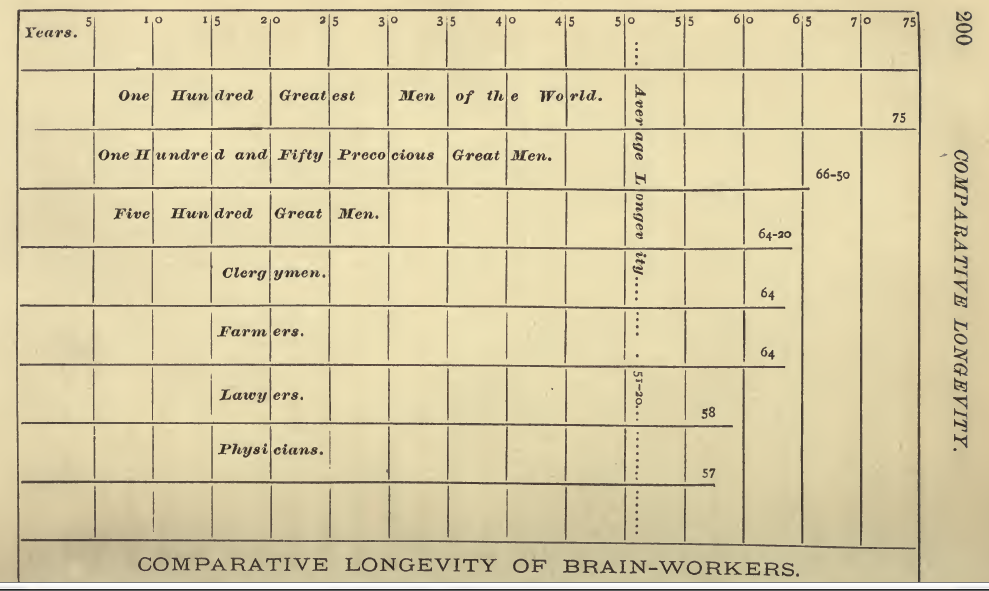
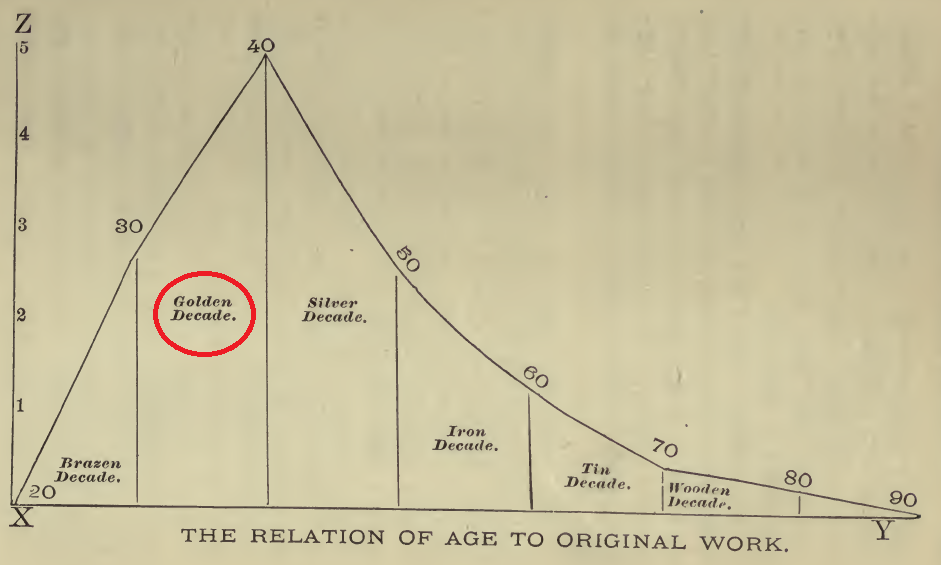
longevity has increased, and in all ages brain-workers have, on the average, been long-lived, the very greatest geniuses being the longest-lived of all.” “the law of the relation of age to work, by which it is shown that original brain-work is done mostly in youth and early and middle life, the latter decades being reserved for work requiring simply experience and routine.” Pequena confusão entre decaimento fisiológico e e incorporação da experiência como forma de reduzir o esforço mental!

Poetas românticos não usavam a cabeça? Pois sua efemeridade é mais-que-popular…

in all our cyclopedias of medicine, the terms hysteria, somnambulism, ecstasy, catalepsy, mimicry of disease, spinal congestion, incipient ataxy, epilepsy, spasms and congestions, anemias and hyperemias, alcoholism, spinal irritation, spinal exhaustion, cerebral paresis, cerebral exhaustion and irritation, nervousness and imagination [!] are thrown together recklessly, confusedly, hopelessly as in a witches cauldron; and in all, and through all, one shall look vainly—save here and there, for an intelligent and differential description of neurasthenia, the most frequent, the most important, the most interesting nervous disease of our time, or of any time

still our medical graduates, after years spent in listening to lectures, must wait for their diploma before they are even ready to begin the study of this side of the nervous system. Meantime the literature of ataxia [desarranjo da coordenação motora], which is but an atom compared with the world of functional nervous diseases, has risen and is yet rising with infinite repetitions and revolutions to volumes and volumes.”

So far as I know, there has been no hostile criticism of this philosophy in Germany, but in England, even now, these views are not unanimously sustained.” Nazistas retesados.

1. NATURE AND DEFINITION OF NERVOUSNESS

Trance, with its numerous, interesting and intricate phenomena, a condition that has been known in all ages, and among almost all people, is not nervousness, albeit nervous people are sometimes subject to it. See my work on Trance [não muito interessado, mas obrigado assim mesmo!], in which this distinction between physiology and psychology is discussed more fully and variously illustrated.” “This interesting survival of the Middle Ages that we have right here with us today, is the most forcible single illustration that I know of, of the distinction between unbalanced mental organization and nervousness. These Jumpers are precious curiosities, relics or antiques that the 14th century has, as it were, dropped right into the middle of the 19th. The phenomena of the Jumpers are as interesting, scientifically, as any phenomena can be, but they aren’t contributions to American nervousness.

Brainlessness (excess of emotion over intellect) is, indeed, to nervousness, what idiocy is to insanity”

Nervousness is not passionateness. A person who easily gets excited or angry, is often called nervous. One of the signs, and in some cases, one of the first signs of real nervousness, is mental irritability, a disposition to become fretted over trifles; but in a majority of instances, passionate persons are healthy—their exhibitions of anger are the expression of normal emotions, and not in any sense evidences of disease, although they may be made worse by disease, either functional or organic. Nervousness is nervelessness—a lack of nerve-force.” “In medical science we are forced to retain terminology that is in the last degree unscientific, for the same reason that we retain our orthography, which in the English language is, as all know, very bad indeed.” <Febre da grama> realmente não é muito literal!

fear of lightning, or fear of responsibility, of open places or of closed places, fear of society, fear of being alone, fear of fears, fear of contamination, fear of everything, deficient mental control, lack of decision in trifling matters, hopelessness, deficient thirst and capacity for assimilating fluids, abnormalities of the secretions, salivation, tenderness of the spine, and of the whole body, sensitiveness to cold or hot water, sensitiveness to changes in the weather, coccyodynia, pains in the back, heaviness of the loins and limbs, shooting pains simulating those of ataxia, cold hands and feet, pain in the feet, localized peripheral numbness and hypersesthesia, tremulous and variable pulse and palpitation of the heart, special idiosyncrasies in regard to food, medicines, and external irritants, local spasms of muscles, difficulty of swallowing, convulsive movements, especially on going to sleep, cramps [cãibras ou cólicas], a feeling of profound exhaustion unaccompanied by positive pain, coming and going, ticklishness [hiperdelicadeza ou sensibilidade; em sentido mais estrito, facilidade para sentir comichão ou cócegas], vague pains and flying neuralgias, general or local itching, general and local chills and flashes of heat [calafrios e ondas de calor esporádicos], attacks of temporary paralysis, pain in the perineum, involuntary emissions, partial or complete impotence, irritability of the prostatic urethra, certain functional diseases of women [vague!], excessive gaping and yawning [bocejar exagerado], rapid decay and irregularities of the teeth, oxalates, urates, phosphates and spermatozoa in the urine, vertigo or dizziness, explosions in the brain at the back of the neck [?!], dribbling and incontinence of urine [incontinência urinária e seu reverso, alternados], frequent urination, choreic movements of different parts of the body, trembling of the muscles or portions of the muscles in different parts of the body, exhaustion after defecation and urination, dryness of the hair, falling away of the hair and beard, slow reaction of the skin, etc. Dr. Neisser, of Breslau, while translating my work on Nervous Exhaustion into German, wrote me that the list of symptoms was not exhaustive. This criticism is at once accepted, and was long ago anticipated. An absolutely exhaustive catalogue of the manifestations of the nervously exhausted state cannot be prepared, since every case differs somewhat from every other case.”

There are millionnaires of nerve-force—those who never know what it is to be tired out, or feel that their energies are expended, who can write, preach, or work with their hands many hours, without ever becoming fatigued, who do not know by personal experience what the term <exhaustion> means; and there are those—and their numbers are increasing daily—who, without being absolutely sick, without being, perhaps for a lifetime, ever confined to the bed a day with acute disorder, are yet very poor in nerve-force; their inheritance is small, and they have been able to increase it but slightly, if at all; and if from overtoil, or sorrow, or injury, they overdraw their little surplus, they may find that it will require months or perhaps years to make up the deficiency, if, indeed they ever accomplish the task. The man with a small income is really rich, as long as there is no overdraft on the account; so the nervous man may be really well and in fair working order as long as he does not draw on his limited store of nerve-force. But a slight mental disturbance, unwonted toil or exposure, anything out of and beyond his usual routine, even a sleepless night, may sweep away that narrow margin, and leave him in nervous bankruptcy, from which he finds it as hard to rise as from financial bankruptcy.”

Hence we see that neurasthenics who can pursue without any special difficulty the callings of their lives, even those callings requiring great and prolonged activity, amid perhaps very considerable excitement, as that of statesmanship, politics, business, commercial life, or in overworked professions, are prostrated at once when they are called upon to do something outside of their line, where their force must travel by paths that have never been opened and in which the obstructions are numerous and can only be overcome by greater energy than they can supply.” The purpose of treatment in cases of nervous exhaustion is of a two-fold character— to widen the margin of nerve-force, and to teach the patient how to keep from slipping over the edge.”

Our title is justified by this, that if once we understand the causes and consequences of American nervousness, the problems connected with the nervousness of other lands speedily solve themselves.” The philosophy of Germany has penetrated to all civilized nations; in all directions we are becoming Germanized. Similarly, the nervousness of America is extending over Europe, which, in certain countries, at least, is becoming rapidly Americanized. Just as it is impossible to treat of German thought without intelligent reference to the thought of other nationalities, ancient or modern, so is it impossible to solve the problem of American nervousness without taking into our estimate the nervousness of other lands and ages. [Acaba de contradizer o grifado em verde!]”

O REVERSO DA MEDALHA

Indeed, nervousness, in its extreme manifestations, seems to save one from these organic incurable diseases of the brain and of the cord; with some exceptions here and there, the neurasthenic does not go into or die of nervous disease.” They may become insane—some of them do; they may become bed-confined invalids; they may be forced, as they often are, to resign their occupations, but they do not, as rule, develop the structural maladies to which here refer.” nervousness is a physical not a mental state, and its phenomena do not come from emotional excess or excitability or from organic disease but from nervous debility and irritability.”

2. SIGNS OF AMERICAN NERVOUSNESS

No one dies of spinal irritation; no one dies of cerebral irritation; no one dies of hay-fever; rarely one dies of hysteria; no one dies of general neuralgia; no one dies of sick-headache; no one dies of nervous dyspepsia; quite rarely does one die of nervous exhaustion; and even when these conditions are the cause of death they are not noted as such in the tables of mortality” Nervousness of constitution is, indeed, an aid to longevity, and in various ways; it compels caution, makes imperative the avoidance of evil habits, and early warns us of the approach of peril.” Wickedness was solemnly assigned as the cause of the increase of nervous diseases, as though wickedness were a modern discovery.” nervous diathesis—an evolution of the nervous temperament.” “It includes those temperaments, commonly designated as nervous, in whom there exists a predisposition to neuralgia, dyspepsia, chorea, sick-headache, functional paralysis, hysteria, hypochondriasis, insanity, or other of the many symptoms of disease of the central or peripheral nervous system.”

A fine organization. The fine organization is distinguished from the coarse by fine, soft hair, delicate skin, nicely chiselled features [bem-cinzelada ou esculpida – somos belos!], small bones, tapering extremities [membros pontiagudos, i.e., que se afunilam nas mãos e nos pés, na canela e no antebraço!], and frequently by a muscular system comparatively small and feeble. It is frequently associated with superior intellect, and with a strong and active emotional nature.” “It is the organization of the civilized, refined, and educated, rather than of the barbarous and low-born and untrained”

The nervous diathesis appears, within certain limits, to protect the system against attacks of fever and inflammation.” Isso explicaria porque só tive febre uma vez desde a idade adulta.

The tuberculous diathesis frequently accompanies a fine organization; but fine organizations only in a certain proportion of cases have a tuberculous diathesis. The nervous diathesis is frequently not only not susceptible to tuberculosis, but apparently much less so than the average, and sometimes, indeed, seems to be antagonistic to it, for there are many nervous patients in whom no amount of exposure or hardship or imprudence seems to be able to develop phthisis [tísica]” Devo acrescentar alguma imunidade ao câncer?

Among Americans of the higher orders, those who live in-doors, drinking is becoming a lost art; among these classes drinking customs are now historic, must be searched for, read or talked about, like extinct or dying-away species.” There is, perhaps, no single fact in sociology more instructive and far reaching than this, and this is but a fraction of the general and sweeping fact that the heightened sensitiveness of Americans forces them to abstain entirely, or to use in incredible and amusing moderation, not only the stronger alcoholic liquors, whether pure or impure, but also the milder wines, ales, and beers, and even tea and coffee.”

I replied that there were very few nervous patients who were not injured by it, and very few who would not find it out without the aid of any physician. Our fathers could smoke, our mothers could smoke, but their children must oft-times be cautious; and chewing is very rapidly going out of custom, and will soon, like snuff-taking, become a historic curiosity; while cigars give way to cigarettes. From the cradle to the grave the Chinese empire smokes, and when a sick man in China has grown so weak that he no longer asks for his pipe, they give up hope, and expect him to die. Savage tribes without number drink most of the time when not sleeping or fighting, and without suffering alcoholism, or without ever becoming inebriates [!]” But 50 years ago opium produced sleep; now the same dose keeps us awake, like coffee or tea—susceptibility to this drug has been revolutionized.” Thus the united forces of climate and civilization are pressing us back from one stimulant to another, until, like babes, we find no safe retreat save in chocolate and milk and water.”

Reprove an Angola negro for being drunk and he will reply, <My mother is dead,> as though that were excuse enough. Even as recently as the beginning of the present century, the custom of drinking at funerals yet survived with our fathers. At the present time both culture and conscience are opposed to such habits.”

It is through the alcohol, and not the adulterations, that excessive drinking injures.” This functional malady of the nervous system which we call inebriety, as distinguished from the vice or habit of drunkenness, may be said to have been born in America, has here developed sooner and far more rapidly than elsewhere, and here also has received earlier and more successful attention from men of science.” For those individuals who inherit a tendency to inebriety, the only safe course is absolute abstinence, especially in early life; and in certain cases treatment of the nervous system, on the exhaustion of which the inebriety depends.”

AQUILO QUE NENHUMA REVISTA DE NUTRIÇÃO DIRÁ: “we so often find not only epileptics, but neurasthenics and nervous persons with other symptoms, are free and sometimes excessive eaters. They say their food does not give them strength, and it does not, for the same reason that the acid poured into the impure fluid of the battery does not give us electric force. There are those who all their lives are habitually small eaters and yet are great workers, and there are those who, though all their lives great eaters, are never strong; their food is either not digested or thoroughly assimilated, and so a much smaller fraction than should be is converted into nerve-force.”

In all the great cities of the East, among the brain-working classes of our large cities everywhere, pork, in all its varieties and preparations, has taken a subordinate place among the meats upon our tables, for the reason that the stomach of the brain-worker cannot digest it.”

Four and 5 meals a day is, or has been, the English and, notably, the German custom. Foreigners have greatly surpassed us in the taking of solid as well as liquid food.”

The eyes also are good barometers of our nervous civilization. The increase of asthenopia and short-sightedness [miopia], and, in general, of the functional disorders of the eye, are demonstrated facts and are most instructive. The great skill and great number of our oculists are constant proof and suggestions of the nervousness of our age. The savage can usually see well; myopia is a measure of civilization.” “near-sightedness increases in schools” Macnamara declares that he took every opportunity of examining the eyes of Southall aborigines of Bengal, for the purpose of discovering whether near-sightedness and diseases of like character existed among them, and he asserts that he never saw a young Southall whose eyes were not perfect.”

at the age of 20, 26% of Americans are near-sighted. In Russia, 42%, and in Germany, 62%.” A nação mais intelectual do mundo.

American dentists are the best in the world, because American teeth are the worst in the world.”

Irregularities of teeth, like their decay, are the product primarily of civilization, secondarily of climate. These are rarely found among the Indians or the Chinese; and, according to Dr. Kingsley, are rare even in idiots”

It is probable that negroes are troubled earlier than Indians. The popular impression that negroes always have good teeth is erroneous—the contrast between the whiteness of the teeth and the blackness of the face tending not a little to flatter them.”

Coarse races and peoples, and coarse individuals can go with teeth badly broken down without being aware of it from any pain; whereas, in a finely organized constitution, the very slightest decay in the teeth excites pain which renders filling or extracting imperative. The coarse races and coarse individuals are less disturbed by the bites of mosquitoes, by the presence of flies or of dirt on the body, than those in whom the nervous diathesis prevails”

It is said, for example, of the negroes of the South, that they rarely if ever sneeze.”

Special explanations without number have been offered for this long-observed phenomenon—the early and rapid decay of American teeth—such as the use of sweets, the use of acids, neglect of cleanliness, and the use of food that requires little mastication. But they who urge these special facts to account for the decay of teeth of our civilization would, by proper inquiry, learn that the savages and negroes, and semi-barbarians everywhere, in many cases use sweets far more than we, and never clean their mouths, and never suffer, except in old age.”

the only races that have poor teeth are those who clean them.” Quando o remédio vem mais tarde que a doença.

Among savages in all parts of the earth baldness is unusual, except in extreme age, and gray hairs come much later than with us. So common is baldness in our large cities that what was once a deformity and exception is now almost the rule, and an element of beauty.”

Increased sensitiveness to both heat and cold is a noteworthy sign of nervousness.”

Cold bathing is not borne as well as formerly.” “Water treatment is as good for some forms of nervous disease as it ever was; but it must be adapted to the constitution of the patient, and adapted also to the peculiar needs of each case.”

The disease, state, or condition to which the term neurasthenia is applied is subdivisible, just as insanity is subdivided into general paresis or general paralysis of the insane, epileptic insanity, hysterical, climatic, and puerperal insanity; just as the disease or condition that we call trance is subdivided into clinical varieties, such as intellectual trance, induced trance, cataleptic trance, somnambulistic trance, emotional trance, ecstatic trance, etc.

That diabetes is largely if not mainly a nervous disease is becoming more and more the conviction of all medical thinkers, and that, like Bright’s disease, it has increased of late, can be proved by statistics that in this respect are in harmony with observation.”

A ERA DA RINITE E DAS ALERGIAS: “A single branch of our neurological tree, hay-fever, has in it the material for years of study; he who understands that, understands the whole problem. In the history of nervous disease I know not where to look for anything as extraordinary or instructive as the rise and growth of hay-fever in the USA.”

Catarrh of the nose and nasal pharyngeal states — so-called nasal and pharyngeal catarrh — is not a nervous disease, in the strict sense of the term, but there is often a nervous element in it; and in the marked and obstinate forms it is, like decay and irregularities of the teeth, one of the signs or one of the nerve-symptoms of impairment of nutrition and decrease of vital force which make us unable to resist change of climate and extremes of temperature.”

The phenomenal beauty of the American girl of the highest type, is a subject of the greatest interest both to the psychologist and the sociologist, since it has no precedent, in recorded history, at least; and it is very instructive in its relation to the character and the diseases of America.”

The same climatic peculiarities that make us nervous also make us handsome”

In no other country are the daughters pushed forward so rapidly, so early sent to school, so quickly admitted into society; the yoke of social observance (if it may be called such), must be borne by them much sooner than by their transatlantic sisters — long before marriage they have had much experience in conversation and in entertainment, and have served as queens in social life, and assumed many of the responsibilities and activities connected therewith. Their mental faculties in the middle range being thus drawn upon, constantly from childhood, they develop rapidly a cerebral activity both of an emotional and an intellectual nature, that speaks in the eyes and forms the countenance; thus, fineness of organization, the first element of beauty, is supplemented by expressiveness of features — which is its second element”

Handsome women are found here and there in Great Britain, and rarely in Germany; more frequently in France and in Austria, in Italy and Spain”

One cause, perhaps, of the almost universal homeliness of female faces among European works of art is the fact that the best of the masters never saw a handsome woman.” Esqueceu da relatividade histórica do tipo belo!

If Raphael had been wont to see everyday in Rome or Naples what he would now see everyday in New York, Baltimore, or Chicago, it would seem probable that, in his Sistine Madonna he would have preferred a face of, at least, moderate beauty, to the neurasthenic and anemic type that is there represented. [?]”

To the first and inevitable objection that will be made to all here said — namely, that beauty is a relative thing, the standard of which varies with age, race, and individual — the answer is found in the fact that the American type is today more adored in Europe than in America; that American girls are more in demand for foreign marriages than any other nationality; and that the professional beauties of London that stand highest are those who, in appearance and in character have come nearest the American type.” Isso se chama cultura hegemônica, e não um argumento de defesa – e um pouco de chauvinismo também…

The ruddiness or freshness, the health-suggesting and health-sustaining face of the English girl seem incomparable when partially veiled, or when a few rods away” HAHA. Uma obra não muito recomendável na parte estética… Beleza EXÓTICA!

The European woman steps with a firmer tread than the American, and with not so much lightness, pliancy, and grace. In a multitude, where both nations are represented, this difference is impressive.”

The grasp of the European woman is firmer and harder, as though on account of greater strength and firmness of muscle. In the touch of the hand of the American woman there is a nicety and tenderness that the English woman destroys by the force of the impact.”

3. CAUSES OF AMERICAN NERVOUSNESS

Punctuality is a greater thief of nervous force than is procrastination of time. We are under constant strain, mostly unconscious, often-times in sleeping as well as in waking hours, to get somewhere or do something at some definite moment.”

In Constantinople indolence is the ideal, as work is the ideal in London and New York”

There are those who prefer, or fancy they prefer, the sensations of movement and activity to the sensations of repose”

The telegraph is a cause of nervousness the potency of which is little understood. (…) prices fluctuated far less rapidly, and the fluctuations which now are transmitted instantaneously over the world were only known then by the slow communication of sailing vessels or steamships” “every cut in prices in wholesale lines in the smallest of any of the Western cities, becomes known in less than an hour all over the Union; thus competition is both diffused and intensified.”

Rhythmical, melodious, musical sounds are not only agreeable, but when not too long maintained are beneficial, and may be ranked among our therapeutical agencies.”

The experiments, inventions, and discoveries of Edison alone have made and are now making constant and exhausting draughts on the nervous forces of America and Europe, and have multiplied in very many ways, and made more complex and extensive, the tasks and agonies not only of practical men, but of professors and teachers and students everywhere” Um tanto utópico e nostálgico para um “médico pragmático”…

On the mercantile or practical side the promised discoveries and inventions of this one man have kept millions of capital and thousand of capitalists in suspense and distress on both sides of the sea.”

the commerce of the Greeks, of which classical histories talk so much, was more like play — like our summer yachting trips”

The gambler risks usually all that he has; while the stock buyer risks very much more than he has. The stock buyer usually has a certain commercial, social, and religious position, which is thrown into the risk, in all his ventures”

as the civilized man is constantly kept in check by the inhibitory power of the intellect, he appears to be far less emotional than the savage, who, as a rule, with some exceptions, acts out his feelings with comparatively little restraint.”

Love, even when gratified, is a costly emotion; when disappointed, as it is so often likely to be, it costs still more, drawing largely, in the growing years of both sexes, on the margin of nerve-force, and thus becomes the channel through which not a few are carried on to neurasthenia, hysteria, epilepsy, or insanity.”

A modern philosopher of the most liberal school states that he hates to hear one laugh aloud, regarding the habit, as he declares, a survival of barbarism.”

There are two institutions that are almost distinctively American — political elections and religious revivals”

My friend, presidents and politicians are chips and foam on the surface of the sea; they are not the sea; tossed up by the tide and left on the shore, but they are not the tide; fold your arms and go to bed, and most of the evils of this world will correct themselves, and, of those that remain, few will be modified by anything that you or I can do.”

The experiment attempted on this continent of making every man, every child, and every woman an expert in politics and theology is one of the costliest of experiments with living human beings, and has been drawing on our surplus energies with cruel extravagance for 100 years.” Agora, 250…

Protestantism, with the subdivision into sects which has sprung from it, is an element in the causation of the nervous diseases of our time. No Catholic country is very nervous, and partly for this—that in a Catholic nation the burden of religion is carried by the church.” Coitado do Brasil, trocando o certo pelo duvidoso assim…

The difference between Canadians and Americans is observed as soon as we cross the border, the Catholic church and a limited monarchy acting as antidotes to neurasthenia and allied affections. Protestant England has imitated Catholicism, in a measure, by concentrating the machinery of religion and taking away the burden from the people. It is stated —although it is supposed that this kind of statistics are unreliable— that in Italy insanity has been on the increase during these few years in which there has been civil and religious liberty in that country.”

The anxieties about the future, family, property, etc., are certainly so wearing on the negro, that some of them, without doubt, have expressed a wish to return to slavery.”

advances in science are not usually made by committees—indeed, are almost never made by them, least of all by government committees”

The people of this country have been pressed constantly with these 3 questions: How shall we keep from starving? Who is to be the next president? And where shall we go when we die? In a limited, narrow way, other nations have met these questions; at least two of them, that of starvation and that of the future life; but nowhere in ancient or modern civilization have these 3 questions been agitated so severely or brought up with such energy as here.”

Those who have acquired or have inherited wealth, are saved an important percentage of this forecasting and fore-worry”

The barbarian cares nothing for the great problems of life; seeks no solution — thinks of no solution of the mysteries of nature, and, after the manner of many reasoners in modern delusions, dismisses what he cannot at once comprehend as supernatural, and leaves it unsatisfactorily solved for himself, for others, and for all time”

Little account has been made of the fact that the old world is small geographically. The ancient Greeks knew only of Greece and the few outside barbarians who tried to destroy them. The discovery of America, like the invention of printing, prepared the way for modern nervousness; and, in connection with the telegraph, the railway, and the periodical press increased a hundred-fold the distresses of humanity.” The burning of Chicago—a city less than half a century old, on a continent whose existence was unknown a few centuries ago—becomes in a few hours the property of both hemispheres, and makes heavy drafts on the vitality not only of Boston and New York, but of London, Paris, and Vienna.”

Letter-writing is an index of nervousness; those nations who writes the most letters being the most nervous, and those who write scarcely at all, as the Turks and Russians, knowing nothing or but very little of it.”

The education of the Athenian boy consisted in play and games and songs, and repetitions of poems, and physical feats in the open air. His life was a long vacation, in which, as a rule, he rarely toiled as hard as the American lad in the intervals of his toil. (…) What they called work, gymnastics, competition games, and conversations on art and letters, is to us recreation.”

Up to a certain point work develops capacity for work; through endurance is evolved the power of greater endurance; force becomes the parent of force. But here, as in all animate nature, there are limitations of development which cannot be passed. The capacity of the nervous system for sustained work and worry has not increased in proportion to the demands for work and worry that are made upon it.”

GREEN COMMENT LAND: “Continuous and uniform cold as in Greenland, like continuous and uniform heat as on the Amazon, produces enervation and languor; but repeated alternations of the cold of Greenland and the heat of the Amazon produce energy, restlessness, and nervousness.”

The element of dryness of the air, peculiar of our climate as distinguished from that of Europe, both in Great Britain and on the Continent, is of the highest scientific and practical interest.” “On the nervous system this unusual dryness and thinness of the air have a many-sided influence; such as increase of headaches, neuralgias, and diminished capacity for sustaining cerebral toil.” The organs, pianos, and violins of America are superior to those made in Europe at the present time. This superiority is the result, not so much of greater skill, ingenuity, or experience, but—so far as I can learn, from conversing with experts in this line—from the greater dryness of the air, which causes the wood to season better than in the moist atmosphere of Europe.”

Moisture conducts electricity, and an atmosphere well charged with moisture, other conditions being the same, will tend to keep the electricity in a state of equilibrium, since it allows free and ready conduction at all times and in all directions.” In regions where the atmosphere is excessively dry, as in the Rocky Mountains, human beings—indeed all animals, become constantly acting lightning-rods, liable at any moment to be made a convenient pathway through which electricity going to or from the earth seeks an equilibrium.”

in the East our neuralgic and rheumatic patients, just before thunder-storms, are suddenly attacked by exquisite pains that at once disappear with the fair weather. There are those so sensitive that for 100 miles, and for a full day in advance, as Dr. Mitchell has shown, they can predict the approach of a storm.”

Dryness of the air, whether external or internal, likewise excites nervousness by heightening the rapidity of the processes of waste and repair in the organism, so that we live faster than in a moist atmosphere.”

one of the Manchester mill owners asserted that, during a season of dry weather, there was, in weaving alone, a loss of 5%, in quantity, and another loss of 5%, in quality; in spinning, also, an equal loss is claimed. To maintain moisture in mills, sundry devices have been tried, which have met, I believe, with partial success in practice.”

Even in our perfect Octobers, on days that are pictures of beauty and ideals of climate — just warm enough to be agreeable and stimulating enough not to be depressing, we yet remain in the house far more than Europeans are wont to do even in rainy or ugly seasons.” So what, Mr. Productive Media?

The English know nothing of summer, as we know of it — they have no days when it is dangerous, and scarcely any days when it is painful to walk or ride in the direct rays of the sun; and in winter, spring, and fall there are few hours when one cannot by proper clothing keep warm while moderately exercising.”

The Kuro Siwo stream of the Pacific, with its circuit of 18,000 miles, carries the warm water of the tropics towards the poles, and regulates in a manner the climate of Japan. Mr. Croll estimates that if the Gulf Stream were to stop, the annual temperature of London would fall 30 degrees [Farenheit], and England would become as cold as Nova Zembla. It is the influence of the Gulf Stream that causes London, that is 11° farther north than New York, to have an annual mean temperature but 2° lower.”

According to Miss Isabella Bird, who has recently published a work entitled Unbeaten Tracks in Japan, which is not only the very best work ever written on Japan, but one of the most remarkable works of travel ever written by man or woman, it seems that the Japanese suffer both from extremes of heat and cold, from deep snows and ice, and from the many weeks of sultriness such as oppress us in the US. The atmosphere of Japan is though far more moist than that of America, in that respect resembling some of the British Isles”

Our Meteorological Bureau has justified its existence and labors by demonstrating and popularizing the fact that our waves of extreme heat and of extreme cold and severe climatic perturbations of various kinds are born in or pass from the Pacific through these mountains and travel eastward, and hence their paths can be followed and their coming can be predicted with a measure of certainty.”

in the latter part of the winter and early spring—or what passes for spring, which is really a part of winter, and sometimes its worse part—there is more suffering from cold, more liability to disease, by taking cold, and more debility from long confinement in dry and overheated air than in early and mid-winter”

the strong races, like the Hebrews and Anglo-Saxons, succeed in nearly all climates, and are dominant wherever they go; but in unlimited or very extended time, race is a result of climate and environment.”

Savages may go to the most furious excesses without developing any nervous disease; they may gorge themselves, or they may go without eating for a week, they may rest in camp or they may go upon laborious campaigns, and yet never have nervous dyspepsia, sick-headache, hay-fever, or neuralgia.”

No people in the world are so careful of their diet, the quality and quantity of their food, and in regard to their habits of drinking, as the very class of Americans who suffer most from these neuroses.”

Alcohol only produces inebriety when it acts on a nervous system previously made sensitive. Alcoholism and inebriety are the products not of alcohol, but of alcohol plus a certain grade of nerve degeneration.”

But bad air, that is, air simply made impure by the presence of human beings, without any special contagion, seems powerless to produce disease of any kind, unless the system be prepared for it. Not only bad air, but bad air and filth combined, the Chinese of the lower orders endure both in this country and their own, and are not demonstrably harmed thereby (…) but impure air, plus a constitution drawn upon and weakened by civilization, is an exciting cause of nervous disease of immense force.”

The philosophy of the causation of American nervousness may be expressed in algebraic formula as follows: civilization in general + American civilization in particular (young and rapidly growing nation, with civil, religious, and social liberty) + exhausting climate (extremes of heat and cold, and dryness) + the nervous diathesis (itself a result of previously named factors) + overwork or overworry, or excessive indulgence of appetites or passions = an attack of neurasthenia or nervous exhaustion.”

Dr. Habsch, the chief oculist in Constantinople, says that the effect of tobacco upon the eyes is very problematical; that everybody smokes from morning to night, the men a great deal, the women a little less than the men, and the children smoke from the age of 7 and 8 years. He states that the number of cases of amaurosis [cegueira] is very limited. If expert oculists would examine the eyes of the Chinese, who smoke quite as much as the Turks, if not more, and smoke opium as well as tobacco, they would unquestionably confirm the conclusion of Dr. Habsch among the Turks. Dr. Habsch believes that in persons with a very delicate skin and conjunctiva [membrana mucosa que liga as pálpabras com o tecido ocular propriamente dito] among the Turks, smoking frequently causes chronic irritation, local congestion, profuse lachrymation, blepharitis ciliaris [inflamação dos cílios], and more or less intense redness of the eyelids. (cf. Dr. Webster on Amblyopia [Perda de visão] from the Use of Tobacco) [livro inexistente na web]”

The Hollanders, according to a most expert traveller, Edmondo De Amicis, are the greatest smokers of Europe; on entering a house, with the first greeting you are offered a cigar, and when you leave another is handed to you; many retire with a pipe in their mouth, re-light it if they awake during the night; they measure distances by smoke – to such a place by not so many miles but by so many pipes.” “Says one Hollander, smoke is our second breath; says another, the cigar is the 6th finger of the hand.”

Opium eating in China does not work in the way that the same habit does in the white races.” “when it is said of a Chinaman that he smokes opium, it is meant that he smokes to excess and has a morbid craving for it, just as with us the expression a man drinks means that he drinks too much”

It is clear that the habit of taking opium does not necessarily impair fertility, since large families are known among those who use opium, even to excess.”

Among my nervous patients I find very many who cannot digest vegetables, but must use them with much caution; but all China lives on vegetables, and indigestion is not a national disease. Many of the Chinese live in undrained grounds, in conditions favorable to ague and various fevers, but they do not suffer from these diseases, nor from diseases of the lungs and bronchial tubes, to the same extent as foreign residents there who do not use opium.”

I have been twice favored with the chance to study Africa in America. On the sea islands of the South, between Charleston and Savannah, there are thousands of negroes, once slaves, most of whom were born on those islands, who there will die, and who at no time have been brought into relation with our civilization, except so far as it is exhibited in a very few white inhabitants in the vicinity. Intellectually, they can be not very much in advance of their African ancestors; in looks and manners they remind me of the Zulus now exhibiting in America; for although since emancipation they have been taught by philanthropists, part of the time under governmental supervision, some of the elements of common school teaching, yet none of them have made, or are soon likely to make, any very important progress beyond those elements, and few, if any of them, even care to exercise the art of reading after it is taught them. Here, then, is a bit of barbarism at our door-steps; here, with our own eyes, and with the aid of those who live near them and employ them, I have sought for the facts of comparative neurology. There is almost no insanity among these negroes; there is no functional nervous disease or symptoms among them of any name or phase; to suggest spinal irritation, or hysteria of the physical form, or hay-fever, or nervous dyspepsia among these people is but to joke.” These primitive people can go, when required, for weeks and months sleeping but 1 or 2 hours out of the 24; they can labor for all day, or for 2 days, eating nothing or but little; hog and hominy and lish, all the year round, they can eat without getting dyspepsia; indulgence of passions several-fold greater, at least, than is the habit of the whites, either there or here, never injures them either permanently or temporarily; if you would find a virgin among them, it is said you must go to the cradle; alcohol, when they can get it, they drink with freedom, and become intoxicated like the whites, but rarely, indeed, manifest the symptoms of delirium-tremens, and never of chronic alcoholism”

These blacks cannot summon as much energy for a moment in an emergency as the whites, since they have less control over their energies, but in holding-on power, in sustained, continuous, unbroken muscular endurance, for hours and days, they surpass the whites.”

The West is where the East was a quarter of a century ago—passing more rapidly, as it would appear, through the same successive stages of development.”

4. LONGEVITY OF BRAIN-WORKERS AND THE RELATION OF AGE TO WORK

Without civilization there can be no nervousness; there is no race, no climate, no environment that can make nervousness and nervous disease possible and common save when reenforced by brain-work and worry and in-door life. This is the dark and, so far as it goes, truthful side of our theme; the brighter side is to be drawn in the present chapter.

Thomas Hughes, in his Life of Alfred the Great, makes a statement that <the world’s hardest workers and noblest benefactors have rarely been long-lived>. That any intelligent writer of the present day should make a statement so untrue shows how hard it is to destroy an old superstition.

The remark is based on the belief which has been held for centuries that the mind can be used only at the injurious expense of the body. This belief has been something more than a mere popular prejudice; it has been a professional dogma, and has inspired nearly all the writers on hygiene since medicine has been a science; and intellectual and promising youth have thereby been dissuaded from entering brain-working professions; and thus, much of the choicest genius has been lost to civilization; students in college have abandoned plans of life to which their tastes inclined, and gone to the farm or workshop; authors, scientists, and investigators in the several professions have thrown away the accumulated experience of the better half of life, and retired to pursuits as uncongenial as they were profitless. The delusion has, therefore, in 2 ways, wrought evil, specifically by depriving the world of the services of some of its best endowed natures, and generally by fostering a habit of accepting statement for demonstration.

Between 1864 and 1866 I obtained statistics on the general subject of the relation of occupation to health and longevity that convinced me of the error of the accepted teachings in regard to the effect of mental labor.”

The views I then advocated, and which I enforced by statistical evidence were:

1st. That the brain-working classes—clergymen, lawyers, physicians, merchants, scientists, and men of letters, lived much longer than the muscle-working classes.

2nd. That those who followed occupations that called both muscle and brain into exercise, were longer-lived than those who lived in occupations that were purely manual.

3rd. That the greatest and hardest brain-workers of history have lived longer on the average than brain-workers of ordinary ability and industry.

4th. That clergymen were longer-lived than any other great class of brain-workers. [QUE PRAGA!]

5th. That longevity increased very greatly with the advance of civilization; and that this increase was too marked to be explained merely by improved sanitary knowledge.

6th. That although nervous diseases increased with the increase of culture, and although the unequal and excessive excitements and anxieties attendant on mental occupations of a high civilization were so far both prejudicial to health and longevity, yet these incidental evils were more than counter-balanced by the fact that fatal inflammatory diseases have diminished in frequency and violence in proportion as nervous diseases have increased; an also that brain-work is, per se, healthful and conducive to longevity.”

the greater majority of those who die in any one of the three great professions — law, theology, and medicine — have, all their lives, from 21 upwards, followed that profession in which they died.”

I have ascertained the longevity of 500 of the greatest men in history. The list I prepared includes a large proportion of the most eminent names in all the departments of thought and activity. (…) the average age of those I have mentioned, I found to be 64.2. (…) the greatest men of the world have lived longer on the average than men of ordinary ability in the different occupations by 14 years” The value of this comparison is enforced by the consideration that longevity has increased with the progress of civilization, while the list I prepared represents every age of recorded history.” “I am sure that any chronology comprising from 100 to 500 of the most eminent personages in history, at any cycle, will furnish an average longevity of from 64 to 70 years. Madden, in his very interesting work The Infirmities of Genius, gives a list of 240 illustrious names, with their ages at death.”

IV comparative longevity of brain-workers

The full explanation of the superior longevity of the brain-working classes would require a treatise on the science of sociology, and particularly of the relation of civilization to health. The leading factors, accounting for the long life of those who live by brain-labor, are:

(…)

In the successful brain-worker worry is transferred into work; in the muscle-worker work too often degrades into worry.” “To the happy brain-worker life is a long vacation; while the muscle-worker often finds no joy in his daily toil, and very little in the intervals.”

Longevity is the daughter of comfort. Of the many elements that make up happiness, mental organization, physical health, fancy, friends, and money—the last is, for the average man, greater than any other, except the first.”

for a large number, sleep is a luxury of which they never have sufficient for real recuperation”

The nervous temperament, which usually predominates in brain-workers, is antagonistic to fatal, acute, inflammatory disease, and favorable to long life.”

Nervous people, if not too feeble, may die everyday. They do not die; they talk of death, and each day expect it, and yet they live. Many of the most annoying nervous diseases, especially of the functional, and some even of the structural varieties, do not rapidly destroy life, and are, indeed, consistent with great longevity.”

the nervous man can expose himself to malaria, to cold and dampness, with less danger of disease, and with less danger of death if he should contract disease, than his tough and hardy brother.”

In the conflict with fevers and inflammations, strength is often weakness, and weakness becomes strength—we are saved through debility.”

Still further, my studies have shown that, of distinctively nervous diseases, those which have the worst pathology and are the most hopeless, such as locomotor ataxia, progressive muscular atrophy, apoplexy with hemiplegia, and so on, are more common and more severe, and more fatal among the comparatively vigorous and strong, than among the most delicate and finely organized. Cancer, even, goes hardest with the hardy, and is most relievable in the nervous.”

Women, with all their nervousness—and in civilized lands, women are more nervous, immeasurably, than men, and suffer more from general and special nervous diseases—yet live quite as long as men, if not somewhat longer; their greater nervousness and far greater liability to functional diseases of the nervous system being compensated for by their smaller liability to certain acute and inflammatory disorders, and various organic nervous diseases, likewise, such as the general paralysis of insanity.”

Brain-workers can adapt their labor to their moods and hours and periods of greatest capacity for labor better than muscle-workers. In nearly all intellectual employments there is large liberty; literary and professional men especially, are so far masters of their time that they can select the hours and days for their most exacting and important work; and when from any cause indisposed to hard thinking, can rest and recreate, or limit themselves to mechanical details.”

Forced labor, against the grain of one’s nature, is always as expensive as it is unsatisfactory”

Even coarser natures have their moods, and the choicest spirits are governed by them; and they who worship their moods do most wisely; and those who are able to do so are the fortunate ones of the earth.”

Again, brain-workers do their best work between the ages of 25-45; before that period they are preparing to work; after that period, work, however extensive it may be, becomes largely accumulation and routine.” “It is as hard to lay a stone wall after one has been laying it 50 years as during the first year. The range of muscular growth and development is narrow, compared with the range of mental growth; the day-laborer soon reaches the maximum of his strength. The literary or scientific worker goes on from strength to strength, until what at 25 was impossible, and at 30 difficult, at 35 becomes easy, and at 40 a past-time.”

The number of illustrious names of history is by no means so great as is currently believed; for, as the visible stars of the firmament, which at a glance appear infinite in number, on careful estimate are reduced to a few thousands, so the galaxy of genius, which appears interminable on a comprehensive estimate, presents but few lights of immortal fame. Mr. Galton, in his Hereditary Genius, states that there have not been more than 400 great men in history.”

obscurity is no sure evidence of demerit, but only a probability of such”

Only in rare instances is special or general talent so allied with influence, or favor, or fortune, or energy that commands circumstances, that it can develop its full functions; <things are in the saddle and ride mankind>, environment commands the environed.”

The stars we see in the sky are but mites compared with the infinite orbs that shall never be seen; but no star is a delusion—each one means a world, the light of which very well corresponds to its size and distance from the earth and sun.” “Routine and imitation work can no more confer the fame that comes from work that is original and creative than the moon can take the place of the sun.”

It is this confounding of force with the results of force, of fame with the work by which fame is attained that causes philosophers to dispute, deny, or doubt, or to puzzle over the law of the relation of age to work, as here announced.

When the lightning flashes along the sky, we expect a discharge will soon follow, since light travels faster than sound; so some kinds of fame are more rapidly diffused than others, and are more nearly contemporaneous with their origin; but as a law, there is an interval — varying from years to hundreds of years — between the doing of any original work and the appreciation of that work by any considerable number of mankind that we call fame.

The great men that we know are old men; but they did the work that has made them great when they were young; in loneliness, in poverty, often, as well as under discouragement, and in neglected or despised youth has been achieved all that has advanced, all that is likely to advance mankind.”

In the man of genius, the idea starts where, in the man of routine, it leaves off.”

Original work—that done by geniuses who have thereby attained immortal fame, is the only kind of work that can be used as the measure of cerebral force in all our search for this law of the relation of work to the time of life at which work is done for the two-fold reason—first, that it is the highest and best measure of cerebral force; and, secondly, because it is the only kind of work that gives earthly immortality.”

Men do not long remember, nor do they earnestly reverence those who have done only what everybody can do. We never look up, unless the object at which we look is higher than ourselves; the forces that control the rise and fall of reputation are as inevitable and as remorseless as heat, light, and gravity; if a great man looms up from afar, it is because he is taller than the average man; else, he would pass below the horizon as we receded from him; factitious fame is as impossible as factitious heat, light, or gravity; if there be force, there must have been, somewhere, and at some time, a source whence that force was evolved.”

the strength of a man is his strength at his strongest point—what he can do in any one direction, at his very best. However weak and even puerile, immature, and non-expert one may be in all other directions except one, be gains an immortality of fame if, in that one direction he develops a phenomenal power; weaknesses and wickednesses, serious immoralities and waywardnesses are soon forgotten by the world, which is, indeed, blinded to all these defects in the face of the strong illumination of genius. Judged by their defects, the non-expert side of their character, moral or intellectual, men like Burns,¹ Shakespeare, Socrates, Cicero, Caesar, Napoleon, Beethoven, Mozart, Byron, Dickens, etc., are but as babes or lunatics, and far, very far below the standard of their fellows.”

¹ Poeta escocês, 1759-96.

SOBRE A PRECOCIDADE E “GASTO DA ENERGIA MENTAL”: “Men to whom these truths are repelling put their eyes on those in high positions and in the decline of life, like Disraeli or Gladstone, forgetting that we have no proof that either of these men have ever originated a new thought during the past 25 years, and that in all their contributions to letters during that time there is nothing to survive, or worthy to survive, their authors.

They point to Darwin, the occupation of whose old age has been to gather into form the thoughts and labors of his manhood and youth, and whose only immortal book was the product of his silver and golden decade.”

IV the relation of age to original work

The lives of some great men are not sufficiently defined to differentiate the period, much less the decade or the year of their greatest productive force. Such lives are either rejected, or only the time of death and the time of first becoming famous are noted; very many authors have never told the world when they thought-out or even wrote their masterpieces, and the season of publication is the only date that we can employ. These classes of facts, it will be seen, tell in favor of old rather than of young men, and will make the year of maximum production later rather than earlier, and cannot, therefore, be objected to by those who may doubt my conclusions.”

For those who have died young, and have worked in original lines up to the year of their death, the date of death has sometimes been regarded as sufficient. Great difficulty has been found in proving the dates of the labors of the great names of antiquity, and, therefore, many of them are necessarily excluded from consideration, but in an extended comparison between ancient and modern brain-workers, so far as history makes possible, there was but little or no difference.”

This second or supplementary list was analyzed in the same way as the primary list, and it was found that the law was true of these, as of those of greater distinction. The conclusion is just, scientific, and inevitable, that if we should go down through all the grades of cerebral force, we should find this law prevailing among medium and inferior natures, that the obscure, the dull, and the unaspiring accomplished the little they did in the direction of relatively original work in the brazen and golden decades.” Tenho 8 anos pela frente.

These researches were originally made as far back as 1870, and were first made public in lectures delivered by me before the Long Island Historical Society. The titles of the lectures were, Young Men in History, and the Decline of Moral Principle in Old Age.”

Finally, it should be remarked that the list has been prepared with absolute impartiality, and no name and no date has been included or omitted to prove any theory. The men who have done original or important work in advanced age, such as Dryden,¹ Radetzky,² Moltke,³ Thiers,4 De Foe,5 have all been noted, and are embraced in the average.”

¹ Poeta inglês, 1631-1700.

² Marechal, militar estrategista alemão que combateu inclusive Napoleão, vivendo ativo até uma idade avançada (1766-1858).

³ Provavelmente o Conde Adam Moltke (1710-1792), diplomata dinamarquês. Seu filho foi primeiro-ministro.

4 Marie Adolph –, político e escritor francês, 1797-1877, foi presidente eleito na França após a queda dos Bourbon.

5 Daniel Defoe viveu 71 anos e também foi ensaísta e publicou obras de não-ficção, além de seu maior sucesso.

The golden decade alone represents nearly 1/3 of the original work of the world. (…) The year of maximum productiveness is 39.”

All the athletes with whom I have conversed on this subject, the guides and lumbermen in the woods — those who have always lived solely by muscle — agree substantially to this: that their staying power is better between the ages of 35 and 45, than either before or after. To get the best soldiers, we must rob neither the cradle nor the grave; but select from those decades when the best brain-work of the world is done.”

Original work requires enthusiasm; routine work, experience.” “Unconsciously the people recognize this distinction between the work that demands enthusiasm and that which demands experience, for they prefer old doctors and lawyers, while in the clerical profession, where success depends on the ability to constantly originate and express thought, young men are the more popular, and old men, even of great ability, passed by. In the editorial profession original work is demanded, and most of the editorials of our daily press are written by young men. In the life of every old man there comes a point, sooner or later, when experience ceases to have any educating power; and when, in the language of Wall St., he becomes a bear; in the language of politics, a Bourbon.”

some of the greatest poets, painters, and sculptors, such as Dryden, Richardson, Cowper, Young, De Foe, Titian, Christopher Wren, and Michael Angelo, have done a part of their very best work in advanced life. The imagery both of Bacon and of Burke seemed to increase in richness as they grew older.

In the realm of reason, philosophic thought, invention and discovery, the exceptions are very rare. Nearly all the great systems of theology, metaphysics, and philosophy are the result of work done between 20 and 50.”

Michael Angelo and Sir Christopher Wren could wait for a quarter or even half a century before expressing their thoughts in St. Peter’s or St. Paul’s; but the time of the conception of those thoughts — long delayed in their artistic expression — was the time when their cerebral force touched its highest mark.

In the old age of literary artists, as Carlyle, Dickens, George Elliot, or Tennyson, the form may be most excellent; but from the purely scientific side the work though it may be good, is old; a repetition often-times, in a new form, of what they have said many times before.”

The philosophy of Bacon can never be written but once; to re-write it, to present it a 2nd time, in a different dress, would indicate weakness, would seem almost grotesque; but to statuary and painting we return again and again; we allow the artist to re-portray his thought, no matter how many times; we visit in succession a hundred cathedrals, all very much alike; and a delicious melody grows more pleasing with repetition; whence it is that in poetry — the queen of the arts — old age has wrought little, or not at all, since the essence of poetry is creative thought, and old age is unable to think; whence, also, in acting — the oldest of all the arts, the servant of all — the best experts are often at their best, or not far below their best, save for the acquisition of new characters, in the iron and wooden decades.”

Similarly with the art of writing—the style, the dress, the use of words, the art of expressing thoughts, and not of thinking. Men who have done their best thinking before 40 have done their best writing after that period.” it is thought, and not the language of thought, that best tests the creative faculties.”

The conversation of old men of ability, before they have passed into the stage of imbecility, is usually richer and more instructive than the conversation of the young; for in conversation we simply distribute the treasures of memory, as a store hoarded during long years of thought and experience. He who thinks as he converses is a poor companion, as he who must earn his money before he spends any is a poor man. When an aged millionnaire makes a liberal donation it costs him nothing; he but gives out of abundance that has resulted by natural accumulation from the labors of his youth and middle life.”

An amount of work not inconsiderable is done before 25 and a vast amount is done after 40; but at neither period is it usually of the original or creative sort that best measures the mental forces.” “In early youth we follow others; in old age we follow ourselves.”

The same law applies to animals. Horses live to be about 25, and are at their best from 8 to 14” “Dogs live 9 or 10 years, and are fittest for the hunt between 2 and 6.”

Children born of parents one or both of whom are between 25 and 40, are, on the average, stronger and smarter than those born of parents one or both of whom are very much younger or older than this.” “we are most productive when we are most reproductive [18-26??].”

In an interesting paper entitled When Women Grow Old, Mrs. Blake has brought facts to show that the fascinating power of the sex is often-times retained much longer than is generally assumed.

She tells us of Aspasia, who, between the ages of 30 and 50 was the strongest intellectual force in Athens; of Cleopatra, whose golden decade for power and beauty was between 30 and 40; of Livia, who was not far from 30 when she gained the heart of Octavius; of Anne of Austria, who at 38 was thought to be the most beautiful queen in Europe; of Catherine II of Russia, who, even at the silver decade was both beautiful and imposing; of Mademoiselle Mars, the actress, whose beauty increased with years, and culminated between 30 and 45; of Madame Recamier, who, between 25 and 40, and even later, was the reigning beauty in Europe; of Ninon de I’Enclos, whose own son — brought up without knowledge of his parentage — fell passionately in love with her when she was at the age of 37, and who even on her 60th birthday received an adorer young enough to be her grandson.

The voice of our great prima donnas is at its very best between 27 and 35; but still some retains, in a degree, its strength and sweetness even in the silver decade. The voice is an index of the body in all its functions, but the decay of other functions is not so readily noted.”

As a lad of 16, Lord Bacon began to think independently on great matters; at 44, published his great work on The Advancement of Learning; at 36, published 12 of his Essays; and at 60 collected the thoughts of his life in his Organum. His old age was devoted to scientific investigation.

At the age of 29, Descartes began to map out his system of philosophy, and at 41 began its publication, and at 54 he died.

Schelling, as a boy, studied philosophy, and at 24 was a brilliant and independent lecturer, and at 27 had published many important works; at 28 was professor of philosophy and arts, and wrote his best works before 50.

Dryden, one of the exceptions to the average, did his best work when comparatively old; his Absalom was written at 50, and his Alexander’s Feast when he was nearly 70.

Dean Swift wrote his Tale of a Tub at 35, and his Gulliver’s Travels at 59.”

Charles Dickens wrote Pickwick at 25, Oliver Twist and Nicholas Nickleby before 27, Christmas Chimes at 31, David Copperfield at 38, and Dombey and Son at 35. Thus we see that nearly all his greatest works were written before he was 40; and it is amazing how little all the writings of the last 20 years of his life took hold of the popular heart, in comparison with Pickwick and David Copperfield, and how little effect the most enormous advertising and the cumulative power of a great reputation really have to give a permanent popularity to writings that do not deserve it. If Dickens had died at 40 his claim to immortality would have been as great as now, and the world of letters would have been little, if any, the loser. The excessive methodical activity of his mature and advanced life could turn off works with fair rapidity; but all his vast experience and all his earnest striving failed utterly to reach the standard of his reckless boyhood. His later works were more perfect, perhaps, judged by some canons, but the genius of Pickwick was not in them.”

Edison with his 300 patents, is not the only young inventor. All inventors are young. Colt was a boy of 21 when he invented the famous weapon that bears his name; and Goodyear began his experiments in rubber while a young man of 24, and made his first success at 38, and at 43 had brought his discovery to approximate perfection.”

The name of Bichat is one of the greatest in science, and he died at 32.”

Handel at 19 was director of the opera at Hamburg; at 20 composed his first opera; at 35 was appointed manager of the Royal Theatre at London; at 25 composed Messiah and Jephtha, and in old age and blindness his intellect was clear and his power of performance remarkable.”

Luther early displayed eloquence, and at 20 began to study Aristotle;¹ at 29 was doctor of divinity, and when he would refuse it, it was said to him that <he must suffer himself to be dignified, for that God intended to bring about great things in the church by his name>; at 34 he opposed the Indulgencies, and set up his 95 propositions; at 37 he publicly burned the Pope’s bull; at 47 he had completed his great task.”

¹ Realmente é impossível derivar prazer de ler Aristóteles antes dessa idade, senão uma ainda mais avançada!

Von Moltke between 65 and 70 directed the operation of the great war of Prussia against Austria and France. But that war was but a conclusion and consummation of military study and organization that had been going on for a quarter of a century.”

Jenner at 21 began his investigation into the difference between cow-pox and small-pox. His attention was called to the subject by the remark of a country girl, who said in his hearing that she could not have the small-pox, because she had had the cow-pox.” Varíola e varíola bovina. Bom… realmente existem ovos de Colombo!

old men, like nations, can show their treasures of art long after they have begun to die; this, indeed, is one of the sweetest and most refreshing compensations for age”

A contemporary deader in science (Huxley) has asserted that it would be well if all men of science could be strangled at the age of 60, since after that age their disposition — with possible exceptions here and there — is to become reactionary and obstructionists”

Se um homem não é belo aos 20, forte aos 30, experiente aos 40 e rico aos 50, ele jamais será belo, forte, experiente ou rico neste mundo.” Lutero

Só começamos a contar nossos anos quando já não há nada mais a ser contado” Emerson

Procrastinamos nossos trabalhos literários até termos experiência e habilidade o bastante, até um dia descobrirmos que nosso talento literário era uma efervescência juvenil que finalmente perdemos.” E.

Quem em nada tem razão aos 30, nunca terá.”

Revoluções não são feitas por homens de óculos, assim como sussurros contendo verdades novas nunca são ouvidos por quem já entrou na idade da surdez” Oliver Holmes

Como pode ser que “o povo da minha rua” seja, para tantos indivíduos, a gente mais burra de toda a Terra? E, pior ainda, que todos que o dizem pareçam estar com a razão?!

Dizem que os jovens são os únicos que não escutam a voz da razão na discussão sobre a verdadeira idade da razão ser a juventude, e não a velhice. Ou eles estão errados ou eles estão errados.

It is not in ambitious human nature to be content with what we have been enabled to achieve up to the age of 40. (…) Happiness may augment with years, because of better external conditions; and yet the highest happiness is obtained through work itself more than through the reward of work”

a wise man declared that he would like to be forever 35, and another, on being asked his age, replied that it was of little account provided that it was anywhere between 25 and 40.”

$$$: “Capacity for original work age does not have, but in compensation it has almost everything else. The querulousness of age, the irritability, the avarice are the resultants partly of habit and partly of organic and functional changes in the brain. Increasing avarice is at once the tragedy and the comedy of age; as we near the end of our voyage we become more chary of our provisions, as though the ocean and not the harbor were before us.” “our intellectual ruin very often dates from the hour when we begin to save money.” A do meu pai começou quando criança.

PORQUE SIM, PORQUE EU MANDEI – POR QUE VOCÊ É ASSIM? NÃO RESPEITA SEU PAI, NÃO? POR QUE NÃO FAZ UM DOUTORADO? POR QUE NÃO COMPRA UM CARRO? “Moral courage is rare in old age; sensitiveness to criticism and fear of opposition take the place, in the iron and wooden decades, of delight in criticism and love of opposition of the brazen and golden decades” Nostalgic UnB times…

fame like wealth makes us cautious, conservative, cowardly, since it implies the possibility of loss.”

when the intellect declines the man is obliged to be virtuous. Physical health is also needed for indulgence in many of the vices”

The decline of the moral faculties in old age may be illustrated by studying the lives of the following historic characters: Demosthenes, Cicero, Sylla, Charles V, Louis XIV, Frederic of Prussia, Napoleon (prematurely old), Voltaire, Jeffries, Dr. Johnson, Cromwell, Burke, Sheridan, Pope, Newton, Ruskin, Carlyle, Dean Swift, Chateaubriand, Rousseau, Milton, Bacon, Earl Pussell, Marlborough and Daniel Webster. In some of these cases the decline was purely physiological, in others pathological; in the majority it was a combination of both.

Very few decline in all the moral faculties. One becomes peevish, another avaricious, another misanthropic, another mean and tyrannical, another exacting and ugly, another sensual, another cold and cruelly conservative, another excessively vain and ambitious, others simply lose their moral enthusiasm and their capacity for resisting disappointment and temptation.”

There are men who in extreme age preserve their teeth sound, their hair unchanged, their complexion fresh, their appetite sharp and digestion strong and sure, and their repose sweet and refreshing, and who can walk and work to a degree that makes their children and grandchildren feel very humble; but these observed exceptions in no way invalidate the general law, which no one will dispute, that the physical powers reach their maximum between 20 and 40, and that the average man at 70 is less muscular and less capable of endurance than the average man at 40.”

For age hath opportunity no less

Than youth itself, though in another dress;

And as the evening twilight fades away,

The sky is filled with stars invisible by day.”

Longfellow

To age is granted in increasing richness the treasures of memory and the delights of recognition which most usually come from those who, at the time of the deeds whose value they recognize, were infants or unborn; only those who bury their contemporaries, can obtain, during their own lifetime, the supremacy of fame.”

POR QUE CRIANÇAS PRODÍGIO SÃO A MAIOR FALSIFICAÇÃO POSSÍVEL: “Mrs. Carlyle, when congratulated on the honors given to her husband on the delivery of his Edinburgh address, replied with a certain disdain, as though he should have been honored before; but only by a reversal of the laws of the evolution of fame shall the manifestation of genius and the recognition of genius be simultaneous.”

The high praise of contemporaries is almost insulting, since it implies that he whom they honor is but little better than themselves. Permanent fame, even in this rapid age [!!], is a plant of slow growth—first the blade; then, after a time, the ear; then, after many, many years, the full corn in the ear”

MEU COPYDESK E EU DE 2015 PARA CÁ SENTIMO-NOS ASSIM: “while the higher power of creating is disappearing, the lower, but for many the more needful, and with contemporaries more quickly appreciated, power of imitation, repetition, and routine, is increasing; we can work without working, and enjoy without striving”

O TRABALHO MATA AOS POUCOS: “An investigation made more recently by a Berlin physician into the facts and data relating to human longevity shows the average age of clergymen to be 65; of merchants, 63; clerks and farmers, 61; military men, 59; lawyers, 58; artists, 57; and medical men, 56 [!]. Statistics are given showing that medical men in England stand high in the scale of longevity. Thus, the united ages of 28 physicians who died there last year, amount to 2,354 years, giving an average of more the 84 years to each [!]. The youngest of the number was 80; the oldest, 93; 2 others were 92 and 89, respectively; 3 were 87, and 4 were 86 each; and there were also more than 50 who averaged from 74 to 75 years.”

That precocity predicts short life, and is therefore a symptom greatly to be feared by parents, has, I believe, never been questioned. (…) plants that are soon to bloom are soon to fade”

APOSTO MINHA VIDA QUE MORREREI ANTES DE A.: “It is probable that, of two individuals with precisely similar organizations and under similar circumstances, the one that develops earlier will be the first to die.”

MINHA ‘GENÉTICA’ NÃO AJUDA: “millionnaires in intellect as well as in money, who can afford to expend enormous means without becoming impoverished.”

Investigating the records of the past two centuries, Winterburn finds 213 recorded cases of acknowledged musical prodigies. None of them died before their 15th year, some attained the age of 103 — and the average duration of life was 58 — showing that, with all their abnormal precocity, they exceed the ordinary longevity by about 6%.”

an almost irresistible impulse to the art in which they are destined to excel manifests itself in future virtuosi— in poets, painters, etc., from their earliest youth.” Wieland

Uma idéia de filme bem ruim: O ESCRITOR NOVATO DE 40 ANOS!

A infância revela o homem, como a manhã revela o dia.” Milton

Madden – Infirmities of Genius (downloads)

MEMENTO À “PROFESSORA SORRISO”: “The stupidity attributed to men of genius may be really the stupidity of their parents, guardians, and biographers.”

Music and drawing appeal to the senses, attract attention, and are therefore appreciated, or at least observed by the most stupid parents, and noted even in the most superficial biographies. Philosophic and scientific thought, on the contrary, does not at once, perhaps may never, reveal itself to the senses—it is locked up in the cerebral cells; in the brain of that dull, pale youth, who is kicked for his stupidity and laughed at for his absent-mindedness, grand thoughts may be silently growing”

Newton, according to his own account, was very inattentive to his studies and low in his class, but a great adept at kite-flying, with paper lanterns attached to them, to terrify the country people, of a dark night, with the appearance of comets; and when sent to market with the produce of his mother’s farm, was apt to neglect his business, and to ruminate at an inn, over the laws of Kepler.”

This belief is strengthened by the consideration that many, perhaps the majority, of the greatest thinkers of the world seemed dull, inane, and stupid to their neighbors, not only in childhood but through their whole lives.”

It is probable, however, that nearly all cases of apparent stupidity in young geniuses are to be explained by the want of circumstances favorable to the display of their peculiar powers, or to a lack of appreciation or discernment on the part of their friends.”

As compared with the world, the most liberal curriculum is narrow; to one avenue of distinction that college opens, the world opens ten.”

GREAT precocity, like GREAT genius, is rare.”

O GÊNIO & O GENIOSO: “There is in some children a petty and morbid smartness that is sometimes mistaken for precocity, but which in truth does not deserve that distinction.”

A DOENÇA DE STEWIE: “Petty smartness is often-times a morbid symptom; it comes from a diseased brain, or from a brain in which a grave predisposition to disease exists; such children may die young, whether they do or do not early exhibit unusual quickness.”

A AMEBA SUPREMACISTA: “M.D. Delaunay has addressed to the Societé de Biologie a communication in which he takes the ground that precocity indicates biological inferiority. To prove this he states that the lower species develop more rapidly than those of a higher order; man is the slowest of all in developing and reaching maturity, and the lower orders are more precocious than the higher. As proof of this he speaks of the children of the Esquimaux, negroes, Cochin Chinese, Japanese, Arabs, etc. (…) He also states that women are more precocious than men”

THE RECURRING THEME: “The highest genius, as here and elsewhere seen, never repeats itself; very great men never have very great children; and in biological analysis, geniuses who are very precocious may be looked upon as the last of their race or of their branch—from them degeneracy is developed; and this precocity, despite their genius, may be regarded as the forerunner of that degeneracy.”

Leibniz, at 12 understood Latin authors well, and wrote a remarkable production; Gassendi, <the little doctor>, preached at 4; and at 10 wrote an important discourse; Goethe, before 10, wrote in several languages; Meyerbeer, at 5, played remarkably well on the piano; Niebuhr, at 7, was a prodigy, and at 12 had mastered 18 languages [QUÊ?!]; Michael Angelo at 19 had attained a very high reputation; at 20 Calvin was a fully-fledged reformer, and at 24 published great works on theology that have changed the destiny of the world; Jonathan Edwards, at 10, wrote a paper refuting the materiality of the soul, and at 12 was so amazingly precocious that it was predicted of him that he would become another Aristotle; at 20 Melanchthon was so learned that Erasmus exclaimed: <My God! What expectations does not Philip Melanchthon create!>.”

In order that a great man shall appear, a double line of more or less vigorous fathers and mothers must fight through the battles for existence and come out triumphant. However feeble the genius may be, his parents or grandparents are usually strong; or if not especially strong, are long-lived. Great men may have nervous if not insane relatives; but the nervous temperament holds to life longer than any other temperament. (…) in him, indeed, the branch of the race to which he belongs may reach its consummation, but the stock out of which he is evolved must be vigorous, and usually contains latent if not active genius.”

The cerebral and muscular forces are often correlated; the brain is a part of the body. This view, though hostile to the popular faith, is yet sound and supportable; a large and powerful brain in a small and feeble body is a monstrosity.”

a hundred great geniuses, chosen by chance, will be larger than a hundred dunces anywhere — will be broader, taller, and more weighty.”

In any band of workmen on a railway, you shall pick out the <boss> by his size alone: and be right 4 times out of 5.”

In certain of the arts extraordinary gifts may lift their possessor into fame with but little effort of his own, but the choicest seats in the temples of art are given only to those who have earned them by the excellence that comes from consecutive effort, which everywhere test the vital power of the man.”

One does not need to practice medicine long to learn that men die that might just as well live if they had resolved to live and that many who are invalids could become strong if they had the native or acquired will to vow that they would do so. Those who have no other quality favorable to life, whose bodily organs are nearly all diseased, to whom each day is a day of pain, who are beset by life-shortening influences, yet do live by the determination to live alone.”

the pluck of the Anglo-Saxon is shown as much on the sick-bed as in Wall Street or on the battlefield.” “When the negro feels the hand of disease pressing upon him, however gently, all his spirit leaves him.”

INNER VOW: “they live, for the same reason that they become famous; they obtain fame because they will not be obscure; they live because they will not die.”

it is the essence of genius to be automatic and spontaneous. Many a huckster or corner tradesman expends each day more force in work or fretting than a Stewart or a Vanderbilt.”

As small print most tires the eyes, so do little affairs the most disturb us” “the nearer our cares come to us the greater the friction; it is easier to govern an empire than to train a family.”

Great genius is usually industrious, for it is its nature to be active; but its movements are easy, frictionless, melodious. There are probably many school-boys who have exhausted themselves more over a prize composition than Shakespeare over Hamlet, or Milton over the noblest passages in Paradise Lost.”

So much has been said of the pernicious effects of mental labor, of the ill-health of brain-workers of all classes, and especially of clergymen, that very few were prepared to accept the statement that the clergy of this country and of England lived longer than any other class, except farmers; and very naturally a lurking fallacy was suspected. Other observers, who have since given special attention to the subject, have more than confirmed this conclusion, and have shown that clergymen are longer lived than farmers.” “A list of 10,000 is sufficient and more than sufficient for a generalization; for the second 5,000 did nothing more than confirm the result obtained by the first. It is fair and necessary to infer that if the list were extended to 10,000, 20,000, or even 100,000, the average would be found about the same.” “In their manifold duties their whole nature is exercised — not only brain and muscle in general, but all, or nearly all, the faculties of the brain — the religious, moral, and emotional nature, as well as the reason. Public speaking, when not carried to the extreme of exhaustion, is the best form of gymnastics that is known; it exercises every inch of a man, from the highest regions of the brain to the smallest muscle.” “The average income of the clergymen of the leading denominations of this country in active service as pastors of churches (including salary, house rent, wedding fees, donations, etc.), is between $800 and $1000, which is probably not very much smaller than the net income of all other professional classes. Furthermore, the income of clergymen in active service is collected and paid with greater certainty and regularity, and less labor of collection on their part, than the income of any other class except, perhaps, government officials; then, again, their earnings, whether small or great, come at once, as soon as they enter their profession, and is not, as with other callings, built up by slow growth.” “Merchants now make, always have made, and probably always will make, most of the money of the world; but business is attended with so much risk and uncertainty, and consequent anxiety, that merchants die sooner than clergymen, and several years sooner than physicians and lawyers.” “During the past 15 years, there has been a tendency, which is now rapidly increasing, for the best endowed and best cultured minds of our colleges to enter other professions, and the ministry has been losing, while medicine, business, and science have been gaining.”

There are those who come into life thus weighted down, not by disease, not by transmitted poison in the blood, but by the tendency to disease, by a sensitiveness to evil and enfeebling forces that seems to make almost every external influence a means of torture; as soon as they are born, debility puts its terrible bond upon them, and will not let them go, but plays the tyrant with them until they die. Such persons in infancy are often on the point of dying, though they may not die; in childhood numberless physical ills attack them and hold them down, and, though not confining them to home, yet deprive them, perhaps, of many childish delights; in early maturity an army of abnormal nervous sensations is waiting for them, the gauntlet of which they must run if they can; and throughout life every function seems to be an enemy.

The compensations of this type of organization are quite important and suggestive, and are most consolatory to sufferers. Among these compensations, this perhaps is worthy of first mention — that this very fineness of temperament, which is the source of nervousness, is also the source of exquisite pleasure. Highly sensitive natures respond to good as well as evil factors in their environment, salutary as well as pernicious stimuli are ever operating upon them, and their capacity for receiving, for retaining, and for multiplying the pleasures derived from external stimuli is proportionally greater than that of cold and stolid organizations: if they are plunged into a deeper hell, they also rise to a brighter heaven (…) art, literature, travel, social life, and solitude, pour out on them their selected treasures; they live not one life but many lives, and all joy is for them variously multiplied. To such temperaments the bare consciousness of living, when life is not attended by excessive exhaustion or by pain, or when one’s capacity for mental or muscular toil is not too closely tethered, is often-times a supreme felicity. The true psychology of happiness is gratification of faculties, and when the nervous are able to indulge even moderately and with studied caution and watchful anxiety their controlling desires of the nobler order, they may experience an exquisiteness of enjoyment that serves, in a measure, to reward them for their frequent distresses.”

The physician who collects his fee before his patient has quite recovered, does a wise thing, since it will be paid more promptly and more gratefully than after the recovery is complete.”

Nervous organizations are rarely without reminders of trouble that they escape — their occasional wakefulness and indigestion, their headaches and backaches and neuralgias, their disagreeable susceptibility to all evil influences that may act on the constitution, keep them ever in sight of the possibility of wliat they might have been, and suggest to them sufferings that others endure, but from which they are spared.”

While it is true that pain is more painful than its absence is agreeable, so that we think more of what is evil than of what is good in our environment, and dwell longer on the curses than the blessings of our lot, and fancy all others happier than ourselves, yet it is true likewise that our curses make the blessings more blissful by contrast”

There are those who though never well are yet never sick, always in bondage to debility and pain, from which absolute escape is impossible, yet not without large liberty of labor and of thought” “Such persons may be exposed to every manner of poison, may travel far and carelessly with recklessness, even may disregard many of the prized rules of health; may wait upon and mingle with the sick, and breathe for long periods the air of hospitals or of fever-infested dwellings, and come out apparently unharmed.”

This recuperative tendency of the nervous system is stronger, often-times, than the accumulating poison of disease, and overmasters the baneful effects of unwise medication and hygiene. Between the ages of 25 and 35, especially, the constitution often consolidates as well as grows, acquires power as well as size, and throws off, by a slow and invisible evolution, the subtile habits of nervous disease, over which treatment the most judicious and persistent seems to have little or no influence. There would appear to be organizations which at certain times of life must needs pass through the dark valley of nervous depression, and who cannot be saved therefrom by any manner of skill or prevision; who must not only enter into this valley, but, having once entered, cannot turn back: the painful, and treacherous, and agonizing horror, wisdom can but little shorten, and ordinary misdoing cannot make perpetual; they are as sure to come out as to go in; health and disease move in rhythm; the tides in the constitution are as demonstrable as the tides of the ocean, and are sometimes but little more under human control.” It is an important consolation for those who are in the midst of an attack of sick-headache, for example, that the natural history of the disease is in their favor. In a few days at the utmost, in a few hours frequently, the storm will be spent, and again the sky will be clear, and perhaps far clearer than before the storm arose.” nearly all severe pain is periodic, intermittent, rhythmical: the violent neuralgias are never constant, but come and go by throbs, and spasms, and fiercely-darting agonies, the intervals of which are absolute relief. After the exertion expended in attacks of pain, the tired nerve-atoms must need repose. Sometimes the cycles of debility, alternating with strength, extend through long years — a decade of exhaustion being followed by a decade of vigor.”

There are those who pass through an infancy of weakness and suffering and much pain, and through a childhood and early manhood in which the game of life seems to be a losing one, to a healthy and happy maturity; all that is best in their organizations seems to be kept in reserve, as though to test their faith, and make the boon of strength more grateful when it comes.”

Perfect health is by no means the necessary condition of long life; in many ways, indeed, it may shorten life; grave febrile and inflammatory diseases are invited and fostered by it, and made fatal, and the self-guarding care, without which great longevity is almost impossible, is not enforced or even suggested.” “Headaches, and backaches, and neuralgias, are safety-valves through which nerve-perturbations escape, and which otherwise might become centres of accumulated force, and break forth with destruction beyond remedy. The liability to sudden attacks of any form of pain, or distress, or discomfort, under overtoil or from disregard of natural law, is, so far forth, a blessing to its possessor, making imperative the need of foresight and practical wisdom in the management of health, and warning us in time to avoid irreparable disaster. The nervous man hears the roar of the breakers from afar, while the strong and phlegmatic steers boldly, blindly on, until he is cast upon the shore, often-times a hopeless wreck.”

A neurastenia também tem o nome de “cãibra do escritor”. No trecho a seguir, a referida “cãibra” está mais próxima de um surto neurastênico agudo, do qual, defende Beard, o ‘nervoso típico’ está protegido: “Those who are sensitive, and nervous, and delicate, whom every external or internal irritation injures, and who appreciate physical injury instantly, as soon as the exciting cause begins to act, cannot write long enough to get writer’s cramp; they are warned by uneasiness or pain, by weariness, local or general, and are forced to interrupt their labors before there has been time to receive a fixed or persistent disease.” “had they been feeble they would have been unable to persevere in the use of the pen so as to invite permanent nervous disorder.” Without such warnings they might have continued in a life of excessive friction and exhausting worry, and never have suspected that permanent invalidism was in waiting for them, until too late to save themselves either by hygiene or medication. When a man is prostrated nervously, all the forces of nature rush to his rescue; but the strong man, once fully fallen, rallies with difficulty, and the health-evolving powers may find a task to which, aided or unaided, they are inadequate.”

The history of the world’s progress from savagery to barbarism, from barbarism to civilization, and, in civilization, from the lower degrees towards the higher, is the history of increase in average longevity, corresponding to and accompanied by increase of nervousness. Mankind has grown to be at once more delicate and more enduring, more sensitive to weariness and yet more patient of toil, impressible but capable of bearing powerful irritation: we are woven of finer fibre, which, though apparently frail, yet outlasts the coarser, as rich and costly garments often-times wear better than those of rougher workmanship.”

Among our educated classes there are nervous invalids in large numbers, who have never known by experience what it is to be perfectly well or severely ill, whose lives have been not unlike a march through a land infested by hostile tribes, that ceaselessly annoy in front and on flank, without ever coming to a decisive conflict, and who, in advanced age, seem to have gained wariness, and toughness, and elasticity, by the long discipline of caution, of courage, and of endurance; and, after having seen nearly all their companions, whose strength they envied, struck down by disease, are themselves spared to enjoy, it may be, their best days, at a time when, to the majority, the grasshopper becomes a burden, and life each day a visibly losing conflict with death.” “the irritability, the sensitiveness, the capriciousness of the constitution, between the ages of 15 and 45, have, in a degree, disappeared, and the system has acquired a certain solidity, steadiness, and power; and thus, after a long voyage against opposing winds and fretting currents, they enter the harbor in calmness and peace.”

MEU SÉCULO ME IMPEDE DE COMPARTILHAR DESTE OTIMISMO: “It may be doubted whether, in the history of disease of any kind, there has been made so decided and so satisfactory an advance as has been made within the last quarter of a century, in the treatment of nervousness in its various manifestations.” “One great factor in the modern treatment of these functional nervous diseases is individualization, no two cases being treated precisely alike, but each one being studied by itself alone. Among wise physicians, the day for wholesale treatment of nervous diseases can never return. The result of all this progress is, that thousands who formerly would have suffered all their lives, and with no other relief except that which comes from the habitual addiction to narcotics, can now be cured, or permanently relieved, or at least put into working order where they are most useful and happy.” if all new modes of action of nerve-force are to be so many added pathways to sorrow,—if each fresh discovery or invention is to be matched by some new malady of the nerves,—if insanity and epilepsy and neurasthenia, with their retinue of neuroses, through the cruel law of inheritance, are to be organized in families, descending in fiery streams throught the generations, we yet have this assurance,—that science, with keen eyes and steps that are not slow, is seeking and is finding means of prevention and of relief.”

5. PHYSICAL FUTURE OF THE AMERICAN PEOPLE [epílogo cagado e ‘poliânico’ totalmente desnecessário]

This increase of neuroses cannot be arrested suddenly; it must yet go on for at least 25 or 50 years, when all of these disorders shall be both more numerous and more heterogenous than at present. But side by side with these are already developing signs of improved health and vigor that cannot be mistaken; and the time must come—not unlikely in the first half of the 20th century—when there will be a halt or retrograde movement in the march of nervous diseases, and while the absolute number of them may be great, relatively to the population, they will be less frequent than now; the evolution of health, and the evolution of nervousness, shall go on side by side.”

Health is the offspring of relative wealth.” “febrile and inflammatory disorders, plagues, epidemics, great accidents and catastrophes even, visit first and last and remain longest with those who have no money.” the absence of all but forced vacations—the result, and one of the worst results, of poverty—added to the corroding force of envy, and the friction of useless struggle,—all these factors that make up or attend upon simple want of money, are in every feature antagonistic to health and longevity. Only when the poor become absolute paupers, and the burden of life is taken from them and put upon the State or public charity, are they in a condition of assured health and long life.” “The inmates of our public institutions of charity of the modern kind are often the happiest of men, blessed with an environment, on the whole, far more salubrious than that to which they have been accustomed, and favorably settled for a serene longevity.” “For the same reasons, well-regulated jails are healthier than many homes, and one of the best prescriptions for the broken-down and distressed is for them to commit some crime.”

A fat bank account tends to make a fat man; in all countries, amid all stages of civilization and semi-barbarism, the wealthy classes have been larger and heavier than the poor.” “In India this coincidence of corpulence and opulence has been so long observed that it is instinctively assumed; and certain Brahmins, it is said, in order to obtain the reputation of wealth, studiously cultivate a diet adapted to make them fat.”

The majority of our Pilgrim Fathers in New England, and of the primitive settlers in the Southern and Middle States, really knew but little of poverty in the sense in which the term is here used. They were an eminently thrifty people, and brought with them both the habits and the results of thrift to their homes in the New World. Poverty as here described is of a later evolution, following in this country, as in all others, the pathway of a high civilization.”

the best of all antidotes and means of relief for nervous disease is found in philosophy.” Thus it is in part that Germany, which in scientific and philosophic discovery does the thinking for all nations, and which has added more to the world’s stock of purely original ideas than any other country, Greece alone excepted, is less nervous than any other nation; thus it is also that America, which in the same department has but fed on the crumbs that fall from Germany’s table, has developed a larger variety and number of functional nervous diseases than all other nations combined.”

The capacity for growth in any given direction, physical or mental, is always limited; no special gift of body or mind can be cultivated beyond a certain point, however great the tenderness and care bestowed upon it.”

In man, that higher operation of the faculties which we call genius is hereditary, transmissible, running through and in families as demonstrably as pride or hay-fever, the gifts as well as the sins of the fathers being visited upon the children and the children’s children; general talent, or some special talent, in one or both parents rises and expands in immediate or remote offspring, and ultimately flowers out into a Socrates, a Shakespeare, a Napoleon, and then falls to the ground”

That a single family may rise to enduring prominence and power, it is needful that through long generations scores of families shall endure poverty and pain and struggle with cruel surroundings”

The America of the future, as the America of the present, must be a nation where riches and culture are restricted to the few—to a body, however, the personnel of which is constantly changing.”

Inebriety being a type of the nervous diseases of the family to which it belongs, may properly be here defined and differentiated from the vice and habit of drinking with which it is confounded. The functional nervous disease inebriety, or dipsomania, differs from the simple vice of drinking to excess in these respects:

(…)

The simple habit of drinking even to an extreme degree may be broken up by pledges or by word promises or by quiet resolution, but the disease inebriety can be no more cured in this way than can neuralgia or sick-headache, or neurasthenia, or hay-fever, or any of the family of diseases to which it belongs.

(…)

Of the nervous symptoms that precede, or accompany, or follow inebriety, are tremors, hallucinations, insomnia, mental depressions, and attacks of trance, to which I give the term alcoholic trance.

(…)

even drunkenness in a parent or grandparent may develop in children epilepsy or insanity, or neurasthenia or inebriety.

(…)

The attacks of inebriety may be periodical; they may appear once a month, and with the same regularity as chills and fever or sick-headache, and far more regularly than epilepsy, and quite independent of any external temptation or invitation to drink, and oftentimes are as irresistible and beyond the control of will as spasms of epilepsy or the pains of neuralgia or the delusions of insanity. Inebriety is not so frequent among the classes that drink excessively as among those who drink but moderately, although their ancestors may have been intemperate; it is most frequent in the nervous and highly organized classes, among the brain-workers, those who have lived indoors; there is more excessive drinking West and South than in the East, but more inebriety in the East.”

probably no country outside of China uses, in proportion to population, so much opium as America, and as the pains and nervousness and debility that tempt to the opium habit are on the increase, the habit must inevitably develop more rapidly in the future than in the past; of hay-fever there must, in a not very distant time, be at least 100,000 cases in America, and in the 20th century hundreds of thousands of insane and neurasthenics.”

There must be, also, an increasing number of people who cannot bear severe physical exercise. Few facts relating to this subject are more instructive than this — the way in which horseback-riding is borne by many in modern times. In our country, I meet with large numbers who cannot bear the fatigue of horseback-riding, which used to be looked upon — possibly is looked upon to-day — as one of the best forms of exercise, and one that is recommended as a routine by physicians who are not discriminating in dealing with nervously-exhausted patients.” The greatest possible care and the best judgment are required in prescribing and adapting horseback-riding to nervous individuals of either sex; it is necessary to begin cautiously, to go on a walk for a few moments; and even after long training excess is followed by injury, in many cases.”

ANTIRRUBENISMO: “If either extreme is to be chosen, it is well, on the whole, to err on the side of rest rather than on the side of excess of physical exertion.”

Why Education is behind other Sciences and Arts? Schools and colleges everywhere are the sanctuaries of medievalism, since their aim and their powers are more for retaining what has been discovered than for making new discoveries; consequently we cannot look to institutions or organizations of education for the reconstruction of that system by which they enslave the world and are themselves enslaved. It is claimed by students of Chinese character that that great nation has been kept stationary through its educational policy — anchored for centuries to competitive examinations which their strong nerves can bear while they make no progress. In a milder way, and in divers and fluctuating degrees, all civilized nations take their inspiration from China, since it is the office and life of teaching to look backward rather than forward; in the relations of men as in physics, force answers to force, and as the first, like the second childhood is always reactionary, a class of youths tend by their collective power to bring the teacher down more than he can lift them up. Only conservative natures are fond of teaching; organizations are always in the path of their own reconstruction; mediocrity begets mediocrity, attracts it, and is attracted by it. Whence all our institutions become undying centres of conservatism. The force that reconstructs an organization must come from outside the body that is to be reconstructed.”

The Gospel of Rest. The gospel of work must make way for the gospel of rest. The children of the past generation were forced, driven, stimulated to work, and in forms most repulsive, the philosophy being that utility is proportioned to pain; that to be happy is to be doing wrong, hence it is needful that studies should not only be useless but repelling, and should be pursued by those methods which, on trial, proved the most distressing, wearisome, and saddening. That this philosophy has its roots in a certain truth psychology allows, but the highest wisdom points also to another truth, the need of the agreeable; our children must be driven from study and all toil, and in many instances coaxed, petted, and hired to be idle; we must drive them away from schools as our fathers drove them towards the schools; one must be each moment awake and alive and active, to keep a child from stealthily learning to read; our cleverest offspring loves books more than play, and truancies [matar aula] and physical punishments are far rarer than half a century ago.”

From investigations at Darmstadt, Paris, and Neuremburg, Dr. Treichler concludes that one-third of the pupils suffer more or less from some form of headache. It is not probable that these headaches in children are the result purely of intellectual exertion, but of intellectual exertion combined with bad air, with the annoyances and excitements and worries, the wasting and rasping anxieties of school life.”

Even studies that are agreeable and in harmony with the organs, and to which tastes and talents are irresistibly inclined, are pursued at an expenditure of force which is far too great for many nervously organized temperaments. I have lately had under my care a newly married lady who for some years has been in a state of neurasthenia of a severe character, and of which the exciting cause was devotion to music at home; long hours at the piano, acting on a neurasthenic temperament, given to her by inheritance, had developed morbid fears and all the array of nervous symptoms that cluster around them, so that despite her fondness for a favorite art she was forced to abandon it, and from that time was dated her improvement, though at the time that I was called in to see her she had yet a long way to travel before she would reach even approximate health.”

The reconstruction of the principles of evidence, the primary need of all philosophy, which cannot much longer be delayed, is to turn nearly all that we call history into myth, and destroy and overthrow beyond chance of resurrection all but a microscopic fraction of the world’s reasoning. Of the trifle that is saved, the higher wisdom of coming generations will know and act upon the knowledge that a still smaller fraction is worthy of being taught, or even remembered by any human being.” A tragédia é que uma filosofia do conhecimento só pode vir depois da burra e didática memorização de fatos tão lineares quanto sem nexo. Ou seja: chega-se ao ideal da educação quando ela já está finalizada ou, antes, só se chega ao suposto ideal, descobrindo-se que o começo devera ter sido diferente, quando o começo se sedimentou. Pode-se ensinar certo, mas não se pode aprender certo!

The fact that anything is known, and true and important for some is of itself no reason why all should know or attempt to know it”

Our children are coaxed, cajoled, persuaded, enticed, bluffed, bullied, and driven into the study of ancient and modern tongues; though the greatest men in all languages, whose writings are the inspiration to the study of languages themselves knew no language but their own; and, in all the loftiest realms of human creative power the best work has been done, and is done today, by those who are mostly content with the language in which they were cradled.” “of all accomplishments, the ability to speak and write in many tongues is the poorest barometer of intellectual force, and the least satisfactory for happiness and practical use”

Shakespeare, drilled in modern gymnasia and universities, might have made a fair school-master, but would have kept the world out of Hamlet and Othello.”

Of the sciences multiplying everyday, but few are to be known by any one individual; he who has studied enough of the systematized knowledge of men, and looked far enough in various directions in which it leads to know which his tastes and environment best adapt him to follow, and who resolutely obeys his tastes, even in opposition to all teachers,(*) philosophers, and scholars, has won the battle of life” Mementos: Jabur, Edsono (um representante dos jornalistas e um dos pseudossociofiloepistemólogos)

the study of the art of thinking, of the philosophy of reasoning, in mathematics, poetry, science, literature, or language, is the best exercise for those who would gain this mental discipline”

O coach está para para o acadêmico de hoje como os sofistas estavam para os filósofos jônicos e eleatas da Grécia Antiga: é um sintoma da crise e insustentabilidade desse modo de conhecimento, mas tampouco chega a lugar algum. Prenuncia um tipo de Sócrates que vem aí?

In all spheres of thought, the most hospitable of intellects, the most generous in their welcome to new truths or dreams of truth are those who have once learned the great secret of life—how to forget.”

GUSMÓN: “Conscientious professors in colleges often-times exhort their graduates to keep up some of the studies of college life during the activity of years — if those graduates are ever to do much in the world, it is by doing precisely NOT what they are thus advised to do.”

ESPECIALISTA AGRAMATICAL: “The details of geography, of mathematics, and of languages, ancient as well as modern, of most of the sciences, ought, and fortunately are, forgotten almost as soon as learned, save by those who become life-experts in these special branches”

The systems of Froebel and Pestalozzi, and the philosophy of Rousseau in his Émile, analyzed and formulated in physiological language is, in substance, that it costs less force and is more natural and easy to get into a house through the doors, than to break down the walls, or come through the roof, or climb up from the cellar. Modern education is burglary; we force ideas into the brain through any other pathway and every other way except the doors and windows, and then we are astonished that they are unwelcome and so quickly expelled.”

they see with the mind’s eye, though we close their eyelids.”

Medicine has been taught in all our schools in a way the most unphilosophical, and despite all the modifications and improvements of late years, by bedside teaching and operations and demonstrations, the system of medical education is in need of reconstruction from the foundation; it begins where it should end; it feeds the tree through the leaves and branches instead of through the roots; physiology itself is taught unphysiologically; the conventional, hereditary, orthodox style is, for the student to take systematic text-books, go through them systematically from beginning to end, and attend systematic lectures, reserving study at the bedside for the middle and later years of his study; the didactic instruction coming first, and the practical instruction and individual observation coming last. Psychology and experience require that this should be reversed; the first years of the medical student’s life should be given to the bedside, the laboratory and dissecting room, and the principles of systematic instruction should be kept for the last years, and then used very sparingly. The human mind does not work systematically, and all new truths enter most easily and are best retained when they enter in psychological order. System in text-books is a tax on the nerve-force, costly both of time and of energy, and it is only by forgetting what has been taught them in the schools that men even attain eminence in the practice of medicine.

The first lesson and the first hour of medical study should be at the bedside of the sick man; before reading a book or hearing a lecture, or even knowing of the existence of a disease, the student should see the disease, and then, after having seen it and been instructed in reference to it, his reading will be a thousand-fold more profitable than it would had he read first and seen the case afterwards. Every practitioner with any power of analyzing his own mental operations knows that his reading of disease is always more intelligent after he has had a case, or while he has a case under treatment under his own eyes, and he knows also that all his reading of abstract, systematic books is of but little worth to him when he meets his first case, unless he re-read, and if he do so, he will find that he has forgotten all he has read before, and he will find, also, that he never understood what he read, and perhaps thoroughly and accurately recited on examination. By this method one shall learn more what is worth learning of medicine in one month, than now we learn in a year, under the common system, and what is learned will be in hand and usable, and will be obtained at incommensurably less cost of energy, as well as of time. So-called <systematic instruction> is the most extravagant form of instruction and is really no instruction, since the information which it professes to give does not enter the brain of the student, though the words in which it is expressed may be retained, and recited or written out on examination. I read the other day an opening lecture by a professor in one of our chief medical schools. I noticed that the professor apologized for being obliged to begin with what was dry and uninteresting, but stated that in a systematic course it was necessary to do so. It will not be his fault only, but rather the fault of the machinery of which he is one of the wheels, if the students who listen to and take notes of and worry over his lecture, never know what he means; 5 minutes study of a case of rheumatism or an inflamed joint, under the aid of an expert instructor, will give a person more knowledge of inflammation, in relation to the practice of medicine, than a year of lectures on that subject.

I make particular reference to medical education, not because it is the leading offender, but because it has made greater progress, perhaps, than almost any other kind of modern education.” and the time will come when men shall read with amusement and horror of intelligent, human, and responsible young men beginning a medical course by listening to systematic abstract lectures.” 140 anos e nada…

In theological seminaries, students are warned about preaching, or speaking, or lecturing during their 1st or 2nd year, and tied and chained down to lectures and homiletics, and theology and history” Nothing David (or Solomon) would be good at…

Aside from the study of language, which is a separate matter, the first day’s work in a theological school should be the writing or preparing a sermon, and homiletics should follow — not precede.”

All languages should be learned as we learn our own language — not through grammars or dictionaries, but through conversation and reading, the grammars and dictionaries being reserved for a more advanced stage of investigation and for reference, just as in the language in which we were born.”

I applaud the English because they boast of their ignorance of American geography; of what worth to them, of what worth to most of us whether Montana be in California, or Alaska be or be not the capital of Arizona?”

The Harvard professor who says that when students enter his room his desire is, not to find out what they knew, but what they did not know, ought to have been born in the 20th century, and possibly in the 30th, for his philosophy is so sound and so well grounded psychology that he cannot hope to have it either received or comprehended in his lifetime; and the innovation that Harvard has just promised, of having the teacher recite and the pupils ask the questions, is one of the few gleams of light in the great darkness by which this whole subject of education has been enveloped.”

EDSONO’S EXQUISITE CLASS OF TORTURE (2009): Lectures, except they be of a clinical sort [belo troca-trilho!], in which appeals are made to the senses, cost so much in nerve-force, in those that listen to them, that the world cannot much longer afford to indulge in them and the information they give is of a most unsatisfactory sort, since questioning, and interruption, and repetition, and reviewing are scarcely possible (…) The human brain is too feeble and limited an organ to catch a new idea when first stated, and if the idea be not new it is useless to state it.”

ServIce on dem and us

dire dim straits

a threat!

One of the pleasantest memories in my life, is that, during my medical education, I did not attend one lecture out of 12 — save those of a clinical sort — that were delivered (brilliant and able as some of them were) in the college where I studied, and my regret is that the poverty of medical literature at that time compelled me to attend even those. All the long lectures in my academical course at the college were useful to me — and I think were useful to all my classmates — only by enforcing the necessity, and inspiring the habit of enduring passively and patiently what we know to be in all respects painful and pernicious, providing we have no remedy.”

Original thinkers and discoverers, and writers are objects of increasing worry on the part of their relatives and friends lest they break down from overwork; whereas, it is not so much these great thinkers as the young school-girl or bank clerk that needs our sympathy.”

In England during the last summer, I attempted, without any human beings on whom to experiment, to explain some of the theories and philosophies of trance before an audience composed of the very best physiologists and psychologists of Europe, and with no hetter success than at home. If I had had but one out of the 20 or 30 cases on whom I have lately experimented, to illustrate and enforce my views, there would have been, I am sure, no difficulty in making clear not only the facts, but what is of chief importance, the interpretation of the facts.”

Modern competitive examinations are but slightly in advance of the system of recitations and lectures. They seem to have been invented by someone who wished to torture rather than benefit mankind, and whose philosophy was: whatever is disagreeable is useful, and that the temporary accumulation of facts is true wisdom, and an accurate measure of cerebral force.”

Knowing by heart is not knowing at all” Montaigne

the greatest fool may often pass the best examination [Exemplo contemporâneo: ‘Patrick Damascenos’ se tornando médicos diplomados por universidades federais – no mínimo os minions esquecem o que aprendem em História após 30 dias (‘conteúdo inútil’, etc.), embora apostilas do Sigma ou Galois nunca fossem lá muito confiáveis, para início de conversa…]; no wise man can always tell what he knows; ideas come by suggestion rather than by order; you must wait for their appearing at their own time and not at ours” “he who can always tell what he knows, knows little worth knowing.”

The first signs of ascension, as of declension, in nations are seen in women.”

palace cars and elevators and sewing machines are types of recent improvements that help to diminish the friction of modern life. Formerly [!!!] inventors increased the friction of our lives and made us nervous.” E que diabos eram palace cars?

The Germanization of America — by which I mean the introduction through very extensive immigration, of German habits and character — is a phenomenon which can now be observed, even by the dullest and nearest-sighted, in the large cities of the Northern portion of our country.” O nazismo foi o último a chegar.

tending to displace pernicious whiskey by less pernicious beer and wine, setting the example of coolness and calmness, which the nervously exhausted American very much needs.”

Tempos em que valia a pena se conservar: “We have been all English in our conservatism, a quality which has increased in proportion as we have gained anything of wealth or character or any manifestation of force whatsoever, that is worth preserving.” Hoje os americanos são azeitonas vencidas em conserva.

after such a vacation one needed a vacation.”

The nervousness of the third generation of Germans [?] is a fact that comes to my professional notice more and more.”

Not only are the <ha, ha’s> [RONALDINHO SOCCER!], of which so much [mundial] SPORT was once made, heard much less frequently than formerly in public meetings, but there is a positive ease and attractiveness to very many of the English speakers in and out of Parliament, in the pulpit and on the platform, that is thoroughly American” it was proved that if all the [congress] speakers continued to speak as often and as elaborately as they had been speaking, a number of years would be required before they could adjourn [se significa entrar em recesso ou perder a próxima eleição, deixo a critério do leitor de criptas!].”

the forces that renovate and save are mightier far than the forces that emasculate and destroy.”

Não sei se chamo o comentário de genial ou estúpido: “The American race, it is said, is dying out; but there is no American race. Americans are the union of European races and peoples, as lakes are fed by many streams, and can only disappear with the exhaustion of its sources. Europe must die before America. In sections of America, as in New England, and in large cities, the number of children to a family in certain classes is too small for increase of population.” Uma eterna sucessão de sins e nãos no melhor estilo Cleber Machado!

Felizmente o Deus Europeu-Ocidental morreu e a Ásia com seu rostinho de beldade imortal de 20 aninhos vem aí…

RICHARD III

“I, that am not shaped for sportive tricks,

Nor made to court an amorous looking-glass;

I, that am rudely stamp’d, and want love’s majesty

To strut before a wanton ambling nymph;

I, that am curtail’d of this fair proportion,

Cheated of feature by dissembling nature,

Deformed, unfinish’d, sent before my time

Into this breathing world, scarce half made up,

And that so lamely and unfashionable

That dogs bark at me as I halt by them;

Why, I, in this weak piping time of peace,

Have no delight to pass away the time,

Unless to spy my shadow in the sun

And descant on mine own deformity:

And therefore, since I cannot prove a lover,

To entertain these fair well-spoken days,

I am determined to prove a villain

And hate the idle pleasures of these days.

Plots have I laid, inductions dangerous,

By drunken prophecies, libels and dreams,

To set my brother Clarence and the king

In deadly hate the one against the other:

And if King Edward be as true and just

As I am subtle, false and treacherous,

This day should Clarence closely be mew’d up,

About a prophecy, which says that <G>

Of Edward’s heirs the murderer shall be.

Dive, thoughts, down to my soul: here

Clarence comes.

“Go, tread the path that thou shalt ne’er return.
Simple, plain Clarence! I do love thee so,
That I will shortly send thy soul to heaven,
If heaven will take the present at our hands.”

“Now, by Saint Paul, this news is bad indeed.
O, he hath kept an evil diet long,
And overmuch consumed his royal person:
‘Tis very grievous to be thought upon.
What, is he in his bed?”

“…if I fall not in my deep intent,
Clarence hath not another day to live:
Which done, God take King Edward to his mercy,
And leave the world for me to bustle in!
For then I’ll marry Warwick’s youngest daughter.
What though I kill’d her husband and her father?
The readiest way to make the wench amends
Is to become her husband and her father:
The which will I; not all so much for love
As for another secret close intent,
By marrying her which I must reach unto.
But yet I run before my horse to market:
Clarence still breathes; Edward still lives and reigns:
When they are gone, then must I count my gains.”

“If ever he have child, abortive be it,
Prodigious, and untimely brought to light,
Whose ugly and unnatural aspect
May fright the hopeful mother at the view;
And that be heir to his unhappiness!
If ever he have wife, let her he made
A miserable by the death of him
As I am made by my poor lord and thee!”

“Foul devil, for God’s sake, hence, and trouble us not;
For thou hast made the happy earth thy hell,
Fill’d it with cursing cries and deep exclaims.
If thou delight to view thy heinous deeds,
Behold this pattern of thy butcheries.
O, gentlemen, see, see! dead Henry’s wounds
Open their congeal’d mouths and bleed afresh!
Blush, Blush, thou lump of foul deformity;
For ‘tis thy presence that exhales this blood
From cold and empty veins, where no blood dwells;
Thy deed, inhuman and unnatural,
Provokes this deluge most unnatural.
O God, which this blood madest, revenge his death!
O earth, which this blood drink’st revenge his death!
Either heaven with lightning strike the
murderer dead,
Or earth, gape open wide and eat him quick,
As thou dost swallow up this good king’s blood
Which his hell-govern’d arm hath butchered!”

GLOUCESTER

I did not kill your husband.

LADY ANNE

Why, then he is alive.

GLOUCESTER

Nay, he is dead; and slain by Edward’s hand.

LADY ANNE

In thy foul throat thou liest: Queen Margaret saw
Thy murderous falchion smoking in his blood;
The which thou once didst bend against her breast,
But that thy brothers beat aside the point.

GLOUCESTER

I was provoked by her slanderous tongue,
which laid their guilt upon my guiltless shoulders.

LADY ANNE

Thou wast provoked by thy bloody mind.
Which never dreamt on aught but butcheries:
Didst thou not kill this king?

GLOUCESTER

I grant ye.

LADY ANNE

Dost grant me, hedgehog? then, God grant me too
Thou mayst be damned for that wicked deed!
O, he was gentle, mild, and virtuous!

GLOUCESTER

The fitter for the King of heaven, that hath him.

LADY ANNE

He is in heaven, where thou shalt never come.

GLOUCESTER

Let him thank me, that holp to send him thither;
For he was fitter for that place than earth.

LADY ANNE

And thou unfit for any place but hell.

GLOUCESTER

Yes, one place else, if you will hear me name it.

LADY ANNE

Some dungeon.

GLOUCESTER

Your bed-chamber.

LADY ANNE

Ill rest betide the chamber where thou liest!

GLOUCESTER

So will it, madam till I lie with you.

LADY ANNE

I hope so.

GLOUCESTER

I know so. But, gentle Lady Anne,
To leave this keen encounter of our wits,
And fall somewhat into a slower method,
Is not the causer of the timeless deaths
Of these Plantagenets, Henry and Edward,
As blameful as the executioner?

LADY ANNE

Thou art the cause, and most accursed effect.

GLOUCESTER

Your beauty was the cause of that effect;
Your beauty: which did haunt me in my sleep
To undertake the death of all the world,
So I might live one hour in your sweet bosom.

LADY ANNE

If I thought that, I tell thee, homicide,
These nails should rend that beauty from my cheeks.

GLOUCESTER

These eyes could never endure sweet beauty’s wreck;
You should not blemish it, if I stood by:
As all the world is cheered by the sun,
So I by that; it is my day, my life.

LADY ANNE

Black night o’ershade thy day, and death thy life!

GLOUCESTER

Curse not thyself, fair creature thou art both.

LADY ANNE

I would I were, to be revenged on thee.

GLOUCESTER

It is a quarrel most unnatural,
To be revenged on him that loveth you.

LADY ANNE

It is a quarrel just and reasonable,
To be revenged on him that slew my husband.

GLOUCESTER

He that bereft thee, lady, of thy husband,
Did it to help thee to a better husband.

LADY ANNE

His better doth not breathe upon the earth.

GLOUCESTER

He lives that loves thee better than he could.

LADY ANNE

Name him.

GLOUCESTER

Plantagenet.

LADY ANNE

Why, that was he.

GLOUCESTER

The selfsame name, but one of better nature.

LADY ANNE

Where is he?

GLOUCESTER

Here.

She spitteth at him

Why dost thou spit at me?

LADY ANNE

Would it were mortal poison, for thy sake!

GLOUCESTER

Never came poison from so sweet a place.

LADY ANNE

Never hung poison on a fouler toad.
Out of my sight! thou dost infect my eyes.

GLOUCESTER

Thine eyes, sweet lady, have infected mine.

LADY ANNE

Would they were basilisks, to strike thee dead!

GLOUCESTER

I would they were, that I might die at once;
For now they kill me with a living death.
Those eyes of thine from mine have drawn salt tears,
Shamed their aspect with store of childish drops:
These eyes that never shed remorseful tear,
No, when my father York and Edward wept,
To hear the piteous moan that Rutland made
When black-faced Clifford shook his sword at him;
Nor when thy warlike father, like a child,
Told the sad story of my father’s death,
And twenty times made pause to sob and weep,
That all the standers-by had wet their cheeks
Like trees bedash’d with rain: in that sad time
My manly eyes did scorn an humble tear;
And what these sorrows could not thence exhale,
Thy beauty hath, and made them blind with weeping.
I never sued to friend nor enemy;
My tongue could never learn sweet smoothing word;
But now thy beauty is proposed my fee,
My proud heart sues, and prompts my tongue to speak.

She looks scornfully at him

Teach not thy lips such scorn, for they were made
For kissing, lady, not for such contempt.
If thy revengeful heart cannot forgive,
Lo, here I lend thee this sharp-pointed sword;
Which if thou please to hide in this true bosom.
And let the soul forth that adoreth thee,
I lay it naked to the deadly stroke,
And humbly beg the death upon my knee.

He lays his breast open: she offers at it with his sword

Nay, do not pause; for I did kill King Henry,
But ‘twas thy beauty that provoked me.
Nay, now dispatch; ‘twas I that stabb’d young Edward,
But ‘twas thy heavenly face that set me on.

Here she lets fall the sword

Take up the sword again, or take up me.

LADY ANNE

Arise, dissembler: though I wish thy death,
I will not be the executioner.

GLOUCESTER

Then bid me kill myself, and I will do it.

LADY ANNE

I have already.

GLOUCESTER

Tush, that was in thy rage:
Speak it again, and, even with the word,
That hand, which, for thy love, did kill thy love,
Shall, for thy love, kill a far truer love;
To both their deaths thou shalt be accessary.

LADY ANNE

I would I knew thy heart.

GLOUCESTER

‘Tis figured in my tongue.

LADY ANNE

I fear me both are false.

GLOUCESTER

Then never man was true.

LADY ANNE

Well, well, put up your sword.

GLOUCESTER

Say, then, my peace is made.

LADY ANNE

That shall you know hereafter.

GLOUCESTER

But shall I live in hope?

LADY ANNE

All men, I hope, live so.

GLOUCESTER

Vouchsafe to wear this ring.

LADY ANNE

To take is not to give.

GLOUCESTER

Look, how this ring encompasseth finger.
Even so thy breast encloseth my poor heart;
Wear both of them, for both of them are thine.
And if thy poor devoted suppliant may
But beg one favour at thy gracious hand,
Thou dost confirm his happiness for ever.

LADY ANNE

What is it?

GLOUCESTER

That it would please thee leave these sad designs
To him that hath more cause to be a mourner,
And presently repair to Crosby Place;
Where, after I have solemnly interr’d
At Chertsey monastery this noble king,
And wet his grave with my repentant tears,
I will with all expedient duty see you:
For divers unknown reasons. I beseech you,
Grant me this boon.

LADY ANNE

With all my heart; and much it joys me too,
To see you are become so penitent.
Tressel and Berkeley, go along with me.

GLOUCESTER

Bid me farewell.

LADY ANNE

‘Tis more than you deserve;
But since you teach me how to flatter you,
Imagine I have said farewell already.

Exeunt LADY ANNE, TRESSEL, and BERKELEY”

“Was ever woman in this humour woo’d?
Was ever woman in this humour won?
I’ll have her; but I will not keep her long.
What! I, that kill’d her husband and his father,
To take her in her heart’s extremest hate,
With curses in her mouth, tears in her eyes,
The bleeding witness of her hatred by;
Having God, her conscience, and these bars
against me,
And I nothing to back my suit at all,
But the plain devil and dissembling looks,
And yet to win her, all the world to nothing!
Ha!
Hath she forgot already that brave prince,
Edward, her lord, whom I, some three months since,
Stabb’d in my angry mood at Tewksbury?
A sweeter and a lovelier gentleman,
Framed in the prodigality of nature,
Young, valiant, wise, and, no doubt, right royal,
The spacious world cannot again afford
And will she yet debase her eyes on me,
That cropp’d the golden prime of this sweet prince,
And made her widow to a woful bed?
On me, whose all not equals Edward’s moiety?
On me, that halt and am unshapen thus?
My dukedom to a beggarly denier,
I do mistake my person all this while:
Upon my life, she finds, although I cannot,
Myself to be a marvellous proper man.
I’ll be at charges for a looking-glass,
And entertain some score or two of tailors,
To study fashions to adorn my body:
Since I am crept in favour with myself,
Will maintain it with some little cost.
But first I’ll turn yon fellow in his grave;
And then return lamenting to my love.
Shine out, fair sun, till I have bought a glass,
That I may see my shadow as I pass.

Exit”

QUEEN ELIZABETH

Oh, he is young and his minority
Is put unto the trust of Richard Gloucester,
A man that loves not me, nor none of you.

RIVERS

Is it concluded that he shall be protector?

QUEEN ELIZABETH

It is determined, not concluded yet:
But so it must be, if the king miscarry.”

QUEEN ELIZABETH

God grant him health! Did you confer with him?

BUCKINGHAM

Madam, we did: he desires to make atonement
Betwixt the Duke of Gloucester and your brothers,
And betwixt them and my lord chamberlain;
And sent to warn them to his royal presence.”

GLOUCESTER

They do me wrong, and I will not endure it:
Who are they that complain unto the king,
That I, forsooth, am stern, and love them not?
By holy Paul, they love his grace but lightly
That fill his ears with such dissentious rumours.
Because I cannot flatter and speak fair,
Smile in men’s faces, smooth, deceive and cog,
Duck with French nods and apish courtesy,
I must be held a rancorous enemy.
Cannot a plain man live and think no harm,
But thus his simple truth must be abused
By silken, sly, insinuating Jacks?”

“Since every Jack became a gentleman
There’s many a gentle person made a Jack.”

QUEEN ELIZABETH

My Lord of Gloucester, I have too long borne
Your blunt upbraidings and your bitter scoffs:
By heaven, I will acquaint his majesty
With those gross taunts I often have endured.
I had rather be a country servant-maid
Than a great queen, with this condition,
To be thus taunted, scorn’d, and baited at:

Enter QUEEN MARGARET, behind

Small joy have I in being England’s queen.

QUEEN MARGARET

And lessen’d be that small, God, I beseech thee!
Thy honour, state and seat is due to me.”

GLOUCESTER

To fight on Edward’s party for the crown;
And for his meed, poor lord, he is mew’d up.
I would to God my heart were flint, like Edward’s;
Or Edward’s soft and pitiful, like mine
I am too childish-foolish for this world.

QUEEN MARGARET

Hie thee to hell for shame, and leave the world,
Thou cacodemon! there thy kingdom is.”

GLOUCESTER

Wert thou not banished on pain of death?

QUEEN MARGARET

I was; but I do find more pain in banishment
Than death can yield me here by my abode.
A husband and a son thou owest to me;
And thou a kingdom; all of you allegiance:
The sorrow that I have, by right is yours,
And all the pleasures you usurp are mine.

GLOUCESTER

The curse my noble father laid on thee,
When thou didst crown his warlike brows with paper
And with thy scorns drew’st rivers from his eyes,
And then, to dry them, gavest the duke a clout
Steep’d in the faultless blood of pretty Rutland–
His curses, then from bitterness of soul
Denounced against thee, are all fall’n upon thee;
And God, not we, hath plagued thy bloody deed.”

QUEEN MARGARET

Thy friends suspect for traitors while thou livest,
And take deep traitors for thy dearest friends!
No sleep close up that deadly eye of thine,
Unless it be whilst some tormenting dream
Affrights thee with a hell of ugly devils!
Thou elvish-mark’d, abortive, rooting hog!
Thou that wast seal’d in thy nativity
The slave of nature and the son of hell!
Thou slander of thy mother’s heavy womb!
Thou loathed issue of thy father’s loins!
Thou rag of honour! thou detested–

GLOUCESTER

Margaret.”

GLOUCESTER [monólogo]

I do the wrong, and first begin to brawl.
The secret mischiefs that I set abroach
I lay unto the grievous charge of others.
Clarence, whom I, indeed, have laid in darkness,
I do beweep to many simple gulls
Namely, to Hastings, Derby, Buckingham;
And say it is the queen and her allies
That stir the king against the duke my brother.
Now, they believe it; and withal whet me
To be revenged on Rivers, Vaughan, Grey:
But then I sigh; and, with a piece of scripture,
Tell them that God bids us do good for evil:
And thus I clothe my naked villany
With old odd ends stolen out of holy writ;
And seem a saint, when most I play the devil.

Enter two Murderers

But, soft! here come my executioners.
How now, my hardy, stout resolved mates!
Are you now going to dispatch this deed?”

CLARENCE

Lord, Lord! methought, what pain it was to drown!
What dreadful noise of waters in mine ears!
What ugly sights of death within mine eyes!
Methought I saw a thousand fearful wrecks;
Ten thousand men that fishes gnaw’d upon;
Wedges of gold, great anchors, heaps of pearl,
Inestimable stones, unvalued jewels,
All scatter’d in the bottom of the sea:
Some lay in dead men’s skulls; and, in those holes
Where eyes did once inhabit, there were crept,
As ‘twere in scorn of eyes, reflecting gems,
Which woo’d the slimy bottom of the deep,
And mock’d the dead bones that lay scatter’d by.

BRAKENBURY

Had you such leisure in the time of death
To gaze upon the secrets of the deep?”

CLARENCE

O, no, my dream was lengthen’d after life;
O, then began the tempest to my soul,
Who pass’d, methought, the melancholy flood,
With that grim ferryman which poets write of,
Unto the kingdom of perpetual night.
The first that there did greet my stranger soul,
Was my great father-in-law, renowned Warwick;
Who cried aloud, ‘What scourge for perjury
Can this dark monarchy afford false Clarence?’
And so he vanish’d: then came wandering by
A shadow like an angel, with bright hair
Dabbled in blood; and he squeak’d out aloud,
<Clarence is come; false, fleeting, perjured Clarence,
That stabb’d me in the field by Tewksbury;
Seize on him, Furies, take him to your torments!>
With that, methoughts, a legion of foul fiends
Environ’d me about, and howled in mine ears
Such hideous cries, that with the very noise
I trembling waked, and for a season after
Could not believe but that I was in hell,
Such terrible impression made the dream.”

CLARENCE

O Brakenbury, I have done those things,
Which now bear evidence against my soul,
For Edward’s sake; and see how he requites me!
O God! if my deep prayers cannot appease thee,
But thou wilt be avenged on my misdeeds,
Yet execute thy wrath in me alone,
O, spare my guiltless wife and my poor children!
I pray thee, gentle keeper, stay by me;
My soul is heavy, and I fain would sleep.

BRAKENBURY

I will, my lord: God give your grace good rest!

CLARENCE sleeps

Sorrow breaks seasons and reposing hours,
Makes the night morning, and the noon-tide night.
Princes have but their tides for their glories,
An outward honour for an inward toil;
And, for unfelt imagination,
They often feel a world of restless cares:
So that, betwixt their tides and low names,
There’s nothing differs but the outward fame.
Enter the two Murderers

“Second Murderer

What, shall we stab him as he sleeps?

First Murderer

No; then he will say ‘twas done cowardly, when he wakes.

Second Murderer

When he wakes! why, fool, he shall never wake till
the judgment-day.

First Murderer

Why, then he will say we stabbed him sleeping.

Second Murderer

The urging of that word ‘judgment’ hath bred a kind
of remorse in me.

First Murderer

What, art thou afraid?

Second Murderer

Not to kill him, having a warrant for it; but to be
damned for killing him, from which no warrant can defend us.

First Murderer

I thought thou hadst been resolute.

Second Murderer

So I am, to let him live.

First Murderer

Back to the Duke of Gloucester, tell him so.

Second Murderer

I pray thee, stay a while: I hope my holy humour
will change; ‘twas wont to hold me but while one
would tell twenty.

First Murderer

How dost thou feel thyself now?

Second Murderer

‘Faith, some certain dregs of conscience are yet
within me.

First Murderer

Remember our reward, when the deed is done.

Second Murderer

‘Zounds, he dies: I had forgot the reward.

First Murderer

Where is thy conscience now?

Second Murderer

In the Duke of Gloucester’s purse.

First Murderer

So when he opens his purse to give us our reward,
thy conscience flies out.

Second Murderer

Let it go; there’s few or none will entertain it.

First Murderer

How if it come to thee again?

Second Murderer

I’ll not meddle with it: it is a dangerous thing: it
makes a man a coward: a man cannot steal, but it
accuseth him; he cannot swear, but it cheques him;
he cannot lie with his neighbour’s wife, but it
detects him: ‘tis a blushing shamefast spirit that
mutinies in a man’s bosom; it fills one full of
obstacles: it made me once restore a purse of gold
that I found; it beggars any man that keeps it: it
is turned out of all towns and cities for a
dangerous thing; and every man that means to live
well endeavours to trust to himself and to live
without it.

First Murderer

‘Zounds, it is even now at my elbow, persuading me
not to kill the duke.

Second Murderer

Take the devil in thy mind, and relieve him not: he
would insinuate with thee but to make thee sigh.

First Murderer

Tut, I am strong-framed, he cannot prevail with me,
I warrant thee.

Second Murderer

Spoke like a tail fellow that respects his
reputation. Come, shall we to this gear?

First Murderer

Take him over the costard with the hilts of thy
sword, and then we will chop him in the malmsey-butt
in the next room.

Second Murderer

O excellent devise! make a sop of him.

First Murderer

Hark! he stirs: shall I strike?

Second Murderer

No, first let’s reason with him.

CLARENCE

Where art thou, keeper? give me a cup of wine.

Second murderer

You shall have wine enough, my lord, anon.

CLARENCE

In God’s name, what art thou?

Second Murderer

A man, as you are.

CLARENCE

But not, as I am, royal.

Second Murderer

Nor you, as we are, loyal.

CLARENCE

Thy voice is thunder, but thy looks are humble.

Second Murderer

My voice is now the king’s, my looks mine own.

CLARENCE

How darkly and how deadly dost thou speak!
Your eyes do menace me: why look you pale?
Who sent you hither? Wherefore do you come?

Both

To, to, to–

CLARENCE

To murder me?

Both

Ay, ay.

CLARENCE

You scarcely have the hearts to tell me so,
And therefore cannot have the hearts to do it.
Wherein, my friends, have I offended you?

First Murderer

Offended us you have not, but the king.

CLARENCE

I shall be reconciled to him again.

Second Murderer

Never, my lord; therefore prepare to die.

CLARENCE

Are you call’d forth from out a world of men
To slay the innocent? What is my offence?
Where are the evidence that do accuse me?
What lawful quest have given their verdict up
Unto the frowning judge? or who pronounced
The bitter sentence of poor Clarence’ death?
Before I be convict by course of law,
To threaten me with death is most unlawful.
I charge you, as you hope to have redemption
By Christ’s dear blood shed for our grievous sins,
That you depart and lay no hands on me
The deed you undertake is damnable.

First Murderer

What we will do, we do upon command.

Second Murderer

And he that hath commanded is the king.

CLARENCE

Erroneous vassal! the great King of kings
Hath in the tables of his law commanded
That thou shalt do no murder: and wilt thou, then,
Spurn at his edict and fulfil a man’s?
Take heed; for he holds vengeance in his hands,
To hurl upon their heads that break his law.

Second Murderer

And that same vengeance doth he hurl on thee,
For false forswearing and for murder too:
Thou didst receive the holy sacrament,
To fight in quarrel of the house of Lancaster.

First Murderer

And, like a traitor to the name of God,
Didst break that vow; and with thy treacherous blade
Unrip’dst the bowels of thy sovereign’s son.

Second Murderer

Whom thou wert sworn to cherish and defend.

First Murderer

How canst thou urge God’s dreadful law to us,
When thou hast broke it in so dear degree?

CLARENCE

Alas! for whose sake did I that ill deed?
For Edward, for my brother, for his sake: Why, sirs,
He sends ye not to murder me for this
For in this sin he is as deep as I.
If God will be revenged for this deed.
O, know you yet, he doth it publicly,
Take not the quarrel from his powerful arm;
He needs no indirect nor lawless course
To cut off those that have offended him.

First Murderer

Who made thee, then, a bloody minister,
When gallant-springing brave Plantagenet,
That princely novice, was struck dead by thee?

CLARENCE

My brother’s love, the devil, and my rage.

First Murderer

Thy brother’s love, our duty, and thy fault,
Provoke us hither now to slaughter thee.

CLARENCE

Oh, if you love my brother, hate not me;
I am his brother, and I love him well.
If you be hired for meed, go back again,
And I will send you to my brother Gloucester,
Who shall reward you better for my life
Than Edward will for tidings of my death.

Second Murderer

You are deceived, your brother Gloucester hates you.

CLARENCE

O, no, he loves me, and he holds me dear:
Go you to him from me.

Both

Ay, so we will.

CLARENCE

Tell him, when that our princely father York
Bless’d his three sons with his victorious arm,
And charged us from his soul to love each other,
He little thought of this divided friendship:
Bid Gloucester think of this, and he will weep.

First Murderer

Ay, millstones; as be lesson’d us to weep.

CLARENCE

O, do not slander him, for he is kind.

First Murderer

Right,
As snow in harvest. Thou deceivest thyself:
‘Tis he that sent us hither now to slaughter thee.

CLARENCE

It cannot be; for when I parted with him,
He hugg’d me in his arms, and swore, with sobs,
That he would labour my delivery.

Second Murderer

Why, so he doth, now he delivers thee
From this world’s thraldom to the joys of heaven.

First Murderer

Make peace with God, for you must die, my lord.

CLARENCE

Hast thou that holy feeling in thy soul,
To counsel me to make my peace with God,
And art thou yet to thy own soul so blind,
That thou wilt war with God by murdering me?
Ah, sirs, consider, he that set you on
To do this deed will hate you for the deed.

Second Murderer

What shall we do?

CLARENCE

Relent, and save your souls.

First Murderer

Relent! ‘tis cowardly and womanish.

CLARENCE

Not to relent is beastly, savage, devilish.
Which of you, if you were a prince’s son,
Being pent from liberty, as I am now,
if two such murderers as yourselves came to you,
Would not entreat for life?
My friend, I spy some pity in thy looks:
O, if thine eye be not a flatterer,
Come thou on my side, and entreat for me,
As you would beg, were you in my distress
A begging prince what beggar pities not?

Second Murderer

Look behind you, my lord.

First Murderer

Take that, and that: if all this will not do,

Stabs him

I’ll drown you in the malmsey-butt within.

Exit, with the body

Second Murderer

A bloody deed, and desperately dispatch’d!
How fain, like Pilate, would I wash my hands
Of this most grievous guilty murder done!

Re-enter First Murderer

First Murderer

How now! what mean’st thou, that thou help’st me not?
By heavens, the duke shall know how slack thou art!

Second Murderer

I would he knew that I had saved his brother!
Take thou the fee, and tell him what I say;
For I repent me that the duke is slain.

Exit

First Murderer

So do not I: go, coward as thou art.
Now must I hide his body in some hole,
Until the duke take order for his burial:And when I have my meed, I must away;
For this will out, and here I must not stay.”

“There wanteth now our brother Gloucester here,
To make the perfect period of this peace.”

“Dukes, earls, lords, gentlemen; indeed, of all.
I do not know that Englishman alive
With whom my soul is any jot at odds
More than the infant that is born to-night
I thank my God for my humility.”

QUEEN ELIZABETH

A holy day shall this be kept hereafter:
I would to God all strifes were well compounded.
My sovereign liege, I do beseech your majesty
To take our brother Clarence to your grace.

GLOUCESTER

Why, madam, have I offer’d love for this
To be so bouted in this royal presence?
Who knows not that the noble duke is dead?

They all start

You do him injury to scorn his corse.

RIVERS

Who knows not he is dead! who knows he is?

QUEEN ELIZABETH

All seeing heaven, what a world is this!

BUCKINGHAM

Look I so pale, Lord Dorset, as the rest?

DORSET

Ay, my good lord; and no one in this presence
But his red colour hath forsook his cheeks.

KING EDWARD IV

Is Clarence dead? the order was reversed.

GLOUCESTER

But he, poor soul, by your first order died,
And that a winged Mercury did bear:
Some tardy cripple bore the countermand,
That came too lag to see him buried.
God grant that some, less noble and less loyal,
Nearer in bloody thoughts, but not in blood,
Deserve not worse than wretched Clarence did,
And yet go current from suspicion!”

“Have a tongue to doom my brother’s death,
And shall the same give pardon to a slave?
My brother slew no man; his fault was thought,
And yet his punishment was cruel death.
Who sued to me for him? who, in my rage,
Kneel’d at my feet, and bade me be advised
Who spake of brotherhood? who spake of love?
Who told me how the poor soul did forsake
The mighty Warwick, and did fight for me?
Who told me, in the field by Tewksbury
When Oxford had me down, he rescued me,
And said, ‘Dear brother, live, and be a king’?
Who told me, when we both lay in the field
Frozen almost to death, how he did lap me
Even in his own garments, and gave himself,
All thin and naked, to the numb cold night?
All this from my remembrance brutish wrath
Sinfully pluck’d, and not a man of you
Had so much grace to put it in my mind.
But when your carters or your waiting-vassals
Have done a drunken slaughter, and defaced
The precious image of our dear Redeemer,
You straight are on your knees for pardon, pardon;
And I unjustly too, must grant it you
But for my brother not a man would speak,
Nor I, ungracious, speak unto myself
For him, poor soul. The proudest of you all
Have been beholding to him in his life;
Yet none of you would once plead for his life.
O God, I fear thy justice will take hold
On me, and you, and mine, and yours for this!
Come, Hastings, help me to my closet.
Oh, poor Clarence!”

Boy

Then, grandam, you conclude that he is dead.
The king my uncle is to blame for this:
God will revenge it; whom I will importune
With daily prayers all to that effect.

Girl

And so will I.

DUCHESS OF YORK [mãe de Gloucester e dos assassinados]

Peace, children, peace! the king doth love you well:
Incapable and shallow innocents,
You cannot guess who caused your father’s death.”

“Edward, my lord, your son, our king, is dead.
Why grow the branches now the root is wither’d?
Why wither not the leaves the sap being gone?
If you will live, lament; if die, be brief,
That our swift-winged souls may catch the king’s;
Or, like obedient subjects, follow him
To his new kingdom of perpetual rest.”

Thou art a widow; yet thou art a mother,
And hast the comfort of thy children left thee:
But death hath snatch’d my husband from mine arms,
And pluck’d two crutches from my feeble limbs,
Edward and Clarence. O, what cause have I,
Thine being but a moiety of my grief,
To overgo thy plaints and drown thy cries!

Boy

Good aunt, you wept not for our father’s death;
How can we aid you with our kindred tears?

Girl

Our fatherless distress was left unmoan’d;
Your widow-dolour likewise be unwept!

QUEEN ELIZABETH

Give me no help in lamentation;
I am not barren to bring forth complaints
All springs reduce their currents to mine eyes,
That I, being govern’d by the watery moon,
May send forth plenteous tears to drown the world!
Oh for my husband, for my dear lord Edward!

Children

Oh for our father, for our dear lord Clarence!

DUCHESS OF YORK

Alas for both, both mine, Edward and Clarence!”

RIVERS

Madam, bethink you, like a careful mother,
Of the young prince your son: send straight for him
Let him be crown’d; in him your comfort lives:
Drown desperate sorrow in dead Edward’s grave,
And plant your joys in living Edward’s throne.

Enter GLOUCESTER, BUCKINGHAM, DERBY, HASTINGS, and RATCLIFF”

BUCKINGHAM

My lord, whoever journeys to the Prince,
For God’s sake, let not us two be behind;
For, by the way, I’ll sort occasion,
As index to the story we late talk’d of,
To part the queen’s proud kindred from the king.

GLOUCESTER

My other self, my counsel’s consistory,
My oracle, my prophet! My dear cousin,
I, like a child, will go by thy direction.
Towards Ludlow then, for we’ll not stay behind.

Exeunt”

Third Citizen

Doth this news hold of good King Edward’s death?

Second Citizen

Ay, sir, it is too true; God help the while!

Third Citizen

Then, masters, look to see a troublous world.

First Citizen

No, no; by God’s good grace his son shall reign.

Third Citizen

Woe to the land that’s govern’d by a child!

Second Citizen

In him there is a hope of government,
That in his nonage council under him,
And in his full and ripen’d years himself,
No doubt, shall then and till then govern well.

First Citizen

So stood the state when Henry the Sixth
Was crown’d in Paris but at nine months old.

Third Citizen

Stood the state so? No, no, good friends, God wot;
For then this land was famously enrich’d
With politic grave counsel; then the king
Had virtuous uncles to protect his grace.”

“O, full of danger is the Duke of Gloucester!
And the queen’s sons and brothers haught and proud:
And were they to be ruled, and not to rule,
This sickly land might solace as before.”

When clouds appear, wise men put on their cloaks;
When great leaves fall, the winter is at hand;
When the sun sets, who doth not look for night?
Untimely storms make men expect a dearth.
All may be well; but, if God sort it so,
‘Tis more than we deserve, or I expect.”

“Quando surgem as nuvens, os prudentes trajam capas;

Quando caem todas as folhas, o inverno está bem próximo;

Quando o sol se põe, que tolo não esperaria a noite?

Tempestades inauditas trazem a estiagem.

Que tudo termine bem, Deus esteja conosco!,

Mas é mais do que merecemos…

Ou do que concebo eu!”

“Small herbs have grace, great weeds do grow apace”

DUCHESS OF YORK

Good faith, good faith, the saying did not hold
In him that did object the same to thee;
He was the wretched’st thing when he was young,
So long a-growing and so leisurely,
That, if this rule were true, he should be gracious”

YORK

Marry, they say my uncle grew so fast
That he could gnaw a crust at two hours old
‘Twas full two years ere I could get a tooth.
Grandam, this would have been a biting jest.

DUCHESS OF YORK

I pray thee, pretty York, who told thee this?

YORK

Grandam, his nurse.

DUCHESS OF YORK

His nurse! why, she was dead ere thou wert born.

YORK

If ‘twere not she, I cannot tell who told me.

QUEEN ELIZABETH

A parlous boy: go to, you are too shrewd.

ARCHBISHOP OF YORK

Good madam, be not angry with the child.

QUEEN ELIZABETH

Pitchers [jarros] have ears.”

DUCHESS OF YORK

Accursed and unquiet wrangling days,
How many of you have mine eyes beheld!
My husband lost his life to get the crown;
And often up and down my sons were toss’d,
For me to joy and weep their gain and loss:
And being seated, and domestic broils
Clean over-blown, themselves, the conquerors.
Make war upon themselves; blood against blood,
Self against self: O, preposterous
And frantic outrage, end thy damned spleen;
Or let me die, to look on death no more!”

“GLOUCESTER

(…)

Those uncles which you want were dangerous;
Your grace attended to their sugar’d words,
But look’d not on the poison of their hearts :
God keep you from them, and from such false friends!”

GLOUCESTER

Where it seems best unto your royal self.
If I may counsel you, some day or two
Your highness shall repose you at the Tower:
Then where you please, and shall be thought most fit
For your best health and recreation.

PRINCE EDWARD

I do not like the Tower, of any place.
Did Julius Caesar build that place, my lord?”

GLOUCESTER

[Aside] So wise so young, they say, do never
live long.”

YORK

What, will you go unto the Tower, my lord?

PRINCE EDWARD

My lord protector needs will have it so.

YORK

I shall not sleep in quiet at the Tower.

GLOUCESTER

Why, what should you fear?

YORK

Marry, my uncle Clarence’ angry ghost:
My grandam told me he was murdered there.

PRINCE EDWARD

I fear no uncles dead.

GLOUCESTER

Nor none that live, I hope.

PRINCE EDWARD

An if they live, I hope I need not fear.
But come, my lord; and with a heavy heart,
Thinking on them, go I unto the Tower.”

BUCKINGHAM

Now, my lord, what shall we do, if we perceive
Lord Hastings will not yield to our complots?

GLOUCESTER

Chop off his head, man; somewhat we will do:
And, look, when I am king, claim thou of me
The earldom of Hereford, and the moveables
Whereof the king my brother stood possess’d.”

“To fly the boar before the boar pursues,
Were to incense the boar to follow us
And make pursuit where he did mean no chase.”

GREY

Now Margaret’s curse is fall’n upon our heads,
For standing by when Richard stabb’d her son.

RIVERS

Then cursed she Hastings, then cursed she Buckingham,
Then cursed she Richard. O, remember, God
To hear her prayers for them, as now for us
And for my sister and her princely sons,
Be satisfied, dear God, with our true blood,
Which, as thou know’st, unjustly must be spilt.”

HASTINGS

His grace looks cheerfully and smooth to-day;
There’s some conceit or other likes him well,
When he doth bid good morrow with such a spirit.
I think there’s never a man in Christendom
That can less hide his love or hate than he;
For by his face straight shall you know his heart.”

GLOUCESTER

If I thou protector of this damned strumpet–
Tellest thou me of ‘ifs’? Thou art a traitor:
Off with his head! Now, by Saint Paul I swear,
I will not dine until I see the same.
Lovel and Ratcliff, look that it be done:
The rest, that love me, rise and follow me.”

“Stanley did dream the boar did raze his helm;
But I disdain’d it, and did scorn to fly:
Three times to-day my foot-cloth horse did stumble,
And startled, when he look’d upon the Tower,
As loath to bear me to the slaughter-house.
O, now I want the priest that spake to me:
I now repent I told the pursuivant
As ‘twere triumphing at mine enemies,
How they at Pomfret bloodily were butcher’d,
And I myself secure in grace and favour.
O Margaret, Margaret, now thy heavy curse
Is lighted on poor Hastings’ wretched head!”

HASTINGS

O momentary grace of mortal men,
Which we more hunt for than the grace of God!
Who builds his hopes in air of your good looks,
Lives like a drunken sailor on a mast,
Ready, with every nod, to tumble down
Into the fatal bowels of the deep.”

GLOUCESTER

So dear I loved the man, that I must weep.
I took him for the plainest harmless creature
That breathed upon this earth a Christian;
Made him my book wherein my soul recorded
The history of all her secret thoughts:
So smooth he daub’d his vice with show of virtue,
That, his apparent open guilt omitted,
I mean, his conversation with Shore’s wife,
He lived from all attainder of suspect.”

“Nay, for a need, thus far come near my person:
Tell them, when that my mother went with child
Of that unsatiate Edward, noble York
My princely father then had wars in France
And, by just computation of the time,
Found that the issue was not his begot;
Which well appeared in his lineaments,
Being nothing like the noble duke my father:
But touch this sparingly, as ‘twere far off,
Because you know, my lord, my mother lives.”

“Now will I in, to take some privy order,
To draw the brats of Clarence out of sight;
And to give notice, that no manner of person
At any time have recourse unto the princes.

Exit”

BUCKINGHAM

(…)

And when mine oratory grew to an end
I bid them that did love their country’s good
Cry ‘God save Richard, England’s royal king!’

GLOUCESTER

Ah! and did they so?

BUCKINGHAM

No, so God help me, they spake not a word;
But, like dumb statues or breathing stones,
Gazed each on other, and look’d deadly pale.”

“And some ten voices cried ‘God save King Richard!’
And thus I took the vantage of those few,
‘Thanks, gentle citizens and friends,’ quoth I;
‘This general applause and loving shout
Argues your wisdoms and your love to Richard’’

BUCKINGHAM

Ah, ha, my lord, this prince is not an Edward!
He is not lolling on a lewd day-bed,
But on his knees at meditation;
Not dallying with a brace of courtezans,
But meditating with two deep divines;
Not sleeping, to engross his idle body,
But praying, to enrich his watchful soul:
Happy were England, would this gracious prince
Take on himself the sovereignty thereof:
But, sure, I fear, we shall ne’er win him to it.”

BUCKINGHAM

Two props of virtue for a Christian prince,
To stay him from the fall of vanity:
And, see, a book of prayer in his hand,
True ornaments to know a holy man.
Famous Plantagenet, most gracious prince,
Lend favourable ears to our request;
And pardon us the interruption
Of thy devotion and right Christian zeal.”

BUCKINGHAM

My lord, this argues conscience in your grace;
But the respects thereof are nice and trivial,
All circumstances well considered.
You say that Edward is your brother’s son:
So say we too, but not by Edward’s wife;
For first he was contract to Lady Lucy–
Your mother lives a witness to that vow–
And afterward by substitute betroth’d
To Bona, sister to the King of France.
These both put by a poor petitioner,
A care-crazed mother of a many children,
A beauty-waning and distressed widow,
Even in the afternoon of her best days,
Made prize and purchase of his lustful eye,
Seduced the pitch and height of all his thoughts
To base declension and loathed bigamy
By her, in his unlawful bed, he got
This Edward, whom our manners term the prince.
More bitterly could I expostulate,
Save that, for reverence to some alive,
I give a sparing limit to my tongue.
Then, good my lord, take to your royal self
This proffer’d benefit of dignity;
If non to bless us and the land withal,
Yet to draw forth your noble ancestry
From the corruption of abusing times,
Unto a lineal true-derived course.”

“Yet whether you accept our suit or no,
Your brother’s son shall never reign our king;
But we will plant some other in the throne,
To the disgrace and downfall of your house:
And in this resolution here we leave you.–
Come, citizens: ‘zounds! I’ll entreat no more.”

GLOUCESTER

Cousin of Buckingham, and you sage, grave men,
Since you will buckle fortune on my back,
To bear her burthen, whether I will or no,
I must have patience to endure the load:
But if black scandal or foul-faced reproach
Attend the sequel of your imposition,
Your mere enforcement shall acquittance me
From all the impure blots and stains thereof;
For God he knows, and you may partly see,
How far I am from the desire thereof.

Lord Mayor

God bless your grace! we see it, and will say it.”

BUCKINGHAM

Then I salute you with this kingly title:
Long live Richard, England’s royal king!

Lord Mayor, Citizens

Amen.”

BRAKENBURY

Right well, dear madam. By your patience,
I may not suffer you to visit them;
The king hath straitly charged the contrary.

QUEEN ELIZABETH

The king! why, who’s that?

BRAKENBURY

I cry you mercy: I mean the lord protector.”

LORD STANLEY

(…)

To LADY ANNE

Come, madam, you must straight to Westminster,
There to be crowned Richard’s royal queen.

QUEEN ELIZABETH

O, cut my lace in sunder, that my pent heart
May have some scope to beat, or else I swoon
With this dead-killing news!

LADY ANNE

Despiteful tidings! O unpleasing news!”

DUCHESS OF YORK

O ill-dispersing wind of misery!
O my accursed womb, the bed of death!
A cockatrice hast thou hatch’d to the world,
Whose unavoided eye is murderous.”

LADY ANNE

And I in all unwillingness will go.
I would to God that the inclusive verge
Of golden metal that must round my brow
Were red-hot steel, to sear me to the brain!
Anointed let me be with deadly venom,
And die, ere men can say, God save the queen!”

“I to my grave, where peace and rest lie with me!
Eighty odd years of sorrow have I seen,
And each hour’s joy wrecked with a week of teen.”

KING RICHARD III

(…)

Thus high, by thy advice
And thy assistance, is King Richard seated;
But shall we wear these honours for a day?
Or shall they last, and we rejoice in them?”

KING RICHARD III

Ha! am I king? ‘tis so: but Edward lives.

BUCKINGHAM

True, noble prince.”

“Cousin, thou wert not wont to be so dull:
Shall I be plain? I wish the bastards dead;
And I would have it suddenly perform’d.
What sayest thou? speak suddenly; be brief.”

“The deep-revolving witty Buckingham
No more shall be the neighbour to my counsel:
Hath he so long held out with me untired,
And stops he now for breath?”

“Rumour it abroad
That Anne, my wife, is sick and like to die:
I will take order for her keeping close.
Inquire me out some mean-born gentleman,
Whom I will marry straight to Clarence’s daughter:
The boy is foolish, and I fear not him.
Look, how thou dream’st! I say again, give out
That Anne my wife is sick and like to die:
About it; for it stands me much upon,
To stop all hopes whose growth may damage me.”

I must be married to my brother’s daughter,
Or else my kingdom stands on brittle glass.
Murder her brothers, and then marry her!
Uncertain way of gain! But I am in
So far in blood that sin will pluck on sin:
Tear-falling pity dwells not in this eye.”

KING RICHARD III

As I remember, Henry the Sixth
Did prophesy that Richmond should be king,
When Richmond was a little peevish boy.
A king, perhaps, perhaps,–”

KING RICHARD III

Richmond! (…)

a bard of Ireland told me once
I should not live long after I saw Richmond.”

TYRREL

The tyrannous and bloody deed is done.
The most arch of piteous massacre
That ever yet this land was guilty of.”

“The son of Clarence have I pent up close;
His daughter meanly have I match’d in marriage;
The sons of Edward sleep in Abraham’s bosom,
And Anne my wife hath bid the world good night.
Now, for I know the Breton Richmond aims
At young Elizabeth, my brother’s daughter,
And, by that knot, looks proudly o’er the crown,
To her I go, a jolly thriving wooer.”

QUEEN ELIZABETH

O thou well skill’d in curses, stay awhile,
And teach me how to curse mine enemies!

QUEEN MARGARET

Forbear to sleep the nights, and fast the days;
Compare dead happiness with living woe;
Think that thy babes were fairer than they were,
And he that slew them fouler than he is:
Bettering thy loss makes the bad causer worse:
Revolving this will teach thee how to curse.”

KING RICHARD III

Who intercepts my expedition?

DUCHESS OF YORK

O, she that might have intercepted thee,
By strangling thee in her accursed womb
From all the slaughters, wretch, that thou hast done!”

“…Tell me, thou villain slave, where are my children?

DUCHESS OF YORK

Thou toad, thou toad, where is thy brother Clarence?
And little Ned Plantagenet, his son?

QUEEN ELIZABETH

Where is kind Hastings, Rivers, Vaughan, Grey?

KING RICHARD III

A flourish, trumpets! strike alarum, drums!
Let not the heavens hear these tell-tale women
Rail on the Lord’s enointed: strike, I say!

Flourish. Alarums

Either be patient, and entreat me fair,
Or with the clamorous report of war
Thus will I drown your exclamations.”

“Thou camest on earth to make the earth my hell.
A grievous burthen was thy birth to me;
Tetchy and wayward was thy infancy;
Thy school-days frightful, desperate, wild, and furious,
Thy prime of manhood daring, bold, and venturous,
Thy age confirm’d, proud, subdued, bloody,
treacherous,
More mild, but yet more harmful, kind in hatred:
What comfortable hour canst thou name,
That ever graced me in thy company?”

“…take with thee my most heavy curse;
Which, in the day of battle, tire thee more
Than all the complete armour that thou wear’st!
My prayers on the adverse party fight;
And there the little souls of Edward’s children
Whisper the spirits of thine enemies
And promise them success and victory.
Bloody thou art, bloody will be thy end;
Shame serves thy life and doth thy death attend.

Exit”

QUEEN ELIZABETH

I have no more sons of the royal blood
For thee to murder: for my daughters, Richard,
They shall be praying nuns, not weeping queens;
And therefore level not to hit their lives.

KING RICHARD III

You have a daughter call’d Elizabeth,
Virtuous and fair, royal and gracious.”

“No doubt the murderous knife was dull and blunt
Till it was whetted on thy stone-hard heart,
To revel in the entrails of my lambs.
But that still use of grief makes wild grief tame,
My tongue should to thy ears not name my boys
Till that my nails were anchor’d in thine eyes;
And I, in such a desperate bay of death,
Like a poor bark, of sails and tackling reft,
Rush all to pieces on thy rocky bosom.”

KING RICHARD III

Even all I have; yea, and myself and all,
Will I withal endow a child of thine;
So in the Lethe of thy angry soul
Thou drown the sad remembrance of those wrongs
Which thou supposest I have done to thee.”

“If I did take the kingdom from your sons,
To make amends, Ill give it to your daughter.
If I have kill’d the issue of your womb,
To quicken your increase, I will beget
Mine issue of your blood upon your daughter
A grandam’s name is little less in love
Than is the doting title of a mother;
They are as children but one step below,
Even of your mettle, of your very blood;
Of an one pain, save for a night of groans
Endured of her, for whom you bid like sorrow.
Your children were vexation to your youth,
But mine shall be a comfort to your age.
The loss you have is but a son being king,
And by that loss your daughter is made queen.
I cannot make you what amends I would,
Therefore accept such kindness as I can.
Dorset your son, that with a fearful soul
Leads discontented steps in foreign soil,
This fair alliance quickly shall call home
To high promotions and great dignity:
The king, that calls your beauteous daughter wife.
Familiarly shall call thy Dorset brother;
Again shall you be mother to a king,
And all the ruins of distressful times
Repair’d with double riches of content.”

QUEEN ELIZABETH

What were I best to say? her father’s brother
Would be her lord? or shall I say, her uncle?
Or, he that slew her brothers and her uncles?
Under what title shall I woo for thee,
That God, the law, my honour and her love,
Can make seem pleasing to her tender years?”

“Day, yield me not thy light; nor, night, thy rest!
Be opposite all planets of good luck
To my proceedings, if, with pure heart’s love,
Immaculate devotion, holy thoughts,
I tender not thy beauteous princely daughter!
In her consists my happiness and thine;
Without her, follows to this land and me,
To thee, herself, and many a Christian soul,
Death, desolation, ruin and decay:
It cannot be avoided but by this;
It will not be avoided but by this.”

QUEEN ELIZABETH

But thou didst kill my children.

KING RICHARD III

But in your daughter’s womb I bury them:
Where in that nest of spicery they shall breed
Selves of themselves, to your recomforture.

QUEEN ELIZABETH

Shall I go win my daughter to thy will?

KING RICHARD III

And be a happy mother by the deed.

QUEEN ELIZABETH

I go. Write to me very shortly.
And you shall understand from me her mind.

KING RICHARD III

Bear her my true love’s kiss; and so, farewell.

Exit QUEEN ELIZABETH

Relenting fool, and shallow, changing woman!”

DERBY

Sir Christopher, tell Richmond this from me:
That in the sty of this most bloody boar
My son George Stanley is frank’d up in hold:
If I revolt, off goes young George’s head;
The fear of that withholds my present aid.
But, tell me, where is princely Richmond now?

CHRISTOPHER

At Pembroke, or at Harford-west, in Wales.

DERBY

What men of name resort to him?

CHRISTOPHER

Sir Walter Herbert, a renowned soldier;
Sir Gilbert Talbot, Sir William Stanley;
Oxford, redoubted Pembroke, Sir James Blunt,
And Rice ap Thomas with a valiant crew;
And many more of noble fame and worth:
And towards London they do bend their course,
If by the way they be not fought withal.

DERBY

Return unto thy lord; commend me to him:
Tell him the queen hath heartily consented
He shall espouse Elizabeth her daughter.
These letters will resolve him of my mind. Farewell.

Exeunt”

BUCKINGHAM

Why, then All-Souls’ day is my body’s doomsday.
This is the day that, in King Edward’s time,
I wish’t might fall on me, when I was found
False to his children or his wife’s allies
This is the day wherein I wish’d to fall
By the false faith of him I trusted most;
This, this All-Souls’ day to my fearful soul
Is the determined respite of my wrongs:
That high All-Seer that I dallied with
Hath turn’d my feigned prayer on my head
And given in earnest what I begg’d in jest.
Thus doth he force the swords of wicked men
To turn their own points on their masters’ bosoms:
Now Margaret’s curse is fallen upon my head;
‘When he,’ quoth she, ‘shall split thy heart with sorrow,
Remember Margaret was a prophetess.’
Come, sirs, convey me to the block of shame;
Wrong hath but wrong, and blame the due of blame.”

“I did but dream.
O coward conscience, how dost thou afflict me!
The lights burn blue. It is now dead midnight.
Cold fearful drops stand on my trembling flesh.
What do I fear? myself? there’s none else by:
Richard loves Richard; that is, I am I.
Is there a murderer here? No. Yes, I am:
Then fly. What, from myself? Great reason why:
Lest I revenge. What, myself upon myself?
Alack. I love myself. Wherefore? for any good
That I myself have done unto myself?
O, no! alas, I rather hate myself
For hateful deeds committed by myself!
I am a villain: yet I lie. I am not.
Fool, of thyself speak well: fool, do not flatter.
My conscience hath a thousand several tongues,
And every tongue brings in a several tale,
And every tale condemns me for a villain.
Perjury, perjury, in the high’st degree
Murder, stem murder, in the direst degree;
All several sins, all used in each degree,
Throng to the bar, crying all, Guilty! guilty!
I shall despair. There is no creature loves me;
And if I die, no soul shall pity me:
Nay, wherefore should they, since that I myself
Find in myself no pity to myself?
Methought the souls of all that I had murder’d
Came to my tent; and every one did threat
To-morrow’s vengeance on the head of Richard.”

“By the apostle Paul, shadows to-night
Have struck more terror to the soul of Richard
Than can the substance of ten thousand soldiers
Armed in proof, and led by shallow Richmond.
It is not yet near day. Come, go with me;
Under our tents I’ll play the eaves-dropper [espia],
To see if any mean to shrink from me.”

“…Ten the clock there. Give me a calendar.
Who saw the sun to-day?

RATCLIFF

Not I, my lord.

KING RICHARD III

Then he disdains to shine; for by the book
He should have braved the east an hour ago
A black day will it be to somebody. Ratcliff!”

“Why, what is that to me
More than to Richmond? for the selfsame heaven
That frowns on me looks sadly upon him.”

CATESBY

Rescue, my Lord of Norfolk, rescue, rescue!
The king enacts more wonders than a man,
Daring an opposite to every danger:
His horse is slain, and all on foot he fights,
Seeking for Richmond in the throat of death.
Rescue, fair lord, or else the day is lost!

Alarums. Enter KING RICHARD III

KING RICHARD III

A horse! a horse! my kingdom for a horse!”

“Slave, I have set my life upon a cast,
And I will stand the hazard of the die:
I think there be six Richmonds in the field;
Five have I slain to-day instead of him.
A horse! a horse! my kingdom for a horse!”

SCENE V. Another part of the field.

Alarum. Enter KING RICHARD III and RICHMOND; they fight. KING RICHARD III is slain. Retreat and flourish. Re-enter RICHMOND, DERBY bearing the crown, with divers other Lords

RICHMOND

God and your arms be praised, victorious friends,
The day is ours, the bloody dog is dead.”

“And then, as we have ta’en the sacrament,
We will unite the white rose and the red:
Smile heaven upon this fair conjunction,
That long have frown’d upon their enmity!
What traitor hears me, and says not amen?
England hath long been mad, and scarr’d herself;
The brother blindly shed the brother’s blood,
The father rashly slaughter’d his own son,
The son, compell’d, been butcher to the sire:
All this divided York and Lancaster,
Divided in their dire division,
O, now, let Richmond and Elizabeth,
The true succeeders of each royal house,
By God’s fair ordinance conjoin together!
And let their heirs, God, if thy will be so.
Enrich the time to come with smooth-faced peace,
With smiling plenty and fair prosperous days!”

RICARDO III – O assassinato de Clarêncio

Segundo assassino

Apunhalá-lo pelas costas, inconsciente?

Primeiro assassino

Jamais… Assim ele dirá que foi covardia, quando acordar.

Segundo assassino

Quando ele acordar! Imbecil, ele só irá acordar no dia do Juízo Final!

Primeiro assassino

Isso, e lá ele dirá que foi apunhalado enquanto dormia!

Segundo assassino

A aparição repentina desta palavra ‘juízo’ trouxe-me à tona uma espécie de remorso.

Primeiro assassino

Tu disseste a palavra juízo! Estás com medinho?

Segundo assassino

Não de matá-lo, tendo a licença;

mas de ser condenado por matá-lo, sentença que não tem salvo-conduto!

Primeiro assassino

Ah, e eu que pensava que estavas resoluto!

Segundo assassino

E estou! Em deixá-lo vivo!

Primeiro assassino

Volta então ao duque de Gloucester e conta-lhe tua resolução.

Segundo Assassino

Calma, não é pra tanto!… Meu humor é instável, foi coisa de momento.

Contarei até 20 e estarei pronto…

Primeiro assassino

E então?… Como te sentes?

Segundo assassino

Confesso que ainda sinto algum naco de culpa.

Primeiro assassino

Pensa na recompensa!… Depois de terminado.

Segundo assassino

Ah, claro! se o matamos, pegamos o dinheiro!

Primeiro assassino

Onde andas com a cabeça?… Deixaste ou não deixaste teus escrúpulos de lado?

Segundo assassino

No presente? Minha cabeça anda na carteira do duque de Gloucester!

Primeiro assassino

E te afianço: quando ele abrir a carteira para nos pagar o serviço, estaremos ambos no céu!

Segundo assassino

Obviamente! Deixa lá irem meus escrúpulos, nada há que lamentar afinal!

Primeiro assassino

E se vieres de novo com isso de remorso?…

Segundo assassino

Não medirei forças com algo tão forte; é perigoso: faz do valente covarde! um homem rouba, e sua consciência o acusa! jura, e ela lhe pesa! deita com a mulher do vizinho, e sua consciência o pega em flagrante delito! Ah, o espírito arrependido se contorce e debate condoído dentro do peito! Enche a vida do homem de obstáculos, pedras e espinhos: uma vez devolvi uma bolsa cheia d’ouro –que, achada, não era roubada!–… A consciência é um mendigo na vida do homem que rouba o que é achado, e não pára de importunar: ‘Devolve, devolve!’. A consciência expulsa o homem das cidades e dos mercados por ter flertado com o abominável! E todo homem desejoso de viver bem escolhe confiar em si, e abandonar sua consciência!…

Primeiro assassino

Agora que disseste… parece mesmo que aterra os meus ombros: a culpa de consciência quer me convencer a não matar o outro duque!

Segundo assassino

Confina o diabo na cabeça, não o libertes! se ele sai agora, vai querer contrariar-te e discutir contigo, e isso não leva a nada…

Primeiro assassino

Tsc, eu tenho nervos de aço, não sou como tu! O diabo não iria levar a melhor, isso eu te garanto!

Segundo assassino

Agora estás falando como um verdadeiro pau-mandado, já era hora!

E então, decidamos como vamos fazer!

Primeiro assassino

Assim: dá-lhe primeiro uma coronhada na cabeça com a bainha de tua espada.

Poderemos esquartejá-lo e escondê-lo à vontade na adega ao lado.

Segundo assassino

Ó, é um bom plano! faremos ensopado de príncipe herdeiro!

Primeiro assassino

Shhh!! Ele está acordando. Abatemo-lo agora?!

Segundo assassino

Deixa, deixa… Primeiro vamos ter uma conversinha…

CLARÊNCIO

Onde estás, carcereiro? Eu desejo uma taça de vinho!

Segundo assassino

Ah, bem a propósito, milorde! Terás quanto vinho quiseres, é pra já!

CLARÊNCIO

Valha-me Deus, tu não és meu carcereiro… Quem és tu?!

Segundo assassino

Um homem como tu.

CLARÊNCIO

Jamais. Eu sou um nobre.

Segundo assassino

Tens razão. Nosso sangue é vermelho, o teu não!

CLARÊNCIO

Mas tua voz é de trovão! Porém…, teu aspecto é humilde.

Segundo assassino

Minha voz é a voz de sua alteza; o rosto é o meu mesmo!

CLARÊNCIO

Como tu falas obscuro… e terrivelmente…, eu não gosto disso!

Por que este olhar de despeito em ti?

E por que estás pálido?

Quem to mandou? Donde vens, sujeito?!

AMBOS

Pra… pra… pra..

CLARÊNCIO

Matar-me?!

AMBOS

SIM!

CLARÊNCIO

Vós não tendes o brio necessário; mal podeis confessar a intenção, quanto mais levá-la ao ato!

Então, ó amigos, podeis-me dizer se vos ofendi no passado?

Primeiro assassino

Não a nós. Ao rei.

CLARÊNCIO

Não sejais por isso: eu farei as pazes com o rei meu irmão.

Segundo assassino

Nunca, milorde! Antes, deverás morrer!

CLARÊNCIO

Sois mesmo seres humanos? E vindes a esta cela matar um inocente? Essa é minha ofensa, ser humano? Discordar doutro homem?! Mas se sou odiado pelo rei, onde estão as provas que me incriminam e fundamentam esse ódio? Que julgamento vos conduziu a sentença tão absurda e cruel? Quem enviou carrascos tais? Onde está escrito ‘CLARÊNCIO DEVE MORRER’? Antes de que eu seja culpado em devido processo legal, ameaçar minha vida seria o crime mais detestável!

Conjuro-vos, pois, se é que sois cristãos,

Pelo sangue do Salvador,

Que nos livrou de todos os pecados,

Saí, não encosteis nem profaneis a minha carne,

Deixai minh’alma em paz porque qualquer coisa diferente disso é diabólico!

Primeiro assassino

O que faremos, faremos a mando.

Segundo assassino

E quem manda é sua majestade o rei!

CLARÊNCIO

Ah! Vassalos ignotos! O supremo rei dos reis inscreveu em suas tábuas ‘NÃO MATARÁS!’. Cuspireis no edito de Deus e obedecerão a um mortal?

Ainda não é tarde – aquele que cunhou as Leis eternas trará a Justa Vingança contra os transgressores!

Segundo assassino

A mesma vingança Ele lançará contra ti, por perjuro e por assassinato idem: recebeste a hóstia, não recebeste? Mas tu lutaste para derrubar a casa dos Lancaster.

Primeiro assassino

Sim! Herético, quebraste teus votos! Com tua lâmina traiçoeira tu te conspurcaste com o sangue do filho do então soberano por direito.

Segundo assassino

O mesmo que tu tinhas solenemente jurado honrar e defender!

Primeiro assassino

Como ousas proclamar a lei de Deus contra nós,

Quando foste tu qu’a quebraste em mais alto grau?

CLARÊNCIO

Ai de mim! Mas dizei, por que fi-lo? Por Eduardo, pelo meu irmão, sangue de meu sangue, que vive e é Rei da Inglaterra!

Vós vindes a mim para matar-me porque ajudei a alçar meu irmão ao trono? Nisto não creio! Pois se a Lei é de Deus, desse pecado sua majestade estaria tão manchada quanto eu! Se é que mereço castigo, o que não merece toda a côrte!

Eduardo busca então vingança? Vingança pelo quê?! Então ele torna de Estado uma tola desavença fraternal?! Não sejais instrumentos deste braço poderoso, porém cego e vil! Ou então, deixai de mentir para mim! O digno Rei da Inglaterra não carece de meios escusos para cortar a cabeça daqueles que o ofendam!

Primeiro assassino

Se é assim, quem te fez, então, juiz sobre a vida e a morte, quando o bravo e tão jovem e promissor Plantagenet mataste tu?

CLARÊNCIO

Quem mo fez? O amor por meu irmão, o demônio, minha ira!…

Primeiro assassino

O amor por teu irmão, nosso dever e teu pecado é que nos movem agora a executar-te!

CLARÊNCIO

Se amais deveras meu irmão, não me odieis por isso! Eu sou sangue de seu sangue, e amo meu querido irmão! Se fostes tentados pel’ouro, desisti! e procurai meu irmão caçula, duque de Gloucester, que por minha vida pagará ainda mais que Eduardo quer pagar-vos por minha morte!

Segundo assassino

Rá! Estás muito enganado. Teu irmão Gloucester odeia-te!

CLARÊNCIO

Quê?! Não! Ele ama-me! Sou muito prezado por ele; procurai-o e sabereis!

AMBOS

Hehehehe, claro, claro!!

CLARÊNCIO

Relatai-o como, quando nosso querido pai York abençoou seus três filhos com seu braço vitorioso, e nos incumbiu de amarmo-nos uns aos outros, a última coisa que ele poderia querer seria a dissensão de nossa sólida irmandade! Vede se Gloucester não refletirá num átimo sobre este juramento sagrado e não verterá torrente de lágrimas!

Primeiro assassino

Deliras! Teu irmão jamais verteu lágrima alguma. Nem por ti nem por ninguém.

CLARÊNCIO

Não o tripudieis! Ele é uma boa pessoa!

Primeiro assassino

Tanto quanto a nevasca é boa para a colheita, milorde! Tu te enganas demasiado… Escuta! Em verdade foi teu próprio irmão Gloucester quem nos mandou!

CLARÊNCIO

Não é verdade! Da última vez que nos vimos, ele me comprimiu em seus braços, e jurou, aos soluços, que faria o que fosse preciso para me tirar daqui!

Segundo assassino

Não te contradigo: ele te livrará daqui–e do mundo ao mesmo tempo… Ao paraíso celeste irás, por nosso intermédio!

Primeiro assassino

Reza tua última Ave-Maria, porque tu morrerás!

CLARÊNCIO

Tens a pachorra de encomendar assim minh’alma pr’outra vida, sendo que estás prestes a condenar tua própria alma aos infernos?

Considerai, amigos, novamente: aquele que vos mandou fazer este serviço um dia vos odiará mortalmente e sofrereis o que agora infligis!

Segundo assassino

Que faremos então?!

CLARÊNCIO

Arrependei-vos! Salvai vossas almas!

Primeiro assassino

Arrepender-nos? Covardia e desonra absoluta!

CLARÊNCIO

E não arrepender-vos agora seria bestial, selvagem, demoníaco! Qual de vós, sendo filho do rei, privado de sua liberdade, como estou agora, ao defrontar-se com dois assassinos, como sois vós, não imploraria pela própria vida?

Amigos, não ignoro, mesmo no estado em que estou, a piedade que escapa por vossos olhares! Se sois providos de alguma ínfima compaixão, enxergai como enxergo esta situação e tomai meu partido, senti minha aflição!! Um príncipe pedinte, que pedinte mesmo não enterneceria?!

Segundo assassino

Milorde, já é hora… Se não quiseres que teus olhos vejam o que irá acontecer, fecha-os, e é tudo…

Primeiro assassino

Toma esta…, e mais esta. E se não morreste… RÁÁ!

Apunhala-o mortalmente pela terceira vez.

…Vais dormir como Dionísio, embebido no vinho!

Sai, carregando o corpo.

Segundo assassino (falando sozinho)

Ah, negócio sangrento e terrível! Agoniante e desesperado fim! Mas já está feito! E como eu não lavaria minhas mãos deste crime horrendo e maldito, de muito bom grado, como Pilatos fez!

Volta o primeiro assassino.

Primeiro assassino

Como é?! Vais ficar aí parado, cúmplice palerma?

Ó, o duque gostará muito de saber dessa leniência!

Segundo assassino

Preferiria que ele soubesse por tua boca que eu salvei seu irmão, e não o contrário!

Queres saber?… Fica com todo o dinheiro só para ti, e passa o recado àquele que nos contratou para carrascos: Arrependo-me de ter participado deste complô para assassinar um duque da Inglaterra! Diga-lhe isto!

Sai.

Primeiro assassino

Eu não me arrependo! Vá, vá, covarde!

Agora… preciso ocultar este cadáver nalgum buraco por enquanto, até Gloucester pagar-me o serviço do enterro apropriado! E quando abocanhar o meu quinhão, fugirei. Logo, logo a côrte será o caos, e não o testemunharei!

FIM DO PRIMEIRO ATO DE RICARDO III DE SHAKESPEARE

PSICANALISAR ou: Terapia como Jogo do Zero ou do Apuro da Diferença; ou: Como reavaliar e progredir sua própria análise em retrospecto – Serge Leclaire

Ed. Perspectiva

DIC poliglota:

Babotchka: a borboleta em russo.

Babouchka: Vovozinha (afetuoso) em russo.

Bücherwurm: verme-de-livro, porém no vernáculo seria entendido como “rato de biblioteca”.

deiscência: cisão em dois de algo previamente uno, no sentido de romper-se, fender-se, reabrir-se, uma cicatriz, p.ex. Pode-se dizer que o parto é uma deiscência entre mãe e filho, bem como o desmame sua reiteração simbólica.

1. O OUVIDO COM QUE CONVÉM OUVIR

Eu não acredito que o Victor Hugo nunca tenha ouvido falar de Leclaire!

é então que tudo se passa como se o psicanalista tivesse pensado em voz alta e o paciente lhe respondesse como homem versado nos rudimentos da teoria e da prática analíticas, como são hoje quase todos os que se submetem a uma análise.”

Laios: eu-lá

MA GRITE!

MATE o pai na transparência

transferência

ferro

ferido

sangue

Irrefutável é o caralho!

2. O DESEJO INCONSCIENTE. COM FREUD, LER FREUD.

De fato atualmente ninguém pode dizer que esqueceu seu guarda-chuva ou perdeu seu isqueiro – desenhos habituais de enigmas sexuais – sem provocar imediatamente o sorriso entendido do seu interlocutor, hermeneuta de ocasião.”

sexo, drogas e freud ‘n’ roll

De todas as baboseiras referentes à auto-análise de Freud mediante a interpretação de seus sonhos, o que eu depreendo é: tios mais novos que seus próprios sobrinhos têm egos enormes!

Por outro lado, Freud não diz quase nada do amarelo como cor dos judeus. Apenas alude – analisando o sonho com o Conde Thun – a uma forma botânica do anti-semitismo, a guerra dos cravos, que assolava Viena. Os cravos brancos eram a insígnia dos anti-semitas; os vermelhos, dos sociais-democratas.” Henrique Quanto?

BLÁBLÁBLÁ: “Além disso, o amarelo – como é sabido de todo analista de criança – é a cor chave do erotismo uretral.” Preferia quando o papo era sobre cores para usar na virada de ano…

Não é nada estranho para um leitor francês ver o pissenlit se inscrever tão profundamente na série botânica.” Mijar na cama mas folha da flor dente-de-leão (Löwenzahn) ao mesmo tempo. Dandelion, Taraxacum officinale, planta de coloração amarela. Tudo indica que é um subgênero de margarida.

Leão não escova os dentes; criança que mija na cama bebe muita água. Bege. Neve.

“Depois de ter lido a narração da expedição de Nansen ao Pólo Norte, sonhou estar aplicando, naquele deserto de gelo, um tratamento elétrico no corajoso explorador para curá-lo de uma dolorosa ciática. Ao analisar esse sonho, descobrirá uma história de sua infância que torna o sonho compreensível. Lá pelos seus 3 ou 4 anos ouviu, um dia, os mais velhos falarem de viagens, de descobertas e perguntou a seu pai se aquela doença era muito perigosa. Sem dúvida, ele confundira viajar (reisen) com dor (Reissen).”

Raizen sun: Yusule

Yu Yu HakuDor

Chinese rice

Raiz de todos os males

H” is (rá é…)

Fakafka ferimento brancoabsurdo

Viagem

Viadagem

Vajem

Virgem

A última formiga se esconde (late-ant).

3. TOMAR O CORPO AO PÉ DA LETRA OU COMO FALAR DO CORPO?

Ao tentarmos fugir à ordem lógica das representações que a psicanálise promove, encontramos, como consolo, o modelo biológico em sua opacidade metafórica.”

moções de desejo (Wunschregungen)” “moções pulsionais (Triebregungen)”

O equívoco do conceito de representante, o recurso constante à hipóstase biológica são constantes importantes no pensamento de Freud. Elas correspondem, segundo M. Tort, a «um divórcio incontestável entre a elaboração da experiência clínica das neuroses (ou das psicoses) e a teoria ou doutrina das pulsões tratada por Freud de mitologia, cujo caráter necessariamente especulativo ele manteve».”

Se no momento eu declarar que o fetiche é um substituto do pênis, vou certamente causar uma desilusão. Apresso-me também a acrescentar que não é o substituto de um pênis qualquer, mas de um pênis determinado, totalmente especial e de grande significado nos primeiros anos de infância, que se perderá, porém, mais tarde.” F.

Tal explicação foi constatada como profundamente verdadeira em todas as análises de pervertidos.”

em uma história particular, o que dá tal privilégio a uma zona em vez de outra, o que estabelece de algum modo uma hierarquia dos investimentos erógenos e o que singularizaria a primazia genital?”

a zona erógena pode ser definida como um lugar do corpo onde o acesso à pura diferença (experiência do prazer) que aí se produz fica marcado por um traço distintivo, uma [primeira] letra [a “/” lacaniana], que se pode dizer estar inscrita nesse lugar ou colocada em sua abstração do corpo.”

Metaforicamente, podemos dizer que um intervalo é fixado no lugar em que se produziu a diferença e o jogo do desejo vai poder se desenrolar em tomo do cerco desse vazio, dentro da regra de seus engodos. É antes de tudo a ilusão retrospectiva de um primeiro objeto perdido em cuja falta se originaria o movimento do desejo” “É verdade que, num segundo tempo, o ciclo das repetições chega à eleição de um objeto determinado, substitutivo e, ao mesmo tempo, estranho à primeira letra.” “Para substituir ao mítico primeiro seio perdido, qualquer coisa que se leve à boca pode servir, até o dia em que a escolha se fixe na orelha do macaco de pelúcia que passa a ser, por um tempo às vezes bem longo, o novo mediador obrigatório de todas as satisfações.”

Tomar o corpo ao pé da letra é, em suma, aprender a soletrar a ortografia do nome composto pelas zonas erógenas que o constituem; é reconhecer em cada letra a singularidade do prazer (ou da dor) que ela fixa e nota ao mesmo tempo”

4. O CORPO DA LETRA OU O ENREDO DO DESEJO DA LETRA

Diferente, necessariamente, da diferença que reaviva como prazer de zona, o objeto deve ser concebido como elemento estranho ao corpo que ele excita.”

O objeto é fundamentalmente o outro corpo cujo encontro atualiza ou torna sensível a dimensão essencial da separação.” “O objeto parece se caracterizar por sua qualidade de estar separado na medida em que o intervalo dessa separação faz surgir a dimensão do espaço ao mesmo tempo que a anulação possível do intervalo que ali se inscreve.” “Desta forma, podemos dizer que o objeto, como parte (pedaço separado) do corpo, representa (no sentido comum da palavra) a dimensão de alteridade essencial implicada na concepção do corpo erógeno.”

De modo inverso poderíamos dizer que o objeto, por sua opacidade, representa segurança no lugar da falta.”

Quando viu a jovem empregada de joelhos, esfregando o chão, suas nádegas proeminentes e o dorso em posição horizontal, reviu nela a atitude tomada por sua mãe durante a cena do coito.”

Para a criança, essa situação privilegiada de ser assim promovido pela mãe à condição de um pequeno deus, constitui também uma situação fechada; isso porque uma tal conjuntura apaga, pela intensidade do gozo atingido, o efeito das insatisfações onde nasce o desejo. O ídolo-criança se vê assim preso numa espécie de relicário precioso cujo invólucro o isola de um verdadeiro acesso à realidade da letra” “Se essa mãe que o tem como objeto querido sente prazer com um outro, o seu mundo desmorona . . . a não ser que ele encontre uma defesa para esse golpe fatal.”

5. O SONHO DO UNICÓRNIO

Philippe gosta dos seus pés que não lhe parecem feios e se diverte em brincar com eles. Houve uma época de sua infância em que, andando muito com os pés descalços, esforçava-se por calejar a planta dos pés, sonhando deixá-la dura como corno para andar sem perigo sobre os solos mais ásperos e correr pela praia sem medo de estrepes [armadilhas, no chão ou sobre muros] ocultos na areia.” “invólucro de uma pele invulnerável”

Valor de representação fálica, o unicórnio constitui tema comum das narrações lendárias. O unicórnio, emblema de fidelidade, é evidentemente um animal difícil de ser pego. Diz a lenda que quem o quiser prender deve deixar, na solidão da floresta, uma jovem virgem como oferenda.”

A cicatriz, como toda a superfície do corpo, é uma recordação dos cuidados atenciosos que lhe dedicou uma mãe impaciente por satisfazer sua paixão ao nível das (sic) necessidades do corpo”

Philippe foi sem dúvida o preferido de sua mãe, mais que seu irmão, mas também mais que seu pai. Encontramos no horizonte sempre velado de sua história aquela satisfação sexual precoce. Nela Freud reconhece a experiência que marca o destino do obsessivo [que se contrapõe ao do psicótico]. Ser escolhido, mimado e saciado por sua mãe é uma beatitude e um exílio de onde é muito difícil voltar.”

O CORTE DE CABELO 2005

O CORTE DE CABELO APÓS AS FÉRIAS 2003

O CORTE DE CABELO DE VERÃO

ÚLTIMA ESTAÇÃO

AMBÍGUA

D’EROS

<Unicórnio> (licorne) marca assim em seu traço conciso o gesto de beber e o movimento das duas mãos juntas para formar uma taça – réplica côncava da convexidade do seio”

Poord’jeli – na própria escansão de sua enunciação secreta, saltando em torno do d’j central e recaindo sobre o júbilo do li – parece ser tanto o modelo como a reprodução do movimento da cambalhota. Há certo interesse em comparar esse nome secreto Poordjelli, que Philippe arranjou para si, com aquele que recebeu de seus pais: Philippe Georges Elhyani (transcrito também com o mínimo de deformações necessárias, tanto para resguardar o segredo da identidade real quanto para preservar todas as possibilidades de transgressão da análise).”

Com a evocação desse nome secreto, parece que atingimos um termo intransponível: modelo irredutível, desprovido de sentido, aparece verdadeiramente como um desses nós que constituem o inconsciente em sua singularidade.”

A rosa de Philippe é fonte inesgotável, indo do perfume das rosas à guerra das duas rosas, local mítico, tema místico, coração entre os dois seios no mais profundo de la gorge (peito) (garganta, literalmente).”

RAFAELDEARAUJOAGUIRAFAEL

nós narcisos

nós que atam os futuros-afogados n’orgulho de ser quem s’é

CAMBALHOTA, SALTO MORTAL

PIRUETA

piru

biruta

puta

punheta

chupeta

róta confulsa

pior de todas as rotas

ruas

perua que leva com motor barulhento

aos confins do vale dos fins

derradeiros

radiante

derredor

do nada real

reino do’Eu

6. O INCONSCIENTE OU A ORDEM DA LETRA

É verdade que a letra é justamente apresentada como esse traço cujo formalismo absoluto suprime toda necessidade de referi-la a outra coisa senão a outras letras, conexões que a definem como letra. Em outras palavras, é o conjunto de suas relações possíveis com outras letras que a caracteriza como tal, excluindo qualquer outra referência. Mas esse cuidado eminentemente louvável de restaurar a própria possibilidade de análise isolando, dentro de uma pretendida <pureza> formal, os termos mínimos de uma lógica não corresponde de fato senão a uma forma extrema de desconhecimento: a que patenteia a recusa sistemática de reconhecer que o conjunto da vida psíquica – e portanto de toda elaboração lógica – é constituído pela realidade do recalque.”

Já consideramos por que foram, entre outros monemas, Poor, d’j e li que se fixaram, quando analisamos as relações da fórmula (ou nome secreto) com o nome próprio do sujeito. O que não interrogamos, de propósito, foi o processo mesmo dessa fixação em torno do movimento de júbilo.”

com o esquizofrênico, achamo-nos confrontados com sombras de letras. Cada uma delas conduz ao conjunto das outras sombras indiferentemente ou exclusivamente a uma delas, que parece ter para ele papel de complemento sexual.”

No mal-estar, beirando o desmaio, da dor provocada por uma topada na quina de uma pedra subsiste apenas – ou se intensifica – o perfume da madressilva que cresce nas moitas ao redor. É como se no choque desta quase-deslocação pela erupção da dor, à beira do desvanecimento, o cheiro da madressilva se desprendesse, como único termo distinto, marcando por isso mesmo – antes que o desvanecimento propriamente dito ou a segunda dor se produzam – o próprio instante em que toda coerência parece se anular, ao mesmo tempo em que ela se mantém em torno desse único perfume.”

Mais simplesmente ainda, imaginemos, no auge do gozo amoroso, a cabeça caída da amante, cujo olhar perdido fixa em um olho sem fundo a imagem duplamente invertida que as cortinas abertas e presas por frouxos cordões desenham com a luz da janela. Teremos dessa forma evidenciado, em sua contingência, o próprio traço que parece fixar a síncope do prazer.

Assim, em todos esses casos, no instante em que se produz a diferença na extrema sensibilidade do prazer ou da dor, um termo aparece, se mantém ou se desprende, termo que parece impedir o total desfalecimento do momento

a própria letra, único termo que continua marcado pelo vazio do prazer.”

game gado save say V say F… safe giver hiver

lava life lie lavar wash is det

veremos, aliás, que tal possibilidade de formação de termos novos é uma característica necessária da ordem do inconsciente.”

Deixemos bem claro que é difícil falar com pertinência desta anulação, pois, por definição, o zero assim evocado é, por sua vez, realmente anulado como zero enquanto dele falamos como um termo.”

zero rose salmão cheiro de rosa e de peixe

o gozo é interdito ao falante como tal” Lacan

ninguém jamais pode dizer <eu gozo> sem se referir por um abuso intrínseco à linguagem, ao instante do prazer passado ou futuro – instante esse em que precisamente toda possibilidade de dizer se desvanece.”

Dentro de uma perspectiva dinâmica, o gozo designa a imediatidade do acesso à <pura diferença> que a estrutura inconsciente impede e dirige ao mesmo tempo.”

Muito sumariamente, podemos indicar aqui que a prevalência de um termo [letra-objeto-sujeito] da estrutura constitui o modelo de uma organização neurótica, ao passo que o enfraquecimento de um deles caracteriza a organização psicótica.”

Assim como na singularidade do exemplo do Homem dos Lobos a objetalidade maciça de um traseiro de mulher provoca o mais violento desejo, como o apelo de um vazio vertiginoso, assim também todo objeto, numa economia de desejo, parece haurir seu poder de atração do zero que ele mascara, dessa realidade do gozo que ele acalma para manter sua diferença em relação à morte.”

objetalização da letra, para fazer dela um sinal, assim como literalização do objeto, já descrita na origem do devir do obsessivo.”

A vida como processo do olho que vê “imparcial” seria o relógio de parede, em que, à meia-noite ou ao meio-dia o ponteiro da hora desaparece sob o ponteiro dos minutos (ou fundindo-se a sua cor e indistinguível a certa distância), e tudo se sucede sempre igual, de 12 em 12 horas (doze unidades de si mesmo). A vida daquele que vive (cada ponteiro) é sempre novidade e não se sabe que se está em círculo “esse tempo todo”, com o perdão da expressão tão cirúrgica, ovalada e cronométrica.

De modo mais aproximativo, poderíamos dizer que a função subjetiva é a contradição nela mesma e que esta particularidade a torna, em geral, difícil de conceber.”

É certo que a tríade objeto, letra e sujeito se oferece facilmente a uma esquematização simplista demais, na medida em que a trivialidade dos termos, que caracterizam as 3 funções, pode servir de pretexto para dissimular a originalidade radical de seu emprego na descrição do inconsciente.” Mas: “Parece inútil pretender evitar absolutamente o risco de redução simplificadora de uma descrição do inconsciente. Querer <colocar> de maneira radical a objetalidade, a literalidade ou a subjetividade da ordem inconsciente, para melhor distinguir o conceito da acepção comum das palavras em questão, seria encetar um processo <neurótico> (ou perverso) de objetalização da letra, negando com isso a intenção que o subentende no processo.”

o d’j da fórmula de Philippe seria provido de uma forte valência subjetiva e de uma função literal de valência fraca.” O contrário com li. Poor tem prevalência objetal, para seguir o didatismo do tripé.

com a diferença sexual, tudo já está escrito.”

é a relação bem problemática da função subjetiva com o conjunto do sistema literal assim concebido que permite caracterizar a dimensão essencialmente psicanalítica da <transferência>.”

7. O RECALQUE E A FIXAÇÃO OU A ARTICULAÇÃO DO GOZO E DA LETRA

Sem dúvida, é essa espécie de tendência fundamental do sistema primário [o inconsciente] para o seu próprio aniquilamento que Freud observou e sustentou contra todos como <pulsão de morte>. (…) o conjunto das relações recíprocas que descrevemos tendem a manter em torno do zero radical um jogo que o produz por meio do objeto, o representa pela letra e o oculta pela alternância do sujeito. Pela articulação da letra, que é a palavra, o horizonte do gozo em sua anulação não cessa, como a beatitude na palavra de Deus, prometida e recusada, outorgada somente depois da morte.”

Após essa lembrança da instabilidade do sistema oscilante que é o inconsciente – aparentemente ameaçado a todo instante de reabsorção – compreenderemos melhor por que ele tende a suscitar a organização paralela de um sistema antinômico ao seu, capaz de assegurar-lhe de algum modo uma organização menos precária.”

é próprio da ordem do inconsciente suscitar o deslize da letra em direção ao sinal indicador do objeto e gerar uma instância unificante e estável, a que chamaremos de moi. É também da natureza própria da ordem inconsciente manter a função estável do objeto, deixando <esquecer>, por assim dizer, que o objeto tem essa estabilidade devido ao absoluto do zero que ele mascara.”

Não nos deteremos nessas leis que regem o sistema da consciência. Elas são por demais conhecidas por todos, psicólogos ou não.”

O recalque é a roda que locomove os dois eixos in e cons.

levantamento do recalque. Esse passo dá acesso à ordem inconsciente como tal numa fórmula literal – Poord’jeli – desprovida de significado mas carregada, em sua permanência, de imperativos libidinosos.”

Como substituto materno, Lili constitui um objeto incestuoso – por isso mesmo interdito – que a organização consciente se vê obrigada a recalcar para as partes inferiores do inconsciente.”

Do ponto de vista consciente, a fórmula parece muito <inocente>. (…) quanto mais um elemento é estruturalmente inconsciente, no sentido em que o definimos, tanto menos poderá ter acesso a uma ordem em que nada o pode acolher, a não ser para se alterar por sua vez.”

um deslize da função literal para um valor significativo.” Cf. DIMITRI & O BILHETE

lit-lit

cama-cama

coma-coma

nurse nurse

coma — morte

s e x o

reprodução consciente

use condom

nur’s or not nur’s the q?

arse null

o interdito se apresenta como a barreira de um dito, isto é, como o fato de uma articulação literal, escrita ou falada.” NEM SEQUER PRONUNCIARÁS ISTO AQUI.

Não comerás tua mãe porque não queres que teu filho como tua esposa.

INFÂNCIA INFALADA (redundança): “Aquele que diz, por seu dito, se interdita o gozo ou, correlativamente, aquele que goza faz com que toda letra – e todo dito possível – se desvaneça no absoluto da anulação que ele celebra.” Ponto G de Gozo de Inexprimível.para.o.Homem GIH

life safe GIHver

Gozo = cegueira = bliss = blind…doublebind…morte em vida PERIGO PERIGO PERIGO

Prazer = gozo calculado (racional) +18 civilização & all (reversibilidade imediata)

Aquele que diz, por dizer, se interdiz(ta)” Lacan, intraduTZível

Aquele que dita, por ditar, se interdita

gozozero

G O Z O

Z E R O

0 E R 0 (S)

0s

Or?G

the her0

hoe

O infinito são dois zeros sucessivos com intervalo 0 entre eles.

COMO SALVAR FREUD COM UM MÍNIMO (PRÓXIMO DE ZERO) DE ESFORÇO! “o gozo não poderia, por isso mesmo, ser pura e simplesmente confundido com a morte, a não ser que se queira confundir a ordem inconsciente com a ordem biológica.”

A precariedade da ordem inconsciente, que anteriormente já apontávamos, manifesta-se clinicamente nas organizações psíquicas de tipo psicótico. Em tais casos, parece que o recalque não se teria exercido, ao mesmo tempo, na medida em que os mecanismos próprios da ordem inconsciente se manifestam de maneira mais ou menos patente à luz do dia – fato indicativo de falta de recalque propriamente dito – e na medida em que as próprias estruturas inconscientes se demonstram enfraquecidas ou, pelo menos, precárias, como se as funções que as asseguram estivessem inseguras – fato indicativo de falta de recalque originário.”

ÓLEO DA RODA DO DEVIR (DENTES SE ENTRELAÇANDO ENTRE DOIS ABISMOS INFINITOS – QUE IMAGEM!): “Assim, acham-se correlativamente perturbadas tanto a função estável [“nadal”] quanto a função tética [existencial], a ponto de – como já lembramos – uma não se poder mais distinguir da outra e as letras serem ali manipuladas como objetos ou, reciprocamente, os objetos como letras.”

O zero clama por (se)u(m) Hamlet, sem o qual ele (o nada!) não seria nada!

Mas persiste aqui uma questão de importância capital: como se realiza o recalque originário? Interrogação legítima e necessária na medida em que, como acabamos de ver, esse tempo parece faltar no caso dos destinos psicóticos.”

AS 3 ETAPAS DE QUEM SE INSCREVEU NO COMPLEXO DE ÉDIPO E PORTANTO FUGIU DA PSICOSE PRIMÁRIA

De início, é preciso que a carícia ao nível da covinha seja sentida como prazer; que uma diferença entre as duas bordas da encantadora depressão tenha sido sensível, intervalo que vai se marcar e que, por ora, reduziremos à (I) fórmula C1-C2, inscrevendo esse intervalo entre 2 pontos sensíveis, mas ainda não-erógena, da covinha. A seguir, é preciso – para que tal carícia seja tão intensamente sensível, agradável e diferente do contato de um pedaço de lã ou das costas da própria mão da criança – que a epiderme do dedo acariciador seja particularmente distinguida como sendo de outro corpo, intervalo que formularemos em (II) Cu-Do, covinha de um, dedo do outro. Finalmente, é evidente que – para que este último intervalo possa ser realmente distinguido nessa clivagem de alteridade – a condição mais importante e absoluta é que o dedo acariciador esteja constituído como erógeno (na economia do corpo do Outro), (III) intervalo que poderemos formular como D1e-D2e marcando assim a diferença sensível, e já erógena para ela [covinha da criança], da ponta do dedo da mãe.”

(I-II) sensibilidade esquisita

(II) “diferença” proximal 0

(II-III) erogeneidade do Outro

clivagina

tô fala no

Pobre da criança que não sabe o que é um cafuné…

novas zonas coloniais

ALGO TÃO BANAL PORÉM TÃO ESSENCIAL: “Mas como pode então suceder que essa operação não se produza ou se efetue de modo tão precário que pareça estar mal-assegurada, tal como supomos que deveria se produzir na origem dos destinos psicóticos?” “Precisamos, pois, considerar com mais atenção o que designamos como <intervalo erógeno do corpo do outro>, enquanto nos parece que sua dimensão própria é essencial para que seja efetuada a clivagem do recalque originário.”

O CARENTE-PADRÃO: “De um lado, podemos considerar que a perturbação do intervalo erógeno, no quadro da ordem neurótica, resulta do efeito do recalque secundário. Nada mais trivial que a extrema erogeneidade de uma zona íntima velada por uma hiperestesia ou uma anestesia que não exige analistas para despertar sua função erógena.”

ATAVICOSE: “Mas pode ser que o recalque seja mais vigoroso e que o conjunto do revestimento cutâneo caia sob o golpe dos seus efeitos. Imagina-se, então, no quadro de nosso exemplo, o pouco efeito <inscritor> que pode ter a mão de uma mãe afligida por tal recalque.” PSICOSE É LOUCURA DE FAMÍLIA

ANALFABETOS DO CORPO E DO ESPÍRITO, SEGREGAI-VOS!

MARCA DE ZONA ERÓGENA POR TELECONF.

ERAM OS MACACOS PSICOPATAS?

De um lado o fálus é aquele traço que, isolado em sua ereção em forma de estela ou de obelisco,¹ simboliza universalmente o caráter sagrado e central dessa eminente zona erógena. De outro lado, ele é, sem outra mediação, reduplicação ou representação, em si mesmo, termo diferencial que faz o corpo macho ou fêmea.”

¹ Uh, pedra filosofal da porra toda!

Afirmar que o fálus é a um só tempo a letra e o estilete que a traça não equivale a afirmar que gerar sexualmente basta para garantir, da parte do genitor, uma realização verdadeira do recalque originário. Isso porque nada impede o exercício de sua função orgânica a despeito de todo gozo digno desse nome. Contudo, a implicação fálica em tudo que se relaciona com o gozo, isto é, em tudo que se refere à afirmação da letra e à sua transgressão, deve-se ao privilégio dessa parte do corpo de ser em si mesma um termo diferencial (da fundamental diferença dos sexos) sem outra mediação, reduplicação ou representação.”

EDIPIADAS TRANSVERSAIS

O gozo genital, no homem e na mulher, parece guardar dessa determinação erógena mais ou menos antiga, suas características profundamente diferentes que Tirésias por experiência, diz a lenda, teria podido testemunhar em termos aritméticos: <…Um dia Zeus e Hera discutiam para saber quem, o homem ou a mulher, sentiria maior prazer no amor quando lhes ocorreu a idéia de consultar Tirésias, único que fizera a dupla experiência. Tirésias, sem vacilar assegurou que se o gozo do amor se compusesse de 10 partes, a mulher ficaria com 9 e o homem com 1 só>.” E com isso Hera (uma vez) arrancou a luz dos olhos de Tirésias.

Foucault banha-se milhões de vezes no rio, ao contrário de Lévi-Strauss, diria Heráclito.

O LADO ESCURO DA LUA

A conjunção dessas 3 aberturas em um mesmo eixo, produz o que se pode chamar de o contrário de um eclipse, na medida em que aquilo que é eclipsado, escondido, escamoteado, é justamente o esconderijo ou a ocultação habitual que sutura mais ou menos todo intervalo.” A diferença é que talvez só haja uma oportunidade para esse eclipse astronômico acontecer, ele não é cíclico…

O LÓBULO ESCURO E SURDO AO PÉ DA ORELHA

O músico é o lóbulo do músico.

O sol é líquido por fora e a lua é sulcada de crateras. Isso já o bastante para sermos felizes até o gás hélio acabar!

8. PSICANALISAR. NOTA SOBRE A TRANSFERÊNCIA E A CASTRAÇÃO.

O convite para falar que é feito ao paciente não se abre sobre algum acontecimento maiêutico ou alívio catártico… assemelha-se mais, em realidade, ao <diga 33, 33> do médico cujo ouvido está atento apenas à ressonância torácica da voz.”

On démolit

le Cherche-Midi

à quatorze heures

tout sera dit.” Queneau

O jogo do zero e sua representação – ou a relação do sujeito à falta que ele acentua no conjunto do qual faz <parte> – evocam esta <cena primitiva> em que Freud nos ensinou a situar o espaço do impossível saber sobre <a origem> de <cada um>.”

Quem sou eu?

Filho dos meus pais.

Filho 2 de 2 pais.

Ângulo negro de uma casa de luz fraca.

É preciso contrair uma dívida para comprar a liberdade

E viver escravizado daí em diante num novo espaço.

Confere?

No entanto não deixa de ser

Um novo zero

No bom sentido

Do número

Se é

Que m’entende!

Não há outro artifício na psicanálise que proporcionar ao paciente a suspensão necessária de nossa <compreensão>, onde o dizer poderá evoluir”

que vazio faria aparecer seu desaparecimento?”

1. nunca ter nascido

2. morrer hoje

Todo mundo já maquinou este simples exercício. Honestamente? Sabe-se lá! Mas eu já escrevi cerca de 2 necrológios para mim mesmo! Montaignesco!

a PEDRA no meu sapato que me incomoda há tanto tempo;

a TESOURA, pois eu corto com mordacidade o discurso dos Outros;

o PAPEL de mãe e ao mesmo tempo o dinheiro que eu rasgo, e que pode embrulhar a pedra e qualquer estômago de pedra, triangulando uma vitória!

tábula rasa instrumento cortante BAGULHO INÚTIL EM EXCESSO SOBRE A TERRA, sendo aliás a própria terra!

Pode ir na frente, eu vou de patinete!

Preciso manter o peso, perder se possível, não sou motorizado!

Meu combustível?! Autopropalado!

Eu ajudo quem os pais atrapalham Sociedade Anônima e Anômica

Eu sou o verdadeiro Messias da minha própria autocriada época.

Devaluei o $$. Olhos de serpente não vêem nada neste covil empoeirado, embolorado. Fica um dissabor equivalente, equidistante. Notícias boas e ruins vêm e vão em caráter indiferente. Ó, valei-me! Escapei dos braços de muitas Shivas e religiões!

A fúria e o Som (WILSON!!! – voz do solitário), não necessariamente nesta ordem. Significando tudo, retrocedendo quase nada. Epílogo da peça elizabetana. N de não-vingança. Eu adoro o mato, tanto que o verbo eu conjugaria, noutras circunstâncias e, sabe-se, eu tenho bastante mato escapando pelo couro, ah!, cabeludo, eriçado! Ar-tista sem fôlego – mas que espécie de paradoxo é esse?! Viva cada dia como se fosse seu último – IN VINO VERITAS!

Rogai por nós cobradores agora e na hora de nossa dívida, Aquém!

Eu e eles somos ambos (?!) gratos, a nosso modo.

Em uma fórmula oriunda do ensino de J. Lacan, que muitos analistas presentemente adotaram, a transferência está situada como o efeito de uma não-resposta ao pedido constituído pelo discurso do paciente.”

Seja um pai para mim ou me diga aquilo que eu quero que me digam: talvez nada! Por desencargo de consciência… Para dar uma descarga no FLUXO DE CONSCIÊNCIA, melhor dizendo.

Refletir sobre a i-nelutável disparidade i-ntelectual…

Rafa el Escritor

Resta o problema, colocado desde o primeiro capítulo, da sujeição do psicanalista ao modelo teórico que determina sua posição e sua função. Vemos à luz do que acabamos de desenvolver, que convém que este suplemento de sujeição seja reduzido ao extremo. Quer isto dizer que o modelo teórico só pode consistir numa fórmula onde apareça como dominante a função radical do zero e onde se manifeste, reduzida à sua <mesmidade>, a função alternante do sujeito.”

TOGASHI ROLUDO (OU FENDIDO): “De modo mais figurado, digamos que a castração é a cavilha ausente que junta os termos para constituir uma seqüência ou um conjunto; ou ao contrário, digamos que ela é o hiato, a clivagem que marca a separação dos elementos entre si.”

a castração – mesmo se permanece mal[-]pensada ou insuficientemente conceitualizada – entra em cena em todo processo psicanalítico, na medida em que o tratamento visa evidenciar, analisar a articulação singular de cada <um> [I] com o espaço do zero [0] que ele desvenda no conjunto dos outros <uns> [11111110101010101…].”

Houve um tempo em que a psicanálise cheirava a enxofre e fazia felizmente parte das atividades malditas: sabia-se então o que ela era: uma interrogação sobre o gozo.” “O que é bendito, benedictus, bemdito, é a afirmação redobrada e magnificada do dito que põe barreira à anulação que é o gozo. O maldito, maledictus, maldito, não é precisamente esta interrogação – diabólica – a respeito da própria função do dito?”

HENRY VI

BEDFORD

Que o firmamento escureça, suma o dia e assome a noite!

Que os cometas, trazendo as mudanças do tempo e da matéria,

Ostentem e baloucem suas fogosas cabeleiras de cristal pelos céus,

E que com elas chicoteiem as estrelas de mau augúrio que revolvem o vácuo

E consentiram na morte de Henrique!

Rei Henrique Quinto, muito bom para viver tempo demais!

Nunca a Inglaterra entrou em luto tão cruento.”

EXETER

(…)

What! shall we curse the planets of mishap

That plotted thus our glory’s overthrow?

Or shall we think the subtle-witted French

Conjurers and sorcerers, that afraid of him

By magic verses have contrived his end?”

GLOUCESTER

The church! where is it? Had not churchmen pray’d,

His thread of life had not so soon decay’d:

None do you like but an effeminate prince,

Whom, like a school-boy, you may over-awe.”

Henry the Fifth, thy ghost I invocate:

Prosper this realm, keep it from civil broils,

Combat with adverse planets in the heavens!

A for more glorious star thy soul will make

Than Julius Caesar or bright–”

Awake, awake, English nobility!

Let not sloth dim your horrors new-begot:

Cropp’d are the flower-de-luces in your arms;

Of England’s coat one half is cut away.”

BEDFORD

Me they concern; Regent I am of France.

Give me my steeled coat. I’ll fight for France.

Away with these disgraceful wailing robes!

Wounds will I lend the French instead of eyes,

To weep their intermissive miseries.”

The Dauphin Charlies is crowned king of Rheims;

The Bastard of Orleans with him is join’d;

Reignier, Duke of Anjou, doth take his part;

The Duke of Alencon flieth to his side.”

If Sir John Faltolfe had not play’d the coward:

He, being in the vaward, placed behind

With purpose to relieve and follow them,

Cowardly fled, not having struck one stroke.”

Is Talbot slain? then I will slay myself,

For living idly here in pomp and ease,

Whilst such a worthy leader, wanting aid,

Unto his dastard foemen is betray’d.

O no, he lives; but is took prisoner,

And Lord Scales with him and Lord Hungerford:

Most of the rest slaughter’d or took likewise.”

I’ll hale the Dauphin headlong from his throne:

His crown shall be the ransom of my friend”

EXETER

To Eltham will I, where the young king is,

Being ordain’d his special governor,

And for his safety there I’ll best devise.

Exit”

ALENCON

They want their porridge and their fat bull-beeves:

Either they must be dieted like mules

And have their provender tied to their mouths

Or piteous they will look, like drowned mice.”

CHARLES

Let’s leave this town; for they are hare-brain’d slaves,

And hunger will enforce them to be more eager:

Of old I know them; rather with their teeth

The walls they’ll tear down than forsake the siege.

REIGNIER

I think, by some odd gimmors or device

Their arms are set like clocks, stiff to strike on;

Else ne’er could they hold out so as they do.

By my consent, we’ll even let them alone.”

BASTARD OF ORLEANS

(…)

A holy maid hither with me I bring,

Which by a vision sent to her from heaven

Ordained is to raise this tedious siege

And drive the English forth the bounds of France.

The spirit of deep prophecy she hath,

Exceeding the 9 sibyls of old Rome:

What’s past and what’s to come she can descry.

Speak, shall I call her in? Believe my words,

For they are certain and unfallible.”

Re-enter the BASTARD OF ORLEANS, with JOAN LA PUCELLE [JOANA A VIRGEM]”

Dauphin, I am by birth a shepherd’s daughter

(…)

God’s mother deigned to appear to me

And in a vision full of majesty

Will’d me to leave my base vocation

And free my country from calamity:

Her aid she promised and assured success:

In complete glory she reveal’d herself;

And, whereas I was black and swart before,

With those clear rays which she infused on me

That beauty am I bless’d with which you see.

Ask me what question thou canst possible,

And I will answer unpremeditated:

My courage try by combat, if thou darest,

And thou shalt find that I exceed my sex.

Resolve on this, thou shalt be fortunate,

If thou receive me for thy warlike mate.”

CHARLES

(…)

In single combat thou shalt buckle with me,

And if thou vanquishest, thy words are true;

Otherwise I renounce all confidence.”

Stay, stay thy hands! thou art an Amazon

And figtest with the sword of Deborah.”

I must not yield to any rites of love,

For my profession’s sacred from above;

When I have chased all thy foes from hence,

Then will I think upon a recompense.”

Glory is like a circle in the water,

Which never ceaseth to enlarge itself

Till by broad spreading it disperse to nought.

With Henry’s death the English circle ends”

CHARLES

Was Mahomet inspired with a dove?

Thou with an eagle art inspired then.

Helen, the mother of great Constantine,

Nor yet Saint Philip’s daughters, were like thee.

Bright star of Venus, fall’n down on the earth,

How may I reverently worship thee enough?”

SALISBURY

Talbot, my life, my joy, again return’d!

How wert thou handled being prisoner?

Or by what means got’st thou to be released?

Discourse, I pritheee, on this turret’s top.”

TALBOT

(…)

But, O! the treacherous Falstolfe wounds my heart,

Whom with my bare fists I would execute,

If I now had him brought into my power.”

TALBOT

(…)

Pucelle or puzzel,¹ dolphin or dogfish,²

Your hearts I’ll stamp out with my horse’s heels,

And make a quagmire of your mingled brains.”

¹ Synonyms

² Very similar species of fish.

TALBOT

(…)

Here, here she comes. I’ll have a bout with thee;

Devil or devil’s dam, I’ll conjure thee:

Blood will I draw on thee, thou art a witch,

And straightway give thy soul to him thou servest.”

A witch, by fear, not force, like Hannibal,

Drives back our troops and conquers as she lists:

So bees with smoke and doves with noisome stench

Are from their hives and houses driven away.

They call’d us for our fierceness English dogs;

Now, like to whelps, we crying run away.”

Sheep run not half so treacherous from the wolf,

Or horse or oxen from the leopard,

As you fly from your oft-subdued slaves.”

Pucelle is enter’d into Orleans,

In spite of us or aught that we could do.

O, would I were to die with Salisbury!

The shame hereof will make me hide my head.

Exit TALBOT.

CHARLES

(…)

France, triumph in thy glorious prophetess!

Recover’d is the town of Orleans:

More blessed hap did ne’er befall our state.”

CHARLES

Tis Joan, not we, by whom the day is won;

For which I will divide my crown with her,

And all the priests and friars in my real

Shall in procession sing her endless praise.

A statelier pyramis to her I’ll rear

Than Rhodope’s or Memphis’ ever was:

In memory of her when she is dead,

Her ashes, in an urn more precious

Than the rich-jewel’d of Darius,

Transported shall be at high festivals

Before the kings and queens of France.

No longer on Saint Denis will we cry,

But Joan la Pucelle shall be France’s saint.

Come in, and let us banquet royalli,

After this golden day of victory.

Flourish. Exeunt.

BEDFORD

Coward of France! how much he wrongs his fame,

Despairing of his own arm’s fortitude,

To join with witches and help of hell!”

Enter the BASTARD OF ORLEANS, ALENCON, and REIGNIER, half ready, and half unready”

TALBOT

(…) I muse we met not with the Dauphin’s grace,

His new-come champions, virtuous Joan of Arc,

Nor any of his false confederates.”

I have heard it said, unbidden guests are often welcomest when they are gone.”

LADY OF AUVERGNE

Is this the scourge of France?

Is this Talbot, so much fear’d aborad

That with his name the mothers still their babes?

I see report is fabulous and false:

I thought I should have seen some Hercules,

A second Hector, for his grim aspect,

And large proportion of his strong-knit limbs.

Alas, this is a child, a silly dwarf!

It cannot be this weak and writhled shrimp

Should strike such terror to his enemies.”

The truth appears so naked on my side that it was just contacted by Barely Legal to a session of photos.

RICHARD PLANTAGENET

(…)
If he suppose that I have pleaded truth,

From off his brier pluck a white rose with me.

SOMERSET

Let him that is no coward nor no flatterer,

But dare maintain the party of the truth,

Pluck a red rose from off this thorn with me.

WARWICK

I love no colours, and without all colour

Of base insinuating flattery

I pluck this white rose with Plantagenet.”

(…)

VERNON

Stay, lords and gentlemen, and pluck no more,

Till you conclude that he upon whose side

The fewest roses are cropp’d from the tree

Shall yield the other in the right opinion.”

SOMERSET

Prick not your finger as you pluck it off,

Lest bleeding you do paint the white rose red

And fall on my side so, against your will.”

SOMERSET

(…)

Was not thy father, Richard Earl of Cambridge,

For treason executed in our late king’s days?

(…)

His trespass yet lives guilty in thy blood;

And, till thou be restored, thou art a yeoman.”

PLANTAGENET

(…)

For your partaker Pole and you yourself,

I’ll note you in my book of memory,

To scourge you for this apprehension”

Farewell, ambitious Richard.

Exit

WARWICK

(…)

And here I prophesy: this brawl to-day,

Grown to this faction in the Temple-garden,

Shall send between the red rose and the white

A thousand souls to death and deadly night.”

MORTIMER

(…)

Poor gentleman! his wrong doth equal mine.

Since Henry Monmouth first began to reign,

Before whose glory I was great in arms,

This loathsome sequestration have I had:

And even since then hath Richard been obscured,

Deprived of honour and inheritance.

But now the arbitrator of despairs,

Just death, kind umpire of men’s miseries,

With sweet enlargement doth dismiss me hence:

I would his troubles likewise were expired,

That so he might recover what was lost.”

MORTIMER

That cause, fair nephew, that imprison’d me

And hath detain’d me all my flowering youth

Within a loathsome dungeon, there to pine,

Was cursed instrument of his decease.

RICHARD PLANTAGENET

Discover more at large what cause that was,

For I am ignorant and cannot guess.”

Henry IV, grandfather to this king,

Deposed his nephew Richard, Edward’s son,

The first-begotten and the lawful heir,

Of Edward king, the III of that descent:

During whose reign the Percies of the nort,

Finding his usurpation most unjust,

Endeavor’d my advancement to the throne:

The reason moved these warlike lords to this

Was, for that—young King Richard thus removed,

Leaving no heir begotten of his body—

I was the next by birth and parentage;

For my mother I derived am

From Lionel Duke of Clarence, the third son

To King Edward III: whereas he

From John of Gaunt doth bring his pedigree,

Being but IV of that heroic line.

But mark: as in this haughty attempt

They laboured to plant the rightful heir,

I lost my liberty and they their lives.

Long after this, when Henry V,

Succeeding his father Bolingbroke, did reign,

Thy father, Earl of Cambridge, then derived

From famous Edmund Langley, Duke of York,

Marrying my sister that thy mother was,

Again in pity of my hard distress

Levied an army, weening to redeem

And have install’d me in the diadem:

But, as the rest, so fell that noble earl

And was beheaded. Thus the Mortimers,

In whom the tide rested, were suppress’d.”

With silence, newphew, be thou politic:

Strong-fixed is the house of Lancaster,

And like a mountain, not to be removed.”

And prosperous be thy life in peace and war!

Dies

BISHOP OF WINCHESTER

Rome shall remedy this.

WARWICK

Roam thither, then.”

SOMERSET

Methinks my lord should be religious

And know the office that belongs to such.

WARWICK

Methinks his lordship should be humbler;

if fitteth not a prelate so to plead.”

KING HENRY VI

Uncles of Gloucester and of Winchester,

The special watchmen of our English weal,

I would prevail, if prayers might prevail,

To join your hearts in love and amity.

O, what a scandal is it to our crown,

That two such noble peers as ye should jar!

Believe me, lords, my tender years can tell

Civil dissension is a viperous worm

That gnaws the bowels of the commonwealth.”

O, how this discord doth afflict my soul!

Can you, my Lord of Winchester, behold

My sighs and tears and will not once relent?

Who should be pitiful, if you be not?

Or who should study to prefer a peace.

If holy churchmen take delight in broils?”

Fie, uncle Beaufort! I have heard you preach

That malice was a great an grievous sin;

And will not you maintain the thing you teadh,

But prove a chief offender in the same?”

WARWICK

(…)

What, shall a child instruct you what to do?

BISHOP

Well, Duke of Gloucester, I will yield to thee;

Love for thy love and hand for hand I give.”

KING HENRY VI

O, loving uncle, kind Duke of Gloucester,

How joyful am I made by this contract!

Away, my masters! trouble us no more”

KING HENRY VI

(…)

Therefore, my loving lords, our pleasure is

That Richard be restored to his blood.

WARWICK

Let Tichard be restored to his blood;

So shall his father’s wrongs be recompensed.

BISHOP OF WINCHESTER

As will the rest, so willeth Winchester.”

Rise Richard, like a true Plantagenet,

And rise created princely Duke of York.”

SOMERSET

(Aside) Perish, base prince, ignoble Duke of York!”

GLOUCESTER

Now will it best avail your majesty

To cross the seas and to be crown’d in France:

The presence of a king engenders love

Amongst his subjects and his loyal friends,

As it disanimates his enemies.

KING HENRY VI

When Gloucester says the word, King Henry goes;

For friendly counsel cuts off many foes.”

EXETER (Alone)

(…)

As fester’d members rot but by degree,

Till bones and flesh and sinews fall away,

So will this base and envious discord breed.

And now I fear that fatal prophecy

Which in the time of Henry V

Was in the mouth of every sucking babe;

That Henry born at Monmouth should win all

And Henry born at Windsor lose all:

Which is so plain that Exeter doth wish

His days may finish ere that hapless time.”

Captain

Whither away, Sir John Fastolfe, in such haste?

FASTOLFE

Whither away! to save myself by flight:

We are like to have the overthrow again.

Captain

What! will you fly, and leave Lord Talbot?

FASTOLFE

Ay,

All the Talbots in the world, to save my life!

Exit

BURGUNDY

Either she hath bewitch’d me with her words,

Or nature makes me suddenly relent.”

POUCELLE

(…)

See, then, thou fight’st against thy countrymen

And joint’st with them will be thy slaughtermen.

Come, come, return; return, thou wandering lord:

Charles and the rest will take thee in their arms.”

BURGUNDY

(…)

So farewell, Talbot; I’ll no longer trust thee.”

KING HENRY VI

Stain to thy countrymen, thou hear’st thy doom!

Be packing, therefore, thou that wast a knight:

Henceforth we banish thee, on pain of death.

Exist FASTOLFE

KING HENRY VI

Good Lord, what madness rules in brainsick men,

When for so slight and frivolous a cause

Such factious emulations shall arise!

Good cousins both, of York and Somerset,

Quiet yourselves, I pray, and be at peace.”

KING HENRY VI

(…)

If they perceive dissension in our looks

And that within ourselves we disagree,

How will their grudging stomachs be provoked

To wilful disobedience, and rebel!

Beside, what infamy will there arise,

When foreign princes shall be certified

That for a toy, a thing of no regard,

King Henry’s peers and chief nobility

Destroy’d themselves, and lost the realm of France!

O, think upon the conquest of my father,

My tender years, and let us not forego

That for a trifle that was bought with blood

Let me be umpire in this doubtful strife.

I see no reason, If I wear this rose,

Putting on a red rose

That any should therefore be suspicious

I more incline to Somerset than York:

Both are my kinsmen, and I love them both

(…)

Cousin of York, we institute your grace

To be our regent in these parts of France:

And, good my Lord of Somerset, unite

Your troops of horsemen with his bands of foot

(…)

Go cheerfully together and digest.

Your angry choler on your enemies.”

YORK

(…)–but let it rest;

Other affairs must now be managed.”

EXETER

(…)

This jarring discord of nobility,

This shouldering of each other in the court,

This factious bandying of their favourites,

But that it doth pressage sine ukk event.

Tis much when sceptres are in children’s hands;

But more when envy breeds unkind division;

There comes the rain, there begins confusion.”

YORK

O God, that Somerset, who in proud heart

Doth stop my cornets, were in Talbot’s place!

So should we save a valiant gentleman

By forfeiting a traitor and a coward.

Mad ire and wrarhful fury makes me weep,

That thus we die, while remiss traitors sleep.”

WILLIAM LUCY

(…)

This 7 years did not Talbot see his son;

And now they meet where both their lives are done.”

SOMERSET

It is too late; I cannot send them now:

This expedition was by York and Talbot

Too rashly plotted: all our general force

Might with a sally of the very town

Be buckled with: the over-daring Talbot

Hath sullied all his gloss of former honour

By this unheedful desperate, wild adventure:

York set him on to fight and die in shame,

That, Talbot dead, great York might bear the name.”

LUCY

(…)

Orleans the Bastard, Charles, Burgundy,

Alencon, Reignier, compass him about,

And Talbot perisheth by your default.”

SOMERSET

Come, go; I will dispatch the horsemen straight:

Within 6 hours they will be at his aid.

LUCY

Too late comes rescue: he is ta’en or slain;

For fly he could not, if he would have fled;

And fly would Talbot never, though he might.”

Now thou art come unto a feast of death,

A terrible and unavoided danger:

Therefore, dear boy, mount on my swiftest horse;

And I’ll direct thee how thou shalt escape

By sudden fligh: come, dally not, be gone.”

…O if you love my mother,

Dishonour not her honourable name,

To make a bastard and a slave of me!

The world will say, he is not Talbot’s blood,

That basely fled when noble Talbot stood.”

You fled for vantage, everyone will swear;

But, if I bow, they’ll say it was for fear.”

JOHN TALBOT

And shall my yout be guilty of such blame?

No more can I be sever’d from your side,

Than can yourself yourself in twain divide:

Stay, go, do what you will, the like do I;

For live I will not, if my father die.”

Come, side by side together live and die.

And soul with soul from France to heaven fly.”

And in that sea of blood my boy did drench

His over-mounting spirit, and there died,

My Icarus, my blossom, in his pride.”

Now my old arms are young John Talbot’s grave.

Dies

Enter CHARLES, ALENCON, BURGUNDY, BASTARD OF ORLEANS, JOAN LA PUCELLE, and forces

CHARLES

Had York and Somerset brought rescue in,

We should have found a bloody day of this.”

LUCY

(…)

O, were mine eyeballs into bullets turn’d,

That I in rage might shoot them at your faces!

O, that I could but call these dead to life!”

GLOUCESTER

Beside, my lord, the sooner to effect

And surer bind this knot of amity,

The Earl of Armagnac, near knit to Charles,

A man of great authority in France,

Proffers his only daughter to your grace

In marriage, with a large and sumptuous dowry.

KING HENRY VI

Marriage, uncle! alas, my years are young!

And fitter is my study and my books

Than wanton dalliance with a paramour.

Yet call the ambassador”

O BISPO QUE VIROU CARDEAL:

CARDINAL OF WINCHESTER

(Aside) Now Winchester will not submit, I trow,

Or be inferior to the proudest peer.

Humphrey of Gloucester, thou shalt well perceive

That, neither in birth or authority,

The bishop will be overborne by thee:

I’ll either make thee stoop and bend thy knee,

Or sack this country with a mutiny.

Exeunt

JOAN LA PUCELLE

Of all base passions, fear is most accursed.

Command the conquest, Charles, it shall be thine,

Let Henry fret and all the world repine.”

O, hold me not with silence over-long!

Where I was wont to feed you with my blood,

I’ll lop a member off and give it you

In earnest of further benefit,

So you do condescend to help me now.

The fiends summoned by La Poucelle hang their heads

No hope to have redress? My body shall

Pay recompense, if you will grant my suit.

They shake their heads

Cannot my body nor blood-sacrifice

Entreat you to your wonted furtherance?

Then take my soul, my body, soul and all,

Before that England give the Franch the foil.

They depart.

See, they forsake me! Now the time is come

That France must vail her lofty-plumed crest

And let her head fall into England’s lap.

My ancient incantations are too weak,

And hell too strong for me to buckle with:

Now, France, thy glory droopeth to the dust.”

YORK [pai do futuro RICHARD III]

Damsel of France, I think I have you fast:

Unchain your spirits now with spelling charms

And try if they can gain your liberty.

A goodly prize, fit for the devil’s grace!

See, how the ugly wench doth bend her brows,

As if with Circe she would change my shape!

JOAN LA PUCELLE

Changed to a worser shape thou canst not be.”

SUFFOLK

Fond man, remember that thou hast a wife;

Then how can Margaret be thy paramour?

MARGARET, prisoner

I were best to leave him, for he will not hear.

SUFFOLK

There all is marr’d; there lies a cooling card.

MARGARET

He talks at random; sure, the man is mad.”

SUFFOLK

I’ll win this Lady Margaret. For whom?

Why, for my king: tush, that’s a wooden thing!

MARGARET

He talks of wood: it is some carpenter.”

…though her father be the King of Naples,

Duke of Anjou and Maine, yet iis he poor,

And our nobility will scorn the match.

(…)

It shall be so, disdain they ne’er so much.

Hery is youthful and will quickly yield.”

To be a queen in bondage is more vile

Than is a slave in base servility;

For princes should be free.”

See, Reignier, see, thy daughter prisoner!”

…Now cursed be the time

Of thy nativity! I would the milk

Thy mother gave thee when thou suck’dst her breast,

Had been a little ratsbane for thy sake!

Or else, when thou didst keep my lambs a-field,

I wish some ravenous wolf had eaten thee!

Dost thou deny thy father, cursed drab?

O, burn her, burn her! hanging is too good.”

No, misconceived! Joan of Arc hath been

A virgin from her tender infancy,

Chaste and immaculate in very thought;

Whose maiden blood, thus rigorously effused,

Will cry for vengeance at the gates of heaven.”

WARWICK

(…)

Place barrels of pitch upon the fatal stake,

That so her torture may be shortened.”

JOAN

(…)

I am with child, ye bloody homicides:

Murder not then the fruit within my womb,

Although ye hale me to a violent death.”

YORK

She and the Dauphin have been juggling:

I did imagine what would be her refuge.

WARWICK

Well, go to; we’ll have no bastards live”

JOAN

You are deceived; my child is none of his:

It was Alencon that enjoy’d my love.

YORK

Alencon! that notorious Machiavel!”

JOAN

…I have deluded you:

Twas neither Charles nor yet the duke I named,

But Reignier, king of Naples, that prevail’d.

WARWICK

A married man! that’s most intolerable.

YORK

Why, here’s a girl! I think she knows not well,

There were so many, whom she may accuse.

WARWICK

It’s sign she hath been liberal and free.

YORK

And yet, forsooth, she is a virgin pure.”

YORK

Is all our travail turn’d to this effect?

After the slaughter of so many peers,

So many captains, gentlemen and soldiers,

That in this quarrel have been overthrown

And sold their bodies for their country’s benefit,

Shall we at last conclude effeminate peace?”

GLOUCESTER

So should I give consent to flatter sin.

You know, my lord, your higness is betroth’d

Unto another lady of esteem:

How shall we then dispense with that contract,

And not deface your honour with reproach?”

Henry is able to enrich his queen

And not seek a queen to make him rich”

SUFFOLK

Thus Suffolk hath prevail’d; and thus he goes,

As did the youthful Paris once to Greece,

With hope to find the like event in love,

But prosper better than the Trojan did.

Margaret shall now be queen, and rule the king;

But I will rule both her, the king and realm.

Exit

End of PART I

GLOUCESTER

(Reads) ‘Imprimis, it is agreed between the French

king Charles, and William de la Pole, Marquess of

Suffolk, ambassador for Henry King of England, that

the said Henry shall espouse the Lady Margaret,

daughter unto Reignier King of Naples, Sicilia and

Jerusalem, and crown her Queen of England ere the

30th of May next ensuing. Item, that the duchy

of Anjou and the county of Maine shall be released

and delivered to the king her father’–

(….)

CARDINAL

(Reads) ‘…and she sent over of the King of England’s own

proper cost and charges, without having any dowry.’”

GLOUCESTER

(…)

O peers of England, shameful is this league!

Fatal this marriage, cancelling your fame,

Blotting your names from books of memory,

Razing the characters of your renown,

Defacing monuments of conquer’d France,

Undoing all, as all had never been!”

WARWICK

(…)

Anjou and Maine! myself did win them both;

Those provinces these arms of mine did conquer:

And are the cities, that I got with wounds,

Delivered up again with peaceful words?

Mort Dieu!”

YORK

(…)

I never read but England’s kings have had

Large sums of gold and dowries with their wives:

And our King Henry gives away his own,

To match with her that brings no vantages.”

GLOUCESTER

My Lord of Winchester, I know your mind;

Its not my speeches that you do mislike,

But ‘tis my presence that doth trouble ye.

Rancour will out: proud prelate, in thy face

I see thy fury: if I longer stay,

We shall begin our ancient bickerings.

Lordings, farewell; and say, when I am gone,

I prophesied France will be lost ere long.”

WARWICK

Unto the main! O father, Maine is lost;

That Maine which by main force Warwick did win,

And would have kept so long as breath did last!

Main chance, father, you meant; but I meant Maine,

Which I will win from France, or else be slain”

YORK

(…)

The peers agreed, and Henry was well pleased

To change 2 dukedoms for a duke’s fair daughter.

I cannot blame them all: what is’t to them?

Tis thine they give away, and not their own.

Pirates may make cheap pennyworths of their pillage

And purchase friends and give to courtezans,

Still revelling like lords till all be gone

(…)

So York must sit and fret and bite his tongue,

While his own lands are bargain’d for and sold.

(…)

A day will come when York shall claim his own

(…)

And, when I spy advantage, claim the crown,

For that’s the golden mark I seek to hit:

Nor shall proud Lancaster (…) wear the diadem upon his head,

Whose church-like humours fits not for a crown.

(…) Then will I raise aloft the milk-white rose,

With whose sweet smell the air shall be perfumed”

DUCHESS [esposa de GLOUCESTER]

What say’st thou, man? hast thou as yet conferr’d

With Margery Jourdain, the cunning witch,

With Roger Bolingbroke, the conjurer?

And will they undertake to do me good?”

QUEEN MARGARET

Not all these lords do vex me half so much

As that proud dame, the lord protector’s wife.

She sweeps it through the court with troops of ladies,

More like an empress than Duke Humphrey’s wife:

Strangers in court do take her for the queen:

She bears a duke’s revenues on her back,

And in her heart she scorns our poverty”

GLOUCESTER

Madam, the king is old enough himself

To give his censure: these are no women’s matters.

QUEEN MARGARET

If he be old enough, what needs your grace

To be protector of his excellence?

GLOUCESTER

Madam, I am protector of the realm;

And, at his pleasure, will resign my place.”

SOMERSET

Thy sumptuous buildings and thy wife’s attire

Have cost a mass of public treasury.”

DUCHESS

(…)

Could I come near your beauty with my nails,

I’d set my ten commandments in your face.”

YORK

(…)

Edward III, my lords, had 7 sons:

The first, Edward the Black Prince, Prince of Wales;

The second, William of Hatfield, and the third,

Lionel Duke of Clarence: next to whom

Was John of Gaunt, the Duke of Lancaster;

The fifth was Edmund Langley, Duke of York;

The sixth was Thomas of Woodstock, Duke of Gloucester;

William of Windsor was the seventh and last.

Edward the Black Prince died before his father

And left behind him Richard, his only son,

Who after Edward III’s death reign’d as king;

Till Henry Bolingbroke, Duke of Lancaster,

The eldest son and heir of John of Gaunt,

Crown’d by the name of Henry IV,

Seized on the realm, deposed the rightful king,

Sent his poor queen to France, from whence she came,

And him to Pomfret; where, as all you know,

Harmless Richard was murder’d traitorously.”

WARWICK

Father, the duke hath told the truth:

Thus got the house of Lancaster the crown.”

SALIBURY

But William of Hatfield died without an heir.

YORK

The third son, Duke of Clarence, from whose line

I claimed the crown, had issue, Philippe, a daughter,

Who married Edmund Mortimer, Earl of March:

Edmund had issue, Roger Earl of March;

Roger had issue, Edmund, Anne and Eleanor.”

SALISBURY

This Edmund, in the reign of Bolingbroke,

As I have read, laid claim unto the crown;

And, but for Owen Glendower, had been king,

Who kept him in captivity till he died.

But to the rest.

YORK

His eldest sister, Anne,

My mother, being heir unto the crown

Married Richard Earl of Cambridge; who was son

To Edmund Langley, Edward III’s fifth son.

By her I claim the kingdom: she was heir

To Roger Earl of March, who was the son

Of Edmund Mortimer, who married Philippe,

Sole daughter unto Lionel Duke of Clarence:

So, if the issue of the elder son

Succeed before the younger, I am king.

WARWICK

What plain proceeding is more plain than this?

Henry doth claim the crown from John of Gaunt,

The fourth son; York claims it from the third.

Till Lionel’s issue fails, his should not reign:

It fails not yet, but flourishes in thee

And in thy sons, fair slips of such a stock.

Then, father Salisbury, kneel we together;

And in this private plot be we the first

That shall salute our rightful sovereign

With honour of his birthright to the crown.

BOTH

Long live our sovereign Richard, England’s king!

YORK

We thank you, lords. But I am not your king

Till I be crown’d and that my sword be stain’d

With heart-blood of the house of Lancaster;

And that’s not suddenly to be perform’d,

But with advice and silent secrecy.”

QUEEN MARGARET

(…)

Small curs are not regarded when thet grin;

But great men tremble when the lion roars;

And Humphrey is no little man in England.

First note that he is near you in descent”

SUFFOLK

(…)

Smooth runs the water where the brook is deep;

And in his simple show he harbours treason.

The fox barks not when he would steal the lamb.”

POST

Great lords, from Ireland am I come amain,

To signify that rebels there are up

And put the Englishman unto the sword:

Send succors, lords, and stop the rage betime,

Before the wound do grow uncurable;

For, being green, there is great hope of help.”

Show me one scar character’d on thy skin:

Men’s flesh preserved so whole do seldom win.”

YORK

(…)

My brain more busy than the labouring spider

Weaves tedious snared to trap mine enemies.”

WARWICK

It is reported, mighty sovereign,

That good Duke Humphrey traitorously is murder’d

By Suffolk and the Cardinal Beaufort’s means.

The commons, like an angry hive of bees

That want their leader, scatter up and down

And care not who they sting in his revenge.

Myself have calm’d their spleenful mutiny,

Until they hear the order of his death.”

Cardinal Beaufort is at point of death;

For suddenly a grievous sickness took him,

That makes him gasp and stare and catch the air,

Blaspheming God and cursing men on earth.”

CADE

…there shall be no money;

all shall eat and drink on my score (…)

DICK

The first thing we do, let’s kill all the lawyers.”

CADE

…he can speak French; and therefore he is a traitor.”

SIR HUMPHREY

Herald, away; and throughout every town

Proclaim them traitors that are up with Cade;

That those which fly before the battle ends

May, even in their wives’ and children’s sight,

Be hang’d up for example at their doors:

And you that be the king’s friends, follow me.”

All scholars, lawyers, courtiers, gentlemen,

They call false caterpillars, and intend their death.”

Away, burn all the records of the realm: my mouth shall be the parliament of England.”

Thou hast most traitorouslyy corrupted the youth of the realm in erecting a grammar school (…) It will be proved to thy face that thou hast men about thee usually talk of a noun and a verb, and such abominable words as no Christian ear can endure to hear.”

Away with him, away with him! he speaks Latin.”

HENRY VI

(…)

Was never subject long’d to be a king

As I do long and wish to be a subject.”

Thus stands my state, ‘twixt Cade and York distress’d.

Like to a ship that, having ‘scaped a tempest,

Is straightway calm’d and boarded with a pirate:

But now is Cade drivan back, his men dispersed;

And now is York in arms to second him.”

The head of Cade! Great God, how just art Thou!

O, let me view his visage, being dead,

That living wrought such exceeding trouble.

Tell me, my friend, art thou the man thant slew him?”

YORK

(…)

King did I call thee? no, thou art not king,

Not fit to govern and rule multitudes,

Which darest not, no, nor canst not rule a traitor.

That head of thine doth not become a crown;

Thy hand is made to grasp a palmer’s staff,

And not to grace an awful princely sceptre.

That gold must round engirt these brows of mine,

Whose smile and frown, like to Achilles’ spear,

Is able with the change to kill and cure.

Here is a hand to hold a sceptre up

And with the same to act controlling laws.

Give place: by heaven, thou shalt rule no more

O’er him whom heaven created for thy ruler.”

SALISBURY

My lord, I have consider’d with myself

The title of this most renowned duke;

And in my conscience do repute his grace

The rightful heir to England’s royal seat.”

YOUNG CLIFFORD

(…) York not our old men spares;

No more will I their babes: tears virginal

Shall be to me even as the dew to fire,

And beauty that the tyrant oft reclaims

Shall to my flaming wrath be oil and flax.

Henceforth I will not have to do with pity:

Meet I an infant of the house of York,

Into as many gobbets will I cut it

As wild Medea young Absyrtus did:

In cruelty will I seek out my fame.”

Priests pray for enemies, but princes kill.”

WARWICK

(…)

Saint Alban’s battle won by famous York

Shall be eternized in all age to come.

Sound drums and trumpets, and to London all:

And more such days as these to us befall!

Exeunt

CLIFFORD

Patience is for poltroons, such as he:

He durst not sit there, had your father lived.

My gracious lord, here in the parliament

Let us assail the family of York.

NORTHUMBERLAND

Well hast thou spoken, cousin: be it so.

KING HENRY VI

Ah, know you not the city favours them,

And they have troops of soldiers at their beck?”

KING HENRY VI

(…)

Cousin of Exeter, frowns, words and threats

Shall be the war that Henry means to use.

Thou factious Duke of York, descend my throne,

and kneel for grace and mercy at my feet;

I am thy sovereign.

YORK

I am thine.

EXETER

For shame, come down, he made thee Duke of York.

YORK

Twas my inheritance, as the earldom was.

EXETER

Thy father was a traitor to the crown.

WARWICK

Exeter, thou art a traitor to the crown

In following this usurping Henry.

CLIFFORD

Whom should he follow but his natural king?

WARWICK

True, Clifford; and that’s Richard Duke of York.

KING HENRY VI

And shall I stand, and thou sit in my throne?

YORK

It must and shall be so: content thyself.

WARWICK

Be Duke of Lancaster; let him be king.

WESTMORELAND

He is both king and Duke of Lancaster;

And that the Lord of Westmoreland shall maintain.

WARWICK

And Warwick shall disprove it. Your forget

That we are those which chased you from the field

And slew your fathers, and with colours spread

March’d through the city to the palace gates.

NORTHUMBERLAND

Yes, Warwick, I remember it to my grief;

And, by his soul, thou and thy house shall rue it.

WESTMORELAND

Plantagenet, of thee and these thy sons,

Thy kinsman and thy friends, I’ll have more lives

Than drops of blood were in my father’s veins.

CLIFFORD

Urge it no more; lest that, instead of words,

I send thee, Warwick, such messenger

As shall revenge his death before I stir.

WARWICK

Poor Clifford! how I scorn his worthless threats!

YORK

Will you we show our title to the crow?

If not, our swords shall plead it in the field.

KING HENRY VI

What title hast thou, traitor, to the crown?

Thy father was, as thou art, Duke of York;

Thy grandfather, Roger Mortimer, Earl of March:

I am the son of Henry V,

Who made the Dauphin and the French to stoop

And seidez upon their towns and provinces.

WARWICK

Talk not of France, sith thou hast lost it all.

KING HENRY VI

The lord protector lost it, and not I:

When I was crown’d I was but 9 months old.

RICHARD

You are old enough now, and yet, methinks, you lose.

Father, tear the crown from the usurper’s head.

EDWARD

Sweet father, do so; set it on your head.

MONTAGUE

Good brother, as thou lovest and honourest arms,

Let’s fight it out and not stand caviling thus.

RICHARD

Sound drums and trumpets, and the king will fly.

YORK

Sons, peace!

KING HENRY VI

Peace, thou! and give King Henry leave to speak.

WARWICK

Plantagenet shall speak first: hear him, lords;

And be you silent and attentive too,

For he that interrupts him shall not live.

KING HENRY VI

Think’st thou that I will leave my kingly throne,

Wherein my grandsire and my father sat?

No: first shall war unpeople this my realm;

Ay, and their colours, often borne in France,

And now in England to out heart’s great sorrow,

Shall be my winding-sheet. Why faint you, lords?

My title’s good, and better far than his.

WARWICK

Prove it, Henry, and thou shalt be king.

KING HENRY VI

Henry IV by conquest got the crown.

YORK

Twas by rebellion against the king.

KING HENRY VI

(Aside) I know not what to say; my title’s weak.—

Tell me, may not a king adopt an heir?

YORK

What then?

KING HENRY VI

An if he may, then am I lawful king;

For Richard, in the view of many lords,

Resign’d the crown to Henry IV,

Whose heir my father was, and I am his.

YORK

He rose against him, being his sovereign,

And made him to resign his crown perforce.

WARWICK

Suppose, my lords, he did it unconstrain’d,

Think you ‘itwere prejudicial to his crown?

EXETER

No; for he could not so resign his crown

Nut that the next heir should succeed and reign.

KING HENRY VI

Art thou against us, Duke of Exeter?

EXETER

His is the right, and therefore pardon me.

YORK

Why whisper you, my lords, and answer not?

EXETER

My conscience tells me he is lawful king.

KING HENRY VI

(Aside) All will revolt from me, and turn to him.

NORTHUMBERLAND

Plantagenet, for all the claim thou lay’st,

Think not that Henry shall be so deposed.

WARWICK

Deposed he shall be, in despite of all.

NORTHUMBERLAND

Thou art deceived: ‘tis not thy southern power,

Of Essex, Norfolk, Suffolk, nor of Kent,

Which makes thee thus presumptuous and proud,

Can set the duke up in despite of me.

CLIFFORD

King Henry, be thy title right or wrong,

Lord Clifford vows to fight in thy defence:

May that ground gape and swallow me alive,

Where I shall kneel to him that slew my father!

KING HENRY VI

O Clifford, how thy words revive my heart!

YORK

Henry of Lancaster, resign thy crown.

What mutter you, or what conspire you, lords?

WARWICK

Do right unto this princely Duke of York,

Or I will fill the house with armed men,

And over the chair of state, where now he sits,

Write up his title with usurping blood.

He stamps with his foot and the soldiers show themselves

KING HENRY Vi

My Lord of Warwick, hear me but one word:

Let me for this my life-time reign as king.

YORK

Confirm the crown to me and to mine heirs,

And thou shalt reign in quiet while thou livest.

KING HENRY VI

I am content: Richard Plantagenet,

Enjoy the kingdom after my decease.

CLIFFORD

What wrong is this unto the prince your son!

WARWICK

What good is this to England and himself!

WESTMORELAND

Base, fearful and despairing Henry!

CLIFFORD

How hast thou injured both thyself and us!

WESTMORELAND

I cannot stay to hear these articles.

NORTHUMBERLAND

Nor I.

CLIFFORD

Come, cousin, let us tell the queen these news.

WESTMORELAND

Farewell, faint-hearted and degenerate king,

In whose cold blood no spark of honour bides.

NORTHUMBERLAND

Be thou a prey unto the house of York,

And die in bands for this unmanly deed!

CLIFFORD

In dreadful war mayst thou be overcome,

Or live in peace abandon’d and despised!

Exeunt NORTHUMBERLAND, CLIFFORD and WESTMORELAND

WARWICK

Turn this way, Henry, and regard them not.

EXETER

They seek revenge and therefore will not yield.

KING HENRY VI

Ah, Exeter!

WARWICK

Why should you sigh, my lord?

KING HENRY VI

Not for myself, Lord Warwick, but my son,

Whom I unnaturally shall disinherit,

But be it as it may: I here entail

The crown to thee and to thine heirs for ever;

Conditionally, that here thou take an oath

To cease this civil war, and, whilst I live,

To honours me as thy king and sovereign,

And neither by treason nor hostility

To seek to put me down and reign thyself.

YORK

This oath I willingly take and will perform.

WARWICK

Long live King Henry! Plantagenet embrace him.

KING HENRY VI

And long live thou and these thy forward sons!

YORK

Now York and Lancaster are reconciled.

EXETER

Accursed be he that seeks to make them foes!

Sennet. Here they come down

YORK

Farewell, my gracious lord; I’ll to my castle.

WARWICK

And I’ll keep London with my soldiers.

NORFOLK

And I to Norfolk with my followers.

MONTAGUE

And I unto the sea from whence I came.

Exeunt YORK, EDWARD, EDMUND, GEORGE, RICHARD, WARWICK, NORFOLK, MONTAGUE, their Soldiers, and Attendants

KING HENRY VI

And I, with grief and sorrow, to the court.

Enter QUEEN MARGARET and PRINCE EDWARD

EXETER

Here comes the queen, whose looks bewray her anger:

I’ll steal away.

KING HENRY VI

Exeter, so will I.

QUEEN MARGARET

Nay, go not from me; I will follow thee.

KING HENRY VI

Be patient, gentle queen, and I will stay.

QUEEN MARGARET

Who can be patient in such extremes?

Ah, wretched man! would I had died a maid

And never seen thee, never borne thee son,

Seeing thou hast proved so unnatural a father

Hath he deserved to lose his birthright thus?

Hadst thou but loved him half so well as I,

Or felt that pain which I did for him once,

Or nourish’d him as I did with my blood,

Thou wouldst have left thy dearest heart-blood there,

Rather than have that savage duke thine heir

And disinherited thine only son.

PRINCE EDWARD

Father, you cannot disinherit me:

If you be king, why should not I succeed?

KING HENRY VI

Pardon me, Margaret; pardon me, sweet son:

The Earl of Warwick and the duke enforced me.

QUEEN MARGARET

Enforced thee! art thou king, and wilt be forced?

I shame to hear thee speak. Ah, timorous wretch!

Thou hast undone thyself, thy son and me;

And given unto the house of York such head

As thou shalt reign but by their sufferance.

To entail him and his heirs unto the crown,

What is it, but to make thy sepulchre

And creep into it far before thy time?

Warwick is chancellor and the lord of Calais;

Stern Falconbridge commands the narrow seas;

The duke is made protector of the realm;

And yet shalt thou be safe? such safety finds

The trembling lamb environed with wolves.

Had I been there, which am a silly woman,

The soldiers should have toss’d me on their pikes

Before I would have granted to that act.

But thou preferr’st thy life before thine honour:

And seeing thou dost, I here divorce myself

Both from thy table, Henry, and thy bed,

Until that act of parliament be repeal’d

Whereby my son is disinherited.

The northern lords that have forsworn thy colours

Will follow mine, if once they see them spread;

And spread they shall be, to thy foul disgrace

And utter ruin of the house of York.

Thus do I leave thee. Come, son, let’s away;

Our army is ready; come, we’ll after them.”

EDWARD

(…)

By giving the house of Lancaster leave to breathe,

It will outrun you, father, in the end.

YORK

I took an oath that he sould quietly reign.

EDWARD

But for a kingdom any oath may be broken:

I would break a thousand oaths to reign one year.

RICHARD

(…) And, father, do but think

How sweet a thing it is to wear a crown;

Within whose circuit is Elysium

And all that poets feign of bliss and joy.

Why do we finger thus? I cannot rest

Until the white rose that I wear be dyed

Even in the lukewarm blood of Henry’s heart.”

Messenger

The queen with all the noerthern earls and lords

Intend here to besiege you in your castle

She is hard by with 20,000 men

(…)

JOHN MORTIMER

She shall not need, we’ll meet her in the field.

YORK

What, with 5,000 men?

RICHARD

Ay, with 500, father, for a need:

A woman’s general; what should we fear?

A march afar off

(…)

YORK

5 men to 20! Though the odds be great,

I doubt not, uncle, of our victory.

Many a battle have I won in France,

When as the enemy hath been 10 to 1:

Why should I not now have the like success?”

Thy father slew my father. Therefore, die.

Stabs him.

Plantagenet! I come, Plantagenet!

And this thy son’s blood cleaving to my blade

Shall rust upon my weapon, till thy blood,

Congeal’d with this, do make me wipe off both.

YORK

(…)

My sons, God knows what hath bechanced them:

But this I know, they have demean’d themselves

Like men born to renown by life or death.

Three times did Richard make a lane to me.

And thrice cried <Courage, father! fight it out!>

And full as oft came Edward to my side,

With purple falchion, painted to the hilt

In blood of those that had encounter’d him:

And when the hardiest warriors did retire,

Richard cried <Charge! And give no foot of ground!>

And cried <A crown, or else a glorious tomb!

A scepter, or an earthly sepulchre!>

With this, we charged again: but, out, alas!

We bodged again; as I have seen a swan

With bootless labour swim against the tide

And spend her strength with over-matching waves.”

NORTHUMBERLAND

Yield to our mercy, proud Plantagenet.

(…)

YORK

My ashes, as the phoenix, may bring forth

A bird that will revenge upon you all:

And in that hope I throw mine eyes to heaven,

Scorning whate’er you can afflict me with.

Why come you not? what! multitudes, and fear?”

QUEEN MARGARET

Hold, valiant Clifford! for a thousand causes

I would prolong awhile the traitor’s life.

Wrath makes him deaf: speak thou, Northumberland.”

What! was it you that would be England’s king?

Was’t you that revell’d in our parliament,

And made a preachment of your high descent?

Where are your mess of sons to back you now?

The wanton Edward, and the lusty George?

And where’s that valiant crook-back prodigy,

Dicky your boy, that with his grumbling voice

Was wont to cheer his dad in mutinies?

Or, with the rest, where is your darling Rutland?

Look, York: I stain’d this napkin with the blood

That valiant Clifford, with his rapier’s point,

Made issue from the bosom of the boy;

And if thine eyes can water for his death,

I give thee this to dry thy cheeks withal.

Alas poor York! But that I hate thee deadly,

I should lament thy miserable state.

I prithee, grieve, to make me merry, York.

What, hath thy fiery heart so parch’d thine entrails

That not a tear can fall for Rutland’s death?

Why art thou patient, man? thou shouldst be mad;

And I, to make thee mad, do mock thee thus.

Thou wouldst be fee’d, I see, to make me sport:

York cannot speak, unless he wear a crown.

A crown for York! and, lords, bow low to him:

Hold you his hands, whilst I do set it on.

Putting a paper crown on his head

Ay, marry, sir, now looks he like a king!

Ay, this is he that took King Henry’s chair,

And this is he was hid adopted heir.

But how is that great Plantagenet

Is crown’d so soon, and broke his solemn oath?

As I bethink me, you should not be king

Till our King Henry had shook hands with death.

And will you pale your head in Henry’s glory,

And rob his temples of the diadem,

Now in his life, against your holy oath?

O, ‘tis a fault too too unpardonable!

Off with the crown, and with the crown his head;

And, whilst we breathe, take time to do him dead.

CLIFFORD

That is my office, for my father’s sake.

QUEEN MARGARET

Nay, stay; lets hear the orisons he makes.

YORK

She-wolf of France, but worse than wolves of France,

Whose tongue more poisons than the adder’s tooth!

How ill-beseeming is it in thy sex

To triumph, like an Amazonian trull,

Upon their woes whom fortune captivates!

But that thy face is, vizard-like, unchanging,

Made impudent with use of evil deeds,

I would assay, proud queen, to make thee blush.

To tell thee whence thou camest, of whom derived,

Were shame enough to shame thee, wer thou not shameless.

Thy father bears the type of King of Naples,

Of both the Sicils and Jerusalem,

Yet not so wealthy as an English yeoman.

Hath that poor monarch taught thee to insult?

It needs not, nor it boots thee not, proud queen,

Unless the adage must be verified,

That beggars mounted run their horse to death.

Tis beauty that doth oft make women proud;

But, God he knows, thy share thereof is small:

Tis virtue that doth make them most admired;

The contrary doth make thee wonder’d at:

Tis government that makes them seem divine;

The want thereof makes thee abominable:

Thou art as opposite to every good

As the Antipodes are unto us,

Or as the south to the septentrion,

O tiger’s heart wrapt in a woman’s hide!

How couldst thou drain the life-blood of the child,

To bid the father wipe his eyes withal,

And yet be seen to bear a woman’s face?

Women are soft, mild, pitiful and flexible;

Thou stern, obdurate, flinty, rough, remorseless.

Bids’t thou me rage? why, now thou hast thy wish:

For raging wind blows up incessant showers,

And when the rage allays, the rain begins.

These tears are my sweet Rutland’s obsequies:

And every drop cries vengeance for his death,

Gaint thee, fell Clifford, and thee, false

Frenchwoman.”

NORTHUMBERLAND

Had he been slaughter-man to all my kin,

I should not for my life but weep with him.

To see how inly sorrow gripes his soul.

QUEEN MARGARET

What, weeping-ripe, my Lord Northumberland?

Think but upon the wrong he did us all,

And that will quickly dry thy melting tears.”

CLIFFORD

Stabbing him

QUEEN MARGARET

Stabbing him

YORK

Open Thy gate of mercy, gracious God!

My soul flies through these wounds to seek out Thee.

Dies”

Messenger

(…)

And after many scorns, many foul taunts,

They took his head, and on the gates of York

They set the same; and there it doth remain,

The saddest spectacle that e’er I view’d.”

RICHARD

(…)

To weep is to make less the depth of grief:

Tears then for babes; blows and revenge for me

Richard, I bear thy name; I’ll venge thy death,

Or die renowned by attempting it.”

WARWICK

(…)

Their power, I think, is 30,000 strong:

Now, if the help of Norfolk and myself,

With all the friends that thou, brave Earl of March,

Amongst the loving Welshmen canst procure,

Will but amount to 25,000,

Why, Via! to London will we march amain,

And once again bestride our foaming steeds,

And once again cry <Charge upon our foes!>

But never once again turn back and fly.”

King Edward, valiant Richard, Montague,

Stay we no longer, dreaming of renown,

But sound the trumpets, and about our task.”

CLIFFORD

(…)

Thou, being a king, blest with a goodly son,

Didst yield consent to disinherit him,

Which argued thee a most unloving father.

Unreasonable creatures feed their young;

And though man’s face be fearful to their eyes,

Yet, in protection of their tender ones,

Who hath not seen them, even with those wings

Which sometime they have used with fearful flight,

Make war with him that climb’d unto their nest,

Offer their own lives in their young’s defence?

For shame, my liege, make them your precedent!

Were it not pity that godly boy

Should lose his birthright by his father’s fault,

And long hereafter say unto his child,

<What my great-grandfather and his grandsire got

My careless father fondly gave away>?

Ah, what a shame were this! Look on the boy;

And let his manly face, which promiseth

Successful fortune, steel thy melting heart

To hold thine own and leave thine own with him.”

HENRY VI

(…)

Ah, cousin York! would thy best friends did know

How it doth grieve me that thy head is here!”

CLIFFORD

I would your highness would depart the field:

The queen hath best success when you are absent.”

PRINCE EDWARD PLANTAGENET X EDWARD THE USURPER’S SON

RICHARD

Northumberland, I hold thee reverently.

Break off the parley; for scarce I can refrain

The execution of my big-swoln heart

Upon that Clifford, that cruel child-killer.

CLIFFORD

I slew thy father, call’st thou him a child?

RICHARD

Ay, like a dastard and a treacherous coward,

As thou didst kill our tender brother Rutland;

But ere sunset I’ll make thee curse the deed.”

KING HENRY VI

(…)

O God! Methinks it were a happy life,

To be no better than a omely swain;

To sit upon a hill, as I do now,

To carve out dials quaintly, point by point,

Thereby to see the minutes how they run,

How many make the hour full complete;

How many hours bring about the day;

How many days will finish up the year.

How many years a mortal man may live.

When this is known, then to divide the times:

So many hours must I tend my flock;

So many hours must I take my rest;

So many hours must Iontemplate;

So many hours must I sport myself;

So many days my ewes have been with young;

So many weeks ere the poor fools will ean:

So many years ere I shall shear the fleece:

So minutes, hours, days, months, and years,

Pass’d over to the end they were created,

Would bring white hairs unto a quiet grave.

Ah, what a life were this! how sweet! how lovely!

Gives me not the hawthorn-bush a sweeter shade

To shepherds looking on their silly sheep,

Than doth a rich embroider’d canopy

To kings that fear their subjects’ treachery?

O, yes, it doth; a thousand-fold it doth.”

O boy, thy father gave thee life too soon,

And hath nereft thee of thy life too late!”

KING HENRY VI

(…)

The red rose and the white rose are on his face,

The fatal colours of our striving houses:

The one his purple blood right well resembles;

The other his pale cheeks, methinks, presenteth:

Wither one rose, and let the other flourish;

If you contend, a thousand lives must wither.

A son

How will my mother for a father’s death

Take on with me and ne’er be satisfied!

Father

How will my wife for slaughter of my son

Shed seas of tears and ne’er be satisfied!

KING HENRY VI

How will the country for these woful chances

Misthink the king and not be satisfied!”

CLIFFORD

(…)

And, Henry, hadst thou sway’d as kings should do,

Or as thy father and his father did,

Giving no ground unto the house of York,

They never then had sprung like summer flies;
I and 10,000 in this luckless realm
Had left no mourning widows for our death;
And thou this day hadst kept thy chair in peace.”

WARWICK

I think his understanding is bereft.
Speak, Clifford, dost thou know who speaks to thee?
Dark cloudy death o’ershades his beams of life,
And he nor sees nor hears us what we say.”

WARWICK

Ay, but he’s dead: off with the traitor’s head,
And rear it in the place your father’s stands.
And now to London with triumphant march,
There to be crowned England’s royal king:
From whence shall Warwick cut the sea to France,
And ask the Lady Bona for thy queen:
So shalt thou sinew both these lands together;
And, having France thy friend, thou shalt not dread
The scatter’d foe that hopes to rise again;
For though they cannot greatly sting to hurt,
Yet look to have them buzz to offend thine ears.
First will I see the coronation;
And then to Brittany I’ll cross the sea,
To effect this marriage, so it please my lord.”

[Soon to be coronated] EDWARD

(…)

Richard, I will create thee Duke of Gloucester,
And George, of Clarence: Warwick, as ourself,
Shall do and undo as him pleaseth best.”

KING HENRY VI

(…)

No, Harry, Harry, ‘tis no land of thine;
Thy place is fill’d, thy sceptre wrung from thee,
Thy balm wash’d off wherewith thou wast anointed:
No bending knee will call thee Caesar now,
No humble suitors press to speak for right,
No, not a man comes for redress of thee;
For how can I help them, and not myself?”

Let me embrace thee, sour adversity,
For wise men say it is the wisest course.”

Ay, but she’s come to beg, Warwick to give;
She, on his left side, craving aid for Henry,
He, on his right, asking a wife for Edward.
She weeps, and says her Henry is deposed;
He smiles, and says his Edward is install’d;
That she, poor wretch, for grief can speak no more;
Whiles Warwick tells his title, smooths the wrong,
Inferreth arguments of mighty strength,
And in conclusion wins the king from her,
With promise of his sister, and what else,
To strengthen and support King Edward’s place.
O Margaret, thus ‘twill be; and thou, poor soul,
Art then forsaken, as thou went’st forlorn!”

And men may talk of kings, and why not I?”

Second Keeper

But, if thou be a king, where is thy crown?

KING HENRY VI

My crown is in my heart, not on my head;
Not decked with diamonds and Indian stones,
Nor to be seen: my crown is called content:
A crown it is that seldom kings enjoy.

Second Keeper

Well, if you be a king crown’d with content,
Your crown content and you must be contented
To go along with us; for as we think,
You are the king King Edward hath deposed;
And we his subjects sworn in all allegiance
Will apprehend you as his enemy.

KING HENRY VI

But did you never swear, and break an oath?”

KING HENRY VI

Where did you dwell when I was King of England?

Second Keeper

Here in this country, where we now remain.

KING HENRY VI

I was anointed king at nine months old;
My father and my grandfather were kings,
And you were sworn true subjects unto me:
And tell me, then, have you not broke your oaths?”

Ah, simple men, you know not what you swear!
Look, as I blow this feather from my face,
And as the air blows it to me again,
Obeying with my wind when I do blow,
And yielding to another when it blows,
Commanded always by the greater gust;
Such is the lightness of you common men.
But do not break your oaths; for of that sin
My mild entreaty shall not make you guilty.
Go where you will, the king shall be commanded;
And be you kings, command, and I’ll obey.”

In God’s name, lead; your king’s name be obey’d:
And what God will, that let your king perform;
And what he will, I humbly yield unto.

Exeunt”

GLOUCESTER [o novo título de Richard, ainda não Terceiro]

Your highness shall do well to grant her suit;
It were dishonour to deny it her.”

KING EDWARD IV

Ay, but thou canst do what I mean to ask.

LADY GREY

Why, then I will do what your grace commands.

(…)

Why stops my lord, shall I not hear my task?

KING EDWARD IV

An easy task; ‘tis but to love a king.

LADY GREY

That’s soon perform’d, because I am a subject.”

KING EDWARD IV

Why, then, thy husband’s lands I freely give thee.

LADY GREY

I take my leave with many thousand thanks.”

KING EDWARD IV

Ay, but, I fear me, in another sense.
What love, think’st thou, I sue so much to get?

LADY GREY

My love till death, my humble thanks, my prayers;
That love which virtue begs and virtue grants.

KING EDWARD IV

No, by my troth, I did not mean such love.

LADY GREY

Why, then you mean not as I thought you did.

KING EDWARD IV

But now you partly may perceive my mind.

LADY GREY

My mind will never grant what I perceive
Your highness aims at, if I aim aright.

KING EDWARD IV

To tell thee plain, I aim to lie with thee.

LADY GREY

To tell you plain, I had rather lie in prison.

KING EDWARD IV

Why, then thou shalt not have thy husband’s lands.

LADY GREY

Why, then mine honesty shall be my dower;
For by that loss I will not purchase them.

KING EDWARD IV

Therein thou wrong’st thy children mightily.

LADY GREY

Herein your highness wrongs both them and me.
But, mighty lord, this merry inclination
Accords not with the sadness of my suit:
Please you dismiss me either with ‘ay’ or ‘no.’

KING EDWARD IV

Ay, if thou wilt say ‘ay’ to my request;
No if thou dost say ‘no’ to my demand.

LADY GREY

Then, no, my lord. My suit is at an end.”

KING EDWARD IV

[Aside] Her looks do argue her replete with modesty;
Her words do show her wit incomparable;
All her perfections challenge sovereignty:
One way or other, she is for a king;
And she shall be my love, or else my queen.–
Say that King Edward take thee for his queen?

LADY GREY

Tis better said than done, my gracious lord:
I am a subject fit to jest withal,
But far unfit to be a sovereign.”

I know I am too mean to be your queen,
And yet too good to be your concubine.”

No more than when my daughters call thee mother.
Thou art a widow, and thou hast some children;
And, by God’s mother, I, being but a bachelor,
Have other some: why, ‘tis a happy thing
To be the father unto many sons.
Answer no more, for thou shalt be my queen.”

Enter a Nobleman

Nobleman

My gracious lord, Henry your foe is taken,
And brought your prisoner to your palace gate.

KING EDWARD IV

See that he be convey’d unto the Tower:
And go we, brothers, to the man that took him,
To question of his apprehension.
Widow, go you along. Lords, use her honourably.

Exeunt all but GLOUCESTER


“GLOUCESTER

(…)

And yet, between my soul’s desire and me–
The lustful Edward’s title buried–
Is Clarence, Henry, and his son young Edward,
And all the unlook’d for issue of their bodies

(…)

Why, then, I do but dream on sovereignty;
Like one that stands upon a promontory,
And spies a far-off shore where he would tread,
Wishing his foot were equal with his eye,
And chides the sea that sunders him from thence,
Saying, he’ll lade it dry to have his way:
So do I wish the crown, being so far off;
And so I chide the means that keeps me from it;
And so I say, I’ll cut the causes off,
Flattering me with impossibilities.
My eye’s too quick, my heart o’erweens too much,
Unless my hand and strength could equal them.
Well, say there is no kingdom then for Richard;
What other pleasure can the world afford?
I’ll make my heaven in a lady’s lap,
And deck my body in gay ornaments,
And witch sweet ladies with my words and looks.
O miserable thought! and more unlikely
Than to accomplish twenty golden crowns!
Why, love forswore me in my mother’s womb:
And, for I should not deal in her soft laws,
She did corrupt frail nature with some bribe,
To shrink mine arm up like a wither’d shrub;
To make an envious mountain on my back,
Where sits deformity to mock my body;
To shape my legs of an unequal size;
To disproportion me in every part,
Like to a chaos, or an unlick’d bear-whelp
That carries no impression like the dam.
And am I then a man to be beloved?
O monstrous fault, to harbour such a thought!
Then, since this earth affords no joy to me,
But to command, to cheque, to o’erbear such
As are of better person than myself,
I’ll make my heaven to dream upon the crown,
And, whiles I live, to account this world but hell,
Until my mis-shaped trunk that bears this head
Be round impaled with a glorious crown.
And yet I know not how to get the crown,
For many lives stand between me and home:
And I,–like one lost in a thorny wood,
That rends the thorns and is rent with the thorns,
Seeking a way and straying from the way;
Not knowing how to find the open air,
But toiling desperately to find it out,–
Torment myself to catch the English crown:
And from that torment I will free myself,
Or hew my way out with a bloody axe.
Why, I can smile, and murder whiles I smile,
And cry ‘Content’ to that which grieves my heart,
And wet my cheeks with artificial tears,
And frame my face to all occasions.
I’ll drown more sailors than the mermaid shall;
I’ll slay more gazers than the basilisk;
I’ll play the orator as well as Nestor,
Deceive more slily than Ulysses could,
And, like a Sinon, take another Troy.
I can add colours to the chameleon,
Change shapes with Proteus for advantages,
And set the murderous Machiavel to school.
Can I do this, and cannot get a crown?
Tut, were it farther off, I’ll pluck it down.
Exit

KING LEWIS XI

(…)

Be plain, Queen Margaret, and tell thy grief;
It shall be eased, if France can yield relief.”

Scotland hath will to help, but cannot help;
Our people and our peers are both misled,
Our treasures seized, our soldiers put to flight,
And, as thou seest, ourselves in heavy plight.”

WARWICK

From worthy Edward, King of Albion,
My lord and sovereign, and thy vowed friend,
I come, in kindness and unfeigned love,
First, to do greetings to thy royal person;
And then to crave a league of amity;
And lastly, to confirm that amity
With a nuptial knot, if thou vouchsafe to grant
That virtuous Lady Bona, thy fair sister,
To England’s king in lawful marriage.

QUEEN MARGARET

[Aside] If that go forward, Henry’s hope is done.”

QUEEN MARGARET

King Lewis and Lady Bona, hear me speak,
Before you answer Warwick. His demand
Springs not from Edward’s well-meant honest love,
But from deceit bred by necessity;
For how can tyrants safely govern home,
Unless abroad they purchase great alliance?
To prove him tyrant this reason may suffice,
That Henry liveth still: but were he dead,
Yet here Prince Edward stands, King Henry’s son.
Look, therefore, Lewis, that by this league and marriage
Thou draw not on thy danger and dishonour;
For though usurpers sway the rule awhile,
Yet heavens are just, and time suppresseth wrongs.”

OXFORD

Why, Warwick, canst thou speak against thy liege,
Whom thou obeyed’st 36 years,
And not bewray thy treason with a blush?

WARWICK

Can Oxford, that did ever fence the right,
Now buckler falsehood with a pedigree?
For shame! leave Henry, and call Edward king.”

No, Warwick, no; while life upholds this arm,
This arm upholds the house of Lancaster.

WARWICK

And I the house of York.”

KING LEWIS XI

Then, Warwick, thus: our sister shall be Edward’s;
And now forthwith shall articles be drawn
Touching the jointure that your king must make,
Which with her dowry shall be counterpoised.
Draw near, Queen Margaret, and be a witness
That Bona shall be wife to the English king.”

WARWICK

Henry now lives in Scotland at his ease,
Where having nothing, nothing can he lose.
And as for you yourself, our quondam queen,
You have a father able to maintain you;
And better ‘twere you troubled him than France.”

KING LEWIS XI

What! has your king married the Lady Grey!
And now, to soothe your forgery and his,
Sends me a paper to persuade me patience?
Is this the alliance that he seeks with France?
Dare he presume to scorn us in this manner?

QUEEN MARGARET

I told your majesty as much before:
This proveth Edward’s love and Warwick’s honesty.

WARWICK

King Lewis, I here protest, in sight of heaven,
And by the hope I have of heavenly bliss,
That I am clear from this misdeed of Edward’s,
No more my king, for he dishonours me,
But most himself, if he could see his shame.
Did I forget that by the house of York
My father came untimely to his death?
Did I let pass the abuse done to my niece?
Did I impale him with the regal crown?
Did I put Henry from his native right?
And am I guerdon’d at the last with shame?
Shame on himself! for my desert is honour:
And to repair my honour lost for him,
I here renounce him and return to Henry.
My noble queen, let former grudges pass,
And henceforth I am thy true servitor:
I will revenge his wrong to Lady Bona,
And replant Henry in his former state.

QUEEN MARGARET

Warwick, these words have turn’d my hate to love;
And I forgive and quite forget old faults,
And joy that thou becomest King Henry’s friend.”

…if King Lewis vouchsafe to furnish us
With some few bands of chosen soldiers,
I’ll undertake to land them on our coast
And force the tyrant from his seat by war.
‘Tis not his new-made bride shall succor him:
And as for Clarence, as my letters tell me,
He’s very likely now to fall from him,
For matching more for wanton lust than honour,
Or than for strength and safety of our country.”

BONA

My quarrel and this English queen’s are one.”

KING LEWIS XI

Then, England’s messenger, return in post,
And tell false Edward, thy supposed king,
That Lewis of France is sending over masquers
To revel it with him and his new bride:
Thou seest what’s past, go fear thy king withal.”

Warwick,
Thou and Oxford, with 5,000 men,
Shall cross the seas, and bid false Edward battle;
And, as occasion serves, this noble queen
And prince shall follow with a fresh supply.
Yet, ere thou go, but answer me one doubt,
What pledge have we of thy firm loyalty?”

KING LEWIS XI

Why stay we now? These soldiers shall be levied,
And thou, Lord Bourbon, our high admiral,
Shalt waft them over with our royal fleet.
I long till Edward fall by war’s mischance,
For mocking marriage with a dame of France.

Exeunt all but WARWICK

WARWICK

I came from Edward as ambassador,
But I return his sworn and mortal foe:
Matter of marriage was the charge he gave me,
But dreadful war shall answer his demand.
Had he none else to make a stale but me?
Then none but I shall turn his jest to sorrow.
I was the chief that raised him to the crown,
And I’ll be chief to bring him down again:
Not that I pity Henry’s misery,
But seek revenge on Edward’s mockery.

Exit”

KING EDWARD IV

Suppose they take offence without a cause,
They are but Lewis and Warwick: I am Edward,
Your king and Warwick’s, and must have my will.

GLOUCESTER

And shall have your will, because our king:
Yet hasty marriage seldom proveth well.

KING EDWARD IV

Yea, brother Richard, are you offended too?

GLOUCESTER

Not I:
No, God forbid that I should wish them sever’d
Whom God hath join’d together; ay, and ‘twere pity
To sunder them that yoke so well together.”

MONTAGUE

Yet, to have join’d with France in such alliance
Would more have strengthen’d this our commonwealth
‘Gainst foreign storms than any home-bred marriage.

HASTINGS

Why, knows not Montague that of itself
England is safe, if true within itself?

MONTAGUE

But the safer when ‘tis back’d with France.

HASTINGS

Tis better using France than trusting France:
Let us be back’d with God and with the seas
Which He hath given for fence impregnable,
And with their helps only defend ourselves;
In them and in ourselves our safety lies.”

GLOUCESTER

(…)

…your bride you bury brotherhood.”

KING EDWARD IV

(…)

Nay, whom they shall obey, and love thee too,
Unless they seek for hatred at my hands;
Which if they do, yet will I keep thee safe,
And they shall feel the vengeance of my wrath.

GLOUCESTER

[Aside] I hear, yet say not much, but think the more.”

KING EDWARD IV

(…)

But say, is Warwick friends with Margaret?

Post

Ay, gracious sovereign; they are so link’d in friendship
That young Prince Edward marries Warwick’s daughter.”

CLARENCE

Belike the elder; Clarence will have the younger.
Now, brother king, farewell, and sit you fast,
For I will hence to Warwick’s other daughter;
That, though I want a kingdom, yet in marriage
I may not prove inferior to yourself.
You that love me and Warwick, follow me.

Exit CLARENCE, and SOMERSET follows

GLOUCESTER

[Aside] Not I:
My thoughts aim at a further matter;

I stay not for the love of Edward, but the crown.”

KING EDWARD IV

(…)

But, ere I go, Hastings and Montague,
Resolve my doubt. You twain, of all the rest,
Are near to Warwick by blood and by alliance:
Tell me if you love Warwick more than me?
If it be so, then both depart to him;
I rather wish you foes than hollow friends:
But if you mind to hold your true obedience,
Give me assurance with some friendly vow,
That I may never have you in suspect.

MONTAGUE

So God help Montague as he proves true!

HASTINGS

And Hastings as he favours Edward’s cause!

KING EDWARD IV

Now, brother Richard, will you stand by us?

GLOUCESTER

Ay, in despite of all that shall withstand you.

KING EDWARD IV

Why, so! then am I sure of victory.
Now therefore let us hence; and lose no hour,
Till we meet Warwick with his foreign power.

Exeunt”

WARWICK

(…) welcome, sweet Clarence; my daughter shall be thine.
And now what rests but, in night’s coverture,
Thy brother being carelessly encamp’d,
His soldiers lurking in the towns about,
And but attended by a simple guard,
We may surprise and take him at our pleasure?
Our scouts have found the adventure very easy:
That as Ulysses and stout Diomede
With sleight and manhood stole to Rhesus’ tents,
And brought from thence the Thracian fatal steeds,
So we, well cover’d with the night’s black mantle,
At unawares may beat down Edward’s guard
And seize himself; I say not, slaughter him,
For I intend but only to surprise him.
You that will follow me to this attempt,
Applaud the name of Henry with your leader.

They all cry, ‘Henry!’”

The drum playing and trumpet sounding, reenter WARWICK, SOMERSET, and the rest, bringing KING EDWARD IV out in his gown, sitting in a chair. RICHARD and HASTINGS fly over the stage”

WARWICK

Ay, but the case is alter’d:
When you disgraced me in my embassade,
Then I degraded you from being king,
And come now to create you Duke of York.
Alas! how should you govern any kingdom,
That know not how to use ambassadors,
Nor how to be contented with one wife,
Nor how to use your brothers brotherly,
Nor how to study for the people’s welfare,
Nor how to shroud yourself from enemies?”

WARWICK

Then, for his mind, be Edward England’s king:

Takes off his crown

But Henry now shall wear the English crown,
And be true king indeed, thou but the shadow.
My Lord of Somerset, at my request,
See that forthwith Duke Edward be convey’d
Unto my brother, Archbishop of York.
When I have fought with Pembroke and his fellows,
I’ll follow you, and tell what answer
Lewis and the Lady Bona send to him.
Now, for a while farewell, good Duke of York.

They lead him out forcibly”

OXFORD

What now remains, my lords, for us to do
But march to London with our soldiers?

WARWICK

Ay, that’s the first thing that we have to do;
To free King Henry from imprisonment
And see him seated in the regal throne.

Exeunt”

QUEEN ELIZABETH

Come, therefore, let us fly while we may fly:
If Warwick take us we are sure to die.
Exeunt”

WARWICK

Your grace hath still been famed for virtuous;
And now may seem as wise as virtuous,
By spying and avoiding fortune’s malice,
For few men rightly temper with the stars:
Yet in this one thing let me blame your grace,
For choosing me when Clarence is in place.

CLARENCE

No, Warwick, thou art worthy of the sway,
To whom the heavens in thy nativity
Adjudged an olive branch and laurel crown,
As likely to be blest in peace and war;
And therefore I yield thee my free consent.

WARWICK

And I choose Clarence only for protector.

KING HENRY VI

Warwick and Clarence give me both your hands:
Now join your hands, and with your hands your hearts,
That no dissension hinder government:
I make you both protectors of this land,
While I myself will lead a private life
And in devotion spend my latter days,
To sin’s rebuke and my Creator’s praise.

WARWICK

What answers Clarence to his sovereign’s will?

CLARENCE

That he consents, if Warwick yield consent;
For on thy fortune I repose myself.

WARWICK

Why, then, though loath, yet must I be content:
We’ll yoke together, like a double shadow
To Henry’s body, and supply his place;
I mean, in bearing weight of government,
While he enjoys the honour and his ease.
And, Clarence, now then it is more than needful
Forthwith that Edward be pronounced a traitor,
And all his lands and goods be confiscate.

CLARENCE

What else? and that succession be determined.

WARWICK

Ay, therein Clarence shall not want his part.

KING HENRY VI

But, with the first of all your chief affairs,
Let me entreat, for I command no more,
That Margaret your queen and my son Edward
Be sent for, to return from France with speed;
For, till I see them here, by doubtful fear
My joy of liberty is half eclipsed.

CLARENCE

It shall be done, my sovereign, with all speed.”

GLOUCESTER

[Aside] But when the fox hath once got in his nose,
He’ll soon find means to make the body follow.”

HASTINGS

Sound trumpet; Edward shall be here proclaim’d:
Come, fellow-soldier, make thou proclamation.

Flourish

Soldier

Edward the Fourth, by the grace of God, king of
England and France, and lord of Ireland, &c.

MONTAGUE [provavelmente erro tipográfico – SIR JOHN MONTGOMERY é o correto]

And whosoe’er gainsays King Edward’s right,
By this I challenge him to single fight.

Throws down his gauntlet

All

Long live Edward the Fourth!”

KING HENRY VI

(…)

I have not been desirous of their wealth,
Nor much oppress’d them with great subsidies.
Nor forward of revenge, though they much err’d:
Then why should they love Edward more than me?
No, Exeter, these graces challenge grace:
And when the lion fawns upon the lamb,
The lamb will never cease to follow him.”

KING EDWARD IV

Now, Warwick, wilt thou ope the city gates,
Speak gentle words and humbly bend thy knee,
Call Edward king and at his hands beg mercy?
And he shall pardon thee these outrages.

WARWICK

Nay, rather, wilt thou draw thy forces hence,
Confess who set thee up and pluck’d thee own,
Call Warwick patron and be penitent?
And thou shalt still remain the Duke of York.”

GLOUCESTER

Come, Warwick, take the time; kneel down, kneel down:
Nay, when? strike now, or else the iron cools.

WARWICK

I had rather chop this hand off at a blow,
And with the other fling it at thy face,
Than bear so low a sail, to strike to thee.”

GLOUCESTER

Two of thy name, both Dukes of Somerset,
Have sold their lives unto the house of York;
And thou shalt be the third if this sword hold.”

CLARENCE

Father of Warwick, know you what this means?

Taking his red rose out of his hat

Look here, I throw my infamy at thee
I will not ruinate my father’s house,
Who gave his blood to lime the stones together,
And set up Lancaster.
Why, trow’st thou, Warwick,
That Clarence is so harsh, so blunt, unnatural,
To bend the fatal instruments of war
Against his brother and his lawful king?
Perhaps thou wilt object my holy oath:
To keep that oath were more impiety
Than Jephthah’s, when he sacrificed his daughter.
I am so sorry for my trespass made
That, to deserve well at my brother’s hands,
I here proclaim myself thy mortal foe,
With resolution, wheresoe’er I meet thee–
As I will meet thee, if thou stir abroad–
To plague thee for thy foul misleading me.
And so, proud-hearted Warwick, I defy thee,
And to my brother turn my blushing cheeks.
Pardon me, Edward, I will make amends:
And, Richard, do not frown upon my faults,
For I will henceforth be no more unconstant.”

KING EDWARD IV

So, lie thou there: die thou, and die our fear;
For Warwick was a bug that fear’d us all.
Now, Montague, sit fast; I seek for thee,
That Warwick’s bones may keep thine company.

Exit”

WARWICK

(…)

Lo, now my glory smear’d in dust and blood!
My parks, my walks, my manors that I had.
Even now forsake me, and of all my lands
Is nothing left me but my body’s length.
Why, what is pomp, rule, reign, but earth and dust?
And, live we how we can, yet die we must.”

Thou lovest me not; for, brother, if thou didst,
Thy tears would wash this cold congealed blood
That glues my lips and will not let me speak.
Come quickly, Montague [Somerset], or I am dead.”

KING EDWARD IV

Thus far our fortune keeps an upward course,
And we are graced with wreaths of victory.
But, in the midst of this bright-shining day,
I spy a black, suspicious, threatening cloud,
That will encounter with our glorious sun,
Ere he attain his easeful western bed:
I mean, my lords, those powers that the queen
Hath raised in Gallia have arrived our coast
And, as we hear, march on to fight with us.”

GLOUCESTER

The queen is valued 30,000 strong,
And Somerset, with Oxford fled to her:
If she have time to breathe be well assured
Her faction will be full as strong as ours.”

QUEEN MARGARET

(…)

What though the mast be now blown overboard,
The cable broke, the holding-anchor lost,
And half our sailors swallow’d in the flood?
Yet lives our pilot still. Is’t meet that he
Should leave the helm and like a fearful lad
With tearful eyes add water to the sea
And give more strength to that which hath too much,
Whiles, in his moan, the ship splits on the rock,
Which industry and courage might have saved?

(…)

Why, is not Oxford here another anchor?
And Somerset another goodly mast?
The friends of France our shrouds and tacklings?
And, though unskilful, why not Ned and I
For once allow’d the skilful pilot’s charge?
We will not from the helm to sit and weep,
But keep our course, though the rough wind say no,
From shelves and rocks that threaten us with wreck.
As good to chide the waves as speak them fair.
And what is Edward but ruthless sea?
What Clarence but a quicksand of deceit?
And Richard but a ragged fatal rock?
All these the enemies to our poor bark.
Say you can swim; alas, ‘tis but a while!
Tread on the sand; why, there you quickly sink:
Bestride the rock; the tide will wash you off,
Or else you famish; that’s a threefold death.
This speak I, lords, to let you understand,
In case some one of you would fly from us,
That there’s no hoped-for mercy with the brothers
More than with ruthless waves, with sands and rocks.
Why, courage then! what cannot be avoided
‘Twere childish weakness to lament or fear.”

SOMERSET

And he that will not fight for such a hope.
Go home to bed, and like the owl by day,
If he arise, be mock’d and wonder’d at.”

KING EDWARD IV

Now here a period of tumultuous broils.
Away with Oxford to Hames Castle straight:
For Somerset, off with his guilty head.
Go, bear them hence; I will not hear them speak.”

KING EDWARD IV

Bring forth the gallant, let us hear him speak.
What! can so young a thorn begin to prick?
Edward, what satisfaction canst thou make
For bearing arms, for stirring up my subjects,
And all the trouble thou hast turn’d me to?

PRINCE EDWARD

Speak like a subject, proud ambitious York!
Suppose that I am now my father’s mouth;
Resign thy chair, and where I stand kneel thou,
Whilst I propose the selfsame words to thee,
Which traitor, thou wouldst have me answer to.

QUEEN MARGARET

Ah, that thy father had been so resolved!”

QUEEN MARGARET

Ay, thou wast born to be a plague to men.

GLOUCESTER

For God’s sake, take away this captive scold.

PRINCE EDWARD

Nay, take away this scolding crookback rather.

KING EDWARD IV

Peace, wilful boy, or I will charm your tongue.

CLARENCE

Untutor’d lad, thou art too malapert.

PRINCE EDWARD

I know my duty; you are all undutiful:
Lascivious Edward, and thou perjured George,
And thou mis-shapen Dick, I tell ye all
I am your better, traitors as ye are:
And thou usurp’st my father’s right and mine.”

QUEEN MARGARET

O, kill me too!

GLOUCESTER

Marry, and shall.

Offers to kill her

KING EDWARD IV

Hold, Richard, hold; for we have done too much.

GLOUCESTER

Why should she live, to fill the world with words?

KING EDWARD IV

What, doth she swoon? use means for her recovery.”

QUEEN MARGARET

O Ned, sweet Ned! speak to thy mother, boy!
Canst thou not speak? O traitors! murderers!
They that stabb’d Caesar shed no blood at all,
Did not offend, nor were not worthy blame,
If this foul deed were by to equal it:
He was a man; this, in respect, a child:
And men ne’er spend their fury on a child.
What’s worse than murderer, that I may name it?
No, no, my heart will burst, and if I speak:
And I will speak, that so my heart may burst.
Butchers and villains! bloody cannibals!
How sweet a plant have you untimely cropp’d!
You have no children, butchers! if you had,
The thought of them would have stirr’d up remorse:
But if you ever chance to have a child,
Look in his youth to have him so cut off
As, deathmen, you have rid this sweet young prince!”

What, wilt thou not? Where is that devil’s butcher,
Hard-favour’d Richard? Richard, where art thou?
Thou art not here: murder is thy alms-deed;
Petitioners for blood thou ne’er put’st back.”

KING HENRY VI

(…)

Good Gloucester’ and ‘good devil’ were alike,
And both preposterous; therefore, not ‘good lord’.

GLOUCESTER

Sirrah, leave us to ourselves: we must confer.

Exit Lieutenant

KING HENRY VI

I, Daedalus; my poor boy, Icarus;
Thy father, Minos, that denied our course;
The sun that sear’d the wings of my sweet boy
Thy brother Edward, and thyself the sea
Whose envious gulf did swallow up his life.
Ah, kill me with thy weapon, not with words!
My breast can better brook thy dagger’s point
Than can my ears that tragic history.
But wherefore dost thou come? is’t for my life?

GLOUCESTER

Think’st thou I am an executioner?

KING HENRY VI

A persecutor, I am sure, thou art:
If murdering innocents be executing,
Why, then thou art an executioner.

GLOUCESTER

Thy son I kill’d for his presumption.

KING HENRY VI

Hadst thou been kill’d when first thou didst presume,
Thou hadst not lived to kill a son of mine.
And thus I prophesy, that many a thousand,
Which now mistrust no parcel of my fear,
And many an old man’s sigh and many a widow’s,
And many an orphan’s water-standing eye–
Men for their sons, wives for their husbands,
And orphans for their parents timeless death–
Shall rue the hour that ever thou wast born.
The owl shriek’d at thy birth,–an evil sign;
The night-crow cried, aboding luckless time;
Dogs howl’d, and hideous tempest shook down trees;
The raven rook’d her on the chimney’s top,
And chattering pies in dismal discords sung.
Thy mother felt more than a mother’s pain,
And, yet brought forth less than a mother’s hope,
To wit, an indigested and deformed lump,
Not like the fruit of such a goodly tree.
Teeth hadst thou in thy head when thou wast born,
To signify thou camest to bite the world:
And, if the rest be true which I have heard,
Thou camest—

GLOUCESTER

I’ll hear no more: die, prophet in thy speech:

Stabs him

For this amongst the rest, was I ordain’d.

KING HENRY VI

Ay, and for much more slaughter after this.
God forgive my sins, and pardon thee!

Dies

I, that have neither pity, love, nor fear.
Indeed, ‘tis true that Henry told me of;
For I have often heard my mother say
I came into the world with my legs forward:
Had I not reason, think ye, to make haste,
And seek their ruin that usurp’d our right?
The midwife wonder’d and the women cried
<O, Jesus bless us, he is born with teeth!>
And so I was; which plainly signified
That I should snarl and bite and play the dog.
Then, since the heavens have shaped my body so,
Let hell make crook’d my mind to answer it.
I have no brother, I am like no brother;
And this word ‘love’, which graybeards call divine,
Be resident in men like one another
And not in me: I am myself alone.
Clarence, beware; thou keep’st me from the light:
But I will sort a pitchy day for thee;
For I will buz abroad such prophecies
That Edward shall be fearful of his life,
And then, to purge his fear, I’ll be thy death.
King Henry and the prince his son are gone:
Clarence, thy turn is next, and then the rest,
Counting myself but bad till I be best.
I’ll throw thy body in another room
And triumph, Henry, in thy day of doom.

Exit, with the body”

KING EDWARD IV

(…)

What valiant foemen, like to autumn’s corn,
Have we mow’d down, in tops of all their pride!
Three Dukes of Somerset, threefold renown’d
For hardy and undoubted champions;
Two Cliffords, as the father and the son,
And two Northumberlands; two braver men
Ne’er spurr’d their coursers at the trumpet’s sound;
With them, the two brave bears, Warwick and Montague,
That in their chains fetter’d the kingly lion
And made the forest tremble when they roar’d.
Thus have we swept suspicion from our seat
And made our footstool of security.
Come hither, Bess, and let me kiss my boy.
Young Ned, for thee, thine uncles and myself
Have in our armours watch’d the winter’s night,
Went all afoot in summer’s scalding heat,
That thou mightst repossess the crown in peace;
And of our labours thou shalt reap the gain.

GLOUCESTER

[Aside] I’ll blast his harvest, if your head were laid;
For yet I am not look’d on in the world.
This shoulder was ordain’d so thick to heave;
And heave it shall some weight, or break my back:
Work thou the way,–and thou shalt execute.”

CLARENCE

What will your grace have done with Margaret?
Reignier, her father, to the king of France
Hath pawn’d the Sicils and Jerusalem,
And hither have they sent it for her ransom.”

KING EDWARD IV

(…)

And now what rests but that we spend the time
With stately triumphs, mirthful comic shows,
Such as befits the pleasure of the court?
Sound drums and trumpets! farewell sour annoy!
For here, I hope, begins our lasting joy.
Exeunt”

HENRY VI TRILOGY REVIEWS – Aldwych Theatre

Ned Chaillet – The Times, 17/4/1978

In the first part alone the opposing factions in the English court choose the white and red roses which mark their division, Henry’s armies in France are troubled by losses, but Lord Talbot is leading devastating forays againt the French. Joan of Arc enters, leads the French to victories, and is burnt. By the end of Part One there is peace with France, and Henry, swayed by the ambitious Earl of Suffolk, is about to marry Margaret of Anjou.

That leaves, for Parts Two and Three, Henry’s growth into maturity, Margaret’s transformation from strumpet queen into warrior, Richard Plantagenet’s struggle for the crown, Jack Cade’s peasant rebellion in Kent, and the various battles, betrayals and alliances which place Edward IV on the throne, remove him, return Henry and once again replace him with Edward, meanwhile preparing the way for Richard III’s rise.

There is little of Shakespeare’s great poetry in the plays. (…) Heads are chopped off almost at will, making voices of reason dumb and yet making Henry appear as a solitary sane man as he turns from power to God. In these plays, howeber, the subtleties of conscience are expressed directly in action, with few of the speeches commenting so eloquently on life as the stage representation of war, aspiration, peace and love.”

Rarely have so many elements of theatre, down to the columns of light and the commentary of Guy Woolfenden’s music, come together with such effect.”

Jane Ellison – Evening Standard, 24/4/1978

Adorers of Alan Howard – I admit at the start I am one – still have 3 Saturdays on which to see one of his famous marathons, when the company performs Parts I, II and III at a single sitting.”

The death of Henry V whose reign is invoked as a Golden Age throughout the trilogy, destroyed the necessary equilibrium between the divine might and right of kingship. It is his son, Henry VI, who can most keenly lament the contrast between bold Harry and St. Henry.”

Images of violence burn in the mind long after the plays are over. Like Joan La pucelle (Charlotte Comwell) leading the French troops forward through cannon-smoke, clasping a burning torch.”

Jack Tinker – Daily Mail, 17/04/1978

This is pure Shakespeare – entirely faithful to the author’s intent.”

What is amazing, in view of Shakespeare’s later prudent partisan re-arrangement of history for his Royal patrons, is his youthful sense of fairness here. He goes to endless pains to establish the Yorkists’ legal claim to the throne, giving Emrys James wonderful scope for spite, hatred and outraged indignation as the Duke.”

B.A. Young – Daily Telegraph

there would be little profit in presenting any of the 3 parts without the ability to see the other 2: and ideally it should be possible to see Richard III afterwards.” “To my mind this is the best Shakespeare production I have ever seen.”

Twice Shakespeare predicts – in 1591! – that the French will have Joan d’Arc made a saint.”

Mr. Peter McEnery is our best Shakespearean actor since Richard Burton, no question about it.” Wiki on Burton: “Richard Burton, born Richard Walter Jenkins Jr.; 10 November 1925 – 5 August 1984) was a Welsh actor. Noted for his mellifluous baritone voice, Burton established himself as a formidable Shakespearean actor in the 1950s, and he gave a memorable performance of Hamlet in 1964. He was called <the natural successor to Olivier> by critic and dramaturge Kenneth Tynan. (…) Burton remained closely associated in the public consciousness with his second wife, actress Elizabeth Taylor.” Eles fizeram par em Cleópatra.

Diana Harker – Manchester Guardian

When the Royal Shakespeare Company presented the Henry VI trilogy at the Theatre Royal, Newcastle, on Saturday, the ovation after 9 hours (with necessary breaks for food and watering) was not only for the tour de force by the company but also a self-congratulatory pat on the back for the stamina of the audience.

Henry VI, 1, 2, and 3 are rarely, if ever performed, simply because they are not very good plays. John Barton extracted the best and most salient parts for his Wars of the Roses, but only the genius of Terry Hands could envisage embarking upon the daunting prospect of the complete uncut version.

Knowing that the artistic merit of the plays has limitations – the French scenes in Part 1 are supposed not to have been written by Shakespeare, and there are the unsatisfactory use of rhyming verse in Parts 1 and 2, the diversity in characterisations, the uneven structures of too many battle scenes and the overall complexity of the plots – Mr. Hands has quite rightly simplified the staging: using follow spots and a curtain of light to isolate his areas, and a specially built raked stage, which tips the actors forward.”

Alan Howard, who was impressive as Henry V, now plays the son, Henry VI; weak, saintly, easily swayed by his elders and who finally retreats inside himself to escape the polemics of his court and queen.”

J.C. Trewin – Shakespeare Quarterly, Spring 1978

Henry VI at Birmingham Repertory in 1953 was the last of the 37 plays I met in performance: it had taken nearly 30 years.”

Anton Lesser is an extremely promising actor, but I felt that his Richard was over-mouthed, even in a production where all worked in bold primary colours.”

Howard’s Henry means more to me than David Warner’s did during the mid-60s”

The play, it seemed, drifted away – though no doubt I was thinking wistfully of the famous Seale production of 1951, at curtain-fall, the opening lines of the first soliloquy of Richard III were beaten into silence by the clanging bells. Nevermind. Mr. Hands had achieved the production of the year, matched only by his Coriolanus

Ostente e balouce suas madeixas de cristal no céu

THE “UNCANNY” (Do insólito que subitamente faz sentido; de uma ‘protonáusea’ ou ‘nostalgia ruim’, enfim.) – Sigmund Freud

Translated by Alix Strachey, 1919.

the <uncanny> is that class of the terrifying which leads back to something long known to us, once very familiar.”

The Italian and the Portuguese seem to content themselves with words which we should describe as circumlocutions.”

BICAR-O-OLHO: “This fantastic tale begins with the childhoodrecollections of the student Nathaniel: in spite of his presente happiness, he cannot banish the memories associated with the mysterious and terrifying death of the father he loved. On certain evenings his mother used to send the children to bed early, warning them that <the Sand-Man was coming>; and sure enough Nathaniel would not fail to hear the heavy tread of a visitor with whom his father would then be occupied that evening. When questioned about the Sand-Man, his mother, it is true, denied that such a person existed except as a form of speech; but his nurse could give him more definite information: <He is a wicked man who comes when children won’t go to bed, and throws handfuls of sand in their eyes so that they jump out of their heads all bleeding. Then he puts the eyes in a sack and carries them off to the moon to feed his children. They sit up there in their nest, and their beaks are hooked like owls’ beaks, and they use them to peck up naughty boys’ and girls’ eyes with.>”

The grains of sand that are to be thrown into the child’s eyes turn into red-hot grains of coal out of the flames; and in both cases they are meant to make his eyes jump out. In the course of another visit of the Sand-Man’s, a year later, his father was killed in his study by an explosion. The lawyer Coppelius vanished from the place without leaving a trace behind.”

Uncertainty whether an object is living or inanimate, which we must admit in regard to the doll Olympia, is quite irrelevant in connection with this other, more striking instance of uncanniness. It is true that the writer creates a kind of uncertainty in us in the beginning by not letting us know, no doubt purposely, whether he is taking us into the real world or into a purely fantastic one of his own creation. He has admitted the right to do either; and if he chooses to stage his action in a world peopled with spirits, demons and ghosts, as Shakespeare does in Hamlet, in Macbeth and, in a different sense, in The Tempest and A Midsummer-Night’s Dream, we must bow to his decision and treat his setting as though it were real for as long as we put ourselves into his hands.”

The theory of <intellectual uncertainty> is thus incapable of explaining that impression.”

We know from psychoanalytic experience, however, that this fear of damaging or losing one’s eyes is a terrible fear of childhood.” Um dia alguém me disse que tocar na pupila gerava cegueira. Outro dia ouvi dizer que não podia me aproximar de sapos nem de borboletas. E em 1994 presenciei um eclipse solar que se repete de 50 em 50 anos – se eu olhasse para o Sol meus olhos se queimariam instantaneamente, a luz estaria para sempre banida de meus sentidos. Eu tinha 6 anos quando isso aconteceu, e me perguntei como eu faria para ir ao trabalho, aos 56 anos, dirigindo – seria o pára-sol prevenção suficiente?!

Imagina se… “Many adults still retain their apprehensiveness in this respect, and no bodily injury is so much dreaded by them as an injury to the eye.”

A study of dreams, phantasies and myths has taught us that a morbid anxiety connected with the eyes and with going blind is often enough a substitute for the dread of castration.” A única existência inútil – realmente pior que a morte.

In blinding himself, Oedipus, that mythical law-breaker, was simply carrying out a mitigated form of the punishment of castration—the only punishment that according to the lex talionis was fitted for him.”

EGO SUM: eye think, ay! therefore, eye M.!

For why does Hoffmann bring the anxiety about eyes into such intimate connection with the father’s death? And why does the Sand-Man appear each time in order to interfere with love?”

the Professor is even called the father of Olympia.” Zeus, o Pai

She, the automatic doll, can be nothing else than a personification of Nathaniel’s feminine attitude towards his father in his infancy. (…) Now Spalaazani’s otherwise incomprehensible statement that the optician has stolen Nathaniel’s eyes so as to set them in the doll becomes significant and supplies fresh evidence for the identity of Olympia and Nathaniel. (…) We may with justice call such love narcissistic, and can understand why he who has fallen victim to it should relinquish his real, external object of love. The psychological truth of the situation in which the young man, fixated upon his father by his castration-complex, is incapable of loving a woman, is amply proved by numerous analyses of patients whose story, though less fantastic, is hardly less tragic than that of the student Nathaniel.”

A TOY OE-TYPICAL STORY: “Now, dolls happen to be rather closely connected with infantile life. We remember that in their early games children do not distinguish at all sharply between living and lifeless objects, and that they are especially fond of treating their dolls like live people. In fact I have occasionally heard a woman patient declare that even at the age of 8 she had still been convinced that her dolls would be certain to come to life if she were to look at them in a particular way, with as concentrated a gaze as possible.” Os bichos de pelúcia de grua que dormiam comigo quando minha casa estava em reforma – como que me lembravam do meu próprio quarto.

Hoffmann is in literature the unrivalled master of conjuring up the uncanny. His Elixire des Teufels (The Devil’s Elixir) contains a mass of themes to which one is tempted to ascribe the uncanny effect of the narrative; but it is too obscure and intricate a story to venture to summarize.”

The theme of the <double> has been very thoroughly treated by Otto Rank (Del Doppelgänger). He has gone into the connections the <double> has with reflections in mirrors, with shadows, guardian spirits, with the belief in the soul and the fear of death; but he also lets in a flood of light on the astonishing evolution of this idea. For the <double> was originally an insurance against destruction to the ego, an <energetic denial of the power of death>, as Rank says; and probably the

<imortal> soul was the first <double> of the body. This invention of doubling as a preservation against extinction has its counterpart in the language of dreams, which is fond of representing castration by a doubling or multiplication of the genital symbol; the same desire spurred on the ancient Egyptians to the art of making images of the dead in some lasting material. Such ideas, however, have sprung from the soil of unbounded self-love, from the primary narcissism which holds sway in the mind of the child as in that of primitive man; and when this stage has been left behind the double takes on a different aspect. From having been an assurance of immortality, he becomes the ghastly harbinger of death.”

A faculdade da auto-crítica talvez seja uma secreta vingança contra um Outro que conhecemos desde a primeira infância muito bem: nosso Duplo.

an involuntary return to the same situation, but which differ radically from it in other respects, also result in the same feeling of helplessness and of something uncanny.”

Perder-se numa superquadra da asa norte, dentro de uma grande mansão que já havíamos visitado, em corredores do minhocão ou em estações do metrô quando esquecemos que a nossa já passou. Que horas são?

if we come across the number 62 several times in a single day, or if we begin to notice that everything which has a number—addresses, hotel-rooms, compartments in railway-trains—always has the same one, or one which at least contains the same figures.”

Aquela música. Essa música. Eu já ouvi tocar. Mas quando, onde?!?

O rosto dum estranho estranhamente familiar. O desconfortado suscitado pelo Efeito Mandela. O livro que eu estava relendo e não sabia – até chegar à metade do livro e finalmente me lembrar. O fato de eu ter perdido a folha de número 33 das minhas anotações sobre a Bíblia justamente quando tinha começado a abordar o Novo Testamento. Uma folha que eu perdi dentro de casa, e parecia inexplicável que o papel tivesse simplesmente se dissolvido no ar…

They are never surprised when they invariably run up against the person they have just been thinking of, perhaps for the first time for many months. If they say one day <I haven’t had news of so-and-so for a long time>, they will be sure to get a letter from him the next morning. And an accident or a death will rarely take place without having cast its shadow before on their minds. They are in the habit of mentioning this state of affairs in the most modest manner, saying that they have <presentiments> which <usually> come true.”

if this is indeed the secret nature of the uncanny, we can understand why the usage of speech has extended das Heimliche into its opposite das Unheimliche; 18 for this uncanny is in reality nothing new or foreign, but something familiar and old (…) This reference to the factor of repression enables us, furthermore, to understand Schelling’s definition of the uncanny as something which ought to have been kept concealed but which has nevertheless come to light.”

Many people experience the feeling in the highest degree in relation to death and dead bodies, to the return of the dead, and to spirits and ghosts. As we have seen, many languages in use today can only render the German expression. <an unheimliches house> by <a haunted house>.”

Most likely our fear still contains the old belief that the deceased becomes the enemy of his survivor and wants to carry him off to share his new life with him.”

All so-called educated people have ceased to believe, officially at any rate, that the dead can become visible as spirits, and have hedged round any such appearances with improbable and remote circumstances; their emotional attitude towards their dead, moreover, once a highly dubious and ambivalent one, has been toned down in the higher strata of the mind into a simple feeling of reverence.”

Sie ahnt, dass ich ganz sicher em Genie,

Vielleicht sogar der Teufel bin.”

To many people the idea of being buried alive while appearing to be dead is the most uncanny thing of all. (…) phantasy, I mean, of intra-uterine existence.”

I read a story about a young married couple, who move into a furnished flat in which there is a curiously shaped table with carvings of crocodiles on it. Towards evening they begin to smell an intolerable and very typical odour that pervades the whole flat; things begin to get in their way and trip them up in the darkness; they seem to see a vague form gliding up the stairs—in short, we are given to understand that the presence of the table causes ghostly crocodiles to haunt the place, or that the wooden monsters come to life in the dark, or something of that sort.”

whenever a man dreams of a place or a country and says to himself, still in the dream, <this place is familiar to me, I have been there before>, we may interpret the place as being his mother’s genitals or her body. In this case, too, the unheimlich is what was once heimisch, homelike, familiar; the prefix un is the token of repression.”

Who would be so bold as to call it an uncanny moment, for instance, when Snow-White opens her eyes once more?”

In fairy-tales, for instance, the world of reality is left behind from the very start, and the animistic system of beliefs is frankly adopted. Wish-fulfillments, secret powers, omnipotence of thoughts, animation of lifeless objects, all the elements so common in fairy-stories, can exert no uncanny influence here; for, as we have learnt, that feeling cannot arise unless there is a conflict of judgement whether things which have been <surmounted> and are regarded as incredible are not, after all, possible; and this problem is excluded from the beginning by the setting of the story. And thus we see that such stories as have furnished us with most of the contradictions to our hypothesis of the uncanny confirm the first part of our proposition—that in the realm of fiction many things are not uncanny which would be so if they happened in real life.”

The story-teller can also choose a setting which, though less imaginary than the world of fairy tales, does yet differ from the real world by admitting superior spiritual entities such as daemonic influences or departed spirits. So long as they remain within their setting of poetic reality their usual attribute of uncanniness fails to attach to such beings. The souls in Dante’s Inferno, or the ghostly apparitions in Hamlet, Macbeth or Julius Caesar, may be gloomy and terrible enough, but they are no more really uncanny than is Homer’s jovial world of gods.” “The situation is altered as soon as the writer pretends to move in the world of common reality. In this case he accepts all the conditions operating to produce uncanny feelings in real life; and everything that would have an uncanny effect in reality has it in his story. But in this case, too, he can increase his effect and multiply it far beyond what could happen in reality, by bringing about events which never or very rarely happen in fact. He takes advantage, as it were, of our supposedly surmounted superstitiousness; he deceives us into thinking that he is giving us the sober truth, and then after all oversteps the bounds of possibility. We react to his inventions as we should have reacted to real experiences; by the time we have seen through his trick it is already too late and the author has achieved his object; but it must be added that his success is not unalloyed. We retain a feeling of dissatisfaction, a kind of grudge against the attempted deceit; I have noticed this particularly after reading Schnitzler’s Die Weissagung and similar stories which flirt with the supernatural. The writer has then one more means he can use to escape our rising vexation and at the same time to improve his chances of success. It is this, that he should keep us in the dark for a long time about the precise nature of the conditions he has selected for the world he writes about, or that he should cunningly and ingeniously avoid any definite information on the point at all throughout the book. Strictly speaking, all these complications relate only to that class of the uncanny which proceeds from forms of thought that have been surmounted. The class which proceeds from repressed complexes is more irrefragable and remains as powerful in fiction as in real experience, except in one point. The uncanny belonging to the first class—that proceeding from forms of thought that have been surmounted—retains this quality in fiction as in experience so long as the setting is one of physical reality; but as soon as it is given an arbitrary and unrealistic setting in fiction, it is apt to lose its quality of the uncanny.”

Concerning the factors of silence, solitude and darkness, we can only say that they are actually elements in the production of that infantile morbid anxiety from which the majority of human beings have never become quite free.”

ENCYCLOPEDIA OF HOMOSEXUALITY

PREFACE

Biographies of gay men and lesbian women discuss their orientation only when unavoidable, as with Oscar Wilde. There have been several encyclopedias and dictionaries of sexuality (beginning with a German one of 1922, the Handbuch der Sexualwissenschaft), but this work is the first to treat homosexuality in all its complexity and variety.

all the efforts of church and state over the centuries to obliterate homosexual behavior and its expression in literature, tradition, and subculture have come to naught, if only because the capacity for homoerotic response and homosexual activity is embedded in human nature, and cannot be eradicated by any amount of suffering inflicted upon hapless individuals.”

The editors are persuaded that the phenomenology of lesbianism and that of male homosexuality have much in common, especially when viewed in the cultural and social context, where massive homophobia has provided a shared setting, if not necessarily an equal duress.”

Perhaps the most difficult obstacle to a simple focus on <homosexuality> is the growing realization that what has been lumped together under that term since its coinage in 1869 is not a simple, unitary phenomenon. The more one works with data from times and cultures other than contemporary middle-class American and northern European ones, the more one tends to see a multiplicity of homosexualities.”

The Greeks who institutionalized pederasty and used it for educational ends take a prominent role, as does the Judeo-Christian tradition of sexual restriction and homophobia that prevailed under the church Fathers, Scholasticism, and the Reformers, and – in altered form – during the 20th century under Hitler and Mussolini, Stalin and Castro.

ACHILLES

He is a tragic hero, being aware of the shortness of his life, and his devoted friendship for Patroclus is one of the major themes of the epic. Later Greek speculation made the two lovers, and also gave Achilles a passion for Troilus. The homoerotic elements in the figure of Achilles are characteristically Hellenic. He is supremely beautiful, kalos as the later vase inscriptions have it; he is ever youthful as well as short-lived, yet he foresees and mourns his own death as he anticipates the grief that it will bring to others. His attachment to Patroclus is an archetypal male bond that occurs elsewhere in Greek culture: Damon and Pythias, Orestes and Pylades, Harmodius and Aristogiton are pairs of comrades who gladly face danger and death for and beside each other. From the Semitic world stem Gilgamesh and Enkidu, as well as David and Jonathan. The friendship of Achilles and Patroclus is mentioned explicitly only once in the Iliad, and then in a context of military excellence; it is the comradeship of warriors who fight always in each other’s ken: <From then on the son of Thetis urged that never in the moil of Ares [nas confusões da guerra] should Patroclus be stationed apart from his own man-slaughtering spear.>”

The friendship with Patroclus blossomed into overt homosexual love in the fifth and fourth centuries, in the works of Aeschylus, Plato, and Aeschines, and as such seems to have inspired the enigmatic verses in Lycophron’s third-century Alexandra that make unrequited love Achilles’ motive for killing Troilus. By the IV century of our era this story had been elaborated into a sadomasochistic version in which Achilles causes the death of his beloved by crushing him in a lover’s embrace. As a rule, the post-classical tradition shows Achilles as heterosexual and having an exemplary asexual friendship with Patroclus. The figure of Achilles remained polyvalent. The classical Greek pederastic tradition only sporadically assimilated him, new variations appeared in pagan writings after the Golden Age of Hellenic civilization, and medieval Christian writers deliberately suppressed the homoerotic nuances of the figure.”

W. M. Clarke, Achilles and Patroclus in Love (1978)

AESCHINES

Athenian orator. His exchanges with Demosthenes in the courts in 343 and 330 reflect the relations between Athens and Macedon in the era of Alexander the Great. Aeschines and Demosthenes were both members of the Athenian boule (assembly) in the year 347-46, and their disagreements led to 16 years of bitter enmity. Demosthenes opposed Aeschines and the efforts to reach an accord with Philip of Macedon, while Aeschines supported the negotiations and wanted to extend them into a peace that would provide for joint action against aggressors and make it possible to do without Macedonian help. In 346-45 Demosthenes began a prosecution of Aeschines for his part in the peace negotiations – Aeschines replied with a charge that Timarchus, Demosthenes’ ally, had prostituted himself with other males and thereby incurred atimia, <civic dishonor>, which disqualified him from addressing the assembly. Aeschines’ stratagem was successful, and Timarchus was defeated and disenfranchised. The oration is often discussed because of the texts of the Athenian laws that it cites, as well as such accusations that Timarchus had gone down to Piraeus, ostensibly to learn the barber’s trade.

AESCHYLUS

QUEM DISSE, JAEGER, QUE NÃO SE PODE SER SOLDADO E POETA AO MESMO TEMPO? First of the great Attic tragedians. Aeschylus fought against the Persians at Marathon and probably Salamis. Profoundly religious and patriotic, he produced, according to one catalogue, 72 titles, but 10 others are mentioned elsewhere. He was the one who first added a second actor to speak against the chorus. Of his 7 surviving tragedies, none is pederastic. His lost Myrmidons, however, described in lascivious terms the physical love of Achilles for Patroclus’ thighs, altering the age relationship given in Homer’s Iliad – where Patroclus is a few years the older, but as they grew up together, they were essentially agemates – to suggest that Achilles was the lover (erastes) of Patroclus.

Plato had Phaedrus point out the confusion, and argue that Patroclus must have been the older and therefore the lover, while the beautiful Achilles was his beloved (Symposium, 180a). Among Attic tragedians Aeschylus was followed by Sophocles, Euripides, and Agathon.

Sophocles (496-406 B.C.), who first bested Aeschylus in 468 and added a third actor, wrote 123 tragedies of which 7 survive, all from later than 440. At least 4 of his tragedies were pederastic. Euripides (480-406 B.C.) wrote 75 tragedies of which 19 survive, and the lost Chrysippus, and probably some others as well, were pederastic. Euripides loved the beautiful but effeminate tragedian Agathon until Agathon was 40. The latter, who won his first victory in 416, was the first to reduce the chorus to a mere interlude, but none of his works survive.

All four of the greatest tragedians wrote pederastic plays but none survive, possibly because of Christian homophobia. The tragedians seem to have shared the pederastic enthusiasm of the lyric poets and of Pindar, though many of their mythical and historical source-themes antedated the formal institutionalization of paiderasteia in Greece toward the beginning of the sixth century before our era.”

(o artigo de William Percy foi transcrito na íntegra)

AFRICA, NORTH

Pederasty was virtually pandemic in North Africa during the periods of Arab and Turkish rule. Islam as a whole was tolerant of pederasty, and in North Africa particularly so. (The Islamic high-water points in this respect may tentatively be marked out as Baghdad of The Thousand and One Nights, Cairo of the Mamluks, Moorish Granada, and Algiers of the 16th and 17th centuries.) The era of Arabic rule in North Africa did, however, witness occasional puritan movements and rulers, such as the Almohads and a Shiite puritanism centered in Fez (Morocco). This puritanism continues with the current King Hassan II of Morocco, who is, however, hampered by an openly homosexual brother.”

400 Franciscan friars left the Spain of Isabel the Catholic and embraced Islam rather than <mend their ways>, as she had commanded them to do.”

Universal throughout pre-colonial North Africa was the singing and dancing boy, widely preferred over the female in café entertainments and suburban pleasure gardens. A prime cultural rationale was to protect the chastity of the females, who would instantly assume the status of a prostitute in presenting such a performance. The result was several centuries of erotic performances by boys, who were the preferred entertainers even when female prostitutes were available, and who did not limit their acts to arousing the lust of the patrons. A North African merchant could stop at the café for a cup of tea and a hookah [narguilé], provided by a young lad, listen to the singing, and then proceed to have sex with the boy right on the premises, before returning to his shop.

The present writer has spoken with a Tunisian supervisor of schools who firmly believes in the death penalty for all homosexuals. Thus, in their rush to modernism, Third World leaders often adopt the sexual standards of medieval Christendom, even as Europe and America are moving toward legalization and tolerance of same-sex activity. Such, at least in part, is also the plight of modern North Africa.”

Tunisia. A small and impoverished country of some 4 million, Tunisia’s high birthrate keeps the country very young – about half the people are under 18. Although it is common to see men walking hand-in-hand (as in all Islamic countries), it would not be wise for a foreigner to adopt the practice with a male lover. Tunisians can easily tell the difference between two friends of approximately equal status (where hand-holding is expected) and a sexual relation (which is <officially> disapproved of and therefore not to be made public).” “In the days of Carthage, the city was known for its perfumed male prostitutes and courtesans. After Carthage was destroyed in the Punic wars, Tunisia became a Roman colony. The country did not regain its independence until modern times. The Romans were supplanted by the Vandals, who in turn surrendered the country to the Byzantine Empire. The rise of the followers of Muhammad swept Tunisia out of Christendom forever, and the country eventually passed into the Turkish Empire, where it remained until the French protectorate.”

Marxist societies abominate homosexuality, and this influence has had a chilling effect on Algeria. The passing tourist will see nothing of such activity, although residents may have a different experience. Another fact is that Algerians do not like the French (because of the war) and this dislike is frequently extended to all people who look like Frenchmen, though they may be Canadian or Polish. It is a strange country, where you can spot signs saying <Parking Reserved for the National Liberation Front> (the stalls are filled with Mercedes Benzes), and also the only place in all of North Africa where the present writer has even seen a large graffito proclaiming <Nous voulons vivre français!> (We want to live as Frenchmen!).

The adventures of Oscar Wilde and André Gide in Tunisia and Algeria before the war are good evidence that this modern difference between the two countries was in fact caused by the trauma of the war. There is better evidence in the history of Algiers long before. During the 16th and 17th centuries, Algiers was possibly the leading homosexual city in the world. It was the leading Ottoman naval and administrative center in the western Mediterranean, and was key to Turkey’s foreign trade with every country but Italy. Of the major North African cities, it was the furthest from the enemy – Europe. It was the most Turkish city in North Africa, in fact the most Turkish city outside Turkey.”

The bath-houses (hammams) of Fez were the object of scandalous comments around 1500. Two factors assume a bolder relief in Morocco, although they are typical of North Africa as a whole. One is a horror of masturbation. This dislike, combined with the seclusion of good women and the diseases of prostitutes, leads many a Maghrebi [africano setentrional] to regard anal copulation with a friend as the only alternative open to him, and clearly superior to masturbation. It also leads

to such behavior being regarded as a mere peccadillo. The other, more peculiarly Moroccan tradition is that of baraka, a sort of <religious good luck>. It is believed that a saintly man can transmit some of this baraka to other men by the mechanism of anal intercourse. (Fellatio has traditionally been regarded with disgust in the region, although the 20th century has been changing attitudes.)”

Malek Chebel, L’Esprit de sérail: Perversions et marginalités sexuelles au

Magreb, Paris: Lieu Commun, 1988.

ALCIBIADES

Reared in the household of his guardian and uncle Pericles, he became the eromenos and later intimate friend of Socrates, who saved his life in battle. His, brilliance enabled him in 420 to become leader of the extreme democratic faction, and his imperialistic designs led Athens into an alliance with Argos and other foes of Sparta, a policy largely discredited by the Spartan victory at Mantinea. He sponsored the plan for a Sicilian expedition to outflank Sparta, which ended after his recall in the capture of thousands of Athenians, most of whom died in the salt mines where they were confined, but soon after the fleet reached Sicily his enemies recalled him on the pretext of his complicity in the mutilation of the Hermae, the phallic pillars marking boundaries between lots of land. He escaped, however, to Sparta and became the adviser of the Spartan high command. Losing the confidence of the Spartans and accused of impregnating the wife of one of Sparta’s two kings, he fled to Persia, then tried to win reinstatement at Athens by winning Persian support for the city and promoting an oligarchic revolution, but without success. Then being appointed commander by the Athenian fleet at Samos, he displayed his military skills for several years and won a brilliant victory at Cyzicus in 410, but reverses in battle and political intrigue at home led to his downfall, and he was finally murdered in Phrygia in 404 [Sócrates, mais velho, foi condenado apenas em 399]. Though an outstanding politician and military leader, Alcibiades compromised himself by the excesses of his sexual life, which was not confined to his own sex, but was uninhibitedly bisexual, as was typical of a member of the Athenian aristocracy. The Attic comedians scolded him for his adventures; Aristophanes wrote a play (now lost) entitled Triphales (The man with three phalli), in which Alcibiades’ erotic exploits were satirized. In his youth, admired by the whole of Athens for his beauty, he bore on his coat of arms an Eros hurling a lightning bolt. Diogenes Laertius said of him that <when a young man, he separated men from their wives, and later, wives from their husbands,> while the comedian Pherecrates declared that <Alcibiades, who once was no man, is now the man of all women>. He gained a bad reputation for introducing luxurious practices into Athenian life, and even his dress was reproached for extravagance. He combined the ambitious political careerist and the bisexual dandy, a synthesis possible only in a society that tolerated homosexual expression and even a certain amount of heterosexual licence in its public figures. His physical beauty alone impressed his contemporaries enough to remain an inseparable part of his historical image.”

Walter Ellis, Alcibiades, New York: Routledge, 1989;

Jean Hatzfeld, Alcibiade: Étude sur l’histoire d’Athènes à la fin du Ve siècle, Paris: Presses Universitaires de France, 1951.

ANARCHISM

Étienne de la Boétie (1530-1563) and William Godwin (1756-1836) wrote two proto-anarchist classics. Boétie’s Discours de la servitude voluntaire (1552-53) (translated as The Politics of Obedience and as The Will to Bondage) is still read by anarchists.” Ver excertos em Português em http://xtudotudo6.zip.net/arch2012-11-01_2012-11-30.html.

Pederasty comes not so much from lack of marriage bed as from a hazy yearning for masculine beauty.” Proudhon

The boy-lover John Henry Mackay (1864-1933), who wrote widely on both pederastic (under the pseudonym Sagitta) and anarchist topics, prepared the first (and only) biography of Stirner in 1898.”

Karl Marx & Frederick Engels had a personal disgust for homosexuality (Engels told Marx to be grateful that they were too old to attract homosexuals). Marx published full-length diatribes against Proudhon, Stirner, and Bakunin. He used Bakunin’s relationship to Nechaev as an excuse for expelling the anarchists from the International in 1872. Lenin later denounced anarchists as politically <infantile>, just as Freudians argued that homosexuality was an arrested infantile (or adolescent) development.”

Thomas Bell, a gay secretary of Frank Harris and a trick[?] of Wilde’s, has written a book on Wilde’s anarchism, available only in Portuguese.[!]”

In Spain during the Civil War (1936-39), anarchists fought against both the fascists and the communists, and for a time dominated large areas of the country. Many gay men and lesbians volunteered to fight in the war, while others worked as ambulance drivers and medics.”

Emma Goldman (1869-1940) is unquestionably the first person to lecture publicly in the United States on homosexual emancipation”

Whether from choice or necessity, anarchists have written extensively against prisons and in favor of prisoners, many of whom either from choice or necessity have experienced prison homosexuality. William Godwin opposed punishment of any kind and all anarchists have opposed any enforced sexuality.”

Both anarchists and gays can be found in the Punk Rock movement. Since many anarchists do not really believe in organizations, they can often be as hard to identify as homosexuals once were. During the early 80s at the New York Gay Pride marches, gay anarchists, S/M groups, gay atheists, NAMBLA, Pag Rag and others all marched together with banners as individual members drifted back and forth between all the groups.”

A major question is whether homosexuals are inherently attracted to anarchism or whether homosexuals have been equally attracted to democracy, communism, fascism, monarchy, nationalism or capitalism. Because of the secrecy, no one can ever figure what percentage of homosexuals are anarchists and what percentage of anarchists are homosexual. But only among anarchists has there been a consistent commitment, rooted in basic principles of the philosophy, to build a society in which every person is free to express him- or herself sexually in every way.”

ANDERSEN, HANS CHRISTIAN

His fame rests upon the 168 fairy tales and stories which he wrote between 1835 and 1872. Some of the very first became children’s classics from the moment of their appearance; the tales have since been translated into more than 100 languages. Some are almost child-like in their simplicity; others are so subtle and sophisticated that they can be properly appreciated only by adults.”

It has been speculated that the fairy tale The Little Mermaid, completed in January 1837, is based on Andersen’s self-identification with a sexless creature with a fish’s tail who tragically loves a handsome prince, but instead of saving her own future as a mermaid by killing the prince and his bride sacrifices herself and commits suicide – another theme of early homosexual apologetic literature.”

ANDROGYNY

There is a tendency to consider androgyny primarily psychic and constitutional, while hermaphroditism is anatomical.”

with reference to male human beings <androgynous> implies effeminacy. Logically, it should then mean <viraginous, masculinized> when applied to women, but this parallel is rarely drawn. Thus there is an unanalyzed tendency to regard androgynization as essentially a process of softening or mitigating maleness. Stereotypically, the androgyne is a half-man or incomplete male. In addition to these relatively specific usages there is a kind of semantic halo effect, whereby androgyny is taken to refer to a more all-encompassing realm. Significantly, in this broader, almost mystical sense the negative connotations fall away, and androgyny may even be a prized quality. For example the figures in the Renaissance paintings of Botticelli and Leonardo are sometimes admired for their androgynous beauty. It comes as no surprise that these aspects of the artists were first emphasized by homosexual art critics of the 19th century.”

In Hinduism and some African religions there are male gods who have female manifestations or avatars. A strand of Jewish medieval interpretation of Genesis holds that Adam and Eve were androgynous before the Fall. If this be the case, God himself must be androgynous since he made man <in his own image>. Working from different premises, medieval Christian mystics found that the compassion of Christ required that he be conceived of as a mother. Jakob Böhme (1575-1624), the German seer, held that all perfect beings, Christ as well as the angels, were androgynous. He foresaw that ultimately Christ’s sacrifice would make possible a restoration of the primal androgyny.”

androgyny points the way to a return to the Golden Age, an era of harmony unmarred by the conflict and dissension of today which are rooted in an unnatural polarization.”

Mircea Eliade, Mephistopheles and the Androgyne, New York: Harper and Row, 1965.

ANIMAL HOMOSEXUALITY

In the 1970s the well-publicized reports of the German ethologist Konrad Lorenz drew attention to male-male pair bonds in greylag geese. Controlled reports of <lesbian> behavior among birds, in which two females share the responsibilities of a single nest, have existed since 1885. Mounting behavior has been observed among male lizards, monkeys, and mountain goats. In some cases one male bests the other in combat, and then mounts his fellow, engaging in penile thrusts – though rarely with intromission. In other instances, a submissive male will <present> to a dominant one, by exhibiting his buttocks in a receptive manner. Mutual masturbation and fellatio have been observed among male stump-tailed macaques. During oestrus female rhesus monkeys engage in mutual full-body rubbing. Those who have observed these same-sex patterns in various species have noted, explicitly or implicitly, similarities with human behavior. It is vital, however, not to elide differences. Mounting behavior may not be sexual, but an expression of social hierarchy: the dominant partner reaffirms his superiority over the presenting one. In most cases where a sexual pairing does occur, one partner adopts the characteristic behavior of the other sex. While this behavioral inversion sometimes occurs in human homosexual conduct, it is by no means universal. Thus while (say) Roman homosexuality, which often involved slaves submitting to their masters, may find its analogue among animals, modern American androphilia largely does not. This difference suggests that the cultural matrix is important.” “In the light of this complexity, a simple identification of human homosexual behavior with same-sex interactions among animals is reductive, and may block or misdirect the search for an understanding of the remaining mysteries of human sexuality. Still, for those aspects to which they have relevance, animal patterns of homosexual behavior help to place human ones in a phylogenetic perspective – in somewhat the same way as animal cries and calls have a relation to human language, and the structures built by birds and beavers anticipate the feats of human architecture.

ARISTOCRATIC VICE

In the 17th century Sir Edward Coke attributed the origin of sodomy to <pride, excess of diet, idleness and contempt of the poor>. The noted English jurist was in fact offering a variation on the prophet Ezekiel (16:49). This accusation reflects the perennial truism that wealth, idleness, and lust tend to go together – a cluster summed up in the Latin term luxuria.

The stereotype of aristocratic vice has a sequel in the early 20th-century Marxist notion that the purported increase of homosexuality in modem industrial states stems from the decadence of capitalism; in this view the workers fortunately remain psychologically healthy and thus untainted by the debilitating proclivity. In the Krupp and von Moltke-Eulenburg scandals in Germany in 1903-08, journalists of the socialist press did their best to inflame their readership against the unnatural vices of the aristocracy, which were bringing the nation to the brink of ruin.”

ARISTOTLE

As a thinker Aristotle is outstanding for the breadth of his interests, which encompassed the entire panorama of the ancient sciences, and for his efforts to make sense of the world through applying an organic and developmental approach. In this way he departed from the essentialist, deductive emphasis of Plato. Unfortunately, Aristotle’s polished essays, which were noted for their style, are lost, and the massive corpus of surviving works derives largely from lecture notes. In these the wording of the Greek presents many uncertainties”

Although Aristotle is known to have had several male lovers, in his writings he tended to follow Plato’s lead in favoring restraints on overt expression of homoerotic feelings. He differs, however, from Plato’s ethical and idealizing approach to male same-sex love by his stress on biological factors. In a brief but important treatment in the Nicomachean Ethics (7:5) he was the first to distinguish clearly between innate and acquired homosexuality. This dichotomy corresponds to a standard Greek distinction between processes which are determined by nature (physis) and those which are conditioned by culture or custom (nomos). The approach set forth in this text was to be echoed a millennium and a half later in the Christian Scholastic treatments of Albertus Magnus and Thomas Aquinas (Summa Theologiae, 31:7). In The History of Animals (9:8), Aristotle anticipates modem ethology by showing that homosexual behavior among birds is linked to patterns of domination and submission. In various passages he speaks of homosexual relations among noted Athenian men and boys as a matter of course. His treatment of friendship (Nicomachean Ethics, books 8 and 9) emphasizes its mutual character, based on the equality of the parties, which requires time for full consolidation. He takes it as given that true friendship can occur only between two free males of equal status, excluding slaves and women. Aristotle’s ideas on friendship were to be echoed by Cicero, Erasmus, Michel de Montaigne, and Francis Bacon.

The Problems (4:26), a work attributed to Aristotle but probably compiled by a follower, attributes desire for anal intercourse in men to the accumulation of semen in the fundament. This notion derives from the common Greek medical view that semen is produced in the region of the brain and then transferred by a series of conduits to the lower body.

In England and America a spurious compilation of sexual and generative knowledge, Aristotle’s Masterpiece, enjoyed a long run of popularity. Compiled from a variety of sources, including the Hippocratic and Galenic medical traditions, the medieval writings of Albertus Magnus, and folklore of all kinds, this farrago was apparently first published in English in 1684. A predecessor of later sex manuals, the book contains such lore as the determination of the size of the penis from that of the nose.

ART, VISUAL

Before the 16th century, we find only representations of friendship between women; then in the Venetian school there begins an imagery of lesbian dalliance – but only for male entertainment. Only in recent decades has there been a substantial production of lesbian art by lesbians and for lesbians.”

pe(re)nial tradition

In antiquity the Greeks were noted for their national peculiarity of exercising in the nude. Out of this custom grew the monumental nude statue, a genre that Greece bequeathed to the world. The tradition began a little before 600 B.C. with the sequence of nude youths known as kowoi. (Monumental female nudes did not appear until ca. 350 B.C.) Although archeologists have maintained a deafening silence on the matter, it seems clear that the radiance of these figures can only be explained in the light of the Greek homoerotic appreciation of the male form. Whatever else they may have been, the kowoi were the finest pin-ups ever created.

The Romans did not share the Greek fondness for nude exercise and their attitude toward homosexual behavior was more ambiguous. Perhaps it is not surprising that they favored the old religious subject of the hermaphrodite, the double-sexed being, but now reduced largely to a subject of titillation [erotização – vulgarização]. They also were capable of depicting scenes of peeping toms [machos, provavelmente felinos] that recall the atmosphere of Petronius’s Satyricon.”

After the reign of Hadrian, who died in 138, the great age of ancient homoerotic art was over. Consequently, the adoption of Christianity cannot be said to have killed off a vibrant tradition, but it certainly did not encourage its revival.”

Since Freud’s essay of 1910 the enigmatic figure of Leonardo has offered a special appeal.”

By the turn of the century magazines began to appear in Germany presenting, by means of photographic reproduction, works appealing exclusively to male homosexual taste; lesbian magazines were only to emerge after World War I. Exceptionally, the American George Piatt Lynes (1907-1955) pursued a career in both mainstream and gay media (the latter in his extensive work for the Swiss magazine, Dei Kreis).”

Although the Surrealists sought to explore sexuality, the homophobia of their leader André Breton placed a ban on gay subjects – or at least male ones. Two related figures did explore in this realm however, the writer Jean Cocteau (1889-1963), with his drawings of sailors, and the Argentine-born painter Leonor Fini (b. 1908), with enigmatic scenes of women. The ambitious Russian-born Pavel Tchelitchev (1898-1957), connected with several avant-garde circles in Europe and America, also belongs in this company.”

It may be doubted that the long-standing premises of the modernist aesthetic – its sense of discontinuity, irony, and high seriousness – have been definitively overcome, but there is no doubt that the boundaries of the acceptable have been broadened. This enlargement creates opportunities for gay and lesbian artists. At the same time, however, the tyranny of the market and of critical stereotypes is as great as ever, so that artists are under great pressure to settle into niches that have been prepared for them. It should be remembered that many painters, sculptors, and photographers whose personal orientation is homosexual are as reluctant to be styled <gay artists> as they are to be called neo-expressionist, neo-mannerist, or some other label.”

BALZAC

Vautrin’s secret is that he does not love women, but when and how does he love men? He does so only in the rents of the fabric of the narrative, because the technique of the novelist lies exactly in not speaking openly, but letting the reader know indirectly the erotic background of the events of his story. The physical union of Vautrin with Lucien he presents with stylistic subtlety as a predestined coupling of two halves of one being, as submission to a law of nature. The homosexual aspect of the discourse must always be masked, must hide behind a euphemism, a taunting ambiguity that nevertheless tells all to the knowing reader. The pact struck between Vautrin and Lucien is a Faustian one. Vautrin dreams of owning a plantation in the American South (sic) where on a 100,000 acres he can have absolute power over his slaves – including their bodies. Balzac refers explicitly to examples of the pederasty of antiquity as a creative, civilization-building force by analogy with the Promethean influence of Vautrin upon his beloved Lucien. Vautrin is almost diabolical as a figure of exuberant masculinity, while Lucien embodies the gentleness and meekness of the feminine. The unconscious dimension of their relationship Balzac underlines with magnificent symbolism. He characterizes Vautrin as a monster, <but attached by love to humanity>. Homosexual love is not relegated to the margin of society, as in the dark underworld of the prison, but expresses the fullness of affection with all its physical demands and its spiritual powers.”

Having revealed to the hero and heroine an ideal love, Séraphitus-Séraphita departs for a heaven free of the earthly misery that human beings must endure.”

BARTHES, ROLAND

Barthes introduced into the discussion of literature an original interpretation of semiotics based on the work of the Swiss linguist Ferdinand de Saussure. His work was associated with the structuralist trend as represented by Claude Lévi-Strauss, Julia Kristeva, Tzvetan Todorov, and others. Attacked by the academic establishment for subjectivism, he formulated a concept of criticism as a creative process on an equal plane with fiction and poetry. Even those favorable to his work conceded that this could amount to a <sensuous manhandling> of the text. The turning point in his criticism is probably the tour de force S/Z (Paris, 1970), analyzing Balzac’s novella about an aging castrato, Sarrasine. Here Barthes turns away from the linear, goal-oriented procedures of traditional criticism in favor of a new mode that is dispersed, deliberately marginal, and <masturbatory>. In literature, he emphasized the factor of jouissance, a word which means both <bliss> and <sexual ejaculation>. Whether these procedures constitute models for a new feminist/gay critical practice that will erode the power of patriarchy, as some of his admirers have asserted, remains unclear.

Barthes, who never married, was actively homosexual during most of his life. Although his books are often personal, in his writing he excluded this major aspect of his experience, even when writing about love. Because of the attacks launched against him for his critical innovations, he was apparently reluctant to give his enemies an additional stick with which to beat him. Barthes’ posthumously published Incidents (Paris, 1987) does contain some revealing diary entries. The first group stems from visits he made, evidently in part for sexual purposes, to North Africa in 1968-69. The second group of entries records restless evenings in Paris in the autumn of 1979 just before his death. These jottings reveal that, despite his great fame, he frequently experienced rejection and loneliness. Whatever his personal sorrows, Barthes’ books remain to attest a remarkable human being whose activity coincided with an ebullient phase of Western culture.”

Sanford Freedman, Roland Barthes: A Bibliographical Reader’s Guide, New York: Garland, 1983.

BEAT GENERATION

The origins of this trend in American culture can be traced to the friendship of three key figures in New York City at the beginning of the 1940s. Allen Ginsberg (1926-[1997]) and Jack Kerouac (1922-1969) met as students at Columbia University, where both were working at becoming writers. In 1944 Ginsberg encountered the somewhat older William Burroughs (1914-[1997]), who was not connected with the University, but whose acquaintance with avant-garde literature supplied an essential intellectual complement to college study. Both Ginsberg and Burroughs were homosexual; Kerouac bisexual. At first the ideas and accomplishments of the three were known only to a small circle. But toward the end of the 1950s, as their works began to be published and widely read, large numbers of young people, <beatniks> and <hippies>, took up elements of their life-style.”

The word beat was sometimes traced to <beatific>, and sometimes to <beat out> and similar expressions, suggesting a pleasant exhaustion that derives from intensity of experience. Its appeal also reflects the beat and improvisation of jazz music, one of the principal influences on the trend. Some beat poets tried to match their writings with jazz in ballroom recitals, prefiguring the more effective melding of words and music in folk and rock. The ideal of spontaneity was one of the essential elements of the beat aesthetic. These writers sought to capture the immediacy of speech and lived experience, which were, if possible, to be transcribed directly as they occurred. This and related ideals reflect a new version of American folk pragmatism, preferring life to theory, immediacy to reflection, and feeling to reason. Contrary to what one might expect, however, the beat generation was not anti-intellectual, but chose to seek new sources of inspiration in neglected aspects of the European avant-garde and in Eastern thought and religion.”

First published in Paris in 1959, his novel Naked Lunch became available in the United States only after a series of landmark obscenity decisions. With its phantasmagoric and sometimes sexually explicit subject matter, together with its quasi-surrealist techniques of narrative and syntactic disjunction, this novel presented a striking new vision. This novel was followed by The Soft Machine and The Ticket That Exploded to form a trilogy. Nova Express (1964) makes extensive use of the <cut-up> techniques, which Burroughs had developed with his friend Brion Gysin. A keen observer of contemporary reality in several countries, Burroughs has sought to present a kind of <world upside down> in order to sharpen the reader’s consciousness. One of his major themes has been his anarchist-based protest against what he sees as increasingly repressive social control through such institutions as medicine and the police. Involved with

drugs for some years, he managed to kick the habit, but there is no doubt that such experiences shaped his viewpoint. His works have been compared to pop art in painting and science fiction in literature. Sometimes taxed for misogyny, his world tends to be a masculine one, sometimes exploiting fantasies of regression to a hedonistic world of juvenile freedom. Burroughs’s hedonism is acerbic and ironic, and his mixture of qualities yields a distorting mirror of reality which some have found, because perhaps of the many contradictions of later 20th-century civilization itself, to be a compelling representation.”

Ted Morgan, Literary Outlaw: The Life and Times of William Burroughs, New York: Henry Holt, 1988.

BEATS AND HIPPIES

The journalistic word <beatnik> is a pseudo-Slavic coinage of a type popular in the 1960s, the core element deriving from <beat> (generation), the suffix -nik being the formative of the noun of agent in Slavic languages. The term <hippie> was originally a slightly pejorative diminutive of the beat <hipster>, which in turn seems to derive from 1940s jivetalk adjective <hep>, meaning <with it, in step with current fashions>. The original hippies were a younger group with more spending money and more flamboyant dress. Their music was rock instead of the jazz of the beats. Despite differences that seemed important at the time, beats and hippies are probably best regarded as successive phases of a single phenomenon.

Attracted by the prestige of the beat writers, many beats/hippies cultivated claims to be poets and philosophers. In reality, once the tendency became modish only a few of the beat recruits were certifiably creative in literature and the arts; these individuals were surrounded by masses of people attracted by the atmosphere of revolt and experiment, or just seeking temporary separation – a moratorium as it was then called – from the banalities of ordinary American life. At its height the phenomenon supported scores of underground newspapers, which were read avidly by curious outsiders as well.”

Significantly, the street term for the Other, <straight>, could refer either to non-drug users or heterosexuals.”

Mysticism exerted a potent influence among beats and hippies, and some steeped themselves in Asian religions, especially Buddhism, Taoism, and Sufism. This fascination was not new, inasmuch as ever since the foundation of Theosophy as an official movement in 1875, American and other western societies had been permeated by Eastern religious elements. Impelled by a search for wisdom and cheap living conditions, many hippies and beatniks set out for prolonged sojourns in India, Nepal, and North Africa. Stay-at-homes professed their deep respect for American Indian culture.”

Most hippies were heterosexual, but their long hair exposed them to jibes of effeminacy. In this way they could experience something of the rejection that had always been the lot of homosexuals.”

With its adoption of a variant of jive talk, largely derived from black urban speech, the movement has left a lasting impression on the English vernacular, as seen in such expressions as <cool>, <spaced out>, and <rip off>.”

Marco Vassi, The Stoned Apocalypse, New York: Trident, 1972.

BENTHAM, JEREMY (1748-1832)

English philosopher and law reformer. Bentham was the founder of the Utilitarian school of social philosophy, which held that legislation should promote the greatest happiness of the greatest number. (…) His Principles of Morals and Legislation (1789) was eventually extremely influential in England, France, Spain, and Latin America where several new republics adopted constitutions and penal codes drawn up by him or inspired by his writings.

Bentham’s utilitarian ethics led him to favor abolition of laws prohibiting homosexual behavior. English law in his day (and until 1861) prescribed hanging for sodomy and during the early 19th century was enforced with, on the average, 2 or 3 hangings a year. Bentham held that relations between men were a source of sexual pleasure that did not lead to unwanted pregnancies and hence a social good rather than a social evil. He wrote extensive notes favoring law reform about 1774 and a 50-page manuscript essay in 1785. In 1791, the French National Assembly repealed France’s sodomy law but in England the period of reaction that followed the outbreak of the French Revolution made reforms impossible. In 1814 and 1816 Bentham returned to the subject and wrote lengthy critiques of traditional homophobia which he regarded as an irrational prejudice leading to <cruelty and intolerance>. In 1817-18 he wrote over 300 pages of notes on homosexuality and the Bible. Homophobic sentiment was, however, so intense in England, both in the popular press and in learned circles, that Bentham did not dare to publish any of his writings on this subject. They remained in manuscript until 1931 when C.K. Ogden included brief excerpts in an appendix to his edition of Bentham’s Theory of Legislation. Bentham’s manuscript writings on this subject are excerpted and described in detail in Louis Crompton’s 1985 monograph on Byron. Bentham’s views on homosexuality are sufficiently positive that he might be described as a precursor of the modern gay liberation movement. Bentham not only treats legal, literary, and religious aspects of the subject in his notes, but also finds support for his opinions in ancient history and comparative anthropology.”

BIBLIOGRAPHY

The emergence of systematic bibliographical control had to await the birth of the first homosexual emancipation movement in Berlin in 1897. This movement firmly held that progress toward homosexual rights must go hand in hand with intellectual enlightenment. Accordingly, each year’s production was noted in the annual volumes of the Jahrbuch fur sexuelle Zwischenstufen (1899-1923); by the end of the first ten years of monitoring over 1,000 new titles had been recorded. Although surveys were made of earlier literature, up to the time of the extinction of the movement by National-Socialism in 1933, no attempt had been made to organize this material into a single comprehensive bibliography of homosexual studies. Nonetheless, much valuable material was noted in the vast work of Magnus Hirschfeld, Die Homosexualität des Mannes und des Weisses (Berlin, 1914).”

Athenaeus (fl. ca. A.D. 200), Deipnosophists, Book 13;

Félix Buffiére, Eros adolescent: la pederastie dans la Grece antique (Paris, 1980);

Vern Bullough et al., Annotated Bibliography of Homosexuality (2 vols., New York, 1976);

Wayne R. Dynes, Homosexuality: A Research Guide (New York, 1987).

BRAZIL [HOMOPHOBIA NEWLAND] & PORTUGAL

The Colonial Era. When the Portuguese reached Brazil in 1500, they were horrified to discover so many Indians who practiced the <unspeakable sin of sodomy>. In the Indian language they were called tivira, and André Thevet, chaplain to Catherine de Medici, described them in 1575 with the word bardache, perhaps the first occasion on which this term was used to describe Amerindian homosexuals. The native women also had relations with one another: according to the chroniclers they were completely <inverted> in appearance, work, and leisure, preferring to die rather than accept the name of women. Perhaps these cacoaimbeguire contributed to the rise of the New World Amazon myth.

In their turn the blacks – more than 5 million were imported during almost 4 centuries of slavery – made a major contribution to the spread of homosexuality in the <Land of the Parrots>. The first transvestite in Brazilian history was a black named Francisco, of the Mani-Congo tribe, who was denounced in 1591 by the Inquisition visitors, but refused to discard women’s clothing. Francisco was a member of the brotherhood of the quimbanba, homosexual fetishists who were well known and respected in the old kingdom of Congo-Angola. Less well established than among the Amerindians and Africans, the Portuguese component (despite the menace of the Tribunal of the Holy Office, 1536-62) continued unabated during the whole history of the kingdom, involving 3 rulers and innumerable notables, and earning sodomy the sobriquet of the <vice of the clergy>. If we compare Portugal with the other European countries of the Renaissance – not excluding England and the Netherlands – our documentation (abundant in the archives of the Inquisition) requires the conclusion that Lisbon and the principal cities of the realm, including the overseas metropolises of Bahia and Rio de Janeiro, boasted a gay subculture that was stronger, more vital, and more stratified than those of other lands, reflecting the fact that Luso-Brazilian gays were accorded more tolerance and social acceptance. Thirty sodomites were burned by the Inquisition during 3 centuries of repression, but none in Brazil, despite the more than 300 who were denounced for practicing the <evil sin>. They were referred to as sodomitas and fanchonos.

Independence. With Brazilian independence and the promulgation of the first constitution (1823) under the influence of the Napoleonic Code, homosexual behavior ceased to be criminal, and from this date forward there has been no Brazilian law restricting homosexuality [Bolsonaro e seu séquito se encontram quase 200 anos enterrados na História; me admira que não tenham morrido asfixiados em seu ideal de mundo até agora!] – apart from the prohibition with persons less than 18 years of age, the same as for heterosexuals. Lesbianism, outlawed by the Inquisition since 1646, had always been less visible than male homosexuality in Brazil, and there is no record of any mulher-macho (<male woman>) burned by the Portuguese Inquisition. In the course of Brazilian history various persons of note were publicly defamed for practicing homosexuality: in the 17th century 2 Bahia governors, Diogo Botelho and Câmara Coutinho, both contemporaries of the major satirical poet, Gregorio de Matos, author of the oldest known poem about a lesbian in the Americas, Nise. He himself was brought before the Inquisition for blasphemy in saying that <Jesus Christ was a sodomite>. [HAHAHA!] In the 19th century the revolutionary leader Sabino was accused of homosexual practices. A considerable surviving correspondence between Empress Leopoldina, consort of the Brazil’s first sovereign, Dom Pedro, with her English lady in waiting, Maria Graham, attests that they had both a homosexual relationship and an intense homoemotional reciprocity. Such famous poets and writers as Álvares de Azevedo (1831-1852), Olavo Bilac (1865-1918), and Mário de Andrade (1893-1945) rank among the votaries of Ganymede. The list also includes the pioneer of Brazilian aeronautics, Alberto Santos-Dumont (1873-1932), after whose airship the pommes Santos-Dumont were named. At the end of the 19th century homosexuality appears as a literary theme. In 1890 Aluizio Azevedo included a realistic lesbian scene in O Cortiço, and in 1895 Adolfo Caminha devoted the entire novel O Bom Crioulo (which has been translated into English) to a love affair between a cabin boy and his black protector. In the faculties of medicine of Rio de Janeiro and Bahia various theses addressed the homosexual question, beginning with O Androfilismo of Domingos Firmínio Ribeiro (1898) and O Homosexualismo: A Libertinagem no Rio de Janeiro (1906) by Pires de Almeida – both strongly influenced by the European psychiatrists Moll, Krafft-Ebing, and Tardieu. From 1930 comes the first and most outspoken Brazilian novel on lesbianism, O Terceiro Sexo, by Odilon Azevedo, where lesbian workers founded an association intended to displace men from power, thus setting forth a radical feminist discourse.

In 1976 appeared the main gay journal of Brazilian history, O Lampião (The Lantern)[!], which had a great positive effect on the rise of the Brazilian homosexual movement.” “One of the chief battles of gay activists is to denounce the repeated murders of homosexuals – about every 10 days the newspapers report a homophobic crime.”

Recently the transvestite Roberta Close appeared on the cover of the main national magazines, receiving the accolade of <the model of the beauty of the Brazilian woman>. In the mid-1980s more than 400 Brazilian transvestites could be counted in the Bois de Boulogne in Paris; many also offer themselves in Rome. When they hear the statistics of the Kinsey Report, Brazilian gays smile, suggesting through experience and <participant observation> that in Brazil the proportion of predominantly homosexual men is as high as 30%.

Brazil, once the paradise of gays, has entered a difficult path.” Premonitório. Mas falava apenas da AIDS.

BUDDHISM

Among world religions, Buddhism has been notable for the absence of condemnation of homosexuality as such.”

For an account of the earliest form of Buddhism, scholars look to the canonical texts of the Tipitaka preserved in the Pali language and transmitted orally until committed to writing in the 2nd century B.C. These scriptures remain authoritative for the Theravada or Hinayana school of Buddhism, now dominant in Southeast Asia and Sri Lanka. The Pali Canon draws a sharp distinction between the path of the lay-person and that of the bhikkhu (mendicant monk, an ordained member of the Buddhist Sangha or Order). The former is expected primarily to support the Sangha and to improve his karmic standing through the performance of meritorious deeds so that his future lives will be more fortunate than his present one. The bhikkhu, in contrast, is expected to devote all his energies to self-liberation, the struggle to cast off the attachments which prevent him from attaining the goal of nirvana in the present lifetime.”

all acts involving the intentional emission of his semen are prohibited for the monk; the insertion of the penis into a female or male is grounds for automatic expulsion from the Sangha, while even masturbation is a (lesser) offense.” “there is no law against a monk receiving a penis into his own body.”

The full rules of the vinaya are not applied to the samanera or novice monk, who may be taken into the Sangha as early as 7 years old and who is generally expected though not obligated to take the Higher Ordination by the age of 21. In this way the more intense sexual drive of the male teenager is tacitly allowed for. A samanera may masturbate without committing an offense. Interestingly, while a novice commits a grave offense if he engages in coitus with a female, requiring him to leave the Sangha, should he instead have sex with a male he is only guilty of a lesser offense requiring that he reaffirms his samanera vows and perform such penance as is directed by his teacher. This may be the only instance of a world religion treating homosexual acts more favorably than heterosexual ones.”

it has been speculated that homosexual orientation may arise from the residual karma of a previous life spent in the opposite gender from that of the body currently occupied by the life-continuum. This explanation contains no element of negativity but rather posits homosexuality as a <natural> result of the rebirth cycle.”

The form of Buddhism which spread northward into Tibet, China, Japan, Korea, and Mongolia from its Indian heartland came to be known as the Mahayana. It de-emphasized the dichotomy between monk and lay-person and relaxed the strict vinaya codes, even permitting monks to marry (in Japan). The Mahayana doctrinally sought to obliterate categorical thinking in general and resolutely fought against conceptual dualism. These tendencies favored the development of positive attitudes toward homosexual practices, most notably in Japan.”

When Father Francis Xavier arrived in Japan in the mid-16th century with the hope of converting the Japanese to Christianity, he was horrified upon encountering many Buddhist monks involved in same-sex relationships; indeed, he soon began referring to homoeroticism as the <Japanese vice>. Although some Buddhist monks condemned such relationships, notably the monk Genshin, many others either accepted or participated in same-sex relationships. Among Japanese Buddhist sects in which such relationships have been documented are the Jishu, Hokkeshu, Shingon, and Zen.”

Zen, that form of Buddhism perhaps most familiar to Westerners, emerged during the 9th century. In the Zen monasteries of medieval Japan, same-sex relations, both between monks and between monks and novices (known as kasshiki and shami), appear to have been so commonplace that the shogun Hojo Sadatoki (whom we might now refer to as <homophobic>) initiated an unsuccessful campaign in 1303 to rid the monasteries of same-sex love. Homoerotic relationships occurring within a Zen Buddhist context have been documented in such literary works as the Gozan Bungaku, Iwatsutsuji, and Comrade Loves of the Samurai [1972]. The blending of Buddhism and homoeroticism has continued to figure prominently in the works of contemporary Japanese writers, notably Yukio Mishima and Mutsuo Takahashi.”

the Gelugpas [seita tibetana dos Lamas que se sucedem] condemned heterosexual intercourse for monks, believing that the mere odor resulting from heterosexual copulation could provoke the rage of certain deities. Such misogynistic and anti-heterosexual notions may have encouraged same-sex bonding.”

Among those who may be credited with introducing the West to Buddhism are Walt Whitman and Henry David Thoreau, both of whom are thought to have loved members of the same sex and both of whom blended elements of Buddhism with elements of other spiritual traditions in their work. In the latter half of the 20th century, many American gays are practitioners of Buddhism, and the blending of homoeroticism and Buddhism may be found in the work of a number of gay American writers and musicians including Allen Ginsberg, Harold Norse, Richard Ronan, Franklin Abbott, and Lou Harrison.”

BYRON

The most influential poet of his day, with a world-wide reputation, Byron became famous with the publication of Childe Harold’s Pilgrimage (1812-

18), an account of his early travels in Portugal, Spain, Albania, and Greece. The proud, gloomy, guilt-ridden, alienated Harold defined the <Byronic hero> who was to reappear in various guises in Byron’s later poems, notably in Manfred, The Corsair, and Lara. The type became a defining image for European and American romanticism. Forced into exile in 1816 because of the scandal caused by his wife’s leaving him, Byron settled in Italy, principally in Venice. There he wrote his sparkling satire on cant and hypocrisy, Don Juan. He spent the last months of his life in Greece, trying to help the Greeks in their struggle to gain independence from the Turks.”

Because of the intense homophobia of English society these poems were ostensibly addressed to a woman, as the name Thyrza and Byron’s use of feminine pronouns implied.”

publicity about his love affair with his half-sister, Augusta Leigh, compounded the scandal [of his homosexuality].”

Byron’s last three poems, On This Day I Complete My 36th Year, Last Words on Greece, and Love and Death, poignantly describe his love for Loukas, which was not reciprocated.”

A surreptitiously published erotic poem, Don Leon, purporting to be Byron’s lost autobiography, probably written in 1833, had set forth many of the facts about Byron’s homosexuality but was dismissed as an unwarranted libel. An edition appeared in 1866 but it remained unknown to all but a few specialists. When the Fortune Press reprinted it in 1934, the publication was confiscated by the British police.”

CAESAR

In addition to his three wives and several mistresses, Julius Caesar had a number of homosexual affairs.”

Arthur D. Kahn, The Education of Julius Caesar: A Biography, a Reconstruction, New York: Schocken, 1986;

Caesar, Gallic Wars (uma prosa bélica comemorativa cortante)

CAPOTE

American novelist and journalist. Capote became famous at the age of 24 with his elegant, evocative book Other Voices, Other Rooms, which concerns the growing consciousness of a boy seeking to comprehend the ambivalent inhabitants of a remote Mississippi house. Dubbed <swamp baroque>, this short novel was easily assimilated into then-current notions of Southern decadence. (…) In 1966 he published In Cold Blood, a <non-fiction novel> about the seemingly senseless murder of a Kansas farm family by two drifters. In preparing for the book, Capote gained the confidence of the murderers, and was thus able to make vivid their sleazy mental universe.”

Capote became the confidant of rich and famous people, especially women, and he gathered their stories for incorporation in a major work which was intended to rival Marcel Proust. Yet when excerpts from this work-in-progress were published in magazines, not only were they found to be vulgar and lacking in insight, but Capote began to be dropped by the socialites he had so unsubtly satirized. Dismayed, the writer sank more and more into a miasma of alcohol, cocaine, and valium – his only consolation the devoted love, or so he claimed, of a succession of straight, proletarian young men whom he prized because of their very ordinariness.”

CARAVAGGIO

Caravaggio came under the protection of Cardinal Francesco Maria del Monte, a homosexual prelate. During this period he painted several works showing ambiguous or androgynous young men, including The Musicians (New York, Metropolitan Museum). Efforts have been made to deny the homoerotic implications of these works, but they seem feeble.”

caravaggio1

Only after World War II did his reputation begin to climb, attaining remarkable heights in the 1980s, when even the abstract artist Frank Stella praised him. In 1986 Derek Jarman’s stylish film Caravaggio was released, presenting the artist as bisexual, but emphasizing the homosexual side.”

caravaggio2
Baco/Dionísio pelas mãos do pintor bissexual italiano.

CASTRATI

The castrati were male singers emasculated in boyhood to preserve the soprano or contralto range of their voices, who from the 16th century to the 19th played roles in Italian opera.” “Boys are commonly mischievous, unruly, and troublesome, and by the time they have really been trained their voices are usually on the edge of breaking; falsettists do not share these drawbacks, but their voices have a peculiar, unpleasant quality, and as a rule cannot attain as high a range as the soprano.”

The elaborate a cappella style, which began to flourish about the middle of the 15th century, required a much wider range of voices and a higher degree of virtuosity than anything that had gone before, and for this task the existing singers were inadequate. The first response took the form of Spanish falsettists of a special kind, but by the end of the 16th century these had yielded to the castrati, who also dominated the new baroque art form – the opera, which was the principal musical activity of the Italian nation in the next two centuries. Opera was unlike legitimate theatre in that it traveled well; it was the first form of musical entertainment that was both popular and to a certain degree international, so that a star system transcending national borders arose. Leading singers were discussed, criticized, and compared in fashionable drawing rooms from Lisbon to St. Petersburg. (…) If other nations had some form of native opera, this ranked lower on the cultural scale and was indifferently sung, while the Italian version enjoyed the highest standard of singing that had ever been known, and will in all likelihood never again be attained. France alone refused admission to Italian singers, and virtually banned the castrati; but Frenchmen, like other Europeans, were full of praise for the opera of Italy.

Since no recording devices existed in the heyday of the castrati, the modern critic has no way of judging the quality of their performance, yet 6 generations of music-lovers preferred the voices of these <half-men> to those of women themselves and of whole men.

In this economic stratum, however, it was accepted that any male child who betrayed the slightest aptitude for music should be sold into servitude, just as in modern Thailand children are sold by their parents to labor in factories or serve in brothels. The successful castrato naturally tried to conceal his humble origins and pose as the scion of an honorable family. The singing-masters of that era were responsible for the perfection of the art of the castrati; no one since has rivaled them in perseverance and thoroughness, and in their perfect command of the capabilities and shortcomings of the human vocal organs. They usually worked in a conservatorio, though sometimes they had their own singing schools or tutored pupils on the side.

Since canon law condemned castration and threatened anyone involved in it with excommunication, which could be reinforced by civil penalties, the business had to be carried on more or less clandestinely, and everywhere prying questions brought only misleading and deceitful answers. The town of Lecce in Apulia, and Norcia, a small town in the Papal States about 20 miles east of Spoleto, are mentioned as notorious for the practice, though the castrati themselves came from all parts of the peninsula. The doctors most esteemed for their skill in the operation were those of Bologna, and their services were in demand not just in Italy but abroad as well.

The curriculum entailed much hard work, and was thorough and comprehensive; as much attention was given to the theory of singing as to its actual practice. Between the ages of 15 and 20, a castrato who had retained and embellished his voice, and passed the various tests with greater or lesser distinction, was considered ready for his debut. On contract to some opera house, he would often first be seen in a female part, for which his youth and fresh complexion would particularly suit him. His looks and unfamiliarity would perhaps gain him greater success than his art would have merited, to the rage and envy of his senior colleagues. Once his name was made, he would have his clique of admirers who attended en masse his every performance and extolled him as their idol; aristocratic ladies and gentlemen would fancy themselves in love with him and manipulate a piquant interview. Backstage, the rivalry with other singers could rage with intense virulence; and a castrato who was too vain and insolent might be assassinated by the hirelings of a rival’s protector. If, however, the performer did not please his audience, he would be doomed to touring small provincial opera houses, or to performing in a church choir. Dissatisfied with his situation, he could set off for Bologna, the marketplace for the musical profession in Italy, to better his fortunes. The castrati came in for a great amount of scurrilous and unkind abuse, and as their fame increased, so did the hatred of them. They were often castigated as malign creatures who lured men into homosexuality, and there were admittedly homosexual castrati, as Casanova’s accounts of XVIII century Italy bear witness. He mentions meeting an abbé whom he

took for a girl in disguise, but was later told that it was a famous castrate. In Rome in 1762, he attended a performance at which the prima donna was a castrato, the minion of Cardinal Borghese, who supped every evening with his protector. From his behavior on stage, <it was obvious that he hoped to inspire the love of those who liked him as a man, and probably would not have done so as a woman.> He concludes by saying that the holy city of Rome forces every man to become a pederast, even if it does not believe in the effect of the illusion which the castrati provoke.”

Opponents of castration have claimed that the practice caused its victims an early loss of voice and an untimely death, while others have affirmed that castration prolonged the life of the vocal cords, and even that of their owner. There is no solid evidence for either contention: the castrati had approximately the same life span as their contemporaries, and retired at roughly the same age as other singers. The operation appears to have had surprisingly little effect on the general health and well-being of the subject, any more than on his sexual impulses. The trauma was largely a psychological one, in an age when virility was deemed a sovereign virtue.A castração tardia não elimina a libido, ao contrário da crença vulgar. Não há solução fácil para o dilema da energia! Eu-nuco El-niño or neverminds

Toward the end of the XVIII century castrati went out of fashion, and new styles in musical composition led to the disappearance of these singers. Meyerbeer was the last composer of importance to write for the male soprano voice; his Il Crociato in Egitto, produced at Venice in 1824, was designed especially for a castrato star. Succeeding generations regarded their memory with derision and disgust, and were happy to live in an age when such products of barbarism were no longer possible. A few castrati performed in the Vatican chapel and some other Roman churches until late in the XIX century, but their vogue on the operatic stage had long passed.”

Angus Heriot, The Castrati in Opera

CATAMITE

The Latin common noun, catamitus, designating a minion or kept boy, is usually derived from the Greek proper name Ganymede(s), the favorite of Zeus. Another possible source is Kadmilos, the companion of the Theban god Kabeiros. The word entered English in 16th century as part of the Renaissance revival of classical literature, and has always retained a learned, quasi-exotic aura. The term could also be used as a verbal adjective, as <a catamited boy>.” “In modern English the termination -ite tends to be perceived as pejorative, as in Trotskyite (vs. Trotskyist) and sodomite.”

CATULLUS

Born at Verona, he spent most of his life in Rome, but kept a villa near his birthplace at Smirno on Lake Garda. Often considered the best Republican poet, he imitated Sappho as well as other archaic, classical, and Hellenistic models, upon which he often improved, and which he combined with native Latin traditions to create stunning, original pieces. He wrote poems, 250 of which survive, of happiness and bitter disappointment. Some are addressed to his mistress Clodia, 10 years his senior, whom he addressed as Lesbia (though with no insinuation of what we now call lesbianism), and who was unfaithful to him with other men. Homophobic Christians and modern schoolmasters have, however, greatly exaggerated the importance of the poems to Lesbia, which amount to no more than 1/8 of the Catullan corpus.”

Sophisticated and fastidious, he set the standard for the Augustan poets of love Ovid, Horace, Vergil, and Propertius. In the Silver Age even Martial acknowledged his debt to Catullus’ epigrams. Like those poets, and most specifically Tibullus, he showed little inhibition and equal attraction to boys and women, but also shared the traditional attitude that the active, full-grown male partner degraded the passive one, and that the threat to penetrate another male symbolized one’s superior virility and power. On the other hand, the accusation of having been raped by another male has a largely negative force”

CENSORSHIP AND OBSCENITY

The practice of tolerating certain hand-produced materials clearly shows that censorship is concerned not simply with the prohibition of materials, but with the size of the audience. It is for this reason that medical and other books dealing with sexual matters formerly had the crucial details in Latin.”

The urge to censor is probably ultimately rooted in fear of blasphemy, the apprehension that if utterances offensive to the gods are tolerated their wrath will fall on the whole society. It was impiety toward the gods for which Socrates was tried and condemned in 399 B.C. The Roman erotic poet Ovid was banished by the puritanical emperor Augustus in A.D. 8.”

Since the monasteries had a monopoly on producing manuscripts, it was assumed that such oversight was not necessary. In fact the abbey scriptoria not only copied erotic materials from Greco-Roman times, but created their own new genres of this type. In any event, the medieval authorities were concerned more with doctrinal deviation than with obscenity.” “The centralization of printing in the hands of a relatively few firms made it possible to scrutinize their intended productions before publication; only those that had passed the test and bore the imprimatur [seal] could be printed. It was then only necessary to make sure that heretical materials were not smuggled in from abroad. In Catholic countries this system was put in place by the establishment, under the Inquisition, with the Index of Prohibited Books in 1557. In countries where the Reformation took hold the control of books was generally assumed by the government. In England the requirement that books should be licenced for printing by the privy council or other agents of the crown was introduced in 1538. These origins explain why the activity of censors was for long chiefly concerned with the printed word. Revealingly, this system is still in force in Communist countries today [1990].”

The French author Nicolas Chorier contrived an even more ambitious ruse for his pansexual dialogues of Aloisia Sigea (1658(?)), which purported to be a translation into Latin by a Dutch author (Jan de Meurs) working from a Spanish original by a learned woman.” Entendeu? Uma tradução para o latim (língua culta) de um escrito erudito (mas vulgar) de uma espanhola, feito por um holandês, para circular na França!

Many French books, unwelcome to throne and altar, were published in Geneva, in Amsterdam, and in Germany. With the coming of the French revolution, however, all restraints were off. Thus the large works which the Marquis de Sade had composed in prison were published, as well as two fascinating homosexual pamphlets, Les enfans de Sodome and Les petits bougres au manège. Although controls were eventually tightened again, Paris gained the reputation (which lasted until about 1960) among English and American travelers as the place where <dirty books> could be obtained.

Through his prudish editions of Shakespeare, Thomas Bowdler (1754-1825) gave rise to the term <bowdlerize>. At the ports, an efficient customs service kept all but a trickle of works deemed to be obscene from coming in. In the United States, the morals crusader Anthony Comstock (1844-1915) not only fought successfully for stringent new legislation, but as head of the New York Society for the Suppression of Vice [haha] he claimed responsibility for the destruction of 160 tons of literature and pictures. The restrictions on malleability proved to be particularly hard on publishers of homosexual material, and this problem was not overcome until the ONE, Inc. case in 1954. A landmark in freedom to read books in the United States was the 1931 Ulysses case. Shortly thereafter, however, Hollywood instituted a system of self-censorship known as the Hays Office. This device effectively prevented any direct representation of homosexual love on the silver screen for decades, the only exceptions being a very few foreign films shown at art houses. During this period book publishers practiced their own form of self-censorship by insisting that novels featuring homosexual characters must doom them to an unhappy end.

Only after World War II did the walls begin to come tumbling down in English-speaking countries. In Britain the publishers of Lady Chatterley’s Lover by D.H. Lawrence were acquitted after a spectacular trial in 1960. In America Grove Press had obtained a favorable court decision on the availability of Lady Chatterley in 1959; three years later the firm went on to publish Henry Miller’s Tropic of Cancer without difficulty. The travails of a book containing explicit homosexual passages, William Burroughs’ Naked Lunch, were more extended. In 1958 authorities at the University of Chicago refused to permit publication of excerpts in a campus literary review. This led to the founding of a new journal, largely to publish the Burroughs text; once this had been done, a lengthy court battle ensued. Only in 1964 was the way clear for the whole novel to be issued by Grove Press. (The book had been published in Paris in 1959.)

Subsequently, a series of United States Supreme Court decisions made censorship impractical, and for all intents and purposes it has ceased nationally, though local option is sometimes exercised. This cessation permitted the appearance and sale of a mass of sexually explicit

books, films, and magazines. The only restriction that is ubiquitously enforced is the ban on <kiddy porn>, photographs and films of children engaging in sexual acts. In an unlikely de facto alliance, two groups emerged at the end of the 1970s in America to reestablish some form of censorship: one consisting of fundamentalists and other religious conservatives; the other of feminist groups [haha].

Michael Barry Goodman, Contemporary Literary Censorship: The Case of Burroughs’ Naked Lunch, Metuchen, NJ: Scarecrow, 1981;

Rocco, Alcibiades The Schoolboy (1652) (diálogo êmulo de Platão apólogo da pederastia)

CERVANTES

For 5 years he was a captive in Algiers, where he was on surprisingly good terms with a homosexual convert to Islam; he refers several times in his writings to the pederasty that flourished in the Ottoman empire – on his return from Algiers he was accused of unspecified filthy acts. His marriage was unhappy, and women in his works are treated distantly. Like Manuel Azaña, he put a very high value on freedom.

While Cervantes presented the male-female relationship as the theoretical ideal and goal for most people, the use of pairs of male friends is characteristic of his fiction, and questions of gender are often close to the surface. In his masterpiece Don Quixote (1605-15), which includes cross-dressing by both sexes, the middle-aged protagonist has never had, and has no interest in, sexual intercourse with a woman. A boy servant who appears fleetingly at the outset is replaced by the unhappily-married companion Sancho Panza. The two men come to love each other, although the love is not sexual.”

Verbete por Daniel Eisenberg

Louis Combet, Cervantes ou les incertitudes du désir, Lyon: Presses Universitaires, 1982 (review in MLN, 97 [1982], 422-27);

Rosa Rossi, Ascoltare Cervantes, Milan: Riuniti, 1987 (Spanish translation: Escuchar a Cervantes, Valladolid: Ámbito, 1988);

Luis Rosales, Cervantes y la libertad, 2ed., Madrid: Cultura Hispánica, 1985;

Ruth El Saffar, Cervantes and the Androgyne, Cervantes, III (1983);

______. Beyond Fiction: The Recovery of the Feminine in the Novels of Cervantes, Berkeley: University of California Press, 1984.

CHINA

The civilization of China emerged from pre-history during the first half of the 2nd millennium B.C. in the valley of the Huang-He (Yellow River), spreading gradually southwards. Over the centuries China has exercised extensive influence on Korea, Japan, and southeast Asia. Inasmuch as Chinese society has traditionally viewed male homosexuality and lesbianism as altogether different, their histories are separate and are consequently treated in sequence in this article.

During the latter part of the Zhou, homosexuality appears as a part of the sex lives of the rulers of many states of that era. Ancient records include homosexual relationships as unexceptional in nature and not needing justification or explanation. This tone of prosaic acceptance indicates that these authors considered homosexuality among the social elite to be fairly common and unremarkable. However, the political, ritual and social importance of the family unit made procreation a necessity. Bisexuality therefore became more accepted than exclusive homosexuality, a predominance continuing throughout Chinese history.

The Eastern Zhou produced several figures who became so associated with homosexuality that later generations invoked their names as symbols of homosexual love, much in the same way that Europeans looked to Ganymede, Socrates, and Hadrian. These famous men included Mizi Xia, who offered his royal lover a half-eaten peach, and Long Yang, who compared the fickle [volúvel] lover to a fisherman who tosses back a small fish when he catches a larger one. Rather than adopt scientific terminology, with associations of sexual pathology, Chinese litterateurs preferred the aesthetic appeal of these literary tropes [figures of speech].”

One incident in the life of Dong Xian became a timeless metaphor for homosexuality. A tersely worded account [relato oral sucinto] relates how Emperor Ai [last Han] was sleeping with Dong Xian one afternoon when he was called to court. Rather than wake up his beloved, who was reclining across the emperor’s sleeve [manga, sobra de tecido], Ai took out a dagger and cut off the end of his garment. When courtiers inquired after the missing fabric, Emperor Ai told them what had happened. This example of love moved his courtiers to cut off the ends of their own sleeves in imitation, beginning a new fashion trend.

The Jin dynasty (265-420) poet Zhang Hanbian wrote a glowing tribute to the 15-year-old boy prostitute Zhou Xiaoshi. In it he presents the boy’s life as happy and care-free, <inclined toward extravagance and festiveness, gazing around at the leisurely and beautiful>. A later poet, the Liang dynasty (502-557) figure Liu Zun, tried to present a more balanced view in a poem entitled Many Blossoms. In this piece he shows the dangers and uncertainty associated with a boy prostitute’s life. His Zhou Xiaoshi

<knows both wounds and frivolity

Withholding words, ashamed of communicating.>

Although these poems take opposite perspectives on homosexual prostitution, the appearance of this theme as an inspiration for poetry points to the presence of a significant homosexual world complete with male prostitutes catering [sendo ofertados] to the wealthy.”

The high profile of male prostitution led the Song rulers to take limited action against it. Many Confucian moralists objected to male prostitution because they saw the sexual passivity of a prostitute as extremely feminizing. In the early 12th century, a law was codified which declared that male prostitutes would receive 100 strokes of a bamboo rod and pay a fine of 50,000 cash. Considering the harsh legal penalties of the period, which included mutilation and death by slicing, this punishment was actually quite lenient. And it appears that the law was rarely if ever enforced, so it soon became a dead letter.”

Legal intervention peaked in the Qing dynasty (1644-1911) when the Kang Xi Emperor (r. 1662-1723) took steps against the sexual procurement of young boys, homosexual rape, and even consensual homosexual acts.” “it seems that the traditional government laissez-faire attitude toward male sexuality prevented enforcement of the law against consensual homosexual acts.”

A thirst for knowledge of homosexual history led to the compilation of the anonymous Ming collection Records of the Cut Sleeve (Duan xiu pian) which contains vignettes of homosexual encounters culled from nearly two millennia of sources. This anthology is the first history of Chinese homosexuality, perhaps the first comprehensive homosexual history in any culture, and still serves as our primary guide to China’s male homosexual past.”

In Fujian province on the South China coast, a form of male marriage developed during the Ming. Two men were united, the older referred to as an <adoptive older brother> (qixiong) and the younger as <adoptive younger brother> (qidi). The younger qidi would move into the qixiong’s household, where he would be treated as a son-in-law by his husband’s parents. Throughout the marriage, which often lasted for 20 years, the qixiong was completely responsible for his younger husband’s upkeep. Wealthy qixiong even adopted young boys who were raised as sons by the couple. At the end of each marriage, which was usually terminated because of the familial responsibilities of procreation, the older husband paid the necessary price to acquire a suitable bride for his beloved qidi.” [!!!]

The famous 17th century author Li Yu wrote several works featuring male homosexuality and lesbianism. The greatest Chinese work of prose fiction, Dream of the Red Chamber (Honglou meng), features a bisexual protagonist and many homosexual interludes. And the mid-19th century saw the creation of A Mirror Ranking Precious Flowers (Pinhua baojian), a literary masterpiece detailing the romances of male actors and their scholar patrons.”

Within a few generations, China shifted from a relative tolerance of homosexuality to open hostility. The reasons for this change are complex and not yet completely understood. First, the creation of colloquial baihua literary language removed many potential readers from the difficult classical Chinese works which contained the native homosexual tradition. Also, the Chinese reformers early in the century began to see any divergence between their own society and that of the West as a sign of backwardness. This led to a restructuring of Chinese marriage and sexuality along more Western lines. The uncritical acceptance of Western science, which regarded homosexuality as pathological, added to the Chinese rejection of same-sex love. The end result is a contemporary China in which the native homosexual tradition has been virtually forgotten and homosexuality is ironically seen as a recent importation from the decadent West.

Communist China. In the People’s Republic of China, homosexuality is taken as a sign of bourgeois immorality and punished by <reeducation> in labor camps. Officially the incidence of homosexuality is quite low. Western psychologists, however, have noted that the official reporting of impotence is much higher in mainland China than in the West. It seems that many Chinese men, unfamiliar with homosexual role models, interpret their sexuality solely according to their attraction to women. Nevertheless, a small gay subculture has begun to develop in the major cities since the end of the Maoist era [?]. Fear of discovery and lack of privacy tend to limit the quality and duration of homosexual relationships. And for the vast majority of Chinese living in the conservative country-side, homosexual contacts are much more difficult to come by.” “With the 1997 return of Hong Kong to China approaching, British liberals have supported a last minute repeal of the sodomy law.”

Traditionally, Chinese people have viewed male homosexuality and lesbianism as unrelated. Consequently, much of the information we have on male homosexuality in China does not apply to the female experience. Piecing together the Chinese lesbian past is frustrated by the relative lack of source material. Since literature and scholarship were usually written by men and for men, aspects of female sexuality unrelated to male concerns were almost always ignored.” “Sex manuals of the period Ming include instructions integrating lesbian acts with heterosexual intercourse as a way of varying the sex lives of men with multiple concubines.”

Li Yu’s first play, Pitying the Fragrant Companion (Lianxiangban), describes a young married woman’s love for a younger unmarried woman. The married woman convinces her husband to take her talented beloved as a concubine. The 3 then live as a happy ménage-à-trois free from jealousy. A more conventional lesbian love affair is detailed in Dream of the Red Chamber, in which a former actress regularly offers incense to the memory of her deceased beloved.”

The most highly developed form of female relationship was the lesbian marriages formed by the exclusively female membership of Golden Orchid Associations. A lesbian couple within this group could choose to undergo a marriage ceremony in which one partner was designated <husband> and the other <wife>. After an exchange of ritual gifts, a wedding feast attended by female friends served to witness the marriage. These married lesbian couples could even adopt young girls, who in turn could inherit family property from the couple’s parents. This ritual was not uncommon in 19th-century Guangzhou province. Prior to this, the only other honorable way for a woman to remain unmarried was to enter a Buddhist nunnery.” “The existence of Golden Orchid Associations became possible only by the rise of a textile industry in south China which enabled women to become economically independent. The traditional social and economic attachment of women to the home has so far prevented the emergence in modem China of a lesbian community on even so limited a scale as that of male homosexuals.”

Lanling Xiaoxiao Sheng, Golden Lotus ou The Plum [Ameixa] in The Golden Vase (2013) (título original: Jin ping mei) (novela de costumes, considerada o “Lolita” oriental), s/ data precisa (~séc. XVI; ed. por Zhang Zhupo no século seguinte). trad. francesa: La merveilleuse histoire de Hsi Men avec ses six femmes (1), Fleur en fiole d’or (2);

Pai Hsien-yung, The Outsiders (Niezi) (inspirou um filme homônimo, de 1986)

CHRISTIANITY

ORÍGENES” DO MAL II: “By about A.D. 200, the church had come to recognize the texts making up the New Testament as a single canon. After some hesitation, the Hebrew Bible, known to Christians as the Old Testament, was taken from Judaism and also accepted as divinely inspired. From this point onwards, Christian doctrines were elaborated by a group of intellectuals, known as the Fathers of the Church or the Patristic writers, beginning with such figures as Origen, Clement of Alexandria and Tertullian.” “Though they based their exegesis upon the Bible, they were inevitably influenced by philosophical and religious currents of their own time, especially Greek Stoicism and Neo-Platonism and by rival mystery cults such as Manichaeanism and Gnosticism.” “Still today there are differences on such sexually related topics as divorce, celibacy, and so forth between Roman Catholics and members of various eastern branches of Christianity which date from the foundations of Christianity, including Coptic, Nestorian, and various Orthodox Churches. In practice, most of these churches have been more tolerant of homosexuality than the Roman Catholic Church and its Protestant off-shoots.”

RESUMO DAS CONFISSÕES DE UM HOMEM POUCO SANTO

St. Augustine (d. 430), one of the great scholars of the ancient world, had converted to the austere faith of Manichaeanism after receiving a classical education. It seemed to his mind more suited to his Neo-Platonic and Stoic ideals than the Christianity of his mother. In Manichaean belief, which drew heavily from Zoroastrianism, intercourse leading to procreation was particularly evil because it caused other souls to be imprisoned in bodies, thus continuing the cycle of good versus evil.

Augustine was a member of the Manichaean religion for some 11 years but never reached the stage of the Elect in part because of his inability to control his sexual appetites. He kept a mistress, fathered a child, and according to his own statement, struggled to overcome his lustful appetites everyday by praying: <Give me chastity, and continence, but do not give it yet>. Recognizing his own inability to give up sexual intercourse, Augustine finally arrived at the conclusion that the only way to control his venereal desire was through marriage. He expelled his mistress and his son from his house, became engaged to a young girl not yet of age for wedlock (probably under 12 years of age), and planned a marriage. Unable to abstain from sex, he turned to prostitutes, went through a religious crisis, and in the process became converted to Christianity.

HA-HA: “All other sex was sinful including coitus within marriage not performed in the proper position (the female on her back and facing the male) and using the proper appendages and orifices (penis in vagina). St. Augustine’s views became the views of the western church centered in Rome.” “In general there was no extensive discussion of homosexuality by any of the early Church Fathers, and most of the references are incidental.”

The Augustinian views were modified in the 13th century [o que houve nestes 7 séculos além de monges devassos e burros?] by St. Thomas Aquinas, who held that homosexual activities, though similar to other sins of lust, were more sinful because they were also sins against nature. The sins against nature in descending order were (I) masturbation, (2) intercourse in an unnatural position, (3) copulation with the same sex (homosexuality and lesbianism), and (4) sex with non-humans (bestiality).

One of the key sources in the early medieval Church is the penitential literature. Originally penance had been a way of reconciling the sinner with God and had taken place through open confession. The earliest penitentials put sexual purity at a high premium, and failure to observe the sexual regulations was classified as equal to idolatry (reversion to paganism) and homicide. Ultimately public penance was replaced by private penance and confession which was regulated by the manuals or penitentials designed to guide those who were hearing them. Most of the early penitentials classified homosexual and lesbian activities as equivalent to fornication. Later ones classified such activities as equivalent to adultery although some writers distinguished between interfemoral intercourse and anal intercourse and between fellatio or oral-genital contacts. Anal intercourse was regarded as being the most serious sin.“Sodomy came to be regarded as the most heinous of sexual offenses, even worse than incest, and as civil law began to take over from canon law, it could be punished as a capital crime.”

Antes só dormia, hoje sodomia.

Só dormia, ou será que prazer também? No lato sensucht

Calvin & Child Harolde: “Catholics denounced Calvin for his supposed pederasty, a charge that was completely unfounded.”

NADA COMO COMER O BRIOCO DUMA INDIAZINHA: “In 1730-31 the great Dutch persecution of sodomites occurred, and in the accompanying propaganda the old charges against Roman Catholicism were revived. In Catholic countries themselves, the dissolution of the Jesuit order in 1773 was preceded by accusations of sodomy.”

Graciano, A Harmony of Discordant Canons (1140)

St. Peter Damián (1007-1072), Liber Gomorrhianus

CHURCHES, GAY

The emergence of Christian churches with predominantly gay and lesbian congregations, as well as interest groups within or allied to existing denominations, is a recent phenomenon, centered in the English-speaking world. There are records of homosexual monks, nuns, and priests, especially in the later Middle Ages and in early modern times, but no indication that they even thought of organizing on the basis of their sexual preference. Christian homosexuals drawn to particular parishes, where cliques [panelinhas] occasionally even became a visible segment of the congregation, would not openly avow this shift in the church’s character: they remained closeted gay Christians, so to speak.”

Some maintain that Jesus – an unmarried man in a Jewish milieu where marriage and procreation were de rigueur even for the religious elite – had a passionate relationship with John, the beloved disciple. Liturgically and sociologically the UFMCC tends to be of a <low church> character, with notable exceptions in some congregations. The evangelical fundamentalist domination of the UFMCC may be regarded as a response to the homophobic vehemence of the mainstream fundamentalist churches, which drives gay Christians out of their fold with a vengeance and forces them into an external redoubt, in contrast to the relatively more tolerant atmosphere, hospitable to internal gay caucuses [panelinhas, partidos], of the more liberal churches.”

CICERO

Roman politician, orator, and writer, who left behind a corpus of Latin prose (speeches, treatises, letters) that make him one of the great authors of classical antiquity. Unsuccessful in politics, he was overestimated as a philosopher by the Middle Ages and the Renaissance and underestimated in modern times, but was and is ranked as one of the greatest masters of Latin style. His career as an orator began in 81 B.C., and from the very beginning his speeches revealed his rhetorical gifts. His denunciation of Verres, the proconsul who had plundered the province of Sicily, opened the way to his election as aedile, praetor, and then consul, but subsequently the intrigues of his enemies led to his banishment from Rome (58/57), followed by his triumphal return. In the civil war he took the side of Pompey and so failed again, but was pardoned by the victorious Caesar, after whose death he launched a rhetorical attack on Mark Antony. The formation of the triumvirate meant that Cicero was to be proscribed by his opponent and murdered by his henchmen.”

In the last turbulent century of the Roman republic in which he lived, a contrast between the austere virtue of earlier times and the luxury and vice of the present had become commonplace. Also, as we know from the slightly later genre of satirical poetry, a taste for salacious gossip had taken root in the metropolis. In his orations Cicero remorselessly flays the homosexual acts of his enemies, contrasting homosexual love with the passion inspired by women which is <far more of natural inspiration>.”

Something of the Roman antipathy to Greek paiderasteia transpires from Cicero’s condemnation of the nudity which the Greeks flaunted in their public baths and gymnasia, and from his assertion that the Greeks were inconsistent in their notion of friendship. He pointedly noted: <Why is it that no one falls in love with an ugly youth or a handsome old man?> Effeminacy and passive homosexuality are unnatural and blameworthy in a free man, though Cicero remained enough under the influence of Greek mores to express no negative judgment on the practice of keeping handsome young slaves as minions of their master.” “The Judaic condemnation of homosexuality per se had not yet reached Rome, but the

distinction that had existed in Hellenic law and custom between acts worthy and unworthy of a citizen was adopted and even heightened by the com[cu]bination of appeal to Roman civic virtue and his own rhetorical flair.”

The term patientia used with reference to Verres implies the passivity in sexual relations that is degrading and unworthy of a free man, just as in the case of Mark Antony, charged with having <prostituted himself to all>, much like the Timarchus whom Aeschines had denounced centuries earlier in Athens for a like failing [op. cit. – para mais detalhes, vide seção OBRAS RECOMENDADAS em https://seclusao.art.blog/2019/09/28/do-espirito-das-leis-de-montesquieu-abreviado-na-traducao-de-jean-melville-com-comentarios-e-aprofundamentos-de-rafael-aguiar-indicacoes-de-leituras-durante-o-tratado-e-ao-final/].”

SMEAR CAMPAIGN: “Cicero’s rhetoric thus had two sides: the attempt to discredit opponents by inflammatory imputations of homosexual conduct and of sexual immorality in general – a type of smear to be followed in political life down to modern times”

CIRCUMCISION

GENEALOGIA DA PROFILAXIA: “Male circumcision, or the cutting away of the foreskin [prepúcio] of the penis, has been practiced by numerous peoples from remotest antiquity as a religious custom, while to some modern homosexuals it has an aesthetic and erotic significance. It has been speculated that the custom originated somewhere in Africa where water was scarce and the ability to wash was limited. Thus the Western Semites (Israelites, Canaanites, Phoenicians, Arabs, Edomites, Syrians), who lived in an area where water was never really plentiful, also observed the custom, while the Eastem Semites (Assyrians and Babylonians), in an area where water was more abundant, did not circumcise. This is true also of the Greeks and other Aegean peoples who always lived near the water.”

Jesus never mentioned circumcision, though the Jewish rite was (Luke 2:21) performed upon him on his 8th day as it was with all other males of his community of faith – hence the designation of the calendar in which the first day of the year is January 1 as <circumcision style>. In the early church the party of Paul of Tarsus which opposed circumcision was victorious, and uncircumcised Greeks and Romans poured into the new faith, so that to this day the majority of European men have retained their foreskins. With the coming of the faith of Islam, however, in the VII century the Middle East and North Africa became a stronghold of the practice of circumcision. Hindus and Buddhists avoid it, hence East Asians – and Amerindians – retain their foreskins.”

In the late 20th century the trend is being reversed in America as more and more medical articles – and some books – have argued that the operation in most cases is needless.”

There are even groups of men who have retained their foreskins (and others who admire them); these individuals with generous or pronounced <curtains> are in demand.”

Bud Berkeley & Joe Tiffenbach, Circumcision: Its Past, Its Present, and Its Future, San Francisco: Bud Berkeley, 1983-84;

Rosemary Romberg, Circumcision: The Painful Dilemma, South Hadley, MA: Bergin & Garvey, 1985;

Edward Wallerstein, Circumcision: An American Health Fallacy, New York: Springer Publishing Co., 1980.

CLASS

When there are no children to raise there is more discretionary income, so that adopting a homosexual lifestyle provides a margin for class enhancement.” “An established gay man or lesbian may put resources which parents would use for raising the status of their children into helping a lover-protegé. The mentor may also provide private lessons in manners and business acumen.” “Curiously, some parents seem to tolerate same-sex alliances by their offspring more easily than those that cross class or racial lines. § Internalizing the folk belief that homosexuals are more <artistic>, some gay men cultivate musical, theatrical, and culinary tastes that are above their <station> – and above their income. Acquisition of these refined preferences, together with <corrected> speech patterns, hinders easy communication with former peers, though there are many factors that work for geographical and psychological distance between homosexuals, on the one hand, and their families and original peer groups, on the other. Given their relative freedom, some individuals may be inclined to experiment with <class bending>, [sinuosidade de classe] sometimes with paradoxical results.”

There is class, and there is class fantasy.”

CLEMENT OF ALEXANDRIA

Greek church father. Born in Athens, probably of pagan and peasant ancestry, he is not to be confused with Clement, bishop of Rome, author of the New Testament epistle. After his conversion, Clement of Alexandria traveled widely to study under Christians, finally under the learned Pantaenus in Alexandria. Of the early Fathers, he had the most thorough knowledge of Greek literature. He quoted Homer, Hesiod, the dramatists, and (most of all) Platonic and Stoic philosophers. Sometime before 200 he succeeded Pantaenus, whom he praised for his orthodoxy, as head of the catechetical school at Alexandria, but in 202 he had to flee the persecution unleashed by the emperor Septimius Severus and perhaps died in Asia Minor.”

Although Clement’s christianity has been criticized as being too Hellenized, his serene hope and classical learning helped convert the upper classes. His pseudo-Platonic doctrine that homosexuality was particularly noxious because it was <against nature> served to combine that strand of classical philosophy with Hellenistic Jewish homophobia, most trenchantly exemplified by the Alexandrian philosopher Philo Judaeus (20 B.C.-A.D. 45), to justify persecution of sodomites. He thus preceded and stimulated the homophobia of the Christian emperors, from Constantine’s sons to Justinian, and of the two most influential Fathers, John Chrysostom and Augustine of Hippo.

CLERGY, GAY

that there is a psychological affinity between religious ministry and hemophilia” Edward Carpenter

The patrician John XII (938-964) went so far as to model himself on the scandalous Roman emperor Heliogabalus, holding homosexual orgies in the papal palace – a practice imitated by Benedict IX (1021-ca. 1052).” “paradoxically the enforcement of celibacy on priests and even attempts to impose it on those in lesser orders increased the danger of homosexuality.”

Friars, who unlike the monks were free to wander among the laity without much supervision, became notorious as seducers of boys as well as women, whose confessions they often heard to the disgruntlement [desabono] of parish priests. Many homosexual clergy, then as now, confessed to one another and were formally absolved. Indeed, the confessional at times became the locus of seduction.

Philip IV of France charged Boniface VIII not only with heresy, usury, and simony, but with sodomy and masturbation as well.”

The Renaissance in Italy, with its revival of classical antiquity and love of art, saw a number of popes who were interested in their own sex. Among them were the anti-pope John XXIII (d. 1419), who began his career as a pirate. Entering the clergy he quickly acquired the reputation of an unblushing libertine. The humanist pope Pius II (1405-1464) watched boys run naked in a race at Pienza, noting a boy <with fair hair and a beautiful body, though disfigured with mud>. The vain Venetian Paul II (1417-1471) toyed with adopting the name Formosus. Affecting the most lavish costumes, he was attacked by his enemies as <Our Lady of Pity>. His successor, Sixtus IV (1414-1482), made his mark as an art patron, erecting the Sistine chapel. He also elevated to the cardinalate a number of handsome young men. Julius II (1443-1513), another art-loving pope, provoked such scandal that he was arraigned under various charges, including that of sodomy, but he managed to survive the attempt to depose him. His successor, the extravagant Medici Leo X (1475-1521), became embroiled in intrigues to advance favorite nephews, a hobby that strained the treasury to the utmost. Julius III (1487-1555), who had presided over the Council of Trent before his pontificate, was nonetheless sometimes seen at official functions with catamites [<coroinhas>], one of whom he made a cardinal.”

The anticlerical literature of the last decades of that century delighted in exposing cases in which a clergyman had committed a sexual offense, to the point where in 1911 the Pope had to issue the motu proprio decree Quamvis diligenter forbidding the Catholic laity to bring charges against the clergy before secular courts. This step unilaterally abolished the principle of the equality of all citizens before the law established by the French Revolution, reinstating the <benefit of clergy> of the Middle Ages. The anticlerical literature of that period still needs study for the light that it can shed on the homosexual subculture of the clerical milieux.”

The Bible for Believers and Unbelievers (1922) (clássico anticlerical russo)

The Rule of St. Benedict, chapter 22.

Transcrição completa do capítulo 22 das regras de São Benedito (regulamento dos monges na alta idade média):

CHAPTER XXII: HOW THE MONKS ARE TO SLEEP

Let them sleep singly in separate beds. Let them receive bedding suitable to their manner of life, at the discretion of the abbot. If it can be done, let all sleep in one room: but if their number does not allow of this, let them repose by tens or by twenties with their seniors who have charge of them. Let a candle burn continually in the dormitory until morning. Let them sleep clothed and girded with girdles or cords, but let them not have knives at their sides while they sleep, lest by chance while dreaming they wound a sleeper; and let them be monks always ready; and upon the signal being given let them rise without delay and hasten one after the other, yet with all gravity and decorum, to be ready in good time for the Work of God. Let not the younger brethren have their beds by themselves, but among those of the seniors: and let them be allowed gently to encourage one another as they rise for the Work of God, because some may feel drowsy and listless.”

COCTEAU, JEAN

The Infernal Machine (peça)

COLETTE

A happy childhood is a bad preparation for contact with human beings.”

COLOR SYMBOLISM

A current Russian term for a gay man is golubchik, from goluboy, <blue>, evidently through association with the <blue blood> of the aristocracy of the Old Régime.”

According to Havelock Ellis, one could not safely walk down the streets of late 19th century New York wearing a red tie without being accosted, since this garment was then the universal mark of the male prostitute.” “Because of the <scarlet woman>, the great Whore of Babylon of the book of Revelation, that color has acquired a strong association with prostitution and adultery”

In American culture the word lavender – a blend of red and blue (as in <lavender lover>, The Lavender Lexicon, etc.) – almost speaks for itself.”

The mid-1980s saw public display at rallies and marches of a rainbow Gay Pride Flag, consisting of six parallel stripes ranging from bright red to deep purple. The juxtaposition of colors stands for the diversity of the gay/lesbian community with regard to ethnicity, gender, and class – perhaps also connoting, in the minds of some, the coalition politics of the Rainbow Alliance headed by Jesse Jackson.”

COMICS

The first true comic strips were introduced in 1897 as a circulation-building device in the Sunday supplements of the Hearst newspapers. The now-familiar pulp comic book was a creation of the Depression: the first commercial example is Famous Funnies of 1934. Although these strips generally affirmed middle-class values, and certainly contained not the slightest overt indication of sex, they were regularly denounced by pundits as a pernicious influence on the young.”

Batman, appearing in 1939, featured the adventures of a playboy detective and his teenage ward, Robin. Although the relationship is portrayed as a simple mentor-protegé one, some teenage male readers were able to project something stronger into it. This aspect was certainly flirted with in the campy television off-shoot beginning in 1966, though this series reflects a much changed cultural climate. In 1941 there appeared Wonder-woman, featuring an Amazon with special powers living on an all-woman island. This strip – contrary to the expressed wishes of its creators – served as a focus for lesbian aspirations. In the 1970s it was rediscovered by the women’s movement as a proto-feminist statement.

In the late 1940s Blade drew several illustrated stories, including The Barn and Truck Hiker, that can be considered predecessors of the gay comics. Circulated underground, they have been officially published only in recent years. Somewhat later the wordless strips of supermacho types created by Tom of Finland began to circulate in Europe.

It was the American counterculture of the 1960s, however, which first made possible the exploration of taboo subjects in a context of crumbling censorship restrictions. In 1964 a Philadelphia gay monthly, Drum, began serializing Harry Chess by Al Shapiro (A. Jay). Modeled on a popular television series, Harry Chess was both macho and campy, though explicit sex scenes were veiled. In the 1970s no-holds-barred examples appeared drawn by such artists as Bill Ward, Sean, and Stephen (Meatman).”

COMING OUT

A few gays and lesbians report no memory of a coming out process; they always considered themselves homosexual and were never <in the closet>. Others have reported a sudden revelation of their own homosexuality which does not fit into any theory of stages but has brought them from apparently heterosexual to comfortably homosexual virtually overnight.”

The self-help literature for gay and lesbian youth is quite explicit in designating parents as the crucial factor in the youth’s coming out process. Those who do not come out to their family, according to G.B. MacDonald, become <half-members of the family unit: afraid and alienated, unable ever to be totally open and spontaneous, to trust or be trusted… This sad stunting of human potential breeds stress for gay people and their families alike – stress characterized by secrecy, ignorance, helplessness, and distance.> The scientific literature, however, has largely ignored the role of parents, having centered on gay and lesbian adults.”

CONTEST LITERATURE

Diálogos.

Achilles Tatius, Leucippe and Clitophon

Pseudo-Lucian, Affairs of the Heart

CONTRARY SEXUAL FEELING

the linguistic remnant of the first, uncertain psychiatric attempt to grapple with the problem of homosexuality.”

COUNTERCULTURE

Apparently the term counterculture is an adaptation of the slightly earlier <adversary culture>, an expression coined by the literary critic Lionel Trilling (1905-1975). In many respects the counterculture constituted a mass diffusion – fostered by diligent media exploitation – of the prefigurative beat/hippie phenomenon. As American involvement in the Vietnam War increased, in the wake of opposition to it the counterculture shifted from the gentle <flower-child> phase to a more aggressive posture, making common cause with the New Left, which was not, like the radicalism of the 30s, forced by economic crisis to focus on issues of unemployment and poverty. Of course radical political leaders were accustomed to decry the self-indulgence of the hippies, but their followers, as often as not, readily succumbed to the lure of psychedelic drugs and the happy times of group togetherness accompanied by ever present rock music.”

MESSIANISMO EPIDÊMICO: “The counterculture shamelessly embraced ageism: <Don’t trust anyone over thirty.> Observing this precept cut young people off from the accumulated experience and wisdom of sympathetic elders. Moreover, it meant that the adherents of the movement themselves quickly became back numbers as they crossed over the 30-year line. In regard to gay adherents, the distrust of older people tended to reinforce the ageism already present in their own subculture. To be sure, the full force of such problematic effects has become evident only in retrospect. Although outsiders, and some insiders as well, exaggerated the fusion of the counterculture and the New Left, still the convergence of massive cultural innovation with hopes for fundamental political change gave the young generation a heady sense of imminent revolution.”

The psychiatrist Thomas Szasz and others correctly perceived the link between the campaign to decriminalize marijuana and the efforts to reform sex laws.” “many assumed that homosexuals were essentially counterculturist, leftist, and opposed root and branch to the established order. Subsequent observation has shown, not surprisingly perhaps, that a majority of gay men and lesbians were (and are) liberal-reformist and even conservative, rather than revolutionary in then-overall political and social outlook.”

CROWLEY, ALEISTER

After the turn of the century Crowley’s public career began, and he was regularly attacked in the press as <The Great Beast> and <The Wickedest Man in the World>.”

Raulseixismo: <There is no law beyond Do what thou wilt.>

In a 1910 memoir Aleister Crowley proclaimed, <I shall fight openly for that which no Englishman dare defend, even in secret – sodomy! At school I was taught to admire Plato and Aristotle, who recommend sodomy to youths – I am not so rebellious as to oppose their dictum; and in truth there seems to be no better way to avoid the contamination of woman and the morose pleasures of solitary vice.>

he advanced beyond the grade of Magus to the supreme status of Ipsissimus.” E o Quico?

Scarcely known today outside occult circles, Crowley is an extravagant instance of the concern with heterodox religion that has flourished among some male homosexuals who could find no peace within established Christianity, and more recently among female adherents of <the craft>. Through his voluminous writings Crowley foreshadowed the emergence of the <Age of Aquarius>.”

Israel Regardie, The Eye in the Triangle: An Interpretation of Aleister Crowley, St. Paul: Llewellen Publications, 1970.

CRUISING

Nicole Ariana, How to Pick up Men, New York: Bantam, 1972;

Mark Freedman & Harvey Mayes, Loving Man, New York: Hark, 1976, chapter 2;

John A. Lee, Getting Sex, Toronto: General, 1978 [Tinder on paper for human beings as archaic as those from a century ago];

Publius Ovid, Art of Love [~1A.D., obra seminal do “flerte” e “sondagens de sexo casual”, homo e heteronormativas!]

CUBA

The largest island of the Antilles chain, home to 10 million Spanish-speaking people” Para 2017, o censo ainda não aponta população superior a 11.5 milhões.

The British, French, and Dutch seized islands from the Spanish or colonized vacant ones as naval bases or sugar plantations; like the pirates they seldom brought women along. All 3 European powers were involved in the notorious triangular trade, shipping molasses or rum to Europe, guns and trinkets from there to Africa, and slaves back to the West Indies.”

Cuba began to excel in sugar production after 1762. Havana became a glittering metropolis, rivaling New York and Rio de Janeiro, by 1800. The slave population, including huge numbers of males imported for work in the cane fields or molasses manufacturing, grew from fewer than 40,000 in 1770 to over 430,000 seventy years later. The census of 1841 reported that more than half the population was non-white (black and mixed blood) and that 43% were slaves. Males outnumbered females by 2 to 1 in the center and west and were just equal in the east. Other islands in the Caribbean had even greater sexual imbalances. Documentation for the homosexuality that must have abounded is scarce but the earlier prevalence can be assumed from attitudes and customs that still survive.”

With Spain’s adoption of the Napoleonic Code in 1889, homosexuality was decriminalized 3 years after the abolition of slavery.”

During World War I, Europe was closed to North Americans and Cuba, especially Havana, became a resort for the more adventurous. Prosperity increased with a rise in commodity prices. Also, the Prohibition in the United States after 1920 left Cuba as an oasis where liquor still flowed freely. Casino gambling and prostitution were also legal. A favorite port of call of cruise ships [pun intended!], Havana flourished as a mecca for pleasure-seekers.”

The post-war collapse of commodity prices was to some extent offset by tourism. Everything was for sale in Havana under the dictator Fulgencio Batista, whose 1952 coup ousted an outwardly democratic but venal and nepotistic predecessor.

Old Havana had gay bars. Moral laxity, characteristic of the slave-rooted Caribbean economy, the Napoleonic Code, and the weakness of the Catholic Church (which was mainly Spanish, urban and upper class) produced an environment where gays were only mildly persecuted and could buy protection from corrupt officials. Drugs, especially marijuana, which flourished throughout the Caribbean, were available in Cuba long before they won popularity in the United States.”

Exploiting popular revulsion against continuing political corruption as well as resentment of the diminishing but still important American domination, Fidel Castro led an ill-assorted group of liberals, patriots, and Marxists, including some gays, to victory over Batista in 1959. Only after he came to power did the United States realize that Castro was an avowed Communist. The American Central Intelligence Agency then tried and failed to assassinate him. His triumph was sealed by the missile crisis of 1962 when Khrushchev agreed to withdraw the missiles in return for Kennedy’s promise never to try to invade Cuba.”

Soviet hostility toward homosexuality since 1934, when Stalin restored the penal laws against male homosexuals, combined with traditional Latin American machismo and Catholic homophobia, made the existence of Cuban homosexuals wretched and oppressive. To prevent their <contamination> of youth, thousands of gays in the 1960s were placed in work camps known as Military Units to Increase Production (UMAP). Although the camps were abolished by the end of the decade, other forms of discrimination continued. Article 359 of the Cuban penal code prohibits public homosexuality. Violations are punished with a minimum of 5 and a maximum of 20 years. Parents must discourage their children from homosexuality or report their failure to officials as Articles 355-58 mandate. Articles 76-94 punish with 4 years imprisonment sexual deviation regarded by the government as contrary to the spirit of Socialism.”

The gifted playwright and fiction writer Virgilio Piñera (1912-1967) returned from Argentina in 1957 and after Castro’s triumph worked for several of the newspapers of the regime. On October 11, 1961, he was arrested and jailed for homosexuality. Che Guevara personally denounced him.”

Allen Young, Gays under the Cuban Revolution

DANDYISM

The dandy has been since antiquity the man who prides himself on being the incarnation of elegance and of male fashion. The word itself stems from the Romantic period in the 19th century, when the character type reached its apogee; England and France were the principal countries in which it flourished. Charles Baudelaire (1821-1867) was one of the first to perceive that the type was not limited to the age just preceding his own, but had emerged across the centuries in some celebrated historical figures. Jules Barbey d’Aurevilly (1808-1889) wrote an Essay on Dandyism and George Brummel (1845), dealing with Beau Brummell (1778-1840), the most famous English representative of the dandy in the London of George IV.

History of the Type. Ancient Greece saw two classical specimens of the dandy: Agathon and Alcibiades. In Plato’s Symposium Agathon is a poet and tragedian, not merely handsome, but obsessed with the most trivial details of his wardrobe. Aristophanes shows him using a razor to keep his cheeks as smooth and glistening as marble, wearing sumptuous clothing in the latest Ionian fashion. Later in the same dialogue Alcibiades also enters the stage, the most dazzling figure of the jeunesse dorée of Athens, richer and more influential than Agathon, and never sparing any expenditure that would enhance his renown.”

Another aesthete of this era, Oscar Wilde, affected a particularly striking costume when he made a lecture tour of the United States, capitalizing on a character featured in the Gilbert and Sullivan opera Patience (1881).”

Rationale. The relation of the dandy to male homosexuality is complicated. As a rule the homosexual – more than the male who is attracted to women – feels the need to distinguish his person in some way, is more conscious of the world of male fashion and more likely to be narcissistically preoccupied with his image. Naturally not all the dandies of the past were homosexual or bisexual, and an element of leisure class self-demarcation and snobbery enters into the picture. Since it is usually the male of the species whom nature makes physically more noteworthy, the male-female antithesis in style of dress that has prevailed in Western culture since the French Revolution reverses the immemorial state of affairs. The notion that only a woman may be preoccupied with her wardrobe and that a man should dress simply and even unobtrusively is of recent date.”

DANTE ALIGHIERI

As a youth he had a profound spiritual experience in an encounter with the young Beatrice Portinari; after her death he submerged himself in the study of philosophy and poetry. In 1302 Dante was banished from Florence, pursuing his literary career in various other cities of Italy.”

The presence in both the Inferno and the Purgatorio of groups of <sodomites> has given rise to a series of debates over the centuries. These passages must be interpreted in the larger context of the great poem’s situations and personnel.” “The sodomites of the Inferno (cantos 15 and 16) are seen running under a rain of fire, condemned never to stop if they wish to avoid the fate of being nailed to the ground for a hundred years with no chance of shielding themselves against the flames. Having recognized Dante, Brunetto Latini (ca. 1212-1294) called him to speak with him, voicing an important prophecy of Dante’s future. In describing his fellow sufferers, Latini mentioned a number of famous intellectuals, politicians, and soldiers.

In the Purgatorio (canto 26) the sodomites appear in a different context – together with lustful heterosexuals. The two categories travel in opposite directions, yelling out the reason for their punishment.

How can one account for the striking deference and sympathy that Dante shows for the sodomites? This matter began to puzzle commentators only a few years after the poet’s death.

Dante’s education took place in the 13th century when Italy was beginning to change its attitudes toward homosexual behavior. Conduct which had been a transgression condemned by religion but viewed with indulgence by everyday morality assumed increasing seriousness in the eyes of the laity. For Dante it was still possible – as it had commonly been through the first half of the 13th century – to separate human and divine judgment with respect to sodomy.”

IDADE DAS LUZES E O BURACO ESCURO: “For Dante’s commentators sodomy was a sin of such gravity that it was inconceivable for them to treat with respect men seared with such <infamy>.”

That Dante had spoken of Brunetto Latini and the sodomites with too much sympathy because he too shared their feelings was the conclusion of one anonymous commentator of the 14th century. Another wild suggestion is that the shameless Latini had made an attempt on Dante’s own virtue, and that hence Dante’s gentle words are in reality sarcasm that must be understood <in the opposite sense> (Guiniforto dei Bargigi; 1406-ca. 1460). Then, foreshadowing a thesis that would be favored by medical opinion in the 12th century, it was suggested that there were two types of sodomites, those by <choice> and those who are such by <necessity>.”

The debate on Dante’s motives has continued until our own day. In 1950 Andre Pezard devoted a whole book, Dante sous la pluie de feu, to an effort to show that the sin for which Brunetto and his companions were being punished was sodomy not in the usual sense, but in an allegorical one: sodomie spirituelle, which in Brunetto’s case meant having used the French language as a medium for one of his works.

The authoritative Encyclopedia Dantesca has sought to bring the conflict to an end, taking adequate account of Dante’s indulgent judgment as the correct key for solving the supposed <enigma> of the band of sodomites. As regards the reason for Brunetto Latini’s presence among the sodomites, Avalle D’Arco’s recent confirmation of the attribution to him of a long love poem directed to a man, S’eo son distretto inamoramente, shows that it was probably on the basis of facts that were publicly known in Dante’s time that he was consigned to Hell.” Aposto o cu que você já deu o cu.

DICKINSON, EMILY (1830-1886)

American poet. After brief periods at Amherst Academy and Holyoke Female Seminary, she settled into an outwardly uneventful life keeping house for her family. Dickinson never married. The real events in her life are her writings, which have assumed classic status in American literature.

These homoerotic poems are never joyous, but that is to be expected in a society where heterosexual marriage was virtually believed inevitable and there was little possibility of two unrelated women establishing a life together if they were not wealthy through independent inheritance.”

DIONYSUS

Greek god associated with wine and emotional exuberance. Although the name occurs in linear B tablets [?] from the end of the second millennium B.C., his figure absorbed additional elements from Thrace and the East in the following centuries. Dionysus, called Bacchus in Latin, was the son of Zeus and a mortal, Semele. When his mother unwisely besought Zeus to reveal himself in his true form, she was incinerated, but the embryo of her son escaped destruction. Zeus then inserted it into his own thigh and carried the child to term. This quality of being <twice born>, once from a woman and once from a man, points to the ambiguity of the god, who though male had effeminate traits. In literary and artistic representations, he sometimes served as a vehicle for questioning sex roles, otherwise strongly polarized in ancient Greece.

According to the late-antique writer Nonnus, Dionysus fell in love with a Phrygian boy, Ampelos, who became his inseparable companion. When the boy was killed in a bull-riding accident, the grief-stricken Dionysus turned him into a vine. As a result, the practices of vine cultivating and grape harvesting, of wine making and drinking, commemorate this deeply felt pederastic relationship: in honoring the vine (ampelos in Greek), one honors the god through his beloved.

In historic times Dionysus attracted a cult following consisting largely of women, the Bacchae or maenads. During the ritual followers abandoned their houses and work to roam about in the mountains, hair and clothing in disarray, and liberally imbibing wine, normally forbidden to women. At the height of their ecstasy they would seize upon an animal or even a child, tear it to pieces, and devour the uncooked flesh, by ingesting which they sought to incorporate the god and his powers within themselves. From a sociological point of view, the Bacchic cult is a <religion of the oppressed>, affording an ecstatic relief to women, whose status was low. Occurring only once during the year, or once every two years, these Dionysiac rites were bracketed off from the normal life of the Greek polis, suggesting comparison with such later European customs as the feast of fools, the carnival, the charivari, and mardi gras.

The maenads assume a major role in Euripides’ tragedy, The Bacchae (406 BC). Accompanied by his female followers, Dionysus appears in Thebes as a missionary. Unwisely, King Pentheus insults and arrests the divine visitor; after he has been rendered mad and humiliated, the transgressor is dismembered by the maenads. Interpretations of the play differ: a warning of the consequences of emotional excess versus a reaffirmation of the enduring presence of humanity’s irrational side. The subject probably attracted Euripides as a phenomenon of individual and group psychology in its own right, but it is unlikely that he intended it as a forecast of modern gay liberation in the <faery spirituality> mode, as Arthur Evans has argued. Inasmuch as the sexuality of The Bacchae was not pederastic, the Greek audience would not have seen the play as homosexual (a concept foreign to their mentality), but rather as challenging gender-role assumptions about men and women, whatever their sexual orientation. That the parts of the maenads were taken by men was not exceptional: women never appeared on the Greek stage.

Bacchanalian rites were introduced into Rome during the Republic. Men joined women in the frenzied gatherings, and (according to the historian Livy) there was more debauchery among the men with each other than with the women. Apart from their orgiastic aspects, the rites caused concern because they crossed class lines, welcoming citizens, freed men and slaves alike. Condemned as a subversive foreign import, the Senate suppressed the Bacchanalia in 186 BC, but they evidently were soon revived. Roman sarcophagi of the 2nd and 3rd century of our era show Bacchic scenes, projecting hopes for an afterlife spent in Dionysic bliss. In its last phases the cult of Dionysus emerged as an other-worldly mystery religion, showing affinities with Mithraism, the religion of Isis, and Christianity. Meeting now behind closed doors, members of the sect recognized one another by passwords and signs.

Although the early Christians regarded all pagan worship as demonic, they were not averse to purloining the Bacchic wine harvest imagery for their own sarcophagi and mosaics. Some Bacchic reminiscences recur in drinking songs of medieval goliardic poets, notably the Carmina Burana.”

At the end of the 16th century the flamboyant bisexual painter Caravaggio created a notably provocative image of Bacchus-Dionysus (Florence, Uffizi Gallery).” Veja pintura no verbete do pintor mais acima.

The most influential latter-day evocation of the god occurs in The Birth of Tragedy (1872) of Friedrich Nietzsche, who exalted the category of the Dionysiac as an antidote for excessive rationality in the interpretation of ancient Greece and, by implication, in modern life as well.

Nietzsche’s ideas were modernized and correlated with anthropology and psychoanalysis by the classical scholar E.R. Dodds, who in turn influenced the poet W.H. Auden. Together with his lover, Chester Kallman, Auden turned Euripides’ play into an opera libretto entitled The Bassarids.”

Karl Kerenyi, Dionysus: Archetypal Image of Indestructible Life, London: Routledge, 1976.

DREAMS

When a dream has homosexual content, the hermeneutic process is complicated by the ethical assumptions of the dreamer and the interpreter, which reflect the attitudes of society toward same-sex experience.

To understand their dream experiences human beings have formulated a lore to which the ancients gave the name oneirocritical. Because the ancient world accepted homosexual interest and activity as part of human sexuality, the dream interpreters of the eastern Mediterranean cultures could calmly explain the homoerotic episodes in dreams in terms of their overall system of signs and meanings and without anxiety. Such was the work of Artemidorus of Daldis (middle of the 2nd century), which alludes to pédérastie and homosexual dream sequences and assigns them a specific, often prophetic meaning. Not so the Christian Middle Ages; the literature of dreams became exclusively heterosexual because the taboo with which theology had tainted sexual attraction to one’s own sex imposed a censorship that is only now being lifted.”

DRUGS

It should be noted that there has never been a country or society in which unrestricted use of all psychoactive drugs has been permitted over any period of time.”

In some users hallucinogens cause terrifying experiences; psychological problems can be exacerbated, and brain damage caused. The action of stimulants is often followed by a compensatory negative experience through which the body restores its equilibrium.”

Society can tolerate drug use if it is encapsulated within an artistic, recreational, religious, or therapeutic context; while some are able to so control their usagé, for many that is a daunting or impossible condition, at least in our present culture”

education is more effective than prohibition. Exaggeration of drugs’ harmful effects reduces respect for law, overwhelms the courts and prisons, inhibits research on any therapeutic use of drugs, makes drugs of controlled strength and purity unavailable, gives drugs the glamour of the forbidden, and encourages progression to ever more dangerous yet legally equal substances. As with alcohol during America’s Prohibition (1920-33), the supply of illegal drugs has become a very profitable industry, and not a passive or benign one. Foreigners who supply drugs sometimes justify their actions to themselves and their countrymen as a means of striking back at the political and economic power of the United States.”

during the 1960s, there were a considerable number of reports of people becoming aware of homoeroticism for the first time while under the influence of LSD especially. Drugs have also been used by musicians, artists, and writers who claim that the substances help them create, although this claim is controversial, perhaps because if substantiated it would be a powerful argument for drug use.”

The use of hashish (cannabis), eaten in sweets rather than smoked, is found in the Bible (Song of Songs 5:1; I Samuel 14:25-45), and there is evidence of psychic use of hemp (marijuana), from which hashish is made, from pre-historic times. Herodotus, for example, reports its popularity among the Scythians. However, widespread use of hashish begins in Islam in the 12th and 13th centuries. While the Koran prohibited wine, which because of distribution costs was somewhat more expensive than today, it was silent on hashish, which was also much less expensive. There was debate about whether the Koran’s silence was to be taken as approval, or whether prohibition was to be inferred from the treatment of wine; still, as long as it remained a minority indulgence it was tolerated, as wine usually was. Hashish users became a subculture; in particular it is linked to the mystical Sufis, who made a cult and ritual of its use. However, almost every Islamic poet from the 13th to the 16th centuries produced at least some playful poems on hashish, although wine poetry is much more abundant.”

Hashish was thought to cause effeminacy, a preference for the passive sexual role, and a loss of interest in sex. However, it was also prized as the drug of scholars and lovers of young men, and an aid in seduction of the latter. Turkish soldiers frequently ate hashish together before going into battle.

Coffee was introduced to Europe in the 17th century from the Turkish empire. Both within Islam and in Europe coffee was at first a similarly controversial drug, subject to occasional legal restriction or suppression. Its use in coffee-houses, later cafés, was typical of intellectuals and dissidents.”

The first half of the 20th century was characterized by a wave of reaction against drugs and the establishment of legal controls throughout Westem Europe and North America. However, the tensions of the 1960s, against a backdrop of the Holocaust and the invention and use of the atomic bomb, brought on a new wave of drug use. The hedonistic use of cannabis increased greatly; its enthusiasts promoted it as an aid to sensual and sexual enjoyment. The Beat generation, especially William Burroughs and Allen Ginsberg, had already turned to potent psychedelics as a means of self-improvement; they became part of the short-lived counterculture of the late 1960s. The discovery of psychedelics was in part due to progress in anthropology and archeology. The use by native peoples of mescaline (peyote), psilocybin (mushrooms), and other psychedelics became known, and the possible role of such substances in visions and oracles of the ancient Mediterranean world was proposed by scholars. The hallucinogenic properties of the most potent psychedelic yet known, lysergic acid diethylamine-25 (LSD), were discovered in 1943” “until it became too controversial, it was manufactured by a pharmaceutical company for research in psychotherapeutic treatment.”

The gay bar remains the only gay institution in many American communities, as it was almost everywhere until the 1970s.”

Poppers are a vasodilator of transitory effect, and cause a <high> from a drop in blood pressure; users say that the intensity and/or duration of orgasm is increased, that muscles (such as throat and anal sphincters) and gag reflexes are relaxed, and that feelings of increased union or <melting> with the sex partner result. Many users report that continued use (a single inhalation produces effects only for a few minutes) inhibits erections, while other users seem unaffected. Likewise, some users say the poppers encourage passivity and complete relaxation, while others report no such effect. Headaches and dizziness are sometimes reported as side effects.” “In the early 1980s poppers were accused of being a co-factor in the development of AIDS, and they were made illegal in some areas, although the accusation remains unproven.”

EFFEMINACY, HISTORICAL SEMANTICS OF

In reading older texts it is important to bear these differences in mind, for the term effeminate can be used slightingly of a womanizer [mulherengo] as well as of a <womanish> man.

The ancient Greeks and Romans sharply differentiated the active male homosexual, the paiderastes (in the New Testament arsenokoites, literally <man-layer>), from the passive partner, the cinaedus or pathicus (New Testament Greek malakos; Hebrew, rakha). The Greeks also sometimes used the term androgynos, <man-woman>, to stigmatize the passive homosexual. Beginning with the Old Attic comedies of Aristophanes, the passive is a stock figure of derision and contempt, the active partner far less so. Because of the military ideals on which ancient societies were founded, passivity and softness in the male were equated with cowardice and want of virility. A seeming exception is the god Dionysus – whose effeminate characteristics are, however, probably an import from the non-Greek East.

In ancient Rome the terms mollis (soft) and effeminatus acquired special connotations of decadence and enervating luxury. By contrast the word virtus meant manliness. The Roman satirists took sardonic delight in flagellating the vices of luxury that were rampant among the upper classes of a nation that, once rude and war-like, had succumbed to the temptations that followed its successful conquest and plunder of the entire ancient world. The classical notion of effeminacy as the result of luxury, idleness, and pampered self-indulgence is thus far removed from the claim of some gay liberationists today to kinship with the exploited and down-trodden.

The old Icelandic literature stemming from medieval Scandinavia documents the condemnation of the argr, the cowardly, unwar-like effeminate (compare Modern German arg, <bad>). The Latin term mollities (softness) entered early Christian and medieval writings, but often with reference to masturbation. It may be that the 18th-century English term molly for an effeminate homosexual is a reminiscence of Latin mollis.”

In the 16th century the French monarch Henri III assembled an entourage of favorites whose name mignon connotes effeminacy and delicacy. In French also the original meaning of bardache was the passive partner of the active bougre. English writings of the 17th and 18th century frequently denounced foppery [dandismo], sometimes homosexual but more often heterosexual.”

Restoration times also witnessed the popularity of the self-referencing habit of male homosexuals adopting women’s names: Mary, Mary-Anne, Molly, Nance or Nancy, and Nelly. The habit occurs in other languages as well – Janet in Flemish; Checca (from Francesca) in Italian; Maricón (from Maria) in Spanish; and Adelaida in Portuguese.”

19th-century English witnessed a semantic shift of a number of terms originally applied to women to provide opprobrious designations of male homosexuals. Thus gay had the meaning of a loose woman, prostitute; faggot, a slatternly woman –, and queen (or quean), a trollop. Even today the popular mind tends to the view that gay men seek to imitate women, or even become women –, the considerable number of unstereotypical, masculine homosexuals are not taken into account.”

Termagant and virago, though pejorative, do not suggest variance of sexual orientation. The girl who is a tomboy has always been treated more indulgently than the boy who is a sissy.”

Men who cross-dress as women are of two kinds. Some go to great lengths to make the simulation credible, an effort that may be a prelude to transsexualism. In other instances the simulation is imperfect, a kind of send-up. Although some feminists have interpreted such cross-dressing exercises as mockery of women, it is more likely that they signify a questioning of gender categories. In any event, transvestism is not normally held to lie within the province of effeminacy, which is thought to be the adjunction of feminine traits in a person otherwise fully recognizable as masculine.”

Hans Herter, Reallexikon fur Antike und Christentum, 4 (1959).

EGYPT

Traditionally the pharaohs married their half-sisters, a custom that other peoples considered curious. Self-confident in their cherished habits and customs, the Egyptians nonetheless cherished a distinct sense of privacy, which restricted discussion of erotic themes in the documents that have come down to modern times. Most of our evidence stems from temples and tombs, where a full record of everyday life could scarcely be expected. Unfortunately, Egypt had no law codes comparable to those known from ancient Mesopotamia.”

The realm of mythology provides several instances of homosexual behavior. In order to subordinate him, the god Seth attempted to sodomize his brother Horus, but the latter foiled him, and tricked Seth into ingesting some of his (Horus’s) own semen. Seth then became pregnant. In another myth the ithyphallic god Min anally assaulted an enemy, who later gave birth to the god Thoth. Both these stories present involuntary receptive homosexuality as a humiliation, but the act itself is not condemned; in the latter incident the god of wisdom is born as a result. (In another myth the high god engenders offspring parthenogenetically by masturbation.) While it is sometimes claimed that the ancient Egyptians were accustomed to sodomize enemies after their defeat on the battlefield, the evidence is equivocal.”

In what is surely history’s first homosexual short story, King Pepy II Neferkare (2355-2261) makes nocturnal visits to have sex with his general Sisinne. This episode is significant as an instance of androphilia – sex between two adult men – rather than the pederasty that was dominant in the ancient world. From a slightly earlier period comes the Tomb of the Two Brothers at Thebes, which the excavators have explained as the joint sepulcher of two men, Niankhnum and Khnumhotep, who were lovers. Bas reliefs on the tomb walls show the owners embracing affectionately.”

Queen Hatshepsut (reigned 1503-1482 BC) adopted male dress and even wore a false beard; these male attributes probably stem from her decision to reign alone, rather than from lesbianism.

A figure of particular interest is the pharaoh Akhenaten (Amenhotep IV; reigned ca. 1372-1354 BC), who was a religious and artistic reformer. Although this king begat several daughters with his wife, the famous Nefertiti, in art he is often shown as eunuch-like, with swollen hips and feminine breasts. According to some interpreters these somatic features reflect a glandular disorder. Other scholars believe that they are a deliberate artistic stylization, so that the appearance of androgyny may convey a universal concept of the office of kingship, uniting the male and the female so as to constitute an appropriate counterpart of the universal god Aten he introduced. Scenes of Akhenaten caressing his son-in-law Smenkhkare have been interpreted, doubtfully, as indicating a homosexual relation between the two.”

ELLIS, HAVELOCK

Pioneering British writer on sexual psychology. Descended from a family with many generations of seafarers, Henry Havelock Ellis was named after a distinguished soldier who was the hero of the Indian Mutiny. Early in life he sailed twice around the world and spent some years in Australia. In boarding school he had some unpleasant experiences suggesting a passive element in his character, and his attachments to women were often more friendships than erotic liaisons. At the age of 32 he married Edith Lees, a lesbian; after the first year of their marriage all sexual relations ceased, and both went on to a series of affairs with women. By nature an autodidact, Ellis obtained in 1889 only a licentiate in Medicine, Surgery, and Midwifery from the Society of Apothecaries – a somewhat inferior degree that always embarrassed him. More interested in his literary studies than in the practice of medicine, he nevertheless collected case histories mainly by correspondence, as his autobiography makes no mention of clinical practice.

ERA DE AQUARIUS: “In the atmosphere that prevailed after the disgrace of Oscar Wilde (May 1895), publication in England was problematic, but under doubtful auspices the English edition was released in November 1897.”

Sexual Inversion was the first book in English to treat homosexuality as neither disease nor crime, and if he dismissed the current notion that it was a species of <degeneracy> (in the biological sense), he also maintained that it was inborn and unmodifiable – a view that he never renounced. His book, couched in simple language, urged public toleration for what was then regarded as unnatural and criminal to the highest degree. To a readership conditioned from childhood to regard homosexual behavior with disgust and abhorrence, the book was beyond the limits of comprehension, and a radical publisher and bookseller named George Bedborough was duly prosecuted for issuing <a certain lewd wicked bawdy scandalous and obscene libel>” “The book was to appear in two later editions as the second volume of Ellis’ Studies in the Psychology of Sex, which in its final format extended to 7 volumes covering the whole of sexual science as it existed in the first three decades of the 20th century.” “Ellis never endorsed the explanations offered by Freud and the psychoanalytic school, so that the third edition of Sexual Inversion (1915), which was supplemented by material drawn from Magnus Hirschfeld’s Die Homosexualität des Mannes und des Weibes, published a year earlier, presented essentially the standpoint of 1904. The next in radical character was the measured discussion of masturbation, which Victorian society had been taught to regard with virtual paranoia as the cause of numberless ills.

EPHEBOPHILIA

The term ephebophilia seems to have been coined by Magnus Hirschfeld in his Wesen der Liebe (1906)

ANTI-AQUILINO (BANQUETE): “those with bearded faces who had outgrown the stage at which they were appropriate as the younger partners in pederasty, but not yet old enough to marry: the prime age for military service. The ancient Greek age of puberty was likely in the mid-teens rather than the younger ages typical of contemporary Western society.”

In other societies, ephebes are legally on a par with younger children, but in practice sexual activities with them are not as harshly repressed as with the younger group.”

The combination of heightened sexual energy with a lack of heterosexual outlets (owing to marriage ages in the twenties and restrictions on pre-marital opportunities) and low incomes (characteristic of males still in school, military service, or just beginning to acquire work experience) has in many societies made heterosexual ephebes more available for trade (one-sided) relationships with homosexuals than any other group of heterosexual males.

For many ephebophiles, the naïveté of ephebes is a source of attraction, their enthusiasm for new experiences (including sexual and romantic involvements) contrasted with what is perceived to be the more jaded and skeptical attitudes of other adults.”

The ancient Greeks acknowledged this trait with the term philephebos (fond of young men) and philoboupais (one who is fond of over-matured boys, <bull-boys> or <husky young men>), but generally slighted it in favor of the pederastic preference. Nevertheless, the athletic games of which the Greeks were so fond featured nude ephebes, the size of whose members received public acclaim, and the victors basked in adulation; Pindar wrote odes to them.”

In the 20th century, the dominance of the androphile model of male homosexuality has tended to subsume, appropriate, and obscure the ephebophile current, and to consider it as a mode of adult-adult relationships rather than as a distinctive type of preference.”

EPICUREANISM

Knowledge of Epicureanism, the classical rival of Stoicism, is fragmentary because Christians, disliking its atheistic materialism, belief in the accidental existence of the cosmos, and ethical libertarianism, either failed to copy or actually destroyed the detested works. Of all the numerous works composed in antiquity, only Lucretius’ philosophical poem De rerum natura survives intact. Diogenes Laertius reported that Epicurus wrote more than anyone else, including 37 books On Nature. A typical maxim: <We see that pleasure is the beginning and end of living happily>.

Epicurus (341-270 BC), the founder of the school, served as an ephebe in Athens at 18 and then studied at the Academy, a fellow classmate of Menander, when Aristotle was absent in Chalcis. Having taught abroad, where he combatted the atomist philosophy of Democritus, he returned to Athens and bought his house with a garden in 307-6. There he taught until his death, allowing women and slaves to participate in his lessons – to the shock of traditionalists. Only a few lines of his works survive. Apparently he likened sexual object choice, whether of women or boys, to food preferences – a parallel that often recurred in later times. His beloved Metrodorus predeceased him.

[O LEITMOTIF INCONSCIENTE DO BLOG] The Epicurean school, consisting of scholars who secluded themselves from society in Epicurus’ garden, lived modestly or even austerely. Stoics, however, libeled the secretive Epicureans because of their professed hedonism, accusing them of profligacy of every kind despite the fact that Epicurus felt that pleasure could be attained only in restraint of some pursuits that in the long run bring more pain than the temporary pleasure they seem to offer. Natural pleasures are easily satisfied, others being unnecessary. The ideal was freedom from destiny by satisfying desire and avoiding the pain of desires too difficult or impossible to satisfy. By freeing man from fear of gods and an afterlife and by teaching him to avoid competition in politics and business it liberates him from emotional turmoil. Friendship was extremely important to Epicureans.”

Lucretius (ca. 94-55 BC) seems not to have added any ideas to those taught by Epicurus himself. But others, like the fabulously rich general Lucullus, whose banquets became proverbial, excused their gross sensuality by references to Epicurus’ maxims. Julius Caesar proclaimed himself an Epicurean. Under the Empire Stoicism vanquished its rival and vied with Christianity, which when triumphant anathematized Epicureanism.”

the Soviet Communists, who naturally ranked Epicurus above Plato as the greatest philosopher of antiquity.” ???

Gassendi (1592-1655) [neo-epicurean] exerted enormous influence on both Newton and Leibniz.”

FAGGOT

One of the most persistent myths that have gained a foot-hold in the gay movement is the belief that faggot derives from the basic meaning of <bundle of sticks used to light a fire>, with the historical commentary that when witches were burned at the stake, <only presumed male homosexuals were considered low enough to help kindle the fires>.

The English word has in fact three forms: faggot, attested by the Oxford English Dictionary from circa 1300; fadge, attested from 1588; and faggald, which the Dictionary of the Older Scottish Tongue first records from 1375. The first and second forms have the additional meaning <fat, slovenly woman> which according to the English Dialect Dictionary survived into the 19th century in the folk speech of England.

The homosexual sense of the term, unknown in England itself, appears for the first time in America in a vocabulary of criminal slang printed in Portland, Oregon in 1914, with the example <All the fagots (sissies) will be dressed in drag at the ball tonight>. The apocopated (clipped) form fag then arose by virtue of the tendency of American colloquial speech to create words of one syllable; the first quotation is from the book by Neis Anderson, The Hobo (1923): <Fairies or Fags are men or boys who exploit sex for profit.> The short form thus also has no connection with British fag as attested from the 19th century (for example, in the novel Tom Brown’s Schooldays) in the sense of <public school boy who performs menial tasks for an upper-classman>.

In American slang faggot/fag usurped the semantic role of bugger in British usage, with its connotations of extreme hostility and contempt bordering on death wishes. In more recent decades it has become the term of abuse par excellence in the mouths of heterosexuals, often just as an insult aimed at another male’s alleged want of masculinity or courage, rather than implying a sexual role or orientation.

The ultimate origin of the word is a Germanic term represented by the Norwegian dialect words fagg, <bundle, heap>, alongside bagge, <obese, clumsy creature> (chiefly of animals). From the latter are derived such Romance words as French bagasse and ltalian bagascia, <prostitute>, whence the parallel derivative bagascione whose meaning matches that of American English faggot/fag, while Catalan bagassejar signifies to faggot, <to frequent the company of loose women>.

The final proof that faggot cannot have originated in the burning of witches at the stake is that in English law both witchcraft and buggery were punishable by hanging, and that in the reign of the homosexual monarch James I the execution of heretics came to an end, so that by the time American English gave the word its new meaning there cannot have been in the popular mind even the faintest remnant of the complex of ideas credited to the term in the contemporary myth. It is purely and simply an Americanism of the 20th century.

Given the fact that the term faggot cannot refer to burning at the stake, why does the myth continue to enjoy popularity in the gay movement? On the conscious level it serves as a device with which to attack the medieval church, by extension Christianity in toto, and finally all authority. On another level, it may linger as a <myth of origins>, a kind of collective masochistic ritual that willingly identifies the homosexual as victim.

FASCISM

The term fascism derives from fasces, the bundles of rods carried by the lictors of ancient Rome to symbolize the unity of classes in the Republic. Fascism is the authoritarian movement that arose in Italy in the wake of World War I. Although Hitler admired its founder Mussolini and imitated him at first – the term Führer is modeled on Duce – one cannot simply equate his more radical National Socialist movement with the Italian phenomenon, as writers of the left are prone to do.”

Not essentially racist like Nazism or anti-bourgeois like Marxism, Italian fascism, with its corporative binding of workers and employers, has been less consistently hostile to homosexuals.”

Mussolini also argued in a discussion of a draft penal code in 1930 that because Italians, being virile, were not homosexuals, Italy needed no law banning homosexual acts, which he believed only degenerate foreigners to practice. A ban would only frighten such tourists away, and Italy needed the money they spent to improve its balance of payments and shore up its sagging economy. Napoléon had promulgated his code, which did not penalize homosexual acts between consenting adults, in northern Italy in 1810, and thus decriminalized sodomy. It had already been decriminalized in Tuscany by Grand Duke Leopold, the enlightened brother of Joseph II. The Albertine Code of 1837 for Piedmont-Sardinia was extended to all its dominions after the House of Savoy created a united Kingdom of Italy, a task completed in 1870. Pervasive was the influence of the jurist Marquis Cesare Beccaria, who argued against cruel and unusual punishments and against all offenses motivated by religious superstition and fanaticism.

Thus Italy with its age-old <Mediterranean homosexuality> in which women were protected, almost secluded – upper-class girls at least in the South being accompanied in public by dueñas –, had like other Latin countries allowed female prostitution and closed its eyes to homosexuality. As such it had became the playground par excellence during the grand tour of the English milords, and also the refuge of exiles and émigrés from the criminal sanctions of the Anglo-American common law and the Prussian code. The Prussian Code was extended in 1871-72 to the North and then South German territories incorporated in the Reich, including ones where the Code Napoleon had prevailed in the early part of the century. Byron and John Addington Symonds took refuge in Italy, as William Beckford did in Portugal and Oscar Wilde in Paris. Friedrich Alfred Krupp’s playground was in Capri, Thomas Mann’s in Venice, and Count Adelswárd Fersen’s also in Capri.”

Personally, Mussolini was somewhat of a sexual acrobat, in that he had a succession of mistresses and often took time out in the office to have sex with one or another of his secretaries.”

Believing in military strength through numbers, Mussolini did more than Hitler to subsidize parents of numerous progeny, thus hoping to increase Italy’s population from 40 to 60 million.”

However, after he formed the Rome-Berlin Axis with Hitler in 1936, Mussolini began, under Nazi influence, to persecute homosexuals and to promulgate anti-Semitic decrees in 1938 and 1939, though these were laxly enforced, and permitted exceptions, such as veterans of World War I.”

Oppressing homosexuals more than Jews, Mussolini’s regime rounded up and imprisoned a substantial number, a procedure poignantly depicted in Ettore Scola’s excellent film A Special Day (1977).” “Even exclusive homosexuals, if they were not unlucky, survived fascism unscathed.”

Admiral Horthy seized control of Hungary from the communist Bela Kun in 1920 and as Regent unleashed a <White Terror> largely directed against Jews, two years before Mussolini marched on Rome with his black-shirts.”

Fascists were less consistent and more divided among themselves than even communists or Nazis. After all, they had no sacred text like Das Kapital or Mein Kampf, and further were not ruling only a single powerful country.” “Czechoslovakia, the only democracy in Central Europe to survive this period, simply continued the Austrian penal code of 1852 that penalized both male and female homosexuality.”

The great homosexual poet Federico García Lorca was shot by a death squad near Granada in 1936; it is said that they fired the bullets through his backside to <make the punishment fit the crime>.” “More than Mussolini, Franco resisted the theories and pressures of Hitler, whom he regarded as a despicable (and perhaps deranged) upstart. It has been argued that Franco was not a fascist at all and that he actually maintained a pro-Jewish policy, granting asylum to refugees from Nazi-occupied Europe and attempting to protect Sephardic Jews in the Balkan countries. In his last years he in fact liberalized Spain to a certain extent, allowing among other things a resurgence of gay bars, baths, and culture even before the accession of King Juan Carlos upon his death in 1975. Today Spain is one of the freest countries in Europe.”

Naturally Latins, like Slavs, being considered inferior peoples by Hitler, did not in general espouse racism (Hitler had to make the Japanese honorary Aryans to ally with them in the Tripartite Pact of 1937), so they had no reason to think of homosexuals in his terms.”

FASCIST PERVERSION, BELIEF IN

Fascism and National Socialism (Nazism) were originally distinct political systems, but their eventual international ties (the <Rome-Berlin axis>) led to the use of <fascist> as an umbrella term¹ by Communist writers anxious to avoid the implication that <National Socialism> was a type of socialism. Neither in Italy nor in Spain did the right-authoritarian political movements have a homosexual component. Rather it was in Weimar Germany that the right-wing paramilitary groups which constituted the nucleus of the later National Socialist German Workers Party (NSDAP) attracted a considerable number of homosexuals whose erotic leanings overlapped with the male bonding of the party. This strong male bonding, in the later judgment of their own leaders, gave the Nazis a crucial advantage in their victory over the rival Social Democratic and communist formations in the early 1930s.

The most celebrated of the homosexuals in the Nazi Party of the 1920s was Ernst Rohm, whose sexual proclivities were openly denounced by left-wing propagandists, but this did not deprive him of Hitler’s confidence until the putsch of June 30, 1934, in which he and many of his homosexual comrades in arms were massacred.”

¹ Discordo, mas segue o jogo.

theorists such as Wilhelm Reich who were opposed to homosexuality [?] could claim that the right-wing youth were <becoming more homosexual>. The victory of National Socialism at the beginning of 1933 then reinforced Communist and émigré propagandists in their resort to <fascist perversion> as a rhetorical device with which they could abuse and vilify the regime that had defeated and exiled them – and which they hoped would be transient and unstable.

In particular, the statute by which Stalin restored the criminal sanctions against homosexuality that had been omitted from the penal codes of 1922 and 1926 was officially titled the <Law of March 7, 1934> – a pointed allusion to the anniversary of the National Socialist consolidation of power one year earlier.”

In the United States Maoists charged that the gay liberation movement of 1969 and the years following was an example of <bourgeois décadance> that would vanish once the triumph of socialism was achieved. “

Samuel Igra, Germany’s National Vice, London: Quality Press, 1945.

FILM

Adolescent alienation was the theme of Rebel without a Cause (1955), in which, however, the delicate Sal Mineo character dies so that James Dean can be united with Natalie Wood.”

In the book Midnight Express the hero admitted to a gay love affair in prison, but in the movie version (1978) he rejects a handsome fellow inmate’s advances.”

Screen biographies of gay people have had similar fates. Michelangelo and Cole Porter appear as joyful heterosexuals; Oscar Wilde could not be sanitized, to be sure, but he was presented in a <tasteful> manner (3 British versions, 2 in 1960, one in 1984). Recent screen biographies have been better; the documentary on the painter Paul Cadmus (1980) is open without being sensational; Prick Up Your Ears, on the life of Joe Orton, is as frank as one can wish, though it somehow misses the core of his personality.”

In The Third Sex (West Germany, 1959) a sophisticated older man has an entourage of teenage boys. Although this film purveys dated ideas of homosexuality, it went farther in explicitness than anything that Hollywood was able to do for over a decade. Federico Fellini’s celebrated La Dolce Vita (1960) is a multifaceted portrait of eternal decadence in chic circles in Rome.”

One breakthrough came in 1967 when the legendary Marlon Brando portrayed a closeted homosexual army officer in John Huston’s Reflections in a Golden Eye, a film which drew a <Condemned> rating from the Catholic Church.” Who gives a fuck (literally)!

Sunday Bloody Sunday: this film was notable for the shock experienced by straight audiences at a kissing scene between Peter Finch and Murray Head. Perhaps the most notorious of the gay directors was Rainer Werner Fassbinder, whose Fox and His Friends (1975) deals with homosexuality and class struggle. Fassbinder’s last film was his controversial version of a Genet novel, Querelle (1982). The death of Franco created the possibility of a new openness in Spanish culture, including a number of gay films. Influenced by Luis Buñuel, Law of Desire (1986) by Pedro Almodóvar is surely a masterpiece of comic surrealism.”

Already in the 1920s some major directors were known to be gay, including the German Friedrich W. Murnau and the Russian Sergei Eisenstein.”

During their lifetimes Charles Laughton and Montgomery Clift had to suffer fag-baiting taunts from colleagues, while Rock Hudson remained largely untouched by public scandal until his death from AIDS in 1985. Tyrone Power and Cary Grant were decloseted after their deaths. The sexuality of others, such as Errol Flynn and James Dean, remains the subject of argument. In Germany the stage actor and film director Gustav Grundgens managed to work through the Nazi period, even though his homosexuality was known to the regime.”

In 1969, however, hardcore porno arrived, apparently to stay. Some 50 theatres across the United States specialized in the genre, and where the authorities were willing to turn a blind eye, sexual acts took place there, stimulated by the films.”

Much of the early production was forgettable, but in 1971, in Boys in the Sand starring Casey Donovan (Cal Culver), the director-producer Wakefield Poole achieved a rare blend of sexual explicitness and cinematographic values.”

In the later 80s AIDS began to devastate porno-industry workers, gay and straight, and safe sex procedures became more rigorous on the set (it should be noted, however, that long before AIDS, by strict convention, pornographic film ejaculations were always conducted outside the body, so as to be graphically visible; hence film sex was always basically <safe sex>).”

PROVAVELMENTE ULTRAPASSADO: “Lesbian porno exists only as scenes within films addressed to heterosexual males, their being, thus far, no market for full-length lesbian films of this nature. A number of independent lesbian film-makers have made candid motion pictures about lesbian life, but they are not pornographic.”

Carel Rowe, The Baudelairean Cinema: A Trend Within the American Avant-Garde, Ann Arbor, MI: UMI Research Press, 1982.

FLAUBERT

From his early years at the lycée onward, he preferred the pen to his father’s scalpel, and single-handedly edited a minor journal, the Colibri, that clumsily but clearly foretold his future talent. In Paris he read Law but never took the degree for reasons of health, and there met Maxime Du Camp, with whom he formed a close friendship. Together they traveled through Brittany and Normandy in 1847, bringing back a volume of reminiscences that was to be published only after Flaubert’s death (Par les champs et par les grèves, 1885). Between October of 1849 and May of 1851 the two traveled in Egypt and Turkey, and there Flaubert had a number of pédérastie experiences which he related in his letters to Louis Bouilhet.”

BORING FASHION: “On his return to France Flaubert shut himself up in his country house at Croisset, near Rouen. Instead of aspiring to self-discovery in the manner of the Romanticists, Flaubert sought to bury his own personality by striving for the goal of art in itself, and he devoted his entire life to the quest for its secrets. His ferocious will to be in his works <like God>, everywhere and nowhere, explains the nerve-wracking effort that went into each of his novels, in which nothing is left to the free flow of inspiration, nothing is asserted without being verified, nothing is described that has not been seen.” “This explains the multiple versions that are periodically uncovered of almost every one of his works, with the sole exception of Madame Bovary (1857), which led to his being tried for offending public decency.”

In 1857 he traveled to Tunisia to collect material for a historical novel set in Carthage after the First Punic War. Salammbô (1862), abundantly documented, is so rich in sadistic scenes, including one of a mass child-sacrifice, that it horrified some contemporary readers.”

In 1874 he published La tentation de saint Antoine, a prose poem of great power and imagination. His last work, Bouvard et Pécuchet (issued posthumously in 1881), is an unfinished study in male bonding.”

Sodomy is a subject of conversation at table. You can deny it at times, but everyone starts ribbing you and you end up spilling the beans. Traveling for our own information and entrusted with a mission by the government, we regarded it as our duty to abandon ourselves to this manner of ejaculation. The occasion has not yet presented itself, but we are looking for one. The Turkish baths are where it is practiced. One rents the bath for 5 fr., including the masseurs, pipe, coffee, and linen, and takes one’s urchin into one of the rooms. – You should know that all the bath attendants are bardaches [homossexuais passivos].”

FOUCAULT

at the end of his life he surprised the world with 2 successor volumes with a different subject matter: the management of sexuality in ancient Greece and Rome. While completing these books he was already gravely ill, a fact that may account for their turgid, sometimes repetitive presentation. In June 1984 Michel Foucault died in Paris of complications resulting from AIDS.”

O CONTINENTE SE ESMIGALHA: “Discontent with the systems of Marx and Freud and their contentious followers had nonetheless left an appetite for new <mega-theories>, which the Anglo-Saxon pragmatic tradition was unable to satisfy.”

This concept of discontinuity was all the more welcome as the ground had been prepared by an influential American philosopher of science, Thomas Kuhn, whose concept of radical shifts in paradigm had been widely adopted. In vain did Foucault protest toward the end of his life that he was not the philosopher of discontinuity; he is now generally taken to be such.”

Not since Jean-Paul Sartre had France given the world a thinker of such resonance. Yet Foucault’s work shows a number of key weaknesses. Not gifted with the patience for accumulating detail that since Aristotle has been taken to be a hallmark of the historian’s craft, he often spun elaborate theories from scanty empirical evidence. He also showed a predilection for scatter-gun concepts such as episteme, discourse, difference, and power; in seeking to explain much, these talismans make for fuzziness. Foucauldian language has had a seductive appeal for his followers, but repetition dulls the magic and banalization looms.”

FOURIER

French Utopian philosopher and sexual radical. Fourier spent much of his life in Lyon, trapped in a business world which he hated with a passion. Disillusioned in childhood by the dishonesty and hypocrisy of the people around him, he gradually formulated an elaborate theory of how totally to transform society in a Utopian world of the future known as Harmony, in which mankind would live in large communes called Phalansteries.

Fourier hid his sexual beliefs from his contemporaries, and it was more than a century after his death before his main erotic work, Le nouveau monde amoureux, was first published. (…) Fourier did not believe that anyone under 16 had any sexual feelings, nor did he understand the psychology of sadism, pedophilia, or rape, so that his sexual theories are not entirely suitable for modem experimentation. (…) He recognized male homosexuals and lesbians as biological categories long before Krafft-Ebing created the modern concept of immutable sexual <perversions>.” “He wrote some fictional episodes in the vein of William Beckford, one of which describes the seduction of a beautiful youth by an older man.”

FRANCE

French politics and literature have exercised an incalculable influence on other countries, from England to Quebec, from Senegal to Vietnam. Whether justified or not, a reputation for libertine hedonism clings to the country, and especially to its capital, Paris – by far the largest city of northern Europe from the 12th to the 18th centuries (when London surpassed it), making France a barometer of changing sexual mores.”

The heavy-drinking later Merovingians, descendants of the Frankish king Merovech and his grandson Clovis, who conquered all Gaul, were barbarians who indulged their sensual appetites freely. Lack of control allowed considerable sexual license to continue into the more Christianized Carolingian period (late 8th-9th centuries), and probably to increase during the feudal anarchy that followed the Viking invasions of the 9th and 10th, but in the 11th century the church moved to regulate private conduct according to its own strict canons.”

The term sodomia, which appears in the last decades of the 12th century [?], covered bestiality, homosexual practices, and <unnatural> heterosexual relations of all kinds.” “Popes organized the Inquisition against them and invoked the bloody Albigensian Crusade which devastated much of Languedoc, homeland of a sensual culture tinged by Moslem influences from the south. The word bougre itself survives to this day as English bugger, which in Great Britain, apart from legal usage, remains a coarse and virtually obscene expression.”

The guilt of the Templars remains moot to this day; while some may have been involved in homosexual liaisons, the political atmosphere surrounding the investigation and the later controversy made impartial judgment impossible. A persistent fear of sexuality and a pathetic inability to stamp out its proscribed manifestations, even with periodic burning of offenders at the stake and strict regulations within the cloister, plagued medieval society to the end.”

Henri III was celebrated for his mignons, the favorites drawn from the ranks of the petty nobility – handsome, gorgeously attired and adorned adolescents and magnificent swordsmen ready to sacrifice their lives for their sovereign. Although the king had exhibited homosexual tendencies earlier in life, these became more marked after a stay in Venice in 1574. Yet neither he nor the mignons scorned the opposite sex in their pursuit of pleasure, and there is no absolute proof that any of this circle expressed their desires genitally. Yet a whole literature of pamphlets and lampoons by Protestants and by Catholic extremists, both of whom disapproved of the king’s moderate policy, was inspired by the life of the court of Henri III until his assassination in 1589.”

Even the entourage of Cardinal Richelieu included the Abbé Boisrobert, patron of the theatre and the arts, and founder of the French Academy, the summit of French intellectual life. His proclivities were so well known that he was nicknamed <the mayor of Sodom>, while the king who occupied the throne, Louis XIII, was surnamed <the chaste> because of his absolute indifference to the fair sex and to his wife Marie de Medici.”

In his posthumously published novel La religieuse, Denis Diderot indicted convents as hot-houses of lesbianism.”

The Revolution secured the release (though only for a time) of the imprisoned pansexual writer and thinker, the Marquis D.A.F. de Sade, who carried the transgressive strain in the Enlightenment to the ultimate limits of the imagination.”

The novels of Jean Genet, a former professional thief, treated male homosexuality with a pornographic frankness and style rich in imagery unparalleled in world literature. Genet enjoyed the patronage of the dominant intellectual of the time, the heterosexual Jean-Paul Sartre, who also wrote about homosexuality in other contexts.”

Innovations such as a computerized gay bulletin board – the Minitel – reached France, but also the tragic incursion of AIDS (in French, SIDA), spread in no small part from Haiti and the United States.”

FREE-MASONRY

The fraternal order of Free and Accepted Masons is a male secret society having adherents throughout the world. The order is claimed to have arisen from the English and Scottish fraternities of stone-masons and cathedral builders in the late Middle Ages. The formation of a grand lodge in London in 1717 marked the beginning of the spread of free-masonry on the continent as far east as Poland and Russia. From its obscure origins free-masonry gradually evolved into a political and benevolent society that vigorously promoted the ideology of the Enlightenment, and thus came into sharp and lasting antagonism with the defenders of the Old Régime.”

The slogan Liberty, Equality, Fraternity immortalized by the French Revolution is said to have begun in the lodges of the Martinist affiliate.”

FREUDIAN CONCEPTS

Five aspects of Freud’s psychoanalytic work are relevant to homosexuality, though by no means have all of them been fully appreciated in the discussion of the legal and social aspects of the subject. These include: (1) the psychology of sex; (2) the etiology of paranoia; (3) psychoanalytic anthropology; (4) the psychology of religion; and (5) the origins of Judaism and Christianity. In regard to the last two the psychoanalytic profession in the United States has notably shied away from the implications of the founder’s ideas, in no small part because of its accommodation to the norms of American culture, including popular Protestant religiosity.”

Freud pointed out that the pederast is attracted only to the male youth who has not yet lost his androgynous quality, so that it is the blend of masculine and feminine traits in the boy that arouses and attracts the adult male” “with a narcissistic starting point they seek youthful sexual partners resembling themselves, whom they then love as the mother loved them. He also determined that alleged inverts were not indifferent to female stimuli, but transferred their arousal to male objects.”

Recent investigations have sought to confirm this insight for paranoia in male subjects only, and in all likelihood it is related not just to the phenomenon of homosexual panic but to the generally higher level of societal anxiety and legal intolerance in regard to male as opposed to female homosexuality. This would also explain why lesbianism is invisible to the unconscious: the collective male psyche experiences no threat from female homosexuality.”

The outcome of Freud’s explorations in this direction [anthropology] was Totem and Taboo (1913), which despite the break with his Swiss colleague in that year is the most Jungian of all his works.” “While Hellenic civilization could distinguish between father-son and erastes-eromenos relationships, Biblical Judaism could not, and expanded its earlier prohibition of homosexual acts with a father or uncle to a generalized taboo. It is perhaps pertinent that pedophilia (sex with pre-pubertal children), as distinct from pederasty, usually involves members of the same family, not total strangers. Also, extending this mode of thinking, the fascination which some homosexual men have for partners of other races may be owing to the unconscious guilt that still adheres to a sexual relationship with anyone who could be even remotely related to them, which is to say a member of the same ethnic or racial group.” “Totemism and exogamy are the two halves of the familiar Oedipus complex, the attraction to the mother and the death wishes against the rival father.” “Freud then appealed to Robertson Smith’s writings on sacrifice and sacrificial feasts in which the totem is ceremonially slain and eaten, thus reenacting the original deed. The rite is followed by mourning and then by triumphant rejoicing and wild excesses –, the events serve to perpetuate the community and its identity with the ancestor. After thousands of years of religious evolution the totem became a god, and the complicated story of the various religions begins. This work of Freud’s has been condemned by anthropologists and other specialists, yet it may throw considerable light on aspects of Judeo-Christian myth and legend that cluster around the rivalry of the father and his adolescent son – in which the homosexual aggressor is, ostensibly, seeking to destroy the masculinity of his rival by <using him as a woman>.

Obsessional neurosis is a pathological counterpart of religion, while religion may be styled a collective obsessional neurosis.”

From the secondary sources that he had read, Freud surmised that the lawgiver Moses was an Egyptian who had opted for exile after religious counter-revolution had undone the reforms of the first monotheist, Akhenaten. His Egyptian retinue became the Levites, the elite of the new religious community which received its law code, not from him, but from the Midianite priest of a volcanic deity, Jahweh, at the shrine of Kadesh Barnea. This last site, amusingly enough, presumably took its name from the bevy of male and female cult prostitutes who ministered at its shrine. The Biblical Moses is a fusion of the two historic figures.

Freud also, on the basis of a book published by the German Semiticist Ernst Sellin, posited the death of Moses in an uprising caused by his autocratic rule and apodictic pronouncements. The whole notion was based upon a reinterpretation of some passages in the book of Hosea, which because of its early and poetic character, not to speak of the problems of textual transmission, poses enormous difficulties even for the expert.” “Judaism is a religion of the father, Christianity a religion of the son, whose death on the cross and the institution of the eucharist are the last stage in the evolution that began with the slaying and eating of the totem animal by the primal horde.”

The particular emphasis with which Freud contradicted Magnus Hirschfeld’s notion that homosexuals were a biological third sex led – together with a tendency (not confined to psychoanalysis) to deny the constitutional bases of behavior – to the assertion that homosexuality was purely the result of <fixation> in an infantile stage of sexual development provoked by the action or inaction of the parents. (…) Thus in the popular mind the belief that homosexuality is somehow a failure of psychological development has its underpinning in the Freudian concepts.”

his legacy has quietly worked in favor of toleration”

FRIENDSHIP, FEMALE ROMANTIC

When Sarah’s family discovered that she had run off with a woman instead of a man, they were relieved – her reputation would not suffer any irreparable harm (as it would have had her accomplice been male). Her relative Mrs. Tighe observed, <Sarah’s conduct, though it has an appearance of imprudence, is I am sure void of serious impropriety. There were no gentlemen concerned, nor does it appear to be anything more than a scheme of Romantic Friendship.> The English, during the second half of the 18th century, prized sensibility, faithfulness, and devotion in a woman, but forbade her significant contact with the opposite sex before she was betrothed. It was reasoned, apparently, that young women could practice these sentiments on each other so that when they were ready for marriage they would have perfected themselves in those areas. It is doubtful that women viewed their own romantic friendships in such a way, but – if we can place any credence in 18th century English fiction as a true reflection of that society – men did. Because romantic friendship between women served men’s self-interest in their view, it was permitted and even socially encouraged. The attitude of Charlotte Lennox’s hero in Euphemia (1790) is typical. Maria Harley’s uncle chides her for her great love for Euphemia and her obstinate grief when Euphemia leaves for America, and he points out that her fiancé <has reason to be jealous of a friendship that leaves him but second place in Maria’s affection>; but the fiancé responds, <Miss Harley’s sensibility on this occasion is the foundation of all my hopes. From a heart so capable of a sincere attachment, the man who is so happy as to be her choice may expect all the refinements of a delicate passion, with all the permanence of a generous friendship.>

The most complete fictional blueprint for conducting a romantic friendship is Sarah Scott’s A Description of Millennium Hall (1762), a novel which went through four editions by 1778.”

Mrs. Delany’s description of her own first love (in The Autobiography and Correspondence of Mrs. Delany, ed. Sara L. Woolsey) is typical of what numerous autobiographies, diaries, letters, and novels of the period contained. As a young woman, she formed a passionate attachment to a clergyman’s daughter, whom she admired for her <uncommon genius … intrepid spirit … extraordinary understanding, lively imagination, and humane disposition.> They shared <secret talk> and <whispers> together –, they wrote to one another every day, and met in the fields between their fathers’ houses at every opportunity. <We thought that day tedious,> Mrs. Delany wrote years later, <that we did not meet, and had many stolen interviews>. Typical of many youthful romantic friendships, it did not last long (at the age of 17, Mrs. Delany was given in marriage to an old man), but it provided fuel for the imagination which idealized the possibilities of what such a relationship might be like without the impingement of cold marital reality. Because of such girlhood intimacies (which were often cut off in an untimely manner), most women would have understood when those attachments were compared with heterosexual love by the female characters in 18th century novels, and were considered, as Lucy says in William Hayley’s The Young Widow, <infinitely more valuable>. They would have had their own frame of reference when in those novels, women adopted the David and Jonathan story for themselves and swore that they felt for each other (again as Lucy says) <a love passing the Love of Men>, or proclaimed as does Anne Hughes, the author of Henry and Isabella (1788), that such friendships are <more sweet, interesting, and to complete all, lasting, than any other which we can ever hope to possess; and were a just account of anxiety and satisfaction to be made out, would, it is possible, in the eye of rational estimation, far exceed the so-much boasted pleasure of love.>

Saint Mery, who recorded his observations of his 1793-1798 journey, was shocked by the <unlimited liberty> which American young ladies seemed to enjoy, and by their ostensible lack of passion toward men. The combination of their independence, heterosexual passionlessness, and intimacy with each other could have meant only one thing to a Frenchman

in the 1790s: that <they are not at all strangers to being willing to seek unnatural pleasures with persons of their own sex>. It is as doubtful that great masses of middle and upper-class young ladies gave themselves up to homosexuality as it is that they gave themselves up to heterosexual intercourse before marriage. But the fiction of the period corroborates that St. Mery saw American women behaving openly as though they were in love with each other. Charles Brockden Brown’s Ormand, for example, suggests that American romantic friends were very much like their English counterparts.”

But love between women, at least as it was lived in women’s fantasies, was far more consuming than the likes of Casanova could believe. Women dreamed not of erotic escapades but of a blissful life together. In such a life a woman would have choices; she would be in command of her own destiny; she would be an adult relating to another adult in a way that a heterosexual relationship with a virtual stranger (often an old or at least a much older man), arranged by a parent for consideration totally divorced from affection, would not allow her to be. Samuel Richardson permitted Miss Howe to express the yearnings of many a frustrated romantic friend when she remarked to Clarissa, <How charmingly might you and I live together and despise them all>.”

FRIENDSHIP, MALE

For Plato, friendship is rather part of the philosopher’s quest: a link between the world of the senses in which we live and the eternal world.”

How could the masculinity of a youth be preserved in a homosexual relationship with an older man? That was the kernel of the problem for the Greeks. For the Romans it was the perennial anxiety that a free citizen might take a passive role in a sexual relationship with a slave. Homosexuality in itself was not the problem for either: it was in the forms that homosexuality might take that the difficulty lay.”

Homosexuality and friendship: they may well appear at first as two discrete histories, one of society and the other of sexuality. But if one tries to follow their subterranean currents in the Europe of the Middle Ages and the Renaissance, one will end by finding oneself drawn into writing about something larger. One will find oneself writing about power and the power not only of judges but of words.”

Marriage itself was redefined, with implicit consequences for friendship. A society that had observed the tradition of arranged marriages between unequal partners was confronted with a need for change. Under the influence of the middle-class ideology of the 18th century, society now accepted the principle of a marriage founded upon the affinity of equals, upon love rather than family interest. In this sense husband and wife could now be friends, and friendship was no longer invested with an exclusively homo-social character. The decisive shift in this direction occurred in England, where the Industrial Revolution and the ideology of classical liberalism went hand in hand.”

So Romanticism revived the classical model of friendship for which Hellenic antecedents could always be held up as an ideal by such homosexual admirers of antiquity as Johann Joachim Winckelmann, a thinker who in Goethe’s words <felt himself born for a friendship of this kind> and <became conscious of his true self only under this form of friendship>.”

While Ernst Röhm could boast, late in 1933, that the homoerotic component in the SA and SS had given the Nazis the crucial edge in their struggle against the Weimar system, homophobic writers could call for the suppression of all forms of overt male homosexuality and the enactment of even more punitive laws – which were in fact adopted in 1935.”

Certain women feel more comfortable in their dealings with gay men, just because they know that they do not have to be constantly on guard against sexual aggression, but can have close relationships, both social and professional, that attain high levels of creativity and imagination.”

The use of friend or friendship as an euphemism for the homosexual partner (lover) and the liaison itself persists. Recently the compilers of newspaper obituary columns have taken to describing the lifelong companion of a deceased homosexual as <his friend>, in contexts where a heterosexual would be survived by the spouse and children.” Haha

Edward Carpenter, Ioläus: An Anthology of Friendship (1902)

GAMES, GAY

Anyone was allowed to compete regardless of race, sex, age, nationality, sexual orientation, religion, or athletic ability. In keeping with the Masters Movement in sports, athletes competed with others in their own age group. The track and field and swimming events were officially sanctioned by their respective national masters programs. Athletes participated, not as representatives of their respective countries, but as individuals on behalf of cities and towns. There were no minimum qualifying standards in any events.”

The organizers of the Gay Games have experienced considerable legal difficulties. Before the 1982 Gay Games, the United States Olympic Committee (USOC) filed a court action against the organizers of the Gay Games, which were going to be called the Gay Olympic Games. In 1978, the United States Congress passed the Amateur Sports Act which, among other things, granted the USOC exclusive use of the word Olympic. Although the USOC had allowed the Rat Olympics, Police Olympics, and Dog Olympics, it took exception to the term Gay Olympic Games. Two years later, the USOC continued its harassment of the Gay Games and filed suit to recover legal fees in the amount of $96,600.”

GAY

The word gay (though not its 3 later slang meanings) stems from the Old Provençal gai, <high spirited, mirthful>. A derivation of this term in turn from the Old High German gahi, <impetuous> (cf. modem German jah, <sudden>), though attractive at first sight, seems unlikely. Gai was a favorite expression among the troubadours, who came to speak of their intricate art of poetry as gai saber, <gay knowledge>. Despite assertions to the contrary, none of these uses reveals any particular sexual content. In so far as the word gay or gai has acquired a sexual meaning in Romance languages, as it has very recently, this connotation is entirely owing to the influence of the American homosexual liberation movement as a component of the American popular culture that has swamped the non-Communist world.

Beginning in the 17th century, the English word gay began to connote the conduct of a playboy or dashing man about town, whose behavior was not always strictly moral but not totally depraved either; hence the popularity of such expressions as <gay lothario>, <gay deceiver>, and <gay blade>. Applied to women in the 19th century (or perhaps somewhat before), it came to mean <of loose morals; a prostitute>: <As soon as a woman has ostensibly lost her reputation we, with grim inappositeness, call her gay> (Sunday Times, London, 1868).”

The expansion of the term to mean homosexual man constitutes a tertiary stage of modification, the sequence being lothario, then female prostitute, then homosexual man.”

The word (and its equivalents in other European languages) is attested in the sense of <belonging to the demimonde> or <given to illicit sexual pleasures>, even specifically to prostitution, but nowhere with the special homosexual sense that is reinforced by the antonym straight, which in the sense of heterosexual was known exclusively in the gay subculture until quite recently.”

Although it has not been found in print before 1933 (when it appears in Noel Ersine’s Dictionary of Underworld Slang as gay cat, <a homosexual boy>), it is safe to assume that the usage must have been circulating orally in the United States for a decade or more. (As Jack London explains in The Road of 1907, gay cat originally meant – or so he thought – an apprentice hobo, without reference to sexual orientation.) In 1955 the English journalist Peter Wildblood defined gay as <an American euphemism for homosexual>, at the same time conceding that it had made inroads in Britain. Grammatically, the word is an adjective, and there has been some resistance to the use of gay, gays as nouns, but this opposition seems to be fading.”

Many lesbian organizations now reject the term gay, restricting it to men, hence the spread of such binary phrases as <gay and lesbian> and <lesbian and gay people>.”

GAY STUDIES

Karl Heinrich Ulrichs (1825-1895), whose Forschungen zur mannmännhchen Liebe (Researches on Love between Males), published from 1864 to 1870, ranged in an encyclopedic manner over the history, literature, and ethnography of past and present.”

In England John Addington Symonds may be considered the first gay scholar, since he composed two privately printed works, A Problem in Greek Ethics and A Problem in Modern Ethics, the latter of which introduced to the English-speaking world the recent findings of continental psychiatrists and the new vision of Ulrichs and Walt Whitman. Symonds was also a major contributor to the first edition of Havelock Ellis’ Sexual Inversion (German 1896, English 1897). At the same time the American university president Andrew Dickson White quietly inserted into his 2-volume History of the Warfare of Science with Theology in Christendom (1896) a comprehensive analysis and demolition of the Sodom legend. In the same year Marc-André Raffalovich published his Uranisme et unisexualité (Uranism and unisexuality), with copious bibliographical and literary material, some from German authors of the 19th century, which he supplemented at intervals in a series of articles in the Archives d’anthropologie criminelle down to World War I.”

psychoanalytic biographies of famous homosexuals, a genre initiated by Freud’s philologically rather weak Eine Kindheitserinnerung des Leonardo da Vinci (A Childhood Reminiscence of Leonardo da Vinci; 1910).”

The interest of geneticists in twin studies led to some papers on the sexual orientation of monozygotic and dizygotic twins, a field pioneered by Franz Kallmann. While certain issues continue to be disputed, the study of monozygotic twin pairs has revealed concordances as marked as those for intelligence and other character traits, albeit with a complexity in the developmental aspect of the personality that earlier thinkers had not fully appreciated.”

black studies and women’s studies are by their very nature interdisciplinary. In 1976, for example, ONE Institute, the independent Los Angeles homophile education foundation, articulated the subject in the following fields: anthropology, history, psychology, sociology, education, medicine and biology, psychiatry, law and its enforcement, military, religion and ethics, biography and autobiography, literature and the arts, the homophile movement, and transvestism and transsexualism (An Annotated Bibliography of Homosexuality, New York, 1976).”

In anthropology there is a continuing temptation to ethno-romanticism, that is over-idealizing the exotic culture one is studying, viewing it as natural, non-repressive, organic, and so forth.”

GENET, JEAN

The homosexuality of Genet’s characters is explicit, and the scenes of love-making attain the limit of physical and psychological detail, recounted in the argot of the French criminal underworld (which largely defies English translation) and in a style once possible only in pornographic novels sold <under the counter>. If the homosexuality of the heroes of Genet’s novels has a strong sado-masochistic component, their love is depicted with honesty and tenderness. The plot construction borders on free association, while the sordid and brutal aspects of male love are not suppressed or denied.” “Since French writing shapes literary trends throughout the world, the influence of Genet on future depictions of homosexual experience is likely to mount.”

GERMANY

In the Passion of Saint Pelagius composed in Latin by Roswitha (Hrotswith) of Gandersheim, there is the story of the son of the king of Galicia in Spain who, captured by the Moslem invaders, was approached by Abderrahman with offers of the highest honors if he would submit to his pederastic advances but violently refused – at the cost of his life. The Latin poem on Lantfrid and Cobbo relates the love of two men, one homosexual, the other bisexual. A High German version of Solomon and Mololf composed about 1190 makes an allusion to sodomy, while the Eneid of Heinrich von Veldeke has the mother of Lavinia, the daughter of King Latinus of Italy accuse Aeneas of being a notorious sodomite to dissuade her from marrying him. Moriz von Craun, a verse narrative of ca. 1200, makes the emperor Nero the archetype of the mad sodomite, who even wishes to give birth to a child. In his rhymed Flauenbuch (1257), Ulrich von Lichtenstein presents a debate between a knight and a lady, in which the latter accuses men of preferring hunting, drinking, and boy-love to the service of women. About the same time the Austrian poet Der Strieker used references to Sodom and Gomorrah in his negative condemnation.”

Prussia was the first German state that in 1794 abolished the death penalty for sodomy and replaced it with imprisonment and flogging. After 1810 many states (including Bavaria, Württemberg, and Hannover) followed the model of the Code Napoleon in France and introduced complete impunity for homosexual acts, a policy reversed in 1871 in favor of the anti-homosexual Paragraph 175 of the uniform Imperial Penal Code.”

In German poetry, however, the homosexual theme was rare before the 19th century. Friendship between men is, to be sure, a frequent subject of poetry (especially in Friedrich Gottlieb Klopstock, Johann Wilhelm Ludwig Gleim, Wilhelm Heinse, even in Hans Jakob Christoffel von Grimmelshausen and others), but the amicable feelings depicted in them are clearly demarcated from the longing of pederasts and sodomites, and the boundary between friendship and sexuality is seldom if ever crossed (though possibly in F.W.B. von Ramdohr, Venus Urania, 1798, Part 2, pp. 103ff.)”

The flowering of a gay movement in the first third of the 20th century was the outstanding feature that set the homosexuals in Germany apart from those in other countries.”

The campaign for the abolition of Paragraph 175 provoked an enormous literature of books, pamphlets, and articles pro and con, so extensive that by 1914 the criminologist Hans Gross could write that everything that anyone could ever have to say on the subject had by then appeared in print. There was also a profusion of gay and lesbian poetry, short stories, and novels. Such mainstream authors as Hans Henny Jahnn, Klaus Mann, Thomas Mann, Anna Elisabet Weihrauch, and Christa Winsloe also discussed the theme. This cultural efflorescence lent substance to the claim of Weimar Germany to be a land of cultural innovation, though to be sure the Republic had its dark side as well.”

If until then Germany was probably unique and unparalleled in the world in terms of governmental liberalism and of opportunities for homosexual life, then the same was true in reverse for the Nazi era from 1933 to 1945: at least 10,000 homosexual men, stigmatized with the pink triangle, were confined in German concentration camps under the Holocaust during those 12 years, and many of them were killed.”

In West Germany after about 1948 conditions returned to what they had been before 1933. Although the Nazi version of Paragraph 175 remained on the books, homosexual organizations, bars, and gay magazines were tolerated in many West German cities and in West Berlin. In East Germany, to be sure, only the milder pre-1933 version of paragraph 175 was in force, but homosexual life was subject to restrictions on the part of the state and the police, so that gay men and lesbians had scarcely any opportunity to organize and express their views freely.”

Richard Plant, The Pink Triangle, New York: Henry Holt, 1986.

GIDE, ANDRÉ

In 1891 Gide met Oscar Wilde, the flamboyant aesthete, who set about ridding him of his inhibitions – with seductive grace. Gide’s first really striking work of moral <subversion> was Les Nourritures terrestres (The Fruits of the Earth, 1897), a set of lyrical exhortations to a fictional youth, Nathanaël, who is urged to free himself of the Christian sense of sin and cultivate the life of the senses with sincerity and independence. During the political turmoil of the 1930s Gide returned to the same themes and stylistic manners in Les nouvelles nourritures (1935).”

In 1895 he married his cousin, Madeleine Rondeaux, and suffered an acute conflict between her strict Christian values and his own yearning for self-liberation, together with his awakening homosexual drives. The never-ending battle within himself between the puritan and the pagan, the Biblical and the Nietzschean, caused his intellect to oscillate between two poles that are reflected in his succeeding books. In Les Caves du Vatican (The Vatican Cellars, 1914), the hero, Lafcadio, <lives dangerously> according to the Gidean formula and commits a seemingly senseless murder as a psychologically liberating <gratuitous act>. A further series of short novels have an ironic structure dominated by the viewpoint of a single character, while his major novel, Les Fauxmonnayeurs (The Counterfeiters, 1926) has a Chinese-box like structure meant to reflect the disorder and complexity of real life.”

Limited in scope as they were, Gide’s four dialogues constituted a remarkable achievement for their time by blending personal experience, the French literary mode of detached presentation of abnormal behavior, the traditional appeal to ancient Greece, and the then quite young science of ethology – the comparative study of the behavior of species lower on the evolutionary scale.”

Gide, Retour de l’U.R.S.S. (Back from the USSR, 1936)

GILGAMESH

This Mesopotamian figure ranks as the first tragic hero in world literature. The Epic of Gilgamesh has survived in Sumerian, Akkadian, and Hittite versions that go back to the 3rd millennium before our era. Lost from sight until the decipherment of the cuneiform script retrieved the literatures of early Mesopotamia, the epic is a blend of pure adventure, morality, and tragedy. Only the final version, that of Assurbanipal’s library in Nineveh, has survived in virtually complete form, but all the episodes in the cycle existed as separate poems in Sumerian. The setting of the story is the 3rd millennium, and the original language was Sumerian, the Paleoeurasian speech of the first literate civilization of Mesopotamia, which continued like Latin to be copied as a dead language of past culture even after it was displaced by the Eastern Semitic Akkadian.”

Gilgamesh is announced at the outset as a hero: two-thirds god and one-third man, endowed by the gods with strength, with beauty, with wisdom. His sexual demands upon the people of Uruk are insatiable: <No son is left with his father, for Gilgamesh takes them all . . . His lust leaves no virgin to her lover, neither the warrior’s daughter nor the wife of the noble.> In reply to their complaints Aruru, the goddess of creation, forms Enkidu out of clay. <His body was rough, he had long hair like a woman’s. He was innocent of mankind; he knew not the cultivated land.> To tame the wild man a harlot offers her services, <she made herself naked and welcomed his eagerness, she incited the savage to love and taught him the woman’s art.> At the conclusion, the transforming power of eros has humanized him; the wild animals flee from him, sensing that as a civilized man he is no longer one of them. The metamorphosis from the subhuman and savage to his new self proves strikingly how love is the force behind civilization.”

Gilgamesh has two dreams with symbolism which presages the homoerotic relationship which the gods have planned for him and the challenger Enkidu. In the Akkadian text there are puns on the words lusru, <ball (of fire), meteorite>, andiezru, <male with curled hair>, the counterpart of the harlot, and on hassinu, <axe>, and assinu, <male prostitute>. Gilgamesh’s superior energy and wisdom set him apart from others and make him lonely; he needs a male companion who can be his intimate and his equal at the same time, while their male bond stimulates and inspires them to action. After a wrestling match between Enkidu and Gilgamesh in which the latter triumphs, the two become comrades. Their erotic drive is not lost, but rather transformed and directed to higher objects; it leads to a homoerotic relationship that entails the rejection of Ishtar, the goddess of love. A liaison of this kind is not contingent on the physical beauty of the lover, it endures until death. Gilgamesh himself abandons his earlier oppressive conduct toward Uruk and comes to behave like a virtuous ruler who pursues the noble goals of fame and immortality through great deeds. But a dream warns Gilgamesh: <The father of the gods has given you kingship (but) everlasting life is not your destiny … Do not abuse this power, deal justly with your servants in the palace.>

To obtain the secret of everlasting life he journeys far across the sea to Utnapishtim, who tells him the Babylonian version of the story of the Deluge. On his return he carries with him a flower that has the power of conferring eternal youth, but loses it to a serpent lying beside a pool and so reaches Uruk empty-handed, yet still able to engrave the tale of his journey in stone. Gilgamesh has been transformed by a love that makes him seek not the pleasures of the moment, but virtue, wisdom, and immortality, hence the motif of the epic is that male bonding is a positive ingredient of civilization itself.

George F. Held, “Parallels between The Gilgamesh Epic and Plato’s Symposium”, Journal of Near Eastern Studies, 42 (1983) (artigo)

GOETHE

BIOGRAFIAS PARTE II & III: “Settling at Weimar under the patronage of the ducal heir and elected to the Privy Council, he became leader in that intellectual center, associating with Wieland, Herder, and later Schiller. His visit to Italy recorded in Italienische Reise and probably involving pederastic adventures inspired him anew as did his intimate friendship with Schiller. Even after he married in 1806 he continued his frequent love affairs with women. His autobiographical Wilhelm Meister, a Bildungsroman or novel of character formation [probably boring…], and the second part of Faust (in 1832), exalted his reputation further, although he was already first in German literature. The non-exhaustive Weimar edition of his works extends to over 130 volumes.

Knaben hebt ich wohl auch, doch

lieber sind mir die Mädchen,

Hab ich als Mädchen sie sätt, dient

sie als Knabe mir noch.

If I have had enough of one as a girl, she still serves me as a boy.”

In the play Egmont (1788) the hero’s enemy Alba is embarrassed by his son’s intense emotional bonding with Egmont. The figure of Mignon, the waif girl in Wilhelm Meister, could be androgynous. In his Travels in Switzerland [DV] he waxed rapturous over the sight of a nude comrade bathing in the lake, and in the West Eastern Divan (1819, enlarged edition, 1827), he used the pretext of being inspired by Persian poetry to allude to the <pure> love which a handsome cupbearer evokes from his master (sec. 9).”

GREECE, ANCIENT

Paiderasteia, or the love of an adult male for an adolescent boy, was invested with a particular aura of idealism and integrated firmly into the social fabric. The erastes or lover was a free male citizen, often a member of the upper social strata, and the eromenos or beloved was a youth between 12 and 17, occasionally somewhat older. Pedophilia, in the sense of erotic interest in young children, was unknown to the Greeks and the practice never approved by them. An interesting question, however, is what was the average age of puberty for ancient Greek boys? For some men (the philobupais type), the boy remained attractive after the growth of the first beard, for most he was not – exactly as with the modern pederast.”

It formed part of the process of initiation of the adolescent into the society of adult males, of his apprenticeship in the arts of the hunter and warrior. The attachment of the lover to his boy eroticized the process of learning, making it less arduous and more pleasurable, while reinforcing the bond between the mentor and his pupil.”

a biological universal – the physical beauty and grace of the adolescent that invest him with an androgynous quality soon lost when he reaches adulthood.”

The achievements of their own history necessarily rested upon the legacy of 3,000 years of cultural evolution in the Semitic and Hamitic nations. In technology and material culture they – and their successor peoples – never went far beyond the accomplishments of the non-Indo-European civilizations of the East. It was in the realm of theory and philosophy that the Greeks innovated – and created a new model of the state and society, a new conception of truth and justice that were the foundations of Western civilization.”

Sir Francis Galton calculated in the late 19th century that in the space of 200 years the population of Athens – a mere 45,000 adult male citizens [número controverso] – had produced 14 of the 100 greatest men of all time. This legacy – the <Greek miracle> – owed no small part of its splendor to the pederastic ethos that underlay its educational system and its civic ideal.”

Marriage and fatherhood were part of the life cycle of duties for which the initiation and training prepared the eromenos. Needless to say, family life did not hinder a male from pursuing boys or frequenting the geisha-like hetairai. Down to the 4th century BC, however, the really intense and reciprocal passion that the modern world calls romantic love was reserved for relationships between males. Only in the Hellenistic period (after 323 BC) was the additional possibility of love between man and wife recognized.”

A INSÂNIA E O RANCOR DO MESTRE: “The misinterpretations have been reinforced by the strictures of the elderly Plato in the Laws, where an element of resentment toward the young and of embitterment at his own failures and disappointments as a teacher seems to have been at work. This text, however it may anticipate later judeo-Christian attitudes and practices, was never typical of Greek thought on the subject. The evidence of the classical authors shows that as late as the early 3rd century of our era the Greeks accepted pederasty non-chalantly as part of the sexual order, without condemnation or apprehension.”

The Greeks knew nothing of the Book of Leviticus, cared nothing for the injunctions it contained, and scarcely even heard of the religious community for which it was meant down to the beginning of the Hellenistic era, when Judea was incorporated into the empire of Alexander the Great. On the other hand, there is evidence that in the Zoroastrian religion pederasty was ascribed to a demonic inventor and regarded as an inexpiable sin, as a vice of the Georgians, the Caucasian neighbors of the Persians – just as the Israelites identified homosexual practices with the religion of the heathen Canaanites whose land they coveted and invaded. However, the antagonism between the Greeks and the Persians precluded any adoption of the beliefs and customs of the <evil empire> – against which they won their legendary victories. The Greek spirit – of which pederasty was a vital component – stood guard over the cradle of Western civilization against the encroachments of Persian despotism. Only on the eastern periphery of the Hellenic world – where Greeks lived as subject peoples under Persian rule – could the Zoroastrian beliefs gain a foothold.

Oral-genital sexuality seems not to have been popular, but this was probably for hygienic reasons specific to the ancient world.”

The career of Sappho suggests that lesbian relations in ancient Greece took the same pattern, that is to say, they were corophile – between adult women and adolescent girls who were receiving their own initiation into the arts of womanhood. But the paucity of evidence makes it difficult to assay the incidence of the phenomenon, especially as Greek sexual mores were entirely androcentric – everything was seen from the standpoint of the adult male and free citizen. The subordinate status of women and children was taken for granted, and the effeminate man was the object of ridicule if not contempt, as can be seen in the plays of Aristophanes and his older contemporary Cratinus.”

It is true that the more abstract thinking of the Greeks ultimately recognized the parallel between male and female homosexuality, beginning with a passage in Plato’s Laws (636bc) in which both are stigmatized as <against nature> – a concept which the Semitic mind, incidentally, lacked until it was adopted from the Greek authors translated in the Middle Ages.”

Toward the end of the 2nd millennium the Mycenean era closed with a series of disasters, both natural catastrophes and wars – of which the Trojan war sung by Homer was an episode. During this period the Dorians invaded Greece, blending with the older stocks. One landmark paper on Greek pederasty, Erich Bethe’s article of 1907, ascribed pederasty to the military culture of the Dorian conquerors, an innovation ostensibly reflected in the greater prominence of the institution among the Dorian city-states of history.”

The sexual lives of the Greeks were free of ritualistic taboos, but enacted in a context of comrade simplified in the devotion of Achilles and Patroclus, which foreshadowed the pederastic ideal of the Golden Age. The lyric poetry composed in the dawn of Greek literature was rich in allusions to male love, between gods and between mortals.”

In a mere 4 centuries Greek civilization had matured into a force that intellectually and militarily dominated the world – and laid the foundations not just for Western culture, but for the entire global meta-system of today. What followed was the Hellenistic era, in which Greek thought confronted the traditions of the peoples of the east with whom the colonists in the new cities founded in Egypt and Syria mingled. The emergence of huge bureaucratic monarchies effectively crushed the independence of the city-states, eroding the base of the pederastic institution with its emphasis on civic initiative. The outcome of this period, once Rome had begun its eastward expansion, was Roman civilization as a derivative culture that blended Greek and indigenous elements. Even under Roman rule the position of the Greek language was maintained, and the literary heritage of previous centuries was codified in the form in which, by and large, it has been transmitted to modern scholars and admirers.”

For nearly 200 years scholars have argued the Homeric question: Did one, two, or many authors create the two great epic poems known as the Illiad and the Odyssey? What were the sources and techniques of composition of the author (or authors)? The current consensus favors a single author utilizing a traditional stock of legends and myths – the final redaction may have taken place as late as 640 BC. A second question arises in connection with these epic poems: Did they recognize homoerotic passion as a theme, or was this an accretion of later times?” “Homer may not have judged the details of their intimacy suitable for epic recitation, but he was not oblivious to a form of affection common to all the warrior societies of the Eastern Mediterranean in antiquity. The peculiar resonance of the Achilles-Patroclus bond probably is rooted in far older Near Eastern epic traditions, such as the liaison between Gilgamesh and Enkidu in the Mesopotamian texts.

PLATÃO CHATEADÍSSIMO: “The famous Athenian lawgiver Solon was also a poet, and in two surviving fragments (13 and 14) he speaks of pederasty as absolutely normal.”

Despite the mutilated and fragmentary state in which Sappho’s poetry has been transmitted, she was hailed in antiquity as the <tenth Muse>, and her poetry remains one of the high points of lyric intensity in world literature. In the 19th century philologists tried to reconcile her with the Judeo-Christian tradition by dismissing the lesbian interpretation of her poems as libelous, and misinterpreting or misusing bits of biographical data to make her nothing but the strait-laced mistress of a girls’ finishing school.”

Anacreon of Teos [Ceos?], who flourished in the mid-6th century, owes his fame to his drinking songs, texts composed for performance at the symposia, which inspired an entire genre of poetry: anacreontic.”

Herodotus, the <Father of History>, used the data that he gathered on his

extensive travels to point up the relativism of moral norms. Among the phenomena that he reported was the Scythian institution of the Enarees, a shift in gender that puzzled the Greeks, who called it the nousos theleia or <feminine disease>, but can now be identified as akin to the shaman and the berdache/bardache of the sub-Arctic and New World cultures. Profiting from the insights of the pre-Socratic thinkers, Herodotus anticipated the findings of modern anthropology in regard to the role of culture in shaping social norms. The consequence of his relativistic standpoint was to discredit absolutist concepts of <revealed> or <natural> morality and to allow for a pluralist approach to sexual ethics.”

Thanks to a surviving oration of Aeschines, the Contra Timarchum of 346 BC, we know of the restrictions that Athenian law placed on the homosexual activity of male citizens: the male who put his body in the power of another by prostituting himself incurred atimia or infamy, the gymnasia anathose who had authority over youth were subject to legal control, and a slave could not be the lover of a free youth. There is no evidence for parallel statutes elsewhere, and certainly no indication that homosexual behavior per se was ever the object of legal prohibition, or more stringently regulated than heterosexual, which had its own juridical norms.”

In the writings of Plato and Xenophon, Socrates basks in a strongly homophile ambiance, as his auditors are exclusively male, even if he was no stranger to heterosexuality and had a wife named Xanthippe who has come down in history as the type of the shrewish wife. His chief disciple, Plato (ca. 429-347 BC), whose thought cannot easily be disentangled from that of his teacher, never married, and left a record of ambivalence toward sexuality and homosexuality in particular that is one of the problematic sides of his thinking. His influence on Western civilization has been incalculable. One of the ironies of history is that the atypical hostility to pederasty in the elderly Plato, probably reflecting both personal resentment and envy and the decline of the institution in the 4th century (while anticipating later <puritan> attitudes), was often received with enthusiasm in later centuries, becoming a Hellenic source of Christian homophobia.“he inculcated the notion of sexual activity as ignoble and demeaning, which was integrated with the absolute <purity> of biblical Judaic ascetic ideal of complete asexuality which was to have fateful consequences for homosexuals in later centuries. A completely negative approach to pederasty emerges in one of his last works, the Laws, the product of the pessimism of old age disappointed by Athenian democracy and the failure of his ambitions at statecraft in Sicily. In the 1st book Plato calls homosexual acts <against nature> (para physin) because they do not lead to procreation, and in the 8th book (836b-839a) he proposes that homosexual activity can be repressed by law and by constant and unrelenting defamation, likening this procedure to the incest taboo. The designation of homosexual acts as <contrary to nature> found its way into the New Testament in a text that intertwined Judaic myth with Hellenic reasoning, Romans 1:18-32. This passage argues that <the wrath of God is revealed from heaven> in the form of the rain of water that drowned the Watchers and their human paramours and the rain of fire that obliterated the homosexual denizens of Sodom and Gomorrah. Later Christian thinkers were to insist that the morality of sexual acts was coterminous with procreation, and that any non-procreative gratification was <contrary to nature>, but this view never held sway in pagan antiquity, so that Plato himself cannot be charged with the tragic aftermath of this belief and the attempt to impose it upon the entire population by penal sanctions and by ostracism. The attempt of modern Christian historians to prove that Plato’s idiosyncratic later attitude corresponded to the mores of Athenian society, or of Greece as a whole, is unfounded.

Plato was succeeded by the almost equally influential Aristotle (384-322 BC), who sought to correct some of the imbalances in his teacher’s work and bring it more in line with experience.” “In the Nicomachean Ethics (1148b) he undertook to differentiate two types of homosexual inclination, one innate or constitutionally determined (<by nature>) and one acquired from having been sexually abused (<by habit>). He stated categorically that no fault attached to behavior that flowed from the nature of the subject (thereby contradicting Plato’s assertion that homosexuality per se was unnatural), while in the second type some moral fault could be imputed. In the 13th century Thomas Aquinas utilized this passage in arguing that sodomy was unnatural in general, but connatural in some human beings; yet in quoting Aristotle he suppressed the mention of homosexual urges as determined <by nature>, so that Christian theology has never been able to accept the claims of gay activists that their behavior had innate causes. At all events, Aristotle can be cited in favor of the belief that in some forms, at least, homosexuality is inborn and unmodifiable.

The successors of Plato and Aristotle, the Stoics, are sometimes regarded as condemnatory of pederasty, but a closer examination of their texts shows that they approved of boy-love and engaged in it, but counseled their followers to practice it in moderation and with ethical concern for the interests of the younger partner [= Epicureans].”

the pseudo-Aristotelian Problemata (IV, 26) claims that the propensity to take the passive role in anal intercourse is caused by an accumulation of semen in the rectum that stimulates activity to relieve the tension.”

pangenesis – the belief that the semen incorporated major parts of the body in microscopic form; yet the belief that the male seed alone determines the formation of the embryo (only in the 19th century was the actual process of fertilization of the ovum observed and analyzed).”

The Hippocratic treatise On Airs, Waters, and Places touched upon the effeminacy of the Scythians, the so-called nasos theleia, which it ascribed to climate – a view that was to recur in later centuries. The Greek adaptation of late Babylonian astrology created the individual horoscope – which included the factors determining sexual characterology. Such authors as Teucer of Babylon and Claudius Ptolemy of Alexandria named the planets whose conjunctions foretold that an individual would prefer his or her own sex or would be effeminate or viraginous. Because Greek religion and law did not condemn homosexual behavior, it fell into the category of an idiosyncrasy of temperament which the heavenly bodies had ordained, not of a pathological condition that entitled the bearer to reprieve from the severity of the law. Ptolemy taught, for example, that if the influence of Venus is joined to that of Mercury, the individuals affected <become restrained in their relations with women but more passionate for boys> (Tetrabiblos, III, 13). The astrological texts make it abundantly clear that the ancients were familiar with the whole range of sexual preferences – a knowledge that psychiatry was to recoup only in modern times.”

GREECE, MODERN

The modern Greeks derived their sexual mores, like their music, cuisine, and dress, from their overlords the Turks rather than from ancient Greece. During the long Ottoman domination from the fall of Byzantium in 1453 to 1821 and in Macedonia and Crete until 1911, and in Anatolia and Cyprus even today, the descendants of the Byzantines who did not convert to Islam preserved their language and religion. Orthodox bishops were given wide political authority over their flocks whom they helped the Turks fleece. The black (monastic) clergy were forbidden to marry, and they were often inclined to homosexuality. Greeks, like Armenians, often rose in the hierarchy at the Sublime Porte, sometimes as eunuchs. Also they served as Janissaries in the Ottoman regiments which were taught to revere the Sultan as their father, the regiment as their family, and the barracks as their home. Forbidden to marry, they engaged in sodomy, particularly pederasty, and in such Ottoman vices as opium and bribery. Along with the Armenians, Greeks became the chief merchants of the Empire, especially dominating the relatively backward Balkan provinces where they congregated in the cities and towns as Jews did in the Polish-Lithuanian commonwealth.”

Winckelmann e Byron morreram durante a guerra de independência da Grécia.

GREEK ANTHOLOGY

The Greek Anthology is another name for the Palatine Anthology preserved in a unique manuscript belonging to the Palatine Library in Heidelberg. It was assembled in the 10th century by the Byzantine scholar Constantine Cephalas on the basis of 3 older collections: (1) the Garland of Meleager, edited at the beginning of the 1st century BC; (2) the Garland of Philippus, which probably dates from the reign of Augustus; and (3) the Cycle of Agathias, collected in the reign of Justinian (527-535) and including only contemporary works. But in addition Cephalas incorporated in his anthology the Musa Puerilis or <Boy-love Muse> of Strato of Sardis, who probably flourished under Hadrian (second quarter of the 2nd century). It is probable that the segregation of the poems on boy-love from the rest of the anthology (with the mistaken inclusion of some heterosexual pieces) reflects the Byzantine attitude, quite different from that of the pagan Meleager who indifferently set the two themes side by side. These poems, assembled in the 12th book of the Anthology (with others scattered elsewhere in the collection), are monuments of the passion of an adult male for an adolescent boy (never another adult, as some modern scholars have suggested; XII, 4 is the most explicit testimony on this matter) that was an integral part of Greek civilization. The verses frankly reveal the mores and values of Greek pederasty, exalting the beauty and charm of the beloved youth, sounding the intensity of the lover’s attachment, and no less skillfully describing the physical practices to which these liaisons led, so that it is not surprising that the complete set of these poems was not published until 1764.

HANDBALLING

This sexual practice involves the insertion of one partner’s hand – and sometimes much of the arm – into the rectum of the other. Before attempting such insertion the nails are pared and the hand lubricated. Sometimes alcohol and drags are used by the receptive partner as relaxants. This practice acquired a certain popularity – and notoriety under the name of fistfucking – in a sector of the gay male leather/S&M community in the 1970s. A few lesbians have also reported engaging in it. A medical term, apparently uncommon, has been proposed for handballing: brachiproctic eroticism.

It need scarcely be stressed that handballing is dangerous in all its variations, as puncturing of the rectal lining may lead to infection and even death. Although handballing does not directly expose the passive partner to AIDS or to sexually transmitted diseases, by scratching or scarring the rectal wall it may create tiny portals for the invasion of microbes during a subsequent penetration. With the new emphasis on safe sex in the 1980s, handballing has greatly declined, and it will probably be relegated to history as one of the temporary excesses of the sexual revolution.”

It may be conjectured that the recent resort to the practice is due to medical knowledge of operations in which the anus is dilated, since the ordinary individual scarcely credits that such enlargement is possible or desirable. In a late Iranian version of the binding and riding of the god of darkness Ahriman by the hero Taxmoruw, the demonic figure breaks loose by means of a trick and swallows the hero; by pretending to be interested in anal intercourse the brother of Taxmoruw manages to insert his arm into Ahriman’s anus and retrieve the body from his belly. The brother’s arm – the one that entered the demon’s anus – becomes silvery white and stinking, and the brother has to exile himself voluntarily so that others will not become polluted. The myth is interesting as linking the forbidden sexual activity with stigmatization and outlawry of the perpetrator. There seems to have been no term for handballing in the Greek language, though siphniazein (from the island of Siphnos) has been defined as to <insert a finger in the anus>. This harmless practice has long been known, and it may have served as a kind of modest precedent.”

HELIOGABALUS / ELAGABALUS

O imperador teria vivido apenas 18 anos – como regente, 4!

he reigned in a style of luxury and effeminacy unprecedented even in the history of Rome. He sent out agents to comb the city for particularly well-hung partners for his couch, whom he made his advisers and ministers. His life was an endless search for pleasure of every kind, and he had his body depilated so that he could arouse the lusts of the greatest number. His extant portraits on coins suggest a sensual, even African type evolving through late adolescence. The refinements which he innovated in the spheres of culinary pleasure and of sumptuous interior decoration and household furnishing are mentioned by the historians of his reign as having survived him and found emulators among the Roman aristocracy of later times. For what Veblen called <conspicuous consumption> he set a standard probably unequaled until the Islamic middle ages.

His sexual personality cannot be reduced to a mere formula of passive-effeminate homosexuality, although this aspect of his erotic pleasure-seeking is the one stressed by his ancient biographers. He loved the role of Venus at the theatre and the passive role in his encounters with other men, yet he was married several times and even violated a Vestal virgin, but remained childless.”

As high priest of the Syrian deity Elagabal he sought to elevate the cult of the latter to the sole religion of the Empire, yet he did not persecute the Christians. Family intrigues ultimately cost him the favor of the soldiers who murdered him and his mother on March 11, 222. Unique as he was in the history of eroticism and of luxury, he has inspired writers from the 3rd century biographer Aelius Lampridius in the Scriptores Historiae Augustas through the later treatments of Jean Lombard, Louis Couperus, and Stefan George to Antonin Artaud and Alberto Arbasino.

HOLOCAUST, GAY

The genocide of Jews and Gypsies in Nazi-occupied Europe has overshadowed the persecution and murder of male homosexuals, which is only now beginning to be recognized and analyzed from the few surviving documents and memoirs. Regrettably, in the immediate post-war period most of those who wrote about the concentration and extermination camps, and even courts which dealt with the staffs and inmates of the camps, treated those sent there for violating the laws against homosexual offenses as common criminals deserving the punishment meted out to them by the Third Reich. The final insult to the victims of Nazi intolerance was the decision of the Bundesverfassungsgericht (Federal Constitutional Court) in Karlsruhe on May 10, 1957, which not only upheld the constitutionality of the more punitive 1935 version of Paragraph 175 of the Penal Code because it <contained nothing specifically National-Socialist> and homosexual acts <unquestionably offended the moral feelings of the German people>, but even recommended doubling the maximum penalty – from 5 to 10 years. If any other victims of National-Socialism had been rebuffed in this manner by a West German court, there would have been outraged demonstrations around the globe; but this one went unprotested and ignored – above all by the psychiatrists who until recently never missed an opportunity to assert that <homosexuality is a serious disease> – for which ostracism and punishment were the best if not the only therapy. Until the late 1980s homosexuals, along with Gypsies, were denied compensation by the West German authorities for their suffering and losses under the Nazis.

Günther (1891-1968), professor of rural sociology and racial science first at Berlin and then at Freiburg im Breisgau, the chief authority on such matters in the Third Reich, held that the genetically inferior elements of the population should be given complete freedom to gratify their sexual urges in any manner that did not lead to reproduction because they would painlessly eliminate themselves from the breeding pool.”

National-Socialism in Germany, like Marxism-Leninism in Russia, was a conspiracy of the 17th and the 19th centuries against the 18th-century Enlightenment” OK

Among all modern states for which figures can be compiled, Nazi Germany offers the horrible example of suicides increasing rather than decreasing in wartime.”

HOMER

Although dramatically dated to Mycenean times, the late 2nd millennium BC, the epics sometimes refer to things that cannot predate 650 or even 570, because interpolations existed in one form or another when 7th century poets cited the epics.”

It is difficult to detect all interpolations and changes, especially additions of Attic terms as high culture became increasingly centered in Athens, where the Peisistratids in the mid-6th century had the epics recited annually at a festival, and many believe the first texts written well over a century after the latest possible date for Homer’s death. A definitive text resulted only from the efforts of 2nd century editors in Alexandria. These texts became almost sacred to the Greeks, whose education was based on them even until the fall of Constantinople to the Turks in 1453.

Homer failed to depict institutionalized pederasty, to which almost all subsequent writers referred, many making it central. Though poets and artists around 600 BC make the earliest unmistakable references to institutionalized pederasty, Homer mentioned Ganymede twice, <the loveliest born of the race of mortals, and therefore the gods caught him away to themselves, to be Zeus’ wine-pourer, for the sake of his beauty, so he might be among the immortals> (Iliad, 20, 233-35) and Zeus’ giving Tros, Ganymede’s father, <the finest of all horses beneath the sun and the daybreak> (Iliad, 5, 265ff.) as compensation for his son. Sir Moses Finley concluded that <the text of the poems offers no directly affirmative evidence at any point; even the two references to the elevation of Ganymede to Olympus speak only of his becoming cup-bearer to Zeus.> Sir Kenneth Dover denied that these passages implied pederasty: <It should not be impossible for us … to imagine that the gods on Olympus, like the souls of men in the Muslim paradise … simply rejoiced in the beauty of their servants as one ingredient of felicity.> However, the Abrahamic religions’ taboo on homosexuality did not exist in Hellenic and Etruscan antiquity. Societies that had the formula <eat, drink, and be merry> held that banquets should fittingly issue in sexual revelry. Anachronisms such as those of Finley and Dover should therefore be dismissed, even though Homer’s allusions to Ganymede may be pederastic interpolations like those ordered by the Peisistratids – successors of Solon, who introduced institutionalized pederasty into Athens – to antedate the cultural prominence of Athens.

HUMBOLDT

MAGNUM OPUS: Voyage aux regions equinoxiales du nouveau continent (30 vols.!)

Mas não só: Cosmos: Outline of a Physical Description of the World (5 vols.!) (1862)

O FIM DE UMA ERA: “It was the last attempt by a single individual to collect within the pages of a work of his own the totality of human knowledge of the universe; after his time the increasing specialization of the sciences and the sheer accumulation of data made such a venture impossible.” Embora Le Bon seja um respeitável polímata, outrossim.

Through the accounts of his findings – models for all subsequent undertakings – he made significant contributions to oceanography, meteorology, climatology, and geography, and furthered virtually all the natural sciences of his time; but above all else he was responsible for major advances in the geographical and geological sciences.”

HYDRAULIC METAPHOR

The idea that sexual energy accumulates in the body until sufficient pressure is generated to require an outlet has over the centuries had considerable appeal. The notion acquires plausibility through observation of the wet dream, which eventually occurs in males if the semen is not evacuated through intercourse or masturbation.”

The first statement of the doctrine is probably owing to the Roman philosopher-poet Lucretius who says that the semen gradually builds up in the body until it is discharged in any available body (On the Nature of Things, IV, 1.065).”

As a device for relieving erotic tension, a homosexual outlet stands on the same plane as a heterosexual one. A curious attestation of the hydraulic concept comes from colonial America. In his reflections on an outbreak of <sodomy and buggery> in the Bay Colony, William Bradford (1590-1637) noted: <It may be in this case as it is with water when their streams are stopped or dammed up; when they get passage they flow with more violence and make more noise and disturbance, than when they are suffered to run quietly in their own channels.>

Some Victorians defended prostitution as a necessary evil. Without this safety valve, they held, the pent-up desires of men would be inflicted on decent women, whose security depends, ironically, on their <fallen> sisters. The Nazi leader Heinrich Himmler even extended this belief by analogy to hustlers and male homosexuals.”

Despite its appeal, the metaphor is not unproblematic. The hydraulic idea rests upon materialist reductionism, identifying the accumulation of semen with the strengthening of sexual desire. Yet the two do not necessarily act in concert, as anyone knows who has visited some sexual resort such as a sauna and felt sexual desire far more frequently than the body is able to replenish its supply of semen.”

INCARCERATION MOTIF

This term refers not to literal incarceration or confinement but to an aspect of gender dysphoria – the idea that a human body can contain, locked within itself, a soul of the other gender. In their adhesion to this self-concept, many pre and post-operative transsexuals unknowingly echo a theme that has an age old, though recondite history.”

Foreign as this idea is to the rationalistic Jew of the 20th century, and to the Biblical and Talmudic periods of Judaism as well, it is first mentioned by Saadiah Gaon (882-942), the spiritual leader of Babylonian Jewry, who rejected it as an alien doctrine that had found its way into Judaism from the Islamic cultural milieu.”

The transmigration of a man’s soul into the body of a woman was considered by some Kabbalists a punishment for the commission of heinous sins, such as man’s refusing to give alms or to communicate his own wisdom to others.”

In the Hollywood film Dog Day Afternoon (1975), which was based upon a real incident in Brooklyn a few years earlier, the character Leon asserts that <My psychiatrist told me I have a female soul trapped in a male body> (…) So a doctrine of medieval Jewish mysticism has entered the folklore of the gay subculture, and thence passed into the mainstream of American popular culture as a metaphor for a profound state of alienation.”

JUNG

The two thinkers increasingly diverged, particularly after Jung published his own ideas in a book entitled The Psychology of the Unconscious (1912), later renamed Symbols of Transformation. At the first meeting of the International Psychoanalytic Association in Munich in 1913, the rift between Jung and Freud turned to open hostility, and the two never met again. In April 1914 Jung resigned as President of the Association. Between 1913 and 1917 Jung went through a period of deep and intensive self-analysis; he now asserted that he had never been a Freudian, and set about creating his own school, which he dubbed analytical psychology in contrast to psychoanalysis.” Diferentão…

his Collected Works amount to eighteen volumes.” “He treated not only psychology and psychotherapy, but also religion, mythology, social issues, art and literature, and such occult and mystical themes as alchemy, astrology, telepathy and clairvoyance, yoga, and spiritualism.”

KEYNES

A polymath [raça resiliente!], Keynes cultivated many interests, from book collecting to probability theory. His real importance, however, stems from the epistemic break he achieved with the classical theory of economics, changing the landscape of that discipline for all time. Keynes was no ivory-tower theorist, and the 30-year boom in Western industrial countries (1945-75) has been called the Age of Keynes.”

In the Apostles he met his lifelong friends Lytton Strachey and Leonard Woolf. Believing himself ugly, Keynes tended to be shy in the presence of the undergraduates he admired. In 1908, however, he began a serious affair with the painter Duncan Grant, whom he later said to be the only person in whom he found a truly satisfying combination of beauty and intelligence.”

In 1908, however, he obtained a lecturer-ship in economics at King’s College, and the courses he gave there were the foundation of his later writings in the field. As editor of the Economic Journal he actively promoted new trends in the discipline outside of Cambridge. Yet he did not turn immediately to the core of the subject, as he spent a number of years writing a challenging Treatise on Probability, which was published in 1921.”

ESCASSEZ DE RECURSOS (GAYS) & SEMENTES DO NAZISMO: “Keynes elected to enter the Treasury where, despite the chronic disapproval of the Prime Minister, David Lloyd George, he worked wonders in managing the wartime economy. During this period the homosexual members of Bloomsbury (Keynes included) found their supply of eligible young men cut off, and began to engage in flirtations and even liaisons with women. After the end of the war Keynes spent a frustrating period as an adviser at the Paris peace conference [for British to see!], trying to limit voracious Allied demands for reparations from defeated Germany. Returning to London, he set down his pungent reflections on the event in what became his most widely read book, The Economic Consequences of the Peace (1919), which eroded the resolve of the Allies to enforce the Treaty of Versailles, at least in its financial provisions.

In 1925 Keynes, now famous, married the noted ballerina Lydia Lopokova. He became an adviser to government and business, consolidating his practical knowledge of economic affairs. These experiences contributed to his great book, General Theory of Employment, Interest and Money (1936).”

[PET-ROYAL]TIES: “Economic difficulties after 1975 subjected Keynesian views, which had become orthodoxy, to contemporary reassessment.”

Surprisingly, in the decades after the conviction of Oscar Wilde, his numerous affairs with young men never caused the slightest legal or even social trouble. This charmed life can be explained only by his combination of extreme personal brilliance, family and professional connections, and remarkable self-confidence.”

KLEIST HEINRICH VON (1777-1811)

German playwright and short story writer, whose The Broken Pitcher is esteemed as possibly the greatest of (and among the few) German comedies. Overshadowed by his contemporary, Johann Wolfgang von Goethe, Kleist’s significance came to light only after his suicide at age 34, a secretive joint pact made with a terminally ill female friend.

Kleist’s slim literary production (8 plays and 8 short stories) vividly and violently captures the historical break between Enlightenment rationalism and Romantic mysticism, often framed as either a psychological conflict (Das Käthchen von Heilbronn, Penthesilea) or a political one (Prinz Friedrich von Homburg, Die Hermannsschlacht). A profound sense of the irrational and absurd permeates Kleist’s works. In stories such as Michael Kohlhaas or Earthquake in Chile, individuals stand powerless before arbitrary circumstances. Kleist’s remarkable heroines, who bear uncanny resemblance to Kleist psychologically, act from the unconscious, for example when The Marquise of O. places a newspaper ad in hopes of discovering the gentleman responsible for her pregnant condition, or when Penthesilea’s confusion between love and war leads her, while intending to kiss her lover Achilles, instead to tear him from limb to limb with her bare hands and teeth.”

LAUTRÉAMONT, o Conde que faltava ao Marquês

Ducasse [nome de batismo] certainly shows more strongly the influence of Baudelaire and Sade than does any other writer. Like Sade, he is rarely studied in universities.”

LAWRENCE, DAVID HERBERT (1885-1930)

Born in a mining area of Nottinghamshire, Lawrence derived much of the problematic of his work from the tension between his coal-miner father, representing for him the physical and the elemental, and his mother, a former school-teacher, who stood for the world of higher culture, politeness, and civilization. Having attended a 2-year teacher training course in Nottingham (his only higher education), Lawrence wrote two early novels, The White Peacock (1911) and The Ties-passer (1912), while teaching at Croydon. In 1912 he eloped with the German-born Frieda von Richthofen Weekley, and the two led a bohemian life of wandering on the continent until the outbreak of World War I. During this period he wrote and published his first masterpiece, Sons and Lovers (1913), an intensely autobiographical novel [more so?].

Women in Love (1921) [currently reading!] has, despite the title, an extraordinary emphasis on the male love affair (though it is non-genitally expressed [forçação de barra, i.m.o.]) between the wealthy Gerald Crich and the school-teacher Rupert Birkin. These aspects were further explored in the Prologue to the book [!], which Lawrence withheld from publication.”

LORCA

In the famous Residencia de Estudiantes, he met and collaborated with such future celebrities as Luis Buñuel and Salvador Dalí, with the latter of whom he had an amorous relationship of several years’ duration.”

An extensive literature exists concerning the mechanics of and motives for his death, which immediately became an international incident and a symbol of fascist stupidity and anti-intellectualism. Lorca’s leftist sympathies, friends, and relatives would be sufficient to explain his execution, but much evidence suggests that his sexual orientation, activities, and writings were at least as important.”

A CANALHA (ESPERO QUE NÃO CUIDEM DO MEU ESPÓLIO!): “The House of Bernarda Alba, suppressed by his family, in 1945.”

MCCARTHYISM (BOECHATISMO NO BRASIL CONTEMPORÂNEO)

The political tactics of the United States Senator from Wisconsin Joseph R. McCarthy (1908-1957)(*) have since the 50s been labeled McCarthyism. They consisted in poorly founded but sensationally publicized charges against individuals in government service or public life whom McCarthy accused on the Senate floor of being Communists, security risks, or otherwise disloyal or untrustworthy. Senator McCarthy’s campaign did not spare <sex perverts in government>, and so it made homosexuality an issue in American political life for the first time since the founding of the republic.Homossexualidade restrita ao Triângulo das Bermudas.

(*) Oxalá nosso expoente morresse tão jovem! (P.S.: Escrito antes de sua inesperada – hoho, que clichê – morte!)

It is also noteworthy that the danger of blackmail which Magnus Hirschfeld and his Berlin Scientific-Humanitarian Committee had used as an argument for the repeal of Paragraph 175 was now turned against homosexuals to deny them employment in the name of <national security>. This factor and others worked so strongly in McCarthy’s favor that despite bitter opposition he was reelected in 1952 in the Eisenhower landslide that brought the Republican Party back to the White House after 20 years of Democratic rule.

Once the Republicans had become the majority party for a brief time, McCarthy’s tactics became a source of embarrassment to them [huhu, quantas semelhanças…], and in 1954 a campaign was launched against him in the Senate which included the (true) accusation that a young University of Wisconsin graduate employed in his office in 1947 to handle veterans’ affairs had been arrested as a homosexual and then promptly fired, and the (probably false) accusation that McCarthy himself was a homosexual, which Senator Ralph Flanders of Vermont included in his denunciation. However, it was alleged that McCarthy’s marriage in 1953 at the age of 45 was motivated by his need to squelch the rumors of his own sexual deviation; the marriage remained childless, though the couple did adopt a little girl. What is significant in retrospect is that Roy Cohn, a young attorney who was one of McCarthy’s chief aidés [sponsored by him] during his heyday, was a lifelong homosexual who died of AIDS in 1986 [meme Cazuza de direita]. Censured by the Senate in 1954, McCarthy thereafter faded in political importance, and when he died in 1957 no great wave of emotion went through the ranks of either his friends or his enemies.”

The policy of denying employment to homosexuals on moral grounds and as security risks, however, remained long after McCarthy himself.”

In France, after André Gide published his negative reflections on his trip to the Soviet Union in 1936-37, he was attacked by his former Communist associates as a pédé (faggot).”

The sexual aspect of McCarthyism has an ancestry going as far back as Aeschines, Cicero, and the Byzantine Emperor Justinian (r. 527-565), whose laws against sodomites forged the <crime of those to whom no crime could be imputed>, a weapon for political intimidation and blackmail that even the enlightened 20th century has not deprived of its cutting edge.”

PEDOPHILIA

the term <p(a)edophilia> was first used in English only as recently as 1906, by Havelock Ellis. It had previously appeared as a specific form of sexual pathology in a German article of 1896 by Richard von Krafft-Ebing. Because the term <pedophilia> originated in a medical context and today connotes disease, efforts have been made to replace it. Pederasty is sometimes used as a synonym, or as a term restricted to post-pubescent adolescents, but in the present writers’ view, it should properly be restricted to the Greek custom it originally designated, which, though a form of pedophilia as we understand it, is not congruent with it.” “The earlier average age for puberty within the last century also means that classical texts (and even more recent ones) which speak of relations with mid-teenage boys were not necessarily referring to sexually mature individuals. (The term ephebophile has been used to describe erotic attraction to boys in their late teens, who are considered adults in many if not all cultures.)” “woman/girl (korophile)” “<Child molestation> or <abuse>, terms current in the media, and in psychological and legal discourse, are neither descriptive of the phenomenon, nor value-free, as academic discourse requires.

That variant of pedophilia occurring between men and boys – male homosexual pedophilia – will be the chief focus of this article. This choice is dictated by several considerations, including the context of the article, the dearth [escassez] of research on korophile relationships, and the fact that until very recently man/boy relationships were accepted as a part, and indeed were a major part, of male homosexuality.”

pedophilia might be considered a remnant, more evident in some persons than others, of the instinct to nurture and protect the young of the species, which in human development has come to serve an educational (including sex-educational) or initiatory purpose in some societies. The attempt to root pedophilia in man’s biological inheritance is controversial, but a cross-cultural survey of man/boy pedophilia at least suggests that it is a universal phenomenon, which, when accepted by a society, generally carries a socially constructed meaning related to the acculturation process for boys.”

Several of these societies (as the Melanesians) believe that without receiving the man’s semen through fellatio the boy cannot physically mature.”

TRANSIÇÃO GRÉCIA-ROMA: “As the function of same-sex relationships increasingly became hedonistic, the age limits broke down: we find increasing references to homosexuality between men (particularly in the satiric poets, who make it clear that this was still scorned) and, to a lesser extent, to the sexual use of very young children.”

That Ganymede was more than an artistic convention is shown by the number of artists who were charged with sodomy with boys, especially their studio assistants. Histories of the Renaissance record similar charges involving popes, poets, and nobles.”

Incarcerated pedophiles continue to be subject to coercive procedures to alter their sexual interest or reduce its level. Although surgical castration is no longer employed, chemical dosages and aversion therapy may be used without the subject’s consent.”

Much of the <research> that exists on pedophilia today reflects a predetermination that adult-child sexual contacts are evil or pathological, and merely documents the point of view with which the authors began. There has been no lack of evidence by which such negative pre-suppositions could be supported, because in the same way that studies of homosexuality until quite recently were limited by the source of their research subjects, resulting in a portrayal of homosexuals as criminal, troubled, and unhappy, most studies of pedophilia examine only cases which have come before either courts or psychiatrists, precisely those where the subjects are most under stress or disturbed. In many countries, research into pedophile relationships under other circumstances is legally

impossible: if a researcher should find a healthy, quietly functioning relationship he or she would be required to report it for prosecution under <child protection> laws. These factors, plus the sensationalism surrounding the topic, assure that much of what is written on the subject is, and will continue to be, worthless.”

Pedophile organizations have linked their arguments to support of the rights of children. While emphasizing that these rights most certainly include the power to say ‘no’ to any unwanted sexual contact as well as the opportunity to say ‘yes’ to contacts children desire, some groups go further than others in espousing a broad range of children’s liberation issues. Related to the question of legal rights for children is the issue of the child’s consent in pedophile relationships. Those speaking for the protection of children frequently assert that children are incapable of consenting to such sexual relationships, sometimes justifying this assertion by the child’s lack of experience or knowledge of long-range consequences of an act. It has been answered that children can and do consent, or at least are quite capable of rejecting experiences they find distasteful, and that the proper response is to empower children to be able to say ‘no’ effectively. This impasse raises the issue of what consent means – freedom to refuse, simple assent, or an <informed> consent that is probably not realized in most human relationships? Closely related to this is the issue of power, and the assertion that the power imbalance between the adult and the younger partner in a pedophile relationship is so great that it inevitably leads to coercion and exploitation. Various responses have been made: either that the power imbalance is not so clear-cut as the critics state, particularly citing the power of the child to terminate the relationship; or that while power imbalances are inherent in all human relationships, they do not necessarily lead to exploitation, but can be used for benevolent ends, and the real issue is not the power imbalance but the use of power.

Child pornography is the sharpest point of attack on pedophilia and pedophiles. Included in this attack are the imputation that children are always abused in the production of such images, and the fear that such images will stimulate the abuse of children. It has been shown that this issue has been exploited for political purposes, and the statistics on the amount of such material exaggerated beyond proportion. Despite rhetoric, it has not been demonstrated that any more connection exists between pedophilia and child pornography than between any other sexuality and its pornography: either to show that pedophiles are more likely to create or use pornography than other persons, or that child pornography encourages sexual contacts with children. Indeed, the Kutschinsky study of the Danish experience with pornography, which has never been refuted, demonstrated that sexual assaults on children declined with the availability of pornography. Pedophiles who have responded to this issue have noted that there is no reason that depictions of children nude or even engaged in sexual actions should be any more or less objectionable than such depictions of adults, and argue that the true issue, as with all pornography, is whether coercion actually is employed in making it. The issues of child prostitution and the sexual exploitation of children in Third World countries have also been used to attack pedophiles and, by implication, pedophilia. Once it is acknowledged that pedophiles are by no means the only persons who engage in <sex tourism> or patronize prostitutes, the debate again seems to resolve itself into issues of power and consent. A defense has been offered that the right of self-determination in sexual behavior for the individual choosing prostitution should apply here. Poverty, however, may diminish the individual freedom of choice in these situations.”

???, Men and Boys [“America’s first anthology of homosexual poetry”];

Bleibtreu-Ehrenberg, Tabu Homosexualität: Die Geschichte eines Vorurteils (The taboo of homosexuality: The history of a prejudice), 1978;

______., Mannbarkeitsriten: Zur institutionellen Päderastie bei Papuas und Melanesiern (Rites of passage into manhood: On institutional paederasty in Papuas and Melanesians), 1980;

______., Der Weibmann: Kultischer Geschlechtswechsel im Schamanismus, eine Studie zur Transvestition und Transsexualität bei Naturvölkern (Androgynous: Cultic sex change in shamanism, a study on transvestism and transsexualism in primitives), 1984;

______., Paidika 1/3 (The Journal of Paedophilia): Der pädophile Impuls: Wie lernt ein junger Mensch Sexualität? (The paedophile impulse: Toward the Development of an Aetiology of Child-Adult Sexual Contacts from an Ethological and Ethnological Viewpoint), 1988;

Cook & Howells, Adult Sexual Interest in Children, 1981;

Fraser, Death of Narcissus, 1976;

Mackay, Books of the Nameless Love, 1913 (sécs. XIX-XX; o pai do “associacionismo pedofílico”);

Theo Sandfort, The sexual aspect of paedosexual relations: The experiences of 25 boys with men, 2000.

SCHOPENHAUER

Through a large inheritance from his father the celebrated misanthrope enjoyed financial independence so that he could devote his life completely to philosophy. Even today Schopenhauer’s ethic of compassion possesses great philosophical significance.”

Schopenhauer’s teleologically oriented conception of nature therefore had to assume in male homosexual behavior – the only form he discussed – a <stratagem of nature> (in the words of Oskar Eichler). Referring to Aristotle he hypothesized that young men (supposedly boys just past puberty) and likewise men who are too old (the magic boundary is here the age of 54) are not capable of begetting healthy and strong offspring, because their semen is too inferior. As nature is interested in perfecting every species, in men older than 54 <a pédérastie tendency gradually and imperceptibly makes its appearance>. When he formulated this argument Schopenhauer himself was 71 years old, so that he could have harbored a homosexual tendency for some years.”

Schopenhauer was himself the father of at least two illegitimate children and had many unhappy affairs with women. He passionately admired Lord Byron and like him came to the conclusion that women could be considered beautiful only by <the male intellect clouded by the sexual instinct>. In intellectual and aesthetic respects Schopenhauer had homosexual preferences. In a letter to his admirer Julius Frauenstadt he stressed that <even women’s faces are nothing alongside those of handsome boys>. Bryan Magee hypothesizes that the philosopher systematically suppressed his gay tendencies, a view shared by Oskar Eichler and others. Thirty years after the publication of the third edition of The World as Will and Representation Oswald Oskar Hartmann adopted Schopenhauer’s teleological explanation of homosexuality, suggesting that the first champions of homosexual rights voluntarily followed Schopenhauer’s arguments.”

SEPARATISM, LESBIAN

In its strongest form, lesbian separatism means social, cultural, and physical separation from all who are not lesbians. As society is now constituted this option is possible only for a very few. Many lesbians who regard themselves as separatists seek to live and work in circumstances that are as far as possible <women’s space>, without insisting on the absolute exclusion of men.”

Aristophanes’ play Lysistrata (411 BC) shows Athenian women seceding from their city in a <sex strike>, but only temporarily – until the men agree to make peace. Charlotte Perkins Gilman (1860-1935), a pioneering American socialist and feminist, wrote a novel, Herland (1915; reprinted 1979), depicting a Utopia in Africa populated only by women.”

Outsiders tend to label lesbian separatists as <women who hate men>. In their defense, separatists often say that what they are opposed to are the domineering, aggressive aspects of male behavior, rather than men themselves. They wish to make a clear statement that will set them apart from the ambivalent stance of heterosexual women, even those who profess feminism. Separatists believe that such straight women enter too readily into complicity with the power structure of patriarchy; by continuing to meet the sexual and emotional needs of men, these women give aid and comfort to the enemy.

Some women choose to form communes on <women’s land>, setting themselves apart from all males, including male children and animals. In so doing they hold that they are creating liberated zones in which their natures can grow unhampered by the dictates of patriarchy.”

Some women have entered lesbian separatism for a number of years as part of a process of personal growth, only to emerge later with a more complex position. This seems to have been the experience of a principal theorist of the movement, Charlotte Bunch, who remains a radical lesbian feminist.”

SHAKESPEARE

Of tenant farmer stock and the son of a glover, Shakespeare was born in the provincial town of Stratford-upon-Avon in England; however, the very few facts known about his life are derived from various legal documents. In 1582, he married Anne Hathaway, with whom he had 3 children within the next 3 years; the following 5 years are unaccounted for, but by 1594 he was involved in the theatre world in London as both an actor and a playwright. He enjoyed an increasingly successful theatrical career until his retirement in 1612 and his return to Stratford.”

Shakespeare’s prolonged separation from his wife and the stipulation in his will that she inherit his <second best bed> has sparked much debate about his sexuality.”

Historically, theatrical companies of Shakespeare’s time did not employ women; instead, their roles were played by boys, apprentices to the companies. In adherence to the laws and sympathies of the times, the plays were, therefore, unable to display any overtly sexual behavior, but one of Shakespeare’s most frequent plot devices was to have his heroines disguise themselves as boys, particularly in the comedies. Thus, what in reality was a boy pretending to be a woman pretending to be a boy leads to some psychologically acute and complex scenes with homoerotic suggestions, such as the encounters between Rosalind (as Ganymede, a name rich in suggestiveness) and Orlando in As You Like It and Viola (as Caesario) and Orsino in Twelfth Night.

For more substantive evidence, one must turn instead to Shakespeare’s sequence of 154 poems in the form of sonnets, published surreptitiously in 1609 and immediately protested by their author. Probably intended as a personal exercise for private circulation, the sonnets may be the works that reveal something of the man himself; in them, Shakespeare names the persona Will, an obviously personal and intimate diminution of William, and, as in most of the Renaissance sonnet sequences, their subject is erotic love. Dedicated to Mr. W.H., who has been variously identified as the Earl of Southampton, a boy actor named Willy Hewes, Shakespeare himself (in a misprint of his initials), someone unknown to history, or someone invented, the first 126 are clearly homoerotic, while most of the others concern a woman conventionally called <the Dark Lady>. Historically, those scholars who begrudgingly admit to their subject matter try to discount their message. Most claim that the attraction the persona feels for the fair young man is either platonic or unconsummated; others assert that the poems are only examples of the Renaissance male friendship tradition. Still others insist on the fallacy of equating the persona with the poet and confusing literature with autobiography.”

Joseph Pequigney, Such Is My Love: A Study of Shakespeare’s Sonnets, Chicago: University of Chicago Press, 1985.

SOCRATES

In early life he was interested in the scientific philosophy of his time and is said to have associated with Archelaus the physicist, but in the period best known to posterity he had abandoned these interests and was concerned solely with the right conduct of life, a quest which he conducted by the so-called <Socratic> method of cross-examining the individuals whom he encountered. While serving in the army he gained a great reputation for bravery, and as one of the presidents of the Athenian Assembly at the trial of the generals after the battle of Arginusae, he courageously refused to put an illegal motion to the vote despite the fury of the multitude.”

There has been considerable dispute over the precise meaning of the indictment, but the first part seems not to have been serious, while the second amounted to a charge that he had a <subversive> influence on the minds of the young, which was based on his known friendship with some of those who had been most prominent in their attacks on democracy in Athens. He made no attempt to placate the jury and was found guilty and sentenced to die by drinking a cup of hemlock.”

He probably rejected the conventional Greek religious beliefs of his time, yet professed or created no heterodox religious doctrines. From time to time he had paranormal experiences, signs, or warnings which he interpreted as guideposts to his own conduct.

His sexual life, apart from the unhappy marriage, reflected the Greek custom of paiderasteia to the fullest. He was both the teacher of the young men who frequented his circle and the lover of at least some of them. As a boy of 17 he had been the favorite of Archelaus, because he was in the bloom of youthful sensuality, which later gave place to serious intellectual concerns.”

he was never given to a coarse and purely sensual pederasty; if the beauty of the young Alcibiades made an intense and lasting impression on him, he never forgot his duty as a teacher to guide his youthful pupils toward perfection.” “As a bisexual Hellene, Socrates was always responsive to the beauty of the male adolescent and craved the companionship of young men; as a philosopher he practiced and taught the virtues of moderation and self-control. He endures as one of the outstanding examples in antiquity of a teacher for whom eros was an inspiration and a guide.

Because Socrates is a major figure in Western tradition, his sexual nature posed a continual problem. From Ficino to Johann Matthias Gesner (1691-1761) scholars sought to address the question discreetly. The Marquis de Sade was bolder, using socratiser as a verb meaning to sodomize. Even today, however, many classicists choose to evade the problem.”

SODOM AND GOMORRAH

These legendary cities have been traditionally located in the vicinity of the Dead Sea, where they constituted two members of a pentapolis, the Cities of the Plain. According to the Old Testament account in Genesis 14, 18, and 19, God overthrew 4 of the 5 cities in a rain of brimstone and fire. The names of Sodom and Gomorrah, especially the former, have become proverbial. Echoes of the episode recur in the Bible and in the Koran, as well as in Jewish, Christian, and Islamic exegetical and homiletic writings. From the first city, Jewish Hellenistic Greek formed the derivative sodomites, from which medieval Latin obtained the noun of agent sodomita – as a result, the connection with male homosexuality is for many axiomatic. However the matter is more complex.”

The ancient world’s rudimentary science of geology correctly related this barrenness to the circumstance that the water level of the Dead Sea had in prehistoric times been far higher; the sinking of the water level had exposed the previously inundated, now strikingly arid and sterile region to the gaze of the traveler.”

to the Bedouin living east and south of the Dead Sea it suggested the etiological inference that at one time the area surrounding this salinized body of water had been a fruitful garden belt. Yet the inhabitants of the cities of the plain had even in the midst of their abundance and prosperity denied hospitality to the poverty-stricken and the wayfarer, while the luxury in which they wallowed led them inevitably into effeminacy and vice (the parallel in the Hellenistic world was the city of Sybaris, whose proverbial self-indulgence gave the English language the word sybaritic). For this reason they were punished by the destruction of their cities and the conversion of the whole area into a lifeless desert.”

In Genesis 14:12 Lot is taken captive when Sodom is conquered by the 4 kings who have allied themselves against the Cities of the Plain; Abraham saves him by military intervention in the manner of a tribal sheikh with his retinue of 318 warriors. In 19:4-9 the Sodomites threaten Lot’s guests with gang rape, but are miraculously blinded and repelled, and in 19:13, 15 the angelic visitors warn Lot of the imminent destruction of the city so that he and his family can leave just in time to escape the rain of brimstone and fire. This underlying motif explains why Lot later <feared to dwell in Zoar> (19:30), even though God has spared the place as a reward for his model hospitality toward the 2 visitors. Over the centuries Sodom and Gomorrah, along with the Babylon of the Book of Revelation, came to symbolize the corruption and depravity of the big city as contrasted with the virtue and innocence of the countryside, a notion cherished by those who idealized rural life and is still present, though fading in 20th century America.”

These volcanic eruptions, which have left traces still to be seen at the present day, inspired the <rain of brimstone and fire> (burning sulfur) of Genesis 19:24, which supplemented the notion that the 4 cities had been <overthrown> (destroyed by an earthquake) that figures in Genesis 19:25.” Sempre o nº 4!

+ Judges 19; Romans 1:18

the currency in antiquity of world destruction legends, in which the earth is annihilated either by water (kataklysmos) or by fire (ekvyrosis). The story of Noah and the deluge is the rendering of the first in the book of Genesis, while the destruction of Sodom and Gomorrah is a localization of the second, in which the catastrophe is limited to 4 cities in the vicinity of the Dead Sea (Sodom, Gomorrah, Admah, and Zeboiim) even though the epilogue involving Lot and his daughters clearly derives from a universal conflagration myth.”

If the human race were annihilated with the exception of a single family, the earth could be repeopled only by means of sexual unions ordinarily condemned as incestuous.”

World destruction fantasies [are] associated in modern clinical experience with the early stages of schizophrenia.”

Astrological literature supplied the ancients with an entire list of calamities that betokened divine wrath, as in Luke 21:11, all of which were later ascribed to retribution for <sodomy>. Fear of homosexual aggression plays a role in these paranoid fantasies, of the sort analyzed by Freud in the classic Schreber case.”

The notion of sodomy is an innovation of Latin Christianity toward the end of the 12th century; it is not found in Jewish or Byzantine writings.” “In the late Middle Ages the tendency of the allegorizing mind to parallelism led to the notion that Gomorrah, the twin city of Sodom, had been a hotbed of lesbianism, even though there was nothing in either Testament that would suggest such a construction.”

TURING, ALAN (1912-1954)

He seems to have been a brilliant, awkward boy whose latent genius went unnoticed by all his teachers; he also had no friends until his very last years at Sherborne. Then he fell in love with a fellow science enthusiast, Christopher Morcom: the Platonic friendship was returned, and Alan Turing was for the first time in his life a happy young man. He had dreams of joining Christopher at Trinity, to pursue science together – unfortunately, Christopher Morcom suddenly died (from a much earlier infection with bovine tuberculosis).”

Turing spent two years in America, at Princeton University, and, on his return to Britain, was drafted into British cryptanalysis for the war effort. Turing was already unusual among mathematicians for his interest in machinery; it was not an interest in applied mathematics so much as something which did not really have a name yet – applied logic. His contribution to the design of code-breaking machines during the war led him deeper and deeper into the field of what would now be called computer programming, except that neither concept existed at the time. He and a colleague named Welshman designed the Bombe machines which were to prove decisive in breaking the main German Enigma ciphers. For his contribution to the Allied victory in World War II Turing was named an Officer of the British Empire (O.B.E.) in 1946. (…) He was elected as a Fellow of the Royal Society in 1951.”

The earliest inventor of such a device was the eccentric 19th century Charles Babbage, who could not obtain the necessary hardware to implement his ideas.”

He was brought to trial and sentenced to a year’s probation under the care of a psychiatrist, who proceeded to administer doses of female hormone to his patient, this being the current <wonder-therapy> which replaced castration as an attempt to kill the sexual instinct. For the entire year, Turing underwent the humiliation of femininization (<I’m growing breasts!>, he confided to a friend), but emerged seemingly intact from the public ordeal. He committed suicide in 1954, by eating an apple he had laced with cyanide.”

WHITMAN, WALT

A VIDA TEM DESSAS: “Often acclaimed as America’s greatest poet, Whitman, of working-class background, was self-taught, but as a printer, school teacher, journalist, and editor he contributed fiction and verse in the worst modes of the day to the best literary journals. There is no evidence of his genius until he suddenly began to write scraps of what was to become Leaves of Grass in his notebooks.”

It has in fact been argued that Leaves is an inverted mystical experience. This work, which encompassed his complete poetic opus, was first published in 1855 with 12 poems (Song of Myself being rather lengthy); the second edition (1857) had 32, the third (1860) 156, and so on through various printings and editions until 1881. Beginning in 1860, Whitman not only added poems (including the homoerotic Calamus collection), but dropped them, changed them, and rearranged the order. He has often been criticized for making changes, but he clearly did not do so for purposes of concealment.”

In his more programmatic poems, Whitman was always careful to say he and she, him and her. Women are permitted to have sexual lives, and he sympathizes with a prostitute, but they are generally thought of and idealized as perfect mothers for the new race of Americans.”

It was his explicitness about male-female sex that shocked his early readers. Only a few homosexuals in England and some readers in Germany caught what is now obvious to any reader who can admit what he sees on the page. The 2nd and 3rd sections of Song of Myself are homosexual in their imagery, as is the subsequent discussion of the body and soul, which climaxes in the intercourse between body and soul in the 5th section. One might also cite the tremendous sweep of eroticism from section 24 to the climax of fulfillment in male intercourse in section 29.”

He was not merely the poet of an idealized Jacksonian democracy nor of a new political structure, but of a culture bound together by love and religious faith in which each person could fulfill his or her own sexual nature.”

Whitman, who was disappointed at his contemporary reception, would have been gratified by his reputation in the 20th century, which is too widespread to more than mention. He is the democratic poet and a progenitor of the development of poetry beyond traditional metrical practice in the United States and foreign countries. A remarkable number of modern poets have paid him tribute in prose or verse, among the most notable being Ezra Pound, Pablo Neruda, Federico García Lorca, Fernando Pessoa, and Allen Ginsberg.”

WOOLF, VIRGINIA

Virginia Woolf was educated largely through reading books in the family library. Unlike her brothers, she did not go to university, and this perceived slight was later to sustain her feminist critique of discrimination against women. In 1912 she married Leonard Woolf, a brilliant Cambridge graduate who had served as a judge in Ceylon, and her sister Vanessa married the art critic Clive Bell. The two couples were major figures in the Bloomsbury group, which also included such male homosexual writers as E.M. Forster, John Maynard Keynes, and Lytton Strachey. Through much of her life Virginia suffered from severe spells of mental depression, and it was partly to provide work therapy that she and Leonard founded the Hogarth Press in 1917.”

Virginia Woolf remained a virgin until her marriage, and found the idea of sex with a man repellent. At the time of their engagement she warned Leonard of this aversion, and their sexual relations seem to have been rare. Before marriage Virginia Stephen was closely attached to her sister Vanessa – loving her almost to the point of <thought-incest> –, and was deeply involved platonically with Madge Vaughan, a daughter of John Addington Symonds, and Violet Dickinson, to whom she wrote an enormous number of letters. Throughout her life, Woolf was to draw emotional sustenance from her intense relations with other women.

Her first novel, The Voyage Out (1915), concerns the trip of a young Englishwoman to South America, followed by her engagement and death there. While this novel was conventional in form, Jacob’s Room (1922) joined the mainstream of innovative modernism through its poetic impressionism and indirection of narrative development. After this work, which marks her real beginning as a literary artist, Woolf secured her place in modernism by a series of carefully wrought books. Mrs. Dalloway (1925) blends interior monologue with the sights and sounds of a single day in central London. To the Lighthouse (1927) explores the tensions of the male-female dyad in the form of a holiday trip of Mr. and Mrs. Ramsey. Its fantastic form notwithstanding, Orlando (1928) is of great personal significance, tracing the biography of the hero-heroine through 4 centuries of male and female existence. This book is a tribute to, and portrait of, her lover Vita Sackville-West, whom she had met in 1922. Woolf’s most ambitious novel is probably The Waves (1931) which presents the contrasting personalities of 6 characters through a series of <recitatives> in which their inner consciousness is revealed.

Shortly after completing her last book, Between the Acts (1941), she suffered a final bout of mental illness and drowned herself in a river near her country home. The posthumous publication of Virginia Woolf’s Letters and Diaries have revealed some unattractive aspects of her personality: she was xenophobic and snobbish, sometimes given to expressions of personal malice, as well as anti-Semitic and homophobic sides. Yet she participated wholeheartedly in the Bloomsbury ethic of individual fulfillment and social enlightenment. Her use of stream-of-consciousness techniques, and other sophisticated literary devices, places her very near the front rank – if not within it – of modernist writers in English.

With the general decline of the Bloomsbury ethos in the middle decades of the century, Woolf’s reputation seemed to fade. In the 1970s, however, feminist critics hailed her as a major champion of then-cause. There is no doubt that A Room of One’s Own (1929), and its sequel, Three Guineas (1938), are powerful pleas for women’s creative independence. Yet her own feminism was fluid and variable, and thus not easily accommodated to present-minded uses. Throughout her life she struggled valiantly against mental illness, succeeding in building up an imposing corpus of writings while expressing her own emotional feelings in her deep relationships with women.”

WORKING CLASS, EROTICIZATION OF

One of the reasons why Walt Whitman had such an impact on English homosexuals of this period was that his praise of democracy was (mis)understood in large part as a veiled plea for such prince-and-pauper liaisons.

HENRY SINKS U.

Suppose within the Girdle of these Walls

Are now confin’d two mightie Monarchies,

Whose high, vp-reared, and abutting Fronts,

The perillous narrow Ocean parts asunder.

Peece out our imperfections with your thoughts:

Into a thousand parts diuide one Man,

And make imaginarie Puissance.

Thinke when we talke of Horses, that you see them

Printing their prowd Hoofes i’th’ receiuing Earth:

For ‘tis your thoughts that now must deck our Kings,

Carry them here and there: Jumping o’re Times;

Turning th’accomplishment of many yeeres

Into an Howre-glasse: for the which supplie

Admit me Chorus to this Historie;

Who Prologue-like, your humble patience pray,

Gently to heare, kindly to iudge our Play.

Exit.”

BISHOP CANTERBURY

(…)

For all the Temporall Lands, which men deuout

By Testament haue giuen to the Church,

Would they strip from vs; being valu’d thus,

As much as would maintaine, to the Kings honor,

Full 15 Earles, and 1,500 Knights,

6,200 good Esquires:

And to reliefe of Lazars, and weake age

Of indigent faint Soules, past corporall toyle,

100 Almes-houses, right well supply’d:

And to the Coffers of the King beside,

1,000 pounds by th’yeere Thus runs the Bill.”

BISHOP ELY

This would drinke deepe.

BISHOP CANTERBURY

Twould drinke the Cup and all.”

Bish. Cant.

The King is full of grace, and faire regard.

Bish. Ely.

And a true louer of the holy Church.

Bish. Cant.

The courses of his youth promis’d it not.

The breath no sooner left his Fathers body,

But that his wildnesse, mortify’d in him,

Seem’d to dye too: yea, at that very moment,

Consideration like an Angell came,

And whipt th’offending Adam out of him;

Leauing his body as a Paradise,

T’inuelop and containe Celestiall Spirits.

Neuer was such a sodaine Scholler made:

Neuer came Reformation in a Flood,

With such a heady currance scowring faults:

Nor neuer Hidra-headed Wilfulnesse

So soone did loose his Seat; and all at once;

As in this King.

Bish. Ely.

We are blessed in the Change.”

Heare him debate of Common-wealth Affaires;

You would say, it hath been all in all his study:

List his discourse of Warre; and you shall heare

A fearefull Battaile rendred you in Musique.

Turne him to any Cause of Pollicy,

The Gordian Knot of it he will vnloose,

Familiar as his Garter: that when he speakes,

The Ayre, a Charter’d Libertine, is still,

And the mute Wonder lurketh in mens eares,

To steale his sweet and honyed Sentences:

So that the Art and Practique part of Life,

Must be the Mistresse to this Theorique.

Which is a wonder how his Grace should gleane it,

Since his addiction was to Courses vaine,

His Companies vnletter’d, rude, and shallow,

His Houres fill’d vp with Ryots, Banquets, Sports;

And neuer noted in him any studie,

Any retyrement, any sequestration,

From open Haunts and Popularitie.”

O VERMELHO & O NEGRO

Uma maçã podre arruína um cesto inteiro, é verdade;

Mas um morango de boa safra salva uma colheita mediana.

B. Ely.

But my good Lord:

How now for mittigation of this Bill,

Vrg’d by the Commons? doth his Maiestie

Incline to it, or no?

B. Cant.

He seemes indifferent:

Or rather swaying more vpon our part,

Then cherishing th’exhibiters against vs:

For I haue made an offer to his Maiestie,

Vpon our Spirituall Conuocation,

And in regard of Causes now in hand,

Which I haue open’d to his Grace at large,

As touching France, to giue a greater Summe,

Then euer at one time the Clergie yet

Did to his Predecessors part withall.”

Belly & Bee Kant

GLÓRIA, GLÓRIA AOS CONQUISTADORES (DOS) FRANCOS!

My learned Lord, we pray you to proceed,

And iustly and religiously vnfold,

Why the Law Salike, that they haue in France,

Or should or should not barre vs in our Clayme:

And God forbid, my deare and faithfull Lord,

That you should fashion, wrest, or bow your reading,

Or nicely charge your vnderstanding Soule,

With opening Titles miscreate, whose right

Sutes not in natiue colours with the truth:

For God doth know, how many now in health,

Shall drop their blood, in approbation

Of what your reuerence shall incite vs to.

Therefore take heed how you impawne our Person,

How you awake our sleeping Sword of Warre;

We charge you in the Name of God take heed:

For neuer two such Kingdomes did contend,

Without much fall of blood, whose guiltlesse drops

Are euery one, a Woe, a sore Complaint,

Gainst him, whose wrongs giues edge vnto the Swords,

That makes such waste in briefe mortalitie.

Vnder this Coniuration, speake my Lord:

For we will heare, note, and beleeue in heart,

That what you speake, is in your Conscience washt,

As pure as sinne with Baptisme.”

HENRIQUE QUINTO DA INGLATERRA: Meu sábio conselheiro, insto-o a prosseguir em nossos intentos, doravante, ao lado da justiça e da religião, se for mesmo nosso direito. Rogo que me explique por que a Lei Sálica, que é seguida em França, não obstaria essa demanda (e Deus proíba, meu amado e honesto soberano, que você incorra em erros de interpretação das palavras inscritas e acabe por levar-nos ao cometimento de atos ilícitos e injustos neste tocante): Deus sabe, meu leal conselheiro, quantos agora em tranqüilidade e segurança deverão derramar seu sangue em decorrência de um incitamento de um douto do Estado, e da simples ordem decorrente que eu, seu Rei, hei de emanar. Desta feita, o máximo cuidado para decidir como vai dar seu parecer, e na forma como ressuscitará ou não a Espada dormente de nosso império. Em nome de Deus, esta é uma enorme responsabilidade a se suportar; lembre-se que dois reinos dessa magnitude nunca se conflagraram sem muitas baixas de ambos os lados, e cada gota de sangue inocente derramada, saiba, é um verdadeiro testemunho contra aquele que deu as ordens e afiou as lâminas e deixou em polvorosa os canhões, pois que incorreu em grave erro, ao se lançar não tendo causa divina e justa; a mortandade de homens, de súditos a quem devemos proteção, é o maior desperdício que existe. Provocado por essa minha exortação, destarte, exijo seu ponderado pronunciamento. Não posso senão escutar, julgar e acreditar piamente no que disser. Nenhuma dúvida pairará em meu peito sobre o caráter consciencioso de sua recomendação final, emitida de forma tão imaculada quanto se torna o cristão logo após o Batismo que o absolve de haver nascido como pecador contra a carne.”

There is no barre

To make against your Highnesse Clayme to France,

But this which they produce from Pharamond,

In terram Salicam Mulieres ne succedaul,

No Woman shall succeed in Salike Land:

Which Salike Land, the French vniustly gloze

To be the Realme of France, and Pharamond

The founder of this Law, and Female Barre.

Yet their owne Authors faithfully affirme,

That the Land Salike is in Germanie,

Betweene the Flouds of Sala and of Elue:

Where Charles the Great hauing subdu’d the Saxons,

There left behind and settled certaine French:

Who holding in disdaine the German Women,

For some dishonest manners of their life,

Establisht then this Law; to wit, No Female

Should be Inheritrix in Salike Land:

Which Salike (as I said) ‘twixt Elue and Sala,

Is at this day in Germanie, call’d Meisen.

Then doth it well appeare, the Salike Law

Was not deuised for the Realme of France:

Nor did the French possesse the Salike Land,

Vntill 421 yeeres

After defunction of King Pharamond,

Idly suppos’d the founder of this Law,

Who died within the yeere of our Redemption,

426: and Charles the Great

Subdu’d the Saxons, and did seat the French

Beyond the Riuer Sala, in the yeere

805. Besides, their Writers say,

King Pepin, which deposed Childerike,

Did as Heire Generall, being descended

Of Blithild, which was Daughter to King Clothair,

Make Clayme and Title to the Crowne of France.

Hugh Capet also, who vsurpt the Crowne

Of Charles the Duke of Loraine, sole Heire male

Of the true Line and Stock of Charles the Great:

To find his Title with some shewes of truth,

Though in pure truth it was corrupt and naught,

Conuey’d himselfe as th’Heire to th’ Lady Lingare,

Daughter to Charlemaine, who was the Sonne

To Lewes the Emperour, and Lewes the Sonne

Of Charles the Great: also King Lewes the Tenth,

Who was sole Heire to the Vsurper Capet,

Could not keepe quiet in his conscience,

Wearing the Crowne of France, ‘till satisfied,

That faire Queene Isabel, his Grandmother,

Was Lineall of the Lady Ermengare,

Daughter to Charles the foresaid Duke of Loraine:

By the which Marriage, the Lyne of Charles the Great

Was re-vnited to the Crowne of France.

So, that as cleare as is the Summers Sunne,

King Pepins Title, and Hugh Capets Clayme,

King Lewes his satisfaction, all appeare

To hold in Right and Title of the Female:

So doe the Kings of France vnto this day.

Howbeit, they would hold vp this Salique Law,

To barre your Highnesse clayming from the Female,

And rather chuse to hide them in a Net,

Then amply to imbarre their crooked Titles,

Vsurpt from you and your Progenitors.

King.

May I with right and conscience make this claim?

Bish. Cant.

The sinne vpon my head, dread Soueraigne:

For in the Booke of Numbers is it writ,

When the man dyes, let the Inheritance

Descend vnto the Daughter. Gracious Lord,

Stand for your owne, vnwind your bloody Flagge,

Looke back into your mightie Ancestors:

Goe my dread Lord, to your great Grandsires Tombe,

From whom you clayme; inuoke his Warlike Spirit,

And your Great Vnckles, Edward the Black Prince,

Who on the French ground play’d a Tragedie,

Making defeat on the full Power of France:

Whiles his most mightie Father on a Hill

Stood smiling, to behold his Lyons Whelpe

Forrage in blood of French Nobilitie.

O Noble English, that could entertaine

With halfe their Forces, the full pride of France,

And let another halfe stand laughing by,

All out of worke, and cold for action.

Bish.

Awake remembrance of these valiant dead,

And with your puissant Arme renew their Feats;

You are their Heire, you sit vpon their Throne:

The Blood and Courage that renowned them,

Runs in your Veines: and my thrice-puissant Liege

Is in the very May-Morne of his Youth,

Ripe for Exploits and mightie Enterprises.

Exe.

Your Brother Kings and Monarchs of the Earth

Doe all expect, that you should rowse your selfe,

As did the former Lyons of your Blood.

West.

They know your Grace hath cause, and means, and might;

So hath your Highnesse: neuer King of England

Had Nobles richer, and more loyall Subiects,

Whose hearts haue left their bodyes here in England,

And lye pauillion’d in the fields of France.”

CONSELHEIRO, O BISPO DE CANTERBURY: Não há qualquer impedimento à reivindicação de Vossa Majestade ao trono da França, uma vez que Vossa Majestade é varão; porque a eficácia da reivindicação na terra de Faramondo não se estende in terram Salicam Mulieres – sob a lei sálica, a mulher não herda a Coroa, mas seu marido sim. Desde que Faramondo supostamente teria instituído a lei sálica, embora em seu texto os seus fundadores clamem que a terra sálica é a Germânia, o reino entre os rios Sala e Elba, nisto constituiria a verdade. Vossa Majestade deve acompanhar meu longo fio de raciocínio e minhas ilustrações a fim de compreender: Carlos o Grande ali derrotou os saxões, onde fê-los coabitar submissamente com alguns dos seus. Estes francos, desdenhando as mulheres germânicas, que tinham reputação de prostitutas, estabeleceram este artigo da Lei: nenhuma fêmea deverá herdar nenhuma terra ou bem sálico. Como eu insinuei, Vossa Majestade, isto se aplicaria somente ao território de Sala a Elba, que hoje são a Germânia, na verdade atual Meisen. Irá parecer que a lei sálica não se aplica ao reino francês; assim o seria por um extenso período, é verdade, e os francos por 421 anos após a morte de Faramondo de fato não adotaram este ordenamento. O Rei Faramondo morreu no ano 426 do nosso Salvador, mas é falso que tenha sido o autor da lei sálica, como muitos acreditam. E, como eu disse, Carlos o Grande derrotou os saxões e alojou francos para além do rio Sala, em 805. O Rei Pepino – filho de Blitilda, filha de Clotário –, que depôs Childerico do trono, reclamou o reino da França para si. Hugo Capeto também o fez, e ele com efeito usurpou a Coroa de Carlos Duque de Lorena, então único varão na linha sucessória ligada ao sangue-azul de Carlos o Grande. Como o fez? Para justificar seu direito à sucessão, embora sua pretensão fosse farisaica e bastarda, Hugo Capeto se casara e se proclamara <herdeiro pela Senhora Lingária, Filha de Carlos Magno>, este por sua vez legítimo filho de Luís. Luís fôra filho de Carlos o Grande. Aí tens o fundador da dinastia. E também Luís X, outro Capeto, único varão de seu tempo elegível para a Coroa: este monarca alegara ser descendente da Coroa por sua avó, a rainha Isabel de Ermengária, filha do citado Carlos Duque de Lorena. Exemplos não faltam, Vossa Majestade. Quando Carlos se casou reunificara a Coroa da linhagem de Carlos o Grande. Portanto, Vossa Majestade, declaro tão claro quanto o sol do verão: o título do Rei Pepino, e a reivindicação de Hugo Capeto, e a nobreza do Rei Luís, todos foram fundados única e exclusivamente sobre a descendência de uma mulher: e assim o é com o Rei de França que agora reina. Como haveriam então de usar a lei sálica de objeção e argumento contra sua justíssima reivindicação, e alegando que uma fêmea não pode herdar a Coroa, Vossa Majestade?! Sim, porque eles negam e dissimulam cegueira diante da própria História! Ou, antes, declaram apenas a meia-verdade que lhes interessa: que a mulher realmente não governa – pois isto não é de relevo e nada temos com isso. O que interessa considerar é que o varão do casamento sim governa, e Vossa Majestade pedirá a mão de uma aristocrata e entrará para a linhagem, como é devido! Eles usurparam o título de Vosssa Majestade através desses arranjos mesquinhos, bem como usurparam o título dos progenitores de Vossa Majestade no passado – a Coroa voltará para sua casa, será apenas uma restituição!

King.

We must not onely arme t’inuade the French,

But lay downe our proportions, to defend

Against the Scot, who will make roade vpon vs,

With all aduantages.

Bish. Can.

They of those Marches, gracious Soueraign,

Shall be a Wall sufficient to defend

Our in-land from the pilfering Borderers.

King.

We do not meane the coursing snatchers onely,

But feare the maine intendment of the Scot,

Who hath been still a giddy neighbour to vs:

For you shall reade, that my great Grandfather

Neuer went with his forces into France,

But that the Scot, on his vnfurnisht Kingdome,

Came pouring like the Tyde into a breach,

With ample and brim fulnesse of his force,

Galling the gleaned Land with hot Assayes,

Girding with grieuous siege, Castles and Townes:

That England being emptie of defence,

Hath shooke and trembled at th’ill neighbourhood.

Bish. Ely.

But there’s a saying very old and true,

If that you will France win, then with Scotland first begim.

For once the Eagle (England) being in prey,

To her vnguarded Nest, the Weazell (Scot)

Comes sneaking, and so sucks her Princely Egges,

Playing the Mouse in absence of the Cat,

To tame and hauocke more then she can eate.

Exet.

It followes then, the Cat must stay at home,

Yet that is but a crush’d necessity,

Since we haue lockes to safegard necessaries,

And pretty traps to catch the petty theeues.

While that the Armed hand doth fight abroad,

Th’aduised head defends it selfe at home:

For Gouernment, though high, and low, and lower,

Put into parts, doth keepe in one consent,

Congreeing in a full and natural close,

Like Musicke.

Cant.

Therefore doth heauen diuide

The state of man in diuers functions,

Setting endeuour in continual motion:

To which is fixed as an ayme or but,

Obedience: for so worke the Hony Bees,

Creatures that by a rule in Nature teach

The Act of Order to a peopled Kingdome.

They haue a King, and Officers of sorts,

Where some like Magistrates correct at home:

Others, like Merchants venter Trade abroad:

Others, like Souldiers armed in their stings,

Make boote vpon the Summers Veluet buddes:

Which pillage, they with merry march bring home:

To the Tent-royal of their Emperor:

Who busied in his Maiesties surueyes

The singing Masons building roofes of Gold,

The ciuil Citizens kneading vp the hony;

The poore Mechanicke Porters, crowding in

Their heauy burthens at his narrow gate:

The sad-ey’d Iustice with his surly humme,

Deliuering ore to Executors pale

The lazie yawning Drone: I this inferre,

That many things hauing full reference

To one consent, may worke contrariously,

As many Arrowes loosed seuerall wayes

Come to one marke: as many wayes meet in one towne,

As many fresh streames meet in one salt sea;

As many Lynes close in the Dials center:

So may a thousand actions once a foote,

And in one purpose, and be all well borne

Without defeat. Therefore to France, my Liege,

Diuide your happy England into foure,

Whereof, take you one quarter into France,

And you withall shall make all Gallia shake.

If we with thrice such powers left at home,

Cannot defend our owne doores from the dogge,

Let vs be worried, and our Nation lose

The name of hardinesse and policie.

King.

Call in the Messengers sent from the Dolphin.

Now are we well resolu’d, and by Gods helpe

And yours, the noble sinewes of our power,

France being ours, wee’l bend it to our Awe,

Or breake it all to peeces. Or there wee’l sit,

(Ruling in large and ample Emperie,

Ore France, and all her (almost) Kingly Dukedomes)

Or lay these bones in an vnworthy Vrne,

Tomblesse, with no remembrance ouer them:

Either our History shall with full mouth

Speake freely of our Acts, or else our graue

Like Turkish mute, shall haue a tonguelesse mouth,

Not worshipt with a waxen Epitaph.

Enter Ambassadors of France.

Now are we well prepar’d to know the pleasure

Of our faire Cosin Dolphin: for we heare,

Your greeting is from him, not from the King.”

TOCAM AS TROMBETAS NA EUROPA: Os membros espalhados ao corpo tornam!

A TROMBETA GAULESA, O SAXOFONE SAXÃO

Como a música, que é unidade, com vários acordes e melodias coordenados, parecendo agir sós mas no final submetidos à vontade do maestro, é a Inglaterra um corpo dirigido pelo soberano, a cabeça, e sua vasta extensão e robustez, todos os seus membros, façam isso ou façam aquilo, respondem a sua maneira ao principal desígnio: este corpo se lança com ímpeto coordenado e unívoco sobre a França e seus múltiplos ducados, destroçando-a e devorando-a. Ou isso, ou seremos um grande cadáver tombado, sem urna, sem filhos, sem memória, mas sem arrependimentos. Porque ou nossos Cronistas hão de contar um dia, com força nos pulmões, sobre nossos atos heróicos de agora ou os ingleses terão sido como o turco que é ladrão: boca sem língua, sem poeta ou poesia. E se é verdade que os escoceses quererão se aproveitar de nossa guerra e tumulto na Gália, que um quarto de nossas forças – mais que o bastante! – seja alocada para esmagar os franceses e fazer seu território tremer, como o murro vigoroso sobre a mesa faz vibrar todas as cartas do baralho. E os outros três quartos fiquem aqui, para proteger a porta de casa, contra este cão valente que ladra, o cão Escócia. Será assim? Por que o dono estica um braço para fora de seus muros, o mascote da casa se sentirá o dono de seu jardim, quando ainda tem de lidar com as pernas e o outro braço, o tronco e a cabeça do seu senhor? Terminará enxotado para sua casinha, sem osso que roer!”

Your Highnesse lately sending into France,

Did claime some certaine Dukedomes, in the right

Of your great Predecessor, King Edward the third.

In answer of which claime, the Prince our Master

Sayes, that you sauour too much of your youth,

And bids you be aduis’d: There’s nought in France,

That can be with a nimble Galliard wonne:

You cannot reuell into Dukedomes there.

He therefore sends you meeter for your spirit

This Tun of Treasure; and in lieu of this,

Desires you let the dukedomes that you claime

Heare no more of you. This the Dolphin speakes.

King.

What Treasure Vncle?

Exe.

Tennis balles, my Liege.

King

We are glad the Dolphin is so pleasant with vs,

His Present, and your paines we thanke you for:

When we haue matcht our Rackets to these Balles,

We will in France (by Gods grace) play a set,

Shall strike his fathers Crowne into the hazard.

Tell him, he hath made a match with such a Wrangler,

That all the Courts of France will be disturb’d

With Chaces. And we vnderstand him well,

How he comes o’re vs with our wilder dayes,

Not measuring what vse we made of them.

We neuer valew’d this poore seate of England,

And therefore liuing hence, did giue our selfe

To barbarous license: As ‘tis euer common,

That men are merriest, when they are from home.

But tell the Dolphin, I will keepe my State,

Be like a King, and shew my sayle of Greatnesse,

When I do rowse me in my Throne of France.

For that I haue layd by my Maiestie,

And plodded like a man for working dayes:

But I will rise there with so full a glorie,

That I will dazle all the eyes of France,

Yea strike the Dolphin blinde to looke on vs,

And tell the pleasant Prince, this Mocke of his

Hath turn’d his balles to Gun-stones, and his soule

Shall stand sore charged, for the wastefull vengeance

That shall flye with them: for many a thousand widows

Shall this his Mocke, mocke out of their deer hvsbands;

Mocke mothers from their sonnes, mock Castles downe:

And some are yet vngotten and vnborne,

That shal haue cause to curse the Dolphins scorne.

But this lyes all within the wil of God,

To whom I do appeale, and in whose name

Tel you the Dolphin, I am comming on,

To venge me as I may, and to put forth

My rightfull hand in a wel-hallow’d cause.

So get you hence in peace: And tell the Dolphin,

His Iest will sauour but of shallow wit,

When thousands weepe more then did laugh at it.

Conuey them with safe conduct. Fare you well.

Exeunt Ambassadors.

let our proportions for these Warres

Be soone collected, and all things thought vpon,

That may with reasonable swiftnesse adde

More Feathers to our Wings: for God before,

Wee’le chide this Dolphin at his fathers doore.

Therefore let euery man now taske his thought,

That this faire Action may on foot be brought.

Exeunt.

Anexo da obra: o mundo.

ATO 2 CENA 0

CORO

(…)

O England: Modell to thy inward Greatnesse,

Like little Body with a mightie Heart:

What mightst thou do, that honour would thee do,

Were all thy children kinde and naturall:

But see, thy fault France hath in thee found out,

A nest of hollow bosomes, which he filles

With treacherous Crownes, and three corrupted men:

One, Richard Earle of Cambridge, and the second

Henry Lord Scroope of Masham, and the third

Sir Thomas Grey Knight of Northumberland,

Haue for the Gilt of France (O guilt indeed)

Confirm’d Conspiracy with fearefull France,

And by their hands, this grace of Kings must dye.

If Hell and Treason hold their promises,

Ere he take ship for France; and in Southampton.

Linger your patience on, and wee’l digest

Th’abuse of distance; force a play:

The summe is payde, the Traitors are agreed,

The King is set from London, and the Scene

Is now transported (Gentles) to Southampton,

There is the Play-house now, there must you sit,

And thence to France shall we conuey you safe,

And bring you backe: Charming the narrow seas

To giue you gentle Passe: for if we may,

Wee’l not offend one stomacke with our Play.

But till the King come forth, and not till then,

Vnto Southampton do we shift our Scene.

Exit

Bardolfe.

I will bestow a breakfast to make you friendes,

and wee’l bee all three sworne brothers to France: Let’t

be so good Corporall Nym.

Corporall Nym.

Faith, I will liue so long as I may, that’s the certaine

of it: and when I cannot liue any longer, I will doe

as I may: That is my rest, that is the rendeuous of it.

Bar.

It is certaine Corporall, that he is marryed to

Nell Quickly, and certainly she did you wrong, for you

were troth-plight to her.”

Nym.

Pish.

Pist.

Pish for thee, Island dogge: thou prickeard cur

of Island.”

Nym.

Will you shogge off? I would haue you solus.

Pist.

Solus, egregious dog? O Viper vile; The solus

in thy most meruailous face, the solus in thy teeth, and

in thy throate, and in thy hatefull Lungs, yea in thy Maw

perdy; and which is worse, within thy nastie mouth. I

do retort the solus in thy bowels, for I can take, and Pistols

cocke is vp, and flashing fire will follow.”

O hound of Creet, think’st thou my spouse to get? No, to the spittle goe, and from the Poudring tub of infamy, fetch forth the Lazar Kite of Cressids kinde, Doll Teare-sheete, she by name, and her espouse. I haue, and I will hold the Quondam Quickely for the onely shee: and Pauca, there’s enough to go to.”

Sobre Falstaff:

Host.

By my troth he’l yeeld the Crow a pudding one

of these dayes: the King has kild his heart. Good Husband

come home presently.”

Bar.

Come, shall I make you two friends. Wee must

to France together: why the diuel should we keep kniues

to cut one anothers throats?

Pist.

Let floods ore-swell, and fiends for food howle on.

Nym.

You’l pay me the 8 shillings I won of you

at Betting?

Pist.

Base is the Slaue that payes.

Nym.

That now I wil haue: that’s the humor of it.

Pist.

As manhood shal compound: push home.

Draw

Bard.

By this sword, hee that makes the first thrust,

Ile kill him: By this sword, I wil.

Pi.

Sword is an Oath, & Oaths must haue their course

Bar.

Corporall Nym, & thou wilt be friends be frends,

and thou wilt not, why then be enemies with me to: prethee

put vp.

Pist.

A Noble shalt thou haue, and present pay, and

Liquor likewise will I giue to thee, and friendshippe

shall combyne, and brotherhood. Ile liue by Nymme, &

Nymme shall liue by me, is not this iust? For I shal Sutler

be vnto the Campe, and profits will accrue. Giue mee

thy hand.”

Host.

As euer you come of women, come in quickly

to sir Iohn: A poore heart, hee is so shak’d of a burning

quotidian Tertian, that it is most lamentable to behold.

Sweet men, come to him.

Nym.

The King hath run bad humors on the Knight,

that’s the euen of it.

Pist.

Nym, thou hast spoke the right, his heart is fracted

and corroborate.

Nym.

The King is a good King, but it must bee as it

may: he passes some humors, and carreeres.”

Enter Exeter, Bedford, & Westmerland.

Bed.

Fore God his Grace is bold to trust these traitors

Exe.

They shall be apprehended by and by.

West.

How smooth and euen they do bear themselues,

As if allegeance in their bosomes sate

Crowned with faith, and constant loyalty.

Bed.

The King hath note of all that they intend,

By interception, which they dreame not of.

Exe.

Nay, but the man that was his bedfellow,

Whom he hath dull’d and cloy’d with gracious fauours;

That he should for a forraigne purse, so sell

His Soueraignes life to death and treachery.

Sound Trumpets.

Enter the King, Scroope, Cambridge, and Gray.

King.

Now sits the winde faire, and we will aboord.

My Lord of Cambridge, and my kinde Lord of Masham,

And you my gentle Knight, giue me your thoughts:

Thinke you not that the powres we beare with vs

Will cut their passage through the force of France?

Doing the execution, and the acte,

For which we haue in head assembled them.

Scro.

No doubt my Liege, if each man do his best.

King.

I doubt not that, since we are well perswaded

We carry not a heart with vs from hence,

That growes not in a faire consent with ours:

Nor leaue not one behinde, that doth not wish

Successe and Conquest to attend on vs.

Cam.

Neuer was Monarch better fear’d and lou’d,

Then is your Maiesty; there’s not I thinke a subiect

That sits in heart-greefe and vneasinesse

Vnder the sweet shade of your gouernment.

Kni.

True: those that were your Fathers enemies,

Haue steep’d their gauls in hony, and do serue you

With hearts create of duty, and of zeale.

King.

We therefore haue great cause of thankfulnes,

And shall forget the office of our hand

Sooner then quittance of desert and merit,

According to the weight and worthinesse.

Scro.

So seruice shall with steeled sinewes toyle,

And labour shall refresh it selfe with hope

To do your Grace incessant seruices.

King.

We Iudge no lesse. Vnkle of Exeter,

Inlarge the man committed yesterday,

That rayl’d against our person: We consider

It was excesse of Wine that set him on,

And on his more aduice, We pardon him.

Scro.

That’s mercy, but too much security:

Let him be punish’d Soueraigne, least example

Breed (by his sufferance) more of such a kind.

King.

O let vs yet be mercifull.

Cam.

So may your Highnesse, and yet punish too.

Grey.

Sir, you shew great mercy if you giue him life,

After the taste of much correction.

King.

Alas, your too much loue and care of me,

Are heauy Orisons ‘gainst this poore wretch:

If little faults proceeding on distemper,

Shall not be wink’d at, how shall we stretch our eye

When capitall crimes, chew’d, swallow’d, and digested,

Appeare before vs? Wee’l yet inlarge that man,

Though Cambridge, Scroope, and Gray, in their deere care

And tender preseruation of our person

Wold haue him punish’d. And now to our French causes,

Who are the late Commissioners?”

King.

Then Richard Earle of Cambridge, there is yours:

There yours Lord Scroope of Masham, and Sir Knight:

Gray of Northumberland, this same is yours:

Reade them, and know I know your worthinesse.

My Lord of Westmerland, and Vnkle Exeter,

We will aboord to night. Why how now Gentlemen?

What see you in those papers, that you loose

So much complexion? Looke ye how they change:

Their cheekes are paper. Why, what reade you there,

That haue so cowarded and chac’d your blood

Out of apparance.

Cam.

I do confesse my fault,

And do submit me to your Highnesse mercy.

Gray. Scro.

To which we all appeale.

King.

The mercy that was quicke in vs but late,

By your owne counsaile is supprest and kill’d:

You must not dare (for shame) to talke of mercy,

For your owne reasons turne into your bosomes,

As dogs vpon their maisters, worrying you:

See you my Princes, and my Noble Peeres,

These English monsters: My Lord of Cambridge heere,

You know how apt our loue was, to accord

To furnish with all appertinents

Belonging to his Honour; and this man,

Hath for a few light Crownes, lightly conspir’d

And sworne vnto the practises of France.

To kill vs heere in Hampton. To the which,

This Knight no lesse for bounty bound to Vs

Then Cambridge is, hath likewise sworne. But O,

What shall I say to thee Lord Scroope, thou cruell,

Ingratefull, sauage, and inhumane Creature?

Thou that didst beare the key of all my counsailes,

That knew’st the very bottome of my soule,

That (almost) might’st haue coyn’d me into Golde,

(Would’st) thou haue practis’d on me, for thy vse?

May it be possible, that forraigne hyer

Could out of thee extract one sparke of euill

That might annoy my finger? ‘Tis so strange,

That though the truth of it stands off as grosse

As blacke and white, my eye will scarsely see it.

Treason, and murther, euer kept together,

As two yoake diuels sworne to eythers purpose,

Working so grossely in an naturall cause,

That admiration did not hoope at them.”

If that same Dæmon that hath gull’d thee thus,

Should with his Lyon-gate walke the whole world,

He might returne to vastie Tartar backe,

And tell the Legions, I can neuer win

A soule so easie as that Englishmans.

Oh, how hast thou with iealousie infected

The sweetnesse of alliance? Shew men dutifull,

Why so didst thou: seeme they graue and learned?

Why so didst thou. Come they of Noble Family?

Why so didst thou. Seeme they religious?

Why so didst thou. Or are they spare in diet,

Free from grosse passion, or of mirth, or anger,

Constant in spirit, not sweruing with the blood,

Garnish’d and deck’d in modest complement,

Not working with the eye, without the eare,

And but in purged iudgement trusting neither,

Such and so finely boulted didst thou seeme:

And thus thy fall hath left a kinde of blot,

To make thee full fraught man, and best indued

With some suspition, I will weepe for thee.

For this reuolt of thine, me thinkes is like

Another fall of Man. Their faults are open,

Arrest them to the answer of the Law,

And God acquit them of their practises.”

Oh! Tão contritos na hora tão derradeira!

Cam.

For me, the Gold of France did not seduce,

Although I did admit it as a motiue,

The sooner to effect what I intended:

But God be thanked for preuention,

Which in sufferance heartily will reioyce,

Beseeching God, and you, to pardon mee.”

Touching our person, seeke we no reuenge,

But we our Kingdomes safety must so tender,

Whose ruine you sought, that to her Lawes

We do deliuer you. Get you therefore hence,

(Poore miserable wretches) to your death:

The taste whereof, God of his mercy giue

You patience to indure, and true Repentance

Of all your deare offences. Beare them hence.

Exit.

Chearely to Sea, the signes of Warre aduance,

No King of England, if not King of France.

Flourish.

for Falstaffe hee is dead, and wee must erne therefore.”

Dolphin

(…)

In cases of defence, ‘tis best to weigh

The Enemie more mightie then he seemes,

So the proportions of defence are fill’d:

Which of a weake and niggardly proiection,

Doth like a Miser spoyle his Coat, with scanting

A little Cloth.”

Selfe-loue, my Liege, is not so vile a sinne, as selfe-neglecting.”

Coro

Suppose th’Embassador from the French comes back:

Tells Harry, That the King doth offer him

Katherine his Daughter, and with her to Dowrie,

Some petty and vnprofitable Dukedomes.

The offer likes not: and the nimble Gunner

With Lynstock now the diuellish Cannon touches”

In Peace, there’s nothing so becomes a man,

As modest stillnesse, and humilitie:

But when the blast of Warre blowes in our eares,

Then imitate the action of the Tyger:

Stiffen the sinewes, commune vp the blood,

Disguise faire Nature with hard-fauour’d Rage:

Then lend the Eye a terrible aspect:

Let it pry through the portage of the Head,

Like the Brasse Cannon: let the Brow o’rewhelme it,

As fearefully, as doth a galled Rocke”

Boy.

As young as I am, I haue obseru’d these three

Swashers: I am Boy to them all three, but all they three,

though they would serue me, could not be Man to me;

for indeed three such Antiques doe not amount to a man:

for Bardolph, hee is white-liuer’d, and red-fac’d; by the

meanes whereof, a faces it out, but fights not: for Pistoll,

hee hath a killing Tongue, and a quiet Sword; by the

meanes whereof, a breakes Words, and keepes whole

Weapons: for Nim, hee hath heard, that men of few

Words are the best men, and therefore hee scornes to say

his Prayers, lest a should be thought a Coward: but his

few bad Words are matcht with as few good Deeds; for

a neuer broke any mans Head but his owne, and that was

against a Post, when he was drunke. They will steale any

thing, and call it Purchase. Bardolph stole a Lute-case,

bore it twelue Leagues, and sold it for three halfepence.

Nim and Bardolph are sworne Brothers in filching: and

in Callice they stole a fire-shouell. I knew by that peece

of Seruice, the men would carry Coales. They would

haue me as familiar with mens Pockets, as their Gloues

or their Hand-kerchers: which makes much against my

Manhood, if I should take from anothers Pocket, to put

into mine; for it is plaine pocketting vp of Wrongs.

I must leaue them, and seeke some better Seruice: their

Villany goes against my weake stomacke, and therefore

I must cast it vp.

Exit.

Scot.

It sall be vary gud, gud feith, gud Captens bath,

and I sall quit you with gud leue, as I may pick occasion:

that sall I mary.”

Irish.

Of my Nation? What ish my Nation? Ish a

Villaine, and a Basterd, and a Knaue, and a Rascall. What

ish my Nation? Who talkes of my Nation?”

The Gates of Mercy shall be all shut vp,

And the flesh’d Souldier, rough and hard of heart,

In libertie of bloody hand, shall raunge

With Conscience wide as Hell, mowing like Grasse

Your fresh faire Virgins, and your flowring Infants.”

What is’t to me, when you your selues are cause,

If your pure Maydens fall into the hand

Of hot and forcing Violation?

What Reyne can hold licentious Wickednesse,

When downe the Hill he holds his fierce Carriere?”

Enter Gouernour.

Gouer.

Our expectation hath this day an end:

The Dolphin, whom of Succours we entreated,

Returnes vs, that his Powers are yet not ready,

To rayse so great a Siege: Therefore great King,

We yeeld our Towne and Liues to thy soft Mercy:

Enter our Gates, dispose of vs and ours,

For we no longer are defensible.

King.

Open your Gates: Come Vnckle Exeter,

Goe you and enter Harflew; there remaine,

And fortifie it strongly ‘gainst the French:

Vse mercy to them all for vs, deare Vnckle.

The Winter comming on, and Sicknesse growing

Vpon our Souldiers, we will retyre to Calis.

To night in Harflew will we be your Guest,

To morrow for the March are we addrest.

Flourish, and enter the Towne.”

Katherine.

Alice, tu as este en Angleterre, & tu bien parlas

le Language.

Alice.

En peu Madame.

Kath.

Ie te prie m’ensigniez, il faut que ie apprend a parlen:

Comient appelle vous le main en Anglois?

Alice.

Le main il & appelle de Hand.”

Le doyts, ma foy Ie oublie, e doyt mays, ie me souemeray

le doyts ie pense qu’ils ont appellé de fingres, ou de fingres.”

coment appelle vous le ongles?

Alice.

Le ongles, les appellons de Nayles.”

Kath.

D’Elbow: Ie men fay le repiticio de touts les mots

que vous mavés, apprins dès à present.

Alice.

Il & trop difficile Madame, comme Ie pense.

Kath.

Excuse moy Alice escoute, d’Hand, de Fingre, de

Nayles, d’Arma, de Bilbow.

Alice.

D’Elbow, Madame.

Kath.

O Seigneur Dieu, ie men oublie d’Elbow, coment appelle

vous le col.

Alice.

De Nick, Madame.

Kath.

De Nick, e le menton.

Alice.

De Chin.

Kath.

De Sin: le col de Nick, le menton de Sin.

Alice.

Ouy. Sauf vostre honneur en verité vous pronounciés

les mots ausi droict, que le Natifs d’Angleterre.

Kath.

Ie ne doute point d’apprendre par de grace de Dieu,

& en peu de temps.

Alice.

N’aue vos y desia oublié ce que ie vous a (ensignié).

Kath.

Nome ie recitera a vous promptement, d’Hand, de

Fingre, de Maylees.

Alice.

De Nayles, Madame.

Kath.

De Nayles, de Arme, de Ilbow.

Alice.

Sans vostre honeus d’Elbow.

Kath.

Ainsi de ie d’Elbow, de Nick, & de Sin: coment appelle

vous les pied & de roba.

Alice.

Le Foot Madame, & le Count.

Kath.

Le Foot, & le Count: O Seignieur Dieu, il sont le

mots de son mauvais corruptible grosse & impudique, & non

pour le Dames de Honeur d’vser: Ie ne voudray pronouncer ce

mots deuant le Seigneurs de France, pour toute le monde, fo le

Foot & le Count, néant moys, Ie recitera vn autrefoys ma leçon

ensembe, d’Hand, de Fingre, de Nayles, d’Arme, d’Elbow, de

Nick, de Sin, de Foot, le Count.

Alice.

Excellent, Madame.

Kath.

C’est assés pour vne foyes, alons nous a dîner.

Exit.

Brit.

Normans, but bastard Normans, Norman bastards:

Mort du ma vie, if they march along

Vnfought withall, but I will sell my Dukedome,

To buy a slobbry and a durtie Farme

In that nooke-shotten Ile of Albion.

Charles Delabreth, High Constable of France.

Dieu de Battailes, where haue they this mettell?

Is not their Clymate foggy, raw, and dull?

On whom, as in despight, the Sunne lookes pale,

Killing their Fruit with frownes. Can sodden Water,

A Drench for sur-reyn’d Iades, their Barly broth,

Decoct their cold blood to such valiant heat?

And shall our quick blood, spirited with Wine,

Seeme frostie? O, for honor of our Land,

Let vs not hang like roping Isyckles

Vpon our Houses Thatch, whiles a more frostie People

Sweat drops of gallant Youth in our rich fields:

Poore we call them, in their Natiue Lords.”

Const.

This becomes the Great.

Sorry am I his numbers are so few,

His Souldiers sick, and famisht in their March:

For I am sure, when he shall see our Army,

Hee’le drop his heart into the sinck of feare,

And for atchieuement, offer vs his Ransome.

King.

Therefore Lord Constable, hast on Montioy,

And let him say to England, that we send,

To know what willing Ransome he will giue.

Prince Dolphin, you shall stay with vs in Roan.”

Pist.

Fortune is Bardolphs foe, and frownes on him:

for he hath stolne a Pax, and hanged must a be: a damned

death: let Gallowes gape for Dogge, let Man goe free,

and let not Hempe his Wind-pipe suffocate: but Exeter

hath giuen the doome of death, for Pax of little price.

Therefore goe speake, the Duke will heare thy voyce;

and let not Bardolphs vitall thred bee cut with edge of

Penny-Cord, and vile reproach. Speake Captaine for

his Life, and I will thee requite.”

Gower.

Why ‘tis a Gull, a Foole, a Rogue, that now and

then goes to the Warres, to grace himselfe at his returne

into London, vnder the forme of a Souldier: and such

fellowes are perfit in the Great Commanders Names, and

they will learne you by rote where Seruices were done;

at such and such a Sconce, at such a Breach, at such a Conuoy:

who came off brauely, who was shot, who disgrac’d,

what termes the Enemy stood on; and this they

conne perfitly in the phrase of Warre; which they tricke

vp with new-tuned Oathes: and what a Beard of the Generalls

Cut, and a horride Sute of the Campe, will doe among

foming Bottles, and Alewasht Wits, is wonderfull

to be thought on: but you must learne to know such

slanders of the age, or else you may be maruellously mistooke.”

th’athuersarie was haue possession of

the Pridge, but he is enforced to retyre, and the Duke of

Exeter is Master of the Pridge: I can tell your Maiestie,

the Duke is a praue man.

(…)

The perdition of th’athuersarie hath beene very

great, reasonnable great: marry for my part, I thinke the

Duke hath lost neuer a man, but one that is like to be executed

for robbing a Church, one Bardolph, if your Maiestie

know the man: his face is all bubukles and whelkes,

and knobs, and flames a fire, and his lippes blowes at his

nose, and it is like a coale of fire, sometimes plew, and

sometimes red, but his nose is executed, and his fire’s

out.”

King

(…) nothing taken, but pay’d for: none of the French

vpbrayded or abused in disdainefull Language; for when

Leuitie and Crueltie play for a Kingdome, the gentler

Gamester is the soonest winner.”

Mountioy.

Thus sayes my King: Say thou to Harry

of England, Though we seem’d dead, we did but sleepe:

Aduantage is a better Souldier then rashnesse. Tell him,

wee could haue rebuk’d him at Harflewe, but that wee

thought not good to bruise an iniurie, till it were full

ripe. Now wee speake vpon our Q. and our voyce is imperiall;

England shall repent his folly, see his weakenesse,

and admire our sufferance. Bid him therefore consider

of his ransome, which must proportion the losses we

haue borne, the subiects we haue lost, the disgrace we

haue digested; which in weight to re-answer, his pettinesse

would bow vnder. For our losses, his Exchequer is

too poore; for th’effusion of our bloud, the Muster of his

Kingdome too faint a number; and for our disgrace, his

owne person kneeling at our feet, but a weake and worthlesse

satisfaction. To this adde defiance: and tell him for

conclusion, he hath betrayed his followers, whose condemnation

is pronounc’t: So farre my King and Master;

so much my Office”

Yet forgiue me God,

That I doe bragge thus; this your ayre of France

Hath blowne that vice in me. I must repent:

Goe therefore tell thy Master, heere I am;

My Ransome, is this frayle and worthlesse Trunke;

My Army, but a weake and sickly Guard:

Yet God before, tell him we will come on,

Though France himselfe, and such another Neighbor

Stand in our way. There’s for thy labour Mountioy.

Goe bid thy Master well aduise himselfe.

If we may passe, we will: if we be hindred,

We shall your tawnie ground with your red blood

Discolour: and so Mountioy, fare you well.

The summe of all our Answer is but this:

We would not seeke a Battaile as we are,

Nor as we are, we say we will not shun it:

So tell your Master.”

le Cheual volante, the Pegasus, ches les narines de feu. When I bestryde him, I soare, I am a Hawke: he trots the ayre: the Earth sings, when he touches it: the basest horne of his hoofe, is more Musicall then the Pipe of Hermes.”

my Horse is argument for them all: ‘tis a subiect

for a Soueraigne to reason on, and for a Soueraignes Soueraigne

to ride on: And for the World, familiar to vs,

and vnknowne, to lay apart their particular Functions,

and wonder at him, I once writ a Sonnet in his prayse,

and began thus, Wonder of Nature

Orleance.

I haue heard a Sonnet begin so to ones Mistresse.

Dolph.

Then did they imitate that which I compos’d

to my Courser, for my Horse is my Mistresse.

Orleance.

Your Mistresse beares well.

Dolph.

Me well, which is the prescript prayse and perfection

of a good and particular Mistresse.

Const.

Nay, for me thought yesterday your Mistresse

shrewdly shooke your back.

Dolph.

So perhaps did yours.

Const.

Mine was not bridled.

Dolph.

O then belike she was old and gentle, and you

rode like a Kerne of Ireland, your French Hose off, and in

your strait Strossers.

Const.

You haue good iudgement in Horsemanship.

Dolph.

Be warn’d by me then: they that ride so, and

ride not warily, fall into foule Boggs: I had rather haue

my Horse to my Mistresse.

Const.

I had as liue haue my Mistresse a Iade.

Dolph.

I tell thee Constable, my Mistresse weares his

owne hayre.

Const.

I could make as true a boast as that, if I had a

Sow to my Mistresse.

Dolph.

Le chien est retourné a son propre vemissement e[s]t

la leuye lauée au bourbier: thou mak’st vse of any thing.

Const.

Yet doe I not vse my Horse for my Mistresse,

or any such Prouerbe, so little kin to the purpose.

Ramb.

My Lord Constable, the Armour that I saw in

your Tent to night, are those Starres or Sunnes vpon it?

Const.

Starres my Lord.

Dolph.

Some of them will fall to morrow, I hope.

Const.

And yet my Sky shall not want.

Dolph.

That may be, for you beare a many superfluously,

and ‘twere more honor some were away.”

Const.

Doing is actiuitie, and he will still be doing.

Orleance.

He neuer did harme, that I heard of.

Const.

Nor will doe none to morrow: hee will keepe

that good name still.

Orleance.

I know him to be valiant.

Const.

I was told that, by one that knowes him better

then you.

Orleance.

What’s hee?

Const.

Marry hee told me so himselfe, and hee sayd hee

Car’d not who knew it.

Orleance.

Hee needes not, it is no hidden vertue in

him.

Const.

By my faith Sir, but it is: neuer any body saw

it, but his Lacquey: ‘tis a hooded valour, and when it

appeares, it will bate.

Orleance.

Ill will neuer sayd well.

Const.

I will cap that Prouerbe with, There is flatterie

in friendship.”

Alas poore Harry of England: hee longs not for the Dawning, as wee doe.”

Foolish Curres, that runne winking into the mouth of a Russian Beare, and haue their heads crusht

like rotten Apples: you may as well say, that’s a valiant Flea, that dare eate his breakefast on the Lippe of a Lyon.”

King. [disfarçado]

God a mercy old Heart, thou speak’st chearefully.

Enter Pistoll.

Pist.

Che vous la?

King.

A friend.

Pist.

Discusse vnto me, art thou Officer, or art thou

base, common, and popular?

King.

I am a Gentleman of a Company.

Pist.

Trayl’st thou the puissant Pyke?

King.

Euen so: what are you?

Pist.

As good a Gentleman as the Emperor.

King.

Then you are a better then the King.

Pist.

The King’s a Bawcock, and a Heart of Gold, a

Lad of Life, an Impe of Fame, of Parents good, of Fist

most valiant: I kisse his durtie shooe, and from heartstring

I loue the louely Bully. What is thy Name?

King.

Harry le Roy.

Pist.

Le Roy? a Cornish Name: art thou of Cornish Crew?

King.

No, I am a Welchman.”

Flu.

If the Enemie is an Asse and a Foole, and a prating

Coxcombe; is it meet, thinke you, that wee should

also, looke you, be an Asse and a Foole, and a prating Coxcombe,

in your owne conscience now?”

Wee see yonder the beginning of the day,

but I thinke wee shall neuer see the end of it.”

King.

No: nor it is not meet he should: for though I

speake it to you, I thinke the King is but a man, as I am:

the Violet smells to him, as it doth to me; the Element

shewes to him, as it doth to me; all his Sences haue but

humane Conditions: his Ceremonies layd by, in his Nakednesse

he appeares but a man; and though his affectious

are higher mounted then ours, yet when they stoupe,

they stoupe with the like wing: therefore, when he sees

reason of feares, as we doe; his feares, out of doubt, be of

the same rellish as ours are: yet in reason, no man should

possesse him with any appearance of feare; least hee, by

shewing it, should dis-hearten his Army.”

King.

By my troth, I will speake my conscience of the

King: I thinke hee would not wish himselfe any where,

but where hee is.

Bates.

Then I would he were here alone; so should he be

sure to be ransomed, and a many poore mens liues saued.”

wee know enough, if wee know wee are the Kings Subiects; if his Cause be wrong, our obedience to the King wipes the Cryme of it out of vs.”

Williams.

But if the Cause be not good, the King himselfe

hath a heauie Reckoning to make, when all those

Legges, and Armes, and Heads, chopt off in a Battaile,

shall ioyne together at the latter day, and cry all, Wee dyed

at such a place, some swearing, some crying for a Surgean;

some vpon their Wiues, left poore behind them;

some vpon the Debts they owe, some vpon their Children

rawly left: I am afear’d, there are few dye well, that dye

in a Battaile: for how can they charitably dispose of any

thing, when Blood is their argument? Now, if these men

doe not dye well, it will be a black matter for the King,

that led them to it; who to disobey, were against all proportion

of subiection.

King.

So, if a Sonne that is by his Father sent about

Merchandize, doe sinfully miscarry vpon the Sea; the imputation

of his wickedneffe, by your rule, should be imposed

vpon his Father that sent him: or if a Seruant, vnder

his Masters command, transporting a summe of Money,

be assayled by Robbers, and dye in many irreconcil’d

Iniquities; you may call the businesse of the Master the

author of the Seruants damnation: but this is not so:

The King is not bound to answer the particular endings

of his Souldiers, the Father of his Sonne, nor the Master

of his Seruant; for they purpose not their death, when

they purpose their seruices. Besides, there is no King, be

his Cause neuer so spotlesse, if it come to the arbitrement

of Swords, can trye it out with all vnspotted Souldiers:

some (peraduenture) haue on them the guilt of

premeditated and contriued Murther; some, of beguiling

Virgins with the broken Seales of Periurie; some,

making the Warres their Bulwarke, that haue before gored

the gentle Bosome of Peace with Pillage and Robberie.

Now, if these men haue defeated the Law, and outrunne

Natiue punishment; though they can out-strip

men, they haue no wings to flye from God. Warre is

his Beadle, Warre is his Vengeance: so that here men

are punisht, for before breach of the Kings Lawes, in

now the Kings Quarrell: where they feared the death,

they haue borne life away; and where they would bee

safe, they perish. Then if they dye vnprouided, no more

is the King guiltie of their damnation, then hee was before

guiltie of those Impieties, for the which they are

now visited. Euery Subiects Dutie is the Kings, but

euery Subiects Soule is his owne. Therefore should

euery Souldier in the Warres doe as euery sicke man in

his Bed, wash euery Moth out of his Conscience: and

dying so, Death is to him aduantage; or not dying,

the time was blessedly lost, wherein such preparation was

gayned: and in him that escapes, it were not sinne to

thinke, that making God so free an offer, he let him outliue

that day, to see his Greatnesse, and to teach others

how they should prepare.”

King.

I my selfe heard the King say he would not be ransom’d.”

you may as well goe about to turne the Sunne to yce, with fanning in his face with a Peacocks feather”

Heere’s my Gloue: Giue mee another of

thine.

King.

There.

Will.

This will I also weare in my Cap: if euer thou

come to me, and say, after to morrow, This is my Gloue,

by this Hand I will take thee a box on the eare.

King.

If euer I liue to see it, I will challenge it.

Will.

Thou dar’st as well be hang’d.

King.

Well, I will doe it, though I take thee in the

Kings companie.

Will.

Keepe thy word: fare thee well.

Bates.

Be friends you English fooles, be friends, wee

haue French Quarrels enow, if you could tell how to reckon.

Exit Souldiers.

O hard Condition, Twin-borne with Greatnesse,

Subiect to the breath of euery foole, whose sence

No more can feele, but his owne wringing.

What infinite hearts-ease must Kings neglect,

That priuate men enioy?

And what haue Kings, that Priuates haue not too,

Saue Ceremonie, saue generall Ceremonie?

And what art thou, thou Idoll Ceremonie?

What kind of God art thou? that suffer’st more

Of mortall griefes, then doe thy worshippers.

What are thy Rents? what are thy Commings in?

O Ceremonie, shew me but thy worth.

What? is thy Soule of Odoration?

Art thou ought else but Place, Degree, and Forme,

Creating awe and feare in other men?

Wherein thou art lesse happy, being fear’d,

Then they in fearing.

What drink’st thou oft, in stead of Homage sweet,

But poyson’d flatterie? O, be sick, great Greatnesse,

And bid thy Ceremonie giue thee cure.

Thinks thou the fierie Feuer will goe out

With Titles blowne from Adulation?

Will it giue place to flexure and low bending?

Canst thou, when thou command’st the beggers knee,

Command the health of it? No, thou prowd Dreame,

That play’st so subtilly with a Kings Repose,

I am a King that find thee: and I know,

Tis not the Balme, the Scepter, and the Ball,

The Sword, the Mase, the Crowne Imperiall,

The enter-tissued Robe of Gold and Pearle,

The farsed Title running ‘fore the King,

The Throne he sits on: nor the Tyde of Pompe,

That beates vpon the high shore of this World:

No, not all these, thrice-gorgeous Ceremonie;

Not all these, lay’d in Bed Maiesticall,

Can sleepe so soundly, as the wretched Slaue:

Who with a body fill’d, and vacant mind,

Gets him to rest, cram’d with distressefull bread,

Neuer sees horride Night, the Child of Hell:

But like a Lacquey, from the Rise to Set,

Sweates in the eye of Phebus; and all Night

Sleepes in Elizium: next day after dawne,

Doth rise and helpe Hiperio to his Horse,

And followes so the euer-running yeere

With profitable labour to his Graue:

And but for Ceremonie, such a Wretch,

Winding vp Dayes with toyle, and Nights with sleepe,

Had the fore-hand and vantage of a King.

The Slaue, a Member of the Countreyes peace,

Enioyes it; but in grosse braine little wots,

What watch the King keepes, to maintaine the peace;

Whose howres, the Pesant best aduantages.”

Fiue hundred poore I haue in yeerely pay,

Who twice a day their wither’d hands hold vp

Toward Heauen, to pardon, blood:

And I haue built two Chauntries,

Where the sad and solemne Priests sing still

For Richards Soule. More will I doe:

Though all that I can doe, is nothing worth;

Since that my Penitence comes after all,

Imploring pardon.”

West.

O that we now had here

But 10,000 of those men in England,

That doe no worke to day.

King.

What’s he that wishes so?

My Cousin Westmerland. No, my faire Cousin:

If we are markt to dye, we are enow

To doe our Countrey losse: and if to liue,

The fewer men, the greater share of honour.

Gods will, I pray thee wish not one man more.

By Ioue, I am not couetous for Gold,

Nor care I who doth feed vpon my cost:

It yernes me not, if men my Garments weare;

Such outward things dwell not in my desires.

But if it be a sinne to couet Honor,

I am the most offending Soule aliue.

No ‘faith, my Couze, wish not a man from England:

Gods peace, I would not loose so great an Honor,

As one man more me thinkes would share from me,

For the best hope I haue. O, doe not wish one more:

Rather proclaime it (Westmerland) through my Hoast,

That he which hath no stomack to this fight,

Let him depart, his Pasport shall be made,

And Crownes for Conuoy put into his Purse:

We would not dye in that mans companie,

That feares his fellowship, to dye with vs.

This day is call’d the Feast of Crispian:

He that out-liues this day, and comes safe home,

Will stand a tip-toe when this day is named,

And rowse him at the Name of Crispian.

He that shall see this day, and liue old age,

Will yeerely on the Vigil feast his neighbours,

And say, to morrow is Saint Crispian.

Then will he strip his sleeue, and shew his skarres:

Old men forget; yet all shall be forgot:

But hee’le remember, with aduantages,

What feats he did that day. Then shall our Names,

Familiar in his mouth as household words,

Harry the King, Bedford and Exeter,

Warwick and Talbot, Salisbury and Gloucester,

Be in their flowing Cups freshly remembred.

This story shall the good man teach his sonne:

And Crispine Crispian shall ne’re goe by,

From this day to the ending of the World,

But we in it shall be remembred;

We few, we happy few, we band of brothers:

For he to day that sheds his blood with me,

Shall be my brother: be he ne’re so vile,

This day shall gentle his Condition.

And Gentlemen in England, now a bed,

Shall thinke themselues accurst they were not here;

And hold their Manhoods cheape, whiles any speakes,

That fought with vs vpon Saint Crispines day.”

The man that once did sell the Lyons skin while the beast liu’d, was kill’d with hunting him”

Pist.

Yeeld Curre.

French.

Ie pense que vous estes le Gentilhome de bon qua

litée.

Pist.

Qualtitie calmie custure me. Art thou a Gentle

man? What is thy Name? discusse.”

French.

Est il impossible d’eschapper le force de ton bras.

Pist.

Brasse, Curre? thou damned and luxurious Mountaine

Goat, offer’st me Brasse [Empáfia]?”

Boy.

Il me commande a vous dire que vous faite vous

prest, car ce soldat icy est disposee tout asture de couppes vostre

gorge.

Pist.

Owy, cuppele gorge permafoy pesant, vnlesse

thou giue me Crownes, braue Crownes; or mangled shalt

thou be by this my Sword.”

garde ma vie, & Ie vous donneray deux cent escus.”

Sur mes genoux Ie vous donnes milles remercious, et Ie me estime heurex que Ie intombe, entre les main d’vn Cheualier Ie peuse le plus braue valiant et très distinte signieur d’Angleterre.”

the saying is true, The empty vessel makes the

greatest sound, Bardolfe and Nym had tenne times more

valour, then this roaring diuell I’th olde play, that euerie

one may payre his nayles with a woodden dagger, and

they are both hang’d, and so would this be, if hee durst

steale any thing aduenturously.”

Flu.

(…)

What call you the Townes name where Alexander the

pig was borne?

Gow.

Alexander the Great.

Flu.

Why I pray you, is not pig, great? The pig, or

the great, or the mighty, or the huge, or the magnanimous,

are all one reckonings, saue the phrase is a litle variations.

Gower.

I thinke Alexander the Great was borne in

Macedon, his Father was called Phillip of Macedon as I

take it.

Flu.

I thinke it is in Macedon where Alexander is porne:

I tell you Captaine, if you looke in the Maps of

the Orld, I warrant you sall finde in the comparisons betweene

Macedon & Monmouth, that the situations looke

you, is both alike. There is a Riuer in Macedon, & there

is also moreouer a Riuer at Monmouth, it is call’d Wye at

Monmouth: but it is out of my praines, what is the name

of the other Riuer: but ‘tis all one, tis alike as my fingers

is to my fingers, and there is Salmons in both. If you

marke Alexanders life well, Harry of Monmouthes life is

come after it indifferent well, for there is figures in all

things. Alexander God knowes, and you know, in his

rages, and his furies, and his wraths, and his chollers, and

his moodes, and his displeasures, and his indignations,

and also being a little intoxicates in his praines, did in

his Ales and his angers (looke you) kill his best friend

Clytus.

Gow.

Our King is not like him in that, he neuer kill’d

any of his friends.”

as Alexander

kild his friend Clytus, being in his Ales and his Cuppes; so

also Harry Monmouth being in his right wittes, and his

good iudgements, turn’d away the fat Knight with the

great belly doublet: he was full of iests, and gypes, and

knaueries, and mockes, I haue forgot his name.

Gow.

Sir Iohn Falstaffe.

Flu.

That is he: Ile tell you, there is good men porne

at Monmouth.

Gow.

Heere comes his Maiesty.

Alarum.

Enter King Harry and Burbon

with prisoners. Flourish.

Glou.

His eyes are humbler then they vs’d to be.

King.

How now, what meanes this Herald? Knowst

thou not,

That I haue fin’d these bones of mine for ransome?

Com’st thou againe for ransome?

Herald.

No great King:

I come to thee for charitable License,

That we may wander ore this bloody field,

To booke our dead, and then to bury them,

To sort our Nobles from our common men.

For many of our Princes (woe the while)

Lye drown’d and soak’d in mercenary blood:

So do our vulgar drench their peasant limbes

In blood of Princes, and with wounded steeds

Fret fet-locke deepe in gore, and with wilde rage

Yerke out their armed heeles at their dead masters,

Killing them twice. O giue vs leaue great King,

To view the field in safety, and dispose

Of their dead bodies.”

Flu.

Your Grandfather of famous memory (an’t please

your Maiesty) and your great Vncle Edward the Placke

Prince of Wales, as I haue read in the Chronicles, fought

a most praue pattle here in France.”

All the water in Wye, cannot wash your Maiesties

Welsh plood out of your pody, I can tell you that”

Exe.

Souldier, you must come to the King.

Kin.

Souldier, why wear’st thou that Gloue in thy

Cappe?

Will.

And’t please your Maiesty, tis the gage of one

that I should fight withall, if he be aliue.

Kin.

An Englishman?

Wil.

And’t please your Maiesty, a Rascall that swagger’d

with me last night: who if aliue, and euer dare to

challenge this Gloue, I haue sworne to take him a boxe

a’th ere: or if I can see my Gloue in his cappe, which he

swore as he was a Souldier he would weare (if aliue) I wil

strike it out soundly.

Kin.

What thinke you Captaine Fluellen, is it fit this

souldier keepe his oath?

Flu.

Though he be as good a Ientleman as the diuel is,

as Lucifer and Belzebub himselfe, it is necessary (looke

your Grace) that he keepe his vow and his oath: If hee

bee periur’d (see you now) his reputation is as arrant a

villaine and a Iacke sawce, as euer his blacke shoo trodd

vpon Gods ground, and his earth, in my conscience law.

King.

Then keepe thy vow sirrah, when thou meet’st

the fellow.

Wil.

So, I wil my Liege, as I liue.

King.

Who seru’st thou vnder?

Wil.

Vnder Captaine Gower, my Liege.

Flu.

Gower is a good Captaine, and is good knowledge

and literatured in the Warres.

King.

Call him hither to me, Souldier.

Will.

I will my Liege.

Exit.

King.

My Lord of Warwick, and my Brother Gloster,

Follow Fluellen closely at the heeles.

The Gloue which I haue giuen him for a fauour,

May haply purchase him a box a’th’eare.

It is the Souldiers: I by bargaine should

Weare it my selfe. Follow good Cousin Warwick:

If that the Souldier strike him, as I iudge

By his blunt bearing, he will keepe his word;

Some sodaine mischiefe may arise of it:

For I doe know Fluellen valiant,

And toucht with Choler, hot as Gunpowder,

And quickly will returne an iniurie.

Follow, and see there be no harme betweene them.

Goe you with me, Vnckle of Exeter.

Exeunt.

Will.

Sir, know you this Gloue?

Flu.

Know the Gloue? I know the Gloue is a Gloue.

Will.

I know this, and thus I challenge it.

Strikes him.

Flu.

Sblud, an arrant Traytor as anyes in the Vniuersall

World, or in France, or in England.

Gower.

How now Sir? you Villaine.

Will.

Doe you thinke Ile be forsworne?

Flu.

Stand away Captaine Gower, I will giue Treason

his payment into plowes, I warrant you.

Will.

I am no Traytor.

Flu.

That’s a Lye in thy Throat. I charge you in his

Maiesties Name apprehend him, he’s a friend of the Duke

Alansons.

Enter Warwick and Gloucester.

Warw.

How now, how now, what’s the matter?

Flu.

My Lord of Warwick, heere is, praysed be God

for it, a most contagious Treason come to light, looke

you, as you shall desire in a Summers day. Heere is his

Maiestie.

Enter King and Exeter.

King.

How now, what’s the matter?

Flu.

My Liege, heere is a Villaine, and a Traytor,

that looke your Grace, ha’s strooke the Gloue which

your Maiestie is take out of the Helmet of Alanson.

Will.

My Liege, this was my Gloue, here is the fellow

of it: and he that I gaue it to in change, promis’d to weare

it in his Cappe: I promis’d to strike him, if he did: I met

this man with my Gloue in his Cappe, and I haue been as

good as my word.

Flu.

Your Maiestie heare now, sauing your Maiesties

Manhood, what an arrant rascally, beggerly, lowsie

Knaue it is: I hope your Maiestie is peare me testimonie

and witnesse, and will auouchment, that this is the Gloue

of Alanson, that your Maiestie is giue me, in your Conscience

now.

King.

Giue me thy Gloue Souldier;

Looke, heere is the fellow of it:

Twas I indeed thou promised’st to strike,

And thou hast giuen me most bitter termes.

Flu.

And please your Maiestie, let his Neck answere

for it, if there is any Marshall Law in the World.

King.

How canst thou make me satisfaction?

Will.

All offences, my Lord, come from the heart: neuer

came any from mine, that might offend your Maiestie.

King.

It was our selfe thou didst abuse.

Will.

Your Maiestie came not like your selfe: you

Appear’d to me but as a common man; witnesse the

Night, your Garments, your Lowlinesse: and what

your Highnesse suffer’d vnder that shape, I beseech you

take it for your owne fault, and not mine: for had you

beene as I tooke you for, I made no offence; therefore I

beseech your Highnesse pardon me.

King.

Here Vnckle Exeter, fill this Gloue with Crownes,

And giue it to this fellow. Keepe it fellow,

And weare it for an Honor in thy Cappe,

Till I doe challenge it. Giue him the Crownes:

And Captaine, you must needs be friends with him.

Flu.

By this Day and this Light, the fellow ha’s mettell

enough in his belly: Hold, there is 12-pence for

you, and I pray you to serue God, and keepe you out of

prawles and prabbles, and quarrels and dissentions, and I

warrant you it is the better for you.

Will.

I will none of your Money.

Flu.

It is with a good will: I can tell you it will serue

you to mend your shooes; come, wherefore should you

be so pashfull, your shooes is not so good: ‘tis a good

silling I warrant you, or I will change it.

Enter Herauld.

King.

Now Herauld, are the dead numbred?

Herald.

Heere is the number of the slaught’red

French.”

King.

This Note doth tell me of 10,000 French

That in the field lye slaine: of Princes in this number,

And Nobles bearing Banners, there lye dead

126: added to these,

Of Knights, Esquires, and gallant Gentlemen,

8,400: of the which,

500 were but yesterday dubb’d Knights.

So that in these 10,000 they haue lost,

There are but 1,600 Mercenaries:

The rest are Princes, Barons, Lords, Knights, Squires,

And Gentlemen of bloud and qualitie.”

Where is the number of our English dead?

(…)

But 25.

O God, thy Arme was here”

But in plaine shock, and euen play of Battaile,

Was euer knowne so great and little losse?”

Pist.

Doeth fortune play the huswife with me now?

Newes haue I that my Doll is dead I’th Spittle of a malady

of France, and there my rendeuous; is quite cut off:

Old I do waxe, and from my wearie limbes honour is

Cudgeld. Well, Baud Ile turne, and something leane to

Cut-purse of quicke hand: To England will I steale, and

there Ile steale:

And patches will I get vnto these cudgeld scarres,

And swore I got them in the Gallia warres.

Exit.

Queen

So happy be the Issue brother Ireland

Of this good day, and of this gracious meeting,

As we are now glad to behold your eyes,

Your eyes which hitherto haue borne

In them against the French that met them in their bent,

The fatall Balls of murthering Basiliskes:

The venome of such Lookes we fairely hope

Haue lost their qualitie, and that this day

Shall change all griefes and quarrels into loue.”

Euen so our Houses, and our selues, and Children,

Haue lost, or doe not learne, for want of time,

The Sciences that should become our Countrey;

But grow like Sauages, as Souldiers will,

That nothing doe, but meditate on Blood,

To Swearing, and sterne Lookes, defus’d Attyre,

And euery thing that seemes vnnaturall.

Which to reduce into our former fauour,

You are assembled: and my speech entreats,

That I may know the Let, why gentle Peace

Should not expell these inconueniences,

And blesse vs with her former qualities,

Eng.

If Duke of Burgonie, you would the Peace,

Whose want giues growth to th’imperfections

Which you haue cited; you must buy that Peace

With full accord to all our iust demands,

Whose Tenures and particular effects

You haue enschedul’d briefely in your hands.”

England.

Yet leaue our Cousin Katherine here with vs,

She is our capitall Demand, compris’d

Within the fore-ranke of our Articles.”

Kath.

Your Maiestie shall mock at me, I cannot speake

your England.”

Kath.

Pardonne moy, I cannot tell wat is like me.

King.

An Angell is like you Kate, and you are like an

Angell.

Kath.

Que dit-il que je suis semblable a les Anges?

Lady.

Ouy verayment (sauf vostre Grace) ainsi dit-il.

Kath.

O bon Dieu, les langues des hommes sont plein de

tromperies.

King.

What sayes she, faire one? that the tongues of

men are full of deceits?

Lady.

Ouy, dat de [tongues] of de mans is be full of

deceits: dat is de Princesse.

“…I am

glad thou canst speake no better English, for if thou

could’st, thou would’st finde me such a plaine King, that

thou wouldst thinke, I had sold my Farme to buy my

Crowne. I know no wayes to mince it in loue, but directly

to say, I loue you; then if you vrge me farther,

then to say, Doe you in faith? I weare out my suite: Giue

me your answer, yfaith doe, and so clap hands, and a bargaine:

how say you, Lady?

Kath.

Sauf vostre honeur, me vnderstand well.”

What? a speaker is but a prater, a Ryme is

but a Ballad; a good Legge will fall, a strait Backe will

stoope, a blacke Beard will turne white, a curl’d Pate will

grow bald, a faire Face will wither, a full Eye will wax

hollow: but a good Heart, Kate, is the Sunne and the

Moone, or rather the Sunne, and not the Moone; for it

shines bright, and neuer changes, but keepes his course

truly. If thou would haue such a one, take me? and

take me; take a Souldier: take a Souldier; take a King.

And what say’st thou then to my Loue? speake my faire,

and fairely, I pray thee.

Kath.

Is it possible dat I sould loue de ennemie of

Fraunce?”

It is as easie for me Kate, to conquer the Kingdome, as to

speake so much more French: I shall neuer moue thee in

French, vnlesse it be to laugh at me.

Kath.

Sauf vostre honeur, le François ques vous parlez, il

& melieus que l’Anglois le quel je parle.

Shall not thou and I, betweene Saint Dennis and Saint

George, compound a Boy, halfe French halfe English,

that shall goe to Constantinople, and take the Turke by

the Beard. Shall wee not? what say’st thou, my faire

Flower-de-Luce?

Kate.

I doe not know dat.”

Não devíamos, tu e eu, fabricar um Varão,

Entre Saint Dennis e Saint George, meio-anglo,

Meio-franco, que deve ir a Constantinopla, pegar

Os turcos pelas barbas? Não deveríamos? Que me diz,

Minha bela Flouêrr-de-Lis?

Kate.

Non saber esto, monrey!”

Kath.

Your Maiestee aue fause Frenche enough to

deceiue de most sage Damoiseil dat is en Fraunce.”

Cathy.

Your Majesty avez faux French enough

To decíz da’mos’ sage Damoiseille th’is in Frãnz.

hee was thinking of Ciuill Warres

when hee got me, therefore was I created with a stubborne

out-side, with an aspect of Iron, that when I come

to wooe Ladyes, I fright them: but in faith Kate, the elder

I wax, the better I shall appeare. My comfort is, that

Old Age, that ill layer vp of Beautie, can doe no more

spoyle vpon my Face.”

Envelheço como um bom vinho de tua terra!

Se a sabedoria esconde a feiúra,

Estamos feitos com o Tempo!

Put off your Maiden Blushes,

auouch the Thoughts of your Heart with the Lookes of

an Empresse, take me by the Hand, and say, Harry of

England, I am thine: which Word thou shalt no sooner

blesse mine Eare withall, but I will tell thee alowd, England

is thine, Ireland is thine, France is thine, and Henry

Plantaginet is thine; who, though I speake it before his

Face, if he be not Fellow with the best King, thou shalt

finde the best King of Good-fellowes. Come your Answer

in broken Musick; for thy Voyce is Musick, and

thy English broken: Therefore Queene of all, Katherine,

breake thy minde to me in broken English; wilt thou

haue me?”

Kath.

Laisse mon Seigneur, laisse, laisse, may foy: Ie ne

veus point que vous abbaisse vostre grandeus, en baisant le

main d’une nostre Seigneur indignie seruiteur excuse may. Ie

vous supplie mon tres-puissant Seigneur.

King.

Our Tongue is rough, Coze, and my Condition

is not smooth: so that hauing neyther the Voyce nor

the Heart of Flatterie about me, I cannot so conjure vp

the Spirit of Loue in her, that hee will appeare in his true

likenesse.

Burg.

Pardon the franknesse of my mirth, if I answer

you for that. If you would conjure in her, you must

make a Circle: if conjure vp Loue in her in his true

likenesse, hee must appeare naked, and blinde. Can you

blame her then, being a Maid, yet ros’d ouer with the

Virgin Crimson of Modestie, if shee deny the apparance

of a naked blinde Boy in her naked seeing selfe? It were

(my Lord) a hard Condition for a Maid to consigne to.”

O AMOR É CEGO E NU

England.

Shall Kate be my Wife?

France.

So please you.

England.

I am content, so the Maiden Cities you

talke of, may wait on her: so the Maid that stood in

the way for my Wish, shall shew me the way to my

Will.

France.

Wee haue consented to all tearmes of reason.”

Nostre trescher filz Henry Roy d’Angleterre

Heretière de Fraunce: and thus in Latine; Præclarissimus

Filius noster Henricus Rex Angliæ & Heres Franciæ.”

That English may as French, French Englishmen,

Receiue each other. God speake this Amen.

All.

Amen.”

Vem o epíLOGO QUE ESTOU COM PRESSA

Small time: but in that small, most greatly liued

This Starre of England. Fortune made his Sword;

By which, the Worlds best Garden he atchieued:

And of it left his Sonne Imperiall Lord.

Henry the Sixt, in Infant Bands crown’d King

Of France and England, did this King succeed:

Whose State so many had the managing,

That they lost France, and made his England bleed:

Which oft our Stage hath showne;¹ and for their sake,

In your faire minds let this acceptance take.

FINIS.

¹ Henry VI foi peça de juventude de Shakespeare, ao contrário da tetralogia da maturidade Ricardo II-Henry IV (Partes 1 & 2)-Henry V.

The Shakespeare Theatre Company’s production of Henry V – First Folio – Teacher Curriculum Guide

Directed by David Muse, folio text by Abby Jackson


“Before working on it, I had always thought that this play was a rah-rah, pro-Henry, pro-England, pro-war play. I also thought that it was a story about a former wastrel who had reformed himself completely and then marched his way through a play, being a terrific leader and saying all the right things. But as I got to know the play better, I realized that it portrays a Henry and a war that are much more complicated and interesting than they first seem. The play is full of incredibly provocative moments for a leader: Henry has to deal with committing his country to go to war, and then he has to deal with the betrayal of one of his best friends. He has to execute a beloved old companion in the middle of a war in order to send the right message to the rest of his troops. Then he has to deal with the carnage of war and what it means to be on a battlefield full of dead men. And so I began to find the kernel of a really interesting psychological story, especially if the distance between how this man acts publicly and how he feels privately is vast; if this is a man who in public is inspiring, direct, sure of himself and sure of what his country needs to be doing, and then in private is uncertain about the wisdom of the war, exhausted, lonely, anxious and torn apart by the things he must do. But so much of the Henry we see in the play is the politician, the public figure. What we get of the private man comes mostly in a big speech in the fourth act. We’ve been watching this king deal with crisis after crisis and move on in what seems to be a pretty untroubled fashion, and then all of a sudden we see him explode with self doubt. It’s an eruption of internality, of self examination—it’s almost as if Hamlet or Brutus walks onstage in the middle of Henry V and delivers a monologue. It’s amazing, but for me it was a little frustrating that it happens so late in the play. So in this production we’re going to try to find ways to spend moments alone with Henry, to <go into his head> at critical moments, and then return to the play to watch the acts he needs to perform in order to behave like the good king that he knows he needs to be. The speech by the soldier called Williams that prompts Henry’s self reflection is morally one of the most challenging moments for the king and for the audience to negotiate. Its theme is, <How much responsibility for the death of men in war should lie on the leaders who sent them there?>That speech really cuts Henry to the quick, and it sends him into a forceful description of how <uneasy lies the head that wears a crown>. It is in a way a summation of a major theme that’s going on in all of Shakespeare’s history plays, which is, <How does one manage to be a human being and a king at the same time?>. That speech, for me, encapsulates how painful it must be to maintain your humanity while doing the things that are expected of you as the leader of your country.” Muse


HISTORICAL EXPLOITATION OF ARTS’ LONELY SUPREMACY


“1599: Henry V was originally performed at the Globe Theatre in London, just after it was built. Elizabethan theater-goers easily related to the patriotic themes of the play, as explorers like Sir Francis Drake were establishing an English presence in Europe and the New World, pushing the country to the forefront of global political power.

1744: This production took place during King George’s War, in which England and France once again drew their swords against each other.

1944: Laurence Olivier’s famous film version of Henry V emphasized the positive power of a national hero, debuting at the close of World War II when the English were desperate for encouragement.

1964: The Royal Shakespeare Company focused on the darker aspects of Henry V in this Vietnam War-era production, which included a group of soldiers more weary of war than elated with patriotism.”


O CORO


“Although we tend to focus on Shakespearean comedies and tragedies, Shakespeare also wrote a handful of plays that bring significant events in English history to life. This type of play, originally called a <chronicle play> and now referred to as a <history play>, was essentially invented by Shakespeare and quickly became popular in Elizabethan England. While Shakespeare based these plays on real historical events and people, he made them theatrically interesting by condensing and simplifying events, taking liberties with chronology and altering characters’ actions and ages to tell a compelling story. (…)

Plagiarism (claiming someone else’s work as one’s own) was not illegal in Elizabethan England and Shakespeare freely used the works of other authors and historians for inspiration and to supplement his own writing. For Henry V, Shakespeare borrowed from several works, including Raphael Holinshed’s Chronicles of England, Scotland, and Ireland (1577) and an anonymous play called The Famous Victories of Henry the Fifth (1580s). Shakespeare used these kinds of works as background research for all of his history plays in order to shape real historical events into tantalizing, stage-worthy stories about power, prestige and politics.

As one of the key history plays, Henry V is the last in a four-work series of plays (also called a tetralogy) known as the Henriad, which includes Richard II, both parts of Henry IV, and culminates in Henry V. Many of the same characters reappear in each of the four plays, creating something like a modern day mini-series that would have had audiences coming back for more. The historical through-line of all four plays is the Hundred Years War (1337-1453) between England and France. In Henry V, we see one of the great climaxes of this war as King Henry V breaks the peace by reclaiming his inheritance of the French throne, momentarily defeats the French at the Battle of Agincourt, and takes Katharine, the daughter of French King Charles VI, as his wife.”

“Shakespeare used his imagination to creatively bring to life the inner motivations and private conversations of historical figures that history books will simply never be able to capture.”

“The choral interludes throughout Henry V are famous for eloquently bridging the action on stage with the reaction of the audience. Although a chorus can serve many purposes, Shakespeare uses the chorus in Henry V mainly to prepare, engage and teach the audience.”

“At the beginning of the play, the chorus apologizes for substituting actors for kings and the theater’s <wooden O> (a reference to the shape of the newly built Globe Theatre) for famous kingdoms.”

“The chorus begins the play with an apology but ends with a reminder that princes are merely actors and each kingdom really is a stage”

REIS E BOBOS


Nym, Bardolph, Pistol and Mistress Quickly are the key players in Henry’s motley crew, providing colorful comic relief in the midst of King Henry’s heroic but difficult journey. These characters, along with the infamous knight aristocrat Sir John Falstaff, all appear in at least one of the other plays within the series”

“Henry V was once part of this gang himself as a young, wild prince in Henry IV, Parts 1 and 2, which is why the Dauphin’s <gift> of tennis balls is insulting—it implies that Henry is still the same reckless youth he once was. In responding to the Dauphin’s joke with the threat of cannon balls, however, Henry proves that he has grown up and takes his role as king seriously.”

Proposta de exercício para o aluno de Cênicas: “Henry and History: Research the real life of King Henry V and the life of one political leader from the 20th century. Write a 3-4 page paper comparing and contrasting these two leaders. Be creative and explore both personal and public information, including life events, world events, personality, political endeavors and achievements, and legacy.”

APROFUNDAMENTO


Shakespeare Dictionaries

  • Schmidt, Alexander. Shakespeare Lexicon and Quotation Dictionary. Dover, 1971.
  • Onion, C.T. A Shakespeare Glossary. Oxford University Press, 1986.

Fallon, Robert Thomas. A Theatregoer’s Guide to Shakespeare. Ivan M. Dee, 2001.

Hattaway, Michael (Ed.). The Cambridge Companion to Shakespeare’s History Plays. Cambridge, 2002.


HENRY IV

Depois de pacificar a terra arrasada pelos desmandos de Ricardo II, Henrique IV encontra uma série de problemas, dentre os quais, os próprios sobrinho e filho, este último o Príncipe de Gales. Um príncipe, como se há de ver, MinúsculO, com o perdão da expressão, e que porta nas entranhas o próprio pai, curiosa inversão (ele tem um rei na barriga). Mas será situação irreversível e incontornável?

KING HENRY IV

But I have sent for him to answer this;

And for this cause awhile we must neglect

Our holy purpose to Jerusalem.

Cousin, on Wednesday next our council we

Will hold at Windsor; so inform the lords:

But come yourself with speed to us again;

For more is to be said and to be done

Than out of anger can be uttered.

WESTMORELAND

I will, my liege.

PRINCE HENRY

Thou art so fat-witted, with drinking of old sack

and unbuttoning thee after supper and sleeping upon

benches after noon, that thou hast forgotten to

demand that truly which thou wouldst truly know.

What a devil hast thou to do with the time of the

day? Unless hours were cups of sack and minutes

capons and clocks the tongues of bawds and dials the

signs of leaping-houses and the blessed sun himself

a fair hot wench in flame-coloured taffeta, I see no

reason why thou shouldst be so superfluous to demand

the time of the day.”

PRÍNCIPE HENRIQUE

Você é tão destemperado, só pensa nesse vinho envelhecido e em desabotoar a camisa depois do almoço e em fazer a sesta na poltrona; tanto é assim que já esqueceu das coisas que não se esquece, e agora me pergunta coisas óbvias. Que diabos tem você com a hora do dia? Que t’importa isto? Só mesmo se as horas fossem taças de vinho e minutos codornas e relógios prostitutas e ponteiros letreiros de puteiro e o santo sol a própria grande e excitante puta da casa, caliente e num vestido de tafetá cor-de-fogo, só mesmo assim veria eu razão na sua leviandade em perguntar QUE HORAS SÃO?.

Com toda sua graça em forma de manteiga, não se frita nem um ovo!

FALSTAFF [o Fanffarrão]

(…) let us be Diana’s foresters, gentlemen of the shade, minions of the moon; and let men say we be men of good government, being governed, as the sea is, by our noble and chaste mistress the moon, under whose countenance we steal.”

FALSTAFF

By the Lord, thou sayest true, lad. And is not my

hostess of the tavern a most sweet wench?

PRINCE HENRY

As the honey of Hybla, my old lad of the castle. And

is not a buff jerkin a most sweet robe of durance?

FALSTAFF

How now, how now, mad wag! what, in thy quips and

thy quiddities? what a plague have I to do with a

buff jerkin?

PRINCE HENRY

Why, what a pox have I to do with my hostess of the tavern?

FALSTAFF

Well, thou hast called her to a reckoning many a

time and oft.

PRINCE HENRY

Did I ever call for thee to pay thy part?

FALSTAFF

No; I’ll give thee thy due, thou hast paid all there.

PRINCE HENRY

Yea, and elsewhere, so far as my coin would stretch;

and where it would not, I have used my credit.

(…)

FALSTAFF

(…) Do not thou, when thou art king, hang a thief.

PRINCE HENRY

No; thou shalt.

FALSTAFF

Shall I? O rare! By the Lord, I’ll be a brave judge.

PRINCE HENRY

Thou judgest false already: I mean, thou shalt have

the hanging of the thieves and so become a rare hangman.

FALSTAFF

Well, Hal, well; and in some sort it jumps with my

humour as well as waiting in the court, I can tell

you.”

A sabedoria grita nas ruas mas nenhum homem presta atenção.

Coisa espalhafatosa não pode ser boa!

Antes de conhecer você eu não sabia de nada.

Agora, veja você, sou pouco menos que um velhaco!

Mas chega! chega de ser bebum

tenho que tomar um rumo

Vadiar é minha vocação

E não é pecado dedicar-se ao seu talento nato

Portanto, vade ao ar, que serás recompensado!

Ó, se o homem há de ser salvo pelo mérito,

Em que círculo do Inferno caberás tu e tua vilania?

Ainda não cavaram tão profundo!

Incrível como a continuação de uma tragédia (ou pelo menos vendeta) seja, em Shakespeare, sem problemas de transição, uma comédia:

PRINCE HENRY

Good morrow, Ned.

POINS

Good morrow, sweet Hal. What says Monsieur Remorse?

what says Sir John Sack and Sugar? Jack! how

agrees the devil and thee about thy soul, that thou

soldest him on Good-Friday last for a cup of Madeira

and a cold capon’s leg?”

POINS

But, my lads, my lads, to-morrow morning, by four

o’clock, early at Gadshill! there are pilgrims going

to Canterbury with rich offerings, and traders

riding to London with fat purses: I have vizards [disfarces]

for you all; you have horses for yourselves:

Gadshill lies to-night in Rochester: I have bespoke

supper to-morrow night in Eastcheap: we may do it

as secure as sleep. If you will go, I will stuff

your purses full of crowns; if you will not, tarry

at home and be hanged.

FALSTAFF

Hear ye, Yedward; if I tarry at home and go not,

I’ll hang you for going.

POINS

You will, chops?

FALSTAFF

Hal, wilt thou make one?

PRINCE HENRY

Who, I rob? I a thief? not I, by my faith.

FALSTAFF

There’s neither honesty, manhood, nor good

fellowship in thee, nor thou camest not of the blood

royal, if thou darest not stand for ten shillings.

PRINCE HENRY

Well then, once in my days I’ll be a madcap.

FALSTAFF

Why, that’s well said.

PRINCE HENRY

Well, come what will, I’ll tarry at home.

FALSTAFF

By the Lord, I’ll be a traitor then, when thou art king.

PRINCE HENRY

I care not.

POINS

Sir John, I prithee, leave the prince and me alone:

I will lay him down such reasons for this adventure

that he shall go.

FALSTAFF

Well, God give thee the spirit of persuasion and him

the ears of profiting, that what thou speakest may

move and what he hears may be believed, that the

true prince may, for recreation sake, prove a false

thief; for the poor abuses of the time want

countenance. Farewell: you shall find me in Eastcheap.”

POINS [privately to the prince]

Falstaff, Bardolph, Peto and Gadshill

shall rob those men that we have already waylaid:

yourself and I will not be there; and when they

have the booty, if you and I do not rob them, cut

this head off from my shoulders.”

POINS

Tut! our horses they shall not see: I’ll tie them

in the wood; our vizards we will change after we

leave them: and, sirrah, I have cases of buckram [capas de couro]

for the nonce, to immask our noted outward garments.”

Yet herein will I imitate the sun,

Who doth permit the base contagious clouds

To smother up his beauty from the world,

That, when he please again to be himself,

Being wanted, he may be more wonder’d at,

By breaking through the foul and ugly mists

Of vapours that did seem to strangle him.

If all the year were playing holidays,

To sport would be as tedious as to work;

But when they seldom come, they wish’d for come,

And nothing pleaseth but rare accidents.

So, when this loose behavior I throw off

And pay the debt I never promised,

By how much better than my word I am,

By so much shall I falsify men’s hopes;

And like bright metal on a sullen ground,

My reformation, glittering o’er my fault,

Shall show more goodly and attract more eyes

Than that which hath no foil to set it off.

I’ll so offend, to make offence a skill;

Redeeming time when men think least I will.”

SOL & CONTEMPLAÇÃO

Imitarei o sol,

Que dá licença para as vulgares e licenciosas nuvens

Eclipsarem sua beleza para o mundo,

E que, quando deseja de novo ser si mesmo,

Sendo por todos ansiado, é ainda mais festejado

Ao romper por entre o feio e sórdido véu

De vapores que pareciam ter seus raios estrangulado.

Se o ano todo fossem rejubilantes feriados,

Recrear-se seria tedioso como trabalhar;

Mas quando eles vêm raro, são bastante esperados,

E acolhidos como dádiva oportuna.

É assim então que,

Quando eu deitar de lado a folga,

Deixando de ser sempre folgado,

Pagando de modo inesperado

A dívida da qual era o tributário,

Quão melhor não me mostrarei

Que meu próprio hábito,

Tanto me esforcei para frustrar expectativas!

E como metal brilhante em solo esquálido,

Minha redenção, contrastando com minhas faltas,

Parecerá ‘inda melhor e atrairá muito mais fãs

Que as qualidades constantes, sem máscara.

Ofenderei os olhos e o tato com cuidado

Par’enfim converter a ofensa em agrado,

Recuperando o que já davam por perdido.

(Tradução do monólogo do Príncipe Henrique, no final da CENA II, PRIMEIRO ATO.)

KING HENRY IV

Let me not hear you speak of Mortimer:

Send me your prisoners with the speediest means,

Or you shall hear in such a kind from me

As will displease you. My Lord Northumberland,

We licence your departure with your son.

Send us your prisoners, or you will hear of it.”

HOTSPUR [o sobrinho sedioso]

But I will lift the down-trod Mortimer

As high in the air as this unthankful king,

As this ingrate and canker’d Bolingbroke.”

HOTSPUR

He will, forsooth, have all my prisoners;

And when I urged the ransom once again

Of my wife’s brother, then his cheek look’d pale,

And on my face he turn’d an eye of death,

Trembling even at the name of Mortimer.

EARL OF WORCESTER

I cannot blame him: was not he proclaim’d

By Richard that dead is the next of blood?”

HOTSPUR

But soft, I pray you; did King Richard then

Proclaim my brother Edmund Mortimer

Heir to the crown?

NORTHUMBERLAND

He did; myself did hear it.”

HOTSPUR

All studies here I solemnly defy,

Save how to gall and pinch this Bolingbroke:

And that same sword-and-buckler Prince of Wales,

But that I think his father loves him not

And would be glad he met with some mischance,

I would have him poison’d with a pot of ale.”

HOTSPUR

(…)

Why, what a candy deal of courtesy

This fawning greyhound then did proffer me!

Look,<when his infant fortune came to age>,

And <gentle Harry Percy>, and <kind cousin>;

O, the devil take such cozeners! God forgive me!”

EARL OF WORCESTER

Then once more to your Scottish prisoners.

Deliver them up without their ransom straight,

And make the Douglas’ son your only mean

For powers in Scotland; which, for divers reasons

Which I shall send you written, be assured,

Will easily be granted.”

HOTSPUR

Why, it cannot choose but be a noble plot;

And then the power of Scotland and of York,

To join with Mortimer, ha?

EARL OF WORCESTER

And so they shall.

HOTSPUR

In faith, it is exceedingly well aim’d.”

EARL OF WORCESTER

(…)

For, bear ourselves as even as we can,

The king will always think him in our debt,

And think we think ourselves unsatisfied,

Till he hath found a time to pay us home:

And see already how he doth begin

To make us strangers to his looks of love.”

GADSHILL

(…) I am joined with no foot-land rakers, no long-staff 6-penny strikers, none of these mad mustachio purple-hued malt-worms; but with nobility and tranquillity, burgomasters and great oneyers, such as can hold in, such as will strike sooner than speak, and speak sooner than drink, and drink sooner than pray: and yet, zounds, I lie; for they pray continually to their saint, the commonwealth; or rather, not pray to her, but prey on her, for they ride up and down on her and make her their boots.”

FALSTAFF

(…)

a plague upon it when thieves cannot be true one to another!”

LADY PERCY

Out, you mad-headed ape!

A weasel hath not such a deal of spleen

As you are toss’d with. In faith,

I’ll know your business, Harry, that I will.

I fear my brother Mortimer doth stir

About his title, and hath sent for you

To line his enterprise: but if you go,– ”

HOTSPUR

Away,

Away, you trifler! Love! I love thee not,

I care not for thee, Kate: this is no world

To play with mammets and to tilt with lips:

We must have bloody noses and crack’d crowns,

And pass them current too. God’s me, my horse!

What say’st thou, Kate? what would’st thou

have with me?”

ESPORA-QUENTE

Fora,

Fora daqui, intrigueira! Amor?! Eu não te amo,

Me fodo pra você, Kate: isso não é mundo

Para idolatrar pés-de-barros nem titilar com os lábios:

Tem que ter fogo nas ventas, cara feia, não confiar em nada,

Nem ninguém; nem em quem tem ou terá uma coroa sobre a fronte!

Deus sou eu, Eu e meu cavalo! Que diz disso, ó querida Kate?

Que merda ‘cê’inda quer comigo?”

você é constante, a sua maneira,

mas não deixa de ser mulher: em prol do sigilo,

Nada de senhoras por perto; quero crer

Que você não fala nada sobre o que não sabe;

Por isso ainda acredito em você, querida e amável

Esposa do Espora!”

PRINCE HENRY

I am now of all humours that have showed themselves

humours since the old days of goodman Adam to the

pupil age of this present twelve o’clock at midnight.”

FRANCIS

Anon, anon, sir.

Exit

PRINCE HENRY

That ever this fellow should have fewer words than a parrot, and yet the son of a woman! His industry is upstairs and downstairs; his eloquence the parcel of a reckoning. I am not yet of Percy’s mind, the Hotspur of the north; he that kills me some six or seven dozen of Scots at a breakfast, washes his hands, and says to his wife <Fie upon this quiet life! I want work.> <O my sweet Harry,> says she, <how many hast thou killed to-day?> <Give my roan horse a drench,> says he; and answers <Some fourteen,> an hour after; <a trifle, a trifle.> I prithee, call in Falstaff: I’ll play Percy, and that damned brawn shall play Dame Mortimer his wife. <Rivo!> says the drunkard. Call in ribs, call in tallow.”

there is nothing but roguery to be found in villanous man: yet a coward is worse than a cup of sack with lime in it.”

FALSTAFF

I am a rogue, if I were not at half-sword with a

dozen of them two hours together. I have ‘scaped by

miracle. I am eight times thrust through the

doublet, four through the hose; my buckler cut

through and through; my sword hacked like a

hand-saw–ecce signum! I never dealt better since

I was a man: all would not do. A plague of all

cowards! Let them speak: if they speak more or

less than truth, they are villains and the sons of darkness.

PRINCE HENRY

Speak, sirs; how was it?

GADSHILL

We four set upon some dozen–

FALSTAFF

Sixteen at least, my lord.

GADSHILL

And bound them.

PETO

No, no, they were not bound.

FALSTAFF

You rogue, they were bound, every man of them; or I

am a Jew else, an Ebrew Jew.

GADSHILL

As we were sharing, some six or seven fresh men set upon us–

FALSTAFF

And unbound the rest, and then come in the other.

PRINCE HENRY

What, fought you with them all?

FALSTAFF

All! I know not what you call all; but if I fought

not with fifty of them, I am a bunch of radish: if

there were not two or three and fifty upon poor old

Jack, then am I no two-legged creature.

PRINCE HENRY

Pray God you have not murdered some of them.

FALSTAFF

Nay, that’s past praying for: I have peppered two

of them; two I am sure I have paid, two rogues

in buckram suits. I tell thee what, Hal, if I tell

thee a lie, spit in my face, call me horse. Thou

knowest my old ward; here I lay and thus I bore my

point. Four rogues in buckram let drive at me–

PRINCE HENRY

What, four? thou saidst but two even now.

FALSTAFF

Four, Hal; I told thee four.

POINS

Ay, ay, he said four.

FALSTAFF

These four came all a-front, and mainly thrust at

me. I made me no more ado but took all their seven

points in my target, thus.

PRINCE HENRY

Seven? why, there were but four even now.

FALSTAFF

In buckram?

POINS

Ay, four, in buckram suits.

FALSTAFF

Seven, by these hilts, or I am a villain else.

PRINCE HENRY

Prithee, let him alone; we shall have more anon.

FALSTAFF

Dost thou hear me, Hal?

PRINCE HENRY

Ay, and mark thee too, Jack.

FALSTAFF

Do so, for it is worth the listening to. These nine

in buckram that I told thee of–

PRINCE HENRY

So, two more already.

FALSTAFF

Their points being broken,–

POINS

Down fell their hose.

FALSTAFF

Began to give me ground: but I followed me close,

came in foot and hand; and with a thought seven of

the eleven I paid.

PRINCE HENRY

O monstrous! eleven buckram men grown out of two!

FALSTAFF

But, as the devil would have it, three misbegotten

knaves in Kendal green came at my back and let drive

at me; for it was so dark, Hal, that thou couldst

not see thy hand.

PRINCE HENRY

These lies are like their father that begets them;

gross as a mountain, open, palpable. Why, thou

clay-brained guts, thou knotty-pated fool, thou

whoreson, obscene, grease tallow-catch,–

FALSTAFF

What, art thou mad? art thou mad? is not the truth

the truth?

PRINCE HENRY

Why, how couldst thou know these men in Kendal

green, when it was so dark thou couldst not see thy

hand? come, tell us your reason: what sayest thou to this?

POINS

Come, your reason, Jack, your reason.

FALSTAFF

What, upon compulsion? ‘Zounds, an I were at the

strappado, or all the racks in the world, I would

not tell you on compulsion. Give you a reason on

compulsion! If reasons were as plentiful as

blackberries, I would give no man a reason upon

compulsion, I.

PRINCE HENRY

I’ll be no longer guilty of this sin; this sanguine

coward, this bed-presser, this horseback-breaker,

this huge hill of flesh,–

FALSTAFF

Sblood, you starveling, you elf-skin, you dried

neat’s tongue, you bull’s pizzle, you stock-fish! O

for breath to utter what is like thee! you

tailor’s-yard, you sheath, you bowcase; you vile

standing-tuck,–

PRINCE HENRY

Well, breathe awhile, and then to it again: and

when thou hast tired thyself in base comparisons,

hear me speak but this.

POINS

Mark, Jack.

PRINCE HENRY

We two saw you four set on four and bound them, and

were masters of their wealth. Mark now, how a plain

tale shall put you down. Then did we two set on you

four; and, with a word, out-faced you from your

prize, and have it; yea, and can show it you here in

the house: and, Falstaff, you carried your guts

away as nimbly, with as quick dexterity, and roared

for mercy and still run and roared, as ever I heard

bull-calf. What a slave art thou, to hack thy sword

as thou hast done, and then say it was in fight!

What trick, what device, what starting-hole, canst

thou now find out to hide thee from this open and

apparent shame?

POINS

Come, let’s hear, Jack; what trick hast thou now?

FALSTAFF

By the Lord, I knew ye as well as he that made ye.

Why, hear you, my masters: was it for me to kill the

heir-apparent? should I turn upon the true prince?

why, thou knowest I am as valiant as Hercules: but

beware instinct; the lion will not touch the true

prince. Instinct is a great matter; I was now a

coward on instinct. I shall think the better of

myself and thee during my life; I for a valiant

lion, and thou for a true prince. But, by the Lord,

lads, I am glad you have the money. Hostess, clap

to the doors: watch to-night, pray to-morrow.

Gallants, lads, boys, hearts of gold, all the titles

of good fellowship come to you! What, shall we be

merry? shall we have a play extempore?

PRINCE HENRY

Content; and the argument shall be thy running away.

FALSTAFF

Ah, no more of that, Hal, an thou lovest me!”

BARDOLPH

Yea, and to tickle our noses with spear-grass to

make them bleed, and then to beslubber our garments

with it and swear it was the blood of true men. I

did that I did not this seven year before, I blushed

to hear his monstrous devices.

PRINCE HENRY

O villain, thou stolest a cup of sack 18 years

ago, and wert taken with the manner, and ever since

thou hast blushed extempore. Thou hadst fire and

sword on thy side, and yet thou rannest away: what

instinct hadst thou for it?”

PRINCE HENRY

(…)

How long is’t ago, Jack, since thou sawest thine own knee?

FALSTAFF

My own knee! when I was about thy years, Hal, I was

not an eagle’s talon in the waist; I could have

crept into any alderman’s thumb-ring: a plague of

sighing and grief! it blows a man up like a

bladder.”

– Quanto tempo faz, tratante, que não vês mais teu próprio joelho?

– Ah, meu joelhinho! Quando eu tinha sua idade, ‘Riquinho, e minha cintura não media nem a garra duma águia! Eu podia m’enfiar em qualquer anel-médio de gentil-homem, não duvide! Era tão espesso e denso quanto um palito-de-dente. Soprassem e eu sairia voando feito bexiga de ar quente!…”

FALSTAFF

(…) But tell me, Hal,

art not thou horrible afeard? thou being

heir-apparent, could the world pick thee out three

such enemies again as that fiend Douglas, that

spirit Percy, and that devil Glendower? Art thou

not horribly afraid? doth not thy blood thrill at

it?

PRINCE HENRY

Not a whit, I’ faith; I lack some of thy instinct.”

FALSTAFF

Shall I? content: this chair shall be my state,

this dagger my sceptre, and this cushion [almofada] my crown.

PRINCE HENRY

Thy state is taken for a joined-stool, thy golden

sceptre for a leaden dagger, and thy precious rich

crown for a pitiful bald crown!”

Give me a cup of sack to make my eyes look red, that it may be thought I have wept; for I must speak in passion, and I will do it in King Cambyses’ vein.” [O filho de Ciro]

Me dê uma taça de vinho para meus olhos parecerem vermelhos, para que se pense que eu chorei; devo falar apaixonadamente, à maneira do Rei Cambises.”

Juventude não é unha nem barba, que quanto mais se apara mais cresce vigorosa: não, não; quanto mais se desperdiça esse dom, menos desse dom se tem, meu caro! Quanto mais se é jovem, menos se é jovem, compreende-me? Aquele que passa a juventude sem ser um jovem como os outros ainda se sustém jovial por longos anos. Aquele que deita a perder sua juventude a consuma, no pior sentido possível. Quanto mais intensamente o adolescente viveu, mais o prazer ficou para trás, congelado no passado, inacessível à reprise. Tempere essa gastança hormonal!

FALSTAFF [‘rei’presentando]

That thou art my son, I have

partly thy mother’s word, partly my own opinion,

but chiefly a villanous trick of thine eye and a

foolish-hanging of thy nether lip, that doth warrant

me. If then thou be son to me, here lies the point;

why, being son to me, art thou so pointed at? Shall

the blessed sun of heaven prove a micher and eat

blackberries? a question not to be asked. Shall

the sun of England prove a thief and take purses? a

question to be asked. There is a thing, Harry,

which thou hast often heard of and it is known to

many in our land by the name of pitch: this pitch,

as ancient writers do report, doth defile; so doth

the company thou keepest: for, Harry, now I do not

speak to thee in drink but in tears, not in

pleasure but in passion, not in words only, but in

woes also: and yet there is a virtuous man whom I

have often noted in thy company, but I know not his name.”

If then the tree may be

known by the fruit, as the fruit by the tree, then,

peremptorily I speak it, there is virtue in that

Falstaff: him keep with, the rest banish. And tell

me now, thou naughty varlet, tell me, where hast

thou been this month?”

PRINCE HARRY [HENRY] [agora no papel de seu próprio pai]

Thou art violently carried away from grace:

there is a devil haunts thee in the likeness of an

old fat man; a tun of man is thy companion. Why

dost thou converse with that trunk of humours, that

bolting-hutch of beastliness, that swollen parcel

of dropsies, that huge bombard of sack, that stuffed

cloak-bag of guts, that roasted Manningtree ox with

the pudding in his belly, that reverend vice, that

grey iniquity, that father ruffian, that vanity in

years? Wherein is he good, but to taste sack and

drink it? wherein neat and cleanly, but to carve a

capon and eat it? wherein cunning, but in craft?

wherein crafty, but in villany? wherein villanous,

but in all things? wherein worthy, but in nothing?

FALSTAFF

I would your grace would take me with you: whom

means your grace?”

If sack and sugar be a fault,

God help the wicked! if to be old and merry be a

sin, then many an old host that I know is damned: if

to be fat be to be hated, then Pharaoh’s lean kine

are to be loved. No, my good lord; banish Peto,

banish Bardolph, banish Poins: but for sweet Jack

Falstaff, kind Jack Falstaff, true Jack Falstaff,

valiant Jack Falstaff, and therefore more valiant,

being, as he is, old Jack Falstaff, banish not him

thy Harry’s company, banish not him thy Harry’s

company: banish plump Jack, and banish all the world.”

Sheriff

One of them is well known, my gracious lord,

A gross fat man.

Carrier

As fat as butter.

PRINCE HENRY

The man, I do assure you, is not here;

For I myself at this time have employ’d him.

And, sheriff, I will engage my word to thee

That I will, by to-morrow dinner-time,

Send him to answer thee, or any man,

For any thing he shall be charged withal:

And so let me entreat you leave the house.”

Sheriff

Good night, my noble lord.

PRINCE HENRY

I think it is good morrow, is it not?

Sheriff

Indeed, my lord, I think it be two o’clock.”

GLENDOWER

I say the earth did shake when I was born.

HOTSPUR

And I say the earth was not of my mind,

If you suppose as fearing you it shook.

GLENDOWER

The heavens were all on fire, the earth did tremble.

HOTSPUR

O, then the earth shook to see the heavens on fire,

And not in fear of your nativity.

Diseased nature oftentimes breaks forth

In strange eruptions; oft the teeming earth

Is with a kind of colic pinch’d and vex’d

By the imprisoning of unruly wind

Within her womb; which, for enlargement striving,

Shakes the old beldam earth and topples down

Steeples and moss-grown towers. At your birth

Our grandam earth, having this distemperature,

In passion shook.

GLENDOWER

Cousin, of many men

I do not bear these crossings. Give me leave

To tell you once again that at my birth

The front of heaven was full of fiery shapes,

The goats ran from the mountains, and the herds

Were strangely clamorous to the frighted fields.

These signs have mark’d me extraordinary;

And all the courses of my life do show

I am not in the roll of common men.

Where is he living, clipp’d in with the sea

That chides the banks of England, Scotland, Wales,

Which calls me pupil, or hath read to me?

And bring him out that is but woman’s son

Can trace me in the tedious ways of art

And hold me pace in deep experiments.

HOTSPUR

I think there’s no man speaks better Welsh.

I’ll to dinner.”

GLENDOWER

I can call spirits from the vasty deep.

HOTSPUR

Why, so can I, or so can any man;

But will they come when you do call for them?

GLENDOWER

Why, I can teach you, cousin, to command

The devil.

HOTSPUR

And I can teach thee, coz, to shame the devil

By telling truth: tell truth and shame the devil.

If thou have power to raise him, bring him hither,

And I’ll be sworn I have power to shame him hence.

O, while you live, tell truth and shame the devil!

MORTIMER

Come, come, no more of this unprofitable chat.”

MORTIMER

(…)

England, from Trent and Severn hitherto,

By south and east is to my part assign’d:

All westward, Wales beyond the Severn shore,

And all the fertile land within that bound,

To Owen Glendower: and, dear coz, to you

The remnant northward, lying off from Trent.

And our indentures tripartite are drawn;

Which being sealed interchangeably,

A business that this night may execute,

To-morrow, cousin Percy, you and I

And my good Lord of Worcester will set forth

To meet your father and the Scottish power,

As is appointed us, at Shrewsbury.

My father Glendower is not ready yet,

Not shall we need his help these fourteen days.

Within that space you may have drawn together

Your tenants, friends and neighbouring gentlemen.”

HOTSPUR

Methinks my moiety, north from Burton here,

In quantity equals not one of yours:

See how this river comes me cranking in,

And cuts me from the best of all my land

A huge half-moon, a monstrous cantle out.

I’ll have the current in this place damm’d up;

And here the smug and silver Trent shall run

In a new channel, fair and evenly;

It shall not wind with such a deep indent,

To rob me of so rich a bottom here.

GLENDOWER

Not wind? it shall, it must; you see it doth.

MORTIMER

Yea, but

Mark how he bears his course, and runs me up

With like advantage on the other side;

Gelding the opposed continent as much

As on the other side it takes from you.”

HOTSPUR

Will not you?

GLENDOWER

No, nor you shall not.

HOTSPUR

Who shall say me nay?

GLENDOWER

Why, that will I.

HOTSPUR

Let me not understand you, then; speak it in Welsh.

GLENDOWER

I can speak English, lord, as well as you;

For I was train’d up in the English court;

Where, being but young, I framed to the harp

Many an English ditty lovely well

And gave the tongue a helpful ornament,

A virtue that was never seen in you.

HOTSPUR

Marry,

And I am glad of it with all my heart:

I had rather be a kitten and cry mew

Than one of these same metre ballad-mongers;

I had rather hear a brazen canstick turn’d,

Or a dry wheel grate on the axle-tree;

And that would set my teeth nothing on edge,

Nothing so much as mincing poetry:

Tis like the forced gait of a shuffling nag.”

HOTSPUR

E que sorte a minha!

Agradeço de todo coração não ter o dom;

Preferia mil vezes ser um gatinho que faz miau

Que recitar baladinhas num sarau

Decassilábicas e paraxítonas

Preferia mesmo ouvir rodar uma girândola,

Uma roda sem óleo raspando no seu eixo,

Do que esses mimos pegajosos

Chamados poesia!

É como o trote forçado de um pangaré aleijado!”

Exit GLENDOWER

MORTIMER

Fie, cousin Percy! how you cross my father!

HOTSPUR

I cannot choose: sometime he angers me

With telling me of the mouldwarp and the ant,

Of the dreamer Merlin and his prophecies,

And of a dragon and a finless fish,

A clip-wing’d griffin and a moulten raven,

A couching lion and a ramping cat,

And such a deal of skimble-skamble stuff

As puts me from my faith. I tell you what;

He held me last night at least nine hours

In reckoning up the several devils’ names

That were his lackeys: I cried <hum>, and <well, go to>,

But mark’d him not a word. O, he is as tedious

As a tired horse, a railing wife;

Worse than a smoky house: I had rather live

With cheese and garlic in a windmill, far,

Than feed on cates [gostosuras] and have him talk to me

In any summer-house in Christendom.

MORTIMER

In faith, he is a worthy gentleman,

Exceedingly well read, and profited

In strange concealments, valiant as a lion

And as wondrous affable and as bountiful

As mines of India. Shall I tell you, cousin?

He holds your temper in a high respect

And curbs himself even of his natural scope

When you come ‘cross his humour; faith, he does:

I warrant you, that man is not alive

Might so have tempted him as you have done,

Without the taste of danger and reproof:

But do not use it oft, let me entreat you.”

MORTIMER

This is the deadly spite that angers me;

My wife can speak no English, I no Welsh.”

Glendower speaks to her in Welsh, and she answers him in the same

GLENDOWER

She is desperate here; a peevish self-wind harlotry,

one that no persuasion can do good upon.

The lady speaks in Welsh

MORTIMER

I understand thy looks: that pretty Welsh

Which thou pour’st down from these swelling heavens

I am too perfect in; and, but for shame,

In such a parley should I answer thee.

The lady speaks again in Welsh

I understand thy kisses and thou mine,

And that’s a feeling disputation:

But I will never be a truant, love,

Till I have learned thy language; for thy tongue

Makes Welsh as sweet as ditties highly penn’d,

Sung by a fair queen in a summer’s bower,

With ravishing division, to her lute.

GLENDOWER

Nay, if you melt, then will she run mad.

The lady speaks again in Welsh

MORTIMER

O, I am ignorance itself in this!”

The music plays

HOTSPUR

Now I perceive the devil understands Welsh;

And ‘tis no marvel he is so humorous.

By’r lady, he is a good musician.”

Você jura como a mulher dum confeiteiro”

KING HENRY IV

For all the world

As thou art to this hour was Richard then

When I from France set foot at Ravenspurgh,

And even as I was then is Percy now.

Now, by my sceptre and my soul to boot,

He hath more worthy interest to the state

Than thou the shadow of succession;

For of no right, nor colour like to right,

He doth fill fields with harness in the realm,

Turns head against the lion’s armed jaws,

And, being no more in debt to years than thou,

Leads ancient lords and reverend bishops on

To bloody battles and to bruising arms.

What never-dying honour hath he got

Against renowned Douglas! whose high deeds,

Whose hot incursions and great name in arms

Holds from all soldiers chief majority

And military title capital

Through all the kingdoms that acknowledge Christ:

Thrice hath this Hotspur, Mars in swathling clothes,

This infant warrior, in his enterprises

Discomfited great Douglas, ta’en him once,

Enlarged him and made a friend of him,

To fill the mouth of deep defiance up

And shake the peace and safety of our throne.

And what say you to this? Percy, Northumberland,

The Archbishop’s grace of York, Douglas, Mortimer,

Capitulate against us and are up.

But wherefore do I tell these news to thee?

Why, Harry, do I tell thee of my foes,

Which art my near’st and dearest enemy?

Thou that art like enough, through vassal fear,

Base inclination and the start of spleen

To fight against me under Percy’s pay,

To dog his heels and curtsy at his frowns,

To show how much thou art degenerate.”

FALSTAFF

Why, there is it: come sing me a bawdy song; make

me merry. I was as virtuously given as a gentleman

need to be; virtuous enough; swore little; diced not

above seven times a week; went to a bawdy-house once

in a quarter–of an hour; paid money that I

borrowed, three of four times; lived well and in

good compass: and now I live out of all order, out

of all compass.

BARDOLPH

Why, you are so fat, Sir John, that you must needs

be out of all compass, out of all reasonable

compass, Sir John.”

Yet all goes well, yet all our joints are whole.”

HOTSPUR

Forty let it be:

My father and Glendower being both away,

The powers of us may serve so great a day

Come, let us take a muster speedily:

Doomsday is near; die all, die merrily.

EARL OF DOUGLAS

Talk not of dying: I am out of fear

Of death or death’s hand for this one-half year.

Exeunt

FALSTAFF

Tut, never fear me: I am as vigilant as a cat to

steal cream.

PRINCE HENRY

I think, to steal cream indeed, for thy theft hath

already made thee butter. But tell me, Jack, whose

fellows are these that come after?

FALSTAFF

Mine, Hal, mine.

PRINCE HENRY

I did never see such pitiful rascals.

FALSTAFF

Tut, tut; good enough to toss; food for powder, food

for powder; they’ll fill a pit as well as better:

tush, man, mortal men, mortal men.

WESTMORELAND

Ay, but, Sir John, methinks they are exceeding poor

and bare, too beggarly.

FALSTAFF

Faith, for their poverty, I know not where they had

that; and for their bareness, I am sure they never

learned that of me.

PRINCE HENRY

No I’ll be sworn; unless you call three fingers on

the ribs bare. But, sirrah, make haste: Percy is

already in the field.”

EARL OF WORCESTER

Good cousin [Deafspur], be advised; stir not tonight.

VERNON

Do not, my lord.

EARL OF DOUGLAS

You do not counsel well:

You speak it out of fear and cold heart.”

VERNON

Come, come it nay not be. I wonder much,

Being men of such great leading as you are,

That you foresee not what impediments

Drag back our expedition: certain horse

Of my cousin Vernon’s are not yet come up:

Your uncle Worcester’s horse came but today;

And now their pride and mettle is asleep,

Their courage with hard labour tame and dull,

That not a horse is half the half of himself.”

Atualmente os cavalos não são nem a metade da metade de si mesmos.

SIR WALTER BLUNT

I come with gracious offers from the king,

if you vouchsafe me hearing and respect.

HOTSPUR

Welcome, Sir Walter Blunt; and would to God

You were of our determination!

Some of us love you well; and even those some

Envy your great deservings and good name,

Because you are not of our quality,

But stand against us like an enemy.”

HOTSPUR

The king is kind; and well we know the king

Knows at what time to promise, when to pay.

My father and my uncle and myself

Did give him that same royalty he wears;

And when he was not six and twenty strong,

Sick in the world’s regard, wretched and low,

A poor unminded outlaw sneaking home,

My father gave him welcome to the shore;

And when he heard him swear and vow to God

He came but to be Duke of Lancaster,

To sue his livery and beg his peace,

With tears of innocency and terms of zeal,

My father, in kind heart and pity moved,

Swore him assistance and perform’d it too.

Now when the lords and barons of the realm

Perceived Northumberland did lean to him,

The more and less came in with cap and knee;

Met him in boroughs, cities, villages,

Attended him on bridges, stood in lanes,

Laid gifts before him, proffer’d him their oaths,

Gave him their heirs, as pages follow’d him

Even at the heels in golden multitudes.

He presently, as greatness knows itself,

Steps me a little higher than his vow

Made to my father, while his blood was poor,

Upon the naked shore at Ravenspurgh;

And now, forsooth, takes on him to reform

Some certain edicts and some strait decrees

That lie too heavy on the commonwealth,

Cries out upon abuses, seems to weep

Over his country’s wrongs; and by this face,

This seeming brow of justice, did he win

The hearts of all that he did angle for;

Proceeded further; cut me off the heads

Of all the favourites that the absent king

In deputation left behind him here,

When he was personal in the Irish war.

SIR WALTER BLUNT

Tut, I came not to hear this.”

EARL OF WORCESTER

It pleased your majesty to turn your looks

Of favour from myself and all our house;

And yet I must remember you, my lord,

We were the first and dearest of your friends.

For you my staff of office did I break

In Richard’s time; and posted day and night

to meet you on the way, and kiss your hand,

When yet you were in place and in account

Nothing so strong and fortunate as I.

It was myself, my brother and his son,

That brought you home and boldly did outdare

The dangers of the time. You swore to us,

And you did swear that oath at Doncaster,

That you did nothing purpose ‘gainst the state;

Nor claim no further than your new-fall’n right,

The seat of Gaunt, dukedom of Lancaster:

To this we swore our aid. But in short space

It rain’d down fortune showering on your head;

And such a flood of greatness fell on you,

What with our help, what with the absent king,

What with the injuries of a wanton time,

The seeming sufferances that you had borne,

And the contrarious winds that held the king

So long in his unlucky Irish wars

That all in England did repute him dead:

And from this swarm of fair advantages

You took occasion to be quickly woo’d

To gripe the general sway into your hand;

Forget your oath to us at Doncaster;

And being fed by us you used us so

As that ungentle hull, the cuckoo’s bird,

Useth the sparrow; did oppress our nest;

Grew by our feeding to so great a bulk

That even our love durst not come near your sight

For fear of swallowing; but with nimble wing

We were enforced, for safety sake, to fly

Out of sight and raise this present head;

Whereby we stand opposed by such means

As you yourself have forged against yourself

By unkind usage, dangerous countenance,

And violation of all faith and troth

Sworn to us in your younger enterprise.”

Both he and they and you, every man

Shall be my friend again and I’ll be his:

So tell your cousin, and bring me word

What he will do: but if he will not yield,

Rebuke and dread correction wait on us

And they shall do their office. So, be gone;

We will not now be troubled with reply:

We offer fair; take it advisedly.”

FALSTAFF

Hal, if thou see me down in the battle and bestride

me, so; ‘tis a point of friendship.

PRINCE HENRY

Nothing but a colossus can do thee that friendship.

Say thy prayers, and farewell.

FALSTAFF

I would ‘twere bed-time, Hal, and all well.

PRINCE HENRY

Why, thou owest God a death.”

Well, ‘tis no matter; honour pricks

me on. Yea, but how if honour prick me off when I

come on? how then? Can honour set to a leg? no: or

an arm? no: or take away the grief of a wound? no.

Honour hath no skill in surgery, then? no. What is

honour? a word. What is in that word honour? what

is that honour? air. A trim reckoning! Who hath it?

he that died o’ Wednesday. Doth he feel it? no.

Doth he hear it? no. ‘Tis insensible, then. Yea,

to the dead. But will it not live with the living?

no. Why? detraction will not suffer it. Therefore

I’ll none of it. Honour is a mere scutcheon: and so

ends my catechism.

Exit

The king should keep his word in loving us;

He will suspect us still and find a time

To punish this offence in other faults:

Suspicion all our lives shall be stuck full of eyes;

For treason is but trusted like the fox,

Who, ne’er so tame, so cherish’d and lock’d up,

Will have a wild trick of his ancestors.

Look how we can, or sad or merrily,

Interpretation will misquote our looks,

And we shall feed like oxen at a stall,

The better cherish’d, still the nearer death.

My nephew’s trespass may be well forgot;

it hath the excuse of youth and heat of blood,

And an adopted name of privilege,

A hair-brain’d Hotspur, govern’d by a spleen:

All his offences live upon my head

And on his father’s; we did train him on,

And, his corruption being ta’en from us,

We, as the spring of all, shall pay for all.

Therefore, good cousin, let not Harry know,

In any case, the offer of the king.”

EARL OF WORCESTER

The Prince of Wales stepp’d forth before the king,

And, nephew, challenged you to single fight.

HOTSPUR

O, would the quarrel lay upon our heads,

And that no man might draw short breath today

But I and Harry Monmouth! Tell me, tell me,

How show’d his tasking? seem’d it in contempt?

VERNON

No, by my soul; I never in my life

Did hear a challenge urged more modestly,

Unless a brother should a brother dare

To gentle exercise and proof of arms.

He gave you all the duties of a man;

Trimm’d up your praises with a princely tongue,

Spoke to your deservings like a chronicle,

Making you ever better than his praise

By still dispraising praise valued in you;

And, which became him like a prince indeed,

He made a blushing cital of himself;

And chid his truant youth with such a grace

As if he master’d there a double spirit.

Of teaching and of learning instantly.

There did he pause: but let me tell the world,

If he outlive the envy of this day,

England did never owe so sweet a hope,

So much misconstrued in his wantonness.

HOTSPUR

Cousin, I think thou art enamoured

On his follies: never did I hear

Of any prince so wild a libertine.

But be he as he will, yet once ere night

I will embrace him with a soldier’s arm,

That he shall shrink under my courtesy.

Arm, arm with speed: and, fellows, soldiers, friends,

Better consider what you have to do

Than I, that have not well the gift of tongue,

Can lift your blood up with persuasion.”

An if we live, we live to tread on kings;

If die, brave death, when princes die with us!”

They fight. DOUGLAS kills SIR WALTER BLUNT. Enter HOTSPUR”

HOTSPUR

This, Douglas? no: I know this face full well:

A gallant knight he was, his name was Blunt;

Semblably furnish’d like the king himself.

EARL OF DOUGLAS

A fool go with thy soul, whither it goes!

A borrow’d title hast thou bought too dear:

Why didst thou tell me that thou wert a king?

HOTSPUR

The king hath many marching in his coats.

EARL OF DOUGLAS

Now, by my sword, I will kill all his coats;

I’ll murder all his wardrobe, piece by piece,

Until I meet the king.

HOTSPUR

Up, and away!

Our soldiers stand full fairly for the day.

Exeunt

FALSTAFF

(…) I am as hot as moulten

lead, and as heavy too: God keep lead out of me! I

need no more weight than mine own bowels. I have

led my ragamuffins where they are peppered: there’s

not three of my hundred and fifty left alive; and

they are for the town’s end, to beg during life.

But who comes here?”

PRINCE HENRY

Give it to me: what, is it in the case?

FALSTAFF

Ay, Hal; ‘tis hot, ‘tis hot; there’s that will sack a city.

PRINCE HENRY draws it out, and finds it to be a bottle of sack

PRINCE HENRY

What, is it a time to jest and dally now?

He throws the bottle at him. Exit

For God’s sake, gimme some sack!

Enter DOUGLAS

EARL OF DOUGLAS

Another king! they grow like Hydra’s heads:

I am the Douglas, fatal to all those

That wear those colours on them: what art thou,

That counterfeit’st the person of a king?

KING HENRY IV

The king himself; who, Douglas, grieves at heart

So many of his shadows thou hast met

And not the very king. I have two boys

Seek Percy and thyself about the field:

But, seeing thou fall’st on me so luckily,

I will assay thee: so, defend thyself.”

They fight. KING HENRY being in danger, PRINCE HENRY enters”

KING HENRY IV

Stay, and breathe awhile:

Thou hast redeem’d thy lost opinion,

And show’d thou makest some tender of my life,

In this fair rescue thou hast brought to me.”

Enter HOTSPUR

HOTSPUR

If I mistake not, thou art Harry Monmouth.

PRINCE HENRY

Thou speak’st as if I would deny my name.

HOTSPUR

My name is Harry Percy.

PRINCE HENRY

Why, then I see

A very valiant rebel of the name.

I am the Prince of Wales; and think not, Percy,

To share with me in glory any more:

Two stars keep not their motion in one sphere;

Nor can one England brook a double reign,

Of Harry Percy and the Prince of Wales.”

They fight

Enter FALSTAFF

FALSTAFF

Well said, Hal! to it Hal! Nay, you shall find no

boy’s play here, I can tell you.

Re-enter DOUGLAS; he fights with FALSTAFF, who falls down as if he were dead, and exit DOUGLAS. HOTSPUR is wounded, and falls

HOTPUR’S LAST DISCOURSE

“…But thought’s the slave of life, and life time’s fool”

Mas pensamentos são os escravos da vida, e os tolos de uma vida vivida.

When that this body did contain a spirit,

A kingdom for it was too small a bound;

But now two paces of the vilest earth

Is room enough: this earth that bears thee dead

Bears not alive so stout a gentleman.

If thou wert sensible of courtesy,

I should not make so dear a show of zeal:

But let my favours hide thy mangled face;

And, even in thy behalf, I’ll thank myself

For doing these fair rites of tenderness.

Adieu, and take thy praise with thee to heaven!

Thy ignominy sleep with thee in the grave,

But not remember’d in thy epitaph!

He spieth FALSTAFF on the ground

What, old acquaintance! could not all this flesh

Keep in a little life? Poor Jack, farewell!

I could have better spared a better man:

O, I should have a heavy miss of thee,

If I were much in love with vanity!

Death hath not struck so fat a deer to-day,

Though many dearer, in this bloody fray.

Embowell”d will I see thee by and by:

Till then in blood by noble Percy lie.

Exit PRINCE HENRY

Counterfeit? I lie, I am no counterfeit: to die,

is to be a counterfeit; for he is but the

counterfeit of a man who hath not the life of a man:

but to counterfeit dying, when a man thereby

liveth, is to be no counterfeit, but the true and

perfect image of life indeed. The better part of

valour is discretion; in the which better part I

have saved my life. ‘Zounds, I am afraid of this

gunpowder Percy, though he be dead: how, if he

should counterfeit too and rise? by my faith, I am

afraid he would prove the better counterfeit.

Therefore I’ll make him sure; yea, and I’ll swear I

killed him. Why may not he rise as well as I?

Nothing confutes me but eyes, and nobody sees me.

Therefore, sirrah,

Stabbing him

with a new wound in your thigh, come you along with me.

Takes up HOTSPUR on his back

Re-enter PRINCE HENRY and LORD JOHN OF LANCASTER

PRINCE HENRY

Come, brother John; full bravely hast thou flesh’d

Thy maiden sword.

LANCASTER

But, soft! whom have we here?

Did you not tell me this fat man was dead?

PRINCE HENRY

I did; I saw him dead,

Breathless and bleeding on the ground. Art

thou alive?

Or is it fantasy that plays upon our eyesight?

I prithee, speak; we will not trust our eyes

Without our ears: thou art not what thou seem’st.

FALSTAFF

No, that’s certain; I am not a double man: but if I

be not Jack Falstaff, then am I a Jack. There is Percy:

Throwing the body down

if your father will do me any honour, so; if not, let

him kill the next Percy himself. I look to be either

earl or duke, I can assure you.

PRINCE HENRY

Why, Percy I killed myself and saw thee dead.

FALSTAFF

Didst thou? Lord, Lord, how this world is given to

lying! I grant you I was down and out of breath;

and so was he: but we rose both at an instant and

fought a long hour by Shrewsbury clock. If I may be

believed, so; if not, let them that should reward

valour bear the sin upon their own heads. I’ll take

it upon my death, I gave him this wound in the

thigh: if the man were alive and would deny it,

zounds, I would make him eat a piece of my sword.

LANCASTER

This is the strangest tale that ever I heard.

PRINCE HENRY

This is the strangest fellow, brother John.

Come, bring your luggage nobly on your back:

For my part, if a lie may do thee grace,

I’ll gild it with the happiest terms I have.

A retreat is sounded

He that rewards me, God reward him! If I do grow great,

I’ll grow less; for I’ll purge, and leave sack, and

live cleanly as a nobleman should do.”

The noble Scot, Lord Douglas, when he saw

The fortune of the day quite turn’d from him,

The noble Percy slain, and all his men

Upon the foot of fear, fled with the rest;

And falling from a hill, he was so bruised

That the pursuers took him. At my tent

The Douglas is; and I beseech your grace

I may dispose of him.”

Rebellion in this land shall lose his sway,

Meeting the cheque of such another day:

And since this business so fair is done,

Let us not leave till all our own be won.

Exeunt

RUMOUR

Open your ears; for which of you will stop

The vent of hearing when loud Rumour speaks?

I, from the orient to the drooping west,

Making the wind my post-horse, still unfold

The acts commenced on this ball of earth:

Upon my tongues continual slanders ride,

The which in every language I pronounce,

Stuffing the ears of men with false reports.

I speak of peace, while covert enmity

Under the smile of safety wounds the world:

And who but Rumour, who but only I,

Make fearful musters and prepared defence,

Whiles the big year, swoln with some other grief,

Is thought with child by the stern tyrant war,

And no such matter? Rumour is a pipe

Blown by surmises, jealousies, conjectures

And of so easy and so plain a stop

That the blunt monster with uncounted heads,

The still-discordant wavering multitude,

Can play upon it. But what need I thus

My well-known body to anatomize

Among my household? Why is Rumour here?

I run before King Harry’s victory;

Who in a bloody field by Shrewsbury

Hath beaten down young Hotspur and his troops,

Quenching the flame of bold rebellion

Even with the rebel’s blood. But what mean I

To speak so true at first? my office is

To noise abroad that Harry Monmouth fell

Under the wrath of noble Hotspur’s sword,

And that the king before the Douglas’ rage

Stoop’d his anointed head as low as death.

This have I rumour’d through the peasant towns

Between that royal field of Shrewsbury

And this worm-eaten hold of ragged stone,

Where Hotspur’s father, old Northumberland,

Lies crafty-sick: the posts come tiring on,

And not a man of them brings other news

Than they have learn’d of me: from Rumour’s tongues

They bring smooth comforts false, worse than

true wrongs.

Exit

LORD BARDOLPH

As good as heart can wish:

The king is almost wounded to the death;

And, in the fortune of my lord your son,

Prince Harry slain outright; and both the Blunts

Kill’d by the hand of Douglas; young Prince John

And Westmoreland and Stafford fled the field;

And Harry Monmouth’s brawn, the hulk Sir John,

Is prisoner to your son: O, such a day,

So fought, so follow’d and so fairly won,

Came not till now to dignify the times,

Since Caesar’s fortunes!

NORTHUMBERLAND

How is this derived?

Saw you the field? came you from Shrewsbury?

LORD BARDOLPH

I spake with one, my lord, that came from thence,

A gentleman well bred and of good name,

That freely render’d me these news for true.

NORTHUMBERLAND

Here comes my servant Travers, whom I sent

On Tuesday last to listen after news.

Enter TRAVERS

I did demand what news from Shrewsbury:

He told me that rebellion had bad luck

And that young Harry Percy’s spur was cold.

With that, he gave his able horse the head,

And bending forward struck his armed heels

Against the panting sides of his poor jade

Up to the rowel-head, and starting so

He seem’d in running to devour the way,

Staying no longer question.

NORTHUMBERLAND

Ha! Again:

Said he young Harry Percy’s spur was cold?

Of Hotspur Coldspur? that rebellion

Had met ill luck?”

NORTHUMBERLAND

How doth my son and brother?

Thou tremblest; and the whiteness in thy cheek

Is apter than thy tongue to tell thy errand.

Even such a man, so faint, so spiritless,

So dull, so dead in look, so woe-begone,

Drew Priam’s curtain in the dead of night,

And would have told him half his Troy was burnt;

But Priam found the fire ere he his tongue,

And I my Percy’s death ere thou report’st it.

This thou wouldst say, <Your son did thus and thus;

Your brother thus: so fought the noble Douglas:>

Stopping my greedy ear with their bold deeds:

But in the end, to stop my ear indeed,

Thou hast a sigh to blow away this praise,

Ending with <Brother, son, and all are dead.>

MORTON

Douglas is living, and your brother, yet;

But, for my lord your son–”

And as the thing that’s heavy in itself,

Upon enforcement flies with greatest speed,

So did our men, heavy in Hotspur’s loss,

Lend to this weight such lightness with their fear

That arrows fled not swifter toward their aim

Than did our soldiers, aiming at their safety,

Fly from the field.

NORTHUMBERLAND

For this I shall have time enough to mourn.

In poison there is physic; and these news,

Having been well, that would have made me sick,

Being sick, have in some measure made me well:

And as the wretch, whose fever-weaken’d joints,

Like strengthless hinges, buckle under life,

Impatient of his fit, breaks like a fire

Out of his keeper’s arms, even so my limbs,

Weaken’d with grief, being now enraged with grief,

Are thrice themselves. Hence, therefore, thou nice crutch!

A scaly gauntlet now with joints of steel

Must glove this hand: and hence, thou sickly quoif!

Thou art a guard too wanton for the head

Which princes, flesh’d with conquest, aim to hit.

Now bind my brows with iron; and approach

The ragged’st hour that time and spite dare bring

To frown upon the enraged Northumberland!

Let heaven kiss earth! now let not Nature’s hand

Keep the wild flood confined! let order die!

And let this world no longer be a stage

To feed contention in a lingering act;

But let one spirit of the first-born Cain

Reign in all bosoms, that, each heart being set

On bloody courses, the rude scene may end,

And darkness be the burier of the dead!

TRAVERS

This strained passion doth you wrong, my lord.

MORTON

(…)

You cast the event of war, my noble lord,

And summ’d the account of chance, before you said

<Let us make head.> It was your presurmise,

That, in the dole of blows, your son might drop:

You knew he walk’d o’er perils, on an edge,

More likely to fall in than to get o’er;

You were advised his flesh was capable

Of wounds and scars and that his forward spirit

Would lift him where most trade of danger ranged:

Yet did you say <Go forth;> and none of this,

Though strongly apprehended, could restrain

The stiff-borne action: what hath then befallen,

Or what hath this bold enterprise brought forth,

More than that being which was like to be?

LORD BARDOLPH

We all that are engaged to this loss

Knew that we ventured on such dangerous seas

That if we wrought our life ‘twas ten to one;

And yet we ventured, for the gain proposed

Choked the respect of likely peril fear’d;

And since we are o’erset, venture again.

Come, we will all put forth, body and goods.”

MORTON

(…)

For that same word, rebellion, did divide

The action of their bodies from their souls;

And they did fight with queasiness, constrain’d,

As men drink potions, that their weapons only

Seem’d on our side; but, for their spirits and souls,

This word, rebellion, it had froze them up,

As fish are in a pond. But now the bishop

Turns insurrection to religion:

Supposed sincere and holy in his thoughts,

He’s followed both with body and with mind;

And doth enlarge his rising with the blood

Of fair King Richard, scraped from Pomfret stones;

Derives from heaven his quarrel and his cause;

Tells them he doth bestride a bleeding land,

Gasping for life under great Bolingbroke;

And more and less do flock to follow him.”

FALSTAFF

(…) the brain of this foolish-compounded clay, man, is not able to invent anything that tends to laughter, more than I invent or is invented on me: I am not only witty in myself, but the cause that wit is in other men.”

I will sooner have a beard grow in the palm of my hand than he shall get one on his cheek”

I looked a’ should have sent me two-and-twenty yards of satin, as I am a true knight, and he sends me security. Well, he may sleep in security; for he hath the horn of abundance, and the lightness of his wife shines through it”

Servant

Sir John Falstaff!

FALSTAFF

Boy, tell him I am deaf.

Page

You must speak louder; my master is deaf.

Lord Chief-Justice

I am sure he is, to the hearing of any thing good. Go, pluck him by the elbow; I must speak with him.

Servant

Sir John!

FALSTAFF

What! a young knave, and begging! Is there not wars? is there not employment? doth not the king lack subjects? do not the rebels need soldiers? Though it be a shame to be on any side but one, it is worse shame to beg than to be on the worst side, were it worse than the name of rebellion can tell how to make it.

Servant

You mistake me, sir.

FALSTAFF

Why, sir, did I say you were an honest man? setting my knighthood and my soldiership aside, I had lied in my throat, if I had said so.

Servant

I pray you, sir, then set your knighthood and our soldiership aside; and give me leave to tell you, you lie in your throat, if you say I am any other than an honest man.

FALSTAFF

I give thee leave to tell me so! I lay aside that which grows to me! if thou gettest any leave of me, hang me; if thou takest leave, thou wert better be hanged. You hunt counter: hence! avaunt!

Servant

Sir, my lord would speak with you.

Lord Chief-Justice

Sir John Falstaff, a word with you.

FALSTAFF

My good lord! God give your lordship good time of day. I am glad to see your lordship abroad: I heard say your lordship was sick: I hope your lordship goes abroad by advice. Your lordship, though not clean past your youth, hath yet some smack of age in you, some relish of the saltness of time; and I must humbly beseech your lordship to have a reverent care of your health.

Lord Chief-Justice

Sir John, I sent for you before your expedition to Shrewsbury.

FALSTAFF

An’t please your lordship, I hear his majesty is returned with some discomfort from Wales.

Lord Chief-Justice

I talk not of his majesty: you would not come when I sent for you.

FALSTAFF

And I hear, moreover, his highness is fallen into this same whoreson apoplexy.

Lord Chief-Justice

Well, God mend him! I pray you, let me speak with you.

FALSTAFF

This apoplexy is, as I take it, a kind of lethargy, an’t please your lordship; a kind of sleeping in the

blood, a whoreson tingling.

Lord Chief-Justice

What tell you me of it? be it as it is.

FALSTAFF

It hath its original from much grief, from study and perturbation of the brain: I have read the cause of his effects in Galen: it is a kind of deafness.

Lord Chief-Justice

I think you are fallen into the disease; for you hear not what I say to you.

FALSTAFF

Very well, my lord, very well: rather, an’t please you, it is the disease of not listening, the malady of not marking, that I am troubled withal.

Lord Chief-Justice

To punish you by the heels would amend the attention of your ears; and I care not if I do become your physician.

FALSTAFF

I am as poor as Job, my lord, but not so patient: your lordship may minister the potion of imprisonment to me in respect of poverty; but how should I be your patient to follow your prescriptions, the wise may make some dram of a scruple, or indeed a scruple itself.

Lord Chief-Justice

I sent for you, when there were matters against you for your life, to come speak with me.

FALSTAFF

As I was then advised by my learned counsel in the laws of this land-service, I did not come.

Lord Chief-Justice

Well, the truth is, Sir John, you live in great infamy.

FALSTAFF

He that buckles him in my belt cannot live in less.

Lord Chief-Justice

Your means are very slender, and your waste is great.

FALSTAFF

I would it were otherwise; I would my means were greater, and my waist slenderer.

Lord Chief-Justice

You have misled the youthful prince.

FALSTAFF

The young prince hath misled me: I am the fellow with the great belly, and he my dog.

Lord Chief-Justice

Well, I am loath to gall a new-healed wound: your day’s service at Shrewsbury hath a little gilded over your night’s exploit on Gadshill: you may thank the unquiet time for your quiet o’er-posting that action.

FALSTAFF

My lord?

Lord Chief-Justice

But since all is well, keep it so: wake not a sleeping wolf.

FALSTAFF

To wake a wolf is as bad as to smell a fox.

Lord Chief-Justice

What! you are as a candle, the better part burnt out.

FALSTAFF

A wassail candle, my lord, all tallow: if I did say of wax, my growth would approve the truth.

Lord Chief-Justice

There is not a white hair on your face but should have his effect of gravity.

FALSTAFF

His effect of gravy, gravy, gravy [recompense, suco da carne].

Lord Chief-Justice

You follow the young prince up and down, like his ill angel.

FALSTAFF

Not so, my lord; your ill angel is light; but I hope he that looks upon me will take me without weighing: and yet, in some respects, I grant, I cannot go: I cannot tell. Virtue is of so little regard in these costermonger times that true valour is turned bear-herd: pregnancy is made a tapster, and hath his quick wit wasted in giving reckonings: all the other gifts appertinent to man, as the malice of this age shapes them, are not worth a gooseberry. You that are old consider not the capacities of us that are young; you do measure the heat of our livers with the bitterness of your galls: and we that are in the vaward of our youth, I must confess, are wags too.

Lord Chief-Justice

Do you set down your name in the scroll of youth, that are written down old with all the characters of age? Have you not a moist eye? a dry hand? a yellow cheek? a white beard? a decreasing leg? an increasing belly? is not your voice broken? your wind short? your chin double? your wit single? and every part about you blasted with antiquity? and will you yet call yourself young? Fie, fie, fie, Sir John!

FALSTAFF

My lord, I was born about three of the clock in the afternoon, with a white head and something a round belly. For my voice, I have lost it with halloing and singing of anthems. To approve my youth further, I will not: the truth is, I am only old in judgment and understanding; and he that will caper with me for a thousand marks, let him lend me the money, and have at him! For the box of the ear that the prince gave you, he gave it like a rude prince, and you took it like a sensible lord. I have chequed him for it, and the young lion repents; marry, not in ashes and sackcloth, but in new silk and old sack.

Lord Chief-Justice

Well, God send the prince a better companion!

FALSTAFF

God send the companion a better prince! I cannot rid my hands of him.

Lord Chief-Justice

Well, the king hath severed you and Prince Harry: I hear you are going with Lord John of Lancaster against the Archbishop and the Earl of Northumberland.

FALSTAFF

Yea; I thank your pretty sweet wit for it. But look you pray, all you that kiss my lady Peace at home, that our armies join not in a hot day; for, by the Lord, I take but two shirts out with me, and I mean not to sweat extraordinarily: if it be a hot day, and I brandish any thing but a bottle, I would I might never spit white again. There is not a dangerous action can peep out his head but I am thrust upon it: well, I cannot last ever: but it was alway yet the trick of our English nation, if they have a good thing, to make it too common. If ye will needs say I am an old man, you should give me rest. I would to God my name were not so terrible to the enemy as it is: I were better to be eaten to death with a rust than to be scoured to nothing with perpetual motion.

Lord Chief-Justice

Well, be honest, be honest; and God bless your expedition!

FALSTAFF

Will your lordship lend me a thousand pound to furnish me forth?

Lord Chief-Justice

Not a penny, not a penny; you are too impatient to bear crosses. Fare you well: commend me to my cousin Westmoreland.

Exeunt Chief-Justice and Servant

FALSTAFF

If I do, fillip me with a three-man beetle. A man can no more separate age and covetousness than a’ can part young limbs and lechery: but the gout galls the one, and the pox pinches the other; and so both the degrees prevent my curses. Boy!

Page

Sir?

FALSTAFF

What money is in my purse?

Page

Seven groats and two pence.

FALSTAFF

I can get no remedy against this consumption of the purse: borrowing only lingers and lingers it out, but the disease is incurable. Go bear this letter to my Lord of Lancaster; this to the prince; this to the Earl of Westmoreland; and this to old Mistress Ursula, whom I have weekly sworn to marry since I perceived the first white hair on my chin. About it: you know where to find me.

Exit Page

A pox of this gout! or, a gout of this pox! for the one or the other plays the rogue with my great toe. ‘Tis no matter if I do halt; I have the wars for my colour, and my pension shall seem the more reasonable. A good wit will make use of any thing: I will turn diseases to commodity.”

Exit

Não há um só perigo que brote em que no meio dele não me joguem! Oh, ok, ok, eu não posso durar para sempre, não é mesmo? Mas seria melhor se a Inglaterra, se é que a Inglaterra tem alguma qualidade, tivesse a qualidade e a prudência de não tornar comum essa coisa de gerar perigos! Ora, se vocês da côrte insistem que sou um velho, deveriam dar-me repouso! Eu peço a Deus que meu nome não permaneça tão terrível a meus adversários, tanto quanto o é agora! Seria melhor ser devorado pela morte por inação e ferrugem dos membros que ser reduzido a nada por esse perpétuo movimento!”

HASTINGS

Our present musters grow upon the file

To five and twenty thousand men of choice;

And our supplies live largely in the hope

Of great Northumberland, whose bosom burns

With an incensed fire of injuries.

LORD BARDOLPH

The question then, Lord Hastings, standeth thus;

Whether our present five and twenty thousand

May hold up head without Northumberland?

HASTINGS

With him, we may.

LORD BARDOLPH

Yea, marry, there’s the point:

But if without him we be thought too feeble,

My judgment is, we should not step too far

Till we had his assistance by the hand;

For in a theme so bloody-faced as this

Conjecture, expectation, and surmise

Of aids incertain should not be admitted.”

LORD BARDOLPH

(…) [THE ROSEBUDS OF WAR]

We see the appearing buds; which to prove fruit,

Hope gives not so much warrant as despair

That frosts will bite them. When we mean to build,

We first survey the plot, then draw the model;

And when we see the figure of the house,

Then must we rate the cost of the erection;

Which if we find outweighs ability,

What do we then but draw anew the model

In fewer offices, or at last desist

To build at all? Much more, in this great work,

Which is almost to pluck a kingdom down

And set another up, should we survey

The plot of situation and the model,

Consent upon a sure foundation,

Question surveyors, know our own estate,

How able such a work to undergo,

To weigh against his opposite; or else

We fortify in paper and in figures,

Using the names of men instead of men:

Like one that draws the model of a house

Beyond his power to build it; who, half through,

Gives o’er and leaves his part-created cost

A naked subject to the weeping clouds

And waste for churlish winter’s tyranny.”

LORD BARDOLPH

What, is the king but five and twenty thousand?

HASTINGS

To us no more; nay, not so much, Lord Bardolph.

For his divisions, as the times do brawl,

Are in three heads: one power against the French,

And one against Glendower; perforce a third

Must take up us: so is the unfirm king

In three divided; and his coffers sound

With hollow poverty and emptiness.”

ARCHBISHOP OF YORK

That he should draw his several strengths together

And come against us in full puissance,

Need not be dreaded.

HASTINGS

If he should do so,

He leaves his back unarm’d, the French and Welsh

Baying him at the heels: never fear that.

LORD BARDOLPH

Who is it like should lead his forces hither?

HASTINGS

The Duke of Lancaster and Westmoreland;

Against the Welsh, himself and Harry Monmouth:

But who is substituted ‘gainst the French,

I have no certain notice.”

ARCHBISHOP OF YORK

(…)

So, so, thou common dog, didst thou disgorge

Thy glutton bosom of the royal Richard;

And now thou wouldst eat thy dead vomit up,

And howl’st to find it. What trust is in

these times?

They that, when Richard lived, would have him die,

Are now become enamour’d on his grave:

Thou, that threw’st dust upon his goodly head

When through proud London he came sighing on

After the admired heels of Bolingbroke,

Criest now <O earth, yield us that king again,

And take thou this!> O thoughts of men accursed!

Past and to come seems best; things present worst.”

FANG

Snare, we must arrest Sir John Falstaff.

MISTRESS QUICKLY

Yea, good Master Snare; I have entered him and all.

SNARE

It may chance cost some of us our lives, for he will stab.

MISTRESS QUICKLY

Alas the day! take heed of him; he stabbed me in

mine own house, and that most beastly: in good

faith, he cares not what mischief he does. If his

weapon be out: he will foin like any devil; he will

spare neither man, woman, nor child.

FANG

If I can close with him, I care not for his thrust.

MISTRESS QUICKLY

No, nor I neither: I’ll be at your elbow.

FANG

An I but fist him once; an a’ come but within my vice,–

MISTRESS QUICKLY

I am undone by his going; I warrant you, he’s an

infinitive thing upon my score. Good Master Fang,

hold him sure: good Master Snare, let him not

scape.”

It is more than for some, my lord; it is for all,

all I have. He hath eaten me out of house and home;

he hath put all my substance into that fat belly of

his: but I will have some of it out again, or I

will ride thee o’ nights like the mare.”

thou didst swear to me then, as I was

washing thy wound, to marry me and make me my lady

thy wife. Canst thou deny it? Did not goodwife

Keech, the butcher’s wife, come in then and call me

gossip Quickly? coming in to borrow a mess of

vinegar; telling us she had a good dish of prawns;

whereby thou didst desire to eat some; whereby I

told thee they were ill for a green wound? And

didst thou not, when she was gone down stairs,

desire me to be no more so familiarity with such

poor people; saying that ere long they should call

me madam? And didst thou not kiss me and bid me

fetch thee thirty shillings? I put thee now to thy

book-oath: deny it, if thou canst.”

Lord Chief-Justice

Sir John, Sir John, I am well acquainted with your

manner of wrenching the true cause the false way. It

is not a confident brow, nor the throng of words

that come with such more than impudent sauciness

from you, can thrust me from a level consideration:

you have, as it appears to me, practised upon the

easy-yielding spirit of this woman, and made her

serve your uses both in purse and in person.”

Come, an ‘twere not for thy humours, there’s not a better wench in England.”

PRINCE HENRY

(…) my heart bleeds inwardly that my father is so

sick: and keeping such vile company as thou art

hath in reason taken from me all ostentation of sorrow.

POINS

The reason?

PRINCE HENRY

What wouldst thou think of me, if I should weep?

POINS

I would think thee a most princely hypocrite.”

PRINCE HENRY

From a God to a bull? a heavy decension! it was

Jove’s case. From a prince to a prentice? a low

transformation! that shall be mine; for in every

thing the purpose must weigh with the folly.”

Viúva LADY PERCY

In military rules, humours of blood,

He was the mark and glass, copy and book,

That fashion’d others. And him, O wondrous him!

O miracle of men! him did you leave,

Second to none, unseconded by you,

To look upon the hideous god of war

In disadvantage; to abide a field

Where nothing but the sound of Hotspur’s name

Did seem defensible: so you left him.

Never, O never, do his ghost the wrong

To hold your honour more precise and nice

With others than with him! let them alone:

The marshal and the archbishop are strong:

Had my sweet Harry had but half their numbers,

To-day might I, hanging on Hotspur’s neck,

Have talk’d of Monmouth’s grave.”

“…so came I a widow;

And never shall have length of life enough

To rain upon remembrance with mine eyes,

That it may grow and sprout as high as heaven,

For recordation to my noble husband.”

NORTHUMBERLAND

(…)

Fain would I go to meet the archbishop,

But many thousand reasons hold me back.

I will resolve for Scotland: there am I,

Till time and vantage crave my company.

Exeunt

FALSTAFF

You make fat rascals, Mistress Doll.

DOLL TEARSHEET

I make them! gluttony and diseases make them; I

make them not.

FALSTAFF

If the cook help to make the gluttony, you help to

make the diseases, Doll: we catch of you, Doll, we

catch of you; grant that, my poor virtue grant that.”

PISTOL

God save you, Sir John!

FALSTAFF

Welcome, Ancient Pistol. Here, Pistol, I charge

you with a cup of sack: do you discharge upon mine hostess.

PISTOL

I will discharge upon her, Sir John, with two bullets.

FALSTAFF

She is Pistol-proof, sir; you shall hardly offend

her.

MISTRESS QUICKLY

Come, I’ll drink no proofs nor no bullets: I’ll

drink no more than will do me good, for no man’s

pleasure, I.

PISTOL

Then to you, Mistress Dorothy; I will charge you.

DOLL TEARSHEET

Charge me! I scorn you, scurvy companion. What!

you poor, base, rascally, cheating, lack-linen

mate! Away, you mouldy rogue, away! I am meat for

your master.

PISTOL

I know you, Mistress Dorothy.”

Si fortune me tormente, sperato me contento.”

DOLL TEARSHEET

Ah, you sweet little rogue, you! alas, poor ape,

how thou sweatest! come, let me wipe thy face;

come on, you whoreson chops: ah, rogue! I’ faith, I

love thee: thou art as valorous as Hector of Troy,

worth five of Agamemnon, and ten times better than

the Nine Worthies: ah, villain!

FALSTAFF

A rascally slave! I will toss the rogue in a blanket.”

FALSTAFF

Kiss me, Doll.

PRINCE HENRY

Saturn and Venus this year in conjunction! what

says the almanac to that?

POINS

And look, whether the fiery Trigon, his man, be not

lisping to his master’s old tables, his note-book,

his counsel-keeper.”

FALSTAFF

(…) I shall receive

money o’ Thursday: shalt have a cap to-morrow. A

merry song, come: it grows late; we’ll to bed.

Thou’lt forget me when I am gone.

DOLL TEARSHEET

By my troth, thou’lt set me a-weeping, an thou

sayest so: prove that ever I dress myself handsome

till thy return: well, harken at the end.

FALSTAFF

Some sack, Francis.

PRINCE HENRY / POINS

Anon, anon, sir.

Coming forward

FALSTAFF

I dispraised him before the wicked, that the wicked might not fall in love with him; in which doing, I have done the part of a careful friend and a true subject, and thy father is to give me thanks for it. No abuse, Hal: none, Ned, none: no, faith, boys, none.”

You see, my good wenches, how men of merit are sought after: the undeserver may sleep, when the man of action is called on. Farewell good wenches: if I be not sent away post, I will see you again ere I go.”

O ELOGIO REAL AO SONO

How many thousand of my poorest subjects

Are at this hour asleep! O sleep, O gentle sleep,

Nature’s soft nurse, how have I frighted thee,

That thou no more wilt weigh my eyelids down

And steep my senses in forgetfulness?

Why rather, sleep, liest thou in smoky cribs,

Upon uneasy pallets stretching thee

And hush’d with buzzing night-flies to thy slumber,

Than in the perfumed chambers of the great,

Under the canopies of costly state,

And lull’d with sound of sweetest melody?

O thou dull god, why liest thou with the vile

In loathsome beds, and leavest the kingly couch

A watch-case or a common ‘larum-bell?

Wilt thou upon the high and giddy mast

Seal up the ship-boy’s eyes, and rock his brains

In cradle of the rude imperious surge

And in the visitation of the winds,

Who take the ruffian billows by the top,

Curling their monstrous heads and hanging them

With deafening clamour in the slippery clouds,

That, with the hurly, death itself awakes?

Canst thou, O partial sleep, give thy repose

To the wet sea-boy in an hour so rude,

And in the calmest and most stillest night,

With all appliances and means to boot,

Deny it to a king? Then happy low, lie down!

Uneasy lies the head that wears a crown.”

Ah, quantos milhares de meus mais míseros súditos não desfrutam agora

Do mais aconchegante dos sonos noturnos! Ah sono, meu doce sono!

A gentil ama da mãe-natureza: como pude espantar este aio?

A ponto de não esperar mais que pese sobre meus cílios

Banhando meus sentidos em puro esquecimento?

Por que preferes visitar com constância as choças dos labregos?

Espreguiças-te na mais precária palha, não dormes comigo em meu leito real

Estiras-te, ao contrário, onde carapanãs roem tudo o que respira!

Não sentes este perfume do palácio dos senhores

Sob tetos imponentes e opulentos

Nem queres ser embalado e embalar-me por refinadas árias

Divindade tola, tens prazer em freqüentar só os vilões?

Camas sujas, deixando um vácuo nos canapés reais?

Preferes cubículos mofados a espaços bem-cuidados e arejados?

Vais então como sereia acalentar o reles marujinho que assiste do alto do mastro os mares

E deveria guardar-se, vigilante, de ter seus nervos apatetados

Tornando sua dura cama de madeira num berço confortável?

O vento que deveria servir-lhe de alerta-mor é que embalará essa cadeirinha de balanço extemporânea

Mal sabe o vigia enganado que assim entregue ao sono estará pior que enforcado

Voltando a si por demais tarde, quando as nuvens negras anunciarem

Em alto e bom som o estrondo da própria Morte!

Não podes tu, sono, deixar de tomar partido?

Deixar de lado essa gente corsária e voltar pra mim?

Na noite mais silenciosa e tranqüila

Que se mostra a mais propícia

Trairás teu próprio Rei?

Ora, se tão vil és, suma, pois!

Digo que a cabeça que sustenta uma coroa

Jamais dorme sossegada!

Warwick

Que vossa majestade ainda veja muitos sóis como este!

Sick King

Este sol cinza que escurece?

– Bom dia!

– Bom dia pra quem?

– Bom dia pra quem já comeu alguém/a queen!

– Então estou na noite…, e não é de núpcias.

KING HENRY IV

Then you perceive the body of our kingdom

How foul it is; what rank diseases grow

And with what danger, near the heart of it.

WARWICK

It is but as a body yet distemper’d;

Which to his former strength may be restored

With good advice and little medicine:

My Lord Northumberland will soon be cool’d.

KING HENRY IV

O God! that one might read the book of fate,

And see the revolution of the times

Make mountains level, and the continent,

Weary of solid firmness, melt itself

Into the sea! and, other times, to see

The beachy girdle of the ocean

Too wide for Neptune’s hips; how chances mock,

And changes fill the cup of alteration

With divers liquors! O, if this were seen,

The happiest youth, viewing his progress through,

What perils past, what crosses to ensue,

Would shut the book, and sit him down and die.

Tis not ‘ten years gone

Since Richard and Northumberland, great friends,

Did feast together, and in two years after

Were they at wars: it is but eight years since

This Percy was the man nearest my soul,

Who like a brother toil’d in my affairs

And laid his love and life under my foot,

Yea, for my sake, even to the eyes of Richard

Gave him defiance. But which of you was by–

You, cousin Nevil, as I may remember–

To WARWICK

When Richard, with his eye brimful of tears,

Then cheque’d and rated by Northumberland,

Did speak these words, now proved a prophecy?

<Northumberland, thou ladder by the which

My cousin Bolingbroke ascends my throne;>

Though then, God knows, I had no such intent,

But that necessity so bow’d the state

That I and greatness were compell’d to kiss:

<The time shall come,> thus did he follow it,

<The time will come, that foul sin, gathering head,

Shall break into corruption:> so went on,

Foretelling this same time’s condition

And the division of our amity.

WARWICK

There is a history in all men’s lives,

Figuring the nature of the times deceased;

The which observed, a man may prophesy,

With a near aim, of the main chance of things

As yet not come to life, which in their seeds

And weak beginnings lie intreasured.

Such things become the hatch and brood of time;

And by the necessary form of this

King Richard might create a perfect guess

That great Northumberland, then false to him,

Would of that seed grow to a greater falseness;

Which should not find a ground to root upon,

Unless on you.”

-ASCENSÃO & QUEDA DE HENRIQUE NO QUARTO-

REI HENRIQUE

Infeliz daquele que tem acesso ao livro que conta do futuro

E testemunha da revolução dos tempos

Montanhas viram vales, o continente, cansado da secura, derrete-se em mar e sal.

Os oceanos, as calças de Poseidon, se tornam muito largas e as vestes desistem do deus

Tudo se esvai em água!

Se esse livro fosse lido

Nem o jovem mais iludido

Animado o fecharia,

Diante de tantas tribulações para trás e,

O que é mais inconsolável,

Para frente, para frente, sem solenidade

Campeãs da impertinência!

Nem bem dez anos faz

Que Ricardo II e Nortumbelino, grandes meus amigos,

Almoçavam comigo!

Só setecentos dias e uma mudança completa se havia operado!

Um em guerra contra o outro; e Percy me jurou lealdade,

Era o mais fidalgo e meu companheiro de armas mais leal.

Como um irmão, sem esperar recompensa, deu-se aos trabalhos

Mais ásperos, humilhando-se debaixo do amor fraternal,

Arriscando a própria vida e deixando de temer o próprio olhar furioso do então

Rei Ricardo

Nevil Pavio, primo, tu viste tudo de que te falo.

Estavas lá quando Ricardo com o olho umedecido,

Vencido pelo ex-companheiro, profetizou então esta negra revelação.

Nortumbelino, pela escada que erigiste

Meu primo Bolingbroke ascenderá ao trono!

Deus sabe que não tinha essa tenção

Mas o estado das coisas dobrou o Estado

Eu e a grandeza estávamos destinados um ao outro, promissoras núpcias.

Mas Ricardo disse ainda: Chegará o dia em que o pecado abominável explodirá em corrupção.

Então ele já contava

Dos tempos atuais e da nossa divisão.

PAVIOCURTO

Todo homem tem uma história,

E alguns vêem na sua própria

Toda a ruína coletiva.

Não é dom tampouco sorte,

Apenas questão de sutileza, estudo,

Probabilidade! Ele anuncia o que vê

que pode acontecer; e de fato acontece!

Porque ele sabia que as sementes que plantara

Germinariam, e sabia muito bem de que planta se tratava!

Sim, Ricardo ainda vive, através de seus palpites, entre nós

Fazendo esta infame porém necessária Colheita dos Tempos:

Nortumbelino, que o traíra, não perderia ocasião

De fazê-lo de novo, árvore sempre crescente,

Cada vez um carvalho mais velho e falso!

E, meu Rei, este carvalho, que já abrigou na sombra um tal Percy, agora anda necessitado

De solo rico o bastante para suas raízes tão sedentas, a fim de não se ver podado.

E esse solo, que ironia, só pode ser Vossa Majestade!

SCENE II. Gloucestershire. Before SHALLOW’S house.

Enter SHALLOW and SILENCE, meeting; MOULDY, SHADOW, WART, FEEBLE, BULLCALF, a Servant or two with them

FESTA DO SONIC?

Entram Supérfluo e Silêncio, entrecruzando-se; Embolorado, Sombra, Verruga, Fracote, Novilho, um servo ou dois com todos eles.

Desairoso Janota

S[HAL]LOW

(…) Then was Jack Falstaff, now Sir John, a boy, and page to Thomas Mowbray, Duke of Norfolk.”

You R.I.P. what you shallow.

Jesu, Jesu, the mad days that I have spent! and to see how many of my old acquaintance are dead!”

SHALLOW

Death is certain. Is old Double of your town living yet?

SILENCE

Dead, sir.” Dobrado no caixão, sô.

Enter BARDOLPH and one with him

BARDOLPH

Good morrow, honest gentlemen: I beseech you, which

is Justice Shallow?

SHALLOW

I am Robert Shallow, sir; a poor esquire of this

county, and one of the king’s justices of the peace:

What is your good pleasure with me?

BARDOLPH

My captain, sir, commends him to you; my captain,

Sir John Falstaff, a tall gentleman, by heaven, and

a most gallant leader.

SHALLOW

He greets me well, sir. I knew him a good backsword

man. How doth the good knight? may I ask how my

lady his wife doth?

BARDOLPH

Sir, pardon; a soldier is better accommodated than

with a wife.

SHALLOW

It is well said, in faith, sir; and it is well said

indeed too. Better accommodated! it is good; yea,

indeed, is it: good phrases are surely, and ever

were, very commendable. Accommodated! it comes of

<accommodo> very good; a good phrase.

BARDOLPH

Pardon me, sir; I have heard the word. Phrase call

you it? by this good day, I know not the phrase;

but I will maintain the word with my sword to be a

soldier-like word, and a word of exceeding good

command, by heaven. Accommodated; that is, when a

man is, as they say, accommodated; or when a man is,

being, whereby a’ may be thought to be accommodated;

which is an excellent thing.

SHALLOW

It is very just.

Enter FALSTAFF

FALSTAFF

(…) where is Mouldy?

MOULDY [Embotado]

Here, an’t please you.

SHALLOW

What think you, Sir John? a good-limbed fellow;

young, strong, and of good friends.

FALSTAFF

Is thy name Mouldy?

MOULDY

Yea, an’t please you.

FALSTAFF

Tis the more time thou wert used.

SHALLOW

Ha, ha, ha! most excellent, I’ faith! Things that

are mouldy lack use: very singular good! in faith,

well said, Sir John, very well said.”

SHALLOW

Where’s Shadow?

SHADOW

Here, sir.

FALSTAFF

Shadow, whose son art thou?

SHADOW

My mother’s son, sir.

FALSTAFF

Thy mother’s son! like enough, and thy father’s

shadow: so the son of the female is the shadow of

the male: it is often so, indeed; but much of the

father’s substance!”

SHALLOW

Ha, ha, ha! you can do it, sir; you can do it: I

commend you well. Francis Feeble!

FEEBLE

Here, sir.

FALSTAFF

What trade art thou, Feeble?

FEEBLE

A woman’s tailor, sir.

SHALLOW

Shall I prick him, sir?

FALSTAFF

You may: but if he had been a man’s tailor, he’ld

ha’ pricked you. Wilt thou make as many holes in

an enemy’s battle as thou hast done in a woman’s petticoat?

FEEBLE

I will do my good will, sir; you can have no more.”

thou wilt be as valiant as the wrathful dove or most magnanimous mouse.”

FEEBLE

I would Wart might have gone, sir.

FALSTAFF

I would thou wert a man’s tailor, that thou mightst

mend him and make him fit to go. I cannot put him

to a private soldier that is the leader of so many

thousands: let that suffice, most forcible Feeble.”

FALSTAFF

I am bound to thee, reverend Feeble. Who is next?

SHALLOW

Peter Bullcalf o’ the green!

FALSTAFF

Yea, marry, let’s see Bullcalf.

BULLCALF

Here, sir.

FALSTAFF

Fore God, a likely fellow! Come, prick me Bullcalf

till he roar again.

BULLCALF

O Lord! good my lord captain,–

FALSTAFF

What, dost thou roar before thou art pricked?

BULLCALF

O Lord, sir! I am a diseased man.

FALSTAFF

What disease hast thou?

BULLCALF

A whoreson cold, sir, a cough, sir, which I caught

with ringing in the king’s affairs upon his

coronation-day, sir.

FALSTAFF

Come, thou shalt go to the wars in a gown; we wilt

have away thy cold; and I will take such order that

my friends shall ring for thee. Is here all?”

Já faz 55 anos, sor.”

Exeunt FALSTAFF and Justices

BULLCALF

Good Master Corporate Bardolph, stand my friend;

and here’s 4 Harry 10 shillings in French crowns

for you. In very truth, sir, I had as lief be

hanged, sir, as go: and yet, for mine own part, sir,

I do not care; but rather, because I am unwilling,

and, for mine own part, have a desire to stay with

my friends; else, sir, I did not care, for mine own

part, so much.

BARDOLPH

Go to; stand aside.

MOULDY

And, good master corporal captain, for my old

dame’s sake, stand my friend: she has nobody to do

any thing about her when I am gone; and she is old,

and cannot help herself: You shall have 40, sir.

BARDOLPH

Go to; stand aside.

FEEBLE

By my troth, I care not; a man can die but once: we

owe God a death: I’ll ne’er bear a base mind:

an’t be my destiny, so; an’t be not, so: no man is

too good to serve’s prince; and let it go which way

it will, he that dies this year is quit for the next.

BARDOLPH

Well said; thou’rt a good fellow.

FEEBLE

Faith, I’ll bear no base mind.

Re-enter FALSTAFF and the Justices

– Como será o pgto., sr.?

– Em 4 xelins e ducados.

– Ah, sim, suponho que todos tenham ido à escola como se deve.

– Não se arrependerá de confiar nas propriedades morais dele, sr.!

MAMÃE EU QUERIA (E VOU) (SERVIR O EXÉRCITO)

Ó, que m’importa! Um homem tem de morrer, e só se morre uma vez, nem mais, nem menos.

Sim, morre-se uma vez! Não há escapatória!

Devemos esta morte a Deus Todo-Poderoso, com certeza. Nunca me esquecerei disso.

Se for coisa do destino, decreto dos céus, que seja!

Se não for, ora, que não seja! Não terá sido dessa vez. Ninguém é bom demais para ser

súdito do Rei! Digo, bom demais

para não ser súdito do Rei, se é que m’entendem! Ninguém é grande pra não ser pequeno.

Pelo menos eu acho. Enfim, só penso:

quem morre esse ano não morre no próximo, já está zerado e saldado! É o qu’eu sempre digo:

Antes cedo do que cinco!

BARDOLPH

Sir, a word with you: I have 3 pound to free

Mouldy and Bullcalf.

FALSTAFF

Go to; well.

SHALLOW

Come, Sir John, which 4 will you have?

FALSTAFF

Do you choose for me.

SHALLOW

Marry, then, Mouldy, Bullcalf, Feeble and Shadow.

FALSTAFF

Mouldy and Bullcalf: for you, Mouldy, stay at home

till you are past service: and for your part,

Bullcalf, grow till you come unto it: I will none of you.”

Here’s Wart; you see what a

ragged appearance it is; a’ shall charge you and

discharge you with the motion of a pewterer’s

hammer, come off and on swifter than he that gibbets

on the brewer’s bucket. And this same half-faced

fellow, Shadow; give me this man: he presents no

mark to the enemy; the foeman may with as great aim

level at the edge of a penknife. And for a retreat;

how swiftly will this Feeble the woman’s tailor run

off! O, give me the spare men, and spare me the

great ones. Put me a caliver into Wart’s hand, Bardolph.”

Ele não é o mestre de seu ofício.”

FALSTAFF

These fellows will do well, Master Shallow. God keep you, Master Silence: I will not use many words with you.”

SHALLOW

Sir John, the Lord bless you! God prosper your

affairs! God send us peace! At your return visit

our house; let our old acquaintance be renewed;

peradventure I will with ye to the court.

FALSTAFF

Fore God, I would you would, Master Shallow.

SHALLOW

Go to; I have spoke at a word. God keep you.

FALSTAFF

Fare you well, gentle gentlemen.”

(…) Lord, Lord, how

subject we old men are to this vice of lying! This

same starved justice hath done nothing but prate to

me of the wildness of his youth, and the feats he

hath done about Turnbull Street: and every third

word a lie, duer paid to the hearer than the Turk’s

tribute. I do remember him at Clement’s Inn like a

man made after supper of a cheese-paring: when a’

was naked, he was, for all the world, like a forked

radish [rabanete espetado], with a head fantastically carved upon it

with a knife: a’ was so forlorn, that his

dimensions to any thick sight were invincible: a’

was the very genius of famine; yet lecherous as a

monkey, and the whores called him mandrake: a’ came

ever in the rearward of the fashion, and sung those

tunes to the overscutched huswives that he heard the

carmen whistle, and swear they were his fancies or

his good-nights. And now is this Vice’s dagger

become a squire, and talks as familiarly of John a

Gaunt as if he had been sworn brother to him; and

I’ll be sworn a’ ne’er saw him but once in the

Tilt-yard; and then he burst his head for crowding

among the marshal’s men. I saw it, and told John a

Gaunt he beat his own name; for you might have

thrust him and all his apparel into an eel-skin; the

case of a treble hautboy [poderia jurar que uma caixinha de anel serviria de mansão para esse frangote!] was a mansion for him, a

court: and now has he land and beefs. Well, I’ll

be acquainted with him, if I return; and it shall

go hard but I will make him a philosopher’s two

stones to me: if the young dace be a bait for the

old pike [se a tilapinha server de isca pro dardo velho… por que não perfurá-lo, não é mesmo? Este é só o começo do bacalhau!], I see no reason in the law of nature but I

may snap at him. Let time shape, and there an end.

Exit

Ó, a adaga do Vício se tornou gentil-homem – mas quando? E por quê?! Cruzes!

WESTMORELAND [MAISTERRAAOESTE]

(…) You, lord archbishop,

Whose see is by a civil peace maintained,

Whose beard the silver hand of peace hath touch’d,

Whose learning and good letters peace hath tutor’d,

Whose white investments figure innocence,

The dove and very blessed spirit of peace,

Wherefore do you so ill translate ourself

Out of the speech of peace that bears such grace,

Into the harsh and boisterous tongue of war;

Turning your books to graves, your ink to blood,

Your pens to lances and your tongue divine

To a trumpet and a point of war?

ARCHBISHOP OF YORK

(…) we are all diseased,

And with our surfeiting and wanton hours

Have brought ourselves into a burning fever,

And we must bleed for it; of which disease

Our late king, Richard, being infected, died.

But, my most noble Lord of Westmoreland,

I take not on me here as a physician,

Nor do I as an enemy to peace

Troop in the throngs of military men;

But rather show awhile like fearful war,

To diet rank minds sick of happiness

And purge the obstructions which begin to stop

Our very veins of life. Hear me more plainly.

I have in equal balance justly weigh’d

What wrongs our arms may do, what wrongs we suffer,

And find our griefs heavier than our offences.

We see which way the stream of time doth run,

And are enforced from our most quiet there

By the rough torrent of occasion;

And have the summary of all our griefs,

When time shall serve, to show in articles;

Which long ere this we offer’d to the king,

And might by no suit gain our audience:

When we are wrong’d and would unfold our griefs,

We are denied access unto his person

Even by those men that most have done us wrong.

The dangers of the days but newly gone,

Whose memory is written on the earth

With yet appearing blood, and the examples

Of every minute’s instance, present now,

Hath put us in these ill-beseeming arms,

Not to break peace or any branch of it,

But to establish here a peace indeed,

Concurring both in name and quality.

WESTMORELAND

When ever yet was your appeal denied?

Wherein have you been galled by the king?

What peer hath been suborn’d to grate on you,

That you should seal this lawless bloody book

Of forged rebellion with a seal divine

And consecrate commotion’s bitter edge?

ARCHBISHOP OF YORK

My brother general, the commonwealth,

To brother born an household cruelty,

I make my quarrel in particular.

WESTMORELAND

There is no need of any such redress;

Or if there were, it not belongs to you.

MOWBRAY

Why not to him in part, and to us all

That feel the bruises of the days before,

And suffer the condition of these times

To lay a heavy and unequal hand

Upon our honours?

WESTMORELAND

O, my good Lord Mowbray,

Construe the times to their necessities,

And you shall say indeed, it is the time,

And not the king, that doth you injuries.

Yet for your part, it not appears to me

Either from the king or in the present time

That you should have an inch of any ground

To build a grief on: were you not restored

To all the Duke of Norfolk’s signories,

Your noble and right well remember’d father’s?”

WESTMORELAND

You speak, Lord Mowbray, now you know not what.

The Earl of Hereford was reputed then

In England the most valiant gentlemen:

Who knows on whom fortune would then have smiled?

But if your father had been victor there,

He ne’er had borne it out of Coventry:

For all the country in a general voice

Cried hate upon him; and all their prayers and love

Were set on Hereford, whom they doted on

And bless’d and graced indeed, more than the king.

But this is mere digression from my purpose.

Here come I from our princely general

To know your griefs; to tell you from his grace

That he will give you audience; and wherein

It shall appear that your demands are just,

You shall enjoy them, every thing set off

That might so much as think you enemies.”

WESTMORELAND

(…)

Our battle is more full of names than yours,

Our men more perfect in the use of arms,

Our armour all as strong, our cause the best;

Then reason will our heart should be as good

Say you not then our offer is compell’d.

MOWBRAY

Well, by my will we shall admit no parley.

WESTMORELAND

That argues but the shame of your offence:

A rotten case abides no handling.”

HASTINGS

Besides, the king hath wasted all his rods

On late offenders, that he now doth lack

The very instruments of chastisement:

So that his power, like to a fangless lion,

May offer, but not hold.”

LANCASTER [PRINCE HENRY]

You are too shallow, Hastings, much too shallow,

To sound the bottom of the after-times.”

HASTINGS

Go, captain, and deliver to the army

This news of peace: let them have pay, and part:

I know it will well please them. Hie thee, captain.

Exit Officer

ARCHBISHOP OF YORK

To you, my noble Lord of Westmoreland.

WESTMORELAND

I pledge your grace; and, if you knew what pains

I have bestow’d to breed this present peace,

You would drink freely: but my love to ye

Shall show itself more openly hereafter.

ARCHBISHOP OF YORK

I do not doubt you.

WESTMORELAND

I am glad of it.

Health to my lord and gentle cousin, Mowbray.

MOWBRAY

You wish me health in very happy season;

For I am, on the sudden, something ill.

ARCHBISHOP OF YORK

Against ill chances men are ever merry;

But heaviness foreruns the good event.

WESTMORELAND

Therefore be merry, coz; since sudden sorrow

Serves to say thus, <some good thing comes

to-morrow.>

A paz é da mesma natureza da conquista: os dois partidos, nobremente submetidos, não se sentem, nenhum deles, vencidos.”

HASTINGS

My lord, our army is dispersed already;

Like youthful steers unyoked, they take their courses

East, west, north, south; or, like a school broke up,

Each hurries toward his home and sporting-place.

WESTMORELAND

Good tidings, my Lord Hastings; for the which

I do arrest thee, traitor, of high treason:

And you, lord archbishop, and you, Lord Mowbray,

Of capitol treason I attach you both.”

MOWBRAY

Is this proceeding just and honourable?

WESTMORELAND

Is your assembly so?

ARCHBISHOP OF YORK

Will you thus break your faith?

LANCASTER

I pawn’d thee none:

I promised you redress of these same grievances

Whereof you did complain; which, by mine honour,

I will perform with a most Christian care.

But for you, rebels, look to taste the due

Meet for rebellion and such acts as yours.

Most shallowly did you these arms commence,

Fondly brought here and foolishly sent hence.

Strike up our drums, pursue the scatter’d stray:

God, and not we, hath safely fought to-day.

Some guard these traitors to the block of death,

Treason’s true bed and yielder up of breath.

Exeunt

FALSTAFF

I have a whole school of tongues in this belly of

mine, and not a tongue of them all speaks any other

word but my name. An I had but a belly of any

indifference, I were simply the most active fellow

in Europe: my womb, my womb, my womb, undoes me.

Here comes our general.”

LANCASTER

(…)

Now, Falstaff, where have you been all this while?

When every thing is ended, then you come:

These tardy tricks of yours will, on my life,

One time or other break some gallows’ back.”

O que pensas que sou, uma andorinha, uma flecha ou uma bala? Teria eu em meus movimentos miseráveis e velhos-velhacos agilidade de pensamento e predição? Vim o mais rápido que pude!”

I came, saw and overcame”

LANCASTER

And now dispatch we toward the court, my lords:

I hear the king my father is sore sick:

Our news shall go before us to his majesty,

Which, cousin, you shall bear to comfort him,

And we with sober speed will follow you.”

FALSTAFF

I would you had but the wit: ‘twere better than

your dukedom. Good faith, this same young soberblooded

boy doth not love me; nor a man cannot make

him laugh; but that’s no marvel, he drinks no wine.

There’s never none of these demure boys come to any

proof; for thin drink doth so over-cool their blood,

and making many fish-meals, that they fall into a

kind of male green-sickness; and then when they

marry, they get wenches: they are generally fools

and cowards; which some of us should be too, but for

inflammation. A good sherris sack hath a two-fold

operation in it. It ascends me into the brain;

dries me there all the foolish and dull and curdy

vapours which environ it; makes it apprehensive,

quick, forgetive, full of nimble fiery and

delectable shapes, which, delivered o’er to the

voice, the tongue, which is the birth, becomes

excellent wit. The second property of your

excellent sherris is, the warming of the blood;

which, before cold and settled, left the liver

white and pale, which is the badge of pusillanimity

and cowardice; but the sherris warms it and makes

it course from the inwards to the parts extreme:

it illumineth the face, which as a beacon gives

warning to all the rest of this little kingdom,

man, to arm; and then the vital commoners and

inland petty spirits muster me all to their captain,

the heart, who, great and puffed up with this

retinue, doth any deed of courage; and this valour

comes of sherris. So that skill in the weapon is

nothing without sack, for that sets it a-work; and

learning a mere hoard of gold kept by a devil, till

sack commences it and sets it in act and use.

Hereof comes it that Prince Harry is valiant; for

the cold blood he did naturally inherit of his

father, he hath, like lean, sterile and bare land,

manured, husbanded and tilled with excellent

endeavour of drinking good and good store of fertile

sherris, that he is become very hot and valiant. If

I had a thousand sons, the first humane principle I

would teach them should be, to forswear thin

potations and to addict themselves to sack.”

Filhos se eu tivesse dez

A todos ensinaria

Encher a pança de tonéis!

KING HENRY IV

Humphrey, my son of Gloucester,

Where is the prince your brother?

GLOUCESTER

I think he’s gone to hunt, my lord, at Windsor.

KING HENRY IV

And how accompanied?

GLOUCESTER

I do not know, my lord.

KING HENRY IV

Is not his brother, Thomas of Clarence, with him?

GLOUCESTER

No, my good lord; he is in presence here.

CLARENCE

What would my lord and father?

KING HENRY IV

Nothing but well to thee, Thomas of Clarence.

How chance thou art not with the prince thy brother?

He loves thee, and thou dost neglect him, Thomas;

Thou hast a better place in his affection

Than all thy brothers: cherish it, my boy,

And noble offices thou mayst effect

Of mediation, after I am dead,

Between his greatness and thy other brethren:

Therefore omit him not; blunt not his love,

Nor lose the good advantage of his grace

By seeming cold or careless of his will;

For he is gracious, if he be observed:

He hath a tear for pity and a hand

Open as day for melting charity:

Yet notwithstanding, being incensed, he’s flint,

As humorous as winter and as sudden

As flaws congealed in the spring of day.

His temper, therefore, must be well observed:

Chide him for faults, and do it reverently,

When thou perceive his blood inclined to mirth;

But, being moody, give him line and scope,

Till that his passions, like a whale on ground,

Confound themselves with working. Learn this, Thomas,

And thou shalt prove a shelter to thy friends,

A hoop of gold to bind thy brothers in,

That the united vessel of their blood,

Mingled with venom of suggestion–

As, force perforce, the age will pour it in–

Shall never leak, though it do work as strong

As aconitum or rash gunpowder.”

WARWICK

My gracious lord, you look beyond him quite:

The prince but studies his companions

Like a strange tongue, wherein, to gain the language,

Tis needful that the most immodest word

Be look’d upon and learn’d; which once attain’d,

Your highness knows, comes to no further use

But to be known and hated. So, like gross terms,

The prince will in the perfectness of time

Cast off his followers; and their memory

Shall as a pattern or a measure live,

By which his grace must mete the lives of others,

Turning past evils to advantages.

KING HENRY IV

Tis seldom when the bee doth leave her comb

In the dead carrion.”

Ó, amigo, muitas vezes a abelha sai de seu favo só quando não há mais mel nenhum…

Tu és para mim uma andorinha de verão que canta as belezas tropicais no mais nevoento inverno…

Os anos passam e mudam seus humores exatamente como as estações do mesmo círculo do sol.

Will fortune never come with both hands full,

But write her fair words still in foulest letters?

She either gives a stomach and no food;

Such are the poor, in health; or else a feast

And takes away the stomach; such are the rich,

That have abundance and enjoy it not.”

A felicidade acaso nunca virá de mancheias e perfeita?

Só escrevendo por linhas tortas nessa comédia de tolos?

Ou temos um estômago sem comida,

Que é a vida do pobre, quando tem saúde;

Ou temos um banquete sem estômago,

Que é a vida do rico, que não desfruta sua abundância.”

My due from thee is this imperial crown,

Which, as immediate as thy place and blood,

Derives itself to me. Lo, here it sits,

Which God shall guard: and put the world’s whole strength

Into one giant arm, it shall not force

This lineal honour from me: this from thee

Will I to mine leave, as ‘tis left to me.

Exit

KING HENRY IV

Where is the crown? who took it from my pillow?

WARWICK

When we withdrew, my liege, we left it here.

KING HENRY IV

The prince hath ta’en it hence: go, seek him out.

Is he so hasty that he doth suppose

My sleep my death?

Find him, my Lord of Warwick; chide him hither.

(…)

How quickly nature falls into revolt

When gold becomes her object!

For this the foolish over-careful fathers

Have broke their sleep with thoughts, their brains with care,

Their bones with industry;

For this they have engrossed and piled up

The canker’d heaps of strange-achieved gold;

For this they have been thoughtful to invest

Their sons with arts and martial exercises:

When, like the bee, culling from every flower

The virtuous sweets,

Our thighs pack’d with wax, our mouths with honey,

We bring it to the hive, and, like the bees,

Are murdered for our pains. This bitter taste

Yield his engrossments to the ending father.”

I stay too long by thee, I weary thee.

Dost thou so hunger for mine empty chair

That thou wilt needs invest thee with my honours

Before thy hour be ripe? O foolish youth!

Thou seek’st the greatness that will o’erwhelm thee.

Stay but a little; for my cloud of dignity

Is held from falling with so weak a wind

That it will quickly drop: my day is dim.

Thou hast stolen that which after some few hours

Were thine without offence; and at my death

Thou hast seal’d up my expectation:

Thy life did manifest thou lovedst me not,

And thou wilt have me die assured of it.

Thou hidest a thousand daggers in thy thoughts,

Which thou hast whetted on thy stony heart,

To stab at half an hour of my life.

What! canst thou not forbear me half an hour?

Then get thee gone and dig my grave thyself,

And bid the merry bells ring to thine ear

That thou art crowned, not that I am dead.

Let all the tears that should bedew my hearse

Be drops of balm to sanctify thy head:

Only compound me with forgotten dust

Give that which gave thee life unto the worms.

Pluck down my officers, break my decrees;

For now a time is come to mock at form:

Harry the Fifth is crown’d: up, vanity!”

Aí seria outra peça, Mel Rey da Co(l)mé(d)ia Humana!

Be happy, he will trouble you no more;

England shall double gild his treble guilt,

England shall give him office, honour, might;

For the fifth Harry from curb’d licence plucks

The muzzle of restraint, and the wild dog

Shall flesh his tooth on every innocent.

O my poor kingdom, sick with civil blows!

When that my care could not withhold thy riots,

What wilt thou do when riot is thy care?

O, thou wilt be a wilderness again,

Peopled with wolves, thy old inhabitants!”

Que dia teremos a minha coração?

Com todo o PESO que isso exige?

Inexoravelmente

Mesmo vindo de coroa enferrujada

pela senilidade do dinheiro?

God witness with me, when I here came in,

And found no course of breath within your majesty,

How cold it struck my heart! If I do feign, [ME: How could it struck my heart?]

O, let me in my present wildness die

And never live to show the incredulous world

The noble change that I have purposed!

Coming to look on you, thinking you dead,

And dead almost, my liege, to think you were,

I spake unto this crown as having sense,

And thus upbraided it: <The care on thee depending

Hath fed upon the body of my father;

Therefore, thou best of gold art worst of gold:

Other, less fine in carat, is more precious,

Preserving life in medicine potable;

But thou, most fine, most honour’d: most renown’d,

Hast eat thy bearer up.> Thus, my most royal liege,

Accusing it, I put it on my head,

To try with it, as with an enemy

That had before my face murder’d my father,

The quarrel of a true inheritor.”

300bD295

Coroa

Cabeça de

Caveira

Não seria estar à

Beira

do Abismo

Começar a falar

Com os mortos ainda estando

Vivo?

Continua…

O my son,

God put it in thy mind to take it hence,

That thou mightst win the more thy father’s love,

Pleading so wisely in excuse of it!

Come hither, Harry, sit thou by my bed;

And hear, I think, the very latest counsel

That ever I shall breathe. God knows, my son,

By what by-paths and indirect crook’d ways

I met this crown; and I myself know well

How troublesome it sat upon my head.

To thee it shall descend with bitter quiet,

Better opinion, better confirmation;

For all the soil of the achievement goes

With me into the earth. It seem’d in me

But as an honour snatch’d with boisterous hand,

And I had many living to upbraid

My gain of it by their assistances;

Which daily grew to quarrel and to bloodshed,

Wounding supposed peace: all these bold fears

Thou see’st with peril I have answered;

For all my reign hath been but as a scene

Acting that argument: and now my death

Changes the mode; for what in me was purchased,

Falls upon thee in a more fairer sort;

So thou the garland wear’st successively.

Yet, though thou stand’st more sure than I could do,

Thou art not firm enough, since griefs are green;

And all my friends, which thou must make thy friends,

Have but their stings and teeth newly ta’en out;

By whose fell working I was first advanced

And by whose power I well might lodge a fear

To be again displaced: which to avoid,

I cut them off; and had a purpose now

To lead out many to the Holy Land,

Lest rest and lying still might make them look

Too near unto my state. Therefore, my Harry,

Be it thy course to busy giddy minds

With foreign quarrels; that action, hence borne out,

May waste the memory of the former days.

Leve esses hereges para o Velho Oeste.

Não faça Cruzadas

No deserto

Com esses comedores de areia

que não bebem vinho

Esqueça!

Puros são

os descendentes morenos

de Rousseau!

her eggs and the hereges

My gracious liege,

You won it, wore it, kept it, gave it me”

KING HENRY IV

Doth any name particular belong

Unto the lodging where I first did swoon?

WARWICK

Tis call’d Jerusalem, my noble lord.

KING HENRY IV

Laud be to God! even there my life must end.

It hath been prophesied to me many years,

I should not die but in Jerusalem;

Which vainly I supposed the Holy Land:

But bear me to that chamber; there I’ll lie;

In that Jerusalem shall Harry die.”

Da Ilha ao Exílio

a friend i’ the court is better than a penny in purse.”

LANCASTER

Good morrow, cousin Warwick, good morrow.

GLOUCESTER CLARENCE

Good morrow, cousin.

LANCASTER

We meet like men that had forgot to speak.

WARWICK

We do remember; but our argument

Is all too heavy to admit much talk.”

KING HENRY V

This new and gorgeous garment, majesty,

Sits not so easy on me as you think.

Brothers, you mix your sadness with some fear:

This is the English, not the Turkish court;

Not Amurath an Amurath succeeds,

But Harry Harry. Yet be sad, good brothers,

For, by my faith, it very well becomes you:

Sorrow so royally in you appears

That I will deeply put the fashion on

And wear it in my heart: why then, be sad;

But entertain no more of it, good brothers,

Than a joint burden laid upon us all.

For me, by heaven, I bid you be assured,

I’ll be your father and your brother too;

Let me but bear your love, I’ll bear your cares:

Yet weep that Harry’s dead; and so will I;

But Harry lives, that shall convert those tears

By number into hours of happiness.

Princes

We hope no other from your majesty.

KING HENRY V

You all look strangely on me: and you most;

You are, I think, assured I love you not.

Lord Chief-Justice

I am assured, if I be measured rightly,

Your majesty hath no just cause to hate me.

KING HENRY V

No!

How might a prince of my great hopes forget

So great indignities you laid upon me?

What! rate, rebuke, and roughly send to prison

The immediate heir of England! Was this easy?

May this be wash’d in Lethe, and forgotten?”

And I do wish your honours may increase,

Till you do live to see a son of mine

Offend you and obey you, as I did.

So shall I live to speak my father’s words:

<Happy am I, that have a man so bold,

That dares do justice on my proper son;

And not less happy, having such a son,

That would deliver up his greatness so

Into the hands of justice.> You did commit me:

For which, I do commit into your hand

The unstained sword that you have used to bear;

With this remembrance, that you use the same

With the like bold, just and impartial spirit

As you have done ‘gainst me. There is my hand.

You shall be as a father to my youth:

My voice shall sound as you do prompt mine ear,

And I will stoop and humble my intents

To your well-practised wise directions.

And, princes all, believe me, I beseech you;

My father is gone wild into his grave,

For in his tomb lie my affections;

And with his spirit sadly I survive,

To mock the expectation of the world,

To frustrate prophecies and to raze out

Rotten opinion, who hath writ me down

After my seeming.”

PISTOL

Under which king, Besonian? speak, or die.

SHALLOW

Under King Harry.

PISTOL

Harry the Fourth? or Fifth?

SHALLOW

Harry the Fourth.

PISTOL

A foutre for thine office!

Sir John, thy tender lambkin now is king;

Harry the Fifth’s the man. I speak the truth:

When Pistol lies, do this; and fig me, like

The bragging Spaniard.

FALSTAFF

What, is the old king dead?

PISTOL

As nail in door: the things I speak are just.”

the laws of England are at

my commandment. Blessed are they that have been my

friends; and woe to my lord chief-justice!”

FALSTAFF

God save thee, my sweet boy!

KING HENRY IV

My lord chief-justice, speak to that vain man.

Lord Chief-Justice

Have you your wits? know you what ‘tis to speak?

FALSTAFF

My king! my Jove! I speak to thee, my heart!

KING HENRY IV

I know thee not, old man: fall to thy prayers;

How ill white hairs become a fool and jester!

I have long dream’d of such a kind of man,

So surfeit-swell’d, so old and so profane;

But, being awaked, I do despise my dream.

Make less thy body hence, and more thy grace;

Leave gormandizing; know the grave doth gape

For thee thrice wider than for other men.

Reply not to me with a fool-born jest:

Presume not that I am the thing I was;

For God doth know, so shall the world perceive,

That I have turn’d away my former self;

So will I those that kept me company.

When thou dost hear I am as I have been,

Approach me, and thou shalt be as thou wast,

The tutor and the feeder of my riots:

Till then, I banish thee, on pain of death,

As I have done the rest of my misleaders,

Not to come near our person by ten mile.

For competence of life I will allow you,

That lack of means enforce you not to evil:

And, as we hear you do reform yourselves,

We will, according to your strengths and qualities,

Give you advancement. Be it your charge, my lord,

To see perform’d the tenor of our word. Set on.

Exeunt KING HENRY V, & c

FALSTAFF

That can hardly be, Master Shallow. Do not you

grieve at this; I shall be sent for in private to

him: look you, he must seem thus to the world:

fear not your advancements; I will be the man yet

that shall make you great.”

LANCASTER

I will lay odds that, ere this year expire,

We bear our civil swords and native fire

As far as France: I beard a bird so sing,

Whose music, to my thinking, pleased the king.

Come, will you hence?

Exeunt

Dancer

(…)

One word more, I beseech you. If you be not too

much cloyed with fat meat, our humble author will

continue the story, with Sir John in it, and make

you merry with fair Katharine of France: where, for

any thing I know, Falstaff shall die of a sweat,

unless already a’ be killed with your hard

opinions; for Oldcastle died a martyr, and this is

not the man. My tongue is weary; when my legs are

too, I will bid you good night: and so kneel down

before you; but, indeed, to pray for the queen.”

PREGUIÇA, GUERRA & SERVIÇO

BARDOLFO

Bom dia, senhores: quem atende pelo nome de Justino Raso?

RASO

Eu sou Roberto Raso, senhor; só um pobre cortesão deste condado, senhor; e um dos juízes de paz do rei, eh, quero dizer, um dos rasos soldados que defendem o rei em tempos atribulados, sor. Qual seria a temática desta tratativa?

BARDOLFO

Sr. Cortesão de Paz, meu sub-capitão presta-lhe as devidas homenagens; meu sub-capitão, Senhor João Falstaff, um gentil-homem de porte, líder, galante, abençoado pelos Céus!

RASO

Mas que belos cumprimentos. Sempre reputei seu senhor como um extraordinário combatente do rei. Como vai este escudeiro valoroso da côrte? E dê notícias também de sua amada esposa.

BARDOLFO

Ah, senhor, mil perdões; um soldado está mais bem acomodado sem uma esposa!

RASO

Muito bem dito, dou-lhe razão, dou fé, e até crédito e débito, se o senhor quiser! Melhor <acomodado> — sim, é claro! É mais adequado; é, dou CRÉDITO, me sinto endividado; boas frases são certeiras, acertam no alvo! São comendáveis estas frases e aforismos. Ah, ele é o máximo! Sabe a genealogia, a raiz destes louros? Vem de <accommodo>, muito bom ramo, bem-provida frase!

BARDOLFO

Perdão (menos 999 desta vez), senhor; eu OUVI a palavra. Mas o senhor chamou de frase? Eu não entendo de fraseado. mas mantenho a palavra, como homem de ação que sou. Fiável e com crédito. Afiado e deveras fervoroso. Bendito. É uma palavra digna de soldo, digo, soldado, uma palavra muito muito louvável, senhor, bem-provida pela providência, pelos Céus! Acomodado, como que dado ao rei; ou quando um homem é, sendo, como por exemplo eu mesmo penso que sou, acomodado; o que é excelente, veja!

RASO

Ó, é justo!


Entra Falstaff.

THE LIFE AND DEATH OF RICHARD II

Tu és um traidor e um descrente,

Bom demais para existir e mau demais para viver,

Vez que quão mais belo e límpido é o céu,

Mais feias são as nuvens.”

Grande malícia produz grande incisão;

Esquecei, perdoai; fazei as pazes de uma vez;

Nossos doutores, com razão,

prognosticam: não é para graves operações

a estação!”

Joga a luva, cavaleirão!

É natural e inevitável

Minha saliva

rivaliza com tua cara

nad’amável

Abomino violência

mas contra o ominoso

Crápula maldito

dê ela o veredito

Morta lenta

ao truculento!

Primo, em meu imo

sei que tu és

ínfimo

merecias era

viver no limo

O que nos fracos chamamos paciência

É no peito valente apenas

a mais pura e fria covardia”

Os Céus que se vinguem

Eu ficarei aqui prostrado.”

A obsessão de Shakespeare com tios assassinados e sobrinhos vingadores.

Therefore, we banish you our territories:

You, cousin Hereford, upon pain of life,

Till twice five summers have enrich’d our fields

Shall not regreet our fair dominions,

But tread the stranger paths of banishment.”

KING RICHARD II

Norfolk, for thee remains a heavier doom,

Which I with some unwillingness pronounce:

The sly slow hours shall not determinate

The dateless limit of thy dear exile;

The hopeless word of <never to return>

Breathe I against thee, upon pain of life.”

THOMAS MOWBRAY

(…)

The language I have learn’d these forty years,

My native English, now I must forego:

And now my tongue’s use is to me no more

Than an unstringed viol or a harp,

Or like a cunning instrument cased up,

Or, being open, put into his hands

That knows no touch to tune the harmony:

Within my mouth you have engaol’d my tongue,

Doubly portcullis’d with my teeth and lips;

And dull unfeeling barren ignorance

Is made my gaoler to attend on me.

I am too old to fawn upon a nurse,

Too far in years to be a pupil now:

What is thy sentence then but speechless death,

Which robs my tongue from breathing native breath?”

Você engaiolou minha língua na minha própria boca.

Passarinho não canta mais.

Sou muito idoso para me darem comida na boquinha

Não, nenhuma bonequinha

Faria isso (de graça);

Ou para virar estudante ou aprendiz:

O que é esse castigo senão uma morte muda

A matar asfixiada minha língua que não poderá mais o britânico e indispensável oxigênio respirar?

Não adianta re-clamar

Nem rebradar

Nem re-correr

Nem percorrer de novo

veloz que seja

as sendas

depois do crime!

You never shall, so help you truth and God!

Embrace each other’s love in banishment;

Nor never look upon each other’s face;

Nor never write, regreet, nor reconcile

This louring tempest of your home-bred hate;

Nor never by advised purpose meet

To plot, contrive, or complot any il

Gainst us, our state, our subjects, or our land.”

But if you wanna kill yourselves, just who am I???

Finalmente a carne recebe a sentença que a alma já cumpria.

Confess thy treasons ere thou fly the realm;

Since thou hast far to go, bear not along

The clogging burthen of a guilty soul.”

Alivia teus pecados

para não morrer

de tão pesado!

Minha parada final é a Inglaterra.

Meu passaporte? A morte.

thy sad aspect

Hath from the number of his banish’d years

Pluck’d four away.

To HENRY BOLINGBROKE

Six frozen winter spent,

Return with welcome home from banishment.

HENRY BOLINGBROKE

How long a time lies in one little word!

Four lagging winters and four wanton springs

End in a word: such is the breath of kings.

Traga-me a Copa!

JOÃO O MACILENTO [pai de Bolingbroke]

But not a minute, king, that thou canst give:

Shorten my days thou canst with sullen sorrow,

And pluck nights from me, but not lend a morrow;

Thou canst help time to furrow me with age,

But stop no wrinkle in his pilgrimage;

Thy word is current with him for my death,

But dead, thy kingdom cannot buy my breath.”

Things sweet to taste prove in digestion sour.

You urged me as a judge; but I had rather

You would have bid me argue like a father.

O, had it been a stranger, not my child,

To smooth his fault I should have been more mild:

A partial slander sought I to avoid,

And in the sentence my own life destroy’d.

Alas, I look’d when some of you should say,

I was too strict to make mine own away;

But you gave leave to my unwilling tongue

Against my will to do myself this wrong.”

Se fosse um estranho e não meu filho

Comutar sua pena seria mais tranqüilo.

Comprei reputação

com grãos de areia d’ampulheta

Vocês calaram enquanto minha língua

pronunciava contra a vontade sua sentença

Mande lembranças do exílio!

If grief be a dove

Grief if it can be shewn

Griffith

to rule berserkly the world

Judeu errante temporário

gnarling sorrow hath less power to bite the man that mocks at it and sets it light.”

the apprehension of the good gives but the greater feeling to the worse”

O vento me fez chorar

GREEN

Well, he is gone; and with him go these thoughts.

Now for the rebels which stand out in Ireland,

Expedient manage must be made, my liege,

Ere further leisure yield them further means

For their advantage and your highness’ loss.”

KING RICHARD II

Now put it, God, in the physician’s mind

To help him to his grave immediately!

The lining of his coffers shall make coats

To deck our soldiers for these Irish wars.

Come, gentlemen, let’s all go visit him:

Pray God we may make haste, and come too late!

All

Amen.”

JOHN OF GAUNT

O, but they say the tongues of dying men

Enforce attention like deep harmony:

Where words are scarce, they are seldom spent in vain,

For they breathe truth that breathe their words in pain.

He that no more must say is listen’d more

Than they whom youth and ease have taught to glose;

More are men’s ends mark’d than their lives before:

The setting sun, and music at the close,

As the last taste of sweets, is sweetest last,

Writ in remembrance more than things long past:

Though Richard my life’s counsel would not hear,

My death’s sad tale may yet undeaf his ear.”

Lascivious metres, to whose venom sound

The open ear of youth doth always listen”

That England, that was wont to conquer others,

Hath made a shameful conquest of itself.

Ah, would the scandal vanish with my life,

How happy then were my ensuing death!”

Seja gentil com o potro, pois potrinhos destemperados e agrestes, se incitados, mais agrestes ficam.

KING RICHARD II

Can sick men play so nicely with their names?”

KING RICHARD II

Should dying men flatter with those that live?

JOHN OF GAUNT

No, no, men living flatter those that die.”

Thy death-bed is no lesser than thy land

Wherein thou liest in reputation sick”

Se tu não fosses meu parente, tua língua que corre tão solta e desimpedida faria com que tua cabeça rolasse ladeira – ombros e dorso – abaixo ainda mais frouxa e veloz, sem quase tempo de se despedir de teu pescoço.

Sobreviva à vergonha!

Filho do roubo sullens has.

(traduza)

More hath he spent in peace than they in wars.”

Stand up, rise

Wipe off the dust

Avenge yourself!

BUSHY

Each substance of a grief hath 20 shadows,

Which shows like grief itself, but is not so;

For sorrow’s eye, glazed with blinding tears,

Divides one thing entire to many objects;

Like perspectives, which rightly gazed upon

Show nothing but confusion, eyed awry

Distinguish form: so your sweet majesty,

Looking awry upon your lord’s departure,

Find shapes of grief, more than himself, to wail;

Which, look’d on as it is, is nought but shadows

Of what it is not. Then, thrice-gracious queen,

More than your lord’s departure weep not: more’s not seen;

Or if it be, ‘tis with false sorrow’s eye,

Which for things true weeps things imaginary.”

QUEEN

(…) though on thinking on no thought I think,

Makes me with heavy nothing faint and shrink.”

Mesmo não pensando em nada

Ou melhor, justamente por não pensar em nada

Eu penso

Pensamentos graves

Gravidade me derruba me adensa me condensa

Esse nada tão pesado me enverga

Me entontece, narcotiza,

Me estremece a alma até a raiz.

Nada mais

Nada menos

do que o Nada

conceit is still derived

From some forefather grief; mine is not so,

For nothing had begot my something grief;

Or something hath the nothing that I grieve:

‘Tis in reversion that I do possess;

But what it is, that is not yet known; what

I cannot name; ‘tis nameless woe, I wot.”

O orgulho deriva ainda

Dum’angústia mais antiga; caso meu não é.

Nada gerou este meu pesar:

Nem Nada tem esse Nada que me aflige:

É tudo ao avesso comigo;

O que isto é, ainda não sei mas saberei;

ainda está para nascer seu nome.

Tristeza inominada, mas não inominável.”

SOSSEGO AFLITO

Fins urgentes

clamam afobação

Em terra de apressado

Suado e em pranto é confortável

QUEEN

(…)

Uncle, for God’s sake, speak comfortable words.

DUKE OF YORK

Should I do so, I should belie my thoughts:

Comfort’s in heaven; and we are on the earth,

Where nothing lives but crosses, cares and grief.

Your husband, he is gone to save far off,

Whilst others come to make him lose at home:

Here am I left to underprop his land,

Who, weak with age, cannot support myself:

Now comes the sick hour that his surfeit made;

Now shall he try his friends that flatter’d him.”

FUTURA VIÚVA

Titio, per favore, pel’amor de Dio, que tu venhas trazendo palavras de consolo para est’alm’aflita!

DUQUE DA VELHIORQUE

Continue a esperar

Fizess’isso eu, trairia meus próprios pensamentos.

Conforto e sossego estão no céu limpo das tempestades

Estamos na terra, lugar de tormentos contínuos,

e previsões do tempo sempre flutuantes…

Aqui nada ‘é’, só ‘passa’, se preocupa, se mortifica.

Seu marido está ido, para conquistas no estrangeiro,

enquanto outros se aprochegam para fazê-lo perder tudo

em seu lar e leito.

Que ironia eu e meus (poucos) homens agora

se acaso formos sitiados nessa cidade sem-senhor

Senhor que uma vez

Dela baniu seu sobrinho;

–Eu! Que mal tenho forças para conservar-me de pé…

Último bastião destas riquezas em perigo!

Muros que antes Bolingbroke repeliam

agora o deverão acolher, favoráveis.

Porque chegou a hora fatídica

da colheita e vendeta dos excessos de

Sua Majestade Ricardo Segundo;

Que ele agora teste o caráter

de sua côrte de bajuladores!

every thing is left at six and seven.”

A esperança de dias felizes é pouco menos feliz que esperanças realizadas”

Eu te rendo mais serviços, assim como sou rendido

Three Judases, each one thrice worse than Judas!”

For God’s sake, let us sit upon the ground

And tell sad stories of the death of kings;

How some have been deposed; some slain in war,

Some haunted by the ghosts they have deposed;

Some poison’d by their wives: some sleeping kill’d;

All murder’d: for within the hollow crown

That rounds the mortal temples of a king

Keeps Death his court and there the antic sits”

Morrer lutando é como escarnecer a morte;

O risco de instante a instante é insultante

para a Morte,

é como triunfar perante

essa Deusa Imortal e Egoísta

cada vez menos indistinta e distante,

que adora feições cabisbaixas,

mãos atadas,

pernas paralisadas,

espírito servil.

SIR STEPHEN SCROOP

Men judge by the complexion of the sky

The state and inclination of the day:

So may you by my dull and heavy eye,

My tongue hath but a heavier tale to say.

I play the torturer, by small and small

To lengthen out the worst that must be spoken:

Your uncle York is join’d with Bolingbroke,

And all your northern castles yielded up,

And all your southern gentlemen in arms

Upon his party.”

Henry Bolingbroke

On both his knees doth kiss King Richard’s hand

And sends allegiance and true faith of heart

To his most royal person, hither come

Even at his feet to lay my arms and power,

Provided that my banishment repeal’d

And lands restored again be freely granted:

If not, I’ll use the advantage of my power

And lay the summer’s dust with showers of blood

Rain’d from the wounds of slaughter’d Englishmen”

KING RICHARD II

Northumberland, say thus the king returns:

His noble cousin is right welcome hither;

And all the number of his fair demands

Shall be accomplish’d without contradiction:

With all the gracious utterance thou hast

Speak to his gentle hearing kind commends.

We do debase ourselves, cousin, do we not,

To DUKE OF AUMERLE

To look so poorly and to speak so fair?

Shall we call back Northumberland, and send

Defiance to the traitor, and so die?”

DUKE OF AUMERLE

No, good my lord; let’s fight with gentle words

Till time lend friends and friends their helpful swords.

KING RICHARD II

O God, O God! that e’er this tongue of mine,

That laid the sentence of dread banishment

On yon proud man, should take it off again

With words of sooth! O that I were as great

As is my grief, or lesser than my name!

Or that I could forget what I have been,

Or not remember what I must be now!

Swell’st thou, proud heart? I’ll give thee scope to beat,

Since foes have scope to beat both thee and me.

(…)

Would not this ill do well? Well, well, I see

I talk but idly, and you laugh at me.

Most mighty prince, my Lord Northumberland,

What says King Bolingbroke? will his majesty

Give Richard leave to live till Richard die?

You make a leg, and Bolingbroke says ay.

(…)

In the base court? Base court, where kings grow base,

To come at traitors’ calls and do them grace.

In the base court? Come down? Down, court!

down, king!

For night-owls shriek where mounting larks

should sing.

Exeunt from above

HENRY BOLINGBROKE

What says his majesty?

NORTHUMBERLAND

Sorrow and grief of heart

Makes him speak fondly, like a frantic man

Yet he is come.

Enter KING RICHARD and his attendants below

Uncle, give me your hands: nay, dry your eyes;

Tears show their love, but want their remedies.

Cousin, I am too young to be your father,

Though you are old enough to be my heir.

What you will have, I’ll give, and willing too;

For do we must what force will have us do.

Set on towards London, cousin, is it so?”

My legs can keep no measure in delight,

When my poor heart no measure keeps in grief”

For what I have I need not to repeat;

And what I want it boots not to complain.”

O que eu tenho, já tenho em demasia;

O que me falta, só de pedir me dá azia.

Gardener

O, what pity is it

That he had not so trimm’d and dress’d his land

As we this garden! We at time of year

Do wound the bark, the skin of our fruit-trees,

Lest, being over-proud in sap and blood,

With too much riches it confound itself:

Had he done so to great and growing men,

They might have lived to bear and he to taste

Their fruits of duty: superfluous branches

We lop away, that bearing boughs may live:

Had he done so, himself had borne the crown,

Which waste of idle hours hath quite thrown down.”

GUERRA NOS MARES: UMA NOVA ESPERANÇA

Ascend his throne, descending now from him;

And long live Henry, fourth of that name!

HENRY BOLINGBROKE

In God’s name, I’ll ascend the regal throne.”

BISHOP OF CARLISLE

(…)

My Lord of Hereford here, whom you call king,

Is a foul traitor to proud Hereford’s king:

And if you crown him, let me prophesy:

The blood of English shall manure the ground,

And future ages groan for this foul act;

Peace shall go sleep with Turks and infidels,

And in this seat of peace tumultuous wars

Shall kin with kin and kind with kind confound;

Disorder, horror, fear and mutiny

Shall here inhabit, and this land be call’d

The field of Golgotha and dead men’s skulls.

O, if you raise this house against this house,

It will the woefullest division prove

That ever fell upon this cursed earth.

Prevent it, resist it, let it not be so,

Lest child, child’s children, cry against you woe!”

RICHARD

(…) I hardly yet have learn’d

To insinuate, flatter, bow, and bend my limbs:

Give sorrow leave awhile to tutor me

To this submission. Yet I well remember

The favours of these men: were they not mine?

Did they not sometime cry, <all hail!> to me?

So Judas did to Christ: but he, in twelve,

Found truth in all but one: I, in twelve thousand, none.

God save the king! Will no man say amen?

Am I both priest and clerk? well then, amen.

God save the king! although I be not he;

And yet, amen, if heaven do think him me.”

O that I were a mockery king of snow,

Standing before the sun of Bolingbroke,

To melt myself away in water-drops!”

[to the QUEEN] Hie thee to France

And cloister thee in some religious house:

Our holy lives must win a new world’s crown,

Which our profane hours here have stricken down.”

The love of wicked men converts to fear;

That fear to hate, and hate turns one or both

To worthy danger and deserved death.”

O amor do malvado cedo se torna medo;

O medo vira ódio, e o ódio torna amigo e adversário

Vítima de todos os perigos, dentre eles a morte.”

DUCHESS OF YORK

(…)

But now I know thy mind; thou dost suspect

That I have been disloyal to thy bed,

And that he is a bastard, not thy son:

Sweet York, sweet husband, be not of that mind:

He is as like thee as a man may be,

Not like to me, or any of my kin,

And yet I love him.”

Twice saying <pardon> doth not pardon twain,

But makes one pardon strong.”

A PRISÃO E SEUS MONÓLOGOS

Ha, ha! keep time: how sour sweet music is,

When time is broke and no proportion kept!

So is it in the music of men’s lives.

And here have I the daintiness of ear

To cheque time broke in a disorder’d string;

But for the concord of my state and time

Had not an ear to hear my true time broke.

I wasted time, and now doth time waste me;

For now hath time made me his numbering clock:

My thoughts are minutes; and with sighs they jar

Their watches on unto mine eyes, the outward watch,

Whereto my finger, like a dial’s point,

Is pointing still, in cleansing them from tears.

Now sir, the sound that tells what hour it is

Are clamorous groans, which strike upon my heart,

Which is the bell: so sighs and tears and groans

Show minutes, times, and hours: but my time

Runs posting on in Bolingbroke’s proud joy,

While I stand fooling here, his Jack o’ the clock.

This music mads me; let it sound no more;

For though it have holp madmen to their wits,

In me it seems it will make wise men mad.

Yet blessing on his heart that gives it me!

For ‘tis a sign of love; and love to Richard

Is a strange brooch in this all-hating world.”

WINTER’S TALE ou CONTO DE UMA NOITE DE INVERNO

TEMPO, o Coro

LEONTES, o Rei Anfitrião

CAMILLO, um siciliano (súdito do anfitrião, depois do Rei da Boêmia, depois outra vez do rei siciliano!)

ARCHIDAMUS, um boêmio

ANTIGONUS, um siciliano, um dos primeiros da côrte de Leontes

jovem príncipe MAMILLIUS da Sicília, filho de Leontes, trágica criança!

POLIXENES, Rei da Boêmia, amigo de infância de Leontes

HERMIONE, (por algum tempo) Rainha da S.

PAULINA, uma confidente da Rainha, esposa de Antigonus

CLEOMENES, siciliano a serviço do oráculo (1)

DION, siciliano a serviço do oráculo (2)

PERDITA, a princesa desgraçada do reino da Sicília, seu nome a descreve bem

PASTOR boêmio, pai adotivo de Perdita

PALHAÇO, filho do Pastor

príncipe FLORIZEL, filho de Polixenes, apaixonado perditamente

AUTOLYCUS, ladrão astuto

MOPSA, o par romântico do Palhaço

DORCAS, humilde serva do Pastor

* * *

If the king had no son, they would desire to live on crutches [muletas, andador] till he had one.”

HERMIONE

(…)

Verily,

You shall not go: a lady’s ‘Verily’ ‘s

As potent as a lord’s. Will you go yet?

Force me to keep you as a prisoner,

Not like a guest; so you shall pay your fees

When you depart, and save your thanks. How say you?

My prisoner? or my guest? by your dread ‘Verily,’

One of them you shall be.”

LEONTES, papai coruja

(…)

Looking on the lines

Of my boy’s face, methoughts I did recoil

Twenty-three years, and saw myself unbreech’d,

In my green velvet coat, my dagger muzzled,

Lest it should bite its master, and so prove,

As ornaments oft do, too dangerous:

How like, methought, I then was to this kernel,

This squash, this gentleman.”

Go, play, boy, play: thy mother plays, and I

Play too, but so disgraced a part, whose issue

Will hiss me to my grave: contempt and clamour

Will be my knell. Go, play, boy, play.”

Estou pescando agora, embora não percebam!

Uma pesca delirante

E os convivas são os peixes

CAMILLO

Stays here longer.

LEONTES

Ay, but why?

CAMILLO

To satisfy your highness and the entreaties

Of our most gracious mistress.

LEONTES

Satisfy!

The entreaties of your mistress! satisfy!

Let that suffice.”

Enquanto aqui falo, neste exato momento

Muitos e muitos homens devem estar a segurar

sua mulherzinha nos braços;

E nem desconfiam que ela escorreu de suas mãos

na sua ausência,

E seu peixão foi fisgado pelo vizinho ao lado,

pelo Senhor Sorriso, seu vizinho: ah, isto é

até um consolo: Ver que não só comigo,

Mas os portões de outros abriram contra

sua vontade. Se todos os homens desesperassem

da fidelidade de suas esposas, um décimo da humanidade

se mataria enforcada. Médico pra isso não há!

É um mundo obsceno, que mais se mostra

Onde é predominante; e forte é essa obscenidade

De leste a oeste, de norte a sul:

Não há muralhas para uma barriga!

O inimigo poderá transitar a bel-prazer

Com mala e sacola: aos milhares, se pensarmos

Que tantos têm a doença, mas não sentem os sintomas.”

Viver em sussurros não é nada?

Beijinho na bochecha? Encontro de narizes?

Mandar beijo às escondidas? Parar de repente no ar

a gargalhada, e encerrâ-la num suspiro?–sinal infalível

de falta de honestidade—cavalgar lado a lado?

Trombadelas em esquinas escuras ao acaso?

Desejar que as horas passassem mais devagar?

Cada hora, cada minuto, nele se deliciar?

Estar desperta e lúcida tanto ao meio-dia

quanto à meia-noite? Todos cegos a essa agulha

diminuta e essas teias invisíveis que eles tecem,

mancomunados como estão? É seu ninho de amor,

essa teia-de-aranha! Isso tudo não é nada?

Porque se for, o mundo e tudo nele não é nada;

O azul do céu nada é; Boêmia não está de pé;

Minha esposa não existe; nada têm esses nadas,

Se isso é nada!”

Se seu fígado estivesse comprometido como está sua integridade, ela não teria mais um dia de vida!”

Um pajem vê mais do quarto de sua ama do que da terra vê do céu um deus;

ah tu, mordomo e garçom, que trazes e levas os copos,

por que é que tu não trazes uma bebida especial para aquele ali,

um boa-noite cinderela para toda a eternidade,

um afogamento que me deixaria realizado?”

LEONTES

I will seem friendly, as thou hast advised me.

Exit”

CAMILLO

(…)

I must

Forsake the court: to do’t, or no, is certain

To me a break-neck. Happy star, reign now!

Here comes Bohemia.

Re-enter POLIXENES

POLIXENES

The king hath on him such a countenance

As he had lost some province and a region

Loved as he loves himself: even now I met him

With customary compliment; when he,

Wafting his eyes to the contrary and falling

A lip of much contempt, speeds from me and

So leaves me to consider what is breeding

That changeth thus his manners.

CAMILLO

I dare not know, my lord.”

Você não ousa saber ou não sabe?

O que você sabe, você sabe,

não tem que ousar ou não.”

Good Camillo,

Your changed complexions are to me a mirror

Which shows me mine changed too; for I must be

A party in this alteration, finding

Myself thus alter’d with ‘t.”

POLIXENES

A sickness caught of me, and yet I well!

(…)

What incidency thou dost guess of harm

Is creeping toward me; how far off, how near;

Which way to be prevented, if to be;

If not, how best to bear it.”

Minha reputação agora fede até para coveiros!

I am sure ‘tis safer to

Avoid what’s grown than question how ‘tis born.”

Decerto é mais seguro evitar o que se tornou ameaçador do que descobrir como se tornou.”

This jealousy

Is for a precious creature: as she’s rare,

Must it be great, and as his person’s mighty,

Must it be violent, and as he does conceive

He is dishonour’d by a man which ever

Profess’d to him, why, his revenges must

In that be made more bitter. Fear o’ershades me:

Good expedition be my friend, and comfort

The gracious queen, part of his theme”

MAMILLIUS

A sad tale’s best for winter: I have one

Of sprites and goblins.”

All’s true that is mistrusted”

I have said

She’s an adulteress; I have said with whom:

More, she’s a traitor and Camillo is

A federary with her”

every inch of woman in the world, ay, every dram of woman’s flesh is false, If she be.”

ANTIGONUS

(…)

Be she honour-flaw’d,

I have three daughters; the eldest is eleven

The second and the third, nine, and some five;

If this prove true, they’ll pay for’t:

by mine honour,

I’ll geld ‘em all; fourteen they shall not see,

To bring false generations: they are co-heirs;

And I had rather glib myself than they

Should not produce fair issue.”

LEONTES

Though I am satisfied and need no more

Than what I know, yet shall the oracle

Give rest to the minds of others, such as he

Whose ignorant credulity will not

Come up to the truth. So have we thought it good

From our free person she should be confined,

Lest that the treachery of the two fled hence

Be left her to perform.”

(…)

She is something before her time deliver’d.

PAULINA

A boy?

EMILIA

A daughter, and a goodly babe,

Lusty and like to live: the queen receives

Much comfort in’t; says <My poor prisoner,

I am innocent as you.>”

We do not know

How he may soften at the sight o’ the child:

The silence often of pure innocence

Persuades when speaking fails.”

I am as ignorant in that as you

In so entitling me, and no less honest

Than you are mad; which is enough, I’ll warrant,

As this world goes, to pass for honest.”

The root of his opinion, which is rotten

As ever oak or stone was sound.”

It is an heretic that makes the fire,

Not she which burns in’t. I’ll not call you tyrant;

But this most cruel usage of your queen,

Not able to produce more accusation

Than your own weak-hinged fancy, something savours

Of tyranny and will ignoble make you,

Yea, scandalous to the world.”

Eu não sou tirano! E para prová-la, lançá-la-ei à fogueira!

Shall I live on to see this bastard kneel

And call me father? better burn it now

Than curse it then. But be it; let it live.

It shall not neither. “

We enjoin thee,

As thou art liege-man to us, that thou carry

This female bastard hence and that thou bear it

To some remote and desert place quite out

Of our dominions, and that there thou leave it,

Without more mercy, to its own protection

And favour of the climate. As by strange fortune

It came to us, I do in justice charge thee,

On thy soul’s peril and thy body’s torture,

That thou commend it strangely to some place

Where chance may nurse or end it. Take it up.”

LEONTES

Your actions are my dreams;

You had a bastard by Polixenes,

And I but dream’d it.”

Officer

You here shall swear upon this sword of justice,

That you, Cleomenes and Dion, have

Been both at Delphos, and from thence have brought

The seal’d-up oracle, by the hand deliver’d

Of great Apollo’s priest; and that, since then,

You have not dared to break the holy seal

Nor read the secrets in’t.”

Officer

[Reads] Hermione is chaste;

Polixenes blameless; Camillo a true subject; Leontes

a jealous tyrant; his innocent babe truly begotten;

and the king shall live without an heir, if that

which is lost be not found.

Lords

Now blessed be the great Apollo!

HERMIONE

Praised!

LEONTES

Hast thou read truth?

Officer

Ay, my lord; even so

As it is here set down.

LEONTES

There is no truth at all i’ the oracle:

The sessions shall proceed: this is mere falsehood.”

LEONTES

(…)

Apollo, pardon

My great profaneness ‘gainst thine oracle!

I’ll reconcile me to Polixenes,

New woo my queen, recall the good Camillo,

Whom I proclaim a man of truth, of mercy;

For, being transported by my jealousies

To bloody thoughts and to revenge, I chose

Camillo for the minister to poison

My friend Polixenes: which had been done,

But that the good mind of Camillo tardied

My swift command, though I with death and with

Reward did threaten and encourage him,

Not doing ‘t and being done: he, most humane

And fill’d with honour, to my kingly guest

Unclasp’d my practise, quit his fortunes here,

Which you knew great, and to the hazard

Of all encertainties himself commended,

No richer than his honour: how he glisters

Thorough my rust! and how his pity

Does my deeds make the blacker!”

PAULINA

(…) O lords,

When I have said, cry ‘woe!’ the queen, the queen,

The sweet’st, dear’st creature’s dead,

and vengeance for’t

Not dropp’d down yet.”

But, O thou tyrant!

Do not repent these things, for they are heavier

Than all thy woes can stir; therefore betake thee

To nothing but despair. A thousand knees

Ten thousand years together, naked, fasting,

Upon a barren mountain and still winter

In storm perpetual, could not move the gods

To look that way thou wert.”

HERMIONE’s ghost

(…)

for the babe

Is counted lost for ever, Perdita,

I prithee, call’t.”

Pastor

Quisera não haver idade entre 16 e 23,

ou que a juventude passasse esses 7 malditos

anos dormindo. Não há nada entre um extremo

e outro, deste intervalo suntuoso, a não ser

barrigas de bebê, anciãos ludibriados, roubos,

combates—Ah, quisera que enxergassem!

Se ao menos um desses cérebros de geléia e paçoca,

de 19 e 22 anos, não saísse para caçar nesse tempo ruinoso?

Estes descerebrados espantaram duas das minhas

melhores ovelhas, que, temo, serão primeiro achadas

pelo lobo que pelo mestre: creio que o único lugar

em que vivas ainda podem estar, seria no litoral,

à procura de hera.

Ó! Zeus meu, se não é uma grande fortuna o que

vejo agora com meus olhos! É uma manjedoura,

e há algo ali, bela manjedoura é! Ó!

Menino, menina? Enrolado, enrolada em trapos.

Ó, linda menina!”

when you do dance, I wish you a wave o’ the sea, that you might ever do nothing but that”

I am put to sea

With her whom here I cannot hold on shore;

And most opportune to our need I have

A vessel rides fast by, but not prepared

For this design. What course I mean to hold

Shall nothing benefit your knowledge, nor

Concern me the reporting.”

CAMILLO

(…)

If your more ponderous and settled project

May suffer alteration, on mine honour,

I’ll point you where you shall have such receiving

As shall become your highness; where you may

Enjoy your mistress, from the whom, I see,

There’s no disjunction to be made, but by–

As heavens forefend!–your ruin; marry her,

And, with my best endeavours in your absence,

Your discontenting father strive to qualify

And bring him up to liking.”

FLORIZEL and AUTOLYCUS exchange garments

Fortunate mistress,–let my prophecy

Come home to ye!–you must retire yourself

Into some covert: take your sweetheart’s hat

And pluck it o’er your brows, muffle your face,

Dismantle you, and, as you can, disliken

The truth of your own seeming; that you may–

For I do fear eyes over–to shipboard

Get undescried.”

What an exchange had this been without boot! What

a boot is here with this exchange! Sure the gods do

this year connive at us, and we may do any thing

extempore. The prince himself is about a piece of

iniquity, stealing away from his father with his

clog at his heels: if I thought it were a piece of

honesty to acquaint the king withal, I would not

do’t: I hold it the more knavery to conceal it;

and therein am I constant to my profession.”

CLOWN

She being none of your flesh and blood, your flesh

and blood has not offended the king; and so your

flesh and blood is not to be punished by him. Show

those things you found about her, those secret

things, all but what she has with her: this being

done, let the law go whistle: I warrant you.”

AUTOLYCUS

[Aside] Though I am not naturally honest, I am so

sometimes by chance: let me pocket up my pedlar’s excrement.

Takes off his false beard

How now, rustics! whither are you bound?

Shepherd

To the palace, an it like your worship.”

Clown

We are but plain fellows, sir.

AUTOLYCUS

A lie; you are rough and hairy. Let me have no

lying: it becomes none but tradesmen, and they

often give us soldiers the lie: but we pay them for

it with stamped coin, not stabbing steel; therefore

they do not give us the lie.”

PALHAÇO

Somos apenas seus humildes e simples servos, senhor.

AUTOLYCUS

Mentira; vocês são rústicos e cheios de pêlos emaranhados. Não mintam:

Todo aquele que mente vira um comerciante, e o comerciante

Vende ao soldado a mentira: mas pagamos com moeda-falsa,

Nada de aço ou espada! É por isso, meu amigo, que não nos vendem

A mentira.”

AUTOLYCUS

How blessed are we that are not simple men!

Yet nature might have made me as these are,

Therefore I will not disdain.

Clown

This cannot be but a great courtier.

Shepherd

His garments are rich, but he wears

them not handsomely.

Clown

He seems to be the more noble in being fantastical:

a great man, I’ll warrant; I know by the picking

on’s teeth.”

AUTOLYCUS

If I had a mind to be honest, I see Fortune would not suffer me: she drops booties in my mouth. I am courted now with a double occasion, gold and a means to do the prince my master good; which who knows how that may turn back to my advancement? I will bring these two moles, these blind ones, aboard him: if he think it fit to shore them again and that the complaint they have to the king concerns him nothing, let him call me rogue for being so far officious; for I am proof against that title and what shame else belongs to’t. To him will I present them: there may be matter in it.”

PAULINA

True, too true, my lord:

If, one by one, you wedded all the world,

Or from the all that are took something good,

To make a perfect woman, she you kill’d

Would be unparallel’d.

LEONTES

I think so. Kill’d!

She I kill’d! I did so: but thou strikest me

Sorely, to say I did; it is as bitter

Upon thy tongue as in my thought: now, good now,

Say so but seldom.

CLEOMENES

Not at all, good lady:

You might have spoken a thousand things that would

Have done the time more benefit and graced

Your kindness better.

PAULINA

You are one of those

Would have him wed again.

DION

If you would not so,

You pity not the state, nor the remembrance

Of his most sovereign name; consider little

What dangers, by his highness’ fail of issue,

May drop upon his kingdom and devour

Incertain lookers on. What were more holy

Than to rejoice the former queen is well?

What holier than, for royalty’s repair,

For present comfort and for future good,

To bless the bed of majesty again

With a sweet fellow to’t?

PAULINA

There is none worthy,

Respecting her that’s gone. Besides, the gods

Will have fulfill’d their secret purposes;

For has not the divine Apollo said,

Is’t not the tenor of his oracle,

That King Leontes shall not have an heir

Till his lost child be found? which that it shall,

Is all as monstrous to our human reason

As my Antigonus to break his grave

And come again to me; who, on my life,

Did perish with the infant. ‘Tis your counsel

My lord should to the heavens be contrary,

Oppose against their wills.

To LEONTES

Care not for issue;

The crown will find an heir: great Alexander

Left his to the worthiest; so his successor

Was like to be the best.”

LEONTES

Stars, stars,

And all eyes else dead coals! Fear thou no wife;

I’ll have no wife, Paulina.”

PAULINA

O Hermione,

As every present time doth boast itself

Above a better gone, so must thy grave

Give way to what’s seen now! Sir, you yourself

Have said and writ so, but your writing now

Is colder than that theme, ‘She had not been,

Nor was not to be equall’d;’–thus your verse

Flow’d with her beauty once:’’tis shrewdly ebb’d,

To say you have seen a better.”

Your mother was most true to wedlock, prince;

For she did print your royal father off,

Conceiving you: were I but twenty-one,

Your father’s image is so hit in you,

His very air, that I should call you brother,

As I did him, and speak of something wildly

By us perform’d before. Most dearly welcome!

And your fair princess,–goddess!–O, alas!

I lost a couple, that ‘twixt heaven and earth

Might thus have stood begetting wonder as

You, gracious couple, do: and then I lost–

All mine own folly–the society,

Amity too, of your brave father, whom,

Though bearing misery, I desire my life

Once more to look on him.”

FLORIZEL

Good my lord,

She came from Libya.

LEONTES

Where the warlike Smalus,

That noble honour’d lord, is fear’d and loved?”

Lord [mensageiro]

Bohemia greets you from himself by me;

Desires you to attach his son, who has–

His dignity and duty both cast off–

Fled from his father, from his hopes, and with

A shepherd’s daughter.”

Utter shame!

FLORIZEL

Camillo has betray’d me;

Whose honour and whose honesty till now

Endured all weathers.”

LEONTES

You are married?

FLORIZEL

We are not, sir, nor are we like to be;

The stars, I see, will kiss the valleys first:

The odds for high and low’s alike.”

Second Gentleman

Nothing but bonfires: the oracle is fulfilled; the king’s daughter is found: such a deal of wonder is

broken out within this hour that ballad-makers cannot be able to express it.”

The mantle of Queen Hermione’s, her jewel about the neck of it, the letters of Antigonus found with it which they know to be his character, the majesty of the creature in resemblance of the mother, the affection of nobleness which nature shows above her breeding, and many other evidences proclaim her with all certainty to be the king’s daughter.”

Third Gentleman

No: the princess hearing of her mother’s statue, which is in the keeping of Paulina,–a piece many years in doing and now newly performed by that rare Italian master, Julio Romano, who, had he himself eternity and could put breath into his work, would beguile Nature of her custom, so perfectly he is her ape: he so near to Hermione hath done Hermione that they say one would speak to her and stand in hope of answer: thither with all greediness of affection are they gone, and there they intend to sup.”

AUTOLYCUS

(…)

Enter Shepherd and Clown

Here come those I have done good to against my will,

and already appearing in the blossoms of their fortune.”

Clown

So you have: but I was a gentleman born before my father; for the king’s son took me by the hand, and called me brother; and then the two kings called my father brother; and then the prince my brother and the princess my sister called my father father; and so we wept, and there was the first gentleman-like tears that ever we shed.

Shepherd

We may live, son, to shed many more.

Clown

Ay; or else ‘twere hard luck, being in so preposterous estate as we are.

AUTOLYCUS

I humbly beseech you, sir, to pardon me all the faults I have committed to your worship and to give

me your good report to the prince my master.

Shepherd

Prithee, son, do; for we must be gentle, now we are gentlemen.

Clown

Thou wilt amend thy life?

AUTOLYCUS

Ay, an it like your good worship.

Clown

Give me thy hand: I will swear to the prince thou art as honest a true fellow as any is in Bohemia.

Shepherd

You may say it, but not swear it.

Clown

Not swear it, now I am a gentleman? Let boors and franklins say it, I’ll swear it.

Shepherd

How if it be false, son?

Clown

If it be ne’er so false, a true gentleman may swear it in the behalf of his friend: and I’ll swear to the prince thou art a tall fellow of thy hands and that thou wilt not be drunk; but I know thou art no tall fellow of thy hands and that thou wilt be drunk: but I’ll swear it, and I would thou wouldst be a tall fellow of thy hands.

AUTOLYCUS

I will prove so, sir, to my power.”

Uma estátua que emula a vida melhor que o sono emula a morte.

PAULINA

As she lived peerless,

So her dead likeness, I do well believe,

Excels whatever yet you look’d upon

Or hand of man hath done; therefore I keep it

Lonely, apart. But here it is: prepare

To see the life as lively mock’d as ever

Still sleep mock’d death: behold, and say ‘tis well.”

LEONTES

(…) But yet, Paulina,

Hermione was not so much wrinkled, nothing

So aged as this seems.

POLIXENES

O, not by much.

PAULINA

So much the more our carver’s excellence;

Which lets go by some sixteen years and makes her

As she lived now.”

I am ashamed: does not the stone rebuke me

For being more stone than it? O royal piece,

There’s magic in thy majesty, which has

My evils conjured to remembrance and

From thy admiring daughter took the spirits,

Standing like stone with thee.”

CAMILLO

My lord, your sorrow was too sore laid on,

Which 16 winters cannot blow away,

So many summers dry; scarce any joy

Did ever so long live; no sorrow

But kill’d itself much sooner.”

No settled senses of the world can match the pleasure of that madness.”

Nenhum sentido deste mundo, por mais apurado, pode igualar as delícias desta loucura.

Let no man mock me,

For I will kiss her.

PAULINA

Good my lord, forbear:

The ruddiness upon her lip is wet;

You’ll mar it if you kiss it, stain your own

With oily painting. Shall I draw the curtain?

LEONTES

No, not these twenty years.

PERDITA

So long could I

Stand by, a looker on.”

PAULINA

Music, awake her; strike!

Music

Tis time; descend; be stone no more; approach;

Strike all that look upon with marvel. Come,

I’ll fill your grave up: stir, nay, come away,

Bequeath to death your numbness, for from him

Dear life redeems you. You perceive she stirs:

HERMIONE comes down

Start not; her actions shall be holy as

You hear my spell is lawful: do not shun her

Until you see her die again; for then

You kill her double. Nay, present your hand:

When she was young you woo’d her; now in age

Is she become the suitor?

LEONTES

O, she’s warm!

If this be magic, let it be an art

Lawful as eating.

POLIXENES

She embraces him.

CAMILLO

She hangs about his neck:

If she pertain to life let her speak too.

POLIXENES

Ay, and make’t manifest where she has lived,

Or how stolen from the dead.”

Turn, good lady;

Our Perdita is found.

HERMIONE

You gods, look down

And from your sacred vials pour your graces

Upon my daughter’s head! Tell me, mine own.

Where hast thou been preserved? where lived? how found

Thy father’s court? for thou shalt hear that I,

Knowing by Paulina that the oracle

Gave hope thou wast in being, have preserved

Myself to see the issue.

Achadita!

PAULINA

(…) I, an old turtle,

Will wing me to some wither’d bough and there

My mate, that’s never to be found again,

Lament till I am lost.”

LEONTES

(…) Come, Camillo,

And take her by the hand, whose worth and honesty

Is richly noted and here justified

By us, a pair of kings.”

TROILUS AND CRESSIDA

TROILUS

(…)

Each Trojan that is master of his heart,

Let him to field; Troilus, alas! hath none.”

I am weaker than a woman’s tear,

Tamer than sleep, fonder than ignorance,

Less valiant than the virgin in the night

And skilless as unpractised infancy.”

“Sou mais fraco que as lágrimas de uma mulher,

Mais inofensivo que o sono, e vaidoso que a ignorância,

Menos valoroso do que uma virgem na noite escura

E menos habilidoso que uma criança que nunca guerreou.”

Quem não tem um pingo de paciência não deveria se atrever a assar bolos.

TROILUS

(…)

I tell thee I am mad

In Cressid’s love: thou answer’st <she is fair;>

Pour’st in the open ulcer of my heart

Her eyes, her hair, her cheek, her gait, her voice,

Handlest in thy discourse, O, that her hand,

In whose comparison all whites are ink,

Writing their own reproach, to whose soft seizure

The cygnet’s down is harsh and spirit of sense

Hard as the palm of ploughman: this thou tell’st me,

As true thou tell’st me, when I say I love her;

But, saying thus, instead of oil and balm,

Thou lay’st in every gash that love hath given me

The knife that made it.

PANDARUS

I speak no more than truth.

TROILUS

Thou dost not speak so much.”

TROILUS

(…)

Devo dizer-te, estou ficando louco

De tanto amar Créssida: tu respondes <ó, bela ela é!>;

Jorras teus discursos inflamados sobre meu coração ulcerado!

Seus olhos, seu cabelo, seu rosto, sim, seus modos, sua voz,

Tu manejas, tu descreves fielmente, tu pintas, ó pintor,

Em teus discursos-quadros! Ah, que sua mão branca como a neve

Faz das outras donzelas umas falsificadas, com mãos cheias de manchas,

Que toda página em branco parece já toda escrita em comparação,

Que tod’outra mão, em contraste, é delicada tanto quanto

A dum bruto serviçal de fazenda,

Que o cisne mais resplandecente, ao seu lado, não passa de criatura amuada e cinzenta—

Tudo isto não precisas reiterar, pois é obviedade!

Em vez de bálsamo confortador,

cada palavra tua, meu amigo,

é uma facada a mais que me porta este sentimento!

PÂNDARO

Nada mais falo que a verdade.

TROILUS

Então não fale tanto!”

“Olha, ela é minha irmã, então nunca será bela como

Helena; se ela não fosse minha parenta, podia ser tão bela

às sextas quanto Helena em pleno domingo; mas que me importa?

Que ela fosse etíope, olhos-puxados ou quem é, para mim dá na mesma,

percebes?

Ademais, deixa que te fale: ela é uma tola que se esconde atrás do pai,

Deixemo-la com os gregos, se isso vai decidir a guerra!”

“Tell me, Apollo, for thy Daphne’s love,

What Cressid is, what Pandar, and what we?

Her bed is India; there she lies, a pearl:

Between our Ilium and where she resides,

Let it be call’d the wild and wandering flood,

Ourself the merchant, and this sailing Pandar

Our doubtful hope, our convoy and our bark.”

AENEAS

How now, Prince Troilus! wherefore not a-field?

TROILUS

Because not there: this woman’s answer sorts,

For womanish it is to be from thence.

What news, AEneas, from the field to-day?

AENEAS

That Paris is returned home and hurt.

TROILUS

By whom, AEneas?

AENEAS

Troilus, by Menelaus.

TROILUS

Let Paris bleed; ‘tis but a scar to scorn;

Paris is gored with Menelaus’ horn.”

ALEXANDER

(…) there is among the Greeks

A lord of Trojan blood, nephew to Hector;

They call him Ajax.”

“Dizem que ele é muito macho,

e se agüenta em pé sozinho.

Como todo homem, é lá verdade

crescido,

se é que não é um bebum, arde em febre

ou nasceu sem membros ou

pernas não mais tem.”

“time must friend or end”

PANDARUS

I swear to you. I think Helen loves him better than Paris.

CRESSIDA

Then she’s a merry Greek indeed.”

Things won are done; joy’s soul lies in the doing.

That she beloved knows nought that knows not this:

Men prize the thing ungain’d more than it is:

That she was never yet that ever knew

Love got so sweet as when desire did sue.

Therefore this maxim out of love I teach:

Achievement is command; ungain’d, beseech:

Then though my heart’s content firm love doth bear,

Nothing of that shall from mine eyes appear.”

“O que foi conquistado já foi perdido;

O fim da ação está na ação em si, não no passado evocado.

Quem houver amado, é ignaro, se não pensa:

Os homens enaltecem a mulher do vizinho, a amiga do amigo,

a cunhada, a nora, a sogra ou a madrasta mais do que qualquer esposa.

Só é doce a presa que custou muito sal e transpiração;

Em suma: entregar-se é espoliar-se; fazer doce é ver o homem em

genuflexão:

Destarte por mais resolvido e inclinado que esteja meu peito,

mais submissa sej’essa égua ao seu senhor ao cabo,

não vai me assediar, romper meus muros,

nem o melhor soldado.”

ULYSSES

(…)

Strength should be lord of imbecility,

And the rude son should strike his father dead:

Force should be right; or rather, right and wrong,

Between whose endless jar justice resides,

Should lose their names, and so should justice too.

Then every thing includes itself in power,

Power into will, will into appetite;

And appetite, an universal wolf,

So doubly seconded with will and power,

Must make perforce an universal prey,

And last eat up himself. Great Agamemnon,

This chaos, when degree is suffocate,

Follows the choking.

And this neglection of degree it is [ausência de nobreza]

That by a pace goes backward, with a purpose

It hath to climb. The general’s disdain’d

By him one step below, he by the next,

That next by him beneath; so every step,

Exampled by the first pace that is sick

Of his superior, grows to an envious fever

Of pale and bloodless emulation:

And ‘tis this fever that keeps Troy on foot,

Not her own sinews [tendões]. To end a tale of length,

Troy in our weakness stands, not in her strength.”

Esse fraco e astuto inimigo se alimenta de nossa covardia diuturna disfarçada de bravura.

AENEAS

(…)

Hector, in view of Trojans and of Greeks,

Shall make it good, or do his best to do it,

He hath a lady, wiser, fairer, truer,

Than ever Greek did compass in his arms,

And will to-morrow with his trumpet call

Midway between your tents and walls of Troy,

To rouse a Grecian that is true in love:

If any come, Hector shall honour him;

If none, he’ll say in Troy when he retires,

The Grecian dames are sunburnt and not worth

The splinter of a lance. Even so much.”

“we are soldiers;

And may that soldier a mere recreant prove,

That means not, hath not, or is not in love!

If then one is, or hath, or means to be,

That one meets Hector; if none else, I am he.”

ULYSSES

This challenge that the gallant Hector sends,

However it is spread in general name,

Relates in purpose only to Achilles.”

“Estaríamos melhor sob o sol da África

do que sob a prepotência e a amarga vista desdenhosa de Aquiles”

ULYSSES

(…)

No, make a lottery;

And, by device, let blockish Ajax draw

The sort to fight with Hector: among ourselves

Give him allowance for the better man

(…)

If the dull brainless Ajax come safe off,

We’ll dress him up in voices: if he fail,

Yet go we under our opinion still

That we have better men.”

Dois vira-latas devem conseguir roer o osso juntos.

THERSITES

I shall sooner rail thee into wit and holiness: but, I think, thy horse [Ajax’] will sooner con an oration than thou learn a prayer without book.”

THERSITES

Thou grumblest and railest every hour on Achilles, and thou art as full of envy at his greatness as Cerberus is at Proserpine’s beauty, ay, that thou barkest at him.”

“thou art here but to thrash Trojans; and thou art bought and sold among those of any wit, like a barbarian slave. If thou use to beat me, I will begin at thy heel, and tell what thou art by inches, thou thing of no bowels, thou!”

AJAX

[Beating him] You cur!

THERSITES

Mars his idiot! do, rudeness; do, camel; do, do.”

ACHILLES

Peace, fool!

THERSITES

I would have peace and quietness, but the fool will not: he there: that he: look you there.”

THERSITES

I will see you hanged, like clotpoles, ere I come any more to your tents: I will keep where there is wit stirring and leave the faction of fools.

Exit

PATROCLUS

A good riddance.”

Nay, if we talk of reason, let’s shut our gates and sleep: manhood and honour should have hare-hearts, would they but fat their thoughts with this cramm’d reason” “se é pra usar a cabeça, melhor fechar nossos portões e ir dormir: valentia e honra devem ter corações de lebre, se engordam se alimentando desses pensamentos produzidos pela razão cultivada”

razão e reverência demais só servem pra nos tornar pálidos e embotar nosso fígados

– Ela não vale o que ela custa!

– O que é o custo, senão o que vale?

Não devolvemos o tecido ao mercador depois de estragá-lo, por que achas que aceitariam a mulher que já está corrompida? Por acaso devolves a carne estropiada e mastigada ao açougueiro?

A manhã empalidece, Apolo fica ofuscado — diante desta pele jovial e macia, beleza mais que divina, quando nos abre as portas de sua cidadela doce

Nunca vi ladrão ter medo da mercadoria que já é sua!

“Cry, Trojans, cry! practise your eyes with tears!

Troy must not be, nor goodly Ilion stand;

Our firebrand brother, Paris, burns us all.

Cry, Trojans, cry! a Helen and a woe:

Cry, cry! Troy burns, or else let Helen go.

Exit

Paris vai ser tomado, graças a sua vaidade mulheril, pelo Cavalo Nazi.

Aristóteles condenará o hedonismo de vocês, caros jovens!

Prazeres e vinganças têm orelhas de decoro.

“If Helen then be wife to Sparta’s king,

As it is known she is, these moral laws

Of nature and of nations speak aloud

To have her back return’d: thus to persist

In doing wrong extenuates not wrong,

But makes it much more heavy.”

THERSITES

How now, Thersites! what lost in the labyrinth of thy fury! Shall the elephant Ajax carry it thus? He beats me, and I rail at him: O, worthy satisfaction! would it were otherwise; that I could beat him, whilst he railed at me.”

“The common curse of mankind, folly and ignorance, be thine in great revenue! heaven bless thee from a tutor, and discipline come not near thee! Let thy blood be thy direction till thy death!”

ACHILLES

Come, what’s Agamemnon?

THERSITES

Thy commander, Achilles. Then tell me, Patroclus, what’s Achilles?

PATROCLUS

Thy lord, Thersites: then tell me, I pray thee, what’s thyself?

THERSITES

Thy knower, Patroclus: then tell me, Patroclus, what art thou?

PATROCLUS

Thou mayst tell that knowest.

ACHILLES

O, tell, tell.

THERSITES

I’ll decline the whole question. Agamemnon commands Achilles; Achilles is my lord; I am Patroclus’ knower, and Patroclus is a fool.

PATROCLUS

You rascal!”

THERSITES

Agamemnon is a fool; Achilles is a fool; Thersites is a fool, and, as aforesaid, Patroclus is a fool.

ACHILLES

Derive this; come.

THERSITES

Agamemnon is a fool to offer to command Achilles; Achilles is a fool to be commanded of Agamemnon; Thersites is a fool to serve such a fool, and Patroclus is a fool positive.”

A amizade que a sabedoria não forja, pode a tolice tolher.

Alguns homens parecem elefantes: possuem pernas, mas não as juntas: cortesia não é seu forte, os membros não dobram.

Ele é um virtuose sem virtude.

Antes um anão agitado que um gigante dorminhão.

AJAX

Why should a man be proud? How doth pride grow? I know not what pride is.”

Quem só se lisonja na ruína, devora a ruína na lisonja.

Odeio mais o homem orgulhoso do que um conluio de sapos.

O corvo só sabe exalar escuridão.

Music within

PANDARUS

What music is this?

Servant

I do but partly know, sir: it is music in parts.”

PANDARUS

Who play they to?

Servant

To the hearers, sir.

PANDARUS

At whose pleasure, friend?

Servant

At mine, sir, and theirs that love music.

PANDARUS

Command, I mean, friend.

Servant

Who shall I command, sir?

PANDARUS

Friend, we understand not one another: I am too courtly and thou art too cunning. At whose request do these men play?

Servant

That’s to ‘t indeed, sir: marry, sir, at the request of Paris my lord, who’s there in person; with him, the mortal Venus, the heart-blood of beauty, love’s invisible soul,–

PANDARUS

Who, my cousin Cressida?

Servant

No, sir, Helen: could you not find out that by her attributes?

PANDARUS

It should seem, fellow, that thou hast not seen the Lady Cressida. I come to speak with Paris from the Prince Troilus: I will make a complimental assault upon him, for my business seethes.”

PANDARUS

Fair be to you, my lord, and to all this fair company! fair desires, in all fair measure, fairly guide them! especially to you, fair queen! fair thoughts be your fair pillow!

HELEN

Dear lord, you are full of fair words.

PANDARUS

You speak your fair pleasure, sweet queen. Fair prince, here is good broken music.

PARIS

You have broke it, cousin: and, by my life, you shall make it whole again; you shall piece it out with a piece of your performance. Nell, he is full of harmony.”

PANDARUS

My niece is horribly in love with a thing you have, sweet queen.

HELEN

She shall have it, my lord, if it be not my lord Paris.

PANDARUS

He! no, she’ll none of him; they two are twain.

HELEN

Falling in, after falling out, may make them three.

PANDARUS

Come, come, I’ll hear no more of this; I’ll sing you a song now.

HELEN

Ay, ay, prithee now. By my troth, sweet lord, thou hast a fine forehead.

PANDARUS

Ay, you may, you may.

HELEN

Let thy song be love: this love will undo us all.

O Cupid, Cupid, Cupid!”

[a song]

“These lovers cry Oh! oh! they die!

Yet that which seems the wound to kill,

Doth turn oh! oh! to ha! ha! he!

So dying love lives still:

Oh! oh! a while, but ha! ha! ha!

Oh! oh! groans out for ha! ha! ha!

Heigh-ho!”

PANDARUS

Is this the generation of love? hot blood, hot thoughts, and hot deeds? Why, they are vipers: is love a generation of vipers? Sweet lord, who’s a-field to-day?”

“what will it be,

When that the watery palate tastes indeed

Love’s thrice repured nectar? death, I fear me,

Swooning destruction, or some joy too fine,

Too subtle-potent, tuned too sharp in sweetness,

For the capacity of my ruder powers:

I fear it much; and I do fear besides,

That I shall lose distinction in my joys;

As doth a battle, when they charge on heaps

The enemy flying.”

“This is the monstruosity in love, lady, that the will is infinite and the execution confined, that the desire is boundless and the act a slave to limit.”

“They say all lovers swear more performance than they are able and yet reserve an ability that they never perform, vowing more than the perfection of ten and discharging less than the tenth part of one. They that have the voice of lions and the act of hares, are they not monsters?”

“no perfection in reversion shall have a praise in present”

CRESSIDA

Boldness comes to me now, and brings me heart.

Prince Troilus, I have loved you night and day

For many weary months.

TROILUS

Why was my Cressid then so hard to win?”

“Why have I blabb’d? who shall be true to us,

When we are so unsecret to ourselves?

But, though I loved you well, I woo’d you not;

And yet, good faith, I wish’d myself a man,

Or that we women had men’s privilege

Of speaking first.”

CRESSIDA

(…) stop my mouth.

(…)

My lord, I do beseech you, pardon me;

‘Twas not my purpose, thus to beg a kiss:

I am ashamed. O heavens! what have I done?

For this time will I take my leave, my lord.”

but you are wise,

Or else you love not, for to be wise and love

Exceeds man’s might; that dwells with gods above.”

“Eu sou mais verdadeiro que a simplicidade da verdade

E mais simples que a transparência da verdade.”

O virtuous fight,

When right with right wars who shall be most right!”

“Ó, combate virtuoso,

Quando o veraz com o veraz guerreia, quem deverá ser mais veraz!”

CALCHAS

You have a Trojan prisoner, call’d Antenor,

Yesterday took: Troy holds him very dear.

Oft have you–often have you thanks therefore–

Desired my Cressid in right great exchange,

Whom Troy hath still denied: but this Antenor,

I know, is such a wrest in their affairs

That their negotiations all must slack,

Wanting his manage (…)

let him be sent, great princes,

And he shall buy my daughter; and her presence

Shall quite strike off all service I have done,

In most accepted pain.”

ULYSSES

Achilles stands i’ the entrance of his tent:

Please it our general to pass strangely by him,

As if he were forgot; and, princes all,

Lay negligent and loose regard upon him:

I will come last. ‘Tis like he’ll question me

Why such unplausive eyes are bent on him:

If so, I have derision medicinable,

To use between your strangeness and his pride,

Which his own will shall have desire to drink:

It may be good: pride hath no other glass

To show itself but pride, for supple knees

Feed arrogance and are the proud man’s fees.”

“perseverance, dear my lord,

Keeps honour bright: to have done is to hang

Quite out of fashion”

“For time is like a fashionable host

That slightly shakes his parting guest by the hand,

And with his arms outstretch’d, as he would fly,

Grasps in the comer: welcome ever smiles,

And farewell goes out sighing.”

“The present eye praises the present object.

Then marvel not, thou great and complete man,

That all the Greeks begin to worship Ajax;

Since things in motion sooner catch the eye

Than what not stirs. The cry went once on thee,

And still it might, and yet it may again,

If thou wouldst not entomb thyself alive

And case thy reputation in thy tent;

Whose glorious deeds, but in these fields of late,

Made emulous missions ‘mongst the gods themselves

And drave great Mars to faction.”

ULYSSES

But ‘gainst your privacy

The reasons are more potent and heroical:

‘Tis known, Achilles, that you are in love

With one of Priam’s daughters.

ACHILLES

Ha! known!

ULYSSES

Is that a wonder?

The providence that’s in a watchful state

Knows almost every grain of Plutus’ gold,

Finds bottom in the uncomprehensive deeps,

Keeps place with thought and almost, like the gods,

Does thoughts unveil in their dumb cradles.

There is a mystery–with whom relation

Durst never meddle–in the soul of state;

Which hath an operation more divine

Than breath or pen can give expressure to:

All the commerce that you have had with Troy

As perfectly is ours as yours, my lord;

And better would it fit Achilles much

To throw down Hector than Polyxena:

But it must grieve young Pyrrhus now at home,

When fame shall in our islands sound her trump,

And all the Greekish girls shall tripping sing,

<Great Hector’s sister did Achilles win,

But our great Ajax bravely beat down him.>

Farewell, my lord: I as your lover speak;

The fool slides o’er the ice that you should break.

Exit

A woman impudent and mannish grown

Is not more loathed than an effeminate man

In time of action. I stand condemn’d for this;

They think my little stomach to the war

And your great love to me restrains you thus:

Sweet, rouse yourself; and the weak wanton Cupid

Shall from your neck unloose his amorous fold”

“danger, like an ague, subtly taints even then when we sit idly in the sun.”

THERSITES

The man’s undone forever; for if Hector break not his neck i’ the combat, he’ll break ‘t himself in vain-glory. He knows not me: I said <Good morrow, Ajax;> and he replies <Thanks, Agamemnon.> What think you of this man that takes me for the general? He’s grown a very land-fish, language-less, a monster. A plague of opinion!”

“If to-morrow be a fair day, by eleven o’clock it will go one way or other: howsoever, he shall pay for me ere he has me.”

THERSITES

(…)

What music will be in him when Hector has knocked out his brains, I know not; but, I am sure, none, unless the fiddler Apollo get his sinews to make catlings on.

ACHILLES

Come, thou shalt bear a letter to him straight.

THERSITES

Let me bear another to his horse; for that’s the more capable creature.”

AENEAS

(…)

Welcome, indeed! By Venus’ hand I swear,

No man alive can love in such a sort

The thing he means to kill more excellently.

DIOMEDES

We sympathize: Jove, let AEneas live,

If to my sword his fate be not the glory,

A thousand complete courses of the sun!

But, in mine emulous honour, let him die,

With every joint a wound, and that to-morrow!

AENEAS

We know each other well.

DIOMEDES

We do; and long to know each other worse.

PARIS

This is the most despiteful gentle greeting,

The noblest hateful love, that e’er I heard of.

What business, lord, so early?”

AENEAS

That I assure you:

Troilus had rather Troy were borne to Greece

Than Cressid borne from Troy.”

ENÉIAS

Isso asseguro-te eu:

Troilo preferiria que Tróia tivesse nascido para ser dos gregos

que ver Créssida fora de Tróia.”

PARIS

And tell me, noble Diomed, faith, tell me true,

Even in the soul of sound good-fellowship,

Who, in your thoughts, merits fair Helen best,

Myself or Menelaus?

DIOMEDES

Both alike:

He merits well to have her, that doth seek her,

Not making any scruple of her soilure,

With such a hell of pain and world of charge,

And you as well to keep her, that defend her,

Not palating the taste of her dishonour,

With such a costly loss of wealth and friends:

He, like a puling cuckold, would drink up

The lees and dregs of a flat tamed piece;

You, like a lecher, out of whorish loins

Are pleased to breed out your inheritors:

Both merits poised, each weighs nor less nor more;

But he as he, the heavier for a whore.”

TROILUS

How now! what’s the matter?

AENEAS

My lord, I scarce have leisure to salute you,

My matter is so rash: there is at hand

Paris your brother, and Deiphobus,

The Grecian Diomed, and our Antenor

Deliver’d to us; and for him forthwith,

Ere the first sacrifice, within this hour,

We must give up to Diomedes’ hand

The Lady Cressida.”

PANDARUS

Is’t possible? no sooner got but lost? The devil take Antenor! the young prince will go mad: a plague upon Antenor! I would they had broke ‘s neck!”

CRESSIDA

O the gods! what’s the matter?

PANDARUS

Prithee, get thee in: would thou hadst ne’er been born! I knew thou wouldst be his death. O, poor gentleman!

CRESSIDA

I will not, uncle: I have forgot my father;

I know no touch of consanguinity;

No kin no love, no blood, no soul so near me

As the sweet Troilus. O you gods divine!

Make Cressid’s name the very crown of falsehood,

If ever she leave Troilus! Time, force, and death,

Do to this body what extremes you can;

But the strong base and building of my love

Is as the very centre of the earth,

Drawing all things to it. I’ll go in and weep,–”

“Injurious time now with a robber’s haste

Crams his rich thievery up, he knows not how:

As many farewells as be stars in heaven,

With distinct breath and consign’d kisses to them,

He fumbles up into a lose adieu,

And scants us with a single famish’d kiss,

Distasted with the salt of broken tears.”

TROILUS

Hear while I speak it, love:

The Grecian youths are full of quality;

They’re loving, well composed with gifts of nature,

Flowing and swelling o’er with arts and exercise:

How novelty may move, and parts with person,

Alas, a kind of godly jealousy–

Which, I beseech you, call a virtuous sin–

Makes me afeard.

CRESSIDA

O heavens! you love me not.”

AGAMEMNON

Most dearly welcome to the Greeks, sweet lady.

NESTOR

Our general doth salute you with a kiss.

ULYSSES

Yet is the kindness but particular;

‘Twere better she were kiss’d in general.

NESTOR

And very courtly counsel: I’ll begin.

So much for Nestor.

ACHILLES

I’ll take what winter from your lips, fair lady:

Achilles bids you welcome.

MENELAUS

I had good argument for kissing once.

PATROCLUS

But that’s no argument for kissing now;

For this popp’d Paris in his hardiment,

And parted thus you and your argument.

ULYSSES

O deadly gall, and theme of all our scorns!

For which we lose our heads to gild his horns.

PATROCLUS

The first was Menelaus’ kiss; this, mine:

Patroclus kisses you.

MENELAUS

O, this is trim!

PATROCLUS

Paris and I kiss evermore for him.

MENELAUS

I’ll have my kiss, sir. Lady, by your leave.

CRESSIDA

In kissing, do you render or receive?

PATROCLUS

Both take and give.

CRESSIDA

I’ll make my match to live,

The kiss you take is better than you give;

Therefore no kiss.

MENELAUS

I’ll give you boot, I’ll give you three for one.

CRESSIDA

You’re an odd man; give even or give none.

MENELAUS

An odd man, lady! every man is odd.

CRESSIDA

No, Paris is not; for you know ‘tis true,

That you are odd, and he is even with you.

MENELAUS

You fillip me o’ the head.

CRESSIDA

No, I’ll be sworn.

ULYSSES

It were no match, your nail against his horn.

May I, sweet lady, beg a kiss of you?

CRESSIDA

You may.

ULYSSES

I do desire it.

CRESSIDA

Why, beg, then.

ULYSSES

Why then for Venus’ sake, give me a kiss,

When Helen is a maid again, and his.

CRESSIDA

I am your debtor, claim it when ‘tis due.

ULYSSES

Never’s my day, and then a kiss of you.

DIOMEDES

Lady, a word: I’ll bring you to your father.

Exit with CRESSIDA

NESTOR

A woman of quick sense.

ULYSSES

Fie, fie upon her!

There’s language in her eye, her cheek, her lip,

Nay, her foot speaks; her wanton spirits look out

At every joint and motive of her body.”

AENEAS

If not Achilles, sir,

What is your name?

ACHILLES

If not Achilles, nothing.”

ULYSSES

(…)

Not soon provoked nor being provoked soon calm’d:

(…)

Manly as Hector, but more dangerous;

For Hector in his blaze of wrath subscribes

To tender objects, but he in heat of action

Is more vindicative than jealous love:

They call him Troilus, and on him erect

A second hope, as fairly built as Hector.

Thus says AEneas”

AENEAS

Princes, enough, so please you.

AJAX

I am not warm yet; let us fight again.

DIOMEDES

As Hector pleases.

HECTOR

Why, then will I no more:

Thou art, great lord, my father’s sister’s son,

A cousin-german to great Priam’s seed;

The obligation of our blood forbids

A gory emulation ‘twixt us twain:

Were thy commixtion Greek and Trojan so

That thou couldst say <This hand is Grecian all,

And this is Trojan; the sinews of this leg

All Greek, and this all Troy; my mother’s blood

Runs on the dexter cheek, and this sinister

Bounds in my father’s>; by Jove multipotent,

Thou shouldst not bear from me a Greekish member

Wherein my sword had not impressure made

Of our rank feud: but the just gods gainsay

That any drop thou borrow’dst from thy mother,

My sacred aunt, should by my mortal sword

Be drain’d! Let me embrace thee, Ajax:

By him that thunders, thou hast lusty arms;

Hector would have them fall upon him thus:

Cousin, all honour to thee!

AJAX

I thank thee, Hector

Thou art too gentle and too free a man:

I came to kill thee, cousin, and bear hence

A great addition earned in thy death.”

ULYSSES

Sir, I foretold you then what would ensue:

My prophecy is but half his journey yet;

For yonder walls, that pertly front your town,

Yond towers, whose wanton tops do buss the clouds,

Must kiss their own feet.

HECTOR

I must not believe you:

There they stand yet, and modestly I think,

The fall of every Phrygian stone will cost

A drop of Grecian blood: the end crowns all,

And that old common arbitrator, Time,

Will one day end it.”

HECTOR

O, like a book of sport thou’lt read me o’er;

But there’s more in me than thou understand’st.

Why dost thou so oppress me with thine eye?

ACHILLES

Tell me, you heavens, in which part of his body

Shall I destroy him? whether there, or there, or there?

That I may give the local wound a name

And make distinct the very breach whereout

Hector’s great spirit flew: answer me, heavens!

HECTOR

It would discredit the blest gods, proud man,

To answer such a question: stand again:

Think’st thou to catch my life so pleasantly

As to prenominate in nice conjecture

Where thou wilt hit me dead?

ACHILLES

I tell thee, yea.

HECTOR

Wert thou an oracle to tell me so,

I’d not believe thee. Henceforth guard thee well;

For I’ll not kill thee there, nor there, nor there;

But, by the forge that stithied Mars his helm,

I’ll kill thee every where, yea, o’er and o’er.

You wisest Grecians, pardon me this brag;

His insolence draws folly from my lips;

But I’ll endeavour deeds to match these words,

Or may I never–”

sweet love is food for fortune’s tooth”

“as delícias do amor são comida para o dente chamado azar”

PATROCLUS

Well said, adversity! and what need these tricks?

THERSITES

Prithee, be silent, boy; I profit not by thy talk: thou art thought to be Achilles’ male varlet.

PATROCLUS

Male varlet, you rogue! what’s that?

THERSITES

Why, his masculine whore. Now, the rotten diseases of the south, the guts-griping, ruptures, catarrhs, loads o’ gravel i’ the back, lethargies, cold palsies, raw eyes, dirt-rotten livers, wheezing lungs, bladders full of imposthume, sciaticas, limekilns i’ the palm, incurable bone-ache, and the rivelled fee-simple of the tetter, take and take again such preposterous discoveries!

PATROCLUS

Why thou damnable box of envy, thou, what meanest thou to curse thus?

THERSITES

Do I curse thee?

PATROCLUS

Why no, you ruinous butt, you whoreson indistinguishable cur, no.”

Os monólogos do interessantíssimo Tersites:

“To an ass, were nothing; he is both ass and ox: to an ox, were nothing; he is both ox and ass. To be a dog, a mule, a cat, a fitchew [furão], a toad, a lizard, an owl, a puttock [ave de rapina], or a herring without a roe [peixe assexuado], I would not care; but to be Menelaus, I would conspire against destiny. Ask me not, what I would be, if I were not Thersites; for I care not to be the louse of a lazar [um inseto que transmite a lepra], so I were not Menelaus! Hey-day [auge, era dourada]! spirits and fires!

(…)

the sun borrows of the moon, when Diomed keeps his word. I will rather leave to see Hector, than not to dog him: they say he keeps a Trojan drab, and uses the traitor Calchas’ tent: I’ll after. Nothing but lechery! all incontinent varlets!

Exit

MEDIADOR “FABULOSO” DE ZEUS

Quando Diomedes, o Pernas-Curtas, diz a verdade, o sol rouba a luz da lua.

DIOMEDES

I shall have it.

CRESSIDA

What, this?

DIOMEDES

Ay, that.

CRESSIDA

O, all you gods! O pretty, pretty pledge!

Thy master now lies thinking in his bed

Of thee and me, and sighs, and takes my glove,

And gives memorial dainty kisses to it,

As I kiss thee. Nay, do not snatch it from me;

He that takes that doth take my heart withal.

DIOMEDES

I had your heart before, this follows it.”

CRESSIDA

Well, well, ‘tis done, ‘tis past: and yet it is not;

I will not keep my word.

DIOMEDES

Why, then, farewell;

Thou never shalt mock Diomed again.

CRESSIDA

You shall not go: one cannot speak a word,

But it straight starts you.

DIOMEDES

I do not like this fooling.

THERSITES

Nor I, by Pluto: but that that likes not you pleases me best.

DIOMEDES

What, shall I come? the hour?

CRESSIDA

Ay, come:–O Jove!–do come:–I shall be plagued.

DIOMEDES

Farewell till then.

CRESSIDA

Good night: I prithee, come.

Exit DIOMEDES

Troilus, farewell! one eye yet looks on thee

But with my heart the other eye doth see.

Ah, poor our sex! this fault in us I find,

The error of our eye directs our mind:

What error leads must err; O, then conclude

Minds sway’d by eyes are full of turpitude.

Exit

THERSITES

A proof of strength she could not publish more,

Unless she said <My mind is now turn’d whore>.

ULYSSES

All’s done, my lord.

TROILUS

It is.

ULYSSES

Why stay we, then?

TROILUS

To make a recordation to my soul

Of every syllable that here was spoke.

But if I tell how these two did co-act,

Shall I not lie in publishing a truth?

Sith yet there is a credence in my heart,

An esperance so obstinately strong,

That doth invert the attest of eyes and ears,

As if those organs had deceptious functions,

Created only to calumniate.

Was Cressid here?

ULYSSES

I cannot conjure, Trojan.

TROILUS

She was not, sure.

ULYSSES

Most sure she was.

TROILUS

Why, my negation hath no taste of madness.

ULYSSES

Nor mine, my lord: Cressid was here but now.

TROILUS

Let it not be believed for womanhood!

Think, we had mothers; do not give advantage

To stubborn critics, apt, without a theme,

For depravation, to square the general sex

By Cressid’s rule: rather think this not Cressid.

ULYSSES

What hath she done, prince, that can soil our mothers?

TROILUS

Nothing at all, unless that this were she.

THERSITES

Will he swagger himself out on’s own eyes?

TROILUS

This she? no, this is Diomed’s Cressida:

If beauty have a soul, this is not she;

If souls guide vows, if vows be sanctimonies,

If sanctimony be the gods’ delight,

If there be rule in unity itself,

This is not she. O madness of discourse,

That cause sets up with and against itself!

Bi-fold authority! where reason can revolt

Without perdition, and loss assume all reason

Without revolt: this is, and is not, Cressid.

Within my soul there doth conduce a fight

Of this strange nature that a thing inseparate

Divides more wider than the sky and earth,

And yet the spacious breadth of this division

Admits no orifex for a point as subtle

As Ariachne’s broken woof to enter.

Instance, O instance! strong as Pluto’s gates;

Cressid is mine, tied with the bonds of heaven:

Instance, O instance! strong as heaven itself;

The bonds of heaven are slipp’d, dissolved, and loosed;

And with another knot, five-finger-tied,

The fractions of her faith, orts of her love,

The fragments, scraps, the bits and greasy relics

Of her o’er-eaten faith, are bound to Diomed.

ULYSSES

May worthy Troilus be half attach’d

With that which here his passion doth express?

TROILUS

Ay, Greek; and that shall be divulged well

In characters as red as Mars his heart

Inflamed with Venus: never did young man fancy

With so eternal and so fix’d a soul.

Hark, Greek: as much as I do Cressid love,

So much by weight hate I her Diomed:

That sleeve is mine that he’ll bear on his helm;

Were it a casque composed by Vulcan’s skill,

My sword should bite it: not the dreadful spout

Which shipmen do the hurricano call,

Constringed in mass by the almighty sun,

Shall dizzy with more clamour Neptune’s ear

In his descent than shall my prompted sword

Falling on Diomed.

THERSITES

He’ll tickle it for his concupy.

TROILUS

O Cressid! O false Cressid! false, false, false!

Let all untruths stand by thy stained name,

And they’ll seem glorious.

ULYSSES

O, contain yourself

Your passion draws ears hither.

Enter AENEAS

still, wars and lechery; nothing else holds fashion”

guerra e concupiscência, em qualquer contexto, em qualquer cenário, a ordem do dia, suprimindo tudo o mais…

“guerra, sangue e putaria: nada mais importa!”

HECTOR

Be gone, I say: the gods have heard me swear.

CASSANDRA

The gods are deaf to hot and peevish vows:

They are polluted offerings, more abhorr’d

Than spotted livers in the sacrifice.”

TROILUS

For the love of all the gods,

Let’s leave the hermit pity with our mothers,

And when we have our armours buckled on,

The venom’d vengeance ride upon our swords,

Spur them to ruthful work, rein them from ruth.”

PRIAM

Come, Hector, come, go back:

Thy wife hath dream’d; thy mother hath had visions;

Cassandra doth foresee; and I myself

Am like a prophet suddenly enrapt

To tell thee that this day is ominous:

Therefore, come back.

HECTOR

AEneas is a-field;

And I do stand engaged to many Greeks,

Even in the faith of valour, to appear

This morning to them.

PRIAM

Ay, but thou shalt not go.”

TROILUS

This foolish, dreaming, superstitious girl

Makes all these bodements.

CASSANDRA

O, farewell, dear Hector!

Look, how thou diest! look, how thy eye turns pale!

Look, how thy wounds do bleed at many vents!

Hark, how Troy roars! how Hecuba cries out!

How poor Andromache shrills her dolours forth!

Behold, distraction, frenzy and amazement,

Like witless antics, one another meet,

And all cry, Hector! Hector’s dead! O Hector!

TROILUS

Away! away!

CASSANDRA

Farewell: yet, soft! Hector! take my leave:

Thou dost thyself and all our Troy deceive.

Exit

“Proud Diomed, believe, I come to lose my arm, or win my sleeve.”

PANDARUS

(…) What says she there?

TROILUS

Words, words, mere words, no matter from the heart:

The effect doth operate another way.”

“and now is the cur Ajax prouder than the cur Achilles, and will not arm to-day; whereupon the Grecians begin to proclaim barbarism, and policy grows into an ill opinion.”

Enter HECTOR

HECTOR

What art thou, Greek? art thou for Hector’s match?

Art thou of blood and honour?

THERSITES

No, no, I am a rascal; a scurvy railing knave: a very filthy rogue.

HECTOR

I do believe thee: live.

Exit

What’s become of the wenching rogues? I think they have swallowed one another: I would laugh at that miracle: yet, in a sort, lechery eats itself. I’ll seek them.” “Onde foram parar aqueles dois vigaristas, aqueles dois cafetões? É, eu acho que um engoliu o outro: eu riria demasiado desse desfecho inusitado: de certa forma, é verdade que a luxúria se devora a si mesma, então não seria impossível! É, vou procurá-los!…”

AGAMEMNON

(…) the dreadful Sagittary

Appals our numbers: haste we, Diomed,

To reinforcement, or we perish all.

Enter NESTOR

NESTOR

Go, bear Patroclus’ body to Achilles;

And bid the snail-paced Ajax arm for shame.

There is a thousand Hectors in the field:

Now here he fights on Galathe his horse,

And there lacks work; anon he’s there afoot,

And there they fly or die, like scaled sculls

Before the belching whale; then is he yonder,

And there the strawy Greeks, ripe for his edge,

Fall down before him, like the mower’s swath:

Here, there, and every where, he leaves and takes,

Dexterity so obeying appetite

That what he will he does, and does so much

That proof is call’d impossibility.

Enter ULYSSES

ULYSSES

O, courage, courage, princes! great Achilles

Is arming, weeping, cursing, vowing vengeance:

Patroclus’ wounds have roused his drowsy blood,

Together with his mangled Myrmidons,

That noseless, handless, hack’d and chipp’d, come to him,

Crying on Hector. Ajax hath lost a friend

And foams at mouth, and he is arm’d and at it,

Roaring for Troilus, who hath done to-day

Mad and fantastic execution,

Engaging and redeeming of himself

With such a careless force and forceless care

As if that luck, in very spite of cunning,

Bade him win all.”

Enter ACHILLES

ACHILLES

Where is this Hector?

Come, come, thou boy-queller, show thy face;

Know what it is to meet Achilles angry:

Hector? where’s Hector? I will none but Hector.

Exeunt

TROILUS

Ajax hath ta’en AEneas: shall it be?

No, by the flame of yonder glorious heaven,

He shall not carry him: I’ll be ta’en too,

Or bring him off: fate, hear me what I say!

I reck not though I end my life to-day.

Exit

Enter MENELAUS and PARIS, fighting: then THERSITES

THERSITES

The cuckold and the cuckold-maker are at it. Now, bull! now, dog! ‘Loo, Paris, ‘loo! now my double-henned sparrow! ‘loo, Paris, ‘loo! The bull has the game: ware horns, ho!

Exeunt PARIS and MENELAUS

Enter MARGARELON

MARGARELON

Turn, slave, and fight.

THERSITES

What art thou?

MARGARELON

A bastard son of Priam’s.

THERSITES

I am a bastard too; I love bastards: I am a bastard begot, bastard instructed, bastard in mind, bastard in valour, in every thing illegitimate. One bear will not bite another, and wherefore should one bastard? Take heed, the quarrel’s most ominous to us: if the son of a whore fight for a whore, he tempts judgment: farewell, bastard.

Exit

MARGARELON

The devil take thee, coward!

Exit

Bastardos me mordam!

Um Aquiles canalha que manda matar:

Enter ACHILLES and Myrmidons

ACHILLES

Look, Hector, how the sun begins to set;

How ugly night comes breathing at his heels:

Even with the vail and darking of the sun,

To close the day up, Hector’s life is done.

HECTOR

I am unarm’d; forego this vantage, Greek.

ACHILLES

Strike, fellows, strike; this is the man I seek.

HECTOR falls

So, Ilion, fall thou next! now, Troy, sink down!

Here lies thy heart, thy sinews, and thy bone.

On, Myrmidons, and cry you all amain,

<Achilles hath the mighty Hector slain.>

A retreat sounded

Hark! a retire upon our Grecian part.”

Sheathes his sword

Come, tie his body to my horse’s tail;

Along the field I will the Trojan trail.

Exeunt

“TROILUS

(…)

Sit, gods, upon your thrones, and smile at Troy!

I say, at once let your brief plagues be mercy,

And linger not our sure destructions on!

AENEAS

My lord, you do discomfort all the host!”

PANDARUS

(…)

why should our endeavour be so loved and the performance so loathed?”

“Por que com diligência fazemos o bem e somos retribuídos com o puro mal?”

TRANSLATION STUDIES – Susan Bassnett (3ª ed., 2002)

0. FUNDAMENTAÇÃO DA DISCIPLINA

In 1978, in a brief Appendix to the collected papers of the 1976 Louvain Colloquium on Literature and Translation, André Lefevere proposed that the name Translation Studies should be adopted for the discipline that concerns itself with <the problems raised by the production and description of translations>.”

The art of translation is a subsidiary art and derivative. On this account it has never been granted the dignity of original work, and has suffered too much in the general judgement of letters.” Belloc

studies purporting to discuss translation <scientifically> are often little more than idiosyncratic value judgements of randomly selected translations of the work of major writers such as Homer, Rilke, Baudelaire or Shakespeare. What is analysed in such studies is the product only, the end result of the translation process and not the process itself.”

1791 had seen the publication of the first theoretical essay on translation in English, Alexander Tytler’s Essay on the Principles of Translation

Hence Dante Gabriel Rossetti could declare in 1861 that the work of the translator involved self-denial and repression of his own creative impulses” “At the opposite extreme Edward Fitzgerald, writing about Persian poetry in 1851, could state <It is an amusement to me to take what liberties I like with these Persians, who, (as I think) are not Poets enough to frighten one from such excursions, and who really do want a little Art to shape them.>” “These two positions are both quite consistent with the growth of colonial imperialism in the nineteenth century. From these positions derives the ambiguity with which translations have come to be regarded in the twentieth century.” “Hence a growing number of British or North American students read Greek and Latin authors in translation or study major nineteenth-century prose works or twentieth-century theatre texts whilst treating the translated text as if it were originally written in their own language.”

Some scholars, such as Theodore Savory, define translation as an <art>; others, such as Eric Jacobsen, define it as a <craft>; whilst others, perhaps more sensibly, borrow from the German and describe it as a <science>. Horst Frenz even goes so far as to opt for <art> but with qualifications, claiming that <translation is neither a creative art nor an imitative art, but stands somewhere between the two.>”

The most important advances in Translation Studies in the twentieth century derive from the ground-work done by groups in Russia in the 1920s and subsequently by the Prague Linguistic Circle and its disciples. Vološinov’s work on Marxism and philosophy, Mukařovský’s on the semiotics of art, Jakobson, Prochazka and Levý on translation have all established new criteria for the founding of a theory of translation and have showed that, far from being a dilettante pursuit accessible to anyone with a minimal knowledge of another language, translation is, as Randolph Quirk puts it, <one of the most difficult tasks that a writer can take upon himself.>” “To divorce the theory from the practice, to set the scholar against the practitioner as has happened in other disciplines, would be tragic indeed.”

The fourth category, loosely called Translation and Poetics, includes the whole area of literary translation, in theory and practice. Studies may be general or genre-specific, including investigation of the particular problems of translating poetry, theatre texts or libretti and the affiliated problem of translation for the cinema, whether dubbing or sub-titling. Under this category also come studies of the poetics of individual, translators and comparisons between them, studies of the problems of formulating a poetics, and studies of the interrelationship between SL [Source Language] and TL [Target Language] texts and author—translator—reader.” “It is important for the student of translation to be mindful of the four general categories, even while investigating one specific area of interest, in order to avoid fragmentation.”

All too often, in discussing their work, translators avoid analysis of their own methods and concentrate on exposing the frailties of other translators. Critics, on the other hand, frequently evaluate a translation from one or other of two limited standpoints: from the narrow view of the closeness of the translation to the SL text (an evaluation that can only be made if the critic has access to both languages) or from the treatment of the TL text as a work in their own language. And whilst this latter position clearly has some validity—it is, after all, important that a play should be playable and a poem should be readable—the arrogant way in which critics will define a translation as good or bad from a purely monolingual position again indicates the peculiar position occupied by translation vis-à-vis another type of metatext (a work derived from, or containing another existing text), literary criticism itself.

In his famous reply to Matthew Arnold’s attack on his translation of Homer, Francis Newman declared that

Scholars are the tribunal of Erudition, but of Taste the educated but unlearned public is the only rightful judge; and to it I wish to appeal. Even scholars collectively have no right, and much less have single scholars, to pronounce a final sentence on questions of taste in their court.

A TRADUÇÃO DEFINITIVA DO CLÁSSICO DEFINITIVO DO ESCRITOR DEFINITIVO

A BÍBLIA DA LITERATURA OU A LITERATURA DA BÍBLIA?

In his useful book Translating Poetry, Seven Strategies and a Blueprint, André Lefevere compares translations of Catullus’ Poem 64 with a view not to comparative evaluation but in order to show the difficulties and at times advantages of a particular method. For there is no universal canon according to which texts may be assessed. There are whole sets of canons that shift and change and each text is involved in a continuing dialectical relationship with those sets. There can no more be the ultimate translation than there can be the ultimate poem or the ultimate novel

The nineteenth-century English concern with reproducing <period flavour> by the use of archaisms in translated texts, often caused the TL text to be more inaccessible to the reader than the SL text itself. In contrast, the seventeenth-century French propensity to gallicize the Greeks even down to details of furniture and clothing was a tendency that German translators reacted to with violent opposition. Chapman’s energetic Renaissance Homer is far removed from Pope’s controlled, masterly eighteenth-century version.”

if there are criteria to be established for the evaluation of a translation, those criteria will be established from within the discipline and not from without.”

1. LINGUAGEM E CULTURA

The first step towards an examination of the processes of translation must be to accept that although translation has a central core of linguistic activity, it belongs most properly to semiotics, the science that studies sign systems or structures, sign processes and sign functions (Hawkes, Structuralism and Semiotics, London 1977).”

Language, then, is the heart within the body of culture, and it is the interaction between the two that results in the continuation of life-energy. In the same way that the surgeon, operating on the heart, cannot neglect the body that surrounds it, so the translator treats the text in isolation from the culture at his peril.”

Jakobson declares that all poetic art is therefore technically untranslatable” “Jakobson gives the example of the Russian word syr (a food made of fermented pressed curds [tecnicamente, coalhada, tofu ou queijo coalho]) which translates roughly into English as cottage cheese. In this case, Jakobson claims, the translation is only an adequate interpretation of an alien code unit and equivalence is impossible.”

consider the question of translating yes and hello into French, German and Italian. This task would seem, at first glance, to be straightforward, since all are Indo-European languages, closely related lexically and syntactically, and terms of greeting and assent are common to all three. For yes standard dictionaries give:

French: oui, si

German: ja

Italian: si

It is immediately obvious that the existence of two terms in French involves a usage that does not exist in the other languages. Further investigation shows that whilst oui is the generally used term, si is used specifically in cases of contradiction, contention and dissent. The English translator, therefore, must be mindful of this rule when translating the English word that remains the same in all contexts.” “French, German and Italian all frequently double or <string> affirmatives in a way that is outside standard English procedures (e.g. si, si, si; ja, ja, etc). Hence the Italian or German translation of yes by a single word can, at times, appear excessively brusque, whilst the stringing together of affirmatives in English is so hyperbolic that it often creates a comic effect.”

Whilst English does not distinguish between the word used when greeting someone face to face and that used when answering the telephone, French, German and Italian all do make that distinction. The Italian pronto can only be used as a telephonic greeting, like the German hallo. Moreover, French and German use as forms of greeting brief rhetorical questions, whereas the same question in English How are you? or How do you do? is only used in more formal situations. The Italian ciao, by far the most common form of greeting in all sections of Italian society, is used equally on arrival and departure, being a word of greeting linked to a moment of contact between individuals either coming or going and not to the specific context of arrival or initial encounter.” “Jakobson would describe this as interlingual transposition, while Ludskanov would call it a semiotic transformation

butter in British English carries with it a set of associations of whole-someness, purity and high status (in comparison to margarine, once perceived only as second-rate butter though now marketed also as practical because it does not set hard under refrigeration).

When translating butter into Italian there is a straightforward word-for-word substitution: butter—burro. Both butter and burro describe the product made from milk and marketed as a creamy-coloured slab of edible grease for human consumption. And yet within their separate cultural contexts butter and burro cannot be considered as signifying the same. In Italy, burro, normally light coloured and unsalted, is used primarily for cooking, and carries no associations of high status, whilst in Britain butter, most often bright yellow and salted, is used for spreading on bread and less frequently in cooking. Because of the high status of butter, the phrase bread and butter is the accepted usage even where the product used is actually margarine.” “The butter—burro translation, whilst perfectly adequate on one level, also serves as a reminder of the validity of Sapir’s statement that each language represents a separate reality.” “Good appetite in English used outside a structured sentence is meaningless. Nor is there any English phrase in general use that fulfills the same function as the French.”

The translator, Levý believed, had the responsibility of finding a solution to the most daunting of problems, and he declared that the functional view must be adopted with regard not only to meaning but also to style and form. The wealth of studies on Bible translation and the documentation of the way in which individual translators of the Bible attempt to solve their problems through ingenious solutions is a particularly rich source of examples of semiotic transformation.

Hence Albrecht Neubert’s view that Shakespeare’s Sonnet <Shall I compare thee to a summer’s day?> cannot be semantically translated into a language where summers are unpleasant is perfectly proper”

Giovanni sta menando il can per I’aia.

becomes

John is leading his dog around the threshing floor.

The image conjured up by this sentence is somewhat startling and, unless the context referred quite specifically to such a location, the sentence would seem obscure and virtually meaningless. The English idiom that most closely corresponds to the Italian is to beat about the bush, also obscure unless used idiomatically, and hence the sentence correctly translated becomes

John is beating about the bush.

Não é que seja tradução livre. É que estamos condenados a ir além da liberdade!

OS NÓS DA TRANSLITERAÇÃO

#TítulodeLivro

“o <elo perdido> entre os componentes de uma teoria completa das traduções parece ser a teoria das relações de equivalência que possam ser estabelecidas tanto para o modelo dinâmico quanto para o modelo estático.”

E que valência têm seus vãos louros?

E.V.Rieu’s deliberate decision to translate Homer into English prose because the significance of the epic form in Ancient Greece could be considered equivalent to the significance of prose in modern Europe, is a case of dynamic equivalence applied to the formal properties of a text which shows that Nida’s categories can actually be in conflict with each other.”

Formules are for mules

Hence a woman writing to a friend in 1812 would no more have signed her letters with love or in sisterhood as a contemporary Englishwoman might, any more than an Italian would conclude letters without a series of formal greetings to the recipient of the letter and his relations.”

stress that you are stressed

It is again an indication of the low status of translation that so much time should have been spent on discussing what is lost in the transfer of a text from SL to TL whilst ignoring what can also be gained, for the translator can at times enrich or clarify the SL text as a direct result of the translation process.”

Nida cites the case of Guaica, a language of southern Venezuela, where there is little trouble in finding satisfactory terms for the English murder, stealing, lying, etc., but where the terms for good, bad, ugly and beautiful cover a very different area of meaning. As an example, he points out that Guaica does not follow a dichotomous classification of good and bad, but a trichotomous one as follows:

(1) Good includes desirable food, killing enemies, chewing dope in moderation, putting fire to one’s wife to teach her to obey, and stealing from anyone not belonging to the same band.

(2) Bad includes rotten fruit, any object with a blemish, murdering a person of the same band, stealing from a member of the extended family and lying to anyone.

(3) Violating taboo includes incest, being too close to one’s mother-in-law, a married woman’s eating tapir before the birth of the first child, and a child’s eating rodents.”

“Nida cita o caso do Guaica, uma língua do sul da Venezuela, em que não é complicado encontrar termos satisfatórios para os vocábulos do Inglês assassinato, furto, mentir, etc., mas em que os termos bom, ruim, feio e bonito se estendem a uma zona de significados muito distinta. Por exemplo, ele assinala que o Guaica não segue uma classificação dicotômica de bom e ruim, mas uma classificação tricotômica, como segue:

(1) Bom inclui a comida desejável, matar inimigos, mastigar maconha com moderação, provocar queimaduras nas esposas como repreensão pela insubordinação ao marido, roubar alguém desde que não seja do seu clã.

(2) Ruim inclui frutas podres, qualquer objeto maculado, matar alguém do próprio clã, roubar de um membro da própria linhagem familiar e mentir sob quaisquer circunstâncias.

(3) Violar o tabu inclui incesto, ser muito íntimo da sogra, se uma mulher casada come carne de anta antes de dar a luz ao primeiro filho, uma criança comer roedores.”

Nor is it necessary to look so far beyond Europe for examples of this kind of differentiation. The large number of terms in Finnish for variations of snow, in Arabic for aspects of camel behaviour, in English for light and water, in French for types of bread, all present the translator with, on one level, an untranslatable problem. Bible translators have documented the additional difficulties involved in, for example, the concept of the Trinity or the social significance of the parables in certain cultures [eu não sabia o tamanho de um grão de mostarda!]. In addition to the lexical problems, there are of course languages that do not have tense systems or concepts of time that in any way correspond to Indo-European systems. Whorf’s comparison (which may not be reliable, but is cited here as a theoretical example) between a <temporal language> (English) and a <timeless language> (Hopi) serves to illustrate this aspect.”

If I’m going home is translated as Je vais chez moi, the content meaning of the SL sentence (i.e. self-assertive statement of intention to proceed to place of residence and/or origin) is only loosely reproduced. And if, for example, the phrase is spoken by an American resident temporarily in London, it could either imply a return to the immediate <home> or a return across the Atlantic, depending on the context in which it is used, a distinction that would have to be spelled out in French. Moreover the English term home, like the French foyer, has a range of associative meanings that are not translated by the more restricted phrase chez moi. Home, therefore, would appear to present exactly the same range of problems as the Finnish or Japanese bathroom.”

POLISSEMIA: A MISSÃO (IMAGINA SE INCLUÍSSEM O MUNDO ANTIGO)

the American Democratic Party

the German Democratic Republic

the democratic wing of the British Conservative Party.”

Against Catford, in so far as language is the primary modelling system within a culture, cultural untranslatability must be de facto implied in any process of translation.”

A slightly more difficult example is the case of the Italian tomponamento in the sentence C’è stato un tamponamento.

There has been/there was a slight accident (involving a vehicle).

Because of the differences in tense-usage, the TL sentence may take one of two forms depending on the context of the sentence, and because of the length of the noun phrase, this can also be cut down, provided the nature of the accident can be determined outside the sentence by the receiver. But when the significance of tomponamento is considered vis-à-vis Italian society as a whole, the term cannot be fully understood without some knowledge of Italian driving habits, the frequency with which <slight accidents> occur and the weighting and relevance of such incidents when they do occur. In short, tomponamento is a sign that has a culture-bound or context meaning, which cannot be translated even by an explanatory phrase. The relation between the creative subject and its linguistic expression cannot therefore be adequately replaced in the translation. [Barbeiragem?]”

SUPERESTIMANDO A ALTURA DAS MONTANHAS: “Boguslav Lawendowski, in an article in which he attempts to sum up the state of translation studies and semiotics, feels that Catford is <divorced from reality>, while Georges Mounin feels that too much attention has been given to the problem of untranslatability at the expense of solving some of the actual problems that the translator has to deal with.”

Mounin acknowledges the great benefits that advances in linguistics have brought to Translation Studies; the development of structural linguistics, the work of Saussure, of Hjelmslev, of the Moscow and Prague Linguistic Circles has been of great value, and the work of Chomsky and the transformational linguists has also had its impact, particularly with regard to the study of semantics. Mounin feels that it is thanks to developments in contemporary linguistics that we can (and must) accept that:

(1) Personal experience in its uniqueness is untranslatable.

(2) In theory the base units of any two languages (e.g. phonemes, monemes, etc.) are not always comparable.

(3) Communication is possible when account is taken of the respective situations of speaker and hearer, or author and translator.”

Translation theory tends to be normative, to instruct translators on the OPTIMAL solution; actual translation work, however, is pragmatic; the translator resolves for that one of the possible solutions which promises a maximum of effect with a minimum of effort. That is to say, he intuitively resolves for the so-called MINIMAX STRATEGY.” Levý

literary criticism does not seek to provide a set of instructions for producing the ultimate poem or novel, but rather to understand the internal and external structures operating within and around a work of art.”

it would seem quite clear that any debate about the existence of a science of translation is out of date: there already exists, with Translation Studies, a serious discipline investigating the process of translation, attempting to clarify the question of equivalence and to examine what constitutes meaning within that process. But nowhere is there a theory that pretends to be normative, and although Lefevere’s statement about the goal of the discipline suggests that a comprehensive theory might also be used as a guideline for producing translations, this is a long way from suggesting that the purpose of translation theory is to be proscriptive.”

2. HISTÓRIA DA TEORIA DA TRADUÇÃO

The persecution of Bible translators during the centuries when scholars were avidly translating and retranslating Classical Greek and Roman authors is an important link in the chain of the development of capitalism and the decline of feudalism. In the same way, the hermeneutic approach of the great English and German Romantic translators connects with changing concepts of the role of the individual in the social context. It cannot be emphasized too strongly that the study of translation, especially in its diachronic aspect, is a vital part of literary and cultural history.”

George Steiner, in After Babel, divides the literature on the theory, practice and history of translation into 4 periods. The first, he claims, extends from the statements of Cicero and Horace on translation up to the publication of Alexander Fraser Tytler’s Essay on the Principles of Translation in 1791. (…) Steiner’s second period, which runs up to the publication of Larbaud’s Sous I’invocation de Saint Jérome in 1946 is characterized as a period of theory and hermeneutic enquiry with the development of a vocabulary and methodology of approaching translation. The third period begins with the publication of the first papers on machine translation in the 1940s, and is characterized by the introduction of structural linguistics and communication theory into the study of translation. Steiner’s fourth period, coexisting with the third has its origins in the early 1960s and is characterized by <a reversion to hermeneutic, almost metaphysical inquiries into translation and interpretation>” “his first period covers a span of some 1700 years while his last two periods cover a mere thirty years.” “His quadripartite division is, to say the least, highly idiosyncratic, but it does manage to avoid one great pitfall: periodization, or compartmentalization of literary history. It is virtually impossible to divide periods according to dates for, as Lotman points out, human culture is a dynamic system.”

Classical philology and comparative literature, lexical statistics and ethnography, the sociology of class-speech, formal rhetoric, poetics, and the study of grammar are combined in an attempt to clarify the act of translation and the process of <life between languages>.” Ge.St.

There is a large body of literature that attempts to decide whether Petrarch and Chaucer were medieval or Renaissance writers, whether Rabelais was a medieval mind post hoc, or whether Dante was a Renaissance mind two centuries too soon.”

André Lefevere has compiled a collection of statements and documents on translation that traces the establishment of a German tradition of translation, starting with Luther and moving on via Gottsched and Goethe to the Schlegels [?] and Schleiermacher and ultimately to Rosenzweig.”

BRANCHES FOR #TCC:

All too often, however, studies of past translators and translations have focused more on the question of influence; on the effect of the TL product in a given cultural context, rather than on the processes involved in the creation of that product and on the theory behind the creation. So, for example, in spite of a number of critical statements about the significance of translation in the development of the Roman literary canon, there has yet to be a systematic study of Roman translation theory in English. The claims summed up by Matthiesson when he declared that <a study of Elizabethan translations is a study of the means by which the Renaissance came to England> are not backed by any scientific investigation of the same.”

Eric Jacobsen claims rather sweepingly that translation is a Roman invention, and although this may be considered as a piece of critical hyperbole, it does serve as a starting point from which to focus attention on the role and status of translation for the Romans. The views of both Cicero and Horace on translation were to have great influence on successive generations of translators, and both discuss translation within the wider context of the two main functions of the poet: the universal human duty of acquiring and disseminating wisdom and the special art of making and shaping a poem.

The significance of translation in Roman literature has often been used to accuse the Romans of being unable to create imaginative literature in their own right, at least until the first century BC. Stress has been laid on the creative imagination of the Greeks as opposed to the more practical Roman mind, and the Roman exaltation of their Greek models has been seen as evidence of their lack of originality. But the implied value judgement in such a generalization is quite wrong. The Romans perceived themselves as a continuation of their Greek models and Roman literary critics discussed Greek texts without seeing the language of those texts as being in any way an inhibiting factor. The Roman literary system sets up a hierarchy of texts and authors that overrides linguistic boundaries and that system in turn reflects the Roman ideal of the hierarchical yet caring central state based on the true law of Reason. Cicero points out that mind dominates the body as a king rules over his subjects or a father controls his children, but warns that where Reason dominates as a master ruling his slaves, <it keeps them down and crushes them>. With translation, the ideal SL text is there to be imitated and not to be crushed by the too rigid application of Reason. Cicero nicely expresses this distinction: <If I render word for word, the result will sound uncouth, and if compelled by necessity I alter anything in the order or wording, I shall seem to have departed from the function of a translator.>

Horace, whilst advising the would-be writer to avoid the pitfalls that beset <the slavish translator> [o imitador barato], also advised the sparing use of new words. He compared the process of the addition of new words and the decline of other words to the changing of the leaves in spring and autumn, seeing this process of enrichment through translation as both natural and desirable, provided the writer exercised moderation. The art of the translator, for Horace and Cicero, then, consisted in judicious interpretation of the SL text so as to produce a TL version based on the principle non verbum de verbo, sed sensum exprimere de sensu (of expressing not word for word, but sense for sense), and his responsibility was to the TL readers.

But there is also an additional dimension to the Roman concept of enrichment through translation, i.e. the pre-eminence of Greek as the language of culture and the ability of educated Romans to read texts in the SL. When these factors are taken into account, then the position both of translator and reader alters. The Roman reader was generally able to consider the translation as a metatext in relation to the original. The translated text was read through the source text, in contrast to the way in which a monolingual reader can only approach the SL text through the TL version.”

Ser compilador não era algo degradante per se.

The good translator, therefore, presupposed the reader’s acquaintance with the SL text and was bound by that knowledge, for any assessment of his skill as translator would be based on the creative use he was able to make of his model.”

Bien que…: “Longinus, in his Essay On the Sublime, cites <imitation and emulation of the great historians and poets of the past> as one of the paths towards the sublime and translation is one aspect of imitation in the Roman concept of literary production.”

Moreover, it should not be forgotten that with the extension of the Roman Empire, bilingualism and trilingualism became increasingly commonplace, and the gulf between oral and literary Latin widened. The apparent licence of Roman translators, much quoted in the seventeenth and eighteenth centuries, must therefore be seen in the context of the overall system in which that approach to translation was applied.

With the spread of Christianity, translation came to acquire another role, that of disseminating the word of God. A religion as text-based as Christianity presented the translator with a mission that encompassed both aesthetic and evangelistic criteria. The history of Bible translation is accordingly a history of western culture in microcosm. Translations of the New Testament were made very early, and St Jerome’s famous contentious version that was to have such influence on succeeding generations of translators was commissioned by Pope Damasus in AD 384.” “but the problem of the fine line between what constituted stylistic licence and what constituted heretical interpretation was to remain a major stumbling block for centuries. § Bible translation remained a key issue well into the seventeenth century, and the problems intensified with the growth of concepts of national cultures and with the coming of the Reformation. Translation came to be used as a weapon in both dogmatic and political conflicts as nation states began to emerge and the centralization of the church started to weaken, evidenced in linguistic terms by the decline of Latin as a universal language. § The first translation of the complete Bible into English was the Wycliffite Bible produced between 1380 and 1384, which marked the start of a great flowering of English Bible translations linked to changing attitudes to the role of the written text in the church, that formed part of the developing Reformation. John Wycliffe (c. 1330–84), the noted Oxford theologian, put forward the theory of <dominion by grace> according to which man was immediately responsible to God and God’s law (by which Wycliffe intended not canon law but the guidance of the Bible). Since Wycliffe’s theory meant that the Bible was applicable to all human life it followed that each man should be granted access to that crucial text in a language that he could understand, i.e. in the vernacular.” “his disciple John Purvey revised the first edition some time before 1408 (the first dated manuscript).”

WIKIPÉDIA NOS TEMPOS DO RONCA

(1) a collaborative effort of collecting old Bibles and glosses and establishing an authentic Latin source text;

(2) a comparison of the versions;

(3) counselling <with old grammarians and old divines> about hard words and complex meanings; and

(4) translating as clearly as possible the <sentence> (i.e. meaning), with the translation corrected by a group of collaborators.”

After the Wycliffite versions, the next great English translation was William Tyndale’s (1494–1536) New Testament printed in 1525. Tyndale’s proclaimed intention in translating was also to offer as clear a version as possible to the layman, and by the time he was burned at the stake in 1536 he had translated the New Testament from the Greek and parts of the Old Testament from the Hebrew.”

In 1482, the Hebrew Pentateuch had been printed at Bologna and the complete Hebrew Bible appeared in 1488, whilst Erasmus, the Dutch Humanist, published the first Greek New Testament in Basle in 1516. This version was to serve as the basis for Martin Luther’s 1522 German version. Translations of the New Testament appeared in Danish in 1529 and again in 1550, in Swedish in 1526–41, and the Czech Bible appeared between 1579–93. Translations and revised versions of existing translations continued to appear in English, Dutch, German and French.”

I would desire that all women should reade the gospell and Paules episteles and I wold to God they were translated in to the tonges of all men so that they might not only be read and knowne of the scotes and yrishmen/

But also of the Turkes and the Sarracenes…. I wold to God the plowman wold singe a texte of the scripture at his plow-beme. And that the wever at his lowme with this wold drive away the tediousnes of tyme. I wold the wayfaringeman with this pastyme wold expelle the weriness of his iorney. And to be shorte I wold that all the communication of the christen shuld be of the scripture for in a manner such are we oure selves as our daylye tales are.” Erasmus

Coverdale’s Bible (1535) was also banned but the tide of Bible translation could not be stemmed, and each successive version drew on the work of previous translators, borrowing, amending, revising and correcting.”

(1) To clarify errors arising from previous versions, due to inadequate SL manuscripts or to linguistic incompetence;

(2) To produce an accessible and aesthetically satisfying vernacular style;

(3) To clarify points of dogma and reduce the extent to which the scriptures were interpreted and re-presented to the laypeople as a metatext.

In his Circular Letter on Translation of 1530 Martin Luther lays such emphasis on the significance of (2) that he uses the verbs übersetzen (to translate) and verdeutschen (to Germanize) almost indiscriminately.”

In an age when the choice of a pronoun could mean the difference between life or condemnation to death as a heretic, precision was of central importance.”

In the Preface to the King James Bible of 1611, entitled The Translators to the Reader, the question is asked <is the kingdom of God words or syllables?>”

With regard to English, for example, the Lindisfarne Gospels (copied out c. AD 700), had a literal rendering of the Latin original inserted between the lines in the tenth century in Northumbrian dialect. These glosses subordinated notions of stylistic excellence to the word-for-word method, but may still be fairly described as translations, since they involved a process of interlingual transfer. However, the system of glossing was only one aspect of translation in the centuries that saw the emergence of distinct European languages in a written form. In the ninth century King Alfred (reign 871–99), who had translated (or caused to be translated) a number of Latin texts, declared that the purpose of translating was to help the English people to recover from the devastation of the Danish invasions that had laid waste the old monastic centres of learning and had demoralized and divided the kingdom. In his Preface to his translation of the Cura Pastoralis (a handbook for parish priests) Alfred urges a revival of learning through greater accessibility of texts as a direct result of translations into the vernacular, and at the same time he asserts the claims of English as a literary language in its own right. Discussing the way in which the Romans translated texts for their own purposes, as did <all other Christian nations>, Alfred states that <I think it better, if you agree, that we also translate some of the books that all men should know into the language that we can all understand.> In translating the Cura Pastoralis, Alfred claims to have followed the teachings of his bishop and priests and to have rendered the text hwilum word be worde, hwilum andgiet of andgiete (sometimes word by word, sometimes sense by sense), an interesting point in that it implies that the function of the finished product was the determining factor in the translation process rather than any established canon of procedure. Translation is perceived as having a moral and didactic purpose with a clear political role to play, far removed from its purely instrumental role in the study of rhetoric that coexisted at the same time.

The concept of translation as a writing exercise and as a means of improving oratorical style was an important component in the medieval educational system based on the study of the Seven Liberal Arts. This system, as passed down from such Roman theoreticians as Quintilian (first century AD) whose Institutio Oratoria was a seminal text, established two areas of study, the Trivium (grammar, rhetoric and dialectic) and the Quadrivium (arithmetic, geometry, music and astronomy), with the Trivium as the basis for philosophical knowledge.” “Quintilian recommends translating from Greek into Latin as a variation on paraphrasing original Latin texts in order to extend and develop the student’s imaginative powers.”

In his useful article on vulgarization and translation, Gianfranco Folena suggests that medieval translation might be described either as vertical, by which he intends translation into the vernacular from a SL that has a special prestige or value (e.g. Latin), or as horizontal, where both SL and TL have a similar value (e.g. Provençal into Italian, Norman-French into English).” “And whilst the vertical approach splits into two distinct types, the interlinear gloss, or word-for-word technique, as opposed to the Ciceronian sense-for-sense method, elaborated by Quintilian’s concept of para-phrase, the horizontal approach involves complex questions of imitatio and borrowing.”

Within the opus of a single writer, such as Chaucer (c. 1340–1400) there is a range of texts that include acknowledged translations, free adaptations, conscious borrowings, reworkings and close correspondences.”

One of the first writers to formulate a theory of translation was the French humanist Étienne Dolet (1509–46) who was tried and executed for heresy after <mistranslating> one of Plato’s dialogues in such a way as to imply disbelief in immortality. In 1540 Dolet published a short outline of translation principles, entitled La manière de bien traduire d’une langue en aultre (How to Translate Well from one Language into Another)

the frequent replacement of indirect discourse by direct discourse in North’s translation of Plutarch (1579), a device that adds immediacy and vitality to the text”

Translation was by no means a secondary activity, but a primary one, exerting a shaping force on the intellectual life of the age, and at times the figure of the translator appears almost as a revolutionary activist rather than the servant of an original author or text.”

O DEMORADO ECO ITALIANO: “Translation of the classics increased considerably in France between 1625 and 1660, the great age of French classicism and of the flowering of French theatre based on the Aristotelian unities. French writers and theorists were in turn enthusiastically translated into English.”

for it is not his business alone to translate Language into Language, but Poesie into Poesie; and Poesie is of so subtile a spirit, that in pouring out of one Language into another, it will all evaporate; and if a new spirit be not added in the transfusion, there will remain nothing but a Caput mortuum.” John Denham

“o prefácio de Cowley foi tomado como o manifesto dos <tradutores libertinos dos fins do século XVII>.”

PINTOR AB EXTRATO

I have endeavoured to make Virgil speak such English as he would himself have spoken, if he had been born in England, and in this present age.” Dryden

NÓS OS JURAMENTADOS HÁ 200 ANOS ÉRAMOS MAIS DESIMPEDIDOS: “The impulse to clarify and make plain the essential spirit of a text led to large-scale rewritings of earlier texts to fit them to contemporary standards of language and taste. Hence the famous re-structuring of Shakespearian texts, and the translations/reworkings of Racine. Dr. [nem existia doutorado nessa época, fala sério] Johnson (1709–84), in his Life of Pope [que não era o Papa] (1779–80), discussing the question of additions to a text through translation, comments that if elegance is gained, surely it is desirable, provided nothing is taken away [mais é mais], and goes on to state that <the purpose of a writer is to be read> [diria que acertou em cheio, mas não é muito difícil…], claiming that Pope wrote for his own time and his own nation. The right of the individual to be addressed in his own terms, on his own ground is an important element in eighteenth-century translation and is linked to changing concepts of <originality>.”

Pope’s Andromache [Ilíada] suffers and despairs, whilst Chapman’s Andromache comes across as a warrior in her own right. Chapman’s use of direct verbs gives a dramatic quality to the scene, whilst Pope’s Latinate structures emphasize the agony of expectation leading up to the moment when the horror is plain to see. And even that horror is quite differently presented—Pope’s <god-like Hector> contrasts with Chapman’s longer description of the hero’s degradation:

(…)

Too soon her Eyes the killing Object found,

The god-like Hector dragg’d along the ground.

A sudden Darkness shades her swimming Eyes:

She faints, she falls; her Breath, her colour flies. (Pope)

(…)

Round she cast her greedy eye, and saw her Hector slain, and bound

T’Achilles chariot, manlessly dragg’d to the Grecian fleet,

Black night strook through her, under her trance took away her feet. (Chapman)

Goethe (1749–1832) argued that every literature must pass through three phases of translation, although as the phases are recurrent all may be found taking place within the same language system at the same time. The first epoch <acquaints us with foreign countries on our own terms>, and Goethe cites Luther’s German Bible as an example of this tendency. The second mode is that of appropriation through substitution and reproduction, where the translator absorbs the sense of a foreign work but reproduces it in his own terms, and here Goethe cites Wieland and the French tradition of translating (a tradition much disparaged by German theorists). The third mode, which he considers the highest, is one which aims for perfect identity between the SL text and the TL text, and the achieving of this mode must be through the creation of a new <manner> which fuses the uniqueness of the original with a new form and structure. Goethe cites the work of Voss, who translated Homer, as an example of a translator who had achieved this prized third level. Goethe is arguing for both a new concept of <originality> in translation, together with a vision of universal deep structures that the translator should strive to meet. The problem with such an approach is that it is moving dangerously close to a theory of untranslatability.”

the translator cannot use the same colours as the original, but is nevertheless required to give his picture <the same force and effect>.”

With the affirmation of individualism came the notion of the freedom of the creative force, making the poet into a quasi-mystical creator, whose function was to produce the poetry that would create anew the universe, as Shelley argued in The Defence of Poesy (1820).”

In England, Coleridge (1772–1834) in his Biographia Literaria (1817) outlined his theory of the distinction between Fancy and Imagination, asserting that Imagination is the supreme creative and organic power, as opposed to the lifeless mechanism of Fancy. This theory has affinities with the theory of the opposition of mechanical and organic form outlined by the German theorist and translator, August Wilhelm Schlegel (1767–1845) in his Vorlesungen über dramatische Kunst und Literatur (1809), translated into English in 1813.” “A.W. Schlegel, asserting that all acts of speaking and writing are acts of translation because the nature of communication is to decode and interpret messages received, also insisted that the form of the original should be retained (for example, he retained Dante’s terza rima in his own translations). Meanwhile, Friedrich Schlegel (1772–1829) conceived of translation as a category of thought rather than as an activity connected only with language or literature.”

The idea of writers at all times being involved in a process of repeating what Blake called <the Divine Body in Every Man> resulted in a vast number of translations, such as the Schlegel-Tieck translations of Shakespeare (1797–1833), Schlegel’s version and Cary’s version of the Divina Commedia (1805–14) and the large intertraffic of translations of critical works and of contemporary writings across the European languages. Indeed, so many texts were translated at this time that were to have a seminal effect on the TL (e.g. German authors into English and vice versa, Scott and Byron into French and Italian, etc.) that critics have found it difficult to distinguish between influence study and translation study proper. Stress on the impact of the translation in the target culture in fact resulted in a shift of interest away from the actual processes of translation.”

If poetry is perceived as a separate entity from language, how can it be translated unless it is assumed that the translator is able to read between the words of the original and hence reproduce the text-behind-the-text; what Mallarmé would later elaborate as the text of silence and spaces?” “with the shift of emphasis away from the formal processes of translation, the notion of untranslatability would lead on to the exaggerated emphasis on technical accuracy and resulting pedantry of later nineteenth-century translating.”

an explanation of the function of peculiarity can be found in G.A. Simcox’s review of Morris’ translation of The Story of the Volsungs and Niblungs (1870) when he declared that the <quaint archaic English of the translation with just the right outlandish flavour> did much to <disguise the inequalities and incompletenesses of the original>”

What emerges from the Schleiermacher—Carlyle—Pre-Raphaelite concept of translation, therefore, is an interesting paradox. On the one hand there is an immense respect, verging on adulation, for the original, but that respect is based on the individual writer’s sureness of its worth. In other words, the translator invites the intellectual, cultivated reader to share what he deems to be an enriching experience, either on moral or aesthetic grounds. Moreover, the original text is perceived as property, as an item of beauty to be added to a collection, with no concessions to the taste or expectations of contemporary life. On the other hand, by producing consciously archaic translations designed to be read by a minority, the translators implicitly reject the ideal of universal literacy. The intellectual reader represented a very small minority in the increasingly diffuse reading public that expanded throughout the century, and hence the foundations were laid for the notion of translation as a minority interest.”

Let not the translator, then, trust to his notions of what the ancient Greeks would have thought of him; he will lose himself in the vague. Let him not trust to what the ordinary English reader thinks of him; he will be taking the blind for his guide. Let him not trust to his own judgement of his own work; he may be misled by individual caprices. Let him ask how his work affects those who both know Greek and can appreciate poetry.” Matthew Arnold [vide polêmica elencada acima]

But although archaizing [afetação, hermetismo] has gone out of fashion, it is important to remember that there were sound theoretical principles for its adoption by translators. George Steiner raises important issues when he discusses the practice, with particular reference to Émile Littré’s theory and his L’Enfer mis en vieux longage François (1879) and to Rudolf Borchardt and his Dante Deutsch:

<The proposition ‘the foreign poet would have produced such and such a text had he been writing in my language’ is a projective fabrication. It underwrites the autonomy, more exactly, the ‘meta-autonomy’ of the translation. But it does much more: it introduces an alternate existence, a ‘might have been’ or ‘is yet to come’ into the substance and historical condition of one’s own language, literature and legacy of sensibility.>

The archaizing principle, then, in an age of social change on an unprecedented scale, can be compared to an attempt to <colonize> the past. (…) The distance between this version of translation and the vision of Cicero and Horace, also the products of an expanding state, could hardly be greater.”

IANQUES, VANGUARDA DO ATRASO: “The increased isolationism of British and American intellectual life, combined with the anti-theoretical developments in literary criticism did not help to further the scientific examination of translation in English. Indeed, it is hard to believe, when considering some of the studies in English, that they were written in the same age that saw the rise of Czech Structuralism and the New Critics, the development of communication theory, the application of linguistics to the study of translation: in short, to the establishment of the bases from which recent work in translation theory has been able to proceed.”

The work of Ezra Pound [Literary Essays] is of immense importance in the history of translation, and Pound’s skill as a translator was matched by his perceptiveness as critic and theorist.”

George Steiner, taking a rather idiosyncratic view of translation history, feels that although there is a profusion of pragmatic accounts by individuals the range of theoretic ideas remains small:

[OS TREZE CAVALEIROS] <List Saint Jerome, Luther, Dryden, Hölderlin, Novalis, Schleiermacher, Nietzsche, Ezra Pound, Valéry, MacKenna, Franz Rosenzweig, Walter Benjamin, Quine—and you have very nearly the sum total of those who have said anything fundamental or new about translation.>

3. PROBLEMAS ESPECÍFICOS

Anne Cluysenaar goes on to analyse C.Day Lewis’ translation of Valéry’s poem, Les pas and comes to the conclusion that the translation does not work because the translator <was working without an adequate theory of literary translation>.” “what is needed is a description of the dominant structure of every individual work to be translated.”

Every literary unit from the individual sentence to the whole order of words can be seen in relation to the concept of system. In particular, we can look at individual works, literary genres, and the whole of literature as related systems, and at literature as a system within the larger system of human culture.” Robert Scholes

Entram num bar: um conteudista, um contextualista, um interesseiro (ou pragmatista) e um deviacionista (selecionador de citações). Qual deles sou eu?

devil acionista

Um concurseiro, um leitor dinâmico, um diletante, um político e um filho de escritor numa roda intelectual-boêmia. Todos falam, mas só o próprio falante se escuta.

The translator is, after all, first a reader and then a writer and in the process of reading he or she must take a position.”

CHOICER”: “The twentieth-century reader’s dislike of the Patient Griselda motif is an example of just such a shift in perception, whilst the disappearance of the epic poem in western European literatures has inevitably led to a change in reading such works.”

suco de palavras

(brincadeira de adultocriança)

the reader/translator will be unable to avoid finding himself in Lotman’s fourth position [aquele que seleciona conteúdos conforme seu interesse humanista-cultural, eu no Seclusão: menos um nazista que cita Nietzsche com propósitos escusos do que alguém que busca simplesmente tirar proveito de algo que possa ainda repercutir num mar de coisas que perderam a referência e o sentido para o homem contemporâneo…] without detailed etymological research. So when Gloucester, in King Lear, Act III sc. vii, bound, tormented and about to have his eyes gouged out, attacks Regan with the phrase <Naughty lady>, it ought to be clear that there has been considerable shift in the weight of the adjective, now used to admonish children or to describe some slightly comic (often sexual) peccadillo.” Danadinha… Perniciosa, insidiosa. Erva daninha!

PIRE(PYRE) COM MODERAÇÃO(FOGO BAIXO): “Quite clearly, the idea of the reader as translator and the enormous freedom this vision bestows must be handled responsibly. The reader/translator who does not acknowledge the dialectical materialist basis of Brecht’s plays or who misses the irony in Shakespeare’s sonnets or who ignores the way in which the doctrine of the transubstantiation is used as a masking device for the production of Vittorini’s anti-Fascist statement in Conversazioni in Sicilia is upsetting the balance of power by treating the original as his own property.”

4. TRADUZINDO POESIA

Catullus, after all, was an aristocrat, whose language, although flexible, is elegant, and Copley’s speaker is a caricature of a teenager from the Johnny [sic – Johnnie] Ray generation. Copley’s choice of register makes the reader respond in a way that downgrades the material itself. The poem is no longer a rather suave and sophisticated mingling of several elements, it is located very precisely in a specific time and context. And, of course, in the relatively short time since the translation appeared, its language and tone have become almost as remote as that of the original!” “The great difference between a text and a metatext is that the one is fixed in time and place, the other is variable. There is only one Divina Commedia but there are innumerable readings and in theory innumerable translations.”

Both English versions appear to stress the I pronoun, because Italian sentence structure is able to dispense with pronouns in verbal phrases. Both opt for the translation make out for distinguo, which alters the English register. The final line of the poem, deliberately longer in the SL version, is rendered longer also in both English versions, but here there is substantial deviation between the two. Version B keeps closely to the original in that it retains the Latinate abandoned as opposed to the Anglo-Saxon adrift in version A. Version B retains the single word infinite, that is spelled out in more detail in version A with infinite space, a device that also adds an element of rhyme to the poem.

The apparent simplicity of the Italian poem, with its clear images and simple structure conceals a deliberate recourse to that process defined by the Russian Formalists as ostranenie, i.e. making strange, or consciously thickening language within the system of the individual work to heighten perception (see Tony Bennet, Formalism and Marxism, London 1979). Seen in this light, version A, whilst pursuing the ‘normalcy’ of Ungaretti’s linguistic structures, loses much of the power of what Ungaretti described as the ‘word-image’. Version B, on the other hand, opts for a higher tone or register, with rhetorical devices of inverted sentence structure and the long, Latinate final line in an attempt to arrive at a ‘thickened’ language by another route.”

The most striking aspect of any comparison of these three sonnets is the range of variation between them. Petrarch’s sonnet splits into octet and sestet and follows the rhyme scheme a b b a/a b b a/c d c/c d c. Wyatt’s poem is similarly divided, but here the rhyme scheme is a b b a/a b b a/c d c/c d d which serves to set the final two lines apart. Surrey’s poem varies much more: a b a b/c d c d/e c e c/f f and consists of three four-line sections building to the final couplet. The significance of these variations in form becomes clear once each sonnet is read closely.”

What can I do, he asks, since my Lord Amor is afeared (and I fear him), except to stay with him to the final hour? and adds, in the last line, that he who dies loving well makes a good end.” “He does not act but is acted upon, and the structure of the poem, with the first person singular verbal form only used at the end, and then only in a question that stresses his helplessness, reinforces this picture.” “But it is not enough to consider this poem in isolation, it must be seen as part of Petrarch’s Canzoniere and linked therefore through language structures, imagery and a central shaping concept, to the other poems in the collection.”

Wyatt creates the image of ‘the hertes forrest’, and by using nouns ‘with payne and cry’, instead of verbs lessens the picture of total, abject humiliation painted by Petrarch.” “The Lover in Wyatt’s poem asks a question that does not so much stress his helplessness as his good intentions and bravery. The Italian temendo il mio signore carries with it an ambiguity (either the Lord fears or the Lover fears the Lord, or, most probably, both) whilst Wyatt has stated very plainly that ‘my master fereth’. The final line, ‘For goode is the liff, ending faithfully’ strengthens the vision of the Lover as noble. Whereas the Petrarchan lover seems to be describing the beauty of death through constant love, Wyatt’s lover stresses the virtues of a good life and a faithful end.” “Love shows his colours and is repulsed and the Lover sets up the alternative ideal of a good life. We are in the world of politics, of the individual geared towards ensuring his survival, a long way from the pre-Reformation world of Petrarch.”

It is in Surrey’s version that the military language prevails, whilst Wyatt reduces the terminology of battle to a terminology of pageantry.” “The Lover is ‘captyve’, and he and Love have often fought. Moreover, the Lady is not in an unreachable position, angered by the display of Love. She is already won and is merely angered by what appears to be excessive ardour.” “Moreover, in the final line of the third quartet, the Lover states plainly that he is ‘fawtless’ and suffers because of ‘my lordes gylt’. The device of splitting the poem into three four-line stanzas can be seen as a way of reshaping the material content. The poem does not build to a question and a final line on the virtues of dying, loving well. It builds instead to a couplet in which the Lover states his determination not to abandon his guilty lord even in the face of death. The voice of the poem and the voice of the Lover are indistinguishable, and the stress on the I, apparent in Wyatt’s poem already, is strengthened by those points in the poem where there is a clear identification with the Lover’s position against the bad behaviour of the false lord Love.

But Wyatt and Surrey’s translations, like Jonson’s Catullus translation, would have been read by their contemporaries through prior knowledge of the original, and those shifts that have been condemned by subsequent generations as taking something away from Petrarch, would have had a very different function in the circles of Wyatt and Surrey’s cultured intellectual readership.” Now nobody reads Petrarch!

5. TRADUZINDO PROSA

“although analysis of narrative has had enormous influence since Shlovsky’s early theory of prose, there are obviously many readers who still adhere to the principle that a novel consists primarily of paraphrasable material content that can be translated straight-forwardly. And whereas there seems to be a common consensus that a prose paraphrase of a poem is judged to be inadequate, there is no such consensus regarding the prose text.”

Belloc points out that the French historic present must be translated into the English narrative tense, which is past, and the French system of defining a proposition by putting it into the form of a rhetorical question cannot be transposed into English where the same system does not apply.”

Let us consider as an example the problem of translating proper names in Russian prose texts, a problem that has bedevilled generations of translators. Cathy Porter’s translation of Alexandra Kollontai’s Love of Worker Bees contains the following note:

Russians have a first (‘Christian’) name, a patronymic and a surname. The customary mode of address is first name plus patronymic, thus, Vasilisa Dementevna, Maria Semenovna. There are more intimate abbreviations of first names which have subtly affectionate, patronizing or friendly overtones. So for instance Vasilisa becomes Vasya, Vasyuk, and Vladimir becomes Volodya, Volodka, Volodechka, Volya.

So in discussing The Brothers Karamazov Uspensky shows how the naming system can indicate multiple points of view, as a character is perceived both by other characters in the novel and from within the narrative. In the translation process, therefore, it is essential for the translator to consider the function of the naming system, rather than the system itself. It is of little use for the English reader to be given multiple variants of a name if he is not made aware of the function of those variants, and since the English naming system is completely different the translator must take this into account and follow Belloc’s dictum to render ‘idiom by idiom’.”

6. TRADUZINDO PEÇAS

Arguably, the volume of ‘complete plays’ has been produced primarily for a reading public where literalness and linguistic fidelity have been principal criteria. But in trying to formulate any theory of theatre translation, Bogatyrev’s description of linguistic expression must be taken into account, and the linguistic element must be translated bearing in mind its function in theatre discourse as a whole.” Platão seria Teatro?

The leaden pedantry of many English versions of Racine, for example, is apt testimony to the fault of excessive literalness, but the problem of defining ‘freedom’ in a theatre translation is less easy to discern.”

* * *

7. (MAIS) APROFUNDAMENTO

André Lefevere, Translating Literature: The German Tradition. From Luther to Rosenzweig (Assen and Amsterdam: Van Gorcum, 1977)

Anton Popovič, Dictionary for the Analysis of Literary Translation (Dept. of Comparative Literature, University of Alberta, 1976)

De Beaugrande, Robert, Shunnaq, Abdulla and Heliel, Mohamed H., (eds.), Language, Discourse and Translation in the West and Middle East (Amsterdam: John Bejamins, 1994)

Benjamin Lee Whorf, Language, Thought and Reality (Selected Writings) ed. J.B.Carroll (Cambridge, Mass.: The MIT Press, 1956)

Chan, Sin-Wai, and Pollard, David, (eds), An Encyclopaedia of Translation. Chinese/English, English/Chinese (Hong Kong: Chinese University Press, 1994)

Cicero, ‘Right and Wrong’, in Latin Literature, ed. M.Grant (Harmondsworth: Penguin Books, 1978)

Dante Gabriel Rossetti, Preface to his translations of Early Italian Poets, Poems and Translations, 1850–1870 (London: Oxford University Press, 1968)

Erasmus, Novum Instrumentum (Basle: Froben, 1516). 1529, tr. W. Tindale.

Francis Newman, ‘Homeric Translation in Theory and Practice’ in Essays by Matthew Arnold (London: Oxford University Press, 1914)

Hilaire Belloc, On Translation (Oxford: The Clarendon Press, 1931)

Horace, On the Art of Poetry, in Classical Literary Criticism (Harmondsworth: Penguin Books, 1965)

Jacobsen, Eric, Translation: A Traditional Craft (Copenhagen: Nordisk Forlag, 1958) “This book contains much interesting information about the function of translation within the terms of medieval rhetorical tradition, but, as the author states in the introduction, avoids as far as possible discussion of the general theory and principles of translation.”

Joachim du Bellay – Défense et lllustration de la Langue française

Josephine Balmer, Classical Women Poets (Newcastle upon Tyne: Bloodaxe Books 1997)

Keir Elam, Semiotics of Theatre and Drama (London: Methuen, 1980)

Levý, Jiří, ‘The Translation of Verbal Art’, in L.Matejka and I.R.Titunik (eds), Semiotics of Art (Cambridge, Mass.: MIT Press, 1976)

Liu, Lydia H., Translingual Practice: Literature, National Culture and Translated Modernity in China 1900–7937 (Stanford: Stanford University Press, 1995)

Luis, William and Rodriguez-Luis, Julio, (eds), Translating Latin America. Culture as Text (Binghamton: Centre for Research in Translation: State University of New York at Binghamton, 1991)

Mukherjee, Sujit, Translation as Discovery and Other Essays on Indian Literature in English Translation (New Delhi: Allied Publishers/London: Sangam Books, 1981), 2nd ed. (New Delhi: Orient Longman, 1994)

Nirenburg, S. (ed.), Machine Translation: Theoretical and Methodological Issues (Cambridge: Cambridge University Press, 1987)

Oittinen, Riita, I am Me—I am Other: On the Dialogics of Translating for Children (Tampere: University of Tampere, 1993)

Rafael, Vicente, Contracting Colonialism: Translation and Christian Conversion in Tagalog Society under Early Spanish Rule (Ithaca: Cornell University Press, 1988)

Simon, Sherry, Gender in Translation. Cultural Identity and the Politics of Transmission (London: Routledge, 1996)

Somekh, Sasson, ‘The Emergence of two sets of Stylistic Norms in the early Literary Translation into Modern Arabic Prose’, Poetics Today, 2, 4, 1981, pp. 193–200.

Vanderauwera, Ria, Dutch Novels Translated into English: The Transformation of a ‘Minority’ Literature (Amsterdam: Rodolpi, 1985)

Wollin, Hans and Lindquist Hans, (eds), Translation Studies in Scandinavia (Lund: CWK Gleerup, 1986)

A MEGERA DOMADA: Uma comédia educativa

trad. por Nélson Jahr Garcia

GLOSSARINHO:

bufarinheiro: vendedor ambulante

marafona: puta

megera: bruxa, perversa – de forma mais nuançada, a Catarina de “O Cravo e a Rosa” // shrew

sly: manhoso, perspicaz, sub-reptício (origem nórdica, “able to slay”), difícil de ler, furtivo

taful: janota, pobretão

* * *

NOBRE

(…) Vamos fazer uma experiência, amigos, com este bêbedo. Que tal a idéia de o pormos numa cama e de o cobrirmos com lençóis bem macios, colocarmos-lhe anéis nos dedos, um banquete opíparo [faustoso] junto ao leito, lhe pormos solícitos serventes ao redor, quando ele a ponto estiver de acordar? Não esquecerá sua própria condição de mendigo?”

“Já quero ver o instante em que ele o nome der de esposo ao borracho, e em que os criados procurarem conter-se, por não rirem, quando mostrarem reverência ao rústico.”

“Nunca na minha vida bebi xerez, e se quereis oferecer-me conserva, que seja de carne de vaca.” “Sim, algumas vezes chego a ter mais pés do que sapatos, ou apenas desses sapatos que deixam ver os dedos pelos furos do couro.”

“Vamos deitar-te num colchão mais macio do que o leito voluptuoso arranjado de propósito para Semíramis.” “Gostas da falcoaria? Teus falcões mais alto pairam do que as cotovias madrugadoras.”

Segundo criado

Se preferes quadros, arranjaremos sem demora o retrato de Adônis repousando nas margens de um regato, ou Citeréia velada pelos juncos, parecendo que brinca com o próprio hálito e se move como os juncos que os ventos embalançam.”

(…)

Terceiro criado

Ou Dafne a errar por entre os espinheiros, as pernas a arranhar de fazer sangue, a cuja vista Apolo chora, tal o primor com que pintadas foram as lágrimas e o sangue.”

Terceiro criado

Não conheceis, senhor, essa taberna, nem criada nenhuma desse nome, como não conheceis ninguém chamado Estêvão Sly, Henrique Pimpernell, Pedro Turf e João Naps, o velho grego e outros 20 sujeitos desse tipo.

SLY

Graças a Deus, agora estou curado.

“Madame esposa, acabam de contar-me que eu dormi e sonhei mais de 15 anos.”

Expediente freqüente da metalinguagem: “Da loucura sendo a melancolia a nutridora, acharam bom que ouvísseis uma peça que a dor expulsa e a vida deixa longa.”

* * *

“O mundo que escorregue, que com isso mais moços nós ficamos.”

“O filho de Vicêncio, que educado foi em Florença, às esperanças deve do pai dar cumprimento, ornamentando sua fortuna com virtuosos feitos.” “Que pensas? Para Pádua vim de Pisa como alguém que deixasse uma lagoa não muito funda, para projetar-se no mar, sequioso de estancar a sede.”

“não devemos virar estóicos – penso – ou mesmo estacas, nem ficar tão devotos de Aristóteles que a Ovídio reneguemos como a réprobo. Com vossas relações falai de lógica mas na prática usual sede retórico. Animai-vos com música e poesia; quanto pedir o estômago, servi-vos de matemática ou de metafísica. Onde não há prazer não há proveito.”

Hortênsio, Petrucchio, Batista, Bianca e Catarina inspiraram O Cravo e a Rosa.

“HORTÊNSIO – De uma demônia dessas, Deus nos livre!

GRÊMIO – E a mim também, bom Deus!”

“Bonequinha mimada! Melhor fôra nos olhos dela enfiar os dedos logo. Saberia por quê.”

“Como eu sei que a maior delícia dela consiste em música, instrumentos, versos, vou chamar professores que lhe possam instruir a mocidade. Signior Grêmio, ou vós, Hortênsio, caso conheçais algum, mandai que me procure logo. Sou sempre amigo das pessoas cultas, nada poupando para dar às filhas gentil educação.”

“Ora, Grêmio! há muitos rapazes bons no mundo – a dificuldade está em sabermos encontrá-los”

“entre batatas podres não há o que escolher.”

3 para 1

0 para 1

“ó Trânio! abraso-me, definho, morro, Trânio, se não casar com esta meiga jovem.”

“não é com ralhos que a afeição se expulsa.”

Redime te captum, quam queas minimo

Melhor comprar um escravo que deixá-lo morrer de fome.

Ame e sofra, mas sorva do amor!

“Acordai, meu caro amo! O caso é este: a irmã mais velha é tão maligna e bruta que enquanto o pai não se vir livre dela, mestre, solteira vossa amada fica. Por isso ele a trancou a 7 chaves, porque dos importunos se livrasse.”

“Basta; tenho um plano. Não fomos vistos em nenhuma casa; pelo rosto ninguém nos reconhece como patrão e criado. Assim faremos: vais ter criados e casa, como eu próprio; vou ser outra pessoa, um florentino, napolitano ou cidadão de Pisa. Já está chocado o plano, vai ser isso. (…)

(Trocam as respectivas roupas.)

TRÂNIO

apraz-me ser Lucêncio, por amor de Lucêncio.”

“passarei a ser escravo, para vir a alcançar essa donzela que me feriu os olhos extasiados.”

Uma peça dentro de uma peça dentro de uma peça que é uma peça tão pequena que não pode ser vista.

* * *

(Saem. Falam as personagens do prólogo.)

PRIMEIRO CRIADO

Estais cochilando, senhor; não estais prestando atenção à peça.”

* * *

“HORTÊNSIO – Alla nostra casa ben venuto, molto honorato signior mio Petrucchio.

“PETRUCCHIO – (…) Resumindo, signior Hortênsio, a coisa é como segue: morreu meu pai, Antônio, tendo agora saído eu sem destino, tencionando casar bem e vencer do melhor modo. Ouro tenho na bolsa; bens, na pátria. Assim, viajo para ver o mundo.”

“PETRUCCHIO – Entre amigos, signior Hortênsio, não se fala muito. Se conheces alguém bastante rica para que esposa de Petrucchio seja – pois o ouro tilintar na dança deve do casamento dele – embora seja tão feia como a amada de Florêncio, velha como a Sibila, tão maligna e impertinente como a própria esposa de Sócrates, Xantipa, ou mesmo pior: não poderá deixar-me transformado nem embotar de meu afeto o gume, embora seja como o mar Adriático, quando se altera. Vim para casar-me, para uma noiva rica achar em Pádua; sendo rica, feliz serei em Pádua.

“Seu único defeito – e que defeito! – é ser intoleravelmente brava, teimosa e cabeçuda sem medida, a tal ponto que, embora meus haveres fossem menores, não a desposara por uma mina de ouro.”

“GRÚMIO – (…) Ela poderá, talvez, chamá-lo umas 10x de biltre ou coisa assim. Não lhe fará mossa nenhuma. Uma vez entrado na dança, ele recorrerá ao vocabulário próprio. Vou dizer-vos uma coisa, senhor: por pouco que ela lhe resista, ele lhe marcará o rosto com uma figura que a deixará tão desfigurada como um gato sem olhos. Não o conheceis, senhor.”

“HORTÊNSIO – (…) Por julgar impossível – em virtude dos defeitos há pouco relatados – que a Catarina alguém escolher possa, determinou Batista deste modo: que ninguém tenha acesso à bela Bianca sem que venha a casar-se Catarina.

GRÚMIO – Catarina goela: o pior nome para uma donzela.”

“Não há nenhuma velhacaria nisso. Vede como os moços sabem juntar as cabeças para enganarem os velhos.”

GRÚMIO & GRÊMIO

“GRÊMIO – Oh! que coisa é a ciência!

GRÚMIO – Oh! que animal é esta galinhola!”

Morreu meu pai; mas vive meu dinheiro; viver pretendo agora prazenteiro.”

“Ora! Espantalho é só para criança.”

“A filha da formosa Leda teve um milhão de pretendentes. Logo, mais um vai ter a bela Bianca. Assim será. Lucêncio não desiste, mesmo que venha Páris, lança em riste.”

“PETRUCCHIO – A primeira, senhor, soltai; é minha.

GRÊMIO – Pois não; deixo o trabalho para esse Hércules; que lhe seja maior que os outros 12.”

“Como advogados procedamos nisso, os quais, embora com calor discutam, depois comem e bebem como amigos.”

Batista, das tuas filhas tenho a lista. Por favor, não as peça que se vista’, simplesmente não insista!

(Entra Grêmio, com Lucêncio vestido pobremente, Petrucchio, com Hortênsio, como professor de música, e Trânio, com Biondello, que traz um alaúde e livros.)”

“Ao se encontrarem, duas chamas violentas aniquilam quanto a fúria lhes tenha alimentado. Conquanto o fogo brando se embraveça com pouco vento, os furacões terríveis levam diante de si o fogo e tudo.”

“CATARINA – Muito leve para ser apanhada por um rústico. Sou tão pesada quanto devo sê-lo.

PETRUCCHIO – Pesada, não; preada.

CATARINA – Ave de preia só conheço gavião.

PETRUCCHIO – Ó vagarosa rolinha, um gavião irá apanhar-te?

CATARINA – Bruto seria para uma rolinha.

PETRUCCHIO – Vamos, vespa; ferina sois bastante.

CATARINA – Sendo eu vespa, cuidado com o ferrão.

PETRUCCHIO – Há remédio para isso: arranco-o logo.

CATARINA – Sim, no caso de o tolo vir a achá-lo.

PETRUCCHIO – Quem não sabe onde as vespas o têm sempre? No corpinho.

CATARINA – Na língua.

PETRUCCHIO – Como! língua? Língua de quem?

CATARINA – Na vossa, se em corpinho vindes falar-me. Adeus.

PETRUCCHIO – Como! Com minha língua em vosso corpinho? Não, Quetinha; voltai; sou um cavalheiro.

CATARINA – Vou ver isso. (Bate-lhe)

PETRUCCHIO – Se me bateres novamente, juro que te darei um murro.

CATARINA – Nesse caso, perderíeis as armas; pois, batendo-me, não seríeis em nada cavalheiro, e, não o sendo, não teríeis armas.”

“PETRUCCHIO – Nem um pouquinho; acho-vos mui gentil. Tinham-me dito que éreis selvagem, áspera e estouvada; e ora vejo que o boato é mentiroso, pois és muito cortês, encantadora, de gênio divertido; um pouco tarda para falar, mas suave como as flores da primavera. Os lábios tu não mordes, tal como as raparigas irritadas. Não contradizes nunca outras pessoas; é sempre branda que manténs conversa com teus cortejadores, sempre afável, com gentis ademanes. Por que o mundo diz que Quetinha é manca? Oh mundo infame! Quetinha é reta e esbelta como galho de aveleira, de tez amorenada como a avelã, tão doce quanto a fruta. Oh! anda um pouco; sei que não claudicas.

CATARINA – Vai dar ordem, cretino, aos teus criados.”

eu nasci para domar-te, para transformar a Quetinha rezingueira numa Quetinha mansa, e tão amável como as Quetinhas donas de seus lares.”

“Em paciência é Griselda rediviva; a romana Lucrécia, em castidade.”

“Oh! sois noviços. É uma maravilha verificar, quando a mulher e o homem ficam sós, como pode um mariquinhas dominar a megera mais rebelde. Quetinha, dá-me a mão. Vou a Veneza comprar a roupa para o casamento.”

“- Sai desmiolado! Brilha a meia-idade.

– Mas às jovens apraz a mocidade.”

“BATISTA – (…) De vós ambos o que firmar a minha filha dote mais opulento, o amor terá de Bianca. Dizei-me, signior Grêmio, que importância podeis assegurar-lhe?”

“Não nego que já sou um tanto idoso. Se eu morrer amanhã tudo isso é dela, caso, enquanto eu viver, ela for minha.”

“2 mil ducados anuais de terra? Minhas terras não dão tamanha renda. Mas prometo também que será dela minha carraca [grande navio] que ancorada se acha no porto de Marselha.”

“- Isso é um sofisma; ele está velho; eu, moço.

– E não morrem os moços como os velhos?”

“Não há motivo – não o vejo – para que um Lucêncio falso não tenha um pai Vicêncio também falso. Eis o estranho do caso: os pais, de regra, dão vida aos filhos; mas neste noivado pelo filho vai ser o pai gerado.”

“Asno atrasado, que não leu bastante para entender por que é que existe música: não é para aliviar o entendimento depois do estudo e do trabalho diário? Deixai-me ler, assim, filosofia, e, ao descansar, servi vossa harmonia.”

“BIANCA – Traduzi.

LUCÊNCIO – Hac ibat, como já voz disse, Simois, eu me chamo Lucêncio, hic est, filho de Vicêncio de Pisa, Sigeia teilus, disfarçado para alcançar vosso amor. Hic steterat e o Lucêncio que se apresentou para vos fazer a côrte, Priami, é meu criado Trânio, regia, que tomou o meu nome, celsa senis, para melhor enganarmos o velho pantalão.”

“BIONDELLO – Ora, Petrucchio vem vindo aí com um chapéu novo e um casaco velho; uns calções de 3x revirados; um par de botas que já serviram de candelabro, uma de fivela e a outra de amarrar com cordão; uma espada enferrujada e sem bainha, tirada do arsenal da cidade, com o punho quebrado e com as duas correias arrebentadas. O cavalo em que ele vem é manco e traz uma sela bichada e velha, com estribos desaparelhados, além de sofrer de mormo e gosma, de sarna, de escorbuto; está cheio de tumores nas juntas, de esparavão caloso; a icterícia o deixou listado, tem escrófula a mais não poder, vive morto de apoplexia, comido de lombrigas; a espinha, arrebentada; as pás, fora do lugar; as pernas da frente são mais curtas, o freio, de um lado só, com cabeçada de couro de carneiro que de tanto ser puxado para impedi-lo de tropeçar, já arrebentou em muitas partes, ficando cheio de nós. A silha é de 6 variedades de pano; o selim é de mulher, com duas iniciais indicadoras do nome da dona primitiva, desenhadas com tachas e aqui e ali costuradas com barbante.”

“um monstro, um verdadeiro monstro nos trajes, não se parecendo em nada com um pajem cristão ou com o criado de um gentil-homem.”

“Aposto um bom vintém em que um cavalo só e um homem, mais ninguém, se eu junto os colocar não formarão um par.”

“Ela se casa comigo apenas, não com minha roupa.”

“Ao perguntar-lhe o padre se por esposa ele aceitava a noiva, <Sim, pelo raio!> disse, de tal modo gritando que, de medo, o sacerdote deixou cair o livro, e, ao abaixar-se para apanhá-lo, o noivo tresloucado deu-lhe tamanho murro que rolaram pelo chão padre e livro, livro e padre. <Quem quiser>, disse, <que os levante agora>. (…) Nunca houve casamento tão maluco.”

“Quero ser dono do que me pertence; ela é minha fazenda, meus bens móveis, a mobília, o celeiro, a casa, o campo, meu burro, meu cavalo, minha vaca, meu tudo, enfim.”

“Petrucchio está catarinado, juro-o.”

“Com um tempo destes, um homem mais alto do que eu se resfriaria facilmente.”

“CURTIS – E ela, é a megera furibunda de que todos falam?

GRÚMIO – Foi, Curtis, antes desta geada. Mas, como sabes, o inverno amansa o homem, a mulher e o animal, pois assim o fez com meu velho amo, com minha nova patroa e comigo mesmo”

“Será melhor para ambos jejuarmos – sendo por natureza tão coléricos – do que carne ingerirmos tão assada.”

“Tenho também outro processo para deixar manso o gavião, fazer que volte e habituá-lo ao meu grito, i.e., forçá-lo a ficar acordado, como é de hábito fazer com esses milhanos indomáveis que se debatem muito.” “Essa é a maneira de matar com carícias uma esposa. Dobrarei desse modo o gênio dela, opinoso e violento. Se alguém sabe como amansar melhor uma megera, venha ensinar-me, que aqui fico à espera.”

Bianca Indomada

“BIANCA – Como! Aulas de domar? Há escola disso?

TRÂNIO – Sim, senhor; e Petrucchio é o professor. Meios conhece de amansar a bruxa, deixando-a mui discreta e não perluxa [presumida].”

“Fico acordada com pragas; alimento-me de gritos. E o que mais me magoa nisso tudo é fazer ele tudo sob a capa do amor mais atencioso, parecendo que, se eu viesse a dormir ou a alimentar-me cairia logo doente, ou perecera sem maiores delongas.”

“Só com o nome dos pratos me alimentas? Sejas maldito, e assim toda essa súcia que com meu sofrimento se empavona.”

Ergo me, logo ando.

“Não posso ficar mais tempo. Conheço uma rapariga que se casou numa tarde, ao ir à horta apanhar salsa para encher um coelho. O mesmo podereis fazer, meu senhor.”

“PROFESSOR [O Vicêncio farsante] – Quem é que bate como se quisesse derrubar a porta?

VICÊNCIO – O signior Lucêncio está, meu senhor?

PROFESSOR – Está, sim senhor; mas não pode atender a ninguém.

VICÊNCIO – Como! E se alguém lhe trouxesse 100 ou 200 libras, para maior animação de seus divertimentos?

PROFESSOR – Guardai para vós mesmos vossas 200 libras; enquanto eu tiver vida ele não precisará disso.”

“VICÊNCIO – Vinde cá, meu velhaco. Então, já vos esquecestes de quem eu sou?

BIONDELLO – Se já me esqueci de vós? Não, senhor; não poderia ter-me esquecido de vós, porque nunca vos vi em toda a vida.

VICÊNCIO – Como, notório biltre! Nunca viste o pai de teu amo, nunca viste Vicêncio?”

“Estou arruinado! Estou arruinado! Enquanto em casa eu faço o papel de marido econômico, meu filho e meu criado esbanjam tudo na universidade.”

“BATISTA – Que fizeste? Onde ficou Lucêncio?

LUCÊNCIO – Aqui está ele, o verdadeiro filho do Vicêncio verdadeiro, que pelo casamento fez dele a tua filha, enquanto os olhos uns mistificadores te enganavam.”

“VIÚVA – Quem tem vertigens diz que o mundo roda.

PETRUCCHIO – Resposta bem redonda.

CATARINA – Explicai-me, vos peço, essa sentença.

VIÚVA – Que tendo vosso esposo uma megera, julga a mulher do próximo uma fera.”

“Paz, amor, vida tranqüila, máxima respeitada e uma legítima supremacia. Em suma: tudo quanto torna doce e feliz nossa existência.”

A mulher irritada é como fonte remexida: limbosa, repulsiva, privada da beleza; e assim mantendo-se, não há ninguém, por mais que tenha sede, que se atreva a encostar os lábios nela, a sorver uma gota.” “Por que motivo temos o corpo delicado e fraco, pouco afeito aos trabalhos e experiências do mundo, se não for apenas para que nossas qualidades delicadas e nossos corações de acordo fiquem com nosso hábito externo? Deixai disso, vermezinhos teimosos e impotentes! agora vejo que nossas lanças são de palha, apenas. Nossa força é fraqueza; somos criança que muito ambicionando logo cansa.”

THE TRAGEDY OF (MARCIUS) CORIOLANUS

For the dearth [escassez],

The gods, not the patricians, make it, and

Your knees to them, not arms, must help.”

MENENIUS

There was a time when all the body’s members

Rebell’d against the belly, thus accused it:

That only like a gulf it did remain

I’ the midst o’ the body, idle and unactive,

Still cupboarding the viand, never bearing

Like labour with the rest, where the other instruments

Did see and hear, devise, instruct, walk, feel,

And, mutually participate, did minister

Unto the appetite and affection common

Of the whole body. The belly answer’d–

First Citizen

Well, sir, what answer made the belly?

MENENIUS

Sir, I shall tell you. With a kind of smile,

Which ne’er came from the lungs, but even thus–

For, look you, I may make the belly smile

As well as speak–it tauntingly replied

To the discontented members, the mutinous parts

That envied his receipt; even so most fitly

As you malign our senators for that

They are not such as you.

First Citizen

Your belly’s answer? What!

The kingly-crowned head, the vigilant eye,

The counsellor heart, the arm our soldier,

Our steed the leg, the tongue our trumpeter.

With other muniments and petty helps

In this our fabric, if that they–

MENENIUS

What then?

Fore me, this fellow speaks! What then? what then?

First Citizen

Should by the cormorant belly be restrain’d,

Who is the sink o’ the body,–

MENENIUS

Well, what then?

First Citizen

The former agents, if they did complain,

What could the belly answer?

MENENIUS

I will tell you

If you’ll bestow a small–of what you have little–

Patience awhile, you’ll hear the belly’s answer.

First Citizen

Ye’re long about it.

MENENIUS

Note me this, good friend;

Your most grave belly was deliberate,

Not rash like his accusers, and thus answer’d:

<True is it, my incorporate friends,> quoth he,

<That I receive the general food at first,

Which you do live upon; and fit it is,

Because I am the store-house and the shop

Of the whole body: but, if you do remember,

I send it through the rivers of your blood,

Even to the court, the heart, to the seat o’ the brain;

And, through the cranks and offices of man,

The strongest nerves and small inferior veins

From me receive that natural competency

Whereby they live: and though that all at once,

You, my good friends,>–this says the belly, mark me,–”

BRUTUS

The present wars devour him: he is grown

Too proud to be so valiant.”

VOLUMNIA

had I a dozen sons, each in my love

alike and none less dear than thine and my good

Marcius, I had rather had eleven die nobly for their

country than one voluptuously surfeit out of action.”

VOLUMNIA

the breasts of Hecuba,

When she did suckle Hector, look’d not lovelier

Than Hector’s forehead when it spit forth blood

At Grecian sword, contemning.”

MARCIUS

(…) You souls of geese,

That bear the shapes of men, how have you run

From slaves that apes would beat! Pluto and hell!

All hurt behind; backs red, and faces pale

With flight and agued fear! Mend and charge home,

Or, by the fires of heaven, I’ll leave the foe

And make my wars on you

LARTIUS

(…) Thou wast a soldier

Even to Cato’s wish, not fierce and terrible

Only in strokes; but, with thy grim looks and

The thunder-like percussion of thy sounds,

Thou madst thine enemies shake, as if the world

Were feverous and did tremble.”

MARCIUS

If any think brave death outweighs bad life

And that his country’s dearer than himself;

Let him alone, or so many so minded,

Wave thus, to express his disposition,

And follow Marcius.

They all shout and wave their swords, take him up in their arms, and cast up their caps

Not Afric owns a serpent I abhor

More than thy fame and envy. Fix thy foot.”

CAIUS MARCIUS CORIOLANUS! Bear

The addition nobly ever!

Flourish. Trumpets sound, and drums

LARTIUS

Marcius, his name?

CORIOLANUS

By Jupiter! forgot.

I am weary; yea, my memory is tired.

Have we no wine here?”

Five times, Marcius,

I have fought with thee: so often hast thou beat me,

And wouldst do so, I think, should we encounter

As often as we eat. By the elements,

If e’er again I meet him beard to beard,

He’s mine, or I am his: mine emulation

Hath not that honour in’t it had; for where

I thought to crush him in an equal force,

True sword to sword, I’ll potch at him some way

Or wrath or craft may get him.”

SICINIUS

Nature teaches beasts to know their friends.

MENENIUS

Pray you, who does the wolf love?

SICINIUS

The lamb.

MENENIUS

Ay, to devour him; as the hungry plebeians would the noble Marcius.

BRUTUS

He’s a lamb indeed, that baes like a bear.”

MENENIUS

I know you can do very little alone; for your helps are many, or else your actions would grow wondrous single: your abilities are too infant-like for doing much alone. You talk of pride: O that you could turn your eyes toward the napes of your necks, and make but an interior survey of your good selves! O that you could!”

one that converses more with the buttock of the night than with the forehead of the morning”

BRUTO

Ora, ora, Menênio, você é bastante conhecido por ser, como senador do Capitólio, um excelso histrião e bufão na mesa de jantar!”

VOLUMNIA

He had, before this last expedition, twenty-five wounds upon him.

MENENIUS

Now it’s twenty-seven: every gash was an enemy’s grave.

A shout and flourish

Hark! the trumpets.

VOLUMNIA

These are the ushers of Marcius: before him he

carries noise, and behind him he leaves tears:

Death, that dark spirit, in ‘s nervy arm doth lie;

Which, being advanced, declines, and then men die.”

VOLUMNIA

Nay, my good soldier, up;

My gentle Marcius, worthy Caius, and

By deed-achieving honour newly named,–

What is it?–Coriolanus must I call thee?–

Messenger

You are sent for to the Capitol. ‘Tis thought

That Marcius shall be consul:

I have seen the dumb men throng to see him and

The blind to bear him speak: matrons flung gloves,

Ladies and maids their scarfs and handkerchers,

Upon him as he pass’d: the nobles bended,

As to Jove’s statue, and the commons made

A shower and thunder with their caps and shouts:

I never saw the like.”

Second Officer

Faith, there had been many great men that have flattered the people, who ne’er loved them; and there be many that they have loved, they know not wherefore: so that, if they love they know not why, they hate upon no better a ground: therefore, for Coriolanus neither to care whether they love or hate him manifests the true knowledge he has in their disposition; and out of his noble carelessness lets them plainly see’t.

First Officer

(…) he seeks their hate with greater devotion than can render it him; and leaves nothing undone that may fully discover him their opposite. Now, to seem to affect the malice and displeasure of the people is as bad as that which he dislikes, to flatter them for their love.

he covets less

Than misery itself would give; rewards

His deeds with doing them, and is content

To spend the time to end it.”

Ingratitude is monstrous, and for the multitude to be ingrateful, were to make a monster of the multitude: of the which we being members, should bring ourselves to be monstrous members.”

visissytudes da democrashia:

We have been called so of many; not that our heads are some brown, some black, some auburn, some bald, but that our wits are so diversely coloured: and truly I think if all our wits were to issue out of one skull, they would fly east, west, north, south, and their consent of one direct way should be at once to all the points o’ the compass.”

Lá vem ele desfilando com a toga da humildade…

O preço do presente do mendigo eu não digo

A ESCULTURA DE PERSEU

Minhas feridas falam por mim.

Se cicatrizes fossem serpentes

Eu seria a Górgona, mas com mais cabeças, até os pés.

Melhor morrer, melhor agonizar,

do que conseguir o que tanto queríamos…”

Mas sabe, é de costume seguir os costumes…

POSIÇÃO OBJETÁVEL

Eu sou um coitado sem as vantagens do coitado

É como se tivessem praticado o coito

em mim

E eu na pior posição possível

Decididamente acharam que eu era uma espécie

de

Ralo da Fonte

God save the Consul

Go say “V.D.” Cone Sul

Mean man or mean men? Methinks it’s a mean beam machine…

First Citizen

No,’tis his kind of speech: he did not mock us.

Second Citizen

Not one amongst us, save yourself, but says

He used us scornfully: he should have show’d us

His marks of merit, wounds received for’s country.”

WHONCE UPON A TAME LAND

Lend me a hand and contest my remarks:

Would you wound my waves of wuthering whores?

Who wore that woody garment?

Who were them?

Brutos sabe boas maneiras

Come espinafre de boca fechada.

Também se amacome quieto.

E de barrigacheia.

CICLÃO

O cão que é espancado ao latir

É criado para latir

Inclusive ao ser espancado

HERE-ARE-KEY

Vouchsafe thy voice

There ain’t be nothing outrageous

Travel must ‘em

to reach your domains!

Only their voices are

foreseen, ‘fore-heard

Like herd

groaning

Eating daily grass

Oh, your Grace

Excuse Me

I am too ice hotter than you.

GILBER-TO GILL

Rate your hate: for whom would you not

take your hat?

Ate your 8 (s)corns

And be not a bait

Be keen as a kin’

A fault in the asfault

A QUE DUTOS EU VOO

BRUTUS

(…)

How youngly he began to serve his country,

How long continued, and what stock he springs of,

The noble house o’ the Marcians, from whence came

That Ancus Marcius, Numa’s daughter’s son,

Who, after great Hostilius, here was king;

Of the same house Publius and Quintus were,

That our beat water brought by conduits hither;

And (Censorinus,) nobly named so,

Twice being (by the people chosen) censor,

Was his great ancestor.”

PAÍS CONFUSO DE MALICE

Ditador escolhido

Presidente imposto

Duas coisas são certas

Só-negar

e Vivenciar

Still the steel plays a sound

a song

music

in the harps and the harpsichord

Oh no too soon!

To the Terpsic[h]ore

Herps and hemp is

on the shore

DON.E KICK-SHOT

Will you be willingly weening and whining to the windmill

of the Wheel?

Well-done Walrus!

Wretches!

For whom the rebels capitulate

and claims the Capitol?

Run!

REVOLUÇÃO A ESTIBORDO

Orquestrar um mo(n)tim

Deve ser mais difícil que desbaratar

A ordem

universal

Sir, answer

Oi, Sir!

I swear

I saw the sire

and it (she!) was awkward!

Wake!

Streamdberg

Mountains will move

Before you decide

What t’do!

Goad!

Incite!

Good-god!

In site…

In time..

Intimidate!

Date!

Apollogize

Come on, coma profound!

Se vira nos 47’ do segundo tempo, faustop gordão!

CORIOLANUS

Whoever gave that counsel, to give forth

The corn o’ the storehouse gratis, as ‘twas used

Sometime in Greece,–

MENENIUS

Well, well, no more of that.

CORIOLANUS

Though there the people had more absolute power,

I say, they nourish’d disobedience, fed

The ruin of the state.

BRUTUS

Why, shall the people give

One that speaks thus their voice?

CORIOLANUS

I’ll give my reasons,

More worthier than their voices. They know the corn

Was not our recompense, resting well assured

That ne’er did service for’t: being press’d to the war,

Even when the navel of the state was touch’d,

They would not thread the gates. This kind of service

Did not deserve corn gratis. Being i’ the war

Their mutinies and revolts, wherein they show’d

Most valour, spoke not for them: the accusation

Which they have often made against the senate,

All cause unborn, could never be the motive

Of our so frank donation. Well, what then?

How shall this bisson multitude digest

The senate’s courtesy? Let deeds express

What’s like to be their words: <we did request it;

We are the greater poll, and in true fear

They gave us our demands.> Thus we debase

The nature of our seats and make the rabble

Call our cares fears; which will in time

Break ope’ the locks o’ the senate and bring in

The crows to peck the eagles.

MENENIUS

Come, enough.

BRUTUS

Enough, with over-measure.

CORIOLANUS

No, take more:

What may be sworn by, both divine and human,

Seal what I end withal! This double worship,

Where one part does disdain with cause, the other

Insult without all reason, where gentry, title, wisdom,

Cannot conclude but by the yea and no

Of general ignorance,–it must omit

Real necessities, and give way the while

To unstable slightness: purpose so barr’d,

it follows,

Nothing is done to purpose. Therefore, beseech you,–

You that will be less fearful than discreet,

That love the fundamental part of state

More than you doubt the change on’t, that prefer

A noble life before a long, and wish

To jump a body with a dangerous physic

That’s sure of death without it, at once pluck out

The multitudinous tongue; let them not lick

The sweet which is their poison: your dishonour

Mangles true judgment and bereaves the state

Of that integrity which should become’t,

Not having the power to do the good it would,

For the in which doth control’t.

BRUTUS

Has said enough.

SICINIUS

Has spoken like a traitor, and shall answer

As traitors do.

CORIOLANUS

Thou wretch, despite o’erwhelm thee!

What should the people do with these bald tribunes?

On whom depending, their obedience fails

To the greater bench: in a rebellion,

When what’s not meet, but what must be, was law,

Then were they chosen: in a better hour,

Let what is meet be said it must be meet,

And throw their power i’ the dust.

BRUTUS

Manifest treason!

SICINIUS

This a consul? no.”

CORIOLANO

Quem quer que seja que teve a idéia de distribuir grãos dos depósitos de graça aos pobres, como era às vezes de usança na Grécia,–

MENÊNIO

Já não há mais disso!

CORIOLANO

–muito embora naqueles tempos os plebeus tivessem mais poder, esse poder não lhes saía melhor do que o poder de um Estado em ruínas, como terminam todos os alimentados pela discórdia.

BRUTO

E quê, então? Devia o povo ceder sua soberania a pelintras que gastam assim a saliva?

CORIOLANO

Eu estou do lado da razão, o que vale muito mais que discursos vazios. O povo sabe muito bem que jamais receberia comida à boca, por ser uma multidão de ingratos! Instados a defender o Estado na guerra, até se o umbigo de Roma fosse corrompido, eles nem por isso atravessariam armados os portões da cidade! Essa conduta não merece pão! Isso quando não iam à guerra, só para se amotinar e revoltar, o que não lhes concede, idem, muito valor! Antes de acusarem o senado, sem qualquer prerrogativa, deviam se arranjar um bom advogado! Como acabaria esse gado ingrato, esse cão infiel, digerindo nossa cortesia?! Eles pensam não estar em falta quando dizem: “Exigimi-lo; nós somos a razão de ser da aristocracia, então ela terá de ceder!” É assim que a degradação enfim invade o Capitólio e que viramos reféns da ralé! Nossa temperança se torna medo; cedo desmorona o púlpito, e a Águia de Zeus acaba devorada às bicadelas por corvos desprezíveis – o mais inverossímil contra-senso!

MENÊNIO

Vamos, Coriolano, já chega.

BRUTO

Não só já chega como já passou muito da conta!

CORIOLANO

Não, ouçam mais estas razões: que os homens e que o Olimpo testemunhem este perjúrio: onde uns menosprezam justificadamente, e outros insultam gratuitamente, onde nobreza, honra, sabedoria, já não podem prosperar senão segundo o Sim e o Não de uma massa ignara;– o que é importante já se perdeu, só restou a mais inconstante vileza: sociedade despropositada, significa que nada mais faz sentido! Prostrem-se, pois!– Vocês, que antes agem temerariamente que com discrição, que amam em primeiro lugar o topo, sem se perguntar o que se deve fazer para lá chegar, virtuosamente!– Vocês, sequiosos da boa-vida mas não da vida longa, sedentos pela incontinência, isentos de saúde e auto-controle, vocês jogam o corpo fora; assim como vocês fazem com a seiva do governo, drenando-a, façam de uma vez com que acabe o falatório! Arranquem fora suas línguas! Não permitam que esse órgão tão sensível, com donos tão torpes, prove do doce que é na verdade puro veneno: sua degenerescência desfigura o juízo e deprava o Estado! Toda a unidade esfarelaria nas mãos de quem não tem o poder de fazer o bem!

BRUTO

Ele já disse o bastante.

SICÍNIO

E falou como um traidor, e agora deve responder como os traidores respondem!

CORIOLANO

Celerados! Passam da medida no despeito! O que faz o populacho confiando nesses dois tribunos da plebe de cabeça oca? Se o povo só se contenta ao se revoltar, como pode ter arautos, arlequins, que assim como eles são incapazes de obedecer qualquer princípio? Na desordem, em que o mais necessário, mas o mais ausente, é a lei, foram esses dois eleitos: em boa hora, façamos o Direito prevalecer e arremessemo-los na lama do olvido!

BRUTO

É um traidor descarado!

SICÍNIO

Não, por Zeus, que isto é um cônsul!

Confúcio passa pela confusão, mas sereno não!

Valentia é conhecida como tolice, quando é dirigida de peito aberto ao maior número!”

BRUTUS

Or let us stand to our authority,

Or let us lose it. We do here pronounce,

Upon the part o’ the people, in whose power

We were elected theirs, Marcius is worthy

Of present death.

SICINIUS

Therefore lay hold of him;

Bear him to the rock Tarpeian, and from thence

Into destruction cast him.

BRUTUS

Aediles, seize him!

Citizens

Yield, Marcius, yield!

MENENIUS

Hear me one word;

Beseech you, tribunes, hear me but a word.

Aedile

Peace, peace!

MENENIUS

[To BRUTUS] Be that you seem, truly your

country’s friend,

And temperately proceed to what you would

Thus violently redress.

BRUTUS

Sir, those cold ways,

That seem like prudent helps, are very poisonous

Where the disease is violent. Lay hands upon him,

And bear him to the rock.

CORIOLANUS

No, I’ll die here.

Drawing his sword

There’s some among you have beheld me fighting:

Come, try upon yourselves what you have seen me.

MENENIUS

Down with that sword! Tribunes, withdraw awhile.

BRUTUS

Lay hands upon him.

COMINIUS

Help Marcius, help,

You that be noble; help him, young and old!

Citizens

Down with him, down with him!

In this mutiny, the Tribunes, the Aediles, and the People, are beat in

MENENIUS

Go, get you to your house; be gone, away!

All will be naught else.

Second Senator

Get you gone.

COMINIUS

Stand fast;

We have as many friends as enemies.

MENENIUS

Sham it be put to that?

First Senator

The gods forbid!

I prithee, noble friend, home to thy house;

Leave us to cure this cause.

MENENIUS

For ‘tis a sore upon us,

You cannot tent yourself: be gone, beseech you.

COMINIUS

Come, sir, along with us.

CORIOLANUS

I would they were barbarians–as they are,

Though in Rome litter’d–not Romans–as they are not,

Though calved i’ the porch o’ the Capitol–

MENENIUS

Be gone;

Put not your worthy rage into your tongue;

One time will owe another.

CORIOLANUS

On fair ground

I could beat forty of them.

COMINIUS

I could myself

Take up a brace o’ the best of them; yea, the two tribunes:

But now ‘tis odds beyond arithmetic;

[As chances estão contra nós, não vê?!]

And manhood is call’d foolery, when it stands

Against a falling fabric. Will you hence,

Before the tag return? whose rage doth rend

Like interrupted waters and o’erbear

What they are used to bear.

MENENIUS

Pray you, be gone:

I’ll try whether my old wit be in request

With those that have but little: this must be patch’d

With cloth of any colour.

COMINIUS

Nay, come away.

Exeunt CORIOLANUS, COMINIUS, and others

Seu coração é sua boca; o que forjam seus pulmões, é forçoso sua língua ventilar!”

O verdadeiro indignado esquece já ter ouvido aquele nome — o da Morte”

A víbora, deixada ser o que é, despovoaria a cidade e seria no lugar dos homens.”

Aquele que sabe o valor de um homem sabe também as suas falhas.”

Somos ingratos com o pé gangrenado, e esquecemos por quantas sendas ele já nos levou…”

Proceed by process”

MENENIUS

Consider this: he has been bred i’ the wars

Since he could draw a sword, and is ill school’d

In bolted language; meal and bran together

He throws without distinction. Give me leave,

I’ll go to him, and undertake to bring him

Where he shall answer, by a lawful form,

In peace, to his utmost peril.”

Ele não é Zeus, mas bem sabe a língua do Trovão!

VOLUMNIA

You might have been enough the man you are,

With striving less to be so; lesser had been

The thwartings of your dispositions, if

You had not show’d them how ye were disposed

Ere they lack’d power to cross you.”

(…)

Pray, be counsell’d:

I have a heart as little apt as yours,

But yet a brain that leads my use of anger

To better vantage.

(…)

You are too absolute;

Though therein you can never be too noble,

But when extremities speak. I have heard you say,

Honour and policy, like unsever’d friends,

I’ the war do grow together: grant that, and tell me,

In peace what each of them by the other lose,

That they combine not there.

(…)

Because that now it lies you on to speak

To the people; not by your own instruction,

Nor by the matter which your heart prompts you,

But with such words that are but rooted in

Your tongue, though but bastards and syllables

Of no allowance to your bosom’s truth.

Now, this no more dishonours you at all

Than to take in a town with gentle words,

Which else would put you to your fortune and

The hazard of much blood.

(…)

Action is eloquence, and the eyes of the ignorant

More learned than the ears–waving thy head,

Which often, thus, correcting thy stout heart,

Now humble as the ripest mulberry

That will not hold the handling: or say to them,

Thou art their soldier, and being bred in broils

Hast not the soft way which, thou dost confess,

Were fit for thee to use as they to claim,

In asking their good loves, but thou wilt frame

Thyself, forsooth, hereafter theirs, so far

As thou hast power and person.”

(…)

Go, and be ruled: although I know thou hadst rather

Follow thine enemy in a fiery gulf

Than flatter him in a bower.

To the market-place!

You have put me now to such a part which never

I shall discharge to the life.”

VOLUMNIA

I prithee now, sweet son, as thou hast said

My praises made thee first a soldier, so,

To have my praise for this, perform a part

Thou hast not done before.”

Away, my disposition, and possess me

Some harlot’s spirit! my throat of war be turn’d,

Which quired with my drum, into a pipe

Small as an eunuch, or the virgin voice

That babies lulls asleep! the smiles of knaves

Tent in my cheeks, and schoolboys’ tears take up

The glasses of my sight! a beggar’s tongue

Make motion through my lips, and my arm’d knees,

Who bow’d but in my stirrup, bend like his

That hath received an alms! I will not do’t,

Lest I surcease to honour mine own truth

And by my body’s action teach my mind

A most inherent baseness.”

let thy mother rather feel thy pride than fear thy dangerous stoutness, for I mock at death with as big heart as thou. Do as thou list thy valiantness was mine, thou suck’dst it from me, but owe thy pride thyself.”

CORIOLANUS

The word is <mildly>. Pray you, let us go:

Let them accuse me by invention, I

Will answer in mine honour.

MENENIUS

Ay, but mildly.

CORIOLANUS

Well, mildly be it then. Mildly!

Exeunt

BRUTUS MARIANNUS CAROLINGIUS

Put him to choler straight: he hath been used

Ever to conquer, and to have his worth

Of contradiction: being once chafed, he cannot

Be rein’d again to temperance; then he speaks

What’s in his heart; and that is there which looks

With us to break his neck.”

The fires i’ the lowest hell fold-in the people!

Call me their traitor! Thou injurious tribune!

Within thine eyes sat 20.000 deaths,

In thy hand clutch’d as many millions, in

Thy lying tongue both numbers, I would say

<Thou liest> unto thee with a voice as free

As I do pray the gods.”

SICINIUS

And in the power of us the tribunes, we,

Even from this instant, banish him our city,

In peril of precipitation

From off the rock Tarpeian never more

To enter our Rome gates: i’ the people’s name,

I say it shall be so.

Citizens

It shall be so, it shall be so; let him away:

He’s banish’d, and it shall be so.”

Despising, for you, the city, thus I turn my back: there is a world elsewhere.”

Our enemy is banish’d! he is gone! Hoo! hoo!

Shouting, and throwing up their caps

CORIOLANUS

What, what, what!

I shall be loved when I am lack’d. Nay, mother.

Resume that spirit, when you were wont to say,

If you had been the wife of Hercules,

Six of his labours you’ld have done, and saved

Your husband so much sweat. Cominius,

Droop not; adieu. Farewell, my wife, my mother:

I’ll do well yet. Thou old and true Menenius,

Thy tears are salter than a younger man’s,

And venomous to thine eyes. My sometime general,

I have seen thee stem, and thou hast oft beheld

Heart-hardening spectacles; tell these sad women

Tis fond to wail inevitable strokes,

As ‘tis to laugh at ‘em. My mother, you wot well

My hazards still have been your solace: and

Believe’t not lightly–though I go alone,

Like to a lonely dragon, that his fen [pântano, covil insalubre]

Makes fear’d and talk’d of more than seen–your son

Will or exceed the common or be caught

With cautelous baits and practise.”

While I remain above the ground, you shall

Hear from me still, and never of me aught

But what is like me formerly.”

SICINIUS

Are you mankind?

VOLUMNIA

Ay, fool; is that a shame? Note but this fool.

Was not a man my father? Hadst thou foxship

To banish him that struck more blows for Rome

Than thou hast spoken words?

SICINIUS

O blessed heavens!

VOLUMNIA

More noble blows than ever thou wise words;

And for Rome’s good. I’ll tell thee what; yet go:

Nay, but thou shalt stay too: I would my son

Were in Arabia, and thy tribe before him,

His good sword in his hand.

SICINIUS

What then?

VIRGILIA

What then!

He’ld make an end of thy posterity.

VOLUMNIA

Bastards and all.

Good man, the wounds that he does bear for Rome!

MENENIUS

Come, come, peace.

SICINIUS

I would he had continued to his country

As he began, and not unknit himself

The noble knot he made.

BRUTUS

I would he had.

VOLUMNIA

<I would he had>! ‘Twas you incensed the rabble:

Cats, that can judge as fitly of his worth

As I can of those mysteries which heaven

Will not have earth to know.

BRUTUS

Pray, let us go.

VOLUMNIA

Now, pray, sir, get you gone:

You have done a brave deed. Ere you go, hear this:–

As far as doth the Capitol exceed

The meanest house in Rome, so far my son–

This lady’s husband here, this, do you see–

Whom you have banish’d, does exceed you all.

BRUTUS

Well, well, we’ll leave you.

SICINIUS

Why stay we to be baited

With one that wants her wits?

VOLUMNIA

Take my prayers with you.

Exeunt Tribunes

I would the gods had nothing else to do

But to confirm my curses! Could I meet ‘em

But once a-day, it would unclog my heart

Of what lies heavy to’t.”

SICÍNIO

Está lúcida você?

VOLÚMNIA

É, covarde… Que vergonha! Olhem para este tolo!

Não foi um homem lúcido meu pai? Tem instintos de raposa

Alguém que, como você, tem a coragem de banir aquele que

Distribuiu mais golpes contra os bárbaros

Do que você jamais distribuiu palavras!

SICÍNIO

Pelo Olimpo!

VOLÚMNIA

Muito mais estocadas do que palavras sábias suas;

e para a sorte de Roma. Direi mais, antes que se vá:

Não vá tão depressa, fique: quisera meu filho

Estivera na Arábia, e sua legião diante dele,

Sua espada em sua destra mão.

SICÍNIO

Sim, e depois?

VIRGÍNIA

E depois!!

Ele extinguiria sua posteridade.

VOLÚMNIA

Bastardos e o restolho.

Homem de valor, todas as cicatrizes que ele adquiriu por Roma!

MENÊNIO

Ei, ei, calma!

SICÍNIO

Eu gostaria que ele seguisse em sua cidade

Como começou, e não desatasse deliberadamente

O nobre laço que ele atara.

BRUTO

Eu também gostaria.

VOLÚMNIA

<Eu também gostaria…>! Você, o inflamador das massas:

Gatunos, que podem avaliar alguém da estatura de meu filho

Tão bem quant’eu poss’avaliar dos mistérios qu’os Céus

Proíbem aos mortais desvelar.

BRUTO

Ora, com licença!

VOLÚMNIA

Senhor, pode ir embora:

Saiba que fez algo bem corajoso!

Antes de ir, porém, ouça isto:–

Enquanto o Capitólio exceder

Em valor a menor das casas romanas,

Enquanto isso, meu filho—

O marido desta que está’o meu lado, olhe bem—

meu filho que você baniu, ele excederá vocês todos!

BRUTO

Pois muito bem, hora de ir-me.

SICÍNIO

E para quê permanecer aqui,

Para ser ofendido

Por quem carece de juízo?

VOLÚMNIA

Vão com Hades, cachorros!

Saem os tribunos da plebe.

Bem desejara que em primeiro lugar os deuses

Confirmaram duma vez minhas imprecações!

Pudera eu vê-los uma vez por dia que fosse,

Descarregaria todo o peso qu’ora oprime

meu coração.”

A raiva é a minha janta. Digiro-me a mim mesma e me devoro no processo. Morro, portanto, de fome ao comer. Hera de se esperar a vingança contra o homem caluniador!”

Volsce

You had more beard when I last saw you; but your favour is well approved by your tongue. What’s the news in Rome? I have a note from the Volscian state, to find you out there: you have well saved me a day’s journey.”

Roman

The day serves well for them now. I have heard it said, the fittest time to corrupt a man’s wife is when she’s fallen out with her husband. Your noble

Tullus Aufidius will appear well in these wars, his great opposer, Coriolanus, being now in no request of his country.”

O dia é propício. Dizem que a hora mais indicada para corromper a esposa é quando ela acaba de botar o marido para fora de casa. Seu nobre Túlio Aufídio aparecerá para cortejar a cidadela e seu maior opositor, o dono da casa, Coriolano, não será encontrado.”

O world, thy slippery turns! Friends now fast sworn,

Whose double bosoms seem to wear one heart,

Whose house, whose bed, whose meal, and exercise,

Are still together, who twin, as ‘twere, in love

Unseparable, shall within this hour,

On a dissension of a doit, break out

To bitterest enmity: so, fellest foes,

Whose passions and whose plots have broke their sleep,

To take the one the other, by some chance,

Some trick not worth an egg, shall grow dear friends

And interjoin their issues. So with me:

My birth-place hate I, and my love’s upon

This enemy town. I’ll enter: if he slay me,

He does fair justice; if he give me way,

I’ll do his country service.

– Ei, você quer briga com o meu patrão?

– É, melhor do que querer algo com sua mulher, palerma!

AUFIDIUS

(…) thou hast beat me out

Twelve several times, and I have nightly since

Dreamt of encounters ‘twixt thyself and me;

We have been down together in my sleep,

Unbuckling helms, fisting each other’s throat,

And waked half dead with nothing. Worthy Marcius,

Had we no quarrel else to Rome, but that

Thou art thence banish’d, we would muster all

From twelve to seventy, and pouring war

Into the bowels of ungrateful Rome,

Like a bold flood o’er-bear. O, come, go in,

And take our friendly senators by the hands;

Who now are here, taking their leaves of me,

Who am prepared against your territories,

Though not for Rome itself.

CORIOLANUS

You bless me, gods!”

Let me have war, say I; it exceeds peace as far as day does night; it’s spritely, waking, audible, and full of vent. Peace is a very apoplexy, lethargy; mulled, deaf, sleepy, insensible; a getter of more bastard children than war’s a destroyer of men.” “A guerra é preferível; ela excele a paz como o dia excele a noite; é espirituosa, revigorante, sonora, promissora como o orvalho e a brisa refrescante da manhã. A paz é uma grande apoplexia e letargia; ensimesmada, surda, sonolenta, insensível; é mais capaz de gerar infantes bastardos que a guerra de destruir o homem. Se a guerra é um estupro, a paz é uma convenção de cornos. Sem falar que na paz é quando e onde o ódio entre os homens floresce! Porque quando não se precisa do outro, o outro é o inferno e o mal. Se eu fosse rico e guerras fossem um bem à venda, eu compraria todas! A arquitetura da destruição é a mais bela das artes. Não devemos tentar interromper o curso natural da natureza. Esta é a verdadeira harmonia do reino animal!”

Onde há paz, há comércio e concórdia! Quem discorda, pegue seu banquinho e suas trouxas… No triunfo do pacifismo, não há lugar para o amor-próprio! Não há tiranos no comando. A cidade dourada, abençoada pelos deuses, diz adeus aos canhões e às espadas! Eh, e quem ousa falar em guerra deve ser chicoteado! Eh, deixem os belicosos se matarem! Nenhum estuprador de donzelas em nossos portões! Sacrifícios nos templos, e não nas ruas. A verdade é que disparate tal é tão antinatural e improfícuo quanto caçar-se borboletas! Só o fruto delicado é doce. Lobos não consomem ovelhas nestes quadrantes! Concedo que é contra nossa vontade que enfraquecemos os fortes. Eles seriam bons trabalhadores. Mas temos de aceitar viver na mediocridade benfazeja. Nada como esquentar os pés na lareira, ler um livro na poltrona, ao lado da patroa, do cachorro e das crianças. Ah, e quantos quitutes para beliscar! Bem que ter fome é avidez guerreira, e longe de mim este cálice! Além do mais, sendo prósperos e diplomáticos, não há nenhum negócio que não consigamos fazer, para o bem de todos! Ninguém aqui é bombeiro, para lutar com fogo contra fogo!”

When, Caius, Rome is thine, thou art poorest of all; then shortly art thou mine.”

CORIOLANUS

Wife, mother, child, I know not. My affairs

Are servanted to others: though I owe

My revenge properly, my remission lies

In Volscian breasts. That we have been familiar,

Ingrate forgetfulness shall poison, rather

Than pity note how much. Therefore, be gone.

Mine ears against your suits are stronger than

Your gates against my force. Yet, for I loved thee,

Take this along; I writ it for thy sake

Gives a letter

And would have rent it. Another word, Menenius,

I will not hear thee speak. This man, Aufidius,

Was my beloved in Rome: yet thou behold’st!

AUFIDIUS

You keep a constant temper.

Aquele que desejaria se suicidar não receia sua morte por outrem. Portanto, não há quem possa pará-lo além das próprias leis da Física. Sejamos o que somos, enquanto durar o mundo; crescendo, com a idade, a miséria, ou, com a miséria, a idade. Como me disseram um dia, digo a vocês: Adeus, que Deus tenha piedade de nós!

Let it be virtuous to be obstinate.

What is that curt’sy worth? or those doves’ eyes,

Which can make gods forsworn? I melt, and am not

Of stronger earth than others. My mother bows;

As if Olympus to a molehill should

In supplication nod: and my young boy

Hath an aspect of intercession, which

Great nature cries <Deny not>. Let the Volsces

Plough Rome and harrow Italy: I’ll never

Be such a gosling to obey instinct, but stand,

As if a man were author of himself

And knew no other kin.”

Que ser obstinado seja o cume da virtude.

Do que valem essas súplicas? Os olhos de vítima imolada,

que fariam até os deuses recuarem? Eu derreto por dentro,

e não sou de chama superior a Prometeu. Minha mãe se ajoelha;

Como se o Olimpo reunido tivesse direito de venerar um inseto!

Se rende em súplicas, traz no colo meu caçula

A modos de interceder favoravelmente,

porque meu calcanhar berra: <Aquiles!>;

é contra a Mãe-Natureza e os instintos dizer <Não!>

a toda essa cena. E quer saber?

Que os volscos deitem Roma, minha excomungadora, e a Itália abaixo:

nunca irei ser um homem-gazela, obedecer à lei natural

e escutar o sangue que borbulha em minhas veias;

prefiro resistir, fazendo a abstração:

a de um homem que é autor de si mesmo

E não podia agir diferente. Não tenho família, não tenho pátria.

VITÓRIA DE PIRRO

Sou um títere da política

Um ator sem sentimentos no palco

Na verdade mesmo como ator

Sou um perfeito incompetente

O ator sente alguma coisa, dúvida, hesitação,

incorpora um personagem. Eu esqueci o texto,

começo agora do zero e a nada nem ninguém

devo minhas ações. Isso é ser deus!

É amargo, diferente do que pensam:

mas melhor do que desobedecer seu destino!

Sou tirano, mas não sou romano!

Sou a vitória, e a vitória é uma coisa bárbara!

Caia Capitólio!

Preferia botar a cabeça no chão, no subsolo,

Como perfeito avestruz,

Mas já que à realidade seu olhar me seduz,

Mulher te digo,

O beijo de despedida que te dei antes do exílio

foi o Beijo da Morte, da largada de minha corrida

contra o tempo para me vingar, e núpcias

de sangue que comparo à Lua de Mel

mais terna.

Whereto we are bound, together with thy victory,

Whereto we are bound? alack, or we must lose

The country, our dear nurse, or else thy person,

Our comfort in the country. We must find

An evident calamity, though we had

Our wish, which side should win: for either thou

Must, as a foreign recreant, be led

With manacles thorough our streets, or else

triumphantly tread on thy country’s ruin,

And bear the palm for having bravely shed

Thy wife and children’s blood. For myself, son,

I purpose not to wait on fortune till

These wars determine: if I cannot persuade thee

Rather to show a noble grace to both parts

Than seek the end of one, thou shalt no sooner

March to assault thy country than to tread–

Trust to’t, thou shalt not–on thy mother’s womb,

That brought thee to this world.

Dance no seu berço, meu filho,

Meu túmulo, minha buceta!

if thou conquer Rome, the benefit

Which thou shalt thereby reap is such a name,

Whose repetition will be dogg’d with curses;

Whose chronicle thus writ: <The man was noble,

But with his last attempt he wiped it out;

Destroy’d his country, and his name remains

To the ensuing age abhorr’d.>

CORIOLANUS

O mother, mother!

What have you done? Behold, the heavens do ope,

The gods look down, and this unnatural scene

They laugh at. O my mother, mother! O!

You have won a happy victory to Rome;

But, for your son,–believe it, O, believe it,

Most dangerously you have with him prevail’d,

If not most mortal to him. But, let it come.

Aufidius, though I cannot make true wars,

I’ll frame convenient peace. Now, good Aufidius,

Were you in my stead, would you have heard

A mother less? or granted less, Aufidius?”

This Marcius is grown from man to dragon: he has wings; he’s more than a creeping thing.”

Esta é uma centopéia alada e temo que não tenhamos magos para combatê-la.

when he walks, he moves like an engine, and the ground shrinks before his treading: he is able to pierce a corslet with his eye; talks like a knell, and his hum is a battery. He sits in his state, as a thing made for Alexander. What he bids be done is finished with his bidding. He wants nothing of a god but eternity and a heaven to throne in.”

there is no more mercy in him than there is milk in a male tiger”

SICINIUS

The gods be good unto us!

MENENIUS

No, in such a case the gods will not be good unto us. When we banished him, we respected not them; and, he returning to break our necks, they respect not us.”

A merrier day did never yet greet Rome,

No, not the expulsion of the Tarquins.”

This Volumnia is worth of consuls, senators, patricians, a city full; of tribunes, such as you, a sea and land full.”

I raised him, and I pawn’d

Mine honour for his truth: who being so heighten’d,

He water’d his new plants with dews of flattery,

Seducing so my friends; and, to this end,

He bow’d his nature, never known before

But to be rough, unswayable and free.

(…) till, at the last,

I seem’d his follower, not partner, and

He waged me with his countenance, as if

I had been mercenary.

(…)

At a few drops of women’s rheum [coriza], which are

As cheap as lies, he sold the blood and labour

Of our great action: therefore shall he die,

And I’ll renew me in his fall.”

Second Conspirator

And patient fools,

Whose children he hath slain, their base throats tear

With giving him glory.”

Third Conspirator

Ere he express himself, or move the people

With what he would say, let him feel your sword,

Which we will second. When he lies along,

After your way his tale pronounced shall bury

His reasons with his body.”

Hail, lords! I am return’d your soldier,

No more infected with my country’s love

Than when I parted hence, but still subsisting

Under your great command. You are to know

That prosperously I have attempted and

With bloody passage led your wars even to

The gates of Rome. Our spoils we have brought home

Do more than counterpoise a full third part

The charges of the action. We have made peace

With no less honour to the Antiates

Than shame to the Romans: and we here deliver,

Subscribed by the consuls and patricians,

Together with the seal o’ the senate, what

We have compounded on.”

The Conspirators draw, and kill CORIOLANUS: AUFIDIUS stands on his body”

My rage is gone;

And I am struck with sorrow. Take him up.

Help, three o’ the chiefest soldiers; I’ll be one.

Beat thou the drum, that it speak mournfully:

Trail your steel pikes. Though in this city he

Hath widow’d and unchilded many a one,

Which to this hour bewail the injury,

Yet he shall have a noble memory.”

A dead march sounded”

THE COUNT OF MONTE CRISTO

Dumas [pai]

25/01/16-24/09/16

GLOSSÁRIO

Frascati: vinho branco italiano, procedente da região de mesmo nome

mazzolata: também mazzatello. Punição capital extremamente cruel empregada pela Igreja no século XVIII. A arma usada pelo carrasco era um enorme martelo ou um machado. O executor, no caso da 1ª arma, embalava a arma para pegar impulso no único golpe que desferia e acertava na cabeça do condenado, que se não morria caía desmaiado no chão e depois tinha a garganta cortada. Reservado a crimes hediondos.

singlestick: foi modalidade olímpica em 1904

I have a partner, and you know the Italian proverb – Chi ha compagno ha padrone – <He who has a partner has a master.>”

<but you were right to return as soon as possible, my boy.>

<And why?>

<Because Mercedes is a very fine girl, and fine girls never lack followers; she particularly has them by dozens.>

<Really?> answered Edmond, with a smile which had in it traces of slight uneasiness.”

Believe me, to seek a quarrel with a man is a bad method of pleasing the woman who loves that man.”

Why, when a man has friends, they are not only to offer him a glass of wine, but moreover, to prevent his suwallowing 3 or 4 pints [2 litros] of water unnecessarily!”

<Well, Fernand, I must say,> said Caderousse, beginning the conversation, with that brutality of the common people in which curiosity destroys all diplomacy, <you look uncommonly like a rejected lover;> and he burst into a hoarse laugh”

<they told me the Catalans were not men to allow themselves to be supplanted by a rival. It was even told me that Fernand, especially, was terrible in his vengeance.>

Fernand smiled piteously. <A lover is never terrible,> he said.”

pricked by Danglars, as the bull is pricked by the bandilleros”

<Unquestionably, Edmond’s star is in the ascendant, and he will marry the splendid girl – he will be captain, too, and laugh at us all unless.> – a sinister smile passed over Danglars’ lips – <unless I take a hand in the affair,> he added.”

happiness blinds, I think, more than pride.”

That is not my name, and in my country it bodes ill fortune, they say, to call a young girl by the name of her betrothed, before he becomes her husband. So call me Mercedes if you please.”

We are always in a hurry to be happy, Mr. Danglars; for when we have suffered a long time, we have great difficulty in believing in good fortune.”

<I would stab the man, but the woman told me that if any misfortune happened to her betrothed, she would kill herself>

<Pooh! Women say those things, but never do them.>”

<you are 3 parts drunk; finish the bottle, and you will be completely so. Drink then, and do not meddle with what we are discussing, for that requires all one’s wit and cool judgement.>

<I – drunk!> said Caderousse; <well that’s a good one! I could drink four more such bottles; they are no bigger than cologne flanks. Pere Pamphile, more wine!>”

and Caderousse rattled his glass upon the table.”

Drunk, if you like; so much the worse for those who fear wine, for it is because they have bad thoughts which they are afraid the liquor will extract from their hears;”

Tous les mechants sont beuveurs d’eau; C’est bien prouvé par le deluge.”

Say there is no need why Dantes should die; it would, indeed, be a pity he should. Dantes is a good fellow; I like Dantes. Dantes, your health.”

<Absence severs as well as death, and if the walls of a prison were between Edmond and Mercedes they would be as effectually separated as if he lay under a tombstone.>

<Yes; but one gets out of prison,> said Caderousse, who, with what sense was left him, listened eagerly to the conversation, <and when one gets out and one’s name is Edmond Dantes, one seeks revenge>-“

<I say I want to know why they should put Dantes in prison; I like Dantes; Dantes, our health!>

and he swallowed another glass of wine.”

the French have the superiority over the Spaniards, that the Spaniards ruminate, while the French invent.”

Yes; I am supercargo; pen, ink, and paper are my tools, and whitout my tools I am fit for nothing.” “I have always had more dread of a pen, a bottle of ink, and a sheet of paper, than of a sword or pistol.”

<Ah,> sighed Caderousse, <a man cannot always feel happy because he is about to be married.>”

Joy takes a strange effect at times, it seems to oppress us almost the same as sorrow.”

<Surely,> answered Danglars, <one cannot be held responsible for every chance arrow shot into the air>

<You can, indeed, when the arrow lights point downward on somebody’s head.>”

<That I believe!> answered Morrel; <but still he is charged>-

<With what?> inquired the elder Dantes.

<With being an agent of the Bonapartist faction!>

Many of our readers may be able to recollect how formidable such and accusation became in the period at which our story is dated.”

the man whom 5 years of exile would convert into a martyr, and 15 of restoration elevate to the rank of a god.”

glasses were elevated in the air à l’Anglais, and the ladies, snatching their bouquets from their fair bossoms, strewed the table with their floral treasures.”

yes, yes, they could not help admitting that the king, for whom we sacrificed rank, wealth and station was truly our <Louis the well-beloved,> while their wretched usurper has been, and ever wil be, to them their evil genius, their <Napoleon the accursed.>”

Napoleon is the Mahomet of the West and is worshipped as the personification of equality.”

one is the quality that elevantes [Napoleon], the other is the equality that degrades [Robespierre]; one brings a king within reach of the guillotine, the other elevates the people to a level with the throne.”

9 Termidor: degolação de Robespierre, num 27/7

4/4/14 – Queda de Napoleão

<Oh, M. de Villefort,>, cried a beautiful young creature, daughter to the Comte de Salvieux, and the cherished friend of Mademoiselle de Saint-Meran, <do try and get up some famous trial while we are at Marseilles. I never was in a law-cout; I am told it is so very amusing!>

<Amusing, certainly,> replied the young man, <inasmuch as, instead of shedding tears as at a theatre, you behold in a law-court a case of real and genuine distress – a drama of life. The prisoner whom you there see pale, agitated, and alarmed, instead of – as is the case when a curtain falls on a tragedy – going home to sup peacefully with his family, and then retiring to rest, that he may recommence his mimic woes on the morrow, – is reconducted to his prison and delivered up to the executioner. I leave you to judge how far your nerves are calculated to bear you through such a scene. Of this, however, be assured, that sould any favorable apportunity present itself, I will not fail to offer you the choice of being present.>

I would not choose to see the man against whom I pleaded smile, as though in mockery of my words. No; my pride is to see the accused pale, agitated and as though beaten out of all composure by the fire of my eloquence.”

Why, that is the very worst offence they could possibly commit, for, don’t you see, Renée, the king is the father of his people, and he who shall plot or contrive aught against the life and safety of the parent of 32 millions of souls, is a parricide upon a fearfully great scale.>”

It was, as we have said, the 1st of March, and the prisoner was soon buried in darkness.” 01/03/16

But remorse is not thus banished; like Virgil’s wounded hero, he carried the arrow in his wound, and, arrived at the salon, Villefort uttered a sigh that was almost a sob, and sank into a chair.”

Danglars was one of those men born with a pen behind the ear, and an inkstand in place of a heart. Everything with him was multiplication or subtraction. The life of a man was to him of far less value than a numeral, especially when, by taking it away, he could increase the sum total of his own desires. He went to bed at his usual hour, and slept in peace.”

A BARCA DO INFERNO QUE ARCA COM AS CONSEQÜÊNCIAS DO PE(S)CADO

desejos desejados no mar infinito

despojos desejosos de ser entregues aos derrotados

de consolo

que nojo

dessa raça

em desgraça

perpétua

que a maré a leve

para o fundo

do abismo

pesadâncora

pesadume

pesado cardume

proa perdeu o lume

popa nasceu sem gume

mastro adubado de petróleo

fóssil agora

apagado e insolente

eu sou experiente, experimente!

um louco que está sempre no lucro

das questões eu chego ao fulcro

por mais que não seja inteligente,

seja só uma compulsão demente

ser verdadeiro

se ver como herdeiro

de uma civilização

legada ao esquecimento

divino

o trem metafísico e seu lote de vagãos pagãos

levando à conclusão

de que o choque é elétrico

e anafilático

nada de milagre nada de intangível

só cobramos e debitamos o crível

(02/03/16)

said Louis XVIII, laughing; <the greatest captains of antiquity amused themselves by casting pebbles [seixos] into the ocean – see Plutarch’s Scipio Africanus.>”

<So then,> he exclaimed, turning pale with anger, <seven conjoined and allied armies overthrew that man. A miracle of heaven replaced me on the throne of my fathers after five-and-twenty years of exile. I have, during those 5-&-20 years, spared no pains to understand the people of France and the interests which were confided to me; and now when I see the fruition of my wishes almost within reach, the power I hold in my hands bursts, and shatters me to atoms!>”

Really impossible for a minister who has an office, agents, spies, and fifteen hundred thousand [1,5 million] francs for secret service money, to know what is going on at 60 leagues from the coast of France!”

Why, my dear boy, when a man has been proscribed by the mountaineers, has escaped from Paris in a hay-cart, been hunted over the plains of Bordeaux by Robespierre’s bloodhounds, he becomes accustomed to most things.”

<Come, come,> said he, <will the Restoration adopt imperial methods so promptly? Shot, my dear boy? What an idea! Where is the letter you speak of? I know you too well to suppose you would allow such a thing to pass you.>”

Quando a polícia está em débito, ela declara que está na pista; e o governo pacientemente aguarda o dia em que ela vem para dizer, com um ar fugitivo, que perdeu a pista.”

The king! I thought he was philosopher enough to allow that there was no murder in politics. In politics, my dear fellow, you know, as well as I do, there are no men, but ideas – no feelings, but interests; in politics we do not kill a man, we only remove an obstacle, that is all. Would you like to know how matters have progressed? Well, I will tell you. It was thought reliance might be placed in General Quesnel; he was recommended to us from the Island of Elba; one of us went to him, and visited him to the Rue Saint-Jacques, where he would find some friends. He came there, and the plan was unfolded to him for leaving Elba, the projected landing, etc. When he had heard and comprehended all to the fullest extent, he replied that he was a royalist. Then all looked at each other, – he was made to take an oath, and did so, but with such an ill grace that it was really tempting Providence to swear him, and yet, in spite of that, the general allowed to depart free – perfectly free. Yet he did not return home. What could that mean? why, my dear fellow, that on leaving us he lost his way, that’s all. A murder? really, Villefort, you surprise me.”

<The people will rise.>

<Yes, to go and meet him.>

Ring, then, if you please, for a second knife, fork, and plate, and we will dine together.”

<Eh? the thing is simple enough. You who are in power have only the means that money produces – we who are in expectation, have those which devotion prompts.>

<Devotion!> said Villefort, with a sneer.

<Yes, devotion; for that is, I believe, the phrase for hopeful ambition.>

And Villefort’s father extended his hand to the bell-rope to summon the servant whom his son had not called.”

Say this to him: <Sire, you are deceived as to the feeling in France, as to the opinions of the towns, and the prejudices of the army; he whom in Paris you call the Corsican ogre, who at Nevers is styled the usurper, is already saluted as Bonaparte at Lyons, and emperor at Grenoble. You think he is tracked, pursued, captured; he is advancing as rapidly as his own eagles. The soldiers you believe to be dying with hunger, worn out with fatigue, ready to desert, gather like atoms of snow about the rolling ball as it hastens onward. Sire, go, leave France to its real master, to him who acquired it, not by purchase, but by right of conquest; go, sire, not that you incur any risk, for your adversary is powerful enough to show you mercy, but because it would be humiliating for a grandson of Saint Louis to owe his life to the man of Arcola Marengo, Austerlitz.> Tell him this, Gerard; or, rather, tell him nothing. Keep your journey a secret; do not boast of what you have come to Paris to do, or have done; return with all speed; enter Marseilles at night, and your house by the back-door, and there remain quiet, submissive, secret, and, above all, inoffensive”

Every one knows the history of the famous return from Elba, a return which was unprecedented in the past, and will probably remain without a counterpart in the future.”

Napoleon would, doubtless, have deprived Villefort of his office had it not been for Noirtier, who was all powerful at court, and thus the Girondin of ‘93 and the Senator of 1806 protected him who so lately had been his protector.” “Villefort retained his place, but his marriage was put off until a more favorable opportunity.” “He made Morrel wait in the antechamber, although he had no one with him, for the simple sreason that the king’s procureur always makes every one wait, and after passing a quarter of an hour in reading the papers, he ordered M. Morrel to be admitted.”

<Edmond Dantes.>

Villefort would probably have rather stood opposite the muzzle of a pistol at five-and-twenty paces than have heard this name spoken; but he did not blanch.”

<Monsieur,> returned Villefort, <I was then a royalist, because I believed the Bourbons not only the heirs to the throne, but the chosen of the nation. The miraculous return of Napoleon has conquered me, the legitimate monarch is he who is loved by his people.>”

<There has been no arrest.>

<How?>

<It is sometimes essential to government to cause a man’s disappearance without leaving any traces, so that no written forms or documents may defeat their wishes.>

<It might be so under the Bourbons, but at present>-

<It has always been so, my dear Morrel, since the reign of Louis XIV. The emperor is more strict in prison discipline than even Louis himself>”

As for Villefort, instead of sending to Paris, he carefully preserved the petition that so fearfully compromised Dantes, in the hopes of an event that seemed not unlikely, – that is, a 2nd restoration. Dantes remained a prisoner, and heard not the noise of the fall of Louis XVIII’s throne, or the still more tragic destruction of the empire.” “At last there was Waterloo, and Morrel came no more; he had done all that was in his power, and any fresh attempt would only compromise himself uselessly.”

But Fernand was mistaken; a man of his disposition never kills himself, for he constantly hopes.”

Old Dantes, who was only sustained by hope, lost all hope at Napoleon’s downfall. Five months after he had been separated from his son, and almost at the hour of his arrest, he breathed his last in Mercedes’ arms.”

The inspector listened attentively; then, turning to the governor, observed, <He will become religious – he is already more gentle; he is afraid, and retreated before the bayonets – madmen are not afraid of anything; I made some curious observations on this at Charenton.> Then, turning to the prisoner, <What is it you want?> said he.”

<My information dates from the day on which I was arrested,> returned the Abbé Faria; <and as the emperor had created the kingdom of Rome for his infant son, I presume that he has realized the dream of Machiavelli and Caesar Borgia, which was to make Italy a united kingdom.>

<Monsieur,> returned the inspector, <providence has changed this gigantic plan you advocate so warmly.>

<It is the only means of rendering Italy strong, happy, and independent.>

<Very possibly; only I am not come to discuss politics, but to inquire if you have anything to ask or to complain of.>

<The food is the same as in other prisons, – that is, very bad, the lodging is very unhealthful, but, on the whole, passable for a dungeon; but it is not that which I wish to speak of, but a secret I have to reveal of the greatest importance.>

<It is for that reason I am delighted to see you,> continued the abbé, <although you have disturbed me in a most important calculation, which, if it succeded, would possibly change Newton’s system. Could you allow me a few words in private.>”

<On my word,> said the inspector in a low tone, <had I not been told beforehand that this man was mad, I should believe what he says.>”

A new governor arrived; it would have been too tedious to acquire the names of the prisoners; he learned their numbers instead. This horrible place contained 50 cells; their inhabitants were designated by the numbers of their cell, and the unhappy young man was no longer called Edmond Dantes – he was now number 34.”

Prisioneiros de segurança máxima não devem adoecer – que bactéria ou vírus cosmopolita os visitaria? Que mudança que fosse mais forte e sensível que o supertédio?

he addressed his supplications, not to God, but to man. God is always the last resource. Unfortunates, who ought to begin with God, do not have any hope in him till they have exhausted all other means of deliverance.”

Dantes spoke for the sake of hearing his own voice; he had tried to speak when alone, but the sound of his voice terrified him.”

in prosperity prayers seem but a mere medley of words, until misfortune comes and the unhappy sufferer first understands the meaning of the sublime language in which he invokes the pity of heaven!”

<Yes, yes,> continued he, <’Twill be the same as it was in England. After Charles I, Cromwell; after Cromwell, Charles II, and then James II, and then some son-in-law or relation, some Prince of Orange, a stadtholder¹ who becomes a king. Then new concessions to the people, then a constitution, then liberty. Ah, my friend!> said the abbé, turning towards Dantes, and surveying him with the kindling gaze of a prophet, <you are young, you will see all this come to pass.>”

¹ Magistrado de província holandesa

<But wherefore are you here?>

<Because in 1807 I dreamed of the very plan Napoleon tried to realize in 1811; because, like Napoleon, I desired to alter the political face of Italy, and instead of allowing it to be split up into a quantity of petty principalities, each held by some weak or tyrannical ruler, I sought to form one large, compact and powerful empire; and lastly, because I fancied I had found Caesar Borgia in a crowned simpleton, who feigned to enter into my views only to betray me. It was the plan of Alexander VI, but it will never succeed now, for they attempted it fruitlessly, and Napoleon was unable to complete his work. Italy seems fated to misfortune.> And the old man bowed his head.

Dantes could not understand a man risking his life for such matters. Napoleon certainly he knew something of, inasmuch as he had seen and spoken with him; but of Clement VII and Alexander VI he knew nothing.

<Are you not,> he asked, <the priest who here in the Chateau d’If is generally thought to be – ill?>

<Mad, you mean, don’t you?>

<I did not like to say so,> answered D., smiling.”

In the 1st place, I was 4 years making the tools I possess, and have been 2 years scraping and digging out earth, hard as granite itself; then what toil and fatigue has it not been to remove huge stones I should once have deemed impossible to loosen.”

Another, other and less stronger than he, had attempted what he had not had sufficient resolution to undertake, and had failed only because of an error in calculation.”

<When you pay me a visit in my cell, my young friend,> said he, <I will show you an entire work, the fruits of the thoughts and reflections of my whole life; many of them meditated over in the Colosseum at Rome, at the foot of St. Mark’s columm at Venice, little imagining at the time that they would be arranged in order within the walls of the Chateau d’If. The work I speak is called ‘A Treatise on the Possibility of a General Monarchy in Italy,’ and will make one large quarto volume.>”

I had nearly 5.000 volumes in my library at Rome; but after reading them over many times, I found out that with 150 well-chosen books a man possesses if not a complete summary of all human knowledge, at least all that a man need really know. I devoted 3 years of my life to reading and studying these 150 volumes, till I knew them nearly by heart; so that since I have been in prison, a very slight effort of memory has enabled me to recall their contents as readily as though the pages were open before me. I could recite you the whole of Thucidides, Xenophon, Plutarch, Titus Livius, Tacitus, Strada, Jornandes [Jordanes], Dante, Montaigne, Shakespeare, Spinoza, Machiavelli, and Bossuet.”

Yes, I speak 5 of the modern tongues – that is to say, German, French, Italian, English and Spanish; by the aid of ancient Greek I learned modern Greek – I don’t speak so well asI could wish, but I am still trying to improve myself.” “Improve yourself!” repeated Dantes; “why, how can you manage to do so?”

This last explanation was wholly lost upon Dantes, who had always imagined, from seeing the sun rise from behind the mountains and set in the Mediterranean, that it moved, and not the earth. A double movement of the globo he inhabited, and of which he could feel nothing, appeared to him perfectly impossible.”

Should I ever get out of prison and find in all Italy a printer courageous enough to publish what I have composed, my literary reputation is forever secured.”

What would you not have accomplished if you had been free?”

Possibly nothing at all; the overflow of my brain would probably, in a state of freedom, have evaporated in a 1,000 follies; misfortune is needed to bring to light the treasure of the human intellect. Compression is needed to explode gunpowder. Captivity has brought my mental faculties to a focus”

<if you visit to discover the author of any bad action, seek first to discover the person to whom the perpetration of that bad action could be in any way advantageous. Now, to apply it in your case, – to whom could your disappearance have been serviceable?>

<To no one, by heaven! I was a very insignificant person.>

<Do not speak thus, for your reply evinces neither logic nor philosophy; everything is relative, my dear young friend, from the king who stands in the way of his successor, to the employee who keeps his rival out of a place. Now, in the event of the king’s death, his successor inherits a crown, – when the employee dies, the supernumerary steps into his shoes, and receives his salary of 12.000 livres. Well, these 12.000 livres are his civil list, and are as essential to him as 12.000.000 of a king. Every one, from the highest to the lowest degree, has his place on the social ladder, and is beset by stormy passions and conflicting interests, as in Descartes’ theory of pressure and impulsion.” efeito borboleta parte I “But these forces increase as we go higher, so that we have a spiral which in defiance of reason rests upon the apex and not on the base.”

<Simply because that accusation had been written with the left hand, and I have noticed that> –

<What?>

<That while the writing of different persons done with the right hand varies, that performed with the left hand is invariably uniform.>”

That is in strict accordance with the Spanish character; an assassination they will unhesitatingly commit, but an act of cowardice never.”

Pray ask me whatever questions you please; for, in good truth, you see more clearly into my life than I do myself.”

<About six or seven and twenty years of age, I should say.>

<So,> anwered the abbé. <Old enough to be ambitious, but too young to be corrupt. And how did he treat you?>”

<That alters the case. Tis man might, after all, be a greater scoundrel than you have thought possible>

<Upon my word,> said Dantes, <you make me shudder. Is the world filled with tigers and crocodiles?>

<Yes; and remember that two-legged tigers and crocodiles are more dangerous than the others.>

Had a thunderbolt fallen at the feet of D., or hell opened its yawining gulf before him, he could not have been more completely transfixed with horror than he was at the sound of these unexpected words. Starting up he clasped his hands around his head as though to prevent his very brain from bursting, and exclaimed, <His father! his father!>”

D. was at lenght roused from his revery by the voice of Faria, who, having also been visited by his jailer, had come to invite his fellow-sufferer to share his supper. The reputation of being out of his mind though harmlessly and even amusingly so, had procured for the abbé unusual privileges. He was supplied with bread of a finer whiter quality than the usual prison fare, and even regaled each Sunday with a small quantity of wine.”

The elder prisoner was one of those persons whose conversation, like that of all who have experienced many trials, contained many usefel and important hints as well as sound information; but it was never egotistical, for the unfortunate man never alluded to his own sorrows. D. listened with admiring attention to all he said; some of his remarks corresponded with what he already knew, or applied to the sort of knowledge his nautical life had enabled him to acquire.”

I can well believe that so learned a person as yourself would prefer absolute solitude to being tormented with the company of one as ignorant and uninformed as myself.”

The abbé smiled: <Alas, my boy,> said he, <human knowledge is confined within very narrow limits; and when I have taught you mathematics, physics, history, and the 3 or 4 modern languages with which I am acquainted, you will know as much as I do myself. Now, it will scarcely require 2 years for me to communicate to you the stock of learnings I possess.>”

<Not their application, certainly, but their principles you may; to learn is not to know; there are the learners and the learned. Memory makes the one, philosophy the other.>

<But cannot one learn philosophy?>

<Philosophy cannot be taught; it is the application of the sciences to truth; it is like the golden cloud in which the Messiah went up into heaven.>”

An that very evening the prisoners sketched a plan of education, to be entered upon the following day. D. possessed a prodigious memory, combined with an astonishing quickness and readiness of conception; the mathematicla turn of his mind rendered him apt at al all kinds of calculation, while his naturally poetical feelings threw a light and pleasing veil over the dry reality of arithmetical computation, or the rigid severity of geometry. He already knew Italian, and had also picked up a little of the Romaic dialect during voyages to the East; and by the aid of these 2 languages he easily comprehended the construction of all the others, so that at the end of 6 months he began to speak Spanish, English, and German. In strict accordance with the promise made to the abbé, D. spoke no more of escape. Perhaps the delight his studies afforded him left no room for such thoughts; perhaps the recollection that he had pledged his word (on which his sense of honor was keen) kept him from referring in any way to the possibilities of flight. Days, even months, passed by unheeded in one rapid and instructive course. At the end of a year D. was a new man. D. observed, however, that Faria, in spite of the relief his society afforded, daily grew sadder; one thought seemed incessantly to harass and distract his mind. Sometimes he would fall into long reveries, sigh heavily and involuntarily, then suddenly rise, and, with folded arms, begin pacing the confined space of his dungeon. One day he stopped all at once, and exclaimed, <Ah, if there were no sentinel!>”

Esse tesouro, que deve corresponder a dois… de coroas romanas no mais afastado a… da segunda abertura co… declara pertencer a ele som… herdeiro. <25 de Abril, 149-”

Eu ouvi freqüentemente a frase <Tão rico como um Spada.>” “Ali, no 20º capítulo de a Vida do Papa Alexandre VI, constavam as seguintes linhas, que jamais poderei esquecer: – <As grandes guerras da Romagna terminaram; César Bórgia, que completou suas conquistas, precisava de dinheiro para adquirir a Itália inteira. O papa também precisava de dinheiro para liquidar seus problemas com Luís XII, Rei da França, que ainda era formidável a despeito de seus recentes reveses; e era necessário, portanto, recorrer a algum esquema rentável, o que era um problema de grande dificuldade nas condições de pauperização de uma exausta Itália. Sua santidade teve uma idéia. Ele resolveu fazer dois cardeais.

Ao escolher duas das maiores personagens de Roma, homens especialmente ricos – esse era o retorno pelo qual o pai santíssimo esperava. Primeiramente, ele poderia vender as grandes posições e esplêndidos ofícios que os cardeais já possuíam; e depois ele teria ainda dois chapéus para vender. Havia um terceiro ponto em vista, que logo aparecerá na narrativa. O papa e César Bórgia primeiro acharam os dois futuros cardeais; eles eram Giovanni Rospigliosi, que portava 4 das mais altas dignidades da Santa Sé; e César Spada, um dos mais nobres e ricos da nobreza romana; ambos sentiram a alta honraria de tal favor do papa. Eles eram ambiciosos, e César Bórgia logo encontrou compradores para suas posições. O resultado foi que Rospigliosi e Spada pagaram para ser cardeais, e 8 outras pessoas pagaram pelos ofícios que os cardeais tinham ante sua elevação; destarte 800.000 coroas entraram nos cofres dos especuladores.

É tempo agora de proceder à última parte da especulação. O papa encheu Rospigliosi e Spada de atenções, conferiu-lhes a insígnia do cardinalato, e os induziu a organizar seus negócios de forma a se mudarem para Roma. É aí que o papa e César Bórgia convidam os dois cardeais para jantar. Esse era um problema de disputa entre o santo pai e seu filho. César pensava que eles poderiam se utilizar de um dos meios que ele sempre tinha preparado para os amigos, i.e., em primeiro lugar, a famosa chave que era dada a certas pessoas com o pedido de que fossem e abrissem o armário equivalente. Essa chave era dotada de uma pequena ponta de ferro, – uma negligência da parte do chaveiro. Quando ela era pressionada a fim de abrir-se o armário, do qual a fechadura era complicada, a pessoa era picada por essa pontinha, e morria no dia seguinte. Havia também o anel com a cabeça de leão, que César usava quando queria cumprimentar seus amigos com um aperto de mão. O leão mordia a mão do assim favorecido, e ao cabo de 24h, a mordida se mostrava mortal. César propôs ao seu pai, que ou eles deveriam pedir aos cardeais para abrir o armário, ou apertar suas mãos; mas Alexandre VI respondeu: <Quanto aos valongos cardeais, Spada e Rospigliosi, convidemo-los para jantar, algo me diz que conseguiremos esse dinheiro de volta. Além disso, esquece-te, ó César, que uma indigestão se declara imediatamente, enquanto uma picada ou uma mordida ocasionam um atraso de um dia ou dois.> César recuou de tão convincente raciocínio, e os cardeais foram conseqüentemente chamados para jantar.

A mesa foi servida num vinhedo pertencente ao papa, perto de San Pierdarena, um retiro encantador que os cardeais conheciam de ouvir falar. Rospigliosi, bem disposto graças a suas novas dignidades, chegou com um bom apetite e suas maneiras mais obsequiosas. Spada, um homem prudente, e muito apegado a seu único sobrinho, um jovem capitão da mais alta promessa, pegou papel e caneta, e redigiu seu testamento. E depois mandou avisar o seu sobrinho para esperá-lo próximo ao vinhedo; mas aparentemente o servo não foi capaz de encontrá-lo.

Spada sabia o que esses convites significavam; desde a Cristandade, tão eminentemente civilizada, se alastrou por toda Roma, não era mais um centurião que vinha da parte do tirano com uma mensagem, <César quer que você morra.> mas era um núncio apostólico a latere, que vinha com um sorriso nos lábios para dizer, pelo papa, que <Sua santidade solicita sua presença num jantar.>

Spada se dirigiu lá pelas 2 a San Pierdarena. O papa o esperava. A primeira imagem a atrair a atenção de Spada foi a do seu sobrinho, todo paramentado, e César Bórgia cativando-o com as atenções mais marcadas. Spada empalideceu quando César o fitou com ar irônico, o que provava que ele havia antecipado tudo, e que a armadilha já estava em funcionamento.

Eles começaram a jantar e Spada foi capaz de indagar, somente, de seu sobrinho se ele tinha recebido sua mensagem. O sobrinho respondeu que não; compreendendo perfeitamente o significado da pergunta. Era tarde demais, já que ele já tinha tomado um copo de um excelente vinho, selecionado para ele expressamente pelo copeiro do papa. Spada testemunhou ao mesmo tempo outra garrafa, vindo a si, que ele foi premido a provar. Uma hora depois um médico declarou que ambos estavam envenenados por comer cogumelos. Spada morreu no limiar do vinhedo; o sobrinho expirou na sua própria porta, fazendo sinais que sua mulher não pôde compreender.

A seguir César e o papa se apressaram para botar as mãos na herança, sob o disfarce de estarem à procura de papéis do homem morto. Mas a herança consistia disso somente, um pedaço de papel em que Spada escreveu: -<Eu lego a meu amado sobrinho meus cofres, meus livros, e, entre outros, meu breviário com orelhas de ouro, que eu espero que ele preserve em consideração de seu querido tio.>

Os herdeiros procuraram em todo lugar, admiraram o breviário, se apropriaram dos móveis, e se espantaram grandemente de que Spada, o homem rico, era de fato o mais miserável dos tios – nenhum tesouro – e não ser que fossem os da ciência, contidos na biblioteca e laboratórios. Isso era tudo. César e seu pai procuraram, examinaram, escrutinaram, mas nada acharam, ou pelo menos muito pouco; nada que excedesse alguns milhares de coroas em prata, e aproximadamente o mesmo em dinheiro corrente; mas o sobrinho teve tempo de dizer a sua esposa, antes de morrer: <Procure direito entre os papéis do meu tio; há um testamento.>

Eles procuraram até mais meticulosamente do que os augustos herdeiros o fizeram, mas foi infrutífero. Havia dois palácios e um vinhedo atrás da Colina Palatina; mas nesses dias a propriedade da terra não tinha assim tanto valor, e os 2 palácios e o vinhedo continuaram com a família já que estavam abaixo da rapacidade do papa e seu filho. Meses e anos se passaram. Alexandre VI morreu, envenenado, – você sabe por qual erro. César, envenenado também, escapou desfolhando sua pele como a de uma cobra; mas a pele de baixo ficou marcada pelo veneno até se parecer com a de um tigre. Então, compelido a deixar Roma, ele acabou morto obscuramente numa escaramuça noturna; quase sem registros históricos. Depois da morte do papa e do exílio de seu filho, supôs-se que a família Spada voltaria ao esplendor dos tempos anteriores aos do cardeal; mas não foi o caso. Os Spada permaneceram em um conforto duvidoso, um mistério seguiu pairando sobre esse tema escuso, e o rumor público era que César, um político mais talentoso que seu pai, havia retirado do papa a fortuna dos 2 cardeais. Eu digo dos 2, porque o Cardeal Rospigliosi, que não tomara nenhuma precaução, foi completamente espoliado.”

Eu estava então quase certo de que a herança não ficara nem para os Bórgias nem para a família, mas se mantivera sem dono como os tesouros das 1001 Noites, que dormiam no seio da terra sob os olhos do gênio.”

esses caracteres foram traçados numa tinta misteriosa e simpática, que só aparecia ao ser exposta ao fogo; aproximadamente 1/3 do papel foi consumido pelas chamas.”

<2 milhões de coroas romanas; quase 13 milhões, no nosso dinheiro.” [*]

[*] $2.600.000 em 1894.”

Then an invincible and extreme terror seized upon him, and he dared not again press the hand that hung out of bed, he dared no longer to gaze on those fixed and vacant eyes, which he tried many times to close, but in vain – they opened again as soon as shut.”

<They say every year adds half a pound to the weight of the bones,> said another, lifting the feet.”

The sea is the cemetery of the Chateau d’If.”

It was 14 years day for day since Dantes’ arrest.”

At this period it was not the fashion to wear so large a beard and hair so long; now a barber would only be surprised if a man gifted with such advantages should consent voluntarily to deprive himself of them.”

The oval face was lengthened, his smiling mouth had assumed the firm and marked lines which betoken resolution; his eyebrows were arched beneath a brow furrowed with thought; his eyes were full of melancholy, and from their depths ocasionally sparkled gloomy fires of misanthropy and hatred; his complexion, so long kept from the sun, had now that pale color which produces, when the features are encircled with black hair, the aristocratic beauty of the man of the north; the profound learning he had acquired had besided diffused over his features a refined intellectual expression; and he had also acquired, being naturally of a goodly stature, that vigor which a frame possesses which has so long concentrated all its force within himself.”

Moreover, from being so long in twilight or darkness, his eyes had acquired the faculty of distinguishing objects in the night, common to the hyena and the wolf.”

it was impossible that his best friend – if, indeed, he had any friend left – could recognize him; he could not recognize himself.”

Fortunately, D. had learned how to wait; he had waited 14 years for his liberty, and now he was free he could wait at least 6 months or a year for wealth. Would he not have accepted liberty without riches if it had been offered him? Besides, were not those riches chimerical? – offspring of the brain of the poor Abbé Faria, had they not died with him?”

The patron of The Young Amelia proposed as a place of landing the Island of Monte Cristo, which being completely deserted, and having neither soldiers nor revenue officers, seemed to have been placed in the midst of the ocean since the time of the heathen Olympus by Mercury, the god of merchants and robbers, classes of mankind which we in modern times have separated if not made distinct, but which antiquity appears to have included in the same category” Tal pai, tal filho: vejo que um Dumas citou o outro, cf. o destino me comandou saber, por estar lendo A Dama das Camélias em simultaneidade – Jr. dissera a dado ponto, também inicial, de sua narrativa que era bom e inteligente que ladrões e comerciantes possuíssem antigamente o mesmo Deus, e que isso não era simples contingência histórica… Até aí, pensava tratar-se de Mammon, comentando o espúrio estilo de vida judio.

e qual solidão é mais completa, ou mais poética, que a de um navio flutuando isolado sobre as águas do mar enquanto reina a obscuridade da noite, no silêncio da imensidão, e sob o olhar dos Céus?”

Nunca um viciado em jogo, cuja fortuna esteja em jogo num lance de dados, chegou a experimentar a angústia que sentiu Edmundo em meio a seus paroxismos de esperança.”

<Em 2h,> ele disse, <essas pessoas vão partir mais ricas em 50 piastres cada, dispostas a arriscar novamente suas vidas só para conseguir outros 50; então retornarão com uma fortuna de 600 francos e desperdiçarão esse tesouro nalgum vilarejo, com aquele orgulho dos sultões e a insolência dos nababos.”

a providência, que, ao limitar os poderes do homem, gratifica-o ao mesmo tempo com desejos insaciáveis.”

<E agora,> ele exclamou, relembrando o conto do pescador árabe, que Faria relatou, <agora, abre-te sésamo!>”

o pavor – aquele pavor da luz do dia que mesmo no deserto nos faz temer estarmos sendo vigiados e observados.”

dentes brancos como os de um animal carnívoro”

seu marido mantinha sua tocaia diária na porta – uma obrigação que ele executava com tanta mais vontade, já que o salvava de ter de escutar os murmúrios e lamentos da companheira, que nunca o viu sem dirigir amargas invectivas contra o destino”

<And you followed the business of a tailor?>

<True, I was a tailor, till the trade fell off. It is so hot at Marseilles, that really I believe that the respectable inhabitants will in time go without any clothing whatever. But talking of heat, is there nothing I can offer you by way of refreshment?>”

<Too true, too true!> ejaculated Caderousse, almost suffocated by the contending passions which assailed him, <the poor old man did die.>”

Os próprios cães que perambulam sem abrigo e sem casa pelas ruas encontram mãos piedosas que oferecem uma mancheia de pão; e esse homem, um cristão, deviam permitir perecer de fome no meio de outros homens que se autodenominam cristãos? é terrível demais para acreditar. Ah, é impossível – definitivamente impossível!”

Eu não consigo evitar ter mais medo da maldição dos mortos que do ódio dos vivos.”

Hold your tongue, woman; it is the will of God.”

Happiness or unhappiness is the secret known but to one’s self and the walls – walls have ears but no tongue”

<Com isso então,> disse o abade, com um sorriso amargo, <isso então dá 18 meses no total. O que mais o mais devoto dos amantes poderia desejar?> Então ele murmurou as palavras do poeta inglês, <Volubilidade, seu nome é mulher.>

<no doubt fortune and honors have comforted her; she is rich, a countess, and yet–> Caderousse paused.”

Maneiras, maneiras de dizer asneiras…

Memorial de Buenos Aires

O aras à beira…

Bonaire de mademoiselle

Gastão amável que me acende o fogo!

ENCICLOPÉDIA DE UM FUTURO REMOTO


(…)


V


(…)


VANIGRACISMO [s.m., origem desconhecida; suspeita-se que guarde relação com vanitas, do latim <vaidade>]: espécie de atavismo do mal; inclinação ou tendência à reprise na crença de dogmas ultrapassados, como a pregação extremada do amor de Cristo ou o apego a regimes e práticas totalitários de forma geral. Duas faces do mesmo fenômeno. Nostalgia do Líder Supremo ou de coletivismos tornados impossíveis ou inexistentes nas democracias de massa, capitalismo avançado ou fase agônica do Ocidente.

        Adeptos são identificados sob a alcunha de vanigra.

Ex:

        Os vanigras brasileiros da década de 10 desejavam a conclamação de Bolsonaro como o Pai Nacional.

        O vanigra praguejou seu semelhante com a condenação ao Inferno no seu pós-vida, graças a suas condutas imorais.


vanigger – Corruptela de vanigra, utilizada para designar negros conservadores que insultavam a memória e o passado histórico de seus ancestrais escravos, ao professarem  credos como os supracitados (cristianismo, fascismo, etc.), invenções do homem branco europeu.

* * *

In business, sir, said he, one has no friends, only correspondents”

the tenacity peculiar to prophets of bad news”

It was said at this moment that Danglars was worth from 6 to 8 millions of francs, and had unlimited credit.”

Her innocence had kept her in ignorance of the dangers that might assail a young girl of her age.”

And now, said the unknown, farewell kindness, humanity and gratitude! Farewell to all the feelings that expand the heart! I have been heaven’s substitute to recompense the good – now the god of vengeance yields me his power to punish the wicked!”

in 5 minutes nothing but the eye of God can see the vessel where she lies at the bottom of the sea.”

He was one of those men who do not rashly court danger, but if danger presents itself, combat it with the most unalterable coolness.”

The Italian s’accommodi is untranslatable; it means at once <Como, enter, you are welcome; make yourself at home; you are the master.>”

he was condemned by the by to have his tongue cut out, and his hand and head cut off; the tongue the 1st day, the hand the 2nd, and the head the 3rd. I always had a desire to have a mute in my service, so learning the day his tongue was cut out, I went to the bey [governador otomano], and proposed to give him for Ali a splendid double-barreled gun which I knew he was very desirous of having.”

I? – I live the happiest life possible, the real life of a pasha. I am king of all creation. I am pleased with one place, and stay there; I get tired of it, and leave it; I am free as a bird and have wings like one; my attendants obey my slightest wish.”

What these happy persons took for reality was but a dream; but it was a dream so soft, so voluptuous, so enthralling, that they sold themselves body and soul to him who have it to them, and obedient to his orders as to those of a deity, struck down the designated victim, died in torture without a murmur, believing that the death they underwent was but a quick transtion to that life of delights of which the holy herb, now before you, had given them a slight foretaste.”

<Then,> cried Franz, <it is hashish! I know that – by name at least.>

<That it is precisely, Signor Aladdin; it is hashish – the purest and most unadulterated hashish of Alexandria, – the hashish of Abou-Gor, the celebrated maker, the only man, the man to whom there should be built a palace, inscribed with these words, <A grateful world to the dealer in happiness.>

Nature subdued must yield in the combat, the dream must succeed [suck-seed] to reality, and then the dream reigns supreme, then the dream becomes life, and life becomes the dream.”

When you return to this mundane sphere from your visionary world, you would seem to leave a Neapolitan spring for a Lapland winter – to quit paradise for earth – heaven for hell! Taste the hashish, guest of mine – taste the hashish.”

Tell me, the 1st time you tasted oysters, tea, porter, truffles, and sundry other dainties which you now adore, did you like them? Could you comprehend how the Romans stuffed their pheasants [faisões] with assafoetida (sic – asafoetida) [planta fétida, mas saborosa], and the Chinese eat swallow’s nests? [ninhos de andorinhas] Eh? no! Well, it is the same with hashish; only eat for a week, and nothing in the world will seem to you equal the delicacy of its flavor, which now appears to you flat and distasteful.”

there was no need to smoke the same pipe twice.”

that mute revery, into which we always sink when smoking excellent tobacco, which seems to remove with its fume all the troubles of the mind, and to give the smoker in exchange all the visions of the soul. Ali brought in the coffee. <How do you take it?> inquired the unknown; <in the French or Turkish style, strong or weak, sugar or none, coal or boiling? As you please; it is ready in all ways.>”

it shows you have a tendency for an Oriental life. Ah, those Orientals; they are the only men who know how to live. As for me, he added, with one of those singular smiles which did not escape the young man, when I have completed my affairs in Paris, I shall go and die in the East; and should you wish to see me again, you must seek me at Cairo, Bagdad, or Ispahan.”

Well, unfurl your wings, and fly into superhuman regions; fear nothing, there is a watch over you; and if your wings, like those of Icarus, melt before the sun, we are here to ease your fall.”

o tempo é testemunha

1001 Noites

The Count of Sinbad Cristo

Oh, ele não teme nem Deus nem Satã, dizem, e percorreria 50 ligas fora de seu curso só para prestar um favor a qualquer pobre diabo.”

em Roma há 4 grandes eventos todos os anos, – o Carnaval, a Semana Santa, Corpus Christi, o Festival de São Pedro. Durante todo o resto do ano a idade está naquele estado de apatia profunda, entre a vida e a morte, que a deixa parecida com uma estação entre esse mundo e o próximo”

<Para São Pedro primeiro, e depois o Coliseu,> retorquiu Albert. Mas Albrto não sabia que leva um dia para ver [a Basílica de] S. Pedro, e um mês para estudá-la. O dia foi todo passado lá.”

Quando mostramos a um amigo uma cidade que já visitamos, sentimos o mesmo orgulho de quando apontamos na rua uma mulher da qual fomos o amante.”

mulher amantizada”, aliás (livro de Dumas Filho) é o melhor eufemismo de todos os tempos!

<em Roma as coisas podem ou não podem ser feitas; quando se diz que algo não pode ser feito, acaba ali>

<É muito mais conveniente em Paris, – quando qualquer coisa não pode ser feita, você paga o dobro, e logo ela está feita.>

<É o que todo francês fala,> devolveu o Signor Pastrini, que acusou o golpe; <por essa razão, não entendo por que eles viajam.> (…)

<Homens em seu juízo perfeito não deixam seu hotel na Rue du Helder, suas caminhadas no Boulevard de Grand, e Café de Paris.>”

<Mas se vossa excelência contesta minha veracidade> – <Signor Pastrini,> atalhou Franz, <você é mais suscetível que Cassandra, que era uma profetisa, e ainda assim ninguém acreditava nela; enquanto que você, pelo menos, está seguro do crédito de metade de sua audiência [a metade de 2 é 1]. Venha, sente-se, e conte-nos tudo que sabe sobre esse Signor Vampa.>”

<O que acha disso, Albert? – aos 2-e-20 ser tão famoso?>

<Pois é, e olha que nessa idade Alexandre, César e Napoleão, que, todos, fizeram algum barulho no mundo, estavam bem detrás dele.>”

Em todo país em que a independência tomou o lugar da liberdade, o primeiro desejo dum coração varonil é possuir uma arma, que de uma só vez torna seu dono capaz de se defender e atacar, e, transformando-o em alguém terrível, com freqüência o torna temido.”

O homem de habilidades superiores sempre acha admiradores, vá onde for.”

MÁFIA: SEQÜESTRO, ESTUPRO, MORTE & A SUCESSÃO DO CLÃ

As leis dos bandidos [dos fora-da-lei] são positivas; uma jovem donzela pertence ao primeiro que levá-la, então o restante do bando deve tirar a sorte, no que ela é abandonada a sua brutalidade até a morte encerrar seus sofrimentos. Quando seus pais são suficientemente ricos para pagar um resgate, um mensageiro é enviado para negociar; o prisioneiro é refém pela segurança do mensageiro; se o resgate for recusado, o refém está irrevogavelmente perdido.”

Os mensageiros naturais dos bandidos são os pastores que habitam entre a cidade e as montanhas, entre a vida civilizada e a selvagem.”

<Tiremos a sorte! Tiremos a sorte!> berraram todos os criminosos ao verem o chefe. Sua demanda era justa e o chefe reclinou a cabeça em sinal de aprovação. Os olhos de todos brilharam terrivelmente, e a luz vermelha da fogueira só os fazia parecer uns demônios. O nome de cada um incluído o de Carlini, foi colocado num chapéu, e o mais jovem do bando retirou um papel; e ele trazia o nome de Diovolaccio¹. Foi ele quem propôs a Carlini o brinde ao chefe, e a quem Carlini reagiu quebrando o copo na sua cara. Uma ferida enorme, da testa à boca, sangrava em profusão. Diovolaccio, sentindo-se favorecido pela fortuna, explodiu em uma gargalhada. <Capitão,> disse, <ainda agora Carlini não quis beber à vossa saúde quando eu propus; proponha a minha a ele, e veremos se ele será mais condescendente consigo que comigo.> Todos aguardavam uma explosão da parte de Carlini; mas para a surpresa de todos ele pegou um copo numa mão e o frasco na outra e, enchendo o primeiro, – <A sua saúde, Diavolaccio²,> pronunciou calmamente, e ele entornou tudo, sem que sua mão sequer tremesse. (…) Carlini comeu e bebeu como se nada tivesse acontecido. (…) Uma faca foi plantada até o cabo no peito esquerdo de Rita. Todos olharam para Carlini; a bainha em seu cinto estava vazia. <Ah, ah,> disse o chefe, <agora entendo por que Carlini ficou para trás.> Todas as naturezas selvagens apreciam uma ação desesperada. Nenhum outro dos bandidos, talvez, fizesse o mesmo; mas todos entenderam o que Carlini fez. <Agora, então,> berrou Carlini, levantando-se por sua vez, aproximando-se do cadáver, sua mão na coronha de uma de suas pistolas, <alguém disputa a posse dessa mulher comigo?> – <Não,> respondeu o chefe, <ela é tua.>”

¹ Corruptela de demônio em Italiano

² Aqui o interlocutor, seu inimigo desde o sorteio, pronuncia o nome como o substantivo correto: diabo, demônio.

<Cucumetto violentou sua filha,> disse o bandido; <eu a amava, destarte matei-a; pois ela serviria para entreter a quadrilha inteira.> O velho não disse nada mas empalideceu como a morte. <Então,> continuou, <se fiz mal, vingue-a;>”

Mas Carlini não deixou a floresta sem saber o paradeiro do pai de Rita. Foi até o lugar onde o deixara na noite anterior. E encontrou o homem suspenso por um dos galhos, do mesmo carvalho que ensombreava o túmulo de sua filha. Então ele fez um amargo juramento de vingança sobre o corpo morto de uma e debaixo do corpo do outro. No entanto, Carlini não pôde cumprir sua promessa, porque 2 dias depois, num encontro com carabineiros romanos, Carlini foi assassinado. (…) Na manhã da partida da floresta de Frosinone Cucumetto seguiu Carlini na escuridão, escutou o juramento cheio de ódio, e, como um homem sábio, se antecipou a ele. A gente contou outras dez histórias desse líder de bando, cada uma mais singular que a anterior. Assim, de Fondi a Perusia, todo mundo treme ao ouvir o nome de Cucumetto.”

Cucumetto era um canalha inveterado, que assumiu a forma de um bandido ao invés de uma cobra nesta vida terrana. Como tal, ele adivinhou no olhar de Teresa o signo de uma autêntica filha de Eva, retornando à floresta, interrompendo-se inúmeras vezes sob pretexto de saudar seus protetores. Vários dias se passaram e nenhum sinal de Cucumetto. Chegava a época do Carnaval.”

4 jovens das mais ricas e nobres famílias de Roma acompanhavam as 3 damas com aquela liberdade italiana que não tem paralelo em nenhum outro país.”

Luigi sentia ciúmes! Ele sentiu que, influenciada pela sua disposição ambiciosa e coquete, Teresa poderia escapar-lhe.”

Por que, ela não sabia, mas ela não sentia minimamente que as censuras de seu amado fossem merecidas.”

<Teresa, o que você estava pensando enquanto dançava de frente para a jovem Condessa de San-Felice?> – <Eu estava pensando,> redargüiu a jovem, com toda a franqueza que lhe era natural, <que daria metade da minha vida por um vestido como o dela.>

<Luigi Vampa,> respondeu o pastor, com o mesmo ar daquele que se apresentasse Alexandre, Rei da Macedônia.

<E o seu?> – <Eu,> disse o viajante, <sou chamado Sinbad, o Marinheiro.>

Franz d’Espinay fitou surpreso.”

Sim, mas eu vim pedir mais do que ser vosso companheiro.> – <E o que poderia ser isso?> inquiriram os bandidos, estupefatos. – <Venho solicitar ser vosso capitão,> disse o jovem. Os bandidos fizeram uma arruaça de risadas. <E o que você fez para aspirar a essa honra?> perguntou o tenente. – <Matei seu chefe, Cucumetto, cujo traje agora visto; e queimei a fazenda San-Felice para pegar o vestido-de-noiva da minha prometida.> Uma hora depois Luigi Vampa era escolhido capitão, vice o finado Cucumetto.”

* * *

Minha casa não seria tão boa se o mundo lá fora não fosse tão ruim.

A vingança tem de começar nalgum lugar: a minha começa no cyberrealm, aqui.

nem é possível, em Roma, evitar essa abundante disposição de guias; além do ordinário cicerone, que cola em você assim que pisa no hotel, e jamais o deixa enquanto permanecer na cidade, há ainda o cicerone especial pertencente a cada monumento – não, praticamente a cada parte de um monumento.”

só os guias estão autorizados a visitar esses monumentos com tochas nas mãos.”

Eu disse, meu bom companheiro, que eu faria mais com um punhado de ouro numa das mãos que você e toda sua tropa poderiam produzir com suas adagas, pistolas, carabinas e canhões incluídos.”

E o que tem isso? Não está um dia dividido em 24h, cada hora em 60 minutos, e todo minuto em 60 segundos? Em 86.400 segundos muita coisa pode acontecer.”

Albert nunca foi capaz de suportar os teatros italianos, com suas orquestras, de onde é impossível ver, e a ausência de balcões, ou camarotes abertos; todos esses defeitos pesavam para um homem que tinha tido sua cabine nos Bouffes, e usufruído de um camarote baixo na Opera.”

Albert deixou Paris com plena convicção de que ele teria apenas de se mostrar na Itáia para ter todos a seus pés, e que em seu retorno ele espantaria o mundo parisiano com a recitação de seus numerosos casos. Ai dele, pobre Albert!”

e tudo que ele ganhou foi a convicção dolorosa de que as madames da Itália têm essa vantagem sobre as da França, a de que são fiéis até em sua infidelidade.”

mas hoje em dia ão é preciso ir tão longe quanto a Noé ao traçar uma linhagem, e uma árvore genealógica é igualmente estimada, date ela de 1399 ou apenas 1815”

A verdade era que os tão aguardados prazeres do Carnaval, com a <semana santa> que o sucederia, enchia cada peito de tal forma que impedia que se prestasse a menor atenção aos negócios no palco. Os atores entravam e saíam despercebidos e ignorados; em determinados momentos convencionais, os expectadores paravam repentinamente suas conversas, ou interrompiam seus divertimentos, para ouvir alguma performance brilhante de Moriani, um recitativo bem-executado por Coselli, ou para aplaudir em efusão os maravilhosos talentos de La Specchia”

<Oh, she is perfectly lovely – what a complexion! And such magnificent hair! Is she French?>

<No, Venetian.>

<And her name is–>

<Countess G——.>

<Ah, I know her by name!> exclaimed Albert; <she is said to possess as much wit and cleverness as beauty. I was to have been presented to her when I met her at Madame Villefort’s ball.>”

believe me, nothing is more fallacious than to form any estimate of the degree of intimacy you may suppose existing among persons by the familiar terms they seem upon”

Por mais que o balé pudesse atrair sua atenção, Franz estava profundamente ocupado com a bela grega para se permitir distrações”

Graças ao judicioso plano de dividir os dois atos da ópera com um balé, a pausa entre as performances é muito curta, tendo os cantores tempo de repousar e trocar de figurino, quando necessário, enquanto os dançarinos executam suas piruetas e exibem seus passos graciosos.”

Maioria dos leitores está ciente [!] de que o 2º ato de <Parisina> abre com um celebrado e efetivo dueto em que Parisina, enquanto dorme, se trai e confessa a Azzo o segredo de seu amor por Ugo. O marido injuriado passa por todos os paroxismos do ciúme, até a firmeza prevalecer em sua mente, e então, num rompante de fúria e indignação, ele acordar sua esposa culpada para contar-lhe que ele sabe de seus sentimentos, e assim infligir-lhe sua vingança. Esse dueto é um dos mais lindos, expressivos e terríveis de que jamais se ouviu emanar da pena de Donizetti. Franz ouvia-o agora pela 3ª vez.”

<Talvez você jamais tenha prestado atenção nele?>

<Que pergunta – tão francesa! Não sabe você que nós italianas só temos olhos para o homem que amamos?>

<É verdade,> respondeu Franz.”

<he looks more like a corpse permitted by some friendly grave-digger to quit his tomb for a while, and revisit this earth of ours, than anything human. How ghastly pale he is!>

<Oh, he is always as colorless as you now see him,> said Franz.

<Then you know him?> almost screamed the countess. <Oh, pray do, for heaven’s sake, tell us all about – is he a vampire, or a ressuscitated corpse, or what?>

<I fancy I have seen him before, and I even think he recognizes me.>”

Vou dizer-lhe, respondeu a condessa. Byron tinha a mais sincera crença na existência de vampiros, e até assegurou a mim que os tinha visto. A descrição que ele me fez corresponde perfeitamente com a aparência e a personalidade daquele homem na nossa frente. Oh, ele é a exata personificação do que eu poderia esperar. O cabelo cor-de-carvão, olhos grandes, claros e faiscantes, em que fogo selvagem, extraterreno parece queimar, — a mesma palidez fantasmal. Observe ainda que a mulher consigo é diferente de qualquer uma do seu sexo. Ela é uma estrangeira – uma estranha. Ninguém sabe quem é, ou de onde ela vem. Sem dúvida ela pertence à mesma raça que ele, e é, como ele, uma praticante das artes mágicas.”

Pela minha alma, essas mulheres confundiriam o próprio Diabo que quisesse desvendá-las. Porque, aqui – elas lhe dão sua mão – elas apertam a sua em correspondência – elas mantêm conversas em sussurros – permitem que você as acompanhe até em casa. Ora, se uma parisiense condescendesse com ¼ dessas coqueterias, sua reputação estaria para sempre perdida.”

Ele era talvez bem pálido, decerto; mas, você sabe, palidez é sempre vista como uma forte prova de descendência aristocrática e casamentos distintos.”

e, a não ser que seu vizinho de porta e quase-amigo, o Conde de Monte Cristo, tivesse o anel de Gyges, e pelo seu poder pudesse ficar invisível, agora era certo que ele não poderia escapar dessa vez.”

O Conde de Monte Cristo é sempre um levantado cedo da cama; e eu posso assegurar que ele já está de pé há duas horas.”

You are thus deprived of seeing a man guillotined; but the mazzuola still remains, which is a very curious punishment when seen for the 1st time, and even the 2nd, while the other, as your must know, is very simple.” [Ver glossário acima.]

do not tell me of European punishments, they are in the infancy, or rather the old age, of cruelty.”

As for myself, I can assure you of one thing, — the more men you see die, the easier it becomes to die yourself” opinion opium onion

do you think the reparation that society gives you is sufficient when it interposes the knife of the guillotine between the base of the occiput and the trapezal muscles of the murderer, and allows him who has caused us years of moral sufferings to escape with a few moments of physical pain?”

Dr. Guillotin got the idea of his famous machine from witnessing an execution in Italy.”

We ought to die together. I was promissed he should die with me. You have no right to put me to death alone. I will not die alone – I will not!”

Oh, man – race of crocodiles, cried the count, extending his clinched hands towards the crowd, how well do I recognize you there, and that at all times you are worthy of yourselves! Lead two sheep to the butcher’s, 2 oxen to the slaughterhouse, and make one of them understand that his companion will not die; the sheep will bleat for pleasure, the ox will bellow with joy. But man – man, whom God has laid his first, his sole commandment, to love his neighbor – man, to whom God has given a voice to express his thoughts – what is his first cry when he hears his fellowman is saved? A blasphemy. Honor to man, this masterpiece of nature, this king of creation! And the count burst into a laugh; a terrible laugh, that showed he must have suffered horribly to be able thus to laugh.”

The bell of Monte Citorio, which only sounds on the pope’s decease and the opening of the Carnival, was ringing a joyous peal.”

On my word, said Franz, you are wise as Nestor and prudent as Ulysses, and your fair Circe must be very skilful or very powerful if she succeed in changing you into a beast of any kind.”

Come, observed the countess, smiling, I see my vampire is only some millionaire, who has taken the appearance of Lara in order to avoid being confounded with M. de Rothschild; and you have seen her?”

without a single accident, a single dispute, or a single fight. The fêtes are veritable pleasure days to the Italians. The author of this history, who has resided 5 or 6 years in Italy, does not recollect to have ever seen a ceremony interrupted by one of those events so common in other countries.”

Se alle sei della mattina le quattro mile piastre non sono nelle mie mani, alla sette il conte Alberto avra cessato di vivere.

Luigi Vampa.

There were in all 6.000 piastres, but of these 6.000 Albert had already expended 3.000. As to Franz, he had no better of credit, as he lived at Florence, and had only come to Rome to pass 7 or 8 days; he had brought but a 100 louis, and of these he had not more than 50 left.”

Well, what good wind blows you hither at this hour?”

I did, indeed.”

Be it so. It is a lovely night, and a walk without Rome will do us both good.”

<Excellency, the Frenchman’s carriage passed several times the one in which was Teresa.>

<The chief’s mistress?>

<Yes. The Frenchman threw her a bouquet; Teresa returned it – all this with the consent of the chief, who was in the carriage.>

<What?> cried Franz, <was Luigi Vampa in the carriage with the Roman peasants?>”

Well, then, the Frenchman took off his mask; Teresa, with the chief’s consent, did the same. The Frenchman asked for a rendez-vous; Teresa gave him one – only, instead of Teresa, it was Beppo who was on the steps of the church of San Giacomo.”

<do you know the catacombs of St. Sebastian?>

<I was never in them; but I have often resolved to visit them.>

<Well, here is an opportunity made to your hand, and it would be difficult to contrive a better.>”

remember, for the future, Napoleon’s maxim, <Never awaken me but for bad news;> if you had let me sleep on, I should have finished my galop [dança de salão], and have been grateful to you all my life.”

<Has your excellency anything to ask me?> said Vampa with a smile.

<Yes, I have,> replied Franz; <I am curious to know what work you were perusing with so much attention as we entered.>

<Caesar’s ‘Commentaries,’> said the bandit, <it is my favorite work.>”

não há nação como a francesa que possa sorrir mesmo na cara da terrível Morte em pessoa.”

Apenas pergunte a si mesmo, meu bom amigo, se não acontece com muitas pessoas de nosso estrato que assumam nomes de terras e propriedades em que nunca foram senhores?”

a vista do que está acontecendo é necessária aos homens jovens, que sempre estão dispostos a ver o mundo atravessar seus horizontes, mesmo se esse horizonte é só uma via pública.”

foils, boxing-gloves, broadswords, and single-sticks – for following the example of the fashionable young men of the time, Albert de Morcerf cultivated, with far more perseverance than music and drawing, the 3 arts that complete a dandy’s education, i.e., fencing [esgrima], boxing, and single-stick”

In the centre of the room was a Roller and Blanchet <baby grand> piano in rosewood, but holding the potentialities of an orchestra in its narrow and sonorous cavity, and groaning beneath the weight of the chefs-d’oeuvre of Beethoven, Weber, Mozart, Haydn, Gretry, and Porpora.”

There on a table, surrounded at some distance by a large and luxurious divan, every species of tobacco known, – from the yellow tobacco of Petersburg to the black of Sinai, and so on along the scale from Maryland and Porto-Rico, to Latakia, – was exposed in pots of crackled earthenware [cerâmica] of which the Dutch are so fond; beside them, in boxes of fragrant wood, were ranged, according to their size and quality, pueros, regalias, havanas, and manillas; and, in an open cabinet, a collection of German pipes, of chibouques [cachimbo turco], with their amber mouth-pieces ornamented with coral, and of narghilés, with their long tubes of morocco, awaiting the caprice of the sympathy of the smokers.”

after coffee, the guests at a breakfast of modern days love to contemplate through the vapor that escapes from their mouths, and ascends in long and fanficul wreaths to the ceiling.”

A única diferença entre Jesus Cristo e eu é que uma cruz o carregava – eu é que carrego a minha cruz.

<Are you hungry?>

<Humiliating as such a confession is, I am. But I dined at M. de Villefort’s, and lawyers always give you very bad dinners. You would think they felt some remorse; did you ever remark that?>

<Ah, depreciate other persons’ dinners; you ministers give such splendid ones.>”

<Willingly. Your Spanish wine is excellent. You see we were quite right to pacify that country.>

<Yes, but Don Carlos?>

<Well, Don Carlos will drink Bordeaux, and in years we will marry his son to the little queen.>”

Recollect that Parisian gossip has spoken of a marriage between myself and Mlle. Eugenie Danglars”

<The king has made him a baron, and can make him a peer [cavalheiro], but he cannot make him a gentleman, and the Count of Morcerf is too aristocratic to consent, for the paltry sum of 2 million francs to a mesalliance [‘desaliança’, casamento com um malnascido]. The Viscount of Morcerf can only wed a marchioness.>

<But 2 million francs make a nice little sum,> replied Morcerf.”

<Nevermind what he says, Morcerf,> said Debray, <do you marry her. You marry a money-bag label, it is true; well but what does that matter? It is better to have a blazon less and a figure more on it. You have seven martlets on your arms; give 3 to your wife, and you will still have 4; that is 1 more than M. de Guise had, who so nearly became King of France, and whose cousin was emperor of Germany.>”

além do mais, todo milionário é tão nobre quanto um bastardo – i.e., ele pode ser.”

<M. de Chateau-Renaud – M. Maximilian Morrel,> said the servant, announcing 2 fresh guests.”

a vida não merece ser falada! – isso é um pouco filosófico demais, minha palavra, Morrel. Fica bem para você, que arrisca sua vida todo dia, mas para mim, que só o fez uma vez—“

<No, his horse; of which we each of us ate a slice with a hearty appetite. It was very hard.>

<The horse?> said Morcerf, laughing.

<No, the sacrifice,> returned Chateau-Renaud; <ask Debray if he would sacrifice his English steed for a stranger?>

<Not for a stranger,> said Debray, <but for a friend I might, perhaps.>”

hoje vamos encher nossos estômagos, e não nossas memórias.”

<Ah, this gentleman is a Hercules killing Cacus, a Perseus freeing Andromeda.>

<No, he is a man about my own size.>

<Armed to the teeth?>

<He had not even a knitting-needle [agulha de tricô].>”

He comes possibly from the Holy Land, and one of his ancestors possessed Calvary, as the Mortemarts(*) did the Dead Sea.”

(*) Wiki: “Anne de Rochechouart de Mortemart (1847-1933), duchess of Uzès, held one of the biggest fortunes in Europe, spending a large part of it on financing general Boulanger’s political career in 1890. A great lady of the world, she wrote a dozen novels and was the 1st French woman to possess a driving licence.”

Motto: “Avant que la mer fût au monde, Rochechouart portait les ondes”

<he has purchased the title of count somewhere in Tuscany?>

<He is rich, then?>

<Have you read the ‘Arabian Nights’?>

<What a question!>”

he calls himself Sinbad the Sailor, and has a cave filled with gold.”

<Pardieu, every one exists.>

<Doubtless, but in the same way; every one has not black salves, a princely retinue, an arsenal of weapons that would do credit to an Arabian fortress, horses that cost 6.000 francs apiece, and Greek mistresses.>”

<Did he not conduct you to the ruins of the Colosseum and suck your blood?> asked Beauchamp.

<Or, having delivered you, make you sign a flaming parchment, surrendering your soul to him as Esau did his birth-right?>”

The count appeared, dressed with the greatest simplicity, but the most fastidious dandy could have found nothing to cavil [escarnecer] at in his toilet. Every article of dress – hat, coat, gloves, and boots – was from the 1st makers. He seemed scarcely five-and-thirty. But what struck everybody was his extreme resemblance to the portrait Debray had drawn.”

Punctuality,> said M. Cristo, <is the politeness of kings, according to one of your sovereings, I think; but it is not the same with travellers. However, I hope you will excuse the 2 or 3 seconds I am behindhand; 500 leagues are not to be accomplished without some trouble, and especially in France, where, it seems, it is forbidden to beat the postilions [cocheiros].”

a traveller like myself, who has successively lived on maccaroni at Naples, polenta at Milan, olla podrida¹ at Valencia, pilau at Constantinople, karrick in India, and swallow’s nests in China. I eat everywhere, and of everything, only I eat but little”

¹ olla podrida: cozido com presunto, aves e embutidos.a

a embutido: carne de tripa

<But you can sleep when you please, monsieur?> said Morrel.

<Yes>

<You have a recipe for it?>

<An infallible one.>

(…)

<Oh, yes, returned M.C.; I make no secret of it. It is a mixture of excellent opium, which I fetched myself from Canton in order to have it pure, and the best hashish which grows in the East – that is, between the Tigris and the Euphrates.>”

he spoke with so much simplicity that it was evident he spoke the truth, or that he was mad.”

<Perhaps what I am about to say may seem strange to you, who are socialists, and vaunt humanity and your duty to your neighbor, but I never seek to protect a society which does not protect me, and which I will even say, generally occupies itself about me only to injure me; and thus by giving them a low place in my steem, and preserving a neutrality towards them, it is society and my neighbor who are indebted to me.>

(…) <you are the 1st man I ever met sufficiently courageous to preach egotism. Bravo, count, bravo!>” “vocês assumem os vícios que não têm, e escondem as virtudes que possuem.”

France is so prosaic, and Paris so civilized a city, that you will not find in its 85 departments – I say 85, because I do not include Corsica – you will not find, then, in these 85 departments a single hill on which there is not a telegraph, or a grotto in which the comissary of polie has not put up a gaslamp.”

<But how could you charge a Nubian to purchase a house, and a mute to furnish it? – he will do everything wrong.>

<Undeceive yourself, monsieur,> replied M.C.; <I am quite sure, that o the contrary, he will choose everything as I wish. He knows my tastes, my caprices, my wants. He has been here a week, with the instinct of a hound, hunting by himself. He will arrange everything for me. He knew, that I should arrive to-day at 10 o’clock; he was waiting for me at 9 at the Barrière de Fontainebleau. He gave me this paper; it contains the number of my new abode; read it yourself,> and M.C. passed a paper to Albert. <Ah, that is really original.> said Beauchamp.”

The young men looked at each other; they did not know if it was a comedy M.C. was playing, but every word he uttered had such an air of simplicity, that it was impossible to suppose what he said was false – besides, why whould he tell a falsehood?”

<Eu, em minha qualidade de jornalista, abro-lhe todos os teatros.>

<Obrigado, senhor,> respondeu M.C., <meu mordomo tem ordens para comprar um camarote em cada teatro.>

<O seu mordomo é também um núbio?> perguntou Debray.

<Não, ele é um homem do campo europeu, se um córsico for considerado europeu. Mas você o conhece, M. de Morcerf.>

<Seria aquele excepcional Sr. Bertuccio, que entende de reservar janelas tão bem?>

<Sim, você o viu o dia que eu tive a honra de recebê-lo; ele tem sido soldado, bandido – de fato, tudo. Eu não teria tanta certeza de que nesse meio-tempo ele não teve problemas com a polícia por alguma briguinha qualquer – uma punhalada com uma faca, p.ex.>”

Eu tenho algo melhor que isso; tenho uma escrava. Vocês procuram suas mulheres em óperas, o Vaudeville, ou as Variedades; eu comprei a minha em Constantinopla; me custa mais, mas não tenho do que reclamar.”

It was the portrait of a young woman of 5-or-6-and-20, with a dark complexion, and light and lustrous eyes, veiled beneath long lashes. She wore the picturesque costume of the Catalan fisher-women, a red and black bodice and golden pins in her hair. She was looking at the sea, and her form was outlined on the blue ocean and sky. The light was so faint in the room that Albert did not perceive the pallor that spread itself over the count’s visage, or the nervous heaving of his chest and shoulders. Silence prevailed for an instant, during which M.C. gazed intently on the picture. § <You have there a most charming mistress, viscount,> said the count in a perfectly calm tone”

Ah, monsieur, returned Albert, You do not know my mother; she it is whom you see here. She had her portrait painted thus 6 or 8 years ago. This costume is a fancy one, it appears, and the resemblance is so great that I think I still see my mother the same as she was in 1830. The countess had this portrait painted during the count’s absence.”

The picture seems to have a malign influence, for my mother rarely comes here without looking at it, weeping. This disagreement is the only one that has ever taken place between the count and countess, who are still as much united, although married more than 20 years, as on the 1st day of their wedding.”

Your are somewhat blasé. I know, and family scenes have not much effect on Sinbad the Sailor, who has seen so much many others.”

These are our arms, that is, those of my father, but they are, as you see, joined to another shield, which has gules, a silver tower, which are my mother’s. By her side I am Spanish, but the family of Morcerf is French, and, I have heard, one of the oldest of the south of France.”

<Yes, you are at once from Provence and Spain; that explains, if the portrait you showed me be like, the dark hue I so much admired on the visage of the noble Catalan.> It would have required the penetration of Oedipus or the Sphinx to have divined the irony the count concealed beneath these words, apparently uttered with the greatest politeness.”

A gentleman of high birth, possessor of an ample fortune, you have consented to gain your promotion as an obscure soldier, step by step – this is uncommon; then become general, peer of France, commander of the Legion of Honor, you consent to again commence a 2nd apprenticeship, without any other hope or any other desire than that of one day becoming useful to your fellow-creatures”

Precisely, monsieur, replied M.C. with ne of those smiles that a painter could never represent or a physiologist analyze.”

He was even paler than Mercedes.”

<And what do you suppose is the coun’s age?> inquired Mercedes, evidently attaching great importance to this question.

<35 or 36, mother.>

<So young, – it is impossible>”

The young man, standing up before her, gazed upon her with that filial affection which is so tender and endearing with children whose mothers are still young and handsome.”

I confess, I am not very desirous of a visit from the commisary of police, for, in Italy, justice is only paid when silent – in France she is paid only when she speaks.”

he has smitten with the sword, and he has perished by the sword”

while he stamped with his feet to remove all traces of his occupation, I rushed on him and plunged my knife into his breast, exclaiming, – <I am Giovanni Bertuccio; thy death for my brother’s; thy treasure for his widow; thou seest that my vengeance is more complete than I had hoped.> I know not if he heard these words; I think he did not for he fell without a cry.”

that relaxation of the laws which always follows a revolution.”

he who is about to commit an assassination fancies that he hears low cries perpetually ringing in his ears. 2 hours passed thus, during which I imagined I heard moans repeatedly.”

too great care we take of our bodies is the only obstacle to the success of those projects which require rapid decision, and vigorous and determined execution.”

No, no; but philosophy at half-past ten at night is somewhat late; yet I have no other observation to make, for what you say is correct, which is more than can be said for all philosophy.”

<heaven will bless you.>

<This, said M.C., is less correct than your philosophy, – it is only faith.>”

red is either altogether good or altogether bad.”

I do not like open doors when it thunders.”

the ocean called eterny”

For all evils there are 2 remedies – time and silence.”

Eu não tenho medo de fantasmas, e nunca ouvi falar de mortos terem causado tanto dano em 6 mil anos quanto os vivos num só dia.”

<It seems, sir steward,> said he <that you have yet to learn that all things are to be sold to such as care to pay the price.>

<His excellency is not, perhaps, aware that M. Danglars gave 16.000 francs for his horses?>

<Very well. Then offer him double that sum; a banker never loses an opportunity of doubling his capital.>”

you have been in my service 1 year, the time I generally give myself to judge of the merits or demerits of those about me.”

I am rich enough to know whatever I desire to know, and I can promise you I am not wanting in curiosity.”

<I assure your excellency,> said he, <that at least it shall be my study to merit your approbation in all things, and I will take M. Ali as my model.>

<By no means,> replied the count in the most frigid tones; <Ali has many faults mixed with most excellent qualities. He cannot possibly serve you as a pattern for your conduct, not being, as you are, a paid servant, but a mere slave – a dog, who, should he fail in his duty towards me, I should not discharge from my service, but kill.> Baptistin opened his eyes with astonishment.”

<Does the sum you have for them make the animals less beautiful,> inquired the count, shrugging his shoulders.”

I see; to your domestics you are <my lord,> the journalists style you <monsieur,> while your constituents call you <citizen>. These are distinctions very suitable under a constitutional government. I understand perfectly.”

I have acquired the bad habit of calling peorsons by their titles from living in a country where barons are still barons by right of birth.”

<My dear sir, if a trifle [ninharia] like that could suffice me, I should never have given myself the trouble of opening an account. A million? Excuse my smiling when you speak of a sum I am in the habit of carrying in my pocket-book or dressing-case.> And with these words M.C. took from his pocket a small case cantaining his visiting-cards and drew forth 2 orders on the treasury for 500.000 francs each, payable at sight to the bearer.”

I must confess to you, count, said Danglars, that I have hitherto imagined myself acquainted with the degree of all the great fortunes of Europe, and still wealth such as yours has been wholly unknown t me. May I presume to ask whether you have long possessed it?”

I have passed a considerable part of my life in the East, madame, and you are doubtless aware that the Orientals value only two things – the fine breeding of their horses and the beauty of their women.”

a woman will often, from mere wilfulness, prefer that which is dangerous to that which is safe. Therefore, in my opinion, my dear baron, the best and easiest way is to leave them to their fancies, and allow them to act as they please, and then, if any mischief follows, why, at least, they have no one to blame but themselves.”


“Debray, who perceived the gathering clouds, and felt no desire to witness the explosion of Madame Danglars’ rage, suddenly recollected an appointment, which compelled him to take his leave”

How grateful will M. de Villefort be for all your goodness; how thanfully will he acknowledge that to you alone he owes the existence of his wife and child!”

hated by many, but warmly supported by others, without being really liked by anybody, M. de Villefort held a high position in the magistracy, and maintened his eminence like a Harley or a Mole.” “A freezing politeness, a strict fidelity to government principles, a profound comtempt for theories and theorists, a deep-seated hatred of ideality, – these were the elements of private and public life displayed by M. de Villefort.”

<Finja pensar bem de si mesmo, e o mundo pensará bem de você,> um axioma 100x mais útil na sociedade hoje que aquele dos gregos, <Conhece-te a ti mesmo,> uma sabedoria que, em nosso dias, nós substituímos pela ciência menos complicada e mais vantajosa de conhecer os outros.”

4 revoluções sucessivas construíram e cimentaram o pedestal sobre o qual sua fortuna se baseia”

Ele deu bailes todos os anos, nos quais não aparecia por mais que ¼ de hora, – ou seja, 45min a menos do que o rei é visível em seus bailes. Nunca fôra visto em teatros, em concertos ou em qualquer lugar público de divertimento. Ocasionalmente, aliás raramente, chegava a jogar Whist, e ainda assim cuidado era tomado para selecionar os jogadores corretos – certas vezes se tratavam de embaixadores, outras, arcebispos; ou quem sabe um príncipe, ou um presidente, talvez alguma duquesa pensionista.”

From being slender he had now become meagre; once pale he was now yellow; his deep-set eyes were hollow, and the gold spectacles shielding his eyes seemed to be an integral portion of his face.”

<well sir, really, if, like you, I had nothing else to do, I should seek a more amusing occupation.>

<man is but an ugly caterpillar for him who studies him through a solar microscope; but you said, I think, that I had nothing else to do. Now, really, let me ask, sir, have you? – do you believe you have anything to do? or to speak in plain terms, do you really think that what you do deserves being called anything?>

It was a long time since the magisrate had heard a paradox so strong, or rather, to say the truth more exactly, it was the 1st time he had ever heard of it.”

it is with the justice of all countries especially that I have occupied myself – it is with the criminal procedure of all nations that I have compared natural justice, and I must say, sir, that it is the law of primitive nations, that is, the law of retaliation, that I have most frequently found to be according to the law of God.” “The English, Turkish, Japanese, Hindu laws, are as familiar to me as the French laws, and thus I was right, when I said to you, that relatively (you know that everything is relative, sir) – that relatively to what I have done, you have very little to do; but that relatively to all I have learned, you have yet a great deal to learn.”

I see that in spite of the reputation which you have acquired as a superior man, you look at everything from the material and vulgar view of society, beginning with man, and ending with man – that is to say, in the most restricted, most narrow view which it is possible for human understanding to embrace.”

Tobias took the angel who restored him to light for an ordinary young man. The nations took Attila, who was doomed to destroy them, for a conqueror similar to other conquerors, and it was necessary for both to reveal their missions, that they might be known and acknowledged”

It is not usual with us corrupted wretches of civilization to find gentlemen like yourself, possessors, as you are, of immense fortune – at least, so it is said – and I beg you to observe that I do not inquire, I merely repeat; – it is not usual, I say, for such privileged and wealthy beings to waste their time in speculations on the state of society, in philosophical reveries, intended at best to console those whom fate has disinherited from the goods of this world.”

The domination of kings are limited either by mountains or rivers, or a change of manners, or an alteration of language. My kingdom is bounded only by the world, for I am not an Italian, or a Frenchman, or a Hindu, or an American, or a Spaniard – I am a cosmopolite. No country can say it saw my birth. God alone knows what country will see me die. I adopt all customs, speak all languages. You believe me to be a Frenchman, for I speak French with the same facility and purity as yourself. Well, Ali, my Nubian, believes me to be an Arab; Bertuccio, my steward, takes me for a Roman; Haidée, my slave, thinks me a Greek. You may, therefore, comprehend, that being of no country, asking no protection from any government, acknowledging no man as my brother, not one of the scruples that arrest the powerful, or the obstacles which paralyze the weak, paralyzes or arrests me. I have only 2 adversaries – I will not say 2 conquerors, for with perseverance I subdue even them, – they are time and distance. There is a 3rd, and the most terrible – that is my condition asa mortal being, this alone can stop me in my onward career, before I have attained the goal at which I aim, for all the rest I have reduced to mathematical terms. What men call the chances of fate – namey, ruin, change, circumstances – I have fully anticipated, and if any of these should overtake me, yet it will not overwhelm me. Unless I die, I shall always be what I am, and therefore it is that I utter the things you have never heard, even from the mouths of kings – for kings have need, and oher persons have fear of you. For who is there who does not say to himself, in a society as incongruously organized as ours, <Perhaps some day I shall have to do with the king’s attorney>?”

we no longer talk, we rise to dissertation.” Engraçada inversão de sentido em relação ao Prefácio da Enciclopédia francesa, que vê nisso o fato de um monólogo cego, nada nobre.

Eu desejo ser a Providência eu mesmo, porque eu sinto que a coisa mais bela, nobre, mais sublime de todas no mundo, é recompensar e punir.”

o filho de Deus é tão invisível quanto o pai.”

<(…) Tudo o que eu posso fazer por você é torná-lo um dos agentes dessa Providência.> A barganha estava concluída. Devo sacrificar minh’alma, mas que importa afinal? Se fosse para fazer tudo de novo, faria de novo.” Villefort olhou o Conde de Monte Cristo admiradíssimo. “Conde, você tem parentes?”

Não, senhor, estou só no mundo.”

Oh, tanto pior.”

há algo que temer além da morte, da velhice e da loucura. P.ex., existe a apoplexia – aquele raio que atinge-o mas sem destruir, mas que de certo modo leva tudo a um fim.” “a ruptura de uma veia no lobo cerebral destruiu tudo isso, não num dia, não numa hora, mas num segundo. Noirtier, que, na noite anterior, era o velho jacobino, o velho senador, o velho Carbonaro, gargalhando à guilhotina, ao canhão, e à adaga – este Noirtier, jogando com revoluções – Monsieur Noirtier, para quem a França era um vasto tabuleiro de xadrez, de onde peões, bispos, cavaleiros e rainhas eram contìnuamente varridos, até o xeque-mate do rei – M.N., o formidável, era, na manhã seguinte, <o pobre N.,> o velho frágil, sob os ternos cuidados da mais fraca das criaturas da casa, i.e., sua neta, Valentina” Nunca chame uma mulher de fraca antes d’a vingança estar completada!

Cem escriores desde Sócrates, Sêneca, St. Agostinho,e Gall, fizeram, em verso e prosa, a comparação que você fez, e ainda assim eu posso mui bem deduzir que os sofrimentos paternos devem causar grandes transformações na mente de um filho.”

Valentina, a filha do meu primeiro casamento – com senhorita Renée de St.-Meran – e Eduardo, o garoto que você hoje salvou.”

<Meu palpite é,> respondeu V., <que meu pai, conduzido por suas paixões; cometeu algumas faltas desconhecidas para a justiça humana, mas marcadas na justiça de Deus. Esse Deus, desejoso em sua misericórdia de punir uma pessoa e mais ninguém, fez justiça nele tão-somente.> O Conde de Monte Cristo, com um sorriso nos lábios, emitiu, das profundezas de sua alma, um grunhido que teria feito V. voar se ao menos tivesse escutado.”

Sua atitude, embora natural para uma mulher oriental, seria, numa européia, confundida com algo emanando luxúria demais.” “E, para completar o quadro, Haidée se encontrava em plena primavera e no auge dos charmes da juventude – ela ainda não tinha ultrapassado os 20 verões.”

Nunca vi ninguém que eu preferisse a você, e nunca amei qualquer um, exceto você e meu pai.”

não é a árvore que abandona a flor – é a flor que cai da árvore.”

Meu pai tinha uma grande barba branca, mas eu o amava; ele tinha 60, mas para mim era mais bonito que qualquer jovem que já tivesse contemplado.”

Acredite: quando 3 grandes paixões, tristeza, amor e gratidão, preenchem o coração, ennui não tem lugar.”

Juventude é a flor da qual amor é o fruto; feliz é aquele que, depois de assistir seu silencioso crescimento, é o felizardo a pegar o fruto e chamá-lo seu.” Píndaro

Havia um estúdio para Emmanuel, que nunca estudava, e uma sala de concertos para Júlia, que nunca tocava.”

Morrel, ao morrer, deixou 500 mil francos, que foram partilhados entre mim e minha irmã, seus únicos descendentes.”

Oh, it was touching superstition, monsieur, and although I did not myself believe it, I would not for the world have destroyed my father’s faith. How often did he muse over it and pronounce the name of a dear friend – a friend lost to him forever; and on his death-bed, when the near approach of eternity seemed to have illumined his mind with supernatural light, this thought, which had until then been but a doubt, became a conviction and his last words were, <Maximilian, it was Edmond Dantes!> At these words the count’s paleness, which had for some time been increasing, became alarming; he could not speak”

M. Franz is not expected to return home for a year to come, I am told; in that time many favorable and unforeseen chances may befriend us.”

Valentine, while reproaching me with selfishness, think a little what you have been to me – the beautiful but cold resemblance of a marble Venus. What promise of future reward have you made me for all the submission and obedience I have evinced? – none whatever.”

The general remark is, <Oh, it cannot be excepcted that one of so stern a character as M. Villefort could lavish the tenderness some fathers do on their daughters. What though she has lost her own mother at a tender age, she has had tha happiness to find a 2nd mother in Madame de Ville.” “my father abandons me from utter indifference, while my mother-in-law detests me with a hatred so much the more terrible because it is veiled beneath a continual smile.”

I do not know; but, though unwilling to introduce money matters into our present conversation, I will just say this much – that her extreme dislike to me has its origin there; and I much fear she envies me the fortime I enjoy in right of my mother, and wich will be more than doubled at the death of M. and Mme. de Saint-Meran, whose sole heiress I am.”

no one could oppose him; he is all-powerful even with the king; he would crush you at a word.”

I am, for many reasons, not altogether so much beneath your alliance. The days when such distinctions were so nicely weighed and considered no longer exist in France, and the 1st families of the monarchy have intermarried with those of the empire. The aristocracy of the lance has allied itself with the nobility of the cannon.”

Don’t speak of Marseilles, I beg of your, Maximilian; that one word brings back my mother to my recollection – my angel mother, who died too soon for myself, and all who knew her.”

<Tell me truly, Maximilian, wether in former days, when our fathers dwelt at Marseilles, there was ever any misunderstanding between them?>

<Not that I am aware of,> replied the young man, <unless; indeed, any ill-feeling might have arisen from their being of opposite parties – your father was, as you know, a zealous partisan of the Bourbons, while mine was wholly devoted to the emperor>”

How singular, murmured Maximilian; your father hates me, while your grandfather, on the contrary – What strange feelings are aroused by politics.”

<And Monsieur de Monte Cristo, King of China, Emperor of Cochin-China,> said the young im[p][ertinent]”

And that is the case, observed Count of Monte Cristo. I have seen Russians devour, without being visibly inconvenienced, vegetable substances which would infallibly have killed a Neapolitan or an Arab.”

Well, supose that this poison was brucine, and you were to take a milligramme the 1st day, 2mg the 2nd, and so on. Well, at the end of 10 days you would have taken a centigramme [+40mg, cumulativamente], at the end of 20 days, increasing another mg, you would have taken 300 centigrammes [?]; that is to say, a dose which you would support without inconvenience, and which would be very dangerous for any other person who had not taken the same precautions as yourself. Well, then, at the end of a month, when drinking water from the same carafe, you would kill the person who drank with you, without your perceiving, otherwise than from slight inconvenience, that there was any poisonous substance mingles with this water.”

<I have often read, and read again, the history of Mithridates,> said Mme. de Villefort in a tone of reflection, <and had always considered it a fable.>

<No, madame, contrary to most history, it is true (…)>

<True, sir. The 2 favorite studies of my youth were botany and mineralogy, and subsequently when I learned the use of simple frequency explained the whole history of a people, and the entire life of individuals in the East, as flowers betoken and symbolize a love affair, I have regretted, that I was not a man, that I might have been a Flamel¹, a Fontana², or a Cabanis³.>

<And the more, madame,> said Counf of Monte Cristo, <as the Orientals do not confine themselves, as did Mithridates, to make a cuirass [escudo; proteção; couraça] of the poisons, but they also made them a dagger.>”

¹ Alquimista dos séc. XIV-XV.

² Médico italiano do séc. XVIII, autor, nas décadas 60, 70 e 80, de tratados pioneiros em toxicologia, como Ricerche fisiche sopra il veleno della vipera.

³ Médico e filósofo francês, contemporâneo de Fontana. De saúde frágil, era um médico que pesquisava muito e não clinicava, sendo portanto quase um metafísico da fisiologia. Suas idéias podem ser consideradas de uma amplitude tal que é, ainda, um psicólogo pré-Psicologia. Seu conceito de Vontade vital influenciaria fortemente Schopenhauer. Magnum opus: Lettre sur les causes premières (1824).

With opium, belladonna, brucaea, snake-wood¹, and the cherry-laurel², they put to sleep all who stand in their way. There is not one of those women, Egyptian, Turkish, or Greek, whom here you call <good women>, who do not know how, by means of chemistry, to stupefy a doctor, and in psychology to amaze a confessor.”

¹ Planta do gênero acácia comum em desertos do Oriente Médio e Austrália.

² Planta originária da vegetação costeira do Mar Morto.

the secret dramas of the East begin with a love philtre and end with a death potion – begin with paradise and end with – hell. There are as many elixirs of every kind as there are caprices and peculiarities in the physical and moral nature of humanity”

A man can easily be put out of the way there, then; it is, indeed, The Bagdad and Bassora of the <Thousand and One Nights>.”

at your theatres, by what at least I could judge by reading the pieces they play, they see persons swallow the contents of a phial, or suck the button of a ring, and fall dead instantly. 5 minutes afterwards the curtain falls, and the spectators depart. They are ignorant of the consequences of the murder; they see neither the police commissary with his badge of office, nor the corporal with his 4 men; and so the poor fools believe that the whole thing is as easy as lying. But go a little way from France – go either to Aleppo or Cairo, or only to Naples or Rome, and you will see people passing by you in the streets – people erect, smiling, and fresh-colored, of whom Asmodeus, if you were holding on by the skirt of his mantle, would say, <That man was poisoned 3 weeks ago; he will be a dead man in a month.>”

Ah, but madame, does mankind ever lose anything? The arts change about and make a tour of the world; things take a different name, and the vulgar do not follow them (…) Poisons at particularly on some organ or another – one on the stomach, another on the brain, another on the intestines. Well, the poison brings on a cough, the cough an inflammation of the lungs, or some other complaint catalogued in the book of science, which, however, by no means precludes it from being decidedly mortal; and if it were not, would be sure to become so, thanks to the remedies applied by foolish doctors, who are generally bad chemists, and which will act in favor of or against the malady, as you please; and then there is a human being killed according to all the rules of art and skill, and of whom justice learns nothing, as was said by a terrible chemist of my acquaintance, the worthy Abbé Adelmonte of Taormina, in Sicily, who has studied these national phenomena very profoundly.”

I thought, I must confess, that these tales, were inventions of the Middle Ages.”

What procureur has ever ventured to draw up an accusation against M. Magendie or M. Flourens², in consequence of the rabbits, cats, and guinea-pigs they have killed? – not one. So, then, the rabbit dies, and justice takes no notice. This rabbit dead, the Abbé Adelmonte has its entrails taken out by his cook and thrown on the dunghill; on this dunghill is a hen, who, pecking these intestines, is in her turn taken ill, and dies next day. At the moment when she is struggling in the convulsions of death, a vulture [espécie de urubu ou abutre] is flying by (there are a good many vultures in Adelmonte’s country); this bird darts on the dead fowl, and carries it away to a rock, where it dines off its prey. Three days afterwards, this poor vulture, which has been very much indisposed since that dinner, suddenly feels very giddly while flying aloft in the clouds, and falls heavily into a fish-pond. The pike, eels, and carp eat greedily always, as everybody knows – well, they feast on the vulture. Now suppose that next day, one of these eels, or pike, or carp, poisoned the fourth remove, is served up at your table. Well, then, your guest will be poisoned at fifth remove, and die, at the end of 8 or 10 days, of pains in the intestines, sickness, or abscess of the pylorus [piloro; músculo entre o estômago e o duodeno]. The doctors open the body and say with an air of profound learning, <The subject has died of a tumor on the liver, or of typhoid fever!>”

¹ Médico do XIX, vivisseccionista célebre pela radicalidade de seus experimentos, que chocaram até mesmo a comunidade científica de um período ainda não tão eticamente regulamentado quanto hoje.

² Médico do XIX especialista em anestesia; diferente de Gall, seu precursor em frenologia, utilizou animais como cobaias para fazer detalhadas comprovações.

But, she exclaimed, suddenly, arsenic is indelible, indestructible; in whatsoever way it is absorbed it will be found again in the body of the victim from the moment when it has been taken in sufficient quantity to cause death.”

<The fowl has not been poisoned – she had died of apoplexy. Apoplexy is a rare disease among fowls, I believe, but very commong among men.> Madame de Villefort appeared more and more thoughtful.

<It is very fortunate,> she observed, <that such substances could only be prepared by chemists; otherwise, all the world would be poisoning each other.>

<By chemists and persons who have a taste for chemistry,> said the Count of Monte Cristo caressly.”

The Orientals are stronger than we are in cases of conscience, and, very prudently, have no hell – that is the point.”

O lado ruim do pensamento humano vai ser sempre definido pelo paradoxo de Jean Jacques Rousseau – você deve saber, – o mandarim que é morto a 200km de distância por erguer a ponta do dedo. A vida inteira o homem passa fazendo essas coisas, e seu intelecto se exaure refletindo sobre elas. Você achará pouquíssimas pessoas que irão e enfiarão uma faca brutalmente no coração de seu companheiro ou irmão, ou que administrariam nele, para fazê-lo sumir da face da terra tão animada de vida, essa quantidade de arsênico de que falamos agora há pouco. Uma coisa dessas está realmente fora do normal – é excêntrico ou estúpido. Para chegar a esse ponto, o sangue deve ferver a 36º, o pulso deve estar, pelo menos, a 90, e os sentimentos, excitados além do limite ordinário.”

Thus Richard III, for instance, was marvellously served by his conscience after the putting away of the 2 children of Edward IV; in fact, he could say, <These 2 children of a cruel and persecuting king, who have inherited the vices of their father, which I alone could perceive in their juvenile propensities – these 2 children are impediments in my way of promoting the happiness of the English people, whose unhappiness they (the children) would infallibly have caused.> Thus was Lady Macbeth served by her conscience, when she sought to give her son, and not her husband (whatever Shakespeare may say), a throne. Ah, maternal love is a great virtue, a powerful motive – so powerful that it excuses a multitude of things, even if, after Duncan’s death, Lady Macbeth had been at all pricked by her conscience.”

Madame de Villefort listened with avidity to these appaling maxims and horrible paradoxes, delivered by the count with that ironical simplicity which was peculiar to him.”

As for me, so nervous, and so subject to fainting fits, I should require a Dr. Adelmonte to invent for me some means of breathing freely and tranquilizing my mind, in the fear I have of dying some fine day of suffocation.”

Only remember 1 thing – a small dose is a remedy, a large one is poison. 1 drop will restore life, as you have seen; 5 or 6 will inevitably kill, and in a way the more terrible inasmuch as, poured into a glass of wine, it would not in the slightest degree affect its flavor.”

He is a very strange man, and in my opinion is himself the Adelmonte he talks about.”

* * *

To no class of persons is the presentation of a gratuitous opera-box more acceptable than to the wealthy millionaire, who still hugs economy while boasting of carrying a king’s ransom in his waistcoat pocket.”

No, for that very ressemblance affrights me; I should have liked something more in the manner of the Venus of Milo or Capua; but this chase-loving Diana continually surrounded by her nymphs gives me a sort of alarm lest she should some day bring on me the fate of Acteon.” “she was beautiful, but her beauty was of too marked and decided a character to please a fastidious taste; her hair was raven black, but its natural waves seemed somewhat rebellious; her eyes of the same color as her hair, were surmounted by well-arched bows, whose great defect, however, consisted in an almost habitual frown, while her whole physiognomy wore that expression of firmness and decision so little in accordance with the gentler attributes of her sex”

But that which completed the almost masculine look Morcerf found so little to his taste, was a dark mole, of much larger dimensions than these freaks of nature generally are, placed just at the corner of her mouth” “She was a perfect linguist, a 1st-rate artist, wrote poetry, professed to be entirely devoted, following it with an indefatigable perseverance, assisted by a schoolfellow” “It was rumored that she was an object of almost paternal interest to one of the principal composers of the day, who excited her to spare no pains in the cultivation of her voice, which might hereafter prove a source of wealth and independence.”

Why, said Albert, he was talked about for a week; then the coronation of the queen of England took place, followed by the theft of Mademoiselle Mars’ diamonds; and so people talked of something else.”

He seems to have a mania for diamonds, and I verily believe that, like Potenkin, he keeps his pockets filled, for the sake of strewing them along the road, as Tom Thumb did his flint stones.”

No, no! exclaimed Debray; that girl is not his wife: he told us himself she was his slave. Do you not recollect, Morcerf, his telling us so at your breakfast?”

Ah, essa música, como produção humana, cantada por bípedes sem penas, está boa o bastante, para citar o velho Diógenes”

<quando eu desejo ouvir sons mais requintadamente consoantes com a melodia do que o ouvido mortal seria capaz de escutar, eu vou dormir.>

<Então durma aqui, meu querido conde. As condições são favoráveis; para o que mais inventaram a ópera?>

<Não, obrigado. Sua orquestra é muito barulhenta. Para dormir da maneira de que falo, calma e silêncio absolutos são precisos, e ainda certa preparação>–

<Eu sei – o famoso haxixe!>

<Precisamente. Destarte, meu querido visconde, sempre que quiser ser regalado com música de verdade, venha e jante comigo.>”

Haidée, cujo espírito parecia centrado nos negócios do palco, como todas as naturezas sem sofisticação, se deliciava com qualquer coisa que se insinuasse aos olhos ou aos ouvidos.”

Você observou, disse a Condessa G—— a Albert, que voltou para o seu lado, esse homem não faz nada como as outras pessoas; ele escuta com grande devoção o 3º ato de <Robert le Diable>, e quando começa o 4º ato, sai de contínuo.”

desinteresse é o raio mais rilhante em que uma espada nobre pode refletir.”

Ah, Haitians, – that is quite another thing! Haitians are the écarte of French stock-jobbing. We may like bouillote, delight in whist, be enraptured with boston, and yet grow tired of them all; but we always come back to écarte – it’s not only a game, it is a hors-d’oeuvre! M. Danglars sold yesterday at 405, and pockets 300.000 francs. Had he but waited till to-day, the price would have fallen to 205, and instead of gaining 300.000 francs, he would have lost 20 or 25.000.”

Você sabe que com banqueiros nada a não ser um documento escrito será válido.”

é cansativo bancar sempre o Manfredo. Eu desejo que minha vida seja livre e aberta.”

Você ouviu – Major Bartolomeo Cavalcanti – um homem que figura entre os nobres mais antigos de Itália, cujo nome foi celebrado no 10º canto do <Inferno> por Dante”

The acquaintances one makes in travelling have a sort of claim on one, they everywhere expect to receive the attention which you once paid them by chance, as though the civilities of a passing hour were likely to awaken any lasting interest in favor of the man in whose society you may happen to be thrown in the course of your journey.”

<Yes, he is to marry Mademoiselle de Villefort.>

<Indeed?>

<And you know I am to marry Mademoiselle Danglars,> said Albert, laughing.

<You smile.>

<Yes.>

<Why do you do so?>

<I smile because there appears to me to be about as much inclination for the consummation of the engagement in question as there is for my own. But really, my dear count, We are talking as much of women as they do of us; it is unpardonable>”

My servants seem to imitate those you sometimes see in a play, who, because they have only a word to say, aquit themselves in the most awkward manner possible.”

I should like you 100x better if, by your intervention, I could manage to remain a bachelor, even were it only for 10 years.”

Lucullus dines with Lucullus” ou o banquete-para-um.

Você deve saber que na França são muito particulares nesses pontos; não é o bastante, como na Itália, ir até o padre e dizer <Nós amamos 1 ao outro, e queremos que você nos case.> Casamento é um negócio civil na França, e a fim de se casar da maneira ortodoxa você precisa de papéis que estabeleçam inegavelmente sua identidade.”

<But what shall I wear?>

<What you find in your trunks.>

<In my trunks? I have but one portmanteau [mala].>

<I dare say you have nothing else with you. What is the use of losing one’s self with so many things? Besides an old soldier always likes to march with as little baggage as possible.>”

<Exactly so. Now, as I have never known any Sinbad, with the exception of the one celebrated in the ‘1001 Nights’>–

<Well, it is one of his descendants, and a great friend of mine; he is a very rich Englishman, eccentric almost to insanity, and his real name is Lord Wilmore.>”

I have, therefore, received a very good education, and have been treated by those kidnappers very much as the slaves were treated in Asia Minor, whose masters made them grammarians, doctors, and philosophers, in order that they might fetch a higher price in the Roman market.”

Você não pode controlar as circunstâncias, meu caro; <o homem propõe, e Deus dispõe>.”

<Does Mademoiselle Danglars object to this marriage with Monsieur de Morcerf on account of loving another?>

<I told you I was not on terms of strict intimacy with Eugenie.>

<Yes, but girls tell each other secrets without being particularly intimate; own, now, that you did question her on the subject. Ah, I see you are smiling.>”

She told me that she loved no one, said Valentine; that she disliked the idea of being married; that she would infinitely prefer leading an independent and unfettered life; and that she almost wished her father might lose his fortune; that she might become an artist, like her friend, Mademoiselle Louise d’Armilly.”

I never saw more simple tastes united to greater magnificence. His smile is so sweet when he addresses me, that I forget it ever can be bitter to others. Ah, Valentine, tell me, if he ever looked on you with one of those sweet smiles?”

Has the sun done anything for me? No, he warms me with his rays, and it is by his light that I see you – nothing more. Has such and such a perfume done anything for me? No; its odors charms one of my senses – that is all I can say when I am asked why I praise it. My friendship for him is as strange and unaccountable as his for me.”

A man who accustoms himself to live in such a world of poetry and imagination must find far too little excitement in a common, every-day sort of attachment such as ours.”

O que você está me dizendo? 900 mil francos? Essa é uma soma que poderia ser lamentada mesmo por um filósofo!”

Flora, a jovial e sorridente deusa dos jardineiros”

O Conde de Monte Cristo tinha visto o bastante. Todo homem tem uma paixão arrebatadora em seu coração, como cada fruta tem seu verme; a do homem-do-telégrafo era a horticultura.”

these Italians are well-named and badly dressed.”

I have only heard that an emperor of China had an oven built expressly, and that in this oven 12 jars like this were successively baked. 2 broke, from the heat of the fire; the other 10 were sunk 300 fathoms deep into the sea. The sea, knowing what was required of her, threw over them her weeds, encircled them with coral, and encrusted them with shells; the whole was cemented by 200 years beneath these almost impervious depths, for a revolution carried away the emperor who wished to make the trial, and only left the documents proving the manufacture of the jars and their descent into the sea. At the end of 200 years the documents were found, and they thought of bringing up the jars. Divers descended in machines, made expressly on the discovery, into the bay where they were thrown; but of 10 3 only remained, the rest having been broken by the waves.”

<Stop! You are in a shocking hurry to be off – you forget one of my guests. Lean a little to the left. Stay! look at M. Andrea Cavalcanti, the young man in a black coat, looking at Murillo’s Madonna; now he is turning.> This time Bertuccio would have uttered an exclamation had not a look from the Count of Monte Cristo silenced him. <Benedetto?> he muttered; <fatality!>”

you will admit that, when arrived at a certain degree of fortune, the superfluities of life are all that can be desired; and the ladies will allow that, after having risen to a certain eminence of position, the ideal alone can be more exalted.”

For example, you see these 2 fish; 1 brought from 50 leagues beyond St. Petersburg, the other 4 leagues from Naples. Is it not amusing to see them both on the same table?”

<Exactly: 1 comes from the Volga, and the other from Lake Fusaro.>

<Impossible!> cried all the guests simultaneously.

<Well, this is just what amuses me,> said the Count of Monte Cristo. <I am like Nero – cupitor impossibilium; and that is what is amusing you at this moment. This fish which seems so exquisite to you is very likely no better than perch or salmon; but it seemed impossible to procure it, and here it is.>”

<Pliny relates that they sent slaves from Ostia to Rome, who carried on their heads fish which he calls the muslus, and which, from the description, must probably be the goldfish. It was also considered a luxury to have them alive, it being an amusing sight to see them die, for, when dying, they chance color 3 or 4 times, and like the rainbow when it disappears, pass through all the prismatic shades, after which they were sent to the kitchen. Their agony formed part of their merit – if they were not seen alive, they were despised when dead.>

<Yes,> said Debray, <but then Ostia is only a few leagues from Rome.>

<True,> said the Count of Monte Cristo; <but what would be the use of living 18×100 years after Lucullus, if we can do no better than he could?>”

Elisabeth de Rossan, Marquise de Ganges, was one of the famous women of the court of Louis XIV where she was known as <La Belle Provençale>. She was the widow of the Marquise de Castellane when she married de Ganges, and having the misfortune to excite the enmity of her new brothers-in-law, was forced by them to take poison; and they finished her off with pistol and dagger.”

<Can you imagine>, said the Count of Monte Crisato, <some Othello or Abbé de Ganges, one stormy night, descending these stairs step by step, carrying a load, which he wishes to hide from the sight of man, if not from God?> Madame Danglars half fainted on the arm of Villefort, who was obliged to support himself against the wall.”

<What is done to infanticides in this country?> asked Major Cavalcanti innocently.

<Oh, their heads are soon cut off>, said Danglars.

<Ah, indeed?> said Cavalcanti.

<I think so, am I not right, M. de Villefort?> asked the Count of Monte Cristo.

<Yes, count>, replied Villefort, in a voice now scarcely human.”

Simpleton symptons

Melancholy in a capitalist, like the appearance of a comet, presages some misfortune to the world.”

She dreamed Don Carlos had returned to Spain; she believes in dreams. It is magnetism, she says, and when she dreams a thing it is sure to happen, she assures me.”

I make three assortments in fortune—first-rate, second-rate, and third-rate fortunes. I call those first-rate which are composed of treasures one possesses under one’s hand, such as mines, lands, and funded property, in such states as France, Austria, and England, provided these treasures and property form a total of about a hundred millions; I call those second-rate fortunes, that are gained by manufacturing enterprises, joint-stock companies, viceroyalties, and principalities, not drawing more than 1,500,000 francs, the whole forming a capital of about fifty millions; finally, I call those third-rate fortunes, which are composed of a fluctuating capital, dependent upon the will of others, or upon chances which a bankruptcy involves or a false telegram shakes, such as banks, speculations of the day—in fact, all operations under the influence of greater or less mischances, the whole bringing in a real or fictitious capital of about fifteen millions. I think this is about your position, is it not?”

We have our clothes, some more splendid than others,—this is our credit; but when a man dies he has only his skin; in the same way, on retiring from business, you have nothing but your real principal of about five or six millions, at the most; for third-rate fortunes are never more than a fourth of what they appear to be, like the locomotive on a railway, the size of which is magnified by the smoke and steam surrounding it. Well, out of the five or six millions which form your real capital, you have just lost nearly two millions, which must, of course, in the same degree diminish your credit and fictitious fortune; to follow out my s[i]mile, your skin has been opened by bleeding, and this if repeated three or four times will cause death—so pay attention to it, my dear Monsieur Danglars. Do you want money? Do you wish me to lend you some?

I have made up the loss of blood by nutrition. I lost a battle in Spain, I have been defeated in Trieste, but my naval army in India will have taken some galleons, and my Mexican pioneers will have discovered some mine.”

to involve me, three governments must crumble to dust.”

Well, such things have been.”

That there should be a famine!”

Recollect the seven fat and the seven lean kine.”

Or, that the sea should become dry, as in the days of Pharaoh, and even then my vessels would become caravans.”

So much the better. I congratulate you, my dear M. Danglars,” said Monte Cristo; “I see I was deceived, and that you belong to the class of second-rate fortunes.”

the sickly moons which bad artists are so fond of daubing into their pictures of ruins.”

But all the Italians are the same; they are like old Jews when they are not glittering in Oriental splendor.”

my opinion, I say, is, that they have buried their millions in corners, the secret of which they have transmitted only to their eldest sons, who have done the same from generation to generation; and the proof of this is seen in their yellow and dry appearance, like the florins of the republic, which, from being constantly gazed upon, have become reflected in them.”

Oh, that depends upon circumstances. I know an Italian prince, rich as a gold mine, one of the noblest families in Tuscany, who, when his sons married according to his wish, gave them millions; and when they married against his consent, merely allowed them thirty crowns a month. Should Andrea marry according to his father’s views, he will, perhaps, give him one, two, or three millions. For example, supposing it were the daughter of a banker, he might take an interest in the house of the father-in-law of his son; then again, if he disliked his choice, the major takes the key, double-locks his coffer, and Master Andrea would be obliged to live like the sons of a Parisian family, by shuffling cards or rattling the dice.”

Well, when I was a clerk, Morcerf was a mere fisherman.”

And then he was called——”

Fernand.”

Only Fernand?”

Fernand Mondego.”

You are sure?”

Pardieu! I have bought enough fish of him to know his name.”

Then, why did you think of giving your daughter to him?”

Because Fernand and Danglars, being both parvenus, both having become noble, both rich, are about equal in worth, excepting that there have been certain things mentioned of him that were never said of me.”

What?”

Oh, nothing!”

Ah, yes; what you tell me recalls to mind something about the name of Fernand Mondego. I have heard that name in Greece.”

In conjunction with the affairs of Ali Pasha?”

Exactly so.”

This is the mystery,” said Danglars. “I acknowledge I would have given anything to find it out.”

It would be very easy if you much wished it?”

How so?”

Probably you have some correspondent in Greece?”

I should think so.”

At Yanina?”

Everywhere.”

Well, write to your correspondent in Yanina, and ask him what part was played by a Frenchman named Fernand Mondego in the catastrophe of Ali Tepelini.”

You are right,” exclaimed Danglars, rising quickly, “I will write today.”

business-like persons pay very little attention to women, and Madame Danglars crossed the hall without exciting any more attention than any other woman calling upon her lawyer.”

it is true that every step in our lives is like the course of an insect on the sands;—it leaves its track! Alas, to many the path is traced by tears.”

 “Besides the pleasure, there is always remorse from the indulgence of our passions, and, after all, what have you men to fear from all this? the world excuses, and notoriety ennobles you.”

It is generally the case that what we most ardently desire is as ardently withheld from us by those who wish to obtain it, or from whom we attempt to snatch it. Thus, the greater number of a man’s errors come before him disguised under the specious form of necessity; then, after error has been committed in a moment of excitement, of delirium, or of fear, we see that we might have avoided and escaped it. The means we might have used, which we in our blindness could not see, then seem simple and easy, and we say, <Why did I not do this, instead of that?> Women, on the contrary, are rarely tormented with remorse; for the decision does not come from you,—your misfortunes are generally imposed upon you, and your faults the results of others’ crimes.

Chance?” replied Villefort; “No, no, madame, there is no such thing as chance.”

Oh, the wickedness of man is very great,” said Villefort, “since it surpasses the goodness of God. Did you observe that man’s eyes while he was speaking to us?”

No.”

But have you ever watched him carefully?”

did you ever reveal to anyone our connection?”

Never, to anyone.”

You understand me,” replied Villefort, affectionately; “when I say anyone,—pardon my urgency,—to anyone living I mean?”

Yes, yes, I understand very well,” ejaculated the baroness; “never, I swear to you.”

Were you ever in the habit of writing in the evening what had transpired in the morning? Do you keep a journal?”

No, my life has been passed in frivolity; I wish to forget it myself.”

Do you talk in your sleep?”

I sleep soundly, like a child; do you not remember?” The color mounted to the baroness’s face, and Villefort turned awfully pale.

It is true,” said he, in so low a tone that he could hardly be heard.

It was a strange thing that no one ever appeared to advance a step in that man’s favor. Those who would, as it were, force a passage to his heart, found an impassable barrier.”

And what is the news?”

You should not ask a stranger, a foreigner, for news.”

One may forsake a mistress, but a wife,—good heavens! There she must always be”

You are difficult to please, viscount.”

Yes, for I often wish for what is impossible.”

What is that?”

To find such a wife as my father found.” Monte Cristo turned pale, and looked at Albert, while playing with some magnificent pistols.

For any other son to have stayed with his mother for four days at Tréport, it would have been a condescension or a martyrdom, while I return, more contented, more peaceful—shall I say more poetic!—than if I had taken Queen Mab or Titania as my companion.”

That is what I call devoted friendship, to recommend to another one whom you would not marry yourself.”

I love everyone as God commands us to love our neighbor, as Christians; but I thoroughly hate but a few. Let us return to M. Franz d’Epinay. Did you say he was coming?”

those who remain in Paris in July must be true Parisians.”

That is very well before one is over forty. No, I do not dance, but I like to see others do so.”

One of his peculiarities was never to speak a word of French, which he however wrote with great facility.”

I am told it is a delightful place?”

It is a rock.”

And why has the count bought a rock?”

For the sake of being a count. In Italy one must have territorial possessions to be a count.”

Are you not his confessor?”

No, sir; I believe he is a Lutheran.”

He is a Quaker then?”

Exactly, he is a Quaker, with the exception of the peculiar dress.”

Has he any friends?”

Yes, everyone who knows him is his friend.”

But has he any enemies?”

One only.”

What is his name?”

Lord Wilmore.”

A investigação circular de Monsieur Villefaible…

Now, sir, I have but one question more to ask, and I charge you, in the name of honor, of humanity, and of religion, to answer me candidly.”

What is it, sir?”

Do you know with what design M. de Monte Cristo purchased a house at Auteuil?”

Certainly, for he told me.”

What is it, sir?”

To make a lunatic asylum of it, similar to that founded by the Count of Pisani at Palermo. Do you know about that institution?”

As the envoy of the prefect of police arrived ten minutes before ten, he was told that Lord Wilmore, who was precision and punctuality personified, was not yet come in, but that he would be sure to return as the clock struck.” (*) [VIDE MARCA POUCO ALÉM]

But as Lord Wilmore, in the character of the count’s enemy, was less restrained in his answers, they were more numerous; he described the youth of Monte Cristo, who he said, at ten years of age, entered the service of one of the petty sovereigns of India who make war on the English. It was there Wilmore had first met him and fought against him; and in that war Zaccone had been taken prisoner, sent to England, and consigned to the hulks, whence he had escaped by swimming. Then began his travels, his duels, his caprices; then the insurrection in Greece broke out, and he had served in the Grecian ranks. While in that service he had discovered a silver mine in the mountains of Thessaly, but he had been careful to conceal it from everyone. After the battle of Navarino, when the Greek government was consolidated, he asked of King Otho a mining grant for that district, which was given him. Hence that immense fortune, which, in Lord Wilmore’s opinion, possibly amounted to one or two millions per annum,—a precarious fortune, which might be momentarily lost by the failure of the mine.”

Hatred evidently inspired the Englishman, who, knowing no other reproach to bring on the count, accused him of avarice. “Do you know his house at Auteuil?”

Certainly.”

What do you know respecting it?”

Do you wish to know why he bought it?”

Yes.”

The count is a speculator, who will certainly ruin himself in experiments. He supposes there is in the neighborhood of the house he has bought a mineral spring equal to those at Bagnères, Luchon, and Cauterets. He is going to turn his house into a Badhaus, as the Germans term it. He has already dug up all the garden two or three times to find the famous spring, and, being unsuccessful, he will soon purchase all the contiguous houses. Now, as I dislike him, and hope his railway, his electric telegraph, or his search for baths, will ruin him, I am watching for his discomfiture, which must soon take place.”

I have already fought three duels with him,” said the Englishman, “the first with the pistol, the second with the sword, and the third with the sabre.”

Lord Wilmore, having heard the door close after him, returned to his bedroom, where with one hand he pulled off his light hair, his red whiskers, his false jaw, and his wound, to resume the black hair, dark complexion, and pearly teeth of the Count of Monte Cristo. It was M. de Villefort, and not the prefect, who returned to the house of M. de Villefort. (*) [???] He himself was the <envoy> [solução do miséterio], although the prefect was no more than an envoy of the King’s Attorney… Champsfort, consequently, continued his circularity with perfection & avidity…

You know that he has another name besides Monte Cristo?”

No, I did not know it.”

Monte Cristo is the name of an island, and he has a family name.”

I never heard it.”

Well, then, I am better informed than you; his name is Zaccone.”

It is possible.”

He is a Maltese.”

That is also possible.”

The son of a shipowner.”

Many men might have been handsomer, but certainly there could be none whose appearance was more significant, if the expression may be used. (…) Yet the Parisian world is so strange, that even all this might not have won attention had there not been connected with it a mysterious story gilded by an immense fortune.”

Albert,” she asked, “did you notice that?”

What, mother?”

That the count has never been willing to partake of food under the roof of M. de Morcerf.”

Yes; but then he breakfasted with me—indeed, he made his first appearance in the world on that occasion.”

But your house is not M. de Morcerf’s,” murmured Mercédès

Count,” added Mercédès with a supplicating glance, “there is a beautiful Arabian custom, which makes eternal friends of those who have together eaten bread and salt under the same roof.”

I know it, madame,” replied the count; “but we are in France, and not in Arabia, and in France eternal friendships are as rare as the custom of dividing bread and salt with one another.”

How can you exist thus without anyone to attach you to life?”

It is not my fault, madame. At Malta, I loved a young girl, was on the point of marrying her, when war came and carried me away. I thought she loved me well enough to wait for me, and even to remain faithful to my memory. When I returned she was married. This is the history of most men who have passed twenty years of age. Perhaps my heart was weaker than the hearts of most men, and I suffered more than they would have done in my place; that is all.” The countess stopped for a moment, as if gasping for breath. “Yes,” she said, “and you have still preserved this love in your heart—one can only love once—and did you ever see her again?”

MÍNIMA LISTA

Countless countesses

M. Count Comtempt

Countemporaneous

Aunt C.

instead of plunging into the mass of documents piled before him, M. Villefort opened the drawer of his desk, touched a spring, and drew out a parcel of cherished memoranda, amongst which he had carefully arranged, in characters only known to himself, the names of all those who, either in his political career, in money matters, at the bar, or in his mysterious love affairs, had become his enemies. § Their number was formidable, now that he had begun to fear, and yet these names, powerful though they were, had often caused him to smile with the same kind of satisfaction experienced by a traveller who from the summit of a mountain beholds at his feet the craggy eminences, the almost impassable paths, and the fearful chasms, through which he has so perilously climbed. When he had run over all these names in his memory, again read and studied them, commenting meanwhile upon his lists, he shook his head.

No,” he murmured, “none of my enemies would have waited so patiently and laboriously for so long a space of time, that they might now come and crush me with this secret. Sometimes, as Hamlet says—

Foul deeds will rise,

Though all the earth o’erwhelm them, to men’s eyes;’

Sujos feitos erguer-se-ão,

Muito embora toda a terra os soterre,

aos olhos dos homens

Hamlet

“—he cared little for that mene, mene, tekel upharsin, which appeared suddenly in letters of blood upon the wall;—but what he was really anxious for was to discover whose hand had traced them.” Referência bíblica. Segue explicação:

(source: Wiki)

Daniel reads the words, MENE, MENE, TEKEL, PARSIN, and interprets them for the king: MENE, God has numbered the days of your kingdom and brought it to an end; TEKEL, you have been weighed and found wanting; and PERES, the kingdom is divided and given to the Medes and Persians. <Then Belshazzar gave the command, and Daniel was clothed in purple, a chain of gold was put around his neck, and a proclamation was made … that he should rank third in the kingdom; [and] that very night Belshazzar the Chaldean (Babylonian) king was killed, and Darius the Mede received the kingdom.> (…) As Aramaic was written with consonants alone, they may have lacked any context in which to make sense of them. Daniel supplies vowels in two different ways, first reading the letters as nouns, then interpreting them as verbs. § The words Daniel reads are monetary weights: a mena, equivalent to a Jewish mina or 60 shekels, (several ancient versions have only one mena instead of two), a tekel, equivalent to a shekel, and parsin, meaning <half-pieces>. The last involves a word-play on the name of the Persians, suggesting not only that they are to inherit Belshazzar’s kingdom, but that they are two peoples, Medes and Persians. § Having read the words as nouns Daniel then interprets them as verbs, based on their roots: mina is interpreted as meaning <numbered>, tekel, from a root meaning to weigh, as meaning <weighed> (and found wanting), and peres, the singular form of dual parsin, from a root meaning to divide, as meaning the kingdom is to be <divided> and given to the Medes and Persians. (A curious point is that the various weights — a mina or sixty shekels, another shekel, and two half-shekels — add up to 62, which is noted in the last verse as the age of Darius the Mede).” RESUMO: “Seus dias estão contados…”

I cannot cry; at my age they say that we have no more tears,—still I think that when one is in trouble one should have the power of weeping.”

nothing frightens old people so much as when death relaxes its vigilance over them for a moment in order to strike some other old person.”

A stepmother is never a mother, sir. But this is not to the purpose,—our business concerns Valentine, let us leave the dead in peace.”

that theatrical formality invented to heighten the effect of a comedy called the signature of the contract”

It is an every-day occurrence for a gambler to lose not only what he possesses but also what he has not.”

I will, then, wait until the last moment, and when my misery is certain, irremediable, hopeless, I will write a confidential letter to my brother-in-law, another to the prefect of police, to acquaint them with my intention, and at the corner of some wood, on the brink of some abyss, on the bank of some river, I will put an end to my existence, as certainly as I am the son of the most honest man who ever lived in France.”

He shut himself in his room, and tried to read, but his eye glanced over the page without understanding a word, and he threw away the book, and for the second time sat down to sketch his plan (…) The garden became darker still, but in the darkness he looked in vain for the white dress, and in the silence he vainly listened for the sound of footsteps. The house, which was discernible through the trees, remained in darkness, and gave no indication that so important an event as the signature of a marriage-contract was going on. Morrel looked at his watch, which wanted a quarter to ten; but soon the same clock he had already heard strike two or three times rectified the error by striking half-past nine. § This was already half an hour past the time Valentine had fixed. It was a terrible moment for the young man. The slightest rustling of the foliage, the least whistling of the wind, attracted his attention, and drew the perspiration to his brow; then he tremblingly fixed his ladder, and, not to lose a moment, placed his foot on the first step. Amidst all these alternations of hope and fear, the clock struck ten. <It is impossible,> said Maximilian, <that the signing of a contract should occupy so long a time without unexpected interruptions. I have weighed all the chances, calculated the time required for all the forms; something must have happened.> And then he walked rapidly to and fro, and pressed his burning forehead against the fence. Had Valentine fainted? or had she been discovered and stopped in her flight? These were the only obstacles which appeared possible to the young man. (…) He even thought he could perceive something on the ground at a distance; he ventured to call, and it seemed to him that the wind wafted back an almost inarticulate sigh. (…) A light moved rapidly from time to time past three windows of the second floor. These three windows were in Madame de Saint-Méran’s room. Another remained motionless behind some red curtains which were in Madame de Villefort’s bedroom. Morrel guessed all this. So many times, in order to follow Valentine in thought at every hour in the day, had he made her describe the whole house, that without having seen it he knew it all.”

grief may kill, although it rarely does, and never in a day, never in an hour, never in ten minutes.”

Did you notice the symptoms of the disease to which Madame de Saint-Méran has fallen a victim?”

I did. Madame de Saint-Méran had three successive attacks, at intervals of some minutes, each one more serious than the former. When you arrived, Madame de Saint-Méran had already been panting for breath some minutes; she then had a fit, which I took to be simply a nervous attack, and it was only when I saw her raise herself in the bed, and her limbs and neck appear stiffened, that I became really alarmed. Then I understood from your countenance there was more to fear than I had thought. This crisis past, I endeavored to catch your eye, but could not. You held her hand—you were feeling her pulse—and the second fit came on before you had turned towards me. This was more terrible than the first; the same nervous movements were repeated, and the mouth contracted and turned purple.”

And at the third she expired.”

At the end of the first attack I discovered symptoms of tetanus; you confirmed my opinion.”

Yes, before others,” replied the doctor; “but now we are alone——“

What are you going to say? Oh, spare me!”

That the symptoms of tetanus and poisoning by vegetable substances are the same.” M. de Villefort started from his seat, then in a moment fell down again, silent and motionless.

Madame de Saint-Méran succumbed to a powerful dose of brucine or of strychnine, which by some mistake, perhaps, has been given to her.”

But how could a dose prepared for M. Noirtier poison Madame de Saint-Méran?”

Nothing is more simple. You know poisons become remedies in certain diseases, of which paralysis is one. For instance, having tried every other remedy to restore movement and speech to M. Noirtier, I resolved to try one last means, and for three months I have been giving him brucine; so that in the last dose I ordered for him there were six grains. This quantity, which is perfectly safe to administer to the paralyzed frame of M. Noirtier, which has become gradually accustomed to it, would be sufficient to kill another person.”

were you a priest I should not dare tell you that, but you are a man, and you know mankind.”

It cannot be wondered at that his mind, generally so courageous, but now disturbed by the two strongest human passions, love and fear, was weakened even to the indulgence of superstitious thoughts. Although it was impossible that Valentine should see him, hidden as he was, he thought he heard the shadow at the window call him; his disturbed mind told him so. This double error became an irresistible reality, and by one of the incomprehensible transports of youth, he bounded from his hiding-place, and with two strides, at the risk of being seen, at the risk of alarming Valentine, at the risk of being discovered by some exclamation which might escape the young girl, he crossed the flower-garden, which by the light of the moon resembled a large white lake, and having passed the rows of orange-trees which extended in front of the house, he reached the step, ran quickly up and pushed the door, which opened without offering any resistance. Valentine had not seen him. Her eyes, raised towards heaven, were watching a silvery cloud gliding over the azure, its form that of a shadow mounting towards heaven. Her poetic and excited mind pictured it as the soul of her grandmother. (…) Morrel was mad.”

A heart overwhelmed with one great grief is insensible to minor emotions.”

The weak man talks of burdens he can raise, the timid of giants he can confront, the poor of treasures he spends, the most humble peasant, in the height of his pride, calls himself Jupiter.”

It is said to have been a congestion of the brain, or apoplexy, which is the same thing, is it not?”

Nearly.”

You bend because your empire is a young stem, weakened by rapid growth. Take the Republic for a tutor; let us return with renewed strength to the battle-field, and I promise you 500,000 soldiers, another Marengo, and a second Austerlitz. Ideas do not become extinct, sire; they slumber sometimes, but only revive the stronger before they sleep entirely.” M. Noirtier a Napoleão

But tell me, said Beauchamp, what is life? Is it not a halt in Death’s anteroom?”

A moment later, Madame de Villefort entered the drawing-room with her little Edward. It was evident that she had shared the grief of the family, for she was pale and looked fatigued. She sat down, took Edward on her knees, and from time to time pressed this child, on whom her affections appeared centred, almost convulsively to her bosom.”

Old age is selfish, sir, and Mademoiselle de Villefort has been a faithful companion to M. Noirtier, which she cannot be when she becomes the Baroness d’Epinay. My father’s melancholy state prevents our speaking to him on any subjects, which the weakness of his mind would incapacitate him from understanding, and I am perfectly convinced that at the present time, although, he knows that his granddaughter is going to be married, M. Noirtier has even forgotten the name of his intended grandson.”

He was then informed of the contents of the letter from the Island of Elba, in which he was recommended to the club as a man who would be likely to advance the interests of their party. One paragraph spoke of the return of Bonaparte and promised another letter and further details, on the arrival of the Pharaon belonging to the shipbuilder Morrel, of Marseilles, whose captain was entirely devoted to the emperor.”

there was something awful in hearing the son read aloud in trembling pallor these details of his father’s death, which had hitherto been a mystery. Valentine clasped her hands as if in prayer. Noirtier looked at Villefort with an almost sublime expression of contempt and pride.”

The general fell, then, in a loyal duel, and not in ambush as it might have been reported. In proof of this we have signed this paper to establish the truth of the facts, lest the moment should arrive when either of the actors in this terrible scene should be accused of premeditated murder or of infringement of the laws of honor.”

<tell me the name of the president of the club, that I may at least know who killed my father.> Villefort mechanically felt for the handle of the door; Valentine, who understood sooner than anyone her grandfather’s answer, and who had often seen two scars upon his right arm, drew back a few steps. <Mademoiselle,> said Franz, turning towards Valentine, <unite your efforts with mine to find out the name of the man who made me an orphan at two years of age.> Valentine remained dumb and motionless.”

M, repeated Franz. The young man’s finger, glided over the words, but at each one Noirtier answered by a negative sign. Valentine hid her head between her hands. At length, Franz arrived at the word MYSELF.”

what is required of a young man in Paris? To speak its language tolerably, to make a good appearance, to be a good gamester, and to pay in cash.”

As for his wife, he bowed to her, as some husbands do to their wives, but in a way that bachelors will never comprehend, until a very extensive code is published on conjugal life.”

The two young ladies were seen seated on the same chair, at the piano, accompanying themselves, each with one hand, a fancy to which they had accustomed themselves, and performed admirably. Mademoiselle d’Armilly, whom they then perceived through the open doorway, formed with Eugénie one of the tableaux vivants of which the Germans are so fond. She was somewhat beautiful, and exquisitely formed—a little fairy-like figure, with large curls falling on her neck, which was rather too long, as Perugino sometimes makes his Virgins, and her eyes dull from fatigue. She was said to have a weak chest, and like Antonia in the Cremona Violin, she would die one day while singing. Monte Cristo cast one rapid and curious glance round this sanctum; it was the first time he had ever seen Mademoiselle d’Armilly, of whom he had heard much. <Well,> said the banker to his daughter, <are we then all to be excluded?> He then led the young man into the study, and either by chance or manœuvre the door was partially closed after Andrea, so that from the place where they sat neither the Count nor the baroness could see anything; but as the banker had accompanied Andrea, Madame Danglars appeared to take no notice of it.”

<Then you are wrong, madame. Fortune is precarious; and if I were a woman and fate had made me a banker’s wife, whatever might be my confidence in my husband’s good fortune, still in speculation you know there is great risk. Well, I would secure for myself a fortune independent of him, even if I acquired it by placing my interests in hands unknown to him.> Madame Danglars blushed, in spite of all her efforts. <Stay,> said Monte Cristo, as though he had not observed her confusion, <I have heard of a lucky hit that was made yesterday on the Neapolitan bonds.>”

<Yes,> said Monte Cristo, <I have heard that; but, as Claudius said to Hamlet, ‘it is a law of nature; their fathers died before them, and they mourned their loss; they will die before their children, who will, in their turn, grieve for them.’>”

How extraordinary! And how does M. de Villefort bear it?”

As usual. Like a philosopher.” Danglars returned at this moment alone. “Well,” said the baroness, “do you leave M. Cavalcanti with your daughter?”

And Mademoiselle d’Armilly,” said the banker; “do you consider her no one?” Then, turning to Monte Cristo, he said, “Prince Cavalcanti is a charming young man, is he not? But is he really a prince?”

HIERARQUIA DOS TÍTULOS DA NOBREZA-BURGUESIA OU CALEIDOSCÓPIO DA CLASSE ARISTOPLUTOCRÁTICA EUROPÉIA DOS “SÉCULOS DE OURO”:

Conde > Visconde > Duque > Barão > Baronete

OBS: A acepção Latina de <barão> é depreciativa.

it is so delightful to hear music in the distance, when the musicians are unrestrained by observation.”

He is a musician.”

So are all Italians.”

Come, count, you do not do that young man justice.”

Well, I acknowledge it annoys me, knowing your connection with the Morcerf family, to see him throw himself in the way.” Danglars burst out laughing.

What a Puritan you are!” said he; “that happens every day.”

But you cannot break it off in this way; the Morcerfs are depending on this union.”

Oh, my dear count, husbands are pretty much the same everywhere; an individual husband of any country is a pretty fair specimen of the whole race.”

Haydée—what an adorable name! Are there, then, really women who bear the name of Haydée anywhere but in Byron’s poems?”

Certainly there are. Haydée is a very uncommon name in France, but is common enough in Albania and Epirus; it is as if you said, for example, Chastity, Modesty, Innocence,—it is a kind of baptismal name, as you Parisians call it.”

Oh, that is charming,” said Albert, “how I should like to hear my countrywomen called Mademoiselle Goodness, Mademoiselle Silence, Mademoiselle Christian Charity! Only think, then, if Mademoiselle Danglars, instead of being called Claire-Marie-Eugénie, had been named Mademoiselle Chastity-Modesty-Innocence Danglars; what a fine effect that would have produced on the announcement of her marriage!”

How was it that Dionysius the Tyrant became a schoolmaster? The fortune of war, my dear viscount,—the caprice of fortune; that is the way in which these things are to be accounted for.”

Monte Cristo turned to Albert. <Do you know modern Greek,> asked he.

<Alas! no,> said Albert; <nor even ancient Greek, my dear count; never had Homer or Plato a more unworthy scholar than myself.>

Monte Cristo turned to Haydée, and with an expression of countenance which commanded her to pay the most implicit attention to his words, he said in Greek,—<Tell us the fate of your father; but neither the name of the traitor nor the treason.> Haydée sighed deeply, and a shade of sadness clouded her beautiful brow.”

that unsophisticated innocence of childhood which throws a charm round objects insignificant in themselves, but which in its eyes are invested with the greatest importance.”

things which in the evening look dark and obscure, appear but too clearly in the light of morning, and sometimes the utterance of one word, or the lapse of a single day, will reveal the most cruel calumnies.”

the breaking off of a marriage contract always injures the lady more than the gentleman.”

one must never be eccentric. If one’s lot is cast among fools, it is necessary to study folly.” “alguém nunca deve ser excêntrico. Se a alguém couber a mesma sorte que a dos loucos, é preciso estudar a loucura.”

Supposing the assertion to be really true?”

A son ought not to submit to such a stain on his father’s honor.”

Ma foi! we live in times when there is much to which we must submit.”

That is precisely the fault of the age.”

And do you undertake to reform it?”

Yes, as far as I am personally concerned.”

Well, you are indeed exacting, my dear fellow!”

Ah, but the friends of today are the enemies of tomorrow”

When you wish to obtain some concession from a man’s self-love, you must avoid even the appearance of wishing to wound it.”

It was a gloomy, dusty-looking apartment, such as journalists’ offices have always been from time immemorial.

I have heard it said that hearts inflamed by obstacles to their desire grew cold in time of security”

People die very suddenly in your house, M. de Villefort.”

Well, sir, you have in your establishment, or in your family, perhaps, one of the frightful monstrosities of which each century produces only one. Locusta and Agrippina, living at the same time, were an exception, and proved the determination of Providence to effect the entire ruin of the Roman empire, sullied by so many crimes. Brunhilda and Fredegund were the results of the painful struggle of civilization in its infancy, when man was learning to control mind, were it even by an emissary from the realms of darkness. All these women had been, or were, beautiful. The same flower of innocence had flourished, or was still flourishing, on their brow, that is seen on the brow of the culprit in your house.”

<Seek whom the crime will profit,> says an axiom of jurisprudence.”

Doctor,” cried Villefort, “alas, doctor, how often has man’s justice been deceived by those fatal words.

<Oh, man,> murmured d’Avrigny, <the most selfish of all animals, the most personal of all creatures, who believes the earth turns, the sun shines, and death strikes for him alone,—an ant cursing God from the top of a blade of grass!>

no one knows, not even the assassin, that, for the last twelve months, I have given M. Noirtier brucine for his paralytic affection, while the assassin is not ignorant, for he has proved that brucine is a violent poison.”

for when crime enters a dwelling, it is like death—it does not come alone.  (…) What does it signify to you if I am murdered? Are you my friend? Are you a man? Have you a heart? No, you are a physician!”

Ah, Caderousse,” said Andrea, “how covetous you are! Two months ago you were dying with hunger.”

The appetite grows by what it feeds on,” said Caderousse, grinning and showing his teeth, like a monkey laughing or a tiger growling.

That Count of Monte Cristo is an original, who loves to look at the sky even at night.”

those thieves of jewellers imitate so well that it is no longer worthwhile to rob a jeweller’s shop—it is another branch of industry paralyzed.”

From his past life, from his resolution to shrink from nothing, the count had acquired an inconceivable relish for the contests in which he had engaged, sometimes against nature, that is to say, against God, and sometimes against the world, that is, against the devil.”

The count felt his heart beat more rapidly. Inured as men may be to danger, forewarned as they may be of peril, they understand, by the fluttering of the heart and the shuddering of the frame, the enormous difference between a dream and a reality, between the project and the execution.” “and one might distinguish by the glimmering through the open panel that he wore a pliant tunic of steel mail, of which the last in France, where daggers are no longer dreaded, was worn by King Louis XVI, who feared the dagger at his breast, and whose head was cleft with a hatchet.”

So you would rob the Count of Monte Cristo?” continued the false abbé.

Reverend sir, I am impelled——”

Every criminal says the same thing.”

Poverty——”

Pshaw!” said Busoni disdainfully; “poverty may make a man beg, steal a loaf of bread at a baker’s door, but not cause him to open a secretary desk in a house supposed to be inhabited.”

Ah, reverend sir,” cried Caderousse, clasping his hands, and drawing nearer to Monte Cristo, “I may indeed say you are my deliverer!”

You mean to say you have been freed from confinement?”

Yes, that is true, reverend sir.”

Who was your liberator?”

An Englishman.”

What was his name?”

Lord Wilmore.”

I know him; I shall know if you lie.”

Ah, reverend sir, I tell you the simple truth.”

Was this Englishman protecting you?”

No, not me, but a young Corsican, my companion.”

What was this young Corsican’s name?”

Benedetto.”

Is that his Christian name?”

He had no other; he was a foundling.”

Then this young man escaped with you?”

He did.”

In what way?”

We were working at Saint-Mandrier, near Toulon. Do you know Saint-Mandrier?”

I do.”

In the hour of rest, between noon and one o’clock——”

Galley-slaves having a nap after dinner! We may well pity the poor fellows!” said the abbé.

Nay,” said Caderousse, “one can’t always work—one is not a dog.”

So much the better for the dogs,” said Monte Cristo.

While the rest slept, then, we went away a short distance; we severed our fetters with a file the Englishman had given us, and swam away.”

And what is become of this Benedetto?”

I don’t know.”

You ought to know.”

No, in truth; we parted at Hyères.” And, to give more weight to his protestation, Caderousse advanced another step towards the abbé, who remained motionless in his place, as calm as ever, and pursuing his interrogation. “You lie,” said the Abbé Busoni, with a tone of irresistible authority.

Reverend sir!”

You lie! This man is still your friend, and you, perhaps, make use of him as your accomplice.”

Oh, reverend sir!”

Since you left Toulon what have you lived on? Answer me!”

On what I could get.”

You lie,” repeated the abbé a third time, with a still more imperative tone. Caderousse, terrified, looked at the count. “You have lived on the money he has given you.”

True,” said Caderousse; “Benedetto has become the son of a great lord.”

How can he be the son of a great lord?”

A natural son.”

And what is that great lord’s name?”

The Count of Monte Cristo, the very same in whose house we are.”

Benedetto the count’s son?” replied Monte Cristo, astonished in his turn.

Well, I should think so, since the count has found him a false father—since the count gives him 4.000 francs a month, and leaves him 500.000 francs in his will.”

Ah, yes,” said the factitious abbé, who began to understand; “and what name does the young man bear meanwhile?”

Andrea Cavalcanti.”

Is it, then, that young man whom my friend the Count of Monte Cristo has received into his house, and who is going to marry Mademoiselle Danglars?”

Exactly.”

And you suffer that, you wretch—you, who know his life and his crime?”

Why should I stand in a comrade’s way?” said Caderousse.

You are right; it is not you who should apprise M. Danglars, it is I.”

Do not do so, reverend sir.”

Why not?”

Because you would bring us to ruin.”

And you think that to save such villains as you I will become an abettor of their plot, an accomplice in their crimes?”

Reverend sir,” said Caderousse, drawing still nearer.

I will expose all.”

To whom?”

To M. Danglars.”

By heaven!” cried Caderousse, drawing from his waistcoat an open knife, and striking the count in the breast, “you shall disclose nothing, reverend sir!” To Caderousse’s great astonishment, the knife, instead of piercing the count’s breast, flew back blunted. At the same moment the count seized with his left hand the assassin’s wrist, and wrung it with such strength that the knife fell from his stiffened fingers, and Caderousse uttered a cry of pain. But the count, disregarding his cry, continued to wring the bandit’s wrist, until, his arm being dislocated, he fell first on his knees, then flat on the floor. The count then placed his foot on his head, saying, “I know not what restrains me from crushing thy skull, rascal.”

Ah, mercy—mercy!” cried Caderousse. The count withdrew his foot. “Rise!” said he. Caderousse rose.

What a wrist you have, reverend sir!” said Caderousse, stroking his arm, all bruised by the fleshy pincers which had held it; “what a wrist!”

Silence! God gives me strength to overcome a wild beast like you; in the name of that God I act,—remember that, wretch,—and to spare thee at this moment is still serving him.”

Oh!” said Caderousse, groaning with pain.

Take this pen and paper, and write what I dictate.”

I don’t know how to write, reverend sir.”

You lie! Take this pen, and write!” Caderousse, awed by the superior power of the abbé, sat down and wrote:—

Sir,—The man whom you are receiving at your house, and to whom you intend to marry your daughter, is a felon who escaped with me from confinement at Toulon. He was Nº 59, and I Nº 58. He was called Benedetto, but he is ignorant of his real name, having never known his parents.

Sign it!” continued the count.

But would you ruin me?”

If I sought your ruin, fool, I should drag you to the first guard-house; besides, when that note is delivered, in all probability you will have no more to fear. Sign it, then!”

Caderousse signed it.

And you did not warn me!” cried Caderousse, raising himself on his elbows. “You knew I should be killed on leaving this house, and did not warn me!”

No; for I saw God’s justice placed in the hands of Benedetto, and should have thought it sacrilege to oppose the designs of Providence.”

God is merciful to all, as he has been to you; he is first a father, then a judge.”

Do you then believe in God?” said Caderousse.

Had I been so unhappy as not to believe in him until now,” said Monte Cristo, “I must believe on seeing you.” Caderousse raised his clenched hands towards heaven.

Help!” cried Caderousse; “I require a surgeon, not a priest; perhaps I am not mortally wounded—I may not die; perhaps they can yet save my life.”

Your wounds are so far mortal that, without the three drops I gave you, you would now be dead. Listen, then.”

Ah,” murmured Caderousse, “what a strange priest you are; you drive the dying to despair, instead of consoling them.”

I do not believe there is a God,” howled Caderousse; “you do not believe it; you lie—you lie!”

No,” said Caderousse, “no; I will not repent. There is no God; there is no Providence—all comes by chance.—”

Monte Cristo took off the wig which disfigured him, and let fall his black hair, which added so much to the beauty of his pallid features. <Oh?> said Caderousse, thunderstruck, <but for that black hair, I should say you were the Englishman, Lord Wilmore.>

<I am neither the Abbé Busoni nor Lord Wilmore,> said Monte Cristo; <think again,—do you not recollect me?> There was a magic effect in the count’s words, which once more revived the exhausted powers of the miserable man. <Yes, indeed,> said he; <I think I have seen you and known you formerly.>

<Yes, Caderousse, you have seen me; you knew me once.>

<Who, then, are you? and why, if you knew me, do you let me die?>

<Because nothing can save you; your wounds are mortal. Had it been possible to save you, I should have considered it another proof of God’s mercy, and I would again have endeavored to restore you, I swear by my father’s tomb.>

<By your father’s tomb!> said Caderousse, supported by a supernatural power, and half-raising himself to see more distinctly the man who had just taken the oath which all men hold sacred; <who, then, are you?> The count had watched the approach of death. He knew this was the last struggle. He approached the dying man, and, leaning over him with a calm and melancholy look, he whispered, <I am—I am——>

And his almost closed lips uttered a name so low that the count himself appeared afraid to hear it. Caderousse, who had raised himself on his knees, and stretched out his arm, tried to draw back, then clasping his hands, and raising them with a desperate effort, <O my God, my God!> said he, <pardon me for having denied thee; thou dost exist, thou art indeed man’s father in heaven, and his judge on earth. My God, my Lord, I have long despised thee!>”

<One!> said the count mysteriously, his eyes fixed on the corpse, disfigured by so awful a death.”

Bertuccio alone turned pale whenever Benedetto’s name was mentioned in his presence, but there was no reason why anyone should notice his doing so.”

the attempted robbery and the murder of the robber by his comrade were almost forgotten in anticipation of the approaching marriage of Mademoiselle Danglars to the Count Andrea Cavalcanti.”

some persons had warned the young man of the circumstances of his future father-in-law, who had of late sustained repeated losses; but with sublime disinterestedness and confidence the young man refused to listen, or to express a single doubt to the baron.”

With an instinctive hatred of matrimony, she suffered Andrea’s attentions in order to get rid of Morcerf; but when Andrea urged his suit, she betrayed an entire dislike to him. The baron might possibly have perceived it, but, attributing it to a caprice, feigned ignorance.”

in this changing age, the faults of a father cannot revert upon his children. Few have passed through this revolutionary period, in the midst of which we were born, without some stain of infamy or blood to soil the uniform of the soldier, or the gown of the magistrate. Now I have these proofs, Albert, and I am in your confidence, no human power can force me to a duel which your own conscience would reproach you with as criminal, but I come to offer you what you can no longer demand of me. Do you wish these proofs, these attestations, which I alone possess, to be destroyed? Do you wish this frightful secret to remain with us?”

he never interrogates, and in my opinion those who ask no questions are the best comforters.”

My papers, thank God, no,—my papers are all in capital order, because I have none”

do you come from the end of the world?” said Monte Cristo; “you, a journalist, the husband of renown? It is the talk of all Paris.”

Silence, purveyor of gossip”

Mademoiselle Eugénie, who appears but little charmed with the thoughts of matrimony, and who, seeing how little I was disposed to persuade her to renounce her dear liberty, retains any affection for me.”

I have told you, where the air is pure, where every sound soothes, where one is sure to be humbled, however proud may be his nature. I love that humiliation, I, who am master of the universe, as was Augustus.”

But where are you really going?”

To sea, viscount; you know I am a sailor. I was rocked when an infant in the arms of old Ocean, and on the bosom of the beautiful Amphitrite” “I love the sea as a mistress, and pine if I do not often see her.”

<Woman is fickle.> said Francis I; <woman is like a wave of the sea,> said Shakespeare; both the great king and the great poet ought to have known woman’s nature well.”

Woman’s, yes; my mother is not woman, but a woman.”

my mother is not quick to give her confidence, but when she does she never changes.”

You are certainly a prodigy; you will soon not only surpass the railway, which would not be very difficult in France, but even the telegraph.”

Precisely,” said the count; “six years since I bought a horse in Hungary remarkable for its swiftness. The 32 that we shall use tonight are its progeny; they are all entirely black, with the exception of a star upon the forehead.”

M. Albert. Tell me, why does a steward rob his master?”

Because, I suppose, it is his nature to do so, for the love of robbing.”

You are mistaken; it is because he has a wife and family, and ambitious desires for himself and them. Also because he is not sure of always retaining his situation, and wishes to provide for the future. Now, M. Bertuccio is alone in the world; he uses my property without accounting for the use he makes of it; he is sure never to leave my service.”

Why?”

Because I should never get a better.”

Probabilities are deceptive.”

But I deal in certainties; he is the best servant over whom one has the power of life and death.”

Do you possess that right over Bertuccio?”

Yes.”

There are words which close a conversation with an iron door; such was the count’s “yes.”

There, as in every spot where Monte Cristo stopped, if but for two days, luxury abounded and life went on with the utmost ease.”

Poor young man,” said Monte Cristo in a low voice; “it is then true that the sin of the father shall fall on the children to the third and fourth generation.”

Five minutes had sufficed to make a complete transformation in his appearance. His voice had become rough and hoarse; his face was furrowed with wrinkles; his eyes burned under the blue-veined lids, and he tottered like a drunken man. <Count,> said he, <I thank you for your hospitality, which I would gladly have enjoyed longer; but I must return to Paris.>

<What has happened?>

<A great misfortune, more important to me than life. Don’t question me, I beg of you, but lend me a horse.>

<My stables are at your command, viscount; but you will kill yourself by riding on horseback. Take a post-chaise or a carriage.>”

The Count of Morcerf was no favorite with his colleagues. Like all upstarts, he had had recourse to a great deal of haughtiness to maintain his position. The true nobility laughed at him, the talented repelled him, and the honorable instinctively despised him. He was, in fact, in the unhappy position of the victim marked for sacrifice; the finger of God once pointed at him, everyone was prepared to raise the hue and cry.”

Moral wounds have this peculiarity,—they may be hidden, but they never close; always painful, always ready to bleed when touched, they remain fresh and open in the heart.”

He thought himself strong enough, for he mistook fever for energy.”

I, El-Kobbir, a slave-merchant, and purveyor of the harem of his highness, acknowledge having received for transmission to the sublime emperor, from the French lord, the Count of Monte Cristo, an emerald valued at 800.000 francs; as the ransom of a young Christian slave of 11 years of age, named Haydée, the acknowledged daughter of the late lord Ali Tepelini, pasha of Yanina, and of Vasiliki, his favorite; she having been sold to me 7 years previously, with her mother, who had died on arriving at Constantinople, by a French colonel in the service of the Vizier Ali Tepelini, named Fernand Mondego. The above-mentioned purchase was made on his highness’s account, whose mandate I had, for the sum of 400.000 francs.

Given at Constantinople, by authority of his highness, in the year 1247 of the Hegira.

Signed El-Kobbir.

I am ignorant of nothing which passes in the world. I learn all in the silence of my apartments,—for instance, I see all the newspapers, every periodical, as well as every new piece of music; and by thus watching the course of the life of others, I learned what had transpired this morning in the House of Peers, and what was to take place this evening; then I wrote.”

Then,” remarked the president, “the Count of Monte Cristo knows nothing of your present proceedings?”—“He is quite unaware of them, and I have but one fear, which is that he should disapprove of what I have done. But it is a glorious day for me,” continued the young girl, raising her ardent gaze to heaven, “that on which I find at last an opportunity of avenging my father!”

Gentlemen,” said the president, when silence was restored, “is the Count of Morcerf convicted of felony, treason, and conduct unbecoming a member of this House?”—“Yes,” replied all the members of the committee of inquiry with a unanimous voice.

leave Paris—all is soon forgotten in this great Babylon of excitement and changing tastes. You will return after 3 or years with a Russian princess for a bride, and no one will think more of what occurred yesterday than if it had happened 16 years ago.”

Yes; M. Danglars is a money-lover, and those who love money, you know, think too much of what they risk to be easily induced to fight a duel. The other is, on the contrary, to all appearance a true nobleman; but do you not fear to find him a bully?”

I only fear one thing; namely, to find a man who will not fight.”

The count had, indeed, just arrived, but he was in his bath, and had forbidden that anyone should be admitted. “But after his bath?” asked Morcerf.

My master will go to dinner.”

And after dinner?”

He will sleep an hour.”

Then?”

He is going to the Opera.”

You know, mother, M. de Monte Cristo is almost an Oriental, and it is customary with the Orientals to secure full liberty for revenge by not eating or drinking in the houses of their enemies.”

Well,” cried he, with that benevolent politeness which distinguished his salutation from the common civilities of the world, “my cavalier has attained his object. Good-evening, M. de Morcerf.” 

Display is not becoming to everyone, M. de Morcerf.”

Wild, almost unconscious, and with eyes inflamed, Albert stepped back, and Morrel closed the door. Monte Cristo took up his glass again as if nothing had happened; his face was like marble, and his heart was like bronze. Morrel whispered, <What have you done to him?>”

listen how adorably Duprez is singing that line,—

<O Mathilde! idole de mon âme!>

I was the first to discover Duprez at Naples, and the first to applaud him. Bravo, bravo!” Morrel saw it was useless to say more, and refrained.

Doubtless you wish to make me appear a very eccentric character. I am, in your opinion, a Lara, a Manfred, a Lord Ruthven; then, just as I am arriving at the climax, you defeat your own end, and seek to make an ordinary man of me. You bring me down to your own level, and demand explanations! Indeed, M. Beauchamp, it is quite laughable.”

the Count of Monte Cristo bows to none but the Count of Monte Cristo himself. Say no more, I entreat you. I do what I please, M. Beauchamp, and it is always well done.”

It is quite immaterial to me,” said Monte Cristo, “and it was very unnecessary to disturb me at the Opera for such a trifle. In France people fight with the sword or pistol, in the colonies with the carbine, in Arabia with the dagger. Tell your client that, although I am the insulted party, in order to carry out my eccentricity, I leave him the choice of arms, and will accept without discussion, without dispute, anything, even combat by drawing lots, which is always stupid, but with me different from other people, as I am sure to gain.”

the music of William Tell¹ is so sweet.”

¹ Herói lendário, ligado à formação da Suíça. Está mais para um Robin Hood que para um Aquiles, no entanto.

Monte Cristo waited, according to his usual custom, until Duprez had sung his famous <Suivez-moi!> then he rose and went out.”

Edmond, you will not kill my son?” The count retreated a step, uttered a slight exclamation, and let fall the pistol he held.

Fernand, do you mean?” replied Monte Cristo, with bitter irony; “since we are recalling names, let us remember them all.”

Listen to me, my son has also guessed who you are,—he attributes his father’s misfortunes to you.”

Madame, you are mistaken, they are not misfortunes,—it is a punishment.”

What are Yanina and its vizier to you, Edmond? What injury has Fernand Mondego done you in betraying Ali Tepelini?”

Ah, sir!” cried the countess, “how terrible a vengeance for a fault which fatality made me commit!—for I am the only culprit, Edmond, and if you owe revenge to anyone, it is to me, who had not fortitude to bear your absence and my solitude.”

But,” exclaimed Monte Cristo, “why was I absent? And why were you alone?”

Because you had been arrested, Edmond, and were a prisoner.”

And why was I arrested? Why was I a prisoner?”

I do not know,” said Mercédès.

You do not, madame; at least, I hope not. But I will tell you. I was arrested and became a prisoner because, under the arbor of La Réserve, the day before I was to marry you, a man named Danglars wrote this letter, which the fisherman Fernand himself posted.”

Monte Cristo went to a secretary desk, opened a drawer by a spring, from which he took a paper which had lost its original color, and the ink of which had become of a rusty hue—this he placed in the hands of Mercédès. It was Danglars’ letter to the king’s attorney, which the Count of Monte Cristo, disguised as a clerk from the house of Thomson & French, had taken from the file against Edmond Dantes, on the day he had paid the two hundred thousand francs to M. de Boville. Mercédès read with terror the following lines:—

The king”s attorney is informed by a friend to the throne and religion that one Edmond Dantes, second in command on board the Pharaon, this day arrived from Smyrna, after having touched at Naples and Porto-Ferrajo, is the bearer of a letter from Murat to the usurper, and of another letter from the usurper to the Bonapartist club in Paris. Ample corroboration of this statement may be obtained by arresting the above-mentioned Edmond Dantès, who either carries the letter for Paris about with him, or has it at his father’s abode. Should it not be found in possession of either father or son, then it will assuredly be discovered in the cabin belonging to the said Dantes on board the Pharaon.”

You well know, madame, was my arrest; but you do not know how long that arrest lasted. You do not know that I remained for fourteen years within a quarter of a league of you, in a dungeon in the Château d’If. You do not know that every day of those fourteen years I renewed the vow of vengeance which I had made the first day; and yet I was not aware that you had married Fernand, my calumniator, and that my father had died of hunger!”

Can it be?” cried Mercédès, shuddering.

That is what I heard on leaving my prison fourteen years after I had entered it; and that is why, on account of the living Mercédès and my deceased father, I have sworn to revenge myself on Fernand, and—I have revenged myself.”

besides, that is not much more odious than that a Frenchman by adoption should pass over to the English; that a Spaniard by birth should have fought against the Spaniards; that a stipendiary of Ali should have betrayed and murdered Ali. Compared with such things, what is the letter you have just read?—a lover’s deception, which the woman who has married that man ought certainly to forgive; but not so the lover who was to have married her.” 

Not crush that accursed race?” murmured he; “abandon my purpose at the moment of its accomplishment? Impossible, madame, impossible!”

Revenge yourself, then, Edmond,” cried the poor mother; “but let your vengeance fall on the culprits,—on him, on me, but not on my son!”

It is written in the good book,” said Monte Cristo, “that the sins of the fathers shall fall upon their children to the third and fourth generation. Since God himself dictated those words to his prophet, why should I seek to make myself better than God?”

Listen; for ten years I dreamed each night the same dream. I had been told that you had endeavored to escape; that you had taken the place of another prisoner; that you had slipped into the winding sheet of a dead body; that you had been thrown alive from the top of the Château d’If, and that the cry you uttered as you dashed upon the rocks first revealed to your jailers that they were your murderers. Well, Edmond, I swear to you, by the head of that son for whom I entreat your pity,—Edmond, for ten years I saw every night every detail of that frightful tragedy, and for ten years I heard every night the cry which awoke me, shuddering and cold.”

What I most loved after you, Mercédès, was myself, my dignity, and that strength which rendered me superior to other men; that strength was my life. With one word you have crushed it, and I die.”

it is melancholy to pass one’s life without having one joy to recall, without preserving a single hope; but that proves that all is not yet over. No, it is not finished; I feel it by what remains in my heart. Oh, I repeat it, Edmond; what you have just done is beautiful—it is grand; it is sublime.”

suppose that when everything was in readiness and the moment had come for God to look upon his work and see that it was good—suppose he had snuffed out the sun and tossed the world back into eternal night—then—even then, Mercédès, you could not imagine what I lose in sacrificing my life at this moment.”

What a fool I was,” said he, “not to tear my heart out on the day when I resolved to avenge myself!”

MOMENT OF HESITATION

what? this edifice which I have been so long preparing, which I have reared with so much care and toil, is to be crushed by a single touch, a word, a breath! Yes, this self, of whom I thought so much, of whom I was so proud, who had appeared so worthless in the dungeons of the Château d’If, and whom I had succeeded in making so great, will be but a lump of clay tomorrow. Alas, it is not the death of the body I regret; for is not the destruction of the vital principle, the repose to which everything is tending, to which every unhappy being aspires,—is not this the repose of matter after which I so long sighed, and which I was seeking to attain by the painful process of starvation when Faria appeared in my dungeon? What is death for me? One step farther” But now is time to set back once again…

It is not God’s will that they should be accomplished.”

Oh, shall I then, again become a fatalist, whom fourteen years of despair and ten of hope had rendered a believer in Providence? And all this—all this, because my heart, which I thought dead, was only sleeping; because it has awakened and has begun to beat again, because I have yielded to the pain of the emotion excited in my breast by a woman’s voice.

yet, it is impossible that so noble-minded a woman should thus through selfishness consent to my death when I am in the prime of life and strength; it is impossible that she can carry to such a point maternal love, or rather delirium. There are virtues which become crimes by exaggeration. No, she must have conceived some pathetic scene; she will come and throw herself between us; and what would be sublime here will there appear ridiculous.”

I ridiculous? No, I would rather die.”

By thus exaggerating to his own mind the anticipated ill-fortune of the next day, to which he had condemned himself by promising Mercédès to spare her son, the count at last exclaimed, “Folly, folly, folly!—to carry generosity so far as to put myself up as a mark for that young man to aim at. He will never believe that my death was suicide; and yet it is important for the honor of my memory,—and this surely is not vanity, but a justifiable pride,—it is important the world should know that I have consented, by my free will, to stop my arm, already raised to strike, and that with the arm which has been so powerful against others I have struck myself. It must be; it shall be.” She remembered that she had a son, said he; and I forgot I had a daughter.

and seeing that sweet pale face, those lovely eyes closed, that beautiful form motionless and to all appearance lifeless, the idea occurred to him for the first time, that perhaps she loved him otherwise than as a daughter loves a father.”

I said to myself that justice must be on your side, or man’s countenance is no longer to be relied on.”

But what has happened, then, since last evening, count?”

The same thing that happened to Brutus the night before the battle of Philippi; I have seen a ghost.”

And that ghost——”

Told me, Morrel, that I had lived long enough.”

Do I regret life? What is it to me, who have passed twenty years between life and death? (…) I know the world is a drawing-room, from which we must retire politely and honestly; that is, with a bow, and our debts of honor paid.”

<I say, and proclaim it publicly, that you were justified in revenging yourself on my father, and I, his son, thank you for not using greater severity.>

Had a thunderbolt fallen in the midst of the spectators of this unexpected scene, it would not have surprised them more than did Albert’s declaration. As for Monte Cristo, his eyes slowly rose towards heaven with an expression of infinite gratitude. He could not understand how Albert’s fiery nature, of which he had seen so much among the Roman bandits, had suddenly stooped to this humiliation.”

Next to the merit of infallibility which you appear to possess, I rank that of candidly acknowledging a fault. But this confession concerns me only. I acted well as a man, but you have acted better than man.”

Providence still,” murmured he; “now only am I fully convinced of being the emissary of God!”

nothing induces serious duels so much as a duel forsworn.”

Mother,” said Albert with firmness. “I cannot make you share the fate I have planned for myself. I must live henceforth without rank and fortune, and to begin this hard apprenticeship I must borrow from a friend the loaf I shall eat until I have earned one. So, my dear mother, I am going at once to ask Franz to lend me the small sum I shall require to supply my present wants.”

I know that from the gulf in which their enemies have plunged them they have risen with so much vigor and glory that in their turn they have ruled their former conquerors, and have punished them.”

You had friends, Albert; break off their acquaintance. But do not despair; you have life before you, my dear Albert, for you are yet scarcely 22 years old; and as a pure heart like yours wants a spotless name, take my father’s—it was Herrera.”

Providence is not willing that the innocent should suffer for the guilty.”

Oh,” said the count, “I only know two things which destroy the appetite,—grief—and as I am happy to see you very cheerful, it is not that—and love.”

Every transport of a daughter finding a father, all the delight of a mistress seeing an adored lover, were felt by Haydée during the first moments of this meeting, which she had so eagerly expected. Doubtless, although less evident, Monte Cristo’s joy was not less intense. Joy to hearts which have suffered long is like the dew on the ground after a long drought; both the heart and the ground absorb that beneficent moisture falling on them, and nothing is outwardly apparent.

Monte Cristo was beginning to think, what he had not for a long time dared to believe, that there were two Mercédès in the world, and he might yet be happy.

We must explain this visit, which although expected by Monte Cristo, is unexpected to our readers.”

you know the guilty do not like to find themselves convicted.”

You call yourself, in Paris, the Count of Monte Cristo; in Italy, Sinbad the Sailor; in Malta, I forget what. But it is your real name I want to know, in the midst of your hundred names, that I may pronounce it when we meet to fight, at the moment when I plunge my sword through your heart.”

he uttered the most dreadful sob which ever escaped from the bosom of a father abandoned at the same time by his wife and son.”

Do you then really suffer?” asked Morrel quickly.

Oh, it must not be called suffering; I feel a general uneasiness, that is all. I have lost my appetite, and my stomach feels as if it were struggling to get accustomed to something.” Noirtier did not lose a word of what Valentine said. “And what treatment do you adopt for this singular complaint?”

A very simple one,” said Valentine. “I swallow every morning a spoonful of the mixture prepared for my grandfather. When I say one spoonful, I began by one—now I take four. Grandpapa says it is a panacea.” Valentine smiled, but it was evident that she suffered.

Maximilian, in his devotedness, gazed silently at her. She was very beautiful, but her usual pallor had increased; her eyes were more brilliant than ever, and her hands, which were generally white like mother-of-pearl, now more resembled wax, to which time was adding a yellowish hue.

Noirtier raised his eyes to heaven, as a gambler does who stakes his all on one stroke.”

since I am to be married whether I will or not, I ought to be thankful to Providence for having released me from my engagement with M. Albert de Morcerf, or I should this day have been the wife of a dishonored man.”

D’Avrigny’s look implied, “I told you it would be so.” Then he slowly uttered these words, “Who is now dying in your house? What new victim is going to accuse you of weakness before God?” A mournful sob burst from Villefort’s heart; he approached the doctor, and seizing his arm,—“Valentine,” said he, “it is Valentine’s turn!”

Your daughter!” cried d’Avrigny with grief and surprise.

a dead father or husband is better than a dishonored one,—blood washes out shame.”

You say an exterminating angel appears to have devoted that house to God’s anger—well, who says your supposition is not reality?”

Conscience, what hast thou to do with me?” as Sterne said.

See,” said he, “my dear friend, how God punishes the most thoughtless and unfeeling men for their indifference, by presenting dreadful scenes to their view. (…) I, who like a wicked angel was laughing at the evil men committed protected by secrecy (a secret is easily kept by the rich and powerful), I am in my turn bitten by the serpent whose tortuous course I was watching, and bitten to the heart!”

What does the angel of light or the angel of darkness say to that mind, at once implacable and generous? God only knows.”

Oh, count, you overwhelm me with that coolness. Have you, then, power against death? Are you superhuman? Are you an angel?”

To the world and to his servants Danglars assumed the character of the good-natured man and the indulgent father. This was one of his parts in the popular comedy he was performing,—a make-up he had adopted and which suited him about as well as the masks worn on the classic stage by paternal actors, who seen from one side, were the image of geniality, and from the other showed lips drawn down in chronic ill-temper. Let us hasten to say that in private the genial side descended to the level of the other, so that generally the indulgent man disappeared to give place to the brutal husband and domineering father.”

Cavalcanti may appear to those who look at men’s faces and figures as a very good specimen of his kind. It is not, either, that my heart is less touched by him than any other; that would be a schoolgirl’s reason, which I consider quite beneath me. I actually love no one, sir; you know it, do you not? I do not then see why, without real necessity, I should encumber my life with a perpetual companion. Has not some sage said, <Nothing too much>? and another, <I carry all my effects with me>? I have been taught these two aphorisms in Latin and in Greek; one is, I believe, from Phædrus, and the other from Bias. (…) life is an eternal shipwreck of our hopes”

The world calls me beautiful. It is something to be well received. I like a favorable reception; it expands the countenance, and those around me do not then appear so ugly. I possess a share of wit, and a certain relative sensibility, which enables me to draw from life in general, for the support of mine, all I meet with that is good, like the monkey who cracks the nut to get at its contents. I am rich, for you have one of the first fortunes in France. I am your only daughter, and you are not so exacting as the fathers of the Porte Saint-Martin and Gaîté, who disinherit their daughters for not giving them grandchildren. Besides, the provident law has deprived you of the power to disinherit me, at least entirely, as it has also of the power to compel me to marry Monsieur This or Monsieur That. And so—being, beautiful, witty, somewhat talented, as the comic operas say, and rich—and that is happiness, sir—why do you call me unhappy?”

Eugénie looked at Danglars, much surprised that one flower of her crown of pride, with which she had so superbly decked herself, should be disputed.”

I do not willingly enter into arithmetical explanations with an artist like you, who fears to enter my study lest she should imbibe disagreeable or anti-poetic impressions and sensations.”

the credit of a banker is his physical and moral life; that credit sustains him as breath animates the body”

as credit sinks, the body becomes a corpse, and this is what must happen very soon to the banker who is proud to own so good a logician as you for his daughter.” But Eugénie, instead of stooping, drew herself up under the blow. “Ruined?” said she.

Yes, ruined! Now it is revealed, this secret so full of horror, as the tragic poet says. Now, my daughter, learn from my lips how you may alleviate this misfortune, so far as it will affect you.””

Oh,” cried Eugénie, “you are a bad physiognomist, if you imagine I deplore on my own account the catastrophe of which you warn me. I ruined? and what will that signify to me? Have I not my talent left? Can I not, like Pasta¹, Malibran², Grisi³, acquire for myself what you would never have given me, whatever might have been your fortune, 100 or 150.000 livres per annum, for which I shall be indebted to no one but myself; and which, instead of being given as you gave me those poor 12.000 francs, with sour looks and reproaches for my prodigality, will be accompanied with acclamations, with bravos, and with flowers? And if I do not possess that talent, which your smiles prove to me you doubt, should I not still have that ardent love of independence, which will be a substitute for wealth, and which in my mind supersedes even the instinct of self-preservation? No, I grieve not on my own account, I shall always find a resource; my books, my pencils, my piano, all the things which cost but little, and which I shall be able to procure, will remain my own.

¹ Giuditta Pasta, soprano italiana do século XIX.

² Maria Malibran, mezzo-soprano espanhola, foi contemporânea de G. Pasta, mas só viveu 28 anos.

³ Outra mezzo-soprano de família abastada e freqüente nas óperas de Rossini. Na verdade, a dúvida é se se trata de Giuditta ou Giulia, a caçula, ambas muito talentosas.

From my earliest recollections, I have been beloved by no one—so much the worse; that has naturally led me to love no one—so much the better—now you have my profession of faith.”

I do not despise bankruptcies, believe me, but they must be those which enrich, not those which ruin.”

Five minutes afterwards the piano resounded to the touch of Mademoiselle d’Armilly’s fingers, and Mademoiselle Danglars was singing Brabantio’s malediction on Desdemona¹.

¹ Ou “Brabanzio”. Trata-se de uma cena do Otelo de Shakespeare.

Without reckoning,” added Monte Cristo, “that he is on the eve of entering into a sort of speculation already in vogue in the United States and in England, but quite novel in France.”

Yes, yes, I know what you mean,—the railway, of which he has obtained the grant, is it not?”

Precisely; it is generally believed he will gain ten millions by that affair.”

Ten millions! Do you think so? It is magnificent!” said Cavalcanti, who was quite confounded at the metallic sound of these golden words.

Well, you must become a diplomatist; diplomacy, you know, is something that is not to be acquired; it is instinctive. Have you lost your heart?”

This calm tone and perfect ease made Andrea feel that he was, for the moment, restrained by a more muscular hand than his own, and that the restraint could not be easily broken through.”

What is it?”

Advice.”

Be careful; advice is worse than a service.”

An Academician would say that the entertainments of the fashionable world are collections of flowers which attract inconstant butterflies, famished bees, and buzzing drones.”

At the moment when the hand of the massive time-piece, representing Endymion asleep, pointed to nine on its golden face, and the hammer, the faithful type of mechanical thought, struck nine times, the name of the Count of Monte Cristo resounded in its turn, and as if by an electric shock all the assembly turned towards the door.”

Having accomplished these three social duties, Monte Cristo stopped, looking around him with that expression peculiar to a certain class, which seems to say, <I have done my duty, now let others do theirs.>”

all were eager to speak to him, as is always the case with those whose words are few and weighty.”

Mademoiselle Danglars’ charms were heightened in the opinion of the young men, and for the moment seemed to outvie the sun in splendor. As for the ladies, it is needless to say that while they coveted the millions, they thought they did not need them for themselves, as they were beautiful enough without them.”

But at the same instant the crowd of guests rushed in alarm into the principal salon as if some frightful monster had entered the apartments, quærens quem devoret [procurando quem devorar]. There was, indeed, reason to retreat, to be alarmed, and to scream. An officer was placing two soldiers at the door of each drawing-room, and was advancing towards Danglars, preceded by a commissary of police, girded with his scarf.”

What is the matter, sir?” asked Monte Cristo, advancing to meet the commissioner.

Which of you gentlemen,” asked the magistrate, without replying to the count, “answers to the name of Andrea Cavalcanti?” A cry of astonishment was heard from all parts of the room. They searched; they questioned. “But who then is Andrea Cavalcanti?” asked Danglars in amazement.

A galley-slave, escaped from confinement at Toulon.”

And what crime has he committed?”

He is accused,” said the commissary with his inflexible voice, “of having assassinated the man named Caderousse, his former companion in prison, at the moment he was making his escape from the house of the Count of Monte Cristo.” Monte Cristo cast a rapid glance around him. Andrea was gone.

Oh, do not confound the two, Eugénie.”

Hold your tongue! The men are all infamous, and I am happy to be able now to do more than detest them—I despise them.”

Oh, I am done with considering! I am tired of hearing only of market reports, of the end of the month, of the rise and fall of Spanish funds, of Haitian bonds. Instead of that, Louise—do you understand?—air, liberty, melody of birds, plains of Lombardy, Venetian canals, Roman palaces, the Bay of Naples. How much have we, Louise?”

that deep sleep which is sure to visit men of twenty years of age, even when they are torn with remorse.”

The honorable functionary had scarcely expressed himself thus, in that intonation which is peculiar to brigadiers of the gendarmerie, when a loud scream, accompanied by the violent ringing of a bell, resounded through the court of the hotel. <Ah, what is that?> cried the brigadier.

<Some traveller seems impatient,> said the host. <What number was it that rang?>

<Number 3.>”

Andrea had very cleverly managed to descend two-thirds of the chimney, but then his foot slipped, and notwithstanding his endeavors, he came into the room with more speed and noise than he intended. It would have signified little had the room been empty, but unfortunately it was occupied. Two ladies, sleeping in one bed, were awakened by the noise, and fixing their eyes upon the spot whence the sound proceeded, they saw a man. One of these ladies, the fair one, uttered those terrible shrieks which resounded through the house, while the other, rushing to the bell-rope, rang with all her strength. Andrea, as we can see, was surrounded by misfortune.

<For pity’s sake,> he cried, pale and bewildered, without seeing whom he was addressing,—<for pity’s sake do not call assistance! Save me!—I will not harm you.>

<Andrea, the murderer!> cried one of the ladies.

<Eugénie! Mademoiselle Danglars!> exclaimed Andrea, stupefied.”

The baroness had looked forward to this marriage as a means of ridding her of a guardianship which, over a girl of Eugénie’s character, could not fail to be rather a troublesome undertaking; for in the tacit relations which maintain the bond of family union, the mother, to maintain her ascendancy over her daughter, must never fail to be a model of wisdom and a type of perfection.”

Sir, I do not deny the justice of your correction, but the more severely you arm yourself against that unfortunate man, the more deeply will you strike our family. Come, forget him for a moment, and instead of pursuing him, let him go.”

Listen; this is his description: <Benedetto, condemned, at the age of 16, for 5 years to the galleys for forgery.> He promised well, as you see—first a runaway, then an assassin.”

And who is this wretch?”

Who can tell?—a vagabond, a Corsican.”

Has no one owned him?”

No one; his parents are unknown.”

But who was the man who brought him from Lucca?”

for heaven’s sake, do not ask pardon of me for a guilty wretch! What am I?—the law. Has the law any eyes to witness your grief? Has the law ears to be melted by your sweet voice? Has the law a memory for all those soft recollections you endeavor to recall?” “Has mankind treated me as a brother? Have men loved me? Have they spared me? Has anyone shown the mercy towards me that you now ask at my hands? No, madame, they struck me, always struck me!”

Alas, alas, alas; all the world is wicked; let us therefore strike at wickedness!”

While working night and day, I sometimes lose all recollection of the past, and then I experience the same sort of happiness I can imagine the dead feel; still, it is better than suffering.”

Valentine, the hand which now threatens you will pursue you everywhere; your servants will be seduced with gold, and death will be offered to you disguised in every shape. You will find it in the water you drink from the spring, in the fruit you pluck from the tree.”

But did you not say that my kind grandfather’s precaution had neutralized the poison?”

Yes, but not against a strong dose; the poison will be changed, and the quantity increased.” He took the glass and raised it to his lips. “It is already done,” he said; “brucine is no longer employed, but a simple narcotic! I can recognize the flavor of the alcohol in which it has been dissolved. If you had taken what Madame de Villefort has poured into your glass, Valentine—Valentine—you would have been doomed!”

But,” exclaimed the young girl, “why am I thus pursued?”

Why?—are you so kind—so good—so unsuspicious of ill, that you cannot understand, Valentine?”

No, I have never injured her.”

But you are rich, Valentine; you have 200.000 livres a year, and you prevent her son from enjoying these 200.000 livres.”

Edward? Poor child! Are all these crimes committed on his account?”

Ah, then you at length understand?”

And is it possible that this frightful combination of crimes has been invented by a woman?”

Valentine, would you rather denounce your stepmother?”

I would rather die a hundred times—oh, yes, die!”

She tried to replace the arm, but it moved with a frightful rigidity which could not deceive a sick-nurse.”

For some temperaments work is a remedy for all afflictions.”

and the Rue du Faubourg Saint-Honoré was filled with a crowd of idlers, equally pleased to witness the festivities or the mourning of the rich, and who rush with the same avidity to a funeral procession as to the marriage of a duchess.”

but the article is not mine; indeed, I doubt if it will please M. Villefort, for it says that if four successive deaths had happened anywhere else than in the house of the king’s attorney, he would have interested himself somewhat more about it.”

Do you know, count, that persons of our time of life—not that you belong to the class, you are still a young man,—but as I was saying, persons of our time of life have been very unfortunate this year. For example, look at the puritanical procureur, who has just lost his daughter, and in fact nearly all his family, in so singular a manner; Morcerf dishonored and dead; and then myself covered with ridicule through the villany of Benedetto; besides——”

Oh, how happy you must be in not having either wife or children!”

Do you think so?”

Indeed I do.”

Philosophers may well say, and practical men will always support the opinion, that money mitigates many trials; and if you admit the efficacy of this sovereign balm, you ought to be very easily consoled—you, the king of finance, the focus of immeasurable power.”

<So rich, dear sir, that your fortune resembles the pyramids; if you wished to demolish them you could not, and if it were possible, you would not dare!> Danglars smiled at the good-natured pleasantry of the count.”

It is a fine thing to have such credit; really, it is only in France these things are done. Five millions on five little scraps of paper!—it must be seen to be believed.”

If a thunderbolt had fallen at the banker’s feet, he could not have experienced greater terror.”

<I never joke with bankers,> said Monte Cristo in a freezing manner”

Ah, true, I was writing. I do sometimes, soldier though I am.”

Why do you mention my father?” stammered he; “why do you mingle a recollection of him with the affairs of today?”

Because I am he who saved your father’s life when he wished to destroy himself, as you do today—because I am the man who sent the purse to your young sister, and the Pharaon to old Morrel—because I am the Edmond Dantes who nursed you, a child, on my knees.” Morrel made another step back, staggering, breathless, crushed; then all his strength give way, and he fell prostrate at the feet of Monte Cristo. Then his admirable nature underwent a complete and sudden revulsion; he arose, rushed out of the room and to the stairs, exclaiming energetically, “Julie, Julie—Emmanuel, Emmanuel!”

<Live—the day will come when you will be happy, and will bless life!>—no matter whose voice had spoken, we should have heard him with the smile of doubt, or the anguish of incredulity,—and yet how many times has your father blessed life while embracing you—how often have I myself——”

Ah,” exclaimed Morrel, interrupting the count, “you had only lost your liberty, my father had only lost his fortune, but I have lost Valentine.”

in grief, as in life, there is always something to look forward to beyond (…) one day you will thank me for having preserved your life.”

Come—do you know of what the Count of Monte Cristo is capable? do you know that he holds terrestrial beings under his control?”

I do not know whether you remember that this is the 5th of September; it is 10 years today since I saved your father’s life, who wished to die.”

Asmodeus—that diabolical personage, who would have been created by every fertile imagination if Le Sage had not acquired the priority in his great masterpiece—would have enjoyed a singular spectacle, if he had lifted up the roof of the little house in the Rue Saint-Germain-des-Prés, while Debray was casting up his figures.”

Amongst the Catalans, Mercédès wished for a thousand things, but still she never really wanted any. So long as the nets were good, they caught fish; and so long as they sold their fish, they were able to buy twine for new nets.”

Now I think we are rich, since instead of the 114 francs we require for the journey we find ourselves in possession of 250.”

Silence,—be silent!” said Andrea, who knew the delicate sense of hearing possessed by the walls; “for heaven’s sake, do not speak so loud!”

But I have always observed that poisoners were cowards. Can you be a coward,—you who have had the courage to witness the death of two old men and a young girl murdered by you?”

What I require is, that justice be done. I am on the earth to punish, madame,” he added, with a flaming glance; “any other woman, were it the queen herself, I would send to the executioner; but to you I shall be merciful. To you I will say, <Have you not, madame, put aside some of the surest, deadliest, most speedy poison?>”

Oh, pardon me, sir; let me live!”

She is cowardly,” said Villefort.

and one of the softest and most brilliant days of September shone forth in all its splendor.”

Well, do you know why they die so multitudinously at M. de Villefort’s?”

<Multitudinously> is good,” said Château-Renaud.

My good fellow, you’ll find the word in Saint-Simon.”

But the thing itself is at M. de Villefort’s; but let’s get back to the subject.”

Talking of that,” said Debray, “Madame was making inquiries about that house, which for the last three months has been hung with black.”

Who is Madame?” asked Château-Renaud.

The minister’s wife, pardieu!

No, my dear fellow, it is not at all incredible. You saw the child pass through the Rue Richelieu last year, who amused himself with killing his brothers and sisters by sticking pins in their ears while they slept. The generation who follow us are very precocious.”

I am 21 years old, or rather I shall be in a few days, as I was born the night of the 27th of September, 1817.” M. de Villefort, who was busy taking down some notes, raised his head at the mention of this date.

<At Auteuil, near Paris.>” M. de Villefort a second time raised his head, looked at Benedetto as if he had been gazing at the head of Medusa, and became livid. As for Benedetto, he gracefully wiped his lips with a fine cambric pocket-handkerchief.”

This is, indeed, the reason why I begged you to alter the order of the questions.” The public astonishment had reached its height. There was no longer any deceit or bravado in the manner of the accused. The audience felt that a startling revelation was to follow this ominous prelude.

Well,” said the president; “your name?”

I cannot tell you my name, since I do not know it; but I know my father’s, and can tell it to you.”

A painful giddiness overwhelmed Villefort; great drops of acrid sweat fell from his face upon the papers which he held in his convulsed hand.

Repeat your father’s name,” said the president. Not a whisper, not a breath, was heard in that vast assembly; everyone waited anxiously.

My father is king’s attorney,’ replied Andrea calmly.

King’s attorney?” said the president, stupefied, and without noticing the agitation which spread over the face of M. de Villefort; ‘king’s attorney?”

Yes; and if you wish to know his name, I will tell it,—he is named Villefort.” The explosion, which had been so long restrained from a feeling of respect to the court of justice, now burst forth like thunder from the breasts of all present; the court itself did not seek to restrain the feelings of the audience. The exclamations, the insults addressed to Benedetto, who remained perfectly unconcerned, the energetic gestures, the movement of the gendarmes, the sneers of the scum of the crowd always sure to rise to the surface in case of any disturbance—all this lasted five minutes, before the door-keepers and magistrates were able to restore silence.

the procureur, who sat as motionless as though a thunderbolt had changed him into a corpse.”

I was born in No. 28, Rue de la Fontaine, in a room hung with red damask; my father took me in his arms, telling my mother I was dead, wrapped me in a napkin marked with an H and an N, and carried me into a garden, where he buried me alive.”

A shudder ran through the assembly when they saw that the confidence of the prisoner increased in proportion to the terror of M. de Villefort. “But how have you become acquainted with all these details?” asked the president.

The man carried me to the foundling asylum, where I was registered under the number 37. Three months afterwards, a woman travelled from Rogliano to Paris to fetch me, and having claimed me as her son, carried me away. Thus, you see, though born in Paris, I was brought up in Corsica.” “my perverse disposition prevailed over the virtues which my adopted mother endeavored to instil into my heart. I increased in wickedness till I committed crime.”

<Do not blaspheme, unhappy child, the crime is that of your father, not yours,—of your father, who consigned you to hell if you died, and to misery if a miracle preserved you alive.> After that I ceased to blaspheme, but I cursed my father. That is why I have uttered the words for which you blame me; that is why I have filled this whole assembly with horror. If I have committed an additional crime, punish me, but if you will allow that ever since the day of my birth my fate has been sad, bitter, and lamentable, then pity me.”

<My mother thought me dead; she is not guilty. I did not even wish to know her name, nor do I know it.>” Just then a piercing cry, ending in a sob, burst from the centre of the crowd, who encircled the lady who had before fainted, and who now fell into a violent fit of hysterics. She was carried out of the hall, the thick veil which concealed her face dropped off, and Madame Danglars was recognized.”

Well, then, look at M. de Villefort, and then ask me for proofs.”

Everyone turned towards the procureur, who, unable to bear the universal gaze now riveted on him alone, advanced staggering into the midst of the tribunal, with his hair dishevelled and his face indented with the mark of his nails. The whole assembly uttered a long murmur of astonishment.

Father,” said Benedetto, “I am asked for proofs, do you wish me to give them?”

No, no, it is useless,” stammered M. de Villefort in a hoarse voice; “no, it is useless!”

How useless?” cried the president, “what do you mean?”

I mean that I feel it impossible to struggle against this deadly weight which crushes me. Gentlemen, I know I am in the hands of an avenging God! We need no proofs; everything relating to this young man is true.”

A dull, gloomy silence, like that which precedes some awful phenomenon of nature, pervaded the assembly, who shuddered in dismay.

What, M. de Villefort,” cried the president, “do you yield to an hallucination? What, are you no longer in possession of your senses? This strange, unexpected, terrible accusation has disordered your reason. Come, recover.”

The procureur dropped his head; his teeth chattered like those of a man under a violent attack of fever, and yet he was deadly pale.

I am in possession of all my senses, sir,” he said; “my body alone suffers, as you may suppose. I acknowledge myself guilty of all the young man has brought against me, and from this hour hold myself under the authority of the procureur who will succeed me.”

And as he spoke these words with a hoarse, choking voice, he staggered towards the door, which was mechanically opened by a door-keeper.

Well,” said Beauchamp, “let them now say that drama is unnatural!”

Ma foi!” said Château-Renaud, “I would rather end my career like M. de Morcerf; a pistol-shot seems quite delightful compared with this catastrophe.”

And moreover, it kills,” said Beauchamp.

And to think that I had an idea of marrying his daughter,” said Debray. “She did well to die, poor girl!”

Many people have been assassinated in a tumult, but even criminals have rarely been insulted during trial.”

Those who hear the bitter cry are as much impressed as if they listened to an entire poem, and when the sufferer is sincere they are right in regarding his outburst as sublime.

It would be difficult to describe the state of stupor in which Villefort left the Palais. Every pulse beat with feverish excitement, every nerve was strained, every vein swollen, and every part of his body seemed to suffer distinctly from the rest, thus multiplying his agony a thousand-fold.”

The weight of his fallen fortunes seemed suddenly to crush him; he could not foresee the consequences; he could not contemplate the future with the indifference of the hardened criminal who merely faces a contingency already familiar.

God was still in his heart. <God,> he murmured, not knowing what he said,—<God—God!> Behind the event that had overwhelmed him he saw the hand of God.”

During the last hour his own crime had alone been presented to his mind; now another object, not less terrible, suddenly presented itself. His wife! He had just acted the inexorable judge with her, he had condemned her to death, and she, crushed by remorse, struck with terror, covered with the shame inspired by the eloquence of his irreproachable virtue,—she, a poor, weak woman, without help or the power of defending herself against his absolute and supreme will,—she might at that very moment, perhaps, be preparing to die!” “Ah,” he exclaimed, “that woman became criminal only from associating with me! I carried the infection of crime with me, and she has caught it as she would the typhus fever, the cholera, the plague! And yet I have punished her—I have dared to tell her—I have—<Repent and die!> But no, she must not die; she shall live, and with me. We will flee from Paris and go as far as the earth reaches. I told her of the scaffold; oh, heavens, I forgot that it awaits me also! How could I pronounce that word? Yes, we will fly (…) Oh, what an alliance—the tiger and the serpent; worthy wife of such as I am!” “She loves him; it was for his sake she has committed these crimes. We ought never to despair of softening the heart of a mother who loves her child.” “she will live and may yet be happy, since her child, in whom all her love is centred, will be with her. I shall have performed a good action, and my heart will be lighter.”

anxiety carried him on further.”

Héloïse!” he cried. He fancied he heard the sound of a piece of furniture being removed. “Héloïse!” he repeated.

It is done, monsieur,” she said with a rattling noise which seemed to tear her throat. “What more do you want?” and she fell full length on the floor.

Villefort ran to her and seized her hand, which convulsively clasped a crystal bottle with a golden stopper. Madame de Villefort was dead. Villefort, maddened with horror, stepped back to the threshhold of the door, fixing his eyes on the corpse: “My son!” he exclaimed suddenly, “where is my son?—Edward, Edward!” and he rushed out of the room, still crying, “Edward, Edward!”

his thoughts flew about madly in his brain like the wheels of a disordered watch.”

The unhappy man uttered an exclamation of joy; a ray of light seemed to penetrate the abyss of despair and darkness. He had only to step over the corpse, enter the boudoir, take the child in his arms, and flee far, far away.

Villefort was no longer the civilized man; he was a tiger hurt unto death, gnashing his teeth in his wound. He no longer feared realities, but phantoms. He leaped over the corpse as if it had been a burning brazier. He took the child in his arms, embraced him, shook him, called him, but the child made no response. He pressed his burning lips to the cheeks, but they were icy cold and pale; he felt the stiffened limbs; he pressed his hand upon the heart, but it no longer beat,—the child was dead.

A folded paper fell from Edward’s breast. Villefort, thunderstruck, fell upon his knees; the child dropped from his arms, and rolled on the floor by the side of its mother. He picked up the paper, and, recognizing his wife’s writing, ran his eyes rapidly over its contents; it ran as follows:—

You know that I was a good mother, since it was for my son’s sake I became criminal. A good mother cannot depart without her son.”

Villefort could not believe his eyes,—he could not believe his reason; he dragged himself towards the child’s body, and examined it as a lioness contemplates its dead cub. Then a piercing cry escaped from his breast, and he cried,

Still the hand of God.”

The presence of the two victims alarmed him; he could not bear solitude shared only by two corpses. Until then he had been sustained by rage, by his strength of mind, by despair, by the supreme agony which led the Titans to scale the heavens, and Ajax to defy the gods. He now arose, his head bowed beneath the weight of grief, and, shaking his damp, dishevelled hair, he who had never felt compassion for anyone determined to seek his father, that he might have someone to whom he could relate his misfortunes,—some one by whose side he might weep.

He descended the little staircase with which we are acquainted, and entered Noirtier’s room. The old man appeared to be listening attentively and as affectionately as his infirmities would allow to the Abbé Busoni, who looked cold and calm, as usual. Villefort, perceiving the abbé, passed his hand across his brow.

He recollected the call he had made upon him after the dinner at Auteuil, and then the visit the abbé had himself paid to his house on the day of Valentine’s death. “You here, sir!” he exclaimed; “do you, then, never appear but to act as an escort to death?”

Busoni turned around, and, perceiving the excitement depicted on the magistrate’s face, the savage lustre of his eyes, he understood that the revelation had been made at the assizes; but beyond this he was ignorant.

I came to pray over the body of your daughter.”

And now why are you here?”

I come to tell you that you have sufficiently repaid your debt, and that from this moment I will pray to God to forgive you, as I do.”

Good heavens!” exclaimed Villefort, stepping back fearfully, “surely that is not the voice of the Abbé Busoni!”

No!” The abbé threw off his wig, shook his head, and his hair, no longer confined, fell in black masses around his manly face.

It is the face of the Count of Monte Cristo!” exclaimed the procureur, with a haggard expression.

You are not exactly right, M. Procureur; you must go farther back.”

That voice, that voice!—where did I first hear it?”

You heard it for the first time at Marseilles, 23 years ago, the day of your marriage with Mademoiselle de Saint-Méran. Refer to your papers.”

You are not Busoni?—you are not Monte Cristo? Oh, heavens—you are, then, some secret, implacable, and mortal enemy! I must have wronged you in some way at Marseilles. Oh, woe to me!”

Yes; you are now on the right path,” said the count, crossing his arms over his broad chest; “search—search!”

But what have I done to you?” exclaimed Villefort, whose mind was balancing between reason and insanity, in that cloud which is neither a dream nor reality; “what have I done to you? Tell me, then! Speak!”

You condemned me to a horrible, tedious death; you killed my father; you deprived me of liberty, of love, and happiness.”

Who are you, then? Who are you?”

I am the spectre of a wretch you buried in the dungeons of the Château d’If. God gave that spectre the form of the Count of Monte Cristo when he at length issued from his tomb, enriched him with gold and diamonds, and led him to you!”

Ah, I recognize you—I recognize you!” exclaimed the king’s attorney; “you are——”

Monte Cristo became pale at this horrible sight; he felt that he had passed beyond the bounds of vengeance, and that he could no longer say, “God is for and with me.” With an expression of indescribable anguish he threw himself upon the body of the child, reopened its eyes, felt its pulse, and then rushed with him into Valentine’s room, of which he double-locked the door. “My child,” cried Villefort, “he carries away the body of my child! Oh, curses, woe, death to you!”

In his arms he held the child, whom no skill had been able to recall to life. Bending on one knee, he placed it reverently by the side of its mother, with its head upon her breast.” 

you may pretend he is not here, but I will find him, though I dig forever!” Monte Cristo drew back in horror.

Oh,” he said, “he is mad!” And as though he feared that the walls of the accursed house would crumble around him, he rushed into the street, for the first time doubting whether he had the right to do as he had done. “Oh, enough of this,—enough of this,” he cried; “let me save the last.”

Indeed,” said Julie, “might we not almost fancy, Emmanuel, that those people, so rich, so happy but yesterday, had forgotten in their prosperity that an evil genius—like the wicked fairies in Perrault’s stories who present themselves unbidden at a wedding or baptism—hovered over them, and appeared all at once to revenge himself for their fatal neglect?”

If the Supreme Being has directed the fatal blow,” said Emmanuel, “it must be that he in his great goodness has perceived nothing in the past lives of these people to merit mitigation of their awful punishment.”

Do you not form a very rash judgment, Emmanuel?” said Julie.

When he had fixed his piercing look on this modern Babylon, which equally engages the contemplation of the religious enthusiast, the materialist, and the scoffer,—

Great city,” murmured he, inclining his head, and joining his hands as if in prayer, “less than 6 months have elapsed since first I entered thy gates. I believe that the Spirit of God led my steps to thee and that he also enables me to quit thee in triumph; the secret cause of my presence within thy walls I have confided alone to him who only has had the power to read my heart. God only knows that I retire from thee without pride or hatred, but not without many regrets; he only knows that the power confided to me has never been made subservient to my personal good or to any useless cause. Oh, great city, it is in thy palpitating bosom that I have found that which I sought; like a patient miner, I have dug deep into thy very entrails to root out evil thence. Now my work is accomplished, my mission is terminated, now thou canst neither afford me pain nor pleasure. Adieu, Paris, adieu!”

Maximilian,” said the count, “the friends that we have lost do not repose in the bosom of the earth, but are buried deep in our hearts, and it has been thus ordained that we may always be accompanied by them. I have two friends, who in this way never depart from me; the one who gave me being, and the other who conferred knowledge and intelligence on me.” 

It is the way of weakened minds to see everything through a black cloud. The soul forms its own horizons; your soul is darkened, and consequently the sky of the future appears stormy and unpromising.”

Morrel was not insensible to that sensation of delight which is generally experienced in passing rapidly through the air, and the wind which occasionally raised the hair from his forehead seemed on the point of dispelling momentarily the clouds collected there.

As the distance increased between the travellers and Paris, almost superhuman serenity appeared to surround the count; he might have been taken for an exile about to revisit his native land.—Marseilles, white, fervid, full of life and energy,—Marseilles, the younger sister of Tyre and Carthage, the successor to them in the empire of the Mediterranean,—Marseilles, old, yet always young.

Oh, heavens!” exclaimed Morrel, “I do not deceive myself—that young man who is waving his hat, that youth in the uniform of a lieutenant, is Albert de Morcerf!”

Yes,” said Monte Cristo, “I recognized him.”

How so?—you were looking the other way.”

The Count smiled, as he was in the habit of doing when he did not want to make any reply, and he again turned towards the veiled woman, who soon disappeared at the corner of the street. Turning to his friend,—“Dear Maximilian,” said the count, “have you nothing to do in this land?”

See” (and she exposed her face completely to view)—“see, misfortune has silvered my hair, my eyes have shed so many tears that they are encircled by a rim of purple, and my brow is wrinkled. You, Edmond, on the contrary,—you are still young, handsome, dignified; it is because you have had faith; because you have had strength, because you have had trust in God, and God has sustained you.” “It often happens,” continued she, “that a first fault destroys the prospects of a whole life.” 

Why, having recognized you, and I the only one to do so—why was I able to save my son alone? Ought I not also to have rescued the man that I had accepted for a husband, guilty though he were? Yet I let him die! What do I say? Oh, merciful heavens, was I not accessory to his death by my supine insensibility, by my contempt for him, not remembering, or not willing to remember, that it was for my sake he had become a traitor and a perjurer? (…) like all renegades I am of evil omen to those who surround me!”

God needed me, and I lived. Examine the past and the present, and endeavor to dive into futurity, and then say whether I am not a divine instrument. The most dreadful misfortunes, the most frightful sufferings, the abandonment of all those who loved me, the persecution of those who did not know me, formed the trials of my youth; when suddenly, from captivity, solitude, misery, I was restored to light and liberty, and became the possessor of a fortune so brilliant, so unbounded, so unheard-of, that I must have been blind not to be conscious that God had endowed me with it to work out his own great designs.  (…) Not a thought was given to a life which you once, Mercédès, had the power to render blissful; not one hour of peaceful calm was mine; but I felt myself driven on like an exterminating angel.

I collected every means of attack and defence; I inured my body to the most violent exercises, my soul to the bitterest trials; I taught my arm to slay, my eyes to behold excruciating sufferings, and my mouth to smile at the most horrid spectacles. Good-natured, confiding, and forgiving as I had been, I became revengeful, cunning, and wicked, or rather, immovable as fate.”

Like the gulf between me and the past, there is an abyss between you, Edmond, and the rest of mankind; and I tell you freely that the comparison I draw between you and other men will ever be one of my greatest tortures. No, there is nothing in the world to resemble you in worth and goodness!”

Before I leave you, Mercédès, have you no request to make?” said the count.

I desire but one thing in this world, Edmond,—the happiness of my son.”

I approve of the deed, but I must pray for the dead.”

I have no will, unless it be the will never to decide.”

A man of the count’s temperament could not long indulge in that melancholy which can exist in common minds, but which destroys superior ones. He thought he must have made an error in his calculations if he now found cause to blame himself.”

can I have been following a false path?—can the end which I proposed be a mistaken end?—can one hour have sufficed to prove to an architect that the work upon which he founded all his hopes was an impossible, if not a sacrilegious, undertaking? I cannot reconcile myself to this idea—it would madden me. The reason why I am now dissatisfied is that I have not a clear appreciation of the past. The past, like the country through which we walk, becomes indistinct as we advance. My position is like that of a person wounded in a dream”

There had been no prisoners confined in the Château d’If since the revolution of July; it was only inhabited by a guard, kept there for the prevention of smuggling [tráfico]. A concierge waited at the door to exhibit to visitors this monument of curiosity, once a scene of terror. The count inquired whether any of the ancient jailers were still there; but they had all been pensioned, or had passed on to some other employment. The concierge who attended him had only been there since 1830. He visited his own dungeon. He again beheld the dull light vainly endeavoring to penetrate the narrow opening. His eyes rested upon the spot where had stood his bed, since then removed, and behind the bed the new stones indicated where the breach made by the Abbé Faria had been. Monte Cristo felt his limbs tremble; he seated himself upon a log of wood.

<Are there any stories connected with this prison besides the one relating to the poisoning of Mirabeau?> asked the count; <are there any traditions respecting these dismal abodes,—in which it is difficult to believe men can ever have imprisoned their fellow-creatures?>

<Yes, sir; indeed, the jailer Antoine told me one connected with this very dungeon.>

Monte Cristo shuddered; Antoine had been his jailer. He had almost forgotten his name and face, but at the mention of the name he recalled his person as he used to see it, the face encircled by a beard, wearing the brown jacket, the bunch of keys, the jingling of which he still seemed to hear.”

he felt afraid of hearing his own history.”

And which of them made this passage?”

Oh, it must have been the young man, certainly, for he was strong and industrious, while the abbé was aged and weak; besides, his mind was too vacillating to allow him to carry out an idea.”

Blind fools!” murmured the count.

However, be that as it may, the young man made a tunnel, how or by what means no one knows; but he made it, and there is the evidence yet remaining of his work. Do you see it?”

The result was that the two men communicated with one another; how long they did so, nobody knows. One day the old man fell ill and died. Now guess what the young one did?”

Tell me.”

Now this was his project. He fancied that they buried the dead at the Château d’If, and imagining they would not expend much labor on the grave of a prisoner, he calculated on raising the earth with his shoulders, but unfortunately their arrangements at the Château frustrated his projects. They never buried the dead; they merely attached a heavy cannon-ball to the feet, and then threw them into the sea. This is what was done. The young man was thrown from the top of the rock; the corpse was found on the bed next day, and the whole truth was guessed, for the men who performed the office then mentioned what they had not dared to speak of before, that at the moment the corpse was thrown into the deep, they heard a shriek, which was almost immediately stifled by the water in which it disappeared.” The count breathed with difficulty; the cold drops ran down his forehead, and his heart was full of anguish.

No,” he muttered, “the doubt I felt was but the commencement of forgetfulness; but here the wound reopens, and the heart again thirsts for vengeance. And the prisoner,” he continued aloud, “was he ever heard of afterwards?”

Oh, no; of course not.

Then you pity him?” said the count.

Ma foi, yes; though he was in his own element.”

What do you mean?”

The report was that he had been a naval officer, who had been confined for plotting with the Bonapartists.”

Great is truth,” muttered the count, “fire cannot burn, nor water drown it! Thus the poor sailor lives in the recollection of those who narrate his history; his terrible story is recited in the chimney-corner, and a shudder is felt at the description of his transit through the air to be swallowed by the deep.” Then, the count added aloud, “Was his name ever known?”

Oh, yes; but only as No. 34.” #SugestãodeTítulodeLivro

Oh, Villefort, Villefort,” murmured the count, “this scene must often have haunted thy sleepless hours!”

Ah—No. 27.”

Yes; No. 27.” repeated the count, who seemed to hear the voice of the abbé answering him in those very words through the wall when asked his name.

Come, sir.”

I will leave you the torch, sir.”

No, take it away; I can see in the dark.”

Why, you are like No. 34. They said he was so accustomed to darkness that he could see a pin in the darkest corner of his dungeon.”

He spent 14 years to arrive at that,” muttered the count.

The guide carried away the torch.

O God! he read, preserve my memory!

Oh, yes,” he cried, “that was my only prayer at last; I no longer begged for liberty, but memory; I dreaded to become mad and forgetful. O God, thou hast preserved my memory; I thank thee, I thank thee!” 

Listen,” said the guide; “I said to myself, <Something is always left in a cell inhabited by one prisoner for 15 years,> so I began to sound the wall.”

Ah,” cried Monte Cristo, remembering the abbé’s 2 hiding-places.

After some search, I found that the floor gave a hollow sound near the head of the bed, and at the hearth.”

Yes,” said the count, “yes.”

I raised the stones, and found——”

A rope-ladder and some tools?”

How do you know that?” asked the guide in astonishment.

I do not know—I only guess it, because that sort of thing is generally found in prisoners’ cells.”

Yes, sir, a rope-ladder and tools.”

And have you them yet?”

No, sir; I sold them to visitors, who considered them great curiosities; but I have still something left.”

What is it?” asked the count, impatiently.

A sort of book, written upon strips of cloth.”

Go and fetch it, my good fellow; and if it be what I hope, you will do well.”

I will run for it, sir;” and the guide went out. Then the count knelt down by the side of the bed, which death had converted into an altar. “Oh, second father,” he exclaimed, “thou who hast given me liberty, knowledge, riches; thou who, like beings of a superior order to ourselves, couldst understand the science of good and evil”

Remove from me the remains of doubt, which, if it change not to conviction, must become remorse!” The count bowed his head, and clasped his hands together.

The manuscript was the great work by the Abbé Faria upon the kingdoms of Italy. The count seized it hastily, his eyes immediately fell upon the epigraph, and he read, <Thou shalt tear out the dragons’ teeth, and shall trample the lions under foot, saith the Lord.>

Ah,” he exclaimed, “here is my answer. Thanks, father, thanks.”

The name he pronounced, in a voice of tenderness, amounting almost to love, was that of Haydée.”

Alas,” said Monte Cristo, “it is the infirmity of our nature always to believe ourselves much more unhappy than those who groan by our sides!”

I knew a man who like you had fixed all his hopes of happiness upon a woman. He was young, he had an old father whom he loved, a betrothed bride whom he adored. He was about to marry her, when one of the caprices of fate,—which would almost make us doubt the goodness of Providence, if that Providence did not afterwards reveal itself by proving that all is but a means of conducting to an end,—one of those caprices deprived him of his mistress, of the future of which he had dreamed (for in his blindness he forgot he could only read the present), and cast him into a dungeon.”

Fourteen years!” he muttered—“Fourteen years!” repeated the count. “During that time he had many moments of despair. He also, Morrel, like you, considered himself the unhappiest of men.”

She was dead?”

Worse than that, she was faithless, and had married one of the persecutors of her betrothed. You see, then, Morrel, that he was a more unhappy lover than you.”

And has he found consolation?”

He has at least found peace.”

And does he ever expect to be happy?”

He hopes so, Maximilian.” The young man’s head fell on his breast.

Another proof that he was a native of the universal country was apparent in the fact of his knowing no other Italian words than the terms used in music, and which like the <goddam> of Figaro, served all possible linguistic requirements. <Allegro!> he called out to the postilions at every ascent. <Moderato!> he cried as they descended. And heaven knows there are hills enough between Rome and Florence by the way of Aquapendente! These two words greatly amused the men to whom they were addressed.

What subject of meditation could present itself to the banker, so fortunately become bankrupt?

Danglars thought for ten minutes about his wife in Paris; another ten minutes about his daughter travelling with Mademoiselle d’Armilly; the same period was given to his creditors, and the manner in which he intended spending their money; and then, having no subject left for contemplation, he shut his eyes, and fell asleep.”

where are we going?”

Dentro la testa! answered a solemn and imperious voice, accompanied by a menacing gesture. Danglars thought dentro la testa meant, “Put in your head!” He was making rapid progress in Italian. He obeyed, not without some uneasiness, which, momentarily increasing, caused his mind, instead of being as unoccupied as it was when he began his journey, to fill with ideas which were very likely to keep a traveller awake, more especially one in such a situation as Danglars. His eyes acquired that quality which in the first moment of strong emotion enables them to see distinctly, and which afterwards fails from being too much taxed. Before we are alarmed, we see correctly; when we are alarmed, we see double; and when we have been alarmed, we see nothing but trouble.

His hair stood on end. He remembered those interesting stories, so little believed in Paris, respecting Roman bandits; he remembered the adventures that Albert de Morcerf had related when it was intended that he should marry Mademoiselle Eugénie.”

Is this the man?” asked the captain, who was attentively reading Plutarch’s Life of Alexander.

Himself, captain—himself.”

The man is tired,” said the captain, “conduct him to his bed.”

Oh,” murmured Danglars, “that bed is probably one of the coffins hollowed in the wall, and the sleep I shall enjoy will be death from one of the poniards I see glistening in the darkness.”

From their beds of dried leaves or wolf-skins at the back of the chamber now arose the companions of the man who had been found by Albert de Morcerf reading Cæsar’s Commentaries, and by Danglars studying the Life of Alexander. The banker uttered a groan and followed his guide; he neither supplicated nor exclaimed. He no longer possessed strength, will, power, or feeling; he followed where they led him. At length he found himself at the foot of a staircase, and he mechanically lifted his foot five or six times. Then a low door was opened before him, and bending his head to avoid striking his forehead he entered a small room cut out of the rock. The cell was clean, though empty, and dry, though situated at an immeasurable distance under the earth.

Oh, God be praised,” he said; “it is a real bed!”

Ecco! said the guide, and pushing Danglars into the cell, he closed the door upon him. A bolt grated and Danglars was a prisoner. If there had been no bolt, it would have been impossible for him to pass through the midst of the garrison who held the catacombs of St. Sebastian, encamped round a master whom our readers must have recognized as the famous Luigi Vampa.

Since the bandits had not despatched him at once, he felt that they would not kill him at all. They had arrested him for the purpose of robbery, and as he had only a few louis about him, he doubted not he would be ransomed. He remembered that Morcerf had been taxed at 4.000 crowns, and as he considered himself of much greater importance than Morcerf he fixed his own price at 8.000 crowns. Eight thousand crowns amounted to 48.000 livres; he would then have about 5.050.000 francs left. With this sum he could manage to keep out of difficulties.”

His first idea was to breathe, that he might know whether he was wounded. He borrowed this from Don Quixote, the only book he had ever read, but which he still slightly remembered.”

Two millions?—three?—four? Come, four? I will give them to you on condition that you let me go.”

Why do you offer me 4.000.000 for what is worth 5.000.000? This is a kind of usury, banker, that I do not understand.”

Take all, then—take all, I tell you, and kill me!”

Come, come, calm yourself. You will excite your blood, and that would produce an appetite it would require a million a day to satisfy. Be more economical.”

(…)

But you say you do not wish to kill me?”

No.”

And yet you will let me perish with hunger?”

Ah, that is a different thing.”

For the first time in his life, Danglars contemplated death with a mixture of dread and desire; the time had come when the implacable spectre, which exists in the mind of every human creature, arrested his attention and called out with every pulsation of his heart, <Thou shalt die!>”

he who had just abandoned 5.000.000 endeavored to save the 50.000 francs he had left, and sooner than give them up he resolved to enter again upon a life of privation—he was deluded by the hopefulness that is a premonition of madness. He who for so long a time had forgotten God, began to think that miracles were possible—that the accursed cavern might be discovered by the officers of the Papal States, who would release him; that then he would have 50.000 remaining, which would be sufficient to save him from starvation; and finally he prayed that this sum might be preserved to him, and as he prayed he wept.”

Are you not a Christian?” he said, falling on his knees. “Do you wish to assassinate a man who, in the eyes of heaven, is a brother? Oh, my former friends, my former friends!” he murmured, and fell with his face to the ground. Then rising in despair, he exclaimed, “The chief, the chief!”

Still, there have been men who suffered more than you.”

I do not think so.”

Yes; those who have died of hunger.”

Danglars thought of the old man whom, in his hours of delirium, he had seen groaning on his bed. He struck his forehead on the ground and groaned. “Yes,” he said, “there have been some who have suffered more than I have, but then they must have been martyrs at least.”

Yes; you see I am as exact as you are. But you are dripping, my dear fellow; you must change your clothes, as Calypso said to Telemachus. Come, I have a habitation prepared for you in which you will soon forget fatigue and cold.”

I have made an agreement with the navy, that the access to my island shall be free of all charge. I have made a bargain.”

Morrel looked at the count with surprise. “Count,” he said, “you are not the same here as in Paris.”

You are wrong, Morrel; I was really happy.”

Then you forget me, so much the better.”

How so?”

Yes; for as the gladiator said to the emperor, when he entered the arena, <He who is about to die salutes you.>

Why should we not spend the last three hours remaining to us of life, like those ancient Romans, who when condemned by Nero, their emperor and heir, sat down at a table covered with flowers, and gently glided into death, amid the perfume of heliotropes and roses?”

Count,” said Morrel, “you are the epitome of all human knowledge, and you seem like a being descended from a wiser and more advanced world than ours.”

There is something true in what you say,” said the count, with that smile which made him so handsome; “I have descended from a planet called grief.”

I believe all you tell me without questioning its meaning; for instance, you told me to live, and I did live; you told me to hope, and I almost did so. I am almost inclined to ask you, as though you had experienced death, <is it painful to die?>

Monte Cristo looked upon Morrel with indescribable tenderness. “Yes,” he said, “yes, doubtless it is painful, if you violently break the outer covering which obstinately begs for life. If you plunge a dagger into your flesh, if you insinuate a bullet into your brain, which the least shock disorders,—then certainly, you will suffer pain, and you will repent quitting a life for a repose you have bought at so dear a price.”

Yes; I know that there is a secret of luxury and pain in death, as well as in life; the only thing is to understand it.”

You have spoken truly, Maximilian; according to the care we bestow upon it, death is either a friend who rocks us gently as a nurse, or an enemy who violently drags the soul from the body. Some day, when the world is much older, and when mankind will be masters of all the destructive powers in nature, to serve for the general good of humanity; when mankind, as you were just saying, have discovered the secrets of death, then that death will become as sweet and voluptuous as a slumber in the arms of your beloved.”

I am endeavoring,” he thought, “to make this man happy; I look upon this restitution as a weight thrown into the scale to balance the evil I have wrought. Now, supposing I am deceived, supposing this man has not been unhappy enough to merit happiness. Alas, what would become of me who can only atone for evil by doing good?

Then he saw a woman of marvellous beauty appear on the threshold of the door separating the two rooms. Pale, and sweetly smiling, she looked like an angel of mercy conjuring the angel of vengeance.

Is it heaven that opens before me?” thought the dying man; “that angel resembles the one I have lost.”

Monte Cristo pointed out Morrel to the young woman, who advanced towards him with clasped hands and a smile upon her lips.

Valentine, Valentine!” he mentally ejaculated; but his lips uttered no sound, and as though all his strength were centred in that internal emotion, he sighed and closed his eyes. Valentine rushed towards him; his lips again moved.

Without me, you would both have died. May God accept my atonement in the preservation of these two existences!” “Oh, thank me again!” said the count; “tell me till you are weary, that I have restored you to happiness; you do not know how much I require this assurance.”

Because tomorrow, Haydée, you will be free; you will then assume your proper position in society, for I will not allow my destiny to overshadow yours. Daughter of a prince, I restore to you the riches and name of your father.”

do you not see how pale she is? Do you not see how she suffers?”

Oh, yes,” she cried, “I do love you! I love you as one loves a father, brother, husband! I love you as my life, for you are the best, the noblest of created beings!”

Let it be, then, as you wish, sweet angel; God has sustained me in my struggle with my enemies, and has given me this reward; he will not let me end my triumph in suffering; I wished to punish myself, but he has pardoned me. Love me then, Haydée! Who knows? perhaps your love will make me forget all that I do not wish to remember.”

What do you mean, my lord?”

I mean that one word from you has enlightened me more than 20 years of slow experience; I have but you in the world, Haydée; through you I again take hold on life, through you I shall suffer, through you rejoice.”

Novas famílias curam das antigas!

“There is neither happiness nor misery in the world; there is only the comparison of one state with another, nothing more. He who has felt the deepest grief is best able to experience supreme happiness. We must have felt what it is to die, Morrel, that we may appreciate the enjoyments of living.” Indeed Zupamann!

Live, then, and be happy, beloved children of my heart, and never forget that until the day when God shall deign to reveal the future to man, all human wisdom is summed up in these two words,—<Wait and hope.> (Fac et spera)!—Your friend,

<Edmond Dantes, Count of Monte Cristo.>